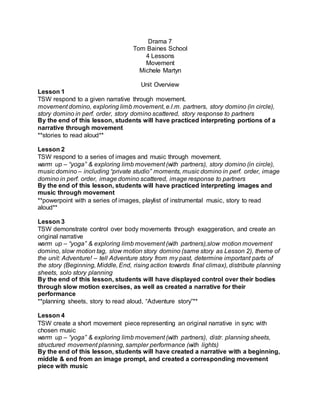
Drama 7 
Tom Baines School 
4 Lessons 
Movement 
Michele Martyn 
Unit Overview 
Lesson 1 
TSW respond to a given narrative through movement. 
movement domino, exploring limb movement, e.l.m. partners, story domino (in circle), 
story domino in perf. order, story domino scattered, story response to partners 
By the end of this lesson, students will have practiced interpreting portions of a 
narrative through movement 
**stories to read aloud** 
Lesson 2 
TSW respond to a series of images and music through movement. 
warm up – “yoga” & exploring limb movement (with partners), story domino (in circle), 
music domino – including “private studio” moments, music domino in perf. order, image 
domino in perf. order, image domino scattered, image response to partners 
By the end of this lesson, students will have practiced interpreting images and 
music through movement 
**powerpoint with a series of images, playlist of instrumental music, story to read 
aloud** 
Lesson 3 
TSW demonstrate control over body movements through exaggeration, and create an 
original narrative 
warm up – “yoga” & exploring limb movement (with partners),slow motion movement 
domino, slow motion tag, slow motion story domino (same story as Lesson 2), theme of 
the unit: Adventure! – tell Adventure story from my past, determine important parts of 
the story (Beginning, Middle, End, rising action towards final climax), distribute planning 
sheets, solo story planning 
By the end of this lesson, students will have displayed control over their bodies 
through slow motion exercises, as well as created a narrative for their 
performance 
**planning sheets, story to read aloud, “Adventure story”** 
Lesson 4 
TSW create a short movement piece representing an original narrative in sync with 
chosen music 
warm up – “yoga” & exploring limb movement (with partners), distr. planning sheets, 
structured movement planning, sampler performance (with lights) 
By the end of this lesson, students will have created a narrative with a beginning, 
middle & end from an image prompt, and created a corresponding movement 
piece with music
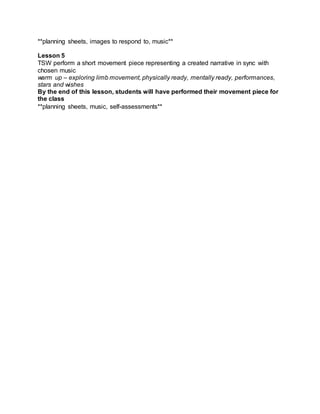
**planning sheets, images to respond to, music** 
Lesson 5 
TSW perform a short movement piece representing a created narrative in sync with 
chosen music 
warm up – exploring limb movement, physically ready, mentally ready, performances, 
stars and wishes 
By the end of this lesson, students will have performed their movement piece for 
the class 
**planning sheets, music, self-assessments**
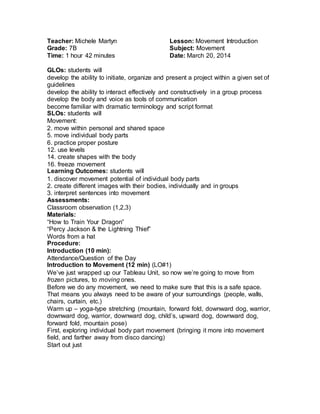
Teacher: Michele Martyn 
Grade: 7B 
Time: 1 hour 42 minutes 
Lesson: Movement Introduction 
Subject: Movement 
Date: March 20, 2014 
GLOs: students will 
develop the ability to initiate, organize and present a project within a given set of 
guidelines 
develop the ability to interact effectively and constructively in a group process 
develop the body and voice as tools of communication 
become familiar with dramatic terminology and script format 
SLOs: students will 
Movement: 
2. move within personal and shared space 
5. move individual body parts 
6. practice proper posture 
12. use levels 
14. create shapes with the body 
16. freeze movement 
Learning Outcomes: students will 
1. discover movement potential of individual body parts 
2. create different images with their bodies, individually and in groups 
3. interpret sentences into movement 
Assessments: 
Classroom observation (1,2,3) 
Materials: 
“How to Train Your Dragon” 
“Percy Jackson & the Lightning Thief” 
Words from a hat 
Procedure: 
Introduction (10 min): 
Attendance/Question of the Day 
Introduction to Movement (12 min) (LO#1) 
We’ve just wrapped up our Tableau Unit, so now we’re going to move from 
frozen pictures, to moving ones. 
Before we do any movement, we need to make sure that this is a safe space. 
That means you always need to be aware of your surroundings (people, walls, 
chairs, curtain, etc.) 
Warm up – yoga-type stretching (mountain, forward fold, downward dog, warrior, 
downward dog, warrior, downward dog, child’s, upward dog, downward dog, 
forward fold, mountain pose) 
First, exploring individual body part movement (bringing it more into movement 
field, and farther away from disco dancing) 
Start out just
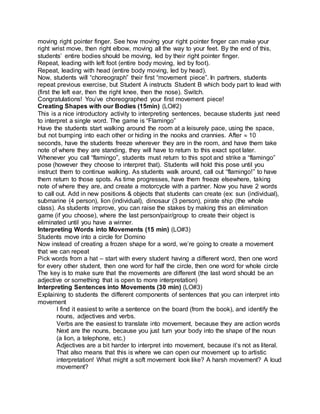
moving right pointer finger. See how moving your right pointer finger can make your 
right wrist move, then right elbow, moving all the way to your feet. By the end of this, 
students’ entire bodies should be moving, led by their right pointer finger. 
Repeat, leading with left foot (entire body moving, led by foot). 
Repeat, leading with head (entire body moving, led by head). 
Now, students will “choreograph” their first “movement piece”. In partners, students 
repeat previous exercise, but Student A instructs Student B which body part to lead with 
(first the left ear, then the right knee, then the nose). Switch. 
Congratulations! You’ve choreographed your first movement piece! 
Creating Shapes with our Bodies (15min) (LO#2) 
This is a nice introductory activity to interpreting sentences, because students just need 
to interpret a single word. The game is “Flamingo” 
Have the students start walking around the room at a leisurely pace, using the space, 
but not bumping into each other or hiding in the nooks and crannies. After  10 
seconds, have the students freeze wherever they are in the room, and have them take 
note of where they are standing, they will have to return to this exact spot later. 
Whenever you call “flamingo”, students must return to this spot and strike a “flamingo” 
pose (however they choose to interpret that). Students will hold this pose until you 
instruct them to continue walking. As students walk around, call out “flamingo!” to have 
them return to those spots. As time progresses, have them freeze elsewhere, taking 
note of where they are, and create a motorcycle with a partner. Now you have 2 words 
to call out. Add in new positions & objects that students can create (ex: sun (individual), 
submarine (4 person), lion (individual), dinosaur (3 person), pirate ship (the whole 
class). As students improve, you can raise the stakes by making this an elimination 
game (if you choose), where the last person/pair/group to create their object is 
eliminated until you have a winner. 
Interpreting Words into Movements (15 min) (LO#3) 
Students move into a circle for Domino 
Now instead of creating a frozen shape for a word, we’re going to create a movement 
that we can repeat 
Pick words from a hat – start with every student having a different word, then one word 
for every other student, then one word for half the circle, then one word for whole circle 
The key is to make sure that the movements are different (the last word should be an 
adjective or something that is open to more interpretation) 
Interpreting Sentences into Movements (30 min) (LO#3) 
Explaining to students the different components of sentences that you can interpret into 
movement 
I find it easiest to write a sentence on the board (from the book), and identify the 
nouns, adjectives and verbs. 
Verbs are the easiest to translate into movement, because they are action words 
Next are the nouns, because you just turn your body into the shape of the noun 
(a lion, a telephone, etc.) 
Adjectives are a bit harder to interpret into movement, because it’s not as literal. 
That also means that this is where we can open our movement up to artistic 
interpretation! What might a soft movement look like? A harsh movement? A loud 
movement?
Have students line up, facing SmartBoard. Each student will interpret one sentence into 
movement from the book, in order down the line. 
Begin with Domino action, getting everybody involved and paying attention to what 
other students are doing. 
Move on to students performing action down the line, without the repetition 
Students scattered throughout room performing in numbered order. 
Congratulations! This was the class’s first movement performance! 
Interpreting Music into Movements (19 min) 
Circle for Domino with Music (have playlist prepped) 
Another thing that inspires movement is music. 
When you’re listening to music, it may be fast or slow, smooth and connected or quick 
and disjointed, happy or sad or scary. Movement can show this. So whatever your 
movement is for the music, I should be able to tell what kind of song is being played just 
from watching your movement. 
Start with just one song per student. Move on to domino-domino-own thing. 
Try to get to where students are all just interpreting songs on their own without paying 
attention to what the other students in the class are doing/getting out of their bodies. 
Closure (5 min) 
What are the different ways that we moved our bodies today? 
What did we interpret into movement? 
What were the easy things to interpret? Was there anything that was difficult to 
interpret? 
Has anyone ever seen a movement performance before? (ex. mime, dance) 
After spring break, we’ll be creating our own movement pieces!
Teacher: Michele Martyn 
Grade: 7B 
Time: 62 minutes 
Lesson: Moving to Music 
Subject: Movement 
Date: April 2, 2014 
GLOs: students will 
Extend the ability to think imaginatively and creatively 
Develop the body and voice as tools of communication 
Become familiar with disciplines that enhance dramatic process 
SLOs: students will 
2. Demonstrate awareness of personal and shared space 
3. Use physical relaxation techniques effectively 
5. Move individual body parts 
7. Demonstrate awareness of his or her own body and its movement potential 
8. Display increased freedom of movement 
9. Travel through space in a variety of ways 
11. Use directions and pathways 
18. Create movement in response to music 
Learning Outcomes: students will 
move in response to various musical cues 
move their body in a variety of ways 
Materials: 
playlist 
Assessments: 
Classroom Observations 
Procedure: 
Introduction (10 min) 
Attendance/Question of the Day 
Warm Up (10 min) 
Stretch bodies (mountain-forward fold-downward dog-warrior-downward dog-warrior-downward 
dog-forward fold-mountain) 
Move individual body parts (finger, hand, arm, head, other arm, foot, leg, whole body) 
Move whole body around the room – don’t follow anyone, completely on your own (all 
your movements should be fluid and curved, nice and leisurely; moving quicker; sharp 
angles & straight lines; you weigh 400 lbs, carrying all that weight, your joints can barely 
hold up under the pressure; you’re an Olympic track star, light on your feet and quick to 
move; you’ve been wandering the desert for 4 and a half days, you haven’t had 
anything to eat or drink, you haven’t seen anyone) 
Moving to Music (35 min) 
Have the students sit down, spread out around the room. Have all students close their 
eyes, play the first song. Have students just listen to the first 15 seconds of the first 
song. Pause song, have students stand up. Students will need to move across the room 
as inspired by the song – Start song, when all students have moved across the room, 
change songs. Give five seconds to listen, then have students move. (10 min) 
Have students standing off stage left and right. Play song, have students move onstage 
one at a time as inspired by song (lined up, once the person ahead of them reaches CS, 
they can begin to move onstage)
Repeat with different song (different vibe) (10 min) 
Students in groups of 3-4. All students will be using the same music as inspiration. One 
student to enter onstage at a time, remaining on stage until each performer is onstage. 
All your movements should relate to each other (not repetitive, just related). Each 
student to exit stage one at a time. Constant movement onstage, only noise is the 
music. Should only be approx. 45 seconds (tops) 
Show performances, stars & wishes. 
Repeat with different song, different vibe (15 min) 
Closure (7 min) 
Play calming song 
Have students find own spot in the room & lie down 
Breathe in & out 
Why are we doing this? (relaxation techniques, calming ourselves down, preparing to 
move to next class) 
What kinds of things did we do in class? 
Why were we doing those exercises? What were we learning?
Teacher Michele Martyn 
Grade 7B 
Time 1 hour 42 minutes 
Lesson Images & Pre-Production 
Subject Movement 
Date April 7, 2014 
GLOs students will 
Extend the ability to think imaginatively and creatively 
Develop the body and voice as tools of communication 
Become familiar with disciplines that enhance dramatic process 
Develop the ability to initiate, organize and present a project within a given set of 
guidelines 
Develop the ability to interact effectively and constructively in a group process 
SLOs students will 
Movement 
2. Demonstrate awareness of personal and shared space. 
3. Use physical relaxation techniques effectively. 
4. Recognize the need for and demonstrate warmup activities. 
5. Move individual body parts. 
6. Use proper posture. 
7. Demonstrate awareness of his or her own body and its movement potential. 
8. Display increased freedom of movement. 
9. Travel through space in a variety of ways; e.g., running, creeping and jumping. 
10. Use varying speed of movement. 
11. Use directions and pathways. 
12. Use levels. 
13. Control focus and energy in movement and gesture. 
17. Use movement to communicate non-verbally. 
18. Create movement in response to music. 
19. Translate sounds, words, images, and emotions into movement. 
Learning Outcomes students will 
respond to images through movement 
display control of their bodies through exaggerated movement (slow motion) 
create an original narrative 
Materials 
movement powerpoint 
playlist of instrumental music 
Movement Narrative worksheet 
Movement Performance Rubric 
Shadow Theatre video 
Assessments 
Classroom Observation 
Narrative worksheet 
Procedure 
Introduction (5 min) 
Attendance/Question of the Day 
Warm Up (10 min) 
Stretch bodies (mountain-forward fold-downward dog-warrior-downward dog-warrior-downward 
dog-forward fold-mountain) why is warming up important?
Move individual body parts (finger, hand, arm, head, other arm, foot, leg, whole body) 
Today we’re going to be in the Actor’s Studio. – difference between studio & stage is the 
lack of audience. We’re not performing for anyone, we’re not giving anyone an 
audience, we’re just working on our own. The studio is a safe space to explore. 
Move whole body around the room – don’t follow anyone, completely on your own (all 
your movements should be fluid and curved, nice and leisurely; moving quicker; sharp 
angles & straight lines; you weigh 400 lbs, carrying all that weight, your joints can barely 
hold up under the pressure; you’re an Olympic track star, light on your feet and quick to 
move; you’ve been wandering the desert for 4 and a half days, you haven’t had 
anything to eat or drink, you haven’t seen anyone) Sidecoaching – slow motion for each 
Have students standing off stage left and right. Play song, have students move onstage 
one at a time as inspired by song (lined up, once the person ahead of them reaches CS, 
they can begin to move onstage) 
Repeat with different song (different vibe) 
Images (35 min) (LO#1) 
Bring first powerpoint image up. 
What is this an image of? What is the character doing? How is the character feeling? 
What is the character’s name? Is the character going somewhere? What happened right 
before this picture was taken? What happened right after this picture was taken? (Get 
some answers aloud from students) (3 min) 
Have students stand up (still spread out around the room). 
Show second image (should still be a single character image). 
Think in your head…(same questions as above) (2 min) 
Now show me what this character was doing right before the photo was taken. Now 
move through the moment that the picture was taken to what happened right after the 
picture was taken. (2 min) 
REMAINDER OF EXERCISES IN SLOW MOTION (LO#2) 
Show third image (should still be a single character image), repeat steps. (4 min) 
Repeat with single character images until students seem to understand the exercise. 
Stretch/Shake it out, walk around the room. Grab a partner (whoever is closest) (1 min) 
Show first 2-character image. In your partners, decide what is going on in the picture, 
what happened right before the picture was taken, and what happened right after the 
picture was taken. (2 min) 
Show me the progression. (30 seconds) 
Switch partners up, show second image. You only get one minute to decide what the 
progression is. Show me. (2 min) 
Switch partners. No more talking. Show third image. Give time for students to practice 
progression, then show progression. 
Repeat as effective. (3 min) 
Stretch/Shake it out, walk around the room. Groups of 3 
Show first 3 character image, decide what’s going on. (2 min) 
Show me the progression. (30 seconds) 
Switch groups, show second image. Only one minute to decide what’s going on. Show 
me. (2 min) 
Switch groups, no talking. Show third image. Give time to practice, then perform. 
Repeat as effective. (4 min)
Stretch/Shake it out, walk around the room. Groups of 4. 
Show first 4 character image. We’re still not talking. Figure out as a group what’s going 
on, and show me. 
These ones should be performed for class, stars & wishes. Repeat as effective. (7 min) 
Relax for Story Time (17 min) 
Have students find their own space in the room. Lie down. Make sure you’re 
comfortable, (students may need to straighten out/bend legs). Close your eyes. Breathe 
in, breathe out. Tighten every part of body, one by one. Now let go. Let all the tension 
seep out of your body into the floor. Feel your body sinking into the floor. Students to sit 
up when ready. (7 min) 
Have students gather for story time – Angela’s Airplane (5 min) 
Go through story plan as a class, with book as example. (Beginning/normal, Initial 
Incident/something happened, Rising Action/Gets Worse, Climax/I couldn’t believe it, 
Resolution/All was well). 
Movement Performance Prep (32 min) 
Put in groups of 3 for Projects, give them planning sheet & rubric. Write on board the 10 
things we’re looking for. Have students begin writing their stories. Give them 6 minutes 
to work on story, then begin planning out movement. Check on story progress as a 
class (What’s your group’s beginning? Initial Incident? etc.) 
Allow them 8 minutes to work on movement 
Show Shadow Theatre video (3 minute) as example of ways to create shapes with our 
bodies in a movement piece – we won’t be using shadows, but you can see how it 
works 
Try and create at least one moment like the ones we saw in the video. 
Continue work, making sure students are writing down choreography. 
As students are working, pull aside one group at a time to choose music (thinking about 
mood & story) 
Showcasing excellent moments (getting students to recognize) 
Show me one moment where you’re creating a shape with your bodies (not a person, 
more than one performer involved) 
Closure (5 min) 
Repeat relaxation exercise. 
Students sitting up: what kinds of activities did we do in class today? why do you think 
we were doing them? why is relaxation important?
Teacher Michele Martyn 
Grade 7B 
Time 1 hour 42 minutes 
Lesson Movement Planning 
Subject Movement 
Date April 10, 2014 
GLOs students will 
Extend the ability to think imaginatively and creatively 
Develop the body and voice as tools of communication 
Become familiar with disciplines that enhance dramatic process 
Develop the ability to initiate, organize and present a project within a given set of 
guidelines 
Develop the ability to interact effectively and constructively in a group process 
SLOs students will 
Movement 
2. Demonstrate awareness of personal and shared space. 
3. Use physical relaxation techniques effectively. 
4. Recognize the need for and demonstrate warmup activities. 
5. Move individual body parts. 
6. Use proper posture. 
7. Demonstrate awareness of his or her own body and its movement potential. 
8. Display increased freedom of movement. 
9. Travel through space in a variety of ways; e.g., running, creeping and jumping. 
10. Use varying speed of movement. 
11. Use directions and pathways. 
12. Use levels. 
13. Control focus and energy in movement and gesture. 
17. Use movement to communicate non-verbally. 
18. Create movement in response to music. 
19. Translate sounds, words, images, and emotions into movement. 
Learning Outcomes students will 
create an original narrative & communicate it non-verbally 
Materials 
Planning Sheets 
Rubrics 
Empress of Ireland story – picture & music 
Assessments 
Observation 
Planning Sheets 
Procedure 
Introduction (10 min) 
Attendance/Question of the Day 
Warm Up (15 min) 
Stretch bodies (mountain-forward fold-downward dog-warrior-downward dog-warrior-downward 
dog-forward fold-mountain) why is warming up important? 
Move individual body parts (finger, hand, arm, head, other arm, foot, leg, whole body) 
Today we’re going to be in the Actor’s Studio. – difference between studio & stage is the 
lack of audience. We’re not performing for anyone, we’re not giving anyone an 
audience, we’re just working on our own. The studio is a safe space to explore.
- Slow Motion – 
Move whole body around the room – don’t follow anyone, completely on your own (all 
your movements should be fluid and curved, nice and leisurely; moving quicker; sharp 
angles & straight lines; you weigh 400 lbs, carrying all that weight, your joints can barely 
hold up under the pressure; you’re an Olympic track star, light on your feet and quick to 
move; you’ve been wandering the desert for 4 and a half days, you haven’t had 
anything to eat or drink, you haven’t seen anyone) Sidecoaching – slow motion for each 
Have students standing off stage left and right. Play song, have students move onstage 
one at a time as inspired by song (lined up, once the person ahead of them reaches CS, 
they can begin to move onstage) 
Repeat with different song (different vibe) 
Story Time & Rubric (15 min) 
Have students gather for story time – The Empress of Ireland (5 min) 
What were the different parts of this story? 
Go over rubric as a class – what would all of these look like? (Exemplary – everyone in 
the group shows understanding of concept, Proficient – two of you get it, Satisfactory – 
one of you gets it, Limited – you’re all there, but you don’t get it, Experiencing Difficulty 
– you haven’t shown me any evidence of this) 
Rehearsals (60 min) 
Give students time to finish writing their stories, begin planning movement (5 min) 
Have students begin working through first beat, second beat, third, fourth, final. 
As students have story planned and begin planning movement, call groups up one by 
one to begin choosing music (what kind of a feel are you looking for, do you have 
anything in mind?) (should take about 20 min in total) Have students write title of song 
on planning sheet 
Have students begin running their performances, showing exemplary moments. 
Are there any more moments where you can create images with your bodies onstage? 
What about different speeds or types of movement to emphasize a moment? (10 min) 
Let’s run through in slow motion. Go as slow as you can, really think about everything 
your body is doing. (10 min) 
Pair groups up, show scenes to each other. Tell the group what you think their story 
was, do stars & wishes (15 min) 
Closure (4 min) 
Next class we’re going to be performing these pieces. What do we need to do in order 
to be prepared for that? (Blacks/Music if they are bringing it)
Teacher Michele Martyn 
Grade 7B 
Time 1 hour 42 minutes 
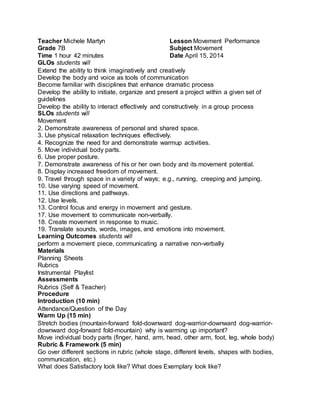
Lesson Movement Performance 
Subject Movement 
Date April 15, 2014 
GLOs students will 
Extend the ability to think imaginatively and creatively 
Develop the body and voice as tools of communication 
Become familiar with disciplines that enhance dramatic process 
Develop the ability to initiate, organize and present a project within a given set of 
guidelines 
Develop the ability to interact effectively and constructively in a group process 
SLOs students will 
Movement 
2. Demonstrate awareness of personal and shared space. 
3. Use physical relaxation techniques effectively. 
4. Recognize the need for and demonstrate warmup activities. 
5. Move individual body parts. 
6. Use proper posture. 
7. Demonstrate awareness of his or her own body and its movement potential. 
8. Display increased freedom of movement. 
9. Travel through space in a variety of ways; e.g., running, creeping and jumping. 
10. Use varying speed of movement. 
11. Use directions and pathways. 
12. Use levels. 
13. Control focus and energy in movement and gesture. 
17. Use movement to communicate non-verbally. 
18. Create movement in response to music. 
19. Translate sounds, words, images, and emotions into movement. 
Learning Outcomes students will 
perform a movement piece, communicating a narrative non-verbally 
Materials 
Planning Sheets 
Rubrics 
Instrumental Playlist 
Assessments 
Rubrics (Self & Teacher) 
Procedure 
Introduction (10 min) 
Attendance/Question of the Day 
Warm Up (15 min) 
Stretch bodies (mountain-forward fold-downward dog-warrior-downward dog-warrior-downward 
dog-forward fold-mountain) why is warming up important? 
Move individual body parts (finger, hand, arm, head, other arm, foot, leg, whole body) 
Rubric & Framework (5 min) 
Go over different sections in rubric (whole stage, different levels, shapes with bodies, 
communication, etc.) 
What does Satisfactory look like? What does Exemplary look like?
Order for performance (House lights down, stage lights up, music up, entrance, title 
tableau, starting positions, performance, freeze, curtain call, exit, stage lights down, 
house lights up, music down) 
Title Tableau (5 min) 
Give students opportunity to rehearse title tableau 
Rehearsals (25 min) 
1. Groups run through performance regularly (refresher) 
2. Groups run through performance in slow motion (why would I have you go through 
perf in slow motion?) 
3. Begin playing the different songs for each group, announcing which group’s song is 
playing, so that students can have a rehearsal with their music. 
Students should have run through performances multiple times by this point. 
Mentally Ready (5 min) 
Now that you’re physically ready, let’s get ourselves mentally ready. What are some 
techniques that we’ve used before to get ourselves focused and relaxed? (breathing, 
lying down, visualizing the performance) 
Go through those exercises. –Start with students lying down, eyes closed. Tensing up 
every muscle, then releasing. Letting all the tension float into the floor. Breathing in & 
out. Visualize the performance. Tell the story in your head. 
Performances (40 min) – gives about 5 min to each group 
Groups to perform 
Go over audience behaviour & reminder of things we’re looking for 
Stars & Wishes & Self-Reflections 
Closure (2 min) 
This was my last class with you! Excellent job with the movement unit!
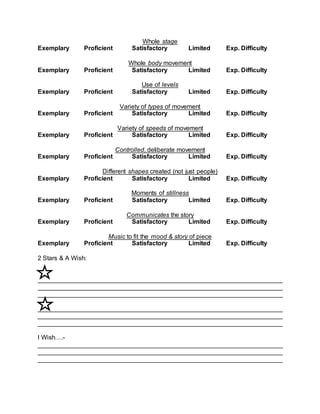
Whole stage 
Exemplary Proficient Satisfactory Limited Exp. Difficulty 
Whole body movement 
Exemplary Proficient Satisfactory Limited Exp. Difficulty 
Use of levels 
Exemplary Proficient Satisfactory Limited Exp. Difficulty 
Variety of types of movement 
Exemplary Proficient Satisfactory Limited Exp. Difficulty 
Variety of speeds of movement 
Exemplary Proficient Satisfactory Limited Exp. Difficulty 
Controlled, deliberate movement 
Exemplary Proficient Satisfactory Limited Exp. Difficulty 
Different shapes created (not just people) 
Exemplary Proficient Satisfactory Limited Exp. Difficulty 
Moments of stillness 
Exemplary Proficient Satisfactory Limited Exp. Difficulty 
Communicates the story 
Exemplary Proficient Satisfactory Limited Exp. Difficulty 
Music to fit the mood & story of piece 
Exemplary Proficient Satisfactory Limited Exp. Difficulty 
2 Stars & A Wish: 
______________________________________________________________________ 
______________________________________________________________________ 
______________________________________________________________________ 
______________________________________________________________________ 
______________________________________________________________________ 
______________________________________________________________________ 
I Wish….- 
______________________________________________________________________ 
______________________________________________________________________ 
______________________________________________________________________
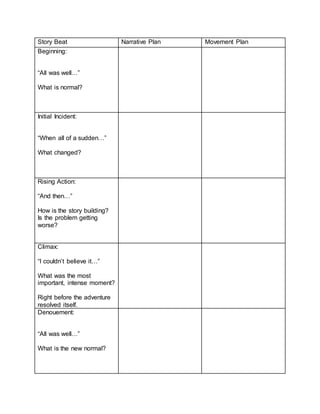
Story Beat Narrative Plan Movement Plan 
Beginning: 
“All was well…” 
What is normal? 
Initial Incident: 
“When all of a sudden…” 
What changed? 
Rising Action: 
“And then…” 
How is the story building? 
Is the problem getting 
worse? 
Climax: 
“I couldn’t believe it…” 
What was the most 
important, intense moment? 
Right before the adventure 
resolved itself. 
Denouement: 
“All was well…” 
What is the new normal?
Grade 7 Movement Unit (Drama)

Grade 7 Movement Unit (Drama)

  • 1.
    Drama 7 TomBaines School 4 Lessons Movement Michele Martyn Unit Overview Lesson 1 TSW respond to a given narrative through movement. movement domino, exploring limb movement, e.l.m. partners, story domino (in circle), story domino in perf. order, story domino scattered, story response to partners By the end of this lesson, students will have practiced interpreting portions of a narrative through movement **stories to read aloud** Lesson 2 TSW respond to a series of images and music through movement. warm up – “yoga” & exploring limb movement (with partners), story domino (in circle), music domino – including “private studio” moments, music domino in perf. order, image domino in perf. order, image domino scattered, image response to partners By the end of this lesson, students will have practiced interpreting images and music through movement **powerpoint with a series of images, playlist of instrumental music, story to read aloud** Lesson 3 TSW demonstrate control over body movements through exaggeration, and create an original narrative warm up – “yoga” & exploring limb movement (with partners),slow motion movement domino, slow motion tag, slow motion story domino (same story as Lesson 2), theme of the unit: Adventure! – tell Adventure story from my past, determine important parts of the story (Beginning, Middle, End, rising action towards final climax), distribute planning sheets, solo story planning By the end of this lesson, students will have displayed control over their bodies through slow motion exercises, as well as created a narrative for their performance **planning sheets, story to read aloud, “Adventure story”** Lesson 4 TSW create a short movement piece representing an original narrative in sync with chosen music warm up – “yoga” & exploring limb movement (with partners), distr. planning sheets, structured movement planning, sampler performance (with lights) By the end of this lesson, students will have created a narrative with a beginning, middle & end from an image prompt, and created a corresponding movement piece with music
  • 2.
    **planning sheets, imagesto respond to, music** Lesson 5 TSW perform a short movement piece representing a created narrative in sync with chosen music warm up – exploring limb movement, physically ready, mentally ready, performances, stars and wishes By the end of this lesson, students will have performed their movement piece for the class **planning sheets, music, self-assessments**
  • 3.
    Teacher: Michele Martyn Grade: 7B Time: 1 hour 42 minutes Lesson: Movement Introduction Subject: Movement Date: March 20, 2014 GLOs: students will develop the ability to initiate, organize and present a project within a given set of guidelines develop the ability to interact effectively and constructively in a group process develop the body and voice as tools of communication become familiar with dramatic terminology and script format SLOs: students will Movement: 2. move within personal and shared space 5. move individual body parts 6. practice proper posture 12. use levels 14. create shapes with the body 16. freeze movement Learning Outcomes: students will 1. discover movement potential of individual body parts 2. create different images with their bodies, individually and in groups 3. interpret sentences into movement Assessments: Classroom observation (1,2,3) Materials: “How to Train Your Dragon” “Percy Jackson & the Lightning Thief” Words from a hat Procedure: Introduction (10 min): Attendance/Question of the Day Introduction to Movement (12 min) (LO#1) We’ve just wrapped up our Tableau Unit, so now we’re going to move from frozen pictures, to moving ones. Before we do any movement, we need to make sure that this is a safe space. That means you always need to be aware of your surroundings (people, walls, chairs, curtain, etc.) Warm up – yoga-type stretching (mountain, forward fold, downward dog, warrior, downward dog, warrior, downward dog, child’s, upward dog, downward dog, forward fold, mountain pose) First, exploring individual body part movement (bringing it more into movement field, and farther away from disco dancing) Start out just
  • 4.
    moving right pointerfinger. See how moving your right pointer finger can make your right wrist move, then right elbow, moving all the way to your feet. By the end of this, students’ entire bodies should be moving, led by their right pointer finger. Repeat, leading with left foot (entire body moving, led by foot). Repeat, leading with head (entire body moving, led by head). Now, students will “choreograph” their first “movement piece”. In partners, students repeat previous exercise, but Student A instructs Student B which body part to lead with (first the left ear, then the right knee, then the nose). Switch. Congratulations! You’ve choreographed your first movement piece! Creating Shapes with our Bodies (15min) (LO#2) This is a nice introductory activity to interpreting sentences, because students just need to interpret a single word. The game is “Flamingo” Have the students start walking around the room at a leisurely pace, using the space, but not bumping into each other or hiding in the nooks and crannies. After  10 seconds, have the students freeze wherever they are in the room, and have them take note of where they are standing, they will have to return to this exact spot later. Whenever you call “flamingo”, students must return to this spot and strike a “flamingo” pose (however they choose to interpret that). Students will hold this pose until you instruct them to continue walking. As students walk around, call out “flamingo!” to have them return to those spots. As time progresses, have them freeze elsewhere, taking note of where they are, and create a motorcycle with a partner. Now you have 2 words to call out. Add in new positions & objects that students can create (ex: sun (individual), submarine (4 person), lion (individual), dinosaur (3 person), pirate ship (the whole class). As students improve, you can raise the stakes by making this an elimination game (if you choose), where the last person/pair/group to create their object is eliminated until you have a winner. Interpreting Words into Movements (15 min) (LO#3) Students move into a circle for Domino Now instead of creating a frozen shape for a word, we’re going to create a movement that we can repeat Pick words from a hat – start with every student having a different word, then one word for every other student, then one word for half the circle, then one word for whole circle The key is to make sure that the movements are different (the last word should be an adjective or something that is open to more interpretation) Interpreting Sentences into Movements (30 min) (LO#3) Explaining to students the different components of sentences that you can interpret into movement I find it easiest to write a sentence on the board (from the book), and identify the nouns, adjectives and verbs. Verbs are the easiest to translate into movement, because they are action words Next are the nouns, because you just turn your body into the shape of the noun (a lion, a telephone, etc.) Adjectives are a bit harder to interpret into movement, because it’s not as literal. That also means that this is where we can open our movement up to artistic interpretation! What might a soft movement look like? A harsh movement? A loud movement?
  • 5.
    Have students lineup, facing SmartBoard. Each student will interpret one sentence into movement from the book, in order down the line. Begin with Domino action, getting everybody involved and paying attention to what other students are doing. Move on to students performing action down the line, without the repetition Students scattered throughout room performing in numbered order. Congratulations! This was the class’s first movement performance! Interpreting Music into Movements (19 min) Circle for Domino with Music (have playlist prepped) Another thing that inspires movement is music. When you’re listening to music, it may be fast or slow, smooth and connected or quick and disjointed, happy or sad or scary. Movement can show this. So whatever your movement is for the music, I should be able to tell what kind of song is being played just from watching your movement. Start with just one song per student. Move on to domino-domino-own thing. Try to get to where students are all just interpreting songs on their own without paying attention to what the other students in the class are doing/getting out of their bodies. Closure (5 min) What are the different ways that we moved our bodies today? What did we interpret into movement? What were the easy things to interpret? Was there anything that was difficult to interpret? Has anyone ever seen a movement performance before? (ex. mime, dance) After spring break, we’ll be creating our own movement pieces!
  • 6.
    Teacher: Michele Martyn Grade: 7B Time: 62 minutes Lesson: Moving to Music Subject: Movement Date: April 2, 2014 GLOs: students will Extend the ability to think imaginatively and creatively Develop the body and voice as tools of communication Become familiar with disciplines that enhance dramatic process SLOs: students will 2. Demonstrate awareness of personal and shared space 3. Use physical relaxation techniques effectively 5. Move individual body parts 7. Demonstrate awareness of his or her own body and its movement potential 8. Display increased freedom of movement 9. Travel through space in a variety of ways 11. Use directions and pathways 18. Create movement in response to music Learning Outcomes: students will move in response to various musical cues move their body in a variety of ways Materials: playlist Assessments: Classroom Observations Procedure: Introduction (10 min) Attendance/Question of the Day Warm Up (10 min) Stretch bodies (mountain-forward fold-downward dog-warrior-downward dog-warrior-downward dog-forward fold-mountain) Move individual body parts (finger, hand, arm, head, other arm, foot, leg, whole body) Move whole body around the room – don’t follow anyone, completely on your own (all your movements should be fluid and curved, nice and leisurely; moving quicker; sharp angles & straight lines; you weigh 400 lbs, carrying all that weight, your joints can barely hold up under the pressure; you’re an Olympic track star, light on your feet and quick to move; you’ve been wandering the desert for 4 and a half days, you haven’t had anything to eat or drink, you haven’t seen anyone) Moving to Music (35 min) Have the students sit down, spread out around the room. Have all students close their eyes, play the first song. Have students just listen to the first 15 seconds of the first song. Pause song, have students stand up. Students will need to move across the room as inspired by the song – Start song, when all students have moved across the room, change songs. Give five seconds to listen, then have students move. (10 min) Have students standing off stage left and right. Play song, have students move onstage one at a time as inspired by song (lined up, once the person ahead of them reaches CS, they can begin to move onstage)
  • 7.
    Repeat with differentsong (different vibe) (10 min) Students in groups of 3-4. All students will be using the same music as inspiration. One student to enter onstage at a time, remaining on stage until each performer is onstage. All your movements should relate to each other (not repetitive, just related). Each student to exit stage one at a time. Constant movement onstage, only noise is the music. Should only be approx. 45 seconds (tops) Show performances, stars & wishes. Repeat with different song, different vibe (15 min) Closure (7 min) Play calming song Have students find own spot in the room & lie down Breathe in & out Why are we doing this? (relaxation techniques, calming ourselves down, preparing to move to next class) What kinds of things did we do in class? Why were we doing those exercises? What were we learning?
  • 8.
    Teacher Michele Martyn Grade 7B Time 1 hour 42 minutes Lesson Images & Pre-Production Subject Movement Date April 7, 2014 GLOs students will Extend the ability to think imaginatively and creatively Develop the body and voice as tools of communication Become familiar with disciplines that enhance dramatic process Develop the ability to initiate, organize and present a project within a given set of guidelines Develop the ability to interact effectively and constructively in a group process SLOs students will Movement 2. Demonstrate awareness of personal and shared space. 3. Use physical relaxation techniques effectively. 4. Recognize the need for and demonstrate warmup activities. 5. Move individual body parts. 6. Use proper posture. 7. Demonstrate awareness of his or her own body and its movement potential. 8. Display increased freedom of movement. 9. Travel through space in a variety of ways; e.g., running, creeping and jumping. 10. Use varying speed of movement. 11. Use directions and pathways. 12. Use levels. 13. Control focus and energy in movement and gesture. 17. Use movement to communicate non-verbally. 18. Create movement in response to music. 19. Translate sounds, words, images, and emotions into movement. Learning Outcomes students will respond to images through movement display control of their bodies through exaggerated movement (slow motion) create an original narrative Materials movement powerpoint playlist of instrumental music Movement Narrative worksheet Movement Performance Rubric Shadow Theatre video Assessments Classroom Observation Narrative worksheet Procedure Introduction (5 min) Attendance/Question of the Day Warm Up (10 min) Stretch bodies (mountain-forward fold-downward dog-warrior-downward dog-warrior-downward dog-forward fold-mountain) why is warming up important?
  • 9.
    Move individual bodyparts (finger, hand, arm, head, other arm, foot, leg, whole body) Today we’re going to be in the Actor’s Studio. – difference between studio & stage is the lack of audience. We’re not performing for anyone, we’re not giving anyone an audience, we’re just working on our own. The studio is a safe space to explore. Move whole body around the room – don’t follow anyone, completely on your own (all your movements should be fluid and curved, nice and leisurely; moving quicker; sharp angles & straight lines; you weigh 400 lbs, carrying all that weight, your joints can barely hold up under the pressure; you’re an Olympic track star, light on your feet and quick to move; you’ve been wandering the desert for 4 and a half days, you haven’t had anything to eat or drink, you haven’t seen anyone) Sidecoaching – slow motion for each Have students standing off stage left and right. Play song, have students move onstage one at a time as inspired by song (lined up, once the person ahead of them reaches CS, they can begin to move onstage) Repeat with different song (different vibe) Images (35 min) (LO#1) Bring first powerpoint image up. What is this an image of? What is the character doing? How is the character feeling? What is the character’s name? Is the character going somewhere? What happened right before this picture was taken? What happened right after this picture was taken? (Get some answers aloud from students) (3 min) Have students stand up (still spread out around the room). Show second image (should still be a single character image). Think in your head…(same questions as above) (2 min) Now show me what this character was doing right before the photo was taken. Now move through the moment that the picture was taken to what happened right after the picture was taken. (2 min) REMAINDER OF EXERCISES IN SLOW MOTION (LO#2) Show third image (should still be a single character image), repeat steps. (4 min) Repeat with single character images until students seem to understand the exercise. Stretch/Shake it out, walk around the room. Grab a partner (whoever is closest) (1 min) Show first 2-character image. In your partners, decide what is going on in the picture, what happened right before the picture was taken, and what happened right after the picture was taken. (2 min) Show me the progression. (30 seconds) Switch partners up, show second image. You only get one minute to decide what the progression is. Show me. (2 min) Switch partners. No more talking. Show third image. Give time for students to practice progression, then show progression. Repeat as effective. (3 min) Stretch/Shake it out, walk around the room. Groups of 3 Show first 3 character image, decide what’s going on. (2 min) Show me the progression. (30 seconds) Switch groups, show second image. Only one minute to decide what’s going on. Show me. (2 min) Switch groups, no talking. Show third image. Give time to practice, then perform. Repeat as effective. (4 min)
  • 10.
    Stretch/Shake it out,walk around the room. Groups of 4. Show first 4 character image. We’re still not talking. Figure out as a group what’s going on, and show me. These ones should be performed for class, stars & wishes. Repeat as effective. (7 min) Relax for Story Time (17 min) Have students find their own space in the room. Lie down. Make sure you’re comfortable, (students may need to straighten out/bend legs). Close your eyes. Breathe in, breathe out. Tighten every part of body, one by one. Now let go. Let all the tension seep out of your body into the floor. Feel your body sinking into the floor. Students to sit up when ready. (7 min) Have students gather for story time – Angela’s Airplane (5 min) Go through story plan as a class, with book as example. (Beginning/normal, Initial Incident/something happened, Rising Action/Gets Worse, Climax/I couldn’t believe it, Resolution/All was well). Movement Performance Prep (32 min) Put in groups of 3 for Projects, give them planning sheet & rubric. Write on board the 10 things we’re looking for. Have students begin writing their stories. Give them 6 minutes to work on story, then begin planning out movement. Check on story progress as a class (What’s your group’s beginning? Initial Incident? etc.) Allow them 8 minutes to work on movement Show Shadow Theatre video (3 minute) as example of ways to create shapes with our bodies in a movement piece – we won’t be using shadows, but you can see how it works Try and create at least one moment like the ones we saw in the video. Continue work, making sure students are writing down choreography. As students are working, pull aside one group at a time to choose music (thinking about mood & story) Showcasing excellent moments (getting students to recognize) Show me one moment where you’re creating a shape with your bodies (not a person, more than one performer involved) Closure (5 min) Repeat relaxation exercise. Students sitting up: what kinds of activities did we do in class today? why do you think we were doing them? why is relaxation important?
  • 11.
    Teacher Michele Martyn Grade 7B Time 1 hour 42 minutes Lesson Movement Planning Subject Movement Date April 10, 2014 GLOs students will Extend the ability to think imaginatively and creatively Develop the body and voice as tools of communication Become familiar with disciplines that enhance dramatic process Develop the ability to initiate, organize and present a project within a given set of guidelines Develop the ability to interact effectively and constructively in a group process SLOs students will Movement 2. Demonstrate awareness of personal and shared space. 3. Use physical relaxation techniques effectively. 4. Recognize the need for and demonstrate warmup activities. 5. Move individual body parts. 6. Use proper posture. 7. Demonstrate awareness of his or her own body and its movement potential. 8. Display increased freedom of movement. 9. Travel through space in a variety of ways; e.g., running, creeping and jumping. 10. Use varying speed of movement. 11. Use directions and pathways. 12. Use levels. 13. Control focus and energy in movement and gesture. 17. Use movement to communicate non-verbally. 18. Create movement in response to music. 19. Translate sounds, words, images, and emotions into movement. Learning Outcomes students will create an original narrative & communicate it non-verbally Materials Planning Sheets Rubrics Empress of Ireland story – picture & music Assessments Observation Planning Sheets Procedure Introduction (10 min) Attendance/Question of the Day Warm Up (15 min) Stretch bodies (mountain-forward fold-downward dog-warrior-downward dog-warrior-downward dog-forward fold-mountain) why is warming up important? Move individual body parts (finger, hand, arm, head, other arm, foot, leg, whole body) Today we’re going to be in the Actor’s Studio. – difference between studio & stage is the lack of audience. We’re not performing for anyone, we’re not giving anyone an audience, we’re just working on our own. The studio is a safe space to explore.
  • 12.
    - Slow Motion– Move whole body around the room – don’t follow anyone, completely on your own (all your movements should be fluid and curved, nice and leisurely; moving quicker; sharp angles & straight lines; you weigh 400 lbs, carrying all that weight, your joints can barely hold up under the pressure; you’re an Olympic track star, light on your feet and quick to move; you’ve been wandering the desert for 4 and a half days, you haven’t had anything to eat or drink, you haven’t seen anyone) Sidecoaching – slow motion for each Have students standing off stage left and right. Play song, have students move onstage one at a time as inspired by song (lined up, once the person ahead of them reaches CS, they can begin to move onstage) Repeat with different song (different vibe) Story Time & Rubric (15 min) Have students gather for story time – The Empress of Ireland (5 min) What were the different parts of this story? Go over rubric as a class – what would all of these look like? (Exemplary – everyone in the group shows understanding of concept, Proficient – two of you get it, Satisfactory – one of you gets it, Limited – you’re all there, but you don’t get it, Experiencing Difficulty – you haven’t shown me any evidence of this) Rehearsals (60 min) Give students time to finish writing their stories, begin planning movement (5 min) Have students begin working through first beat, second beat, third, fourth, final. As students have story planned and begin planning movement, call groups up one by one to begin choosing music (what kind of a feel are you looking for, do you have anything in mind?) (should take about 20 min in total) Have students write title of song on planning sheet Have students begin running their performances, showing exemplary moments. Are there any more moments where you can create images with your bodies onstage? What about different speeds or types of movement to emphasize a moment? (10 min) Let’s run through in slow motion. Go as slow as you can, really think about everything your body is doing. (10 min) Pair groups up, show scenes to each other. Tell the group what you think their story was, do stars & wishes (15 min) Closure (4 min) Next class we’re going to be performing these pieces. What do we need to do in order to be prepared for that? (Blacks/Music if they are bringing it)
  • 13.
    Teacher Michele Martyn Grade 7B Time 1 hour 42 minutes Lesson Movement Performance Subject Movement Date April 15, 2014 GLOs students will Extend the ability to think imaginatively and creatively Develop the body and voice as tools of communication Become familiar with disciplines that enhance dramatic process Develop the ability to initiate, organize and present a project within a given set of guidelines Develop the ability to interact effectively and constructively in a group process SLOs students will Movement 2. Demonstrate awareness of personal and shared space. 3. Use physical relaxation techniques effectively. 4. Recognize the need for and demonstrate warmup activities. 5. Move individual body parts. 6. Use proper posture. 7. Demonstrate awareness of his or her own body and its movement potential. 8. Display increased freedom of movement. 9. Travel through space in a variety of ways; e.g., running, creeping and jumping. 10. Use varying speed of movement. 11. Use directions and pathways. 12. Use levels. 13. Control focus and energy in movement and gesture. 17. Use movement to communicate non-verbally. 18. Create movement in response to music. 19. Translate sounds, words, images, and emotions into movement. Learning Outcomes students will perform a movement piece, communicating a narrative non-verbally Materials Planning Sheets Rubrics Instrumental Playlist Assessments Rubrics (Self & Teacher) Procedure Introduction (10 min) Attendance/Question of the Day Warm Up (15 min) Stretch bodies (mountain-forward fold-downward dog-warrior-downward dog-warrior-downward dog-forward fold-mountain) why is warming up important? Move individual body parts (finger, hand, arm, head, other arm, foot, leg, whole body) Rubric & Framework (5 min) Go over different sections in rubric (whole stage, different levels, shapes with bodies, communication, etc.) What does Satisfactory look like? What does Exemplary look like?
  • 14.
    Order for performance(House lights down, stage lights up, music up, entrance, title tableau, starting positions, performance, freeze, curtain call, exit, stage lights down, house lights up, music down) Title Tableau (5 min) Give students opportunity to rehearse title tableau Rehearsals (25 min) 1. Groups run through performance regularly (refresher) 2. Groups run through performance in slow motion (why would I have you go through perf in slow motion?) 3. Begin playing the different songs for each group, announcing which group’s song is playing, so that students can have a rehearsal with their music. Students should have run through performances multiple times by this point. Mentally Ready (5 min) Now that you’re physically ready, let’s get ourselves mentally ready. What are some techniques that we’ve used before to get ourselves focused and relaxed? (breathing, lying down, visualizing the performance) Go through those exercises. –Start with students lying down, eyes closed. Tensing up every muscle, then releasing. Letting all the tension float into the floor. Breathing in & out. Visualize the performance. Tell the story in your head. Performances (40 min) – gives about 5 min to each group Groups to perform Go over audience behaviour & reminder of things we’re looking for Stars & Wishes & Self-Reflections Closure (2 min) This was my last class with you! Excellent job with the movement unit!
  • 15.
    Whole stage ExemplaryProficient Satisfactory Limited Exp. Difficulty Whole body movement Exemplary Proficient Satisfactory Limited Exp. Difficulty Use of levels Exemplary Proficient Satisfactory Limited Exp. Difficulty Variety of types of movement Exemplary Proficient Satisfactory Limited Exp. Difficulty Variety of speeds of movement Exemplary Proficient Satisfactory Limited Exp. Difficulty Controlled, deliberate movement Exemplary Proficient Satisfactory Limited Exp. Difficulty Different shapes created (not just people) Exemplary Proficient Satisfactory Limited Exp. Difficulty Moments of stillness Exemplary Proficient Satisfactory Limited Exp. Difficulty Communicates the story Exemplary Proficient Satisfactory Limited Exp. Difficulty Music to fit the mood & story of piece Exemplary Proficient Satisfactory Limited Exp. Difficulty 2 Stars & A Wish: ______________________________________________________________________ ______________________________________________________________________ ______________________________________________________________________ ______________________________________________________________________ ______________________________________________________________________ ______________________________________________________________________ I Wish….- ______________________________________________________________________ ______________________________________________________________________ ______________________________________________________________________
  • 16.
    Story Beat NarrativePlan Movement Plan Beginning: “All was well…” What is normal? Initial Incident: “When all of a sudden…” What changed? Rising Action: “And then…” How is the story building? Is the problem getting worse? Climax: “I couldn’t believe it…” What was the most important, intense moment? Right before the adventure resolved itself. Denouement: “All was well…” What is the new normal?