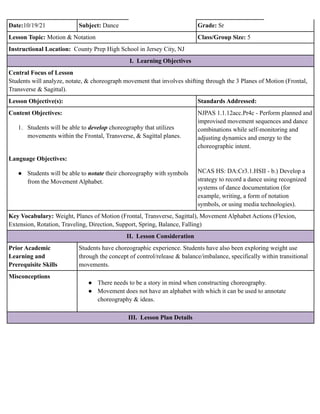
Date:10/19/21 Subject: Dance Grade: Sr
Lesson Topic: Motion & Notation Class/Group Size: 5
Instructional Location: County Prep High School in Jersey City, NJ
I. Learning Objectives
Central Focus of Lesson
Students will analyze, notate, & choreograph movement that involves shifting through the 3 Planes of Motion (Frontal,
Transverse & Sagittal).
Lesson Objective(s): Standards Addressed:
Content Objectives:
1. Students will be able to develop choreography that utilizes
movements within the Frontal, Transverse, & Sagittal planes.
Language Objectives:
● Students will be able to notate their choreography with symbols
from the Movement Alphabet.
NJPAS 1.1.12acc.Pr4c - Perform planned and
improvised movement sequences and dance
combinations while self-monitoring and
adjusting dynamics and energy to the
choreographic intent.
NCAS HS: DA:Cr3.1.HSII - b.) Develop a
strategy to record a dance using recognized
systems of dance documentation (for
example, writing, a form of notation
symbols, or using media technologies).
Key Vocabulary: Weight, Planes of Motion (Frontal, Transverse, Sagittal), Movement Alphabet Actions (Flexion,
Extension, Rotation, Traveling, Direction, Support, Spring, Balance, Falling)
II. Lesson Consideration
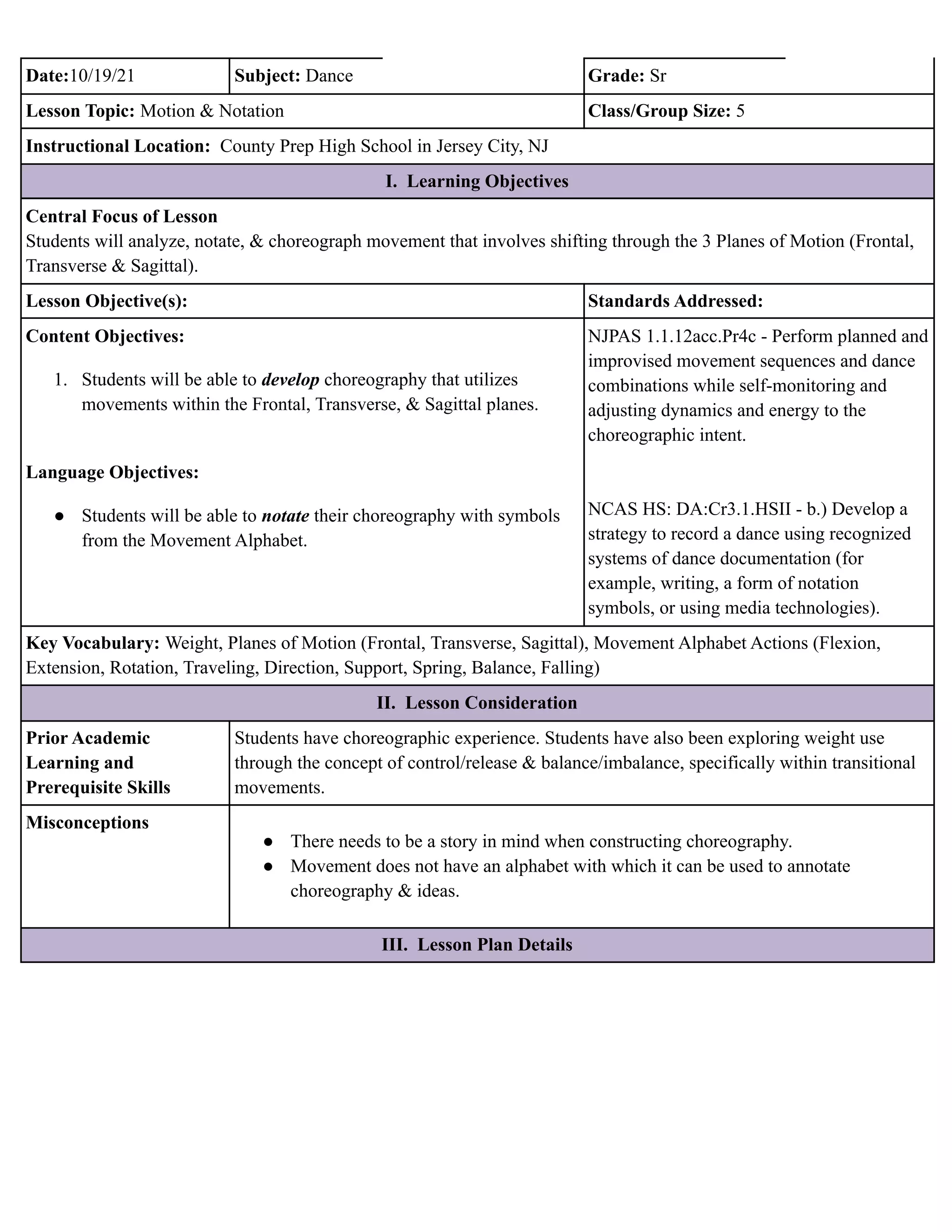
Prior Academic
Learning and
Prerequisite Skills
Students have choreographic experience. Students have also been exploring weight use
through the concept of control/release & balance/imbalance, specifically within transitional
movements.
Misconceptions
● There needs to be a story in mind when constructing choreography.
● Movement does not have an alphabet with which it can be used to annotate
choreography & ideas.
III. Lesson Plan Details
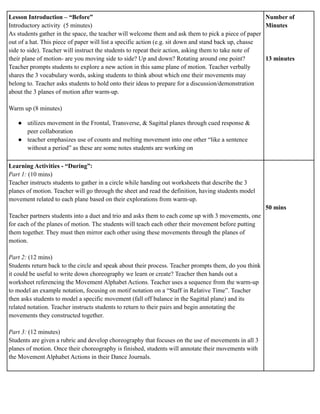
Lesson Introduction – “Before”
Introductory activity (5 minutes)
As students gather in the space, the teacher will welcome them and ask them to pick a piece of paper
out of a hat. This piece of paper will list a specific action (e.g. sit down and stand back up, chasse
side to side). Teacher will instruct the students to repeat their action, asking them to take note of
their plane of motion- are you moving side to side? Up and down? Rotating around one point?
Teacher prompts students to explore a new action in this same plane of motion. Teacher verbally
shares the 3 vocabulary words, asking students to think about which one their movements may
belong to. Teacher asks students to hold onto their ideas to prepare for a discussion/demonstration
about the 3 planes of motion after warm-up.
Warm up (8 minutes)
● utilizes movement in the Frontal, Transverse, & Sagittal planes through cued response &
peer collaboration
● teacher emphasizes use of counts and melting movement into one other “like a sentence
without a period” as these are some notes students are working on
Number of
Minutes
13 minutes
Learning Activities - “During”:
Part 1: (10 mins)
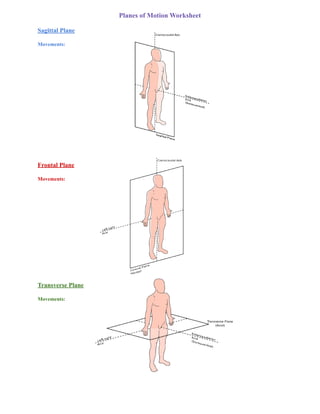
Teacher instructs students to gather in a circle while handing out worksheets that describe the 3
planes of motion. Teacher will go through the sheet and read the definition, having students model
movement related to each plane based on their explorations from warm-up.
Teacher partners students into a duet and trio and asks them to each come up with 3 movements, one
for each of the planes of motion. The students will teach each other their movement before putting
them together. They must then mirror each other using these movements through the planes of
motion.
Part 2: (12 mins)
Students return back to the circle and speak about their process. Teacher prompts them, do you think
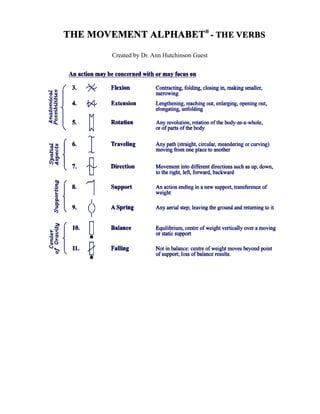
it could be useful to write down choreography we learn or create? Teacher then hands out a
worksheet referencing the Movement Alphabet Actions. Teacher uses a sequence from the warm-up
to model an example notation, focusing on motif notation on a “Staff in Relative Time”. Teacher
then asks students to model a specific movement (fall off balance in the Sagittal plane) and its
related notation. Teacher instructs students to return to their pairs and begin annotating the
movements they constructed together.
Part 3: (12 minutes)
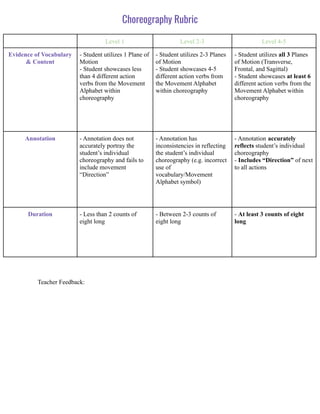
Students are given a rubric and develop choreography that focuses on the use of movements in all 3
planes of motion. Once their choreography is finished, students will annotate their movements with
the Movement Alphabet Actions in their Dance Journals.
50 mins
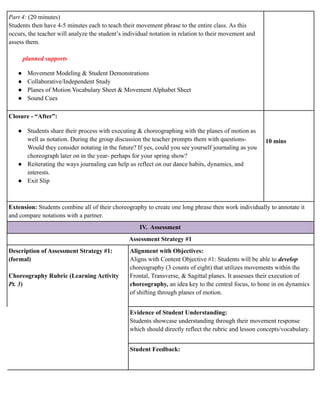
Part 4: (20 minutes)
Students then have 4-5 minutes each to teach their movement phrase to the entire class. As this
occurs, the teacher will analyze the student’s individual notation in relation to their movement and
assess them.
planned supports
● Movement Modeling & Student Demonstrations
● Collaborative/Independent Study
● Planes of Motion Vocabulary Sheet & Movement Alphabet Sheet
● Sound Cues
Closure - “After”:
● Students share their process with executing & choreographing with the planes of motion as
well as notation. During the group discussion the teacher prompts them with questions-
Would they consider notating in the future? If yes, could you see yourself journaling as you
choreograph later on in the year- perhaps for your spring show?
● Reiterating the ways journaling can help us reflect on our dance habits, dynamics, and
interests.
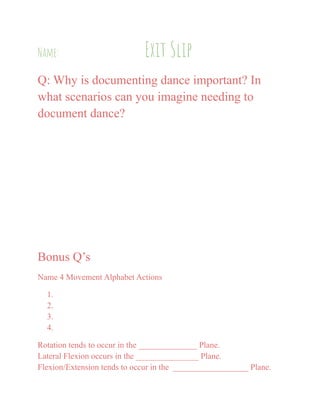
● Exit Slip
10 mins
Extension: Students combine all of their choreography to create one long phrase then work individually to annotate it
and compare notations with a partner.
IV. Assessment
Assessment Strategy #1
Description of Assessment Strategy #1:
(formal)
Choreography Rubric (Learning Activity
Pt. 3)
Alignment with Objectives:
Aligns with Content Objective #1: Students will be able to develop
choreography (3 counts of eight) that utilizes movements within the
Frontal, Transverse, & Sagittal planes. It assesses their execution of
choreography, an idea key to the central focus, to hone in on dynamics
of shifting through planes of motion.
Evidence of Student Understanding:
Students showcase understanding through their movement response
which should directly reflect the rubric and lesson concepts/vocabulary.
Student Feedback:
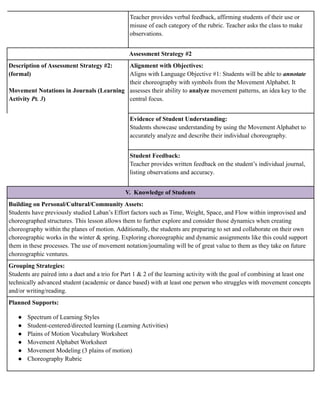
Teacher provides verbal feedback, affirming students of their use or
misuse of each category of the rubric. Teacher asks the class to make
observations.
Assessment Strategy #2
Description of Assessment Strategy #2:
(formal)
Movement Notations in Journals (Learning
Activity Pt. 3)
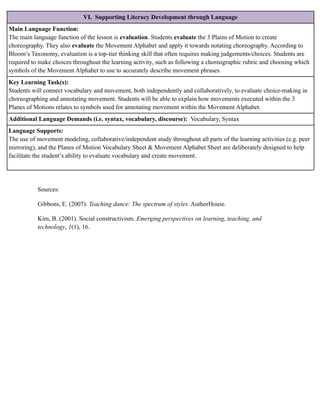
Alignment with Objectives:
Aligns with Language Objective #1: Students will be able to annotate
their choreography with symbols from the Movement Alphabet. It
assesses their ability to analyze movement patterns, an idea key to the
central focus.
Evidence of Student Understanding:
Students showcase understanding by using the Movement Alphabet to
accurately analyze and describe their individual choreography.
Student Feedback:
Teacher provides written feedback on the student’s individual journal,
listing observations and accuracy.
V. Knowledge of Students
Building on Personal/Cultural/Community Assets:
Students have previously studied Laban’s Effort factors such as Time, Weight, Space, and Flow within improvised and
choreographed structures. This lesson allows them to further explore and consider those dynamics when creating
choreography within the planes of motion. Additionally, the students are preparing to set and collaborate on their own
choreographic works in the winter & spring. Exploring choreographic and dynamic assignments like this could support
them in these processes. The use of movement notation/journaling will be of great value to them as they take on future
choreographic ventures.
Grouping Strategies:
Students are paired into a duet and a trio for Part 1 & 2 of the learning activity with the goal of combining at least one
technically advanced student (academic or dance based) with at least one person who struggles with movement concepts
and/or writing/reading.
Planned Supports:
● Spectrum of Learning Styles
● Student-centered/directed learning (Learning Activities)
● Plains of Motion Vocabulary Worksheet
● Movement Alphabet Worksheet
● Movement Modeling (3 plains of motion)
● Choreography Rubric
VI. Supporting Literacy Development through Language
Main Language Function:
The main language function of the lesson is evaluation. Students evaluate the 3 Plains of Motion to create
choreography. They also evaluate the Movement Alphabet and apply it towards notating choreography. According to
Bloom’s Taxonomy, evaluation is a top-tier thinking skill that often requires making judgements/choices. Students are
required to make choices throughout the learning activity, such as following a choreographic rubric and choosing which
symbols of the Movement Alphabet to use to accurately describe movement phrases.
Key Learning Task(s):
Students will connect vocabulary and movement, both independently and collaboratively, to evaluate choice-making in
choreographing and annotating movement. Students will be able to explain how movements executed within the 3
Planes of Motions relates to symbols used for annotating movement within the Movement Alphabet.
Additional Language Demands (i.e. syntax, vocabulary, discourse): Vocabulary, Syntax
Language Supports:
The use of movement modeling, collaborative/independent study throughout all parts of the learning activities (e.g. peer
mirroring), and the Planes of Motion Vocabulary Sheet & Movement Alphabet Sheet are deliberately designed to help
facilitate the student’s ability to evaluate vocabulary and create movement.
Sources:
Gibbons, E. (2007). Teaching dance: The spectrum of styles. AuthorHouse.
Kim, B. (2001). Social constructivism. Emerging perspectives on learning, teaching, and
technology, 1(1), 16.
Planes of Motion Worksheet
Sagittal Plane
Movements:
Frontal Plane
Movements:
Transverse Plane
Movements:
Created by Dr. Ann Hutchinson Guest
Choreography Rubric
Level 1 Level 2-3 Level 4-5
Evidence of Vocabulary
& Content
- Student utilizes 1 Plane of
Motion
- Student showcases less
than 4 different action
verbs from the Movement
Alphabet within
choreography
- Student utilizes 2-3 Planes
of Motion
- Student showcases 4-5
different action verbs from
the Movement Alphabet
within choreography
- Student utilizes all 3 Planes
of Motion (Transverse,
Frontal, and Sagittal)
- Student showcases at least 6
different action verbs from the
Movement Alphabet within
choreography
Annotation - Annotation does not
accurately portray the
student’s individual
choreography and fails to
include movement
“Direction”
- Annotation has
inconsistencies in reflecting
the student’s individual
choreography (e.g. incorrect
use of
vocabulary/Movement
Alphabet symbol)
- Annotation accurately
reflects student’s individual
choreography
- Includes “Direction” of next
to all actions
Duration - Less than 2 counts of
eight long
- Between 2-3 counts of
eight long
- At least 3 counts of eight
long
Teacher Feedback:
Name: Exit Slip
Q: Why is documenting dance important? In
what scenarios can you imagine needing to
document dance?
Bonus Q’s
Name 4 Movement Alphabet Actions
1.
2.
3.
4.
Rotation tends to occur in the ______________ Plane.
Lateral Flexion occurs in the _______________ Plane.
Flexion/Extension tends to occur in the __________________ Plane.

Motion & Notation Across Planes

  • 1.
    Date:10/19/21 Subject: DanceGrade: Sr Lesson Topic: Motion & Notation Class/Group Size: 5 Instructional Location: County Prep High School in Jersey City, NJ I. Learning Objectives Central Focus of Lesson Students will analyze, notate, & choreograph movement that involves shifting through the 3 Planes of Motion (Frontal, Transverse & Sagittal). Lesson Objective(s): Standards Addressed: Content Objectives: 1. Students will be able to develop choreography that utilizes movements within the Frontal, Transverse, & Sagittal planes. Language Objectives: ● Students will be able to notate their choreography with symbols from the Movement Alphabet. NJPAS 1.1.12acc.Pr4c - Perform planned and improvised movement sequences and dance combinations while self-monitoring and adjusting dynamics and energy to the choreographic intent. NCAS HS: DA:Cr3.1.HSII - b.) Develop a strategy to record a dance using recognized systems of dance documentation (for example, writing, a form of notation symbols, or using media technologies). Key Vocabulary: Weight, Planes of Motion (Frontal, Transverse, Sagittal), Movement Alphabet Actions (Flexion, Extension, Rotation, Traveling, Direction, Support, Spring, Balance, Falling) II. Lesson Consideration Prior Academic Learning and Prerequisite Skills Students have choreographic experience. Students have also been exploring weight use through the concept of control/release & balance/imbalance, specifically within transitional movements. Misconceptions ● There needs to be a story in mind when constructing choreography. ● Movement does not have an alphabet with which it can be used to annotate choreography & ideas. III. Lesson Plan Details
  • 2.
    Lesson Introduction –“Before” Introductory activity (5 minutes) As students gather in the space, the teacher will welcome them and ask them to pick a piece of paper out of a hat. This piece of paper will list a specific action (e.g. sit down and stand back up, chasse side to side). Teacher will instruct the students to repeat their action, asking them to take note of their plane of motion- are you moving side to side? Up and down? Rotating around one point? Teacher prompts students to explore a new action in this same plane of motion. Teacher verbally shares the 3 vocabulary words, asking students to think about which one their movements may belong to. Teacher asks students to hold onto their ideas to prepare for a discussion/demonstration about the 3 planes of motion after warm-up. Warm up (8 minutes) ● utilizes movement in the Frontal, Transverse, & Sagittal planes through cued response & peer collaboration ● teacher emphasizes use of counts and melting movement into one other “like a sentence without a period” as these are some notes students are working on Number of Minutes 13 minutes Learning Activities - “During”: Part 1: (10 mins) Teacher instructs students to gather in a circle while handing out worksheets that describe the 3 planes of motion. Teacher will go through the sheet and read the definition, having students model movement related to each plane based on their explorations from warm-up. Teacher partners students into a duet and trio and asks them to each come up with 3 movements, one for each of the planes of motion. The students will teach each other their movement before putting them together. They must then mirror each other using these movements through the planes of motion. Part 2: (12 mins) Students return back to the circle and speak about their process. Teacher prompts them, do you think it could be useful to write down choreography we learn or create? Teacher then hands out a worksheet referencing the Movement Alphabet Actions. Teacher uses a sequence from the warm-up to model an example notation, focusing on motif notation on a “Staff in Relative Time”. Teacher then asks students to model a specific movement (fall off balance in the Sagittal plane) and its related notation. Teacher instructs students to return to their pairs and begin annotating the movements they constructed together. Part 3: (12 minutes) Students are given a rubric and develop choreography that focuses on the use of movements in all 3 planes of motion. Once their choreography is finished, students will annotate their movements with the Movement Alphabet Actions in their Dance Journals. 50 mins
  • 3.
    Part 4: (20minutes) Students then have 4-5 minutes each to teach their movement phrase to the entire class. As this occurs, the teacher will analyze the student’s individual notation in relation to their movement and assess them. planned supports ● Movement Modeling & Student Demonstrations ● Collaborative/Independent Study ● Planes of Motion Vocabulary Sheet & Movement Alphabet Sheet ● Sound Cues Closure - “After”: ● Students share their process with executing & choreographing with the planes of motion as well as notation. During the group discussion the teacher prompts them with questions- Would they consider notating in the future? If yes, could you see yourself journaling as you choreograph later on in the year- perhaps for your spring show? ● Reiterating the ways journaling can help us reflect on our dance habits, dynamics, and interests. ● Exit Slip 10 mins Extension: Students combine all of their choreography to create one long phrase then work individually to annotate it and compare notations with a partner. IV. Assessment Assessment Strategy #1 Description of Assessment Strategy #1: (formal) Choreography Rubric (Learning Activity Pt. 3) Alignment with Objectives: Aligns with Content Objective #1: Students will be able to develop choreography (3 counts of eight) that utilizes movements within the Frontal, Transverse, & Sagittal planes. It assesses their execution of choreography, an idea key to the central focus, to hone in on dynamics of shifting through planes of motion. Evidence of Student Understanding: Students showcase understanding through their movement response which should directly reflect the rubric and lesson concepts/vocabulary. Student Feedback:
  • 4.
    Teacher provides verbalfeedback, affirming students of their use or misuse of each category of the rubric. Teacher asks the class to make observations. Assessment Strategy #2 Description of Assessment Strategy #2: (formal) Movement Notations in Journals (Learning Activity Pt. 3) Alignment with Objectives: Aligns with Language Objective #1: Students will be able to annotate their choreography with symbols from the Movement Alphabet. It assesses their ability to analyze movement patterns, an idea key to the central focus. Evidence of Student Understanding: Students showcase understanding by using the Movement Alphabet to accurately analyze and describe their individual choreography. Student Feedback: Teacher provides written feedback on the student’s individual journal, listing observations and accuracy. V. Knowledge of Students Building on Personal/Cultural/Community Assets: Students have previously studied Laban’s Effort factors such as Time, Weight, Space, and Flow within improvised and choreographed structures. This lesson allows them to further explore and consider those dynamics when creating choreography within the planes of motion. Additionally, the students are preparing to set and collaborate on their own choreographic works in the winter & spring. Exploring choreographic and dynamic assignments like this could support them in these processes. The use of movement notation/journaling will be of great value to them as they take on future choreographic ventures. Grouping Strategies: Students are paired into a duet and a trio for Part 1 & 2 of the learning activity with the goal of combining at least one technically advanced student (academic or dance based) with at least one person who struggles with movement concepts and/or writing/reading. Planned Supports: ● Spectrum of Learning Styles ● Student-centered/directed learning (Learning Activities) ● Plains of Motion Vocabulary Worksheet ● Movement Alphabet Worksheet ● Movement Modeling (3 plains of motion) ● Choreography Rubric
  • 5.
    VI. Supporting LiteracyDevelopment through Language Main Language Function: The main language function of the lesson is evaluation. Students evaluate the 3 Plains of Motion to create choreography. They also evaluate the Movement Alphabet and apply it towards notating choreography. According to Bloom’s Taxonomy, evaluation is a top-tier thinking skill that often requires making judgements/choices. Students are required to make choices throughout the learning activity, such as following a choreographic rubric and choosing which symbols of the Movement Alphabet to use to accurately describe movement phrases. Key Learning Task(s): Students will connect vocabulary and movement, both independently and collaboratively, to evaluate choice-making in choreographing and annotating movement. Students will be able to explain how movements executed within the 3 Planes of Motions relates to symbols used for annotating movement within the Movement Alphabet. Additional Language Demands (i.e. syntax, vocabulary, discourse): Vocabulary, Syntax Language Supports: The use of movement modeling, collaborative/independent study throughout all parts of the learning activities (e.g. peer mirroring), and the Planes of Motion Vocabulary Sheet & Movement Alphabet Sheet are deliberately designed to help facilitate the student’s ability to evaluate vocabulary and create movement. Sources: Gibbons, E. (2007). Teaching dance: The spectrum of styles. AuthorHouse. Kim, B. (2001). Social constructivism. Emerging perspectives on learning, teaching, and technology, 1(1), 16.
  • 6.
    Planes of MotionWorksheet Sagittal Plane Movements: Frontal Plane Movements: Transverse Plane Movements:
  • 7.
    Created by Dr.Ann Hutchinson Guest
  • 8.
    Choreography Rubric Level 1Level 2-3 Level 4-5 Evidence of Vocabulary & Content - Student utilizes 1 Plane of Motion - Student showcases less than 4 different action verbs from the Movement Alphabet within choreography - Student utilizes 2-3 Planes of Motion - Student showcases 4-5 different action verbs from the Movement Alphabet within choreography - Student utilizes all 3 Planes of Motion (Transverse, Frontal, and Sagittal) - Student showcases at least 6 different action verbs from the Movement Alphabet within choreography Annotation - Annotation does not accurately portray the student’s individual choreography and fails to include movement “Direction” - Annotation has inconsistencies in reflecting the student’s individual choreography (e.g. incorrect use of vocabulary/Movement Alphabet symbol) - Annotation accurately reflects student’s individual choreography - Includes “Direction” of next to all actions Duration - Less than 2 counts of eight long - Between 2-3 counts of eight long - At least 3 counts of eight long Teacher Feedback:
  • 9.
    Name: Exit Slip Q:Why is documenting dance important? In what scenarios can you imagine needing to document dance? Bonus Q’s Name 4 Movement Alphabet Actions 1. 2. 3. 4. Rotation tends to occur in the ______________ Plane. Lateral Flexion occurs in the _______________ Plane. Flexion/Extension tends to occur in the __________________ Plane.