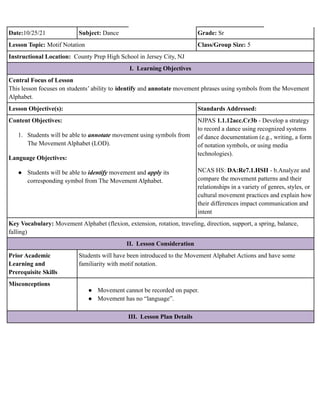
Date:10/25/21 Subject: Dance Grade: Sr
Lesson Topic: Motif Notation Class/Group Size: 5
Instructional Location: County Prep High School in Jersey City, NJ
I. Learning Objectives
Central Focus of Lesson
This lesson focuses on students’ ability to identify and annotate movement phrases using symbols from the Movement
Alphabet.
Lesson Objective(s): Standards Addressed:
Content Objectives:
1. Students will be able to annotate movement using symbols from
The Movement Alphabet (LOD).
Language Objectives:
● Students will be able to identify movement and apply its
corresponding symbol from The Movement Alphabet.
NJPAS 1.1.12acc.Cr3b - Develop a strategy
to record a dance using recognized systems
of dance documentation (e.g., writing, a form
of notation symbols, or using media
technologies).
NCAS HS: DA:Re7.1.HSII - b.Analyze and
compare the movement patterns and their
relationships in a variety of genres, styles, or
cultural movement practices and explain how
their differences impact communication and
intent
Key Vocabulary: Movement Alphabet (flexion, extension, rotation, traveling, direction, support, a spring, balance,
falling)
II. Lesson Consideration
Prior Academic
Learning and
Prerequisite Skills
Students will have been introduced to the Movement Alphabet Actions and have some
familiarity with motif notation.
Misconceptions
● Movement cannot be recorded on paper.
● Movement has no “language”.
III. Lesson Plan Details
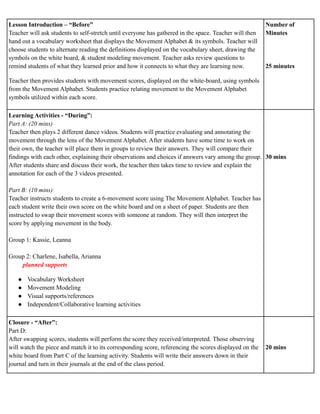
Lesson Introduction – “Before”
Teacher will ask students to self-stretch until everyone has gathered in the space. Teacher will then
hand out a vocabulary worksheet that displays the Movement Alphabet & its symbols. Teacher will
choose students to alternate reading the definitions displayed on the vocabulary sheet, drawing the
symbols on the white board, & student modeling movement. Teacher asks review questions to
remind students of what they learned prior and how it connects to what they are learning now.
Teacher then provides students with movement scores, displayed on the white-board, using symbols
from the Movement Alphabet. Students practice relating movement to the Movement Alphabet
symbols utilized within each score.
Number of
Minutes
25 minutes
Learning Activities - “During”:
Part A: (20 mins)
Teacher then plays 2 different dance videos. Students will practice evaluating and annotating the
movement through the lens of the Movement Alphabet. After students have some time to work on
their own, the teacher will place them in groups to review their answers. They will compare their
findings with each other, explaining their observations and choices if answers vary among the group.
After students share and discuss their work, the teacher then takes time to review and explain the
annotation for each of the 3 videos presented.
Part B: (10 mins)
Teacher instructs students to create a 6-movement score using The Movement Alphabet. Teacher has
each student write their own score on the white board and on a sheet of paper. Students are then
instructed to swap their movement scores with someone at random. They will then interpret the
score by applying movement in the body.
Group 1: Kassie, Leanna
Group 2: Charlene, Isabella, Arianna
planned supports
● Vocabulary Worksheet
● Movement Modeling
● Visual supports/references
● Independent/Collaborative learning activities
30 mins
Closure - “After”:
Part D:
After swapping scores, students will perform the score they received/interpreted. Those observing
will watch the piece and match it to its corresponding score, referencing the scores displayed on the
white board from Part C of the learning activity. Students will write their answers down in their
journal and turn in their journals at the end of the class period.
20 mins
Students complete an in-class Exit Slip to end the class.
Extension: In their groups, students create a movement phrase together and have the other group view/annotate the
movement using symbols from the Movement Alphabet.
IV. Assessment
Assessment Strategy #1
Description of Assessment Strategy #1:
(informal)
Movement Annotations (Part B)
Alignment with Objectives:
Aligns with Content Objective #1: Students will be able to annotate
movements using symbols from The Movement Alphabet (LOD). It
assesses their application of the lesson vocabulary and how they are
evaluating movement in response to the vocabulary, an idea central to
the lesson focus.
Evidence of Student Understanding:
Students showcase understanding through their written responses on
paper. They draw symbols from the Movement Alphabet to accurately
document the observed movement. This relates to Language Objective
#1.
Student Feedback:
Teacher provides verbal feedback.
Assessment Strategy #2
Description of Assessment Strategy #2:
(formal)
Matching Annotations (Part D)
Alignment with Objectives:
Aligns with Language Objective #1: Students will be able to identify a
movement. It assesses the student’s ability to apply the correct symbol
from the Movement Alphabet in order to match it to its corresponding
annotation on the white board.
Evidence of Student Understanding:
Students showcase their understanding by their ability to connect each
movement phrase to its corresponding annotation.
Student Feedback:
Teacher provides written feedback on the student’s individual journal
entry.
V. Knowledge of Students
Building on Personal/Cultural/Community Assets:
Students have been previously introduced to the Movement Alphabet Actions (flexion, extension, rotation, traveling,
direction support, a spring, balance, falling). This will give them the opportunity to further develop their understanding
of this content specific language. Additionally, the students are preparing to set and collaborate on their own
choreographic works in the winter & spring. Evaluating and creating movement under specific language parameters, like
the Movement Alphabet, will allow them to hone in on their dynamic & choreographic choice making skills. The use of
movement notation/journaling will be of great value to them as they take on future choreographic ventures.
Grouping Strategies:
Students are grouped together based on who has worked with each other the least in order to strengthen the relationships
& trust within the class.
Planned Supports:
● Vocabulary Worksheet
● Movement Modeling
● Visual supports/references
● Independent/Collaborative learning activities
VI. Supporting Literacy Development through Language
Main Language Function:
The main language function of the lesson is application. Students apply the Movement Alphabet after correctly
identifying movement phrases.
Key Learning Task(s):
Students will apply vocabulary and identify/create movement to expand their choreographic and organizational skills
(e.g. documenting dance). Students will be able to identify which movements relate to specific Movement Alphabet
symbols.
Additional Language Demands (i.e. syntax, vocabulary, discourse): Vocabulary, syntax
Language Supports:
The use of movement modeling, collaborative/independent study throughout all parts of the learning activities, use of
technology, and use of vocabulary sheets are deliberately designed to help facilitate the student’s ability to apply
vocabulary and evaluate movement.

Spinal Mobility Lesson

  • 1.
    Date:10/25/21 Subject: DanceGrade: Sr Lesson Topic: Motif Notation Class/Group Size: 5 Instructional Location: County Prep High School in Jersey City, NJ I. Learning Objectives Central Focus of Lesson This lesson focuses on students’ ability to identify and annotate movement phrases using symbols from the Movement Alphabet. Lesson Objective(s): Standards Addressed: Content Objectives: 1. Students will be able to annotate movement using symbols from The Movement Alphabet (LOD). Language Objectives: ● Students will be able to identify movement and apply its corresponding symbol from The Movement Alphabet. NJPAS 1.1.12acc.Cr3b - Develop a strategy to record a dance using recognized systems of dance documentation (e.g., writing, a form of notation symbols, or using media technologies). NCAS HS: DA:Re7.1.HSII - b.Analyze and compare the movement patterns and their relationships in a variety of genres, styles, or cultural movement practices and explain how their differences impact communication and intent Key Vocabulary: Movement Alphabet (flexion, extension, rotation, traveling, direction, support, a spring, balance, falling) II. Lesson Consideration Prior Academic Learning and Prerequisite Skills Students will have been introduced to the Movement Alphabet Actions and have some familiarity with motif notation. Misconceptions ● Movement cannot be recorded on paper. ● Movement has no “language”. III. Lesson Plan Details
  • 2.
    Lesson Introduction –“Before” Teacher will ask students to self-stretch until everyone has gathered in the space. Teacher will then hand out a vocabulary worksheet that displays the Movement Alphabet & its symbols. Teacher will choose students to alternate reading the definitions displayed on the vocabulary sheet, drawing the symbols on the white board, & student modeling movement. Teacher asks review questions to remind students of what they learned prior and how it connects to what they are learning now. Teacher then provides students with movement scores, displayed on the white-board, using symbols from the Movement Alphabet. Students practice relating movement to the Movement Alphabet symbols utilized within each score. Number of Minutes 25 minutes Learning Activities - “During”: Part A: (20 mins) Teacher then plays 2 different dance videos. Students will practice evaluating and annotating the movement through the lens of the Movement Alphabet. After students have some time to work on their own, the teacher will place them in groups to review their answers. They will compare their findings with each other, explaining their observations and choices if answers vary among the group. After students share and discuss their work, the teacher then takes time to review and explain the annotation for each of the 3 videos presented. Part B: (10 mins) Teacher instructs students to create a 6-movement score using The Movement Alphabet. Teacher has each student write their own score on the white board and on a sheet of paper. Students are then instructed to swap their movement scores with someone at random. They will then interpret the score by applying movement in the body. Group 1: Kassie, Leanna Group 2: Charlene, Isabella, Arianna planned supports ● Vocabulary Worksheet ● Movement Modeling ● Visual supports/references ● Independent/Collaborative learning activities 30 mins Closure - “After”: Part D: After swapping scores, students will perform the score they received/interpreted. Those observing will watch the piece and match it to its corresponding score, referencing the scores displayed on the white board from Part C of the learning activity. Students will write their answers down in their journal and turn in their journals at the end of the class period. 20 mins
  • 3.
    Students complete anin-class Exit Slip to end the class. Extension: In their groups, students create a movement phrase together and have the other group view/annotate the movement using symbols from the Movement Alphabet. IV. Assessment Assessment Strategy #1 Description of Assessment Strategy #1: (informal) Movement Annotations (Part B) Alignment with Objectives: Aligns with Content Objective #1: Students will be able to annotate movements using symbols from The Movement Alphabet (LOD). It assesses their application of the lesson vocabulary and how they are evaluating movement in response to the vocabulary, an idea central to the lesson focus. Evidence of Student Understanding: Students showcase understanding through their written responses on paper. They draw symbols from the Movement Alphabet to accurately document the observed movement. This relates to Language Objective #1. Student Feedback: Teacher provides verbal feedback. Assessment Strategy #2 Description of Assessment Strategy #2: (formal) Matching Annotations (Part D) Alignment with Objectives: Aligns with Language Objective #1: Students will be able to identify a movement. It assesses the student’s ability to apply the correct symbol from the Movement Alphabet in order to match it to its corresponding annotation on the white board. Evidence of Student Understanding: Students showcase their understanding by their ability to connect each movement phrase to its corresponding annotation. Student Feedback: Teacher provides written feedback on the student’s individual journal entry. V. Knowledge of Students Building on Personal/Cultural/Community Assets: Students have been previously introduced to the Movement Alphabet Actions (flexion, extension, rotation, traveling, direction support, a spring, balance, falling). This will give them the opportunity to further develop their understanding of this content specific language. Additionally, the students are preparing to set and collaborate on their own choreographic works in the winter & spring. Evaluating and creating movement under specific language parameters, like
  • 4.
    the Movement Alphabet,will allow them to hone in on their dynamic & choreographic choice making skills. The use of movement notation/journaling will be of great value to them as they take on future choreographic ventures. Grouping Strategies: Students are grouped together based on who has worked with each other the least in order to strengthen the relationships & trust within the class. Planned Supports: ● Vocabulary Worksheet ● Movement Modeling ● Visual supports/references ● Independent/Collaborative learning activities VI. Supporting Literacy Development through Language Main Language Function: The main language function of the lesson is application. Students apply the Movement Alphabet after correctly identifying movement phrases. Key Learning Task(s): Students will apply vocabulary and identify/create movement to expand their choreographic and organizational skills (e.g. documenting dance). Students will be able to identify which movements relate to specific Movement Alphabet symbols. Additional Language Demands (i.e. syntax, vocabulary, discourse): Vocabulary, syntax Language Supports: The use of movement modeling, collaborative/independent study throughout all parts of the learning activities, use of technology, and use of vocabulary sheets are deliberately designed to help facilitate the student’s ability to apply vocabulary and evaluate movement.