LESSON 3
THE MILKMAID AND
HER PAIL
A weekly lesson in
English subject for Grade
6 – Ephesians of MCA
Manila
September 29, 2020
SOUND DEVICES
❑ It helps the readers to develop strong visual images,
reinforcing the mood and tone of the literary piece,
to emphasize particular sounds and create a
powerful rhythm to evoke an emotional response.
HYPERBOLE
an outrageous
exaggeration that
emphasizes a point, can be
ridiculous and funny
example
It was so cold I could see polar
bears wearing coats.
IRONY
the use of words that
mean the opposite of
what you really think in
order to be funny
example
She’s a brilliant singer who
sings like a crow.
Using hyperbole and irony to describe people without a regard of their feelings seems
inappropriate and uncalled for. Always remember to be tactful and mindful of what you say to
others.
As you are going to read one of Aesop’s fables today
of which, a fable is a short story intended to teach a
lesson, called “the moral lesson.” This fable is about
a milkmaid, a girl who milks cows, the milkmaid’s job
is an important one because cows need to be milked
every day. (WRL, page 24)
THE MILKMAID & HER PAIL
(AESOP)
A Milkmaid had been out to milk the cows and was returning from
the field with the shining milk pail balanced nicely on her head. As
she walked along, her pretty head was busy with plans for the days
to come.
"This good, rich milk," she mused, "will give me plenty of cream to
churn. The butter I make I will take to market, and with the money
I get for it I will buy a lot of eggs for hatching. How nice it will be
when they are all hatched and the yard is full of fine young chicks.
Then when May day comes I will sell them, and with the money I'll
buy a lovely new dress to wear to the fair. All the young men will
look at me. They will come and try to make love to me,—but I shall
very quickly send them about their business!"
As she thought of how she would settle that matter, she tossed
her head scornfully, and down fell the pail of milk to the ground.
And all the milk flowed out, and with it vanished butter and eggs
and chicks and new dress and all the milkmaid's pride.
“Do not count your chickens before they are hatched.”
The moral lesson of the story in other words is, “Don’t
count on having everything turn out exactly as you
plan, because you may be disappointed.”
When reading a story, we can discover the literary
texts used by the author and these are called the tone,
mood and the purpose.
TONE
❑ It is simply the author’s attitude towards the subject.
❑ You can recognize the tone or attitude by the word
choices of what the author uses. The author’s choice of
words will reveal their perspective/opinion about the
subject.
❑ Tone must be inferred through the use of descriptive
words.
Example
Paragraph 1: “balanced nicely on her head”
“her head was busy with plans”
❑ A tone can either be a positive or a negative word.
MOOD
❑ It is the overall feelings or emotions that are created
by the reader.
❑ This could be happiness, sadness, darkness, anger,
suspicion, loneliness, or even excitement.
❑ Authors “move” their readers’ moods through their
choice of words and level of detail.
Example
What did you feel after reading the fable?
PURPOSE
❑ An author's purpose is his reason or intent in writing.
It may be to amuse the reader, to persuade the
reader, to inform the reader.
1. Writing to Entertain
The primary purpose to entertain is to amuse readers
includes stories, poems, dramas, songs.
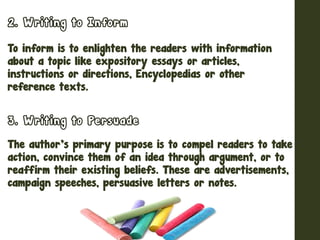
2. Writing to Inform
To inform is to enlighten the readers with information
about a topic like expository essays or articles,
instructions or directions, Encyclopedias or other
reference texts.
3. Writing to Persuade
The author’s primary purpose is to compel readers to take
action, convince them of an idea through argument, or to
reaffirm their existing beliefs. These are advertisements,
campaign speeches, persuasive letters or notes.
TENSES OF VERBS
❑ Past is used to describe things that have already
happened (yesterday).
❑ Present tense is used to describe things that are
happening right now, or things that are continuous
(today).
❑ Future tense describes things that have yet to happen
(tomorrow).
(WRL, pages 27-28)
Simple Present Simple Past Simple Future
I read nearly
every day.
Last night,
I read an entire
novel.
I will read as
much as I can this
year.
Present
Continuous
Past
Continuous
Future
Continuous
I am
reading Aesop at
the moment.
I was
reading Robert
Frost last night.
I will be
reading Leo
Tolstoy soon.
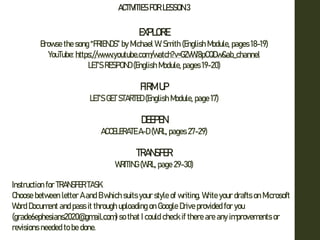
ACTIVITIES FOR LESSON 3
EXPLORE
Browse the song “FRIENDS” by Michael W. Smith (English Module, pages 18-19)
YouTube: https://www.youtube.com/watch?v=GZVWi8pCQDw&ab_channel
LET’S RESPOND (English Module, pages 19-20)
FIRM UP
LET’S GET STARTED (English Module, page 17)
DEEPEN
ACCELERATE A-D (WRL, pages 27-29)
TRANSFER
WRITING (WRL, page 29-30)
Instruction for TRANSFER TASK
Choose between letter A and B which suits your style of writing. Write your drafts on Microsoft
Word Document and pass it through uploading on Google Drive provided for you
(grade6ephesians2020@gmail.com) so that I could check if there are any improvements or
revisions needed to be done.

GRADE 6, LESSON 3

  • 1.
    LESSON 3 THE MILKMAIDAND HER PAIL A weekly lesson in English subject for Grade 6 – Ephesians of MCA Manila September 29, 2020
  • 2.
    SOUND DEVICES ❑ Ithelps the readers to develop strong visual images, reinforcing the mood and tone of the literary piece, to emphasize particular sounds and create a powerful rhythm to evoke an emotional response.
  • 3.
    HYPERBOLE an outrageous exaggeration that emphasizesa point, can be ridiculous and funny example It was so cold I could see polar bears wearing coats. IRONY the use of words that mean the opposite of what you really think in order to be funny example She’s a brilliant singer who sings like a crow. Using hyperbole and irony to describe people without a regard of their feelings seems inappropriate and uncalled for. Always remember to be tactful and mindful of what you say to others.
  • 4.
    As you aregoing to read one of Aesop’s fables today of which, a fable is a short story intended to teach a lesson, called “the moral lesson.” This fable is about a milkmaid, a girl who milks cows, the milkmaid’s job is an important one because cows need to be milked every day. (WRL, page 24)
  • 5.
    THE MILKMAID &HER PAIL (AESOP) A Milkmaid had been out to milk the cows and was returning from the field with the shining milk pail balanced nicely on her head. As she walked along, her pretty head was busy with plans for the days to come. "This good, rich milk," she mused, "will give me plenty of cream to churn. The butter I make I will take to market, and with the money I get for it I will buy a lot of eggs for hatching. How nice it will be when they are all hatched and the yard is full of fine young chicks. Then when May day comes I will sell them, and with the money I'll buy a lovely new dress to wear to the fair. All the young men will look at me. They will come and try to make love to me,—but I shall very quickly send them about their business!" As she thought of how she would settle that matter, she tossed her head scornfully, and down fell the pail of milk to the ground. And all the milk flowed out, and with it vanished butter and eggs and chicks and new dress and all the milkmaid's pride. “Do not count your chickens before they are hatched.”
  • 6.
    The moral lessonof the story in other words is, “Don’t count on having everything turn out exactly as you plan, because you may be disappointed.” When reading a story, we can discover the literary texts used by the author and these are called the tone, mood and the purpose.
  • 7.
    TONE ❑ It issimply the author’s attitude towards the subject. ❑ You can recognize the tone or attitude by the word choices of what the author uses. The author’s choice of words will reveal their perspective/opinion about the subject. ❑ Tone must be inferred through the use of descriptive words.
  • 8.
    Example Paragraph 1: “balancednicely on her head” “her head was busy with plans” ❑ A tone can either be a positive or a negative word.
  • 9.
    MOOD ❑ It isthe overall feelings or emotions that are created by the reader. ❑ This could be happiness, sadness, darkness, anger, suspicion, loneliness, or even excitement. ❑ Authors “move” their readers’ moods through their choice of words and level of detail.
  • 10.
    Example What did youfeel after reading the fable?
  • 11.
    PURPOSE ❑ An author'spurpose is his reason or intent in writing. It may be to amuse the reader, to persuade the reader, to inform the reader. 1. Writing to Entertain The primary purpose to entertain is to amuse readers includes stories, poems, dramas, songs.
  • 12.
    2. Writing toInform To inform is to enlighten the readers with information about a topic like expository essays or articles, instructions or directions, Encyclopedias or other reference texts. 3. Writing to Persuade The author’s primary purpose is to compel readers to take action, convince them of an idea through argument, or to reaffirm their existing beliefs. These are advertisements, campaign speeches, persuasive letters or notes.
  • 13.
    TENSES OF VERBS ❑Past is used to describe things that have already happened (yesterday). ❑ Present tense is used to describe things that are happening right now, or things that are continuous (today). ❑ Future tense describes things that have yet to happen (tomorrow). (WRL, pages 27-28)
  • 14.
    Simple Present SimplePast Simple Future I read nearly every day. Last night, I read an entire novel. I will read as much as I can this year. Present Continuous Past Continuous Future Continuous I am reading Aesop at the moment. I was reading Robert Frost last night. I will be reading Leo Tolstoy soon.
  • 15.
    ACTIVITIES FOR LESSON3 EXPLORE Browse the song “FRIENDS” by Michael W. Smith (English Module, pages 18-19) YouTube: https://www.youtube.com/watch?v=GZVWi8pCQDw&ab_channel LET’S RESPOND (English Module, pages 19-20) FIRM UP LET’S GET STARTED (English Module, page 17) DEEPEN ACCELERATE A-D (WRL, pages 27-29) TRANSFER WRITING (WRL, page 29-30) Instruction for TRANSFER TASK Choose between letter A and B which suits your style of writing. Write your drafts on Microsoft Word Document and pass it through uploading on Google Drive provided for you (grade6ephesians2020@gmail.com) so that I could check if there are any improvements or revisions needed to be done.