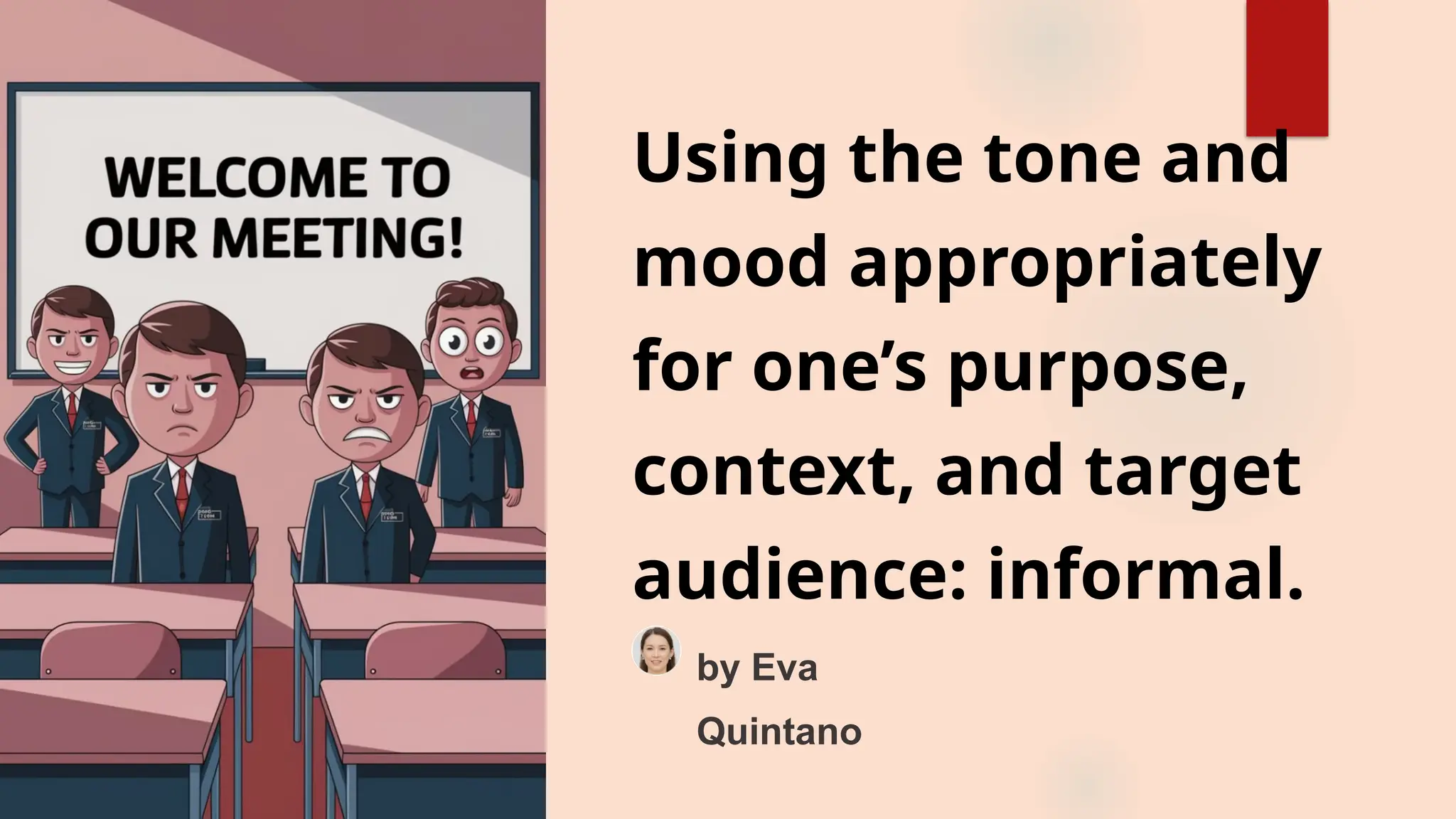
Using the tone and
mood appropriately
for one’s purpose,
context, and target
audience: informal.
by Eva
Quintano
A. DRAG and DROP
Allow the students to drag the
keyword and drop it next to its
meaning.
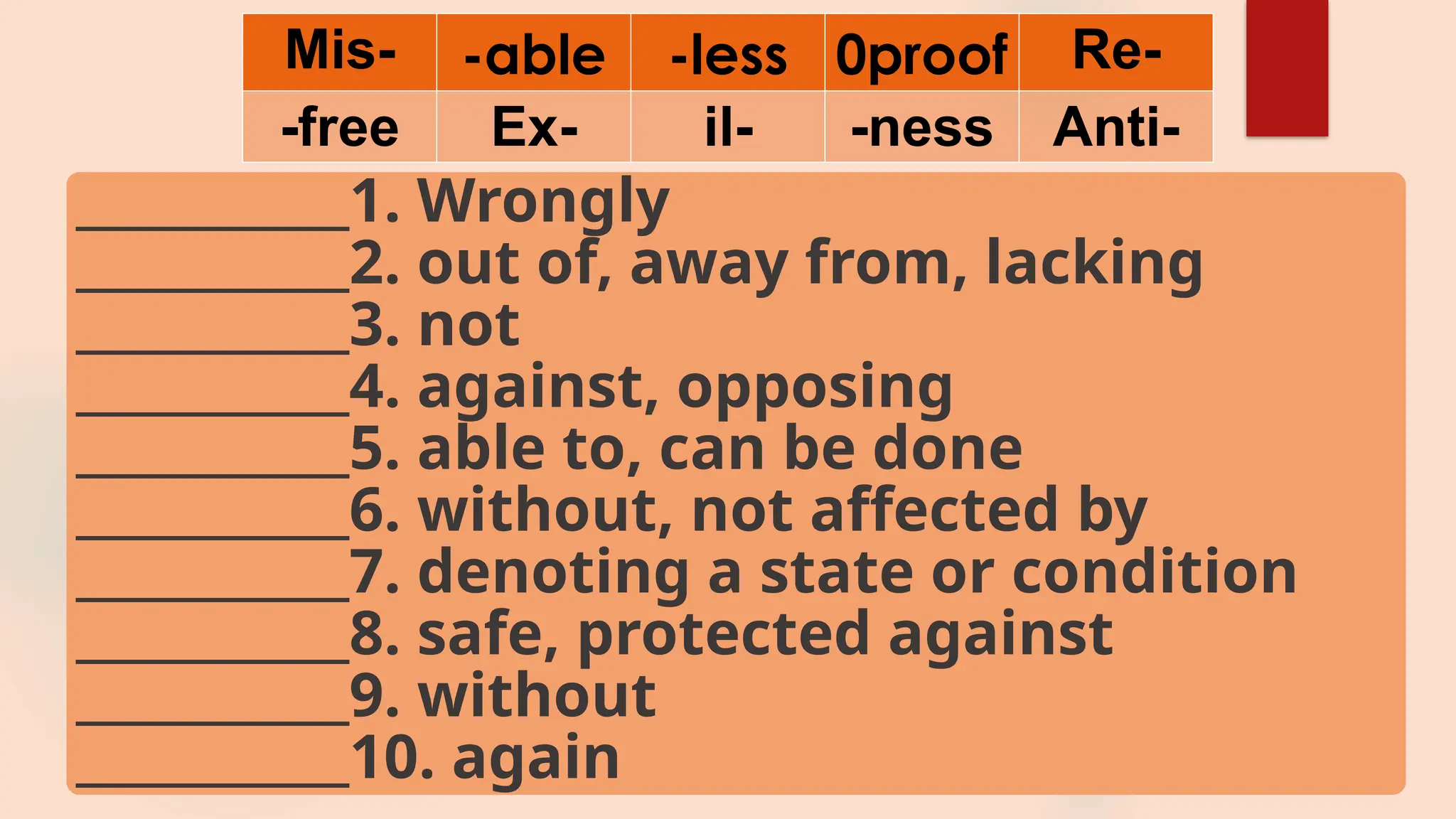
Mis- -able -less 0proof Re-
-free Ex- il- -ness Anti-
___________1. Wrongly
___________2. out of, away from, lacking
___________3. not
___________4. against, opposing
___________5. able to, can be done
___________6. without, not affected by
___________7. denoting a state or condition
___________8. safe, protected against
___________9. without
___________10. again
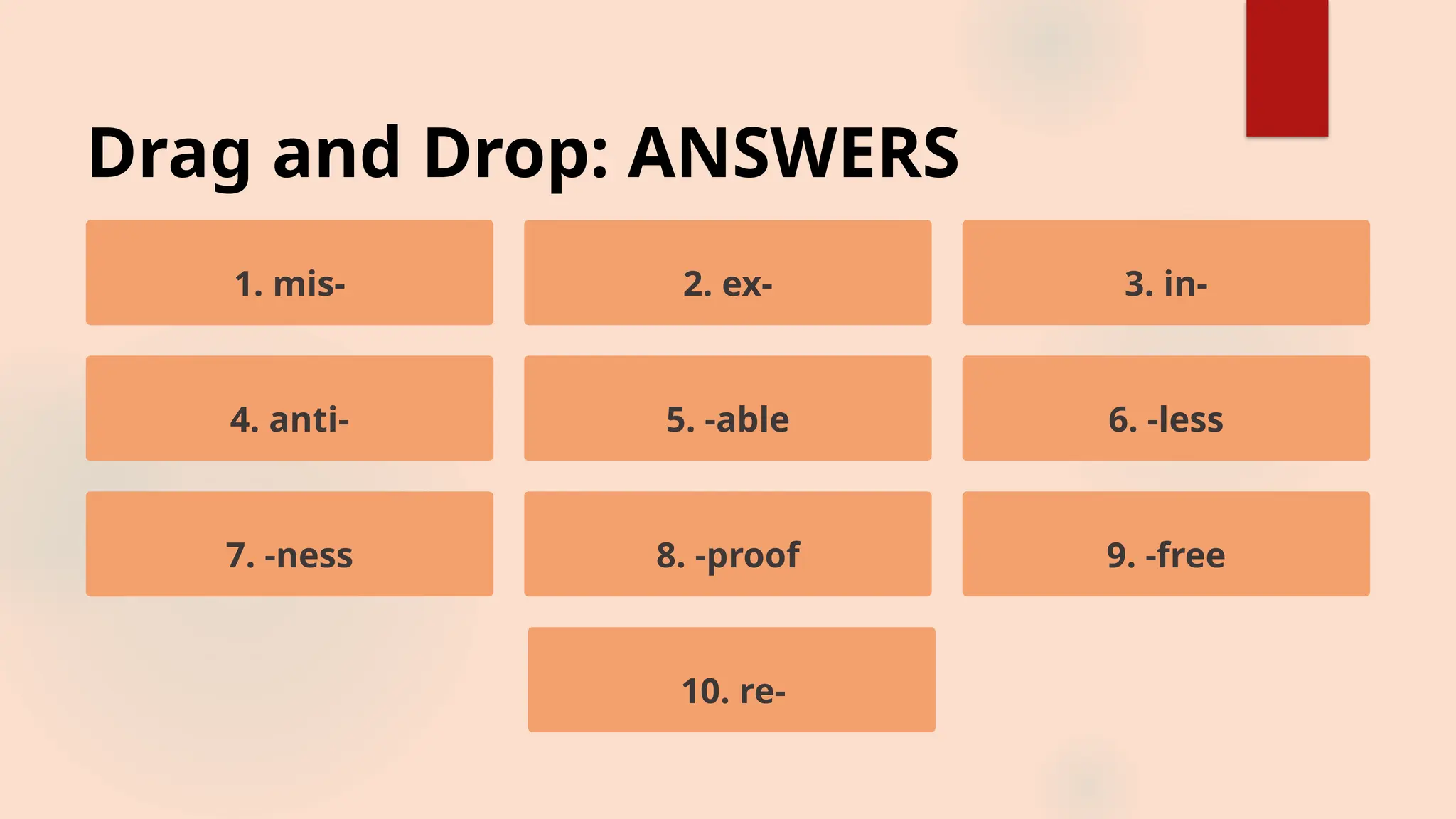
Drag and Drop: ANSWERS
1. mis- 2. ex- 3. in-
4. anti- 5. -able 6. -less
7. -ness 8. -proof 9. -free
10. re-
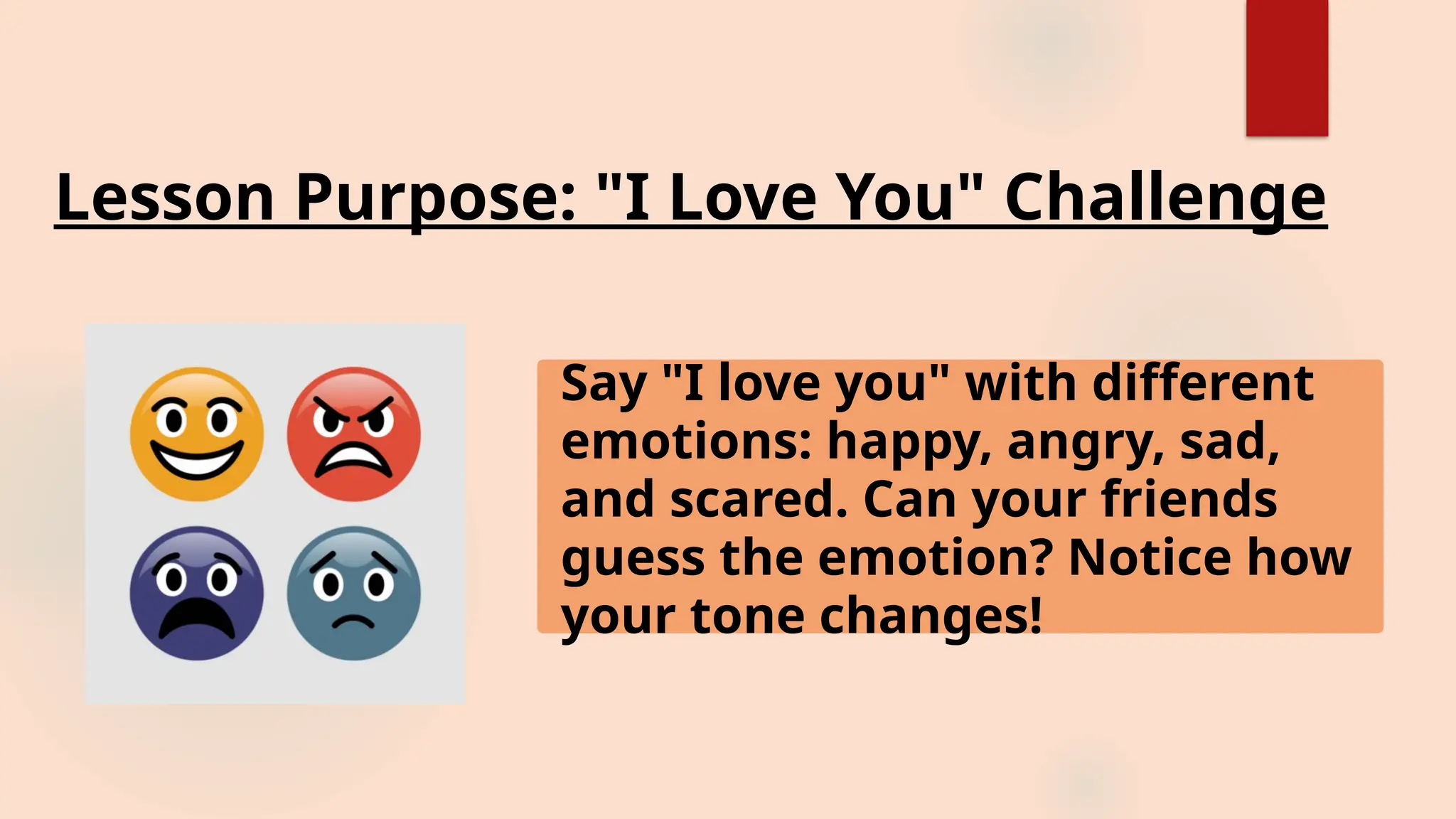
Lesson Purpose: "I Love You" Challenge
Say "I love you" with different
emotions: happy, angry, sad,
and scared. Can your friends
guess the emotion? Notice how
your tone changes!
Questions:
1. What have
you noticed in
the tone of their
voices?
2. How do they
convey the
mood?
3. Is it possible that we can also feel
what the speaker feels in written text?
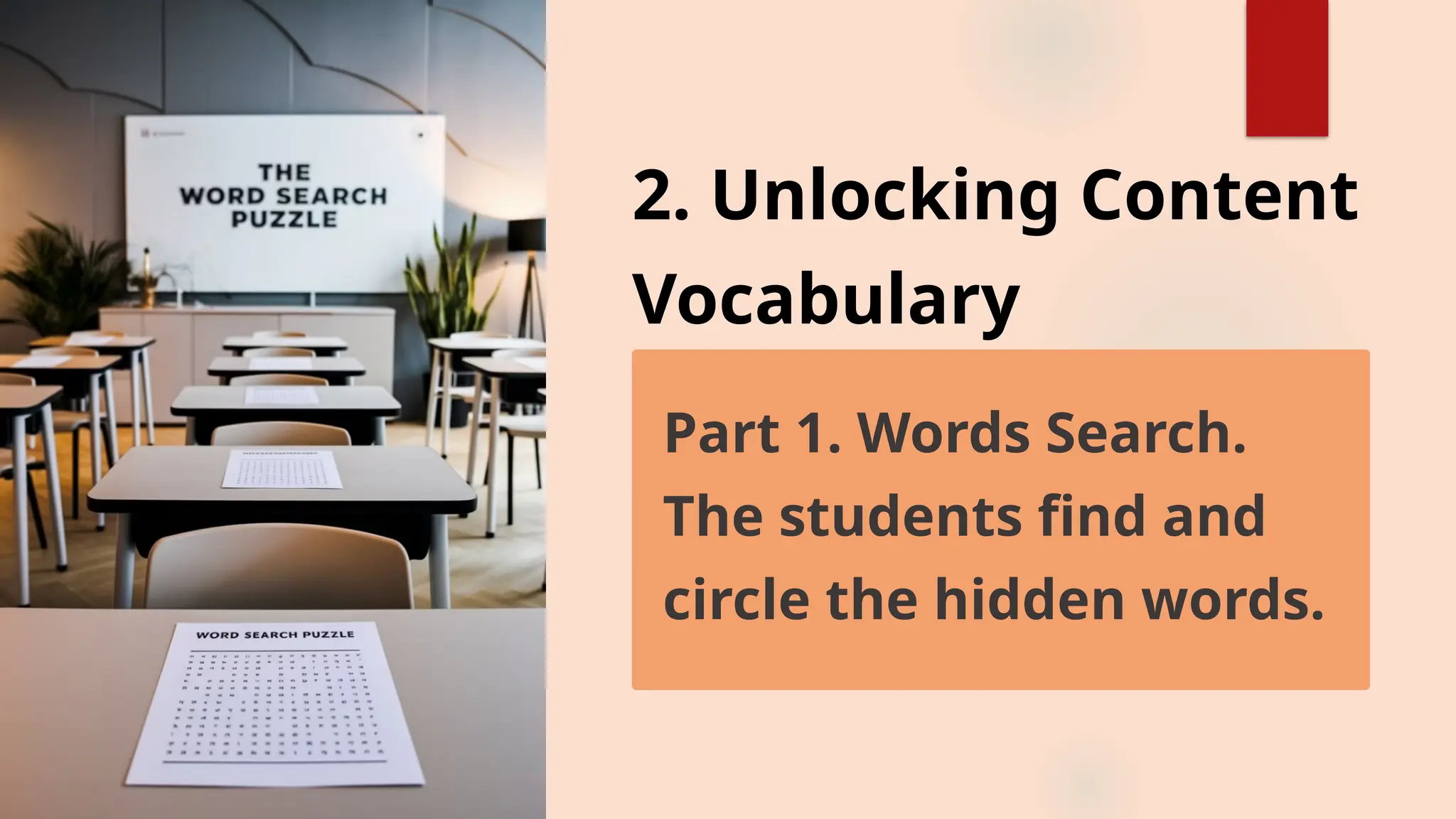
2. Unlocking Content
Vocabulary
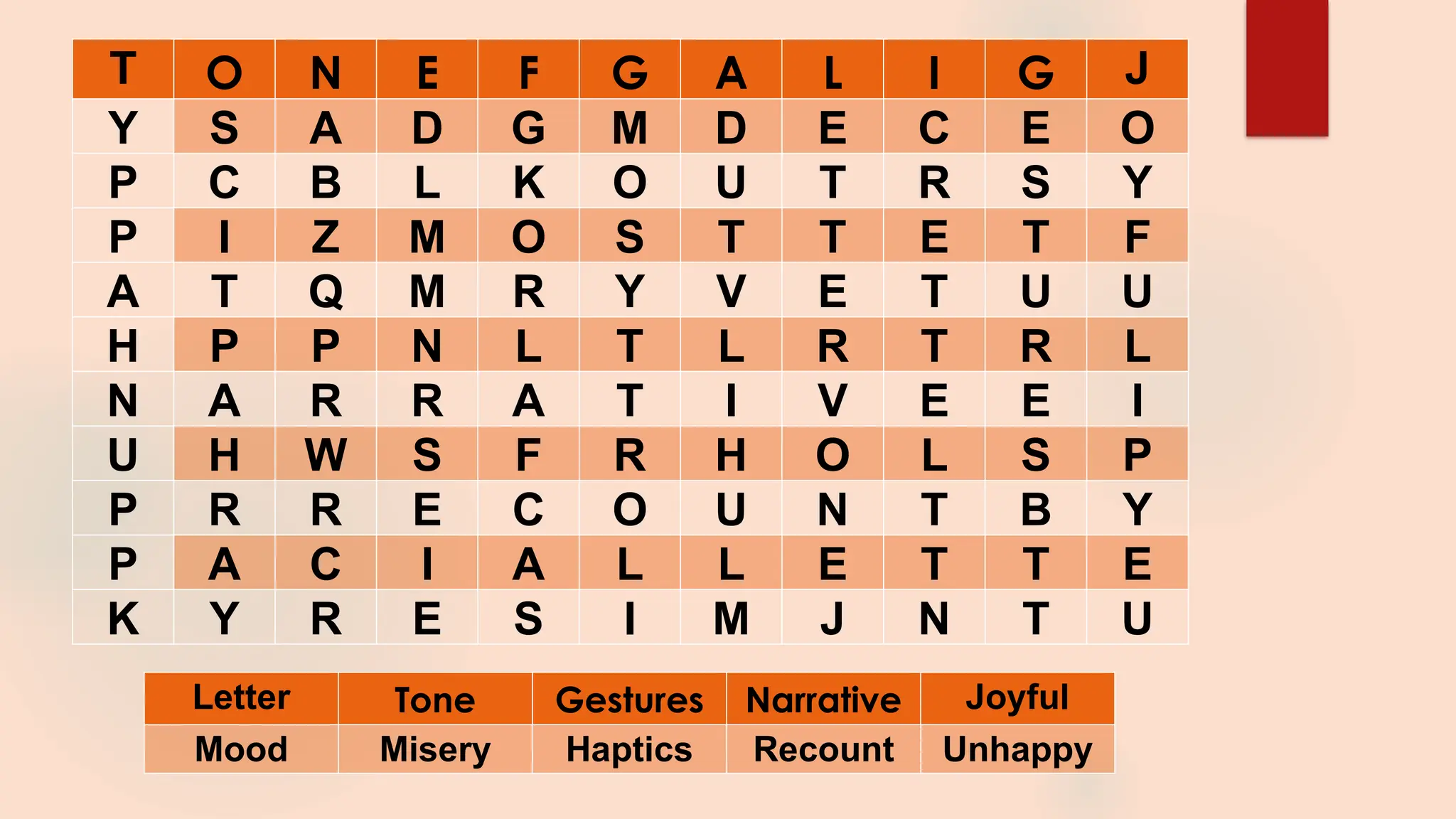
Part 1. Words Search.
The students find and
circle the hidden words.
T O N E F G A L I G J
Y S A D G M D E C E O
P C B L K O U T R S Y
P I Z M O S T T E T F
A T Q M R Y V E T U U
H P P N L T L R T R L
N A R R A T I V E E I
U H W S F R H O L S P
P R R E C O U N T B Y
P A C I A L L E T T E
K Y R E S I M J N T U
Letter Tone Gestures Narrative Joyful
Mood Misery Haptics Recount Unhappy
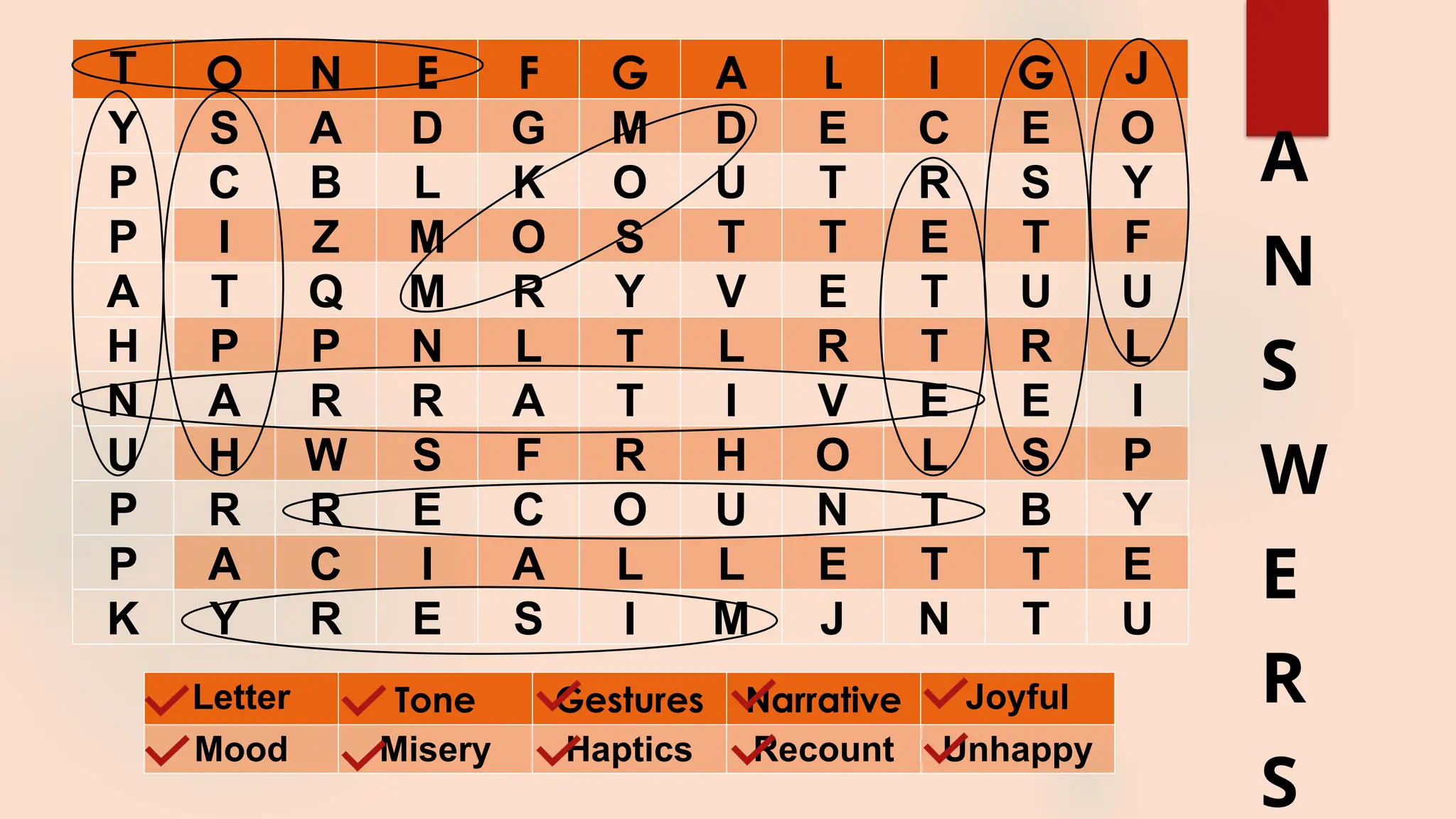
T O N E F G A L I G J
Y S A D G M D E C E O
P C B L K O U T R S Y
P I Z M O S T T E T F
A T Q M R Y V E T U U
H P P N L T L R T R L
N A R R A T I V E E I
U H W S F R H O L S P
P R R E C O U N T B Y
P A C I A L L E T T E
K Y R E S I M J N T U
Letter Tone Gestures Narrative Joyful
Mood Misery Haptics Recount Unhappy
A
N
S
W
E
R
S
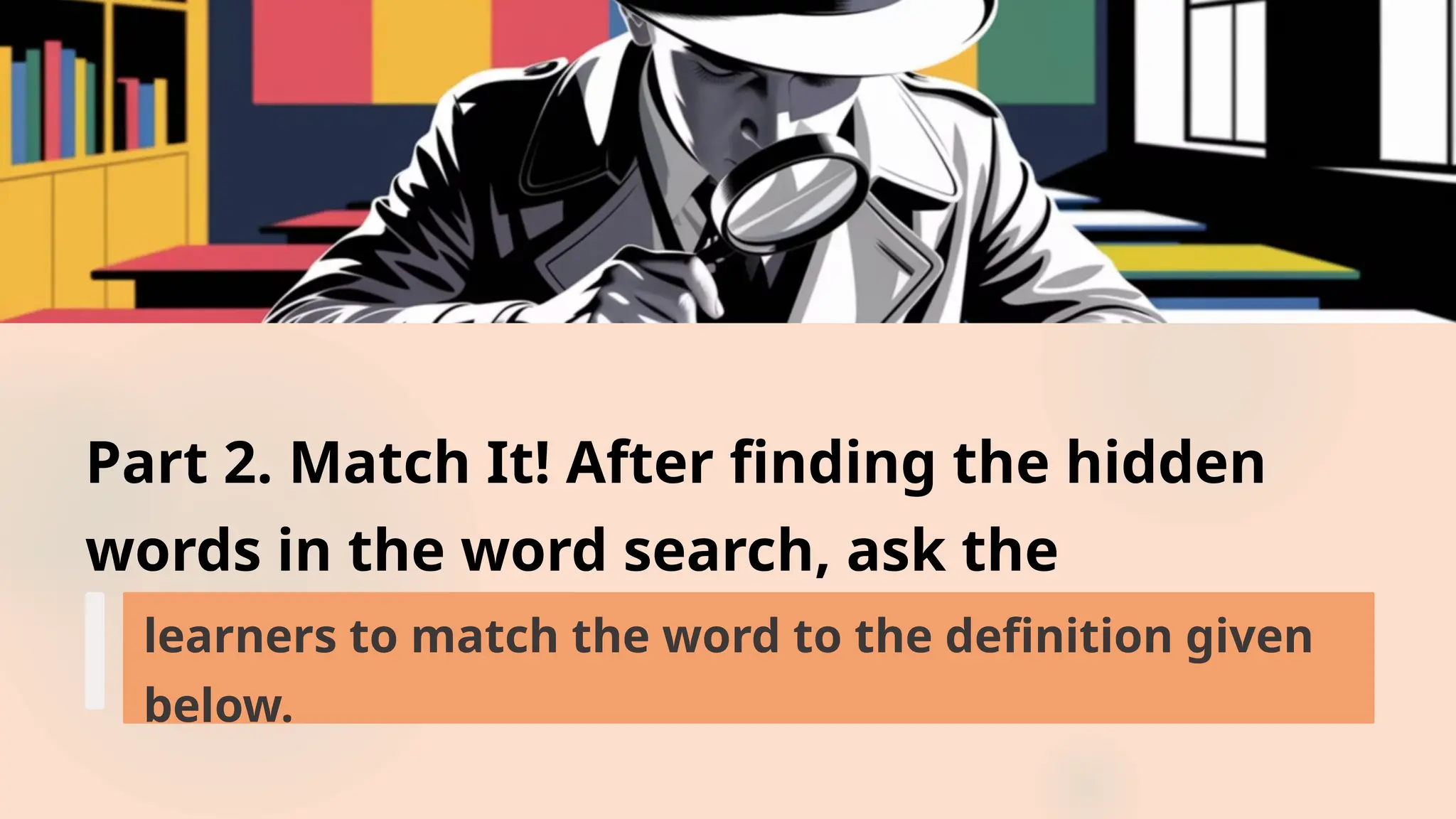
Part 2. Match It! After finding the hidden
words in the word search, ask the
learners to match the word to the definition given
below.
__________1. refers to the author’s attitude
toward a subject
__________2. a written, typed, or printed
communication, especially one sent in an
envelope by mail or messenger.
__________3. refers to the emotions that a
text evokes from the reader
__________4. entertains, instructs, or
informs readers by telling a story
__________5. tell someone about
something; give an account of an event
or experience.
__________6. include movement of the
hands, face, or other parts of the body
__________7. the study of touch as a form of
nonverbal communication.
__________8. not satisfied or pleased with (a
situation)
____________9. feeling, expressing, or
causing great pleasure and happiness.
__________10. a state or feeling of great
distress or discomfort of mind or body.
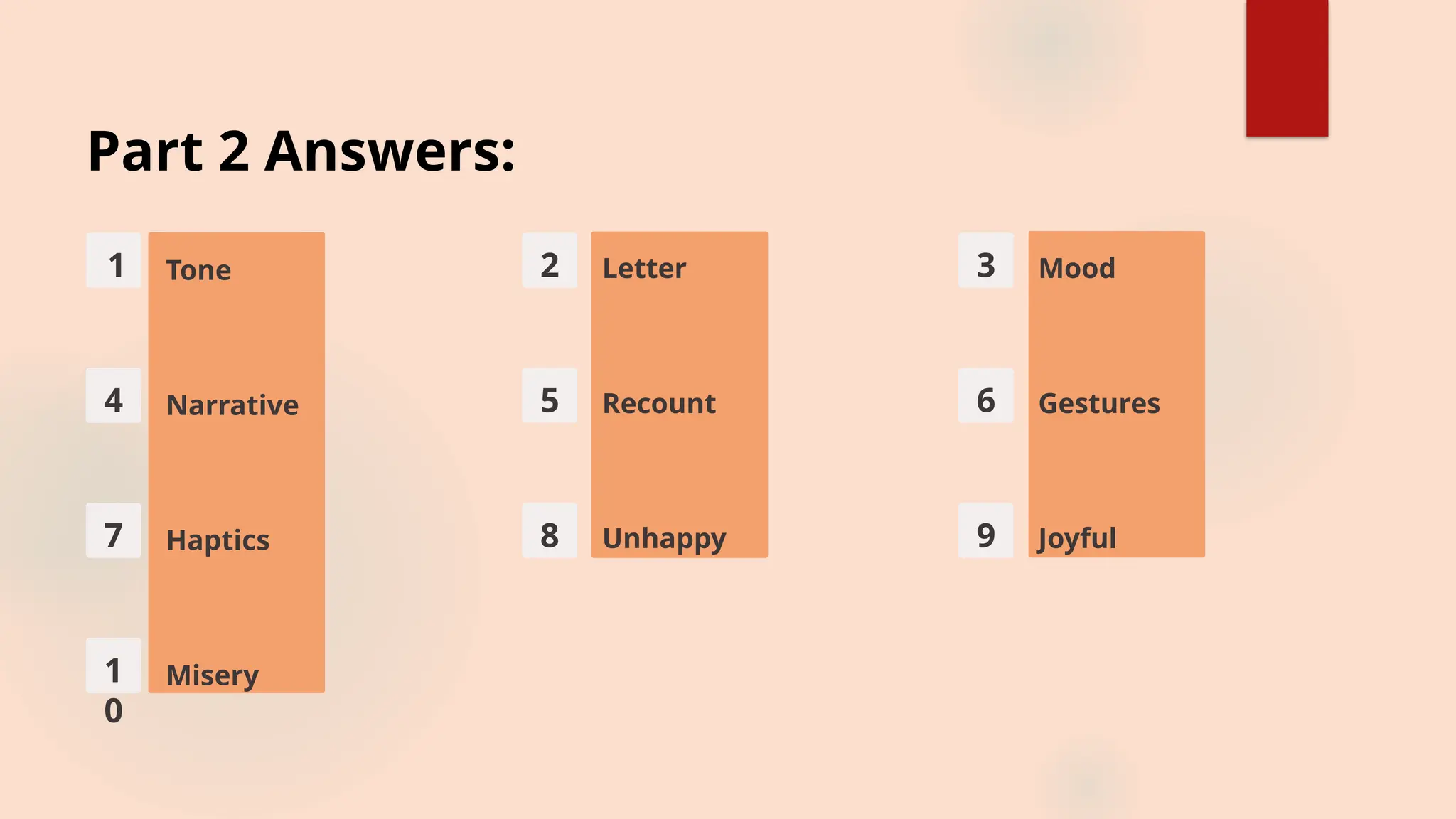
Part 2 Answers:
1 Tone 2 Letter 3 Mood
4 Narrative 5 Recount 6 Gestures
7 Haptics 8 Unhappy 9 Joyful
1
0
Misery
1. Explicitation:
Have the students watch Pixar Short Film
#25 La Luna 2011
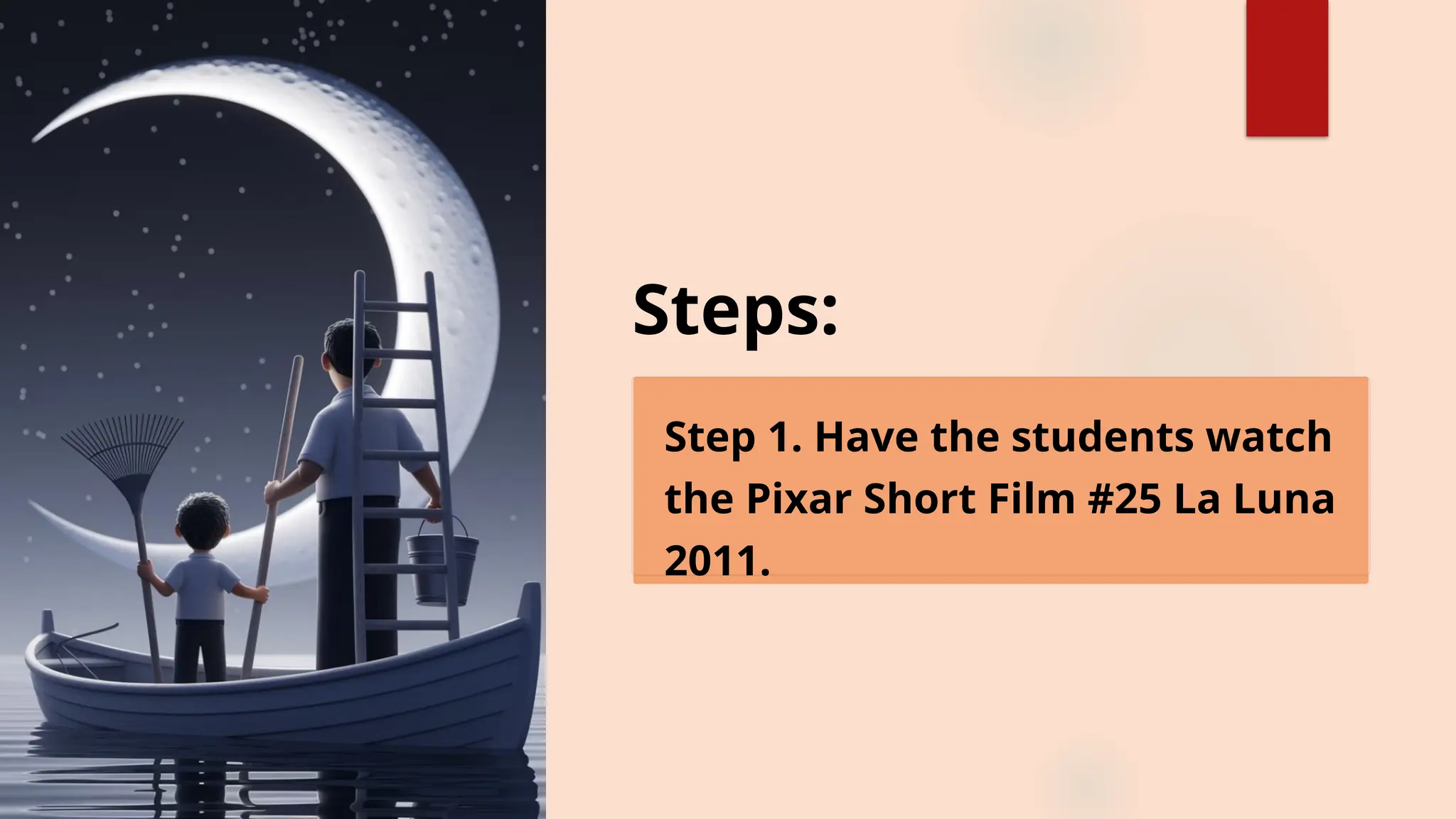
Steps:
Step 1. Have the students watch
the Pixar Short Film #25 La Luna
2011.
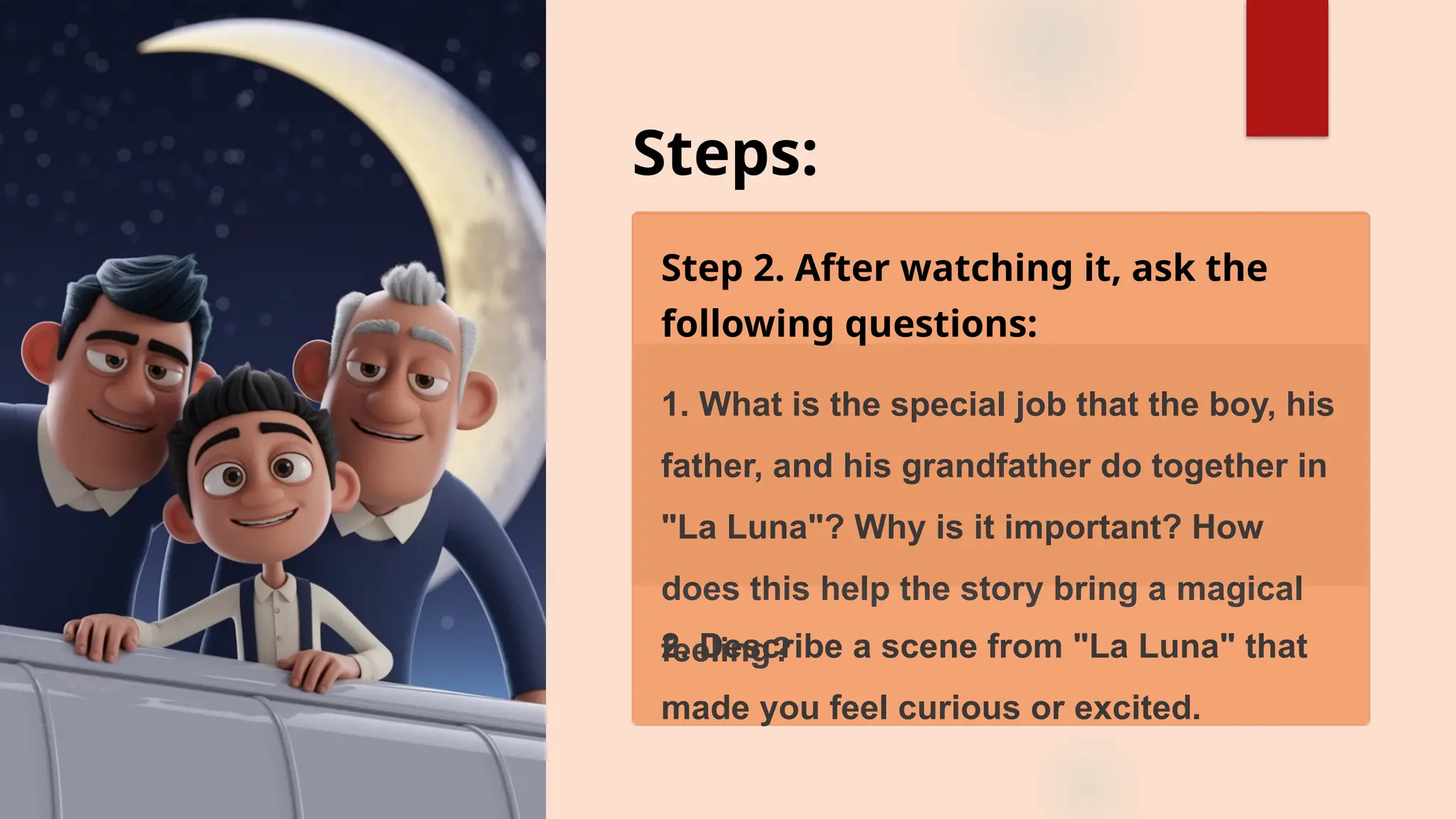
Steps:
Step 2. After watching it, ask the
following questions:
1. What is the special job that the boy, his
father, and his grandfather do together in
"La Luna"? Why is it important? How
does this help the story bring a magical
feeling?
2. Describe a scene from "La Luna" that
made you feel curious or excited.
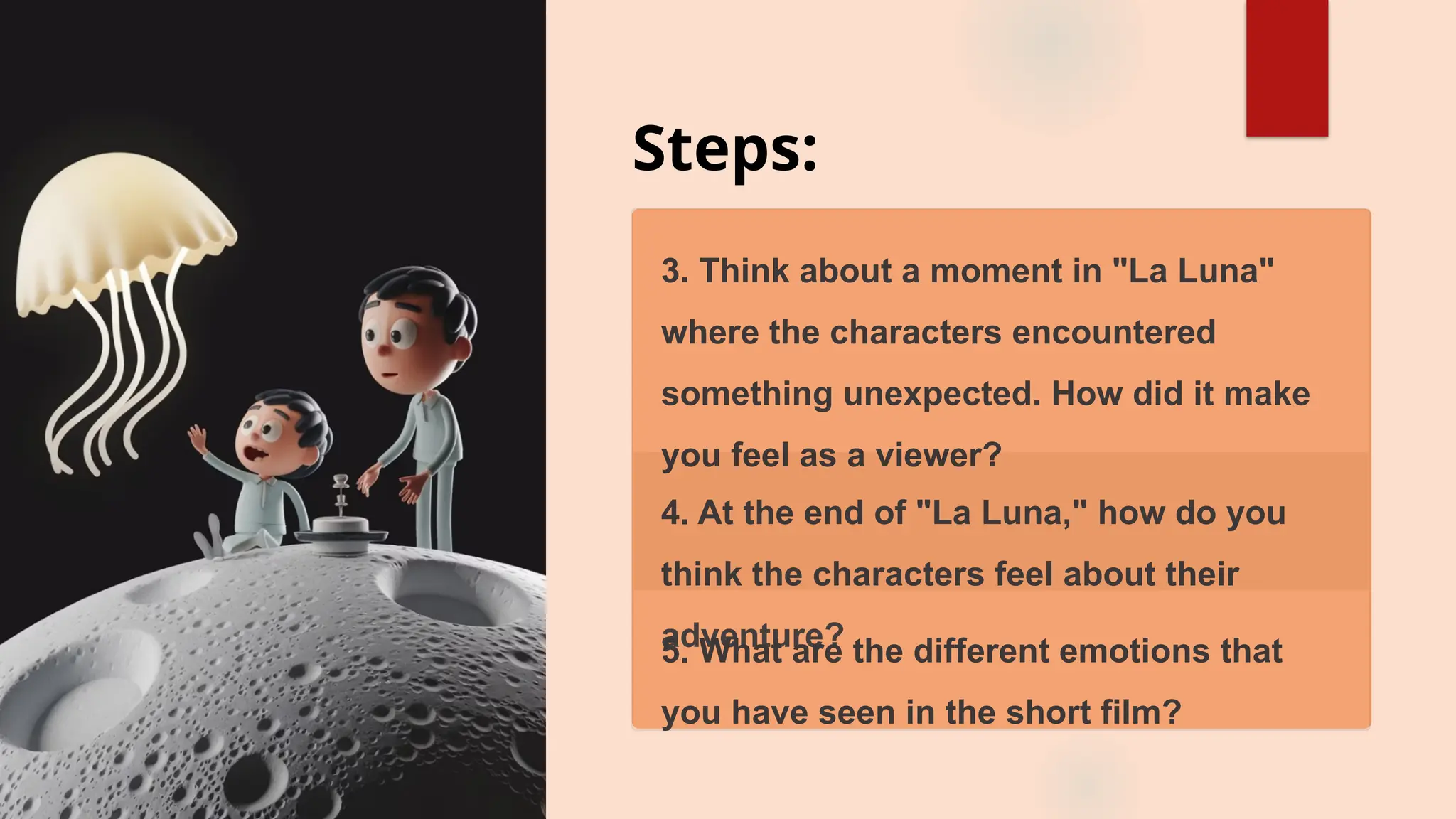
Steps:
3. Think about a moment in "La Luna"
where the characters encountered
something unexpected. How did it make
you feel as a viewer?
4. At the end of "La Luna," how do you
think the characters feel about their
adventure?
5. What are the different emotions that
you have seen in the short film?
2. Worked Example
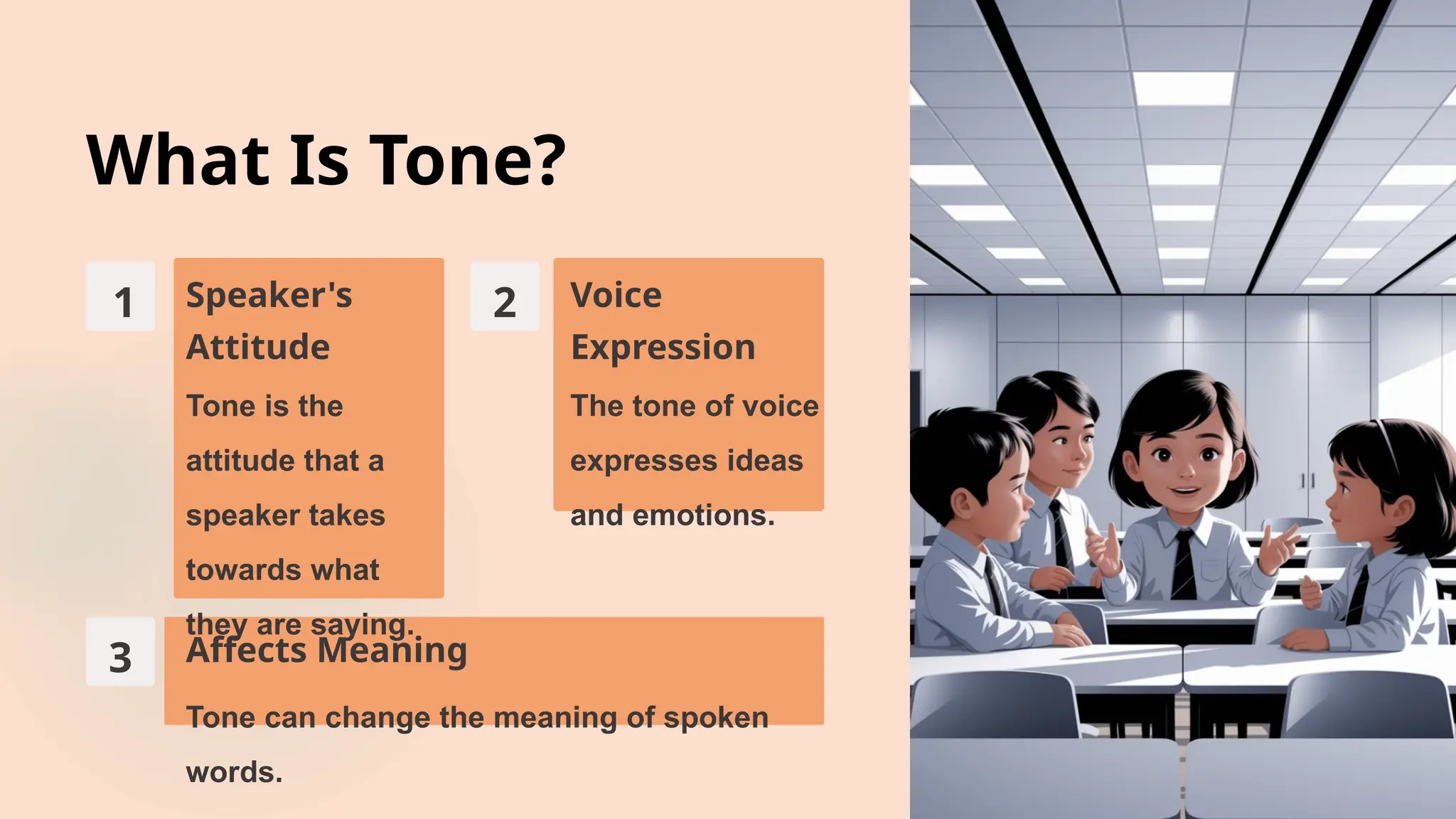
What Is Tone?
1 Speaker's
Attitude
Tone is the
attitude that a
speaker takes
towards what
they are saying.
2 Voice
Expression
The tone of voice
expresses ideas
and emotions.
3 Affects Meaning
Tone can change the meaning of spoken
words.
What Is Mood?
Reader's Feelings
Mood refers to the
emotions that a text
makes the reader feel.
Created by Words
Authors use specific
words to create moods
like happy, sad, or scared.
Sets the Atmosphere
Mood creates the overall
feeling or atmosphere of
a story or poem.
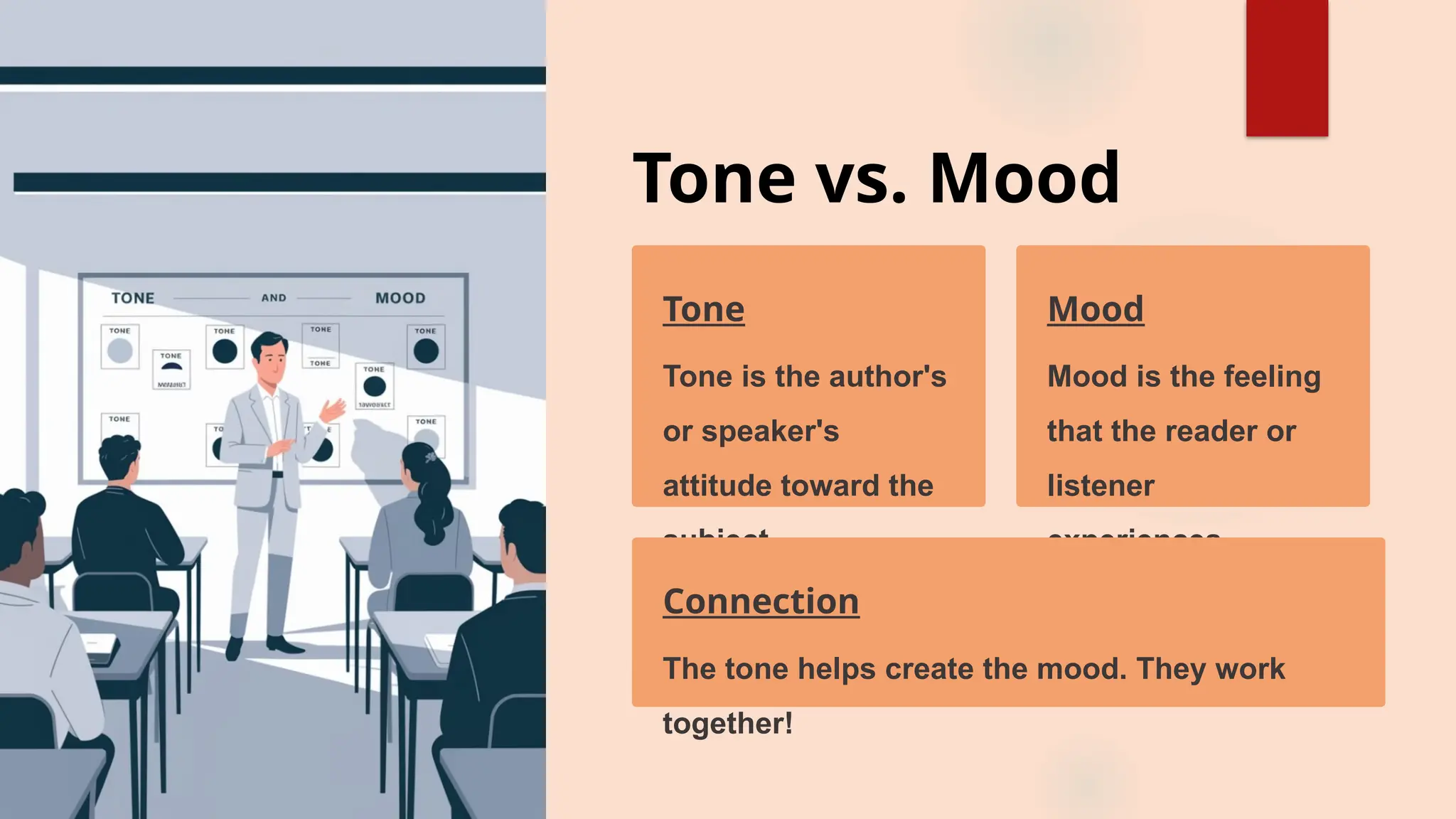
Tone vs. Mood
Tone
Tone is the author's
or speaker's
attitude toward the
subject.
Mood
Mood is the feeling
that the reader or
listener
experiences.
Connection
The tone helps create the mood. They work
together!
Activity 1. Have the students read
aloud the text below to infer the
speaker’s tone and mood.
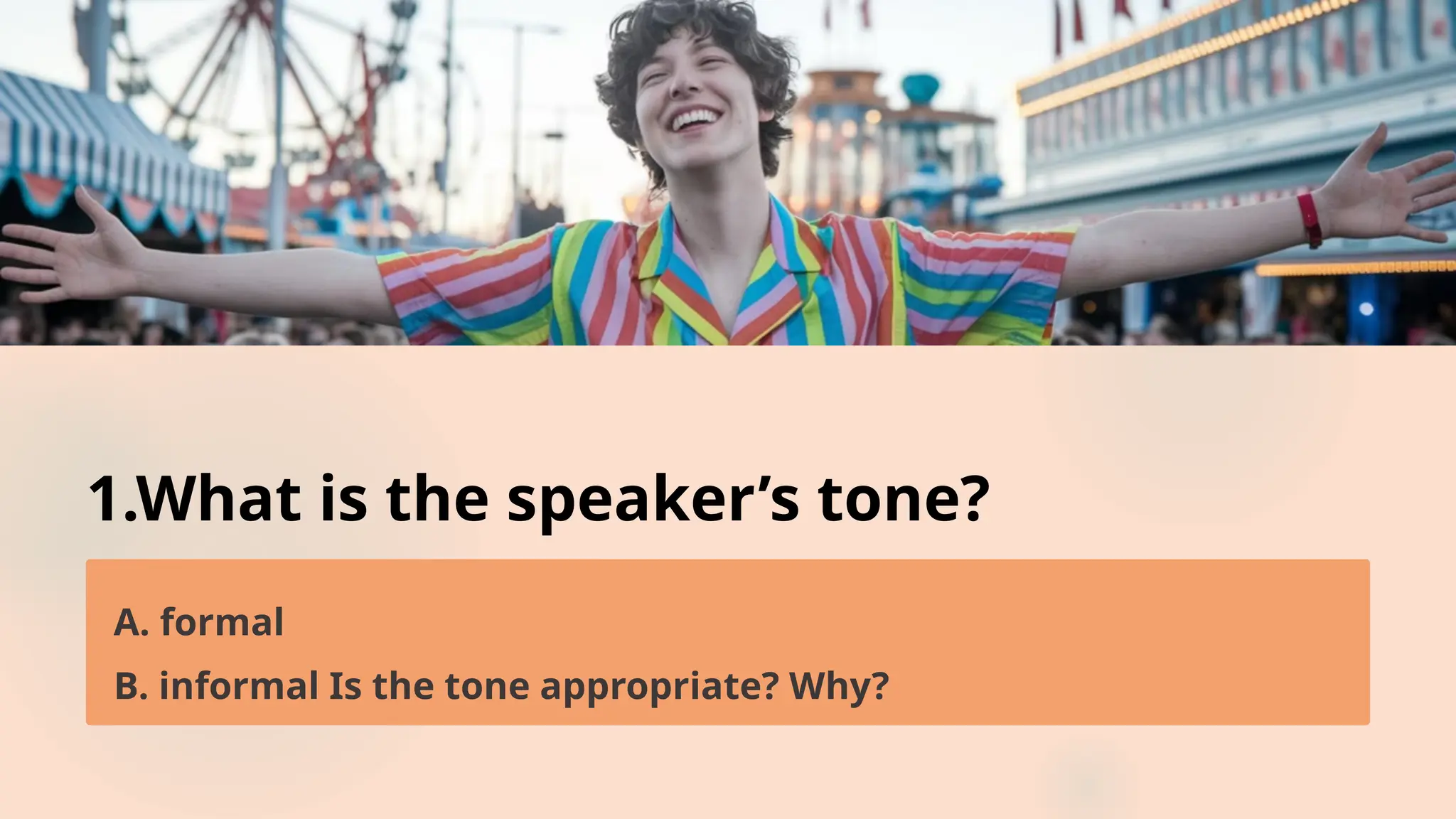
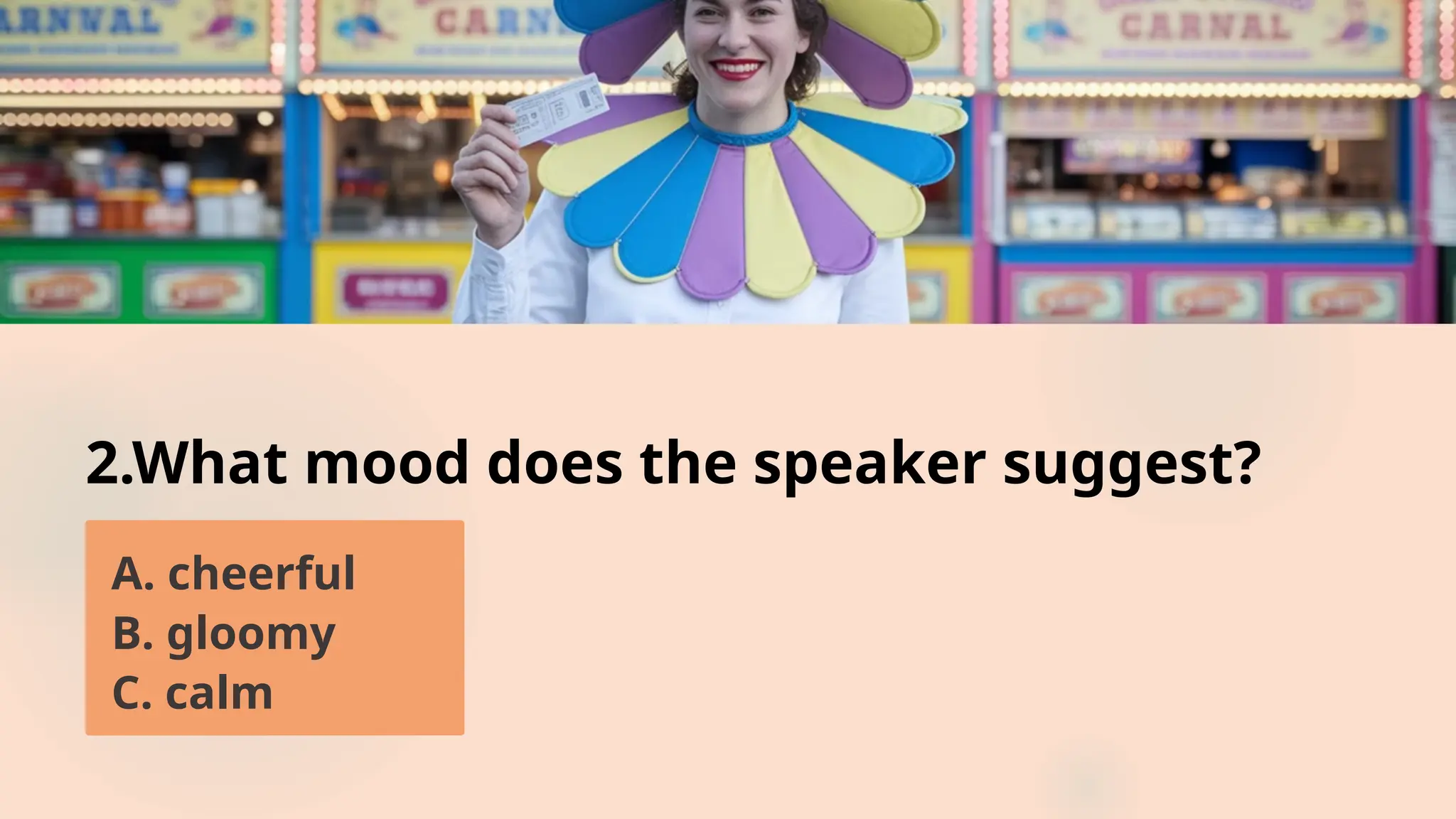
A. “Guess what, everyone? There will be a carnival in town this
weekend! There will be games, rides, and delicious treats for everyone
to enjoy. I can’t wait to try all the rides!”
1.What is the speaker’s tone?
A. formal
B. informal Is the tone appropriate? Why?
2.What mood does the speaker suggest?
A. cheerful
B. gloomy
C. calm
3.Which part(s) of the passage clearly suggest the mood?
Activity 1. Have the students read
aloud the text below to infer the
speaker’s tone and mood.
B. “Welcome to our cozy English corner! Here, you will find shelves
lined with books of every kind, just waiting to be explored. Curl up in a
comfy chair with your favorite story and let your imagination soar!
1.What is the
speaker’s tone?
A. formal
B. informal
Is the tone appropriate? Why?
2. What mood does
the speaker suggest?
A. calm
B. hopeful
C. reflective
3.Which part(s) of the
passage clearly suggest
the mood?
Activity 2. Ask students to
deliver the statements
based on the intended
meaning indicated: "SHE
SAW ME"
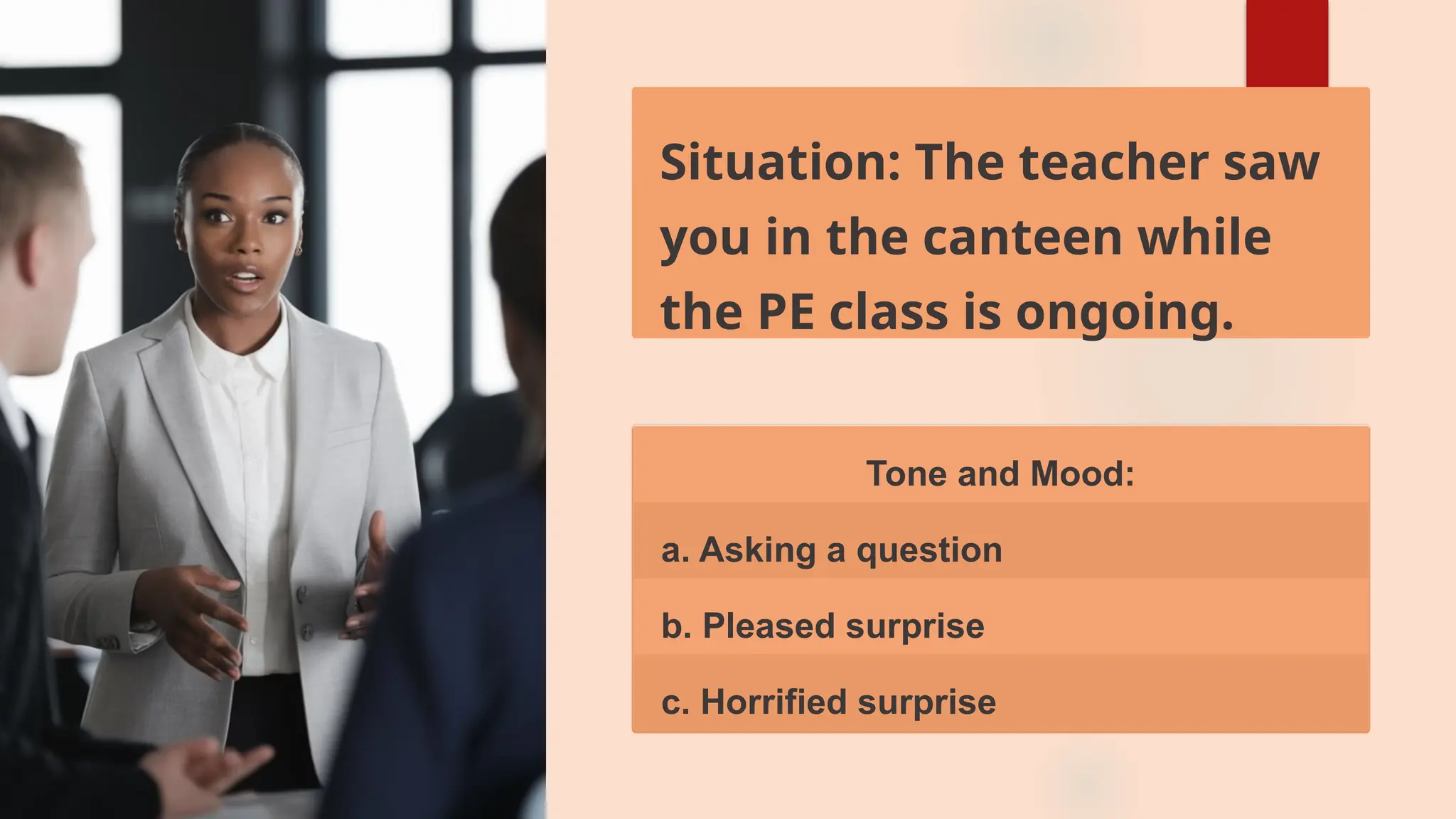
Situation: The teacher saw you
in the canteen while the PE
class is ongoing.
Situation: The teacher saw
you in the canteen while
the PE class is ongoing.
Tone and Mood:
a. Asking a question
b. Pleased surprise
c. Horrified surprise
“You were wonderful.”
Situation: You are congratulating your classmate who joined the quiz bee.
TONE AND MOOD
a. Warmly.
b. He was good and the others were bad.
c. He used to be good but isn’t anymore.
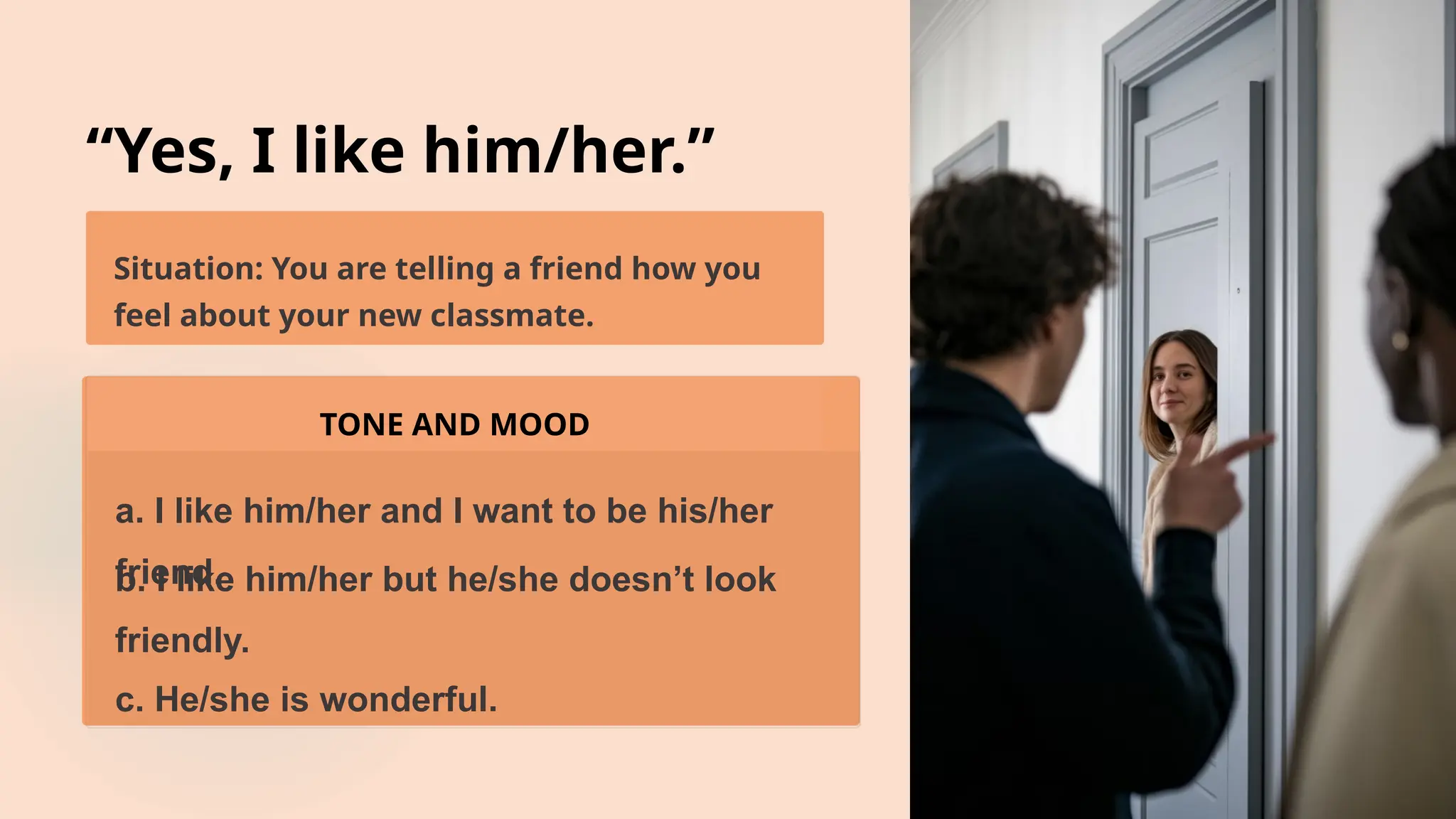
“Yes, I like him/her.”
Situation: You are telling a friend how you
feel about your new classmate.
TONE AND MOOD
a. I like him/her and I want to be his/her
friend.
b. I like him/her but he/she doesn’t look
friendly.
c. He/she is wonderful.
Activity 3. Provide passages for students
to analyze. Questions like “How does the
character feel? What words or phrases tell
you that?” may be asked. Passages from
stories or excerpts from dialogues may be
used. Below is an example from “The
Mango and The Bamboo.”
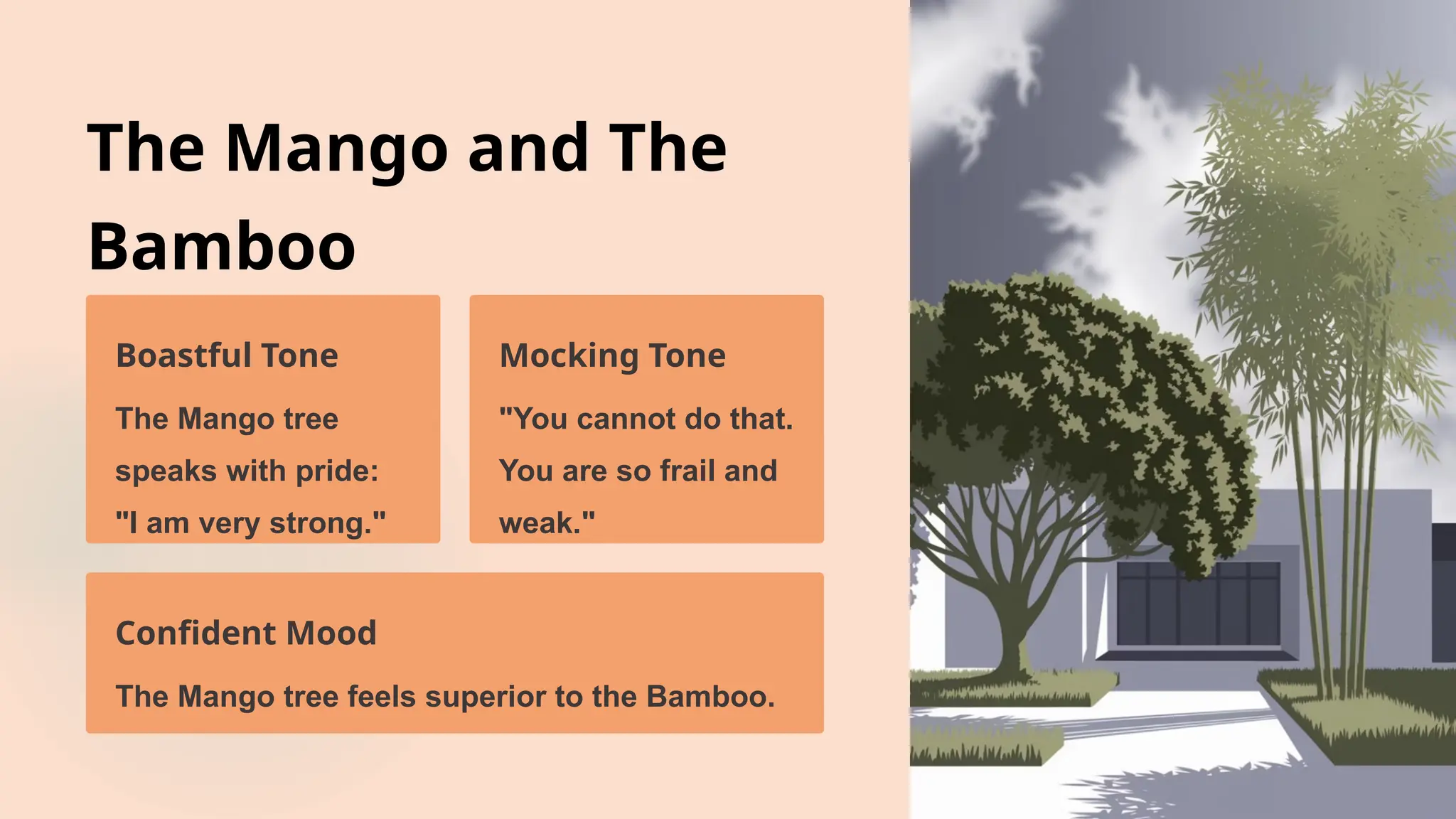
The Mango and The
Bamboo
Boastful Tone
The Mango tree
speaks with pride:
"I am very strong."
Mocking Tone
"You cannot do that.
You are so frail and
weak."
Confident Mood
The Mango tree feels superior to the Bamboo.
John-John and Macy's Conversation
John-John's Questions
"Hi, Macy. Did you have a
nice weekend?"
Macy's Responses
"Hi. It was a very nice
weekend, thanks. My
friends and I played our
favorite games."
The Tone
Friendly and informal.
Appropriate for
classmates talking about
weekend activities.
3. Lesson Activity:
Activity 4.
Ask students to work in small groups to prepare and
perform Chamber Theater. Any grade-level appropriate
narrative may be turned into script. Below is a sample
script which adapted the story “Mouse Maid Made
Mouse.”
Chamber Theater: Mouse Maid Made
Mouse
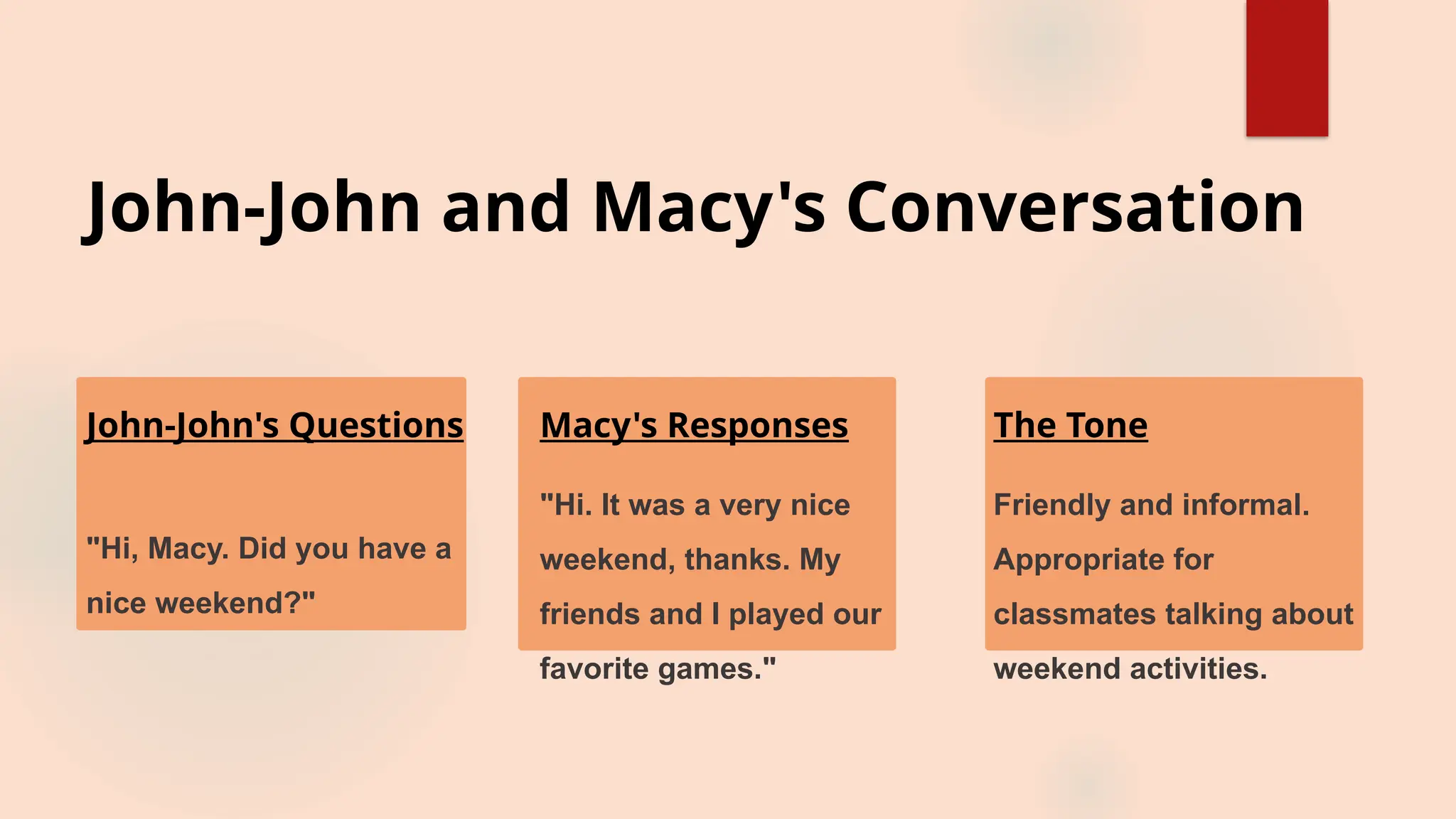
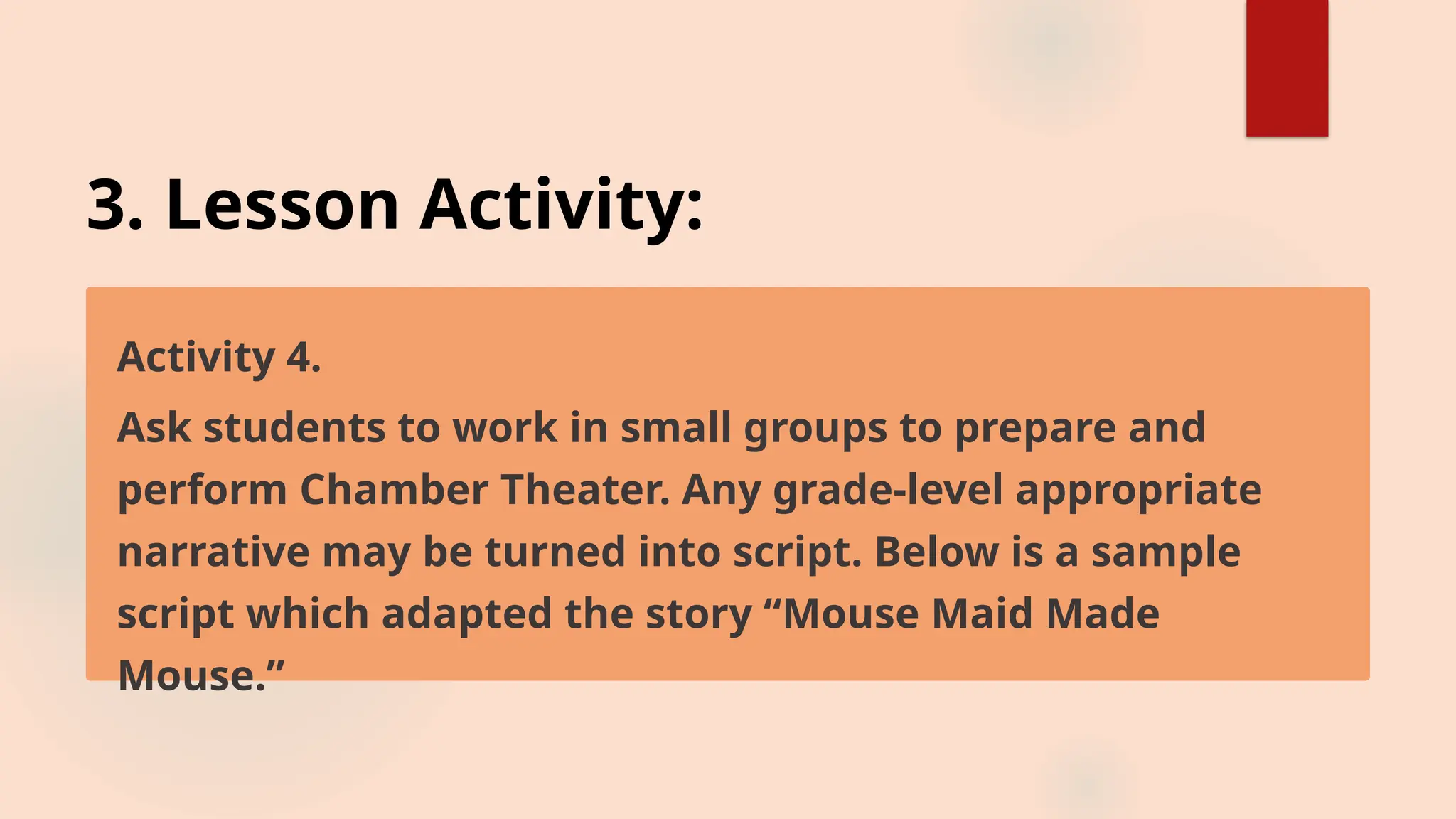
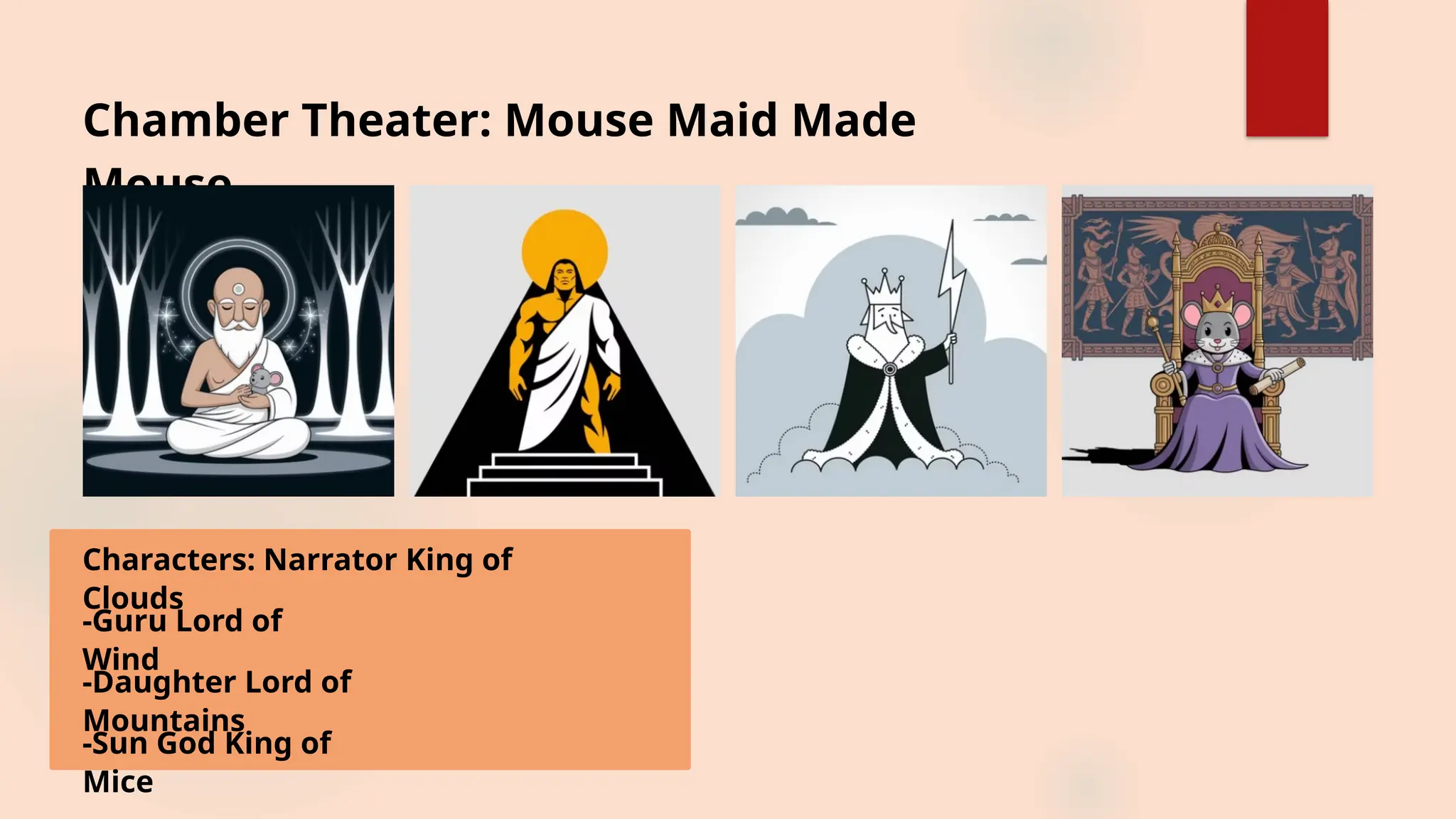
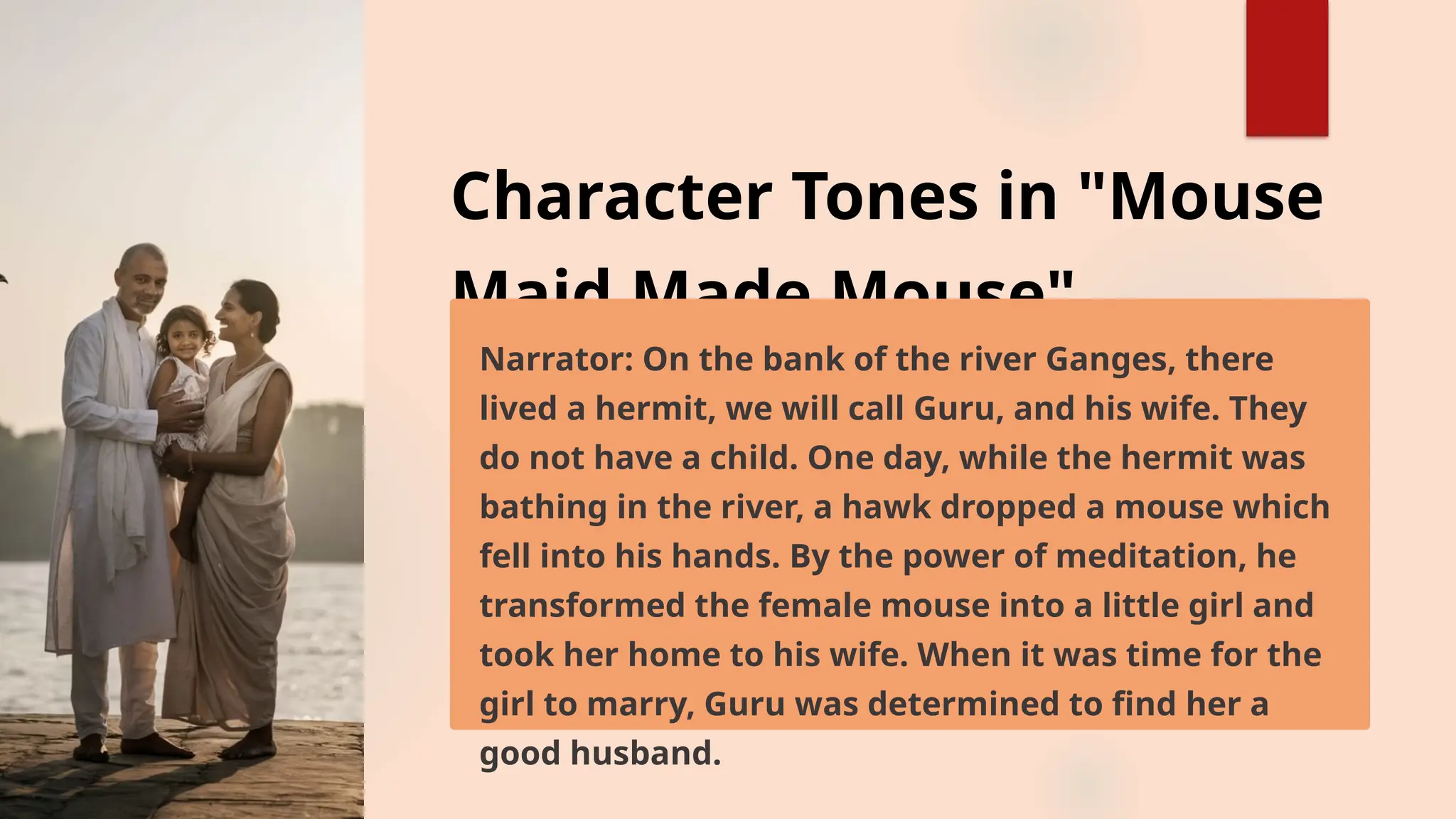
Characters: Narrator King of
Clouds
-Guru Lord of
Wind
-Daughter Lord of
Mountains
-Sun God King of
Mice
Character Tones in "Mouse
Maid Made Mouse"
Narrator: On the bank of the river Ganges, there
lived a hermit, we will call Guru, and his wife. They
do not have a child. One day, while the hermit was
bathing in the river, a hawk dropped a mouse which
fell into his hands. By the power of meditation, he
transformed the female mouse into a little girl and
took her home to his wife. When it was time for the
girl to marry, Guru was determined to find her a
good husband.
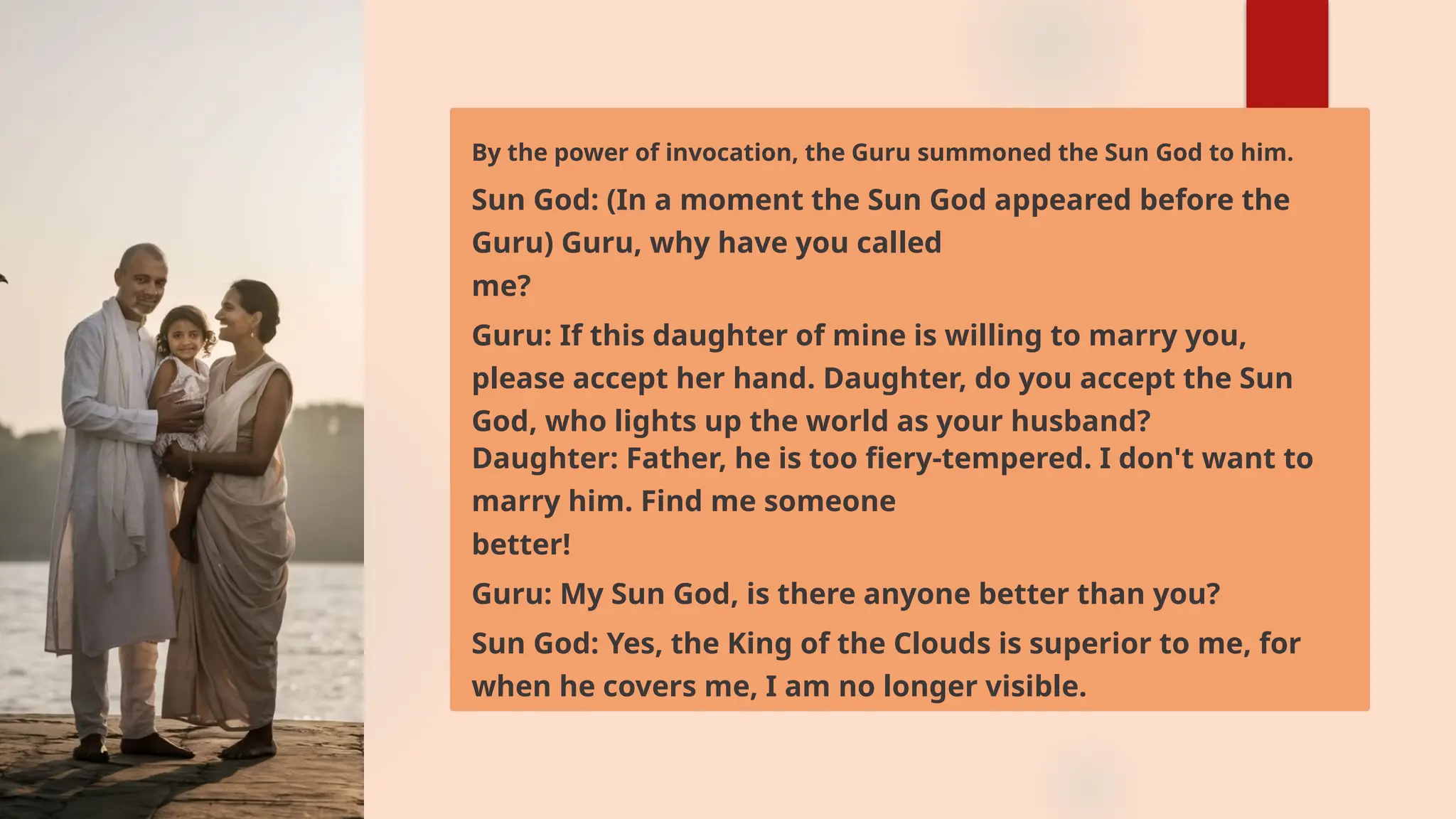
By the power of invocation, the Guru summoned the Sun God to him.
Sun God: (In a moment the Sun God appeared before the
Guru) Guru, why have you called
me?
Guru: If this daughter of mine is willing to marry you,
please accept her hand. Daughter, do you accept the Sun
God, who lights up the world as your husband?
Daughter: Father, he is too fiery-tempered. I don't want to
marry him. Find me someone
better!
Guru: My Sun God, is there anyone better than you?
Sun God: Yes, the King of the Clouds is superior to me, for
when he covers me, I am no longer visible.
Narrator: The Guru invited the King of the Clouds.
Guru: My child, may I offer you hand to the King of Clouds?
Daughter: Father, he is dark and too cold. I don't want to marry him. Find me someone
better!
Guru: Oh, King of the Clouds! Is there anyone better than you?
King of Clouds: Yes, the Lord of the Wind is superior to me, for he makes me drift.
Narrator: So, the Guru invited the Lord of the Wind
Guru: My daughter, what do you say to him?
Daughter: Father, he is very changeable. I don't want to marry him. Find me someone
better.
Guru: My Lord, is there anyone better than you?
Lord of Wind: Yes, the Lord of the Mountains is superior to me, for although I am strong, he
prevents me from blowing where I want to.
Narrator: And so, Guru invited the Lord of Mountains.
Guru: Now I am offering you to him.
Daughter: Father, he is hard and immovable. I don't want to marry him. Find me someone
better.
Guru: Lord of the Mountains, is there anyone better than you?
Lord of Mountains: Yes, the mice are superior to me, for they bore holes in my body.
Narrator: And so, the Guru invited the King of Mice.
Guru: Now my little daughter, I'm going to offer you the King of Mice. Do you like him?
Daughter: (The girl looked at the King of Mice, her whole body began to quiver with
delight.) Oh father, he is the best of all! Please turn me into a mouse, so that after my
marriage to the King of Mice, I shall be able to perform the household duties of my new
clan.
Narrator: By the power of the Guru’s meditation, he turned his daughter back into a mouse
and gave her in marriage to the king of mice.
1. Learners’ Takeaways
1 Why is knowing tone and mood
important in interpreting and
relaying messages? Complete the
prompts below:
2 I have learned that
________________________________.
3 I realized that
_____________________________________.
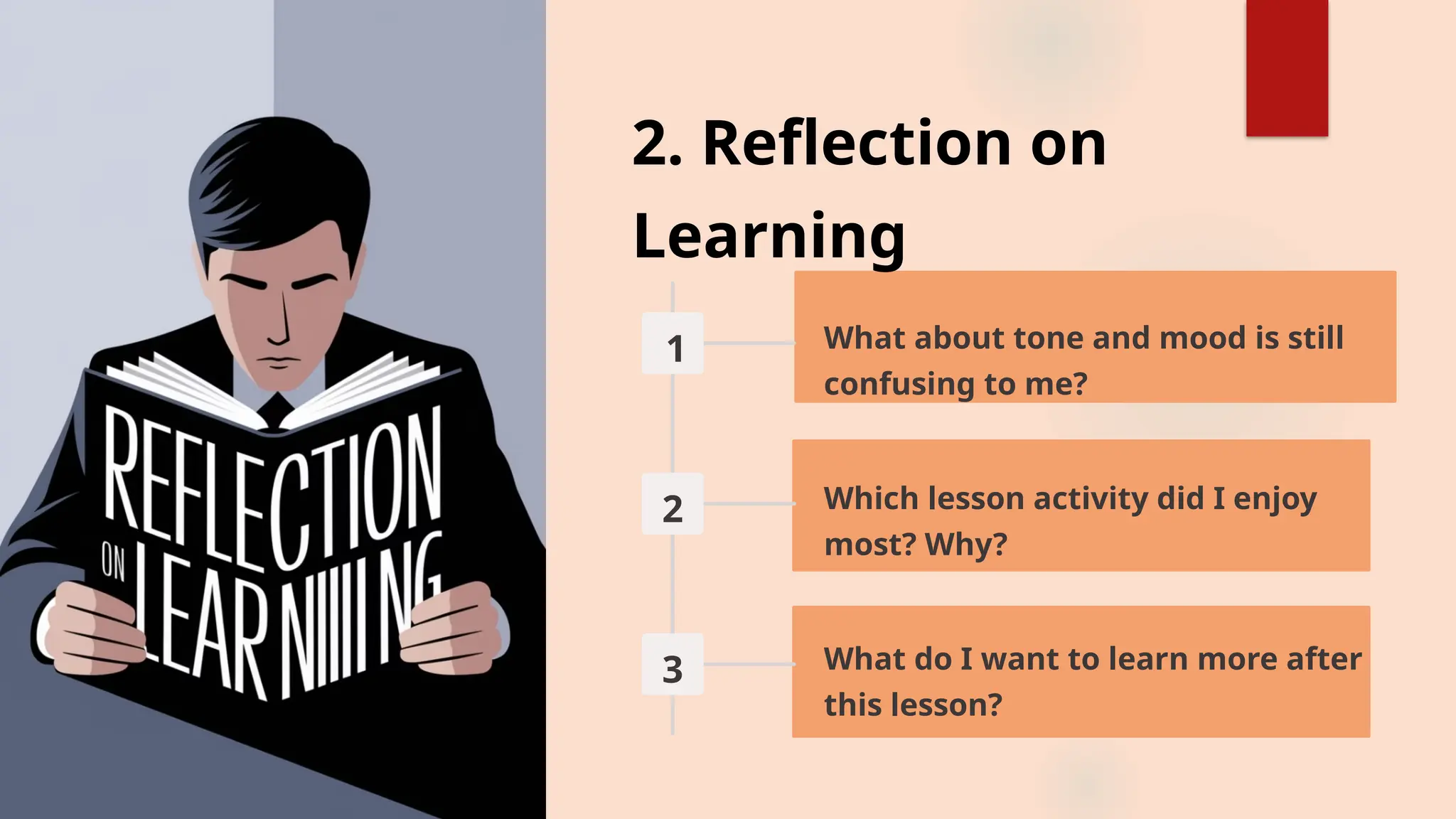
2. Reflection on
Learning
1 What about tone and mood is still
confusing to me?
2 Which lesson activity did I enjoy
most? Why?
3 What do I want to learn more after
this lesson?
Formative Assessment:
1. How would you characterize the mode of
the following sentence: "I won the game fair
and square — and I'll fight anyone who says
differently!"
a. Delighted c. Bored
b. Angry d. Deceitful
Formative Assessment:
2. What is the mood in the following
sentence? "Here we go again,” he moaned,
as he watched the other team score yet
another goal."
a. Joy c. Excitement
b. Fury d. Frustration
Formative Assessment:
3. “I’ll miss you,” she said with a tear in her
eye. What mood is expressed here?
a. Calm c. Lonely
b. Angry d. Tensed
Formative Assessment:
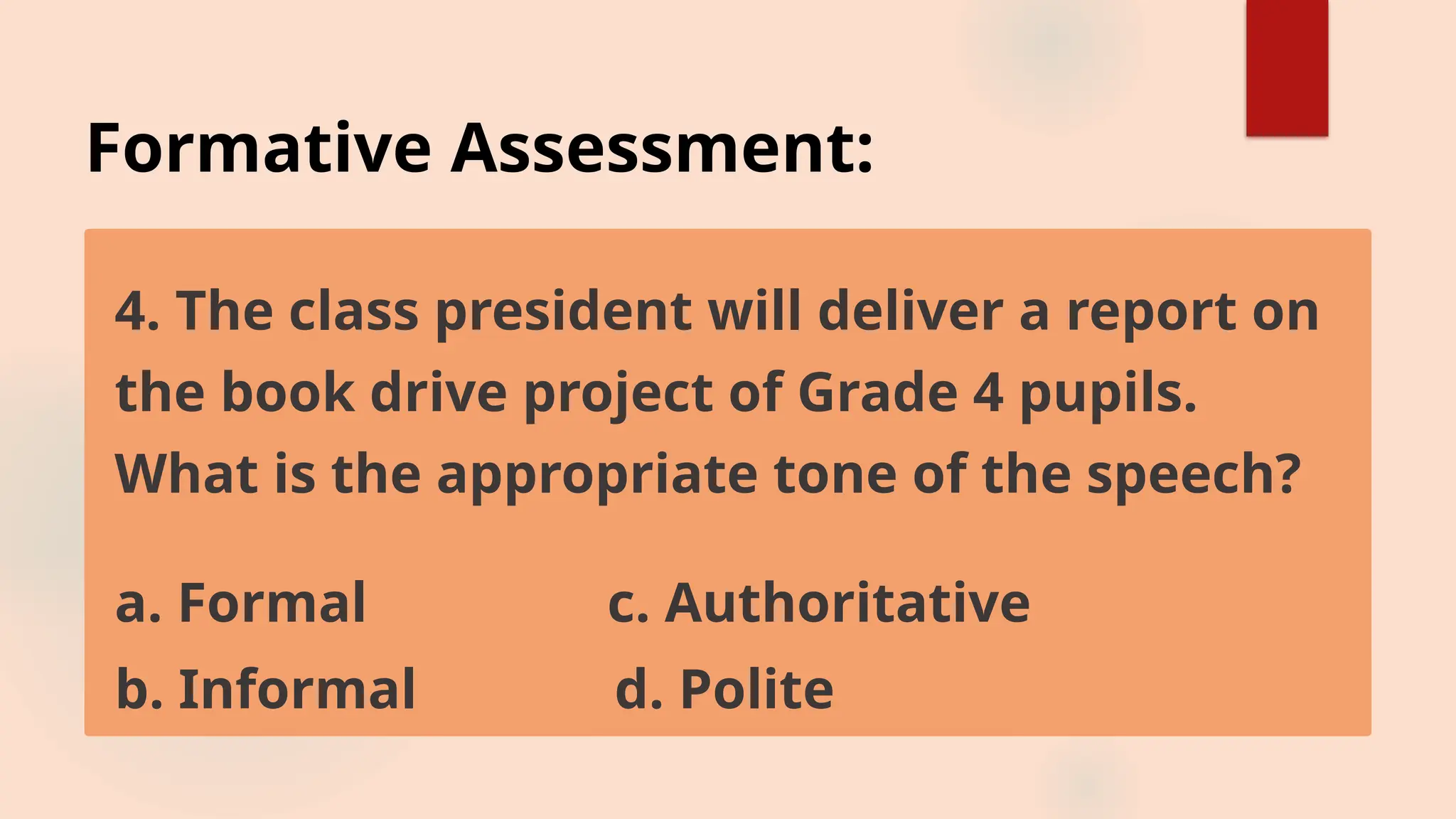
4. The class president will deliver a report on
the book drive project of Grade 4 pupils.
What is the appropriate tone of the speech?
a. Formal c. Authoritative
b. Informal d. Polite
Formative Assessment:
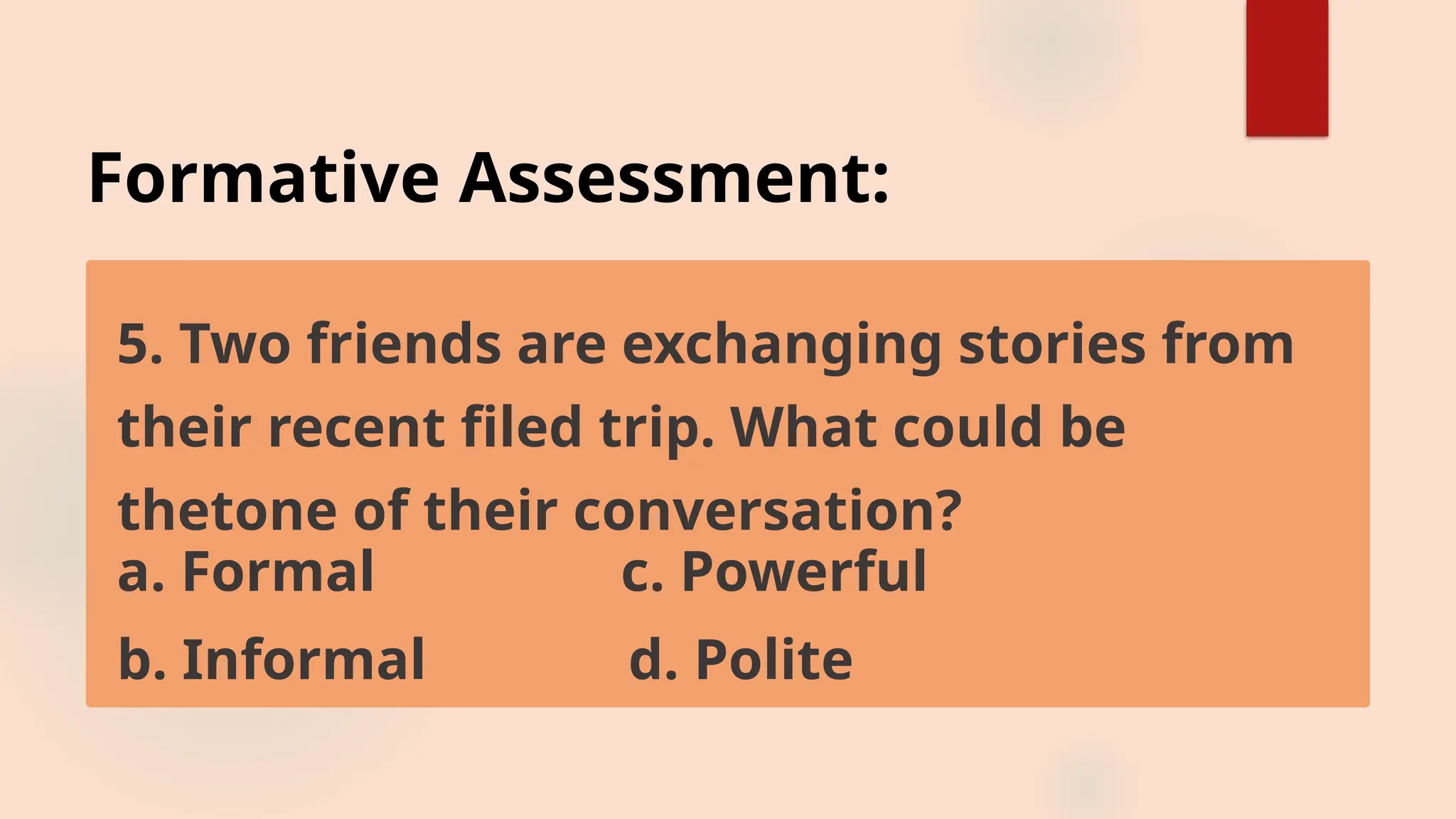
5. Two friends are exchanging stories from
their recent filed trip. What could be
thetone of their conversation?
a. Formal c. Powerful
b. Informal d. Polite
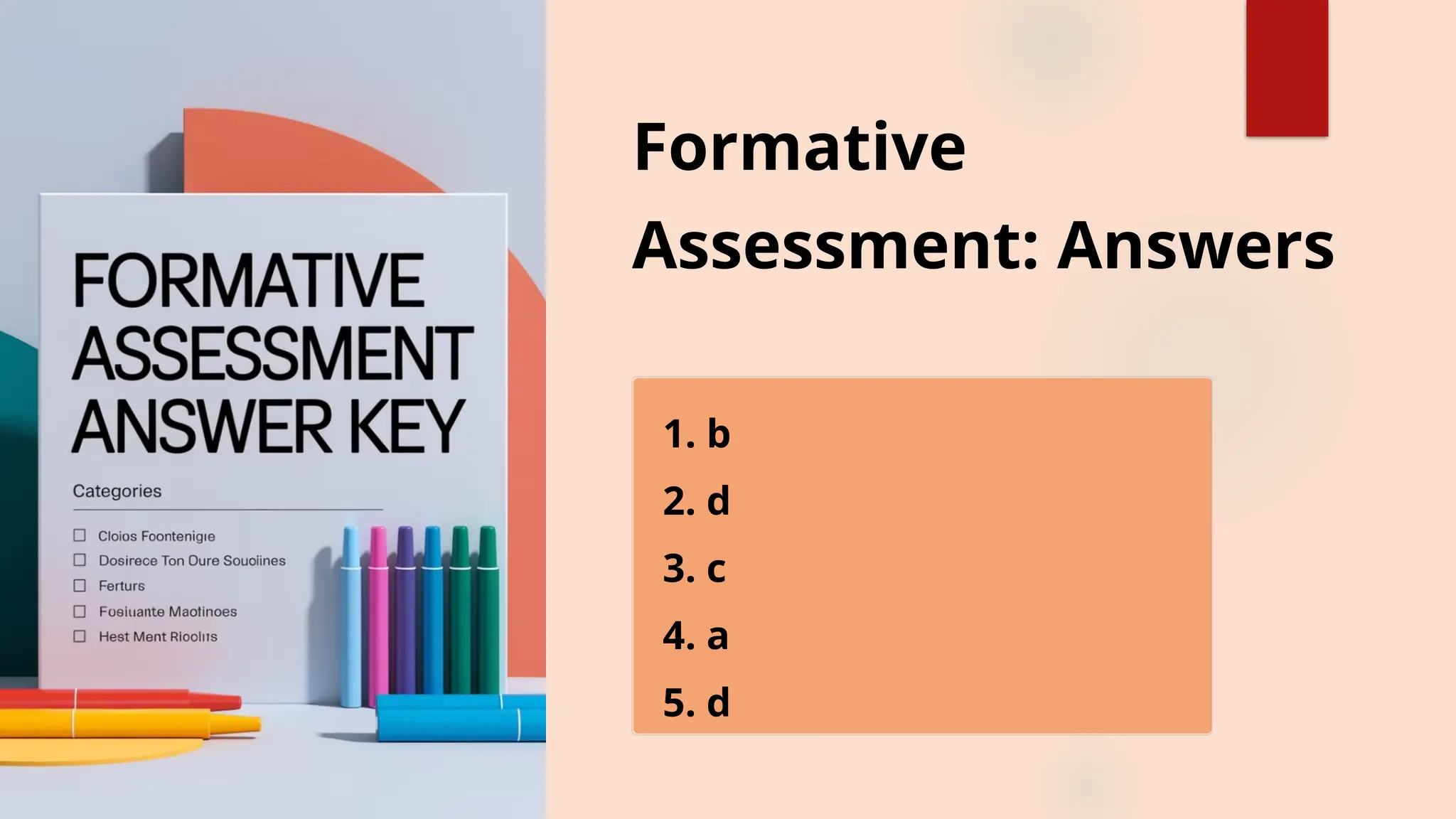
Formative
Assessment: Answers
1. b
2. d
3. c
4. a
5. d
Thank
You!

English 4 Quarter 4 Week 4 Classroom Obs

  • 1.
    Using the toneand mood appropriately for one’s purpose, context, and target audience: informal. by Eva Quintano
  • 2.
    A. DRAG andDROP Allow the students to drag the keyword and drop it next to its meaning.
  • 3.
    Mis- -able -less0proof Re- -free Ex- il- -ness Anti- ___________1. Wrongly ___________2. out of, away from, lacking ___________3. not ___________4. against, opposing ___________5. able to, can be done ___________6. without, not affected by ___________7. denoting a state or condition ___________8. safe, protected against ___________9. without ___________10. again
  • 4.
    Drag and Drop:ANSWERS 1. mis- 2. ex- 3. in- 4. anti- 5. -able 6. -less 7. -ness 8. -proof 9. -free 10. re-
  • 5.
    Lesson Purpose: "ILove You" Challenge Say "I love you" with different emotions: happy, angry, sad, and scared. Can your friends guess the emotion? Notice how your tone changes!
  • 6.
    Questions: 1. What have younoticed in the tone of their voices? 2. How do they convey the mood? 3. Is it possible that we can also feel what the speaker feels in written text?
  • 7.
    2. Unlocking Content Vocabulary Part1. Words Search. The students find and circle the hidden words.
  • 8.
    T O NE F G A L I G J Y S A D G M D E C E O P C B L K O U T R S Y P I Z M O S T T E T F A T Q M R Y V E T U U H P P N L T L R T R L N A R R A T I V E E I U H W S F R H O L S P P R R E C O U N T B Y P A C I A L L E T T E K Y R E S I M J N T U Letter Tone Gestures Narrative Joyful Mood Misery Haptics Recount Unhappy
  • 9.
    T O NE F G A L I G J Y S A D G M D E C E O P C B L K O U T R S Y P I Z M O S T T E T F A T Q M R Y V E T U U H P P N L T L R T R L N A R R A T I V E E I U H W S F R H O L S P P R R E C O U N T B Y P A C I A L L E T T E K Y R E S I M J N T U Letter Tone Gestures Narrative Joyful Mood Misery Haptics Recount Unhappy A N S W E R S
  • 10.
    Part 2. MatchIt! After finding the hidden words in the word search, ask the learners to match the word to the definition given below.
  • 11.
    __________1. refers tothe author’s attitude toward a subject __________2. a written, typed, or printed communication, especially one sent in an envelope by mail or messenger. __________3. refers to the emotions that a text evokes from the reader __________4. entertains, instructs, or informs readers by telling a story __________5. tell someone about something; give an account of an event or experience.
  • 12.
    __________6. include movementof the hands, face, or other parts of the body __________7. the study of touch as a form of nonverbal communication. __________8. not satisfied or pleased with (a situation) ____________9. feeling, expressing, or causing great pleasure and happiness. __________10. a state or feeling of great distress or discomfort of mind or body.
  • 13.
    Part 2 Answers: 1Tone 2 Letter 3 Mood 4 Narrative 5 Recount 6 Gestures 7 Haptics 8 Unhappy 9 Joyful 1 0 Misery
  • 14.
    1. Explicitation: Have thestudents watch Pixar Short Film #25 La Luna 2011
  • 16.
    Steps: Step 1. Havethe students watch the Pixar Short Film #25 La Luna 2011.
  • 17.
    Steps: Step 2. Afterwatching it, ask the following questions: 1. What is the special job that the boy, his father, and his grandfather do together in "La Luna"? Why is it important? How does this help the story bring a magical feeling? 2. Describe a scene from "La Luna" that made you feel curious or excited.
  • 18.
    Steps: 3. Think abouta moment in "La Luna" where the characters encountered something unexpected. How did it make you feel as a viewer? 4. At the end of "La Luna," how do you think the characters feel about their adventure? 5. What are the different emotions that you have seen in the short film?
  • 19.
  • 20.
    What Is Tone? 1Speaker's Attitude Tone is the attitude that a speaker takes towards what they are saying. 2 Voice Expression The tone of voice expresses ideas and emotions. 3 Affects Meaning Tone can change the meaning of spoken words.
  • 21.
    What Is Mood? Reader'sFeelings Mood refers to the emotions that a text makes the reader feel. Created by Words Authors use specific words to create moods like happy, sad, or scared. Sets the Atmosphere Mood creates the overall feeling or atmosphere of a story or poem.
  • 22.
    Tone vs. Mood Tone Toneis the author's or speaker's attitude toward the subject. Mood Mood is the feeling that the reader or listener experiences. Connection The tone helps create the mood. They work together!
  • 23.
    Activity 1. Havethe students read aloud the text below to infer the speaker’s tone and mood. A. “Guess what, everyone? There will be a carnival in town this weekend! There will be games, rides, and delicious treats for everyone to enjoy. I can’t wait to try all the rides!”
  • 24.
    1.What is thespeaker’s tone? A. formal B. informal Is the tone appropriate? Why?
  • 25.
    2.What mood doesthe speaker suggest? A. cheerful B. gloomy C. calm
  • 26.
    3.Which part(s) ofthe passage clearly suggest the mood?
  • 27.
    Activity 1. Havethe students read aloud the text below to infer the speaker’s tone and mood. B. “Welcome to our cozy English corner! Here, you will find shelves lined with books of every kind, just waiting to be explored. Curl up in a comfy chair with your favorite story and let your imagination soar!
  • 28.
    1.What is the speaker’stone? A. formal B. informal Is the tone appropriate? Why?
  • 29.
    2. What mooddoes the speaker suggest? A. calm B. hopeful C. reflective
  • 30.
    3.Which part(s) ofthe passage clearly suggest the mood?
  • 31.
    Activity 2. Askstudents to deliver the statements based on the intended meaning indicated: "SHE SAW ME" Situation: The teacher saw you in the canteen while the PE class is ongoing.
  • 32.
    Situation: The teachersaw you in the canteen while the PE class is ongoing. Tone and Mood: a. Asking a question b. Pleased surprise c. Horrified surprise
  • 33.
    “You were wonderful.” Situation:You are congratulating your classmate who joined the quiz bee. TONE AND MOOD a. Warmly. b. He was good and the others were bad. c. He used to be good but isn’t anymore.
  • 34.
    “Yes, I likehim/her.” Situation: You are telling a friend how you feel about your new classmate. TONE AND MOOD a. I like him/her and I want to be his/her friend. b. I like him/her but he/she doesn’t look friendly. c. He/she is wonderful.
  • 35.
    Activity 3. Providepassages for students to analyze. Questions like “How does the character feel? What words or phrases tell you that?” may be asked. Passages from stories or excerpts from dialogues may be used. Below is an example from “The Mango and The Bamboo.”
  • 36.
    The Mango andThe Bamboo Boastful Tone The Mango tree speaks with pride: "I am very strong." Mocking Tone "You cannot do that. You are so frail and weak." Confident Mood The Mango tree feels superior to the Bamboo.
  • 37.
    John-John and Macy'sConversation John-John's Questions "Hi, Macy. Did you have a nice weekend?" Macy's Responses "Hi. It was a very nice weekend, thanks. My friends and I played our favorite games." The Tone Friendly and informal. Appropriate for classmates talking about weekend activities.
  • 38.
    3. Lesson Activity: Activity4. Ask students to work in small groups to prepare and perform Chamber Theater. Any grade-level appropriate narrative may be turned into script. Below is a sample script which adapted the story “Mouse Maid Made Mouse.”
  • 39.
    Chamber Theater: MouseMaid Made Mouse Characters: Narrator King of Clouds -Guru Lord of Wind -Daughter Lord of Mountains -Sun God King of Mice
  • 40.
    Character Tones in"Mouse Maid Made Mouse" Narrator: On the bank of the river Ganges, there lived a hermit, we will call Guru, and his wife. They do not have a child. One day, while the hermit was bathing in the river, a hawk dropped a mouse which fell into his hands. By the power of meditation, he transformed the female mouse into a little girl and took her home to his wife. When it was time for the girl to marry, Guru was determined to find her a good husband.
  • 41.
    By the powerof invocation, the Guru summoned the Sun God to him. Sun God: (In a moment the Sun God appeared before the Guru) Guru, why have you called me? Guru: If this daughter of mine is willing to marry you, please accept her hand. Daughter, do you accept the Sun God, who lights up the world as your husband? Daughter: Father, he is too fiery-tempered. I don't want to marry him. Find me someone better! Guru: My Sun God, is there anyone better than you? Sun God: Yes, the King of the Clouds is superior to me, for when he covers me, I am no longer visible.
  • 42.
    Narrator: The Guruinvited the King of the Clouds. Guru: My child, may I offer you hand to the King of Clouds? Daughter: Father, he is dark and too cold. I don't want to marry him. Find me someone better! Guru: Oh, King of the Clouds! Is there anyone better than you? King of Clouds: Yes, the Lord of the Wind is superior to me, for he makes me drift. Narrator: So, the Guru invited the Lord of the Wind Guru: My daughter, what do you say to him? Daughter: Father, he is very changeable. I don't want to marry him. Find me someone better. Guru: My Lord, is there anyone better than you? Lord of Wind: Yes, the Lord of the Mountains is superior to me, for although I am strong, he prevents me from blowing where I want to.
  • 43.
    Narrator: And so,Guru invited the Lord of Mountains. Guru: Now I am offering you to him. Daughter: Father, he is hard and immovable. I don't want to marry him. Find me someone better. Guru: Lord of the Mountains, is there anyone better than you? Lord of Mountains: Yes, the mice are superior to me, for they bore holes in my body. Narrator: And so, the Guru invited the King of Mice. Guru: Now my little daughter, I'm going to offer you the King of Mice. Do you like him? Daughter: (The girl looked at the King of Mice, her whole body began to quiver with delight.) Oh father, he is the best of all! Please turn me into a mouse, so that after my marriage to the King of Mice, I shall be able to perform the household duties of my new clan. Narrator: By the power of the Guru’s meditation, he turned his daughter back into a mouse and gave her in marriage to the king of mice.
  • 44.
    1. Learners’ Takeaways 1Why is knowing tone and mood important in interpreting and relaying messages? Complete the prompts below: 2 I have learned that ________________________________. 3 I realized that _____________________________________.
  • 45.
    2. Reflection on Learning 1What about tone and mood is still confusing to me? 2 Which lesson activity did I enjoy most? Why? 3 What do I want to learn more after this lesson?
  • 46.
    Formative Assessment: 1. Howwould you characterize the mode of the following sentence: "I won the game fair and square — and I'll fight anyone who says differently!" a. Delighted c. Bored b. Angry d. Deceitful
  • 47.
    Formative Assessment: 2. Whatis the mood in the following sentence? "Here we go again,” he moaned, as he watched the other team score yet another goal." a. Joy c. Excitement b. Fury d. Frustration
  • 48.
    Formative Assessment: 3. “I’llmiss you,” she said with a tear in her eye. What mood is expressed here? a. Calm c. Lonely b. Angry d. Tensed
  • 49.
    Formative Assessment: 4. Theclass president will deliver a report on the book drive project of Grade 4 pupils. What is the appropriate tone of the speech? a. Formal c. Authoritative b. Informal d. Polite
  • 50.
    Formative Assessment: 5. Twofriends are exchanging stories from their recent filed trip. What could be thetone of their conversation? a. Formal c. Powerful b. Informal d. Polite
  • 51.
  • 52.