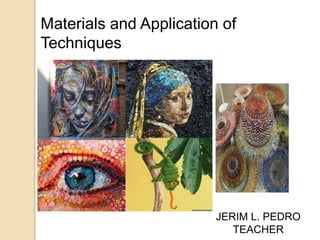
Materials and Application of
Techniques
JERIM L. PEDRO
TEACHER
What I
Need to
Know
After going through this module, you are
expected to:
 1. discuss the different materials used
and the application of techniques;
 2. determines the processes or
methods of each application
techniques;
 3. examine the reason why the
existing application techniques are
gradually being forgotten; and
 4. Create artwork / s from used pet
bottles.
What
is It
Garbage
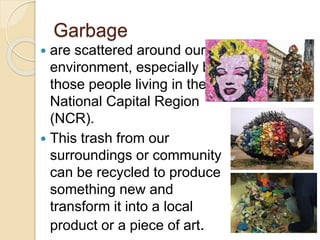
 are scattered around our
environment, especially by
those people living in the
National Capital Region
(NCR).
 This trash from our
surroundings or community
can be recycled to produce
something new and
transform it into a local
product or a piece of art.
 The Philippines has
been blessed with a lot
of local materials
according to previous
discussions.
 Some of these are
Abaca, Bakbak,
Bamboo, Buntal, Buri,
and many others that
are constantly being
developed by talented
 But in the long run, our skilled
Filipinos have gone through
various trials especially on the
scarcity of the materials used and
the growth of technology that
hinders the development of our
existing methods in the
development of local materials
 so that new generations are
gradually forgetting the materials
used and the application of
In this lesson,
we will go back
to the local
materials and
the techniques
of yesterday that
are gradually
being forgotten.
 Based on the book (Sandagan, 2016)
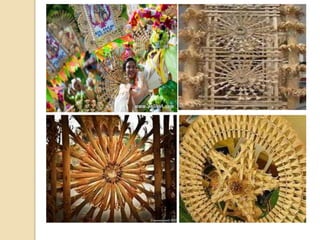
 Singkaban is a type of Filipino art of shaving
a bamboo for home decors and bamboo
arches for weddings, mass gathering, fiesta,
and as welcome signage of a town, city, or
village in the country.
 It is broadly utilized as enrichment amid town
celebration in Bulacan.
 Experienced workers who strive to shave
bamboo, layering to make curls and sensitive
twirls to reach the unique art in this field.
 Perhaps, it is an art form ensuring that art is
acknowledged and is open to everybody
within the community and their visitors.
Singkaban
Puni
 According to (Flores, 2018)
 Puni is a traditional art of leaf folding.
 It is an ancient art of weaving that uses
elongated leaves.
 It starts with preparing the leaf, folding the
leaf, tightening the package, and trimming the
garnish.
 It is one of the recognized crafts in the
weaving industry.
 In the history of Bulacan, they use these
leaves in making “Kubol” as a resting place,
as a wrapper for their foods, and most of all
as a creative toy for children.
 It was only during 1998 when it was called
Puni.
 These leaves were widely used then but now,
it's becoming obsolete and become a dying
art.
 With the cooperation of the local
governments of Bulacan, it is gradually being
introduced to the new generations.
 Today it continues to be used to create
woven baskets, bags, fans, and most of all as
"Palaspas" by Catholic believers at the
beginning of Holy Week.
 Currently, these leaves are imported from
Sampaloc, Quezon.
 The leaves dry and crumbled within a few
days. It is more common to use that are dried
treated and dyed for strength and color.
Pabalat
 As featured by Galvez in 2016, the
province of Bulacan is known for
making Pastillas de Letche one of the
Filipinos' favorites.
 It is made from carabao’s milk and
sprinkled with white sugar.
 After this is done, it is wrapped in plain
white paper and then placed in
packages to be released to the
market.
Due to the unique mindset and
creativity of the Filipinos, they
had a unique approach in
making pastillas.
In the town of San Miguel, the
unique production of paper
used to wrap pastillas first
emerged.
This art was soon transferred
to the town of Malolos,
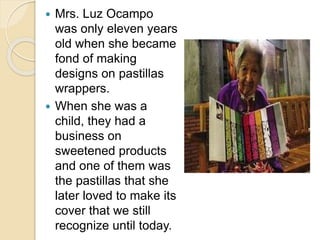
 Mrs. Luz Ocampo
was only eleven years
old when she became
fond of making
designs on pastillas
wrappers.
 When she was a
child, they had a
business on
sweetened products
and one of them was
the pastillas that she
later loved to make its
cover that we still
recognize until today.
 This kind of art is what we called borlas
de pastillas, the intricately-designed
wrapper is made from papel de hapon or
Japanese paper.
 First, Make a design on the tracing
board.
 Trace the design on the papel de Hapon
or Japanese paper.
 The real challenge comes with cutting
the paper where the design is traced.
 The designs include Bahay kubo (nipa
hut), rice field, farmer/farmers, Maria
Clara, flowers, landscapes, figures, or
specific activities and scenarios.
 Wrapper-making
used to be folk art,
but the tradition is
slowly diminishing.
 Today, Ate Naty
Ocampo Castro
continues the legacy
of her mother – offer
her borlas de
pastillas- to keep this
culture alive and to
be recognized by the
current generation.
Taka
 Paete, Laguna is one of the
most colorful and creative
places in the Philippines.
The name Paete is derived
from the word chisel which is
an important tool used for
sculpture.
 Taka or Paper Mache was first recorded
in the 1920s when Maria Bangue made a
paper toy.
 The papers were molded from wood
carving and glued with paste.
 After drying, the paper was removed
from the molder and reassembled, dried,
and painted in a decorative pattern that
eventually becomes toys and ornaments.
 Unfortunately, no one knows if her
artworks were saved after her town was
consumed by fire and almost all traces of
Takas she made are gone.
 Every April the Paete people are busy
making Christmas characters like Santa
Claus, Rudolph the red nose Reindeer,
and Frosty the Snowman in preparation
for the upcoming holiday season.
 Within the town, almost all the shops sell
various Filipino-inspired designs carabao
figurine, Maria Clara dolls, and horses in
a variety of options.
 Some new designs are toy soldiers,
giraffes, rabbits, and a variety of fruits —
all in different colors and sizes
(Baldemor, 2020).
Pagpapalayok or
Potterymaking
 Kare-kare, Paksiw, Sinigang, these are
only some of the Filipino dishes we love
to feast on. of course, they're only more
appetizing served hot off the fire, in a
clay pot.
 Our use of clay pots is one of the things
that highlight the Filipino trademark of
our dishes.
 Despite many changes, the people of
Pasig still preserve one of the oldest and
most important art forms of the city the
pottery-making.
 The tradition of Pottery-making lives on
in Pasig until now. Where the products
include not only ornamental jars but also
those used in everyday living.
 Some pottery makers in Pasig import
clay in San Mateo, Rizal.
 The first step is passing the clay through
the mill. Then, they shape it in a mold
made from "Plaster of Paris." Next, they
put the clay on the potter's wheel.
 After it's done on the wheel, it will be
buff and smoothen the pot.
 Drying takes one or two days depending
on the climate.
 When it rains, the pots can take one
week to dry.
 When it is sunny, it can take only
one day.
 When the pots are dry, they can be
baked in the kiln.
 The ideal time is eight hours of
baking.
 In baking, if you heat it too suddenly,
the pots break, so you have to heat
it slowly.
 When the pots turn red, that means
they're almost done so turn up the heat
until the embers spark.
 Today, they used old pieces of wood and
plywood as fuel in their ovens.
 However, potters before used carabao
dung and hay.
 That's what they used back in the 1950s.
When the pot is tapped and sounds like
a bell it is cooked then it must be
inspected once more.
 Finally, it will be painted with latex or
acrylic paint, or coated with a glaze to
make it shine (Castro, 2020).
Sanikulas Cookies or Panecillos
de San Nicola
 News featured in Youtube last 2018,
considers Pampanga as the culinary
destination of the Philippines.
 Atching Lillian Borromeo is one of the
famous food historians and experts in
Pampanga. Her recipes are handed down
from her grandmother whom she called
“Impo”.
 Atching Lilian also makes Panecillos de San
Nicolas, whom Filipinos believe to possess
healing properties. Arrowroot is the main
ingredient in baking the said cookies.
 The arrowroot plant was inherited from her
ancestors.
 They had to plant the arrowroot and
wait
eight months for the roots to mature.
 The roots are then processed. It is
pounded and soaked in water.
 It is sun-dried and ends up as powder.
That's the flour they used for San
Nicolas cookies.
 Unlike these days you can easily buy
ingredients from the store.
 But at that time, they didn't even have
flour.
 Combine all the ingredients in a bowl
– cornstarch, baking powder, salt,
sugar, egg yolks, coconut milk,
softened butter, lemon zest, and oil.
 Blend well with a wooden spoon.
Slowly add the cake flour and the rice
flour, knead it into the mixture till it
resembles a thick dough, and has a
smooth surface.
 Mixing by the hand should take about
10 minutes till it is smooth and all
ingredients are incorporated.
 Place the dough into an airtight
container and freezer for 2 to 4
hours or overnight.
 When ready to bake, take the
dough out of the freezer and thaw
on the counter for 8 to 10
minutes.
 Keep the dough very cold so it is
easy to roll out and handle on the
heirloom cookie molds.
 Grease with baking spray or shortening the
surface of the San Nicolas mold which has
the design.
 Make sure to grease the inner crevices and
corners so that dough can be removed easily
after shaping.
 Place a chunk of the dough, about 4
tablespoons over the San Nicolas mold, on
the hand-carved portion.
 Flatten with your hand to spread it around
evenly. Place a piece of parchment or wax
paper over the dough, which is over the
wooden mold.
 Using a rolling pin, roll and flatten the dough
so it gets embedded in the design.
 Place a round or oval cookie
cutter over the San Nicolas mold,
to cut the dough to the
appropriate shape needed.
 Trim the edges of the cookie if
needed, whether round or oval.
 Quickly transfer the molded
dough onto a baking sheet that
has parchment paper or a silicone
baking sheet.
 Bake Pan de San Nicolas at a preheated
oven of 325 F degrees for 10 to 12
minutes or till top is brown.
 When done, cool the cookies on a cookie
rack.
 They will be crisp on the outside but will
have a slightly soft shortbread texture
inside. It will take at least 30-40 minutes
for the cookies to cool on the rack.
 When Pan de San Nicolas cookies are
cooled, wrap in white cellophane
wrappers to show off the intricate
designs.
 Store in an airtight glass or plastic jar.
San Nicolas cookies are quite
bland in taste. People say it's
good for people with diabetes.
The absence of sweetness
makes it excellent when it is
paired with hot chocolate
(Sison, 2017).
Pagbuburda
 Embroidery is an art of decorative
stitching, especially by hand.
 The high quality of embroidery in the
Philippines is partly due to its history and
partly due to native talent.
 The town of Taal and Lumban, Laguna
had a long tradition of hand embroidery
since the arrival of the Franciscan
Missionaries.
 They started teaching women
embroidery. This is probably one of the
most formal studies that have happened
to women folks.
 During the Japanese era, the culture of
embroidery was forgotten.
 It only goes back to the American era.
 Piña and Jusi are traditional fabrics
used by the bordadoras.
 But Piña is more special because it is
decent, soft, refined, durable, and not
hot.
 Ang Jusi (Chiese term for raw silk), on
the other hand, is a lightweight, flimsy,
and ecru colored fabric regarded by the
bordadoras as the best material for
embroidery (News, Youtube, 2019).
 The first process starts with a “magdidibuho”
(designer) who is in charge of stamping design on
the cloth.
 After making the design the cloth is then passed on
to the “burdadera” (embroiderer) it who embroiders
the cloth which the designer has stamped.
 After embroidering it will be passed to another
person called “magbabakbak". She pulls each
thread to form a design.
 After that, another person will do the next process
which is “pagkakalado” (calado).
 It is done to avoid the cloth from being frayed. In
calado you will lock the threads from which you
have pulled from the cloth before you have to make
sure you look at each thread. “Calado” is a very
tedious process.
 Those are the process from embroidery,
“pagbakbak” and “pagkakalado.”
grade 12 .pptx
grade 12 .pptx
grade 12 .pptx

grade 12 .pptx

  • 1.
    Materials and Applicationof Techniques JERIM L. PEDRO TEACHER
  • 2.
  • 3.
    After going throughthis module, you are expected to:  1. discuss the different materials used and the application of techniques;  2. determines the processes or methods of each application techniques;  3. examine the reason why the existing application techniques are gradually being forgotten; and  4. Create artwork / s from used pet bottles.
  • 4.
  • 5.
    Garbage  are scatteredaround our environment, especially by those people living in the National Capital Region (NCR).  This trash from our surroundings or community can be recycled to produce something new and transform it into a local product or a piece of art.
  • 6.
     The Philippineshas been blessed with a lot of local materials according to previous discussions.  Some of these are Abaca, Bakbak, Bamboo, Buntal, Buri, and many others that are constantly being developed by talented
  • 7.
     But inthe long run, our skilled Filipinos have gone through various trials especially on the scarcity of the materials used and the growth of technology that hinders the development of our existing methods in the development of local materials  so that new generations are gradually forgetting the materials used and the application of
  • 8.
    In this lesson, wewill go back to the local materials and the techniques of yesterday that are gradually being forgotten.
  • 9.
     Based onthe book (Sandagan, 2016)  Singkaban is a type of Filipino art of shaving a bamboo for home decors and bamboo arches for weddings, mass gathering, fiesta, and as welcome signage of a town, city, or village in the country.  It is broadly utilized as enrichment amid town celebration in Bulacan.  Experienced workers who strive to shave bamboo, layering to make curls and sensitive twirls to reach the unique art in this field.  Perhaps, it is an art form ensuring that art is acknowledged and is open to everybody within the community and their visitors. Singkaban
  • 11.
    Puni  According to(Flores, 2018)  Puni is a traditional art of leaf folding.  It is an ancient art of weaving that uses elongated leaves.  It starts with preparing the leaf, folding the leaf, tightening the package, and trimming the garnish.  It is one of the recognized crafts in the weaving industry.  In the history of Bulacan, they use these leaves in making “Kubol” as a resting place, as a wrapper for their foods, and most of all as a creative toy for children.  It was only during 1998 when it was called Puni.
  • 12.
     These leaveswere widely used then but now, it's becoming obsolete and become a dying art.  With the cooperation of the local governments of Bulacan, it is gradually being introduced to the new generations.  Today it continues to be used to create woven baskets, bags, fans, and most of all as "Palaspas" by Catholic believers at the beginning of Holy Week.  Currently, these leaves are imported from Sampaloc, Quezon.  The leaves dry and crumbled within a few days. It is more common to use that are dried treated and dyed for strength and color.
  • 14.
    Pabalat  As featuredby Galvez in 2016, the province of Bulacan is known for making Pastillas de Letche one of the Filipinos' favorites.  It is made from carabao’s milk and sprinkled with white sugar.  After this is done, it is wrapped in plain white paper and then placed in packages to be released to the market.
  • 15.
    Due to theunique mindset and creativity of the Filipinos, they had a unique approach in making pastillas. In the town of San Miguel, the unique production of paper used to wrap pastillas first emerged. This art was soon transferred to the town of Malolos,
  • 16.
     Mrs. LuzOcampo was only eleven years old when she became fond of making designs on pastillas wrappers.  When she was a child, they had a business on sweetened products and one of them was the pastillas that she later loved to make its cover that we still recognize until today.
  • 17.
     This kindof art is what we called borlas de pastillas, the intricately-designed wrapper is made from papel de hapon or Japanese paper.  First, Make a design on the tracing board.  Trace the design on the papel de Hapon or Japanese paper.  The real challenge comes with cutting the paper where the design is traced.  The designs include Bahay kubo (nipa hut), rice field, farmer/farmers, Maria Clara, flowers, landscapes, figures, or specific activities and scenarios.
  • 19.
     Wrapper-making used tobe folk art, but the tradition is slowly diminishing.  Today, Ate Naty Ocampo Castro continues the legacy of her mother – offer her borlas de pastillas- to keep this culture alive and to be recognized by the current generation.
  • 20.
    Taka  Paete, Lagunais one of the most colorful and creative places in the Philippines. The name Paete is derived from the word chisel which is an important tool used for sculpture.
  • 21.
     Taka orPaper Mache was first recorded in the 1920s when Maria Bangue made a paper toy.  The papers were molded from wood carving and glued with paste.  After drying, the paper was removed from the molder and reassembled, dried, and painted in a decorative pattern that eventually becomes toys and ornaments.  Unfortunately, no one knows if her artworks were saved after her town was consumed by fire and almost all traces of Takas she made are gone.
  • 22.
     Every Aprilthe Paete people are busy making Christmas characters like Santa Claus, Rudolph the red nose Reindeer, and Frosty the Snowman in preparation for the upcoming holiday season.  Within the town, almost all the shops sell various Filipino-inspired designs carabao figurine, Maria Clara dolls, and horses in a variety of options.  Some new designs are toy soldiers, giraffes, rabbits, and a variety of fruits — all in different colors and sizes (Baldemor, 2020).
  • 24.
    Pagpapalayok or Potterymaking  Kare-kare,Paksiw, Sinigang, these are only some of the Filipino dishes we love to feast on. of course, they're only more appetizing served hot off the fire, in a clay pot.  Our use of clay pots is one of the things that highlight the Filipino trademark of our dishes.  Despite many changes, the people of Pasig still preserve one of the oldest and most important art forms of the city the pottery-making.
  • 25.
     The traditionof Pottery-making lives on in Pasig until now. Where the products include not only ornamental jars but also those used in everyday living.  Some pottery makers in Pasig import clay in San Mateo, Rizal.  The first step is passing the clay through the mill. Then, they shape it in a mold made from "Plaster of Paris." Next, they put the clay on the potter's wheel.  After it's done on the wheel, it will be buff and smoothen the pot.  Drying takes one or two days depending on the climate.
  • 26.
     When itrains, the pots can take one week to dry.  When it is sunny, it can take only one day.  When the pots are dry, they can be baked in the kiln.  The ideal time is eight hours of baking.  In baking, if you heat it too suddenly, the pots break, so you have to heat it slowly.
  • 27.
     When thepots turn red, that means they're almost done so turn up the heat until the embers spark.  Today, they used old pieces of wood and plywood as fuel in their ovens.  However, potters before used carabao dung and hay.  That's what they used back in the 1950s. When the pot is tapped and sounds like a bell it is cooked then it must be inspected once more.  Finally, it will be painted with latex or acrylic paint, or coated with a glaze to make it shine (Castro, 2020).
  • 29.
    Sanikulas Cookies orPanecillos de San Nicola  News featured in Youtube last 2018, considers Pampanga as the culinary destination of the Philippines.  Atching Lillian Borromeo is one of the famous food historians and experts in Pampanga. Her recipes are handed down from her grandmother whom she called “Impo”.  Atching Lilian also makes Panecillos de San Nicolas, whom Filipinos believe to possess healing properties. Arrowroot is the main ingredient in baking the said cookies.  The arrowroot plant was inherited from her ancestors.
  • 30.
     They hadto plant the arrowroot and wait eight months for the roots to mature.  The roots are then processed. It is pounded and soaked in water.  It is sun-dried and ends up as powder. That's the flour they used for San Nicolas cookies.  Unlike these days you can easily buy ingredients from the store.  But at that time, they didn't even have flour.
  • 31.
     Combine allthe ingredients in a bowl – cornstarch, baking powder, salt, sugar, egg yolks, coconut milk, softened butter, lemon zest, and oil.  Blend well with a wooden spoon. Slowly add the cake flour and the rice flour, knead it into the mixture till it resembles a thick dough, and has a smooth surface.  Mixing by the hand should take about 10 minutes till it is smooth and all ingredients are incorporated.
  • 32.
     Place thedough into an airtight container and freezer for 2 to 4 hours or overnight.  When ready to bake, take the dough out of the freezer and thaw on the counter for 8 to 10 minutes.  Keep the dough very cold so it is easy to roll out and handle on the heirloom cookie molds.
  • 33.
     Grease withbaking spray or shortening the surface of the San Nicolas mold which has the design.  Make sure to grease the inner crevices and corners so that dough can be removed easily after shaping.  Place a chunk of the dough, about 4 tablespoons over the San Nicolas mold, on the hand-carved portion.  Flatten with your hand to spread it around evenly. Place a piece of parchment or wax paper over the dough, which is over the wooden mold.  Using a rolling pin, roll and flatten the dough so it gets embedded in the design.
  • 34.
     Place around or oval cookie cutter over the San Nicolas mold, to cut the dough to the appropriate shape needed.  Trim the edges of the cookie if needed, whether round or oval.  Quickly transfer the molded dough onto a baking sheet that has parchment paper or a silicone baking sheet.
  • 36.
     Bake Pande San Nicolas at a preheated oven of 325 F degrees for 10 to 12 minutes or till top is brown.  When done, cool the cookies on a cookie rack.  They will be crisp on the outside but will have a slightly soft shortbread texture inside. It will take at least 30-40 minutes for the cookies to cool on the rack.  When Pan de San Nicolas cookies are cooled, wrap in white cellophane wrappers to show off the intricate designs.  Store in an airtight glass or plastic jar.
  • 37.
    San Nicolas cookiesare quite bland in taste. People say it's good for people with diabetes. The absence of sweetness makes it excellent when it is paired with hot chocolate (Sison, 2017).
  • 39.
    Pagbuburda  Embroidery isan art of decorative stitching, especially by hand.  The high quality of embroidery in the Philippines is partly due to its history and partly due to native talent.  The town of Taal and Lumban, Laguna had a long tradition of hand embroidery since the arrival of the Franciscan Missionaries.  They started teaching women embroidery. This is probably one of the most formal studies that have happened to women folks.
  • 40.
     During theJapanese era, the culture of embroidery was forgotten.  It only goes back to the American era.  Piña and Jusi are traditional fabrics used by the bordadoras.  But Piña is more special because it is decent, soft, refined, durable, and not hot.  Ang Jusi (Chiese term for raw silk), on the other hand, is a lightweight, flimsy, and ecru colored fabric regarded by the bordadoras as the best material for embroidery (News, Youtube, 2019).
  • 41.
     The firstprocess starts with a “magdidibuho” (designer) who is in charge of stamping design on the cloth.  After making the design the cloth is then passed on to the “burdadera” (embroiderer) it who embroiders the cloth which the designer has stamped.  After embroidering it will be passed to another person called “magbabakbak". She pulls each thread to form a design.  After that, another person will do the next process which is “pagkakalado” (calado).  It is done to avoid the cloth from being frayed. In calado you will lock the threads from which you have pulled from the cloth before you have to make sure you look at each thread. “Calado” is a very tedious process.  Those are the process from embroidery, “pagbakbak” and “pagkakalado.”