HAZARD
• Elements ofthe physical environment,
harmful
to man and caused by forces extraneous to
him.
• A natural event that has the potential to
cause a harm or loss
• A phenomenon or situation, which has
the potential to cause the disruption or
damage to people, their services and
their environment
3.
GENERAL CLASSIFICATION OF
HAZARD
1.Natural hazard such as earthquakes or floods
arise from purely natural processes in
the environment.
2. Quasi – natural hazard such as smog or
desertification that arise through the
interaction of natural processes and human
activity.
3. Technological (or human – made) hazards such
as the toxicity of pesticides to
agricultural lands, accidental leaks of
chemicals from chemical laboratories or
radiation from a nuclear plant. These
arise directly as a result of human
4.
TYPES OF HAZARD
Atmospheric
(SingleElement) (Combined Element)
Excess Rainfall Hurricanes
Freezing Rain (Glaze) Glaze storm
Hail Thunderstorm
Heavy Snow Falls Blizzard
High wind speeds Tornadoes
Extreme Temperature Heat/Cold Stress
5.
TYPES OF
HAZARD
Hydrologic
• Floods
•Wave Action
• Drought
• Rapid glacier advance
Geologic
• Mass movement (Landslides, Mudslides,
Avalanche)
• Tsunami
• Earthquake
• Volcanic Eruption
• Rapid sediment movement
6.
TYPES OF HAZARD
Biologic
•Epidemic in humans, plants,
animals
• Locusts
Technologic
• Transportation accident
• Industrial explosions and fire
• Accidental release of toxic
elements
• Nuclear accidents
• Collapse of public buildings
• Cyber Terrorism
7.
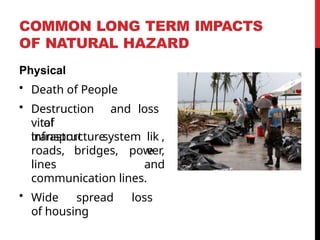
COMMON LONG TERMIMPACTS
OF NATURAL HAZARD
Physical
vital
infrastructure
• Death of People
• Destruction and loss
of
lik
e
transport system ,
roads, bridges, power,
lines and
communication lines.
• Wide spread loss
of housing
8.
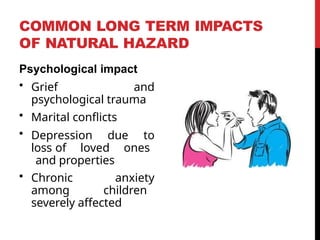
Psychological impact
• Griefand
psychological trauma
• Marital conflicts
• Depression due to
loss of loved ones
and properties
• Chronic anxiety
among children
severely affected
COMMON LONG TERM IMPACTS
OF NATURAL HAZARD
9.
COMMON LONG TERMIMPACTS
OF NATURAL HAZARD
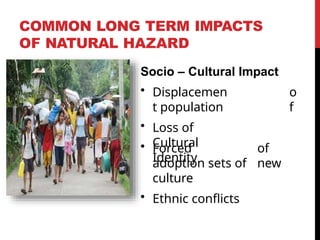
Socio – Cultural Impact
• Displacemen
t population
• Loss of
Cultural
Identity
o
f
• Forced
adoption sets of
culture
• Ethnic conflicts
of
new
10.
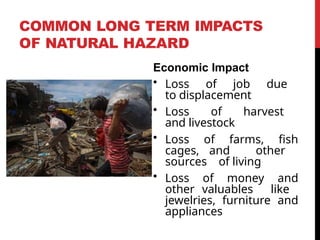
Economic Impact
• Lossof job due
to displacement
• Loss of harvest
and livestock
• Loss of farms, fish
cages, and other
sources of living
• Loss of money and
other valuables like
jewelries, furniture and
appliances
COMMON LONG TERM IMPACTS
OF NATURAL HAZARD
11.
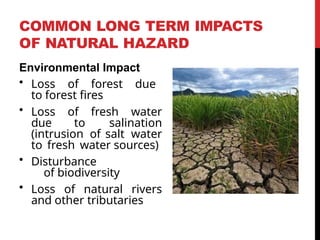
Environmental Impact
• Lossof forest due
to forest fires
• Loss of fresh water
due to salination
(intrusion of salt water
to fresh water sources)
• Disturbance
of biodiversity
• Loss of natural rivers
and other tributaries
COMMON LONG TERM IMPACTS
OF NATURAL HAZARD
12.
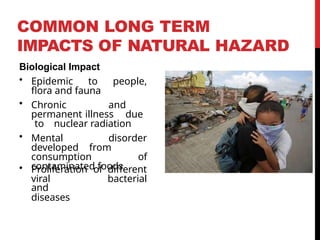
Biological Impact
• Epidemicto people,
flora and fauna
• Chronic and
permanent illness due
to nuclear radiation
• Mental disorder
developed from
consumption of
contaminated foods
• Proliferation of different
viral
and
bacterial
diseases
COMMON LONG TERM
IMPACTS OF NATURAL HAZARD
13.
ASSIGNMENT
What isHazard?
Are the impacts of each hazard the same?
What kinds of hazards affected everyone? What kind of
hazards did not?
What would you do if you were caught in one of these
hazards?
Summarize how the impact of certain hazards can differ
based on what is exposed to the hazard and where.
14.
Your task isto choose one example of
hazards (i. e., flooding, environmental
degradation, etc...)
A. Write an article about the issue.
B. Explain your standpoint and your
analysis if it is preventable or not.
C. Explain why it is preventable and how it
can be prevented?
You can submit your output to your teacher.
Your paper will be assessed base on the
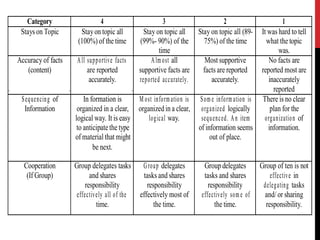
following rubric
Write on the A4 Paper with clip
15.
Category 4 32 1
Stays on Topic Stayon topic all
(100%) of the time
Stay on topic all
(99%- 90%) of the
time
Stay on topic all (89-
75%) of the time
It was hard to tell
what the topic
was.
Accuracy of facts All supportive facts Almost all Most supportive No facts are
(content) are reported supportive facts are facts are reported reported most are
accurately. reported accurately. accurately. inaccurately
reported
Sequencing of In formation is M ost information is Som e information is There is no clear
Information organized in a clear, organized in a clear, organized logically plan for the
logical way. It is easy logical way. sequenced. An item organization of
to anticipate the type of information seems information.
ofmaterial that might out of place.
be next.
Cooperation Group delegates tasks Group delegates Group delegates Group of ten is not
(If Group) and shares tasks and shares tasks and shares effective in
responsibility responsibility responsibility delegating tasks
effectively all of the effectively most of effectively some of and/ or sharing
time. the time. the time. responsibility.
Editor's Notes
#2 Extraneous In an experiment, extraneous variables are factors that can affect the results but are not being studied. These can be characteristics of the participants, like age or gender, or environment
al factors, like lighting or noise.
Disruption hazards can be natural, man-made, or a combination of both.
Examples of disruption hazards
Natural hazards: Weather events like storms, floods, wildfires, and landslides
Man-made hazards: Economic crises, pandemics, and hazardous material spills
Societal hazards: Drug addiction, domestic violence, and suicide
#3 Smog or Smoke can cause many health problems, including respiratory issues, heart disease, and cancer. It can also irritate the eyes, nose, and throat.
Pesticide toxicity cause harm to living organisms, including humans, when exposed through ingestion, inhalation, or skin contact, with effects ranging from mild irritation to severe poisoning and even death, depending on the dose and exposure duration, and can manifest as both acute (short-term) and chronic (long-term) health issues.
Minimizing pesticide exposure:
Following label instructions: Always read and follow safety guidelines on pesticide labels.
Protective gear: Wearing appropriate personal protective equipment (PPE) like gloves, masks, and coveralls when handling pesticides.
Proper application techniques: Using the correct application methods to minimize spray drift and exposure to non-target organisms.
#4 atmospheric hazard is a substance in the air that can harm people or the environment. These hazards can include chemical vapors, and flammable gases.
Effects of atmospheric hazards
Short-term effects include headaches, dizziness, and respiratory distress.
Long-term effects include cancer and damage to the immune, neurological, reproductive, and respiratory systems. In extreme cases, it can even cause death.
How to protect yourself
Test the atmosphere before entering a confined space.
Never enter a confined space without an approved entry permit and all required protective equipment.
If you believe you are exposed to a hazardous atmosphere, leave the space immediately.
Hail is a form of solid precipitation. It is distinct from ice pellets, though the two are often confused. It consists of balls or irregular lumps of ice, each of which is called a hailstone. Ice pellets generally fall in cold weather, while hail growth is greatly inhibited during low surface temperatures.
Blizzards can cause many hazards, including car accidents, hypothermia, and power outages.
#5 A hydrological hazard is a natural disaster that involves extreme water-related events, such as flooding, droughts, landslides, and tsunamis. These hazards can have devastating impacts on communities and the environment.
A geologic hazard is a natural event that can damage property, injure people, or kill people. Geologic hazards can be short-term or long-term, and can include earthquakes, volcanoes, tsunamis, erosion, and landslides.
#6 Biological health hazards include bacteria, viruses, parasites and moulds or fungi. They can pose a threat to human health when they are inhaled, eaten or come in contact with skin. They can cause illness such as food poisoning, tetanus, respiratory infections or parasite infection.
technological hazard is a threat to people or the environment that comes from industry, technology, or human activity. Technological hazards can include chemical spills, nuclear radiation, and factory explosions.