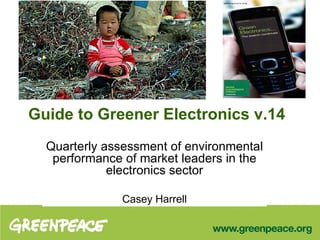
Guide to Greener Electronics v.14 Quarterly assessment of environmental performance of market leaders in the electronics sector Casey Harrell
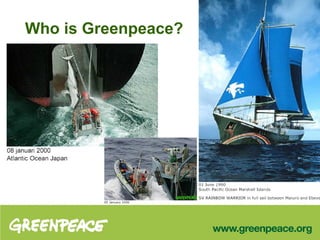
Who is Greenpeace?
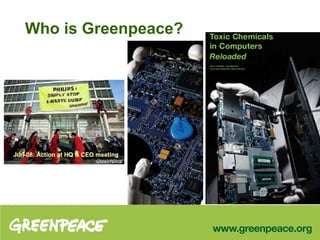
Who is Greenpeace?
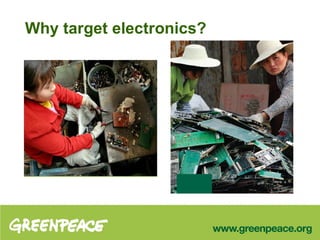
Why target electronics?
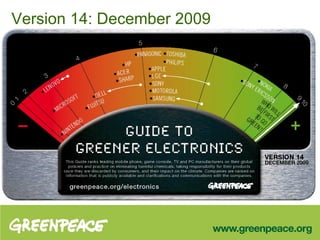
Version 14: December 2009
Guide to Greener Electronics Campaign tool  to create demand for greener electronics  by: quarterly ranking major brands on toxic chemicals, e-waste and climate/energy policies and practices -  a race to go green! publicly communicating both positive and regressive individual company performance providing consumer information to allow public to show their preference for truly green products
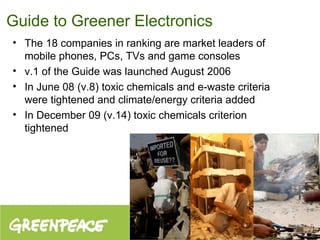
Guide to Greener Electronics The 18 companies in ranking are market leaders of mobile phones, PCs, TVs and game consoles v.1 of the Guide was launched August 2006 In June 08 (v.8) toxic chemicals and e-waste criteria were tightened and climate/energy criteria added In December 09 (v.14) toxic chemicals criterion tightened
Key demands to brands 1.  Phase out  all hazardous chemicals based on the precautionary principle  (Toxic chemicals) As 1 st  step: substitute vinyl plastic (PVC) and all Brominated Flame Retardants (BFRs) with a clear and reasonable time line  2. Take Back or Extended Producer Responsibility (EPR):  Take responsibility for the full life cycle of your products; Take back end-of-life products and re-use/recycle responsibly  (Waste)  3. Protect the climate:  Limit your carbon footprint via absolute greenhouse gas cuts in operations, increased renewable energy use, strong climate advocacy & highly energy-efficient products  (Energy)
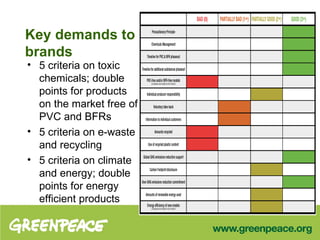
Key demands to brands 5 criteria on toxic chemicals; double points for products on the market free of PVC and BFRs 5 criteria on e-waste and recycling 5 criteria on climate and energy; double points for energy efficient products
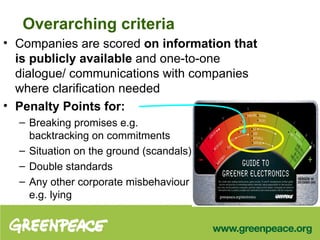
Overarching criteria Companies are scored  on information that is publicly available  and one-to-one dialogue/   communications with companies where clarification needed Penalty Points for: Breaking promises e.g.  backtracking on commitments Situation on the ground (scandals) Double standards Any other corporate misbehaviour  e.g. lying
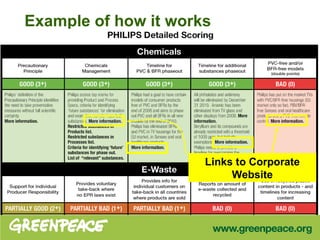
Example of how it works Links to Corporate Website
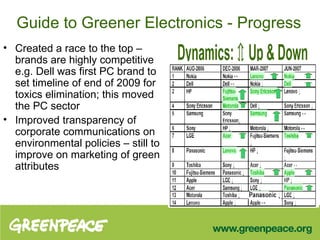
Guide to Greener Electronics - Progress Created a race to the top – brands are highly competitive e.g. Dell was first PC brand to set timeline of end of 2009 for toxics elimination; this moved the PC sector Improved   transparency of corporate communications on environmental policies – still to improve on marketing of green attributes
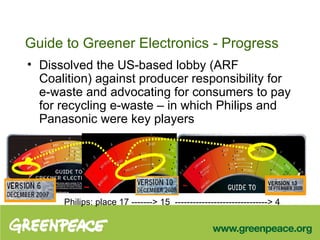
Guide to Greener Electronics - Progress Dissolved the US-based lobby (ARF Coalition) against producer responsibility for e-waste and advocating for consumers to pay for recycling e-waste – in which Philips and Panasonic were key players Philips: place 17 -------> 15  -------------------------------> 4
Green My Apple Sept 06: launch of Apple campaign with demand to eliminate the most toxic substances and offer takeback/recycling globally Over the next 7 months, cyberactions via greenmyapple.org, activities in London, Rome, New York….. In May 2007 Jobs announces Apple will eliminate PVC and BFRs by end of 2008 All products are now free of PVC and BFRs (except power cords in some regions/PCs); takeback &  recycling offered in countries where more than 95% of sales, incl.  India and China
Philips – simply take-back and recycle Demands to Philips June 2008: publicly commit to setting up a take-back system for its end-of-life electronic products globally   re-evaluate bad position on individual producer responsibility (IPR = financing real costs of recycling/treating its e-scrap from its own products) Activities at AGM in Amsterdam,  HQ, Moscow….. Feb 2009: after other companies implement progressive take-back policies, Philips changes position too  Sept 2009:  neutralized negative EU lobbying
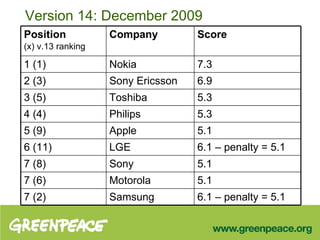
Version 14: December 2009 Position (x) v.13 ranking Company Score 1 (1)  Nokia 7.3 2 (3)  Sony Ericsson 6.9 3 (5) Toshiba 5.3 4 (4) Philips 5.3 5 (9) Apple 5.1 6 (11) LGE 6.1 – penalty = 5.1 7 (8) Sony 5.1 7 (6)  Motorola 5.1 7 (2) Samsung 6.1 – penalty = 5.1
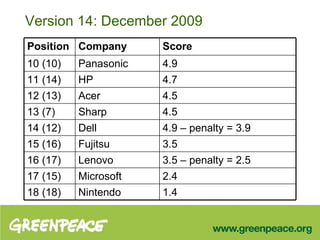
Version 14: December 2009 Position Company Score 10 (10) Panasonic 4.9 11 (14)  HP 4.7 12 (13) Acer 4.5 13 (7) Sharp 4.5 14 (12) Dell 4.9 – penalty = 3.9 15 (16) Fujitsu 3.5 16 (17) Lenovo 3.5 – penalty = 2.5 17 (15)  Microsoft 2.4 18 (18) Nintendo 1.4
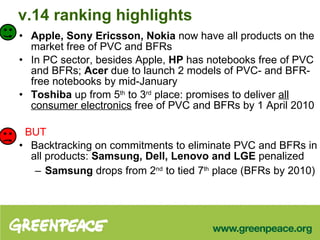
v.14 ranking highlights Apple, Sony Ericsson, Nokia  now have all products on the market free of PVC and BFRs In PC sector, besides Apple,  HP  has notebooks free of PVC and BFRs;  Acer  due to launch 2 models of PVC- and BFR-free notebooks by mid-January Toshiba  up from 5 th  to 3 rd  place: promises to deliver  all consumer electronics  free of PVC and BFRs by 1 April 2010  BUT  Backtracking on commitments to eliminate PVC and BFRs in all products:  Samsung, Dell, Lenovo and LGE  penalized Samsung  drops from 2 nd  to tied 7 th  place (BFRs by 2010)
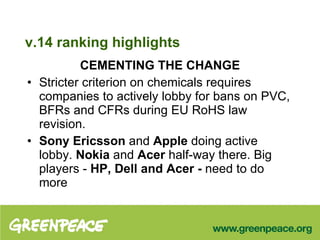
v.14 ranking highlights CEMENTING THE CHANGE Stricter criterion on chemicals requires companies to actively lobby for bans on PVC, BFRs and CFRs during   EU RoHS law   revision.  Sony Ericsson  and  Apple  doing active lobby.  Nokia  and  Acer  half-way there. Big players -   HP, Dell and Acer -  need to do more
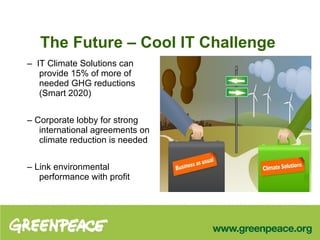
The Future – Cool IT Challenge –  IT Climate Solutions can provide 15% of more of needed GHG reductions (Smart 2020) –  Corporate lobby for strong international agreements on climate reduction is needed –  Link environmental performance with profit
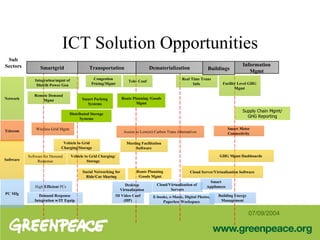
ICT Solution Opportunities Transportation Dematerialization Buildings Information Mgmt Smartgrid Sub Sectors Integration/mgmt of Distrib Power Gen Facility Level GHG Mgmt Congestion Pricing/Mgmt Software for Demand Response Vehicle to Grid Charging/Storage Meeting Facilitation Software Vehicle to Grid Charging/Storage Software Social Networking for Ride/Car Sharing Remote Demand Mgmt PC Mfg Smart Meter Connectivity Telecom Distributed Storage Systems Real Time Trans Info Access to Low(er) Carbon Trans Alternatives Demand Response Integration w/IT Equip 3D Video Conf (HP) Cloud/Virtualization of  Servers Wireless Grid Mgmt Building Energy Management High  Efficient  PCs Network Smart Appliances Route Planning /Goods Mgmt Desktop Virtualization Supply Chain Mgmt/ GHG Reporting GHG Mgmt Dashboards Cloud Server/Virtualization Software Route Planning /Goods Mgmt Tele- Conf Smart Parking Systems E-books, e-Music, Digital Photos, Paperless Workspace
More information Casey Harrell Mob + 1 415 307 3382 [email_address]     Daniel Kessler Mob + 1 510 501 1779 [email_address]    www.greenpeace.org/ces   www.greenpeace.org/rankingguide www.greenpeace.org/coolit

GPI CES Power Point

  • 1.
    Guide to GreenerElectronics v.14 Quarterly assessment of environmental performance of market leaders in the electronics sector Casey Harrell
  • 2.
  • 3.
  • 4.
  • 5.
  • 6.
    Guide to GreenerElectronics Campaign tool to create demand for greener electronics by: quarterly ranking major brands on toxic chemicals, e-waste and climate/energy policies and practices - a race to go green! publicly communicating both positive and regressive individual company performance providing consumer information to allow public to show their preference for truly green products
  • 7.
    Guide to GreenerElectronics The 18 companies in ranking are market leaders of mobile phones, PCs, TVs and game consoles v.1 of the Guide was launched August 2006 In June 08 (v.8) toxic chemicals and e-waste criteria were tightened and climate/energy criteria added In December 09 (v.14) toxic chemicals criterion tightened
  • 8.
    Key demands tobrands 1. Phase out all hazardous chemicals based on the precautionary principle (Toxic chemicals) As 1 st step: substitute vinyl plastic (PVC) and all Brominated Flame Retardants (BFRs) with a clear and reasonable time line 2. Take Back or Extended Producer Responsibility (EPR): Take responsibility for the full life cycle of your products; Take back end-of-life products and re-use/recycle responsibly (Waste) 3. Protect the climate: Limit your carbon footprint via absolute greenhouse gas cuts in operations, increased renewable energy use, strong climate advocacy & highly energy-efficient products (Energy)
  • 9.
    Key demands tobrands 5 criteria on toxic chemicals; double points for products on the market free of PVC and BFRs 5 criteria on e-waste and recycling 5 criteria on climate and energy; double points for energy efficient products
  • 10.
    Overarching criteria Companiesare scored on information that is publicly available and one-to-one dialogue/ communications with companies where clarification needed Penalty Points for: Breaking promises e.g. backtracking on commitments Situation on the ground (scandals) Double standards Any other corporate misbehaviour e.g. lying
  • 11.
    Example of howit works Links to Corporate Website
  • 12.
    Guide to GreenerElectronics - Progress Created a race to the top – brands are highly competitive e.g. Dell was first PC brand to set timeline of end of 2009 for toxics elimination; this moved the PC sector Improved transparency of corporate communications on environmental policies – still to improve on marketing of green attributes
  • 13.
    Guide to GreenerElectronics - Progress Dissolved the US-based lobby (ARF Coalition) against producer responsibility for e-waste and advocating for consumers to pay for recycling e-waste – in which Philips and Panasonic were key players Philips: place 17 -------> 15 -------------------------------> 4
  • 14.
    Green My AppleSept 06: launch of Apple campaign with demand to eliminate the most toxic substances and offer takeback/recycling globally Over the next 7 months, cyberactions via greenmyapple.org, activities in London, Rome, New York….. In May 2007 Jobs announces Apple will eliminate PVC and BFRs by end of 2008 All products are now free of PVC and BFRs (except power cords in some regions/PCs); takeback & recycling offered in countries where more than 95% of sales, incl. India and China
  • 15.
    Philips – simplytake-back and recycle Demands to Philips June 2008: publicly commit to setting up a take-back system for its end-of-life electronic products globally re-evaluate bad position on individual producer responsibility (IPR = financing real costs of recycling/treating its e-scrap from its own products) Activities at AGM in Amsterdam, HQ, Moscow….. Feb 2009: after other companies implement progressive take-back policies, Philips changes position too Sept 2009: neutralized negative EU lobbying
  • 16.
    Version 14: December2009 Position (x) v.13 ranking Company Score 1 (1) Nokia 7.3 2 (3) Sony Ericsson 6.9 3 (5) Toshiba 5.3 4 (4) Philips 5.3 5 (9) Apple 5.1 6 (11) LGE 6.1 – penalty = 5.1 7 (8) Sony 5.1 7 (6) Motorola 5.1 7 (2) Samsung 6.1 – penalty = 5.1
  • 17.
    Version 14: December2009 Position Company Score 10 (10) Panasonic 4.9 11 (14) HP 4.7 12 (13) Acer 4.5 13 (7) Sharp 4.5 14 (12) Dell 4.9 – penalty = 3.9 15 (16) Fujitsu 3.5 16 (17) Lenovo 3.5 – penalty = 2.5 17 (15) Microsoft 2.4 18 (18) Nintendo 1.4
  • 18.
    v.14 ranking highlightsApple, Sony Ericsson, Nokia now have all products on the market free of PVC and BFRs In PC sector, besides Apple, HP has notebooks free of PVC and BFRs; Acer due to launch 2 models of PVC- and BFR-free notebooks by mid-January Toshiba up from 5 th to 3 rd place: promises to deliver all consumer electronics free of PVC and BFRs by 1 April 2010 BUT Backtracking on commitments to eliminate PVC and BFRs in all products: Samsung, Dell, Lenovo and LGE penalized Samsung drops from 2 nd to tied 7 th place (BFRs by 2010)
  • 19.
    v.14 ranking highlightsCEMENTING THE CHANGE Stricter criterion on chemicals requires companies to actively lobby for bans on PVC, BFRs and CFRs during EU RoHS law revision. Sony Ericsson and Apple doing active lobby. Nokia and Acer half-way there. Big players - HP, Dell and Acer - need to do more
  • 20.
    The Future –Cool IT Challenge – IT Climate Solutions can provide 15% of more of needed GHG reductions (Smart 2020) – Corporate lobby for strong international agreements on climate reduction is needed – Link environmental performance with profit
  • 21.
    ICT Solution OpportunitiesTransportation Dematerialization Buildings Information Mgmt Smartgrid Sub Sectors Integration/mgmt of Distrib Power Gen Facility Level GHG Mgmt Congestion Pricing/Mgmt Software for Demand Response Vehicle to Grid Charging/Storage Meeting Facilitation Software Vehicle to Grid Charging/Storage Software Social Networking for Ride/Car Sharing Remote Demand Mgmt PC Mfg Smart Meter Connectivity Telecom Distributed Storage Systems Real Time Trans Info Access to Low(er) Carbon Trans Alternatives Demand Response Integration w/IT Equip 3D Video Conf (HP) Cloud/Virtualization of Servers Wireless Grid Mgmt Building Energy Management High Efficient PCs Network Smart Appliances Route Planning /Goods Mgmt Desktop Virtualization Supply Chain Mgmt/ GHG Reporting GHG Mgmt Dashboards Cloud Server/Virtualization Software Route Planning /Goods Mgmt Tele- Conf Smart Parking Systems E-books, e-Music, Digital Photos, Paperless Workspace
  • 22.
    More information CaseyHarrell Mob + 1 415 307 3382 [email_address]     Daniel Kessler Mob + 1 510 501 1779 [email_address]   www.greenpeace.org/ces www.greenpeace.org/rankingguide www.greenpeace.org/coolit