G protein-coupled receptor GPR19 regulates E-cadherin
expression and invasion of breast cancer cells
DENNIS N. MUÑOZ, RN, RM, LPT
M.Sci Biology, Ateneo de Davao University
Johannes Hartwig, Katsiaryna Tarbashevich, Jochen Seggewiß, Martin Stehling, Jan Bandemer, Cecilia Grimaldi, Azadeh Paksa, Theresa
Groß-Thebing, Dana Meyen and Erez Raz
Proceedings of the National Academy of Sciences of the United States of America, Vol. 111, No. 31 (August 5, 2014), pp. 11389-11394
Introduction
E cadherin and GPCR19
Material and methods
1. Antibodies and
reagents
2. Cell culture
3. Plasmid constructs and
generation of stable
cell lines
4. Adropin treatment
5. Western blot
6. Wound healing assay
7. Immunocytochemistry
8. Invasion assay
9. TGFα shedding assay
10. Quantitative real time
PCR (QRT-PCR) and
reverse transcriptase
PCR (RT-PCR)
11. Cyclic AMP assay
Results
Results
Conclusion
• This study it shows for the first time that
GPR19 plays a potential role in metastasis by
promoting the mesenchymal-epithelial
transition (MET) through the ERK/MAPK
pathway, thus facilitating colonization of
metastatic breast tumor cells.

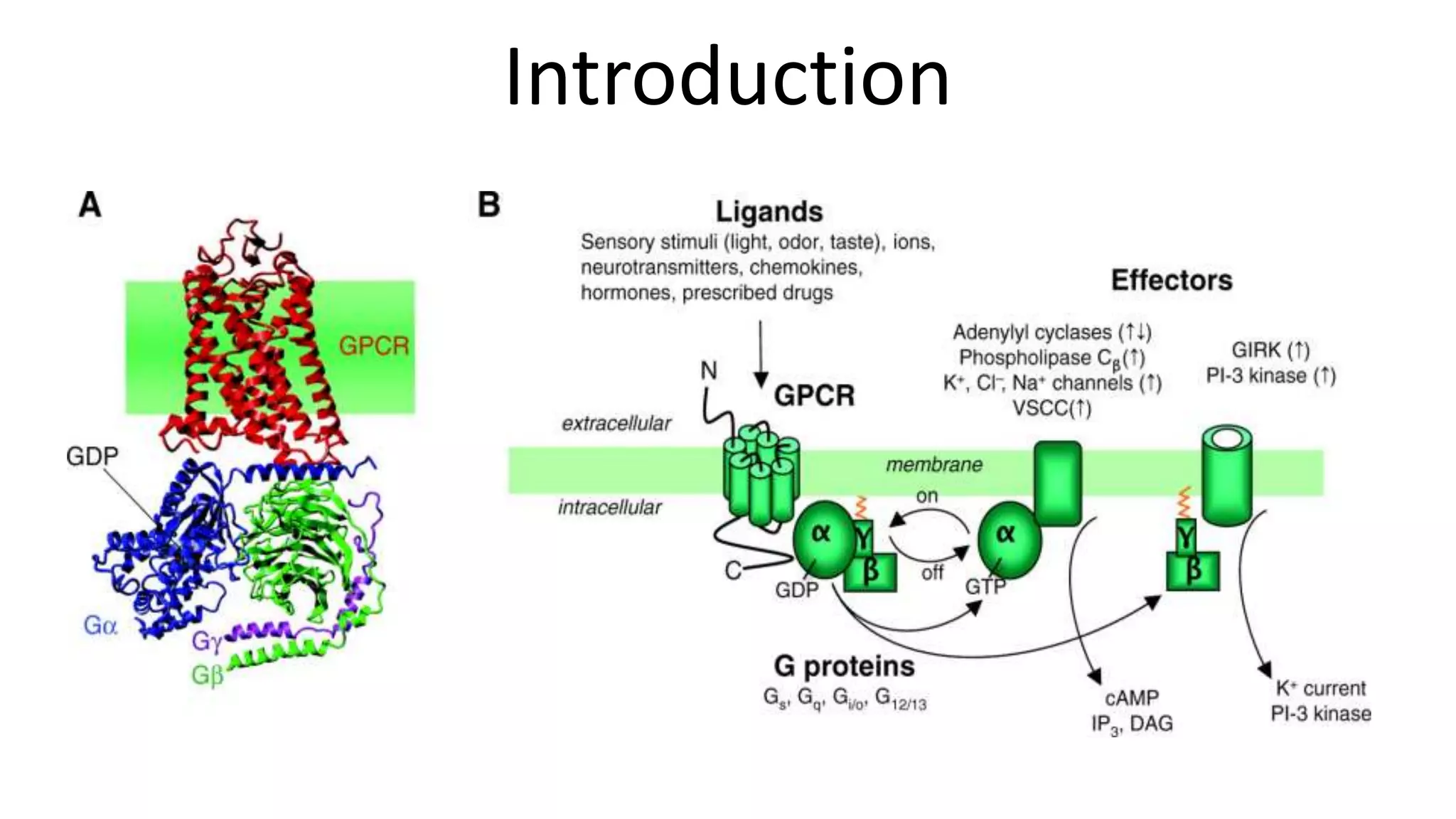
GPCR

  • 1.
    G protein-coupled receptorGPR19 regulates E-cadherin expression and invasion of breast cancer cells DENNIS N. MUÑOZ, RN, RM, LPT M.Sci Biology, Ateneo de Davao University Johannes Hartwig, Katsiaryna Tarbashevich, Jochen Seggewiß, Martin Stehling, Jan Bandemer, Cecilia Grimaldi, Azadeh Paksa, Theresa Groß-Thebing, Dana Meyen and Erez Raz Proceedings of the National Academy of Sciences of the United States of America, Vol. 111, No. 31 (August 5, 2014), pp. 11389-11394
  • 2.
  • 3.
  • 4.
    Material and methods 1.Antibodies and reagents 2. Cell culture 3. Plasmid constructs and generation of stable cell lines 4. Adropin treatment 5. Western blot 6. Wound healing assay 7. Immunocytochemistry 8. Invasion assay 9. TGFα shedding assay 10. Quantitative real time PCR (QRT-PCR) and reverse transcriptase PCR (RT-PCR) 11. Cyclic AMP assay
  • 5.
  • 6.
  • 7.
    Conclusion • This studyit shows for the first time that GPR19 plays a potential role in metastasis by promoting the mesenchymal-epithelial transition (MET) through the ERK/MAPK pathway, thus facilitating colonization of metastatic breast tumor cells.

Editor's Notes

  • #8 ERK1 a serine/threonine kinase of the GMGC group that plays a critical role in the regulation of cell growth and differentiation. ERK1 (MAPK3) and ERK2 (MAPK1) play central roles in MAPK cascades and are activated by a wide variety of extracellular signals including growth and neurotrophic factors, cytokines, hormones and neurotransmitters. Depending on the cellular context, MAPK cascades mediate diverse biological functions such as cell growth, adhesion, survival and differentiation through the regulation of transcription, translation, cytoskeletal rearrangements. MAPK cascades also plays a role in initiation and regulation of meiosis, mitosis, and postmitotic functions in differentiated cells by phosphorylating a number of transcription factors. Activation of MAP kinases occurs through phosphorylation of threonine and tyrosine residues at the sequence T*EY* by upstream MAP kinase kinases, MEK1 and -2. Phosphorylation of both the threonine and tyrosine are required for activity. This phosphorylation causes dramatic conformational changes, which enable full activation and interaction of MAPK1/ERK2 with its substrates.