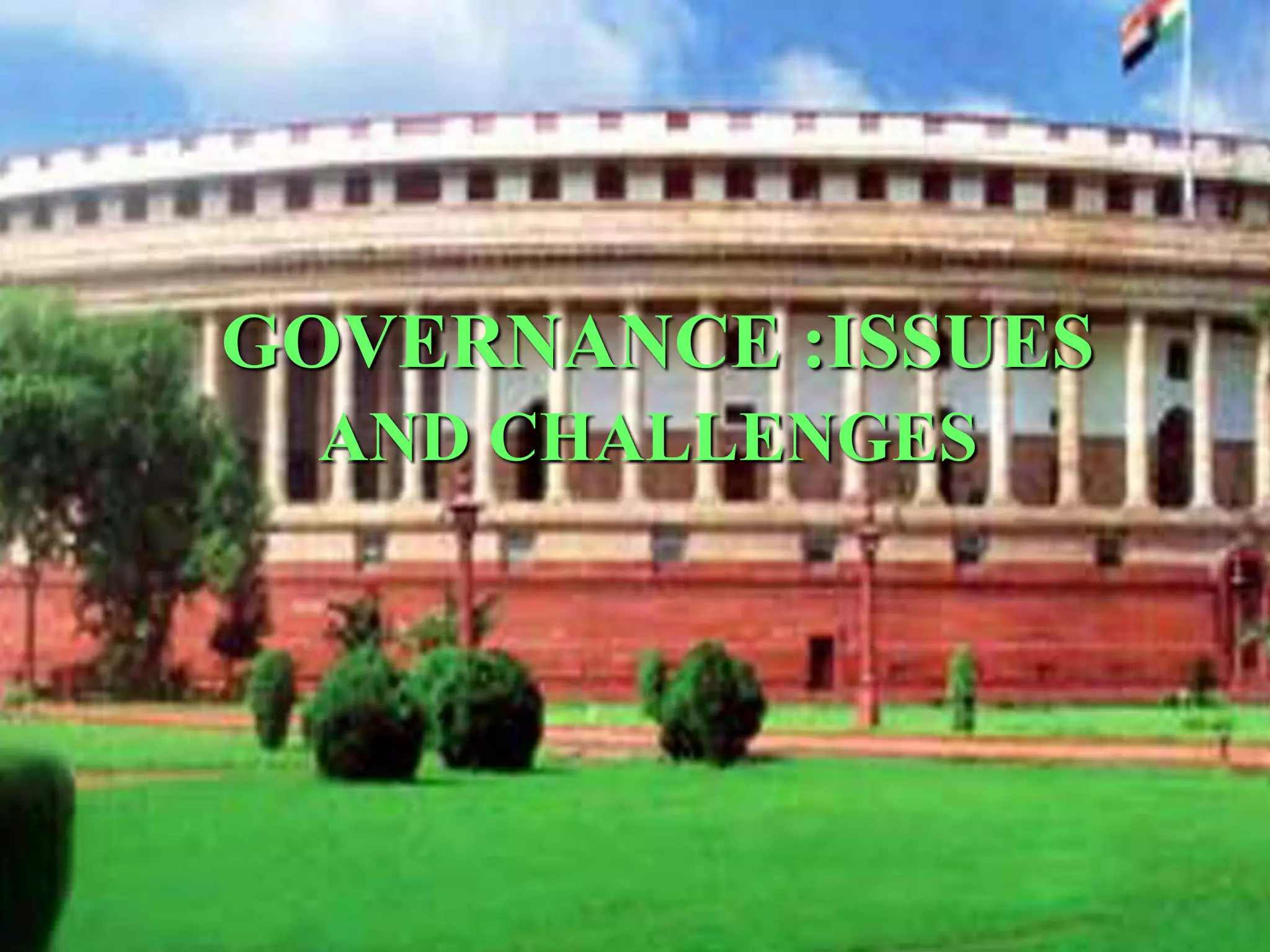
GOVERNANCE :ISSUES
AND CHALLENGES
OBJECTIVES AND EXPECTED OUTCOME
 TO UNDERSTAND THE IMPORTANCE OF
CONCEPT OF GOVERNANCE IN THE CONTEXT
OF GLOBALISATION.
 TO GIVE STUDENTS SOME IDEA ABOUT ISSUES
LIKE DEVELOPMENT,ADMINISTRATION AND
ENVIRONMENTAL GOVERNANCE
 TO GIVE STUDENTS SOME GLIMPSE ABOUT
LOCAL GOVERNANCE
 TO AWARE THEM ABOUT VARIOUS
GOVERNMENT INTITAIVES IN IMPROVING
GOVERNANCE
 THE PAPER WILL PROVIDE THE STUDENTS
PERSPECTIVE AND INSIGHT OF GOVERNANCE.IT
WILL HELP THEM BECOME MORE INFORMED
AND EFFECTIVE IN THEIR ROLE AS CITIZEN
AREAS TO BE COVERED
1. GOVERNMENT AND GOVERNANCE:CONCEPTS
2. GOVERNANCE AND DEVELOPMENT
3. ENVIRONMENTAL GOVERNANCE
4. LOCAL GOVERNANCE
5. GOOD GOVERNANCE INITIATIVES IN
INDIA:BEST PRACTICES
1. GOVERNMENT AND
GOVERNANCE:CONCEPTS
 WHAT IS GOVERNANCE?
 ROLE OF STATE IN THE ERA OF GLOBALISATION
 STATE, MARKET AND CIVIL SOCIETY DEBATE
 CHALLENGES TO GOVERNANCE
WHAT IS MEANT BY GOVERNANCE?
 Governance refers to "all processes of governing, whether
undertaken by a government, market or network, whether over
a family, tribe, formal or informal organization or territory and
whether through laws, norms, power or language.
 It relates to "the processes of interaction and decision-making
among the actors involved in a collective problem that lead to
the creation, reinforcement, or reproduction of social norms
and institutions.
GOVERNMENT VS GOVERNANCE
 A government is a formal body invested with the
authority to make decisions in a given political system.
 Governance is the process of decision-making and the
process by which decisions are implemented (or not
implemented).
 The term governance can apply to corporate,
international, national, local governance or to the
interactions between other sectors of society.
 Governance determines who has power, who makes
decisions, how other players make their voice heard
and how account is rendered
GOVERNANCE AND GLOBALISATION
 The Liberalisation and Globalisation process is
supposed to give primacy to market in meeting the
needs of the people. So much so, the role of
Government in the economic life of the people
logically should come down which leads to reduce
of government staff and machinery.
 This further leads to diminishing the role of state and
increased role of market forces in delivery of goods
and services.
CIVIL SOCIETY AND GOVERNNACE
 The downsizing of the government and the withdrawal
of the state from certain areas of operation provide
space for, and make way to, the civil society.
 The civil society comprising various organizations of
people meant to provide services is an outgrowth of the
inadequacy or even the failure of the state to deliver
some public goods and services on a scale required and
at reasonable prices.
 NGOs, which are another important constituent of the
civil society, they have gone into a series of areas starting
from organising the poor and looking after the welfare
of the old, disabled, widows, and street children to
provide health and education facilities, drinking water,
better sanitation and such other basic needs in the rural
and urban areas.
CHALLENGES TO GOVERNANCE
 Corruption
 Criminilastion of Politics
 Redtepism
 Racial Exclusion
 Nepotism
 Population Burden
 Religious Fundamentalism.
WHY DO WE NEED TO STUDY THIS
CHAPTER???
 IN UPSC NEW SYLLABUS G.S PAPER 2 DEALS
WITH GOVERNANCE AND ISSUES.
 IN MAINS 2013 and 2014 MORE THAN 50 MARKS
DIRECTLY OR INDIRECTLY FROM THIS TOPIC
 IN PUBLIC ADD.MORE THAN 25 MARKS EVERY
YEAR FROM THIS TOPIC
 IT MAKES US WELL INFORMED ABOUT
CONTEMPORARY ISSUES
 HELPS US IN DECISION MAKING AND
PROACTIVE ROLE IN GOVERNANCE OF
COUNTRY.
2. GOVERNANCE AND
DEVELOPMENT
 CHANGING DIMENSIONS OF DEVELOPMENT
 STRENGTHENING DEMOCRACY THROUGH
GOOD GOVERNANCE
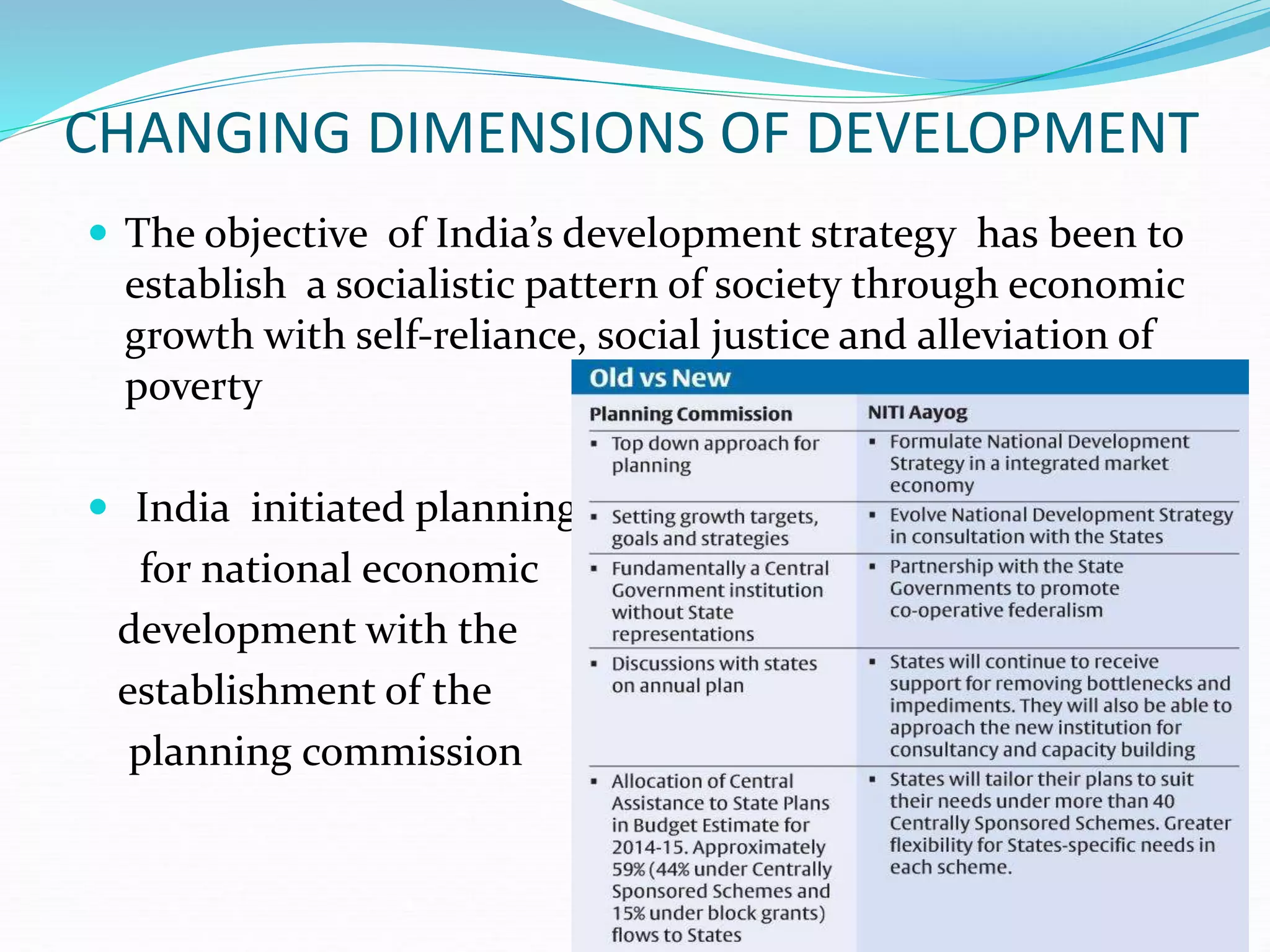
CHANGING DIMENSIONS OF DEVELOPMENT
 The objective of India’s development strategy has been to
establish a socialistic pattern of society through economic
growth with self-reliance, social justice and alleviation of
poverty
 India initiated planning
for national economic
development with the
establishment of the
planning commission
 While the reasons for adopting a centrally directed strategy of
development were understandable against the background of
colonial rule, it, however soon became clear that the actual
results of this strategy were far below expectations.
 Between 1950 and 1990, India’s growth rate averaged less than
4 per cent per annum and this was at a time when the
developing world, including Sub-Saharan Africa and other least
developed countries, showed a growth rate of 5.2 % per
annum.
 The surge in oil prices triggered by the Gulf War in 1990
imposed a severe strain on a balance of payments already made
fragile by several years of large fiscal deficits and increasing
external debt.
 Foreign exchange reserves dropped to $1.2 billion in 1991,
barely sufficient for two weeks of imports and a default on
external payments appeared inevitable.
 The reform process began in earnest only in July 1991. It was
only in 1991 that the Government signaled a systemic shift to a
more open economy with greater reliance upon market forces,
a larger role for the private sector including foreign investment,
and a restructuring of the role of Government.
 The reforms of the last decade and a half have gone a long way
in freeing the domestic economy from the control regime.
 In the post-reform (since 1991) period, India has
done well in some indicators such as balance of
payments, resilience to external shocks, service
sector growth.
 Significant accumulation of foreign exchange,
Information technology (IT) and stock market,
improvements in telecommunications etc.
 GDP growth was around 8 to 9% per annum .
Investment and savings rates were quite high 32 to
36%.
 The focus now is on inclusive growth whereby
fruits of development are enjoyed by all people.
DEMOCRACY THROUGH GOOD
GOVERNANCE
 Good governance is the process whereby public
institutions conduct public affairs, manage public
resources and guarantee the realization of human
rights in a manner essentially free of abuse and
corruption, and with due regard for the rule of law.
 Democracy is also basically about citizen
participation, rule of law, rights of citizens.
Democracy and good governance are interlinked.
 Democracy leads to good and effective governance
According to the United Nations, Good Governance has
following eight characteristics.
 Consensus oriented
 Participatory
 Following the rule of law
 Effective and efficient
 Accountable
 Transparent
 Responsive
 Equitable and inclusive
Why Do we Need to Study this?
 MAKES US AWARE ABOUT ECONOMIC POLICIES
OF COUNTRY AND ITS POST INDEPENDENCE
DEVELOPMENT
 GIVES US IDEA ABOUT GOOD GOVERNANCE
 IMPORTANT FOR ALL COMPETITIVE EXAMS
 PAPER3 OF UPSC IS ALL ABOUT ECONOMIC
DEVELOPMENT NEARLY 80-100 MARKS ON
ECONOMIC DEVELOPMENT EVERY YEAR
ENVIRONMENTAL GOVERNANCE
 HUMAN –ENVIRONMENT INTERACTION
 PARTICIPATION IN GOVERNANCE
3.ENVIRONMENTAL GOVERNANCE
 Environmental Governance is a concept in political
ecology and environmental policy that advocates
sustainability (sustainable development) as the
supreme consideration for managing all human
activities—political, social and economic.
 It views natural resources and the environment as
global public goods, belonging to the category of
goods that are not diminished when they are
shared
 Key principles of Environmental Governance include:
 Embedding the environment in all levels of decision-
making and action
 Conceptualizing cities and communities, economic and
political life as a subset of the environment
 Emphasizing the connection of people to the ecosystems in
which they live.
 Promoting the transition from open-loop/cradle-to-grave
systems (like garbage disposal with no recycling) to closed-
loop/cradle-to-cradle systems (like permaculture and zero
waste strategies).
HUMAN-ENVIRONMENT INTERACTION
 Human Environmental Interactions can be defined as
interactions between the human social system and (the
“rest” of) the ecosystem.
 People modify the environment for their purposes and
obtain benefits (Ecosystem Services) from it.
 These Ecosystem Services are essential for human well-
being and include for example the provision of resources
like water, timber, food, energy, information, land for
farming and many more. Obviously by using these
resources people affect the environment in a lot of ways.
SUSTAINABLE DEVELOPMENT
 "Sustainable development is development that meets
the needs of the present without compromising the
ability of future generations to meet their own needs.
It contains within it two key concepts:
 the concept of needs, in particular the essential needs
of the world's poor, to which overriding priority should
be given; and
 the idea of limitations imposed by the state of
technology and social organization on the
environment's ability to meet present and future
needs."
Why to study this paper??
 MOST IMPORTANT TOPIC FOR ANY
COMPETETVIVE EXAM IN CONTEMPORARY
PERIOD
 IN UPCS PRE 20-30 MARKS FROM ENVIRONMENT
 IN MAINS ONE FULL TOPIC ON ENVIRONMENTAL
GOVERNANCE IN GS3 PAPER
 FOCUS OF WORLD IS ON ENVIRONMENTAL
GOVERNANCE SO LOT OF SCOPE FOR FUTURE
STUDIES
4. LOCAL GOVERNANCE
 Grassroot democracy is must for participative
democracy and informed citizenship.
 Father of Nation Mahatma Gandhi was great
advocate of grassroot democracy
 Constitution of country under Article 40
emphasises for Panchayti Raj system.
LOCAL GOVERNANCE
 73rd and 74th amendment acts were landmark acts in the
development of local governance.
 These acts have led to the empowerment of women as
over one million women have been elected.
 It has led to the strengthening of democracy and
increased people’s participation particularly of
underprivileged sections of society.
WHY THIS UNIT??
 IT MAKES US AWARE ABOUT LOCAL ISSUES AND
THE GRASSROOT LEVEL GOVERNANCE.
 IT ENHANCES OUR PARTICIPATION IN
GOVERNANCE OF COUNTRY.
 ONE OF THE BASIC TOPICS OF CIVIL SERVICE
EXAMS.
 KNOWLEDGE ABOUT LOCAL GOVERNANCE
MAKES CITIZENS MORE DEMANDING AND
ARTICULATE ABOUT THEIR RIGHTS
5. GOOD GOVERNANCE INITIATIVES IN
INDIA :BEST PRACTICES
 PUBLIC SERVICE DELIVERY
 E-GOVERNANCE
 CITIZEN CHARTER
 RIGHT TO INFORMATION
 CORPORATE SOCIAL RESPONSIBILITY
PUBLIC SERVICE DELIVERY
 Public service is a service which is provided by government to
people living within its jurisdiction, either directly (through
the public sector) or by financing provision of services.
 Statutory laws which guarantee time bound delivery of services
rendered by the Government to citizens have been passed by many
states and they also provide mechanism for punishing the
errant public servant who is deficient in providing the service
stipulated under the statute.
 Some of the common public services includes issuing caste, birth,
marriage and domicile certificates, electric connections, voter’s
card, ration cards, copies of land records, etc
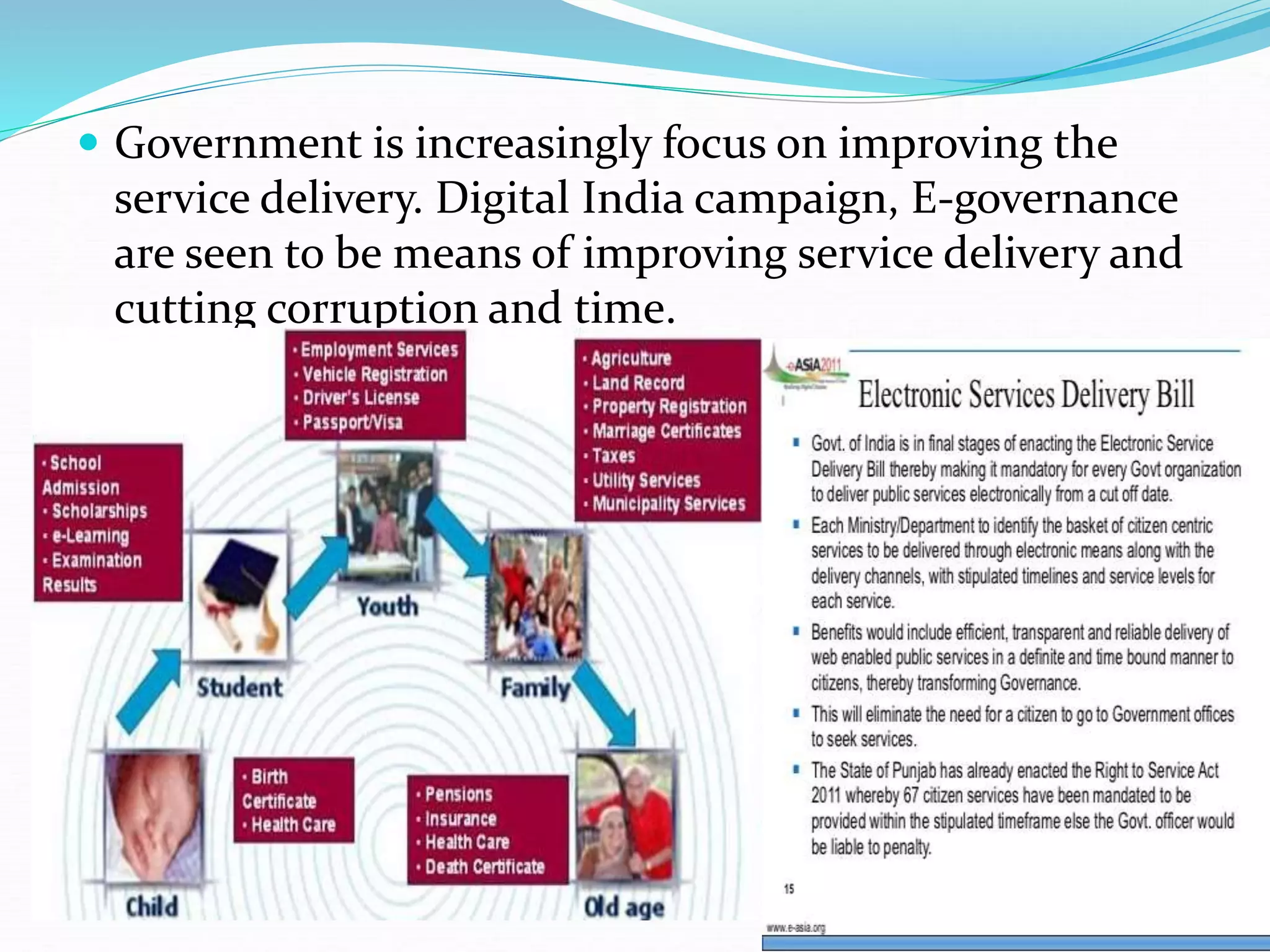
 Government is increasingly focus on improving the
service delivery. Digital India campaign, E-governance
are seen to be means of improving service delivery and
cutting corruption and time.
RIGHT TO INFORMATION
 Landmark act in ensuring transparency and accountability
of government
 Bulwark against corruption
 Citizens become part of government functioning by having
more information about the process of government functioning.
CITIZEN CHARTER
 A citizens' charter represents the commitment of the
organisation towards :
 Standard, quality and time frame of service delivery.
 Grievance redress mechanism.
 Transparency and accountability
 Most of central departments have come out with citizen
charters
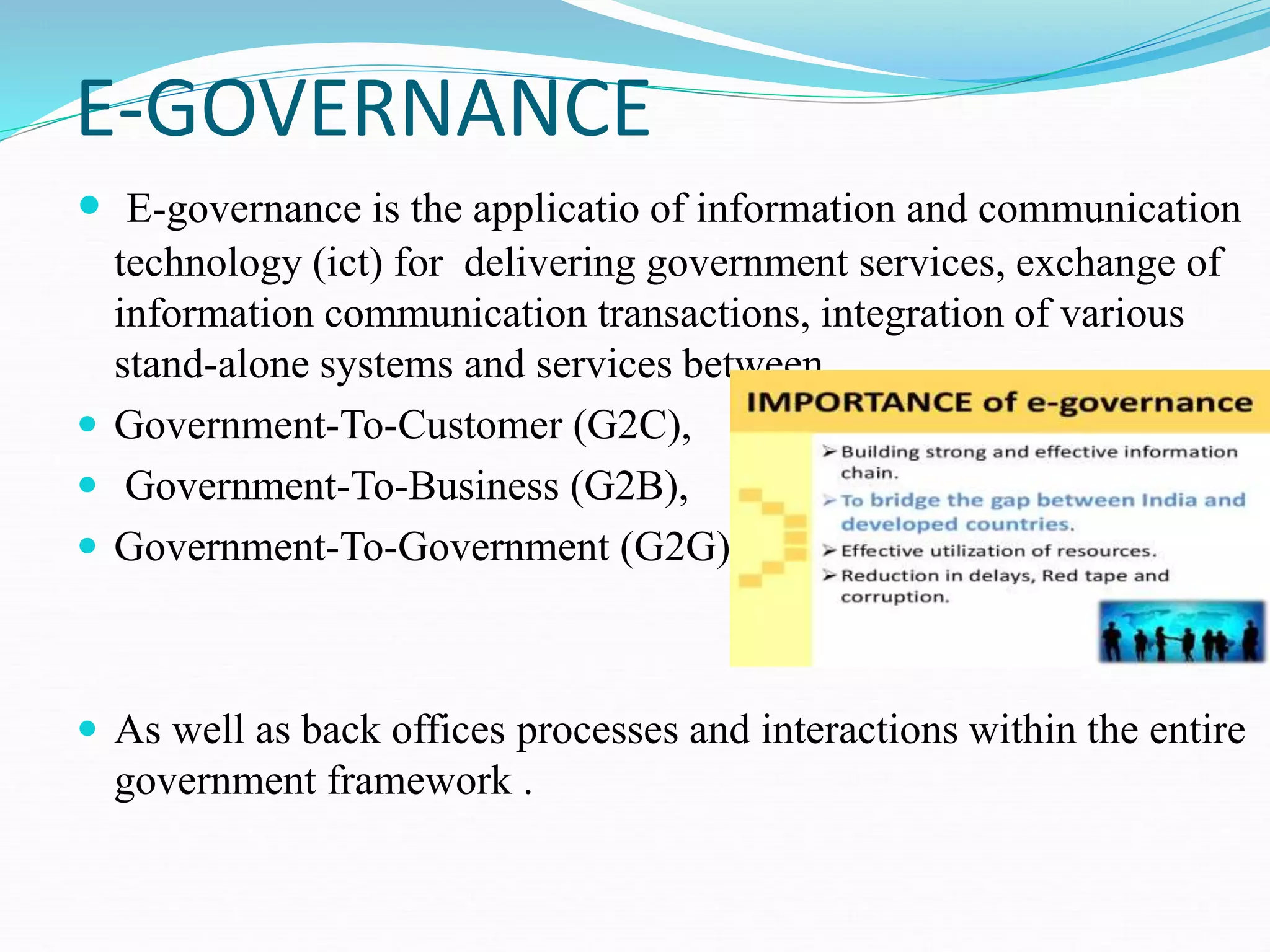
E-GOVERNANCE
 E-governance is the applicatio of information and communication
technology (ict) for delivering government services, exchange of
information communication transactions, integration of various
stand-alone systems and services between
 Government-To-Customer (G2C),
 Government-To-Business (G2B),
 Government-To-Government (G2G)
 As well as back offices processes and interactions within the entire
government framework .
 Through e-governance, government services will be
made available to citizens in a convenient, efficient
and transparent manner.
 E-Governance is the future, many countries are
looking forward to for a corruption free government.
 The essence of E-Governance is to reach
the beneficiary and ensure that the services intended
to reach the desired individual has been met with.
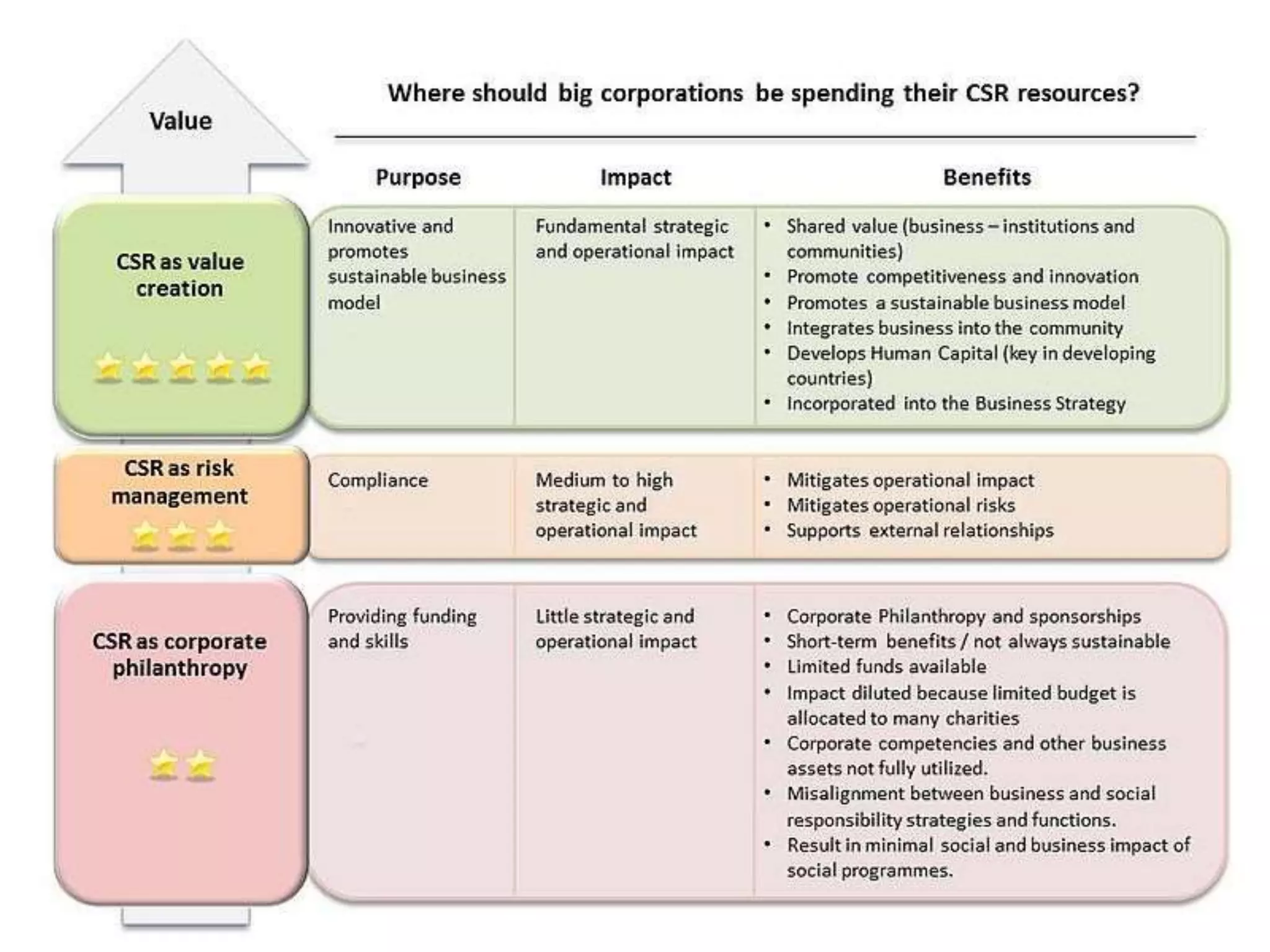
CORPORATE SOCIAL RESPONSIBILITY
 A company’s sense of responsibility towards the
community and environment (both ecological and social)
in which it operates.
 The concept of CSR rests on the ideology of give and
take. Companies take resources in the form of raw
materials, human resources etc from the society. By
performing the task of CSR activities, the companies are
giving something back to the society.
 CSR aims to embrace responsibility for corporate actions
and to encourage a positive impact on the environment
and stakeholders including consumers, employees,
investors, communities, and others.
 Section 135 of the Companies Act OF 2013 has made
CSR mandatory for companies.
 The threshold limit for applicability of the CSR to a
Company i.e.
 (a) net worth of the company to be Rs 500 crore or
more;
 (b) turnover of the company to be Rs 1000 crore or
more;
 (c) net profit of the company to be Rs 5 crore or more.
Why this unit?
 MAKES US AWARE ABOUT CONTEMPORARY
ISSUES
 WHAT IS LATEST IN THE GOVERNANCE OF
COUNTRY?
 ONE OF THE MOST IMPORTANT TOPICS ASKED
BY UPSC
 IN MAINS 2013 DIRECT QUESTIONS ON CITIZEN
CHARTER ,CSR ETC WERE ASKED
 CORE AREA OF PAPER 4 IN UPSC (ETHICS AND
GOVERNANCE)
 IMPORTANT FOR DAY TO DAY KNWOLEDGE
ABOUT COUNTRY
government to governance ' presentation

government to governance ' presentation

  • 1.
  • 2.
    OBJECTIVES AND EXPECTEDOUTCOME  TO UNDERSTAND THE IMPORTANCE OF CONCEPT OF GOVERNANCE IN THE CONTEXT OF GLOBALISATION.  TO GIVE STUDENTS SOME IDEA ABOUT ISSUES LIKE DEVELOPMENT,ADMINISTRATION AND ENVIRONMENTAL GOVERNANCE  TO GIVE STUDENTS SOME GLIMPSE ABOUT LOCAL GOVERNANCE  TO AWARE THEM ABOUT VARIOUS GOVERNMENT INTITAIVES IN IMPROVING GOVERNANCE
  • 3.
     THE PAPERWILL PROVIDE THE STUDENTS PERSPECTIVE AND INSIGHT OF GOVERNANCE.IT WILL HELP THEM BECOME MORE INFORMED AND EFFECTIVE IN THEIR ROLE AS CITIZEN
  • 4.
    AREAS TO BECOVERED 1. GOVERNMENT AND GOVERNANCE:CONCEPTS 2. GOVERNANCE AND DEVELOPMENT 3. ENVIRONMENTAL GOVERNANCE 4. LOCAL GOVERNANCE 5. GOOD GOVERNANCE INITIATIVES IN INDIA:BEST PRACTICES
  • 5.
    1. GOVERNMENT AND GOVERNANCE:CONCEPTS WHAT IS GOVERNANCE?  ROLE OF STATE IN THE ERA OF GLOBALISATION  STATE, MARKET AND CIVIL SOCIETY DEBATE  CHALLENGES TO GOVERNANCE
  • 6.
    WHAT IS MEANTBY GOVERNANCE?  Governance refers to "all processes of governing, whether undertaken by a government, market or network, whether over a family, tribe, formal or informal organization or territory and whether through laws, norms, power or language.  It relates to "the processes of interaction and decision-making among the actors involved in a collective problem that lead to the creation, reinforcement, or reproduction of social norms and institutions.
  • 7.
    GOVERNMENT VS GOVERNANCE A government is a formal body invested with the authority to make decisions in a given political system.  Governance is the process of decision-making and the process by which decisions are implemented (or not implemented).  The term governance can apply to corporate, international, national, local governance or to the interactions between other sectors of society.  Governance determines who has power, who makes decisions, how other players make their voice heard and how account is rendered
  • 8.
    GOVERNANCE AND GLOBALISATION The Liberalisation and Globalisation process is supposed to give primacy to market in meeting the needs of the people. So much so, the role of Government in the economic life of the people logically should come down which leads to reduce of government staff and machinery.  This further leads to diminishing the role of state and increased role of market forces in delivery of goods and services.
  • 9.
    CIVIL SOCIETY ANDGOVERNNACE  The downsizing of the government and the withdrawal of the state from certain areas of operation provide space for, and make way to, the civil society.  The civil society comprising various organizations of people meant to provide services is an outgrowth of the inadequacy or even the failure of the state to deliver some public goods and services on a scale required and at reasonable prices.  NGOs, which are another important constituent of the civil society, they have gone into a series of areas starting from organising the poor and looking after the welfare of the old, disabled, widows, and street children to provide health and education facilities, drinking water, better sanitation and such other basic needs in the rural and urban areas.
  • 11.
    CHALLENGES TO GOVERNANCE Corruption  Criminilastion of Politics  Redtepism  Racial Exclusion  Nepotism  Population Burden  Religious Fundamentalism.
  • 12.
    WHY DO WENEED TO STUDY THIS CHAPTER???  IN UPSC NEW SYLLABUS G.S PAPER 2 DEALS WITH GOVERNANCE AND ISSUES.  IN MAINS 2013 and 2014 MORE THAN 50 MARKS DIRECTLY OR INDIRECTLY FROM THIS TOPIC  IN PUBLIC ADD.MORE THAN 25 MARKS EVERY YEAR FROM THIS TOPIC  IT MAKES US WELL INFORMED ABOUT CONTEMPORARY ISSUES  HELPS US IN DECISION MAKING AND PROACTIVE ROLE IN GOVERNANCE OF COUNTRY.
  • 13.
    2. GOVERNANCE AND DEVELOPMENT CHANGING DIMENSIONS OF DEVELOPMENT  STRENGTHENING DEMOCRACY THROUGH GOOD GOVERNANCE
  • 14.
    CHANGING DIMENSIONS OFDEVELOPMENT  The objective of India’s development strategy has been to establish a socialistic pattern of society through economic growth with self-reliance, social justice and alleviation of poverty  India initiated planning for national economic development with the establishment of the planning commission
  • 15.
     While thereasons for adopting a centrally directed strategy of development were understandable against the background of colonial rule, it, however soon became clear that the actual results of this strategy were far below expectations.  Between 1950 and 1990, India’s growth rate averaged less than 4 per cent per annum and this was at a time when the developing world, including Sub-Saharan Africa and other least developed countries, showed a growth rate of 5.2 % per annum.  The surge in oil prices triggered by the Gulf War in 1990 imposed a severe strain on a balance of payments already made fragile by several years of large fiscal deficits and increasing external debt.
  • 16.
     Foreign exchangereserves dropped to $1.2 billion in 1991, barely sufficient for two weeks of imports and a default on external payments appeared inevitable.  The reform process began in earnest only in July 1991. It was only in 1991 that the Government signaled a systemic shift to a more open economy with greater reliance upon market forces, a larger role for the private sector including foreign investment, and a restructuring of the role of Government.  The reforms of the last decade and a half have gone a long way in freeing the domestic economy from the control regime.
  • 17.
     In thepost-reform (since 1991) period, India has done well in some indicators such as balance of payments, resilience to external shocks, service sector growth.  Significant accumulation of foreign exchange, Information technology (IT) and stock market, improvements in telecommunications etc.  GDP growth was around 8 to 9% per annum . Investment and savings rates were quite high 32 to 36%.  The focus now is on inclusive growth whereby fruits of development are enjoyed by all people.
  • 18.
    DEMOCRACY THROUGH GOOD GOVERNANCE Good governance is the process whereby public institutions conduct public affairs, manage public resources and guarantee the realization of human rights in a manner essentially free of abuse and corruption, and with due regard for the rule of law.  Democracy is also basically about citizen participation, rule of law, rights of citizens. Democracy and good governance are interlinked.  Democracy leads to good and effective governance
  • 19.
    According to theUnited Nations, Good Governance has following eight characteristics.  Consensus oriented  Participatory  Following the rule of law  Effective and efficient  Accountable  Transparent  Responsive  Equitable and inclusive
  • 20.
    Why Do weNeed to Study this?  MAKES US AWARE ABOUT ECONOMIC POLICIES OF COUNTRY AND ITS POST INDEPENDENCE DEVELOPMENT  GIVES US IDEA ABOUT GOOD GOVERNANCE  IMPORTANT FOR ALL COMPETITIVE EXAMS  PAPER3 OF UPSC IS ALL ABOUT ECONOMIC DEVELOPMENT NEARLY 80-100 MARKS ON ECONOMIC DEVELOPMENT EVERY YEAR
  • 21.
    ENVIRONMENTAL GOVERNANCE  HUMAN–ENVIRONMENT INTERACTION  PARTICIPATION IN GOVERNANCE
  • 22.
    3.ENVIRONMENTAL GOVERNANCE  EnvironmentalGovernance is a concept in political ecology and environmental policy that advocates sustainability (sustainable development) as the supreme consideration for managing all human activities—political, social and economic.  It views natural resources and the environment as global public goods, belonging to the category of goods that are not diminished when they are shared
  • 23.
     Key principlesof Environmental Governance include:  Embedding the environment in all levels of decision- making and action  Conceptualizing cities and communities, economic and political life as a subset of the environment  Emphasizing the connection of people to the ecosystems in which they live.  Promoting the transition from open-loop/cradle-to-grave systems (like garbage disposal with no recycling) to closed- loop/cradle-to-cradle systems (like permaculture and zero waste strategies).
  • 24.
    HUMAN-ENVIRONMENT INTERACTION  HumanEnvironmental Interactions can be defined as interactions between the human social system and (the “rest” of) the ecosystem.  People modify the environment for their purposes and obtain benefits (Ecosystem Services) from it.  These Ecosystem Services are essential for human well- being and include for example the provision of resources like water, timber, food, energy, information, land for farming and many more. Obviously by using these resources people affect the environment in a lot of ways.
  • 25.
    SUSTAINABLE DEVELOPMENT  "Sustainabledevelopment is development that meets the needs of the present without compromising the ability of future generations to meet their own needs. It contains within it two key concepts:  the concept of needs, in particular the essential needs of the world's poor, to which overriding priority should be given; and  the idea of limitations imposed by the state of technology and social organization on the environment's ability to meet present and future needs."
  • 27.
    Why to studythis paper??  MOST IMPORTANT TOPIC FOR ANY COMPETETVIVE EXAM IN CONTEMPORARY PERIOD  IN UPCS PRE 20-30 MARKS FROM ENVIRONMENT  IN MAINS ONE FULL TOPIC ON ENVIRONMENTAL GOVERNANCE IN GS3 PAPER  FOCUS OF WORLD IS ON ENVIRONMENTAL GOVERNANCE SO LOT OF SCOPE FOR FUTURE STUDIES
  • 28.
    4. LOCAL GOVERNANCE Grassroot democracy is must for participative democracy and informed citizenship.  Father of Nation Mahatma Gandhi was great advocate of grassroot democracy  Constitution of country under Article 40 emphasises for Panchayti Raj system.
  • 29.
  • 30.
     73rd and74th amendment acts were landmark acts in the development of local governance.  These acts have led to the empowerment of women as over one million women have been elected.  It has led to the strengthening of democracy and increased people’s participation particularly of underprivileged sections of society.
  • 31.
    WHY THIS UNIT?? IT MAKES US AWARE ABOUT LOCAL ISSUES AND THE GRASSROOT LEVEL GOVERNANCE.  IT ENHANCES OUR PARTICIPATION IN GOVERNANCE OF COUNTRY.  ONE OF THE BASIC TOPICS OF CIVIL SERVICE EXAMS.  KNOWLEDGE ABOUT LOCAL GOVERNANCE MAKES CITIZENS MORE DEMANDING AND ARTICULATE ABOUT THEIR RIGHTS
  • 32.
    5. GOOD GOVERNANCEINITIATIVES IN INDIA :BEST PRACTICES  PUBLIC SERVICE DELIVERY  E-GOVERNANCE  CITIZEN CHARTER  RIGHT TO INFORMATION  CORPORATE SOCIAL RESPONSIBILITY
  • 33.
    PUBLIC SERVICE DELIVERY Public service is a service which is provided by government to people living within its jurisdiction, either directly (through the public sector) or by financing provision of services.  Statutory laws which guarantee time bound delivery of services rendered by the Government to citizens have been passed by many states and they also provide mechanism for punishing the errant public servant who is deficient in providing the service stipulated under the statute.  Some of the common public services includes issuing caste, birth, marriage and domicile certificates, electric connections, voter’s card, ration cards, copies of land records, etc
  • 34.
     Government isincreasingly focus on improving the service delivery. Digital India campaign, E-governance are seen to be means of improving service delivery and cutting corruption and time.
  • 35.
    RIGHT TO INFORMATION Landmark act in ensuring transparency and accountability of government  Bulwark against corruption  Citizens become part of government functioning by having more information about the process of government functioning.
  • 36.
    CITIZEN CHARTER  Acitizens' charter represents the commitment of the organisation towards :  Standard, quality and time frame of service delivery.  Grievance redress mechanism.  Transparency and accountability  Most of central departments have come out with citizen charters
  • 38.
    E-GOVERNANCE  E-governance isthe applicatio of information and communication technology (ict) for delivering government services, exchange of information communication transactions, integration of various stand-alone systems and services between  Government-To-Customer (G2C),  Government-To-Business (G2B),  Government-To-Government (G2G)  As well as back offices processes and interactions within the entire government framework .
  • 39.
     Through e-governance,government services will be made available to citizens in a convenient, efficient and transparent manner.  E-Governance is the future, many countries are looking forward to for a corruption free government.  The essence of E-Governance is to reach the beneficiary and ensure that the services intended to reach the desired individual has been met with.
  • 41.
    CORPORATE SOCIAL RESPONSIBILITY A company’s sense of responsibility towards the community and environment (both ecological and social) in which it operates.  The concept of CSR rests on the ideology of give and take. Companies take resources in the form of raw materials, human resources etc from the society. By performing the task of CSR activities, the companies are giving something back to the society.  CSR aims to embrace responsibility for corporate actions and to encourage a positive impact on the environment and stakeholders including consumers, employees, investors, communities, and others.
  • 42.
     Section 135of the Companies Act OF 2013 has made CSR mandatory for companies.  The threshold limit for applicability of the CSR to a Company i.e.  (a) net worth of the company to be Rs 500 crore or more;  (b) turnover of the company to be Rs 1000 crore or more;  (c) net profit of the company to be Rs 5 crore or more.
  • 44.
    Why this unit? MAKES US AWARE ABOUT CONTEMPORARY ISSUES  WHAT IS LATEST IN THE GOVERNANCE OF COUNTRY?  ONE OF THE MOST IMPORTANT TOPICS ASKED BY UPSC  IN MAINS 2013 DIRECT QUESTIONS ON CITIZEN CHARTER ,CSR ETC WERE ASKED  CORE AREA OF PAPER 4 IN UPSC (ETHICS AND GOVERNANCE)  IMPORTANT FOR DAY TO DAY KNWOLEDGE ABOUT COUNTRY