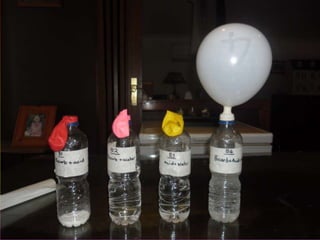
Aim of the experiment
The aim of this experiment called ‘gas bags’ is to
investigate four bottles filled with acid, bi-
carbonate and water and see how they react to
each other.
Materials
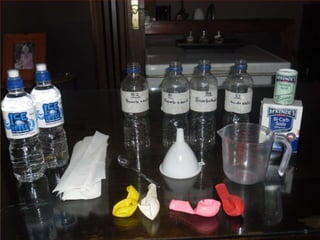
The materials used : 6 teaspoons of sodium bicarbonate
                       6 teaspoons of tartaric acid
                       3 cups of non-acidic water
                       1 cup measure
                       1 teaspoon
                       4 pieces of paper towel
                       4 bottles the same size
                       4 balloons
                       1 labeling pen
                       1 funnel
                       masking tape
Steps used
1. Label the 4 bottles with the following
• Bottle 1: bicarb + acid
• Bottle 2: bicarb + water
• Bottle 3: acid + water
• Bottle 4: bicarb + acid + water
Label the balloons 1,2,3 and 4.

2.   Add 2 teaspoons of sodium bicarbonate to balloons 1,2 and 4 by placing the
     funnel into the opening of each balloon.

3.   Wipe funnel carefully with a piece of paper towel. Discard paper towel.

4.   Add 2 teaspoons of tartaric acid to balloons 1,3 and 4 by placing the funnel
     into the opening of each balloon.
Steps continued..
5. Wipe funnel carefully with the second piece of paper towel. Discard paper towel.

6.   Add 300ml of water to bottles 2,3 and 4 by placing the funnel into the mouth
     of each bottle.

7.   Have one team member carefully fit the opening of each balloon over the
     mouth of their corresponding bottle while another holds down the balloon so
     that no powder falls in. Pull the stem part of the balloon down so that it will
     not come off easily. If it is loose, stick it down with a piece of masking tape to
     make it airtight.
8.   Carefully upend Balloon 1 so that its contents fall into Bottle 1. Mix the
     contents gently. Observe the bottle carefully, and record your observations in
     your science journal.

9.   Repeat step 8 for each of the bottles.
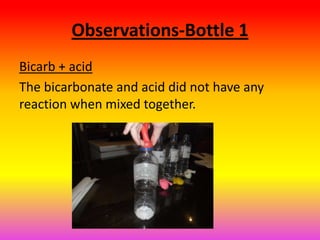
Observations-Bottle 1
Bicarb + acid
The bicarbonate and acid did not have any
reaction when mixed together.
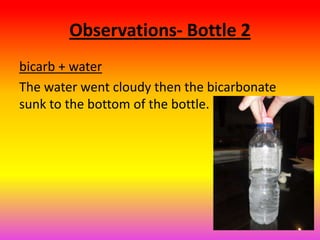
Observations- Bottle 2
bicarb + water
The water went cloudy then the bicarbonate
sunk to the bottom of the bottle.
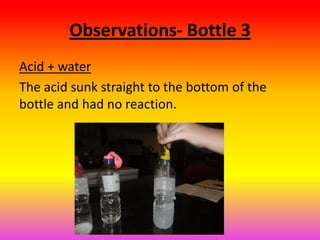
Observations- Bottle 3
Acid + water
The acid sunk straight to the bottom of the
bottle and had no reaction.
Observations- Bottle 4
Acid + Water + bicarb
The Acid + Water + bicarb fizzed up in seconds
and the balloon blew up. Soon after it stopped
fizzing and the balloon deflated.
Questions
1. What are bubbles?
Bubbles are round pockets of air or other liquids.
2. Do the bubbles come from the sodium bicarbonate? Why do
you think that?
Yes, the bubbles come from sodium bicarbonate because the
acid and the water did not fizz but with bicarb it fizzed.
3. Do the bubbles come from the tartaric acid? Why do you
think that?
no, because the acid did not react when mixed with the water.
4. When do the bubbles appear? Why do you think they only
appear then?
When everything was mixed the bubbles appeared. The bubbles
only appeared then because in every ingredient there is different
things which react to each other.
Questions continued..
5. What do you think inflated the balloon?
 the reaction of the Acid + Water + bicarb which fizzed up and
the gases blew up the balloon.

6. Predict what you think will happen if you mix Bottle 2 (bicarb
+ water) and Bottle 3 (acid + water)?
I think it would fizz up like bottle four and react in a very
interesting way.
Conclusion
Seeing all the results I saw I would not change
anything.
Logan's science presentation

Logan's science presentation

  • 2.
    Aim of theexperiment The aim of this experiment called ‘gas bags’ is to investigate four bottles filled with acid, bi- carbonate and water and see how they react to each other.
  • 3.
    Materials The materials used: 6 teaspoons of sodium bicarbonate 6 teaspoons of tartaric acid 3 cups of non-acidic water 1 cup measure 1 teaspoon 4 pieces of paper towel 4 bottles the same size 4 balloons 1 labeling pen 1 funnel masking tape
  • 5.
    Steps used 1. Labelthe 4 bottles with the following • Bottle 1: bicarb + acid • Bottle 2: bicarb + water • Bottle 3: acid + water • Bottle 4: bicarb + acid + water Label the balloons 1,2,3 and 4. 2. Add 2 teaspoons of sodium bicarbonate to balloons 1,2 and 4 by placing the funnel into the opening of each balloon. 3. Wipe funnel carefully with a piece of paper towel. Discard paper towel. 4. Add 2 teaspoons of tartaric acid to balloons 1,3 and 4 by placing the funnel into the opening of each balloon.
  • 6.
    Steps continued.. 5. Wipefunnel carefully with the second piece of paper towel. Discard paper towel. 6. Add 300ml of water to bottles 2,3 and 4 by placing the funnel into the mouth of each bottle. 7. Have one team member carefully fit the opening of each balloon over the mouth of their corresponding bottle while another holds down the balloon so that no powder falls in. Pull the stem part of the balloon down so that it will not come off easily. If it is loose, stick it down with a piece of masking tape to make it airtight. 8. Carefully upend Balloon 1 so that its contents fall into Bottle 1. Mix the contents gently. Observe the bottle carefully, and record your observations in your science journal. 9. Repeat step 8 for each of the bottles.
  • 7.
    Observations-Bottle 1 Bicarb +acid The bicarbonate and acid did not have any reaction when mixed together.
  • 8.
    Observations- Bottle 2 bicarb+ water The water went cloudy then the bicarbonate sunk to the bottom of the bottle.
  • 9.
    Observations- Bottle 3 Acid+ water The acid sunk straight to the bottom of the bottle and had no reaction.
  • 10.
    Observations- Bottle 4 Acid+ Water + bicarb The Acid + Water + bicarb fizzed up in seconds and the balloon blew up. Soon after it stopped fizzing and the balloon deflated.
  • 11.
    Questions 1. What arebubbles? Bubbles are round pockets of air or other liquids. 2. Do the bubbles come from the sodium bicarbonate? Why do you think that? Yes, the bubbles come from sodium bicarbonate because the acid and the water did not fizz but with bicarb it fizzed. 3. Do the bubbles come from the tartaric acid? Why do you think that? no, because the acid did not react when mixed with the water. 4. When do the bubbles appear? Why do you think they only appear then? When everything was mixed the bubbles appeared. The bubbles only appeared then because in every ingredient there is different things which react to each other.
  • 12.
    Questions continued.. 5. Whatdo you think inflated the balloon? the reaction of the Acid + Water + bicarb which fizzed up and the gases blew up the balloon. 6. Predict what you think will happen if you mix Bottle 2 (bicarb + water) and Bottle 3 (acid + water)? I think it would fizz up like bottle four and react in a very interesting way.
  • 13.
    Conclusion Seeing all theresults I saw I would not change anything.