GOTHIC NOVELS
End of 18th century
Gothic novels…
♦ were a very popular

genre among all
strata of society
Gothic novels…
♦ were a very popular

genre among all
strata of society
♦ Today’s ghost and

horror stories
derive from 18thcentury Gothic
novels
The term Gothic was associated
with:
The term Gothic was associated
with:
♦ Medieval => architectural style of the

Middle Ages
The term Gothic was associated
with:
♦ Medieval => architectural style of the

Middle Ages
♦ Irregular and barbarious (as opposed to

classicism)
The term Gothic was associated
with:
♦ Medieval => architectural style of the

Middle Ages
♦ Irregular and barbarious (as opposed to

classicism)
♦ Wild and supernatural => mysterious &

fearful
Gothic literature…
♦ … can now be considered as the product of

a society that was conscious of
social inequity
Big social changes of 18th century

♦ RISE OF THE BOURGEOISIE, who had

begun to understand its real condition
Big social changes of 18th century
♦ MIGRATION towards INDUSTRIALIZED

TOWNS
(thousands of people abandoned
country villages in search
of better job opportunities in cities
Big social changes of 18th century
♦ INDUSTRIAL EXPLOITATION

which destroyed the importance of the
single human being
 MAN had become a SLAVE
to forces he could not control
In rejection of such reality:
In rejection of such a reality:
♦ They showed big interest in the

SUPERNATURAL
In rejection of such a reality =>
INTEREST in:
♦ the SUPERNATURAL
♦ INTENSE FEELINGS such as terror, as a

way to realize individual potential
CONCEPT of the SUBLIME
Edmund Burke
♦What is beauty?
CONCEPT of the SUBLIME
E. Burke
♦What is sublime?
CONCEPT of the SUBLIME
E. Burke
♦Flowerbeds are beautiful…
CONCEPT of the SUBLIME
E. Burke
♦Daylight is beautiful …
CONCEPT of the SUBLIME
E. Burke
♦Daylight is beautiful because it can

be contemplated
CONCEPT of the SUBLIME
E. Burke
♦ The eruption of a volcano is sublime
CONCEPT of the SUBLIME
E. Burke
♦ The eruption of a volcano is sublime
♦ A storm is sublime
CONCEPT of the SUBLIME
E. Burke
♦ The eruption of a volcano is sublime
♦ A storm at sea is sublime
♦ An abyss is sublime
CONCEPT of the SUBLIME
E. Burke
♦ The eruption of a volcano is sublime
♦ A storm at sea is sublime
♦ An abyss is sublime
♦ The obscurity of the night is sublime

because…
CONCEPT of the SUBLIME
E. Burke
♦ the sublime arouses emotions such as:

– Uncertainty
– Anxiety
– Anguish
– Astonishment
– Admiration, reverence, respect
BURKE’s conclusion is that…
♦ the great and the sublime are more effective

than beauty in art because they arouse:
BURKE’s conclusion is that…
♦ the great and the sublime are more effective

than beauty in art because they arouse:
– HORROR & FEAR
….by suspending man’s faculty of reason
GOTHIC SYMBOLS
♦The wanderer
GOTHIC SYMBOLS
♦The wanderer

♦The vampire
GOTHIC SYMBOLS
♦The wanderer

♦The vampire

♦The overreacher
GOTHIC SYMBOLS
♦ They represent:

-> Rejection of limits and constraints
GOTHIC SYMBOLS
♦ They represent:

-> Rejection of limits and constraints

-> Interest in intense feelings
GOTHIC SYMBOLS
♦ They represent:

-> Rejection of limits and constraints

-> Interest in intense feelings
->Concern with the exploration of
forbidden, denied areas.
They all represent
figures of individualists who are not
satisfied with the society they live in
They all represent figures of
individualists who are not satisfied with
the society they live in
♦ Their concern with the

exploration of
forbidden knowledge
or denied areas reflects
the wish to go beyond
God, nature and
human limits.
They all represent figures of
individualists who are not satisfied with
the society they live in
♦ Their concern with the

exploration of
forbidden knowledge
or denied areas reflects
the wish to go beyond
God, nature and
human limits.

♦ They reject all

constraints and
limits imposed by
religious or social
laws
CONSTANT FEATURES
OF
GOTHIC NOVELS
SETTING
SETTING
♦ Ancient settings: isolated castles,

mysterious abbeys, hidden
passages, secret rooms
♦ Catholic countries (Protestant
prejudice)
CHARACTERS
CHARACTERS
♦ Supernatural beings: vampires,

monsters, ghosts
♦ Heroines stricken with terror and
persecuted
♦Terrifying male characters victim of
their negative impulses with no
command over them
PLOT
PLOT
♦ very complicated, associated with

mysterious elements
♦Exaggerated reactions of the

characters to mysterious
or events

situations
ATMOSPHERE
ATMOSPHERE
♦ Terrifying descriptions of

ghosts/monsters
♦ Sense of mystery
♦ Great suspense
Most famous Gothic novels:
♦ The Castle of Otranto by Horace Walpole
Most famous Gothic novels:
♦ The Castle of Otranto by Horace Walpole
♦ The Mysteries of Udolpho by Ann Radcliff
Most famous Gothic novels:
♦ The Castle of Otranto by Horace Walpole
♦ The Mysteries of Udolpho by Ann Radcliff
♦ The Monk by Matthew Lewis
Most famous Gothic novels:
♦ The Castle of Otranto by Horace Walpole
♦ The Mysteries of Udolpho by Ann Radcliff
♦ The Monk by Matthew Lewis
♦ Frankenstein or the Modern Prometheus

by Mary Shelley
FRANKENSTEIN
by Mary Shelley
Epistolary Novel
Epistolary Novel
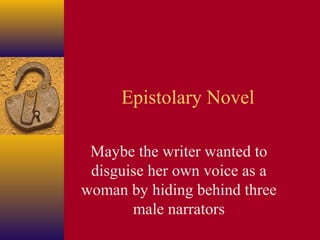
Maybe the writer wanted to
disguise her own voice as a
woman by hiding behind three
male narrators
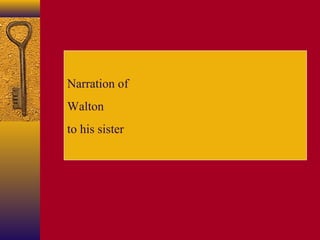
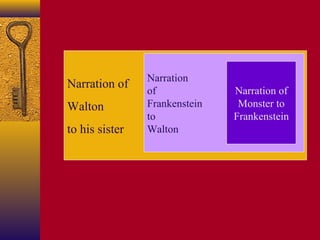
Narration of
Walton
to his sister
Narration of
Walton
to his sister

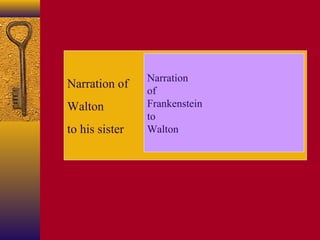
Narration
of
Frankenstein
to
Walton
Narration of
Walton
to his sister

Narration
of
Frankenstein
to
Walton

Narration of
Monster to
Frankenstein
CHARACTERS
CHARACTERS
♦ Few characters => the most important are

the three narrators
Captain WALTON
♦ A double of Frankenstein
Captain WALTON
♦ A double of Frankenstein
♦ Manifesting the same ambition
Captain WALTON
♦ A double of Frankenstein
♦ Manifesting the same ambition
♦ Characterised by Romantic elements:
Captain WALTON
♦ A double of Frankenstein
♦ Manifesting the same ambition
♦ Characterised by Romantic elements:
– NATURE seen as the embodiment of God
Captain WALTON
♦ A double of Frankenstein
♦ Manifesting the same ambition
♦ Characterised by Romantic elements:
– NATURE seen as the embodiment of God
– The longing for the North and travel towards
the unknown
Captain WALTON
♦ A double of Frankenstein
♦ Manifesting the same ambition
♦ Characterised by Romantic elements:
– NATURE seen as the embodiment of God
– The longing for the North and travel towards
the unknown
– The wish for loneliness and pride in being
different.
Captain WALTON

Captain Walton tries
to go beyond human limits
Captain WALTON
Captain Walton is punished in the end
as all overreachers are:
his punishment is
• the imprisonment of his ship in the ice
•The rebellion of the crew
Victor FRANKENSTEIN
Victor FRANKENSTEIN
♦ He is an overreacher
Victor FRANKENSTEIN
♦ He is an overreacher
♦ He wants to defeat death and create a spark

of life without woman’s participation
Victor FRANKENSTEIN
♦ He is an overreacher
♦ He wants to defeat death and create a spark

of life without woman’s participation
♦ He breaks the rules and challenges God =>
Myth of Prometheus
Victor FRANKENSTEIN
♦ He is an overreacher
♦ He wants to defeat death and create a spark

of life without woman’s participation
♦ He breaks the rules and challenges God =>
Myth of Prometheus
♦ He is hungry for knowledge – His ambition
to know the secrets of life leads him to
damnation => Myth of Dr. Faust
Victor FRANKENSTEIN

Frankenstein wants
to access forbidden knowledge
without considering
the consequences of his actions
Victor FRANKENSTEIN
Frankenstein is punished in the end
His punishment is:
• The murder of his beloved
•His own death
Victor FRANKENSTEIN
♦ Frankenstein and the monster are

complementary:
Victor FRANKENSTEIN
♦ Frankenstein and the monster are
complementary:
– both suffer from a sense of alienation and
isolation
Victor FRANKENSTEIN
♦ Frankenstein and the monster are

complementary:
– both suffer from a sense of alienation and
isolation
– Both begin with a desire to be good but
become obsessed with hate and revenge
The MONSTER…
♦ …becomes the protagonist in the third part

of the novel
The MONSTER…
♦ … is an intelligent being
The MONSTER
♦ He is an intelligent being
♦ His natural sensibility is hurt by the

repulsion and terror he produces
The MONSTER
♦ He is an intelligent being
♦ His natural sensibility is hurt by the

repulsion and terror he produces
♦ He represents a deviation from the rule – a
deviation from the forces of good.
The MONSTER
♦ He is an intelligent being
♦ His natural sensibility is hurt by the

repulsion and terror he produces
♦ He represents a deviation from the rule – a
deviation from the forces of good.
♦ He becomes an outcast, a murderer and a
rebel against every human being
THEMES
THEMES

♦Forbidden knowledge
THEMES

♦The overreacher
THEMES

♦The overreacher
– In the characters of Walton and
Doctor Frankenstein => they both try
to overcome human limits
THEMES

♦The double:
THEMES

♦The double:
– Doctor Frankenstein and the monster
are two aspects of the same being =>

anticipating the double identity of Doctor
Jekyll and Mr Hyde
THEMES

♦Usurping the female role:
THEMES

♦Usurping the female role:
– The creation of human beings
becomes possible without the
participation of women
THEMES

♦Penetrating Nature’s secrets:
THEMES
=>Scientific research connected to the
development of science in the
period
=>
THEMES
♦ Penetrating Nature’s secrets:
=>Scientific research connected to the
development of science in the period
=> Desire of the Romantics to

penetrate Nature’s secrets related to
the theme of the overreacher
THEMES
♦ Penetrating Nature’s secrets:
=>Scientific research connected to the
development of science in the period
=> Desire of the Romantics to penetrate
Nature’s secrets related to the theme of
the overreacher

⇒Limits and dangers of scientific
research
THEMES
♦ Penetrating Nature’s secrets:
=>Scientific research connected to the
development of science in the period
=> Desire of the Romantics to penetrate
Nature’s secrets related to the theme of
the overreacher
⇒Limits and dangers of scientific research
⇒ The novel is considered a forerunner of
science fiction
THEMES

♦ Social injustice

- the monster is good in his inside
THEMES

♦ Social injustice

- the monster is good in his inside
- he becomes evil only because of the
humiliations and injustices he has
suffered => OUTCAST of society
THEMES

♦Education and experience:
THEMES

♦ Education and experience:

=> represented by the monster’s
intellectual and emotional development
The novel is only partly
Gothic….
♦ …because it is not set in a Gothic castle
The novel is only partly
Gothic….
♦ …because it is not set in a Gothic castle
♦ It does not deal with supernatural events
The novel is only partly
Gothic….
♦ …because it is not set in a Gothic castle
♦ It does not deal with supernatural events
♦ It deals with a scientific experiment and the

horror derived from the unexpected
outcome
The Gothic element is to be
found ….
♦ …in the description of the parts of the

corpse which make up the monster,
The Gothic element is to be
found ….
♦ …in the description of the parts of the

corpse which make up the monster,
♦ The dreadful setting
The Gothic element is to be
found ….
♦ …in the description of the parts of the

corpse which make up the monster
♦ The dreadful setting
♦ The emotional atmosphere
FRANKENSTEIN
by mary Shelley

BE WARNED !

Gothic novels

  • 1.
  • 2.
    Gothic novels… ♦ werea very popular genre among all strata of society
  • 3.
    Gothic novels… ♦ werea very popular genre among all strata of society ♦ Today’s ghost and horror stories derive from 18thcentury Gothic novels
  • 4.
    The term Gothicwas associated with:
  • 5.
    The term Gothicwas associated with: ♦ Medieval => architectural style of the Middle Ages
  • 6.
    The term Gothicwas associated with: ♦ Medieval => architectural style of the Middle Ages ♦ Irregular and barbarious (as opposed to classicism)
  • 7.
    The term Gothicwas associated with: ♦ Medieval => architectural style of the Middle Ages ♦ Irregular and barbarious (as opposed to classicism) ♦ Wild and supernatural => mysterious & fearful
  • 8.
    Gothic literature… ♦ …can now be considered as the product of a society that was conscious of social inequity
  • 9.
    Big social changesof 18th century ♦ RISE OF THE BOURGEOISIE, who had begun to understand its real condition
  • 10.
    Big social changesof 18th century ♦ MIGRATION towards INDUSTRIALIZED TOWNS (thousands of people abandoned country villages in search of better job opportunities in cities
  • 11.
    Big social changesof 18th century ♦ INDUSTRIAL EXPLOITATION which destroyed the importance of the single human being  MAN had become a SLAVE to forces he could not control
  • 12.
    In rejection ofsuch reality:
  • 13.
    In rejection ofsuch a reality: ♦ They showed big interest in the SUPERNATURAL
  • 14.
    In rejection ofsuch a reality => INTEREST in: ♦ the SUPERNATURAL ♦ INTENSE FEELINGS such as terror, as a way to realize individual potential
  • 15.
    CONCEPT of theSUBLIME Edmund Burke ♦What is beauty?
  • 16.
    CONCEPT of theSUBLIME E. Burke ♦What is sublime?
  • 17.
    CONCEPT of theSUBLIME E. Burke ♦Flowerbeds are beautiful…
  • 18.
    CONCEPT of theSUBLIME E. Burke ♦Daylight is beautiful …
  • 19.
    CONCEPT of theSUBLIME E. Burke ♦Daylight is beautiful because it can be contemplated
  • 20.
    CONCEPT of theSUBLIME E. Burke ♦ The eruption of a volcano is sublime
  • 21.
    CONCEPT of theSUBLIME E. Burke ♦ The eruption of a volcano is sublime ♦ A storm is sublime
  • 22.
    CONCEPT of theSUBLIME E. Burke ♦ The eruption of a volcano is sublime ♦ A storm at sea is sublime ♦ An abyss is sublime
  • 23.
    CONCEPT of theSUBLIME E. Burke ♦ The eruption of a volcano is sublime ♦ A storm at sea is sublime ♦ An abyss is sublime ♦ The obscurity of the night is sublime because…
  • 24.
    CONCEPT of theSUBLIME E. Burke ♦ the sublime arouses emotions such as: – Uncertainty – Anxiety – Anguish – Astonishment – Admiration, reverence, respect
  • 25.
  • 26.
    BURKE’s conclusion isthat… ♦ the great and the sublime are more effective than beauty in art because they arouse:
  • 27.
    BURKE’s conclusion isthat… ♦ the great and the sublime are more effective than beauty in art because they arouse: – HORROR & FEAR ….by suspending man’s faculty of reason
  • 28.
  • 29.
  • 30.
    GOTHIC SYMBOLS ♦The wanderer ♦Thevampire ♦The overreacher
  • 31.
    GOTHIC SYMBOLS ♦ Theyrepresent: -> Rejection of limits and constraints
  • 32.
    GOTHIC SYMBOLS ♦ Theyrepresent: -> Rejection of limits and constraints -> Interest in intense feelings
  • 33.
    GOTHIC SYMBOLS ♦ Theyrepresent: -> Rejection of limits and constraints -> Interest in intense feelings ->Concern with the exploration of forbidden, denied areas.
  • 34.
    They all represent figuresof individualists who are not satisfied with the society they live in
  • 35.
    They all representfigures of individualists who are not satisfied with the society they live in ♦ Their concern with the exploration of forbidden knowledge or denied areas reflects the wish to go beyond God, nature and human limits.
  • 36.
    They all representfigures of individualists who are not satisfied with the society they live in ♦ Their concern with the exploration of forbidden knowledge or denied areas reflects the wish to go beyond God, nature and human limits. ♦ They reject all constraints and limits imposed by religious or social laws
  • 37.
  • 38.
  • 39.
    SETTING ♦ Ancient settings:isolated castles, mysterious abbeys, hidden passages, secret rooms ♦ Catholic countries (Protestant prejudice)
  • 40.
  • 41.
    CHARACTERS ♦ Supernatural beings:vampires, monsters, ghosts ♦ Heroines stricken with terror and persecuted ♦Terrifying male characters victim of their negative impulses with no command over them
  • 42.
  • 43.
    PLOT ♦ very complicated,associated with mysterious elements ♦Exaggerated reactions of the characters to mysterious or events situations
  • 44.
  • 45.
    ATMOSPHERE ♦ Terrifying descriptionsof ghosts/monsters ♦ Sense of mystery ♦ Great suspense
  • 46.
  • 47.
    Most famous Gothicnovels: ♦ The Castle of Otranto by Horace Walpole
  • 48.
    Most famous Gothicnovels: ♦ The Castle of Otranto by Horace Walpole ♦ The Mysteries of Udolpho by Ann Radcliff
  • 49.
    Most famous Gothicnovels: ♦ The Castle of Otranto by Horace Walpole ♦ The Mysteries of Udolpho by Ann Radcliff ♦ The Monk by Matthew Lewis
  • 50.
    Most famous Gothicnovels: ♦ The Castle of Otranto by Horace Walpole ♦ The Mysteries of Udolpho by Ann Radcliff ♦ The Monk by Matthew Lewis ♦ Frankenstein or the Modern Prometheus by Mary Shelley
  • 51.
  • 52.
  • 53.
    Epistolary Novel Maybe thewriter wanted to disguise her own voice as a woman by hiding behind three male narrators
  • 54.
  • 55.
    Narration of Walton to hissister Narration of Frankenstein to Walton
  • 56.
    Narration of Walton to hissister Narration of Frankenstein to Walton Narration of Monster to Frankenstein
  • 57.
  • 58.
    CHARACTERS ♦ Few characters=> the most important are the three narrators
  • 59.
    Captain WALTON ♦ Adouble of Frankenstein
  • 60.
    Captain WALTON ♦ Adouble of Frankenstein ♦ Manifesting the same ambition
  • 61.
    Captain WALTON ♦ Adouble of Frankenstein ♦ Manifesting the same ambition ♦ Characterised by Romantic elements:
  • 62.
    Captain WALTON ♦ Adouble of Frankenstein ♦ Manifesting the same ambition ♦ Characterised by Romantic elements: – NATURE seen as the embodiment of God
  • 63.
    Captain WALTON ♦ Adouble of Frankenstein ♦ Manifesting the same ambition ♦ Characterised by Romantic elements: – NATURE seen as the embodiment of God – The longing for the North and travel towards the unknown
  • 64.
    Captain WALTON ♦ Adouble of Frankenstein ♦ Manifesting the same ambition ♦ Characterised by Romantic elements: – NATURE seen as the embodiment of God – The longing for the North and travel towards the unknown – The wish for loneliness and pride in being different.
  • 65.
    Captain WALTON Captain Waltontries to go beyond human limits
  • 66.
    Captain WALTON Captain Waltonis punished in the end as all overreachers are: his punishment is • the imprisonment of his ship in the ice •The rebellion of the crew
  • 67.
  • 68.
    Victor FRANKENSTEIN ♦ Heis an overreacher
  • 69.
    Victor FRANKENSTEIN ♦ Heis an overreacher ♦ He wants to defeat death and create a spark of life without woman’s participation
  • 70.
    Victor FRANKENSTEIN ♦ Heis an overreacher ♦ He wants to defeat death and create a spark of life without woman’s participation ♦ He breaks the rules and challenges God => Myth of Prometheus
  • 71.
    Victor FRANKENSTEIN ♦ Heis an overreacher ♦ He wants to defeat death and create a spark of life without woman’s participation ♦ He breaks the rules and challenges God => Myth of Prometheus ♦ He is hungry for knowledge – His ambition to know the secrets of life leads him to damnation => Myth of Dr. Faust
  • 72.
    Victor FRANKENSTEIN Frankenstein wants toaccess forbidden knowledge without considering the consequences of his actions
  • 73.
    Victor FRANKENSTEIN Frankenstein ispunished in the end His punishment is: • The murder of his beloved •His own death
  • 74.
    Victor FRANKENSTEIN ♦ Frankensteinand the monster are complementary:
  • 75.
    Victor FRANKENSTEIN ♦ Frankensteinand the monster are complementary: – both suffer from a sense of alienation and isolation
  • 76.
    Victor FRANKENSTEIN ♦ Frankensteinand the monster are complementary: – both suffer from a sense of alienation and isolation – Both begin with a desire to be good but become obsessed with hate and revenge
  • 77.
    The MONSTER… ♦ …becomesthe protagonist in the third part of the novel
  • 78.
    The MONSTER… ♦ …is an intelligent being
  • 79.
    The MONSTER ♦ Heis an intelligent being ♦ His natural sensibility is hurt by the repulsion and terror he produces
  • 80.
    The MONSTER ♦ Heis an intelligent being ♦ His natural sensibility is hurt by the repulsion and terror he produces ♦ He represents a deviation from the rule – a deviation from the forces of good.
  • 81.
    The MONSTER ♦ Heis an intelligent being ♦ His natural sensibility is hurt by the repulsion and terror he produces ♦ He represents a deviation from the rule – a deviation from the forces of good. ♦ He becomes an outcast, a murderer and a rebel against every human being
  • 82.
  • 83.
  • 84.
  • 85.
    THEMES ♦The overreacher – Inthe characters of Walton and Doctor Frankenstein => they both try to overcome human limits
  • 86.
  • 87.
    THEMES ♦The double: – DoctorFrankenstein and the monster are two aspects of the same being => anticipating the double identity of Doctor Jekyll and Mr Hyde
  • 88.
  • 89.
    THEMES ♦Usurping the femalerole: – The creation of human beings becomes possible without the participation of women
  • 90.
  • 91.
    THEMES =>Scientific research connectedto the development of science in the period =>
  • 92.
    THEMES ♦ Penetrating Nature’ssecrets: =>Scientific research connected to the development of science in the period => Desire of the Romantics to penetrate Nature’s secrets related to the theme of the overreacher
  • 93.
    THEMES ♦ Penetrating Nature’ssecrets: =>Scientific research connected to the development of science in the period => Desire of the Romantics to penetrate Nature’s secrets related to the theme of the overreacher ⇒Limits and dangers of scientific research
  • 94.
    THEMES ♦ Penetrating Nature’ssecrets: =>Scientific research connected to the development of science in the period => Desire of the Romantics to penetrate Nature’s secrets related to the theme of the overreacher ⇒Limits and dangers of scientific research ⇒ The novel is considered a forerunner of science fiction
  • 95.
    THEMES ♦ Social injustice -the monster is good in his inside
  • 96.
    THEMES ♦ Social injustice -the monster is good in his inside - he becomes evil only because of the humiliations and injustices he has suffered => OUTCAST of society
  • 97.
  • 98.
    THEMES ♦ Education andexperience: => represented by the monster’s intellectual and emotional development
  • 99.
    The novel isonly partly Gothic…. ♦ …because it is not set in a Gothic castle
  • 100.
    The novel isonly partly Gothic…. ♦ …because it is not set in a Gothic castle ♦ It does not deal with supernatural events
  • 101.
    The novel isonly partly Gothic…. ♦ …because it is not set in a Gothic castle ♦ It does not deal with supernatural events ♦ It deals with a scientific experiment and the horror derived from the unexpected outcome
  • 102.
    The Gothic elementis to be found …. ♦ …in the description of the parts of the corpse which make up the monster,
  • 103.
    The Gothic elementis to be found …. ♦ …in the description of the parts of the corpse which make up the monster, ♦ The dreadful setting
  • 104.
    The Gothic elementis to be found …. ♦ …in the description of the parts of the corpse which make up the monster ♦ The dreadful setting ♦ The emotional atmosphere
  • 105.