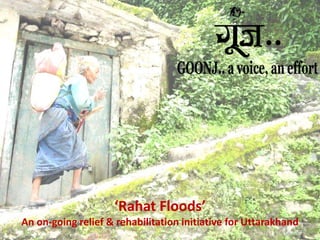
‘Rahat Floods’ 
An on-going relief & rehabilitation initiative for Uttarakhand
Our first appeal 
on 
June 20th, 2013 
for 
specific relief 
material..
Base Camp setup in Rishikesh 
Goonj converted a NDMC community center into its Base Camp; for unloading material from 
cities and reloading it on to smaller vehicles to move in the affected areas. 
Old doors became our tables while cartons of water bottles were turned into walls.
Goonj team members with disaster handling experience like floods in Bihar or Kurnool and 
trained processing team of women from Delhi along with 
Mr. Anshu Gupta, Founder Goonj reached Rishikesh and the affected areas
Overwhelming response from across the country 
Thousands of people and hundreds of organizations collected material and sent it to Goonj. 
IBN 7 made an appeal to its viewers collected material for Goonj and STAR TV network launched 
a major campaign across all its channels, spreading mass awareness.
Goonj’s Delhi, Bangalore, Mumbai, Hyderabad, Kolkata and Jalandhar offices with their small 
teams handled truckloads of material, hundreds of visitors, calls and mails.
Voluntary efforts came up in all shapes and ways. 
From loading trucks, making receipts, sorting material, answering calls. 
Students, professionals, housewives, senior citizens; everyone wanted to help..
Goonj reverted to its time tested partnership model for more effective relief efforts. 
Meetings held with local organizations, activists, community leaders to better understand the 
situation and to look for potential partners for short & long term work.
The relief material was given as Family Packs to address needs holistically . 
A Family Pack included around 25-30 kg of dry ration & biscuits, candles & match box, blankets 
& ‘MY-Pad’- Goonj’s sanitary pads
Village survey; an integral part of the distribution and implementation process
While Goonj took the material till last possible points, people from villages in the cut off areas 
travelled down to take back relief material for their families.
Biggest challenge remains the unpredictable weather .. 
Non-stop rains and frequent landslides have been the biggest hurdle in moving material 
in the mountains.
And it further aggravated the already damaged terrain..
The challenges certainly made us more determined 
Our teams used all possible routes, existing/non-existing paths to reach the affected 
communities..
Using every single channel; from jeeps, trucks, porters to mules..
Loss of mules; a big loss of livelihood 
Over 5000 mules, sole employment source for thousands of people were also killed in the 
disaster. Today mules are a critical means of reaching material to tough terrains. A mule carries 
around 80 kg material, covers risky routes of over 30 km for Rs. 1600/- to 2000/-
Some areas are still completely cut-off.. 
There aren’t even trails for the mules, our teams walk the same stretches to reach new areas!!
Even the porters risk their lives to carry the material.. 
to ensure that it reaches on time. In some areas, where even mules couldn’t go, these tough 
guys became our only channel to reach out..
As always local communities are our biggest stakeholders & partners. 
Not only for relief work but also for our short & long term work.
Getting the local viewpoint and needs assessment from local leaders.. 
A meeting with School teachers and Gram Pradhans (Uttarkashi)
Rafters of Uttarakhand; among our first strategic partners for reaching material. 
They knew the area well and had the risk taking ability & training. 
They reached essentials in many cut off villages of Chandrapuri & Agastyamuni areas.
Sahil; A group of passionate mountaineers and trekkers, 
Goonj channelised over 20 tonnes of essential food supplies and other material through this 
group to the totally cut off Bhatwari area of Uttarkashi.
Boond; a group of enthusiastic youngsters got regular supplies of essentials 
from Goonj (from ration to medicines, water, tarpaulins etc.) 
for many villages of Guptkashi, Chandrapuri & Agastyamuni .
Reaching out to the damaged but ignored villages of Thatyur 
Thatyur is a few kilometers away from Mussoorie. Working together with a well respected 
institution- Landour Community Hospital, we reached out relief material to over 1000 families. 
We are now set to work long term in 100 villages of the area.
YWAM (Helang, Joshimath); One truck load of relief material reached out to 268 families 
in 7 villages
Our collective effort helped material reach out to over 2000 families of 15 villages, 
in Bhatwari block (Uttarkashi) & basic medical support to hundreds of people.
GOONJ now has implementation offices in Uttarkashi & Guptkashi 
apart from the base camp in Rishikesh
Medical camps in 25 remote villages by doctor volunteers
Reaching sanitary pads - a basic need, and opening up the taboo issue of menses.. 
‘MY- Pad’ (Goonj’s cloth sanitary pad) is reaching in different villages..
Reviving local education infrastructure.. 
Goonj is supporting & restoring many govt. & private schools in Guptkashi & Uttarkashi. 
The first one below has been started at Triyuginarayan, Guptkashi.
Goonj opened its first Recreation Center - a happy space for children who have very little in the 
name of learning and fun.. (in Bhangeli, Uttarkashi)
Electrifying schools through Solar panels 
Repairing the present ones & putting up new ones to create a community space after dark.
In the last 3 months.. 
GOONJ’s support has touched over 166 villages so far, mainly 
as relief in some areas & in other areas for schools & winters 
The areas include- Joshimath region- villages of Urgam valley. Guptkashi/ Rudraprayag region- 
Triyuginarayan, Guptkashi, Phata, Agastyamuni, Mayali , Chandrapuri, Ukhimath and Jakholi 
Uttarkashi- villages of Bhatwari, Sangamchetti, Dunda . Tehri Garhwal- Thatyur, Bhilangana 
Pithoragarh ( Kumaon mandal)- villages of Madkote, Darkote 
 Base camp in Rishikesh & two major hubs in Guptkashi & Uttarkashi. 25 full/ part time team 
members, community workers and a large force of village volunteers. 
 Reached over 60 truck loads of relief material; including ration, blankets, woolens, utensils, bucket, 
My-pads, tarpaulins, medicines, torches, drinking water, raincoats, umbrellas etc. with a focus on far off 
and cut off villages. 
 Multiple channels used to reach affected communities - partners include Rafting association, local 
organizations, hospitals, ashrams, village Panchayats, village people, doctors, mountaineers, trekkers, 
porters, mules and volunteers under strict & structured supervision and support of our team. 
Goonj’s strong experience of working in partnerships is proved valuable 
in connecting with different stakeholders.
The road ahead.. 
 Committed to work for 2 to 3 years in this region; immediate relief & rehab as well as long term, on 
gaps in health, menstrual hygiene, toilets in schools, libraries and Aanganwaris. 
 Given the devastating direct effect on livelihoods, we will continue filling gaps for essential material 
for the next few months, wherever needed. 
 As health infrastructure is non- existent at many places, Goonj will be supporting voluntary efforts, 
pharmacists, Asha workers, to tackle basic issues apart from running regular medical camps. 
 We will implement some successful experiments & learning’s from other disasters like Sujni, Vaapsi, 
Stitching centers, Computer centers etc. 
 We will be starting our flagship initiative ‘Cloth for Work’ to empower and encourage local 
communities to address key gap areas. 
 Repairing infrastructure; Repair of existing structures like schools, community spaces. Reviving 
traditional Gherats for small scale electricity production. 
Our stress is on local wisdom, resources & people instead of imposing outside ideas..
 Target spread: In-depth work in 300 villages Surveys & in-depth interaction are on with relief 
operations. 
 Started reaching Goonj’s Winter Kits to far-flung villages given the fast setting winters. A kit typically 
has 4 blankets, 2 mats, woolens and general clothes for a family. 
 Targeting 300 schools and Aanganwaris for extensive work. The target is to reach basic school 
material, sitting mats, school supplies, toys, books etc. as well as filling up gaps in teachers 
remuneration, for the next few months where ever we see a gap. 
 Goonj is taking up the taboo issue of menstrual hygiene, education and awareness apart from 
reaching Goonj sanitary pads for village women & adolescent girls. Focusing on 100 villages. 
 Solar interventions; 30 solar systems have been installed. Focus on big units for community spaces. 
Initial target-about 500 systems. 
 Reviving severely damaged private schools which have no support, providing learning at minimal 
fees. First private school revived in Triyuginarayan. 
 Exploring doing massive plantation drives under Cloth for Work to prevent land erosion and 
landslides.
Contributions.. 
Apart from a large quantity of material from all over the country as per our list, we also got- 
1. Massive response from corporates, schools and other institutions; Around 120 organizations 
participated through one day salary contribution while some matched employee contributions. Names 
of contributors will be uploaded on our website in the next few months, after proper reconciling & 
auditing. 
2. Overwhelming contribution from individuals; From a money order of Rs. 20/- to 3.64/- lakh , sheer 
variety & range of individual contributions has been both mind boggling & humbling. Over 38,000 
people have contributed directly or through their respective organizations . 
3. STAR TV, a surprise support in this campaign; They did a pro bono campaign which ran across its 
various channels. It reached our message across the country. People even from smallest & remotest 
corners of India connected with us. 
4. The Balance sheet will be up on the website with the details of all the Rahat related contributions 
and expenses after the auditing etc. as per our regular practice .
Challenges.. 
 Toughest terrain; Despite our long and varied experience of working in different disasters from 
Laddakh to Andhra Pradesh, this disaster has been a new experience for our team & resources at every 
step. People faced landslides, falls & walked through some of the toughest routes. 
 Expired material; A lot of traders and organizations gave us biscuits and other material which had 
expired months back. Some sneakily dumped sachets of so called energy drink and other goods-about 
to expire, in the name of CSR. Big quantities of cooked food like burgers, patties, poori & soiled clothes 
like undergarments to torn trousers as well as expired & half consumed medicines wasted our 
resources & time. 
Sudden inflow of money and material; Sudden inflow of massive quantities of material, attention & 
monetary contribution from the masses challenged our resources, capacities, energy and systems. The 
entire team & support network of volunteers, friends, and families - everyone played a beautiful role.
A sincere thanks to the team, volunteers and to all who have joined the work.. 
All of us at Goonj, are just some ordinary citizens of a country where disaster training 
happens mostly on papers. Like millions of citizens we also come from average Indian 
families for whom hills have been a holiday place in the past. For many of us the broken 
and angry mountains, land slides, risky hilly terrains, nights in the rubble filled villages, 
waiting all night in the buses and jeeps for clearance of huge stones has been an 
absolutely different experience. We are certainly not the trained army and air force people 
and neither are we locals. 
It’s just a small keera inside us, a passion and now many years of working in various 
difficult situations.. 
Our sincere salute and thanks to a number of volunteers and team members who 
were there in the toughest and busiest times, to attend hundreds of telephone calls and 
mails. Who slept in office, worked day and night, loaded- unloaded so much material for 
the first time, sorted cartons of material or soiled food, supervised packing and traveled in 
the risky terrains in the trucks itself. 
And to all who trusted this small, locally grown idea called Goonj 
with so much support to handle such a massive disaster..
No, it isn’t déjà vu after all. Being in Uttarakhand after the floods has been like 
no other experience. This is one disaster in which I have seen the largest 
number of people risking their lives to do something and reaching out to the 
toughest terrains as volunteers. Refer- http://in.news.yahoo.com/why-uttarakhand- 
still-needs-your-attention-063051049.html 
Another write-up on yahoo- http://in.news.yahoo.com/how-to-sort-a-calamity- 
055136095.html 
Besides, we need to understand that we might feel great by giving 25 kg of 
ration to a family in affected areas and claim that the relief has reached but 
that is barely sufficient for a few days. more on 
http://www.governancenow.com/news/regular-story/meanwhile-uttarakhand-long- 
battle-ahead 
From these hubs, smaller teams are dispatched via four wheelers to the 
villages. Where roads have been washed away, teams of Goonj volunteers 
trek up the hills to reach the people. In some cases, the villagers themselves 
come down in small groups to the relief hubs. 
Refer- http://civilsocietyonline.com/pages/Details.aspx?380 
“We don’t rush to the field immediately after any disaster and instead focus on 
creating awareness in the cities. We understand that in the initial days of any 
calamity it is the administration and the army that plays an important role,” 
Gupta says over the phone from Delhi. “We step in later.” Refer-http:// 
www.rediff.com/news/report/be-sensitive-about-what-you-donate/ 
20130621.htm 
In Media…
The need will be there for months !! Stay tuned to our work.. 
Write to us- mail@goonj.org Web- www.goonj.org 
www.facebook.com/goonj.org www.twitter.com/goonj

Goonj work at uttarakhand (1.10.13)

  • 1.
    ‘Rahat Floods’ Anon-going relief & rehabilitation initiative for Uttarakhand
  • 2.
    Our first appeal on June 20th, 2013 for specific relief material..
  • 3.
    Base Camp setupin Rishikesh Goonj converted a NDMC community center into its Base Camp; for unloading material from cities and reloading it on to smaller vehicles to move in the affected areas. Old doors became our tables while cartons of water bottles were turned into walls.
  • 4.
    Goonj team memberswith disaster handling experience like floods in Bihar or Kurnool and trained processing team of women from Delhi along with Mr. Anshu Gupta, Founder Goonj reached Rishikesh and the affected areas
  • 5.
    Overwhelming response fromacross the country Thousands of people and hundreds of organizations collected material and sent it to Goonj. IBN 7 made an appeal to its viewers collected material for Goonj and STAR TV network launched a major campaign across all its channels, spreading mass awareness.
  • 6.
    Goonj’s Delhi, Bangalore,Mumbai, Hyderabad, Kolkata and Jalandhar offices with their small teams handled truckloads of material, hundreds of visitors, calls and mails.
  • 7.
    Voluntary efforts cameup in all shapes and ways. From loading trucks, making receipts, sorting material, answering calls. Students, professionals, housewives, senior citizens; everyone wanted to help..
  • 9.
    Goonj reverted toits time tested partnership model for more effective relief efforts. Meetings held with local organizations, activists, community leaders to better understand the situation and to look for potential partners for short & long term work.
  • 10.
    The relief materialwas given as Family Packs to address needs holistically . A Family Pack included around 25-30 kg of dry ration & biscuits, candles & match box, blankets & ‘MY-Pad’- Goonj’s sanitary pads
  • 11.
    Village survey; anintegral part of the distribution and implementation process
  • 12.
    While Goonj tookthe material till last possible points, people from villages in the cut off areas travelled down to take back relief material for their families.
  • 16.
    Biggest challenge remainsthe unpredictable weather .. Non-stop rains and frequent landslides have been the biggest hurdle in moving material in the mountains.
  • 17.
    And it furtheraggravated the already damaged terrain..
  • 18.
    The challenges certainlymade us more determined Our teams used all possible routes, existing/non-existing paths to reach the affected communities..
  • 20.
    Using every singlechannel; from jeeps, trucks, porters to mules..
  • 21.
    Loss of mules;a big loss of livelihood Over 5000 mules, sole employment source for thousands of people were also killed in the disaster. Today mules are a critical means of reaching material to tough terrains. A mule carries around 80 kg material, covers risky routes of over 30 km for Rs. 1600/- to 2000/-
  • 22.
    Some areas arestill completely cut-off.. There aren’t even trails for the mules, our teams walk the same stretches to reach new areas!!
  • 23.
    Even the portersrisk their lives to carry the material.. to ensure that it reaches on time. In some areas, where even mules couldn’t go, these tough guys became our only channel to reach out..
  • 24.
    As always localcommunities are our biggest stakeholders & partners. Not only for relief work but also for our short & long term work.
  • 26.
    Getting the localviewpoint and needs assessment from local leaders.. A meeting with School teachers and Gram Pradhans (Uttarkashi)
  • 27.
    Rafters of Uttarakhand;among our first strategic partners for reaching material. They knew the area well and had the risk taking ability & training. They reached essentials in many cut off villages of Chandrapuri & Agastyamuni areas.
  • 28.
    Sahil; A groupof passionate mountaineers and trekkers, Goonj channelised over 20 tonnes of essential food supplies and other material through this group to the totally cut off Bhatwari area of Uttarkashi.
  • 29.
    Boond; a groupof enthusiastic youngsters got regular supplies of essentials from Goonj (from ration to medicines, water, tarpaulins etc.) for many villages of Guptkashi, Chandrapuri & Agastyamuni .
  • 30.
    Reaching out tothe damaged but ignored villages of Thatyur Thatyur is a few kilometers away from Mussoorie. Working together with a well respected institution- Landour Community Hospital, we reached out relief material to over 1000 families. We are now set to work long term in 100 villages of the area.
  • 31.
    YWAM (Helang, Joshimath);One truck load of relief material reached out to 268 families in 7 villages
  • 32.
    Our collective efforthelped material reach out to over 2000 families of 15 villages, in Bhatwari block (Uttarkashi) & basic medical support to hundreds of people.
  • 33.
    GOONJ now hasimplementation offices in Uttarkashi & Guptkashi apart from the base camp in Rishikesh
  • 34.
    Medical camps in25 remote villages by doctor volunteers
  • 35.
    Reaching sanitary pads- a basic need, and opening up the taboo issue of menses.. ‘MY- Pad’ (Goonj’s cloth sanitary pad) is reaching in different villages..
  • 36.
    Reviving local educationinfrastructure.. Goonj is supporting & restoring many govt. & private schools in Guptkashi & Uttarkashi. The first one below has been started at Triyuginarayan, Guptkashi.
  • 38.
    Goonj opened itsfirst Recreation Center - a happy space for children who have very little in the name of learning and fun.. (in Bhangeli, Uttarkashi)
  • 39.
    Electrifying schools throughSolar panels Repairing the present ones & putting up new ones to create a community space after dark.
  • 40.
    In the last3 months.. GOONJ’s support has touched over 166 villages so far, mainly as relief in some areas & in other areas for schools & winters The areas include- Joshimath region- villages of Urgam valley. Guptkashi/ Rudraprayag region- Triyuginarayan, Guptkashi, Phata, Agastyamuni, Mayali , Chandrapuri, Ukhimath and Jakholi Uttarkashi- villages of Bhatwari, Sangamchetti, Dunda . Tehri Garhwal- Thatyur, Bhilangana Pithoragarh ( Kumaon mandal)- villages of Madkote, Darkote  Base camp in Rishikesh & two major hubs in Guptkashi & Uttarkashi. 25 full/ part time team members, community workers and a large force of village volunteers.  Reached over 60 truck loads of relief material; including ration, blankets, woolens, utensils, bucket, My-pads, tarpaulins, medicines, torches, drinking water, raincoats, umbrellas etc. with a focus on far off and cut off villages.  Multiple channels used to reach affected communities - partners include Rafting association, local organizations, hospitals, ashrams, village Panchayats, village people, doctors, mountaineers, trekkers, porters, mules and volunteers under strict & structured supervision and support of our team. Goonj’s strong experience of working in partnerships is proved valuable in connecting with different stakeholders.
  • 41.
    The road ahead..  Committed to work for 2 to 3 years in this region; immediate relief & rehab as well as long term, on gaps in health, menstrual hygiene, toilets in schools, libraries and Aanganwaris.  Given the devastating direct effect on livelihoods, we will continue filling gaps for essential material for the next few months, wherever needed.  As health infrastructure is non- existent at many places, Goonj will be supporting voluntary efforts, pharmacists, Asha workers, to tackle basic issues apart from running regular medical camps.  We will implement some successful experiments & learning’s from other disasters like Sujni, Vaapsi, Stitching centers, Computer centers etc.  We will be starting our flagship initiative ‘Cloth for Work’ to empower and encourage local communities to address key gap areas.  Repairing infrastructure; Repair of existing structures like schools, community spaces. Reviving traditional Gherats for small scale electricity production. Our stress is on local wisdom, resources & people instead of imposing outside ideas..
  • 42.
     Target spread:In-depth work in 300 villages Surveys & in-depth interaction are on with relief operations.  Started reaching Goonj’s Winter Kits to far-flung villages given the fast setting winters. A kit typically has 4 blankets, 2 mats, woolens and general clothes for a family.  Targeting 300 schools and Aanganwaris for extensive work. The target is to reach basic school material, sitting mats, school supplies, toys, books etc. as well as filling up gaps in teachers remuneration, for the next few months where ever we see a gap.  Goonj is taking up the taboo issue of menstrual hygiene, education and awareness apart from reaching Goonj sanitary pads for village women & adolescent girls. Focusing on 100 villages.  Solar interventions; 30 solar systems have been installed. Focus on big units for community spaces. Initial target-about 500 systems.  Reviving severely damaged private schools which have no support, providing learning at minimal fees. First private school revived in Triyuginarayan.  Exploring doing massive plantation drives under Cloth for Work to prevent land erosion and landslides.
  • 43.
    Contributions.. Apart froma large quantity of material from all over the country as per our list, we also got- 1. Massive response from corporates, schools and other institutions; Around 120 organizations participated through one day salary contribution while some matched employee contributions. Names of contributors will be uploaded on our website in the next few months, after proper reconciling & auditing. 2. Overwhelming contribution from individuals; From a money order of Rs. 20/- to 3.64/- lakh , sheer variety & range of individual contributions has been both mind boggling & humbling. Over 38,000 people have contributed directly or through their respective organizations . 3. STAR TV, a surprise support in this campaign; They did a pro bono campaign which ran across its various channels. It reached our message across the country. People even from smallest & remotest corners of India connected with us. 4. The Balance sheet will be up on the website with the details of all the Rahat related contributions and expenses after the auditing etc. as per our regular practice .
  • 44.
    Challenges..  Toughestterrain; Despite our long and varied experience of working in different disasters from Laddakh to Andhra Pradesh, this disaster has been a new experience for our team & resources at every step. People faced landslides, falls & walked through some of the toughest routes.  Expired material; A lot of traders and organizations gave us biscuits and other material which had expired months back. Some sneakily dumped sachets of so called energy drink and other goods-about to expire, in the name of CSR. Big quantities of cooked food like burgers, patties, poori & soiled clothes like undergarments to torn trousers as well as expired & half consumed medicines wasted our resources & time. Sudden inflow of money and material; Sudden inflow of massive quantities of material, attention & monetary contribution from the masses challenged our resources, capacities, energy and systems. The entire team & support network of volunteers, friends, and families - everyone played a beautiful role.
  • 45.
    A sincere thanksto the team, volunteers and to all who have joined the work.. All of us at Goonj, are just some ordinary citizens of a country where disaster training happens mostly on papers. Like millions of citizens we also come from average Indian families for whom hills have been a holiday place in the past. For many of us the broken and angry mountains, land slides, risky hilly terrains, nights in the rubble filled villages, waiting all night in the buses and jeeps for clearance of huge stones has been an absolutely different experience. We are certainly not the trained army and air force people and neither are we locals. It’s just a small keera inside us, a passion and now many years of working in various difficult situations.. Our sincere salute and thanks to a number of volunteers and team members who were there in the toughest and busiest times, to attend hundreds of telephone calls and mails. Who slept in office, worked day and night, loaded- unloaded so much material for the first time, sorted cartons of material or soiled food, supervised packing and traveled in the risky terrains in the trucks itself. And to all who trusted this small, locally grown idea called Goonj with so much support to handle such a massive disaster..
  • 46.
    No, it isn’tdéjà vu after all. Being in Uttarakhand after the floods has been like no other experience. This is one disaster in which I have seen the largest number of people risking their lives to do something and reaching out to the toughest terrains as volunteers. Refer- http://in.news.yahoo.com/why-uttarakhand- still-needs-your-attention-063051049.html Another write-up on yahoo- http://in.news.yahoo.com/how-to-sort-a-calamity- 055136095.html Besides, we need to understand that we might feel great by giving 25 kg of ration to a family in affected areas and claim that the relief has reached but that is barely sufficient for a few days. more on http://www.governancenow.com/news/regular-story/meanwhile-uttarakhand-long- battle-ahead From these hubs, smaller teams are dispatched via four wheelers to the villages. Where roads have been washed away, teams of Goonj volunteers trek up the hills to reach the people. In some cases, the villagers themselves come down in small groups to the relief hubs. Refer- http://civilsocietyonline.com/pages/Details.aspx?380 “We don’t rush to the field immediately after any disaster and instead focus on creating awareness in the cities. We understand that in the initial days of any calamity it is the administration and the army that plays an important role,” Gupta says over the phone from Delhi. “We step in later.” Refer-http:// www.rediff.com/news/report/be-sensitive-about-what-you-donate/ 20130621.htm In Media…
  • 47.
    The need willbe there for months !! Stay tuned to our work.. Write to us- mail@goonj.org Web- www.goonj.org www.facebook.com/goonj.org www.twitter.com/goonj