WOMEN EMPOWERMENT:
key to population
stabilization in India
GROUP NAME:
“GOONJ”
-voice of youth
Universal declaration of
human rights
“Everyone is entitled to all the rights and freedoms
set forth in this Declaration, without distinction of
any kind, such as race, colour, sex, language,
religion, political or other opinion, national or
social origin, property, birth or other status”
05-09-2013 2
Article 2. Universal declaration of human rights. (Available at
http://www.un.org/en/documents/udhr/#atop)
The Constitution of India:
Preamble (1950)
 WE, THE PEOPLE OF INDIA, having solemnly resolved to
constitute India into a SOVEREIGN SOCIALIST SECULAR
DEMOCRATIC REPUBLIC and to secure to all its citizens:
 JUSTICE, social, economic and political;
 LIBERTY of thought, expression, belief, faith and worship
 EQUALITY of status and of opportunity
 and to promote among them all
 FRATERNITY assuring the dignity of the individual and the unity
and integrity of the Nation
05-09-2013 3
?.........
Women's empowerment has five
components:
Sense of self-worth
Right to have and to determine
choices
Right to have access to
opportunities and resources
Right to have the power to control
their own lives, both within and
outside the home
Ability to influence the direction of
social change to create a more
just social and economic order,
nationally and internationally
What is Women
Empowerment?
What’s worse- wider perception
Factors influencing women empowerment
05-09-2013 6
Women
Empow
erment
Strength
Economi
cally
independ
ent
women
Industry
Wisdom
Women
literacy
Women
participati
on in
election
Proportion of
women in
parliament,
local bodies
Empathy
28 countries: women make up over
30% of parliamentarians
European countries: Increase in the
number of women police officers
helps to overcome reluctance in
reporting sexual assault
Sweden: Improved paternity leave
has reduced the gender pay gap
Nepal: Tax exemptions have
incentives families to transfer land to
daughters, sisters and wives
Significant initiatives towards
women empowerment
GENDER INEQUALITY
India’s score is 0.59-0.68 on the scale and it paints a sorry picture for us in the world
History of status of women
05-09-2013 8
•Freedom to choose
partners for marriage
•Daughters were not
considered as liability
or unwelcomed guest
in the family
•Widow marriages
were permissible
Statusofwomen
Vedic period
(1500-1000 BC)
•Women had
Subjugated status
• But gave the
message that
respectable wife is
one who humbles
herself vis-à-vis her
husband
Period of epics
(1000-500 BC)
•Did not deserve the
freedom at any point
of time in her life
•Not marring a girl
before the age of 14
years was a sin
Age of Manushatra
(500 – 200 BC)
Maitreyi, Gargi
Philosophers &
women seers
Woman empowerment in post-independence era
05-09-2013 9
• Hindu Marriage Act1955
• The Dowry Prohibition Act
• The maternity Benefit Act1961
• The Equal Remuneration Act1976
• The Indecent Representation of Women
[Prohibition] Act1986
• Formation of National Commission of Women1990
• Constitutional amendments for reservation of
seats in the local bodies of Panchayat and
Municipalities
1993
• The National Policy for the Empowerment of
Women2001
• Protection of Women from Domestic Violence Act2005
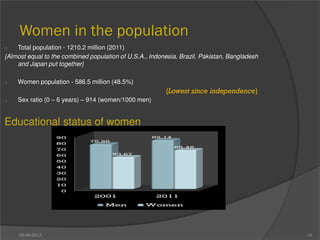
Women in the population
o Total population - 1210.2 million (2011)
{Almost equal to the combined population of U.S.A., Indonesia, Brazil, Pakistan, Bangladesh
and Japan put together}
o Women population - 586.5 million (48.5%)
o Sex ratio (0 – 6 years) – 914 (women/1000 men)
Educational status of women
05-09-2013 10
{Lowest since independence}
QUOTES
1.“You can tell condition of nation by looking at the status of its
women”
-Nehruji
2. “I measure the progress of a community by the degree of progress
which women have achieved”
-BR Ambedkar
3. “To call woman the weaker sex is a libel; it is man's injustice to woman. If by
strength is meant brute strength, then, indeed, is woman less brute than
man. If by strength is meant moral power, then woman is immeasurably
man's superior. Has she not greater intuition, is she not more self-
sacrificing, has she not greater powers of endurance, has she not greater
courage? Without her, man could not be. If nonviolence is the law of our
being, the future is with woman. Who can make a more effective appeal to
the heart than woman?”
-Gandhi ji
GOONJ

GOONJ

  • 1.
    WOMEN EMPOWERMENT: key topopulation stabilization in India GROUP NAME: “GOONJ” -voice of youth
  • 2.
    Universal declaration of humanrights “Everyone is entitled to all the rights and freedoms set forth in this Declaration, without distinction of any kind, such as race, colour, sex, language, religion, political or other opinion, national or social origin, property, birth or other status” 05-09-2013 2 Article 2. Universal declaration of human rights. (Available at http://www.un.org/en/documents/udhr/#atop)
  • 3.
    The Constitution ofIndia: Preamble (1950)  WE, THE PEOPLE OF INDIA, having solemnly resolved to constitute India into a SOVEREIGN SOCIALIST SECULAR DEMOCRATIC REPUBLIC and to secure to all its citizens:  JUSTICE, social, economic and political;  LIBERTY of thought, expression, belief, faith and worship  EQUALITY of status and of opportunity  and to promote among them all  FRATERNITY assuring the dignity of the individual and the unity and integrity of the Nation 05-09-2013 3
  • 4.
    ?......... Women's empowerment hasfive components: Sense of self-worth Right to have and to determine choices Right to have access to opportunities and resources Right to have the power to control their own lives, both within and outside the home Ability to influence the direction of social change to create a more just social and economic order, nationally and internationally What is Women Empowerment?
  • 5.
  • 6.
    Factors influencing womenempowerment 05-09-2013 6 Women Empow erment Strength Economi cally independ ent women Industry Wisdom Women literacy Women participati on in election Proportion of women in parliament, local bodies Empathy 28 countries: women make up over 30% of parliamentarians European countries: Increase in the number of women police officers helps to overcome reluctance in reporting sexual assault Sweden: Improved paternity leave has reduced the gender pay gap Nepal: Tax exemptions have incentives families to transfer land to daughters, sisters and wives Significant initiatives towards women empowerment
  • 7.
    GENDER INEQUALITY India’s scoreis 0.59-0.68 on the scale and it paints a sorry picture for us in the world
  • 8.
    History of statusof women 05-09-2013 8 •Freedom to choose partners for marriage •Daughters were not considered as liability or unwelcomed guest in the family •Widow marriages were permissible Statusofwomen Vedic period (1500-1000 BC) •Women had Subjugated status • But gave the message that respectable wife is one who humbles herself vis-à-vis her husband Period of epics (1000-500 BC) •Did not deserve the freedom at any point of time in her life •Not marring a girl before the age of 14 years was a sin Age of Manushatra (500 – 200 BC) Maitreyi, Gargi Philosophers & women seers
  • 9.
    Woman empowerment inpost-independence era 05-09-2013 9 • Hindu Marriage Act1955 • The Dowry Prohibition Act • The maternity Benefit Act1961 • The Equal Remuneration Act1976 • The Indecent Representation of Women [Prohibition] Act1986 • Formation of National Commission of Women1990 • Constitutional amendments for reservation of seats in the local bodies of Panchayat and Municipalities 1993 • The National Policy for the Empowerment of Women2001 • Protection of Women from Domestic Violence Act2005
  • 10.
    Women in thepopulation o Total population - 1210.2 million (2011) {Almost equal to the combined population of U.S.A., Indonesia, Brazil, Pakistan, Bangladesh and Japan put together} o Women population - 586.5 million (48.5%) o Sex ratio (0 – 6 years) – 914 (women/1000 men) Educational status of women 05-09-2013 10 {Lowest since independence}
  • 11.
    QUOTES 1.“You can tellcondition of nation by looking at the status of its women” -Nehruji 2. “I measure the progress of a community by the degree of progress which women have achieved” -BR Ambedkar 3. “To call woman the weaker sex is a libel; it is man's injustice to woman. If by strength is meant brute strength, then, indeed, is woman less brute than man. If by strength is meant moral power, then woman is immeasurably man's superior. Has she not greater intuition, is she not more self- sacrificing, has she not greater powers of endurance, has she not greater courage? Without her, man could not be. If nonviolence is the law of our being, the future is with woman. Who can make a more effective appeal to the heart than woman?” -Gandhi ji