…and the Network Economy
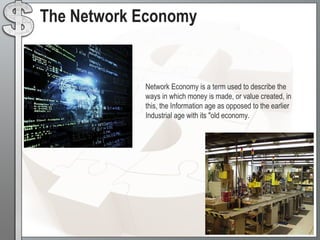
The Network EconomyThe Industrial Revolution shifted the economy from agriculture to industrial manufacturing…The Information Age has again shifted the focus of the economy. This time from industrial manufacturing to the Network Economy…
Rules of the Network EconomyOrganisations must innovate continuously in the marketplace. Value is created not by refining a product to perfection but by bringing new products to market quickly;  
 Organisations must leverage the dynamics and agility of networks to deliver their products;
 The environment is fickle, “in the thickening web of the Network Economy, the cycle of "find, nurture, destroy" happens faster and more intensely than ever before”, (http://www.wired.com/wired/archive/5.09/newrules_pr.html)“The Internet creates value by reducing the costs of transmitting information. That, in a nutshell, is all the Internet does”, (Liebowitz, S. 2002). 
Unlock the value of the InternetIn 2003, following the lead of Goto.com , Google, with its AdWords program, was one of the few companies that understood how to make money out of search engines. Revenues from Internet advertising have been growing over the last few years at around 20%-25%, (Laudon & Traver 2008), creating the new industry of search engine marketing and allowing Google to create an ever increasing portfolio of online applications and services.Google is a dominant player in the search engine market.
Monetizing the Internet Google aims to monetize the traffic to its sites and not the content contained therein.
 Services offered to Google customers serve not only to provide rich functionality to those users, but also allows Google to learn more about their behaviours and thus in turn increasing value further by being able to categorise these users and provide targeted advertising.
 YouTube illustrates this monetization model. The platform attracts content providers and content seekers. Relevant advertising is then displayed as well as ecommerce affiliation with sites such as iTunes and Amazon.“Google wants to become the ‘social data’ search engine and to monetize this data leveraging network effects”, (http://www.slideshare.net/misteroo/all-about-google-presentation)

Google Network Economy

  • 1.
  • 2.
    The Network EconomyTheIndustrial Revolution shifted the economy from agriculture to industrial manufacturing…The Information Age has again shifted the focus of the economy. This time from industrial manufacturing to the Network Economy…
  • 3.
    Rules of theNetwork EconomyOrganisations must innovate continuously in the marketplace. Value is created not by refining a product to perfection but by bringing new products to market quickly;  
  • 4.
    Organisations mustleverage the dynamics and agility of networks to deliver their products;
  • 5.
    The environmentis fickle, “in the thickening web of the Network Economy, the cycle of "find, nurture, destroy" happens faster and more intensely than ever before”, (http://www.wired.com/wired/archive/5.09/newrules_pr.html)“The Internet creates value by reducing the costs of transmitting information. That, in a nutshell, is all the Internet does”, (Liebowitz, S. 2002). 
  • 6.
    Unlock the valueof the InternetIn 2003, following the lead of Goto.com , Google, with its AdWords program, was one of the few companies that understood how to make money out of search engines. Revenues from Internet advertising have been growing over the last few years at around 20%-25%, (Laudon & Traver 2008), creating the new industry of search engine marketing and allowing Google to create an ever increasing portfolio of online applications and services.Google is a dominant player in the search engine market.
  • 7.
    Monetizing the InternetGoogle aims to monetize the traffic to its sites and not the content contained therein.
  • 8.
    Services offeredto Google customers serve not only to provide rich functionality to those users, but also allows Google to learn more about their behaviours and thus in turn increasing value further by being able to categorise these users and provide targeted advertising.
  • 9.
    YouTube illustratesthis monetization model. The platform attracts content providers and content seekers. Relevant advertising is then displayed as well as ecommerce affiliation with sites such as iTunes and Amazon.“Google wants to become the ‘social data’ search engine and to monetize this data leveraging network effects”, (http://www.slideshare.net/misteroo/all-about-google-presentation)