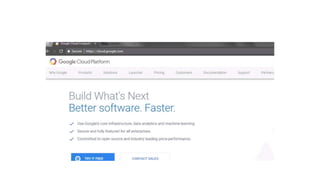
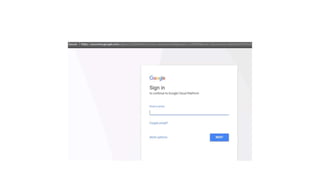
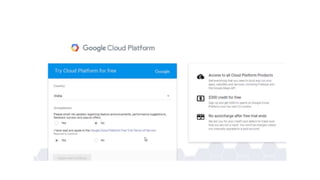
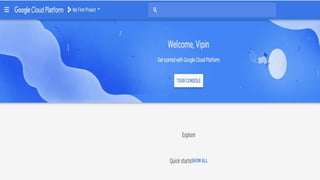
Google cloud
Submitted by
VIPIN OJHA
(imb2016002)
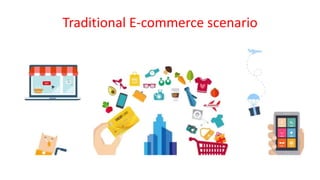
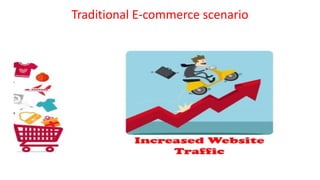
Traditional E-commerce scenario
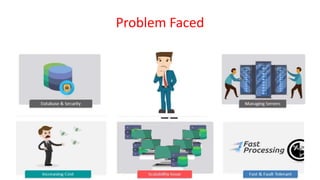
Problem Faced
Solution-Cloud computing
• Cloud computing is on demand delivery of compute power
,database storage ,applications and other IT services through a
cloud services platform via the internet with pay as you go
pricing.
• It is the the use of remote servers on the internet to store ,
manage and process data rather than a local server or personal
computer.
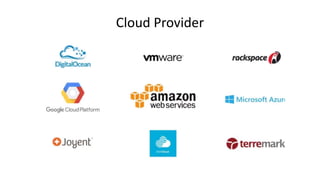
Cloud Provider
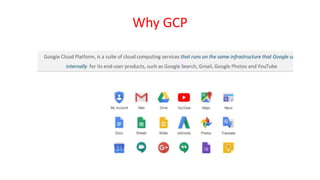
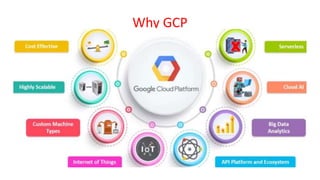
Why GCP
Why GCP
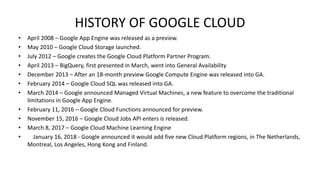
HISTORY OF GOOGLE CLOUD
• April 2008 – Google App Engine was released as a preview.
• May 2010 – Google Cloud Storage launched.
• July 2012 – Google creates the Google Cloud Platform Partner Program.
• April 2013 – BigQuery, first presented in March, went into General Availability
• December 2013 – After an 18-month preview Google Compute Engine was released into GA.
• February 2014 – Google Cloud SQL was released into GA.
• March 2014 – Google announced Managed Virtual Machines, a new feature to overcome the traditional
limitations in Google App Engine.
• February 11, 2016 – Google Cloud Functions announced for preview.
• November 15, 2016 – Google Cloud Jobs API enters is released.
• March 8, 2017 – Google Cloud Machine Learning Engine
• January 16, 2018 - Google announced it would add five new Cloud Platform regions, in The Netherlands,
Montreal, Los Angeles, Hong Kong and Finland.
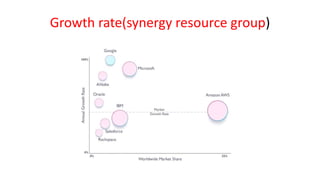
Growth rate(synergy resource group)
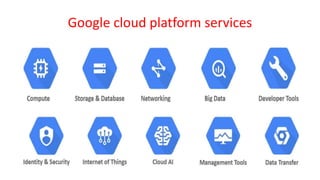
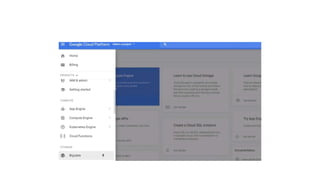
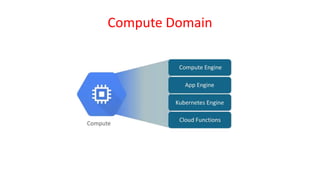
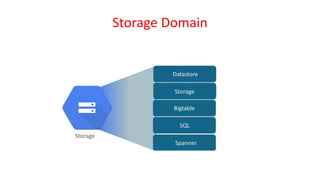
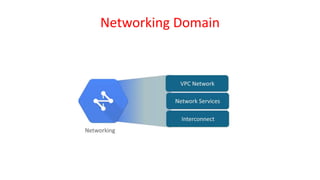
Google cloud platform services
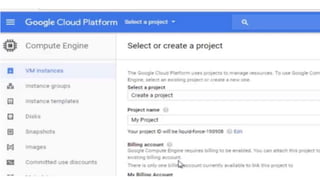
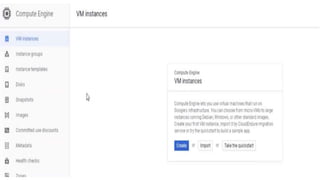
Compute Domain
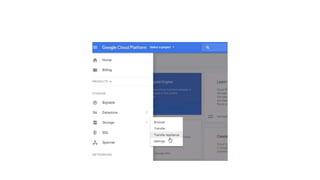
Storage Domain
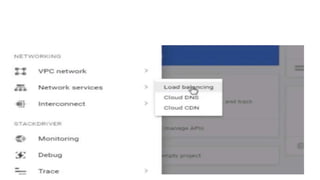
Networking Domain
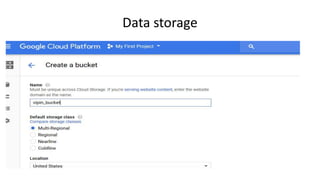
Data storage
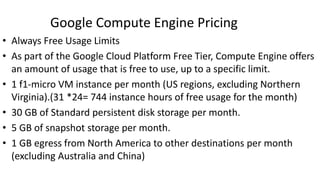
Google Compute Engine Pricing
• Always Free Usage Limits
• As part of the Google Cloud Platform Free Tier, Compute Engine offers
an amount of usage that is free to use, up to a specific limit.
• 1 f1-micro VM instance per month (US regions, excluding Northern
Virginia).(31 *24= 744 instance hours of free usage for the month)
• 30 GB of Standard persistent disk storage per month.
• 5 GB of snapshot storage per month.
• 1 GB egress from North America to other destinations per month
(excluding Australia and China)
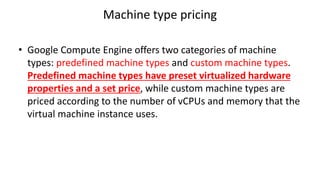
Machine type pricing
• Google Compute Engine offers two categories of machine
types: predefined machine types and custom machine types.
Predefined machine types have preset virtualized hardware
properties and a set price, while custom machine types are
priced according to the number of vCPUs and memory that the
virtual machine instance uses.
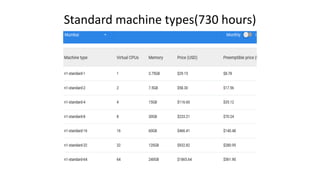
Standard machine types(730 hours)
Sustained use discounts
• Sustained use discounts
• When you use an instance for more than 25% of a month,
Compute Engine automatically gives you a discount for every
incremental second you use for that instance. The discount
increases with usage and you can get up to a 30% net discount
for instances that run the entire month.
• Committed use discounts-57% discount
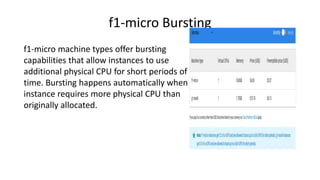
f1-micro Bursting
f1-micro machine types offer bursting
capabilities that allow instances to use
additional physical CPU for short periods of
time. Bursting happens automatically when your
instance requires more physical CPU than
originally allocated.
Sustained use discounts
• Sustained use discounts
• When you use an instance for more than 25% of a month,
Compute Engine automatically gives you a discount for every
incremental second you use for that instance. The discount
increases with usage and you can get up to a 30% net discount
for instances that run the entire month.
• Committed use discounts-57% discount
Thank You

Google cloud

  • 1.
  • 2.
  • 3.
  • 4.
  • 5.
    Solution-Cloud computing • Cloudcomputing is on demand delivery of compute power ,database storage ,applications and other IT services through a cloud services platform via the internet with pay as you go pricing. • It is the the use of remote servers on the internet to store , manage and process data rather than a local server or personal computer.
  • 6.
  • 7.
  • 8.
  • 9.
    HISTORY OF GOOGLECLOUD • April 2008 – Google App Engine was released as a preview. • May 2010 – Google Cloud Storage launched. • July 2012 – Google creates the Google Cloud Platform Partner Program. • April 2013 – BigQuery, first presented in March, went into General Availability • December 2013 – After an 18-month preview Google Compute Engine was released into GA. • February 2014 – Google Cloud SQL was released into GA. • March 2014 – Google announced Managed Virtual Machines, a new feature to overcome the traditional limitations in Google App Engine. • February 11, 2016 – Google Cloud Functions announced for preview. • November 15, 2016 – Google Cloud Jobs API enters is released. • March 8, 2017 – Google Cloud Machine Learning Engine • January 16, 2018 - Google announced it would add five new Cloud Platform regions, in The Netherlands, Montreal, Los Angeles, Hong Kong and Finland.
  • 10.
  • 11.
  • 17.
  • 18.
  • 19.
  • 38.
  • 41.
    Google Compute EnginePricing • Always Free Usage Limits • As part of the Google Cloud Platform Free Tier, Compute Engine offers an amount of usage that is free to use, up to a specific limit. • 1 f1-micro VM instance per month (US regions, excluding Northern Virginia).(31 *24= 744 instance hours of free usage for the month) • 30 GB of Standard persistent disk storage per month. • 5 GB of snapshot storage per month. • 1 GB egress from North America to other destinations per month (excluding Australia and China)
  • 42.
    Machine type pricing •Google Compute Engine offers two categories of machine types: predefined machine types and custom machine types. Predefined machine types have preset virtualized hardware properties and a set price, while custom machine types are priced according to the number of vCPUs and memory that the virtual machine instance uses.
  • 43.
  • 44.
    Sustained use discounts •Sustained use discounts • When you use an instance for more than 25% of a month, Compute Engine automatically gives you a discount for every incremental second you use for that instance. The discount increases with usage and you can get up to a 30% net discount for instances that run the entire month. • Committed use discounts-57% discount
  • 45.
    f1-micro Bursting f1-micro machinetypes offer bursting capabilities that allow instances to use additional physical CPU for short periods of time. Bursting happens automatically when your instance requires more physical CPU than originally allocated.
  • 46.
    Sustained use discounts •Sustained use discounts • When you use an instance for more than 25% of a month, Compute Engine automatically gives you a discount for every incremental second you use for that instance. The discount increases with usage and you can get up to a 30% net discount for instances that run the entire month. • Committed use discounts-57% discount
  • 47.