Visit https://ebookultra.com todownload the full version and
explore more ebooks
Google Analytics 1st Edition Justin Cutroni
_____ Click the link below to download _____
https://ebookultra.com/download/google-analytics-1st-
edition-justin-cutroni/
Explore and download more ebooks at ebookultra.com
2.
Here are somesuggested products you might be interested in.
Click the link to download
Google BigQuery Analytics 1st Edition Naidu
https://ebookultra.com/download/google-bigquery-analytics-1st-edition-
naidu/
Performance Marketing with Google Analytics Strategies and
Techniques for Maximizing Online ROI 1st Edition Sebastian
Tonkin
https://ebookultra.com/download/performance-marketing-with-google-
analytics-strategies-and-techniques-for-maximizing-online-roi-1st-
edition-sebastian-tonkin/
Google Maps Mashups with Google Mapplets 1st Edition
Michael Young
https://ebookultra.com/download/google-maps-mashups-with-google-
mapplets-1st-edition-michael-young/
Justin Bieber First Step 2 Forever 100 Official Justin
Bieber
https://ebookultra.com/download/justin-bieber-first-
step-2-forever-100-official-justin-bieber/
3.
Google 1st EditionAudrey Deangelis
https://ebookultra.com/download/google-1st-edition-audrey-deangelis/
Indigenous Rights 1st Edition Justin Healey
https://ebookultra.com/download/indigenous-rights-1st-edition-justin-
healey/
Street Crhymes 1st Edition Justin Rollins
https://ebookultra.com/download/street-crhymes-1st-edition-justin-
rollins/
Baking School 1st Edition Justin Gellatly
https://ebookultra.com/download/baking-school-1st-edition-justin-
gellatly/
Get Motivated Justin Herald
https://ebookultra.com/download/get-motivated-justin-herald/
5.
Google Analytics 1stEdition Justin Cutroni Digital
Instant Download
Author(s): Justin Cutroni
ISBN(s): 9780596158002, 0596158009
Edition: 1
File Details: PDF, 4.56 MB
Year: 2010
Language: english
Preface
When Google launchedGoogle Analytics in 2005, it revolutionized web analytics.
Heck, it flat out turned the entire industry on its collective head. No longer was web
analytics an expensive endeavor that required a substantial investment in software.
Measurement tools became irrelevant from a cost perspective, and the focus started to
shift to people.
In May 2007, Google gave the analytics industry another shot in the arm when it re-
leased version 2 of Analytics. The update included a progressive new interface that
simplified the data presentation in hopes that more people, like marketers and PR pro-
fessionals, would use the data to make business decisions.
By creating a free analytics tool that is easy to understand, Google has helped everyone
become a web analyst. Website designers, webmasters, IT teams, C-level executives,
and marketers are all using Google Analytics to track and measure website performance
and online marketing initiatives.
Let’s face it, Google Analytics is sexy as hell right now! Everyone wants a piece of it.
Who This Book Is For
This book is for anyone thinking about using Google Analytics or actively using Google
Analytics (GA). You may be an executive who’s trying to determine if Google Analytics
will work for your organization. You may be a marketing team member trying to figure
out how to track different types of marketing initiatives (both online and offline). You
may be an IT team member tasked with implementing GA.
I believe that all of you will find something useful in this book. Throughout the book,
I try to explain how Google Analytics works so you can understand the impact of
various configuration choices. Remember, Google Analytics analyzes business data,
which means each business will configure it differently. You need to understand what’s
important for your business and configure Google Analytics accordingly.
ix
17.
There is notechnical prerequisite for reading this book. If you have a basic under-
standing of the Internet, if you know what a web server is, and if you know what HTML
is, you’ll understand the subject matter in this book. You may not understand some of
the more advanced code samples, but I will make sure you understand the concepts
and ideas behind the code.
Who This Book Is Not For
People who are very new to web analytics may have some problems with this book.
There is an assumption that you have some basic web analytics knowledge. For exam-
ple, you should know what a pageview, visit, and visitor are. If you don’t have a basic
understanding of web analytics, you may want to use this book as a companion to a
more thorough web analytics text.
What You’ll Learn
My goal in writing this book is to help people understand what Google Analytics can
do and show you how to actually do it.
I’ll start by talking about your business, not about Google Analytics. Before we even
touch on Google Analytics, it’s imperative to identify what you want to track on your
website. If you don’t know what you want to track, you won’t know how to configure
Google Analytics to track it.
Next I’ll describe how Google Analytics actually works. I’ll cover how data is collected,
processed, and turned into reports. I’ll also include some information about the dif-
ferent data-collection mechanisms, like mobile data collection and application (app)
tracking.
Understanding how the system works will provide the foundation for our configuration
discussion. We’ll talk about all of the various settings you can use to control data access,
manipulate data, and track goals on a website.
I’ll also spend time discussing how to track marketing campaigns. In my opinion, this
is one of the most overlooked features and, when done incorrectly, can completely
destroy your data. However, when it’s done correctly it can lead to a deeper under-
standing of your marketing initiative and analysis nirvana.
After marketing campaigns, we’ll move into advanced topics, like configuring websites
that span multiple domains, collecting e-commerce data, event tracking, and custom
variables. All of these features allow Google Analytics to adapt and fit the data and
analysis needs of your organization. These may not be features you’re currently using,
but they’ll showcase the flexibility of what Google Analytics can do.
x | Preface
18.
By the endof this tour, you should be a Google Analytics guru! It’s your job to take
your understanding of what Google Analytics can do for your business and implement
it on your website.
Other Learning Options
There are lots of different ways to learn about web analytics and Google Analytics.
Some people want to learn web analytics in detail before jumping into Google Analytics.
That’s a perfectly good tactic and if you want to start that way you should explore some
of the following publications:
• Web Analytics, An Hour a Day by Avinash Kaushik (Sybex)
• Web Analytics 2.0: The Art of Online Accountability and Science of Customer Cen-
tricity by Avinash Kaushik (Wiley)
• Complete Web Monitoring by Alistair Croll and Sean Power (O’Reilly)
You’ll definitely want to make sure that whatever books or online documentation you
use covers the most recent version of Google Analytics. Google Analytics’ perpetual
evolution has unfortunately made it dangerous to use a lot of formerly great (but now
dated) material—some of it works, some of it doesn’t.
If You Like (or Don’t Like) This Book
If you like (or don’t like) this book, by all means, please let people know. Amazon
reviews are one popular way to share your happiness (or lack thereof), or you can leave
reviews at the site for the book:
http://oreilly.com/catalog/9780596158002
There’s also a link to errata there. This gives readers a way to let us know about typos,
errors, and other problems with the book. The errata will be visible on the page im-
mediately, and we’ll confirm it after checking it out. O’Reilly can also fix errata in future
printingsofthebookandonSafari,makingforabetterreaderexperienceprettyquickly.
We hope to keep this book updated for future versions of Google Analytics, and will
also incorporate suggestions and complaints into future editions.
Conventions Used in This Book
The following font conventions are used in this book:
Italic
Indicates pathnames, filenames, and program names; Internet addresses, such as
domain names and URLs; and new items where they are defined
Preface | xi
19.
Constant width
Indicates commandlines and options that should be typed verbatim; names and
keywords in programs, including method names, variable names, and class names;
and HTML element tags
Constant width bold
Indicates emphasis in program code lines
Constant width italic
Indicates text that should be replaced with user-supplied values
This icon signifies a tip, suggestion, or general note.
This icon indicates a warning or caution.
Using Code Examples
This book is here to help you get your job done. In general, you may use the code in
this book in your programs and documentation. You do not need to contact us for
permission unless you’re reproducing a significant portion of the code. For example,
writing a program that uses several chunks of code from this book does not require
permission. Selling or distributing a CD-ROM of examples from O’Reilly books does
require permission. Answering a question by citing this book and quoting example
code does not require permission. Incorporating a significant amount of example code
from this book into your product’s documentation does require permission.
We appreciate, but do not require, attribution. An attribution usually includes the title,
author, publisher, and ISBN. For example: “Google Analytics by Justin Cutroni. Copy-
right 2010 O’Reilly Media, Inc., 978-0-596-15800-2.”
If you feel your use of code examples falls outside fair use or the permission given above,
feel free to contact us at permissions@oreilly.com.
How to Contact Us
We have tested and verified the information in this book to the best of our ability, but
you may find that features have changed (or even that we have made a few mistakes!)
Please let us know about any errors you find, as well as your suggestions for future
editions, by writing to:
xii | Preface
20.
O’Reilly Media, Inc.
1005Gravenstein Highway North
Sebastopol, CA 95472
800-998-9938 (in the U.S. or Canada)
707-829-0515 (international/local)
707-829-0104 (fax)
We have a web page for this book, where we list errata, examples, and any additional
information. You can access this page at:
http://oreilly.com/catalog/9780596158002
To comment or ask technical questions about this book, send email to:
bookquestions@oreilly.com
For more information about our books, conferences, Resource Centers, and the
O’Reilly Network, see our web site at:
http://www.oreilly.com
Safari® Books Online
Safari Books Online is an on-demand digital library that lets you easily
search over 7,500 technology and creative reference books and videos to
find the answers you need quickly.
Withasubscription,youcanreadanypageandwatchanyvideofromourlibraryonline.
Read books on your cell phone and mobile devices. Access new titles before they are
available for print, and get exclusive access to manuscripts in development and post
feedback for the authors. Copy and paste code samples, organize your favorites, down-
load chapters, bookmark key sections, create notes, print out pages, and benefit from
tons of other time-saving features.
O’Reilly Media has uploaded this book to the Safari Books Online service. To have full
digital access to this book and others on similar topics from O’Reilly and other pub-
lishers, sign up for free at http://my.safaribooksonline.com.
Acknowledgments
First and foremost, this book is dedicated to the three people who sacrificed the most:
Heidi, Benton, and Avery. Thanks for giving Daddy the time to explore this amazing
opportunity. And Heidi, thanks for keeping life running (as smoothly as possible) dur-
ing the nights and weekends that I was holed up writing.
Preface | xiii
21.
A huge thanksto the entire Google Analytics team: Avinash, Brett, Scott, Phil, Amy,
Alex, Nick, Jeff, and the countless others, you’ve become fantastic friends over the last
five years. I really appreciate the time you spend helping me learn more about GA so I
can spread the word.
Another big thanks to the team at O’Reilly. Simon, Amy, and the entire crew who
helped fine-tune my babble into a new version of this book. Your patience borders on
insanity! Thanks for sticking by me and helping me get this out the door.
xiv | Preface
22.
CHAPTER 1
Introducing WebAnalytics
This book is about Google Analytics, and at some level that means it is also about web
analytics. It’s important to note that Google Analytics is not the same as web analytics.
Web analytics is a business process used to continuously improve your online business.
Google Analytics is a tool to quantitatively measure what happens on your website.
Just because you have Google Analytics does not mean you are doing web analytics.
Before we dive into Google Analytics, I believe it’s important to establish how Google
Analytics should fit into your overall analytics strategy.
Defining Web Analytics
Rather than creating another definition of web analytics (there are a lot of them out
there), I prefer to reference Avinash Kaushik’s concise yet thorough definition. In his
book Web Analytics: An Hour a Day (Wiley), Kaushik defines web analytics as:
The analysis of qualitative and quantitative data from your website and the competition,
to drive a continual improvement of the online experience that your customers, and
potential customers have, which translates into your desired outcomes (online and
offline).
This definition encapsulates three main tasks every business must tackle when doing
web analytics:
• Measuring quantitative and qualitative data
• Continuously improving your website
• Aligning your measurement strategy with your business strategy
Let’s look at each part of the definition and break it down into more detail.
1
23.
Quantitative and QualitativeData
Web analytics is not possible without data. But many organizations fail to realize that
they need many different types of data to understand the performance of their website.
Tools like Google Analytics, Omniture, WebTrends, and Yahoo! Web Analytics gen-
erate quantitative, or clickstream, data. This data identifies where website traffic comes
from and what it does on the site. It more or less tells what happened on a website.
While clickstream data is critical, you must collect more than quantitative data—you
must also collect qualitative data. While quantitative data describes what happens on
your website, qualitative describes why it happens. Qualitative data comes from dif-
ferent sources, like user interviews and usability tests. But the easiest way to get qual-
itative data is through surveys. Asking website visitors simple questions like the ones
below can lead to a greater understanding of what visitors want and whether you’re
making it easy for them:
Why did you come here today?
Were you able to do what you wanted to do?
If not, why?
There are a number of free qualitative data tools, like 4Q and Kampyle, that are easy
to implement and provide valuable feedback from your website visitors. In many cases,
it’s easier to implement these tools than a clickstream data tool like Google Analytics.
If you’re not collecting qualitative data, start now!
It’s not enough, however, to analyze clickstream data from your own website. You must
also look at data from your competitors’ websites. We live in an amazing age in which
competitive data is freely available to everyone.
Competitive data provides valuable context for your own data. It describes your per-
formance as compared to that of your competitors. Compete.com and Google
Trends can help you identify simple things like whether your competitors are getting
more traffic than you.
The Continuous Improvement Process
The second part of Kaushik’s web analytics definition is, “to drive a continual im-
provement of the online experience that your customers, and potential customers
have.”
All of the data and analysis must drive a continuous improvement process. This is the
most critical part of web analytics. You must take action on the data. That’s the whole
purpose of web analytics—to improve over time. Figure 1-1 shows a very basic repre-
sentation of the web analytics process.
2 | Chapter 1:匿Introducing Web Analytics
24.
Knowing how tochange as a result of analysis is often difficult, though. Much of our
data tells us that there is a problem, but it does not say how to fix it. So how does one
go about fixing or optimizing a website based on data? You create different solutions
to the problems and test them. Testing is the process of displaying the potential solution
to website visitors, in real time, and measuring which one generates the best result.
Many people are surprised to learn that testing a website is possible. There are a number
of free tools, like Google’s Website Optimizer, that provide this service.
Testing has always been part of marketing. Direct-mail marketers have been testing
different offers and different ad variations for a long time. And those doing pay-per-
click marketing have also been testing for many years, experimenting with different
headlines and ad copy to optimize ad expenditures.
However, website testing has failed to gain popularity. I believe the reason testing has
been adopted so slowly is because of the many misconceptions about testing. Most
people think testing is too hard, too expensive, or takes too much time. But in reality,
testing has been changing, just like web analytics. With free tools it’s becoming easier
and easier to start testing different parts of a website.
Measuring Outcomes
The final part of Kaushik’s definition of web analytics is that it “translates into your
desired outcomes (online and offline).”
The entire goal of the web analytics process is to increase our desired business out-
comes. We are no longer obsessed with just measuring how much traffic our online
business generates. We also want to measure how well it performs in business terms.
This means measuring metrics that relate directly to our overall business goals. Every
website exists for a reason, and your measurement strategy must align with the business
goals of the website.
Figure 1-1. The web analytics process: measure, analyze, and change
Defining Web Analytics | 3
25.
For the mostpart, all websites exist for one of the four following reasons:
• To sell a product
• To generate a sales lead
• To generate ad revenue
• To provide support
Some websites do other things as well, but for the most part, this is why websites exist.
This is where you should start measuring your website. How does it affect the bottom
line of your business? Once you define why you have a website, it becomes much easier
to identify the metrics you should focus on. You don’t need a lot of metrics—just a
handful (3‒5) should help you understand if your business is succeeding or failing.
If you’re having trouble identifying key performance indicators (or KPIs)
for your site, try The Big Book of Key Performance Indicators by Eric
Peterson (http://troni.me/dr08gA).
What Google Analytics Contributes
Google Analytics provides a core set of tools that supports some of the primary tasks
that web analysts perform.
First and foremost, Google Analytics tracks many standard website metrics, like visits,
uniquevisitors,pageviews,bouncerate,andabandonmentrate.But,moreimportantly,
it can track business outcomes, called goals. Remember, we want to move beyond
tracking basic traffic to our websites and begin understanding if our websites are adding
to the bottom line of our business.
In addition to tracking goals, Google Analytics does a great job at tracking all different
kinds of marketing initiatives. Many people believe that Google Analytics can only track
AdWords, but it can track other types of paid searches, email marketing, display ad-
vertising, social media, and any other type of ad you can think of.
One of the key activities of any analyst is performing segmentation. Segmentation in-
volves diving deeper into the data to understand how smaller buckets, or segments, of
traffic perform and ultimately influence the overall performance of the website.
A simple example of segmentation is viewing website traffic based on the physical
location of the visitors. Google Analytics does this using the Map Overlay report, shown
in Figure 1-2.
This is a very basic segmentation. Each row of data shows all the values for a dimen-
sion. A dimension is an attribute of a website visitor or the visits that they create. Some
common dimensions are country, campaign name, and browser version. There are
many, many different types of dimensions, and you can view the complete list at http:
//troni.me/9EKc62.
4 | Chapter 1:匿Introducing Web Analytics
26.
In this case,the dimension is the country. The metrics for that dimension are shown
in the columns of the report. Now notice the tabs at the top of the report. The Goal
tab displays conversions for the same dimension of traffic. So, if you click the Goal Set
1 tab, Google Analytics will display conversions for each goal for each country.
This is the way all Google Analytics reports work. Every row of data is a different value
of the dimension of traffic. For example, in the Traffic Sources report, each row in the
table is a different source of traffic (organic search, marketing campaigns, etc.).
But the ability to segment data does not end there. Google Analytics also has a feature
called Advanced Segmentation that can segment data on the fly based on attributes that
you define. For example, you can build an advanced segment to view all traffic coming
from Google AdWords that resulted in transactions greater than $1,000.00. You can
do this using a simple drag-and-drop interface, shown in Figure 1-3.
This is a complicated segmentation that you can build and apply in real time! The result
istheabilitytoviewthesegmentwecreatedabove,alongwithothersegmentsofwebsite
traffic. Figure 1-4 shows the High Value AdWords traffic along with the total traffic to
the website.
This ability to drill down and focus on various segments of traffic is key to all analysis.
We want to identify the segments of traffic that are performing well and determine how
to promote those segments. We also want to identify the segments of traffic that suck
and figure out how to fix them.
Advanced Segmentation is not the only tool that helps facilitate analysis. Google An-
alytics also contains a custom reporting tool that can greatly simplify your daily
reporting and even help simplify common segmentations.
Figure 1-2. The Map Overlay report shows traffic from individual countries
What Google Analytics Contributes | 5
27.
Figure 1-4. Viewinga segment of traffic along with all traffic in Google Analytics
TheCustomReportinginterfaceisverysimilartotheAdvancedSegmentationinterface.
You can drag and drop different pieces of information to create your own reports, as
shown in Figure 1-5.
Figure 1-3. The interface to build Advanced Segments
6 | Chapter 1:匿Introducing Web Analytics
28.
Figure 1-5. TheCustom Reporting interface
The rows of data in a custom report represent different dimensions of data. The col-
umns in a custom report are the different metrics in Google Analytics: things like visits,
pageviews, conversions, revenue, etc.
For example, to create a report that shows the conversion rate for different marketing
campaigns, drag the Campaign dimension to the Dimension section of the screen and
drag the Conversion Rate metric to a metric column.
Custom reports also provide the ability to drill down into each dimension and view
subdimensions. Notice the subdimension sections of the interface in Figure 1-5. You
can add more dimensions under your primary dimension. Using subdimensions, it’s
easy, for example, to view the different types of visitors (new or returning) in your
marketing campaigns and determine what time of day each visitor type converts—just
keep dragging dimensions to the interface (Figure 1-6).
These are just a few of the features that are standard in Google Analytics. They don’t
take any extra configuration. Every user, from day one, can access these features and
use them to analyze their own data. I encourage you to experiment with these features:
you’ll be amazed at how much time they can save you.
How Google Analytics Fits in the Analytics Ecosystem
Obviously, Google Analytics is one of the most popular clickstream data tools that has
ever been created. In the five years since its launch, it has been adopted by millions of
businesses, both large and small.
How Google Analytics Fits in the Analytics Ecosystem | 7
29.
Small and mid-sizedbusinesses have access to a world-class analytics tool that can help
drive their continuous improvement process. Larger organizations that have tradition-
ally spent six figures on a web analytics tool are migrating to Google Analytics because
it provides 90% of all the reporting and analysis functionality that their organizations
need. They can save tremendous amounts of money and reallocate those funds to skil-
led analysts who can help make the data actionable.
As we discuss Google Analytics throughout this book, though, remember that it’s just
a small piece of your web analytics strategy. It’s a tool (and a very good one in my
opinion) that provides clickstream data. Google Analytics will help you identify what
is working and what is not working with your online business, but remember, the world
of web analytics is much bigger than Google Analytics!
Figure 1-6. A custom report with many subdimensions
8 | Chapter 1:匿Introducing Web Analytics
30.
CHAPTER 2
Creating anImplementation Plan
GoogleAnalyticsisabusinessintelligencetooland,becauseeverybusinesshasdifferent
data needs, your implementation may be very different from someone else’s. Do not
believe that you can simply slap some tags on the site and collect valid data. It is very
rare that an implementation involves only page tagging. There are many configuration
steps required to generate accurate, actionable data.
With that said, there are some standard things that everyone should do to get reliable
data for analysis. Implementing Google Analytics does take some planning and fore-
sight. The Google Analytics support documentation does contain a rough implemen-
tation guide that includes the various steps to get Google Analytics installed and
running. I have modified that process as follows:
1. Gather and document business requirements.
2. Analyze and document website architecture.
3. Create a Google Analytics account and configure profiles.
4. Configure the Google Analytics tracking code and tag website pages.
5. Tag marketing campaigns.
6. Create additional user accounts and configure the following reporting features:
• Report access
• Automated email report delivery
• Reporting customizations (Custom Reports, Advanced Segments)
7. Perform the following optional configuration steps:
• Enable e-commerce transaction tracking
• Implement event tracking
• Implement custom variables
9
31.
Gather Business Requirements
Youprobably noticed that step 1 has very little to do with Google Analytics. As I men-
tioned before, Google Analytics is just a tool that you can use to measure the perform-
ance of your business. How you define and measure success for your business will be
different than for other organizations. Take the time at the start of this process to
understand your organization’s data needs.
Sit down with the different stakeholders and interview them. Ask them what data they
need to make better decisions and document the answers. The information you collect
should be the driving force for your implementation. What you measure needs to align
with your business objectives. Remember, you need to collect and define the KPIs for
your organization.
It’s also important to ask if there are any existing reports distributed internally. If so,
you can use these as a template for your Google Analytics reports.
Analyze and Document Website Architecture
Once you have an understanding of what’s important to the business, it’s time to an-
alyze your website. During this step, you should identify any aspect of the website
architecture that may interfere with measuring your business objectives defined in the
previous step. During this step you should ask questions like the following:
• Does the website span multiple domains?
• Does the website have multiple subdomains?
• Is the website dynamic (does it have query-string parameters)?
• Does the website use Frames or iFrames?
• Does the website use any redirect?
• Does the website contain any Ajax, Flash, or other elements you want to track?
All of the items listed here can cause issues with Google Analytics. While they
complicate the implementation process, they will not keep you from using Google
Analytics, but it’s critical to identify them before starting the implementation.
The amount of work it takes to complete this step depends on how large your organi-
zation is and how many websites you have. Regardless of how big your company is,
take the time to answer these questions through experimentation and interviews.
Browse your own website or websites to determine if it uses any of the above configu-
rations. Meet with IT people and ask them to explain as much as they can about how
the website works.
And document everything you learn. Having written documentation about the website
architecture will make the entire process easier.
10 | Chapter 2:匿Creating an Implementation Plan
32.
Create an Accountand Configure Your Profile
Once you’ve got all of your business requirements, it’s time to start working in Google
Analytics. Begin by creating an account. If you’ve already got a Google Analytics ac-
count, there is no need to create another one. Once you have an account, configure
your profile settings, such as Site Search, Filters, and Goals.
Configure the Tracking Code and Tag Pages
We’ll discuss how to configure the tracking code later, but, briefly, based on your
website architecture, you may need to alter the tracking code to compensate for things
like subdomains or multiple domains. Luckily, there is a code configuration tool that
makes changing the JavaScript rather simple.
Once you have created and configured the profiles and the tracking code, it’s time to
tag the pages. Because most sites use some type of template system, like WordPress,
Drupal, or some custom content management system, this makes tagging pages fairly
easy. In most cases, you can place the page tag in your footer template, and in about
three hours you should start to see data. If your website does not use a templating
system, you will need to manually add the tag at the bottom of all the pages on your site.
Tag Marketing Campaigns
Tagging marketing campaigns is one of the most critical parts of configuring Google
Analytics. This is the process of identifying your different marketing activities (like paid
search,displayadvertising,andemailmarketing)toGoogleAnalytics.Youdothisusing
a process called link tagging. If you do not tag your marketing campaigns, it will be
impossible to measure the success of your online marketing initiatives. I will thoroughly
describe how to tag your marketing campaigns in Chapter 9.
Create Additional User Accounts and Configure Reporting
Features
Onceanalyticsisupandrunningandyou’vestartedtocollectdata,it’stimetoconfigure
various features that provide access to data. This is the time to create user accounts so
coworkers and others can access analytics.
This is also the time to configure some of the reporting tools that Google Analytics
provides.Featureslikeautomatedreportemailmessagesandcustomreportscangreatly
reduce the time it takes to generate any standard reports that an organization may need.
Create Additional User Accounts and Configure Reporting Features | 11
33.
Perform Optional ConfigurationSteps
There are many Google Analytics features that generate additional data. E-commerce
tracking, custom variables, and event tracking are optional features that all collect other
types of data. While it is not necessary to implement these features, they often provide
additional information that can provide you with more insight.
For example, custom variables can collect demographic information about your site
visitors, event tracking can measure how people interact with different types of content,
and e-commerce tracking can collect revenue and transactional data in real time.
Some organizations may make these features a high priority based on the metrics they
provide. If you’re one of them, these implementation steps may not be optional for you.
Schedule the implementation of these features based on your priority and implemen-
tation resources.
To some extent, the implementation process is iterative. Don’t expect to get it right the
first time. Once you have installed the tracking code and you have some data in the
reports, check the data. Does it make sense? Should you modify the data to manipulate
how it looks? It may be that you need to add an additional filter or change a profile
setting to improve the quality. Can you reconcile the data with a different tool? Granted,
the data is unlikely to be exactly the same between tools, but is it fairly consistent? Do
you see the same trends in the data?
The key to a successful implementation is to take a structured approach, take your
time, and document everything you do.
12 | Chapter 2:匿Creating an Implementation Plan
34.
CHAPTER 3
Under theCovers: How Google
Analytics Works
Understanding the Google Analytics architecture—how it collects data, processes data,
and creates reports—is the key to understanding many of the advanced topics that
we will discuss later in this book. Google Analytics can collect data from a number
of different platforms using different tracking technologies, which makes things
complicated.
Google Analytics is no longer a simple “hit collector” for websites, but rather an in-
formation aggregation system that collects data from standard websites, mobile web-
sites, Adobe Air applications, and iPhone and Android apps. Google has progressively
added more data collection methods as technology has driven new and different ways
of distributing content to people.
In this book, we will primarily focus on tracking websites, but I will briefly discuss the
other tracking methods as well. Let’s start with the simplest configuration: tracking a
website.
Data Collection and Processing
Figure 3-1 shows how Google Analytics collects, processes, and displays data.
Google Analytics uses a common data collection technique called page tags. A page tag
is a small piece of JavaScript that you must place on all the website pages you want to
track. We affectionately call this code the Google Analytics Tracking Code, or GATC
for short. If you do not place the code on a page, Google Analytics will not track that
page.
13
35.
The data collectionprocess begins when a visitor requests a page from the web server.
The server responds by sending the requested page back to the visitor’s browser (step
1 in Figure 3-1). As the browser processes the data, it contacts other servers that may
host parts of the requested page, like images, videos, or script files. This is the case with
the GATC.
Figure 3-1. Google Analytics processing flow
When the visitor’s browser reaches the GATC, the code begins to execute. During
execution, the GATC identifies attributes of the visitor and her browsing environment,
such as how many times she’s been to the site, where she came from, her operating
system, her web browser, etc.
After collecting the appropriate data, the GATC sets (or updates, depending on the
situation) a number of first-party cookies (step 2), which are discussed later in this
section. The cookies store information about the visitor. After creating the cookies on
the visitor’s machine, the tracking code waits to send the visitor data back to the Google
Analytics server.
While the data is collected and the cookies are set, the browser is actively downloading
a file named ga.js from a Google Analytics server (also step 2). All of the code that
Google Analytics needs to function is contained within ga.js.
Once the ga.js file is loaded in the browser, the data that was collected is sent to Google
in the form of a pageview. A pageview indicates that a visitor has viewed a certain page
on the website. There are other types of data, like events and e-commerce data, that
can be sent to Google Analytics (we will discuss these later).
The pageview is transmitted to the Google Analytics server via a request for an invisible
GIF file (step 4) named __utm.gif. Each piece of information the GATC has collected
is sent as a query-string parameter in the __utm.gif request, as shown below:
14 | Chapter 3:匿Under the Covers: How Google Analytics Works
36.
http://www.google-analytics.com/__utm.gif?utmwv=4.6.5&utmn=1881501226&utmhn
=cutroni.com&utmcs=UTF-8&utmsr=1152x720&utmsc=24-bit&utmul=en- s
&utmje=1&utmfl
=10.0%20r42&utmdt=Analytics%20Talk%20by%20Justin%20Cutroni&utmhid
=465405990&utmr=-&utmp=%2Fblog%2F&utmac=UA-XXXX-1&utmcc=
__utma%3D32856364.1914824586.1269919681.1269919681.1269919681.1%3B%2B
__utmz%3D32856364.1269919681.1.1.utmcsr%3D(direct)
%7Cutmccn%3D(direct)%7Cutmcmd%3D(none)%3B&gaq=1
When theGoogle Analytics server receives this pageview, it stores the data in some
type of temporary data storage. Google has not indicated exactly how the data is stored,
but we know that there is some type of storage for the raw data. Think of this data
storage as a large text file or a logfile (step 5).
Each line in the logfile contains numerous attributes of the pageview sent to Google.
This includes:
• When the data was collected (date and time)
• Where the visitor came from (referring website, search engine, etc.)
• How many times the visitor has been to the site (number of visits)
• Where the visitor is located (geographic location)
• Who the visitor is (IP address)
After the pageview is stored in the logfile, the data collection process is complete. The
data collection and data processing components of Google Analytics are separate. This
ensures Google Analytics will always collect data, even if the data processing engine is
undergoing maintenance.
The next step is data processing. At some regular interval, approximately every 3 hours,
Google Analytics processes the data in the logfile. Data processing time does fluctuate.
Google Analytics does not process data in real time. While data is normally processed
about every 3 hours, it’s not normally complete until 24 hours after collection. The
reason the data is not complete until 24 hours after processing is that the entire day’s
data is reprocessed after it has been collected.
Be aware that this processing behavior can lead to inaccurate intraday
metrics. It is best to avoid using Google Analytics for real-time or intra-
day reporting.
During processing, each line in the logfile is split into pieces, one piece for each attribute
of the pageview. Here’s a sample logfile; this is not an actual data storage line from
Google Analytics, but a representation:
65.57.245.11 www.cutroni.com - [21/Jan/2010:19:05:06 −0600]
"GET __utm.gif?utmwv=4.6.5&utmn=1881501226&utmhn=cutroni.com&utmcs=UTF-8&utmsr
=1152x720&utmsc=24-bit&utmul=en-us&utmje=1&utmfl=10.0%20r42&utmdt
=Analytics%20Talk%20by%20Justin%20Cutroni&utmhid=465405990&utmr
=-&utmp=%2Fblog%2F&utmac=UA-XXXX-11&utmcc
=__utma%3D32856364.1914824586.1269919681.1269919681.1269919681.1%3B%2B
Data Collection and Processing | 15
37.
__utmz%3D32856364.1269919681.1.1.utmcsr%3D(direct)%7Cutmccn%3D(direct)
%7Cutmcmd%3D(none)%3B&gaq=1"__utma
=32856364.1914824586.1269919681.1269919681.1269919681.1; __utmb
=100957269; __utmc=100957269;__utmz=100957269.1164157501.1.1.utmccn
=(direct)|utmcsr=(direct)|utmcmd=(none)"
While most of this data is difficult to understand, a few things stand out. The date and
time (Jan 21, 2010 at 19:05:06) and the IP address of the visitor (65.57.245.11) are
easily identifiable.
Google Analytics turns each piece of data in the logfile record into a data element called
afield. Later, the fields will be transformed into dimensions. For example, the IP address
becomes the Visitor IP field. The city that the visitor is visiting from becomes the Visitor
City field and the City dimension.
It’s important to understand that each pageview has many, many attributes and that
each one is stored in a different field or dimension. Later, Google Analytics will use
fields to manipulate the data and dimensions to build the reports.
After each line has been broken into fields and dimensions (steps 6-9), the configuration
settings are applied to the data. This includes features like:
• Site search
• Goals and funnels
• Filters
This is shown in step 7.
Finally, after all of the settings have been applied, the data is stored in the database
(step 10).
Once the data is in the database, the process is complete. When you (or any other user)
request a report, the appropriate data is retrieved from the database and sent to the
browser.
Once Google Analytics has processed the data and stored it in the da-
tabase, it can never be changed. This means historical data can never be
altered or reprocessed. Any mistakes made during setup or configura-
tion can permanently affect the quality of the data. It is critical to avoid
configuration mistakes, as there is no way to undo data issues.
This also means that any configuration changes made to Google Ana-
lytics will not alter historical data. Changes will only affect future data,
not past data.
Reports
When you log in to Google Analytics to view a report, Google Analytics creates that
report in real time. Reports are created by comparing a dimension, like the Visitor City,
to a numerical piece of information called a metric. Metrics include common web
16 | Chapter 3:匿Under the Covers: How Google Analytics Works
38.
analytics numbers likevisits, pageviews, bounce rate, conversion rate, revenue, etc.
When viewed alone, a metric provides a site-wide total for that metric. But when viewed
compared to a dimension, the metric represents the total for that specific dimension.
For example, a website may have a conversion rate of 2.87%. The metric in this case is
conversion rate and the value is 2.87%. However, if you view conversion rate based on
the City dimension, Google Analytics will display the conversion rate for each country
in the database (see Figure 3-2).
Figure 3-2. This report shows the conversion rate (a metric) for the City dimension
Each row in Figure 3-2 is a different value for the City dimension. Notice that there are
many columns, or metrics, in the report. Google Analytics can associate many different
metrics for a single dimension.
Almost every report is created in the same manner. Google Analytics displays various
metrics for a given dimension. If you are interested in a certain metric that Google
Analytics does not include in a report, you can create a custom report to display that
metric for the dimension.
About the Tracking Code
As mentioned earlier, Google Analytics uses a very common web analytics technology
called page tags to identify visitors, track their actions, and collect the data. Each page
on your website that you want to track must be “tagged” with a small snippet of Java-
Script. If the tracking code is not on a page, that page will not be tracked.
No tracking code, no data. It’s as simple as that.
About the Tracking Code | 17
39.
The following isthe GATC JavaScript snippet:
<script type="text/javascript">
var _gaq = _gaq || [];
_gaq.push(['_setAccount', 'UA-XXXXXX-YY']);
_gaq.push(['_trackPageview']);
(function() {
var ga = document.createElement('script'); ga.type = 'text/javascript';
ga.async = true; ga.src = ('https:' == document.location.protocol ?
'https://ssl' : 'http://www') + '.google-analytics.com/ga.js';
var s = document.getElementsByTagName('script')[0];
s.parentNode.insertBefore(ga, s);
})();
</script>
This part of the tracking code does all of the work. It starts by creating a queue
(named _gaq), or list of Google Analytics commands. These commands are also
calledmethods.WhenyouwantGoogleAnalyticstodosomething,youadd,orpush,
a command into the queue.
The standard page tag adds the first two methods to the queue for you. The first method
is _setAccount(). This method links the data collected from your site to your Google
Analytics account using a unique number. The number is found directly after the
“UA-”. Once the _setAccount() method has been added, the tracking code knows where
to send all of the data.
The second method, _trackPageview() is the part of the code that collects information
about the visitor, stores it in cookies, and sends the data back to Google. This is the
true workhorse of Google Analytics.
Remember, this part of the tracking code is a queue of methods. Up to this point, the
only thing that has happened is two methods have been added to the queue. The queue
has not been processed and no data has been sent to Google Analytics.
Before any code can execute the ga.js file, which contains all of the Google Analytics
logic, this code loads that logic into the browser and requests ga.js from a Google
server. This file is geo-load-balanced across all of Google’s global data centers. This
means the visitor’s browser will connect with the closest data center to reduce the
time it takes to retrieve the file. The visitor’s browser caches this file, so it’s possible
that it doesn’t even need to load from a Google data center. Once the browser has
retrieved the file, the queue of commands begins to execute. Notice the
ga.async=true part of the code. This part of the code tells the browser to load the
ga.js file asynchronously. This means that the browser can load ga.js while it con-
tinues to render the page for the visitor. Even if there is a communication issue
between the browser and Google’s Analytics servers and Google’s servers stop trans-
mitting ga.js to the browser, the browser will continue to render the page for the
visitor.
18 | Chapter 3:匿Under the Covers: How Google Analytics Works
40.
Not all browserscan load files asynchronously. At the time of this writing, Firefox 3.6
and later are the only browsers that support true asynchronous loading. For browsers
that do not support asynchronous loading, the code is optimized to dynamically add
the script directly to the document object model (DOM). This more or less creates the
asynchronous behavior for browsers that do not support true asynchronous loading.
When it comes time to place the code on your pages, Google suggests that you place
the tracking code immediately before the </HEAD> tag of each page. If your website uses
a content management system or some type of template engine, you can add the track-
ing code to template files or another mechanism that automatically generates common
HTML elements. This is a fast, effective way to tag all website pages.
The Evolution of the Tracking Code
Some of you may be wondering why the tracking code on your site looks dramatically
different than the tracking code in this book. In May 2010, Google changed the tracking
code format to the version you see in this book. Google replaced the previous version,
commonly referred to as the “standard” tracking code, with this new version, called
the “asynchronous” or “async” tracking code.
Google changed to an asynchronous version of the tracking code to reduce the amount
of time it takes for the tracking code to load and execute. This, in turn, should speed
up your website. Google has indicated the page load time is a factor in its ranking
algorithm, and it would be embarrassing if one of its products increased load times.
The async version of the tracking code is, from a functional perspective, the same as
the “standard” version of the tracking code. Other than loading asynchronously, the
only difference is the syntax.
Switching from the “standard” Google Analytics tracking to the async tracking code
can be time-consuming and complicated. It all depends on the complexity of your
implementation. If you’ve got a simple site that does not use events, custom variables,
virtualpageviews,ore-commercetracking,youcanprobablymigratewithouttoomuch
pain. You’ll probably just need to change the tags on your site. But if you use any of
the earlier Google Analytics features, you’ll need to do additional coding to reformat
all of your code to the new asynchronous format.
It is possible to host the ga.js file on your own server, regardless of whether you use the
standard GATC or the async GATC. Why would you do this? Some large enterprise
organizations have policies that restrict where some or parts of their sites can be hosted.
Other organizations want more controls and choose to host the file locally.
To host the ga.js locally, copy the contents of ga.js by viewing the file in your browser.
Just enter http://www.google-analytics.com/ga.js in your browser, copy the resulting
code, and place it in a file on your server. Next, update the GATC to reference the new
file location on your server and not the ga.js located on the Google Analytics server:
About the Tracking Code | 19
41.
<script type="text/javascript">
var _gaq= _gaq || [];
_gaq.push(['_setAccount', 'UA-XXXXXX-YY']);
_gaq.push(['_trackPageview']);
(function() {
var ga = document.createElement('script'); ga.type = 'text/javascript';
ga.async = true; ga.src = ('https:' == document.location.protocol ?
'https://ssl' : 'http://www') + '.YOUR-WEBSITE-DOMAIN/THE-PATH/YOUR-FILE-NAME.js';
var s = document.getElementsByTagName('script')[0];
s.parentNode.insertBefore(ga, s);
})();
</script>
Google updates ga.js without notifying users. If you decide to host ga.js on your own
servers, make sure you periodically check for updates. Google publishes a ga.js change
log at http://troni.me/cUNRvq.
The Mobile Tracking Code
The Google Analytics tracking code relies on JavaScript and cookies to collect visitor
data. While some mobile devices support these technologies, like iPhones and Android-
powered phones, there is a huge ecosystem of mobile devices that do not support either
of these technologies. Google Analytics therefore needs a different way to collect data
for visitors using a device that does not support cookies and JavaScript. Thus was born
the mobile tracking code.
The mobile tracking code collects data at the server level rather than at the browser, or
device, level. Because the mobile tracking code collects data at the server level, you
must implement it in the language that you used to build your web application. Google
provides four mobile tracking libraries to make the process easier: PHP, Java, ASP, and
Perl. All of the libraries work in the same basic way. You can download the mobile
tracking libraries from the Google Analytics code site at http://troni.me/bULXyd.
Regardless of the language you use to implement mobile tracking, the data collection
process is the same. Let’s walk through the mobile tracking process using a PHP ex-
ample, shown in Figure 3-3.
To track a mobile site built in PHP, you must add a block of PHP code before the
<HTML> tag on all your mobile pages. You must also add a small block of PHP code
immediately before the closing </BODY> tag.
When the server processes the first block of PHP (step 1 in Figure 3-3), it creates a URL
containing information about the visitor. Then it places the URL that was generated in
the first block of code in an HTML IMG tag (step 2 in Figure 3-3).
20 | Chapter 3:匿Under the Covers: How Google Analytics Works
42.
The image requestis actually a request for the ga.php file. This file takes the requested
URL, extracts the data, and sends the data back to the Google Analytics server (step 3
in Figure 3-3). This image passes data back to your server, where a request for the
__utm.gif image is made. This __utm.gif request is nearly identical to the __utm.gif
request that the JavaScript makes.
Figure 3-3. How the Google Analytics mobile tracking code collects data
Examining the first block of PHP code, you’ll notice that you need to add your account
number to the top of the block. You’ll also need to change the path to the ga.php file
to match your website architecture:
<?php
// Copyright 2009 Google Inc. All Rights Reserved.
$GA_ACCOUNT = "MO-XXXXXX-YY";
$GA_PIXEL = "/ga.php";
function googleAnalyticsGetImageUrl() {
global $GA_ACCOUNT, $GA_PIXEL;
$url = "";
$url .= $GA_PIXEL . "?";
$url .= "utmac=" . $GA_ACCOUNT;
$url .= "&utmn=" . rand(0, 0x7fffffff);
$referer = $_SERVER["HTTP_REFERER"];
$query = $_SERVER["QUERY_STRING"];
$path = $_SERVER["REQUEST_URI"];
if (empty($referer)) {
$referer = "-";
}
$url .= "&utmr=" . urlencode($referer);
if (!empty($path)) {
$url .= "&utmp=" . urlencode($path);
}
$url .= "&guid=ON";
return str_replace("&", "&", $url);
}
?>
About the Tracking Code | 21
43.
The second blockof PHP code is much simpler. It is simply two lines of PHP code that
reference a function in the first block of code:
<?php
$googleAnalyticsImageUrl = googleAnalyticsGetImageUrl();
echo '<img src="' . $googleAnalyticsImageUrl . '" />';?>
When both blocks of PHP work, the result is an image tag at the bottom of every page
on your mobile website. The resulting HTML looks something like this:
<img src="/ga.php?utmac=MO-XXXXXX-YY&;utmn=669391585&;utmr=-&;
utmp=%2Ftesting%2Fmobile%2Findex.php&;guid=ON" />
</body>
</html>
It’s important to understand that Google Analytics not only collects mobile data in a
different manner, but also processes it differently than data it collects using the standard
tracking code. The reason is that Google cannot define certain visitor metrics when
tracking a mobile site is because mobile phones don’t support cookies.
Another thing to notice is the account number. It’s in the utmac query-string parameter
above. It starts with MO, not UA, as the standard tracking code. This helps Google Ana-
lytics identify data coming from a mobile device and send it to a different processing
engine. Google Analytics uses a separate processing engine for mobile to deal with
session definition. Once it processes the data from a mobile device, Google Analytics
places it in the same profile as data it collects using the standard tracking code.
At this time, the mobile GATC can only track pageview and event data. It cannot track
any specialized data, like custom variables or e-commerce data. The methods to collect
these other data types simply do not exist in the mobile tracking code.
If you have a mobile version of your website, it is worth the time to invest in tracking.
App Tracking
In addition to tracking mobile and standard websites, Google Analytics can also track
mobile apps. Tracking apps is fundamentally different than tracking websites, because
apps function differently than websites. The user experience (how people interact with
the app) is completely different, because the device offers different ways to interact.
There is no mouse and (potentially) no keyboard. With many devices, people use their
finger to interact with the app. This change in how people interact with content leads
to new and different types of data.
While Google Analytics has the capability to track apps, it uses the standard web
measurement data model. This means it uses pageviews and visits to measure apps.
Both software developer kits (SDKs) also support tracking events in apps. While it’s
useful to useful to have app tracking, it can be confusing to force the data into a web
metrics paradigm.
22 | Chapter 3:匿Under the Covers: How Google Analytics Works
44.
App tracking iscurrently available for iPhone and Android applications. Those inter-
ested in tracking apps can download the SDK from the Google code site at http://troni
.me/aOnRye.
App tracking has many unique features that are specific to apps and mobile devices.
For example, the SDK includes a feature called dispatch. This feature allows the devel-
oper to cache, or hold, requests for the __utm.gif image and send multiple requests at
the same time. This can help reduce the bandwidth the device uses.
The (Very) Old Tracking Code: urchin.js
For those of you who have been using Google Analytics for a long, long time, you may
have noticed that the GATC has changed dramatically. The original version of the
Google Analytics tracking code was named urchin.js. While urchin.js is still supported,
it is recommended that all users migrate to the current version of the tracking code.
Thecurrentversionofthetrackingcodewillloadfasterinthevisitor’sbrowser,contains
new functionality, and is continuously updated by Google.
When planning a conversion from urchin.js, consider your implementation. Do you
use e-commerce tracking? Does your website span multiple domains? Are you tracking
Flash or Ajax? All of these things complicate the migration from urchin.js, because they
are customizations of the tracking code. While I do recommend migrating from
urchin.js, I recommend that you take the time to plan your migration carefully.
Understanding Pageviews
The most important part of the GATC is _trackPageview(). This method collects visitor
data, stores that data in cookies, and sends the data to the Google Analytics server. The
_trackPageview() portion of the GATC is shown in bold in the following code:
<script type="text/javascript">
var _gaq = _gaq || [];
_gaq.push(['_setAccount', 'UA-XXXXXX-YY']);
_gaq.push(['_trackPageview']);
(function() {
var ga = document.createElement('script'); ga.type = 'text/javascript';
ga.async = true; ga.src = ('https:' == document.location.protocol ?
'https://ssl' : 'http://www') + '.google-analytics.com/ga.js';
var s = document.getElementsByTagName('script')[0];
s.parentNode.insertBefore(ga, s);
})();
</script>
Every time _trackPageview() executes, a pageview is created by sending the data to
Google Analytics (step 4 in Figure 3-1). Remember, each pageview includes many,
many dimensions, like the visitor’s IP address, city, country, region, etc. The actual
Understanding Pageviews | 23
45.
page the visitorwas looking at is captured in a dimension called page. You can use the
page dimension to create many of the reports in the Content section of Google Ana-
lytics. Figure 3-4 shows some sample data from the Top Content report.
Figure 3-4. Top Content report showing pageview “names”
During the data collection process, _trackPageview() copies the information from the
location bar of the visitor’s browser. It modifies the value by removing the domain name
and domain extension. The only things left are the directories, filename, and query-
string parameters. This becomes the Request URI field or page dimension, and it is
created during data processing.
For example, the URL http://www.cutroni.com/pages/index.php?id=110 will appear in
the Top Content report as /pages/index.php?id=110. So, in this example, the request
URI is the part of the URL that comes after http://www.cutroni.com.
That’s the default behavior of _trackPageview(). You can override this behavior and
specify how _trackPageview() names a pageview by passing a value to _trackPage
view(). For example, to change the way the pageview for /index.php appears in Google
Analytics, modify _trackPageview() on the /index.php page as follows:
_gaq.push(['_trackPageview', '/index page']);
This modification forces _trackPageview() to name the pageview /index page rather
than /index.php. The deeper effect of this change is that the value for the Request URI
field and the page dimension is not /index.php, but index page. This will have an impact
on other configuration settings, like goals and funnels, which we’ll discuss inChapter 7.
24 | Chapter 3:匿Under the Covers: How Google Analytics Works
46.
You can execute_trackPageview() anywhere you can execute JavaScript. So, if you
place _trackPageview() to the onclick attribute of an image, a pageview will be created
in Google Analytics when a visitor clicks on the image. How will the pageview appear
in Google Analytics? By default, it will use the request URI value. However, if you pass
it a value, you can name the click anything you want.
You can use this technique to track visitor clicks, actions, and other browser events.
For example, to track clicks on links to other websites (called outbound links), simply
add the _trackPageview() method to the onclick attribute of the appropriate anchor
tags. Don’t forget to pass _trackPageview() a value so the visitor click is identifiable.
There are more tricks on using _trackPageiew() to track clicks, Flash, Ajax, and non-
HTML files in Chapter 4.
Every time _trackPageview() executes, a new pageview is created in
Google Analytics. By using this technique, you can greatly distort the
actual number of pageviews for a website, which is bad! You can use a
feature in Google Analytics called Event Tracking to track visitor actions
and, in fact, this feature is more appropriate for tracking clicks and ac-
tions. Event tracking is discussed in Chapter 10.
Understanding Pageviews | 25
48.
CHAPTER 4
TrackingVisitorClicks,OutboundLinks,
and Non-HTMLFiles
The simple implementation for tracking visitor actions, or clicks, involves adding the
_trackPageview() function to an HTML tag. For example, to track a visitor click on an
image, just add _trackPageview() to the onclick event of that element:
<img src="/image.jpg" onclick="_gaq.push(['_trackPageview', '/image.jpg']);" />
When a visitor clicks on the above image, a pageview will be created for /image.jpg.
You can also use this method to track non-HTML files:
<a href="/schedule.pdf" onclick="_gaq.push(['_trackPageview',
'/vpv/downloads/pdf/schedule.pdf']);" />PDF</a>
When creating pageviews for non-HTML files, try to use a consistent naming conven-
tion. This will make it easier to identify them in the reporting interface. For example,
you may want to create a virtual directory structure using _trackPageview().
In the previous code example, I added /vpv/downloads/pdf/ to the value passed to
_trackPageview() (vpv stands for “virtual pageview”). This makes it easy to identify the
non-HTML files in the reports.
Outbound links are tracked in the same manner:
<a href="http://www.cutroni.com" onclick="_gaq.push(['_trackPageview',
'/vpv/outbound/'+this.href]);" />www.cutroni.com</a>
This outbound link will appear as /vpv/outbound/http://www.cutroni.com in the re-
ports. Again, be logical in your naming convention. By placing all outbound links in
the /vpv/outbound/ directory, you can easily filter the data in the Top Content report
or the Content Drilldown report.
27
49.
Clicks on outboundlinks are not “real” pageviews. If you need an ac-
curate count of the number of pageviews your website generates, make
sure you filter out any clicks on outbound links. An exclude filter, using
the request URI and a filter pattern that matches your outbound link
structure, will do the job.
An alternate method for tracking clicks is to use event tracking rather than virtual
pageviews. See Chapter 9 for more information about event tracking.
There is an easier way to track outbound links and non-HTML files. Create a simple
DOM script to automatically apply the _trackPageview() method to links the moment
a visitor clicks them.
The problem with DOM scripts is the browser compatibility. If a browser changes the
way it interprets the DOM, the script can break. This actually happens more often than
you might think. Another challenge with DOM scripts is keeping them up to date. At
the time of this publication, there are no DOM scripts that support the new async
version of the tracking code.
In October 2007, Google announced that automatic file download
tracking and automatic outbound link tracking would be included in
Google Analytics. It has been almost three years and this feature has still
not appeared. Google assures us that it is coming, but we still have not
seen it.
If you are tracking file downloads or outbound links, it is critical to your
business that you do not wait for Google to launch this functionality.
One modification that I do recommend adding is a timer, especially when tracking
outboundlinksorfiledownloads.Insomeinstances,thebrowsercanredirectthevisitor
to the file or requested website before the Google Analytics code can generate the virtual
pageview or event. By adding a short timer, you can increase the chances that Google
Analytics will record your data.
Adding a timer means you must create a small function that intercepts the visitor’s
click, creates the pageview, and lets the browser execute the visitor’s actions. You
modify an outbound link like this:
<a onclick='trackClick(this);return false;' href="http://www.redsox.com/" >
Red Sox
</a>
Next, create a JavaScript function as follows and place it in the HEAD tag on all pages
where you need to track outbound links:
28 | Chapter 4:匿Tracking Visitor Clicks, Outbound Links, and Non-HTML Files
50.
<script type="text/javascript">
function trackClick(this){
_gaq.push(['_trackPageview', '/vpv/outbound/'+this.href]]);
setTimeout('document.location = "' + this.href + '"', 100);
}
</script>
About the Tracking Cookies
Google Analytics uses up to five first-party cookies to track and store information about
a visitor. These cookies, set by the _trackPageview() method, track attributes of the
visitor, such as how many times she has been to the site and where she came from. The
cookies do not store any personally identifiable information about the visitor. Here is
a list of all the tracking cookies, their format, and other information:
__utma
Expiration: 24 months from the last session
Format: domain-hash.unique-id.ftime.ltime.stime.session-counter
The __utma cookie is the visitor identifier. The unique-id value is a number that
identifies this specific visitor. ftime (first time), ltime (last time), and stime (start
time) are all used to compute visit length (along with the __utmb and __utmc cook-
ies). The final value in the cookie is the session or visit counter. It tracks how many
times the visitor has visited the site and is incremented every time a new visit begins.
__utmb
Expiration: 30 minutes from the last action (pageview, event, transaction)
Format: domain-hash.session-pageview-count.session-event-count.stime
The __utmb cookie, in conjunction with the __utmc cookie, computes the session
length.
__utmc
Expiration: End of the browser session
Format: domain-hash
The __utmc cookie, in conjunction with the __utmb cookie, computes visit length.
__utmz
Expiration: By default, 6 months, but you can customize this value
Format: domain-hash.ctime.nsessions.nresponses.utmcsr=X(|utmccn=X|utmctr
=X|utmcmd=X|utmcid=X|utmcct=X|utmgclid=X)
The __utmz cookie is the referrer-tracking cookie. It tracks all referrer information
regardless of the referrer medium or source. This means all organic, cost-per-click
(also known as CPC), campaign, or plain referral information is stored in the
__utmz cookie. Data about the referrer is stored in a number of name-value pairs,
one for each attribute of the referral:
About the Tracking Cookies | 29
“No, you haven’t;”and here he opened the door in the side of the
chimney, and let her look in.
“Why, what in the world is this for?”
“This is a smoke-house; you see it’s on one side of the chimney,
so that there won’t be heat enough go in there to melt the hams or
fish. All you have to do, when you want to smoke anything, is to
hang it up on these lug-poles, and the common fire you have every
day will smoke it. It’ll be a nice place for Ben, when he has an ox-
yoke, wooden bowl, or shovel to season or toughen. Now I want you
to see the cellar.”
He pulled from his pocket a horn filled with tinder, and striking a
spark into it with a flint and steel, kindled a piece of pitch-wood, and
they went down.
“O, my! if here isn’t an arch; what a nice place that will be to keep
my milk, when I get it.”
“Now we’ve got a light, let’s look into the oven.”
“I know that oven will bake well,” said Sally; “it looks as though it
would. Now, I think this is a real nice place, and that Ben has made
a good trade; and, if we have our health, we can pay for it well
enough. Only think how much we’ve saved by living in this house,
which is good enough for young folks just beginning, and better
than many have. Why, it ain’t a month since the trees were growing,
and now it’s all done. Didn’t he make a good trade, Uncle Isaac?”
“He made a better one when he got you, you little humming-bird,”
said Uncle Isaac, who was brim full, and could no longer restrain
himself; patting her on the head, “you would suck honey out of a
rock.”
“I’m much obliged to you, you good old man. I’ll tell you what
we’ll do (that is, when we are able); you shall come over here with
53.
Aunt Hannah, andbring all your tools, and we’ll part off the front
rooms, and have a front entry, ceil up the kitchen, have Uncle Sam
to build fireplaces in the front rooms, and Joe Griffin to make fun for
us. I’ll make you some of those three-cornered biscuit and custard
puddings you like so well. In the evenings we’ll have a roaring fire;
you can tell stories, and we will sit and listen, and knit. Ben says this
is the greatest place for gunning that ever was; and you can bring
on your float and gun, and you and Uncle Sam can gun to your
heart’s content. Ain’t I building castles in the air?” cried Sally, with
another laugh, that made the house ring; “but we must go off, or we
shall be caught.”
A little breeze had sprung up, and Uncle Isaac putting up a bush
for a sail, they landed on the other side without detection.
He said he never wanted to tell anything so much in his life, as he
did to tell Ben how much Sally was delighted with the island; but he
resolutely kept it to himself.
As it would be difficult getting off in the winter, Ben carried on
provisions, hay for a cow, and for oxen that he might get
occasionally. He put the hay in a stack out of doors. He bought the
hay of Joe Griffin’s father, and Joe was to deliver it on the island.
Being disappointed in respect to the man who was engaged to help
him, he took old Uncle Sam Yelf, as better than nobody. There was a
long easterly swell; the scow rolled a good deal, and, the hay
hanging over the side and getting wet, she began to fill. At some
distance from them Sydney Chase and Sam Hadlock were fishing.
“Shall I holler, Mr. Griffin?” said Yelf, who was terribly frightened, and
had a tremendous voice.
“Yes.”
“What shall I holler?”
“Holler fire.”
54.
“Fire! fire! fire!”screamed Yelf.
As their neighbors rowed up, they could not help laughing to see
two men up to their waists in water, and one of them crying fire.
“I thought,” said the old man, “I’d holler what I could holler the
loudest.”
56.
CHAPTER XVII.
THEY MARRY,AND GO ON TO THE ISLAND.
The wedding was at the widow Hadlock’s; but Captain Rhines
made the infare, as ’twas called,—which was an entertainment given
the day after the wedding at the house of the bridegroom. To this
were invited all who had aided in building the house, including the
girls who prepared the victuals; and a merry time they had of it.
It was very hard for Sally and her mother to part. Since the death
of her father, and while the other children were small, Sally had been
her mother’s great dependence; and, as they came to the edge of
the water, the widow lifted up her voice and wept.
Sally, with her eyes full, strove to comfort her mother.
“Well, I ought not to feel so, I know; but it sort o’ brings up
everything, and tears open all the old wounds. May God bless you!
you’ve been a good child to me in all my trials, and, I doubt not,
you’ll make a good wife. There’s a blessing promised in the
Scriptures to those who are dutiful to their parents. Keep the Lord’s
day, Sally, as you’ve been taught to do, and seek the one thing
needful.”
Ben had chosen a sunny, calm morning, that the impressions
made upon Sally’s mind might be as pleasant as possible, not
dreaming that she had already visited the island, and been all over
the house. Nevertheless, as he sat down to the oars, his old fears
began somewhat to revive; but Providence ordered matters in a
much better manner than he could have done, to render Sally’s first
impressions of the island both pleasant and permanent.
57.
When he leftit the last time, knowing that Sally would return with
him, he had crammed the great fireplace with dry wood, and pushed
under the forestick the top of a dry fir, with the leaves all on, and
covered with cones full of balsam. They were well on their way when
a black cloud rose suddenly from the north-west, denoting that the
wind, which had been south for some days, was about to shift, with
a squall.
“We are two thirds over now,” said Ben; “we shall be head to the
sea, and soon get under the lee of the island; ’tis better to go ahead
than to go back.”
“I wish we were there now,” said Sally to herself, as she thought
of that sheltered spot behind the thick woods, that no wind could
get through.
“Sit down in the bottom of the canoe, Sally; if the water flies over
you, don’t move.”
When the squall struck, the wind seemed to shriek right out, and
in an instant raised a furious sea, drenching them with water from
head to foot. Sally uttered not a word, but sat perfectly still, though
the cold spray flew over and ran under her, wetting her through and
through.
The little boat, managed with consummate skill and strength, rode
the sea like an egg-shell. It began to grow smoother as they
approached the high woods on the island, when Ben, exerting his
strength, drove her through the water, and they were soon at the
mouth of the brook, where it was as smooth as a mill-pond. Jumping
out, he dragged the canoe from the water, and, taking Sally out,
stood her, all dripping, on the beach.
“What a calm place,” she exclaimed, “after that dreadful sea! O,
you wicked Ben, how could you tell me ’twas such an awful place?”
58.
“You’re shaking withthe cold; let’s go where there’s a fire;” and
catching her up, he ran into the house with her; then striking fire, he
lighted the fir top under the forestick; in an instant the bright flame
flashed through the pile of wood, and roared up the chimney,
diffusing a cheerful warmth through the room. Ben pulled up the
great settle; Sally stretched herself upon it, her wet garments
smoking in the heat.
“Isn’t this nice?” she said, as, safe from danger, she basked in the
warm blaze. “I shall always love this great fireplace after this, as
long as I live.”
Ben was delighted. He knew by experience the power of strong
contrasts,—for the whole life of a seaman is made up of them,—and
that nothing could have made the island seem so much like home to
Sally, as there finding safety when in danger, and warmth when
shivering with cold.
They now went over the house together; and Sally made Ben
completely happy by telling him she would have been thankful for a
house not half so good. We see in this well-matched and hardy pair
the representatives of those who laid broad and deep the
foundations of our free institutions, and whose strength was in their
homes.
They flung themselves with alacrity upon these hardships, which
were to procure for them a heritage of their own,—the product of
their own energies,—confident in their own resources, and the
protection of that Being whom they had been educated to believe
helps those who help themselves.
They were now on an island, in the stormy Atlantic, six miles from
the nearest land, which, with the exception of a little strip of grass
along the beach, was an unbroken forest.
Here they had commenced married life, in the face of a long, hard
winter.
59.
It may seemto many of our readers idle to talk about happiness
in relation to people in such circumstances. They, perhaps judging
from their own feelings, wonder how they could pass their time.
In the first place, they had health and strength, were not troubled
with dyspepsia, and hence did not look at life through green
spectacles. They took pride in overcoming obstacles, and feeling that
they were equal to the emergency. They had plenty to do from the
time they rose in the morning till they went to bed at night; not a
moment to brood over and dread difficulties; and a June day was
too short for all they found to do in it. Finally, they loved each other,
had an object to look forward to, had never known any of those
things which are considered by many as necessary to happiness, and
thus neither pined after nor missed them.
Sally had plenty of bed-clothes, which she had made herself; also
beautiful table-cloths and towels of linen, figured, that she had spun,
woven, and bleached; and tow towels, coarse sheets, and table-
cloths for every day. One little looking-glass, about six inches by
eight in size, graced the wall, with a comb-case, made of
pasteboard, hanging below it. They had one really beautiful piece of
furniture, which her father had brought from England—a mahogany
secretary, with book-cases and drawers, and inlaid with different
kinds of wood, contrasting strangely with the rough logs against
which it rested. They had chairs with round posts, and bottoms
made of ash-splints; mugs, bowls, a tea-pot, and pitchers of earthen
ware; and pewter plates, from the largest platter to the smallest
dishes and porringers; also an iron skillet. Ben had a shoe-maker’s
bench, awls and lasts, and quite a good set of carpenter’s tools.
Sally now put all the earthen and new pewter ware upon the
dressers, which made quite a show.
“I declare, Ben, I’ve forgotten my candle-moulds, and we’ve got
no light. Here’s a lamp, but not a drop of oil or wick in it.”
60.
“I’ll shoot aseal,—I saw three or four on the White Bull when we
came over,—then to-morrow you can try out the blubber.”
Ben was better than his word, for before night he shot two.
There was one piece of property that Sally valued more than
anything else, because ’twas alive, and there was such a look of
home about it.
The widow Hadlock had a line-backed cow, that gave a great mess
of milk. Sally had milked her ever since she was large enough to
milk; indeed, she milked her that memorable night when Ben and
Sam Johnson went blueberrying in the widow’s parlor.
They raised a calf from her, which was marked just like the old
cow, and Mrs. Hadlock had given it to Sally. The creature, having
been brought up with a large stock of cattle, missing her mates, had
been very lonesome on the island, and roared and moaned a great
deal. As Sally opened the door to throw out some water, the heifer
came on the gallop, and, putting her feet on the door-stone, rubbed
her nose against Sally’s shoulder, and licked her face. The tears
came into Sally’s eyes in a moment. “You good old soul,” said she,
putting her arms round her neck,—half a mind to kiss her,—“do you
know me, and were you glad to see me? I wish I had an ear of corn
to give you.”
After this the cow made no more ado, but went to feeding,
perfectly contented with the knowledge that her old mistress was
present. As night came on, Sally made the discovery that they had
no milk-pail; but Ben was equal to the emergency: he cut down a
maple, cut a trough in it, drove the cow astride of it, while Sally
milked her into this novel pail. That evening Ben dug out a pine log,
put a bottom in it, and a bail, then drove two hoops on it, and made
a milk-pail.
The next day Sally tried out the seals, while Ben went into the
swamp and got some cooper’s flags, which he cut into short pieces,
61.
for lamp-wicks.
Fowling, fora person in Ben’s situation, was not merely a source
of pleasure, but of profit, as the feathers sold readily for cash, the
bodies were good for food, and could be exchanged at the store for
groceries, or with the farmers for wool and flax, which Sally made
into cloth.
Ben had a little yellow dog, with white on the end of his tail, that
would play. Sea-fowl possess a great share of curiosity, which leads
them to swim up to anything strange, in order to see what it is. They
would often swim in to a squirrel, playing in the bushes at the
water’s edge, to see what he’s about. The gunners take advantage
of this trait in their character; they teach a little dog to play with a
stone on the beach: he’ll roll it along the ground, stand up on his
hind legs with it in his fore paws, and when he gets tired of it, his
master’ll throw him another from his ambush. The birds swim in to
see what he is doing, and are killed, and the little dog swims off and
brings them ashore. All dogs cannot be taught this, only those who
have a genius for it.
Tige Rhines would pick up birds right in the surf, or in the dead of
winter, but could never be taught to play; he was too dignified.
It is impossible for one destitute of a taste for fowling to conceive
of the intensity which the passion will acquire by indulgence. Ben
was so eager for birds, that he would lie on a ledge till Sailor froze
his ears and tail. There were a great many minks on the island,
whose furs were valuable: these Sailor would track to their holes,
when Ben would smoke them out.
The widow Hadlock had brought up her family to cherish a great
reverence for the Lord’s day. Ben had been trained by his mother in
the same way; but, after leaving home, he, like most seafaring men,
carried a traveller’s conscience, and did many things on that day
which would not have met her approval.
62.
One Sabbath morninga whole flock of coots swam into the mouth
of the brook to drink; ’twas a superb chance for a shot. Ben, without
a moment’s hesitation, took down his gun from the hook, and was
just going out the door when Sally laid her hand on his arm.
“Ben, where are you going?”
“To shoot those coots; I never saw such a chance for a shot in my
life. I shouldn’t wonder if I could knock over twenty with this big
gun.”
“Why, Ben, you must be out of your head; do you know what day
’tis? would you go gunning on the Lord’s day?”
“No, I wouldn’t go a-gunning; but when they come right in under
my nose, asking to be shot, I’d shoot them.”
“Well, I never would begin by breaking the Lord’s day; ’tis not
right, and we shall not prosper; if we’ve not much else, let us, at
least, have a clear conscience. What do you think your father and
mother would say, if they heard you had fired a gun on the Lord’s
day?”
“It wouldn’t trouble father much; he would do the same himself;
but ’twould mother, and I see it does you.”
He took his ramrod, and thumped on the side of the house; the
coots took to flight in an instant.
“There goes the temptation,” said he. “I didn’t know before that
you was a professor of religion.”
“No more I ain’t, nor a possessor either; wish I was; but I mean
to keep the Lord’s day; I’ll do that much, any way.”
“I know you’re right, Sally; but you must make some allowance for
a feller who has been so long at sea, and couldn’t keep it, if he
63.
would, as peoplecan ashore. Suppose a hawk was carrying off a
chicken on the Sabbath—wouldn’t you let me shoot it?”
“No, I’m sure I wouldn’t; but if an eagle was carrying off a baby, I
would.”
This was the first and only time Ben ever took the gun down on
the Sabbath. They made it a day of rest.
They had some good books, and one Sally’s mother had given her,
which she was very fond of reading, called “Hooks and Eyes for
Christian’s Breeches.” It was a queer title, but a very good book. In
those days people did not wear suspenders, but kept their breeches
up by buttoning the waistband, or by a belt. Where people were
well-formed, and had good hips, they would keep up very well; but
when they were all the way of a bigness, or were careless and didn’t
button their waistbands tight, they would slip down; so some had
hooks and eyes to keep them up, and prevent this by hooking them
to the waistcoat. Thus this book was designed for those slouching,
careless Christians who needed hooks and eyes to their breeches,
and were slack in their religious duties.
65.
CHAPTER XVIII.
THE BRIDALCALL.
Parents and friends of the new-married pair had watched with no
small anxiety their progress through the squall. During the height of
it, they could see the canoe when it rose upon the top of a wave; as
it disappeared in a trough of the sea, the widow clasped her hands
convulsively, and gave them up for lost.
“They are safe,” cried Captain Rhines, drawing a long breath;
“they’ve got under the lee of the island. John, run to the house and
get my spy-glass.”
With the aid of the glass he saw them land, and Ben carry Sally to
the house in his arms.
“She’s fainted with fright, poor thing; it’s a rough beginning for
her,” said the widow.
“He only wants to get her to the fire; there’s nothing the matter
with her but a good soaking.”
’Twas now the Indian summer, with calm moonlight nights.
“Wife,” said Captain Rhines, “I expect Sally’s mother is dying to
know how she got on the island that morning. If we don’t go now,
we shan’t be able to go this winter; it’ll be too rough by and by.
John, run over there, and ask her if she would like to go and see
Sally.”
“Can I go, too, father?”
66.
“Yes, I wantyou to help row; so do your chores, tie up the cattle,
and bear a hand about it.”
Sally had washed her supper dishes, and Ben was pulling off his
boots, when the door was opened, and in walked the party. It was a
most joyful surprise to the new-married couple.
“Why, mother!” exclaimed Sally, kissing her again and again; “I
was thinking the other day whether you would ever venture to come
on to this island; and now you’re here so soon, and in the fall of the
year, too!”
“Indeed, Sally, you know I never lacked for courage, only for
strength. You must needs think I had a strong motive.”
But, of all the group, none seemed more delighted than John. He
stared at the log walls, looked up the chimney, capered round the
room with Sailor, and finally getting up in Ben’s lap, put both arms
round his neck, and fairly cried for joy.
“How should you like to live on here, Johnnie?” said Ben.
“O, shouldn’t I like it! you’d better believe.”
“I shot two seals the other day, on the White Bull; and within a
week I’ve killed fifty birds, of all kinds.”
“Won’t you ask father to let me come on and stay a little while,
and go gunning? O, I do miss you so!”
“I shouldn’t wonder if there were ducks now feeding on the flats;
take my gun; she’s all loaded.”
The moment Sailor saw the gun taken down, he was all ready: so
perfectly was he trained, that when it was not desirable he should
play, he would lie still till the gun was fired, and then bring in the
game.
67.
“How I shouldlike to be on here in the daytime!” said John. “Do
you know, Ben, I was never here in all my life before?”
“Why, Sally,” said her mother, “how did you get over in that
dreadful squall? We were all watching you, and felt so worried!
Wasn’t you frightened almost to death?”
“No, mother, I wasn’t much frightened; but I was terrible cold, and
wet all through. I never saw anything look so good, in all my life, as
this great fireplace did, for Ben made a roaring fire in it; and I’m just
as happy and contented as I can be.”
In the midst of this conversation the door opened, and in walked
Uncle Isaac.
“It was such a pleasant night,” said he, addressing the captain, “I
told Hannah we’d take a run down to your house; and when I found
you’d come over here, I thought I’d take your gunning float and
follow suit.”
“Why didn’t you bring Hannah with you?” inquired Sally.
“Well, I wanted to; but she ain’t much of a water-fowl, and was
afraid to come in a tittlish gunning float, and said she’d stay and visit
Captain Rhines’s girls; but she sends her love to you, and says if
she’d known I was coming, she’d sent you over a bag of apples.”
“How this does carry a body back!” said the widow; “it don’t seem
but t’other day since I was living in a log house; and how much I’ve
been through since then!”
They then went all over the house, and down cellar.
“Well, Isaac,” said Captain Rhines, “you’ve done yourself credit in
building this house; I knew you would. ’Tisn’t much like the house I
was born in; that wasn’t tighter than a wharf, except while it was
stuffed with moss and clay; and some of that was always falling out.
68.
I’ve gone tobed many a night, and waked up in a snow drift,
because the wind had blown the clay out, and the snow in; but I
thought, when I was coming up from the shore, and saw it standing
here in the moonlight, that it was as much like the one father built,
after his boys got big enough to be of some help to him, as two
peas in a pod: just as many windows, just as high, and with a bark
roof; but it ain’t much like it other-ways; for the timber wan’t hewed
—only the bark and knots taken off where it came together; but this
is as tight as a churn. And then that fireplace; I wouldn’t believed it
possible.”
“Well,” said Uncle Isaac, “I did the best I could; but I think Sam
beat the whole of us. I should be glad to swap my fireplace and
chimney for that, and give a yoke of oxen to boot.”
“Do you know, Isaac, there’s nothing carries me back to my boy
days like that old chamber? It’s the very image of ours; it seems to
me as if I was setting there now, on a rainy day, astraddle of a tub,
shelling corn on the handle of mother’s frying-pan, with my thoughts
running all over the world, longing to go to sea, and contriving how I
should get father’s consent.”
A loud mewing was now heard in the corner of the room.
“I declare to man,” said the widow, “I’ve been so taken up with
old times, I forgot. See here, Sally,”—opening her basket and taking
out a kitten,—“I thought she’d be company for you. You know them
speckled chickens, Sally, that the old top-knot hen hatched out.”
“Yes, mother.”
“Well, the hawks carried off three of ’em; and I meant to brought
the rest over to you, but Sam said they wouldn’t lay much this
winter; you’d have to buy corn, and you’d better have ’em in the
spring. But I’ve brought you over a pillow-case full of flax.”
“I,” said Mrs. Rhines, “brought you over some wool.”
69.
“And I,” saidCaptain Rhines, “a barrel of cider and some
vegetables, to go with your coots and salt beef.”
“While I,” said Uncle Isaac, “am all the one that’s come empty-
handed; but I know what I’ll do; I’ll give you a pig, and Ben can get
him next time he comes off.”
John now came in, bringing five ducks, that he had shot.
“He’s just like the rest of us, Ben,” said his father: “I believe it runs
in the breed of us to shoot.”
“Let him come over here, and stay a day or two, and gun with
me.”
“He’s too good a boy,”—patting him fondly on the head;—“I
couldn’t get along without him.”
“That is just the reason,” said his mother, “that he ought to be
gratified once in a while. It’s a great deal better he should be here
with Ben, than with some of the boys he goes with; I should feel
much easier about him than I do when he’s with them in boats, and
gunning. I’m always afraid they’ll shoot one another, or be drowned.”
“Well, it’s just as his mother says; I’m at home so little, I don’t
interfere with her concerns; she’s cap’n; I’m only passenger.”
“But you’re going to be at home all the time now; and I should
like to give up my authority.”
“By the way, Ben, I’ve had a letter from Mr. Welch; he says large,
handsome masts, bowsprits, and spars are in great demand; that he
can find a market in Boston and Salem, in the spring, for all you can
send him.”
“I’m going to cut small spars directly, father; but I want snow to
fall the large ones on, else I shall have to bed them with brush, for
70.
fear of breakingthem.”
“He says that the war in Europe is throwing all the carrying trade
into the hands of neutrals; that now we’ve got our government
going, it’ll be snapping times; and that while they’re all fighting like
dogs over a bone, we can run off with the bone; and if I want to try
a voyage, he has a vessel for me.”
“Well, you’re not going,” said his wife; “you’ve been enough, and
you’ve done enough. If Ben could afford to give up going to sea, in
the prime of life, for the sake of Sally, I’m sure you can, in your old
age, for the sake of Betsey; and you belong to me for the rest of
your life.”
“Old!” said the captain, dancing over the room; “I don’t feel a bit
old. I should like a little cash, just to fix up the buildings a little, buy
that timber lot that joins the rye field; and then”—with a comical
look at his wife—“I should like to do a little more for the minister. I
should be so thankful, sometimes, if somebody would come in that
could talk about anything else than some old horse, or cow, or
sheep that’s got the mulligrubs!”
“Father,” said John, as they were preparing to go, “why can’t I stay
now?”
“Because, child, I want you to help me row.”
“Let him stay,” said Uncle Isaac, who, from instinct, always took
the part of the boys; “I’ll go over with you.”
“But there’s my float over here, and I want to go gunning to-
morrow.”
“We’ll take her in tow,” said Uncle Isaac.
With mutual good wishes they now separated, leaving John in
high glee at the result, with Ben, for a visit.
72.
Welcome to ourwebsite – the ideal destination for book lovers and
knowledge seekers. With a mission to inspire endlessly, we offer a
vast collection of books, ranging from classic literary works to
specialized publications, self-development books, and children's
literature. Each book is a new journey of discovery, expanding
knowledge and enriching the soul of the reade
Our website is not just a platform for buying books, but a bridge
connecting readers to the timeless values of culture and wisdom. With
an elegant, user-friendly interface and an intelligent search system,
we are committed to providing a quick and convenient shopping
experience. Additionally, our special promotions and home delivery
services ensure that you save time and fully enjoy the joy of reading.
Let us accompany you on the journey of exploring knowledge and
personal growth!
ebookultra.com










![Google Analytics
by Justin Cutroni
Copyright © 2010 O’Reilly Media, Inc. All rights reserved.
Printed in the United States of America.
Published by O’Reilly Media, Inc., 1005 Gravenstein Highway North, Sebastopol, CA 95472.
O’Reilly books may be purchased for educational, business, or sales promotional use. Online editions
are also available for most titles (http://my.safaribooksonline.com). For more information, contact our
corporate/institutional sales department: (800) 998-9938 or corporate@oreilly.com.
Editor: Simon St.Laurent
Production Editor: Kristen Borg
Copyeditor: Amy Thomson
Proofreader: Kiel Van Horn
Indexer: Newgen North America, Inc.
Cover Designer: Karen Montgomery
Interior Designer: David Futato
Illustrator: Robert Romano
Printing History:
August 2010: First Edition.
Nutshell Handbook, the Nutshell Handbook logo, and the O’Reilly logo are registered trademarks of
O’Reilly Media, Inc. Google Analytics, the image of an African sacred ibis, and related trade dress are
trademarks of O’Reilly Media, Inc.
Many of the designations used by manufacturers and sellers to distinguish their products are claimed as
trademarks. Where those designations appear in this book, and O’Reilly Media, Inc., was aware of a
trademark claim, the designations have been printed in caps or initial caps.
While every precaution has been taken in the preparation of this book, the publisher and authors assume
no responsibility for errors or omissions, or for damages resulting from the use of the information con-
tained herein.
ISBN: 978-0-596-15800-2
[SB]
1281640668](https://image.slidesharecdn.com/35302-250228034843-6f950754/85/Google-Analytics-1st-Edition-Justin-Cutroni-11-320.jpg)


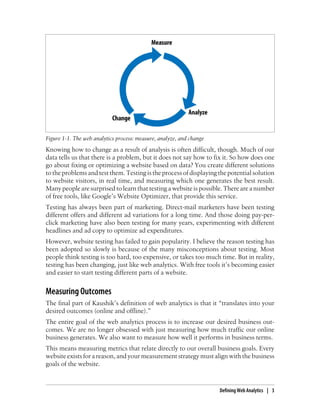
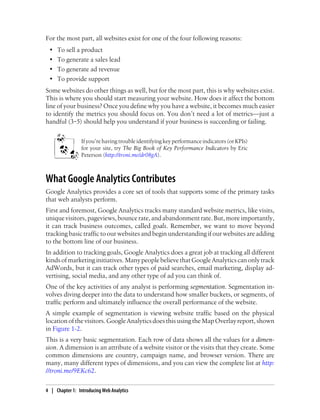
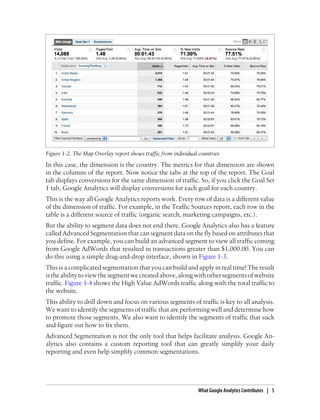
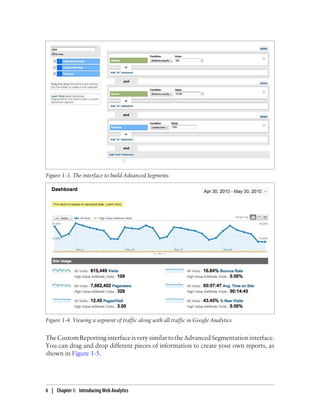
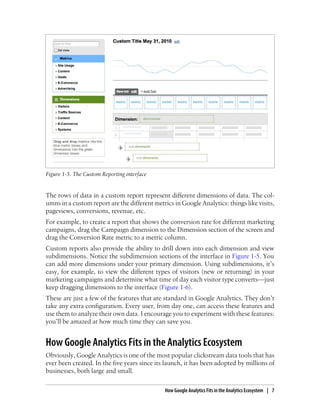
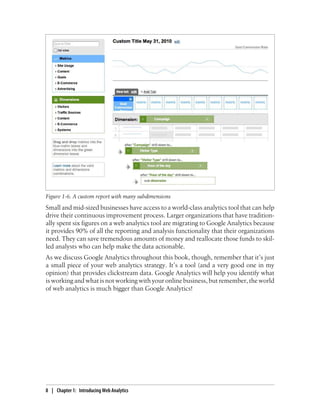
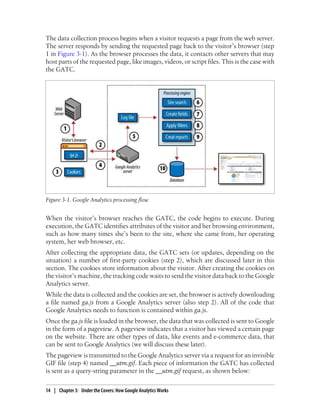
![http://www.google-analytics.com/__utm.gif?utmwv=4.6.5&utmn=1881501226&utmhn
=cutroni.com&utmcs=UTF-8&utmsr=1152x720&utmsc=24-bit&utmul=en- s
&utmje=1&utmfl
=10.0%20r42&utmdt=Analytics%20Talk%20by%20Justin%20Cutroni&utmhid
=465405990&utmr=-&utmp=%2Fblog%2F&utmac=UA-XXXX-1&utmcc=
__utma%3D32856364.1914824586.1269919681.1269919681.1269919681.1%3B%2B
__utmz%3D32856364.1269919681.1.1.utmcsr%3D(direct)
%7Cutmccn%3D(direct)%7Cutmcmd%3D(none)%3B&gaq=1
When the Google Analytics server receives this pageview, it stores the data in some
type of temporary data storage. Google has not indicated exactly how the data is stored,
but we know that there is some type of storage for the raw data. Think of this data
storage as a large text file or a logfile (step 5).
Each line in the logfile contains numerous attributes of the pageview sent to Google.
This includes:
• When the data was collected (date and time)
• Where the visitor came from (referring website, search engine, etc.)
• How many times the visitor has been to the site (number of visits)
• Where the visitor is located (geographic location)
• Who the visitor is (IP address)
After the pageview is stored in the logfile, the data collection process is complete. The
data collection and data processing components of Google Analytics are separate. This
ensures Google Analytics will always collect data, even if the data processing engine is
undergoing maintenance.
The next step is data processing. At some regular interval, approximately every 3 hours,
Google Analytics processes the data in the logfile. Data processing time does fluctuate.
Google Analytics does not process data in real time. While data is normally processed
about every 3 hours, it’s not normally complete until 24 hours after collection. The
reason the data is not complete until 24 hours after processing is that the entire day’s
data is reprocessed after it has been collected.
Be aware that this processing behavior can lead to inaccurate intraday
metrics. It is best to avoid using Google Analytics for real-time or intra-
day reporting.
During processing, each line in the logfile is split into pieces, one piece for each attribute
of the pageview. Here’s a sample logfile; this is not an actual data storage line from
Google Analytics, but a representation:
65.57.245.11 www.cutroni.com - [21/Jan/2010:19:05:06 −0600]
"GET __utm.gif?utmwv=4.6.5&utmn=1881501226&utmhn=cutroni.com&utmcs=UTF-8&utmsr
=1152x720&utmsc=24-bit&utmul=en-us&utmje=1&utmfl=10.0%20r42&utmdt
=Analytics%20Talk%20by%20Justin%20Cutroni&utmhid=465405990&utmr
=-&utmp=%2Fblog%2F&utmac=UA-XXXX-11&utmcc
=__utma%3D32856364.1914824586.1269919681.1269919681.1269919681.1%3B%2B
Data Collection and Processing | 15](https://image.slidesharecdn.com/35302-250228034843-6f950754/85/Google-Analytics-1st-Edition-Justin-Cutroni-36-320.jpg)
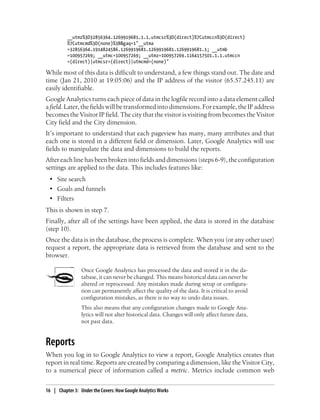
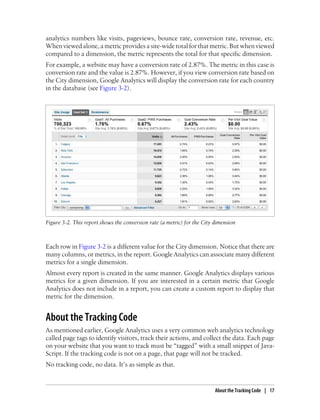
![The following is the GATC JavaScript snippet:
<script type="text/javascript">
var _gaq = _gaq || [];
_gaq.push(['_setAccount', 'UA-XXXXXX-YY']);
_gaq.push(['_trackPageview']);
(function() {
var ga = document.createElement('script'); ga.type = 'text/javascript';
ga.async = true; ga.src = ('https:' == document.location.protocol ?
'https://ssl' : 'http://www') + '.google-analytics.com/ga.js';
var s = document.getElementsByTagName('script')[0];
s.parentNode.insertBefore(ga, s);
})();
</script>
This part of the tracking code does all of the work. It starts by creating a queue
(named _gaq), or list of Google Analytics commands. These commands are also
calledmethods.WhenyouwantGoogleAnalyticstodosomething,youadd,orpush,
a command into the queue.
The standard page tag adds the first two methods to the queue for you. The first method
is _setAccount(). This method links the data collected from your site to your Google
Analytics account using a unique number. The number is found directly after the
“UA-”. Once the _setAccount() method has been added, the tracking code knows where
to send all of the data.
The second method, _trackPageview() is the part of the code that collects information
about the visitor, stores it in cookies, and sends the data back to Google. This is the
true workhorse of Google Analytics.
Remember, this part of the tracking code is a queue of methods. Up to this point, the
only thing that has happened is two methods have been added to the queue. The queue
has not been processed and no data has been sent to Google Analytics.
Before any code can execute the ga.js file, which contains all of the Google Analytics
logic, this code loads that logic into the browser and requests ga.js from a Google
server. This file is geo-load-balanced across all of Google’s global data centers. This
means the visitor’s browser will connect with the closest data center to reduce the
time it takes to retrieve the file. The visitor’s browser caches this file, so it’s possible
that it doesn’t even need to load from a Google data center. Once the browser has
retrieved the file, the queue of commands begins to execute. Notice the
ga.async=true part of the code. This part of the code tells the browser to load the
ga.js file asynchronously. This means that the browser can load ga.js while it con-
tinues to render the page for the visitor. Even if there is a communication issue
between the browser and Google’s Analytics servers and Google’s servers stop trans-
mitting ga.js to the browser, the browser will continue to render the page for the
visitor.
18 | Chapter 3:匿Under the Covers: How Google Analytics Works](https://image.slidesharecdn.com/35302-250228034843-6f950754/85/Google-Analytics-1st-Edition-Justin-Cutroni-39-320.jpg)
![<script type="text/javascript">
var _gaq = _gaq || [];
_gaq.push(['_setAccount', 'UA-XXXXXX-YY']);
_gaq.push(['_trackPageview']);
(function() {
var ga = document.createElement('script'); ga.type = 'text/javascript';
ga.async = true; ga.src = ('https:' == document.location.protocol ?
'https://ssl' : 'http://www') + '.YOUR-WEBSITE-DOMAIN/THE-PATH/YOUR-FILE-NAME.js';
var s = document.getElementsByTagName('script')[0];
s.parentNode.insertBefore(ga, s);
})();
</script>
Google updates ga.js without notifying users. If you decide to host ga.js on your own
servers, make sure you periodically check for updates. Google publishes a ga.js change
log at http://troni.me/cUNRvq.
The Mobile Tracking Code
The Google Analytics tracking code relies on JavaScript and cookies to collect visitor
data. While some mobile devices support these technologies, like iPhones and Android-
powered phones, there is a huge ecosystem of mobile devices that do not support either
of these technologies. Google Analytics therefore needs a different way to collect data
for visitors using a device that does not support cookies and JavaScript. Thus was born
the mobile tracking code.
The mobile tracking code collects data at the server level rather than at the browser, or
device, level. Because the mobile tracking code collects data at the server level, you
must implement it in the language that you used to build your web application. Google
provides four mobile tracking libraries to make the process easier: PHP, Java, ASP, and
Perl. All of the libraries work in the same basic way. You can download the mobile
tracking libraries from the Google Analytics code site at http://troni.me/bULXyd.
Regardless of the language you use to implement mobile tracking, the data collection
process is the same. Let’s walk through the mobile tracking process using a PHP ex-
ample, shown in Figure 3-3.
To track a mobile site built in PHP, you must add a block of PHP code before the
<HTML> tag on all your mobile pages. You must also add a small block of PHP code
immediately before the closing </BODY> tag.
When the server processes the first block of PHP (step 1 in Figure 3-3), it creates a URL
containing information about the visitor. Then it places the URL that was generated in
the first block of code in an HTML IMG tag (step 2 in Figure 3-3).
20 | Chapter 3:匿Under the Covers: How Google Analytics Works](https://image.slidesharecdn.com/35302-250228034843-6f950754/85/Google-Analytics-1st-Edition-Justin-Cutroni-41-320.jpg)
![The image request is actually a request for the ga.php file. This file takes the requested
URL, extracts the data, and sends the data back to the Google Analytics server (step 3
in Figure 3-3). This image passes data back to your server, where a request for the
__utm.gif image is made. This __utm.gif request is nearly identical to the __utm.gif
request that the JavaScript makes.
Figure 3-3. How the Google Analytics mobile tracking code collects data
Examining the first block of PHP code, you’ll notice that you need to add your account
number to the top of the block. You’ll also need to change the path to the ga.php file
to match your website architecture:
<?php
// Copyright 2009 Google Inc. All Rights Reserved.
$GA_ACCOUNT = "MO-XXXXXX-YY";
$GA_PIXEL = "/ga.php";
function googleAnalyticsGetImageUrl() {
global $GA_ACCOUNT, $GA_PIXEL;
$url = "";
$url .= $GA_PIXEL . "?";
$url .= "utmac=" . $GA_ACCOUNT;
$url .= "&utmn=" . rand(0, 0x7fffffff);
$referer = $_SERVER["HTTP_REFERER"];
$query = $_SERVER["QUERY_STRING"];
$path = $_SERVER["REQUEST_URI"];
if (empty($referer)) {
$referer = "-";
}
$url .= "&utmr=" . urlencode($referer);
if (!empty($path)) {
$url .= "&utmp=" . urlencode($path);
}
$url .= "&guid=ON";
return str_replace("&", "&", $url);
}
?>
About the Tracking Code | 21](https://image.slidesharecdn.com/35302-250228034843-6f950754/85/Google-Analytics-1st-Edition-Justin-Cutroni-42-320.jpg)
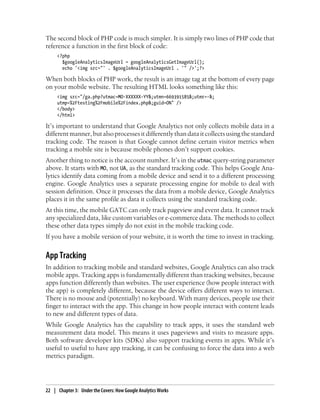
![App tracking is currently available for iPhone and Android applications. Those inter-
ested in tracking apps can download the SDK from the Google code site at http://troni
.me/aOnRye.
App tracking has many unique features that are specific to apps and mobile devices.
For example, the SDK includes a feature called dispatch. This feature allows the devel-
oper to cache, or hold, requests for the __utm.gif image and send multiple requests at
the same time. This can help reduce the bandwidth the device uses.
The (Very) Old Tracking Code: urchin.js
For those of you who have been using Google Analytics for a long, long time, you may
have noticed that the GATC has changed dramatically. The original version of the
Google Analytics tracking code was named urchin.js. While urchin.js is still supported,
it is recommended that all users migrate to the current version of the tracking code.
Thecurrentversionofthetrackingcodewillloadfasterinthevisitor’sbrowser,contains
new functionality, and is continuously updated by Google.
When planning a conversion from urchin.js, consider your implementation. Do you
use e-commerce tracking? Does your website span multiple domains? Are you tracking
Flash or Ajax? All of these things complicate the migration from urchin.js, because they
are customizations of the tracking code. While I do recommend migrating from
urchin.js, I recommend that you take the time to plan your migration carefully.
Understanding Pageviews
The most important part of the GATC is _trackPageview(). This method collects visitor
data, stores that data in cookies, and sends the data to the Google Analytics server. The
_trackPageview() portion of the GATC is shown in bold in the following code:
<script type="text/javascript">
var _gaq = _gaq || [];
_gaq.push(['_setAccount', 'UA-XXXXXX-YY']);
_gaq.push(['_trackPageview']);
(function() {
var ga = document.createElement('script'); ga.type = 'text/javascript';
ga.async = true; ga.src = ('https:' == document.location.protocol ?
'https://ssl' : 'http://www') + '.google-analytics.com/ga.js';
var s = document.getElementsByTagName('script')[0];
s.parentNode.insertBefore(ga, s);
})();
</script>
Every time _trackPageview() executes, a pageview is created by sending the data to
Google Analytics (step 4 in Figure 3-1). Remember, each pageview includes many,
many dimensions, like the visitor’s IP address, city, country, region, etc. The actual
Understanding Pageviews | 23](https://image.slidesharecdn.com/35302-250228034843-6f950754/85/Google-Analytics-1st-Edition-Justin-Cutroni-44-320.jpg)
![page the visitor was looking at is captured in a dimension called page. You can use the
page dimension to create many of the reports in the Content section of Google Ana-
lytics. Figure 3-4 shows some sample data from the Top Content report.
Figure 3-4. Top Content report showing pageview “names”
During the data collection process, _trackPageview() copies the information from the
location bar of the visitor’s browser. It modifies the value by removing the domain name
and domain extension. The only things left are the directories, filename, and query-
string parameters. This becomes the Request URI field or page dimension, and it is
created during data processing.
For example, the URL http://www.cutroni.com/pages/index.php?id=110 will appear in
the Top Content report as /pages/index.php?id=110. So, in this example, the request
URI is the part of the URL that comes after http://www.cutroni.com.
That’s the default behavior of _trackPageview(). You can override this behavior and
specify how _trackPageview() names a pageview by passing a value to _trackPage
view(). For example, to change the way the pageview for /index.php appears in Google
Analytics, modify _trackPageview() on the /index.php page as follows:
_gaq.push(['_trackPageview', '/index page']);
This modification forces _trackPageview() to name the pageview /index page rather
than /index.php. The deeper effect of this change is that the value for the Request URI
field and the page dimension is not /index.php, but index page. This will have an impact
on other configuration settings, like goals and funnels, which we’ll discuss inChapter 7.
24 | Chapter 3:匿Under the Covers: How Google Analytics Works](https://image.slidesharecdn.com/35302-250228034843-6f950754/85/Google-Analytics-1st-Edition-Justin-Cutroni-45-320.jpg)

![CHAPTER 4
TrackingVisitorClicks,OutboundLinks,
and Non-HTML Files
The simple implementation for tracking visitor actions, or clicks, involves adding the
_trackPageview() function to an HTML tag. For example, to track a visitor click on an
image, just add _trackPageview() to the onclick event of that element:
<img src="/image.jpg" onclick="_gaq.push(['_trackPageview', '/image.jpg']);" />
When a visitor clicks on the above image, a pageview will be created for /image.jpg.
You can also use this method to track non-HTML files:
<a href="/schedule.pdf" onclick="_gaq.push(['_trackPageview',
'/vpv/downloads/pdf/schedule.pdf']);" />PDF</a>
When creating pageviews for non-HTML files, try to use a consistent naming conven-
tion. This will make it easier to identify them in the reporting interface. For example,
you may want to create a virtual directory structure using _trackPageview().
In the previous code example, I added /vpv/downloads/pdf/ to the value passed to
_trackPageview() (vpv stands for “virtual pageview”). This makes it easy to identify the
non-HTML files in the reports.
Outbound links are tracked in the same manner:
<a href="http://www.cutroni.com" onclick="_gaq.push(['_trackPageview',
'/vpv/outbound/'+this.href]);" />www.cutroni.com</a>
This outbound link will appear as /vpv/outbound/http://www.cutroni.com in the re-
ports. Again, be logical in your naming convention. By placing all outbound links in
the /vpv/outbound/ directory, you can easily filter the data in the Top Content report
or the Content Drilldown report.
27](https://image.slidesharecdn.com/35302-250228034843-6f950754/85/Google-Analytics-1st-Edition-Justin-Cutroni-48-320.jpg)
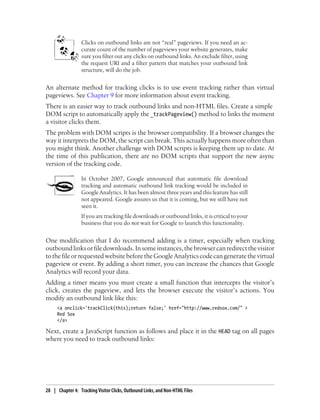
![<script type="text/javascript">
function trackClick(this) {
_gaq.push(['_trackPageview', '/vpv/outbound/'+this.href]]);
setTimeout('document.location = "' + this.href + '"', 100);
}
</script>
About the Tracking Cookies
Google Analytics uses up to five first-party cookies to track and store information about
a visitor. These cookies, set by the _trackPageview() method, track attributes of the
visitor, such as how many times she has been to the site and where she came from. The
cookies do not store any personally identifiable information about the visitor. Here is
a list of all the tracking cookies, their format, and other information:
__utma
Expiration: 24 months from the last session
Format: domain-hash.unique-id.ftime.ltime.stime.session-counter
The __utma cookie is the visitor identifier. The unique-id value is a number that
identifies this specific visitor. ftime (first time), ltime (last time), and stime (start
time) are all used to compute visit length (along with the __utmb and __utmc cook-
ies). The final value in the cookie is the session or visit counter. It tracks how many
times the visitor has visited the site and is incremented every time a new visit begins.
__utmb
Expiration: 30 minutes from the last action (pageview, event, transaction)
Format: domain-hash.session-pageview-count.session-event-count.stime
The __utmb cookie, in conjunction with the __utmc cookie, computes the session
length.
__utmc
Expiration: End of the browser session
Format: domain-hash
The __utmc cookie, in conjunction with the __utmb cookie, computes visit length.
__utmz
Expiration: By default, 6 months, but you can customize this value
Format: domain-hash.ctime.nsessions.nresponses.utmcsr=X(|utmccn=X|utmctr
=X|utmcmd=X|utmcid=X|utmcct=X|utmgclid=X)
The __utmz cookie is the referrer-tracking cookie. It tracks all referrer information
regardless of the referrer medium or source. This means all organic, cost-per-click
(also known as CPC), campaign, or plain referral information is stored in the
__utmz cookie. Data about the referrer is stored in a number of name-value pairs,
one for each attribute of the referral:
About the Tracking Cookies | 29](https://image.slidesharecdn.com/35302-250228034843-6f950754/85/Google-Analytics-1st-Edition-Justin-Cutroni-50-320.jpg)
























![[Webinar] Advanced Google Analytics](https://cdn.slidesharecdn.com/ss_thumbnails/webinargoogleanalyticsbychristinasanders-170328183539-thumbnail.jpg?width=640&height=640&fit=bounds)


