Innovative Healthcare Design


From lean thinking to complex adaptive system
     Developing new service models to integrate care around
               patients with complex care needs


       Dr Nick Goodwin, Senior Fellow, The King’s Fund, UK
          Paper to MIHealth Forum, Fira Barcelona, 24 May 2012
The Need to Focus on Complexity
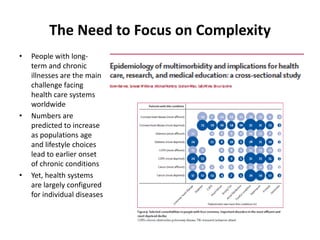
•   People with long-
    term and chronic
    illnesses are the main
    challenge facing
    health care systems
    worldwide
•   Numbers are
    predicted to increase
    as populations age
    and lifestyle choices
    lead to earlier onset
    of chronic conditions
•   Yet, health systems
    are largely configured
    for individual diseases
INTEGRATED CARE

• Integrated care is an approach for any individuals where gaps
in care, or poor care co-ordination, leads to an adverse impact
on care experiences and care outcomes.

• Integrated care is best suited to frail older people, to those
living with long-term chronic and mental health illnesses, and to
those with medically complex needs or requiring urgent care.

• Integrated care is most effective when it is population-based
and takes into account the holistic needs of patients. Disease-
based approaches ultimately lead to new silos of care.
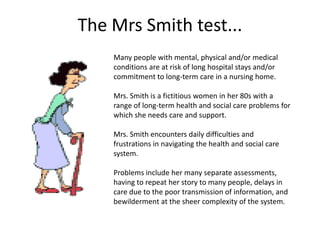
The Mrs Smith test...
    Many people with mental, physical and/or medical
    conditions are at risk of long hospital stays and/or
    commitment to long-term care in a nursing home.

    Mrs. Smith is a fictitious women in her 80s with a
    range of long-term health and social care problems for
    which she needs care and support.

    Mrs. Smith encounters daily difficulties and
    frustrations in navigating the health and social care
    system.

    Problems include her many separate assessments,
    having to repeat her story to many people, delays in
    care due to the poor transmission of information, and
    bewilderment at the sheer complexity of the system.
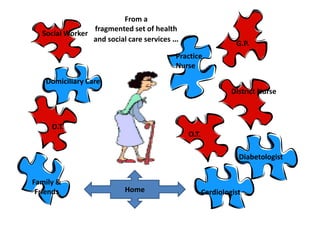
From a
                fragmented set of health
  Social Worker
                and social care services …
                                                              G.P.
                                         Practice
                                         Nurse
   Domiciliary Care
                                                             District Nurse


     O.T.
                                             O.T.

                                                               Diabetologist


Family &
 Friends                  Home                      Cardiologist
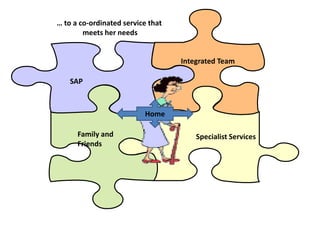
… to a co-ordinated service that
        meets her needs


                                   Integrated Team

    SAP


                          Home

      Family and                       Specialist Services
      Friends
Examples of Successful
   Integrated Care
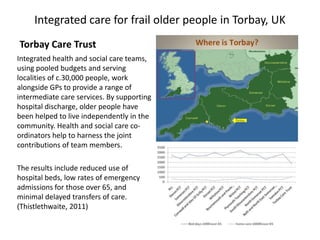
Integrated care for frail older people in Torbay, UK
Torbay Care Trust
Integrated health and social care teams,
using pooled budgets and serving
localities of c.30,000 people, work
alongside GPs to provide a range of
intermediate care services. By supporting
hospital discharge, older people have
been helped to live independently in the
community. Health and social care co-
ordinators help to harness the joint
contributions of team members.

The results include reduced use of
hospital beds, low rates of emergency
admissions for those over 65, and
minimal delayed transfers of care.
(Thistlethwaite, 2011)
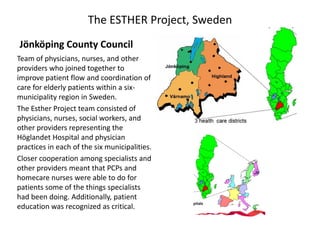
The ESTHER Project, Sweden
Jönköping County Council
Team of physicians, nurses, and other
providers who joined together to
improve patient flow and coordination of
care for elderly patients within a six-
municipality region in Sweden.
The Esther Project team consisted of
physicians, nurses, social workers, and
other providers representing the
Höglandet Hospital and physician
practices in each of the six municipalities.
Closer cooperation among specialists and
other providers meant that PCPs and
homecare nurses were able to do for
patients some of the things specialists
had been doing. Additionally, patient
education was recognized as critical.
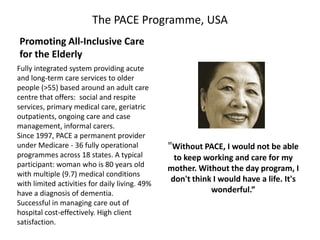
The PACE Programme, USA
Promoting All-Inclusive Care
for the Elderly
Fully integrated system providing acute
and long-term care services to older
people (>55) based around an adult care
centre that offers: social and respite
services, primary medical care, geriatric
outpatients, ongoing care and case
management, informal carers.
Since 1997, PACE a permanent provider
under Medicare - 36 fully operational           "Without PACE, I would not be able
programmes across 18 states. A typical           to keep working and care for my
participant: woman who is 80 years old
                                                mother. Without the day program, I
with multiple (9.7) medical conditions
with limited activities for daily living. 49%
                                                don't think I would have a life. It's
have a diagnosis of dementia.                              wonderful.”
Successful in managing care out of
hospital cost-effectively. High client
satisfaction.
Tackling Complexity
Key System Design Factors
Systemic Characteristics
• Universal coverage, care free at point of use
     – Use of prepaid capitation-based budgets
• Primary/community care driven
     – Developing new services that wrap around primary care practices to support people in
       local communities has a record of success
•   Emphasis on chronic and long-term physical and mental health care
•   Emphasis on population health management and public health
•   Alignment of regulatory frameworks with goals of integrated care
•   Funding/payment flexibilities to promote integrated care
     – Seeing the hospital as a cost-centre, not a revenue centre
• Workforce educated and skilled in chronic care, teamwork (joint working)
  and care co-ordination
Organisational Characteristics
•   Strong administrative and clinical leadership
•   Shared mission, values and culture
•   Common organizational and governance structure
•   Shared organizational/financial accountabilities
•   Aligned financial incentives and use of funding flexibilities (e.g.
    pooled/capitated budgets)
•   Organized provider network embedded in system
•   Integrated IT & single electronic health record
•   Responsibility for defined population and/or service area (e.g. registered
    list)
•   Continuous quality measurement and improvement
Delivery Characteristics
   There are many different ways in which professionals and providers can work directly with
  communities, patients/clients to support integrated care. These ‘tools’ focus on the ‘how’ of
                                 clinical and service integration

Examples of tools for clinical or professional       Examples of tools for service integration:
integration:                                         • Assisted living/care support in home
• Case finding and use of risk-stratification        • Single point of entry
• Standardised diagnostic and eligibility criteria   • Care co-ordination
• Comprehensive joint assessments                    • Case management
• Joint care planning                                • Disease management
• Single or shared clinical records                  • Centralised information, referral and intake
• Decision support tools such as care                • Multi-disciplinary teamwork
    guidelines and protocols                         • Inter-professional networks
• Technologies that support continuous and           • Shared accountability for care
    remote patient monitoring
                                                     • Co-location of services
• Peer review
                                                     • Discharge/transfer agreements
                                                     • Personal health budgets
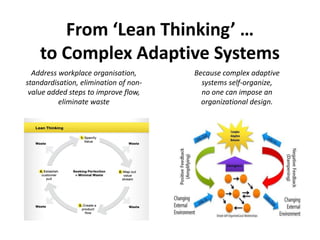
From ‘Lean Thinking’ …
    to Complex Adaptive Systems
  Address workplace organisation,      Because complex adaptive
standardisation, elimination of non-     systems self-organize,
 value added steps to improve flow,      no one can impose an
          eliminate waste                organizational design.

Goodwin, Nick - From lean thinking to complex adaptative system

  • 1.
    Innovative Healthcare Design Fromlean thinking to complex adaptive system Developing new service models to integrate care around patients with complex care needs Dr Nick Goodwin, Senior Fellow, The King’s Fund, UK Paper to MIHealth Forum, Fira Barcelona, 24 May 2012
  • 2.
    The Need toFocus on Complexity • People with long- term and chronic illnesses are the main challenge facing health care systems worldwide • Numbers are predicted to increase as populations age and lifestyle choices lead to earlier onset of chronic conditions • Yet, health systems are largely configured for individual diseases
  • 3.
    INTEGRATED CARE • Integratedcare is an approach for any individuals where gaps in care, or poor care co-ordination, leads to an adverse impact on care experiences and care outcomes. • Integrated care is best suited to frail older people, to those living with long-term chronic and mental health illnesses, and to those with medically complex needs or requiring urgent care. • Integrated care is most effective when it is population-based and takes into account the holistic needs of patients. Disease- based approaches ultimately lead to new silos of care.
  • 4.
    The Mrs Smithtest... Many people with mental, physical and/or medical conditions are at risk of long hospital stays and/or commitment to long-term care in a nursing home. Mrs. Smith is a fictitious women in her 80s with a range of long-term health and social care problems for which she needs care and support. Mrs. Smith encounters daily difficulties and frustrations in navigating the health and social care system. Problems include her many separate assessments, having to repeat her story to many people, delays in care due to the poor transmission of information, and bewilderment at the sheer complexity of the system.
  • 5.
    From a fragmented set of health Social Worker and social care services … G.P. Practice Nurse Domiciliary Care District Nurse O.T. O.T. Diabetologist Family & Friends Home Cardiologist
  • 6.
    … to aco-ordinated service that meets her needs Integrated Team SAP Home Family and Specialist Services Friends
  • 7.
    Examples of Successful Integrated Care
  • 8.
    Integrated care forfrail older people in Torbay, UK Torbay Care Trust Integrated health and social care teams, using pooled budgets and serving localities of c.30,000 people, work alongside GPs to provide a range of intermediate care services. By supporting hospital discharge, older people have been helped to live independently in the community. Health and social care co- ordinators help to harness the joint contributions of team members. The results include reduced use of hospital beds, low rates of emergency admissions for those over 65, and minimal delayed transfers of care. (Thistlethwaite, 2011)
  • 9.
    The ESTHER Project,Sweden Jönköping County Council Team of physicians, nurses, and other providers who joined together to improve patient flow and coordination of care for elderly patients within a six- municipality region in Sweden. The Esther Project team consisted of physicians, nurses, social workers, and other providers representing the Höglandet Hospital and physician practices in each of the six municipalities. Closer cooperation among specialists and other providers meant that PCPs and homecare nurses were able to do for patients some of the things specialists had been doing. Additionally, patient education was recognized as critical.
  • 10.
    The PACE Programme,USA Promoting All-Inclusive Care for the Elderly Fully integrated system providing acute and long-term care services to older people (>55) based around an adult care centre that offers: social and respite services, primary medical care, geriatric outpatients, ongoing care and case management, informal carers. Since 1997, PACE a permanent provider under Medicare - 36 fully operational "Without PACE, I would not be able programmes across 18 states. A typical to keep working and care for my participant: woman who is 80 years old mother. Without the day program, I with multiple (9.7) medical conditions with limited activities for daily living. 49% don't think I would have a life. It's have a diagnosis of dementia. wonderful.” Successful in managing care out of hospital cost-effectively. High client satisfaction.
  • 11.
  • 12.
    Systemic Characteristics • Universalcoverage, care free at point of use – Use of prepaid capitation-based budgets • Primary/community care driven – Developing new services that wrap around primary care practices to support people in local communities has a record of success • Emphasis on chronic and long-term physical and mental health care • Emphasis on population health management and public health • Alignment of regulatory frameworks with goals of integrated care • Funding/payment flexibilities to promote integrated care – Seeing the hospital as a cost-centre, not a revenue centre • Workforce educated and skilled in chronic care, teamwork (joint working) and care co-ordination
  • 13.
    Organisational Characteristics • Strong administrative and clinical leadership • Shared mission, values and culture • Common organizational and governance structure • Shared organizational/financial accountabilities • Aligned financial incentives and use of funding flexibilities (e.g. pooled/capitated budgets) • Organized provider network embedded in system • Integrated IT & single electronic health record • Responsibility for defined population and/or service area (e.g. registered list) • Continuous quality measurement and improvement
  • 14.
    Delivery Characteristics There are many different ways in which professionals and providers can work directly with communities, patients/clients to support integrated care. These ‘tools’ focus on the ‘how’ of clinical and service integration Examples of tools for clinical or professional Examples of tools for service integration: integration: • Assisted living/care support in home • Case finding and use of risk-stratification • Single point of entry • Standardised diagnostic and eligibility criteria • Care co-ordination • Comprehensive joint assessments • Case management • Joint care planning • Disease management • Single or shared clinical records • Centralised information, referral and intake • Decision support tools such as care • Multi-disciplinary teamwork guidelines and protocols • Inter-professional networks • Technologies that support continuous and • Shared accountability for care remote patient monitoring • Co-location of services • Peer review • Discharge/transfer agreements • Personal health budgets
  • 15.
    From ‘Lean Thinking’… to Complex Adaptive Systems Address workplace organisation, Because complex adaptive standardisation, elimination of non- systems self-organize, value added steps to improve flow, no one can impose an eliminate waste organizational design.