Good bye
Massive View Controller!
Balazs Kovacs
About Supercharge
Supercharge 2
• Our mission is build strategic mobile products with a large
impact (usually meaning 1+ million users)
• ~40 people strong team
• Technologies
– Native iOS, Android, Windows Phone
– Ruby/Rails, JS
• Large-scale international products e.g.
– Self-care app for Europe’s biggest telco company (multiple
countries)
– Mobile banking app for the 2nd largest bank in Indonesia (100+
million customers)
Agenda
Supercharge 3
• History
• Problems / Requirements
• Our Solution
• Pros & Cons
• Tools
• Lessons learnt
History – MVC
Supercharge 4
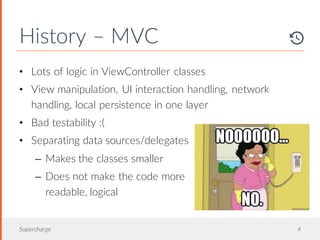
• Lots of logic in ViewController classes
• View manipulation, UI interaction handling, network
handling, local persistence in one layer
• Bad testability :(
• Separating data sources/delegates
– Makes the classes smaller
– Does not make the code more
readable, logical
History – MVVM
Supercharge 5
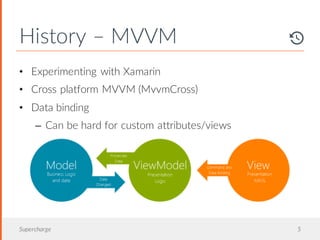
• Experimenting with Xamarin
• Cross platform MVVM (MvvmCross)
• Data binding
– Can be hard for custom attributes/views
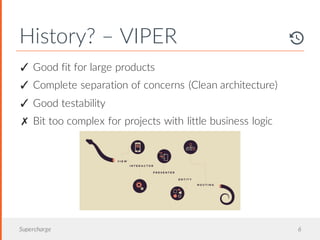
History? – VIPER
Supercharge 6
✓ Good fit for large products
✓ Complete separation of concerns (Clean architecture)
✓ Good testability
✗ Bit too complex for projects with little business logic
Problems / Requirements
Supercharge 7
• Large-scale applications
– Many functions
– 100+ screens
• Relatively little business logic on client side
• Large team
– 6-10 people / platform
• Hard deadlines
• Complex backend systems
– Integration is a tough nut
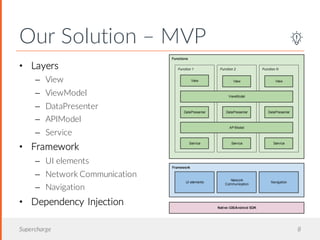
Our Solution – MVP
Supercharge 8
• Layers
– View
– ViewModel
– DataPresenter
– APIModel
– Service
• Framework
– UI elements
– Network Communication
– Navigation
• Dependency Injection
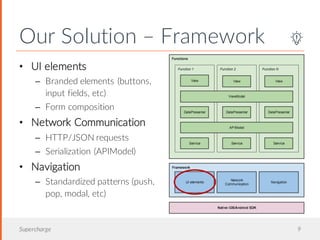
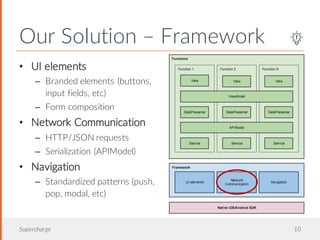
Our Solution – Framework
Supercharge 9
• UI elements
– Branded elements (buttons,
input fields, etc)
– Form composition
• Network Communication
– HTTP/JSON requests
– Serialization (APIModel)
• Navigation
– Standardized patterns (push,
pop, modal, etc)
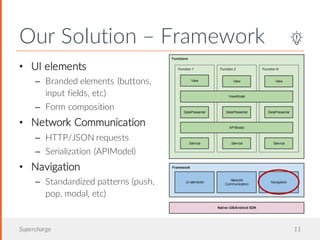
Our Solution – Framework
Supercharge 10
• UI elements
– Branded elements (buttons,
input fields, etc)
– Form composition
• Network Communication
– HTTP/JSON requests
– Serialization (APIModel)
• Navigation
– Standardized patterns (push,
pop, modal, etc)
Our Solution – Framework
Supercharge 11
• UI elements
– Branded elements (buttons,
input fields, etc)
– Form composition
• Network Communication
– HTTP/JSON requests
– Serialization (APIModel)
• Navigation
– Standardized patterns (push,
pop, modal, etc)
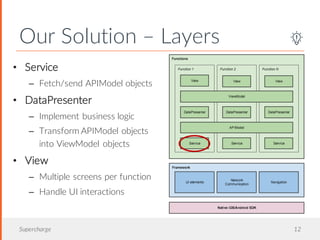
Our Solution – Layers
Supercharge 12
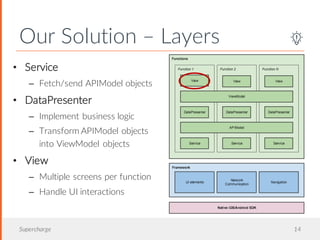
• Service
– Fetch/send APIModel objects
• DataPresenter
– Implement business logic
– Transform APIModel objects
into ViewModel objects
• View
– Multiple screens per function
– Handle UI interactions
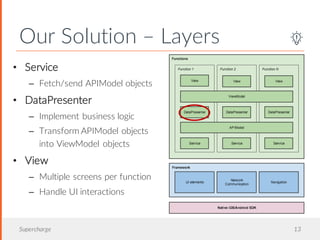
Our Solution – Layers
Supercharge 13
• Service
– Fetch/send APIModel objects
• DataPresenter
– Implement business logic
– Transform APIModel objects
into ViewModel objects
• View
– Multiple screens per function
– Handle UI interactions
Our Solution – Layers
Supercharge 14
• Service
– Fetch/send APIModel objects
• DataPresenter
– Implement business logic
– Transform APIModel objects
into ViewModel objects
• View
– Multiple screens per function
– Handle UI interactions
Our Solution – Workflow
Supercharge 15
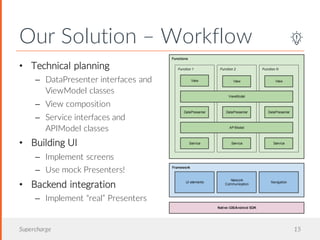
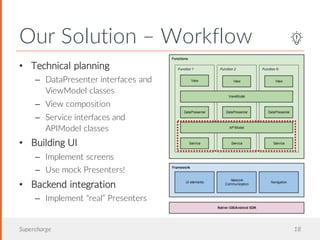
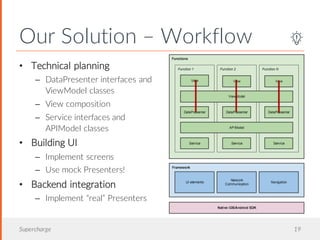
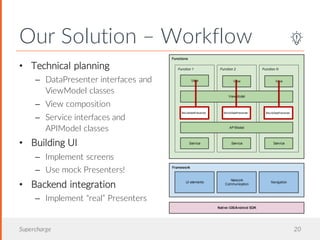
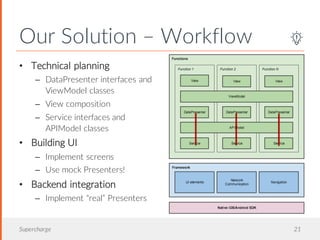
• Technical planning
– DataPresenter interfaces and
ViewModel classes
– View composition
– Service interfaces and
APIModel classes
• Building UI
– Implement screens
– Use mock Presenters!
• Backend integration
– Implement “real” Presenters
Our Solution – Workflow
Supercharge 16
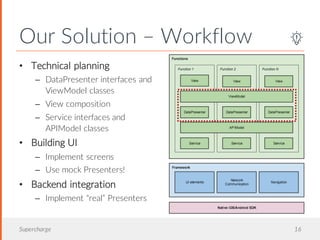
• Technical planning
– DataPresenter interfaces and
ViewModel classes
– View composition
– Service interfaces and
APIModel classes
• Building UI
– Implement screens
– Use mock Presenters!
• Backend integration
– Implement “real” Presenters
Our Solution – Workflow
Supercharge 17
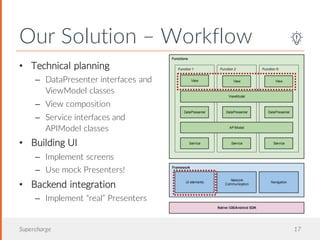
• Technical planning
– DataPresenter interfaces and
ViewModel classes
– View composition
– Service interfaces and
APIModel classes
• Building UI
– Implement screens
– Use mock Presenters!
• Backend integration
– Implement “real” Presenters
Our Solution – Workflow
Supercharge 18
• Technical planning
– DataPresenter interfaces and
ViewModel classes
– View composition
– Service interfaces and
APIModel classes
• Building UI
– Implement screens
– Use mock Presenters!
• Backend integration
– Implement “real” Presenters
Our Solution – Workflow
Supercharge 19
• Technical planning
– DataPresenter interfaces and
ViewModel classes
– View composition
– Service interfaces and
APIModel classes
• Building UI
– Implement screens
– Use mock Presenters!
• Backend integration
– Implement “real” Presenters
Our Solution – Workflow
Supercharge 20
• Technical planning
– DataPresenter interfaces and
ViewModel classes
– View composition
– Service interfaces and
APIModel classes
• Building UI
– Implement screens
– Use mock Presenters!
• Backend integration
– Implement “real” Presenters
MockDataPresenter MockDataPresenter MockDataPresenter
Our Solution – Workflow
Supercharge 21
• Technical planning
– DataPresenter interfaces and
ViewModel classes
– View composition
– Service interfaces and
APIModel classes
• Building UI
– Implement screens
– Use mock Presenters!
• Backend integration
– Implement “real” Presenters
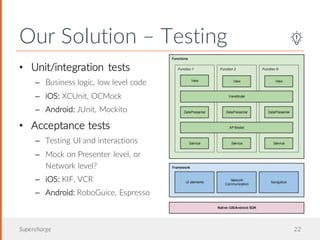
Our Solution – Testing
Supercharge 22
• Unit/integration tests
– Business logic, low level code
– iOS: XCUnit, OCMock
– Android: JUnit, Mockito
• Acceptance tests
– Testing UI and interactions
– Mock on Presenter level, or
Network level?
– iOS: KIF, VCR
– Android: RoboGuice, Espresso
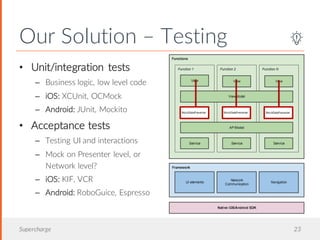
Our Solution – Testing
Supercharge 23
• Unit/integration tests
– Business logic, low level code
– iOS: XCUnit, OCMock
– Android: JUnit, Mockito
• Acceptance tests
– Testing UI and interactions
– Mock on Presenter level, or
Network level?
– iOS: KIF, VCR
– Android: RoboGuice, Espresso
MockDataPresenter MockDataPresenter MockDataPresenter
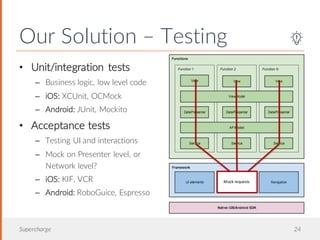
Our Solution – Testing
Supercharge 24
• Unit/integration tests
– Business logic, low level code
– iOS: XCUnit, OCMock
– Android: JUnit, Mockito
• Acceptance tests
– Testing UI and interactions
– Mock on Presenter level, or
Network level?
– iOS: KIF, VCR
– Android: RoboGuice, Espresso
Mock	requests
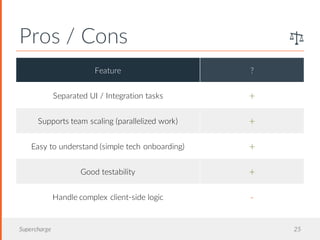
Pros / Cons
Supercharge 25
Feature ?
Separated UI / Integration tasks +
Supports team scaling (parallelized work) +
Easy to understand (simple tech onboarding) +
Good testability +
Handle complex client-side logic -
Tools
Supercharge 26
• Build schemes
– Centralized configuration for different environments (mock, staging
production)
– iOS: Build Schemes (not targets!) / Android: Gradle flavors
• SCConfiguration / SCForceUpdater / SCComponentCollection
– Environment-based configuration (available on GitHub)
– Basic force update functionality (available on GitHub)
– Management for horizontal/vertical layouts (soon to be open sourced)
• Reactive programming
– iOS: to be introduced
– Android: RxJava is extensively used
Lessons learnt
Supercharge 27
• Project requirements should determine the
architecture, not the other way around
• Always document your architectural planning
• Do not compromise on testability
• Feel free to experiment
• Learn from your bad choices
Thank you, any questions?
Balazs Kovacs
Supercharge
balazs.kovacs@supercharge.io // www.supercharge.io
• References
– https://github.com/MvvmCross/MvvmCross
– https://www.objc.io/issues/13-architecture/viper/
– http://typhoonframework.org/
– http://square.github.io/dagger/
– http://ocmock.org/
– https://github.com/kif-framework/KIF
– https://github.com/roboguice/roboguice
– https://google.github.io/android-testing-support-
library/docs/espresso/
– https://bitbucket.org/martijnthe/nsurlconnectionvcr
– https://github.com/team-supercharge/
Good bye Massive View Controller!

Good bye Massive View Controller!

  • 1.
    Good bye Massive ViewController! Balazs Kovacs
  • 2.
    About Supercharge Supercharge 2 •Our mission is build strategic mobile products with a large impact (usually meaning 1+ million users) • ~40 people strong team • Technologies – Native iOS, Android, Windows Phone – Ruby/Rails, JS • Large-scale international products e.g. – Self-care app for Europe’s biggest telco company (multiple countries) – Mobile banking app for the 2nd largest bank in Indonesia (100+ million customers)
  • 3.
    Agenda Supercharge 3 • History •Problems / Requirements • Our Solution • Pros & Cons • Tools • Lessons learnt
  • 4.
    History – MVC Supercharge4 • Lots of logic in ViewController classes • View manipulation, UI interaction handling, network handling, local persistence in one layer • Bad testability :( • Separating data sources/delegates – Makes the classes smaller – Does not make the code more readable, logical
  • 5.
    History – MVVM Supercharge5 • Experimenting with Xamarin • Cross platform MVVM (MvvmCross) • Data binding – Can be hard for custom attributes/views
  • 6.
    History? – VIPER Supercharge6 ✓ Good fit for large products ✓ Complete separation of concerns (Clean architecture) ✓ Good testability ✗ Bit too complex for projects with little business logic
  • 7.
    Problems / Requirements Supercharge7 • Large-scale applications – Many functions – 100+ screens • Relatively little business logic on client side • Large team – 6-10 people / platform • Hard deadlines • Complex backend systems – Integration is a tough nut
  • 8.
    Our Solution –MVP Supercharge 8 • Layers – View – ViewModel – DataPresenter – APIModel – Service • Framework – UI elements – Network Communication – Navigation • Dependency Injection
  • 9.
    Our Solution –Framework Supercharge 9 • UI elements – Branded elements (buttons, input fields, etc) – Form composition • Network Communication – HTTP/JSON requests – Serialization (APIModel) • Navigation – Standardized patterns (push, pop, modal, etc)
  • 10.
    Our Solution –Framework Supercharge 10 • UI elements – Branded elements (buttons, input fields, etc) – Form composition • Network Communication – HTTP/JSON requests – Serialization (APIModel) • Navigation – Standardized patterns (push, pop, modal, etc)
  • 11.
    Our Solution –Framework Supercharge 11 • UI elements – Branded elements (buttons, input fields, etc) – Form composition • Network Communication – HTTP/JSON requests – Serialization (APIModel) • Navigation – Standardized patterns (push, pop, modal, etc)
  • 12.
    Our Solution –Layers Supercharge 12 • Service – Fetch/send APIModel objects • DataPresenter – Implement business logic – Transform APIModel objects into ViewModel objects • View – Multiple screens per function – Handle UI interactions
  • 13.
    Our Solution –Layers Supercharge 13 • Service – Fetch/send APIModel objects • DataPresenter – Implement business logic – Transform APIModel objects into ViewModel objects • View – Multiple screens per function – Handle UI interactions
  • 14.
    Our Solution –Layers Supercharge 14 • Service – Fetch/send APIModel objects • DataPresenter – Implement business logic – Transform APIModel objects into ViewModel objects • View – Multiple screens per function – Handle UI interactions
  • 15.
    Our Solution –Workflow Supercharge 15 • Technical planning – DataPresenter interfaces and ViewModel classes – View composition – Service interfaces and APIModel classes • Building UI – Implement screens – Use mock Presenters! • Backend integration – Implement “real” Presenters
  • 16.
    Our Solution –Workflow Supercharge 16 • Technical planning – DataPresenter interfaces and ViewModel classes – View composition – Service interfaces and APIModel classes • Building UI – Implement screens – Use mock Presenters! • Backend integration – Implement “real” Presenters
  • 17.
    Our Solution –Workflow Supercharge 17 • Technical planning – DataPresenter interfaces and ViewModel classes – View composition – Service interfaces and APIModel classes • Building UI – Implement screens – Use mock Presenters! • Backend integration – Implement “real” Presenters
  • 18.
    Our Solution –Workflow Supercharge 18 • Technical planning – DataPresenter interfaces and ViewModel classes – View composition – Service interfaces and APIModel classes • Building UI – Implement screens – Use mock Presenters! • Backend integration – Implement “real” Presenters
  • 19.
    Our Solution –Workflow Supercharge 19 • Technical planning – DataPresenter interfaces and ViewModel classes – View composition – Service interfaces and APIModel classes • Building UI – Implement screens – Use mock Presenters! • Backend integration – Implement “real” Presenters
  • 20.
    Our Solution –Workflow Supercharge 20 • Technical planning – DataPresenter interfaces and ViewModel classes – View composition – Service interfaces and APIModel classes • Building UI – Implement screens – Use mock Presenters! • Backend integration – Implement “real” Presenters MockDataPresenter MockDataPresenter MockDataPresenter
  • 21.
    Our Solution –Workflow Supercharge 21 • Technical planning – DataPresenter interfaces and ViewModel classes – View composition – Service interfaces and APIModel classes • Building UI – Implement screens – Use mock Presenters! • Backend integration – Implement “real” Presenters
  • 22.
    Our Solution –Testing Supercharge 22 • Unit/integration tests – Business logic, low level code – iOS: XCUnit, OCMock – Android: JUnit, Mockito • Acceptance tests – Testing UI and interactions – Mock on Presenter level, or Network level? – iOS: KIF, VCR – Android: RoboGuice, Espresso
  • 23.
    Our Solution –Testing Supercharge 23 • Unit/integration tests – Business logic, low level code – iOS: XCUnit, OCMock – Android: JUnit, Mockito • Acceptance tests – Testing UI and interactions – Mock on Presenter level, or Network level? – iOS: KIF, VCR – Android: RoboGuice, Espresso MockDataPresenter MockDataPresenter MockDataPresenter
  • 24.
    Our Solution –Testing Supercharge 24 • Unit/integration tests – Business logic, low level code – iOS: XCUnit, OCMock – Android: JUnit, Mockito • Acceptance tests – Testing UI and interactions – Mock on Presenter level, or Network level? – iOS: KIF, VCR – Android: RoboGuice, Espresso Mock requests
  • 25.
    Pros / Cons Supercharge25 Feature ? Separated UI / Integration tasks + Supports team scaling (parallelized work) + Easy to understand (simple tech onboarding) + Good testability + Handle complex client-side logic -
  • 26.
    Tools Supercharge 26 • Buildschemes – Centralized configuration for different environments (mock, staging production) – iOS: Build Schemes (not targets!) / Android: Gradle flavors • SCConfiguration / SCForceUpdater / SCComponentCollection – Environment-based configuration (available on GitHub) – Basic force update functionality (available on GitHub) – Management for horizontal/vertical layouts (soon to be open sourced) • Reactive programming – iOS: to be introduced – Android: RxJava is extensively used
  • 27.
    Lessons learnt Supercharge 27 •Project requirements should determine the architecture, not the other way around • Always document your architectural planning • Do not compromise on testability • Feel free to experiment • Learn from your bad choices
  • 28.
    Thank you, anyquestions? Balazs Kovacs Supercharge balazs.kovacs@supercharge.io // www.supercharge.io
  • 29.
    • References – https://github.com/MvvmCross/MvvmCross –https://www.objc.io/issues/13-architecture/viper/ – http://typhoonframework.org/ – http://square.github.io/dagger/ – http://ocmock.org/ – https://github.com/kif-framework/KIF – https://github.com/roboguice/roboguice – https://google.github.io/android-testing-support- library/docs/espresso/ – https://bitbucket.org/martijnthe/nsurlconnectionvcr – https://github.com/team-supercharge/