Goldsmiths Inclusive
Teaching and Learning
Teaching Methods and Support Materials
Welcome
Welcome
• These resources are intended for Goldsmiths staff,
but any external visitors are welcome to make use of
them under the Creative Commons License.
• Goldsmiths Inclusive Teaching and Learning by
Goldsmiths, University of London is licensed under a
Creative Commons Attribution-NonCommercial 4.0
International License.
Defining ‘Inclusion’
• Equality, inclusion and social justice are vitally
important to Goldsmiths.
• Inclusion means that all students, no matter their
sensory, physical or learning differences, religious
or ethnic background, sexual orientation, gender,
age, or family circumstance, will be welcomed as
equal, respected and fully integrated members of
Goldsmiths.
Inclusion in practice
• Although Reasonable Adjustments Student Agreements
(RASA) will persist, inclusion mean more than picking
out certain individuals or groups and making special
arrangements for them. It means transforming one’s
systems, structures and practice so that what used to be
a special arrangement becomes business as usual.
• The joy of inclusive practice is that it benefits everyone.
For instance, providing a glossary of technical terms
benefits all students, not just those with dyslexia or for
whom English is not their first language.
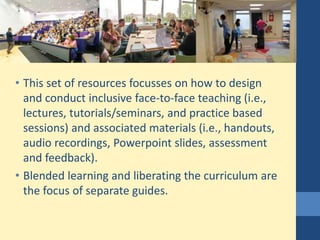
• This set of resources focusses on how to design
and conduct inclusive face-to-face teaching (i.e.,
lectures, tutorials/seminars, and practice based
sessions) and associated materials (i.e., handouts,
audio recordings, Powerpoint slides, assessment
and feedback).
• Blended learning and liberating the curriculum are
the focus of separate guides.
Modular Content
• Most of the content has been split up into
elements that can be viewed separately according
to the viewer’s particular interest.
• However, the module entitled ‘General Advice: To
be read after ‘Welcome’’ is intended to be viewed
first, since its content is relevant to all forms of
face-to-face teaching.
“Inclusion is not a strategy to help people fit
into the systems and structures which exist
in our societies; it is about transforming
those systems and structures to make it
better for everyone. Inclusion is about
creating a better world for everyone.”
Diane Richler, Past President, Inclusion International
Email: talic@gold.ac.uk

Goldsmiths teaching and learning welcome

  • 1.
    Goldsmiths Inclusive Teaching andLearning Teaching Methods and Support Materials Welcome
  • 2.
    Welcome • These resourcesare intended for Goldsmiths staff, but any external visitors are welcome to make use of them under the Creative Commons License. • Goldsmiths Inclusive Teaching and Learning by Goldsmiths, University of London is licensed under a Creative Commons Attribution-NonCommercial 4.0 International License.
  • 3.
    Defining ‘Inclusion’ • Equality,inclusion and social justice are vitally important to Goldsmiths. • Inclusion means that all students, no matter their sensory, physical or learning differences, religious or ethnic background, sexual orientation, gender, age, or family circumstance, will be welcomed as equal, respected and fully integrated members of Goldsmiths.
  • 4.
    Inclusion in practice •Although Reasonable Adjustments Student Agreements (RASA) will persist, inclusion mean more than picking out certain individuals or groups and making special arrangements for them. It means transforming one’s systems, structures and practice so that what used to be a special arrangement becomes business as usual. • The joy of inclusive practice is that it benefits everyone. For instance, providing a glossary of technical terms benefits all students, not just those with dyslexia or for whom English is not their first language.
  • 5.
    • This setof resources focusses on how to design and conduct inclusive face-to-face teaching (i.e., lectures, tutorials/seminars, and practice based sessions) and associated materials (i.e., handouts, audio recordings, Powerpoint slides, assessment and feedback). • Blended learning and liberating the curriculum are the focus of separate guides.
  • 6.
    Modular Content • Mostof the content has been split up into elements that can be viewed separately according to the viewer’s particular interest. • However, the module entitled ‘General Advice: To be read after ‘Welcome’’ is intended to be viewed first, since its content is relevant to all forms of face-to-face teaching.
  • 7.
    “Inclusion is nota strategy to help people fit into the systems and structures which exist in our societies; it is about transforming those systems and structures to make it better for everyone. Inclusion is about creating a better world for everyone.” Diane Richler, Past President, Inclusion International
  • 8.