Going Paperless-Part 1
The conceptof a paperless office has been around for many years. Many companies have tried it, some
have been successful,butmosthave either failed, or not tried in the first place.
From a technical perspective,setting up a paperless office is a realistic objective,from every other view it
is a different story. Paper provides a convenientmedium for the transmittal & storage ofdata. Paper
doesn’trun out of power,it doesn’tcatch viruses;it doesn’tbreak when you drop it. Most of us have
been working with paper since our early childhood.
In reality, we are not ready to give up paper completely,but that should notbe an excuse to nothing
aboutthe inefficiencies thatresult from our excessive use of paper. We can use less paper – most
companies could cuttheir paper consumption by70 to 80% with ease.
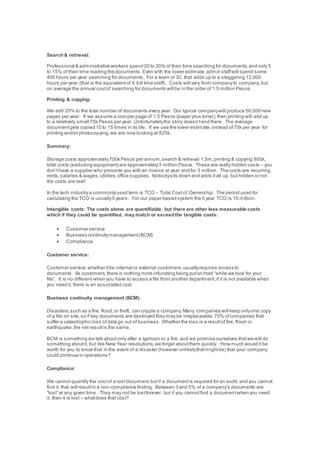
Paper filing systems versus electronic documents?
In the Philippines more than 95% of companies relyon paper as
opposed to electronic documents.
Paperless Trail promotes technologythat helps our customers
migrate to a “paperless environment”.
Throughoutthis article we will make reference to a “typical” company. Our typical companyis modeled
on the average of more than 50 LLCs that we have dealtwith over the years. This companyhas 30
administrative (admin/legal/HR/finance) staff. They will store up to 1 million pages in their head-office,
with perhaps as manymore spread across branch offices throughoutthe country.
Tangible costs: We have identified three measurable cost areas:
 Storage
 Printing & copying
 Retrieval
Storage – where do you keepyour documents?
On average, 13.5% of office space is used for storing documents. A typical filing cabinetrequires 0.4 sqm
of floor space,but you have to be able to open it so the area required is now 0.8 sqm. You need
somewhere to stand whilstyou look for your files – to keep the maths simple,we will assume thatyou
occupy 0.2 sqm,total 1.0 sqm ofspace for a filing cabinet. If average rental costs in Makati are 600
Pesos/sqm,then each filing cabinetcosts 7,200 Pesos per year (whether it is full or empty). The costs of
storing 1 million pages in 4 drawer cabinets will be around 720k Pesos per year (every year).
The rental figures are based on costs in Makati CBD, so if you are based in QC, Pasig or Alabang you
can make the necessaryadjustments to figure outwhat it costs you.
Search& retrieval:
Professional & administrative workers spend 20 to 30% of their time searching for documents,and only 5
to 15% of their time reading the documents. Even with the lower estimate,admin staffwill spend some
400 hours per year searching for documents. For a team of 30, that adds up to a staggering 12,000
hours per year (that is the equivalentof 6 full time staff). Costs will vary from companyto company,but
on average the annual costof searching for documents will be in the order of 1.5 million Pesos.
Printing & copying:
We add 20% to the total number of documents every year. Our typical companywill produce 50,000 new
pages per year. If we assume a costper page of 1.5 Pesos (paper plus toner),then printing will add up
to a relatively small 75k Pesos per year. Unfortunatelythe story doesn’tend there. The average
documentgets copied 10 to 15 times in its life. If we use the lower estimate,instead of75k per year for
printing and/or photocopying,we are now looking at 825k.
Summary:
Storage costs approximately700k Pesos per annum,search & retrieval 1.5m,printing & copying 800k,
total costs (excluding equipment) are approximately3 million Pesos. These are really hidden costs – you
don’thave a supplier who presents you with an invoice at year end for 3 million. The costs are recurring,
rents,salaries & wages,utilities,office supplies. Nobodysits down and adds itall up, but hidden or not
the costs are real!
In the tech industry a commonlyused term is TCO – Total Costof Ownership. The period used for
calculating the TCO is usually5 years. For our paper based system the 5 year TCO is 15 million.
Intangible costs: The costs above are quantifiable, but there are other less measurable costs
which if they could be quantified, may match or exceedthe tangible costs:
 Customer service
 Business continuitymanagement(BCM)
 Compliance
Customer service:
Customer service,whether itbe internal or external customers,usuallyrequires access to
documents. As customers,there is nothing more infuriating being puton hold “while we look for your
file”. It is no different when you have to access a file from another department,if it is not available when
you need it, there is an associated cost.
Business continuity management (BCM):
Disasters,such as a fire, flood,or theft, can cripple a company.Many companies will keep onlyone copy
of a file on site,so if key documents are destroyed they may be irreplaceable.70% ofcompanies that
suffer a catastrophic loss ofdata go out of business. Whether the loss is a resultof fire, flood or
earthquake,the net resultis the same.
BCM is something we talk aboutonly after a typhoon or a fire, and we promise ourselves thatwe will do
something aboutit, but like New Year resolutions,we forget aboutthem quickly. How much would it be
worth for you to know that in the event of a disaster (however unlikelythatmightbe) that your company
could continue in operations?
Compliance:
We cannot quantify the costof a lostdocument,butif a documentis required for an audit, and you cannot
find it, that will resultin a non-compliance finding. Between 3 and 5% of a company’s documents are
“lost” at any given time. They may not be lostforever, but if you cannotfind a documentwhen you need
it, then it is lost – whatdoes that cost?
Summary:
The intangible costs are risks. Could you recover if your office was burned down? What is the cost of a
lostdocument? Whatis the costif you fail a compliance auditand lose your accreditation?
Conclusions:
At this pointmany of the companies thatwe meetwill say, thank you, but we don’t have the budgetto do
this. According to the 2014 AIIM Industry Watch report, “60% of users have seen ROI on their paper-free
projects within 12 months,an impressive 77% within 18 months.
For our typical companythe 5 year TCO of going paperless is approximately20% of the 5 year TCO of
using an entirely paper based system.
For more detailed information,visitus at http://www.archive-one.net/

Going Paperless - Part 1

  • 1.
    Going Paperless-Part 1 Theconceptof a paperless office has been around for many years. Many companies have tried it, some have been successful,butmosthave either failed, or not tried in the first place. From a technical perspective,setting up a paperless office is a realistic objective,from every other view it is a different story. Paper provides a convenientmedium for the transmittal & storage ofdata. Paper doesn’trun out of power,it doesn’tcatch viruses;it doesn’tbreak when you drop it. Most of us have been working with paper since our early childhood. In reality, we are not ready to give up paper completely,but that should notbe an excuse to nothing aboutthe inefficiencies thatresult from our excessive use of paper. We can use less paper – most companies could cuttheir paper consumption by70 to 80% with ease. Paper filing systems versus electronic documents? In the Philippines more than 95% of companies relyon paper as opposed to electronic documents. Paperless Trail promotes technologythat helps our customers migrate to a “paperless environment”. Throughoutthis article we will make reference to a “typical” company. Our typical companyis modeled on the average of more than 50 LLCs that we have dealtwith over the years. This companyhas 30 administrative (admin/legal/HR/finance) staff. They will store up to 1 million pages in their head-office, with perhaps as manymore spread across branch offices throughoutthe country. Tangible costs: We have identified three measurable cost areas:  Storage  Printing & copying  Retrieval Storage – where do you keepyour documents? On average, 13.5% of office space is used for storing documents. A typical filing cabinetrequires 0.4 sqm of floor space,but you have to be able to open it so the area required is now 0.8 sqm. You need somewhere to stand whilstyou look for your files – to keep the maths simple,we will assume thatyou occupy 0.2 sqm,total 1.0 sqm ofspace for a filing cabinet. If average rental costs in Makati are 600 Pesos/sqm,then each filing cabinetcosts 7,200 Pesos per year (whether it is full or empty). The costs of storing 1 million pages in 4 drawer cabinets will be around 720k Pesos per year (every year). The rental figures are based on costs in Makati CBD, so if you are based in QC, Pasig or Alabang you can make the necessaryadjustments to figure outwhat it costs you.
  • 2.
    Search& retrieval: Professional &administrative workers spend 20 to 30% of their time searching for documents,and only 5 to 15% of their time reading the documents. Even with the lower estimate,admin staffwill spend some 400 hours per year searching for documents. For a team of 30, that adds up to a staggering 12,000 hours per year (that is the equivalentof 6 full time staff). Costs will vary from companyto company,but on average the annual costof searching for documents will be in the order of 1.5 million Pesos. Printing & copying: We add 20% to the total number of documents every year. Our typical companywill produce 50,000 new pages per year. If we assume a costper page of 1.5 Pesos (paper plus toner),then printing will add up to a relatively small 75k Pesos per year. Unfortunatelythe story doesn’tend there. The average documentgets copied 10 to 15 times in its life. If we use the lower estimate,instead of75k per year for printing and/or photocopying,we are now looking at 825k. Summary: Storage costs approximately700k Pesos per annum,search & retrieval 1.5m,printing & copying 800k, total costs (excluding equipment) are approximately3 million Pesos. These are really hidden costs – you don’thave a supplier who presents you with an invoice at year end for 3 million. The costs are recurring, rents,salaries & wages,utilities,office supplies. Nobodysits down and adds itall up, but hidden or not the costs are real! In the tech industry a commonlyused term is TCO – Total Costof Ownership. The period used for calculating the TCO is usually5 years. For our paper based system the 5 year TCO is 15 million. Intangible costs: The costs above are quantifiable, but there are other less measurable costs which if they could be quantified, may match or exceedthe tangible costs:  Customer service  Business continuitymanagement(BCM)  Compliance Customer service: Customer service,whether itbe internal or external customers,usuallyrequires access to documents. As customers,there is nothing more infuriating being puton hold “while we look for your file”. It is no different when you have to access a file from another department,if it is not available when you need it, there is an associated cost. Business continuity management (BCM): Disasters,such as a fire, flood,or theft, can cripple a company.Many companies will keep onlyone copy of a file on site,so if key documents are destroyed they may be irreplaceable.70% ofcompanies that suffer a catastrophic loss ofdata go out of business. Whether the loss is a resultof fire, flood or earthquake,the net resultis the same. BCM is something we talk aboutonly after a typhoon or a fire, and we promise ourselves thatwe will do something aboutit, but like New Year resolutions,we forget aboutthem quickly. How much would it be worth for you to know that in the event of a disaster (however unlikelythatmightbe) that your company could continue in operations? Compliance: We cannot quantify the costof a lostdocument,butif a documentis required for an audit, and you cannot find it, that will resultin a non-compliance finding. Between 3 and 5% of a company’s documents are “lost” at any given time. They may not be lostforever, but if you cannotfind a documentwhen you need it, then it is lost – whatdoes that cost?
  • 3.
    Summary: The intangible costsare risks. Could you recover if your office was burned down? What is the cost of a lostdocument? Whatis the costif you fail a compliance auditand lose your accreditation? Conclusions: At this pointmany of the companies thatwe meetwill say, thank you, but we don’t have the budgetto do this. According to the 2014 AIIM Industry Watch report, “60% of users have seen ROI on their paper-free projects within 12 months,an impressive 77% within 18 months. For our typical companythe 5 year TCO of going paperless is approximately20% of the 5 year TCO of using an entirely paper based system. For more detailed information,visitus at http://www.archive-one.net/