Pareto’s Principle:“The 80/20 Rule”Project 3: Team 4Erika Navarro, Jay Clark, Estevan McDaniel, Jason Miller, Jason Shanahan, Samuel Lespron, Andrea Rothluebber, and Noel Searles
Pareto’s Principle Applied to Project ManagementUnderstanding the			Pareto Principle is  advantageous for a			Project Manager. Understanding how			it works and how it can help you manage project teams is extremely beneficial and will help any company. “Take away our twenty most important people, and I tell you we would become an unimportant company.”--Bill Gates, chairman, Microsoft
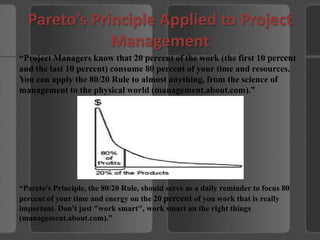
Pareto’s Principle Applied to Project Management“Project Managers know that 20 percent of the work (the first 10 percent and the last 10 percent) consume 80 percent of your time and resources. You can apply the 80/20 Rule to almost anything, from the science of management to the physical world (management.about.com).”“Pareto's Principle, the 80/20 Rule, should serve as a daily reminder to focus 80 percent of your time and energy on the 20 percent of you work that is really important. Don't just "work smart", work smart on the right things (management.about.com).”
Pareto’s Principle Applied to Project ManagementLearn to manage the Pareto Principle in your Project Team. Use the Pareto Principle to your advantage by identifying the 20% of work in your project that accounts for 80% of the time and resources, and make informed decisions with the information you find.
Pareto Principle in Software Development ProjectsThe Pareto Principle is observed in quality management of software development projects.The Pareto-like effect observed by TimeaIlles-Seifert and Barbara Paech, regarding open source software projects is:H1 - Pareto distribution of defects in filesH2 - Pareto distribution of defects in files across releases“A small number of files accounts for the majority of the defects (Hypothesis 1). This is true even across several releases of software (Hypothesis 2).”Quality - There should be a considerate amount of effort for quality to be built into any project and tracked, in order to ensure that a good end product is delivered to the customer/stakeholders.
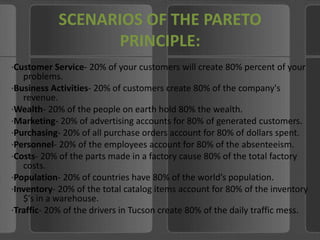
SCENARIOS OF THE PARETO PRINCIPLE:·Customer Service- 20% of your customers will create 80% percent of your problems.·Business Activities- 20% of customers create 80% of the company's revenue.·Wealth- 20% of the people on earth hold 80% the wealth.·Marketing- 20% of advertising accounts for 80% of generated customers.·Purchasing- 20% of all purchase orders account for 80% of dollars spent.·Personnel- 20% of the employees account for 80% of the absenteeism.·Costs- 20% of the parts made in a factory cause 80% of the total factory costs.·Population- 20% of countries have 80% of the world’s population.·Inventory- 20% of the total catalog items account for 80% of the inventory $’s in a warehouse.·Traffic- 20% of the drivers in Tucson create 80% of the daily traffic mess.
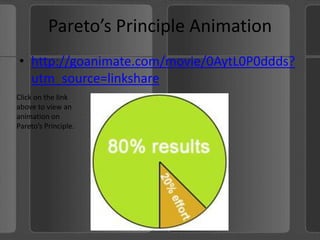
Pareto’s Principle Animationhttp://goanimate.com/movie/0AytL0P0ddds?utm_source=linkshareClick on the link above to view an animation on Pareto’s Principle.
Work CitedBachman, R. (1973). Takin’ Care of Business. On Bachman-Turner Overdrive II. [Album]. Winnipeg, Manitoba, Canada: Mercury. Illes-Seifert T., & Paech, B. (2009). (Eds). The vital few and trivial many: An empirical analysis of the Pareto Distribution of defects. Software Engineering 2009 Fachtagung des GI-FachbereichsSoftwaretechnik 02.-06.03. (pp. 151-164). KaiserslauternKoch, R. (2003). The 80/20 Individual: How to Accomplish More by Doing Less—The Nine Essentials of 80/20 Success at Work. [Excerpt from Chapter 1]. Retrieved from http://www.leadershipnow.com/leadershop/0957-Xexcerpt.htmlReh, F. John. "Pareto's Principle - The 80-20 Rule." About Management - Business Management - People Management - and More. http://management.about.com/cs/generalmanagement/a/Pareto081202.htm, Accessed February 28, 2011.

Paretoprinciple2

  • 1.
    Pareto’s Principle:“The 80/20Rule”Project 3: Team 4Erika Navarro, Jay Clark, Estevan McDaniel, Jason Miller, Jason Shanahan, Samuel Lespron, Andrea Rothluebber, and Noel Searles
  • 2.
    Pareto’s Principle Appliedto Project ManagementUnderstanding the Pareto Principle is advantageous for a Project Manager. Understanding how it works and how it can help you manage project teams is extremely beneficial and will help any company. “Take away our twenty most important people, and I tell you we would become an unimportant company.”--Bill Gates, chairman, Microsoft
  • 3.
    Pareto’s Principle Appliedto Project Management“Project Managers know that 20 percent of the work (the first 10 percent and the last 10 percent) consume 80 percent of your time and resources. You can apply the 80/20 Rule to almost anything, from the science of management to the physical world (management.about.com).”“Pareto's Principle, the 80/20 Rule, should serve as a daily reminder to focus 80 percent of your time and energy on the 20 percent of you work that is really important. Don't just "work smart", work smart on the right things (management.about.com).”
  • 4.
    Pareto’s Principle Appliedto Project ManagementLearn to manage the Pareto Principle in your Project Team. Use the Pareto Principle to your advantage by identifying the 20% of work in your project that accounts for 80% of the time and resources, and make informed decisions with the information you find.
  • 5.
    Pareto Principle inSoftware Development ProjectsThe Pareto Principle is observed in quality management of software development projects.The Pareto-like effect observed by TimeaIlles-Seifert and Barbara Paech, regarding open source software projects is:H1 - Pareto distribution of defects in filesH2 - Pareto distribution of defects in files across releases“A small number of files accounts for the majority of the defects (Hypothesis 1). This is true even across several releases of software (Hypothesis 2).”Quality - There should be a considerate amount of effort for quality to be built into any project and tracked, in order to ensure that a good end product is delivered to the customer/stakeholders.
  • 6.
    SCENARIOS OF THEPARETO PRINCIPLE:·Customer Service- 20% of your customers will create 80% percent of your problems.·Business Activities- 20% of customers create 80% of the company's revenue.·Wealth- 20% of the people on earth hold 80% the wealth.·Marketing- 20% of advertising accounts for 80% of generated customers.·Purchasing- 20% of all purchase orders account for 80% of dollars spent.·Personnel- 20% of the employees account for 80% of the absenteeism.·Costs- 20% of the parts made in a factory cause 80% of the total factory costs.·Population- 20% of countries have 80% of the world’s population.·Inventory- 20% of the total catalog items account for 80% of the inventory $’s in a warehouse.·Traffic- 20% of the drivers in Tucson create 80% of the daily traffic mess.
  • 7.
  • 8.
    Work CitedBachman, R.(1973). Takin’ Care of Business. On Bachman-Turner Overdrive II. [Album]. Winnipeg, Manitoba, Canada: Mercury. Illes-Seifert T., & Paech, B. (2009). (Eds). The vital few and trivial many: An empirical analysis of the Pareto Distribution of defects. Software Engineering 2009 Fachtagung des GI-FachbereichsSoftwaretechnik 02.-06.03. (pp. 151-164). KaiserslauternKoch, R. (2003). The 80/20 Individual: How to Accomplish More by Doing Less—The Nine Essentials of 80/20 Success at Work. [Excerpt from Chapter 1]. Retrieved from http://www.leadershipnow.com/leadershop/0957-Xexcerpt.htmlReh, F. John. "Pareto's Principle - The 80-20 Rule." About Management - Business Management - People Management - and More. http://management.about.com/cs/generalmanagement/a/Pareto081202.htm, Accessed February 28, 2011.