GODS AND GODDESSES
By: John Lloyd Traje
ZEUS
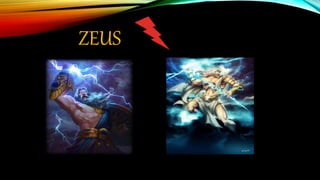
Often referred to as the “Father of Gods and men”, he is a sky god who controls
lightning (often using it as a weapon) and thunder. Zeus is king of Mount
Olympus, the home of Greek gods, where he rules the world and imposes his will
onto gods and mortals alike.
ZEUS
ZEUS HAD A NUMBER OF CHILDREN. SOME OF
HIS CHILDREN WERE OLYMPIC GODS SUCH AS:
ARES
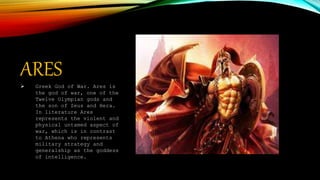
 Greek God of War. Ares is
the god of war, one of the
Twelve Olympian gods and
the son of Zeus and Hera.
In literature Ares
represents the violent and
physical untamed aspect of
war, which is in contrast
to Athena who represents
military strategy and
generalship as the goddess
of intelligence.
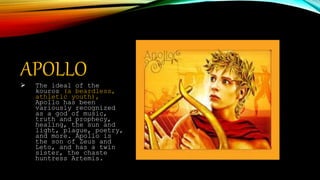
APOLLO The ideal of the
kouros (a beardless,
athletic youth),
Apollo has been
variously recognized
as a god of music,
truth and prophecy,
healing, the sun and
light, plague, poetry,
and more. Apollo is
the son of Zeus and
Leto, and has a twin
sister, the chaste
huntress Artemis.
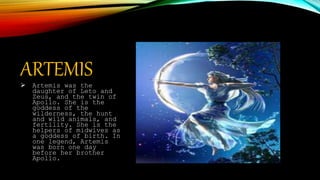
ARTEMIS Artemis was the
daughter of Leto and
Zeus, and the twin of
Apollo. She is the
goddess of the
wilderness, the hunt
and wild animals, and
fertility. She is the
helpers of midwives as
a goddess of birth. In
one legend, Artemis
was born one day
before her brother
Apollo.
ATHENA
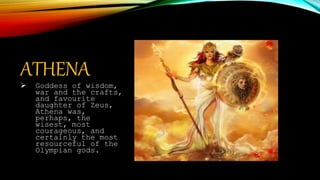
 Goddess of wisdom,
war and the crafts,
and favourite
daughter of Zeus,
Athena was,
perhaps, the
wisest, most
courageous, and
certainly the most
resourceful of the
Olympian gods.
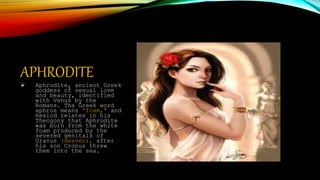
APHRODITE
 Aphrodite, ancient Greek
goddess of sexual love
and beauty, identified
with Venus by the
Romans. The Greek word
aphros means “foam,” and
Hesiod relates in his
Theogony that Aphrodite
was born from the white
foam produced by the
severed genitals of
Uranus (Heaven), after
his son Cronus threw
them into the sea.
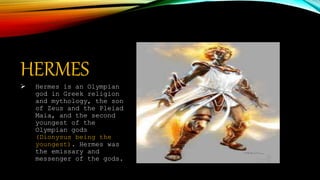
HERMES
 Hermes is an Olympian
god in Greek religion
and mythology, the son
of Zeus and the Pleiad
Maia, and the second
youngest of the
Olympian gods
(Dionysus being the
youngest). Hermes was
the emissary and
messenger of the gods.
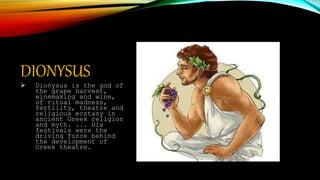
DIONYSUS
 Dionysus is the god of
the grape harvest,
winemaking and wine,
of ritual madness,
fertility, theatre and
religious ecstasy in
ancient Greek religion
and myth. ... His
festivals were the
driving force behind
the development of
Greek theatre.
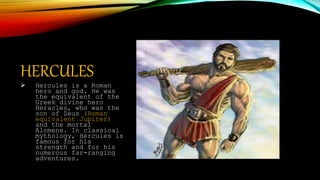
HERCULES
 Hercules is a Roman
hero and god. He was
the equivalent of the
Greek divine hero
Heracles, who was the
son of Zeus (Roman
equivalent Jupiter)
and the mortal
Alcmene. In classical
mythology, Hercules is
famous for his
strength and for his
numerous far-ranging
adventures.
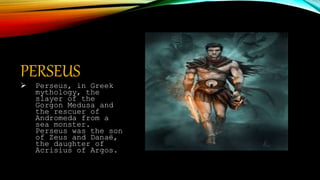
PERSEUS
 Perseus, in Greek
mythology, the
slayer of the
Gorgon Medusa and
the rescuer of
Andromeda from a
sea monster.
Perseus was the son
of Zeus and Danaë,
the daughter of
Acrisius of Argos.
REFERENCES:
hhttps://greekgodsandgoddesses.net/go
ds/
hhttps://en.wikipedia.org/wiki/List_o
f_Greek_mythological_figures
https://greekgodsandgoddesses.net/
https://greekgodsandgoddesses.net/god
s/
THANK YOU FOR
YOUR ATTENTION ! !

GODS AND GODDESSES

  • 1.
    GODS AND GODDESSES By:John Lloyd Traje
  • 2.
    ZEUS Often referred toas the “Father of Gods and men”, he is a sky god who controls lightning (often using it as a weapon) and thunder. Zeus is king of Mount Olympus, the home of Greek gods, where he rules the world and imposes his will onto gods and mortals alike.
  • 3.
  • 4.
    ZEUS HAD ANUMBER OF CHILDREN. SOME OF HIS CHILDREN WERE OLYMPIC GODS SUCH AS:
  • 5.
    ARES  Greek Godof War. Ares is the god of war, one of the Twelve Olympian gods and the son of Zeus and Hera. In literature Ares represents the violent and physical untamed aspect of war, which is in contrast to Athena who represents military strategy and generalship as the goddess of intelligence.
  • 6.
    APOLLO The idealof the kouros (a beardless, athletic youth), Apollo has been variously recognized as a god of music, truth and prophecy, healing, the sun and light, plague, poetry, and more. Apollo is the son of Zeus and Leto, and has a twin sister, the chaste huntress Artemis.
  • 7.
    ARTEMIS Artemis wasthe daughter of Leto and Zeus, and the twin of Apollo. She is the goddess of the wilderness, the hunt and wild animals, and fertility. She is the helpers of midwives as a goddess of birth. In one legend, Artemis was born one day before her brother Apollo.
  • 8.
    ATHENA  Goddess ofwisdom, war and the crafts, and favourite daughter of Zeus, Athena was, perhaps, the wisest, most courageous, and certainly the most resourceful of the Olympian gods.
  • 9.
    APHRODITE  Aphrodite, ancientGreek goddess of sexual love and beauty, identified with Venus by the Romans. The Greek word aphros means “foam,” and Hesiod relates in his Theogony that Aphrodite was born from the white foam produced by the severed genitals of Uranus (Heaven), after his son Cronus threw them into the sea.
  • 10.
    HERMES  Hermes isan Olympian god in Greek religion and mythology, the son of Zeus and the Pleiad Maia, and the second youngest of the Olympian gods (Dionysus being the youngest). Hermes was the emissary and messenger of the gods.
  • 11.
    DIONYSUS  Dionysus isthe god of the grape harvest, winemaking and wine, of ritual madness, fertility, theatre and religious ecstasy in ancient Greek religion and myth. ... His festivals were the driving force behind the development of Greek theatre.
  • 12.
    HERCULES  Hercules isa Roman hero and god. He was the equivalent of the Greek divine hero Heracles, who was the son of Zeus (Roman equivalent Jupiter) and the mortal Alcmene. In classical mythology, Hercules is famous for his strength and for his numerous far-ranging adventures.
  • 13.
    PERSEUS  Perseus, inGreek mythology, the slayer of the Gorgon Medusa and the rescuer of Andromeda from a sea monster. Perseus was the son of Zeus and Danaë, the daughter of Acrisius of Argos.
  • 14.
  • 15.
    THANK YOU FOR YOURATTENTION ! !