Operations Management
What is operations management?
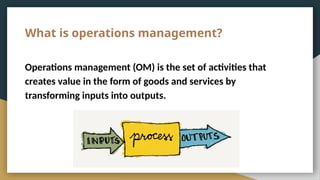
Operations management (OM) is the set of activities that
creates value in the form of goods and services by
transforming inputs into outputs.
Case study - Frito Lay
Frito-Lay, the massive Dallas-based subsidiary of PepsiCo, has 38 plants and 48,000 employees in North America. Seven of
Frito-Lay’s 41 brands exceed $1 billion in sales: Fritos, Lay’s, Cheetos, Ruffles, Tostitos, Doritos, and Walker’s Potato Chips.
Operations is the focus of the firm—from designing products for new markets, to meeting changing consumer preferences,
to adjusting to rising commodity costs, to subtle issues involving flavors and preservatives—OM is under constant cost, time,
quality, and market pressure. Here is a look at how the 10 decisions of OM are applied at this food processor. In the food
industry, product development kitchens experiment with new products, submit them to focus groups, and perform test
marketing. Once the product specifications have been set, processes capable of meeting those specifications and the
necessary quality standards are created. At Frito-Lay, quality begins at the farm, with onsite inspection of the potatoes used
in Ruffles and the corn used in Fritos. Quality continues throughout the manufacturing process, with visual inspections and
with statistical process control of product variables such as oil, moisture, seasoning, salt, thickness, and weight. Additional
quality evaluations are conducted throughout shipment, receipt, production, packaging, and delivery. The production
process at Frito-Lay is designed for large volumes and small variety, using expensive special-purpose equipment, and with
swift movement of material through the facility. Product-focused facilities, such as Frito-Lay’s, typically have high capital
costs, tight schedules, and rapid processing. FritoLay’s facilities are located regionally to aid in the rapid delivery of products
because freshness is a critical issue.
The production process at Frito-Lay is designed for large volumes and small variety, using expensive
special-purpose equipment, and with swift movement of material through the facility. Product-
focused facilities, such as Frito-Lay’s, typically have high capital costs, tight schedules, and rapid
processing. Frito Lay's facilities are located regionally to aid in the rapid delivery of products
because freshness is a critical issue. Sanitary issues and necessarily fast processing of products put
a premium on an efficient layout. Production lines are designed for balanced throughput and high
utilization. Cross-trained workers, who handle a variety of production lines, have promotion paths
identified for their particular skill set. The company rewards employees with medical, retirement,
and education plans. Its turnover is very low.The supply chain is integral to success in the food
industry; vendors must be chosen with great care. Moreover, the finished food product is highly
dependent on perishable raw materials. Consequently, the supply chain brings raw material
(potatoes, corn, etc.) to the plant securely and rapidly to meet tight production schedules. For
instance, from the time that potatoes are picked in St. Augustine, Florida, until they are unloaded at
the Orlando plant, processed, packaged, and shipped from the plant is under 12 hours. The
requirement for fresh product requires ontime, just-in-time deliveries combined with both low raw
material and finished goods inventories. The continuous-flow nature of the specialized equipment in
the production process permits little work-in-process inventory. The plants usually run 24/7. This
means that there are four shifts of employees each week. Tight scheduling to ensure the proper mix
of fresh finished goods on automated equipment requires reliable systems and effective
maintenance. Frito-Lay’s workforce is trained to recognize problems early, and professional
maintenance personnel are available on every shift. Downtime is very costly and can lead to late
deliveries, making maintenance a high priority.
Q1. How OM Decisions are applied at Frito-Lay?
1. Design of good and services: Frito currently owns 7 successful products that contribute a
huge amount of profits to them. However, Frito Lay always tries to make some
innovation in their product designs. Their product development department would
experiment with new products and send them to evaluation groups who are responsible
for its marketing testing.
2. Managing quality: Frito Lay has a strict quality control process that involves a variety of
process such as visual inspection, oil control, weight control, etc. Moreover, they also
conduct quality checks throughout shipment, receipt, production, packaging, and
Delivery.
3. Process and capacity design: Frito-Lay’s process should be suitably design for their high
volumes and small variety, so they have to invest heavily in some high-technology
machine that can sustain the rapid process. Moreover, they also focus on green
manufacturing and sustainability. They use solar energy to reduce their electricity
expense and recycle carton boxes to protect the environment.
4. Location strategy: Because chips require a high freshness of input materials so Frito Lay
has to set up their plant near raw material sources.
5. Layout strategy: Sanitary problems and rapid processing of product require Frito Lay to
focus on the efficiency of their plant layout. The assembly lines should be easy for
workers to do all production steps in the shortest time.
6. Human resources : There are cross-training for workers who have to operate a variety of
production lines. The firm also gives them a specific path with a good promotion policy. Frito Lay also
rewards employees with high condition of medical, retirement, and education policy.
7. Supply-chain management : Supply chain is a very important factor that brings success to food-
related company. The quality of finished product is highly dependent on the freshness of raw material.
Frito Lay should strictly choose good vendors that can supply high-quality raw materials on time, so they
can enhance their production’s efficiency.
8. Inventory, material requirements planning, and JIT : The inventory turnover rate for
Frito-Lay is 200 times per year. This allows for better flow of fresh goods.
9. Intermediate and short-term scheduling : Frito-Lay upholds tight scheduling to ensure the
proper mix of fresh finished good on automated equipment, which requires reliable systems and effective
maintenance.
10. Maintenance : Frito Lay has to focus on maintenance because downtime is very costly and
leads to a delay in production. They trained their employees to recognize the flaws early and do a
professional fix, so they can avoid some problems that force them to stop their production lines.
Q2. How would you determine the
productivity of the production process at
Frito-Lay?
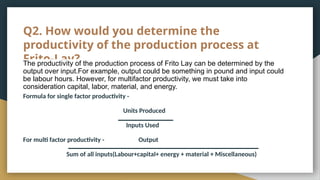
The productivity of the production process of Frito Lay can be determined by the
output over input.For example, output could be something in pound and input could
be labour hours. However, for multifactor productivity, we must take into
consideration capital, labor, material, and energy.
Formula for single factor productivity -
Units Produced
Inputs Used
For multi factor productivity - Output
Sum of all inputs(Labour+capital+ energy + material + Miscellaneous)
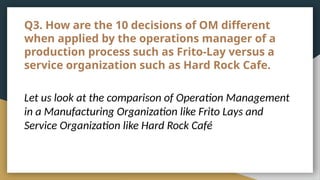
Q3. How are the 10 decisions of OM different
when applied by the operations manager of a
production process such as Frito-Lay versus a
service organization such as Hard Rock Cafe.
Let us look at the comparison of Operation Management
in a Manufacturing Organization like Frito Lays and
Service Organization like Hard Rock Café
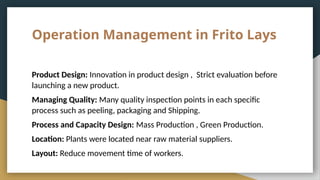
Operation Management in Frito Lays
Product Design: Innovation in product design , Strict evaluation before
launching a new product.
Managing Quality: Many quality inspection points in each specific
process such as peeling, packaging and Shipping.
Process and Capacity Design: Mass Production , Green Production.
Location: Plants were located near raw material suppliers.
Layout: Reduce movement time of workers.
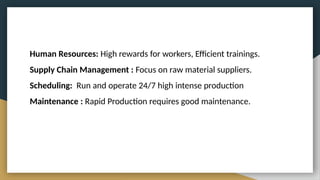
Human Resources: High rewards for workers, Efficient trainings.
Supply Chain Management : Focus on raw material suppliers.
Scheduling: Run and operate 24/7 high intense production
Maintenance : Rapid Production requires good maintenance.
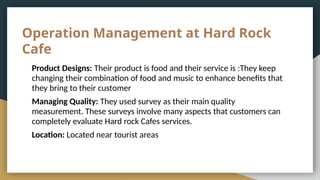
Operation Management at Hard Rock
Cafe
Product Designs: Their product is food and their service is :They keep
changing their combination of food and music to enhance benefits that
they bring to their customer
Managing Quality: They used survey as their main quality
measurement. These surveys involve many aspects that customers can
completely evaluate Hard rock Cafes services.
Location: Located near tourist areas
Human Resources : Having many different positions staffs not only have good
skills for their specific tasks but also show their passion in music and
collaborate with others
Scheduling : Fluctuation in sales. It highly depends on seasonal factor
Maintenance: Maintenance of the Café and improvement where needed
Supply Chain Management: Supply of food materials such as
vegetables ,beverages, glassware etc
Functions of Operations Management Presentation.pptx

Functions of Operations Management Presentation.pptx

  • 1.
  • 2.
    What is operationsmanagement? Operations management (OM) is the set of activities that creates value in the form of goods and services by transforming inputs into outputs.
  • 3.
    Case study -Frito Lay Frito-Lay, the massive Dallas-based subsidiary of PepsiCo, has 38 plants and 48,000 employees in North America. Seven of Frito-Lay’s 41 brands exceed $1 billion in sales: Fritos, Lay’s, Cheetos, Ruffles, Tostitos, Doritos, and Walker’s Potato Chips. Operations is the focus of the firm—from designing products for new markets, to meeting changing consumer preferences, to adjusting to rising commodity costs, to subtle issues involving flavors and preservatives—OM is under constant cost, time, quality, and market pressure. Here is a look at how the 10 decisions of OM are applied at this food processor. In the food industry, product development kitchens experiment with new products, submit them to focus groups, and perform test marketing. Once the product specifications have been set, processes capable of meeting those specifications and the necessary quality standards are created. At Frito-Lay, quality begins at the farm, with onsite inspection of the potatoes used in Ruffles and the corn used in Fritos. Quality continues throughout the manufacturing process, with visual inspections and with statistical process control of product variables such as oil, moisture, seasoning, salt, thickness, and weight. Additional quality evaluations are conducted throughout shipment, receipt, production, packaging, and delivery. The production process at Frito-Lay is designed for large volumes and small variety, using expensive special-purpose equipment, and with swift movement of material through the facility. Product-focused facilities, such as Frito-Lay’s, typically have high capital costs, tight schedules, and rapid processing. FritoLay’s facilities are located regionally to aid in the rapid delivery of products because freshness is a critical issue.
  • 4.
    The production processat Frito-Lay is designed for large volumes and small variety, using expensive special-purpose equipment, and with swift movement of material through the facility. Product- focused facilities, such as Frito-Lay’s, typically have high capital costs, tight schedules, and rapid processing. Frito Lay's facilities are located regionally to aid in the rapid delivery of products because freshness is a critical issue. Sanitary issues and necessarily fast processing of products put a premium on an efficient layout. Production lines are designed for balanced throughput and high utilization. Cross-trained workers, who handle a variety of production lines, have promotion paths identified for their particular skill set. The company rewards employees with medical, retirement, and education plans. Its turnover is very low.The supply chain is integral to success in the food industry; vendors must be chosen with great care. Moreover, the finished food product is highly dependent on perishable raw materials. Consequently, the supply chain brings raw material (potatoes, corn, etc.) to the plant securely and rapidly to meet tight production schedules. For instance, from the time that potatoes are picked in St. Augustine, Florida, until they are unloaded at the Orlando plant, processed, packaged, and shipped from the plant is under 12 hours. The requirement for fresh product requires ontime, just-in-time deliveries combined with both low raw material and finished goods inventories. The continuous-flow nature of the specialized equipment in the production process permits little work-in-process inventory. The plants usually run 24/7. This means that there are four shifts of employees each week. Tight scheduling to ensure the proper mix of fresh finished goods on automated equipment requires reliable systems and effective maintenance. Frito-Lay’s workforce is trained to recognize problems early, and professional maintenance personnel are available on every shift. Downtime is very costly and can lead to late deliveries, making maintenance a high priority.
  • 5.
    Q1. How OMDecisions are applied at Frito-Lay? 1. Design of good and services: Frito currently owns 7 successful products that contribute a huge amount of profits to them. However, Frito Lay always tries to make some innovation in their product designs. Their product development department would experiment with new products and send them to evaluation groups who are responsible for its marketing testing. 2. Managing quality: Frito Lay has a strict quality control process that involves a variety of process such as visual inspection, oil control, weight control, etc. Moreover, they also conduct quality checks throughout shipment, receipt, production, packaging, and Delivery. 3. Process and capacity design: Frito-Lay’s process should be suitably design for their high volumes and small variety, so they have to invest heavily in some high-technology machine that can sustain the rapid process. Moreover, they also focus on green manufacturing and sustainability. They use solar energy to reduce their electricity expense and recycle carton boxes to protect the environment. 4. Location strategy: Because chips require a high freshness of input materials so Frito Lay has to set up their plant near raw material sources. 5. Layout strategy: Sanitary problems and rapid processing of product require Frito Lay to focus on the efficiency of their plant layout. The assembly lines should be easy for workers to do all production steps in the shortest time.
  • 6.
    6. Human resources: There are cross-training for workers who have to operate a variety of production lines. The firm also gives them a specific path with a good promotion policy. Frito Lay also rewards employees with high condition of medical, retirement, and education policy. 7. Supply-chain management : Supply chain is a very important factor that brings success to food- related company. The quality of finished product is highly dependent on the freshness of raw material. Frito Lay should strictly choose good vendors that can supply high-quality raw materials on time, so they can enhance their production’s efficiency. 8. Inventory, material requirements planning, and JIT : The inventory turnover rate for Frito-Lay is 200 times per year. This allows for better flow of fresh goods. 9. Intermediate and short-term scheduling : Frito-Lay upholds tight scheduling to ensure the proper mix of fresh finished good on automated equipment, which requires reliable systems and effective maintenance. 10. Maintenance : Frito Lay has to focus on maintenance because downtime is very costly and leads to a delay in production. They trained their employees to recognize the flaws early and do a professional fix, so they can avoid some problems that force them to stop their production lines.
  • 7.
    Q2. How wouldyou determine the productivity of the production process at Frito-Lay? The productivity of the production process of Frito Lay can be determined by the output over input.For example, output could be something in pound and input could be labour hours. However, for multifactor productivity, we must take into consideration capital, labor, material, and energy. Formula for single factor productivity - Units Produced Inputs Used For multi factor productivity - Output Sum of all inputs(Labour+capital+ energy + material + Miscellaneous)
  • 8.
    Q3. How arethe 10 decisions of OM different when applied by the operations manager of a production process such as Frito-Lay versus a service organization such as Hard Rock Cafe. Let us look at the comparison of Operation Management in a Manufacturing Organization like Frito Lays and Service Organization like Hard Rock Café
  • 9.
    Operation Management inFrito Lays Product Design: Innovation in product design , Strict evaluation before launching a new product. Managing Quality: Many quality inspection points in each specific process such as peeling, packaging and Shipping. Process and Capacity Design: Mass Production , Green Production. Location: Plants were located near raw material suppliers. Layout: Reduce movement time of workers.
  • 10.
    Human Resources: Highrewards for workers, Efficient trainings. Supply Chain Management : Focus on raw material suppliers. Scheduling: Run and operate 24/7 high intense production Maintenance : Rapid Production requires good maintenance.
  • 11.
    Operation Management atHard Rock Cafe Product Designs: Their product is food and their service is :They keep changing their combination of food and music to enhance benefits that they bring to their customer Managing Quality: They used survey as their main quality measurement. These surveys involve many aspects that customers can completely evaluate Hard rock Cafes services. Location: Located near tourist areas
  • 12.
    Human Resources :Having many different positions staffs not only have good skills for their specific tasks but also show their passion in music and collaborate with others Scheduling : Fluctuation in sales. It highly depends on seasonal factor Maintenance: Maintenance of the Café and improvement where needed Supply Chain Management: Supply of food materials such as vegetables ,beverages, glassware etc