Chapter 5
Using Equations to Solve Business Problems
Brechner/Bergeman, Contemporary Mathematics for Business & Consumers, 9th Edition. © 2020 Cengage. All Rights Reserved.
May not be scanned, copied or duplicated, or posted to a publicly accessible website, in whole or in part.
Brechner/Bergeman, Contemporary Mathematics for Business & Consumers, 9th Edition. © 2020 Cengage. All Rights Reserved.
May not be scanned, copied or duplicated, or posted to a publicly accessible website, in whole or in part.
Section I: Solving Basic Equations
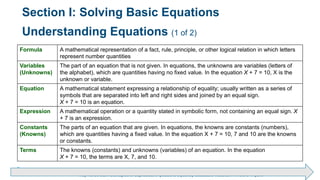
Formula A mathematical representation of a fact, rule, principle, or other logical relation in which letters
represent number quantities
Variables
(Unknowns)
The part of an equation that is not given. In equations, the unknowns are variables (letters of
the alphabet), which are quantities having no fixed value. In the equation X + 7 = 10, X is the
unknown or variable.
Equation A mathematical statement expressing a relationship of equality; usually written as a series of
symbols that are separated into left and right sides and joined by an equal sign.
X + 7 = 10 is an equation.
Expression A mathematical operation or a quantity stated in symbolic form, not containing an equal sign. X
+ 7 is an expression.
Constants
(Knowns)
The parts of an equation that are given. In equations, the knowns are constants (numbers),
which are quantities having a fixed value. In the equation X + 7 = 10, 7 and 10 are the knowns
or constants.
Terms The knowns (constants) and unknowns (variables) of an equation. In the equation
X + 7 = 10, the terms are X, 7, and 10.
Understanding Equations (1 of 2)
Brechner/Bergeman, Contemporary Mathematics for Business & Consumers, 9th Edition. © 2020 Cengage. All Rights Reserved.
May not be scanned, copied or duplicated, or posted to a publicly accessible website, in whole or in part.
Understanding Equations (2 of 2)
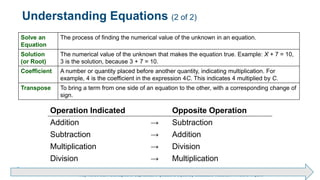
Solve an
Equation
The process of finding the numerical value of the unknown in an equation.
Solution
(or Root)
The numerical value of the unknown that makes the equation true. Example: X + 7 = 10,
3 is the solution, because 3 + 7 = 10.
Coefficient A number or quantity placed before another quantity, indicating multiplication. For
example, 4 is the coefficient in the expression 4C. This indicates 4 multiplied by C.
Transpose To bring a term from one side of an equation to the other, with a corresponding change of
sign.
Operation Indicated Blank Opposite Operation
Addition → Subtraction
Subtraction → Addition
Multiplication → Division
Division → Multiplication
Brechner/Bergeman, Contemporary Mathematics for Business & Consumers, 9th Edition. © 2020 Cengage. All Rights Reserved.
May not be scanned, copied or duplicated, or posted to a publicly accessible website, in whole or in part.
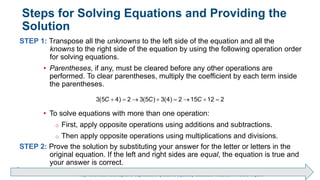
Steps for Solving Equations and Providing the
Solution
STEP 1: Transpose all the unknowns to the left side of the equation and all the
knowns to the right side of the equation by using the following operation order
for solving equations.
• Parentheses, if any, must be cleared before any other operations are
performed. To clear parentheses, multiply the coefficient by each term inside
the parentheses.
• To solve equations with more than one operation:
o First, apply opposite operations using additions and subtractions.
o Then apply opposite operations using multiplications and divisions.
STEP 2: Prove the solution by substituting your answer for the letter or letters in the
original equation. If the left and right sides are equal, the equation is true and
your answer is correct.
       
3(5 4) 2 3(5 ) 3(4) 2 15 12 2
C C C
Brechner/Bergeman, Contemporary Mathematics for Business & Consumers, 9th Edition. © 2020 Cengage. All Rights Reserved.
May not be scanned, copied or duplicated, or posted to a publicly accessible website, in whole or in part.
Solving Basic Equations
Tips for solving equations
• Whatever you do to one side of the equation, do to the other.
• Use the opposite operation to get rid of (i.e., move) a term from
one side of the equation to the other.
• Isolate the unknown (variable).
• Combine like terms.
Brechner/Bergeman, Contemporary Mathematics for Business & Consumers, 9th Edition. © 2020 Cengage. All Rights Reserved.
May not be scanned, copied or duplicated, or posted to a publicly accessible website, in whole or in part.
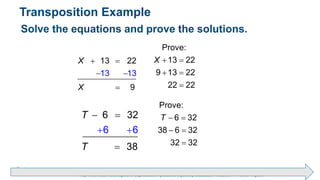
Solve the equations and prove the solutions.





13 1
13 22
3
9
X
X

 


6
32
3
6
6
8
T
T
Transposition Example
 
 

Prove:
13 22
9 13 22
22 22
X
 
 

Prove:
6 32
38 6 32
32 32
T
Brechner/Bergeman, Contemporary Mathematics for Business & Consumers, 9th Edition. © 2020 Cengage. All Rights Reserved.
May not be scanned, copied or duplicated, or posted to a publicly accessible website, in whole or in part.
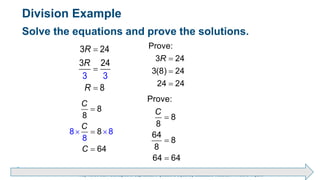
Solve the equations and prove the solutions.



3
3 24
3 24
8
3
R
R
R



Prove:
3 24
3(8) 24
24 24
R


 

8
8
8
8
8
6
8
4
C
C
C



Prove:
8
8
64
8
8
64 64
C
Division Example
Brechner/Bergeman, Contemporary Mathematics for Business & Consumers, 9th Edition. © 2020 Cengage. All Rights Reserved.
May not be scanned, copied or duplicated, or posted to a publicly accessible website, in whole or in part.
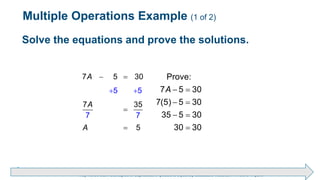
Solve the equations and prove the solutions.

 



5 5
7 5 30
7 3
7
5
5
7
A
A
A
 
 
 

Prove:
7 5 30
7(5) 5 30
35 5 30
30 30
A
Multiple Operations Example (1 of 2)
Brechner/Bergeman, Contemporary Mathematics for Business & Consumers, 9th Edition. © 2020 Cengage. All Rights Reserved.
May not be scanned, copied or duplicated, or posted to a publicly accessible website, in whole or in part.
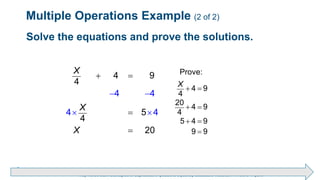
Solve the equations and prove the solutions.
4 4
4 4
4 9
4
5
4
20
X
X
X
 
 
 


Prove:
4 9
4
20
4 9
4
5 4 9
9 9
X
 
 
 

Multiple Operations Example (2 of 2)
Brechner/Bergeman, Contemporary Mathematics for Business & Consumers, 9th Edition. © 2020 Cengage. All Rights Reserved.
May not be scanned, copied or duplicated, or posted to a publicly accessible website, in whole or in part.
 
 
 
 

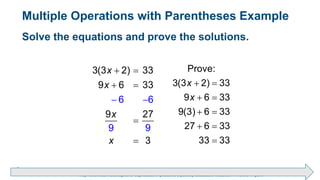
Prove:
3(3 2) 33
9 6 33
9(3) 6 33
27 6 33
33 33
x
x
 
 


 
3(3 2) 33
9 6 3
6 6
9
9
3
9
3
27
x
x
x
x
Solve the equations and prove the solutions.
Multiple Operations with Parentheses Example
Brechner/Bergeman, Contemporary Mathematics for Business & Consumers, 9th Edition. © 2020 Cengage. All Rights Reserved.
May not be scanned, copied or duplicated, or posted to a publicly accessible website, in whole or in part.
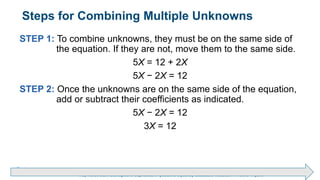
Steps for Combining Multiple Unknowns
STEP 1: To combine unknowns, they must be on the same side of
the equation. If they are not, move them to the same side.
5X = 12 + 2X
5X − 2X = 12
STEP 2: Once the unknowns are on the same side of the equation,
add or subtract their coefficients as indicated.
5X − 2X = 12
3X = 12
Brechner/Bergeman, Contemporary Mathematics for Business & Consumers, 9th Edition. © 2020 Cengage. All Rights Reserved.
May not be scanned, copied or duplicated, or posted to a publicly accessible website, in whole or in part.
   
  
 



 

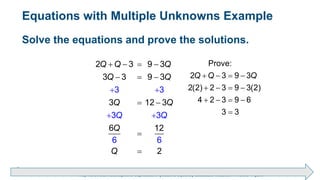
2 3 9 3
3 3 9 3
3
3 3
3 3
12 3
6
6
12
2
6
Q Q Q
Q Q
Q
Q
Q
Q
Q
Q
Solve the equations and prove the solutions.
Equations with Multiple Unknowns Example
   
   
   

Prove:
2 3 9 3
2(2) 2 3 9 3(2)
4 2 3 9 6
3 3
Q Q Q
Brechner/Bergeman, Contemporary Mathematics for Business & Consumers, 9th Edition. © 2020 Cengage. All Rights Reserved.
May not be scanned, copied or duplicated, or posted to a publicly accessible website, in whole or in part.
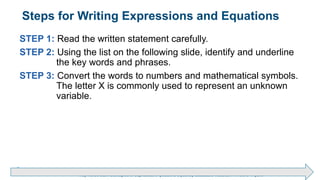
Steps for Writing Expressions and Equations
STEP 1: Read the written statement carefully.
STEP 2: Using the list on the following slide, identify and underline
the key words and phrases.
STEP 3: Convert the words to numbers and mathematical symbols.
The letter X is commonly used to represent an unknown
variable.
Brechner/Bergeman, Contemporary Mathematics for Business & Consumers, 9th Edition. © 2020 Cengage. All Rights Reserved.
May not be scanned, copied or duplicated, or posted to a publicly accessible website, in whole or in part.
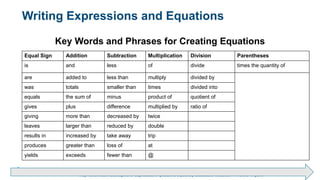
Writing Expressions and Equations
Key Words and Phrases for Creating Equations
Equal Sign Addition Subtraction Multiplication Division Parentheses
is and less of divide times the quantity of
are added to less than multiply divided by blank
was totals smaller than times divided into blank
equals the sum of minus product of quotient of blank
gives plus difference multiplied by ratio of blank
giving more than decreased by twice blank blank
leaves larger than reduced by double blank blank
results in increased by take away trip blank blank
produces greater than loss of at blank blank
yields exceeds fewer than @ blank blank
Brechner/Bergeman, Contemporary Mathematics for Business & Consumers, 9th Edition. © 2020 Cengage. All Rights Reserved.
May not be scanned, copied or duplicated, or posted to a publicly accessible website, in whole or in part.
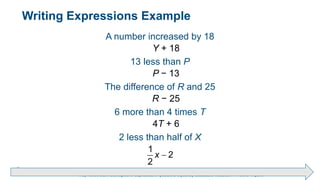
Writing Expressions Example
A number increased by 18
Y + 18
13 less than P
P − 13
The difference of R and 25
R − 25
6 more than 4 times T
4T + 6
2 less than half of X
1
2
2
x 
Brechner/Bergeman, Contemporary Mathematics for Business & Consumers, 9th Edition. © 2020 Cengage. All Rights Reserved.
May not be scanned, copied or duplicated, or posted to a publicly accessible website, in whole or in part.
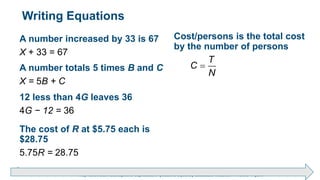
Writing Equations
A number increased by 33 is 67
X + 33 = 67
A number totals 5 times B and C
X = 5B + C
12 less than 4G leaves 36
4G − 12 = 36
The cost of R at $5.75 each is
$28.75
5.75R = 28.75
Cost/persons is the total cost
by the number of persons
T
C
N

Brechner/Bergeman, Contemporary Mathematics for Business & Consumers, 9th Edition. © 2020 Cengage. All Rights Reserved.
May not be scanned, copied or duplicated, or posted to a publicly accessible website, in whole or in part.
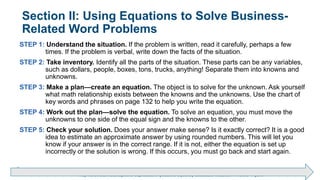
Section II: Using Equations to Solve Business-
Related Word Problems
STEP 1: Understand the situation. If the problem is written, read it carefully, perhaps a few
times. If the problem is verbal, write down the facts of the situation.
STEP 2: Take inventory. Identify all the parts of the situation. These parts can be any variables,
such as dollars, people, boxes, tons, trucks, anything! Separate them into knowns and
unknowns.
STEP 3: Make a plan—create an equation. The object is to solve for the unknown. Ask yourself
what math relationship exists between the knowns and the unknowns. Use the chart of
key words and phrases on page 132 to help you write the equation.
STEP 4: Work out the plan—solve the equation. To solve an equation, you must move the
unknowns to one side of the equal sign and the knowns to the other.
STEP 5: Check your solution. Does your answer make sense? Is it exactly correct? It is a good
idea to estimate an approximate answer by using rounded numbers. This will let you
know if your answer is in the correct range. If it is not, either the equation is set up
incorrectly or the solution is wrong. If this occurs, you must go back and start again.
Brechner/Bergeman, Contemporary Mathematics for Business & Consumers, 9th Edition. © 2020 Cengage. All Rights Reserved.
May not be scanned, copied or duplicated, or posted to a publicly accessible website, in whole or in part.
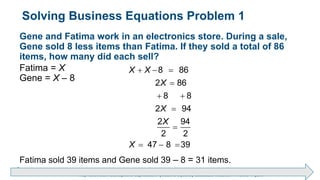
Solving Business Equations Problem 1
Gene and Fatima work in an electronics store. During a sale,
Gene sold 8 less items than Fatima. If they sold a total of 86
items, how many did each sell?
Fatima = X
Gene = X – 8
8 86
2 86
8 8
2 94
2 94
2 2
47 8 39
X X
X
X
X
X
  

 


  
Fatima sold 39 items and Gene sold 39 – 8 = 31 items.
Brechner/Bergeman, Contemporary Mathematics for Business & Consumers, 9th Edition. © 2020 Cengage. All Rights Reserved.
May not be scanned, copied or duplicated, or posted to a publicly accessible website, in whole or in part.
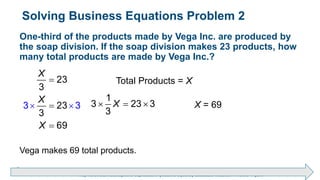
Solving Business Equations Problem 2
One-third of the products made by Vega Inc. are produced by
the soap division. If the soap division makes 23 products, how
many total products are made by Vega Inc.?
Total Products = X
1
3 23 3
3
X
   X = 69
Vega makes 69 total products.
3
23
3
23
3
69
3
X
X
X



 
Brechner/Bergeman, Contemporary Mathematics for Business & Consumers, 9th Edition. © 2020 Cengage. All Rights Reserved.
May not be scanned, copied or duplicated, or posted to a publicly accessible website, in whole or in part.
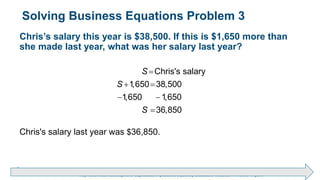
Solving Business Equations Problem 3
Chris’s salary this year is $38,500. If this is $1,650 more than
she made last year, what was her salary last year?
Chris's salary
1,650 38,500
1,650 1,650
36,850
S
S
S

 
 

Chris's salary last year was $36,850.
Brechner/Bergeman, Contemporary Mathematics for Business & Consumers, 9th Edition. © 2020 Cengage. All Rights Reserved.
May not be scanned, copied or duplicated, or posted to a publicly accessible website, in whole or in part.
Understanding and Solving Ratio and Proportion
Problems
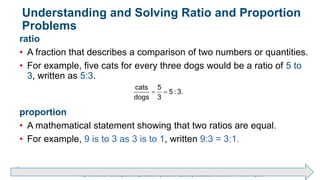
ratio
• A fraction that describes a comparison of two numbers or quantities.
• For example, five cats for every three dogs would be a ratio of 5 to
3, written as 5:3.
proportion
• A mathematical statement showing that two ratios are equal.
• For example, 9 is to 3 as 3 is to 1, written 9:3 = 3:1.
 
cats 5
5 : 3.
dogs 3
Brechner/Bergeman, Contemporary Mathematics for Business & Consumers, 9th Edition. © 2020 Cengage. All Rights Reserved.
May not be scanned, copied or duplicated, or posted to a publicly accessible website, in whole or in part.
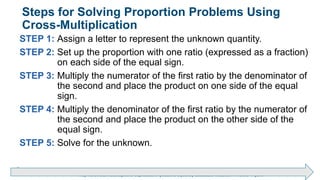
Steps for Solving Proportion Problems Using
Cross-Multiplication
STEP 1: Assign a letter to represent the unknown quantity.
STEP 2: Set up the proportion with one ratio (expressed as a fraction)
on each side of the equal sign.
STEP 3: Multiply the numerator of the first ratio by the denominator of
the second and place the product on one side of the equal
sign.
STEP 4: Multiply the denominator of the first ratio by the numerator of
the second and place the product on the other side of the
equal sign.
STEP 5: Solve for the unknown.
Brechner/Bergeman, Contemporary Mathematics for Business & Consumers, 9th Edition. © 2020 Cengage. All Rights Reserved.
May not be scanned, copied or duplicated, or posted to a publicly accessible website, in whole or in part.
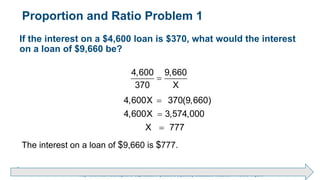
Proportion and Ratio Problem 1
If the interest on a $4,600 loan is $370, what would the interest
on a loan of $9,660 be?
4,600 9,660
370 X

4,600X 370(9,660)
4,600X 3,574,000
X 777



The interest on a loan of $9,660 is $777.
Brechner/Bergeman, Contemporary Mathematics for Business & Consumers, 9th Edition. © 2020 Cengage. All Rights Reserved.
May not be scanned, copied or duplicated, or posted to a publicly accessible website, in whole or in part.
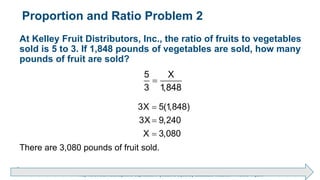
Proportion and Ratio Problem 2
At Kelley Fruit Distributors, Inc., the ratio of fruits to vegetables
sold is 5 to 3. If 1,848 pounds of vegetables are sold, how many
pounds of fruit are sold?
5 X
3 1,848

3X 5(1,848)
3X 9,240
X 3,080



There are 3,080 pounds of fruit sold.
Brechner/Bergeman, Contemporary Mathematics for Business & Consumers, 9th Edition. © 2020 Cengage. All Rights Reserved.
May not be scanned, copied or duplicated, or posted to a publicly accessible website, in whole or in part.
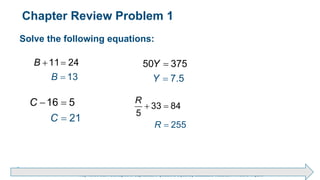
Chapter Review Problem 1
Solve the following equations:

 
16 5
21
C
C


50 375
7.5
Y
Y

 
11 24
13
B
B


 33 8
5
4
5
5
2
R
R
Brechner/Bergeman, Contemporary Mathematics for Business & Consumers, 9th Edition. © 2020 Cengage. All Rights Reserved.
May not be scanned, copied or duplicated, or posted to a publicly accessible website, in whole or in part.
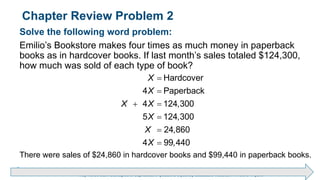
Chapter Review Problem 2
Solve the following word problem:
Emilio’s Bookstore makes four times as much money in paperback
books as in hardcover books. If last month’s sales totaled $124,300,
how much was sold of each type of book?
Hardcover
4 Paperback
4 124,300
5 124,300
24,860
4 99,440
X
X
X X
X
X
X


 



There were sales of $24,860 in hardcover books and $99,440 in paperback books.
Brechner/Bergeman, Contemporary Mathematics for Business & Consumers, 9th Edition. © 2020 Cengage. All Rights Reserved.
May not be scanned, copied or duplicated, or posted to a publicly accessible website, in whole or in part.
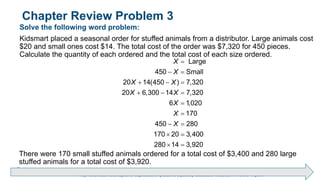
Chapter Review Problem 3
Solve the following word problem:
Kidsmart placed a seasonal order for stuffed animals from a distributor. Large animals cost
$20 and small ones cost $14. The total cost of the order was $7,320 for 450 pieces.
Calculate the quantity of each ordered and the total cost of each size ordered.
Large
450 Small
20 14(450 ) 7,320
20 6,300 14 7,320
6 1,020
170
450 280
170 20 3,400
280 14 3,920
X
X
X X
X X
X
X
X

 
  
  


 
 
 
There were 170 small stuffed animals ordered for a total cost of $3,400 and 280 large
stuffed animals for a total cost of $3,920.
Brechner/Bergeman, Contemporary Mathematics for Business & Consumers, 9th Edition. © 2020 Cengage. All Rights Reserved.
May not be scanned, copied or duplicated, or posted to a publicly accessible website, in whole or in part.
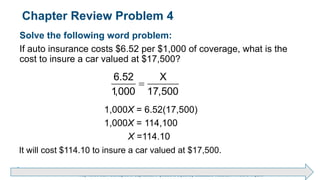
Chapter Review Problem 4
Solve the following word problem:
If auto insurance costs $6.52 per $1,000 of coverage, what is the
cost to insure a car valued at $17,500?
6.52 X
1,000 17,500

1,000X = 6.52(17,500)
1,000X = 114,100
X =114.10
It will cost $114.10 to insure a car valued at $17,500.

Equation Business Problem concerned with mathemetics business

  • 1.
    Chapter 5 Using Equationsto Solve Business Problems Brechner/Bergeman, Contemporary Mathematics for Business & Consumers, 9th Edition. © 2020 Cengage. All Rights Reserved. May not be scanned, copied or duplicated, or posted to a publicly accessible website, in whole or in part.
  • 2.
    Brechner/Bergeman, Contemporary Mathematicsfor Business & Consumers, 9th Edition. © 2020 Cengage. All Rights Reserved. May not be scanned, copied or duplicated, or posted to a publicly accessible website, in whole or in part. Section I: Solving Basic Equations Formula A mathematical representation of a fact, rule, principle, or other logical relation in which letters represent number quantities Variables (Unknowns) The part of an equation that is not given. In equations, the unknowns are variables (letters of the alphabet), which are quantities having no fixed value. In the equation X + 7 = 10, X is the unknown or variable. Equation A mathematical statement expressing a relationship of equality; usually written as a series of symbols that are separated into left and right sides and joined by an equal sign. X + 7 = 10 is an equation. Expression A mathematical operation or a quantity stated in symbolic form, not containing an equal sign. X + 7 is an expression. Constants (Knowns) The parts of an equation that are given. In equations, the knowns are constants (numbers), which are quantities having a fixed value. In the equation X + 7 = 10, 7 and 10 are the knowns or constants. Terms The knowns (constants) and unknowns (variables) of an equation. In the equation X + 7 = 10, the terms are X, 7, and 10. Understanding Equations (1 of 2)
  • 3.
    Brechner/Bergeman, Contemporary Mathematicsfor Business & Consumers, 9th Edition. © 2020 Cengage. All Rights Reserved. May not be scanned, copied or duplicated, or posted to a publicly accessible website, in whole or in part. Understanding Equations (2 of 2) Solve an Equation The process of finding the numerical value of the unknown in an equation. Solution (or Root) The numerical value of the unknown that makes the equation true. Example: X + 7 = 10, 3 is the solution, because 3 + 7 = 10. Coefficient A number or quantity placed before another quantity, indicating multiplication. For example, 4 is the coefficient in the expression 4C. This indicates 4 multiplied by C. Transpose To bring a term from one side of an equation to the other, with a corresponding change of sign. Operation Indicated Blank Opposite Operation Addition → Subtraction Subtraction → Addition Multiplication → Division Division → Multiplication
  • 4.
    Brechner/Bergeman, Contemporary Mathematicsfor Business & Consumers, 9th Edition. © 2020 Cengage. All Rights Reserved. May not be scanned, copied or duplicated, or posted to a publicly accessible website, in whole or in part. Steps for Solving Equations and Providing the Solution STEP 1: Transpose all the unknowns to the left side of the equation and all the knowns to the right side of the equation by using the following operation order for solving equations. • Parentheses, if any, must be cleared before any other operations are performed. To clear parentheses, multiply the coefficient by each term inside the parentheses. • To solve equations with more than one operation: o First, apply opposite operations using additions and subtractions. o Then apply opposite operations using multiplications and divisions. STEP 2: Prove the solution by substituting your answer for the letter or letters in the original equation. If the left and right sides are equal, the equation is true and your answer is correct.         3(5 4) 2 3(5 ) 3(4) 2 15 12 2 C C C
  • 5.
    Brechner/Bergeman, Contemporary Mathematicsfor Business & Consumers, 9th Edition. © 2020 Cengage. All Rights Reserved. May not be scanned, copied or duplicated, or posted to a publicly accessible website, in whole or in part. Solving Basic Equations Tips for solving equations • Whatever you do to one side of the equation, do to the other. • Use the opposite operation to get rid of (i.e., move) a term from one side of the equation to the other. • Isolate the unknown (variable). • Combine like terms.
  • 6.
    Brechner/Bergeman, Contemporary Mathematicsfor Business & Consumers, 9th Edition. © 2020 Cengage. All Rights Reserved. May not be scanned, copied or duplicated, or posted to a publicly accessible website, in whole or in part. Solve the equations and prove the solutions.      13 1 13 22 3 9 X X      6 32 3 6 6 8 T T Transposition Example      Prove: 13 22 9 13 22 22 22 X      Prove: 6 32 38 6 32 32 32 T
  • 7.
    Brechner/Bergeman, Contemporary Mathematicsfor Business & Consumers, 9th Edition. © 2020 Cengage. All Rights Reserved. May not be scanned, copied or duplicated, or posted to a publicly accessible website, in whole or in part. Solve the equations and prove the solutions.    3 3 24 3 24 8 3 R R R    Prove: 3 24 3(8) 24 24 24 R      8 8 8 8 8 6 8 4 C C C    Prove: 8 8 64 8 8 64 64 C Division Example
  • 8.
    Brechner/Bergeman, Contemporary Mathematicsfor Business & Consumers, 9th Edition. © 2020 Cengage. All Rights Reserved. May not be scanned, copied or duplicated, or posted to a publicly accessible website, in whole or in part. Solve the equations and prove the solutions.       5 5 7 5 30 7 3 7 5 5 7 A A A        Prove: 7 5 30 7(5) 5 30 35 5 30 30 30 A Multiple Operations Example (1 of 2)
  • 9.
    Brechner/Bergeman, Contemporary Mathematicsfor Business & Consumers, 9th Edition. © 2020 Cengage. All Rights Reserved. May not be scanned, copied or duplicated, or posted to a publicly accessible website, in whole or in part. Solve the equations and prove the solutions. 4 4 4 4 4 9 4 5 4 20 X X X         Prove: 4 9 4 20 4 9 4 5 4 9 9 9 X        Multiple Operations Example (2 of 2)
  • 10.
    Brechner/Bergeman, Contemporary Mathematicsfor Business & Consumers, 9th Edition. © 2020 Cengage. All Rights Reserved. May not be scanned, copied or duplicated, or posted to a publicly accessible website, in whole or in part.          Prove: 3(3 2) 33 9 6 33 9(3) 6 33 27 6 33 33 33 x x         3(3 2) 33 9 6 3 6 6 9 9 3 9 3 27 x x x x Solve the equations and prove the solutions. Multiple Operations with Parentheses Example
  • 11.
    Brechner/Bergeman, Contemporary Mathematicsfor Business & Consumers, 9th Edition. © 2020 Cengage. All Rights Reserved. May not be scanned, copied or duplicated, or posted to a publicly accessible website, in whole or in part. Steps for Combining Multiple Unknowns STEP 1: To combine unknowns, they must be on the same side of the equation. If they are not, move them to the same side. 5X = 12 + 2X 5X − 2X = 12 STEP 2: Once the unknowns are on the same side of the equation, add or subtract their coefficients as indicated. 5X − 2X = 12 3X = 12
  • 12.
    Brechner/Bergeman, Contemporary Mathematicsfor Business & Consumers, 9th Edition. © 2020 Cengage. All Rights Reserved. May not be scanned, copied or duplicated, or posted to a publicly accessible website, in whole or in part.                2 3 9 3 3 3 9 3 3 3 3 3 3 12 3 6 6 12 2 6 Q Q Q Q Q Q Q Q Q Q Q Solve the equations and prove the solutions. Equations with Multiple Unknowns Example              Prove: 2 3 9 3 2(2) 2 3 9 3(2) 4 2 3 9 6 3 3 Q Q Q
  • 13.
    Brechner/Bergeman, Contemporary Mathematicsfor Business & Consumers, 9th Edition. © 2020 Cengage. All Rights Reserved. May not be scanned, copied or duplicated, or posted to a publicly accessible website, in whole or in part. Steps for Writing Expressions and Equations STEP 1: Read the written statement carefully. STEP 2: Using the list on the following slide, identify and underline the key words and phrases. STEP 3: Convert the words to numbers and mathematical symbols. The letter X is commonly used to represent an unknown variable.
  • 14.
    Brechner/Bergeman, Contemporary Mathematicsfor Business & Consumers, 9th Edition. © 2020 Cengage. All Rights Reserved. May not be scanned, copied or duplicated, or posted to a publicly accessible website, in whole or in part. Writing Expressions and Equations Key Words and Phrases for Creating Equations Equal Sign Addition Subtraction Multiplication Division Parentheses is and less of divide times the quantity of are added to less than multiply divided by blank was totals smaller than times divided into blank equals the sum of minus product of quotient of blank gives plus difference multiplied by ratio of blank giving more than decreased by twice blank blank leaves larger than reduced by double blank blank results in increased by take away trip blank blank produces greater than loss of at blank blank yields exceeds fewer than @ blank blank
  • 15.
    Brechner/Bergeman, Contemporary Mathematicsfor Business & Consumers, 9th Edition. © 2020 Cengage. All Rights Reserved. May not be scanned, copied or duplicated, or posted to a publicly accessible website, in whole or in part. Writing Expressions Example A number increased by 18 Y + 18 13 less than P P − 13 The difference of R and 25 R − 25 6 more than 4 times T 4T + 6 2 less than half of X 1 2 2 x 
  • 16.
    Brechner/Bergeman, Contemporary Mathematicsfor Business & Consumers, 9th Edition. © 2020 Cengage. All Rights Reserved. May not be scanned, copied or duplicated, or posted to a publicly accessible website, in whole or in part. Writing Equations A number increased by 33 is 67 X + 33 = 67 A number totals 5 times B and C X = 5B + C 12 less than 4G leaves 36 4G − 12 = 36 The cost of R at $5.75 each is $28.75 5.75R = 28.75 Cost/persons is the total cost by the number of persons T C N 
  • 17.
    Brechner/Bergeman, Contemporary Mathematicsfor Business & Consumers, 9th Edition. © 2020 Cengage. All Rights Reserved. May not be scanned, copied or duplicated, or posted to a publicly accessible website, in whole or in part. Section II: Using Equations to Solve Business- Related Word Problems STEP 1: Understand the situation. If the problem is written, read it carefully, perhaps a few times. If the problem is verbal, write down the facts of the situation. STEP 2: Take inventory. Identify all the parts of the situation. These parts can be any variables, such as dollars, people, boxes, tons, trucks, anything! Separate them into knowns and unknowns. STEP 3: Make a plan—create an equation. The object is to solve for the unknown. Ask yourself what math relationship exists between the knowns and the unknowns. Use the chart of key words and phrases on page 132 to help you write the equation. STEP 4: Work out the plan—solve the equation. To solve an equation, you must move the unknowns to one side of the equal sign and the knowns to the other. STEP 5: Check your solution. Does your answer make sense? Is it exactly correct? It is a good idea to estimate an approximate answer by using rounded numbers. This will let you know if your answer is in the correct range. If it is not, either the equation is set up incorrectly or the solution is wrong. If this occurs, you must go back and start again.
  • 18.
    Brechner/Bergeman, Contemporary Mathematicsfor Business & Consumers, 9th Edition. © 2020 Cengage. All Rights Reserved. May not be scanned, copied or duplicated, or posted to a publicly accessible website, in whole or in part. Solving Business Equations Problem 1 Gene and Fatima work in an electronics store. During a sale, Gene sold 8 less items than Fatima. If they sold a total of 86 items, how many did each sell? Fatima = X Gene = X – 8 8 86 2 86 8 8 2 94 2 94 2 2 47 8 39 X X X X X X            Fatima sold 39 items and Gene sold 39 – 8 = 31 items.
  • 19.
    Brechner/Bergeman, Contemporary Mathematicsfor Business & Consumers, 9th Edition. © 2020 Cengage. All Rights Reserved. May not be scanned, copied or duplicated, or posted to a publicly accessible website, in whole or in part. Solving Business Equations Problem 2 One-third of the products made by Vega Inc. are produced by the soap division. If the soap division makes 23 products, how many total products are made by Vega Inc.? Total Products = X 1 3 23 3 3 X    X = 69 Vega makes 69 total products. 3 23 3 23 3 69 3 X X X     
  • 20.
    Brechner/Bergeman, Contemporary Mathematicsfor Business & Consumers, 9th Edition. © 2020 Cengage. All Rights Reserved. May not be scanned, copied or duplicated, or posted to a publicly accessible website, in whole or in part. Solving Business Equations Problem 3 Chris’s salary this year is $38,500. If this is $1,650 more than she made last year, what was her salary last year? Chris's salary 1,650 38,500 1,650 1,650 36,850 S S S       Chris's salary last year was $36,850.
  • 21.
    Brechner/Bergeman, Contemporary Mathematicsfor Business & Consumers, 9th Edition. © 2020 Cengage. All Rights Reserved. May not be scanned, copied or duplicated, or posted to a publicly accessible website, in whole or in part. Understanding and Solving Ratio and Proportion Problems ratio • A fraction that describes a comparison of two numbers or quantities. • For example, five cats for every three dogs would be a ratio of 5 to 3, written as 5:3. proportion • A mathematical statement showing that two ratios are equal. • For example, 9 is to 3 as 3 is to 1, written 9:3 = 3:1.   cats 5 5 : 3. dogs 3
  • 22.
    Brechner/Bergeman, Contemporary Mathematicsfor Business & Consumers, 9th Edition. © 2020 Cengage. All Rights Reserved. May not be scanned, copied or duplicated, or posted to a publicly accessible website, in whole or in part. Steps for Solving Proportion Problems Using Cross-Multiplication STEP 1: Assign a letter to represent the unknown quantity. STEP 2: Set up the proportion with one ratio (expressed as a fraction) on each side of the equal sign. STEP 3: Multiply the numerator of the first ratio by the denominator of the second and place the product on one side of the equal sign. STEP 4: Multiply the denominator of the first ratio by the numerator of the second and place the product on the other side of the equal sign. STEP 5: Solve for the unknown.
  • 23.
    Brechner/Bergeman, Contemporary Mathematicsfor Business & Consumers, 9th Edition. © 2020 Cengage. All Rights Reserved. May not be scanned, copied or duplicated, or posted to a publicly accessible website, in whole or in part. Proportion and Ratio Problem 1 If the interest on a $4,600 loan is $370, what would the interest on a loan of $9,660 be? 4,600 9,660 370 X  4,600X 370(9,660) 4,600X 3,574,000 X 777    The interest on a loan of $9,660 is $777.
  • 24.
    Brechner/Bergeman, Contemporary Mathematicsfor Business & Consumers, 9th Edition. © 2020 Cengage. All Rights Reserved. May not be scanned, copied or duplicated, or posted to a publicly accessible website, in whole or in part. Proportion and Ratio Problem 2 At Kelley Fruit Distributors, Inc., the ratio of fruits to vegetables sold is 5 to 3. If 1,848 pounds of vegetables are sold, how many pounds of fruit are sold? 5 X 3 1,848  3X 5(1,848) 3X 9,240 X 3,080    There are 3,080 pounds of fruit sold.
  • 25.
    Brechner/Bergeman, Contemporary Mathematicsfor Business & Consumers, 9th Edition. © 2020 Cengage. All Rights Reserved. May not be scanned, copied or duplicated, or posted to a publicly accessible website, in whole or in part. Chapter Review Problem 1 Solve the following equations:    16 5 21 C C   50 375 7.5 Y Y    11 24 13 B B    33 8 5 4 5 5 2 R R
  • 26.
    Brechner/Bergeman, Contemporary Mathematicsfor Business & Consumers, 9th Edition. © 2020 Cengage. All Rights Reserved. May not be scanned, copied or duplicated, or posted to a publicly accessible website, in whole or in part. Chapter Review Problem 2 Solve the following word problem: Emilio’s Bookstore makes four times as much money in paperback books as in hardcover books. If last month’s sales totaled $124,300, how much was sold of each type of book? Hardcover 4 Paperback 4 124,300 5 124,300 24,860 4 99,440 X X X X X X X        There were sales of $24,860 in hardcover books and $99,440 in paperback books.
  • 27.
    Brechner/Bergeman, Contemporary Mathematicsfor Business & Consumers, 9th Edition. © 2020 Cengage. All Rights Reserved. May not be scanned, copied or duplicated, or posted to a publicly accessible website, in whole or in part. Chapter Review Problem 3 Solve the following word problem: Kidsmart placed a seasonal order for stuffed animals from a distributor. Large animals cost $20 and small ones cost $14. The total cost of the order was $7,320 for 450 pieces. Calculate the quantity of each ordered and the total cost of each size ordered. Large 450 Small 20 14(450 ) 7,320 20 6,300 14 7,320 6 1,020 170 450 280 170 20 3,400 280 14 3,920 X X X X X X X X X                  There were 170 small stuffed animals ordered for a total cost of $3,400 and 280 large stuffed animals for a total cost of $3,920.
  • 28.
    Brechner/Bergeman, Contemporary Mathematicsfor Business & Consumers, 9th Edition. © 2020 Cengage. All Rights Reserved. May not be scanned, copied or duplicated, or posted to a publicly accessible website, in whole or in part. Chapter Review Problem 4 Solve the following word problem: If auto insurance costs $6.52 per $1,000 of coverage, what is the cost to insure a car valued at $17,500? 6.52 X 1,000 17,500  1,000X = 6.52(17,500) 1,000X = 114,100 X =114.10 It will cost $114.10 to insure a car valued at $17,500.