



GO
                                                    Jump Start New Hires – pg 9


                                                    Research: Development Pays Off – pg 24


                                                    Secrets of Pipeline Success – pg 30


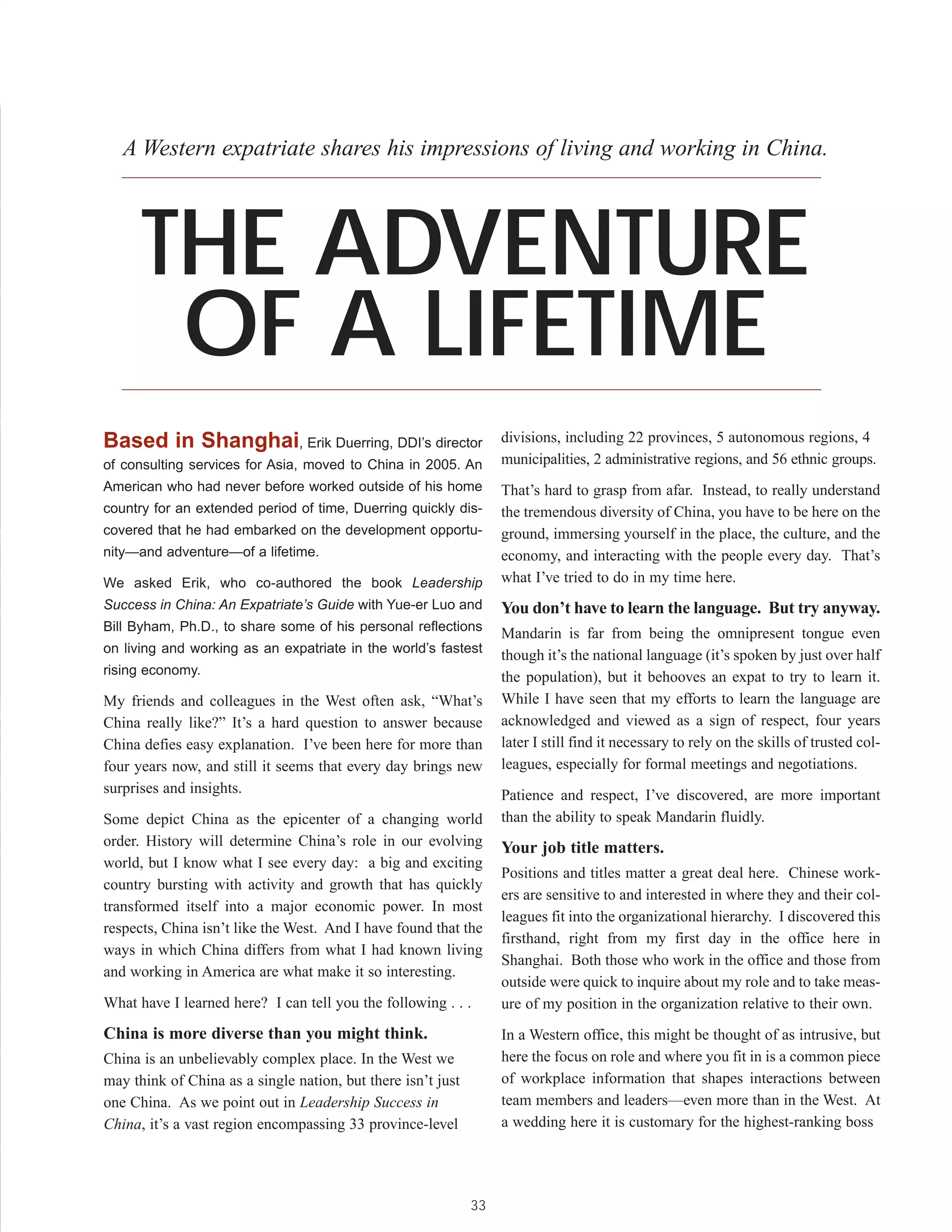
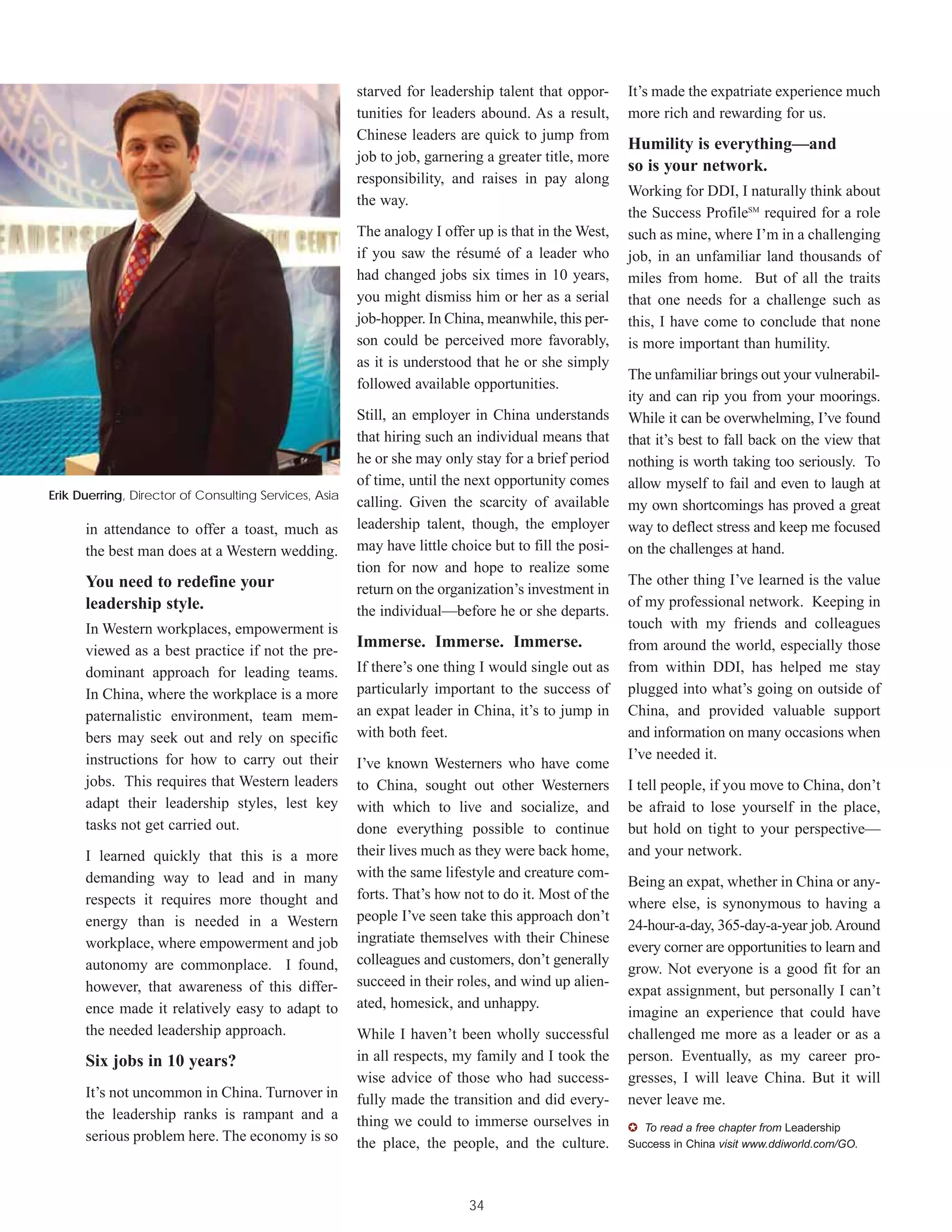
                                                    An Expat’s View of China – pg 33
Great People. Great Organizations. Great Results.
                                                                                                  Spring 2010 Vol. 6, No. 1


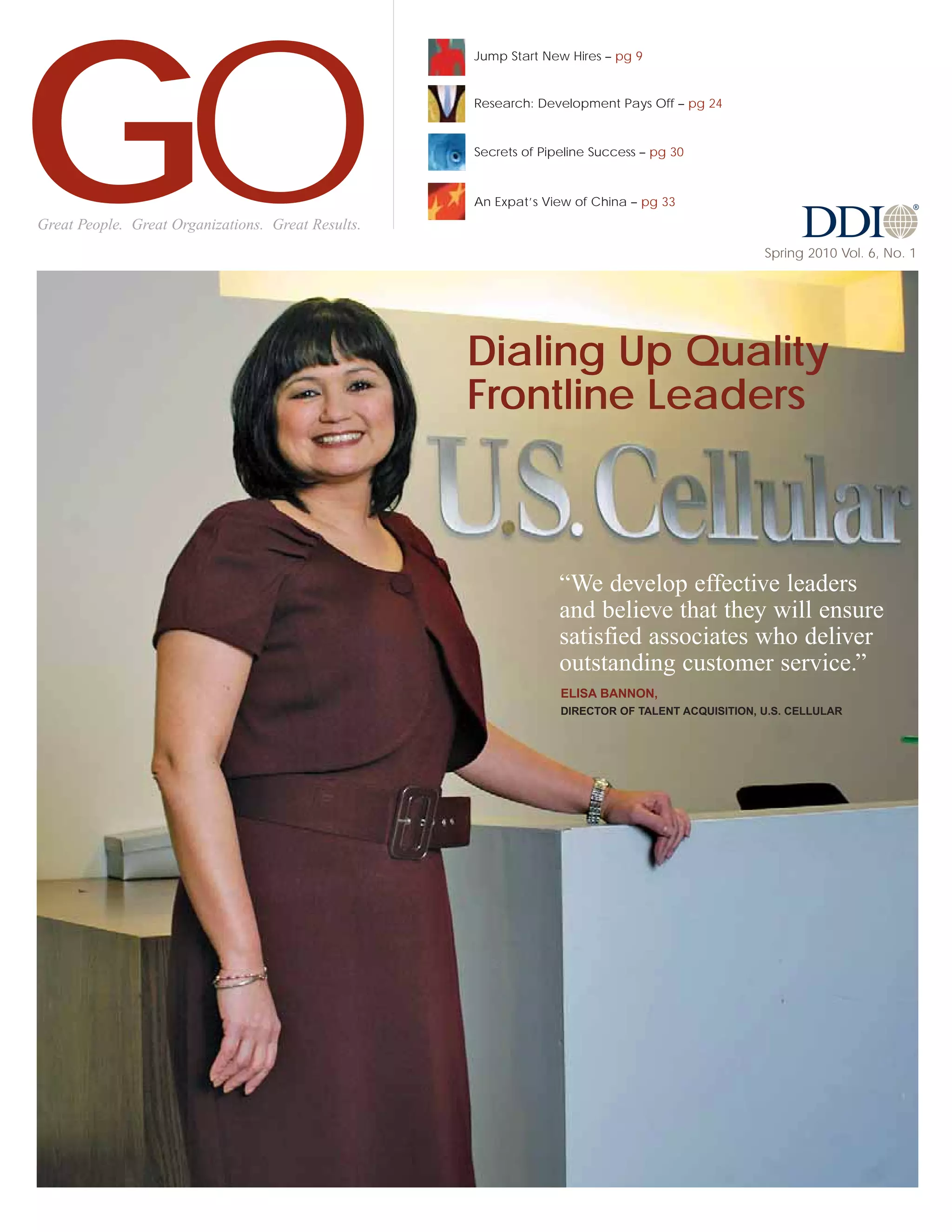
                                                    Dialing Up Quality
                                                    Frontline Leaders


                                                                  “We develop effective leaders
                                                                  and believe that they will ensure
                                                                  satisfied associates who deliver
                                                                  outstanding customer service.”
                                                                  ELISA BANNON,
                                                                  DIRECTOR OF TALENT ACQUISITION, U.S. CELLULAR
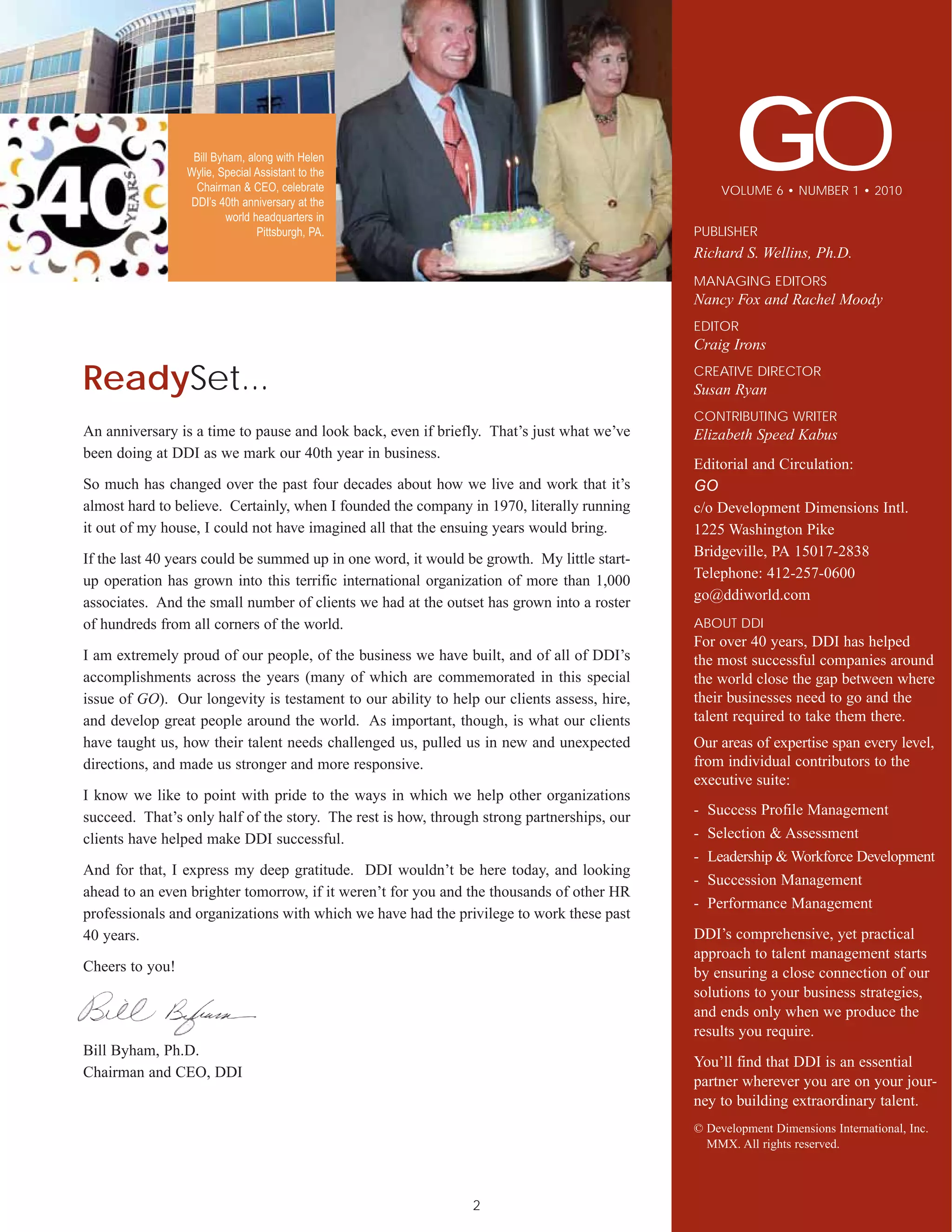
Bill Byham, along with Helen
                 Wylie, Special Assistant to the
                  Chairman & CEO, celebrate
                 DDI’s 40th anniversary at the
                          world headquarters in
                                                                                                   GO
                                                                                                 VOLUME 6 • NUMBER 1 • 2010


                                 Pittsburgh, PA.                                            PUBLISHER
                                                                                            Richard S. Wellins, Ph.D.
                                                                                            MANAGING EDITORS
                                                                                            Nancy Fox and Rachel Moody
                                                                                            EDITOR
                                                                                            Craig Irons

ReadySet...                                                                                 CREATIVE DIRECTOR
                                                                                            Susan Ryan
                                                                                            CONTRIBUTING WRITER
An anniversary is a time to pause and look back, even if briefly. That’s just what we’ve    Elizabeth Speed Kabus
been doing at DDI as we mark our 40th year in business.
                                                                                            Editorial and Circulation:
So much has changed over the past four decades about how we live and work that it’s         GO
almost hard to believe. Certainly, when I founded the company in 1970, literally running    c/o Development Dimensions Intl.
it out of my house, I could not have imagined all that the ensuing years would bring.       1225 Washington Pike
If the last 40 years could be summed up in one word, it would be growth. My little start-   Bridgeville, PA 15017-2838
up operation has grown into this terrific international organization of more than 1,000     Telephone: 412-257-0600
associates. And the small number of clients we had at the outset has grown into a roster    go@ddiworld.com
of hundreds from all corners of the world.                                                  ABOUT DDI
                                                                                            For over 40 years, DDI has helped
I am extremely proud of our people, of the business we have built, and of all of DDI’s      the most successful companies around
accomplishments across the years (many of which are commemorated in this special            the world close the gap between where
issue of GO). Our longevity is testament to our ability to help our clients assess, hire,   their businesses need to go and the
and develop great people around the world. As important, though, is what our clients        talent required to take them there.
have taught us, how their talent needs challenged us, pulled us in new and unexpected       Our areas of expertise span every level,
directions, and made us stronger and more responsive.                                       from individual contributors to the
                                                                                            executive suite:
I know we like to point with pride to the ways in which we help other organizations
succeed. That’s only half of the story. The rest is how, through strong partnerships, our   - Success Profile Management
clients have helped make DDI successful.                                                    - Selection & Assessment
                                                                                            - Leadership & Workforce Development
And for that, I express my deep gratitude. DDI wouldn’t be here today, and looking
                                                                                            - Succession Management
ahead to an even brighter tomorrow, if it weren’t for you and the thousands of other HR
                                                                                            - Performance Management
professionals and organizations with which we have had the privilege to work these past
40 years.                                                                                   DDI’s comprehensive, yet practical
                                                                                            approach to talent management starts
Cheers to you!                                                                              by ensuring a close connection of our
                                                                                            solutions to your business strategies,
                                                                                            and ends only when we produce the
                                                                                            results you require.
Bill Byham, Ph.D.
                                                                                            You’ll find that DDI is an essential
Chairman and CEO, DDI
                                                                                            partner wherever you are on your jour-
                                                                                            ney to building extraordinary talent.
                                                                                            © Development Dimensions International, Inc.
                                                                                              MMX. All rights reserved.


                                                               2
30


17                                                                                 27
                   10
                                                                                                                           32


           9                                                                              28


contents
GO VOLUME 6 • NUMBER 1 • SPRING 2010

F E AT U R E S                                                     D E PA R T M E N T S
9 Courageous Networking Primes a New Hire’s Fast Start             4   GO to Work with Talent Champions
    A conversation with Bill Byham on the importance                     A Call for Great Leaders
    of networking in the workplace.                                      Elisa Bannon and her colleagues at U.S. Cellular are
                                                                         committed to putting great leadership talent where it
10 How a Course is Made
                                                                         matters most—in the company’s stores.
     Behind the scenes with the team that produced
     DDI’s new IM: ExPSM series for individual contributors.       14 What’s GOing On
                                                                       DDI teams with CNBC in Asia and AFR BOSS magazine
17 Four Decades of Serving You!
                                                                       in Australia to recognize standout business leaders.
     On DDI’s 40th anniversary we recognize our people,
     our innovations, and especially you.                          24 Research
                                                                        A new DDI study confirms the strong impact of
22 Many Reasons to Celebrate
                                                                        leadership training.
     Forty years in business is worth celebrating, but
     what excites us most are our clients’ great results           26 Trend Tracker
     and their wonderful feedback.                                      Findings of a recent DDI study capture the state
                                                                        of a discontented workforce.
30 The Middle Matters
     Best-in-class companies believe mid-level is key              27 ERGO
     to pipeline success.                                               What’s the biggest change in the workforce since 1970?
32 The Adventure of a Lifetime                                     28 Coffee on the GO
     A Western expatriate shares his impressions of                     Paul Osterman, author of The Truth About Middle
     living and working in China.                                       Managers, discusses the challenges facing the most
                                                                        overlooked category of leaders.


                                                               3
GO TO WORK


             4
A Call
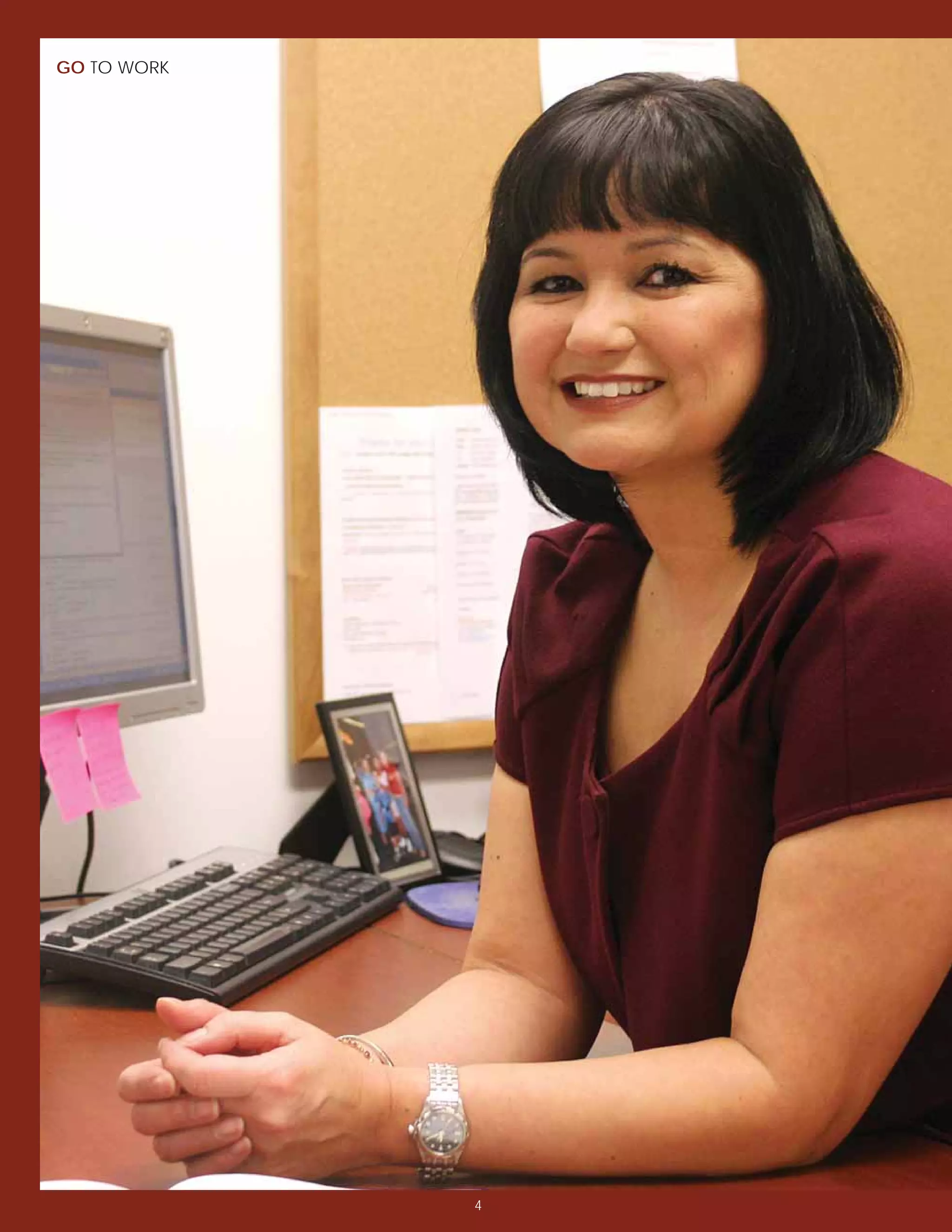
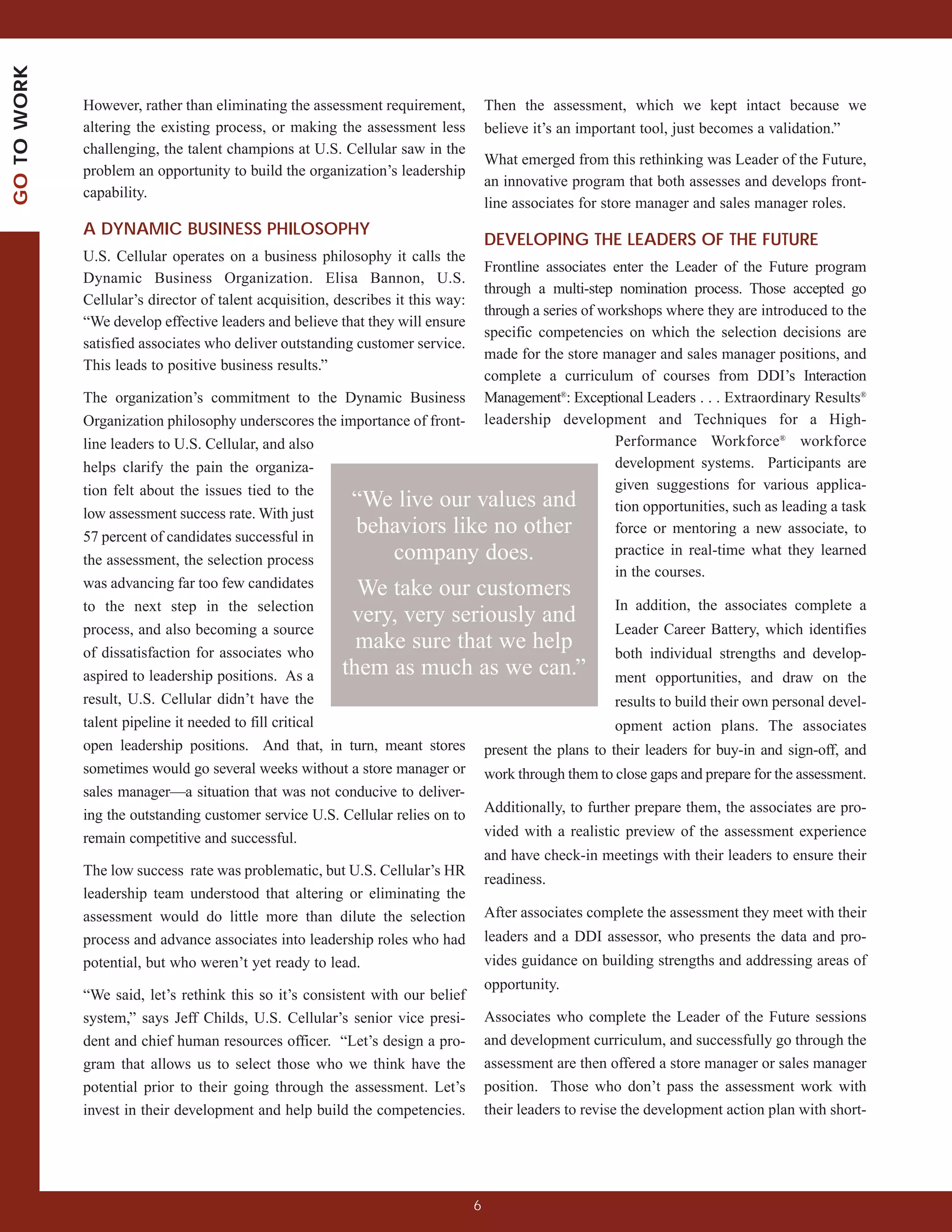
Elisa Bannon and her
colleagues at U.S. Cellular
are committed to putting
great leadership talent
where it matters most—
in the company’s stores.
                              for Great
                              Leaders
                              Alejandro Alumbreros is a busy guy. He manages two U.S. Cellular
                              stores in suburban Chicago, one of the largest markets for the nation’s fifth
                              largest full-service wireless carrier. What makes Alumbreros’ job especially
                              challenging is that, even though he previously worked in a U.S. Cellular store
                              for a year-and-a-half as a sales manager, he’s new to the store manager role.

                              He rattles off a long list of his new responsibilities, but Alumbreros isn’t
                              complaining.

                              “We live our values and behaviors like no other company does,” he says
                              cheerfully. “We are here first for the customer. We take our customers very,
                              very seriously and make sure that we help them as much as we can.”

                              Alumbreros would appear to be exactly the type of individual a retail organ-
                              ization like U.S. Cellular would want in its stores serving customers and
                              leading employees.

                              Yet, he almost never got the chance. U.S. Cellular’s promotion process for
                              store and sales managers (the two frontline leadership positions in U.S.
                              Cellular’s stores) includes a challenging assessment. And many candidates
                              were coming up short. In fact, in 2007 just 57 percent of candidates were
                              successful in the assessment. Alumbreros was not among them.

                              For a company that hires 90 percent of its leaders from within, a 57-percent
                              success rate wasn’t acceptable, even though the company’s leadership felt
                              strongly about the integrity of the assessment and the need for it to be part
                              of the selection process.


                                         5
GO TO WORK


             However, rather than eliminating the assessment requirement,            Then the assessment, which we kept intact because we
             altering the existing process, or making the assessment less            believe it’s an important tool, just becomes a validation.”
             challenging, the talent champions at U.S. Cellular saw in the
                                                                                     What emerged from this rethinking was Leader of the Future,
             problem an opportunity to build the organization’s leadership
                                                                                     an innovative program that both assesses and develops front-
             capability.
                                                                                     line associates for store manager and sales manager roles.
             A DYNAMIC BUSINESS PHILOSOPHY
                                                                                     DEVELOPING THE LEADERS OF THE FUTURE
             U.S. Cellular operates on a business philosophy it calls the
                                                                          Frontline associates enter the Leader of the Future program
             Dynamic Business Organization. Elisa Bannon, U.S.
                                                                          through a multi-step nomination process. Those accepted go
             Cellular’s director of talent acquisition, describes it this way:
                                                                          through a series of workshops where they are introduced to the
             “We develop effective leaders and believe that they will ensure
                                                                          specific competencies on which the selection decisions are
             satisfied associates who deliver outstanding customer service.
                                                                          made for the store manager and sales manager positions, and
             This leads to positive business results.”
                                                                          complete a curriculum of courses from DDI’s Interaction
             The organization’s commitment to the Dynamic Business Management®: Exceptional Leaders . . . Extraordinary Results®
             Organization philosophy underscores the importance of front- leadership development and Techniques for a High-
             line leaders to U.S. Cellular, and also                                            Performance Workforce® workforce
             helps clarify the pain the organiza-                                               development systems. Participants are
             tion felt about the issues tied to the                                             given suggestions for various applica-
                                                       “We live our values and                  tion opportunities, such as leading a task
             low assessment success rate. With just
             57 percent of candidates successful in
                                                       behaviors like no other                  force or mentoring a new associate, to

             the assessment, the selection process           company does.                      practice in real-time what they learned
                                                                                                in the courses.
             was advancing far too few candidates      We take our customers
             to the next step in the selection                                                  In addition, the associates complete a
                                                          very, very seriously and
             process, and also becoming a source                                                   Leader Career Battery, which identifies
             of dissatisfaction for associates who
                                                          make sure that we help                   both individual strengths and develop-
             aspired to leadership positions. As a      them as much as we can.” ment opportunities, and draw on the
             result, U.S. Cellular didn’t have the                                                 results to build their own personal devel-
             talent pipeline it needed to fill critical                                            opment action plans. The associates
             open leadership positions. And that, in turn, meant stores present the plans to their leaders for buy-in and sign-off, and
             sometimes would go several weeks without a store manager or work through them to close gaps and prepare for the assessment.
             sales manager—a situation that was not conducive to deliver-
             ing the outstanding customer service U.S. Cellular relies on to Additionally, to further prepare them, the associates are pro-
             remain competitive and successful.                              vided with a realistic preview of the assessment experience
                                                                             and have check-in meetings with their leaders to ensure their
             The low success rate was problematic, but U.S. Cellular’s HR
                                                                             readiness.
             leadership team understood that altering or eliminating the
             assessment would do little more than dilute the selection After associates complete the assessment they meet with their
             process and advance associates into leadership roles who had leaders and a DDI assessor, who presents the data and pro-
             potential, but who weren’t yet ready to lead.                           vides guidance on building strengths and addressing areas of
                                                                                     opportunity.
             “We said, let’s rethink this so it’s consistent with our belief
             system,” says Jeff Childs, U.S. Cellular’s senior vice presi-           Associates who complete the Leader of the Future sessions
             dent and chief human resources officer. “Let’s design a pro-            and development curriculum, and successfully go through the
             gram that allows us to select those who we think have the               assessment are then offered a store manager or sales manager
             potential prior to their going through the assessment. Let’s            position. Those who don’t pass the assessment work with
             invest in their development and help build the competencies.            their leaders to revise the development action plan with short-


                                                                                 6
term objectives addressing the improvement areas identified           Bannon is enthusiastic and energetic when recalling how
during the assessment. The aim is to prepare the associate to         Leader of the Future came to fruition, and it’s not hard to
be successful in the assessment the next time, once the super-        imagine how those traits served her well as she sought to
visor believes that he or she is ready to be reassessed.              build consensus among the various U.S. Cellular stakeholders.

In another critical component of Leader of the Future, super-         Lamart Clay, director of sales for U.S. Cellular’s Nebraska
visors of the leadership candidates attend a two-day work-            market, lauds Bannon for her ability to get everyone on the
shop, Developing Leadership Talent. During the workshop,              same page and excited about the solution.
they increase their knowledge of the program, enhance their           “Elisa was the glue. She talked to a lot of folks in the field
skills to support associates’ development prior to and after          who had been successful at working on developing a pipeline
assessment, and build confidence so that they are better pre-         of candidates, and was able to identify the best practices, take
pared to support the development of U.S. Cellular’s future            away things that didn’t work, and create what we thought was
leaders. Just as the associates are required to do as part of         the best solution for the enterprise. Elisa’s leadership made
Leader of the Future, the supervisors build development plans         this whole thing possible.”
to promote application of their new skills.
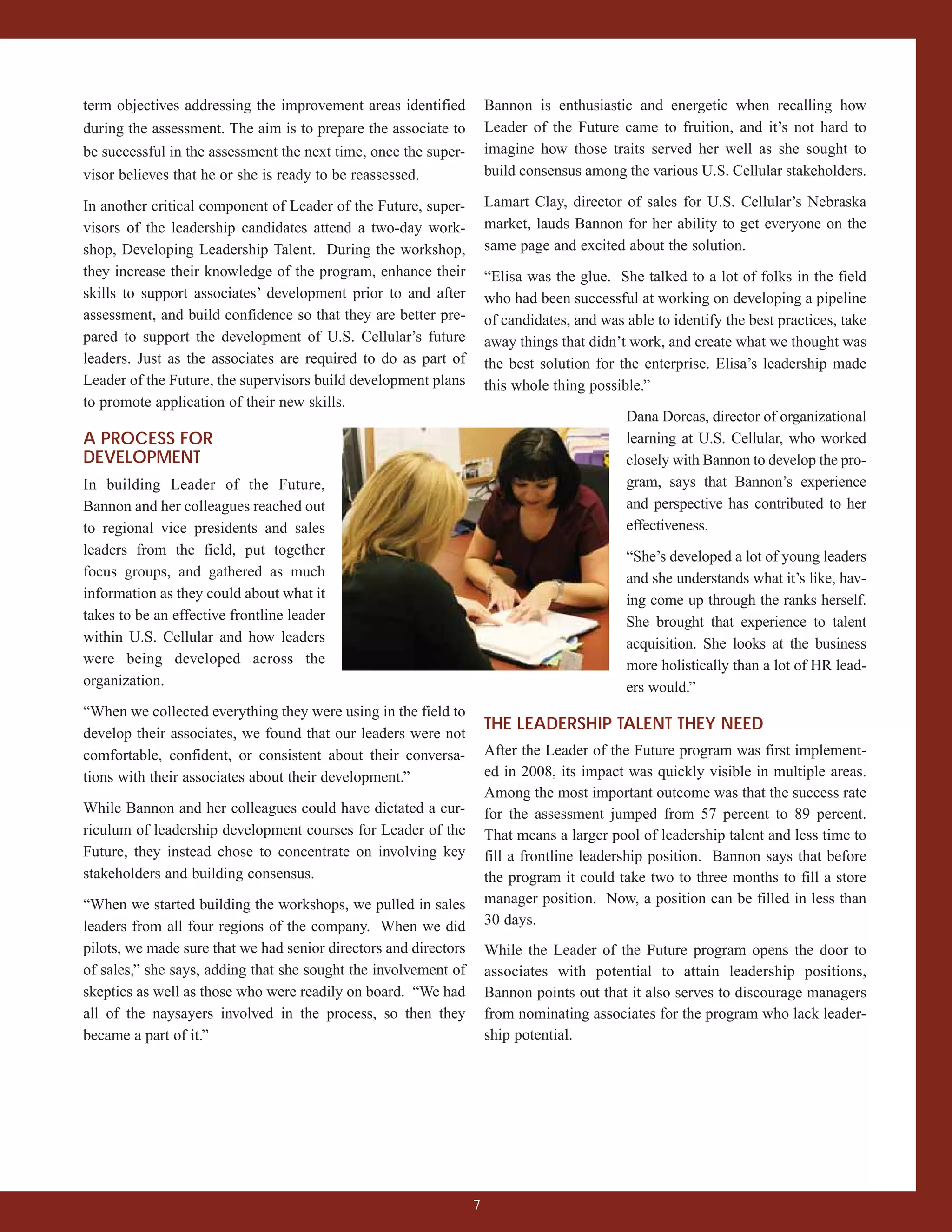
                                                                                             Dana Dorcas, director of organizational
A PROCESS FOR                                                                                learning at U.S. Cellular, who worked
DEVELOPMENT                                                                                  closely with Bannon to develop the pro-
In building Leader of the Future,                                                            gram, says that Bannon’s experience
Bannon and her colleagues reached out                                                        and perspective has contributed to her
to regional vice presidents and sales                                                        effectiveness.
leaders from the field, put together                                                         “She’s developed a lot of young leaders
focus groups, and gathered as much                                                           and she understands what it’s like, hav-
information as they could about what it                                                      ing come up through the ranks herself.
takes to be an effective frontline leader                                                    She brought that experience to talent
within U.S. Cellular and how leaders                                                         acquisition. She looks at the business
were being developed across the                                                              more holistically than a lot of HR lead-
organization.                                                                                ers would.”
“When we collected everything they were using in the field to
                                                                      THE LEADERSHIP TALENT THEY NEED
develop their associates, we found that our leaders were not
comfortable, confident, or consistent about their conversa-           After the Leader of the Future program was first implement-
tions with their associates about their development.”                 ed in 2008, its impact was quickly visible in multiple areas.
                                                                      Among the most important outcome was that the success rate
While Bannon and her colleagues could have dictated a cur-            for the assessment jumped from 57 percent to 89 percent.
riculum of leadership development courses for Leader of the           That means a larger pool of leadership talent and less time to
Future, they instead chose to concentrate on involving key            fill a frontline leadership position. Bannon says that before
stakeholders and building consensus.                                  the program it could take two to three months to fill a store
“When we started building the workshops, we pulled in sales           manager position. Now, a position can be filled in less than
leaders from all four regions of the company. When we did             30 days.
pilots, we made sure that we had senior directors and directors       While the Leader of the Future program opens the door to
of sales,” she says, adding that she sought the involvement of        associates with potential to attain leadership positions,
skeptics as well as those who were readily on board. “We had          Bannon points out that it also serves to discourage managers
all of the naysayers involved in the process, so then they            from nominating associates for the program who lack leader-
became a part of it.”                                                 ship potential.


                                                                  7
GO TO WORK


             “We assessed less, but because we’re growing and developing our leaders of the future, we have been able to spend our dollars
             more wisely.”

             In addition, the organization’s leadership acknowledges that the program has had a tremendous impact. Childs says that with
             its focus on individual development as well as assessment, Leader of the Future has enabled U.S. Cellular to build a retail lead-
             ership pipeline by spotting those individuals who should be fast-tracked.

             Dorcas is even more enthusiastic.

             “It has been overwhelmingly successful,” he says. “Without a doubt, those that have gone through the new approach are more
             well-rounded than those who passed the assessment before Leader of the Future. It really gave us not only a higher assess-
             ment success rate but it gave us a future leader with a more in-depth understanding of what’s going to be expected of them,
             with less surprise and intimidation.”

             That included Alumbreros who, through Leader of the Future, got the feedback, development, and preparation he needed to
             pass the assessment in 2008, after not passing it previously.

             “I got the feedback from DDI and that allowed me to prepare for the next time I went through the assessment,” he says.
             “It was pretty awesome, knowing that you worked so hard to get where you want to be. And then to get that call that you
             passed, it felt great.”
             ✪ To learn more about DDI’s assessment offerings, our Interaction Management®: Exceptional Leaders . . . Extraordinary Results® leadership development
             system, and our new IM: ExP workforce development system, visit www.ddiworld.com/GO.


             HOW TO... Sell a Talent Solution Internally
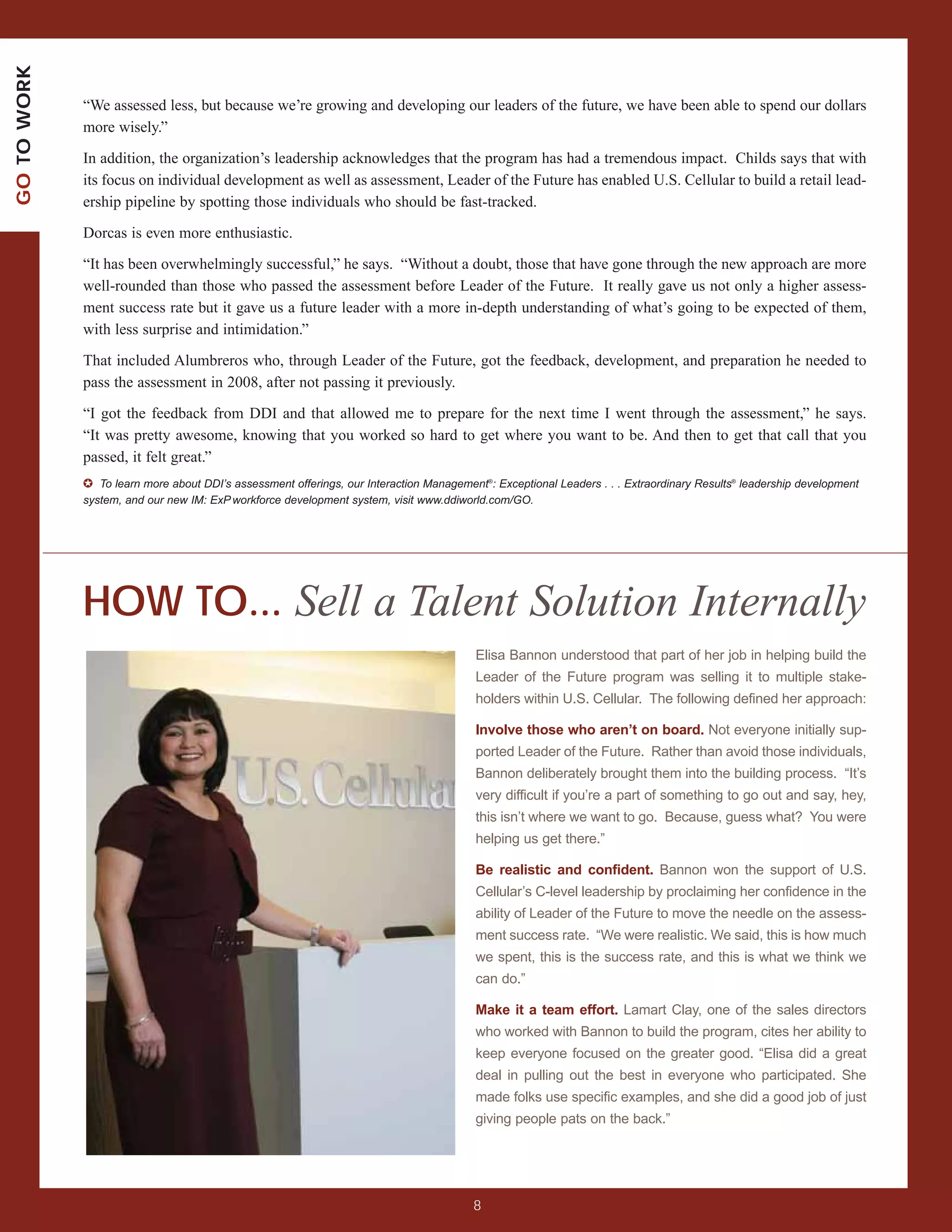
                                                                                        Elisa Bannon understood that part of her job in helping build the
                                                                                        Leader of the Future program was selling it to multiple stake-
                                                                                        holders within U.S. Cellular. The following defined her approach:

                                                                                        Involve those who aren’t on board. Not everyone initially sup-
                                                                                        ported Leader of the Future. Rather than avoid those individuals,
                                                                                        Bannon deliberately brought them into the building process. “It’s
                                                                                        very difficult if you’re a part of something to go out and say, hey,
                                                                                        this isn’t where we want to go. Because, guess what? You were
                                                                                        helping us get there.”

                                                                                        Be realistic and confident. Bannon won the support of U.S.
                                                                                        Cellular’s C-level leadership by proclaiming her confidence in the
                                                                                        ability of Leader of the Future to move the needle on the assess-
                                                                                        ment success rate. “We were realistic. We said, this is how much
                                                                                        we spent, this is the success rate, and this is what we think we
                                                                                        can do.”

                                                                                        Make it a team effort. Lamart Clay, one of the sales directors
                                                                                        who worked with Bannon to build the program, cites her ability to
                                                                                        keep everyone focused on the greater good. “Elisa did a great
                                                                                        deal in pulling out the best in everyone who participated. She
                                                                                        made folks use specific examples, and she did a good job of just
                                                                                        giving people pats on the back.”


                                                                                        8
Courageous Networking
             Primes a New Hire’s Fast Start
                                             A Conversation with Bill Byham, Ph.D.


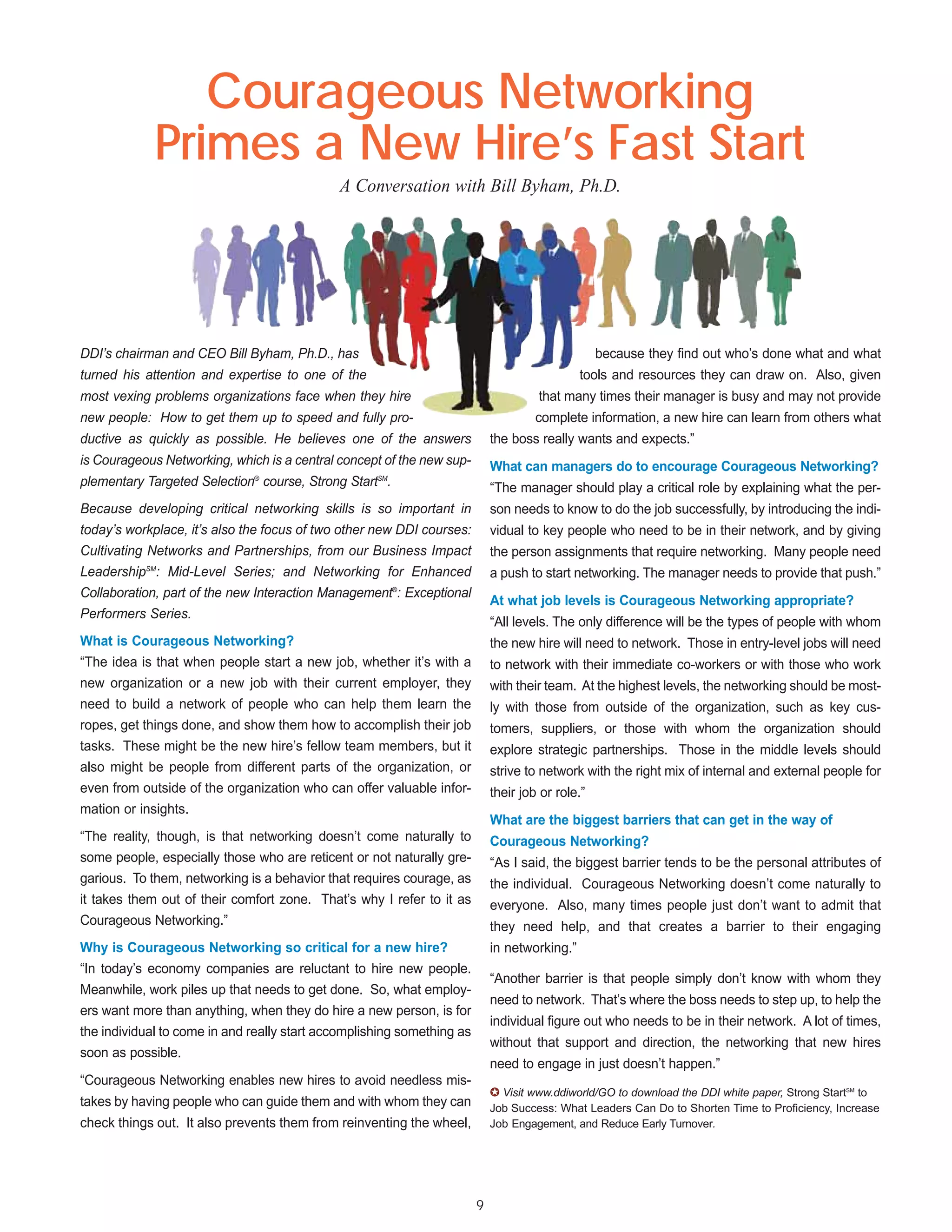
DDI’s chairman and CEO Bill Byham, Ph.D., has                                                     because they find out who’s done what and what
turned his attention and expertise to one of the                                              tools and resources they can draw on. Also, given
most vexing problems organizations face when they hire                               that many times their manager is busy and may not provide
new people: How to get them up to speed and fully pro-                               complete information, a new hire can learn from others what
ductive as quickly as possible. He believes one of the answers              the boss really wants and expects.”
is Courageous Networking, which is a central concept of the new sup-        What can managers do to encourage Courageous Networking?
plementary Targeted Selection® course, Strong StartSM.                      “The manager should play a critical role by explaining what the per-
Because developing critical networking skills is so important in            son needs to know to do the job successfully, by introducing the indi-
today’s workplace, it’s also the focus of two other new DDI courses:        vidual to key people who need to be in their network, and by giving
Cultivating Networks and Partnerships, from our Business Impact             the person assignments that require networking. Many people need
LeadershipSM: Mid-Level Series; and Networking for Enhanced                 a push to start networking. The manager needs to provide that push.”
Collaboration, part of the new Interaction Management®: Exceptional
                                                                            At what job levels is Courageous Networking appropriate?
Performers Series.
                                                                            “All levels. The only difference will be the types of people with whom
What is Courageous Networking?                                              the new hire will need to network. Those in entry-level jobs will need
“The idea is that when people start a new job, whether it’s with a          to network with their immediate co-workers or with those who work
new organization or a new job with their current employer, they             with their team. At the highest levels, the networking should be most-
need to build a network of people who can help them learn the               ly with those from outside of the organization, such as key cus-
ropes, get things done, and show them how to accomplish their job           tomers, suppliers, or those with whom the organization should
tasks. These might be the new hire’s fellow team members, but it            explore strategic partnerships. Those in the middle levels should
also might be people from different parts of the organization, or           strive to network with the right mix of internal and external people for
even from outside of the organization who can offer valuable infor-         their job or role.”
mation or insights.
                                                                            What are the biggest barriers that can get in the way of
“The reality, though, is that networking doesn’t come naturally to          Courageous Networking?
some people, especially those who are reticent or not naturally gre-        “As I said, the biggest barrier tends to be the personal attributes of
garious. To them, networking is a behavior that requires courage, as        the individual. Courageous Networking doesn’t come naturally to
it takes them out of their comfort zone. That’s why I refer to it as        everyone. Also, many times people just don’t want to admit that
Courageous Networking.”                                                     they need help, and that creates a barrier to their engaging
Why is Courageous Networking so critical for a new hire?                    in networking.”
“In today’s economy companies are reluctant to hire new people.
                                                                            “Another barrier is that people simply don’t know with whom they
Meanwhile, work piles up that needs to get done. So, what employ-
                                                                            need to network. That’s where the boss needs to step up, to help the
ers want more than anything, when they do hire a new person, is for
                                                                            individual figure out who needs to be in their network. A lot of times,
the individual to come in and really start accomplishing something as
                                                                            without that support and direction, the networking that new hires
soon as possible.
                                                                            need to engage in just doesn’t happen.”
“Courageous Networking enables new hires to avoid needless mis-
                                                                            ✪ Visit www.ddiworld/GO to download the DDI white paper, Strong StartSM to
takes by having people who can guide them and with whom they can            Job Success: What Leaders Can Do to Shorten Time to Proficiency, Increase
check things out. It also prevents them from reinventing the wheel,         Job Engagement, and Reduce Early Turnover.


                                                                        9
HOW A COURSE IS MADE:
BEHIND THE SCENES WITH IM: EXP
                                                                                                                                     SM


The end product can fit into a small box: facilitator guide, DVD, wall charts, participant workbooks and job aids.
Producing these little packages takes big effort. DDI’s team of writers, researchers, editors, graphic designers and subject
matter experts began producing the latest round of courses for the new series aimed at individual contributors, called
Interaction Management®: Exceptional Performers (IM: ExPSM) in early 2009. The development team invited GO readers to
travel along and get a peek at just what goes into developing a DDI course.


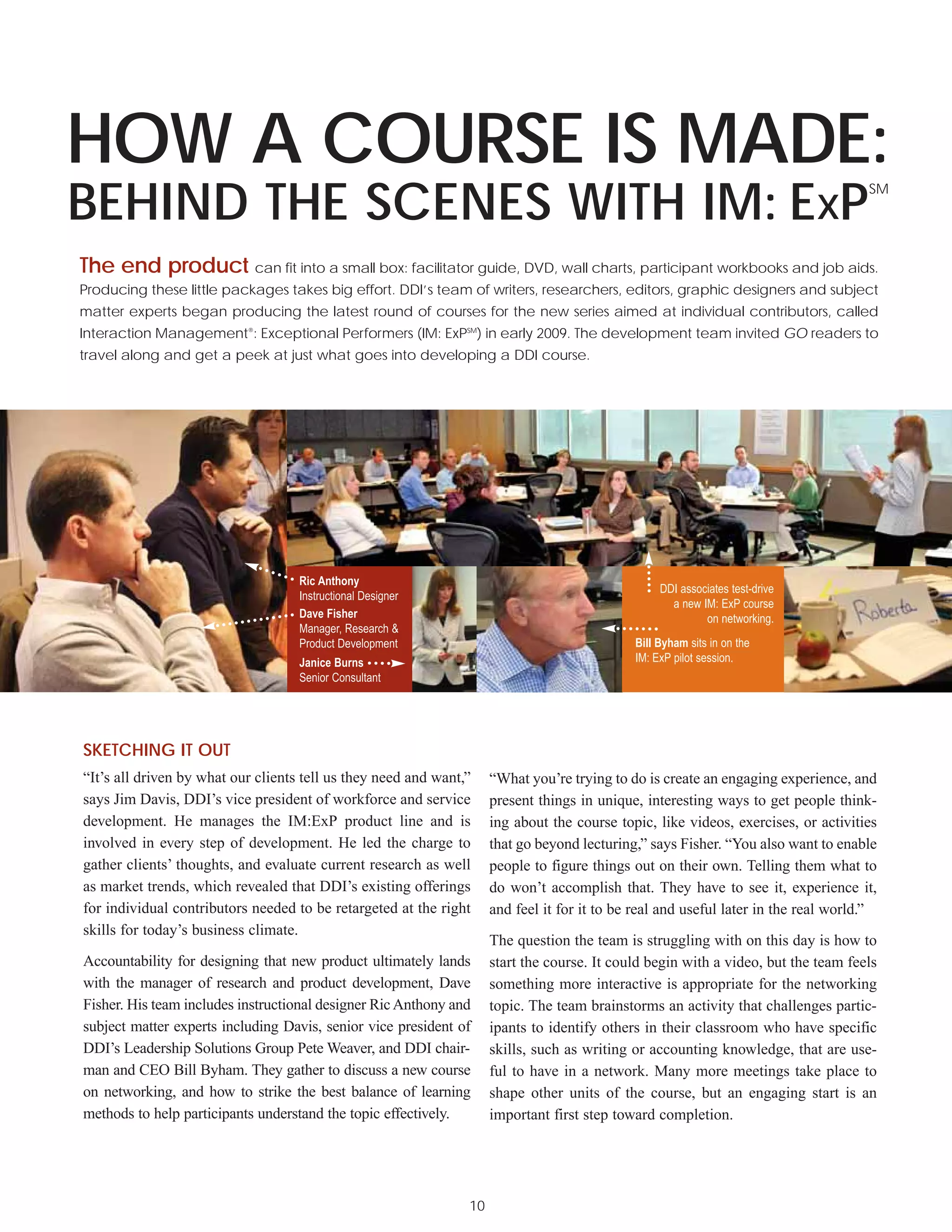
                                    Ric Anthony
                                                                                                  DDI associates test-drive
                                    Instructional Designer
                                                                                                    a new IM: ExP course
                                    Dave Fisher                                                            on networking.
                                    Manager, Research &
                                    Product Development                                      Bill Byham sits in on the
                                    Janice Burns                                             IM: ExP pilot session.
                                    Senior Consultant


SKETCHING IT OUT
“It’s all driven by what our clients tell us they need and want,”    “What you’re trying to do is create an engaging experience, and
says Jim Davis, DDI’s vice president of workforce and service        present things in unique, interesting ways to get people think-
development. He manages the IM:ExP product line and is               ing about the course topic, like videos, exercises, or activities
involved in every step of development. He led the charge to          that go beyond lecturing,” says Fisher. “You also want to enable
gather clients’ thoughts, and evaluate current research as well      people to figure things out on their own. Telling them what to
as market trends, which revealed that DDI’s existing offerings       do won’t accomplish that. They have to see it, experience it,
for individual contributors needed to be retargeted at the right     and feel it for it to be real and useful later in the real world.”
skills for today’s business climate.
                                                                     The question the team is struggling with on this day is how to
Accountability for designing that new product ultimately lands       start the course. It could begin with a video, but the team feels
with the manager of research and product development, Dave           something more interactive is appropriate for the networking
Fisher. His team includes instructional designer Ric Anthony and     topic. The team brainstorms an activity that challenges partic-
subject matter experts including Davis, senior vice president of     ipants to identify others in their classroom who have specific
DDI’s Leadership Solutions Group Pete Weaver, and DDI chair-         skills, such as writing or accounting knowledge, that are use-
man and CEO Bill Byham. They gather to discuss a new course          ful to have in a network. Many more meetings take place to
on networking, and how to strike the best balance of learning        shape other units of the course, but an engaging start is an
methods to help participants understand the topic effectively.       important first step toward completion.


                                                                10
ASSEMBLING A COURSE                                                       The session goes smoothly—confirmation that the course content
It is Ric Anthony’s job to assimilate the outcome of the multi-           is close to being finalized. At the end, participants offer their
ple rounds of meetings, discussions, and field tests into one             comments and critiques. Directions for some of the exercises
cohesive course. Drawing on two decades of experience                     need clarification, but the video scripts are well received.
designing learning for adults, Anthony strives for courses                And the participants feel their time as test subjects was worth-
that are “high impact, entertaining, easily-facilitated, and that         while, equipping them with new ideas to strengthen their net-
develop skills and knowledge that are applicable on the job.”             working skills.
                                                                          A typical course goes through three to seven iterations, and
He’ll first draft the course overview, then when that’s finalized
                                                                          there are significant changes made based on participant feed-
he works with the editorial team to produce participant work-
                                                                          back. “We learn so much during these test runs,” says Fisher.
books, facilitator guides, and other supporting materials.
                                                                          “Feedback from client pilots influences the course design,
Anthony also scripts the videos.


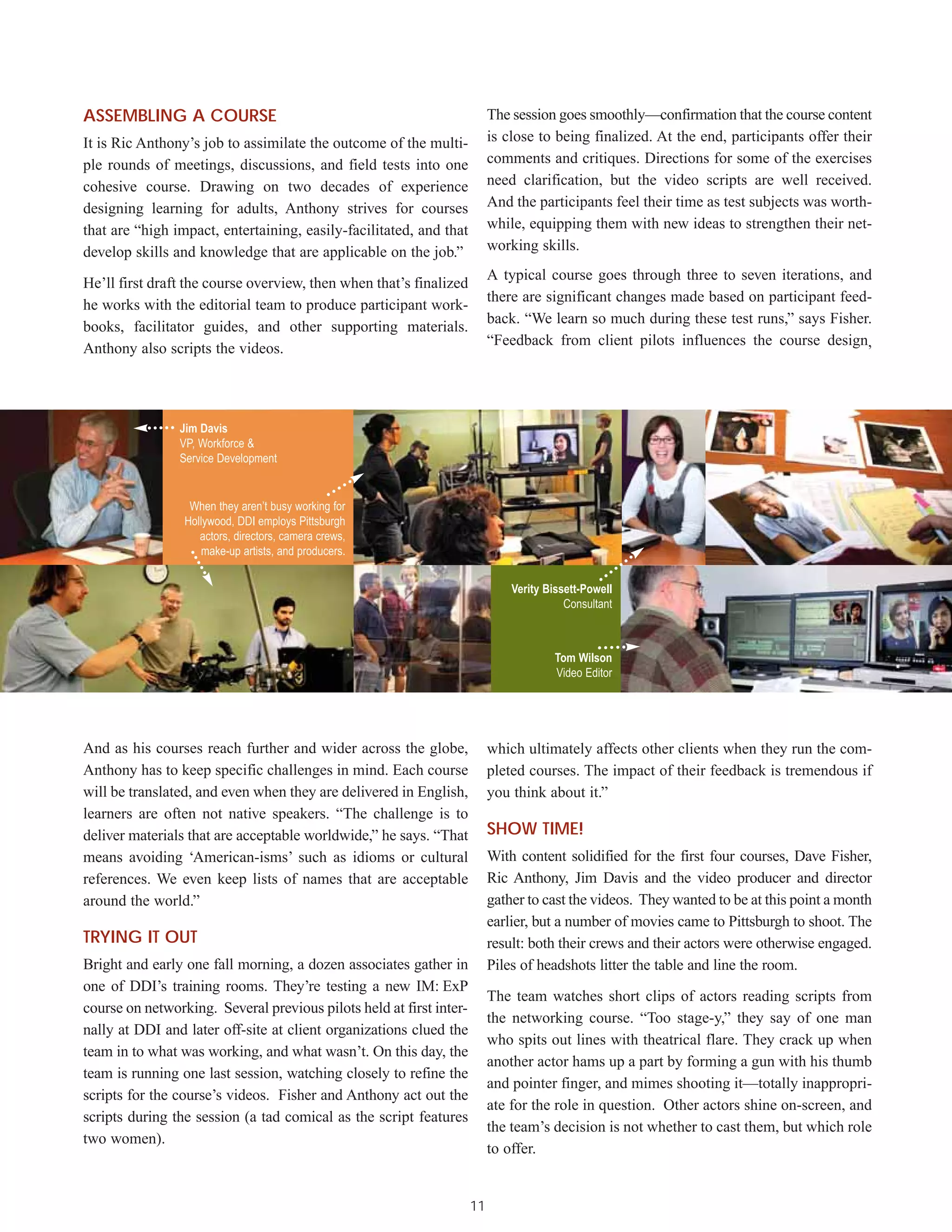
                Jim Davis
                VP, Workforce &
                Service Development


                  When they aren’t busy working for
                 Hollywood, DDI employs Pittsburgh
                    actors, directors, camera crews,
                    make-up artists, and producers.


                                                                              Verity Bissett-Powell
                                                                                         Consultant


                                                                                       Tom Wilson
                                                                                       Video Editor


And as his courses reach further and wider across the globe,              which ultimately affects other clients when they run the com-
Anthony has to keep specific challenges in mind. Each course              pleted courses. The impact of their feedback is tremendous if
will be translated, and even when they are delivered in English,          you think about it.”
learners are often not native speakers. “The challenge is to
deliver materials that are acceptable worldwide,” he says. “That          SHOW TIME!
means avoiding ‘American-isms’ such as idioms or cultural                 With content solidified for the first four courses, Dave Fisher,
references. We even keep lists of names that are acceptable               Ric Anthony, Jim Davis and the video producer and director
around the world.”                                                        gather to cast the videos. They wanted to be at this point a month
                                                                          earlier, but a number of movies came to Pittsburgh to shoot. The
TRYING IT OUT                                                             result: both their crews and their actors were otherwise engaged.
Bright and early one fall morning, a dozen associates gather in           Piles of headshots litter the table and line the room.
one of DDI’s training rooms. They’re testing a new IM: ExP
                                                                          The team watches short clips of actors reading scripts from
course on networking. Several previous pilots held at first inter-
                                                                          the networking course. “Too stage-y,” they say of one man
nally at DDI and later off-site at client organizations clued the
                                                                          who spits out lines with theatrical flare. They crack up when
team in to what was working, and what wasn’t. On this day, the
                                                                          another actor hams up a part by forming a gun with his thumb
team is running one last session, watching closely to refine the
                                                                          and pointer finger, and mimes shooting it—totally inappropri-
scripts for the course’s videos. Fisher and Anthony act out the
                                                                          ate for the role in question. Other actors shine on-screen, and
scripts during the session (a tad comical as the script features
                                                                          the team’s decision is not whether to cast them, but which role
two women).
                                                                          to offer.


                                                                     11
Younger or older. Black, white, Asian, and other races. Male,
and female. Diversity is a key consideration when casting the
29 roles needed for the upcoming shoot, and the team pays a
lot of attention to getting the right mix of on-screen talent.

A month later, the chosen actors report to the DDI offices in
Pittsburgh, where many of the videos for this series are shot.
This day, the team is shooting the video featuring two women
who are networking (the same scene Fisher and Anthony
acted out in pilot training for the course). A large meeting
room is converted into an office set, and it’s crowded with
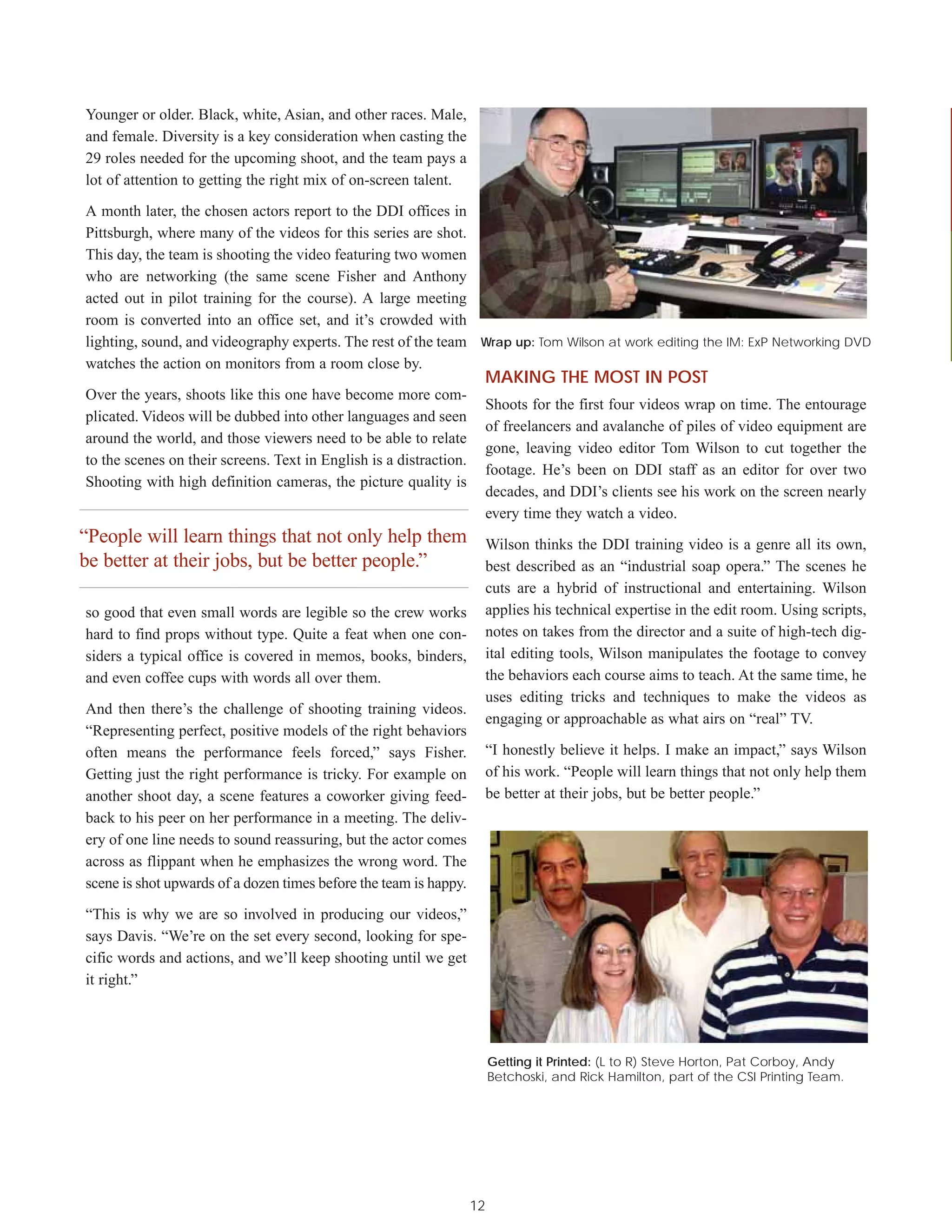
lighting, sound, and videography experts. The rest of the team Wrap up: Tom Wilson at work editing the IM: ExP Networking DVD
watches the action on monitors from a room close by.
                                                                         MAKING THE MOST IN POST
Over the years, shoots like this one have become more com-
                                                                         Shoots for the first four videos wrap on time. The entourage
plicated. Videos will be dubbed into other languages and seen
                                                                         of freelancers and avalanche of piles of video equipment are
around the world, and those viewers need to be able to relate
                                                                         gone, leaving video editor Tom Wilson to cut together the
to the scenes on their screens. Text in English is a distraction.
                                                                         footage. He’s been on DDI staff as an editor for over two
Shooting with high definition cameras, the picture quality is
                                                                         decades, and DDI’s clients see his work on the screen nearly
                                                                         every time they watch a video.
“People will learn things that not only help them                        Wilson thinks the DDI training video is a genre all its own,
be better at their jobs, but be better people.”                          best described as an “industrial soap opera.” The scenes he
                                                                         cuts are a hybrid of instructional and entertaining. Wilson
so good that even small words are legible so the crew works              applies his technical expertise in the edit room. Using scripts,
hard to find props without type. Quite a feat when one con-              notes on takes from the director and a suite of high-tech dig-
siders a typical office is covered in memos, books, binders,             ital editing tools, Wilson manipulates the footage to convey
and even coffee cups with words all over them.                           the behaviors each course aims to teach. At the same time, he
                                                                         uses editing tricks and techniques to make the videos as
And then there’s the challenge of shooting training videos.
                                                                         engaging or approachable as what airs on “real” TV.
“Representing perfect, positive models of the right behaviors
often means the performance feels forced,” says Fisher.                  “I honestly believe it helps. I make an impact,” says Wilson
Getting just the right performance is tricky. For example on             of his work. “People will learn things that not only help them
another shoot day, a scene features a coworker giving feed-              be better at their jobs, but be better people.”
back to his peer on her performance in a meeting. The deliv-
ery of one line needs to sound reassuring, but the actor comes
across as flippant when he emphasizes the wrong word. The
scene is shot upwards of a dozen times before the team is happy.

“This is why we are so involved in producing our videos,”
says Davis. “We’re on the set every second, looking for spe-
cific words and actions, and we’ll keep shooting until we get
it right.”


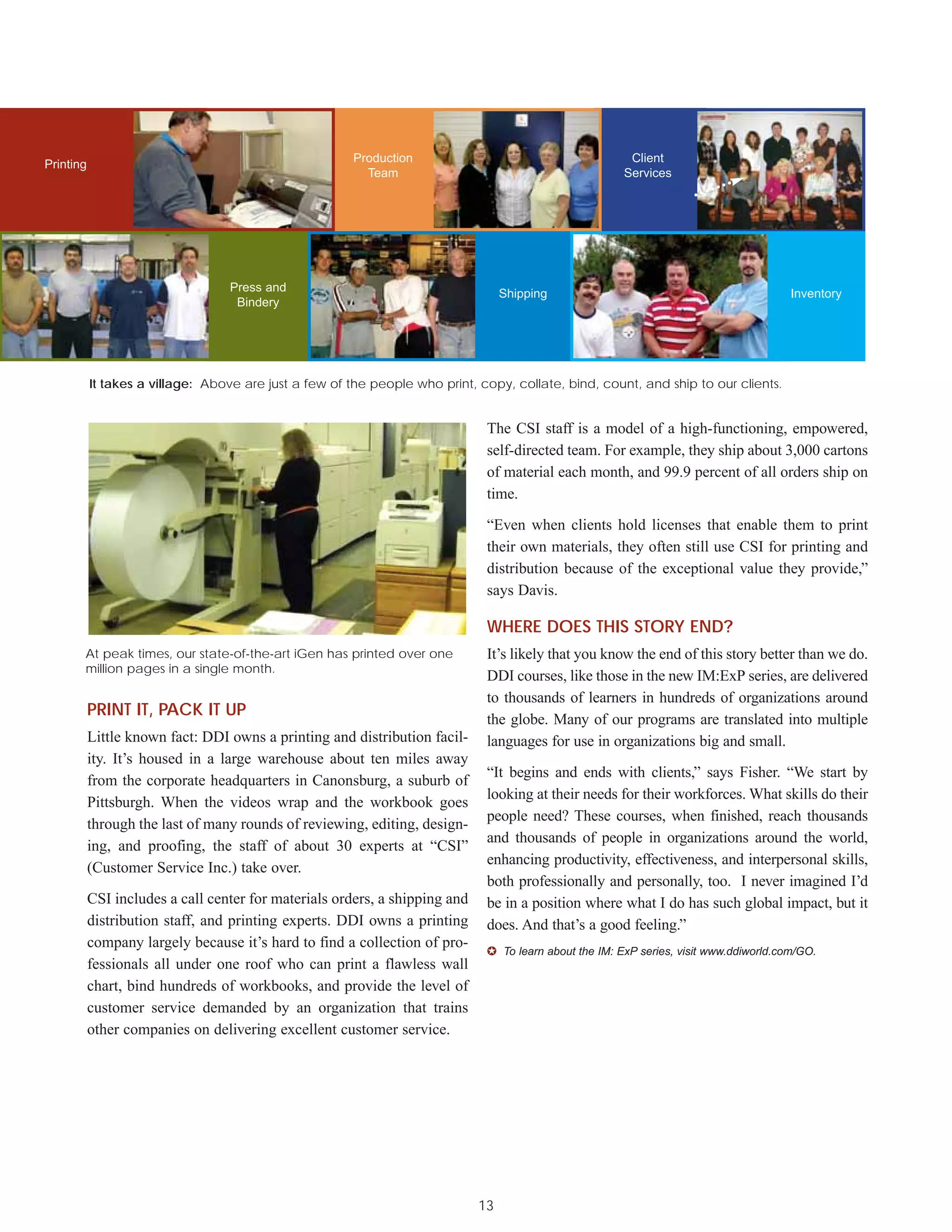
                                                                         Getting it Printed: (L to R) Steve Horton, Pat Corboy, Andy
                                                                         Betchoski, and Rick Hamilton, part of the CSI Printing Team.


                                                                    12
Production                                        Client
Printing
                                                         Team                                           Services


                                  Press and                                       Shipping                                              Inventory
                                   Bindery


           It takes a village: Above are just a few of the people who print, copy, collate, bind, count, and ship to our clients.


                                                                              The CSI staff is a model of a high-functioning, empowered,
                                                                              self-directed team. For example, they ship about 3,000 cartons
                                                                              of material each month, and 99.9 percent of all orders ship on
                                                                              time.

                                                                              “Even when clients hold licenses that enable them to print
                                                                              their own materials, they often still use CSI for printing and
                                                                              distribution because of the exceptional value they provide,”
                                                                              says Davis.

                                                                              WHERE DOES THIS STORY END?
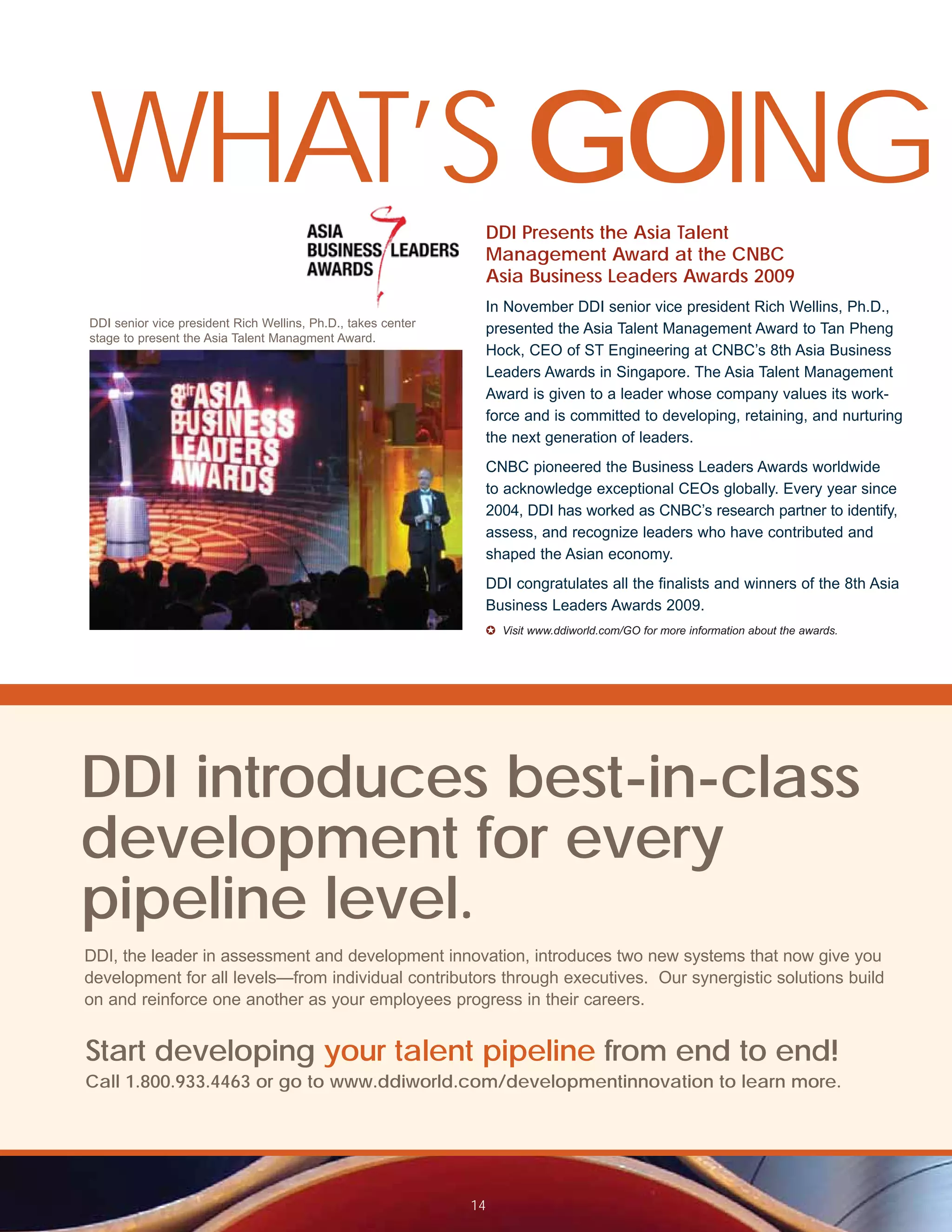
       At peak times, our state-of-the-art iGen has printed over one          It’s likely that you know the end of this story better than we do.
       million pages in a single month.
                                                                              DDI courses, like those in the new IM:ExP series, are delivered
                                                                              to thousands of learners in hundreds of organizations around
           PRINT IT, PACK IT UP
                                                                              the globe. Many of our programs are translated into multiple
           Little known fact: DDI owns a printing and distribution facil-     languages for use in organizations big and small.
           ity. It’s housed in a large warehouse about ten miles away
                                                                              “It begins and ends with clients,” says Fisher. “We start by
           from the corporate headquarters in Canonsburg, a suburb of
                                                                              looking at their needs for their workforces. What skills do their
           Pittsburgh. When the videos wrap and the workbook goes
                                                                              people need? These courses, when finished, reach thousands
           through the last of many rounds of reviewing, editing, design-
                                                                              and thousands of people in organizations around the world,
           ing, and proofing, the staff of about 30 experts at “CSI”
                                                                              enhancing productivity, effectiveness, and interpersonal skills,
           (Customer Service Inc.) take over.
                                                                              both professionally and personally, too. I never imagined I’d
           CSI includes a call center for materials orders, a shipping and    be in a position where what I do has such global impact, but it
           distribution staff, and printing experts. DDI owns a printing      does. And that’s a good feeling.”
           company largely because it’s hard to find a collection of pro-
                                                                              ✪ To learn about the IM: ExP series, visit www.ddiworld.com/GO.
           fessionals all under one roof who can print a flawless wall
           chart, bind hundreds of workbooks, and provide the level of
           customer service demanded by an organization that trains
           other companies on delivering excellent customer service.


                                                                             13
WHAT’S GOING                                                   DDI Presents the Asia Talent
                                                               Management Award at the CNBC
                                                               Asia Business Leaders Awards 2009
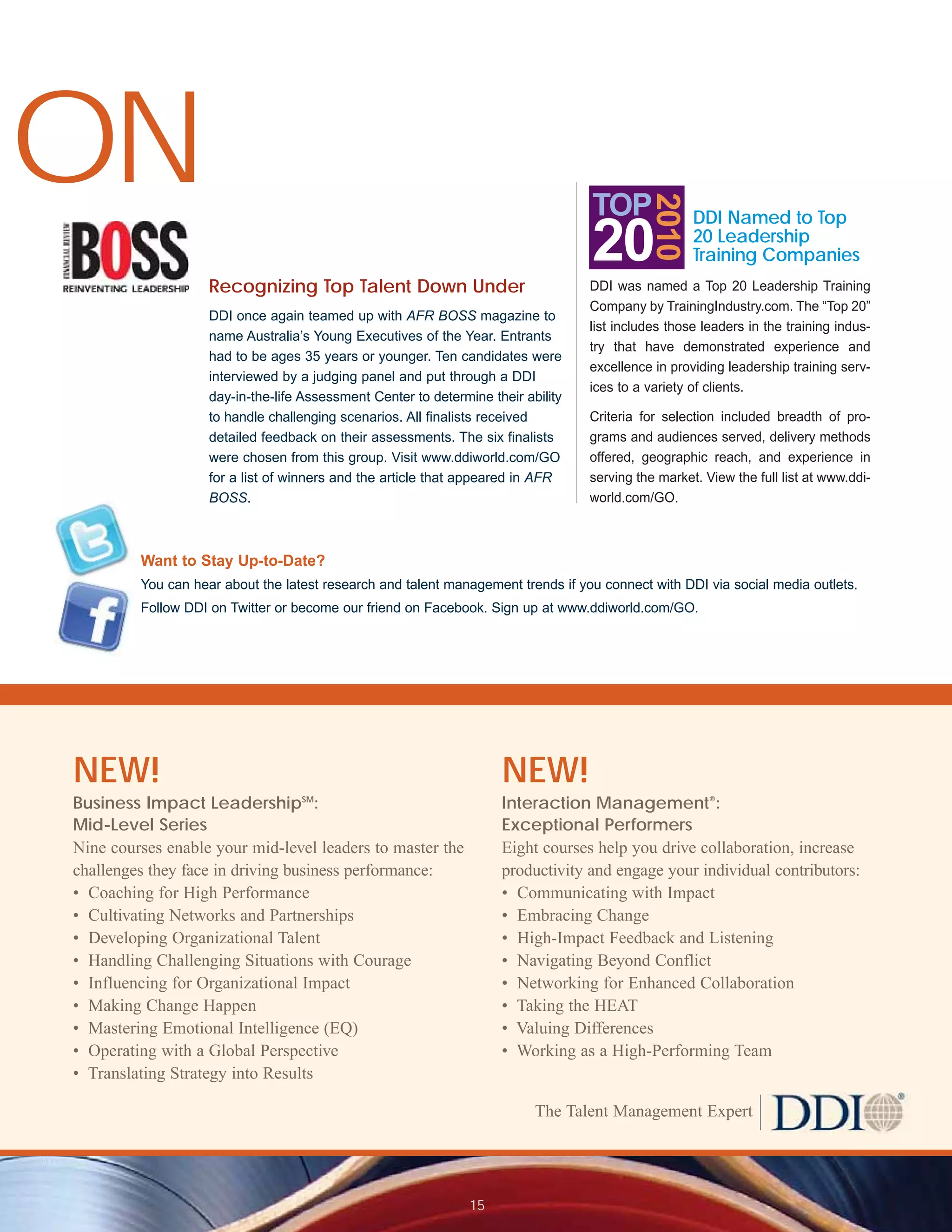
                                                               In November DDI senior vice president Rich Wellins, Ph.D.,
DDI senior vice president Rich Wellins, Ph.D., takes center
                                                               presented the Asia Talent Management Award to Tan Pheng
stage to present the Asia Talent Managment Award.
                                                               Hock, CEO of ST Engineering at CNBC’s 8th Asia Business
                                                               Leaders Awards in Singapore. The Asia Talent Management
                                                               Award is given to a leader whose company values its work-
                                                               force and is committed to developing, retaining, and nurturing
                                                               the next generation of leaders.
                                                               CNBC pioneered the Business Leaders Awards worldwide
                                                               to acknowledge exceptional CEOs globally. Every year since
                                                               2004, DDI has worked as CNBC’s research partner to identify,
                                                               assess, and recognize leaders who have contributed and
                                                               shaped the Asian economy.
                                                               DDI congratulates all the finalists and winners of the 8th Asia
                                                               Business Leaders Awards 2009.
                                                               ✪ Visit www.ddiworld.com/GO for more information about the awards.


DDI introduces best-in-class
development for every
pipeline level.
DDI, the leader in assessment and development innovation, introduces two new systems that now give you
development for all levels—from individual contributors through executives. Our synergistic solutions build
on and reinforce one another as your employees progress in their careers.


Start developing your talent pipeline from end to end!
Call 1.800.933.4463 or go to www.ddiworld.com/developmentinnovation to learn more.


                                                              14
ON


                                                                                             2010
                                                                                   TOP               DDI Named to Top
                                                                                   20                20 Leadership
                                                                                                     Training Companies
                    Recognizing Top Talent Down Under                              DDI was named a Top 20 Leadership Training
                                                                                   Company by TrainingIndustry.com. The “Top 20”
                    DDI once again teamed up with AFR BOSS magazine to
                                                                                   list includes those leaders in the training indus-
                    name Australia’s Young Executives of the Year. Entrants
                                                                                   try that have demonstrated experience and
                    had to be ages 35 years or younger. Ten candidates were
                                                                                   excellence in providing leadership training serv-
                    interviewed by a judging panel and put through a DDI
                                                                                   ices to a variety of clients.
                    day-in-the-life Assessment Center to determine their ability
                    to handle challenging scenarios. All finalists received        Criteria for selection included breadth of pro-
                    detailed feedback on their assessments. The six finalists      grams and audiences served, delivery methods
                    were chosen from this group. Visit www.ddiworld.com/GO         offered, geographic reach, and experience in
                    for a list of winners and the article that appeared in AFR     serving the market. View the full list at www.ddi-
                    BOSS.                                                          world.com/GO.


         Want to Stay Up-to-Date?
         You can hear about the latest research and talent management trends if you connect with DDI via social media outlets.
         Follow DDI on Twitter or become our friend on Facebook. Sign up at www.ddiworld.com/GO.


NEW!                                                                 NEW!
                                   SM
Business Impact Leadership :                                         Interaction Management®:
Mid-Level Series                                                     Exceptional Performers
Nine courses enable your mid-level leaders to master the             Eight courses help you drive collaboration, increase
challenges they face in driving business performance:                productivity and engage your individual contributors:
• Coaching for High Performance                                      • Communicating with Impact
• Cultivating Networks and Partnerships                              • Embracing Change
• Developing Organizational Talent                                   • High-Impact Feedback and Listening
• Handling Challenging Situations with Courage                       • Navigating Beyond Conflict
• Influencing for Organizational Impact                              • Networking for Enhanced Collaboration
• Making Change Happen                                               • Taking the HEAT
• Mastering Emotional Intelligence (EQ)                              • Valuing Differences
• Operating with a Global Perspective                                • Working as a High-Performing Team
• Translating Strategy into Results

                                                                           The Talent Management Expert


                                                                15
DDI INNOVATIONS.
THE STORY CONTINUES...
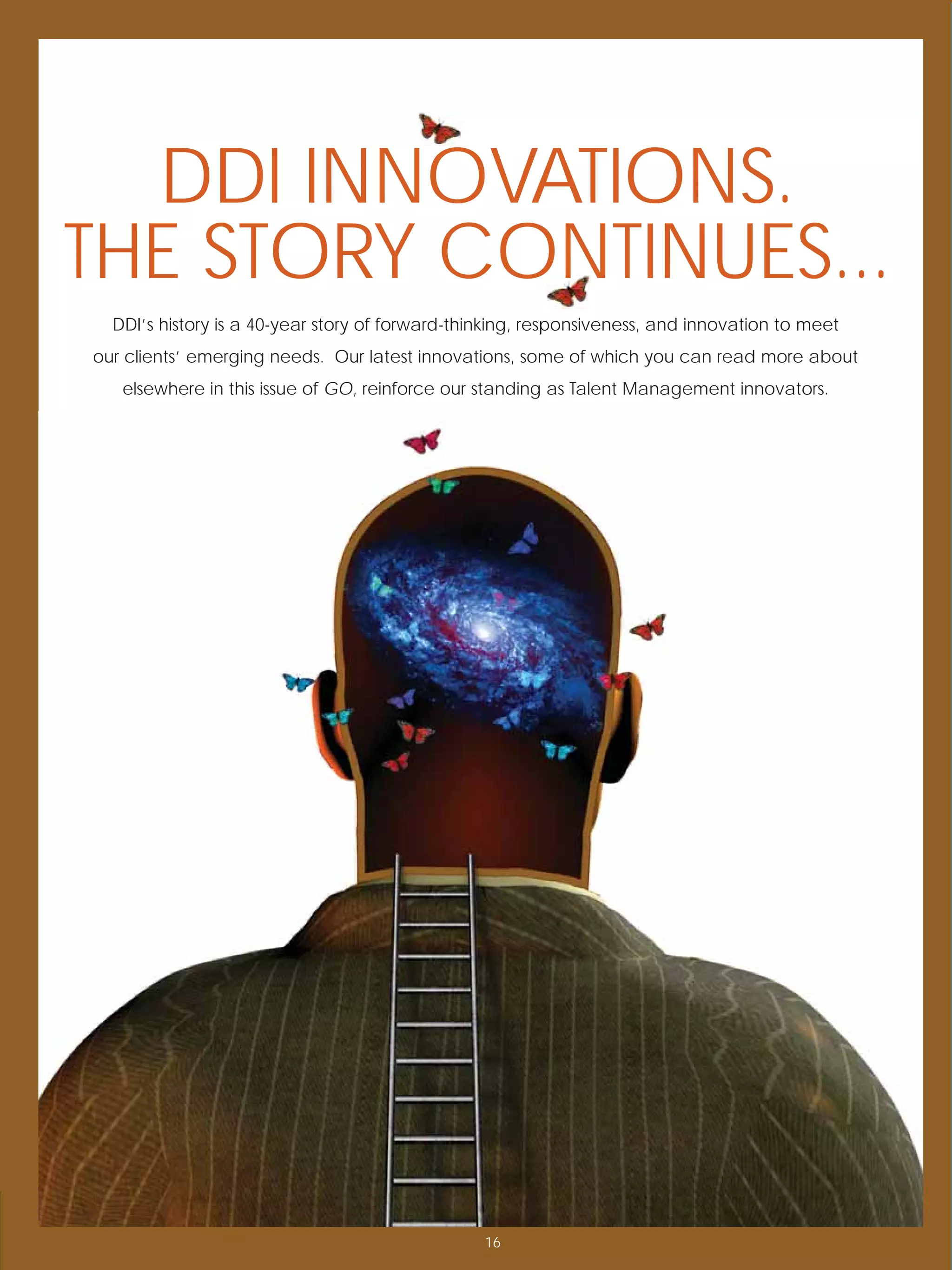
  DDI’s history is a 40-year story of forward-thinking, responsiveness, and innovation to meet
our clients’ emerging needs. Our latest innovations, some of which you can read more about
   elsewhere in this issue of GO, reinforce our standing as Talent Management innovators.


                                                 16
.............                                  Giving Individual
                                               Contributors a Leg Up
                                               Interaction Management®: Exceptional
                                                                                                Making Everyone More
                                                                                                Effective and Productive

                                               Performers Series (IM: ExPSM)—This new           Building Networking Skills—Networking
                                               system targets your organization’s value         is an important skill that provides numerous
                                               creators—your individual contributors. IM:       real benefits for organizations and their
                                               ExP SM
                                                        is designed to boost interpersonal      people—more partnering and collaboration,
                                               skills that enhance individual and group         improved knowledge sharing, faster job
                                               effectiveness, and build customer service        proficiency, etc. DDI has introduced three
                                               skills. The skills covered in the series’        new courses that help develop business
                                               eight brand new courses include                  networking skills at multiple organizational
Mid- and Senior-level
                                               Networking, Communicating, Listening             levels. These courses are:
Leadership Development to
Drive Better Strategy Execution                and Feedback, Embracing Change, and
                                                                                                • Targeted Selection®: Strong StartSM.
                                               Valuing Differences. With all new videos,
Business Impact LeadershipSM—We                support guides for the leaders of learn-         • Networking for Enhanced Collaboration,
understand the challenges mid- and             ers—including guidance for leveraging             part of the Interaction Management®:
senior-level leaders face and their critical   Modern Media for skill application—IM:            Exceptional Performers Series (IM: ExP).
responsibilities in creating and executing     ExP enables your team members to confi-          • Cultivating Networks and Partnerships,
business strategy. Now, we have applied        dently work together to drive your organi-        one of the courses in the Business
this knowledge to create two highly engag-     zation’s bottom line.                             Impact Leadership: Mid-Level Series.
ing new programs just for them. Business
Impact LeadershipSM: Mid-Level Series          Go Virtual with Frontline                        Taking Hiring to the Next Level
offers a suite of nine high-impact courses     Development
                                                                                                Strong Start and Interviewing for
that provide mid-level leaders with skills
                                               Interaction Management®: Exceptional             Technical Skills—Two innovative new
and insights in critical areas such as
                                               Leaders . . . Extraordinary Results®             courses make the Targeted Selection
driving performance in a changing world,
                                               (IM: EX®) Virtual Classroom—A new                interviewing system even more powerful.
managing horizontal integration, leading
                                               “must have” for blended training implemen-       Strong Start provides leaders with valuable
and developing talent, and making tough
                                               tations, DDI’s breakthrough approach to          insights and a process to help new hires
decisions. Business Impact LeadershipSM:
                                               the Virtual Classroom will help you circum-      begin contributing quickly, get and keep
Senior-Level Series, meanwhile, enables
                                               vent travel restrictions to deliver the train-   them engaged in the job, and position
your organization to create continuous
                                               ing your leaders need now. DDI’s nine            them for success. Targeted Selection:
learning experiences—linked directly to
                                               IM: EX® Virtual Classroom training courses       Interviewing for Technical Skills, mean-
business needs—for your executive level.
                                               are specifically designed to engage partici-     while, enables interviewers to determine
The combination of Business Impact             pants in discussion, small group activities,     if candidates possess the knowledge and
Leadership and the Interaction                 and skill practice through Web-conferenc-        skills required to be effective in a position
Management® system for frontline leaders       ing software. Perfect for geographically         requiring a high level of technical expertise,
and individual contributors means that         dispersed leadership groups or intact            such as an engineer, a nurse, an account-
DDI now provides a complete portfolio of       teams, DDI’s Virtual Classroom will deliver      ant, or a computer programmer.
assessment and development offerings           the same behavior change as instructor-led       To learn more about these latest DDI innovations,
spanning the entire leadership pipeline!       or self-paced Web-based courses.                 visit www.ddiworld.com/GO


                                                                    17
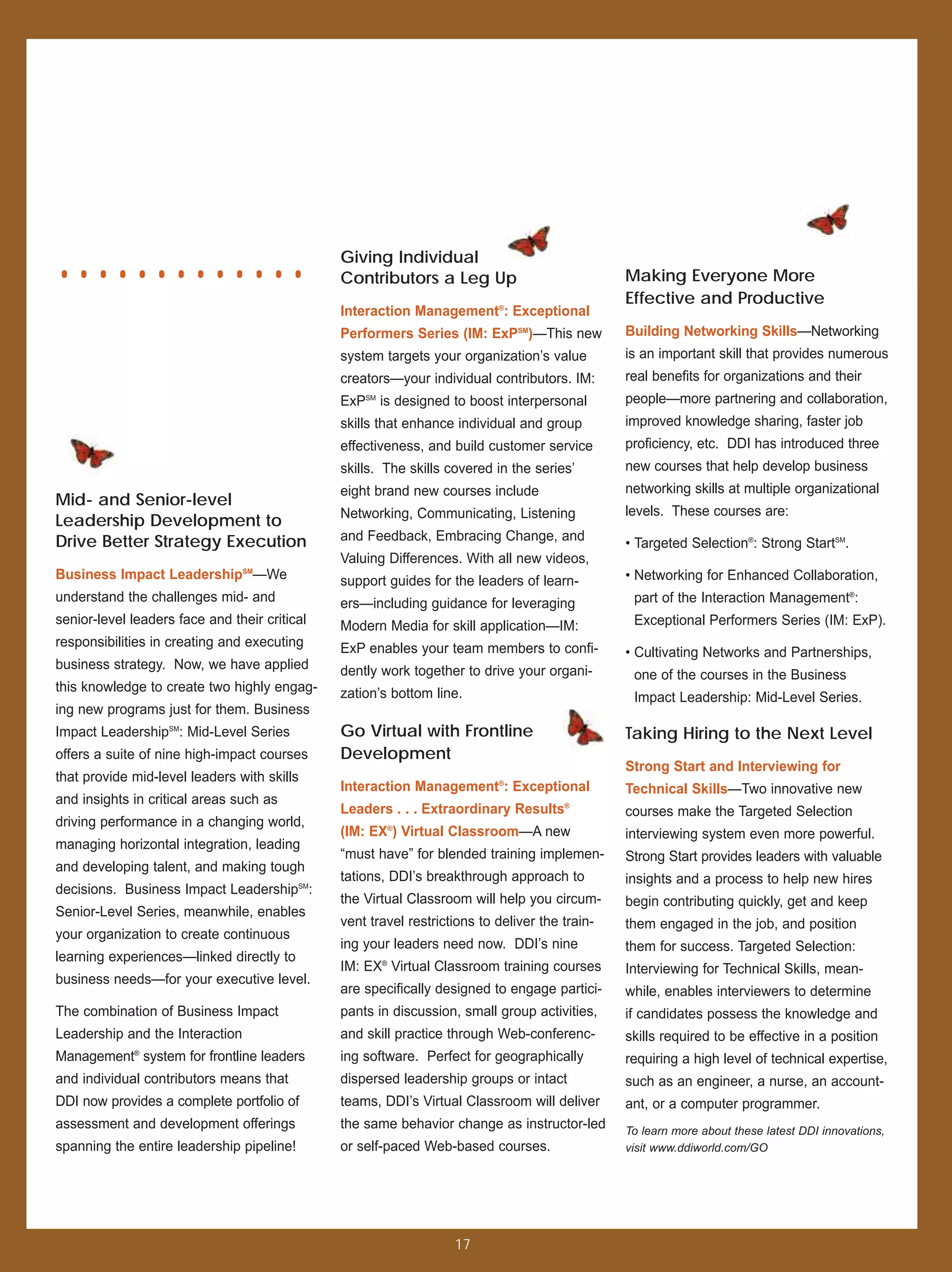
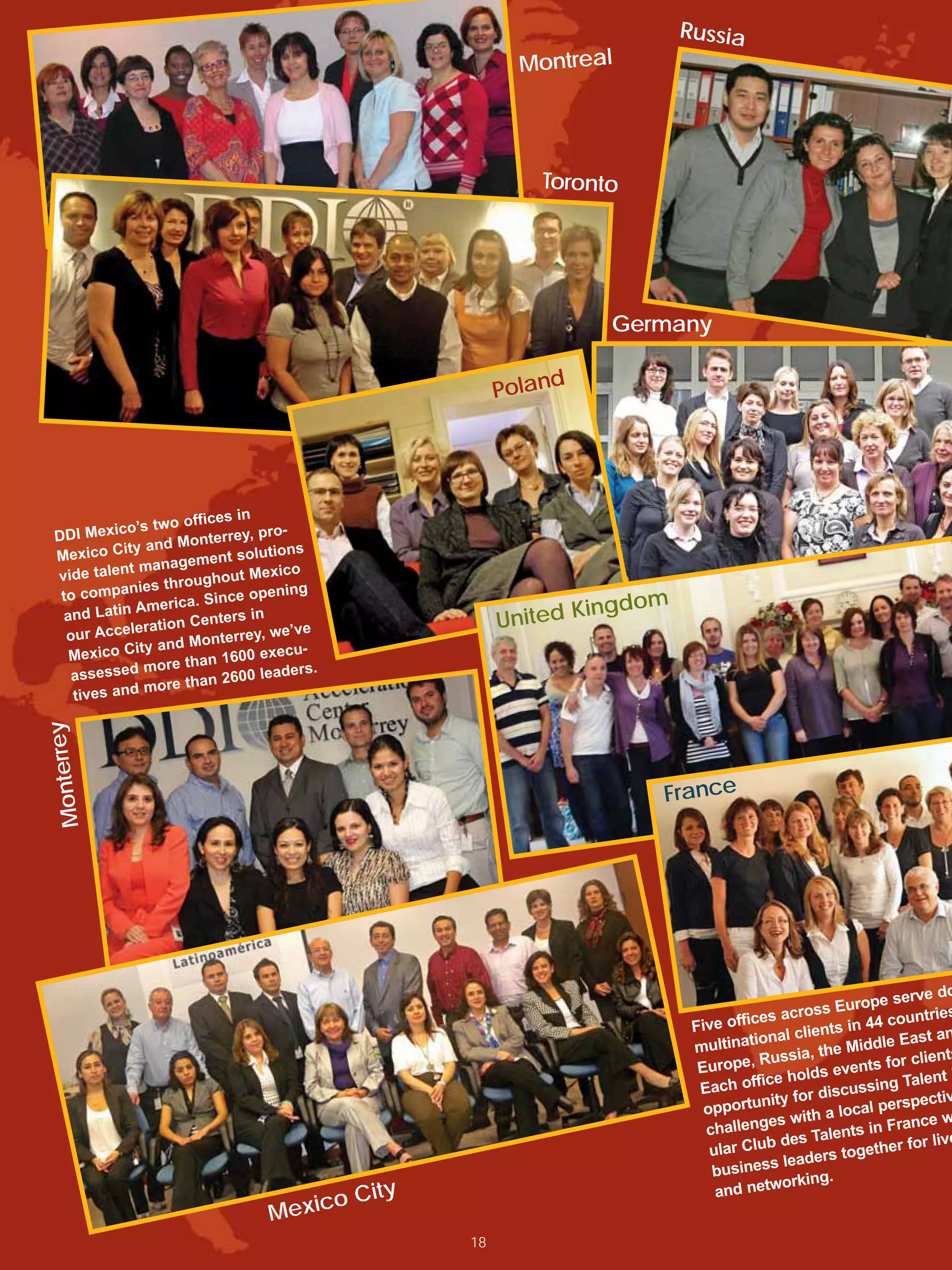
Russia
                                                            Montreal


                                                              Toronto


                                                                    Germany

                                                          Poland


                       ffices in
             o’s two o
 DDI Mexic           Monterrey
                                , pro-
 Mexic  o City and             olutions
                     gement s
 vide ta lent mana              Mexico
                     roughout
  to com  panies th             opening
                     ca. Since
          tin Ameri                                                ingdom
  and La
                ration Ce
                          nters in                        United K
   our Accele            onterrey,
                                   we’ve
              ity and M                u-
   Mexico C                 1600 exec
                more than              ers.
    assessed                2600 lead
                more than
    tives and
       ey
Monterr


                                                                        France


                                                                                                                  rve do
                                                                                                        urope se
                                                                                       es   across E                tries
                                                                             Five offic                    44 coun
                                                                                       onal   clients in              an
                                                                             multinati                      dle East
                                                                                       Russia    , the Mid
                                                                              Europe,                           r clients
                                                                                                      events fo
                                                                                        ice holds                  lent
                                                                              Each off                    ssing Ta
                                                                                        nity  for discu            ectiv
                                                                               opportu                    al persp
                                                                                               ith a loc
                                                                               challeng
                                                                                         es w                 France w
                                                                                                     lents in
                                                                                         b des Ta                for live
                                                                                ular Clu               together
                                                                                          s leaders
                                                                                busines         ing.
                                                                                     network
                                         o    City                               and
                                   Mexic
                                                     18
Ind


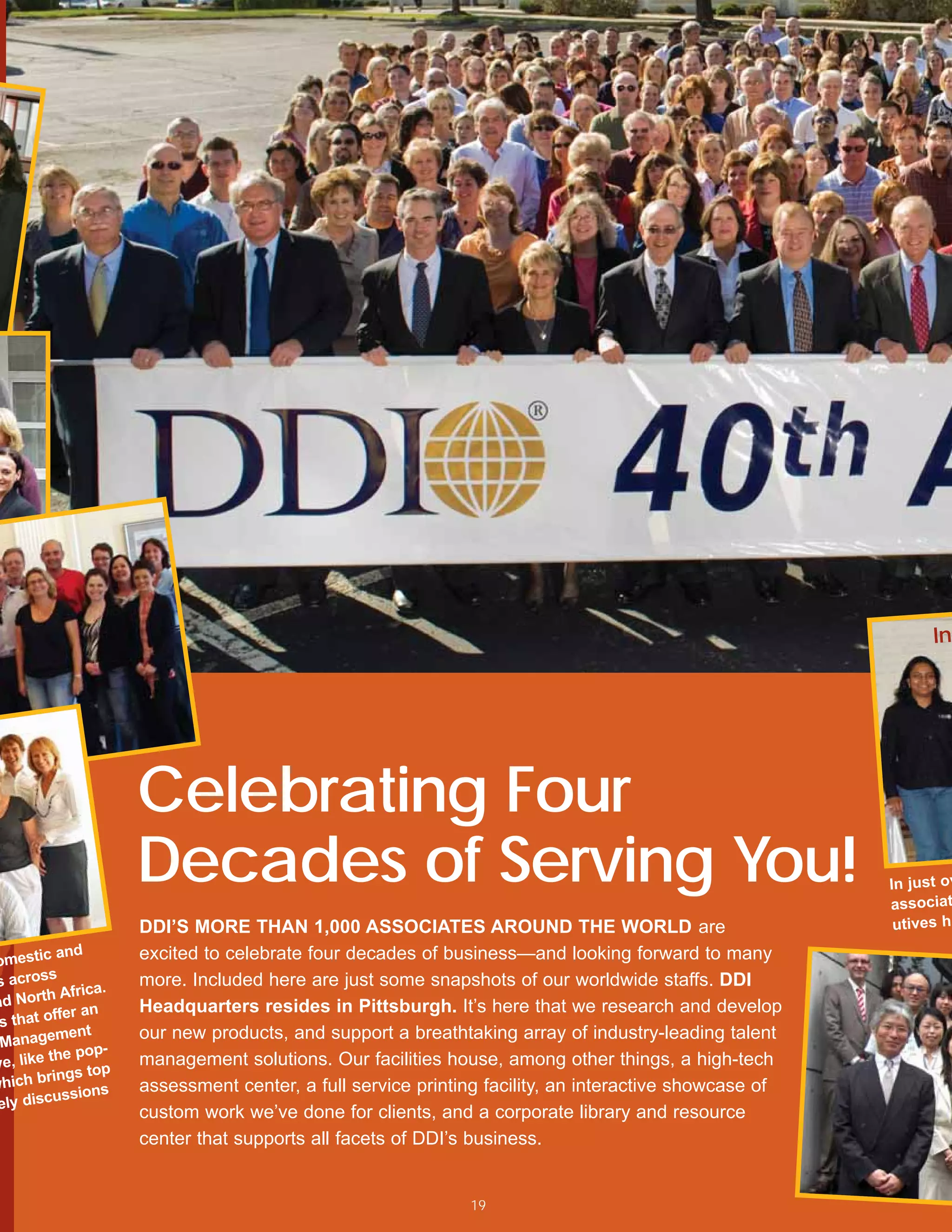
                     Celebrating Four
                     Decades of Serving You!                                                           In just ov
                                                                                                       associat
                     DDI’S MORE THAN 1,000 ASSOCIATES AROUND THE WORLD are                              utives ha
          and        excited to celebrate four decades of business—and looking forward to many
omestic
s across             more. Included here are just some snapshots of our worldwide staffs. DDI
           Africa.
nd North             Headquarters resides in Pittsburgh. It’s here that we research and develop
           er an
 s that off
          ment       our new products, and support a breathtaking array of industry-leading talent
 Manage
            e pop-
ve, like th          management solutions. Our facilities house, among other things, a high-tech
        rings top
which b              assessment center, a full service printing facility, an interactive showcase of
           ssions
 ely discu
                     custom work we’ve done for clients, and a corporate library and resource
                     center that supports all facets of DDI’s business.


                                                             19
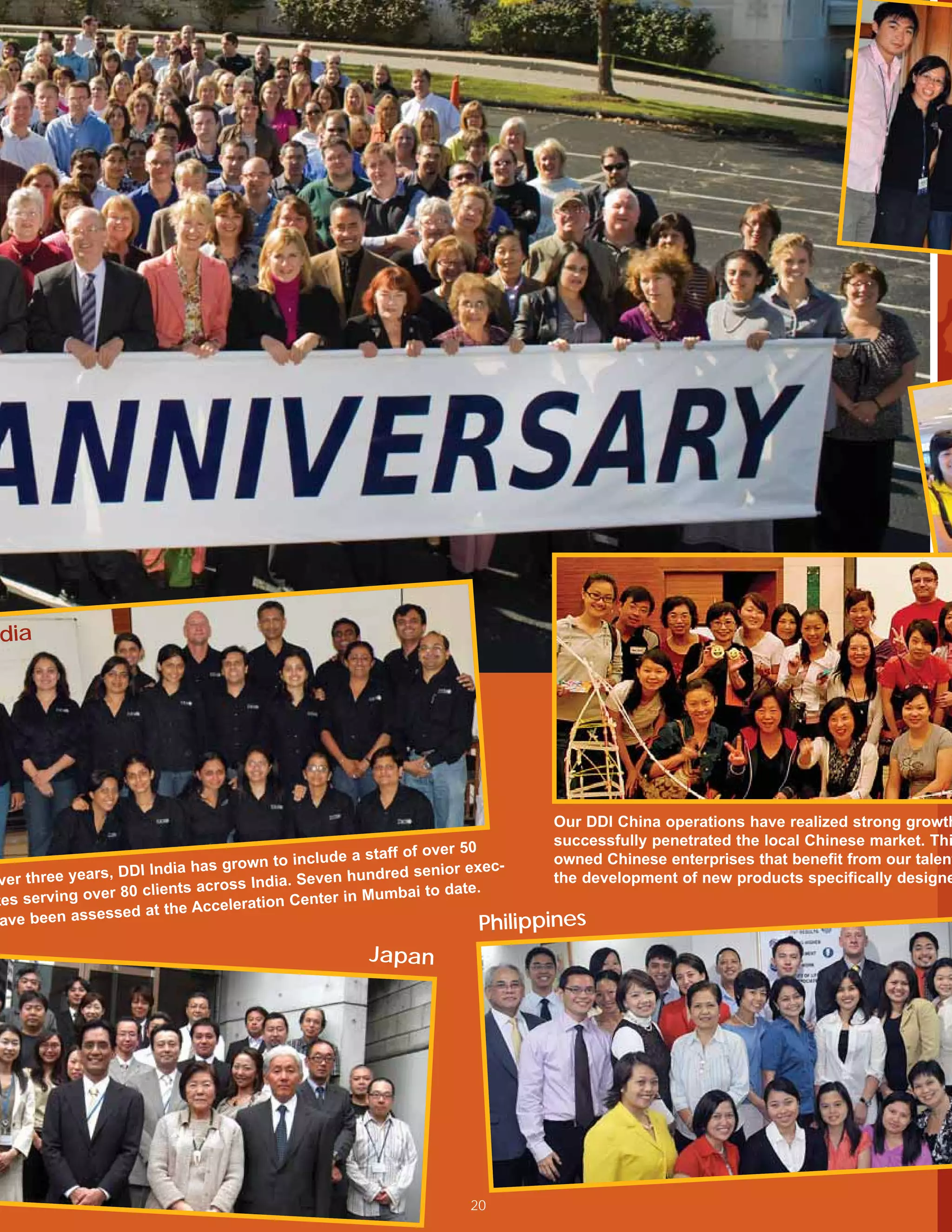
dia
                                                                                   DDI World Headquarters, Pittsburgh, Pennsylvania


                                                                           Our DDI China operations have realized strong growth
                                                                           successfully penetrated the local Chinese market. Thi
                                                  a staff of over 50
                                  own to include                           owned Chinese enterprises that benefit from our talent
                 DDI India has gr                hundred senior
                                                                   exec-
ver three years,                 ss India. Seven                           the development of new products specifically designe
                 80 clients acro                            i to date.
tes serving over                         Center in Mumba
                 ed at  the Acceleration
 ave been assess                                                     Philippines
                                                  Japan


                                                                20
Malaysia
                                                                 DDI has offic
                                                                               es across So
                                                                 Malaysia, Sin              utheast Asia,
                                                                               gapore, Taiw                including Ind
                                                                already cele                an and Thaila                  onesia,
                                                                             brated a dec                  nd. Each off
                                                                a 20 year an              ade of servic                  ice has
                                                                             niversary! To              e; some are
                                                                Southeast A                gether with o             approaching
                                                                            sia manages                  ur other Asia
                                                                Asia Busines               our involvem                  offices, DDI
                                                                              s Leaders Aw               ent with the
                                                                ments and in                ard, for whic              prestigious
                                                                             terviews to h                h we conduct
                                                                                           elp determin                   assess-
                                                                                                        e the winner
                                                                                                                      s.

                        Taiwan


            ore
   Singap


                                                                                                                 Thailand


                                      Shanghai


                                                                                                                      Australia

h despite the global economic downturn and
is market consists of state owned and privately
 t management solutions. Our future plans include
ed for China.

                                         I
                  Founded in 1977, DD
                  Philippin es was DDI’s first
                                            d the
                  international office an
                                          nsion
                  base for further expa
                                          On the
                  into Southeast Asia.
                                             ’s 30th
                   occasion of the office
                                           the
                   anniversary in 2007,                      The three off
                                                                           ices that com
                   Philippin e’s VP & COO and                as the countr
                                                                           y’s leading H
                                                                                          prise DDI Au
                                                                                                      stralia are no
                                               blished                                                                w recognized
                   marketing manager pu                     sponsor a co
                                                                          mpetition, in
                                                                                         R consultancy
                                                                                                        . The offices
                                              guished       Review, to id                                              down under
                   a book with the distin                                 entify six you
                                                                                         conjunction
                                                                                                      with the Aust
                                              tion of                                    ng executive                ralia Financial
                    Management Associa                      generation o
                                                                         f leaders. DD                s who perso
                                                hlighted                                                            nify our next
                    the Philippines that hig               assessments
                                                                          to determine
                                                                                        I conducts al
                                                                                                     l of the interv
                                            stories        in AFR BOSS                   the winners,               iews and
                    inspiring leadership                                  magazine.                   which are an
                                            leaders.                                                                 nounced
                    from 51 top Filipino

                                                                     21
40 Years: Many
Reasons to Celebrate!                                       We have helped YOU
Forty years in business is worth celebrating. But what
                                                            have a real impact!
excites us most are the great results we’ve been able
to help you achieve, the wonderful feedback you have        BOEING, Alabama Industrial Development
                                                            Training, screened more than 11,000 production
given us, and the number of people around the world whose
                                                            and maintenance candidates, tested over 7,000,
work lives we have touched over the past four decades.
                                                            assessed more than 3,000—and realized an 80
                                                            to 90 percent hiring success rate at the interview
                                                            stage.

                                                            HCA implemented integrated, behavioral compe-
                                                            tency-based selection and performance manage-
                                                            ment systems across the organization. Among its
                                                            results: turnover fell from 29 percent to 12 percent
                                                            within 12 months, employee retention improved by
                                                            more than 42.3 percent, and cost savings improved
                                                            by 26.7 percent.

                                                            INFOSYS transitioned to a more strategic sales
                                                            force and tripled sales revenues within three years,
                                                            from $1 billion to $3 billion. In addition, Infosys
                                                            doubled its sales force productivity with just a 30-
                                                            percent increase in sales force headcount.

                                                            JETBLUE decreased its total turnover to half the
                                                            industry average—and just 2 to 3 percent for
                                                            pilots—by revising its selection process.

                                                            PHILIPS deployed a unified core leadership devel-
                                                            opment curriculum to more than 11,000 leaders in
                                                            35 countries, and realized greater cost efficiencies
                                                            by working with a single vendor.

                                                            SANOFI-AVENTIS sourced, screened, and hired
                                                            more than 1,000 top-notch sales professionals in
                                                            120 days while reducing hiring costs by more than
                                                            20 percent.


                                                     22
YOU have helped us                          Partnerships with YOU                      YOU have helped us
amass some impressive                       that make a difference                     become an industry
numbers!                                    “DDI is an excellent partner, always       leader!
• Trained and developed nearly 10           meeting our needs and responsive.          “Bottom Line–if a company is looking
   million executives and leaders           They provide leading-edge solutions,       for a partner that offers ‘soup to nuts’ in
   worldwide.                               and it's apparent that understanding our   terms of content, services and assess-
                                            business is important to DDI.”             ments related to leadership develop-
• 3,200 high-quality hiring decisions are
                                            Cindy Phillips, Amedisys Home Health       ment, DDI is the right choice.”
  made every hour using our behavioral
                                                                                       Bersin & Associates,
  interviewing, testing, and assessment
                                            “I feel that I’m working with the          High Impact Leadership Development
  systems.
                                            leaders in the industry.”                  (2009)
• 1,500 leaders benefit from one or         Lucille Cordero,
  more of our leadership training or        Municipio Autonomo de Caguas               “DDI’s leadership development clients
  assessment systems every day.                                                        are 14 percent more likely than their
                                            “I am very impressed with the materials.   counterparts to increase managerial
• Major corporations make crucial
                                            Everything we’ve used has been excel-      performance.”
  promotion and placement decisions
                                            lent. DDI understands where we need        Aberdeen Group,
  for over 3,000 senior executives
                                            to go, shows flexibility, and adapts to    Research Brief (2010)
  each year using our assessment
                                            changes.”
  centers—in Singapore, Beijing,
                                            Bunny Alexander,
  London, Mumbai, New York, and
                                            Niagara Health System
  other locations around the world.


                                                                23
RESEARCH


                    Leadership Training:
                        It Pays Off
                 By Jazmine Boatman, Ph.D. | Senior Consultant, DDI Center for Applied Behavioral Research


  DDI’s Center for Applied Behavioral Research                                Significant Improvement
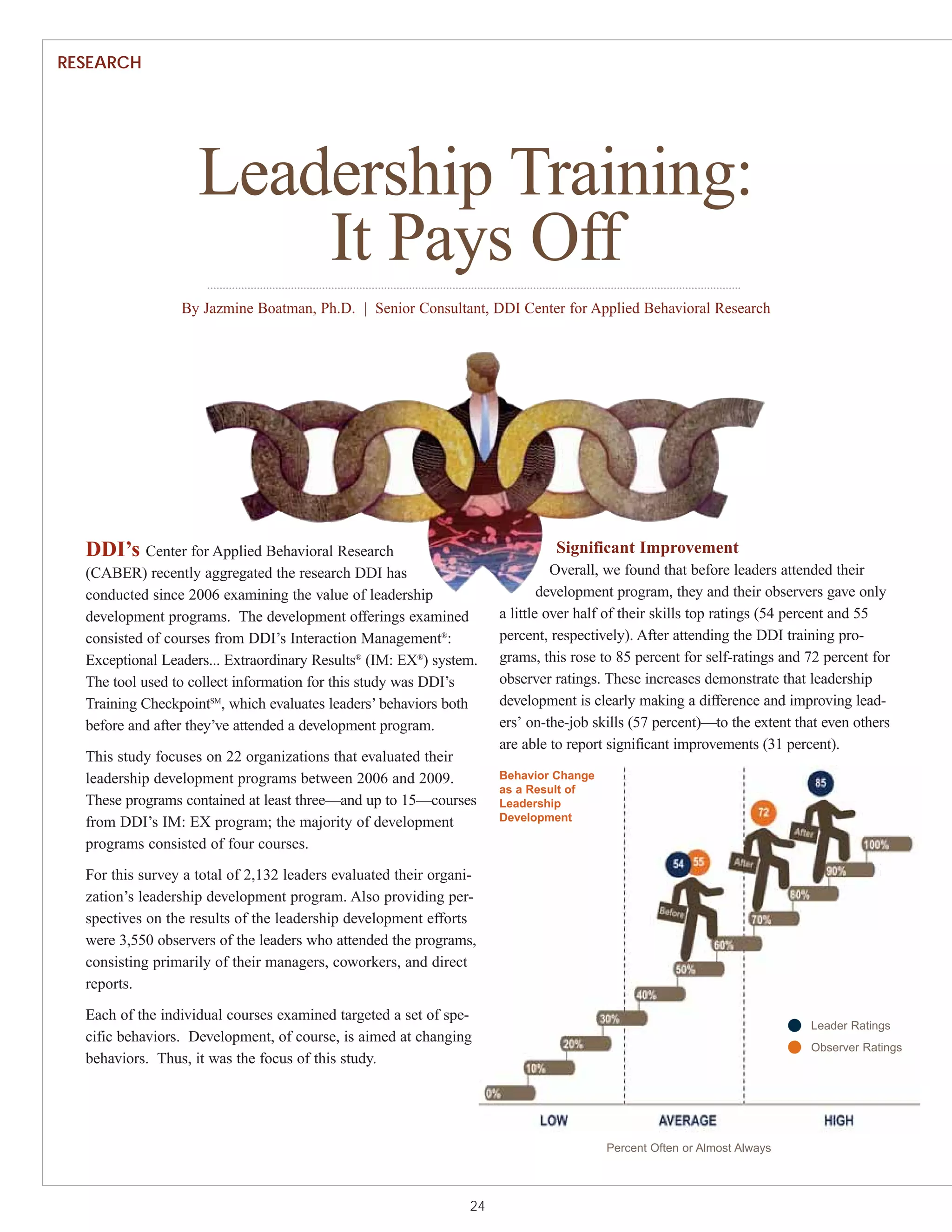
  (CABER) recently aggregated the research DDI has                             Overall, we found that before leaders attended their
  conducted since 2006 examining the value of leadership                     development program, they and their observers gave only
  development programs. The development offerings examined           a little over half of their skills top ratings (54 percent and 55
  consisted of courses from DDI’s Interaction Management®:           percent, respectively). After attending the DDI training pro-
  Exceptional Leaders... Extraordinary Results® (IM: EX®) system.    grams, this rose to 85 percent for self-ratings and 72 percent for
  The tool used to collect information for this study was DDI’s      observer ratings. These increases demonstrate that leadership
  Training CheckpointSM, which evaluates leaders’ behaviors both     development is clearly making a difference and improving lead-
  before and after they’ve attended a development program.           ers’ on-the-job skills (57 percent)—to the extent that even others
                                                                     are able to report significant improvements (31 percent).
  This study focuses on 22 organizations that evaluated their
  leadership development programs between 2006 and 2009.             Behavior Change
                                                                     as a Result of
  These programs contained at least three—and up to 15—courses       Leadership
  from DDI’s IM: EX program; the majority of development             Development

  programs consisted of four courses.

  For this survey a total of 2,132 leaders evaluated their organi-
  zation’s leadership development program. Also providing per-
  spectives on the results of the leadership development efforts
  were 3,550 observers of the leaders who attended the programs,
  consisting primarily of their managers, coworkers, and direct
  reports.

  Each of the individual courses examined targeted a set of spe-
                                                                                                                         Leader Ratings
  cific behaviors. Development, of course, is aimed at changing
                                                                                                                         Observer Ratings
  behaviors. Thus, it was the focus of this study.


                                                                                       Percent Often or Almost Always


                                                                24
Self-Rating of Behavior Change                                           Self-ratings of behavior change varied depending on the level of
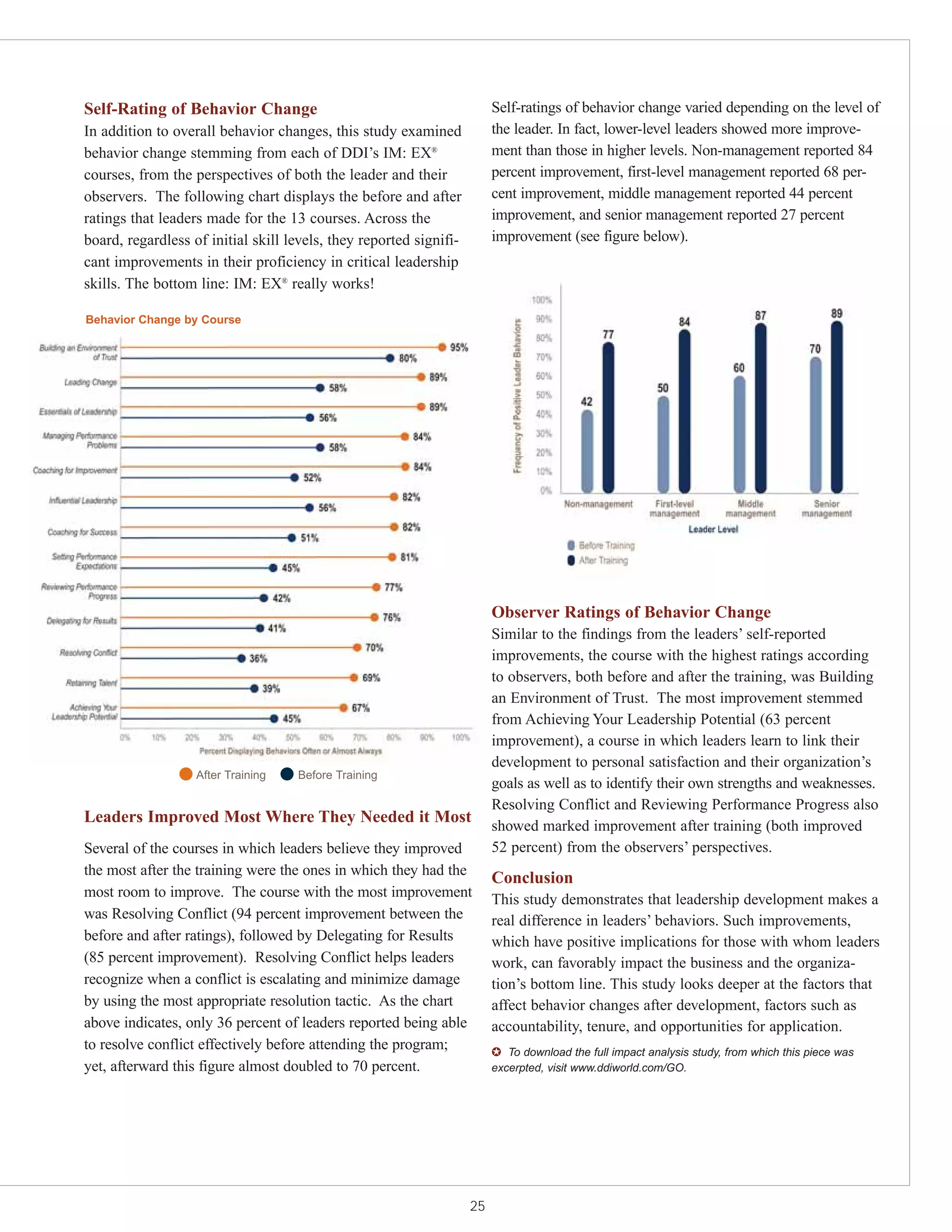
In addition to overall behavior changes, this study examined             the leader. In fact, lower-level leaders showed more improve-
behavior change stemming from each of DDI’s IM: EX®                      ment than those in higher levels. Non-management reported 84
courses, from the perspectives of both the leader and their              percent improvement, first-level management reported 68 per-
observers. The following chart displays the before and after             cent improvement, middle management reported 44 percent
ratings that leaders made for the 13 courses. Across the                 improvement, and senior management reported 27 percent
board, regardless of initial skill levels, they reported signifi-        improvement (see figure below).
cant improvements in their proficiency in critical leadership
skills. The bottom line: IM: EX® really works!

Behavior Change by Course


                                                                         Observer Ratings of Behavior Change
                                                                         Similar to the findings from the leaders’ self-reported
                                                                         improvements, the course with the highest ratings according
                                                                         to observers, both before and after the training, was Building
                                                                         an Environment of Trust. The most improvement stemmed
                                                                         from Achieving Your Leadership Potential (63 percent
                                                                         improvement), a course in which leaders learn to link their
                                                                         development to personal satisfaction and their organization’s
                   After Training   Before Training
                                                                         goals as well as to identify their own strengths and weaknesses.
                                                                         Resolving Conflict and Reviewing Performance Progress also
Leaders Improved Most Where They Needed it Most
                                                                         showed marked improvement after training (both improved
Several of the courses in which leaders believe they improved            52 percent) from the observers’ perspectives.
the most after the training were the ones in which they had the
                                                                         Conclusion
most room to improve. The course with the most improvement               This study demonstrates that leadership development makes a
was Resolving Conflict (94 percent improvement between the               real difference in leaders’ behaviors. Such improvements,
before and after ratings), followed by Delegating for Results            which have positive implications for those with whom leaders
(85 percent improvement). Resolving Conflict helps leaders               work, can favorably impact the business and the organiza-
recognize when a conflict is escalating and minimize damage              tion’s bottom line. This study looks deeper at the factors that
by using the most appropriate resolution tactic. As the chart            affect behavior changes after development, factors such as
above indicates, only 36 percent of leaders reported being able          accountability, tenure, and opportunities for application.
to resolve conflict effectively before attending the program;            ✪ To download the full impact analysis study, from which this piece was
yet, afterward this figure almost doubled to 70 percent.                 excerpted, visit www.ddiworld.com/GO.


                                                                    25
TRENDTRACKER                                                                                           Telling Number:


Discontent in the Workforce
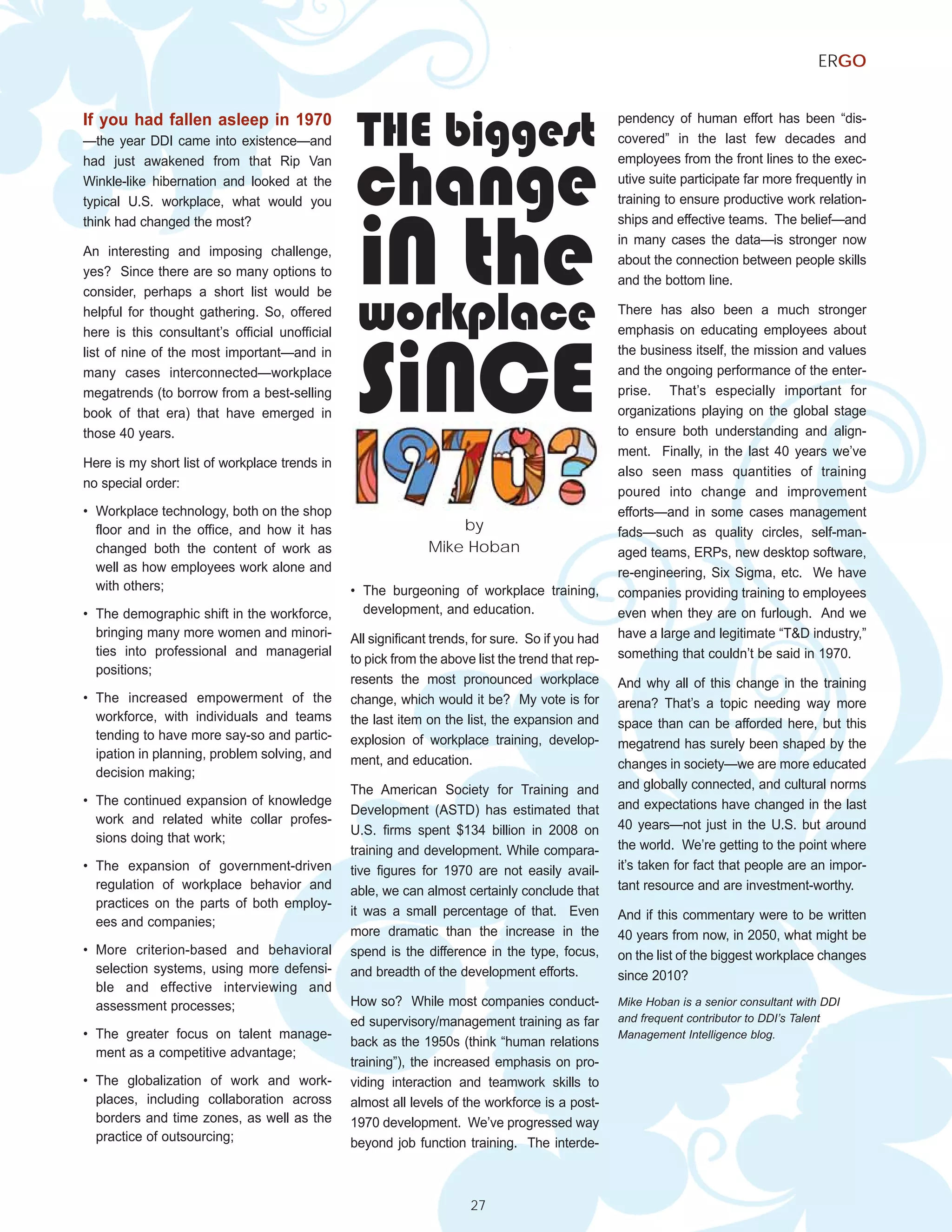
A recent DDI survey of more than 1,000 individual contributors found that half feel their
jobs are stagnant, and one in three do just their jobs, nothing more. These are among
                                                                                                                50
                                                                                                       Percent of workers who feel
the findings captured in Pulse of the Workforce: 2009 Survey of Individual Contributors,               their interpersonal skills are
                                                                                                       “very good” or “excellent”—
a study that sought to explore the mindset of today’s workers. Some of the specific                    well below the 65 percent
results captured in the study are below. Visit www.ddiworld.com/GO to download the full                who rate their technical skills
                                                                                                       that favorably.
Pulse of the Workforce report.
                                                                                                       Source: Pulse of the Workforce study.


 Feeling
 stagnant
 Fifty-one percent of respondents said they feel
 stagnant, when asked how they feel about their
 current jobs. Asked how they would classify their
 situations at work, the most popular answer was
 that they have no room to advance.


                                                 Do you want to be promoted to a leadership position?
 Not everyone
 wants to lead
 Sixty-two percent of individual contributors
 surveyed have no aspiration to assume a
 management role—one of the few things
 both stagnant and contented workers
 generally agree on. Interestingly, content-
 ed workers were more likely to say “no” to
 leadership; with 68 percent eschewing a
 formal role leading others, compared to
 just 55 percent of stagnant workers.


                                            What phrase best describes your attitude about your job?
   Disengaged and
   phoning it in
   Individual contributors are poorly
   engaged in their jobs. We asked our
   sample what phrase best describes
   their attitude about their jobs.
          The top answer:
           “Just do my job
             and go home.”


                                                                26
ERGO


If you had fallen asleep in 1970
                                                 THE biggest                                      pendency of human effort has been “dis-


                                                change
—the year DDI came into existence—and                                                             covered” in the last few decades and
had just awakened from that Rip Van                                                               employees from the front lines to the exec-
Winkle-like hibernation and looked at the                                                         utive suite participate far more frequently in


                                                 iN the
typical U.S. workplace, what would you                                                            training to ensure productive work relation-
think had changed the most?                                                                       ships and effective teams. The belief—and
                                                                                                  in many cases the data—is stronger now
An interesting and imposing challenge,
                                                                                                  about the connection between people skills
yes? Since there are so many options to
                                                                                                  and the bottom line.


                                                 workplace
consider, perhaps a short list would be
helpful for thought gathering. So, offered                                                        There has also been a much stronger


                                                 SiNCE
here is this consultant’s official unofficial                                                     emphasis on educating employees about
list of nine of the most important—and in                                                         the business itself, the mission and values
many cases interconnected—workplace                                                               and the ongoing performance of the enter-
megatrends (to borrow from a best-selling                                                         prise. That’s especially important for
book of that era) that have emerged in                                                            organizations playing on the global stage
those 40 years.                                                                                   to ensure both understanding and align-
                                                                                                  ment. Finally, in the last 40 years we’ve
Here is my short list of workplace trends in
                                                                                                  also seen mass quantities of training
no special order:
                                                                                                  poured into change and improvement
• Workplace technology, both on the shop                                                          efforts—and in some cases management
  floor and in the office, and how it has                         by                              fads—such as quality circles, self-man-
  changed both the content of work as                         Mike Hoban                          aged teams, ERPs, new desktop software,
  well as how employees work alone and                                                            re-engineering, Six Sigma, etc. We have
  with others;                                  • The burgeoning of workplace training,           companies providing training to employees
• The demographic shift in the workforce,         development, and education.                     even when they are on furlough. And we
  bringing many more women and minori-          All significant trends, for sure. So if you had   have a large and legitimate “T&D industry,”
  ties into professional and managerial                                                           something that couldn’t be said in 1970.
                                                to pick from the above list the trend that rep-
  positions;
                                                resents the most pronounced workplace             And why all of this change in the training
• The increased empowerment of the              change, which would it be? My vote is for         arena? That’s a topic needing way more
  workforce, with individuals and teams         the last item on the list, the expansion and      space than can be afforded here, but this
  tending to have more say-so and partic-       explosion of workplace training, develop-         megatrend has surely been shaped by the
  ipation in planning, problem solving, and     ment, and education.                              changes in society—we are more educated
  decision making;
                                                The American Society for Training and             and globally connected, and cultural norms
• The continued expansion of knowledge                                                            and expectations have changed in the last
                                                Development (ASTD) has estimated that
  work and related white collar profes-                                                           40 years—not just in the U.S. but around
                                                U.S. firms spent $134 billion in 2008 on
  sions doing that work;
                                                training and development. While compara-          the world. We’re getting to the point where
• The expansion of government-driven            tive figures for 1970 are not easily avail-       it’s taken for fact that people are an impor-
  regulation of workplace behavior and          able, we can almost certainly conclude that       tant resource and are investment-worthy.
  practices on the parts of both employ-
                                                it was a small percentage of that. Even           And if this commentary were to be written
  ees and companies;
                                                more dramatic than the increase in the            40 years from now, in 2050, what might be
• More criterion-based and behavioral           spend is the difference in the type, focus,       on the list of the biggest workplace changes
  selection systems, using more defensi-        and breadth of the development efforts.           since 2010?
  ble and effective interviewing and
  assessment processes;                         How so? While most companies conduct-             Mike Hoban is a senior consultant with DDI
                                                ed supervisory/management training as far         and frequent contributor to DDI’s Talent
• The greater focus on talent manage-                                                             Management Intelligence blog.
                                                back as the 1950s (think “human relations
  ment as a competitive advantage;
                                                training”), the increased emphasis on pro-
• The globalization of work and work-           viding interaction and teamwork skills to
  places, including collaboration across        almost all levels of the workforce is a post-
  borders and time zones, as well as the        1970 development. We’ve progressed way
  practice of outsourcing;                      beyond job function training. The interde-


                                                                      27
Coffee on
                                    the GO with
                                    PAUL OSTERMAN
                                    If there’s been a theme running through the downsizings and
                                    reorganizations of the past two decades, it’s that organizations have determined
                                    that there is value in pruning hierarchies. As a result, with startling regularity
                                    the ax has fallen on those in the middle—the middle managers who, the think-
                                    ing goes, contribute more bureaucracy than value to their organizations.

                                    Having studied three decades worth of employment data and interviewed dozens
                                    of managers, Paul Osterman, professor of human resources and management at
                                    the MIT Sloan School of Management, believes middle managers deserve a
                                    fresh appraisal. He spoke with GO about his recent book, The Truth About
                                    Middle Managers: Who They Are, How They Work, Why They Matter. In the
                                    book, Osterman not only debunks the dim view that organizations and many
                                    prominent thought leaders hold of middle managers, but he also points out a sur-
                                    prising fact: Despite decades of deliberate efforts to thin the middle manage-
                                    ment ranks, there are actually now more middle managers than ever before.
                                    GO: How would you define the current state of middle managers?
                                    OSTERMAN: For one thing their work is becoming more complex and much
                                    broader, and the reason is that as layers have been reduced in organizations,
                                    the remaining people have had to do more. So in some sense the work is more
                                    interesting, it’s broader, they have more responsibilities and they’re doing
                                    much more work in teams, ad hoc teams and cross-functional teams of one
                                    kind or another. A related point is that their stress level is much higher than it
                                    used to be. They’re working much harder and they describe the stress and feel
                                    the stress; it’s there.
    The author of The Truth About
                                    The second trend, and this was actually a surprise to me, is that middle man-
   Middle Managers discusses the    agers are really committed to what they do. But while they’re deeply
 challenges facing the most-over-   committed to their jobs and committed to their teams and the people
looked segment of the workforce.    they work with, they’ve lost their commitment to their organiza-
                                    tions. They’re focused on their job. They don’t think about the
                                    larger questions about what the firm is about and what its
                                    strategy is.


                                             28
COFFEE ON THE GO


GO: You depict middle managers                  labor force and the percentage of the labor       body exactly what to do, what to train
as lacking loyalty and commitment               force that are managers have not gone             people in, how to move people ahead.
to their organizations. What are the            down a lot. In fact, as an occupational cat-      These managers don’t just want more
implications of that?                           egory, the fraction of American workers           training for its own sake, but they also
OSTERMAN: It’s clearly kind of a good           who are managers today is in fact higher          want to understand how it gets linked to
news, bad news story. I mean you’ve got         than it was 10 or 20 years ago. When you          career movement.
a group of people that, in truth, you can’t     think about it, it’s not that surprising,         GO: If you could tell HR or talent
run the organization without. They want         given that we live in an organizational           management professionals one
to do a good job at what they’re doing.         world. We live in a world of managers.            thing they must know about middle
They’re really committed to doing quality                                                         managers what would it be?
                                                GO: In your book you say that mid-
work, producing a quality product, what-        dle managers are the ones who get                 OSTERMAN: I would say you need to
ever their task is. But they don’t really       the circuits designed, place the                  know that these people care about doing
feel committed to the organization any-         loans, sell the products, and allocate            good work, doing a good job, but they’re
more. So how does that play out? One            the space. Yet, they are the leaders              extremely uncertain about how to con-
view is if people are scared enough,            who attract the least amount of                   struct careers in their organizations and it
they’re going to continue to work hard,         attention and respect. Why is this?               would make a big difference to them if
they’re going to continue to do their very      OSTERMAN: We live in a hero culture.              they had some understanding about how to
best in order to keep their jobs, and so you    We live in a cowboy world where the               do that. Also, if they’re not loyal to the
don’t really care if they’re loyal, you don’t   emphasis is on the heroic individual. The         organization that potentially is very costly.
really care if they’re committed to the         truth is it’s just a lot easier to write and
organization as long as they produce.                                                             If the organization and if the HR man-
                                                think about individuals, whether they are
                                                                                                  agers can find a way to help people feel
The other view is that if people lose their     heroes or villains, than it is to think about
                                                                                                  better about where their careers are going,
                                                a group of people who are working as a
loyalty, as middle managers appear to                                                             give them a pathway, give them a strategy,
                                                team in an organization.
have done, they’re going to work a little                                                         show them that there’s forward move-
less hard but in a more subtle way.             GO: What are some of the specific                 ment, it would make a big difference to
They’re not going to give you their best        skills that middle managers need to               how middle managers feel about their
ideas, they’re not going to make their best     do their jobs effectively?                        organizations.
effort; they’re going to withhold. And we       OSTERMAN: The way work has changed
                                                                                                  GO: In your study of middle
know from research that a lot of quality        is that there are a lot more of these teams,
                                                                                                  managers, what did you learn
improvement, a lot of product improve-          and there’s a lot more cross-functional
                                                                                                  that surprised you?
ment comes from the accumulation of small       interaction and coordination. So they need
                                                                                                  OSTERMAN: I would have expected that in
ideas by the workforce. That adds up to         management skills around working in a
                                                                                                  a world in which many managers fear los-
something better and so you may lose out        team. They also need skills to help them
                                                                                                  ing their jobs, and people around them are
on that.                                        better be an ambassador to other parts of
                                                                                                  losing their jobs, that these managers would
                                                the organization. You could describe those
GO: Given the headlines of the                                                                    kind of slack off in terms of their day-to-
                                                as political skills, if you will, and there’s a
past several years indicating that                                                                day work and not really care if they ran that
organizations have pruned the ranks             higher premium on those skills than there
                                                                                                  meeting well, or not really care if they put
of mid-level leaders, it would seem             used to be. Then there’s the ability to deal
                                                                                                  together a good portfolio for somebody, or
   that there are actually significant-         with the stress.
                                                                                                  whatever we’re talking about. And I just
       ly fewer middle managers.                GO: Do you feel that organizations                didn’t see that. People really care about
           Was that what you found?             do enough to develop the skills of                their tasks.
              OSTERMAN: If you look at          their middle managers?
                                                                                                  ✪ Paul Osterman’s book, The Truth About Middle
               census data and other            OSTERMAN: No. I got a sense of a real             Managers: Who They Are, How They Work, Why
                sources, which I looked at      hunger for that, because career lines and         They Matter is available at bookstores and through
                                                                                                  major online booksellers, including Amazon.com
                quite carefully, the num-       career pathways for getting ahead aren’t          and Barnes & Noble. Visit www.ddiworld.com/GO
                ber of managers in the          clear anymore. It’s not obvious to any-           to listen to the podcast.


                                                                       29
THE MIDDLE MATTERS
        Best-in-class companies believe mid-level is key to pipeline success
                                                 By Tacy M. Byham, Ph.D.

DO ANY OF THESE STATEMENTS SOUND FAMILIAR?                         Mid-level leaders have as much to say about organizational suc-
                                                                   cess or failure as do those at the top of the organization. A few of
“How can I help support our company’s transformation?              these leaders will step up to become their organization’s future
I need a way to link our new business strategy with a
contemporary learning and development strategy (and                senior leaders, but that milestone is several steps away. In the
ensure that content is current and effective) to get people        meantime, these mid-level leaders carry out senior executive’s
                                                                   agendas, and interpret and execute corporate decisions. They han-
moving in the right direction.   ”                                 dle a wide range of tasks and responsibilities, including coaching
“How do we prepare our leaders for more challenging,               and developing leaders of high-performing teams. In short, they
senior-level positions? How do we help them acquire the
                                                                   make companies run—and weakness amidst their ranks will
requisite experience and skills they need to succeed in a
                                                                   weaken their organizations, too.
mid-level role, or ascend even higher?   ”                         There is strong evidence of weak mid-level leaders. A Bersin study
“We have strong programs for the high-potential leaders            found that about half of the 213 global corporations they surveyed
who are advancing up the leadership pipeline. I often
                                                                   rate their mid-level leaders as “fair” or “poor.” The Hay Group
think about the people at the mid-level who don’t get pro-
                                                                   reported that mid-level leaders are described as “barriers” and
moted—what are we offering to our high performers to
                                                                   “paralyzing,” while being perceived as lacking management skills.
continue their in-role development?  ”                             DDI’s research found that even middle managers feel they are
“What can we do to strengthen their skills and keep our            lacking, with a mere quarter rating themselves as “very effective.”
leadership brand top of mind and ensure we retain this
talent when the job market picks up again?   ”

                                                              30
MADE FOR THE MIDDLE
The reality is that these leaders face unique challenges that                 DDI’S NEW SOLUTION: Business Impact LeadershipSM
require solutions specific to their role. These challenges include:           Best-in-class companies drive business performance by
     Driving performance in a changing world                                  taking a pipeline approach to development. DDI’s Business
                                                                              Impact LeadershipSM provides a powerful solution for devel-
     Fewer resources. Fighting for survival. Hanging onto every
                                                                              oping your mid-level or operational leaders. We call it
     customer. There’s no margin for error. Today’s middle
                                                                              Business Impact LeadershipSM for a good reason. Relevant,
     managers must execute flawlessly, while successfully                     engaging, and focused on business application, our nine
     managing constant change.                                                courses enable mid-level leaders to meet their mandate
     Horizontal integration in a complex organization                         and ultimately drive the success of their organization.

     They can’t get it done alone. New middle managers must                   Key topic areas include:
     develop strong networks and influence a range of stake-                  - Translating Strategy into Results
     holders—often around the world—to meet their objectives.
                                                                              - Making Change Happen
     Landing and developing talent                                            - Cultivating Networks and Partnerships
     It’s job #1 for mid-level managers who must be constant-                 - Operating with a Global Perspective
     ly thinking about having both the quantity and quality of                - Influencing for Organizational Impact
     talent required to meet business needs.                                  - Developing Organizational Talent

     Making the tough decisions                                               - Coaching for High Performance

     Few issues can be swept under the carpet without eventu-                 - Mastering Emotional Intelligence
     al consequences. Middle managers must face up to and                     - Handling Challenging Situations with Courage
     make extraordinarily difficult decisions every day.

Equipping leaders to meet these—and other—challenges that
can produce significant results for organizations, which do not                cites an example of a company that created a management
have sufficient talent in their pipelines to ensure future business            development program for a subset of middle managers.
success. In a DDI-Economist Intelligence Unit study, nearly                    The program incorporated regular executive briefings with
three in five executives said their company’s performance was                  this group of employees. These managers outperformed a
likely or very likely to suffer in the near future due to insufficient         control group in a number of metrics, including engage-
leadership. And that’s assuming leaders stay.                                  ment and performance.

The workforce has called a truce on the “War for Talent,” but            #2: Create individual development plans that are connected to
most expect that battle to resume as the world economy                       corporate goals. Ensure your managers see how their work is
improves. If mid-level managers don’t see room for advance-                  contributing directly to the big picture and corporate vision.
ment or don’t feel they’re making progress in their careers,
                                                                         #3: Give people a sense of achievement and accomplishment
they’ll be on the march for another job.
                                                                             in creative ways. If upward mobility is going to be increas-
The bottom line for organizations is, well, their bottom line. A             ingly difficult in your organization, find a way to move
recent Bersin study found that a strong multi-level approach to              people around horizontally, find ways for people to aug-
developing leaders drives better bottom-line performance.                    ment their skills, and broaden jobs so that people have a
Excellence can’t be attained—or sustained—if the skills and                  sense of movement in their careers.
abilities of critical leaders in the middle are sub-standard.
                                                                         #4: Provide access to educational opportunities, as that can
BEST PRACTICES FOR DEVELOPING                                                play a big role in increasing retention rates. Offering oppor-
MIDDLE MANAGERS                                                              tunities for development sends the message that a leader is
                                                                             valued. When a quality program for mid-level managers
So what should be done to develop better leaders in operational
                                                                             isn’t available in-house, using an external program is a
roles? DDI recommends these approaches:
                                                                             desirable option. In general, organizations that invest in
#1: Expose managers to top management, so they obtain a                      their leaders can expect lower turnover in addition to the
    larger vision of the purposes and strategies of the enter-               expanded capabilities of their newly educated leaders.
    prise. In his book, The Truth About Middle Managers,                 ✪ For more information on Business Impact LeadershipSM solutions made just
    Paul Osterman (see page 28 for a Q&A with the author)                for the middle, visit www.ddiworld.com/GO.


                                                                         31
32
A Western expatriate shares his impressions of living and working in China.


      THE ADVENTURE
       OF A LIFETIME
Based in Shanghai, Erik Duerring, DDI’s director                   divisions, including 22 provinces, 5 autonomous regions, 4
of consulting services for Asia, moved to China in 2005. An        municipalities, 2 administrative regions, and 56 ethnic groups.
American who had never before worked outside of his home           That’s hard to grasp from afar. Instead, to really understand
country for an extended period of time, Duerring quickly dis-      the tremendous diversity of China, you have to be here on the
covered that he had embarked on the development opportu-           ground, immersing yourself in the place, the culture, and the
nity—and adventure—of a lifetime.                                  economy, and interacting with the people every day. That’s
We asked Erik, who co-authored the book Leadership                 what I’ve tried to do in my time here.
Success in China: An Expatriate’s Guide with Yue-er Luo and        You don’t have to learn the language. But try anyway.
Bill Byham, Ph.D., to share some of his personal reflections
                                                                   Mandarin is far from being the omnipresent tongue even
on living and working as an expatriate in the world’s fastest
                                                                   though it’s the national language (it’s spoken by just over half
rising economy.
                                                                   the population), but it behooves an expat to try to learn it.
My friends and colleagues in the West often ask, “What’s           While I have seen that my efforts to learn the language are
China really like?” It’s a hard question to answer because         acknowledged and viewed as a sign of respect, four years
China defies easy explanation. I’ve been here for more than        later I still find it necessary to rely on the skills of trusted col-
four years now, and still it seems that every day brings new       leagues, especially for formal meetings and negotiations.
surprises and insights.                                            Patience and respect, I’ve discovered, are more important
Some depict China as the epicenter of a changing world             than the ability to speak Mandarin fluidly.
order. History will determine China’s role in our evolving         Your job title matters.
world, but I know what I see every day: a big and exciting
                                                                   Positions and titles matter a great deal here. Chinese work-
country bursting with activity and growth that has quickly
                                                                   ers are sensitive to and interested in where they and their col-
transformed itself into a major economic power. In most
                                                                   leagues fit into the organizational hierarchy. I discovered this
respects, China isn’t like the West. And I have found that the
                                                                   firsthand, right from my first day in the office here in
ways in which China differs from what I had known living
                                                                   Shanghai. Both those who work in the office and those from
and working in America are what make it so interesting.
                                                                   outside were quick to inquire about my role and to take meas-
What have I learned here? I can tell you the following . . .       ure of my position in the organization relative to their own.
China is more diverse than you might think.                        In a Western office, this might be thought of as intrusive, but
China is an unbelievably complex place. In the West we             here the focus on role and where you fit in is a common piece
may think of China as a single nation, but there isn’t just        of workplace information that shapes interactions between
one China. As we point out in Leadership Success in                team members and leaders—even more than in the West. At
China, it’s a vast region encompassing 33 province-level           a wedding here it is customary for the highest-ranking boss


                                                              33
starved for leadership talent that oppor-      It’s made the expatriate experience much
                                                       tunities for leaders abound. As a result,      more rich and rewarding for us.
                                                       Chinese leaders are quick to jump from
                                                                                                      Humility is everything—and
                                                       job to job, garnering a greater title, more
                                                                                                      so is your network.
                                                       responsibility, and raises in pay along
                                                                                                      Working for DDI, I naturally think about
                                                       the way.
                                                                                                      the Success ProfileSM required for a role
                                                       The analogy I offer up is that in the West,    such as mine, where I’m in a challenging
                                                       if you saw the résumé of a leader who          job, in an unfamiliar land thousands of
                                                       had changed jobs six times in 10 years,        miles from home. But of all the traits
                                                       you might dismiss him or her as a serial       that one needs for a challenge such as
                                                       job-hopper. In China, meanwhile, this per-     this, I have come to conclude that none
                                                       son could be perceived more favorably,         is more important than humility.
                                                       as it is understood that he or she simply
                                                                                                      The unfamiliar brings out your vulnerabil-
                                                       followed available opportunities.
                                                                                                      ity and can rip you from your moorings.
                                                       Still, an employer in China understands        While it can be overwhelming, I’ve found
                                                       that hiring such an individual means that      that it’s best to fall back on the view that
                                                       he or she may only stay for a brief period     nothing is worth taking too seriously. To
                                                       of time, until the next opportunity comes      allow myself to fail and even to laugh at
Erik Duerring, Director of Consulting Services, Asia
                                                       calling. Given the scarcity of available       my own shortcomings has proved a great
      in attendance to offer a toast, much as          leadership talent, though, the employer        way to deflect stress and keep me focused
      the best man does at a Western wedding.          may have little choice but to fill the posi-   on the challenges at hand.
                                                       tion for now and hope to realize some
      You need to redefine your                                                                       The other thing I’ve learned is the value
                                                       return on the organization’s investment in
      leadership style.                                                                               of my professional network. Keeping in
                                                       the individual—before he or she departs.
      In Western workplaces, empowerment is                                                           touch with my friends and colleagues
      viewed as a best practice if not the pre-
                                                       Immerse. Immerse. Immerse.                     from around the world, especially those
      dominant approach for leading teams.             If there’s one thing I would single out as     from within DDI, has helped me stay
      In China, where the workplace is a more          particularly important to the success of       plugged into what’s going on outside of
      paternalistic environment, team mem-             an expat leader in China, it’s to jump in      China, and provided valuable support
      bers may seek out and rely on specific           with both feet.                                and information on many occasions when
      instructions for how to carry out their                                                         I’ve needed it.
                                                       I’ve known Westerners who have come
      jobs. This requires that Western leaders         to China, sought out other Westerners          I tell people, if you move to China, don’t
      adapt their leadership styles, lest key          with which to live and socialize, and          be afraid to lose yourself in the place,
      tasks not get carried out.                       done everything possible to continue           but hold on tight to your perspective—
      I learned quickly that this is a more            their lives much as they were back home,       and your network.
      demanding way to lead and in many                with the same lifestyle and creature com-
                                                                                                      Being an expat, whether in China or any-
      respects it requires more thought and            forts. That’s how not to do it. Most of the
                                                                                                      where else, is synonymous to having a
      energy than is needed in a Western               people I’ve seen take this approach don’t
                                                                                                      24-hour-a-day, 365-day-a-year job. Around
      workplace, where empowerment and job             ingratiate themselves with their Chinese
                                                                                                      every corner are opportunities to learn and
      autonomy are commonplace. I found,               colleagues and customers, don’t generally
                                                                                                      grow. Not everyone is a good fit for an
      however, that awareness of this differ-          succeed in their roles, and wind up alien-
                                                                                                      expat assignment, but personally I can’t
      ence made it relatively easy to adapt to         ated, homesick, and unhappy.
                                                                                                      imagine an experience that could have
      the needed leadership approach.                  While I haven’t been wholly successful         challenged me more as a leader or as a
      Six jobs in 10 years?                            in all respects, my family and I took the      person. Eventually, as my career pro-
                                                       wise advice of those who had success-          gresses, I will leave China. But it will
      It’s not uncommon in China. Turnover in          fully made the transition and did every-       never leave me.
      the leadership ranks is rampant and a            thing we could to immerse ourselves in         ✪ To read a free chapter from Leadership
      serious problem here. The economy is so          the place, the people, and the culture.        Success in China visit www.ddiworld.com/GO.


                                                                          34
The
DDI Talent Management intelligence
                          blog presents:

             Top 10 Talent Resolutions for 2010
             To wrap up 2009, DDI asked 10 thought leaders in management, human
             resources, and training & development what talent resolution they think
             organizations should make.
             We counted down 10 nuggets of wisdom from:
             10   Barry Stern, Vice President Consulting Services and Delivery, DDI
                  “Live in the crisis mindset”
             19    Ellen McGirt, Senior Writer, Fast Company magazine
                   “Be the love”
             18    Dan McCarthy, Blogger and Leadership Development Manager
                   “Repair the reputation of leadership”
             17    Peter Cappelli, George W. Taylor Professor of Management,
                   The Wharton School
                   “Pull your head out of the sand”
             16    John Hollon, Editor, Workforce
                   “Walk the talk”
             15    Matt Paese, Vice President, Executive Solutions, DDI
                   “Vaccinate: for growth”
             14    Alexandra Levit, author and Wall Street Journal columnist
                   “Manage your millenials”
             13    Heather Daigle, Blogger and Human Capital Specialist
                   “Ask more, tell less”
             12    Mike Hoban, Senior Consultant, DDI
                   “Quit sacrificing talent”
             11    Josh Bersin, CEO and President, Bersin & Associates
                   “Expand succession management to talent mobility”
             Visit http://blogs.ddiworld.com/tmi/ to read their insights. Join the dialogue and
             share your own resolution. What are you changing in 2010?
Decades of accomplishment can be wiped out
                                                            in just a few seconds.
                                                            As we celebrate our 40 years in business, we
                                                            also pause to consider helping others who’ve
                                                            lost a lifetime of work. Honoring a spirit of global
                                                            solidarity, DDI made a donation to disaster relief
                                                            through the American Red Cross.
                                                            It’s not too late to lend a hand.
                                                            Visit www.redcross.org to make a contribution.


D EVELOPMENT D IMENSIONS I NTERNATIONAL
1225 Washington Pike | Bridgeville, PA | 15017-2838 | USA
International Headquarters: 1-800-933-4463


*J4N6*
     J4N6
                  MKTCPDM153-0709

Go Magazine Spring2010 Ddi

  • 1.
    GO Jump Start New Hires – pg 9 Research: Development Pays Off – pg 24 Secrets of Pipeline Success – pg 30 An Expat’s View of China – pg 33 Great People. Great Organizations. Great Results. Spring 2010 Vol. 6, No. 1 Dialing Up Quality Frontline Leaders “We develop effective leaders and believe that they will ensure satisfied associates who deliver outstanding customer service.” ELISA BANNON, DIRECTOR OF TALENT ACQUISITION, U.S. CELLULAR
  • 2.
    Bill Byham, alongwith Helen Wylie, Special Assistant to the Chairman & CEO, celebrate DDI’s 40th anniversary at the world headquarters in GO VOLUME 6 • NUMBER 1 • 2010 Pittsburgh, PA. PUBLISHER Richard S. Wellins, Ph.D. MANAGING EDITORS Nancy Fox and Rachel Moody EDITOR Craig Irons ReadySet... CREATIVE DIRECTOR Susan Ryan CONTRIBUTING WRITER An anniversary is a time to pause and look back, even if briefly. That’s just what we’ve Elizabeth Speed Kabus been doing at DDI as we mark our 40th year in business. Editorial and Circulation: So much has changed over the past four decades about how we live and work that it’s GO almost hard to believe. Certainly, when I founded the company in 1970, literally running c/o Development Dimensions Intl. it out of my house, I could not have imagined all that the ensuing years would bring. 1225 Washington Pike If the last 40 years could be summed up in one word, it would be growth. My little start- Bridgeville, PA 15017-2838 up operation has grown into this terrific international organization of more than 1,000 Telephone: 412-257-0600 associates. And the small number of clients we had at the outset has grown into a roster go@ddiworld.com of hundreds from all corners of the world. ABOUT DDI For over 40 years, DDI has helped I am extremely proud of our people, of the business we have built, and of all of DDI’s the most successful companies around accomplishments across the years (many of which are commemorated in this special the world close the gap between where issue of GO). Our longevity is testament to our ability to help our clients assess, hire, their businesses need to go and the and develop great people around the world. As important, though, is what our clients talent required to take them there. have taught us, how their talent needs challenged us, pulled us in new and unexpected Our areas of expertise span every level, directions, and made us stronger and more responsive. from individual contributors to the executive suite: I know we like to point with pride to the ways in which we help other organizations succeed. That’s only half of the story. The rest is how, through strong partnerships, our - Success Profile Management clients have helped make DDI successful. - Selection & Assessment - Leadership & Workforce Development And for that, I express my deep gratitude. DDI wouldn’t be here today, and looking - Succession Management ahead to an even brighter tomorrow, if it weren’t for you and the thousands of other HR - Performance Management professionals and organizations with which we have had the privilege to work these past 40 years. DDI’s comprehensive, yet practical approach to talent management starts Cheers to you! by ensuring a close connection of our solutions to your business strategies, and ends only when we produce the results you require. Bill Byham, Ph.D. You’ll find that DDI is an essential Chairman and CEO, DDI partner wherever you are on your jour- ney to building extraordinary talent. © Development Dimensions International, Inc. MMX. All rights reserved. 2
  • 3.
    30 17 27 10 32 9 28 contents GO VOLUME 6 • NUMBER 1 • SPRING 2010 F E AT U R E S D E PA R T M E N T S 9 Courageous Networking Primes a New Hire’s Fast Start 4 GO to Work with Talent Champions A conversation with Bill Byham on the importance A Call for Great Leaders of networking in the workplace. Elisa Bannon and her colleagues at U.S. Cellular are committed to putting great leadership talent where it 10 How a Course is Made matters most—in the company’s stores. Behind the scenes with the team that produced DDI’s new IM: ExPSM series for individual contributors. 14 What’s GOing On DDI teams with CNBC in Asia and AFR BOSS magazine 17 Four Decades of Serving You! in Australia to recognize standout business leaders. On DDI’s 40th anniversary we recognize our people, our innovations, and especially you. 24 Research A new DDI study confirms the strong impact of 22 Many Reasons to Celebrate leadership training. Forty years in business is worth celebrating, but what excites us most are our clients’ great results 26 Trend Tracker and their wonderful feedback. Findings of a recent DDI study capture the state of a discontented workforce. 30 The Middle Matters Best-in-class companies believe mid-level is key 27 ERGO to pipeline success. What’s the biggest change in the workforce since 1970? 32 The Adventure of a Lifetime 28 Coffee on the GO A Western expatriate shares his impressions of Paul Osterman, author of The Truth About Middle living and working in China. Managers, discusses the challenges facing the most overlooked category of leaders. 3
  • 4.
  • 5.
    A Call Elisa Bannonand her colleagues at U.S. Cellular are committed to putting great leadership talent where it matters most— in the company’s stores. for Great Leaders Alejandro Alumbreros is a busy guy. He manages two U.S. Cellular stores in suburban Chicago, one of the largest markets for the nation’s fifth largest full-service wireless carrier. What makes Alumbreros’ job especially challenging is that, even though he previously worked in a U.S. Cellular store for a year-and-a-half as a sales manager, he’s new to the store manager role. He rattles off a long list of his new responsibilities, but Alumbreros isn’t complaining. “We live our values and behaviors like no other company does,” he says cheerfully. “We are here first for the customer. We take our customers very, very seriously and make sure that we help them as much as we can.” Alumbreros would appear to be exactly the type of individual a retail organ- ization like U.S. Cellular would want in its stores serving customers and leading employees. Yet, he almost never got the chance. U.S. Cellular’s promotion process for store and sales managers (the two frontline leadership positions in U.S. Cellular’s stores) includes a challenging assessment. And many candidates were coming up short. In fact, in 2007 just 57 percent of candidates were successful in the assessment. Alumbreros was not among them. For a company that hires 90 percent of its leaders from within, a 57-percent success rate wasn’t acceptable, even though the company’s leadership felt strongly about the integrity of the assessment and the need for it to be part of the selection process. 5
  • 6.
    GO TO WORK However, rather than eliminating the assessment requirement, Then the assessment, which we kept intact because we altering the existing process, or making the assessment less believe it’s an important tool, just becomes a validation.” challenging, the talent champions at U.S. Cellular saw in the What emerged from this rethinking was Leader of the Future, problem an opportunity to build the organization’s leadership an innovative program that both assesses and develops front- capability. line associates for store manager and sales manager roles. A DYNAMIC BUSINESS PHILOSOPHY DEVELOPING THE LEADERS OF THE FUTURE U.S. Cellular operates on a business philosophy it calls the Frontline associates enter the Leader of the Future program Dynamic Business Organization. Elisa Bannon, U.S. through a multi-step nomination process. Those accepted go Cellular’s director of talent acquisition, describes it this way: through a series of workshops where they are introduced to the “We develop effective leaders and believe that they will ensure specific competencies on which the selection decisions are satisfied associates who deliver outstanding customer service. made for the store manager and sales manager positions, and This leads to positive business results.” complete a curriculum of courses from DDI’s Interaction The organization’s commitment to the Dynamic Business Management®: Exceptional Leaders . . . Extraordinary Results® Organization philosophy underscores the importance of front- leadership development and Techniques for a High- line leaders to U.S. Cellular, and also Performance Workforce® workforce helps clarify the pain the organiza- development systems. Participants are tion felt about the issues tied to the given suggestions for various applica- “We live our values and tion opportunities, such as leading a task low assessment success rate. With just 57 percent of candidates successful in behaviors like no other force or mentoring a new associate, to the assessment, the selection process company does. practice in real-time what they learned in the courses. was advancing far too few candidates We take our customers to the next step in the selection In addition, the associates complete a very, very seriously and process, and also becoming a source Leader Career Battery, which identifies of dissatisfaction for associates who make sure that we help both individual strengths and develop- aspired to leadership positions. As a them as much as we can.” ment opportunities, and draw on the result, U.S. Cellular didn’t have the results to build their own personal devel- talent pipeline it needed to fill critical opment action plans. The associates open leadership positions. And that, in turn, meant stores present the plans to their leaders for buy-in and sign-off, and sometimes would go several weeks without a store manager or work through them to close gaps and prepare for the assessment. sales manager—a situation that was not conducive to deliver- ing the outstanding customer service U.S. Cellular relies on to Additionally, to further prepare them, the associates are pro- remain competitive and successful. vided with a realistic preview of the assessment experience and have check-in meetings with their leaders to ensure their The low success rate was problematic, but U.S. Cellular’s HR readiness. leadership team understood that altering or eliminating the assessment would do little more than dilute the selection After associates complete the assessment they meet with their process and advance associates into leadership roles who had leaders and a DDI assessor, who presents the data and pro- potential, but who weren’t yet ready to lead. vides guidance on building strengths and addressing areas of opportunity. “We said, let’s rethink this so it’s consistent with our belief system,” says Jeff Childs, U.S. Cellular’s senior vice presi- Associates who complete the Leader of the Future sessions dent and chief human resources officer. “Let’s design a pro- and development curriculum, and successfully go through the gram that allows us to select those who we think have the assessment are then offered a store manager or sales manager potential prior to their going through the assessment. Let’s position. Those who don’t pass the assessment work with invest in their development and help build the competencies. their leaders to revise the development action plan with short- 6
  • 7.
    term objectives addressingthe improvement areas identified Bannon is enthusiastic and energetic when recalling how during the assessment. The aim is to prepare the associate to Leader of the Future came to fruition, and it’s not hard to be successful in the assessment the next time, once the super- imagine how those traits served her well as she sought to visor believes that he or she is ready to be reassessed. build consensus among the various U.S. Cellular stakeholders. In another critical component of Leader of the Future, super- Lamart Clay, director of sales for U.S. Cellular’s Nebraska visors of the leadership candidates attend a two-day work- market, lauds Bannon for her ability to get everyone on the shop, Developing Leadership Talent. During the workshop, same page and excited about the solution. they increase their knowledge of the program, enhance their “Elisa was the glue. She talked to a lot of folks in the field skills to support associates’ development prior to and after who had been successful at working on developing a pipeline assessment, and build confidence so that they are better pre- of candidates, and was able to identify the best practices, take pared to support the development of U.S. Cellular’s future away things that didn’t work, and create what we thought was leaders. Just as the associates are required to do as part of the best solution for the enterprise. Elisa’s leadership made Leader of the Future, the supervisors build development plans this whole thing possible.” to promote application of their new skills. Dana Dorcas, director of organizational A PROCESS FOR learning at U.S. Cellular, who worked DEVELOPMENT closely with Bannon to develop the pro- In building Leader of the Future, gram, says that Bannon’s experience Bannon and her colleagues reached out and perspective has contributed to her to regional vice presidents and sales effectiveness. leaders from the field, put together “She’s developed a lot of young leaders focus groups, and gathered as much and she understands what it’s like, hav- information as they could about what it ing come up through the ranks herself. takes to be an effective frontline leader She brought that experience to talent within U.S. Cellular and how leaders acquisition. She looks at the business were being developed across the more holistically than a lot of HR lead- organization. ers would.” “When we collected everything they were using in the field to THE LEADERSHIP TALENT THEY NEED develop their associates, we found that our leaders were not comfortable, confident, or consistent about their conversa- After the Leader of the Future program was first implement- tions with their associates about their development.” ed in 2008, its impact was quickly visible in multiple areas. Among the most important outcome was that the success rate While Bannon and her colleagues could have dictated a cur- for the assessment jumped from 57 percent to 89 percent. riculum of leadership development courses for Leader of the That means a larger pool of leadership talent and less time to Future, they instead chose to concentrate on involving key fill a frontline leadership position. Bannon says that before stakeholders and building consensus. the program it could take two to three months to fill a store “When we started building the workshops, we pulled in sales manager position. Now, a position can be filled in less than leaders from all four regions of the company. When we did 30 days. pilots, we made sure that we had senior directors and directors While the Leader of the Future program opens the door to of sales,” she says, adding that she sought the involvement of associates with potential to attain leadership positions, skeptics as well as those who were readily on board. “We had Bannon points out that it also serves to discourage managers all of the naysayers involved in the process, so then they from nominating associates for the program who lack leader- became a part of it.” ship potential. 7
  • 8.
    GO TO WORK “We assessed less, but because we’re growing and developing our leaders of the future, we have been able to spend our dollars more wisely.” In addition, the organization’s leadership acknowledges that the program has had a tremendous impact. Childs says that with its focus on individual development as well as assessment, Leader of the Future has enabled U.S. Cellular to build a retail lead- ership pipeline by spotting those individuals who should be fast-tracked. Dorcas is even more enthusiastic. “It has been overwhelmingly successful,” he says. “Without a doubt, those that have gone through the new approach are more well-rounded than those who passed the assessment before Leader of the Future. It really gave us not only a higher assess- ment success rate but it gave us a future leader with a more in-depth understanding of what’s going to be expected of them, with less surprise and intimidation.” That included Alumbreros who, through Leader of the Future, got the feedback, development, and preparation he needed to pass the assessment in 2008, after not passing it previously. “I got the feedback from DDI and that allowed me to prepare for the next time I went through the assessment,” he says. “It was pretty awesome, knowing that you worked so hard to get where you want to be. And then to get that call that you passed, it felt great.” ✪ To learn more about DDI’s assessment offerings, our Interaction Management®: Exceptional Leaders . . . Extraordinary Results® leadership development system, and our new IM: ExP workforce development system, visit www.ddiworld.com/GO. HOW TO... Sell a Talent Solution Internally Elisa Bannon understood that part of her job in helping build the Leader of the Future program was selling it to multiple stake- holders within U.S. Cellular. The following defined her approach: Involve those who aren’t on board. Not everyone initially sup- ported Leader of the Future. Rather than avoid those individuals, Bannon deliberately brought them into the building process. “It’s very difficult if you’re a part of something to go out and say, hey, this isn’t where we want to go. Because, guess what? You were helping us get there.” Be realistic and confident. Bannon won the support of U.S. Cellular’s C-level leadership by proclaiming her confidence in the ability of Leader of the Future to move the needle on the assess- ment success rate. “We were realistic. We said, this is how much we spent, this is the success rate, and this is what we think we can do.” Make it a team effort. Lamart Clay, one of the sales directors who worked with Bannon to build the program, cites her ability to keep everyone focused on the greater good. “Elisa did a great deal in pulling out the best in everyone who participated. She made folks use specific examples, and she did a good job of just giving people pats on the back.” 8
  • 9.
    Courageous Networking Primes a New Hire’s Fast Start A Conversation with Bill Byham, Ph.D. DDI’s chairman and CEO Bill Byham, Ph.D., has because they find out who’s done what and what turned his attention and expertise to one of the tools and resources they can draw on. Also, given most vexing problems organizations face when they hire that many times their manager is busy and may not provide new people: How to get them up to speed and fully pro- complete information, a new hire can learn from others what ductive as quickly as possible. He believes one of the answers the boss really wants and expects.” is Courageous Networking, which is a central concept of the new sup- What can managers do to encourage Courageous Networking? plementary Targeted Selection® course, Strong StartSM. “The manager should play a critical role by explaining what the per- Because developing critical networking skills is so important in son needs to know to do the job successfully, by introducing the indi- today’s workplace, it’s also the focus of two other new DDI courses: vidual to key people who need to be in their network, and by giving Cultivating Networks and Partnerships, from our Business Impact the person assignments that require networking. Many people need LeadershipSM: Mid-Level Series; and Networking for Enhanced a push to start networking. The manager needs to provide that push.” Collaboration, part of the new Interaction Management®: Exceptional At what job levels is Courageous Networking appropriate? Performers Series. “All levels. The only difference will be the types of people with whom What is Courageous Networking? the new hire will need to network. Those in entry-level jobs will need “The idea is that when people start a new job, whether it’s with a to network with their immediate co-workers or with those who work new organization or a new job with their current employer, they with their team. At the highest levels, the networking should be most- need to build a network of people who can help them learn the ly with those from outside of the organization, such as key cus- ropes, get things done, and show them how to accomplish their job tomers, suppliers, or those with whom the organization should tasks. These might be the new hire’s fellow team members, but it explore strategic partnerships. Those in the middle levels should also might be people from different parts of the organization, or strive to network with the right mix of internal and external people for even from outside of the organization who can offer valuable infor- their job or role.” mation or insights. What are the biggest barriers that can get in the way of “The reality, though, is that networking doesn’t come naturally to Courageous Networking? some people, especially those who are reticent or not naturally gre- “As I said, the biggest barrier tends to be the personal attributes of garious. To them, networking is a behavior that requires courage, as the individual. Courageous Networking doesn’t come naturally to it takes them out of their comfort zone. That’s why I refer to it as everyone. Also, many times people just don’t want to admit that Courageous Networking.” they need help, and that creates a barrier to their engaging Why is Courageous Networking so critical for a new hire? in networking.” “In today’s economy companies are reluctant to hire new people. “Another barrier is that people simply don’t know with whom they Meanwhile, work piles up that needs to get done. So, what employ- need to network. That’s where the boss needs to step up, to help the ers want more than anything, when they do hire a new person, is for individual figure out who needs to be in their network. A lot of times, the individual to come in and really start accomplishing something as without that support and direction, the networking that new hires soon as possible. need to engage in just doesn’t happen.” “Courageous Networking enables new hires to avoid needless mis- ✪ Visit www.ddiworld/GO to download the DDI white paper, Strong StartSM to takes by having people who can guide them and with whom they can Job Success: What Leaders Can Do to Shorten Time to Proficiency, Increase check things out. It also prevents them from reinventing the wheel, Job Engagement, and Reduce Early Turnover. 9
  • 10.
    HOW A COURSEIS MADE: BEHIND THE SCENES WITH IM: EXP SM The end product can fit into a small box: facilitator guide, DVD, wall charts, participant workbooks and job aids. Producing these little packages takes big effort. DDI’s team of writers, researchers, editors, graphic designers and subject matter experts began producing the latest round of courses for the new series aimed at individual contributors, called Interaction Management®: Exceptional Performers (IM: ExPSM) in early 2009. The development team invited GO readers to travel along and get a peek at just what goes into developing a DDI course. Ric Anthony DDI associates test-drive Instructional Designer a new IM: ExP course Dave Fisher on networking. Manager, Research & Product Development Bill Byham sits in on the Janice Burns IM: ExP pilot session. Senior Consultant SKETCHING IT OUT “It’s all driven by what our clients tell us they need and want,” “What you’re trying to do is create an engaging experience, and says Jim Davis, DDI’s vice president of workforce and service present things in unique, interesting ways to get people think- development. He manages the IM:ExP product line and is ing about the course topic, like videos, exercises, or activities involved in every step of development. He led the charge to that go beyond lecturing,” says Fisher. “You also want to enable gather clients’ thoughts, and evaluate current research as well people to figure things out on their own. Telling them what to as market trends, which revealed that DDI’s existing offerings do won’t accomplish that. They have to see it, experience it, for individual contributors needed to be retargeted at the right and feel it for it to be real and useful later in the real world.” skills for today’s business climate. The question the team is struggling with on this day is how to Accountability for designing that new product ultimately lands start the course. It could begin with a video, but the team feels with the manager of research and product development, Dave something more interactive is appropriate for the networking Fisher. His team includes instructional designer Ric Anthony and topic. The team brainstorms an activity that challenges partic- subject matter experts including Davis, senior vice president of ipants to identify others in their classroom who have specific DDI’s Leadership Solutions Group Pete Weaver, and DDI chair- skills, such as writing or accounting knowledge, that are use- man and CEO Bill Byham. They gather to discuss a new course ful to have in a network. Many more meetings take place to on networking, and how to strike the best balance of learning shape other units of the course, but an engaging start is an methods to help participants understand the topic effectively. important first step toward completion. 10
  • 11.
    ASSEMBLING A COURSE The session goes smoothly—confirmation that the course content It is Ric Anthony’s job to assimilate the outcome of the multi- is close to being finalized. At the end, participants offer their ple rounds of meetings, discussions, and field tests into one comments and critiques. Directions for some of the exercises cohesive course. Drawing on two decades of experience need clarification, but the video scripts are well received. designing learning for adults, Anthony strives for courses And the participants feel their time as test subjects was worth- that are “high impact, entertaining, easily-facilitated, and that while, equipping them with new ideas to strengthen their net- develop skills and knowledge that are applicable on the job.” working skills. A typical course goes through three to seven iterations, and He’ll first draft the course overview, then when that’s finalized there are significant changes made based on participant feed- he works with the editorial team to produce participant work- back. “We learn so much during these test runs,” says Fisher. books, facilitator guides, and other supporting materials. “Feedback from client pilots influences the course design, Anthony also scripts the videos. Jim Davis VP, Workforce & Service Development When they aren’t busy working for Hollywood, DDI employs Pittsburgh actors, directors, camera crews, make-up artists, and producers. Verity Bissett-Powell Consultant Tom Wilson Video Editor And as his courses reach further and wider across the globe, which ultimately affects other clients when they run the com- Anthony has to keep specific challenges in mind. Each course pleted courses. The impact of their feedback is tremendous if will be translated, and even when they are delivered in English, you think about it.” learners are often not native speakers. “The challenge is to deliver materials that are acceptable worldwide,” he says. “That SHOW TIME! means avoiding ‘American-isms’ such as idioms or cultural With content solidified for the first four courses, Dave Fisher, references. We even keep lists of names that are acceptable Ric Anthony, Jim Davis and the video producer and director around the world.” gather to cast the videos. They wanted to be at this point a month earlier, but a number of movies came to Pittsburgh to shoot. The TRYING IT OUT result: both their crews and their actors were otherwise engaged. Bright and early one fall morning, a dozen associates gather in Piles of headshots litter the table and line the room. one of DDI’s training rooms. They’re testing a new IM: ExP The team watches short clips of actors reading scripts from course on networking. Several previous pilots held at first inter- the networking course. “Too stage-y,” they say of one man nally at DDI and later off-site at client organizations clued the who spits out lines with theatrical flare. They crack up when team in to what was working, and what wasn’t. On this day, the another actor hams up a part by forming a gun with his thumb team is running one last session, watching closely to refine the and pointer finger, and mimes shooting it—totally inappropri- scripts for the course’s videos. Fisher and Anthony act out the ate for the role in question. Other actors shine on-screen, and scripts during the session (a tad comical as the script features the team’s decision is not whether to cast them, but which role two women). to offer. 11
  • 12.
    Younger or older.Black, white, Asian, and other races. Male, and female. Diversity is a key consideration when casting the 29 roles needed for the upcoming shoot, and the team pays a lot of attention to getting the right mix of on-screen talent. A month later, the chosen actors report to the DDI offices in Pittsburgh, where many of the videos for this series are shot. This day, the team is shooting the video featuring two women who are networking (the same scene Fisher and Anthony acted out in pilot training for the course). A large meeting room is converted into an office set, and it’s crowded with lighting, sound, and videography experts. The rest of the team Wrap up: Tom Wilson at work editing the IM: ExP Networking DVD watches the action on monitors from a room close by. MAKING THE MOST IN POST Over the years, shoots like this one have become more com- Shoots for the first four videos wrap on time. The entourage plicated. Videos will be dubbed into other languages and seen of freelancers and avalanche of piles of video equipment are around the world, and those viewers need to be able to relate gone, leaving video editor Tom Wilson to cut together the to the scenes on their screens. Text in English is a distraction. footage. He’s been on DDI staff as an editor for over two Shooting with high definition cameras, the picture quality is decades, and DDI’s clients see his work on the screen nearly every time they watch a video. “People will learn things that not only help them Wilson thinks the DDI training video is a genre all its own, be better at their jobs, but be better people.” best described as an “industrial soap opera.” The scenes he cuts are a hybrid of instructional and entertaining. Wilson so good that even small words are legible so the crew works applies his technical expertise in the edit room. Using scripts, hard to find props without type. Quite a feat when one con- notes on takes from the director and a suite of high-tech dig- siders a typical office is covered in memos, books, binders, ital editing tools, Wilson manipulates the footage to convey and even coffee cups with words all over them. the behaviors each course aims to teach. At the same time, he uses editing tricks and techniques to make the videos as And then there’s the challenge of shooting training videos. engaging or approachable as what airs on “real” TV. “Representing perfect, positive models of the right behaviors often means the performance feels forced,” says Fisher. “I honestly believe it helps. I make an impact,” says Wilson Getting just the right performance is tricky. For example on of his work. “People will learn things that not only help them another shoot day, a scene features a coworker giving feed- be better at their jobs, but be better people.” back to his peer on her performance in a meeting. The deliv- ery of one line needs to sound reassuring, but the actor comes across as flippant when he emphasizes the wrong word. The scene is shot upwards of a dozen times before the team is happy. “This is why we are so involved in producing our videos,” says Davis. “We’re on the set every second, looking for spe- cific words and actions, and we’ll keep shooting until we get it right.” Getting it Printed: (L to R) Steve Horton, Pat Corboy, Andy Betchoski, and Rick Hamilton, part of the CSI Printing Team. 12
  • 13.
    Production Client Printing Team Services Press and Shipping Inventory Bindery It takes a village: Above are just a few of the people who print, copy, collate, bind, count, and ship to our clients. The CSI staff is a model of a high-functioning, empowered, self-directed team. For example, they ship about 3,000 cartons of material each month, and 99.9 percent of all orders ship on time. “Even when clients hold licenses that enable them to print their own materials, they often still use CSI for printing and distribution because of the exceptional value they provide,” says Davis. WHERE DOES THIS STORY END? At peak times, our state-of-the-art iGen has printed over one It’s likely that you know the end of this story better than we do. million pages in a single month. DDI courses, like those in the new IM:ExP series, are delivered to thousands of learners in hundreds of organizations around PRINT IT, PACK IT UP the globe. Many of our programs are translated into multiple Little known fact: DDI owns a printing and distribution facil- languages for use in organizations big and small. ity. It’s housed in a large warehouse about ten miles away “It begins and ends with clients,” says Fisher. “We start by from the corporate headquarters in Canonsburg, a suburb of looking at their needs for their workforces. What skills do their Pittsburgh. When the videos wrap and the workbook goes people need? These courses, when finished, reach thousands through the last of many rounds of reviewing, editing, design- and thousands of people in organizations around the world, ing, and proofing, the staff of about 30 experts at “CSI” enhancing productivity, effectiveness, and interpersonal skills, (Customer Service Inc.) take over. both professionally and personally, too. I never imagined I’d CSI includes a call center for materials orders, a shipping and be in a position where what I do has such global impact, but it distribution staff, and printing experts. DDI owns a printing does. And that’s a good feeling.” company largely because it’s hard to find a collection of pro- ✪ To learn about the IM: ExP series, visit www.ddiworld.com/GO. fessionals all under one roof who can print a flawless wall chart, bind hundreds of workbooks, and provide the level of customer service demanded by an organization that trains other companies on delivering excellent customer service. 13
  • 14.
    WHAT’S GOING DDI Presents the Asia Talent Management Award at the CNBC Asia Business Leaders Awards 2009 In November DDI senior vice president Rich Wellins, Ph.D., DDI senior vice president Rich Wellins, Ph.D., takes center presented the Asia Talent Management Award to Tan Pheng stage to present the Asia Talent Managment Award. Hock, CEO of ST Engineering at CNBC’s 8th Asia Business Leaders Awards in Singapore. The Asia Talent Management Award is given to a leader whose company values its work- force and is committed to developing, retaining, and nurturing the next generation of leaders. CNBC pioneered the Business Leaders Awards worldwide to acknowledge exceptional CEOs globally. Every year since 2004, DDI has worked as CNBC’s research partner to identify, assess, and recognize leaders who have contributed and shaped the Asian economy. DDI congratulates all the finalists and winners of the 8th Asia Business Leaders Awards 2009. ✪ Visit www.ddiworld.com/GO for more information about the awards. DDI introduces best-in-class development for every pipeline level. DDI, the leader in assessment and development innovation, introduces two new systems that now give you development for all levels—from individual contributors through executives. Our synergistic solutions build on and reinforce one another as your employees progress in their careers. Start developing your talent pipeline from end to end! Call 1.800.933.4463 or go to www.ddiworld.com/developmentinnovation to learn more. 14
  • 15.
    ON 2010 TOP DDI Named to Top 20 20 Leadership Training Companies Recognizing Top Talent Down Under DDI was named a Top 20 Leadership Training Company by TrainingIndustry.com. The “Top 20” DDI once again teamed up with AFR BOSS magazine to list includes those leaders in the training indus- name Australia’s Young Executives of the Year. Entrants try that have demonstrated experience and had to be ages 35 years or younger. Ten candidates were excellence in providing leadership training serv- interviewed by a judging panel and put through a DDI ices to a variety of clients. day-in-the-life Assessment Center to determine their ability to handle challenging scenarios. All finalists received Criteria for selection included breadth of pro- detailed feedback on their assessments. The six finalists grams and audiences served, delivery methods were chosen from this group. Visit www.ddiworld.com/GO offered, geographic reach, and experience in for a list of winners and the article that appeared in AFR serving the market. View the full list at www.ddi- BOSS. world.com/GO. Want to Stay Up-to-Date? You can hear about the latest research and talent management trends if you connect with DDI via social media outlets. Follow DDI on Twitter or become our friend on Facebook. Sign up at www.ddiworld.com/GO. NEW! NEW! SM Business Impact Leadership : Interaction Management®: Mid-Level Series Exceptional Performers Nine courses enable your mid-level leaders to master the Eight courses help you drive collaboration, increase challenges they face in driving business performance: productivity and engage your individual contributors: • Coaching for High Performance • Communicating with Impact • Cultivating Networks and Partnerships • Embracing Change • Developing Organizational Talent • High-Impact Feedback and Listening • Handling Challenging Situations with Courage • Navigating Beyond Conflict • Influencing for Organizational Impact • Networking for Enhanced Collaboration • Making Change Happen • Taking the HEAT • Mastering Emotional Intelligence (EQ) • Valuing Differences • Operating with a Global Perspective • Working as a High-Performing Team • Translating Strategy into Results The Talent Management Expert 15
  • 16.
    DDI INNOVATIONS. THE STORYCONTINUES... DDI’s history is a 40-year story of forward-thinking, responsiveness, and innovation to meet our clients’ emerging needs. Our latest innovations, some of which you can read more about elsewhere in this issue of GO, reinforce our standing as Talent Management innovators. 16
  • 17.
    ............. Giving Individual Contributors a Leg Up Interaction Management®: Exceptional Making Everyone More Effective and Productive Performers Series (IM: ExPSM)—This new Building Networking Skills—Networking system targets your organization’s value is an important skill that provides numerous creators—your individual contributors. IM: real benefits for organizations and their ExP SM is designed to boost interpersonal people—more partnering and collaboration, skills that enhance individual and group improved knowledge sharing, faster job effectiveness, and build customer service proficiency, etc. DDI has introduced three skills. The skills covered in the series’ new courses that help develop business eight brand new courses include networking skills at multiple organizational Mid- and Senior-level Networking, Communicating, Listening levels. These courses are: Leadership Development to Drive Better Strategy Execution and Feedback, Embracing Change, and • Targeted Selection®: Strong StartSM. Valuing Differences. With all new videos, Business Impact LeadershipSM—We support guides for the leaders of learn- • Networking for Enhanced Collaboration, understand the challenges mid- and ers—including guidance for leveraging part of the Interaction Management®: senior-level leaders face and their critical Modern Media for skill application—IM: Exceptional Performers Series (IM: ExP). responsibilities in creating and executing ExP enables your team members to confi- • Cultivating Networks and Partnerships, business strategy. Now, we have applied dently work together to drive your organi- one of the courses in the Business this knowledge to create two highly engag- zation’s bottom line. Impact Leadership: Mid-Level Series. ing new programs just for them. Business Impact LeadershipSM: Mid-Level Series Go Virtual with Frontline Taking Hiring to the Next Level offers a suite of nine high-impact courses Development Strong Start and Interviewing for that provide mid-level leaders with skills Interaction Management®: Exceptional Technical Skills—Two innovative new and insights in critical areas such as Leaders . . . Extraordinary Results® courses make the Targeted Selection driving performance in a changing world, (IM: EX®) Virtual Classroom—A new interviewing system even more powerful. managing horizontal integration, leading “must have” for blended training implemen- Strong Start provides leaders with valuable and developing talent, and making tough tations, DDI’s breakthrough approach to insights and a process to help new hires decisions. Business Impact LeadershipSM: the Virtual Classroom will help you circum- begin contributing quickly, get and keep Senior-Level Series, meanwhile, enables vent travel restrictions to deliver the train- them engaged in the job, and position your organization to create continuous ing your leaders need now. DDI’s nine them for success. Targeted Selection: learning experiences—linked directly to IM: EX® Virtual Classroom training courses Interviewing for Technical Skills, mean- business needs—for your executive level. are specifically designed to engage partici- while, enables interviewers to determine The combination of Business Impact pants in discussion, small group activities, if candidates possess the knowledge and Leadership and the Interaction and skill practice through Web-conferenc- skills required to be effective in a position Management® system for frontline leaders ing software. Perfect for geographically requiring a high level of technical expertise, and individual contributors means that dispersed leadership groups or intact such as an engineer, a nurse, an account- DDI now provides a complete portfolio of teams, DDI’s Virtual Classroom will deliver ant, or a computer programmer. assessment and development offerings the same behavior change as instructor-led To learn more about these latest DDI innovations, spanning the entire leadership pipeline! or self-paced Web-based courses. visit www.ddiworld.com/GO 17
  • 18.
    Russia Montreal Toronto Germany Poland ffices in o’s two o DDI Mexic Monterrey , pro- Mexic o City and olutions gement s vide ta lent mana Mexico roughout to com panies th opening ca. Since tin Ameri ingdom and La ration Ce nters in United K our Accele onterrey, we’ve ity and M u- Mexico C 1600 exec more than ers. assessed 2600 lead more than tives and ey Monterr France rve do urope se es across E tries Five offic 44 coun onal clients in an multinati dle East Russia , the Mid Europe, r clients events fo ice holds lent Each off ssing Ta nity for discu ectiv opportu al persp ith a loc challeng es w France w lents in b des Ta for live ular Clu together s leaders busines ing. network o City and Mexic 18
  • 19.
    Ind Celebrating Four Decades of Serving You! In just ov associat DDI’S MORE THAN 1,000 ASSOCIATES AROUND THE WORLD are utives ha and excited to celebrate four decades of business—and looking forward to many omestic s across more. Included here are just some snapshots of our worldwide staffs. DDI Africa. nd North Headquarters resides in Pittsburgh. It’s here that we research and develop er an s that off ment our new products, and support a breathtaking array of industry-leading talent Manage e pop- ve, like th management solutions. Our facilities house, among other things, a high-tech rings top which b assessment center, a full service printing facility, an interactive showcase of ssions ely discu custom work we’ve done for clients, and a corporate library and resource center that supports all facets of DDI’s business. 19
  • 20.
    dia DDI World Headquarters, Pittsburgh, Pennsylvania Our DDI China operations have realized strong growth successfully penetrated the local Chinese market. Thi a staff of over 50 own to include owned Chinese enterprises that benefit from our talent DDI India has gr hundred senior exec- ver three years, ss India. Seven the development of new products specifically designe 80 clients acro i to date. tes serving over Center in Mumba ed at the Acceleration ave been assess Philippines Japan 20
  • 21.
    Malaysia DDI has offic es across So Malaysia, Sin utheast Asia, gapore, Taiw including Ind already cele an and Thaila onesia, brated a dec nd. Each off a 20 year an ade of servic ice has niversary! To e; some are Southeast A gether with o approaching sia manages ur other Asia Asia Busines our involvem offices, DDI s Leaders Aw ent with the ments and in ard, for whic prestigious terviews to h h we conduct elp determin assess- e the winner s. Taiwan ore Singap Thailand Shanghai Australia h despite the global economic downturn and is market consists of state owned and privately t management solutions. Our future plans include ed for China. I Founded in 1977, DD Philippin es was DDI’s first d the international office an nsion base for further expa On the into Southeast Asia. ’s 30th occasion of the office the anniversary in 2007, The three off ices that com Philippin e’s VP & COO and as the countr y’s leading H prise DDI Au stralia are no blished w recognized marketing manager pu sponsor a co mpetition, in R consultancy . The offices guished Review, to id down under a book with the distin entify six you conjunction with the Aust tion of ng executive ralia Financial Management Associa generation o f leaders. DD s who perso hlighted nify our next the Philippines that hig assessments to determine I conducts al l of the interv stories in AFR BOSS the winners, iews and inspiring leadership magazine. which are an leaders. nounced from 51 top Filipino 21
  • 22.
    40 Years: Many Reasonsto Celebrate! We have helped YOU Forty years in business is worth celebrating. But what have a real impact! excites us most are the great results we’ve been able to help you achieve, the wonderful feedback you have BOEING, Alabama Industrial Development Training, screened more than 11,000 production given us, and the number of people around the world whose and maintenance candidates, tested over 7,000, work lives we have touched over the past four decades. assessed more than 3,000—and realized an 80 to 90 percent hiring success rate at the interview stage. HCA implemented integrated, behavioral compe- tency-based selection and performance manage- ment systems across the organization. Among its results: turnover fell from 29 percent to 12 percent within 12 months, employee retention improved by more than 42.3 percent, and cost savings improved by 26.7 percent. INFOSYS transitioned to a more strategic sales force and tripled sales revenues within three years, from $1 billion to $3 billion. In addition, Infosys doubled its sales force productivity with just a 30- percent increase in sales force headcount. JETBLUE decreased its total turnover to half the industry average—and just 2 to 3 percent for pilots—by revising its selection process. PHILIPS deployed a unified core leadership devel- opment curriculum to more than 11,000 leaders in 35 countries, and realized greater cost efficiencies by working with a single vendor. SANOFI-AVENTIS sourced, screened, and hired more than 1,000 top-notch sales professionals in 120 days while reducing hiring costs by more than 20 percent. 22
  • 23.
    YOU have helpedus Partnerships with YOU YOU have helped us amass some impressive that make a difference become an industry numbers! “DDI is an excellent partner, always leader! • Trained and developed nearly 10 meeting our needs and responsive. “Bottom Line–if a company is looking million executives and leaders They provide leading-edge solutions, for a partner that offers ‘soup to nuts’ in worldwide. and it's apparent that understanding our terms of content, services and assess- business is important to DDI.” ments related to leadership develop- • 3,200 high-quality hiring decisions are Cindy Phillips, Amedisys Home Health ment, DDI is the right choice.” made every hour using our behavioral Bersin & Associates, interviewing, testing, and assessment “I feel that I’m working with the High Impact Leadership Development systems. leaders in the industry.” (2009) • 1,500 leaders benefit from one or Lucille Cordero, more of our leadership training or Municipio Autonomo de Caguas “DDI’s leadership development clients assessment systems every day. are 14 percent more likely than their “I am very impressed with the materials. counterparts to increase managerial • Major corporations make crucial Everything we’ve used has been excel- performance.” promotion and placement decisions lent. DDI understands where we need Aberdeen Group, for over 3,000 senior executives to go, shows flexibility, and adapts to Research Brief (2010) each year using our assessment changes.” centers—in Singapore, Beijing, Bunny Alexander, London, Mumbai, New York, and Niagara Health System other locations around the world. 23
  • 24.
    RESEARCH Leadership Training: It Pays Off By Jazmine Boatman, Ph.D. | Senior Consultant, DDI Center for Applied Behavioral Research DDI’s Center for Applied Behavioral Research Significant Improvement (CABER) recently aggregated the research DDI has Overall, we found that before leaders attended their conducted since 2006 examining the value of leadership development program, they and their observers gave only development programs. The development offerings examined a little over half of their skills top ratings (54 percent and 55 consisted of courses from DDI’s Interaction Management®: percent, respectively). After attending the DDI training pro- Exceptional Leaders... Extraordinary Results® (IM: EX®) system. grams, this rose to 85 percent for self-ratings and 72 percent for The tool used to collect information for this study was DDI’s observer ratings. These increases demonstrate that leadership Training CheckpointSM, which evaluates leaders’ behaviors both development is clearly making a difference and improving lead- before and after they’ve attended a development program. ers’ on-the-job skills (57 percent)—to the extent that even others are able to report significant improvements (31 percent). This study focuses on 22 organizations that evaluated their leadership development programs between 2006 and 2009. Behavior Change as a Result of These programs contained at least three—and up to 15—courses Leadership from DDI’s IM: EX program; the majority of development Development programs consisted of four courses. For this survey a total of 2,132 leaders evaluated their organi- zation’s leadership development program. Also providing per- spectives on the results of the leadership development efforts were 3,550 observers of the leaders who attended the programs, consisting primarily of their managers, coworkers, and direct reports. Each of the individual courses examined targeted a set of spe- Leader Ratings cific behaviors. Development, of course, is aimed at changing Observer Ratings behaviors. Thus, it was the focus of this study. Percent Often or Almost Always 24
  • 25.
    Self-Rating of BehaviorChange Self-ratings of behavior change varied depending on the level of In addition to overall behavior changes, this study examined the leader. In fact, lower-level leaders showed more improve- behavior change stemming from each of DDI’s IM: EX® ment than those in higher levels. Non-management reported 84 courses, from the perspectives of both the leader and their percent improvement, first-level management reported 68 per- observers. The following chart displays the before and after cent improvement, middle management reported 44 percent ratings that leaders made for the 13 courses. Across the improvement, and senior management reported 27 percent board, regardless of initial skill levels, they reported signifi- improvement (see figure below). cant improvements in their proficiency in critical leadership skills. The bottom line: IM: EX® really works! Behavior Change by Course Observer Ratings of Behavior Change Similar to the findings from the leaders’ self-reported improvements, the course with the highest ratings according to observers, both before and after the training, was Building an Environment of Trust. The most improvement stemmed from Achieving Your Leadership Potential (63 percent improvement), a course in which leaders learn to link their development to personal satisfaction and their organization’s After Training Before Training goals as well as to identify their own strengths and weaknesses. Resolving Conflict and Reviewing Performance Progress also Leaders Improved Most Where They Needed it Most showed marked improvement after training (both improved Several of the courses in which leaders believe they improved 52 percent) from the observers’ perspectives. the most after the training were the ones in which they had the Conclusion most room to improve. The course with the most improvement This study demonstrates that leadership development makes a was Resolving Conflict (94 percent improvement between the real difference in leaders’ behaviors. Such improvements, before and after ratings), followed by Delegating for Results which have positive implications for those with whom leaders (85 percent improvement). Resolving Conflict helps leaders work, can favorably impact the business and the organiza- recognize when a conflict is escalating and minimize damage tion’s bottom line. This study looks deeper at the factors that by using the most appropriate resolution tactic. As the chart affect behavior changes after development, factors such as above indicates, only 36 percent of leaders reported being able accountability, tenure, and opportunities for application. to resolve conflict effectively before attending the program; ✪ To download the full impact analysis study, from which this piece was yet, afterward this figure almost doubled to 70 percent. excerpted, visit www.ddiworld.com/GO. 25
  • 26.
    TRENDTRACKER Telling Number: Discontent in the Workforce A recent DDI survey of more than 1,000 individual contributors found that half feel their jobs are stagnant, and one in three do just their jobs, nothing more. These are among 50 Percent of workers who feel the findings captured in Pulse of the Workforce: 2009 Survey of Individual Contributors, their interpersonal skills are “very good” or “excellent”— a study that sought to explore the mindset of today’s workers. Some of the specific well below the 65 percent results captured in the study are below. Visit www.ddiworld.com/GO to download the full who rate their technical skills that favorably. Pulse of the Workforce report. Source: Pulse of the Workforce study. Feeling stagnant Fifty-one percent of respondents said they feel stagnant, when asked how they feel about their current jobs. Asked how they would classify their situations at work, the most popular answer was that they have no room to advance. Do you want to be promoted to a leadership position? Not everyone wants to lead Sixty-two percent of individual contributors surveyed have no aspiration to assume a management role—one of the few things both stagnant and contented workers generally agree on. Interestingly, content- ed workers were more likely to say “no” to leadership; with 68 percent eschewing a formal role leading others, compared to just 55 percent of stagnant workers. What phrase best describes your attitude about your job? Disengaged and phoning it in Individual contributors are poorly engaged in their jobs. We asked our sample what phrase best describes their attitude about their jobs. The top answer: “Just do my job and go home.” 26
  • 27.
    ERGO If you hadfallen asleep in 1970 THE biggest pendency of human effort has been “dis- change —the year DDI came into existence—and covered” in the last few decades and had just awakened from that Rip Van employees from the front lines to the exec- Winkle-like hibernation and looked at the utive suite participate far more frequently in iN the typical U.S. workplace, what would you training to ensure productive work relation- think had changed the most? ships and effective teams. The belief—and in many cases the data—is stronger now An interesting and imposing challenge, about the connection between people skills yes? Since there are so many options to and the bottom line. workplace consider, perhaps a short list would be helpful for thought gathering. So, offered There has also been a much stronger SiNCE here is this consultant’s official unofficial emphasis on educating employees about list of nine of the most important—and in the business itself, the mission and values many cases interconnected—workplace and the ongoing performance of the enter- megatrends (to borrow from a best-selling prise. That’s especially important for book of that era) that have emerged in organizations playing on the global stage those 40 years. to ensure both understanding and align- ment. Finally, in the last 40 years we’ve Here is my short list of workplace trends in also seen mass quantities of training no special order: poured into change and improvement • Workplace technology, both on the shop efforts—and in some cases management floor and in the office, and how it has by fads—such as quality circles, self-man- changed both the content of work as Mike Hoban aged teams, ERPs, new desktop software, well as how employees work alone and re-engineering, Six Sigma, etc. We have with others; • The burgeoning of workplace training, companies providing training to employees • The demographic shift in the workforce, development, and education. even when they are on furlough. And we bringing many more women and minori- All significant trends, for sure. So if you had have a large and legitimate “T&D industry,” ties into professional and managerial something that couldn’t be said in 1970. to pick from the above list the trend that rep- positions; resents the most pronounced workplace And why all of this change in the training • The increased empowerment of the change, which would it be? My vote is for arena? That’s a topic needing way more workforce, with individuals and teams the last item on the list, the expansion and space than can be afforded here, but this tending to have more say-so and partic- explosion of workplace training, develop- megatrend has surely been shaped by the ipation in planning, problem solving, and ment, and education. changes in society—we are more educated decision making; The American Society for Training and and globally connected, and cultural norms • The continued expansion of knowledge and expectations have changed in the last Development (ASTD) has estimated that work and related white collar profes- 40 years—not just in the U.S. but around U.S. firms spent $134 billion in 2008 on sions doing that work; training and development. While compara- the world. We’re getting to the point where • The expansion of government-driven tive figures for 1970 are not easily avail- it’s taken for fact that people are an impor- regulation of workplace behavior and able, we can almost certainly conclude that tant resource and are investment-worthy. practices on the parts of both employ- it was a small percentage of that. Even And if this commentary were to be written ees and companies; more dramatic than the increase in the 40 years from now, in 2050, what might be • More criterion-based and behavioral spend is the difference in the type, focus, on the list of the biggest workplace changes selection systems, using more defensi- and breadth of the development efforts. since 2010? ble and effective interviewing and assessment processes; How so? While most companies conduct- Mike Hoban is a senior consultant with DDI ed supervisory/management training as far and frequent contributor to DDI’s Talent • The greater focus on talent manage- Management Intelligence blog. back as the 1950s (think “human relations ment as a competitive advantage; training”), the increased emphasis on pro- • The globalization of work and work- viding interaction and teamwork skills to places, including collaboration across almost all levels of the workforce is a post- borders and time zones, as well as the 1970 development. We’ve progressed way practice of outsourcing; beyond job function training. The interde- 27
  • 28.
    Coffee on the GO with PAUL OSTERMAN If there’s been a theme running through the downsizings and reorganizations of the past two decades, it’s that organizations have determined that there is value in pruning hierarchies. As a result, with startling regularity the ax has fallen on those in the middle—the middle managers who, the think- ing goes, contribute more bureaucracy than value to their organizations. Having studied three decades worth of employment data and interviewed dozens of managers, Paul Osterman, professor of human resources and management at the MIT Sloan School of Management, believes middle managers deserve a fresh appraisal. He spoke with GO about his recent book, The Truth About Middle Managers: Who They Are, How They Work, Why They Matter. In the book, Osterman not only debunks the dim view that organizations and many prominent thought leaders hold of middle managers, but he also points out a sur- prising fact: Despite decades of deliberate efforts to thin the middle manage- ment ranks, there are actually now more middle managers than ever before. GO: How would you define the current state of middle managers? OSTERMAN: For one thing their work is becoming more complex and much broader, and the reason is that as layers have been reduced in organizations, the remaining people have had to do more. So in some sense the work is more interesting, it’s broader, they have more responsibilities and they’re doing much more work in teams, ad hoc teams and cross-functional teams of one kind or another. A related point is that their stress level is much higher than it used to be. They’re working much harder and they describe the stress and feel the stress; it’s there. The author of The Truth About The second trend, and this was actually a surprise to me, is that middle man- Middle Managers discusses the agers are really committed to what they do. But while they’re deeply challenges facing the most-over- committed to their jobs and committed to their teams and the people looked segment of the workforce. they work with, they’ve lost their commitment to their organiza- tions. They’re focused on their job. They don’t think about the larger questions about what the firm is about and what its strategy is. 28
  • 29.
    COFFEE ON THEGO GO: You depict middle managers labor force and the percentage of the labor body exactly what to do, what to train as lacking loyalty and commitment force that are managers have not gone people in, how to move people ahead. to their organizations. What are the down a lot. In fact, as an occupational cat- These managers don’t just want more implications of that? egory, the fraction of American workers training for its own sake, but they also OSTERMAN: It’s clearly kind of a good who are managers today is in fact higher want to understand how it gets linked to news, bad news story. I mean you’ve got than it was 10 or 20 years ago. When you career movement. a group of people that, in truth, you can’t think about it, it’s not that surprising, GO: If you could tell HR or talent run the organization without. They want given that we live in an organizational management professionals one to do a good job at what they’re doing. world. We live in a world of managers. thing they must know about middle They’re really committed to doing quality managers what would it be? GO: In your book you say that mid- work, producing a quality product, what- dle managers are the ones who get OSTERMAN: I would say you need to ever their task is. But they don’t really the circuits designed, place the know that these people care about doing feel committed to the organization any- loans, sell the products, and allocate good work, doing a good job, but they’re more. So how does that play out? One the space. Yet, they are the leaders extremely uncertain about how to con- view is if people are scared enough, who attract the least amount of struct careers in their organizations and it they’re going to continue to work hard, attention and respect. Why is this? would make a big difference to them if they’re going to continue to do their very OSTERMAN: We live in a hero culture. they had some understanding about how to best in order to keep their jobs, and so you We live in a cowboy world where the do that. Also, if they’re not loyal to the don’t really care if they’re loyal, you don’t emphasis is on the heroic individual. The organization that potentially is very costly. really care if they’re committed to the truth is it’s just a lot easier to write and organization as long as they produce. If the organization and if the HR man- think about individuals, whether they are agers can find a way to help people feel The other view is that if people lose their heroes or villains, than it is to think about better about where their careers are going, a group of people who are working as a loyalty, as middle managers appear to give them a pathway, give them a strategy, team in an organization. have done, they’re going to work a little show them that there’s forward move- less hard but in a more subtle way. GO: What are some of the specific ment, it would make a big difference to They’re not going to give you their best skills that middle managers need to how middle managers feel about their ideas, they’re not going to make their best do their jobs effectively? organizations. effort; they’re going to withhold. And we OSTERMAN: The way work has changed GO: In your study of middle know from research that a lot of quality is that there are a lot more of these teams, managers, what did you learn improvement, a lot of product improve- and there’s a lot more cross-functional that surprised you? ment comes from the accumulation of small interaction and coordination. So they need OSTERMAN: I would have expected that in ideas by the workforce. That adds up to management skills around working in a a world in which many managers fear los- something better and so you may lose out team. They also need skills to help them ing their jobs, and people around them are on that. better be an ambassador to other parts of losing their jobs, that these managers would the organization. You could describe those GO: Given the headlines of the kind of slack off in terms of their day-to- as political skills, if you will, and there’s a past several years indicating that day work and not really care if they ran that organizations have pruned the ranks higher premium on those skills than there meeting well, or not really care if they put of mid-level leaders, it would seem used to be. Then there’s the ability to deal together a good portfolio for somebody, or that there are actually significant- with the stress. whatever we’re talking about. And I just ly fewer middle managers. GO: Do you feel that organizations didn’t see that. People really care about Was that what you found? do enough to develop the skills of their tasks. OSTERMAN: If you look at their middle managers? ✪ Paul Osterman’s book, The Truth About Middle census data and other OSTERMAN: No. I got a sense of a real Managers: Who They Are, How They Work, Why sources, which I looked at hunger for that, because career lines and They Matter is available at bookstores and through major online booksellers, including Amazon.com quite carefully, the num- career pathways for getting ahead aren’t and Barnes & Noble. Visit www.ddiworld.com/GO ber of managers in the clear anymore. It’s not obvious to any- to listen to the podcast. 29
  • 30.
    THE MIDDLE MATTERS Best-in-class companies believe mid-level is key to pipeline success By Tacy M. Byham, Ph.D. DO ANY OF THESE STATEMENTS SOUND FAMILIAR? Mid-level leaders have as much to say about organizational suc- cess or failure as do those at the top of the organization. A few of “How can I help support our company’s transformation? these leaders will step up to become their organization’s future I need a way to link our new business strategy with a contemporary learning and development strategy (and senior leaders, but that milestone is several steps away. In the ensure that content is current and effective) to get people meantime, these mid-level leaders carry out senior executive’s agendas, and interpret and execute corporate decisions. They han- moving in the right direction. ” dle a wide range of tasks and responsibilities, including coaching “How do we prepare our leaders for more challenging, and developing leaders of high-performing teams. In short, they senior-level positions? How do we help them acquire the make companies run—and weakness amidst their ranks will requisite experience and skills they need to succeed in a weaken their organizations, too. mid-level role, or ascend even higher? ” There is strong evidence of weak mid-level leaders. A Bersin study “We have strong programs for the high-potential leaders found that about half of the 213 global corporations they surveyed who are advancing up the leadership pipeline. I often rate their mid-level leaders as “fair” or “poor.” The Hay Group think about the people at the mid-level who don’t get pro- reported that mid-level leaders are described as “barriers” and moted—what are we offering to our high performers to “paralyzing,” while being perceived as lacking management skills. continue their in-role development? ” DDI’s research found that even middle managers feel they are “What can we do to strengthen their skills and keep our lacking, with a mere quarter rating themselves as “very effective.” leadership brand top of mind and ensure we retain this talent when the job market picks up again? ” 30
  • 31.
    MADE FOR THEMIDDLE The reality is that these leaders face unique challenges that DDI’S NEW SOLUTION: Business Impact LeadershipSM require solutions specific to their role. These challenges include: Best-in-class companies drive business performance by Driving performance in a changing world taking a pipeline approach to development. DDI’s Business Impact LeadershipSM provides a powerful solution for devel- Fewer resources. Fighting for survival. Hanging onto every oping your mid-level or operational leaders. We call it customer. There’s no margin for error. Today’s middle Business Impact LeadershipSM for a good reason. Relevant, managers must execute flawlessly, while successfully engaging, and focused on business application, our nine managing constant change. courses enable mid-level leaders to meet their mandate Horizontal integration in a complex organization and ultimately drive the success of their organization. They can’t get it done alone. New middle managers must Key topic areas include: develop strong networks and influence a range of stake- - Translating Strategy into Results holders—often around the world—to meet their objectives. - Making Change Happen Landing and developing talent - Cultivating Networks and Partnerships It’s job #1 for mid-level managers who must be constant- - Operating with a Global Perspective ly thinking about having both the quantity and quality of - Influencing for Organizational Impact talent required to meet business needs. - Developing Organizational Talent Making the tough decisions - Coaching for High Performance Few issues can be swept under the carpet without eventu- - Mastering Emotional Intelligence al consequences. Middle managers must face up to and - Handling Challenging Situations with Courage make extraordinarily difficult decisions every day. Equipping leaders to meet these—and other—challenges that can produce significant results for organizations, which do not cites an example of a company that created a management have sufficient talent in their pipelines to ensure future business development program for a subset of middle managers. success. In a DDI-Economist Intelligence Unit study, nearly The program incorporated regular executive briefings with three in five executives said their company’s performance was this group of employees. These managers outperformed a likely or very likely to suffer in the near future due to insufficient control group in a number of metrics, including engage- leadership. And that’s assuming leaders stay. ment and performance. The workforce has called a truce on the “War for Talent,” but #2: Create individual development plans that are connected to most expect that battle to resume as the world economy corporate goals. Ensure your managers see how their work is improves. If mid-level managers don’t see room for advance- contributing directly to the big picture and corporate vision. ment or don’t feel they’re making progress in their careers, #3: Give people a sense of achievement and accomplishment they’ll be on the march for another job. in creative ways. If upward mobility is going to be increas- The bottom line for organizations is, well, their bottom line. A ingly difficult in your organization, find a way to move recent Bersin study found that a strong multi-level approach to people around horizontally, find ways for people to aug- developing leaders drives better bottom-line performance. ment their skills, and broaden jobs so that people have a Excellence can’t be attained—or sustained—if the skills and sense of movement in their careers. abilities of critical leaders in the middle are sub-standard. #4: Provide access to educational opportunities, as that can BEST PRACTICES FOR DEVELOPING play a big role in increasing retention rates. Offering oppor- MIDDLE MANAGERS tunities for development sends the message that a leader is valued. When a quality program for mid-level managers So what should be done to develop better leaders in operational isn’t available in-house, using an external program is a roles? DDI recommends these approaches: desirable option. In general, organizations that invest in #1: Expose managers to top management, so they obtain a their leaders can expect lower turnover in addition to the larger vision of the purposes and strategies of the enter- expanded capabilities of their newly educated leaders. prise. In his book, The Truth About Middle Managers, ✪ For more information on Business Impact LeadershipSM solutions made just Paul Osterman (see page 28 for a Q&A with the author) for the middle, visit www.ddiworld.com/GO. 31
  • 32.
  • 33.
    A Western expatriateshares his impressions of living and working in China. THE ADVENTURE OF A LIFETIME Based in Shanghai, Erik Duerring, DDI’s director divisions, including 22 provinces, 5 autonomous regions, 4 of consulting services for Asia, moved to China in 2005. An municipalities, 2 administrative regions, and 56 ethnic groups. American who had never before worked outside of his home That’s hard to grasp from afar. Instead, to really understand country for an extended period of time, Duerring quickly dis- the tremendous diversity of China, you have to be here on the covered that he had embarked on the development opportu- ground, immersing yourself in the place, the culture, and the nity—and adventure—of a lifetime. economy, and interacting with the people every day. That’s We asked Erik, who co-authored the book Leadership what I’ve tried to do in my time here. Success in China: An Expatriate’s Guide with Yue-er Luo and You don’t have to learn the language. But try anyway. Bill Byham, Ph.D., to share some of his personal reflections Mandarin is far from being the omnipresent tongue even on living and working as an expatriate in the world’s fastest though it’s the national language (it’s spoken by just over half rising economy. the population), but it behooves an expat to try to learn it. My friends and colleagues in the West often ask, “What’s While I have seen that my efforts to learn the language are China really like?” It’s a hard question to answer because acknowledged and viewed as a sign of respect, four years China defies easy explanation. I’ve been here for more than later I still find it necessary to rely on the skills of trusted col- four years now, and still it seems that every day brings new leagues, especially for formal meetings and negotiations. surprises and insights. Patience and respect, I’ve discovered, are more important Some depict China as the epicenter of a changing world than the ability to speak Mandarin fluidly. order. History will determine China’s role in our evolving Your job title matters. world, but I know what I see every day: a big and exciting Positions and titles matter a great deal here. Chinese work- country bursting with activity and growth that has quickly ers are sensitive to and interested in where they and their col- transformed itself into a major economic power. In most leagues fit into the organizational hierarchy. I discovered this respects, China isn’t like the West. And I have found that the firsthand, right from my first day in the office here in ways in which China differs from what I had known living Shanghai. Both those who work in the office and those from and working in America are what make it so interesting. outside were quick to inquire about my role and to take meas- What have I learned here? I can tell you the following . . . ure of my position in the organization relative to their own. China is more diverse than you might think. In a Western office, this might be thought of as intrusive, but China is an unbelievably complex place. In the West we here the focus on role and where you fit in is a common piece may think of China as a single nation, but there isn’t just of workplace information that shapes interactions between one China. As we point out in Leadership Success in team members and leaders—even more than in the West. At China, it’s a vast region encompassing 33 province-level a wedding here it is customary for the highest-ranking boss 33
  • 34.
    starved for leadershiptalent that oppor- It’s made the expatriate experience much tunities for leaders abound. As a result, more rich and rewarding for us. Chinese leaders are quick to jump from Humility is everything—and job to job, garnering a greater title, more so is your network. responsibility, and raises in pay along Working for DDI, I naturally think about the way. the Success ProfileSM required for a role The analogy I offer up is that in the West, such as mine, where I’m in a challenging if you saw the résumé of a leader who job, in an unfamiliar land thousands of had changed jobs six times in 10 years, miles from home. But of all the traits you might dismiss him or her as a serial that one needs for a challenge such as job-hopper. In China, meanwhile, this per- this, I have come to conclude that none son could be perceived more favorably, is more important than humility. as it is understood that he or she simply The unfamiliar brings out your vulnerabil- followed available opportunities. ity and can rip you from your moorings. Still, an employer in China understands While it can be overwhelming, I’ve found that hiring such an individual means that that it’s best to fall back on the view that he or she may only stay for a brief period nothing is worth taking too seriously. To of time, until the next opportunity comes allow myself to fail and even to laugh at Erik Duerring, Director of Consulting Services, Asia calling. Given the scarcity of available my own shortcomings has proved a great in attendance to offer a toast, much as leadership talent, though, the employer way to deflect stress and keep me focused the best man does at a Western wedding. may have little choice but to fill the posi- on the challenges at hand. tion for now and hope to realize some You need to redefine your The other thing I’ve learned is the value return on the organization’s investment in leadership style. of my professional network. Keeping in the individual—before he or she departs. In Western workplaces, empowerment is touch with my friends and colleagues viewed as a best practice if not the pre- Immerse. Immerse. Immerse. from around the world, especially those dominant approach for leading teams. If there’s one thing I would single out as from within DDI, has helped me stay In China, where the workplace is a more particularly important to the success of plugged into what’s going on outside of paternalistic environment, team mem- an expat leader in China, it’s to jump in China, and provided valuable support bers may seek out and rely on specific with both feet. and information on many occasions when instructions for how to carry out their I’ve needed it. I’ve known Westerners who have come jobs. This requires that Western leaders to China, sought out other Westerners I tell people, if you move to China, don’t adapt their leadership styles, lest key with which to live and socialize, and be afraid to lose yourself in the place, tasks not get carried out. done everything possible to continue but hold on tight to your perspective— I learned quickly that this is a more their lives much as they were back home, and your network. demanding way to lead and in many with the same lifestyle and creature com- Being an expat, whether in China or any- respects it requires more thought and forts. That’s how not to do it. Most of the where else, is synonymous to having a energy than is needed in a Western people I’ve seen take this approach don’t 24-hour-a-day, 365-day-a-year job. Around workplace, where empowerment and job ingratiate themselves with their Chinese every corner are opportunities to learn and autonomy are commonplace. I found, colleagues and customers, don’t generally grow. Not everyone is a good fit for an however, that awareness of this differ- succeed in their roles, and wind up alien- expat assignment, but personally I can’t ence made it relatively easy to adapt to ated, homesick, and unhappy. imagine an experience that could have the needed leadership approach. While I haven’t been wholly successful challenged me more as a leader or as a Six jobs in 10 years? in all respects, my family and I took the person. Eventually, as my career pro- wise advice of those who had success- gresses, I will leave China. But it will It’s not uncommon in China. Turnover in fully made the transition and did every- never leave me. the leadership ranks is rampant and a thing we could to immerse ourselves in ✪ To read a free chapter from Leadership serious problem here. The economy is so the place, the people, and the culture. Success in China visit www.ddiworld.com/GO. 34
  • 35.
    The DDI Talent Managementintelligence blog presents: Top 10 Talent Resolutions for 2010 To wrap up 2009, DDI asked 10 thought leaders in management, human resources, and training & development what talent resolution they think organizations should make. We counted down 10 nuggets of wisdom from: 10 Barry Stern, Vice President Consulting Services and Delivery, DDI “Live in the crisis mindset” 19 Ellen McGirt, Senior Writer, Fast Company magazine “Be the love” 18 Dan McCarthy, Blogger and Leadership Development Manager “Repair the reputation of leadership” 17 Peter Cappelli, George W. Taylor Professor of Management, The Wharton School “Pull your head out of the sand” 16 John Hollon, Editor, Workforce “Walk the talk” 15 Matt Paese, Vice President, Executive Solutions, DDI “Vaccinate: for growth” 14 Alexandra Levit, author and Wall Street Journal columnist “Manage your millenials” 13 Heather Daigle, Blogger and Human Capital Specialist “Ask more, tell less” 12 Mike Hoban, Senior Consultant, DDI “Quit sacrificing talent” 11 Josh Bersin, CEO and President, Bersin & Associates “Expand succession management to talent mobility” Visit http://blogs.ddiworld.com/tmi/ to read their insights. Join the dialogue and share your own resolution. What are you changing in 2010?
  • 36.
    Decades of accomplishmentcan be wiped out in just a few seconds. As we celebrate our 40 years in business, we also pause to consider helping others who’ve lost a lifetime of work. Honoring a spirit of global solidarity, DDI made a donation to disaster relief through the American Red Cross. It’s not too late to lend a hand. Visit www.redcross.org to make a contribution. D EVELOPMENT D IMENSIONS I NTERNATIONAL 1225 Washington Pike | Bridgeville, PA | 15017-2838 | USA International Headquarters: 1-800-933-4463 *J4N6* J4N6 MKTCPDM153-0709