Go Global
Class B, Group 12
Aditi Ajgaonkar (007)
Karishma Bagla (041)
Shraddha Bhaskar (083)
Sneha Rajan (088)
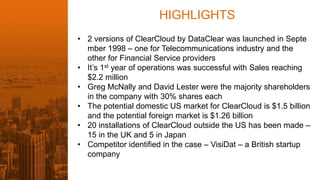
HIGHLIGHTS
• 2 versions of ClearCloud by DataClear was launched in Septe
mber 1998 – one for Telecommunications industry and the
other for Financial Service providers
• It’s 1st year of operations was successful with Sales reaching
$2.2 million
• Greg McNally and David Lester were the majority shareholders
in the company with 30% shares each
• The potential domestic US market for ClearCloud is $1.5 billion
and the potential foreign market is $1.26 billion
• 20 installations of ClearCloud outside the US has been made –
15 in the UK and 5 in Japan
• Competitor identified in the case – VisiDat – a British startup
company
A looming threat of being replaced in an International market creates a
dilemma whether to go international or to catch hold of Home market
• Dataclear is a Data Analysis Software developing company, currently serving
Telecommunication and Financial sector in US
• Clearcloud- A complex product that needs service infrastructure
• British startup VisiDat makes them aware about the emerging competition.
Parameter Home International
Potential in Telecom and Financial
Software industry
$ 600M $ 600M
Potential in other Software industry $ 900M $ 660M
Investment $ 2M $ 0.5M
Challenges • Creating awareness in the
existing sectors
• Sales & Service infrastruct
ure development for expan
sion
• New Office
• Sales team
• Software & Manual
translation
• BD team & product su
pport manager
• Culture, eco, political, l
egal aspects
Should Dataclear go international?
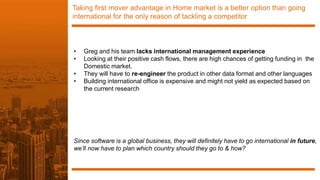
Taking first mover advantage in Home market is a better option than going
international for the only reason of tackling a competitor
• Greg and his team lacks international management experience
• Looking at their positive cash flows, there are high chances of getting funding in the
Domestic market.
• They will have to re-engineer the product in other data format and other languages
• Building international office is expensive and might not yield as expected based on
the current research
Since software is a global business, they will definitely have to go international in future,
we’ll now have to plan which country should they go to & how?
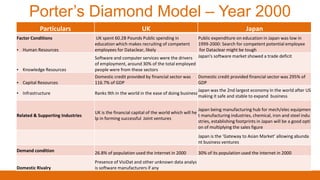
Porter’s Diamond Model – Year 2000
Particulars UK Japan
Factor Conditions
• Human Resources
UK spent 60.2B Pounds Public spending in
education which makes recruiting of competent
employees for Dataclear, likely
Public expenditure on education in Japan was low in
1999-2000: Search for competent potential employee
for Dataclear might be tough
• Knowledge Resources
Software and computer services were the drivers
of employment, around 30% of the total employed
people were from these sectors
Japan's software market showed a trade deficit
• Capital Resources
Domestic credit provided by financial sector was
116.7% of GDP
Domestic credit provided financial sector was 295% of
GDP
• Infrastructure Ranks 9th in the world in the ease of doing business
Japan was the 2nd largest economy in the world after US
making it safe and stable to expand business
Related & Supporting Industries
UK is the financial capital of the world which will he
lp in forming successful Joint ventures
Japan being manufacturing hub for mech/elec equipmen
t manufacturing industries, chemical, iron and steel indu
stries, establishing footprints in Japan will be a good opti
on of multiplying the sales figure
Japan is the ‘Gateway to Asian Market’ allowing abunda
nt business ventures
Demand condition 26.8% of population used the internet in 2000 30% of its population used the internet in 2000
Domestic Rivalry
Presence of VisiDat and other unknown data analys
is software manufacturers if any
Porter’s Diamond Model showed the competitive advantage of
both the target countries for expansion – UK and Japan
For better understanding the feasibility of expansion into international markets
– CAGE distance framework can be studied
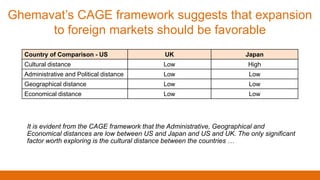
Ghemavat’s CAGE framework suggests that expansion
to foreign markets should be favorable
Country of Comparison - US UK Japan
Cultural distance Low High
Administrative and Political distance Low Low
Geographical distance Low Low
Economical distance Low Low
It is evident from the CAGE framework that the Administrative, Geographical and
Economical distances are low between US and Japan and US and UK. The only significant
factor worth exploring is the cultural distance between the countries …
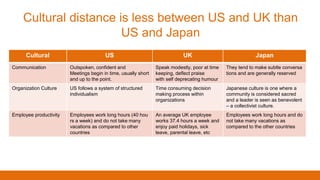
Cultural US UK Japan
Communication Outspoken, confident and
Meetings begin in time, usually short
and up to the point.
Speak modestly, poor at time
keeping, deflect praise
with self deprecating humour
They tend to make subtle conversa
tions and are generally reserved
Organization Culture US follows a system of structured
individualism
Time consuming decision
making process within
organizations
Japanese culture is one where a
community is considered sacred
and a leader is seen as benevolent
– a collectivist culture.
Employee productivity Employees work long hours (40 hou
rs a week) and do not take many
vacations as compared to other
countries
An average UK employee
works 37.4 hours a week and
enjoy paid holidays, sick
leave, parental leave, etc
Employees work long hours and do
not take many vacations as
compared to the other countries
Cultural distance is less between US and UK than
US and Japan
From Porter’s Diamond Model and the CAGE framework we can say that
expansion by Dataclear in the future should be in UK also considering the fact
that they already have a few existing customers in UK
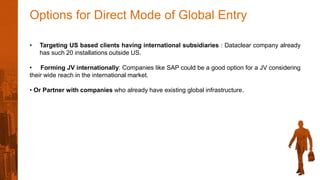
Options for Direct Mode of Global Entry
• Targeting US based clients having international subsidiaries : Dataclear company already
has such 20 installations outside US.
• Forming JV internationally: Companies like SAP could be a good option for a JV considering
their wide reach in the international market.
• Or Partner with companies who already have existing global infrastructure.
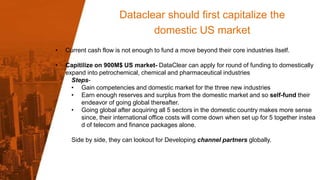
Dataclear should first capitalize the
domestic US market
• Current cash flow is not enough to fund a move beyond their core industries itself.
• Capitilize on 900M$ US market- DataClear can apply for round of funding to domestically
expand into petrochemical, chemical and pharmaceutical industries
Steps-
• Gain competencies and domestic market for the three new industries
• Earn enough reserves and surplus from the domestic market and so self-fund their
endeavor of going global thereafter.
• Going global after acquiring all 5 sectors in the domestic country makes more sense
since, their international office costs will come down when set up for 5 together instea
d of telecom and finance packages alone.
Side by side, they can lookout for Developing channel partners globally.
What needs DataClear’s attention?
1. Invest in doing a perpetual research for domestic & international market and other curre
nt and future players
• Analyze pros, cons and synergy of other players
• Focus on a joint venture with an advantageous domestic/international partner from one of
these, to prepare to go global in a well planned way
2. Research and negotiate with international channel partners to generate leads
And, Invest in generating sales leads from an Online portal
3. Invest in an international hiring agency
Conclusion
• Dataclear will discover new challenges while expanding its grip into the
domestic market too, whether its into telecommunication & finance or the
other three new industries
• Therefore its better to test the waters domestically first and then go inter
national with all preparation and backed up resources from reserves, par
tners etc.
• However, having a product worth international potential they should defin
itely go international in future.
• For now, they should focus more on building competencies that will be e
ssential for them to shine in the International markets in the future

Go global case study: HBR

  • 1.
    Go Global Class B,Group 12 Aditi Ajgaonkar (007) Karishma Bagla (041) Shraddha Bhaskar (083) Sneha Rajan (088)
  • 2.
    HIGHLIGHTS • 2 versionsof ClearCloud by DataClear was launched in Septe mber 1998 – one for Telecommunications industry and the other for Financial Service providers • It’s 1st year of operations was successful with Sales reaching $2.2 million • Greg McNally and David Lester were the majority shareholders in the company with 30% shares each • The potential domestic US market for ClearCloud is $1.5 billion and the potential foreign market is $1.26 billion • 20 installations of ClearCloud outside the US has been made – 15 in the UK and 5 in Japan • Competitor identified in the case – VisiDat – a British startup company
  • 3.
    A looming threatof being replaced in an International market creates a dilemma whether to go international or to catch hold of Home market • Dataclear is a Data Analysis Software developing company, currently serving Telecommunication and Financial sector in US • Clearcloud- A complex product that needs service infrastructure • British startup VisiDat makes them aware about the emerging competition. Parameter Home International Potential in Telecom and Financial Software industry $ 600M $ 600M Potential in other Software industry $ 900M $ 660M Investment $ 2M $ 0.5M Challenges • Creating awareness in the existing sectors • Sales & Service infrastruct ure development for expan sion • New Office • Sales team • Software & Manual translation • BD team & product su pport manager • Culture, eco, political, l egal aspects Should Dataclear go international?
  • 4.
    Taking first moveradvantage in Home market is a better option than going international for the only reason of tackling a competitor • Greg and his team lacks international management experience • Looking at their positive cash flows, there are high chances of getting funding in the Domestic market. • They will have to re-engineer the product in other data format and other languages • Building international office is expensive and might not yield as expected based on the current research Since software is a global business, they will definitely have to go international in future, we’ll now have to plan which country should they go to & how?
  • 5.
    Porter’s Diamond Model– Year 2000 Particulars UK Japan Factor Conditions • Human Resources UK spent 60.2B Pounds Public spending in education which makes recruiting of competent employees for Dataclear, likely Public expenditure on education in Japan was low in 1999-2000: Search for competent potential employee for Dataclear might be tough • Knowledge Resources Software and computer services were the drivers of employment, around 30% of the total employed people were from these sectors Japan's software market showed a trade deficit • Capital Resources Domestic credit provided by financial sector was 116.7% of GDP Domestic credit provided financial sector was 295% of GDP • Infrastructure Ranks 9th in the world in the ease of doing business Japan was the 2nd largest economy in the world after US making it safe and stable to expand business Related & Supporting Industries UK is the financial capital of the world which will he lp in forming successful Joint ventures Japan being manufacturing hub for mech/elec equipmen t manufacturing industries, chemical, iron and steel indu stries, establishing footprints in Japan will be a good opti on of multiplying the sales figure Japan is the ‘Gateway to Asian Market’ allowing abunda nt business ventures Demand condition 26.8% of population used the internet in 2000 30% of its population used the internet in 2000 Domestic Rivalry Presence of VisiDat and other unknown data analys is software manufacturers if any
  • 6.
    Porter’s Diamond Modelshowed the competitive advantage of both the target countries for expansion – UK and Japan For better understanding the feasibility of expansion into international markets – CAGE distance framework can be studied
  • 7.
    Ghemavat’s CAGE frameworksuggests that expansion to foreign markets should be favorable Country of Comparison - US UK Japan Cultural distance Low High Administrative and Political distance Low Low Geographical distance Low Low Economical distance Low Low It is evident from the CAGE framework that the Administrative, Geographical and Economical distances are low between US and Japan and US and UK. The only significant factor worth exploring is the cultural distance between the countries …
  • 8.
    Cultural US UKJapan Communication Outspoken, confident and Meetings begin in time, usually short and up to the point. Speak modestly, poor at time keeping, deflect praise with self deprecating humour They tend to make subtle conversa tions and are generally reserved Organization Culture US follows a system of structured individualism Time consuming decision making process within organizations Japanese culture is one where a community is considered sacred and a leader is seen as benevolent – a collectivist culture. Employee productivity Employees work long hours (40 hou rs a week) and do not take many vacations as compared to other countries An average UK employee works 37.4 hours a week and enjoy paid holidays, sick leave, parental leave, etc Employees work long hours and do not take many vacations as compared to the other countries Cultural distance is less between US and UK than US and Japan
  • 9.
    From Porter’s DiamondModel and the CAGE framework we can say that expansion by Dataclear in the future should be in UK also considering the fact that they already have a few existing customers in UK
  • 10.
    Options for DirectMode of Global Entry • Targeting US based clients having international subsidiaries : Dataclear company already has such 20 installations outside US. • Forming JV internationally: Companies like SAP could be a good option for a JV considering their wide reach in the international market. • Or Partner with companies who already have existing global infrastructure.
  • 11.
    Dataclear should firstcapitalize the domestic US market • Current cash flow is not enough to fund a move beyond their core industries itself. • Capitilize on 900M$ US market- DataClear can apply for round of funding to domestically expand into petrochemical, chemical and pharmaceutical industries Steps- • Gain competencies and domestic market for the three new industries • Earn enough reserves and surplus from the domestic market and so self-fund their endeavor of going global thereafter. • Going global after acquiring all 5 sectors in the domestic country makes more sense since, their international office costs will come down when set up for 5 together instea d of telecom and finance packages alone. Side by side, they can lookout for Developing channel partners globally.
  • 12.
    What needs DataClear’sattention? 1. Invest in doing a perpetual research for domestic & international market and other curre nt and future players • Analyze pros, cons and synergy of other players • Focus on a joint venture with an advantageous domestic/international partner from one of these, to prepare to go global in a well planned way 2. Research and negotiate with international channel partners to generate leads And, Invest in generating sales leads from an Online portal 3. Invest in an international hiring agency
  • 13.
    Conclusion • Dataclear willdiscover new challenges while expanding its grip into the domestic market too, whether its into telecommunication & finance or the other three new industries • Therefore its better to test the waters domestically first and then go inter national with all preparation and backed up resources from reserves, par tners etc. • However, having a product worth international potential they should defin itely go international in future. • For now, they should focus more on building competencies that will be e ssential for them to shine in the International markets in the future

Editor's Notes

  • #9 https://www.ifs.org.uk/tools_and_resources/fiscal_facts/education