Automated Web Foo or FUD? David Kierznowski IT Security Analyst [email_address]
Powered by... http://www.nta-monitor.com
About DK Check Team Leader with UK’s CESG Scheme Senior Security Analyst for a leading penetration testing company in the UK Works in both government and commercial sectors Core member of GNUCITIZEN group Developed a number of open source security tools (i.e. ASP-Auditor, TSF) Founder of BlogSecurity, michaeldaw.org and primary developer of wp-scanner Credited on several major web application vulnerability findings Research featured on Slashdot, eWeek, SecurityFocus and others
Review Current Threats and the Attack Renaissance. Insight into the effectiveness of automated tools. Test less vs test all debate. Hybrid testing with the Technika Security Framework.
Goals Basic understanding of how automated security testing tools are constructed. A greater awareness of the challenges that lie ahead with automated web application tools. An introduction into browser scripting and the Technika Security Framework. A better understanding of how security testing companies approach web application testing. Some suggestions to improve the quality of web application tests.
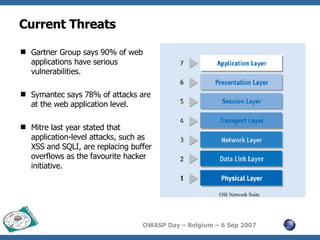
Current Threats Gartner Group says 90% of web applications have serious vulnerabilities. Symantec says 78% of attacks are at the web application level. Mitre last year stated that application-level attacks, such as XSS and SQLI, are replacing buffer overflows as the favourite hacker initiative. OSI Network Suite
Attack Renaissance Traditional vulnerabilities target the server New age attacks target the client - XSS as the catalyst
Find Less vs Find All Find all approach Try locate and report all vulnerabilities Find less approach   Locate less and report the cause of the problem
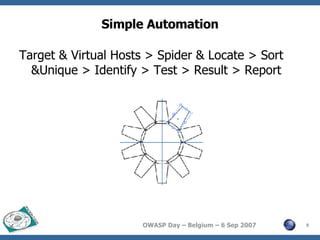
Simple Automation Target & Virtual Hosts > Spider & Locate > Sort &Unique > Identify > Test > Result > Report
Auto Limitations “find all” Script Parsing Business and/or application logic False Negatives/Positives Non-RFC applications State or flow  Challenge-Response Cost Custom URLs Training Denial of Service risks
Manual Limitations "Find less approach" Time Emotional stability Skill level Find less approach
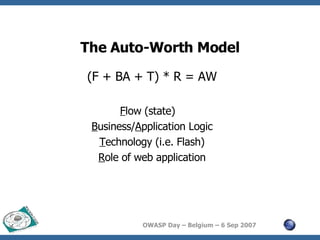
The Auto-Worth Model (F + BA + T) * R = AW F low (state)  B usiness/ A pplication Logic T echnology (i.e. Flash) R ole of web application
A Couple Suggestions Define clearly the purpose and role of the application to be tested Use the Auto-Worth Model as a base Manual security testers should follow a testing procedure A hybrid approach may be best
Technika Automated Browser Exploitation Tool  and  Browser Scripting Tool
Technika – Write Script Snippet from tech.store for persistent storage   tech.store.pop = function(_sarray, key) { var _l = _sarray.length; for (i=0; i<_l; i++) { var _key = key + i; sessionStorage.removeItem(_key, _sarray[i]); } console.log(_sarray.length + &quot; records removed.&quot;); };
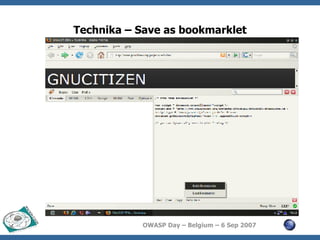
Technika – Save as bookmarklet
Technika Security Framework tech.dspider  - DOM link spider; because we utilize the DOM, the results are instant.  tech.forms  - GET/POST form parser.  tech.mutate  - By specifying a payload and regex, we can mutate our target arrays and build tests.  tech.scan  - tech.scan is our actual engine that will handle our GET and POST requests.  tech.mNikto  - Mini-Nikto was named after the popular web application tool Nikto if you haven’t already guessed. We called it mini-nikto as it currently only contains a very small database.  tech.explorer  - This is one of my favorite tools in the TS framework. It uses Yahoo! AJAX API (JSON) to fetch links and perform other Google hacking type queries outside of our current DOM. This is really useful even when it is not security related.  tech.store  - Utilizes the Firefox sessionStorage to allow us to persistently store arrays.  And much MORE!!
Technika Security Framework Technika demo video placeholder and tool introduction.
Summary The application layer is enemy number 1! Increased attacks in the future due to the Attack Renaissance Remember the Auto-Worth model in planning and even during the web application testing process. The hybrid approach will almost always present the best results. We hope to start developing Technika to a semi-stable state, but its definitely a project to start getting involved in.
Credits and Refs Credits: GNUCITIZEN GROUP –  http://gnucitizen.org NTA-Monitor –  http://www.nta-monitor.com Refs: Robert Auger -  http://www.cgisecurity.com/articles/scannerchallenges.shtml Technika -  http://www.gnucitizen.org/projects/technika/ Technika Security Framework -  http://www.gnucitizen.org/blog/introducing-technika-security-framework/ Jeremiah Grossman – Challenges of Web Application Testing

GNUCITIZEN Dwk Owasp Day September 2007

  • 1.
    Automated Web Fooor FUD? David Kierznowski IT Security Analyst [email_address]
  • 2.
  • 3.
    About DK CheckTeam Leader with UK’s CESG Scheme Senior Security Analyst for a leading penetration testing company in the UK Works in both government and commercial sectors Core member of GNUCITIZEN group Developed a number of open source security tools (i.e. ASP-Auditor, TSF) Founder of BlogSecurity, michaeldaw.org and primary developer of wp-scanner Credited on several major web application vulnerability findings Research featured on Slashdot, eWeek, SecurityFocus and others
  • 4.
    Review Current Threatsand the Attack Renaissance. Insight into the effectiveness of automated tools. Test less vs test all debate. Hybrid testing with the Technika Security Framework.
  • 5.
    Goals Basic understandingof how automated security testing tools are constructed. A greater awareness of the challenges that lie ahead with automated web application tools. An introduction into browser scripting and the Technika Security Framework. A better understanding of how security testing companies approach web application testing. Some suggestions to improve the quality of web application tests.
  • 6.
    Current Threats GartnerGroup says 90% of web applications have serious vulnerabilities. Symantec says 78% of attacks are at the web application level. Mitre last year stated that application-level attacks, such as XSS and SQLI, are replacing buffer overflows as the favourite hacker initiative. OSI Network Suite
  • 7.
    Attack Renaissance Traditionalvulnerabilities target the server New age attacks target the client - XSS as the catalyst
  • 8.
    Find Less vsFind All Find all approach Try locate and report all vulnerabilities Find less approach Locate less and report the cause of the problem
  • 9.
    Simple Automation Target& Virtual Hosts > Spider & Locate > Sort &Unique > Identify > Test > Result > Report
  • 10.
    Auto Limitations “findall” Script Parsing Business and/or application logic False Negatives/Positives Non-RFC applications State or flow Challenge-Response Cost Custom URLs Training Denial of Service risks
  • 11.
    Manual Limitations &quot;Findless approach&quot; Time Emotional stability Skill level Find less approach
  • 12.
    The Auto-Worth Model(F + BA + T) * R = AW F low (state) B usiness/ A pplication Logic T echnology (i.e. Flash) R ole of web application
  • 13.
    A Couple SuggestionsDefine clearly the purpose and role of the application to be tested Use the Auto-Worth Model as a base Manual security testers should follow a testing procedure A hybrid approach may be best
  • 14.
    Technika Automated BrowserExploitation Tool and Browser Scripting Tool
  • 15.
    Technika – WriteScript Snippet from tech.store for persistent storage tech.store.pop = function(_sarray, key) { var _l = _sarray.length; for (i=0; i<_l; i++) { var _key = key + i; sessionStorage.removeItem(_key, _sarray[i]); } console.log(_sarray.length + &quot; records removed.&quot;); };
  • 16.
    Technika – Saveas bookmarklet
  • 17.
    Technika Security Frameworktech.dspider - DOM link spider; because we utilize the DOM, the results are instant. tech.forms - GET/POST form parser. tech.mutate - By specifying a payload and regex, we can mutate our target arrays and build tests. tech.scan - tech.scan is our actual engine that will handle our GET and POST requests. tech.mNikto - Mini-Nikto was named after the popular web application tool Nikto if you haven’t already guessed. We called it mini-nikto as it currently only contains a very small database. tech.explorer - This is one of my favorite tools in the TS framework. It uses Yahoo! AJAX API (JSON) to fetch links and perform other Google hacking type queries outside of our current DOM. This is really useful even when it is not security related. tech.store - Utilizes the Firefox sessionStorage to allow us to persistently store arrays. And much MORE!!
  • 18.
    Technika Security FrameworkTechnika demo video placeholder and tool introduction.
  • 19.
    Summary The applicationlayer is enemy number 1! Increased attacks in the future due to the Attack Renaissance Remember the Auto-Worth model in planning and even during the web application testing process. The hybrid approach will almost always present the best results. We hope to start developing Technika to a semi-stable state, but its definitely a project to start getting involved in.
  • 20.
    Credits and RefsCredits: GNUCITIZEN GROUP – http://gnucitizen.org NTA-Monitor – http://www.nta-monitor.com Refs: Robert Auger - http://www.cgisecurity.com/articles/scannerchallenges.shtml Technika - http://www.gnucitizen.org/projects/technika/ Technika Security Framework - http://www.gnucitizen.org/blog/introducing-technika-security-framework/ Jeremiah Grossman – Challenges of Web Application Testing