Abdurrahim Musleman
Agenda Background Identify Problem The Macro-environment situation The Competitive situation SWOT Analysis Marketing Research Project Objectives Alterations to the Marketing Mix Q & A
Background Multinational automobile manufacturer founded in 1908. Was the world’s largest automaker until last year. GM is the ninth largest publicly traded company in the World. GM today employs about 266,000 people around the world. . With global headquarters in Detroit, GM manufactures its cars and trucks in 35 countries and its vehicles are sold in 200 countries.  Currently, the United States holds the “largest national market” for General Motors. China, Canada, the UK, and Germany follow the United States for GM’s largest markets.
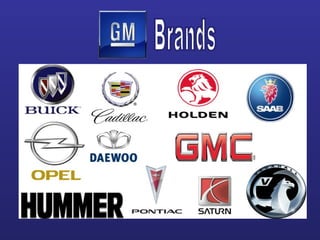
Brands
objectives position the company for sustained competitiveness, profitability and growth. satisfy customers based on the design, quality, technology and value of our cars and trucks. Continue solid growth in global vehicle sales. .  Investing dedicated to improving cultural, economic, educational, environmental, and social aspects of our communities. “ G.M. is a multinational corporation engaged in socially responsible operations, worldwide. It is dedicated to provide products and services of such quality that our customers will receive superior value while our employees and business partners will share in our success and our stock-holders will receive a sustained superior return on their investment."  Mission Statement:
Identified Problem Falling car sales has been a problem for GM due to increased competition from foreign manufacturers & rising oil prices.
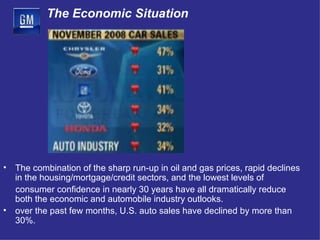
The Economic Situation The combination of the sharp run-up in oil and gas prices, rapid declines in the housing/mortgage/credit sectors, and the lowest levels of  consumer confidence in nearly 30 years have all dramatically reduce both the economic and automobile industry outlooks. over the past few months, U.S. auto sales have declined by more than 30%.
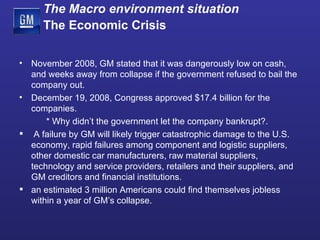
November 2008, GM stated that it was dangerously low on cash, and weeks away from collapse if the government refused to bail the company out. December 19, 2008, Congress approved $17.4 billion for the companies. * Why didn’t the government let the company bankrupt? . A failure by GM will likely trigger catastrophic damage to the U.S. economy, rapid failures among component and logistic suppliers, other domestic car manufacturers, raw material suppliers, technology and service providers, retailers and their suppliers, and GM creditors and financial institutions. an estimated 3 million Americans could find themselves jobless within a year of GM’s collapse. The Macro environment situation   The Economic Crisis
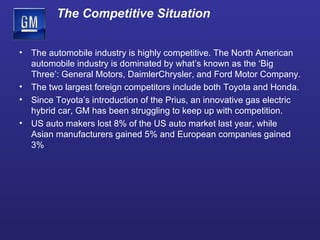
The automobile industry is highly competitive. The North American automobile industry is dominated by what’s known as the ‘Big Three’: General Motors, DaimlerChrysler, and Ford Motor Company. The two largest foreign competitors include both Toyota and Honda. Since Toyota’s introduction of the Prius, an innovative gas electric hybrid car, GM has been struggling to keep up with competition. US auto makers lost 8% of the US auto market last year, while Asian manufacturers gained 5% and European companies gained 3% The Competitive Situation
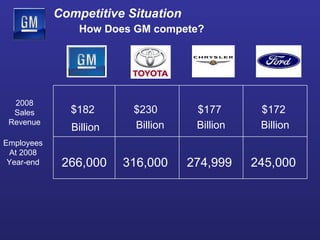
Competitive Situation   How Does GM compete? 2008 Sales  Revenue Employees At 2008 Year-end $182  Billion   $230  Billion $177  Billion $172  Billion 266,000 316,000  274,999  245,000
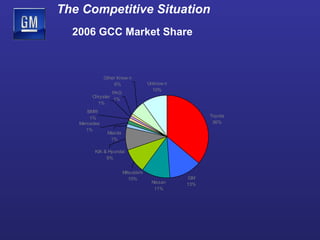
The Competitive Situation   2006 GCC Market Share
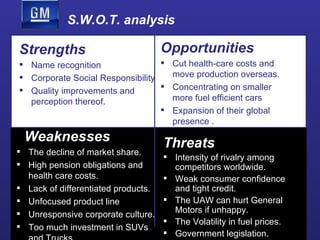
S.W.O.T. analysis Strengths Name recognition  Corporate Social Responsibility Quality improvements and perception thereof. Opportunities Cut health-care costs and move production overseas. Concentrating on smaller more fuel efficient cars  Expansion of their global presence . Weaknesses The decline of market share. High pension obligations and health care costs. Lack of differentiated products. Unfocused product line  Unresponsive corporate culture. Too much investment in SUVs and Trucks. Threats Intensity of rivalry among competitors worldwide. Weak consumer confidence and tight credit. The UAW can hurt General Motors if unhappy. The Volatility in fuel prices. Government legislation.
Research Plan Primary Research Limited to Qatar university  Survey Research: Focus Group Amendment Simple Random Sample: 15 students   Secondary Research Official Websites Business Magazines Journals GM’s annual reports
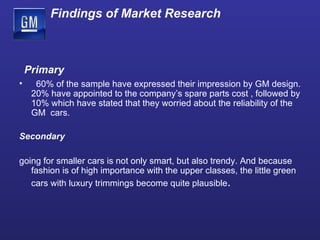
Findings of Market Research Primary 60% of the sample have expressed their impression by GM design. 20% have appointed to the company’s spare parts cost   , followed by 10% which have stated that they worried about the reliability of the GM  cars.  Secondary going for smaller cars is not only smart, but also trendy. And because fashion is of high importance with the upper classes, the little green cars with luxury trimmings become quite plausible .
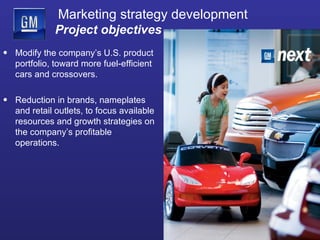
Marketing strategy development   Project objectives Modify the company’s U.S. product portfolio, toward more fuel-efficient cars and crossovers. Reduction in brands, nameplates and retail outlets, to focus available resources and growth strategies on the company’s profitable operations.
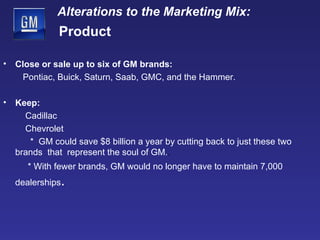
Alterations to the Marketing Mix:   Product Close or sale up to six of GM brands: Pontiac, Buick, Saturn, Saab, GMC, and the Hammer.  Keep: Cadillac Chevrolet *  GM could save $8 billion a year by cutting back to just these two  brands  that  represent the soul of GM. .  * With fewer brands, GM would no longer have to maintain 7,000 dealerships .
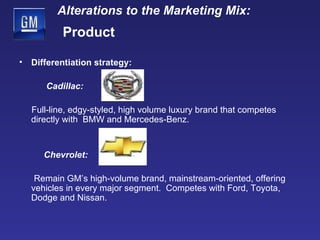
Differentiation strategy:   Cadillac:  Full-line, edgy-styled, high volume luxury brand that competes directly with  BMW and Mercedes-Benz. Chevrolet: Remain GM’s high-volume brand, mainstream-oriented, offering vehicles in every major segment.  Competes with Ford, Toyota, Dodge and Nissan. Alterations to the Marketing Mix:   Product
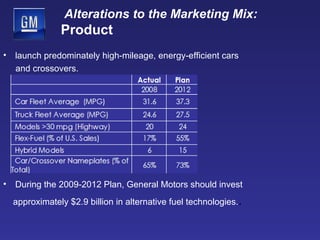
Alterations to the Marketing Mix:   Product launch predominately high-mileage, energy-efficient cars  and crossovers. During the 2009-2012 Plan, General Motors should invest approximately $2.9 billion in alternative fuel technologies. .
Alterations to the Marketing Mix Cont.   Price Abandon the employee pricing discounts as they prove to be very harmful to the company and its image. Selling lots of vehicles doesn't necessarily translate into higher profits unless the cars and trucks are sold at the right price. begin pricing all the new models in a more rational way, at the actual price for which they usually sell.  Cadillac: Very expensive  Chevrolet:  Economy-priced
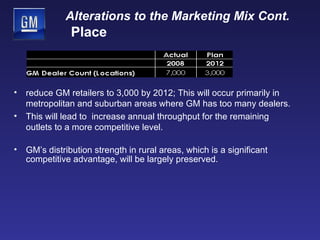
reduce GM retailers to 3,000 by 2012; This will occur primarily in metropolitan and suburban areas where GM has too many dealers. This will lead to  increase annual throughput for the remaining outlets to a more competitive level.  GM’s distribution strength in rural areas, which is a significant competitive advantage, will be largely preserved.   Alterations to the Marketing Mix Cont.   Place
Alterations to the Marketing Mix:   Promotion The company is perceived as a gas-guzzling company.  pursues a "green" promotion strategy that addresses global energy and climate issues to improve its overall corporate image. We propose a cost-effective campaign, focused on direct marketing, publicity, and Internet web page. We suggest that the company partner with an environmental icon like for example Algore, and sponsor environmental awareness campaigns.
Thank You
Q & A

Gm Presentation3

  • 1.
  • 2.
    Agenda Background IdentifyProblem The Macro-environment situation The Competitive situation SWOT Analysis Marketing Research Project Objectives Alterations to the Marketing Mix Q & A
  • 3.
    Background Multinational automobilemanufacturer founded in 1908. Was the world’s largest automaker until last year. GM is the ninth largest publicly traded company in the World. GM today employs about 266,000 people around the world. . With global headquarters in Detroit, GM manufactures its cars and trucks in 35 countries and its vehicles are sold in 200 countries. Currently, the United States holds the “largest national market” for General Motors. China, Canada, the UK, and Germany follow the United States for GM’s largest markets.
  • 4.
  • 5.
    objectives position thecompany for sustained competitiveness, profitability and growth. satisfy customers based on the design, quality, technology and value of our cars and trucks. Continue solid growth in global vehicle sales. . Investing dedicated to improving cultural, economic, educational, environmental, and social aspects of our communities. “ G.M. is a multinational corporation engaged in socially responsible operations, worldwide. It is dedicated to provide products and services of such quality that our customers will receive superior value while our employees and business partners will share in our success and our stock-holders will receive a sustained superior return on their investment." Mission Statement:
  • 6.
    Identified Problem Fallingcar sales has been a problem for GM due to increased competition from foreign manufacturers & rising oil prices.
  • 7.
    The Economic SituationThe combination of the sharp run-up in oil and gas prices, rapid declines in the housing/mortgage/credit sectors, and the lowest levels of consumer confidence in nearly 30 years have all dramatically reduce both the economic and automobile industry outlooks. over the past few months, U.S. auto sales have declined by more than 30%.
  • 8.
    November 2008, GMstated that it was dangerously low on cash, and weeks away from collapse if the government refused to bail the company out. December 19, 2008, Congress approved $17.4 billion for the companies. * Why didn’t the government let the company bankrupt? . A failure by GM will likely trigger catastrophic damage to the U.S. economy, rapid failures among component and logistic suppliers, other domestic car manufacturers, raw material suppliers, technology and service providers, retailers and their suppliers, and GM creditors and financial institutions. an estimated 3 million Americans could find themselves jobless within a year of GM’s collapse. The Macro environment situation The Economic Crisis
  • 9.
    The automobile industryis highly competitive. The North American automobile industry is dominated by what’s known as the ‘Big Three’: General Motors, DaimlerChrysler, and Ford Motor Company. The two largest foreign competitors include both Toyota and Honda. Since Toyota’s introduction of the Prius, an innovative gas electric hybrid car, GM has been struggling to keep up with competition. US auto makers lost 8% of the US auto market last year, while Asian manufacturers gained 5% and European companies gained 3% The Competitive Situation
  • 10.
    Competitive Situation How Does GM compete? 2008 Sales Revenue Employees At 2008 Year-end $182 Billion $230 Billion $177 Billion $172 Billion 266,000 316,000 274,999 245,000
  • 11.
    The Competitive Situation 2006 GCC Market Share
  • 12.
    S.W.O.T. analysis StrengthsName recognition Corporate Social Responsibility Quality improvements and perception thereof. Opportunities Cut health-care costs and move production overseas. Concentrating on smaller more fuel efficient cars Expansion of their global presence . Weaknesses The decline of market share. High pension obligations and health care costs. Lack of differentiated products. Unfocused product line Unresponsive corporate culture. Too much investment in SUVs and Trucks. Threats Intensity of rivalry among competitors worldwide. Weak consumer confidence and tight credit. The UAW can hurt General Motors if unhappy. The Volatility in fuel prices. Government legislation.
  • 13.
    Research Plan PrimaryResearch Limited to Qatar university Survey Research: Focus Group Amendment Simple Random Sample: 15 students Secondary Research Official Websites Business Magazines Journals GM’s annual reports
  • 14.
    Findings of MarketResearch Primary 60% of the sample have expressed their impression by GM design. 20% have appointed to the company’s spare parts cost , followed by 10% which have stated that they worried about the reliability of the GM cars. Secondary going for smaller cars is not only smart, but also trendy. And because fashion is of high importance with the upper classes, the little green cars with luxury trimmings become quite plausible .
  • 15.
    Marketing strategy development Project objectives Modify the company’s U.S. product portfolio, toward more fuel-efficient cars and crossovers. Reduction in brands, nameplates and retail outlets, to focus available resources and growth strategies on the company’s profitable operations.
  • 16.
    Alterations to theMarketing Mix: Product Close or sale up to six of GM brands: Pontiac, Buick, Saturn, Saab, GMC, and the Hammer. Keep: Cadillac Chevrolet * GM could save $8 billion a year by cutting back to just these two brands that represent the soul of GM. . * With fewer brands, GM would no longer have to maintain 7,000 dealerships .
  • 17.
    Differentiation strategy: Cadillac: Full-line, edgy-styled, high volume luxury brand that competes directly with BMW and Mercedes-Benz. Chevrolet: Remain GM’s high-volume brand, mainstream-oriented, offering vehicles in every major segment. Competes with Ford, Toyota, Dodge and Nissan. Alterations to the Marketing Mix: Product
  • 18.
    Alterations to theMarketing Mix: Product launch predominately high-mileage, energy-efficient cars and crossovers. During the 2009-2012 Plan, General Motors should invest approximately $2.9 billion in alternative fuel technologies. .
  • 19.
    Alterations to theMarketing Mix Cont. Price Abandon the employee pricing discounts as they prove to be very harmful to the company and its image. Selling lots of vehicles doesn't necessarily translate into higher profits unless the cars and trucks are sold at the right price. begin pricing all the new models in a more rational way, at the actual price for which they usually sell. Cadillac: Very expensive Chevrolet: Economy-priced
  • 20.
    reduce GM retailersto 3,000 by 2012; This will occur primarily in metropolitan and suburban areas where GM has too many dealers. This will lead to increase annual throughput for the remaining outlets to a more competitive level. GM’s distribution strength in rural areas, which is a significant competitive advantage, will be largely preserved. Alterations to the Marketing Mix Cont. Place
  • 21.
    Alterations to theMarketing Mix: Promotion The company is perceived as a gas-guzzling company. pursues a "green" promotion strategy that addresses global energy and climate issues to improve its overall corporate image. We propose a cost-effective campaign, focused on direct marketing, publicity, and Internet web page. We suggest that the company partner with an environmental icon like for example Algore, and sponsor environmental awareness campaigns.
  • 22.
  • 23.