Page | 1 
BUS 444 – Strategic Management 
Lecturer: Professor Thomas Bradley 
Strategic Management Project 
Class 1 – Group 3 
Pham Ngoc Minh Khoa 
Tran Thai Son 
Pham Hung Thai Son
Page | 2 
Truong Tran Ngoc Son
Page | 3
Page | 4 
Table of Contents 
The Bankruptcy of General Motors in 2009 .......................................................................................... 5 
Executive Summary ............................................................................................................................ 5 
- General Motors....................................................................................................................... 6 
- Mission Statement – Evaluation Matrix .................................................................................... 6 
- Vision Statement .................................................................................................................... 7 
- Objectives .............................................................................................................................. 7 
- Strategy and Evaluation .......................................................................................................... 7 
- GM Vehicle – Global Brands .................................................................................................. 8 
- Vehicle Engines and Transmission........................................................................................... 9 
- Marine Engines and Controllers............................................................................................. 10 
- Services ............................................................................................................................... 11 
SWOT Matrix .................................................................................................................................. 12 
- Strength ............................................................................................................................... 13 
- Weakness ............................................................................................................................. 14 
- Opportunity.......................................................................................................................... 15 
- Threat .................................................................................................................................. 16 
External Factors Evaluations Matrix (EFE) ........................................................................................ 17 
- Analysis ............................................................................................................................... 18 
Internal Factor Evaluation Matrix (IFE) ............................................................................................. 23 
- Analysis ............................................................................................................................... 24 
Competitive Profile Matrix................................................................................................................ 26 
- Analysis ............................................................................................................................... 27 
The Strategic Position and Action Evaluation Matrix (Space) .............................................................. 31 
- Analysis ............................................................................................................................... 34 
Grand Matrix.................................................................................................................................... 35 
Quantitative Strategic Planning Matrix (QSPM) ................................................................................. 37
- Analysis ............................................................................................................................... 39 
Business Strategy Recommendations ................................................................................................. 41 
Annual Objectives ............................................................................................................................ 43 
Strategy Review and Evaluation ........................................................................................................ 44 
Financial Analysis ............................................................................................................................ 45 
Porter’s Five Forces Analysis ............................................................................................................ 53 
Pestel Analysis ................................................................................................................................. 54 
Conclusion ....................................................................................................................................... 54 
Reference ......................................................................................................................................... 55 
Page | 5
Page | 6 
Executive Summary 
General Motors Corporation - GM 
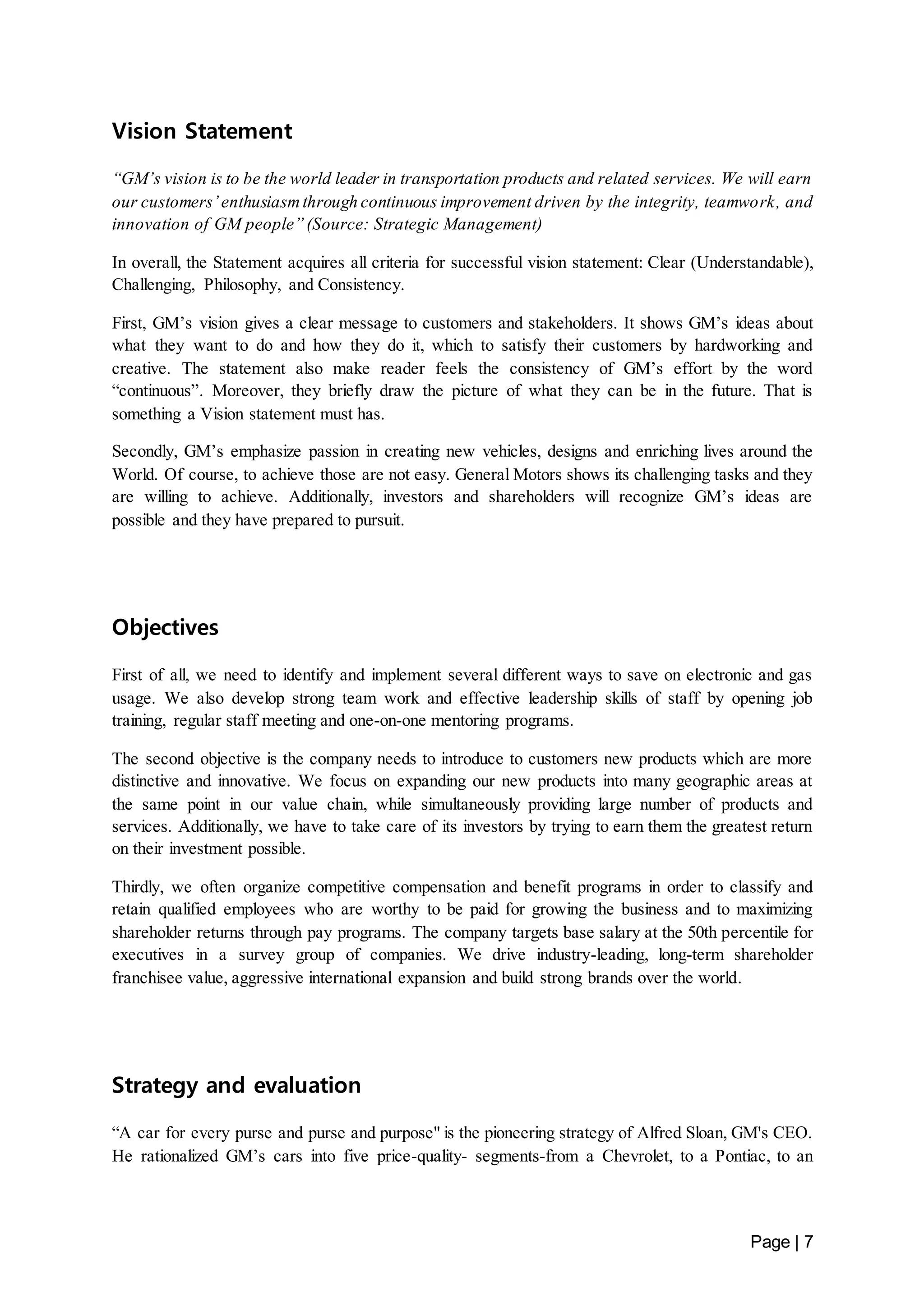
It is an American multinational corporation headquartered 
in Detroit,Michigan that designs, manufactures, markets and 
distributes vehicles and vehicle parts and sells financial 
services. GM has been seen as one of the largest car 
manufacturer for about 78 years. Nowadays, although it is not 
on the top of the game, still GM’s products spread all over the 
world. General Motors produces vehicles in 37 countries under 
ten 
brands: Chevrolet, Buick, GMC, Cadillac, Opel, Holden, Vauxhall, Wuling,Baojun, Jie Fang, UzDaewoo. 
General Motors also has many oversea subsidiaries. They include Opel / Vauxhall in Europe, Holden 
in Australia, GM Korea in South Korea and Shanghai GM in China. Moreover, those Asian agencies 
have been tremendous profitable sources for GM. 
Mission Statement – Evaluation Matrix 
"G.M. is a multinational corporation engaged in socially responsible operations, worldwide. It is 
dedicated to provide products and services of such quality that our customers will receive superior 
value while our employees and business partners will share in our success and our stock-holders will 
receive a sustained superior return on their investment”(Source: Strategic Management) 
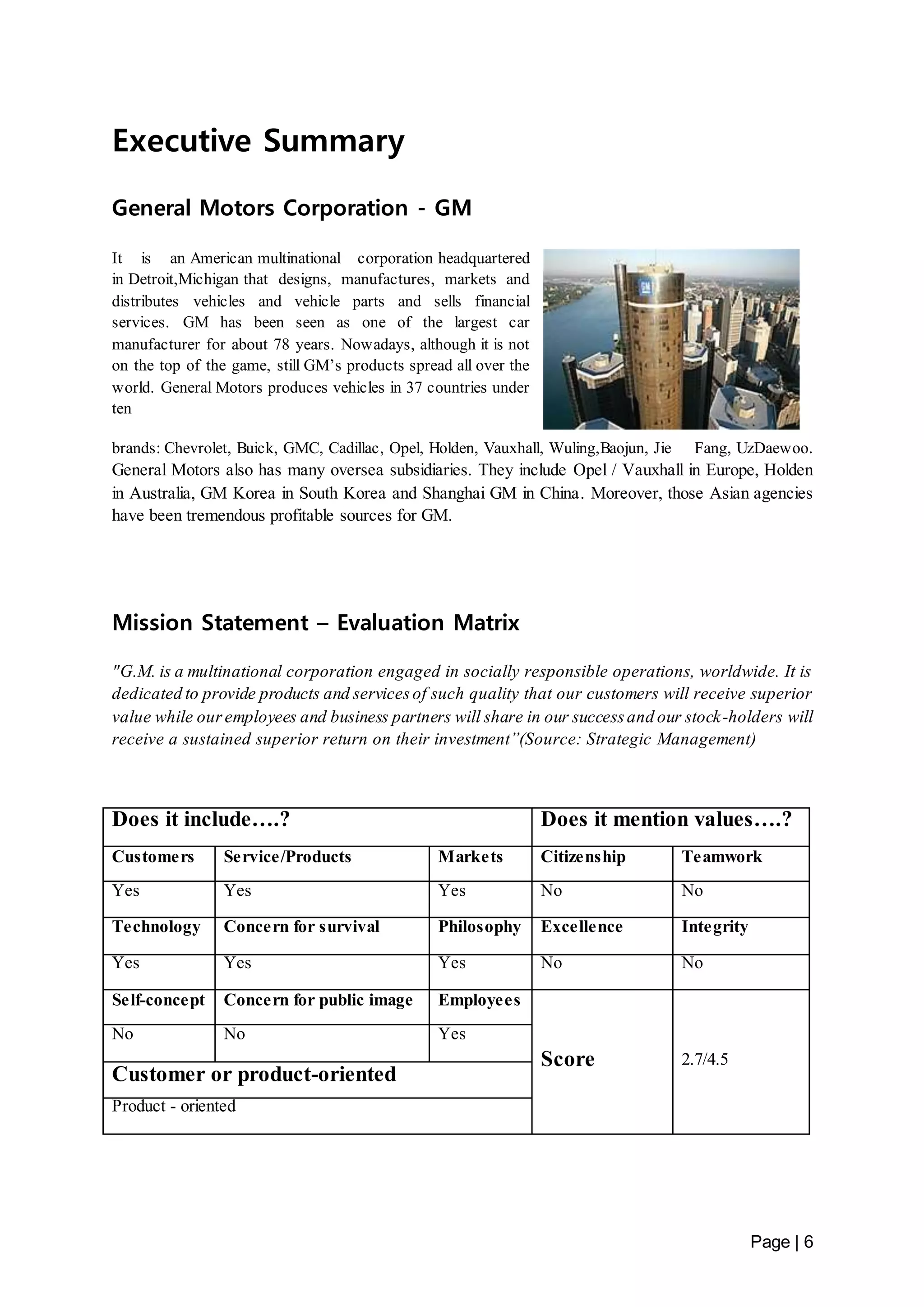
Does it include….? Does it mention values….? 
Customers Service/Products Markets Citizenship Teamwork 
Yes Yes Yes No No 
Technology Concern for survival Philosophy Excellence Integrity 
Yes Yes Yes No No 
Self-concept Concern for public image Employees 
Score 2.7/4.5 
No No Yes 
Customer or product-oriented 
Product - oriented
Page | 7 
Vision Statement 
“GM’s vision is to be the world leader in transportation products and related services. We will earn 
our customers’ enthusiasm through continuous improvement driven by the integrity, teamwork, and 
innovation of GM people” (Source: Strategic Management) 
In overall, the Statement acquires all criteria for successful vision statement: Clear (Understandable), 
Challenging, Philosophy, and Consistency. 
First, GM’s vision gives a clear message to customers and stakeholders. It shows GM’s ideas about 
what they want to do and how they do it, which to satisfy their customers by hardworking and 
creative. The statement also make reader feels the consistency of GM’s effort by the word 
“continuous”. Moreover, they briefly draw the picture of what they can be in the future. That is 
something a Vision statement must has. 
Secondly, GM’s emphasize passion in creating new vehicles, designs and enriching lives around the 
World. Of course, to achieve those are not easy. General Motors shows its challenging tasks and they 
are willing to achieve. Additionally, investors and shareholders will recognize GM’s ideas are 
possible and they have prepared to pursuit. 
Objectives 
First of all, we need to identify and implement several different ways to save on electronic and gas 
usage. We also develop strong team work and effective leadership skills of staff by opening job 
training, regular staff meeting and one-on-one mentoring programs. 
The second objective is the company needs to introduce to customers new products which are more 
distinctive and innovative. We focus on expanding our new products into many geographic areas at 
the same point in our value chain, while simultaneously providing large number of products and 
services. Additionally, we have to take care of its investors by trying to earn them the greatest return 
on their investment possible. 
Thirdly, we often organize competitive compensation and benefit programs in order to classify and 
retain qualified employees who are worthy to be paid for growing the business and to maximizing 
shareholder returns through pay programs. The company targets base salary at the 50th percentile for 
executives in a survey group of companies. We drive industry-leading, long-term shareholder 
franchisee value, aggressive international expansion and build strong brands over the world. 
Strategy and evaluation 
“A car for every purse and purse and purpose" is the pioneering strategy of Alfred Sloan, GM's CEO. 
He rationalized GM’s cars into five price-quality- segments-from a Chevrolet, to a Pontiac, to an
Oldsmobile, to a Buick, to a Cadillac. In order to differentiate GM brands from their competition, he 
positioned each car line at the top of the price scale in its price-quality segment. 
For more than a half century GM dominated the U.S auto industry like colossus with a market share 
as high as 50% which made it a low-cost leader. So, it is ironic that even the most prestigious 
handwork –Cadillac—of the man wrote the book on market segmentation and differentiation failed 
the threshold of a differentiated product in Porter’s scheme of things. We would like to point out here 
that while multiple brands might have been a good strategy for GM in the past it is not so today’s 
global competition in which the successful firms like Toyota and others concentrate only on a limited 
number of car lines. 
Page | 8 
GM Vehicle – Global Brands 
Chevrolet 
Chevrolet colloquially referred to as Chevy and formally 
the Chevrolet Division of General Motors LLC. In 1919, 
Alfred Sloan chose Chevrolet brand to become the volume 
leader in the General Motors Family and mainstream 
vehicles to compete with Henry Ford’s Model T. Then in 
1923, Chevy overtook the Model T as the best-selling car in 
the US. 
Buick 
Buick, formally the Buick Motor Division is premium 
automobile brand, selling entry-level luxury vehicles 
positioned above its mainstream Chevrolet, and below the 
Cadillac. Buick cars mostly targeted for the North American 
market. 
Since the discontinuation of Saturn in 2009, GM has 
positioned Buick to be an analogue to its 
German Opel brand, sharing models and development. 
Buick-branded vehicles are sold in the United States, Canada, Mexico, and China. Buick sold 
1,032,331 vehicles worldwide in calendar year 2013, a record for the brand.[2]
Page | 9 
GMC 
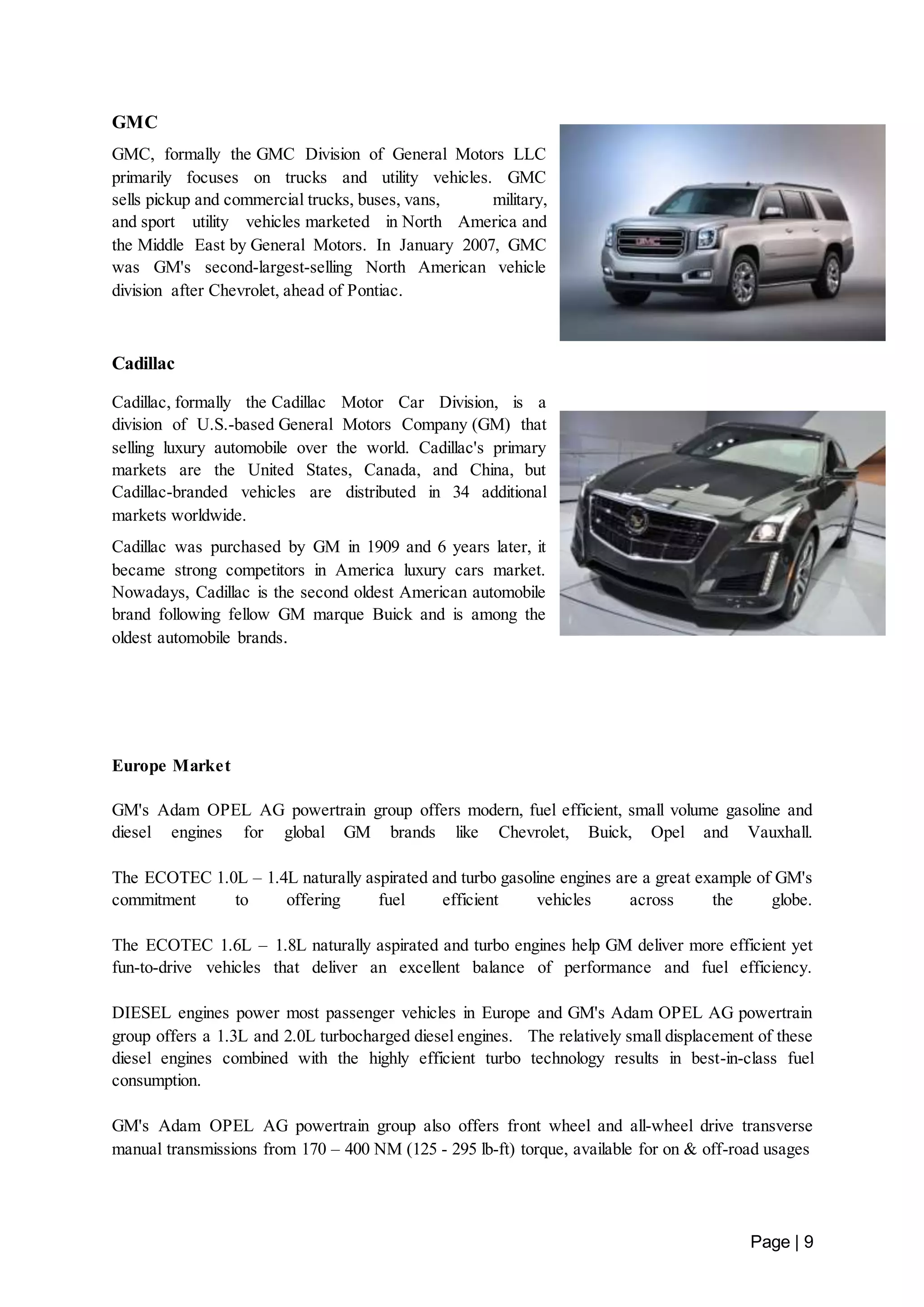
GMC, formally the GMC Division of General Motors LLC 
primarily focuses on trucks and utility vehicles. GMC 
sells pickup and commercial trucks, buses, vans, military, 
and sport utility vehicles marketed in North America and 
the Middle East by General Motors. In January 2007, GMC 
was GM's second-largest-selling North American vehicle 
division after Chevrolet, ahead of Pontiac. 
Cadillac 
Cadillac, formally the Cadillac Motor Car Division, is a 
division of U.S.-based General Motors Company (GM) that 
selling luxury automobile over the world. Cadillac's primary 
markets are the United States, Canada, and China, but 
Cadillac-branded vehicles are distributed in 34 additional 
markets worldwide. 
Cadillac was purchased by GM in 1909 and 6 years later, it 
became strong competitors in America luxury cars market. 
Nowadays, Cadillac is the second oldest American automobile 
brand following fellow GM marque Buick and is among the 
oldest automobile brands. 
Europe Market 
GM's Adam OPEL AG powertrain group offers modern, fuel efficient, small volume gasoline and 
diesel engines for global GM brands like Chevrolet, Buick, Opel and Vauxhall. 
The ECOTEC 1.0L – 1.4L naturally aspirated and turbo gasoline engines are a great example of GM's 
commitment to offering fuel efficient vehicles across the globe. 
The ECOTEC 1.6L – 1.8L naturally aspirated and turbo engines help GM deliver more efficient yet 
fun-to-drive vehicles that deliver an excellent balance of performance and fuel efficiency. 
DIESEL engines power most passenger vehicles in Europe and GM's Adam OPEL AG powertrain 
group offers a 1.3L and 2.0L turbocharged diesel engines. The relatively small displacement of these 
diesel engines combined with the highly efficient turbo technology results in best-in-class fuel 
consumption. 
GM's Adam OPEL AG powertrain group also offers front wheel and all-wheel drive transverse 
manual transmissions from 170 – 400 NM (125 - 295 lb-ft) torque, available for on & off-road usages
Page | 10 
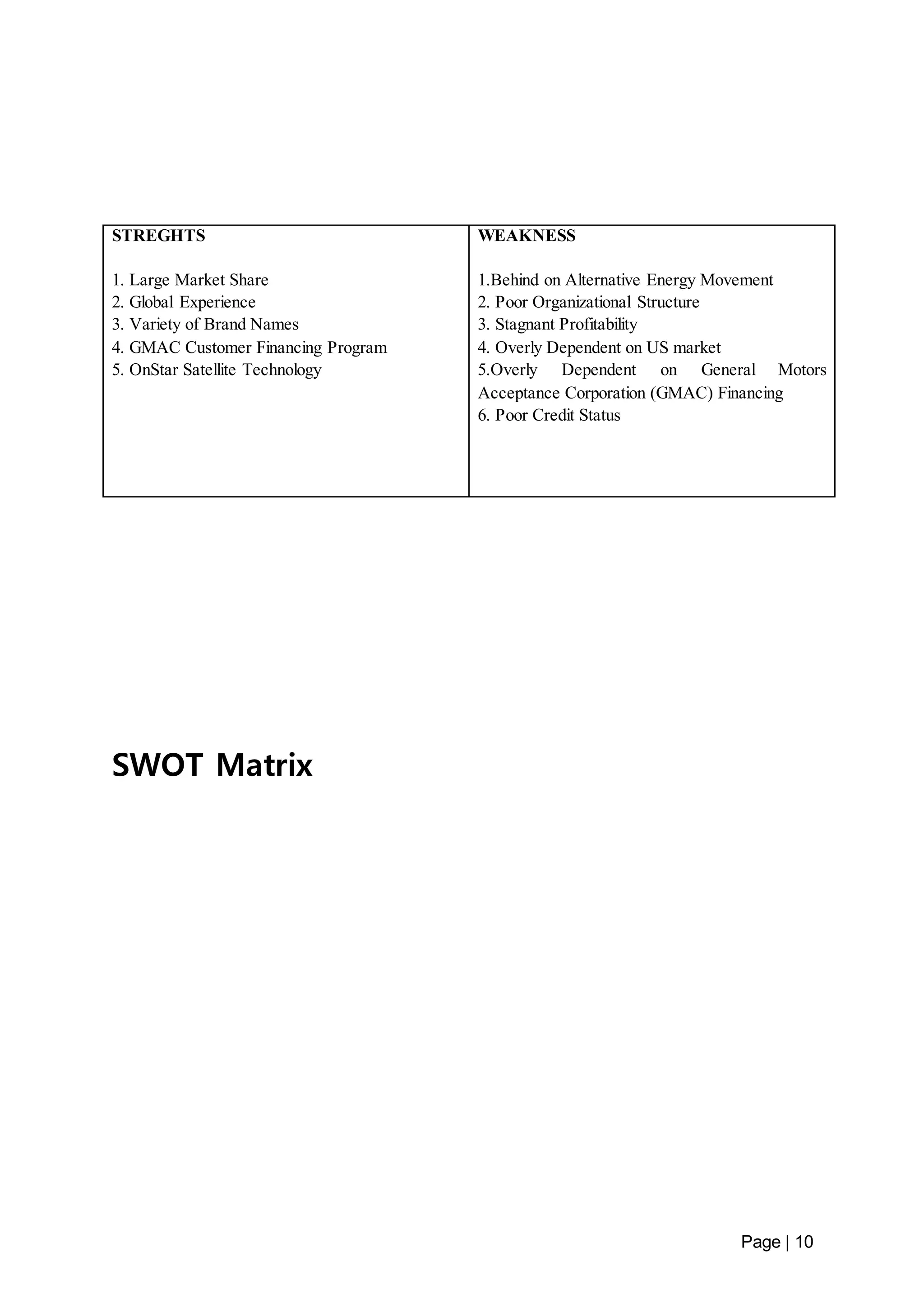
STREGHTS 
1. Large Market Share 
2. Global Experience 
3. Variety of Brand Names 
4. GMAC Customer Financing Program 
5. OnStar Satellite Technology 
SWOT Matrix 
WEAKNESS 
1.Behind on Alternative Energy Movement 
2. Poor Organizational Structure 
3. Stagnant Profitability 
4. Overly Dependent on US market 
5.Overly Dependent on General Motors 
Acceptance Corporation (GMAC) Financing 
6. Poor Credit Status
Page | 11 
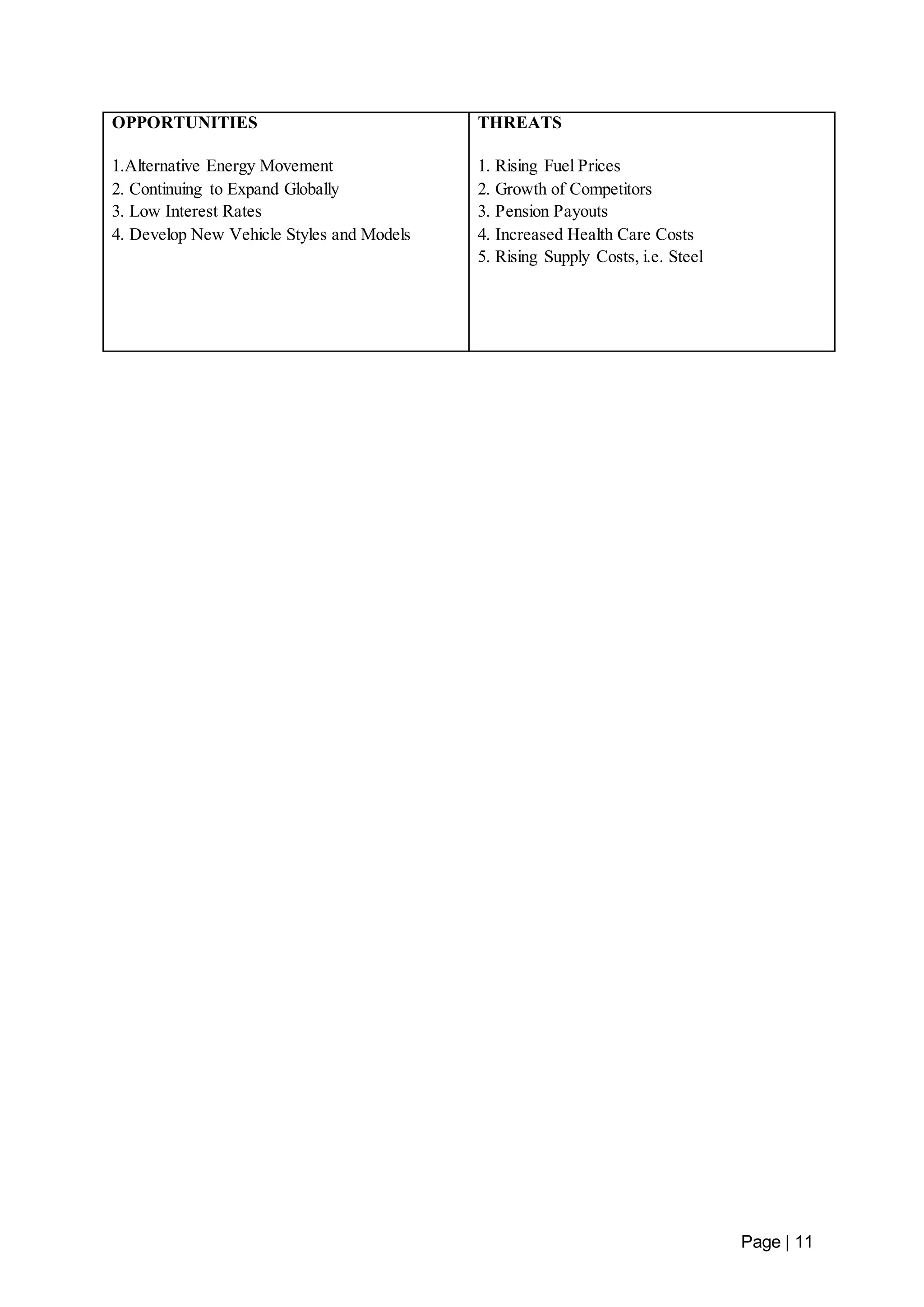
OPPORTUNITIES 
1.Alternative Energy Movement 
2. Continuing to Expand Globally 
3. Low Interest Rates 
4. Develop New Vehicle Styles and Models 
THREATS 
1. Rising Fuel Prices 
2. Growth of Competitors 
3. Pension Payouts 
4. Increased Health Care Costs 
5. Rising Supply Costs, i.e. Steel
Page | 12 
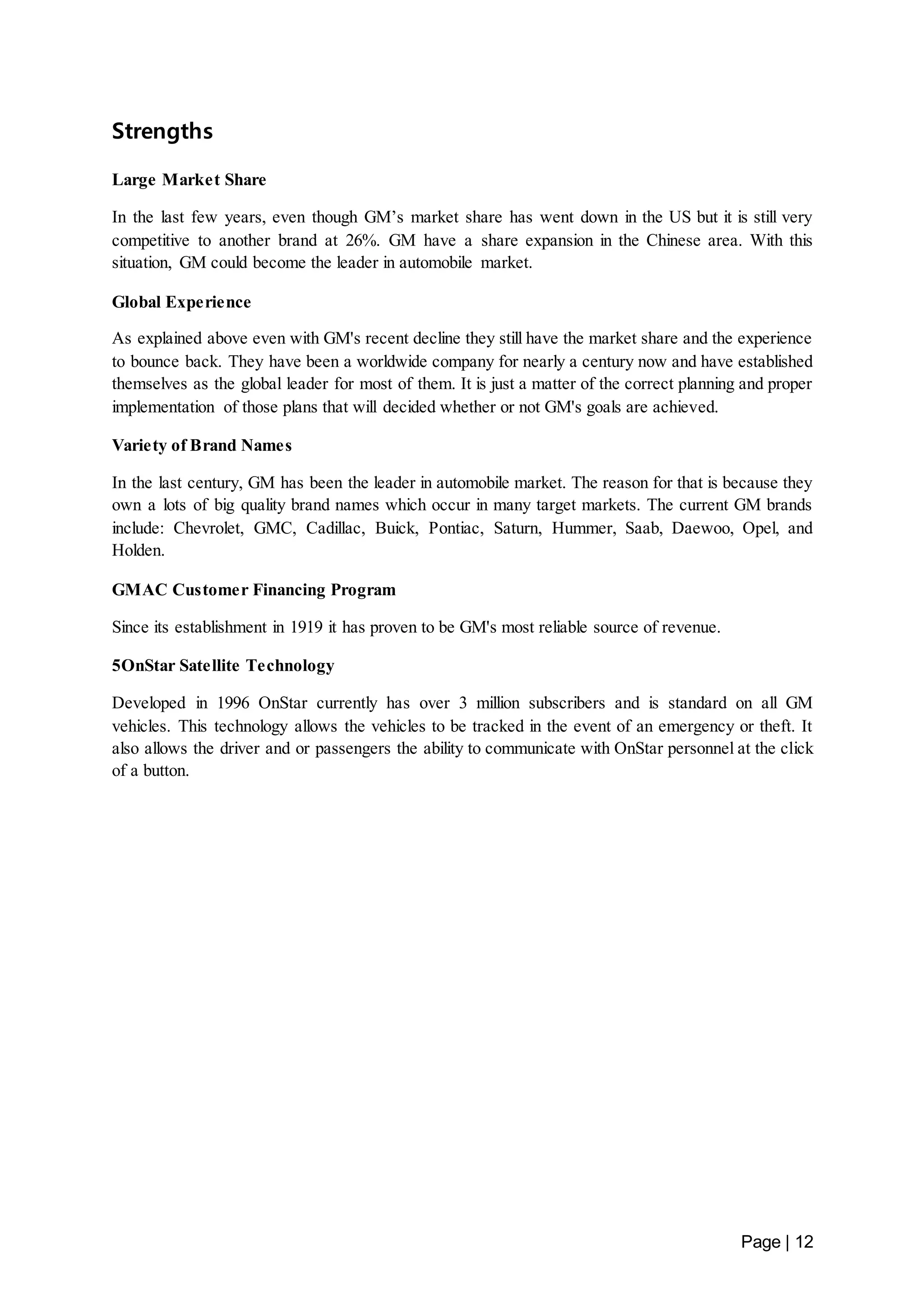
Strengths 
Large Market Share 
In the last few years, even though GM’s market share has went down in the US but it is still very 
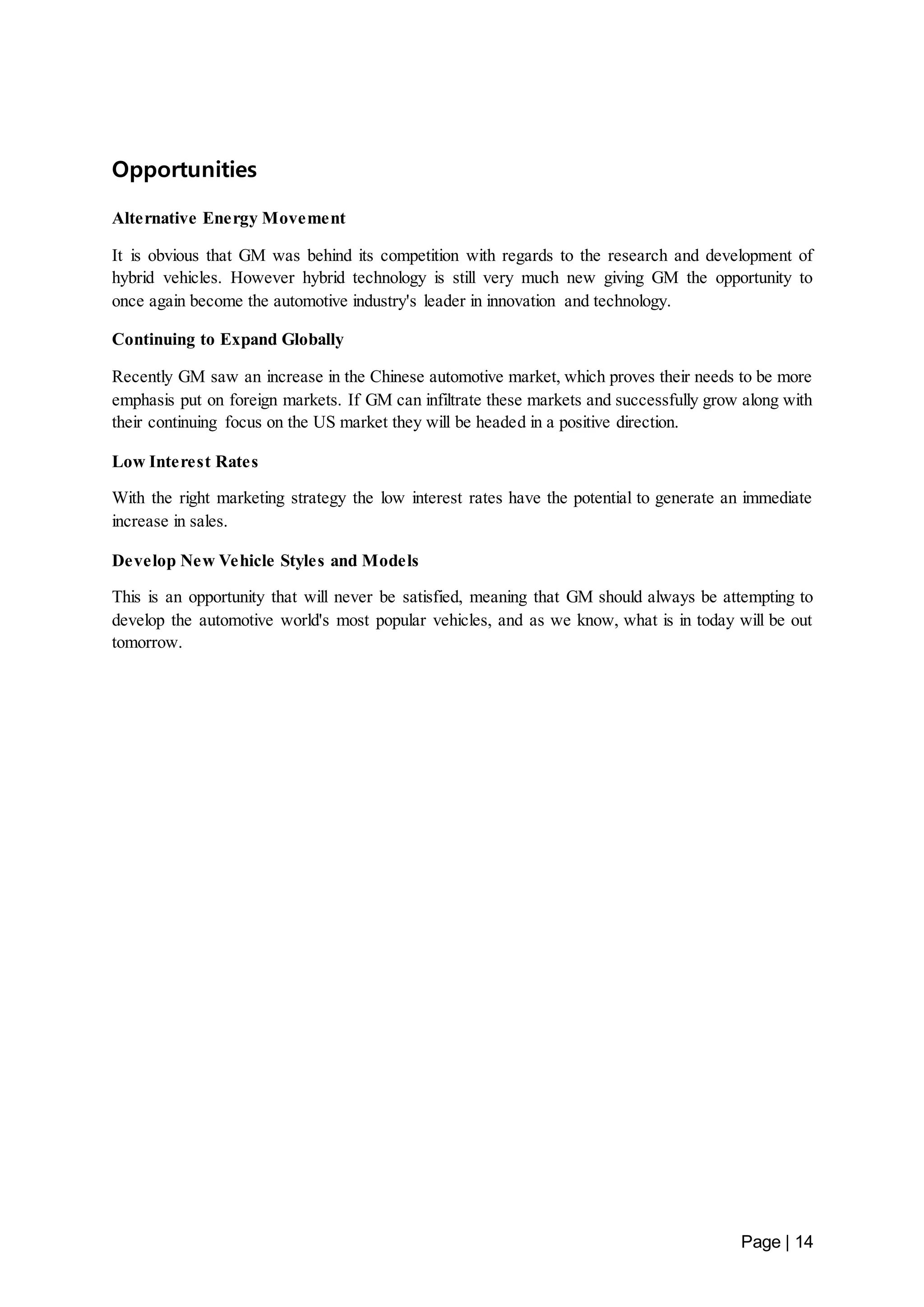
competitive to another brand at 26%. GM have a share expansion in the Chinese area. With this 
situation, GM could become the leader in automobile market. 
Global Experience 
As explained above even with GM's recent decline they still have the market share and the experience 
to bounce back. They have been a worldwide company for nearly a century now and have established 
themselves as the global leader for most of them. It is just a matter of the correct planning and proper 
implementation of those plans that will decided whether or not GM's goals are achieved. 
Variety of Brand Names 
In the last century, GM has been the leader in automobile market. The reason for that is because they 
own a lots of big quality brand names which occur in many target markets. The current GM brands 
include: Chevrolet, GMC, Cadillac, Buick, Pontiac, Saturn, Hummer, Saab, Daewoo, Opel, and 
Holden. 
GMAC Customer Financing Program 
Since its establishment in 1919 it has proven to be GM's most reliable source of revenue. 
5OnStar Satellite Technology 
Developed in 1996 OnStar currently has over 3 million subscribers and is standard on all GM 
vehicles. This technology allows the vehicles to be tracked in the event of an emergency or theft. It 
also allows the driver and or passengers the ability to communicate with OnStar personnel at the click 
of a button.
Page | 13 
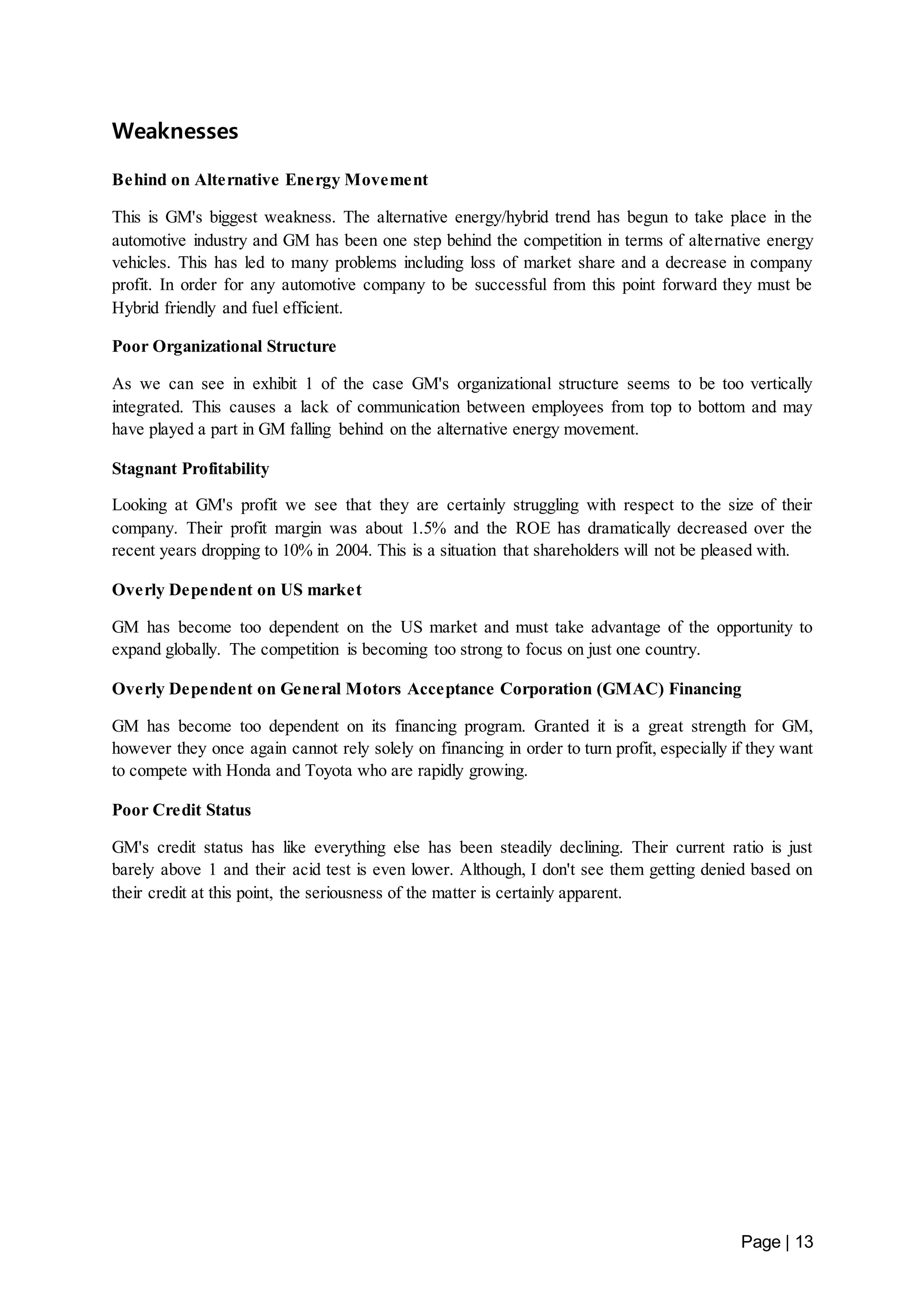
Weaknesses 
Behind on Alternative Energy Movement 
This is GM's biggest weakness. The alternative energy/hybrid trend has begun to take place in the 
automotive industry and GM has been one step behind the competition in terms of alternative energy 
vehicles. This has led to many problems including loss of market share and a decrease in company 
profit. In order for any automotive company to be successful from this point forward they must be 
Hybrid friendly and fuel efficient. 
Poor Organizational Structure 
As we can see in exhibit 1 of the case GM's organizational structure seems to be too vertically 
integrated. This causes a lack of communication between employees from top to bottom and may 
have played a part in GM falling behind on the alternative energy movement. 
Stagnant Profitability 
Looking at GM's profit we see that they are certainly struggling with respect to the size of their 
company. Their profit margin was about 1.5% and the ROE has dramatically decreased over the 
recent years dropping to 10% in 2004. This is a situation that shareholders will not be pleased with. 
Overly Dependent on US market 
GM has become too dependent on the US market and must take advantage of the opportunity to 
expand globally. The competition is becoming too strong to focus on just one country. 
Overly Dependent on General Motors Acceptance Corporation (GMAC) Financing 
GM has become too dependent on its financing program. Granted it is a great strength for GM, 
however they once again cannot rely solely on financing in order to turn profit, especially if they want 
to compete with Honda and Toyota who are rapidly growing. 
Poor Credit Status 
GM's credit status has like everything else has been steadily declining. Their current ratio is just 
barely above 1 and their acid test is even lower. Although, I don't see them getting denied based on 
their credit at this point, the seriousness of the matter is certainly apparent.
Page | 14 
Opportunities 
Alternative Energy Movement 
It is obvious that GM was behind its competition with regards to the research and development of 
hybrid vehicles. However hybrid technology is still very much new giving GM the opportunity to 
once again become the automotive industry's leader in innovation and technology. 
Continuing to Expand Globally 
Recently GM saw an increase in the Chinese automotive market, which proves their needs to be more 
emphasis put on foreign markets. If GM can infiltrate these markets and successfully grow along with 
their continuing focus on the US market they will be headed in a positive direction. 
Low Interest Rates 
With the right marketing strategy the low interest rates have the potential to generate an immediate 
increase in sales. 
Develop New Vehicle Styles and Models 
This is an opportunity that will never be satisfied, meaning that GM should always be attempting to 
develop the automotive world's most popular vehicles, and as we know, what is in today will be out 
tomorrow.
Page | 15 
Threats 
Rising Fuel Prices 
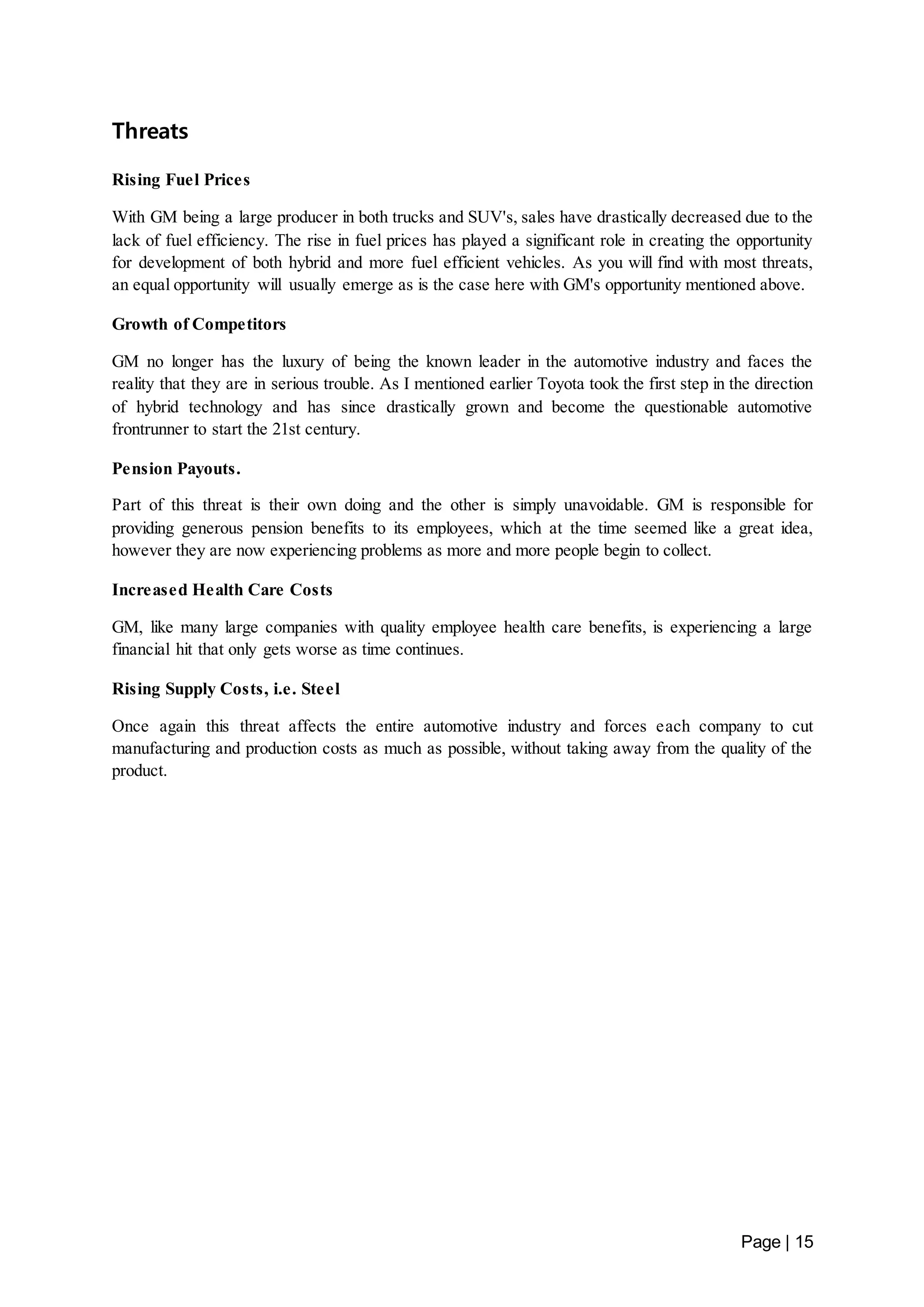
With GM being a large producer in both trucks and SUV's, sales have drastically decreased due to the 
lack of fuel efficiency. The rise in fuel prices has played a significant role in creating the opportunity 
for development of both hybrid and more fuel efficient vehicles. As you will find with most threats, 
an equal opportunity will usually emerge as is the case here with GM's opportunity mentioned above. 
Growth of Competitors 
GM no longer has the luxury of being the known leader in the automotive industry and faces the 
reality that they are in serious trouble. As I mentioned earlier Toyota took the first step in the direction 
of hybrid technology and has since drastically grown and become the questionable automotive 
frontrunner to start the 21st century. 
Pension Payouts. 
Part of this threat is their own doing and the other is simply unavoidable. GM is responsible for 
providing generous pension benefits to its employees, which at the time seemed like a great idea, 
however they are now experiencing problems as more and more people begin to collect. 
Increased Health Care Costs 
GM, like many large companies with quality employee health care benefits, is experiencing a large 
financial hit that only gets worse as time continues. 
Rising Supply Costs, i.e. Steel 
Once again this threat affects the entire automotive industry and forces each company to cut 
manufacturing and production costs as much as possible, without taking away from the quality of the 
product.
Page | 16 
Analysis 
Content: Daimler Chrysler 
Ford Motor 
Toyota Motor 
Daimler Chrysler 
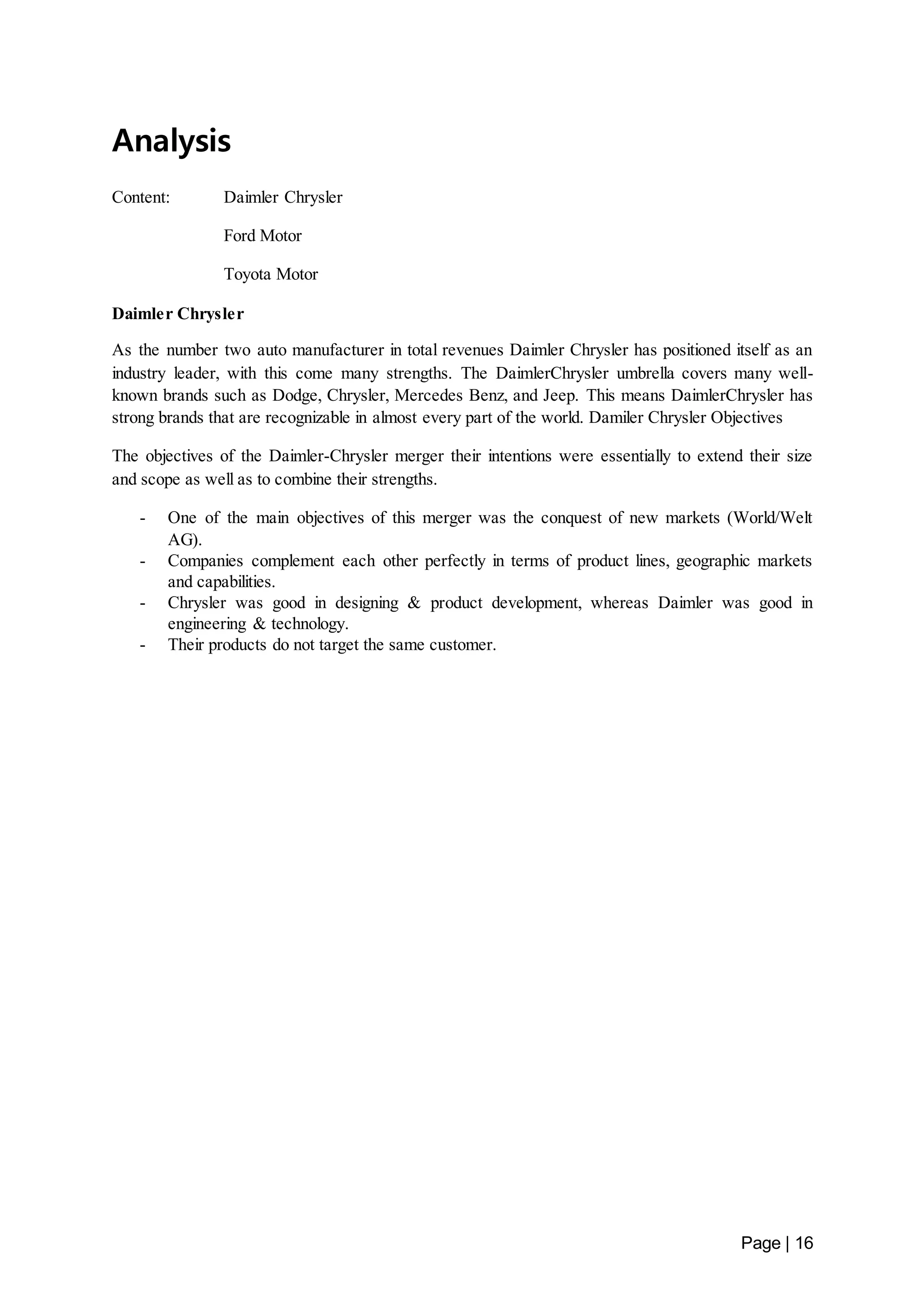
As the number two auto manufacturer in total revenues Daimler Chrysler has positioned itself as an 
industry leader, with this come many strengths. The DaimlerChrysler umbrella covers many well-known 
brands such as Dodge, Chrysler, Mercedes Benz, and Jeep. This means DaimlerChrysler has 
strong brands that are recognizable in almost every part of the world. Damiler Chrysler Objectives 
The objectives of the Daimler-Chrysler merger their intentions were essentially to extend their size 
and scope as well as to combine their strengths. 
- One of the main objectives of this merger was the conquest of new markets (World/Welt 
AG). 
- Companies complement each other perfectly in terms of product lines, geographic markets 
and capabilities. 
- Chrysler was good in designing & product development, whereas Daimler was good in 
engineering & technology. 
- Their products do not target the same customer.
Page | 17 
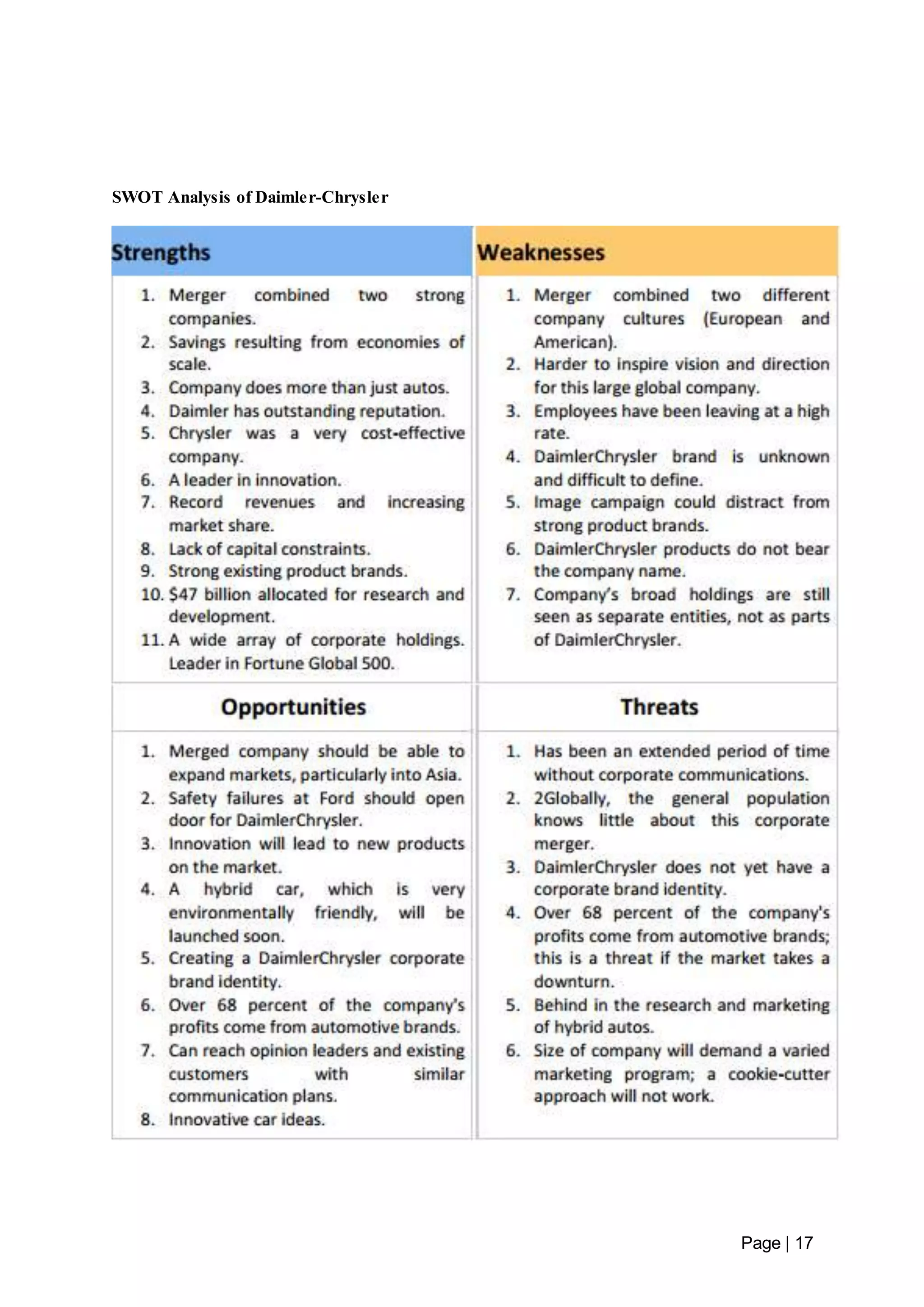
SWOT Analysis of Daimler-Chrysler
Page | 18 
Ford Motor Company 
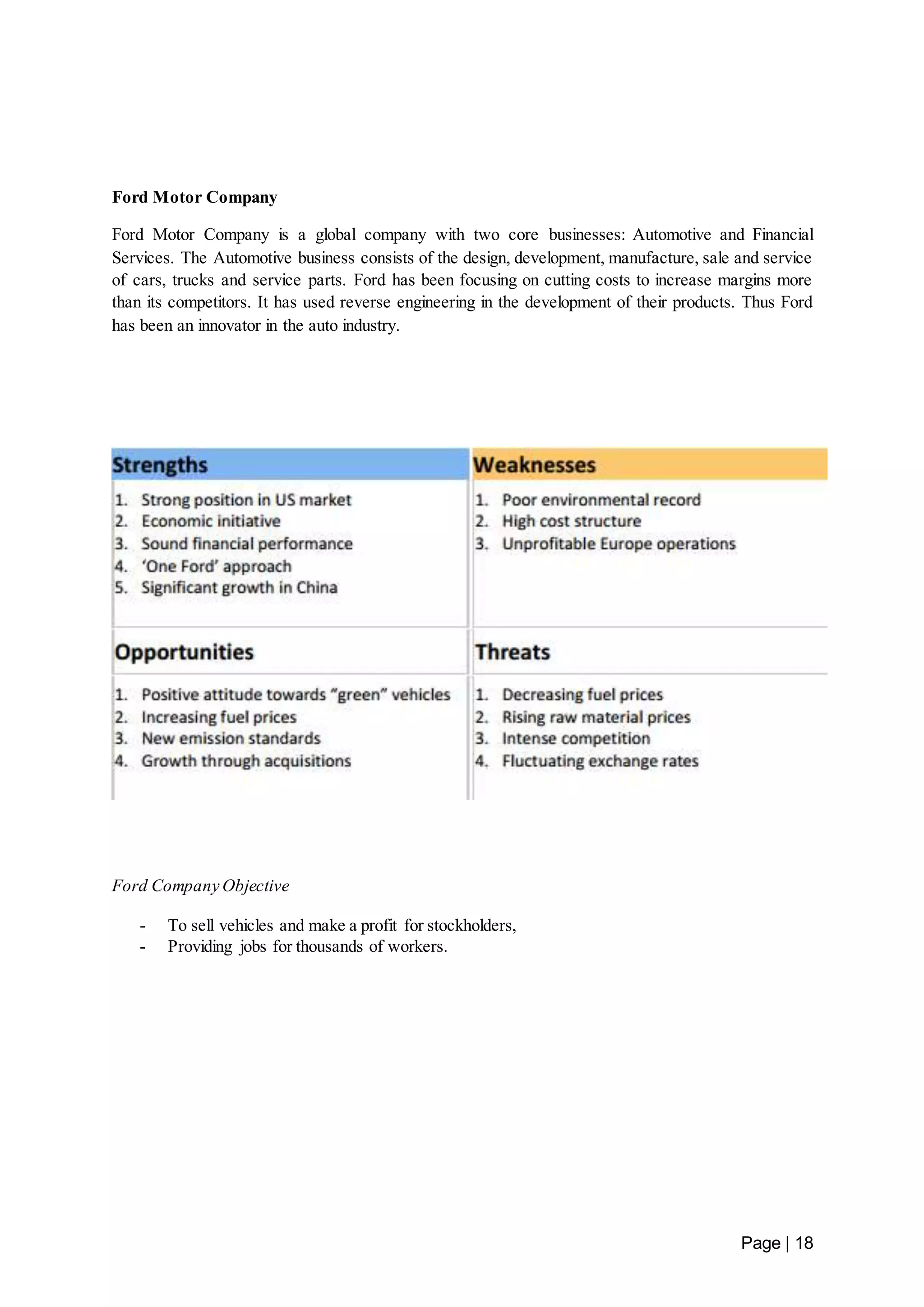
Ford Motor Company is a global company with two core businesses: Automotive and Financial 
Services. The Automotive business consists of the design, development, manufacture, sale and service 
of cars, trucks and service parts. Ford has been focusing on cutting costs to increase margins more 
than its competitors. It has used reverse engineering in the development of their products. Thus Ford 
has been an innovator in the auto industry. 
Ford Company Objective 
- To sell vehicles and make a profit for stockholders, 
- Providing jobs for thousands of workers.
Page | 19 
Toyota Motor Corporation 
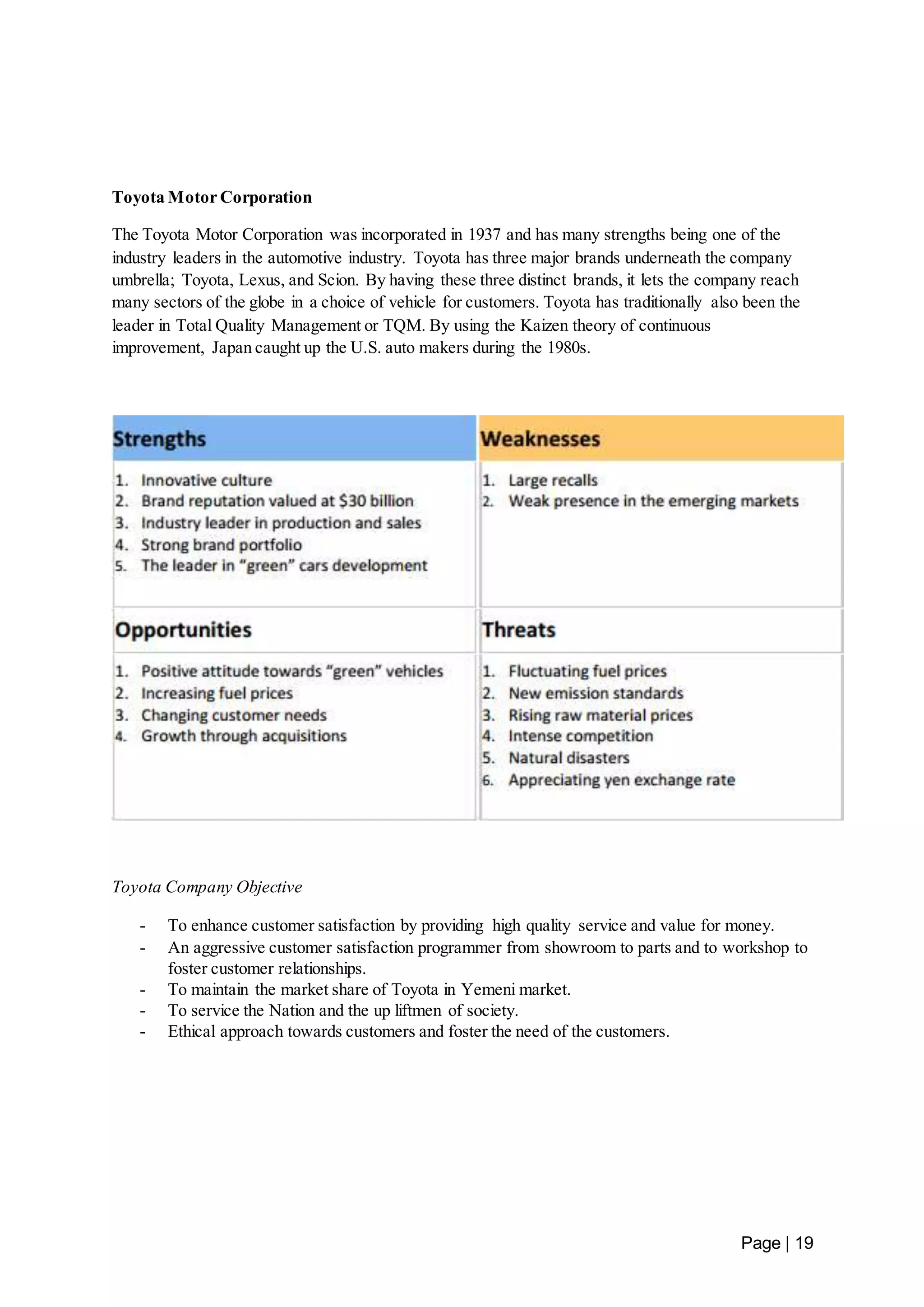
The Toyota Motor Corporation was incorporated in 1937 and has many strengths being one of the 
industry leaders in the automotive industry. Toyota has three major brands underneath the company 
umbrella; Toyota, Lexus, and Scion. By having these three distinct brands, it lets the company reach 
many sectors of the globe in a choice of vehicle for customers. Toyota has traditionally also been the 
leader in Total Quality Management or TQM. By using the Kaizen theory of continuous 
improvement, Japan caught up the U.S. auto makers during the 1980s. 
Toyota Company Objective 
- To enhance customer satisfaction by providing high quality service and value for money. 
- An aggressive customer satisfaction programmer from showroom to parts and to workshop to 
foster customer relationships. 
- To maintain the market share of Toyota in Yemeni market. 
- To service the Nation and the up liftmen of society. 
- Ethical approach towards customers and foster the need of the customers.
Quantitative Strategic Planning Matrix – External Factors 
Page | 20
Key Factors Production of fuel 
efficient cars. 
Page | 21 
Global Market 
Penetration 
Alliance with the 
competitor. 
External Opportunities Weight AS TAS AS TAS AS TAS 
Increasing demand for electric/hybrid/hydrogen celled vehicles 0.15 4 0.60 2 0.30 1 0.15 
Strategic alliances to integrate additional technology with On-Star 
0.10 4 0.40 3 0.45 2 0.30 
system [H] 
New model types and styles [M] 0.10 4 0.40 3 0.30 2 0.20 
GMNA market increase [M] 0.10 4 0.40 3 0.30 2 0.20 
Continual manufacturing in lower health care and pensioned-countries 
[M] 
0.10 4 0.40 3 0.30 2 0.20 
Continual saturation in Thailand and India which have shown 
improved earnings [L] 
0.05 4 0.20 3 0.15 2 0.10 
External Threats 
Rising raw material and transportation costs [H] 0.05 4 0.20 3 0.15 2 0.10 
Declining demand for light vehicles [H] 0.05 2 0.10 1 0.05 3 0.15 
Competitors have a higher level of perceived value with a solid 
0.05 3 0.15 4 0.20 2 0.10 
reputation for better product quality [H] 
Chinese lack of intellectual property rights from government and 
competitors [M] 
0.05 3 0.15 2 0.10 4 0.20 
Chinese regulations [L] 0.02 2 0.14 3 0.06 1 0.07 
Rising Fuel Prices 0.08 3 0.24 4 0.32 2 0.16 
Increased Health Care Costs 0.07 3 0.18 4 0.28 3 0.06
Quantitative Strategic Planning Matrix – Internal Factors 
Internal Opportunities Weight AS TAS AS 
Large scale company operations [H] 0.8 3 0.30 2 0.20 4 0.40 
Growing business, specifically in Asia Pacific & Latin America regions [H] 0.10 3 0.30 4 0.40 1 0.10 
Quality/cost improvement through outsourcing [H] 0.08 3 0.30 4 0.40 1 0.10 
Radical product development organization [H] 0.12 3 0.45 4 0.60 2 0.30 
Voluntary environmental policy [L] 0.05 4 0.60 2 0.30 3 0.45 
China partnerships and joint ventures [M] 0.05 3 0.15 4 0.20 2 0.10 
OnStar communications (automotive industry‘s leading telematics provider) and 
0.07 4 0.28 2 0.14 2 0.14 
electronic stability control [M] 
Page | 22 
Highest annual productivity improvement among all automakers from 1999- 
2004 [H] 
0.05 3 0.15 2 0.10 1 0.10 
Raise in GMAC credit rating [M] 0.05 4 0.20 2 0.10 3 0.10 
Internal Weaknesses 
Decreasing market share [H] 0.05 4 0.40 2 0.20 3 0.30 
Pension debt [H] 0.03 2 0.20 1 0.10 3 0.30 
Increasing health care [H] 0.02 2 0.10 1 0.05 3 0.15 
Numerous product recalls [H] 0.04 2 0.20 2 0.20 3 0.30 
Saturn strategy failure which lost as much as $15B [M] 0.02 3 0.18 3 0.06 3 0.06 
Quality problems with foreign production [M] 0.03 3 0.09 1 0.03 2 0.06 
Pricing strategy [M] 0.07 3 0.21 2 0.14 3 0.21 
Declining financial performance 0.10 4 0.40 3 0.30 2 0.20 
Total 1 7.31 5.94 5.33
Page | 23 
Analysis 
Content: Decreasing market share 
Rising raw material prices 
The problem General Motors facing are the increasing of health care costs, which is the main reason why GM are on the way to bankruptcy, the material and 
fuel costs. Base on what we find, we choose to penetrate the market and we come up with 3 strategies to do so: global market penetration, production of fuel 
efficient cars and alliance with the competitors. 
To conduct this table, we go through 3 stages: First step, we decide which factor is important and how it is important to our project’s firm. These factors are 
base on what we analyze in real situations in 2009. Then we use them to produce IFE, EFE and also in QSPM. These factors are explained in the IFE and EFE 
analysis. Secondly, we discuss what strategy is most suitable to the problems of GM. In this step, SWOT, CPM and SPACE are the method to build the 
strategy. Those methods give us important views of market trends, competitors and how market is doing. Third step, we determine how important of each 
factors and give them attractive score to represent the effects on those strategies. We also calculate the total score and the result can give us the most suitable 
plan for GM. 
After calculations, we decide that “Production of fuel efficient cars” is the best strategy for GM to solve serious problems. This QSPM give us the 
comparisons between the 3 strategies fairly, base on important internal and external factors. The first plan has 7.31 which are much higher than the rest, 5.94 
and 5.33, respectively.
Page | 24 
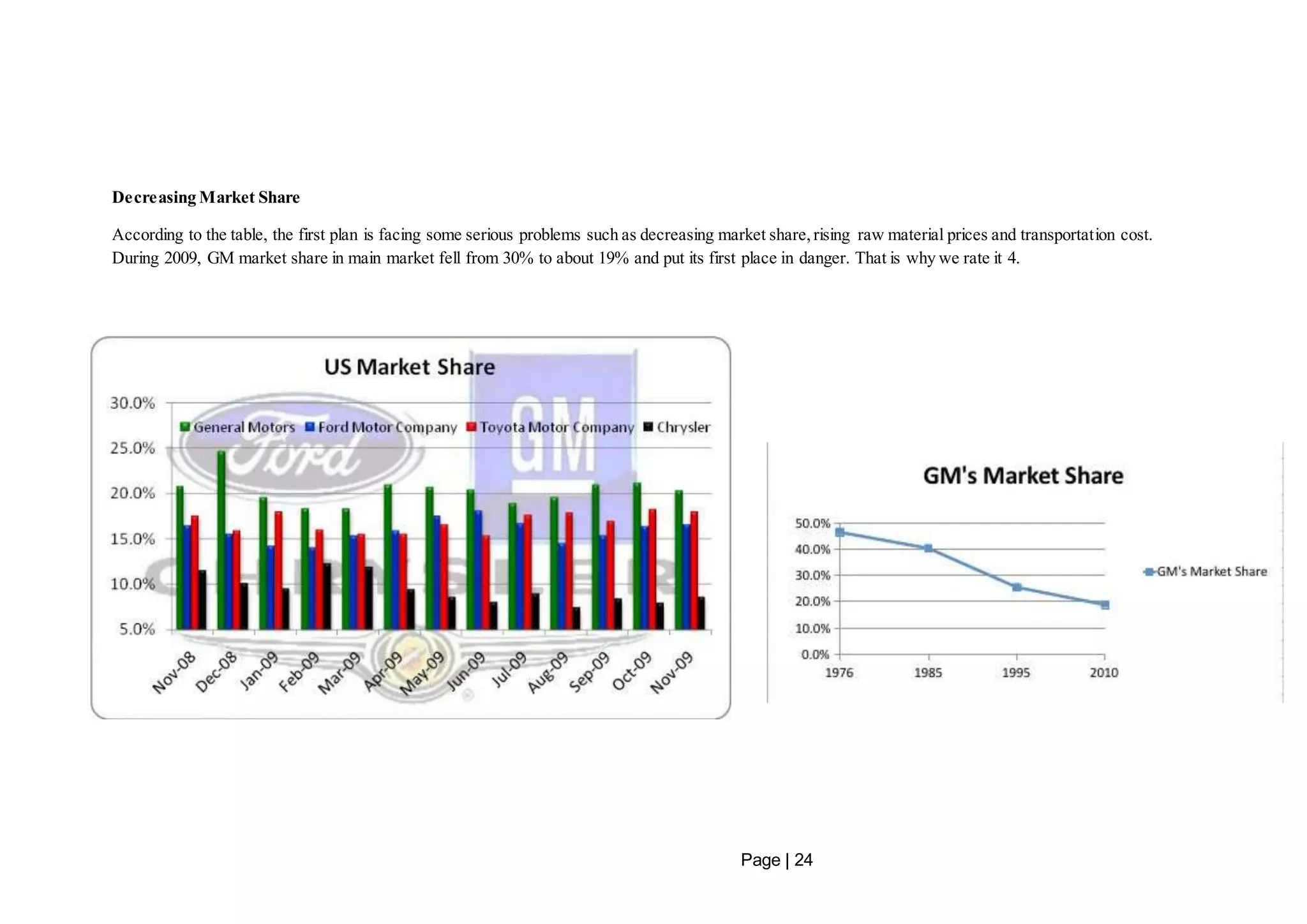
Decreasing Market Share 
According to the table, the first plan is facing some serious problems such as decreasing market share, rising raw material prices and transportation cost. 
During 2009, GM market share in main market fell from 30% to about 19% and put its first place in danger. That is why we rate it 4.
Page | 25 
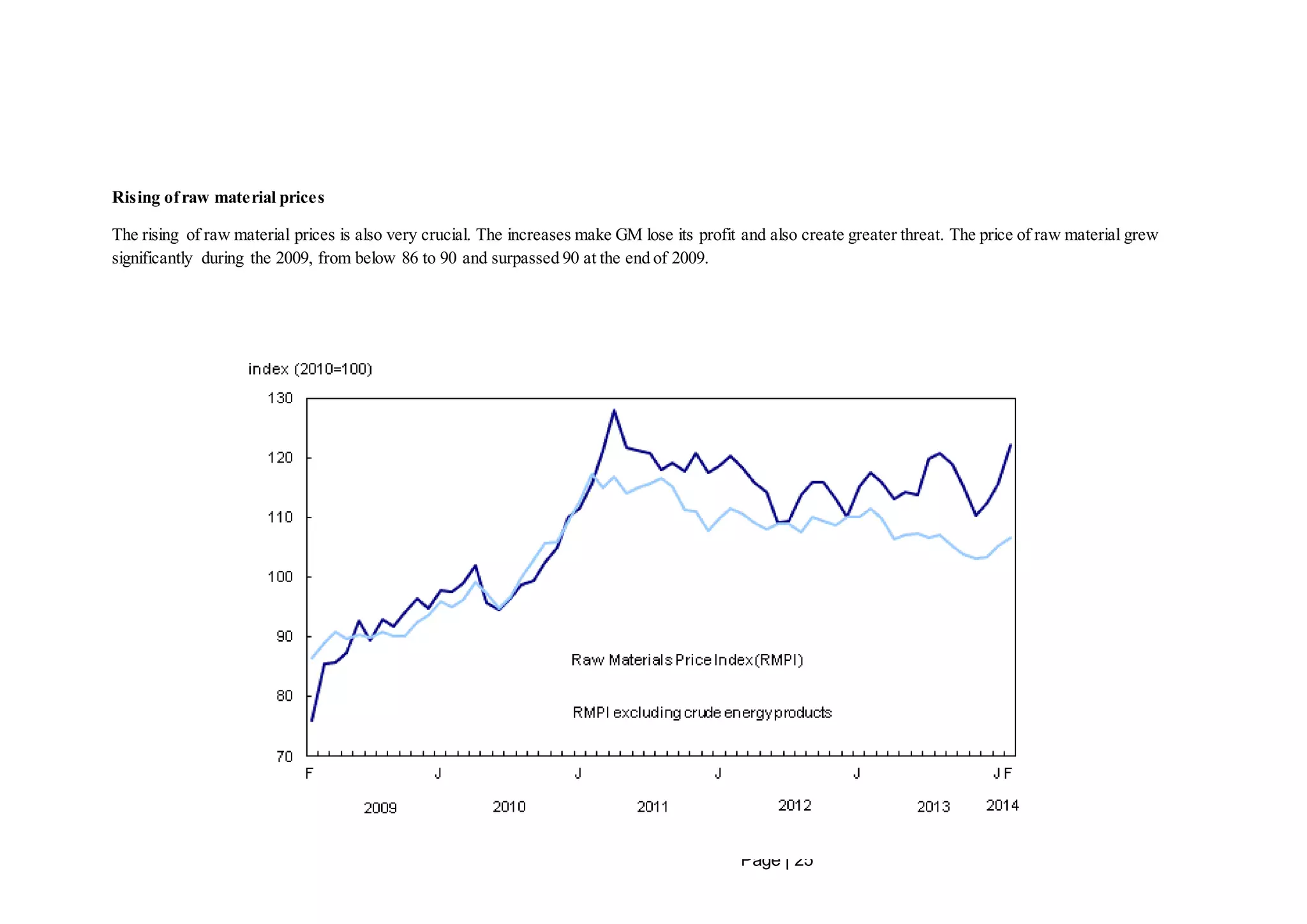
Rising of raw material prices 
The rising of raw material prices is also very crucial. The increases make GM lose its profit and also create greater threat. The price of raw material grew 
significantly during the 2009, from below 86 to 90 and surpassed 90 at the end of 2009.
Page | 26 
Annual Objectives 
With the new strategy for GM, our group also set new annual objective goals for the company: 
Market Growth 
- Stop losing market shares in US and increase it by 2% 
- Develop market in India 
- Sustain the top position in China and head for 2% increases in market share 
Financial Growth 
- Sales volume stop falling and increase 1% after a 49% drop in the US 
- Increase gross profit by 2% 
- Increase stock price to $30 per share 
- Increase sales in China by 1% 
Employee policy 
- Reduce health care cost
Page | 27 
Reference 
Mission statement of General Motors (General Motors mission statement 2013) 
http://www.strategicmanagementinsight.com/mission-statements/general-motors-mission-statement. 
htm 
Product Offerings (Products & Services for Auto Dealers) 
http://www.gmfinancial.com/dealers/product-offerings.aspx 
GM Sites: Vehicle, Services, Financing (GM Card) 
https://www.gmcard.com/gm-sites 
General Motors | Maintenance & Repair | GM.com (General Motors | Maintenance & Repair | 
GM.com) 
http://www.gm.com/toolbar/faqs/maintenance_servicerepair.html 
General Motors | Browse By Brand | GM.com (General Motors | Browse By Brand | GM.com) 
http://www.gm.com/vehicles/browseByBrand.html 
General Motor Strategic Management Analysis (General Motor Strategic Management 
Analysis) 
http://www.slideshare.net/rashidjaved925059/gmworkfinalreport-140129104656phpapp02 
General Motor Strategic Management Analysis (General Motor Strategic Management 
Analysis) 
http://www.slideshare.net/rashidjaved925059/gmworkfinalreport-140129104656phpapp02 
General Motors | Investors - Corporate Strategy | GM.com (General Motors | Investors - 
Corporate Strategy | GM.com) 
http://www.gm.com/company/investors/corporate-strategy.html 
SWOT analysis of General Motors (General Motors SWOT analysis 2013) 
http://www.strategicmanagementinsight.com/swot-analyses/general-motors-swot-analysis.html 
General Motor Strategic Management Analysis (General Motor Strategic Management 
Analysis) 
http://www.slideshare.net/rashidjaved925059/gmworkfinalreport-140129104656phpapp02 
Todo Sobre Mi Vida (: General Motors Strategy in the Global Economic Crisis) 
http://bee-mo.blogspot.com/2009/07/general-motors-strategy-in-global.html
The primary internal and external influence on the General Motors Corporation - WriteWork 
(The primary internal and external influence on the General Motors Corporation - WriteWork) 
http://www.writework.com/essay/primary-internal-and-external-influence-general-motors-cor 
Page | 28 
Article :: GENERAL MOTORS BUSINESS STRATEGY IN 2009 (MBAJobs.ca) 
http://www.mbajobs.ca/articles/show/id/19 
General Motors (GM) (Cash Flow for General Motors Co (GM)) 
http://www.wikinvest.com/stock/General_Motors_(GM)/Cash_Flow 
Calculated Risk: U.S. Light Vehicle Sales decline to 15.17 million annual rate in October 
(Calculated Risk: U.S. Light Vehicle Sales decline to 15.17 million annual rate in October) 
http://www.calculatedriskblog.com/2013/11/us-light-vehicle-sales-decline-to-1517.html

Keuka_Experiental Learning_295924

  • 1.
    Page | 1 BUS 444 – Strategic Management Lecturer: Professor Thomas Bradley Strategic Management Project Class 1 – Group 3 Pham Ngoc Minh Khoa Tran Thai Son Pham Hung Thai Son
  • 2.
    Page | 2 Truong Tran Ngoc Son
  • 3.
  • 4.
    Page | 4 Table of Contents The Bankruptcy of General Motors in 2009 .......................................................................................... 5 Executive Summary ............................................................................................................................ 5 - General Motors....................................................................................................................... 6 - Mission Statement – Evaluation Matrix .................................................................................... 6 - Vision Statement .................................................................................................................... 7 - Objectives .............................................................................................................................. 7 - Strategy and Evaluation .......................................................................................................... 7 - GM Vehicle – Global Brands .................................................................................................. 8 - Vehicle Engines and Transmission........................................................................................... 9 - Marine Engines and Controllers............................................................................................. 10 - Services ............................................................................................................................... 11 SWOT Matrix .................................................................................................................................. 12 - Strength ............................................................................................................................... 13 - Weakness ............................................................................................................................. 14 - Opportunity.......................................................................................................................... 15 - Threat .................................................................................................................................. 16 External Factors Evaluations Matrix (EFE) ........................................................................................ 17 - Analysis ............................................................................................................................... 18 Internal Factor Evaluation Matrix (IFE) ............................................................................................. 23 - Analysis ............................................................................................................................... 24 Competitive Profile Matrix................................................................................................................ 26 - Analysis ............................................................................................................................... 27 The Strategic Position and Action Evaluation Matrix (Space) .............................................................. 31 - Analysis ............................................................................................................................... 34 Grand Matrix.................................................................................................................................... 35 Quantitative Strategic Planning Matrix (QSPM) ................................................................................. 37
  • 5.
    - Analysis ...............................................................................................................................39 Business Strategy Recommendations ................................................................................................. 41 Annual Objectives ............................................................................................................................ 43 Strategy Review and Evaluation ........................................................................................................ 44 Financial Analysis ............................................................................................................................ 45 Porter’s Five Forces Analysis ............................................................................................................ 53 Pestel Analysis ................................................................................................................................. 54 Conclusion ....................................................................................................................................... 54 Reference ......................................................................................................................................... 55 Page | 5
  • 6.
    Page | 6 Executive Summary General Motors Corporation - GM It is an American multinational corporation headquartered in Detroit,Michigan that designs, manufactures, markets and distributes vehicles and vehicle parts and sells financial services. GM has been seen as one of the largest car manufacturer for about 78 years. Nowadays, although it is not on the top of the game, still GM’s products spread all over the world. General Motors produces vehicles in 37 countries under ten brands: Chevrolet, Buick, GMC, Cadillac, Opel, Holden, Vauxhall, Wuling,Baojun, Jie Fang, UzDaewoo. General Motors also has many oversea subsidiaries. They include Opel / Vauxhall in Europe, Holden in Australia, GM Korea in South Korea and Shanghai GM in China. Moreover, those Asian agencies have been tremendous profitable sources for GM. Mission Statement – Evaluation Matrix "G.M. is a multinational corporation engaged in socially responsible operations, worldwide. It is dedicated to provide products and services of such quality that our customers will receive superior value while our employees and business partners will share in our success and our stock-holders will receive a sustained superior return on their investment”(Source: Strategic Management) Does it include….? Does it mention values….? Customers Service/Products Markets Citizenship Teamwork Yes Yes Yes No No Technology Concern for survival Philosophy Excellence Integrity Yes Yes Yes No No Self-concept Concern for public image Employees Score 2.7/4.5 No No Yes Customer or product-oriented Product - oriented
  • 7.
    Page | 7 Vision Statement “GM’s vision is to be the world leader in transportation products and related services. We will earn our customers’ enthusiasm through continuous improvement driven by the integrity, teamwork, and innovation of GM people” (Source: Strategic Management) In overall, the Statement acquires all criteria for successful vision statement: Clear (Understandable), Challenging, Philosophy, and Consistency. First, GM’s vision gives a clear message to customers and stakeholders. It shows GM’s ideas about what they want to do and how they do it, which to satisfy their customers by hardworking and creative. The statement also make reader feels the consistency of GM’s effort by the word “continuous”. Moreover, they briefly draw the picture of what they can be in the future. That is something a Vision statement must has. Secondly, GM’s emphasize passion in creating new vehicles, designs and enriching lives around the World. Of course, to achieve those are not easy. General Motors shows its challenging tasks and they are willing to achieve. Additionally, investors and shareholders will recognize GM’s ideas are possible and they have prepared to pursuit. Objectives First of all, we need to identify and implement several different ways to save on electronic and gas usage. We also develop strong team work and effective leadership skills of staff by opening job training, regular staff meeting and one-on-one mentoring programs. The second objective is the company needs to introduce to customers new products which are more distinctive and innovative. We focus on expanding our new products into many geographic areas at the same point in our value chain, while simultaneously providing large number of products and services. Additionally, we have to take care of its investors by trying to earn them the greatest return on their investment possible. Thirdly, we often organize competitive compensation and benefit programs in order to classify and retain qualified employees who are worthy to be paid for growing the business and to maximizing shareholder returns through pay programs. The company targets base salary at the 50th percentile for executives in a survey group of companies. We drive industry-leading, long-term shareholder franchisee value, aggressive international expansion and build strong brands over the world. Strategy and evaluation “A car for every purse and purse and purpose" is the pioneering strategy of Alfred Sloan, GM's CEO. He rationalized GM’s cars into five price-quality- segments-from a Chevrolet, to a Pontiac, to an
  • 8.
    Oldsmobile, to aBuick, to a Cadillac. In order to differentiate GM brands from their competition, he positioned each car line at the top of the price scale in its price-quality segment. For more than a half century GM dominated the U.S auto industry like colossus with a market share as high as 50% which made it a low-cost leader. So, it is ironic that even the most prestigious handwork –Cadillac—of the man wrote the book on market segmentation and differentiation failed the threshold of a differentiated product in Porter’s scheme of things. We would like to point out here that while multiple brands might have been a good strategy for GM in the past it is not so today’s global competition in which the successful firms like Toyota and others concentrate only on a limited number of car lines. Page | 8 GM Vehicle – Global Brands Chevrolet Chevrolet colloquially referred to as Chevy and formally the Chevrolet Division of General Motors LLC. In 1919, Alfred Sloan chose Chevrolet brand to become the volume leader in the General Motors Family and mainstream vehicles to compete with Henry Ford’s Model T. Then in 1923, Chevy overtook the Model T as the best-selling car in the US. Buick Buick, formally the Buick Motor Division is premium automobile brand, selling entry-level luxury vehicles positioned above its mainstream Chevrolet, and below the Cadillac. Buick cars mostly targeted for the North American market. Since the discontinuation of Saturn in 2009, GM has positioned Buick to be an analogue to its German Opel brand, sharing models and development. Buick-branded vehicles are sold in the United States, Canada, Mexico, and China. Buick sold 1,032,331 vehicles worldwide in calendar year 2013, a record for the brand.[2]
  • 9.
    Page | 9 GMC GMC, formally the GMC Division of General Motors LLC primarily focuses on trucks and utility vehicles. GMC sells pickup and commercial trucks, buses, vans, military, and sport utility vehicles marketed in North America and the Middle East by General Motors. In January 2007, GMC was GM's second-largest-selling North American vehicle division after Chevrolet, ahead of Pontiac. Cadillac Cadillac, formally the Cadillac Motor Car Division, is a division of U.S.-based General Motors Company (GM) that selling luxury automobile over the world. Cadillac's primary markets are the United States, Canada, and China, but Cadillac-branded vehicles are distributed in 34 additional markets worldwide. Cadillac was purchased by GM in 1909 and 6 years later, it became strong competitors in America luxury cars market. Nowadays, Cadillac is the second oldest American automobile brand following fellow GM marque Buick and is among the oldest automobile brands. Europe Market GM's Adam OPEL AG powertrain group offers modern, fuel efficient, small volume gasoline and diesel engines for global GM brands like Chevrolet, Buick, Opel and Vauxhall. The ECOTEC 1.0L – 1.4L naturally aspirated and turbo gasoline engines are a great example of GM's commitment to offering fuel efficient vehicles across the globe. The ECOTEC 1.6L – 1.8L naturally aspirated and turbo engines help GM deliver more efficient yet fun-to-drive vehicles that deliver an excellent balance of performance and fuel efficiency. DIESEL engines power most passenger vehicles in Europe and GM's Adam OPEL AG powertrain group offers a 1.3L and 2.0L turbocharged diesel engines. The relatively small displacement of these diesel engines combined with the highly efficient turbo technology results in best-in-class fuel consumption. GM's Adam OPEL AG powertrain group also offers front wheel and all-wheel drive transverse manual transmissions from 170 – 400 NM (125 - 295 lb-ft) torque, available for on & off-road usages
  • 10.
    Page | 10 STREGHTS 1. Large Market Share 2. Global Experience 3. Variety of Brand Names 4. GMAC Customer Financing Program 5. OnStar Satellite Technology SWOT Matrix WEAKNESS 1.Behind on Alternative Energy Movement 2. Poor Organizational Structure 3. Stagnant Profitability 4. Overly Dependent on US market 5.Overly Dependent on General Motors Acceptance Corporation (GMAC) Financing 6. Poor Credit Status
  • 11.
    Page | 11 OPPORTUNITIES 1.Alternative Energy Movement 2. Continuing to Expand Globally 3. Low Interest Rates 4. Develop New Vehicle Styles and Models THREATS 1. Rising Fuel Prices 2. Growth of Competitors 3. Pension Payouts 4. Increased Health Care Costs 5. Rising Supply Costs, i.e. Steel
  • 12.
    Page | 12 Strengths Large Market Share In the last few years, even though GM’s market share has went down in the US but it is still very competitive to another brand at 26%. GM have a share expansion in the Chinese area. With this situation, GM could become the leader in automobile market. Global Experience As explained above even with GM's recent decline they still have the market share and the experience to bounce back. They have been a worldwide company for nearly a century now and have established themselves as the global leader for most of them. It is just a matter of the correct planning and proper implementation of those plans that will decided whether or not GM's goals are achieved. Variety of Brand Names In the last century, GM has been the leader in automobile market. The reason for that is because they own a lots of big quality brand names which occur in many target markets. The current GM brands include: Chevrolet, GMC, Cadillac, Buick, Pontiac, Saturn, Hummer, Saab, Daewoo, Opel, and Holden. GMAC Customer Financing Program Since its establishment in 1919 it has proven to be GM's most reliable source of revenue. 5OnStar Satellite Technology Developed in 1996 OnStar currently has over 3 million subscribers and is standard on all GM vehicles. This technology allows the vehicles to be tracked in the event of an emergency or theft. It also allows the driver and or passengers the ability to communicate with OnStar personnel at the click of a button.
  • 13.
    Page | 13 Weaknesses Behind on Alternative Energy Movement This is GM's biggest weakness. The alternative energy/hybrid trend has begun to take place in the automotive industry and GM has been one step behind the competition in terms of alternative energy vehicles. This has led to many problems including loss of market share and a decrease in company profit. In order for any automotive company to be successful from this point forward they must be Hybrid friendly and fuel efficient. Poor Organizational Structure As we can see in exhibit 1 of the case GM's organizational structure seems to be too vertically integrated. This causes a lack of communication between employees from top to bottom and may have played a part in GM falling behind on the alternative energy movement. Stagnant Profitability Looking at GM's profit we see that they are certainly struggling with respect to the size of their company. Their profit margin was about 1.5% and the ROE has dramatically decreased over the recent years dropping to 10% in 2004. This is a situation that shareholders will not be pleased with. Overly Dependent on US market GM has become too dependent on the US market and must take advantage of the opportunity to expand globally. The competition is becoming too strong to focus on just one country. Overly Dependent on General Motors Acceptance Corporation (GMAC) Financing GM has become too dependent on its financing program. Granted it is a great strength for GM, however they once again cannot rely solely on financing in order to turn profit, especially if they want to compete with Honda and Toyota who are rapidly growing. Poor Credit Status GM's credit status has like everything else has been steadily declining. Their current ratio is just barely above 1 and their acid test is even lower. Although, I don't see them getting denied based on their credit at this point, the seriousness of the matter is certainly apparent.
  • 14.
    Page | 14 Opportunities Alternative Energy Movement It is obvious that GM was behind its competition with regards to the research and development of hybrid vehicles. However hybrid technology is still very much new giving GM the opportunity to once again become the automotive industry's leader in innovation and technology. Continuing to Expand Globally Recently GM saw an increase in the Chinese automotive market, which proves their needs to be more emphasis put on foreign markets. If GM can infiltrate these markets and successfully grow along with their continuing focus on the US market they will be headed in a positive direction. Low Interest Rates With the right marketing strategy the low interest rates have the potential to generate an immediate increase in sales. Develop New Vehicle Styles and Models This is an opportunity that will never be satisfied, meaning that GM should always be attempting to develop the automotive world's most popular vehicles, and as we know, what is in today will be out tomorrow.
  • 15.
    Page | 15 Threats Rising Fuel Prices With GM being a large producer in both trucks and SUV's, sales have drastically decreased due to the lack of fuel efficiency. The rise in fuel prices has played a significant role in creating the opportunity for development of both hybrid and more fuel efficient vehicles. As you will find with most threats, an equal opportunity will usually emerge as is the case here with GM's opportunity mentioned above. Growth of Competitors GM no longer has the luxury of being the known leader in the automotive industry and faces the reality that they are in serious trouble. As I mentioned earlier Toyota took the first step in the direction of hybrid technology and has since drastically grown and become the questionable automotive frontrunner to start the 21st century. Pension Payouts. Part of this threat is their own doing and the other is simply unavoidable. GM is responsible for providing generous pension benefits to its employees, which at the time seemed like a great idea, however they are now experiencing problems as more and more people begin to collect. Increased Health Care Costs GM, like many large companies with quality employee health care benefits, is experiencing a large financial hit that only gets worse as time continues. Rising Supply Costs, i.e. Steel Once again this threat affects the entire automotive industry and forces each company to cut manufacturing and production costs as much as possible, without taking away from the quality of the product.
  • 16.
    Page | 16 Analysis Content: Daimler Chrysler Ford Motor Toyota Motor Daimler Chrysler As the number two auto manufacturer in total revenues Daimler Chrysler has positioned itself as an industry leader, with this come many strengths. The DaimlerChrysler umbrella covers many well-known brands such as Dodge, Chrysler, Mercedes Benz, and Jeep. This means DaimlerChrysler has strong brands that are recognizable in almost every part of the world. Damiler Chrysler Objectives The objectives of the Daimler-Chrysler merger their intentions were essentially to extend their size and scope as well as to combine their strengths. - One of the main objectives of this merger was the conquest of new markets (World/Welt AG). - Companies complement each other perfectly in terms of product lines, geographic markets and capabilities. - Chrysler was good in designing & product development, whereas Daimler was good in engineering & technology. - Their products do not target the same customer.
  • 17.
    Page | 17 SWOT Analysis of Daimler-Chrysler
  • 18.
    Page | 18 Ford Motor Company Ford Motor Company is a global company with two core businesses: Automotive and Financial Services. The Automotive business consists of the design, development, manufacture, sale and service of cars, trucks and service parts. Ford has been focusing on cutting costs to increase margins more than its competitors. It has used reverse engineering in the development of their products. Thus Ford has been an innovator in the auto industry. Ford Company Objective - To sell vehicles and make a profit for stockholders, - Providing jobs for thousands of workers.
  • 19.
    Page | 19 Toyota Motor Corporation The Toyota Motor Corporation was incorporated in 1937 and has many strengths being one of the industry leaders in the automotive industry. Toyota has three major brands underneath the company umbrella; Toyota, Lexus, and Scion. By having these three distinct brands, it lets the company reach many sectors of the globe in a choice of vehicle for customers. Toyota has traditionally also been the leader in Total Quality Management or TQM. By using the Kaizen theory of continuous improvement, Japan caught up the U.S. auto makers during the 1980s. Toyota Company Objective - To enhance customer satisfaction by providing high quality service and value for money. - An aggressive customer satisfaction programmer from showroom to parts and to workshop to foster customer relationships. - To maintain the market share of Toyota in Yemeni market. - To service the Nation and the up liftmen of society. - Ethical approach towards customers and foster the need of the customers.
  • 20.
    Quantitative Strategic PlanningMatrix – External Factors Page | 20
  • 21.
    Key Factors Productionof fuel efficient cars. Page | 21 Global Market Penetration Alliance with the competitor. External Opportunities Weight AS TAS AS TAS AS TAS Increasing demand for electric/hybrid/hydrogen celled vehicles 0.15 4 0.60 2 0.30 1 0.15 Strategic alliances to integrate additional technology with On-Star 0.10 4 0.40 3 0.45 2 0.30 system [H] New model types and styles [M] 0.10 4 0.40 3 0.30 2 0.20 GMNA market increase [M] 0.10 4 0.40 3 0.30 2 0.20 Continual manufacturing in lower health care and pensioned-countries [M] 0.10 4 0.40 3 0.30 2 0.20 Continual saturation in Thailand and India which have shown improved earnings [L] 0.05 4 0.20 3 0.15 2 0.10 External Threats Rising raw material and transportation costs [H] 0.05 4 0.20 3 0.15 2 0.10 Declining demand for light vehicles [H] 0.05 2 0.10 1 0.05 3 0.15 Competitors have a higher level of perceived value with a solid 0.05 3 0.15 4 0.20 2 0.10 reputation for better product quality [H] Chinese lack of intellectual property rights from government and competitors [M] 0.05 3 0.15 2 0.10 4 0.20 Chinese regulations [L] 0.02 2 0.14 3 0.06 1 0.07 Rising Fuel Prices 0.08 3 0.24 4 0.32 2 0.16 Increased Health Care Costs 0.07 3 0.18 4 0.28 3 0.06
  • 22.
    Quantitative Strategic PlanningMatrix – Internal Factors Internal Opportunities Weight AS TAS AS Large scale company operations [H] 0.8 3 0.30 2 0.20 4 0.40 Growing business, specifically in Asia Pacific & Latin America regions [H] 0.10 3 0.30 4 0.40 1 0.10 Quality/cost improvement through outsourcing [H] 0.08 3 0.30 4 0.40 1 0.10 Radical product development organization [H] 0.12 3 0.45 4 0.60 2 0.30 Voluntary environmental policy [L] 0.05 4 0.60 2 0.30 3 0.45 China partnerships and joint ventures [M] 0.05 3 0.15 4 0.20 2 0.10 OnStar communications (automotive industry‘s leading telematics provider) and 0.07 4 0.28 2 0.14 2 0.14 electronic stability control [M] Page | 22 Highest annual productivity improvement among all automakers from 1999- 2004 [H] 0.05 3 0.15 2 0.10 1 0.10 Raise in GMAC credit rating [M] 0.05 4 0.20 2 0.10 3 0.10 Internal Weaknesses Decreasing market share [H] 0.05 4 0.40 2 0.20 3 0.30 Pension debt [H] 0.03 2 0.20 1 0.10 3 0.30 Increasing health care [H] 0.02 2 0.10 1 0.05 3 0.15 Numerous product recalls [H] 0.04 2 0.20 2 0.20 3 0.30 Saturn strategy failure which lost as much as $15B [M] 0.02 3 0.18 3 0.06 3 0.06 Quality problems with foreign production [M] 0.03 3 0.09 1 0.03 2 0.06 Pricing strategy [M] 0.07 3 0.21 2 0.14 3 0.21 Declining financial performance 0.10 4 0.40 3 0.30 2 0.20 Total 1 7.31 5.94 5.33
  • 23.
    Page | 23 Analysis Content: Decreasing market share Rising raw material prices The problem General Motors facing are the increasing of health care costs, which is the main reason why GM are on the way to bankruptcy, the material and fuel costs. Base on what we find, we choose to penetrate the market and we come up with 3 strategies to do so: global market penetration, production of fuel efficient cars and alliance with the competitors. To conduct this table, we go through 3 stages: First step, we decide which factor is important and how it is important to our project’s firm. These factors are base on what we analyze in real situations in 2009. Then we use them to produce IFE, EFE and also in QSPM. These factors are explained in the IFE and EFE analysis. Secondly, we discuss what strategy is most suitable to the problems of GM. In this step, SWOT, CPM and SPACE are the method to build the strategy. Those methods give us important views of market trends, competitors and how market is doing. Third step, we determine how important of each factors and give them attractive score to represent the effects on those strategies. We also calculate the total score and the result can give us the most suitable plan for GM. After calculations, we decide that “Production of fuel efficient cars” is the best strategy for GM to solve serious problems. This QSPM give us the comparisons between the 3 strategies fairly, base on important internal and external factors. The first plan has 7.31 which are much higher than the rest, 5.94 and 5.33, respectively.
  • 24.
    Page | 24 Decreasing Market Share According to the table, the first plan is facing some serious problems such as decreasing market share, rising raw material prices and transportation cost. During 2009, GM market share in main market fell from 30% to about 19% and put its first place in danger. That is why we rate it 4.
  • 25.
    Page | 25 Rising of raw material prices The rising of raw material prices is also very crucial. The increases make GM lose its profit and also create greater threat. The price of raw material grew significantly during the 2009, from below 86 to 90 and surpassed 90 at the end of 2009.
  • 26.
    Page | 26 Annual Objectives With the new strategy for GM, our group also set new annual objective goals for the company: Market Growth - Stop losing market shares in US and increase it by 2% - Develop market in India - Sustain the top position in China and head for 2% increases in market share Financial Growth - Sales volume stop falling and increase 1% after a 49% drop in the US - Increase gross profit by 2% - Increase stock price to $30 per share - Increase sales in China by 1% Employee policy - Reduce health care cost
  • 27.
    Page | 27 Reference Mission statement of General Motors (General Motors mission statement 2013) http://www.strategicmanagementinsight.com/mission-statements/general-motors-mission-statement. htm Product Offerings (Products & Services for Auto Dealers) http://www.gmfinancial.com/dealers/product-offerings.aspx GM Sites: Vehicle, Services, Financing (GM Card) https://www.gmcard.com/gm-sites General Motors | Maintenance & Repair | GM.com (General Motors | Maintenance & Repair | GM.com) http://www.gm.com/toolbar/faqs/maintenance_servicerepair.html General Motors | Browse By Brand | GM.com (General Motors | Browse By Brand | GM.com) http://www.gm.com/vehicles/browseByBrand.html General Motor Strategic Management Analysis (General Motor Strategic Management Analysis) http://www.slideshare.net/rashidjaved925059/gmworkfinalreport-140129104656phpapp02 General Motor Strategic Management Analysis (General Motor Strategic Management Analysis) http://www.slideshare.net/rashidjaved925059/gmworkfinalreport-140129104656phpapp02 General Motors | Investors - Corporate Strategy | GM.com (General Motors | Investors - Corporate Strategy | GM.com) http://www.gm.com/company/investors/corporate-strategy.html SWOT analysis of General Motors (General Motors SWOT analysis 2013) http://www.strategicmanagementinsight.com/swot-analyses/general-motors-swot-analysis.html General Motor Strategic Management Analysis (General Motor Strategic Management Analysis) http://www.slideshare.net/rashidjaved925059/gmworkfinalreport-140129104656phpapp02 Todo Sobre Mi Vida (: General Motors Strategy in the Global Economic Crisis) http://bee-mo.blogspot.com/2009/07/general-motors-strategy-in-global.html
  • 28.
    The primary internaland external influence on the General Motors Corporation - WriteWork (The primary internal and external influence on the General Motors Corporation - WriteWork) http://www.writework.com/essay/primary-internal-and-external-influence-general-motors-cor Page | 28 Article :: GENERAL MOTORS BUSINESS STRATEGY IN 2009 (MBAJobs.ca) http://www.mbajobs.ca/articles/show/id/19 General Motors (GM) (Cash Flow for General Motors Co (GM)) http://www.wikinvest.com/stock/General_Motors_(GM)/Cash_Flow Calculated Risk: U.S. Light Vehicle Sales decline to 15.17 million annual rate in October (Calculated Risk: U.S. Light Vehicle Sales decline to 15.17 million annual rate in October) http://www.calculatedriskblog.com/2013/11/us-light-vehicle-sales-decline-to-1517.html