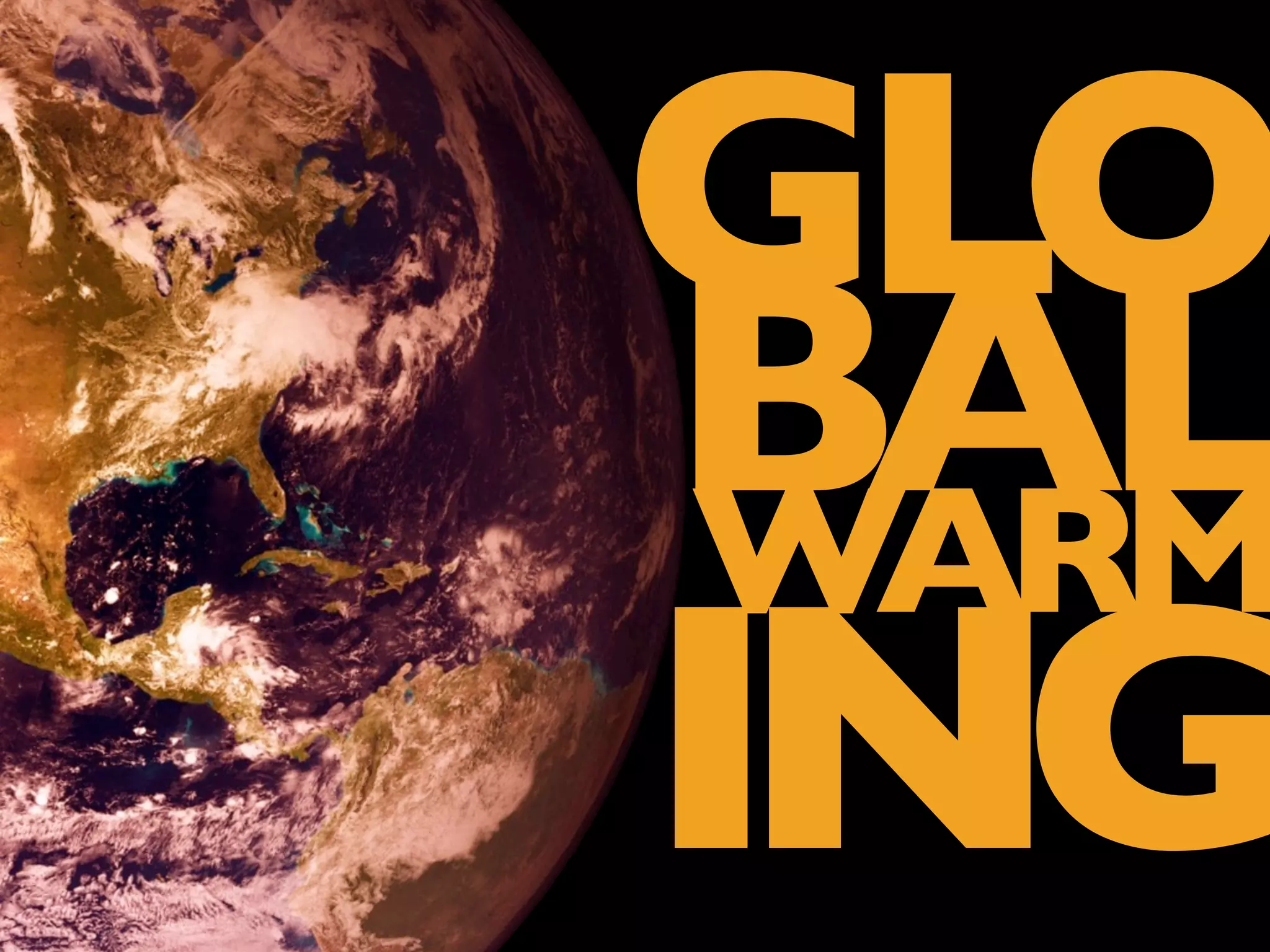






GLO
BAL
WARM

ING
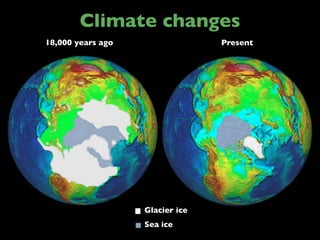
Climate changes
Climate changes
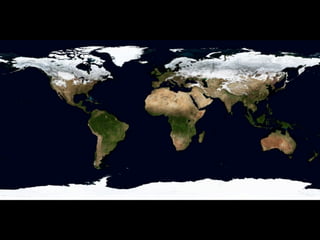
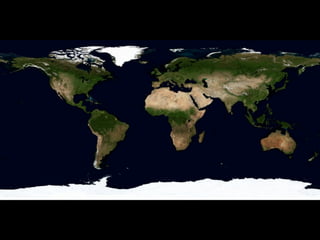
18,000 years ago

Present

Glacier ice
Sea ice
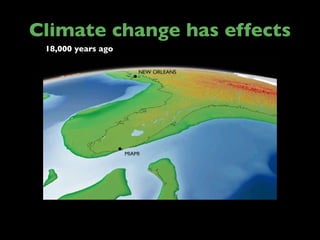
Florida’s coast during the LGM

Climate change has effects
18,000 years ago
Warming

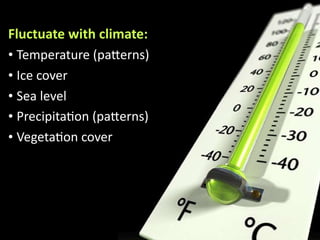
Fluctuate	
  with	
  climate:
• Temperature	
  (pa+erns)

• Ice	
  cover
• Sea	
  level
• Precipita7on	
  (pa+erns)
• Vegeta7on	
  cover
Essen1al	
  Principles
of	
  Climate	
  Science
1.	
  The	
  Sun	
  is	
  the	
  primary	
  
source	
  of	
  energy	
  for	
  Earth’s	
  
climate	
  system
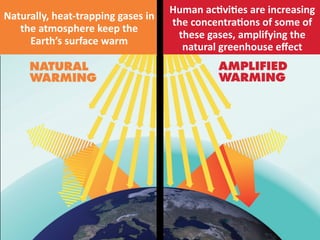
Naturally,	
  heat-­‐trapping	
  gases	
  in	
  
the	
  atmosphere	
  keep	
  the	
  
Earth’s	
  surface	
  warm

Human	
  ac1vi1es	
  are	
  increasing	
  
the	
  concentra1ons	
  of	
  some	
  of	
  
these	
  gases,	
  amplifying	
  the	
  
natural	
  greenhouse	
  effect
2.	
  Climate	
  is	
  regulated	
  by
complex	
  interac1ons
among	
  various	
  systems
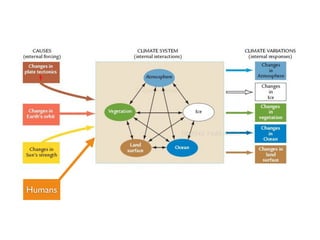
Humans
46
47
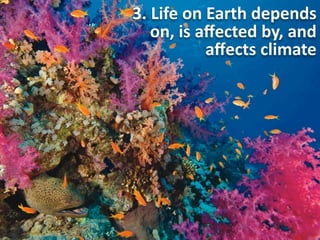
3.	
  Life	
  on	
  Earth	
  depends	
  
on,	
  is	
  affected	
  by,	
  and	
  
affects	
  climate
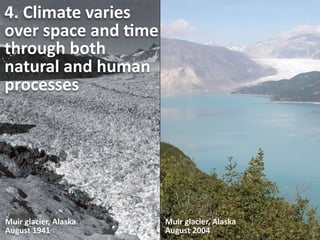
4.	
  Climate	
  varies	
  
over	
  space	
  and	
  1me	
  
through	
  both	
  
natural	
  and	
  human	
  
processes

Muir	
  glacier,	
  Alaska
August	
  1941

Muir	
  glacier,	
  Alaska
August	
  2004
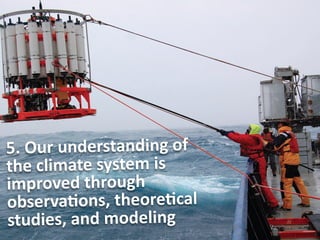
5.	
  Our	
  understanding	
  of	
  
the	
  climate	
  system	
  is	
  
improved	
  through	
  
observa1ons,	
  theore1cal	
  
studies,	
  and	
  modeling
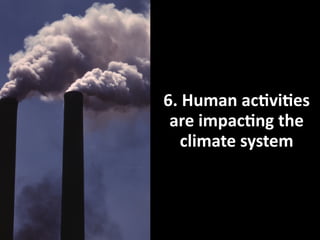
6.	
  Human	
  ac1vi1es	
  
are	
  impac1ng	
  the	
  
climate	
  system
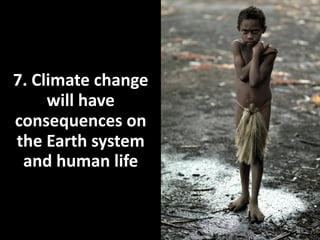
7.	
  Climate	
  change	
  
will	
  have	
  
consequences	
  on	
  
the	
  Earth	
  system	
  
and	
  human	
  life
1824:

Jean-­‐Bap1ste	
  Fourier	
  discusses	
  greenhouse	
  effect	
  
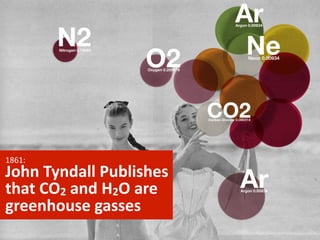
1861:

John	
  Tyndall	
  Publishes	
  
that	
  CO2	
  and	
  H2O	
  are	
  
greenhouse	
  gasses
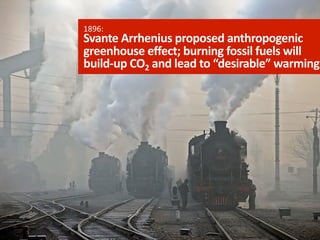
1896:

Svante	
  Arrhenius	
  proposed	
  anthropogenic	
  
greenhouse	
  effect;	
  burning	
  fossil	
  fuels	
  will	
  
build-­‐up	
  CO2	
  and	
  lead	
  to	
  “desirable”	
  warming	
  
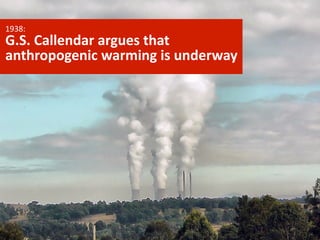
1938:

G.S.	
  Callendar	
  argues	
  that	
  
anthropogenic	
  warming	
  is	
  underway
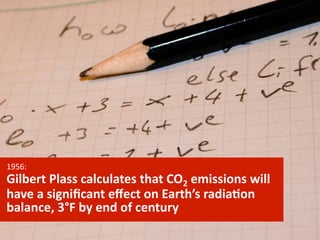
1956:

Gilbert	
  Plass	
  calculates	
  that	
  CO2	
  emissions	
  will	
  
have	
  a	
  significant	
  effect	
  on	
  Earth’s	
  radia<on	
  
balance,	
  3°F	
  by	
  end	
  of	
  century
1957:

Roger	
  Revelle	
  warns	
  "large-­‐scale	
  geophysical	
  
experiment”;	
  he	
  and	
  David	
  Keeling	
  begin	
  
monitoring	
  CO2
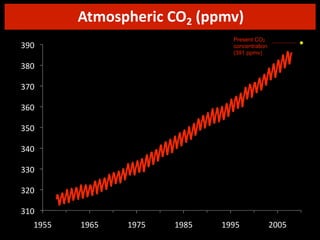
Atmospheric	
  CO2	
  (ppmv)
Present CO2
concentration
(391 ppmv)

!+#$
!*#$
!)#$
!(#$
!'#$
!&#$
!!#$
!%#$
!"#$
"+''$

"+('$

"+)'$

"+*'$

"++'$

%##'$
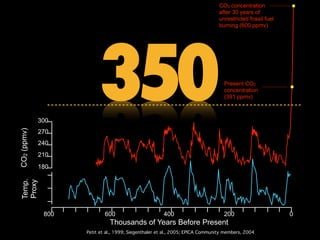
CO2 concentration
after 30 years of
unrestricted fossil fuel
burning (600 ppmv)

270
240
210
180

Temp.
Proxy

CO2 (ppmv)

300

350

Present CO2
concentration
(391 ppmv)

800

600

400

200

Thousands of Years Before Present
Petit et al., 1999; Siegenthaler et al., 2005; EPICA Community members, 2004

0
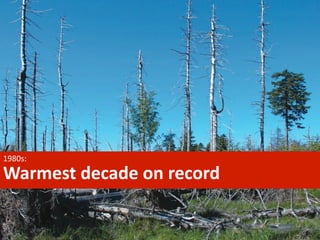
1980s:

Warmest	
  decade	
  on	
  record
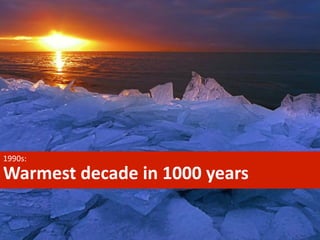
1990s:

Warmest	
  decade	
  in	
  1000	
  years
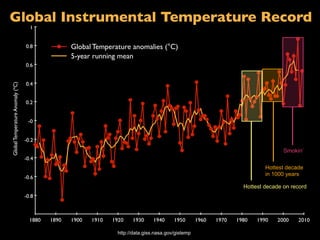
Global Instrumental Temperature Record
1

Global Temperature anomalies (°C)
5-year running mean

0.8

Global Temperature Anomaly (ºC)

0.6
0.4
0.2
-0
-0.2

Smokin’
-0.4

Hottest decade
in 1000 years

-0.6

Hottest decade on record
-0.8

1880

1890

1900

1910

1920

1930

1940

1950

http://data.giss.nasa.gov/gistemp

1960

1970

1980

1990

2000

2010
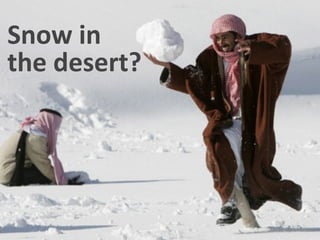
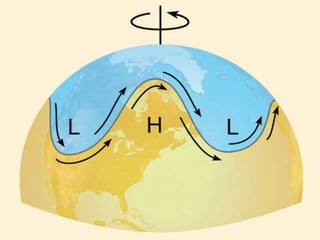
Snow	
  in
the	
  desert?
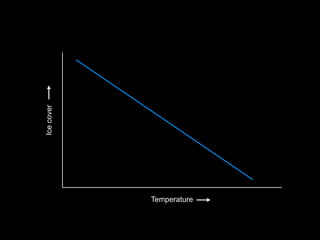
Ice cover

Temperature
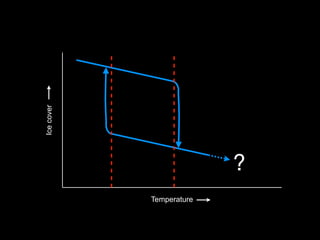
Ice cover

?
Temperature
Hysteresis
system that exhibits non-linear behavior
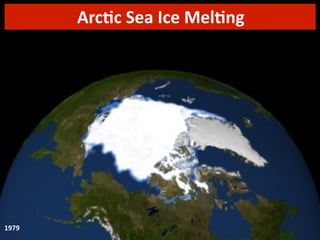
Arc1c	
  Sea	
  Ice	
  Mel1ng

1979
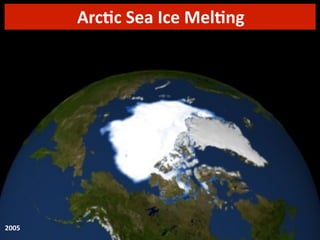
Arc1c	
  Sea	
  Ice	
  Mel1ng

2005
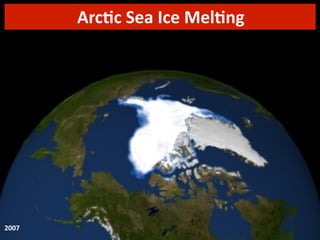
Arc1c	
  Sea	
  Ice	
  Mel1ng

2007
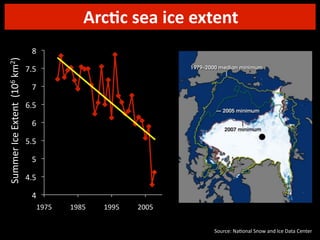
Arc1c	
  sea	
  ice	
  extent
Summer	
  Ice	
  Extent	
  	
  (106	
  km2)

'"
&#$"
&"
%#$"
%"
$#$"
$"
!#$"
!"
()&$"

()'$"

())$"

*++$"
Source:	
  Na7onal	
  Snow	
  and	
  Ice	
  Data	
  Center
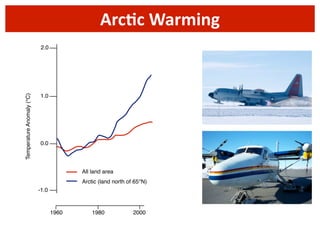
Arc1c	
  Warming

Temperature Anomaly (°C)

2.0

1.0

0.0

All land area
Arctic (land north of 65°N)
-1.0

1960

1980

2000
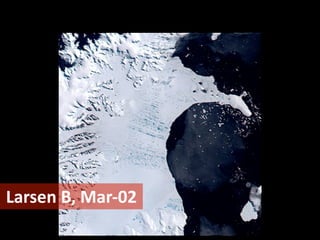
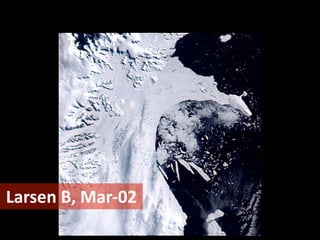
Larsen	
  B,	
  Mar-­‐02
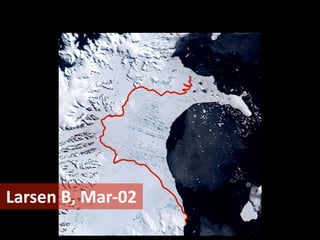
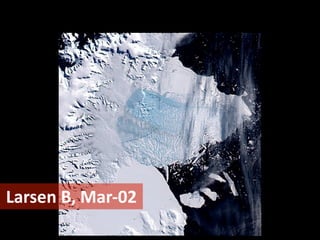
Larsen	
  B,	
  Mar-­‐02
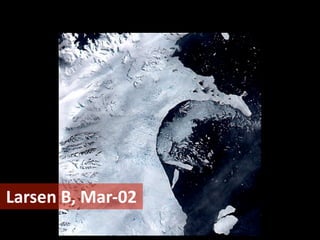
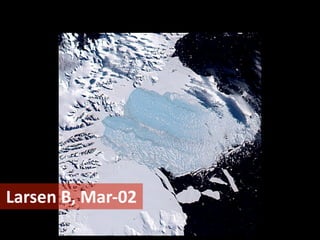
Larsen	
  B,	
  Mar-­‐02
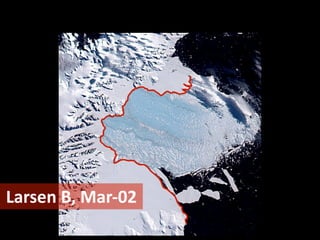
Larsen	
  B,	
  Mar-­‐02
Larsen	
  B,	
  Mar-­‐02
Larsen	
  B,	
  Mar-­‐02
Larsen	
  B,	
  Mar-­‐02
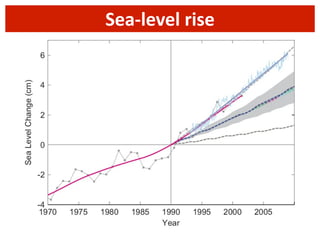
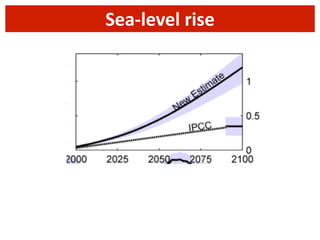
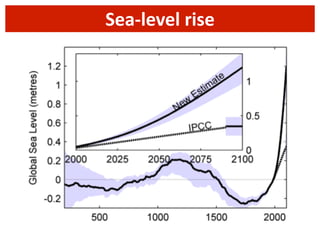
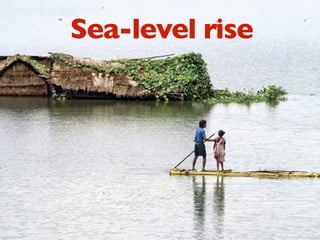
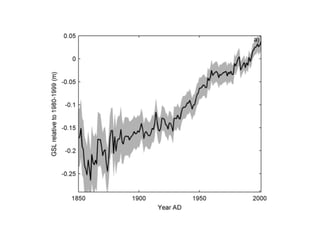
Sea-level rise
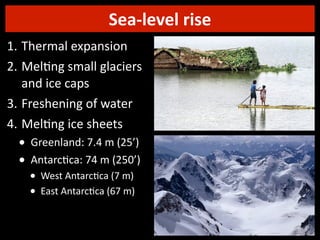
Sea-­‐level	
  rise
1. Thermal	
  expansion
2. Mel3ng	
  small	
  glaciers	
  
and	
  ice	
  caps
3. Freshening	
  of	
  water
4. Mel3ng	
  ice	
  sheets

•
•

Greenland:	
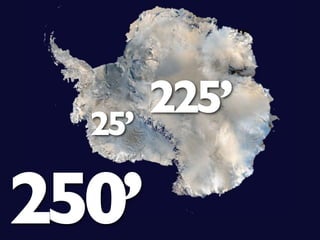
  7.4	
  m	
  (25’)
Antarc7ca:	
  74	
  m	
  (250’)

•
•

West	
  Antarc7ca	
  (7	
  m)
East	
  Antarc7ca	
  (67	
  m)
“

Those	
  of	
  us	
  who	
  live	
  
on	
  small	
  specks	
  of	
  
land	
  .	
  .	
  .	
  have	
  not	
  
agreed	
  to	
  be	
  sacrificial	
  
lambs	
  on	
  the	
  altar	
  of	
  
success	
  of	
  industrial	
  
civiliza1on.
Ambassador	
  Lionel	
  Hurst
of	
  An1gua	
  and	
  Barbuda
June	
  28,	
  2002

Photo by rembcc
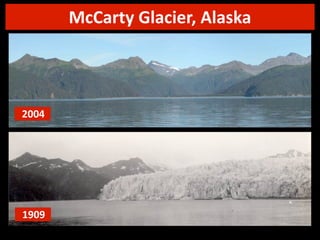
McCarty	
  Glacier,	
  Alaska

2004

1909
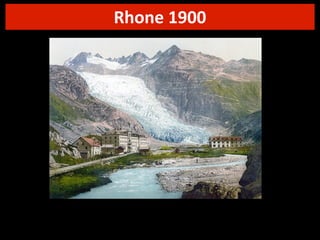
Rhone	
  1900
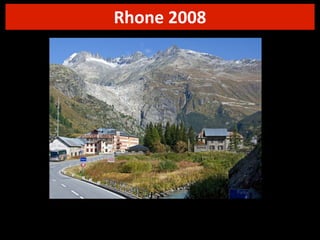
Rhone	
  2008
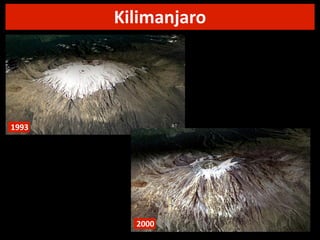
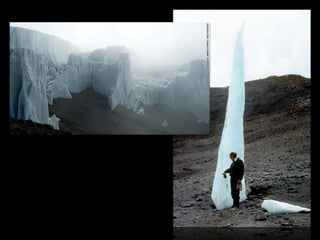
Kilimanjaro

1993

2000
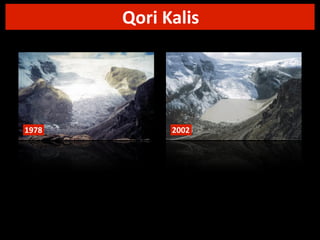
Qori	
  Kalis

1978

2002
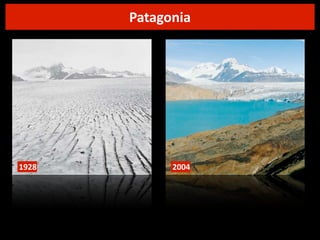
Patagonia

1928

2004
225’
25’

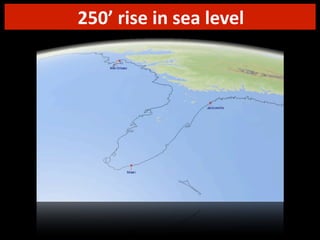
250’
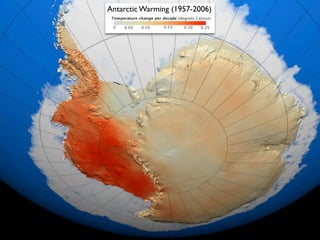
Antarctic Warming (1957-2006)
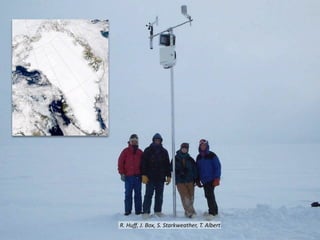
R.	
  Huff,	
  J.	
  Box,	
  S.	
  Starkweather,	
  T.	
  Albert
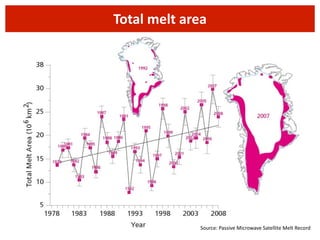
Total	
  melt	
  area

Source:	
  Passive	
  Microwave	
  Satellite	
  Melt	
  Record
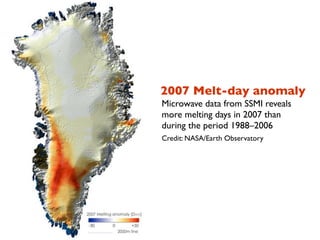
2007 Melt-day anomaly
Microwave data from SSMI reveals
more melting days in 2007 than
during the period 1988–2006
Credit: NASA/Earth Observatory
Mass change on Greenland
200
Unfiltered data
Seasonally filtered data

0

Mass Change [Gt]

-200
-400
-600
-800
-1000
-1200
-1400

2007 Extreme Summer Melt

-1600
-1800

2003

2004

2005

2006

2007

2008

2009
Source: GRACE measurements
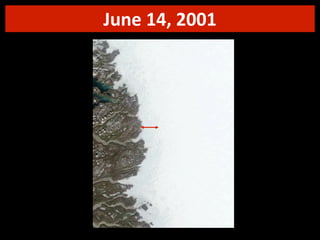
June	
  14,	
  2001
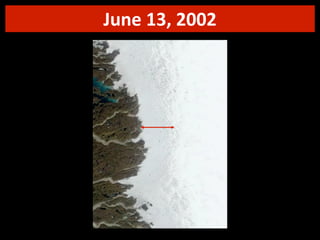
June	
  13,	
  2002
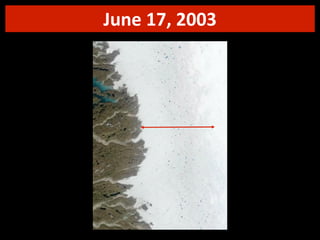
June	
  17,	
  2003
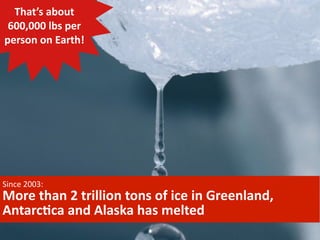
That’s	
  about	
  
600,000	
  lbs	
  per	
  
person	
  on	
  Earth!

Since	
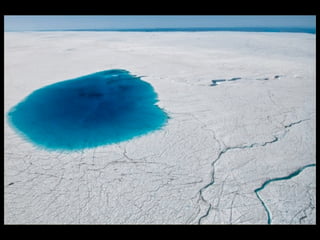
  2003:

More	
  than	
  2	
  trillion	
  tons	
  of	
  ice	
  in	
  Greenland,	
  
Antarc1ca	
  and	
  Alaska	
  has	
  melted
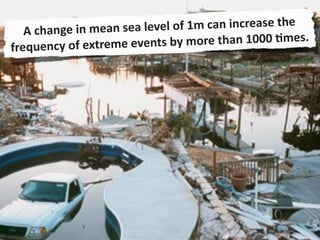
Sea-­‐level	
  rise
Sea-­‐level	
  rise
Sea-­‐level	
  rise
of	
  1m	
  can	
  increase	
  the
	
  change	
  in	
  mean	
  sea	
  level	
  
A
ore	
  than	
  1000	
  1mes.
y	
  of	
  extreme	
  events	
  by	
  m
frequenc
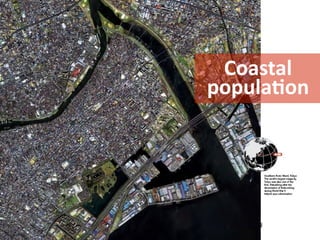
Coastal	
  
popula1on
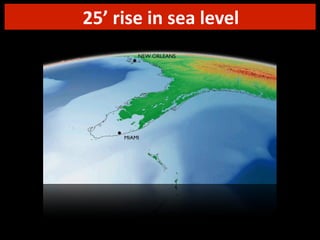
25’	
  rise	
  in	
  sea	
  level
250’	
  rise	
  in	
  sea	
  level
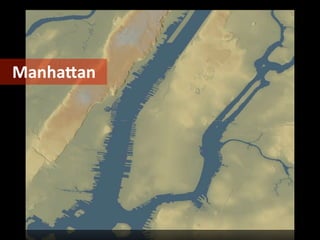
Manhaian
Manhaian	
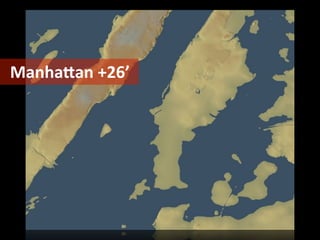
  +26’
Manhaian	
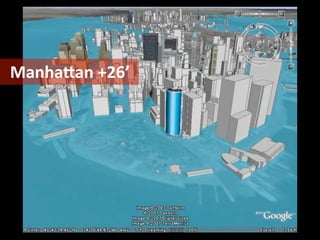
  +26’
Consequences
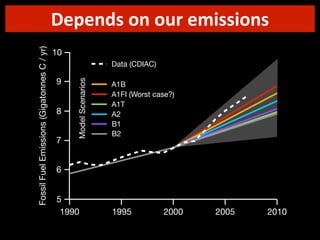
10
Data (CDIAC)

9
8
7

Model Scenarios

Fossil Fuel Emissions (Gigatonnes C / yr)

Depends	
  on	
  our	
  emissions
A1B
A1FI (Worst case?)
A1T
A2
B1
B2

6
5
1990

1995

2000

2005

2010
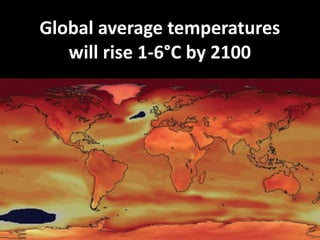
Global	
  average	
  temperatures
will	
  rise	
  1-­‐6°C	
  by	
  2100
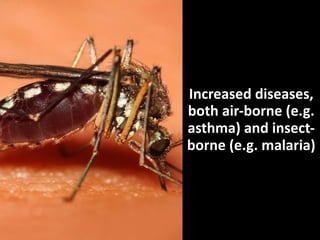
Increased	
  diseases,	
  
both	
  air-­‐borne	
  (e.g.	
  
asthma)	
  and	
  insect-­‐
borne	
  (e.g.	
  malaria)
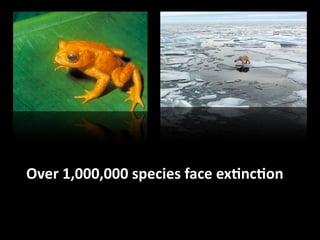
Over	
  1,000,000	
  species	
  face	
  ex1nc1on
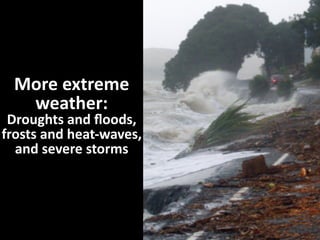
More	
  extreme	
  
weather:

Droughts	
  and	
  floods,	
  
frosts	
  and	
  heat-­‐waves,	
  
and	
  severe	
  storms
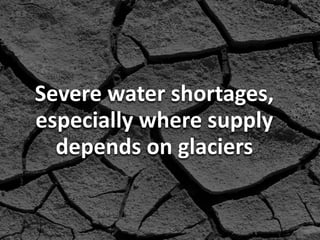
Severe	
  water	
  shortages,	
  
especially	
  where	
  supply	
  
depends	
  on	
  glaciers
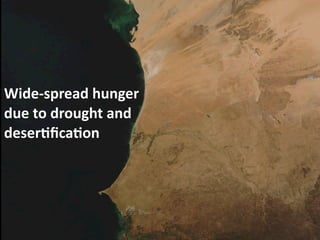
Wide-­‐spread	
  hunger	
  
due	
  to	
  drought	
  and	
  
deser1fica1on
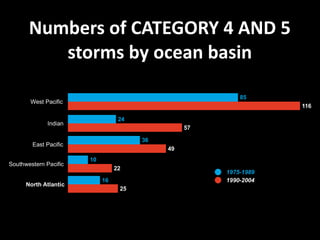
Numbers	
  of	
  CATEGORY	
  4	
  AND	
  5	
  
storms	
  by	
  ocean	
  basin
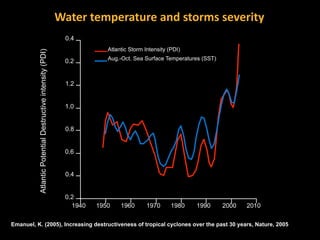
Water	
  temperature	
  and	
  storms	
  severity
Atlantic Potential Destructive intensity (PDI)

0.4
Atlantic Storm Intensity (PDI)

0.2

Aug.-Oct. Sea Surface Temperatures (SST)

1.2

1.0

0.8

0.6

0.4

0.2
1940

1950

1960

1970

1980

1990

2000

2010

Emanuel, K. (2005), Increasing destructiveness of tropical cyclones over the past 30 years, Nature, 2005
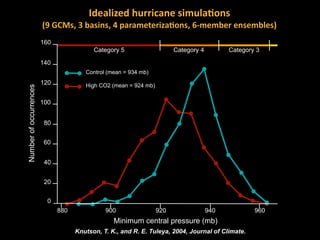
Idealized	
  hurricane	
  simula1ons

(9	
  GCMs,	
  3	
  basins,	
  4	
  parameteriza1ons,	
  6-­‐member	
  ensembles)
160
Category 5

Category 4

Category 3

140

Number of occurrences

Control (mean = 934 mb)

120

High CO2 (mean = 924 mb)

100
80
60
40
20
0
880

900

920

940

Minimum central pressure (mb)
Knutson, T. K., and R. E. Tuleya, 2004, Journal of Climate.

960
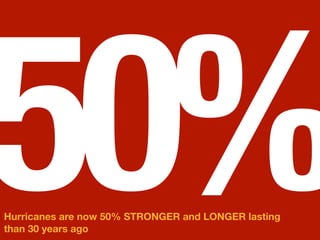
50%
Hurricanes are now 50% STRONGER and LONGER lasting
than 30 years ago
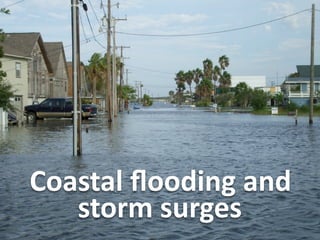
Coastal	
  flooding	
  and	
  
storm	
  surges
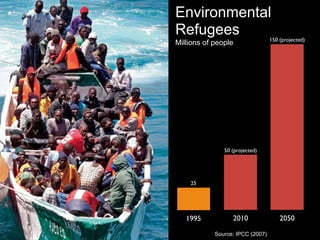
Environmental
Refugees
Millions of people

150 (projected)

50 (projected)

25

1995

2010
Source: IPCC (2007)

2050
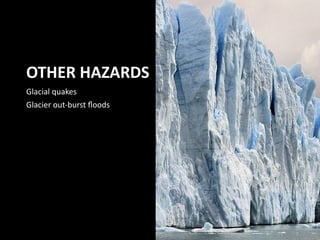
OTHER	
  HAZARDS
Glacial	
  quakes
Glacier	
  out-­‐burst	
  floods
What	
  can	
  we	
  do?
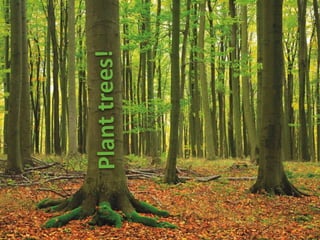
Plant	
  trees!
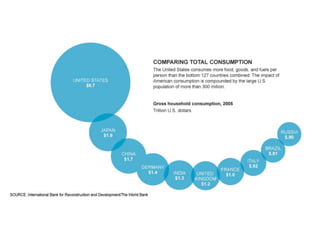
Reduce	
  consumpDon
Shop	
  smart
AlternaDve	
  energy
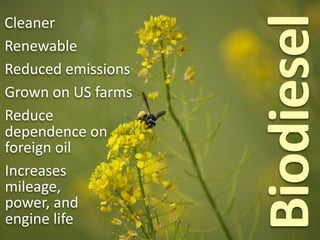
Biodiesel

Cleaner
Renewable
Reduced	
  emissions
Grown	
  on	
  US	
  farms
Reduce	
  
dependence	
  on	
  
foreign	
  oil
Increases	
  
mileage,	
  
power,	
  and	
  
engine	
  life
Be	
  informed
Unplug
ncy
cie
e	
  effi
rov
Imp
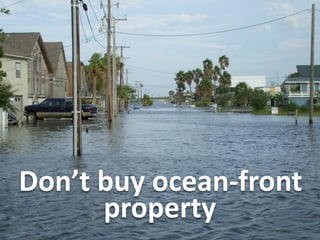
Don’t	
  buy	
  ocean-­‐front	
  
property
T
R
A
M
S
Form	
  PACs
Don’t	
  remain	
  happy	
  in	
  ignorance
todda@me.com

Global warming