Outlook 2012             Expert Articles from
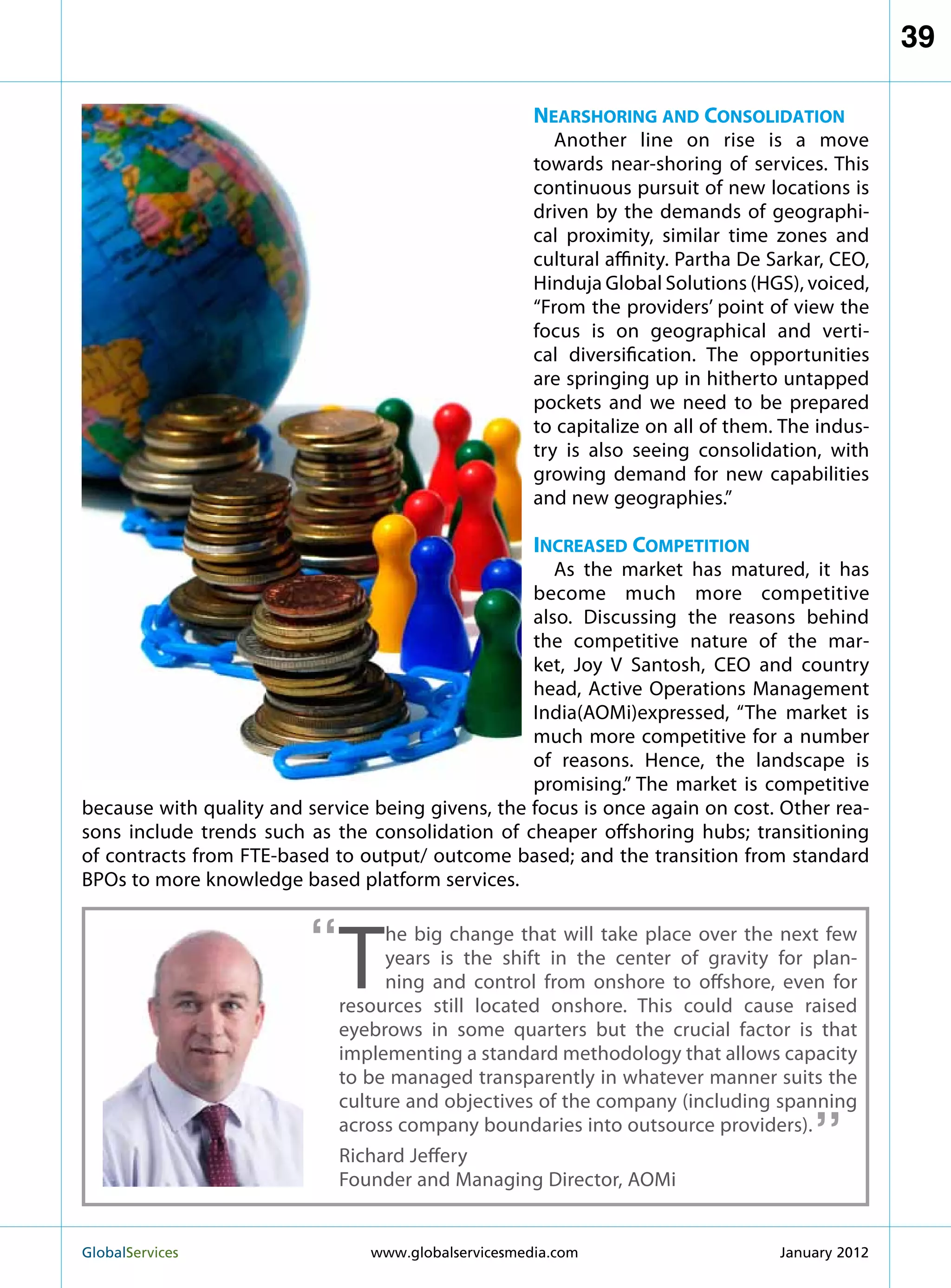
                          Survey Analysis   p. 8   Sourcing Advisors    p. 81


www.globalservicesmedia.com


 O utloo k


    Where do we go next?

                                    The Way Ahead
                                    Grim economic outlook, mounting
                                    expectations, bigger challenges...
                                    and few lessons to be learnt       

                                     p.20
Editor’s Note


                                                          Outsourcing in
                                                          2012: Surely,
                                                          Politics Will Not
                  Ed Nair, Editor
                ed@cybermedia.co.in                       Matter

                                      I
                                           t being the election year, this is the time to pull out the political cards
                                           against outsourcing. The anti-outsourcing machinery has already begun to
                                           stir— the proposed Call Center Bill, restrictions on L1 visas, and what not.
                                         Our survey indicates that politics will not have any impact on outsourcing.
                                      Businesses have adopted outsourcing, or more specifically global sourcing
                                      of services, as a strategic business practice. This is because organizations
One should expect
                                      believe that not only does outsourcing help save costs, but also that out-
modest, guarded
                                      sourcing frees up organizational bandwidth to pursue strategic growth
growth in out-
                                      opportunities that matter more to the business.
sourcing this year.
                                         One should expect modest, guarded growth in outsourcing this year.
Organizations will
                                      Organizations will want to do it cheaper and better, but face minimal disrup-
want to do it cheap-
                                      tive change. Therefore, cloud as an infrastructure service would see adoption.
er and better, but
                                      But far-fetched experiments in cloud computing has been voted out of favor.
face minimal disrup-
                                         Service providers can expect strong pressure on pricing because clients
tive change.
                                      would force price renegotiations to get more ‘mileage’ from their trips with
                                      service providers. Clients would also ‘maintain’ their vehicles, call it out-
                                      sourcing relationships, using various management tools, to get the best
                                      performance.
                                         The good news is that leading service providers are geared to handle the
                                      demands. Over the past decade, both buyers and service providers have
                                      matured to this level. Our interviews with nearly 30 service providers during
                                      the month clearly reveal this and more.
                                         This issue is packed with insights and ideas about the outlook for the
                                      coming year. Do let us know your opinions, comments, feedback, insights by
                                      writing to me at ed@cybermedia.co.in.
                                         Wish You a Very Happy New Year!
Contents
                        8
                          GLOBAL SERVICES OUTLOOK 2012 SURVEY


                                                                20
   The Way Ahead
   Lessons from the Past and Some More 	                       22 
   Services Spends Will Happen Despite Budget Cuts 	           30
   The Changing Landscape of the Global Services Industry	     36
   IT Outsourcing Slow, Deliberate March	                      43
   FAO: Helping Really Handle the ‘Finance’ Function Better	   49
   Analytics Outsourcing 2012: What do the Cards Say?	         53
   Contact Centers Being Redefined	                            58
   A Cautious Optimism Continues To Drive HRO	                 63
   3 Pointers by Industry Leaders	                             68
   What Service Providers Say?	                                76

Pradeep Gupta                        Smriti Sharma                   Global Services
Chairman  Managing                  smritis@cybermedia.co.in        Cyber Media (India) Ltd.
Director                             Smita Vasudevan                 CyberHouse, B- 35, Sector 32
Cyber Media (India) Ltd.             smitav@cybermedia.co.in         Gurgaon-122001, India
E. Abraham Mathew                    Sourabh Chandra Pushp           Tel: +911 24 4822222
President                            sourabhc@cybermedia.co.in       Fax: +911 24 2380694
Ed Nair                              Design
Editor, ed@cybermedia.co.in          Suresh Kumar
Satish Gupta                         sureshk@cybermedia.co.in
AVP, satishg@cybermedia.             Nitin Kumar Srivastava          Contact:
co.in                                nitinks@cybermedia.co.in        globalservices@cybermedia.co.in
Gary Bindra
gurdeepb@cybermedia.co.in             Disclaimer: All rights reserved. No part of this
Niketa Chauhan                        publication may be reproduced by any means without
niketac@cybermedia.co.in              prior written permission from the publisher.
81
                                         EXPERTS
Global Services Trends: 2012	                              82
                                                     MARCH 15
Future of Outsourcing in 2012	                             89
                                                  NEW YORK 94
A Year of a Profound Change in Software Development	        CITY
Small Frames and Big Pictures: Keys to Success in 2012	                100
Predictions on the Cloud Age: 2012	                                    104
Knowledge Services Will be Most Important in 2012 Growth Strategies	   107
IT Outsourcing in 2012	                                                111


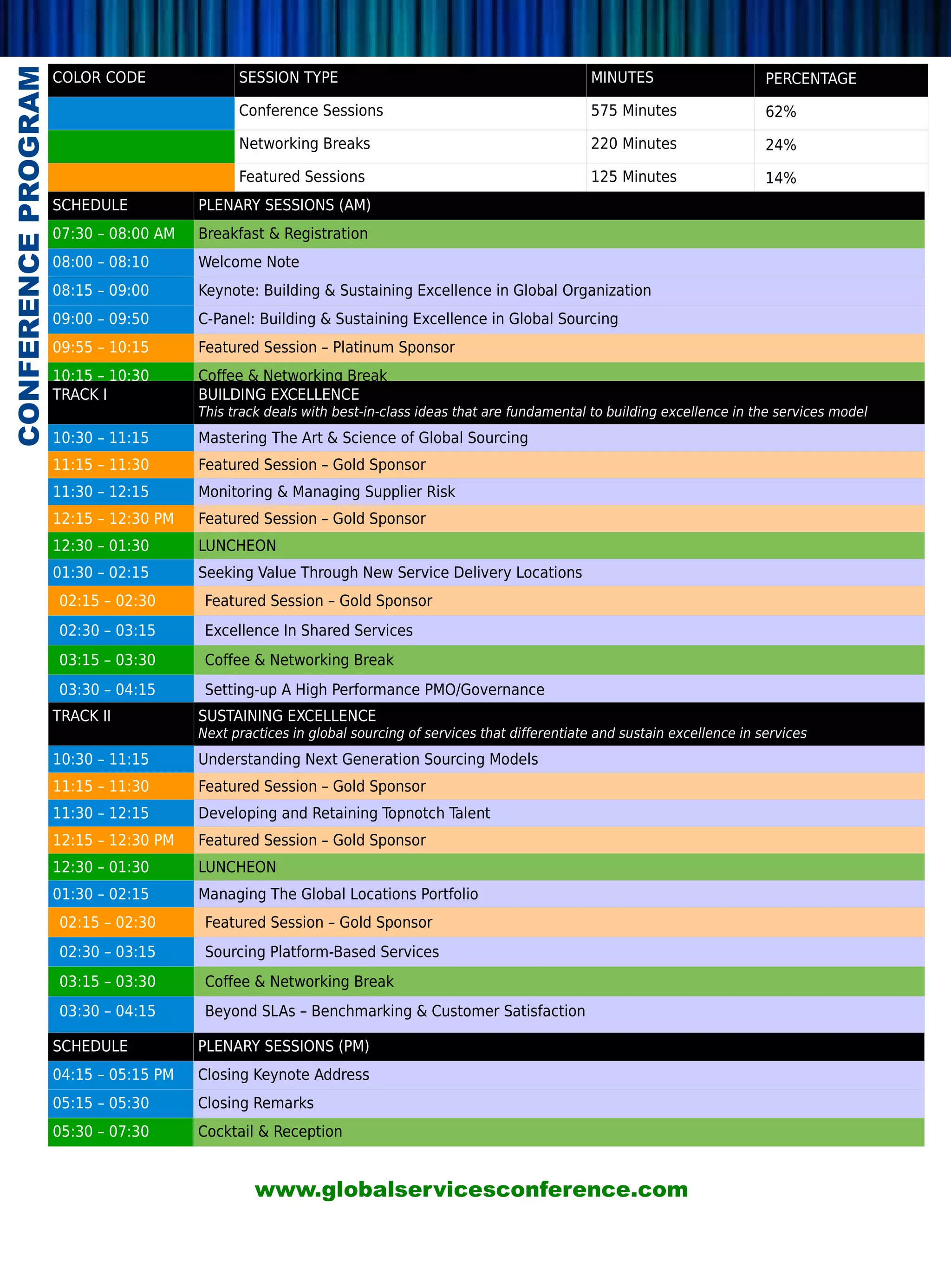
                March 15, 2012 | New York City
                               |
            www.globalservicesconference.com
8   G S S U R V E Y


    GLOBAL SERVICES
                  OUTLOOK 2012 SURVEY


          Tempered Expectations,
                              Moderate Outlook


    GlobalServices 	    www.globalservicesmedia.com   January 2012
9


While the outlook for outsourcing is modest, the
direction is positive. Reducing operational costs
remains the prime driver, but organizations are
equally looking at outsourcing to create bandwidth
for pursuing strategic growth.

Ed Nair


                   G
                           lobal Services did an online survey in the second
                           week of December 2011 to gauge the sentiments
                           of how the services industry would fare in 2012.
                   The participants of the survey included all stakeholders in
                   the industry- services buyers, service providers, and sourc-
                   ing advisors- at a global level. We received 149 responses
                   that included services providers among the top 50 global
                   vendors, 30 buyer organizations with two-thirds being $1 B
                   plus organizations, and a near complete representation of
                   top advisors in the industry. Here are the top-line findings:

GlobalServices 	   www.globalservicesmedia.com                      January 2012
10   G S S U R V E Y

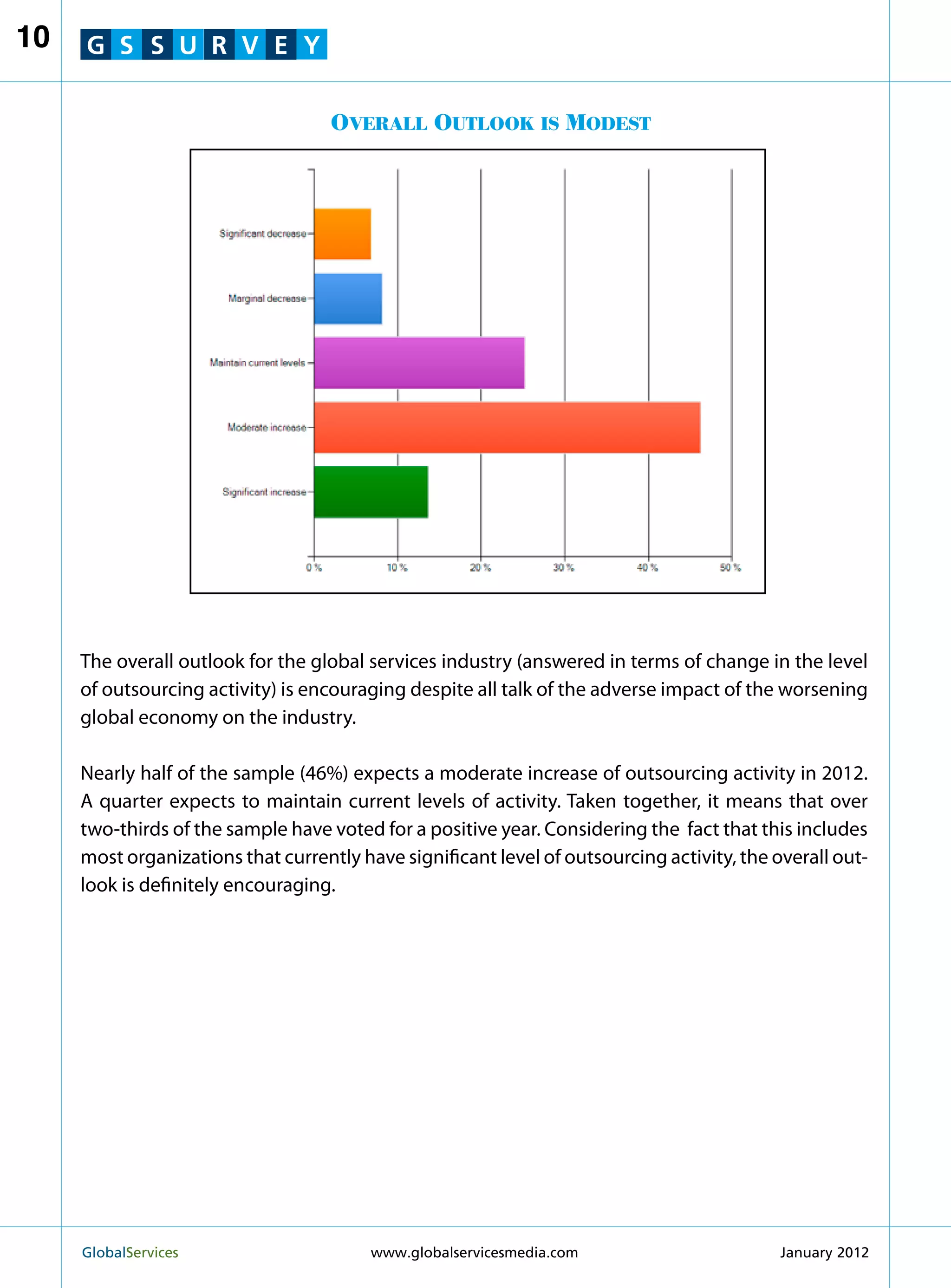
                                    Overall Outlook is Modest


     The overall outlook for the global services industry (answered in terms of change in the level
     of outsourcing activity) is encouraging despite all talk of the adverse impact of the worsening
     global economy on the industry.

     Nearly half of the sample (46%) expects a moderate increase of outsourcing activity in 2012.
     A quarter expects to maintain current levels of activity. Taken together, it means that over
     two-thirds of the sample have voted for a positive year. Considering the fact that this includes
     most organizations that currently have significant level of outsourcing activity, the overall out-
     look is definitely encouraging.


     GlobalServices 	                    www.globalservicesmedia.com                       January 2012
12   G S S U R V E Y


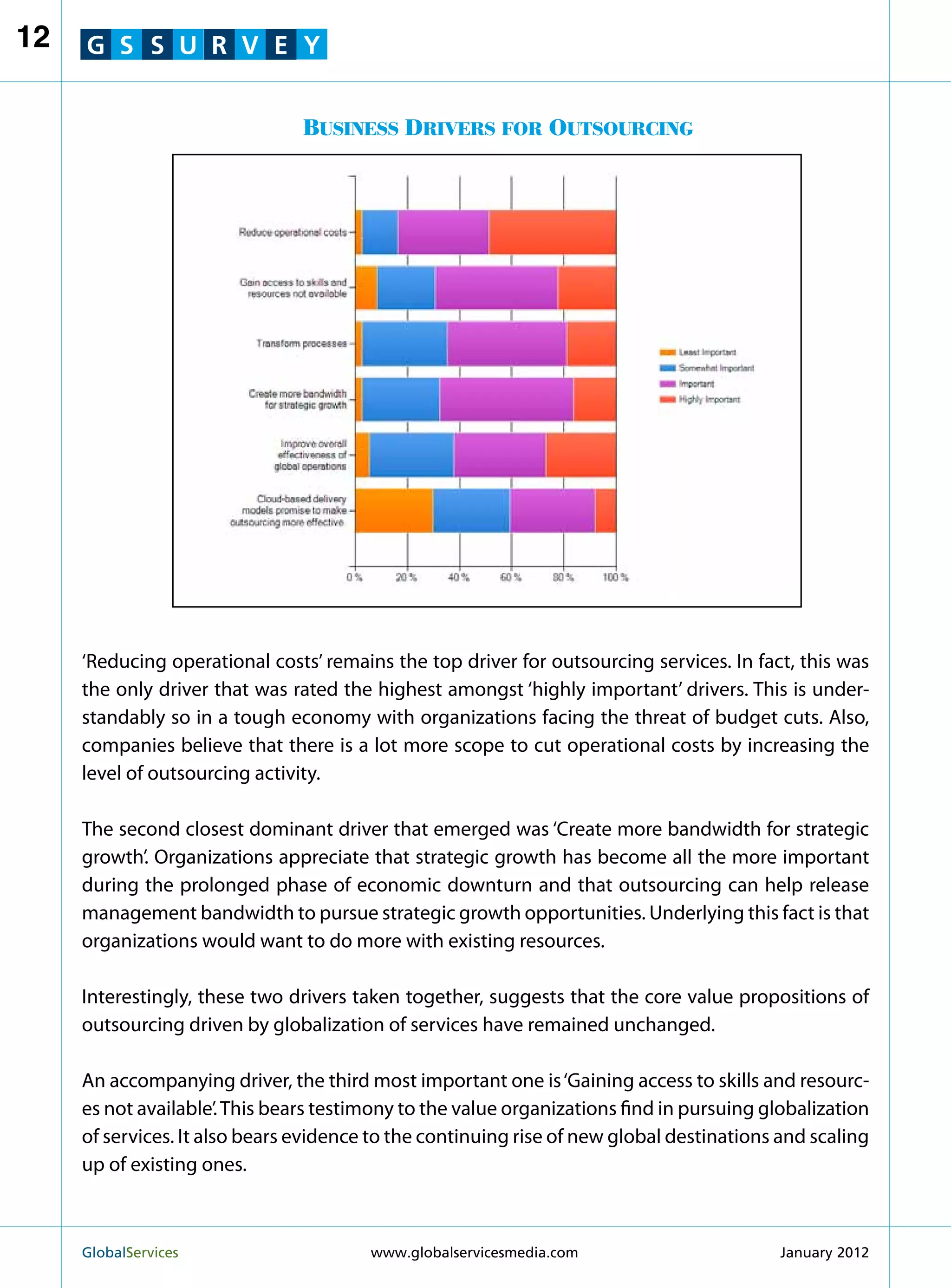
                                Business Drivers for Outsourcing


     ‘Reducing operational costs’ remains the top driver for outsourcing services. In fact, this was
     the only driver that was rated the highest amongst ‘highly important’ drivers. This is under-
     standably so in a tough economy with organizations facing the threat of budget cuts. Also,
     companies believe that there is a lot more scope to cut operational costs by increasing the
     level of outsourcing activity.

     The second closest dominant driver that emerged was ‘Create more bandwidth for strategic
     growth’. Organizations appreciate that strategic growth has become all the more important
     during the prolonged phase of economic downturn and that outsourcing can help release
     management bandwidth to pursue strategic growth opportunities. Underlying this fact is that
     organizations would want to do more with existing resources.

     Interestingly, these two drivers taken together, suggests that the core value propositions of
     outsourcing driven by globalization of services have remained unchanged.

     An accompanying driver, the third most important one is ‘Gaining access to skills and resourc-
     es not available’. This bears testimony to the value organizations find in pursuing globalization
     of services. It also bears evidence to the continuing rise of new global destinations and scaling
     up of existing ones.


     GlobalServices 	                   www.globalservicesmedia.com                       January 2012
14   G S S U R V E Y

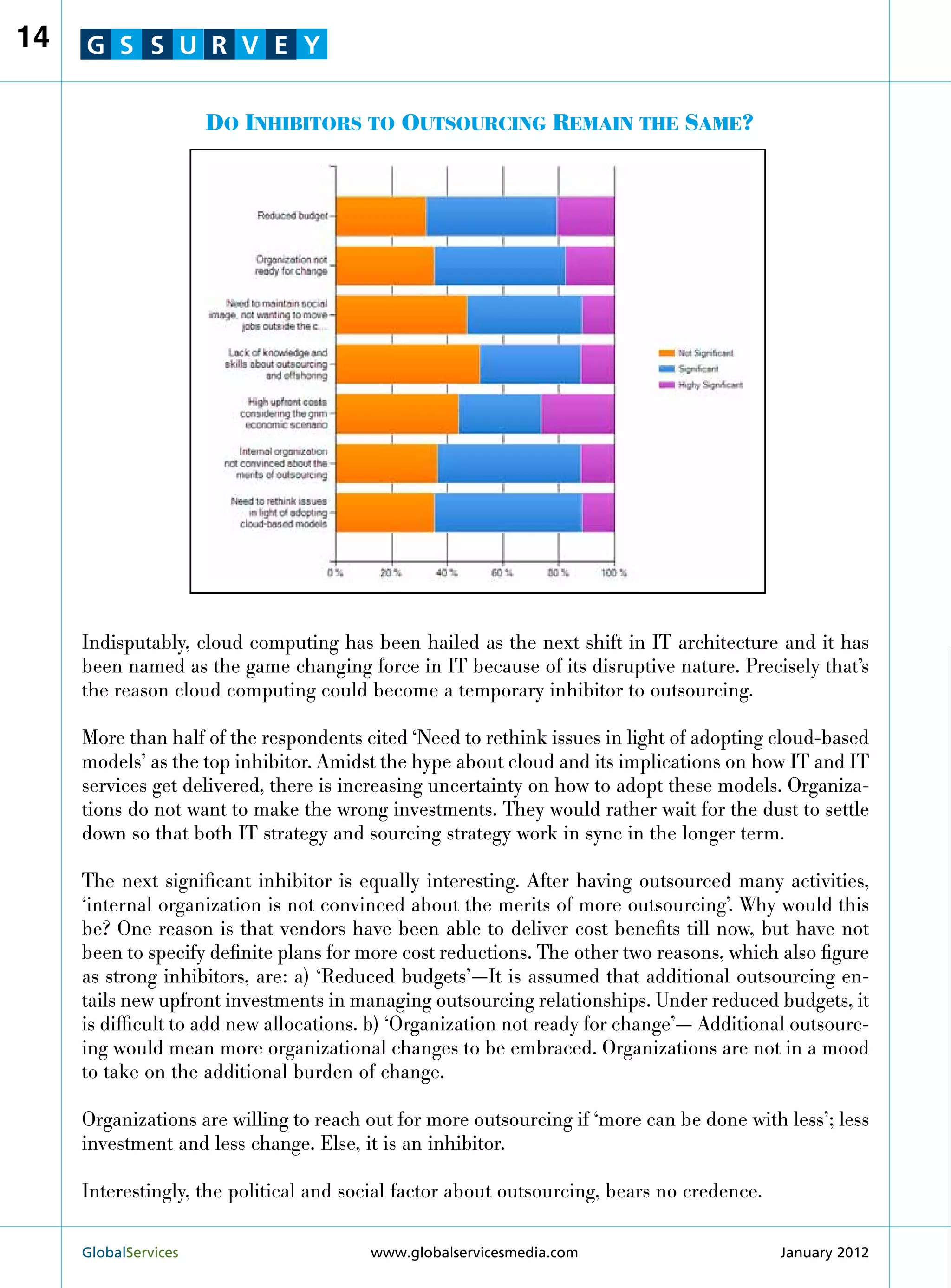
                        Do Inhibitors to Outsourcing Remain the Same?


     Indisputably, cloud computing has been hailed as the next shift in IT architecture and it has
     been named as the game changing force in IT because of its disruptive nature. Precisely that’s
     the reason cloud computing could become a temporary inhibitor to outsourcing.

     More than half of the respondents cited ‘Need to rethink issues in light of adopting cloud-based
     models’ as the top inhibitor. Amidst the hype about cloud and its implications on how IT and IT
     services get delivered, there is increasing uncertainty on how to adopt these models. Organiza-
     tions do not want to make the wrong investments. They would rather wait for the dust to settle
     down so that both IT strategy and sourcing strategy work in sync in the longer term.

     The next significant inhibitor is equally interesting. After having outsourced many activities,
     ‘internal organization is not convinced about the merits of more outsourcing’. Why would this
     be? One reason is that vendors have been able to deliver cost benefits till now, but have not
     been to specify definite plans for more cost reductions. The other two reasons, which also figure
     as strong inhibitors, are: a) ‘Reduced budgets’—It is assumed that additional outsourcing en-
     tails new upfront investments in managing outsourcing relationships. Under reduced budgets, it
     is difficult to add new allocations. b) ‘Organization not ready for change’— Additional outsourc-
     ing would mean more organizational changes to be embraced. Organizations are not in a mood
     to take on the additional burden of change.

     Organizations are willing to reach out for more outsourcing if ‘more can be done with less’; less
     investment and less change. Else, it is an inhibitor.

     Interestingly, the political and social factor about outsourcing, bears no credence.

     GlobalServices 	                   www.globalservicesmedia.com                        January 2012
15


GlobalServices 	   www.globalservicesmedia.com   January 2012
16   G S S U R V E Y

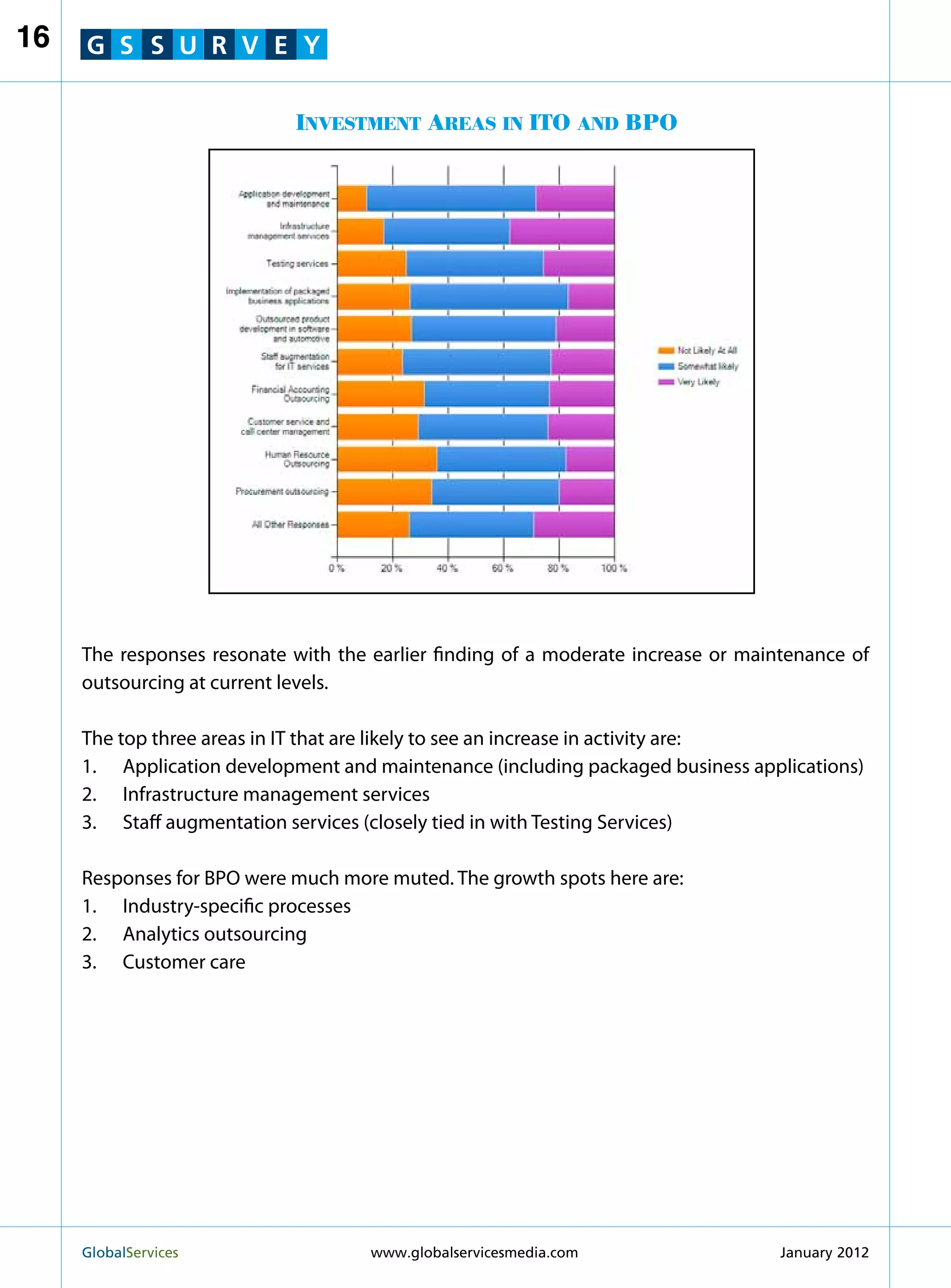
                            Investment Areas in ITO and BPO


     The responses resonate with the earlier finding of a moderate increase or maintenance of
     outsourcing at current levels.

     The top three areas in IT that are likely to see an increase in activity are:
     1.	 Application development and maintenance (including packaged business applications)
     2.	 Infrastructure management services
     3.	 Staff augmentation services (closely tied in with Testing Services)

     Responses for BPO were much more muted. The growth spots here are:
     1.	 Industry-specific processes
     2.	 Analytics outsourcing
     3.	 Customer care


     GlobalServices 	                www.globalservicesmedia.com                  January 2012
Hungary   Belarus
                                                                                         Poland         Russia
                                                                                    Sweden                Ukraine
                                                                                Switzerland                 Kazakhstan
                                                                                 Germany
                                                                                       UK

    United States


                                                                         Excellence in Software
                                                                                   Engineering
                                                                         EPAM Systems a leading global IT services provider with delivery centers
                                                                         throughout Central and Eastern Europe focused on complex software
                                                                         product development services, software engineering and
www.epam.com                                                             vertically-oriented custom development solution.

Experience: since 1993                                                   Services                                        Industries
Talents: 7,000+                                                            Product Development                            ISVs and Technology
Quality: CMMI Level 4, SAS
70 Type II, ISO 9001:2000,                                                 Application Development                        Banking  Financial Services
ISO 27001:2005                                                             Enterprise Application Platforms               Business Information 
                                                                           Application Testing                            Media
                                                                           Application Maintenance  Support              Travel and Hospitality
                                                                           ASM  Infrastructure Services                  Retail  CPG
                                                                                                                          Emerging Vertical

Our Awards                                                               Sample client:

                                  01 1
                                   1


                                                           1 1
                                                  1         1
                     10   0   1 010 1 1 0 0 1 1 0   1 0 10 1 0 0 1 1 0
18   G S S U R V E Y

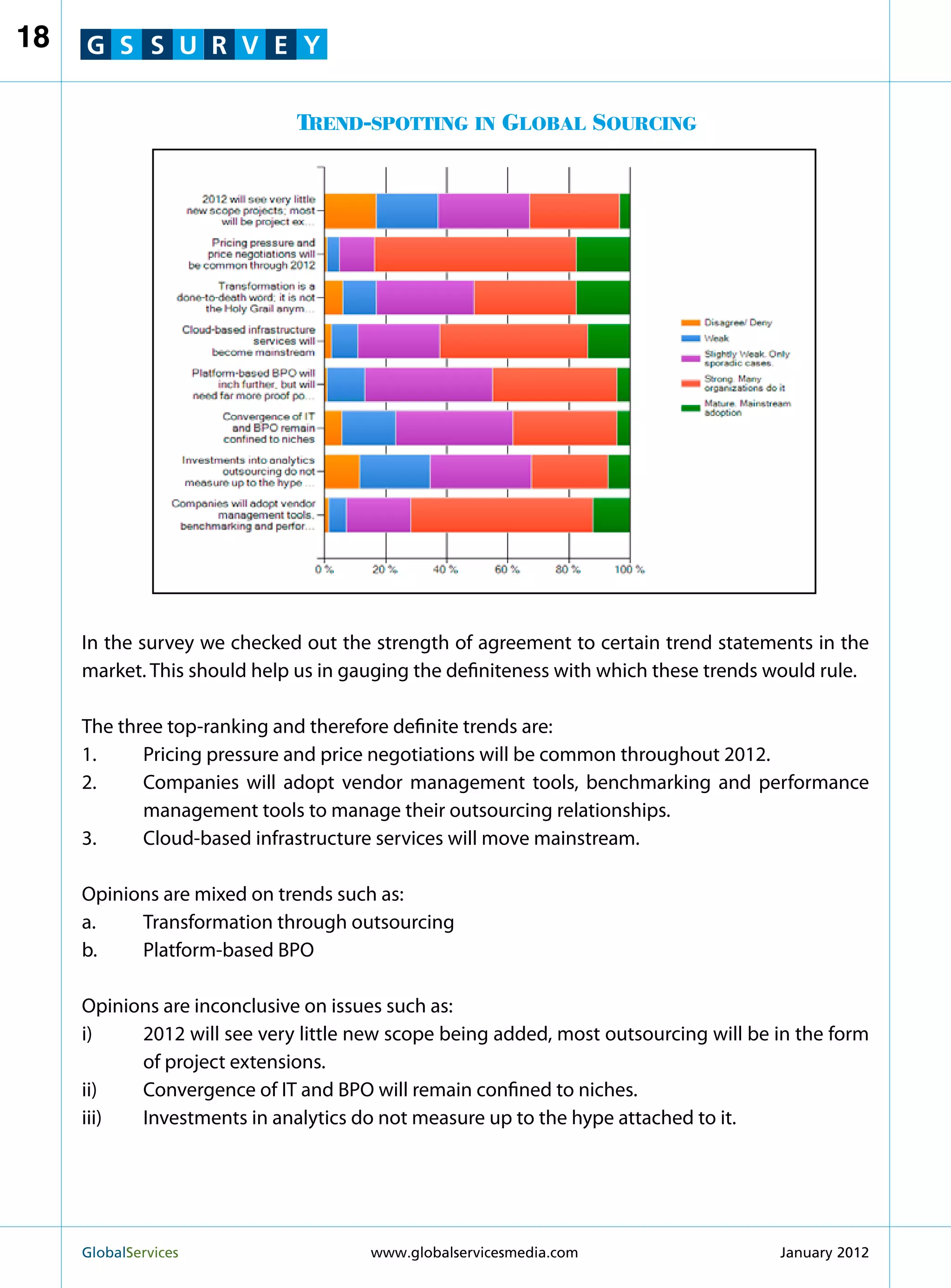
                             Trend-spotting in Global Sourcing


     In the survey we checked out the strength of agreement to certain trend statements in the
     market. This should help us in gauging the definiteness with which these trends would rule.

     The three top-ranking and therefore definite trends are:
     1.	    Pricing pressure and price negotiations will be common throughout 2012.
     2.	   Companies will adopt vendor management tools, benchmarking and performance
            management tools to manage their outsourcing relationships.
     3.	    Cloud-based infrastructure services will move mainstream.

     Opinions are mixed on trends such as:
     a.	   Transformation through outsourcing
     b.	   Platform-based BPO

     Opinions are inconclusive on issues such as:
     i)	  2012 will see very little new scope being added, most outsourcing will be in the form
           of project extensions.
     ii)	  Convergence of IT and BPO will remain confined to niches.
     iii)	 Investments in analytics do not measure up to the hype attached to it.


     GlobalServices 	                 www.globalservicesmedia.com                   January 2012
19

  OUTLOOK 2012 SURVEY METHODOLOGY

  Global Services conducted an online survey in early December. The survey was conduct-
  ed within the Global Services reader community, two-thirds of which is based in the US.

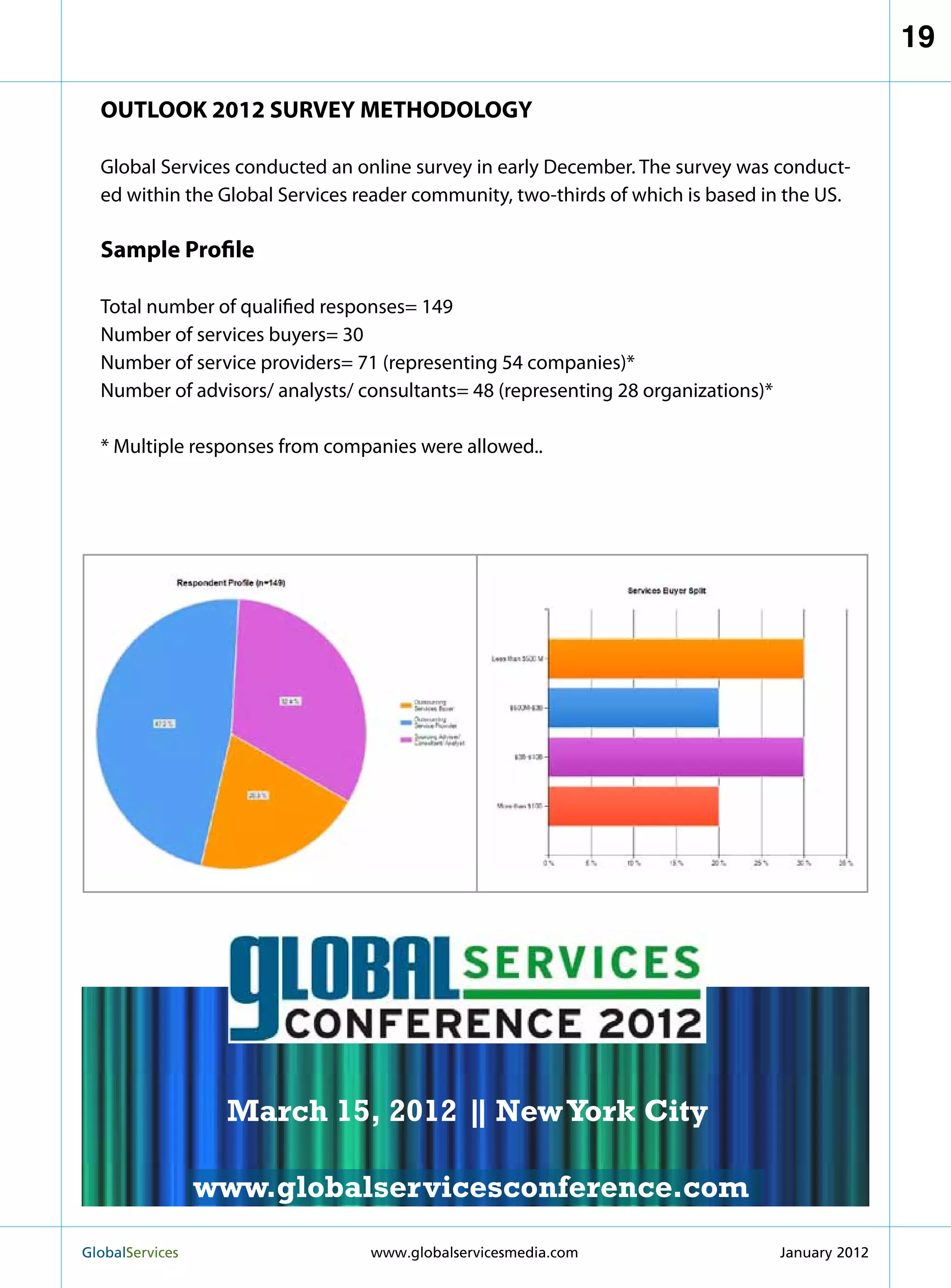
  Sample Profile

  Total number of qualified responses= 149
  Number of services buyers= 30
  Number of service providers= 71 (representing 54 companies)*
  Number of advisors/ analysts/ consultants= 48 (representing 28 organizations)*

  * Multiple responses from companies were allowed..


                                                          MARCH 15
                                                        NEW YORK CITY


                    March 15, 2012 | New York City
                                   |

                   www.globalservicesconference.com
GlobalServices 	                                     Welcome to the 7th Ann
                                 www.globalservicesmedia.com    January 2012
Outl oo k


                    t?
                 ex
           n
          e go
      ow
    ed


    her
   W
The Way Ahead
Grim economic outlook, mounting
expectations, bigger challenges...
and few lessons to be learnt
22   O U T L O O K 2 0 1 2


                        Global Services 2012:
      Lessons from the Past and Some More
     The lessons from the recession economy led to permanent
     changes in making outsourcing more effective. While these
     will continue to hold, service providers will need to focus on
     developing deep skills in business and industry domains,
     leveraging opportunities in new geographies, and managing
     risk to ensure scalable growth.


     Smita Vasudevan


                                          T
                                                 he year 2011 was tough indeed. The global
                                                 economic turmoil has had a knock-down
                                                 impact on most areas. The strains were
                                          visible on the outsourcing industry too. The pace
                                          of activities was rather slow and experts mark the
                                          year as one with relatively sluggish growth.

     GlobalServices 	         www.globalservicesmedia.com                      January 2012
24   O U T L O O K 2 0 1 2

     Sweet Lessons from the Recessive Economy
        Interestingly, even though the pace was slow, the transformations happening around
     the industry like the quest for more business value (albeit in the form of cost savings and
     more), increased accountability placed on service providers to deliver value and business
     outcomes, heightened awareness for performance management and the recognition of the
     need to manage and measure risks, were permanent. These are the sweet lessons from the
     adversity of a recessive economy.
        European and US enterprises will continue to battle rising costs and productivity issues.
     The struggle has also resulted in a huge surge in what these companies expect out of their
     outsourcing deals. Strategic outsourcing relationships, emerging verticals and new geo-
     graphical areas were increasingly looked for by buyers, so that every possibility of efficiency
     gain is made use of.
        The economic outlook for 2012 does not augur the rapid recovery of the world economy.
     Therefore, changes are here to stay and some trends may deepen.
        The basics still remain the same as cost still continues to be one major driver. Just that
     the focus has grown much beyond that and the aim is to build strategic partnerships that
     help contain costs and at the same time attain long term objectives. The hunt is for service
     providers that can add value and bring a mix of everything-low cost, innovation and overall
     efficiency.

     Not an Ugly Noun- 'Verticalization'
        Efficiency improvement is something all enterprises are looking for, irrespective of
     what industry or vertical they belong to. Demand is thus likely to come from most areas.
     Healthcare is expected to consume a significant chunk of outsourcing services. Traditional
     areas like banking and financial services will see growing demand for e-banking, online
     authentication and automation services. Hospitality is another opportunity area; a grow-
     ing number of hotels will use technology like GDS (Global Distribution Systems) and IDS
     (Internet Distribution Systems) to increase online visibility and enable guests to book
     online. “In addition, hotels are looking at outsourcing non-core technology functions like
                                             managed services, internet marketing and loyalty
                                             management” said Binu Mathews, President and
                                             COO, IDS Next.
                                                'Verticalization' will be an important trend to
                                             watch out for. Service providers need to have
                                             improved domain knowledge to be able to play in
                                             different verticals. It goes beyond understanding
                                             the technology requirements of different verticals to
                                             developing deep-seated domain expertise to bring
                                             about changes at the fundamental level of business
                                             model.


     GlobalServices 	                  www.globalservicesmedia.com                      January 2012
26   O U T L O O K 2 0 1 2


                             “  Hospitality is a big opportunity area. Hotels are looking at
                                outsourcing non-core technology functions like managed
                                                                                      “
                                services, internet marketing and loyalty management.
                                               —Binu Mathews, President and COO, IDS Next.


     Hunt for New Geographies
        When the going gets tough it is natural for enterprises to look for greener pastures. The
     search for destinations was for a long time driven mainly by cost considerations. Offshore
     locations like India and China have thus always been prominent spots on the global out-
     sourcing map. Though these established locations still hold their value when it comes to
     advanced service requirements, unexplored areas are increasingly being sought after for
     their untapped potential. Tier II and Tier III locations in these countries are hence coming
     out to be more attractive.
        Multiple language capabilities have become more important as enterprises look for a
     global presence. Cultural affinity, booming infrastructure, cheap workforce are few other
     factors driving the hunt for new destinations. Certain regions in Europe and Middle East
     are seeing high nearshore demand from United States and Western European businesses.
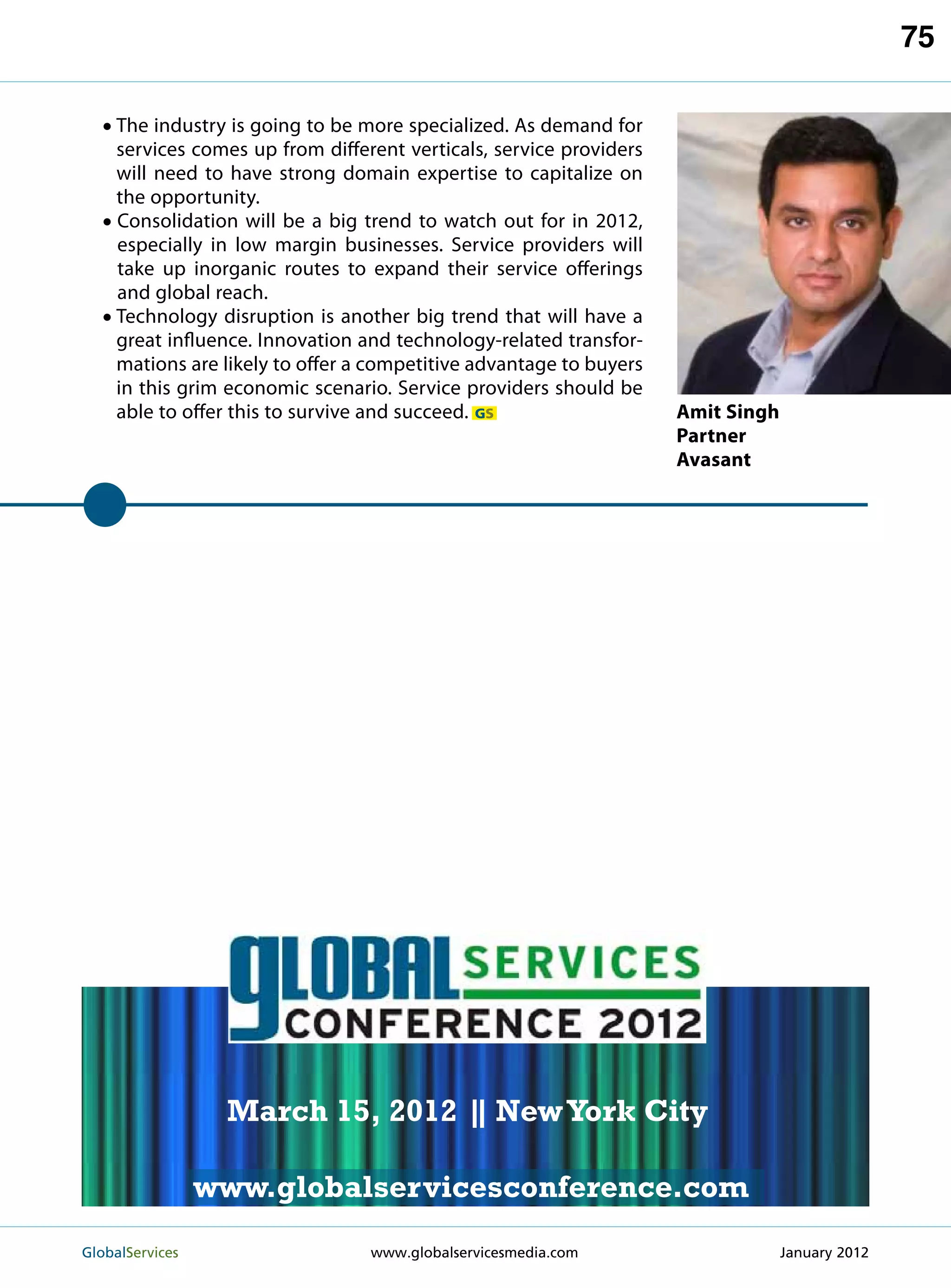
     Latin America too is gaining prominence for its Spanish language capabilities. Amit Singh,
     Partner, Avasant, says, Spanish is a major language requirement for the US. Some support is
     coming from Philippines. But most of the Spanish language work is going to Latin America.”
     Geographical proximity, similar times zones and cultural affinity make these locations
     attractive.


                            “   Spanish is a major language requirement for the US. Some
                                                                           “
                                support is coming from Philippines. But most of the Spanish
                                language work is going to Latin America.
                                                                 —Amit Singh, Partner, Avasant.


        While new and emerging locations offer certain unique capabilities and competitive
     advantages, there are important factors to be considered. Europe, for say, is vast and
     growth is scattered across different countries. It is thus important to analyze and look at
     each country and region separately. Moreover, the current crisis has sapped the strength
     of most European locations. The impact is also fairly visible on other regions like parts of
     Middle East and Africa and Latin America. Economic stability thus becomes an important
     factor be considered for expanding into these regions. GS


     GlobalServices 	                 www.globalservicesmedia.com                     January 2012
case study


A Fortune 500, Global Technology Company
Achieves Business Transformation through
its Partnership with HCL
The Client:                          Solution:                                    at a glance
Headquartered in the U.S., the     HCL Technology Infrastructure
                                                                                         Client
company is a Fortune 500 global    Services Division, also known as             A Fortune 500, Global
giant, a corporation of com-       HCL ISD, offered end-to-end                  Technology Company
plementary business units that     IT infrastructure services deliv-
design, manufacture, distribute    ery. It undertook several trans-              Service Provider
and service engines and related    formational projects for backup                       HCL
technologies. The customer was
                                   tape optimization, application
looking for a reliable outsourc-                                                 Service Provided
                                   consolidation, database optimi-
ing partner to consolidate all its                                          Consolidating all its internal
internal client services includ-   zation, server virtualization and
                                                                             client services including IT,
ing IT, HR, Accounting and         more such. Besides, HCL ISD
                                                                                 HR, Accounting and
Professional Support into a sin-   well-executed a major area of
                                                                              Professional Support into
gle operation.                     concern for the customer i.e. data             a single operation.
                                   center consolidation. It handled
Situation Analysis:                all data center operations tasks                    Industry
The customer wanted its internal without any external support;                             IT
IT organization to focus on areas successful migration of servers
that would create strategic dif- from Australia to Singapore data                      Solution
ferentiators for business and con- center being one.                                   HCL ISD
tribute to the organization’s core
IT. The customer challenges were:
•	 Heterogeneous IT environ-
   ment                                                     Success Metrics
•	 Wide scope of engagement          HCL ISD introduced tools in the client environment and automated
   that included end user com-       processes that enabled client to improve IT services while taking out
   puting, data center manage-       costs.
   ment, infrastructure applica-     •	 Consolidation of helpdesk across geographies decreased support
   tions, network and security,          costs and reduced ticket resolution by 30%
   and process consulting and        •	 Focus on SLAs, process standardization across the globe, and
   tools implementation                  resource optimization with zero impact on service improved CSAT
•	 Globally spread business oper-    •	 Moreover, successful completion of Six Sigma projects saved client
   ations                                on an average $ 50k to 100k annually per project.

                                For more information please visit
                                           www.hcltech.com
28   O U T L O O K 2 0 1 2


       Moving to New Areas
       •	Local knowledge and understanding of specific contexts of each region is
          essential.
       •	Risk diversification is going to be important. There needs to be a right balance
          between offshore, onshore and nearshore activities.
       •	 the current scenario, economic stability in different regions is an important fac-
          In
          tor to be considered.
       •	 Scalability is another factor that becomes important in the long run.


                                                              MARCH 15
                                                            NEW YORK CITY


                         March 15, 2012 | New York City
                                        |

                        www.globalservicesconference.com
     GlobalServices 	                                    Welcome to the 7th Ann
                                     www.globalservicesmedia.com    January 2012
case study


Lanit-TERCOM Creates iOS Application
for a Russian Bank
The Client:                                cedures are performed on the server,               at a glance
A major Russian Bank which has             so the application on the mobile
                                           device acts as a client to display data                 Client
a network of branches and ATMs
throughout Russia and the CIS.             received from the server.                      A major Russian Bank
The Bank is the leader in terms of         The application allows a user to:
its own capital. It’s also the larg-                                                        Service Provider
                                           • View banking services points on
est bank in terms of deposits and                                                            JSC Lanit-Tercom
                                           the map or as a list, with an option
the main creditor of the Russian           of obtaining detailed information
economy. The Bank has the largest                                                          Service Provided
                                           on the selected object (address,
branch network across the country:                                                    Application Development and
                                           hours of operation);
it includes 17 regional banks, about                                                      Server Management
                                           • View the location of the service
20 000 retail outlets, a large number
                                           provision point of interest in rela-                  Industry
of ATMs, and 241 000 employees.
                                           tion to a user’s current location;
The Bank has representative offices                                                               Banking
in Germany, India and China.               • Estimate the distance to the
                                           selected object;                                      Solution
Situation Analysis:                        • View detailed information about             Client server solution for
The main task of the project is            the services provided there;                        iOS platform
the full cycle development of an           • View the rating of the selected
application for iOS (iPhone / iPad /       service point and vote with user’s        In the subsequent versions the func-
iPod), namely the mobile bank with         rating                                    tionality has been improved upon,
a geopositioning feature.                  • File complaints which are auto-         and a mobile bank feature has been
                                           matically routed to a client request      added, which is easy to use and
Solution:                                  processing center;                        enable users to:
The developed application allows           • See the going currency exchange         • Pay fares on public transportation;
to promptly obtain necessary infor-        rates and the dynamics of their
mation regarding the provision of                                                    • Check the balance of a user’s
                                           changes;                                  account in the standby mode;
banking services and is intended to
help users find the nearest branch         • View the current prices of pre-         • Receive notifications of bank
or service point providing such            cious metals;                             transfers;
banking services as money trans-           • Convert one currency into another       • Make micropayments.
fers and payments, opening deposit
accounts, cashier services, services
for credit card holders. Search results                               Success Metrics
include all points of service available      • Over 40 thousands active users
nearby – branches, ATMs and cash             • Over 30 thousands requests per day
machines. Due to large amounts of            • Over 100 feedback messages to customer support service per day
data and with the view to facilitating       • Over 3 thousands new active users per month
information updates, all search pro-         • Over 40 feedback messages to application support service per month


                  For more information on Mobile Bank contact Vadim Sabashny
                                          Vadim.Sabashny@lanit-tercom.com
30   O U T L O O K 2 0 1 2


     Services Spends Will Happen
                 Despite Budget Cuts
     There is no denying that the environment is fairly turbulent.
     When there is uncertainty, capital investments get impacted.
     Pricing pressure will thin out service providers’ margin. This
     will in turn force service providers to come up with newer cus-
     tomer-centric solutions and innovative engagement models.


     Smriti Sharma
                            A
                                   rvind Thakur CEO, NIIT Technologies Ltd. articulated,
                                   “Both for the IT as well as the BPO industry, I do not
                                   anticipate there to be budget cuts because we are
                            seeing renowned focus on outsourcing. The cuts really
                            would be on capital investments and not on operating
                            expense related activities.”
                              As per Thakur, three types of actions will hit the invest-
                            ment front. One would be just to keep the business run-
                            ning; this one would be budgeted for. Then, there may
                            be certain strategic initiatives -such as moving to a new
                            platform- that makes the business more competitive. This
                            one would be planned and also budgeted for. And then,
                            there would be activities that independent businesses
                            may feel appropriate to invest in. Here, the funding would
                            be sought for from the user itself.


     GlobalServices 	       www.globalservicesmedia.com                      January 2012
31

IT Spending $2.7 Trillion in 2012
   Gartner predicts that IT spend is projected to total $2.7 trillion in 2012. The slowdown in
US and Europe economic growth could suppress IT spends. According to Forrester Research,
IT spends are expected to decrease to 5.5 percent in 2012 for a total of $2.15 trillion, from
estimated growth of 11 percent this year.
   Emerging economies such as India will account for $1.013 trillion. According to Gartner,
the telecommunications market is the largest IT segment in India with IT spending forecast
to reach $54.7B in 2012 followed by the IT services market with spending of $11.1B. The
computing hardware market in India is projected to reach $10.7B in 2012 while software
spending will total $3.2 billion.
   Buyers are increasingly trying to consolidate their IT services as portfolio and thereby
arrive at cost savings.


                   “
                     I
                         nstead of having a multitude of contracts spread all over the
                         world, with a variety of service providers, buyers are increasingly
                         trying to consolidate their portfolio and implement global con-  “
                     tracts with uniform standard SLA. This leads to a fair amount of cen-
                     tralization of spends and consequently cost savings for the client.
                     Chirajeet Sengupta
                     Research Director, Everest Group


   Sengupta believes Infrastructure Outsourcing is one of the areas where we can expect to
see a change, as there is a steady increase in offshoring. Traditional onshore infrastructure
support services are going to go down. This entire wave of consolidation will evolve a fair
degree of system integration, process improvement and process optimization. These three
are some of the areas that are expected to go up.
   In addition, enterprise mobility, cloud computing, managed services, machine-to-
machine communications, product engineering service are some of the areas that will wit-
ness growth.
   Even though there have been major concerns around the macro economy over the past
year, it is still very difficult to envisage any significant budgetary cuts from the customer
standpoint going into 2012 and beyond.


“
    A
            t worst, budgets might remain flat as customers offset
            the need for a technology refresh arising out of expo-
            nential data growth, security and compliance concerns
    by embracing fast emerging delivery models like virtualiza-
    tion, cloud computing and unified communications. The tran-
    sition towards an ‘As a Service’ IT economy has surely gained
                             “
    momentum in the year gone by and is certainly the future of
    IT services and solutions,
    Brian J Manning
    President and Managing Director, CSC India

GlobalServices 	                  www.globalservicesmedia.com                     January 2012
32   O U T L O O K 2 0 1 2


        Significant increase in IT spends in outsourcing are likely to come from emerging com-
     panies and economies. These companies and economies have matured to a level where
     they can significantly upgrade their IT infrastructure or want to get there soon enough by
     leveraging best in class IT.
        In Q1 2012, 350 companies are expected to invest more than $1B in IT. The main reason
     behind this is they comprehend that IT impacts their business performance and that there
     are many benefits to by spending on moving applications to the cloud.
        Lalit Dhingra, president of NIIT Technologies expressed, “Hardware and technology
     refresh is perceived to be optimized. With the spread of cloud computing, progressive
     enterprises will use shared or dedicated computing power on cloud at a fraction of cost.
     Traditional vendors who used to lease computing equipment and power in the old data
     center hosting model will see a shift in consumer behavior.”
        While innovation is the buzz word, RD spendings are expected to be scrutinized. Sanjay
     Dhawan, president and CEO, Symphony Services Corp. opined, “Research and Development
     spendings may come under pressure. Having said that, the pressure to innovate and intro-
     duce new products has never been higher.” He expects customers to look for help from their
     outsourcing partners in three ways:
        1. Taking over mature products to drive down costs and add enhancements to extend the
     lifespan, and using those savings to fund new products and initiatives,
        2. Improving automation through new cloud-oriented processes and tools also unearths
     product development life-cycle savings that can be used to fund new initiatives and
        3. Delivering new product frameworks (software and hardware) to shorten time and cost
     to market for new solutions.

     GlobalServices 	                 www.globalservicesmedia.com                  January 2012
33

   In the end, as Everest Report titled 2012 Market Predictions pointed, “Larger buyers will
continue to drive the spending budgets in both infrastructure outsourcing and ADM, and
will focus on vendor consolidation, providing growth opportunities to larger players, both
offshore and MNC. This will lead to further growth disparity between large and small sup-
pliers IO deals will increase, driven by next generation models such as cloud computing
and RIMO.”

BPO: Win-Win Situation for Both the Customers and the Vendors
   At the onset of the downturn, many organizations had put new projects on a pause; now
most of them are looking at a long-term outsourcing strategy.
   Recently, HGS won a big public sector contract in the UK. The contracts are expanding
to include more service lines. Financial services institutions will move towards lesser and
more strategic relationships with service providers, resulting in longer contract terms and
larger contract sizes.


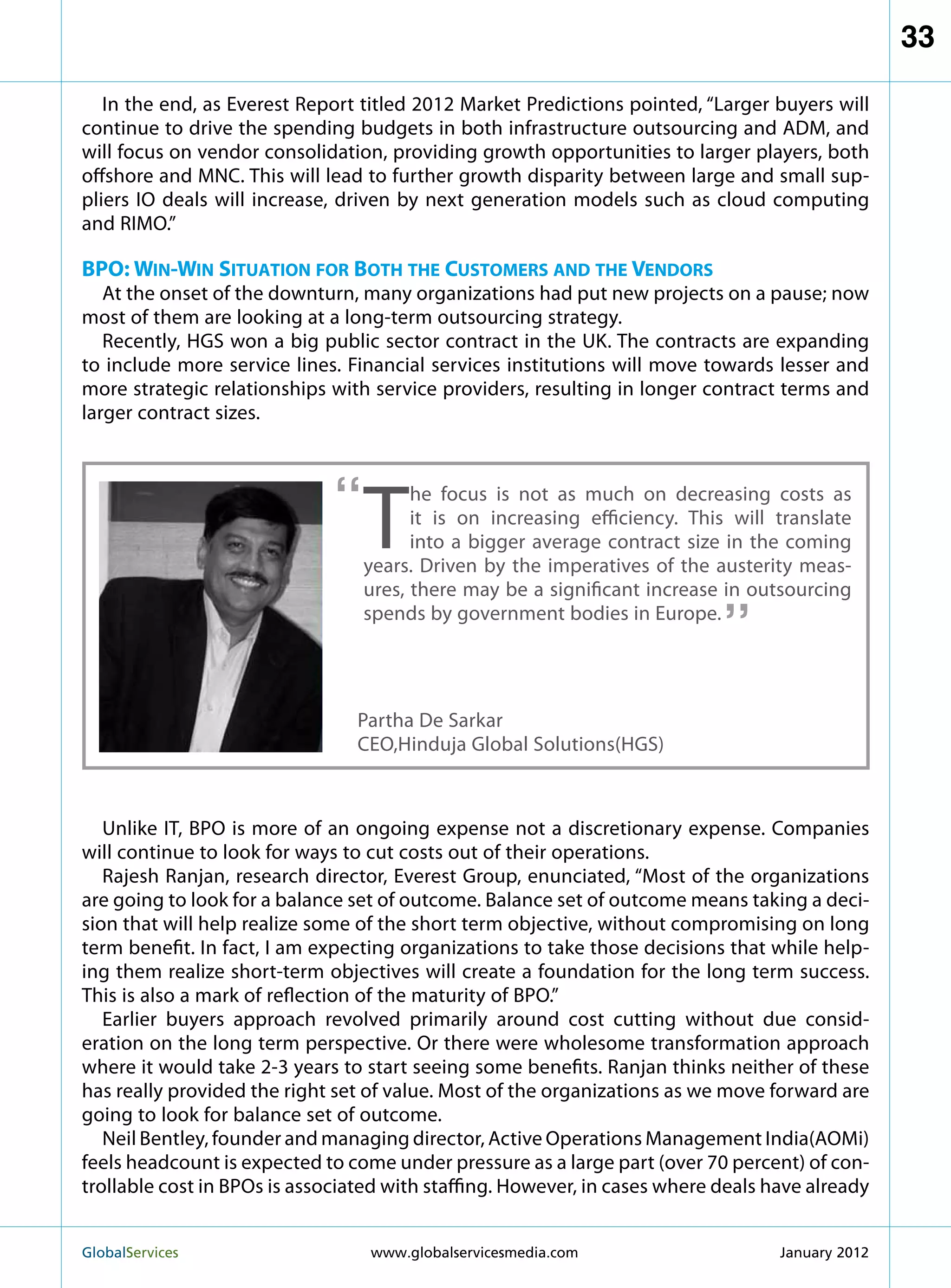
                              “
                                  T
                                        he focus is not as much on decreasing costs as
                                        it is on increasing efficiency. This will translate
                                        into a bigger average contract size in the coming
                                  years. Driven by the imperatives of the austerity meas-
                                                                            “
                                  ures, there may be a significant increase in outsourcing
                                  spends by government bodies in Europe.


                                Partha De Sarkar
                                CEO,Hinduja Global Solutions(HGS)


   Unlike IT, BPO is more of an ongoing expense not a discretionary expense. Companies
will continue to look for ways to cut costs out of their operations.
   Rajesh Ranjan, research director, Everest Group, enunciated, “Most of the organizations
are going to look for a balance set of outcome. Balance set of outcome means taking a deci-
sion that will help realize some of the short term objective, without compromising on long
term benefit. In fact, I am expecting organizations to take those decisions that while help-
ing them realize short-term objectives will create a foundation for the long term success.
This is also a mark of reflection of the maturity of BPO.”
   Earlier buyers approach revolved primarily around cost cutting without due consid-
eration on the long term perspective. Or there were wholesome transformation approach
where it would take 2-3 years to start seeing some benefits. Ranjan thinks neither of these
has really provided the right set of value. Most of the organizations as we move forward are
going to look for balance set of outcome.
   Neil Bentley, founder and managing director, Active Operations Management India(AOMi)
feels headcount is expected to come under pressure as a large part (over 70 percent) of con-
trollable cost in BPOs is associated with staffing. However, in cases where deals have already


GlobalServices 	                  www.globalservicesmedia.com                     January 2012
34   O U T L O O K 2 0 1 2

     been struck there may be zero incentives to reduce head count; in transaction-based deals
     the scenario may be different.


       “
          C
                 ompanies seeking to make budgetary cuts may
                 well turn to BPO as an option - maybe even some
                 operations that have never previously considered
          the option such as parts of the public sector. This may
          lead to some growth in BPO but with it would come com-
          petition and pressure on price and service delivery. The
          successful BPOs would therefore be the ones that stand
                                            “
          out as being able to offer the most competitive package
          - price plus assurance of delivery.

          Neil Bentley
          Founder and Managing Director, AOMi


       Sitel is seeing a significant cost-savings opportunity for global call center BPO providers
     to achieve optimal operational efficiency by transitioning from on-premise legacy systems
     to cloud-based call center offerings that scale as a direct operating expense. This will also
     open the door for companies to replace large, captive operations with faster and cheaper
     outsourced operations, particularly in areas where customer experience can be enhanced
     by specialists.


                               “
                                   T
                                         echnological, social and economic changes have made
                                         at-home agents a viable business model, especially for
                                         experienced outsourcing providers. With broadband
                                   access now available in much of the US, end users can sup-
                                   plement existing call center operations by drawing from
                                   and connecting to a new and substantial labor pool. In
                                   2012, Sitel believes the BPO industry will see a decrease in
                                   traditional call center environments where agents work in
                                   a typical office setting. Instead, work-at-home agents will
                                                             “
                                   emerge as a customer-care solution that favors a more flex-
                                   ible labor environment.

                                   Andrew Kokes
                                   Vice President, Global Product Management,Sitel


       Investments will take place in building more robust analytics and integrated talent man-
     agement offerings.


     GlobalServices 	                  www.globalservicesmedia.com                    January 2012
35

Highlights from Everest's Report titled 2012 Market Predictions
   Restoring growth while improving profitability and reducing operational complexity
will be the primary imperatives for banks, leading to investments in legacy moderniza-
tion, application consolidation and ERP initiatives. In addition, adapting to changing cus-
tomer preferences will create demand in areas such as mobility, social media, and channel
integration.
   Within banking BPO, increase pressure on margins and profitability, and the rising cost of
servicing each loan, is causing lenders to seek out solutions that can help them standard-
ize loan origination and convert fixed to variable costs; this will drive greater adoption of
technology-enabled BPO solutions within the leading segment.
   Pricing pressure will squeeze providers' margins, especially offshore, forcing investment
in newer customer-centric solutions and 	 innovative engagement models.
   Captive investments will continue, and the majority of setups/expansions will be in Asia
Pacific and CEE.
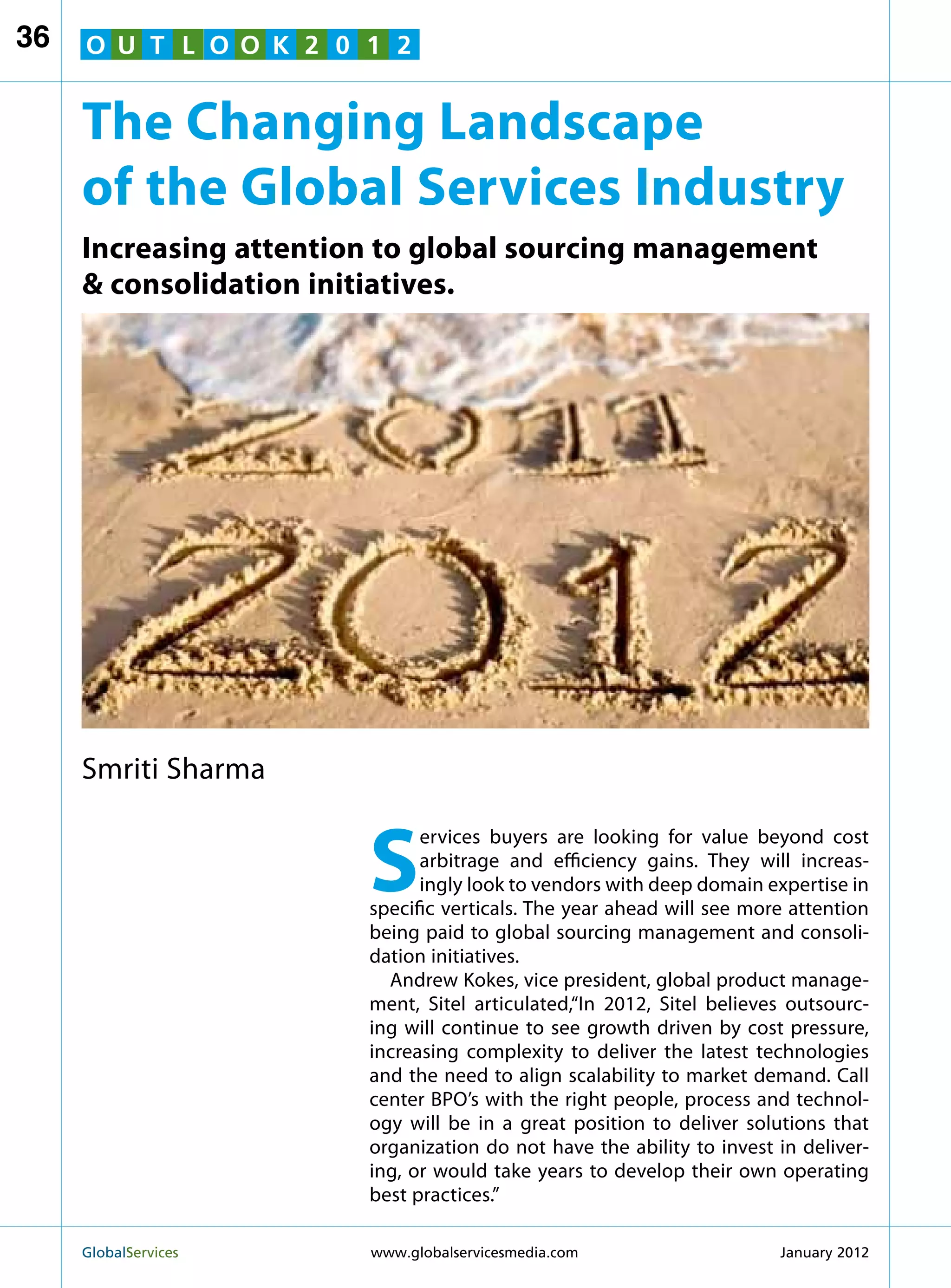
   The final word is BPO spends could increase as they have low impact on business and
help organizations save cost. Satya Gottumukkala, executive vice president, Anthelio
Business Technologies Pvt. Ltd. voiced, “I see more of shared services being outsourced – in
fact the vendors will look for newer opportunities to save costs of their customers. This will
be a “win-win” situation for both the customers and the vendors.” GS


                                                           MARCH 15
                                                         NEW YORK CITY


                    March 15, 2012 | New York City
                                   |

                   www.globalservicesconference.com
GlobalServices 	                                      Welcome to the 7th Ann
                                  www.globalservicesmedia.com    January 2012
36   O U T L O O K 2 0 1 2


     The Changing Landscape
     of the Global Services Industry
     Increasing attention to global sourcing management
      consolidation initiatives.


     Smriti Sharma


                        S
                              ervices buyers are looking for value beyond cost
                              arbitrage and efficiency gains. They will increas-
                              ingly look to vendors with deep domain expertise in
                        specific verticals. The year ahead will see more attention
                        being paid to global sourcing management and consoli-
                        dation initiatives.
                          Andrew Kokes, vice president, global product manage-
                        ment, Sitel articulated,“In 2012, Sitel believes outsourc-
                        ing will continue to see growth driven by cost pressure,
                        increasing complexity to deliver the latest technologies
                        and the need to align scalability to market demand. Call
                        center BPO’s with the right people, process and technol-
                        ogy will be in a great position to deliver solutions that
                        organization do not have the ability to invest in deliver-
                        ing, or would take years to develop their own operating
                        best practices.”

     GlobalServices 	   www.globalservicesmedia.com                   January 2012
ePublishing - The New Success Paradigm
           for the Media Sector
               Author: Vasanth Kumar Mani
                       Online Publishing  Media Solutions Expert,
                       Datamatics Global Services Limited.


O
        ver the last decade wide availability  falling costs of bandwidth with rapidly evolving
        mobile computing devices have driven a paradigm shift in the way people  organiza-
        tions around the world create, access and distribute information. Rapid evolution of the
social media has further driven this growth in tendency to take everything online and expect
everything online. The internet is fast evolving into a powerful channel for marketing across
industries, more so for the publishing  media sector.
  Reader preferences are shifting towards electronic versions from the traditional print medi-
um. According to a recent industry report, e-books sale in the US market in the year 2010 was
$500 million; expected to cross $1000 million in 2011 and $2000 million in 2015.
   Convenience of reading  carrying, lower costs, novelty value, intelligent tagging and cross-
linking, multimedia, and ease of search are features driving demand for electronic versions of
print publications. Dropping prices and rapid evolution of eReaders  tablets are further driv-
ing demand. Worldwide media tablet spending is projected to reach $29.4 billion in 2011, up
from $9.6 billion in 2010 by Gartner Inc. Global spending on media tablets is forecast to increase
at an annual average rate of 52 percent through 2015. By 2014, 6.7 billion devices will be con-
nected to the Internet.
   Adapting to the ePublishing paradigm is not simply about creating digitized versions of
content in print. It requires a thorough rethink of the entire workflow from content acquisition
through editorial, creative representation and distribution processes. Relative ease of distribu-
tion, better margins on higher volumes and high level of flexibility makes it an attractive busi-
ness proposition for publishers too, to change lanes to the e-way.
   There has been a mixed reaction from the publishing sector to this market trend towards
greater adoption of electronic versions of print media. Thought leaders in the sector were quick
adapt their organizations to maximize the potential of this opportunity while most other pub-
lishers are in a wait and watch mode. Datamatics joined hands with the thought leaders and
early adopters to help them venture into the field and has been an advisory partner for the
latter.
   Datamatics is committed to delight publishers with intelligent technology leverage that helps
them enhance their user experience, expand reach and drive efficiency in their operations.
Datamatics online publishing and media experts are already working with some of the lead-
ing companies in the online publishing  retail space, processing over 2 million pages a year.
Besides rapidly increasing volume, the depth and breadth of services in these areas has also
widened. Today, Datamatics is one among the few companies that is a preferred partner for
publishers and online companies for any new ventures into the technology space, be it produc-
tion or testing of new devices and e-book formats or even in Social Media marketing. .
  For any further information on how Datamatics can help your organization in effectively
tapping the e-Publishing opportunity, please write to us at onlineprintmedia@datamatics.com.
                                                                                          Advertorial
38   O U T L O O K 2 0 1 2

     The Dawn of the ‘As-a-Service’ Economy
       Some of the dynamics have started to kick in with a definite shift towards ‘as-a-service’
     economy.


                                 “
                                    T
                                           his not only helps businesses put a cap on capex which
                                           is at a premium, but also transition towards an opex
                                           model. With businesses suffering two major hiccups
                                    in the space of three years, there would be an incremental
                                    demand for innovative service models aimed at mitigating
                                    risk, possessing high domain knowledge as well as robust
                                    security and compliance delivery models. Service providers
                                    would also look towards innovative service delivery models
                                    to sustain demand and major moves towards restructuring
                                                               “
                                    internally as well as developing domain expertise and capa-
                                    bilities can be expected.


                                    Brian J Manning
                                    President and Managing Director, CSC India


        The three key main forces in the marketplace are: a) price-performance ratios keep
     improving, b) consumer expectations are changing dramatically, as they are exposed to
     technology choices that empower them as never before and c) emerging technologies
     are positioning IT to drive innovation and growth, rather than targeting cost-cutting and
     efficiencies. These forces are driving the following trends - the rising importance of data,
     analytics, cloud computing, services-centred architecture, IT security, data privacy, social
     platforms, and user experiences.


     The Role of the Service Integrator
        Accenture believes that ‘transformational’ and ‘bundled’ outsourcing will become an
     increasingly important strategy for companies in the current market. By outsourcing sev-
     eral business processes and IT systems to one provider, companies can free up cost and
     management resources while acquiring the strategic flexibility and capability for growth
     and to embrace the trends to drive competitive differentiation.
        In addition, significance of the role of the service integrator will continue to rise. The
     cloud brings a set of third parties into the mix whose services cut across traditional lines.
     It takes specialized skills in service integration as well as business processes and tools (aka
     the service integration bus) that automate and monitor IT to ensure coordination and over-
     sight between third party providers and in-house IT. The cloud has magnified the issues of
     a multi-sourced environment and strategic sourcing has become not just an integral but a
     critical part of IT and business strategy agendas. The key to being a service integrator is to
     adopt a services mindset across all internal and external capabilities provided in IT. It is not
     just cloud services; it is all services IT provides to enable the business.


     GlobalServices 	                   www.globalservicesmedia.com                      January 2012
39

                                                      Nearshoring and Consolidation
                                                         Another line on rise is a move
                                                      towards near-shoring of services. This
                                                      continuous pursuit of new locations is
                                                      driven by the demands of geographi-
                                                      cal proximity, similar time zones and
                                                      cultural affinity. Partha De Sarkar, CEO,
                                                      Hinduja Global Solutions (HGS), voiced,
                                                      “From the providers’ point of view the
                                                      focus is on geographical and verti-
                                                      cal diversification. The opportunities
                                                      are springing up in hitherto untapped
                                                      pockets and we need to be prepared
                                                      to capitalize on all of them. The indus-
                                                      try is also seeing consolidation, with
                                                      growing demand for new capabilities
                                                      and new geographies.”

                                                      Increased Competition
                                                      As the market has matured, it has
                                                   become much more competitive
                                                   also. Discussing the reasons behind
                                                   the competitive nature of the mar-
                                                   ket, Joy V Santosh, CEO and country
                                                   head, Active Operations Management
                                                   India(AOMi)expressed, “The market is
                                                   much more competitive for a number
                                                   of reasons. Hence, the landscape is
                                                   promising.” The market is competitive
because with quality and service being givens, the focus is once again on cost. Other rea-
sons include trends such as the consolidation of cheaper offshoring hubs; transitioning
of contracts from FTE-based to output/ outcome based; and the transition from standard
BPOs to more knowledge based platform services.


                         “
                             T
                                  he big change that will take place over the next few
                                  years is the shift in the center of gravity for plan-
                                  ning and control from onshore to offshore, even for
                             resources still located onshore. This could cause raised
                             eyebrows in some quarters but the crucial factor is that
                             implementing a standard methodology that allows capacity
                             to be managed transparently in whatever manner suits the   “
                             culture and objectives of the company (including spanning
                             across company boundaries into outsource providers).
                             Richard Jeffery
                             Founder and Managing Director, AOMi


GlobalServices 	                 www.globalservicesmedia.com                       January 2012
40   O U T L O O K 2 0 1 2

       As it has been observed, in the last two years, enterprises prefer working with credible
     outsourcers who focus on effectiveness than efficiencies. It is about partnering with ven-
     dors who have demonstrated that they can create business value – e.g. increase the client’s
     revenue by architecting new product and services and skin-in-the-game contracts.
       Traditionally, call centers are limited by their geography to a job-recruiting radius of about
     50 miles, and the hiring constraints that come with that geographical location. Talking
     about home-based labor pool, Kokes shared, “In 2012, Sitel expects to see an increase in
     the utilization of a flexible home-based labor pool to drive operating efficiency. The vir-
     tual model will provide a wider hiring footprint with the hub-based environment focused
     on hiring and training at a physical location to improve work/life balance for employees.
     This concept will ultimately overcome the rigid scheduling challenges of call center-based
     operations while complementing existing in-center customer care support, providing vari-
     ous types of talent, shifts and scale for seasonality and call volume, regardless of location.”


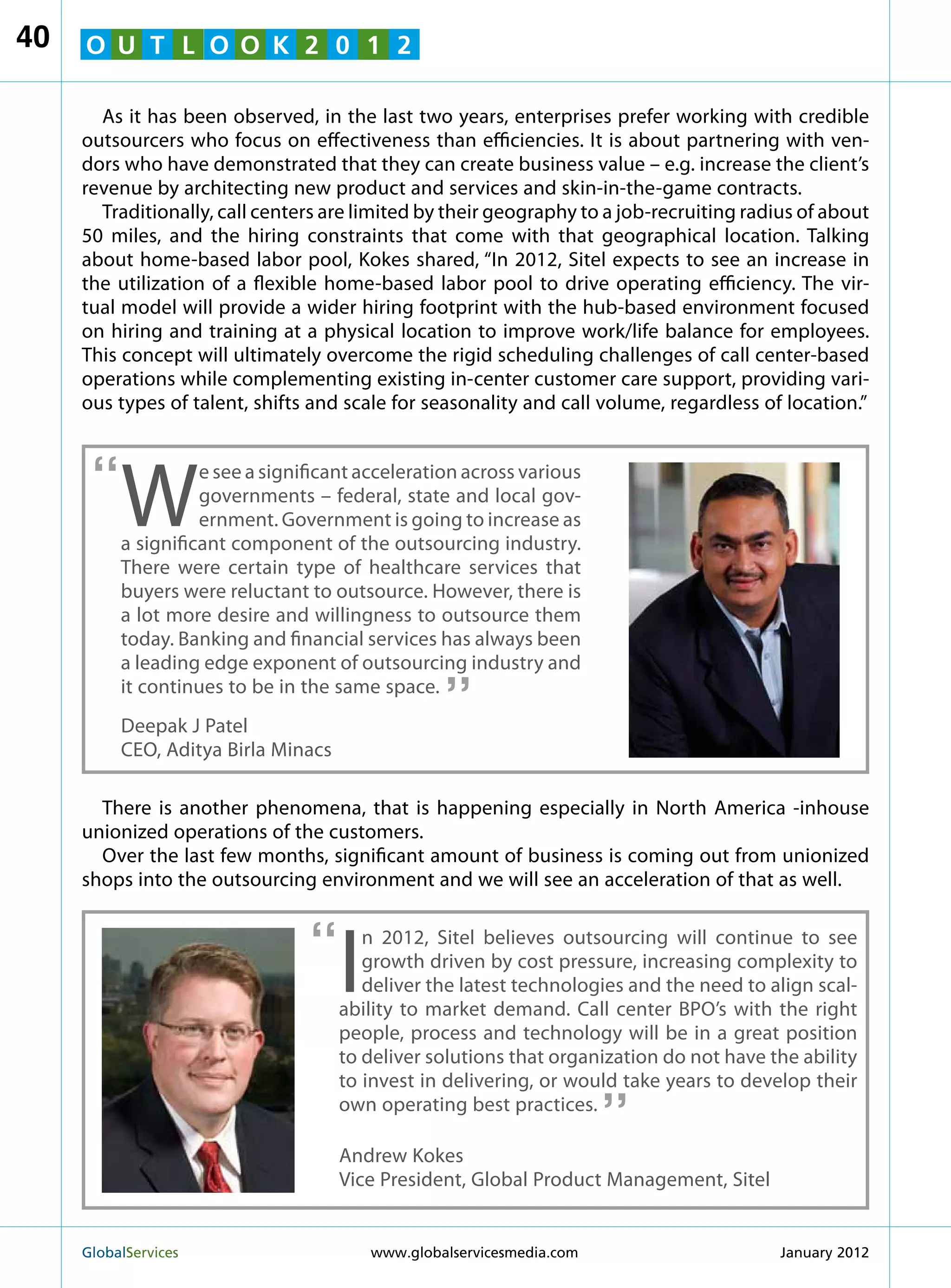
      “
          W
                    e see a significant acceleration across various
                    governments – federal, state and local gov-
                    ernment. Government is going to increase as
          a significant component of the outsourcing industry.
          There were certain type of healthcare services that
          buyers were reluctant to outsource. However, there is
          a lot more desire and willingness to outsource them
          today. Banking and financial services has always been
                                                  “
          a leading edge exponent of outsourcing industry and
          it continues to be in the same space.
          Deepak J Patel
          CEO, Aditya Birla Minacs

       There is another phenomena, that is happening especially in North America -inhouse
     unionized operations of the customers.
       Over the last few months, significant amount of business is coming out from unionized
     shops into the outsourcing environment and we will see an acceleration of that as well.


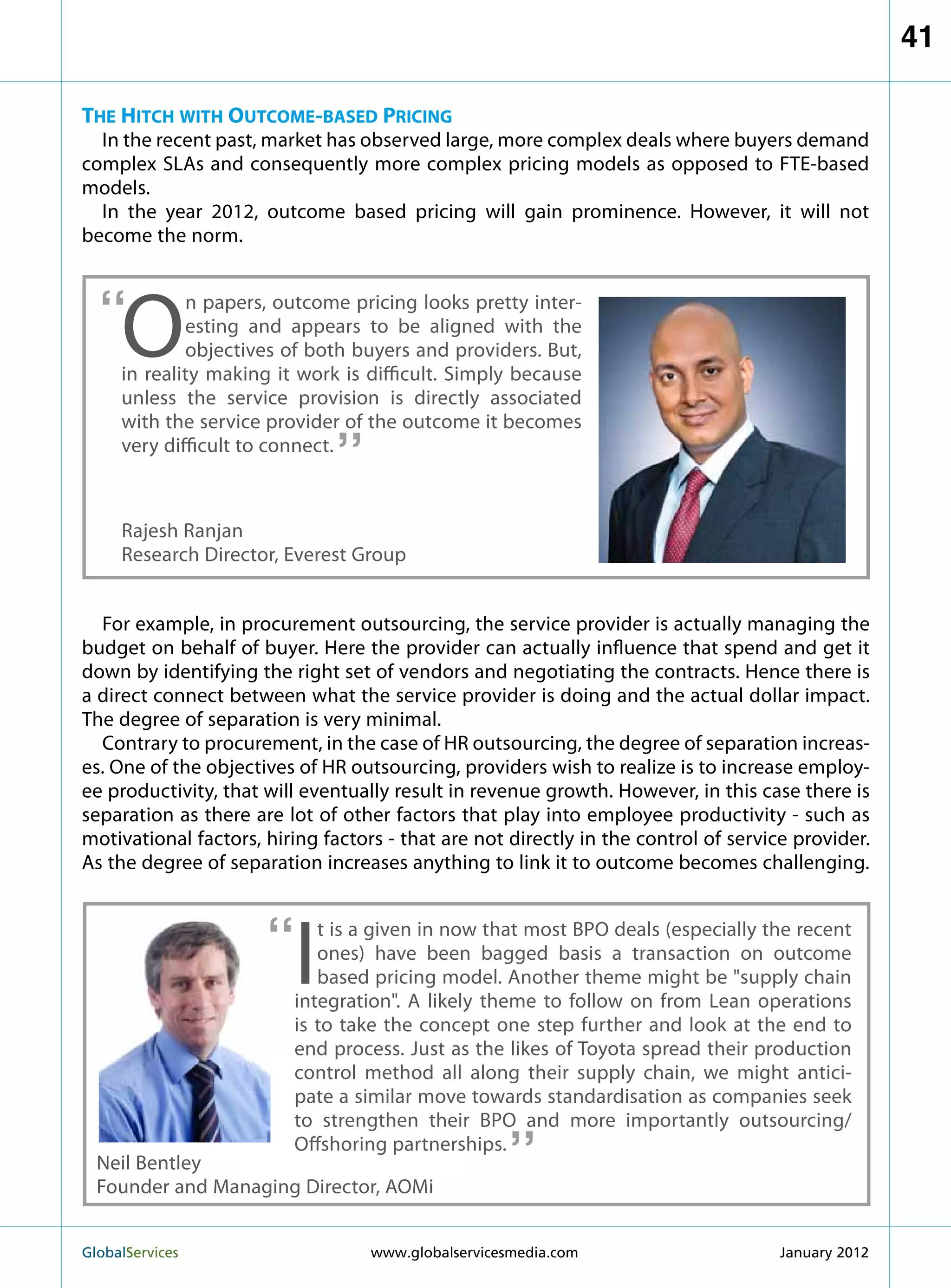
                                 “
                                     I
                                        n 2012, Sitel believes outsourcing will continue to see
                                        growth driven by cost pressure, increasing complexity to
                                        deliver the latest technologies and the need to align scal-
                                     ability to market demand. Call center BPO’s with the right
                                     people, process and technology will be in a great position
                                     to deliver solutions that organization do not have the ability
                                                                        “
                                     to invest in delivering, or would take years to develop their
                                     own operating best practices.

                                     Andrew Kokes
                                     Vice President, Global Product Management, Sitel


     GlobalServices 	                    www.globalservicesmedia.com                     January 2012
41

The Hitch with Outcome-based Pricing
  In the recent past, market has observed large, more complex deals where buyers demand
complex SLAs and consequently more complex pricing models as opposed to FTE-based
models.
  In the year 2012, outcome based pricing will gain prominence. However, it will not
become the norm.


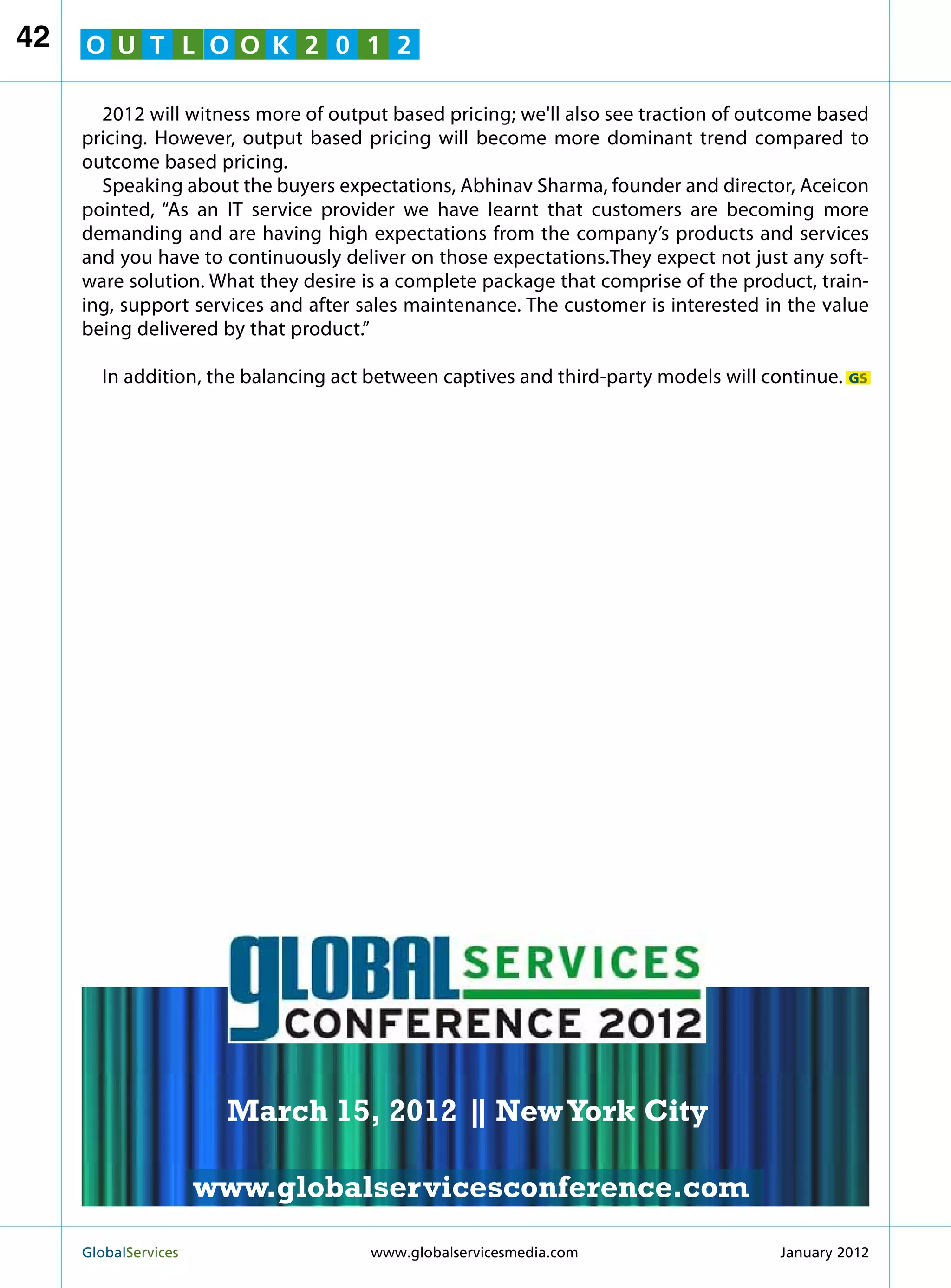
  “  O
             n papers, outcome pricing looks pretty inter-
             esting and appears to be aligned with the
             objectives of both buyers and providers. But,
     in reality making it work is difficult. Simply because
     unless the service provision is directly associated
                              “
     with the service provider of the outcome it becomes
     very difficult to connect.


     Rajesh Ranjan
     Research Director, Everest Group


  For example, in procurement outsourcing, the service provider is actually managing the
budget on behalf of buyer. Here the provider can actually influence that spend and get it
down by identifying the right set of vendors and negotiating the contracts. Hence there is
a direct connect between what the service provider is doing and the actual dollar impact.
The degree of separation is very minimal.
  Contrary to procurement, in the case of HR outsourcing, the degree of separation increas-
es. One of the objectives of HR outsourcing, providers wish to realize is to increase employ-
ee productivity, that will eventually result in revenue growth. However, in this case there is
separation as there are lot of other factors that play into employee productivity - such as
motivational factors, hiring factors - that are not directly in the control of service provider.
As the degree of separation increases anything to link it to outcome becomes challenging.


                      “  I
                            t is a given in now that most BPO deals (especially the recent
                            ones) have been bagged basis a transaction on outcome
                            based pricing model. Another theme might be supply chain
                         integration. A likely theme to follow on from Lean operations
                         is to take the concept one step further and look at the end to
                         end process. Just as the likes of Toyota spread their production
                         control method all along their supply chain, we might antici-
                         pate a similar move towards standardisation as companies seek
                                                     “
                         to strengthen their BPO and more importantly outsourcing/
                         Offshoring partnerships.
  Neil Bentley
  Founder and Managing Director, AOMi


GlobalServices 	                   www.globalservicesmedia.com                      January 2012
42   O U T L O O K 2 0 1 2

       2012 will witness more of output based pricing; we'll also see traction of outcome based
     pricing. However, output based pricing will become more dominant trend compared to
     outcome based pricing.
       Speaking about the buyers expectations, Abhinav Sharma, founder and director, Aceicon
     pointed, “As an IT service provider we have learnt that customers are becoming more
     demanding and are having high expectations from the company’s products and services
     and you have to continuously deliver on those expectations.They expect not just any soft-
     ware solution. What they desire is a complete package that comprise of the product, train-
     ing, support services and after sales maintenance. The customer is interested in the value
     being delivered by that product.”

       In addition, the balancing act between captives and third-party models will continue. GS


                                                               MARCH 15
                                                             NEW YORK CITY


                         March 15, 2012 | New York City
                                        |

                        www.globalservicesconference.com
     GlobalServices 	                                     Welcome to the 7th Ann
                                      www.globalservicesmedia.com    January 2012
43


IT Outsourcing
        Slow, Deliberate March
Smaller deals, more standardization of services, mix of
sourcing models, and cloud adoption are the key trends
in IT outsourcing for 2012.


Sourabh Chandra Pushp

                   “
                     T
                           he year 2012, will be marked by the inking of smaller
                           IT services deals, many of them by first-time buyers
                           who sat on the sidelines in 2010-11. Contract activity
                                                               “
                     will creep back throughout 2011, as the recover stutters and
                     buyers pull the trigger on sourcing activity.


                     Phil Fersht
                     Founder-Outsourcing Analyst Firm-HfS Research.

GlobalServices 	     www.globalservicesmedia.com                     January 2012
44   O U T L O O K 2 0 1 2

     Rigor and Standardization
       Clients will be increasingly open to changing their internal processes and accepting stand-
     ard services in 2012, predicts Bob Mathers, principal consultant for Compass Management
     Consulting. Service providers will put renewed emphasis on internal initiatives to standardize
     their own offerings to leverage economies of scale and stabilize profit margins. It's the stuff of
     benchmarking dreams, but economic conditions may turn it into a reality. Stan Lepeak, man-
     aging director of global research for outsourcing consultancy EquaTerra KPMG, also predicts
     more process, technology, and location standardization including platform-based solutions.


                                     “
                                         I
                                            n 2012, there would be an incremental demand for inno-
                                            vative service models aimed at mitigating risk, possessing
                                            high domain knowledge as well as robust security and
                                         compliance delivery models. IT outsourcing service provid-
                                         ers would also look towards innovative service delivery mod-
                                         els to sustain demand and major moves towards restructur-
                                                                        “
                                         ing internally as well as developing domain expertise and
                                         capabilities can be expected.


                                         Brain J. Manning
                                         President and Managing Director, CSC India

     Sluggish Demand and Pricing Pressure
        “The demand environment for service providers will remain tentative in 2012 given the
     watchful approach of global buyers, and optimization
     will be a strong focus for organizations looking to
     extract more value from their sourcing models,” said Eric
     Simonson, managing partner-Everest Research.
        For year 2012, sluggish activity is expected due to
     macroeconomic and political uncertainty, with greater
     confidence likelier later in the year; but more attention
     will be paid to global sourcing management and consoli-
     dation initiatives.
        Buyers’ IT budgets may be suppressed by fears of a sec-
     ond economic slowdown due to the debt environment
     in Europe and the macro environment in the U.S.
        Pricing pressures will squeeze providers’ margins,
     especially offshore, forcing investment in newer custom-
     er-centric solutions and innovative engagement models.
     Domain/micro-vertical expertise will be emphasized as
     buyers focus on business innovation.
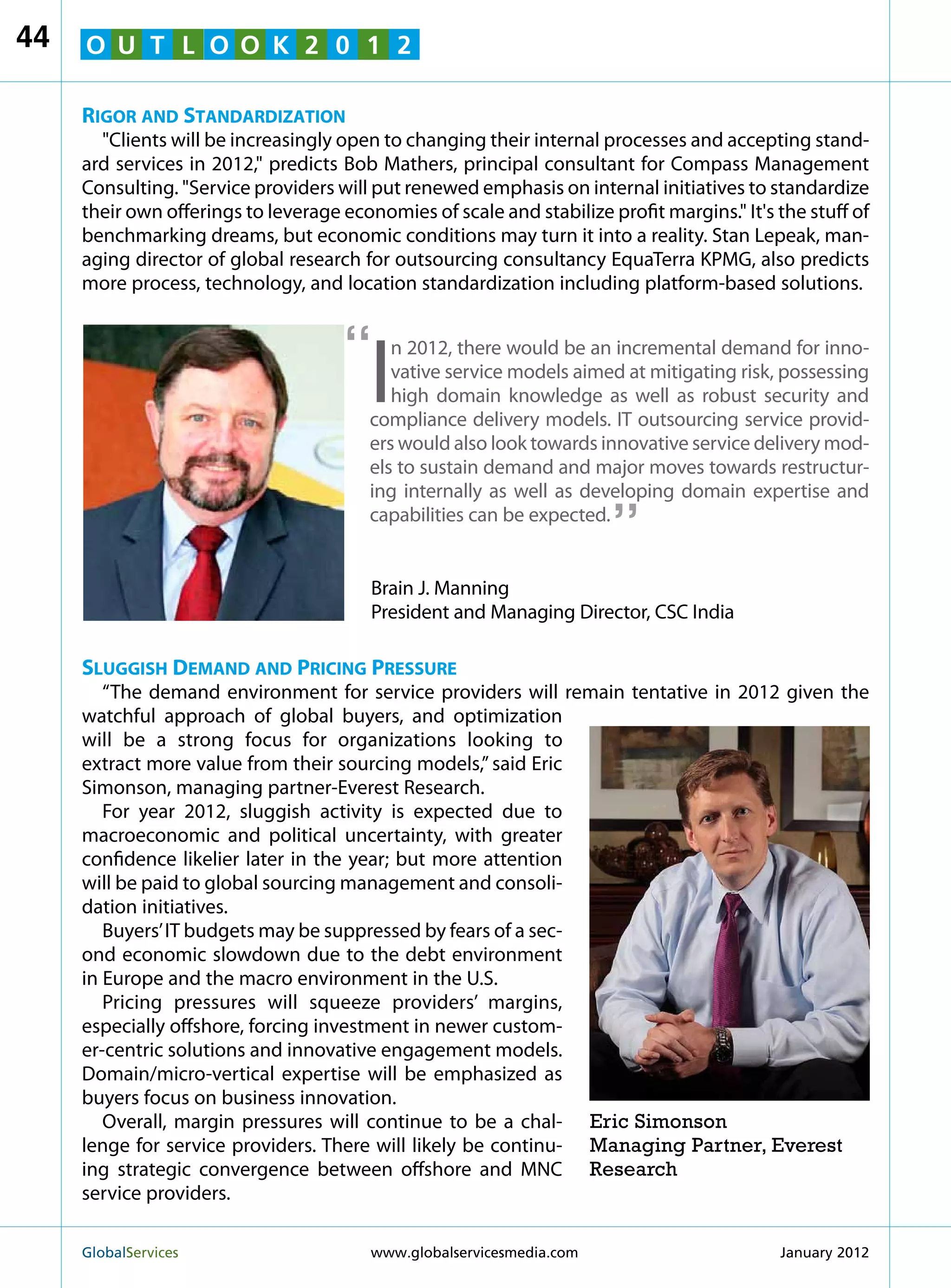
        Overall, margin pressures will continue to be a chal- Eric Simonson
     lenge for service providers. There will likely be continu- Managing Partner, Everest
     ing strategic convergence between offshore and MNC Research
     service providers.

     GlobalServices 	                    www.globalservicesmedia.com                       January 2012
Smart Technology to Manage Power Consumption

               Author: Sanjeet Banerji
                       Head, Engineering Services  Embedded
                       Software Business Unit
                       Datamatics Global Services Limited


  M
            ost economies across the world are struggling to address the challenge of managing
            power consumption. Individuals and enterprises are also actively looking for ways
            to conserve power consumption. Intermittent peaks in demand also pose a challenge
  for power generation, transmission and distribution companies, which they try to address with
  variable tariff slabs and other such means.
    The first step towards managing anything effectively is to first be able to measure it. Same
  applies to energy consumption. The next step would be then to analyse the processes/entities
  that consume the most energy, the third being how to save and the fourth being able to predict
  the energy demands and its use in the most effective way
     Automated Meter Reading (AMR) is the first step towards near-real-time measurement of
  energy as it is being consumed. The next step is the AMI (Automated Meter Infrastructure) for
  managing the data so obtained in analysing the current usage patterns. The next step of energy
  planning is to arrive at a re-sequencing of processes to obtain a sensible and economically viable
  allocation of resources for production and consumption of energy. From the customer perspec-
  tive it means better control of managing energy consumption, and for the utility provider it
  means better control of production and distribution of energy in the most effective manner.
     AMI is not only a means to reduce time and cost of meter readings, it also contributes towards
  efficient energy management through load profiling and supply automation, enabling dynamic
  pricing for suppliers and consumers to balance demand and supply, balance loads, tamper
  notification, revenue assurance through timely and accurate billing, outage management and
  lot more in terms of being able to supply and consume energy in a smart manner.
     A typical system may vary from a simple deployment to a very complex system where
  energy could be dynamically priced, leading to possibilities of innovative service offerings as
  well as ability to schedule energy consumption by the consumers in the most effective way. One
  such application is local monitoring of energy consumption in an enterprise to gain insight into
  its energy needs and consumption patterns. Our experience has shown that such systems have
  brought good value in terms of managing its peak demands, power factor, and wastage. The
  discounts availed on a disciplined usage of power not only contributes to a lower power bill
  but also contributes to a greener earth. The system also acts as an indicator and allows audit of
  energy usage in real time, giving an early indication of power bills.
     Datamatics provides end-to-end services from design and development of smart meter soft-
  ware, remote management of meters, connectivity via MUCs, to systems that acquire meter
  data, to management systems that remotely manage and monitor supply, and finally create
  bills to be presented electronically to consumers. The whole comprehensive solution includes
  a set of data modelling and smart analytical tools to predict and manage energy distribution 
  consumption.
    To know more please write to business@datamatics.com .
                                                                                              Advertorial
46   O U T L O O K 2 0 1 2

     Vendor Landscape
       Larger buyers will continue to drive the spending budgets in both infrastructure out-
     sourcing (IO) and ADM, and will focus on vendor consolidation, providing growth oppor-
     tunities to larger players, both offshore and MNC. This will lead to further growth disparity
     between large and small suppliers. Regional service providers will increasingly emerge glo-
     bally and significant MA will continue, with Tier-2 suppliers the prime targets.


                                             “
                                                E
                                                      ven though the IT industry will follow along
                                                      the same transformational path as it did in
                                                      2011, the events, the choices, and the stakes
                                                will be very different in 2012. The urgency to act
                                                and to make the right decisions will dramatically
                                                increase. By the end of 2012, we should be able
                                                to see much more clearly which players have suc-
                                                cessfully positioned themselves in the 'lead pack'
                                                of the marathon-like race for industry leadership in
                                                the decade ahead. In 2012, ITO deals will increase,
                                                                             “
                                                driven by next generation (NGIT) models such as
                                                cloud computing and RIMO.


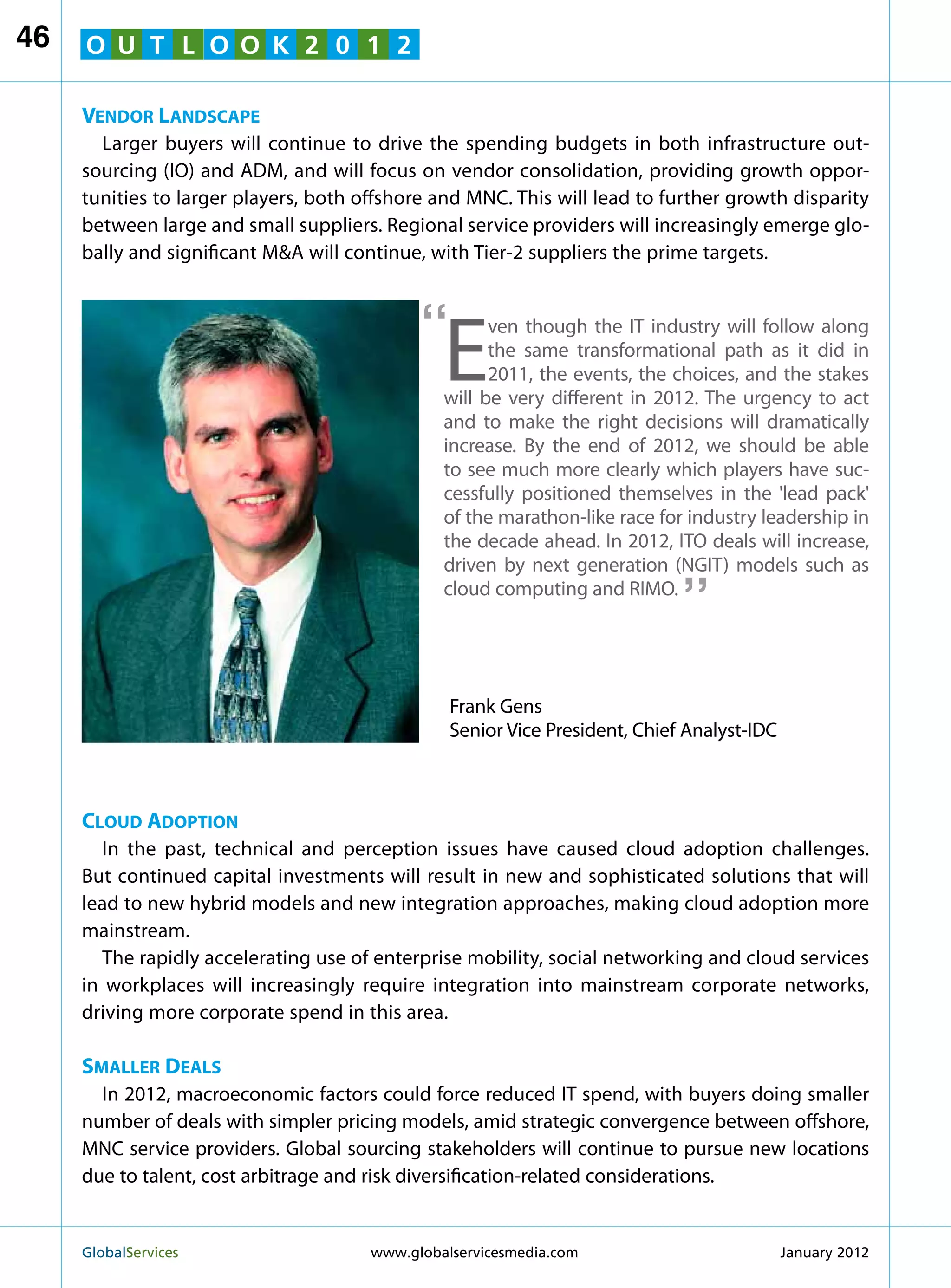
                                                 Frank Gens
                                                 Senior Vice President, Chief Analyst-IDC


     Cloud Adoption
        In the past, technical and perception issues have caused cloud adoption challenges.
     But continued capital investments will result in new and sophisticated solutions that will
     lead to new hybrid models and new integration approaches, making cloud adoption more
     mainstream.
        The rapidly accelerating use of enterprise mobility, social networking and cloud services
     in workplaces will increasingly require integration into mainstream corporate networks,
     driving more corporate spend in this area.

     Smaller Deals
       In 2012, macroeconomic factors could force reduced IT spend, with buyers doing smaller
     number of deals with simpler pricing models, amid strategic convergence between offshore,
     MNC service providers. Global sourcing stakeholders will continue to pursue new locations
     due to talent, cost arbitrage and risk diversification-related considerations.


     GlobalServices 	                  www.globalservicesmedia.com                         January 2012
Achieving Non-Linear Growth Using Smart
   Technology and Smart Outsourcing
              Author: Punit Jain
                      Head – Smart Document Processing Practice
                      Datamatics Global Services Limited.


 W
           ith economic turmoil and increasing competition in the global markets, process
           owners and operations managers are facing increasing pressure to build dynamic
           scalability, cut costs and improve speed of processing. The biggest challenge for any
 organization is not just attaining growth but to do so in a non-linear way.
   Industry research indicates that an average office worker annually uses 10,000 sheets of copy
 paper whilst most business decision makers spend over 40% of their time searching for infor-
 mation. Documents, in paper or electronic form, constitute the lifeline of any organization as
 they are vital for every operational success. With growing business velocity, increasing com-
 plexity of business operations, ever stricter regulatory compliance requirements  pressure to
 cut operational costs, optimizing document-intensive business processes has become a business
 imperative.
    The world is moving towards smart technology to enhance the productivity of document-
 intensive processes with break-through cost, quality, and scalability  speed benefits through
 intelligent automation. An intelligent platform can help automate the entire end-to-end process
 workflow and significantly reduce manual effort of document processing.
   Use of smart technology helps in reducing Value/Productivity Leakage which impacts both
 revenue and cost, specifically in operational areas. Organizations are speedily moving towards
 tools which emphasize on;
   •	 Leveraging smart technology for process automation
   •	Reducing operational cost and continuous quality improvements through deployment
      of workflow tools, and processes which adopt Industry Best-Practices
   •	Increased ROI by moving from manual to automated document management workflow
      system
   •	Using artificial intelligence in capture of information from documents, both physical
      and electronic
    The evolution of an organization in the direction of process automation for document cap-
 ture and process workflow, significantly reduces manual data entry, improves data accuracy,
 frees valuable resources and dramatically speeds up processing time.
   Are your business processes document driven? If yes, move to smart technologies consist-
 ing of imaging, workflow and intelligent capture tools, and derive the stated benefits. Explore
 outsourcing options which leverage these smart technologies. Smart outsourcing based on
 smart technology can provide real, measurable value in terms of cost reduction, productivity
 improvement, customer satisfaction and turn around time. Arguably, your documents can be
 perceived as a valuable asset which you can leverage towards gaining competitive advantage.
   To know more about how Datamatics can help you achieve break-through business benefits
 with intelligent automation, please write to business@datamatics.com

                                                                                       Advertorial
48   O U T L O O K 2 0 1 2

     Hybrid and Captive Sourcing Models
        Companies will continue adoption of hybrid captive/third-party sourcing models in
     2012, and efforts will be made to improve captive value by focusing on high-value proc-
     esses. Captive investments will continue with the majority of setups and expansions occur-
     ring in the Asia Pacific and CEE geographies in the year to come.
        For example, in the year 2011, IT service providers opened 32 new outsourcing deliv-
     ery centers in the third quarter compared to 17 the previous quarter. HP led the way by
     announcing ten new locations, followed by Dell, which announced four. Convergys, IBM
     and Tech Mahindra each announced three new centers. GS


                                                               MARCH 15
                                                             NEW YORK CITY


                         March 15, 2012 | New York City
                                        |

                        www.globalservicesconference.com
     GlobalServices 	                                     Welcome to the 7th Ann
                                      www.globalservicesmedia.com    January 2012
49


FAO: Helping Really Handle the
‘Finance’ Function Better
FAO clients expect their providers to undertake analytics
on transactions, gather functional insights, and then
identify opportunities to improve and add value. The focus
is on improving the performance of the finance function.


Smriti Sharma

                     A
                            ccording to a report by Everest Group, the FAO
                            market will continue to attract strong activity,
                            resulting in a year-on-year growth of 15 percent in
                     2012, with the total number of active multi-process FAO
                     contracts expected to reach 700. In terms of total contract
                     value, renewals worth $2.5B and annualized contract
                     value of $4.5B-$5B are expected. Strong tractions will be
                     visible in healthcare, financial services, energy  utility
                     industry segments and mid-market. There will be contin-
                     ued upward growth in India-to-India domestic BPO and
                     the Middle East and APAC regions.
                        Accenture, IBM, Genpact, Capgemini, Infosys BPO and
                     HP dominate the FAO space. The reason being, recent
                     years, have witnessed these players bag multiple engage-
                     ments in the $50M+ range.
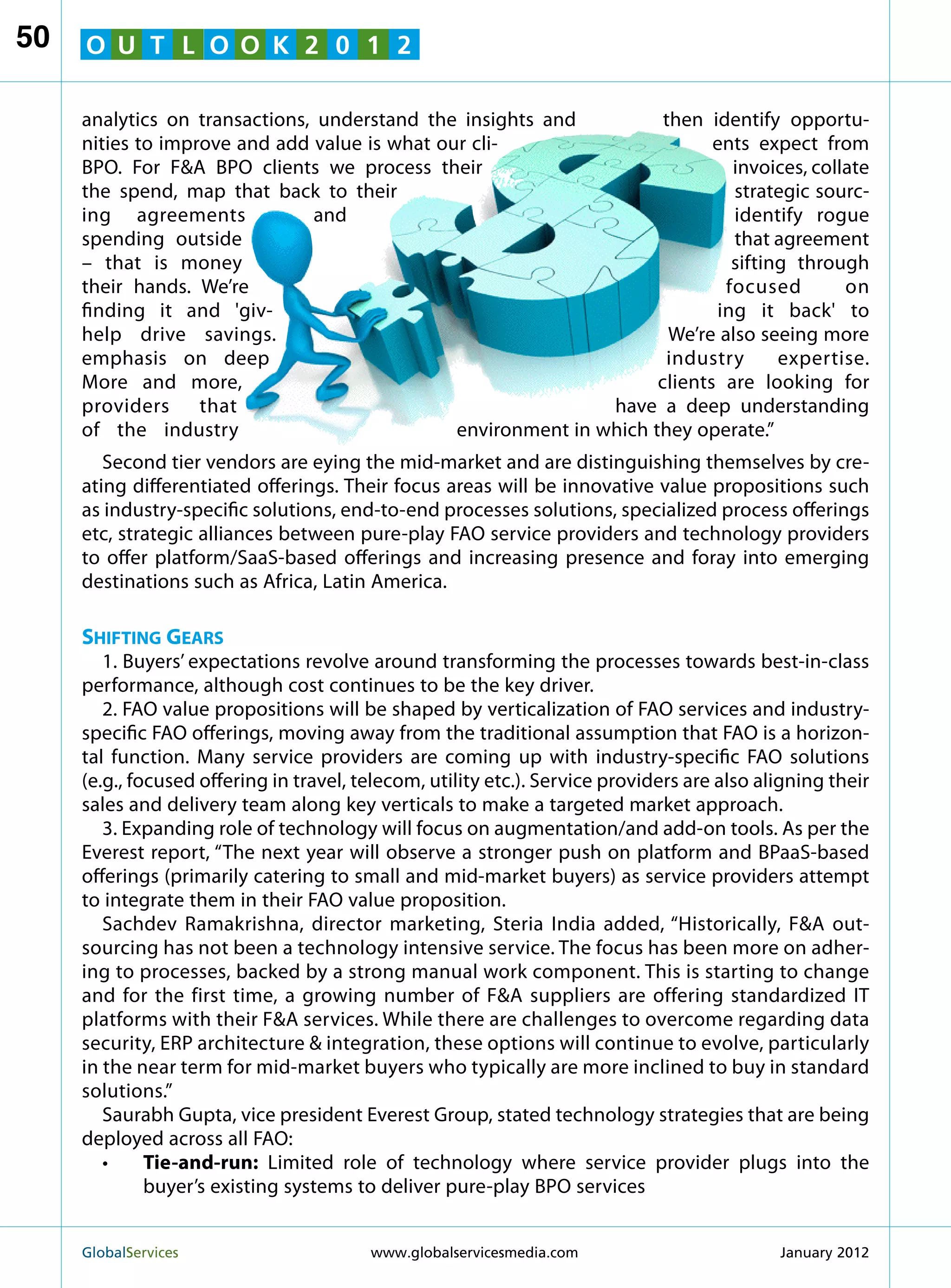
                        Tony Chambliss, global offering lead for FA BPO serv-
                     ices at Accenture articulated, “The ability to undertake


GlobalServices 	     www.globalservicesmedia.com                    January 2012
50   O U T L O O K 2 0 1 2

     analytics on transactions, understand the insights and           then identify opportu-
     nities to improve and add value is what our cli-                       ents expect from
     BPO. For FA BPO clients we process their                                 invoices, collate
     the spend, map that back to their                                         strategic sourc-
     ing agreements            and                                             identify rogue
     spending outside                                                          that agreement
     – that is money                                                           sifting through
     their hands. We’re                                                       focused        on
     finding it and 'giv-                                                   ing it back' to
     help drive savings.                                               We’re also seeing more
     emphasis on deep                                                 industry       expertise.
     More and more,                                                  clients are looking for
     providers that                                            have a deep understanding
     of the industry                           environment in which they operate.”
        Second tier vendors are eying the mid-market and are distinguishing themselves by cre-
     ating differentiated offerings. Their focus areas will be innovative value propositions such
     as industry-specific solutions, end-to-end processes solutions, specialized process offerings
     etc, strategic alliances between pure-play FAO service providers and technology providers
     to offer platform/SaaS-based offerings and increasing presence and foray into emerging
     destinations such as Africa, Latin America.

     Shifting Gears
        1. Buyers’ expectations revolve around transforming the processes towards best-in-class
     performance, although cost continues to be the key driver.
        2. FAO value propositions will be shaped by verticalization of FAO services and industry-
     specific FAO offerings, moving away from the traditional assumption that FAO is a horizon-
     tal function. Many service providers are coming up with industry-specific FAO solutions
     (e.g., focused offering in travel, telecom, utility etc.). Service providers are also aligning their
     sales and delivery team along key verticals to make a targeted market approach.
        3. Expanding role of technology will focus on augmentation/and add-on tools. As per the
     Everest report, “The next year will observe a stronger push on platform and BPaaS-based
     offerings (primarily catering to small and mid-market buyers) as service providers attempt
     to integrate them in their FAO value proposition.
        Sachdev Ramakrishna, director marketing, Steria India added, “Historically, FA out-
     sourcing has not been a technology intensive service. The focus has been more on adher-
     ing to processes, backed by a strong manual work component. This is starting to change
     and for the first time, a growing number of FA suppliers are offering standardized IT
     platforms with their FA services. While there are challenges to overcome regarding data
     security, ERP architecture  integration, these options will continue to evolve, particularly
     in the near term for mid-market buyers who typically are more inclined to buy in standard
     solutions.”
        Saurabh Gupta, vice president Everest Group, stated technology strategies that are being
     deployed across all FAO:
        •	   Tie-and-run: Limited role of technology where service provider plugs into the
              buyer’s existing systems to deliver pure-play BPO services


     GlobalServices 	                    www.globalservicesmedia.com                        January 2012
51

    •	  Technology augmentation: Service provider implements tools that serve as “add-
         ons” around the periphery of the existing buyer systems to address specific gaps
    •	  Core FA technology replacement/ implementation: IT infrastructure and/or
         core FA application implementation bundled with FAO services. Technology own-
         ership resides with buyer
    •	  Platform-based FAO: Pre-integrated applications and pre-built processes, owned
         by service provider, with pricing built into the FAO contract
    4. The demand for analytics and other specialized FA services such as regulatory com-
pliance, internal audit will continue to increase.
    5. Pricing models namely outcome-based and transaction-based pricing will find
increased mention in FAO contracts. Chambliss spoke about how many companies are
moving from just a transactional basis of BPO toward outsourcing higher value added func-
tions in their decision making and FPM areas. He opined, “Access to better information to
communicate to their line of business owners seem to be driving more value add for the
FA organizations and making the opportunities to grow analytics and improvements in
the bottom line for companies. Value propositions are centered around improvements to
cash performance.”
    WNS has adopted several mod-
els of implementations such as-
lift and shift, shift and fix, and a
combination of fix whilst lifting
and shifting. Tasneem Lakdawalla,
business unit leader, Finance and
Accounting shared, “WNS delivers
a full range of FAO processes to
support all functions in the CFO’s
office. We perform over 650 proc-
esses ranging from simple transac-
tions to complex analytical proc-
esses including industry-specific
processes such as royalty and
passenger revenue accounting.
Specifically, we deliver end-to-end
services across the full spectrum of
finance and accounting functions,
including procure-to-pay, order-to-cash and record-to-report.”
    6. Demand in the emerging markets- whether it is India or Asia Pacific or Latin America-
for FAO services is expected to increase this year.
    Shantanu Ghosh, senior vice president and global head of practices, solutions and transi-
tions, Genpact opined, “The reason being a lot of multinationals - which are US and continen-
tal Europe based- have done their first wave of FAO, where they obviously focused on high
impact geographies like US or UK or continental Europe are now focusing on their second or
third wave outsourcing through the new market. These economies are creating companies
that are growing from small to medium to big and they are expanding outside their home
territories. They are also looking not only from the prospects of labor arbitrage but also from


GlobalServices 	                  www.globalservicesmedia.com                      January 2012
52   O U T L O O K 2 0 1 2


     the prospect of creating growth platforms along with delivering process excellence through
     use of process management expertise.”
        7. FAO will continue to increase in the developed markets. Demand will continue to come
     from late adopters. These are the people who have not jumped on the FAO bandwagon
     earlier, but now have seen the model get proven and have got enough confidence that this
     works and they are therefore now coming in the market.
        8. An end-to-end process-driven approach to FAO is also emerging as opposed to a tra-
     ditional functional and piecemeal approach.


     Service Providers Landscape
        Experts from the Everest Report titled 2012 Market Predictions:
        Driving non-linear growth through investments in technology-led solutions (platform
     and BPaaS-based offerings) and process-led solutions (process maturity models and
     frameworks).
        Creating differentiated offerings through industry-specific and go-to-market strategies,
     specialized process offerings and bundled FAO-PO offerings to leverage synergies across
     the FA and procurement functions.
        Service providers will push to increase penetration in the small and mid-market buyer
     segments and also in emerging buyer geographies such as India, the Middle East, and
     APAC. They will also continue and South America, the Middle East  Africa, and Tier -2/3
     locations in India etc.
        The MA activity witnessed in 2011 will continue to an extent in 2012 with acquisition of
     niche players by established suppliers trying to augment their capabilities to enter newer
                                                               MARCH 15
     geographies. Private equity investors looking to either invest in mid-market FAO suppliers
     or exit their positions held with large suppliers. GS   NEW YORK CITY


                         March 15, 2012 | New York City
                                        |

                        www.globalservicesconference.com
     GlobalServices 	                                     Welcome to the 7th Ann
                                      www.globalservicesmedia.com    January 2012
53


   Analytics Outsourcing 2012:
     What do the Cards Say?
Analytics outsourcing will continue to grow as businesses
would turn to analytics to understand customer
behavior and optimize various business measures.


Smriti Sharma

                     I
                        nitially, analytics did not perfectly plug into the con-
                        ventional outsourcing model, as the level of data sensi-
                        tivity is exceptionally high. These vulnerabilities made
                     some of the clients set up or expand captive units instead
                     of outsourcing their secure data. However, in the past
                     decade, third-party providers have armed themselves
                     with commendable expertise in analytics. Thus, the ana-
                     lytics space that was once dominated by captives of large
                     companies is now embracing large vendors offering end-
                     to-end specialized solutions to specific verticals.
                        For those companies, whose data security concerns are
                     still making them hesitant about AO, vendors are offering
                     onsite delivery teams – at clients’ premises, client country-
                     so data is not required to reach offshore.

GlobalServices 	    www.globalservicesmedia.com                      January 2012
54   O U T L O O K 2 0 1 2

     AO-Evolution
         AO started with financial and marketing functions. MNC’s when they had set up their
     captives in India, were one of the first companies to benefit from it. At the start, heavy
     lifting in terms of data analysis was being outsourced and then entered the higher end
     statistical modeling. Nowadays, high end business consulting (based on the data) is being
     outsourced. Next phase will observe companies start services where they will own data and
     provide consulting/analytics based on the owned data as well as customer data.
         Anoop Sagoo, BPO cross operating group lead, Accenture, expressed, “BPO today is
     about mining the huge volume of transactional data that is being processed – and using
     industry expertise, analytics and innovation to help a client operate its business better and
     drive business outcomes. The ability to undertake analytics on transactions, understand the
     insights and then identify opportunities to improve and add value to the client’s business is
     what our clients expect from BPO.”


        Over the next five years, the top strategic technology investment at outperforming mid-
     size operations is business analytics, according to an IBM report in CIOs. Thus, this space is
     expected to grow in the coming year and also there is expected to be an increase in the
     percentage of service providers offering analytics services from offshore destinations.


     Gaining Importance
        Analytics has become a critical component without which tactical and strategic decisions
     cannot be drawn. Today, companies can choose from a host of platforms and services based
     tools that can be deployed to make intelligent use of information enabling business deci-
     sions that impact both top line and bottom line.
        Arun Kharbanda, business unit head, Research  Analytics, WNS Global Services stated
     that analytics will continue to grow because it helps their clients to grow the topline by
     understanding customer behavior better. He added, “This in turn helps optimize various
     business measures like cost reduction/ optimization of price, inventory and shipment to

     GlobalServices 	                  www.globalservicesmedia.com                     January 2012
Smart Analytics – The Strategic Edge
              For Your Business
               Author:      Rakesh Tiwari
                            Head – Smart Analytics Practice
                            Datamatics Global Services Limited


E
       nterprises across the world generate terabytes of data from transactions that happen
       internally and externally. This data carries a wealth of information, which if extracted
       properly can equip the enterprise with strategic business insights. Here is a example from
the many we like to refer to at Datamatics:
   A large bank was able to maximize ATM utilization by tracking ATM transactions data
across locations. Analysis of transaction data over a defined time interval provided insights for
ensuring ATMs were available easily where their customers would need them the most, were
stocked with the right currency denominations in the right quantities. This ensured greater cus-
tomer satisfaction scores, significant reduction in ATM maintenance  management costs and
a noticeable increase in market share in the pilot areas where the project was run. Needless to
say, the bank then ran the initiative world-wide and is reaping business benefits.
   Most companies are unaware of the wealth of potential strategic insights they are sitting on
with the transaction data generated every minute. Those that do set on this path typically have
to go through a 5-step ‘Datamatics Information Management Maturity ModelTM’ given below:
   Assessment: Get visibility into sources and consumers of the information, needed to pro-
vide 3600 view of the business, prepare for the activities at data layer and assess infrastructure
needed to support business decision making process
   Data Management: Prepare data layer  related infrastructure to generate business data
glossary  data dictionary, build business data governance structure  relevant infrastructure,
logical and physical data repository and validate data repository. Provides integrated business
view needed by decision makers and planners
   Reporting: Map business needs to the reporting requirements, create reporting infrastructure
to support business reporting needs starting at the dashboards for executive level to canned
reports for transaction analysis. This architecture should be further supported by OLAP struc-
tures to facilitate for detailed analysis by power users.
   Predictive: Data mining and pattern recognition to detect trends in the business data and
support business leaders to make suggestions for addressing emerging business scenarios.
                                                      Prescriptive: Suggest changes to the current
                                                   business processes to handle the emerging
                                                   business trends detected by predictive busi-
                                                   ness models.
                                                      Right information at the right time to the
                                                   right person in the right format empowers
                                                   decision makers for well-informed decisions
                                                   and the enterprise with a competitive edge.
                                                     To know more about how your enterprise
                                                  can benefit from smart analytics, please write
                                                  to business@datamatics.com

                                                                                          Advertorial
56   O U T L O O K 2 0 1 2

     reduce demand-supply mismatches, improving sourcing to reduce cost of procurement,
     quantifying probability of adverse outcomes to reduce risk, improving compliance adher-
     ence and provide strategies to minimize risk; improving predictability of and minimize
     variations in planning.”

     AO-Outlook 2012
        Analytics service providers include BPOs, KPOs, BPO/KPO arm or department of large
     IT-BPO Company, specialist market research (MR) firms, and other boutique Research and
     Analytics (RA) firms.
        The coming year will not see much change in the major markets that are being served
     by analytics service providers. That is US, UK and to some degree, the rest of Europe will
     continue to demand this space as they move up the value chain. Some providers will be
     focusing on Australia and Japan.
                                                      The delivery locations are also expected to
                                                   remain the same. India, China and Eastern Europe
                                                   are the most prominent destinations on the ana-
                                                   lytics outsourcing map. Others include nearshore
                                                   countries to the US such as Mexico and Costa
                                                   Rica, and offshore destinations such as Singapore
                                                   and Sri Lanka.
                                                      On the buyers’ front, Fortune 500 companies
                                                   are the big-league clients for this knowledge
                                                   service. Pankaj Kulshreshtha, senior vice presi-
                                                   dent, Genpact's analytics and research depart-
                                                   ment articulated, “Genpact has a large concen-
                                                   tration in America and a large portion of their
                                                   current revenue comes from this region. It has
                                                   footprints in Europe, China, India and Australia. In
                                                   the coming years, it is expecting to grow signifi-
                                                   cantly in Europe and Asia-Pacific Region.”
                                                      In 2012, WNS – whose clients are based in
                                                   the US and European Union region – would also
                                                   expand its client base in the Asia-Pacific region.
                                                      The next 10 years of the analytics landscape
                                                   will be drastically different from the last one.
     “With structural shifts in demographics, that will reflect more prominently in the interna-
     tional trade and economics, where outsourcing will no longer be a choice. The KPO industry
     in India has gone through a “concept selling” phase in the last few years for a majority of
     clients who have so far utilized BPO services. At the same time, some clients have been able
     to create a competitive advantage for themselves through establishing Analytics Centers of
     Excellence programs that have resulted in improved decision making across multiple busi-
     ness groups, markets and geographies,” opined Kharbanda.
        Industry verticals such as shipping and logistics, manufacturing and supply chain were
     initially not very active in this space, but they now offer good opportunities. From an offer-
     ing standpoint, web and web related services are very much in demand from the market,
     as are packaged solutions that combine consulting services with delivery.

     GlobalServices 	                   www.globalservicesmedia.com                       January 2012
57

  “As a business partner, clients will expect a far greater expertise in vertical industry
knowledge from their providers as well as the latest combined BPO and IT outsourcing
capabilities. Providers will need to possess industry, technical and functional knowledge.
They will need the proven ability to deliver end-to-end processes and deploy analytics in
order to identify opportunities to improve and add value to a client’s business. And they
need a strong transformational capability by making change management a priority,” said
Sagoo.
  Viral Thakker, executive director, performance and technology services KPMG pointed
out some of the emerging/growth areas in analytics:

  •	   Customer analytics for the energy and utilities sector
  •	   Fraud analytics in retail banking
  •	   Cyber-analytics to detect cyber crime and terrorism
  •	   Learning analytics to assess academic performance

  Other trends that could emerge are:

  •	 Cloud-based BI tools could see proliferation
  •	 Social network data mining for customer analytics
  •	 ‘Big data analytics’— Big data refers to the tools, processes and procedures allowing
     an organization to create, manipulate, and manage very large data sets and storage
     facilities. GS

                                                           MARCH 15
                                                         NEW YORK CITY


                    March 15, 2012 | New York City
                                   |

                   www.globalservicesconference.com
GlobalServices 	                                      Welcome to the 7th Ann
                                  www.globalservicesmedia.com    January 2012
58   O U T L O O K 2 0 1 2


     Contact Centers Being Redefined
     Multiple channel interactions, technology innovations
     and increasing preference for self service is bringing
     about massive changes in the way contact centers work.


     Smita Vasudevan


                        T
                               he contact center outsourcing industry continues
                               to witness some major transformations. A turbulent
                               economy, rising customer expectations and chang-
                        ing modes of customer interactions are swiftly redefining
                        contact center activities. Customer service is being increas-
                        ingly seen as one of the major competitive differentiators for
                        enterprises, as there is not much scope in other areas.

     GlobalServices 	   www.globalservicesmedia.com                      January 2012
60   O U T L O O K 2 0 1 2

        Interactions have grown beyond the traditional phone calls. Customers are interacting
     in different ways and through different channels like email, chat and social media sites, like
     never before.
        Cost reduction remains one of the primary objectives as a result of budgetary pressures.
     Enterprises are attempting numerous ways to reduce their cost of servicing, at the same
     time not compromising on the quality. A higher percentage of technology automation is
     thus being enabled with the objective of cost savings and improved customer service.
        How far will automation go? Though automated technologies will continue to find their
     way, where ever possible, this will depend on the complexity of transactions involved and is
     not expected to replace human interactions completely. Experts and service providers have
     similar views on this. Sitel foresees humanization of technology to be an important change.
     The idea behind the approach is to discover ways to reduce expenses through technology
     without sacrificing the human touch.

     Multiple Channel Interactions and Self Service
        Today customers are interacting through multiple channels and are smart enough to
     decide where, how and when do they want to interact. In case of a problem, they are more
     likely to look for solutions on their own before they make a call. This poses a big challenge
     for enterprises to be there where all the customer is and interact in a way the customer
     is interacting. Service providers that can enable their clients to interact and engage with
     customers on multiple channels will clearly have an edge. Significant investments are thus
     being made into channels like email, chat and Web-based interactions.
        Self service is being encouraged more through technology enablement. The benefit here
     lies in being able to lower call volumes and be able to take up more customer service. It can
     significantly cut down the amount of time that customers need to spend waiting in queues
     finding answer to their queries.
        Web engagement is going to be a major part of customer care strategies. Engaging cus-
     tomers once they are on the web either through self service or through assisted service will
     be very important. Web retention and web conversion are two major opportunity areas.


                          “   Multiple channel communication will be a major trend. Players
                           who can bring technology to combine all mediums of communi-
                                      “
                           cation to offer an optimum communication medium strategy will
                           stand out.
                                                                          — Manish Dugar,
                                                        Senior VP  Global Head, Wipro BPO


     The Power of Social Media
       Social media interactions are happening in a big way. More companies are thus waking
     up to the benefits that a social media strategy can bring about and the impact it can have
     on the overall customer service. Customers are increasingly turning to social media sites
     and other online forums to find answers to their queries and even to vent out their anger
     when things go wrong. It is important for enterprises to be a part of these interactions


     GlobalServices 	                  www.globalservicesmedia.com                     January 2012
61

to understand and control what is being said about them and use it to their advantage.
Andrew Kokes, Vice President, Global Product Management,, Sitel, commented in a previ-
ous interaction, “Here is the reality all companies must face, social media interactions are
going to happen with or without you.
  Social media strategies in contact centers is still in the early stages of adoption. United
States has been an early adopter and other areas are also gradually gaining momentum.


                             “  What we get out of our social media activities is an addi-
                             tional layer of value add capability that enables us to build
                             better relationships with people. The major challenge here
                                                 “
                             is lack of awareness. But we do see increased adoption in
                             the coming years.
                                         — Andrew Kokes, Vice President, Global Product
                                                                       Management, Sitel


Increased Technology Automation and Cloud Adoption
   More enterprises will move to the cloud and adoption rates are likely to go up signifi-
cantly. Vijay Narsapur,                                        Strategic Business Practice
Head, Customer Service,                                        Infosys BPO, reveals in
another interaction on                                         automation. “Lot of contact
centers will be moving                                         to the cloud-both hardware
and software. CRM soft-                                        ware is already going to the
cloud” he says.
   Experts     have    a                                       unanimous view on this.
Technology automation                                          is leading to major transfor-
mations and will con-                                          tinue to do so in the coming
years. Enterprises will                                        take the road to technology
automation in order                                            to cut down costs and and
be able to offer better                                        customer service. Significant
amount of technology                                           investments are being made
across different chan-                                         nels of communications.
During an interac-                                             tion on technology automa-
tion in contact cent-                                          ers, Subramanium C, Chief
Technology       Officer,                                      Hinduja Global Services,
reveals, “Lot of new technologies are being enabled. The IVR is slowly being replaced by
ASR. TTS is another area that is seeing more adoption. These are technologies that are being
enabled to see that volumes are lowered so that automation kicks in for end clients to take
more service.”

GlobalServices 	                  www.globalservicesmedia.com                    January 2012
62   O U T L O O K 2 0 1 2


                                    “   New revenue streams like Cloud will gain popularity.
                                      Business driven projects towards customer experience,
                                      business intelligence, etc are examples of customers
                                                                                  “
                                      spending to adopt technology evolution to keep up
                                      competitive differentiation at services level.
                                                        — Deepankar Khiwani, Vice President,
                                                      Continental Europe Application Services,
                                                                            Capgemini India


     Analytics-How You Make Use of Data
        How you manage data is going to have a very crucial role to play in understanding cus-
     tomer behavior and making right decisions at the right point of time. Customer interactions
     across different mediums offer a huge pool of useful information. Integrating the scattered
     pieces of information and using it in the right way through analytic solutions can help
     enterprises in improving overall performance and cutting down costs. This is thus an area
     that is going to gain more prominence in the coming year.
        A recent example is Avaya that has added speech analytics capabilities with the acquisi-
     tion of Aurix, a global provider of speech analytics and audio data mining technology. Brett
     Shockley, Senior Vice President, Corporate Development, Strategy and Innovation, Avaya,
     commented in one of its press releases, “The value of document search engines is widely
                                                               MARCH 15
     understood. There is another dimension of data that is largely untapped,and that is the
     information exchanged through spoken interactions.”
                                                             NEW YORK CITY
     What Lies Ahead?
       Multiple channel interactions and technology innovations will continue to influence
     contact centers in 2012. According to Amit Singh, Avasant, “Technology disruptions will be
     the biggest trend to watch out for in the coming year.” Enterprises that are able to make
     customer interactions simple, serve on multiple channels, imbibe new technologies and
     bring out flexible offerings will clearly stand out. GS


                         March 15, 2012 | New York City
                                        |

                        www.globalservicesconference.com
     GlobalServices 	                                     Welcome to the 7th Ann
                                      www.globalservicesmedia.com    January 2012
63


A Cautious Optimism Continues
         To Drive HRO
Withstanding the turbulent economy will be high on
enterprises' agenda next year. Non-core functions like
HRO will be outsourced more with the objective of short-
term cost savings and long-term strategic objectives.


Smita Vasudevan

                    R
                           ecession fears are around the corner and cost savings
                           is a priority for every enterprise. This coupled with
                           the growing complexities in handling HR processes
                    and meeting the fast changing technology advancements
                    is likely to drive human resource outsourcing in the year to
                    come. Rohail Khan, Group President, HR Outsourcing and
                    Solutions, ACS, says, “Focus on cost management is going to
                    drive HRO. The “double dip” economy in the United States is


GlobalServices 	    www.globalservicesmedia.com                     January 2012
64   O U T L O O K 2 0 1 2

     forcing companies to focus on core, revenue generating areas and outsource more of the other
     non-core functions, like back office processing.”

     Keep it Short and Small
        This year we saw more preference for small, short term deals as enterprises became more
     cautious about their outsourcing decisions. Even the multi-process HRO deals had reduced
     in size with the inclusion of fewer processes. Experts believe that this trend is going to
     continue as enterprises are still treading a safe path and are cautiously optimistic about
     outsourcing their HRO processes.
        Rajesh Ranjan, Research Director, Everest Group, says, companies will continue to be
     cautious and start with outsourcing a few HRO processes to a single service provider. He
     adds “A multi vendor approach is likely to increase as a single vendor may not be able to
     offer everything end-to-end.” The success of such contracts will depend on how enterprises
     make use of such relationships to achieve the desired outcomes.


                              “
                                                                                          “
                                                                                          “
                                  A multi vendor approach is likely to increase as a single
                                vendor may not be able to offer everything end-to-end.
                                                                               — Rajesh Ranjan
                                                               Research Director, Everest Group,


        Manish Dugar, Senior VP  Global Head, Wipro BPO, holds a slightly contrary view on this.
     He believes that instead of the trend of outsourcing different processes to different service
     providers, the industry will see the emergence of multi-process transactions” he says. ACS
     too holds a similar view.“Clients are driving the need for much more service integration
     across HR domains, as client HR teams are downsizing and can’t effectively manage the host
     of vendors they have had historically” says Khan.

     Global Footprint is the Need of the Hour
        Enterprises want to partner with service providers that have outsourcing capabilities
     in not just one but multiple locations. Expanding their capabilities and gaining a global
     footprint will be high on service providers' agenda. This they may be doing on their own or
     inorganic growth strategies like mergers and acquisitions. More consolidation is thus likely
     to be seen. Service providers will have to be prepared to handle this kind of complexity to
     play in the HRO market. Dugar adds, “You need to have the capability of understanding the
     law of land and managing the requirement of different geographies, if you want to play in
     the HRO field. You can either do this on your own or partner with someone.”

     Growth Areas
        Payroll and Benefits have traditionally been the most outsourced HR functions. This trend
     continues as enterprises will preferably start outsourcing these transaction intensive func-
     tions and then move to other areas like learning and recruitment. Benefits administration

     GlobalServices 	                  www.globalservicesmedia.com                     January 2012
65

is expected to gain more outsourcing interest in the coming year. “Health care reforms
happening in the US is driving outsourcing in health and benefits administration.
Changes in health care reform bill may have an impact on this area. But as of now Benefits
Administration looks attractive,” says, Ranjan.
   RPO is another segment that has been capturing good amount of attention. Western
economies are struggling with their unemployment rates but at the same time have also
cut down significantly on their recruitment staff. This creates the need for an option that is
scalable and flexible, and RPO fits the bill.
   The mid market is another area that presents a huge opportunity. A large chunk of busi-
ness is coming from these enterprises and service providers are also developing specialized
packages to tap the vast potential of this segment. In an interaction earlier this year, Ann
Vezina, Executive vice president and chief operating officer Enterprise BPO, ACS, com-
mented, “Services need to be scalable for any size employer with the ability to grow as mid-
market organizations grow and their needs expand. We are prepared to meet their needs in
all service lines and grow with them as the economy recovers.”


It's time to Move to the Cloud
                                  SaaS and cloud-based models are increasingly becoming
                               a part of HRO deals. At this time when cost pressures are
                               paramount, platform-based models are likely to see more
                               interest coming in. This is because it does not require buyers
                               to make upfront technology investments. The technology
                               part is brought in by the service providers. This eases off a
                               lot of burden and is thus becoming more attractive in the
                               current scenario.
                                  Northgate Arinso has recently partnered with Workday
                               to bring multi-country payroll to the cloud. Brad Everett,
                               VP Strategy, Marketing and Portfolio Management at NGA,
                               commented in its press release, Multi-country payroll is a
                               challenge that ranks very high on HR leaders' agenda today,
                               and for which NGA has developed a unique platform. By
                               partnering, we can now support Workday customers in their
                               search for global HR and payroll excellence.

The Challenge
   Buyers will look out for partners who can offer global expertize, integrated HR services
and technology innovations. The focus will be on balanced outcome, that is short-term cost
savings without compromising on long-term considerations. Khan says, “The first genera-
tion of HR services contracts are coming up for renewal and the providers need to show
innovative thinking and additional efficiencies to win the renewal. Incumbents are still pre-
vailing, but in some cases firms are breaking up the deals if the providers are not innovat-
ing.” The message is thus loud and clear.


GlobalServices 	                  www.globalservicesmedia.com                     January 2012
66   O U T L O O K 2 0 1 2


                               “   The first generation of HR services contracts are coming up
                                                                                   “
                                 for renewal and the providers need to show innovative think-
                                 ing and additional efficiencies to win the renewal.
                                                                                 — Rohail Khan
                                             Group President, HR Outsourcing and Solutions, ACS


     Major Trends for 2012
       •	    Preference for small and short term deals will continue
       •	    Enterprises will look for service providers with global footprint
       •	    Multi-process HRO deals will be seen but with fewer processes
       •	    Platform-based HRO models will gain more popularity
       •	    ‘’Best of Breed’’ approach likely to be seen more GS


                                                                 MARCH 15
                                                               NEW YORK CITY


                         March 15, 2012 | New York City
                                        |

                        www.globalservicesconference.com
     GlobalServices 	                                       Welcome to the 7th Ann
                                        www.globalservicesmedia.com    January 2012
DIGITAL MAGAZINE
                                                                                                                                                                                                                                                                                                  Monthly
                                     Outlook 2012
                                                           p. 00
                                                                            Expert articles from
                                                                                                                 p. 00
                                                                                                                                        FLASHBACK 2011                                                                                                   DECEMBER 2011


                                                                                                                                  1
                                     survey analysis                        sourcing advisors  analysts


                                                                                                                              Outlook 2012                                                                                                                                                Building 
         www.globalservicesmedia.com


           O utl OOk                                                                                                                                                                           VOICE OF THE EXPERT
                                                                                                                                                                                                                                                                                          Sustaining
                                                                                                                                                                                                                                                                                          Excellence in
                                                                                                                                                                                                                           What Are Business Platforms And Why Do They
                                                                                                                                                                                                                           Represent The Future of Outsourcing?
                                                                                                                                                                                                                           Service Center Excellence: Getting Things Done
                                                                                                                                                                                                                           Dispelling the Ten Myths that Impede Excellence
                                                                                                                                                                                                                                                                                          Global Services
             Where do we go next?                                                                                                                                                                                          in Business Service Delivery
                                                                                                                                                                                                                           Getting Multisourcing Right!


                                                 The Way Ahead
                                                 Grim economy, mounting
                                                 expectations, bigger challenges...
                                                 and few lessons to be learnt      

                                                 p.10


                                                               INAUGURAL ISSUE  NovEmbER 2011


                                                                                                                              Infrastructure                                                                                                                                              Top 100 Cities
                                                                                                                              Management                                                                                                                                                  Regional
                                                                                                                              Services                                                                                                                                                    Dynamics
                        Infrastructure
                     Management Services
                                                                                                                                                                                                                                                                                          Experts Speak
                 RIM Comes of Age                              Benchmarks Go Strategic
                 Ben Trowbridge                                Kathy Rudy
                 Alsbridge	                                    Compass	Management	Consulting


                 Emerging Models in IMS                        Achieving Innovation in IMS


01               Amit Singh
                 Avasant	


                 Global Sourcing of Services
                 Cliff Justice
                 KPMG	

                 Stan Lepeak
                 KPMG


                          “WFM Has Changed to a Know-
                          ledge-based Function”

  www.globalservicesmedia.com
                                                 Pg 8
                                                               Robert McNeill
                                                               Horses	for	Sources


                                                               Pricing the Cloud
                                                               Scott Feuless
                                                               Compass	Management	Consulting	

                                                               Stanton Jones
                                                               TPI


                                                           Why Governments Are
                                                           Treading Slow Pg 10


           The gateway to the global sourcing of IT and BPO services


                                    Hot                      and
                                                                     ADM
                                                                    Testing
                                                                   Services
                                                                                 New:
                                                                                      Android Accelerates Mobile
                                                                                      Application Development Pg 22


                                                                                                    September 2011


                                                                                                                              Hot and New:
                                                                                                                              ADM 
                                                                                                                              Testing
                                                                                                                              Services


                                                                                                                              2011
                                                                                                                              Global
                                                                                                                              Services
                                                                                                                              Compendium
                                                                                                                                                           Special Report
                                                                                                                                                                                         Small, Shorter Term
                                                                                                                                                                                         Deals in HRO

                                                                                                                                                               www.globalservicesmedia.com
                                                                                                                                                                                                           Pg 20
                                                                                                                                                                                                                   Human Resources
                                                                                                                                                                                                                   Transformation


                                                                                                                                                                            The gateway to the global sourcing of IT and BPO services


                                                                                                                                                                                               HRO


                                                                                                                                                                                         Landscape

                                                                                                                                                                www.globalservicesmedia.com
                                                                                                                                                                                                             So Old,
                                                                                                                                                                                                             Yet So New


                                                                                                                                                                                         The Offshore Analytics
                                                                                                                                                                                                         Pg 10
                                                                                                                                                                                                                                        Pg 28


                                                                                                                                                                                                                   Making Sense of Data to Make
                                                                                                                                                                                                                   Money


                                                                                                                                                                            The gateway to the global sourcing of IT and BPO services


                                                                                                                                                                                             The
                                                                                                                                                                                           Promise
                                                                                                                                                                                                               of
                                                                                                                                                                                                              IaaS
                                                                                                                                                                                                                                          Pg 19
                                                                                                                                                                                                                                                  Sourcing Strategies, Trends,
                                                                                                                                                                                                                                                  and Observations        Pg 32


                                                                                                                                                                                                                                                                        July 2011


                                                                                                                                                                                                                                                     Cloud IaaS: How secure is
                                                                                                                                                                                                                                                     the user?         Pg 24


                                                                                                                                                                                                                                                                        May 2011
                                                                                                                                                                                                                                                                                          HRO
                                                                                                                                                                                                                                                                                          So Old,
                                                                                                                                                                                                                                                                                          Yet So New


                                                                                                                                                                                                                                                                                          The Promise
                                                                                                                                                                                                                                                                                          of IaaS


                          Everest Report Forecasts 20%        All Eyes Are on Latin       New Face of The BPO                                                                              Analytics Outsourcing   The Next Generation of Business    No Room for Heroes in Outsourcing
                          Growth in FAO             Pg 8      America        Pg 20        Sector         Pg 27                                                                             on the Rise Pg18        Process Outsourcing Pg 21          Relationships Pg 28


                                                                                                                              BPO 3 Rules to                                                                                                                                              Contact Center
  www.globalservicesmedia.com                                                                                                                                  globalservicesmedia.com


                                                                                                                                                                                                                                                                         March 2011


                                                                                                                              Live By                                                                                                                                                     Industry: Where
                                                                                                            April 2011

           The gateway to the global sourcing of IT and BPO services


                                         bpo 3 Rules                                                                                                                                                                            Contact
                                                               to Live by                                                                                                                                                        Center                                                   Do You Go From
                                                                                                                                                                                                                               Industry:
                                                                                                                                                                                                                             Where Do                                                     Here?
                                                                                                                                                                                                                                 You Go
                                                                                                                                                                                                                            From Here?
                                                                                                                                                                                                                         The new rules to play by:
                                                                                                                                                                                                                        Growth in demand in new geographies
                                                                                                                                                                                                                                                        Balanced shoring
                                                                                                                                                                                                                                                Domain-driven services
                                                                                                                                                                                                                                       Unified customer experience


                            From the NASSCOM India            The 21st Century Employee          Global Services LIVE!
                            Leadership Forum 2011 Pg22        Incentive Program Pg24             Case studies Pg26


                                                                                                                              Next  Best                                                                                                                                                 Utility
globalservicesmedia.com


                                                                                                                              Practices
                                                                                                              February 2011


                                                                                                                                                                                                                                                                                          Computing:
  NEXT  BEST                                                                                                                 in Global                                                                                                                                                   The Reality
  PRACTICES IN                                                                                                                Sourcing
  GLOBAL SOURCING
  Thought-leading Practitioners’ Viewpoint
                                                                                                                                                                                                                                                                                          Check
   The State of the Outsourcing Industry .............. Pg 8
   Key Imperatives in Global Sourcing ................. Pg 11
   Collaborative Sourcing................................. Pg 13
   Supply Risk Monitoring ................................ Pg 16
   Cloud and its Implications on Service Delivery ... Pg 18
   Business Process Integration In The Cloud......... Pg 18
   Accelerating Transformation through BPO.......... Pg 19


                                                                            www.globalservicesmedia.com/E-Magazine
                                                                                                                               For queries write to niketac@cybermedia.co.in
68   O U T L O O K 2 0 1 2


                           Pointers by
                                    Industry Leaders
          Smriti Sharma, Sourabh Chandra Pushp  Smita Vasudevan
                               CEOs' verdict
                           For Providers:
                           • Move towards op-ex model (from cap-ex).
                           •Diversify to increase reach and expand portfolio.
                           •Look at long-term engagements.

                           For Buyers:
                           • H
                              ave a streamlined internal process to define the outsourcing
                             needs and vet a prospective provider.
                           • Use outsourcing not to just reduce costs, but to increase value.
                           •Look at long-term engagements

                           For Both:
                           • W
                              hat is needed is an integrated relationship between the client
                             and the provider whereby each has a stake in the other. The two
                             parties must act as one in a business association that goes beyond
     Partha De Sarkar        a cost reduction exercise to function as a true partnership.
     CEO, HGS


                           • Tap into newer verticals – heathcare, retail, energy public sector.
                           •  here is global economic activity shifting to east. I would say
                             T
                             increase activity in Asia region.
                           •  raditionally, the industry has focused on large accounts but with
                             T
                               the advent of cloud there is the big opportunity in the long tail
                               which is to reach out to the SMB segment.

                        Arvind Thakur
                        CEO, NIIT Technologies Ltd

     GlobalServices 	                  www.globalservicesmedia.com                  January 2012
69

   • Generic providers’ will be commoditized. So, there is
       need for a lot of specialization. Specialization can be on
       industry capabilities, on technical capabilities, on the
       tools and technology that you bring to the table etc. But
       it is going to be a more specialized game. People who
       are very generalist will approach commoditization and
       then it is just a pricing game.
   •   D
        emonstrated capability is going to be another big
       factor; in truly being able to harness the opportunity.
       When you are trying to outsource the core pieces of
       your business, it implies higher amount of risk in the
       customers mind because now you are relying on some
       third party to do what you use to call core yesterdayIn
       order to win that one needs very specialized and dem-
       onstrated capability to be able to harness it.
   •   Y
        ou cannot wait for such businesses and for the cus-
       tomer to tell you. You will have to have the innovation
       engine that you will lead to create idea and thought         Deepak J Patel
       leadership to make sure that the processes that you          CEO, Aditya Birla Minacs
       are running for your customers are operating at best in
       class level.


  • Mobility being new and agile companies who have cre-
       ated skills on this will be wanted. Mobility outsourcing
       will be played on a level field where niche companies
       can compete and win against the big guns.
  •    C
        ompanies will come looking for than fixed bid, low
       value projects. Companies are looking for their out-
       sourcing vendor to create more value for them and be
       associated for the long term.
  •    D
        esign will matter. Smartphones provide great user
       experience. Work delivered by outsourcing compa-
       nies need to maintain and if not enhance the user
       experience.
                                                                      Prakash Sreewastav
                                                                      CEO, WINIT


GlobalServices 	                     www.globalservicesmedia.com                   January 2012
70    O U T L O O K 2 0 1 2


                          • Cost will never lose its spot as a key driver, but it sure is in a crowd
                            of other value-based drivers. The provider's proven expertise in
                            industry solutions, sophistication of services offered, emotional
                            drivers like 'cultural alignment and fit' and the ability to impact
                            the customer's business in the long-term become equally impor-
                            tant criteria.
                          •Commoditization is on its downward spiral, while 'verticalization'
                            of offerings will take reigns. From a WNS perspective, being the
                            early adopters of a verticalized structure, our offerings have reso-
                            nated better in industries such as banking and financial services,
                            insurance, utilities and travel.
                          •We foresee that BPO deals will move from the FTE-based model to
                            outcome- and value-based. Non-linearity will be the way forward.
                            Going ahead, focus will be more on delivery models, a mix of off-
     Keshav R. Murugesh     shore, nearshore and onshore.
     CEO, WNS


      GlobalServices 	               www.globalservicesmedia.com                        January 2012
71


              executives' viewpoint


  • ncreased adaptability of cloud services: The global mar-
    I
     ket for cloud services is predicted to surge to US$148.8B in
     2014 from US $68.3 billion in 2010. This shows that there
     will be a huge transformation in the business model of
     any organization. The cloud service providers should work
     aggressively on finding out the solutions to cloud security
     as its one of the biggest issues when we talk about cloud.
  • Enterprises Mobility Market will grow dramatically:
     Mobility market is predicted to grow to $7670.4M by 2016.
     We are experiencing an increased demand in testing serv-
     ices for mobility apps especially during 2011. We expect
     this to increase further in 2012. With rise in the numbers of
     private application stores, mobility services are acting as
     fuel in promoting information communication technology
     globally. Thus, new applications that are developed by any
     organization must leverage rich browser and mobile devices
     to support end-user demands for a movement from PCs to
     mobile devices.
  • Adoption of as a service offerings: Most of services
     offered by software vendors today will soon be offered          Brian J Manning
     as “as-a-Service” because it gives cost efficiency which is     President  Managing
     acceptable to most of the customers. As such, enterprises       Director CSC India
     will eventually be forced to standardize their processes
     (for competitive-parity business functions), to embrace the
     lowest-cost solutions in order to ensure that underlying cost
     structures meet industry averages. As a result, clients will
     need to clearly identify business processes providing com-
     petitive parity, along with their underlying IT services, for
     analyzing as a service potential.


GlobalServices 	                  www.globalservicesmedia.com                 January 2012
72     O U T L O O K 2 0 1 2


                                      • In both ITO and BPO, high performing businesses will
                                          continue to extract significantly more value out of their
                                          investments if they approach outsourcing as a partner-
                                          ship with their service providers. Buyers are looking
                                          at outsourcing as a driver of business value -- to help
                                          operate their businesses better and to deliver measur-
                                          able business outcomes – and that is best achieved with
                                          a true business partner. To that end, we expect clients
                                          to be much more discerning about their outsourcing
                                          providers.
                                      •   A
                                           s a business partner, clients will expect a far greater
                                          expertise in vertical industry knowledge from their
                                          providers as well as the latest combined BPO and IT
                                          outsourcing capabilities. Providers will need to possess
                                          industry, technical and functional knowledge. They will
                                          need the proven ability to deliver end-to-end processes
                                          and deploy analytics in order to identify opportunities
                                          to improve and add value to a client’s business. And
                                          they need a strong transformational capability by mak-
     Anoop Sagoo
                                          ing change management a priority.
     BPO Cross Operating Group Lead
     Accenture                        •   T
                                           hose providers with the ability to bring these elements
                                          to their clients will be well-placed to succeed in 2012 –
                                          and those that continue to view the market as one in
                                          which it's all about “lift and shift”, transactional process-
                                          ing and cost alone will be challenged.


                                      •  he focus will be on improved Return on Investments.
                                        T
                                          These are being enabled through improved poductivi-
                                          ties with the same spend, alternate geographies  new
                                          technologies.
                                      •  Fundamental shifts in engagement model from TM
                                          based to outcome oriented model is becoming the
                                          norm. Certain services which are at the bottom of the
                                          value chain are becoming increasingly commoditized
                                          putting margin pressures on traditional large outsourc-
                                          ing services companies.
                                      •  With the current economy trends customers are defi-
                                          nitely looking for more at lower budgets. The focus
                                          is more on optimizing existing IT infrastructure and
                                          resources. Hence more focus would be on consolida-
                                          tion and Virtualization. Investments in new technolo-
     Ramesh Ajjampur                      gies like Cloud will continue with caution
     SVP, Global Delivery
     Mindteck

      GlobalServices 	                www.globalservicesmedia.com                         January 2012
73


  •  s cloud, SaaS, mobility and other trends fundamentally re-
    A
     shape software development, there is a large, growing market
     for specialized product development specialists. 2012 is just
     the beginning of some of these massive movements. There are
     a bewildering range of technologies on the market today.
  • Service partners will become a key conduit for new tools and
     technology. Cloud, SaaS and mobility have spawned lots of
     investments and new companies producing new technology
     and tools. Many organizations want to leverage these tools
     but donít have the domain visibility to select the best ones
     or the integration experience. Small and medium-sized enter-
     prises (SMEs) are starting to invest heavily in cloud, SaaS and
     enterprise mobility technology. However, few of these busi-
     nesses have the technical expertise to develop this technology
     in-house.
  • 2012 will be the year in which cloud sourcing supplants tradi-
     tional outsourcing. Thereís no question that cloud computing
                                                                     Keith Higgins
     has transformed the way companies do business. Organisations
                                                                     Chief Marketing Officer
     are now sourcing complete business solutions through the pub-
                                                                     Symphony Services
     lic cloud using a combination of cloud applications, platforms
     and infrastructure. We expect that outsourcing companies will
     become more specialised in 2012 and will include some cloud-
     based tools in their offerings.


  •  iversify overall enterprise support to include at least 10-20%
    D
    home-based agent labor.
  •  eview collections strategy to identify opportunities to prevent
    R
    good payors from becoming routinely past due.
  •  igrate technology investments to hosted models that scale
    M
     web engagement and customer experience solutions as needed.


                                                                        Andrew Kokes
                                                                        Vice President, Global
                                                                        Product Management
                                                                        Sitel


GlobalServices 	                 www.globalservicesmedia.com                     January 2012
74    O U T L O O K 2 0 1 2


        • see more spends on BPO as they have low impact on
          I
           business but will help organizations save costs. I see
           more of shared services being outsourced infact the
           vendors will look for newer opportunities to save costs
           of their customers. This will be a win-win situation for
           both the customers and the vendors..
        • Customers are now very clear on what they want. They
           are asking vendors to show value beyond ìpure vanilla
           services. Value-add is going to be the name of the game.
           The expectation of the customers is to see reduction of
           costs as vendors maintain their systems for long. There
           will be pressure on vendors to become more efficient.
        • Specialize / verticalize, implement better processes to
           reduce costs and look for new opportunities in BPO that
           would help customers with cost containment. It is get-
           ting very clear that customers are now looking at spe-
           cialized offerings. They want vendors to solve business
                                                                       Satya Gottumukkala
           problems and also help them with cost containment.
                                                                       Executive Vice President
           New focused solutions that address specific business
                                                                       Anthelio Business Technologies
           problem will be in demand.
                                                                       Pvt. Ltd.


                                •  irst, the classical syndrome is playing out : for many corporates
                                  F
                                  that didn't streamline their cost base enough in previous years,
                                  the need for caution is leading to cost takeouts in application
                                  and infrastructure management.
                                •Second, it is not just cost: let's take the telecom customers as
                                  case in example wherein the apprehension of increased churn
                                  is leading to operators focusing on how to secure competi-
                                  tive advantage. So the implication for outsourcing is that IT is
                                  moving away from setting up and running systems to the avail-
                                  ability and performance of services. Overall this is creating new
                                  transformation opportunities in outsourcing as well, but with a
                                  focus on not just cost.
     Deepankar Khiwani          •Third, because many corporates - especially the more global
     VP, Continental Europe       companies - are less cash-crunched, we see investment in
     Application Services         project work - post MA consolidation, or new systems that
     Capgemini India              help in differentiation, which are accelerating because of
                                  increased need for speed of development.


      GlobalServices 	                  www.globalservicesmedia.com                      January 2012
75

   • The industry is going to be more specialized. As demand for
       services comes up from different verticals, service providers
       will need to have strong domain expertise to capitalize on
       the opportunity.
   •   C
        onsolidation will be a big trend to watch out for in 2012,
       especially in low margin businesses. Service providers will
       take up inorganic routes to expand their service offerings
       and global reach.
   •   T
        echnology disruption is another big trend that will have a
       great influence. Innovation and technology-related transfor-
       mations are likely to offer a competitive advantage to buyers
       in this grim economic scenario. Service providers should be
       able to offer this to survive and succeed. GS                   Amit Singh
                                                                       Partner
                                                                       Avasant


                                                             MARCH 15
                                                           NEW YORK CITY


                    March 15, 2012 | New York City
                                   |

                   www.globalservicesconference.com
GlobalServices 	                                        Welcome to the 7th Ann
                                    www.globalservicesmedia.com    January 2012
76   O U T L O O K 2 0 1 2


     What Service Providers Say?
     Service providers put across their viewpoint on 2012.


     Smriti Sharma  Sourabh Chandra Pushp
     Clients are looking for more industry-specific BPO offerings

        In the past couple of years,                                       weíve seen BPO mov-
     ing away from transaction                                             processing and moving
     towards a driver of business                                          value.Clients want BPO
     to help operate their busi-                                           nesses better and to
     deliver measurable business                                           outcomes. They also are
     looking for more industry-                                            specific BPO offerings,
     and services are moving from                                          the back office to the
     mid- and front office. BPO                                            today is about mining
     the huge volume of transac-                                           tional data that is being
     processed ñ and using indus-                                          try expertise, analytics
     and innovation to help a cli-                                         ent operate its busi-
     ness better and drive busi-                                           ness outcomes ñ which
     Accenture       calls   fourth Anoop Sagoo,                           Generation BPO.
        The ability to undertake BPO Cross Operating Group Lead analytics on trans-
     actions, understand the Accenture                                     insights and then iden-
     tify opportunities to improve                                         and add value to the
     clientís business is what our clients expect from BPO.In BPO, our clients are looking to lever-
     age scale, industry expertise, analytics and technology for expanded industry-specific BPO
     services. As a result, we have seen a surge of interest for industry-specific BPO offerings
     such as care management, health administration, mortgage, insurance, communication
     network, life sciences, consumer goods and utilities services.

     GlobalServices 	                  www.globalservicesmedia.com                      January 2012
77

Significant IP Assets around Business with Comprehensive
End-to-End Managed Services Model


   Customers today are defi-                                     nitely looking at service
provider partners who have                                       demonstrable and well
documented domain exper-                                         tise around their busi-
ness. Increasingly stringent                                     and complex security and
compliance guidelines being                                      rolled out all across the
globe, accompanied by stiff                                      penalties resulting out
of non-adherence is a major                                      reason for this. Customers
also expect their service pro-                                   viders today to possess
significant IP assets around                                     their business. A compre-
hensive end to end managed Brian J Manning                       services model with well-
defined SLAs and compelling President  Managing Director        value propositions has
always been well sought after CSC India                          and will continue to be so.


Transformation of the Outsourcing Market as we Know it Today


  The shift to cloud, the                                     emergence of enterprise
mobility and other trends                                     have spawned a wide range
of innovative technology,                                     platforms and services. But
the primary issue here is that                                many customers lack the
expertise to deploy the new                                   solutions, and many of the
companies building the solu-                                  tions donít have professional
services arms. The answer to                                  this would be partnerships
between services companies                                    and a range of companies
that results in best in class                                 solutions for customers. We
are reaching the tipping                                      point of complexity with a
huge variety of connected                                     devices, significant security
concerns, app development                                     challenges, and expense
management         concerns. Sanjay Dhawan                    All these are driving forces
for most enterprises to buy President  CEO                   Enterprise Mobility as a man-
aged service.                  Symphony Services Corp.


GlobalServices 	               www.globalservicesmedia.com                      January 2012
78   O U T L O O K 2 0 1 2

     Five key areas of strategic focus in 2012

        1.       Work@Home                                                  Solutions home-based
     agent program where                                                    the customer service
     agent works remotely.                                                  This allows for more
     satisfied agents, better                                               customer experience,
     and a more efficient                                                   operating      environ-
     ment. Over the next year,                                              Sitel will continue to
     evolve its Sitel Work@                                                 Home Solutionsô with
     the industry-leading Sitel                                             Work at Home Center
     of Excellence. The Sitel                                               Work at Home Center
     of Excellence is a cen-                                                tralized management
     hub designed to raise                                                  the standard for virtual
     workforce performance,                                                 security and scalability
     to align virtual customer                                              service quality levels
     comparable to or better Andrew Kokes                                   than any call center.
        2. Global Language- VP, Global Product Management                   Based SolutionsóSitel
     will be focusing on Sitel                                              matching the language
     needs of our clients with                                              the expertise of our
     global agents. Sitel combines the right agent skill set for the right global location(s) at the
     right time, all of which falls within the varying operating budgets of the client.
        3. Collectionsó Sitel provides domestic and international receivables management/col-
     lections programs for companies across the globe. Our dedicated team offers comprehen-
     sive experience in loss mitigation and provides a consultative approach, sharing industry-
     served best practices to create customized strategies. In the New Year, Sitel expects to see
     more focus placed on the Companyís early stage debt prevention offerings to ensure client
     customer retention while reducing losses and delinquency rates.
        4. Customer Experience ManagementóAs Sitel continues to invest in new call center
     technologies based on client needs, a strategic focus will be placed upon on-demand
     hosted solutions that improve the view of a clientís customer data, access to knowledge
     and consistency of communication across multiple channels.
        5. Voice and Data Analyticsóto extract greater real-time knowledge that empowers busi-
     ness decisions that drive behavior and returns closer to the actual transactions.


     GlobalServices 	                  www.globalservicesmedia.com                      January 2012
79

Shift in Center of Gravity for Planning and Control

   The big change which                                    will take place over the next
few years is the shift of                                   the planning and control cen-
tre of gravity to offshore                                  even for resources still located
onshore. This could cause                                   raised eyebrows in some quar-
ters but the crucial factor                                 is that implementing a stand-
ard methodology that                                        allows capacity to be managed
transparently in whatever                                   manner suits the culture and
objectives of the compa-                                    ny (including spanning across
company boundaries into                                     outsource providers).
   In most global compa-                                    nies transaction processing/
back office operations are                                  shifting to offshore locations.
This may be just the sim-                                   ple transaction processing or
the majority of back office                                 functions and in some cases
essentially the whole of                                    the delivery function. Both
the transition of capac-                                    ity and the ongoing optimisa-
                            Richard Jeffery
tion of the use of that                                     capacity can only realistically
                            Founder  Managing Director
be achieved with a com-                                     bination of transparency of
                            AOMi
plans and monitoring and                                    reporting of actual perform-
ance and this in turn requires a standard approach to and culture of managing operations.
In our view, the implementation and partnering framework offered by AOM provides a
unique solution to an increasingly universal set of challenges.


Strong Focus on Specific Verticals


  Buyers are looking                                             to work with companies that
have a strong focus                                              on their specific vertical. Firm
that make significant                                            investments in the vertical,
high-touch account                                               management, credible his-
tory of creating value                                           for clients with a strong bal-
ance sheet.


                         Lalit Dhingra
                         President, NIIT Technologies, Inc.;
                         Director, NIIT Media Technologies
                         Managing Director, NIIT Healthcare
                         Technologies


GlobalServices 	                  www.globalservicesmedia.com                       January 2012
80   O U T L O O K 2 0 1 2


     Value-Add Is the Name of the Game


        Customers are now very                                clear on what they want. They are
     asking vendors to show value                             beyond pure vanilla services. Value-
     add is going to be the name                              of the game. The expectation of the
     customers is to see reduction                            of costs as vendors maintain their sys-
     tems for long. There will be                             pressure on vendors to become more
     efficient. GS

                                     Satya Gottumukkala
                                     EVP
                                     Anthelio Business
                                     Technologies Pvt. Ltd.


                                                                 MARCH 15
                                                               NEW YORK CITY


                         March 15, 2012 | New York City
                                        |

                        www.globalservicesconference.com
     GlobalServices 	                                         Welcome to the 7th Ann
                                     www.globalservicesmedia.com         January 2012
EXPERTS SPEAK


Leading Industry Experts throw
light on what 2012 has in store
82    E X P E R T S


          Global Services Trends: 2012
           Out with the old and in with the new. Well, almost!


                                         Atul Vashistha is the Chairman
                                          CEO of Neo Group Inc., a glo-
                                         bal firm. Atul is a recognized
                                         leader in the global services
                                         industry with numerous indus-
                                         try recognitions, such as ‘Top 25
                                         Most Influential Consultants’,
                                         ‘Nearshore Power 50’, ‘HRO
                                         Superstar’, ‘FAO Superstar and
      Atul Vashistha                     Global Sourcing Leader’.
      Chairman  CEO, Neo Group Inc.


                                       1. Demand Outlook
                                         Demand will weaken initially, but then should improve
                                       by mid-year. The inhibiting factors will be:
                                         •	 Continued tight budgets.
                                         •	 Minimal discretionary spending, with approvals
                                             requiring rigorous ROI explanations. The majority
                                             of investments will need positive ROI within the
                                             fiscal year and as a result, lead times and planning
                                             cycles will be short.
                                         •	 Most IT budgets will be approved on rolling month
                                             or quarterly basis


     GlobalServices 	                  www.globalservicesmedia.com                   January 2012
Ex-
Introd ucing The World's Foremost
         pert On Outsourcing


     Vox Artis, a Latin phrase that literally means voice of the ex-
     pert, is a resource of cutting-edge insights by ­ xperts in global
                                                     e
     sourcing of bussiness and technology, the ­ esource is intended
                                                  r
     to be a knowledge repository and is oriented to help practi-
     tioners make actionable decisions. The voice of experts is de-
     livered on various subjects and in multiple formats such as e-
     book, pdf, microsite, webinars, webcasts, expert round tables
     and more.

                                An initiative by


           For queries, write to us at globalservices@cybermedia.co.in
84    E X P E R T S

                                       •	Systems integration, led by standardization and
                                          migration to common global processes, will lead
                                          growth. Simplify remains the buzzword for CIOs
                                       •	Cloud computing offerings will stimulate greater
                                          demand for infrastructure outsourcing. Outsourcing
                                          vendors, therefore, will revamp the architecture of
                                          their product offerings to fit the modular needs of
                                          a cloud environment. Buyers moving to the cloud
                                          will thus will create a big demand for redesigning
                                          software architecture, and also for QA and testing
                                          services. 2012 is clearly about cloud and mobile,
                                          said Sam Rasul, VP, ABB Inc.


                                        The ROI of Business Process Outsourcing will continue

     “ The return is no longer
     generated from the reduced
                                     to be challenged. As we support clients in this sourcing
                                     area, we see lack of domain skills on supplier teams stym-
     cost of a transaction but       ing deals. “While I agree a return on investment in Business
     rather from staffing quality    Process Outsourcing can be challenging in some functional
     and flexibility, tools, proc-   areas, the return is no longer generated from the reduced
     ess improvement and inno-       cost of a transaction but rather from staffing quality and
     vation that remains inherent    flexibility, tools, process improvement and innovation that
                               “
     in the culture of third party   remains inherent in the culture of third party global service
     global service providers.       providers. I also would forecast significant growth in the
     Amanda Sweeney, Director,       KPO area; for retail, specifically focused on business analyt-
     Petco Animal Supplies.          ics. I believe retailers are beginning to see the true benefits
                                     of a global delivery model and are moving in the direction
                                     of working from the ground up to establish the right inter-
                                     nal/external model versus starting with a full in-house staff,
                                     said Amanda Sweeney, Director, Petco Animal Supplies.
                                        Outsourcing by mid-market companies will be on the rise
                                     with much attention on platform- based bundled outsourc-
                                     ing, and transaction- based pricing. The most common
                                     example is services such as payroll and hosting services.
                                        “We have witnessed a 20% rise in real estate outsourcing
                                     services to middle market firms over the past three years.
                                     These firms are outsourcing at a faster pace as a means


     GlobalServices 	                www.globalservicesmedia.com                       January 2012
85

                   to create operational nimbleness and gain strategic com-
                   petitive advantage. They also want the services available to
                   larger companies to help their competitive position.”, said Bill
                   Concannon, President of CBRE’s Global Corporate Services
                   business.


                   2. Operating models going retro
                     A mix of factors will affect the market. At the same time,
                   continued hiring and attrition challenges at global busi-
                   nesses, and overall governance requirements, will accelerate
                   buyers’ move to managed services models.


                   3. Professionalization of Outsourcing
                      Supplier management and governance challenges
                   will also help clients recognize the need for profession-
                   ally trained managers on their staff. Programs such as
                   Certified Outsourcing Professional (COP) from International
                   Association of International Professionals (IAOP), and work-
                   shops will be leveraged more.
                      Additionally, customers will increasingly see clear differ-
                   ences in sourcing and managing in the services sector vs.
                   product categories. This will lead them to place a higher
                   importance on sourcing leads and high-quality vendor
                   managers.


                   4. MA to continue, but yield little benefits
                      Small acquisitions, focused on specific domain knowledge,
                   will continue among suppliers. The gap between high-end
                   Tier 1, and smaller Tier 2 providers is wide now. At the same
                   time, there is an interesting mix of billion-dollar firms that
                   have yet to stake a lead claim in their category; they need
                   clearer differentiation.
                      Some niche, or Tier 2 players, will continue to prosper,
                   but focus is key to their success. Therefore, clear differen-
                   tiation branding is needed for them as well. There are no
                   clear leaders in this category yet. CIOs need to make sure


GlobalServices 	   www.globalservicesmedia.com                        January 2012
86    E X P E R T S

                                   that detailed due diligence happens when selecting a Tier
                                   2 partner. Assess if the fit is right with your future plans and
                                   their investments.


                                   5. Pricing is expected to be flat in spite of many upward
                                   pressures
                                      Pressure on suppliers will continue, meaning that pricing
                                   will be flat – but not down --compared to 2010/11 levels.
                                   Moreover, weak exchange rates and weakness of the U.S.
                                   dollar, will put increased pressure on suppliers. This could
                                   be a good time for businesses to get good deals on contract
                                   terms. Increasingly, outsourcing will move away from staff
     “  There will be greater
     attention on the diversity
                                   augmentation/time and materials toward output-based
                                   pricing and managed services.
     of one’s geographic port-
     folio as well as on moni-     6. Hiring and Utilization will strengthen
     toring of risk and compli-       Expect to see growth in new graduate hiring by suppliers
     ance related to disruption    as a result of market growth and the need to reduce costs.
                        “
     at supply locations and the   The better firms will continue to operate with staff utiliza-
     supplier base.                tion in the high 70s to low 80s. In addition, hiring in newer
                                   geographies-- such as Brazil, Mexico, China, Poland and
                                   Colombia-- takes some attention away from India.


                                   7. Wages will rise creating increased pressure on
                                   margins
                                     Higher inflation is causing wages to rise 10% -15% in
                                   India and many other Asia/ Pacific locations, while U.S.
                                   and Western Europe will see much smaller raises. Latin
                                   American wages will rise more than 8 percent.


                                   8. Proactive Risk Management
                                     Proactive Risk Management is important to the contin-
                                   ued growth of the outsourcing industry.
                                     There will be greater attention on the diversity of one’s
                                   geographic portfolio as well as on monitoring of risk and


     GlobalServices 	              www.globalservicesmedia.com                        January 2012
SAVE
         the
        DATE
03.15.2012
www.globalservicesconference.com

            Organizers
88    E X P E R T S

                        compliance related to disruption at supply locations and
                        the supplier base.


                        9. Rising Geographies will take market share away
                        from traditional locations, but the overall pie is
                        growing
                          Eastern Europe and Central and South America are surg-
                        ing and buyers will increasingly utilize existing supplier's
                        Global Delivery Models to provide time-zone coverage and
                        realize true 24x7x365 support. Offshore players will also
                        continue to expand and/or setup operations in new geog-
                        raphies, such as Brazil, Poland, China, Mexico and Colombia.
                          In conclusion, expect something new, something old and
                        something borrowed in global services and outsourcing as
                        we head into 2012. But most importantly, expect frequent
                        change and so don’t go long on risk. GS


     GlobalServices 	   www.globalservicesmedia.com                     January 2012
89


Future of Outsourcing in 2012
Greater emphasis within bpo in maximizing value
from existing customer bases.


                     John is the founder of NelsonHall
                     and has been CEO since its incep-
                     tion in 1998. John has over 20
                     years' experience in the services
                     sector, principally in roles with
                     strategic marketing responsibili-
                     ty. John previously held senior
                     positions with suppliers and
                     research agencies in both Europe
 John Willmott       and the U.S.
 CEO, NelsonHall


                   A
                          s we build-up to 2012, Q4 2011 has a very similar feel
                          economically to Q4 2008, which will potentially have
                          major implications for outsourcing next year with
                   similar business pressures being experienced in 2012 to
                   those felt in 2009.

                      So what are the parallels and differences between 2009
                   and 2012 and what implications does this have for the
                   outsourcing industry in 2012?
                      Well firstly, the economic pressure in Q4 2011 is com-
                   ing from a different geography, this time the Euro zone,
                   rather than the U.S. However, in both cases, the result is a
                   slowdown in economic growth globally, with the mature
                   economies such as the U.S. and Europe hovering around


GlobalServices 	   www.globalservicesmedia.com                      January 2012
90    E X P E R T S

                                     the point of recession, and a slowdown, though still high
                                     single-figure GDP growth, in the emerging economies.
                                        This has implications both for the geographic emphasis
                                     of the outsourcing vendors and for the approaches taken to
                                     outsourcing in the various geographies.
                                        Clearly the nature of this demand is different from that in
                                     the mature geographies and is about bringing best practice

      “
                                     processes, people and technology to support high transac-
          Clients are also seek-
       ing contractual flexibility   tion growth. The emphasis is less about labour arbitrage with
       that enables them to scale    service delivery typically in country or region, though this
       up in those parts of their    trend is encouraging the development of delivery capabil-
       business where growth
       is occurring and to scale     ity outside the established centers. This acceleration in use
       back the number of FTEs       of BPO and outsourcing in “growth markets” will continue
       in areas where levels of      apace in 2012 as vendors seek to inject growth beyond that
                        “
       business and transactions
                                     available within the depressed mature economies.
       are declining.
                                        In the mature economies, the focus is returning even
                                     more strongly to cost reduction and to aligning cost struc-
                                     tures with business volumes while minimizing client invest-
                                     ment. This leads to contracts that are more about quick
                                     wins with a 12-month or lower payback time, than massive
                                     end-to-end process transformations. Clients are also seek-
                                     ing contractual flexibility that enables them to scale up in
                                     those parts of their business where growth is occurring and
                                     to scale back the number of FTEs in areas where levels of
                                     business and transactions are declining.
                                        However, while an economic slowdown places a greater
                                     need on organizations for process excellence and reduced
                                     process costs, and organizations typically recognize this, it
                                     also enhances all the main inhibitors to BPO and outsourc-
                                     ing i.e. uncertainty regarding the shape of their future
                                     business and levels of demand together with increased
                                     difficulty in providing the executive time and investment
                                     needed to carry out the deal and undergo transition.
                                        There is also the added pressure not to impact service
                                     quality, as often happens immediately post transition, at
                                     a time when the business may be in a state of fragility. So,


     GlobalServices 	                www.globalservicesmedia.com                      January 2012
91

                   contrary to expectation, business process outsourcing in
                   order to flourish needs some level of short-term stability,
                   if only to free up the management bandwidth necessary
                   for adoption.
                      In addition, if organizations are seeking immediate
                   impact i.e. with the next 6-months, then levers such as
                   office closures and redundancies have much more rapid
                   effect than BPO. Organizations in these circumstances
                   typically recognize that they have a requirement for BPO
                   to assist them in moving to more standardized processes
                   and to process excellence but BPO remains essentially a
                   medium-term, rather than a short-term, cost lever, which
                   reduces its adoption in times of significant economic
                   stress.
                      In addition, the continuing emphasis on cost reduction
                   from key markets such as the U.S. combined with wage
                   inflation and staff attrition in India and China will lead ven-
                   dors to enter new lower cost locations moving to parts of
                   India for example which have yet to experience BPO and
                   may deliver both lower cost and greater employee loyalty.
                      At the same time, political pressure in the U.S. will
                   lead vendors to offer a greater range of onshore options,
                   again using new lower cost locations where possible, with
                   HCL’s introduction of “socially-responsible” outsourcing an
                   example of this trend.
                      In addition to the economic forces at work, there are
                   also technology forces impacting the level and manner of
                   outsourcing adoption. Chief among these are cloud and
                   social media.
                      Surprisingly enough, both of these factors are having
                   a positive impact on the level of demand for BPO while
                   within IT outsourcing cloud is having a positive impact
                   on niche application adoption through SaaS but on the
                   whole a negative impact on the adoption of large-scale IT
                   infrastructure management services.


GlobalServices 	   www.globalservicesmedia.com                       January 2012
92    E X P E R T S

                                      As discussed above, the economic environment in the
                                   mature economies is generating a need for quick wins,
                                   leading in many cases to smaller, shorter BPO contracts.
                                   Here cloud and social media technologies come into their
                                   own, with organizations able to use BPaaS services in con-
                                   junction with their core processes and core technologies
                                   for example to enhance their ability to apply more sophis-
                                   ticated collections strategies and improve their DSO or use
                                   specialist P2P technology to reduce the numbers of screens
                                   used by agents in a given transaction and improve the take-
                                   up of early payment discounts. In practice, there are many
                                   sub-process areas where BPaaS can be use both to augment
                                   existing core systems and processes and to implement new

      “   Typically organiza-
       tions are still not ready
                                   “edge” processes where there has been little formal process
                                   and technology in the past.
       to adopt out-and-out           Similarly, social media services also offer a means of
       public cloud for produc-    achieving a “double benefit” by simultaneously offering
       tion applications, with     customer service cost deflection and improved customer
       the preferred approach      satisfaction. In particular, social media can be used to both
       being a gradual move        proactively identify issues as they arise and to resolve these
       towards hybrid cloud        through multi-channel outbound notification. It can even
       with public cloud being     be used as a partial means of crowd-sourcing, involving an
       adopted in support of       organization’s customers in its sales and customer service
       storage in areas like       efforts.
       e-commerce and cus-            Accordingly, NelsonHall expects to see a significant
       tomer relationship man-     rise in the use of BPaaS to tackle sub-process optimiza-
       agement which are both      tion both within core processes and to support new
       customer-facing       and   emerging requirements, and in social media in sales 
                        “
       have volatile levels of     customer service process optimization. Overall there will
       resource usage.             be a greater emphasis within BPO in 2012 in maximizing
                                   value from existing customer bases, with the emphasis on
                                   cross-selling and up-selling continuing to increase within
                                   BPO contracts.
                                      So what impact is cloud having on IT outsourcing? In
                                   2012, it will continue to inhibit the adoption of large-scale IT
                                   infrastructure management contracts, since organizations


     GlobalServices 	              www.globalservicesmedia.com                        January 2012
93

                   are still typically working out what cloud means to them.
                   Typically organizations are still not ready to adopt out-
                   and-out public cloud for production applications, with the
                   preferred approach being a gradual move towards hybrid
                   cloud with public cloud being adopted in support of stor-
                   age in areas like e-commerce and customer relationship
                   management which are both customer-facing and have
                   volatile levels of resource usage. But as in BPaaS, cloud will
                   encourage use of SaaS for niche applications.
                      So overall what does NelsonHall expect to see in out-
                   sourcing in 2012:
                      •	 Single digit growth in the mature economies with
                   an emphasis on quick sub-process wins rather than major
                   transformation, with double-digit growth in the emerging
                   and growth economies
                      •	 Increased acceleration to new lower-cost delivery
                   locations both onshore, to meet branding and political
                   pressures, and offshore to re-establish high levels of labor
                   arbitrage
                      •	 Increased adoption of BPaaS, both embedded
                   within existing end-to-end services and also increasingly
                   in standalone form, and SaaS in ITO
                      •	 Continuing emphasis on certainty of outcome in
                   short timescales within the mature economies with proc-
                   ess benchmarking and roadmaps key factors in establish-
                   ing certainty of outcome. GS


GlobalServices 	   www.globalservicesmedia.com                      January 2012
94    E X P E R T S


     A Year of a Profound Change in
     Software Development
     2012 is the beginning of some of these massive
     movements.

                                 Keith brings more than 20 years of
                                 technology, product and outsourc-
                                 ing services experience to Symphony
                                 Services. Prior to joining Symphony
                                 Services, Keith was senior vice presi-
                                 dent of marketing at Aricent. Keith
                                 was vice president of worldwide
                                 marketing for Copper Mountain
                                 Networks. Keith has also held senior
                                 marketing and sales positions at
      Keith Higgins              StrataComa, Cisco Systems, and
      CMO, Symphony Services     Sprint.


                               T
                                      he Outsourced Product Development (OPD) mar-
                                      ket is going through a period of massive change.
                                      As enterprise software enters a great renaissance
                               period driven by mobility, cloud computing and Software
                               as a Service (SaaS), software manufacturers are increasingly
                               turning to experts in product development to help them
                               deliver innovation to market faster, and at a lower cost. By
                               2015, technology analyst Forrester expects the market for
                               product development services to approach $19B USD.
                                  During 2012 the market for product development
                               services will become increasingly fragmented and


     GlobalServices 	          www.globalservicesmedia.com                     January 2012
95

                              specialized. Demand for general outsourcing services
                              will decline. Instead, we expect organisations to turn
                              to specialist service providers for support with very
                              specific initiatives related to technology such as mobil-
                              ity, cloud and SaaS, their industry, business and vertical
                              segments.
                                 Six key trends will influence the product development
                              services market in 2012:


                              1) ISVs will swap or expand their
                              service partners for better results
                                 Many Independent Software Vendors (ISVs) have long
                              standing agreements with their software engineering
    2012 will be the year     partners. These are now beginning to unravel. Most
  in which cloud sourc-
                              agreements were drafted before the advent of cloud
  ing supplants traditional
  outsourcing. Thereís no     computing, enterprise mobility and SaaS and are no
  question that cloud com-    longer relevant.
  puting has transformed         According to the global consultancy Zinnov, 70% of
  the way companies do
  business. We expect         ISVs look at industry benchmarks every year to re-nego-
  that outsourcing compa-     tiate contracts with their services partner. Increasingly in
  nies will become more       2012 ISVs will be looking to add rigorous Service Level
  specialised in 2012 and
                              Agreements (SLAs) and other outcome-based conditions
  will include some cloud-
  based tools in their        to the commercial engagement model with their services
  offerings.                  partners.
                                 As a result, we expect to see savvy ISVs using these
                              measures to add and replace a high volume of services
                              partners during 2012.
                                 We predict this will create a significant opportunity for
                              specialist service providers, as more ISVs will move to a
                              multi-source model involving a spectrum of trusted part-
                              ners. ISVs will actively seek out specialist help to address
                              specific pain points in their businesses, speed innovation
                              and reduce costs. They will not hesitate to call on the best
                              talent available. Incumbency is no longer the advantage
                              it once was.


GlobalServices 	              www.globalservicesmedia.com                     January 2012
96    E X P E R T S

                        2) Enterprise mobility will reach a
                        tipping point
                          Today’s workers are not static. They are constantly on
                        the move and need to have instant access to information
                        anywhere, anytime. According to a recent Gartner survey,
                        30% of large organisations cited enterprise mobility as
                        their top business priority for 2012.
                          In the past, the enterprise tended to be a closed and
                        homogenous place. Employees would typically use one
                        type of device – like a Blackberry – to communicate
                        amongst themselves. Enterprises now have to grapple
                        with a dizzying array of business and connected mobile
                        devices, all of which need to communicate seamlessly and
                        securely with one another.
                          Organisations will address this challenge in 2012 by out-
                        sourcing their enterprise software mobility development.
                        Complexity will drive this trend. There are massive hurdles
                        for companies to overcome if they want to develop their
                        own enterprise mobility services. Challenges involving
                        security, application development, expense management
                        and system integration have to be comprehensively dealt
                        with. Only a finite number of companies around the world
                        have the skills and resources to do this.
                          We’re convinced that the enterprise mobility market has
                        reached a tipping point. Expect to see more companies
                        buying enterprise mobility as a managed service in 2012.


                        3) The market for personal health
                        management systems will explode
                           2012 will see a rapid growth in the adoption of personal
                        health management systems. There are already applica-
                        tions on the market that help patients compare the qual-
                        ity and performance of different hospitals. Other systems
                        – such as Intel’s Health Guide – allow patients with chronic
                        illnesses to keep doctors informed of their conditions.


     GlobalServices 	   www.globalservicesmedia.com                     January 2012
97

                                  Applications have also been developed to encourage
                               patients to take their medication. US-based HealthPrize
                               has developed an innovative platform that gathers daily
                               compliance data from patients, verifies their prescription
                               refills and rewards them for sticking to their medication.
                                  Other healthcare systems collect non-clinical data to help
                               users improve their general quality of life. One example is
                               the Nike+iPod Sports kit, which measures the distance and
                               pace of a run and records the amount of calories burned.
                                  The speed of growth in the industry is set to quick-
 “   During 2012 the mar-
  ket for product devel-
                               en. By 2015, as many as 500 million smartphones will
                               have a health-related application on them. The Veterans
  opment services will         Administration in the US is planning to rollout 100,000
  become       increasingly    iPAD tablets across 152 hospitals. Next year, we expect to
  fragmented and special-      see a host of new vendors enter the market with innova-
  ized. Demand for gener-      tive connected healthcare solutions.
  al outsourcing services
  will decline. Instead, we    4) Cloud sourcing will outpace outsourcing
  expect organisations to         2012 will be the year in which cloud sourcing supplants
  turn to specialist service   traditional outsourcing. There’s no question that cloud
  providers for support        computing has transformed the way companies do busi-
  with very specific ini-      ness. There are now two million users of Salesforce.com
  tiatives related to tech-    around the world and 25 million users of Google Apps.
  nology such as mobil-           The way in which companies utilise cloud technology
  ity, cloud and SaaS, their   is changing too. Organisations are now sourcing com-
                     “
  industry, business and       plete business solutions through the public cloud using
  vertical segments.           a combination of cloud applications, platforms and infra-
                               structure. There are good reasons why this happening.
                               Public cloud services give companies much more granular
                               control over their IT environments. They also offer a much
                               cheaper alternative to traditional outsourcing – some
                               businesses can cut their costs by as much as 85% by going
                               down the cloud sourcing route.
                                  We expect that outsourcing companies will become
                               more specialised in 2012 and will include some cloud-
                               based tools in their offerings. An example is our partnership


GlobalServices 	               www.globalservicesmedia.com                      January 2012
98    E X P E R T S

                        with Electric Cloud. The company’s products help soft-
                        ware developers to create private development clouds.
                        Software developers can then use these clouds to build,
                        test, and deploy software quickly and cost-effectively.
                          Gartner predicts that 75% of all computing will be in
                        public clouds by the year 2020. We predict that cloud
                        sourcing will reach critical mass in 2012.


                        5) Service partners will become a key
                        conduit for new tools and technology
                           Cloud, SaaS and mobility have spawned lots of invest-
                        ments and new companies producing new technology
                        and tools. Many organizations want to leverage these tools
                        but don’t have the domain visibility to select the best ones
                        or the integration experience. And the new companies
                        themselves don’t have professional services arms so serv-
                        ice companies will fill this critical gap. Small and medium-
                        sized enterprises (SMEs) are starting to invest heavily in
                        cloud, SaaS and enterprise mobility technology. However,
                        few of these businesses have the technical expertise to
                        develop this technology in-house. Nor do they have profes-
                        sional services arms capable of doing the work for them.
                           We expect these companies will turn to outsourcing
                        partners to get the specialist help they need in 2012.
                        Service companies will effectively become conduits for
                        emerging platforms, tools and technologies. Over the next
                        12 months, service firms will put a lot of energy into
                           locating new best-in-class technologies for their clients.
                        They will then deliver these innovative technologies to
                        their customers as a trusted partner.


                        6) Open Source will come of age
                           We predict that companies globally will adopt open
                        source at an accelerating rate throughout 2012 in a wide
                        variety of ways. More companies are waking up to the
                        significant cost savings they can gain from using this


     GlobalServices 	   www.globalservicesmedia.com                      January 2012
99

                   technology. For example, more than half of the respond-
                   ents surveyed in a recent Gartner report have adopted
                   Open Source Software (OSS) as part of their IT strategy.
                   Enterprises are increasingly using Open Source code to
                   speed up the deployment of mobile, cloud and virtualisa-
                   tion technologies.
                      Companies are also choosing OSS because it is vendor-
                   neutral and flexible. More than 90% of respondents to the
                   Future of Open Source Survey, published in May 2011, said
                   they had adopted OSS to avoid vendor lock-in.
                      These trends lead us to believe that Open Source use
                   will escalate throughout 2012. Service companies will be
                   amongst the most avid users of the technology. By incor-
                   porating OSS into their offerings, outsourcing companies
                   will be able to help clients get rapid speed to market for
                   new products and services.


                   Conclusion
                      As cloud, SaaS, mobility and other trends fundamentally
                   re-shape software development, there is a large, growing
                   market for specialized product development specialists.
                   2012 is just the beginning of some of these massive move-
                   ments. There are a bewildering range of technologies on
                   the market today. The good news is that the service indus-
                   try is becoming more and more specialised. Companies
                   that want to take advantage of the hottest initiatives
                   today – be they Saas, cloud or enterprise mobility – can
                   get all the assistance they need. The right software devel-
                   opment service providers will have in-depth knowledge of
                   all these platforms and the competency to deploy them
                   quickly and at a competitive price. They will also offer
                   outcome-based engagement models that fit each client’s
                   needs. If you want to stay ahead of the technological
                   curve, take the time to talk to a specialized service pro-
                   vider like Symphony in 2012. GS


GlobalServices 	   www.globalservicesmedia.com                    January 2012
100    E X P E R T S


        Small Frames and Big Pictures:
          Keys to Success in 2012
      Effective sourcing strategies are increasingly
      characterized by a granular attention to detail coupled
      with a high-level view of operational strategy.


                                          Nigel Hughes is Markets and Services
                                          Strategy Director for Compass, an ISG,
                                          Inc. company. He has 20 years experi-
                                          ence in Service Development, Change
                                          Management and Performance
                                          Management, and is responsible for
                                          aligning and expanding Compass
                                          services with market opportunities.
                                          Industry expertise includes financial
       Nigel Hughes                       services, manufacturing, public sector,
       Director, Global Services,
       Development Compass Management     and utilities.
       Consulting


                                        A
                                                 s client organizations and service providers assess
                                                 the sourcing landscape and define their priori-
                                                 ties for 2012, a clear theme emerges. Executives
                                        are focusing on performance at a granular level to ensure
                                        optimal efficiency, while at the same time maintaining
                                        a high-level perspective on long-term operational strat-
                                        egy. In other words, putting out fires is not enough; rather,
                                        today’s competitive imperative is to address emerging
                                        challenges with urgency, while charting a path toward a


      GlobalServices 	                  www.globalservicesmedia.com                      January 2012
101

                              fully integrated global enterprise that takes full advantage
                              of standard services, utility computing, and cloud delivery
                              models.
                                  Consider CIOs, who are increasingly haunted by the
                              specter of the “Bring Your Own Device” phenomenon; spe-
                              cifically, the thorny issues involved in managing the iPads,
                              Blackberries, iPhones, and other devices that employees
                              purchase and use for work-related purposes.
                                  One set of considerations involves what policies to define
                              and enforce: who can use what kind of device for what kind
                              of activity? Who will be allowed access to what level cor-
                              porate network? What criteria will be applied to determine
                              accessibility? What if an approved user wants to collabo-

 “  For both client organ-
  izations and service
                              rate with a colleague who doesn’t pass security clearance
                              muster? It becomes very confusing, very quickly.
  providers,sourcing suc-         Another challenge surrounds application and infrastruc-
  cess in 2012 will require   ture support for myriad mobile devices. Will character-
  a combination of effi-      based legacy applications hamper mobile functionality? Put
  ciency and effectiveness    differently, who wants to tell the EVP he can’t access sales
  doing things right on a     figures on his iPhone? For infrastructure, BYOD impacts
  daily basis to optimize     network strategy in terms of managing perimeter security,
  performance, and at the     IP, and client data, and other issues.
  same time doing the             While BYOD raises a number of thorny and immediate
  right things in terms of    issues, it needs to be viewed in a broader context of the
  defining and implement-     big-picture tasks of IT operational strategy – including
  ing a long-term enter-      platform enablement, management of legacy applications,
                   “
  prise strategy to support   and rationalization of application portfolios. My colleague,
  the business.               Compass Consulting Director John Lytle, says that while
                              CIOs are fretting about BYOD, they are also increasingly con-
                              cerned about developing a long-term ‘operational defense
                              plan,’ based on a solid understanding of spending and utili-
                              zation, and guided by optimized shared services and sourc-
                              ing. As such, he says, “The imperative to effectively support
                              mobile devices can become part of the strategic plan to
                              transition the enterprise from where is now to where you
                              know it needs to be.”


GlobalServices 	              www.globalservicesmedia.com                      January 2012
102    E X P E R T S

                            In the BPO space, there’s a similar correlation between
                         granularity and overarching strategy. My TPI colleague,
                         Managing Partner Bill Huber, says service providers are
                         eschewing price-based differentiation and focusing instead
                         on vertical- and process-based specialization. Rather than
                         relying on labor arbitrage, vendors are applying innovation
                         and automation to specific business issues to deliver value
                         and generate profits.
                            At the same time, client organizations are pursuing
                         broader agendas in response to growing C-level interest
                         in re-structuring broad swaths of the organization. This
                         approach contrasts to earlier efforts, which focused on
                         discrete functional areas. “Cost savings remains a goal,
                         but executives are becoming more ambitious about using
                         BPO to free up capacity and make better use of limited
                         internal resources and capture business knowledge,” says
                         Huber. “The goal is to tend the garden more intelligently,
                         to leverage standardization and address unique growth
                         challenges.”
                            Huber anticipates increased BPO activity in 2012, as busi-
                         nesses recover from their “deer in the headlights” reaction
                         to the 2008 recession. “Businesses have been too nerv-
                         ous to do anything because of uncertainty on regulations
                         and the economy. Today, while the economic risks remain,
                         there’s a realization that you can’t simply wait and so they
                         are moving forward.”
                            The banking sector, meanwhile, faces continued pres-
                         sure to “do more with less” and improve cost structure. Terry
                         Kuester, global leader of the Business Advisory Services unit
                         of TPI, says banks are addressing this challenge by focusing
                         on granularity. “The meat axe stuff has been done; now it’s
                         time for the scalpel.” Specifically, he says, managers accus-
                         tomed to assessing a unit’s performance at a high level
                         must now take a more detailed view and manage from the
                         bottom up. “If you look at the PL of a bank’s auto-lending
                         unit, you can see a trend and assume one thing or another.


      GlobalServices 	   www.globalservicesmedia.com                      January 2012
103

                               That’s no longer enough. You need to manage dealer rela-
                               tionships and understand which ones are profitable and
                               which ones aren’t.”
                                  Kuester sees a significant opportunity emerging in the
                               small- and medium-business (SMB) lending operations of
                               major banks. While improvement initiatives traditionally
                               have focused on retail and commercial loan operations, the
                               SMB space is “neither fish nor fowl” and has been somewhat
                               neglected. “Banks have struggled with SMB operations,”
                               says Kuester. “They don’t understand the processes and the
                               cost structures, and there aren’t clearly defined benchmark
 “   While improvement
   initiatives traditionally
                               standards or best practices.” With the emerging imperative
                               to leave no stone unturned in identifying and addressing
   have focused on retail
   and commercial loan         performance gaps, executives in charge of SMB operations
   operations, the SMB         are eager for insights into how to drive improvement.
   space is ìneither fish
   nor fowl and has been
                         “        For both client organizations and service providers,
   somewhat neglected.         sourcing success in 2012 will require a combination of
                               efficiency and effectiveness – doing things right on a daily
                               basis to optimize performance, and at the same time doing
                               the right things in terms of defining and implementing a
                               long-term enterprise strategy to support the business.


GlobalServices 	               www.globalservicesmedia.com                     January 2012
104    E X P E R T S


         Predictions on the Cloud Age:
                     2012
      The current landscape of the outsourcing industry will
      shift in 2012. Most notably, we’ll see a strong transition
      to cloud computing.

                              Fred Côté is the president of
                              Kunnect, an industry leader in
                              cloud-based call center
                              telephony solutions. He has
                              over 10 years of sales and
                              operation      management
                              experience and has spoken at
                              conferences worldwide.
       Fred Côté
       President, Kunnect


                            T
                                    he year 2012 might be associated with the Mayan end
                                    of the world prophecy, but it also signals the start of a
                                    new era for the outsourcing industry – the cloud age.
                               The current landscape of the outsourcing industry will
                            shift in 2012. Most notably, we’ll see a strong transition to
                            cloud computing. Cloud-based technologies have made
                            a notable impact on the business community in the past
                            five years. However, it has been in the last two years that
                            we have seen cloud providers increase ten-fold.


      GlobalServices 	      www.globalservicesmedia.com                         January 2012
105

                                  2011 was the beginning of an amazing era, which will
                               prompt change, especially to cloud-based technologies
                               and the call center industry.
                                  Here’s what we can expect to see in the year ahead:
                                  1.	 “100,000 new jobs will be created in the call center
                               and BPO field. Two new proposed laws will prompt this
                               job growth – the U.S. Call Center and Consumer Protection

“   50 percent of all tradi-
 tional BPO workers will
                               act, which seeks to restore outsourced call center jobs,
                               and the Veterans Job Bill, which will provide employers
 be doing some form of         with tax credits for hiring veterans.”
 multi-channel work. This         2.	 “The US call center and telemarketing industry
 implies that agents are       will see $23 billion in revenue in 2012 - roughly $5 billion
 doing more than just one      more than 2011 due to significant job growth. In 2011,
 form of client interaction    there were 336,000 telemarketing employees. New ini-
           “
 like email, telemarketing     tiatives like those set forth by Jobs4America are already
 or chat.                      creating new jobs.”
                                  3.	 “75 percent of companies will choose cloud sub-
                               scriptions lasting more than one year. The adoption
                               rate for cloud-based services is increasing dramatically.
                               Consumer-based familiarization with the iPhone 4s’ iCloud
                               will further support the cause for cloud-based solutions.
                               Organizations are also witnessing ROI in the cloud, as evi-
                               dent in a CSC study showing that 82 percent of businesses
                               adopting cloud services save money.”
                                  4.	 “The ‘at home’ remote agent call center workforce
                               will see 30 percent growth.This will be due to the para-
                               digm shift in employer perception in the productivity of
                               this employment segment. In an economically critical
                               time, companies will do whatever they can to increase
                               productivity, grow revenues and control expenses.”
                                  5.	 “50 percent of all traditional BPO workers will be
                               doing some form of multi-channel work. This implies
                               that agents are doing more than just one form of client
                               interaction like email, telemarketing or chat. This will
                               be substantiated by the continued growth in companies
                               adopting multi-channel CRM solutions and it will translate


GlobalServices 	               www.globalservicesmedia.com                     January 2012
106    E X P E R T S

                         into companies buying new state-of-the-art hosted multi-
                         channel solutions.”
                            6.	 “There will be 2.5 billion global internet users by the
                         end of 2012. As the availability of broadband and smartphone
                         connectivity increases globally, this number will continue to
                         grow at a rate of more than 20 percent annually. We crossed
                         the 2 billion internet user platform in January 2011, as report-
                         ed by ITU.”


                         The Future of BPO/Contact Center Outsourcing in the
                         U.S.: How to Prepare
                            Despite seeing a steady stream of interest from offshore
                         BPOs for cloud-based telephony solutions, there has been an
                         impressive increase in demand from U.S. based firms. This is
                         a sign of an improving business environment in the U.S., one
                         that will rely heavily on optimization, cost reductions and
                         increased efficiency - all deliverables of cloud-based solutions.
                            According to research from Datamonitor, contact cent-
                         er outsourcers saw significant cost saving benefits from
                         home based agents compared to contact center facilities.
                         Based upon estimates from brick-and-mortar providers,
                         cost savings estimates can vary between 20% to 30%.
                            With cloud-based solutions gaining momentum, U.S. com-
                         panies have a responsibility to “know the facts” and make
                         informed decisions, while offshore outsourcers need to firm
                         up their value proposition if they want to remain competitive
                         on more than just price. GS


      GlobalServices 	   www.globalservicesmedia.com                         January 2012
107


 Knowledge Services Will be
Most Important in 2012 Growth
         Strategies
The key will be the ability to understand and stay ahead
of buyer demands.


                                   Deepali manages projects in
                                   the ValueNotes Sourcing
                                   Practice. She has undertaken
                                   projects across verticals such
                                   as e-learning, legal outsourc-
                                   ing etc. Her experience
                                   includes projects on compet-
                                   itive intelligence, partner
                                   selection, destination analy-
                                   sis, etc.
  Deepali Sathe
  Project Manager,
  ValueNotes Sourcing Practice


                                   •	Genpact announced its plans to acquire US based
                                      EmPower Research, which offers social and tradi-
                                      tional media monitoring and measurement, event
                                      impact research, brand tracking and data man-
                                      agement. Its clientele spans across PR agencies,
                                      technology firms, pharmaceutical and consumer
                                      packaged goods (CPG) companies. This is likely to
                                      help them cross sell services and will add expertise
                                      to their Smart Decision Services business.


GlobalServices 	                 www.globalservicesmedia.com                  January 2012
108    E X P E R T S

                                       •	  EXLService Holdings, post its acquisition of Trumbull
                                            Services – a specialized service provider to the
                                            insurance industry, is now looking at enhancing
                                            the existing capabilities of Trumbull’s SubroSource
                                            platform by investing in data analytics.
                                       As Information Technology (IT) and business proc-
                                    ess outsourcing (BPO) companies realign their growth
                                    strategies to meet changing buyer demands, many have
                                    realized the importance of expanding their product and
                                    service lines to include knowledge services (or knowledge
                                    process outsourcing – KPO). The examples above are
                                    indicative of a growing trend among the IT and BPO com-
      “  2011 has been the start
      of a dramatic shift in the
                                    panies to focus on exploring lateral growth even as they
                                    build on existing capabilities and strengths. This reflects
      structure of the industry
      and clear winners and los-    a shift where providers need to build knowledge based
      ers will emerge in the next   capabilities as opposed to process capabilities.
      five years. The key will be
      their ability to understand
                         “
      and stay ahead of buyer       The synergies and benefits are too strong to ignore
      demands.                        Now that cost savings due to offshoring and simple
                                    process optimization are done, buyers are seeking more
                                    value. Their expectations from service providers have
                                    moved beyond traditional processes, e.g., call analytics
                                    along with call center services to improve hit rates. They
                                    want service providers to contribute in ways that will
                                    impact their business.
                                       To cater to this evolution in buyer demand, service
                                    providers are making efforts to leverage existing client
                                    relationships and expand in service areas where they
                                    are already present. When Accenture agreed to acquire
                                    Zenta, a provider of residential and commercial mortgage
                                    processing services in the United States in August 2011,
                                    Terry Moore, global managing director of Accenture Credit
                                    Services said in the press release, “In the residential mort-
                                    gage business, low customer satisfaction, rising fulfillment
                                    costs, and falling pull-through rates -- coupled with slower
                                    refinancing and purchase activity -- are undercutting


      GlobalServices 	              www.globalservicesmedia.com                      January 2012
109

                   profitability. On the servicing side, regulatory changes are
                   forcing operational transformation… This acquisition will
                   help our clients address these challenges by combining
                   Zenta’s resources and expertise in mortgage processing
                   with Accenture’s long track record helping financial insti-
                   tutions design and execute complex, large-scale business
                   transformations. Zenta’s white-glove approach to mort-
                   gage processing will serve our clients well.”
                      The other obvious benefits are higher billing rates and
                   the potential move up the value chain. Many suppliers
                   achieve this by acquiring capabilities in areas where they
                   predict a definite demand growth. As Genpact stated in its
                   press release post its acquisition of Symphony Marketing
                   Solutions (SMS), “Genpact was one of the first companies
                   to offer high-end analytics services from delivery centers
                   in India and today is one of the largest global providers of
                   the full spectrum of analytics services. The acquisition of
                   SMS expands Genpact’s scale and depth in the retail, phar-
                   maceutical and consumer packaged goods industries and
                   reinforces Genpact’s leadership position in the knowledge
                   process outsourcing industry.”
                      Many other instances of this phenomenon already gain-
                   ing significant traction were visible in 2011. Infosys BPO,
                   FirstSource, TCS BPO, are just some examples among a
                   growing breed of companies looking to strengthen their
                   presence in various knowledge services such as legal
                   process outsourcing, publishing outsourcing, analytics
                   etc.


                   New outsourcing dynamics to impact the industry
                     The other important aspect of this trend is its three-way
                   impact on the industry. Benefits to the buyers are set to
                   increase with more providers to choose from. It will how-
                   ever require in-depth due diligence to ensure that they
                   work with the best in the industry.


GlobalServices 	   www.globalservicesmedia.com                     January 2012
110    E X P E R T S

                                        The provider map that has many niche knowledge proc-
                                     ess outsourcing (KPO) providers and IT/BPO companies will
                                     witness a huge impact. A small to mid-sized niche KPO can
                                     expect tremendous increase in competition. The competi-
                                     tion may not necessarily be characterized by experience,
                                     but will be from companies that excel in processes and
                                     scale, and boast strong customer relationships in IT or BPO.
                                     Undifferentiated KPOs may find survival difficult and may
                                     look for exit opportunities. For those that want to maintain
                                     their existence, the one way to do it would be to move up
                                     the value chain, and undertake highly specialized work.

      “  It is not going to be all
      that easy for the IT/BPO
                                     Discerning buyers are likely to recognize them for their capa-
                                     bilities and pay higher rates for services.
      service providers, despite
                                        However it is not going to be all that easy for the IT/
      the obvious scale and
      brand advantages. Buyers       BPO service providers, despite the obvious scale and brand
      of many knowledge serv-        advantages. Buyers of many knowledge services tend to be
      ices tend to be small and      small and specialized (e.g., law firms, market research com-
      specialized (e.g., law
      firms, market research         panies) and may not be willing to work with gigantic pro-
      companies) and may not
                          “          viders. Many highly qualified professionals such as lawyers,
      be willing to work with        Chartered accountants may also have inhibitions about
      gigantic providers.
                                     working in BPOs.
                                        The future definitely looks interesting. Small undifferen-
                                     tiated KPOs as well as BPOs who rush in blindly are both
                                     going to be in trouble. 2011 has been the start of a dra-
                                     matic shift in the structure of the industry and clear win-
                                     ners and losers will emerge in the next five years. The key
                                     will be their ability to understand and stay ahead of buyer
                                     demands. GS


      GlobalServices 	               www.globalservicesmedia.com                       January 2012
IT Outsourcing in 2012
IT infrastructure outsourcing will see geographic
expansion, consolidation, adoption of cloud, and
offshore service providers continuing to work with
US-based data center companies. IT applications
outsourcing will be marked by increased thrust on
business analytics driven by consumer computing and
social media.


                       Amit is a Partner with Avasant LLC,
                       one of the globally top ranked sourc-
                       ing advisory and management con-
                       sulting firms. He is one of the key lead-
                       ers of the firm in strategy consulting,
                       MA and global shared services opti-
                       mization practices. He possesses sig-
                       nificant international management
                       consulting experience and has a deep
                       understanding of the outsourcing
  Amit Singh
  Partner, Avasant     industry.


                     IT Infrastructure
                        1.Global Service Delivery: IT infrastructure outsourc-
                     ing has been one of the mainstays of IT outsourcing
                     industry. Over the years, it’s composition has changed
                     significantly. IT infrastructure outsourcing was tradition-
                     ally limited to domestic outsourcing companies that had
                     the financial and operational capabilities to build and


GlobalServices 	     www.globalservicesmedia.com                    January 2012
112    E X P E R T S

                                  manage data centers, network operation centers (NOCs),
                                  help desks and support end-users on the ground. In last
                                  couple of years, that model has undergone a massive
                                  change. With increased server virtualization technologies
                                  and availability of sufficient bandwidth, remote server
                                  management has become the de facto standard in data
                                  centers. This has led to offshore companies coming to the
                                  table with multiple services models and competing with
                                  traditional IT infrastructure outsourcing firms. This trend
                                  will become stronger in 2012, with offshore providers
                                  building on successes of 2011 and competing strongly

      “ Remote data center
      management,        NOCs,
                                  in new IT infrastructure deals. I believe offshore provid-
                                  ers have turned a new page in capacity development and
      remote end-user support
                                  service delivery maturity, with India emerging as a key hub
      and severity 2/3 help
      desks will see increased    of activity and achieving a critical mass of IT skills required
                            “
      competitiveness from off-   for IT infrastructure management. Specifically, remote data
      shore service providers.    center management, NOCs, remote end-user support and
                                  severity 2/3 help desks will see increased competitiveness
                                  from offshore service providers. I do not believe physical
                                  data centers will move away from United States. Offshore
                                  service providers will continue to work with US based data
                                  center companies to provide IT infrastructure solutions.
                                     2.Geographical Dispersion: Another key area for IT
                                  Infrastructure outsourcing will be developing new cent-
                                  ers for service delivery in diverse geographical regions. I
                                  believe Latin America and Eastern Europe will continue
                                  to emerge as secondary delivery centers. In fact, service
                                  delivery management tools that facilitate seamless move-
                                  ment of operational tasks across geographies are already
                                  mainstream. I regularly see service provider service deliv-
                                  ery toolsets and proposals espousing a true global deliv-
                                  ery management structure, following client’s flow of IT
                                  operations across multiple geographies. This geographical
                                  dispersion is expected to continue into 2012, because of
                                  an ease of use/similar time-zone support requirements as
                                  well as geo-political considerations.


      GlobalServices 	            www.globalservicesmedia.com                       January 2012
113

                      3.Consolidation: Another key trend for 2012 is consoli-
                   dation of IT infrastructure. Ongoing pressure on profit mar-
                   gins, technology growth and streamlined internal report-
                   ing requirements are continuing a world-wide push in IT
                   organizations to consolidate their IT infrastructure and per-
                   sonnel into a more centralized architecture that supports IT
                   requirements in a highly virtual, modular way. With the con-
                   tinuously lower hardware costs, premium is being placed
                   in IT organizations on an ability to reduce IT management
                   costs, with a centralized structure seen as a preferred con-
                   cept. We have witnessed multiple initiatives where global
                   organizations are consolidating IT infrastructure in just a
                   few global hubs to provide service delivery across geogra-
                   phies and companies.
                      4.Cloud Computing: Cloud computing will have a big
                   impact on IT infrastructure service delivery as well as IT appli-
                   cation management in 2012. The advent of cloud is rooted
                   in the concept of shared availability, immediate scalability
                   and usage based payment. Cloud providers such as Amazon,
                   Google, Rackspace, ATT have created large server farms that
                   allow for scaling IT infrastructure almost effortlessly. Cloud
                   enablers are working with clients to identify services that are
                   best delivered on cloud and I believe 2012 will see increasing
                   traction for multiple cloud based service categories, most
                   notably Products as a Service (PaaS)  Infrastructure as a
                   Service (IaaS) domains. There still are a lot of questions that
                   will need to be answered before organizations will consider
                   cloud as a viable option for most critical systems but we will
                   see an increasing push for adopting variants of cloud based
                   services in IT service delivery across the spectrum. For now,
                   they will likely include non-core business applications and
                   services and provisioning of non-critical IT infrastructure.


                   IT Applications
                      1.Consumer Focus: 2011 was a banner year for Business
                   to Consumer (B2C) applications, not in the least due to the


GlobalServices 	   www.globalservicesmedia.com                         January 2012
114    E X P E R T S

                                     tsunami of mobile devices that resulted in a terrific spurt
                                     in new application development, porting or upgrading of
                                     existing applications. The key categories included media
                                     (video content), retail and healthcare. 2011 saw a big jump
                                     in the share of ecommerce, including mobile commerce as
                                     compared to retail store purchases. 2012 will be no differ-
                                     ent. I believe this year should mark a fundamental shift in
                                     the consumer purchasing behavior, with more and more
                                     consumers making significant portion of total discretion-
                                     ary purchases electronically. This trend is also catching on
                                     in developing countries and 2012 will see a strengthening
                                     trend.
      “ This year should mark
      a fundamental shift in the
                                        2.Business Analytics: Across industries, the amount
                                     of data being captured is growing exponentially. As such,
      consumer        purchasing
      behavior, with more and        2012 will present significant opportunities for compa-
      more consumers making          nies providing business analytics solutions. There has
      significant portion of total
                         “           been an explosion of data availability in the consumer
      discretionary purchases
      electronically.                space. Organizations will look to technology and man-
                                     aged outsourcing services in order to mine this data and
                                     leverage it to position products and services better. The
                                     retail, healthcare, banking and media industries will mark
                                     the highpoint of data analytics requirements. In United
                                     States, healthcare is one of the growth industries for 2012
                                     and new EHR (Electronic Health Record) requirements are
                                     expected to be a key driver for data management, port-
                                     ability and analytics domains.
                                        3.Social Media  Online Gaming: I believe that social
                                     media, social commerce and online gaming are among 3
                                     top growth application areas for 2012. With LinkedIn,
                                     Facebook, Google Plus, Twitter and other private/public
                                     networking sites, a supporting ecosystem of applications,
                                     games and technology tools will continue to develop in
                                     the coming year. As traditional IT Application develop-
                                     ment areas mature, IT service companies will have an
                                     increased focus on these technology organizations. GS


      GlobalServices 	               www.globalservicesmedia.com                     January 2012
MARCH 15
NEW YORK CITY
Welcome to the 7th Annual

BUILDING AND SUSTAINING
THEME                                                                     UNIQUE
BUILDING AND SUSTAINING
EXCELLENCE IN GLOBAL SERVICES
                                                                          DIFFERENTIATORS

Welcome to the next generation of the services economy — where            FOCUS ON GLOBAL SOURCING
we have technology and business processes enmeshing with each             GSC has always maintained a sharp focus on the
other on a global scale — to unlock business value. Global sourcing of    strategy and practice of global sourcing covering
these services have gone beyond the paradigms of large scale              both ITO and BPO
outsourcing, offshoring, distributed global delivery, managed
services, and such other mechanisms. Various models, old and new,         FOCUSED ON OUTSOURCING PARTNERSHIPS
will coexist to make this a reality; the scope is inherently global and
                                                                          The primary focus is on nurturing outsourcing
the returns are implicitly valuable.
                                                                          partnerships between buyers and service providers and
                                                                          creating win-win relationships between them
Beginning with in-sourcing and often shared services, organizations
went on to outsourcing, co-sourcing, and finally co-creating
competencies with service providers. The new rules for the services       HIGHLY INTERACTIVE  DISCUSSION BASED
organization are to consolidate and standardize delivery; to balance      Sessions are not canned presentations; they are highly
internal, external, and virtual capabilities; and to manage services      interactive with the audience. The audience RoI is
like a portfolio. These are the essential steps to building and           enriched through these peer-level discussions of live
sustaining excellence in services.                                        situations

Global Services Conference 2012 will focus on how to build and
sustain excellence in services. This strategy is the key to enterprise
                                                                          PRACTITIONER-DRIVEN CONTENT
services, enterprise transformation, and aligning that transformation     All of GSC content is conceived by sourcing practitioners
to drive competitive advantage to companies. Companies are looking        to be delivered to a peer-level audience
to access data and knowledge in a better way and to leverage the
maturity of the services organization that has been in place to drive
better business value.


                                 www.globalservicesconference.com
AUDIENCE @ GSC
The audience at GSC is unique and represents the best mix of qualified
buyers, providers and influencers.


             Over   150                                    Over   25                              Over   2,000
             DELEGATES                                     SPEAKERS                               ONLINE VIEWERS


             Over 75                                       Over   25                              Over   30
             BUYERS/USERS                                  INFLUENCERS                            GLOBAL PROVIDERS


2011 BY TITLE                                                              2011 BY INDUSTRY
      23%
                                                                                             13%
                           22%
                                                                                                   6%
                                                                           41%
11%
                             17%
                                                                                                    25%

            28%                       CEO/CIO/CTO/CFO/CSO                                                 More than $5 B
                                      President/SVP/EVP/VP/AVP                         16%                $1 B - $5 B
                                      Director - Sourcing/IT/LoB/Corp.                                    $500 M - $1 B
                                      GM/Manager - Sourcing/IT/LoB/Corp.                                  $100 M - $500 M
                                      Others Allied                                                       Less than $100 M


2011 BY REVENUE                                                            2011 BY BUDGET
                      9%                                                              13%
                                                                                 6%
                                                                                              23%
35%                          12%
                                                                           3%
                                          BFS/Fin. S                                                         $100 M and above
                                 9%       Business Services                13%                      6%       $25 M - $100 M
                                          Insurance                                                          $10 M - $ 25 M
  2%                                      Life-sciences                                            6%
                                                                                                             $5 M - $10M
       14%               9%               Hi-Tech/IT/Software/ISV's                                          $1 M - $5M
                    7% 2%                 Telecom/Comm. Related                       23%    6%
                                                                                                             $500K - $1 M
                                          Govt./Education                                                    $250K - $500K 
                                          Manufacturing/CPG/Retail                                           $100K - $250K
                                          Travel  Transportation                                            Not Disclosed


                                      www.globalservicesconference.com
ROLE OF GSC AUDIENCE
●   Create Strategy  Set Goals
●   Authorize Service Provider Partnerships/Signs Contracts
●   Evaluate, Specify Service Providers/Create Shortlist
●   Select or Manage Outsourced Enabling Technologies
●   Selecting/Negotiating with Vendors/Partners/Providers
●   Manage Contracts/SLAa/Relationships
●   Determine Needs (Own Business Process)
●   Establish or Manage Budget
●   Consultant/Advisor


COMPANIES AT GSC
ACE Group                  Citibank                J.P. Morgan                    Pitney Bowes Inc. 
ACE Insurance              Citigroup               JJ                            PR Newswire Association LLC
Aetna                      City of New York        Johnson  Johnson Group        Prudential
AIG                        City of Santa Clara     JP Morgan Chase                Publicis
Allianz Life               City University of NY   KeyBank                        Purdue Pharma
Ameriprise                 Comverse                KeyCorp                        RPO (Citi Group)
Applied Materials          Credit Suisse           KPMG International             SAP
ARTstor                    Deutsche Bank           Life Masters                   Schering-Plough
Assurant                   DOW JONES               M. Fried Store Fixtures        State University of New York
Astra Zeneca               Duetsche Bank           Marsh Inc                      Stevens Institute of Technology
ATT                       Edifice                 Mass Mutual Financial Group    Stratos
AXA Equitable              Elance                  Merck                          Synapse Group Inc
Axis Group                 Fairmont Capital        MetLife                        TD Canada Trust
Bancolombia Group          Farmers Insurance       MGI                            The Hartford
Bank of America            Fidelity                Microsoft Corporation          The Hartford

BNY Mellon                 Flushing Manors         Moelis Capital Partners        The McGraw-Hill Companies

Bank of Tokyo-Mitsubishi   Footstar                Morgan Stanley                 The World Bank
Biomet                     Forrester Research      MSP Co                         Thunderbird
BlackRock                  FTV Capital             MTA -NYC Transit               Time Inc.
BNY Mellon                 GE Energy               Novartis                       UBS
Bristol-Myers Squibb       GE Money                Novartis Biomedical Research   UBS Investment Bank
Burberry                   General Atlantic LLC    NYC Dept of Correction         UPS
CA                         GFI Group               NYC Dept of Health             Visa
CDTV.net                   Gloria Jeans            NYSE                           Wachovia
CheckFree                  Gomez Enterprises       Pace University                WACHOVIA BANK
CIGNA                      Guy Carpenter           PepsiCo                        Wells Fargo
Citi Venture Capital       HSBC                    Pfizer Inc.                    Wolters Kluwer


                              www.globalservicesconference.com
CONFERENCE PROGRAM
                     COLOR CODE               SESSION TYPE                                             MINUTES                      PERCENTAGE

                                              Conference Sessions                                      575 Minutes                  62%

                                              Networking Breaks                                        220 Minutes                  24%

                                              Featured Sessions                                        125 Minutes                  14%
                     SCHEDULE           PLENARY SESSIONS (AM)
                     07:30 – 08:00 AM   Breakfast  Registration
                     08:00 – 08:10      Welcome Note
                     08:15 – 09:00      Keynote: Building  Sustaining Excellence in Global Organization
                     09:00 – 09:50      C-Panel: Building  Sustaining Excellence in Global Sourcing
                     09:55 – 10:15      Featured Session – Platinum Sponsor
                     10:15 – 10:30      Coffee  Networking Break
                     TRACK I            BUILDING EXCELLENCE
                                        This track deals with best-in-class ideas that are fundamental to building excellence in the services model
                     10:30 – 11:15      Mastering The Art  Science of Global Sourcing
                     11:15 – 11:30      Featured Session – Gold Sponsor
                     11:30 – 12:15      Monitoring  Managing Supplier Risk
                     12:15 – 12:30 PM   Featured Session – Gold Sponsor
                     12:30 – 01:30      LUNCHEON
                     01:30 – 02:15      Seeking Value Through New Service Delivery Locations
                     02:15 – 02:30       Featured Session – Gold Sponsor
                     02:30 – 03:15       Excellence In Shared Services
                     03:15 – 03:30       Coffee  Networking Break
                     03:30 – 04:15       Setting-up A High Performance PMO/Governance
                     TRACK II           SUSTAINING EXCELLENCE
                                        Next practices in global sourcing of services that differentiate and sustain excellence in services
                     10:30 – 11:15      Understanding Next Generation Sourcing Models
                     11:15 – 11:30      Featured Session – Gold Sponsor
                     11:30 – 12:15      Developing and Retaining Topnotch Talent
                     12:15 – 12:30 PM   Featured Session – Gold Sponsor
                     12:30 – 01:30      LUNCHEON
                     01:30 – 02:15      Managing The Global Locations Portfolio
                     02:15 – 02:30       Featured Session – Gold Sponsor
                     02:30 – 03:15       Sourcing Platform-Based Services
                     03:15 – 03:30       Coffee  Networking Break
                     03:30 – 04:15       Beyond SLAs – Benchmarking  Customer Satisfaction

                     SCHEDULE           PLENARY SESSIONS (PM)
                     04:15 – 05:15 PM   Closing Keynote Address
                     05:15 – 05:30      Closing Remarks
                     05:30 – 07:30      Cocktail  Reception


                                                 www.globalservicesconference.com
SPONSORSHIP OPPORTINITIES
There are various sponsorship options designed to meet marketers objectives that include - Thought
Leadership, Branding  Awareness, Influential Marketing and Lead/Interest generation:

Sponsorship packages designed for: Global Services Providers, Regional Service Providers,
Countries, Country Associations, Trade  Investment Promotions Agencies, Solution Providers and
others allied to the outsourcing field.

A few standard options are:

      Platinum              Gold                       Silver                       Associate

       Lunch              Reception          Breakfast  Coffee Breaks          Delegate Kit/Bag

   Lanyard/Badge        GSC Webinars             Conference Guide              Conference e-Book


                                   Other Standard and Custom Options


SPONSORSHIP BENEFITS
There are variety of benefits associated with Global Services Conference 2012. A few sponsorship
benefits are listed below (Not Limited):

   ● Allows you to meet face-to-face and address your potential customers currently/considering
   sourcing
   ● Builds a platform to position thought leadership
   ● Creates avenues for branding and awareness - prior to the event, on-site and post-event
   ● Generates qualified leads through complete registration  attendee list with analysis
   ● Instills confidence in your clients and contacts by maintaining a strong presence
   ● GSC is unique as it attracts highly engaged sourcing professional who are subscribers and
   readers of Global Service Magazine, website and various media vehicles that keeps them
   connected round the year
   ● Global Services is the first and only leading outsourcing media house with the largest opt-in
   subscriber base of over 115,000 - Stand to benefit from the widest outreach program
   deployed for GSC2012.


                          CONTACT INFORMATION

    SATISH GUPTA                                            GARY BINDRA
    HEAD OF SALES  MARKETING                               MANAGER – INTERNATIONAL SALES

    E-mail: satishg@cybermedia.co.in                        E-mail: gurdeepb@cybermedia.co.in
    Mobile: +91 987 199 7785                                Mobile: +91 991 040 1911


                          www.globalservicesconference.com
REGISTRATION

 Outsourcing Services Buyer                       Outsourcing Service Provider/Other
 REGULAR FEE: $695.00                             REGULAR FEE: $1495.00


               For Special Offers Visit www.globalservicesconference.com

 Registration Includes:
 • Full day of conference sessions, track sessions and keynote lectures
 • On-site and vaulted conference materials
 • Breakfast, Lunch, Refreshment, Networking breaks  Cocktail Reception


 For Registration queries please call: 1.516.277.1108 or write to:

  Dawn Walton                                     Niketa Chauhan
  dawnwalton@optonline.net                        niketac@cybermedia.co.in


                www.globalservicesconference.com
Thank You
     Outloo k


 O
sp
   !     PANTONE 2915 C
         CMYK 59/7/0/0
         RGB 18/188/235
                          PANTONE 299 C
                          CMYK 85/19/0/0
                          RGB 0/157/220
                                           PANTONE 2935 C
                                           CMYK 100/46/0/0
                                           RGB 0/118/192
                                                             PANTONE 1795 C
                                                             CMYK 0/94/100/0
                                                             RGB 238/52/36
                                                                               nsors

Global Services - Outlook 2012 issue

  • 1.
    Outlook 2012 Expert Articles from Survey Analysis   p. 8 Sourcing Advisors    p. 81 www.globalservicesmedia.com O utloo k Where do we go next? The Way Ahead Grim economic outlook, mounting expectations, bigger challenges... and few lessons to be learnt   p.20
  • 2.
    Editor’s Note Outsourcing in 2012: Surely, Politics Will Not Ed Nair, Editor ed@cybermedia.co.in Matter I t being the election year, this is the time to pull out the political cards against outsourcing. The anti-outsourcing machinery has already begun to stir— the proposed Call Center Bill, restrictions on L1 visas, and what not. Our survey indicates that politics will not have any impact on outsourcing. Businesses have adopted outsourcing, or more specifically global sourcing of services, as a strategic business practice. This is because organizations One should expect believe that not only does outsourcing help save costs, but also that out- modest, guarded sourcing frees up organizational bandwidth to pursue strategic growth growth in out- opportunities that matter more to the business. sourcing this year. One should expect modest, guarded growth in outsourcing this year. Organizations will Organizations will want to do it cheaper and better, but face minimal disrup- want to do it cheap- tive change. Therefore, cloud as an infrastructure service would see adoption. er and better, but But far-fetched experiments in cloud computing has been voted out of favor. face minimal disrup- Service providers can expect strong pressure on pricing because clients tive change. would force price renegotiations to get more ‘mileage’ from their trips with service providers. Clients would also ‘maintain’ their vehicles, call it out- sourcing relationships, using various management tools, to get the best performance. The good news is that leading service providers are geared to handle the demands. Over the past decade, both buyers and service providers have matured to this level. Our interviews with nearly 30 service providers during the month clearly reveal this and more. This issue is packed with insights and ideas about the outlook for the coming year. Do let us know your opinions, comments, feedback, insights by writing to me at ed@cybermedia.co.in. Wish You a Very Happy New Year!
  • 4.
    Contents 8 GLOBAL SERVICES OUTLOOK 2012 SURVEY 20 The Way Ahead Lessons from the Past and Some More 22  Services Spends Will Happen Despite Budget Cuts 30 The Changing Landscape of the Global Services Industry 36 IT Outsourcing Slow, Deliberate March 43 FAO: Helping Really Handle the ‘Finance’ Function Better 49 Analytics Outsourcing 2012: What do the Cards Say? 53 Contact Centers Being Redefined 58 A Cautious Optimism Continues To Drive HRO 63 3 Pointers by Industry Leaders 68 What Service Providers Say? 76 Pradeep Gupta Smriti Sharma Global Services Chairman Managing smritis@cybermedia.co.in Cyber Media (India) Ltd. Director Smita Vasudevan CyberHouse, B- 35, Sector 32 Cyber Media (India) Ltd. smitav@cybermedia.co.in Gurgaon-122001, India E. Abraham Mathew Sourabh Chandra Pushp Tel: +911 24 4822222 President sourabhc@cybermedia.co.in Fax: +911 24 2380694 Ed Nair Design Editor, ed@cybermedia.co.in Suresh Kumar Satish Gupta sureshk@cybermedia.co.in AVP, satishg@cybermedia. Nitin Kumar Srivastava Contact: co.in nitinks@cybermedia.co.in globalservices@cybermedia.co.in Gary Bindra gurdeepb@cybermedia.co.in Disclaimer: All rights reserved. No part of this Niketa Chauhan publication may be reproduced by any means without niketac@cybermedia.co.in prior written permission from the publisher.
  • 5.
    81 EXPERTS Global Services Trends: 2012 82 MARCH 15 Future of Outsourcing in 2012 89 NEW YORK 94 A Year of a Profound Change in Software Development CITY Small Frames and Big Pictures: Keys to Success in 2012 100 Predictions on the Cloud Age: 2012 104 Knowledge Services Will be Most Important in 2012 Growth Strategies 107 IT Outsourcing in 2012 111 March 15, 2012 | New York City | www.globalservicesconference.com
  • 8.
    8 G S S U R V E Y GLOBAL SERVICES OUTLOOK 2012 SURVEY Tempered Expectations, Moderate Outlook GlobalServices www.globalservicesmedia.com January 2012
  • 9.
    9 While the outlookfor outsourcing is modest, the direction is positive. Reducing operational costs remains the prime driver, but organizations are equally looking at outsourcing to create bandwidth for pursuing strategic growth. Ed Nair G lobal Services did an online survey in the second week of December 2011 to gauge the sentiments of how the services industry would fare in 2012. The participants of the survey included all stakeholders in the industry- services buyers, service providers, and sourc- ing advisors- at a global level. We received 149 responses that included services providers among the top 50 global vendors, 30 buyer organizations with two-thirds being $1 B plus organizations, and a near complete representation of top advisors in the industry. Here are the top-line findings: GlobalServices www.globalservicesmedia.com January 2012
  • 10.
    10 G S S U R V E Y Overall Outlook is Modest The overall outlook for the global services industry (answered in terms of change in the level of outsourcing activity) is encouraging despite all talk of the adverse impact of the worsening global economy on the industry. Nearly half of the sample (46%) expects a moderate increase of outsourcing activity in 2012. A quarter expects to maintain current levels of activity. Taken together, it means that over two-thirds of the sample have voted for a positive year. Considering the fact that this includes most organizations that currently have significant level of outsourcing activity, the overall out- look is definitely encouraging. GlobalServices www.globalservicesmedia.com January 2012
  • 12.
    12 G S S U R V E Y Business Drivers for Outsourcing ‘Reducing operational costs’ remains the top driver for outsourcing services. In fact, this was the only driver that was rated the highest amongst ‘highly important’ drivers. This is under- standably so in a tough economy with organizations facing the threat of budget cuts. Also, companies believe that there is a lot more scope to cut operational costs by increasing the level of outsourcing activity. The second closest dominant driver that emerged was ‘Create more bandwidth for strategic growth’. Organizations appreciate that strategic growth has become all the more important during the prolonged phase of economic downturn and that outsourcing can help release management bandwidth to pursue strategic growth opportunities. Underlying this fact is that organizations would want to do more with existing resources. Interestingly, these two drivers taken together, suggests that the core value propositions of outsourcing driven by globalization of services have remained unchanged. An accompanying driver, the third most important one is ‘Gaining access to skills and resourc- es not available’. This bears testimony to the value organizations find in pursuing globalization of services. It also bears evidence to the continuing rise of new global destinations and scaling up of existing ones. GlobalServices www.globalservicesmedia.com January 2012
  • 14.
    14 G S S U R V E Y Do Inhibitors to Outsourcing Remain the Same? Indisputably, cloud computing has been hailed as the next shift in IT architecture and it has been named as the game changing force in IT because of its disruptive nature. Precisely that’s the reason cloud computing could become a temporary inhibitor to outsourcing. More than half of the respondents cited ‘Need to rethink issues in light of adopting cloud-based models’ as the top inhibitor. Amidst the hype about cloud and its implications on how IT and IT services get delivered, there is increasing uncertainty on how to adopt these models. Organiza- tions do not want to make the wrong investments. They would rather wait for the dust to settle down so that both IT strategy and sourcing strategy work in sync in the longer term. The next significant inhibitor is equally interesting. After having outsourced many activities, ‘internal organization is not convinced about the merits of more outsourcing’. Why would this be? One reason is that vendors have been able to deliver cost benefits till now, but have not been to specify definite plans for more cost reductions. The other two reasons, which also figure as strong inhibitors, are: a) ‘Reduced budgets’—It is assumed that additional outsourcing en- tails new upfront investments in managing outsourcing relationships. Under reduced budgets, it is difficult to add new allocations. b) ‘Organization not ready for change’— Additional outsourc- ing would mean more organizational changes to be embraced. Organizations are not in a mood to take on the additional burden of change. Organizations are willing to reach out for more outsourcing if ‘more can be done with less’; less investment and less change. Else, it is an inhibitor. Interestingly, the political and social factor about outsourcing, bears no credence. GlobalServices www.globalservicesmedia.com January 2012
  • 15.
    15 GlobalServices www.globalservicesmedia.com January 2012
  • 16.
    16 G S S U R V E Y Investment Areas in ITO and BPO The responses resonate with the earlier finding of a moderate increase or maintenance of outsourcing at current levels. The top three areas in IT that are likely to see an increase in activity are: 1. Application development and maintenance (including packaged business applications) 2. Infrastructure management services 3. Staff augmentation services (closely tied in with Testing Services) Responses for BPO were much more muted. The growth spots here are: 1. Industry-specific processes 2. Analytics outsourcing 3. Customer care GlobalServices www.globalservicesmedia.com January 2012
  • 17.
    Hungary Belarus Poland Russia Sweden Ukraine Switzerland Kazakhstan Germany UK United States Excellence in Software Engineering EPAM Systems a leading global IT services provider with delivery centers throughout Central and Eastern Europe focused on complex software product development services, software engineering and www.epam.com vertically-oriented custom development solution. Experience: since 1993 Services Industries Talents: 7,000+ Product Development ISVs and Technology Quality: CMMI Level 4, SAS 70 Type II, ISO 9001:2000, Application Development Banking Financial Services ISO 27001:2005 Enterprise Application Platforms Business Information Application Testing Media Application Maintenance Support Travel and Hospitality ASM Infrastructure Services Retail CPG Emerging Vertical Our Awards Sample client: 01 1 1 1 1 1 1 10 0 1 010 1 1 0 0 1 1 0 1 0 10 1 0 0 1 1 0
  • 18.
    18 G S S U R V E Y Trend-spotting in Global Sourcing In the survey we checked out the strength of agreement to certain trend statements in the market. This should help us in gauging the definiteness with which these trends would rule. The three top-ranking and therefore definite trends are: 1. Pricing pressure and price negotiations will be common throughout 2012. 2. Companies will adopt vendor management tools, benchmarking and performance management tools to manage their outsourcing relationships. 3. Cloud-based infrastructure services will move mainstream. Opinions are mixed on trends such as: a. Transformation through outsourcing b. Platform-based BPO Opinions are inconclusive on issues such as: i) 2012 will see very little new scope being added, most outsourcing will be in the form of project extensions. ii) Convergence of IT and BPO will remain confined to niches. iii) Investments in analytics do not measure up to the hype attached to it. GlobalServices www.globalservicesmedia.com January 2012
  • 19.
    19 OUTLOOK2012 SURVEY METHODOLOGY Global Services conducted an online survey in early December. The survey was conduct- ed within the Global Services reader community, two-thirds of which is based in the US. Sample Profile Total number of qualified responses= 149 Number of services buyers= 30 Number of service providers= 71 (representing 54 companies)* Number of advisors/ analysts/ consultants= 48 (representing 28 organizations)* * Multiple responses from companies were allowed.. MARCH 15 NEW YORK CITY March 15, 2012 | New York City | www.globalservicesconference.com GlobalServices Welcome to the 7th Ann www.globalservicesmedia.com January 2012
  • 20.
    Outl oo k t? ex n e go ow ed her W
  • 21.
    The Way Ahead Grimeconomic outlook, mounting expectations, bigger challenges... and few lessons to be learnt
  • 22.
    22 O U T L O O K 2 0 1 2 Global Services 2012: Lessons from the Past and Some More The lessons from the recession economy led to permanent changes in making outsourcing more effective. While these will continue to hold, service providers will need to focus on developing deep skills in business and industry domains, leveraging opportunities in new geographies, and managing risk to ensure scalable growth. Smita Vasudevan T he year 2011 was tough indeed. The global economic turmoil has had a knock-down impact on most areas. The strains were visible on the outsourcing industry too. The pace of activities was rather slow and experts mark the year as one with relatively sluggish growth. GlobalServices www.globalservicesmedia.com January 2012
  • 24.
    24 O U T L O O K 2 0 1 2 Sweet Lessons from the Recessive Economy Interestingly, even though the pace was slow, the transformations happening around the industry like the quest for more business value (albeit in the form of cost savings and more), increased accountability placed on service providers to deliver value and business outcomes, heightened awareness for performance management and the recognition of the need to manage and measure risks, were permanent. These are the sweet lessons from the adversity of a recessive economy. European and US enterprises will continue to battle rising costs and productivity issues. The struggle has also resulted in a huge surge in what these companies expect out of their outsourcing deals. Strategic outsourcing relationships, emerging verticals and new geo- graphical areas were increasingly looked for by buyers, so that every possibility of efficiency gain is made use of. The economic outlook for 2012 does not augur the rapid recovery of the world economy. Therefore, changes are here to stay and some trends may deepen. The basics still remain the same as cost still continues to be one major driver. Just that the focus has grown much beyond that and the aim is to build strategic partnerships that help contain costs and at the same time attain long term objectives. The hunt is for service providers that can add value and bring a mix of everything-low cost, innovation and overall efficiency. Not an Ugly Noun- 'Verticalization' Efficiency improvement is something all enterprises are looking for, irrespective of what industry or vertical they belong to. Demand is thus likely to come from most areas. Healthcare is expected to consume a significant chunk of outsourcing services. Traditional areas like banking and financial services will see growing demand for e-banking, online authentication and automation services. Hospitality is another opportunity area; a grow- ing number of hotels will use technology like GDS (Global Distribution Systems) and IDS (Internet Distribution Systems) to increase online visibility and enable guests to book online. “In addition, hotels are looking at outsourcing non-core technology functions like managed services, internet marketing and loyalty management” said Binu Mathews, President and COO, IDS Next. 'Verticalization' will be an important trend to watch out for. Service providers need to have improved domain knowledge to be able to play in different verticals. It goes beyond understanding the technology requirements of different verticals to developing deep-seated domain expertise to bring about changes at the fundamental level of business model. GlobalServices www.globalservicesmedia.com January 2012
  • 26.
    26 O U T L O O K 2 0 1 2 “ Hospitality is a big opportunity area. Hotels are looking at outsourcing non-core technology functions like managed “ services, internet marketing and loyalty management. —Binu Mathews, President and COO, IDS Next. Hunt for New Geographies When the going gets tough it is natural for enterprises to look for greener pastures. The search for destinations was for a long time driven mainly by cost considerations. Offshore locations like India and China have thus always been prominent spots on the global out- sourcing map. Though these established locations still hold their value when it comes to advanced service requirements, unexplored areas are increasingly being sought after for their untapped potential. Tier II and Tier III locations in these countries are hence coming out to be more attractive. Multiple language capabilities have become more important as enterprises look for a global presence. Cultural affinity, booming infrastructure, cheap workforce are few other factors driving the hunt for new destinations. Certain regions in Europe and Middle East are seeing high nearshore demand from United States and Western European businesses. Latin America too is gaining prominence for its Spanish language capabilities. Amit Singh, Partner, Avasant, says, Spanish is a major language requirement for the US. Some support is coming from Philippines. But most of the Spanish language work is going to Latin America.” Geographical proximity, similar times zones and cultural affinity make these locations attractive. “ Spanish is a major language requirement for the US. Some “ support is coming from Philippines. But most of the Spanish language work is going to Latin America. —Amit Singh, Partner, Avasant. While new and emerging locations offer certain unique capabilities and competitive advantages, there are important factors to be considered. Europe, for say, is vast and growth is scattered across different countries. It is thus important to analyze and look at each country and region separately. Moreover, the current crisis has sapped the strength of most European locations. The impact is also fairly visible on other regions like parts of Middle East and Africa and Latin America. Economic stability thus becomes an important factor be considered for expanding into these regions. GS GlobalServices www.globalservicesmedia.com January 2012
  • 27.
    case study A Fortune500, Global Technology Company Achieves Business Transformation through its Partnership with HCL The Client: Solution: at a glance Headquartered in the U.S., the HCL Technology Infrastructure Client company is a Fortune 500 global Services Division, also known as A Fortune 500, Global giant, a corporation of com- HCL ISD, offered end-to-end Technology Company plementary business units that IT infrastructure services deliv- design, manufacture, distribute ery. It undertook several trans- Service Provider and service engines and related formational projects for backup HCL technologies. The customer was tape optimization, application looking for a reliable outsourc- Service Provided consolidation, database optimi- ing partner to consolidate all its Consolidating all its internal internal client services includ- zation, server virtualization and client services including IT, ing IT, HR, Accounting and more such. Besides, HCL ISD HR, Accounting and Professional Support into a sin- well-executed a major area of Professional Support into gle operation. concern for the customer i.e. data a single operation. center consolidation. It handled Situation Analysis: all data center operations tasks Industry The customer wanted its internal without any external support; IT IT organization to focus on areas successful migration of servers that would create strategic dif- from Australia to Singapore data Solution ferentiators for business and con- center being one. HCL ISD tribute to the organization’s core IT. The customer challenges were: • Heterogeneous IT environ- ment Success Metrics • Wide scope of engagement HCL ISD introduced tools in the client environment and automated that included end user com- processes that enabled client to improve IT services while taking out puting, data center manage- costs. ment, infrastructure applica- • Consolidation of helpdesk across geographies decreased support tions, network and security, costs and reduced ticket resolution by 30% and process consulting and • Focus on SLAs, process standardization across the globe, and tools implementation resource optimization with zero impact on service improved CSAT • Globally spread business oper- • Moreover, successful completion of Six Sigma projects saved client ations on an average $ 50k to 100k annually per project. For more information please visit www.hcltech.com
  • 28.
    28 O U T L O O K 2 0 1 2 Moving to New Areas • Local knowledge and understanding of specific contexts of each region is essential. • Risk diversification is going to be important. There needs to be a right balance between offshore, onshore and nearshore activities. • the current scenario, economic stability in different regions is an important fac- In tor to be considered. • Scalability is another factor that becomes important in the long run. MARCH 15 NEW YORK CITY March 15, 2012 | New York City | www.globalservicesconference.com GlobalServices Welcome to the 7th Ann www.globalservicesmedia.com January 2012
  • 29.
    case study Lanit-TERCOM CreatesiOS Application for a Russian Bank The Client: cedures are performed on the server, at a glance A major Russian Bank which has so the application on the mobile device acts as a client to display data Client a network of branches and ATMs throughout Russia and the CIS. received from the server. A major Russian Bank The Bank is the leader in terms of The application allows a user to: its own capital. It’s also the larg- Service Provider • View banking services points on est bank in terms of deposits and JSC Lanit-Tercom the map or as a list, with an option the main creditor of the Russian of obtaining detailed information economy. The Bank has the largest Service Provided on the selected object (address, branch network across the country: Application Development and hours of operation); it includes 17 regional banks, about Server Management • View the location of the service 20 000 retail outlets, a large number provision point of interest in rela- Industry of ATMs, and 241 000 employees. tion to a user’s current location; The Bank has representative offices Banking in Germany, India and China. • Estimate the distance to the selected object; Solution Situation Analysis: • View detailed information about Client server solution for The main task of the project is the services provided there; iOS platform the full cycle development of an • View the rating of the selected application for iOS (iPhone / iPad / service point and vote with user’s In the subsequent versions the func- iPod), namely the mobile bank with rating tionality has been improved upon, a geopositioning feature. • File complaints which are auto- and a mobile bank feature has been matically routed to a client request added, which is easy to use and Solution: processing center; enable users to: The developed application allows • See the going currency exchange • Pay fares on public transportation; to promptly obtain necessary infor- rates and the dynamics of their mation regarding the provision of • Check the balance of a user’s changes; account in the standby mode; banking services and is intended to help users find the nearest branch • View the current prices of pre- • Receive notifications of bank or service point providing such cious metals; transfers; banking services as money trans- • Convert one currency into another • Make micropayments. fers and payments, opening deposit accounts, cashier services, services for credit card holders. Search results Success Metrics include all points of service available • Over 40 thousands active users nearby – branches, ATMs and cash • Over 30 thousands requests per day machines. Due to large amounts of • Over 100 feedback messages to customer support service per day data and with the view to facilitating • Over 3 thousands new active users per month information updates, all search pro- • Over 40 feedback messages to application support service per month For more information on Mobile Bank contact Vadim Sabashny Vadim.Sabashny@lanit-tercom.com
  • 30.
    30 O U T L O O K 2 0 1 2 Services Spends Will Happen Despite Budget Cuts There is no denying that the environment is fairly turbulent. When there is uncertainty, capital investments get impacted. Pricing pressure will thin out service providers’ margin. This will in turn force service providers to come up with newer cus- tomer-centric solutions and innovative engagement models. Smriti Sharma A rvind Thakur CEO, NIIT Technologies Ltd. articulated, “Both for the IT as well as the BPO industry, I do not anticipate there to be budget cuts because we are seeing renowned focus on outsourcing. The cuts really would be on capital investments and not on operating expense related activities.” As per Thakur, three types of actions will hit the invest- ment front. One would be just to keep the business run- ning; this one would be budgeted for. Then, there may be certain strategic initiatives -such as moving to a new platform- that makes the business more competitive. This one would be planned and also budgeted for. And then, there would be activities that independent businesses may feel appropriate to invest in. Here, the funding would be sought for from the user itself. GlobalServices www.globalservicesmedia.com January 2012
  • 31.
    31 IT Spending $2.7Trillion in 2012 Gartner predicts that IT spend is projected to total $2.7 trillion in 2012. The slowdown in US and Europe economic growth could suppress IT spends. According to Forrester Research, IT spends are expected to decrease to 5.5 percent in 2012 for a total of $2.15 trillion, from estimated growth of 11 percent this year. Emerging economies such as India will account for $1.013 trillion. According to Gartner, the telecommunications market is the largest IT segment in India with IT spending forecast to reach $54.7B in 2012 followed by the IT services market with spending of $11.1B. The computing hardware market in India is projected to reach $10.7B in 2012 while software spending will total $3.2 billion. Buyers are increasingly trying to consolidate their IT services as portfolio and thereby arrive at cost savings. “ I nstead of having a multitude of contracts spread all over the world, with a variety of service providers, buyers are increasingly trying to consolidate their portfolio and implement global con- “ tracts with uniform standard SLA. This leads to a fair amount of cen- tralization of spends and consequently cost savings for the client. Chirajeet Sengupta Research Director, Everest Group Sengupta believes Infrastructure Outsourcing is one of the areas where we can expect to see a change, as there is a steady increase in offshoring. Traditional onshore infrastructure support services are going to go down. This entire wave of consolidation will evolve a fair degree of system integration, process improvement and process optimization. These three are some of the areas that are expected to go up. In addition, enterprise mobility, cloud computing, managed services, machine-to- machine communications, product engineering service are some of the areas that will wit- ness growth. Even though there have been major concerns around the macro economy over the past year, it is still very difficult to envisage any significant budgetary cuts from the customer standpoint going into 2012 and beyond. “ A t worst, budgets might remain flat as customers offset the need for a technology refresh arising out of expo- nential data growth, security and compliance concerns by embracing fast emerging delivery models like virtualiza- tion, cloud computing and unified communications. The tran- sition towards an ‘As a Service’ IT economy has surely gained “ momentum in the year gone by and is certainly the future of IT services and solutions, Brian J Manning President and Managing Director, CSC India GlobalServices www.globalservicesmedia.com January 2012
  • 32.
    32 O U T L O O K 2 0 1 2 Significant increase in IT spends in outsourcing are likely to come from emerging com- panies and economies. These companies and economies have matured to a level where they can significantly upgrade their IT infrastructure or want to get there soon enough by leveraging best in class IT. In Q1 2012, 350 companies are expected to invest more than $1B in IT. The main reason behind this is they comprehend that IT impacts their business performance and that there are many benefits to by spending on moving applications to the cloud. Lalit Dhingra, president of NIIT Technologies expressed, “Hardware and technology refresh is perceived to be optimized. With the spread of cloud computing, progressive enterprises will use shared or dedicated computing power on cloud at a fraction of cost. Traditional vendors who used to lease computing equipment and power in the old data center hosting model will see a shift in consumer behavior.” While innovation is the buzz word, RD spendings are expected to be scrutinized. Sanjay Dhawan, president and CEO, Symphony Services Corp. opined, “Research and Development spendings may come under pressure. Having said that, the pressure to innovate and intro- duce new products has never been higher.” He expects customers to look for help from their outsourcing partners in three ways: 1. Taking over mature products to drive down costs and add enhancements to extend the lifespan, and using those savings to fund new products and initiatives, 2. Improving automation through new cloud-oriented processes and tools also unearths product development life-cycle savings that can be used to fund new initiatives and 3. Delivering new product frameworks (software and hardware) to shorten time and cost to market for new solutions. GlobalServices www.globalservicesmedia.com January 2012
  • 33.
    33 In the end, as Everest Report titled 2012 Market Predictions pointed, “Larger buyers will continue to drive the spending budgets in both infrastructure outsourcing and ADM, and will focus on vendor consolidation, providing growth opportunities to larger players, both offshore and MNC. This will lead to further growth disparity between large and small sup- pliers IO deals will increase, driven by next generation models such as cloud computing and RIMO.” BPO: Win-Win Situation for Both the Customers and the Vendors At the onset of the downturn, many organizations had put new projects on a pause; now most of them are looking at a long-term outsourcing strategy. Recently, HGS won a big public sector contract in the UK. The contracts are expanding to include more service lines. Financial services institutions will move towards lesser and more strategic relationships with service providers, resulting in longer contract terms and larger contract sizes. “ T he focus is not as much on decreasing costs as it is on increasing efficiency. This will translate into a bigger average contract size in the coming years. Driven by the imperatives of the austerity meas- “ ures, there may be a significant increase in outsourcing spends by government bodies in Europe. Partha De Sarkar CEO,Hinduja Global Solutions(HGS) Unlike IT, BPO is more of an ongoing expense not a discretionary expense. Companies will continue to look for ways to cut costs out of their operations. Rajesh Ranjan, research director, Everest Group, enunciated, “Most of the organizations are going to look for a balance set of outcome. Balance set of outcome means taking a deci- sion that will help realize some of the short term objective, without compromising on long term benefit. In fact, I am expecting organizations to take those decisions that while help- ing them realize short-term objectives will create a foundation for the long term success. This is also a mark of reflection of the maturity of BPO.” Earlier buyers approach revolved primarily around cost cutting without due consid- eration on the long term perspective. Or there were wholesome transformation approach where it would take 2-3 years to start seeing some benefits. Ranjan thinks neither of these has really provided the right set of value. Most of the organizations as we move forward are going to look for balance set of outcome. Neil Bentley, founder and managing director, Active Operations Management India(AOMi) feels headcount is expected to come under pressure as a large part (over 70 percent) of con- trollable cost in BPOs is associated with staffing. However, in cases where deals have already GlobalServices www.globalservicesmedia.com January 2012
  • 34.
    34 O U T L O O K 2 0 1 2 been struck there may be zero incentives to reduce head count; in transaction-based deals the scenario may be different. “ C ompanies seeking to make budgetary cuts may well turn to BPO as an option - maybe even some operations that have never previously considered the option such as parts of the public sector. This may lead to some growth in BPO but with it would come com- petition and pressure on price and service delivery. The successful BPOs would therefore be the ones that stand “ out as being able to offer the most competitive package - price plus assurance of delivery. Neil Bentley Founder and Managing Director, AOMi Sitel is seeing a significant cost-savings opportunity for global call center BPO providers to achieve optimal operational efficiency by transitioning from on-premise legacy systems to cloud-based call center offerings that scale as a direct operating expense. This will also open the door for companies to replace large, captive operations with faster and cheaper outsourced operations, particularly in areas where customer experience can be enhanced by specialists. “ T echnological, social and economic changes have made at-home agents a viable business model, especially for experienced outsourcing providers. With broadband access now available in much of the US, end users can sup- plement existing call center operations by drawing from and connecting to a new and substantial labor pool. In 2012, Sitel believes the BPO industry will see a decrease in traditional call center environments where agents work in a typical office setting. Instead, work-at-home agents will “ emerge as a customer-care solution that favors a more flex- ible labor environment. Andrew Kokes Vice President, Global Product Management,Sitel Investments will take place in building more robust analytics and integrated talent man- agement offerings. GlobalServices www.globalservicesmedia.com January 2012
  • 35.
    35 Highlights from Everest'sReport titled 2012 Market Predictions Restoring growth while improving profitability and reducing operational complexity will be the primary imperatives for banks, leading to investments in legacy moderniza- tion, application consolidation and ERP initiatives. In addition, adapting to changing cus- tomer preferences will create demand in areas such as mobility, social media, and channel integration. Within banking BPO, increase pressure on margins and profitability, and the rising cost of servicing each loan, is causing lenders to seek out solutions that can help them standard- ize loan origination and convert fixed to variable costs; this will drive greater adoption of technology-enabled BPO solutions within the leading segment. Pricing pressure will squeeze providers' margins, especially offshore, forcing investment in newer customer-centric solutions and innovative engagement models. Captive investments will continue, and the majority of setups/expansions will be in Asia Pacific and CEE. The final word is BPO spends could increase as they have low impact on business and help organizations save cost. Satya Gottumukkala, executive vice president, Anthelio Business Technologies Pvt. Ltd. voiced, “I see more of shared services being outsourced – in fact the vendors will look for newer opportunities to save costs of their customers. This will be a “win-win” situation for both the customers and the vendors.” GS MARCH 15 NEW YORK CITY March 15, 2012 | New York City | www.globalservicesconference.com GlobalServices Welcome to the 7th Ann www.globalservicesmedia.com January 2012
  • 36.
    36 O U T L O O K 2 0 1 2 The Changing Landscape of the Global Services Industry Increasing attention to global sourcing management consolidation initiatives. Smriti Sharma S ervices buyers are looking for value beyond cost arbitrage and efficiency gains. They will increas- ingly look to vendors with deep domain expertise in specific verticals. The year ahead will see more attention being paid to global sourcing management and consoli- dation initiatives. Andrew Kokes, vice president, global product manage- ment, Sitel articulated,“In 2012, Sitel believes outsourc- ing will continue to see growth driven by cost pressure, increasing complexity to deliver the latest technologies and the need to align scalability to market demand. Call center BPO’s with the right people, process and technol- ogy will be in a great position to deliver solutions that organization do not have the ability to invest in deliver- ing, or would take years to develop their own operating best practices.” GlobalServices www.globalservicesmedia.com January 2012
  • 37.
    ePublishing - TheNew Success Paradigm for the Media Sector Author: Vasanth Kumar Mani Online Publishing Media Solutions Expert, Datamatics Global Services Limited. O ver the last decade wide availability falling costs of bandwidth with rapidly evolving mobile computing devices have driven a paradigm shift in the way people organiza- tions around the world create, access and distribute information. Rapid evolution of the social media has further driven this growth in tendency to take everything online and expect everything online. The internet is fast evolving into a powerful channel for marketing across industries, more so for the publishing media sector. Reader preferences are shifting towards electronic versions from the traditional print medi- um. According to a recent industry report, e-books sale in the US market in the year 2010 was $500 million; expected to cross $1000 million in 2011 and $2000 million in 2015. Convenience of reading carrying, lower costs, novelty value, intelligent tagging and cross- linking, multimedia, and ease of search are features driving demand for electronic versions of print publications. Dropping prices and rapid evolution of eReaders tablets are further driv- ing demand. Worldwide media tablet spending is projected to reach $29.4 billion in 2011, up from $9.6 billion in 2010 by Gartner Inc. Global spending on media tablets is forecast to increase at an annual average rate of 52 percent through 2015. By 2014, 6.7 billion devices will be con- nected to the Internet. Adapting to the ePublishing paradigm is not simply about creating digitized versions of content in print. It requires a thorough rethink of the entire workflow from content acquisition through editorial, creative representation and distribution processes. Relative ease of distribu- tion, better margins on higher volumes and high level of flexibility makes it an attractive busi- ness proposition for publishers too, to change lanes to the e-way. There has been a mixed reaction from the publishing sector to this market trend towards greater adoption of electronic versions of print media. Thought leaders in the sector were quick adapt their organizations to maximize the potential of this opportunity while most other pub- lishers are in a wait and watch mode. Datamatics joined hands with the thought leaders and early adopters to help them venture into the field and has been an advisory partner for the latter. Datamatics is committed to delight publishers with intelligent technology leverage that helps them enhance their user experience, expand reach and drive efficiency in their operations. Datamatics online publishing and media experts are already working with some of the lead- ing companies in the online publishing retail space, processing over 2 million pages a year. Besides rapidly increasing volume, the depth and breadth of services in these areas has also widened. Today, Datamatics is one among the few companies that is a preferred partner for publishers and online companies for any new ventures into the technology space, be it produc- tion or testing of new devices and e-book formats or even in Social Media marketing. . For any further information on how Datamatics can help your organization in effectively tapping the e-Publishing opportunity, please write to us at onlineprintmedia@datamatics.com. Advertorial
  • 38.
    38 O U T L O O K 2 0 1 2 The Dawn of the ‘As-a-Service’ Economy Some of the dynamics have started to kick in with a definite shift towards ‘as-a-service’ economy. “ T his not only helps businesses put a cap on capex which is at a premium, but also transition towards an opex model. With businesses suffering two major hiccups in the space of three years, there would be an incremental demand for innovative service models aimed at mitigating risk, possessing high domain knowledge as well as robust security and compliance delivery models. Service providers would also look towards innovative service delivery models to sustain demand and major moves towards restructuring “ internally as well as developing domain expertise and capa- bilities can be expected. Brian J Manning President and Managing Director, CSC India The three key main forces in the marketplace are: a) price-performance ratios keep improving, b) consumer expectations are changing dramatically, as they are exposed to technology choices that empower them as never before and c) emerging technologies are positioning IT to drive innovation and growth, rather than targeting cost-cutting and efficiencies. These forces are driving the following trends - the rising importance of data, analytics, cloud computing, services-centred architecture, IT security, data privacy, social platforms, and user experiences. The Role of the Service Integrator Accenture believes that ‘transformational’ and ‘bundled’ outsourcing will become an increasingly important strategy for companies in the current market. By outsourcing sev- eral business processes and IT systems to one provider, companies can free up cost and management resources while acquiring the strategic flexibility and capability for growth and to embrace the trends to drive competitive differentiation. In addition, significance of the role of the service integrator will continue to rise. The cloud brings a set of third parties into the mix whose services cut across traditional lines. It takes specialized skills in service integration as well as business processes and tools (aka the service integration bus) that automate and monitor IT to ensure coordination and over- sight between third party providers and in-house IT. The cloud has magnified the issues of a multi-sourced environment and strategic sourcing has become not just an integral but a critical part of IT and business strategy agendas. The key to being a service integrator is to adopt a services mindset across all internal and external capabilities provided in IT. It is not just cloud services; it is all services IT provides to enable the business. GlobalServices www.globalservicesmedia.com January 2012
  • 39.
    39 Nearshoring and Consolidation Another line on rise is a move towards near-shoring of services. This continuous pursuit of new locations is driven by the demands of geographi- cal proximity, similar time zones and cultural affinity. Partha De Sarkar, CEO, Hinduja Global Solutions (HGS), voiced, “From the providers’ point of view the focus is on geographical and verti- cal diversification. The opportunities are springing up in hitherto untapped pockets and we need to be prepared to capitalize on all of them. The indus- try is also seeing consolidation, with growing demand for new capabilities and new geographies.” Increased Competition As the market has matured, it has become much more competitive also. Discussing the reasons behind the competitive nature of the mar- ket, Joy V Santosh, CEO and country head, Active Operations Management India(AOMi)expressed, “The market is much more competitive for a number of reasons. Hence, the landscape is promising.” The market is competitive because with quality and service being givens, the focus is once again on cost. Other rea- sons include trends such as the consolidation of cheaper offshoring hubs; transitioning of contracts from FTE-based to output/ outcome based; and the transition from standard BPOs to more knowledge based platform services. “ T he big change that will take place over the next few years is the shift in the center of gravity for plan- ning and control from onshore to offshore, even for resources still located onshore. This could cause raised eyebrows in some quarters but the crucial factor is that implementing a standard methodology that allows capacity to be managed transparently in whatever manner suits the “ culture and objectives of the company (including spanning across company boundaries into outsource providers). Richard Jeffery Founder and Managing Director, AOMi GlobalServices www.globalservicesmedia.com January 2012
  • 40.
    40 O U T L O O K 2 0 1 2 As it has been observed, in the last two years, enterprises prefer working with credible outsourcers who focus on effectiveness than efficiencies. It is about partnering with ven- dors who have demonstrated that they can create business value – e.g. increase the client’s revenue by architecting new product and services and skin-in-the-game contracts. Traditionally, call centers are limited by their geography to a job-recruiting radius of about 50 miles, and the hiring constraints that come with that geographical location. Talking about home-based labor pool, Kokes shared, “In 2012, Sitel expects to see an increase in the utilization of a flexible home-based labor pool to drive operating efficiency. The vir- tual model will provide a wider hiring footprint with the hub-based environment focused on hiring and training at a physical location to improve work/life balance for employees. This concept will ultimately overcome the rigid scheduling challenges of call center-based operations while complementing existing in-center customer care support, providing vari- ous types of talent, shifts and scale for seasonality and call volume, regardless of location.” “ W e see a significant acceleration across various governments – federal, state and local gov- ernment. Government is going to increase as a significant component of the outsourcing industry. There were certain type of healthcare services that buyers were reluctant to outsource. However, there is a lot more desire and willingness to outsource them today. Banking and financial services has always been “ a leading edge exponent of outsourcing industry and it continues to be in the same space. Deepak J Patel CEO, Aditya Birla Minacs There is another phenomena, that is happening especially in North America -inhouse unionized operations of the customers. Over the last few months, significant amount of business is coming out from unionized shops into the outsourcing environment and we will see an acceleration of that as well. “ I n 2012, Sitel believes outsourcing will continue to see growth driven by cost pressure, increasing complexity to deliver the latest technologies and the need to align scal- ability to market demand. Call center BPO’s with the right people, process and technology will be in a great position to deliver solutions that organization do not have the ability “ to invest in delivering, or would take years to develop their own operating best practices. Andrew Kokes Vice President, Global Product Management, Sitel GlobalServices www.globalservicesmedia.com January 2012
  • 41.
    41 The Hitch withOutcome-based Pricing In the recent past, market has observed large, more complex deals where buyers demand complex SLAs and consequently more complex pricing models as opposed to FTE-based models. In the year 2012, outcome based pricing will gain prominence. However, it will not become the norm. “ O n papers, outcome pricing looks pretty inter- esting and appears to be aligned with the objectives of both buyers and providers. But, in reality making it work is difficult. Simply because unless the service provision is directly associated “ with the service provider of the outcome it becomes very difficult to connect. Rajesh Ranjan Research Director, Everest Group For example, in procurement outsourcing, the service provider is actually managing the budget on behalf of buyer. Here the provider can actually influence that spend and get it down by identifying the right set of vendors and negotiating the contracts. Hence there is a direct connect between what the service provider is doing and the actual dollar impact. The degree of separation is very minimal. Contrary to procurement, in the case of HR outsourcing, the degree of separation increas- es. One of the objectives of HR outsourcing, providers wish to realize is to increase employ- ee productivity, that will eventually result in revenue growth. However, in this case there is separation as there are lot of other factors that play into employee productivity - such as motivational factors, hiring factors - that are not directly in the control of service provider. As the degree of separation increases anything to link it to outcome becomes challenging. “ I t is a given in now that most BPO deals (especially the recent ones) have been bagged basis a transaction on outcome based pricing model. Another theme might be supply chain integration. A likely theme to follow on from Lean operations is to take the concept one step further and look at the end to end process. Just as the likes of Toyota spread their production control method all along their supply chain, we might antici- pate a similar move towards standardisation as companies seek “ to strengthen their BPO and more importantly outsourcing/ Offshoring partnerships. Neil Bentley Founder and Managing Director, AOMi GlobalServices www.globalservicesmedia.com January 2012
  • 42.
    42 O U T L O O K 2 0 1 2 2012 will witness more of output based pricing; we'll also see traction of outcome based pricing. However, output based pricing will become more dominant trend compared to outcome based pricing. Speaking about the buyers expectations, Abhinav Sharma, founder and director, Aceicon pointed, “As an IT service provider we have learnt that customers are becoming more demanding and are having high expectations from the company’s products and services and you have to continuously deliver on those expectations.They expect not just any soft- ware solution. What they desire is a complete package that comprise of the product, train- ing, support services and after sales maintenance. The customer is interested in the value being delivered by that product.” In addition, the balancing act between captives and third-party models will continue. GS MARCH 15 NEW YORK CITY March 15, 2012 | New York City | www.globalservicesconference.com GlobalServices Welcome to the 7th Ann www.globalservicesmedia.com January 2012
  • 43.
    43 IT Outsourcing Slow, Deliberate March Smaller deals, more standardization of services, mix of sourcing models, and cloud adoption are the key trends in IT outsourcing for 2012. Sourabh Chandra Pushp “ T he year 2012, will be marked by the inking of smaller IT services deals, many of them by first-time buyers who sat on the sidelines in 2010-11. Contract activity “ will creep back throughout 2011, as the recover stutters and buyers pull the trigger on sourcing activity. Phil Fersht Founder-Outsourcing Analyst Firm-HfS Research. GlobalServices www.globalservicesmedia.com January 2012
  • 44.
    44 O U T L O O K 2 0 1 2 Rigor and Standardization Clients will be increasingly open to changing their internal processes and accepting stand- ard services in 2012, predicts Bob Mathers, principal consultant for Compass Management Consulting. Service providers will put renewed emphasis on internal initiatives to standardize their own offerings to leverage economies of scale and stabilize profit margins. It's the stuff of benchmarking dreams, but economic conditions may turn it into a reality. Stan Lepeak, man- aging director of global research for outsourcing consultancy EquaTerra KPMG, also predicts more process, technology, and location standardization including platform-based solutions. “ I n 2012, there would be an incremental demand for inno- vative service models aimed at mitigating risk, possessing high domain knowledge as well as robust security and compliance delivery models. IT outsourcing service provid- ers would also look towards innovative service delivery mod- els to sustain demand and major moves towards restructur- “ ing internally as well as developing domain expertise and capabilities can be expected. Brain J. Manning President and Managing Director, CSC India Sluggish Demand and Pricing Pressure “The demand environment for service providers will remain tentative in 2012 given the watchful approach of global buyers, and optimization will be a strong focus for organizations looking to extract more value from their sourcing models,” said Eric Simonson, managing partner-Everest Research. For year 2012, sluggish activity is expected due to macroeconomic and political uncertainty, with greater confidence likelier later in the year; but more attention will be paid to global sourcing management and consoli- dation initiatives. Buyers’ IT budgets may be suppressed by fears of a sec- ond economic slowdown due to the debt environment in Europe and the macro environment in the U.S. Pricing pressures will squeeze providers’ margins, especially offshore, forcing investment in newer custom- er-centric solutions and innovative engagement models. Domain/micro-vertical expertise will be emphasized as buyers focus on business innovation. Overall, margin pressures will continue to be a chal- Eric Simonson lenge for service providers. There will likely be continu- Managing Partner, Everest ing strategic convergence between offshore and MNC Research service providers. GlobalServices www.globalservicesmedia.com January 2012
  • 45.
    Smart Technology toManage Power Consumption Author: Sanjeet Banerji Head, Engineering Services Embedded Software Business Unit Datamatics Global Services Limited M ost economies across the world are struggling to address the challenge of managing power consumption. Individuals and enterprises are also actively looking for ways to conserve power consumption. Intermittent peaks in demand also pose a challenge for power generation, transmission and distribution companies, which they try to address with variable tariff slabs and other such means. The first step towards managing anything effectively is to first be able to measure it. Same applies to energy consumption. The next step would be then to analyse the processes/entities that consume the most energy, the third being how to save and the fourth being able to predict the energy demands and its use in the most effective way Automated Meter Reading (AMR) is the first step towards near-real-time measurement of energy as it is being consumed. The next step is the AMI (Automated Meter Infrastructure) for managing the data so obtained in analysing the current usage patterns. The next step of energy planning is to arrive at a re-sequencing of processes to obtain a sensible and economically viable allocation of resources for production and consumption of energy. From the customer perspec- tive it means better control of managing energy consumption, and for the utility provider it means better control of production and distribution of energy in the most effective manner. AMI is not only a means to reduce time and cost of meter readings, it also contributes towards efficient energy management through load profiling and supply automation, enabling dynamic pricing for suppliers and consumers to balance demand and supply, balance loads, tamper notification, revenue assurance through timely and accurate billing, outage management and lot more in terms of being able to supply and consume energy in a smart manner. A typical system may vary from a simple deployment to a very complex system where energy could be dynamically priced, leading to possibilities of innovative service offerings as well as ability to schedule energy consumption by the consumers in the most effective way. One such application is local monitoring of energy consumption in an enterprise to gain insight into its energy needs and consumption patterns. Our experience has shown that such systems have brought good value in terms of managing its peak demands, power factor, and wastage. The discounts availed on a disciplined usage of power not only contributes to a lower power bill but also contributes to a greener earth. The system also acts as an indicator and allows audit of energy usage in real time, giving an early indication of power bills. Datamatics provides end-to-end services from design and development of smart meter soft- ware, remote management of meters, connectivity via MUCs, to systems that acquire meter data, to management systems that remotely manage and monitor supply, and finally create bills to be presented electronically to consumers. The whole comprehensive solution includes a set of data modelling and smart analytical tools to predict and manage energy distribution consumption. To know more please write to business@datamatics.com . Advertorial
  • 46.
    46 O U T L O O K 2 0 1 2 Vendor Landscape Larger buyers will continue to drive the spending budgets in both infrastructure out- sourcing (IO) and ADM, and will focus on vendor consolidation, providing growth oppor- tunities to larger players, both offshore and MNC. This will lead to further growth disparity between large and small suppliers. Regional service providers will increasingly emerge glo- bally and significant MA will continue, with Tier-2 suppliers the prime targets. “ E ven though the IT industry will follow along the same transformational path as it did in 2011, the events, the choices, and the stakes will be very different in 2012. The urgency to act and to make the right decisions will dramatically increase. By the end of 2012, we should be able to see much more clearly which players have suc- cessfully positioned themselves in the 'lead pack' of the marathon-like race for industry leadership in the decade ahead. In 2012, ITO deals will increase, “ driven by next generation (NGIT) models such as cloud computing and RIMO. Frank Gens Senior Vice President, Chief Analyst-IDC Cloud Adoption In the past, technical and perception issues have caused cloud adoption challenges. But continued capital investments will result in new and sophisticated solutions that will lead to new hybrid models and new integration approaches, making cloud adoption more mainstream. The rapidly accelerating use of enterprise mobility, social networking and cloud services in workplaces will increasingly require integration into mainstream corporate networks, driving more corporate spend in this area. Smaller Deals In 2012, macroeconomic factors could force reduced IT spend, with buyers doing smaller number of deals with simpler pricing models, amid strategic convergence between offshore, MNC service providers. Global sourcing stakeholders will continue to pursue new locations due to talent, cost arbitrage and risk diversification-related considerations. GlobalServices www.globalservicesmedia.com January 2012
  • 47.
    Achieving Non-Linear GrowthUsing Smart Technology and Smart Outsourcing Author: Punit Jain Head – Smart Document Processing Practice Datamatics Global Services Limited. W ith economic turmoil and increasing competition in the global markets, process owners and operations managers are facing increasing pressure to build dynamic scalability, cut costs and improve speed of processing. The biggest challenge for any organization is not just attaining growth but to do so in a non-linear way. Industry research indicates that an average office worker annually uses 10,000 sheets of copy paper whilst most business decision makers spend over 40% of their time searching for infor- mation. Documents, in paper or electronic form, constitute the lifeline of any organization as they are vital for every operational success. With growing business velocity, increasing com- plexity of business operations, ever stricter regulatory compliance requirements pressure to cut operational costs, optimizing document-intensive business processes has become a business imperative. The world is moving towards smart technology to enhance the productivity of document- intensive processes with break-through cost, quality, and scalability speed benefits through intelligent automation. An intelligent platform can help automate the entire end-to-end process workflow and significantly reduce manual effort of document processing. Use of smart technology helps in reducing Value/Productivity Leakage which impacts both revenue and cost, specifically in operational areas. Organizations are speedily moving towards tools which emphasize on; • Leveraging smart technology for process automation • Reducing operational cost and continuous quality improvements through deployment of workflow tools, and processes which adopt Industry Best-Practices • Increased ROI by moving from manual to automated document management workflow system • Using artificial intelligence in capture of information from documents, both physical and electronic The evolution of an organization in the direction of process automation for document cap- ture and process workflow, significantly reduces manual data entry, improves data accuracy, frees valuable resources and dramatically speeds up processing time. Are your business processes document driven? If yes, move to smart technologies consist- ing of imaging, workflow and intelligent capture tools, and derive the stated benefits. Explore outsourcing options which leverage these smart technologies. Smart outsourcing based on smart technology can provide real, measurable value in terms of cost reduction, productivity improvement, customer satisfaction and turn around time. Arguably, your documents can be perceived as a valuable asset which you can leverage towards gaining competitive advantage. To know more about how Datamatics can help you achieve break-through business benefits with intelligent automation, please write to business@datamatics.com Advertorial
  • 48.
    48 O U T L O O K 2 0 1 2 Hybrid and Captive Sourcing Models Companies will continue adoption of hybrid captive/third-party sourcing models in 2012, and efforts will be made to improve captive value by focusing on high-value proc- esses. Captive investments will continue with the majority of setups and expansions occur- ring in the Asia Pacific and CEE geographies in the year to come. For example, in the year 2011, IT service providers opened 32 new outsourcing deliv- ery centers in the third quarter compared to 17 the previous quarter. HP led the way by announcing ten new locations, followed by Dell, which announced four. Convergys, IBM and Tech Mahindra each announced three new centers. GS MARCH 15 NEW YORK CITY March 15, 2012 | New York City | www.globalservicesconference.com GlobalServices Welcome to the 7th Ann www.globalservicesmedia.com January 2012
  • 49.
    49 FAO: Helping ReallyHandle the ‘Finance’ Function Better FAO clients expect their providers to undertake analytics on transactions, gather functional insights, and then identify opportunities to improve and add value. The focus is on improving the performance of the finance function. Smriti Sharma A ccording to a report by Everest Group, the FAO market will continue to attract strong activity, resulting in a year-on-year growth of 15 percent in 2012, with the total number of active multi-process FAO contracts expected to reach 700. In terms of total contract value, renewals worth $2.5B and annualized contract value of $4.5B-$5B are expected. Strong tractions will be visible in healthcare, financial services, energy utility industry segments and mid-market. There will be contin- ued upward growth in India-to-India domestic BPO and the Middle East and APAC regions. Accenture, IBM, Genpact, Capgemini, Infosys BPO and HP dominate the FAO space. The reason being, recent years, have witnessed these players bag multiple engage- ments in the $50M+ range. Tony Chambliss, global offering lead for FA BPO serv- ices at Accenture articulated, “The ability to undertake GlobalServices www.globalservicesmedia.com January 2012
  • 50.
    50 O U T L O O K 2 0 1 2 analytics on transactions, understand the insights and then identify opportu- nities to improve and add value is what our cli- ents expect from BPO. For FA BPO clients we process their invoices, collate the spend, map that back to their strategic sourc- ing agreements and identify rogue spending outside that agreement – that is money sifting through their hands. We’re focused on finding it and 'giv- ing it back' to help drive savings. We’re also seeing more emphasis on deep industry expertise. More and more, clients are looking for providers that have a deep understanding of the industry environment in which they operate.” Second tier vendors are eying the mid-market and are distinguishing themselves by cre- ating differentiated offerings. Their focus areas will be innovative value propositions such as industry-specific solutions, end-to-end processes solutions, specialized process offerings etc, strategic alliances between pure-play FAO service providers and technology providers to offer platform/SaaS-based offerings and increasing presence and foray into emerging destinations such as Africa, Latin America. Shifting Gears 1. Buyers’ expectations revolve around transforming the processes towards best-in-class performance, although cost continues to be the key driver. 2. FAO value propositions will be shaped by verticalization of FAO services and industry- specific FAO offerings, moving away from the traditional assumption that FAO is a horizon- tal function. Many service providers are coming up with industry-specific FAO solutions (e.g., focused offering in travel, telecom, utility etc.). Service providers are also aligning their sales and delivery team along key verticals to make a targeted market approach. 3. Expanding role of technology will focus on augmentation/and add-on tools. As per the Everest report, “The next year will observe a stronger push on platform and BPaaS-based offerings (primarily catering to small and mid-market buyers) as service providers attempt to integrate them in their FAO value proposition. Sachdev Ramakrishna, director marketing, Steria India added, “Historically, FA out- sourcing has not been a technology intensive service. The focus has been more on adher- ing to processes, backed by a strong manual work component. This is starting to change and for the first time, a growing number of FA suppliers are offering standardized IT platforms with their FA services. While there are challenges to overcome regarding data security, ERP architecture integration, these options will continue to evolve, particularly in the near term for mid-market buyers who typically are more inclined to buy in standard solutions.” Saurabh Gupta, vice president Everest Group, stated technology strategies that are being deployed across all FAO: • Tie-and-run: Limited role of technology where service provider plugs into the buyer’s existing systems to deliver pure-play BPO services GlobalServices www.globalservicesmedia.com January 2012
  • 51.
    51 • Technology augmentation: Service provider implements tools that serve as “add- ons” around the periphery of the existing buyer systems to address specific gaps • Core FA technology replacement/ implementation: IT infrastructure and/or core FA application implementation bundled with FAO services. Technology own- ership resides with buyer • Platform-based FAO: Pre-integrated applications and pre-built processes, owned by service provider, with pricing built into the FAO contract 4. The demand for analytics and other specialized FA services such as regulatory com- pliance, internal audit will continue to increase. 5. Pricing models namely outcome-based and transaction-based pricing will find increased mention in FAO contracts. Chambliss spoke about how many companies are moving from just a transactional basis of BPO toward outsourcing higher value added func- tions in their decision making and FPM areas. He opined, “Access to better information to communicate to their line of business owners seem to be driving more value add for the FA organizations and making the opportunities to grow analytics and improvements in the bottom line for companies. Value propositions are centered around improvements to cash performance.” WNS has adopted several mod- els of implementations such as- lift and shift, shift and fix, and a combination of fix whilst lifting and shifting. Tasneem Lakdawalla, business unit leader, Finance and Accounting shared, “WNS delivers a full range of FAO processes to support all functions in the CFO’s office. We perform over 650 proc- esses ranging from simple transac- tions to complex analytical proc- esses including industry-specific processes such as royalty and passenger revenue accounting. Specifically, we deliver end-to-end services across the full spectrum of finance and accounting functions, including procure-to-pay, order-to-cash and record-to-report.” 6. Demand in the emerging markets- whether it is India or Asia Pacific or Latin America- for FAO services is expected to increase this year. Shantanu Ghosh, senior vice president and global head of practices, solutions and transi- tions, Genpact opined, “The reason being a lot of multinationals - which are US and continen- tal Europe based- have done their first wave of FAO, where they obviously focused on high impact geographies like US or UK or continental Europe are now focusing on their second or third wave outsourcing through the new market. These economies are creating companies that are growing from small to medium to big and they are expanding outside their home territories. They are also looking not only from the prospects of labor arbitrage but also from GlobalServices www.globalservicesmedia.com January 2012
  • 52.
    52 O U T L O O K 2 0 1 2 the prospect of creating growth platforms along with delivering process excellence through use of process management expertise.” 7. FAO will continue to increase in the developed markets. Demand will continue to come from late adopters. These are the people who have not jumped on the FAO bandwagon earlier, but now have seen the model get proven and have got enough confidence that this works and they are therefore now coming in the market. 8. An end-to-end process-driven approach to FAO is also emerging as opposed to a tra- ditional functional and piecemeal approach. Service Providers Landscape Experts from the Everest Report titled 2012 Market Predictions: Driving non-linear growth through investments in technology-led solutions (platform and BPaaS-based offerings) and process-led solutions (process maturity models and frameworks). Creating differentiated offerings through industry-specific and go-to-market strategies, specialized process offerings and bundled FAO-PO offerings to leverage synergies across the FA and procurement functions. Service providers will push to increase penetration in the small and mid-market buyer segments and also in emerging buyer geographies such as India, the Middle East, and APAC. They will also continue and South America, the Middle East Africa, and Tier -2/3 locations in India etc. The MA activity witnessed in 2011 will continue to an extent in 2012 with acquisition of niche players by established suppliers trying to augment their capabilities to enter newer MARCH 15 geographies. Private equity investors looking to either invest in mid-market FAO suppliers or exit their positions held with large suppliers. GS NEW YORK CITY March 15, 2012 | New York City | www.globalservicesconference.com GlobalServices Welcome to the 7th Ann www.globalservicesmedia.com January 2012
  • 53.
    53 Analytics Outsourcing 2012: What do the Cards Say? Analytics outsourcing will continue to grow as businesses would turn to analytics to understand customer behavior and optimize various business measures. Smriti Sharma I nitially, analytics did not perfectly plug into the con- ventional outsourcing model, as the level of data sensi- tivity is exceptionally high. These vulnerabilities made some of the clients set up or expand captive units instead of outsourcing their secure data. However, in the past decade, third-party providers have armed themselves with commendable expertise in analytics. Thus, the ana- lytics space that was once dominated by captives of large companies is now embracing large vendors offering end- to-end specialized solutions to specific verticals. For those companies, whose data security concerns are still making them hesitant about AO, vendors are offering onsite delivery teams – at clients’ premises, client country- so data is not required to reach offshore. GlobalServices www.globalservicesmedia.com January 2012
  • 54.
    54 O U T L O O K 2 0 1 2 AO-Evolution AO started with financial and marketing functions. MNC’s when they had set up their captives in India, were one of the first companies to benefit from it. At the start, heavy lifting in terms of data analysis was being outsourced and then entered the higher end statistical modeling. Nowadays, high end business consulting (based on the data) is being outsourced. Next phase will observe companies start services where they will own data and provide consulting/analytics based on the owned data as well as customer data. Anoop Sagoo, BPO cross operating group lead, Accenture, expressed, “BPO today is about mining the huge volume of transactional data that is being processed – and using industry expertise, analytics and innovation to help a client operate its business better and drive business outcomes. The ability to undertake analytics on transactions, understand the insights and then identify opportunities to improve and add value to the client’s business is what our clients expect from BPO.” Over the next five years, the top strategic technology investment at outperforming mid- size operations is business analytics, according to an IBM report in CIOs. Thus, this space is expected to grow in the coming year and also there is expected to be an increase in the percentage of service providers offering analytics services from offshore destinations. Gaining Importance Analytics has become a critical component without which tactical and strategic decisions cannot be drawn. Today, companies can choose from a host of platforms and services based tools that can be deployed to make intelligent use of information enabling business deci- sions that impact both top line and bottom line. Arun Kharbanda, business unit head, Research Analytics, WNS Global Services stated that analytics will continue to grow because it helps their clients to grow the topline by understanding customer behavior better. He added, “This in turn helps optimize various business measures like cost reduction/ optimization of price, inventory and shipment to GlobalServices www.globalservicesmedia.com January 2012
  • 55.
    Smart Analytics –The Strategic Edge For Your Business Author: Rakesh Tiwari Head – Smart Analytics Practice Datamatics Global Services Limited E nterprises across the world generate terabytes of data from transactions that happen internally and externally. This data carries a wealth of information, which if extracted properly can equip the enterprise with strategic business insights. Here is a example from the many we like to refer to at Datamatics: A large bank was able to maximize ATM utilization by tracking ATM transactions data across locations. Analysis of transaction data over a defined time interval provided insights for ensuring ATMs were available easily where their customers would need them the most, were stocked with the right currency denominations in the right quantities. This ensured greater cus- tomer satisfaction scores, significant reduction in ATM maintenance management costs and a noticeable increase in market share in the pilot areas where the project was run. Needless to say, the bank then ran the initiative world-wide and is reaping business benefits. Most companies are unaware of the wealth of potential strategic insights they are sitting on with the transaction data generated every minute. Those that do set on this path typically have to go through a 5-step ‘Datamatics Information Management Maturity ModelTM’ given below: Assessment: Get visibility into sources and consumers of the information, needed to pro- vide 3600 view of the business, prepare for the activities at data layer and assess infrastructure needed to support business decision making process Data Management: Prepare data layer related infrastructure to generate business data glossary data dictionary, build business data governance structure relevant infrastructure, logical and physical data repository and validate data repository. Provides integrated business view needed by decision makers and planners Reporting: Map business needs to the reporting requirements, create reporting infrastructure to support business reporting needs starting at the dashboards for executive level to canned reports for transaction analysis. This architecture should be further supported by OLAP struc- tures to facilitate for detailed analysis by power users. Predictive: Data mining and pattern recognition to detect trends in the business data and support business leaders to make suggestions for addressing emerging business scenarios. Prescriptive: Suggest changes to the current business processes to handle the emerging business trends detected by predictive busi- ness models. Right information at the right time to the right person in the right format empowers decision makers for well-informed decisions and the enterprise with a competitive edge. To know more about how your enterprise can benefit from smart analytics, please write to business@datamatics.com Advertorial
  • 56.
    56 O U T L O O K 2 0 1 2 reduce demand-supply mismatches, improving sourcing to reduce cost of procurement, quantifying probability of adverse outcomes to reduce risk, improving compliance adher- ence and provide strategies to minimize risk; improving predictability of and minimize variations in planning.” AO-Outlook 2012 Analytics service providers include BPOs, KPOs, BPO/KPO arm or department of large IT-BPO Company, specialist market research (MR) firms, and other boutique Research and Analytics (RA) firms. The coming year will not see much change in the major markets that are being served by analytics service providers. That is US, UK and to some degree, the rest of Europe will continue to demand this space as they move up the value chain. Some providers will be focusing on Australia and Japan. The delivery locations are also expected to remain the same. India, China and Eastern Europe are the most prominent destinations on the ana- lytics outsourcing map. Others include nearshore countries to the US such as Mexico and Costa Rica, and offshore destinations such as Singapore and Sri Lanka. On the buyers’ front, Fortune 500 companies are the big-league clients for this knowledge service. Pankaj Kulshreshtha, senior vice presi- dent, Genpact's analytics and research depart- ment articulated, “Genpact has a large concen- tration in America and a large portion of their current revenue comes from this region. It has footprints in Europe, China, India and Australia. In the coming years, it is expecting to grow signifi- cantly in Europe and Asia-Pacific Region.” In 2012, WNS – whose clients are based in the US and European Union region – would also expand its client base in the Asia-Pacific region. The next 10 years of the analytics landscape will be drastically different from the last one. “With structural shifts in demographics, that will reflect more prominently in the interna- tional trade and economics, where outsourcing will no longer be a choice. The KPO industry in India has gone through a “concept selling” phase in the last few years for a majority of clients who have so far utilized BPO services. At the same time, some clients have been able to create a competitive advantage for themselves through establishing Analytics Centers of Excellence programs that have resulted in improved decision making across multiple busi- ness groups, markets and geographies,” opined Kharbanda. Industry verticals such as shipping and logistics, manufacturing and supply chain were initially not very active in this space, but they now offer good opportunities. From an offer- ing standpoint, web and web related services are very much in demand from the market, as are packaged solutions that combine consulting services with delivery. GlobalServices www.globalservicesmedia.com January 2012
  • 57.
    57 “Asa business partner, clients will expect a far greater expertise in vertical industry knowledge from their providers as well as the latest combined BPO and IT outsourcing capabilities. Providers will need to possess industry, technical and functional knowledge. They will need the proven ability to deliver end-to-end processes and deploy analytics in order to identify opportunities to improve and add value to a client’s business. And they need a strong transformational capability by making change management a priority,” said Sagoo. Viral Thakker, executive director, performance and technology services KPMG pointed out some of the emerging/growth areas in analytics: • Customer analytics for the energy and utilities sector • Fraud analytics in retail banking • Cyber-analytics to detect cyber crime and terrorism • Learning analytics to assess academic performance Other trends that could emerge are: • Cloud-based BI tools could see proliferation • Social network data mining for customer analytics • ‘Big data analytics’— Big data refers to the tools, processes and procedures allowing an organization to create, manipulate, and manage very large data sets and storage facilities. GS MARCH 15 NEW YORK CITY March 15, 2012 | New York City | www.globalservicesconference.com GlobalServices Welcome to the 7th Ann www.globalservicesmedia.com January 2012
  • 58.
    58 O U T L O O K 2 0 1 2 Contact Centers Being Redefined Multiple channel interactions, technology innovations and increasing preference for self service is bringing about massive changes in the way contact centers work. Smita Vasudevan T he contact center outsourcing industry continues to witness some major transformations. A turbulent economy, rising customer expectations and chang- ing modes of customer interactions are swiftly redefining contact center activities. Customer service is being increas- ingly seen as one of the major competitive differentiators for enterprises, as there is not much scope in other areas. GlobalServices www.globalservicesmedia.com January 2012
  • 60.
    60 O U T L O O K 2 0 1 2 Interactions have grown beyond the traditional phone calls. Customers are interacting in different ways and through different channels like email, chat and social media sites, like never before. Cost reduction remains one of the primary objectives as a result of budgetary pressures. Enterprises are attempting numerous ways to reduce their cost of servicing, at the same time not compromising on the quality. A higher percentage of technology automation is thus being enabled with the objective of cost savings and improved customer service. How far will automation go? Though automated technologies will continue to find their way, where ever possible, this will depend on the complexity of transactions involved and is not expected to replace human interactions completely. Experts and service providers have similar views on this. Sitel foresees humanization of technology to be an important change. The idea behind the approach is to discover ways to reduce expenses through technology without sacrificing the human touch. Multiple Channel Interactions and Self Service Today customers are interacting through multiple channels and are smart enough to decide where, how and when do they want to interact. In case of a problem, they are more likely to look for solutions on their own before they make a call. This poses a big challenge for enterprises to be there where all the customer is and interact in a way the customer is interacting. Service providers that can enable their clients to interact and engage with customers on multiple channels will clearly have an edge. Significant investments are thus being made into channels like email, chat and Web-based interactions. Self service is being encouraged more through technology enablement. The benefit here lies in being able to lower call volumes and be able to take up more customer service. It can significantly cut down the amount of time that customers need to spend waiting in queues finding answer to their queries. Web engagement is going to be a major part of customer care strategies. Engaging cus- tomers once they are on the web either through self service or through assisted service will be very important. Web retention and web conversion are two major opportunity areas. “ Multiple channel communication will be a major trend. Players who can bring technology to combine all mediums of communi- “ cation to offer an optimum communication medium strategy will stand out. — Manish Dugar, Senior VP Global Head, Wipro BPO The Power of Social Media Social media interactions are happening in a big way. More companies are thus waking up to the benefits that a social media strategy can bring about and the impact it can have on the overall customer service. Customers are increasingly turning to social media sites and other online forums to find answers to their queries and even to vent out their anger when things go wrong. It is important for enterprises to be a part of these interactions GlobalServices www.globalservicesmedia.com January 2012
  • 61.
    61 to understand andcontrol what is being said about them and use it to their advantage. Andrew Kokes, Vice President, Global Product Management,, Sitel, commented in a previ- ous interaction, “Here is the reality all companies must face, social media interactions are going to happen with or without you. Social media strategies in contact centers is still in the early stages of adoption. United States has been an early adopter and other areas are also gradually gaining momentum. “ What we get out of our social media activities is an addi- tional layer of value add capability that enables us to build better relationships with people. The major challenge here “ is lack of awareness. But we do see increased adoption in the coming years. — Andrew Kokes, Vice President, Global Product Management, Sitel Increased Technology Automation and Cloud Adoption More enterprises will move to the cloud and adoption rates are likely to go up signifi- cantly. Vijay Narsapur, Strategic Business Practice Head, Customer Service, Infosys BPO, reveals in another interaction on automation. “Lot of contact centers will be moving to the cloud-both hardware and software. CRM soft- ware is already going to the cloud” he says. Experts have a unanimous view on this. Technology automation is leading to major transfor- mations and will con- tinue to do so in the coming years. Enterprises will take the road to technology automation in order to cut down costs and and be able to offer better customer service. Significant amount of technology investments are being made across different chan- nels of communications. During an interac- tion on technology automa- tion in contact cent- ers, Subramanium C, Chief Technology Officer, Hinduja Global Services, reveals, “Lot of new technologies are being enabled. The IVR is slowly being replaced by ASR. TTS is another area that is seeing more adoption. These are technologies that are being enabled to see that volumes are lowered so that automation kicks in for end clients to take more service.” GlobalServices www.globalservicesmedia.com January 2012
  • 62.
    62 O U T L O O K 2 0 1 2 “ New revenue streams like Cloud will gain popularity. Business driven projects towards customer experience, business intelligence, etc are examples of customers “ spending to adopt technology evolution to keep up competitive differentiation at services level. — Deepankar Khiwani, Vice President, Continental Europe Application Services, Capgemini India Analytics-How You Make Use of Data How you manage data is going to have a very crucial role to play in understanding cus- tomer behavior and making right decisions at the right point of time. Customer interactions across different mediums offer a huge pool of useful information. Integrating the scattered pieces of information and using it in the right way through analytic solutions can help enterprises in improving overall performance and cutting down costs. This is thus an area that is going to gain more prominence in the coming year. A recent example is Avaya that has added speech analytics capabilities with the acquisi- tion of Aurix, a global provider of speech analytics and audio data mining technology. Brett Shockley, Senior Vice President, Corporate Development, Strategy and Innovation, Avaya, commented in one of its press releases, “The value of document search engines is widely MARCH 15 understood. There is another dimension of data that is largely untapped,and that is the information exchanged through spoken interactions.” NEW YORK CITY What Lies Ahead? Multiple channel interactions and technology innovations will continue to influence contact centers in 2012. According to Amit Singh, Avasant, “Technology disruptions will be the biggest trend to watch out for in the coming year.” Enterprises that are able to make customer interactions simple, serve on multiple channels, imbibe new technologies and bring out flexible offerings will clearly stand out. GS March 15, 2012 | New York City | www.globalservicesconference.com GlobalServices Welcome to the 7th Ann www.globalservicesmedia.com January 2012
  • 63.
    63 A Cautious OptimismContinues To Drive HRO Withstanding the turbulent economy will be high on enterprises' agenda next year. Non-core functions like HRO will be outsourced more with the objective of short- term cost savings and long-term strategic objectives. Smita Vasudevan R ecession fears are around the corner and cost savings is a priority for every enterprise. This coupled with the growing complexities in handling HR processes and meeting the fast changing technology advancements is likely to drive human resource outsourcing in the year to come. Rohail Khan, Group President, HR Outsourcing and Solutions, ACS, says, “Focus on cost management is going to drive HRO. The “double dip” economy in the United States is GlobalServices www.globalservicesmedia.com January 2012
  • 64.
    64 O U T L O O K 2 0 1 2 forcing companies to focus on core, revenue generating areas and outsource more of the other non-core functions, like back office processing.” Keep it Short and Small This year we saw more preference for small, short term deals as enterprises became more cautious about their outsourcing decisions. Even the multi-process HRO deals had reduced in size with the inclusion of fewer processes. Experts believe that this trend is going to continue as enterprises are still treading a safe path and are cautiously optimistic about outsourcing their HRO processes. Rajesh Ranjan, Research Director, Everest Group, says, companies will continue to be cautious and start with outsourcing a few HRO processes to a single service provider. He adds “A multi vendor approach is likely to increase as a single vendor may not be able to offer everything end-to-end.” The success of such contracts will depend on how enterprises make use of such relationships to achieve the desired outcomes. “ “ “ A multi vendor approach is likely to increase as a single vendor may not be able to offer everything end-to-end. — Rajesh Ranjan Research Director, Everest Group, Manish Dugar, Senior VP Global Head, Wipro BPO, holds a slightly contrary view on this. He believes that instead of the trend of outsourcing different processes to different service providers, the industry will see the emergence of multi-process transactions” he says. ACS too holds a similar view.“Clients are driving the need for much more service integration across HR domains, as client HR teams are downsizing and can’t effectively manage the host of vendors they have had historically” says Khan. Global Footprint is the Need of the Hour Enterprises want to partner with service providers that have outsourcing capabilities in not just one but multiple locations. Expanding their capabilities and gaining a global footprint will be high on service providers' agenda. This they may be doing on their own or inorganic growth strategies like mergers and acquisitions. More consolidation is thus likely to be seen. Service providers will have to be prepared to handle this kind of complexity to play in the HRO market. Dugar adds, “You need to have the capability of understanding the law of land and managing the requirement of different geographies, if you want to play in the HRO field. You can either do this on your own or partner with someone.” Growth Areas Payroll and Benefits have traditionally been the most outsourced HR functions. This trend continues as enterprises will preferably start outsourcing these transaction intensive func- tions and then move to other areas like learning and recruitment. Benefits administration GlobalServices www.globalservicesmedia.com January 2012
  • 65.
    65 is expected togain more outsourcing interest in the coming year. “Health care reforms happening in the US is driving outsourcing in health and benefits administration. Changes in health care reform bill may have an impact on this area. But as of now Benefits Administration looks attractive,” says, Ranjan. RPO is another segment that has been capturing good amount of attention. Western economies are struggling with their unemployment rates but at the same time have also cut down significantly on their recruitment staff. This creates the need for an option that is scalable and flexible, and RPO fits the bill. The mid market is another area that presents a huge opportunity. A large chunk of busi- ness is coming from these enterprises and service providers are also developing specialized packages to tap the vast potential of this segment. In an interaction earlier this year, Ann Vezina, Executive vice president and chief operating officer Enterprise BPO, ACS, com- mented, “Services need to be scalable for any size employer with the ability to grow as mid- market organizations grow and their needs expand. We are prepared to meet their needs in all service lines and grow with them as the economy recovers.” It's time to Move to the Cloud SaaS and cloud-based models are increasingly becoming a part of HRO deals. At this time when cost pressures are paramount, platform-based models are likely to see more interest coming in. This is because it does not require buyers to make upfront technology investments. The technology part is brought in by the service providers. This eases off a lot of burden and is thus becoming more attractive in the current scenario. Northgate Arinso has recently partnered with Workday to bring multi-country payroll to the cloud. Brad Everett, VP Strategy, Marketing and Portfolio Management at NGA, commented in its press release, Multi-country payroll is a challenge that ranks very high on HR leaders' agenda today, and for which NGA has developed a unique platform. By partnering, we can now support Workday customers in their search for global HR and payroll excellence. The Challenge Buyers will look out for partners who can offer global expertize, integrated HR services and technology innovations. The focus will be on balanced outcome, that is short-term cost savings without compromising on long-term considerations. Khan says, “The first genera- tion of HR services contracts are coming up for renewal and the providers need to show innovative thinking and additional efficiencies to win the renewal. Incumbents are still pre- vailing, but in some cases firms are breaking up the deals if the providers are not innovat- ing.” The message is thus loud and clear. GlobalServices www.globalservicesmedia.com January 2012
  • 66.
    66 O U T L O O K 2 0 1 2 “ The first generation of HR services contracts are coming up “ for renewal and the providers need to show innovative think- ing and additional efficiencies to win the renewal. — Rohail Khan Group President, HR Outsourcing and Solutions, ACS Major Trends for 2012 • Preference for small and short term deals will continue • Enterprises will look for service providers with global footprint • Multi-process HRO deals will be seen but with fewer processes • Platform-based HRO models will gain more popularity • ‘’Best of Breed’’ approach likely to be seen more GS MARCH 15 NEW YORK CITY March 15, 2012 | New York City | www.globalservicesconference.com GlobalServices Welcome to the 7th Ann www.globalservicesmedia.com January 2012
  • 67.
    DIGITAL MAGAZINE Monthly Outlook 2012 p. 00 Expert articles from p. 00 FLASHBACK 2011 DECEMBER 2011 1 survey analysis sourcing advisors analysts Outlook 2012 Building www.globalservicesmedia.com O utl OOk VOICE OF THE EXPERT Sustaining Excellence in What Are Business Platforms And Why Do They Represent The Future of Outsourcing? Service Center Excellence: Getting Things Done Dispelling the Ten Myths that Impede Excellence Global Services Where do we go next? in Business Service Delivery Getting Multisourcing Right! The Way Ahead Grim economy, mounting expectations, bigger challenges... and few lessons to be learnt p.10 INAUGURAL ISSUE  NovEmbER 2011 Infrastructure Top 100 Cities Management Regional Services Dynamics Infrastructure Management Services Experts Speak RIM Comes of Age Benchmarks Go Strategic Ben Trowbridge Kathy Rudy Alsbridge Compass Management Consulting Emerging Models in IMS Achieving Innovation in IMS 01 Amit Singh Avasant Global Sourcing of Services Cliff Justice KPMG Stan Lepeak KPMG “WFM Has Changed to a Know- ledge-based Function” www.globalservicesmedia.com Pg 8 Robert McNeill Horses for Sources Pricing the Cloud Scott Feuless Compass Management Consulting Stanton Jones TPI Why Governments Are Treading Slow Pg 10 The gateway to the global sourcing of IT and BPO services Hot and ADM Testing Services New: Android Accelerates Mobile Application Development Pg 22 September 2011 Hot and New: ADM Testing Services 2011 Global Services Compendium Special Report Small, Shorter Term Deals in HRO www.globalservicesmedia.com Pg 20 Human Resources Transformation The gateway to the global sourcing of IT and BPO services HRO Landscape www.globalservicesmedia.com So Old, Yet So New The Offshore Analytics Pg 10 Pg 28 Making Sense of Data to Make Money The gateway to the global sourcing of IT and BPO services The Promise of IaaS Pg 19 Sourcing Strategies, Trends, and Observations Pg 32 July 2011 Cloud IaaS: How secure is the user? Pg 24 May 2011 HRO So Old, Yet So New The Promise of IaaS Everest Report Forecasts 20% All Eyes Are on Latin New Face of The BPO Analytics Outsourcing The Next Generation of Business No Room for Heroes in Outsourcing Growth in FAO Pg 8 America Pg 20 Sector Pg 27 on the Rise Pg18 Process Outsourcing Pg 21 Relationships Pg 28 BPO 3 Rules to Contact Center www.globalservicesmedia.com globalservicesmedia.com March 2011 Live By Industry: Where April 2011 The gateway to the global sourcing of IT and BPO services bpo 3 Rules Contact to Live by Center Do You Go From Industry: Where Do Here? You Go From Here? The new rules to play by: Growth in demand in new geographies Balanced shoring Domain-driven services Unified customer experience From the NASSCOM India The 21st Century Employee Global Services LIVE! Leadership Forum 2011 Pg22 Incentive Program Pg24 Case studies Pg26 Next Best Utility globalservicesmedia.com Practices February 2011 Computing: NEXT BEST in Global The Reality PRACTICES IN Sourcing GLOBAL SOURCING Thought-leading Practitioners’ Viewpoint Check The State of the Outsourcing Industry .............. Pg 8 Key Imperatives in Global Sourcing ................. Pg 11 Collaborative Sourcing................................. Pg 13 Supply Risk Monitoring ................................ Pg 16 Cloud and its Implications on Service Delivery ... Pg 18 Business Process Integration In The Cloud......... Pg 18 Accelerating Transformation through BPO.......... Pg 19 www.globalservicesmedia.com/E-Magazine For queries write to niketac@cybermedia.co.in
  • 68.
    68 O U T L O O K 2 0 1 2 Pointers by Industry Leaders Smriti Sharma, Sourabh Chandra Pushp Smita Vasudevan CEOs' verdict For Providers: • Move towards op-ex model (from cap-ex). •Diversify to increase reach and expand portfolio. •Look at long-term engagements. For Buyers: • H ave a streamlined internal process to define the outsourcing needs and vet a prospective provider. • Use outsourcing not to just reduce costs, but to increase value. •Look at long-term engagements For Both: • W hat is needed is an integrated relationship between the client and the provider whereby each has a stake in the other. The two parties must act as one in a business association that goes beyond Partha De Sarkar a cost reduction exercise to function as a true partnership. CEO, HGS • Tap into newer verticals – heathcare, retail, energy public sector. • here is global economic activity shifting to east. I would say T increase activity in Asia region. • raditionally, the industry has focused on large accounts but with T the advent of cloud there is the big opportunity in the long tail which is to reach out to the SMB segment. Arvind Thakur CEO, NIIT Technologies Ltd GlobalServices www.globalservicesmedia.com January 2012
  • 69.
    69 • Generic providers’ will be commoditized. So, there is need for a lot of specialization. Specialization can be on industry capabilities, on technical capabilities, on the tools and technology that you bring to the table etc. But it is going to be a more specialized game. People who are very generalist will approach commoditization and then it is just a pricing game. • D emonstrated capability is going to be another big factor; in truly being able to harness the opportunity. When you are trying to outsource the core pieces of your business, it implies higher amount of risk in the customers mind because now you are relying on some third party to do what you use to call core yesterdayIn order to win that one needs very specialized and dem- onstrated capability to be able to harness it. • Y ou cannot wait for such businesses and for the cus- tomer to tell you. You will have to have the innovation engine that you will lead to create idea and thought Deepak J Patel leadership to make sure that the processes that you CEO, Aditya Birla Minacs are running for your customers are operating at best in class level. • Mobility being new and agile companies who have cre- ated skills on this will be wanted. Mobility outsourcing will be played on a level field where niche companies can compete and win against the big guns. • C ompanies will come looking for than fixed bid, low value projects. Companies are looking for their out- sourcing vendor to create more value for them and be associated for the long term. • D esign will matter. Smartphones provide great user experience. Work delivered by outsourcing compa- nies need to maintain and if not enhance the user experience. Prakash Sreewastav CEO, WINIT GlobalServices www.globalservicesmedia.com January 2012
  • 70.
    70 O U T L O O K 2 0 1 2 • Cost will never lose its spot as a key driver, but it sure is in a crowd of other value-based drivers. The provider's proven expertise in industry solutions, sophistication of services offered, emotional drivers like 'cultural alignment and fit' and the ability to impact the customer's business in the long-term become equally impor- tant criteria. •Commoditization is on its downward spiral, while 'verticalization' of offerings will take reigns. From a WNS perspective, being the early adopters of a verticalized structure, our offerings have reso- nated better in industries such as banking and financial services, insurance, utilities and travel. •We foresee that BPO deals will move from the FTE-based model to outcome- and value-based. Non-linearity will be the way forward. Going ahead, focus will be more on delivery models, a mix of off- Keshav R. Murugesh shore, nearshore and onshore. CEO, WNS GlobalServices www.globalservicesmedia.com January 2012
  • 71.
    71 executives' viewpoint • ncreased adaptability of cloud services: The global mar- I ket for cloud services is predicted to surge to US$148.8B in 2014 from US $68.3 billion in 2010. This shows that there will be a huge transformation in the business model of any organization. The cloud service providers should work aggressively on finding out the solutions to cloud security as its one of the biggest issues when we talk about cloud. • Enterprises Mobility Market will grow dramatically: Mobility market is predicted to grow to $7670.4M by 2016. We are experiencing an increased demand in testing serv- ices for mobility apps especially during 2011. We expect this to increase further in 2012. With rise in the numbers of private application stores, mobility services are acting as fuel in promoting information communication technology globally. Thus, new applications that are developed by any organization must leverage rich browser and mobile devices to support end-user demands for a movement from PCs to mobile devices. • Adoption of as a service offerings: Most of services offered by software vendors today will soon be offered Brian J Manning as “as-a-Service” because it gives cost efficiency which is President Managing acceptable to most of the customers. As such, enterprises Director CSC India will eventually be forced to standardize their processes (for competitive-parity business functions), to embrace the lowest-cost solutions in order to ensure that underlying cost structures meet industry averages. As a result, clients will need to clearly identify business processes providing com- petitive parity, along with their underlying IT services, for analyzing as a service potential. GlobalServices www.globalservicesmedia.com January 2012
  • 72.
    72 O U T L O O K 2 0 1 2 • In both ITO and BPO, high performing businesses will continue to extract significantly more value out of their investments if they approach outsourcing as a partner- ship with their service providers. Buyers are looking at outsourcing as a driver of business value -- to help operate their businesses better and to deliver measur- able business outcomes – and that is best achieved with a true business partner. To that end, we expect clients to be much more discerning about their outsourcing providers. • A s a business partner, clients will expect a far greater expertise in vertical industry knowledge from their providers as well as the latest combined BPO and IT outsourcing capabilities. Providers will need to possess industry, technical and functional knowledge. They will need the proven ability to deliver end-to-end processes and deploy analytics in order to identify opportunities to improve and add value to a client’s business. And they need a strong transformational capability by mak- Anoop Sagoo ing change management a priority. BPO Cross Operating Group Lead Accenture • T hose providers with the ability to bring these elements to their clients will be well-placed to succeed in 2012 – and those that continue to view the market as one in which it's all about “lift and shift”, transactional process- ing and cost alone will be challenged. • he focus will be on improved Return on Investments. T These are being enabled through improved poductivi- ties with the same spend, alternate geographies new technologies. • Fundamental shifts in engagement model from TM based to outcome oriented model is becoming the norm. Certain services which are at the bottom of the value chain are becoming increasingly commoditized putting margin pressures on traditional large outsourc- ing services companies. • With the current economy trends customers are defi- nitely looking for more at lower budgets. The focus is more on optimizing existing IT infrastructure and resources. Hence more focus would be on consolida- tion and Virtualization. Investments in new technolo- Ramesh Ajjampur gies like Cloud will continue with caution SVP, Global Delivery Mindteck GlobalServices www.globalservicesmedia.com January 2012
  • 73.
    73 • s cloud, SaaS, mobility and other trends fundamentally re- A shape software development, there is a large, growing market for specialized product development specialists. 2012 is just the beginning of some of these massive movements. There are a bewildering range of technologies on the market today. • Service partners will become a key conduit for new tools and technology. Cloud, SaaS and mobility have spawned lots of investments and new companies producing new technology and tools. Many organizations want to leverage these tools but donít have the domain visibility to select the best ones or the integration experience. Small and medium-sized enter- prises (SMEs) are starting to invest heavily in cloud, SaaS and enterprise mobility technology. However, few of these busi- nesses have the technical expertise to develop this technology in-house. • 2012 will be the year in which cloud sourcing supplants tradi- tional outsourcing. Thereís no question that cloud computing Keith Higgins has transformed the way companies do business. Organisations Chief Marketing Officer are now sourcing complete business solutions through the pub- Symphony Services lic cloud using a combination of cloud applications, platforms and infrastructure. We expect that outsourcing companies will become more specialised in 2012 and will include some cloud- based tools in their offerings. • iversify overall enterprise support to include at least 10-20% D home-based agent labor. • eview collections strategy to identify opportunities to prevent R good payors from becoming routinely past due. • igrate technology investments to hosted models that scale M web engagement and customer experience solutions as needed. Andrew Kokes Vice President, Global Product Management Sitel GlobalServices www.globalservicesmedia.com January 2012
  • 74.
    74 O U T L O O K 2 0 1 2 • see more spends on BPO as they have low impact on I business but will help organizations save costs. I see more of shared services being outsourced infact the vendors will look for newer opportunities to save costs of their customers. This will be a win-win situation for both the customers and the vendors.. • Customers are now very clear on what they want. They are asking vendors to show value beyond ìpure vanilla services. Value-add is going to be the name of the game. The expectation of the customers is to see reduction of costs as vendors maintain their systems for long. There will be pressure on vendors to become more efficient. • Specialize / verticalize, implement better processes to reduce costs and look for new opportunities in BPO that would help customers with cost containment. It is get- ting very clear that customers are now looking at spe- cialized offerings. They want vendors to solve business Satya Gottumukkala problems and also help them with cost containment. Executive Vice President New focused solutions that address specific business Anthelio Business Technologies problem will be in demand. Pvt. Ltd. • irst, the classical syndrome is playing out : for many corporates F that didn't streamline their cost base enough in previous years, the need for caution is leading to cost takeouts in application and infrastructure management. •Second, it is not just cost: let's take the telecom customers as case in example wherein the apprehension of increased churn is leading to operators focusing on how to secure competi- tive advantage. So the implication for outsourcing is that IT is moving away from setting up and running systems to the avail- ability and performance of services. Overall this is creating new transformation opportunities in outsourcing as well, but with a focus on not just cost. Deepankar Khiwani •Third, because many corporates - especially the more global VP, Continental Europe companies - are less cash-crunched, we see investment in Application Services project work - post MA consolidation, or new systems that Capgemini India help in differentiation, which are accelerating because of increased need for speed of development. GlobalServices www.globalservicesmedia.com January 2012
  • 75.
    75 • The industry is going to be more specialized. As demand for services comes up from different verticals, service providers will need to have strong domain expertise to capitalize on the opportunity. • C onsolidation will be a big trend to watch out for in 2012, especially in low margin businesses. Service providers will take up inorganic routes to expand their service offerings and global reach. • T echnology disruption is another big trend that will have a great influence. Innovation and technology-related transfor- mations are likely to offer a competitive advantage to buyers in this grim economic scenario. Service providers should be able to offer this to survive and succeed. GS Amit Singh Partner Avasant MARCH 15 NEW YORK CITY March 15, 2012 | New York City | www.globalservicesconference.com GlobalServices Welcome to the 7th Ann www.globalservicesmedia.com January 2012
  • 76.
    76 O U T L O O K 2 0 1 2 What Service Providers Say? Service providers put across their viewpoint on 2012. Smriti Sharma Sourabh Chandra Pushp Clients are looking for more industry-specific BPO offerings In the past couple of years, weíve seen BPO mov- ing away from transaction processing and moving towards a driver of business value.Clients want BPO to help operate their busi- nesses better and to deliver measurable business outcomes. They also are looking for more industry- specific BPO offerings, and services are moving from the back office to the mid- and front office. BPO today is about mining the huge volume of transac- tional data that is being processed ñ and using indus- try expertise, analytics and innovation to help a cli- ent operate its busi- ness better and drive busi- ness outcomes ñ which Accenture calls fourth Anoop Sagoo, Generation BPO. The ability to undertake BPO Cross Operating Group Lead analytics on trans- actions, understand the Accenture insights and then iden- tify opportunities to improve and add value to the clientís business is what our clients expect from BPO.In BPO, our clients are looking to lever- age scale, industry expertise, analytics and technology for expanded industry-specific BPO services. As a result, we have seen a surge of interest for industry-specific BPO offerings such as care management, health administration, mortgage, insurance, communication network, life sciences, consumer goods and utilities services. GlobalServices www.globalservicesmedia.com January 2012
  • 77.
    77 Significant IP Assetsaround Business with Comprehensive End-to-End Managed Services Model Customers today are defi- nitely looking at service provider partners who have demonstrable and well documented domain exper- tise around their busi- ness. Increasingly stringent and complex security and compliance guidelines being rolled out all across the globe, accompanied by stiff penalties resulting out of non-adherence is a major reason for this. Customers also expect their service pro- viders today to possess significant IP assets around their business. A compre- hensive end to end managed Brian J Manning services model with well- defined SLAs and compelling President Managing Director value propositions has always been well sought after CSC India and will continue to be so. Transformation of the Outsourcing Market as we Know it Today The shift to cloud, the emergence of enterprise mobility and other trends have spawned a wide range of innovative technology, platforms and services. But the primary issue here is that many customers lack the expertise to deploy the new solutions, and many of the companies building the solu- tions donít have professional services arms. The answer to this would be partnerships between services companies and a range of companies that results in best in class solutions for customers. We are reaching the tipping point of complexity with a huge variety of connected devices, significant security concerns, app development challenges, and expense management concerns. Sanjay Dhawan All these are driving forces for most enterprises to buy President CEO Enterprise Mobility as a man- aged service. Symphony Services Corp. GlobalServices www.globalservicesmedia.com January 2012
  • 78.
    78 O U T L O O K 2 0 1 2 Five key areas of strategic focus in 2012 1. Work@Home Solutions home-based agent program where the customer service agent works remotely. This allows for more satisfied agents, better customer experience, and a more efficient operating environ- ment. Over the next year, Sitel will continue to evolve its Sitel Work@ Home Solutionsô with the industry-leading Sitel Work at Home Center of Excellence. The Sitel Work at Home Center of Excellence is a cen- tralized management hub designed to raise the standard for virtual workforce performance, security and scalability to align virtual customer service quality levels comparable to or better Andrew Kokes than any call center. 2. Global Language- VP, Global Product Management Based SolutionsóSitel will be focusing on Sitel matching the language needs of our clients with the expertise of our global agents. Sitel combines the right agent skill set for the right global location(s) at the right time, all of which falls within the varying operating budgets of the client. 3. Collectionsó Sitel provides domestic and international receivables management/col- lections programs for companies across the globe. Our dedicated team offers comprehen- sive experience in loss mitigation and provides a consultative approach, sharing industry- served best practices to create customized strategies. In the New Year, Sitel expects to see more focus placed on the Companyís early stage debt prevention offerings to ensure client customer retention while reducing losses and delinquency rates. 4. Customer Experience ManagementóAs Sitel continues to invest in new call center technologies based on client needs, a strategic focus will be placed upon on-demand hosted solutions that improve the view of a clientís customer data, access to knowledge and consistency of communication across multiple channels. 5. Voice and Data Analyticsóto extract greater real-time knowledge that empowers busi- ness decisions that drive behavior and returns closer to the actual transactions. GlobalServices www.globalservicesmedia.com January 2012
  • 79.
    79 Shift in Centerof Gravity for Planning and Control The big change which will take place over the next few years is the shift of the planning and control cen- tre of gravity to offshore even for resources still located onshore. This could cause raised eyebrows in some quar- ters but the crucial factor is that implementing a stand- ard methodology that allows capacity to be managed transparently in whatever manner suits the culture and objectives of the compa- ny (including spanning across company boundaries into outsource providers). In most global compa- nies transaction processing/ back office operations are shifting to offshore locations. This may be just the sim- ple transaction processing or the majority of back office functions and in some cases essentially the whole of the delivery function. Both the transition of capac- ity and the ongoing optimisa- Richard Jeffery tion of the use of that capacity can only realistically Founder Managing Director be achieved with a com- bination of transparency of AOMi plans and monitoring and reporting of actual perform- ance and this in turn requires a standard approach to and culture of managing operations. In our view, the implementation and partnering framework offered by AOM provides a unique solution to an increasingly universal set of challenges. Strong Focus on Specific Verticals Buyers are looking to work with companies that have a strong focus on their specific vertical. Firm that make significant investments in the vertical, high-touch account management, credible his- tory of creating value for clients with a strong bal- ance sheet. Lalit Dhingra President, NIIT Technologies, Inc.; Director, NIIT Media Technologies Managing Director, NIIT Healthcare Technologies GlobalServices www.globalservicesmedia.com January 2012
  • 80.
    80 O U T L O O K 2 0 1 2 Value-Add Is the Name of the Game Customers are now very clear on what they want. They are asking vendors to show value beyond pure vanilla services. Value- add is going to be the name of the game. The expectation of the customers is to see reduction of costs as vendors maintain their sys- tems for long. There will be pressure on vendors to become more efficient. GS Satya Gottumukkala EVP Anthelio Business Technologies Pvt. Ltd. MARCH 15 NEW YORK CITY March 15, 2012 | New York City | www.globalservicesconference.com GlobalServices Welcome to the 7th Ann www.globalservicesmedia.com January 2012
  • 81.
    EXPERTS SPEAK Leading IndustryExperts throw light on what 2012 has in store
  • 82.
    82 E X P E R T S Global Services Trends: 2012 Out with the old and in with the new. Well, almost! Atul Vashistha is the Chairman CEO of Neo Group Inc., a glo- bal firm. Atul is a recognized leader in the global services industry with numerous indus- try recognitions, such as ‘Top 25 Most Influential Consultants’, ‘Nearshore Power 50’, ‘HRO Superstar’, ‘FAO Superstar and Atul Vashistha Global Sourcing Leader’. Chairman CEO, Neo Group Inc. 1. Demand Outlook Demand will weaken initially, but then should improve by mid-year. The inhibiting factors will be: • Continued tight budgets. • Minimal discretionary spending, with approvals requiring rigorous ROI explanations. The majority of investments will need positive ROI within the fiscal year and as a result, lead times and planning cycles will be short. • Most IT budgets will be approved on rolling month or quarterly basis GlobalServices www.globalservicesmedia.com January 2012
  • 83.
    Ex- Introd ucing TheWorld's Foremost pert On Outsourcing Vox Artis, a Latin phrase that literally means voice of the ex- pert, is a resource of cutting-edge insights by ­ xperts in global e sourcing of bussiness and technology, the ­ esource is intended r to be a knowledge repository and is oriented to help practi- tioners make actionable decisions. The voice of experts is de- livered on various subjects and in multiple formats such as e- book, pdf, microsite, webinars, webcasts, expert round tables and more. An initiative by For queries, write to us at globalservices@cybermedia.co.in
  • 84.
    84 E X P E R T S • Systems integration, led by standardization and migration to common global processes, will lead growth. Simplify remains the buzzword for CIOs • Cloud computing offerings will stimulate greater demand for infrastructure outsourcing. Outsourcing vendors, therefore, will revamp the architecture of their product offerings to fit the modular needs of a cloud environment. Buyers moving to the cloud will thus will create a big demand for redesigning software architecture, and also for QA and testing services. 2012 is clearly about cloud and mobile, said Sam Rasul, VP, ABB Inc. The ROI of Business Process Outsourcing will continue “ The return is no longer generated from the reduced to be challenged. As we support clients in this sourcing area, we see lack of domain skills on supplier teams stym- cost of a transaction but ing deals. “While I agree a return on investment in Business rather from staffing quality Process Outsourcing can be challenging in some functional and flexibility, tools, proc- areas, the return is no longer generated from the reduced ess improvement and inno- cost of a transaction but rather from staffing quality and vation that remains inherent flexibility, tools, process improvement and innovation that “ in the culture of third party remains inherent in the culture of third party global service global service providers. providers. I also would forecast significant growth in the Amanda Sweeney, Director, KPO area; for retail, specifically focused on business analyt- Petco Animal Supplies. ics. I believe retailers are beginning to see the true benefits of a global delivery model and are moving in the direction of working from the ground up to establish the right inter- nal/external model versus starting with a full in-house staff, said Amanda Sweeney, Director, Petco Animal Supplies. Outsourcing by mid-market companies will be on the rise with much attention on platform- based bundled outsourc- ing, and transaction- based pricing. The most common example is services such as payroll and hosting services. “We have witnessed a 20% rise in real estate outsourcing services to middle market firms over the past three years. These firms are outsourcing at a faster pace as a means GlobalServices www.globalservicesmedia.com January 2012
  • 85.
    85 to create operational nimbleness and gain strategic com- petitive advantage. They also want the services available to larger companies to help their competitive position.”, said Bill Concannon, President of CBRE’s Global Corporate Services business. 2. Operating models going retro A mix of factors will affect the market. At the same time, continued hiring and attrition challenges at global busi- nesses, and overall governance requirements, will accelerate buyers’ move to managed services models. 3. Professionalization of Outsourcing Supplier management and governance challenges will also help clients recognize the need for profession- ally trained managers on their staff. Programs such as Certified Outsourcing Professional (COP) from International Association of International Professionals (IAOP), and work- shops will be leveraged more. Additionally, customers will increasingly see clear differ- ences in sourcing and managing in the services sector vs. product categories. This will lead them to place a higher importance on sourcing leads and high-quality vendor managers. 4. MA to continue, but yield little benefits Small acquisitions, focused on specific domain knowledge, will continue among suppliers. The gap between high-end Tier 1, and smaller Tier 2 providers is wide now. At the same time, there is an interesting mix of billion-dollar firms that have yet to stake a lead claim in their category; they need clearer differentiation. Some niche, or Tier 2 players, will continue to prosper, but focus is key to their success. Therefore, clear differen- tiation branding is needed for them as well. There are no clear leaders in this category yet. CIOs need to make sure GlobalServices www.globalservicesmedia.com January 2012
  • 86.
    86 E X P E R T S that detailed due diligence happens when selecting a Tier 2 partner. Assess if the fit is right with your future plans and their investments. 5. Pricing is expected to be flat in spite of many upward pressures Pressure on suppliers will continue, meaning that pricing will be flat – but not down --compared to 2010/11 levels. Moreover, weak exchange rates and weakness of the U.S. dollar, will put increased pressure on suppliers. This could be a good time for businesses to get good deals on contract terms. Increasingly, outsourcing will move away from staff “ There will be greater attention on the diversity augmentation/time and materials toward output-based pricing and managed services. of one’s geographic port- folio as well as on moni- 6. Hiring and Utilization will strengthen toring of risk and compli- Expect to see growth in new graduate hiring by suppliers ance related to disruption as a result of market growth and the need to reduce costs. “ at supply locations and the The better firms will continue to operate with staff utiliza- supplier base. tion in the high 70s to low 80s. In addition, hiring in newer geographies-- such as Brazil, Mexico, China, Poland and Colombia-- takes some attention away from India. 7. Wages will rise creating increased pressure on margins Higher inflation is causing wages to rise 10% -15% in India and many other Asia/ Pacific locations, while U.S. and Western Europe will see much smaller raises. Latin American wages will rise more than 8 percent. 8. Proactive Risk Management Proactive Risk Management is important to the contin- ued growth of the outsourcing industry. There will be greater attention on the diversity of one’s geographic portfolio as well as on monitoring of risk and GlobalServices www.globalservicesmedia.com January 2012
  • 87.
    SAVE the DATE 03.15.2012 www.globalservicesconference.com Organizers
  • 88.
    88 E X P E R T S compliance related to disruption at supply locations and the supplier base. 9. Rising Geographies will take market share away from traditional locations, but the overall pie is growing Eastern Europe and Central and South America are surg- ing and buyers will increasingly utilize existing supplier's Global Delivery Models to provide time-zone coverage and realize true 24x7x365 support. Offshore players will also continue to expand and/or setup operations in new geog- raphies, such as Brazil, Poland, China, Mexico and Colombia. In conclusion, expect something new, something old and something borrowed in global services and outsourcing as we head into 2012. But most importantly, expect frequent change and so don’t go long on risk. GS GlobalServices www.globalservicesmedia.com January 2012
  • 89.
    89 Future of Outsourcingin 2012 Greater emphasis within bpo in maximizing value from existing customer bases. John is the founder of NelsonHall and has been CEO since its incep- tion in 1998. John has over 20 years' experience in the services sector, principally in roles with strategic marketing responsibili- ty. John previously held senior positions with suppliers and research agencies in both Europe John Willmott and the U.S. CEO, NelsonHall A s we build-up to 2012, Q4 2011 has a very similar feel economically to Q4 2008, which will potentially have major implications for outsourcing next year with similar business pressures being experienced in 2012 to those felt in 2009. So what are the parallels and differences between 2009 and 2012 and what implications does this have for the outsourcing industry in 2012? Well firstly, the economic pressure in Q4 2011 is com- ing from a different geography, this time the Euro zone, rather than the U.S. However, in both cases, the result is a slowdown in economic growth globally, with the mature economies such as the U.S. and Europe hovering around GlobalServices www.globalservicesmedia.com January 2012
  • 90.
    90 E X P E R T S the point of recession, and a slowdown, though still high single-figure GDP growth, in the emerging economies. This has implications both for the geographic emphasis of the outsourcing vendors and for the approaches taken to outsourcing in the various geographies. Clearly the nature of this demand is different from that in the mature geographies and is about bringing best practice “ processes, people and technology to support high transac- Clients are also seek- ing contractual flexibility tion growth. The emphasis is less about labour arbitrage with that enables them to scale service delivery typically in country or region, though this up in those parts of their trend is encouraging the development of delivery capabil- business where growth is occurring and to scale ity outside the established centers. This acceleration in use back the number of FTEs of BPO and outsourcing in “growth markets” will continue in areas where levels of apace in 2012 as vendors seek to inject growth beyond that “ business and transactions available within the depressed mature economies. are declining. In the mature economies, the focus is returning even more strongly to cost reduction and to aligning cost struc- tures with business volumes while minimizing client invest- ment. This leads to contracts that are more about quick wins with a 12-month or lower payback time, than massive end-to-end process transformations. Clients are also seek- ing contractual flexibility that enables them to scale up in those parts of their business where growth is occurring and to scale back the number of FTEs in areas where levels of business and transactions are declining. However, while an economic slowdown places a greater need on organizations for process excellence and reduced process costs, and organizations typically recognize this, it also enhances all the main inhibitors to BPO and outsourc- ing i.e. uncertainty regarding the shape of their future business and levels of demand together with increased difficulty in providing the executive time and investment needed to carry out the deal and undergo transition. There is also the added pressure not to impact service quality, as often happens immediately post transition, at a time when the business may be in a state of fragility. So, GlobalServices www.globalservicesmedia.com January 2012
  • 91.
    91 contrary to expectation, business process outsourcing in order to flourish needs some level of short-term stability, if only to free up the management bandwidth necessary for adoption. In addition, if organizations are seeking immediate impact i.e. with the next 6-months, then levers such as office closures and redundancies have much more rapid effect than BPO. Organizations in these circumstances typically recognize that they have a requirement for BPO to assist them in moving to more standardized processes and to process excellence but BPO remains essentially a medium-term, rather than a short-term, cost lever, which reduces its adoption in times of significant economic stress. In addition, the continuing emphasis on cost reduction from key markets such as the U.S. combined with wage inflation and staff attrition in India and China will lead ven- dors to enter new lower cost locations moving to parts of India for example which have yet to experience BPO and may deliver both lower cost and greater employee loyalty. At the same time, political pressure in the U.S. will lead vendors to offer a greater range of onshore options, again using new lower cost locations where possible, with HCL’s introduction of “socially-responsible” outsourcing an example of this trend. In addition to the economic forces at work, there are also technology forces impacting the level and manner of outsourcing adoption. Chief among these are cloud and social media. Surprisingly enough, both of these factors are having a positive impact on the level of demand for BPO while within IT outsourcing cloud is having a positive impact on niche application adoption through SaaS but on the whole a negative impact on the adoption of large-scale IT infrastructure management services. GlobalServices www.globalservicesmedia.com January 2012
  • 92.
    92 E X P E R T S As discussed above, the economic environment in the mature economies is generating a need for quick wins, leading in many cases to smaller, shorter BPO contracts. Here cloud and social media technologies come into their own, with organizations able to use BPaaS services in con- junction with their core processes and core technologies for example to enhance their ability to apply more sophis- ticated collections strategies and improve their DSO or use specialist P2P technology to reduce the numbers of screens used by agents in a given transaction and improve the take- up of early payment discounts. In practice, there are many sub-process areas where BPaaS can be use both to augment existing core systems and processes and to implement new “ Typically organiza- tions are still not ready “edge” processes where there has been little formal process and technology in the past. to adopt out-and-out Similarly, social media services also offer a means of public cloud for produc- achieving a “double benefit” by simultaneously offering tion applications, with customer service cost deflection and improved customer the preferred approach satisfaction. In particular, social media can be used to both being a gradual move proactively identify issues as they arise and to resolve these towards hybrid cloud through multi-channel outbound notification. It can even with public cloud being be used as a partial means of crowd-sourcing, involving an adopted in support of organization’s customers in its sales and customer service storage in areas like efforts. e-commerce and cus- Accordingly, NelsonHall expects to see a significant tomer relationship man- rise in the use of BPaaS to tackle sub-process optimiza- agement which are both tion both within core processes and to support new customer-facing and emerging requirements, and in social media in sales “ have volatile levels of customer service process optimization. Overall there will resource usage. be a greater emphasis within BPO in 2012 in maximizing value from existing customer bases, with the emphasis on cross-selling and up-selling continuing to increase within BPO contracts. So what impact is cloud having on IT outsourcing? In 2012, it will continue to inhibit the adoption of large-scale IT infrastructure management contracts, since organizations GlobalServices www.globalservicesmedia.com January 2012
  • 93.
    93 are still typically working out what cloud means to them. Typically organizations are still not ready to adopt out- and-out public cloud for production applications, with the preferred approach being a gradual move towards hybrid cloud with public cloud being adopted in support of stor- age in areas like e-commerce and customer relationship management which are both customer-facing and have volatile levels of resource usage. But as in BPaaS, cloud will encourage use of SaaS for niche applications. So overall what does NelsonHall expect to see in out- sourcing in 2012: • Single digit growth in the mature economies with an emphasis on quick sub-process wins rather than major transformation, with double-digit growth in the emerging and growth economies • Increased acceleration to new lower-cost delivery locations both onshore, to meet branding and political pressures, and offshore to re-establish high levels of labor arbitrage • Increased adoption of BPaaS, both embedded within existing end-to-end services and also increasingly in standalone form, and SaaS in ITO • Continuing emphasis on certainty of outcome in short timescales within the mature economies with proc- ess benchmarking and roadmaps key factors in establish- ing certainty of outcome. GS GlobalServices www.globalservicesmedia.com January 2012
  • 94.
    94 E X P E R T S A Year of a Profound Change in Software Development 2012 is the beginning of some of these massive movements. Keith brings more than 20 years of technology, product and outsourc- ing services experience to Symphony Services. Prior to joining Symphony Services, Keith was senior vice presi- dent of marketing at Aricent. Keith was vice president of worldwide marketing for Copper Mountain Networks. Keith has also held senior marketing and sales positions at Keith Higgins StrataComa, Cisco Systems, and CMO, Symphony Services Sprint. T he Outsourced Product Development (OPD) mar- ket is going through a period of massive change. As enterprise software enters a great renaissance period driven by mobility, cloud computing and Software as a Service (SaaS), software manufacturers are increasingly turning to experts in product development to help them deliver innovation to market faster, and at a lower cost. By 2015, technology analyst Forrester expects the market for product development services to approach $19B USD. During 2012 the market for product development services will become increasingly fragmented and GlobalServices www.globalservicesmedia.com January 2012
  • 95.
    95 specialized. Demand for general outsourcing services will decline. Instead, we expect organisations to turn to specialist service providers for support with very specific initiatives related to technology such as mobil- ity, cloud and SaaS, their industry, business and vertical segments. Six key trends will influence the product development services market in 2012: 1) ISVs will swap or expand their service partners for better results Many Independent Software Vendors (ISVs) have long standing agreements with their software engineering 2012 will be the year partners. These are now beginning to unravel. Most in which cloud sourc- agreements were drafted before the advent of cloud ing supplants traditional outsourcing. Thereís no computing, enterprise mobility and SaaS and are no question that cloud com- longer relevant. puting has transformed According to the global consultancy Zinnov, 70% of the way companies do business. We expect ISVs look at industry benchmarks every year to re-nego- that outsourcing compa- tiate contracts with their services partner. Increasingly in nies will become more 2012 ISVs will be looking to add rigorous Service Level specialised in 2012 and Agreements (SLAs) and other outcome-based conditions will include some cloud- based tools in their to the commercial engagement model with their services offerings. partners. As a result, we expect to see savvy ISVs using these measures to add and replace a high volume of services partners during 2012. We predict this will create a significant opportunity for specialist service providers, as more ISVs will move to a multi-source model involving a spectrum of trusted part- ners. ISVs will actively seek out specialist help to address specific pain points in their businesses, speed innovation and reduce costs. They will not hesitate to call on the best talent available. Incumbency is no longer the advantage it once was. GlobalServices www.globalservicesmedia.com January 2012
  • 96.
    96 E X P E R T S 2) Enterprise mobility will reach a tipping point Today’s workers are not static. They are constantly on the move and need to have instant access to information anywhere, anytime. According to a recent Gartner survey, 30% of large organisations cited enterprise mobility as their top business priority for 2012. In the past, the enterprise tended to be a closed and homogenous place. Employees would typically use one type of device – like a Blackberry – to communicate amongst themselves. Enterprises now have to grapple with a dizzying array of business and connected mobile devices, all of which need to communicate seamlessly and securely with one another. Organisations will address this challenge in 2012 by out- sourcing their enterprise software mobility development. Complexity will drive this trend. There are massive hurdles for companies to overcome if they want to develop their own enterprise mobility services. Challenges involving security, application development, expense management and system integration have to be comprehensively dealt with. Only a finite number of companies around the world have the skills and resources to do this. We’re convinced that the enterprise mobility market has reached a tipping point. Expect to see more companies buying enterprise mobility as a managed service in 2012. 3) The market for personal health management systems will explode 2012 will see a rapid growth in the adoption of personal health management systems. There are already applica- tions on the market that help patients compare the qual- ity and performance of different hospitals. Other systems – such as Intel’s Health Guide – allow patients with chronic illnesses to keep doctors informed of their conditions. GlobalServices www.globalservicesmedia.com January 2012
  • 97.
    97 Applications have also been developed to encourage patients to take their medication. US-based HealthPrize has developed an innovative platform that gathers daily compliance data from patients, verifies their prescription refills and rewards them for sticking to their medication. Other healthcare systems collect non-clinical data to help users improve their general quality of life. One example is the Nike+iPod Sports kit, which measures the distance and pace of a run and records the amount of calories burned. The speed of growth in the industry is set to quick- “ During 2012 the mar- ket for product devel- en. By 2015, as many as 500 million smartphones will have a health-related application on them. The Veterans opment services will Administration in the US is planning to rollout 100,000 become increasingly iPAD tablets across 152 hospitals. Next year, we expect to fragmented and special- see a host of new vendors enter the market with innova- ized. Demand for gener- tive connected healthcare solutions. al outsourcing services will decline. Instead, we 4) Cloud sourcing will outpace outsourcing expect organisations to 2012 will be the year in which cloud sourcing supplants turn to specialist service traditional outsourcing. There’s no question that cloud providers for support computing has transformed the way companies do busi- with very specific ini- ness. There are now two million users of Salesforce.com tiatives related to tech- around the world and 25 million users of Google Apps. nology such as mobil- The way in which companies utilise cloud technology ity, cloud and SaaS, their is changing too. Organisations are now sourcing com- “ industry, business and plete business solutions through the public cloud using vertical segments. a combination of cloud applications, platforms and infra- structure. There are good reasons why this happening. Public cloud services give companies much more granular control over their IT environments. They also offer a much cheaper alternative to traditional outsourcing – some businesses can cut their costs by as much as 85% by going down the cloud sourcing route. We expect that outsourcing companies will become more specialised in 2012 and will include some cloud- based tools in their offerings. An example is our partnership GlobalServices www.globalservicesmedia.com January 2012
  • 98.
    98 E X P E R T S with Electric Cloud. The company’s products help soft- ware developers to create private development clouds. Software developers can then use these clouds to build, test, and deploy software quickly and cost-effectively. Gartner predicts that 75% of all computing will be in public clouds by the year 2020. We predict that cloud sourcing will reach critical mass in 2012. 5) Service partners will become a key conduit for new tools and technology Cloud, SaaS and mobility have spawned lots of invest- ments and new companies producing new technology and tools. Many organizations want to leverage these tools but don’t have the domain visibility to select the best ones or the integration experience. And the new companies themselves don’t have professional services arms so serv- ice companies will fill this critical gap. Small and medium- sized enterprises (SMEs) are starting to invest heavily in cloud, SaaS and enterprise mobility technology. However, few of these businesses have the technical expertise to develop this technology in-house. Nor do they have profes- sional services arms capable of doing the work for them. We expect these companies will turn to outsourcing partners to get the specialist help they need in 2012. Service companies will effectively become conduits for emerging platforms, tools and technologies. Over the next 12 months, service firms will put a lot of energy into locating new best-in-class technologies for their clients. They will then deliver these innovative technologies to their customers as a trusted partner. 6) Open Source will come of age We predict that companies globally will adopt open source at an accelerating rate throughout 2012 in a wide variety of ways. More companies are waking up to the significant cost savings they can gain from using this GlobalServices www.globalservicesmedia.com January 2012
  • 99.
    99 technology. For example, more than half of the respond- ents surveyed in a recent Gartner report have adopted Open Source Software (OSS) as part of their IT strategy. Enterprises are increasingly using Open Source code to speed up the deployment of mobile, cloud and virtualisa- tion technologies. Companies are also choosing OSS because it is vendor- neutral and flexible. More than 90% of respondents to the Future of Open Source Survey, published in May 2011, said they had adopted OSS to avoid vendor lock-in. These trends lead us to believe that Open Source use will escalate throughout 2012. Service companies will be amongst the most avid users of the technology. By incor- porating OSS into their offerings, outsourcing companies will be able to help clients get rapid speed to market for new products and services. Conclusion As cloud, SaaS, mobility and other trends fundamentally re-shape software development, there is a large, growing market for specialized product development specialists. 2012 is just the beginning of some of these massive move- ments. There are a bewildering range of technologies on the market today. The good news is that the service indus- try is becoming more and more specialised. Companies that want to take advantage of the hottest initiatives today – be they Saas, cloud or enterprise mobility – can get all the assistance they need. The right software devel- opment service providers will have in-depth knowledge of all these platforms and the competency to deploy them quickly and at a competitive price. They will also offer outcome-based engagement models that fit each client’s needs. If you want to stay ahead of the technological curve, take the time to talk to a specialized service pro- vider like Symphony in 2012. GS GlobalServices www.globalservicesmedia.com January 2012
  • 100.
    100 E X P E R T S Small Frames and Big Pictures: Keys to Success in 2012 Effective sourcing strategies are increasingly characterized by a granular attention to detail coupled with a high-level view of operational strategy. Nigel Hughes is Markets and Services Strategy Director for Compass, an ISG, Inc. company. He has 20 years experi- ence in Service Development, Change Management and Performance Management, and is responsible for aligning and expanding Compass services with market opportunities. Industry expertise includes financial Nigel Hughes services, manufacturing, public sector, Director, Global Services, Development Compass Management and utilities. Consulting A s client organizations and service providers assess the sourcing landscape and define their priori- ties for 2012, a clear theme emerges. Executives are focusing on performance at a granular level to ensure optimal efficiency, while at the same time maintaining a high-level perspective on long-term operational strat- egy. In other words, putting out fires is not enough; rather, today’s competitive imperative is to address emerging challenges with urgency, while charting a path toward a GlobalServices www.globalservicesmedia.com January 2012
  • 101.
    101 fully integrated global enterprise that takes full advantage of standard services, utility computing, and cloud delivery models. Consider CIOs, who are increasingly haunted by the specter of the “Bring Your Own Device” phenomenon; spe- cifically, the thorny issues involved in managing the iPads, Blackberries, iPhones, and other devices that employees purchase and use for work-related purposes. One set of considerations involves what policies to define and enforce: who can use what kind of device for what kind of activity? Who will be allowed access to what level cor- porate network? What criteria will be applied to determine accessibility? What if an approved user wants to collabo- “ For both client organ- izations and service rate with a colleague who doesn’t pass security clearance muster? It becomes very confusing, very quickly. providers,sourcing suc- Another challenge surrounds application and infrastruc- cess in 2012 will require ture support for myriad mobile devices. Will character- a combination of effi- based legacy applications hamper mobile functionality? Put ciency and effectiveness differently, who wants to tell the EVP he can’t access sales doing things right on a figures on his iPhone? For infrastructure, BYOD impacts daily basis to optimize network strategy in terms of managing perimeter security, performance, and at the IP, and client data, and other issues. same time doing the While BYOD raises a number of thorny and immediate right things in terms of issues, it needs to be viewed in a broader context of the defining and implement- big-picture tasks of IT operational strategy – including ing a long-term enter- platform enablement, management of legacy applications, “ prise strategy to support and rationalization of application portfolios. My colleague, the business. Compass Consulting Director John Lytle, says that while CIOs are fretting about BYOD, they are also increasingly con- cerned about developing a long-term ‘operational defense plan,’ based on a solid understanding of spending and utili- zation, and guided by optimized shared services and sourc- ing. As such, he says, “The imperative to effectively support mobile devices can become part of the strategic plan to transition the enterprise from where is now to where you know it needs to be.” GlobalServices www.globalservicesmedia.com January 2012
  • 102.
    102 E X P E R T S In the BPO space, there’s a similar correlation between granularity and overarching strategy. My TPI colleague, Managing Partner Bill Huber, says service providers are eschewing price-based differentiation and focusing instead on vertical- and process-based specialization. Rather than relying on labor arbitrage, vendors are applying innovation and automation to specific business issues to deliver value and generate profits. At the same time, client organizations are pursuing broader agendas in response to growing C-level interest in re-structuring broad swaths of the organization. This approach contrasts to earlier efforts, which focused on discrete functional areas. “Cost savings remains a goal, but executives are becoming more ambitious about using BPO to free up capacity and make better use of limited internal resources and capture business knowledge,” says Huber. “The goal is to tend the garden more intelligently, to leverage standardization and address unique growth challenges.” Huber anticipates increased BPO activity in 2012, as busi- nesses recover from their “deer in the headlights” reaction to the 2008 recession. “Businesses have been too nerv- ous to do anything because of uncertainty on regulations and the economy. Today, while the economic risks remain, there’s a realization that you can’t simply wait and so they are moving forward.” The banking sector, meanwhile, faces continued pres- sure to “do more with less” and improve cost structure. Terry Kuester, global leader of the Business Advisory Services unit of TPI, says banks are addressing this challenge by focusing on granularity. “The meat axe stuff has been done; now it’s time for the scalpel.” Specifically, he says, managers accus- tomed to assessing a unit’s performance at a high level must now take a more detailed view and manage from the bottom up. “If you look at the PL of a bank’s auto-lending unit, you can see a trend and assume one thing or another. GlobalServices www.globalservicesmedia.com January 2012
  • 103.
    103 That’s no longer enough. You need to manage dealer rela- tionships and understand which ones are profitable and which ones aren’t.” Kuester sees a significant opportunity emerging in the small- and medium-business (SMB) lending operations of major banks. While improvement initiatives traditionally have focused on retail and commercial loan operations, the SMB space is “neither fish nor fowl” and has been somewhat neglected. “Banks have struggled with SMB operations,” says Kuester. “They don’t understand the processes and the cost structures, and there aren’t clearly defined benchmark “ While improvement initiatives traditionally standards or best practices.” With the emerging imperative to leave no stone unturned in identifying and addressing have focused on retail and commercial loan performance gaps, executives in charge of SMB operations operations, the SMB are eager for insights into how to drive improvement. space is ìneither fish nor fowl and has been “ For both client organizations and service providers, somewhat neglected. sourcing success in 2012 will require a combination of efficiency and effectiveness – doing things right on a daily basis to optimize performance, and at the same time doing the right things in terms of defining and implementing a long-term enterprise strategy to support the business. GlobalServices www.globalservicesmedia.com January 2012
  • 104.
    104 E X P E R T S Predictions on the Cloud Age: 2012 The current landscape of the outsourcing industry will shift in 2012. Most notably, we’ll see a strong transition to cloud computing. Fred Côté is the president of Kunnect, an industry leader in cloud-based call center telephony solutions. He has over 10 years of sales and operation management experience and has spoken at conferences worldwide. Fred Côté President, Kunnect T he year 2012 might be associated with the Mayan end of the world prophecy, but it also signals the start of a new era for the outsourcing industry – the cloud age. The current landscape of the outsourcing industry will shift in 2012. Most notably, we’ll see a strong transition to cloud computing. Cloud-based technologies have made a notable impact on the business community in the past five years. However, it has been in the last two years that we have seen cloud providers increase ten-fold. GlobalServices www.globalservicesmedia.com January 2012
  • 105.
    105 2011 was the beginning of an amazing era, which will prompt change, especially to cloud-based technologies and the call center industry. Here’s what we can expect to see in the year ahead: 1. “100,000 new jobs will be created in the call center and BPO field. Two new proposed laws will prompt this job growth – the U.S. Call Center and Consumer Protection “ 50 percent of all tradi- tional BPO workers will act, which seeks to restore outsourced call center jobs, and the Veterans Job Bill, which will provide employers be doing some form of with tax credits for hiring veterans.” multi-channel work. This 2. “The US call center and telemarketing industry implies that agents are will see $23 billion in revenue in 2012 - roughly $5 billion doing more than just one more than 2011 due to significant job growth. In 2011, form of client interaction there were 336,000 telemarketing employees. New ini- “ like email, telemarketing tiatives like those set forth by Jobs4America are already or chat. creating new jobs.” 3. “75 percent of companies will choose cloud sub- scriptions lasting more than one year. The adoption rate for cloud-based services is increasing dramatically. Consumer-based familiarization with the iPhone 4s’ iCloud will further support the cause for cloud-based solutions. Organizations are also witnessing ROI in the cloud, as evi- dent in a CSC study showing that 82 percent of businesses adopting cloud services save money.” 4. “The ‘at home’ remote agent call center workforce will see 30 percent growth.This will be due to the para- digm shift in employer perception in the productivity of this employment segment. In an economically critical time, companies will do whatever they can to increase productivity, grow revenues and control expenses.” 5. “50 percent of all traditional BPO workers will be doing some form of multi-channel work. This implies that agents are doing more than just one form of client interaction like email, telemarketing or chat. This will be substantiated by the continued growth in companies adopting multi-channel CRM solutions and it will translate GlobalServices www.globalservicesmedia.com January 2012
  • 106.
    106 E X P E R T S into companies buying new state-of-the-art hosted multi- channel solutions.” 6. “There will be 2.5 billion global internet users by the end of 2012. As the availability of broadband and smartphone connectivity increases globally, this number will continue to grow at a rate of more than 20 percent annually. We crossed the 2 billion internet user platform in January 2011, as report- ed by ITU.” The Future of BPO/Contact Center Outsourcing in the U.S.: How to Prepare Despite seeing a steady stream of interest from offshore BPOs for cloud-based telephony solutions, there has been an impressive increase in demand from U.S. based firms. This is a sign of an improving business environment in the U.S., one that will rely heavily on optimization, cost reductions and increased efficiency - all deliverables of cloud-based solutions. According to research from Datamonitor, contact cent- er outsourcers saw significant cost saving benefits from home based agents compared to contact center facilities. Based upon estimates from brick-and-mortar providers, cost savings estimates can vary between 20% to 30%. With cloud-based solutions gaining momentum, U.S. com- panies have a responsibility to “know the facts” and make informed decisions, while offshore outsourcers need to firm up their value proposition if they want to remain competitive on more than just price. GS GlobalServices www.globalservicesmedia.com January 2012
  • 107.
    107 Knowledge ServicesWill be Most Important in 2012 Growth Strategies The key will be the ability to understand and stay ahead of buyer demands. Deepali manages projects in the ValueNotes Sourcing Practice. She has undertaken projects across verticals such as e-learning, legal outsourc- ing etc. Her experience includes projects on compet- itive intelligence, partner selection, destination analy- sis, etc. Deepali Sathe Project Manager, ValueNotes Sourcing Practice • Genpact announced its plans to acquire US based EmPower Research, which offers social and tradi- tional media monitoring and measurement, event impact research, brand tracking and data man- agement. Its clientele spans across PR agencies, technology firms, pharmaceutical and consumer packaged goods (CPG) companies. This is likely to help them cross sell services and will add expertise to their Smart Decision Services business. GlobalServices www.globalservicesmedia.com January 2012
  • 108.
    108 E X P E R T S • EXLService Holdings, post its acquisition of Trumbull Services – a specialized service provider to the insurance industry, is now looking at enhancing the existing capabilities of Trumbull’s SubroSource platform by investing in data analytics. As Information Technology (IT) and business proc- ess outsourcing (BPO) companies realign their growth strategies to meet changing buyer demands, many have realized the importance of expanding their product and service lines to include knowledge services (or knowledge process outsourcing – KPO). The examples above are indicative of a growing trend among the IT and BPO com- “ 2011 has been the start of a dramatic shift in the panies to focus on exploring lateral growth even as they build on existing capabilities and strengths. This reflects structure of the industry and clear winners and los- a shift where providers need to build knowledge based ers will emerge in the next capabilities as opposed to process capabilities. five years. The key will be their ability to understand “ and stay ahead of buyer The synergies and benefits are too strong to ignore demands. Now that cost savings due to offshoring and simple process optimization are done, buyers are seeking more value. Their expectations from service providers have moved beyond traditional processes, e.g., call analytics along with call center services to improve hit rates. They want service providers to contribute in ways that will impact their business. To cater to this evolution in buyer demand, service providers are making efforts to leverage existing client relationships and expand in service areas where they are already present. When Accenture agreed to acquire Zenta, a provider of residential and commercial mortgage processing services in the United States in August 2011, Terry Moore, global managing director of Accenture Credit Services said in the press release, “In the residential mort- gage business, low customer satisfaction, rising fulfillment costs, and falling pull-through rates -- coupled with slower refinancing and purchase activity -- are undercutting GlobalServices www.globalservicesmedia.com January 2012
  • 109.
    109 profitability. On the servicing side, regulatory changes are forcing operational transformation… This acquisition will help our clients address these challenges by combining Zenta’s resources and expertise in mortgage processing with Accenture’s long track record helping financial insti- tutions design and execute complex, large-scale business transformations. Zenta’s white-glove approach to mort- gage processing will serve our clients well.” The other obvious benefits are higher billing rates and the potential move up the value chain. Many suppliers achieve this by acquiring capabilities in areas where they predict a definite demand growth. As Genpact stated in its press release post its acquisition of Symphony Marketing Solutions (SMS), “Genpact was one of the first companies to offer high-end analytics services from delivery centers in India and today is one of the largest global providers of the full spectrum of analytics services. The acquisition of SMS expands Genpact’s scale and depth in the retail, phar- maceutical and consumer packaged goods industries and reinforces Genpact’s leadership position in the knowledge process outsourcing industry.” Many other instances of this phenomenon already gain- ing significant traction were visible in 2011. Infosys BPO, FirstSource, TCS BPO, are just some examples among a growing breed of companies looking to strengthen their presence in various knowledge services such as legal process outsourcing, publishing outsourcing, analytics etc. New outsourcing dynamics to impact the industry The other important aspect of this trend is its three-way impact on the industry. Benefits to the buyers are set to increase with more providers to choose from. It will how- ever require in-depth due diligence to ensure that they work with the best in the industry. GlobalServices www.globalservicesmedia.com January 2012
  • 110.
    110 E X P E R T S The provider map that has many niche knowledge proc- ess outsourcing (KPO) providers and IT/BPO companies will witness a huge impact. A small to mid-sized niche KPO can expect tremendous increase in competition. The competi- tion may not necessarily be characterized by experience, but will be from companies that excel in processes and scale, and boast strong customer relationships in IT or BPO. Undifferentiated KPOs may find survival difficult and may look for exit opportunities. For those that want to maintain their existence, the one way to do it would be to move up the value chain, and undertake highly specialized work. “ It is not going to be all that easy for the IT/BPO Discerning buyers are likely to recognize them for their capa- bilities and pay higher rates for services. service providers, despite However it is not going to be all that easy for the IT/ the obvious scale and brand advantages. Buyers BPO service providers, despite the obvious scale and brand of many knowledge serv- advantages. Buyers of many knowledge services tend to be ices tend to be small and small and specialized (e.g., law firms, market research com- specialized (e.g., law firms, market research panies) and may not be willing to work with gigantic pro- companies) and may not “ viders. Many highly qualified professionals such as lawyers, be willing to work with Chartered accountants may also have inhibitions about gigantic providers. working in BPOs. The future definitely looks interesting. Small undifferen- tiated KPOs as well as BPOs who rush in blindly are both going to be in trouble. 2011 has been the start of a dra- matic shift in the structure of the industry and clear win- ners and losers will emerge in the next five years. The key will be their ability to understand and stay ahead of buyer demands. GS GlobalServices www.globalservicesmedia.com January 2012
  • 111.
    IT Outsourcing in2012 IT infrastructure outsourcing will see geographic expansion, consolidation, adoption of cloud, and offshore service providers continuing to work with US-based data center companies. IT applications outsourcing will be marked by increased thrust on business analytics driven by consumer computing and social media. Amit is a Partner with Avasant LLC, one of the globally top ranked sourc- ing advisory and management con- sulting firms. He is one of the key lead- ers of the firm in strategy consulting, MA and global shared services opti- mization practices. He possesses sig- nificant international management consulting experience and has a deep understanding of the outsourcing Amit Singh Partner, Avasant industry. IT Infrastructure 1.Global Service Delivery: IT infrastructure outsourc- ing has been one of the mainstays of IT outsourcing industry. Over the years, it’s composition has changed significantly. IT infrastructure outsourcing was tradition- ally limited to domestic outsourcing companies that had the financial and operational capabilities to build and GlobalServices www.globalservicesmedia.com January 2012
  • 112.
    112 E X P E R T S manage data centers, network operation centers (NOCs), help desks and support end-users on the ground. In last couple of years, that model has undergone a massive change. With increased server virtualization technologies and availability of sufficient bandwidth, remote server management has become the de facto standard in data centers. This has led to offshore companies coming to the table with multiple services models and competing with traditional IT infrastructure outsourcing firms. This trend will become stronger in 2012, with offshore providers building on successes of 2011 and competing strongly “ Remote data center management, NOCs, in new IT infrastructure deals. I believe offshore provid- ers have turned a new page in capacity development and remote end-user support service delivery maturity, with India emerging as a key hub and severity 2/3 help desks will see increased of activity and achieving a critical mass of IT skills required “ competitiveness from off- for IT infrastructure management. Specifically, remote data shore service providers. center management, NOCs, remote end-user support and severity 2/3 help desks will see increased competitiveness from offshore service providers. I do not believe physical data centers will move away from United States. Offshore service providers will continue to work with US based data center companies to provide IT infrastructure solutions. 2.Geographical Dispersion: Another key area for IT Infrastructure outsourcing will be developing new cent- ers for service delivery in diverse geographical regions. I believe Latin America and Eastern Europe will continue to emerge as secondary delivery centers. In fact, service delivery management tools that facilitate seamless move- ment of operational tasks across geographies are already mainstream. I regularly see service provider service deliv- ery toolsets and proposals espousing a true global deliv- ery management structure, following client’s flow of IT operations across multiple geographies. This geographical dispersion is expected to continue into 2012, because of an ease of use/similar time-zone support requirements as well as geo-political considerations. GlobalServices www.globalservicesmedia.com January 2012
  • 113.
    113 3.Consolidation: Another key trend for 2012 is consoli- dation of IT infrastructure. Ongoing pressure on profit mar- gins, technology growth and streamlined internal report- ing requirements are continuing a world-wide push in IT organizations to consolidate their IT infrastructure and per- sonnel into a more centralized architecture that supports IT requirements in a highly virtual, modular way. With the con- tinuously lower hardware costs, premium is being placed in IT organizations on an ability to reduce IT management costs, with a centralized structure seen as a preferred con- cept. We have witnessed multiple initiatives where global organizations are consolidating IT infrastructure in just a few global hubs to provide service delivery across geogra- phies and companies. 4.Cloud Computing: Cloud computing will have a big impact on IT infrastructure service delivery as well as IT appli- cation management in 2012. The advent of cloud is rooted in the concept of shared availability, immediate scalability and usage based payment. Cloud providers such as Amazon, Google, Rackspace, ATT have created large server farms that allow for scaling IT infrastructure almost effortlessly. Cloud enablers are working with clients to identify services that are best delivered on cloud and I believe 2012 will see increasing traction for multiple cloud based service categories, most notably Products as a Service (PaaS) Infrastructure as a Service (IaaS) domains. There still are a lot of questions that will need to be answered before organizations will consider cloud as a viable option for most critical systems but we will see an increasing push for adopting variants of cloud based services in IT service delivery across the spectrum. For now, they will likely include non-core business applications and services and provisioning of non-critical IT infrastructure. IT Applications 1.Consumer Focus: 2011 was a banner year for Business to Consumer (B2C) applications, not in the least due to the GlobalServices www.globalservicesmedia.com January 2012
  • 114.
    114 E X P E R T S tsunami of mobile devices that resulted in a terrific spurt in new application development, porting or upgrading of existing applications. The key categories included media (video content), retail and healthcare. 2011 saw a big jump in the share of ecommerce, including mobile commerce as compared to retail store purchases. 2012 will be no differ- ent. I believe this year should mark a fundamental shift in the consumer purchasing behavior, with more and more consumers making significant portion of total discretion- ary purchases electronically. This trend is also catching on in developing countries and 2012 will see a strengthening trend. “ This year should mark a fundamental shift in the 2.Business Analytics: Across industries, the amount of data being captured is growing exponentially. As such, consumer purchasing behavior, with more and 2012 will present significant opportunities for compa- more consumers making nies providing business analytics solutions. There has significant portion of total “ been an explosion of data availability in the consumer discretionary purchases electronically. space. Organizations will look to technology and man- aged outsourcing services in order to mine this data and leverage it to position products and services better. The retail, healthcare, banking and media industries will mark the highpoint of data analytics requirements. In United States, healthcare is one of the growth industries for 2012 and new EHR (Electronic Health Record) requirements are expected to be a key driver for data management, port- ability and analytics domains. 3.Social Media Online Gaming: I believe that social media, social commerce and online gaming are among 3 top growth application areas for 2012. With LinkedIn, Facebook, Google Plus, Twitter and other private/public networking sites, a supporting ecosystem of applications, games and technology tools will continue to develop in the coming year. As traditional IT Application develop- ment areas mature, IT service companies will have an increased focus on these technology organizations. GS GlobalServices www.globalservicesmedia.com January 2012
  • 115.
  • 116.
    Welcome to the7th Annual BUILDING AND SUSTAINING
  • 117.
    THEME UNIQUE BUILDING AND SUSTAINING EXCELLENCE IN GLOBAL SERVICES DIFFERENTIATORS Welcome to the next generation of the services economy — where FOCUS ON GLOBAL SOURCING we have technology and business processes enmeshing with each GSC has always maintained a sharp focus on the other on a global scale — to unlock business value. Global sourcing of strategy and practice of global sourcing covering these services have gone beyond the paradigms of large scale both ITO and BPO outsourcing, offshoring, distributed global delivery, managed services, and such other mechanisms. Various models, old and new, FOCUSED ON OUTSOURCING PARTNERSHIPS will coexist to make this a reality; the scope is inherently global and The primary focus is on nurturing outsourcing the returns are implicitly valuable. partnerships between buyers and service providers and creating win-win relationships between them Beginning with in-sourcing and often shared services, organizations went on to outsourcing, co-sourcing, and finally co-creating competencies with service providers. The new rules for the services HIGHLY INTERACTIVE DISCUSSION BASED organization are to consolidate and standardize delivery; to balance Sessions are not canned presentations; they are highly internal, external, and virtual capabilities; and to manage services interactive with the audience. The audience RoI is like a portfolio. These are the essential steps to building and enriched through these peer-level discussions of live sustaining excellence in services. situations Global Services Conference 2012 will focus on how to build and sustain excellence in services. This strategy is the key to enterprise PRACTITIONER-DRIVEN CONTENT services, enterprise transformation, and aligning that transformation All of GSC content is conceived by sourcing practitioners to drive competitive advantage to companies. Companies are looking to be delivered to a peer-level audience to access data and knowledge in a better way and to leverage the maturity of the services organization that has been in place to drive better business value. www.globalservicesconference.com
  • 118.
    AUDIENCE @ GSC Theaudience at GSC is unique and represents the best mix of qualified buyers, providers and influencers. Over 150 Over 25 Over 2,000 DELEGATES SPEAKERS ONLINE VIEWERS Over 75 Over 25 Over 30 BUYERS/USERS INFLUENCERS GLOBAL PROVIDERS 2011 BY TITLE 2011 BY INDUSTRY 23% 13% 22% 6% 41% 11% 17% 25% 28% CEO/CIO/CTO/CFO/CSO More than $5 B President/SVP/EVP/VP/AVP 16% $1 B - $5 B Director - Sourcing/IT/LoB/Corp. $500 M - $1 B GM/Manager - Sourcing/IT/LoB/Corp. $100 M - $500 M Others Allied Less than $100 M 2011 BY REVENUE 2011 BY BUDGET 9% 13% 6% 23% 35% 12% 3% BFS/Fin. S $100 M and above 9% Business Services 13% 6% $25 M - $100 M Insurance $10 M - $ 25 M 2% Life-sciences 6% $5 M - $10M 14% 9% Hi-Tech/IT/Software/ISV's $1 M - $5M 7% 2% Telecom/Comm. Related 23% 6% $500K - $1 M Govt./Education $250K - $500K  Manufacturing/CPG/Retail $100K - $250K Travel Transportation Not Disclosed www.globalservicesconference.com
  • 119.
    ROLE OF GSCAUDIENCE ● Create Strategy Set Goals ● Authorize Service Provider Partnerships/Signs Contracts ● Evaluate, Specify Service Providers/Create Shortlist ● Select or Manage Outsourced Enabling Technologies ● Selecting/Negotiating with Vendors/Partners/Providers ● Manage Contracts/SLAa/Relationships ● Determine Needs (Own Business Process) ● Establish or Manage Budget ● Consultant/Advisor COMPANIES AT GSC ACE Group Citibank J.P. Morgan Pitney Bowes Inc.  ACE Insurance Citigroup JJ PR Newswire Association LLC Aetna City of New York Johnson Johnson Group Prudential AIG City of Santa Clara JP Morgan Chase Publicis Allianz Life City University of NY KeyBank Purdue Pharma Ameriprise Comverse KeyCorp RPO (Citi Group) Applied Materials Credit Suisse KPMG International SAP ARTstor Deutsche Bank Life Masters Schering-Plough Assurant DOW JONES M. Fried Store Fixtures State University of New York Astra Zeneca Duetsche Bank Marsh Inc Stevens Institute of Technology ATT Edifice Mass Mutual Financial Group Stratos AXA Equitable Elance Merck Synapse Group Inc Axis Group Fairmont Capital  MetLife TD Canada Trust Bancolombia Group Farmers Insurance MGI The Hartford Bank of America Fidelity Microsoft Corporation The Hartford BNY Mellon Flushing Manors Moelis Capital Partners The McGraw-Hill Companies Bank of Tokyo-Mitsubishi Footstar Morgan Stanley The World Bank Biomet Forrester Research MSP Co Thunderbird BlackRock FTV Capital MTA -NYC Transit Time Inc. BNY Mellon GE Energy Novartis UBS Bristol-Myers Squibb GE Money Novartis Biomedical Research UBS Investment Bank Burberry General Atlantic LLC NYC Dept of Correction  UPS CA GFI Group NYC Dept of Health Visa CDTV.net Gloria Jeans NYSE Wachovia CheckFree Gomez Enterprises Pace University WACHOVIA BANK CIGNA Guy Carpenter PepsiCo Wells Fargo Citi Venture Capital HSBC Pfizer Inc. Wolters Kluwer www.globalservicesconference.com
  • 120.
    CONFERENCE PROGRAM COLOR CODE SESSION TYPE MINUTES PERCENTAGE Conference Sessions 575 Minutes 62% Networking Breaks 220 Minutes 24% Featured Sessions 125 Minutes 14% SCHEDULE PLENARY SESSIONS (AM) 07:30 – 08:00 AM Breakfast Registration 08:00 – 08:10 Welcome Note 08:15 – 09:00 Keynote: Building Sustaining Excellence in Global Organization 09:00 – 09:50 C-Panel: Building Sustaining Excellence in Global Sourcing 09:55 – 10:15 Featured Session – Platinum Sponsor 10:15 – 10:30 Coffee Networking Break TRACK I BUILDING EXCELLENCE This track deals with best-in-class ideas that are fundamental to building excellence in the services model 10:30 – 11:15 Mastering The Art Science of Global Sourcing 11:15 – 11:30 Featured Session – Gold Sponsor 11:30 – 12:15 Monitoring Managing Supplier Risk 12:15 – 12:30 PM Featured Session – Gold Sponsor 12:30 – 01:30 LUNCHEON 01:30 – 02:15 Seeking Value Through New Service Delivery Locations 02:15 – 02:30 Featured Session – Gold Sponsor 02:30 – 03:15 Excellence In Shared Services 03:15 – 03:30 Coffee Networking Break 03:30 – 04:15 Setting-up A High Performance PMO/Governance TRACK II SUSTAINING EXCELLENCE Next practices in global sourcing of services that differentiate and sustain excellence in services 10:30 – 11:15 Understanding Next Generation Sourcing Models 11:15 – 11:30 Featured Session – Gold Sponsor 11:30 – 12:15 Developing and Retaining Topnotch Talent 12:15 – 12:30 PM Featured Session – Gold Sponsor 12:30 – 01:30 LUNCHEON 01:30 – 02:15 Managing The Global Locations Portfolio 02:15 – 02:30 Featured Session – Gold Sponsor 02:30 – 03:15 Sourcing Platform-Based Services 03:15 – 03:30 Coffee Networking Break 03:30 – 04:15 Beyond SLAs – Benchmarking Customer Satisfaction SCHEDULE PLENARY SESSIONS (PM) 04:15 – 05:15 PM Closing Keynote Address 05:15 – 05:30 Closing Remarks 05:30 – 07:30 Cocktail Reception www.globalservicesconference.com
  • 121.
    SPONSORSHIP OPPORTINITIES There arevarious sponsorship options designed to meet marketers objectives that include - Thought Leadership, Branding Awareness, Influential Marketing and Lead/Interest generation: Sponsorship packages designed for: Global Services Providers, Regional Service Providers, Countries, Country Associations, Trade Investment Promotions Agencies, Solution Providers and others allied to the outsourcing field. A few standard options are: Platinum Gold Silver Associate Lunch Reception Breakfast Coffee Breaks Delegate Kit/Bag Lanyard/Badge GSC Webinars Conference Guide Conference e-Book Other Standard and Custom Options SPONSORSHIP BENEFITS There are variety of benefits associated with Global Services Conference 2012. A few sponsorship benefits are listed below (Not Limited): ● Allows you to meet face-to-face and address your potential customers currently/considering sourcing ● Builds a platform to position thought leadership ● Creates avenues for branding and awareness - prior to the event, on-site and post-event ● Generates qualified leads through complete registration attendee list with analysis ● Instills confidence in your clients and contacts by maintaining a strong presence ● GSC is unique as it attracts highly engaged sourcing professional who are subscribers and readers of Global Service Magazine, website and various media vehicles that keeps them connected round the year ● Global Services is the first and only leading outsourcing media house with the largest opt-in subscriber base of over 115,000 - Stand to benefit from the widest outreach program deployed for GSC2012. CONTACT INFORMATION SATISH GUPTA GARY BINDRA HEAD OF SALES MARKETING MANAGER – INTERNATIONAL SALES E-mail: satishg@cybermedia.co.in E-mail: gurdeepb@cybermedia.co.in Mobile: +91 987 199 7785 Mobile: +91 991 040 1911 www.globalservicesconference.com
  • 122.
    REGISTRATION Outsourcing ServicesBuyer Outsourcing Service Provider/Other REGULAR FEE: $695.00 REGULAR FEE: $1495.00 For Special Offers Visit www.globalservicesconference.com Registration Includes: • Full day of conference sessions, track sessions and keynote lectures • On-site and vaulted conference materials • Breakfast, Lunch, Refreshment, Networking breaks Cocktail Reception For Registration queries please call: 1.516.277.1108 or write to: Dawn Walton Niketa Chauhan dawnwalton@optonline.net niketac@cybermedia.co.in www.globalservicesconference.com
  • 124.
    Thank You Outloo k O sp ! PANTONE 2915 C CMYK 59/7/0/0 RGB 18/188/235 PANTONE 299 C CMYK 85/19/0/0 RGB 0/157/220 PANTONE 2935 C CMYK 100/46/0/0 RGB 0/118/192 PANTONE 1795 C CMYK 0/94/100/0 RGB 238/52/36 nsors