Global ReachLocal ScaleIntersperience Research Ltd.Open IdeasMay 2011
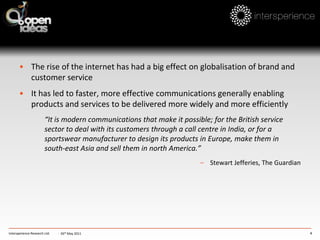
Globalisation has been underway for last couple of hundred yearsType of definition of globalisation we’re taking here:“Globalisation is the more or less simultaneous marketing and sale of identical goods and services around the world.”The Economist, 2009-  26th May 2011Intersperience Research Ltd.
Globalisation affords …Economies of scalee.g. One distribution centre, one call centreControl and consistencyUnification of branding and marketingSearch Engine OptimisationIntersperience Research Ltd.-  26th May 2011
The rise of the internet has had a big effect on globalisation of brand and customer serviceIt has led to faster, more effective communications generally enabling products and services to be delivered more widely and more efficiently“It is modern communications that make it possible; for the British service sector to deal with its customers through a call centre in India, or for a sportswear manufacturer to design its products in Europe, make them in south-east Asia and sell them in north America.”Stewart Jefferies, The GuardianIntersperience Research Ltd.-  26th May 2011
Use of internet also means small, local or ‘virtual’ companies can market their products globally Can create a much larger ‘web footprint’ than their physical size or turnover would suggestIntersperience Research Ltd.Power of internet to sell products and social media to market brand means they can go global easily-  26th May 2011
Intersperience Research Ltd.Do globalised, standardised products and services increase the chance of culture clash?Large corporations, can be serving customers…From different culturesAcross many different parts of the worldWith services located within many different countries and cultures“Culture as a concept is like a fish immersed in water – we do not always appreciate this power until we encounter a different environment… The effect of encountering such differences can be so great that the term ‘culture shock’ is not an exaggeration”(Solomon et al, 2006)-  26th May 2011
Identifies culture across 6 underlying behaviours
Allows measurement and clustering by culture: identifying gapsIntersperience Research Ltd.The Cultural LensShort term/Long term orientationMastery/NurturanceDo people here look to the future/plan ahead? Or are they more attached to the past?Is personal ambition or caring more important?Individualism/Group orientationPower – DistanceAre individual needs prioritised here or is collective wellbeing more important?How hierarchical is the society?NoveltyHigh context/Low contextDo people like to try new things?How ‘direct’ are speech styles?-  26th May 2011
The most highly individualist cluster: marketing needs to target benefits to the individualLow power-distance and so may be more inclined to make use of self-serviceIntersperience Research Ltd.North Sea clustere.g.: The UKLatin clustere.g.: SpainHigh collectivist dimension means strong influence of family in making purchase decisions and choosing how to spend their leisure timeHighest power-distance cluster; probably less willing to use self-service and more importance is likely to be placed on personal service-  26th May 2011
Intersperience Research Ltd.So far we have seenGlobalisation of products and services is a key trendThis means that marketers want to standardise products and servicesThis may lead to culture clashHowever, an opposing key trend is personalisation…-  26th May 2011
There is also an increasing demand for services to be personalised and tailored to the individualScope for internet and mobile to offer one-to-one marketing and personalised service encountersLocation based services also tap into this trendIntersperience Research Ltd.Need for messages to mobile to be tailoredSemantic web (3.0) to allow more tailoring-  26th May 2011
Intersperience Research Ltd.There has been a huge rise in the use of mobile internet (whether by smartphone, laptop or tablet)24% of the UK population regularly use mobile internetQ: How has your use of the following changed in the last 3 years?Deloitte (Sep 2009) Intersperience Digital Selves research (2011)-  26th May 2011
Intersperience Research Ltd.Internet can be consumed where and when you want: global access from anywhere, at any time, in any situation“The mapping between activities and places will dissolve, and everyplace will be for everything all the time.”Aigre, 2001
Does this increase the chance of culture clash?Intersperience Digital Selves research 2011-  26th May 2011
There can be a lot of factors affecting the context in which marketing messages and services are consumedThese will operate to different extents in different individuals in different contextsThese three affect satisfaction with service mostThese have around a 16% stronger effect than age, gender etc.1Intersperience Research Ltd.Physical surroundingsWhere you are and what’s going on around you – sights, sounds, smellsSocial surroundingsWho else is with you? Who are you dealing with?Temporal perspectiveTime or perception of timeTask definitionWhat you are trying to do and whyAntecedent stateMood etcAfter Belk (1975:159) Intersperience Experience Laboratory ‘Experiential Segmentation’  (2007)-  26th May 2011
Intersperience Research Ltd.In summary….-  26th May 2011

Global Reach Local Scale

  • 1.
    Global ReachLocal ScaleIntersperienceResearch Ltd.Open IdeasMay 2011
  • 2.
    Globalisation has beenunderway for last couple of hundred yearsType of definition of globalisation we’re taking here:“Globalisation is the more or less simultaneous marketing and sale of identical goods and services around the world.”The Economist, 2009- 26th May 2011Intersperience Research Ltd.
  • 3.
    Globalisation affords …Economiesof scalee.g. One distribution centre, one call centreControl and consistencyUnification of branding and marketingSearch Engine OptimisationIntersperience Research Ltd.- 26th May 2011
  • 4.
    The rise ofthe internet has had a big effect on globalisation of brand and customer serviceIt has led to faster, more effective communications generally enabling products and services to be delivered more widely and more efficiently“It is modern communications that make it possible; for the British service sector to deal with its customers through a call centre in India, or for a sportswear manufacturer to design its products in Europe, make them in south-east Asia and sell them in north America.”Stewart Jefferies, The GuardianIntersperience Research Ltd.- 26th May 2011
  • 5.
    Use of internetalso means small, local or ‘virtual’ companies can market their products globally Can create a much larger ‘web footprint’ than their physical size or turnover would suggestIntersperience Research Ltd.Power of internet to sell products and social media to market brand means they can go global easily- 26th May 2011
  • 6.
    Intersperience Research Ltd.Doglobalised, standardised products and services increase the chance of culture clash?Large corporations, can be serving customers…From different culturesAcross many different parts of the worldWith services located within many different countries and cultures“Culture as a concept is like a fish immersed in water – we do not always appreciate this power until we encounter a different environment… The effect of encountering such differences can be so great that the term ‘culture shock’ is not an exaggeration”(Solomon et al, 2006)- 26th May 2011
  • 7.
    Identifies culture across6 underlying behaviours
  • 8.
    Allows measurement andclustering by culture: identifying gapsIntersperience Research Ltd.The Cultural LensShort term/Long term orientationMastery/NurturanceDo people here look to the future/plan ahead? Or are they more attached to the past?Is personal ambition or caring more important?Individualism/Group orientationPower – DistanceAre individual needs prioritised here or is collective wellbeing more important?How hierarchical is the society?NoveltyHigh context/Low contextDo people like to try new things?How ‘direct’ are speech styles?- 26th May 2011
  • 9.
    The most highlyindividualist cluster: marketing needs to target benefits to the individualLow power-distance and so may be more inclined to make use of self-serviceIntersperience Research Ltd.North Sea clustere.g.: The UKLatin clustere.g.: SpainHigh collectivist dimension means strong influence of family in making purchase decisions and choosing how to spend their leisure timeHighest power-distance cluster; probably less willing to use self-service and more importance is likely to be placed on personal service- 26th May 2011
  • 10.
    Intersperience Research Ltd.Sofar we have seenGlobalisation of products and services is a key trendThis means that marketers want to standardise products and servicesThis may lead to culture clashHowever, an opposing key trend is personalisation…- 26th May 2011
  • 11.
    There is alsoan increasing demand for services to be personalised and tailored to the individualScope for internet and mobile to offer one-to-one marketing and personalised service encountersLocation based services also tap into this trendIntersperience Research Ltd.Need for messages to mobile to be tailoredSemantic web (3.0) to allow more tailoring- 26th May 2011
  • 12.
    Intersperience Research Ltd.Therehas been a huge rise in the use of mobile internet (whether by smartphone, laptop or tablet)24% of the UK population regularly use mobile internetQ: How has your use of the following changed in the last 3 years?Deloitte (Sep 2009) Intersperience Digital Selves research (2011)- 26th May 2011
  • 13.
    Intersperience Research Ltd.Internetcan be consumed where and when you want: global access from anywhere, at any time, in any situation“The mapping between activities and places will dissolve, and everyplace will be for everything all the time.”Aigre, 2001
  • 14.
    Does this increasethe chance of culture clash?Intersperience Digital Selves research 2011- 26th May 2011
  • 15.
    There can bea lot of factors affecting the context in which marketing messages and services are consumedThese will operate to different extents in different individuals in different contextsThese three affect satisfaction with service mostThese have around a 16% stronger effect than age, gender etc.1Intersperience Research Ltd.Physical surroundingsWhere you are and what’s going on around you – sights, sounds, smellsSocial surroundingsWho else is with you? Who are you dealing with?Temporal perspectiveTime or perception of timeTask definitionWhat you are trying to do and whyAntecedent stateMood etcAfter Belk (1975:159) Intersperience Experience Laboratory ‘Experiential Segmentation’ (2007)- 26th May 2011
  • 16.
    Intersperience Research Ltd.Insummary….- 26th May 2011