Global Plastics
Value Chain
Products Journey from Raw
Materials to End of Life
Source: PRI Association
Overview of Global Plastics Value Chain
Overview of the Global
Plastics Value Chain
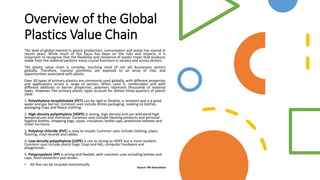
The level of global interest in plastic production, consumption and waste has soared in
recent years. While much of this focus has been on the risks and impacts, it is
important to recognise that the flexibility and resilience of plastic mean that products
made from the material perform many crucial functions in society and across sectors.
The plastic value chain is complex, touching most (if not all) businesses sectors
globally. Therefore, investor portfolios are exposed to an array of risks and
opportunities associated with plastic.
Over 30 types of primary plastics are commonly used globally, with different properties
and applications across a range of sectors. When used in combination and with
different additives or barrier properties, polymers represent thousands of material
types. However, five primary plastic types account for almost three-quarters of plastic
used:
1. Polyethylene terephthalate (PET) can be rigid or flexible, is resistant and is a good
water and gas barrier. Common uses include drinks packaging, cooking oil bottles,
packaging trays and fleece clothing.
2. High-density polyethylene (HDPE) is strong, high density and can withstand high
temperatures and chemicals. Common uses include cleaning products and personal
hygiene bottles, shopping bags, pipes, insulation, bottle caps, protective helmets and
street furniture.
3. Polyvinyl chloride (PVC) is easy to mould. Common uses include clothing, pipes,
flooring, vinyl records and cables.
4. Low-density polyethylene (LDPE) is not as strong as HDPE but is more resilient.
Common uses include plastic bags, trays and lids, computer hardware and
playgrounds.
5. Polypropylene (PP) is strong and flexible, with common uses including bottles and
caps, food containers and straws.
• All five can be recycled mechanically
Source: PRI Association
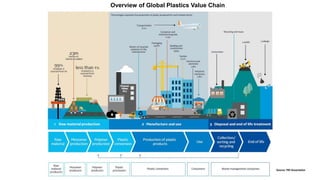
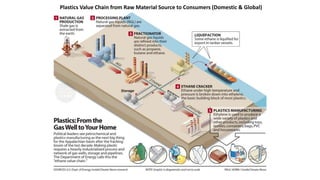
Plastics Value Chain from Raw Material Source to Consumers (Domestic & Global)
Plastic Losses to
Environment
from Global
Plastics Value
Chain
• Plastics have become one of the most ubiquitous materials used globally, and their production has
on average increased by about 9% per year since 1950.
• Global plastics production was about 388 million tonnes (Mt) in 2015. Moreover, the plastic
industry is a major economic actor with estimated revenue of about 1,722 billion Euros in 2015,
corresponding to about 3% of the global economy.
• The issue of plastics ending up in the oceans and harming marine lifeforms has been known since
the 1970s.
• Research focusing on the impacts and exposure of organisms to marine micro- and macro plastics
has been ongoing for years.
• However, studies linking the processes in the plastic value chain to plastics being emitted to the
oceans are only starting to emerge.
• This has given some information on the losses of plastics from mismanaged waste and littering in
the coastal area, and on losses of microplastics along the global plastics value chain.
• To reduce losses and potential impacts of plastics on the marine environment, it was therefore
recommended to prioritize:
• i) Focus on reducing loss of macro plastics from MSW, in particular plastic packaging. Initiatives
should not be limited to the end-of-life stage; instead measures for reducing potential plastic
losses at the end-of-life stage should be implemented along the entire plastic value chain.
Particular focus should be on regions where the largest losses occur, i.e. Africa, Latin America
and the Caribbean, and the Middle East
• ii) Focus on reducing microplastics losses from use of consumer-related applications. Initiatives
should not be limited to the use stage; instead, measures for reducing potential plastic losses
during the use stage should be implemented along the entire plastic value chain. Particular
focus on the regions North America, China, Asia (excluding Japan, India, and China), and
Western Europe which are responsible for the majority of microplastic losses
• iii) Focus on reducing direct plastic losses from marine activities (e.g. fishing, aquaculture, etc.).
• iv) Focus on reducing losses of plastics that have been identified to pose a hazardous risk to
marine organisms
• Source: UN Environment Programme

Global Plastics Value Chain digital artifact

  • 1.
    Global Plastics Value Chain ProductsJourney from Raw Materials to End of Life
  • 2.
    Source: PRI Association Overviewof Global Plastics Value Chain
  • 3.
    Overview of theGlobal Plastics Value Chain The level of global interest in plastic production, consumption and waste has soared in recent years. While much of this focus has been on the risks and impacts, it is important to recognise that the flexibility and resilience of plastic mean that products made from the material perform many crucial functions in society and across sectors. The plastic value chain is complex, touching most (if not all) businesses sectors globally. Therefore, investor portfolios are exposed to an array of risks and opportunities associated with plastic. Over 30 types of primary plastics are commonly used globally, with different properties and applications across a range of sectors. When used in combination and with different additives or barrier properties, polymers represent thousands of material types. However, five primary plastic types account for almost three-quarters of plastic used: 1. Polyethylene terephthalate (PET) can be rigid or flexible, is resistant and is a good water and gas barrier. Common uses include drinks packaging, cooking oil bottles, packaging trays and fleece clothing. 2. High-density polyethylene (HDPE) is strong, high density and can withstand high temperatures and chemicals. Common uses include cleaning products and personal hygiene bottles, shopping bags, pipes, insulation, bottle caps, protective helmets and street furniture. 3. Polyvinyl chloride (PVC) is easy to mould. Common uses include clothing, pipes, flooring, vinyl records and cables. 4. Low-density polyethylene (LDPE) is not as strong as HDPE but is more resilient. Common uses include plastic bags, trays and lids, computer hardware and playgrounds. 5. Polypropylene (PP) is strong and flexible, with common uses including bottles and caps, food containers and straws. • All five can be recycled mechanically Source: PRI Association
  • 5.
    Plastics Value Chainfrom Raw Material Source to Consumers (Domestic & Global)
  • 6.
    Plastic Losses to Environment fromGlobal Plastics Value Chain • Plastics have become one of the most ubiquitous materials used globally, and their production has on average increased by about 9% per year since 1950. • Global plastics production was about 388 million tonnes (Mt) in 2015. Moreover, the plastic industry is a major economic actor with estimated revenue of about 1,722 billion Euros in 2015, corresponding to about 3% of the global economy. • The issue of plastics ending up in the oceans and harming marine lifeforms has been known since the 1970s. • Research focusing on the impacts and exposure of organisms to marine micro- and macro plastics has been ongoing for years. • However, studies linking the processes in the plastic value chain to plastics being emitted to the oceans are only starting to emerge. • This has given some information on the losses of plastics from mismanaged waste and littering in the coastal area, and on losses of microplastics along the global plastics value chain. • To reduce losses and potential impacts of plastics on the marine environment, it was therefore recommended to prioritize: • i) Focus on reducing loss of macro plastics from MSW, in particular plastic packaging. Initiatives should not be limited to the end-of-life stage; instead measures for reducing potential plastic losses at the end-of-life stage should be implemented along the entire plastic value chain. Particular focus should be on regions where the largest losses occur, i.e. Africa, Latin America and the Caribbean, and the Middle East • ii) Focus on reducing microplastics losses from use of consumer-related applications. Initiatives should not be limited to the use stage; instead, measures for reducing potential plastic losses during the use stage should be implemented along the entire plastic value chain. Particular focus on the regions North America, China, Asia (excluding Japan, India, and China), and Western Europe which are responsible for the majority of microplastic losses • iii) Focus on reducing direct plastic losses from marine activities (e.g. fishing, aquaculture, etc.). • iv) Focus on reducing losses of plastics that have been identified to pose a hazardous risk to marine organisms • Source: UN Environment Programme