COURSE: GLOBAL STUDIES II
YEAR: 2015
University of South East- Asia
1
Chapter 1: CONCEPTS OF
CULTURE
UNIT 2: COMPONENTS OF SYMBOLIC
CULTURE
Components of SYMBOLIC
CULTURE
Terminology:
 symbolic culture
another term for nonmaterial
culture
 symbol
something to which people
attach meanings and then use
to communicate with others
3
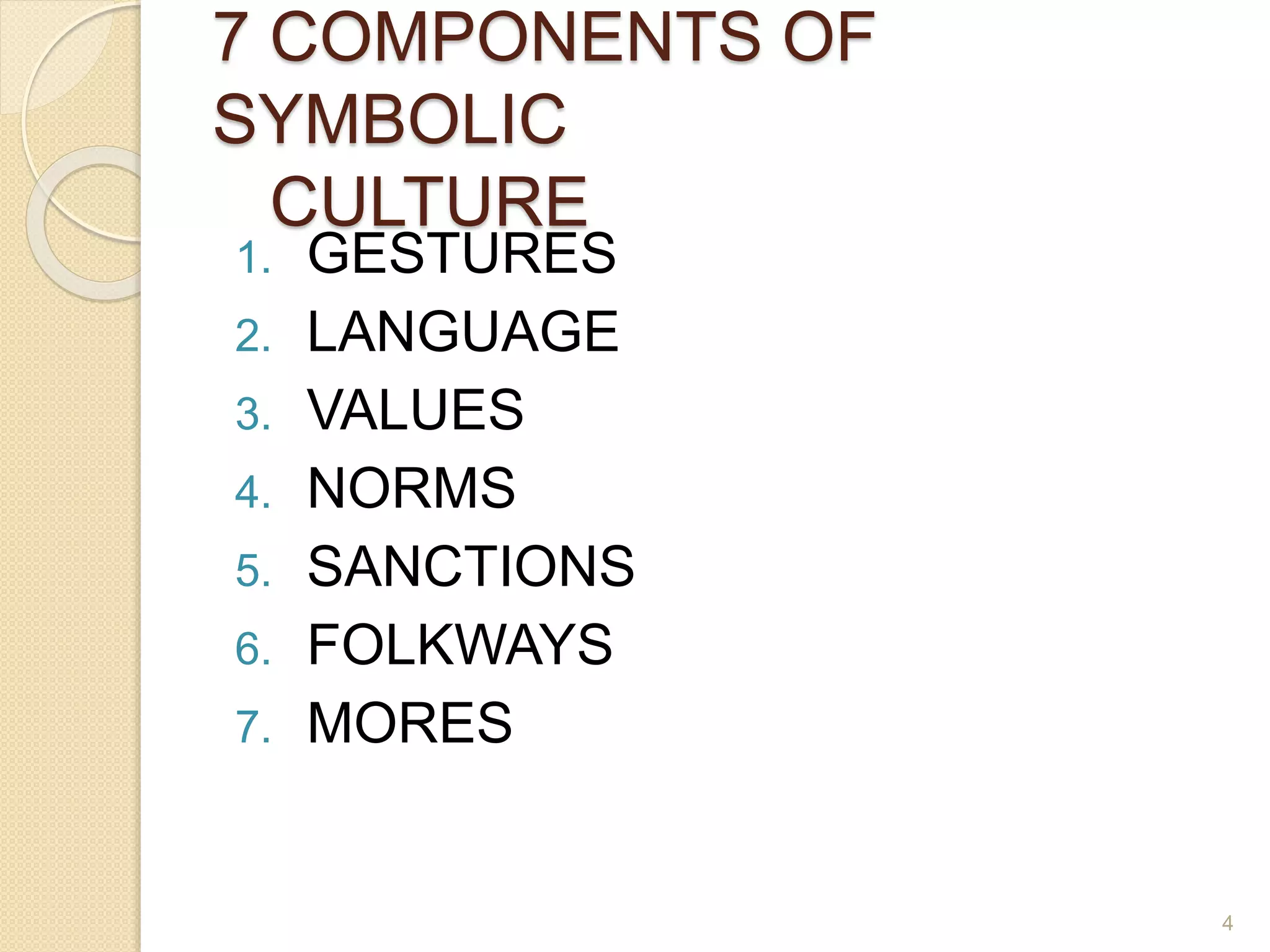
7 COMPONENTS OF
SYMBOLIC
CULTURE
1. GESTURES
2. LANGUAGE
3. VALUES
4. NORMS
5. SANCTIONS
6. FOLKWAYS
7. MORES
4
1. GESTURES
 The ways in which people use their
bodies to communicate with one
another.
 Gestures can differ in meanings
around the world.
 It is important to learn the gestures of
another culture if you want to get
along fine with that culture.
 Some fundamental emotions are
inborn 5
2. LANGUAGE
 A system of symbols that can be
combined in an infinite number of
ways and can represent not only
objects but also abstract thoughts.
 The primary way in which people
communicate with one another.
 This separates humans from animals
in terms of communication
6
Some properties of language
 Language allows human experience to
be cumulative
 Language provides a social or shared
past
 Language provides a social or shared
future
 Language allows shared perspectives or
understandings
 Language allows complex, shared, goal-
directed behavior 7
3. VALUES
 The standards by which people define
what is desirable or undesirable, good
or bad, beautiful or ugly
 Values underlie our preferences, guide
our choices, and indicate what we
hold worthwhile
8
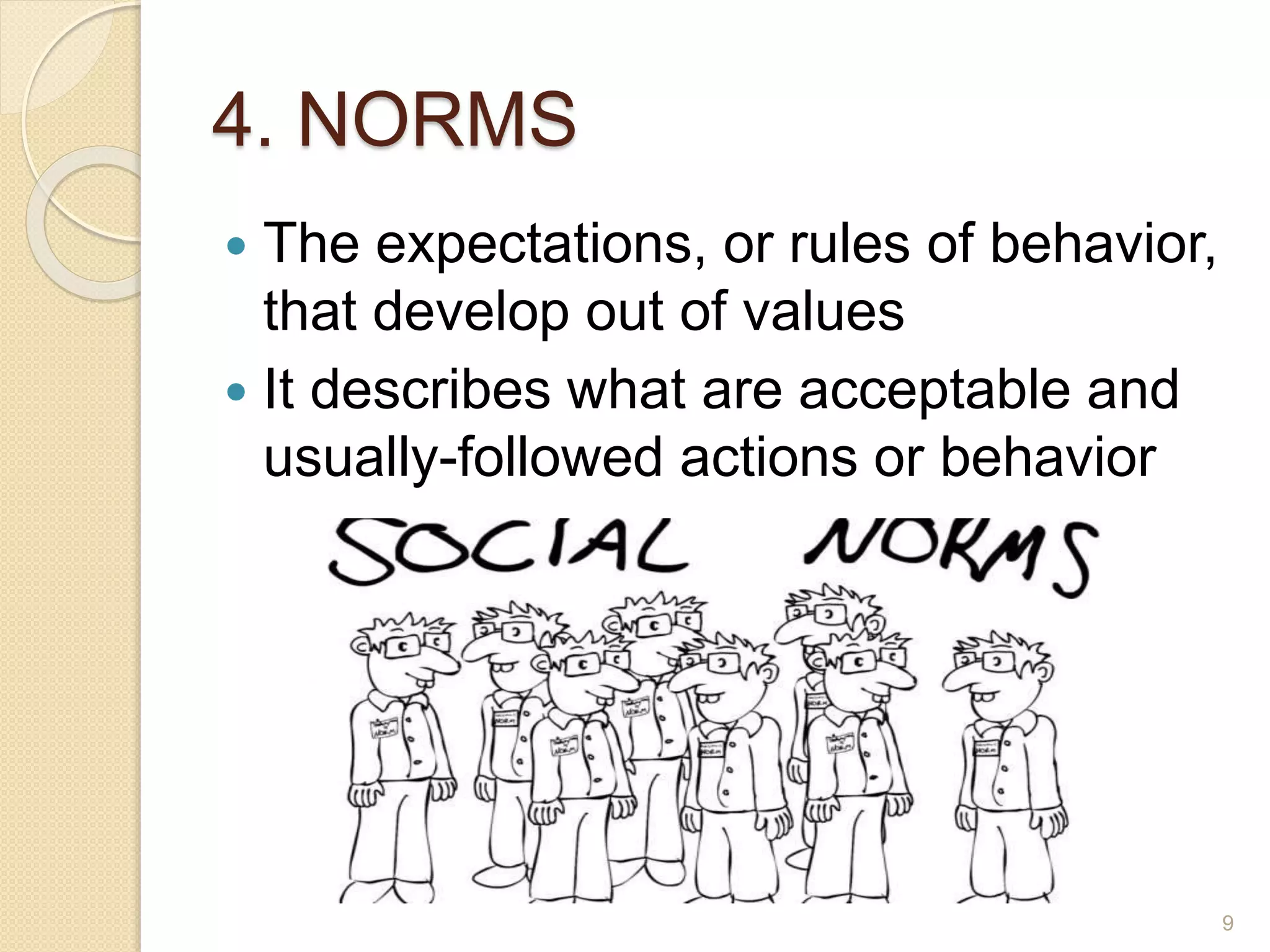
4. NORMS
 The expectations, or rules of behavior,
that develop out of values
 It describes what are acceptable and
usually-followed actions or behavior
9
5. SANCTIONS
 An expression of approval or
disapproval given to people for
upholding or violating norms
 Positive or negative reactions to the
ways in which people follow norms
There are two types of sanctions;
1) Positive sanction
2) Negative sanction
10
 Positive sanction
a reward given for following norms,
ranging from a smile to a prize
 Negative sanction
an expression of disapproval for
breaking a norm, ranging from a mild,
informal reaction such as a frown to a
formal prison sentence or an
execution 11
6. FOLKWAYS
 Norms that are not strictly enforced
 These are the actions that we can
allow to occur
 Examples:
People picking their nose in public
Spitting on the street
12
7. MORES
 Norms that are strictly enforced
because they are thought essential to
core values.
Examples of mores:
Societies do not accept or do not take
lightly on:
 A person who steals, rapes, and kills
13
Folkways vs. Mores
“ A man who walks down a street wearing
nothing on the upper half of his body is
violating a folkway; a man who walks
down the street wearing nothing on the
lower part of his body is violating one of
our most important mores, the
requirement that people cover their
private parts in public.’
Ian Robertson (1987)
sociologist
14
 TABOO
a norm so strong that it brings
revulsion if violated
Examples:
Eating human flesh
Having sexual relationship with own
parents
15

Global 3 chapter 1 unit 2

  • 1.
    COURSE: GLOBAL STUDIESII YEAR: 2015 University of South East- Asia 1
  • 2.
    Chapter 1: CONCEPTSOF CULTURE UNIT 2: COMPONENTS OF SYMBOLIC CULTURE
  • 3.
    Components of SYMBOLIC CULTURE Terminology: symbolic culture another term for nonmaterial culture  symbol something to which people attach meanings and then use to communicate with others 3
  • 4.
    7 COMPONENTS OF SYMBOLIC CULTURE 1.GESTURES 2. LANGUAGE 3. VALUES 4. NORMS 5. SANCTIONS 6. FOLKWAYS 7. MORES 4
  • 5.
    1. GESTURES  Theways in which people use their bodies to communicate with one another.  Gestures can differ in meanings around the world.  It is important to learn the gestures of another culture if you want to get along fine with that culture.  Some fundamental emotions are inborn 5
  • 6.
    2. LANGUAGE  Asystem of symbols that can be combined in an infinite number of ways and can represent not only objects but also abstract thoughts.  The primary way in which people communicate with one another.  This separates humans from animals in terms of communication 6
  • 7.
    Some properties oflanguage  Language allows human experience to be cumulative  Language provides a social or shared past  Language provides a social or shared future  Language allows shared perspectives or understandings  Language allows complex, shared, goal- directed behavior 7
  • 8.
    3. VALUES  Thestandards by which people define what is desirable or undesirable, good or bad, beautiful or ugly  Values underlie our preferences, guide our choices, and indicate what we hold worthwhile 8
  • 9.
    4. NORMS  Theexpectations, or rules of behavior, that develop out of values  It describes what are acceptable and usually-followed actions or behavior 9
  • 10.
    5. SANCTIONS  Anexpression of approval or disapproval given to people for upholding or violating norms  Positive or negative reactions to the ways in which people follow norms There are two types of sanctions; 1) Positive sanction 2) Negative sanction 10
  • 11.
     Positive sanction areward given for following norms, ranging from a smile to a prize  Negative sanction an expression of disapproval for breaking a norm, ranging from a mild, informal reaction such as a frown to a formal prison sentence or an execution 11
  • 12.
    6. FOLKWAYS  Normsthat are not strictly enforced  These are the actions that we can allow to occur  Examples: People picking their nose in public Spitting on the street 12
  • 13.
    7. MORES  Normsthat are strictly enforced because they are thought essential to core values. Examples of mores: Societies do not accept or do not take lightly on:  A person who steals, rapes, and kills 13
  • 14.
    Folkways vs. Mores “A man who walks down a street wearing nothing on the upper half of his body is violating a folkway; a man who walks down the street wearing nothing on the lower part of his body is violating one of our most important mores, the requirement that people cover their private parts in public.’ Ian Robertson (1987) sociologist 14
  • 15.
     TABOO a normso strong that it brings revulsion if violated Examples: Eating human flesh Having sexual relationship with own parents 15