MSINGM99 Global Research Project, Consultancy Project Report, Evelina Georgieva and Liliya Pencheva
1
C ON SU LTA NCY PRO J EC T REPO R T
The London Export Plan
GREATER LONDON AUTHORITY
JULY 2015
EVELINA GEORGIEVA LILIYA PENCHEVA
MSINGM99 Global Research Project, Consultancy Project Report, Evelina Georgieva and Liliya Pencheva
2
Executive Summary
This report summarizes the main approach and steps taken during the consultancy process on
the London Export Plan. The latter is a strategic initiative, undertaken by the Mayor of
London and the Greater London Authority, seeking to enhance London’s small and medium
enterprises’ capacity and potential to expand globally.
The report summarizes the main task and objectives, including the ultimate goal of reaching
out to London SMEs and learning about their exporting experiences. Further, GLA’s
organizational characteristics and our roles and position within the project team are described.
Finally, four essential recommendations regarding the London Export Plan are presented,
followed by a clarification of the international aspect of the project: inherently global.
MSINGM99 Global Research Project, Consultancy Project Report, Evelina Georgieva and Liliya Pencheva
3
Table of Contents
1. BACKGROUND............................................................................................................ 4
1.1 UK Exports and London’s Key Role.................................................................. 4
1.2 Description of the Consultancy Task and Objectives ....................................... 4
1.3 The Greater London Authority......................................................................... 6
1.4 GLA Economic & Business Policy Unit and Our Roles...................................... 6
1.5 Team Positioning within the GLA Structure .....................................................7
2. CONSULTANCY PROCESS...................................................................................... 8
2.1 Preliminary Research Stage............................................................................. 8
2.2 Qualitative Market Assessment ...................................................................... 9
2.3 Evaluation of the Mayor’s Trade Missions.......................................................10
2.4 Research on Other UK “Core Cities” Export Support......................................10
2.5 Presentations .................................................................................................10
3. RECOMMENDATIONS.............................................................................................11
4. INTERNATIONAL DIMENSION.............................................................................12
BIBLIOGRAPHY..............................................................................................................13
APPENDIX .......................................................................................................................14
MSINGM99 Global Research Project, Consultancy Project Report, Evelina Georgieva and Liliya Pencheva
4
1. BACKGROUND
1.1 UK Exports and London’s Key Role
After the 2008 Global financial crisis economic recovery has been a top UK government
priority. Expansion into international markets has been identified as a key element of the
reclamation process and the ambitious goal to double national exports by 2020 has been set
(UKTI, 2014).
Recent research on UK national exports (Theseira, 2014) has identified that London accounts
for about half of the total UK services exports. As global trends indicate that services are the
major export growth driver, London is expected to keep its key role in UK’s export progress.
1.2 Description of the Consultancy Task and Objectives
Various public and private organizations have been striving to assist UK businesses in their
global expansion ambitions, yet the latest export data (GLA Economics, 2014) fails to meet
the expectations. Considering London’s key export role in the UK, the Mayor of London has
decided on a city-based approach on export support to better utilize the capital’s potential.
The London Export Plan, a strategic initiative relying on public-private sector collaboration,
has been designed for this purpose. The plan is jointly developed by The Greater London
Authority (GLA), London & Partners (L&P), London First and UK Trade & Investment
(UKTI), with the assistance of The Brookings Institution and J.P. Morgan.
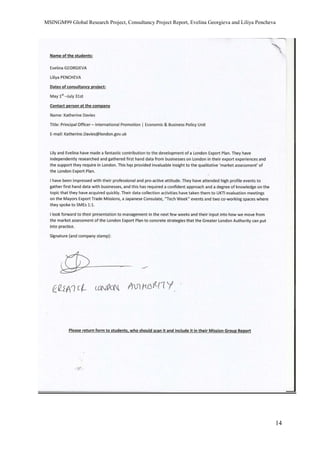
Our consulting role fit within the GLA core project team working on the Export Plan.
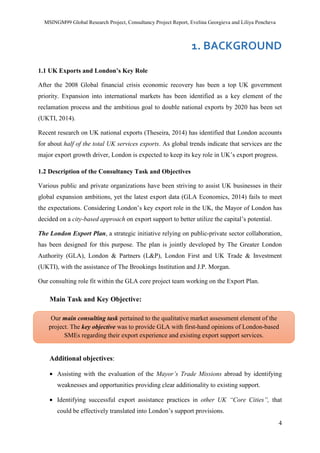
Main Task and Key Objective:
Additional objectives:
• Assisting with the evaluation of the Mayor’s Trade Missions abroad by identifying
weaknesses and opportunities providing clear additionality to existing support.
• Identifying successful export assistance practices in other UK “Core Cities”, that
could be effectively translated into London’s support provisions.
Our main consulting task pertained to the qualitative market assessment element of the
project. The key objective was to provide GLA with first-hand opinions of London-based
SMEs regarding their export experience and existing export support services.
MSINGM99 Global Research Project, Consultancy Project Report, Evelina Georgieva and Liliya Pencheva
5
1.3 The Greater London Authority
The GLA, run by the Mayor and the London Assembly, is a top tier administrative body,
responsible for planning and development, policymaking, budgeting, transport (GLA, 2015).
Being a public sector organization, the forces affecting the GLA are materially different from
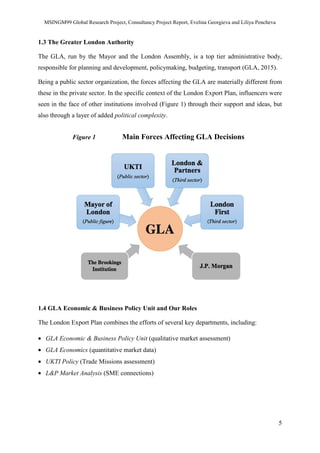
these in the private sector. In the specific context of the London Export Plan, influencers were
seen in the face of other institutions involved (Figure 1) through their support and ideas, but
also through a layer of added political complexity.
Figure 1 Main Forces Affecting GLA Decisions
1.4 GLA Economic & Business Policy Unit and Our Roles
The London Export Plan combines the efforts of several key departments, including:
• GLA Economic & Business Policy Unit (qualitative market assessment)
• GLA Economics (quantitative market data)
• UKTI Policy (Trade Missions assessment)
• L&P Market Analysis (SME connections)
MSINGM99 Global Research Project, Consultancy Project Report, Evelina Georgieva and Liliya Pencheva
6
The GLA Economic & Business Policy Unit is responsible for developing and implementing
strategic economic policies and projects. The London Export Plan, part of the wider
Economic Development Strategy (Mayor of London, 2010), is an excellent example.
Both of us were assigned the role of “Market Researcher” during the consultancy process.
However, we adopted separate informal roles – Liliya Pencheva was involved in the market
assessment instrument development and the research of other UK “Core Cities“, while
Evelina Georgieva participated in the evaluation of the Mayor’s Trade Missions. Further, both
members were involved in the preliminary research and the qualitative market data gathering.
1.5 Team Positioning within the GLA Structure
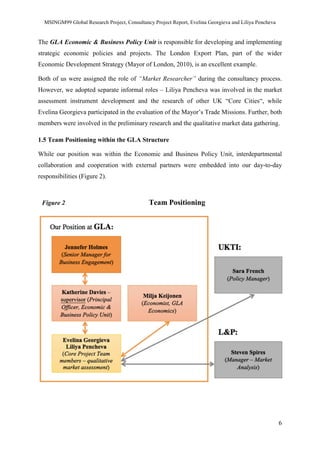
While our position was within the Economic and Business Policy Unit, interdepartmental
collaboration and cooperation with external partners were embedded into our day-to-day
responsibilities (Figure 2).
Figure 2 Team Positioning
MSINGM99 Global Research Project, Consultancy Project Report, Evelina Georgieva and Liliya Pencheva
7
2. CONSULTANCY PROCESS
The consultancy process we followed was highly structured and adhered to the key required
deliverables. We were delegated the decisions on the organization and aligned our timeline
with the Principal Project Officer Katherine Davies; one of the main products of our project –
the presentation for Ms Davies’ appearance at the Global Cities Initiative Conference
(GCI Salt Lake City, 20-22 July 2015), had to be completed by the time of her participation.
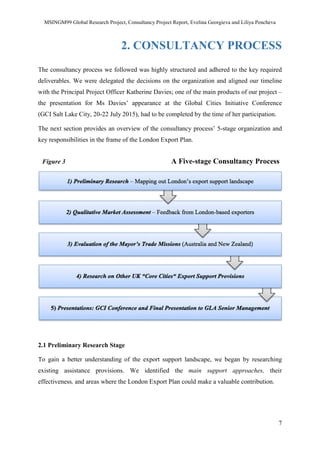
The next section provides an overview of the consultancy process’ 5-stage organization and
key responsibilities in the frame of the London Export Plan.
Figure 3 A Five-stage Consultancy Process
2.1 Preliminary Research Stage
To gain a better understanding of the export support landscape, we began by researching
existing assistance provisions. We identified the main support approaches, their
effectiveness, and areas where the London Export Plan could make a valuable contribution.
MSINGM99 Global Research Project, Consultancy Project Report, Evelina Georgieva and Liliya Pencheva
8
The existing research grounded the main issues that current and prospective London-based
exporters face and directed our market assessment questionnaire. Appendix A provides an
overview of the main UK/London-based institutions and the nature of the support provisions.
2.2 Qualitative Market Assessment
The core element of our consultancy task involved examination of the attitudes and opinions
of London-based SMEs that already export, those that have considered exporting but haven’t
started the internationalization process, and those who perceive export as an unviable
expansion option. This placed a particularly strong focus on London’s high growth, service-
oriented sectors: technology, life sciences and the financial industry (Theseira, 2014).
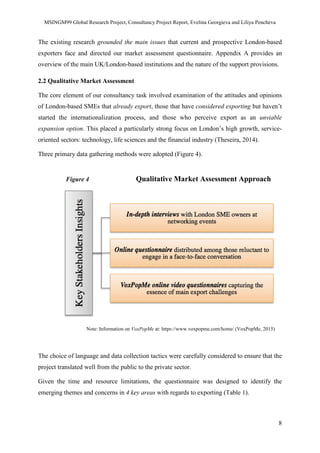
Three primary data gathering methods were adopted (Figure 4).
Figure 4 Qualitative Market Assessment Approach
Note: Information on VoxPopMe at: https://www.voxpopme.com/home/ (VoxPopMe, 2015)
The choice of language and data collection tactics were carefully considered to ensure that the
project translated well from the public to the private sector.
Given the time and resource limitations, the questionnaire was designed to identify the
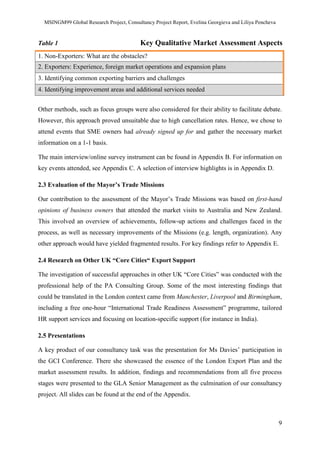
emerging themes and concerns in 4 key areas with regards to exporting (Table 1).
MSINGM99 Global Research Project, Consultancy Project Report, Evelina Georgieva and Liliya Pencheva
9
Table 1 Key Qualitative Market Assessment Aspects
1. Non-Exporters: What are the obstacles?
2. Exporters: Experience, foreign market operations and expansion plans
3. Identifying common exporting barriers and challenges
4. Identifying improvement areas and additional services needed
Other methods, such as focus groups were also considered for their ability to facilitate debate.
However, this approach proved unsuitable due to high cancellation rates. Hence, we chose to
attend events that SME owners had already signed up for and gather the necessary market
information on a 1-1 basis.
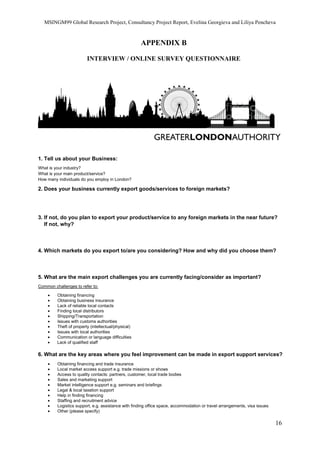
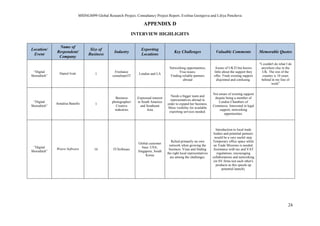
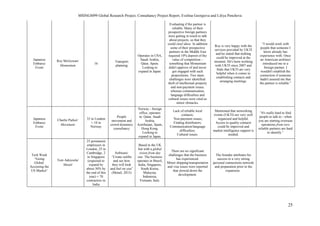
The main interview/online survey instrument can be found in Appendix B. For information on
key events attended, see Appendix C. A selection of interview highlights is in Appendix D.
2.3 Evaluation of the Mayor’s Trade Missions
Our contribution to the assessment of the Mayor’s Trade Missions was based on first-hand
opinions of business owners that attended the market visits to Australia and New Zealand.
This involved an overview of achievements, follow-up actions and challenges faced in the
process, as well as necessary improvements of the Missions (e.g. length, organization). Any
other approach would have yielded fragmented results. For key findings refer to Appendix E.
2.4 Research on Other UK “Core Cities“ Export Support
The investigation of successful approaches in other UK “Core Cities” was conducted with the
professional help of the PA Consulting Group. Some of the most interesting findings that
could be translated in the London context came from Manchester, Liverpool and Birmingham,
including a free one-hour “International Trade Readiness Assessment” programme, tailored
HR support services and focusing on location-specific support (for instance in India).
2.5 Presentations
A key product of our consultancy task was the presentation for Ms Davies’ participation in
the GCI Conference. There she showcased the essence of the London Export Plan and the
market assessment results. In addition, findings and recommendations from all five process
stages were presented to the GLA Senior Management as the culmination of our consultancy
project. All slides can be found at the end of the Appendix.
MSINGM99 Global Research Project, Consultancy Project Report, Evelina Georgieva and Liliya Pencheva
10
3. RECOMMENDATIONS
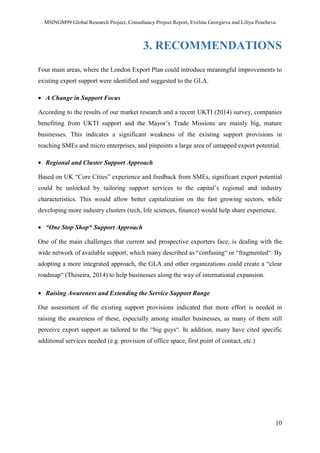
Four main areas, where the London Export Plan could introduce meaningful improvements to
existing export support were identified and suggested to the GLA.
• A Change in Support Focus
According to the results of our market research and a recent UKTI (2014) survey, companies
benefiting from UKTI support and the Mayor’s Trade Missions are mainly big, mature
businesses. This indicates a significant weakness of the existing support provisions in
reaching SMEs and micro enterprises, and pinpoints a large area of untapped export potential.
• Regional and Cluster Support Approach
Based on UK “Core Cities” experience and feedback from SMEs, significant export potential
could be unlocked by tailoring support services to the capital’s regional and industry
characteristics. This would allow better capitalization on the fast growing sectors, while
developing more industry clusters (tech, life sciences, finance) would help share experience.
• “One Stop Shop“ Support Approach
One of the main challenges that current and prospective exporters face, is dealing with the
wide network of available support, which many described as “confusing“ or “fragmented“. By
adopting a more integrated approach, the GLA and other organizations could create a “clear
roadmap“ (Theseira, 2014) to help businesses along the way of international expansion.
• Raising Awareness and Extending the Service Support Range
Our assessment of the existing support provisions indicated that more effort is needed in
raising the awareness of these, especially among smaller businesses, as many of them still
perceive export support as tailored to the “big guys“. In addition, many have cited specific
additional services needed (e.g. provision of office space, first point of contact, etc.)
MSINGM99 Global Research Project, Consultancy Project Report, Evelina Georgieva and Liliya Pencheva
11
4. INTERNATIONAL DIMENSION
The London Export Plan is characterized by its inherently global nature. The city-based
approach, encouraging SMEs to internationalize, is centered around the initiative of building
fruitful international connections and presenting the capital on the Global economic scene.
Being one of the newest members of the Global Cities Initiative network, GLA provided us
with rich access to international contacts to collaborate with. In turn, we had the flexibility of
locating cross-border export assistance knowledge and suggesting new support tactics.
Further global exposure of the London Export Plan could be achieved through following the
example of other big cities, such as Chicago, and collaborating with these in more initiatives
like Chicago’s Entrepreneurial hub 1871 and World Business Chicago.
MSINGM99 Global Research Project, Consultancy Project Report, Evelina Georgieva and Liliya Pencheva
12
BIBLIOGRAPHY
1871. 2015. 1871 and L39 Announce Friendship Agreement [online]. Available at:
http://www.1871.com/pressrelease42314/ [Accessed 20 July 2015]
British Chambers of Commerce. 2015. Trading internationally [online]. Available at:
http://www.britishchambers.org.uk/business/international-trade/ [Accessed 26 July 2015].
GLA Economics. 2014. London Business Survey 2014: Exports. London: Greater London Authority
Greater London Authority. 2015. About GLA Economics [online]. Available at:
https://www.london.gov.uk/priorities/business-economy/publications/about-gla-economics [Accessed 23
July 2015].
Greater London Authority. 2015. Greater London Authority [online]. Available at:
https://www.london.gov.uk/mayor-assembly/gla [Accessed 23 July 2015].
London and Partners. 2015. London & Partners - The Official Promotional Company for London [online].
Available at: http://www.londonandpartners.com [Accessed 26 July 2015].
London Technology Week. 2015. Going Global: Accessing the US Market | London Technology Week [online].
Available at: http://londontechnologyweek.co.uk/2015/05/going-global-accessing-us-market/ [Accessed 22
July 2015].
Mayor of London. 2010. The Mayor’s Economic Development Strategy for London. London: Greater London
Authority
MedCity. 2014. A Partnership - MedCity [online]. Available at: http://www.medcitylondon.com/a-partnership/
[Accessed 26 July 2015].
Tech City UK. 2015. Tech City UK Programmes [online]. Available at:
http://www.techcityuk.com/programmes/ [Accessed 26 Jul. 2015].
The Brookings Institution. 2015. Global Cities Initiative: A Joint Project of Brookings and JPMorgan Chase
[online]. Available at: http://www.brookings.edu/about/projects/global-cities [Accessed 23 July 2015].
Theseira, M. 2014. Trading Places: Maximising London’s Exports Potential. London: Centre for London
UK Government. 2015. 2010 to 2015 government policy: Local Enterprise Partnerships (LEPs) and enterprise
zones [online]. Available at: https://www.gov.uk/government/publications/2010-to-2015-government-
policy-local-enterprise-partnerships-leps-and-enterprise-zones/2010-to-2015-government-policy-local-
enterprise-partnerships-leps-and-enterprise-zones [Accessed 26 July 2015].
UK Trade & Investment. 2014. 2020 Export Drive - GOV.UK [online]. Available at:
https://www.gov.uk/government/publications/2020-export-drive/2020-export-drive [Accessed 14 July
2015].
UK Trade & Investment. 2014. Internationalisation Strategies, Barriers & Awareness Survey 2014. Kent: OMB
Research
VoxPopMe. 2015. Home - VoxPopMe [online]. Available at: https://www.voxpopme.com/home/ [Accessed 23
July 2015].
World Business Chicago. 2015. Who We Are [online]. Available at: http://www.worldbusinesschicago.com/who-
we-are/ [Accessed 20 July 2015]
MSINGM99 Global Research Project, Consultancy Project Report, Evelina Georgieva and Liliya Pencheva
13
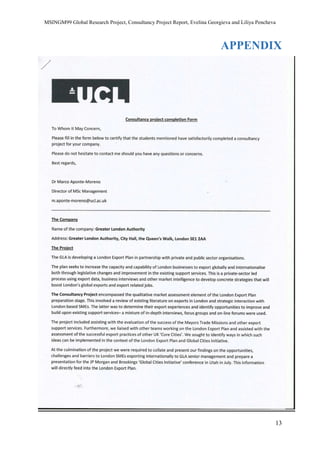
APPENDIX
MSINGM99 Global Research Project, Consultancy Project Report, Evelina Georgieva and Liliya Pencheva
14
MSINGM99 Global Research Project, Consultancy Project Report, Evelina Georgieva and Liliya Pencheva
15
APPENDIX A
EXISTING EXPORT SUPPORT FOR LONDON-BASED BUSINESSES
PUBLIC SERVICES
1. National Level
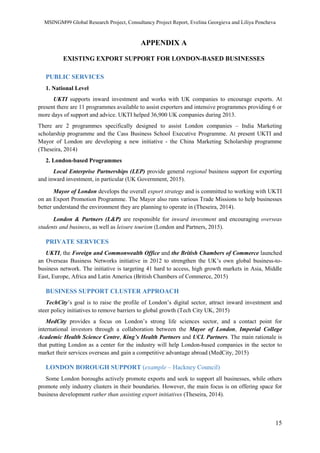
UKTI supports inward investment and works with UK companies to encourage exports. At
present there are 11 programmes available to assist exporters and intensive programmes providing 6 or
more days of support and advice. UKTI helped 36,900 UK companies during 2013.
There are 2 programmes specifically designed to assist London companies – India Marketing
scholarship programme and the Cass Business School Executive Programme. At present UKTI and
Mayor of London are developing a new initiative - the China Marketing Scholarship programme
(Theseira, 2014)
2. London-based Programmes
Local Enterprise Partnerships (LEP) provide general regional business support for exporting
and inward investment, in particular (UK Government, 2015).
Mayor of London develops the overall export strategy and is committed to working with UKTI
on an Export Promotion Programme. The Mayor also runs various Trade Missions to help businesses
better understand the environment they are planning to operate in (Theseira, 2014).
London & Partners (L&P) are responsible for inward investment and encouraging overseas
students and business, as well as leisure tourism (London and Partners, 2015).
PRIVATE SERVICES
UKTI, the Foreign and Commonwealth Office and the British Chambers of Commerce launched
an Overseas Business Networks initiative in 2012 to strengthen the UK’s own global business-to-
business network. The initiative is targeting 41 hard to access, high growth markets in Asia, Middle
East, Europe, Africa and Latin America (British Chambers of Commerce, 2015)
BUSINESS SUPPORT CLUSTER APPROACH
TechCity’s goal is to raise the profile of London’s digital sector, attract inward investment and
steer policy initiatives to remove barriers to global growth (Tech City UK, 2015)
MedCity provides a focus on London’s strong life sciences sector, and a contact point for
international investors through a collaboration between the Mayor of London, Imperial College
Academic Health Science Centre, King’s Health Partners and UCL Partners. The main rationale is
that putting London as a center for the industry will help London-based companies in the sector to
market their services overseas and gain a competitive advantage abroad (MedCity, 2015)
LONDON BOROUGH SUPPORT (example – Hackney Council)
Some London boroughs actively promote exports and seek to support all businesses, while others
promote only industry clusters in their boundaries. However, the main focus is on offering space for
business development rather than assisting export initiatives (Theseira, 2014).
MSINGM99 Global Research Project, Consultancy Project Report, Evelina Georgieva and Liliya Pencheva
16
APPENDIX B
INTERVIEW / ONLINE SURVEY QUESTIONNAIRE
1. Tell us about your Business:
What is your industry?
What is your main product/service?
How many individuals do you employ in London?
2. Does your business currently export goods/services to foreign markets?
3. If not, do you plan to export your product/service to any foreign markets in the near future?
If not, why?
4. Which markets do you export to/are you considering? How and why did you choose them?
5. What are the main export challenges you are currently facing/consider as important?
Common challenges to refer to:
• Obtaining financing
• Obtaining business insurance
• Lack of reliable local contacts
• Finding local distributors
• Shipping/Transportation
• Issues with customs authorities
• Theft of property (intellectual/physical)
• Issues with local authorities
• Communication or language difficulties
• Lack of qualified staff
6. What are the key areas where you feel improvement can be made in export support services?
• Obtaining financing and trade insurance
• Local market access support e.g. trade missions or shows
• Access to quality contacts: partners, customer, local trade bodies
• Sales and marketing support
• Market intelligence support e.g. seminars and briefings
• Legal & local taxation support
• Help in finding financing
• Staffing and recruitment advice
• Logistics support, e.g. assistance with finding office space, accommodation or travel arrangements, visa issues
• Other (please specify)
MSINGM99 Global Research Project, Consultancy Project Report, Evelina Georgieva and Liliya Pencheva
17
APPENDIX C
LIST OF NETWORKING EVENTS
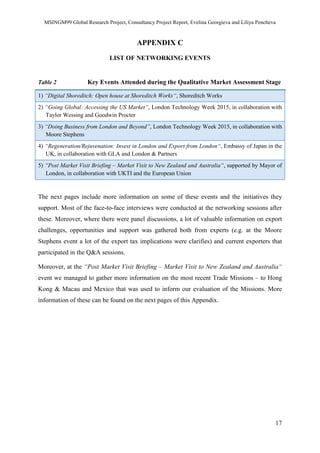
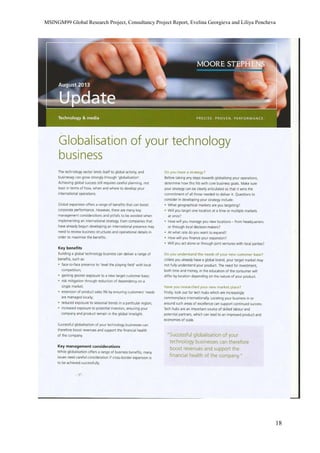
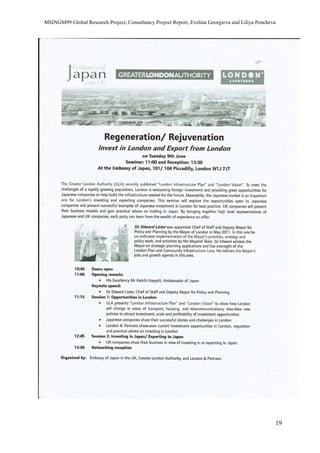
Table 2 Key Events Attended during the Qualitative Market Assessment Stage
1) “Digital Shoreditch: Open house at Shoreditch Works“, Shoreditch Works
2) “Going Global: Accessing the US Market“, London Technology Week 2015, in collaboration with
Taylor Wessing and Goodwin Procter
3) “Doing Business from London and Beyond”, London Technology Week 2015, in collaboration with
Moore Stephens
4) “Regeneration/Rejuvenation: Invest in London and Export from London“, Embassy of Japan in the
UK, in collaboration with GLA and London & Partners
5) “Post Market Visit Briefing – Market Visit to New Zealand and Australia“, supported by Mayor of
London, in collaboration with UKTI and the European Union
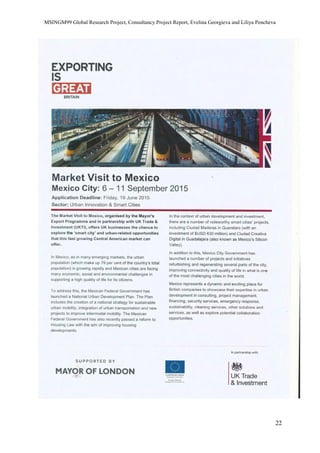
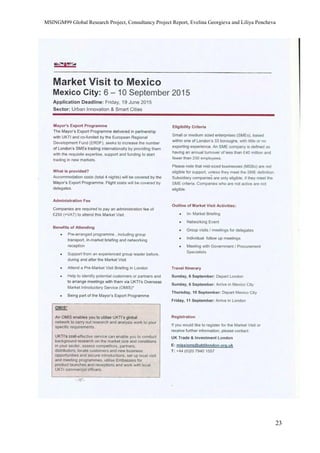
The next pages include more information on some of these events and the initiatives they
support. Most of the face-to-face interviews were conducted at the networking sessions after
these. Moreover, where there were panel discussions, a lot of valuable information on export
challenges, opportunities and support was gathered both from experts (e.g. at the Moore
Stephens event a lot of the export tax implications were clarifies) and current exporters that
participated in the Q&A sessions.
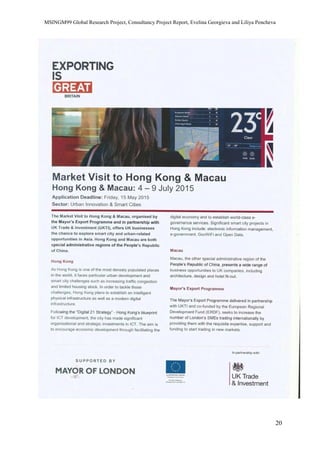
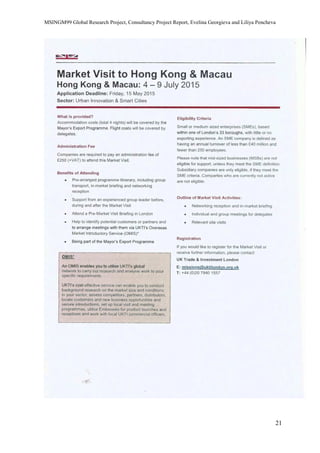
Moreover, at the “Post Market Visit Briefing – Market Visit to New Zealand and Australia“
event we managed to gather more information on the most recent Trade Missions – to Hong
Kong & Macau and Mexico that was used to inform our evaluation of the Missions. More
information of these can be found on the next pages of this Appendix.
MSINGM99 Global Research Project, Consultancy Project Report, Evelina Georgieva and Liliya Pencheva
18
MSINGM99 Global Research Project, Consultancy Project Report, Evelina Georgieva and Liliya Pencheva
19
MSINGM99 Global Research Project, Consultancy Project Report, Evelina Georgieva and Liliya Pencheva
20
MSINGM99 Global Research Project, Consultancy Project Report, Evelina Georgieva and Liliya Pencheva
21
MSINGM99 Global Research Project, Consultancy Project Report, Evelina Georgieva and Liliya Pencheva
22
MSINGM99 Global Research Project, Consultancy Project Report, Evelina Georgieva and Liliya Pencheva
23
MSINGM99 Global Research Project, Consultancy Project Report, Evelina Georgieva and Liliya Pencheva
24
APPENDIX D
INTERVIEW HIGHLIGHTS
Location/
Event
Name of
Respondent/
Company
Size of
Business
Industry
Exporting
Locations
Key Challenges Valuable Comments Memorable Quotes
“Digital
Shoreditch”
Daniel Ivatt 1
Freelance
consultant/IT
London and LA
Networking opportunities;
Visa issues;
Finding reliable partners
abroad
Aware of UKTI but knows
little about the support they
offer. Finds existing support
disjointed and confusing.
"I couldn't do what I do
anywhere else in the
UK. The rest of the
country is 10 years
behind in my line of
work"
“Digital
Shoreditch”
Annalisa Banello 1
Business
photographer/
Creative
industries
Expressed interest
in South America
and Southeast
Asia
Needs a bigger team and
representatives abroad in
order to expand her business.
More visibility for available
exporting services needed.
Not aware of existing support
despite being a member of
London Chambers of
Commerce. Interested in legal
support, networking
opportunities.
“Digital
Shoreditch”
Weave Software 16 IT/Software
Global customer
base: USA,
Singapore, South
Korea
Relied primarily on own
network when growing the
business. Visas and finding
the right local representatives
are among the challenges.
Introduction to local trade
bodies and potential partners
would be a very useful step.
Temporary office space while
on Trade Missions is needed.
Assistance with tax and VAT
regulations, encouraging
collaborations and networking
(in SV firms test each other's
products as this speeds up
potential launch).
MSINGM99 Global Research Project, Consultancy Project Report, Evelina Georgieva and Liliya Pencheva
25
Japanese
Embassy
Event
Roy McGowan/
Momentum
16
Transport
planning
Operates in USA,
Saudi Arabia,
Qatar, Spain.
Looking to
expand in Japan.
Evaluating if the partner is
reliable. Many of their
prospective foreign partners
were getting in touch to talk
about projects, so that they
could steal ideas. In addition
some of their prospective
partners in the Middle East
required 10% deposit of the
value of competition –
something that Momentum
didn't approve of and never
got engaged with such
propositions. Two main
challenges were identified:
theft of intellectual property
and non-payment issues,
whereas communication,
language difficulties and
cultural issues were cited as
minor obstacles.
Roy is very happy with the
services provided by UKTI
and he stated that nothing
could be improved at the
moment. He's been working
with UKTI since 2007 and
finds that UKTI are very
helpful when it comes to
establishing contacts and
arranging meetings.
“I would work with
people that someone I
know already has
experience with. Once
an American architect
introduced me to a
foreign partner. I
wouldn't establish the
connection if someone
hadn't assured me that
the partner is reliable.”
Japanese
Embassy
Event
Charlie Parker/
Movement
35 in London
+ 10 in
Norway
People
movement and
crowd dynamics
consultancy
Norway - foreign
office, operates
in: Qatar, Saudi
Arabia,
Azerbaijan, Spain,
Hong Kong.
Looking to
expand in Japan.
Lack of reliable local
contacts;
Non-payment issues;
Finding distributors;
Communication/language
difficulties;
Cultural issues.
Mentioned that networking
events (UKTI) are very well
organized and helpful.
Access to quality contacts
could be improved and
market intelligence support is
needed.
“It's really hard to find
people to talk to - when
you are starting overseas
operations from zero
reliable partners are hard
to identify.”
Tech Week
“Going
Global:
Accessing the
US Market“
Tom Adeyoola/
Metail
25 permanent
employees in
London, 25 in
Cambridge, 2
in Singapore
(expected to
expand by
about 30% by
the end of this
year) + 70
contractors in
India
Software/
”Create outfits
and see how
they will look
and feel on you”
(Metail, 2015)
Based in the UK
but with a global
vision from day
one. The business
operates in Brazil,
India, Singapore,
South Korea,
Malaysia,
Indonesia,
Vietnam, Italy.
There are no significant
challenges that the business
has experienced.
Minor shipping/transportation
and visa issues were reported
that slowed down the
development.
The founder attributes his
success to a very strong
personal connections network
and preparation prior to the
expansion.
MSINGM99 Global Research Project, Consultancy Project Report, Evelina Georgieva and Liliya Pencheva
26
APPENDIX E
MAYOR’S TRADE MISSIONS EVALUATION – KEY FINDINGS
1) Meetings with local partners should be organized on a 1-1 basis, otherwise not everyone
gets the chance to share their views and convey important information on their business.
2) Trade missions were very helpful at providing contacts in the explored locations; a few
of the participants stated that the best part was "connection/relationship establishment".
3) Establishing one contact helps building a whole network, following up is
important and local organizations should be involved in the process.
4) Everyone agreed that partnering with locals is "the way in" – for example one of the
business owners realized that the procurement process in New Zealand was much faster
than in his own country, so if the company were to compete successfully, they would
definitely need a local procurement partner.
5) Visa issues – a residential visa might take a very long time to get issued, so establishing
a branch overseas is problematic in some cases; immigration consulting is needed.
6) Distance isn't an impediment if you have the technological support; moreover, countries
that have the same language, similar legislation, banking systems, etc. should be an
obvious choice (e.g. Australia, New Zealand).
7) Opportunities for overseas business expansion advertised on the UKTI website actually
got some of the businesses interested, so more publicity needed there.
8) Some of the participants mentioned "educating the market" – future exporters should
bear in mind that the usefulness of their product/service might not be familiar to foreign
markets, so this is a phase that should be undergone in the process of going abroad
(connection building and educational programmes were mentioned as particular
examples of support).
9) A question was posed: "Are there enough Trade Missions for manufacturers, or mostly
for service providers? What can be done there to expand the support provisions?
10) The brand of UKTI and the Mayor of London definitely helped gathering more people
on the networking events – one event was even attended by the Minister of
Infrastructure. Locals see opportunities in London, so they are willing to help businesses
establish in their own country first in order to build connections with London-based
businesses afterwards.

GLA Consultancy repot - The London Export Plan.docx

  • 1.
    MSINGM99 Global ResearchProject, Consultancy Project Report, Evelina Georgieva and Liliya Pencheva 1 C ON SU LTA NCY PRO J EC T REPO R T The London Export Plan GREATER LONDON AUTHORITY JULY 2015 EVELINA GEORGIEVA LILIYA PENCHEVA
  • 2.
    MSINGM99 Global ResearchProject, Consultancy Project Report, Evelina Georgieva and Liliya Pencheva 2 Executive Summary This report summarizes the main approach and steps taken during the consultancy process on the London Export Plan. The latter is a strategic initiative, undertaken by the Mayor of London and the Greater London Authority, seeking to enhance London’s small and medium enterprises’ capacity and potential to expand globally. The report summarizes the main task and objectives, including the ultimate goal of reaching out to London SMEs and learning about their exporting experiences. Further, GLA’s organizational characteristics and our roles and position within the project team are described. Finally, four essential recommendations regarding the London Export Plan are presented, followed by a clarification of the international aspect of the project: inherently global.
  • 3.
    MSINGM99 Global ResearchProject, Consultancy Project Report, Evelina Georgieva and Liliya Pencheva 3 Table of Contents 1. BACKGROUND............................................................................................................ 4 1.1 UK Exports and London’s Key Role.................................................................. 4 1.2 Description of the Consultancy Task and Objectives ....................................... 4 1.3 The Greater London Authority......................................................................... 6 1.4 GLA Economic & Business Policy Unit and Our Roles...................................... 6 1.5 Team Positioning within the GLA Structure .....................................................7 2. CONSULTANCY PROCESS...................................................................................... 8 2.1 Preliminary Research Stage............................................................................. 8 2.2 Qualitative Market Assessment ...................................................................... 9 2.3 Evaluation of the Mayor’s Trade Missions.......................................................10 2.4 Research on Other UK “Core Cities” Export Support......................................10 2.5 Presentations .................................................................................................10 3. RECOMMENDATIONS.............................................................................................11 4. INTERNATIONAL DIMENSION.............................................................................12 BIBLIOGRAPHY..............................................................................................................13 APPENDIX .......................................................................................................................14
  • 4.
    MSINGM99 Global ResearchProject, Consultancy Project Report, Evelina Georgieva and Liliya Pencheva 4 1. BACKGROUND 1.1 UK Exports and London’s Key Role After the 2008 Global financial crisis economic recovery has been a top UK government priority. Expansion into international markets has been identified as a key element of the reclamation process and the ambitious goal to double national exports by 2020 has been set (UKTI, 2014). Recent research on UK national exports (Theseira, 2014) has identified that London accounts for about half of the total UK services exports. As global trends indicate that services are the major export growth driver, London is expected to keep its key role in UK’s export progress. 1.2 Description of the Consultancy Task and Objectives Various public and private organizations have been striving to assist UK businesses in their global expansion ambitions, yet the latest export data (GLA Economics, 2014) fails to meet the expectations. Considering London’s key export role in the UK, the Mayor of London has decided on a city-based approach on export support to better utilize the capital’s potential. The London Export Plan, a strategic initiative relying on public-private sector collaboration, has been designed for this purpose. The plan is jointly developed by The Greater London Authority (GLA), London & Partners (L&P), London First and UK Trade & Investment (UKTI), with the assistance of The Brookings Institution and J.P. Morgan. Our consulting role fit within the GLA core project team working on the Export Plan. Main Task and Key Objective: Additional objectives: • Assisting with the evaluation of the Mayor’s Trade Missions abroad by identifying weaknesses and opportunities providing clear additionality to existing support. • Identifying successful export assistance practices in other UK “Core Cities”, that could be effectively translated into London’s support provisions. Our main consulting task pertained to the qualitative market assessment element of the project. The key objective was to provide GLA with first-hand opinions of London-based SMEs regarding their export experience and existing export support services.
  • 5.
    MSINGM99 Global ResearchProject, Consultancy Project Report, Evelina Georgieva and Liliya Pencheva 5 1.3 The Greater London Authority The GLA, run by the Mayor and the London Assembly, is a top tier administrative body, responsible for planning and development, policymaking, budgeting, transport (GLA, 2015). Being a public sector organization, the forces affecting the GLA are materially different from these in the private sector. In the specific context of the London Export Plan, influencers were seen in the face of other institutions involved (Figure 1) through their support and ideas, but also through a layer of added political complexity. Figure 1 Main Forces Affecting GLA Decisions 1.4 GLA Economic & Business Policy Unit and Our Roles The London Export Plan combines the efforts of several key departments, including: • GLA Economic & Business Policy Unit (qualitative market assessment) • GLA Economics (quantitative market data) • UKTI Policy (Trade Missions assessment) • L&P Market Analysis (SME connections)
  • 6.
    MSINGM99 Global ResearchProject, Consultancy Project Report, Evelina Georgieva and Liliya Pencheva 6 The GLA Economic & Business Policy Unit is responsible for developing and implementing strategic economic policies and projects. The London Export Plan, part of the wider Economic Development Strategy (Mayor of London, 2010), is an excellent example. Both of us were assigned the role of “Market Researcher” during the consultancy process. However, we adopted separate informal roles – Liliya Pencheva was involved in the market assessment instrument development and the research of other UK “Core Cities“, while Evelina Georgieva participated in the evaluation of the Mayor’s Trade Missions. Further, both members were involved in the preliminary research and the qualitative market data gathering. 1.5 Team Positioning within the GLA Structure While our position was within the Economic and Business Policy Unit, interdepartmental collaboration and cooperation with external partners were embedded into our day-to-day responsibilities (Figure 2). Figure 2 Team Positioning
  • 7.
    MSINGM99 Global ResearchProject, Consultancy Project Report, Evelina Georgieva and Liliya Pencheva 7 2. CONSULTANCY PROCESS The consultancy process we followed was highly structured and adhered to the key required deliverables. We were delegated the decisions on the organization and aligned our timeline with the Principal Project Officer Katherine Davies; one of the main products of our project – the presentation for Ms Davies’ appearance at the Global Cities Initiative Conference (GCI Salt Lake City, 20-22 July 2015), had to be completed by the time of her participation. The next section provides an overview of the consultancy process’ 5-stage organization and key responsibilities in the frame of the London Export Plan. Figure 3 A Five-stage Consultancy Process 2.1 Preliminary Research Stage To gain a better understanding of the export support landscape, we began by researching existing assistance provisions. We identified the main support approaches, their effectiveness, and areas where the London Export Plan could make a valuable contribution.
  • 8.
    MSINGM99 Global ResearchProject, Consultancy Project Report, Evelina Georgieva and Liliya Pencheva 8 The existing research grounded the main issues that current and prospective London-based exporters face and directed our market assessment questionnaire. Appendix A provides an overview of the main UK/London-based institutions and the nature of the support provisions. 2.2 Qualitative Market Assessment The core element of our consultancy task involved examination of the attitudes and opinions of London-based SMEs that already export, those that have considered exporting but haven’t started the internationalization process, and those who perceive export as an unviable expansion option. This placed a particularly strong focus on London’s high growth, service- oriented sectors: technology, life sciences and the financial industry (Theseira, 2014). Three primary data gathering methods were adopted (Figure 4). Figure 4 Qualitative Market Assessment Approach Note: Information on VoxPopMe at: https://www.voxpopme.com/home/ (VoxPopMe, 2015) The choice of language and data collection tactics were carefully considered to ensure that the project translated well from the public to the private sector. Given the time and resource limitations, the questionnaire was designed to identify the emerging themes and concerns in 4 key areas with regards to exporting (Table 1).
  • 9.
    MSINGM99 Global ResearchProject, Consultancy Project Report, Evelina Georgieva and Liliya Pencheva 9 Table 1 Key Qualitative Market Assessment Aspects 1. Non-Exporters: What are the obstacles? 2. Exporters: Experience, foreign market operations and expansion plans 3. Identifying common exporting barriers and challenges 4. Identifying improvement areas and additional services needed Other methods, such as focus groups were also considered for their ability to facilitate debate. However, this approach proved unsuitable due to high cancellation rates. Hence, we chose to attend events that SME owners had already signed up for and gather the necessary market information on a 1-1 basis. The main interview/online survey instrument can be found in Appendix B. For information on key events attended, see Appendix C. A selection of interview highlights is in Appendix D. 2.3 Evaluation of the Mayor’s Trade Missions Our contribution to the assessment of the Mayor’s Trade Missions was based on first-hand opinions of business owners that attended the market visits to Australia and New Zealand. This involved an overview of achievements, follow-up actions and challenges faced in the process, as well as necessary improvements of the Missions (e.g. length, organization). Any other approach would have yielded fragmented results. For key findings refer to Appendix E. 2.4 Research on Other UK “Core Cities“ Export Support The investigation of successful approaches in other UK “Core Cities” was conducted with the professional help of the PA Consulting Group. Some of the most interesting findings that could be translated in the London context came from Manchester, Liverpool and Birmingham, including a free one-hour “International Trade Readiness Assessment” programme, tailored HR support services and focusing on location-specific support (for instance in India). 2.5 Presentations A key product of our consultancy task was the presentation for Ms Davies’ participation in the GCI Conference. There she showcased the essence of the London Export Plan and the market assessment results. In addition, findings and recommendations from all five process stages were presented to the GLA Senior Management as the culmination of our consultancy project. All slides can be found at the end of the Appendix.
  • 10.
    MSINGM99 Global ResearchProject, Consultancy Project Report, Evelina Georgieva and Liliya Pencheva 10 3. RECOMMENDATIONS Four main areas, where the London Export Plan could introduce meaningful improvements to existing export support were identified and suggested to the GLA. • A Change in Support Focus According to the results of our market research and a recent UKTI (2014) survey, companies benefiting from UKTI support and the Mayor’s Trade Missions are mainly big, mature businesses. This indicates a significant weakness of the existing support provisions in reaching SMEs and micro enterprises, and pinpoints a large area of untapped export potential. • Regional and Cluster Support Approach Based on UK “Core Cities” experience and feedback from SMEs, significant export potential could be unlocked by tailoring support services to the capital’s regional and industry characteristics. This would allow better capitalization on the fast growing sectors, while developing more industry clusters (tech, life sciences, finance) would help share experience. • “One Stop Shop“ Support Approach One of the main challenges that current and prospective exporters face, is dealing with the wide network of available support, which many described as “confusing“ or “fragmented“. By adopting a more integrated approach, the GLA and other organizations could create a “clear roadmap“ (Theseira, 2014) to help businesses along the way of international expansion. • Raising Awareness and Extending the Service Support Range Our assessment of the existing support provisions indicated that more effort is needed in raising the awareness of these, especially among smaller businesses, as many of them still perceive export support as tailored to the “big guys“. In addition, many have cited specific additional services needed (e.g. provision of office space, first point of contact, etc.)
  • 11.
    MSINGM99 Global ResearchProject, Consultancy Project Report, Evelina Georgieva and Liliya Pencheva 11 4. INTERNATIONAL DIMENSION The London Export Plan is characterized by its inherently global nature. The city-based approach, encouraging SMEs to internationalize, is centered around the initiative of building fruitful international connections and presenting the capital on the Global economic scene. Being one of the newest members of the Global Cities Initiative network, GLA provided us with rich access to international contacts to collaborate with. In turn, we had the flexibility of locating cross-border export assistance knowledge and suggesting new support tactics. Further global exposure of the London Export Plan could be achieved through following the example of other big cities, such as Chicago, and collaborating with these in more initiatives like Chicago’s Entrepreneurial hub 1871 and World Business Chicago.
  • 12.
    MSINGM99 Global ResearchProject, Consultancy Project Report, Evelina Georgieva and Liliya Pencheva 12 BIBLIOGRAPHY 1871. 2015. 1871 and L39 Announce Friendship Agreement [online]. Available at: http://www.1871.com/pressrelease42314/ [Accessed 20 July 2015] British Chambers of Commerce. 2015. Trading internationally [online]. Available at: http://www.britishchambers.org.uk/business/international-trade/ [Accessed 26 July 2015]. GLA Economics. 2014. London Business Survey 2014: Exports. London: Greater London Authority Greater London Authority. 2015. About GLA Economics [online]. Available at: https://www.london.gov.uk/priorities/business-economy/publications/about-gla-economics [Accessed 23 July 2015]. Greater London Authority. 2015. Greater London Authority [online]. Available at: https://www.london.gov.uk/mayor-assembly/gla [Accessed 23 July 2015]. London and Partners. 2015. London & Partners - The Official Promotional Company for London [online]. Available at: http://www.londonandpartners.com [Accessed 26 July 2015]. London Technology Week. 2015. Going Global: Accessing the US Market | London Technology Week [online]. Available at: http://londontechnologyweek.co.uk/2015/05/going-global-accessing-us-market/ [Accessed 22 July 2015]. Mayor of London. 2010. The Mayor’s Economic Development Strategy for London. London: Greater London Authority MedCity. 2014. A Partnership - MedCity [online]. Available at: http://www.medcitylondon.com/a-partnership/ [Accessed 26 July 2015]. Tech City UK. 2015. Tech City UK Programmes [online]. Available at: http://www.techcityuk.com/programmes/ [Accessed 26 Jul. 2015]. The Brookings Institution. 2015. Global Cities Initiative: A Joint Project of Brookings and JPMorgan Chase [online]. Available at: http://www.brookings.edu/about/projects/global-cities [Accessed 23 July 2015]. Theseira, M. 2014. Trading Places: Maximising London’s Exports Potential. London: Centre for London UK Government. 2015. 2010 to 2015 government policy: Local Enterprise Partnerships (LEPs) and enterprise zones [online]. Available at: https://www.gov.uk/government/publications/2010-to-2015-government- policy-local-enterprise-partnerships-leps-and-enterprise-zones/2010-to-2015-government-policy-local- enterprise-partnerships-leps-and-enterprise-zones [Accessed 26 July 2015]. UK Trade & Investment. 2014. 2020 Export Drive - GOV.UK [online]. Available at: https://www.gov.uk/government/publications/2020-export-drive/2020-export-drive [Accessed 14 July 2015]. UK Trade & Investment. 2014. Internationalisation Strategies, Barriers & Awareness Survey 2014. Kent: OMB Research VoxPopMe. 2015. Home - VoxPopMe [online]. Available at: https://www.voxpopme.com/home/ [Accessed 23 July 2015]. World Business Chicago. 2015. Who We Are [online]. Available at: http://www.worldbusinesschicago.com/who- we-are/ [Accessed 20 July 2015]
  • 13.
    MSINGM99 Global ResearchProject, Consultancy Project Report, Evelina Georgieva and Liliya Pencheva 13 APPENDIX
  • 14.
    MSINGM99 Global ResearchProject, Consultancy Project Report, Evelina Georgieva and Liliya Pencheva 14
  • 15.
    MSINGM99 Global ResearchProject, Consultancy Project Report, Evelina Georgieva and Liliya Pencheva 15 APPENDIX A EXISTING EXPORT SUPPORT FOR LONDON-BASED BUSINESSES PUBLIC SERVICES 1. National Level UKTI supports inward investment and works with UK companies to encourage exports. At present there are 11 programmes available to assist exporters and intensive programmes providing 6 or more days of support and advice. UKTI helped 36,900 UK companies during 2013. There are 2 programmes specifically designed to assist London companies – India Marketing scholarship programme and the Cass Business School Executive Programme. At present UKTI and Mayor of London are developing a new initiative - the China Marketing Scholarship programme (Theseira, 2014) 2. London-based Programmes Local Enterprise Partnerships (LEP) provide general regional business support for exporting and inward investment, in particular (UK Government, 2015). Mayor of London develops the overall export strategy and is committed to working with UKTI on an Export Promotion Programme. The Mayor also runs various Trade Missions to help businesses better understand the environment they are planning to operate in (Theseira, 2014). London & Partners (L&P) are responsible for inward investment and encouraging overseas students and business, as well as leisure tourism (London and Partners, 2015). PRIVATE SERVICES UKTI, the Foreign and Commonwealth Office and the British Chambers of Commerce launched an Overseas Business Networks initiative in 2012 to strengthen the UK’s own global business-to- business network. The initiative is targeting 41 hard to access, high growth markets in Asia, Middle East, Europe, Africa and Latin America (British Chambers of Commerce, 2015) BUSINESS SUPPORT CLUSTER APPROACH TechCity’s goal is to raise the profile of London’s digital sector, attract inward investment and steer policy initiatives to remove barriers to global growth (Tech City UK, 2015) MedCity provides a focus on London’s strong life sciences sector, and a contact point for international investors through a collaboration between the Mayor of London, Imperial College Academic Health Science Centre, King’s Health Partners and UCL Partners. The main rationale is that putting London as a center for the industry will help London-based companies in the sector to market their services overseas and gain a competitive advantage abroad (MedCity, 2015) LONDON BOROUGH SUPPORT (example – Hackney Council) Some London boroughs actively promote exports and seek to support all businesses, while others promote only industry clusters in their boundaries. However, the main focus is on offering space for business development rather than assisting export initiatives (Theseira, 2014).
  • 16.
    MSINGM99 Global ResearchProject, Consultancy Project Report, Evelina Georgieva and Liliya Pencheva 16 APPENDIX B INTERVIEW / ONLINE SURVEY QUESTIONNAIRE 1. Tell us about your Business: What is your industry? What is your main product/service? How many individuals do you employ in London? 2. Does your business currently export goods/services to foreign markets? 3. If not, do you plan to export your product/service to any foreign markets in the near future? If not, why? 4. Which markets do you export to/are you considering? How and why did you choose them? 5. What are the main export challenges you are currently facing/consider as important? Common challenges to refer to: • Obtaining financing • Obtaining business insurance • Lack of reliable local contacts • Finding local distributors • Shipping/Transportation • Issues with customs authorities • Theft of property (intellectual/physical) • Issues with local authorities • Communication or language difficulties • Lack of qualified staff 6. What are the key areas where you feel improvement can be made in export support services? • Obtaining financing and trade insurance • Local market access support e.g. trade missions or shows • Access to quality contacts: partners, customer, local trade bodies • Sales and marketing support • Market intelligence support e.g. seminars and briefings • Legal & local taxation support • Help in finding financing • Staffing and recruitment advice • Logistics support, e.g. assistance with finding office space, accommodation or travel arrangements, visa issues • Other (please specify)
  • 17.
    MSINGM99 Global ResearchProject, Consultancy Project Report, Evelina Georgieva and Liliya Pencheva 17 APPENDIX C LIST OF NETWORKING EVENTS Table 2 Key Events Attended during the Qualitative Market Assessment Stage 1) “Digital Shoreditch: Open house at Shoreditch Works“, Shoreditch Works 2) “Going Global: Accessing the US Market“, London Technology Week 2015, in collaboration with Taylor Wessing and Goodwin Procter 3) “Doing Business from London and Beyond”, London Technology Week 2015, in collaboration with Moore Stephens 4) “Regeneration/Rejuvenation: Invest in London and Export from London“, Embassy of Japan in the UK, in collaboration with GLA and London & Partners 5) “Post Market Visit Briefing – Market Visit to New Zealand and Australia“, supported by Mayor of London, in collaboration with UKTI and the European Union The next pages include more information on some of these events and the initiatives they support. Most of the face-to-face interviews were conducted at the networking sessions after these. Moreover, where there were panel discussions, a lot of valuable information on export challenges, opportunities and support was gathered both from experts (e.g. at the Moore Stephens event a lot of the export tax implications were clarifies) and current exporters that participated in the Q&A sessions. Moreover, at the “Post Market Visit Briefing – Market Visit to New Zealand and Australia“ event we managed to gather more information on the most recent Trade Missions – to Hong Kong & Macau and Mexico that was used to inform our evaluation of the Missions. More information of these can be found on the next pages of this Appendix.
  • 18.
    MSINGM99 Global ResearchProject, Consultancy Project Report, Evelina Georgieva and Liliya Pencheva 18
  • 19.
    MSINGM99 Global ResearchProject, Consultancy Project Report, Evelina Georgieva and Liliya Pencheva 19
  • 20.
    MSINGM99 Global ResearchProject, Consultancy Project Report, Evelina Georgieva and Liliya Pencheva 20
  • 21.
    MSINGM99 Global ResearchProject, Consultancy Project Report, Evelina Georgieva and Liliya Pencheva 21
  • 22.
    MSINGM99 Global ResearchProject, Consultancy Project Report, Evelina Georgieva and Liliya Pencheva 22
  • 23.
    MSINGM99 Global ResearchProject, Consultancy Project Report, Evelina Georgieva and Liliya Pencheva 23
  • 24.
    MSINGM99 Global ResearchProject, Consultancy Project Report, Evelina Georgieva and Liliya Pencheva 24 APPENDIX D INTERVIEW HIGHLIGHTS Location/ Event Name of Respondent/ Company Size of Business Industry Exporting Locations Key Challenges Valuable Comments Memorable Quotes “Digital Shoreditch” Daniel Ivatt 1 Freelance consultant/IT London and LA Networking opportunities; Visa issues; Finding reliable partners abroad Aware of UKTI but knows little about the support they offer. Finds existing support disjointed and confusing. "I couldn't do what I do anywhere else in the UK. The rest of the country is 10 years behind in my line of work" “Digital Shoreditch” Annalisa Banello 1 Business photographer/ Creative industries Expressed interest in South America and Southeast Asia Needs a bigger team and representatives abroad in order to expand her business. More visibility for available exporting services needed. Not aware of existing support despite being a member of London Chambers of Commerce. Interested in legal support, networking opportunities. “Digital Shoreditch” Weave Software 16 IT/Software Global customer base: USA, Singapore, South Korea Relied primarily on own network when growing the business. Visas and finding the right local representatives are among the challenges. Introduction to local trade bodies and potential partners would be a very useful step. Temporary office space while on Trade Missions is needed. Assistance with tax and VAT regulations, encouraging collaborations and networking (in SV firms test each other's products as this speeds up potential launch).
  • 25.
    MSINGM99 Global ResearchProject, Consultancy Project Report, Evelina Georgieva and Liliya Pencheva 25 Japanese Embassy Event Roy McGowan/ Momentum 16 Transport planning Operates in USA, Saudi Arabia, Qatar, Spain. Looking to expand in Japan. Evaluating if the partner is reliable. Many of their prospective foreign partners were getting in touch to talk about projects, so that they could steal ideas. In addition some of their prospective partners in the Middle East required 10% deposit of the value of competition – something that Momentum didn't approve of and never got engaged with such propositions. Two main challenges were identified: theft of intellectual property and non-payment issues, whereas communication, language difficulties and cultural issues were cited as minor obstacles. Roy is very happy with the services provided by UKTI and he stated that nothing could be improved at the moment. He's been working with UKTI since 2007 and finds that UKTI are very helpful when it comes to establishing contacts and arranging meetings. “I would work with people that someone I know already has experience with. Once an American architect introduced me to a foreign partner. I wouldn't establish the connection if someone hadn't assured me that the partner is reliable.” Japanese Embassy Event Charlie Parker/ Movement 35 in London + 10 in Norway People movement and crowd dynamics consultancy Norway - foreign office, operates in: Qatar, Saudi Arabia, Azerbaijan, Spain, Hong Kong. Looking to expand in Japan. Lack of reliable local contacts; Non-payment issues; Finding distributors; Communication/language difficulties; Cultural issues. Mentioned that networking events (UKTI) are very well organized and helpful. Access to quality contacts could be improved and market intelligence support is needed. “It's really hard to find people to talk to - when you are starting overseas operations from zero reliable partners are hard to identify.” Tech Week “Going Global: Accessing the US Market“ Tom Adeyoola/ Metail 25 permanent employees in London, 25 in Cambridge, 2 in Singapore (expected to expand by about 30% by the end of this year) + 70 contractors in India Software/ ”Create outfits and see how they will look and feel on you” (Metail, 2015) Based in the UK but with a global vision from day one. The business operates in Brazil, India, Singapore, South Korea, Malaysia, Indonesia, Vietnam, Italy. There are no significant challenges that the business has experienced. Minor shipping/transportation and visa issues were reported that slowed down the development. The founder attributes his success to a very strong personal connections network and preparation prior to the expansion.
  • 26.
    MSINGM99 Global ResearchProject, Consultancy Project Report, Evelina Georgieva and Liliya Pencheva 26 APPENDIX E MAYOR’S TRADE MISSIONS EVALUATION – KEY FINDINGS 1) Meetings with local partners should be organized on a 1-1 basis, otherwise not everyone gets the chance to share their views and convey important information on their business. 2) Trade missions were very helpful at providing contacts in the explored locations; a few of the participants stated that the best part was "connection/relationship establishment". 3) Establishing one contact helps building a whole network, following up is important and local organizations should be involved in the process. 4) Everyone agreed that partnering with locals is "the way in" – for example one of the business owners realized that the procurement process in New Zealand was much faster than in his own country, so if the company were to compete successfully, they would definitely need a local procurement partner. 5) Visa issues – a residential visa might take a very long time to get issued, so establishing a branch overseas is problematic in some cases; immigration consulting is needed. 6) Distance isn't an impediment if you have the technological support; moreover, countries that have the same language, similar legislation, banking systems, etc. should be an obvious choice (e.g. Australia, New Zealand). 7) Opportunities for overseas business expansion advertised on the UKTI website actually got some of the businesses interested, so more publicity needed there. 8) Some of the participants mentioned "educating the market" – future exporters should bear in mind that the usefulness of their product/service might not be familiar to foreign markets, so this is a phase that should be undergone in the process of going abroad (connection building and educational programmes were mentioned as particular examples of support). 9) A question was posed: "Are there enough Trade Missions for manufacturers, or mostly for service providers? What can be done there to expand the support provisions? 10) The brand of UKTI and the Mayor of London definitely helped gathering more people on the networking events – one event was even attended by the Minister of Infrastructure. Locals see opportunities in London, so they are willing to help businesses establish in their own country first in order to build connections with London-based businesses afterwards.