Objective, Reference books, Syllabus
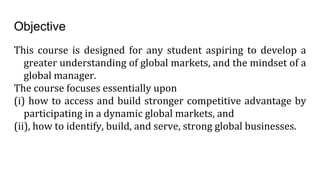
Objective
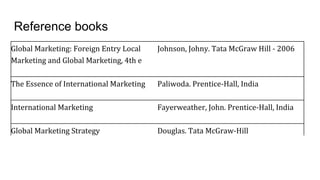
Reference books
Reference books
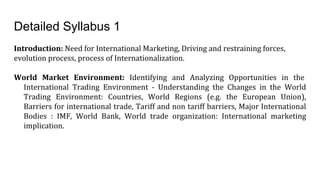
Detailed Syllabus 1
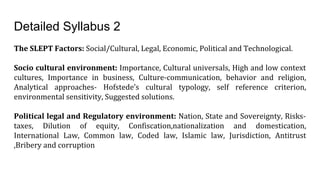
Detailed Syllabus 2
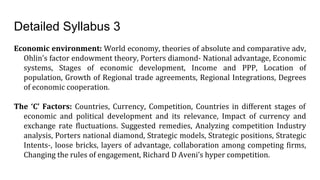
Detailed Syllabus 3
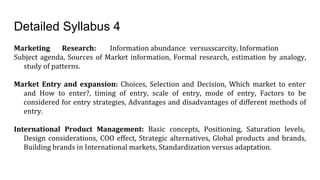
Detailed Syllabus 4
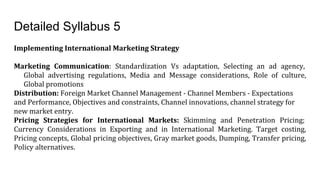
Detailed Syllabus 5
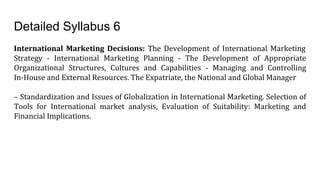
Detailed Syllabus 6
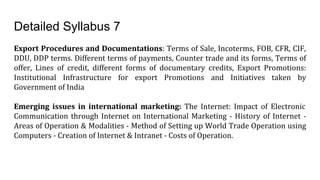
Detailed Syllabus 7
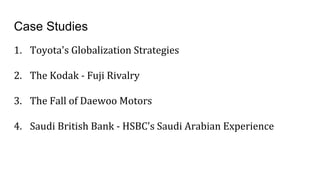
Case Studies
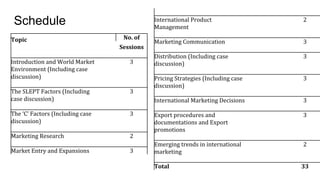
Schedule
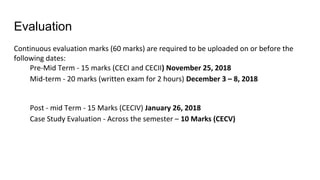
Evaluation
Continuous evaluation marks (60 marks) are required to be uploaded on or before the
following dates:
Pre-Mid Term - 15 marks (CECI and CECII) November 25, 2018
Mid-term - 20 marks (written exam for 2 hours) December 3 – 8, 2018
Post - mid Term - 15 Marks (CECIV) January 26, 2018
Case Study Evaluation - Across the semester – 10 Marks (CECV)
Introduction to the world market
environment
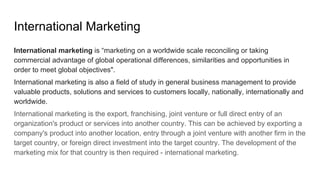
International Marketing
International marketing is “marketing on a worldwide scale reconciling or taking
commercial advantage of global operational differences, similarities and opportunities in
order to meet global objectives".
International marketing is also a field of study in general business management to provide
valuable products, solutions and services to customers locally, nationally, internationally and
worldwide.
International marketing is the export, franchising, joint venture or full direct entry of an
organization's product or services into another country. This can be achieved by exporting a
company's product into another location, entry through a joint venture with another firm in the
target country, or foreign direct investment into the target country. The development of the
marketing mix for that country is then required - international marketing.
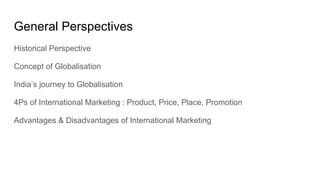
General Perspectives
Historical Perspective
Concept of Globalisation
India’s journey to Globalisation
4Ps of International Marketing : Product, Price, Place, Promotion
Advantages & Disadvantages of International Marketing
Advantages of International Market
Economies of scale in production and distribution
Lower marketing costs
Power and scope
Consistency in brand image
Ability to leverage good ideas quickly and efficiently
Uniformity of marketing practices
Helps to establish relationships outside of the "political arena"
Helps to encourage ancillary industries to be set up to cater for the needs of the
global player
Benefits of eMarketing over traditional marketing
Disadvantages
Differences in consumer needs, wants, and usage patterns for products
Differences in consumer response to marketing mix elements
Differences in brand and product development and the competitive environment
Differences in the legal environment, some of which may conflict with those of the
home market
Differences in the institutions available, some of which may call for the creation of
entirely new ones (e.g. infrastructure)
Differences in administrative procedures
Differences in product placement.
Differences in the administrative procedures and product placement can occur
Dimensions of Globalisation
Economic Globalisation results in Globalisation of
1. Production
2. Corporations
3. Technology
4. Competition
5. Markets
Reason for International Business Expansion
Rapid increase in and expansion of technology
Transportation is quicker while costs are lower
Communication enables control from afar
Liberal government policies on trade and resources
Development of institutions that support international trade
Consumer pressures
Short Activity - Group Discussion
1. Has Globalisation done more harm than led benefits ?
2. Discuss any Indian Company / Companies which have done well Globally ?
Reasons it did well and how others can copy it
3. Discuss 2-3 companies / business which have been affected by globalisation
?
4. Discuss potential of following areas for doing business for Indian Companies :
SAARC, Middle East, SEA, Europe, UK, USA, ANZ ?
Major International Trade Bodies
The International Monetary Fund (IMF) is an international organization
headquartered in Washington, D.C., consisting of "189 countries working to foster
global monetary cooperation, secure financial stability, facilitate international trade,
promote high employment and sustainable economic growth, and reduce poverty.
The World Trade Organization (WTO) is an intergovernmental organization that
regulates international trade. The WTO officially commenced on 1 January 1995
under the Marrakesh Agreement, signed by 124 nations on 15 April 1994,
replacing the General Agreement on Tariffs and Trade (GATT), which commenced
in 1948. It is the largest international economic organization in the world.
World Bank
The World Bank (French: Banque mondiale is an international financial institution
that provides loans to countries of the world for capital projects. It comprises two
institutions: the International Bank for Reconstruction and Development (IBRD),
and the International Development Association (IDA). The World Bank is a
component of the World Bank Group. (Below institutions)
International Bank for Reconstruction and Development (IBRD)
International Development Association (IDA)
International Finance Corporation (IFC)
Multilateral Investment Guarantee Agency (MIGA)
International Centre for Settlement of Investment Disputes (ICSID)
Trade Blocs
Trading blocs
A regional trading bloc is a group of countries within a geographical region that
protect themselves from imports from non-members. Trading blocs are a form of
economic integration, and increasingly shape the pattern of world trade. There are
several types of trading bloc:
Preferential Trade Area
Preferential Trade Areas (PTAs) exist when countries within a geographical region
agree to reduce or eliminate tariff barriers on selected goods imported from other
members of the area. This is often the first small step towards the creation of a
trading bloc.
Trade Blocs
Free Trade Area
Free Trade Areas (FTAs) are created when two or more countries in a region
agree to reduce or eliminate barriers to trade on all goods coming from other
members.
Customs Union
A customs union involves the removal of tariff barriers between members, plus the
acceptance of a common (unified) external tariff against non-members. This
means that members may negotiate as a single bloc with 3rd parties, such as with
other trading blocs, or with the WTO.
Trade Blocs
Some examples include :
The World Trade Organisation (WTO),
The North American Free Trade Agreement (NAFTA),
The Association of Southeast Asian Nations (ASEAN)
European Union – 28 (EU-28)
Organization of the Petroleum Exporting Countries (OPEC)
Tariffs Barriers
Tariff is a tax on imported goods which is normally a customs duty
Why is Tariff charged :
Protecting Domestic Employment
Protecting Consumers
Infant Industries
National Security
Retaliation
Non Tariff barriers include
Licenses
Import Quotas
Voluntary Export Restraints (VER)
Local Content Requirement
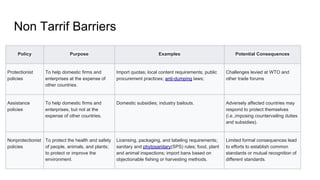
Non Tarrif Barriers
Policy Purpose Examples Potential Consequences
Protectionist
policies
To help domestic firms and
enterprises at the expense of
other countries.
Import quotas; local content requirements; public
procurement practices; anti-dumping laws;
Challenges levied at WTO and
other trade forums
Assistance
policies
To help domestic firms and
enterprises, but not at the
expense of other countries.
Domestic subsidies; industry bailouts. Adversely affected countries may
respond to protect themselves
(i.e.,imposing countervailing duties
and subsidies).
Nonprotectionist
policies
To protect the health and safety
of people, animals, and plants;
to protect or improve the
environment.
Licensing, packaging, and labeling requirements;
sanitary and phytosanitary(SPS) rules; food, plant
and animal inspections; import bans based on
objectionable fishing or harvesting methods.
Limited formal consequences lead
to efforts to establish common
standards or mutual recognition of
different standards.
Questions
1.Explain concept of Globalisation ?
2.

Introduction and World Market Environment

  • 2.
  • 3.
  • 4.
  • 5.
  • 6.
  • 7.
  • 8.
  • 9.
  • 10.
  • 11.
  • 12.
  • 13.
  • 14.
  • 15.
    Evaluation Continuous evaluation marks(60 marks) are required to be uploaded on or before the following dates: Pre-Mid Term - 15 marks (CECI and CECII) November 25, 2018 Mid-term - 20 marks (written exam for 2 hours) December 3 – 8, 2018 Post - mid Term - 15 Marks (CECIV) January 26, 2018 Case Study Evaluation - Across the semester – 10 Marks (CECV)
  • 16.
    Introduction to theworld market environment
  • 22.
    International Marketing International marketingis “marketing on a worldwide scale reconciling or taking commercial advantage of global operational differences, similarities and opportunities in order to meet global objectives". International marketing is also a field of study in general business management to provide valuable products, solutions and services to customers locally, nationally, internationally and worldwide. International marketing is the export, franchising, joint venture or full direct entry of an organization's product or services into another country. This can be achieved by exporting a company's product into another location, entry through a joint venture with another firm in the target country, or foreign direct investment into the target country. The development of the marketing mix for that country is then required - international marketing.
  • 23.
    General Perspectives Historical Perspective Conceptof Globalisation India’s journey to Globalisation 4Ps of International Marketing : Product, Price, Place, Promotion Advantages & Disadvantages of International Marketing
  • 24.
    Advantages of InternationalMarket Economies of scale in production and distribution Lower marketing costs Power and scope Consistency in brand image Ability to leverage good ideas quickly and efficiently Uniformity of marketing practices Helps to establish relationships outside of the "political arena" Helps to encourage ancillary industries to be set up to cater for the needs of the global player Benefits of eMarketing over traditional marketing
  • 25.
    Disadvantages Differences in consumerneeds, wants, and usage patterns for products Differences in consumer response to marketing mix elements Differences in brand and product development and the competitive environment Differences in the legal environment, some of which may conflict with those of the home market Differences in the institutions available, some of which may call for the creation of entirely new ones (e.g. infrastructure) Differences in administrative procedures Differences in product placement. Differences in the administrative procedures and product placement can occur
  • 26.
    Dimensions of Globalisation EconomicGlobalisation results in Globalisation of 1. Production 2. Corporations 3. Technology 4. Competition 5. Markets
  • 27.
    Reason for InternationalBusiness Expansion Rapid increase in and expansion of technology Transportation is quicker while costs are lower Communication enables control from afar Liberal government policies on trade and resources Development of institutions that support international trade Consumer pressures
  • 28.
    Short Activity -Group Discussion 1. Has Globalisation done more harm than led benefits ? 2. Discuss any Indian Company / Companies which have done well Globally ? Reasons it did well and how others can copy it 3. Discuss 2-3 companies / business which have been affected by globalisation ? 4. Discuss potential of following areas for doing business for Indian Companies : SAARC, Middle East, SEA, Europe, UK, USA, ANZ ?
  • 29.
    Major International TradeBodies The International Monetary Fund (IMF) is an international organization headquartered in Washington, D.C., consisting of "189 countries working to foster global monetary cooperation, secure financial stability, facilitate international trade, promote high employment and sustainable economic growth, and reduce poverty. The World Trade Organization (WTO) is an intergovernmental organization that regulates international trade. The WTO officially commenced on 1 January 1995 under the Marrakesh Agreement, signed by 124 nations on 15 April 1994, replacing the General Agreement on Tariffs and Trade (GATT), which commenced in 1948. It is the largest international economic organization in the world.
  • 30.
    World Bank The WorldBank (French: Banque mondiale is an international financial institution that provides loans to countries of the world for capital projects. It comprises two institutions: the International Bank for Reconstruction and Development (IBRD), and the International Development Association (IDA). The World Bank is a component of the World Bank Group. (Below institutions) International Bank for Reconstruction and Development (IBRD) International Development Association (IDA) International Finance Corporation (IFC) Multilateral Investment Guarantee Agency (MIGA) International Centre for Settlement of Investment Disputes (ICSID)
  • 31.
    Trade Blocs Trading blocs Aregional trading bloc is a group of countries within a geographical region that protect themselves from imports from non-members. Trading blocs are a form of economic integration, and increasingly shape the pattern of world trade. There are several types of trading bloc: Preferential Trade Area Preferential Trade Areas (PTAs) exist when countries within a geographical region agree to reduce or eliminate tariff barriers on selected goods imported from other members of the area. This is often the first small step towards the creation of a trading bloc.
  • 32.
    Trade Blocs Free TradeArea Free Trade Areas (FTAs) are created when two or more countries in a region agree to reduce or eliminate barriers to trade on all goods coming from other members. Customs Union A customs union involves the removal of tariff barriers between members, plus the acceptance of a common (unified) external tariff against non-members. This means that members may negotiate as a single bloc with 3rd parties, such as with other trading blocs, or with the WTO.
  • 33.
    Trade Blocs Some examplesinclude : The World Trade Organisation (WTO), The North American Free Trade Agreement (NAFTA), The Association of Southeast Asian Nations (ASEAN) European Union – 28 (EU-28) Organization of the Petroleum Exporting Countries (OPEC)
  • 34.
    Tariffs Barriers Tariff isa tax on imported goods which is normally a customs duty Why is Tariff charged : Protecting Domestic Employment Protecting Consumers Infant Industries National Security Retaliation
  • 35.
    Non Tariff barriersinclude Licenses Import Quotas Voluntary Export Restraints (VER) Local Content Requirement
  • 36.
    Non Tarrif Barriers PolicyPurpose Examples Potential Consequences Protectionist policies To help domestic firms and enterprises at the expense of other countries. Import quotas; local content requirements; public procurement practices; anti-dumping laws; Challenges levied at WTO and other trade forums Assistance policies To help domestic firms and enterprises, but not at the expense of other countries. Domestic subsidies; industry bailouts. Adversely affected countries may respond to protect themselves (i.e.,imposing countervailing duties and subsidies). Nonprotectionist policies To protect the health and safety of people, animals, and plants; to protect or improve the environment. Licensing, packaging, and labeling requirements; sanitary and phytosanitary(SPS) rules; food, plant and animal inspections; import bans based on objectionable fishing or harvesting methods. Limited formal consequences lead to efforts to establish common standards or mutual recognition of different standards.
  • 37.