Giving and Receiving Compliments Intermediate English WTUC April 20, 2004
Giving Compliments, p. 114 Flattery A compliment that sounds sincere ‘Flattery will get you everywhere’ Flatter people a lot Sometimes it works, sometimes it does not
Sincere Compliments, p. 115 People are often suspicious of flattery The keys to offering compliments appropriately are timing, number, and phrasing.
Timing Give a compliment when a person has accomplished something special Or when a person is discouraged and you are reminding them of their good efforts and steady progress
Number Don’t overdo it One’s okay, and two are fine, but stop at three, and draw the line If you overdo it, you may look like you are flattering them to gain favor or approval
Phrasing Be careful when you use adjectives and analogies that the person is pleased to identify with
Expressions used to introduced compliments I don’t mind saying … I don’t mind telling you… I’d like to compliment you on… If you ask me… I’ve been meaning to tell you… Just between you and me…
Receiving Compliments, p. 116 Undeserved compliments Do not deny or protest the compliment more than once or twice before you give in and accept the compliment graciously
Inappropriate compliments Say thank you or simply ignore it If the compliment is offensive, you should consider telling the person so
Expressions used to receive compliments Coming from you, that’s a real compliment Coming from you, that means a lot. Do you really think so? How nice (sweet/kind) of you to say that. I appreciate you saying that. I’m really glad you think so. I’m very flattered. That’s nice to hear.
Listening for Appropriate and inappropriate compliments Conversation 1 He’s making Mr. McGovern late for his appointment. Doing this makes the compliment an annoyance rather than a pleasure. There are too many compliments. There were 4 when there should be 2 at the most.
3. The phrasing is too exaggerated. Also, there is too much that is personal. It is better to compliment the course than say I like you sooo much.
Conversation 2 Yes, it is appropriate. Her comment dealt with the course materials, was not exaggerated, and was not too personal.
Conversation 3 Larry says he can’t beat Helen at the checkers and that she’s definitely the checker champion around there. Oh I wouldn’t say that Because she is modest. Martin says that Helen is the best player at the retirement home.
5. She says, ‘Thank you very much.’ 6. Helen and Larry tell Martin that he is a very good dancer. 7. Martin’s daughter looked beautiful on the dance floor. 8. Martin likes getting a compliment from Helen about his dancing, because she is a very good dancer herself.
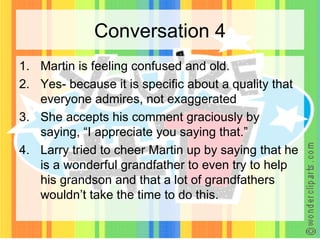
Conversation 4 Martin is feeling confused and old. Yes- because it is specific about a quality that everyone admires, not exaggerated She accepts his comment graciously by saying, “I appreciate you saying that.” Larry tried to cheer Martin up by saying that he is a wonderful grandfather to even try to help his grandson and that a lot of grandfathers wouldn’t take the time to do this.
5. Helen says that she thinks that Martin is interested in lifelong learning and that he is “one of the brightest, most stimulating, most adventuresome and forward-looking men” she knows 6. Yes- because Martin gives a response that seems much more positive and cheerful now.
7. Martin says, “Why thanks, Helen! That kind of flattery will get you anywhere!” 8. He means that he feels the compliment is exaggerated, but that he likes it. He appreciates the compliment and he would be happy to do something nice for Helen in return.
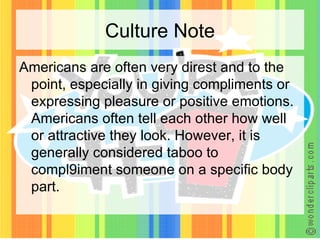
Culture Note Americans are often very direst and to the point, especially in giving compliments or expressing pleasure or positive emotions. Americans often tell each other how well or attractive they look. However, it is generally considered taboo to compl9iment someone on a specific body part.
“You have great legs.” or “You have a great figure.” are not acceptable comments. In some cultures, receiving simple compliments may be an occasion for embarrassment. For example in Japan, people often feel the need to deny a compliment because it is culturally inappropriate to accept them.
Focus on Testing B D C A C A

Giving and Receiving Compliments

  • 1.
    Giving and ReceivingCompliments Intermediate English WTUC April 20, 2004
  • 2.
    Giving Compliments, p.114 Flattery A compliment that sounds sincere ‘Flattery will get you everywhere’ Flatter people a lot Sometimes it works, sometimes it does not
  • 3.
    Sincere Compliments, p.115 People are often suspicious of flattery The keys to offering compliments appropriately are timing, number, and phrasing.
  • 4.
    Timing Give acompliment when a person has accomplished something special Or when a person is discouraged and you are reminding them of their good efforts and steady progress
  • 5.
    Number Don’t overdoit One’s okay, and two are fine, but stop at three, and draw the line If you overdo it, you may look like you are flattering them to gain favor or approval
  • 6.
    Phrasing Be carefulwhen you use adjectives and analogies that the person is pleased to identify with
  • 7.
    Expressions used tointroduced compliments I don’t mind saying … I don’t mind telling you… I’d like to compliment you on… If you ask me… I’ve been meaning to tell you… Just between you and me…
  • 8.
    Receiving Compliments, p.116 Undeserved compliments Do not deny or protest the compliment more than once or twice before you give in and accept the compliment graciously
  • 9.
    Inappropriate compliments Saythank you or simply ignore it If the compliment is offensive, you should consider telling the person so
  • 10.
    Expressions used toreceive compliments Coming from you, that’s a real compliment Coming from you, that means a lot. Do you really think so? How nice (sweet/kind) of you to say that. I appreciate you saying that. I’m really glad you think so. I’m very flattered. That’s nice to hear.
  • 11.
    Listening for Appropriateand inappropriate compliments Conversation 1 He’s making Mr. McGovern late for his appointment. Doing this makes the compliment an annoyance rather than a pleasure. There are too many compliments. There were 4 when there should be 2 at the most.
  • 12.
    3. The phrasingis too exaggerated. Also, there is too much that is personal. It is better to compliment the course than say I like you sooo much.
  • 13.
    Conversation 2 Yes,it is appropriate. Her comment dealt with the course materials, was not exaggerated, and was not too personal.
  • 14.
    Conversation 3 Larrysays he can’t beat Helen at the checkers and that she’s definitely the checker champion around there. Oh I wouldn’t say that Because she is modest. Martin says that Helen is the best player at the retirement home.
  • 15.
    5. She says,‘Thank you very much.’ 6. Helen and Larry tell Martin that he is a very good dancer. 7. Martin’s daughter looked beautiful on the dance floor. 8. Martin likes getting a compliment from Helen about his dancing, because she is a very good dancer herself.
  • 16.
    Conversation 4 Martinis feeling confused and old. Yes- because it is specific about a quality that everyone admires, not exaggerated She accepts his comment graciously by saying, “I appreciate you saying that.” Larry tried to cheer Martin up by saying that he is a wonderful grandfather to even try to help his grandson and that a lot of grandfathers wouldn’t take the time to do this.
  • 17.
    5. Helen saysthat she thinks that Martin is interested in lifelong learning and that he is “one of the brightest, most stimulating, most adventuresome and forward-looking men” she knows 6. Yes- because Martin gives a response that seems much more positive and cheerful now.
  • 18.
    7. Martin says,“Why thanks, Helen! That kind of flattery will get you anywhere!” 8. He means that he feels the compliment is exaggerated, but that he likes it. He appreciates the compliment and he would be happy to do something nice for Helen in return.
  • 19.
    Culture Note Americansare often very direst and to the point, especially in giving compliments or expressing pleasure or positive emotions. Americans often tell each other how well or attractive they look. However, it is generally considered taboo to compl9iment someone on a specific body part.
  • 20.
    “You have greatlegs.” or “You have a great figure.” are not acceptable comments. In some cultures, receiving simple compliments may be an occasion for embarrassment. For example in Japan, people often feel the need to deny a compliment because it is culturally inappropriate to accept them.
  • 21.
    Focus on TestingB D C A C A