Mahajna Mohammad
Sackler faculty of medicine ,Tel-Aviv Uni.
Introduction
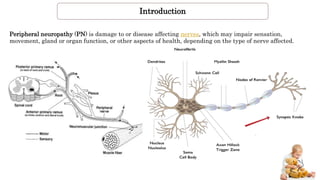
Peripheral neuropathy (PN) is damage to or disease affecting nerves, which may impair sensation,
movement, gland or organ function, or other aspects of health, depending on the type of nerve affected.
Classification
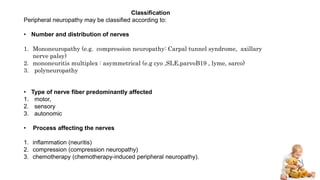
Peripheral neuropathy may be classified according to:
• Number and distribution of nerves
1. Mononeuropathy (e.g. compression neuropathy: Carpal tunnel syndrome, axillary
nerve palsy)
2. mononeuritis multiplex : asymmetrical (e.g cyo ,SLE,parvoB19 , lyme, sarco)
3. polyneuropathy
• Type of nerve fiber predominantly affected
1. motor,
2. sensory
3. autonomic
• Process affecting the nerves
1. inflammation (neuritis)
2. compression (compression neuropathy)
3. chemotherapy (chemotherapy-induced peripheral neuropathy).
Causes
 Genetic diseases
Friedreich's ataxia, Fabry dis,CMT hereditary neuropathy with liability to pressure palsy , HMSN
 Metabolic and endocrine diseases:
diabetes CRF, porphyria, amyloidosis, liver failure, hypothyroidism
 Toxic & drugs:
Chemo (vincristine),Abx( metronidazole, phenytoin, nitrofurantoin, isoniazid ) heavy metals
,excess intake of vitamin B6 (pyridoxine).
 Inflammatory diseases:
Guillain–Barré syndrome,[22] systemic lupus erythematosus, leprosy, multiple sclerosis,[22] Sjögren's
syndrome, Babesiosis, Lyme disease,[22]vasculitis,[22] sarcoidosis
Vitamin deficiency states: Vitamin B12 (Methylcobalamin),[22] vitamin A, vitamin E, vitamin B1 (thiamin)
 Physical trauma(compression, pinching, cutting)
Others: electric shock, HIV,[22][29] malignant disease, radiation, shingles, MGUS (Monoclonal gammopathy of
undetermined significance).[30]
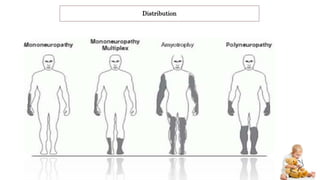
Distribution
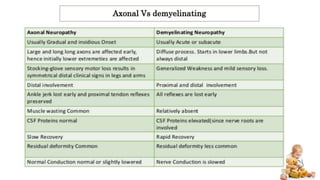
Axonal Vs demyelinating
Giant axonal neuropathy
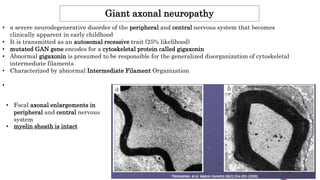
• a severe neurodegenerative disorder of the peripheral and central nervous system that becomes
clinically apparent in early childhood
• It is transmitted as an autosomal recessive trait (25% likelihood)
• mutated GAN gene encodes for a cytoskeletal protein called gigaxonin
• Abnormal gigaxonin is presumed to be responsible for the generalized disorganization of cytoskeletal
intermediate filaments
• Characterized by abnormal Intermediate Filament Organization
•
• Focal axonal enlargements in
peripheral and central nervous
system
• myelin sheath is intact
Manifestations
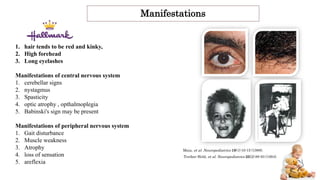
1. hair tends to be red and kinky,
2. High forehead
3. Long eyelashes
Manifestations of central nervous system
1. cerebellar signs
2. nystagmus
3. Spasticity
4. optic atrophy , opthalmoplegia
5. Babinski's sign may be present
Manifestations of peripheral nervous system
1. Gait disturbance
2. Muscle weakness
3. Atrophy
4. loss of sensation
5. areflexia
Treiber-Held, et al. Neuropediatrics 25(2):89-93 (1994).
Maia, et al. Neuropediatrics 19(1):10-15 (1988).
Diagnosis conformation– sural nerve biopsy
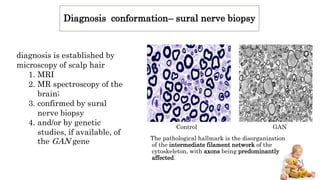
The pathological hallmark is the disorganization
of the intermediate filament network of the
cytoskeleton, with axons being predominantly
affected.
Control GAN
diagnosis is established by
microscopy of scalp hair
1. MRI
2. MR spectroscopy of the
brain;
3. confirmed by sural
nerve biopsy
4. and/or by genetic
studies, if available, of
the GAN gene
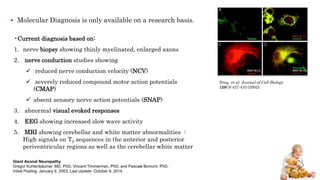
 Molecular Diagnosis is only available on a research basis.
•Current diagnosis based on:
1. nerve biopsy showing thinly myelinated, enlarged axons
2. nerve conduction studies showing
 reduced nerve conduction velocity (NCV)
 severely reduced compound motor action potentials
(CMAP)
 absent sensory nerve action potentials (SNAP)
3. abnormal visual evoked responses
4. EEG showing increased slow wave activity
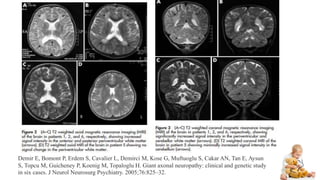
5. MRI showing cerebellar and white matter abnormalities :
High signals on T2 sequences in the anterior and posterior
periventricular regions as well as the cerebellar white matter
Ding, et al. Journal of Cell Biology
158(3):427-433 (2002).
Giant Axonal Neuropathy
Gregor Kuhlenbäumer, MD, PhD, Vincent Timmerman, PhD, and Pascale Bomont, PhD.
Initial Posting: January 9, 2003; Last Update: October 9, 2014.
Demir E, Bomont P, Erdem S, Cavalier L, Demirci M, Kose G, Muftuoglu S, Cakar AN, Tan E, Aysun
S, Topcu M, Guicheney P, Koenig M, Topaloglu H. Giant axonal neuropathy: clinical and genetic study
in six cases. J Neurol Neurosurg Psychiatry. 2005;76:825–32.
Management
Treatment of manifestations : goals are to optimize intellectual and physical development
 A multidisciplinary team :(pediatric) neurologists, orthopedic surgeons, physiotherapists,
psychologists, and speech and occupational therapists is recommended;
 speech therapy to improve communication,
 occupational therapy to maximize independence in activities of daily living,
 physiotherapy to preserve mobility as long as possible,
 early intervention and special education;
 orthopedic surgery as needed for foot deformities;
 ophthalmologic treatment as needed for diplopia.
Management
Prevention of secondary complications: For wheelchair-bound or bedridden
individuals:
 prophylaxis and frequent examination for decubitus ulcers.
 Surveillance:
 At least yearly reassessment of intellectual abilities
 peripheral neuropathy, ataxia, spasticity, and cranial nerve dysfunction.
Genetic counseling.
GAN is inherited in an autosomal recessive manner : At conception:
each sib of an affected individual has:
1. a 25% chance of being affected,
2. a 50% chance of being an asymptomatic carrier,
3. a 25% chance of being unaffected and not a carrier.
Carrier testing for at-risk relatives and prenatal testing for pregnancies at
increased risk are possible if the GAN pathogenic variants in a family are
known.
Preimplantation genetic diagnosis (PGD) may be an option for some families in which
the GAN pathogenic variants have been identified.
Koop O, Schirmacher A, Nelis E, Timmerman V, De Jonghe P, Ringelstein B, Rasic VM, Evrard P, Gärtner J, Claeys KG,
Appenzeller S, Rautenstrauss B, Hühne K, Ramos-Arroyo MA, Wörle H, Moilanen JS, Hammans S, Kuhlenbäumer G.
Genotype-phenotype analysis in patients with giant axonal neuropathy (GAN). Neuromuscul Disord. 2007;17:624–
30. [PubMed]
prognosis
 Most individuals become wheelchair
dependent in the second decade of life
 bedridden with severe polyneuropathy, ataxia,
and dementia.
 Death usually occurs in the third decade.
Giant axonal neuropathy

Giant axonal neuropathy

  • 1.
    Mahajna Mohammad Sackler facultyof medicine ,Tel-Aviv Uni.
  • 2.
    Introduction Peripheral neuropathy (PN)is damage to or disease affecting nerves, which may impair sensation, movement, gland or organ function, or other aspects of health, depending on the type of nerve affected.
  • 4.
    Classification Peripheral neuropathy maybe classified according to: • Number and distribution of nerves 1. Mononeuropathy (e.g. compression neuropathy: Carpal tunnel syndrome, axillary nerve palsy) 2. mononeuritis multiplex : asymmetrical (e.g cyo ,SLE,parvoB19 , lyme, sarco) 3. polyneuropathy • Type of nerve fiber predominantly affected 1. motor, 2. sensory 3. autonomic • Process affecting the nerves 1. inflammation (neuritis) 2. compression (compression neuropathy) 3. chemotherapy (chemotherapy-induced peripheral neuropathy).
  • 5.
    Causes  Genetic diseases Friedreich'sataxia, Fabry dis,CMT hereditary neuropathy with liability to pressure palsy , HMSN  Metabolic and endocrine diseases: diabetes CRF, porphyria, amyloidosis, liver failure, hypothyroidism  Toxic & drugs: Chemo (vincristine),Abx( metronidazole, phenytoin, nitrofurantoin, isoniazid ) heavy metals ,excess intake of vitamin B6 (pyridoxine).  Inflammatory diseases: Guillain–Barré syndrome,[22] systemic lupus erythematosus, leprosy, multiple sclerosis,[22] Sjögren's syndrome, Babesiosis, Lyme disease,[22]vasculitis,[22] sarcoidosis Vitamin deficiency states: Vitamin B12 (Methylcobalamin),[22] vitamin A, vitamin E, vitamin B1 (thiamin)  Physical trauma(compression, pinching, cutting) Others: electric shock, HIV,[22][29] malignant disease, radiation, shingles, MGUS (Monoclonal gammopathy of undetermined significance).[30]
  • 6.
  • 7.
  • 8.
    Giant axonal neuropathy •a severe neurodegenerative disorder of the peripheral and central nervous system that becomes clinically apparent in early childhood • It is transmitted as an autosomal recessive trait (25% likelihood) • mutated GAN gene encodes for a cytoskeletal protein called gigaxonin • Abnormal gigaxonin is presumed to be responsible for the generalized disorganization of cytoskeletal intermediate filaments • Characterized by abnormal Intermediate Filament Organization • • Focal axonal enlargements in peripheral and central nervous system • myelin sheath is intact
  • 9.
    Manifestations 1. hair tendsto be red and kinky, 2. High forehead 3. Long eyelashes Manifestations of central nervous system 1. cerebellar signs 2. nystagmus 3. Spasticity 4. optic atrophy , opthalmoplegia 5. Babinski's sign may be present Manifestations of peripheral nervous system 1. Gait disturbance 2. Muscle weakness 3. Atrophy 4. loss of sensation 5. areflexia Treiber-Held, et al. Neuropediatrics 25(2):89-93 (1994). Maia, et al. Neuropediatrics 19(1):10-15 (1988).
  • 10.
    Diagnosis conformation– suralnerve biopsy The pathological hallmark is the disorganization of the intermediate filament network of the cytoskeleton, with axons being predominantly affected. Control GAN diagnosis is established by microscopy of scalp hair 1. MRI 2. MR spectroscopy of the brain; 3. confirmed by sural nerve biopsy 4. and/or by genetic studies, if available, of the GAN gene
  • 11.
     Molecular Diagnosisis only available on a research basis. •Current diagnosis based on: 1. nerve biopsy showing thinly myelinated, enlarged axons 2. nerve conduction studies showing  reduced nerve conduction velocity (NCV)  severely reduced compound motor action potentials (CMAP)  absent sensory nerve action potentials (SNAP) 3. abnormal visual evoked responses 4. EEG showing increased slow wave activity 5. MRI showing cerebellar and white matter abnormalities : High signals on T2 sequences in the anterior and posterior periventricular regions as well as the cerebellar white matter Ding, et al. Journal of Cell Biology 158(3):427-433 (2002). Giant Axonal Neuropathy Gregor Kuhlenbäumer, MD, PhD, Vincent Timmerman, PhD, and Pascale Bomont, PhD. Initial Posting: January 9, 2003; Last Update: October 9, 2014.
  • 12.
    Demir E, BomontP, Erdem S, Cavalier L, Demirci M, Kose G, Muftuoglu S, Cakar AN, Tan E, Aysun S, Topcu M, Guicheney P, Koenig M, Topaloglu H. Giant axonal neuropathy: clinical and genetic study in six cases. J Neurol Neurosurg Psychiatry. 2005;76:825–32.
  • 13.
    Management Treatment of manifestations: goals are to optimize intellectual and physical development  A multidisciplinary team :(pediatric) neurologists, orthopedic surgeons, physiotherapists, psychologists, and speech and occupational therapists is recommended;  speech therapy to improve communication,  occupational therapy to maximize independence in activities of daily living,  physiotherapy to preserve mobility as long as possible,  early intervention and special education;  orthopedic surgery as needed for foot deformities;  ophthalmologic treatment as needed for diplopia.
  • 14.
    Management Prevention of secondarycomplications: For wheelchair-bound or bedridden individuals:  prophylaxis and frequent examination for decubitus ulcers.  Surveillance:  At least yearly reassessment of intellectual abilities  peripheral neuropathy, ataxia, spasticity, and cranial nerve dysfunction.
  • 15.
    Genetic counseling. GAN isinherited in an autosomal recessive manner : At conception: each sib of an affected individual has: 1. a 25% chance of being affected, 2. a 50% chance of being an asymptomatic carrier, 3. a 25% chance of being unaffected and not a carrier. Carrier testing for at-risk relatives and prenatal testing for pregnancies at increased risk are possible if the GAN pathogenic variants in a family are known. Preimplantation genetic diagnosis (PGD) may be an option for some families in which the GAN pathogenic variants have been identified. Koop O, Schirmacher A, Nelis E, Timmerman V, De Jonghe P, Ringelstein B, Rasic VM, Evrard P, Gärtner J, Claeys KG, Appenzeller S, Rautenstrauss B, Hühne K, Ramos-Arroyo MA, Wörle H, Moilanen JS, Hammans S, Kuhlenbäumer G. Genotype-phenotype analysis in patients with giant axonal neuropathy (GAN). Neuromuscul Disord. 2007;17:624– 30. [PubMed]
  • 16.
    prognosis  Most individualsbecome wheelchair dependent in the second decade of life  bedridden with severe polyneuropathy, ataxia, and dementia.  Death usually occurs in the third decade.