Getting started
with server-side
testing
Dennis Pavlina and Thomas Davis
WiderFunnel Strategist and WiderFunnel Web Developer
● The presentation deck and recording will
be available to you after the webinar.
● Feel free to ask questions during the
presentation, using the Question panel.
Housekeeping
Dennis Pavlina, WiderFunnel Strategist
● Oversees experimentation strategy
for some of WiderFunnel’s most
notable full stack clients
● Guest lectures at local design and
tech institution, RED Academy
Your Presenters
Thomas Davis, WiderFunnel Developer
● The go-to guy for server-side
experiment development
● Instructor and mentor at local coding
bootcamp, Lighthouse Labs
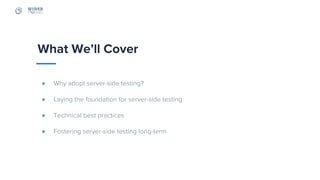
● Why adopt server-side testing?
● Laying the foundation for server-side testing
● Technical best practices
● Fostering server-side testing long-term
What We’ll Cover
Why Server-Side?
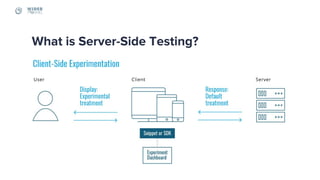
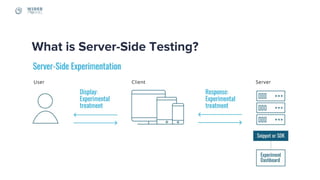
What is Server-Side Testing?
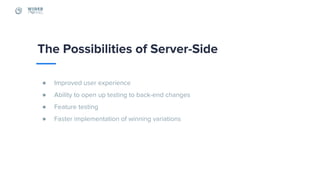
The Possibilities of Server-Side
● Improved user experience
● Ability to open up testing to back-end changes
● Feature testing
● Faster implementation of winning variations
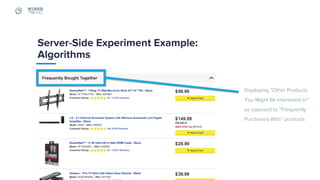
Server-Side Experiment Example:
Algorithms
Displaying “Other Products
You Might Be Interested In”
as opposed to “Frequently
Purchased With” products
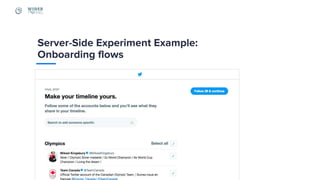
Server-Side Experiment Example:
Onboarding flows
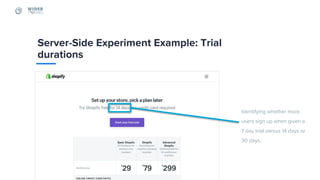
Server-Side Experiment Example: Trial
durations
Identifying whether more
users sign up when given a
7 day trial versus 14 days or
30 days.
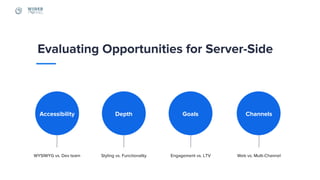
Evaluating Opportunities for Server-Side
Accessibility Depth Goals Channels
WYSIWYG vs. Dev team Styling vs. Functionality Engagement vs. LTV Web vs. Multi-Channel
Laying the Foundation for
Server-Side Testing
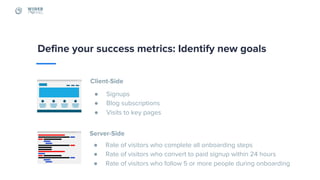
Define your success metrics: Identify new goals
Server-Side
● Rate of visitors who complete all onboarding steps
● Rate of visitors who convert to paid signup within 24 hours
● Rate of visitors who follow 5 or more people during onboarding
Client-Side
● Signups
● Blog subscriptions
● Visits to key pages
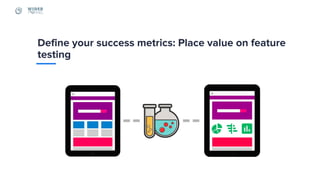
Define your success metrics: Place value on feature
testing
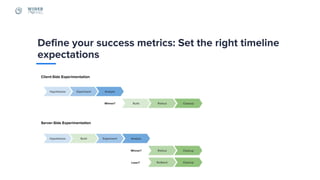
Define your success metrics: Set the right timeline
expectations
Full Stack Best Practices
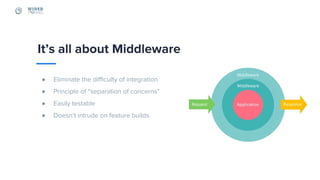
● Eliminate the difficulty of integration
● Principle of “separation of concerns”
● Easily testable
● Doesn’t intrude on feature builds
It’s all about Middleware
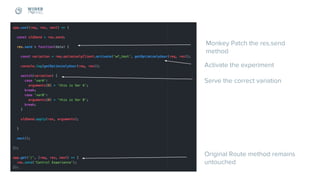
Activate the experiment
Monkey Patch the res.send
method
Serve the correct variation
Original Route method remains
untouched
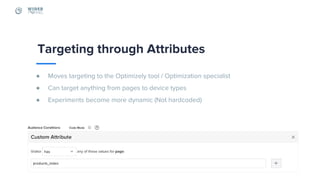
● Moves targeting to the Optimizely tool / Optimization specialist
● Can target anything from pages to device types
● Experiments become more dynamic (Not hardcoded)
Targeting through Attributes
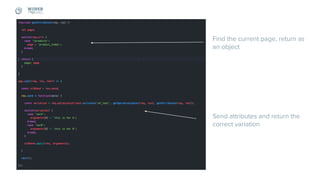
Find the current page, return as
an object
Send attributes and return the
correct variation
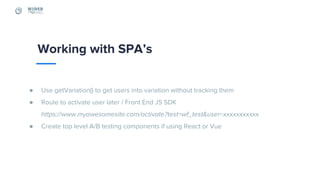
Working with SPA’s
● Use getVariation() to get users into variation without tracking them
● Route to activate user later / Front End JS SDK
https://www.myawesomesite.com/activate?test=wf_test&user=xxxxxxxxxxx
● Create top level A/B testing components if using React or Vue
● Setup all global events first (i.e. page visits, revenue tracking)
● May need a ‘AJAXable’ route for UI component goals /
Alternatively use the client-side JS SDK
● Make naming conventions specific and namespaced
products-index/add-to-cart-cta
Custom Event Set up
● Have a roadmap for the installation process
● Use cookies or webhooks when dealing with page caching reverse
proxies
● Random string vs. database user ID to identify the Optimizely user
● Test Driven Development (TDD)
Tips and “Got ya’s”
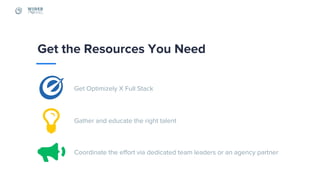
Get Optimizely X Full Stack
Get the Resources You Need
Gather and educate the right talent
Coordinate the effort via dedicated team leaders or an agency partner
Identify the Best First Experiments
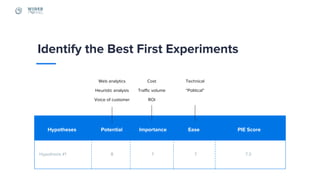
Hypotheses Potential Importance Ease PIE Score
Hypothesis #1
Web analytics
Heuristic analysis
Voice of customer
Cost
Traffic volume
ROI
Technical
“Political”
8 7 7 7.3
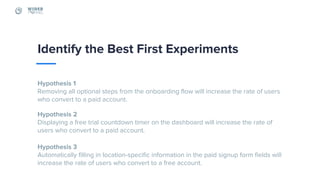
Hypothesis 2
Displaying a free trial countdown timer on the dashboard will increase the rate of
users who convert to a paid account.
Identify the Best First Experiments
Hypothesis 1
Removing all optional steps from the onboarding flow will increase the rate of users
who convert to a paid account.
Hypothesis 3
Automatically filling in location-specific information in the paid signup form fields will
increase the rate of users who convert to a free account.
Identify the Best First Experiments
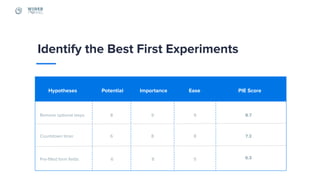
Hypotheses Potential Importance Ease PIE Score
Remove optional steps
Countdown timer
Pre-filled form fields
8 9 9 8.7
6 8 8 7.3
6 8 5 6.3
The Long-Term Vision
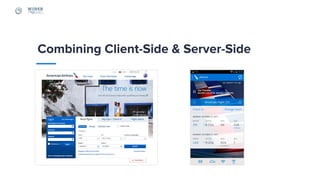
Combining Client-Side & Server-Side
Work to establish a “We should test that” culture:
● Dedicated brainstorming sessions
● Regular lunch and learns
● Review assumptions and status quo
● Company-wide results/insights updates
Experimentation Culture
Q&A
Thank you!

Getting Started with Server-Side Testing

  • 1.
    Getting started with server-side testing DennisPavlina and Thomas Davis WiderFunnel Strategist and WiderFunnel Web Developer
  • 2.
    ● The presentationdeck and recording will be available to you after the webinar. ● Feel free to ask questions during the presentation, using the Question panel. Housekeeping
  • 3.
    Dennis Pavlina, WiderFunnelStrategist ● Oversees experimentation strategy for some of WiderFunnel’s most notable full stack clients ● Guest lectures at local design and tech institution, RED Academy Your Presenters Thomas Davis, WiderFunnel Developer ● The go-to guy for server-side experiment development ● Instructor and mentor at local coding bootcamp, Lighthouse Labs
  • 4.
    ● Why adoptserver-side testing? ● Laying the foundation for server-side testing ● Technical best practices ● Fostering server-side testing long-term What We’ll Cover
  • 5.
  • 6.
  • 7.
  • 8.
  • 9.
  • 10.
    The Possibilities ofServer-Side ● Improved user experience ● Ability to open up testing to back-end changes ● Feature testing ● Faster implementation of winning variations
  • 11.
    Server-Side Experiment Example: Algorithms Displaying“Other Products You Might Be Interested In” as opposed to “Frequently Purchased With” products
  • 12.
  • 13.
    Server-Side Experiment Example:Trial durations Identifying whether more users sign up when given a 7 day trial versus 14 days or 30 days.
  • 14.
    Evaluating Opportunities forServer-Side Accessibility Depth Goals Channels WYSIWYG vs. Dev team Styling vs. Functionality Engagement vs. LTV Web vs. Multi-Channel
  • 15.
    Laying the Foundationfor Server-Side Testing
  • 16.
    Define your successmetrics: Identify new goals Server-Side ● Rate of visitors who complete all onboarding steps ● Rate of visitors who convert to paid signup within 24 hours ● Rate of visitors who follow 5 or more people during onboarding Client-Side ● Signups ● Blog subscriptions ● Visits to key pages
  • 17.
    Define your successmetrics: Place value on feature testing
  • 18.
    Define your successmetrics: Set the right timeline expectations
  • 19.
    Full Stack BestPractices
  • 20.
    ● Eliminate thedifficulty of integration ● Principle of “separation of concerns” ● Easily testable ● Doesn’t intrude on feature builds It’s all about Middleware
  • 21.
    Activate the experiment MonkeyPatch the res.send method Serve the correct variation Original Route method remains untouched
  • 22.
    ● Moves targetingto the Optimizely tool / Optimization specialist ● Can target anything from pages to device types ● Experiments become more dynamic (Not hardcoded) Targeting through Attributes
  • 23.
    Find the currentpage, return as an object Send attributes and return the correct variation
  • 24.
    Working with SPA’s ●Use getVariation() to get users into variation without tracking them ● Route to activate user later / Front End JS SDK https://www.myawesomesite.com/activate?test=wf_test&user=xxxxxxxxxxx ● Create top level A/B testing components if using React or Vue
  • 25.
    ● Setup allglobal events first (i.e. page visits, revenue tracking) ● May need a ‘AJAXable’ route for UI component goals / Alternatively use the client-side JS SDK ● Make naming conventions specific and namespaced products-index/add-to-cart-cta Custom Event Set up
  • 26.
    ● Have aroadmap for the installation process ● Use cookies or webhooks when dealing with page caching reverse proxies ● Random string vs. database user ID to identify the Optimizely user ● Test Driven Development (TDD) Tips and “Got ya’s”
  • 27.
    Get Optimizely XFull Stack Get the Resources You Need Gather and educate the right talent Coordinate the effort via dedicated team leaders or an agency partner
  • 28.
    Identify the BestFirst Experiments Hypotheses Potential Importance Ease PIE Score Hypothesis #1 Web analytics Heuristic analysis Voice of customer Cost Traffic volume ROI Technical “Political” 8 7 7 7.3
  • 29.
    Hypothesis 2 Displaying afree trial countdown timer on the dashboard will increase the rate of users who convert to a paid account. Identify the Best First Experiments Hypothesis 1 Removing all optional steps from the onboarding flow will increase the rate of users who convert to a paid account. Hypothesis 3 Automatically filling in location-specific information in the paid signup form fields will increase the rate of users who convert to a free account.
  • 30.
    Identify the BestFirst Experiments Hypotheses Potential Importance Ease PIE Score Remove optional steps Countdown timer Pre-filled form fields 8 9 9 8.7 6 8 8 7.3 6 8 5 6.3
  • 31.
  • 32.
  • 33.
    Work to establisha “We should test that” culture: ● Dedicated brainstorming sessions ● Regular lunch and learns ● Review assumptions and status quo ● Company-wide results/insights updates Experimentation Culture
  • 34.
  • 35.