





Shipping to Learn and
Accelerate Growth
Opticon 2020
Presented by @shama0 & @gregce
Greg Ceccarelli (@gregce)
Director, Data Science
Data & Security Product
Sha Ma (@shama0)
VP, Software Engineering
Core Platform & Ecosystem
Our Story
GitHub started in 2008 as a way
to make it easier for developers
to host and share their code.
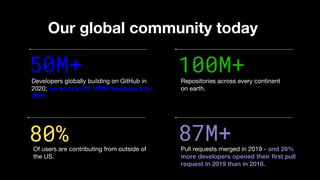
50M+
Our global community today
87M+
Developers globally building on GitHub in
2020; we want to hit 100M developers by
2025.
Of users are contributing from outside of
the US.
Pull requests merged in 2019 - and 28%
more developers opened their first pull
request in 2019 than in 2018.
80%
100M+Repositories across every continent
on earth.
2K
Rapid internal growth
15+
Employees at GitHub, significant growth
in the last year.
Employees work outside of our San
Francisco HQ, distributed across the globe.
Countries and regions, where full time
employees live and work. We hire in all 50
States of the US.
70%
Problem Statement
Product Development at this
scale can be costly
1. User Experience Research
2. Focus on Minimum Viable Product
3. Data Driven Experimentation
Ship to learn in practice
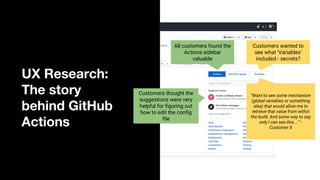
UX Research:
The story
behind GitHub
Actions
All customers found the
Actions sidebar
valuable
Customers thought the
suggestions were very
helpful for figuring out
how to edit the config
file
Customers wanted to
see what ‘Variables’
included - secrets?
“Want to see some mechanism
(global variables or something
else) that would allow me to
retrieve that value from within
the build. And some way to say
only I can see this....” -
Customer X
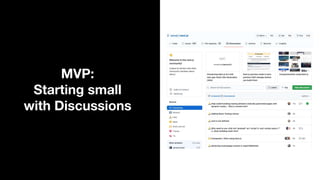
MVP:
Starting small
with Discussions
Vision:
Home for All
Developers
“We want every developer and team
on earth to be able to use GitHub for
their development, whether it’s
private or public development.”
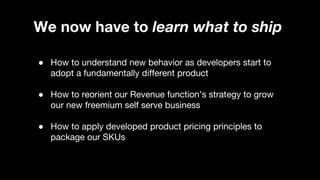
We now have to learn what to ship
● How to understand new behavior as developers start to
adopt a fundamentally different product
● How to reorient our Revenue function’s strategy to grow
our new freemium self serve business
● How to apply developed product pricing principles to
package our SKUs
Meanwhile...
We’re amidst a
global pandemic
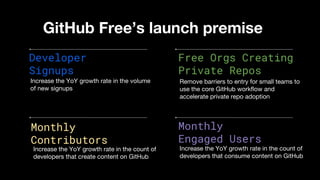
Developer
Signups
GitHub Free’s launch premise
Free Orgs Creating
Private Repos
Increase the YoY growth rate in the volume
of new signups
Increase the YoY growth rate in the count of
developers that consume content on GitHub
Monthly
Contributors
Remove barriers to entry for small teams to
use the core GitHub workflow and
accelerate private repo adoption
Monthly
Engaged Users
Increase the YoY growth rate in the count of
developers that create content on GitHub
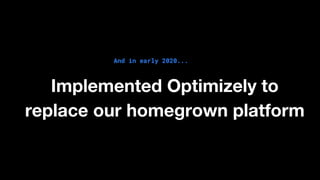
And in early 2020...
Implemented Optimizely to
replace our homegrown platform
But… experimentation is key to
learning what matters most to our
customers
Why Experiment?
Experimentation allows us to
measure the quantitative causal
impact of what we’re building
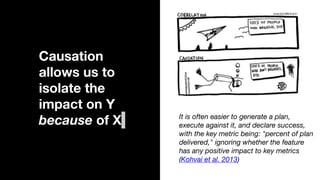
Causation
allows us to
isolate the
impact on Y
because of X It is often easier to generate a plan,
execute against it, and declare success,
with the key metric being: "percent of plan
delivered," ignoring whether the feature
has any positive impact to key metrics
(Kohvai et al. 2013)
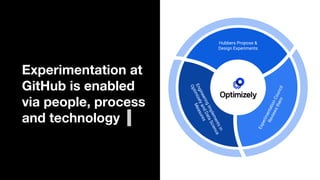
Experimentation at
GitHub is enabled
via people, process
and technology
Hubbers Propose &
Design Experiments
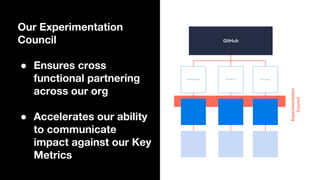
Our Experimentation
Council
● Ensures cross
functional partnering
across our org
● Accelerates our ability
to communicate
impact against our Key
Metrics
GitHub
Product FinanceMarketing
Experimentation
Council
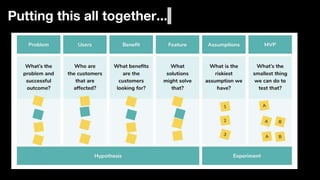
Putting this all together...
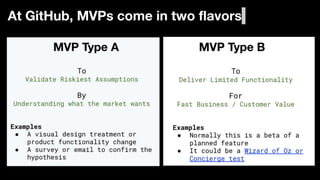
At GitHub, MVPs come in two flavors
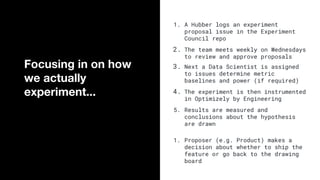
1. A Hubber logs an experiment
proposal issue in the Experiment
Council repo
2. The team meets weekly on Wednesdays
to review and approve proposals
3. Next a Data Scientist is assigned
to issues determine metric
baselines and power (if required)
4. The experiment is then instrumented
in Optimizely by Engineering
5. Results are measured and
conclusions about the hypothesis
are drawn
1. Proposer (e.g. Product) makes a
decision about whether to ship the
feature or go back to the drawing
board
Focusing in on how
we actually
experiment...
Process out of the way...
Now let’s chat about some
experiments!
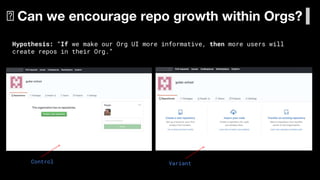
🧪 Can we encourage repo growth within Orgs?
Hypothesis: “If we make our Org UI more informative, then more users will
create repos in their Org.”
Control Variant
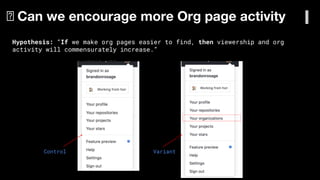
🧪 Can we encourage more Org page activity 🎓
Hypothesis: “If we make org pages easier to find, then viewership and org
activity will commensurately increase.”
Control Variant
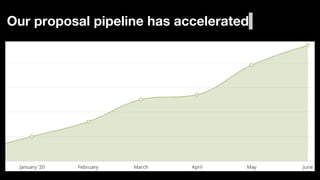
Our proposal pipeline has accelerated
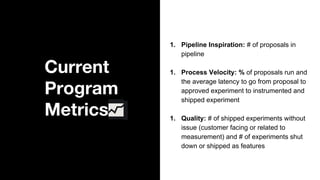
1. Pipeline Inspiration: # of proposals in
pipeline
1. Process Velocity: % of proposals run and
the average latency to go from proposal to
approved experiment to instrumented and
shipped experiment
1. Quality: # of shipped experiments without
issue (customer facing or related to
measurement) and # of experiments shut
down or shipped as features
Current
Program
Metrics 📈
Experimentation in their words
Carmel Schetrit (@Carmel-S)
Demand Generation Manager
Growth
“The experimentation council
helped the Growth team in 2020
to evaluate the complexities of
designing, instrumenting, and
measuring experiments on
github.com with Optimizely.
The council often shed light on
scenarios requiring more careful
consideration, including those
that conflict with concurrent
experiments or cannot reach
statistical significance.”
Experimentation in their words
Katie Sipos (@ohitsmekatie)
Senior Product Manager
Education
“Our team is rolling out changes to
our GitHub Classroom onboarding
flow through Optimizely.
Being able to definitively prove
which experience is best for our
users and then ship that with
confidence is great!
Without it, we would be flying blind
and shipping features with our gut
feelings and not data.”
Now that’s a wrap!
Closing thoughts
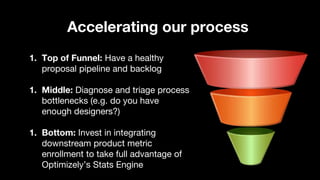
Accelerating our process
1. Top of Funnel: Have a healthy
proposal pipeline and backlog
1. Middle: Diagnose and triage process
bottlenecks (e.g. do you have
enough designers?)
1. Bottom: Invest in integrating
downstream product metric
enrollment to take full advantage of
Optimizely’s Stats Engine
Accelerating our program maturity
1. Strategic Prioritization: # of
experiments selected based on priority
score (versus last in, first out) and
alignment with OKRs
1. Culture: # of times we broadly
syndicate learnings and % business
functions integrated into the process @
GitHub
Shipping to Learn and Accelerate Growth with GitHub

Shipping to Learn and Accelerate Growth with GitHub

  • 1.
    Shipping to Learnand Accelerate Growth Opticon 2020 Presented by @shama0 & @gregce
  • 2.
    Greg Ceccarelli (@gregce) Director,Data Science Data & Security Product Sha Ma (@shama0) VP, Software Engineering Core Platform & Ecosystem
  • 3.
    Our Story GitHub startedin 2008 as a way to make it easier for developers to host and share their code.
  • 4.
    50M+ Our global communitytoday 87M+ Developers globally building on GitHub in 2020; we want to hit 100M developers by 2025. Of users are contributing from outside of the US. Pull requests merged in 2019 - and 28% more developers opened their first pull request in 2019 than in 2018. 80% 100M+Repositories across every continent on earth.
  • 5.
    2K Rapid internal growth 15+ Employeesat GitHub, significant growth in the last year. Employees work outside of our San Francisco HQ, distributed across the globe. Countries and regions, where full time employees live and work. We hire in all 50 States of the US. 70%
  • 6.
    Problem Statement Product Developmentat this scale can be costly
  • 7.
    1. User ExperienceResearch 2. Focus on Minimum Viable Product 3. Data Driven Experimentation Ship to learn in practice
  • 8.
    UX Research: The story behindGitHub Actions All customers found the Actions sidebar valuable Customers thought the suggestions were very helpful for figuring out how to edit the config file Customers wanted to see what ‘Variables’ included - secrets? “Want to see some mechanism (global variables or something else) that would allow me to retrieve that value from within the build. And some way to say only I can see this....” - Customer X
  • 9.
  • 10.
    Vision: Home for All Developers “Wewant every developer and team on earth to be able to use GitHub for their development, whether it’s private or public development.”
  • 11.
    We now haveto learn what to ship ● How to understand new behavior as developers start to adopt a fundamentally different product ● How to reorient our Revenue function’s strategy to grow our new freemium self serve business ● How to apply developed product pricing principles to package our SKUs
  • 12.
  • 13.
    Developer Signups GitHub Free’s launchpremise Free Orgs Creating Private Repos Increase the YoY growth rate in the volume of new signups Increase the YoY growth rate in the count of developers that consume content on GitHub Monthly Contributors Remove barriers to entry for small teams to use the core GitHub workflow and accelerate private repo adoption Monthly Engaged Users Increase the YoY growth rate in the count of developers that create content on GitHub
  • 14.
    And in early2020... Implemented Optimizely to replace our homegrown platform
  • 15.
    But… experimentation iskey to learning what matters most to our customers
  • 16.
    Why Experiment? Experimentation allowsus to measure the quantitative causal impact of what we’re building
  • 17.
    Causation allows us to isolatethe impact on Y because of X It is often easier to generate a plan, execute against it, and declare success, with the key metric being: "percent of plan delivered," ignoring whether the feature has any positive impact to key metrics (Kohvai et al. 2013)
  • 18.
    Experimentation at GitHub isenabled via people, process and technology Hubbers Propose & Design Experiments
  • 19.
    Our Experimentation Council ● Ensurescross functional partnering across our org ● Accelerates our ability to communicate impact against our Key Metrics GitHub Product FinanceMarketing Experimentation Council
  • 20.
    Putting this alltogether...
  • 21.
    At GitHub, MVPscome in two flavors
  • 22.
    1. A Hubberlogs an experiment proposal issue in the Experiment Council repo 2. The team meets weekly on Wednesdays to review and approve proposals 3. Next a Data Scientist is assigned to issues determine metric baselines and power (if required) 4. The experiment is then instrumented in Optimizely by Engineering 5. Results are measured and conclusions about the hypothesis are drawn 1. Proposer (e.g. Product) makes a decision about whether to ship the feature or go back to the drawing board Focusing in on how we actually experiment...
  • 23.
    Process out ofthe way... Now let’s chat about some experiments!
  • 24.
    🧪 Can weencourage repo growth within Orgs? Hypothesis: “If we make our Org UI more informative, then more users will create repos in their Org.” Control Variant
  • 25.
    🧪 Can weencourage more Org page activity 🎓 Hypothesis: “If we make org pages easier to find, then viewership and org activity will commensurately increase.” Control Variant
  • 26.
    Our proposal pipelinehas accelerated
  • 27.
    1. Pipeline Inspiration:# of proposals in pipeline 1. Process Velocity: % of proposals run and the average latency to go from proposal to approved experiment to instrumented and shipped experiment 1. Quality: # of shipped experiments without issue (customer facing or related to measurement) and # of experiments shut down or shipped as features Current Program Metrics 📈
  • 28.
    Experimentation in theirwords Carmel Schetrit (@Carmel-S) Demand Generation Manager Growth “The experimentation council helped the Growth team in 2020 to evaluate the complexities of designing, instrumenting, and measuring experiments on github.com with Optimizely. The council often shed light on scenarios requiring more careful consideration, including those that conflict with concurrent experiments or cannot reach statistical significance.”
  • 29.
    Experimentation in theirwords Katie Sipos (@ohitsmekatie) Senior Product Manager Education “Our team is rolling out changes to our GitHub Classroom onboarding flow through Optimizely. Being able to definitively prove which experience is best for our users and then ship that with confidence is great! Without it, we would be flying blind and shipping features with our gut feelings and not data.”
  • 30.
    Now that’s awrap! Closing thoughts
  • 31.
    Accelerating our process 1.Top of Funnel: Have a healthy proposal pipeline and backlog 1. Middle: Diagnose and triage process bottlenecks (e.g. do you have enough designers?) 1. Bottom: Invest in integrating downstream product metric enrollment to take full advantage of Optimizely’s Stats Engine
  • 32.
    Accelerating our programmaturity 1. Strategic Prioritization: # of experiments selected based on priority score (versus last in, first out) and alignment with OKRs 1. Culture: # of times we broadly syndicate learnings and % business functions integrated into the process @ GitHub

Editor's Notes

  • #2 SPEAKER NOTES
  • #8 SPEAKER NOTES
  • #11 https://github.blog/2020-04-14-github-is-now-free-for-teams/
  • #22 MVP A: It may need no development work, It’s generally _not_ a basic future release with a release backlog MVP B: Generally done when assumptions are less risky or customer research has already validated them
  • #23 Power analysis is used to determine the necessary number of subjects needed to detect an effect of a given size
  • #26 Primary Hypothesis: If we provide easier accessibility to the org page then access and viewership to that page will increase Impact: We saw a 131% increase in users visiting this page in the alternative arm compared to the control! Result: Growth Lifecycle shipped this a feature for all users and it supports a goal of increasing Monthly Active orgs.