Telling your story/getting hired
(for my kids and their friends)
greg shove, founder/ceo, socialchorus
@gregshove
Jan 2015
Finding your first job takes time, so
allocate enough time
• It’s al least 90 mins a day:
– 30 mins less on buzzfeed.com
– 15 mins less looking at your friends fashion
pinterest board
– 15 mins less on deadspin
• One less episode of whatever show you have
already seen
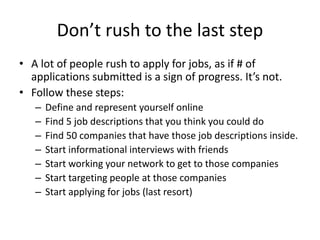
Don’t rush to the last step
• A lot of people rush to apply for jobs, as if # of
applications submitted is a sign of progress. It’s not.
• Follow these steps:
– Define and represent yourself online
– Find 10 job descriptions that you think you could do
– Find 50 companies that have those job descriptions inside.
– Start informational interviews with friends
– Start working your network to get to those companies
– Start targeting people at those companies
– Start applying for jobs (last resort)
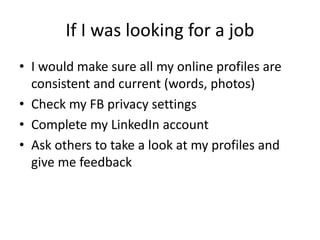
If I was looking for a job
• I would make sure all my online profiles are
consistent and current (words, photos)
• I would look at my profiles from a mobile
device – look OK?
• Check my FB privacy settings
• Upgrade my LinkedIn account
• Ask others to take a look at my profiles and
give me feedback
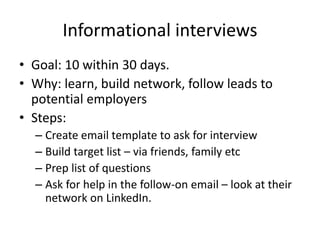
Informational interviews
• Goal: 10 within 30 days.
• Why: learn, build network, follow leads to
potential employers
• Steps:
– Create email template to ask for interview
– Build target list – via friends, family etc
– Prep list of questions.
– More good advice here:
In terms of finding a job, we are all SO
lucky
• It’s never been easier to communicate who
you are, what you care about and how you
can change the world (or company, or job)
• It gets easier and faster every day to find and
connect with the people you need to connect
with (eg potential employers)
5 steps
• Define yourself online
• Define a list of jobs you want
• Research the companies with those jobs
• Use your network and start to create your
own
• Be your best self in person (interviews)
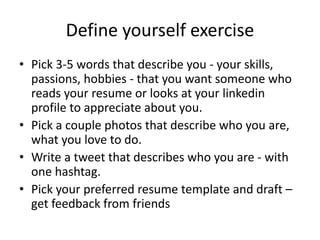
Define yourself exercise
• Pick 3-5 words that describe you - your skills,
passions, hobbies - that you want someone who
reads your resume or looks at your linkedin
profile to appreciate about you.
• Pick a couple photos that describe who you are,
what you love to do.
• Write a tweet that describes who you are - with
one hashtag.
• Pick your preferred resume template and draft –
get feedback from friends
LinkedIn – deserves it’s own slide
• Create your own great profile
• Google “how to create a great linkedin profile”
The resume
• Pick a template that is easy to scan
• No typos
• No inconsistencies, missing blocks of time
• Follow the best practices – check out or
google:
– http://www.forbes.com/sites/susanadams/2012/0
5/10/how-to-write-a-resume-when-youre-just-
out-of-college/
Represent yourself online
• LinkedIn profile – 100% complete, including
join some relevant grps and follow some
relevant companies
• About.me profile (tell a more personal story).
Be super cool and set up a rebelmouse profile.
• Twitter handle – at least claim it and create a
profile (consistent with others)
Be able to speak to your personal
keywords and your passions
• What blogs do you read regularly?
• Who do you follow on twitter?
• Does the way you spend your non-work time
match the interests/passions you say you
have.
Tools for social presence
• about.me, rebelmouse.com
• Upgrade your Linkedin account so you can
contact more people (its worth the $$)
• Buffer for scheduling your social posting
• Medium.com for great mid-length content
• Build your own blog:
– Squarespace.com
– Crushpath.com
Tools for research and outreach
• Crunchbase.com, Glassdoor.com, company aboutus
page and linkedin page, twitter feed
• Use rapportive plug-in for connecting social profiles to
email
• Use yesmail/bananatag to see if your recipients open
your email.
• Use clearslide if someone wants you to send them a
PPT prezo.
• Feedly to track topics
• Mention to track names of people – including your
own
If I was writing/emailing prospective
jobs
• Develop several email templates – personal
intro, thank you, reach out again
• Make emails brief, bullet points, links, clear
request or call to action
• Don’t attach your resume – link to Linkedin
profile only (it’s being read on a phone)
Cold-calling someone that could hire
you (professional stalking)
• Check if they have a social presence – twitter,
prezos in slideshare, quora etc
• Follow them, comment on one of their blog
posts
If I was interviewing
• I would make sure all my online profiles are
consistent and current
• I would follow the company on LinkedIn and
Twitter
• I would research the person I am seeing on:
LinkedIn (groups), Twitter, about.me
• I would not friend request them on FB or
LinkedIn before the meeting/interview
Practice for interviews
• Expect all kinds of interview questions
– A good starter list:
– http://jobsearch.about.com/od/interviewquestionsanswers/a/t
op-50-job-interview-questions.htm
– http://www.forbes.com/sites/jacquelynsmith/2013/01/11/how-
to-ace-the-50-most-common-interview-questions/
• Ask others who have interviewed there – or use glassdoor:
– http://www.glassdoor.ca/Interview/index.htm
• Be prepared for video interview – so practice that with a
friend via skype
My recommendations – therefore my
bias
• Get a job quickly
• Get a job that means you have to use lots of
software to get your work done
– any software
• Move your role closer and closer to the
software
• Stay 9 months min, 18 months ++
As an employer, I ask myself
• Will this person get their shit done
• Are they authentic/real/passionate about
SOMETHING
• Will the company/team be BETTER if we hire
this person
– Will they do more than asked
– Will they help others on team
– Will they manage projects not process
Other thoughts
• Room mates and after-college friends matter -
read this:
– http://lifehacker.com/5926309/how-the-people-
around-you-affect-personal-success
• Be reading a real book – and don’t look
terrified when someone asks: “whats your
favorite book?” (or app)
The bullshit excuses I hear…
• Those privacy settings are confusing
• Don’t have time for extra classes/training
• I don’t have enough to say on social media
• Twitter is lame
• Linkedin is boring
You must be GREAT at
• All google app’s
• Powerpoint (sadly, yes)
• Box, Dropbox, Evernote etc
• Excel (I don’t mean you can figure out how much
your friends owe you after a weekend at
Coachella, more than that)
• The tools that the best in your field/domain use
• All social platforms
Upgrade your personal productivity
• Evernote
• Mailbox or gmail app.
• Wunderlist – or a great cloud to-do list that
you like
• Tempo for a better calendar
• Refresh for meeting prep
• LinkedIn apps (both)

Getting hired jan2015

  • 1.
    Telling your story/gettinghired (for my kids and their friends) greg shove, founder/ceo, socialchorus @gregshove Jan 2015
  • 2.
    Finding your firstjob takes time, so allocate enough time • It’s al least 90 mins a day: – 30 mins less on buzzfeed.com – 15 mins less looking at your friends fashion pinterest board – 15 mins less on deadspin • One less episode of whatever show you have already seen
  • 3.
    Don’t rush tothe last step • A lot of people rush to apply for jobs, as if # of applications submitted is a sign of progress. It’s not. • Follow these steps: – Define and represent yourself online – Find 10 job descriptions that you think you could do – Find 50 companies that have those job descriptions inside. – Start informational interviews with friends – Start working your network to get to those companies – Start targeting people at those companies – Start applying for jobs (last resort)
  • 4.
    If I waslooking for a job • I would make sure all my online profiles are consistent and current (words, photos) • I would look at my profiles from a mobile device – look OK? • Check my FB privacy settings • Upgrade my LinkedIn account • Ask others to take a look at my profiles and give me feedback
  • 5.
    Informational interviews • Goal:10 within 30 days. • Why: learn, build network, follow leads to potential employers • Steps: – Create email template to ask for interview – Build target list – via friends, family etc – Prep list of questions. – More good advice here:
  • 6.
    In terms offinding a job, we are all SO lucky • It’s never been easier to communicate who you are, what you care about and how you can change the world (or company, or job) • It gets easier and faster every day to find and connect with the people you need to connect with (eg potential employers)
  • 7.
    5 steps • Defineyourself online • Define a list of jobs you want • Research the companies with those jobs • Use your network and start to create your own • Be your best self in person (interviews)
  • 8.
    Define yourself exercise •Pick 3-5 words that describe you - your skills, passions, hobbies - that you want someone who reads your resume or looks at your linkedin profile to appreciate about you. • Pick a couple photos that describe who you are, what you love to do. • Write a tweet that describes who you are - with one hashtag. • Pick your preferred resume template and draft – get feedback from friends
  • 9.
    LinkedIn – deservesit’s own slide • Create your own great profile • Google “how to create a great linkedin profile”
  • 10.
    The resume • Picka template that is easy to scan • No typos • No inconsistencies, missing blocks of time • Follow the best practices – check out or google: – http://www.forbes.com/sites/susanadams/2012/0 5/10/how-to-write-a-resume-when-youre-just- out-of-college/
  • 11.
    Represent yourself online •LinkedIn profile – 100% complete, including join some relevant grps and follow some relevant companies • About.me profile (tell a more personal story). Be super cool and set up a rebelmouse profile. • Twitter handle – at least claim it and create a profile (consistent with others)
  • 12.
    Be able tospeak to your personal keywords and your passions • What blogs do you read regularly? • Who do you follow on twitter? • Does the way you spend your non-work time match the interests/passions you say you have.
  • 13.
    Tools for socialpresence • about.me, rebelmouse.com • Upgrade your Linkedin account so you can contact more people (its worth the $$) • Buffer for scheduling your social posting • Medium.com for great mid-length content • Build your own blog: – Squarespace.com – Crushpath.com
  • 14.
    Tools for researchand outreach • Crunchbase.com, Glassdoor.com, company aboutus page and linkedin page, twitter feed • Use rapportive plug-in for connecting social profiles to email • Use yesmail/bananatag to see if your recipients open your email. • Use clearslide if someone wants you to send them a PPT prezo. • Feedly to track topics • Mention to track names of people – including your own
  • 15.
    If I waswriting/emailing prospective jobs • Develop several email templates – personal intro, thank you, reach out again • Make emails brief, bullet points, links, clear request or call to action • Don’t attach your resume – link to Linkedin profile only (it’s being read on a phone)
  • 16.
    Cold-calling someone thatcould hire you (professional stalking) • Check if they have a social presence – twitter, prezos in slideshare, quora etc • Follow them, comment on one of their blog posts
  • 17.
    If I wasinterviewing • I would make sure all my online profiles are consistent and current • I would follow the company on LinkedIn and Twitter • I would research the person I am seeing on: LinkedIn (groups), Twitter, about.me • I would not friend request them on FB or LinkedIn before the meeting/interview
  • 18.
    Practice for interviews •Expect all kinds of interview questions – A good starter list: – http://jobsearch.about.com/od/interviewquestionsanswers/a/t op-50-job-interview-questions.htm – http://www.forbes.com/sites/jacquelynsmith/2013/01/11/how- to-ace-the-50-most-common-interview-questions/ • Ask others who have interviewed there – or use glassdoor: – http://www.glassdoor.ca/Interview/index.htm • Be prepared for video interview – so practice that with a friend via skype
  • 19.
    My recommendations –therefore my bias • Get a job quickly • Get a job that means you have to use lots of software to get your work done – any software • Move your role closer and closer to the software • Stay 9 months min, 18 months ++
  • 20.
    As an employer,I ask myself • Will this person get their shit done • Are they authentic/real/passionate about SOMETHING • Will the company/team be BETTER if we hire this person – Will they do more than asked – Will they help others on team – Will they manage projects not process
  • 21.
    Other thoughts • Roommates and after-college friends matter - read this: – http://lifehacker.com/5926309/how-the-people- around-you-affect-personal-success • Be reading a real book – and don’t look terrified when someone asks: “whats your favorite book?” (or app)
  • 22.
    The bullshit excusesI hear… • Those privacy settings are confusing • Don’t have time for extra classes/training • I don’t have enough to say on social media • Twitter is lame • Linkedin is boring
  • 23.
    You must beGREAT at • All google app’s • Powerpoint (sadly, yes) • Box, Dropbox, Evernote etc • Excel (I don’t mean you can figure out how much your friends owe you after a weekend at Coachella, more than that) • The tools that the best in your field/domain use • All social platforms
  • 24.
    Upgrade your personalproductivity • Evernote • Mailbox or gmail app. • Wunderlist – or a great cloud to-do list that you like • Tempo for a better calendar • Refresh for meeting prep • LinkedIn apps (both)