Get Going with GreenClosing the Sustainability Gap
Ogilvy Earth is the global sustainability practice within the Ogilvy & Mather Group. We help brands harness the power of sustainability, through strategic planning and communications. We work with visionary companies that are looking to make sustainability a growth driver for both their business and the communities they serve.
There is a yawning gap between people’s claimed and actual sustainable behavior. At Ogilvy Earth, we call it the Sustainability Gap.
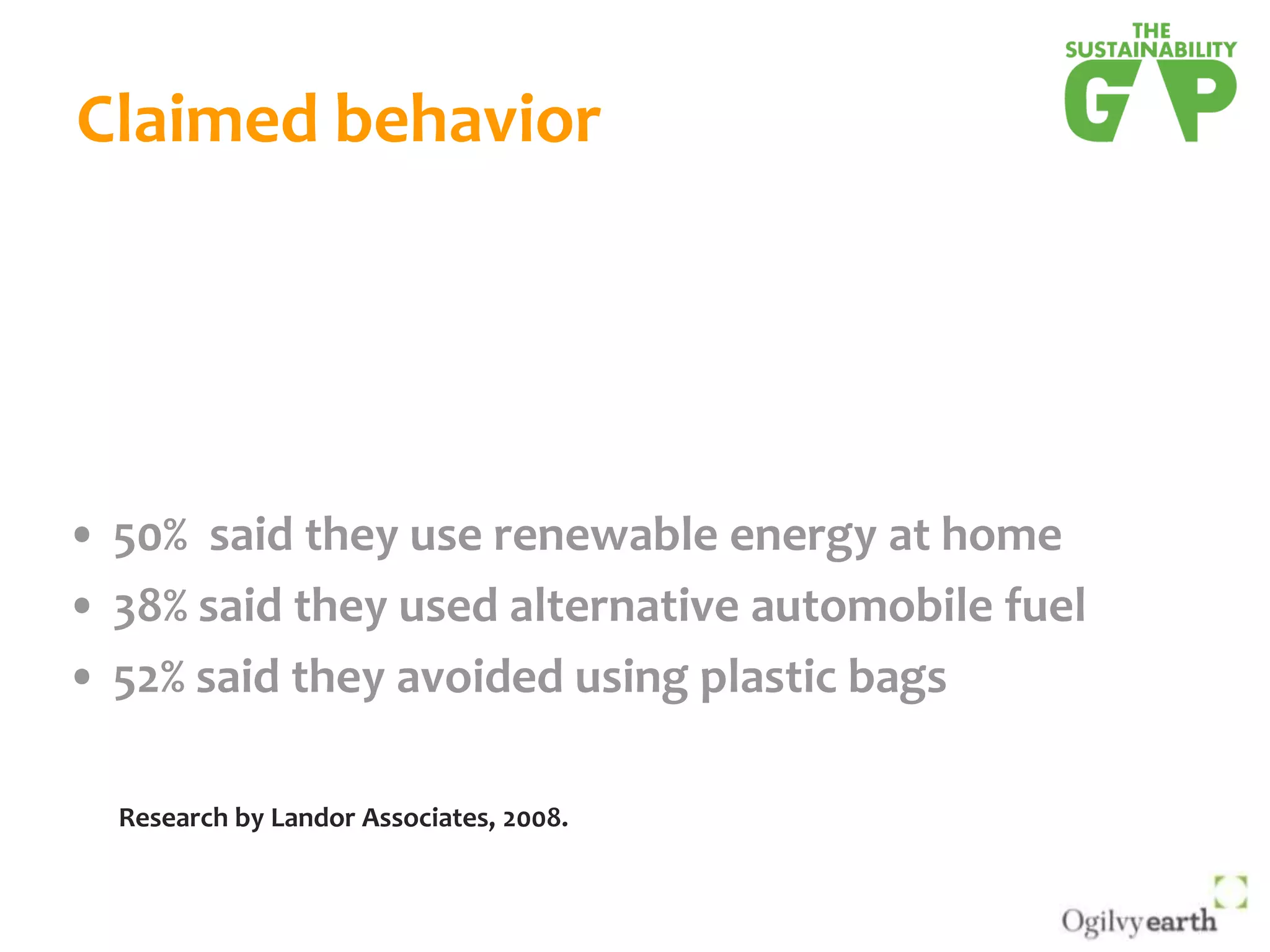
Claimed behavior50%  said they use renewable energy at home38% said they used alternative automobile fuel52% said they avoided using plastic bagsResearch by Landor Associates, 2008.
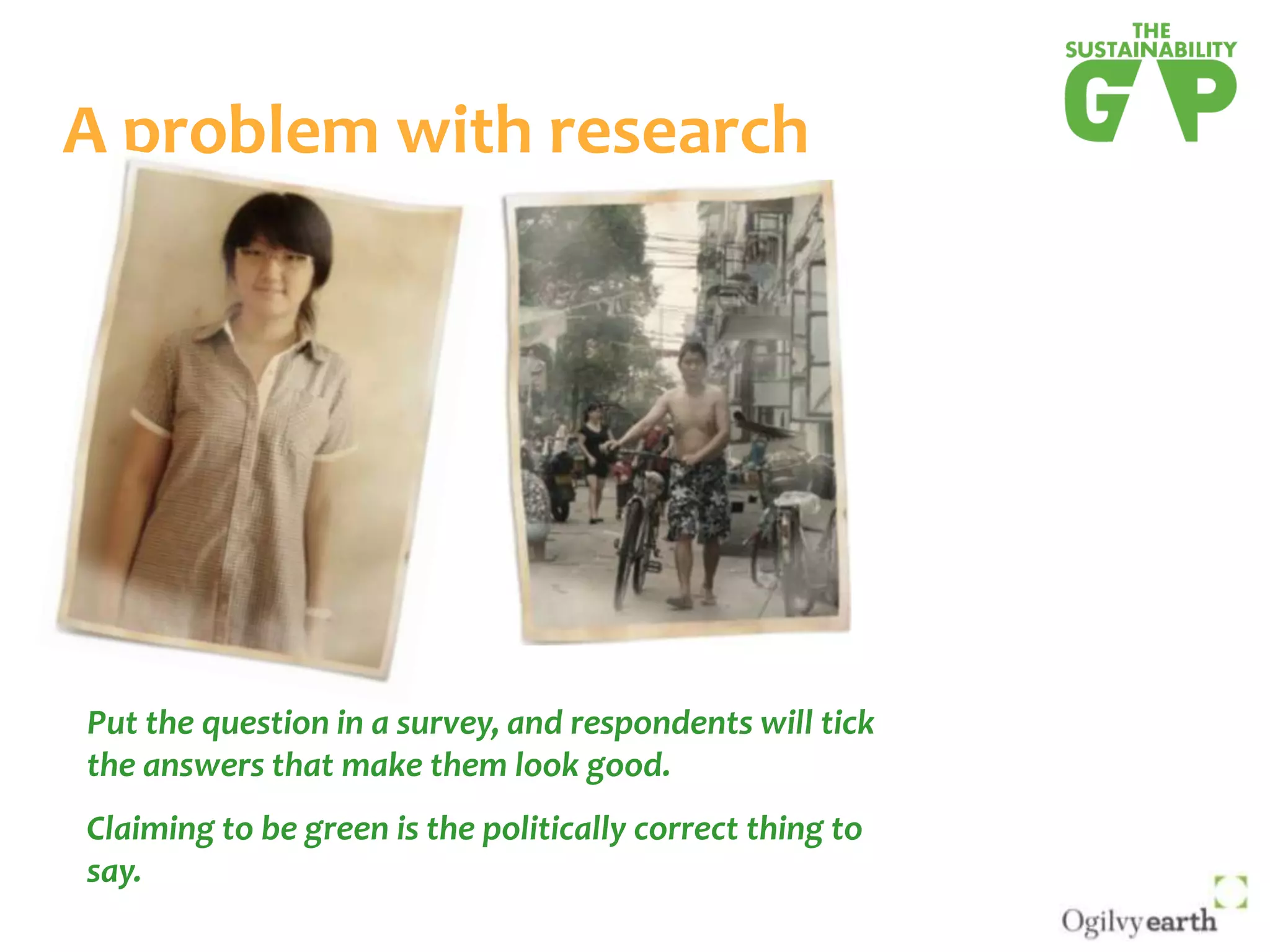
A problem with researchPut the question in a survey, and respondents will tick the answers that make them look good. Claiming to be green is the politically correct thing to say.
When people claim they are green, it is because they already have the knowledge that they need to change their behaviors. They are concerned, but they feel powerless.
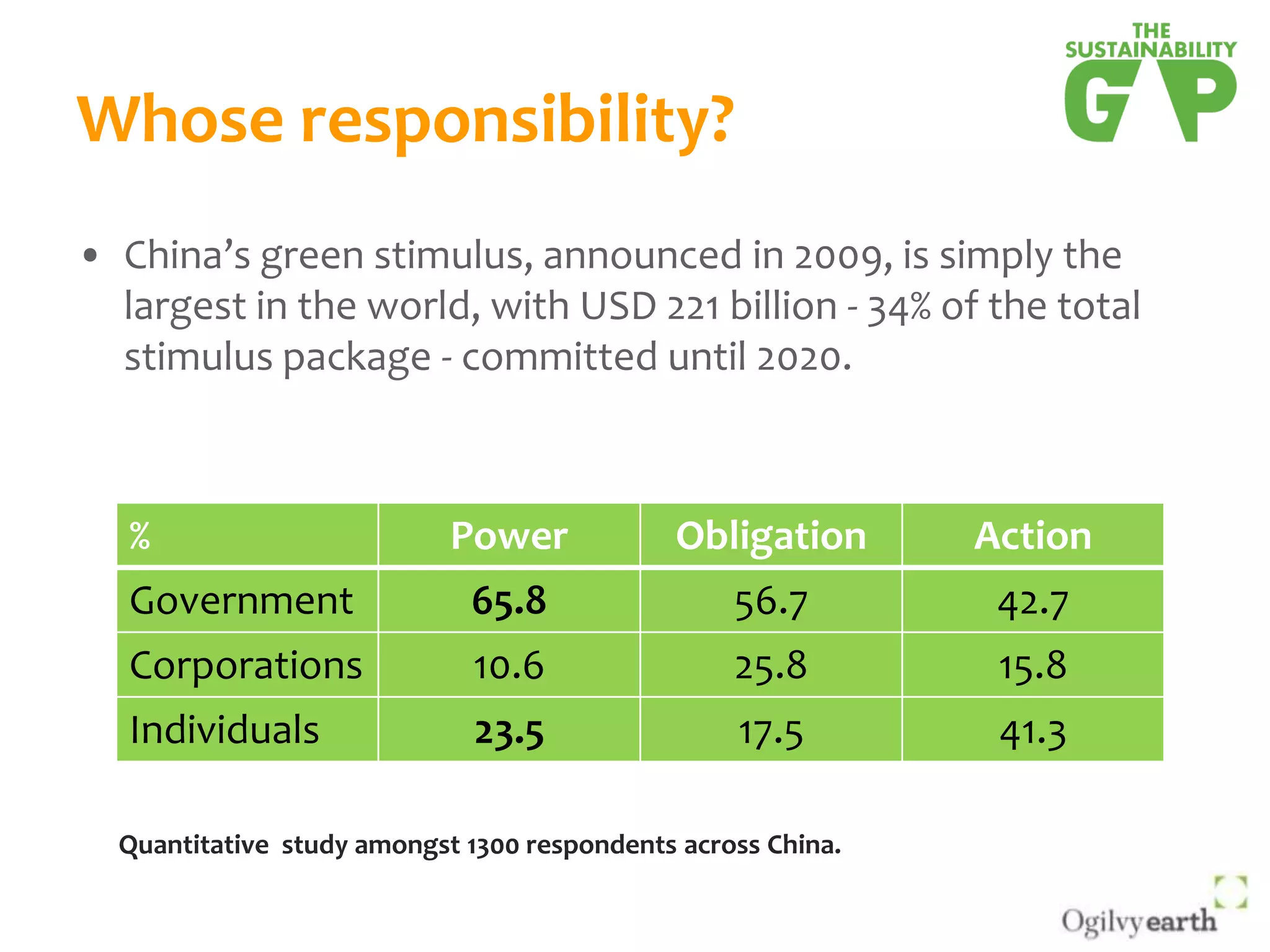
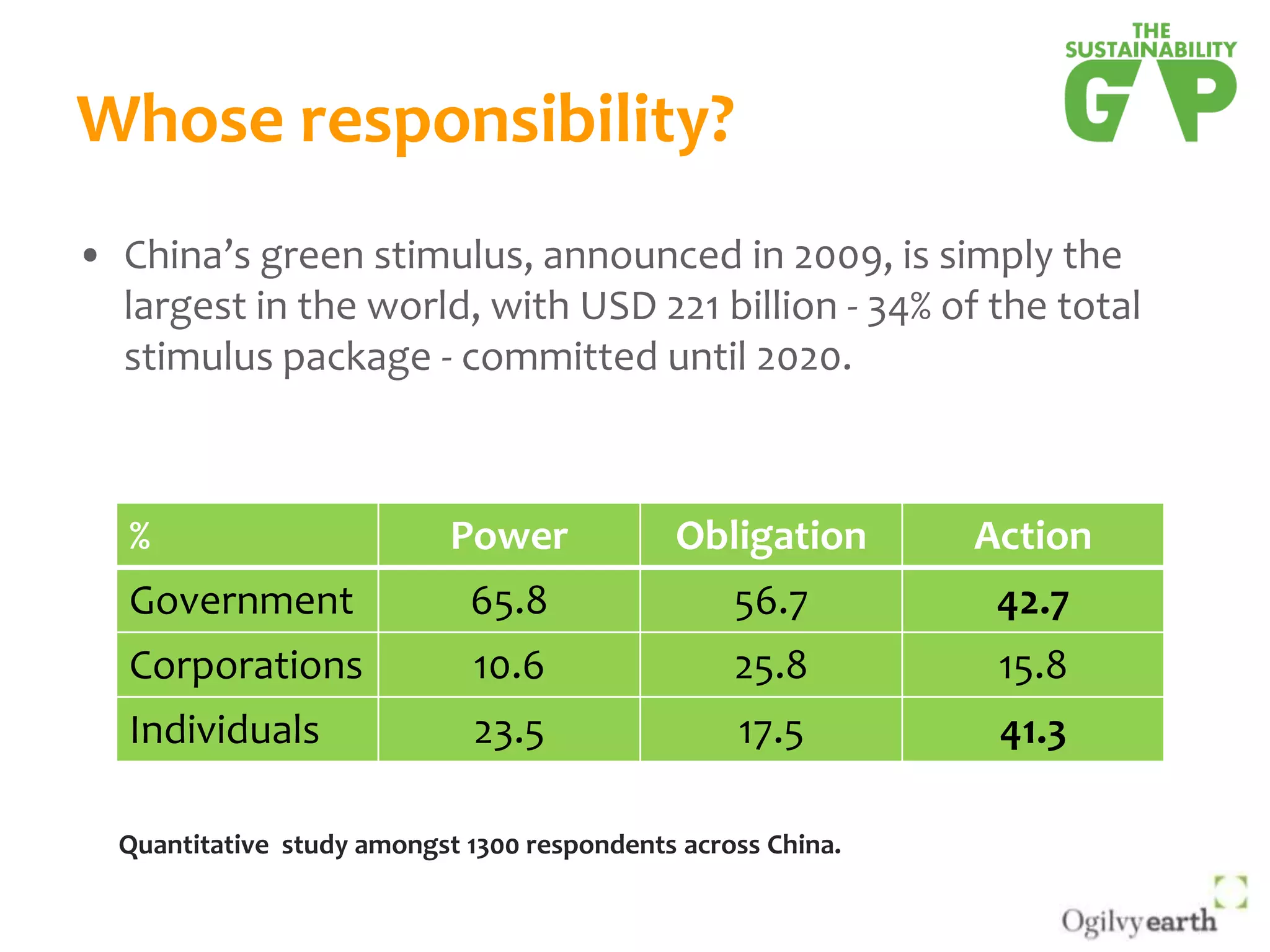
Whose responsibility?China’s green stimulus, announced in 2009, is simply the largest in the world, with USD 221 billion - 34% of the total stimulus package - committed until 2020. Quantitative  study amongst 1300 respondents across China.
A focus on compliance, cost & image84% companies said that environment protection is important to them because it is a legal requirement79% said it was a brand image necessityOnly 19% said they were promoting the sales of environment friendly productsChinese companies in the 21st century, A survey of Social Responsibility & Sustainability of Chinese companies, Worldwide Fund for Nature, April 2010
53% of our respondents said that the green options in the marketplace were too expensive.
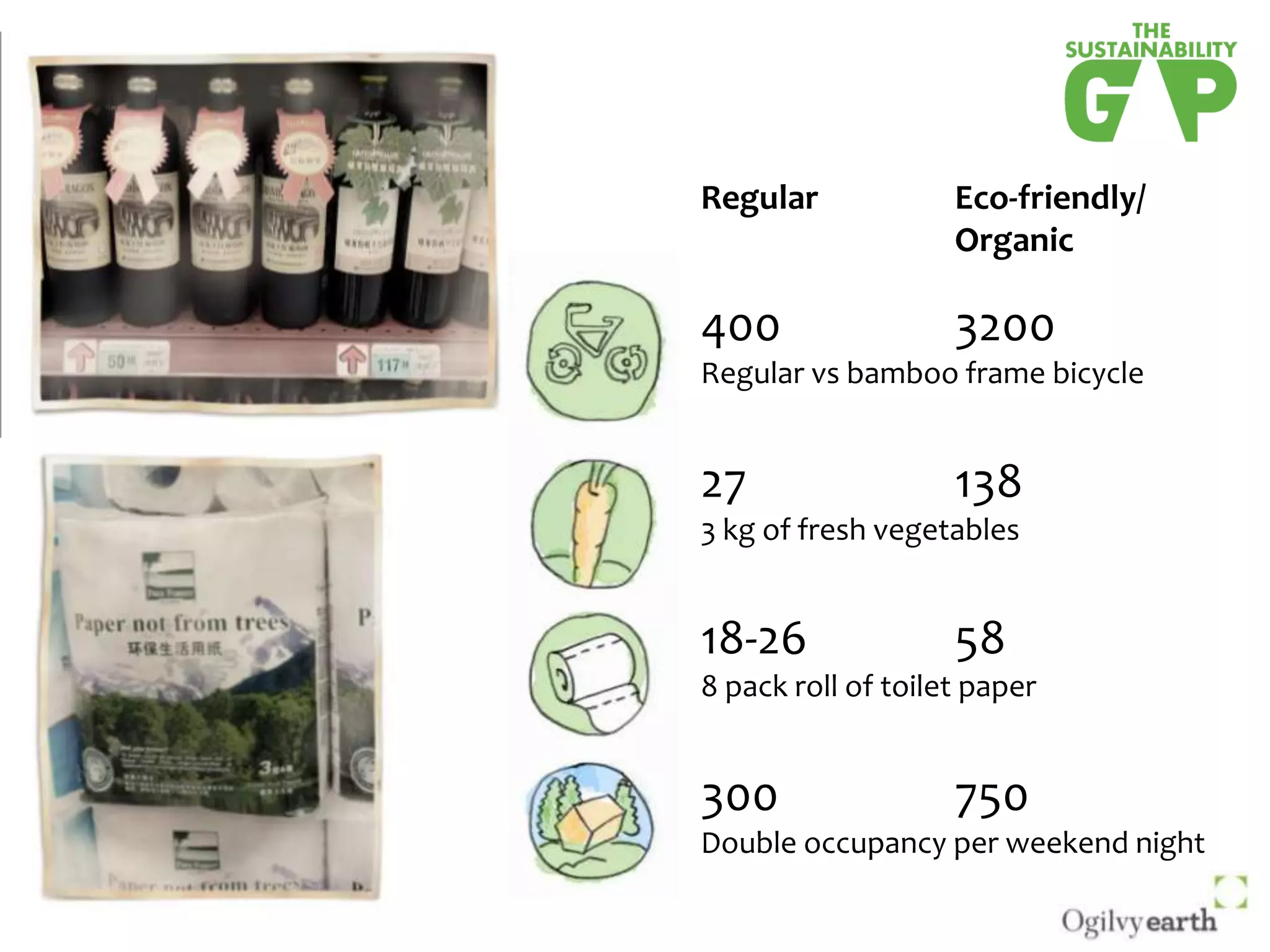
Regular		Eco-friendly/		Organic400		3200Regular vs bamboo frame bicycle27		138 3 kg of fresh vegetables18-26		588 pack roll of toilet paper300		750Double occupancy per weekend night
A willingness to act67% believe that their efforts did count69% said that if environment friendly products were available at the same price point, they would purchase themNot entirely closed to the idea of paying a small premium71% are happy to pay up to 10% more
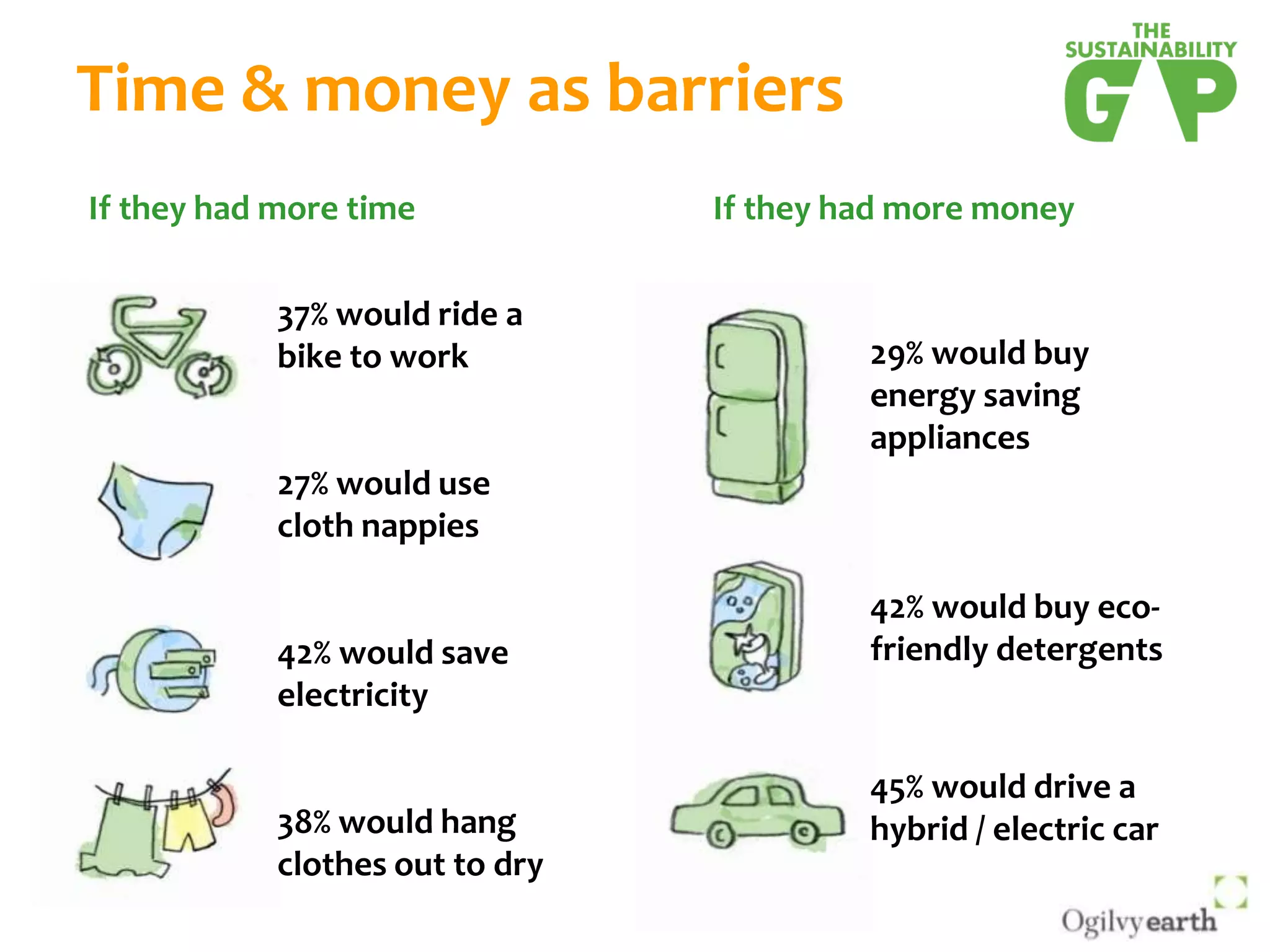
Time & money as barriersIf they had more timeIf they had more money37% would ride a bike to work27% would use cloth nappies42% would save electricity38% would hang clothes out to dry29% would buy energy saving appliances42% would buy eco-friendly detergents45% would drive a hybrid / electric car
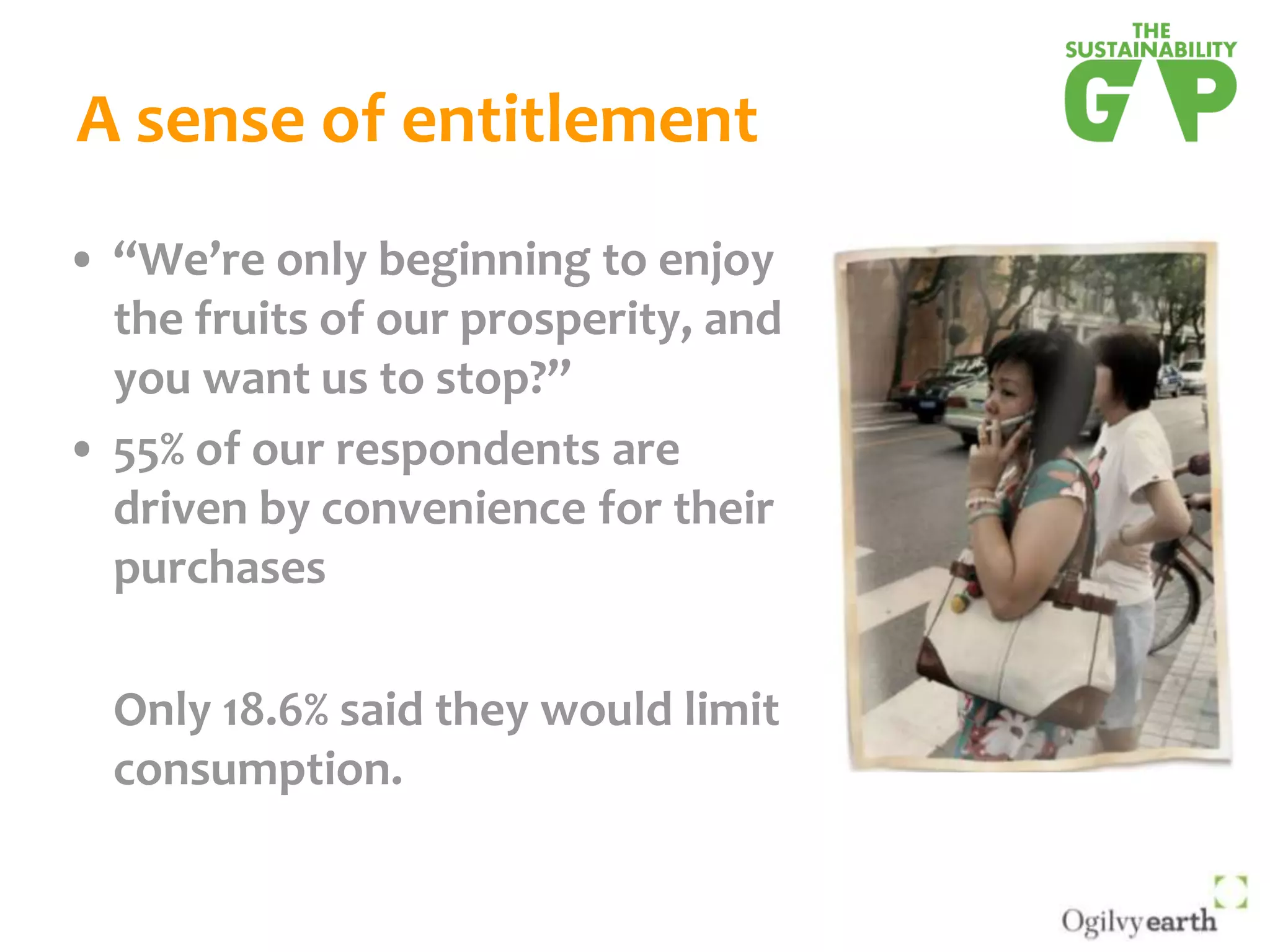
A sense of entitlement“We’re only beginning to enjoy the fruits of our prosperity, and you want us to stop?”55% of our respondents are driven by convenience for their purchases	Only 18.6% said they would limit consumption.
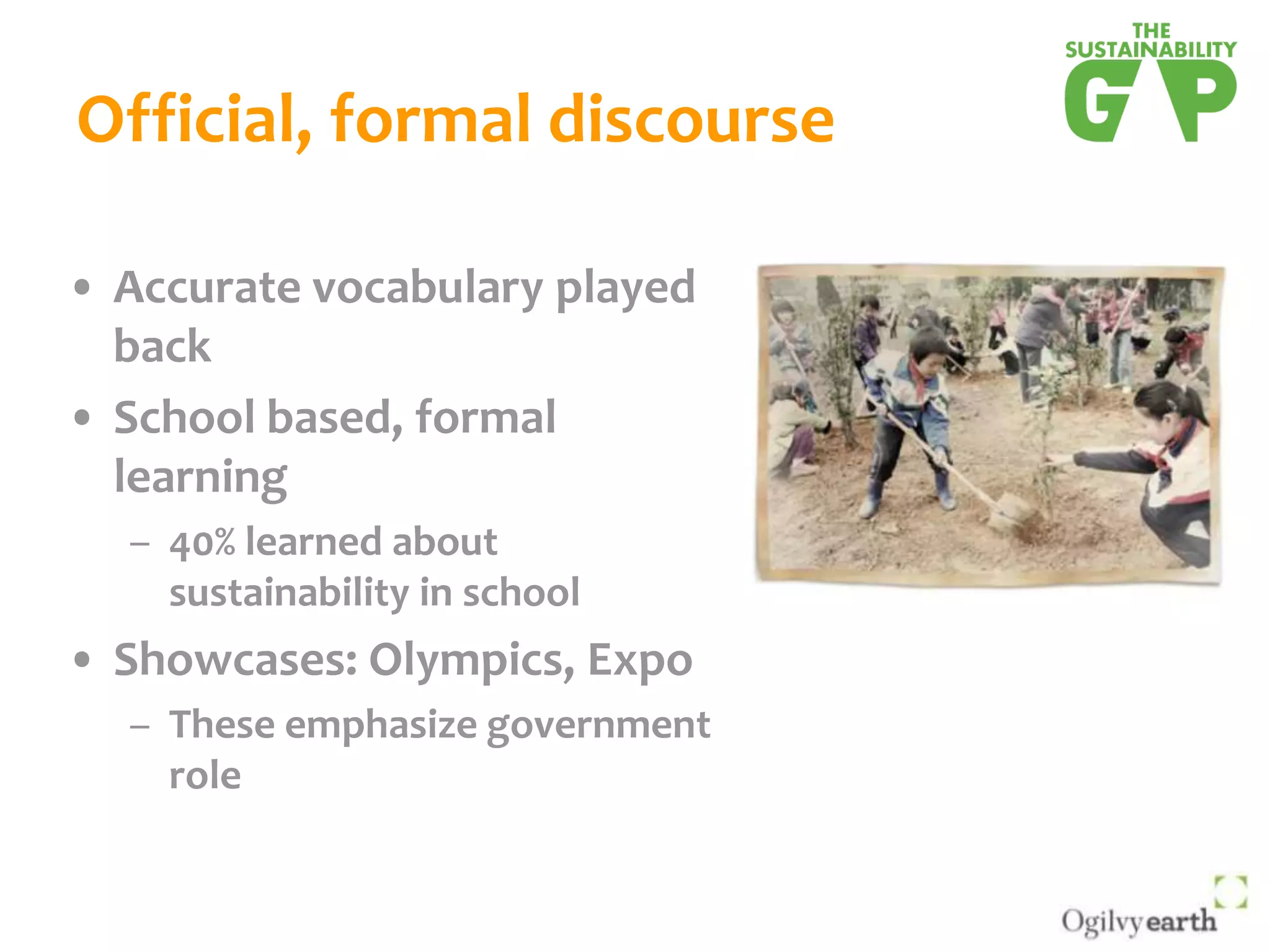
Official, formal discourseAccurate vocabulary played backSchool based, formal learning40% learned about sustainability in schoolShowcases: Olympics, ExpoThese emphasize government role
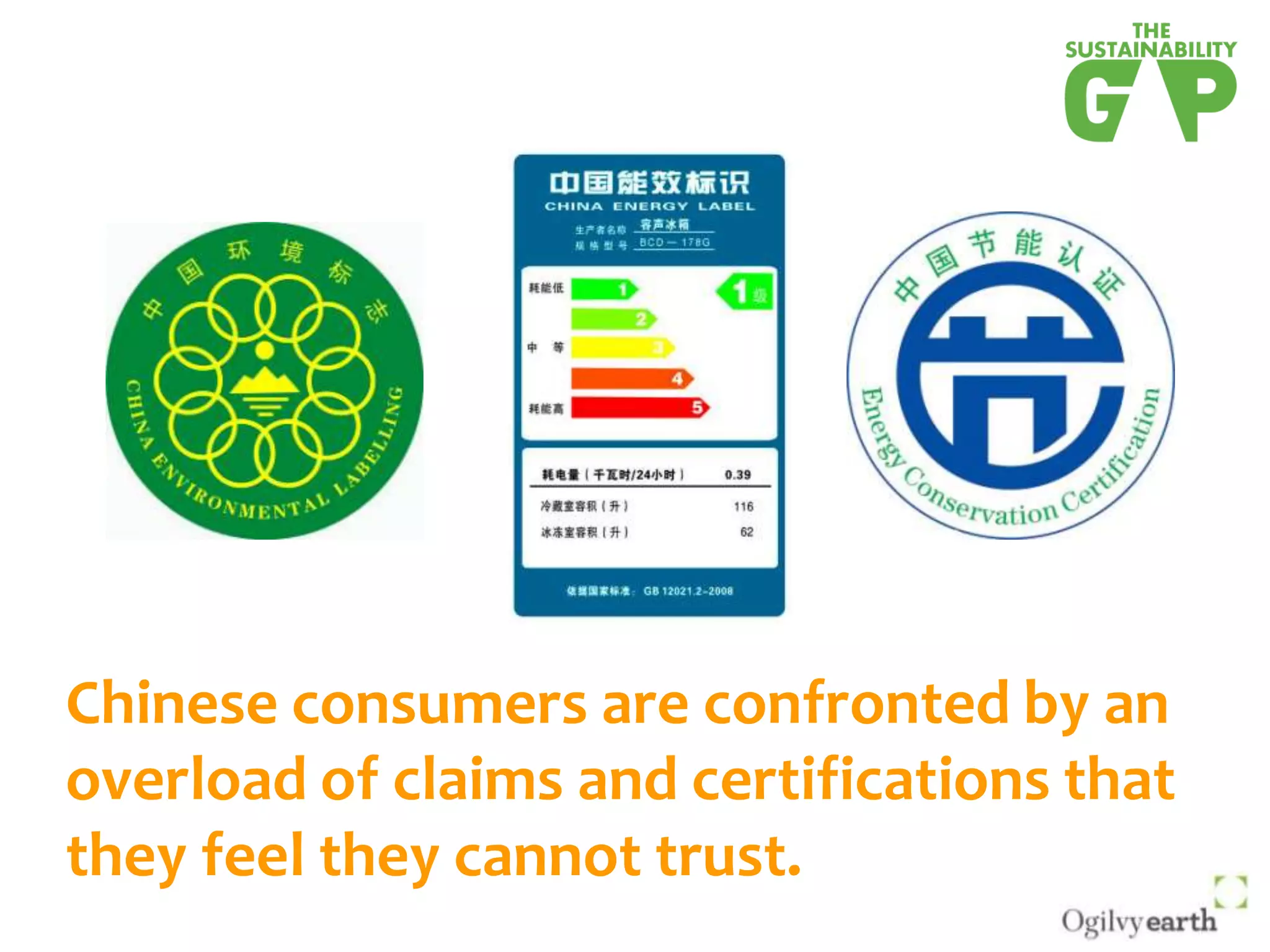
Chinese consumers are confronted by an overload of claims and certifications that they feel they cannot trust.
The idealism of Green HeroesThe badge that the Eco-chic wearCreates a distance
But there’s hope.
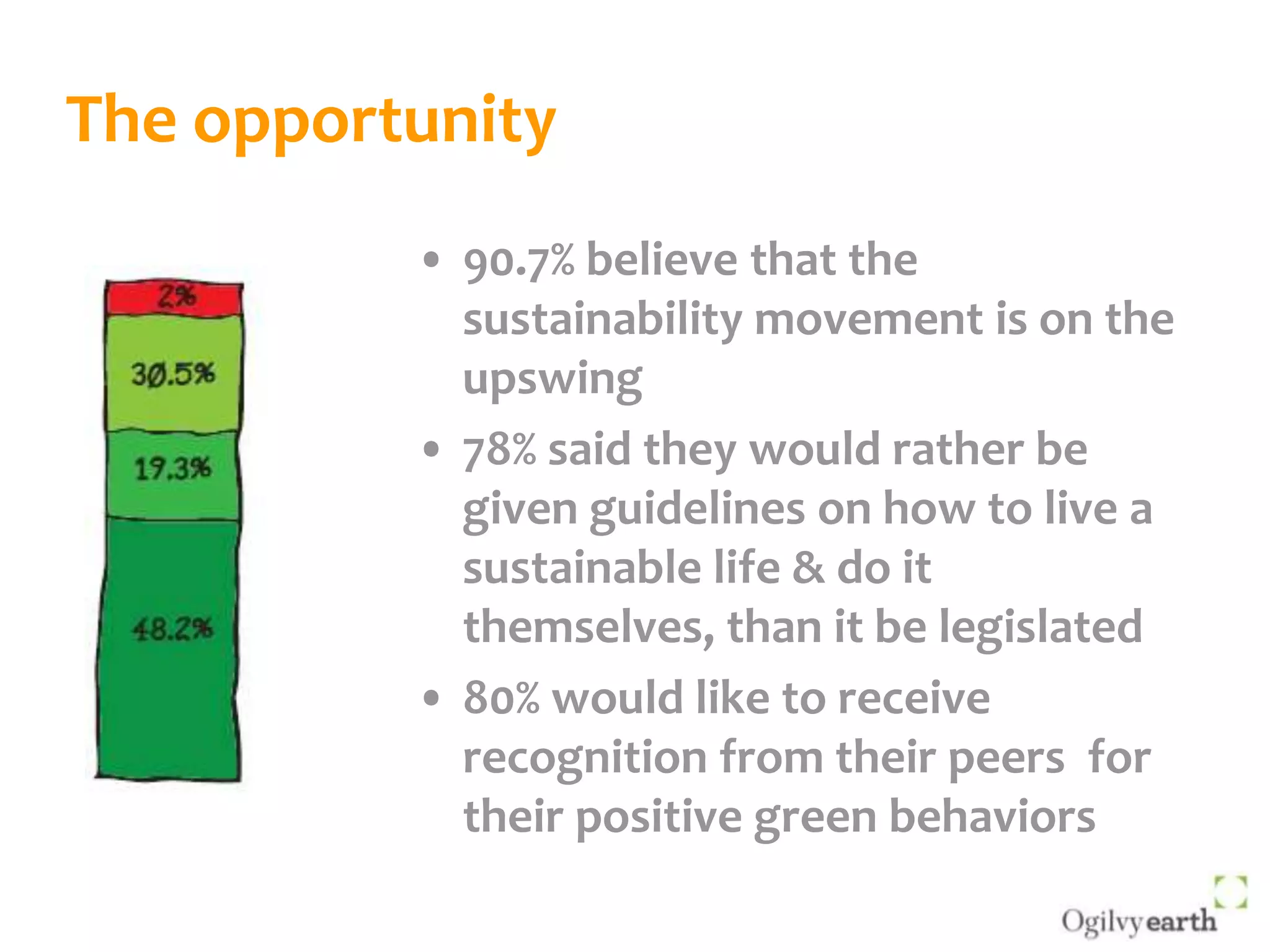
The opportunity90.7% believe that the sustainability movement is on the upswing78% said they would rather be given guidelines on how to live a sustainable life & do it themselves, than it be legislated80% would like to receive recognition from their peers  for their positive green behaviors
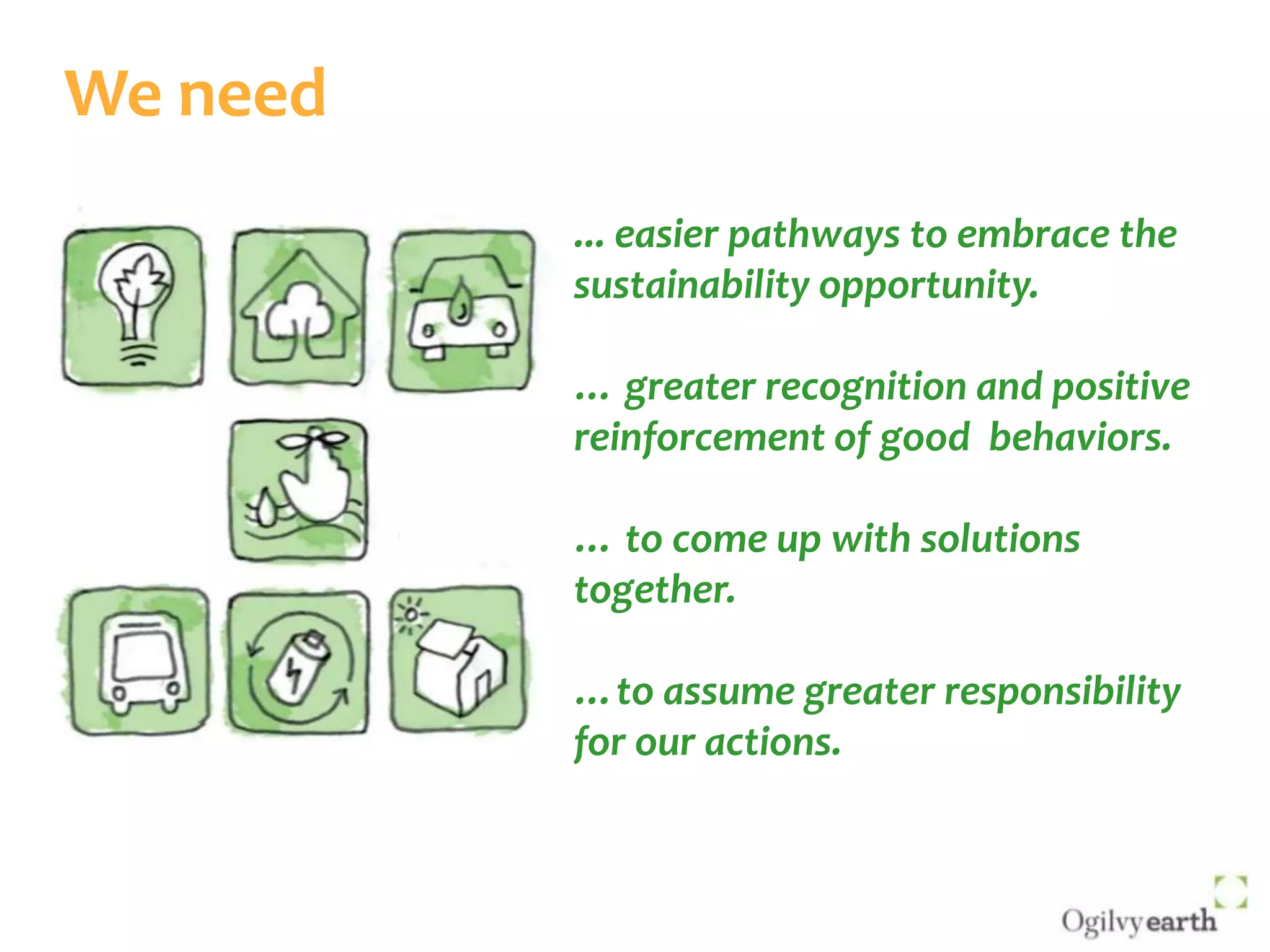
We need... easier pathways to embrace the sustainability opportunity. … greater recognition and positive reinforcement of good  behaviors. … to come up with solutions together. …to assume greater responsibility for our actions.
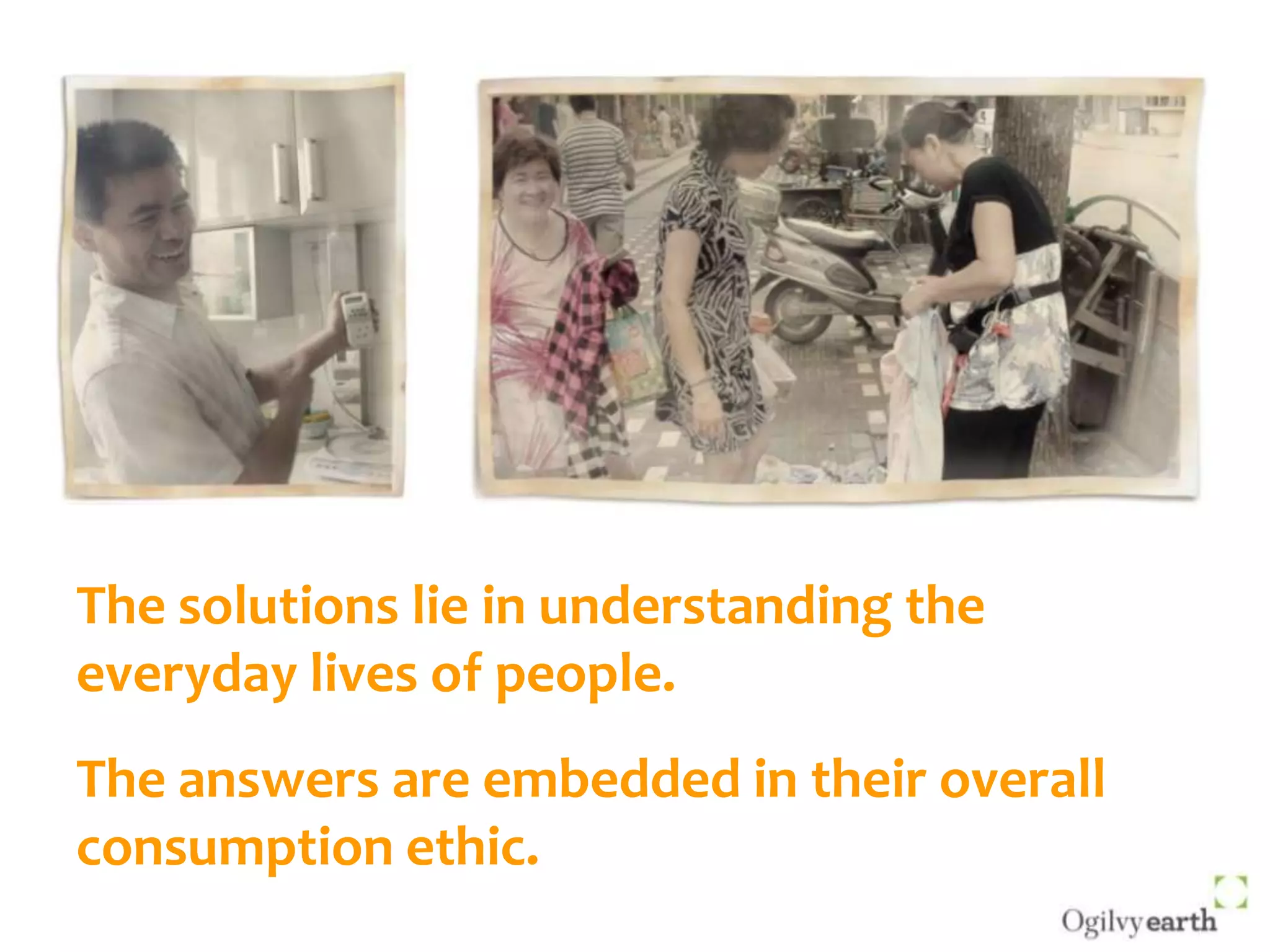
The solutions lie in understanding the everyday lives of people.The answers are embedded in their overall consumption ethic.
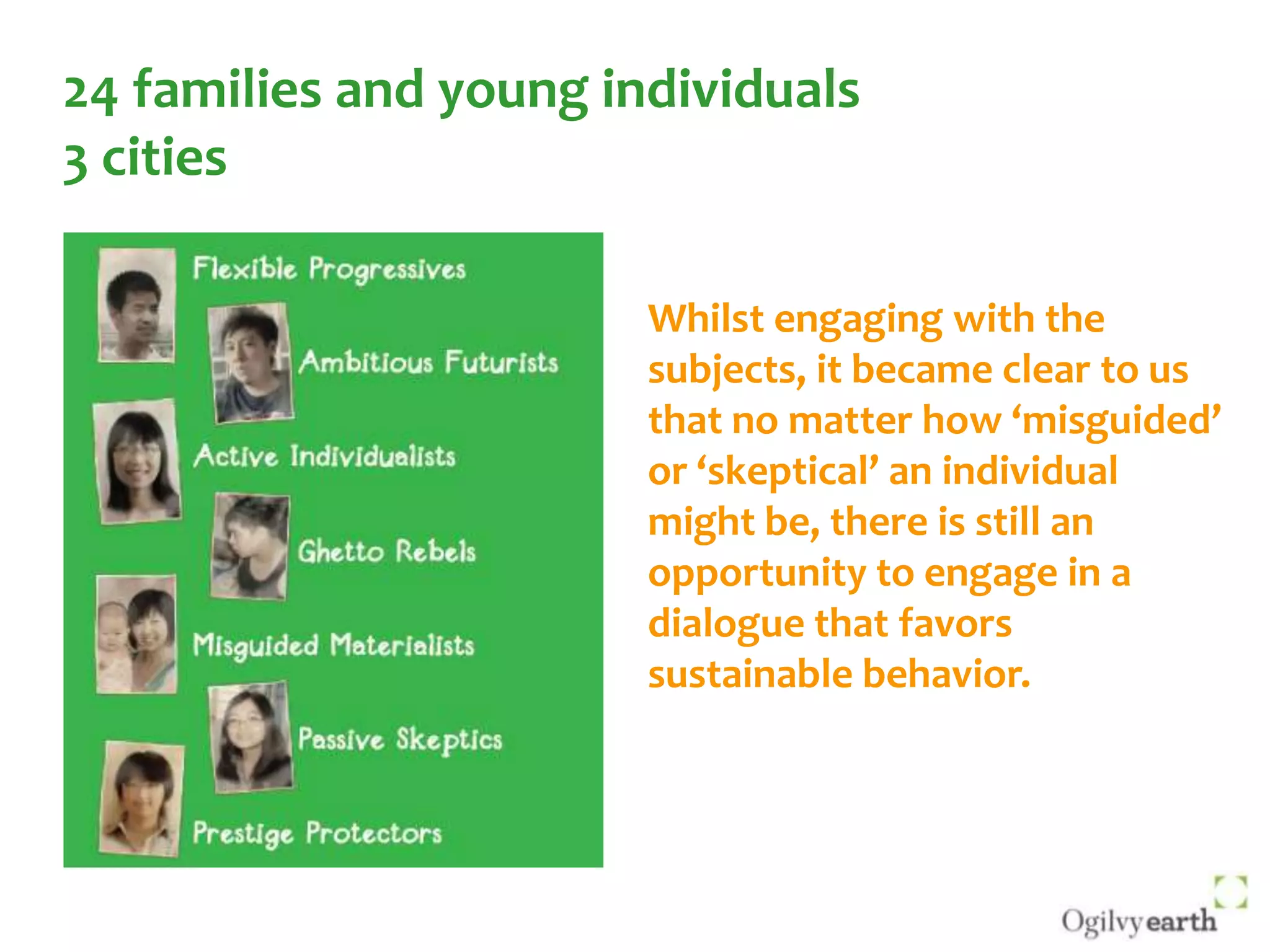
24 families and young individuals 3 cities   Whilst engaging with the subjects, it became clear to us that no matter how ‘misguided’ or ‘skeptical’ an individual might be, there is still an opportunity to engage in a dialogue that favors sustainable behavior.
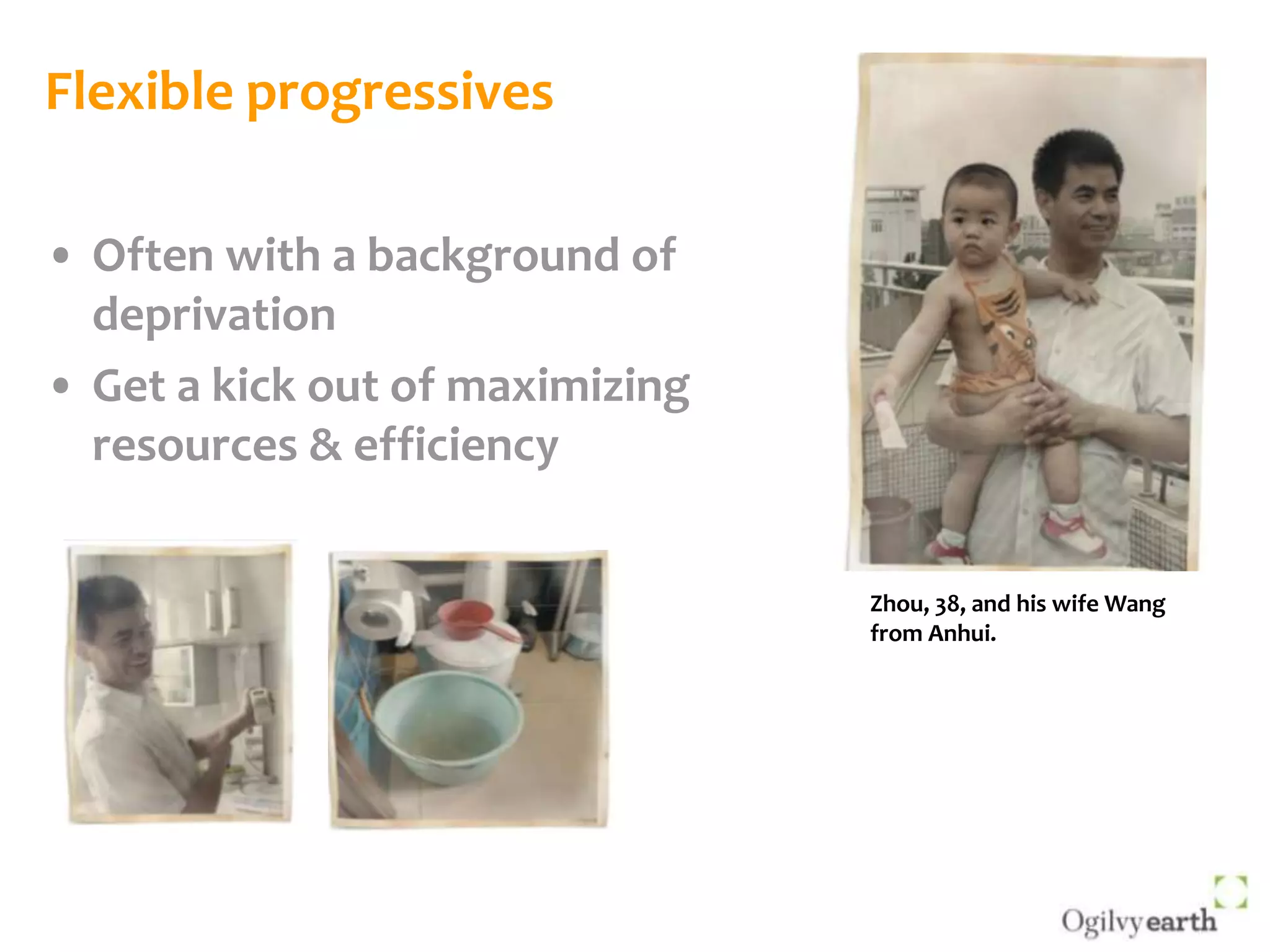
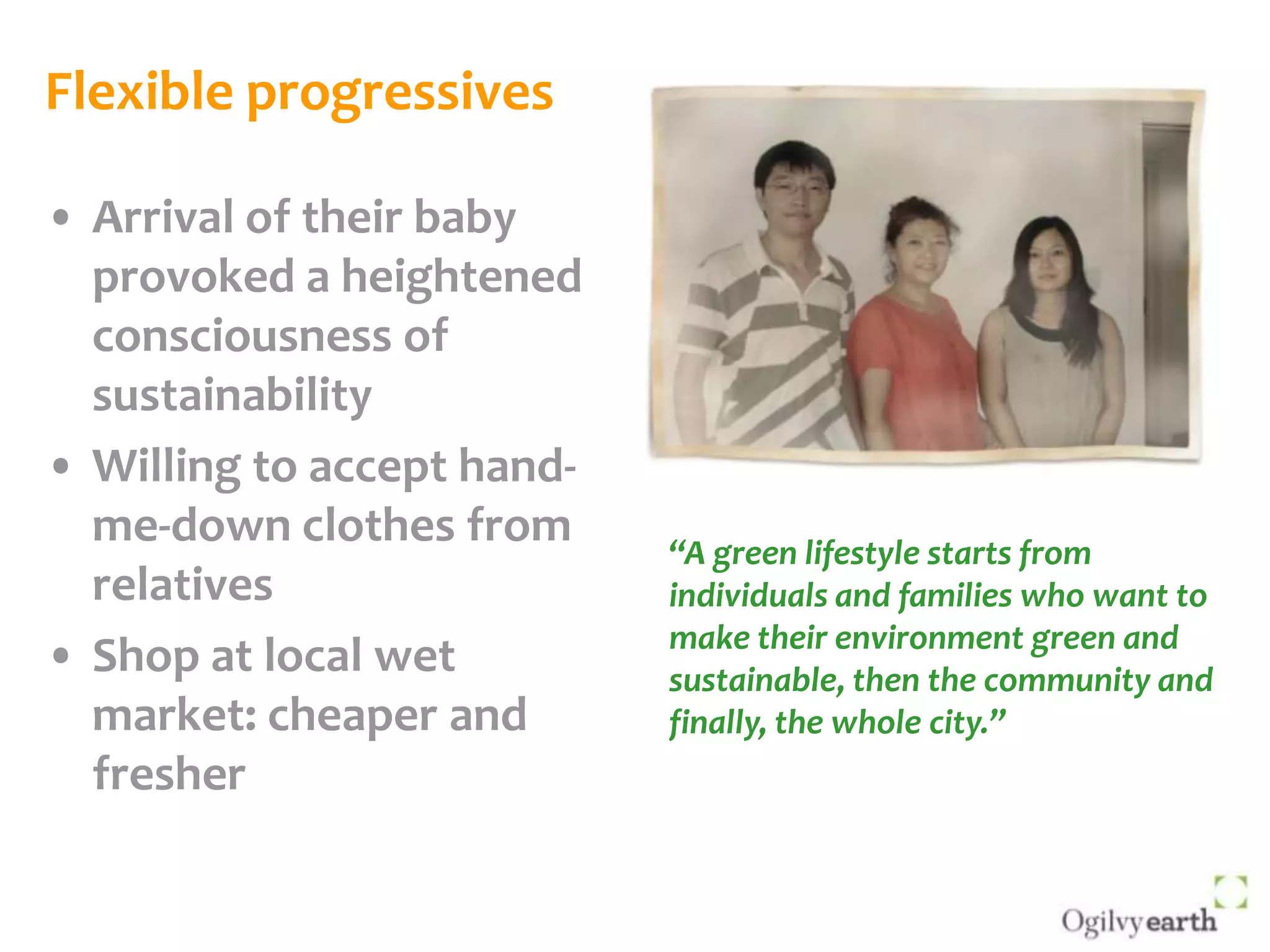
Flexible progressivesOften with a background of deprivationGet a kick out of maximizing resources & efficiencyZhou, 38, and his wife Wang from Anhui.
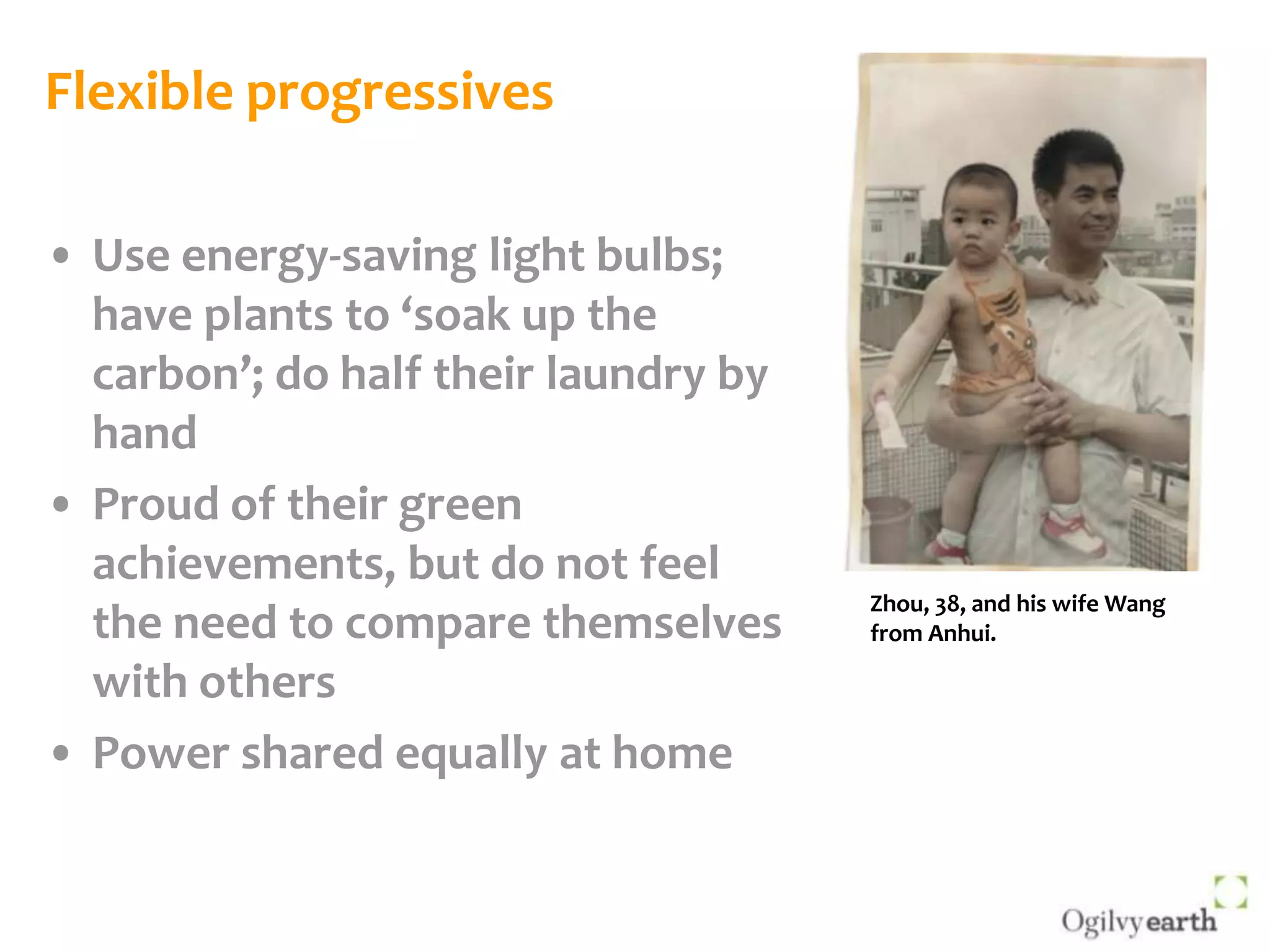
Flexible progressivesUse energy-saving light bulbs; have plants to ‘soak up the carbon’; do half their laundry by handProud of their green achievements, but do not feel the need to compare themselves with othersPower shared equally at homeZhou, 38, and his wife Wang from Anhui.
Flexible progressivesArrival of their baby provoked a heightened consciousness of sustainabilityWilling to accept hand-me-down clothes from relativesShop at local wet market: cheaper and fresher“A green lifestyle starts from individuals and families who want to make their environment green and sustainable, then the community and finally, the whole city.”
Heroes amongst us.Bring men & women equally into the discussion.Use critical moments in life, such as childbirth, to motivate action.
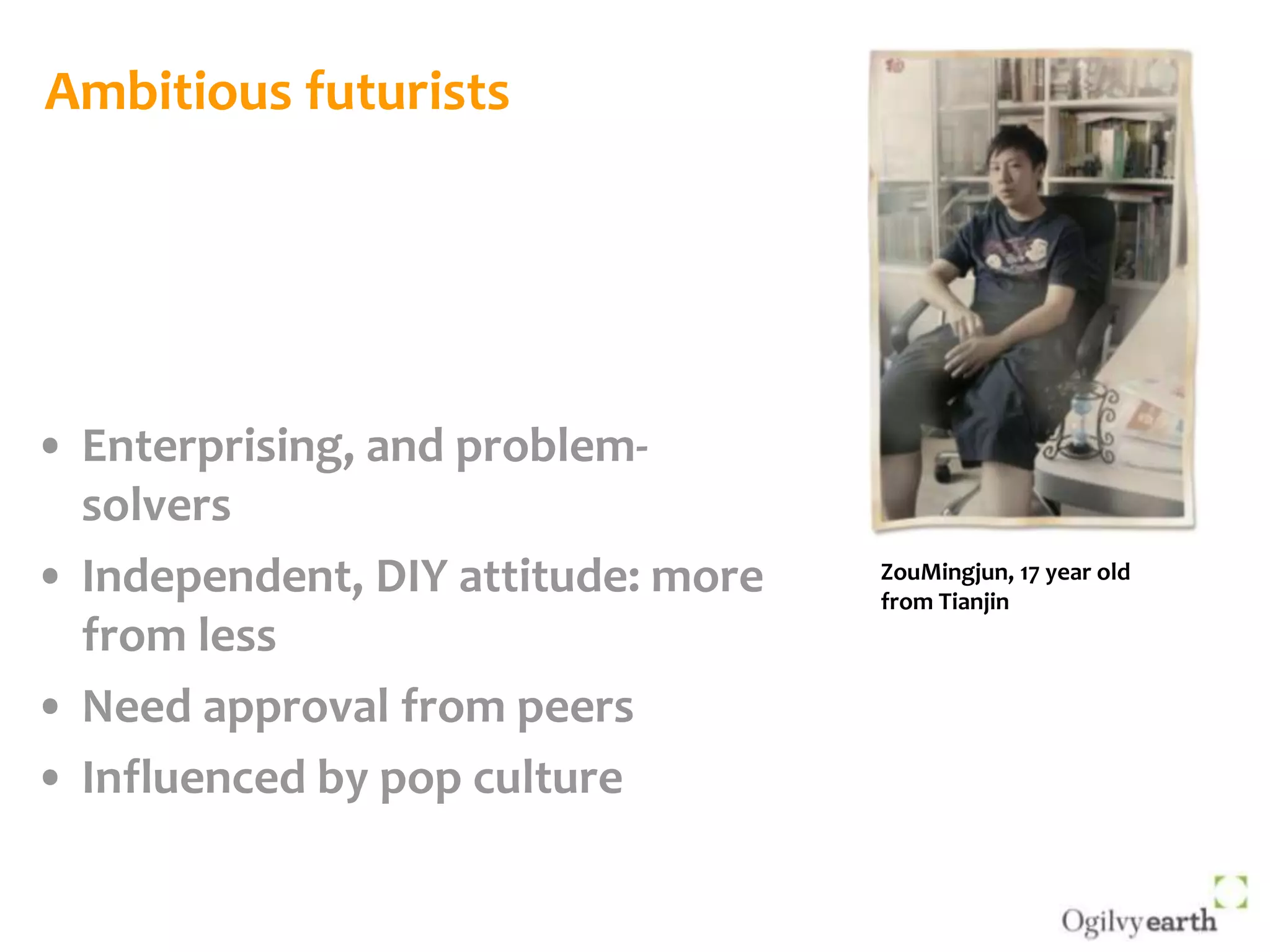
Ambitious futuristsEnterprising, and problem-solversIndependent, DIY attitude: more from lessNeed approval from peersInfluenced by pop cultureZouMingjun, 17 year old from Tianjin
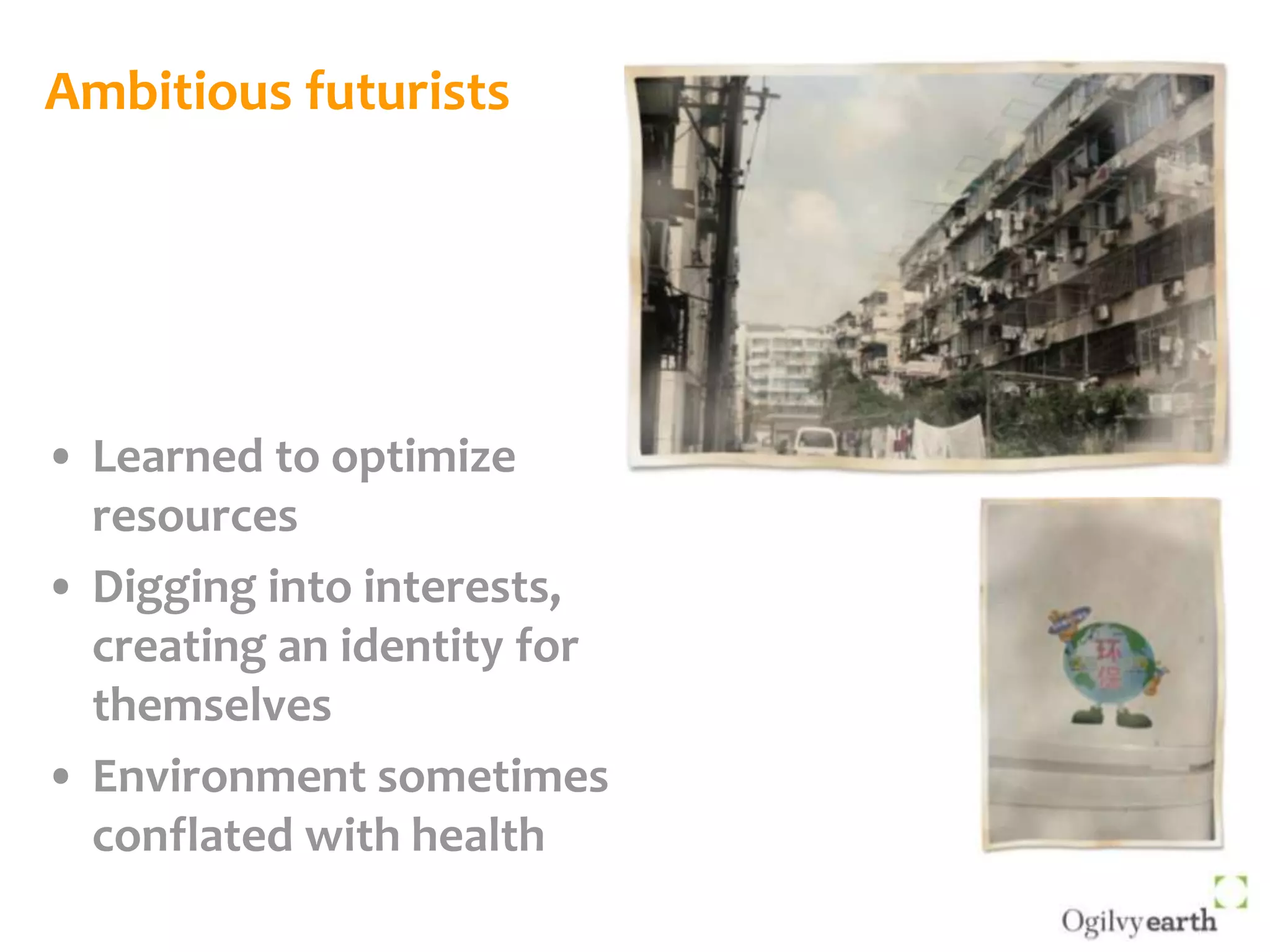
Ambitious futuristsLearned to optimize resourcesDigging into interests, creating an identity for themselvesEnvironment sometimes conflated with health
Give them a stake in the future.Encourage & reward them for their enterprise.Sustainability as a smart strategy to overcome deprivation.
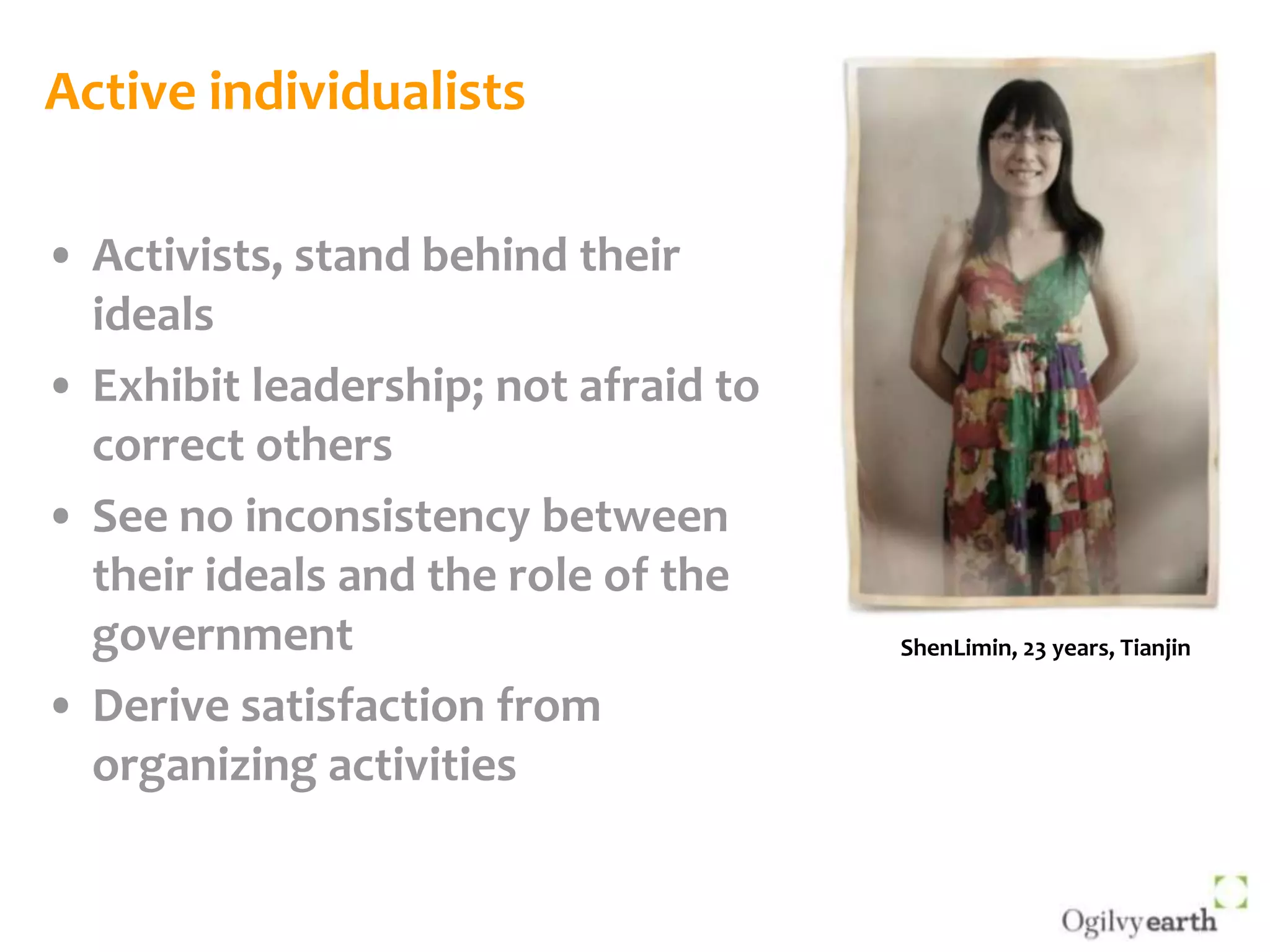
Active individualistsActivists, stand behind their idealsExhibit leadership; not afraid to correct othersSee no inconsistency between their ideals and the role of the governmentDerive satisfaction from organizing activitiesShenLimin, 23 years, Tianjin
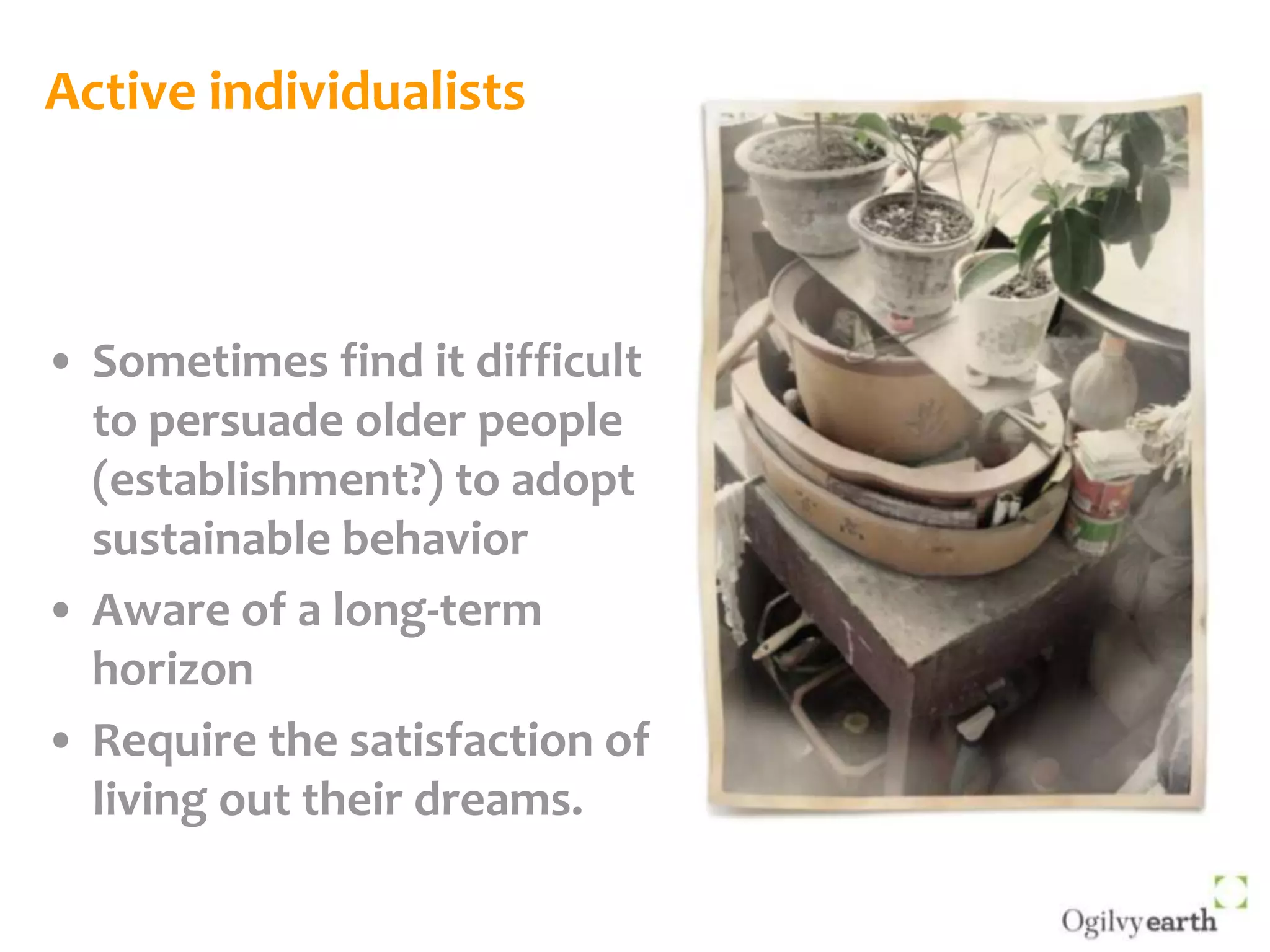
Active individualistsSometimes find it difficult to persuade older people (establishment?) to adopt sustainable behaviorAware of a long-term horizonRequire the satisfaction of living out their dreams.
Ensure that their fragile ideals are sustained in practical action.Guard against idealism superseding effectiveness.
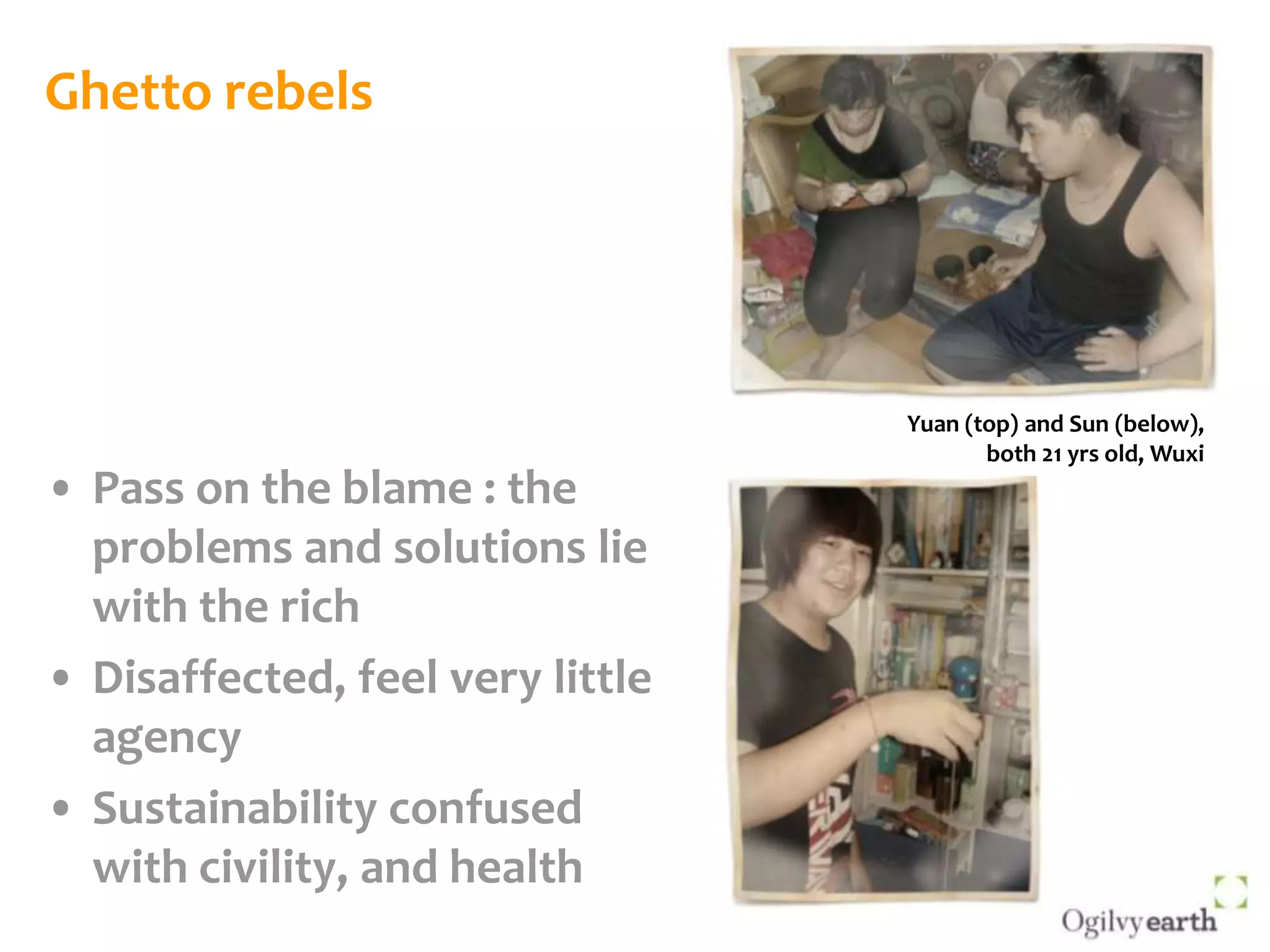
Ghetto rebelsYuan (top) and Sun (below), both 21 yrs old, WuxiPass on the blame : the problems and solutions lie with the richDisaffected, feel very little agencySustainability confused with civility, and health
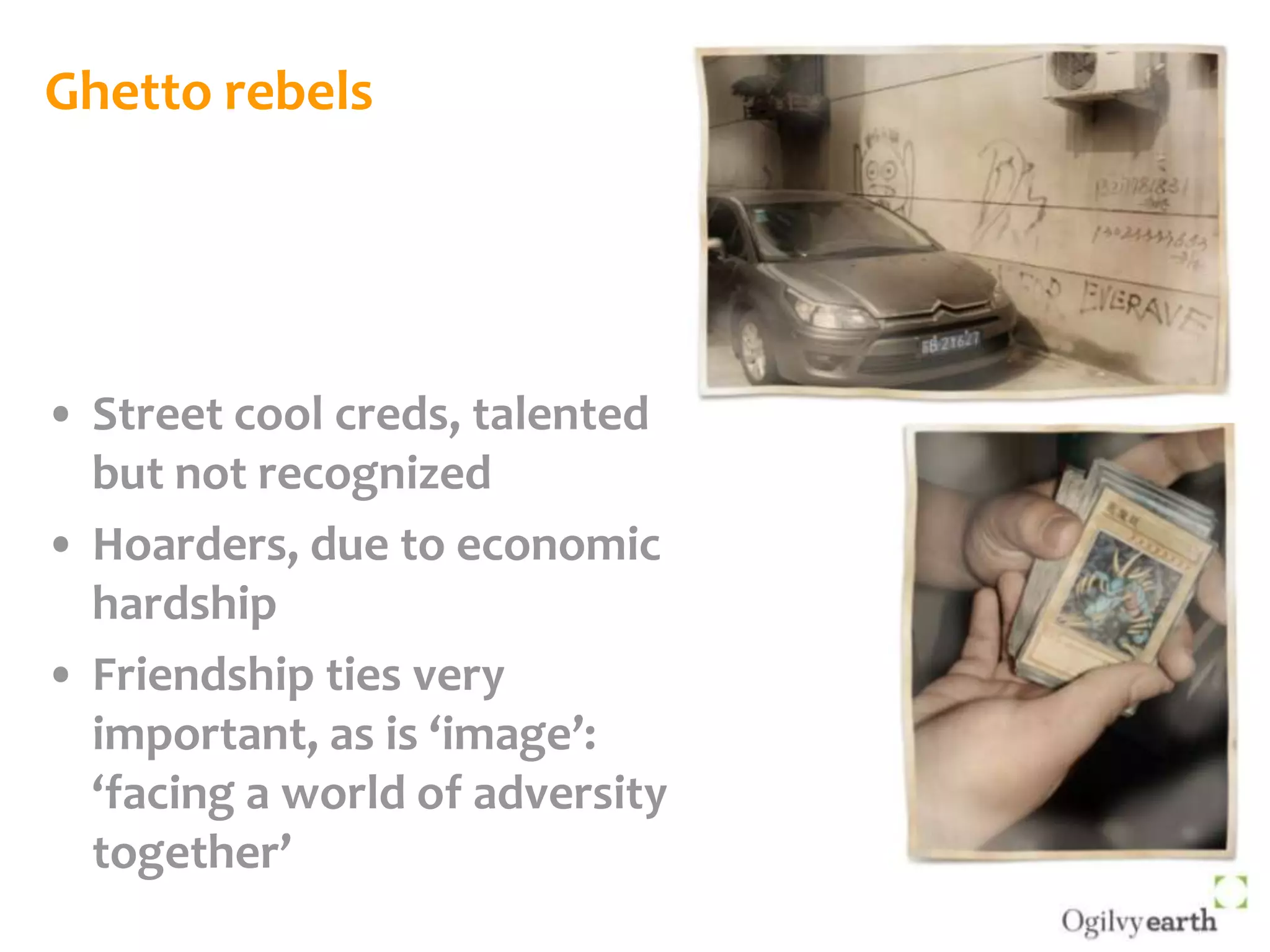
Ghetto rebelsStreet cool creds, talented but not recognizedHoarders, due to economic hardshipFriendship ties very important, as is ‘image’: ‘facing a world of adversity together’
Give the rebels a cause.Use their friendship ties, get them to act together.Counter the perception that sustainability is only for the rich.
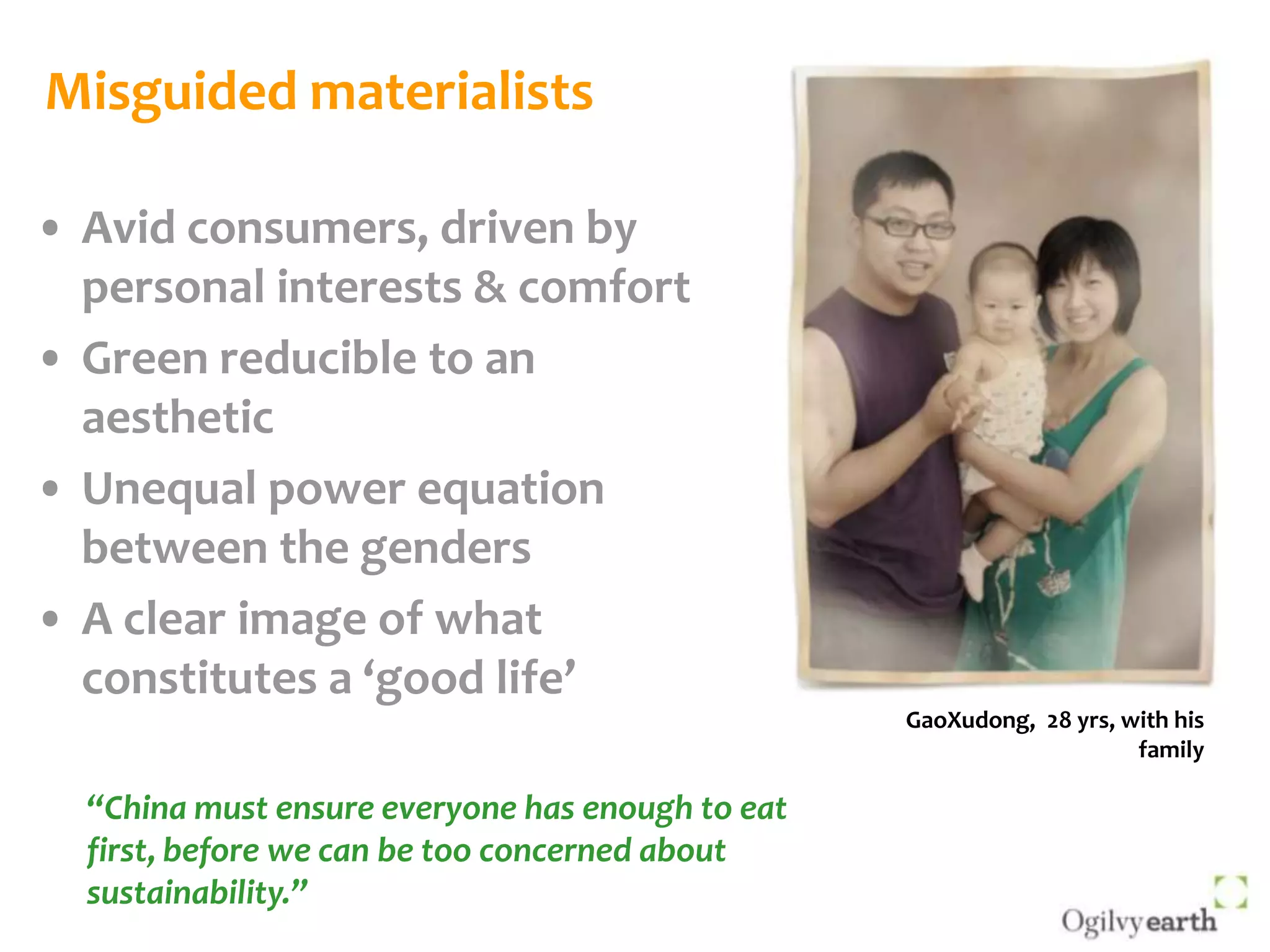
Misguided materialistsAvid consumers, driven by personal interests & comfortGreen reducible to an aestheticUnequal power equation between the gendersA clear image of what constitutes a ‘good life’GaoXudong,  28 yrs, with his family“China must ensure everyone has enough to eat first, before we can be too concerned about sustainability.”
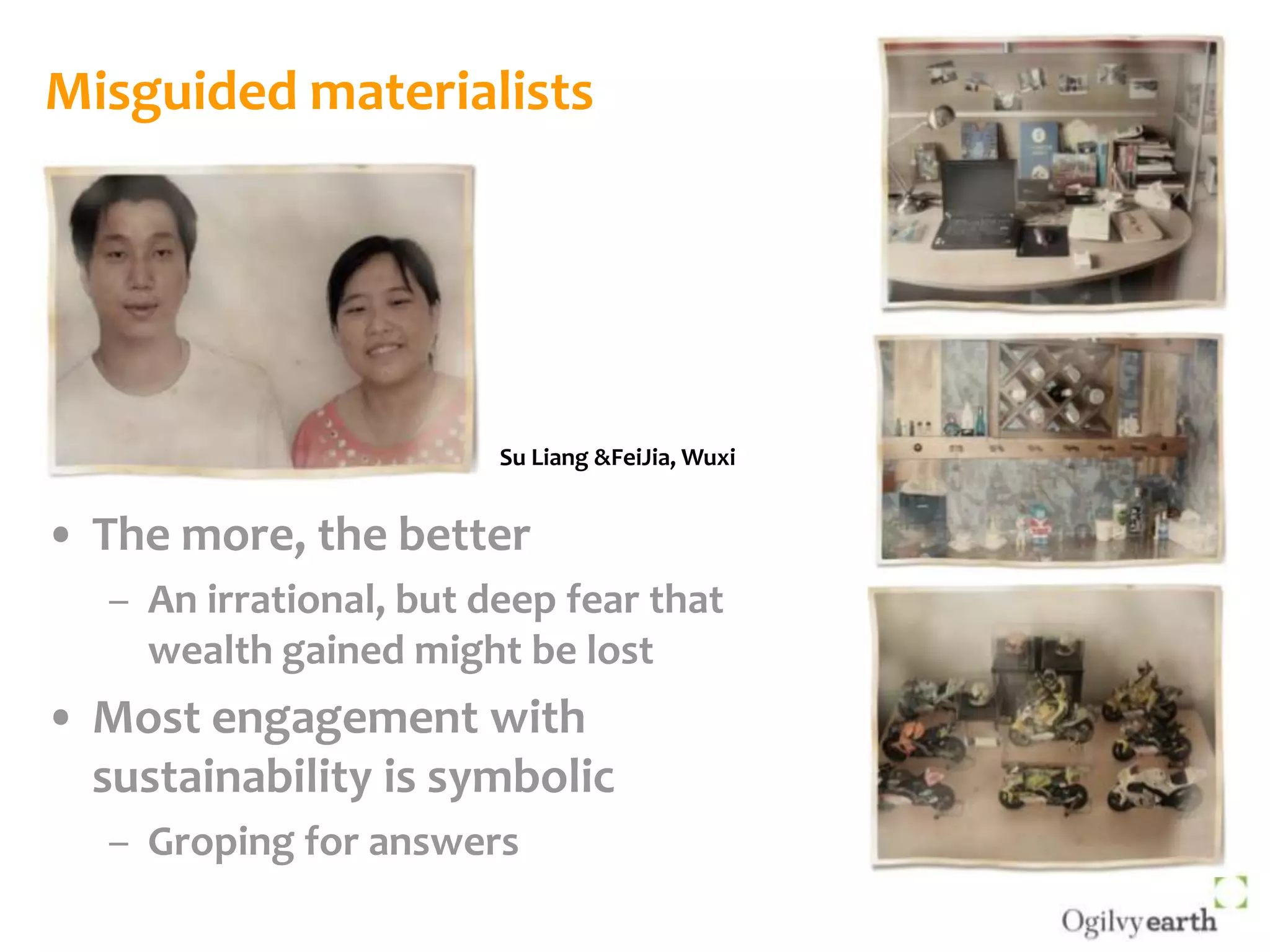
Misguided materialistsSu Liang & FeiJia, WuxiThe more, the betterAn irrational, but deep fear that wealth gained might be lostMost engagement with sustainability is symbolicGroping for answers
Address deep insecurities that lead to hoarding.Provide incentives for de-cluttering and sharing.Tackle the misperception that green is just an aesthetic.
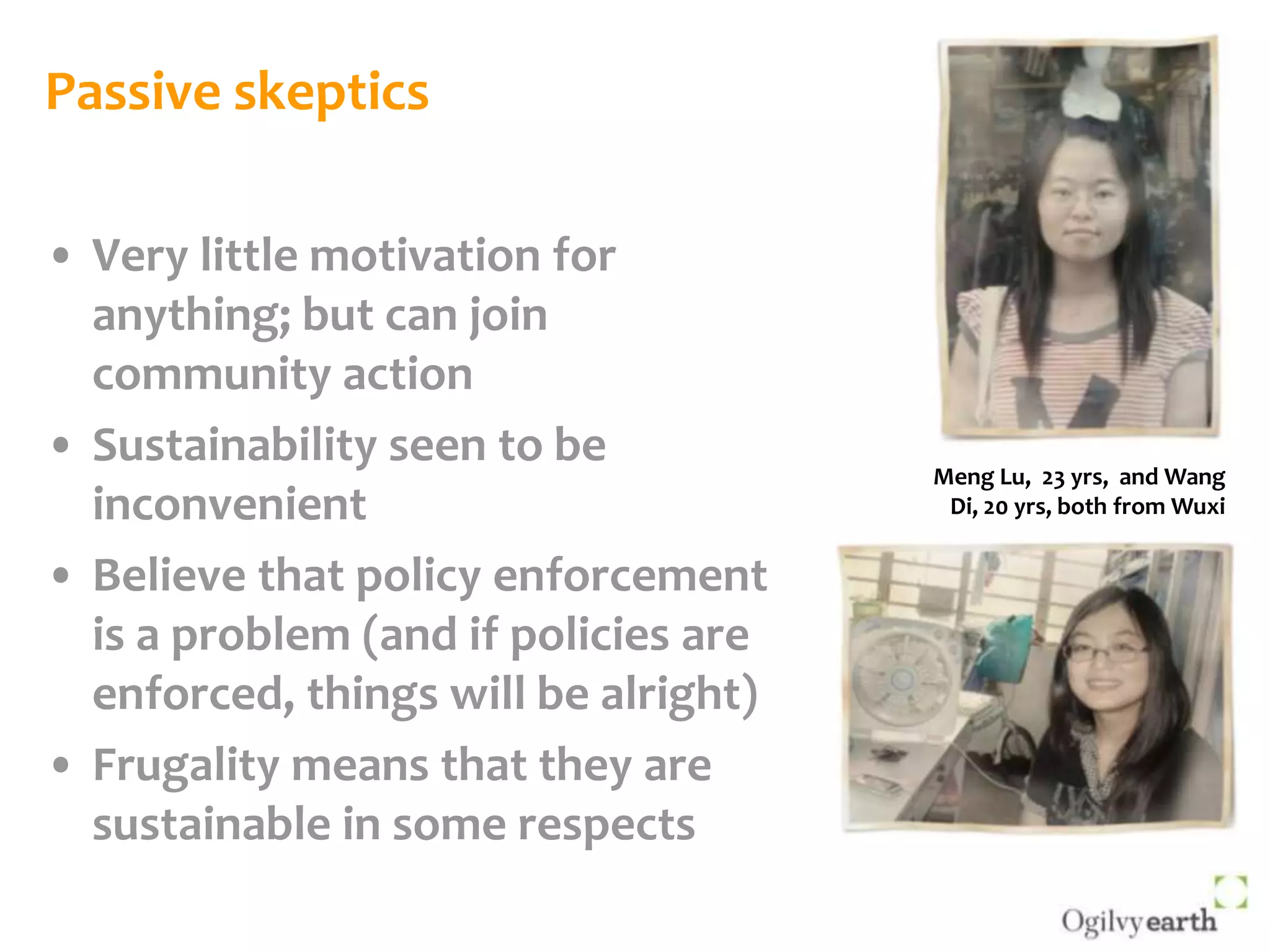
Passive skepticsVery little motivation for anything; but can join community actionSustainability seen to be inconvenientBelieve that policy enforcement is a problem (and if policies are enforced, things will be alright)Frugality means that they are sustainable in some respectsMeng Lu,  23 yrs,  and Wang Di, 20 yrs, both from Wuxi
Tap into public good drivers; using government communications.Emphasize their social role: e.g. get the elderly ‘community minders’ to promote compliance.
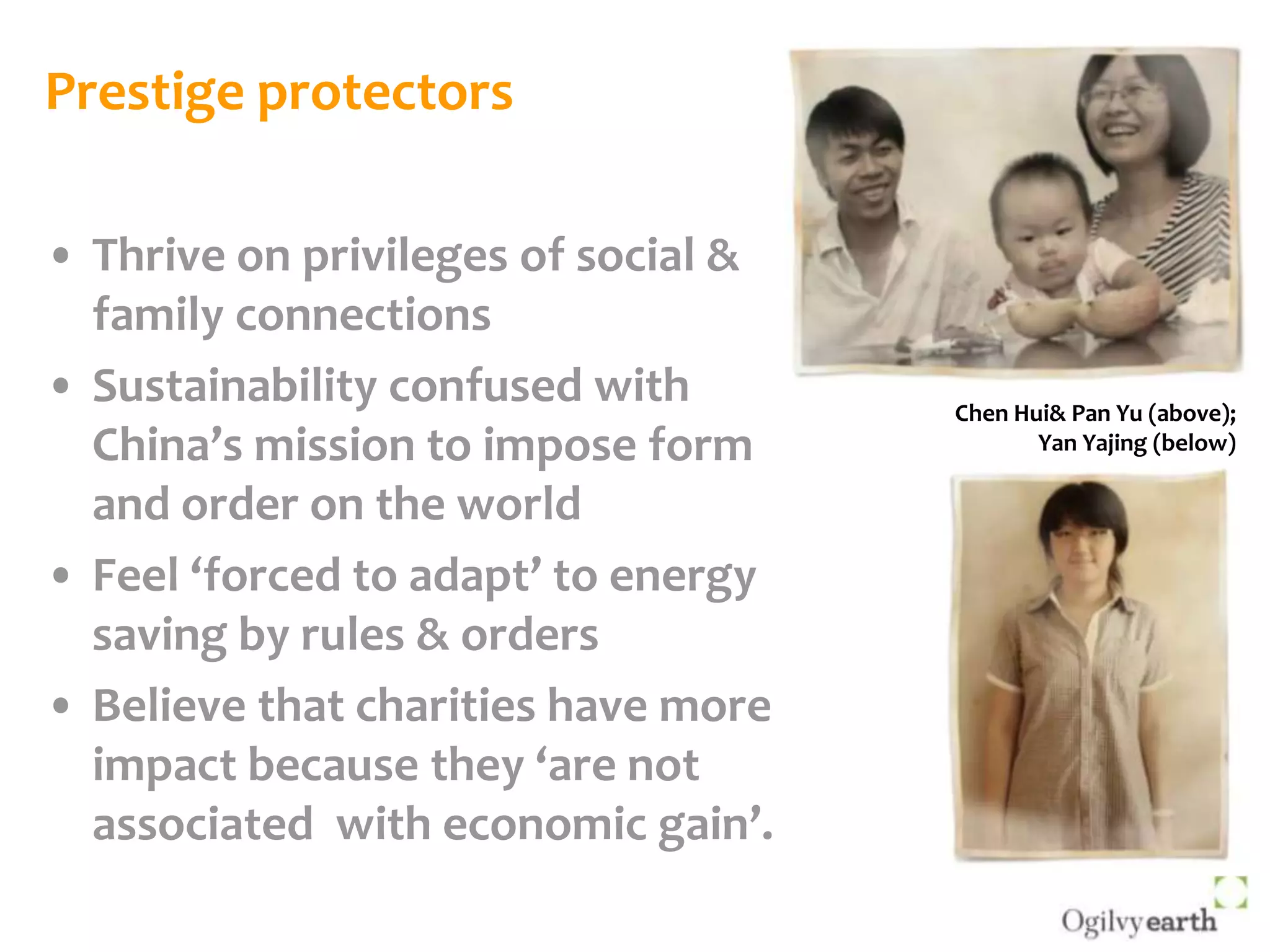
Prestige protectorsThrive on privileges of social & family connectionsSustainability confused with China’s mission to impose form and order on the worldFeel ‘forced to adapt’ to energy saving by rules & ordersBelieve that charities have more impact because they ‘are not associated  with economic gain’.Chen Hui & Pan Yu (above); Yan Yajing (below)
Provoke change from within the establishment.Empower these individuals to embrace environmental behavior as a means to enhance their prestige.
Green is not only a reputation opportunity for corporations, rather it is a marketing opportunity in itself.
Future Pathways for Behavior ChangeProducts, not policy Everyday, not just Earth DayPersonal, not planet Incentive, not invective Mainstream, not model                     Choice, not constraint                           Conscious, not conspicuous		Collaborate, not confront                    Pluralize, not polarizeDialogue, not decree
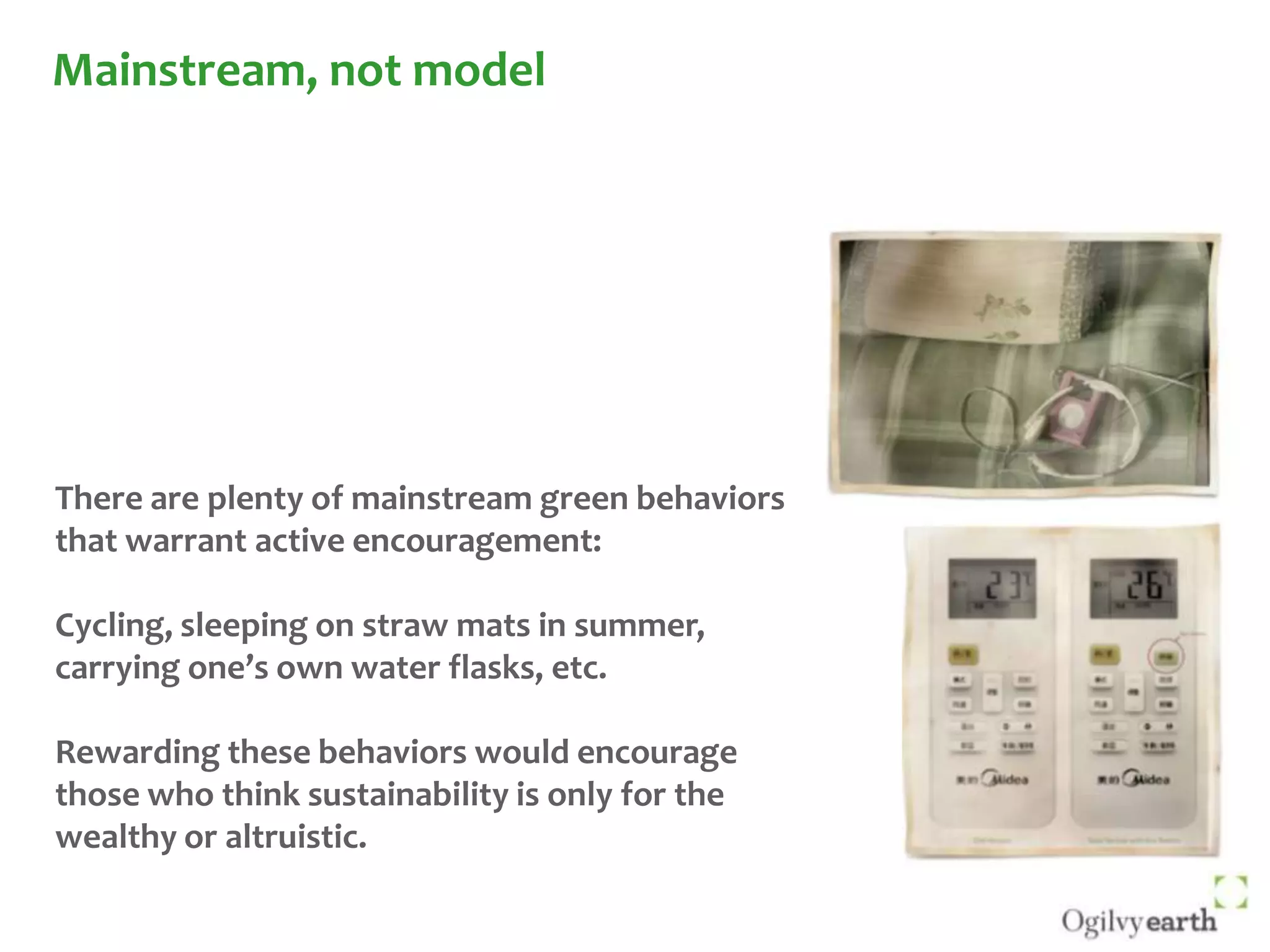
Mainstream, not modelThere are plenty of mainstream green behaviors that warrant active encouragement:  Cycling, sleeping on straw mats in summer, carrying one’s own water flasks, etc.Rewarding these behaviors would encourage those who think sustainability is only for the wealthy or altruistic.
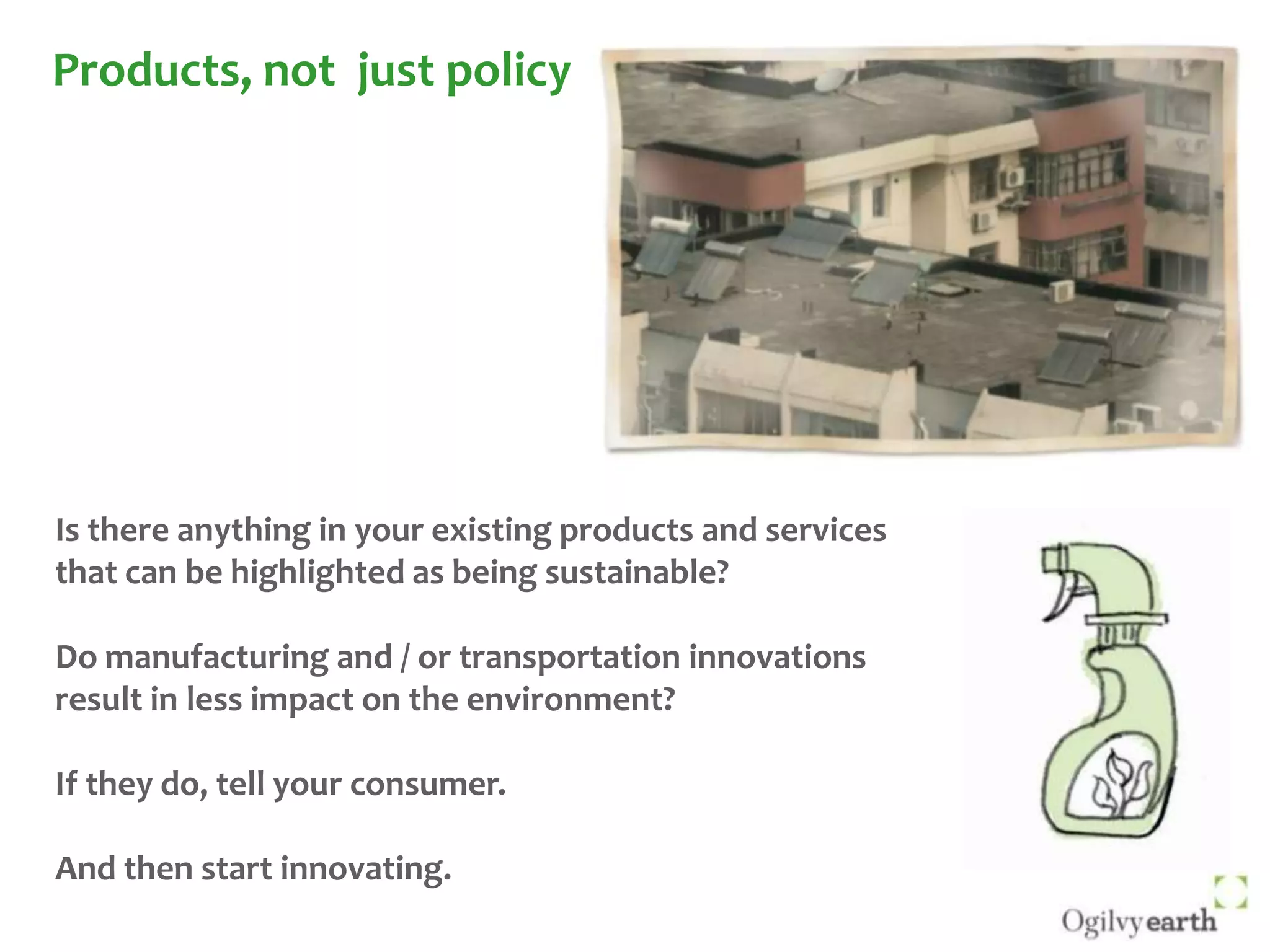
Products, not  just policyIs there anything in your existing products and services that can be highlighted as being sustainable?Do manufacturing and / or transportation innovations result in less impact on the environment?If they do, tell your consumer. And then start innovating.
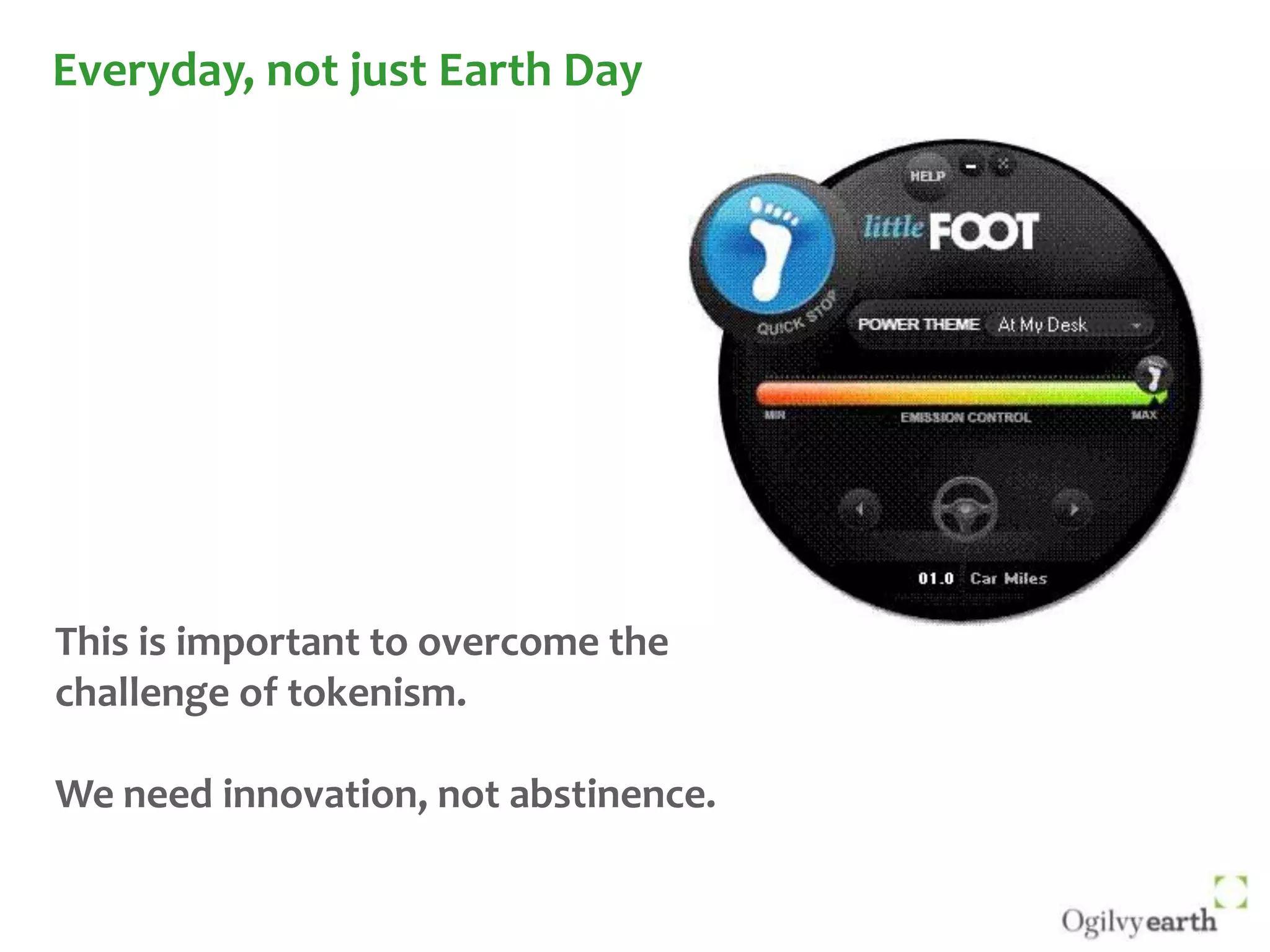
Everyday, not just Earth DayThis is important to overcome the challenge of tokenism.We need innovation, not abstinence.
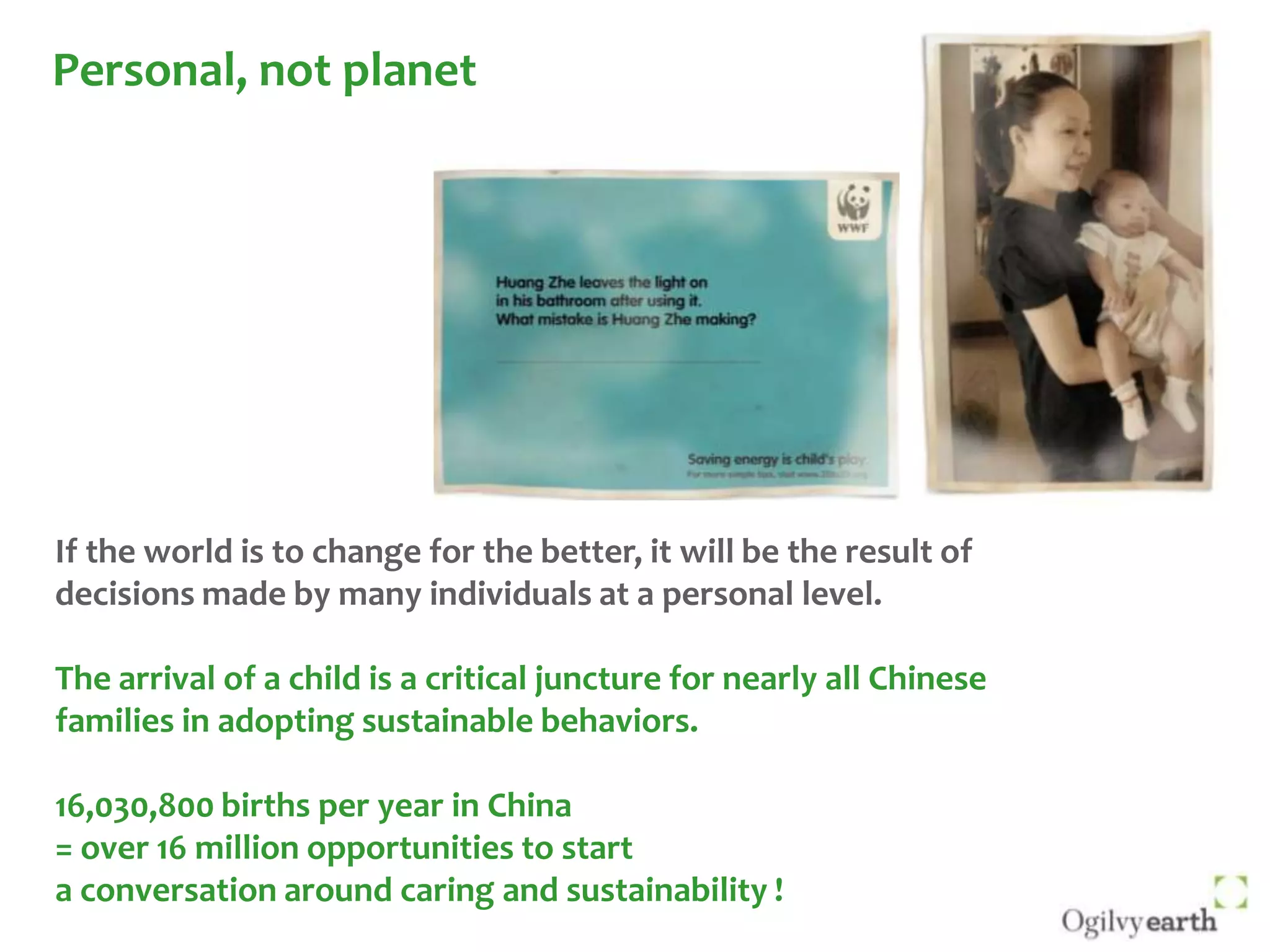
Personal, not planet If the world is to change for the better, it will be the result of decisions made by many individuals at a personal level. The arrival of a child is a critical juncture for nearly all Chinese families in adopting sustainable behaviors. 16,030,800 births per year in China = over 16 million opportunities to start a conversation around caring and sustainability !
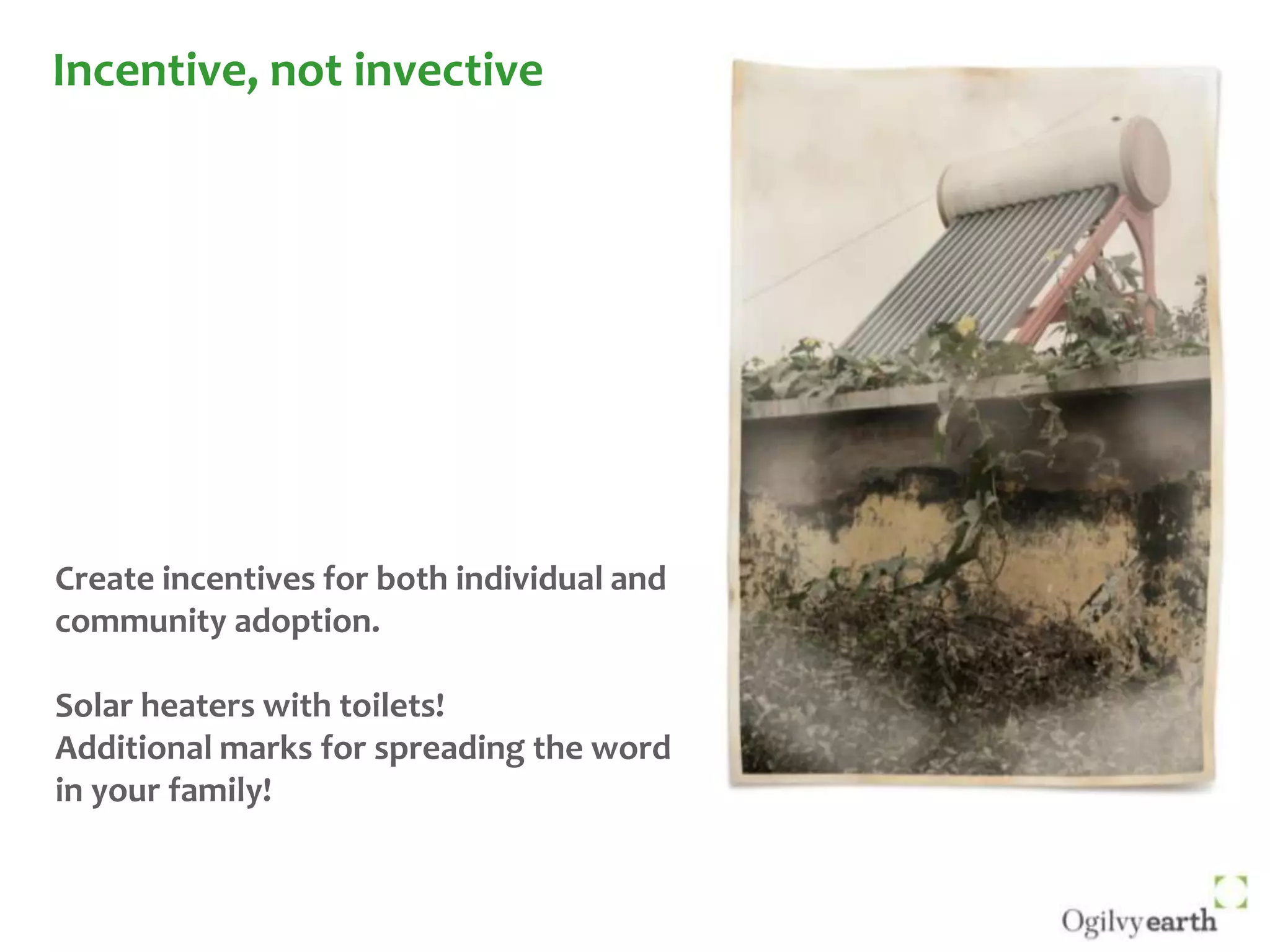
Incentive, not invectiveCreate incentives for both individual and community adoption.Solar heaters with toilets!Additional marks for spreading the word in your family!
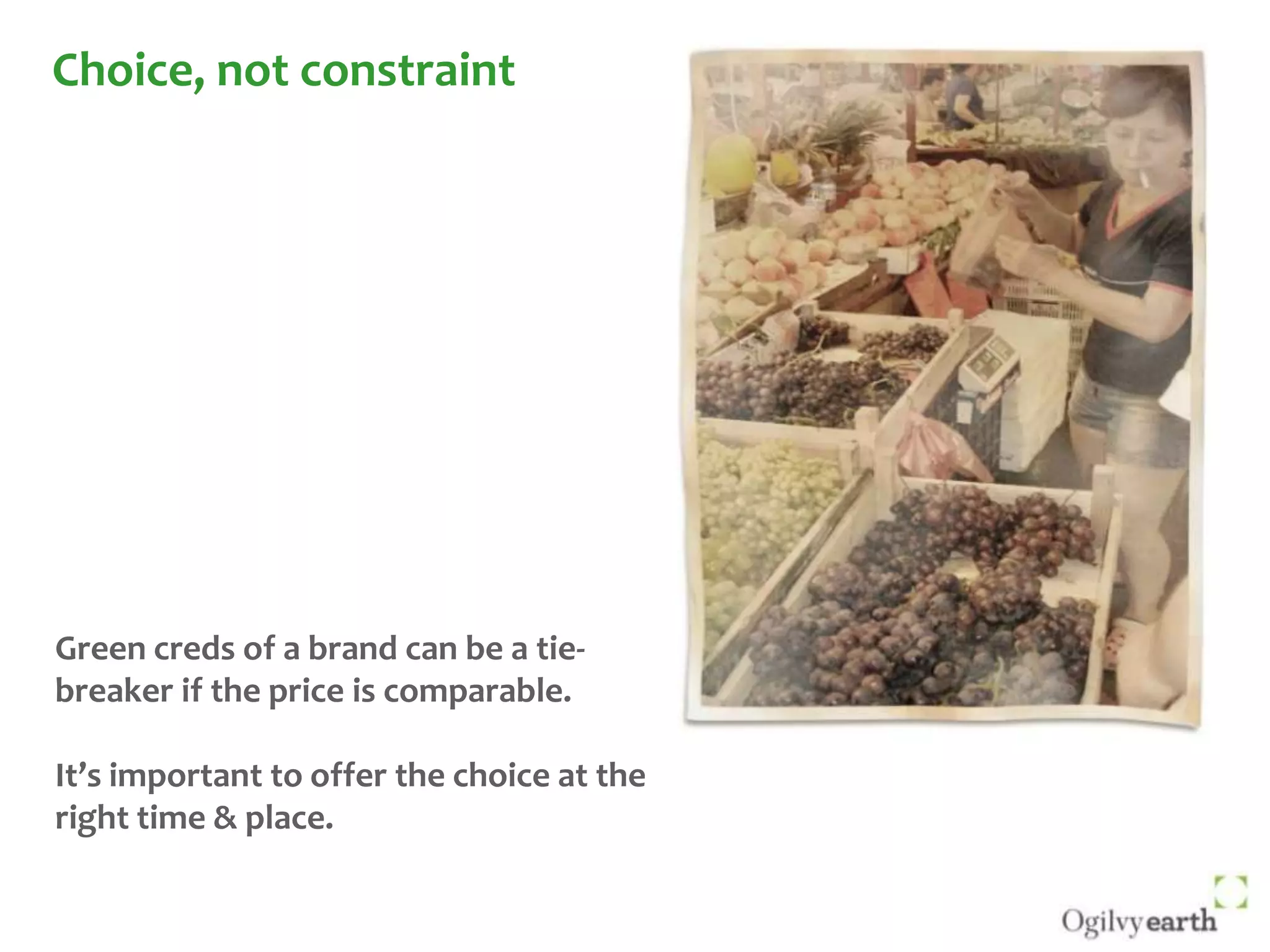
Choice, not constraintGreen creds of a brand can be a tie-breaker if the price is comparable.It’s important to offer the choice at the right time & place.
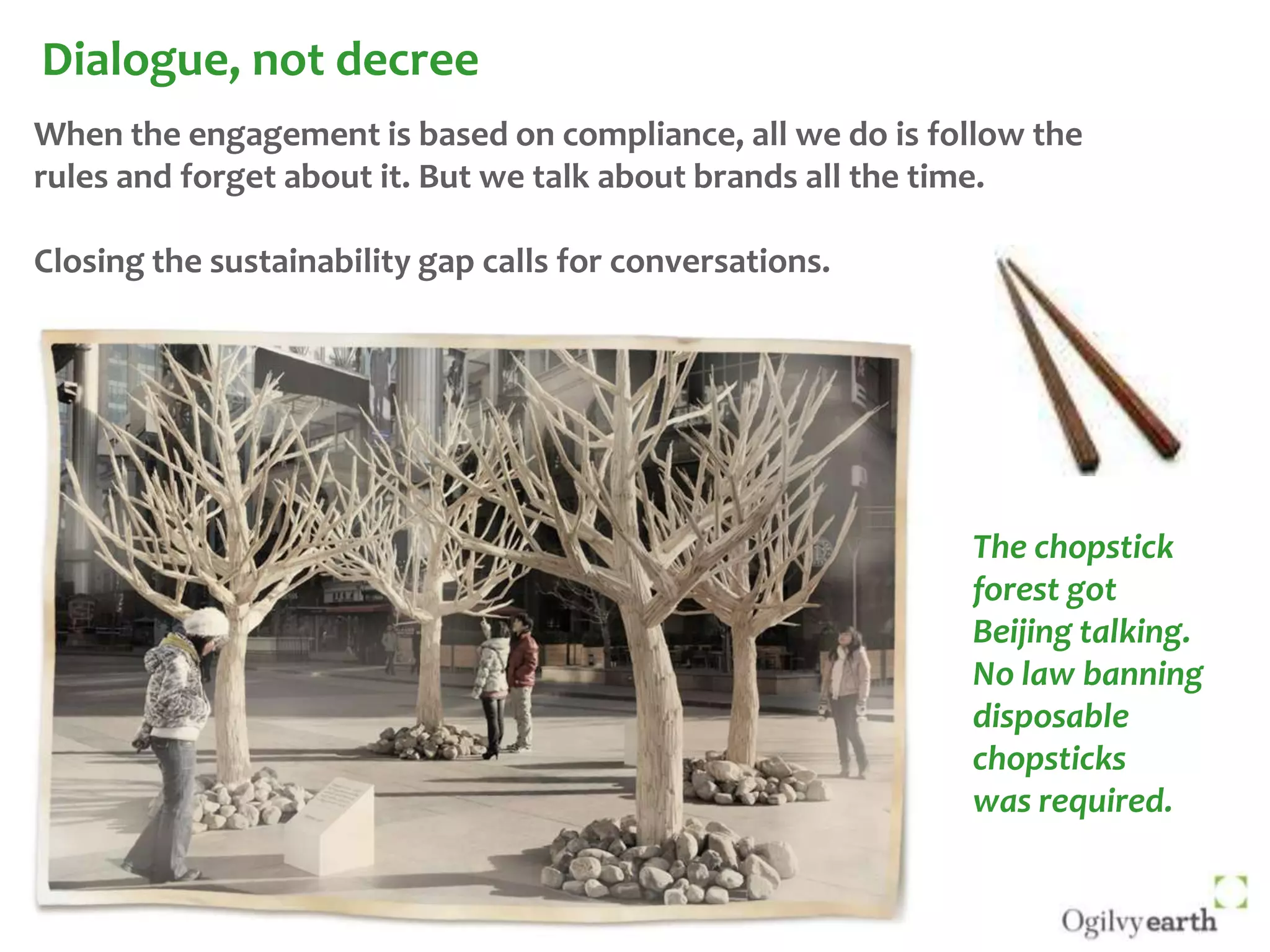
Dialogue, not decreeWhen the engagement is based on compliance, all we do is follow the rules and forget about it. But we talk about brands all the time. Closing the sustainability gap calls for conversations.The chopstick forest got Beijing talking. No law banning disposable chopsticks was required.
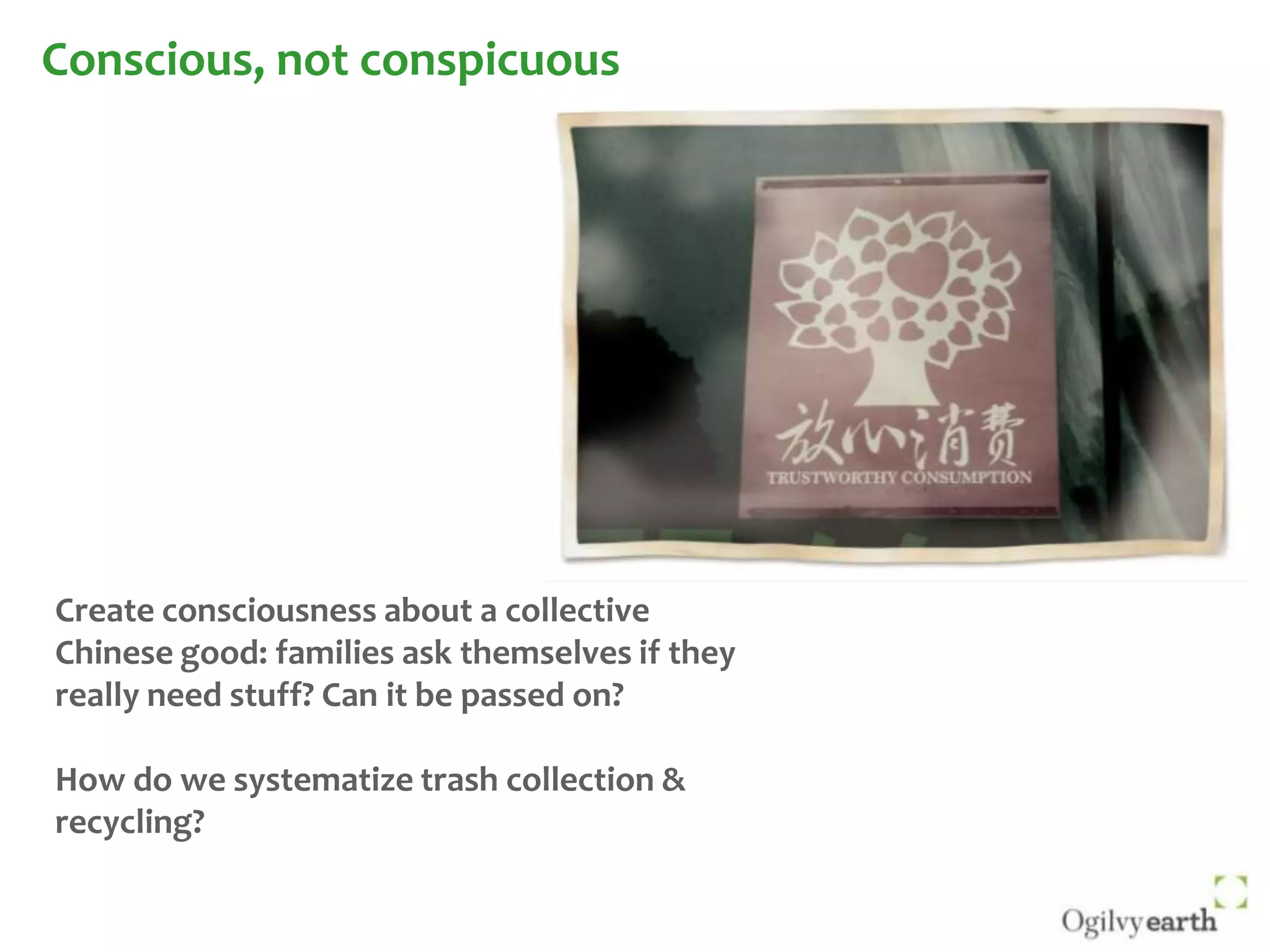
Conscious, not conspicuousCreate consciousness about a collective Chinese good: families ask themselves if they really need stuff? Can it be passed on?How do we systematize trash collection & recycling?
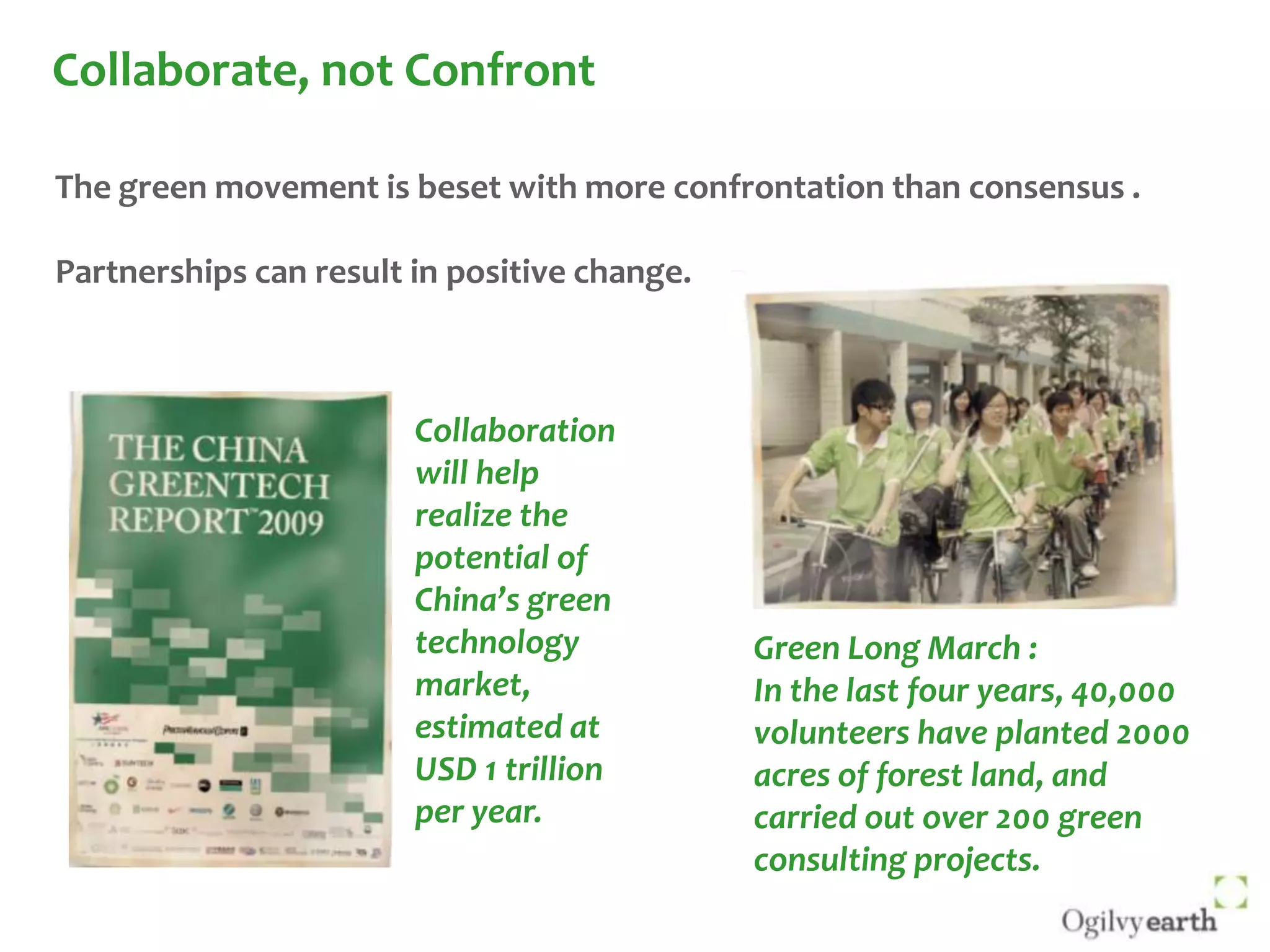
Collaborate, not ConfrontThe green movement is beset with more confrontation than consensus .Partnerships can result in positive change.Collaboration will help realize the potential of China’s green technology market, estimated at USD 1 trillion per year. Green Long March :In the last four years, 40,000 volunteers have planted 2000 acres of forest land, and carried out over 200 green consulting projects.
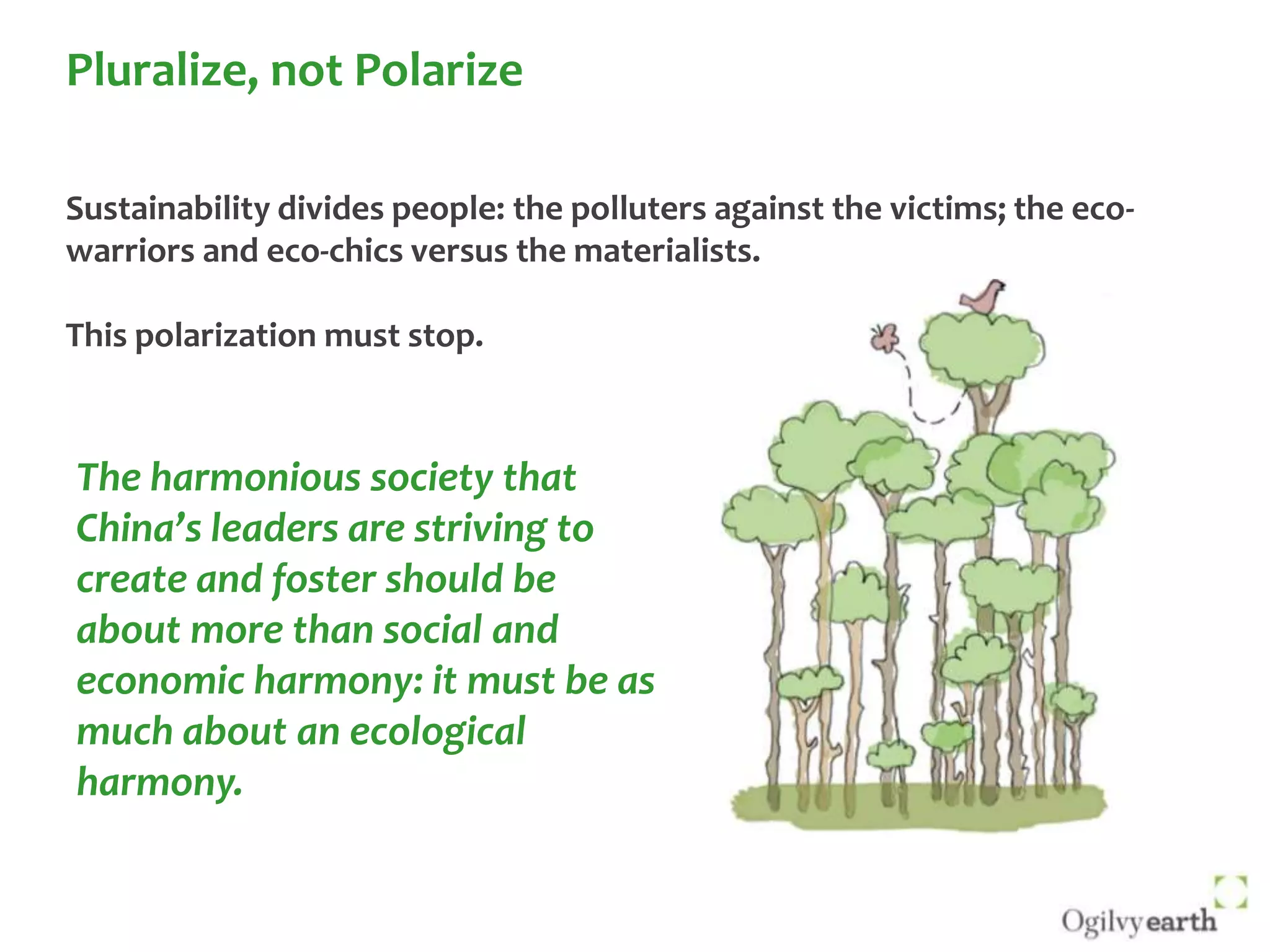
Pluralize, not PolarizeSustainability divides people: the polluters against the victims; the eco-warriors and eco-chics versus the materialists.This polarization must stop. The harmonious society that China’s leaders are striving to  create and foster should be about more than social and  economic harmony: it must be as much about an ecological harmony.
OgilvyEarth believes that the world will be a better place if brands and corporations acted on the insights that Get Going with Green has uncovered.
To find out more about how to Get Going with Green in the United States, please visit our website:www.ogilvyearth.com
Research partner for Get Going with Green in China:For more information on Get Going with Green,  please contact:KunalSinha – kunal.sinha@ogilvy.com orHannah Lane – hannah.lane@ogilvy.com
Thank you.

Get Going With Green: Presentation

  • 1.
    Get Going withGreenClosing the Sustainability Gap
  • 2.
    Ogilvy Earth isthe global sustainability practice within the Ogilvy & Mather Group. We help brands harness the power of sustainability, through strategic planning and communications. We work with visionary companies that are looking to make sustainability a growth driver for both their business and the communities they serve.
  • 3.
    There is ayawning gap between people’s claimed and actual sustainable behavior. At Ogilvy Earth, we call it the Sustainability Gap.
  • 4.
    Claimed behavior50% said they use renewable energy at home38% said they used alternative automobile fuel52% said they avoided using plastic bagsResearch by Landor Associates, 2008.
  • 5.
    A problem withresearchPut the question in a survey, and respondents will tick the answers that make them look good. Claiming to be green is the politically correct thing to say.
  • 6.
    When people claimthey are green, it is because they already have the knowledge that they need to change their behaviors. They are concerned, but they feel powerless.
  • 7.
    Whose responsibility?China’s greenstimulus, announced in 2009, is simply the largest in the world, with USD 221 billion - 34% of the total stimulus package - committed until 2020. Quantitative study amongst 1300 respondents across China.
  • 8.
    Whose responsibility?China’s greenstimulus, announced in 2009, is simply the largest in the world, with USD 221 billion - 34% of the total stimulus package - committed until 2020. Quantitative study amongst 1300 respondents across China.
  • 9.
    A focus oncompliance, cost & image84% companies said that environment protection is important to them because it is a legal requirement79% said it was a brand image necessityOnly 19% said they were promoting the sales of environment friendly productsChinese companies in the 21st century, A survey of Social Responsibility & Sustainability of Chinese companies, Worldwide Fund for Nature, April 2010
  • 10.
    53% of ourrespondents said that the green options in the marketplace were too expensive.
  • 11.
    Regular Eco-friendly/ Organic400 3200Regular vs bambooframe bicycle27 138 3 kg of fresh vegetables18-26 588 pack roll of toilet paper300 750Double occupancy per weekend night
  • 12.
    A willingness toact67% believe that their efforts did count69% said that if environment friendly products were available at the same price point, they would purchase themNot entirely closed to the idea of paying a small premium71% are happy to pay up to 10% more
  • 13.
    Time & moneyas barriersIf they had more timeIf they had more money37% would ride a bike to work27% would use cloth nappies42% would save electricity38% would hang clothes out to dry29% would buy energy saving appliances42% would buy eco-friendly detergents45% would drive a hybrid / electric car
  • 14.
    A sense ofentitlement“We’re only beginning to enjoy the fruits of our prosperity, and you want us to stop?”55% of our respondents are driven by convenience for their purchases Only 18.6% said they would limit consumption.
  • 15.
    Official, formal discourseAccuratevocabulary played backSchool based, formal learning40% learned about sustainability in schoolShowcases: Olympics, ExpoThese emphasize government role
  • 16.
    Chinese consumers areconfronted by an overload of claims and certifications that they feel they cannot trust.
  • 17.
    The idealism ofGreen HeroesThe badge that the Eco-chic wearCreates a distance
  • 18.
  • 19.
    The opportunity90.7% believethat the sustainability movement is on the upswing78% said they would rather be given guidelines on how to live a sustainable life & do it themselves, than it be legislated80% would like to receive recognition from their peers for their positive green behaviors
  • 20.
    We need... easierpathways to embrace the sustainability opportunity. … greater recognition and positive reinforcement of good behaviors. … to come up with solutions together. …to assume greater responsibility for our actions.
  • 21.
    The solutions liein understanding the everyday lives of people.The answers are embedded in their overall consumption ethic.
  • 22.
    24 families andyoung individuals 3 cities Whilst engaging with the subjects, it became clear to us that no matter how ‘misguided’ or ‘skeptical’ an individual might be, there is still an opportunity to engage in a dialogue that favors sustainable behavior.
  • 23.
    Flexible progressivesOften witha background of deprivationGet a kick out of maximizing resources & efficiencyZhou, 38, and his wife Wang from Anhui.
  • 24.
    Flexible progressivesUse energy-savinglight bulbs; have plants to ‘soak up the carbon’; do half their laundry by handProud of their green achievements, but do not feel the need to compare themselves with othersPower shared equally at homeZhou, 38, and his wife Wang from Anhui.
  • 25.
    Flexible progressivesArrival oftheir baby provoked a heightened consciousness of sustainabilityWilling to accept hand-me-down clothes from relativesShop at local wet market: cheaper and fresher“A green lifestyle starts from individuals and families who want to make their environment green and sustainable, then the community and finally, the whole city.”
  • 26.
    Heroes amongst us.Bringmen & women equally into the discussion.Use critical moments in life, such as childbirth, to motivate action.
  • 27.
    Ambitious futuristsEnterprising, andproblem-solversIndependent, DIY attitude: more from lessNeed approval from peersInfluenced by pop cultureZouMingjun, 17 year old from Tianjin
  • 28.
    Ambitious futuristsLearned tooptimize resourcesDigging into interests, creating an identity for themselvesEnvironment sometimes conflated with health
  • 29.
    Give them astake in the future.Encourage & reward them for their enterprise.Sustainability as a smart strategy to overcome deprivation.
  • 30.
    Active individualistsActivists, standbehind their idealsExhibit leadership; not afraid to correct othersSee no inconsistency between their ideals and the role of the governmentDerive satisfaction from organizing activitiesShenLimin, 23 years, Tianjin
  • 31.
    Active individualistsSometimes findit difficult to persuade older people (establishment?) to adopt sustainable behaviorAware of a long-term horizonRequire the satisfaction of living out their dreams.
  • 32.
    Ensure that theirfragile ideals are sustained in practical action.Guard against idealism superseding effectiveness.
  • 33.
    Ghetto rebelsYuan (top)and Sun (below), both 21 yrs old, WuxiPass on the blame : the problems and solutions lie with the richDisaffected, feel very little agencySustainability confused with civility, and health
  • 34.
    Ghetto rebelsStreet coolcreds, talented but not recognizedHoarders, due to economic hardshipFriendship ties very important, as is ‘image’: ‘facing a world of adversity together’
  • 35.
    Give the rebelsa cause.Use their friendship ties, get them to act together.Counter the perception that sustainability is only for the rich.
  • 36.
    Misguided materialistsAvid consumers,driven by personal interests & comfortGreen reducible to an aestheticUnequal power equation between the gendersA clear image of what constitutes a ‘good life’GaoXudong, 28 yrs, with his family“China must ensure everyone has enough to eat first, before we can be too concerned about sustainability.”
  • 37.
    Misguided materialistsSu Liang& FeiJia, WuxiThe more, the betterAn irrational, but deep fear that wealth gained might be lostMost engagement with sustainability is symbolicGroping for answers
  • 38.
    Address deep insecuritiesthat lead to hoarding.Provide incentives for de-cluttering and sharing.Tackle the misperception that green is just an aesthetic.
  • 39.
    Passive skepticsVery littlemotivation for anything; but can join community actionSustainability seen to be inconvenientBelieve that policy enforcement is a problem (and if policies are enforced, things will be alright)Frugality means that they are sustainable in some respectsMeng Lu, 23 yrs, and Wang Di, 20 yrs, both from Wuxi
  • 40.
    Tap into publicgood drivers; using government communications.Emphasize their social role: e.g. get the elderly ‘community minders’ to promote compliance.
  • 41.
    Prestige protectorsThrive onprivileges of social & family connectionsSustainability confused with China’s mission to impose form and order on the worldFeel ‘forced to adapt’ to energy saving by rules & ordersBelieve that charities have more impact because they ‘are not associated with economic gain’.Chen Hui & Pan Yu (above); Yan Yajing (below)
  • 42.
    Provoke change fromwithin the establishment.Empower these individuals to embrace environmental behavior as a means to enhance their prestige.
  • 43.
    Green is notonly a reputation opportunity for corporations, rather it is a marketing opportunity in itself.
  • 44.
    Future Pathways forBehavior ChangeProducts, not policy Everyday, not just Earth DayPersonal, not planet Incentive, not invective Mainstream, not model Choice, not constraint Conscious, not conspicuous Collaborate, not confront Pluralize, not polarizeDialogue, not decree
  • 45.
    Mainstream, not modelThereare plenty of mainstream green behaviors that warrant active encouragement: Cycling, sleeping on straw mats in summer, carrying one’s own water flasks, etc.Rewarding these behaviors would encourage those who think sustainability is only for the wealthy or altruistic.
  • 46.
    Products, not just policyIs there anything in your existing products and services that can be highlighted as being sustainable?Do manufacturing and / or transportation innovations result in less impact on the environment?If they do, tell your consumer. And then start innovating.
  • 47.
    Everyday, not justEarth DayThis is important to overcome the challenge of tokenism.We need innovation, not abstinence.
  • 48.
    Personal, not planetIf the world is to change for the better, it will be the result of decisions made by many individuals at a personal level. The arrival of a child is a critical juncture for nearly all Chinese families in adopting sustainable behaviors. 16,030,800 births per year in China = over 16 million opportunities to start a conversation around caring and sustainability !
  • 49.
    Incentive, not invectiveCreateincentives for both individual and community adoption.Solar heaters with toilets!Additional marks for spreading the word in your family!
  • 50.
    Choice, not constraintGreencreds of a brand can be a tie-breaker if the price is comparable.It’s important to offer the choice at the right time & place.
  • 51.
    Dialogue, not decreeWhenthe engagement is based on compliance, all we do is follow the rules and forget about it. But we talk about brands all the time. Closing the sustainability gap calls for conversations.The chopstick forest got Beijing talking. No law banning disposable chopsticks was required.
  • 52.
    Conscious, not conspicuousCreateconsciousness about a collective Chinese good: families ask themselves if they really need stuff? Can it be passed on?How do we systematize trash collection & recycling?
  • 53.
    Collaborate, not ConfrontThegreen movement is beset with more confrontation than consensus .Partnerships can result in positive change.Collaboration will help realize the potential of China’s green technology market, estimated at USD 1 trillion per year. Green Long March :In the last four years, 40,000 volunteers have planted 2000 acres of forest land, and carried out over 200 green consulting projects.
  • 54.
    Pluralize, not PolarizeSustainabilitydivides people: the polluters against the victims; the eco-warriors and eco-chics versus the materialists.This polarization must stop. The harmonious society that China’s leaders are striving to create and foster should be about more than social and economic harmony: it must be as much about an ecological harmony.
  • 55.
    OgilvyEarth believes thatthe world will be a better place if brands and corporations acted on the insights that Get Going with Green has uncovered.
  • 56.
    To find outmore about how to Get Going with Green in the United States, please visit our website:www.ogilvyearth.com
  • 57.
    Research partner forGet Going with Green in China:For more information on Get Going with Green, please contact:KunalSinha – kunal.sinha@ogilvy.com orHannah Lane – hannah.lane@ogilvy.com
  • 58.