Informal Sector 
in Developed and Less Developed Countries: 
A Literature Survey* 
by 
Klarita Gërxhani 
Abstract 
This study gives an overview of what has been written until now about the informal sector. This overview 
is based on a comparison between studies of the informal sector in developed countries with studies about 
less developed countries. The main topics discussed are: (1) the definitions of the informal sector, 
distinguishing various criteria used in different studies; (2) the significance of the informal sector by 
comparing its advantages with disadvantages; (3) the main theories about the informal sector, and its 
relationship with the formal economy; and finally (4) empirical studies which have tried to quantify the 
informal sector activities, together with some of their results. 
1 
Tinbergen Institute and University of Amsterdam 
address: 
Roetersstraat 11 
1018 WB Amsterdam 
The Netherlands 
Fax: +31 20 525 4254 
e-mail: gerxhani@tinbinst.nl 
* I am grateful to Micheal Ellman and Arthur Schram for their useful insights and comments.
“The inconsistency between the predictions of conventional macroeconomic theories and the ‘facts’ of 
economic life have led to a re-examination of both the theories and facts” 
2 
Edgar L. FEIGE - 
1. Introduction 
At one time, no attention was given by economists to economic activities carried out 
outside the formal framework of the economy. Sociologists and anthropologists were the 
only ones who even seemed to consider the existences of such activities. In the 1950s and 
1960s, however, the informal dimensions of organizational life became increasingly 
recognized as important and were accepted as a commonplace topic for research (Blau 
and Scott, 1963; Gouldner, 1954). 
However, an accurate academic meaning was not given to this neglected 
phenomenon until it was analyzed in 1972 by the International Labor Office (ILO), under 
the name ‘informal sector’1. As a matter of fact, the ‘informal sector’ concept originates 
from a study in a Third World context (Hart, 1971).2 It was in the Third World countries 
that the informal sector was initially observed and studied, followed by the increased 
interest in developed countries. Eventually, significant studies about less developed 
countries, a few on former socialist countries (mainly about the former Soviet Union), 
and more recently (in the last ten years) about transition countries started to appear. The 
academic thinking about the informal sector was really advanced by these studies about 
less developed and transition countries, where the influence of the ‘informal sector’ is 
much more significant than in other countries. 
Although the significance of this sector has varied in different periods and for 
different countries, society has become more and more aware of the importance of 
studying it. Several studies define the ‘informal sector’ in distinct ways, however, and 
this is one of the reasons why these studies are considered inconsistent. The academic 
thought about this phenomenon has developed from the earliest studies, which 
contemplated ‘informal sector’ as a marginal or residual activity, to recent ones, which 
1 Many taxonomies have been used to name this phenomenon, since then. Nevertheless, there is no 
universal terminology, yet. However, I find it relevant to adopt the term ‘informal sector’ in this literature 
survey.
consider it a central aspect of the economic and social dynamics of any country, but 
especially of less developed ones. The main issue discussed in the literature has been the 
significance of the ‘informal sector’ and its relation to the formal economy. Many studies 
have contributed to this issue, but there are still contradictions and inconsistent outcomes. 
This is most obvious when one compares studies of the ‘informal sector’ in developed 
countries with studies of the same phenomenon in less developed and transition countries. 
My research aims at studying more deeply the ‘informal sector’ in transition countries. 
Nevertheless, it is of great importance to see how academic thought progressed as the 
result of numerous studies in all countries. Hence, this survey will discuss all these 
historical developments in the literature on the ‘informal sector’ and their contributions to 
economic, political and social theory. 
This survey is organized by distinguishing studies of the informal sector in 
developed countries from studies about less developed countries3. The next section 
provides a summarized description of what has been written until now about the informal 
sector. More details are given in its sub-sections. The first one deals with the criteria used 
to define various aspects of the informal sector. The second sub-section presents the 
advantages and disadvantages of the informal sector, and some concluding remarks 
regarding its significance. Theories about the informal sector follow in the third section 
of this paper. Empirical studies are discussed in the fourth section. Section 5 concludes. 
2. The Literature about the Informal Sector 
2.1. The Genesis of the ‘Informal Sector’ Concept 
As previously mentioned, Keith Hart (1971, 1973), a social anthropologist, was the first 
one to bring the term ‘informal sector’ (in a Third World context) into the academic 
literature4. He introduced the concept of the ‘informal sector’ as a part of the urban labor 
2 More details will be given later. 
3 From now on, ‘less developed countries’ will refer to ‘developing, centrally planned and transition 
4 Hart’s first publication about it seems to have been in 1973, but apparently he used the term already in 
1971. 
3
force, which takes place outside of the formal labor market5. Hart considered the 
‘informal sector’ as almost synonymous for the categories of small self-employed. This 
was thereafter typically used to refer to ways of making a living outside the formal wage 
economy, either as an alternative to it, or as a means of supplementing income earned 
with it (Bromley and Gerry, 1979). In addition, Hart distinguished formal and informal 
income opportunities on the basis of whether the activity entailed wage or self-employment, 
implying that wage-earning employment is a characteristic of the formal 
sector only. Even though Hart’s original notion of the ‘informal sector’ is limited to the 
‘self-employed’, the introduction of the concept was able to incorporate activities that 
were previously ignored in theoretical models of development and in national economic 
accounts (Swaminathan, 1991). This was an important characteristic of the subsequent 
use of the term. 
In spite of the early work by Hart, the pioneering research on the informal sector 
is widely considered to be the report of the International Labor Office on employment in 
Kenya (ILO, 1972). Informality in this report is mainly characterized by the avoidance of 
government regulations and taxes. Initially, ILO considered the main aim of the informal 
sector to be the provision of subsistence to families. It related the growth of the informal 
sector to its positive effects on the labor market and the distribution of income. As a 
consequence, it argued that solving the problems of the informal sector is only possible if 
the problems in these domains are solved6. After this initial study, ILO carried out 
numerous research studies on the informal sector, bringing new developments to the field 
every time. One of these new developments was the recognition of a new aspect of the 
informal sector7, which is its dynamism and potential for economic growth and 
employment. 
Initiated by the well-known research of H. De Soto (1989) and followed by many 
others, the conceptualization of the informal sector took yet another meaning. This new 
course of research studied the informal sector in a regulatory framework. In this 
approach, the legal status is the main element distinguishing informal from formal 
5 It should be mentioned, however, that a casual labor market of a somewhat similar nature (informal) has 
also been identified in 18th – and 19th –century London (George, 1966; Stedman Jones, 1984). 
6 It is argued that this approach conforms with Keynesianism which believes on State intervention. 
7 Note that the prior belief was that informal sector was composed only of marginal activities. 
4
activities. It relates the emergence of the informal sector to the policies applied. It 
suggests, therefore, the deregulation of the market and the almost complete abolition of 
State intervention. 
Several theories, methodologies, attitudes and policy implications followed in due course, 
but these initial approaches are recognized as the basic roots of studies of the informal 
sector. 
5 
2.2. Definitions 
2.2.1. Studies about developed countries 
The literature on the ‘informal sector’ is fraught with terminological confusion (Harding 
and Jenkins, 1989). Some of the early phrasings of ‘informal sector’ are the ‘bazaar-economy’ 
and the ‘firm-centered economy’ (Geertz, 1963); the wartime notion of the 
‘black market’ (Smithies, 1984); popular conceptions about the criminal ‘underworld’, or 
images of ‘the world turned upside down’. Feige (1989) introduces the term 
‘underground economy’, whereas many others have labeled it subterranean, shadow, 
informal, hidden, parallel, black, clandestine, second, household, etc. The generation of 
these concepts is explained by the simple fact that what Feige calls the ‘underground 
economy’ is a mixture of multi-fold activities. This explanation clarifies to some extent 
the terminological confusion. In addition, it illustrates why different domains (e.g. labor 
economics, sociology, finance, macroeconomics, statistics, criminology, etc.) give it a 
different meaning. It appeared that no single definition of the underground economy 
could serve all these diverse domains (Feige, 1989). Therefore, researchers gave up trying 
to formulate a unique definition, but instead, based on several criteria, they have 
attempted to define the informal sector in accordance with the problem at hand. 
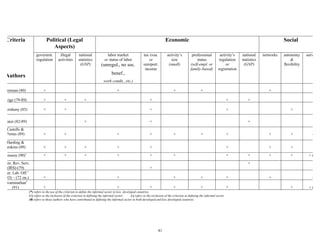
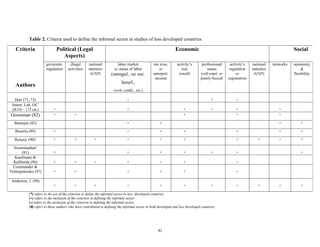
A lot has been written about the definition of the informal sector. However, for 
reasons of brevity, I will summarize the criteria used in various studies to formulate the 
informal sector and relate these to various definitions. My analysis is summarized in 
tables 1 (studies of the informal sector in developed countries) and 2 (studies of the 
informal sector in less developed countries).
The selection of researchers – listed in the table - who have studied the informal 
sector is based on several elements e.g. on the study period; the distinct criteria used to 
define the informal sector; the new developments brought into the field; the international 
importance of their findings, etc. Though a survey like this can never cover all of the 
studies in a field, the work referred to in tables 1 and 2 is generally considered to cover 
some of the main studies on this topic. 
In both tables, I distinguish various definitions by using three main criteria and various 
sub-criteria. I have adopted the main criteria from Harding and Jenkins (1989). These 
describe ‘the institutional patterns with which the society shapes the informal sector’. 
They are political, economic and social. The more specified sub-criteria, which are used 
to define the amalgam of the informal sector activities, vary across the main criteria. 
The main sub-criteria used regarding the political aspect of the informal sector are: 
1. government regulation; 
2. illegal activities; and 
3. national statistics (GNP). 
The main idea behind this classification is that it captures the influence of the informal 
sector [involving lack of government regulation, illegal activities and as a consequence 
substantial errors in measuring the national product (GNP)] in politics and vice-versa. 
The majority of researchers selected have used the first criteria to define the informal 
sector (cf. tables 1 & 2). Feige (1981), as we will see again later, in spite of using several 
other criteria, emphasizes the ‘national statistics’ aspect. 
Even though the introduction of a political aspect in the study of the informal sector 
was an achievement, the basic criterion - which has also received most attention - is the 
economic one. The sub-criteria used in this category are numerous. However, I will try to 
cover the most significant ones, which consist of the following: 
(1) labor market or status of labor (including undeclared labor, no social benefits, under 
minimum wage, non- appropriate working conditions, etc.) 
6
As expected, this criterion is essential in defining the informal sector. Many studies have 
based their notion of the informal sector on its consequences for the labor market. Based 
on this criterion the informal sector is the sum total of all income-earning activities with 
the exclusion of those that involve contractual and legally regulated employment. Among 
others, Harding and Jenkins (1989), Renooy (1990) and especially the International Labor 
Office (ILO) emphasize this criterion. 
(2) unreported income or tax evasion 
Tax evasion appears to be another essential sub-criterion under the category ‘economic’. 
The general definition of informal sector using this criterion is the sum of all unreported 
taxable money income, with the intention to evade taxes. Obviously, a combination of 
economic and legal aspects takes place when the element of tax evasion is used in 
defining the informal sector. Several researchers8, such as the Internal Revenue Service 
(IRS, 1979) in US, Feige (1981) and Tanzi (1982-1989), specifically emphasize this 
criterion. 
(3) size of activity 
This criterion used to be quite dominant especially in the beginning of the research on the 
informal sector. It was usually considered in terms of the number of people employed. 
For example, S.V. Sethuraman (1976) claims that employment of less than ten persons 
should be considered part of the informal sector. It is thought that the main feature of the 
informal sector activities is the small-scale of operation. This criterion has been 
particularly helpful in carrying out enterprise surveys. However, table 1 shows that not 
many researchers of the informal sector in developed countries have used this criterion. 
(4) professional status (i.e. self-employed, employer, family worker, apprentice, wage 
7 
employee, etc.) 
This criterion is meant to distinguish between wage employees and non-wage employees 
involved in the informal sector activities. Since the beginning (Hart, 1971, 1973), self-employment 
is considered to be a dividing criterion. For a while, this criterion comprised 
8 Note that in tables 1 & 2, this is the criterion used by the highest number of researchers.
the core of the informal sector. Informal workers are defined as ‘the sum of the self-employed, 
unremunerated family workers and domestic servants’. In addition, informal 
sector activities are basically labor intensive. The criterion ‘professional status’ no longer 
seems to have many supporters, however. 
(5) regulation or registration of the activity 
Whereas the labor market criterion is based on the status of labor, definitions based on 
regulation consider the standpoint of an activity/enterprise towards government 
regulations. Swaminathan (1991), who has mostly elaborated this criterion defines the 
informal sector enterprises as establishments which are unregistered and unlicensed9. 
However, he does not seem to be alone; many others share the same view (see tables 1 & 
2). Regulation is inclined to be a frequently used criterion in defining the informal sector 
activities. 
(6) national statistics or GNP accounts10 
One of the main reasons to study the informal sector has been the distortions this 
economy causes in measuring the national accounts (GNP). Feige (1981), who is one of 
the main supporters of this criterion, defines the informal economy as ‘all economic 
activity which, because of accounting conventions, non-reporting or under-reporting, 
escapes the social measurement apparatus, most notably the GNP accounts’. As it can 
also be derived from table 1, Feige combines two criteria – tax evasion and national 
accounts – in defining the informal sector, where the causality is both sided. 
The third institutional criterion used in definitions of the informal sector is the social one. 
Its main sub-criteria are: 
1- social networks or easy of entry 
Surveys on the informal sector indicate that ‘A friend of a friend’ are the key words in 
this sector. Breman (1980) emphasizes this by stating that the social network is very 
9 License procedure refers to obtaining a permit from state authorities in order to operate; while registration 
procedure refers to registering the activity according to the state rules. 
10 Remember that this sub-criterion has political effects as well. 
8
significant in dividing the informal economy into different types. In addition, the 
International Labor Office (ILO) and various other researchers have often stressed one of 
the main advantages of the informal sector - easy of entry – which has also been 
considered the defining feature of the informal sector. Tables 1 and 2 show that about 
half of authors use this criterion in their definitions. 
2- autonomy and flexibility 
Many informal sector participants, especially in developed countries, choose to 
participate in the informal sector because of more autonomy, flexibility and freedom they 
find in this sector compared to the formal one. In other words, the participants have the 
freedom of operating their own business; they have flexibility regarding hours or days of 
operation; they can use and develop their creativity, etc. About half of the researchers 
selected in tables 1 & 2 seem to share this criterion, however. 
3- survival 
Survival does not appear to be an aspect of the informal sector in developed countries 
(see table 1). Some think that the growth of the informal sector in these countries is 
indeed related to reorganization of productive activities on a global scale. As a matter of 
fact, this criterion used to be considered by the pessimistic viewers of the informal sector 
in early times, who therefore suggested State intervention should be reduced. Conversely, 
the optimists suggest that accumulation is indeed possible, hence the expansion of the 
informal sector should be supported. 
2.2.2. Studies about developing and transition countries 
As mentioned above, the origin of the informal sector concept comes from a study in a 
Third World context. This is basically due to the bigger significance this sector has had 
and still has in developing and transition countries11. There are many studies about the 
informal sector in developing countries and recently more and more about it in transition 
countries. It should be noted that the informal sector has also existed in the former 
11 Studies indicate that the lower the level of a country’s development, the larger and more important its 
informal sector. 
9
centrally planned economies12 and now in transition ones. However, considering the 
previous relative isolation of these countries, there are only few studies about this 
phenomenon in a socialist regime. Both will be discussed below. 
As previously mentioned, table 2 contains a considerable number of researchers who 
have studied the informal sector in less developed countries. This table indicates that 
studies of less developed countries use more or less the same criteria as studies of 
developed countries in defining the informal sector. However, considering several 
differences in the stages of development in these two groups of countries, differences 
regarding the informal sector and its definitions are expected. 
According to the table, studies of less developed countries support the political 
criteria in the same way as studies of developed countries do. With respect to the 
economic criteria, there are some differences. For example, the sub-criteria ‘size of 
activity’ or in other words ‘small scale of operation’ is used more in studies of less 
developed countries. This is most likely a consequence of the fact that small-scale 
activities dominate in the informal sector of less developed countries. Perhaps 
surprisingly, the sub-criteria ‘professional status’ does not appear to be used often. 
Distortions caused by the informal sector in measuring national account (GNP) do not 
seem to have attracted much attention either. However, the fact that J. Anderson (1998) 
uses it, shows that research studies on these countries are becoming more and more aware 
of its importance. 
As for the social pattern of the informal sector, it is worth mentioning the 
emphasis that Grossman (1982) gives to the importance of social networks in the 
informal sector of planned economies. In addition, his study pinpoints another typical 
feature of the informal sector in socialist countries, which is the strong linkage between 
the state and non-state activities. This feature seems to have remained, in some countries 
particularly evident, even during their transition period13. Furthermore, table 2 indicates a 
big difference among the two groups of countries regarding the use of ‘survival’ sub- 
12 In the socialist system, especially in its last period, activities in the invisible part of the economy were 
very much more widespread than in an ‘average’ market economy – (For more details see the empirical 
evidence from Schneider, 1997. 
13 For more evidence, see Kaufmann and Kaliberda (1996). 
10
criteria in defining the informal sector. Various studies have shown that contrary to 
developed countries, the informal sector in less developed countries generates low 
income, little if any accumulation and it is mainly a survival sector. However, there is a 
lot of discussion going on about this issue, which I will elaborate on in a separate section 
about the significance of the informal sector. 
2.2.3. Concluding remarks 
Obviously, there are several criteria which can be used to describe the diverse forms of 
the appearance of the informal sector. Both the existences of these various forms and 
several criteria yield the big variety in definitions. Understandably, the existence of a 
variety of descriptions/definitions is confusing, as Renooy (1990) has pointed out. In 
addition, this large variety of definitions makes it difficult to provide a uniform picture of 
the field. However, consensus amongst the authors about what is being studied has 
grown. 
There is basically agreement in both groups of studies (about developed and less 
developed countries) regarding the use of the classic criteria – undeclared labor, tax 
evasion, unregulated or unlincensed enterprises, illegality or criminality – in defining the 
informal sector. Besides some slight differences concerning the ‘national statistics’ and 
‘professional status’ criteria, the basic divergence among these groups of studies is 
related to the ‘survival’ criterion. Contrary to research on the informal sector in less 
developed countries, some studies of the informal sector in developed countries have 
shown that the informal sector offers possibilities for accumulation. 
To sum up, the previously mentioned studies have contributed to the general 
thought that the informal economy is not a homogeneous phenomenon, but a very 
diversified one. Therefore, any attempt to study it as a whole (including the introduction 
of a precise broad definition) cannot be completely successful. This does not mean that 
any effort should be discouraged or not supported. In my view, definitions of the informal 
sector can vary across countries, bearing in mind the political, economic, cultural and 
social differences. However, the differences seem to be strongest between developed and 
undeveloped countries. 
11
‘There are probably few people who do not, at some level, have mixed feelings about informal economic 
12 
Harding and Jenkins. 
2.3. Advantages and Disadvantages of the Informal Sector 
There is already a common consent that the informal sector constitutes a significant part 
of the economy as a whole. Its influence on the economy can be either positive, or 
negative, however. Many studies about the informal economy have tried to solve this 
dilemma. Good or bad / positive or negative? The solution to this dilemma may give an 
answer to another dilemma: would a reduction or expansion of this sector be beneficial to 
the economy as a whole? This section will deal with the history of this discussion. 
The early literature about the informal sector was dominated by the pessimistic vision14 
of this sector, according to which the informal sector was characterized by marginality 
and poverty. In addition, this sector was considered to be a source of unproductive labor 
and to have a residual character. However, continuous research in the field has shown 
that the informal sector can have potential for accumulation and development. These two 
viewpoints have been the center of a traditional debate about the advantages and 
disadvantages of the informal sector. 
Several studies give different opinions on the advantages and disadvantages of the 
informal sector. In a broad sense, these opinions are mostly grouped into economic, 
social and political advantages and disadvantages. The following will briefly cover the 
most important studies/publications (Tanzi, 1982; Harding and Jenkins 1989; Portes, 
Castells and Benton 1989; Feige, 1989; Renooy, 1990) based on their contributions to the 
‘informal sector’ evaluation dilemma. 
14 Among others, Marxist academics have also had this vision (see, Lubell, 1991).
2.3.1. Advantages 
The main advantages mentioned in the literature are the following: 
1. Economic 
· informal sector activities may help in maintaining the competitiveness and flexibility 
13 
of production; 
· Harding and Jenkins (1989) suggest that the informal sector activities/enterprises may 
bring growth if supported and encouraged; 
· this sector puts downward pressure on wages in the formal labor market; 
· it offers lower prices for goods and services; 
· it generates substantial personal income; 
· the informal sector is characterized by very low costs of labor; 
· the low labor costs combined with the advantage of not bearing any bureaucratic cost 
are thought to contribute to a higher productivity of capital in this sector; 
· the evidence from some transition countries indicates that the particularly large 
decline of the official GDP that these countries experienced (especially in the 
beginning) was alleviated through rapid growth of the informal sector. 
2. Social 
· informal sector activities provide families with employment, enables them to meet 
their basic needs, and increase their well-being15; 
· it offers freedom and opportunities for initiative and creativity; 
· it is a better alternative, even though poorly paid and unprotected, than being 
dependent on state benefits, or starving. 
3. Political 
· the existence of the informal sector can be used as a safety valve for public 
dissatisfaction and social tensions; 
· informal sector activities are often tolerated or even encouraged as a way to promote 
political patronage. 
15 Grossman (1982) declares that this positive assessment holds for the informal sector in a planned 
economy as well.
2.3.2. Disadvantages 
Notwithstanding the above positive aspects of the informal sector, research studies have 
not neglected its disadvantages: 
1. Economic 
- contrary to Harding and Jenkins (1989), Portes, Castells and Benton (1989) claim that 
in spite of various advantages, no development strategy and growth is expected from 
the informal sector; 
- the informal sector causes distortions in some main economic indicators such as the 
unemployment rate16, inflation rate17 and growth rate18. 
- the operation of informal sector activities (tax evasion) causes financial losses in the 
State revenues and, ceteris paribus, generates budget deficits; 
- therefore, it will cause a further increase in the tax rates; 
- its existence induces an unfair competition for those involved in the national and 
14 
international formal sector19; 
- if the informal sector is quite widespread in a country, it may increase the 
technological gap between this country and the other industrialized ones; 
- work in the informal sector is often characterized by low productivity and low 
incomes; 
- according to Frey (1989), the informal sector is negatively related to the provision of 
public goods due to the falling State revenues. 
2. Social 
- participants of the informal sector are worse off than those of the formal sector 
regarding their working conditions and because of the exclusion from any social 
benefit and security; 
- citizens will be provided with false information due to the incorrect measurement of 
GNP; 
16 Unemployment rate can be overstated because the individuals involved in the informal sector activities 
might be counted as part of the labor force, but unemployed. 
17 Feige argues that the inflation rate is overstated as prices in the informal sector are thought to grow at a 
lower rate than in the formal sector. 
18 The real economic growth rate will be distorted due to the exclusion of the informal sector in measuring 
the GNP.
- participants in the informal sector have an unfair advantage (no taxes or social 
security contributions) compared to participants in the formal sector. 
3. Political 
- due to the fact that informal economic activities are often not included in measuring 
the GNP, the available statistics will provide a misleading view of the state of the 
economy to policy-makers; 
- their operation will increase corruption and political lobbying with negative 
15 
consequences. 
To a large extent, studies of the informal sector in developed and less developed countries 
seem to share the same views on the advantages and disadvantages of the informal sector. 
In general, studies of transition countries appear to be quite close to the previous ones, 
but with some significant differences regarding their negative assessment of the informal 
sector. 
To start up with studies of the informal sector in these countries during their 
communist regimes, the party in power has attributed a negative political assessment to 
the informal sector operation, because it decays the authority of communist dictatorship 
(Grossman, 1982). This opinion seems to have remained even during the transition period 
but in the latter case ‘it undermines the effective management of the economy by the 
Kaufmann, and Kaliberda, 1996). In addition, these authors claim that even if it is 
large, the informal sector is mostly a survival sector where the short-term turnover 
dominates the long-term one; and where large-scale and vital investments do not take 
place. 
2.3.3. Policy Implications 
The effects of the informal sector on the economy as a whole are under severe debate. As 
a consequence, a debate is also taking place with respect to government policies vis-à-vis 
this sector. Too many case studies have led to very diverse arguments and suggestions. 
19 This disadvantage is often stressed by labor unions (see Sabel 1982).
Contrary to the situation many years ago, however, academics as well as the society are 
fully aware of its existence. The main issue remains how to react towards it. 
According to the analysts with a negative evaluation, formalization of the informal sector 
is needed. The disadvantages dominate the advantages. Therefore, the informal sector 
should be reduced in size. In addition, its residual and marginal character (according to 
the supporters of this opinion) makes its transformation a necessity. 
Nevertheless, the positive view of the role of the informal sector has increased 
with the development of the literature. Even within the group of positive analysts, the 
controversy about the attitude towards the informal sector is still a hot topic, however. 
Some think that the informal sector has its own dynamics, it promotes small business and 
it reduces unemployment. Therefore, it should be supported. Others think that 
notwithstanding these advantages, wrong policies will be pursued, distortion of the 
distribution of resources will occur and its implications in the long-run are worse than its 
positive economic, social and political consequences in the short-run. Consequently, the 
latter ones suggest its integration into the formal economy. These two views, however, 
are more extreme regarding the informal sector in developing and transition countries. 
The prevailing belief, in these countries, is that the negative implications dominate. 
The essential difference between the significance of the informal sector in developed and 
less developed countries is that whereas in less developed countries the informal sector is 
identified with low income and little if any accumulation capacity, in developed countries 
there are possibilities for accumulation and incomes are often comparable to the formal 
sector standard. 
3. Theories related to the ‘Informal Sector’ 
Research on the informal sector is substantially based on several theories. Even though 
quite some components of these theories have been described previously, this section will 
analyze them in more details. Whereas the previous section discussed descriptive theories 
16
in as much as they are related to the characteristics of the informal sector, the theories 
selected expected here have been chosen because they try to explain rather than describe 
the informal sector phenomenon. They try to give a view of the relationship between 
formal and informal activities or to explain the motives/reasons to participate in the 
informal economy. As with other topics discussed until now, I will maintain the structure 
based on the division of studies in developed and less developed countries. This structure 
can help to recognize potential differences between both groups of studies. 
17 
3.1. Studies in Developed Countries 
3.1.1. The relationship between the formal and informal sector 
In the earliest studies of the informal economy (approximately 1960-1970), the dominant 
theory was one which considered the informal economy a separate economic domain or 
in other words which supported dualism. The concepts of dual economy20 and social 
marginality21 were already mentioned in 1953 by the ‘colonial economist’ Boeke. He 
describes the dual economy as consisting of an urban market economy (capitalist nature) 
on one hand and a rural subsistence economy (static agricultural system of production) on 
the other. This theory was later criticized for its descriptive rather than explanatory 
nature; the acceptance of economic dualism; and the assumed autonomous relationship 
between the formal and informal sectors instead of the one of domination and 
subordination. 
Research in the following years showed the significance of the informal sector and its 
complete integration into the national economy. The mainstream theory of this period 
considered informality a reality, characterized by ‘its own right, with its own rules, 
conditions and characteristic modes of representation’ (Harding and Jenkins, 1989). 
Supporters of this theory reject the notions of economic dualism and social marginality. 
They do not see the informal economy as a set of survival activities performed in a 
‘marginal society’. This theory is characterized by its explanatory power and the 
20 The concept of dual economy is conventionally known as modern against traditional; or capitalist versus 
non-capitalist; or industrial-urban as against agrarian-rural modes of production. 
21 The last notion means that informal activities were perceived as marginal.
recognition of another relationship between the formal and informal sectors. This is a 
linking relationship where the informal sector is dependent on the formal sector. 
In a parallel way, two important theoretical approaches (mainly as subordinates of the 
latter theory) emerged: the so-called ‘production-rationale’ approach and ‘illegality-based’ 
approach. The first approach emphasizes the influence of the State in the 
economic cycle and distribution of resources. Conversely, the second approach supports 
the traditional economics (laissez-faire), where there is no need for State regulation or 
intervention. As a consequence, ‘the production-rationale’ approach favors State 
regulation of the informal sector in order to integrate it into the formal economy. The 
‘illegality-based’ approach, on the other hand, argues that the informal sector should be 
left free, and let the market forces rule. Despite their positive developments, Guerguil 
(1988) has criticized them because ‘neither of the two approaches performs the dual 
function: to establish an analytical framework and a measurable indicator’. 
Research went further on developing several new approaches within the 
framework of the mainstream theory. These typically try to explain certain aspects of the 
informal sector. An example is the ‘tax evasion’ approach mainly analyzed by Feige and 
Tanzi. According to Tanzi (1982), the main determinants of tax evasion are: (1) the 
perceived fairness of tax laws; (2) the attitude of tax-payers vis-à-vis their government; 
(3) their basic religious and cultural characteristics; (4) the severity of penalties imposed 
on the tax evaders that are apprehended; (5) the facility with which taxes can be evaded; 
and, (6) the monetary rewards to the taxpayers associated with not paying taxes. 
There is a causality correlation between the ‘tax evasion’ approach and the one 
which deals with the reliability of the nation’s information system. Feige (1989) 
contemplates a split up of the unobserved economy in two elements: a monetary sector 
which utilizes money as a medium of exchange and a non-monetary sector in which the 
exchange occurs through barter or its goods and services are self-consumed. Due to the 
unreported income (tax evasion) from both these sectors, the national accounting system 
is misleading. Consequently, Alford and Feige (1989) suggest that ‘information must be 
treated as an endogenous variable in social systems whenever there exist behavioral 
incentives and mechanisms to manipulate the information system’. They argue that the 
apparent economic stagnation may partly result from the statistical illusion or distortion 
18
(due to the exclusion of the informal economy in the conventional measures of national 
income). Conversely, some other researchers like O’Higgins (1989) and Broesterhuizen 
(1989)22 claim that the informal economy is greatest during stagnation periods. 
All these ideas have been extensively discussed by Frey (1989), who refers back 
to two theories about the informal economy, launched for the first time in earlier studies. 
The first theory is the theory of optimal taxation or the social-welfare-maximizing 
approach. Its pioneers are Ramsay (1927), Allingham and Sandmo (1972), Srinivasan 
(1973), Singh (1973) and Kolm (1973). This theory is used to determine that tax rate 
which maximizes economic well-being as described by a social welfare function, taking 
into account the effect taxes have on the supply of labor and on the production of goods 
as well as on the distribution of income23. The second theory is the economics of crime as 
it is called by Becker (1976), who studies the possibilities for controlling illegitimate 
activities, looking both at the supply of and demand for (i.e., the partial neglect of 
protecting oneself against) offenses. These two approaches are primarily concerned with 
the individual behavior regarding taxes and illegal activities, through which, the informal 
economy (tax evasion and illegal) is analyzed. 
Frey’s main criticism about the social-welfare-maximizing approach is that 
‘government is not an exogenous actor in the political-economic system free to pursue the 
social good but is dependent on other decision makers, particularly on the support of 
voters and interest groups’. Alternatively, he suggests another approach: the theory of 
democratic economic policy. According to this theory, ‘in a system of decision makers 
each of which pursues his own utility, the size of the official as well as that of the 
unobserved economy is the unintended outcome of their actions’. In other words, the 
informal sector activities are the consequence of self-interested decision makers. 
In his theoretical approach, Renooy (1990) models the informal sector as a simple 
cyclical phenomenon in which subjects undertake activities (work), which may or may 
not lead to transactions, from which payments may or may not result, which produce 
income, which again may be used in various ways. This approach yields several distinct 
22 These researchers have studied the informal economy in United Kingdom and the Netherlands, 
respectively. 
23 Sandmo (1981) develops a model based on this theory in order to determine the optimal size of the 
unobserved sector for policy purposes. 
19
features of the informal sector compared to the formal economy: (1) formal regulations 
and rules are absent; (2) there is often a higher degree of flexibility than in the formal 
labor market; (3) it is not the organization but the form of payment which differs 
compared to the formal economy; (4) these activities take place both within and outside 
formal contexts and they strongly interact with each-other; (5) there is no complete 
information; (6) this sector is highly fragmentary; (7) there is a combination of various 
(informal) activities because sometimes one activity alone does not produce sufficient 
income; (8) there is a low entrance threshold to the informal economy; (9) the price of 
goods and services in this economy is lower than in the formal one; (10) there is a lower 
capital intensity; (11) there is a lower level of productivity; (12) the informal sector relies 
predominantly on social/family networks, where subcontracting is its connection with the 
formal economy; and (13) sometimes absence of channels of access to the formal 
activities. 
3.1.2. Reasons, Motives, and Causes of Informalization 
The existence of an informal economy and its persistence over time has been explained 
by a variety of reasons, motives and related causes. Public attention was drawn to the 
underground economy during World War II when higher tax rates, price controls, and 
rationing programs provided incentives for firms and individuals to participate in various 
‘black market’ activities (Feige, 1989). The study of these elements is considered to be 
very important, in order to understand this phenomenon more in depth and to reach a 
scientific conclusion regarding its overall significance. 
The majority of analysts have agreed, to a large extent, that one of the foremost causes of 
the development and tenacity of the informal economy is the recession in which any 
country may go through. As a consequence of this potential stagnation, a lot of 
unpleasant economic phenomena appear to happen, such as unemployment, depreciation 
of capital, etc., which in turn influence the informal activities. Some of the earliest 
primary reasons to participate in the underground economy mentioned in the literature 
are: (1) to evade taxes; (2) to avoid losing government benefits24; (3) to circumvent 
24 If incomes exceed a specific level then individuals may no longer receive all or part of their benefits. 
20
regulations and licensing requirements; (4) a reaction by both firms and individual 
workers to the labor unions; and (5) the impact of international competition25. 
In broader terms, the motives for participation can be economic and non-economic. 
The economic reasons are related to unemployment and an inflexible formal 
labor market; the declining real price of capital; and the high cost of formal production. 
The non-economic motives are related to a greater flexibility and greater satisfaction in 
work; a complete use of their professional qualifications; and the increased leisure time. 
A very important element, which motivates the participation in the informal economy, 
seems to be the role of the State. Beyond economic considerations, State-related variables 
are decisive in creating a climate suitable for the expansion of the informal sector 
(Gershuny 1979). These State-related variables and other motives are discussed by 
Renooy (1990) from another perspective, behavioral economics. He claims that there are 
two groups of factors which determine the decision to become active in the informal 
economy, specifically, the ‘structural’ and ‘opportunity’ factors. The structural factors 
consist of financial pressure; socio-psychological pressure26; and institutional constraints. 
The opportunity factors, which imply free choice, consist of individual background; 
skills; education; contacts and living situation, or non-individual components such as 
environment; cultural tradition; values and standards; and geographical factors. The 
author suggests that these ‘opportunity’ factors explain why different sorts of informal 
economies exist. The individual free choice affects the decision on tax payments based on 
a combination of inadequate information and a lack of any trust in the way taxes are 
spent. In an atmosphere in which the government loses the trust of the population, in 
which people no longer feel that government supports them, a step into the twilight 
economy will be taken much more lightly (Renooy, 1990). 
The last but not the least reason for participation in the informal sector, mentioned 
by several researchers, is the governmental over-regulation of the market sector, for 
example ‘not only via the taxes, but also through labor legislation and legislature relating 
to labor conditions, quality regulations, and production limitations’. This over-regulation 
25This implies the move towards underground due to the competition with cheaper Third World imports. 
26 Pressure here means ‘pressed by circumstances’. 
21
increases the transaction costs of participation in the formal economy, so that it becomes 
relatively more appealing to switch over to the informal sector. 
3.2. Studies in Developing and Transition Countries 
3.2.1. The relationship between the formal and informal sector 
The early literature on the informal sector has mostly focused on the Third World 
countries and has, wittingly or not, assumed that as a social type such sectors are not to be 
expected in advanced industrialized countries (Feige 1979; Gutmann 1979; Tanzi 1982). 
However, research has shown that the informal sector not only exists in the developed 
countries, but it is often a very problematic phenomenon. As a matter of fact, the theories 
for developed countries, mentioned previously, hold to a large extent, for less developed 
countries as well. Therefore, I will be brief in mentioning some theoretical developments 
specific to these countries. 
Early studies of the informal economy in developing countries considered the participants 
of informal activities as a ‘reserve army’ of labor, who mainly survive at subsistence 
levels. For example, Swaminathan (1991) recognizes that the primary reason to start with 
research on the informal sector, in developing countries, was related to the problems of 
mass poverty and unemployment, which has not always been the case in developed 
countries. Furthermore, besides the common reasons – mentioned in section 3.1.2 – for 
small-scale enterprises to go underground, he argues that historical circumstances, like 
poverty and survival needs, are also important for explaining the occurrence of an 
informal sector. 
As mentioned above, the informal economy was present even in centrally planned 
economies. Obviously, theories describing informal activities in these economies are 
expected to have particular features. Even though the economic regime is substantially 
different, than in Western economies, the informal sector acts as a safety valve for 
political discontent in planned economies however. While in the West individuals earn 
incomes that are then taxed, in socialist economies, the resources are withheld at the 
22
outset by the overall imposition of scarcity as dictated by the central plan (Feige, 1989). 
Grossman (1989) has contributed significantly in providing a lot of evidence about the 
informal activities in these economies, especially for the USSR. His research has shown 
the following: (a) demand for informal income and the supply of informal goods and 
services inevitably reinforce one another27; (b) the involvement on the outlay side is more 
widespread than on the income side; and (c) exchange of favors in the form of access to 
goods or services was a salient feature of the Soviet informal economy. More 
specifically, some forms of informalization were: private lucrative use of the socialist 
property; theft from the state and cooperatives; bribe-taking by official persons; and 
bribe-giving, in money or natura. He gives a very interesting explanation of this 
phenomenon in the form of a circle, which starts with the state compensating for its loss 
through theft by paying lower wages. The individual in turn will consider this as an 
implicit justification to steal from the state - especially in a situation of pervasive goods 
shortages - and the circle closes. It is agreed that these characteristics might be similar in 
other communist countries of Eastern Europe, ‘since both the underlying causes of the 
second economy and its symptoms and manifestations are essentially the same there as in 
the USSR, despite country differences’. Further interesting evidences about the informal 
sector in former socialist countries are given by Schneider (1997) in his empirical 
findings. He has found out that the informal sector activities in these countries, especially 
in the last period, were very much more wide-spread than in an ‘average’ market 
economy. This contradicts the common view that these countries have experienced a 
relatively small informal sector, especially compared to developed countries. 
Long after the early studies of centrally planned economies (e.g. by Grossman, 1982), the 
informal activities were again a subject of study, but this time in the transition period 
these countries were passing through. The few new things, pinpointed from research on 
these specific economies regarding the theories on the informal sector, will be discussed 
below. In spite of this, the traditional well-established theories were applied to the 
different political, economic, social and mainly institutional circumstances in these 
transition countries. Each economic system (developed, developing, transition, etc.) 
27 At any rate, one is often reassured that “everybody does it anyway”. 
23
requires correspondingly different analytical frameworks if we are to understand the way 
they work and the relationship between formality and informality in each context 
(Harding and Jenkins, 1989), however. 
In the literature, the following elements show up specifically in the studies about 
transition countries. Some researchers28 argue that the informal sector in these countries 
is characterized by almost zero entry and exit costs. This argument, however, has been 
criticized, because research has shown that informal sector does have entry and exit 
costs29. The increased use of barter is another typical piece of evidence from some of 
these countries. This is explained as a reaction to high inflation initially, and later to the 
shortage of liquidity30. In addition, the new small businesses in some of these countries 
hardly show any trend to restructure, expand and grow (e.g. in Russia)31. Some of the 
reasons observed are: to avoid the attention of tax authorities and criminal 
organizations32; and often to delay paying wages to the workers. Finally, some argue that 
the rapid growth of an informal sector from a relatively low base has been a notable 
feature of the transition economies33. 
Several further attempts have been made to analyze the operation of the informal 
sector through modeling and other theoretical and empirical methods, which have further 
enriched the theories of the informal sector in transition countries 34. A more profound 
research about the informal sector activities in these countries is a necessity, however. 
3.2.2. Reasons, Motives and Causes of Informalization 
Informal activities have their own reasons and motives of existence and growth in 
developing and transition countries as well. Nevertheless, the majority of reasons and 
28 For example, see Kaufmann and Kaliberda (1996). 
29 One possible example is related to the existing network in an informal market, which increases the entry 
cost if a person is not part of the network. 
30 This phenomenon can be explained by the persistence of high real interest rates and therefore serious 
difficulties for businesses to borrow. 
31 For more details, see Gaddy and Ickes (1998). 
32 It has been argued that sometimes they do not want to attract the attention of potential investors as well, 
because the latter ones might see the business as a potential takeover target (for further comments, see 
Gaddy and Ickes, 1998). 
33 Some potential reasons will be given below in section 3.2.2. However, for more details, see Commander 
and Tolstopiatenko, 1997. 
34 See Commander and Tolstopiatenko, 1997; and Lacko’, 1999. 
24
motives converge for developed and less developed countries. There are a few specific 
reasons which diverge, however. 
- developing countries 
First of all, the low rate of industrialization and productivity, and the presence of surplus 
labor are listed as principal reasons why a dualistic system arose in the cities of the third 
world (Breman, 1980). In addition, it is accepted that due to the old economic mechanism 
(low technology and intensive use of cheap unskilled and semi-skilled labor) that these 
countries have, informal activities emerge and grow quite rapidly. This is basically one of 
the reasons why the informal sector in less developed countries is considered to be a 
surviving sector. 
Earlier in this literature survey, it was emphasized that stagnation can have a big 
impact on the informalization of the labor market. However, some argue that a 
flourishing economy can effect the participation in the informal activities as well35. This 
phenomenon was observed during the economic boom period of these countries. 
- former socialist countries 
Research about the informal sector under central planning recognizes some other basic 
motives of informalization36, such as: (a) the presence of common socialist property, 
which is broadly regarded as ‘up for grabs’; (b) the chronic shortages of many items; (c) 
virtually universal price controls, physical allocation and rationing of goods, and 
innumerable other kinds of official regulations; (d) the outright banning of a wide range 
of consumer articles and services37; (e) the ineffectiveness and slowness of the formal 
production and distribution mechanism; and (f) the support, protection, and often 
deliberate promotion of illegal activities by corrupt authorities at various levels. 
35 The prospering period of export manufacturers which entailed high levels of benefit for entrepreneurs, 
the use of advanced technology, and the growth in the scale of production also fostered a process of 
informalization disguised as small independent entrepreneurship (Fortuna and Prates, 1989). 
36 For more details, see Grossman (1982). 
37 For example, those pertaining to Western youth culture, religion, some forms of minority nationalism, 
and pornography, among others. 
25
- transition countries 
Regarding transition countries, Kaufmann and Kaliberda (1996) specify the hypothesized 
determinants for a rapidly growing unofficial economy as follows: a low initial share38; a 
high degree of bureaucratic discretion; corruption; civil war; undeveloped market 
institutions and enforcement mechanisms; low degree of economic liberalization; high 
tax burden; lack of credibility towards government; and macroeconomic instability39. 
3.3. Concluding remarks 
There is a variety of theories which attempt to explain informal economic activities. 
Deficiencies, and therefore criticism, are recognized over time, which consequently have 
resulted in their improvement. The basic features of these theories hold for all the 
countries, developed and less developed ones. 
Differences are observed, however. They are the result of different political, 
economic, social and institutional features characterizing these countries. The basic 
difference is mainly related to the modes of production. While the informal sector in 
developed countries is often characterized by technological dynamism (technological 
innovation and accumulation) of small-scale enterprises, informal activities in less 
developed countries are identified by low income, low technology and survival 
mechanisms. 
Furthermore, the informal sector in former socialist countries has shown specific 
characteristics, which is basically the result of a completely different economic regime. 
Partly as a consequence of this, but also of the severe transitional period towards market 
economies, these countries appear to develop distinctive features of the informal sector. 
38 Note that in some countries, the initial share of the informal sector is often quite high. 
39 In particular, macroeconomic instability seems to have stronger effects regarding currency substitution, 
capital flight, and barter transactions. 
26
27 
‘If the facts don’t fit the theory, check the facts’ 
FEIGE - 
4. Empirical Studies 
When the informal sector phenomenon was accepted and broadly investigated, more and 
more empirical work appeared. This empirical work has used several methods to measure 
the informal economy, which is dependent on the way this economy is defined. Besides 
the difficulties coming from terminological confusion; inconsistency in definitions; and 
several measuring methods, ‘the irregular and obscure conditions make it difficult for the 
researcher to collect data on the informal sector’, however (Breman, 1980). Nevertheless, 
many attempts have been made, and this section summarizes the most important ones. 
4.1. Studies in Developed and Less Developed Countries 
The empirical analysis of the informal sector in developed and less developed countries 
do not differ much. The following methods/approaches are applicable to every country. 
Therefore, this section will not distinguish the two groups of countries when discussing 
the empirical method. Two research approaches are significant in the literature: the direct 
and indirect approaches. 
· indirect approach 
The indirect approach focuses on the study of already available statistics. The earliest 
method, according to a report by Feige (1989), is the simple currency ratio method first 
used by Cagan (1958) to obtain a rough quantitative measure of the size of unreported 
income. This method implies that any significant increase in monetary notes in 
circulation – in other words, any increased demand for cash - corresponds to an increase 
in economic activity in the informal market. Henry (1976) used this method to measure 
the informal economy in the United States, during the period 1969-1970. Indeed, there 
was an increase in 50$ and 100$ notes in the US, which was explained by Henry in terms 
of an expansion in profit-oriented crime and tax evasion. Many researchers have applied 
this method in various countries. However, several of them do not relate the increase of
notes in circulation to the increased informal sector, but instead to the price effect in 
currency holdings40 or the declining value of money41*. More objections to the monetary 
method to quantify informal activities are given by Gutmann (1977), and later by 
Macafee (1980), and Tanzi (1982). 
As a response to this criticism, attempts were made to develop accurate methods to 
measure the informal economy. One of these endeavors is the suggestion of the currency-ratio 
method by Gutmann (1977). This method claims that an increase in the ratio of 
currency to checkable deposits indicates an increased informal activity (taking into 
account that currency is the sole medium of exchange in the informal economy). Another 
endeavor is the income/expenditure discrepancy method42, which assumes that while 
people may attempt to conceal their true income, they will not conceal their true 
expenditure when interviewed. There are positive and negative opinions about this 
method. Mattera (1985) stands on the positive side because ‘the reported income/reported 
expenditure discrepancy measures are more convincing that the currency-based 
techniques, inasmuch as they are related to more solid data (expenditures figures) than 
the latter’s dependence upon rates of circulation of money’. Conversely, Frey and 
Pommerehne (1982) mention three shortcomings of the discrepancy approach: (1) there 
are errors in both estimates of aggregate income; (2) there are errors due to differences in 
the statistical coverage; and (3) income not captured by tax authorities may also not 
appear in the national income data. 
In the framework of attempts to quantify informal activities indirectly, Portes and 
Sassen-Koob (1987) have used small business activities as a proxy for informal economic 
activities. Also, there have been efforts to assess the informal economic activities by 
estimating the size of the unregistered labor force, especially in the United States. The 
basic line of this method is the comparison between the Census Bureau’s Current 
Population Survey (CPS) estimate of the numbers of jobs and job-holders and the Bureau 
40 Boyle (1984) found evidence of this by using the same method to measure the informal activities in the 
Republic of Ireland. 
41 This is Tucker’s (1982) evidence from his study of the informal sector in Australia. 
* Another possible explanation of the increase in monetary notes in circulation is the increased use of cash 
dollars outside the United States. 
42 The discrepancy method measures the net effect of the unobserved activity, when for example, one 
procedure for measuring a particular form of unobserved activity is believed to be relatively free of biases 
induced by that activity while another procedure is known to be affected by the activity. 
28
of Labor Statistics survey of establishments of all sizes to determine the number of 
people on the official payroll. 
Feige has proposed a couple of additional methods. In 1980, he introduced the so-called 
transactions-ratio method, which hypothesizes that ‘activity in the underground 
economy is likely to be recorded in measures of total transactions but excluded from 
recorded income’. His intention was to measure the unrecorded GNP. Later, in 1989, he 
stated that ‘the two most widely used valuation methods are opportunity cost and market 
costs’: (1) the opportunity cost approach attempts to measure the value of lost market 
income that results from production activities at home; whereas (2) the market cost 
approach values household production activities at corresponding market wage rates that 
would be paid if outside workers were hired to perform the productive activities. 
A further step is undertaken by Frey and Weck (1981) in their comparative study 
among a number of industrialized (OECD) countries, where they expect to find a 
correlation between levels of taxation and the estimated size of the country’s informal 
economies. They call this method the soft modeling method. Taking into account the 
levels of taxation and legal regulation, their ranking in the size of the informal sector is: 
the Netherlands, Germany, France and United Kingdom. Switzerland, known for its 
comparatively high levels of taxation, seemed to have a comparatively small unofficial 
economy. Surprisingly enough, Italy appeared to have a very small unofficial economy, 
while it was an ‘accepted fact’ that Italy had a very large informal economy. Due to this 
inconsistency in the empirical results, Frey and Weck recognize several important factors 
to understand the regional differences in analyzing the informal market: (a) labor-market 
conditions; (b) the economic climate; (c) culture and values; (d) the organization and 
structure of legal and administrative frameworks; and (e) the power and nature of the 
State. Considering these elements, they have attempted to correct this inconsistency later. 
· direct approach 
The direct approach entails the research of samples. Mattera (1985) is one of many 
researchers using the direct approach applying the random sample method to quantify 
particular kinds of informal economic activity. He states that since 1963, the Internal 
Revenue Service (IRS) in the United States operates under a Taxpayer Compliance 
29
Measurement Program (TCMP), through which, it rigorously examines the tax returns of 
a randomly selected sample of about 50,000 taxpayers. Therewith, the tax returns of these 
people are interconnected with supplementary information reports submitted by 
businesses and individuals. However, it is argued that the unreported transactions, either 
by the vendor or by the purchaser of goods and services, will not be examined by this 
method and this is considered to be one of its failures. 
Several other researchers have provided empirical evidence based on more 
detailed in-depth interviews with a selected sample of households. This method is 
considered important in quantifying the informal labor market. Another form of the 
sample approach is the so-called time-budget survey, which means detailed evidence 
from people, using a diary approach, to keep track of ‘the changing pattern of their 
economic and non-economic activities outside of the formal economy’ (Gershuny and 
Miles, 1985). In addition, Harding and Jenkins (1989), acknowledge a so-called 
‘nominative-technique’, which implies that a ‘shadow sample’ of those having a 
particular attribute is ascertained by asking respondents about the activities of their 
relatives and friends. Particular conditions, such as detailed pre-testing, should be 
satisfied, however, in order to apply this method. The sample method is mainly criticized 
regarding the potential respondent jeopardy43. Lee (1985) has pointed out two manners to 
minimize this jeopardy, basically by dealing in more sensitive ways with the 
respondent44. 
Besides the indirect approach, the irregular labor market is estimated by using a 
direct approach as well. For example, Frey and Pommerehne (1982) have used the direct 
approach by interviewing a representative sample of the population regarding their 
participation as a buyer or seller in the market for irregular labor services. The advantage 
of this approach, according to them, is ‘that both monetary and bartering income-creating 
Some researchers have attempted to combine the direct and indirect approaches. 
For example, Portes, Castells, and Benton (1989) introduce a multi-country comparative 
study, based on a methodological approach, which combines a ‘horizontal’ method with a 
43 This deficiency is related to the respondents’ impression of being threatened by questions, during the 
interview. 
44 For more details, see Lee (1985). 
30
‘vertical’ one. The former attempts to provide quantitative estimates of the relative 
weight of informal production and employment in each city, whereas the later attempts to 
trace the articulation between formal and informal activities in selected sectors of the 
urban economy. They accomplish the ‘horizontal’ method through field surveys or 
reanalysis of available statistics/reports (indirect approach); instead, the ‘vertical’ one 
through direct observation and in-depth interviews (direct approach). Instead, Isachsen 
and Strom (1989) call it a micro- and macro- approach. The micro-approach is based on a 
survey study related to unreported income from work (direct approach), whereas the 
macro-study focuses on the development of the stock of currency (indirect approach). It 
is argued that due to the combination of both approaches (direct and indirect), the 
statistical errors and distortions can be eluded45. 
Regarding the measurement of informal activities in transition countries (even 
during their socialist system), the direct method is used more often. There are efforts to 
measure it using indirect methods, however. For example, Kaufmann and Kaliberda 
(1996) launch a new indirect method, which they call the macro-electrical approach. 
They argue that ‘by having a proxy measurement for the overall economy and subtracting 
it from estimates of official GDP, an estimate of unofficial GDP can be derived’, where 
the electric-power consumption is regarded as the best variable/indicator to measure the 
overall economic activity in an economy. They conduct a cross-country study among the 
Central and Eastern European (CEE) countries by using this method. This method is 
considered to be simple and helpful, but some aspects of it are treated with reserve even 
by the authors themselves. 
In 1999, Lacko` worked out a new method, the so-called household electricity 
approach. This approach avoids the inconsistency of the previous approach46. The main 
assumption of the household electricity approach is that a part of the household 
consumption of electricity is used in the hidden economy (in other words, the hidden 
economy is present in all sectors of the economy, including households). This method is 
based on an econometric model and it attempts to determine the share of the hidden 
45 For further details, see Broesterhuizen (1989). 
46 According to Lacko` (1999), ‘it is the structural differences and their rapid changes that has had a 
dominant impact on total electricity consumption in these countries and its relation to the registered GDP in 
the course of transition, and not the hidden economy’. 
31
economy in 19 OECD countries. After some modifications, the same method is applied to 
a few transition countries. 
4.2. Discussion and empirical results 
Two main approaches have been discussed to estimate/quantify informal economic 
activities: the indirect and direct approach. Several methods have been employed as 
components of these approaches, such as a number of monetary methods, a number of 
discrepancy methods to measure unregistered labor market, and tax evasion47; and small 
or large survey/sample methods, respectively. Any measurement of the unofficial 
economy is subject to substantial margins of error (Kaufmann and Kaliberda, 1996). 
Therefore, given the difficulties inherent in any effort to quantify the unobserved sector, 
the various approaches to measurement are best viewed as complementary, yielding 
insights into different aspects of the issue (Feige, 1989). Every new method has gone 
through filters of evaluation and criticism over time and across countries. The indirect 
approach has been criticized most because, contrary to the direct approach, it does not 
give specific and inside information about the participants and location of the informal 
economy. Especially, the monetary-ratio method has been strongly criticized. ‘It has 
always made me think of the person who wanted to measure a girl’s height by the length 
Tanzi, 1982). Nevertheless, there have been efforts to improve the quality of 
estimations which have used indirect methods. 
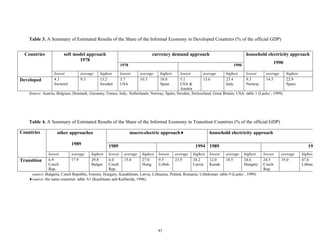
Table 3 summarizes the estimated share of the informal economy in developed 
countries. The data show the lowest, average and highest estimated share of the informal 
sector from three selected methods. For 1978, there is a reasonable inconsistency 
(comparing the soft model approach and currency demand approach) regarding the 
highest estimated share. The same occurs but for the lowest share in 1990 (comparing the 
currency demand approach and the household electricity approach). 
Several researchers have implemented various methods in less developed 
countries as well. One of these endeavors is shown as a summary in table 4. Comparing 
the results of all three approaches, the inconsistency varies for 1989, but it is very 
47 Hansson (1989) applied the discrepancy method to estimate tax evasion in different years as the 
discrepancy between households’ total expenditures on consumption, savings, taxes, and so on, and total 
income estimated from income reported on tax returns. 
32
significant for 1994. In spite of the inconsistencies across methods, tables 3 and 4 can be 
used to compare the two groups of countries. This yields the conclusion that: the informal 
sector is bigger in transition than in developed countries. 
5. Conclusion 
Starting from complete neglect, the phenomenon of informal economic activity has 
become something studied by many researchers, both governmental and non-governmental. 
In my view, this research has consisted of three important domains: 
definition, measurement and significance of the informal sector. 
In light of the manifold appearances of the informal sector and consequently the variety 
of criteria describing each of them, several definitions have emerged. Many researchers 
have considered this a disadvantage. Therefore, numerous unsuccessful efforts have been 
made to formulate a unique definition. In my view, there is no need for a universal 
definition, however. As long as researchers share a definition for each separate 
aspect/activity of the informal sector, there will be, first, a basis of comparison between 
studies (for each activity) and second, the sum of all activities will provide a picture of 
the informal sector as a whole. 
The only difference across definitions is then, that researchers focus on different 
subsets of all of these activities. A comparison between studies of the informal sector in 
developed countries with studies in less developed countries has shown that the basic 
divergence is related to the ‘survival’ criterion. Whereas studies in developed countries 
show that the informal sector offers possibilities for accumulation, research in less 
developed countries provides evidence that survival is the main characteristic of the 
informal sector in these countries. 
Another important debate is related to the significance of the informal sector, and 
therefore to the best reaction towards it. Opinions are split between the positive and 
negative assessment. There are two types of negative assessors, however. The first sees 
the informal sector as negligible, with a residual and marginal nature. The second type, 
33
instead, considers the informal sector as a dynamic phenomenon, which might have a 
significant impact in the economy. Considering its negative long-run implications, they 
suggest its (gradual) integration into the formal economy. These opinions hold for the 
informal sector in developing and transition countries, but in a more complicated way 
than for developed countries. In light of the general poverty, low technology and 
development, informal activities are often considered as an economic, political and social 
valve for public discontent. Nevertheless, transformation in the long run is a necessity for 
these countries as well. Another essential difference observed between the informal 
sector in developed and less developed countries, is that the informal sector in developed 
countries shows possibilities for accumulation and a comparable standard of income with 
the formal sector. Instead, the informal sector in less developed countries is identified 
with low income and little if any accumulation capacity. 
Efforts have been made to establish theories, which would aim at explaining the 
informal sector phenomenon. Some of them have been only descriptive, some others have 
tried to explain informal economic activities. The basic features of these theories hold for 
all countries, developed and less developed. Differences, which are mainly related to 
different political, economic, social and institutional characteristics of these countries, are 
observed however. The main difference is related to the modes of production. 
Accordingly, technological dynamism (technological innovation and accumulation) 
characterizes, to a large extent, the informal sector in developed countries, while low 
technology and survival mechanisms characterize the informal sector in less developed 
countries. A better understanding of why the informal sector exists and what is its 
relationship to the formal sector needs further research, however. 
The third important domain is related to the measurement of informal sector activities. 
The literature discusses two main approaches to quantify the informal sector: the direct 
and indirect approach. The indirect approach focuses on the study of already available 
statistics, while the direct approach operates using sample surveys. These two main 
approaches consist of several other methods, which are used to estimate diverse activities 
of the informal sector in both developed and less developed countries. The direct 
approach is considered to be best, because contrary to the indirect approach, it gives 
34
specific and inside information about the participants and location of the informal 
economy. 
In sum, a considerable amount of work has been done to analyze the informal sector 
phenomenon. Numerous significant findings have contributed to lighten the darkness of 
this new field of study. Several methods have been used to deal with it. In my view, more 
efforts to study it thoroughly and to find new insights should be strongly encouraged in 
the future, however. We are still a long way from really understanding this phenomenon 
that is of such major economic, political and social importance in all countries, developed 
as well as undeveloped. 
References 
Alford, R.R., and Feige, E.L., 1989. ‘’Information Distortions in Social Systems: 
The Underground Economy and other Observer-Subject-Policymaker 
Feedbacks’’ in Feige (eds.), The Underground Economy: Tax Evasion and 
Information Distortion, Cambridge University Press, pp. 57-81. 
Allingham, M.G., and Sandmo, A., 1972. ‘’Income Tax Evasion: A Theoretical 
Journal of Public Economics, vol. 1, pp. 323-38. 
Anderson, J.H., 1998. “The Size, Origins, and Character of Mongolia’s Informal Sector 
World Bank WP 1916. 
Becker, G.S., 1976. The Economic Approach to Human Behavior, University of Chicago 
35 
Press, Chicago and London. 
Blau, P.M. and Scott, W.R, 1963. Formal Organizations: A Comparative Approach, 
London, Routledge and Kegan Paul. 
Boeke, J.H., 1953. Economics and Economic Policy of Dual Societies, New York. 
Boyle, G.E., 1984. ‘’In Search of Ireland’s Black Economy’’, Irish Banking Review, 
March, pp. 32-42. 
Breman, J.C., 1980. The Informal Sector In Research: Theory And Practice, 
casp 3, Rotterdam.
Broesterhuizen, G.A.A.M., 1989, ‘’The Unrecorded Economy and the National Income 
Accounts in the Netherlands: A Sensitivity Analysis’’, in Feige (eds.), The 
Underground Economy: Tax Evasion and Information Distortion, Cambridge 
University Press, pp. 159-175. 
Bromley, R. and Gerry, C. (eds.), 1979. ‘’Casual Work and Poverty in Third World 
Chichester, Wiley and Sons. 
Cagan, P., 1958. ‘’The Demand for Currency Relative to the Total Money Supply, 
Journal of Political Economy, 66, pp. 303-328. 
Commander, S. and Tolstopiatenko A., 1997. ‘A Model of the Informal Economy in 
Transition Economies’. WP 122. The William Davidson Institute (University of 
Michigan). 
De Soto, H., 1989. The Other Path. The Invisible Revolution in the Third World. Harper 
36 
and Row. New York. 
Feige, E.L., 1979. ‘’How Big is the Irregular Economy’’, Challenge, vol. 22, pp. 5-13. 
Feige, E.L., 1981. ‘’The UK’s Unobserved Economy: A Preliminary Assessment’’, 
Journal of Economic Affairs, vol. 1, pp. 205-12. 
Feige, E.L., 1989. The Underground Economies: Tax Evasion and Information Distortion 
(ed.), Cambridge University Press. 
Fortuna, J.C., and Prates, S., 1989. ‘’Informal Sector versus Informalized Labor Relations 
in Uruguay’’, in Portes, A., Castells, M., and Benton, L.A., The Informal 
Economy: Studies in Advanced and Less Developed Countries, Baltimore, Johns 
Hopkins. 
Frey, B.S., 1989. ‘’How Large (or Small) should the Underground Economy 
Feige (eds.), The Underground Economy: Tax Evasion and Information 
Distortion, Cambridge University Press, pp. 111-29. 
Frey, B.S., and Pommerehne, W.W., 1982. ‘’Measuring the Hidden Economy: Though 
this be Madness, there is Method in it’’, in Tanzi (ed.), 1982. 
Frey, B.S., and Weck, H., 1981. ‘’Bureaucracy and the Shadow Economy: A Macro 
Anatomy of Government Deficiency, Hanusch, H., (ed.), Detroit: 
Wayne State University Press.
Gaddy, C., and Ickes, B.W., 1998. ‘’To Restructure or Not to Restructure: Informal 
Activities and Enterprise Behavior in Transition’’, WP 134, The William 
Davidson Institute at the University of Michigan Business School. 
Geertz, 1963. ‘’Peddlers and Princes: Social Change and Economic Modernization in 
Two Indonesian Towns, Chicago, University of Chicago. 
George, M.D., 1966. London Life in the Eighteenth Century, London, Peregrine. 
Gershuny, J.I., 1979. ‘’The Informal Economy: Its Role in Post-Industrial Society’’, 
37 
Futures. Vol. 11, pp. 3-15. 
Gershuny, J.I. and Miles, I.D., 1985. ‘’Towards a New Social Economics’’, in Roberts, 
B., and Gallie, D., (eds.): New Approaches to Economic Life: Economic 
Restructuring: Unemployment and Social Division of Labor, Manchester 
University Press, Manchester. 
Gouldner, A.W., 1954. Patterns of Industrial Bureaucracy, New York, Free Press. 
Grossman, G., 1982. “The ‘Second Economy’ of the USSR’’, in Tanzi (eds.) The 
Underground Economy in the United States and Abroad, Lexington, Mass., D.C. 
Heath. 
Guerguil, M, 1988. ‘’Some Thoughts on the Definition of the Informal Sector’’. CEPAL 
Review, 35, pp. 57-65. 
Gutmann, P.M., 1977. “The Subterranean Economy’’, Financial Analysis Journal, 33 (6), 
pp. 26-27, 34. 
Hansson, I., 1989. ‘’The Underground Economy in Sweden’’, in Feige (eds.), The 
Underground Economy: Tax Evasion and Information Distortion, Cambridge 
University Press, pp. 219-37. 
Harding, P. and Jenkins, R., 1989. The Myth of the Hidden Economy: Towards a New 
Understanding of Informal Economic Activity, Open University Press, Milton 
Keynes, Philadelphia. 
Hart, K., 1973. ‘’Informal Income Opportunities and Urban Employment in Ghana’’, 
Journal of Modern African Studies, 11, 1, pp 61-89. 
Henry, J., 1976. ‘’Calling in the Big Bills’’, Washington Monthly. 
Internal Revenue Service (IRS), 1979. Estimates of Income Unreported on Individual 
Income Tax Returns, Washington DC: Government Printing Office.
International Labor Office (ILO), 1972. ‘’Employment, Income and Equality: A Strategy 
for Increasing Productivity in Kenya’’. Geneva. 
Isachsen, A.J., and Strom, S., 1989. ‘’The Hidden Economy in Norway with Special 
Emphasis on the Hidden Labor Market’’, in Feige (eds.), The Underground 
Economy: Tax Evasion and Information Distortion, Cambridge University Press, 
pp. 251-67. 
Kaufmann, D. and Kaliberda, A., 1996. “Integrating the Unofficial Economy into the 
Dynamics of Post-Socialist Economies: A Framework of Analysis and 
Evidence’’, Mimeo, World Bank. 
Kolm, S.C., 1973. ‘’A Note on Optimum Tax Evasion’’, Journal of Public Economics, 
38 
vol. 2, pp. 265-70. 
Lacko`, M., 1999. Hidden Economy – An Unknown Quantity? Comparative Analysis of 
Hidden Economies in Transition Countries in 1989-1995. WP 9905. 
Lee, R.M., 1985. De-jeopardizing techniques for asking sensitive questions on survey: 
applications from the study of the black economy’, unpublished paper, 
Department of Sociology and Anthropology, University College, Swansea. 
Lubell, H., 1991. ‘’The Informal Sector in the 1980s and 1990s’’. Paris: OECD. 
Macafee, K., 1980. ‘’A Glimpse of the Hidden Economy in the National Accounts’’, 
Economic Trends, vol. 316, pp. 81-87 (also in Tanzi (ed.) 1982). 
Mattera, P., 1985. Off the Books, London, Pluto Press. 
O’Higgins, M., 1989. ‘’Assessing the Underground Economy in the United Kingdom’’, 
in Feige, E. (ed.) The Underground Economies: Tax Evasion and Information 
Distortion, Cambridge University Press. 
Portes, A. and Sassen-Koob, S., 1987. ‘’Making it Underground: Comparative Material 
on the Informal Sector in Western Market Economies’’, American Journal of 
Sociology, 93, 1, pp 30-61. 
Portes, A., Castells, M., and Benton, L. A., (eds.) 1989. The Informal Economy: Studies 
in Advanced and Less Developed Countries, Baltimore, Johns Hopkins University 
Press. 
Ramsay, F.R., 1927. ‘’A Contribution to the Theory of Taxation’’, Economic Journal, 
vol. 37, pp. 47-61.
Renooy, P.H., 1990. The Informal Economy: Meaning, Measurement and Social 
Significance. Netherlands Geographical Studies, Amsterdam. 
Sabel, C.F., 1982. Work and Politics, Cambridge University Press, Cambridge. 
Sandmo, A., 1981. ‘’Income Tax Evasion, Labor Supply and the Equity-Efficiency 
Journal of Public Economics, vol. 16, pp. 265-88. 
Schneider, F., 1997. ‘’Empirical Results for the Size of the Shadow Economy of Western 
European Countries over Time’’. Johannes Kepler University of Linz, 
Arbeitspaper: 9710. 
Sethuraman, S.V., 1976. ‘’The Urban Informal Sector: Concept, Measurement and 
International Labor Review, 114, 1, pp 69-81. 
Singh, B., 1973. ‘’Making Honesty the Best Policy’’, Journal of Public Economics, vol. 
39 
2, pp. 257-63. 
Smithies, E., 1984. The Black Economy in England since 1914, Gill and Macmillan, 
Dublin. 
Srinivasan, T.N., 1973. ‘’Tax Evasion: A Model’’, Journal of Public Economics, 
pp. 339-46. 
Stedman Jones, G., 1984. Outcast London, revised edition, Harmonds-worth, Peregrine. 
Swaminathan, M., 1991. ‘Understanding The ‘Informal Sector’: A Survey’. WP 95. 
WIDER, Finland. 
Tanzi, V., 1982. The Underground Economy in the United States and Abroad (ed.), D.C 
Heath and Co. Lexington, Massachusetts, Toronto. 
Tucker, M., 1982. ‘’The Underground Economy in Australia’’ in Tanzi (eds.) The 
Underground Economy in the United States and Abroad, Lexington, Mass., D.C. 
Heath.
40 
Annexes 
Table 1. Criteria used to define the informal sector in studies of developed countries
Criteria Economic Social 
41 
Political (Legal 
Aspects) 
Authors 
governmt. 
regulation 
illegal 
activities 
national 
statistics 
(GNP) 
labor market 
or status of labor 
(unregul., no soc. 
benef., 
work condit., etc.) 
tax evas. 
or 
unreport. 
income 
activity’s 
size 
(small) 
professional 
status 
(self-empl. or 
family-based) 
activity’s 
regulation 
or 
registration 
national 
statistics 
(GNP) 
networks autonomy 
& 
flexibility 
survival 
Breman (80) + + + + + 
eige (79-89) + + + + + + 
ershuny (83) + + + + + 
anzi (82-89) + + + 
Castells & 
Portes (89) + + + + + + + + + - 
Harding & 
enkins (89) + + + + + + + + 
Renooy (90)¢ + + + + + + + + + + + ( 
ern. Rev. Serv. 
+ 
(IRS)-(79) + 
er. Lab. Off.¢ 
LO) – (72 on.) + + + + + + - 
waminathan¢ 
(91) + + + + + + + + ( 
(*) refers to the use of the criterion to define the informal sector in less developed countries. 
(+) refers to the inclusion of the criterion in defining the informal sector; (-) refers to the exclusion of the criterion in defining the informal sector. 
(¢ ) refers to those authors who have contributed in defining the informal sector in both developed and less developed countries.
Table 2. Criteria used to define the informal sector in studies of less developed countries 
Criteria Economic Social 
42 
Political (Legal 
Aspects) 
Authors 
governmt. 
regulation 
illegal 
activities 
national 
statistics 
(GNP) 
labor market 
or status of labor 
(unregul., no soc. 
benef., 
work condit., etc.) 
tax evas. 
or 
unreport. 
income 
activity’s 
size 
(small) 
professional 
status 
(self-empl. or 
family-based) 
activity’s 
regulation 
or 
registration 
national 
statistics 
(GNP) 
networks autonomy 
& 
flexibility 
Hart (71, 73) + + + 
Intern. Lab. Of.¢ 
(ILO) – (72 on.) + + + + + + 
Grossman (82) + + + + + 
Banerjee (82) + + + + 
Beneria (89) + + + + + + + 
Renooy (90)¢ + + + + + + + + + + 
Swaminathan¢ 
(91) + + + + + + + 
Kaufmann & 
Kaliberda (96) + + + + + + + 
Commander & 
Tolstopiatenko (97) + + + + + + 
Anderson, J. (98) 
+ + + + + + + + + + + 
(*) refers to the use of the criterion to define the informal sector in less developed countries. 
(+) refers to the inclusion of the criterion in defining the informal sector. 
(-) refers to the exclusion of the criterion in defining the informal sector. 
(¢ ) refers to those authors who have contributed in defining the informal sector in both developed and less developed countries.
Table 3. A Summary of Estimated Results of the Share of the Informal Economy in Developed Countries (% of the official GDP) 
soft model approach currency demand approach 
43 
1978 
1978 1990 
household electricity approach 
1990 
Countries 
lowest average highest lowest average highest lowest average highest lowest average highest 
Developed 4.3 
Switzerl. 
9.3 13.2 
Sweden 
3.7 
USA 
10.3 18.0 
Spain 
5.1 
USA & 
Austria 
13.6 23.4 
Italy 
9.3 
Norway 
14.5 22.9 
Spain 
Source: Austria, Belgium, Denmark, Germany, France, Italy, Netherlands, Norway, Spain, Sweden, Switzerland, Great Britain, USA: table 1 (Lacko`, 1999). 
Table 4. A Summary of Estimated Results of the Share of the Informal Economy in Transition Countries (% of the official GDP) 
other approaches* macro-electric approach¨ household electricity approach* 
1989 1989 1994 1989 1994 
Countries 
lowest average highest lowest average highest lowest average highest lowest average highest lowest average highest 
Transition 6.9 
Czech 
Rep. 
17.9 29.8 
Bulgar 
6.0 
Czech 
Rep. 
15.4 27.0 
Hung. 
9.5 
Uzbek. 
23.9 34.2 
Latvia 
12.0 
Kazak. 
18.5 24.6 
Hungary 
24.5 
Czech 
Rep. 
35.0 47.6 
Lithuania 
* source: Bulgaria, Czech Republic, Estonia, Hungary, Kazakhstan, Latvia, Lithuania, Poland, Romania, Uzbekistan: table 9 (Lacko`, 1999) 
¨source: the same countries: table A1 (Kaufmann and Kaliberda, 1996).

Informal Sector in Developed and Less Developed Countries

  • 1.
    Informal Sector inDeveloped and Less Developed Countries: A Literature Survey* by Klarita Gërxhani Abstract This study gives an overview of what has been written until now about the informal sector. This overview is based on a comparison between studies of the informal sector in developed countries with studies about less developed countries. The main topics discussed are: (1) the definitions of the informal sector, distinguishing various criteria used in different studies; (2) the significance of the informal sector by comparing its advantages with disadvantages; (3) the main theories about the informal sector, and its relationship with the formal economy; and finally (4) empirical studies which have tried to quantify the informal sector activities, together with some of their results. 1 Tinbergen Institute and University of Amsterdam address: Roetersstraat 11 1018 WB Amsterdam The Netherlands Fax: +31 20 525 4254 e-mail: gerxhani@tinbinst.nl * I am grateful to Micheal Ellman and Arthur Schram for their useful insights and comments.
  • 2.
    “The inconsistency betweenthe predictions of conventional macroeconomic theories and the ‘facts’ of economic life have led to a re-examination of both the theories and facts” 2 Edgar L. FEIGE - 1. Introduction At one time, no attention was given by economists to economic activities carried out outside the formal framework of the economy. Sociologists and anthropologists were the only ones who even seemed to consider the existences of such activities. In the 1950s and 1960s, however, the informal dimensions of organizational life became increasingly recognized as important and were accepted as a commonplace topic for research (Blau and Scott, 1963; Gouldner, 1954). However, an accurate academic meaning was not given to this neglected phenomenon until it was analyzed in 1972 by the International Labor Office (ILO), under the name ‘informal sector’1. As a matter of fact, the ‘informal sector’ concept originates from a study in a Third World context (Hart, 1971).2 It was in the Third World countries that the informal sector was initially observed and studied, followed by the increased interest in developed countries. Eventually, significant studies about less developed countries, a few on former socialist countries (mainly about the former Soviet Union), and more recently (in the last ten years) about transition countries started to appear. The academic thinking about the informal sector was really advanced by these studies about less developed and transition countries, where the influence of the ‘informal sector’ is much more significant than in other countries. Although the significance of this sector has varied in different periods and for different countries, society has become more and more aware of the importance of studying it. Several studies define the ‘informal sector’ in distinct ways, however, and this is one of the reasons why these studies are considered inconsistent. The academic thought about this phenomenon has developed from the earliest studies, which contemplated ‘informal sector’ as a marginal or residual activity, to recent ones, which 1 Many taxonomies have been used to name this phenomenon, since then. Nevertheless, there is no universal terminology, yet. However, I find it relevant to adopt the term ‘informal sector’ in this literature survey.
  • 3.
    consider it acentral aspect of the economic and social dynamics of any country, but especially of less developed ones. The main issue discussed in the literature has been the significance of the ‘informal sector’ and its relation to the formal economy. Many studies have contributed to this issue, but there are still contradictions and inconsistent outcomes. This is most obvious when one compares studies of the ‘informal sector’ in developed countries with studies of the same phenomenon in less developed and transition countries. My research aims at studying more deeply the ‘informal sector’ in transition countries. Nevertheless, it is of great importance to see how academic thought progressed as the result of numerous studies in all countries. Hence, this survey will discuss all these historical developments in the literature on the ‘informal sector’ and their contributions to economic, political and social theory. This survey is organized by distinguishing studies of the informal sector in developed countries from studies about less developed countries3. The next section provides a summarized description of what has been written until now about the informal sector. More details are given in its sub-sections. The first one deals with the criteria used to define various aspects of the informal sector. The second sub-section presents the advantages and disadvantages of the informal sector, and some concluding remarks regarding its significance. Theories about the informal sector follow in the third section of this paper. Empirical studies are discussed in the fourth section. Section 5 concludes. 2. The Literature about the Informal Sector 2.1. The Genesis of the ‘Informal Sector’ Concept As previously mentioned, Keith Hart (1971, 1973), a social anthropologist, was the first one to bring the term ‘informal sector’ (in a Third World context) into the academic literature4. He introduced the concept of the ‘informal sector’ as a part of the urban labor 2 More details will be given later. 3 From now on, ‘less developed countries’ will refer to ‘developing, centrally planned and transition 4 Hart’s first publication about it seems to have been in 1973, but apparently he used the term already in 1971. 3
  • 4.
    force, which takesplace outside of the formal labor market5. Hart considered the ‘informal sector’ as almost synonymous for the categories of small self-employed. This was thereafter typically used to refer to ways of making a living outside the formal wage economy, either as an alternative to it, or as a means of supplementing income earned with it (Bromley and Gerry, 1979). In addition, Hart distinguished formal and informal income opportunities on the basis of whether the activity entailed wage or self-employment, implying that wage-earning employment is a characteristic of the formal sector only. Even though Hart’s original notion of the ‘informal sector’ is limited to the ‘self-employed’, the introduction of the concept was able to incorporate activities that were previously ignored in theoretical models of development and in national economic accounts (Swaminathan, 1991). This was an important characteristic of the subsequent use of the term. In spite of the early work by Hart, the pioneering research on the informal sector is widely considered to be the report of the International Labor Office on employment in Kenya (ILO, 1972). Informality in this report is mainly characterized by the avoidance of government regulations and taxes. Initially, ILO considered the main aim of the informal sector to be the provision of subsistence to families. It related the growth of the informal sector to its positive effects on the labor market and the distribution of income. As a consequence, it argued that solving the problems of the informal sector is only possible if the problems in these domains are solved6. After this initial study, ILO carried out numerous research studies on the informal sector, bringing new developments to the field every time. One of these new developments was the recognition of a new aspect of the informal sector7, which is its dynamism and potential for economic growth and employment. Initiated by the well-known research of H. De Soto (1989) and followed by many others, the conceptualization of the informal sector took yet another meaning. This new course of research studied the informal sector in a regulatory framework. In this approach, the legal status is the main element distinguishing informal from formal 5 It should be mentioned, however, that a casual labor market of a somewhat similar nature (informal) has also been identified in 18th – and 19th –century London (George, 1966; Stedman Jones, 1984). 6 It is argued that this approach conforms with Keynesianism which believes on State intervention. 7 Note that the prior belief was that informal sector was composed only of marginal activities. 4
  • 5.
    activities. It relatesthe emergence of the informal sector to the policies applied. It suggests, therefore, the deregulation of the market and the almost complete abolition of State intervention. Several theories, methodologies, attitudes and policy implications followed in due course, but these initial approaches are recognized as the basic roots of studies of the informal sector. 5 2.2. Definitions 2.2.1. Studies about developed countries The literature on the ‘informal sector’ is fraught with terminological confusion (Harding and Jenkins, 1989). Some of the early phrasings of ‘informal sector’ are the ‘bazaar-economy’ and the ‘firm-centered economy’ (Geertz, 1963); the wartime notion of the ‘black market’ (Smithies, 1984); popular conceptions about the criminal ‘underworld’, or images of ‘the world turned upside down’. Feige (1989) introduces the term ‘underground economy’, whereas many others have labeled it subterranean, shadow, informal, hidden, parallel, black, clandestine, second, household, etc. The generation of these concepts is explained by the simple fact that what Feige calls the ‘underground economy’ is a mixture of multi-fold activities. This explanation clarifies to some extent the terminological confusion. In addition, it illustrates why different domains (e.g. labor economics, sociology, finance, macroeconomics, statistics, criminology, etc.) give it a different meaning. It appeared that no single definition of the underground economy could serve all these diverse domains (Feige, 1989). Therefore, researchers gave up trying to formulate a unique definition, but instead, based on several criteria, they have attempted to define the informal sector in accordance with the problem at hand. A lot has been written about the definition of the informal sector. However, for reasons of brevity, I will summarize the criteria used in various studies to formulate the informal sector and relate these to various definitions. My analysis is summarized in tables 1 (studies of the informal sector in developed countries) and 2 (studies of the informal sector in less developed countries).
  • 6.
    The selection ofresearchers – listed in the table - who have studied the informal sector is based on several elements e.g. on the study period; the distinct criteria used to define the informal sector; the new developments brought into the field; the international importance of their findings, etc. Though a survey like this can never cover all of the studies in a field, the work referred to in tables 1 and 2 is generally considered to cover some of the main studies on this topic. In both tables, I distinguish various definitions by using three main criteria and various sub-criteria. I have adopted the main criteria from Harding and Jenkins (1989). These describe ‘the institutional patterns with which the society shapes the informal sector’. They are political, economic and social. The more specified sub-criteria, which are used to define the amalgam of the informal sector activities, vary across the main criteria. The main sub-criteria used regarding the political aspect of the informal sector are: 1. government regulation; 2. illegal activities; and 3. national statistics (GNP). The main idea behind this classification is that it captures the influence of the informal sector [involving lack of government regulation, illegal activities and as a consequence substantial errors in measuring the national product (GNP)] in politics and vice-versa. The majority of researchers selected have used the first criteria to define the informal sector (cf. tables 1 & 2). Feige (1981), as we will see again later, in spite of using several other criteria, emphasizes the ‘national statistics’ aspect. Even though the introduction of a political aspect in the study of the informal sector was an achievement, the basic criterion - which has also received most attention - is the economic one. The sub-criteria used in this category are numerous. However, I will try to cover the most significant ones, which consist of the following: (1) labor market or status of labor (including undeclared labor, no social benefits, under minimum wage, non- appropriate working conditions, etc.) 6
  • 7.
    As expected, thiscriterion is essential in defining the informal sector. Many studies have based their notion of the informal sector on its consequences for the labor market. Based on this criterion the informal sector is the sum total of all income-earning activities with the exclusion of those that involve contractual and legally regulated employment. Among others, Harding and Jenkins (1989), Renooy (1990) and especially the International Labor Office (ILO) emphasize this criterion. (2) unreported income or tax evasion Tax evasion appears to be another essential sub-criterion under the category ‘economic’. The general definition of informal sector using this criterion is the sum of all unreported taxable money income, with the intention to evade taxes. Obviously, a combination of economic and legal aspects takes place when the element of tax evasion is used in defining the informal sector. Several researchers8, such as the Internal Revenue Service (IRS, 1979) in US, Feige (1981) and Tanzi (1982-1989), specifically emphasize this criterion. (3) size of activity This criterion used to be quite dominant especially in the beginning of the research on the informal sector. It was usually considered in terms of the number of people employed. For example, S.V. Sethuraman (1976) claims that employment of less than ten persons should be considered part of the informal sector. It is thought that the main feature of the informal sector activities is the small-scale of operation. This criterion has been particularly helpful in carrying out enterprise surveys. However, table 1 shows that not many researchers of the informal sector in developed countries have used this criterion. (4) professional status (i.e. self-employed, employer, family worker, apprentice, wage 7 employee, etc.) This criterion is meant to distinguish between wage employees and non-wage employees involved in the informal sector activities. Since the beginning (Hart, 1971, 1973), self-employment is considered to be a dividing criterion. For a while, this criterion comprised 8 Note that in tables 1 & 2, this is the criterion used by the highest number of researchers.
  • 8.
    the core ofthe informal sector. Informal workers are defined as ‘the sum of the self-employed, unremunerated family workers and domestic servants’. In addition, informal sector activities are basically labor intensive. The criterion ‘professional status’ no longer seems to have many supporters, however. (5) regulation or registration of the activity Whereas the labor market criterion is based on the status of labor, definitions based on regulation consider the standpoint of an activity/enterprise towards government regulations. Swaminathan (1991), who has mostly elaborated this criterion defines the informal sector enterprises as establishments which are unregistered and unlicensed9. However, he does not seem to be alone; many others share the same view (see tables 1 & 2). Regulation is inclined to be a frequently used criterion in defining the informal sector activities. (6) national statistics or GNP accounts10 One of the main reasons to study the informal sector has been the distortions this economy causes in measuring the national accounts (GNP). Feige (1981), who is one of the main supporters of this criterion, defines the informal economy as ‘all economic activity which, because of accounting conventions, non-reporting or under-reporting, escapes the social measurement apparatus, most notably the GNP accounts’. As it can also be derived from table 1, Feige combines two criteria – tax evasion and national accounts – in defining the informal sector, where the causality is both sided. The third institutional criterion used in definitions of the informal sector is the social one. Its main sub-criteria are: 1- social networks or easy of entry Surveys on the informal sector indicate that ‘A friend of a friend’ are the key words in this sector. Breman (1980) emphasizes this by stating that the social network is very 9 License procedure refers to obtaining a permit from state authorities in order to operate; while registration procedure refers to registering the activity according to the state rules. 10 Remember that this sub-criterion has political effects as well. 8
  • 9.
    significant in dividingthe informal economy into different types. In addition, the International Labor Office (ILO) and various other researchers have often stressed one of the main advantages of the informal sector - easy of entry – which has also been considered the defining feature of the informal sector. Tables 1 and 2 show that about half of authors use this criterion in their definitions. 2- autonomy and flexibility Many informal sector participants, especially in developed countries, choose to participate in the informal sector because of more autonomy, flexibility and freedom they find in this sector compared to the formal one. In other words, the participants have the freedom of operating their own business; they have flexibility regarding hours or days of operation; they can use and develop their creativity, etc. About half of the researchers selected in tables 1 & 2 seem to share this criterion, however. 3- survival Survival does not appear to be an aspect of the informal sector in developed countries (see table 1). Some think that the growth of the informal sector in these countries is indeed related to reorganization of productive activities on a global scale. As a matter of fact, this criterion used to be considered by the pessimistic viewers of the informal sector in early times, who therefore suggested State intervention should be reduced. Conversely, the optimists suggest that accumulation is indeed possible, hence the expansion of the informal sector should be supported. 2.2.2. Studies about developing and transition countries As mentioned above, the origin of the informal sector concept comes from a study in a Third World context. This is basically due to the bigger significance this sector has had and still has in developing and transition countries11. There are many studies about the informal sector in developing countries and recently more and more about it in transition countries. It should be noted that the informal sector has also existed in the former 11 Studies indicate that the lower the level of a country’s development, the larger and more important its informal sector. 9
  • 10.
    centrally planned economies12and now in transition ones. However, considering the previous relative isolation of these countries, there are only few studies about this phenomenon in a socialist regime. Both will be discussed below. As previously mentioned, table 2 contains a considerable number of researchers who have studied the informal sector in less developed countries. This table indicates that studies of less developed countries use more or less the same criteria as studies of developed countries in defining the informal sector. However, considering several differences in the stages of development in these two groups of countries, differences regarding the informal sector and its definitions are expected. According to the table, studies of less developed countries support the political criteria in the same way as studies of developed countries do. With respect to the economic criteria, there are some differences. For example, the sub-criteria ‘size of activity’ or in other words ‘small scale of operation’ is used more in studies of less developed countries. This is most likely a consequence of the fact that small-scale activities dominate in the informal sector of less developed countries. Perhaps surprisingly, the sub-criteria ‘professional status’ does not appear to be used often. Distortions caused by the informal sector in measuring national account (GNP) do not seem to have attracted much attention either. However, the fact that J. Anderson (1998) uses it, shows that research studies on these countries are becoming more and more aware of its importance. As for the social pattern of the informal sector, it is worth mentioning the emphasis that Grossman (1982) gives to the importance of social networks in the informal sector of planned economies. In addition, his study pinpoints another typical feature of the informal sector in socialist countries, which is the strong linkage between the state and non-state activities. This feature seems to have remained, in some countries particularly evident, even during their transition period13. Furthermore, table 2 indicates a big difference among the two groups of countries regarding the use of ‘survival’ sub- 12 In the socialist system, especially in its last period, activities in the invisible part of the economy were very much more widespread than in an ‘average’ market economy – (For more details see the empirical evidence from Schneider, 1997. 13 For more evidence, see Kaufmann and Kaliberda (1996). 10
  • 11.
    criteria in definingthe informal sector. Various studies have shown that contrary to developed countries, the informal sector in less developed countries generates low income, little if any accumulation and it is mainly a survival sector. However, there is a lot of discussion going on about this issue, which I will elaborate on in a separate section about the significance of the informal sector. 2.2.3. Concluding remarks Obviously, there are several criteria which can be used to describe the diverse forms of the appearance of the informal sector. Both the existences of these various forms and several criteria yield the big variety in definitions. Understandably, the existence of a variety of descriptions/definitions is confusing, as Renooy (1990) has pointed out. In addition, this large variety of definitions makes it difficult to provide a uniform picture of the field. However, consensus amongst the authors about what is being studied has grown. There is basically agreement in both groups of studies (about developed and less developed countries) regarding the use of the classic criteria – undeclared labor, tax evasion, unregulated or unlincensed enterprises, illegality or criminality – in defining the informal sector. Besides some slight differences concerning the ‘national statistics’ and ‘professional status’ criteria, the basic divergence among these groups of studies is related to the ‘survival’ criterion. Contrary to research on the informal sector in less developed countries, some studies of the informal sector in developed countries have shown that the informal sector offers possibilities for accumulation. To sum up, the previously mentioned studies have contributed to the general thought that the informal economy is not a homogeneous phenomenon, but a very diversified one. Therefore, any attempt to study it as a whole (including the introduction of a precise broad definition) cannot be completely successful. This does not mean that any effort should be discouraged or not supported. In my view, definitions of the informal sector can vary across countries, bearing in mind the political, economic, cultural and social differences. However, the differences seem to be strongest between developed and undeveloped countries. 11
  • 12.
    ‘There are probablyfew people who do not, at some level, have mixed feelings about informal economic 12 Harding and Jenkins. 2.3. Advantages and Disadvantages of the Informal Sector There is already a common consent that the informal sector constitutes a significant part of the economy as a whole. Its influence on the economy can be either positive, or negative, however. Many studies about the informal economy have tried to solve this dilemma. Good or bad / positive or negative? The solution to this dilemma may give an answer to another dilemma: would a reduction or expansion of this sector be beneficial to the economy as a whole? This section will deal with the history of this discussion. The early literature about the informal sector was dominated by the pessimistic vision14 of this sector, according to which the informal sector was characterized by marginality and poverty. In addition, this sector was considered to be a source of unproductive labor and to have a residual character. However, continuous research in the field has shown that the informal sector can have potential for accumulation and development. These two viewpoints have been the center of a traditional debate about the advantages and disadvantages of the informal sector. Several studies give different opinions on the advantages and disadvantages of the informal sector. In a broad sense, these opinions are mostly grouped into economic, social and political advantages and disadvantages. The following will briefly cover the most important studies/publications (Tanzi, 1982; Harding and Jenkins 1989; Portes, Castells and Benton 1989; Feige, 1989; Renooy, 1990) based on their contributions to the ‘informal sector’ evaluation dilemma. 14 Among others, Marxist academics have also had this vision (see, Lubell, 1991).
  • 13.
    2.3.1. Advantages Themain advantages mentioned in the literature are the following: 1. Economic · informal sector activities may help in maintaining the competitiveness and flexibility 13 of production; · Harding and Jenkins (1989) suggest that the informal sector activities/enterprises may bring growth if supported and encouraged; · this sector puts downward pressure on wages in the formal labor market; · it offers lower prices for goods and services; · it generates substantial personal income; · the informal sector is characterized by very low costs of labor; · the low labor costs combined with the advantage of not bearing any bureaucratic cost are thought to contribute to a higher productivity of capital in this sector; · the evidence from some transition countries indicates that the particularly large decline of the official GDP that these countries experienced (especially in the beginning) was alleviated through rapid growth of the informal sector. 2. Social · informal sector activities provide families with employment, enables them to meet their basic needs, and increase their well-being15; · it offers freedom and opportunities for initiative and creativity; · it is a better alternative, even though poorly paid and unprotected, than being dependent on state benefits, or starving. 3. Political · the existence of the informal sector can be used as a safety valve for public dissatisfaction and social tensions; · informal sector activities are often tolerated or even encouraged as a way to promote political patronage. 15 Grossman (1982) declares that this positive assessment holds for the informal sector in a planned economy as well.
  • 14.
    2.3.2. Disadvantages Notwithstandingthe above positive aspects of the informal sector, research studies have not neglected its disadvantages: 1. Economic - contrary to Harding and Jenkins (1989), Portes, Castells and Benton (1989) claim that in spite of various advantages, no development strategy and growth is expected from the informal sector; - the informal sector causes distortions in some main economic indicators such as the unemployment rate16, inflation rate17 and growth rate18. - the operation of informal sector activities (tax evasion) causes financial losses in the State revenues and, ceteris paribus, generates budget deficits; - therefore, it will cause a further increase in the tax rates; - its existence induces an unfair competition for those involved in the national and 14 international formal sector19; - if the informal sector is quite widespread in a country, it may increase the technological gap between this country and the other industrialized ones; - work in the informal sector is often characterized by low productivity and low incomes; - according to Frey (1989), the informal sector is negatively related to the provision of public goods due to the falling State revenues. 2. Social - participants of the informal sector are worse off than those of the formal sector regarding their working conditions and because of the exclusion from any social benefit and security; - citizens will be provided with false information due to the incorrect measurement of GNP; 16 Unemployment rate can be overstated because the individuals involved in the informal sector activities might be counted as part of the labor force, but unemployed. 17 Feige argues that the inflation rate is overstated as prices in the informal sector are thought to grow at a lower rate than in the formal sector. 18 The real economic growth rate will be distorted due to the exclusion of the informal sector in measuring the GNP.
  • 15.
    - participants inthe informal sector have an unfair advantage (no taxes or social security contributions) compared to participants in the formal sector. 3. Political - due to the fact that informal economic activities are often not included in measuring the GNP, the available statistics will provide a misleading view of the state of the economy to policy-makers; - their operation will increase corruption and political lobbying with negative 15 consequences. To a large extent, studies of the informal sector in developed and less developed countries seem to share the same views on the advantages and disadvantages of the informal sector. In general, studies of transition countries appear to be quite close to the previous ones, but with some significant differences regarding their negative assessment of the informal sector. To start up with studies of the informal sector in these countries during their communist regimes, the party in power has attributed a negative political assessment to the informal sector operation, because it decays the authority of communist dictatorship (Grossman, 1982). This opinion seems to have remained even during the transition period but in the latter case ‘it undermines the effective management of the economy by the Kaufmann, and Kaliberda, 1996). In addition, these authors claim that even if it is large, the informal sector is mostly a survival sector where the short-term turnover dominates the long-term one; and where large-scale and vital investments do not take place. 2.3.3. Policy Implications The effects of the informal sector on the economy as a whole are under severe debate. As a consequence, a debate is also taking place with respect to government policies vis-à-vis this sector. Too many case studies have led to very diverse arguments and suggestions. 19 This disadvantage is often stressed by labor unions (see Sabel 1982).
  • 16.
    Contrary to thesituation many years ago, however, academics as well as the society are fully aware of its existence. The main issue remains how to react towards it. According to the analysts with a negative evaluation, formalization of the informal sector is needed. The disadvantages dominate the advantages. Therefore, the informal sector should be reduced in size. In addition, its residual and marginal character (according to the supporters of this opinion) makes its transformation a necessity. Nevertheless, the positive view of the role of the informal sector has increased with the development of the literature. Even within the group of positive analysts, the controversy about the attitude towards the informal sector is still a hot topic, however. Some think that the informal sector has its own dynamics, it promotes small business and it reduces unemployment. Therefore, it should be supported. Others think that notwithstanding these advantages, wrong policies will be pursued, distortion of the distribution of resources will occur and its implications in the long-run are worse than its positive economic, social and political consequences in the short-run. Consequently, the latter ones suggest its integration into the formal economy. These two views, however, are more extreme regarding the informal sector in developing and transition countries. The prevailing belief, in these countries, is that the negative implications dominate. The essential difference between the significance of the informal sector in developed and less developed countries is that whereas in less developed countries the informal sector is identified with low income and little if any accumulation capacity, in developed countries there are possibilities for accumulation and incomes are often comparable to the formal sector standard. 3. Theories related to the ‘Informal Sector’ Research on the informal sector is substantially based on several theories. Even though quite some components of these theories have been described previously, this section will analyze them in more details. Whereas the previous section discussed descriptive theories 16
  • 17.
    in as muchas they are related to the characteristics of the informal sector, the theories selected expected here have been chosen because they try to explain rather than describe the informal sector phenomenon. They try to give a view of the relationship between formal and informal activities or to explain the motives/reasons to participate in the informal economy. As with other topics discussed until now, I will maintain the structure based on the division of studies in developed and less developed countries. This structure can help to recognize potential differences between both groups of studies. 17 3.1. Studies in Developed Countries 3.1.1. The relationship between the formal and informal sector In the earliest studies of the informal economy (approximately 1960-1970), the dominant theory was one which considered the informal economy a separate economic domain or in other words which supported dualism. The concepts of dual economy20 and social marginality21 were already mentioned in 1953 by the ‘colonial economist’ Boeke. He describes the dual economy as consisting of an urban market economy (capitalist nature) on one hand and a rural subsistence economy (static agricultural system of production) on the other. This theory was later criticized for its descriptive rather than explanatory nature; the acceptance of economic dualism; and the assumed autonomous relationship between the formal and informal sectors instead of the one of domination and subordination. Research in the following years showed the significance of the informal sector and its complete integration into the national economy. The mainstream theory of this period considered informality a reality, characterized by ‘its own right, with its own rules, conditions and characteristic modes of representation’ (Harding and Jenkins, 1989). Supporters of this theory reject the notions of economic dualism and social marginality. They do not see the informal economy as a set of survival activities performed in a ‘marginal society’. This theory is characterized by its explanatory power and the 20 The concept of dual economy is conventionally known as modern against traditional; or capitalist versus non-capitalist; or industrial-urban as against agrarian-rural modes of production. 21 The last notion means that informal activities were perceived as marginal.
  • 18.
    recognition of anotherrelationship between the formal and informal sectors. This is a linking relationship where the informal sector is dependent on the formal sector. In a parallel way, two important theoretical approaches (mainly as subordinates of the latter theory) emerged: the so-called ‘production-rationale’ approach and ‘illegality-based’ approach. The first approach emphasizes the influence of the State in the economic cycle and distribution of resources. Conversely, the second approach supports the traditional economics (laissez-faire), where there is no need for State regulation or intervention. As a consequence, ‘the production-rationale’ approach favors State regulation of the informal sector in order to integrate it into the formal economy. The ‘illegality-based’ approach, on the other hand, argues that the informal sector should be left free, and let the market forces rule. Despite their positive developments, Guerguil (1988) has criticized them because ‘neither of the two approaches performs the dual function: to establish an analytical framework and a measurable indicator’. Research went further on developing several new approaches within the framework of the mainstream theory. These typically try to explain certain aspects of the informal sector. An example is the ‘tax evasion’ approach mainly analyzed by Feige and Tanzi. According to Tanzi (1982), the main determinants of tax evasion are: (1) the perceived fairness of tax laws; (2) the attitude of tax-payers vis-à-vis their government; (3) their basic religious and cultural characteristics; (4) the severity of penalties imposed on the tax evaders that are apprehended; (5) the facility with which taxes can be evaded; and, (6) the monetary rewards to the taxpayers associated with not paying taxes. There is a causality correlation between the ‘tax evasion’ approach and the one which deals with the reliability of the nation’s information system. Feige (1989) contemplates a split up of the unobserved economy in two elements: a monetary sector which utilizes money as a medium of exchange and a non-monetary sector in which the exchange occurs through barter or its goods and services are self-consumed. Due to the unreported income (tax evasion) from both these sectors, the national accounting system is misleading. Consequently, Alford and Feige (1989) suggest that ‘information must be treated as an endogenous variable in social systems whenever there exist behavioral incentives and mechanisms to manipulate the information system’. They argue that the apparent economic stagnation may partly result from the statistical illusion or distortion 18
  • 19.
    (due to theexclusion of the informal economy in the conventional measures of national income). Conversely, some other researchers like O’Higgins (1989) and Broesterhuizen (1989)22 claim that the informal economy is greatest during stagnation periods. All these ideas have been extensively discussed by Frey (1989), who refers back to two theories about the informal economy, launched for the first time in earlier studies. The first theory is the theory of optimal taxation or the social-welfare-maximizing approach. Its pioneers are Ramsay (1927), Allingham and Sandmo (1972), Srinivasan (1973), Singh (1973) and Kolm (1973). This theory is used to determine that tax rate which maximizes economic well-being as described by a social welfare function, taking into account the effect taxes have on the supply of labor and on the production of goods as well as on the distribution of income23. The second theory is the economics of crime as it is called by Becker (1976), who studies the possibilities for controlling illegitimate activities, looking both at the supply of and demand for (i.e., the partial neglect of protecting oneself against) offenses. These two approaches are primarily concerned with the individual behavior regarding taxes and illegal activities, through which, the informal economy (tax evasion and illegal) is analyzed. Frey’s main criticism about the social-welfare-maximizing approach is that ‘government is not an exogenous actor in the political-economic system free to pursue the social good but is dependent on other decision makers, particularly on the support of voters and interest groups’. Alternatively, he suggests another approach: the theory of democratic economic policy. According to this theory, ‘in a system of decision makers each of which pursues his own utility, the size of the official as well as that of the unobserved economy is the unintended outcome of their actions’. In other words, the informal sector activities are the consequence of self-interested decision makers. In his theoretical approach, Renooy (1990) models the informal sector as a simple cyclical phenomenon in which subjects undertake activities (work), which may or may not lead to transactions, from which payments may or may not result, which produce income, which again may be used in various ways. This approach yields several distinct 22 These researchers have studied the informal economy in United Kingdom and the Netherlands, respectively. 23 Sandmo (1981) develops a model based on this theory in order to determine the optimal size of the unobserved sector for policy purposes. 19
  • 20.
    features of theinformal sector compared to the formal economy: (1) formal regulations and rules are absent; (2) there is often a higher degree of flexibility than in the formal labor market; (3) it is not the organization but the form of payment which differs compared to the formal economy; (4) these activities take place both within and outside formal contexts and they strongly interact with each-other; (5) there is no complete information; (6) this sector is highly fragmentary; (7) there is a combination of various (informal) activities because sometimes one activity alone does not produce sufficient income; (8) there is a low entrance threshold to the informal economy; (9) the price of goods and services in this economy is lower than in the formal one; (10) there is a lower capital intensity; (11) there is a lower level of productivity; (12) the informal sector relies predominantly on social/family networks, where subcontracting is its connection with the formal economy; and (13) sometimes absence of channels of access to the formal activities. 3.1.2. Reasons, Motives, and Causes of Informalization The existence of an informal economy and its persistence over time has been explained by a variety of reasons, motives and related causes. Public attention was drawn to the underground economy during World War II when higher tax rates, price controls, and rationing programs provided incentives for firms and individuals to participate in various ‘black market’ activities (Feige, 1989). The study of these elements is considered to be very important, in order to understand this phenomenon more in depth and to reach a scientific conclusion regarding its overall significance. The majority of analysts have agreed, to a large extent, that one of the foremost causes of the development and tenacity of the informal economy is the recession in which any country may go through. As a consequence of this potential stagnation, a lot of unpleasant economic phenomena appear to happen, such as unemployment, depreciation of capital, etc., which in turn influence the informal activities. Some of the earliest primary reasons to participate in the underground economy mentioned in the literature are: (1) to evade taxes; (2) to avoid losing government benefits24; (3) to circumvent 24 If incomes exceed a specific level then individuals may no longer receive all or part of their benefits. 20
  • 21.
    regulations and licensingrequirements; (4) a reaction by both firms and individual workers to the labor unions; and (5) the impact of international competition25. In broader terms, the motives for participation can be economic and non-economic. The economic reasons are related to unemployment and an inflexible formal labor market; the declining real price of capital; and the high cost of formal production. The non-economic motives are related to a greater flexibility and greater satisfaction in work; a complete use of their professional qualifications; and the increased leisure time. A very important element, which motivates the participation in the informal economy, seems to be the role of the State. Beyond economic considerations, State-related variables are decisive in creating a climate suitable for the expansion of the informal sector (Gershuny 1979). These State-related variables and other motives are discussed by Renooy (1990) from another perspective, behavioral economics. He claims that there are two groups of factors which determine the decision to become active in the informal economy, specifically, the ‘structural’ and ‘opportunity’ factors. The structural factors consist of financial pressure; socio-psychological pressure26; and institutional constraints. The opportunity factors, which imply free choice, consist of individual background; skills; education; contacts and living situation, or non-individual components such as environment; cultural tradition; values and standards; and geographical factors. The author suggests that these ‘opportunity’ factors explain why different sorts of informal economies exist. The individual free choice affects the decision on tax payments based on a combination of inadequate information and a lack of any trust in the way taxes are spent. In an atmosphere in which the government loses the trust of the population, in which people no longer feel that government supports them, a step into the twilight economy will be taken much more lightly (Renooy, 1990). The last but not the least reason for participation in the informal sector, mentioned by several researchers, is the governmental over-regulation of the market sector, for example ‘not only via the taxes, but also through labor legislation and legislature relating to labor conditions, quality regulations, and production limitations’. This over-regulation 25This implies the move towards underground due to the competition with cheaper Third World imports. 26 Pressure here means ‘pressed by circumstances’. 21
  • 22.
    increases the transactioncosts of participation in the formal economy, so that it becomes relatively more appealing to switch over to the informal sector. 3.2. Studies in Developing and Transition Countries 3.2.1. The relationship between the formal and informal sector The early literature on the informal sector has mostly focused on the Third World countries and has, wittingly or not, assumed that as a social type such sectors are not to be expected in advanced industrialized countries (Feige 1979; Gutmann 1979; Tanzi 1982). However, research has shown that the informal sector not only exists in the developed countries, but it is often a very problematic phenomenon. As a matter of fact, the theories for developed countries, mentioned previously, hold to a large extent, for less developed countries as well. Therefore, I will be brief in mentioning some theoretical developments specific to these countries. Early studies of the informal economy in developing countries considered the participants of informal activities as a ‘reserve army’ of labor, who mainly survive at subsistence levels. For example, Swaminathan (1991) recognizes that the primary reason to start with research on the informal sector, in developing countries, was related to the problems of mass poverty and unemployment, which has not always been the case in developed countries. Furthermore, besides the common reasons – mentioned in section 3.1.2 – for small-scale enterprises to go underground, he argues that historical circumstances, like poverty and survival needs, are also important for explaining the occurrence of an informal sector. As mentioned above, the informal economy was present even in centrally planned economies. Obviously, theories describing informal activities in these economies are expected to have particular features. Even though the economic regime is substantially different, than in Western economies, the informal sector acts as a safety valve for political discontent in planned economies however. While in the West individuals earn incomes that are then taxed, in socialist economies, the resources are withheld at the 22
  • 23.
    outset by theoverall imposition of scarcity as dictated by the central plan (Feige, 1989). Grossman (1989) has contributed significantly in providing a lot of evidence about the informal activities in these economies, especially for the USSR. His research has shown the following: (a) demand for informal income and the supply of informal goods and services inevitably reinforce one another27; (b) the involvement on the outlay side is more widespread than on the income side; and (c) exchange of favors in the form of access to goods or services was a salient feature of the Soviet informal economy. More specifically, some forms of informalization were: private lucrative use of the socialist property; theft from the state and cooperatives; bribe-taking by official persons; and bribe-giving, in money or natura. He gives a very interesting explanation of this phenomenon in the form of a circle, which starts with the state compensating for its loss through theft by paying lower wages. The individual in turn will consider this as an implicit justification to steal from the state - especially in a situation of pervasive goods shortages - and the circle closes. It is agreed that these characteristics might be similar in other communist countries of Eastern Europe, ‘since both the underlying causes of the second economy and its symptoms and manifestations are essentially the same there as in the USSR, despite country differences’. Further interesting evidences about the informal sector in former socialist countries are given by Schneider (1997) in his empirical findings. He has found out that the informal sector activities in these countries, especially in the last period, were very much more wide-spread than in an ‘average’ market economy. This contradicts the common view that these countries have experienced a relatively small informal sector, especially compared to developed countries. Long after the early studies of centrally planned economies (e.g. by Grossman, 1982), the informal activities were again a subject of study, but this time in the transition period these countries were passing through. The few new things, pinpointed from research on these specific economies regarding the theories on the informal sector, will be discussed below. In spite of this, the traditional well-established theories were applied to the different political, economic, social and mainly institutional circumstances in these transition countries. Each economic system (developed, developing, transition, etc.) 27 At any rate, one is often reassured that “everybody does it anyway”. 23
  • 24.
    requires correspondingly differentanalytical frameworks if we are to understand the way they work and the relationship between formality and informality in each context (Harding and Jenkins, 1989), however. In the literature, the following elements show up specifically in the studies about transition countries. Some researchers28 argue that the informal sector in these countries is characterized by almost zero entry and exit costs. This argument, however, has been criticized, because research has shown that informal sector does have entry and exit costs29. The increased use of barter is another typical piece of evidence from some of these countries. This is explained as a reaction to high inflation initially, and later to the shortage of liquidity30. In addition, the new small businesses in some of these countries hardly show any trend to restructure, expand and grow (e.g. in Russia)31. Some of the reasons observed are: to avoid the attention of tax authorities and criminal organizations32; and often to delay paying wages to the workers. Finally, some argue that the rapid growth of an informal sector from a relatively low base has been a notable feature of the transition economies33. Several further attempts have been made to analyze the operation of the informal sector through modeling and other theoretical and empirical methods, which have further enriched the theories of the informal sector in transition countries 34. A more profound research about the informal sector activities in these countries is a necessity, however. 3.2.2. Reasons, Motives and Causes of Informalization Informal activities have their own reasons and motives of existence and growth in developing and transition countries as well. Nevertheless, the majority of reasons and 28 For example, see Kaufmann and Kaliberda (1996). 29 One possible example is related to the existing network in an informal market, which increases the entry cost if a person is not part of the network. 30 This phenomenon can be explained by the persistence of high real interest rates and therefore serious difficulties for businesses to borrow. 31 For more details, see Gaddy and Ickes (1998). 32 It has been argued that sometimes they do not want to attract the attention of potential investors as well, because the latter ones might see the business as a potential takeover target (for further comments, see Gaddy and Ickes, 1998). 33 Some potential reasons will be given below in section 3.2.2. However, for more details, see Commander and Tolstopiatenko, 1997. 34 See Commander and Tolstopiatenko, 1997; and Lacko’, 1999. 24
  • 25.
    motives converge fordeveloped and less developed countries. There are a few specific reasons which diverge, however. - developing countries First of all, the low rate of industrialization and productivity, and the presence of surplus labor are listed as principal reasons why a dualistic system arose in the cities of the third world (Breman, 1980). In addition, it is accepted that due to the old economic mechanism (low technology and intensive use of cheap unskilled and semi-skilled labor) that these countries have, informal activities emerge and grow quite rapidly. This is basically one of the reasons why the informal sector in less developed countries is considered to be a surviving sector. Earlier in this literature survey, it was emphasized that stagnation can have a big impact on the informalization of the labor market. However, some argue that a flourishing economy can effect the participation in the informal activities as well35. This phenomenon was observed during the economic boom period of these countries. - former socialist countries Research about the informal sector under central planning recognizes some other basic motives of informalization36, such as: (a) the presence of common socialist property, which is broadly regarded as ‘up for grabs’; (b) the chronic shortages of many items; (c) virtually universal price controls, physical allocation and rationing of goods, and innumerable other kinds of official regulations; (d) the outright banning of a wide range of consumer articles and services37; (e) the ineffectiveness and slowness of the formal production and distribution mechanism; and (f) the support, protection, and often deliberate promotion of illegal activities by corrupt authorities at various levels. 35 The prospering period of export manufacturers which entailed high levels of benefit for entrepreneurs, the use of advanced technology, and the growth in the scale of production also fostered a process of informalization disguised as small independent entrepreneurship (Fortuna and Prates, 1989). 36 For more details, see Grossman (1982). 37 For example, those pertaining to Western youth culture, religion, some forms of minority nationalism, and pornography, among others. 25
  • 26.
    - transition countries Regarding transition countries, Kaufmann and Kaliberda (1996) specify the hypothesized determinants for a rapidly growing unofficial economy as follows: a low initial share38; a high degree of bureaucratic discretion; corruption; civil war; undeveloped market institutions and enforcement mechanisms; low degree of economic liberalization; high tax burden; lack of credibility towards government; and macroeconomic instability39. 3.3. Concluding remarks There is a variety of theories which attempt to explain informal economic activities. Deficiencies, and therefore criticism, are recognized over time, which consequently have resulted in their improvement. The basic features of these theories hold for all the countries, developed and less developed ones. Differences are observed, however. They are the result of different political, economic, social and institutional features characterizing these countries. The basic difference is mainly related to the modes of production. While the informal sector in developed countries is often characterized by technological dynamism (technological innovation and accumulation) of small-scale enterprises, informal activities in less developed countries are identified by low income, low technology and survival mechanisms. Furthermore, the informal sector in former socialist countries has shown specific characteristics, which is basically the result of a completely different economic regime. Partly as a consequence of this, but also of the severe transitional period towards market economies, these countries appear to develop distinctive features of the informal sector. 38 Note that in some countries, the initial share of the informal sector is often quite high. 39 In particular, macroeconomic instability seems to have stronger effects regarding currency substitution, capital flight, and barter transactions. 26
  • 27.
    27 ‘If thefacts don’t fit the theory, check the facts’ FEIGE - 4. Empirical Studies When the informal sector phenomenon was accepted and broadly investigated, more and more empirical work appeared. This empirical work has used several methods to measure the informal economy, which is dependent on the way this economy is defined. Besides the difficulties coming from terminological confusion; inconsistency in definitions; and several measuring methods, ‘the irregular and obscure conditions make it difficult for the researcher to collect data on the informal sector’, however (Breman, 1980). Nevertheless, many attempts have been made, and this section summarizes the most important ones. 4.1. Studies in Developed and Less Developed Countries The empirical analysis of the informal sector in developed and less developed countries do not differ much. The following methods/approaches are applicable to every country. Therefore, this section will not distinguish the two groups of countries when discussing the empirical method. Two research approaches are significant in the literature: the direct and indirect approaches. · indirect approach The indirect approach focuses on the study of already available statistics. The earliest method, according to a report by Feige (1989), is the simple currency ratio method first used by Cagan (1958) to obtain a rough quantitative measure of the size of unreported income. This method implies that any significant increase in monetary notes in circulation – in other words, any increased demand for cash - corresponds to an increase in economic activity in the informal market. Henry (1976) used this method to measure the informal economy in the United States, during the period 1969-1970. Indeed, there was an increase in 50$ and 100$ notes in the US, which was explained by Henry in terms of an expansion in profit-oriented crime and tax evasion. Many researchers have applied this method in various countries. However, several of them do not relate the increase of
  • 28.
    notes in circulationto the increased informal sector, but instead to the price effect in currency holdings40 or the declining value of money41*. More objections to the monetary method to quantify informal activities are given by Gutmann (1977), and later by Macafee (1980), and Tanzi (1982). As a response to this criticism, attempts were made to develop accurate methods to measure the informal economy. One of these endeavors is the suggestion of the currency-ratio method by Gutmann (1977). This method claims that an increase in the ratio of currency to checkable deposits indicates an increased informal activity (taking into account that currency is the sole medium of exchange in the informal economy). Another endeavor is the income/expenditure discrepancy method42, which assumes that while people may attempt to conceal their true income, they will not conceal their true expenditure when interviewed. There are positive and negative opinions about this method. Mattera (1985) stands on the positive side because ‘the reported income/reported expenditure discrepancy measures are more convincing that the currency-based techniques, inasmuch as they are related to more solid data (expenditures figures) than the latter’s dependence upon rates of circulation of money’. Conversely, Frey and Pommerehne (1982) mention three shortcomings of the discrepancy approach: (1) there are errors in both estimates of aggregate income; (2) there are errors due to differences in the statistical coverage; and (3) income not captured by tax authorities may also not appear in the national income data. In the framework of attempts to quantify informal activities indirectly, Portes and Sassen-Koob (1987) have used small business activities as a proxy for informal economic activities. Also, there have been efforts to assess the informal economic activities by estimating the size of the unregistered labor force, especially in the United States. The basic line of this method is the comparison between the Census Bureau’s Current Population Survey (CPS) estimate of the numbers of jobs and job-holders and the Bureau 40 Boyle (1984) found evidence of this by using the same method to measure the informal activities in the Republic of Ireland. 41 This is Tucker’s (1982) evidence from his study of the informal sector in Australia. * Another possible explanation of the increase in monetary notes in circulation is the increased use of cash dollars outside the United States. 42 The discrepancy method measures the net effect of the unobserved activity, when for example, one procedure for measuring a particular form of unobserved activity is believed to be relatively free of biases induced by that activity while another procedure is known to be affected by the activity. 28
  • 29.
    of Labor Statisticssurvey of establishments of all sizes to determine the number of people on the official payroll. Feige has proposed a couple of additional methods. In 1980, he introduced the so-called transactions-ratio method, which hypothesizes that ‘activity in the underground economy is likely to be recorded in measures of total transactions but excluded from recorded income’. His intention was to measure the unrecorded GNP. Later, in 1989, he stated that ‘the two most widely used valuation methods are opportunity cost and market costs’: (1) the opportunity cost approach attempts to measure the value of lost market income that results from production activities at home; whereas (2) the market cost approach values household production activities at corresponding market wage rates that would be paid if outside workers were hired to perform the productive activities. A further step is undertaken by Frey and Weck (1981) in their comparative study among a number of industrialized (OECD) countries, where they expect to find a correlation between levels of taxation and the estimated size of the country’s informal economies. They call this method the soft modeling method. Taking into account the levels of taxation and legal regulation, their ranking in the size of the informal sector is: the Netherlands, Germany, France and United Kingdom. Switzerland, known for its comparatively high levels of taxation, seemed to have a comparatively small unofficial economy. Surprisingly enough, Italy appeared to have a very small unofficial economy, while it was an ‘accepted fact’ that Italy had a very large informal economy. Due to this inconsistency in the empirical results, Frey and Weck recognize several important factors to understand the regional differences in analyzing the informal market: (a) labor-market conditions; (b) the economic climate; (c) culture and values; (d) the organization and structure of legal and administrative frameworks; and (e) the power and nature of the State. Considering these elements, they have attempted to correct this inconsistency later. · direct approach The direct approach entails the research of samples. Mattera (1985) is one of many researchers using the direct approach applying the random sample method to quantify particular kinds of informal economic activity. He states that since 1963, the Internal Revenue Service (IRS) in the United States operates under a Taxpayer Compliance 29
  • 30.
    Measurement Program (TCMP),through which, it rigorously examines the tax returns of a randomly selected sample of about 50,000 taxpayers. Therewith, the tax returns of these people are interconnected with supplementary information reports submitted by businesses and individuals. However, it is argued that the unreported transactions, either by the vendor or by the purchaser of goods and services, will not be examined by this method and this is considered to be one of its failures. Several other researchers have provided empirical evidence based on more detailed in-depth interviews with a selected sample of households. This method is considered important in quantifying the informal labor market. Another form of the sample approach is the so-called time-budget survey, which means detailed evidence from people, using a diary approach, to keep track of ‘the changing pattern of their economic and non-economic activities outside of the formal economy’ (Gershuny and Miles, 1985). In addition, Harding and Jenkins (1989), acknowledge a so-called ‘nominative-technique’, which implies that a ‘shadow sample’ of those having a particular attribute is ascertained by asking respondents about the activities of their relatives and friends. Particular conditions, such as detailed pre-testing, should be satisfied, however, in order to apply this method. The sample method is mainly criticized regarding the potential respondent jeopardy43. Lee (1985) has pointed out two manners to minimize this jeopardy, basically by dealing in more sensitive ways with the respondent44. Besides the indirect approach, the irregular labor market is estimated by using a direct approach as well. For example, Frey and Pommerehne (1982) have used the direct approach by interviewing a representative sample of the population regarding their participation as a buyer or seller in the market for irregular labor services. The advantage of this approach, according to them, is ‘that both monetary and bartering income-creating Some researchers have attempted to combine the direct and indirect approaches. For example, Portes, Castells, and Benton (1989) introduce a multi-country comparative study, based on a methodological approach, which combines a ‘horizontal’ method with a 43 This deficiency is related to the respondents’ impression of being threatened by questions, during the interview. 44 For more details, see Lee (1985). 30
  • 31.
    ‘vertical’ one. Theformer attempts to provide quantitative estimates of the relative weight of informal production and employment in each city, whereas the later attempts to trace the articulation between formal and informal activities in selected sectors of the urban economy. They accomplish the ‘horizontal’ method through field surveys or reanalysis of available statistics/reports (indirect approach); instead, the ‘vertical’ one through direct observation and in-depth interviews (direct approach). Instead, Isachsen and Strom (1989) call it a micro- and macro- approach. The micro-approach is based on a survey study related to unreported income from work (direct approach), whereas the macro-study focuses on the development of the stock of currency (indirect approach). It is argued that due to the combination of both approaches (direct and indirect), the statistical errors and distortions can be eluded45. Regarding the measurement of informal activities in transition countries (even during their socialist system), the direct method is used more often. There are efforts to measure it using indirect methods, however. For example, Kaufmann and Kaliberda (1996) launch a new indirect method, which they call the macro-electrical approach. They argue that ‘by having a proxy measurement for the overall economy and subtracting it from estimates of official GDP, an estimate of unofficial GDP can be derived’, where the electric-power consumption is regarded as the best variable/indicator to measure the overall economic activity in an economy. They conduct a cross-country study among the Central and Eastern European (CEE) countries by using this method. This method is considered to be simple and helpful, but some aspects of it are treated with reserve even by the authors themselves. In 1999, Lacko` worked out a new method, the so-called household electricity approach. This approach avoids the inconsistency of the previous approach46. The main assumption of the household electricity approach is that a part of the household consumption of electricity is used in the hidden economy (in other words, the hidden economy is present in all sectors of the economy, including households). This method is based on an econometric model and it attempts to determine the share of the hidden 45 For further details, see Broesterhuizen (1989). 46 According to Lacko` (1999), ‘it is the structural differences and their rapid changes that has had a dominant impact on total electricity consumption in these countries and its relation to the registered GDP in the course of transition, and not the hidden economy’. 31
  • 32.
    economy in 19OECD countries. After some modifications, the same method is applied to a few transition countries. 4.2. Discussion and empirical results Two main approaches have been discussed to estimate/quantify informal economic activities: the indirect and direct approach. Several methods have been employed as components of these approaches, such as a number of monetary methods, a number of discrepancy methods to measure unregistered labor market, and tax evasion47; and small or large survey/sample methods, respectively. Any measurement of the unofficial economy is subject to substantial margins of error (Kaufmann and Kaliberda, 1996). Therefore, given the difficulties inherent in any effort to quantify the unobserved sector, the various approaches to measurement are best viewed as complementary, yielding insights into different aspects of the issue (Feige, 1989). Every new method has gone through filters of evaluation and criticism over time and across countries. The indirect approach has been criticized most because, contrary to the direct approach, it does not give specific and inside information about the participants and location of the informal economy. Especially, the monetary-ratio method has been strongly criticized. ‘It has always made me think of the person who wanted to measure a girl’s height by the length Tanzi, 1982). Nevertheless, there have been efforts to improve the quality of estimations which have used indirect methods. Table 3 summarizes the estimated share of the informal economy in developed countries. The data show the lowest, average and highest estimated share of the informal sector from three selected methods. For 1978, there is a reasonable inconsistency (comparing the soft model approach and currency demand approach) regarding the highest estimated share. The same occurs but for the lowest share in 1990 (comparing the currency demand approach and the household electricity approach). Several researchers have implemented various methods in less developed countries as well. One of these endeavors is shown as a summary in table 4. Comparing the results of all three approaches, the inconsistency varies for 1989, but it is very 47 Hansson (1989) applied the discrepancy method to estimate tax evasion in different years as the discrepancy between households’ total expenditures on consumption, savings, taxes, and so on, and total income estimated from income reported on tax returns. 32
  • 33.
    significant for 1994.In spite of the inconsistencies across methods, tables 3 and 4 can be used to compare the two groups of countries. This yields the conclusion that: the informal sector is bigger in transition than in developed countries. 5. Conclusion Starting from complete neglect, the phenomenon of informal economic activity has become something studied by many researchers, both governmental and non-governmental. In my view, this research has consisted of three important domains: definition, measurement and significance of the informal sector. In light of the manifold appearances of the informal sector and consequently the variety of criteria describing each of them, several definitions have emerged. Many researchers have considered this a disadvantage. Therefore, numerous unsuccessful efforts have been made to formulate a unique definition. In my view, there is no need for a universal definition, however. As long as researchers share a definition for each separate aspect/activity of the informal sector, there will be, first, a basis of comparison between studies (for each activity) and second, the sum of all activities will provide a picture of the informal sector as a whole. The only difference across definitions is then, that researchers focus on different subsets of all of these activities. A comparison between studies of the informal sector in developed countries with studies in less developed countries has shown that the basic divergence is related to the ‘survival’ criterion. Whereas studies in developed countries show that the informal sector offers possibilities for accumulation, research in less developed countries provides evidence that survival is the main characteristic of the informal sector in these countries. Another important debate is related to the significance of the informal sector, and therefore to the best reaction towards it. Opinions are split between the positive and negative assessment. There are two types of negative assessors, however. The first sees the informal sector as negligible, with a residual and marginal nature. The second type, 33
  • 34.
    instead, considers theinformal sector as a dynamic phenomenon, which might have a significant impact in the economy. Considering its negative long-run implications, they suggest its (gradual) integration into the formal economy. These opinions hold for the informal sector in developing and transition countries, but in a more complicated way than for developed countries. In light of the general poverty, low technology and development, informal activities are often considered as an economic, political and social valve for public discontent. Nevertheless, transformation in the long run is a necessity for these countries as well. Another essential difference observed between the informal sector in developed and less developed countries, is that the informal sector in developed countries shows possibilities for accumulation and a comparable standard of income with the formal sector. Instead, the informal sector in less developed countries is identified with low income and little if any accumulation capacity. Efforts have been made to establish theories, which would aim at explaining the informal sector phenomenon. Some of them have been only descriptive, some others have tried to explain informal economic activities. The basic features of these theories hold for all countries, developed and less developed. Differences, which are mainly related to different political, economic, social and institutional characteristics of these countries, are observed however. The main difference is related to the modes of production. Accordingly, technological dynamism (technological innovation and accumulation) characterizes, to a large extent, the informal sector in developed countries, while low technology and survival mechanisms characterize the informal sector in less developed countries. A better understanding of why the informal sector exists and what is its relationship to the formal sector needs further research, however. The third important domain is related to the measurement of informal sector activities. The literature discusses two main approaches to quantify the informal sector: the direct and indirect approach. The indirect approach focuses on the study of already available statistics, while the direct approach operates using sample surveys. These two main approaches consist of several other methods, which are used to estimate diverse activities of the informal sector in both developed and less developed countries. The direct approach is considered to be best, because contrary to the indirect approach, it gives 34
  • 35.
    specific and insideinformation about the participants and location of the informal economy. In sum, a considerable amount of work has been done to analyze the informal sector phenomenon. Numerous significant findings have contributed to lighten the darkness of this new field of study. Several methods have been used to deal with it. In my view, more efforts to study it thoroughly and to find new insights should be strongly encouraged in the future, however. We are still a long way from really understanding this phenomenon that is of such major economic, political and social importance in all countries, developed as well as undeveloped. References Alford, R.R., and Feige, E.L., 1989. ‘’Information Distortions in Social Systems: The Underground Economy and other Observer-Subject-Policymaker Feedbacks’’ in Feige (eds.), The Underground Economy: Tax Evasion and Information Distortion, Cambridge University Press, pp. 57-81. Allingham, M.G., and Sandmo, A., 1972. ‘’Income Tax Evasion: A Theoretical Journal of Public Economics, vol. 1, pp. 323-38. Anderson, J.H., 1998. “The Size, Origins, and Character of Mongolia’s Informal Sector World Bank WP 1916. Becker, G.S., 1976. The Economic Approach to Human Behavior, University of Chicago 35 Press, Chicago and London. Blau, P.M. and Scott, W.R, 1963. Formal Organizations: A Comparative Approach, London, Routledge and Kegan Paul. Boeke, J.H., 1953. Economics and Economic Policy of Dual Societies, New York. Boyle, G.E., 1984. ‘’In Search of Ireland’s Black Economy’’, Irish Banking Review, March, pp. 32-42. Breman, J.C., 1980. The Informal Sector In Research: Theory And Practice, casp 3, Rotterdam.
  • 36.
    Broesterhuizen, G.A.A.M., 1989,‘’The Unrecorded Economy and the National Income Accounts in the Netherlands: A Sensitivity Analysis’’, in Feige (eds.), The Underground Economy: Tax Evasion and Information Distortion, Cambridge University Press, pp. 159-175. Bromley, R. and Gerry, C. (eds.), 1979. ‘’Casual Work and Poverty in Third World Chichester, Wiley and Sons. Cagan, P., 1958. ‘’The Demand for Currency Relative to the Total Money Supply, Journal of Political Economy, 66, pp. 303-328. Commander, S. and Tolstopiatenko A., 1997. ‘A Model of the Informal Economy in Transition Economies’. WP 122. The William Davidson Institute (University of Michigan). De Soto, H., 1989. The Other Path. The Invisible Revolution in the Third World. Harper 36 and Row. New York. Feige, E.L., 1979. ‘’How Big is the Irregular Economy’’, Challenge, vol. 22, pp. 5-13. Feige, E.L., 1981. ‘’The UK’s Unobserved Economy: A Preliminary Assessment’’, Journal of Economic Affairs, vol. 1, pp. 205-12. Feige, E.L., 1989. The Underground Economies: Tax Evasion and Information Distortion (ed.), Cambridge University Press. Fortuna, J.C., and Prates, S., 1989. ‘’Informal Sector versus Informalized Labor Relations in Uruguay’’, in Portes, A., Castells, M., and Benton, L.A., The Informal Economy: Studies in Advanced and Less Developed Countries, Baltimore, Johns Hopkins. Frey, B.S., 1989. ‘’How Large (or Small) should the Underground Economy Feige (eds.), The Underground Economy: Tax Evasion and Information Distortion, Cambridge University Press, pp. 111-29. Frey, B.S., and Pommerehne, W.W., 1982. ‘’Measuring the Hidden Economy: Though this be Madness, there is Method in it’’, in Tanzi (ed.), 1982. Frey, B.S., and Weck, H., 1981. ‘’Bureaucracy and the Shadow Economy: A Macro Anatomy of Government Deficiency, Hanusch, H., (ed.), Detroit: Wayne State University Press.
  • 37.
    Gaddy, C., andIckes, B.W., 1998. ‘’To Restructure or Not to Restructure: Informal Activities and Enterprise Behavior in Transition’’, WP 134, The William Davidson Institute at the University of Michigan Business School. Geertz, 1963. ‘’Peddlers and Princes: Social Change and Economic Modernization in Two Indonesian Towns, Chicago, University of Chicago. George, M.D., 1966. London Life in the Eighteenth Century, London, Peregrine. Gershuny, J.I., 1979. ‘’The Informal Economy: Its Role in Post-Industrial Society’’, 37 Futures. Vol. 11, pp. 3-15. Gershuny, J.I. and Miles, I.D., 1985. ‘’Towards a New Social Economics’’, in Roberts, B., and Gallie, D., (eds.): New Approaches to Economic Life: Economic Restructuring: Unemployment and Social Division of Labor, Manchester University Press, Manchester. Gouldner, A.W., 1954. Patterns of Industrial Bureaucracy, New York, Free Press. Grossman, G., 1982. “The ‘Second Economy’ of the USSR’’, in Tanzi (eds.) The Underground Economy in the United States and Abroad, Lexington, Mass., D.C. Heath. Guerguil, M, 1988. ‘’Some Thoughts on the Definition of the Informal Sector’’. CEPAL Review, 35, pp. 57-65. Gutmann, P.M., 1977. “The Subterranean Economy’’, Financial Analysis Journal, 33 (6), pp. 26-27, 34. Hansson, I., 1989. ‘’The Underground Economy in Sweden’’, in Feige (eds.), The Underground Economy: Tax Evasion and Information Distortion, Cambridge University Press, pp. 219-37. Harding, P. and Jenkins, R., 1989. The Myth of the Hidden Economy: Towards a New Understanding of Informal Economic Activity, Open University Press, Milton Keynes, Philadelphia. Hart, K., 1973. ‘’Informal Income Opportunities and Urban Employment in Ghana’’, Journal of Modern African Studies, 11, 1, pp 61-89. Henry, J., 1976. ‘’Calling in the Big Bills’’, Washington Monthly. Internal Revenue Service (IRS), 1979. Estimates of Income Unreported on Individual Income Tax Returns, Washington DC: Government Printing Office.
  • 38.
    International Labor Office(ILO), 1972. ‘’Employment, Income and Equality: A Strategy for Increasing Productivity in Kenya’’. Geneva. Isachsen, A.J., and Strom, S., 1989. ‘’The Hidden Economy in Norway with Special Emphasis on the Hidden Labor Market’’, in Feige (eds.), The Underground Economy: Tax Evasion and Information Distortion, Cambridge University Press, pp. 251-67. Kaufmann, D. and Kaliberda, A., 1996. “Integrating the Unofficial Economy into the Dynamics of Post-Socialist Economies: A Framework of Analysis and Evidence’’, Mimeo, World Bank. Kolm, S.C., 1973. ‘’A Note on Optimum Tax Evasion’’, Journal of Public Economics, 38 vol. 2, pp. 265-70. Lacko`, M., 1999. Hidden Economy – An Unknown Quantity? Comparative Analysis of Hidden Economies in Transition Countries in 1989-1995. WP 9905. Lee, R.M., 1985. De-jeopardizing techniques for asking sensitive questions on survey: applications from the study of the black economy’, unpublished paper, Department of Sociology and Anthropology, University College, Swansea. Lubell, H., 1991. ‘’The Informal Sector in the 1980s and 1990s’’. Paris: OECD. Macafee, K., 1980. ‘’A Glimpse of the Hidden Economy in the National Accounts’’, Economic Trends, vol. 316, pp. 81-87 (also in Tanzi (ed.) 1982). Mattera, P., 1985. Off the Books, London, Pluto Press. O’Higgins, M., 1989. ‘’Assessing the Underground Economy in the United Kingdom’’, in Feige, E. (ed.) The Underground Economies: Tax Evasion and Information Distortion, Cambridge University Press. Portes, A. and Sassen-Koob, S., 1987. ‘’Making it Underground: Comparative Material on the Informal Sector in Western Market Economies’’, American Journal of Sociology, 93, 1, pp 30-61. Portes, A., Castells, M., and Benton, L. A., (eds.) 1989. The Informal Economy: Studies in Advanced and Less Developed Countries, Baltimore, Johns Hopkins University Press. Ramsay, F.R., 1927. ‘’A Contribution to the Theory of Taxation’’, Economic Journal, vol. 37, pp. 47-61.
  • 39.
    Renooy, P.H., 1990.The Informal Economy: Meaning, Measurement and Social Significance. Netherlands Geographical Studies, Amsterdam. Sabel, C.F., 1982. Work and Politics, Cambridge University Press, Cambridge. Sandmo, A., 1981. ‘’Income Tax Evasion, Labor Supply and the Equity-Efficiency Journal of Public Economics, vol. 16, pp. 265-88. Schneider, F., 1997. ‘’Empirical Results for the Size of the Shadow Economy of Western European Countries over Time’’. Johannes Kepler University of Linz, Arbeitspaper: 9710. Sethuraman, S.V., 1976. ‘’The Urban Informal Sector: Concept, Measurement and International Labor Review, 114, 1, pp 69-81. Singh, B., 1973. ‘’Making Honesty the Best Policy’’, Journal of Public Economics, vol. 39 2, pp. 257-63. Smithies, E., 1984. The Black Economy in England since 1914, Gill and Macmillan, Dublin. Srinivasan, T.N., 1973. ‘’Tax Evasion: A Model’’, Journal of Public Economics, pp. 339-46. Stedman Jones, G., 1984. Outcast London, revised edition, Harmonds-worth, Peregrine. Swaminathan, M., 1991. ‘Understanding The ‘Informal Sector’: A Survey’. WP 95. WIDER, Finland. Tanzi, V., 1982. The Underground Economy in the United States and Abroad (ed.), D.C Heath and Co. Lexington, Massachusetts, Toronto. Tucker, M., 1982. ‘’The Underground Economy in Australia’’ in Tanzi (eds.) The Underground Economy in the United States and Abroad, Lexington, Mass., D.C. Heath.
  • 40.
    40 Annexes Table1. Criteria used to define the informal sector in studies of developed countries
  • 41.
    Criteria Economic Social 41 Political (Legal Aspects) Authors governmt. regulation illegal activities national statistics (GNP) labor market or status of labor (unregul., no soc. benef., work condit., etc.) tax evas. or unreport. income activity’s size (small) professional status (self-empl. or family-based) activity’s regulation or registration national statistics (GNP) networks autonomy & flexibility survival Breman (80) + + + + + eige (79-89) + + + + + + ershuny (83) + + + + + anzi (82-89) + + + Castells & Portes (89) + + + + + + + + + - Harding & enkins (89) + + + + + + + + Renooy (90)¢ + + + + + + + + + + + ( ern. Rev. Serv. + (IRS)-(79) + er. Lab. Off.¢ LO) – (72 on.) + + + + + + - waminathan¢ (91) + + + + + + + + ( (*) refers to the use of the criterion to define the informal sector in less developed countries. (+) refers to the inclusion of the criterion in defining the informal sector; (-) refers to the exclusion of the criterion in defining the informal sector. (¢ ) refers to those authors who have contributed in defining the informal sector in both developed and less developed countries.
  • 42.
    Table 2. Criteriaused to define the informal sector in studies of less developed countries Criteria Economic Social 42 Political (Legal Aspects) Authors governmt. regulation illegal activities national statistics (GNP) labor market or status of labor (unregul., no soc. benef., work condit., etc.) tax evas. or unreport. income activity’s size (small) professional status (self-empl. or family-based) activity’s regulation or registration national statistics (GNP) networks autonomy & flexibility Hart (71, 73) + + + Intern. Lab. Of.¢ (ILO) – (72 on.) + + + + + + Grossman (82) + + + + + Banerjee (82) + + + + Beneria (89) + + + + + + + Renooy (90)¢ + + + + + + + + + + Swaminathan¢ (91) + + + + + + + Kaufmann & Kaliberda (96) + + + + + + + Commander & Tolstopiatenko (97) + + + + + + Anderson, J. (98) + + + + + + + + + + + (*) refers to the use of the criterion to define the informal sector in less developed countries. (+) refers to the inclusion of the criterion in defining the informal sector. (-) refers to the exclusion of the criterion in defining the informal sector. (¢ ) refers to those authors who have contributed in defining the informal sector in both developed and less developed countries.
  • 43.
    Table 3. ASummary of Estimated Results of the Share of the Informal Economy in Developed Countries (% of the official GDP) soft model approach currency demand approach 43 1978 1978 1990 household electricity approach 1990 Countries lowest average highest lowest average highest lowest average highest lowest average highest Developed 4.3 Switzerl. 9.3 13.2 Sweden 3.7 USA 10.3 18.0 Spain 5.1 USA & Austria 13.6 23.4 Italy 9.3 Norway 14.5 22.9 Spain Source: Austria, Belgium, Denmark, Germany, France, Italy, Netherlands, Norway, Spain, Sweden, Switzerland, Great Britain, USA: table 1 (Lacko`, 1999). Table 4. A Summary of Estimated Results of the Share of the Informal Economy in Transition Countries (% of the official GDP) other approaches* macro-electric approach¨ household electricity approach* 1989 1989 1994 1989 1994 Countries lowest average highest lowest average highest lowest average highest lowest average highest lowest average highest Transition 6.9 Czech Rep. 17.9 29.8 Bulgar 6.0 Czech Rep. 15.4 27.0 Hung. 9.5 Uzbek. 23.9 34.2 Latvia 12.0 Kazak. 18.5 24.6 Hungary 24.5 Czech Rep. 35.0 47.6 Lithuania * source: Bulgaria, Czech Republic, Estonia, Hungary, Kazakhstan, Latvia, Lithuania, Poland, Romania, Uzbekistan: table 9 (Lacko`, 1999) ¨source: the same countries: table A1 (Kaufmann and Kaliberda, 1996).