Who? What? Where?

See if you can give details about the following from German history 1924-1930.

Stresemann                        Bruning                            Dawes Plan


Young Plan                        Rentenmark                         Locarno Treaties


Kellogg Briand Pact               League of Nations                  Marlene Dietrich


Fritz Laing                       Bauhaus movement                   New objectivity


Otto Dix                          800,000,000                        Reduced by 67%


72% up to 81%                     IG Farben                          Telephones


900 clubs                         Transvestites                      Schools and hospitals


35% of the vote                   32 to 12 seats                     Censorship


Moral outrage                     Shorter skirts                     Up 10% from WW1


In 8 marker questions, you only have time to talk about 2 or 3 points. Which ones (from the above, or
your own) would you choose if the question was…

   1. Explain how the Weimar Government solved the hyperinflation problem of 1923.

   2. Explain how people’s lives improved in Germany in the 1920s.

   3. Explain how the German economy was stabilised in the 1920s.

   4. Why did the Weimar Government become more popular in the 1920s?

   5. Explain why Berlin became the cultural capital of Europe in the 1920s.

   6. Explain why Gustav Stresemann was so highly regarded in Germany in the 1920s.
High Level Reasoning

An A* can often be gained by the quality of reasoning in a conclusion. A pupil will show that they’ve
really grasped the complexity of the problem and have thought hard about what exactly what’s going
on. A* marks are only available in 12 and 15 markers.

Read this A* conclusion. Which are the high level reasoning sentences? What else makes this such a
good conclusion?

To what extent had Germany recovered economically by 1929? 12 marks

In conclusion, it seems that superficially, Germany had made great progress in her economic recovery.
Exports were increasing, real wages were higher, American money had been invested in industry
creating jobs and opportunities, people were spending. But we must dig deeper than this. In truth,
Germany’s recovery was built on foreign loans – even though they were aiming to move from
dependence to independence, this could not be achieved in the 5 or 6 years they had had so far, and
their economy was incredibly vulnerable to the whims of the American market. The economy looked
good, but in reality it was incredibly shaky: it had only made small steps towards recovery by 1929.


One of the keys to producing such conclusions is to have thought through your opinions carefully
before the exam. In the one hour of the Germany exam, you just won’t have time for deep thinking –
you need to have done this before you go into the exam room.

Get some deep thinking done now by reasoning through your ideas to the following issues:

   1. Was the Rentenmark, the Dawes Plan or the Young Plan more helpful to Germany’s recovery
      between 1924 and 1929?


   2. How important was it that the farmers of Germany did not benefit economically in the 1920s?


   3. To what extent were the Weimar Government and the democratic ideal “safe” in the 1920s?


   4. Were the American loans or Germany’s entry to the League of Nations more significant in their
      recovery in the 1920s?


   5. Which was more significant in the Nazis losing seats in the 1920s: the negative image they
      gained following the Munich Putsch or the successes of Stresemann?


   6. October 1929: Wall Street Crash and Stresemann’s death. Which was the bigger blow to
      Germany?
Inference Questions practice
Source A                                                   Source B
From “The Weimar Republic 1919-1933” by Ruth               Part of a painting by Otto Dix in 1924, showing
Henig, published 1998.                                     wounded WW1 veterans begging for money
                                                           outside a Berlin sex shop.
The hyperinflation of the 1920s had, to a certain extent
benefited the German farmers by reducing their debts.
Stabilisation in 1924 hit them hard. Between 1924 and
1930, taxes on farms rose 3.7 times. Farmers often
found themselves borrowing money to pay their taxes
and to buy seeds and machinery. They were unable to
pay off their debts as food prices stayed low,
particularly as people began to buy foreign goods. The
average German’s real income rose by 45% from 1924
to 1930 – but the farmer’s rose by 4.5%.


Q: What can we learn from Sources A and B about people’s lives in Germany in the 1920s? 5 marks

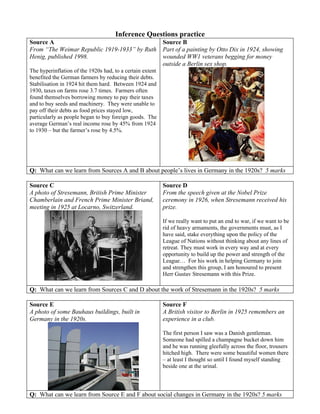
Source C                                                   Source D
A photo of Stresemann, British Prime Minister              From the speech given at the Nobel Prize
Chamberlain and French Prime Minister Briand,              ceremony in 1926, when Stresemann received his
meeting in 1925 at Locarno, Switzerland.                   prize.

                                                           If we really want to put an end to war, if we want to be
                                                           rid of heavy armaments, the governments must, as I
                                                           have said, stake everything upon the policy of the
                                                           League of Nations without thinking about any lines of
                                                           retreat. They must work in every way and at every
                                                           opportunity to build up the power and strength of the
                                                           League… For his work in helping Germany to join
                                                           and strengthen this group, I am honoured to present
                                                           Herr Gustav Stresemann with this Prize.

Q: What can we learn from Sources C and D about the work of Stresemann in the 1920s? 5 marks

Source E                                                   Source F
A photo of some Bauhaus buildings, built in                A British visitor to Berlin in 1925 remembers an
Germany in the 1920s.                                      experience in a club.

                                                           The first person I saw was a Danish gentleman.
                                                           Someone had spilled a champagne bucket down him
                                                           and he was running gleefully across the floor, trousers
                                                           hitched high. There were some beautiful women there
                                                           – at least I thought so until I found myself standing
                                                           beside one at the urinal.


Q: What can we learn from Source E and F about social changes in Germany in the 1920s? 5 marks

Germany 1924 29 various exercises

  • 1.
    Who? What? Where? Seeif you can give details about the following from German history 1924-1930. Stresemann Bruning Dawes Plan Young Plan Rentenmark Locarno Treaties Kellogg Briand Pact League of Nations Marlene Dietrich Fritz Laing Bauhaus movement New objectivity Otto Dix 800,000,000 Reduced by 67% 72% up to 81% IG Farben Telephones 900 clubs Transvestites Schools and hospitals 35% of the vote 32 to 12 seats Censorship Moral outrage Shorter skirts Up 10% from WW1 In 8 marker questions, you only have time to talk about 2 or 3 points. Which ones (from the above, or your own) would you choose if the question was… 1. Explain how the Weimar Government solved the hyperinflation problem of 1923. 2. Explain how people’s lives improved in Germany in the 1920s. 3. Explain how the German economy was stabilised in the 1920s. 4. Why did the Weimar Government become more popular in the 1920s? 5. Explain why Berlin became the cultural capital of Europe in the 1920s. 6. Explain why Gustav Stresemann was so highly regarded in Germany in the 1920s.
  • 2.
    High Level Reasoning AnA* can often be gained by the quality of reasoning in a conclusion. A pupil will show that they’ve really grasped the complexity of the problem and have thought hard about what exactly what’s going on. A* marks are only available in 12 and 15 markers. Read this A* conclusion. Which are the high level reasoning sentences? What else makes this such a good conclusion? To what extent had Germany recovered economically by 1929? 12 marks In conclusion, it seems that superficially, Germany had made great progress in her economic recovery. Exports were increasing, real wages were higher, American money had been invested in industry creating jobs and opportunities, people were spending. But we must dig deeper than this. In truth, Germany’s recovery was built on foreign loans – even though they were aiming to move from dependence to independence, this could not be achieved in the 5 or 6 years they had had so far, and their economy was incredibly vulnerable to the whims of the American market. The economy looked good, but in reality it was incredibly shaky: it had only made small steps towards recovery by 1929. One of the keys to producing such conclusions is to have thought through your opinions carefully before the exam. In the one hour of the Germany exam, you just won’t have time for deep thinking – you need to have done this before you go into the exam room. Get some deep thinking done now by reasoning through your ideas to the following issues: 1. Was the Rentenmark, the Dawes Plan or the Young Plan more helpful to Germany’s recovery between 1924 and 1929? 2. How important was it that the farmers of Germany did not benefit economically in the 1920s? 3. To what extent were the Weimar Government and the democratic ideal “safe” in the 1920s? 4. Were the American loans or Germany’s entry to the League of Nations more significant in their recovery in the 1920s? 5. Which was more significant in the Nazis losing seats in the 1920s: the negative image they gained following the Munich Putsch or the successes of Stresemann? 6. October 1929: Wall Street Crash and Stresemann’s death. Which was the bigger blow to Germany?
  • 3.
    Inference Questions practice SourceA Source B From “The Weimar Republic 1919-1933” by Ruth Part of a painting by Otto Dix in 1924, showing Henig, published 1998. wounded WW1 veterans begging for money outside a Berlin sex shop. The hyperinflation of the 1920s had, to a certain extent benefited the German farmers by reducing their debts. Stabilisation in 1924 hit them hard. Between 1924 and 1930, taxes on farms rose 3.7 times. Farmers often found themselves borrowing money to pay their taxes and to buy seeds and machinery. They were unable to pay off their debts as food prices stayed low, particularly as people began to buy foreign goods. The average German’s real income rose by 45% from 1924 to 1930 – but the farmer’s rose by 4.5%. Q: What can we learn from Sources A and B about people’s lives in Germany in the 1920s? 5 marks Source C Source D A photo of Stresemann, British Prime Minister From the speech given at the Nobel Prize Chamberlain and French Prime Minister Briand, ceremony in 1926, when Stresemann received his meeting in 1925 at Locarno, Switzerland. prize. If we really want to put an end to war, if we want to be rid of heavy armaments, the governments must, as I have said, stake everything upon the policy of the League of Nations without thinking about any lines of retreat. They must work in every way and at every opportunity to build up the power and strength of the League… For his work in helping Germany to join and strengthen this group, I am honoured to present Herr Gustav Stresemann with this Prize. Q: What can we learn from Sources C and D about the work of Stresemann in the 1920s? 5 marks Source E Source F A photo of some Bauhaus buildings, built in A British visitor to Berlin in 1925 remembers an Germany in the 1920s. experience in a club. The first person I saw was a Danish gentleman. Someone had spilled a champagne bucket down him and he was running gleefully across the floor, trousers hitched high. There were some beautiful women there – at least I thought so until I found myself standing beside one at the urinal. Q: What can we learn from Source E and F about social changes in Germany in the 1920s? 5 marks