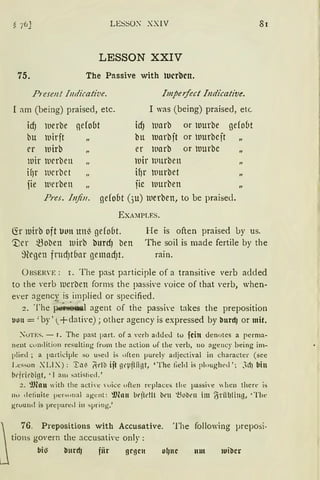
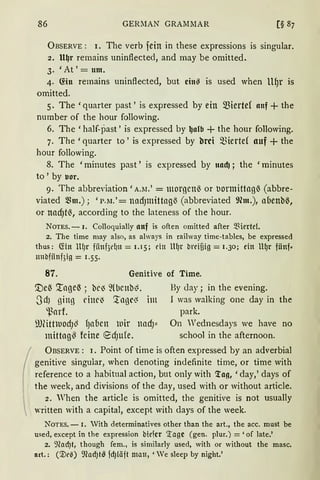
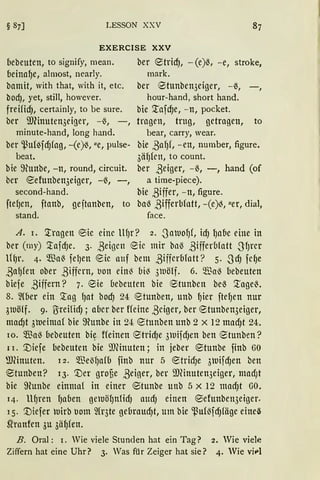
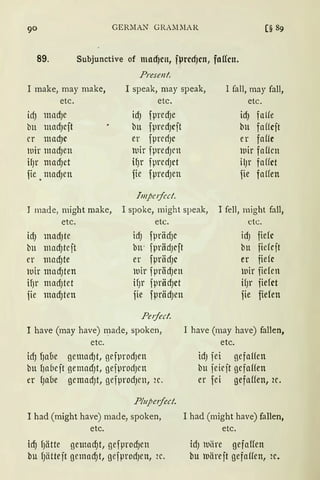
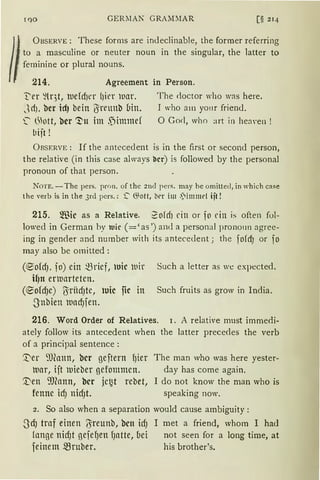
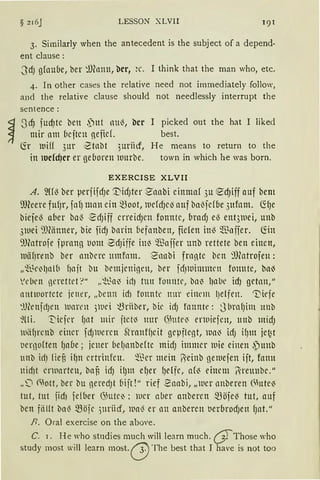
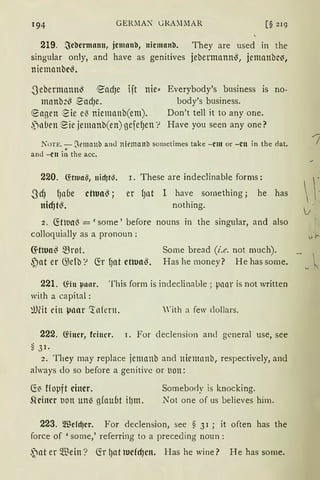
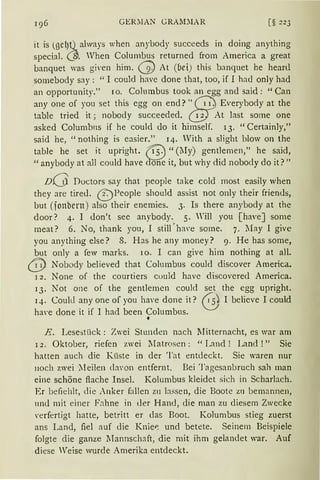
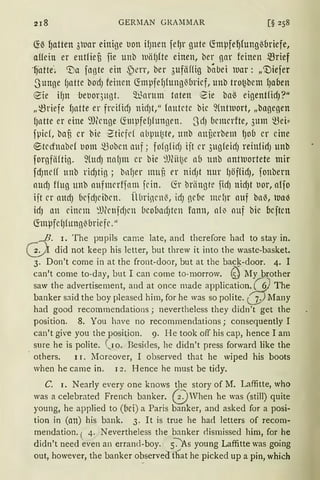
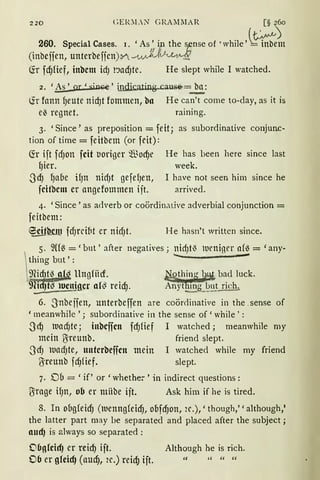
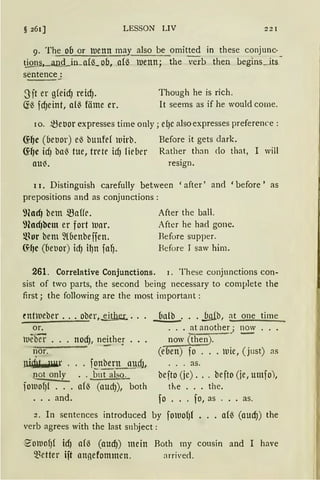
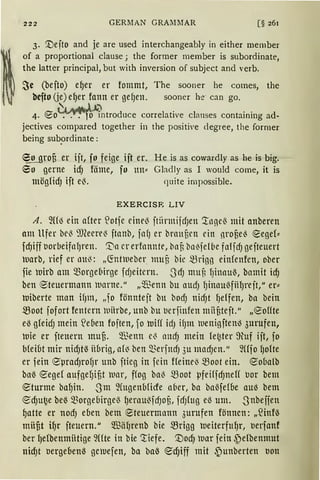
u.r:- -J
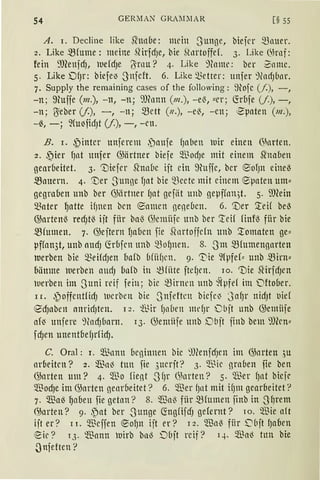
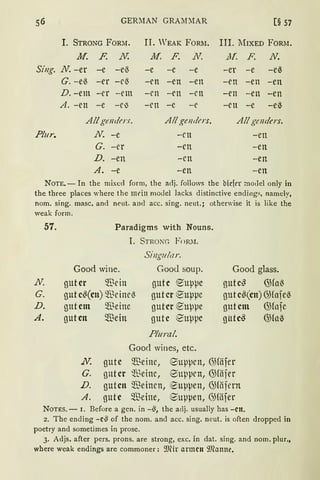
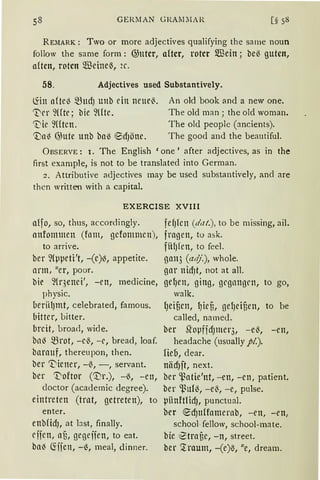
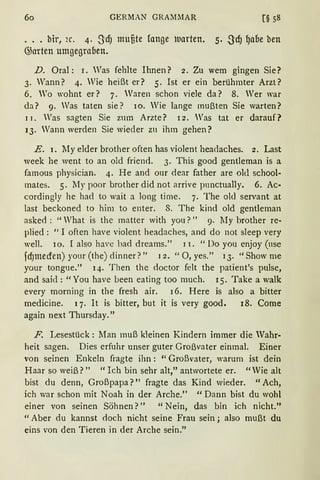
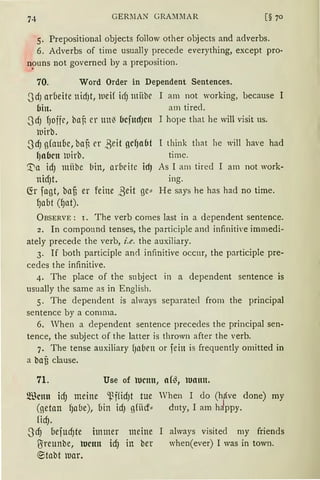
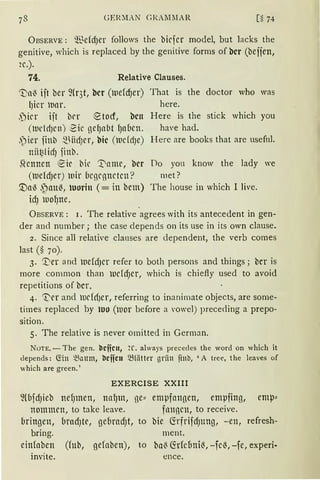
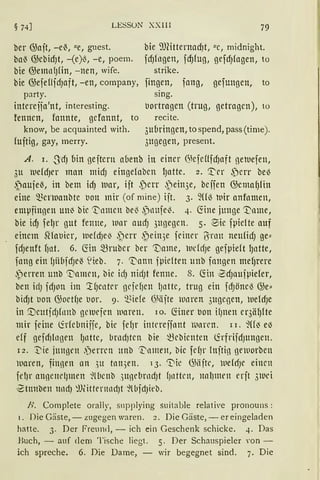
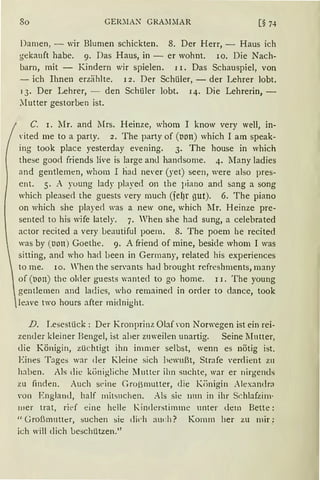
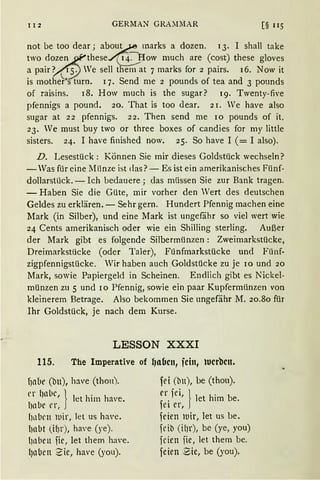
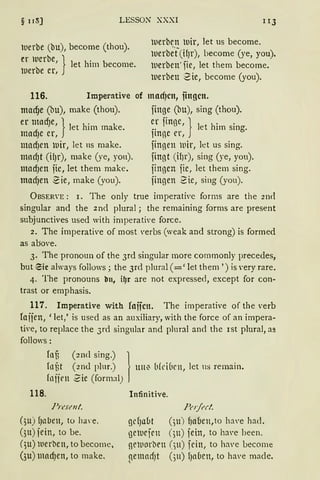
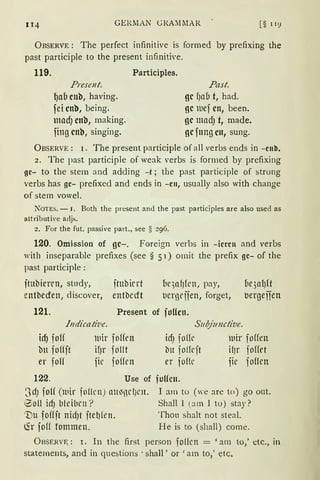
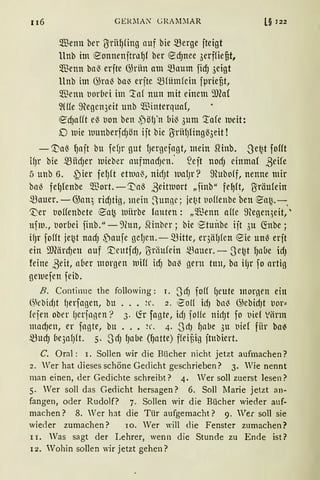
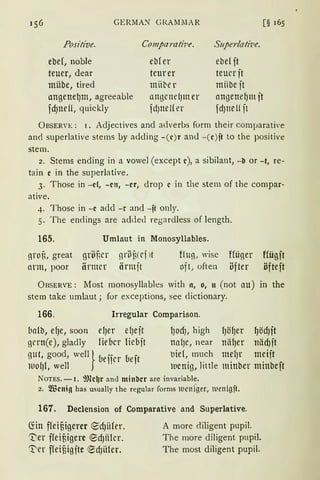
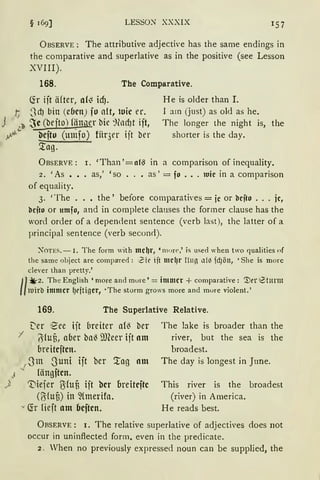
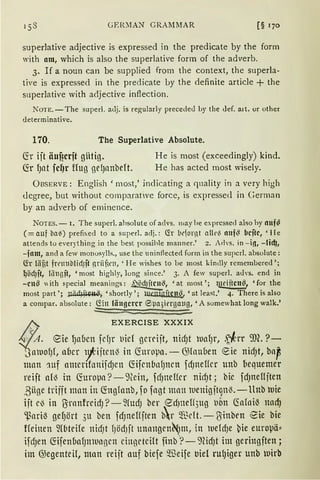
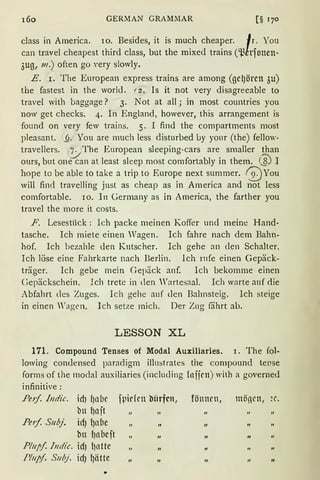
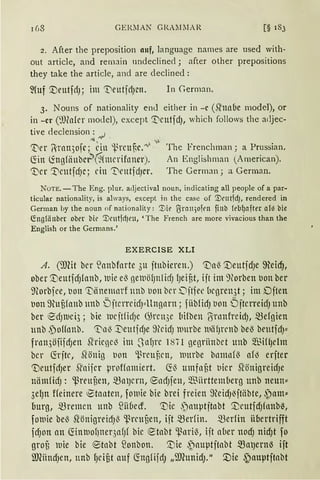
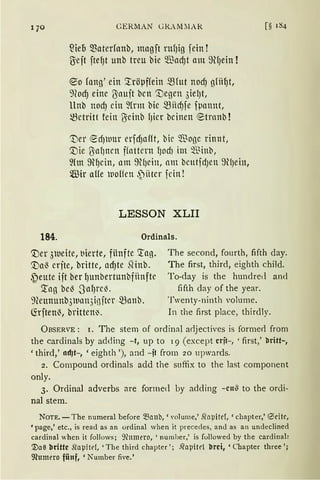
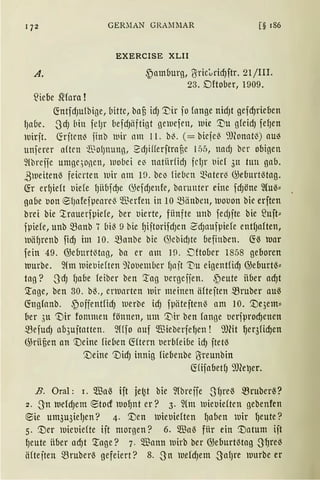
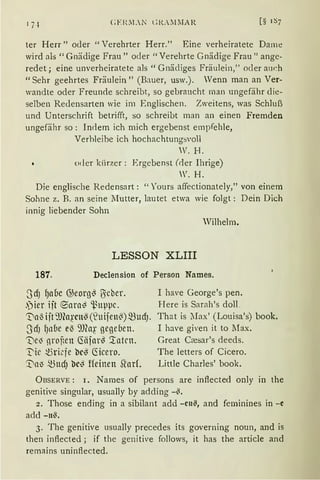
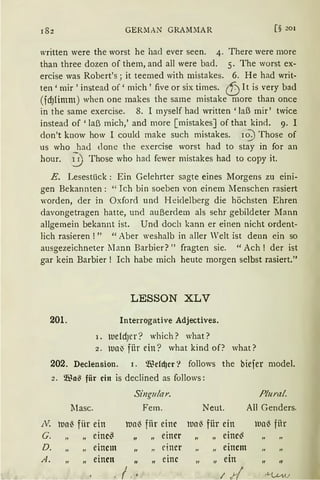
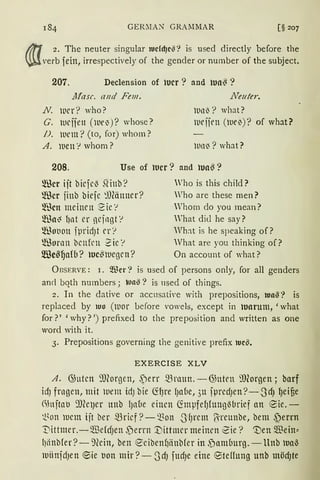
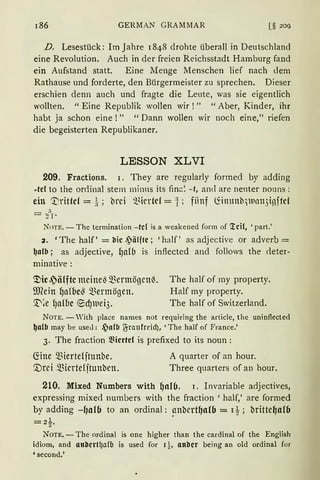
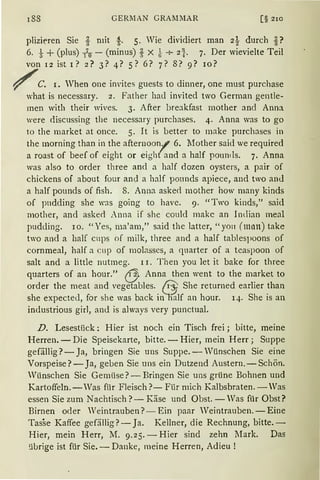
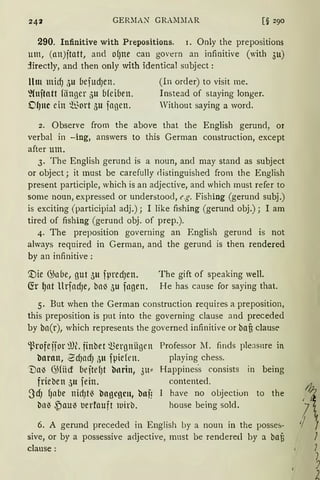
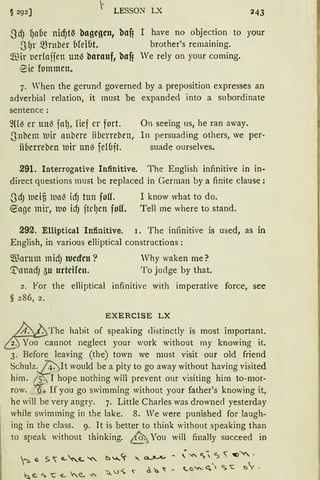
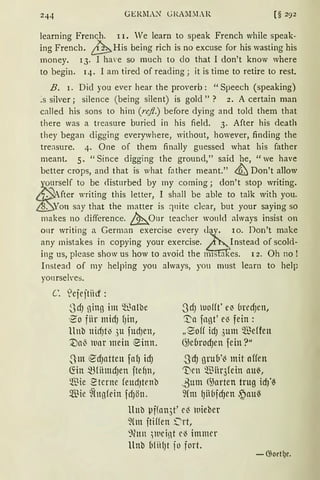
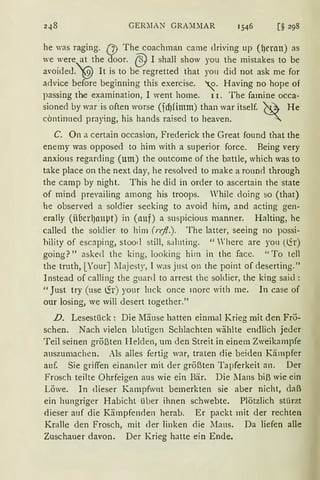
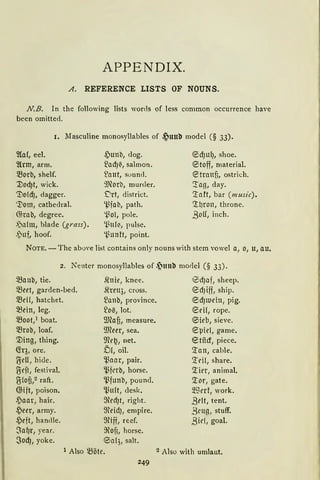
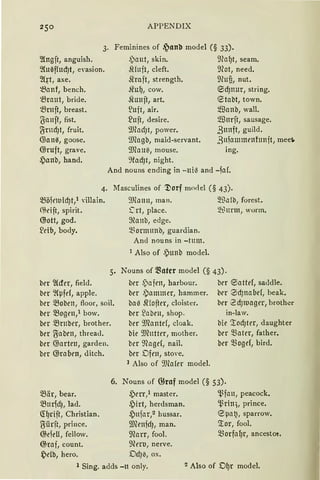
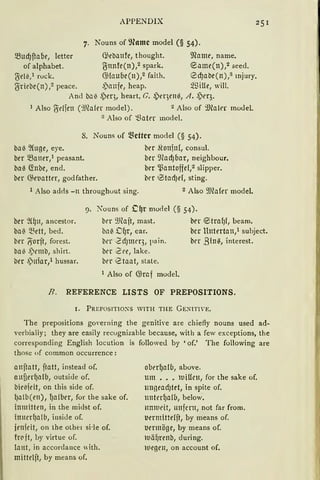
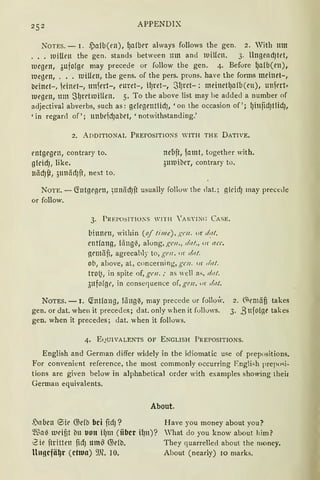
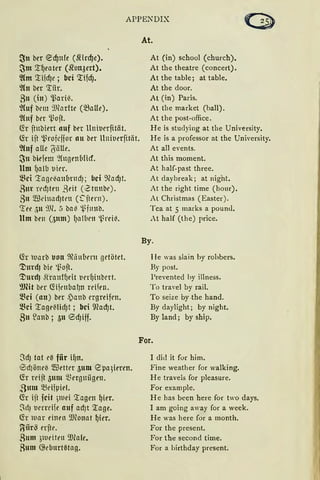
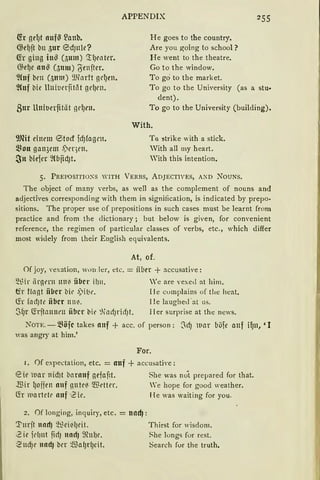
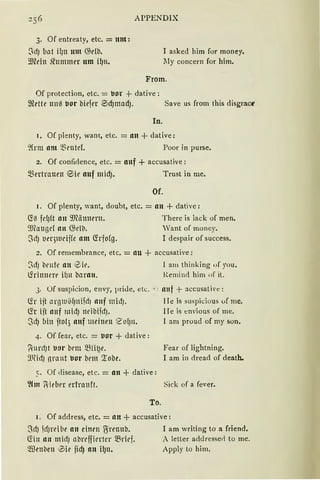
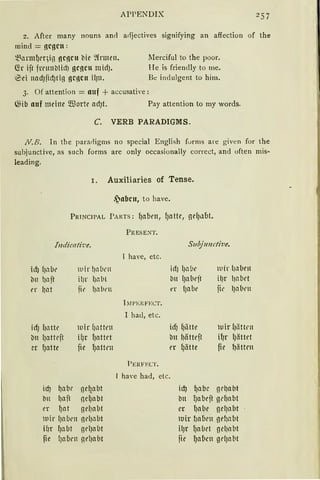
Digitized by the Internet Archive
in 2009 with funding from
Ontario Council of University Libraries
http://www.archive.org/details/highschoolgesaskOOvand
WESTERN CANADA SERIES
HIGHSCHOOL
GERMAN GRAMMAR
AND
EXERCISES
BY
W. H. VAN DER SMISSEN
AND
W. H . FRASER
Authorized for use in the Schools of Saskatchewan
TORONTO
THE COPP CLARK COMPANY. LIMITED
Copyright, Canada, 1909, by Tes CoPP OLARK COMPANY, LIMITIW,
Toronto, Ontario
PREFACE
Tms book is intended to serve as a guide to the use of the
spoken and written German of the present day, and makes
no claim to be a compendium of all forms and usages in
either speech or literature.
The grammatical material has been arranged with a view
to its c01wenient use in the exercises, and with the object of
facilitating the rapid acquisition of a reading knowledge of
the language. The elementary statements of grammatical
theory in the earlier part of the book have been supplemented
and summarized in the more ad•anced lessons, thus enabling
the learner to review and amplify the knowledge previously
acquired in detail. Thus, for instance, in the treatment of
the verb, each mood and tense of both weak and strong verbs
is taken up successi·ely, and afterwards the whole theory of
conjugation is stated in methodical form.
The exercises have been made continuous, where·er it was
found practicable to do so, and are constructed on the same
general plan as those in the elementary part of Fraser and
Squair's Frenclz Grammar. lt is hoped that this form of
exercise will not only render the learner's task less dreary
than exercises made up of detached sentences, but will also
encou;age him to acquire phrases rather than words, which
so often change their signification with the context.
In the use of the exercises teachers will ~1aturally be guided
by their own judgment and the character of their classes, but,
in the opinion of the authors, it will be found advantageous
first of all to practise very thoroughly the German and oral
portions, and afterwards pass on to the translation of the
English and to elementary composition. The oral exercises
iii
iv PREFACE
are not intended to be exhaustive, but rather suggestive for
further drill along the same line, as the authors attach the
very greatest importance to this method of teaching.
The reading extracts are not intended to replace a Reader,
but to add variety, with perhaps a spiee of entertainment, to
the acquisition and practice of grammar. The extracts in
verse are designed primarily for memorizing; the prose ex-
tracts may be used as exercises in translation, and may serve
also for practice in conversation and composition.
The Appendix contains reference lists and paradigms,
which it is hoped will prove useful, particularly B, 4 and 5,
which are intended as a guide to the correct use of preposi-
tions.
The principal authorities consulted in the preparation of
the work were: on orthography, the decisions of the Ortho·
graphic Conference of Berlin, 1901, and Duden's Ortho-
graphisches TVörterverzeichnis; on grammatical points, Blatz'
Grammar and Muret-Sanders' larger dictionary; on pronun-
ciation, the various manuals of Professor Vietor of Marburg,
whose German Prommciation (3d ed., Reisland: Leipzig,
1903) and Deutsches Lesebuch in Lautschrift (I. und II. Teil,
Teubner: Leipzig; or David Nutt: London) are especially
commended to the attention of teachers.
In conclusion, the authors desire to acknowledge their
indebtedness to Mr. W. C. Ferguson, Riverdale CoJlegiate
Institute, Toronto, for valuable advice regarding the plan
of the work and on many points of detail; to Miss Julia S.
Hillock, Parkdale Collegiate Institute, Toronto, for testing a
considerable proportion of the lessons and exercises in the
classroom; and to Mr. Heinrich von Nettelbladt, of the
teaching staff of the High Schools, Buffalo, for valuable Ser-
vices in revising the manuscript and thus affording the au-
thors the benefit of the judgment of a native German scholar
ä.nd teacher.
AUGUST, 1909.
CONTENTS
fNTRODUCTION:
Alphabet
Syllabication
Stress
Quantity
Pronunciation.
Use of Capitals; Punctuation
Gerrnan Script
Map of Gerrnany
LESSON
I.
II.
III.
IV.
V.
VI.
VII.
VIII.
IX.
X.
XI.
XII.
XIII.
XIV.
XV.
XVI.
Gender and Agreement. - Nominative of Personal Pronouns
Nominative of ein, fein, possessives, Wddjcr
Present Indicative of fcin. - Pronouns of Address. - Use of
l!a~. - Place of Preclicate Acljective .
Present Indicative of ~abcn. - Accusative Forms. - Repeti-
tion. - Comparative Degree
Present Indicative an<l Imperative of madjcn. - Adjective
as Adverb.
Review.
Definite Article. - Use ofCases. -Contraction. - Case Forms
Present Indicative of tun. - Infinitive after 'erbs. -Accu-
sative and Dative Pronoun<>
9Jleitt lfodel.- Possessive Adjectives .
Imperfect Indicative. - Adverbial Accusative. - Place of
Time Phrase and of Verb .
".l)iefer Model. -Some Possessive Pronouns.
Review.
Strong Declension of Nouns: .lttttll, eo~tt, .~llllll lJodels.
- Essential Parts. - Compound Nouns. - Rule of Gender
Perfect and Pluperfect. - 'ord Order in Principal Sentences.
-Cardinal Nurnerals.- lIultiplicative Adverbs
Strong Declension (continued): ".l)orf, 9Jlalcr, llfotcr
lJodels. - fann, mnf!, etc.
Future and Future Perfect.- Vord Order. - Prefixes ,
V
ix
X
xi
xi
xii
xxii
xxiii
xxvi
3
6
9
12
14
16
20
23
26
30
33
35
39
LESSON
XVII.
XVlII.
XIX.
XX.
XXI.
XXII.
XXIII.
XXIV.
XXV.
XXVI.
XXVII.
XXVIII.
XXIX.
XXX.
XXXI.
XXXII.
XXXIII.
XXXIV.
XXXV.
XXXVI.
XXXVII.
:XXXVIII.
XXXIX.
XL.
XLI.
XLII.
XLIII.
XLIV.
XLV.
XLVI.
XLVII.
XLVIII.
~LIX.
CONTENTS
Veak ancl Mixed Declensions. - Rules of Gender
Declension of Adjectives
Declension of Nouns: Summary .
6citt: Compound Tenses; Use as Auxiliary. - lUill,
lJOUtc.-Infinitive of Purpose .
Declension of Adjectives (concluded): Special Cases;
Adjectives as Nouns .
Vord Order: Objects, etc.; Dependent Sentences. -
lJCttlt, tl{~, lJlltttt
The RelatiYes lcr and lucld)cr. - Relati'e Clauscs
Passi,·e: Simple Tenses.- Prepositions with .ccusative
Time of Day. -Genitive of Time.
The Subjunctive. - I ndirect Statements and Questions
Prepositions with Dative
The Conditional. - Conditional Scntcnces
Use of Articles
Quantity. - Distributive Article. -eilt, bettle
The Imperative, Infinitive, and Participles. - foll .
Prepositions with Dative or Accusative.
Verb Sterns. - Principal Parts. - Special Forms in
Weak Verbs.- lrregular Weak Verbs
Personal Pronoum. - Address. - 1mpersonal Verhs. -
Uses of c~.
The Strong Conjugation. - Classes of Strong Vcrbs
Reflexive Pronouns and Verbs. - Reciprocal and Em-
phatic Pronouns
llixed Conjugation. - Modal Auxiliaries. - 'shall' and
•will'
Possessive Pronouns. - Possessive Dative
Comparison of Adjectives and Adverbs.
Modal Auxiliaries (concluded): Word Order; Idio-
matic Uses
Place Names.-Nouns and Acljectives ofNationality
Ordinal Numerals.-Dates.-House Number, etc.
Person Names. -Ordinals with Person Names
Demonstratives
Interrogatives
Fractions. - i1 ixell Numbers
Relative Pronouns
Indefinite Pronouns
The Passive Voice
P .~GH
51
55
61
73
77
81
85
89
95
100
104
108
112
117
123
128
133
16o
167
170
174
177
182
186
189
193
197
Ll:i S ~ ON
L.
LI.
LII.
LIII.
LIV.
LV.
LVI.
LVII.
LVIII.
LIX.
LX.
LXI.
CONTEN l'S
InJefinite Pronominal AJjectil'eS
Idiomatic Uses of Certain Adverbs
Verb Prefixes
Coördinative and Adverbial Conjunctions
Subordinative and Correlative Conjunctions
Agreement and Apposition
Use of Nominative and Accusative
Use of Genitive and Dative
Use of Indicative Tenses. - Use of Subjunctive and Im-
perative
The Infinitive
The Infinitive (concluded).
The Participles .
APPENDIX
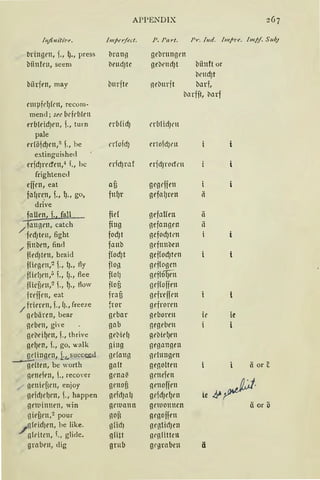
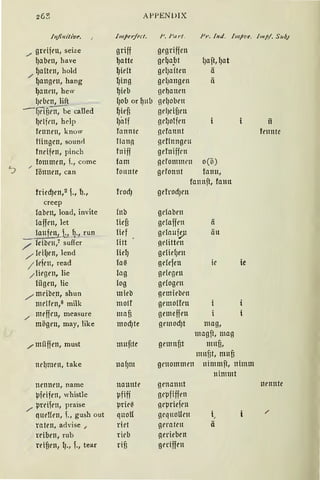
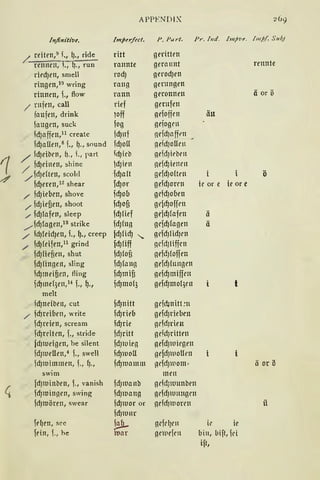
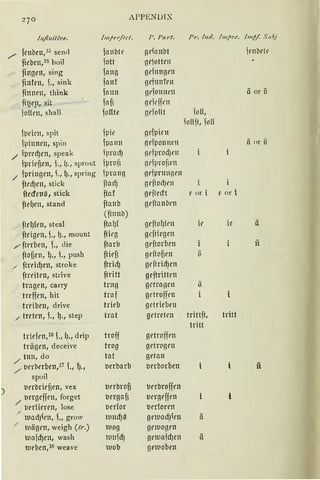
A. Noun Declension : Reference Lists, 1-9
B. Prepositions:
1. Prepositions with Genitive
2. " Dative (additional !ist)
3· " Varying Case
..j.. Equivalents of English Prepositions
5· Prepositions after Verbs, etc.
c. Verb Paradigms:
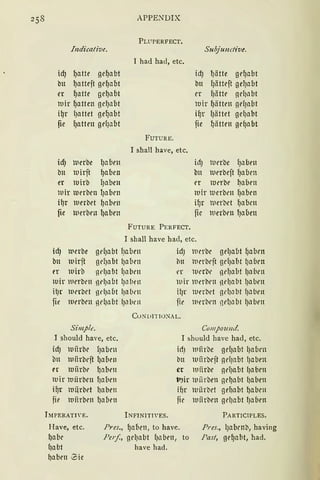
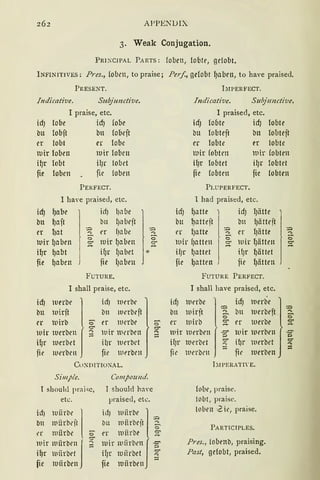
1. Auxiliaries of Tense
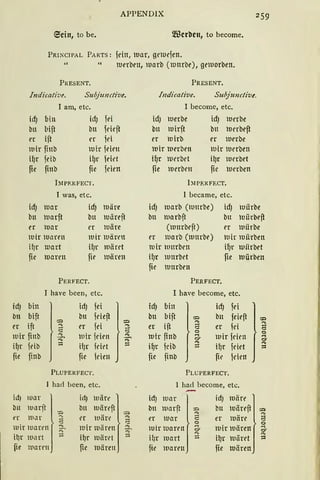
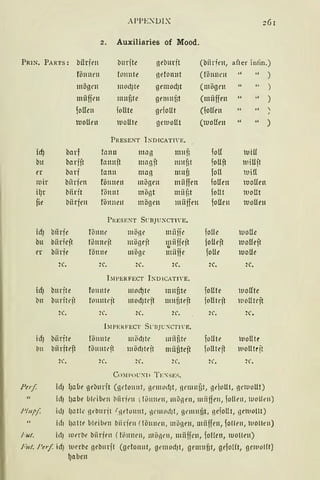
2. "Mood
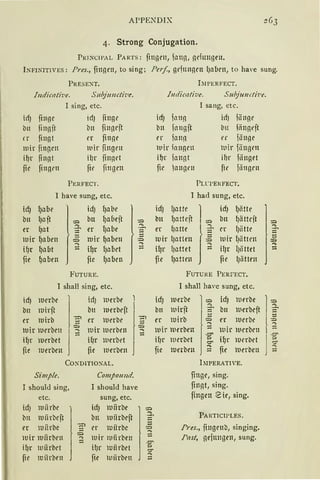
3. Weak Conjugation
4. Strong
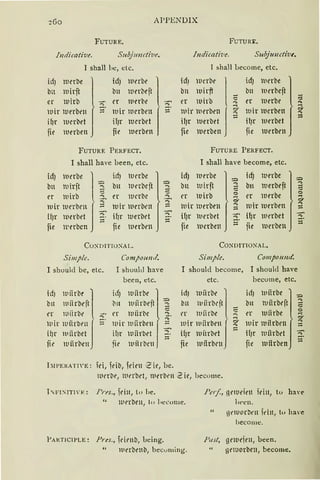
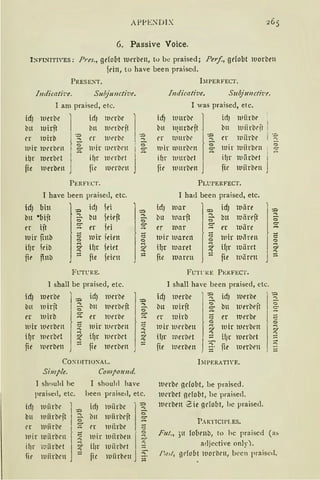
5. Conjugation with fein
6. Passive Voice
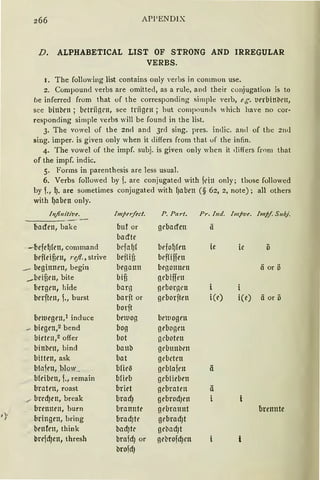
D. Alpbabetical List of Strang and lrregular Verbs
VOCABULARY: German-English
English-German
INDEX
vii
PAG E
202
206
210
216
219
224
227
230
234
238
241
245
249
251
252
252
252
255
257
261
262
263
264
265
266
273
311
339
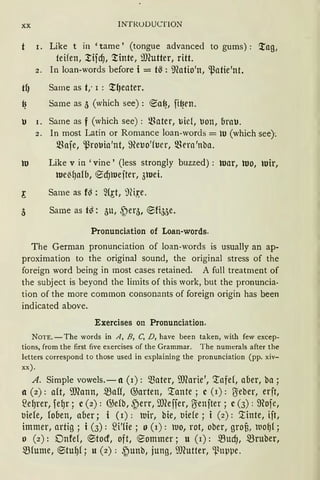
INTRODUCTION
The German Alphabet.
German Roman German German Roman German
form. form. name. form. form. name.
~(, lt A, a ah 9l, lt N, n CllJt
~, fJ B, b bay D, o 0, 0 oh
Cf, c C, c tsay ~, µ P, p pay
'!>, b D, d day a, er Q, q koo
~, c E, e eh m, r R, r crr
~,L F, f cff 6, f, ~ s, s ess
ill, g G,g ga)' :t, t T, t tay
.), ~ H, h halt lt, u U, u 00
~, i 1, i ce ~~, u V, v fow
~, j ] ' j yot fil, lU V, w Vtl)'
Si, f K, k kalt f,~ X, X iks
~, { L, 1 elf v, tJ Y, y ipsilou
~m, m M,m ('JJlJJl B, 5 Z, z tsd
RElfARKS ON THE ALPHABET.
1. The approximate pronunciation of the German names
of the letters is given abo'e in English characters; these names
should be le;,rned, and used in spelling words.
z. Three of the vowels 111ay Le modified by the sign u (called
' umlaut '): ~( ä, Ö ö, Ü ii; as capitals, in the older spelling,
theseare: ~{e, ~e, lle.
3. Diphthongs are: fü ni, ~(u cm, fö ei, liu eu, ~iu iiu, an<l
the rarer forms atJ, etJ, ui.
X INTRODUCTION
4. The following change their form slightly when printed as
one character: dJ=cfJ; cf= cf; ff, f3=f3; t3=f2.
5. The character fi always replaces ff when final: ßiufi, ~af!,
l5fuf!; within a word, it stands after long vowels, after diph-
thongs, and before another consonant (elsewhere ff) : !Jiifie,
fJeifien, fJäf!lidJ, mufite; but l'Jfüffe, müffen, 2c. ; hence all
vowels are to be pronounced short before ff.
6. The form ~ occurs only as fi.rial in words or stems; else-
where f: ~au~, ba§, ~äu§ficf); ~äufer, fefen, fJaft.
7. Since the sounds of German depend to a considerable
extent upon syllabication, stress, and quantity, these subjects
.will be treated in the following paragraphs, before rules are
given for the pronunciation of the alphabet.
Syllabication.
1. In German the syllable ends in a vowel wherever possi-
ble, which is frequently not the case in English: S))(i:::fHär,
'mil-i-ta-ry'; the neglect of this principle is a serious defect in
pronunciation.
2. Hence single consonants within a ward, and also such
consonant groups as can be pronouncecl undivicled, belang to
the following syllable, both in speaking and writing: ~a:::be,
ge:::brnu:::rf)en, ge:::fd)enft ; other consonant groups are divided :
uer:::ben, '.tin:::te.
3. In writing, howe·er, doublecl consonants are clivided at
the end of a line: miif::: fen ; so also bt, i•f, ug, d, the latter
becoming H:. etäbde, <IntV:::fnng, fin:::oen, tStiiMe (for
·2tfüft'); compounds are <livi<led according to their parts:
,1ttf,djrn, fJin:::ao, 'tionnmMon.
4. 'Open' syllables are those ending in a vowel or f) : b11,
fo~ urn, brau -dJr, üc::: ftel1 ~rn.
5. 'Closed' syllables are those ending in a consonant, or
coming before a doubled consonant : ll.'lar:::ten, '.tin:::te, faft,
bo~, f)llf:::ten.
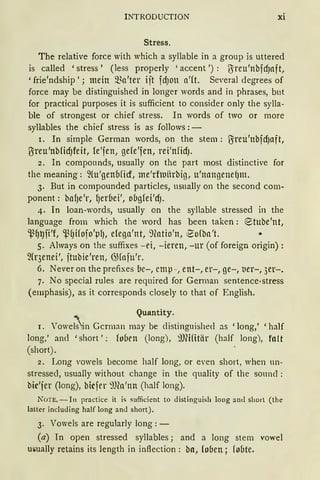
NOTE. -This distinction is importa nt for the rules of quantity.
INTRODUCTION xi
Stress.
The relative force with which a syllable in a group is uttered
is called 'stress' (less properly 'accent ') : ßreu'nbfcfJaft,
'frie'ndship'; mein Sl~a'ter ijt fdJOll a'(t. Several degrees of
force may be distinguished in longer words and in phrases, but
for practical purposes it is sufficient to consider only the sylla-
ble of strongest or chief stress. In words of two or more
syllables the chief stress is as follows : -
r. In simple German words, on the stem: ßreu'nbfcfJaft,
l}ireu'nbficfJfeit, le'fen, gefe'fen, rei'nficfJ.
2. In compounds, usually on the part most distinctive for
the meaning: ~{u'genbficf, me'rfluitrbig, u'nangettd)m.
3. But in compounded particles, usually on the second com-
ponent: bafJe'r, l)er6ei', obg(ei'cfJ.
4. In loan-words, usually on the syllable stressed in the
language from which the word has been taken: (Stube'nt,
'-ß~~fi'f, '_ß(Jifofo'pfJ, elega'nt, 9catio'n, ~ofba't.
5. Always on the suffixes - ei, -ieren, -ur (of foreign origin):
fü·3enei', jtubie'ren, G.Hafu'r.
6. Never on the prefixes be-, emp-, ent-, er-, ge-, ber-, 3er-.
7. No special rules are required for German sentence-stress
(emphasis), as it corresponds closely to that of English.
Quantity.
r. Vowe;};n Gcrman may be clistingnished as 'long,' 'half
long,' ancl 'short': fo6en (long), iOfüitär (half long), falt
(short). '
2. Long vowels become half long, or even short, when un-
stressecl, usually without change in the quality of the sonnd :
bic'fer (long), bicfer :'J)(a'nn (half long).
NOTE. - In practice it is sufficient to distinguish long anti shorl (the
latter including half long and short).
3. Vowels are regularly long : -
(a) In open stressed syllables; and a long stem vowel
mmally retains its length in inflection: bn, loben; fobte.
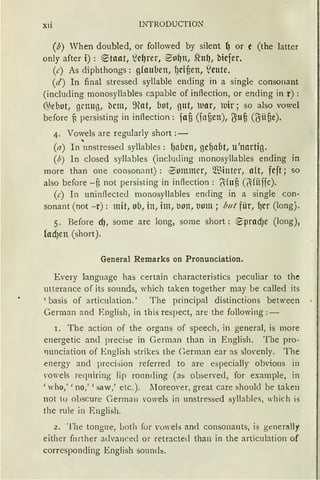
Xli INTRODUCTION
(b) When doubled, or followed by silent {) or c (the Jatter
only after i) : ®taat, ~c~rer, ®o~n, stuf), bicfer.
(c) As diphthongs: g(auuen, fJcifien, t'eute.
(d) In final stressed syllable ending in a single consonant
(including monosyllables capable of inftection, or ending in r) :
~5euot, genug, i:lcm, ~nat, (Jot, gut, uar, uir; so also vowel
before f, persisting in inftection: fau (faf)en), t}iuü (Oiüfie).
4. Vowels are reguJarly short :-
(a) In 'unstressed syllables: f)abcn, gcf)a(1t, u'nartig.
(b) In closed syllables (including monosyllables ending in
more than one consonant) : ~ommcr, ~"ßitttcr, a(t, fcft; so
also before -f3 not persisting in inftection: l}ifnf, (~ fiiffe).
(c) In uninftected monosyllables ending in a single con-
sonant (not -r): mit, ob, in, im, l10n, lllllll; but für, fJCr (long).
5. Before d), some are long, some short: ~pradJe (long),
fod1en (short).
General Remarks on Pronunciation.
Every Janguage has certain characteristics peculiar to the
utterance of its sounds, which taken together may be called its
'basis of articulation.' The principal distinctions between
German and English, in this respect, are the following: -
r. The action of the organs of speech, in general, is more
energetic and precise in German than in English. The pro-
tmnciation of English strikes the German ear as slovenly. The
energy and preci::;ion referred to are especially obvious in
'Owels reqniring lip ro11nding (as observecl, for example, in
'who,' 'no,' 'saw,' etc.). lJoreover, great care shoulcl be taken
not tu obscure German voweJs in unstres::;ed syllables, which is
the rule in English.
2. The tongue, Loth for vowels and consonants, is gener:tlly
either fürther advanced or retracted than in the articulation of
corresponding English soumb.
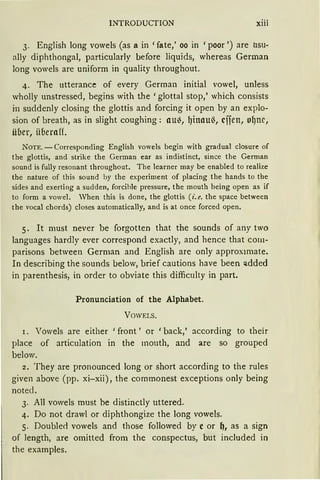
INTRODUCTION xiii
3. English long vowels (as a in 'fate,' oo in 'poor ') are usu-
ally diphthongal, particularly before liquids, whereas German
long vowels are uniform in quality throughout.
4. The utterance of every German initial vowel, unless
wholly unstressed, begins with the 'glottal stop,' which consists
in suddenly closing the glottis and forcing it open by an explo-
sion of breath, as in slight coughing: au~, l)inau~, cifen, ol)nc,
über, iiberaff.
NOTE. - Corresponding English vowels begin with gradual closure of
the glottis, and strike the German ear as indistinct, since the German
sound is fully resonant throughout. The learner may be enabled to realize
the nature of this sound by the experiment of placing the hands to the
sides and exerting a sudden, forcihle pressure, the mouth being open as if
to form a vowel. Vhen this is clone, the glottis (i. e. the space between
the vocal chords) closes automatically, and is at once forced open.
5. lt must never be forgotten that the sounds of any two
languages hardly ever correspond exactly, and hence that co1n-
parisons between German and English are only approx1mate.
In describing the sounds below, brief cautions have been added
in parenthesis, in order to obviate this difficulty in part.
Pronunciation of the Alphabet.
VOWELS.
I. Vowels are either 'front' or 'back,' according to their
place of articulation in the mouth, and are so grouped
below.
2. They are pronounced long or short according to the rules
given above (pp. xi-xii), the commonest exceptions only being
notecl.
3. All vowels must be distinctly uttered.
4. Do not drawl or diphthongize the long vowels.
5. Double<l vowels and those followed by e or ~, as a sign
of length, are omitted from the conspectus, but included in
the examples.
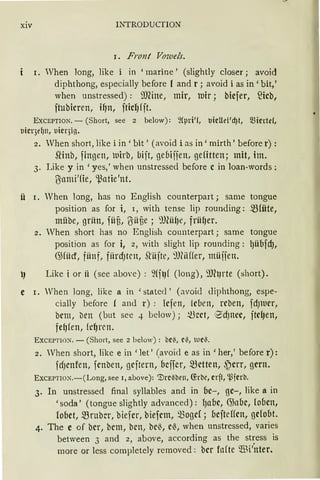
xiv INTRODUCTION
1. Front Vowels.
I. When long, like i in 'marine' (slightly closer; avoid
diphthong, especially before l and r; avoid i as in' bit,'
when unstressed) : ?JJ(ine, mir, Dir; biefer, fücb,
ftubicren, if)n, fticf) fft.
EXCEPTION. - (Short, see 2 below): 2fpri'(, Uicllei'd)t, miede(,
uicqefjn, uicqig.
2. When short, like i in' bit' (avoid i as in' mirth' before r) :
SNnb, fingen, luirb, bift, gebijjen, gefitten; mit, im.
3. Like y in 'yes,' when unstressed before c in loan-words :
ßami'fie, '.ßatie'nt.
ü r. When long, has no English counterpart; same tongue
position as for i, 1, with tense lip rounding: mrnte,
mübe, grün, füü, ßüüe ; 9JlüfJe, frü{Jer.
2. When short has no English counterpart; same tongue
position as for i, 2, with slight lip rounding: l)übfd),
G>füd, fünf, fiirdJten, .Q'üjte, 9Hüffer, müjjen.
J Like i or ii (see above): ~(flJf (long), 9JhJrte (short).
e r. When long, like a in 'statecl' (:woid diphthong, espe-
cially before ( and r) : Icfen, leben, rcben, fdJlller,
bcm, bcn (but see 4 below); ~~et, ®dJncc, ftdJen,
fe{Jfen, fcf)ren.
EXCEPTlON. - (Short, see 2 below): bei', Ci', UCi'.
2. Vhen short, like ein 'let' (avoid e as in 'her,' before r):
fdJcnfen, fcnben, gcftern, bcifcr, mctten, ,~crr, gern.
EXCEPTION.-(Long, see 1, above): mrcilbrn, (fabc, erft, '.l)ferb.
3. In unstressed final syllables and in bc-, gc-, like a in
'soda' (tongueslightly advanced): I)abc, G3l1bc, loben,
fobet, mrubcr, biefer, biefcm, Q3ogd; bcfteffcn, gelobt.
4. The e of bcr, bcm, bcn, bc~, c~, when unstressed, varies
between 3 and 2, above, according as the stress is
more or less completely removed: bcr fofte füi'nter.
INTRODUCTION XV
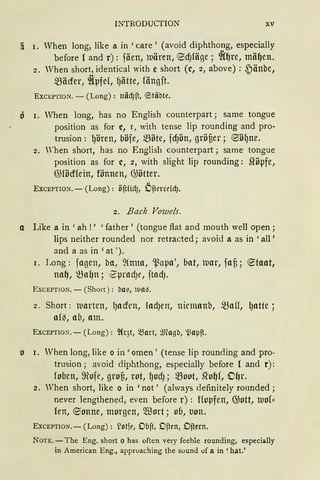
!i 1. When long, like a in 'care ' (avoid diphthong, especially
before { and r): fäen, uären, ecf)1äge; ~(~re, mä~en.
2. When short, identical with e short (c, 2, above): ~änbe,
mäcfer, ~{pfe(, fJätte, fängft.
EXCEPTION. - (Long) : näcf)ft, ~täbte.
o 1. When long, has no English counterpart; same tongue
position as for c, r, with tense lip rounding and pro-
trusion: lJÖren, böfe, möte, fd)Ön, gröüer; ®öf)ne.
2. 'hen short, has no English counterpart; same tongue
position as for c, 2, with slight lip rounding: ~öpfe,
@födfein, fönnen, @ötter.
EXCEPTION. - (Long) : öftlidJ, Öfterreicf).
2. Back Vowels.
a Like a in 'ah ! ' 'father' (tongue flat and rnouth well open;
lips neither rounded nor retracted; avoid a as in 'all'
and a as in 'at ').
1. Long: fagen, ba, 2(nna, ~apa', bat, Dar, faf3; ®taat,
na~, ~af)tt; '2pradJe, ftadJ.
EXCEPTION. - (Short ) : ba~, tun.
2. Short: uarten, {Jaden, ladJen, niemanb, ~aff, lJatte ;
a(~, ab, am.
EXCEPTIO~. - (Long): ~Cr3t, 5Bart, 9Jfogb, i.iaµft.
o 1. When long, like o in' omen' (tense lip rounding and pro-
trusion; avoid diphthong, especially before { and r):
foben, 9ofe, grof,, rot, f)odJ; moot, Slo~f, OfJr.
2. Vhen short, like o in 'not' (always definitely rounded;
never lengthened, even before r): Hopfen, @ott, tuo{"
fen, e;onne, morgen, füort; ob, trnn.
ExcEPTION.- (Long): ~otft', Obft, Often, Oftern.
NOTE. -The Eng. short o has often very feeble rounding, especially
in American Eng., approaching the sound of a in 'hat.'
xvi INTRODUCTION
u 1. When Iong, Iike oo in 'too' (tense lip rounding and pro·
trusion; avoid diphthong, especially before ( and r):
bu, rufen, 5Bfume, ITittf3, guten, nur; Si'u~, ®tu~L
2. When short, like u in 'put' (definitely rounded; never
Iengthened, even before r) : unb, tuurbe, ffi(utter,
{Jifuf3 ; um, 3um, 3ur.
Diphthongs.
ai } Like i in 'mile' (first element more deliberately uttered;
al] equals German a, 2 +i, 2): ~aifrr, 5Bat1ern.
au Like ou in 'house' (first element more deliberately uttered;
equals German a, 2 + u, 2): ITirnu, .$Baum, mauer.
äu Like oi in 'boil' (first element more deliberately uttered;
equals German o, 2 + i, 2) : 9äuoer, il)(äufe, .$Bäume.
NOTE. -The second element is sometimes slightly rounded.
ei } The same sound as ai, above; mein, il)(cife, fciner, tfci::
et) ner, cinft, 9JCct1er. ,
eu The same sound as iiu, above: neu, 9cute, ITicuer, euer,
fcuf3en.
ui Equals German u, 2 + i, 2 : fJUi ! pfui !
Co.NsoNANTS.
I. It is very important to remember that all final consonants
are short in German, although not always so in English; com-
pare matt and 'man,' fang and 'sang.'
2. Double consonants have only a single sound, as also iP
English : gefallen, 'fallen' ; but when two consonants corne
together through compounding the sound is lengthened in
careful diction, but not fully doubled : mittcifen; similarly
also contiguous final and initial consonant, when necessary for
distinctness : not tun.
3. When alternative pronunciations are given below the
preferable one is put first.
INTRODUCTION xvii
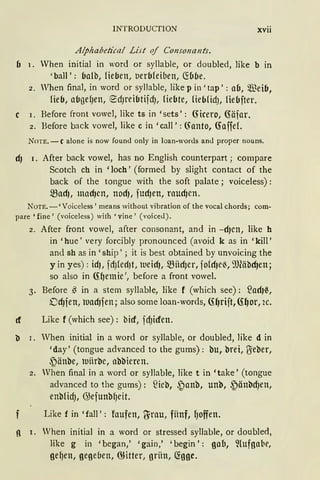
A!phabetica! List of Co11so11a11ts.
6 1. When initial in word or syllable, or doubled, like b in
'ball': balb, lieben, 1.1erbfeiben, ~(Jbe.
2. When final, in ward or syllable, like p in' tap' : ab, 5IBeib,
lieb, abgelJen, ~dJreibtifdJ, liebte, füblidJ, liebfter.
c I. Before front vowel, like ts in 'sets' : (}icero, ßäfar.
2. Before back vowel, like c in 'call': (fonto, (foffef.
NOTE. - c alone is now found only in loan-words an<l proper nouns.
cf) 1. After back vowel, has no English counterpart ; compare
Scotch eh in 'loch' (formed by slight contact of the
back of the tongue with the soft palate ; voiceless) :
madJ, mad1en, nodL fud1en, raud1en.
NOTE. - 'Voiceless' means without vibration of the vocal chords; com-
pare 'fine' (voiceless) with 'vine' (voice<l).
2. After front vowel, after consonant, and in -dJen, like h
in 'hue' very forcibly pronounced (avoid k as in 'kill'
and sh as in' ship'; it is best obtained by unvoicing the
y in yes): icfJ, fdJfed)t, tuetcfJ, miict)Cr, fofdJC~, 9JläbcfJen;
so also in G:l)emie ', before a front vowel.
3. Before § in a stem syllable, like f (which see): ~ad)~,
Dcf)fen, tuadJfen; also some loan-words, G:l)rift,G:~or, 2c.
cf Like f (which see): bicf, fd)iden.
b 1. When initial in a ward or syllable, or doubled, like d in
'day' (tongue advanced to the gums): bu, brei, ~eber,
~änbe, tuiirbe, abbieren.
2. When final in a ward or syllable, like t in 'take 1
(tongue
advanced to the gums): füeb, ~anb, unb, ~önbd)en,
enblid), G>efunbl)eit.
Like f in 'fall': faufen, irrau, fünf, l)offen.
g 1. When initial in a word or stressed syllable, or doubled,
like g in 'began,' 'gain,' 'begin': gab, ~(ufga(H',
gel)en, gegeben, (})itter, grün, ~gge.
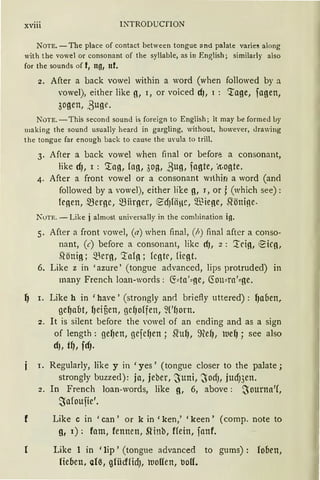
xviii INTRODUCfION
N OTE. -The place of contact between tongue and palate varies along
with the vowel or consonant of the syllable, as in English; similarly also
for the sounds of f1 ng, nf.
2. After a back vowel within a word (when followed by a
vowel), either like g, 1, or voiced d), 1 : 'tage, fagen,
3ogen, ß uge.
NOTE. - This second soun<l i~ foreign to English ; it may bc forme<l by
maki ng the sound usually heard in gargling, without, however, <lrawing
the tongue far enough back to cause the urnla to trill.
3. After a back vowel when final or befor~ a consonant,
like cfJ, 1 : '.rag, fag, 3og, 3ug, fagte, ·11:.ogte.
4. After a front vowel or a consonant w1lhiri a word (and
followed by a vowel), either lil::e g, J, or j (which see) :
froen, Q3erge, Q3firoer, €dJHiHc, Wieoe, Slönioe-
KoTE. - Like j almost universally in the combination ig.
5. After a front vowe1, (a) when final, (h) final after a conso-
nant, (c) before a consonant, 1ikc ct), 2 : '.trio, ~ico,
.~önig; ~erg, '.tafo; feotr, fügt.
6. Like z in ' azure ' (tongue advanced, 1ips protruded) in
many French loan-words : ~:::ta':::11e, 6:01M·a':::ge.
~ I. Like h in 'have' (strongly and briefly uttered) : fJaoen,
geqaot, r,eifien, gefJoffen, ~('~orn.
2. lt is silent before the vowel of an ending and as a sign
of length: geqen, gefeqen; ~uq, ~efJ, kueq; see also
d), t~, fdJ.
I. Regularly, like y in 'yes ' (tongue closer to the palate ;
strongly buzzed): ja, jeber, ~uni, ~OdJ, jucfnen.
2. In French loan-words, like g, 6, above: .~ourna'(,
~afoufie'.
f Like c in 'can' or k in 'ken,' 'keen' (comp. note to
g, 1): fam, fennen, Slinb, ffein, fanf.
Like 1 in 'lip' (tongue advanced to gums) : fooen,
lieben, ar~, ~lücffidJ, kllolfen, uoff.
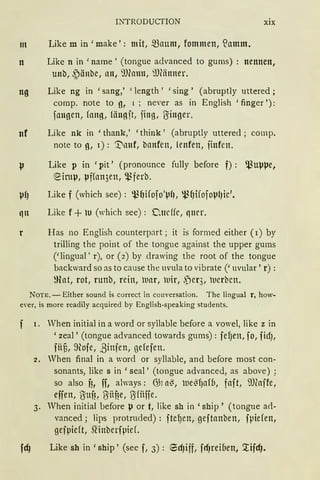
INTRODUCTION xix
m Like min 'make': mit, ~aum, fommen, ?amm.
n Like n in 'name' (tongue advanced to gums) : nennen,
unb, .5änbe, lltt, 9Jfonn, ~föinner.
ng Like ng in 'sang,' 'length' 'sing' (abruptly uttered;
comp. note to g, 1 ; never as in English 'finger '):
fanoen, fang, fängjt, fing, ~inoer.
nf Like nk in 'thank,' 'think' (abruptly utterecl; cornp.
note to g, 1): '.t'mtf, banfen, lenfen, finfett.
µ Like p in 'pit' (pronounce fully before f) : ~uµµe,
~iruµ, µffan3en, ~ferb.
µf) Like f (which see): ~{Jifofo'µf1 1 ~f)ifofoµt1ic'.
qu Like f + U (which see): Oncffe, qner.
r Has no English counterpart; it is formed either ( 1) by
trilling the point of the tongue against the upper gums
('lingual' r), or (2) by drawing the root of the tongue
backward so as to cause the uvula to vibrate (' uvular' r) :
ffiat, rot, nmb, rein, uar, 11ir, ,per3, 11erbctt.
NOTE. - Either sound is correct in conversation. The lingual r, how-
ever, is more rcadily acquired by English-speaking students.
1. Vhen initial in a word or syllable before a vowel, like z in
'zeal' (tongue advanced towards gums): fefJen, fo, fidJ,
fiiu, 9iofe, ßinfen, gefefen.
2. Vhen final in a word or syllable, and before most con-
sonants, like s in 'seal' (tongue advanced, as above) ;
so also f!, ff, always: G,51 a~, ue~fJaf6, faft, ~))(affe,
effen, ~uf!, ßiif?e, ?Jfiifie.
3. Vhen initial before µ or t, like sh in 'ship' (tongue a<l-
vanced; lips protruded) : fte~en, geftauben, fpiefen,
gefpieft, SHnberfpief.
fd) Like sh in 'ship' (see f, 3) : 6d)iff, frt)reiben, '..tifd).
XX INTRUDUCTION
I. Like t in 'tarne' (tongue advanced to gums) : ;tag;
teifen, l'.ifcf), ;t'inte, iDCutter, ritt.
2. In loan-words before i = ts : ~fotio'n, ~atie'nt.
tl) Same as t,· 1 : ;t~eater.
~ Same as 5 (which see): ®a~, ft~en.
u I. Same as f (which see): ~foter, liie1, tlon, brau.
2. In most Latin or Romance loan-words = ro (which see):
mafe, ~robia'nt, ffieuo'h1er, ~~era 'nba.
w Like V in 'vine, (less strongly buzzed) : war, wo, •uir,
we~lJafb, '0cf}rtlefter, 3•uei.
~ Same as f~ : 2(~t, 'ini,~e.
3 Same as t~: 5u, .~eq, '0fi55e.
Pronunciation of Loan-words.
The German pronunciation of loan-words is usually an ap-
proximation to the original sound, the original stress of the
foreign word being in most cases retained. A füll treatment of
the subject is beyond the lirnits of this work, but the pronuncia-
tion of the more common consonants of foreign origin has been
indicated above.
Exercises on Pronunciation.
NOTE. -The words in A, B, C, D, have been taken, with few excep-
tions, from the first five exercises of the Grammar. The numerals after the
letters correspond to those used in explaining the pronunciation (pp. xiv-
xx).
A. Simple vowels.- a (1): Q)ater, ffiCarie', '.rafef, aber, ba;
a (2): oft, [l(ann, ~all, @arten, '.raute; c (1): 1Jeber, erft,
2egrer, fegr; c(2): @efb, {)err, illceffer, U:enfter; c(3): ffiofe,
biefe, fooen, aber; i (1): •uir, bie, biefe; i (2): '.tinte, ift,
immer, artig; i (3): fü'fie; o (1): •uo, rot, ober, grof), luofJl;
o (2): Dnfef, ®tocf, oft, '0ommer; u (1): ~ucf), ~ruber,
.5Bfume, ®tugf; u (2): {)unb, jung, iUCutter, ~nppe.
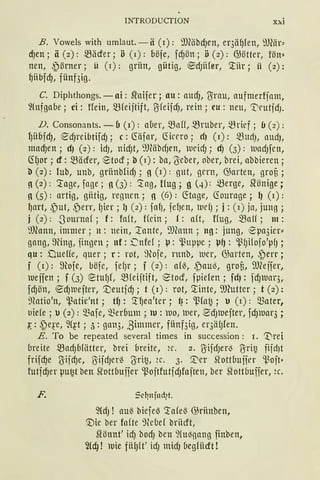
INTRODUCTION xxi
B. Vowels with umlaut.-ä (r): 9JClibcf)en, er3äl)fen, SJJ(är~
d)en; ä(2): 5Bäder; ö (1): böfe, fcf)ön; ö(2): GJötter, fön~
nen, ~örner; ü (1): grün, gütig, ®dJiifer, '.l'ür; ü (2):
l)übfdJ, fünf3ig.
C. Diphthongs. - ai: Sl'aifer; au: aUdJ, O:rnu, aufmerfjam,
fütfgabe; ci: Hein, mfeijtift, ßfeifcfJ, rein; eu: neu, "t'rutfdJ.
D. Consonants. -b (r): aüer, 5Baff, 5Bruber, ~rief; (J (2):
J)iibfcfJ, ®cf)reibtifdJ; c: (föfar, ~irrro; rf) (r): 5BudJ, llltdJ,
macf)en; dJ (2): idJ, nidJt, ~1)(äbrfJen, weid); cfJ (3): uadJfen,
~()Or ; cf: 5Bäder, etocf; b (1): ba, (Yeber, ober, brei, abbieren;
b (2): lub, unb, griinbfidJ; g (r): gut, grrn, 63arten, groü;
g (2): ~age, fage; g (3): ~ag, tfug; g (4): merge, ~önige;
g (5): artig, gütig, regnen; g (6): ~tage, ~ourage; 1) (r):
l)art, ~)ut, ,~err, lJier; 1) (2): fa(J, fefJen, lDdJ; j: (r) ja, jung ;
j (2): -3ourna( ; f: foft, Hein ; f: aft, ffug, 5Ba1f ; m:
9Jcann, immer ; n: nein, '.tante, 9)eann ; ng: jung, ~pa3ier"
gang, ~ing, fingen; nf: >::nfef; l.J: ~uppe; l-J{J: ~fJHofo'p(J;
qu: Dueffe, quer ; r: rot, ~}tofe, runb, uer, GJarten, ~err;
f (r): 9loje, böfe, fe(Jr; f (2): af~, ~au~, groü, SJJ(eifer,
Ueifen ; f (3) ®tU(Jf, 5Bfeijtift, 12tocf, fpiefen; fcfJ: fcfJUar3,
fcfJÖU, ecf)Uefter, '.Deutjcf); t (r): rot, '.l'inte, 9Jhttter; f (2):
~fotio'n, ~atie'nt; tl): '.tfJea'ter; ~: ~fo~; u (r): Q3ater,
uiefe; u (2): Q3afe, Q3eroum; ku: uo, uer, ~dJluefter, fdJlUar3;
1-:: ~e~·e, 2(~t ; J: gan3, ,3immer, fiinf3ig, er3ä(Jfen.
E. To be repeated several times in succession : r. 'Vrei
breite 5BadJoHitter, brei breite, 2r. 2. ßifdJerl3 ßrit~ fiidJt
frifcf)e ßifcf)e, ßifdJer~ (Jrit~, 2c. 3. ~er ~ottbuifer ~oft•
futfcf)er pu~t ben ~ottbuifer ~ojtfutfdJfaften, ber ~ottbuffer, 2c.
F. Sc~nfud7t.
2CdJ ! au~ biefeß '..tafeß GJriinben,
'.:Die ber fofte 9(cbef briicft,
Slönnt' idJ bod) ben ~{ul3gang finben,
~cf}! 1uie fülJft' idJ midJ (1egfücft !
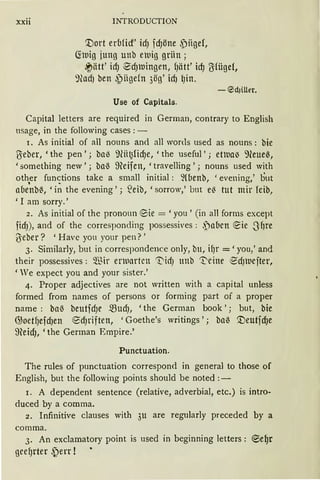
xxii INfRODUCTION
'.Dort erblief' idJ fdJöne .pügef,
~tuig iung unb emig griin ;
~ätt' icf) ~dJlDingen, {Jätt' icf) (Jfügel,
9lad) ben ~iigefn 3ög' id) lJin.
Use of Capitals.
Capital letters are required in German, contrary to English
usage, in the following cases : -
I. As initial of all nouns and all words used as nouns : bie
l!ieber, 'the pen '; ba~ llZHt~HdJe, 'the useful'; etma~ ~füue~,
'something new' ; ba~ ffieifen, 'travelling ' ; nouns used with
oth,er fun~tions take a small initial: ~([lenb, 'evening,' but
abenb~, 'in the evening' ; ~eib, 'sorrow,' but e~ tut mir feib,
'I am sorry.'
2. As initial of the pronoun ~ie = 'you' (in all forms except
fidJ), and of the corresponding possessives : .pabcn eie .3fJre
6eber? ' Have you your pen? '
3. Similarly, but in correspondence only, b11, if)r = 'you,' and
their possessives: Q.Tiir ertuartcn 't'idJ tmb '1:"cine iEdJlUcfter,
'We expect you and your sister.'
4. Proper adjectives are not written with a capital unless
formed from names of persons or forming part of a proper
name : ba~ beutfdJC 5SudJ, 'the German book'; but, bie
@oetfJefd)en ~d)l'iften, 'Goethe's writings '; ba~ '.Deutfcf)e
9leid), 'the German Empire.'
Punctuation.
The rules of punctuation correspond in general to those of
English, but the following points should be noted :-
1. A dependent sentence (relative, adverbial, etc.) is intro-
duced by a comma.
2. Infinitive clauses with 3u are regularly preceded by a
comma.
3. An exclamatory point is used in beginning letters: ~e~r
gcefJrter ~err !
INTRODUCTION xxiii
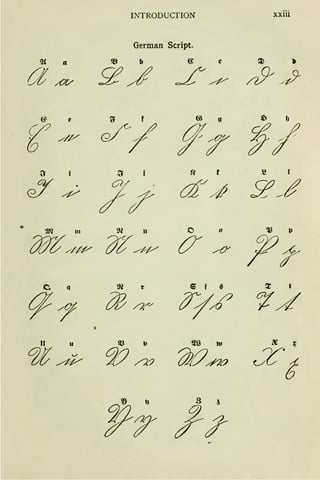
German Script.
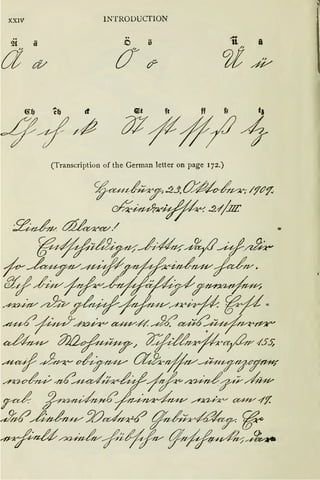
~ Q ~ (J (t c ~ )
a AJV !Z~ JA/ ff ~?
(i e iJ f 6l II () IJ
~ //// ~/ flt/' ?/~ t ~ i fl' f ~ (
eY #
// ä/.P SE~tß
• IDl !.llIII II .0 0 l „
(}3?,,,-/-/// a /fr// V / CY
Pr0. q !ll t' iS f e ~ t
CJ'-? ~ /)(° T/f 6;!//
lt u fll b m.1 tu ~ ~
~~ V /A~ (kJ#2/) X
t
Pi?
.B &
/-?..
xx1v INTRODUCTION
ad/
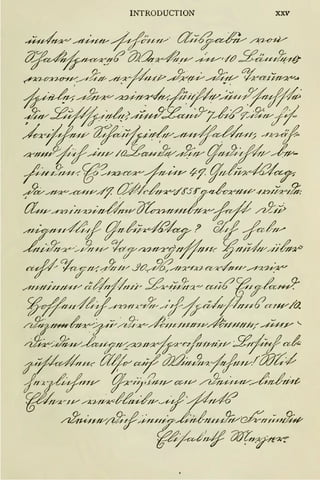
(Transcription of the German letter on page I 72.)
INTRODUCTION XXV
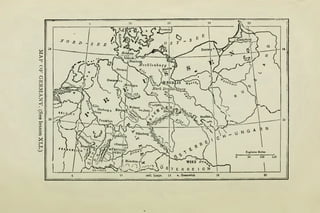
':?' " ·~ '----
1 G -~-"" - ·1'ltl f n n.ntzi1t o ~/ r; 1 ( _.)_.j M
>"C
".;j
('.l
t:Tj
:;::1
':?'
>z
:<
Ul
~ 11 50~ ), ~ .-i p„.,,____ lJ··,~'i~r--.(~~-:;;,;?);-?::"h ~'· -·~~i.(. ~olauo~ (_'___
/ 1 ~ 50 1
ro-cn
cn
0
::i
X
~
r-4
'-"
10 o•tl. Lange. H T. Green„lob 18 22
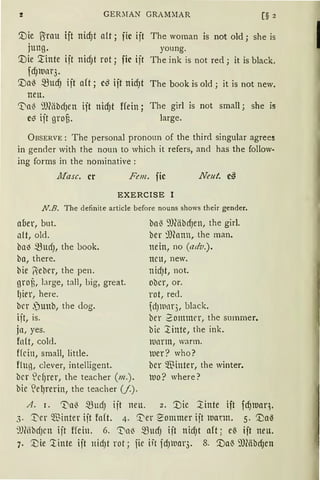
LE~80N I
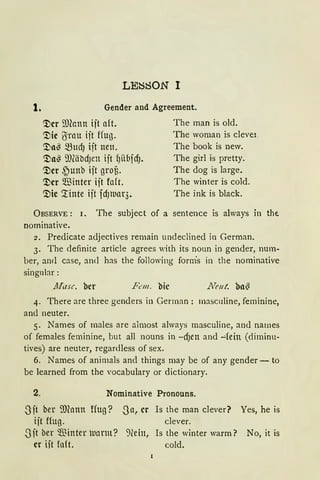
1. Gender and Agreement.
'.l)cr ~)(ann ijt aft. The man is old.
'.l)ic 6rnu ijt ffug. The woman is cleve1.
'.l)a~ ~Ud) ijt neu. The book is new.
'.l)a~ 9)(äbdJen ijt f)übfdj. The girl is pretty.
'.l)cr ,~unb ijt grof3. The dog is large.
'.l)er Q.'ßinter ift faft. The winter is cold.
'.l)ie Xinte ift fdJ11ar3. The ink is black.
ÜBSERVE : 1. The subject of a sentence is always in tht
nominative.
2. Predicate adjectives remain undeclined in German.
3. The definite article agrees with its noun in gender, num-
ber, and case, and has the following form's in the nominative
singnbr:
llftrsc. her B:m. bic .Neut. ba~
4. There are three genders in German : masculine, feminine,
and neuter.
5. Names of males are almost always masculine, and names
of females feminine, but all nouns in -dJen and -:.fein (diminu-
tives) are neuter, regardless of sex.
6. Names of animals and things may be of any gender- to
be learned from the vocabulary or dictionary.
2. Nominative Pronouns.
3 jt ber smann ffug?
ijt ffug.
3ft ber $inter tuarm?
er iit fn{t.
.Sa, er Is the man clever? Yes, he is
clever.
:Hein, Is the winter warm? No, it is
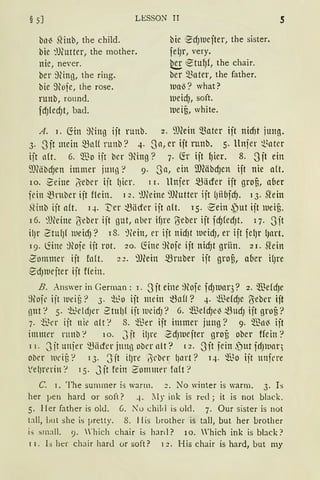
cold.
GER:lAN GRAMMAR [§ 2
'.Die Brau ift nicf)t alt; fic ift
jung.
The wornan is not old; she is
young.
'.Die '.:tinte ift nid)t rot; fic ift
fcf}lUtH3.
'.Da~ 5BucfJ ift alt; c~ ift nidJt
neu.
The ink is not red; it is black.
The book is old; it is not new.
'Va~ 9J(äbd)en ift nicf)t ffein; The girl is not small; she is
c~ ift grof3. large.
ÜBSERVE: The personal pronoun of the third singular agrees
in gender with the noun to which it refers, and has the follow·
ing forms in the nominative :
ltfasc. er Fon. fic Neu!. c~
EXERCISE I
N.B. The definite article before nouns shows their gender.
aber, but.
alt, old.
ba~ 5BudJ, the book.
ba, there.
bie Rebcr, the pen.
groü, !arge, tall, big, great.
l)ier, here.
bcr ,)unb, the dog.
ift, is.
jn, yes.
fo(t, cold.
Hein, small, little.
fluß, clever, intelligent.
bcr ~d)tU, the teacher (m.).
bie lel)rerin, the teacher (/.).
ba{ ~JläbdJen, the girl.
ber illfonn, the man.
nein, no (adv.).
neu, new.
nid)t, not.
ober, or.
rot, red.
dJllltH"j, black.
ber 2onnmr, the summer.
bie ~inte, the ink.
mnrm, warm.
iuer? who?
bcr $inter, the winter.
lUO? where?
A. 1. 'Va~ 5BudJ ijt neu. 2. '.Die ~inte ift fd)tuaq.
3. 1:'er $inter ift fa(t. 4. ~er ~ommer ijt ltlann. 5. '.i)al3
9JMbdJcn ijt ffein. 6. '1)nl3 5BudJ ift nid)t aft ~ e~ ift neu.
7. '.i)ie ~inte ijt nidJt rot; fic iit jd)luar3. 8. '.Da'3 9J(äbdJen
1
§ 3] LESSON I 3
ijt nidJt Hein ; e~ ijt groB. 9. 3 jt bie {Seber f)ier? 10. 3a, fie
ijtf)ier. II. Q.Berijtba? I2. '.tln139JMbdJenijtba. 13.$0
• ijt ber S3ef)l·er? 14. ~r ijt nidJt f)ier; er ijt ba. I5· '.Der
~ef)rer ift f)ier, aber bie ~M)rerin ijt nid)t f)ier. 16. -~Jit ber
eonnner foft? I 7. ':)(ein, er ijt warm; er ift nicf)t fa(t.
I8. 3ft ber ~unb ffug? 19. _Ja, er ift ffug.
B. Answer the following questions in German: I. -S'it ba{
~Ud) grof3? 2. Sft bnl3 :"JJMbdJen Hein? 3. S·ft bie ~inte
fd)lUar3? 4. -3ft ber Sommer fnft? 5. -Sit ber $inter fo(t
ober wann? 6. $0 ijt bie ('5ieber? 7. ~~er ijt f)ier? 8. $er
ijt nidJt f)ier? 9. -Sit ber ~ef)rer nicf)t ba? 10. $0 ijt bnl3
9J(äbdJen? II. .Jit ber ~unb nidJt ffug? I2. Sit bnl3 ~UdJ
aft ober neu?
C. I. The book is !arge. 2. The ink is red. 3. Is the
man clever? 4. He is clever. 5. Where is the pen? 6. lt
is not here. 7. The summer is warm j it is not cold. 8. Is
the winter warm? 9. No, it is cold. 10. Where is the dog?
1 I. lt is here. I 2. Is the ink black? I 3. No, it is red.
I4. Is the teacher here? IS. Yes, she is here. I6. ls the
girl !arge? q. No, she is small. I 8. Is the book old or is
it new? I9· lt is old j it is not new. 20. Where is the
teacher?
D. S2ejejtiicf (extract for reading):
fön~, 31uei, brci,
~Ut ijt nidJt neu,
9reu ijt nid)t ait,
'J.Bnnn ift nid)t fnft,
Sln(t ijt nirfJt luarm,
~HeicfJ ijt nicfJt arm.
No rn. - For vocaLulary of these extracts, see entl of the volume.
3.
LESSON II
Nominative of ein and fein.
()'in etein iit ~art.
fönc ~Hofe ijt rÖt.
A stone is hard.
A rose is red.
4 GER:'IIA~ GRA~DIAR
fön fö ijt runb.
Shin e>ommer ijt fa(t.
5teinc ~~ofe ijt grün.
Slcin fünb ijt aft.
An egg is round.
No summer is cold.
No rase is green.
No child is old.
ÜBSERVE: The indefinite article ein and its negative fein
agree with their nouns, and have the following forms in the
nominative singular :
JJiasc. anil JTeut. ein
Afasc. a11ci 1Vmt. fein
Fem. eine
Fem. feine
4. Nominative of Some Possessives.
~-l)(ein ~~ntcr iit groB.
])eine 9Jhtttcr iit gut.
~ein SHnb iit ffein.
-3 jt bll'3 ifJr ~Ud) ?
Uniere :lJCuttcr iit aft.
lIy father is tall.
Your (thy) mother is good.
His child is small.
Is tbat her (their) book?
Our mother is old.
ÜBSER'E : Possessive adjectives haYe the same endings as
the indefinite article in the nominative singular, and agret.
5. Nominative of tucfd)cr?
®efdJcr ~%rnn ijt ltft?
5illefcf)c ~htme iit rot"!
~13efdJc$ SHnb iit lJüüjdJ:
Vhich man is old ?
'hich ftower is red ?
Which chilcl is pretty?
ÜBSERVE: The interrogati'e luddJer? 'which?' has the fol
lowing forms in the nominative singnlar, and agrees:
Uasc. mddJCr Fem. lllcldJC JTmt. lllefcf}c~
EXERCISE II
ber ~äct'er, the baker.
ber ~nlf, the ball.
brr ~rnber, Lhe brother.
grün, green.
gut, good.
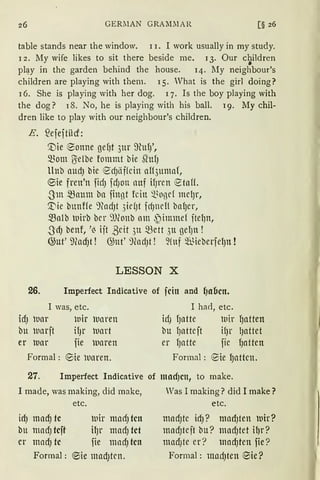
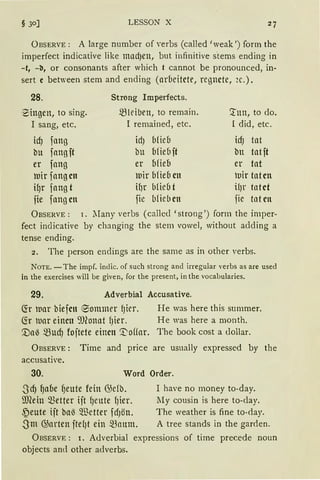
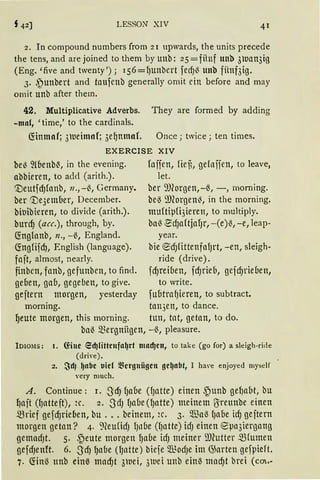
l)llrt, hard.
f)iibfdJ, pretty.
ber ,Put, the hat.
immer, always.
jung, young.
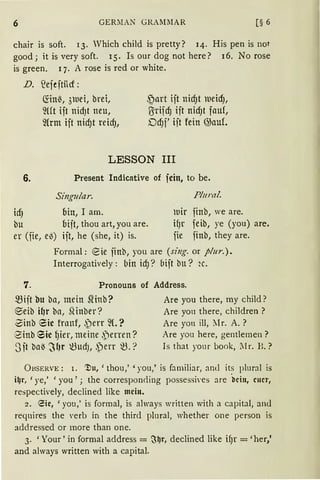
§ sJ LESSON II
bn~ SHnb, the child.
bie ~l)(utter, the mother.
nie, never.
ber ~ing, the ring.
hie ~Hofe, the rose.
runb, round.
fdJ(edJt, bad.
bie 1~cf)tuefter, the sister.
fefJr, very.
~ ~tu{Jf, the chair.
ber mater, the father.
lllll'3? what?
ueidJ, soft.
uein, white.
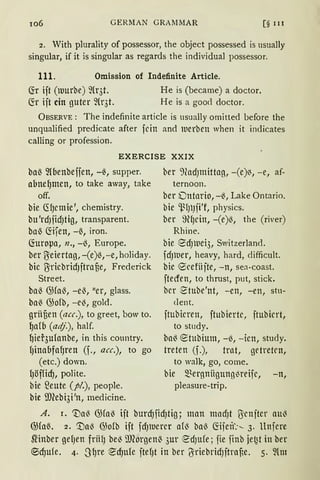
5
A. 1. ~in ~ing ift runb. 2 . ~)(ein mater ift nid)t jung.
3. 3it mein mnH runb? 4. 3a, er ift runb. 5. llnfer ~~nter
ijt nft. 6. ~mo ijt ber ~ing? 7. Cfr ift {Jier. 8. 3 ft ein
~JllibdJen immer jung? 9. 3n, ein illCäbcf)en ift nie a(t.
10. 2 eine ~·eber ijt f)tcr. l r. llnfer ~äcrer ift grofi, aber
fein ~rnber ift fleht. l 2. :lJfeine ~Ulutter ift (Jiibfcf). 13· Slein
SHnb ift nft. q. t'er ~iicfer ijt nft. 15. ,~ein ~)ut ift uein.
16. ~)(e ine ß'eber ift gut, nber if)1-e b;eber ift fdJfedJt. 17. ,Sft
il)r 2tufJ( meid)? 18. ~Hein, er ift nidJt ueidJ, er ift felJr lJtHt.
l 9. (iine ~Hofe ijt rot. 20. ~ine ~ofe ift nicf)t griin. 2 r. Slein
2'ommer ift fnft. 2 2. 9J(ein mruber ift grofi, aber HJre
~dJtuefte r ift Hein.
B . Answer in German: 1. 3 jt eine ~Hofe fdJU.lnr3? 2. $efdJe
~)lojl' ijt rneij3 ? 3. ~t.~o ift mein tJnfl? 4. ®efdJe b;ebcr ift
gnt? 5. ~~el dJer 2tttl)f ijt rneidJ ? 6. $efdJe~ ~UdJ ift groß?
7. ~Bcr ijt nie nlt '? 8. ~3er ift immer jung? 9. $11~ ift
immer nmb '-! io. J it ilJre 2dJtuefter groß ober Hein?
l 1. 3jt unjer ~iidcr jnng ober nlt? l 2. Sft jein ,)ut fdJltinq
ober 1t1cij3? l 3. 3jt ilJre /1cber l)nrt? q. m..~o ijt unjcre
~el)rerin ·~ 15. Jft fein 2ommrr fo(t?
C. I. The sumrner is warm. 2 . No 'inter is warm. 3. Is
her pen hard or soft ? ·l· l ly ink is red ; it is not black.
5. H er fa ther is olc..I. G. No child is old. 7. Our sister is not
t::lll, but she is pretty. 8. 11 is brother is tall, but her brother
is small. 9. 'hich chair is hard ? 1 0 . Which ink is black ?
l I. b her chair hard or soft? l 2 . His chair is hard, but my
6 GERMAN GRAl11lAR [§ 6
chair is soft. 13. Vhich child is pretty? 14. His pen is not
good; it is very soft. 15. Is our dog not here? 16. No rose
is green. q. A rose is red or white.
D. ~efejtücf:
mnl5, 31uei, brei,
~m ift nidJt neu,
mrm ift nid)t reid),
~art ijt nid)t tueidJ,
ß=rifd) iit nidJt fauf,
DdJf' iit fein @auf.
LESSON III
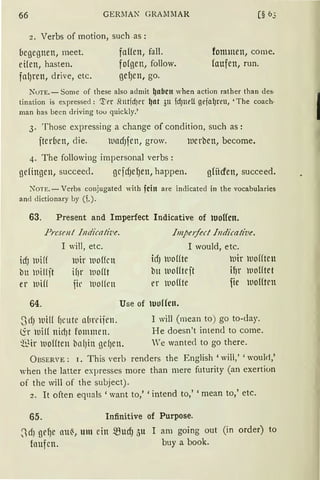
6. Present lndicative of fein, to be.
Singular.
idJ bin, I am.
bu bijt, thou art, you are.
er (fie, e~) ift, he (she, it) is.
Plural.
tuir finb, we are.
ifJr feib, ye (you) are.
fie finb, they are.
Formal: eie ;inb, you are (siug. or plur.).
Interrogatively: bin id)? 6ift bu? 2c.
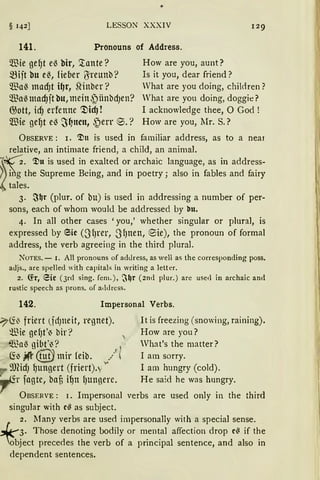
7. Pronouns of Address.
mift bu ba, mein ~inb?
@)eib H1r bn, .Qinber?
-0inb eic franf, ,)err ~(.?
Sinb 6ic ~ier, meine ,~jenen?
3it ba~ ~f)r t3udJ, ~)err ~.?
Are you there, my child?
Are you there, children ?
Are yon ill, ?[r. A. ?
Are you here, gentlemen ?
Is that your book, ll r. B.?
ÜBSERVE: I. 'J)u, 'thou,' 'you,' is familiar, am! its plural is
ilJr, 'ye,' 'you'; the correspon<ling possessi'es are ·bcin, euer,
respectively, declined like mein.
2. eie, 'you,' is formal, is always written with a capital, an<l
reqnires the verb in the third plural, whether one person is
addressed or more than one.
3. 'Your' in formal address = ~~r, declined like ifJr = 'her,'
and always written with a capital.
LESSO~ lll§ 9]
8. The Demonstrative bll~·
l... ---> ~a~ ift ber mater.
~a~ ift bie ilJlutter.
'.3)n~ finb meine ~dJiifer.
That is the father.
That is the mother.
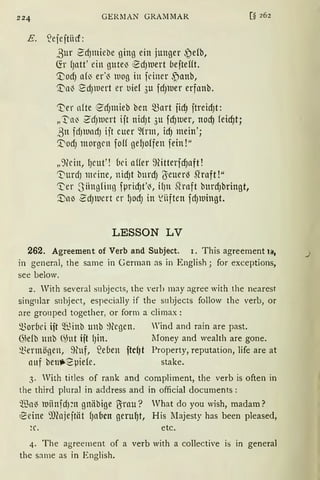
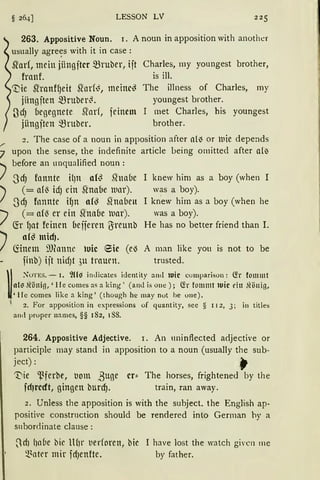
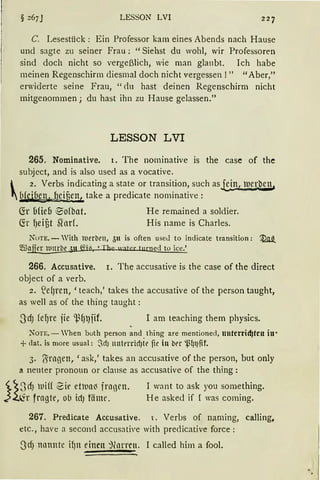
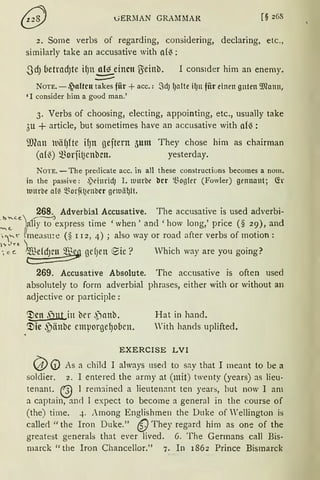
Those are rny pupils.
7
ÜBSERVE : ba~. remains unchanged here ; the verb agrees
with the real subject, which follows.
9. Wotd Order. The predicate adjective comes at the end
of a principal sentence in simple tenses :
'.tla~ Wetter ift l)eute fcf)ön. The weather is fine to-day.
EXERCISE III
artig, well-behaved, good.
aUdJ, also, too.
böfe, bad, cross, angry.
bie ~rau, the woman, wife, :Mrs.
gan3, quite.
ber G)arten, the garden.
giitig, kind.
ber ~err, the gentlernan, 1fr.
in, in.
bie Siinber, the children.
franf, ill, sick.
bie ~el)rer, the teachers.
ba) 9Jleffer, the knife.
bie 9JCeffer, the knives.
ber Dnfef, the uncle.
fd)arf, sharp.
fd)ön, beautiful, handsorne,
fine.
bie ~d)ufe, the school.
ber SdJiHer, the pupil, scholar.
bie ~dJiifer, the pupils, schol-
ars.
bie Tante, the aunt.
u'nartig, naughty, bad.
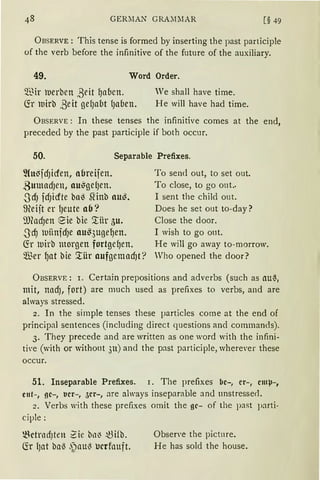
unb, and.
lueffen? whose?
lUOf)f, well.
2c., etc.
Io1o:i.1: .jerr 2e~rer, teacher (voc.); bcr- ~err 2e~rer, the teacher
(forms of respect).
A. Continue the following throughout the tense: I. SdJ
bin franf, bu bift, 2c. 2. ~in idJ artig? bift bu? 2c. 3. SdJ
bin nid)t Hein, bu, 2C. 4· min icfJ nid)t grou? bift bu? 2C.
B. r. ~ie ~dJiifer finb nidJt f)ier ; fie finb nidJt luofJL
2. '.:Die ~el)rer finb gier unb hie ~d)Ufer finb aud) gier.
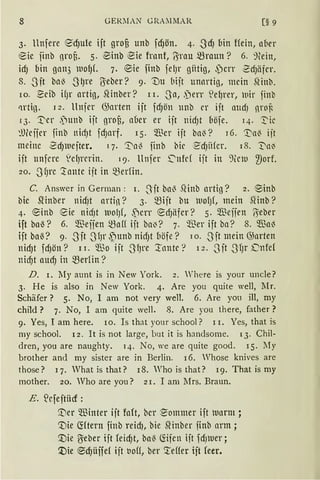
8 GERlIAN GRAllMAR (§ 9
3. llnfere 6dJule ift grofi unb fd)ön. 4. -S'd) bin Hein, aber
~ic iinb nrot. 5. ®inb eie frnnt, Brau mraun? 6. :nein,
id) bin gan3 niof)f. 7. ®ie finb felJr gütig, ,Pcrr 2dJäfer.
8. .J·it bn~ -S'lJre Uieber? 9. t)u bijt unnrtig, mein ~inb.
10. ~db ifJr artig, Slinber? r r. .Jn, ,)err S!e~rer, wir finb
ctrti13. 12. llnfer G;arten ijt fdJön unb er ift mtdJ nroi'
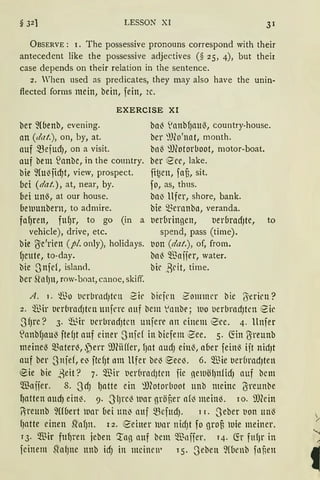
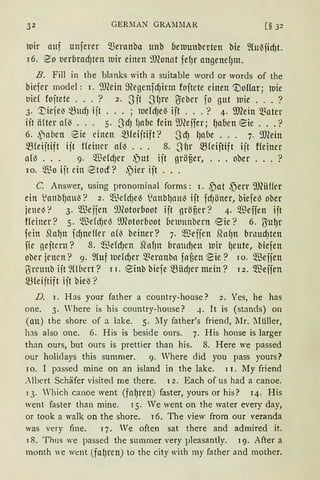
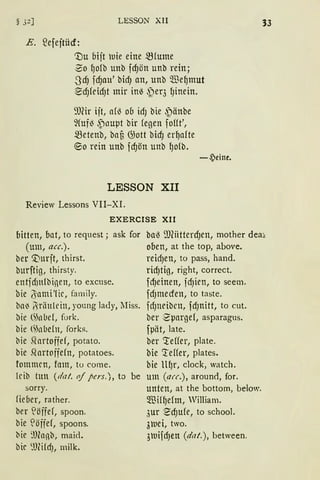
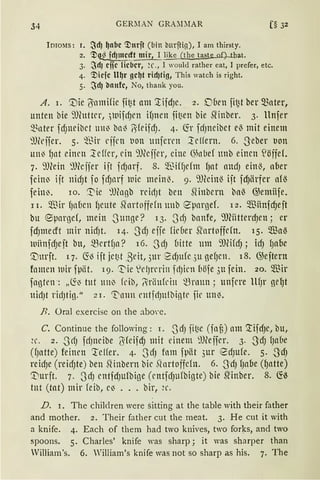
r 3. T'er .'lunb ijt grot, aücr er ift nidJt [iöfe. 14. 1:'ic
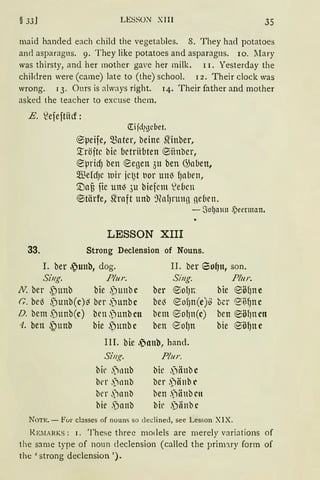
~lJlcijer finb nirf)t fdJarf. 15. m..~cr ijt ba~? r6. 'Va~ ijt
meine -SdJlUejter. q. '.:t'n~ finb bie ~dJitfcr. 18. T'n~
ift unferc 1
cfJrcrin. 19. ltnfer ~nfd ijt in 'fülu 2)orf.
20• .J fJrc '.:tnntc ijt in ~erfin.
C. Answer in German : 1. Sit ba~ .~inb artio? 2. ®inb
bic 5linber nid)t artin? 3· mijt bu lUO{Jf, mein SHnb?
4. ®inb eie nid)t lUO(Jf, ,Pcrr ~dJäfcr? 5· $effen ß=eber
ift boö? 6. $efien mnff ijt ba~? 7. $er ift ba? 8. $a~
ift bal3? 9. .Jft .J'fJr ,)junb nid)t böfe? 1 o. .J'ft mein @nrten
nidJt fdJön? rr. Wo ijt .J'lJre '.rnnte? 12. Jit .J'(Jr Dnfe(
nidJt aud) in ~er1in?
D. r. My aunt is in New York. 2. Where is your uncle?
3. He is also in New York. 4. Are you quite well, :[[r.
Schäfer? 5. No, I am not very well. 6. Are yon m, my
child ? 7. No, I am quite weil. 8. Are you there, father?
9. Yes, I am here. ro. Is that your school? r r. Yes, that is
my school. 12. lt is not large, but it is handsome. 13. Chil-
dren, you are naughty. 14. No, we are quite good. 15. My
brother and rny sister are in Berlin. 16. Whose knives are
those? 17. What is that? 18. Who is that? 19. That is rny
mother. 20. Who are you? 21. I am Mrs. Braun.
E. ~rfeftiicr :
[)er Winter ijt faft, bcr ~ommer ift tuarm ;
'.Die (füern finb reidJ, bie ~inber finb arm;
'.Die Uieber ijt feid)t, baö ~ifcn iit fdJlUer;
'.:Die ®d)üffef ift uoff, ber :teffer ijt leer.
§ 13] LESSON IV 9
LESSON IV
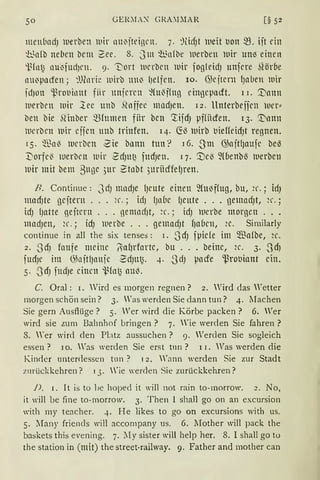
10. Present lndicative of f)aben, to have.
I ha·e, etc. Have I? etc.
ich ht1be lllir lJetbrn {Jetbe id)? fJetben luir?
bu (jtl jt ifJr f)tl bt ~ajt bn? lJet(1t ifJr?
er l)Ctt fic l)etbrn l)ett rr? lJet(1cn fie?
Formal: ~ic fJabcn. Formal: lJet(1en ?ie?
11. Accusative Forms. r. The direct object is put in the
accusative, which has the same form as the nominative, except
in the masculine singular.
2. Observe the following forms of the masculine singular
accusative, and of the norninative and accusative plural of all
genders:
Sing. be n
Plur. bi e
einen feinen
feine
12. Repetition.
meinen, ~c.
meine, 2c.
'.Der mfonn unb bie lJrCIU. The man and woman.
:Die ßeber unb bie ~intc. The pen and ink.
~mein Q)ater unb meine i'JJiutter. My father and mother.
ÜRSERVE: The article, possessive adjective, etc., rnust be re-
peated before each noun in the singular.
13. The Comparative Degree.
'!;u Oijt ffeiner af~ id). You are smaller than I.
(fr nefJt fo id)neff uie icfJ. He walks as quickly as I.
~r ijt iHter et(~ fein Rreunb. He is okler than his friend.
Or.sERVE : 1. Most a<ljectives and adverbs form the com-
parative by adding -er to the stem of the positive.
2. 'Than' after comparatives = aCG; 'as' ... 'as' or 'so'
... 'as' = fo ••• 1uic.
3. llany monosyllabic adjectives and adverbs with stern vowel
11, o, 11, have umlaut (ä, ö, it, respectively) in the comparat:Cve.
10 GERIlAN GRAMIIA R [§ 13
4. The noun after o(~ has the same case as that which pre-
cedes.
NOTE. -Adjectives with umlaut in comparative are marked by (!') in
the vocabularies; see also vocabularies and Lesson XXXIX for irregular
comparison.
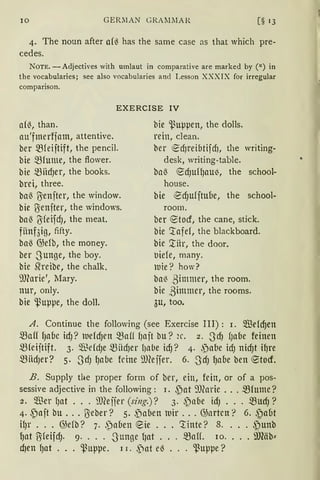
EXERCISE IV
am, than.
ou'fmerfjam, attentive.
ber $(eiftift, the pencil.
bie $(ume, the flower.
bie miidJer, the books.
brei, three.
baß IJenfter, the window.
bie ßenfter, the windows.
baß {S'feifdJ, the meat.
fünf3ig, fifty.
baß @e(b, the money.
ber -Sunge, the boy.
bie ~re ibe, the chalk.
mcarie', Mary.
nur, only.
bie '.ßuµpe, the doll.
bie 'l.~uppen, the dolls.
rein, clean.
ber t0dJreibtifdJ, the writing-
desk, writing-table.
baß t0dJUHJaUl3, the school-
house.
bie t0dJufftuue, the school-
roorn.
ber CS:tocf, the cane, stick.
bie 'l'afe(, the blackboard.
bie '.titr, the door.
uie(e, many.
luie? how?
bal3 ,ßimmer, the room.
bie ßimmer, the rooms.
3u, too.
A. Continue the following (see Exercise III) : 1. füdcf)en
maff fJOUe tdJ? luefcf}en $off (Jaft bU? 2C. 2. 3dJ (JaUe feinen
mfeiftift. 3· $efd)e miidJel' l)abe icf}? 4· ,pabe idJ nicf}t i~re
mndJer? 5. SdJ qabe feine i1JCeffer. 6. SdJ qabe ben e:tocf.
B. Supply the proper form of ber, ein, fein, or of a pos-
sessive adjective in the following: I • .Pat 9)(arte ... mfUlllC?
2. Wer lJat ... ill(effer (sing.)? 3. 3)abe idJ ... mudJ?
4. .poft bu ... ßeber? 5. ,Paben luir ... @arten? 6. .)aut
HJr ... @eib? 7. ,paben ~ie ... 'l'inte? 8.... .)unb
fJat UifeifdJ. 9. . . . -Sunge fJat . . . $0lf. 10. • • • 9J1äb~
dJen lJat ... '.ßuppe. 1 r. f)at e~ ... '.ßuppe?
§ 13] LESSON l' II
C. 1. llnfl'r ~d)HffJl1Ul3 ift nrof; unb fd)ön. 2. Ci~ fJat
lliefe ,3immer nnb b;enfter. 3. ''.Die .3immer finb grof;.
4. ®ie fJaben (Jenfter. 5. llttfer ,3immer lJllt nur ein l}enfter.
6. '.Dal) l}enfter ift nron, aüer e{' ift nid)t immer rein. 7. ,)irr
ift unfer ~eIJt-er. 8. füa~ fJllt er? 9. G:r lJllt einen ~dJrei(1~
tifdJ. 10. G:r f)at attd) eine (5;eber unb '.tinte. 11. ~emc
~d)ii1er lJaÜen audJ 6eber nnb iintc. 12. Hufere ~dJn(ftube
IJllt eine '.tafef. 1 3. 3::'iie :tafel ift fdJtuaq. q. Wie lliefe
®d)iifer f)at -S~re ~dJU(e r TS· e ie ~at fünf3io ~d}iifer.
16. ®inb bie ~d)iifer aufmerffam? 17. 2ie finb nidJt immer
aufmerffam. 18. llnfere S!efJrer l)lllH'll .Qreibe. 19. 'Va{'
Üiettfter ift fleiner afo bic '.tür. 20. '1)cr S!ef)t-er ift äfter nk~
feine ®dJiifer. 21. '.tlie ®djfüer finb nicf)t fo ffttg tuie ifJr
'efJrer.
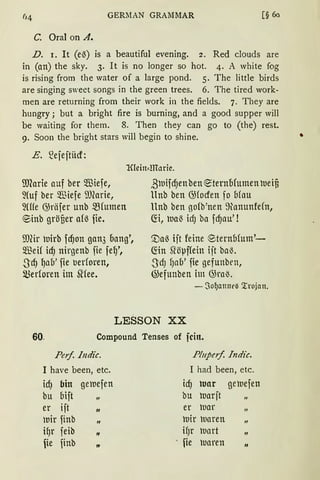
D. Oral exercise on the above.
E. 1. Our teacher has a chair and writing-desk. 2. Has
he also a cane? 3. No, he has no cane. 4. The pupils have
their books. 5. Have you your books? 6. Yes, but I have
no pencil. 7. lfary has my pe11cil a11d pen. 8. Which doll
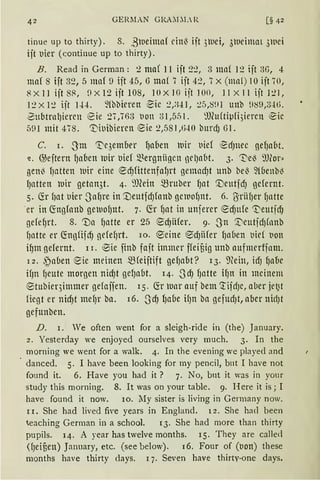
have the girls? 9. They have 110 doll. 19. How many
teachers has your school? 11. lt has three teachers.
r2. Have they many pupils? 13. Yes, they have fifty pupils.
1:1-. Are their pupils atte11tive? 15. No, not always. 16. Has
your teacher her pe11 or pe11cil? 1 7. No, but she has her
chalk. 18. Has your sister a doll? 19. No, she has 110 doll ;
she is too big. 2?· She is taller than h-er brother.
F. S2efeftücf:
G:in Slinbe{~er3 foff fein:
5ffiie bie ~Hie fo rein,
5!ßie ber '.tau fo ffar,
5ffiie ber eµiegef f0 tuaf)r,
$ie ber Duelf fo frifd),
l}rol) tuie bie 5fügfein im ~k~
üitfd).
G. ~µridJlUörter (proverbs) : 1. ~eifer fpät afö nie. 2. G:t~
llla~ ift oeffer af~ gar nid)t~. 3· ,Beit ift {S)e(b. 4· G:nbe gut,
aUe~ gut.
12 GER.MAN CRA.M).IAR
LESSON V
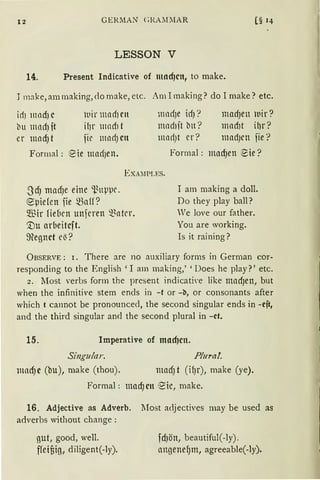
14. Present Indicative of modJcn, to rnake.
I make, am making, do rnake, etc. Am I rnaking? do I make? etc.
ictJ rnnd) c luir mnd1 cn llHlOJC lO) ? mad)en luir?
bu mndJ ft ifJr mnd1 t mnd1it litt? mnd1t ihr?
er mnd) t fic l1lCl OJ Clt mnrl)t er? mndJcn fie?
Formal: €ie mnrf1en. Formal: mad)en ~ie?
ExAr.IPLES.
-3dJ macf)e eine ~uppc.
eµiefen fie ~foff?
Sffiir lieücn unferen ~ntcr.
'.Du arüeitcft.
~egnct cl3?
I am making a doll.
Do they play ball?
Ve love our father.
You are working.
Is it raining?
ÜBSERVE : 1. There are no auxiliary forms in German cor-
responding to the English 'I am making,' 'Does he play?' etc.
2. lIost verbs form the present indicati,·e like mnd)en, but
when the infinitive stem ends in -t or -b, or consonants after
which t cannot be pronounced, the second singular ends in -eft,
and the third singular and the second plural in -et.
15. Imperative of macf)cn.
Singular.
mnd)C (bu), make (thou).
Plural.
mnd) t (il)r), make (ye).
Formal: macl)cn 1~ic, make.
16. Adjective as Adverb.
adverbs without change:
gut, good, well.
ffeifiig, diligent(-ly).
lfost adjectives may be used as
fd)ön, beautiful(-ly).
nngenel)m, agreeable(-ly).
§ 16] LESS0 N V 13
EXERCISE V
oruciten, to work. macfJen, to make, do.
bie ~(ufgabe, the exercise.
bitte, please.
bal3 9)(iircfJcn, the fairy- tale,
ber ~rief, the letter.
bie .t)riibcr, the brothers.
'DcutidJ, German.
cqii(Jfen, to tell (narrate).
ffeinig, diligent, industrious.
uern, willingly, gladly.
~ad, Charles.
ba~ SHat)ie'r, the piano.
fef)ren, to teach.
fernen, to learn, study.
ba'3 ~ieb, the song.
louen, to praise.
story.
bic 9)(iird)Cll, the fairy-tales,
stories.
oft, often.
rennen, to rain.
fdJncH, quick, fast.
fdJrcibcn, to write.
jingcn, to sing.
ber ~pa3ie'rgnng, the walk.
fpiefen, to play.
lucn? whorn?
lucnig, little (not much).
JD10:11~. ~dJ fpiclc gcr.u., I am fu11Ll of playing, like to play.
2. (fotcn .Cpn5icr!lOll!111IOd)C1t1 to take (go for) a walk.
3. füouicr fpiclcn, to play the piano.
A. Continue the following, giYing also the imperative: 1. -3cf)
fdJreioe einen mrief, btt, ZC. 2. 3'cf) ntacfJe einen ~pa)ier"
gang. 3. ~ dJ jinne ein lieb. 4. JdJ jµicfe nidJt ~nlf.
5. 9(rbeite icfJ fcfJneU? 6. S'cfJ ferne fcfJneffer a(l3 ~arf.
B. 1. llnjcre S!efJrer fouen if)re ~cfJHfcr. 2. ':Die ~cf)rerin
fefJrt if)re ~rfJiifer. 3. ~ie ~cfJiifer fernen gern. 4..Hnbcr,
lernt if)r gern ~euticfJ? 5. -3n, luir fernen fef1r gern 't'cutfdJ.
6..~inber fernen nicfJt immer nern. 7. '{Sir fcfJrciucn eine
9(ufgabe. 8. Sfnr( fcfJrci6t einen mrief. 9· 9)forie, fcfJreibc
eine ~(ufgabc. 10. ~(rbeitet ffcif,iner, Siinbcr. 1 r. 9)forie
arbeitet fd)r ffeif,ig. 12. mnbcr fpiefcn immer nern. 13. starf,
fpicfit bu nern ~a((? 14. 3a, ,)crr ~1
efJrer, idJ ipicfc fefJl'
nern ~nff. 15. mitte, eqii~fen 2ie ein 9Jlärcf)en, ,pen·
S?efJrer. 16. llnfere 9)cutter cqiifJ(t oft 9JfürcfJen. 17. 9Jeeine
GEKM AS GKA.1lMAR [§ 16
2dJlnefter fingt fefJr fcfJön ; fit' fingt ein lieb. 18. ·Zpielen
Zic SHnt1ier, (Yrau ·ZcfJäfer? r9. 3dJ fpide ein tuenig, aber
nicf)t fcfJr gut. 20. ~))(eine ~rüber madJen oft einen epa3ier;
nang. 21. 'J)eadJen ®ie gern einen ~µa3iergang? 22. Sa,
id) madJC fefJr gern einen ®µa3iergang.
C. Answer in Gerrnan: 1. Wer foot bie ed)Hfer? 2. S!crnft
bu nern, S1nrf? 3. 9(roeitet ifJr ffeitig, SHnber? 4. $er
idJreibt? 5. $a~ fdJreibt er? 6. ~..~er fµieft? 7. $a~
fpiefen fie ? 8. '8µiefen ~ie .~fat1ier? 9. ~ernen 2ie gern
't'eutidJ ? rn. $a~ cr3äl)ft bie ~efJrerin? 11. $er fingt?
1 2. $a~ finnt fie ? 13. ~egnet e~, ober rennet e~ nidJt?
.D. 1. We are learning German. 2. I like to learn°Gerrnan.
3. Do you like to learn German? 4. Ch.arles likes to learn
Gennan. 5. lfary works diligently. 6. Her brother learns
very quickly. 7. He learns rnore quickly than I. 8. Our
teacher is telling a story. 9. The teacher teaches and the
pupils learn. 10. Do pupils always like to learn? 11. Charles
is not so clever as llary. 12. What are you writing, Mary?
1 3. I am writing a letter. 14. Please sing a song, Mrs. Schäfer.
15. Do not play, rny child; write an exercise. 16. lIy father
and rnother are taking a walk. 1 7. Do they often take a walk?
18. Our house is !arger than their house. 19. Our garden is
srnaller than their garden.
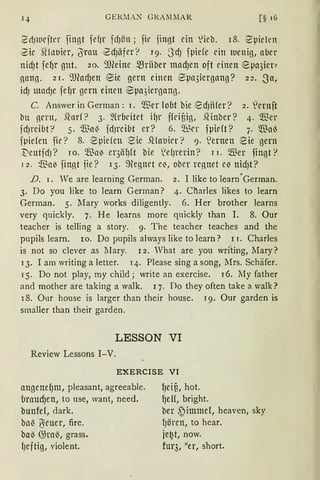
LESSON VI
Review Lessons I-V.
EXERCISE VI
angenef)m, pleasant, agreeable.
braucf)en, to use, want, need.
bunfef, dark.
ba~ ~euer, fire.
ba~ G)ra~, grass.
fJcftig, violent.
fJeiß, hot.
l)eff, bright.
ber ,~immef, heaven, sky.
fJören, to hear.
je~t, now.
fur3, !!er, short.
§ 16]
fang, uer, long.
fegen, to lay.
bie ~nft, air.
mnnd)tnal, frequently.
meqr, more.
bie ~(ad)t, night.
naB, uer, wet.
nicf)t mef)r, no longer.
ber ,[lfen, sto'e.
LESSON VI
ber ffiegen, rain.
fdJeinen, shine.
bcr ~dJnee, snow.
bie ~onne, sun.
ber Staub, dust.
ber '.lag, day.
trocfen, dry.
luieber, again.
A. i. $ir fJaben jet2t ~ommer. 2. '.Der '.tag iit länner
unb bie 9tadJt iit für3er. 3. '.Die ?uft iit oft fclJr lJeiu.
4. Wir fJaben mancfJtnnf 9tegen. 5. '.:t)er 9tegen ijt felJr
angenef)lll. 6. ~r tnlld)t ba0 G)rn0 llCIB unb fegt bcn ~taU{l.
7. ~0 regnet jet~t fJeftig ; idJ ()Öt'C e~. 8. vie '2onne fd)etnt
nid)t mefJr. 9. ~er ,Pimmel iit bunfef. 10. ':Die ~onne
idJeint je~t mieber fJeff unb madJt bal3 G)ra~ trocfen. 1 r. ~'ßir
qauen jet2t feinen ~cf)nee. 12. 9JfodJcn ~ie fein ß'ener.
13. $ir uraud1en j_e~t fein ß'cuer. 14. ~Bir urnudJen unfcren
Dfen nic!Jt me~r.
B. Oral : 1. ~Jit e~ jet2t ~Binter? 2. S it ber '.lag für3er
af~ bie 9ladJt? 3. 3it bie ~.HadJt fo fnng uie ber 'tag?
4. ffiegnet c~? 5. ,Pört ilJr nidJt ben 9kgen, SHnber?
6. ffiegnet e'3 lJier oft? 7..pabcn uir 2dJttCc? 8. Sit ba~
())ra~ nau? 9· .')aben 2ie einen .Cfrn? 10. ~raUd)Ctl uir
je~t (}euer?
C. Continue: 1. 3d) l)llbe feinen 0frn, bu, 2r. 2 •. SdJ
11öre uidJt ben 9egen. 3. SdJ üitt uidJt uofJL 4. ~nmdJe idJ
fein (5euer?
D. 1. lt is now "·inter. 2. The <lay is shorter than the
night. 3. The air is colder. 4. We neecl a sto'e. 5. 'e
need also a fire. 6. 'e ha'e no fire. 7. Our room is quite
cold. 8. Ve have snow. 9. The snow is white and clean.
10. The air is often very cold, but it is pleasant and bright.
16 GERMAN GRAMMAR [§ 17
r 1. My room has a stove. r 2. I use the stove very often.
13. Charles and Mary need a stove. 14. Their room is not
very warm. 15. Please make a fire.
E. lefejtiicf:
17.
}Tom.
Gen.
Dc1t.
Ace.
18.
SdJ fie(le bie ~fumen, idJ fie(le ba~ ®pief,
SdJ fie(le bie ~ögef, idJ fü(1e gar t1ief,
'.t'ie G:rbe, ben .f)hnme{, bie eonne, ben ~tern,
3cfJ fiebe ba~ affe~, ob nafJ' ober fern.
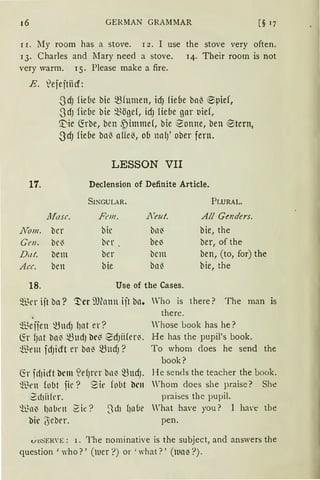
LESSON VII
Declension of Definite Article.
SINGULAR. PLURAL.
Afasc. Ft•m. l1
eut. All Gotders.
ber bir bll~ bie, the
br~ ber be~ ber, of the
bem ber bcm ben, (to, for) the
ben bie bn~ bie, the
Use of the Cases.
sil~er ijt ba? '!'er i'Olann ijt bll. Who is there? The man is
there.
~e fien ~UdJ {Jnt er? 'hose Look has he?
G:r fJnt ba~ ~UdJ br~ ~dJüfer~. He has the pupil's book.
t3em fdJilft er ba~ ~lldJ? To whom does he send the
book?
G:r fd1ilft brm ~dJn'r bn~ ~ttdJ. He sends the teacher the book.
~Brn fobt fie? Sie fobt bell Whom does she praise? She
2d1iifer. praises the pupil.
'll.~a~ hnbrn 2ie? 3d1 f10Cie 'hat have you? l have the
bir '(Seber. pen.
V.u::>t-:RVE: 1. The nominative is the subject, and answers the
question 'who?' (rner ?) or ' what?' (llla~ ?).
§ 20] LESSON VII
„ The gemt1ve corresponds to the English possessive or
objecti,·e with of, an<l answers the question 'whose?' 'of
whom?' 'of what?' (tueifen ?).
3. The dative is the indirect object, and answers the ques-
tion 'to whom?' (luem ?).
4. The accusative is the direct object, and answers the
question 'whom?' (luen ?) or 'what?' (lua3 ?).
NOTES. - I. Any of these cases, excepl the nominative, may be gov-
crned by a preposition.
2. lt is imp'Atant to remember that some verbs which are transitive in
English govern a dative only in German, as indicated in the vocabularies.
19. Contraction. The prepositions an, 'on,' 'at,' in, 'in,' uon,
'of,' 'from,' 511, 'to,' are contracted with the unemphasized
definite article as follows :
an bem = am in bem = im uon bem = uom
)U bem = 5um 311 ber = 5ur
20. Case Forms of Nouns. r. lIost masculine and neuter
nouns have the genitive singular in -~ or -c~; the dative singu-
lar is often, and the accusative usually, the same as the nomi-
native; but masculine and neuter monosyllables usually add -e
in the dative singular.
2. Feminines remain unchanged in the singular, and most
of them have -11 or -cn throughout the plural.
3. The norninative, genitive, and accusative plural are always
alike, and the dative ends in -11.
EXERCISE VII
auf (dat.), on, upon.
ber .t3nm11, tree.
betommeu, to get, recei'e.
bie ~lumen, ftowers.
ber ~fumenfo{Jl, cauliftower.
bringen, to bring.
hanfen (dat), to thank.
fiir (arc.), for.
ber ~iirtnrr, gardener.
bnie 05emiife (sing. only),
vegetables.
nern f)nben, to be fon<l of, like.
in (dat.), in.
ber ~lo{J{, cabbat?e.
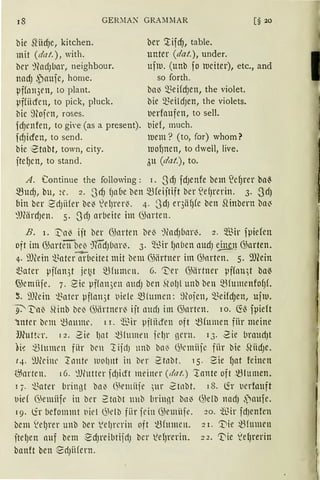
18 GER~IAX GRAJlMAR [§ 20
bie SHid)e, kitchen.
mit (da!.), with.
bcr '.)fodJlinr, neighbour.
nndJ .paufc, home.
µffo113en, to plant.
pffiidcn, to pick, pluck.
bic ~)lojrn, roses.
fdJenfen, to giYe (as a present).
fd)icfen, to send.
bie iStabt, town, city.
ftef)cn, to stand.
ber '.tifd), table.
unter (dat.), under.
uftu. (unb fo lueiter), etc., and
so forth.
ba~ ~eifdJen, the violet.
bie ~eildJen, the violets.
uerfoufen, to sell.
tiieI, much.
wem ? (to, for) whom?
wof)nen, to dwell, live.
3u (dat.), to.
A. Continue the following: 1. SdJ fdJenfe bem ~dJrer ba~
mucf), bu, 2r. 2. SdJ fJnbe ben $feiitift ber ~eIJrerin. 3. 3dJ
bin ber SdJii(er bc~ lel)rer~. 4. SdJ er3äfJ(c bcn Rinbern ba~
~1JfördJen. 5. 3cfJ arbeite im 05nrten.
B. i. :t'n~ ijt ber G;nrten be~ :1(adJbnr~. 2. ~ir fpiden
oft im G;arteübei' ~(ndJbar~. 3. ~~ir fJ11l1en nudJ cjill_11 G;arten.
4. 9füin ~3aterar{1citet mit bem G;iirtner im G;nrtcn. 5. 9Jeein
~atcr pffan5t jct~t mrumcn. 6. 'l::'er G;iirtner pf(an,t btl~
@emiife. 7. 2ic pffnn5e11 nudJ ben S~o!Jl unb ben $fumenfo(JL
~. 9Jkin ~~atcr pflatt3t tiiele $fumcn: ~)lojen, ~~eifdJen, ujlll.
~ :t'n0 5Cinb be~ G;iirtner~ ijt nmfJ im G;nrten. 10. ~~ fpieft
"Inter brm ~numc. 11. ~ir pflfüfen oft ~(umen für meine
mutt;:r. [2. 2ie l)nt ~lmnen fd)r gern. 13. 2ie brnudJt
bfr ~lmnen für brn lifdJ nnb ba~ ~krniije fiir bie StiidJe.
q. ~Jlrinc Ionte rno!11tt in ber 2t11bt. 15. Sie {Jat feinen
G5nrten. 16. :lJhttter fdJicft meiner (dat.) „Tonte oft ~lumen.
1 i· ~ater bringt bn~ (~emiije ~ur 2tnbt. 18. lir tierfouft
uid G,emüfr in ber 2tabt 1111b brin~it bn~ ~klb nadJ .Daufe.
19. lfr befommt tiiel ~ell:l fiir fein G;emüfe. 20. füir fdJenfen
bem ~e~rer unb ber ~e!Jrcritt oft t3(umcn. 21. ~ie ~fumen
jte~en auf bem ~dJreibtiidJ ber l?efJrerin. 2 2. 't'ie .lelJrerin
banft ben 8dJiHern.
§ 20] LESSON VII
C. Answer in German: l. ~eifen G;arten ift bal5? 2. 5iller
ijt im G;arten? 3. 9)(it wem arbeitet er? 4. WefdJel5
G;emüfe pffnn5t ber ~ärtner? 5. Wer pf(an3t bie $fumen?
6. Q."ßefdJe mfumen pffan3t er? 7. füeifen SHnb ift im G;arten?
8. ~0 fµief t eJ '? 9· füet pffiicft mtunten? IO. ßitt lUelt
finb fie? l I. mrnudJt fie mrumen für bie Sfücf)e? l 2. ~o
luo~nt SfJre '.tunte? 13. Wem fdJicft -JfJre ~Ulutter bie
mrumen? 14· 'l~o t1erfauft SfJr ~ater bl1l5 G;emttje?
15· ~"ßo jtd)cn bie mfumcn?
D. Supply an article in the blank spaces: i. ••• maH
•.. €dJHfer~ iit fJHbjdJ. 2. ~n(1en 2ie ... mndJ ...
ßrnu? 3. -SdJ fJabc nidJt . . . -i.~uppe ... 9J(äbdJen~.
4· 8dJenfen '2ie ... i:nfe{ ... mud). 5· ®tef)t .
~ifcfJ in . . . ßimmer? 6. . . . 'iScber Hegt auf .
'2dJreibtifdJ ... S2cf11-er~. 7. Wo ijt .•. mfeijtift .
~e~rerin?
E. r. That is our garden. 2. We work often in the garden.
3. The children like to play in the garden. 4. They play with
the neighbour's children. 5. The gardener is working in the
garden. 6. He is planting the flowers. 7. Father is planting
the vegetables. ~- Which vegetables is he planting? 9. He
is planting the cabbage and cauliflower. 1<;>. Are you fond of
flowers? l I. Yes, 1 am very fond of flowers. 1 ?· To whom
does your mother send flowers? 13. She sends flowers to my
(meiner) aunt. 14. lIy aunt lives ·in the city, but si1e has no
garden. 15. We need the flowers for the table and the vege-
tables for the kitchen. 16. The flowers on the teacher's table
are very pretty. q . .My mother sends the teacher (/) violets.
r8. Send the teacher the violets.
F. ~efeftiicf :
~~ regnet. · 6hHt fegnet O
~en f)Of)Cl! maum, bett ffeil1en e:trnUdJ
ltnb aff bie tlmfenb 5!3fumen llltdJ.
D _frifdJer 9~enen ! 'T'n ();otte~ ~enen !
10 GERiIAN GRA.MiIAR
LESSON VIII
21. Present lndicative of tun, to do.
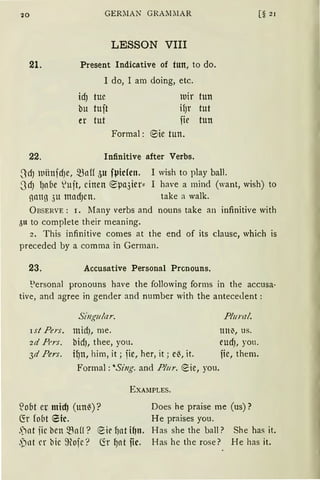
22.
1 do, I an.1 doing, etc.
idJ tue
bu tuit
er tut
luir tun
ifJr tut
fie tun
Formal : ~ie tun.
Infinitive after Verbs.
3dJ lllilnfd)e, -~Mf öU fVicfcn. 1 wish to play ball.
[§ 21
~d) l)nbe luft, einen ~µa3ier:: I have a mind (want, wish) to
gang 3u mndJen. take a walk.
Ü BSERVE: 1. Many verbs and nouns take an infinitive with
3n to complete their meaning.
2. This infinitive comes at the end of its clause, which is
preceded by a comma in German.
23. Accusative Personal Prcnouns.
"?ersonal pronouns have the following forms in the accusa·
tive, and agree in gender and number with the antecedent:
ist Pers.
zd Pt'rs.
3d Pers.
Singular.
midJ, me.
bidJ, thee, you.
i~n, him, it; fie, her, it; e~, it.
Formal: 'Sing. and Plur. ~ie, you.
E XA!IPLES.
Plural.
lttt~, US.
eudJ, you.
fie, them.
:1obt er micfJ (un~) ?
fü fobt Eie.
Does he praise me (us)?
He praises you.
.')nt iic ben ~nfl?
,pot er bic 9tofe?
~ie f)at i~n. Has she the balI? She has it.
~r ~at fic. Has he the rose? He has it.
§ 24] LESSON VIII
24. Dative Personal Pronouns.
Personal pronouns have the following forms in the dative2
and agree:
Singular. Plural.
ist Pers. mir, (to, for) me. un~, (to, for) us.
2d Pers. bir,.(to, for) thee, you. eud), (to, for) you.
3d Pers. iq_m,(to,for) him. iqr,(to, for) ~er. i9nen,(to,for) them.
Formal: Sing. and Plur. SIJnen, (to, for) you.
NOTE. -The neut. dat. i~m is used only of persons or animals.
EXAMPLES.
@eben ®ie mir (unö) G)efb.
SdJ gebe bir (eudJ) mrot.
®ie fd)enft i~r ein mud).
fü bnut"i~ncn·ein ~nuö.
~r bnut ~~ncn· ein ~au'3.
Give me (us) money.
I give bread to you.
She gives her a book.
He builds them a house.
He builds a house for you.
ÜBSERVE : The German dative fonns are rendered into Eng·
lish by a pronoun simply before the direct object, and by a
pronoun with 'to ' or ' for' after the direct object.
EXERCISE VIII
bcfUd)ett, to visit, call 011.
ber 'Jreunb, friend.
bie Oireunbe, friends.
jaltlofJ(, yes (indeed), 0 yes.
ber ~ärm, noise.
Heben, to love.
bnl) i~nµie'r, paper.
tun, to do.
luarum ? why?
luiinfd)ett, to wish.
lD10Ms: ~cfucl)c macl)cn, to make calls, pay visits.
i!uft ~abcu (3u + infin.), to have a mind tu, want to.
A. 1. '!obt ber ~ef)rer eud) oft, .~Hnber? 2. Sa, er fobt 1111~
oft. 3. '.t'ie 2d)iifer finb aufmertfam unb her ~eqrer fobt fic.
4. Wir Heben unfere '.tante unb bringen if)r oft ~fumen.
5. llnfer matcr ift fe~r giiti~ unb 1uir Heben i9n. 6. ~r
eqiifJft un~ oft ~)(ärdJen unb lnir lJören fie gern. 7. S:iefaft btt
midJ, mein SHnb? 8. .SalllOl)f, idJ Hebe bidJ, matcr. 9· '.t)ic
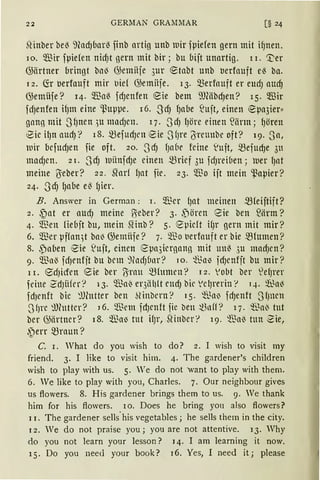
22 GERMAN GRAl11lAR
~Huberbe~ mad)bar~ finb artig unb Dir fpiefen gern mit i~nen.
10. Q."ßir fpiefen nicf)t gern mit bir; bu bijt unartig. l i. [;er
G;ärtner bringt bll~ G;emiiie 3ur ~tabt unb berfauft e~ ba.
1 2. fü berfauft mir llie[ G;emiije. 13. ~erfauft er eucfJ aud)
G;emÜfe? 14· füaß fcf)enfen eie betn i)}(äbcf)en? l 5. füir
fcfJenfen ifJtn eine ~~uppe. 16. SdJ fJabe ~ujt, einen ~pa3ier"
gann mit SfJnen .~u mncfJcn. l 7. S cf) lJöre einen ~iirm; fJören
8ie i1Jn aUdJ? 18. mefUcfJl'll 8ie s(Jre {S;reunbe oft? 19. Sa,
Dir befUdJen fie oft. 20. ScfJ l)a6e feine ~uft, mefud)e 3tt
macfJen. 2 I. ScfJ UÜnfdJe einen mrief 3u fcfJrei(1en; uer l)at
meine ßieber? 22. Sforf fJat fie. 23. 5illo ijt mein ~apier?
24. S'cfJ 1Jabe eß fJier.
B. Answer in German: i. $er {Jat meinen mfeiftift?
2. ~at er aUdJ meine ßeber? 3· ~ören eie ben füirm?
4. 5illen fiebjt bu, mein SHnb? 5. epicft ifJr gern mit mir?
6. füer pffan~t bal) G;emüfe? 7. ~Tio t1erfauft er bie -~Humen?
8. ,pa(1en eie ~Ujt, einen (?pa3iergann mit Ullß 3U macf)Cn?
9. $a'3 fcfJenfjt bu bem 9~llcf)Ünr? 10. ~l.~n~ jd)cnfjt bu mir?
l I. 8cfJicfrn eie ber 15iraU mfltlllell? I 2. 'Obt ber 'ef)l'{'l'
feine ~dJiifer? i3. ~ai' er3iihlt endJ bie Vel)rerin '! q. ~a(
fdJenft bic ~))Cutter ben ~cinbcrn? 15. 'füa~ fdJenft 3fJUCU
SfJre ~Jhttter? 16. $em fdJenft ;tc bett ~nff? 17. ~"Sai3 tut
ber G;ärtner? 18. ~a~ tut ifJr, SHnber? 19. ~Tia~ tun 2ie,
.~err mraun?
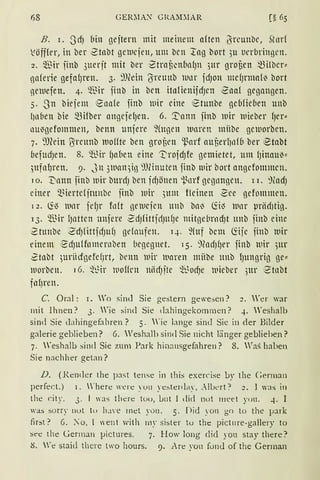
C. I. Vhat do you wish to do? 2. I wish to visit my
friend. 3. I like to visit him. 4. The gardener's children
wish to play with us. 5. We do not want to play with them.
6. We like to play with you, Charles. 7. Our neighbour gives
us ftowers. 8. His gardener brings them to us. 9. Ve thank
him for bis flowers. lO. Does he bring you also flowers?
11. The gardener sells.his vegetables; he sells them in the city.
12. We do not praise you; you are not attentive. 13. Why
do you not learn your lesson? 14. I am learning it now.
15. Do you neecl your book? 16. Yes, I need it; please
§ 25] LESSO)l" IX 23
bring it to me. q. Do you hear me? 18. Yes, I hear you
quite well.
D. ?efeftiicf:
~Cm ,Pau~ ift ein (förten,
'Va bin idJ fo gern!
'Da ruf' idJ unb fing' icf),
So fnut e~ nur gefJt :
't'a Qiipf' icf) unb fµring' idJ
Um 5Baum unb um 5Beet;
Sm G;arten, im @arten,
~a bin id) fo gern!
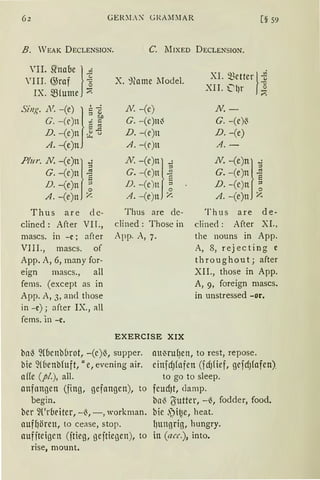
LESSON IX
25. 9Jlein Model and Possessive Adjectives.
Jlfasc.
N. mein
G. meine~
D. meinem
A. meinen
SINGULAR.
Fon.
meine
meiner
meiner
meine
PLURAL.
Neut. All Genders.
mein meine, my
meine~ meiner, of my
meinem meinen, (to, for) my
mein meine, my
-RnrARKS: 1. Thus are declined the possessive adjectives :
mein, my. fein, his, its. unfer, our. -S'Qr, your.
bein, thy. ifJr, her, its, their. euer, your.
Also, ein, a, one (sing. only) ; fein, no, not any.
NOTE. -ltnfer usually drops c before final-m or -n (nnferm, unfern).
2. Observe the correspondence between the pronoun of ad-
dress and the possessive :
':l;u fernft bcine 2Cufgnbe.
SfJr lernt eure ~{ufgabe.
eie fernen <J~re ~ufgabe.
Vou learn your lesson.
You learn your lesson.
3. Observe also the correspondence for the third person,
especially for fein and if)r, of inanimate objects:
'.t)iemhnne tlerfierti~re O:arCie. The flower loses its colour.
~a~ G;ra~ berfiert fcine O:arbe. The grass loses its colour.
~ie fJat i~ren .~ut. She has her hat.
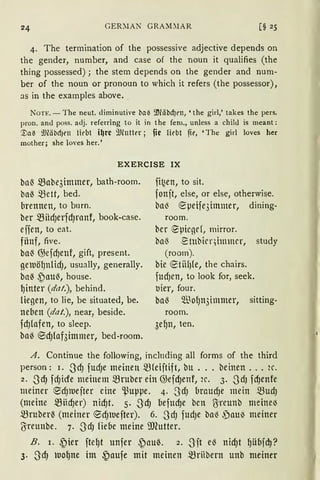
GER:'lAN GRAM~lAR
4. The termination of the possessive adjective depends on
the gender, number, and case of the noun it qualifies (the
thing possessed); the stem depends on the gender and num-
ber of the noun or pronoun to which it refers (the possessor),
as in the examples above..
NoTE. - The neut. diminutive ba~ ~läbd)rn, 'the girl,' takes the pers.
pron. and poss. adj. referring to it in the fem., unless a child is meant:
'.Vatl iJJläbd)t'll liebt i~re 9Jluttt'r; fie fübt fit', 'The girl loves her
mother; she loves her.'
EXERCISE IX
baß mabe3immer, bath-room.
baß ~ett, bed.
brennen, to burn.
ber miid)erfd)ranf, book-case.
effen, to eat.
fiinf, five.
baß @efd)enf, gift, present.
geluölJnlid), usually, generally.
baß ~au6, house.
~inter (dat.), behind.
liegen, to lie, be situated, be.
neben (dat.), near, beside.
fdJlafen, to sleep.
ba6 ®d)fof3immer, bed-room.
fi~en, to sit.
fonft, else, or else, otherwise.
ba~ epeife3immer, dining-
room.
bcr ~picgd, mirror.
ba~ ~tubicqbnmcr, study
(room).
bie etfüJ{e, the chairs.
fUdJen, to look for, seek.
t1ier, four.
ba6 5ffio{Jn3immer, sitting-
room.
3e~n, ten.
A. Continue the following, inclnding all forms of the third
person: I. -3dJ fUd)e meinen mfeiftift, bU ... beit1en ... 2C.
2. -3d) fd)tcfe meinem mruber etll @efd)enf, 2C. 3· -3dJ fd)enfe
meiner ~d)IUefter eine '.ßuppe. 4. -3dJ braUd)e mein mud)
(meine mnd)er) nid)t. 5· -3dJ {1efltd)e bcn ßireunb meine~
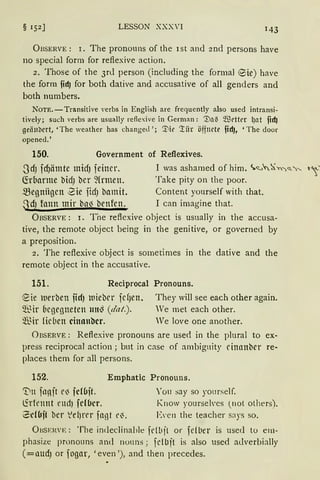
mruberß (meiner ®d)lllefter). 6. -3dJ fUd)e ba~ ,)au~ meiner
(Sreunbe. 7. -3dJ liebe meine ~.mutter.
B. i. ~ier fte~t unfer ~auß. 2. -3it e6 nid)t ~übfd)?
3. -3d) nrn~ne im ~aufe mit meinen mrHbern unb meiner
§ 25 ] LESSON IX
®d)h.lefter. 4. llnfer Q3ater unb unfere ffilutter rool)nen aud)
im ~aufe? 5. llnfer ~au~ l)at nur 3el)n ßimmer unb eine
srnd)e. 6. Wir fi~en getuölJnfidJ im WofJn3immer. 7. '!ßir
effen im ®peife3immer unb fdJfafen in unfern ®d)faf3immern.
8. 'Daß 8tubier3immer meine~ ~ater~ ift grofi ttnb fd)ön.
9· (h arbeitet je~t llt feinem 8tUbteqintmer. IO. eeine
mHdJer ftet1en im ~iid)erfd)ranf ober liegen auf feinem 0d)reib ~
t.ifd). 11. Sm ®inter brennt immer ein O:ener im .ßimmer.
12. 'Va~ ~attß lJat fünf 8dJfaf3immer. 13. Sm 8'dJlaf"
3immer meiner ~mutter ftel)en il)r mett unb uier ~tül)fe.
14. '.Die 1Jenfter HJre~ ßimmer~ finb grof3 unb mad)en e~ l)eU.
15. 31Jr epiegel ftel)t nd1en bem ?ienfter. 16. 't'a~ mnbe"
3itmner ift ne6en brm edJfnf3in11ner meine~ ~nter~. 11..Din"
ter bem .paufe ift ein @arten. 18. ~a[len 8ie aum einen
G;arten lJinter SlJrcm .)aufe?
C. Answer in German, introducing possessive fonns where
possible: 1. 5ffia6 fud)t ~arl? 2. 5ffiem fd)icfen 8ie ein
@efd)enf? 3· 5ffieffen mnct)er braud)en ®ie? 4. ®en be:::
fud)en Sie? 5..~Jft ba~ Sf)r .pau~? 6. Wer luol)nt in
SfJrem ,Paufe? 7. 5ffiie uiefe ßimmer lJat 31Jr ~au~?
8. 5ffio arbeitet 3fJr ~err Q3ater? 9. 5ffio ift fein ®tubier"
3immer? 10. Wo finb feine mud)er getuöl)nfidJ? 11. 5ffia~
fügt fonft auf feinem ®d)reibtifd)? 12. $u~ fügt auf
3~rem ~ifd)e? 13. 5ffio ftel)t ber ®piege{ 3fJreß mruber~?
14. 5ffie!d)e6 ßimmer ift grof3 unb fJeff? 15. 5ffieffen @arten
ift baß? 16. 5ffio ift ber @arten beß 9Cad)barß?
D. 1. That is my house. 2. Your house is quite pretty.
3. I live here with my wife and our two children. 4. The
sister of my wife lives here also (also here). 5. She is the
aunt of my children. 6. My house has only ten rooms.
7. The children sleep in a room beside my wife's bedroom.
8. Our children are small and they sleep in one bed. 9. In
their room [there] are also two chairs and a table. 1 o. Their
26 GERllAN GRAl11lAR
table stands near the window. l i. I work usually in my study.
l 2. My wife likes to sit there beside me. l 3. Our c~ildren
pl~y in the garden behind the house. 14. My neighbour's
children are playing with them. 15. What is the girl doing?
l 6. She is playing with her dog. q. Is the boy playing with
the dog? 18. No, he is playing with bis ball. 19. My chil-
dren like to play with our neighbour's children.
E. ?efeftilcf:
'.Die ®onne gefJt 3ur ffiufJ',
mom ~elbe fommt bie SlttfJ
llnb aUd) bie ed)lif(cin aH3uma{,
e;ie freu'n ftd) fd)Oll llttf ifJrcn etaff.
-3m ~attm bn finßt fein ~~oßcf mclJr,
~ie bunffe ')fodJt 3icfJt fcfJncl! ba{Jcr,
.~falb wirb bcr '))(onb am ~immei ftefJn,
-3dJ benf, '~ ift ßcit 3u ~ett 3u gefJn !
@ut' llfod)t ! G;ut' 9(ad)t ! ~!uf füieberfelJn !
LESSON X
26. Imperfect Indicative of fcin and {)abctt.
I was, etc. I bad, etc.
idJ luar lnir luaren idJ fJntte wir 9ntten
bu wnrft il)l" luart bu 9attcft il)l' lJattet
er luar fie luaren er fJlltte fic {Jatten
Formal : ®ie luaren. Formal: ®ie {Jnttcn.
27. Imperfect Indicative of mod)cn, to make.
I made, was making, did make, Was I rnaking? did I make?
id) mad) tc
bu madJ tcft
er madJ tc
Formal:
etc.
luir madJ tcn
ilJr madJ tct
fie mndJ tcn
®ie madJtcn.
etc.
mndJtC idJ? ntlldJten luir?
madJtcft bu? madJtet ilJr?
mad)te er? madJten fie?
Formal : madJten ®ie?
LESSON X
ÜBSERVE : A !arge number of 'erbs (called 'weak ') form the
imperfect indicative like mad)ell, but infinitive s·tems ending in
-t, -ll, or consonants after which t cannot be pronounced, in-
sert e between stem and ending (ad1eitcte, regnete, ~c.).
28. Strong Imperfects.
'9ingen, to sing. 5.ßleiben, to remain. '.tun, to do.
I sang, etc. I remained, etc. I did, etc.
id) fang id) bfieb icf) tat
bu fang ft bu bfiebft bu tnt ft
er fang er bfieb er tat
luir fangen luir bfieb en tuir taten
i~r fangt if)r bfübt il)r tntct
fie fangen fie ufieben fie tntcn
ÜBSERVE: 1. lIany verbs (called 'strong ') form the imper-
fect indicative by changing the stem vowel, without aclding a
tense ending.
2. The person endings are the same as in other verbs.
NOTE. -The impf. indic. of such strong and irregular verbs as are used
in the exercises will be given, for the present, in the vocabularies.
29. Adverbial Accusative.
~r ltlar biefen ®ommer fJier. He was here this summer.
6'.r tuar einen 9Jlonat fJier. He was here a month.
'.Va-3 ~Ucf) foftete einen ~offar. The book cost a dollar.
ÜBSERVE : Time and price are usually expressed by the
accusati'e.
30. Word Order.
.SdJ fJa(1e fJeute fein G3efb.
[)(ein metter ift f)ettte f)ier.
~eute ift baß Wetter fdJön.
.Sm ~arten ftel)t ein mmtm.
I have no money to-day.
lIy cousin is here to-day.
The weather is fine to-day.
A tree stands in the garden.
ÜBSERVE: 1. Adverbial expressions of time precede noun
objects and other adverbs.
GERllAN GRA~lMAR [§ 3c
2. When any rnernber of a principal sentence other than
the subject precedes the verb the subject cornes after the verb,
which is the second idea in a principal assertive sentence.
EXERCISE X
n'ntluorten, to answer, reply.
balb, comp. elJer, soon.
beginnen, begann, to begin,
commence.
bleiben, bfieb, to rernain, stay.
bann, then.
ber '.tloffar, dollar. ·
crrcid)en, to reach.
frifdJ, fresh, cool.
friif)er, earlier, forrnerly.
neben, gafl, to give.
nef)en, ging, to walk, go.
ncftern, yesterday.
ber G;ott, God.
bie ,Panb, hand.
ber 51ned)t, rnan-servant, la-
bourer.
bie 51ned)te, labourers.
foften, to cost.
lange (adv.), long, a long
time.
bie lieber, songs.
nadJ (dat.), after.
neulidJ, lately, the other day.
O(Jne (acc.), without.
ber ~HegenfdJirm, urnbrella.
fagen, to say, teil.
fclJen, faf), to see.
fingen, fang, to sing.
bie 2tunbc, hour.
ber $nlb, forest, wood(s).
luamt? when?
uciter (adv.), further, along,
on.
baß $etter, weather.
UOI)in? where (to)? whither?
uunberfdJön, very beautiful.
3u ,Pauie, at horne.
A. 1. 9Ceu1id) mad)te icf) einen epa3iergang mit einem
11reunbe. 2. fü IJatte einen ~tod in feiner ,Panb unb idJ
f)atte meinen 9legenfd)inn. 3. 'l)a6 füetter Uar fdJön unb bie
~uft frifdJ. 4. „-3it eß nid)t fdJön unter @otteß 3)immel ?"
fagte id). 5. „Saluof)l !" antluortete mein l}ireunb, „e~ iit
luunberfd)ön." 6. Wir gingen ueiter unb faf)en lia(b einen
~1arten. 7. -3m @arten n:iaren SlnedJte. 8. ®ie arbeiteten
fe~r fleiüig. 9. ®ie µffan3ten ~lumen unb @emiije. rn. Wir
fnl)en aud) ein .f)au~ neben bem G3arten. i 1. ,')inter bem
3)aufe ltJar ein füalb. 12. -3n bem ,Paufe uo(Jnte ber @ärt::
§ 30] LESSON X
ner mit feiner ~rau unb feinen SHnbern. 13. '.Die ~rau be~
@ärtner~ fdJenfte un~ mrumen unb wir banften il)r. 14. ®ir
bfieben eine ®tunbe im ®afbe {)inter bem @arten unb mein
~reunb fang ein füeb. 15· '.Dann gingen luir nadj ~aufe.
16. ~~ begann 3u regnen unb luir braudJten ben ~Hegenfcflirm.
17. ~fodJ einer etunbe erreidJten ll1ir unfer ~au~ in ber
®tabt.
B. Continue: 1. @eitern lUllr hfJ nidJt fJier, ... bu, 2c.
2. SdJ fJlltte meinen ®tocf, bu ..• Deinen, 2c. 3. U:riifJer
lt10fJnte id) in ber ~tllbt. 4· .JdJ arbeitete eine etunbe.
5. SdJ bfieb eine ~tunbe im ~1.Mbe. 6. .J'dJ fano t1iefe t'ieber.
7. SdJ ging geitern 3ur etabt. s. '„mein 9egenfdJirm foitete
einen 1)offor, bein, ~c.
C. Answer: 1. Wa~ tat idJ neufidJ? 2. ~~er ging mit mir?
3. Wie Uar ba~ Wetter? 4. $er ar6eitcte? 5. Wo?
6. $effen .~au3 fa~en luir? 7. $er luof)nte mit ifJm? 8. Q.~o
luar fein .~au~? 9. $ai fdJenfte un~ bie (-rau? 10. Wll~
luar {)inter bem @arten? l 1. Wie fange waren wir ba?
l 2. Wa~ tat mein ~reunb? 13. m3a~ taten lnir bann?
q. mraudJten lUir ben ~fügenfdJirtll? 15. $of)in gingen lUir?
l 6. füann erreidJten luir unfer {)au~?
D. 1. I visited rny friend Schäfer yesterday. 2. I said to
him: "Do you want to take a walk with rne ?" 3. "No," re-
plied he, "I do not want to take a walk to-day, I am not quite
-..vell." 4. Then I went without hirn. 5. He remaine<l at home.
6. The weather was not ,·ery fine, but it was not raining. 7. I
wished to visit a friend. 8. My friend lived in a house near
the wood. 9. His house had a garden. 10. His gardener was
working in the garden with the man-servant. l 1. He was
planting cabbage and cauliftower. l 2. The gardener's wife
was picking ftowers. i:3. My friend gave me the ftowers.
14. I remained an hour in his house. 15· His wife played
an the (auf bem) piano, and sang rne a song. 16. I thanked
GERl1AN GRAMMAR [§ 31
her for the song. 1 7. Then we took a walk in the woods
behind his house. 18. After an hour I went home again.
19. lt began to rain, and I needed my umbrella.
LESSON XI
31. '!'iefer Model.
SINGULAR. PLURAL.
.Alasc. Fem. Neu/. All Genders.
N biefer ·biefc bief e~, this bief e, these
G. biefe~ biefer bief e~, of this biefer, of these
D. biefcm bief er • biefem,(to, for) this bief cn, (to, for) these
A. biefett biefe birfe~, this birfc, these
RElIARKS: 1. In the same way decline jener, 'that' (yonder);
jeber, ' each,' 'every ' ; 1ucfd1er? ' which?'
NOTES.- I. ~iefer is commonly used for that,' as well as for 'this.'
2. The unchanged bie~ (also jme{l and uddje{I ?) is used, like ·ba~
(§ 8), before fein:. ~ie~ ift 1i1d11e ~d)tieftcr, 'This is my sister ';
Wcfd)e~ finb meine ~iid)rr? 'Which are my books? '.
2. Thus also the short forms of the po~sessive pronouns :
meiner, mine. feiner, his, its. unf(e)rer, ours.
beiner, thine. , ifJrer, hers, its, theirs. eurer, yours.
.3f)l'er, yours.
Further, einer, one; feiner, none.
NoTE. -The contracted forms mein~, bein~, feint, ein~, fein{I, are
often used in the nom. and acc. neue. sing.
32. Use of Possessive Pronouns.
.ScfJ qabe meinen 4'ut; er qat
feinen; fie qnt ifJ~en.
5ffiir qnben unfere mncf)d unb
eie f)nben zrfJrC.
'.Diefer ~ut ift mein(er).
I have my hat; he has his;
· she has hers.
'Ve have our books, and you
have .yours.
This hat is mine.
LESSON XI 31
ÜBSERVE : 1. The possessive pronouns correspond with their
antecedent like the possessive adjectives (§ 25, 4), but their
case depends on their relation in the sentence.
2. When used as predicates, they may also have the unin-
flected forms mein, bein, fein, 2c.
EXERCISE XI
ber ~(benb, evening.
an (dat.), on, by, at.
auf ~ejud), on a visit.
auf bem ~anbe, in the country.
bie ~(u~jid)t, view, prospect.
bei (dat.), at, near, by.
bei uni?>, at our house.
be1uunbern, to admire.
fal)ren, fttf)r, to go (in a
vehicle), drive, etc.
bie (Ye'rien (pl. only), holidays.
{Jeute, to-day.
bie Snfd, island.
ber Sfo{)lt, row-boat, canoe, skiff.
bal3 1anbf)attl3, country-house.
ber :1J(o'nat, month.
bn~ :))(otoruoot, motor-boat.
ber :2'ee, lake.
fi~en, faf3, sit.
fo, as, thus.
bal3 llfer, shore, bank.
bie mernnbn, veranda.
t1erbringen, tierbradJte, to
spend, pass (time).
tion (dat.), of, from.
bal3 Waifer, water.
bie ,Beit, time.
A. 1. iBo t1crbrndJtcn 2k biefrn Zom11H'l' bie (Yerirn?
2. ®ir t1rrbrndJtcn unfcre nuf bem Vnnbe ; 1110 uerlJracfJtcn 8ic
S fJre? 3. ~qr uerbrndJtcn unfere nn einem i0ee. 4. llnfer
S!anbfJau~ ftefJt auf einer Snfcf in biefem ~ee. 5. ~in !}ireunb
meine~ materl3, .perr 9J(iiffer, fJat audJ einl?>, aber feinl?> ijt nidJt
auf ber Snjef, e~ ftd)t nm llfer be~ e:ee~. 6. Wie t1er6racfJten
eie bie ,geit? 7. ~Tiir t1er6rnd)trn fie ne1uöl}nfidJ auf bettt
Waifer. 8. SdJ lJatte ein :l)(otorl1oot unb meine ß-reunbe
l)atten aucf) einl3. 9. J'lJrel3 111ar gröf,er af~ meiM. lo. ilJCein
~reunb fübert war bei un~ auf ~efttd). 1 r. Seber IJon ttn13
fJatte einen stnf)n. 12. 8einer 1unr nidJt fo grou 1uie meiner.
13. Wir ful)ren jeben '.rng auf bem $nffer. 14. fü fufJr in
feinem SlalJne ttnb idJ in meinen• 15. Seben ~((ienb fof;en
32 GERllAN GRA~IMAR [§ 32
luir auf unjmr Q.3ernnba unb beluunberten bie ~{ußfid)t.
i 6. 2o nerbradJten wir einen 9Jlonat fefJr angenefJm.
B. Fill in the blanks with a suitable word or words of the
biefer model: I. 9JCein 9egenfdJirm fojtete einen 1no1far; luie
tiief fojtete ... ? 2 • .Jit -3fJre U:eber fo gut wie ... ?
3. '.Dieje~ -fütd) ijt ... ; luefdJe~ ift ... ? 4. SJRein 5Bater
iit ii{ter af~ . . . 5· 3dJ f)abe fein ilJCeifer; (Jaben eie ... ?
6. ,Paben :Sie einen mreijtift? .JdJ (Jabe . . . 7. ill(ein
~feijtift ijt ffeiner am . . . 8. _Jf)r mreiftift iit ffeiner
af~ . . . 9. $efdJer ~ut ijt gröfier, ... ober ... ?
10. ~'ßo iit ein ®tocf? .)ier ift ...
C. Answer, using pronominal forms: 1. ,f)at ,~err 9J(iiffer
ein .lanbfJaU~? 2. ~lMdJe~ s:ianbl)ntt~ ijt fdJöner, biefe~ ober
jene~'? 3. $eifen 9Jfotorboot ijt gröf,er? 4. $effen ijt
ffeiner? 5. ~'ßefdJe~ ilJ(otor6oot bewnnbern eie? 6. ßu~r
fein ~a1Jn fdJneHer am beiner? 7. $eifen SfofJn brnud)ten
fie geftern? 8. 'ffiefdJen SfofJn brmtd)en wir fJeute, biefen
ober jenen? 9. ~(uf luefdJer 5Beranbn fnf,en ~ie? ro. 'illeifen
ßrcunb iit fübcrt? 1 r. einb biefe mHdJer mein? 12. $eifen
mfeijtift ift bie~?
D. r. Has your father a country-house? 2. Yes, he has
one. 3. 'here is his country-house? 4. lt is (stands) on
(an) the shore of a lake. 5. lIy father's friend, l1r. Müller,
has also one. 6. His is beside ours. 7. His honse is larger
than ours, but ours is prettier than his. 8. Here we passed
our holidays this summer. 9. Vhere did you pass yours?
ro. I passed mine on an island in the lake. i 1. My friend
:l!Jert Schäfer visited me there. 12. Each of us had a canoe.
1 3. Which canoe went (fafJren) faster, yours or his? r4. His
Vent faster than mine. I 5. Ve went on the water every day,
or took a walk on the shore. 16. The view from our veranda
was very fine. 17. Ve often sat there and admired it.
18. Thns we passed the sumrner very pleasantly. 19. After a
month we went (fa{Jren) to the city with my father and mother.
LESSON XII
E. ~efeftücf:
'X)u oift uie eine 5Slume
0o ~ofb unb fd)ön unb rein;
-3dJ fd)au' bidJ an, unb We~mut
~d)feidJt mir in~ ~eq {Jinein.
9Jfü ift, af~ oo idJ bie ~änbe
~(uf~ ,Pnuµt bir (egen foHt',
metenb, bafi G;ott bid) er~afte
®o rein unb fd)ön unb lJolb.
LESSON XII
Review Lessons VII-XI.
EXERCISE XII
-~eine.
33
bitten, bat, to request; ask for
(um, acc.).
ber 0urft, thirst.
burftig, thirsty.
ba~ ill(iitterd)en, mother dea;..
oben, at the top, above.
reidJen, to pass, hand.
entfdinlbinen, to excuse.
bie (Sinmi'lic, family.
ba~ 6riinlein, young lady, lIiss.
bie (~nl.Jd, fork.
bie <~nl.Jeln, forb.
bie Sfortoffef, potato.
bie .Qartoffefn, potatoes.
fommcn, fam, to come.
lcib tun (dat. of pers.), to be
sorry.
lieoer, rather.
ber löffef, spoon.
bie 'öffef, spoons.
bie ~lJlnnb, rnaid.
bic ~l)füdJ, milk.
rid)tig, right, correct.
fdJeinen, idJien, to seem.
fdJmecfen, to taste.
fdJneibrn, fdJnitt, to cut.
ber 2'µarge1, asparagus.
fµät, late.
ber <teffer, plate.
bie 'reffer, plates.
bie llfJr, clock, watch.
um (aff.), around, for.
unten, at the bottom, below.
Wil~elm, William.
,;ur ~d)ufe, to school.
3uei, two.
3uifdJen (dat.), between.
34 GERMAN GRA:D1AR [§ 32
ImoMs: r. ~d) ~nbc ~urjt (bin bnrftig), I am thirsty.
2. ~~fdJmecft mir, I like (the taste of) tbat.
3. :JdJ cife lieber, ~C., I would rather eat, I prefer, etc.
4. ~icfc lt~r ge~t rtdJtig, This watch is right.
5. :JdJ bnufc, No, thank you.
A. i. '.Uie l5amifie fi~t am ~ifdJe. 2. D(1eu fit2t ber mater,
unten bie 9Jhtttrr, .)luifdJrn ifJnen fit3en bie Slinber. 3. llnfer
~~nter fd)neibct utt~ bn~ ~·(eifdJ. 4. Cfr fdJneibet el3 mit einem
9Jfrifer. 5. ~Jir eijrn t1on ttnferrn lclfern. 6. -S'eber t1on
un~ fJnt einrn leffer, ein 9)(cjjer, eine ()h1Lief nnb einen S!öffeL
7. 9Jeein 9füjjer ijt frfJnrf. 8. 5[~iffJdm fJat ancfJ eht13, aber
fein~ ijt nid)t fo fc~t1rf wie meinl3. 9. 9füilt13 ijt fd)ärfer afl3
fein~. 10. '.t'ie :1J(ngb rcictJt ben fünbern bal3 @emiife.
II. $ir fJaÜen f1eute Sfortoffefn uub eparnef. 12. $finfd)eft
bu epar13cf, mein -Sttnge? 13. _Jcf) banfe, 9föitterd)en; er
fdJmecrt mir nidJt. 14. -S'lfJ effe fir6er startoffdn. 15. Wa~
iuiinfdJe jt bu, mcrtfJa? 16. -S cf) üitte um 9JWdJ ; icfJ fJabe
'.Unrft. 17. 6'.13 ift jet~t ,8eit, 3ur 2dJufe 3u gef)en. 18. @eftern
fomcn luir fpiit. 19. ~ie 1
dJrerin fdJicn böfe 3u fein. 20. $ir
fankn: „Ci~ tut tlll~ kiti, l=rliu(ci11 ~rnun; unfcre llfJr ge~t
11ir1Jt ridJtin." 2 1. ~trnn rntfrlJulbinte fie un~.
.H. Oral exercise on the abo·e.
C. Continue the following : r. -SdJ fi~e (fnü) am '.!ifcfJe, bu,
~ c. 2. -S cfJ frfJncibe 6feifcf) mit einem 9füifer. 3. -S'dJ f)a be
(fJatte) feincu 'reifer. 4. -SdJ fom fpät 3ur 8dJufe. 5. .J'dJ
reidJe (reidJte) ben .Qinbern bic Rnrtoffdn. 6. -S'dJ fJaoe (f)lltte)
'Vurjt. 7. -SdJ cntfdJufbi13e (cntfdJufbi13te) bie srinber. 8. 6'.13
tnt (tat) mir feib, e~ .•. bir, ~r.
D. 1. The chil<lren were sitting at the table with their father
and mother. 2. Their father cut the meat. 3. He cut it with
a knife. 4. Each of them had two knives, two forks, and two
spoons. 5. Charles' knife was sharp; it was sharper than
Villiam's. 6. William's knife was not so sharp as his. 7. The
§ 33J LESSON Xlll 35
maid handed each child the vegetables. 8. They had potatoes
and asparagns. 9. They like potatoes and asparagus. 10. lIary
was thirsty, and her mother gave her milk. r 1. Yesterday the
children were (came) late to (the) school. 12. Their clock was
wrang. 13. Ours is always right. 14. 'Their father and mother
asked the teacher to excuse them.
E. tiefeftiicf:
33.
<Li jd7gcbet.
(0peife, mater, beine ~inber,
~röitc bie betrübten ®Hnber,
®prid) ben ®egen 3u ben ~aben,
~efd)C uir jct~t 1.1or uul3 fJaben,
'.Dafi fie unl3 3u biefcm ?eben
®tärfe, ~raft unb 9ealJrung Aeben.
- SolJaHn ~emnan.
LESSON XIII
Strong Declension of Nouns.
I. ber ~unb, <log. II. ber So~u, son.
Sing. Plur. Sing. Plur.
N. ber ~)unb bie .puttb c ber ®olJr~ bie ®öf)ne
rr. bel3 .f)unb(c)~ ber fmnbc
D. bem f)ttnb(c) ben ,)unbcn
4. ben 4/unb hie ~)unb c
bel3 ~of)n(e)§ brr e;MJnc
bem ®olJn(c) ben ®öl)ncn
ben 8olJn bie ®ö~n e
III. bie .panb, band.
Sing.
bie .1lltlb
bn .)nnb
ber .)anb
bie .)attb
Plur.
bic f)iinb c
ber .')iinb c
ben .)iinb l'tt
bie ,')iittb c
Non:. - For classes of nouns so cleclined, see Lesson XIX.
R E.lIARKS : 1. These three moclels are rnerely variations of
the same type of noun cleclension (called the prinnry form of
the ' strong declension ').
GERMAN GRA:IMAR [§ 34
2. Feminines are invariable in the singular; masculines and
neuters take -c~ in the genitive and -c in the dative singular.
NoTES. - I. The C of the gen. and dat. sing'. is usual in monosyllables,
ess so in polysyllables, but Cof the gen. is always retainecl after final~ sound.
2. The c of the dat. sing. is omitted when a prep. immediately precedes:
an~ .l)ot,, 'of wood '; but exceptionally, 311 .l)anfc, naci, .l)aufc.
3. Nouns in -ni~ double the last consonant before an encling: 5Scjorg~
ni~, 'anxiety,' gen. sing. ~eforgniffctl, nom. plur. 5Scforgniffe; so also
t =ff after short stem vowel: ß=fn~, 'river,' ~htffctl, ß=tiiffc.
3. All a<ld -c in the plural with additional -tt in the dative.
4. liany mascnlines with stem-vowel a, o, u, 1111, and all femi-
nine monosyllables of this moclel, take umlaut in the plural.
34. Essential Parts. By observing the case forms which
are identical, the full declension of any noun may be inferred
from the nominative singular, genitive singular, and nominative
plural, which are given in the dictionary for this purpose.
35. Compound Nouns. In compoun<l nouns the last com-
ponent only is <leclined; they usually follow the gender of the
last component:
Nom. Sing. Gen. Sing.
ber ,~lrnbjdJUf), glove. be'3 ,~anbfdJttf) (c)~
ber Dflftbaum, fruit-tree. be{ Dbftflaum (c)~
Nom. Plur.
bie .panbfd)ufJe
bie Dbftbäumc
NOTE. - Compounds with -mann have as plur. -männcr (indivicluals or
occupations), or -tcntc (collectively): etaatilmänncr, 'statesmen ';
fönbtcntc, 'country-people.'
36. Rule of Gender. lIost nouns in -id), -ig, -ing, -fing, and
foreign nouns in -111, -1111, -11r, -icr, -or are masculine.
EXERCISE XIII
1V.B. The gen. sing. fern. is not gi·en, being the same as the nom.
ber ~(rm, -(e)i, -e, arm.
ber %·3t, -e~, ue, physician,
doctor.
{1efommen, befom, to get, re-
ceive.
bringen, brndJte, to bring.
§ 36] LESSON XIII 37
ber ~lni3, -c{I, "e, river.
ber ßufi, -ei3, "e, foot.
ber.~anbfdJHlJ,-(c)i3,-e, glove.
baö .~cu, -(e){5, hay.
baö SnlJr, -(c)i3, -c, year.
ber ~opf, -(c)i3, "e, head.
bie .QulJ, !!c, cow.
nitt~licf), useful.
ber Dbft6amn, -(c)i3, !!e, fruit-
tree.
ber ,Cffi3ic'r, -(c)i3, -c, officer
(military).
ba{I i.~ferb, -e{I, -e, horse.
prlidJtig, splendid, magnifi-
cent.
bni3 ~cf)nf, -(e){I, -e, sheep.
bn{I ~d)iff, -(cH, -e, ship.
jicflen, seven.
baö '.tier, -(e)~, -e, animal,
beast.
bic ~od)e, -n, week.
3uöff, twelve.
KOTE. - The sign !!. indicates umlaut.
A. 1. Decline in füll without umlaut: ber ~rief, mein ~(rm,
uefdJer '.tag, biefcö Sal)r, fein 5lnedJt. 2. With umlaut: bcr
.~ut, mein etulJ(, biefer ~aum, Udc~er €ol)n, biefe .Quf), ber
Dbjtflnum. 3. Supply the remaining cases of the following,
explaining how they may be inferred from the forms given:
Nolll. Si'ng. 6efdJenf (n.), Gm. -(c){I, P!11r. -c; ~ifdJ (m.),
-ci3, -e; ~opf (lll.), -(c)i3, !!c; Brennb (lll.), -cö, -c; €tabt
(f), -, !!e; ect)nf (n.), -(c){l,-e; ßui3 (m.),-e~,!!e; ~ffi3icr
(m.). -(c){I, -e; 9J(onat (m.), -(c){I, -c.
B. 1. 'Die '2öl)nl' bc{I ~lr3tc~ befttdJcn ifJre {Sreunbe in bcr
etabt. 2. fütf bicfclll etttl)ll' fügrn )Uct ,piitc : meiner ttllb
SlJn'r. 3. ~fücinc ~)nnbfdJHIJC licgrn auf bcm 'J:ifdJt'. 4. ·~a{I
~nn~ mcinc{I ~rcunbc{I jtrlJt nm Ufer be~ ~foffe~. 5. Sn
fcincm (hirtl'll jtcl)t'll 3mci 0bjtliii1lllll'. 6. T'ic ectJiffc fnlJrCll
auf bcn /1liiffe11. 7. t"ic SfocdJtl' brinnrn bcn i-~fnbcn .~cn.
s. ~Iir gclirn bcn 'flcrbcn, brn .1 ii!Jcn nnb bcn 8'tfJnfen ,)rn.
9. T'irjc 'rim jinb tm~ fd1r niit~licfJ. 10. 't"k 'l.~fcrbe bl'r
Dffi3icrc jinb präcfitin. Ir. ~~ir {Jnben 3uci ,piinl:lc, ~llci
ö·üf)c, ,wri fü'mc, aller nnr einen .~opf. 12. Sn jcbem Snl)re
finb 3mölf ~))(onntc. 13. 2icben :tnge mad)ett eine Wocf)e.
GE}{lIAN GRA;llIAR
q. ~Jrf) frf)icfte {JeUte meinem (S·t'CUnbc einen mrief. r 5. J n
biejetn mriefc er3iil)lte idJ if)lll tlOll meinen }ltll'i ,)nnbrn.
16. '.Dicie waren ein Gkfd)enf tion meinem Q..~ntcr. 17. ,,eben
~ag mnrf)e irf) einen 2'pn)icrnang mit meinen .i)nnben. 18. JdJ
befom geitcrn GJefcfJcnfc t1011 meinen f·re1mben. 19. li13 iit
jcl)l' nngendJm, {Yreunbe 3u IJaben 1111b (}kjdJenfe 3u bcfomrnen.
C. Oral exercise on the a!Jove.
D. 1. I received a present yesterday frorn my father.
2. He sent me two dogs. 3. These were quite young and
very handsome. 4. l am very fand of these a11imals. 5. They
take a walk every <lay with me. 6. I get presents often
frorn my father and rny friends. 7. Th::it is very pleasant for
me. 8. l received two letters frorn my frieml Albert to-day.
9. lly brother brought them home. 10. In the::;e letters Albert
told (cr3iHJfcn) rne about (tiott) his holidays. 11. He spent
them in the country. 1 2. His uncle has a house there.
13. His uncle has ma11y animals - horses, cows, sheep, etc.
14. He has also rnany fruit-trees behind his house. 15. They
are large an<l very fine. 16. The house is 011 (nn) the shore
of a river. 17. His uncle has also a ship. 18. lIy friend
used to sail (fufJr) every d ay in this ship. 19. Albert is the
so11 of a physicia11 in this city. 20. His father lives near
(neben) us. 21. lly father and his are friends.
E. Vefcftiicr:
Wu11~rL'l':3 rlud1tfüt>.
ÜJJer nllrn l~Hpfrf11
~Ht ~u l)',
~111 ll llen 'b_qpfd 11
2piirejt b11
förnm einen ~lllld);
'Die ~önl'lriu fc1Jlllei13rn im ~t~nfbe.
~rnnrte nnr, bnl'Dr
~fütfJeit bu nnd).
-G;oetl)e.
§ 39] LESSON XIV 39
LESSON XIV
37 Perfect Indicative of f)nbcn, fVicfctt.
I have had (played, been playing), etc.
id) f)afic gcI)abt (gefpidt)
bu fJait 11cIJnbt (gcfpidt)
er IJat gcIJnbt (gcfpicft)
lltr f)ll{Jen lcf)CT{lt (gcfpicft)
ifJr fJnbt gl'l)nbt (gejpieft)
fie fJnben gcIJaüt (gejpicft)
Formal: ~ic f)nbcn ne9nM (gefpieft).
ÜBSERVE: r. Verbs conjugated with ~abcu form this tense by
adding tiie past participle to the present of ~abcn, as auxiliary.
2. The past participle of weak verbs is usually formed by pre-
fixing gc- and adding -t (or -et after b, t, etc.; see § 27) to the
stem, e.g. fpief:::en, gc:::fµief:::t; arueit:::en, gc:::arucit:::ct.
NOTE. -The past part. of all strong verbs will be given for the present •
in the vocabularies.
38. Use of Perfect Tense.
The German perfect corresponcls to the English perfect, but
also often replaces the English past, especially when referring
to a period recently cornpleted, or to an independent fact:
SdJ {Jnbe el3 gef1ört. I have heard it.
.JdJ fJnbe e'3 gejtern gefJört. I heard it yesterday.
39. Pluperfect Indicative of {Jo6cn, !oben.
I had had (praised, been praising), etc.
idJ f)ntte gcf)abt (gefobt) uir fJntten ge{Jabt (gefoM)
bu lJntteft nefJaM (gefoM) ifJr fJattct gef1abt (gefout)
er fJattc gef)nbt (ßcfobt) fie fJnttcn gefJnM (gefout)
ÜRSERVE: Verbs conjugated with lJabcn form this tense by
aclding the past participle to the imperfect of lJabcn, as auxiliary.
GER;lAN GRA;llLR
40 Word Order in Principal Sentences.
Verb.
(fr iit
'.Ver ~Bater beö ~d)iiferß
S)ier
)Dar
iit
finb
f)tlt
l)eutc nid)t franf.
l)ier.
~er ~~ater bel3 ~dJü(er0.
bic ~1iimne fd)ön.Sm eommer
'.Daö SHnb l)eutc ttid)t t1ief gefpie(t.
ÜBSERVE: I. In principal sentences making a statement,
the verb is the second idea (not necessarily the second word).
2. Any member, except the verb, may occupy the first place.
3. Vhen any member other than the subject precedes the
verb, the subject, with its attributes and enlargements, is
thrown after the verb, and occupies the third place.
4. The auxiliary is the verb in compound tenses, and the
past participle comes last in the perfect and pluperfect.
I
{ NoTEs.- 1. The connectives nnb, aber, ober, benn, do not affect the
word order. 2. The rules of word order are often disregarded in verse.
41. Cardinal Numerals.
1. ein.S II. eff 2I. einunb 3lUan3ig
2. 3iuei I2. 3wöff 22. 3iuei unb 3iuan3ig
3. brei I3. brei3efJn 30. breiüig
4. llicr I4. t1ier3ef)n 40. t1ier3ig
5. fiinf I 5. fünf3clJn 50. fitnf3ig
6. fedJö I6. fed)3efJtt 60. fed)3ig
7. ficben q. fieb(en)3cf)n 70. fieb(en)3ig
8. ad)t 18. ad)t3ef)n So. ad)t3ig
9. neun 19. ne1m3el)n 90. neun3ig
lo. 3el)n 20. 3wan3ig 100. l)ttnbert
IoI. f)unbert(unb)einö I23. f)Unbert(ttnb)breiunb3lUan3ig
200. 3weil)ttnbert 1001. taufenb unb einö
1000. taufenb J ,000,000. eine mwfio'n
I897. ad)t3ef)tt f)ttnbert fieben unb neun3ig, or
taufenb adJt f)unbert fieben unb neun3ig.
ÜBSERVE : 1. The form ein~ is used in counting.
LESSON XIV 41
2. In compound numbers from 21 upwards, the units precede
the tens,and arejoined tothem byunb: 25=fitnf unb 3uan3ig
(Eng. 'five and twenty'); 156=QUnbert fedJI} unb fiinf3ig.
3. ,~unbert and taufcnb generally omit ein before and may
ornit unb after them.
42. Multiplicative Adverbs. They are formed by adding
-mal, 'time,' to the cardinals.
fönmaf; 3weimof; 3e~nmof. Once; twice; ten times.
EXERCISE XIV
bei} ~(benM, in the evening. fojien, fief,, gefojjen, to Ieave,
nbbieren, to ad<l (arith.). let.
'tleutfd)fonb, 11., -1}, Germany. ber ~morgen,-~,-, morning.
ber '1)e3ember, December. he.S 9J(orgen~, in the morning.
hiuibieren, to divi<le (arith.). muftipfi3ieren, to multiply.
burcf) (acc.), through, by. ba~ ~dJaftjafJr, -(e)~, -e, leap-
~nglanb, 11., -~, England. year.
~ngfifd), English (language). bie ®dJfittenfafJrt, -en, sleigh-
fajt, almost, nearly. ride (drive).
finbcn, fanb, gefunbcn, to find. fcf)reiben, fcf)rieb, gefd)rieben,
geben, gab, gegeben, to give. to write.
gefirnt morgen, yesterday fubtrafJieren, to subtract.
morning. tan3en, to dance.
~eute morgen, this morning. tun, tat, getan, to do.
ba~ mergnügen, -~, pleasure.
}DlOlIS: I. föue ed)fütenfa~rt mad)cn, to take (go for) a sleigh-ride
(driYe).
2. ~dJ ~nbe tiicl ~~ergnügen ge~nbt, 1 ha,·e enjoyed myself
very much.
A. Continue: 1. -ScfJ {Jabe ({Jatte) einen ~unh gef)abt, bu
~ait (fJattejt), 2c. 2. SdJ {Jabe(lJatte) meinem ßireunbe einen
mrief gefc{Jrieben, bu .•. beinem, 2C. 3· ~a~ (Jabe icf) geftern
morgen getan? 4. 9(eufidJ lJllbe (f)atte) idJ einen eµa3iergang
gemadJt. 5. ~eute morgen QUbe id) meiner ~.mutter mfumen
gefdJenH. 6. SdJ l)abe ({Jntte) biefe Ql~odJe im G5arten gefpieft.
7. fön~ unh ein~ macf)t 3wei, 3uei unb ein~ macf)t brei (cm.-
42 GERMAN GRAZ! ;L R [§ 42
tinue up to thirty) . 8. ßlueimaf rinl3 ijt 3luei, 3weimaL 3wei
ijt uier (continue up to thirty).
B. Read in German: 2 ma( 11 ijt 2~, 3 ma( 12 ijt 3G, 4
maf 8 ift 32, 5 maf 9 iit 45, 6 ma( 7 iit 42, 7x (mn1) 10 ijt 70,
8Xl1ijt8~, DX12ijt108, lOX JG ijt 100, 11X11ijt121,
12XI:! ijt 1±4. ~föbirren ·~ic 2,;{.!J, :!.5,8!11 unb ~l89,3Jti.
~ubtrnl)iercu eie 27 '763 t1on 31 ,55l. ~l)lu(ti~1fi,)iercn eic
591mit 478. '1)it1ibiercn eie 2,581,f,i-10 burd) 61.
C. r. -3m 1t'c3ember l)aben Wir t1ie( ed)llCC gef)aM.
.z. @ejtern f)al1en wir uief Q.~ergniigcn gelJabt. 3. 'De~ 9J(or„
genl3 fJatten luir eine ed)fittenfafJrt gemad)t unb bel3 ~{(1enbl3
l)atten luir getan3t. 4. ~füin mruber f)at '.Deutjd) gefernt.
5. fü fJat uier -Saf1re in '.UeutfdJfonb grn1ofJnt. 6. ßriifJer fJntte
·er in 6:ngfoub grn1ofJ11t. 7. fö fJat in unferer ed)ufe 0eutfdJ
gefef)rt. 8. rua f)atte er 25 e ·dJiHer. 9· -Sn ~eutfdJflmb
fJatte er (fogfijdj gefefJrt. lo. ®eine '0dJfifer fJaflen t1id t1on
i1)m gefernt. l 1. ~ie finb faft immer ffeifiig unb aufmerfjnm.
12. ~ aben eie meinen mfeijtift gef)abt? 13. mein, td) lJll(lC
if)n fJeute morgen nidJt gef)abt. 14. .JdJ fJatte ifJn in meinem
®tubieqimmer gefoifen. 15. fö' lunr auf bem 'rifdJc, aber jef2t
fügt er nid)t tnef)r bn. 16. ,ScfJ fJabe ifJn ba gefud)t, aber nid)t
gefunben.
D. 1. Ve often went for a sleigh-ride in (the) January.
2 . Yesterday we enjoyed ourselves very much. 3. In the
morning we went for a walk. 4. In the evening we played and
danced. 5. I have been looking for my pencil, b11t I have not
found it. 6. Have you had it? 7. No, bnt it was in your
study this rnorning. 8. lt was on your table. 9. Here it is j I
have found it now. 10. lIy sister is living in Germany now.
l 1. She had lived five years in England. i 2. She hacl been
~eaching German in a school. 13. She had more than thirty
pupils. 14. A year has twelve months. 15. They are called
(fJeifien) January, etc. (see below). 16. Four of (t1on) these
months have thirty days. l 7. Seven have thirty-one days.
§ 43] L ESSO.N XV 43
18. (The) February has usually twenty-eight clays, but in a
leap-year it has twenty-nine. 19. The days of the week are
called Sunday, etc. 2 0. Each week has seven days. 21. The
year has usually three hundred and sixty-five days, but in a
leap-year it has three hundred and sixty-six.
R. Comrnit to memory: ~il' ~monntc bel3 .S nfJrcl3 fi11b:
.Januar, (5c6runr, ~lJliiq, 9lpri'f, 9Jlni, .Su'ni, Sn'fi, 9lugu'jt,
erptcmbcr, 5:'ftober, :'lfot1rmflrr, 1:"qcm6cr.
't'ic <:ra1l' brr ~Od)C finb: e'onntnn, :montng, ~icn~tn!J,
~)(ittltlOd), 't'onncritag, /-rritng, t2onuabettb ober ®nnt~tllJ·
~ic tiier Snf)l'C~3ritcn finb: 6rii1Jli11), eommcr, ,~crujt,
5lliinter.
:N'OTE.-All are masc., and usually require art.; names of months are
rarely inflected.
LESSON XV
43. Strong Declension of Nouns (co11ti1111ed).
IV. tia'3 ~orf, village.
Singular.
N. bal3 '.Dorf
G. be{ '.r'orf (c)S
D. bem 1t'orf(c)
A. bal3 ':L'orf.
Plural.
bie '.tlörf er
bcr 'Vörf er
ben Tiörf crn
bie '.D&rf er
NoTE. - For classes of nouns so declined, see Lesson XIX.
REJIARKS: 1. The singular is after the .Dunb model (§ 33).
2. The '.Dorf modd differs from the ,punb model Ly adding
~er in the plural (11, o, 11, stems always with umlaut), ancl is called
the 'enlarged form.'
V. bcr 9Jlalcr, painter. VI. bcr ~fotcr, father.
Singular. Plural. Singular. Plural.
N. ber ill?afer bie 9J(afer ber matcr bie 5l~ifü,
G. he'3 ilJCakr ~ ber 9)(a{er bc~ Q3ntcr ~ ber 5l~öter
D. hem 9J(nfer bcn 9)(a{cr n brm matcr bcn SBnter n
A. bcn 9nafer bie 9Jlnfcr hen Q3ater bic 5l~öter
44 GERMAN GRAM:IAR
NoTES. - 1. For classes of nouns so declined, see Lesson XIX.
2. Nouns in - lt do not add -lt in dat. plur.: @arten, @ärten.
REJIARK : These models differ from ,~unb and ~of)n only in
the omission of c in the various endings, and are further varia-
tions of the strong declension - called the 'contracted form. 1
44. Rules of Gender. 1. Most nouns in -cf, -er, are rnasculine.
2. Collecti'es beginning with ffic- and ending in -e are gen-
erally nenter.
45. Pres. and Impf. Indic. of fönncn, müffen.
Prcsent. Imp{'Jfect.
I can, am I mnst, have I could, was I had to, was
able to, etc. to, etc. able to, etc. obliged to, etc.
icf) fann icf) muü icf) fonnte icf) muf3te
bu fannft bu nmi3t btt fonnteft bu muf3teft
er fonn er muf3 er fonnte er muf3te
luir fönnen wir miiifen wir fonnten luir muf3ten
H)r fönnt ifJr miif3t if)r fonntet if)r muf3tet
fie fönnen fie miijjen fie fonnten fie muf3ten
EXAMPLES.
-S'cfJ fann fJeute nicf)t fommen.
fü fonnte nicfJt foufen.
~ir miiffen ofeioen.
~ie muf3ten icf)lller nrüeiten.
I cannot come to-day.
He was unable to run.
We rnust stay.
They had to work hard.
ÜBSERVE: I. These verbs govern an infinitive (without 3u),
which comes at the end in a principal sentence.
2. As the English 'must' has no past tense, the German
irnperfect must be variously rendererl as above.
auf ei'mnnf, at once.
bie ~{~t, 11
e, axe.
bebecft, covered.
EXERCISE XV
üdbe, both.
ber ~erg, -(e)ß, -e, hill, rnoun-
tain.
§ 45] LESSON XV 45
betradJten, to observe, consider.
bo~ '.UodJ, -(c)l3, "er, roof.
brr ~omµfer, - ß, - , steamer.
benn (conj.), for.
bort, there, yonder.
ei'nmo(, once.
fäffen, to fell, cut down.
bal3 ITefb, -e~, -er, field.
baß @ebirgc, -~, - , mountain-
range, range of hills.
lJocfen, to hew, chop, cut.
ber ,~intergntnb, - el3, lle, back-
ground.
boß ~0(3, -eß, uer, wood
(material).
bie ~anbfdJaft, -en, landscape.
1infl3, on the (to the) left.
mnn (pron.), one, people, etc.
ber ~)fonn, -(e)l3, uer, man.
mdJrcre (pi.), several.
morgen, to-morrow.
red)t~, on the (to the) right.
ba'3 e:dJfo§, -el3, ucr, castle.
baß ecgeffdJiff, -(c)~, -e, sail-
ing-vesse], ship.
fdJen, fofJ, gefcfJen, to see.
fo, so.
baß ~trofJ, -(e)~, straw.
bol3 '.tof, -(c)ß, ucr, valley.
ber '.tafer,-ß,-, dollar(72 cts.).
bcr 5ßorbergrunb, -e~, ue, fore·
grounci.
uaß fiir? what kind (sort) of?
3erfaffen, ruined, in ruins.
A. r. Decline throughout like '.Dorf: ber 5ffia(b, t1efc(Je~
~auß, biefeß 8dJfo3, mein SSudJ, fein 9Jfonn. 2. Decline like
[)(ofer: unfer s.'.efJrer, baß mabc3immer, fein ITenfter, biefeß
9JCäbcf)en. 3. Decline 1ike 5ßater: biefer 0Jarten, unfere i'JJ(ut==
ter, .SfJr mruber. 4. Supp1y the remaining cases of the fol-
1owing. G3arten (111.), -ß, II; ~fr3t (m.), -e~, ue; ~anbf)Ultß (n.),
-e~, uer; (Yelb (n.), - eß, -er; edJiff (n.), -e~, -e ; '.J:afer (m.),
-~, - ; '..ta( (n.), -e~, uer; G3ebirge (11.), -~, - ; ,ponb (/.),
-, ue. 5. Continue: 3-dJ fann meine miicf)cr nicf)t fhtben, bu
... beine, 2c. .Sc() fonnte fJeute morgen meine ~(ufgabe nidJt
macf)en, bu ... beine, 2c. .Sc() muß morgen 3ur e:dJufe ge==
~en. .Sc() muüte geftern SSriefe fcfJreioen.
B. 1. metrodJten e:ie biefe ~anbfdJaft. 2. ~ier fönnen
iuir fo bief auf einmal fefJen: (Einen ßfu§, eine ®tabt mit
biefen ~äufern, unb fJinter ber ®tobt ßefber unb 5ffiäfber,
SSerge unb '.J:äfer. 3. .Sm 5ßorbergrunbe Hegt bie Etabt an
GER.MAN GRAMJlAN. [§ 45
brn Ufern eine~ l'fniie~. 4. ~fuf bem l'fuije fnlJrcll 2'egd~
fdJijfc, '.I"nmpfer unb ~UifJnc. 5. 3m ,~internrunbc fnnn m11n
ein ~kbirge fefJrn. 6. ,~inter ber ®tnbt Hegen mefJrere 13:'ör~
fer. 7. 't'ie ".I"iidJcr ber .')ättfer in biefcn '.:Dörfern finb mit
2'trof) 1iebcrft. 8. 't'iort arbeiten bic ':'OMnncr ffeijdg in ifJl'l'll
<Wirtrn 11nb l·cfbern. 9. ~)led)tl3 auf bcm ~erne fJiuter ben
T'örfnn fönncn ~ic einen '!13nli:i fcfJcn. 10. -3n bicfcm ~"ß11lbe
miificn bie .Qnect)te ~iiume fäffcn unb mit i(Jrcn 9(~·tcn .~of'
l111dcn. 1 r. 3111 ~internrunbe linfl3 fann id1 and) 3luei
@:d)löifer fdJen. 12. ".I"iefr ~d)föffer miiifen fcfJr a(t fein,
benn fic finb 6cibe ga113 3erfaHcn.
C. Oral: 1. Was liegt in dem Tale? 2. Was kann man
auf dem Berge rechts sehen? 3. Wer wohnt da? 4. Was für
Dächer haben die Häuser? 5. Wer arbeitet hier? 6. Wo
arbeiten sie? 7. Was steht hinter den Dörfern? 8. Wer
arbeitet dort? 9. Was müssen sie tun? io. Was können Sie
auf dem Berge links sehen?
D. 1. This landscape is very fine. 2. One can see hills
and valleys, towns and villages. 3. In the foreground on the
right lie two villages. 4. The windows of the houses are small,
and the roofs are covered with straw. 5. The houses in the
villages in Germany are often covered with straw. 6. In the
valley on the left lie two towns; can you see them? 7. The
houses in the towns are ·]arger :rnd finer than the houses of the
villages, but the gardens are smaller. 8. In the backgroun<l
one can see hills. 9. On the hills to the right stand two castles.
ro. Castles usually stand on hills. 1 r. These castles are in
ruins, for they are very old. 12. I can see two steamers on
the river and also three row-boats. 13. In the fields [there]
are CO'S and horses. 14. They are standing unrler the trees,
for it is very hot. I 5. The labourers are working in the fields
and in the woods. 16. They are making hay, and felling trees
with their axes.
LESSON XVI 47
E. Lesestück: Ein :Maler hatte ein Bildnis vom Sohne eines
Kaufmanns gemalt. Der Künstler war einmal bei dem Kauf-
mann auf Besuch. J)er Kaufmann zeigte ihm das Bild seines
Sohnes und sagte: "Dieses Bild ist meinem Sohne sehr ähn-
lich." Der lIaler antwortete: "Das freut mich sehr, aber ich
habe noch kein Gelrl von ihm für das Bild erhalten." Der
Vater erwiderte: "Das ist ihm auch sehr ähnlich."
46.
LESSON XVI
Pres~nt Indicative of )UCl"l'lcn.
idJ werbe
·btt lt'irjt
er ltiirb
111ir lucrben
ilJr 111crbet
jie lucrben
Formal: 12ie lnerbrn.
ÜBSERVE: The i of the second and third singular.
47. Future Indicative of f106cn, lllOctJCll.
I shall have (make), thou '"ilt, etc.
id) luerbe l)aben (mndJen) luir uerben fJa(1en (mnd)ett)
bn luirjt lJnben (nrnd)cn) if)r lverbet lJaben (mnd)cn)
er 1uirb l)nÜcn (mndJcn) fie lvcrben lJaben (mnd)en)
Formal : '2ie lucrbcn l)nben (mndJcn).
ÜBSERVE: This tense is formed hy adding the infinitive to
the present indicative of werben, as auxiliary.
48. Future Perfect of lJtl6cn, llhHiJCll.
irfJ ltlcrbc
!Jnl.Jrn
l shall h~we harl (made), etc.
gc{)nlit (ßt'llllld)t) lllir lllCl'belt !l'f)nbt (gl'llllldJt)
IJafJcn
bu luirit gd)nbt (geurnd)t) f)nCien il)r lllerbd ßd)llllt (gemndJtJ
lJll ben
er lllirb gd)nl.Jt (gcmarfJt) lJnbcn jic luerbcn gcf)abt (gcmnd)t)
lJnben
GERiIAN GRA:liIAR [§ 49
ÜBSERVE: This tense is formed by inserting the past participle
of the verb before the infinitive of the future of the auxiliary.
49. Word Order.
~13ir merbcn ,8eit ~abcn.
fü lt1irb ße it gelJabt {Jabeu.
We shall have time.
He will have had time.
ÜBSERVE: In these tenses the infinitive comes at the end,
preceded by the past participle if both occur.
50. Separable Prefixes.
2Cu~fdJicfen, obreifen.
.BmnadJen, nu~gelJen.
-~lcfJ fdJicfte ba~ SHnb au~.
9{eijt er {Jeute ab?
il)fodJen eie bie ~iir 5u.
.Jcf) luiinfdJe nus3uge~en.
CS:r luirb morgen fortgc~en.
$er f)at bie ~ür nufgemad1t ?
To send out, to set out.
To close, to go out..
I sent the child out.
Does he set out to-day?
Close the door.
I wish to go out.
He will go away to-morrow.
Who opened the door?
ÜBSERVE: r. Certain prepositions and adverbs (such as au~,
mit, nadJ, fort) are much used as prefixes to verbs, and are
always stressed.
2. In the simple tenses these particles come at the end of
principal sentences (including direct questions and commands).
3. They precede and are written as one word with the infini-
ti·e (with or without 311) and the past participle, where,·er these
occur.
51. Inseparable Prefixes. 1. The prefixes llc-, er-, cmµ-,
c11t-, gc-, 1.1cr-1 5cr-, are always inseparable and unstressefl.
2. Verbs with these prefixes omit the gc- of the past parti-
ciple:
~ctnH1Jten 2:ie bn~ .t3ifb.
fü lJat ba~ .~au~ ucrfouft.
Obsen·e the pictnre.
He has sold the house.
§ 52] LESSON XVI 49
52. Compound verbs are conjugated like the simple verbs
from which they are derived: au'3fdJicfen, fdJicfte au~, au~"
gejdJicft; au~jteigen, jtieg au~, au'3gejtiegen.
EXERCISE XVI
aufite~en (jtanb, gejtnnben),
to get up, rise.
ber ~lu~ffug, -(e)~, "e, excur-
sion, picnic.
au~pacfen, to unpack.
au~jteigen, to get off, get out.
au~fucf)en, to pick out, select.
ber ~a~nfJof, -(e)'3, "e, sta-
ber Slnffee, -~, coffee.
foufen, to buy.
ber Siorb, -e~, "e, basket.
pacfen, to pack.
ber 'ßfa~, -e~, "e, place.
ber ~rol'tll'nt, -(e)~, provisions.
fdJOtt, already.
ber ecf)ttt~, -(e)~, shelter, pro-
tion. tection.
begfeiten, to accompany, go fogleicf), immediately.
with. jteigen, jtieg, gc itiegen, to
einpacfen, to pack up.
einjteigen, to go aboard.
erft, first, not before..
bie lJaf)rforte, -n, ticket (for
travelling).
frii~, early.
mount, climb.
bie 2'trnüenbaf)n, -en, street-
railway, tram.
ber :tee, -~, tea.
trinfen, trnnf, getrunfen, to
drink.
ba~ G;aftf)aU~, -e'3, uer, hotel, unterbeffen, meanwhile, in the
inn.
1Je1fen (dat. ), f)aff, gefJoffen, to
help.
1JoffentfidJ, it is to be hoped, I
hope.
meantime.
L'ieffeid)t, perhaps.
weit, far.
ber ßng, -(e)~, ue, trnin.
3nriidfrfJrt'tl, to return.
Imo:-.1: <fincn ~(nS~ng mad}cn, tu make an excursion, gu on a picnic.
A. 1. f)offcntfidJ wirb bn~ Q.l~ctter morgen fcfJön fdtt.
2. Dann 1uerbrn 1uir einen füt~fhtg madJl'lt. 3. Wir werbrn
friifJ auf jtefJett uttb mit ber ZtrnüenbafJn ,um ~afJnfJof fn()rcn.
4. ~er ~efJrer wirb un-3 begfeiten. 5. ·~ort werben 1uir crjt
bir ~q1)t"fqrten föien (buy) unb bann cinjtcinen. 6. ~n ~{u~
50 GER~L~ GRA~DIAR
menbadJ werben lllir nu0jteinrn. 7. :HicfJt iueit tJon ~. iit dn
~b.~n(b neben bcm 2ee. 8. Jm fünfbe werben lllir uM einen
-i~(ntJ nui'fUdJcn. 9. 'Dort werben iuir fogleidJ unfcre ~1öroe
nu~pl1cfen; ~mnrfr wirb tm~ 1Je1fen. 10. G;cjtcrn f)nben lDir
jd)on ~rol)il1nt fiir unjcrcn ~(u~ffng cingcpndt. 1 I. '.'Dann
werben wir lec unb Slnffec mndJen. 12. llnterbeficn wer::
ben bie ~1inber m(umen fiir bcn ~ifcfJ pffiiden. 13. '.t1nnn
ll1erbcn lllir ejjcn unb trinfen. 14. ~~ iuirb uieffeicfJt regnen.
15. ~Ba~ ll1crbcn 2ie bllnll tun? 16. .Jm G;ajtlJaufe bel3
:Dorfe~ werben wir 2cfJUI~ fucfJen. 1 7. '.Del3 ~(benbl3 iuerben
wir mit bem 3uge 3ur 2tnbt 3urüdfelJren.
B. Continue : JdJ mndJe {Jcute einen füt~f(ug, bu, ~r. ; idJ
mncfJte gcjtern ... 2r.; idJ lJnbc lJente ... gemndJt, ~r.;
idJ lJatte geitcrn ... nemncf)t, ~r.; idJ lUerbe morgen ...
madJen, ~r.; idJ werbe ... gemndJt f)nbcn, ~c. Similarly
continue in all the six tenses: I. -ScfJ fpide im ~a(be, ~c.
2. -ScfJ fnufe meine lillf)rfnrtc, bu ... beinc, ~c. 3. .JcfJ
fucfJc im ~5nit1Jlrnje 2dJtt~. 4. -SdJ pade ~rouiant ein.
5. -ScfJ fltdJe einen 1.~(ntJ aul3.
C. Oral: 1. Wird es morgen regnen? 2. Wird das Wetter
morgen schön sein? 3. Was werden Sie dann tun? 4. lIachen
Sie gern Ausflüge? 5. Wer wird die Körbe packen? 6. Wer
wird sie zum Bahnhof bringen? 7. Wie werden Sie fahren ?
8. Wer wird den Platz aussuchen? 9. Werden Sie sogleich
essen ? 10. "Tas werden Sie erst tnn ? l I. Was Verden die
Kincier unterdessen tlln ? 1 2. "'ann werden Sie zur Stadt
zurückkehren? 1 3. 'ie werden Sie zurückkehren?
J), i. It is to be hoped it will not rain to-morrow. 2. No,
it will be fine to-morrow. 3. Then l shall go on an excursion
with my teacher. 4. He likes to go on excursions with us.
5. lfany friencls will accompany us. 6. .lIother will pack the
baskets this evening. 7. lly sister will help her. 8. I shall go to
the station in (mit) the street-railway. 9. Father and mother can
LESSON XVII 51
drive to the station. 10. The teacher will pick out a place in
the woods. 11. lIy aunt will make the coffee. 12. lIother
will unpack the baskets. 13. Ve shall eat and drink and play
in the woods. 14. Then the children will sing and dance
under the trees. 1 5. We shall enjoy ourselves ,·ery much.
16. Shall you return with the train to the city? 17. No, we
must return with the steamer.
E. Lesestück: Der Dichter Rossetti war auch als lIaler be-
rühmt. Ein Fürst aus Indien besuchte ihn einmal und sagte
zu ihm : "Können Sie mir ein Bildnis von meinem Vater
malen ? " "Ist Ihr Herr Vater jetzt in London ? " fragte der
Künstler. "Nein, mein Vater ist tot," antwortete der Fürst.
"Haben Sie vielleicht eine Photographie von ihm?" "Nein,
wir haben gar kein Bildnis von ihm." "Wie kann ich denn
sein Bildnis malen? Das ist unmöglich. Es ist lächerlich. Das
kann ich nicht tun." "Veshalb ist es lächerlich ? " erwiderte
der Fürst. "Sie haben Cäsar, Hannibal un<l die zwölf Apostel
gemalt; warum können Sie denn meinen Vater nicht malen?"
53.
LESSON XVII
Weak Declension of Nouns.
YII. ber SlnafJc, boy.
Si11!{11la r.
N bcr 5htnbe
G. be~ fürnbe n
D. bem Slnabe n
A. ben ~nabe n
rl11ral.
bir $inabe n
ber .nrnbc n
ben Sfnnbe n
hie Slnabe n
YIII. her ti)raf, count.
Singular.
N. her @raf
G. bc~ @raf en
D. brm @raf cn
A. bcn 6;raf cn
Plural.
hie @rnf cn
ber @raf cn
bcn (2raf cn
bie @raf cn
GERMAN GRA1111AR
IX. bie ~.Humc, flower.
Singular.
N. bie mfume
G. ber mrume
D. ber mrume
A. bie ~(ume
Plural.
bie ~(ume n
ber ~(ume n
ben mrume n
bie ~fume n
[§ 54
NoTES. - I. For classes of nouns so declined, see I .esson XIX.
2. ~err drops c before -lt in the singular: Genitive, ~)errn, 2C.
REMARKS: r. These models are all variations of the same
type of declension, called the 'weak declension.'
2. In masculines all cases of the singular, except the nomi-
native, end in -11 or -Clt.
3. The plurals end in -lt or -ctt throughout.
54. Mixed Declension of Nouns.
X. ber 91amc, name.
Singular.
N. ber ~Hnme
G. bei) %11ne n5
D. bem S)(nme n
A. ben 91nme n
Pl11ra!.
bie 91nme n
ber :Hnme n
ben ~)(nme n
bie ')hnne n
XI. ber ~ktter, cousin.
Sing11lar.
N. ber Q)etter
G. be~ ~~etter 5
D. bem ~Better
A. ben ~Better
Plural.
bie Q3etter n
ber 93etter n
ben Q)etter n
bie Q3etter n
XII. ba~ O~r, ear.
Singular. Plural.
N. bat 5JQr
G. bet DQr(c)s
D. bem DfJr(c)
A. bllt 8(Jr
bie DQr cn
ber DQr cn
ben DQr cn
bie ,['(Jr cn
NoTE. - For classes of nouns so declined, see Lesson XIX.
§ 55] LESSON XVII 53
REJ.IARKS: 1. .Model X. is a variation of the ~na(1e model
(§ 53), adding -~ in the genitive singular.
2. :Model XI. follows the ~(nfer model (§ 43) in the singu-
lar and the Slnabe model in the plural.
3. 1lodel XII. follows the ~unb model (§ 33) in the singu-
lar and the G.;rnf model (§ 53) in the plural.
55. Rules of Gender. 1. Nouns in -ci, -~cit, -feit, -fdJaft,
-ung, -in, are always feminine.
NOTE. -The ending -in is used to form feminine nouns from mascu
lines, often with umlaut; they double -tt in the plural: !Jreuub, ~reunbin,
plur. ~rcnnbinuen; G;raf, (füäfiu, (füäfinnen.
2. Foreign nouns in -agc, -ic, -if, -cu3, -tät, -(t)ion, -nr, are
always feminine.
EXERCISE XVII
nnridJten, to do (damage).
ber ~(pfef, -~, !L' apple.
ber ~(pfef6aum, -(e)~, "e, ap-
ple-tree.
ber mnuer, -11, - ll, peasant,
countryman, farmer.
bal7> ~eet, -e~, -c, garden-becl.
ber ~irnbmnn, -(c)~, "C, pear-
tree.
bie ~irne, -n, pear.
bfii~en, to blossorn, be m
bloom, be in flower.
ber mfumennarten, -~, !L'
flower-garden.
bie ~{iitc, -n, blossom.
bie ~o~nc, -n, bean.
bic G:rbje, -n, pea.
graben, grub, gegraben, to
dig.
ba~ Snie'ft, -c~, -en, insect.
bie SHridJe, -n, cherry.
ber meenfdJ, -en, -en, man
(human being).
bn~ [''oft, -e~, fruit (of gar-
den or orchar<l).
reif, ripe.
ber ~uffe, -lt, -n, Russian
(noun).
fden, to sow.
bcr -Same, -n~, -n, seed.
ber ®dJabc, -n~, -n or n,
damage.
ber epaten, -~, -, spade.
bcr '.tcif, -(c)~, -c, part,
portion.
bie '.tomatc, -n, tomato.
ttmgra(1en, to dig up, dig
over.
uncnt(1ef)rfidJ, indispensable.
3uerft (adz1.), first.
Imme: ~ungc is used for fürnbc in addressing a boy.
54 GERMAN GRA~DIAR [§ 55
A. I. Decline like Shrnbe: mdn _JunlJe, biejcr 5Bnuer.
2. Like 5Bfume : meine fürfdJe, bie füutoffef. 3. Like 6~rnf:
fein 9JCenidJ, luefd)e (}irnu? 4. Like 9(nmc: ber 3nmc.
5. Like DfJr: biefeJ -Snicft. 6. Like .'Better: unfer %1dJ(1nr.
7. Supply the remaining cases of the following: ~Hofc (/.), -,
-n; 9~uffe (m.), -n, -n; 9)fonn (m.), -e~, !!er; ~r(1fe (/.), -,
-n; ß;eber (/.), -, -n; 5Bctt (n.), -e~, -cn; ~paten (m.),
-~, -; ~fu3fidJt (/.), -, -cn.
B. r. ~)inter unferem -')aufe (Jaben wir einen <Shuten.
2. ~ier fJtlt unfer @iirtner biefe Sl~odJe mit einem ~11t1ben
1Jearbeitet. 3. 'tliefer Sfonbe ift ein 9~uffe, ber elof)lt eineß
~nuern. 4. '.Der _Junße f)at bie ~3eete mit einem e:paten um"
gegrnben unb ber 03iirtner (Jat gefiit unb geµffnn)t. 5. i"!füin
.'Bater ~atte if)nen bcn eamen genebcn. 6. '.Ver steif beß
@artenß redJh3 ift fiir baß ()Jemiifc ttnb ber steif finfß fiir bie
~fumen. 7. 0.)eftern 1Jnben fie 51nrtoffcfn unb 5tomnten ge"
µffan3t, unb attdJ ~rbfcn unb 5BofJnen. 8. -Sm 5Bfumengnrten
werben bie Q3eHdJen bnfb bfiifJcn. 9. ~ie ~lpfef:: unb 5Birn::
biimne werbe1t nttd) bn(b in ~fiite ftef)rn. 10. 'Die RirfdJen
uerben im Suni reif fein; bie JBirnrn ttnb ~{pfef im Oftober.
1 r. ,~offcntfidJ werben bie ~nfeften biefc~ J'afJr nidJt tiid
9dJnben anridJten. 12. tBir (Jnben mdJr übft unb @emiije
afo unfere 9(acfJflarn. 13. @emiife tmb Dbjt finb bem 9fün„
fdJen unentbefJrfid).
C. Oral: 1. ~~nnn bcl)innen bie 9J?enfcfJcn im @nrten 3u
ar(1dtcn? 2. Wa'3 tun fie 3uerjt? 3. Q.mc graben fie ben
0.)arten um? 4. $0 fient -3f)r <Sillt·ten? 5. $er (Jat biefc
Wocf)e im ~arten gearbeitet? 6. Wer fJtlt mit ifJm gearbeitet?
7. $aß qaben fie getan? 8. füa{ fiir mrumen finb in -39rem
G;arten? 9. ")at ber ~,unge CfogfifdJ gelernt? 10. Wie aft
ijt er? 11. Weffen <0of)lt iit er? 12. Wn13 fiir DC1jt fJaben
e:ic? 13. $ann luirb baß Dbjt reif? q. $a13 tun bie
~nfeftcn?
§ 56] LE::-;sox XVIII 55
D. 1. Vegetables and fruit are indispensable to (the) men.
2. They must have gardens. 3. They dig up the garden with
a spade. 4. Then the gardeners sow and plant. 5. Our gar-
dener is a Russian. 6. His father and mother were peasants.
7. Here on the left he will plant the cabbage and tomatoes.
S. Yonder he will plant the beans and peas. 9. He bought the
seed yesterday. 10. He has already planted the potatoes.
l l. In which month do people plant them? l 2. The pear-trees
are in ftower in April or ~Iay. 13. Ye ha,·e picked the
cherries already. q. " Te had more cherries this year than
our neighbours. l 5. In October we shall pick our apples and
pears. 16. The insects do mnch damage in the garden.
E. ~ejrjtiicf:
~onnenj dJein unb ~{iitenbuft,
'.t'lll3 ijt ein ~~rr13niinen !
~~enn in (1fauer ~))(nienfuft
.j ocfJ bie ~ercfJen flienen.
~~enn be~ ~lldJC~ ~~e ffen jidJ
0urdJ bie ~fumen idJmic13en,
llnb bie ~cfJmetterfin13e ficfJ
9(uf ben .jnfmen l11ie13en:
9fcfJ, wie ijt el3 bll fo fcf)ön
:tief im mrn~ ;u fienen
ltnb )Ulll ,Pimmef auf,ufe~n !
'1:}n~ ijt ein ~er13niigen !
LESSON XVIII
56. Declension of Attributive Adjectives. l. When not pre-
ceded by a determinative, they take the endings of the biefer
model (§ 3l) throughout (Strong Form).
N°OTE. -The articles, possess., interrog., demonstr., and indef. adjs. are
called 'determinatives.'
2. When preceded by the definite article or a determinati,·e
of the biejer model they take the ending -c in the nominati,·e
singular of all genders, ancl in the accusative singular feminine
antl neuter; otherwise -cn throughont (Weak Form).
3. When preceded by a cletenninati,·e of the mein model
they take the endings -er, -c, -c~ in the nominative singular,
ancl -cn, -c, -CG in the accusative singular; otherwise -cn
throughout (~lixed Form;.
56 GERMAN GRA:ß1AR [§ 57
1. STRONG FORM. II. WEAK FORM. III. lfIXED FORM•
jlf. F. N. M F. .N. 1lf. F. N.
Sing. .N. -er -e -e~ -e -e -e -er -e -e6
G. -e~ -er -e~ -en -en -en -en -en -en
D.-em -er -em -en -en -en -en -en -en
A. -en -e -e~ -en -e -e -en -e -e6
Allgenders. Allgendt'rs. Allgenders.
Plur. N. -e -en -en
G. -er -cn -en
D. -en -en -en
A. -e -en -en
NOTE. - In the mixed form, the adj. follows the biefer ;:no<lel only in
the three places where the mdn model Jacks distinctive endiogs, namely,
nom. sing. masc. and neut. and acc. sing. neut.; other'ise it is like the
weak form.
57.
N.
G.
D.
A.
Paradigms with Nouns.
1. STRON. FnRiI.
Good wine.
guter $ein
gutc~(en) $eine~
gut cm $eine
guten $ein
S/ng11!ar.
Goo<l soup.
gute €upµc
guter €uµµe
guter €upµe
gute euppc
Plural.
Goocl wines, etc.
Good glass.
gute~ <Na~
gut c6(en) (fünfe~
gut cm G5fnfe
gute~ @fn6
N. gute $eine, 9upµen, G5fäfer
G. gatcr •meine, 8uppen, G5fäjer
D. guten $einen, ~uppen, G5fäfern
A. gute $eine, 8uppen, G5Hifer
NoTES. - 1. Before a gen. in -EJ, the adj. usually has -cn.
2. The ending -c'J of the nom. and acc. sing. neut. is often dropped in
poetry and sometimes in prose.
3. Adjs. after pers. prons. are strong, exc. in dat. sing. and nom. plur.,
where weak endings are commoner: 9Jlh" anncn 9Jeanne.
H7] LESSON XVIII 57
II. WEAK FORlI.
Singular.
The good man.
N. ber gute 9Jfonn
G. be~ guten 9Jfonne-3
D. bem guten füfoune
A. ben guten 9J(ann
The good woman. The good child.
bie gute 1}irau bal) gute fünb
ber guten (Jrnu be~ guten Sfinbe~
ber guten (Jrau bem guten SHnbe
bfr gute (Jrau bn-3 gute SHnt>
Pl11rnl.
The good men, etc.
N. bie guten ~)?iinner, Uirnuen, srinber
G. ber guten 9JNinner, Üirnuen, ~'inbcr
D. ben guten 9JNinnern, Üirnuen, SHnbcrn
A. bie guten 9JNinner, ßiratten, SHnbcr
III. !IIXED F ORlI.
Sing11lt1r.
lly good hat.
N. mein guter .)ut
G. meine~ guten .')ute-3
D. meinem guten ~ute
A. meinen guten ~ut
My good book.
lly good axe.
meine gut c ~l~t
meiner guten ~(~t
meiner guten ~(~t
meine gute ~l~t
N mein gute~ mucfJ
G. meine'3 gut ett mudJeg
D. meinem gut ett mudJe
A. mein gute~ mucfJ
Plural
My goo<l hats, etc.
N. meine guten ~iite, ~(~·te, miidJet'
G. meiner gut ett .~Ute, 9{~te, miicfJet·
D. meinen guten ,Pitten, ~(~ten, mücfJet·n
A. meine guten ~üte, ~(~te, ~UdJer
GERMAN GRAilJ.lAR
REMARK: Two or more adjectives qualifying the same noun
follow the same form : @ntcr, a(tcr, roter 5illein; be-3 guten,
aftcn, roten 5.ffieine~, ~c.
58. Adjectives used Substantively.
~in a(te~ mudJ unb ein neue~. An old book and a new one.
't"rr füte; bie ~lfte. The old man; the old woman.
't'ie fütcn. The old people (ancients).
Da~ @ute unb ba~ ®dJöne. The good and the beautiful.
ÜBSERVE: 1. The English 'one' after adjectives, as in the
first example, is not to be translated into German.
2. Attributive adjectives may be used substantively, and are
then written with a capital.
EXERCISE XVIII
alfo, so, thus, accordingly.
onfotttttten (fnm, gdommcn),
to arrive.
her ~{ppeti't, -(e)~, appetite.
orm, "er, poor.
bie ~(r3enei', -en, medicine,
physic.
beriil)lllt, celebrated, famous.
bitter, bitter.
breit, broad, wide.
bnl3 mrot, -e~, -('' bread, loaf.
btuauf, thereupon, then.
ber 't'iener, -~, -, servant.
ber 't'oftor (CDr.), -~, -en,
doctor (academic degree).
eintreten (trat, getreten), to
enter.
enbfidJ, at bst, finally.
effen, ou, gegeifen, to eat.
bol3 ~fien, -~, meal, dinner.
fe()lctt (dll/.), to be missing, ail.
fragen, to ask.
fiHJfen, to feel.
gan3 (arlj.), whole.
gar nid)t, not at all.
gd)en, ging, grgnngrn, to go,
walk.
{Jeifien, lJiefi, gelJeifien, to be
called, named.
ber SfopfidJ1ner3, -e~, -en,
headache (usually pi.).
fie(l, dear.
näd)jt, next.
ber ~atie'nt, -en, -en, patient.
ber ~13u(~, -e~, -e, pulse.
lJiinWid), punctual.
ber ed)ttffamernb, -en, -en,
school-fellow, school-mate.
bie i2trnfie, -n, street.
ber ~raum, -(e)-3, 11
e, dream.
~ 58] LESSON XVIII 59
u'ngebufbig, impatient. marten, to wait (for, auf, acc.).
t)erfdJreioen, berfd)rie(l, ber:: luinfen (dat.), to beckon.
fdJrieoen, to prescribe. 3eigen, to show.
oorig (adj.), last, former. bie ,Bunge, - n, tongue.
lDio:'IIS: 1. ~{qt = physician, meclical man; '!'oftor is the academic
degree in any faculty.
z. fil3ic gc~t c~ ~~ncn, .~crr ~oftor? I-Iow are you, doctor?
3. ~d) ~cif?c Sforf, My name is Charles; fil.fü lJcif?t er"? 'hat is his
name?
A. I. Decline in the singular in German: White brearl,
good cabbage, red ink. 2. In the plural: Ripe aµples, old
books, beautifnl hancls. 3. In füll: Which great river, rny
good friend, this fine view, your white rose, the small child, my
little room. 4. Continne with similar exarnples.
B. i. Q.~origen 'I"icnitng ging icf) 311m 9(qtr, ,5errn '1}r. 9(uc.
2. ~dJ lllar gnr nidJt lllofJL 3. .JdJ l)ntte lJcftige SfopffdJmer::
)l'll. 4. 't'iefer nute .)rrr ijt ein after 'iireunb unb ~dJuf::
fnmernb mdnrlJ lieben Q..~ateri. 5. 1
2'ritt nrnri ,paui jtel)t in
einer fcf)önen breiten iStrnüe. 6. .Scf) fnm piinftficfJ an, a(ler
fdJon warteten uiefe llngebulbige. 7. ·~iefe luaren arme ~a"
timten br'3 oeriil)lllten ~(r)tl'0. 8. füf0 muute idJ eine gan3e
Stunbe tunrten. 9. (fobfidJ tuinfte mir ber afte ['iener unb
icfJ trat ein. 10. „Q.l~n'3 felJft .Sf)lten, mein junger O:reunb? 11
frn13te ber 9(r3t. l i. „'1:ai fann idJ .S fJnen nhiJt fngen, ,)err
~oftor, ba.s miiffen Sie mir fngen. 11
12. „.pn6en eie gutrn
9fppetit? II 13. „9(ein." 14. „.pn(lcn eie Sfopfjd)llll'r3en tlllcfJ
bem G:jjen?" 15. „0atuofJf, fdJr fJeftine. 16. .ScfJ fd;fnfe
nid)t nut unb fJn6r. oft böfe '.lriiltmr." 17. '.Dnnn nmtte
idJ ifJm meine Bunne 3einen unb er fii~fte meinen ~u(IJ.
18. '.i:"arauf uerfdJrieb er mir eine bittere fü·3enei unb fagte;
„.Q'ommen Sie nädJfte Q:t_~odJe wirber."
C. Continue: i. 5L~orine $odie ßlllß idJ 3um 9(qte, ...
gingjt bu, 2c. 2. SdJ fam µiinftlidJ nn. 3. m3a'3 felJfte mir ?
60 GERMAN GRA::1MAR [§ 58
... bir, 2C. 4· SdJ muute fange uarten. S· S:cfJ 9afJe ben
@arten umgegrafJen.
D. Oral: 1. Was fehlte Ihnen? 2. Zu wem gingen Sie?
3. Wann? 4. Wie heißt er? 5. Ist er ein berühmter Arzt?
6. Wo wohnt er? 7. Waren schon viele da? 8. Wer war
da? 9. Was taten sie? 10. Wie lange mußten Sie warten?
11. Was sagten Sie zum Arzte? 12. Was tat er darauf?
13. Wann werden Sie wieder zu ihm gehen?
E. 1. My elder brother often has violent headaches. 2. Last
week he went to an old friend. 3. This good gentleman is a
famous physician. 4. He and our dear father are old school-
mates. 5. My poor brother did not arrive pnnctually. 6. Ac-
cordingly he had to wait a long time. 7. The old servant at
last beckoned to him to enter. 8. The kind old gentleman
asked : "What is the matter with you?" 9. lIy brother re-
plied: "I often have violent headaches, and do not sleep very
well. io. I also have bad dreams." 1 l. "Do you enjoy (use
fdJmecren)your(the)dinner?" 12. "0,yes." 13. "Showme
your tongue." 14· Then thc doctor felt the patient's pulse,
and said: "You have been eating too much. I 5. Take a walk
every morning in the fresh air. 16. Here is also a bitter
medicine. 1 7. lt is bitter, but it is very good. 18. Come
again next Thursday."
F. Lesestück: Man muß kleinen Kindern immer die Wahr-
heit sagen. Dies erfuhr unser guter Großvater einmal. Einer
von seinen Enkeln fragte ihn : "Großvater, warum ist dein
Haar so weiß?" "Ich bin sehr alt," antwortete er. "Wie alt
bist du denn, Großpapa?" fragte das Kind wieder. "Ach,
ich war schon mit Noah in der Arche." " Dann bist du wohl
einer von seinen Söhnen?" "Nein, das bin ich nicht."
"Aber du kannst <loch nicht seine Frau sein; also mußt du
eins von den Tieren in der Arche sein."
§ 59) LESSON XIX 61
59.
LESSON XIX
Summary of Noun Declension.
A. STRONG DECLENSION.
L .punb) V. [lfofer}
II. ~Of)n Models. IV. 'Dorf Mo<lel. VI. Q3nter Models.
III. ~)anb
[Primary Form.]
Sing. N. - } , .i:::""
G. -(e)'3 ~ ~
D. -(e) ~ ~
A.- - ~ u
P!11r. N. -e }..c:
G. -e ·~ ~
n. -en 2s~ ::s
A. -e ~
After 1. are de-
clined : lIasc. mon-
osylls. in App. A, 1;
neut. monosylls. in
App. A, 2; nouns in
-at, -id), -ig, -iug,
-ni~, -fn{; foreign
mascs. in -nf, -nn,
-ar, -icr; also in -or
stressed. After II.
are declined : lIasc.
monosylls., exc. as
in App. A, r and A,
4; the neuts. ßfoü,
<H)or, and some-
times >Boot ; those
in -ait ; those in -af,
-an, -ar sometimes.
After III., fems. in
App. A, 3.
[Enlarged Form.]
N.-
G. -(e)~
D. -(e)
A.-
~: =:~~ }~
D. -ern ~
A. -er
After IV. are
declined : lIascu-
lines in App. A,
4 ; neuter mono-
syllables, except
those in App. A,
2 ; nouns in -tunt;
ba~ ~eghuent,
ba~ ~pofpita( (or
~pitaf); no fem-
inines; stems
having a, o, tt,
take umlaut m
the plural.
[Contracted Form.]
N.-}'i::: •
G. -~ ~ ~
"'i:::
n.- La
A.- ~ u
~=}~~V eil
D. -n s s0 ::s
A.- r.n
After V. are de·
clined : lIasculines
an<l neuters in -cf,
-ctt, -er (except those
in App. A, 5); di-
minutives in -d)cn and
-fein ; neuter collec-
tives beginning with
ffic- and ending in
-c; ber ~äfe. After
VI. are declined :
The nouns in App.
A, 5, and the
feminines illeutter,
~Od)ter.
62 GER:I.: GRA:DIAR [§59
B. WEAK DECLENSION.
VII. Sfnaoe } ..:!l
VIII. GJraf ~
IX. mfume ~
Sing. 1V. -(e) } c~::s t;;JJ
G. -(r)n ~ ~
D. -(e)n ~ "5
A. -(e)n
Plur. N. -(e)n} ~
G. - (e)n ~
c
D. -(e)n ~
A. - (e)n ~
Thus are de-
clined : After VII.,
mascs. in -c; after
VIII., mascs. of
App. A, 6, many for-
eign mascs., all
fems. (except as in
App. A, 3, ancl those
in -c); after IX., all
fems. 'in -c.
C. lIIXED DECLENSION.
X. ~~ame lIodel.
N. -(c)
G. -(c)ni
D. -(e)tt
A. -(r)tt
N. -(e)n} ~
G. -(c)tt .E
D. -(e)tt §
A . -(e)n z
Thus are de-
cli ned : Those in
App. A, 7.
EXERCISE XIX
XI. ~etterl~
XII. ~l)r ~
..-;
N.-
G. -(e)~
D. -(e)
A.-
N. -(e)n} ~
G. - (e)n ~
s::
D. -(e)n ~
A. - (e)tt Z
Thus are de-
clined: After XI.,
the nouns in App.
A, 8, rejecting c
t h ro u g hout ; after
XII., those in App.
A, 9, foreign mascs.
in unstressed -or.
bal3 ~(ucnbbrot, -(c)~, supper.
bie ~(benbfuft, u e, evening air.
affe (pl.), all.
auiru[)ett, to rest, repose.
einfdJfnfen (fdJfüf, gefdJfafen).
to go to sleep.
anfnngen (fing, gefnngen), to
begin.
ber ~C'rueiter, -~, -, workman.
auff)örett, to cease, stop.
aufiteigcn (itieg, geitiegen), to
rise, mount.
feudJt, clamp.
bn~ ü;utter, -~, fodder, food.
bie ,')i~e, heat.
l)ungrig, hungry.
itt (acc.), into.
§ 59] LESSON XIX
fommen, fnm, gefommen, to
come.
fe~t, last.
feudJten, to shine.
mitbe, tired, fatigued.
ber ~.l(ebef, -~, -, fog, mist.
ber Dcf)fc, -n, -11, ox.
raudJen, to smoke.
bie 9htf)e, rest, repose.
ru1Jen, to rest.
ber ~dJornftein, -(e)~, -e,
chimney.
ber etnff, -(e)~, ire, stable.
ber etern, -(e).;:., -e, star.
füt, sweet.
ber '.tau, -(e)~, dew.
ber '.1eid), -(c)~, -e, pond.
bcr ~~ogcf, -~, ", bird.
ber 'lßngcn, -.;:., -, wagon, car-
riage.
bie ~"Boffc, -n, cloud.
ber ßweig, -(e)~, -e, branch,
bough.
lDW:T: ~cf) bin fatt, I have had enough to eat.
Review Lessons XIII, XV, XVII, XVIII.
A. I. 6:13 wirb 2lbenb. 2. 'l:'ie $offen unb ber .f)imme1
uerben rot. 3. ~ie ,')i~e l)nt aufgelJört. 4. ~om $njjer
be~ '.teidJel3 fteigt ein ~)(ebef auf. 5. [)a~ 6~rn{ ift feudJt tiom
~nu. 6. -311 ber ~(benbluft fpiefen tiicfc .Snfeften. 7. '.Die
~öncf nuf ben ßwei13en ber ~fömne finnen ifJr fe~te~, füfie'3
~icb. s. 'l;ic ~(rbciter fommen tiom (}ielbe nadJ ,Paufe.
9. ~dJirn ltnb ~tiil)l', i~frrbc unb ~dJnfe ndJen in ben etnlf.
10. ~llfe finb mitbc mtb uiinfdJen lllti')UntfJcn. l r. ~(bcr
~1Jt'enjdJen unb '.tfrre finb nmiJ lJunnrin unb unrtcn auf ilJr
~(benbbrot. 12. ~nfb werben fie nbcr nlfe fntt fein, benn ber
ZdJornftein nrndJt nnb bic Q.~ngen bringen (}iutter. lJ. ~mtn
fönnen fie 311r 9tUlJe ßelJCll ltllb cinfdJfafen. 14· [)ie 8terne
Derben bafb nnfnngen 3u feudJten.
R. T. Decline the following nouns throughout, prefixing a
possessive pronoun and an appropriate adjective: .~U{J, ~num,
mett, ,Dau~, ~~ogef, ~ßnAen, ~dJnf, ~taff. 2. Decline with
definite article or biefer and an adjective: 9J(enfcfJ, ~nft, 6~ra~,
~'ßoffe, .iimmcf, ~(benb, 2(r(ieiter, -3nfeft. 3. Decline with
an adjective only: 9!ebef, ~eidJ, 2tcrn, ~ieb, 'flerb, s:'dJfe,
etaff, ~ier, '2d)ornftcin.
GERMAN GRAMMAR [§ 60
C. Oral on A.
D. 1. lt (eß) is a beautiful evening. 2. Red clouds are
in (an) the sky. 3. lt is no longer so hot. 4. A white fog
is rising from the water of a large pond. 5. The little birds
are singing sweet songs in the green trees. 6. The tired work-
men are returning from their work in the fields. 7. They are
hungry; but a bright fire is burning, and a good supper will
be waiting for them. 8. Then they can go to (the) rest.
9. Soon the bright stars will begin to shine.
E. 2ejejtiicf:
IDCarie auf ber füiefe,
~(uf ber füiefe ilJ(arie,
~(ffe G;räfer unb ~(umen
®inb gröfier a(ß fie.
ill(ir uirb fd)on gan3 oang',
5illeif id) nirgenb fie feq',
-S'dJ IJab' fie uerforen,
merforen im 5l'iee.
ßuifd)enben ~ternofumen ueifi
ltnb ben G)focfen fo Ofau
llnb ben gofb'nen ~anunfe(n,
~i, uaß icfJ ba fd)au' !
'.Daß ijt feine ®ternbfum'-
fön Sl'öµf(ein ijt ba~.
.ScfJ fJab' fie gefunbrn,
@efunben im GJraß.
- ~Of)etllnel'.3 '.rrojan.
LESSON XX
60. Compound Tenses of fein.
Peif. Indic. P!11peif. Indic.
1 have been, etc. I had been, etc.
id) bin geuefen id) war geu.iefen
bu bift „ bu roarjt „
er ift
"
er uar
Utr finb
"
uir uaren „
iqr feib
"
ifJr uart „
fie finb „ · ie uaren
"
•
§ 62] LESSON XX
Fut. Pc1f Indic.
I shall have been, etc.
id) luerbe geluefen fein
bu lllirft
er luirb
luir luerben
ifJr luerbet
fie lllerben
II
II
II
„
PetJ. Injin. geluefen (3u) fein, to have been.
61. Compound Tenses of fommcn.
Petf Indic. P!upeif. Indic.
I have come, etc. I had come, etc.
id) Clin
bu Oift
er ift
luir finb
HJr fcib
ie finb
gefommen id) luar
bu luarft
er lllar
"
luir waren
ifJr lllart
fie unren
Fut. Po/ hu!ic.
I shall have come, etc.
idJ rnerbe ßdommen fcin
bu wirft
er ltiirb
luir uerben
ifJr uerbet
fie tuerben
II
gefonnnen
II
II
„
1;
Peif. Injin. gefommen (5ll) fcin, to have come.
62. Verbs with fein. The following classes of verbs are con·
jugated with fein as an auxiliary of tense:
1. The two verbs of rest :
fein, be. bfeH1en, remain.
66 GER~IAN GRAl11IAR (§ 63
2. Verbs of motion, such -as :
begegnen, meet.
eHen, hasten.
fal)ren, drive, etc.
faHen, fall.
fofgen, follow.
gel)rn, go.
fommen, come.
faufen, run.
NuTE.- Some of these also admit ~nbcn when action rather than des-
tination is expressed: '.T't•r Shttd)l'r ~at 311 fd)ltell geia~reu, 'The coach-
man has been driving tou quickly.'
3. Those expressing a change of condition, such as:
jter6en, die. luadJfett, grow. 1uerben, become.
4. The following impersonal verbs:
gefingen, succeed. grfdJefJen, happen. gfiicten, succeed.
NOTE.- Verbs conjugated with fein are in<licated in the vocabularies
and dictionary by Cf.).
63. Present and Imperfect Indicative of ttJolfen.
Pn-se11 I fJl(ficatiz•e.
idJ 1ui((
bn 111i1lft
er 1t1W
I will, etc.
1uir 1uofkn
if1r 1uo(ft
fie 1t10Hcn
Jmpe1fect Indicative.
I would, etc.
icfJ 1uoffte 1uir 1uofften
btt ltloffteft if)r 1u0Htet
er 1t1offte fie 1nofftrn
64. Use of luuUcu.
0dJ 1t1Hf f1cute a(1reijen.
lir 1ui1f nidJt fommen.
§ir 1u0Hten bnf)in gel)en.
I will (mean to) go to-day.
He doesn't inlend to come.
We wanted to go there.
ÜBSERVE: r. This verb renders the English 'will,' 'woulrl,'
when the latter expresses rnore than mere futurity (an exertion
of the will of the subject).
2. lt often eq11als 'want to,' 'intend to,' 'mean to,' etc.
65. Infinitive of Purpose.
Jd) gef)c au~, Uut ein mucf) ßU l am going out (in order) to
foufcn. buy a book.
§ 65] LESSON XX
ÜBSERVE : Purpose is often expressed by an infinitive with
3u, governed by um.
EXERCISE XX
aofa~ren (f., fufJr, gefllfJren),
to depart, set off, set out.
anfef)en (faIJ, gefef)en), to look
at.
baß ~(uge, -~, -n, eye.
aufierf)afb (gen.), outside of.
au~gef)en (f., ging, gegangen),
to go out.
begegnen (f., dat.), to meet.
ba~ mHb, -e~, -er, picture.
bie mHbergaferie', -n, picture-
gallery.
bfeil1en (f.), ufieo, geMieuen,
fJerauMommen (f., fam, ge"
fommen), to come out.
fJinau~fafJren (f.), to drive out.
italienifdJ, Italian (atfj.).
faufen (f.), fief, gefaufen, to
run.
mefJrmaf~, several times.
mieten, to hire, engage.
bie i'IJ(inute, -n, minute.
mitbringen (brndJte, gebrad)t),
to bring along (with).
nadJger, afterwards.
ber ~arf, -~, -e or -~, park.
ber ~aaf, -(e)~, eäre, hall.to remain, stay.
baf)in, thither, to that place, ber edJfittfdJUfJ, -(e)~, -e,
there.
bie ~rofdJfe, -n, cab.
ba~ fö~, -e~, ice.
faffen (f.), fid, gefaffen,
fall.
skate.
<S'dJfittfcfJUfJ faufen (f.), to
skate.
to bie miertefjtunbe, -n, quarter
of an hour.
gefingen (f., impers., dat.), werben (f.), ruarb or luurbe, 9e1
gefang, gefungen, to suc- ltiorben, to become, be.
ceed. lUe~~a{b? why?
3u (adv.), too.
A. Continue the following: 1. S'd) bin muficfJ franf geluefen.
2. ScfJ mar mitbe gelnorben. 3. 3cfJ fiin au~gegangen, um
einen mefudJ 3H mad)en. 4. 3cfJ lnerbe morgen a(1gefaf)ren
fein. 5. 3dJ bin (lllnr) fcfJneff gefaHfcn. 6. -S'cfJ bin (wnr)
meiner 2'cf)luefter (1egeg11et. 7. 3dJ bin (luar) auf bem Ciife
gefaffen. 8. ~~ ijt (mnr) mir nefunnen, bnl) muctJ 311 finben,
e.:S ijt (rnar) bir, 2c. 9. SdJ bin (tuar) uief 3u fpät gebfieben.
68 GER:-.IA~ GRAM~IAR
B. r. SrfJ bin gejtern mit meinem nften (Jrcunbc, Sh1rf
)Jöfffer, in ber 2tnbt grn1cjen, um bcn ~ng bort ;u ticrbringrn.
2. ~ir iinb 3uerjt mit ber ,ztrnf3cnbn(Jn ;ur grof3cn ~ilbcr"
nnferie gefnf1ren. 3. ~))(ein (Jrctmb wnr idJon mdJrmn(~ bort
neluefen. 4· ~~ir iinb in bcn itnfienifrfJcn 2nn( gegnngen.
s. Sn biefem ennfe iinb luir eine etunbe gcbfid1cn unb
!inben bie ~Hber angeielJen. 6. '.1:ann iinb wir l11ieber {Jer"
llll~gefommen, bcnn uniere ~(ugen wnren mübc gcmorbcn.
7. 9J?ein ~rcunb luo{(te ben grof3en 'l.~arf auf3erl)nfb ber ~tnbt
befudJen. 8. ~~ir (Ja6en eine ':i)roidJfe gemietet, um (Jinnu~"
,;ufnlJren. 9. Jn 3wan3in 9Jlinutcn jinb mir bort nngdommcn.
10. t'innn iinb wir burrfJ ben irfJönen 'l.~nrf gcgnngcn. 11. 9(adJ
einer Q3iertdjtunbc iinb wir 3um f!cinen 2ce gcfommen.
i 2. ~~ lllnr jelJr fn(t gelucjcn tmb bn~ föl3 lllnr µriirfJtiJ.
13. ~~ir lJnttcn nnjere 2dJfitticfJH(Je mitgebrndJt unb jinb eine
Stunbe 2dJfittidJU{J gelnufen. q. fütf bcm Ciijc jinb lllir
einem 1
2dJu(fomernben begegnet. i5. ~?ndJ(Jer jinb luir 5ur
2tnbt 5urüdgefef1rt, benn luir waren mübe unb lJtmgrig ge"
lllorbcn. 16. ~-~ir woHrn niirfJite ~t~orf)e luieber ,3ur 1
Stnbt
fnf1ren.
C. Oral: I. Wo sind Sie gestern gewesen? 2. Yer war
mit Ihnen? 3. Wie sind Sie dahingekommen? 4. Weshalb
sind Sie dahingefahren? 5. "'ie lange sind Sie in der Bilder
galerie geblieben? 6. Weshalb sind Sie nicht länger geblieben?
7. Weshalb sind Sie zum Park hinausgefahren? 8. Was haben
Sie nachher getan?
D. (Render the past tense in this exercise by the Cerman
perfect.) l. 'here were yuu yestenlay, .--ILert? 2. 1 was in
tht c:ity. 3. 1 'as liiere tuu, Lut 1 dicl not llleet yuu. 4. I
was sorry nul tu lu'e rnet you. 5. Did yon go to the }Jark
first? G. :o, l went with 111y sisttr tu the picture-gallery to
see the German }Jictures. 7. How long clicl you stay there?
8. 'e staid there two hours. 9. Are yon fond of the German
LESSü)J" XXI 69
painters? 10. lIany of their pictures are splendid ; I ad-
mire them very [ much]. r 1. Had you been in the picture-
gallery before (fcf)on) ? 12 . Oh yes, I had been there several
times. 13. Did you go into the hall of the Italian painters?
14. No, we had no time; we wished to visit the park.
15. Did you drive there (bal)in) ? 16. Yes, we drove in a cab.
17. Afterwards we walked through the park. 18. We also
skated. 19. Ve then returned home to eat and rest.
E .. ~ejeftiicf:
~~ bfiil)t ein fcfJöne~ ~fümcf)en
~{uf unjrer gritnen %t',
~ein ~{ug ' iit tuie ber ,')immef
~o l)eiter unb fo b!au.
~~ lueif3 nicf)t tiief ;u reben,
llnb affe~ lua~ e~ fpridJt,
3it immer nur ba13felbe,
.~Jit nur: „~ergif3 mein nicfJt."
- .)offmonn tion ~ollertitcben.
LESSON XXI
66. Adjective Sterns in -e, -cf, -cu, -er. 1. Adjective stems
in -c drop c before the endings: miibc, 'tired '; ber (bie, ba13)
miib-e ; bie müb- rn, etc.
2. Adjectives in -cf drop c of the inflectional enrling before
a final - u, and clrop e of the stem before other terrninations;
so usnally also adjectives in - er preceded by a vowel : ebef,
' noble,' ebeln, eb!e, ebfer, ebfe~; teuer, ' clear,' teuern, teure, etc.
3. Adjectives in - er precede<l by a consonant usually drop c
of the inftectional ending before -m or - 11 only: l)eijer,
'hoarse,' lJeiienn, l)eijern.
4.• djectives in - cn may <lrop c of the stem before any ter-
minatiun: ßOlbett, 'golden,' ßO(b(t' )IH'll, ßOlb(t')lle, ßOlb(e)llt'~,
etc.
);'uTE. - The abu,·e ehanges are euphu11 ic, anJ serve lo ubviate the
repetiliun uf the weakened c suund in suecessive syllables (see p. xiv).
67. Special Cases. 1. T he adjective ()OdJ, ' high,' drops c
when inflected :
'.t'n lJOIJe 5,Bnum. Thc high trec.
GER!'IIAN GRArIl1AR [§ 68
2 . After etlvaß, 'something,' nidjt), 'nothing,' uief, 'much,'
tuenig, 'little,' the adjective follows the strong declension, and
is written with a capital:
~tluaß (nidJtß) @utc~.
9)fü luenig @utcm.
Something (nothing) good.
With little that is good.
3. After the plurals affe, 'all,' einiße, etfidJe, 'some,' mandJe,
' many,' ntefJrcrc, 'several,' fofdJe, 'such,' t1iefe, 'many,' luenige,
'few,' the a<ljective may be weak or strong in nom. and acc. :
mfc gute(n) ifüenfdJett. All good men.
4. Adjectives in -er from names of cities are indeclinable,
and are written with a capital:
'.t'iie lonboncr .Bettungen.
~arifer 9)foben.
The London newspapers.
Paris fashions.
68. Adjectives as Nouns.
The stranger (m.). The stranger (/.). The strangers.
N. ber ßrembe bie (Srembc bie ßrembett
G. be~ ~remben ber (Jrembcn bcr ß'remben
D. bem ßremben ber /Yt'emben bcn l}ircmben
A. ben ßremben bic l}ircmbe bie (Jrcmbett
A stranger (m.). A stranger (/). Strangers.
N. eitt (Jrembrr eine Rrnnbe 1-rembc
G. t'inel3 /in111 bt'n dner (3'1-embcn 1-rember
D. dnem ~mnben cimr /Yrrmbnt (Yrembrn
A. einen (Sremben due (5-rembe (S:mube
ÜBSER'E: Adjectives and participles used as nouns vary their
cleclension according to the rules for adjecti·e <leclension
(Lesson XVII 1), but are written with rapital letters.
rOTE. -1lany adjectfres and participles are thus used in German, the
English equivalents of which are nouns only: fremb, 'strange,' ba (bie)
O:rembe, ic., 'the stranger '; rt'ilen~, 'travelling,' her ~Heifenbe, ~l' .1 'the
traveller '; ueruanbt, 'related,' her mer1uanhte, ~c., 'the relative.'
§ 68] LESSON XXI
EXERCISE XXI
abreifen (f.), to set out, start,
depart, go away.
ber meamte, official.
ber mebiente, servant.
Minb, blind.
bie ':tiamc, -11, lady.
beutjdJ (adj.), German.
ebef, noble.
e(JrlidJ, honest.
erjt (adj.), first.
ß"ranfreicf), 11., -13, France.
fremb, strange, foreign.
~reube madJell, to give pleasure.
ber G;efanbte, ambassador.
gliicfficfJ, happy.
gofben, golden, gold (at(j.).
{Jeifer, hoarse.
'.ßari'~, 11., Paris.
reid), rich.
ber ffieifenbe, traveller.
fdJfafen, fdJlief, gefcf)fafen, to
sleep.
fdJledJt, bad, poor.
bal3 -Spita'f, -(e)13, "er, hos-
pital. .
ber :-Stant, - eß, - en, state.
ftattfinben (fnnb, grfunben),
to take place.
fterben (f.), ftarb, geftorben,
~ to die.
teuer, dear, costly.
Hbera'ff, everywhere.
u'ngfitcffidJ, unhappy, unfortu-
nate.
ber Sßenuanbte, relative.
ber ~ßein, - (e)13, -e, wine.
bie ~fü(tau13fteflung, -en, in-
ternational exhibition.
$ien, n., -~, Vienna.
)Difffo'mmen, welcome.
bie $urft, "e, sausage.
A. 1. Sßiefe '.3)eutfcf)e wolJnen in unferer '~tl1bt. 2. ltnfer
~e~rer ift ein '.DeutidJer; feine ~rau ift eine 1neutfdJe.
3. '.Die '.UeutfdJen fernen gern (fogfifdJ. 4. i'JJ1eine ~~er::
)uanbten )Doffen auf bem ~anbe )UOfJncn. s. fön ffieifenber
ltlUU oft in fdJfedJten metten fdJfafen. 6. 't)iefer arme mfinbe
fJat meiner imutter 3lliei f)Hfafcf)e Slörbe gemadJt, benn fie f)at
i~m tJief G;utel3 getan. 7. Cfr tat el3, um ifJr eine ~reube 3u
macfJen. 8. '.Die erfte ~onboner ~"ße(taußfteHung fanb im
.SalJre 1851 ftatt. 9. 'l.~arifer ~anbfdJUf)e unb ~iener
$ ürfte finb Hberaff uerii~mt. 10. ':Diefe ffieifenben oe)uun::
berten bie fdJöne ~anbfcf)aft. 1 I. 6rau meofer ift eine Sßcr::
(~ER~l.-N CR .ll1.1 ~ [§ GS
tuanbte unfcre~ aften 9lqte~. 1 2. ~in ßrember ift nidJt
immer luiHfommen. 13. ~er afte mebiente meine~ guten
~nfef~ ift gejtorocn. 14. 'Ver beutfd)e Gkfonbte ijt abgercijt,
um Q..~cnuanbtc ,)U facfudJen. 15. ".t'ie 6efanbtcn l'Oll ~rnnf­
reidJ tmb ~ngfanb finb on13efommen. 16. ~1cnmte finb bic
'.Diener bl'~ 2tCTllte{'. I 7· füll mcnmter lllll~ cf)rftcf) fcitt.
18. ·~ie ~füicfJcn finlY nid)t immer gfiidlidJ. 19. 9(ud) 9frme
fönncn Afiidfid) fcin. 20. '.Der 9fqt ltliff bcm nngfüdlidJcn
~ rnnfcn Atttcn, a{tcn ~ein !Jdll'tt. 2 i. -3·n biefcm e-pita(
finb nicfe Shnnfe.
.ß. Oral on the abovc.
C. Supply the proper termination of the following stems:
r. Gin ~eutfdJ-. 2. '.lneinem Q..~erwnnbt-. 3. ßwci 9lei"
fenb-. 4. Shr mc'öient-. S· ".t'e~ armen m!inb-. 6. $e::
nig ~rfJött-. 7. '.'.Der beriifJmten ~Heifenb-. 8. Gin reidJer
Q..~ertuattbt-. 9· '}){e Ortnelt ßrcmb-. IO. 'I:'cn guten me::
bient-. 1 i. '.'.Del3 beutfdJcn 6kfanbt-. 12. Q.~icfe ungfücf„
lidJe Shanf-.
D. Inftect, and give the proper orthographical form of the
adjectives: r. ~in (go{ben) ~lling. " 9füin (teuer) ~o~n.
3. ~ie (ebe1) '.Dame~ 4. ~cm (rbcf) 6kjnnbten. 5. 't'en
(fJeifer) ~d)iifrrn.
E. 1. I have many relatives in this village. 2. Where do
your relatives intend to live? 3. The son of this German is a
celehrated physician. 4. The blind are not always unhappy.
5. This noble German has clone rnuch good. 6. The London
cabs drive very fast. 7. My aunt likes Paris gloves very
rnnch. 8. Our old physician is a relative of (l,ott) Mrs. Jfoser.
9. This German [wornan] is a friend of my aunt. 10. Strangers
and poor people were always welcome at our ho11se. 11. The
German ambassador was a very noble man. 12. Ambassadors
are the servants of the state. 13. The young may (fönnen)
die; the old rnust die ; the patient has died. 14. I have sold
LE --.~<>:' X~II 73
my house [to] a rich man. 15. We have bought this dearwine
for the patients in the hospital. 16. Good okl wine costs
a great deal. q. Do you like (to e:it) Vienna sausages?
18. This honest official was our neighbour. 19. Officials are not
always honest. 20. Honest officials are not always rich.
F. Lesestück: Die ~Ienschen wohnen in Häusern. Viele
Hänser zusammen bilden eine Stadt oder ein Dorf. Eine Stadt
hat lange untl breite Straßen. Die Stadt ist groPi. Die Häuse1
sind sehr schön gebaut. Die Straßen der Stadt sind gepfla-
stert. Zu beiden Seiten stehen Laternen. Abends ziinrlet man
sie an. In Jen Häusern sind oft Läden; diese haben große,
schöne Schaufenster. In den Straßen und auf den Plätzen
sieht man stets viele lIenschen.
LESSON XXII
69. Word Order of Objects, etc.
i. 3dJ fdJicrte ifJnt gejtern ein
mudJ.
2 • .JdJ fcfJicre ~fJncn biefc~.
3. (ir fJat c~ mir gefdJicft.
4. S'cfJ fdJicrte meinem eo~nc
ein mudJ.
5. 3cfJ fdJicfte geftern ein
5BudJ an ifJtt (an meinen
~OfJn).
6. 3cfJ fJabe if)ut gcftmt ein
gute~ }ßudJ gefdJicft.
I sent him a book yesterday.
I send you this.
He sent it to me.
I sent my son a book.
I sent a book to him (to my
son) yesterrlay.
I sent him a good book yester-
day.
ÜBSERVE: 1. Pronoun objects without prepositions precede
all other objects, adverbs, etc.
2. Personal pronouns precede other pronouns.
3. Of several personal prononns, the accusative precedes.
( 4. Of nonn objects without prepositions, the person precedes
I the thing.
GERllAN GRA::11lAR
5. Prepositional objects follow other objects and adverbs.
6. Adverbs of time usually precede everything, except pro-
npuns not governed by a preposition.
70. Word Order in Dependent Sentences.
~dJ arbeite nidJt, lueif irf) miibr I am not working, because I
bin. am tired.
~d) {Joffr, ba~ er ttlt( bcfttcfJClt I hope that he will visit us.
luirb.
-3rfJ g(aube, ba~ er ßeit gcf)abt I think that he will have had
lJnbcn luirb. time.
[a idJ mübe bin, arbeite id) As I am tired I am not work-
nidJt. ing.
fü fagt, bafi er feine ßeit ge" He says he has had no time.
fJabt (1Jat).
ÜBSERVE : 1. The verb comes last in a dependent sentence.
2. In componnd tenses, the participle and infiniti,·e immedi-
ately precede the verb, i.e. the auxiliary.
3. If both participle an<l infinitive occnr, the participle pre-
cedes the infinitive.
4. The place of the snbject in a dependent sentence is
usually the same as in English.
5. The dependent is always separatecl from the principal
sentence by a comma.
6. When a dependent sentence precedes the principal sen-
tence, the subject of the latter is thrown after the verb.
7. The tense auxiliary ()oben or fein is frequently omitted in
a bafi clause.
71. Use of tucnu, nf~, lunnn.
®cnn id) meine ~ffid)t tue When I do (hfive done) my
(ßetan {Ja(Je), uin idJ gfiief„ duty, I am hJppy.
fidJ.
3rfJ uefUd)te immer meine I always visited my friends
O:reunbe, tucnn icf) in ber when(ever) I was in town.
~tabt luar.
LESS<>~ XXII 75
J'cf) ging geitern auö, a(~ e~ I went out yesterday when it
3ef)n gejd)fagen {Jattc. bad struck ten.
']((~ icf) jung tunr, Wnr id) itnrf. Wben I was young I was
strong.
~Bann tuar fein ~~ater fJier? When was bis father here?
ÜBSERYE: 1. 'rhen' = 1uc1111 always with present or perfect.
2. 'Wben' = 1urn11 with imperfect ancl pluperfect of a habit-
ual or repeatecl occurrence, state. or condition ( = 'wbenever ').
3. 'rhen' = ah:l with imperfect anrl pluperfect only, of a sin-
gle, definite occurrence, or of a state or condition once occurring.
4. 'When?' interrogative = wann'?
NOTE. - Remember that ltJCltlt also ='if.'
EXERCISE XXII
oefonber~, especially, particu- bal) ~d)aujpief, -(e)~, -e, play.
larly.
ba (conj.), as, when, since.
baf3, that (conj.).
cnttäuid)t, disappointed.
bie ~nttäuidJung, -cn, disap-
pointment.
crföltet jein, to have a cold.
ct111a0, something, somewhat.
gelien, to act, present (a play).
gefaffen, gefief, gefaffen, to
please, suit.
gfaulien, to believe, think.
{Jerrlicf), magnificent, splendid.
{Joffen, to hope.
fiegen, fag, gelegen, to lie, be.
bie ~offe, -n, part.
ber ed)t1Ujpiefer, ~~, -, actor.
bie ed)attjpieferin, -nen, ac-
tress.
bnö 2pief, -(c)~, -c, play, act-
ing.
jpred)Ctt, fprndJ, gcjprocf)en, to
speak.
ba~ '2tiicf, -(e)ö, - c, piece,
play.
baö '.tf)eater, -~, -, theatre.
üoerne'fJmcn (iH1ernafJm, iiber::
nommcn), to undertake.
warum'? why? wherefore?
tucif, because.
3uriicf, back (adv.).
lDIO;IS: ~m ~~catcr, at the theatre; itt~ ~~catcr gcl)Cll, to go to
the theatre.
A. 1. Wann finb eie im beutfdJen '.tf)catcr gewefen? 2. Wir
finb neitern aoenb bort ge1uejen. 3. Warum finb eie bafJin
GERIA>1 l";RAI:LR [s71
~egangen? 4. Q.'ßeif man 8f)afefpenre~ .pamfet gab. s. ~t-ir
woflten befonbcr~ gern bie (1crfü)mte 2d)aufpiderin ?Jriiufein ~!)(.
in ber ~Hoffe ber .['pf)efo1 fcfJrtt. 6. ~Bie f)nt _Jf)ncn if)r epief
}lefnffen? 7. ~~ir lnnren et111al) rnttäufrfJt, bn unfcrc ~l3fät~e
f0 lucit 3uriid logen, bni3 lnir nirf)t nut f)ören fonnten. 8. 9f6er
ict) fonn -Slptcn fogcn, ba5 ba{' e-tiicf ttn~ fonjt fcfJr nut
ncfaffrn f)at. 9..)llt bcr (tcriif)mte 2rfJnnipicfer 2. bcn .)am"
.:.t nefpidt? 10. ~lein, .)err ~t mujüc biejc ~)lo!le iiber"
itcl)mcn, ba .)crr ?. ttirf)t fpiden fonnte. 11. 'I'o~ luar aud)
eine grof,c (fott~iufdJtlll1, ober idJ fJoffe, bo~ er mornrn abcnb
,i,iefen luirb. 12. llnb lue~{)afb fonnte er nid)t fpicfrtt?
J3• .JdJ gfoubc, bnf, er erfä{tct 111or unb nirfJt fprerfJcn fonnte.
14. Binben ~ie nidJt, bof, biefel) ~d1oufpief l)errfidJ ift?
15. .Jaluof)f ! mefonberl) l11cnn ein guter ed)attjpiefer bcn
,Pomfct fpieft. 16. ~ir luoHcn niidJfte ~t-odJe 1uieber inl)
'.tf)l'llter gef)Cll, Um ,perrn e. 311 fef)Cll.
B. Oral exercise on the above.
C. Complete the following sentences: r. -3dJ fann f)rnte
nicfJt fommcn, 111df . . . 2. ~Bir 1uerben miibe, wenn .. .
3. 'mir fonntcn f1eutc feine ~~ejud)c mncf)cn, benn .. .
4. 9füin ?Jrrnnb nfnubt, bnB . . . s. SrfJ 1uerbe eic mornrn
üefudJett, llenn . . . 6. SdJ f)offc, bof, . . . 7. 11:'-cr €dJiifer
fommt nidJt, ba • . . 8. (fr fonnte bie 9fufga6e nidJt madJcn,
iuei! • . • 9. .JdJ Mn if)m begegnet, a(l3 . . . ro. SdJ 111ill
morgen 3ur ~tabt fal)ren, um ...
D. 1. I like to go to the theatre when I have time. EJ I
wanted to go to the theatre yesterday evening, for Miss 11. was
playing the part of (the) Ophelia. ~ But I was obliged to stay
at home, because I ha<l headache. 4. I was very [nrnch] dis-
appointed, as Miss 11. is a celebrated actress. 5. People say
that she plays this part especially well. 6. Vere you there yes-
terday evening? 7. Yes, but my seat was so far back that I
couldn't hear well. 8. I was disappointed, as the celehrated
~ 73] LESS< 1~ XX 11 l 77
actor S. didn 't play. 9. They (man) say that he had a cold
and conldn't speak. 10. I do not believe that he had a cold.
l'9- When he was here last year he had a colrl and coulrln't
_IJlay. 12. Perhaps he doesn't like to play in a small town.
13. If he is weil to-morrow evening, I hope that he will play
(~he) Hamlet. 14. 'hen will Miss 11. play again in this town?
E. Lesestück : Ein Schauspieler spielte die Rolle des Geistes
im Hamlet sehr schlecht und wurde ausgezischt. Nachdem er
dies eine Zeitlang ertragen hatte, versetzte er die Zuhörer
dadurch wierler in gute Laune, <laß er sagte ~ "lIeine Damen
nnrl Herren ! Es tut mir sehr leid, daß ich bei Ihnen keinen
Erfolg habe; wenn Sie nicht zufrierlen sind, so muß ich den
Geist aufgeben."
LESSON XXIII
72. The Relative Pronoun bcr.
SINGULAR. PLURAL.
.i1fasc. Fem. Neut. All Genders.
N. Der Die Da~ Die, who, which, that.
G. Deiicn Der cn DeifCtl Der ctt, whose, cf which.
D. Dem bcr Dem Den cn, (to, for) whom, which.
A. Den Die bn~ Die, whom, which, that.
ÜBSERVE: These forms are the same as those of the definite
article, except the added -cn of the genitive singular and plural
anrl the dative plural.
73. The Relative Pronoun tudd1cr.
SINGULAR. PLURAL.
Masc. Fem. Neut. All Genders
N. lllefd)et' luefdJe luefcf)e~ lt1efd)e, who, which, that.
G.
D. lllefd)ellt luefcf)er luefcf)em ltlefdJen, (to, for) whom, etc.
A . luefcf)eu n1e1cf)c luefd)Ci luefdJe, whom, etc.
GEfD1AN CR:Ml1AR
ÜBSERVE : ~"Sefd)er follows the bicfer rnodel, but Jacks the
genitive, which is replaced by the genitive forms of bcr (bejien,
2C.).
74. Relative Clauses.
~a{ ift ber ~(r3t, bcr (luefdJer)
f)icr luar.
,')icr ijt brr etocf, bcn
(luddJcn) 2ic gef)11bt fJaflcn.
.')ier Hnb ~HidJer, bic (luddJe)
nii~lidJ finb.
Sicnnen €ic bic 't'ame, bcr
(l11eldJer) wir (1cgcgnctcn?
'.Da~ ,~au~, luorin (= in bem)
icf) wo~ne.
That is the doctor who was
here.
Here is the stick which you
have had.
Here are books that are usefnl.
Do you know the lady we
met?
The house in which 1 live.
ÜBSERVE : 1. The relative agrees with its antecedent in gen-
der and number; the case depends on its use in its own clause.
z. Since all relative clanses are dependent, the verb comes
last(§ 70).
3. '.i)er and Wefd)Cl' refer to both persons and things ; bcr is
more common than wcfdJer, which is chiefty used to avoid
repetitions of bcr.
4. 't'er and wcfcfJer, referring to inanimate objects, are some-
times replaced by lUO (wor before a 'Owel) preceding a prepo-
sition.
5. The relative is never omitted in German.
NoTE. - The gen. l'lcffcu, 2C. always prececles the word on which it
depends: C!in ~aum, l'lcifcu 5Bfättn griin finb, 'A tree, the leaves of
which are green. '
EXERCISE XXIII
empfangen, empfing, emp==
fimgcn, to receive.
füifdJieb nefJmen, nalJm, ge==
nommen, to take leave.
flringen, brndJte, geflrad)t, to bie CS:rfrifd)ttng, -en, refresh-
bring. ment.
einfaben (fub, gefoben), to ba{ CS:rfcfmi~, -fc{, -fe, experi·
invite. ence.
LESSON XXlll 79
ber G3ait, -e~, "e, guest. bie 9JCitternac1)t, "e, midnight.
ba~ G)ebidJt, -(e)~, -e, poem. fdJfngen, fd)fug, gefd)fagen, to
bie @emn{Jfin, -nen, wife. strike.
bie G;efeflfd)aft, -en, company, fingen, fang, gefungen, to
party.
intereija'nt, interesting.
fennen, fannte, gefannt, to
know, be acquainted with.
fuftig, gay, rnerry.
sing.
t1ortragen (trug, getragen), to
recite.
3ubringen, to spend, pass (time).
311gegen, present.
A. i. .JdJ bin geftern abenb in einer GkfeUfdJaft geluefen,
3u luefd)er man midJ eittgefaben IJatte. 2. '.I:'er ,Derr be~
~auje~, in bem idJ tuar, iit ,perr ,Dein3e, beifen G;emafJfitt
eine 'Bcnuanbte tion mir (of mine) iit. 3. 2((13 luir anfomen,
empfingen un~ bie 't'nmcn bel3 .)nufe~. 4. ~ine junge ~nme,
bie id) fel)r gut fenne, wnr aud) 3ugegcn. 5. ~ie fpicfte auf
einem SHatiier, wefd)ei' ,perr ~ein3e feiner 1}irntt neufidJ ge"
fd)enft f)at. 6. ~in mruber ber 'name, ucfdJe gefpieft l)ntte,
fang ein fJiihfdJe~ ~1
ieb. 7. ~atm fpicften unb fnngrn mef)rere
.perren unb 'T'nmen, bie icfJ nicfJt fenne. 8. ~in 2dJtlUfpiefer,
ben id) fdJOtl im :lfJcntrr gcfefJen l)ntte, trug ein fdJönel'.5 G;e"
bid)t uon G;octfJe t1or. 9. ~iefe 6Hifte tlnren 3ugegen, uefdJe
in '.Deutic!Jfnnb getuefcn ltiaren. 10. füner bon il)nen er3äf)fte
mir feine lirfebniffe, bir fefJr intneffnnt 1i.1lHCtt. 11. ~((~ eß
eff gefd)ln)en lJnttc, brncf)ten bie ~ebienten lirfrifdJttttgen.
12. ~ie j1111grn .jerrcn unb ·~nmen, bie fdJr lttitin ßt'luorben
waren, finnen an ,)lt tnn3en. 13. "Die G>iiite, wefd)e einen
fd)r annemlJlnrn füicnb )Ußebrnc!Jt finttrn, nnl}mrn rrit ,)ll1d
~tunben llllli) ~lJlitternnctJt ~lbfdJit'b.
H. Complete orally, supplying suitable relati'e pronouns:
1. Die Gäste, - zugegen waren. 2. Die Gäste, - er eingeladen
hatte. 3. Der Freund, - ich ei n Geschenk schicke. 4. Das
Buch, - auf dem Tische liegt. 5. Der Schauspieler rnn -
ich spreche. 6. Die Dame, - wir begegnet sind. 7. Die
So GER~IAX GRA~LIAR
Damen, - wir Blumen schickten. 8. Der Herr, - Haus ich
gekauft habe. 9. Das Haus, in - er wohnt. 10. Die Nach-
barn, mit - Kindern wir spielen. 11. Das Schauspiel, von
- ich Ihnen erzählte. 12. Der Schüler, - der Lehrer lobt.
13. Der Lehrer, - den Schüler lobt. 14. Die Lehrerin, -
Mutter gestorben ist.
C. 1. 1''Ir. and Mrs. Heinze, whom I know very well, in-
rited me to a party. 2. The party of (non) which I am speak-
ing took place yesterday evening. 3. The house in which
these goo<l friends live is large anu handsome. 4. Many ladies
and gentlemen, whom I ha<l ne'er (yet) seen, were also pres-
cnt. 5. A young lady played on the piano and sang a song
which please<l the guests very much (fel)r gut). 6. The piano
on which she played was a new one, which lIr. Heinze pre-
sented to his wife lately. 7. When she had sung, a celebrated
actor recited a very beautiful poern. 8. The poem he recited
was by (non) Goethe. 9. A friend of mine, beside whom I was
sitting, an<l who had been in Germany, related his experiences
to me. 10. When the sen'ants ha<l brought rcfreshments, many
of (t10n) thc older guests wantecl to go home. 11. The young
gentlernen and ladies, who remained in or<ler to dance, took
leave two hours after miclnight.
D. Lesestück: Der Kronprinz Obf rnn Norwegen ist ein rei-
zender kleiner Bengel, ist aber zuweilen unartig. Seine Mutter,
die Königin, züchtigt ihn immer selbst, wenn es nötig ist.
Eines Tages war der Kleine sich bewußt, Strafe 'er<lient zu
h::lben. Als die königliche Mutter ihn suchte, war er nirgends
zu finden. Auch st>ine Großmutter, die Kiinigin Alexandr:-i
 'On England, half mitsuchen. Ab sie nun in ihr Schlafzim·
tller trat, rie>f eine helle Kinderstimme unter dem Bette:
"Großmutter, suchen sie dich auch? Komm her zu mir;
ich will dich be~chützen.''
LESSO~ XXIV
LESSON XXIV
75. The Passive with lucrben.
P1·esen! fllllicative. Impeifect lndi'cative.
[ am (being) praised, etc.
icf) iuerbe gelobt
bu iuirit
er rnirb
rnir rnerben
if)r ltlerbet
fie ltlerben
I was (being) praised, etc
icf) tuarb or Uurbe gefo(lt
bu Uarbit or tuurbeit
er tuarb or tuurbe
rnir lllltrben
if)r ltlurbet
iie rnurben
Pres. lnjin. gefo6t (3u) luerben, to be praised.
EXA:IPLES.
81
~r mirb oft uon un{ gefo(lt.
':Der ~oben lt1irb burd) ben
~}legen fntdJt6nr gemadJt.
He is often praised oy US.
The soil is made fertile by the
rain.
ÜBSERVE: r. The past participle of a transitive verb aclded
to the 'erb rnerben forms the passive voice of that 'erb, when-
e'er agenC)~ is implied or specified.
2. The per-!)oual agent of the passi,·e takes the preposition
1.1011 = :by' (+dative); other agency is expressed by burdj or mit.
::'uTES. - I. The past part. of a Yerh addeJ to fein denotes a perma-
nent cundition resulting frum the action uf the yerb, no agency being im-
plie<l ; a participle so used is uften purely acljectiYal in character (see
Lesson XLIX): 'I:a~ ~dl:l ijt gl'Pfliigt, 'The lieh! is pl"ughed '; JdJ bin
tidrit·tiint, • J am satistied.'
2. ~man with the actire 'Uice uften replaces tlie passive  hen there is
110 detinite personal agenl: ~Jln11 b1•jtt'!ll llt'll '.öob1•11 im (jriil)lillg, •The
gruund is prepared in spring.'
~
76. Prepositions with Accusative. The following µreposi-
tions govern the accusati'e only :
bi~ bnrdJ fiir !JC!JCll ul1nc um 1uibcr
82 GER.MAN GRAMilAR [§ 77
77. ~i~, till, until (time), as far as (space).
~il3 ~(benb; bi'3 ~H om . Till evening; as far as Rome.
NoTES. - I. ~i~ is more commonly used as an adverb followed by a
prep. of direction: ~i(I !Jl'rJCll 2lbrnb, 'till towards evening '; bi~ 3nr
0ta.bt, 'as far as the town.'
2. With numerals bi~ ='or': ~irr bi(I fiinf, 'four or five.'
78. ~urd), through, by (means of).
6:r reitet burdJ ben 5ffinfb. He rides through the wood.
'.DttrdJ einen mrief geltlnrnt. Warned by a letter.
79. wiir, for, on behalf of.
'.Der ~rief iit fiir ifJn. The letter is for him.
.JdJ fpredJe fiir ~ie. I speak on your behalf.
80. G;cgcn, towards, against.
fü reitet gegen bic ~riicfe. He rides towards the bridge.
Gkgen adJt llfJr. Towards eight o'clock.
eteffen Sie ben 8tU(J( genen Place the chair against the
bie füanb. wall.
Wir fömµfen gegen ben ßeiub. We fight against the enemy.
81. OIJllC, without.
DQne ßrennbe; ofJne ®ie. Without friends; without you.
82. Um, rouncl, around, at.
I. Of Place:
(ir gcf)t ltlll bil' '2tnbt fJrrnm. He walks round the town.
XuTE. -The ach·erb l)Crtllll is usually atlcle<l after the ohject in this
sense.
2. Of Time:
lllll bieir 8dt; lllll ;iut'i llf)r. At this time; at 2 o'clock.
83. ~ibcr, against, contrary to.
~l.~ibcr mcinrn ~t~nnjdJ. Against rny wish.
~iber mein CS:rmarten. F .._ Contrary to my expectation. t • ~
§ 85] LESSON XXIV
84. Contractions. '.DurdJ, für, and um are generally con-
tracted with the neuter of the unemphasized definite article,
as follows:
burd)~ (= burdJ bal3) für~ (= fiir ba~) um~ (= um bal3)
85. '.!'n for Pronoun. With personal pronouns of the third
person referring to inanimate objects, the pronoun is replaced
by bn (before vowels bnr) prefixed to the preposition (except
bil3 and Of)ne) and written with it as one ward:
'.Viel3 ift mein ~ut; id) f)abe This is my hat; I gave ten
3ef)lt ?JJ(arf bafiir gegeben. marks for it.
EXERCISE XXIV
anber, other.
bie ~{rbeit, -en, work, labour.
au(ftreuen, to scatter.
bereiten, to make ready, pre-
pare.
befteffen, to till, prepare.
ber ~oben, -{, ground, soil.
ba'mafo, then, at that time.
bic ~gge, -ll, harrow.
bn~ fötbc, -{, - n, end.
frttd)tfJar, fruitfnl, fertile.
bnl) G;etreibc, - ~' grain, corn.
ber ~)afer, -~, oats.
f)ettt3utt1ge, nowadays, in these
days, now.
{)in unb fJer, to and fro, back-
wards and forwards.
focfcrn, to loosen.
ber ~Jlai~, -e~, Indian corn.
bie 9J(nfdJine, -n, machine.
nodJ nidJt, not yet.
lJfliigen, to plough.
bie e5aat, -en, sowing, green
crop.
ber ~iiemntttt, -(e)~, "er, sower.
ber 2ottnrnfd)ein, -(e)l3, sun-
shine.
t1erf)illbcrn, to hin.der, prevent.
lundJfen (f.), luttd)(, geluad1fen,
to grow.
ber ~"ßei3en, -~, wheat.
3ief)en, 3og, gc3ogen, to draw.
3ubecfen, to cover (up).
A. r. ".Da~ l'efb luirb gegen ~nbe ~Dför3 ober im ~(prif fiir
bie ·eaat bereitet. 2. Um biefe ,8cit ltlerbcn $ei3en, ,)nfcr
unb anbere~ 0Jetreibe gefiit. 3. epiiter pff1rn3t man Slar"
foffefn, ffi(ai~, 2C. 4. ßtterft ltlirb ber mobcn gepffiilf.
5. ~er -~Hoben luirb bann mit einer ~n~e qefocfert. 6. eo
lllirb er burdJ ben megcn ttttb bcn eonnenfcfJein frttd)tllttr
. GERJIA~ GRA~IMAR [§ 85
gemndJt. 7. Df)ne ~egen unb ®onnenfdJein fonn bie 2aat
nid)t luad)fen. 8. 'Jead)fJer luirb ber ~ame heut3utage mit
einer 9Jlnfd)ine gefät, luefd)e uon ~ferben ober DdJfen {)in unb
ljer ge3ogen )Utrb. 9· rrriifJer tat man bal3 O(Jlte 'JJ(afd)ine.
10. [)amafl3 luurbe ber ~ame t1om ~äemnntt gefät, ber fJin
unb ljer ging unb ben ~amen au13jtreute. 1 r. 9ead)f)er )nurbe
ber ~ame burcfJ bie (5'.gge 3ugebecrt. I 2. 3ft bal3 rre(b fd)On
bejtefft, luefdJel3 2ie uorigel3 .JnfJr fouften? 13. ~)(ein, el3 ijt
nocf) nid)t bejtefft. 14. '.Die ~{rbeit rnurbe oft burd) ba~
fdJfed)te ~f-etter t1erfJinbert.
B. Oral: 1. Um welche Zeit wird der Weizen gesät? 2. Ist
Ihr Weizen schon gesät? 3. Wann werden die Kartoffeln
gepflanzt? 4. Wann pflanzt man Kartoffeln? 5. Was tut
man zuerst, wenn man ein Feld für die Saat bereiten will?
6. Was tnt man dann? 7. 'ie wird der Boden gelockert?
8. 'esh1lb wird der Boden gelockert? 9. Wie wurde der
Same früher gesät? 10. Yie wird die ~bschine gezogen?
1 r. Ist Ihr F~ld schon gepfliigt? 12. 'eshalb ist es no!·h
nicht gepflügt? 13. Wollten Sie es vorige Worhe bestellen?
q. 'ann wollen Sie Ihren 1-bfrr und Ihre Erbsen säen?
15. 'as wollen Sie in diesem Beete pflanzen?
C. Turn q1e following orally into the passive voice : 1. Das
schlechte 'etter verhindert die :rlieit. 2. Der Bauer !Jestellte
das Feld. 3. 1>ie Egge deckt den Samen zu. 4. Die Egge
deckte den Samen zu. 5. Der Säemann streute den Samen
aus. 6. Die Pferde ziehen die Egge hin und her. 7. Der
Regen macht den Boden fruchtbar. 8. 1Ian pflanzt jetzt die
Kartoffeln. 9. Der Knecht pflügt das Feld. 10. Die Knechte
pfüigten die Felder.
D. © Grain is sown towaRis [theJ end [of] lIarch or in
April. <!J The fielrl must first bc prepared (use man).
3. The soil is plougherl, ancl then a harrow is drawn to anri
fro. 4. 1 It is drawn by horses or oxen. 5. The soil is loos-
ened by the harrow.•Q lt is made fruitful by the rain and
§ 86] LESSON XXV
sun. 7. Without rain and sunshine the wheat cannot grow.
8. In these days the seed is not scattered by the sower.
(§) That used to be done (use man) formerly, but now it is
sown with a machine. 1o. Our field is not ye.t ploughed, be-
cause we were hindered by the bad weather. (i.1. We wante<l to
plough it earlier, in order to sow our wheat. 12. We mean
to begin to plough it to-morrow, if the weather is fine. 13. We
shall plant our potatoes an<l our Indian corn next week. 14.
Our cabbage and our tomatoes are planted already.
E. Lesestück: Es ging ein Säemann aus, zu säen. Und
indem er säete, fiel etliches an den Weg; da kamen die Vögel
und fraßen es auf. Etliches fiel in das Steinichte, wo es nicht
viel Errle hatte, und ging bald auf, darum, daß es nicht tiefe
Erde hatte. Als aber die Sonne aufging, verwelkte es, und
weil es nicht Wurzel hatte, ward es dürre. Etliches fiel unter
die Dornen und die Dornen wuchsen auf und erstickten es.
Etliches fiel auf gutes Land und trug Frucht, etliches hun-
dertfältig, etliches sechzigfältig, etliches dreißigfältig.
LESSON XXV
86. The Time of Day.
~qe tJid ll(Jr ijt e~?
~) ijt ein~ (ein lHJr).
Um 3luö(f llfJr mittngiJ
(nndJt~).
~13 ijt ein Q3iertd auf 3luei.
~~ ijt (Jn(b 3wei.
~~ ijt brei ~iertef auf 3luei.
llm (Jafb ein~ (ein lUJr).
Um 23 i1Jlinuten nadJ ein~.
~ö ijt 21 9JHnuten uor 3luei.
~(dJt lH)r morgen( (uormit"'
tng~).
'I:rei lllJr nncf)mittag~.
~edJ~ lllJr abenb~.
What time is it?
lt is one o'clock.
At twelve o'clock noon (at
night).
lt is a quarter past one.
lt is half-past one.
lt is a quarter to two.
At half-past twelve.
At 23 minutes past one.
lt is 2 r minutes to two.
Eight o'clock A.lI.
Three o:clock P.lt.
Six o'clock P.M.
86 GERl1AN GRAMMAR
ÜBSERVE: 1. The verb fein in these expressions is singular.
2. ll~r remains uninflected, and may be omitted.
3. 'At'= um.
4. (füt remains uninflected, but eins is used when U~r is
omitted.
5. The 'quarter past' is expressed by ein 5Biertef auf + the
number of the hour following.
6. The 'half-past' is expressed by ~alb + the hour following.
7. The 'quarter to ' is expressed by brci Q)ierte( auf + the
hour following.
8. The 'minutes past' is expressed by uad}; the 'minutes
to' by vor.
9. The abbreviation 'A.l1.
1
= morgenß or t1ormittag~ (abbre-
viated )Sm.); 'P.lJ.'= nadJmittag~ (abbreviated 9lm.), aoenb~,
or nac(Jrn, according to the lateness of the hour.
NOTES.- 1. Colloquially auf is often ornitted after ~~iertef.
2. The time may also, as always in railway tirne-tables, be expressed
thus: crin llfJr fii11f3d111 = 1.15; l'ill ll~r breifiig =1.30; ein ll~r fünf~
1111bfiinf3ig = 1.55.
87. Genitive
'.De~ '.tage~ ; be~ ~(bettb~.
3dJ ginn dm~ '.rage~ im
~~arf.
~1JlittluodJ~ 1Ja{1en wir nadJ"
mittag~ feine EcfJufe.
of Time.
By clay ; in the evening.
I was walking one day in the
park.
On Wednesdays we have no
school in the afternoon.
ÜBSERVE : I. Point of time is often expressed by an adverbial
genitive singular, when denoting indefinite time, or time with
reference to a habitual action, but only with '!ag, 'day,' days of
the week, and divisions of the day, used with or without article.
2. When the article is omitted, the genitive is not usually
written with a capital, except with days of the week.
NoTES. - I. Vith determinatives other than the art., the acc. rnust be
used, except in the expression biefer 'Tage (gen. plur.) ='of late.'
2. 9ead)t, though fern., is similarly used, with or without the rnasc.
art.: cmt'0) 91ad)t~ fdJ(äft man, 'Ve sleep by night.'
LESSON XXV
EXERCISE XXV
bebeuten, to signify, mean.
beinaf)e, almost, nearly.
bamit, with that, with it, etc.
bod), yet, still, however.
freifid), certainly, to be sure.
ber ill(inuten3eiger, - ß, -,
minute-hand, long band.
ber ~uf~fcf)fag, -(e)ß, ue, pulse-
beat.
bie 9fonbe, -n, round, circuit.
ber eefunben3eiger, -ß, -,
second-hand.
ftef)en, ftanb, geftanben, to
stand.
ber etricfJ, -(e)ß, - e, stroke,
mark.
ber 9tunben3eiger, - ß, -,
hour-hand, short hand.
bie :tafd)e, - n, pocket.
tragen, trug, getragen, to
bear, carry, wear.
bie ßaf)f, - en, nurnber, figure.
3äf)ktt, to count.
ber ßeiger, - ß, -, hand (of
a time-piece).
bie ßiffer, - n, figure.
ba~ ßifferbfatt, -(e)~, uer, dial,
face.
A. 1. :tragen ®ie eine llf)r? 2 • .Satuof)(, id) f)a{1e eine in
ber (rny) '.tafcfJe. 3. ßeigen Eie mir bllß ßifferblatt -S'f)rer
lif)r. 4· $a~ fel)en eie anf bem ßifferbfatt? 5. .SdJ fcC)e
ßaf)fen ober ßiffern, bon ein~ bi~ 3tuölf. 6. $a~ bebeuten
biefe ßiffern? 7. <Sie bebeuten bie etunben beß :tage~.
8. ~{ber ein '.tag f)at bod) 24 r8tunben, Uttb {Jier ftef)en nur
31uölf. 9. ßreHicfJ; aber ber ffeine ßciger, ber ®tunben3eiger,
ntad)t 3ueima{ bie ffiunbe in 24: 8tunben unb 2 X 12 macf)t 24.
10. $a~ bebeuten bi~ ffeinen ®tricfJe 3uifcfJen ben ®tunben?
11. [)iefe bebeuten bie 9J(inuten; in jeber ®tunbe finb GO
ffi(inuten. l 2 • $eßf)afb fittb nur 5 etrtcf)e ÖUifcfJen ben
®tunben? 13. [)er groue ßeiger, ber IDHnuten3eiger, macf;t
bie ffiunbe einma{ in einer ®tunbe unb 5 x 12 macfJt GO.
14· llf)ren lJaben geUöf)nficfJ attcfJ einen ®efunbe113eiger.
15. [)iefer uirb botn 2fr3te gebraucfJt, um bie ~u{{fcfJfäge eineß
~ranfen 3u 3äl)fen.
B. Oral: I. Wie viele Stunden hat ein Tag? 2. Wie vielf!
Ziffern hat eine Uhr? 3. Was für Zeiger hat sie? 4. Wie viPI
88 GEIUtA:- G RA:LlAR
Uhr ist es, wenn beide Zeiger auf 12 stehen (are at twelve) ?
5. Wie viel Uhr ist es, wenn der :Minutenzeiger auf 6 und der
Stundenzeiger zwischen eins und zwei steht? 6. Wenn der
?-.Iinutenzeiger auf 9 steht und der Stundenzeiger beinahe auf 4?
7. Um wie viel Uhr gehen Sie gewöhnlich zu Bett? 8. Wann
sind Sie heute morgen aufgestanden? 9. Wie viel Uhr ist es,
wenn der ::[inutenzeiger auf 4 steht und der Stundenzeiger
zwischen 6 und 7? IO. renn der Minutenzeiger auf 8 und
der Stundenzeiger zwischen 8 und 9 steht?
C. ~ Can you tell me what time it is? 2. Yes, I have a
watch in my pocket. 3. I will show you the dial. (!) I see
that it is a quarter to eight, for the long hand is (jtefJt) at nine,
and the short hand almost at eight. 5. What ti rne is it when the
minute-hand is at 6 and the hour-hand between 9 aml 10?
6. lt is then half-past nine. 7. How many hands has a watch?
8. lline has three, one for thc honrs, one for the minntes, and
one for the seconds. {<i) .lot all watches ha,·e a second-haml,
but it is used by physicians in order to connt the pulse-beats of
their patients. !~ At what o'clock do yon usnally get up in
the morning? 11. I usually rise at half-past se,·en. 12. Yes-
terday evening J was working nntil after midnight. r~ J was
too tired this morning to rise at the usual hour. 14. lt was 20
minutes past eight when I got up. '!Goethe, the great Ger-
man poet, usually rose at 5 o'clock or at half-past 5 in the sum-
mer, when he was (still) young. ~ The train for (nadJ)
Berlin will leav~ at 9.rn A.M. and will arrive at 2.48 P.M.
D. S!riejtiicfe:
I. 2'.ätfd.
~'Jie fJcif,t ba~ 'T'inn bort an ber ~anb?
~~ fdJfägt unb fJnt bodJ feine ~anb;
~~ fJängt unb gefJt bodJ fort unb fort;
~~ gef)t unb fommt bodJ nidJt t1om ('rt.
L•.1lm a!<1]
2. Um fedJ~ U(Jr morgenl3 tuerben bie ®d)iifer burd) bie
§ SS] LESSON XX'!
(Hode geuecft ; fie tuacf)en auf unb müfien bann fofort auf::
jtdJcn ; btrnn tuajdJen jie ~)änbe unb G)ejicf)t unb 3idJen bie
SHeiber an. mil3 lJa(b adJt lllJr fernen fic ifJre 2(nfgaben ; um
brei ~iertel auf acf)t friilJitiicfen fie ; nadJ bem ~riifJjtücf (Jaben
fie eine l)afbe etunbe frei. llm neun ll{Jr gel)en iie in baiS
~dJuf3immer unb bleiben bi~ elf llfJr bort. ~~on eff lUJr bi~
tinlb 3uö(f ijt i3aufe. 'Dann l)aben iie ßcid)enjtunbe ober
arbeiten im -Stubier3immer. llm ein lll)r tDirb 3u 9Jlittag
gegeifrn.
LESSON XXVI
88. Pres. and Impf. Subj. of l1n6cn, fcin, lucrbcn.
Present.
I have, may have, etc.
icf) l1auc uir lJaben
bu lJabrjt HJr habrt
er ~abc ne ~abcn
I am, may be, etc.
id) fei
bu feicjt
er fei
uir feien
ilJr feict
iie feien
I become, may become, etc.
idJ Derbe
bu uerbcjt
er uerbc
Dir uerben
HJr llerbct
fie Derben
Impe1f{'rf.
I had, might have, etc.
idJ ~ättc uir f)ätten
bu fJiittejt ihr f)ättct
er (Jätte fic lJiitten
I was, might be, etc.
icf) rnärc
bu 11iircjt
er tniirc
tuir lDären
HJr luärct
fie uären
I became, might become, etc
idJ uürbe
bu Würbejt
er Diirbe
Dir uürbcn
ifJr lUJrbet
fie lDürben
ÜBSERVE : 1. The persistent e of the present endings ; also
the umlaut of the imperfect.
2. These tenses of l)auen, fein, ancl uerben serve to form the
compound tenses of other verbs, as below.
GERMAN GRAllllAR
89. Subjunctive of mad)cn, fµrcd)cn, faffcn.
Presenl.
I make, rnay make, I speak, may speak, I fall, may fall,
etc.etc.
idJ mad)e
bu madJcft
er mad)c
tuir madJen
ifJr madJct
fie .madJen
etc.
idJ fprecfJe
btt fpredJcft
er fprcdJC
111ir fpredJen
ifJr fpredJct
fie fpredJen
hnpc1fcct.
idJ fatfe
bu faffcft
er faffc
tuir faffcn
ilJr faffct
fie faffen
J made, might make,
etc.
I spoke, might speak,
etc.
I fell, rnight fall,
etc.
idJ madJte
bu madJtcft
er madJte
tuir madJten
if)r madJtet
fie macfJten
td) fprÖd)C
bu· fprädJcft
er fprädJC
tuir fprädJen
ifJr fprädJct
fie fpriidJen
Pe1fect.
I have (may have) t~iade, spoken,
etc.
icfJ fJaue gemadJt, gefprodJen
bu f)a6e ft gemacfJt, gefprodJen
er {Jaoe gemadJt, gefprodJen, 2c.
P!11pe1fect.
I bad (rnight have) made, spoken,
etc.
id) f)ätte gemad)t, gefprocfJen
bu fJätteft gemacf)t, gefprodJen, 2c.
id) fiefc
bu fiefcft
er fiefc
tuir fiefen
ifJr fiefct
fie fiden
I have (may have) fallen,
etc.
idJ fei gefaHen
bu feicjt gefaffen
er fei gefaffen, ic.
I had (might have) fallen,
etc.
idJ tuiire gefaffen
bu tuäreft gefaffen, 2c.
LESSON XXVI
Future.
I shall make, speak, fall, etc.
id) uerbe madJen, fpredJen, faffen
bu uerbeft madJen, fpred)en, faffen
er uerbe thadJen, fpredJen, faffcn, 2c.
Future Pe1fect.
I shall have rnade (spoken), etc.
idJ werbe gemndJt (gcfprodJcn) fJaCien
bu werbcft gemadJt (gefprodJcn) lJllÜen, 2c.
I shall have fallen, etc.
idJ werbe gefaffcn fcin
btt ucrbejt gcfnffcn fcin, ~c.
ÜBSERVE: 1. The persistent c of the endings.
91
2. The imperfect subjunctive of all regular weak verbs is the
„same as the imperfect indicative.
3. Strang verbs with o, o, tt in the imperfect indicative stern
take umlaut in the imperfect subjunctive.
4. The compound tenses are formed by adding the past
participle or the infinitive, or both, to the auxiliary, precisely as
in the indicative (for word order, see § 49).
90. Use of Subjunctive. 1. The use of this mood is con-
fined almest entirely to dependent sentences.
2. The English forms with 'rnay' and 'might' in the para-
<ligms only partially ancl occasionally represent the exact force
of the German subjunctive:
Cfr fagte, bau er G>efb fJnCie.
.SdJ ~a(le oft gernünfdJt, baf) icfJ
G>efb ~ätte.
He said he had money.
I have often wished that I had
(might have) money.
91. Indirect Statements and Questions.
(fr fagt: „3dJ bin miibe.11
(fr fagt, bafi er miibe ijt.
He says: "I am tired."
He says (that) he is tired.
92 GER:lAN GRA.;..IMAR
Cfr fagte : „3d) bin miibe."
fü fngte, bnf3 er miibe jei111äre).
(fr fragte: „Wer iit bn?"
(fr fragte, ltler ba fei (märe).
3cfJ fragte, ob er mübe fei
(luäre).
~ie fagten, baß fie if1ren ~ntrr
fiebtrn.
~r fngte, er fei (tuäre) miibe.
He said: "I am tired."
He said (that) he was tired.
He asked: "Who is there?"
He asked who was there.
I asked if (whether) he was
tired.
They said that they lovecl their
father.
He said (that) he was tired.
ÜBSERVE: r. Indirect statements and questions are always
dependent clauses, and have the word order of such clauses
( § 70).
2. The verb of the <lependent clause is usnally in the sub-
junctive if the verb of the governing clause be in a past tense,
and, unlike English, has reg11larly the same tense which it would
have if the statement or question were <lirect.
NllTE. -Th e in.Jic. is useci in indir. stalemenl to express a facl as
unrlisputeci tJr as vouched fur hy the speaker.
3. Where the present s11hj11ncti·e of a 'erb has no forms
clistinct from those of its present indicative, the imperfect sub-
junctive is used instead of the present, as in the last example
but one above.
4. 'If' or 'whether' in dependent questions = ob.
5. The canjunctian baBmay be omitted in clauses af indi-
rect statement, which then have the ward order of a principal
sentence (verb second).
EXERCISE XXVI
nnnelJmen (naf)m, ~enom"
men), ta accept.
befe~(en, befn~(, befo~fen,
(dat. ), to arder, cammand.
beriif)ren, ta tauch.
bicf, thick.
bie fönfabung, -en, invita-
tion.
einft, once (upon a time).
entbecfen, ta discover.
frnn3öfijd), French.
fiird)ten, ta fear, be afraid of.
LESSON XXVI 93
nebcnfen, geb!ld)tl'I gebnd)t,
to intend.
fJofen, to get, fetch, bring.
imftanbe fein, tobe in a posi-
tion to, be able to.
fllben, {ub, gefnben, to invite.
lt'be'nbig, living.
ber löme, -H, -n, lion.
~)(orb <~(frifn, 11., -i!>, North
Africa.
reifen (f., lJ.), to travel, jour-
ney; go (away), set ont (on
a journey).
ber ~et,o(t,er, -~, - , revolver.
ber ®cf)iibef, -~, -, skull.
ber ecf)eif, -i!t, -e, sheik.
fofort, immediately.
fonbern (after neg.), but.
töten, to kill.
tro~bem, in spite of this (that),
nevertheless.
bic Übcrra'id)ttng, -en, sur-
prise.
u'nangenef)m, disagreeable,
unpleasant.
bie ~"ßa fte, -n, weapon.
lll'trnen, to warn.
Tmo:-.ts : 1. !Bei t;!ifd), at tahle, at meals.
2. 3n ".tifd) (obrn, to invite to clinner.
A. fön frnn;öiiidJer r'ffi3ier, bcr in 'Jiorb <~(frifa reifte,
llttrbe einft t'on einem ~dJrif )tt '.tijd) gelnbcn. 9Jfon unrnte
ifJn, baf, bicjer jcinen G>äften oft unanncnelJnte Überrnfd1ungen
{1creite. :trot~bem fngtc ber 0ffi3ier, er uerbe bie fönfobun13
annefJlnen, ba er biejen ~.%mn nirfJt fiirdJte. 9({13 er nadJfJer
bei 'tiidJ uar, fiHJfte er, bnf, feine ß'iif,e ettll113 ~c(1enbigcl3
berii{Jrten. ~a!b entbeLfte er, baf, el3 ein grof,er ~öue UtH.
e-ofort {1efn~f er feinem '.Diener, feinen ~et,ofoer 3u IJofen.
'.t'er ~cf)eif fragte, Dai3 bal3 bcbeutc. C5:r fngte attcf), bnf, man
mit biefer ffeincn Waffe nid)t imftnnbe fci, ben 1
öuett.3u töten,
ber einen fe~r bicfcn ~rfJiibef fJabe. 't'cr 6nft antwortete, er
ncbenfe ben ~)et,oft,er nirf)t gegen bn~ 'tier, fonbern gegen ben
8dJeif 3u brnnrfJcn. fö jagte, er werbe bcn edJeif fofort töten,
rnenn ber ?öUe una!lgene!Jln tliirbe.
B. Oral : Turn the following <lirect statements and questions
into the in<lirect form, prefixing 'man sagte, daß' to the state-
ments, an<l either' man fragte' or ' man fragte, ob' to the q11es-
tions. 1. Sie sind müde. 2. Der Offizier wir<l <lie Einladung
94 GERMAN GRAMMAR [§ 91
annehmen. 3. Das ist ein großer Löwe. 4. Dies sind große
Löwen. 5. Das waren große Löwen. 6. Der Diener wird
den Revolver holen. 7. Hat er den Revolver geholt? 8. Wer
hat den Revolver geholt? 9. Ist der Diener imstande, einen
Löwen zu töten? 10. Wer gedenkt, die Waffe zu brauchen.
11. Wird er den Löwen töten ?
C. (i) The officer told me that the sheik had invited him to
dinner. 2. I warned him that the sheik was an unpleasant
man. t3 The officer answered that he <lidn't fear the sheik.
'- , ------ - --=-=- --
4. He discovered that a big lion was under the table. 5. At
once he aske<l the sheik why the lion was there. ~· He
(biefer) replied that it (e~) was a pleasant surprise which he had
prepared for his guest. 7. The officer then said that he also
had a pleasant surprise for the sheik. /J. Thereupon he beck-
oned to his servant, and the servant got the revolver. 9. As
(al~) he was giving it to his master, he warned him that a lion
had a very thick skull. 10. He said that it was impossible
(unmögHd)) to kill him with this weapon. 11. The officer
replied that he woukl be in a position to kill the sheik if the
lion became disagreeable.
D. Lesestück: Es kam einmal ein Bauer in die Stadt gefahren,
hielt vor einer Apotheke an und lud eine große Stubentür
vom Wagen a~b. Als er die Tür in den Laden trug, machte
der Apotheke~ große Augen und fragte ihn, was er hier wolle;
der Tischler wohne nebenan. Der Bauer aber sagte, er wolle
nicht zun~ Tischler, sondern zum Apotheker. Der Arzt sei bei
seiner kranken Frau gewesen und habe ihr eine Arzenei ver-
schrieben. Als der Herr Doktor aber das Rezept aufschreiben
wollte, sei ~veder Feder, noch Tinte, noch Papier im Hause
gewesen; da habe er es mit Kreide an die Stubentür ge-
schrieben. Der Apotheker lachte, bereitete aber dem Bauern
die Arzenei, der damit nach Hause zurückfuhr und sie der Frau
eingab.
LESSON XXVII 95
LESSON XXVII
92. Prepositions with Dative. The following nine preposi·
tions govern the dative only :
(/:~~er ::iit f~~:J
4 gcgcniibcr
93. ~(n~, out of, of, from.
r. Out of (motion):
~r fommt au~ bem .~aufe. He cornes out of the hause.
2. Of (material):
[)a~ .~nu{ ijt au{ ~)of3 geuaut. The hause is built of wood.
3. Frorn (origin) :
~r fommt au~ (fogfanb. 1 He comes from England.
4. From (cause) :
,S:d) tue eß auß U:ttrd)t. I do it from fear.
94. ~lnf!cr, outside of, except.
I. Outside of (rest), rnore commonly nutrrf1al(1 + genitive:
lir lllOfJnt anuer twr 2tnbt. He lives outside the town.
2. Except, besides, but:
~lid)t~ auuer einem etocfc. Nothing but (except) a cane.
95. ~ci, near (by), beside, at, with.
r. Near (by), beside:
fü ftanb bei ber '.tiir. He stood by (near) the door.
2. At (the hause, etc., of = French chez), with:
~r luof)nt beim Onfef. He Jives at his uncle's.
3. About (one's person), with:
3'cfJ fjaue @efb uei mir. I have money about me.
NOTE. - ~d is generally contracted with unemphasized bem: beim =
bei bem.
GEI.~lAN GRAMMAR [§ 96
96. illfü, with, along with.
r. Vith (instrument) :
.Jd) fd)l°eibe mit ber tyeber. I am writing with the pen.
2. (Along) with, in company with:
(fr fommt mit ifJnen. He is coming with them.
97. 9lad), after, to, according to.
1. After (time, order):
9fod) ber ed)Ufe. After schoo].
~r fommt nad) mir. He comes after (next to) me.
2. To (with proper names of places):
J
fö reijt nad) ~){om (<HJina). He is going to Rome (China).
3. According to (may follow its case in this seme):
1J
9fod) meiner ')J(cinung. According to my opinion.
~))(einer ml'eimmg nnd). According to my opinion.
98. 6cit, since.
8'eit betu Shicge. Since the war.
fö iit eit adit. ~agen r1icr. He has been here for a week.
99. ~~0111 frorn , of, a1>011t, hy.
1. From:
lir fommt t1on bcr 2tnbt. l le co111e:) from the town.
2. Of, about:
~h.~ir rebetcn t1011 ,J fJlll'lt. We were speaking of you.
3. Of (replacing genitive case):
~nter uon uier SHnbern. Father of four children.
NoTES. - I. The Eng. prep. 'of' with a noun must generally be ren-
dered in Ger. by a gen. without a prep., whenever i~ can be turned into
t he Eng. poss„ otherwise by lJOll : '.J;er Sloµf ri11c~ ,Puub C~; ' The head of
a dog (a dog's head) '; '1)fr 9.'lClltter bie1cr .fünber, 'The mother of these
children' ; Wir rebrn uon brm 9Räbd)t'U, 'We are talking of the girl.'
2. ~~Oll replaces the gen. with unqualified plur. nnuns, as in the example
under 3, ah1>ve ; also to avoicl repetition of genitives, and usually after
partiti'es: '.I:l1 ~ ~l111i uum .'l~rnber mei11e~ t~att'l"il; dun .von tndnrn
'6rrnnbrn. }'' ·
§ 102] LESSON XXVII 97
4. By (with personal agent after the passive voice):
~r luurbe tJom ~'önig gelobt. He was praised by the king.
100. ,gu, to, at, for.
1. To (persons):
CS:r rebet 3u mir.
C5:r gefJt 3u feinem ßreunbe.
He is speaking to me.
He is going to his frien<l (01
to his friend's house).
NOTE. -The Eng. prep. 'to' with a noun must be renclered in Ger. by
the dat. without a prep„ whenever the noun can be turned into the Eng.
in<lir. obj., otherwise generally hy a prep„ asin the examples above: @rben
i2ir mir baß 'Sild): 'Give the book to me ( = Give me the book).'
2. To (places, if not proper names) :
~~r gefJt 3ur ~tabt. He is going to town.
3. At (with names of towns, etc.):
C5:r lUO{Jnt 3u ~erfin. He Jives at Berlin.
4. At (of time, with ßeit
festivals):
and ~tunbe, and with names of
Rur rcdJten 8t'it (2tunbe).
.B_n -:h_~l'il und trn (' ·te_·n .
·5..t, of (price and rneasure):
Al the right time (hour).
At Christmas (Easter).
'llld) )11 :l.ll. ~J.- bn~ :1.lleter. Cloth at 3 marks a metre.
15in t)rnten )lt 10 i.~funb. A roast of rn poun<ls.
6. For (of purpose) :
8mn i~ergniigen. For pleasure.
101. fficgcuiibcr, opposite.
9)~einem ,)aufe grgenii{1er. Opposite my house.
6;egeniioer meinem ,)nufe. Opposite my hause.
Nou:. - This preposition usually follows its case.
102. ~a with prepositions repbces inanimate objects (com-
pare § 85), but not with nufier, feit, or gegenüber.
Nun:. -For other preps. with dat., see App. ll, 2, 3; for idioms, App. B, 4, 5.
GER:IAN GRA:l:IAR [§ 102
EXERCISE XXVII
abjteigen (f.), to dismount, bcr Dmnibu'3, -, -ije, omni-
get out of (a vehicle). bus.
hie ~anf, -en, bank. 8jtern, Easter.
befefJen, bcfaf), befe(Jen, to look baß ~}{atf)aU~, -cß, uer, town-
at, view, see. hall.
bejteigen, lieftieg, {1ejtiegen, to bie 9kife, -n, journey, voyage,
mount, ascend, get into (a trip; eine - macf)en, to
vehicle). take (go on) a journey.
hie ~örje, -n, Exchange. bie ~Hejtnurntio'n, -en, res
-hie {Sreunbin, -nen, friend. taurant.
her GJaftfJof, -(e)0, !le, hotel. fdJauen, to look, gaze.
baß G)cuäube, -~, -, building. fi~en, fau, gefeficn, to sit.
ha~ GJebränge, -0, crowd, fobafb )uie, as soon as.
throng, crush. bic 1rnife, -n, cup.
her Stutfcf)er, -6, -, coachman, t1erbringen, tierbrad)te, tier:::
driver. brnd)t, to spend, pass (time).
fäng~ (gen., dat., or acc.), along. ßeitlnng (eine), for a while.
mögfidJ, possible. )lt ~uu, on foot.
nadJbem (conj.), after. ,)11 ~Jfittng eijen, to cfuie.
ninuanb, nobody, no one.
A. I. 3cf) (1in fdt t1ier Stl~ren <!efJrcrin in mof~on; )lt
Dftern bieje~ .JnlJre~ mndJte idJ eine ~~eife nad) (fägfanb.
2. ~inc (Yreunbin bcgfritete midJ. 3. llnfer -SdJiff fufJr t1ou
~1.l(ontren( nadJ lonbon. ' 4. '%1dJ firbeu '.tngen fnmen mir in
lonbon an. 5. ~obafb mie mögfidJ fufJren )uir 3u unferm
(1nftfJofe (1ei CTfJaring 6roft. 6. :;[;a e~ fpät abenbß war, gingen
lUtr [ia(b 3ll mett, nad)bem )Dir eine ßeitfang au0 bcm ~enjter
gefdJaUt ~atten. 7. '/1riifJ morgen0 gingen )Dir auß, um bie
.Stabt ein )11enig 3u befe~cn. 8. ':ffiir beftil'gen einen Dmni"
bu0, unb fauen [lci bem ShttfdJer. 9. '.:I;er Dmnibu~ fulJr
fäng0 bem ,,'~tranb" bi0 )Ur ~anf t1on ~ngfanb. 10. '.Da~
GJebriinge in biefer ~trnf~e )DtH felJr grof,, befonber~ bei ber
§ 102] LESSON XXVII 99
manf. 11. 'l::'iejem G)ebäube gegenii6er jte~t bie mörfe, bie
IJerüf)ntte ~onboner „~~·cfJtrnße." 12. ~ier jtiegen lllir ab unb
gingen 3u i3'nf3 3um ~tntf)tlllJ ober „<}htilb~aff," luie cl3 ~eif3t.
13. ~3om ~tlltf)trnje ginneu lllir 3u einer ~teitaurntion, l110 luir
311 9föttan af)en. 14. 1)ann fttf)rett wir mit einer 'tlrojcf)fe
3u einem ~~enunnbten. 15. mei if)lll )llllr niemanb ;n ~nuje,
attf)er jeiner /3'rnu GJema~fin. 16. 9fod)bem luir bei il)r eine
'.laffe ~ee netrunfen f)ntten, fef)rten luir ;um illnjtl)ofe 3uriicf.
17. eo t1er{1rad)ten mir ben ::tng fel)t' angenef)ttt.
B. Oral: 1. Wann machtest du die Reise, wovon du er-
zählst? 2. Wohin fuhr dJs Schiff? 3. Wo kam das Schiff an?
4. 'o steht der Gasthof, wo ihr abstiegt? 5. 'ie fuhrt
ihr dahin? 6. Weshalb seid ihr früh zu Bett gegangen?
7. 'eshalb schaut man aus den Fenstern? 8. Vo war das
Gedränge besonders groß? 9. Welches Gebäude steht der
Börse gegenüber? 10. Sitzst du gern beim Kutscher? 11. Hat
der Kutscher viel mit euch gesprochen? 12. Sprechen die
Kutscher gern mit fremden? 13. Wohin fuhr der Omnibus?
14. Längs welcher Straße fuhr er? 15. Gehst du gern zu
Fuß? 16. Weshalb seid ihr zur Rest:rnration gegangen?
1 7. Warst du heute bei deinen Verwandten? 18. Bei wem
habt ihr Tee getrunken?
C. {) ~Iiss Klein has told me of her journey to London,
2. She had not been in England for five years. (__{JA lady,
a friend of her[s], went with her. A)Their ship did not go
'ery fast, an<l only (erjn after ten or tweh-e days did they
arrive in London. 5. They were tired from the journey,
and went at once to their hotel at (bei) Charing Cross. 6. The
next morning they rno1111te<l an omnibus, in order to see the
city. 7. One c~t}-earn a great deal from the driver, if one
~its beside him.&With the omnibus they drove through the
streets as far as the town-hall. 9. Opposite this building stands
a restaurant, where they drank a cup of tea. 10. Afterwards
they wcnt on foot to the Exchange and the Bank of England.
100 GERMAN GRA~DlAR [§ 103
(;-~ At the bank the crush was so great that they had to take a
cab. r 2. They then drove to the house of an aunt of (tion)
lIiss Klein, with whom they dined. 13. Thus they spent their
first day in London very agreeabl.y.
D. Lesestück : Ein Reiseneier war stundenlang durch eine
öde Gegend gefahren, ohne einem menschlichen Vesen zu
begegnen. Endlich erblickte er eine elende Hütte, vor deren
Tür eine hagere Gestalt gegen den Türpfosten lehnte. "l1ein
Freund," fragte der Reisende, "haben Sie Ihr ganzes Leben
hier zugebracht?" "Noch nicht!" lautete die Antwort.
LESSON XXVIII
103. The Simple Conditional.
I should have, make, be, fall, etc.
icfJ luiirbe lJnllen madJen fein faffen
bu luürbejt „ „ „
er luürbe „ „ „
luir luilrben „ II
ifJr luürbet „
fie luürben
ÜBSERVE : The simple conditional of all verbs is formed by
adding their infiniti,·e to the imperfect subjunctive of ttJerben.
104. The Compound Conditional with f1abcn.
I shonld have had (made), thou woulclst, etc.
irl) llliirbe gef)nbt (gemadJt) f1nbcn
bu rniirbejt gelJabt (gemndJt) fJabrn
er rniirbe ge~nbt (gemacf)t) fJaben, ~c.
"Ü BSER'E: T he compound conditional of a verb conjugateJ.
with ~aben is formed by adding its past par-ticiple to the simple
c;onditional of f)aben (for word order1 compare § 49).
§ 106] LESSO~ XXVIII 101

105. The Compound Conditional with fein.
I should have been (fallen), thou wouldst, etc.
idJ lufirbe ge1uefen (gefnffcn) fcin
bu 111itrbejt ge1uefen (gefnffen) jein
er luiirbe gc1ucfcn (gcfnffcn) fein, ic.
ÜBSERVE : The compound conditional of a verb conjugated
with fein (see § 62) is formed by adding its past participle to the
simple conditional of feitt (for word order, compare § 49).
106. Conditional Sentences.
$cnn idJ 6klb lJättc, (fo) 1uiirbe
idJ ein ~nuJ fnufen.
ScfJ luiirbe ein ")nu0 gefouft
{Jnben, nienn idJ ~efb gelJnbt
{Jätte.
f)ätte idJ ßeit, fo llliirbe id) e0
tun.
~enn id) CMb lJätte, fönnte
id) ein ~nu0 fnufen.
,~ätte idJ ßcit ge{Jnbt, fo fJfüte
idJ e0 getnn.
~r luirb fommen, 111enn er fonn.
If I had money, I should buy a
house.
I should have bought a house,
if I had bad money.
If I bad (had I) time, I should
do it.
If I had money, I could buy a
house.
If I ha<l had (bad I had) time,
I should have clone it.
H e wiII come if he can.
ÜRSERVE : 1. Conditional sentences regularly consist of two
parts: the condition and the result; am! eith er part may come
first.
2. The subjuncti·e mood is required in the imperfec t or
plnperfect of the 'if' clanse, the res11lt being tben expresse<! hy
the r.onditional ; 'ith other tenses the n~rb is in the ind icative
in hoth clanses (see last example abon~).
3. T he imperfect or pluperfect subjuncti·e may replace the
conditional in the resnlt clause, if the Iatter follows.
.NOTE. - These shortcr forme; are use<l to ::n·oid complicatetl construc-
tions, a$ for example in thc moclal auxiliaries; see Lesson XXXVI I.
102 GERllAN GRAMllAR [§ 106
4. When the 'if ' clause precedes, the subject of the result
clause is thrown after the verb (as in the first example above),
the particle fo being usually inserted before the verb, but not
translated into English.
5. Wenn,=' if,' may be omitted when the condition pre-
cedes the result, in which case the verb begins the sentence,
and the result clause is introduced hy fo.
EXERCISE XXVIII
abgel)en (f.), to go away, set genejen (f.), gena~, genefen,
out, start, depart. to get well, recover.
a(nuefenb, absent. 13enug, enough.
nrf) ! ah ! oh! b11l3 G;efdJiift, (e)~, -e, busi-
t3er(i'n, n., Berlin. ness.
befe~t, occupied, full. fojtjpidig , costly, expensi'e.
liejorgen, to take care of, see mitfommen (f.), to come along
to, look after. (with).
beMJn{6, for this or that reason, mitrrifen (f.), to travel with,
therefore, on that account. go with, come along (with).
erfrnnfen (f.), to fall ill. bic ~1)fütcl (pi.), means.
ber tyaff, -(e)~, "e, fall, c;lse. natiirlirfJ, naturally, of course.
bie G;efegenfJeit, - en, occasion, ll'nfojten (pi.), expenses.
opportunity. lllll(Jr, trne.
lUO(Jf, probably, I suppose.
lo10;11s: 1. flommcn Zic bOdJ mit! Do cume along.
2. ~11~ ~fücttcr iit jd)ön, nid)t tllll~r "? The weather is fine, isn't it?
A. ~1.rnrbcn S'il' l'ine ~djl' n1HiJ T"eutjdJlnnb mndJen, nirnn
2fr G.;elegeulJdt (Jiittcn ·1- JnwofJI ! ~i.~iire mein t~ater nidJt
nfrnnft, fo llliirr idJ jet0~t fdJOll 11l>gereijt. - ~lJWffen ~ie bc"lJnlli
)U i,)aujc bleH1et1 ?- ~-ßenn mein ~ater franf ober abiucfenb
ijt, nmu irf) jeine G;ejdJlifte bejorgen. -'Da er lDicber genefen
ijt, werben Sie ualb abreijen, nidJt lua(Jr?-ScfJ luiirbe fdJon
biefe mJodJe reifen, wenn bic 'J)amµfer nicf)t affe oejefJt lvären.
§ 106] LES~UN X:' JII 103
- Sef3t ntiiffen eie lllOfJf bi~ lliicfJite $od)e lllarten.- Jn !
JdJ 1uilf mit bem !_Dampfer fnfJrcn, bcr niidJitrn 9J(ittluodJ ab ~
ge~t. $enn ~ie ~uit fJättcn mit3urcifen, fo 111äre c~ mir fc!Jr
angene~m. - 9-'Benn idJ bic ~)fütcf fJiitte, ll1iirbe idJ 2ie gerne
beg(eiten, n(1cr idJ fiirdJte, bie füife luiirbe 311 foftfpidi!l
merben. -füfJ ! 1::-ie llnfoftcn finb iuofJ( nidJt fo grou, 111ic 2ic
gfouben. - 311 bicfcm linffc 111iirbc c~ mir t1ieffrid)t möglir[)
fein. -1t'mm fommcn ~ic mit ; bn'3 luiire ~1riid1tin ! - ~ic
iuiirben natiirficfJ )Uerft mcrfin bcf11d1cn, nidJt wafJr? - Sn;
iuenn idJ ßdt nnb 6klb !Jcnnn IJiittc, fo llliirbe idJ fpäter nnd)
(fogfanb reifen.
B. Continue the following: 1. S dJ luiirbc fommcn, luenn
icfJ ßeit f)ättc, bu ... , 1uenn bu, ~ c . 2. Wenn idJ @efegen"
fJeit f)ätte, fo 1uiirbe idJ eine ~?eife mad)cn. 3. ~JdJ 111ifl 3u
~aufe Ofeiben, iuenn idJ fann. 4. ~iitte id) G)efb genug ge"
~abt, fo fJätte idJ bn~ ,~au~ gefouft. 5. $iire idJ nidJt frnnf
gciucfen, fo lt'liirbe id) gejtern gefommcn fein. 6. $Hrbe id)
gcfnlfen fein, 111enn idJ 2d)CittfdJUfJ gefnufen iuäre? 7. Wenn
idJ morgen iuo~f bin, fo iuerbe idJ nbreifen.
C. Complete the following orally by adding a clause ex-
pressing condition or result : 1. Wenn die Kinder artig sind,
so . . . 2. Hätte ich Feder und Tinte, so . . . 3. Ich
würde Berlin schon besucht haben, wenn . . . 4. Wenn sie
nicht erkältet gewesen wäre, so . . . 5. Er würde schon
abgereist sein, wenn . . . 6. 'Venn es morgen regnet, so ...
7. Wir hätten gestern unser Feld gepflügt, wenn . . . 8. Wenn
die Unkosten nicht so groß wären, so . . . 9. Wir müssen
bis nächste Woche warten, wenn . . . 10. Es wiirde uns sehr
angenehm sein, wenn . . . 11. Wenn ich morgen nicht zn
müde bin, so . . . 12. Ich hätte Sie gern begleitet, wenn ...
I D. @)_I have a mind to take a trip to Europe this summer.
/.3) lf I had had time and rnoney enough, I should have gone
(aflreifen) at Easter. 3. If one has no money and no time,
GERllAN GRAMMAR [§ 107
one must stay at horne. 4. I should travel nmch rnore, if I
had the me~~· 5. Would it be possible for you to accom-
pany me? (§j I should accompany you gladly, if rny father
had not been ill. 7. I hope he will soon be weil again.
8. Perhaps; and in that case it wonld be possible for me to
go with [you]. 9. I~he steamers are not all füll, we
can start next month. '2 o. I should have started already, if
the stearners had not all been füll. 11. We should of course
visit Gerrnany, should we not? 1 2. Certainly; and afterwards
we should takc a trip to London, where I have relati'es.
13. That would be splendid. q. 'e should be very welcorne
at their house. 15. You would enjoy yourself very much in
London.
E. ~efejtiicf:
@(öcffein, ~füenbg(öcf(ein, läute
ßrieben, U:reube
~Wen 9JCenfd)en 3u !
~eHe lat bein ~ieb erfdJnHen
llnb bring' affen
Ciine fllllfte ffiufJ'.
9(ufJe bem, ber forgt unb tueint,
9Cu1J' bem U:reunb unb audJ bem
ITieinb !
~Wen ~ieuen bringe bu
9MJe unb audJ mir ba3u !
LESSON XXIX
107. Article with Noun in General Sense.
'JJcr 9Renfd) iit fteru1idJ.
~a~ ~fo~ iit burd)fidJtig.
~ic @ufif ijt eine ~unjt.
'J)er ~)unb iit ber treue ßreunb
bc~ ilfünfdJen.
lian is mortal.
Glass is transparent.
Music is an art.
The <log is the faithful friend
of man.
ÜBSERVE: A noun used in a general sense ('in general,' 'all,'
'every,' etc., being implied with it) regularly has the definite
article in German, though not usually in English.
NoTES. - I. This art. is frequently omitted in the plur.; also in enu-
merations and proverbs: l.tltern füben i~re Jiinber, 'Parents love their
§ 110] LESSO~ XXIX 105
children '; ~ot'ö nnb @;Hbt'r flnb 9)1etalfr, 'Go1d and silver are meta1s.'
2. The art. is omitted when the sense is partitive, i.e. when 'sume' ur
'any' is implied: S)abt'll i§5ie ~rot? 'Have you (any) bread?' ~r ftn~
biert il)cuflf, 'He is studying music.'
108.
~er 5Bejull.
~er Dntario.
~er ~~ein.
Article with Proper Names.
lIount Vesuvius.
Lake Ontario.
~ic ~d)ltlei3; bic stilrfei'.
!J)a~ fd)öne BnlttfreidJ.
'.t1rr Heine .Qarf.
The (river) Rhine.
Switzerland; Turkey.
Beautiful France.
Little Charles.
ÜB~ERYF.: T. Geographical names always take the article
when masculine or feminine.
2. Place names are neuter, except countries in -ci arnl -,)
(which are feminine), and a few others.
3. All proper names require the article when prececled by
an adjective.
109. Various Uses of Article.
~m €ommer; im ~(ugujt.
2fm illeontag.
Sn bcr ~önigjtraf3e.
>sei bem illHttag~eijen.
,3ur €dJule ge~en.
In summer; in August.
On llonday.
In King Street.
At dinner.
To go to school.
ÜBSERVE: The article is required before seasons, months,
days of the week, streets, meal:;, and places of public resort.
NOTE. -The art. is also used !Jefore 0tabt, ~)i111ml'l, ctrbe, and ~ölle.
110. Article for Possessive.
G~e(Jen Sie mir bie ~anb. Give me your hand.
fü(e l)aben ba5 ~eben tlerforen. They all lost their lives.
ÜBSERVE : I. The definite article usually replaces the posses-
sive adjective when no ambiguity would result as to the possessor.
106 GERMAN GRAJ1MAR [§ 111
2. With plurality of possessor, the object possessed is usually
singular, if it is singular as regards the individual possessor.
111. Omission of Indefinite Article.
(fr ift (tuurbe) ~{r3t. He is (became) a doctor.
~r ift ein guter fü·3t. He is a good doctor.
ÜBSERVE: The indefinite article is usually omitted before the
unqualified predicate after fcin and luerben when it indicates
calling or profession.
EXERCISE XXIX
baß ~lbenbeffen, -ß, supper.
abne~men, to take away, take
off.
bie crfJcmie', chernistry.
bu 'rdJfidJtig, transparent.
baß ~ifen, -ß, iron.
(foropa, n., -ß, Europe.
ber O:eiertag, -(e)ß,-e, holiday.
bic O:ricbridJftra§e, Frederick
Street.
baß ())faß, -eß, "er, glass.
baß ())ofb, -eß, gold.
grii§en (acc.), to greet, bow to.
~afb (ari.f.), half.
~ier3ufonbe, in this country.
fJinabfafJren (f., acc.), to go
(etc.) down.
lJöfficfJ, polite.
bie ~eute (pi.), people.
bie ilRebi3i'n, rnedicine.
ber 9?ad)lnittag, -(e)~, -e, af-
ternoon.
ber Dntario, -ß, Lake Ontario.
bie 'l.~f)l)fi'f, physics.
ber 9HJcin, -(e)~, the (river)
Rhine.
bie ecfJWei3, Switzerland.
fdJlUer, heavy, hard, difficult.
bie 8cefiifte, -n, sea-coast.
ftecren, to thrust, put, stick.
bcr etube'nt, -en, -en, stu-
dent.
ftubicren, ftubiertc, ftubicrt,
to st11dy.
baß etubium, -ß, -icn, study.
treten (f.), trnt, getretrn,
to walk, go, come.
bie ~~ergnitgungl3reifc, -n,
pleasure-trip.
A. r. 'tlaß ())faß ift burdJfidJtig; man mncfJt ßcnftcr auß
@faß. 2. '.!laß @ofb ift fcfJluercr afß baß föfeif.-.__ 3. llnfere
~inber gef)en frfüJ be~ ffi(orgenß 3ur ed)Ufe; jie finb jet~t in ber
®cf)ufe. 4. "3~re ~cf)ufe ftefJt in ber !JriebridJftrane. 5. ~lm
~ 111 J LES~UN XXIX 107
:UWtwodJ Hilb ?onnnlirnb fJnbcn fie bei ~nad)lttittng~ einen
f)n!bcn i}·eicrtnn. 6. %1cfJ bem 9lbcnbejjen mncfJcn fie gcwöfJn"
ficfJ ifJrC 9lllf1llbell. 7· 'Bcnll fie itt bie erfJHfjtufle treten, nefJ"
men fie ben .)ut nb nnb grtij')en bcn )cf)rcr fJöffidJ. 8. ,~öffidJe
.hrnben jtelfcn bic S1iinbc nitfJt in bic '.rnfdJe. 9. '.t}er Heine
51nrf ijt ein {JöffüfJer Junge. 1o. 3dJ liin rn?afer, a6er mein
~~ctter ijt ~tubrnt ; er fhtbiert jet~t 'l.qJlJlf unb füJrmie.
l 1. (ir finbet bni ~t11bium brr 'µfJJjif (1cfonberi intereiinnt.
12. %icfJjtrn Q.~ intrr luirb rr in ':Dct1tirf1fnnb 9fübi;in jtubiercn.
13. .Jn ben (Jericn luirb er eine ~tcifr nndJ brr ~cf)lllct.) mncfJen.
14.•~ier311fonbe macfJt man eine 5l~crnniin1111n~rcife nadJ bem
Dntario ober nadJ ber €rcfüjte. 15. _Jn Cforoµa fafJren liie(e
1eute ben ~HJein lJinab ober (1efndJen bie ~dJltlci3. 16. ~(nbere
reifen nndJ (fogfottb ober nadJ bem fdJönen ßranfreidJ.
B. Oral: r. Weshalb werden Fenster aus Glas gemacht?
2. Welches ist schwerer, <las Eisen oder das Glas? 3. Gehst
du heute zur Schule? 4. In welcher Straße steht eure Schule?
5. In welchem :tfonate habt ihr Ferien? 6. An welchem Tage
der Woche habt ihr einen halben Feiertag ? 7. Wie grüßen
Sie eine Dame, wenn Sie ihr begegnen? 8. Ist es höflich, die
Hände in die Tasche zu stecken? 9: Sind Sie Student?
10. Was studieren Sie jetzt? 1 I. Welches Studium haben Sie
gern ? 12. Was wollen Sie sonst stu<lieren? 13. Wohin wollen
Sie im Sommer reisen? 14. Wie bringen die Deutschen die
Ferien zu? 15· Uncl die Leute hierzulande?
C. r. Gold is dearer than iron. 2. Rings are made of gold.
3. Windows are made of glass, because it is transparent.
4. Children learn; students study. ~· I am a student; little
Max, my brother, is only (erft) a pupil. 6. He goes to school
every morning in King Street. 7. H e intends to become a
painter. %. I am studying physics and chemistry now, for I
mean to be (lnerbcn) a doctor. 9. The stu<ly of medicine
is interesting; it is also very usefu1 to man. ~· Vhen we
108 GER'.lAN GRAMMAR [§ I 12
meet ladies in (auf, dat.) the street, we take off our hats and
bow to them. 1 i. They bow to us, but they do not take off
their hats. ~ In this country people generally take a pleasnre-
tnp m sumrner. 3· A pleasure-trip is often better (beijer) for
the health than a bitter merlicine. 14. Last winter I visited
Germany with my mother. 15. " 'e intend to pass this summer
in Switzerland. "6. If we have time afterwards, and if we have
enough money, we shall go down the Rhine.
D. Sprichwörter: I. Übermut tut selten gut.
macht den ~I ei st er. 3. Kleider machen Leute.
macht Sorgen. 5. Die Not ist die Mutter der
6. Hunger ist der beste Koch.
2. Übung
4. Borgen
Erfindung.
E. Lesestück : Ein Tourist,· der einen entlegenen Teil von
Irland bereiste und die Nacht in einem kleinen, wenig be-
suchten Wirtshaus verbracht hatte, klagte dem Wirte am Mor-
gen, daß seine Stiefel, die er vor die Zimmertür gesetzt habe,
nicht angerührt seien. "Ach," sagte der Wirt, "in diesem Hause
könnten Sie sogar Ihre goldene Uhr vor die Zimmertür legen,
und kein Mensch würde sie anrühren."
LESSON XXX
112. Expressions of Quantity.
Q3ierunb3UJan3ig ßoff tnlldJen
3luei ~ufi.
Q3ier '.pfunb; taufenb ill(ann.
ßtuei ~fnfcf)en; 3luöff ~ffen.
~iinf 'J)forf, 3luan3ig '-Pfennig.
~ilnf ~Hn~ ~ier.
'JJ(it 3tuci '-1.~lllll" edJU{Jen.
2edJ~ ~lfütcr tion bicjem '.rucf).
'Drr r2'tocf ijt einrn (liuf3 fnng.
Twenty-four inches make two
feet.
Four pounds; a thousand men.
Two bottles ; twelve yards.
Five rnarks, twenty 'pfennigs.'
Five glasses of beer.
With two pairs of shoes.
Six metres of this cloth.
The stick is a foot long.
Ü BSERVE: i. Nouns expressing rneasure, weight, or number
(except feminines in -c) retain the uninflected form of the
singular, even when the sense is plural.
§ 114] LESSON XXX 109
2. Feminines in -c add -lt in the plural.
3. The noun, the quantity of which is expressed, is usually
in apposition to the noun expressing the quantity, unless pre-
ceded by a determinative.
4. The measure of distance, weight, etc., is in the accusative.
113. Distributive Article.
ßlueimaf be~ .SalJre~.
~reima( bic Q.~odJe.
'.l)rei ~J(arf hie ~Ue.
Twice a year.
Three times a week.
Three marks a yarci.
ÜBSERVE: The English indefinite article is replaced by the
definite article in German when 11sed distributively ( = 'each ').
NmE.- In expressions of time, as above, masc. an1l ncut. nouns are
in the genilive, fems. in the accusali'e; in those of price thc noun is
in the accusative.
114. Remarks on Numerals. 1. fön is used adjectively after
a determinative :
'.Der eine mruber ; mein einer
~d)ttl).
The one brother ; one of my
shoes.
2. fön is also used substantively with the definite article, in
both singular and plural :
'.Der eine ober ber anbere. The one or the other.
'.Vie. einen fagten bie~, bie Some said this, (the) others
anbern ba~. that.
3. ~cibr, 'both,' is used snbstantively and adjectively; sub-
stantively it also has the neuter singular form bcibrß:
9füine ctftern finb beibe ~ier. My parents are both here.
inie (meine) beibett mrHber. The (my) two brothers.
.zBeibe~ ift ltJa~r. Both (things) are true.
EXERCISE XXX
bie ~(bteHung, -en, department. befteflen, to order.
att~reidJen, tobe enough, suffice. bqnlJlcn, to pay.
befommen, befom, befommen, billig, cheap.
to get, receive, obtain.
110
bie ~onbonß (pi.), candy,
candies.
bie (foufine, -n, cousin (/.).
~aß '.Damenffeib, -(e)~, -er,
la<ly's dress.
bal3 't)u~enb, -eß, -e, dozen.
bcr fönfouf, -(e)13, l!e, pnr-
chase.
fertig, ready; - fcin, to have
finished (done).
bie ~faidJe, -n, bottle.
ArnU, grey.
bie 9Jforf, mark (about 24 cts.;
abbr. mc. or 9JH.).
bal3 9)leter, -~, -, metre.
baß 9föttagßcjjen, -ß, dinner.
ba~ 9)(ujter, -{!., -, pattern,
sample.
ba~ ~anr, -(c)13, -e, pair.
ber ~fennig, -ß, -e, 'pfennig,'
( 1 i 0 part of a mark).
bal3 ~funb, -el3, -e, pound.
bie ffiedJnung, -en, bill, ac-
count.
[§ 114
bie ffiei~c, -ri, row; turn.
bie ffiojine, -n, raisin.
ber ~}lottuein, -(e)~, -e, red
wine, claret.
bie eacf)e, -n, thing, matter,
affair.
bie S'dJndJtcf, -n, box (of
cardboard, etc.).
ba~ ~ommerflcib, -(c)~, -er,
summer-dress.
foluic, as well as, and also.
baß '.tafcf)entucf), -(e)~, "er,
handkerchief.
ungefäf)r, about, nearly.
bie merfäuferin, -nen, sales-
woman.
baß ~1Jaaren{)UUl3, -eß, uer, de-
partmental store.
ba~ ßeug, -Ce)ö, -e, stuff, ma-
terial.
ber ßoH, -(e)~, -e, inch.
ber ßuder, -~, sugar.
3ufct;t, last.
3unädJft, next, then.
IDIOMS: 1. (fiufäufc tnlldjcu, to make purchases, go shopping.
2. ~(n bcr 9lci~c fein (1111 bic 9lci~c fommcu), to be one's turn.
A. _morige $odJe tnar eine ~ouiine bom lanbe bei unß nut
~efudJ. 8ie fommt getuö{)nfidJ 31ueirna( be~ S'nf)reß 3ur
8tabt, um fönföufe 3u mndJen. 9(m 't"onnerl3tag ginnen wir
a{jo 3uttt grof,en $aarenf)Ullfe l)Oll ~artmann ttnb 8of)n.
'.Dort fonn man fnit affe e-acf)cn befommen, bie man brnudJt,
of)ne tueiter 3u ge{)en. ßuerft gingen tuir in bie 9(bteifung fitr
'namenffeibcr. '.Die 5Eerföuferin 3eigte unl3 ein ffihtfter )tt
einem ~ommerHcibe 3u 'JJ(. 3.- bnß il)(eter. ~ie fugte, bafi
§ 1qj LESSU~ XXX 111
ungefäfJr G 9füter bnuon nu~reidJen uiirben, ba bn3 9J(ujter
flü ßoH breit jei. 9JCeine ~oujine foufte s ~Weter bnl1on, bn
es fo Uiffig lltH. ßunfüiJit fnufte fie nudJ 6 ':tnfd)entiidjer für
HJren mruber unb bqnfJfte '.'IH. l~.50 bnl) '.Du~enb bnfiir.
'.Dann foufte jie 3111ei ~nnr .)nnbfdJUfJe fiir bie ill(utter. ~ ie
11nren (1eibe fefJr ;d1ön. ~ie einen unren grnu, bie nnbern
11e1u. ~(ndJbem bie (foufine fertig war, fom idJ an bie 9ei~e.
SdJ oejteffte 5 '1-~fuub 9tt1finen, uub io ~funb ßucrer 3u 25
i3fennig bn~ ~fuub, fornie ein '1)ut3eub ßfnfd)en 9tot111eiu fiir ben
ütfef. ~ff3 wir fertig iunren, fouften uir 3111ci SdJnd)tef mon==
60111) fiir bie hlinber unb bqnfJften bie 9ecfJnnng. '.t'nnn fu~ren
uir mit ber 2'trnüen6nfJn 3um 9JHttng{effen nadJ .~nufe.
B. Oral: r. ro steht das große Waarenhaus von Hart-
mann und Sohn? 2. Machen Sie gern Einkäufe dort?
3. Weshalb? 4. Wie oft gehen Sie dahi..n? 5. Wie fahren
Sie dahin? 6. Yann waren Sie zuletzt da? 7. In welche
Abteilung gingen Sie zuerst? 8. Wie viele ~Ieter Zeug braucht
man für ein Sommerkleid ? 9. Wie breit ist dieses Zeug?
10. Wie 'iel kosten Taschentücher das Dutzend? r r. Wie
'iel bezahlt man für drei Paar Han<lschuhe, zu lI. 2.50 das
Paar? I 2. 'ie viel kostet guter Tee? I 3. Wie viel Pfund
Rosinen brauchen wir? q. Fiir wen ist die Schachtel Bon-
bons, <lie Sie gekauft haben? 15. Fi.ir wen sind die beiden
Paar Han<lschuhe?
C. r. Hartmann am] Son have a ]arge departmental store.
2. You (mnn) can buy many things very cheap at Hartmann's.
„. lly mother goes shopping there usually twice a week15'- We
can go there (blll)ill) with the street-railway and come home
before clinner. 5. lfere is the ladies' drcss department.
G. Please show us se·ernl µatterns for a summer-dress. 7.
The material must be about 48 inches wide. 8. If it is
wide enough, 7 metres will suffice. 9. This material costs 4
rks [and] 50 pfennigs a metre. rn. Give me 7 metres of it.
Next show us handkerchiefs, if you please. 12. They rnust
112 GERMAN GRA~n!AR [§ 115
not be too dear; abou~ marks a dozen. 13. I shall take
two dozen.2'these./(14~__.B:ow much are (cost) these gloves
a pairY(i'i) We sell ttiei1'1 at 7 marks for 2 pairs. 16. Now it
is mothe~~s turn. 17. Send me 2 pounds of tea and 3 pounds
of raisins. 18. How much is the sugar? 19. Twenty-five
pfennigs a pound. 20. That is too dear. 21. Ve have also
sugar at 22 pfennigs. 22. Then send me 10 pounds of it.
23. Ve must buy two or three boxes of candies for my little
sisters. 24. I have finished now. 25. So have I ( = I also).
D. Lesestück: Können Sie mir dieses Goldstück wechseln?
- Was für eine Münze ist das?- Es ist ein amerikanisches Fünf-
dollarstück. - Ich bedauere; das müssen Sie zur Bank tragen.
- Haben Sie die Güte, mir vorher den Wert des deutschen
Geldes zu erklären. - Sehr gern. Hundert Pfennig machen eine
Mark (in Silber), und eine Mark ist ungefähr so viel wert wie
24 Cents amerikanisch oder wie ein Shilling sterling. Außer
der Mark gibt es folgende Silbermünzen: Zweimarkstücke,
Dreimarkstücke (oder Taler), Fünfmarkstücke und Fünf-
zigpfennigstücke. Wir haben auch Goldstücke zu je 10 und 20
Mark, sowie Papiergeld in Scheinen. Endlich gibt es Nickel-
münzen zu 5 und ro Pfennig, sowie ein paar Kupfermünzen von
kleinerem Betrage. Also bekommen Sie ungefähr M. 20.80 für
Ihr Goldstück, je nach dem Kurse.
LESSON XXXI
115. The Imperative of l1abcn, fcin, tucrbctt.
f1abe (bu), have (thon).
er habe } .
t l
' let h1m ha'e.
)ll JC l'r,
hllbt'll lllir, Jet us have.
l)nbt (HJr), ha'e (ye).
{)nbcn fic, let them ha·e.
{)oben Sie, have (you).
fei (bn), be (thou).
er fei, } 1 h' b, . et 1m e.
1et er,
feien iuir, let us be.
feib (ilJr), be (ye, you)
fden iic, let them be.
feien Bie, be (you).
§ 11S) LESSON XXXI IIJ
luerbe (bu), become (thou).
er luerbe, 1iet him become.
luerbe er, J
luerbrn lUir, let us become.
luerbe°f(ifJr), become (ye, you).
luerben·fie, Jet them become.
luerben 2ie, become (you).
116. Imperative of macfJcn, iingcn.
madje (bu), make (thou).
er tdnadJe, } let him make.
ma Je er,
madJen lDir, let ns make.
mad)t (i!Jr), make (ye, yon).
madJen jie, let them make.
mad)en 2ie, rnake (you).
finge (bu), sing (thou).
er 1·int1e, 1 1 h' .•• ;J ~ et 1rn smg.
imne er, J
fingen luir, let us sing.
fingt (ifJr), sing (ye, you).
jingen jie, let them sing.
jingen 2ie, sing (you).
ÜBSER'E : 1. The onJy true imperative forms are the 2n<l
singular and the 2nd plural; the remaining forms are present
subjunctives used with imperative force.
2. The imperative of most 'erbs (weak and strong) is formed
as above.
3. The pronoun of the 3rd singular more cornmonly precedes,
but eic aJways follows ; the 3rd plural (=' let them ') is very rare.
4. The pronouns bn, i~r are not expressed, except for con-
trast or emphasis.
117. Imperative with foffcn. The imperative of the verb
foijen, 'Jet,' is used as an auxiJiary, with the force of an impera-
ti,·e, to replace the 3rd singuJar and pluraJ and the ist pluraJ, as
follows:
fol3 (21Hl sing.) }
fof)t (2nd plur.) un~ {l(d(1rn, Jet n~ remain.
foijrn 2ie (formal)
118.
Prt·senl.
(~u) fJalJen, to ha,·e.
()tt) jein, to be.
(3u) ltlerben, to become,
(3u) madJen, to make.
Infinitive.
Pofi'rl.
gef)abt (3u) f1aben,to h:l'e had.
gelurjrn (;u) fein, to h~we been.
!leluorbrn (;u) fein, to have become
gemarfJt ()ll) fJa(1cn, to have made.
114 GEH.MAN GRAMJ1AR [§ 119
ÜBSERVE: The perfect infinitive is formed by prefixing the
past participle to the present infinitive.
119. Participles.
Present. Pas/.
~ab cub, having. gc f)ab t, had.
fei cnb, being.
madJ cnb, making.
fing cnb, singing.
gc 1uef cn, been.
gc madJ t, made.
gc fung cn, sung.
ÜBSERVE: r. The present participle of all verbs ends in -cnb.
2. The past participle of weak verbs is formed by prefixing
gc- to the stem and adding -t; the past participle of strong
verbs has gc- prefixed and ends in -cn, usually also with change
of stem vowel.
NoTES. - I. Both the present and the past participles are also used as
attributi·e adjs.
2. For the fut. passive patt., see § 296.
120. Omission of gc-. Foreign verbs in - icrcn and verbs
with inseparable prefixes (see § 5 I) omit the prefix gc- of the
past participle :
itubierrn, study, ftubirrt
entbeden, discover, entbedt
faqaf)frn, pay,
t1crgeffen, forget,
121. Present of follen.
lndicatiz1e. S11bj11uctive.
(1e3alJft
oergeifen
id) foff 111ir foffen idJ foffr lllir foffen
bn foUit if)r follt bu folfrft if)r foffet
er foff fic foffrn er foHe fie foffen
122. Use of fuffcn.
3dJ foli (luir fotlrn) att~ßC{JCH. I am to (we are to) go out.
8011 idJ bleiben? Shall l pm l to) stay?
·nu foffft nidJt fte~{eu. Thon shalt not steal.
G:r foff fommen. He is to (shall) come.
ÜBSERVE.: r. In the first person fo(fcn = 'am to,' etc., in
statements, and in questions · shall' or 'am to,,' etc,
§ 122] LESSON XXXI 115
2. In the other persons, foffen is equivalent to an emphatic
imperative ( = 'shall, or 'are to,' etc.), unless interrogative.
EXERCISE XXXI
auf '.t)eutfcf), in Gerrnan.
aufmad)ett, to open.
tlll~lucnbig, by heart.
bal3 SBfiimfein, -ß, -, little
flower.
bcr 'DidJter, -13, -, poet.
erfnu(Jen (dat.), to perrnit, al-
low.
ßiriebridJ, Frederick.
bie (3riilJfing~3eit, spring-time.
bal3 G)riin, -~, green.
l)crfagen, to recite, repeat.
bie ~öfJe, -n, height.
(nuten, to sound, run, read.
fejen, fa~, gefefen, to read.
mit einem ~)lnf, all at once.
lH'lllH'n, llllttlttC, ßenllllttt, to
narne.
nodJ einmnf, once more, again.
mm, now.
bic 9tegen3eit, -en, rainy
weather.
ber eat~, -e~, ue, sentence.
fdJaffen, to resound.
fciJÖll (adv.), weil, very weil.
bie e-eitc, -n, page.
fidJ, hirnself, herself, etc.
ber e-onnenftra(Jf, -(e)ß, -en,
sunbeam.
fprieten (f.), fprof3, gefproifen,
to sprout, bud.
uoffe'nben, to finish, cornplete.
t1orbei, past, gone.
t1orfefen, to reaci alouci.
bie Ql~interquaf, hard winter
weather.
bal3 ~ort, -(e)l3, uer, word.
bie ,8cife, -n, line (of writing).
ba~ .8citluort, -(e)~, uer, verb.
3erffül3en (f.), 3erffot, 3er==
ffojjen, to rnelt (away).
3u (fobe, at an end.
3ufJören (dat.), to listen.
3umndJett, to close, shut.
A. mnber, macf)t bie SBiidJer auf unb faf,t unß baß @ebid)t
auf 2eite 13:2 fefen. eagt mir, wie bal3 G)ebid)t fJeif,t. -'.l)a~
<'iebidJt fJcif-t „'Ver (·riil)fing" unb ber '.l)id)ter lJeifit 1Jriebrid)
~obeujtebt. -9J(arie, fange an, eß mir uor3ufefen. - .fütte,
entfdJufbigen ~ie midJ, ~räufein SBauer, idJ bin erfäftet.-
6Jut, mein SHnb; affo fange bu an, SHara. -CMauben eie
mir, e~ {Jequfagen; icf) f)a6e eß aul3111enbig gefernt.- ~cf)ön;
lJört aufmcrffnm ,)tt, .Qinbcr. -
116 GERMA~ GRAM:JAR
Qnenn ber Uiriil)fing auf bie merge jteigt
llnb im eonnenjtral)f ber ecf)nee 3erffiefit,
Qnenn bal3 erjte (füiin am maum ficf) 3eigt
llnb im 6)ra'3 ba~ erjte mrnmfein jµriefit,
$enn t1orbei im '.taf nun mit einem 9Jfa(
~(({e 9tegen3eit unb Q."ßinterquaf,
ecf)afft el3 t10n ben ,pöl)'n bil3 3um '.tafe )Ueit:
D lDie luunberfdJön ijt bie UiriHJfingl33eit !
l§ 122
- ~al3 l)ajt bu fefJr gut fJergejagt, mein SHnb. Se~t joUt
ifJr bie miidJet" )Uieber attfmadJen.' .'ejt llOcf) einmaf ßeife
5 uttb 6. j)ier fe!Jft etlun~, nidJt wafJr? ~Huboff, nenne mir
ba-3 fel)fenbe ~ort.-'.t'a3 ßeitluort „finb" fe~ft, Uiräufein
mauer. - 6)an) ricf)tig, mein ~UUßC; jet~t t1offenbe -ben 0a~. - ,
'Ver tioffenbete 0a~ luiirbe lauten: „~Jenn affe ~Hegen;eit,'
ufm., t1orbei finb." - 9hm, SHnbcr ; bie 1Stuitbe ijt 3u ~nbe ;
ifJr fofft je~t nadJ f)aufe ge!Jett. -mitte, er3iHJfen eie unß erjt
ein 9JfürdJeu auf '.t;rntfdJ, Uiriiufein ~fouer. - 3e~t fJnbe idJ
feine ßeit, n6er morgen luiff idJ bn~ gern tuu, ba ifJr fo artig
ge)tlejen feib.
B. Continue the following: I. SLiJ foff fJeute mornen ein
(~kbidJt {Jerfagen, bu ... ~r. 2. i?olf hiJ bn~ G;ebidJt t1or"
fejen ober fJerjngen? 3. ~r fagte, idJ joHe nidJt fo t1ief Viirm
macf)en, er fngte, bu ••• ~r. 4. .SdJ fJnbe 3u t1ief fiir ba~
mucf) be3af)ft. 5. 3dJ lJabe (l)atte) ffeiüig jtubiert.
C. Oral: 1. Sollen wir die Bücher nicht jetzt aufmachen?
2. Wer hat dieses schöne Gedicht geschrieben? 3. Wie nennt
man einen, der Gedichte schreibt? 4. Wer soll zuerst lesen?
5. Wer soll das Gedicht hersagen? 6. Soll !farie jetzt an-
fangen, oder Rudolf? 7. Sollen wir die Bücher wieder auf-
machen? 8. Ver hat die Tür aufgemacht? 9. Ver soll sie
wieder zumachen? 10. Wer will die Fenster zumachen?
11. Was sagt der Lehrer, wenn die Stunde zu Ende ist?
r2. Wohin sollen wir jetzt gehen?
§ 125] LESSON XXXII I J7
-~D. Oell me what poem you read yesterday, Clara.
( f2) Please excuse me, Miss Bauer, I was not at school.
"- 3. Then you tell rne (it), Charles. 4. lt was a poem about
(über, acc.) spring, ~is~ B. 5. Do you1 know it by heart?
6. Not yet, lIiss B..,(j) Then learn it this evening, and recite
it to me to-morrow, my boy. 8. Open your books, and let us
read line[s] one to (bi~) eight. 9. Now close them again, and
you recite me these lines, lIary. ro. Yon are to listen, chil-
dren ; lIary is to recite them. 11. Please tell us, lIiss B.,
what word is missing in line six. I 2. The missing word is
'sind.' 13. Don't make so much noise, children. 14. Now
go home. 15. ,Take your books with [you], and read the poem
attentively. ./r6:) You are to learn it by heart to-morrow.
n) Please r~the poem aloud to US first, and show US the
pictures you brought from Germany. 18. I shall do so (e()
to-morrow if you are good. 19. Charles, please shut the door
when you go out (I)inau~).
LESSON XXXII
123. Prepositions with Dative or Accusative. The following
nine prepositions govern the dative when they indicate locality
merely, and answer the question 'where?' or 'in what place?'
the accusative when they imply motion, direction, or tendency
towards the object of the preposition, and answer the question
'whither?' or 'to what place or person?'
an
auf
~inter
in
neben
iiber
unter
vor
124. Contractions. ~(n and in are generally (in expres-
sions of time always) contracte<l with the unernphasized llem
and lla~: am=an bem, im=in bem, an~=an ba~, in~=in bal);
auf is contracted with bal) only: auf~=auf ba~.
125. ~Cn, on, upon, to, at, in.
I. Of place (surface non-horizontal):
IJ8 GERMAN GRA .MMAR [§ 126
(a) With dative=on, upon (adjacent to), at-
~ll~ 5Bifb I)ängt an ber Q.Bnnb. The picture hangs on the wall.
.JdJ fi~e am '.tifdJe. I am sitting at the table.
(b) With accusative = on, to (towards)-
fü I)ängt bn~ mifb an bie He hangs the picture Oll the
$nnb. wall.
Cir gef)t an~ (5enjter. He goes to the window.
+-~. Of time and date, with dative only=on, upon, in:
fün Q..~ormittag (~(Üenb). In the forenoon (evening).
~{m 31ueiten -Sufi. On the second of July.r
-1--
126. %1f, on, upon, to, for.
I. Pface (surface horizontal) :
(a) With dative ~on, upon, on top of-
.~ ~UdJ ijt auf betn '.tifdJe. Tne book is on the table.
r (b) With accnsative = on, to -
~egen eie bn~ nuf brn ~ ifrfJ. Lay that on the table.
~r gd)t nuf brn ~Ulnrftf 'n1
H e is going to the market.-V
2. Of future time, 'ith accusati,·e only = for:
. (fr Jommt nnf 3twi 'tngr. H e is coming foct~:o days.
· ~TE. - ~i~ auf + acc. = ' except,' ' but': (fr afi afü ~tµfd bi) Rttf
einen, ' He ate all the apples but one.'
127. ~inter, behind.
'.t'er .')unb liegt IJintcr bcm The dog lies behind the stove.
Dfen.
~r friedJt I)inter ben Dfen. He creeps behind the stove.
128. ~n, in, into.
1. Of place, with dative=in; with accusative=into:
~r arbeitet im 6)arten. He works in the garden.
5'.r gcl)t ·in~ ,3immer. He goes into the room.
§ 132] LESSON" XXXII
2. Of time, with dative only =in:
~r tat e0 in einer IStunbe. He did it in an hour.
129. ~llcbeu, beside, by. near.
6:r ite~t neben bem J:iidJe.
~teffe e~ neuen bie ~ür.
He stands beside the table
Put it by (near) the door.
130. Über, over, across, of, abont, concerning.
Il9
r. Of place, with dati'e = over (above); with accusative =
over (across).
~ie $offe lJängt über bem The cloud hangs over the hill.
5,Berge.
1.'ie 5Briide fü~rt iiber ben The bridge leads across the
Rhtü. ri,·er.
2. Of excess, with accusative onlv = twer:
- - . ,----
't'o0 foitet ii(ier einen 'J:o{er. That rnsts o,·er a dollar.
-3. ".ith accusative only = of, about, concerning:
~r rebetc iiber feine ~}teijc. He spoke of his journey.
131. Unter, under, among.
I. Of place, with. dati,·e or accusati'e = under (beneath,
below):
't'ie fcfJIDaqe Sfai2e 111ar unter
bem '.tiicfJe.
2ie frocf) unter ben '.tifdJ.
The black cat was under the
table.
She crept under the table.
2. Of number, with dative or accusative = among:
'Ver graufame ~noff ift unter The crnel wolf is among tbe
ben IBcfJofen. sheep.
~r ijt unter bie edJafe gegnn" He went among the sheep.
gen.
132. ~~or, before, in front of. ago.
1. Of place, with dative or accusati,·e = before, in front of:
120 GER~1AN GRA~nIAR [§ 133
't'er 2tu{Jf jte[Jt Jor ber '.:tiir. The chair stands before the
door.
®teffe il)ll lJor bie '.:tiir. Put it in front of the door.
2. Of order, with dati'e only = before (ahead of):
eie fommen tior mir. You come before(precede)me.
3. Of time, with clati1
e only = before, ago:

 ~r fommt t1or nädJitrr i~odJe. He comes before next week.
(fr fam lJor 3)uei ':tngen llll. He arrived two days ago.
133. 8tuifd)cu,
~er ,~tul)( ftel)t ,3)uifdJen brr
~iir unb bem (3-enjter.
eteffen ·~ie i!Jn ,mifd)CU bie
<.riir unb bll~ ßienjtrr.
between.
The chair stands between the
door and the window.
Put it between the door and
the window.
134. ~11 with all these prepositions replaces pronouns used
for inanimate objects (compare § 85).
EXERCISE XXXII
bnß ~(nbenfen, -~, memory. föniglidJ, royal.
bcr ~(uMänber, -ß, -, for- bie S!inbc, -n, linden.
eigner. ber S3ujtgarten, -~, 11
, pleasure-
bie 5.!fanf, 11
e, bench. garden, park.
bie ~riicfe, -n, bridge. bie ~)Htte, middle, centre.
einige, a few, several. ba~ 91ntiona'f:::f)enfmnf, -~,
ber 6'.inluol)ner, -~, -, inhab- uer, or -e, National Monu-
itant. ment.
fii~ren, to lead. öjtficl), eastern.
ber ßiufigänger, -6, -, pedes- ba~ ffieicl), -(e)ß, -e, empire.
trian. bie ect)ifb1uadJe, -n, sentry.
bie ~au~tftabt, 11
e, capital. baß ecl)fou, -e~, "er, castle,
bie ,S)au~tftrnfte, -n, main palace.
street. bie ~cl)fo§frei~eit, Precincts of
ber staifer, -~, -, emperor. the Palace.
§ 134] LESSO~ XXXII 121
ber ~dJfof,pfo~, -e{, Palace ba{ Tor, - (e){, -e, gate.
Square. bie Uniuerfitä't, -en, univer-
bie epree, the (river) Spree.
ber epringbrunnen, -~, -,
fountain.
ber 'tiergarten, -~, u., deer-
park, park.
sity.
trnr(1eigef)en (f.), to go past
(an+ dat.). 1
ber $e), -(e)~, -e, way, road.
tue jt(idJ, western.
A. ~erfin fügt an ber epree unb ijt feit 1871 bie ~)auµt::
ftabt bei} '.DeutidJen meid)e{. .Se~t fJat e{ iiber brei 9JW::
Honen ~imuoljner. '.Die ~auptjtrnüe .fürfin-3 fJeif,t Unter ben
~inben. .Sn biefer ~tra f,e jtefJen uier 9teifJcn ~inben tmb
be'7-lJaf6 fJciüt jie fo. .Sn ber 9Jfüte 3111ifdJen ben linbrn fient
ein breiter ~~eJ fiir ÜiUBgiinger. Unter bcn Sl3iiumen jtefJcn
~iinfc, auf bencn matt fit;cn fnnn. ~(m öftfid)en 6'.ttbc bcr
~trnBe fient ba{ föninfidJC ~dJfof,. ~or bem edJfoffc,
31uifdJen ,51uci ~(rmen be~ 6fuffe'7-, iit ber 'uftgarten. ~(n bcr
~cf)fonfrcilJeit neben bem 1
~dJfoife ftef)t ba~ 9fotiont1f::'t'enfmaf
(,;um ~(n5cnfrn an) .taijer 2nul)efm bcn füit!.!k ,pinter bem
~cf)foife ijt ber ~dJfof.pfnt~, auf bcm citt groBcr ~~1rin]­
brunncn fte()t. föne icfJötte mrncfe fiHJrt tiom ~dJfojie iiber
ben ßfoü 3ur ~auptftrnf,e. ':Dann ge(Jt man 1ueiter unb an
ber UnitJerfität uorbei. J~~ ~er_ ll~itJ~rfitäJ jtubieren neun bi~
3eljntaufenb etubenten. m1~ auf emtge fJunbert ~fuMiinber
finb biefe '1)eutfdJe. ~(m iueftficfJen 6'.nbe ber ~trnfie fteljt
ba~ beriif)mte mrnnbenbur)er '.tor. ~urd) bicjc~ 'tor gel)t
man in ben 'tiergarten. G:ine ~dJHb1nacfJe ftef)t immer
barunter.
B. Oral: 1. Wann waren Sie zuletzt in Europa? 2. In
welchen Ländern waren Sie? 3. Wie heißt die Hauptstadt des
Deutschen Reiches? 4. Wie nennt man die Hauptstraße Ber-
lins? 5. Weshalb? 6. Wo liegt der Weg für Fußgänger?
7. Wo steht das königliche Schloß? 8. Wer wohnt darin?
9. Wie kommt man aus dem Tiergarten in die Hauptstraße?
I2:Z GER:fAN GRAl1l1AR [§ IJt
10. Sind Sie gestern an der Universität vorbeigegangen?
11. Wie viele Studenten hat die Universität? 12. Studieren
auch Ausländer auf der Universität? 13. Zum Andenken an
wen ist das National-Denkmal? 14. Wo steht es? 15. Wohin
führt diese schöne Brücke? 16, Wo liegt der Lustgarten?
C. 1. 1 was standing between rny two (beibe) friends.
WHe did that exercise a month ago. 3. Put (jteffen) my
chair in front of the door.~ Don't put your hands into yom
pockets. 5. Let us put (~ecfcn) the letter under the door.
6. We can see clouds above the hills. 7. They went past me
on the street. 8. Let the coachman drive behind the palace.
9. Let us go to the market. 10. They will come in the even-
ing. 11. Ve are sitting at the table.
D. 1. I spent six rnonths in Berlin last year, ~ I was
studying at the University. 3. Accordingly I know this city
very weil. 4. lt is situated on the Spree. 5. The Spree ftows
(ffiefit) into the Havel~()· 6. The main street of Berlin is callecl
Unter den Linden. f ~ lt is celebrated among the streets of
great capitals. 8. The royal pal.1ce is at the eastern end of the
street. 9. At the western end stands the Brandenburg Gate.
~'1 used to go past the palace every day on the way to the
university. 11. Among the celebrated builclings in this street
is the Berlin University. 1 2. The University has now rnore
than 9000 students. 13. Among these are several hundrecl
women. 14. In the middle of the street [thereJ are four
rows of lindens. 15. One can sit on the benches uncler these
trees. 16. The middle of the street is only for pede~~ians.
1 7. A fine park is situated in front of the royal palace. (;~~ Be-
tween the palace and an arm of the rive~fnds a monument
in mernory of the first German Emperor. ,(~ From the palace
you (man) go over a bridge which leads into the main street.
E. ?efejtücf:
'.treue füeoe biß 3um @raue
~dJUör' icfJ bir mit ~)er3 unb ~anb,
s136] LESSON XXXIII
füa~ idJ bin unb iual) idJ l)abe
'.Danf' id) bir, mein materfanb !
91idJt in ~ orten nur unb füebern
3 it mein ~er3 3um 'Vanf bereit;
9)fü ber 1nt iuiff id)'i enuibern
~ir in ~Hot, in Slamµf unb ~treit.
3n bn J rrnbc, wie im leibe,
~tnf' idfi' ~rcunb unb ßeinben 3u:
~1uiß finb t1ereint luir beibe
Unb mein 'rrojt, mein ~Hiid bijt bn.
123
- .')offmaun 1.1011 ~aUertteben.
LESSON XXXIII
N.B. Before studying this and the following lessons, review carefully
the Yerh paradigms of pre,·ious lessons, and remember that the compound
tenses uf all verbs are formed with either ~nbcn or fcin (§ 62) as auxiliary.
135.
mod) en
rcb en
Verb Sterns.
rcd)n en
rnbcr n
tobe! n
ftu!l en
ÜBSERVE: The stem of a verb is what is left when the end-
ing -cn or -tt is drepped from the infinitive.
136. Principal Parts.„:
Infin. Impf Indic. .Past Part.
'eak Yerb: mnd)cn mad) tc gc mad) t
Streng Verb : fin13en fang gc fung cn
0RSERVE: From the principal parts may be inferred the
various forms of the stem, which is regularly changeable only in
streng verbs.
12 4 GERMAN GRAMMAR
137. Special Forms of Weak Verbs.
1. Weben, 'speak': reben, reb~te, gerebet.
idJ rebe
bu rebeft
er rebet
Present Indicative.
luir reben
i~r rebet
fie reben
[§ 137
ÜRSERVE: Verb stems ending in -b, -t (e.g. reben, arbeiten),
or in any combination of consonants after which -t or -ft can-
not be pronounced (e.g. atmen, red)nen), retain c of the endin5
throughout.
2. '..tnbefn, 'blame ,: tnbcfn, tnbefte, netnbcft.
~eluunbern, ' admire' : brlu1mbern, {lcluunberte, be::
lumibert. •
P1 ese11t lndi'rative.
id) tnbfe
btt tnbefjt
er tnbeft
luir tabefn
il)r tnbdt
fie tnbdn
lmperalive.
tnbdn lUir
tabfc fl1beft
er tnbfc tnbefn iie
I'rese11t lndiratit•e.
idJ belUunberc
bu beluunberft
er beluunbert
luir belUunbern
ifJr bell.lunbert
fie beluunbern
ÜBSERVE : Verb stems in -cl drop c of the stem in the first
singular present indicative, and in the second and third singu-
lar imperative; verb stems in -cl and -er drop e of the ending
-cn.
NOTE. -Sterns in -cl drop e of the stem in the pres. subj.
3. '..tan3en, 'dance' ; reifen, 'travel.'
Pres. lndic. bu tan3cft, bu reifcft.
ÜBSERVE: Verb stems in a sibilant (~, fd}, ~, ~, 5) insert e in
the ending of the second singular, but these forms are usually
spoken and often written bu tnn3t, bu reift, 2c.
~
§ 138] LESSON XXXIII 125
138. Irregular Weak Verbs.
Injin. Impf. Indic. Impf. Sub/. Pas/ Part.
brennen, burn. brannte brennte gebrannt
fennen, know. fannte fennte gefannt
nennen, name. nannte nennte genannt
rennen, run. rannte rennte gerannt
fenben, send.
fanbte
} fenbete gefanbt }
fenbete gefenbet
luenben, turn.
luanbte i
luenbete J
luenbete geluanbt }
geluenbet
bringen, bring. brad1te oräd)te georad)t
bcnfen, think. bacf)te bädjte gcbndJt
ÜBSERVE: 1. The change of the stem vowel lo a in the imper-
fect indicative and past participle.
2. Except in the last two verbs, the imperfect sul>junctive
has the same stem vowel as the infinitive.
3. The shorter forms of fenben and menben are more usual.
4. The last two verbs have also a consonant change, and
umlaut in the imperfect subjunctive.
5. Otherwise these verbs are conjugated regularly.
EXERCISE XXXIII
bie ~ofid)t, -en, intention.
begritfien, to greet.
befannt, well-known.
einftecfen, to pocket.
entgalten, entgielt, entgaften,
to contain.
erfiiffen, to fulfil.
erfennen, to recognize.
enuibern, to reply.
fofgen (f., dat.), to follow.
freunbfid), friendly, kind.
fiHfen, to fill.
bie @abe, -n, gift, present.
ba~ @e{bftiicf, -(e)), -e, coin.
gelui§, certain.
bie .~anbarbeit, -en, needle-
work, knitting, etc.
bie .peqenßgiite, kindliness.
Stafien, n., -~, Italy.
jebermann, -~, everybody,
every one.
bie S'rönigin, -nen, quee11.
126 GERMAN GRA~ lMAR [§ 138
fädJefn, to smile.
bie 9Jfojejtä't, -en, majesty.
reben, to speak, talk.
feiben, silken, (of) silk.
e;ignora, madam.
jtricfen, to knit.
ber ~trumpf, -e~, "e, stocking.
tabefn, to blame.
bie '.träne, -n, tear.
uerbrennen, to burn (tr.).
wegen (gen.), on account of.
ltlegnel)men, to take away.
IDIOM: Wa~ ift au~ i~m geworben'! 'hat has become of him ?
A. '.Die 5löninin ,)dena uon _Jtnfün ijt wegen ilJrcr j)cr==
3en~giite iiberaff befonnt. eie benft immer an bie ~(rmen unb
llnnfiicffidJen. -~Jebermann bciuunbert bieje fönig(idJc (Srau.
füne~ '.rage~ madJtC 3(Jrr 9)(njcjtät einen ~pa~iergang im
'l.~nrf. 'Dort ()enennetc i!Jr ein flcinc~ 9JCiibdJen. '.l:;ie Siönigin
benriifttc ba~ 9JläbdJrn freunb(idJ unb f~:ontc: „$a~ fiir ,panb==
ar(1eit fannjt bu madJCU ?" „3dJ fann'2triimpfc jtrirfrn," er"
1uiberte bic .Qfcine. „.Qennft i:ln midJ, ,qfei~c '!" frnotr bic
S'i'önigin lädJelnb. „~e1uin, ~~nora, idJ fJabe 2ie fofort er==
fonnt; ~ie jinb bie göni13in." '.J:)ie Siöninin fantc, bie SHeinc
foffe if)l' ein 'l.~aar etriimpfe jtricfen unb fic nnf~ edJfofJ
bringen. i)fodJ einigen '.ragen Hmrben ifJr bie Strümpfe ge==
brad)t. '.Dl>. Slöninin badJtc, bem SHnbe eine groüe ~reube ~u
mad)en un~ fanbtc ifJm ein 'l.~aar feibenc e:triimpfe, f01uie einen
mrief. '.t'er eine bat10n luar mit ~onbon~ gefiilft; bcr anbere
entfJicft mefJrere Gkfbjtiicfe. 't'cn nädJiten Xag faradJte ba~
9JNibdJen fofgenben mricf auf~ ~dJfoü: „3fJre Gjnfac, @3ignora,
f)at micf) tiiefe '.tränen gefoftet. '.Dai3 ~efb f)at mein matlr
eingejtecft; bie monbon~ l)at mein mruber gygejien; bie
e:triimpfe {Jat meine ~.mutter mir lueggenommen nnb ben mrief
fJat man uerbrannt." 9Ujo fonn man fe9en, bat gute ~{bjidJten
nid)t immer erfiifft tuerben.
B. Continue: r. -J'dJ tabfe ben 3ungen, lueif er bie mon==
bon6 gegefien fJat, bu, 2c. 2. Jd) henmnbere bie ,Per3enß==
güte ber stönigin. 3. 9J1ein Dnfef fragt, ob idJ gern reife,
§ 138] LESSON XXXIII 127
.. . ob btt, ?c. 4. -3dJ rebe tiief t1on meiner 9leife, bu
non beiner, ?r. 5. 3cfJ erfnnnte Dlll3 SHnb iogleid). 6. 3dJ
jllltbte einen ~rief auf13 2'cf)fof).
C. Oral: 1. Was wird hier von guten Absichten gesagt?
2. Bewundern Sie die gute Königin? 3. Wie heißt sie?
4. Warum ist sie bebnnt? 5. Kannte Ihre lIajestät das
kleine lIädchen? 6. Wer strickte die Strümpfe? 7. Was tat
es nachher? 8. Weshalb sandte Ihre Majestät dem Mädchen
die Strümpfe? 9. Wohin wurde der Brief gebracht? 10. Was
stand darin geschrieben? 11. Weshalb tadeln Sie den Vater?
12. Weshalb tadelte das Kind seinen Bruder? 13. Was ward
aus den Bonbons? q. Was ward aus dem Briefe?
D. 1. l am a poor ltalian girl. 2. One day I was taking a
walk in the park. 3~ l met a beautiful lady who greeted
"-.:::.:..'
me. 4. I recognized her at once. 5. Everybody knows (the)
Queen Helena. 6. Her kindliness is [well-Jknown in Italy,
as also in other countries. (j).. She asked me if I knew her.
8. She asked me also where''lny father and mother lived.
9. Finally she said, srniling: "Can you knit stockings?"
10. "Certainly, signora, I often knit stockings." 11. Then
she bowed to me and went on (meiter). 12. I knitted her
a pair of stockings at once, and sent them to her. (13}The next
day a servant of the queen brought me a pair of silk stockings,
which she had sent me. q. He also brought me candies and
several pieces of money. r5. The queen thought I shoulcl be
':~ h::ippy. 16. But good intentions are not always fulfilled.
( r 71
Tlie letter was burnt, and the candies were eaten by my
brother. (i8 lfy father pocketed the money, and the stockings
were sold by my mother.
E. Lesestück: Als Charles Lamb im "India-House" war,
sagte ein Vorgesetzter eines llorgens zu ihm : "Herr Lamb,
ich habe bemerkt, daß Sie jeden lIorgen sehr spät ins Bureau
kommen." "Das gebe ich zu," erwiderte der Dichter, "ver-
gessen Sie aber nicht, daß ich jeden Nachmittag sehr früh
fortgehe."
GER:IAN GRAfLIAR [§ 139
LESSON XXXIV
Declension of Personal Pronouns.
FIRST PERSON. SECOND PERSON.
N. idJ' 1. bu, thou.
G. meiner, of me. bciner, of thee.
D. mir, (to, for) me. bir, (to, for) thee.
A. midJ, me. bicf), thee.
N. tt>ir, we. i~r, ye, you.
G. unfer, of us. euer, of you.
D. un~, (to, for) us. eud), (to, for) you.
A. un~, us. eud), you.
THIRD PERSON.
Singular.
Masc. Fern. Neut.
N. er, he. fie, she. e~, it.
G. feiner, of him. i~rer, of her. ' feiner, of its.
D. i~m, (to, for) him. i~r, (to, for) her. HJm, (to, for) it.
A. H)n, him. fie, her. e~, it.
Plural.
.fl. fie, they.
G. il)rer, of them.
D. i~nen, (to, for) them.
A. fie, them.
NOTES. - 1. In poetical and archaic language, the fullowing forms of
the genitive are found: mein, bein, !ein, il)r, un1rer, eurer.
2. The gen. and dat. of the 3rd sing. neut. do not occur, except when
referring to persons (e.g. 9.J?äbd)en,'9J?ämtfein, etc.).
)J. ~cijen (gen. of ba{) repl;ces the neut. gen. 1eina, referring tu
things: ~..SJ erinnere micfl llcffctt tt_!St, '1 don't remember it.'
4. For the use of lla before preps. instead of pers. prons. of 3rd pers.:
see § s5.
140. Agreement. The pronouns of the third singular must
agree in gender and number with the nouns to which they refer.
NOTE. - (jrän{ein, 'young lady,' requires the fern. pron. fie (as also the
fern. poss.).
r
1
LESSON XXXIV 129
141. Pronouns of Address.
Wie ge~t eß bir, iante?
~iit bu eß, lieber ßteunb?
$aß madJt i~r, Shnber?
Waßmad)itbu, mein,~iinbdJen?
G)ott, id) erfenne ~icfJ !
Wie ge~t eß ~~ncn, ~err ®·?
How are you, aunt?
Is it you, dear friend?
What are you doing, chil<lren?
Vhat are you doing, doggie?
I acknowledge thee, 0 God !
How are you, lIr. S.?
ÜBSERVE : 1. ~u is used in familiar address, as to a near
relative, an intimate friend, a child, an anirnal.
~
~. ~u is used in exalted or archaic language, as in address-
~ i'tlg the Suprerne Being, and in poetry; also in fahles and fairy
tales.
3. ~~r (plur. of bu) is used in addressing a number of per-
sons, each of whom would be addressed by t'ln.
4. In all other cases 'you,' whether singular or plural, is
expressed by 6ie (-S'l)rer, -S'l)nen, ®ie), the pronoun of formal
address, the verb agreeing in the third plural.
NoTES. - I. All pronouns of adJress, as well as the corresponding poss.
adjs., are spelled ·ith capitals in writing a letter.
2. (ff, Eie (3rd sing. fem. ), ~~r (2nd plur.) are used in archaic and
rustic speech as prons. of a<lJress.
142. Impersonal Verbs.
-7<i~ friert (jdJneit, regnet).
Wie gel)t'i bir?
Waß gibt'i?
fö~ jfl' (@ mir (eib. / {
meid) f)Ullgert (friert).y-'"'
~r fagte, baf, i~n l)ungere.
It is freezing (snowing, raining).
How are you?
What's the matter?
I am sorry.
I am hungry (cold).
He said he was hungry.
ÜBSERVE : 1. Impersonal verbs are used only in the third
singular with cß as subject.
2. Many verbs are use<l impersonally with a special sense.
3. Those denoting bodily or mental affection drop c~ if the
object prece<les the verb of a principal sentence, and also in
dependent sentences.
130 GER.MAN GRA.M..IAR [§ 143
143. ldiomatic Uses of c~. 1. <!G is often placeJ before
a verb (especially fein) to represent the real subject, which
follows the verb, and with which the verb agrees ; thus used
it frequently = ' there ' :
$er ijt e~? ~~ ijt bie ::tante.
~~ waren meine SL~ettern.
~13 feudJten bie eterne.
~~ ijt ein ~ogef im .läfig.
~I) fügen mHdJer lJier.
Who is it? lt is aunt.
lt was my cousins.
The stars are shining.
There is a bircl in the cage.
There are books lying here.
2. Whenever indefinite existence is tobe expresserl, or when
the assertion is general, 'there is,' 'there were,' etc., must be
rendered by CG gibt, e~ gab, ~c., and the English subject be-
comes the direct object (acc.) in German:
fö:~ gibt einige ~ögef, bie nidJt
fingen.
S3e~tel3 .Ja9r gab e~ tiicfe
mimen.
~ö gibt nur einen (~oetfJe.
There are some birds which
do not sing.
There were a great many
pears last year.
There is only one Goethe.
3. With fein, 'to be,' when the real subject is a personal pru-
nouu, the English order is im·erted, and the ·erb agrees 'ith
the real subject:
SdJ bin c~; bu bijt c~, 2c.
2inb eie c~?
It is I; it is you, etc.
Isityou?
4. After a verb, c~ often represents a predicate or clause}
aud corresponds to the English 'one,' or 'so':
Sit er ~fr3t?
Sa, er ijt c~ .
.5l1iit bu frei? SdJ bin c~.
~f-ir luoffen fommen unb ifJr
fofft c~ oucfJ.
Is he a doctor?
Yes, he is (one).
Are you free? I am (so).
We will come, and you shall
(do so) too.
143] LESSO)l" XXXIV 131
EXERCISE XXXIV.
afferbi'ngiS, certainly, indeed.
belJifffidJ, helpful, of assistance.
rier ~eruf, -(e)~, -e, calling,
profession.
bitten, bat, gebeten, to beg,
ask.
banföar, thankful.
benn (adv.), then.
ermögfid1en, to make possible.
bie !JälJigfeit, -en, capacity.
freuen, to gladden; e~ freut
mid), I am glad.
gebenfen (gen.),to be mindful of.
(Jerein ! come in !
jeber3eit, always.
Hoµfen, to knock.
nöti13, necessary, needful.
ber ~)lnt, -(e)~, advice.
raten, riet, geraten, to advise.
ber llmjtanb, -e~, !!e, cir~
cumstance.
t1erbienen, to earn.
uoqiel)en, to pref~r.
wiil}len, to choose, select.
bal3 ßutrauen, -~, trust, con-
fidence.
IDIO::IS: I. Wie gc~t c~ ~~ltClt? H ow are you?
2. ~cf) bin miibc. - ~cf) (bin c~) aucf), I am tired. - So am I.
A. ~c~rcr. ~~ ffoµft; f1min! ~ijt bn e~, mooert?
9obcrt. Sa, id) bin e~, .)e1T 1e(Jrer. ~. ~~ freut midJ, bid)
3u felJen, ~tobert; 1un~ giut e~ benn? m. Sd) 1uoffte-Sie uit"
ten, mir einen ßllien ;)lnt )lt neben. ~.,) ijt ()Ofje ßeit, bnf3 id)
einen ~eruf luä[Jfe, benn idJ bin fdJOll fed))efJn _Jn(Jre aft.
i!. ~nrum gfaubjt bu benn, baf3 idJ bir in biefer SndJe raten
fann? m. fü~ ijt nienrnnb, ber meine llmjtänbe unb meine
ITiäl)igfeiten fo gut fcnnt, luie 2ie. ~. ~13 freut mid), baf3 bu
jo uief ßutrnuen ;u mir l1njt. ~"ßefdJen ~ernf luiirbejt bu IJor"
;ie!ien? m. Sct1 wiirbr bn~ ~ llim l'l ·, ' ·,~ •
nber e~ felJlen mir l tC '.lJWtd bll)lt. ~. ~n~ ijt nllerbing~
ein fojtjpiefige~ St11bimn, aber nnbcre jinb e~ and). .)rnt3n"
ta)e ßlUt e~ aber t1idl' (t'fl'1l'lll)Citrn, b11~ nötige ßklb ,)ll ller"
bienen. ~)(. VG~ lUiirle ('~ ll1 ir t1fr 11eirl)t ermögfid)Cll, ~(qt 'll
werben; idJ fJnbe el) mir fnnnc ~ie111iinfdJt. ~. SdJön; r~ wirb
midi jebeqeit freuen, bir in biefer SndJe belJiff!idJ 3u fein.
~Jl. 3d1 bin _J(Jnen fefJr i:lnnfbnr bafiir, bn§ ~ie meiner fo
freunblidJ gebenfen.
iJ2 GERMAN GRAMMAR [§ 14l
B. Oral: r. Hat es geklopft? 2. Wer war da? 3. War
es Robert oder sein Bruder? 4. Ist es schwer, einen Beruf zu
wählen? 5. Was sagte Robert darüber? 6. Freute es den
Lehrer, seinem Schüler zu helfen? 7. Wird der Lehrer immer
dieses Jungen gedenken? 8. Ist Roberts Vater Arzt ?
9. Willst du auch Arzt werden? IO. Fehlen dir die Mittel
dazn? 11. Wird es Robert möglich sein, Arzt zu werden?
12. Wollen Sie mir einen guten Rat geben?
C. 1. There is a book lying on the table. 2. There are six
chairs in this room. 3. How are you to-day, dear friends?
/ How are you to-day, Mr. Aue? 5. I am always glad to see
you. 6. I am unhappy; so am I ; so are 'e. 7. We praise
Thee, 0 God ! Thon art always mindful of us. Jt. Was it you,
dear aunt? I didn't think it was you. 9. Sfug, little birds,
sing. IO. Do you hear me, <log? 1 1. Is lIr. Aue very cele-
brated? He is. if-· There are always enough doctors, but
there are never enough good ones.
D. ' Robert's teacher, l1r. Aue, was sitting at the table.
2. There was a knock [at the cloor]. 3. "Who is there?
Corne in," said he. ~- lt was one of his pupils. 5. "I
am glad to see you, my boy; what can I clo for you?"
6. "You can perhaps gi•e me (a) good a<frice, llr. Aue. ~I
rnust choose a profession ; it is high time now, for I am oYer
sixteen years old." 8. IIr. A. asked him what profession he
preferre<l. '9· "I prefer the stucly of medicine," replied the
l>oy, "but 'f haven't the means." 10. "lt is an expensive
study, to be sure, but so are others. 1'ioL.... Bnt there are many
opportunities to earn money nowadays." 1 :.! • " Perhaps it will
be possible," replierl Robert. 13. " :Iy father was a doctor,
anu I mean to become one also, if 1 can. 14. lt is a noble
calling.'' 1 His teacher said he would hdp him.
E. Lesestück : Ein Pfarrer in Schottland fiel eines Abends
in ein tiefes Loch und rief um Hilfe. Ein vorbeigehender
.Arbeiter hörte ihn rufen und fragte, wer es sei. Der Pfarrer
LESSON XXXV 133
nannte seinen Namen, worauf der Arbeiter erwiderte : "Na!
Regen Sie sich nicht unnötig auf; Sie haben bis nächsten
Sonntag Zeit und heute ist erst Mittwoch."
LESSON XXXV
144. The Strong Conjugation.
Pri11. Parts: {Jfeiben, remain.
finoen, sing.
frieren, freeze.
bfie6
fllllß
fror
gebfieben
gefungcn
gefroren
ÜBSERVE : Strang verbs form the imperfect indicative by a
change of stem vowel, without adding a tense ending; for the
past participle see § r r9.
NOTE. - Remember that, apart from the Jack of tense enJing in the
imperfect indicative anJ subjunctive, the simple tenses of strong verbs have
the same enJings as those of macf)en, and that their compound tenses are
1 formed exactly like those of weak verbs.
145. Vowel Changes of Present Stern.
1e'pml)en, speak. i2tefJ(rn, steal. (Ynffen, fall.
Prt's. In.iic. Pres. I11dic. Prcs. lndic.
idJ fpredJe icf) ftefJfe idJ fnHe
bu ipridJ jt bu ftichfft bu fäffft
er fpridJt t'l' jticl)lt er fäfft
lllir fpred)en lllir jtel)frn iuir fnlfen
if)r fpredJt 11)r ftef)l t if)r fntft
fie jprerfJen fir jtd)ll'll fit' fnlft'll
/111jt'ratil't'. .lmprr11 lt°'l't'. lmjic·ratii•e.
fprid) fticl)l fn-lle
er fpredic l'I' fte!Jle er fnUe
fpred1en wir ftefJ(en lllir fnlfen toil
fpred)t jtelJ(t fallt
fprccfJcn jie jtef)fett fie fnUen fic
134 GERiIAN GRAMMAR
ÜBSERVE : r. lfany strong verbs change short e of the in.
finitive stem vowel to i, and long e to ic, in the second and
third singular present indicative and the second singular impera-
tive, and also drop -e of the latter.
2. Some strong verbs with a, o, of the infinitive stem take
umiaut in the second and third singular of the present indica-
tive, but not in the imperative.
3. Hence the principal parts of such verbs are as follows :
Injin. Impf. Iwl.
geben gab
fprecfJen fµrndJ
fef)en fafJ
fte(Jfen ftal)f
faHen fief
fcfJfagen fcfJ(Ug
Past Pari. 2 Sg., 3 Sg. Pr. lnd.
gegeben gibft, gibt
!)efprOcfJen fpricfJft, fpricf)t
gefef)en fief)ft, fiel)r
geftofJfen ftieqfft, ftief)ft
gefaffen fäffjt, fäHt
gefdJfagen fcfJfägft, fdJfligt
Impve.
giu
fµricf)
fiel)
jtielJ(
faHe
fcf)fage
NOTE. -The whole pres. indic. and impve. should be practised.
146. Sterns in -b, -t, ~c.
Present l11dicatiz1e,
5Binben, 5Bitten, ßed)ten, 9laten, 5Seif)en,
bind. beg. fight. advise. bite.
icJ) binbe bitte fecfJte rnte beif,e
bu binbcft &ittcft fidJtft riitft (1eif)t
er oinbct (1ittct fid)t riit beif)t
wir binben (1itten fedJtrn rnten beif,en
if)l' flinbrt bittet fedJW rnM beif;t
fie binben (1ittrn fed)trn rntrn 11eif;en
ÜHSER'E: I. Stems in -b, -t, witho11t 'Owel change in the
present indicative, retain -c uefore -it, -t.
2. Sterns in - b, -t, with vowel change, clrop -c of the ending
in the second singular and -et in the third; in other forms they
retain the -e and -et.
3. Sterns in sibilants usually drop -e~ of the second singu,lar.
§ 148] LESSON XXXV 135
147. Formation of Imperfect Subjunctive.
idJ ofieoe idJ fiinge idJ fröre idJ fcfJfüge
ÜBSERVE: The stem of the imperfect indicative regularly
serves for the imperfect subjunctive, but with added umlaut
when the imperfect stem vowel is o, o, or n.
NOTE. - In some verbs the vowel of the impf. subj. cloes not correspond
with that of the impf. indic.: {Jdfl'll, 'help,' l)Olf, imp. subj. {jfüfr; some
ha,·e double forms: g1•1t1in11rn, 'win,' grrno1111, impf. subj. grtuänne or
!lt'llJÖllllt' ; such furms occur only in Classes 9, 10, II ( § 148); see also
Alphabetical List in App. D.
148. Classes of Strong Verbs. For convenience of reference,
the principal strong verbs are arranged here in classes, accord-
ing to their vowel changes, exceptional forms and peculiarities
being given in the notes:
r. ~cificn Model.
Parts: oeiuen 1
gfeicfJen, resemble. / reiuen,1 tear.
g(eiten,2 glide. reiten,2 ride.
g~·eifen,2
gr~~ · fdJfeidJen, sneak.
~:n,2 pinch.) ~/ grin_d)
/ fetben,:r suffer. <....{rfl~:_~E__en,1 flir:~i
,/µfeifen,2 whistle.
geOiffen bite
fcfJneiben,3
cut.
fd)l'eiten,2 stride.
/ ./ ftretd)en, strake.
ftreiten,2 contend.
weid)en, yiel<l.
1 Stem -fi becomes fi after shortened vowel in the parts, unless final.
2 After short i stems -f and -t are doubled. 3 Stern -t> becomes -tt.
2. j8(eibcn 11odel.
Parts: bleiben ofieo
gebei~en, thrive.
feifJett, lend.
meibett, avoid.
„ µreifen, extol.
reiben, rub.
fdJeiben, part.
fdJeinen, shine.
1
fd)l'eiben, write.
fdJrcien, scream.j
gebficoen remain
fdJlVeigen, be silent.
fteigen, mount.
/ treiben, drive.
lveifen, show.
G El.JLN C lzAl1.IAR
3. ~ricrcn Model.
Pc1rts:
biegen, bend.
. bieten, offer.
~ ffiegen, fly.
_,, flicfJen, Ree.
1 !)Ob or f111b.
frieren fror
{Jd1cn,1 lift.
/ fdJieben, push.
fdJltlörcn,2 swear.
/ t1crfieren, lose.
2 jd)lllOl' or fd)lllltr.
4. Ed)ic~cn Model.
Parts:
/ crfd)aHen, resonnd. fricd)cn, creep.
ffieüen,1 flow. ricd)Cll, smell.
ocnief,en,1 enjoy. )(fnttfen,2 drink
gi_eucn,1 pour. (of beasts).
gefroren freeze
uägen, weigh (tr.).
/ luicgen, weigh (intr.).
1
3ief1en,3
pull (tr.),
move (intr.).
3 30(1, ne;ogrn.
gcfdJofiett shoot
fdJHcüen,1 lock.
x triefen,1 drip.
>< t1crbrieuen,l vex.
l Consonant changes of stem as in bcift'll model.
2 and 3 sing. pres. indic., jiinift, iii1tit.
2
ioff, geioffrn ;
S. ~cd)tcu Model.
Parts: fcd)tl'll fud)t gefod)ten fid)tjt fidJt fight
,,, erföfd)en, become -;t. mdfcn, milk.
extinguished. _,...t1neffen, gush.
y ffcd)ten, weave.
6. ~ficn lfodel.
fid)t
x fdJllld)ett, melt.
> fdJIUefien, swell.
Parts: ·.effen
/
gegcffen 1 ifit
iut
eat
frefien, eat (of ~ meffcn, measure.
beasts). fi~en,2 sit.
geben, give.
l Note the inserted g.
tritt, p. pple. getreten.
2
iofi, neieffrn.
treten,3
tread.
/ t1ergejfen, forget.
3 Pres. trittft, tritt, impve,
LE~SON' XXX'
7. Ec~cn Model.
Parts: fel)en faf) gefcl)cn ficf)ft
ficl)t
ficf)
137
see
bitten, beg.
lefen, read.
liegen, lie. ..- gefdJel)en, happen.
11en~en,
1
recover.
1 Pres. grnl'ft'jt, nr111•jt, impve. grnl'fr.
8. e~rcd)cn lfoclel.
J'tzrts: jprcrIJcn jprnrfJ gcfprurf)rtt fpridJit fprid) spcak
/ fpricf)t
brcd)ett, break.
crfdJrccfcn,1
bc
frightened.
ncln.!)c11,2 takc.
(fudJen, sti~
trcffcn,3
hit.
1 Impf. rrfdJrnf.
3 Impf. trnf.
2 nalJm, nrnommcn, nimmft, nimmt, nimm.
9. Etc~lcn Model.
Parts: ftelJfen ftal)f gcftol)fen fticl)l ft fticfJ( steal
fticf)ft
befel)fen, commancl. emµfef)fcn, recommend_,-fommen,1
come.
1 fam, fommft, fommt (rarely with umlaut).
IO. e~ittttClt Model.
Parts: fpinnen fµann gefµonnen spin
beginnen, begin. rinnen, flow. finnen, think.
ge tuinnen, win. fdJlUimmen, swirn.
11. ~cffcu Model.
Parts: l)effen l)nlf gef)offen fJiffft f)iff
l)Hft
help
fd)eften, scold. / verbergen, hide.
fterbcn, die. oerberben, spoil.
uerben,2
becorne.
1 Jmpf. brnfd) or broidJ. '.! Impf. ltlctrb or uurbr in sg., pl. llllt'~rn,
etc., only; pres. 2 sg. and 3 sg. lllirft, ltiirb j impve. uerbr.
GEIUIAN GR.-~DIAR
I 2. Eingen lfodel.
Parts: fingen fang gejungen sing
uinbcn, bind.
bringen, press.
finbcn, find.
geringen, succeed.
ffingctt, sound.
'-ringrn, wriii~ fpringen, spring.
fdJlingrn, twine; swallow;l'trinfcn, drink.
fd)tuinben, vanish. ~1uin.'Drn, wi;;d'?
fdJluingrn, swing. /.3wingcn, force.
iinfen, sink.
r3. ed}Cagcn Model.
Parts: fdJ(agen fd)fttg gcfdJlngen fdJfägjt fd)fnge strike
fd)fägt
6acfen,1 hake.
/ faf)rcn, drive.
grauen, dig.
,......faben,2 load ; invite.
fdJaffen,3
create.
fte{Jcn,4 stand.
trngcn, carry.
tundJfen, grow.
tunfd;rn, wash.
1 Impf. buf, or more usually badte.
fobeft, lobet. 3
ldJuf, fdJaffit, fdJafft.
2 2 sg. and 3 sg. fiibjt, fäbt or
4 ftanb (jtnnb, obsolete),
geftanbcn.
14. ~allcn lfodel.
.Rlrts: faffcn ficf gefoHcn fiiff jt
fiifft
faffe
bfnfcn, l>low. IJlltlßCll,3
hang. rnten, aclvise.
~J1rnten, roaSt:" ~1~11,~ l;._e,;. ntfen," call.
fllllgen,1 catch. -f;d13cn, bid; be called. fdJlafen, sleep.
gef)en,2 go, walk. fnfirn, let. / ftof3en, knock.I
fJtt1ten, hold. faufen, run.
fall
1 Impf. ~ng. 2 ning, gegangen. 3 Impf. 1Jing. 4
1Jieb, ~a11ft,
~ant. 5 rnf11„ rnft.
15. Anomalous Verbs.
Parts: fein
tun
war
tat
getuefen
getmt
be
do
,)
§ 148] LESSON XXXV 1 39
EXERCISE XXXV
.N.B. lt is not intended that lhe following exercise should be com-
pleted at this stage, but that its various parts should be used from time
to time at the cliscretion of the teacher, for drill in the conjugation of
strong verbs. For the vocabulary of this and following exercises, see end
ofvolume.
A. Review § 148, 1, and translate :0'_:.. As the woodcutter
was grinding bis axe, it slipped out of bis band. 2. Vhen I
was young I suffered rnuch frorn (an, dat.) toothache. 3. lIary
bas torn (3erreincn) her new clress. ( 4. The thief was seized
(ergreifen) as he was sneaking into t!lthouse. S. That bad
boy has pinched his little brother. 6. Charles was punished
because he whistled in school. ~ 7. The boys have ftung their
books on the ground. 8. Two officers were riding with the
ernperor through the park. 9. The farrners were cutting their
wheat last week.
B. Review § 148, 2, and translate: 1. The ernperor as-
cended the throne in the year 1888. 2. You thought I was in
the wrong because I was silent. 3. Would you stay here if I
staid with you? 4. The poor girl screarned when the dog bit
her. 5. Vhere are the books which I (have) lent you? 6. The
tree was not thriving, because the soil was too poor. 7. The
teacher has proved to us that we were wrong. 8. He seerned
to be angry with (auf, acc.) us. 9. I staid at home because
I was suffering from headache. 10. The sheep were being
driven to the pasture. 1 r. I have already copie<l my exercises.
12. I hope I have avoided (tiermeiben) all mistakes this time.
C. Review § 148, 3, and translate: 1. The birds have flown
into the wood. 2. The students have lost nrnch time this
winter. 3. The witness swore that he recognized the thief.
4. The enemy fled when they were attacked. 5. I picked up a
book which was lying on the table. 6. Robert weighed rnore
a year ago than he weighs now. ("7) I have offered a thousand
marks for this picture. 8. The children are not dressed yet.
qo GERMA N GKAnIAR [~ q8
9. My parents have (are) moved into another street. 10. This
pen is bent; I cannot write with it. 0_.JI should be sorry if
L lost this beautiful ring.
/ ~eview § 148, 4, 5, and translate : 1. Has the gar-
'defie·:;r,~'atereci the flowers anci cut the grass? 2. A river
swells when the ice melts. 3. This river is always swollen in
spring. 4. This basket was woven by a blind man. 5. The
cows are already milked and have been dri'en to the pasture.
'@ The doors are locked; T lockeJ them myself. 7. lt vexed
me that this pretty bin! had been shot (use man). 8. Have
you smelled those roses ? They srnell 'ery fine. 9 The cat
drank the milk which I pomecl into a cup. @The dog has
(is) crept behind the stove beca11se he was cold (frieren).
11. Ve have not swum in the river, because it was flowing so
fast.
E. Review § 148, 6, 7, and translate: 1. Have you seen my
gloves? 2. Yes; they are lying on the table. {t)What has
happened to your little sister? 4. She stepped on a piece of
glass and cut her foot. 5. This happened in the holidays, and
she recovered very slowly. 6. She has now quite recovered.
7. Don't forget, my boy, that the door is locked at ten. @ rt
often happens that the professor forgets his umbrella. 9. This
student reads many books, hut he soon forgets what he has
read. 10. The horse was eating his oats in the stable, while
bis master was dining. 11. Don't step on the ice, Robert;
it is very thin, the sun has melted it. 1 2. Charles, please
give this letter to your uncle. 13. The stranger trod on my
foot, but at once begged my pardon. 14. Please read
(t1orlefen) this poem to me, Sarah. 15. The newspapers tell
us what is happening in the worlcl. I 6. See, my child, how
brightly the sun shines.
F. Review § 148, 8, 9, and translate: 1. One officer com-
mands many soldiers. 2. The officer commanded his soldiers
to shoot, and they shot. 3. Thin ice breaks when one trearls
§ q 8] LE~SO~ XXX ' Lp
on it; take care, child. 4. The child was frightened when · it
saw the soldiers. 5. Speak louder, my boy, I cannot hear you.
6. I spoke as loud as I could. 7. This man speaks French and
German weil. {i.)r have often met this gentleman; I met him
yesterday at m;;=fu.other's. 9. You have taken my book, lIary;
take this one. IO. :My watch was stolen from (au~) my room.
e The doctor has recommended me to go (3ie~cn) to a
warmer climate.
G. Review § r48, 10, l 1, and translatc: J. That fruit is
bad (spoiled) ; throw it away, my child. 2. Honour is worth
more than life. 3. This coin is not current hcre. 4. The good
man repays evil with good. © 'hy do you scold us, dear
mother? 6D üne gladly helps one (einem) who helps himself.
7. This boy has swum over the river. 8. You have reflected long
enough. 9. The boy was ashamed, and hid his face. lO. The
farmer is threshing his oats to-day. 1 l. The wheat is already
threshed. 12. Yhendid youruncle die? 13. When a good
king dies, the people ('J3off, n.) mourn. 14. My youngest
brother won a prize at (uei) the examination. 15. One should
always finish what one has begun.
H. Review§ 148, 12, and translate :~ Have you succeeded
in learning (to learn) German? 2. The traveller jumped from
his horse and tied him to (an) a tree. 3. I have found the
money I lost yesterday. 4. The telephone was invented by
Mr. Bell. 5. :My pen has disappeared; do you know where it
is ? 6. Here it is; I have brought it to you. „ I should be
much obliged to you ·if you sang that song again. 8. The
women on the shore screamed and wrung their hands, when
the boat sank, in which their husbands were (ficfJ befinben).
9. They were at once swallowed up by the waves and were
drowned. 1 o. I have been forced to seil my house. l 1. Clara's /
voice soun<led very hoarse, as she ha<l a cold. /
J. Review § 148, 13, ancl translate: I. Ras the clock
struck yet? 2. lt is just striking ten. 3. This train goes
GER.MAN GRAM~IAR [§ 149
very slowly. 4. Are you invited (einfaben) to the ball at Mrs.
Braun's? 5. The gardener is digging a large hole in the gar-
den. 6. Yesterday he was digging (umgrnben) a flower-bed.
7. This tree is growing fast. 8. lt grew two or three feet
last year, but it bare no fruit. 9. God created the earth and
all that is therein.
K. Review § 148, 14, and translate: I. The ship strnck on
a rock ancl sank. 2. The wind was blowing violently. 3. The
captain did not leave (t1er1aijett) his ship until it was sinking.
4. The child fell and knorkecl ib head on the ice. 5. The
woodcutter was culling down a big tree. 6. 'hat wa~ the
name of the gentlernan whom we met yesterday? 7. Are you
still asleep, John? I have called you twice. 8. My fa ther
never lets me sleep later than seven o'clock. 9. Our doctor
advises me to rise early. lo. Mine advised me to rise late.
11. My father's picture hangs over my writing-table. l 2. How
do you like this town? lJ. Vhen did you begin (anfangen) to
learn German? 14. This train stops at all stations (~tation,/).
15. If you had run more quickly, you would have won the
prize. l 6. Adolf runs quicker than you.
LESSON XXXVI
149. Reflexive Pronouns and Verbs.
~idJ (oben, to praise one's seif.
Pres. Jndir.
idJ (o(1e micf)
bu fobft bicfJ
er fobt ficfJ
luir loben un~
H)r fobt eucf)
fie foben firIJ
eie (oben ficfJ
Pnf. lndic.
eid) cinbilben, to imagine.
Pres. Jndir.
idJ bifbe mir ein
bu bifbeft bir ein
er bifbet firfJ ein
H:iir bi(ben un~ ein
if)r bifbet eucfJ ein
fie liifbcn ficf) ein
e ·ic bi{ben ficfJ ein
Perf. Indie.
idJ f)abe midJ gefobt, 2c. irl) l)abe mir eingebifbet, 2c., 2c.
LESSON XXXVI 143
ÜBSERVE: r. The pronouns of the ist and 2nd persons have
no special form for reflexive action.
z. Those of the 3rd person (including the formal ®ie) have
the form fidJ for both dative and accusative of all genders and
both numbers.
NoTE.-Transitive Yerbs in English are frequently also used intransi-
tively; such verbs are usually reAexive in German: '.:Da~ ~t'ttt't: lJOt fidJ
geiinbert, 'The weather has changed '; '.I'lit' '!iir öffnete fidJ, 'The door
opened.'
150. Government of Reflexives.
.JdJ idJätnte midJ feiner. I was ashamed of him. ~<:._,'c.~n')<!..'-.... t~'
~rbarme bidJ bcr ~(rmen. Take pity on the poor.
megniigcn 2ie fidJ bamit. Content yourself with that.
SdJ fann mir ba) benfen. I can imagine that.
ÜBSERVE : 1. Tne reflexive object is usually in the accusa-
tive, the remote object being in the genitive, or governed by
a preposition.
2. The reflexive object is sometimes in the dative and the
remote object in the accusative.
151. Reciprocal
~ie lUerben fidJ wiebrr icfJen.
5[~ir Cicgegneten tttt~ (dat.).
~Bir fidien cinanbcr.
Pronouns.
They will see each other again.
Ve met each other.
We love one another.
ÜBSERVE: Reflexive pronouns are used in the plural to ex-
press reciprocal action; but in case of ambiguity dtrnnber re-
places them for all persons.
152. Emphatic Pronouns.
"Dn fnnit e) fd6jt. '0 11 say so yourself.
(irfennt ettd) fd6cr. Know yourseh·es (not others).
~d(Jft ber ld)rt'r fnnt t'). E,·en the teacher says so.
ÜBSEI{'E: Tbe indeclinable fdbjt or fdl1er is used to em-
phasize prnnouns and no1111s ; fd Li jt is also used adverbially
(=aUdJ or fogar, 'even '), and then precedes.
GER~lA~ GRA:DlAR [§ 152
EXERCISE XXXVI
1010:-.1s: 1. .jabeu Zie fiel) gut unter~alteu? Did you enjoy
0
your-
self?
2. ®ie ~at ~l)1te1t ba~ G:fien gefd)medt? How did yqu enjoy
your dinner?
3. Ziel) auf ben Weg niad)eu, to set out ( on a walk, 9c.).
A. ,peute enuacfJte idJ fcfJon um fJa(fJ fedJ~ llfJr. 3dJ ftanb
iofort nuf unb ffeibete midJ fcfJneU an, benn idJ (Jntte befdJfojien,
einen ~µn5iergnnn 3u macf)en. ~.'Oiutter riet mir, midJ warnt
lrn31qiefJen, fonjt tuiirbe idJ micf) erfäften. -JdJ meinte afJe~;.,
ba~ fei nidJt nötig. „T'u irrjt bidJ, fic(1e SHara," fµrncfJ fie,
„bn'3 :illetter lJat fidJ geänbert; e3 ijt fefJr fort gemorben." fül3
'dJ burdJ ben ~arf ging, (lcgeßnete icfJ meiner Üireunbin ~(je.
'.Dal3 tuunberte midJ nidJt, benn uir treffen un'3 oft an biefer
8teffe. :illir Ücßrii3tcn un'3 unb. freuten un~ iioer biefe~
,Bttflttmnentreffcn, benn ~ffe fJntte fidJ audJ 3u einem frii(Jen
~µn5iergnng cntfdJfojien. ~Cuf bcm :illege untedJieften uir
un~ prädJtiß. j~ndJbem tuir eine Stunbe gegangen uaren,
fe~ten tuir uM nnf eine ~nnf nm :illcge, um uM ein tuenig
au~3urulJcn. ~a elJ aber nnfing )U fdJncien, cr(Joben uir un~
{1n(b nnb madJtrn unlJ nuf ben .peinuueg. llntcnueg~ trennten
wir un'3 nnb id) felJrtc alfdn nndJ ~aufe 3uriicf.
B. Continue the following: i. .JdJ fonn micfJ fcfbjt an==
flcibcn, bu ... bicfJ, ~c. 2. 3cfJ werbe midJ tunnn mqiefJen.
3. 3dJ fJllbe 1~idJ je~r barüber oetuunbert. 4. 3rfJ fonnte
midJ nidJt bn3u entfdJfief3en. 5. ~t~ir (Jnbcn un'3 oft l)ier ge==
troffen. 6. .JdJ fdJiime midJ meinclJ t3etragen~, bu ...
beine~, ~c 7. 3dJ befnnb midJ gnr nidJt lVOlJl.
C. Oral : 1. Wie geht es ihnen heute? 1. 'ie befindet
sich lhr Herr 'ater? 3. Glaubst du, daß das Wetter sich
heute ändern wird? 4. Haben die Kinder sich schon ange-
kleiJet? 5. Können sie sich selbst anziehen? 6. Wo haben
sich die beiden Freundinnen getroffen? 7. Wozu hatten sie
V •.
J '3 ~ p ~ ~ 11-
152] LESSON XXXVI
.:;ich beide entschlossen? 8. Wollen Sie sich nicht auf diese
Bank setzen? 9. Hast du deine Aufgabe nicht selbst ge~
schrieben? 10. Schämst du dich nicht deines Betragens?
D.@The weather has changed. ~We must dress more
warmly, if we mean to go out. ~ Otherwise we shall catch
cold. ~I think you are mistaken; the weather is warmer
now. 5. I don't wonder at that. 6. The weather often
changes quickly in this country. 7. Vell (nun), have you
made up your mind to take a walk_? 8. Certainly; and I
shaJ be glad to accompany you. 9. We shall set out at once.
.!.._?· )'ho is that lacty you bowed to? 11. Oh, that is a friend
of my sister's. 1 2. They know each other very well. 13. She
and I always bow to e~ other when we meet. 14. I am
tired. 15. So a1.-1 I. 16. Sit down on this bench and rest
a little. 1 7. I fear it will begin to snow soon. 18. In that
case we must go home. 19~ am sorry that we m~t part
now, but we have enjoyed ourselves very much (gut). 2~ lt is
to be hoped we shall meet again this evening.
E. .'ejejtiict :
~ridJit bu ~(umen, fei befdJeiben,
91imm nid)t gar fo l1iefe fC1rt !
eiel)', bie ~fumen miiifen'~ feiben,
:UodJ fie 3ieren il)ren Drt.
9limm ein pnar unb fat bic anbern
1
2tdJn im 6,Jrni unb nn bem 2traudJ !
~(nbre, bie t1oriiber wnnbern,
~ren'n jidJ nn ben ~(mnrn aud).
:)~lldJ bir tommt oielfeidJt ein milber
~unb'rer, ber be~ Wege~ 3iel)t
crriiben Binn~; - ber freut fidJ roieber,
Wenn er attdJ ein 9?öMein jiel)t.
- 3o~anne11 l:rnjan.
146
153.
Injin.
mijjen
biirfcn
fönnen
mögen
miiifen
foffen
luoffen
GERlIAN GRAl11lAR
/LESSON XXXVII
Mixed Conjugation.
Impf Indic. Fast Part. Pres. Indic.
1111 utc ge1uuf3t lueifi
burfte geburft bnrf
fonnte gefonnt fann
ntOdJte gemodJt mng
mufite gemufit muu
folite gefof!t foH
luoHte geluofft llliff
§ 153
JJfeaning.
know
may
can
may
must
shall
will
ÜBSERVE : The imperfect indicative and past participle have
the weak endings -tc, -t, without urnlaut.
NOTE. -The imperative is wanting in all, except luiffrn, luiffe, ~C., and
tuoUrn, tuollt', 2c.
154. Present Indicative.
id) 1uein barf fmin mag muf3 foff lUiff
bu 1ueint barfjt fonnjt mngjt muf3t foffjt luiff jt
er ltietB bnrf fnnn lllllg muu foff llliH
luir wijjen biirfrn fönnen mögen mii jien foffen 1uoffen
il)r luifli biirft fönnt mögt miifü iofft hJolit
jie 1uijjen biirfcn fönnen mögen miiifeu foHen luoffen
ÜBSERVE: 1. The vowel change in the singular (except
foffen) and the abserice of personal terminations in the first and
third singnlar.
z. The plmal is formed regularly from the infinith'e stem.
155. Subjunctive.
Pres. id) luijfe, biirfc, fönne, möge, miiift', foffe, luoife,
2l'. 2C. 2C. 2C . 2l'. 2C. 2C.
I111pf irf) llliitte, biirfte, fönntc, mödJtc, miiütt', foflte, 1uoffte,
2C. 2C: 2C. 2C. 2l'. 2l'. 2l'.
Continue the paradigm with regular subjunctive endings.
ÜBSERVE: The absence of umlaut in foHte and U.)oHte.
LESSON XXXVII 147
156. Compound Tenses.
Pof. 11Ul. icf) l)abe, bu l)aft, 2c. geumfit, geburft, 2c.
Pcif. S11bj. icfJ fJabe, bu fJnbcft, 2c. getllllüt, geburft, 2c.
Pl11pf f1Ut. icfJ fJattc, bu lJatteft, 2c. grn1uut, geburft, 2c.
Pl11pf Sub}. idJ fJättc, bu {Jlitteft, 2c. getuuüt, geburft, 2c.
Fut. lud. icf) 111erbc, bu tuirft, 2c. luijien, biirfen, 2c.
Fut. Subj. icf) werbe, bu llcrbeft, 2c. uiffen, bürfen, 2c.
Fut. Peif. lnd. idJ rnerbe, bu wirft, 2c. gewuüt, 2c., fJnuen.
F11t.Peif.S11bj. id) tuerbe, bu t1erbeft, 2c. gellttfit, 2c., {)auen.
Simp. Condl. id) tuiirbe, bu tuiirbeft, 2c. luijjen, biirfen, 2c.
Comp. Condl. icfJ luitrbe, bu luiirbeft, 2c. gelunüt, 2c., fJaben.
Pe1f. 111.ftn. geluufit fJaben, geburft fJabeu, 2c.
157. Modal Auxiliaries. The verbs biirfen, fönnen, mögen,
miijfen, foffen, luoffen, with the verb foffen, are called 'modal
auxiliaries,' since they form constructions equivalent to various
moods; they all govern an infinitive without 3u:
ScfJ fann fefen.
ScfJ mödJte gelJen.
SJafien ~.ie un{ gefJen.
I can read (potential).
I should like to go (optative).
Let us go (imperative).
158. General Remarks on Modals. 1. These verhs, unlike
their English equivalents, have an infinitive and past participle,
and are hence capable of forming a complete set of tenses :
SdJ tuerbe arbeiten miiffen.
(fr luirb nidJt fommen fönncn.
I shall be obliged to work.
He will not be able to come.
2. After a governed infinitive, in the compound tenses, the
past participle takes the form of an infinitive :
fü lJat nidJt fµiefen fönncn.
fü l)at eß fdJicfen laffen.
He was unable to play.
He causecl it to be sent.
NOTE. -The verbs ~örcn and fcl)Clt (and less commonly IJeifien, (Jdfrn,
fr~rrn, frrnrn, mad)rn) also sharc this peculiarity: ~d) l)l'lbe il)ll fommm
~örrn (ldJrn), '1 heard (saw) him comc.'
GERMAN GRAM~IAR [§ 1 59
3. They may also be used independently (without a governed
infinitive), and even as transitive verbs, and have then the regular
forms of the past participle in compound tenses :
fü ~at nidJt gctuollt. He was not willing.
3dJ lJ11be nie Wein gcmod)t. I have never liked wine.
4. Owing to the defective conjugation and limited meaning
of the Eng1ish modals, German modal constructions are vari-
ously rendered into English (see next section and §§ 174-180).
5. The imperfect subjunctive is regularly used for the simple
conditional :
-3dJ biirftc e~ tun.
3d) mödJte e3 tun.
I should be allowed to do it.
I should like to do it.
6. Distinguish carefully between 'could' (='was able '),
fonnte (indic.) and 'could ' ( = 'would be able '), fönnte
(condl.):
(fr fonntc c~ nid)t tun, b11 er
frnnf wnr.
(fr fihmte e~ nidJt tun, iuemt
er attdJ iuolltr.
He couldn't (was unable to)
do it, as he was ill.
He couldn't (would be unable
to) do it, even if he would.
Non:. -The infin. of a verh of motion (especialJy fommrn, gr~rn) is
often omitted after the modals wben an adverb ur adverbial phrase denot-
ing ' hither' is present: :.dJ llliU l)t'l'l'in, ' l wish to come in'; (fr foll
1rnd) ,Pauft'1 ' llc:: is tu go hume.'
159. Primary Signi:tication of Modals. The following para-
grapbs contain examples of the commoner uses of modals ;
for the construction of the compound tenses and the more
idiomatic distinctions, see Lesson XL:
1. ".:l'iitrfen (permission, concession):
~arf idJ ~ie begfriten? May I accompany you?
Wir biirfrn ffiomanr kfrn. We are allowed to read novels.
2. ~önnen (ability, possibility):
(!r fonntc nidJt fdJlllimmen. He could not swim.
~ ~a~ fann frin. That may (possibly) be so.
~Q gönnen ~ic '1.)cutfdJ ~ Do you know German?
I . - .
§ 160] LESSON XXXVII
3. 9Jlögen (preference, concession):
lir mod)te nid)t arbeiten. He did not like to work.
(ir möd)te (gern) bfeiben. He would like to stay.
(ir mag bfeiben. He may (Jet him) stay.
4. 9J(iiffen (necessity, obligation):
Wir miiffen a~fe fterben. We must all die.
$ir werben luarten mitffen. Ve shall have to wait.
5. eoffen (obligation, duty):
3dJ fo!f morgen abreifen.
5ll.~t1) fo!ften iuir tun?
'.Val3 foffte er nidJt tun.
I am to start to-morrow.
What were we to do?
He ought not to do that.
NOTE. - The obligation is that imposed by the will of another.
6. $offen (resolution, intention):
(fr llliff nid)t Warten. He is unwilling to wait.
3cfJ lDiH morgen fd)l"ciben. I mean to write to-morrow.
7. ~affen (with imperative force, § 117) :
~affen i2ir midJ bfcibcn. Let me stay.
160. English 'shall ' and 'will.'
149
3dJ tucrbc ertrinfcn mtb nie"
manb wirb midJ rettrn.
shall be clrowned, and no-
bociy will sa'e me.
3dJ tui(( crtrinfen mtb nie:::
manb foff mid) retten.
I will be clrowned, ancl nohody
shall save me.
ÜBSERVE : 1. The English 'shall ' and 'will ' must bot h be
renciered by luerben when they express mere futurity.
2. But if they express obligation or resolution, they must bc
rendered by foHen and luoffcn respectively.
EXERCISE XXXVII
A. ~}'d) lUiff ,3ur etabt fal)ren; luiffft btt mit, ~mif ?-'!'a~
mödJte idJ molJ{, iuenn idJ biirfte, aber einentfidJ fo!fte idJ
arbeiten. 3dJ muu ben Q3ater crft fragen, ob idJ mitfafJren barf.
GElDIA~ GRAl11lAR [§ 16o
- '])nun miiffcn lllir Ull~ (1ecifcn. -eoffen luir 3m11 mafJlt~of
gefJen ober fnlJren?-53aj3 un~ Heber fnlJren, fonft möd)ten luir
ben ßug ticrfäumen. - 't)a finb lDir am malJnlJOf. - .lafi Un~
je~t bic {SalJrfortrn faufen; cß ift fJOfJe ßeit.- ~ldJ, idJ mufi
mein 'l..~ortemonnnie 3u ,paufc gelnffcn lJaben; fönnteft bu mir
etll1a~ 6kfb t1oridJiefien ?- ~))(it Q3ergniigcn, aber idJ lJabe nur
11cnig bei mir. -1Uann miiffen luir brittcr Slfoifc fafJren, fonft
tttödJte e~ nidJt au~reidJen. - ~Tieifit bu luie t1ic( ßeit luir in
ber ~tabt fJllben ?- Über brci ®tnnbcn. - '.Dann luerben luir
bem ßufibnfffpief bchuofJnen fönnen. - 'tla~ möd)te idJ nidJt;
idJ mag bicfen ®port nidJt; idJ mödJte lieber bnß ffi(ufeum (Je„
fudJen. - ~(dJ ! idJ luufite nidJt, bafi bu bidJ fiir fo etlunß inte"
reffierteft. - füir uerbcn un~ affoam mafJnfJof trennen müffen.
-~Tiann nnb luo foffen llltr unß wiebcr treffen ?-Um 5.45
auf bem mafJnfJof. -@ut; alfo auf füieberfefJen !
B. Continue: 1. SdJ lueij3 nidJt, ltlaß bal3 bebeuten fotf.
2. SdJ uufite nidJt llla~ idJ a1of!te, bu ... bu, 2c. 3. SdJ
mödJte au~gefJen, luenn id) biirftc, bu ... bu, H'. 4. SdJ
fonn fel}r gut ~eutidJ. 5. 3dJ fönnte eine ~fü'ife madJen,
uenn id) woflte, bu ... bu, ~c. 6. SdJ werbe morgen nidJt
fommrn fönmn. 7. 3dJ lJnbe bkfrn ~.U;rnfd)l'n nie gcmodJt.
s. 3dJ lunr frnnf unb fonntc nidJt nrbl'itcn. 9. 3dJ uerbe
biefe %tfgnbe mndJen miiijrn. rn. SdJ folfte bn~ eigentlidJ
iet2t tun.
C. Oral: 1. Können Sie Deutsch? 2. Kann Ihr Bruder
Deutsch lesen? 3. Könnte er diesen deutschen Brief lesen?
4. Wohin möchten Heinrich und Emil gehen? 5. Dürfen wir
mit (gehen)? 6. lIöchten Sie nicht lieber erster Klasse fahren?
7. Darf ich mich auf diese Bank setzen? 8. liögen Sie das
Fußballspiel nicht? 9. Werden Sie heute dem Spiel beiwohnen
können? 10. Dürften Sie nicht ausgehen, wenn Sie wollten?
11. Vo könnte ich Sie wieder treffen? 1 2. Wissen Sie, wie
viel Uhr es jetzt ist? 13. Wußten Sie nicht, wie viel Uhr es
war?
§ 161] LESSON XXXVIII
D.(_!; Henry and Emil mean to go to town. 2. They would
like to attend the football game. 3. They don't know whether
they may. 4. They really ought to work to-day. 5. Father,
may I go to town? 6. Might Emil and Robert go with [meJ?
They woukl like [to go] along (mit). 7. Yes, but you will have
to come back early. 8. I don't know whether we can; we will
come home as soon as possible. 9. Emil wanted to buy a
ticket, but couldn't find his purse. JO. Henry had to advance
him some money. l r. Will they be obliged to travel third dass?
12. Ithink (glauben) not; they must have money. 13. Robert
doesn't wish to attend the football game; he doesn't like the
garne. 14. He has never liked it. 15. Neither have I (idJ aUdJ
nidJt). 16. He prefers to visit (brfud)t fiebcr) the nrnseum
when he is in town. 17. Wc didn't know that; we thought
he meant to accompany us. 18. Here we are at the station.
19. We nrnst part here. 20. But we couhl rneet again at
t he (am) rnuseurn, couldn't we? 21. Certainly, and Jet 11s go
home at 6 o'clock. 22. Wc have to hc at homc before
scven.
E. Lesestück: Der türkische Gesandte in London wohnte
einst einem lebhaften Fußballspiel bei. Er folgte dem Spiel
mit großem Interesse. Als es Yorüber war, fragte ihn sein
Begleiter: "Nun, was denken Sie vom Fußballspiel?" Der
Gesandte antwortete: "Ich bin noch nicht im klaren darüber;
für ein Spiel scheint es mir ein bißchen zu viel und für eint>
Schlacht ein bißchen zu wenig."
LESSON XXXVIII
161. Possessive Pronouns. They are formed as follows from
the stems of the corresponding possessive adjectives: -
1. With endings of biefer model, without article (see § 31, 2).
2 With definite article and weak adjective endings:
GERMAN GRA~llIAR
llo. ;C.
N. ber mrini:
G. be0 rnciniqen, ic.
Singular.
Fern.
bie meine
ber meinen, H'.
Plural.
bil' meinen
ber meinen, ~e.
Neut.
ba~ meine
[§ 162
be-3 meinen, 2c.
3. With uefinite article and ending - ig + weak endings:
lIasc.
N. ber mcini~c
G. bc~ mcininm, :c.
Singular.
Fem.
bic meinige
ber meinincn, ic.
Fl11ral.
bic meinincn
bn mcini11c11, ~r.
Neut.
ba~ meinige
be~ meinh1en, ~c.
NoTE. - In nufrigl' and rnri(ll' the c of thc stcm is always omitted.
162: Use of Possessive Pronouns.
['er ,Put ijt meiner (ber mdne, The hat is mine.
ber meinige).
-~JdJ l)CTÜC meinen .put, auer fie I have my hat, but she has not
lJllt (ben) ifJr(ig)en nid)t. hers.
ÜBSERVE: 1. The three fonns given in the previous section
are interchangeable, without difference of meaning, the first (or
shortest) form being the most usual.
2. The stem of the possessive pronoun depends on the
gender, number, and person of its antecedent.
NoTES. - I. A possessive pron. used as predicate may also have the
uninflected form: '.I'idt' ~iidJt'r jiub fein, 'These books are his.'
~· Observe the following idiomatic uses of the possessive pronoun: '.'.Die
9J1du(ig)en, bie ®l'in(in)t>n, 'lIy (his) friends, family,' etc.; .SdJ iunbt'
ba{l 9JM11(ig)e tun, 'I shall do my part.'
LESSON XXXVIII 1 53
3. The forms mcine~g(eid)cn (beine~g{eidJen, etc.), meaning 'a person,
or persons, like me, you,' etc., are used as indeclinable substs. : ~Hr lllerbm
feine~g(eid)en nie IUil'ber nbficfen,' Ve ne'er shall look upon his like again.'
163. Possessive Dative.
is·i:. fiel il)m nuf bcn sropf. lt feil 011 his head.
liin ~fogel 3errifi mir bcu ffiod. A nail tore my coat.
t.5-r fdJiittdte feinem nlten He shook the hand of his old
/hennbc bic ~)anb. friend.
~r fdJnitt fid) bctt lSinger au. He cut off his (own) finger.
ÜBSERVE: r. With parts of the person, clothing, etc., the
possessi'e adjective is commonly replaced by the dative of the
personal pronoun or of a noun + the definite article.
2. If the possessor is the subject, the reflexiYe pronoun is
nsed when the action is reflexive.
~UTE. - But when thcrc is nu reflexive action, thc rcfl. prun. is omitted:
C!r jcf)iittl'ftl' brn ,{l1pf, 'l lc shuok bis head.'
EXERCISE XXXVIII
A. ~((~ ein armer ~of3l)nuer eine~ '.tage~ am Ufer eine~
~fuije~ ~3liume flHfte, gfitt if)m bie ~(~·t au~ ber ~)nnb unb fid
in~ tiefe Wajier. „0dJ llng{ihfüdJer," rief er, „tuie foH idJ
je~t ~rot fiir bie 9JCrinincn t'erbicnen ?" fü fe~te fidJ fJin unb
weinte lnut. ::tin rnufc1Jtc ba~ ~'ßnjier; eine ~li~·e erfdJicn unb
frnnte if)n, Ua( if)m gefdJclJen fei. „~(dJ!" crwiberte ber ~(nne,
„bie ~(~t ift mir in~ füajfer gefaffen." „Sei ntl)ig," fprnrfJ fic,
„idJ ui(( baß 9füinine tun, bir bie ~{~·t wicber 3u t'erfdJnffen."
~antt taUcfJte jie unter lltlb fnnt mit einer 10fbtten W~·t {Jerauf.
„3jt bicfe ~(~t heilt'?" fragte fie. „~(dJ nein!" cnuiberte ber
.~)of fJauer, „bnß iit bie meinige nid)t." ~Bieber t'erfdJUanb
hie ;Jfo:e unb CirnrlJte eine fifCierne (Jernuf. „~Ht baß bie
beine ?" fragte fir. „~(Hd) bn~ ijt nid)t meine," t'erfct~te er; bie
154 GER.'.IAX GRA.'.DIAR
meinige i~t au~ föfen." ilfod) einmal taud)te fie unter unb
erfd)ien ~1it ber ricfJtigen. „$eH bu fo efJrficf) gm1efen bift,
uiff icf) bir aucfJ bie g~ne unb bie fifberne ~(p fcf)e;ifen/
fprad) fie. (Yrol) banfte ifJr ~· ~)o13fJauer unb fef)rt~ '3,g ben
e-einen 3uriicf. " /
B. <:rmif mad)t je~t ':toifette. ßuerft 3iefJt er beu ~u4"au~.
,8unäd)ft uäfdJt er ficfJ forgfäftig bie ~)änbe unb ba~ GJeficfJt.
inann biirjtet er bie ,8iifJne unb fömmt ficfJ bie ,paare. GJeftern
3errif3 ifJm ein 9(ngcf ben ~tocf. ~ente t1irb er uofJ{ einen
anbern an3iefJcn miiijen. ~arf, Mit bu fertig, au~3ugefJen?
-3cfJ 3iefJe mir fod1cn ben Ü(1eqiefJer unb bie S)anbfd)UfJe an.
$cnn l}ircunbe einnnber (1egennen, fo nefJmen fic ben .')ut ab
ober gd1en ficfJ bie ,')anb. T'n~ :trottoir ijt f)eutc fefJr gfatt;
man fönnte fcid)t au~gfdtcn tmb ficf) ba~ -~Hein (1rccf)cn.
C. Continue: 1. 9)fü ijt bie 9f~t au~ ber ,panb gegfitten,
bir, H'. 2. -3cfJ fJa(1e mir fcfJneU brn 9tocf angqogen, bu ...
bir, 2c. 3. -3cfJ 111erbc mir jei~t bie -'='1änbe uafcf)cu, bu ... bir,
2c. 4. -3cfJ bitt au~gcgfitten unb lJabe mir ein $ein gebrod)en,
bu •.. bir, 2c. 5. -3cfJ uiff bn~ ~:meinige tun, bn ... ba6
'.Deinige, 2c.
D. I. The woodcutter sat on the b::rnk of a river and wept
aloud. 2. A water-sprite appeared and said: "What has hap-
pened to you? Why are you weeping?" ( ~e replied that
his axe had slipped from his hand and fallen into the river.
4. The unhappy man had no axe, and could earn no bread for
his [family]. 5. xhereupon the sprite dived and brpught
up a silver axe. 1 6. She asked him if this axe was his. 7. He
said it was not hi( since his was of iron. 8. Then she showed
him a gold axe, which she had hrought up out of the water.
9. The ' oodcutter was very honest, and would not accept this
one. o. He wanted only [what was] his [own]. 1 I. At last
she brought np his and gave it to hirn.
E. 1. This book is mine. 2. I have my pencil, and you
have yours. J.Emil has eaten his pear and also (a) part oi
§ 16{] LESSO>; XXXIX
mine. -+· E,·erybody Im·es his own [relatives, etc.]. f~ Henry,
have you vashed your face and combed your hair? ~re
shake hands with one another. 7. How did Robert break his
leg? ~ake off your hat, Emil. ~ Henry has torn my
coat. ~ Put on your glm·es. ~ . stone feil (peif.) on my
foot. 1 2 . lt hurt me very much.
F. ~ejejtiicr:
2 tef)t ein .Qtrd}lcin im 1:'orf,
gef)t bcr ':!.~cg brnn uorbd,
unb bie ·i iihner, bie nrndJcn
nm ~Beg ein (S)efd}rci.
llnb bcr ~~L1nrn t10({ .)eu,
ber fommt tion bcr ~~ieje,
unb oben barnuf
jit:t bcr .)nn~ unb bic ~'icjc.
~ ie iobdn unb jndJ)l'll
unb fodJen nlfc bcib',
unb bn~ flin11t burdJ ben ~(benb,
e~ iit eine iSreuD·!
llnb llliir' id) ber ~önig,
gfeicf) tuiir' idJ bnbei
mtD nlif}me ;um :tf1ron mir
einen ~~llßen t10(( .)eu.
- ~obert ~einicf.
164.
Positit.•e.
reim, rich
neu, new
füf3, sweet
breit, broad
„.
LESSON XXXIX
Degrees of Comparison.
Co111paratiz·e.
reid) er
neu er
fiif3 er
breit er
Superlatiz.e
./f .reu)lt
neu cjt
fiif; cjt
breitcjt
156 GERMA~ GRAMilAR [§ 165
Positive. Comparati71e. Super!ative.
ebef, noble ebf er ebef ft
teuer, dear teurer teuer ft
mübe, tired miil'er mübe ft
angene~m, agreeable angcneQm er angeneQm ft
fcf)neff, quickly fdJneHer fd)llC lf f1
ÜBSER'E: 1. Adjectives and adverbs form their comparative
and superlative stems by adding -(c)r an<l -(c)ft to the positive
stem.
2. Sterns ending in a vowel (except c), a sibilant, -b or -t, re-
tain c in the superlative.
3. Those in -cl, -cn, -er, drop c in the stem of the compar-
ative.
4. Those in -c aclcl -r and -ft only.
5. The endings are added regardless of length.
165. Umlaut in Monosyllables.
!l"OB, great grüner Ariif)(riit f(un, wise ffüger ffügft
arm, poor örmer örmft oft, often öfter öfteft
ÜBSERVE: Most monosyllables with a, o, u (not au) in the
stem take umlaut ; for exceptions, see dictionary.
166. Irregular Comparison.
ba(b, efJe, soon elJer e(Jeft
nern(e), gladly lieber liebft
)llt, good, weil} beijcr beft
li.lO (J(, weil
lJOdJ, high (JöfJer f)öcf)ft
no(Je, near niilJer näcf)ft
t1ief, much melJr meift
wenig, little minber minbeft
NoTES. - 1. 9Jlc~r and minbcr are invariable.
2. m3cni11 has usually the regular forms lticniger, iucnigft.
167. Declension of Comparative and Superlative.
~in ffei%igerer ecf)üfer.
't'er ffeifiigere ®cf)iilcr.
't'er ffei%igfte ecf)füer.
A more diligent pupil.
The more diligent pnpil.
The most diligent pupil.
LESSO.N XXXIX 1 57
ÜBSERVE : The attributive adjecth·e has the same endings in
the comparative and superlative as in the positive (see Lesson
XVIII).
168. The Comparative.
Ch iit äfter, af~ icfJ.
t 3rf) bin (ebm) jo ctlt, luic er.
J '~ ~c (bejto) fänQer bie ~lllcf}t ijt,
ytJ- ~cfto (unifo) für3er ijt ber
5tag.
He is older than I.
1 am (just) as old as he.
The longer the night is, the
shorter is the day.
ÜBSERVE: r. 'Than '=11{~ in a cornparison of inequality.
2. 'As ••. as,' 'so . . • as' = fo ••. 1uic in a comparison
of equality.
3. 'The ..• the' before comparatives =je or bcjto ... je,
bcjto or umfo, and in complete clauses the form er clause has the
word order of a dependent sentence (verb last), the latter of a
principal sentence (verb secon<l).
:'OTES.-1. The form with me~r, 'mure,' is used when two qualitiesof
the same object are comp:rred: Zir iit mel)r r!Hfl ll(~ fd)Öll, 'She is morc
clever than pretty.'
II
~2. The English 'more and mure'= immer + cornparative: iller 8tmm
luirb immer fJeftiger, •The storm grows more and mure violent.'
169. The Superlative Relative.
t'er 1
~ee ijt breiter am ber
I ~(u3, aber ba~ i)JCeer ijt am
breitcjtcn.
-J -3m -3uni ijt ber '.tag am
J. längftcn.
) 'Viejer ~Cun ijt bcr breitcftc
(alufi) in ~{merifa.
Ch lieft am bcftcn.
The bke is broader than the
river, but the sea is the
broadest.
The day is longest in June.
This river is the broadest
(river) in America.
He reads best.
ÜRSERVE : r. The relative superlative of adjectives does not
occur in uninftected form. even in the predicate.
2. When no previously expressed noun can be supplied, the
GEID1A.N GRAMMAR [§ 170
super1ative adjective is expressed in the predicate by the form
with am, which is also the superlative form of the adverb.
3. If a noun can be supplied from the context, the superla-
tive is expressed in the predicate Ly the definite article + the
superlative with adjective inftection.
NOTE.-The super!. allj. is regularly precede<l by the <lef. a1t. or other
determinative.
170. The Superlative Absolute.
fö ijt äuf?crft gHtig. He is most (exceedingly) kind.
fü fJClt fcl)r Uug geIJanbeft. He has acted most wisely.
ÜBSERVE: English 'most,' indicating a ciuality in a very high
<legree, but without comparatvc force, is expressetl in German
by an adverb of eminence.
NOTES. - I. The super!. ahsolute of advs. 111ay he exprcssed also hy llllf~
(=auf ba~) prefixed to a super!. adj.: Ch bt'jornt atlt-~ nnf~ bcitc, 'lle
attends to everything in the best possihle manner.' 2. Advs. in - i!l, - lid},
-fam, and a few monosylls., use thc uninflecte<l form in the supcrl. absolute:
lir liif3t frrnnblid)ft nriif;rn, 'He wishes to be most kindly remembered ';
~Öd)ft, liingft, 'most highly, lung since.' 3. A few super!. a<lvs. end in
-cn~ "ith ~pecial meanings: ~~' 'at most '; tlliJitcn~, 'for the
most part '; ~' 'shortly '; wcmgftcn~. 'at least.' 4. There is also
a compar. absolute: CYin längerer ®µa5ierga11g1 'A somewhat long walk.'
/:"; EXERCISE XXXIX
4J'A. ~ie lJaucn fdJr t1id gmijt, ttic!Jt )tltlfJr, .~~rr :m. ?-
'3aiuofJf, aber 1fiitcn'3 in (foropa. - G)lauuen €ie nidJt, bap
mnn 11tf amcnfonijc!Jett C5ifcn(1nfJncn fdJneHcr unb [)equemer
reift al'3 in Cforopa ?-9(cin, fdJneHcr nidJt; bie fdJndljten
,Büge trifft man in C5ngfanb, fofagt man iuenigjt9nl3.-llttb )uie
ijt cö in l1rnnfrcidJ ?-2(Ucf) ber edJtteH5ug t)Ötl (folaiö nacfJ
~ariö gef)ört 3u ben fdJneHjten br ~"ßdt.-l1inbrn ~ie bie
ffeinen fü1teife nidJt fJödJft 1mangen'N)ln, in )tiefdJe ~ie europä:::
ifc!Jen C5ifenbafJnlut1gcn cinnrtcilt finb ·?- 9cidJt im geringften;
im @egenteil, man reijt auf biefe IBeife bie1 rulJiger unb )uirb
§ 170] LESSON XXXIX 159
uie( )ueniger llon ben illfüreifenben geftört, al~ bei un~. - ~inb
unfere ~d)fafmagen nidJt &ejicr n(l3 bie europiiijdJett?- @röüer
freifid) finb fie, aber in ben 8'dJfnf1ungen briiben lJaben je 3)uei
ffieifenbe einen ~{bteif fiir fidJ, wo fie nufl3 bcquemfte fdJfafen
unb audJ ifJre '.toifctte mad)rtt fönnen. - Sn ~qug attf bie
~eförberttng bel3 63epäcf~ lJnbcn luir el3 lJier bodJ mit unfern
63epäcfjdJeinen faequemer, nidJt )tltllJr ?- Sn (fogfnnb finbrt
man afferbingl3 biefe fönridJtung auf fclJr )uenigen ßiigcn,
aber in ben meijten europiiifdJcn S!änbern erlJäft ber 9tei"
fenbe je~t immer einen illcpäcffdJein. - srann man bort
e&enfo biffig reifcn, )Ute lJirr ?-€ognr biUiger, wenn man
3ttJeiter ober brittcr ~faffe fäf)rt; am biUigftcn unb am lang"
famften fäfJrt man mit bcm fogennnntcn „~u1111nef3ug," )Uef"
d)er an jeber 8tation anlJä(t. ~Je fongfamer man fäf)rt, befto
&Hfiger fäfJrt man. -meften '.Danf, ~err m., fiir SfJre IJödJft
intereifante 9Jfüteifung.
B. Oral exercise on the above.
C. Insert comparative and superlative forms respectively in
the blanks: 1. SdJ bitt miibe, bu bijt-, er ijt - . 2. ~ie breite
etrafic, bie - etrnfie, bie - etrnfie. 3. Q:t_qr arbeiten gut,
ifJr nrbritet - , fie nrbeiten - . 4. SdJ fpiclt· wenig, btt fpielft
-, .sinr( fpieit -. 5. Cfütr tlttßl'ltdJmc ~)teifr, einr - ~~eife,
hie - 9leift'. 6. ~Harn ift flug, ~Wnrir ift -, nber ~hu( ift -.
D. 1 (tfind travelling (ba~ ~"Heifen) m_?st interesting.
(~} Travelling is most agreeable in summer. (~') The days are
langest then, one can see more, and it is ~~h pleasanter.
4. I like to take a somewhat long journey by ('tt) water.
5. The fastest steamers go in less than five clays from New York
to Europe. 6.Germans travel a great deal, but in this country
people travel sri1 more. GJ{üne can travel second class very
comfortably in Europe. s;Most people (bie mciften S!eute) in
Germany travel secon<i <{lass, even the wealthiest. 9) Over
there you (man) can t1avel as cornfortably second class aß fast
160 GERMAN GRAMMAR [§ 170
class in America. 10. Besides, it is much cheaper. Ir. You
can travel cheapest third dass, but the mixed trains ('13lrfonen-
3ug, 111.) often go Yery slowly.
E. r. The European express trains are among (gel)ören 3u)
the fastest in the world. f 2. Is it not very disagreeable to
travel with baggage? 3. Not at all; in most countries you
now get checks. 4. In England, however, this arrangement is
found on very few trains. 5. I find the compartments rnost
pleasant. .§. You are much less disturbed uy your (the) fellow-
travellers. ·7. The European sleeping-cars are smaller than
ours, but one1"an at least sleep most comfortably in them. @ I
hope tobe able to take a trip to Europe next summer. @ You
will find travelling just as cheap as in America and not less
comfortable. IO. In Germany as in America, the farther you
travel the more it costs.
F. Lesestlick: Ich packe meinen Koffer und meine Hand-
tasche. Ich miete einen Wagen. Ich fahre nach dem Bahn-
hof. Ich bezahle den Kutscher. Ich gehe an den Schalter.
Ich löse eine Fahrkarte nach Berlin. Ich rnfe einen Gepäck-
träger. Ich gebe mein Gepäck anf. Ich bekomme einen
Gepäckschein. Ich trete in den Wartesaal. Ich warte auf die
Abfahrt cles Zuges. Ich gehe anf den Bahnsteig. Ich steige
in einen Wagen. Ich setze mich. Der Zug fährt ab.
LESSON XL
171. Compound Tenses of Modal Auxiliaries. 1. The fol-
lowing condensed paradigm illustrates the compound tense
forms of the modal auxiliaries (including Infirn) with a governed
infinitive:
Feif. Indie. idJ {Jnbc fpirlcu biirfcn, fönncn, möncn, ~c.
bu l)n jt
Pe1f. Subj. id) l)nbe „
bn l)nbeft „ „
Pluff. lndic. id) l)ntte
"I'luff. Suhj. id) l)ätte „ „
"
LESSON XL 161
.. ÜBSER : The past participle here has the form of an infin-
1t1ve. .
NoTE.-The last form above replaces the compouncl conclitional, wbicb
is not in use.
2. The following examples show the use of the pluperfect
subjunctive as a shorter compound conditional :
.Jd) lJiitte c~ tun biirfcn.
Sd) lJätte e~ tun föunen.
Sd) l)ätte c~ tun mögen.
SdJ lJiitte e~ tun miiffen.
ScfJ lJiitte e( tun foffen.
I should have been allowed to
do it.
I conld have done it.
I should like to have done it.
I should have been obliged to
do it.
I onght to have done it.
ÜBSERVE : In all these examples, except the fourth, the
Gerrnan modal has the compound tense, and the governed in-
finitive the simple tense; whereas in English the mo<lal has the
simple, and the infinitive the compound tense.
3. These verbs have also another form of the perfect and the
pl11perfect, with the modal in a simple an<l the infinitive in a
compoun<l tense. The following p:uallel examples show the
respective me:-inings of the two forms:
lir lJtlt c~ nid1t tun fönucu.
lir fnn11 c~ netnn l)tlben.
lST (Jnt c~ uict1t tun mö13cn.
lir mag l'~ nctnu l)tlben.
fö IJnt c~ tun miiffen.
lir muu e~ netan lJnbcn.
lir (Jnt c~ tun luoHcn.
lir luiH c~ netan {Jnbcn.
H e has been unable to do it.
He may possihly have clone it.
He didn't like to do it.
He may possibly have done it.
He has hacl to do it.
He mnst have clone it.
He meant to have done it.
He pretends to have done it.
172. Word Order. In a depen<lent sentence with compound
tense and governed infinitive, the auxiliary of t~nse (l)nbcn or
luerben) rloes not come last, but precedes both the participle
and the governed infinitive :
GER.'.IAN GRA!IMAR
fü fagte, ba§ er eß nicf)t {Jabc
tun mögen.
Wenn er ~iittc fommen woffen.
-3dJ uei§ nidJt, ob idJ uerbc
fommen fönnen.
He said that he had not cared
to do it.
If he had wanted to come.
I don't know whether I shall
be able to come.
173. Various Uses of Modals. The following sections con-
tain, for reference, examples of the idiomatic uses of the modal
auxiliaries.
174. ~itrfcn.
~arf icf) fragen, lla~ er uiff?
'Dürfte idJ ~ie bitten?
'.Du barfit jet~t gel)en.
'.Da~ bitrfte fcf)on fein.
,.[ -3cfJ barf bel)auptcn, bafi biefe
" 9ladJrid)t nidJt waf)r ift.
'.Daß barf idJ nidJt.
JIay I ask what he wants?
Might I request you ?
You may go now. . ./. .&~
That might possibly be. l~~
I venture to assert that this
news is not true.
I am not allowed to do that.
ÜBSERVE: 1-3 indicate permission; 4, 5, modest assertion;
6 shows the absolute use.
NoTE.-~iirfcn rernl ers the English 'may,' 'might' in questions, as in
I and 2 above.
175. .flönncn.
ßdJ l)iittc fommen fönmn.
'.Dai' fnnn frin.
 ~fü fnnn bie Vdtion nid)t.
0dJ f)abe nid)t gdonnt.
I coulJ ha'e come.
That may Lie.
He doesn't know the lesson.
I have not Lieen able.
ÜBSERVE: 1 denotes ability; 2, possibility; 3, the transitive
u~e ; 4, absolute use.
176.
9JCöge ber ,jimmd ba~ gd1en !
3-rfJ mödJte~ße
0
rn bfdbcn.
fü l)lli nie arbeiten mögen.
3dJ 1Jlitte bllß feIJcn mögen.
'Du magft ben man bef)aftcn.
lIay Heaven grant that !
I should like to stay.
He has never liked working.
I should like to have seen that.
You may keep the ball.
§ 178] LESSON XL
-lleie m_ii.cf)ftn fid) bod) ltlOfJ( Perhaps you are mistaken after
irren. all.
(ir mag 3ef)tt 3nf)l'e n(t jein. He may beten years old.
1
~a~ mng iein. They may be (but I doubt it).
~dJ lli!lß..biefN ~UdJ nicfJt. I don't like this book.
~ 3dJ gd)e morgen au~, 1_!!.a!) e~ 1 am going out to-rnorrow
regnen o].tr nid)t. whether it rains or not.
$ie bem auLiJ fein mag. No matter how that may be.
ÜBSERVE: 1 denotes a wish; 2-4, preference or liking;
5, permission; 6, modest assertion; 7, 8, concession; 9, tran-
sitive use; 10, 11, special idioms.
Non:. -The adverb gern further emphasizes the idea of liking or
preference, as in the second example above.
177. 9Jliilfcu.
~(((e 9J~enfdJen miiffen fter6en. All men must die.
SdJ fJa(ie au~gefJen miijjen. I have had to go out.
3n 9~om muß e~ fdJÖU fein. lt rnust be beautiful in Rome.
~~muß fefJr faft gemefen fein, lt must have been very cold,
ba ber See 3ugefroren ift. as the lake is frozen over.
-3dJ 1Ja(ie gemuf)t. 1 ha·e been obliged to.
ÜBSERVE : 1 denotes necessity; 2, compulsion by another
person; 3, 4, inference; 5, absolute use.
KOTE. - 'Tobe obliged, compelled,' after a negative in simple tenses,
is usually rendered by bralldJen : ~r braud)t nid)t 511 ge~en, 'He is not
obliged to gn.'
178.
'Ln fol(jt nilf)t töten.
Ch foll nidJt anigef)en.
(ir 1Jiitte geficn foffen.
'Ü~ll~ jofl neidJe()en '?
'hla~ fo(ltr ic!J tun?
~1.fr fo(( fcfJr reidJ fein.
3dJ wciü nictJt, lUll~ idJ fofL
~enn l'r fommen foHte.
r;::2.~1..tl1'1 fo(( bn~':'(~ 
eoucu.
Thou shalt not kill.
He shall not go out.
He ought to have gone.
Vhat is to be clone?
Vhat was I to do?
He is sai<l to be very rich.
I don't know what 1 am to do.
lf he should (were to) come.
'hat does that mean?
GERMAN GRA.iDIAR [§ 179
ÜBSERVE: 1, 2 denote command; 3, duty or obligation ;
4, 5, submission of the speaker's will; 6, statement not vouched
for by the speaker; 7, absolute use; 8, conditional use;
9, special idiom.
179. m3oUcn.
G:r luiff nidJt gefJordJen.
fü luiff morgen abreifen.
Ch woHte eben gelJen.
's4 ~a~ G:i~ luiH bredJen.
~ r tuiU in -3nbien geluefen
fein.
~ dJ wi(( ba~ ~1ttd) nidJt. ·
~dJ {Jabe nidJt geinofft.
He won't (refuses to) obey.
He means to go to-morrow.
He was just about to go.
The ic~ threatens to break.
He"<~that he has been in
India.
I don't want the book.
I didn 't want to.
ÜBSERVE : 1 denotes exertion of will on the part of the sub-
ject; 2, intention; 3, 4, impending action or event; 5, asser-
tion or claim not vouched for by the speaker; 6, transitive use;
7, absolute use.
180. ~aiicn.
~affen ~ie unß fortgefJen.
mean lJat ifJn r~bcn laffen.
'.Der .f)auptmann lief3 ben
~olbaten (1ejtrnfen.
~ 3dJ lief3 ba~ mudJ binben.
G:~ fäf3t fidJ nidJt leugnen.
~ G:~ fäf3t fidJ lridJt mad)cn.
Let us go away.
He has been allowed to speak.
The captain ordered the soldier
to be punished.
I had the book bound.
It cannot be denied.
It is easily done.
ÜBSER'E: 1, imperative use; 2, permission; 3, 4, causath·e
use ; 5, 6, impersonal reflexive nse.
N OTE. - After laffen the infiniti·e of transitive verhs has passi'e force,
as in examples 3, 4, 5, 6, abu·e.
EXERCISE XL
A. / fü~ idJ jung war, fonntr idJ felJr gut ~"
fen. 2 • .ScfJ {Jätte gejtern in~ '.theater gehenJönnen, luenn idJ
§ 180] LESSON XL
gemo((t f)ätte. 3. ~((~ mnb mutte id) immer friif) 3u .$Bett
~ 4. ~enn ltlir unjere 9(ufga6en nidJt madJten, fo
wiirben uir 3u ~nuje 6fei6en miiifen. 5. $ir f)aben unfere
9fufga6en forgfäftig fcfJrci6cn müffen. 6. 'ffiir uerben nocfJ
3uei etunben barnn arbeiten miijfen. 7· 'ffiir uiirben fie
a6jdjreiben miiffen, uenn uir fie fcfJkcfJt macfJtett. 8. 9J(öcfJten
eie nidjt gern ~nril3 oefucf)en, wenn ~ie ~s.fegenfJeit ~litte.n.2_
9. -3'cfJ fJa6e nie 9~~n. biirfcn. 10. -~JcfJ fJätte fie gern
gefefen, ltletm icfJ geburft fJiitte. 11. ~mH, bu 1Jiittcft bem
5Brnber f1efien foffen. 12. 1I)a~ luoffte idJ ltlofJf, a(1er icfJ fonnte
el3 lciber nicfJt. 13. ~Tienn bu ifJm lJätteft 1Jeffen uoffen, fo
l)ättejt bu e~ feirfJt tun fönnen. q. laifen eie bi.L114r
nicfJt faffcn.
B. 1. Bllffen -Sie bcn 5foffee jet~t fJerein(1ringen. 2. ~ei
luefcf)em ~cfJneiber (Ja6cn 2ie biefcn Ü(leqie(Jer nrncfJen foijen?
3. ScfJ fJabe biefe 'ffiocfJe nicfJt au~gcfJen fönnen; icf) uar frnnf.
4. ~13ir lJiitten biefe13 ~~ntti' für ~m. 20,000 faufen fönnen,
luenn uh· gemofft fJiitten. 5. Set~t fönnten luir el3 nicfJt fo
biffig befommen. 6. 'mir ~aben nicfJt geluofft, aber luir ~aoen
gemutt. 7. hlönnten 2ie mir tlofJ{ eine {Seber feifJen? ScfJ
möcfJte gern an meinen ~~nter fd)l'ciben. 8. ScfJ luäre 3ur
Stabt mitgcfafJrcn, luenn icfJ geburft f1litte. 9. ".Der <Jef)t-et
fagte, bau icfJ nicfJt mit bitrfe. 10. ~~enn iebermann täte,
ua~ er joffte, jo llliirbe bie Q.lMt uirf beifer fein. 1 r. 'Viefe
'I)nme foff fdJr reidJ fein. 12. 2ic luilf t1iefc SafJre in Snbirn
ne!ebt fJabcn. 13. ~Ulnn fJiittc brn 't"id1 nidJt .entfommrn
lnffrn foffen.
C. Continue : 1. Ich cliirfte diesen Roman lesen, wenn ich
wollte, <111 ••• wenn du, etc. 2. Ich hätte es ihm sofort sagen
künnen. 3. Ich hätte ihn das nicht tun lassen sollen. 4. Dies
ist der Überzieher, den ich mir habe machen lassen, ... den
du dir, etc. 5. Ich hätte so einen Brief nicht schreiben mÖgen.
6. Ich werde mir ein Sommerkleid machen lassen. 7. Ich
166 GERMAN GRAM11AR [§ 180
möchte heute gern spazieren gehen. 8. Ich habe das nicht
tun wollen. 9. Ich muß es wohl getan haben. ro. Das mag
ich vie1leicht•gesagt haben.
D. '1.. I could write better if I had a better pen. 2. You
have never been able to write well. 3. I should have had
to stay at home if I hadn't done my exercises. 4. I should not
have been able to go with you to-day. 5. As [a] child I didn't
like to go to school, but I ha<l to. 6. I have not cared to go
out to-day. 7. These children were never allowed to stay up
late. 8. I might stay up late this evening, if I wanted to.
9. Shall webe allowe<l to go out to-morrow? '1:0. The teacher
said we ought not to go out in (bei) this cold weather.
11. Where is the m·ercoat which you have had made? 12. The
tailor will have it sent to me to-morrow. 13. He has not been
able to send it to-day.
E. 1. Mary could have written her exercise, if she had
wanted to. 2. Charles has had to write his. 3. We always hacl
to copy our exercises when we had done them badly. 4. When
I was young, I conld have learnt German, but I wouldn't.
5. Now I shonld like to learn it if I could, but I can't. 6. If
the weather had been cold, we should have been compelled to
stay at homc. 7. Ve ha'e never been allowecl to stay out
late. 8. 'e always hacl to come home earlier than we Jiked.
9. You shoul<l have dressed more warmly. 10. The weather
has changed, and you might easily have caught col<l. 11. Don't
play when yon should study. 12. This man is said to have
learnt German, but he knows n0thing of it. 13. He pretends
to have been two years in Cermany. q. 'here is the ho11se
which this gentleman has hacl built for himself?
F. Lesestiick : Der Dichter Gilbert begegnete eines Tages
dnem :i.ufgeregten Herrn, der ihn fragte : "Haben Sie einen
Herrn mit einem Auge namens B. gesehen ? " ''Nein,"
erwiderte Gilbert, "wie heißt denn eigentlich sein anderes
Auge ?"
LESSt)N XI J
LESSON XLI
181. Declension of Place Names.
N. ber 9~~ein, the Rhine.
G. be~ ~nfJein(e)~.
D. bem ~fJein(c).
A. ben ~(Jein.
N. 't"eutfd)fanb, Germany.
G. 't'eutfdJfnnb~.
N: bie 1
Bd)ltiei3, Switzerland.
G. bcr 0dJWei3.
D. bcr 2'dJWei3.
A. bie ~dJlllet).
N. ~erfin, Berlin.
G. merrin~.
ÜBSERVF. : r. Proper names of places which are never used
without an article (§ 108) are declined like common nouns.
2. If not generally usecl with an article or determinative,
they take no en<ling except -~ in the genitive singular.
NOTE. - ~fon may replace thi-; gen., and mu"t do so if the noun ends in
a sibilant: ~ir Ztrnfien JOlt 'l.ari~, 'The streets of Paris.'
182. Apposition.
N. bie ~tabt ~onbon, the city N. baß stönigreidJ ~reuten,
<1f London. the Kingdom of Prussia.
G. ber etabt lonbon. G. bc~ .QönigreidJ~ ~reuüen.
ÜBSERVE: When a place name is defined by a common noun
preceding it, the two nouns are in apposition, but the common
noun only is inftected.
NOTE. - The word fylttfi is regularly omitted in names of rivers: '.!)rr
~l)dll, bie C!lbe, 'The (river) Rhine, Elbe.'
183. Adjectives and Nouns of Nationality. - r. A<ljectives
of nationality end in -ifrt), except beutfct), and are used sub·
stantively only of the language, being then written with a capital :
'.DeutfdJ; 6rtm)öfifdJ. German; French (the language).
Nun:. - They are also writtcn with a capital when forming part of a
proper namc: :Da~ :Dt'ntd)e 9Jlur, 'Thc German Ocean.'
GERllAN GRAlnlAR [§ 183
2. After the preposition 11uf, language names are used with-
out article, and remain undeclined j after other prepositions
they take the article, and are declined :
In German.
3. Nouns of nationality end either in - c (.Q'nabe model), or
in -er (~)J(afcr model), except '.t'cutfdJ, which follows thc adjec-
tive declension : ~ .
111,, V.
1t'er l·rnn3ofc; ein 'l.rcuflc.""°' The Frenchman; a Prussian.
~in ~ngfiiubcr'(§"hncrifoncr). An Englishrnan (A rnerican).
'1)cr '.Dcutfd)C; ein 'DcutfdJCr. The Gerrnan; a German.
NOTE. -The Eng. plur. acljectival noun, indicating all people of a par-
ticular nationality, is always, except in the case of '.Vrnt1dJ, rendered in
German by the noun of nationality: '.Vie ~rnll)Olt'll finb feb{Jafter af-3 bie
~ng!ä nbet ober bie '.Vrnt1d)l'll, 'The French are more vivacious than the
English or the Germans.'
EXERCISE XLI
A. (illfü bcr lanbforte 311 ftubieren.) <;Daß '.DeutjdJe ffieid),
ober '.Deutfd)fnttb, wie el3 geluö1JnlicfJ lJeij3t, ijt im 9forben uon ber
lnorbfce, t1on SDiinemnrf nnb t1on bcr Ditfec licgren3t; im Djten
t1on 9~uf3fmtb tmb ÖjtcrrcidJ"llngnrn; fiib!idJ t1on ÖjtcrreidJ unb
ber t0d)lDcl3; bie lUCjtficfJC ~rcn3e 1Ji{ben (S·nmfreid), mefgien
unb ,polfnnb. 'T:'n~ ~eutfdJe 9(cidJ luurbe luiifJn·nb bel3 bcutfdJ"
frnn3öiifd)ett 5lr icßc~ im S nfJrC 1871 gegriinbct unb ~°ßiUJclttt
bcr ~rjte, ~önig t1on ~l3rcuf,cn, luttrbe bnmnf'3 afo erfter
'DcutfrfJer .Q'aifer lJroffnmiert. ~ß umfllf,t t1icr .Q'önigreidJe
niimfidJ: 'ßreuuen, mnJcrn, ®ndJfen, 5füiirttemberg unb neun"
3elJn ffeinere ~tauten, foluie bie brei freien 9~eidJ13jtlibte, ~am"
Imrg, mremcn ttnb füiflecf. ':Die ,')auptjtnbt '.DcutfdJfanb~,
foluie be~ Sl•önigreidJ'3 'ßrcnuen, ift merfin. merfin übertrifft
fcfJOlt an ~tlllllOf)tter3afJf bic etabt 'ßnri{, ift aber ltOcf) nicf)t f0
grof3 lUie bie ®tnbt ~onbon. '.t)ie ~auptftabt ma)ertt13 ift
illCiincfJen, unb fJciüt auf ~ngfifdJ „illeunicfJ." '.Die ~auptjtabt
§ 183] LESSON XLI 8be~ S1'önigreidJ~ ®ad)fett iit '1)re~ben. '1)ic 3luei gröBten ~fitne
1.1011 '.DeutfdJfonb finb ber 9tlJein 1mb bie ~foe.
B. Germany (see p. xxvi).
C. 1. The inhabitants ofGermany are called Germans; those
(bie) of (l1on) England, Englishmen ; those of France, French-
men. 2. Englishmen speak English, Frenchmen speak French,
and Germans speak German. 3. Do you speak German?
4. Not very well, but I can read it a little. 5. Then you should
know something about Germany and the Germans. .6. ) Ve
will take a look at (fidJ attfrlJrn) the map of the German Em-
pire. cj_)You see that Germany is situated between France,
Belgium and Holland on (in) the west and Russia on the east.
8. Yes, and to the south lie Austria and Switzerland. 9. The
Baltic, Denmark and the North Sea form the northern boun-
dary. 10. l Of the rivers of Germany the two Iargest are the
Rhine and the Elbe, which both flow into the North Sea.
/'1~~ The Rhine is celebrated for (lueoen, gen.) its beautiful
shores, its ruined castles and its excellent wines.
D. I. William the First was the first German Emperor.
2. The German Empire consists of four kingcloms, three free
imperial cities and rnany smaller states. 3. Bayern is called
"Bavaria" in English, Preußen is called "Prnssia," etc.
4. The city of Berlin is situated on the Spree. 5. lt is the
capital of the kingdom of Prussia; it is also the capital of
the German Empire. 6. Berlin is not yet as large as the city
of London. 7. Dresden, the capital of the kingdom of
Saxony, is celebrated for its picture-gallery.
E. ~efeftiid:
Die !lJad?t am R~ein.
CH~ brau;t ein ffiuf uie '1)onnerf)aH,
m3ie 9dJluertgeffirr unb ~ogcnpraH:
ßum ffi~ein, 3Ulll 9lfJeitt, ,)tltll betttfCfJen ~lf)etlt !
m3er luilf be-3 ®trome~ ,piitcr fein?
qo
184.
CERMAN Gl<.AM~IAR
füe6 materfanb, magft ntf)ig fein!
ßeft ftef)t unb treu bie ~ad)t am 9lfJein !
~o fang' ein ::tröµffein mrut nodJ gfiil)t,
9(od) eine ßaujt bcn '.:Degen 3ielJt,
llnb ttOdJ citt ~frlll bic mitd)fe f~1attnt,
~ctritt fein Oicinb fJicr bcinen ®trnnb !
't)er ~d)Mtr erfdJafft, bir ~"ßogc rinnt,
c:;r)ie ßaf)ttett ffattcrn fJodJ im ~Bittb,
fün 9l)cin, llttt 9lf)ein, nm bcutfdJett 9!)ein,
®ir aHe woHen ,~ittcr fcin!
LESSON XLII
Ordinals.
c:;r)er 3tueite, t1ierte, fünfte 'tag.
c:;r)a~ crfte, britte, adJte mnb.
~eute ift ber l)unbertunbfiinfte
The second, fourth, fifth day.
The first, third, eighth child.
To-day is the hundred and
'.tag be~ Saf)l"c~.
9?eununb3lt1lllt3inftcr mnnb.
(frften~, britten~.
fifth day of the year.
Twenty-ninth volume.
In the first place, thirdly.
ÜBSERVE: 1. The stem of ordinal adjectives is forme<l from
the cardinals by adding -t, up to 19 (except crit-, ' first,' &!ritt-,
'third,' tldJt-, 'eighth '), and -it from 20 upwards.
2. Compound ordinals add the suffix to the last component
only.
3. Ordinal adverbs are formed by adding -cn~ to the ordi-
nal stem.
NOTE. -The numeral before ~anb, 'Yolume,' Stopitrf, 'chapter,' <Sdtr,
'page,' etc., is read as an ordinal when it precedes, an<l as an undeclined
cardinal when it follows; 9cnmero, 'number,' is followed by the cardinal:
1'Ja~ brittc Stapitef, 'The third chapter '; .Q'apitrl brci, 'Cbapter three ';
9?umero fünf, 'Number fiYe.'
§ 1S6] LE~:-;c 1: XLI l
185. Dates.
~er mieoief(fJte ijr geute?
~en mieoief1 j ten gaben mir?
~a~ fiir ein ~atum ijt f)eute?
Cfo ijt ber 5ef)nte.
~ir ~aben ben ;egnten.
~{m 1. ( = erjren l 3anuar.
~onbon, 3. ~{prH (= ~onbon,
ben britten ~f prif1.
<"oet~e jrarb (im 3agrey 1~3:?.
'hat day of the month is it ?
'' H H " "
What is the date ?
lt is the tenth.
On the r:,t of January.
London, 3r<l April.
Coethe ciied in 1832.
ÜBSER"E: 1. In dates, the ordinal::; are u:-.ed adjectively be-
fore the names of the months, the figures, 1, 2, 3, etc., being
rea<l as ordinals with the definite article and the proper adjec-
ti·e terrnination.
XOTE. - In correspondence, the ordinals are often written a3 follows:
btn (or b.) 1jrrn, :·Hen, 23fttn, etc.
2. The year number is either preceded by im ~a~re or writ·
ten and read without the preposition in.
186. House 1fombers· and Addresses. 1. In street names,
the preposition and article are ornitted in gi·ing an address and
in addressing Ietters, and the street name is written as one
word with -jtrnf;e; the house number follows the street name:
~)(ein jJreunb mognt Z cf)iffer:::
jtrai3e J:3.
~Iy friend fü·es at number 13
Schiller Street.
2. In addressing letters, the name of the town precedes that
of the street and number:
S)errn .forf ? d)neiber,
f)eibef beqJ,
2 cf)fof.jrra6e 15/IV.
i'oTE. - The Roman numeral after the house number indicates the
story (<!tage,/, or 'Ztocf, m.).
172
A.
53iebe SHara !
GER11AN GRAlIMAR [§ 186
EXERCISE XLII
~amburg, 'ßrie~ricf)ftr. 21/III.
23. Dftober, 1909.
~ntfdJufbige, bitte, baf, idJ '.Dir jo fange nidJt gefcf)rieben
l)aue. .JdJ bin fefJr {1efdJiiftigt gelllefen, luie '.Du gfeidJ fefJen
luirjt. füjten~ finb luir nm 11. b~. (= bieje~ 9)(onarn) oul)
unferer o(ten ~~ol)ttnng, ~dJiHerftrnf,e 155, narfJ bcr obigen
9lbreife umgqonen, wobei ei natiirfidJ fdJr t1ief 3n tun gab.
ßweiten~ feierten luir am rn. be) lieben Q.~aterl3 @eburtßtag.
~r ed)ieft uiefe f)HbfdJe G)efcfJenfe, barunter eine fcfJöne mu6::
gabe bon i0f)afefpearel3 ~~erfen in 10 mänbeu, )ll0l10n bie erften
brei bie '.rrnuerfµiefe, ber uierte, fünfte unb fedJjte bie 53uft_.
fµiefe, unb manb 7 bi~ 9 bie f)ijtorifdJCn 2dJOUfpiefe entf)Often,
lUä~renb ficf) im 10. manbe bie @ebid)te befinben. ~~ luar
fein 49. GJeburrntng, ba er am 19. Dftober 1858 geboren
ttmrbe. ~(m luiebieften ~.l(ot1ember f)njt 'tlu eigenHicf) @eburtß::
tag? -3dJ fJabe feiber ben '.:tog tJergeifen. ~eute über acf)t
~age, ben 30. bl3., rnunrten wir meinen äfteften 5.Bruber au6
(fogfanb. ~offentfidJ luerbe icf) fpiiteften~ am 10. '.De3em::
{1er 3u ':Dir fommen fönnen, um '.tlir ben fange uerfprocf)enen
5.BefudJ ab3ujtatten. ~Hfo auf WieberfefJett ! 9Jlit l)er3ficf)en
@riif,en an '.Deine fie(len (füern tJerl1feibe idJ ftern
'.Deine '.DicfJ innig fiebenbe ßreunbin
<föfabetfJ 9JCet)er.
B. Oral: 1. 5lliaß ift je~t bie 9lbreife SfJreß ~ruberß?
2. -3n tt1efdJem ®tocr luol)nt er? 3. ~(m luiebieften gebenfen
®ie um3u3ielJen? 4. '.Den luietJieften l)aben luir l)eute?
5. '.Der luietJiefte iit morgen? 6. mJaß fitr ein '.Datum ift
l)eute Uber acf)t '.rage? 7. $ann luirb ber GJeburrntag -3fJrel3
ä(tejten ~ruberß gefeiert? 8. -3n lu.efcf)em -S<al)re Mtrbe er
§ 186] LESSON' XLII
geboren? 9. 3tt uefdJem Q3anbe biefer ~(ul3gaoe finbet man
bie l:rnueriµiefe? 1 o. $efdJe ~änbe etttl)aften hie ?uitiµiefe '?
1 r. ~eldJe ~änbe fJa6en 9ie fdJott gclefen? 12. Sl·önnen ~ie
mir fagen, uann G3oetl1e gejtorben ijt?
C. 1. Vhat day of the month is it to-day? 2. Vhat date
is this day week? 3. Of what date is Elizabeth's letter? 4. I
have read the first and the second volume, but not the third.
5. Bring volume[sJ three to (bil3) five with [youJ when yot
come. 6. Snnday is the first day of the week, lIonday the
second, etc. 7. January is the first rnonth of the year, Febru-
ary the second, etc. 8. Goethe was born in seventeen hundred
and forty-nine, on the 12th of August. 9. Give the ordinals
corresponding to the cnrdinals in § 4l.
D. 40 Hall St., Chicago,
August 27th, 1910.
My dear friend (f) :
You will certainly wonder why I have not written you
sooner, as your interesting letter frorn Dayton arrived on the
l 5th of this month. But I must tell you that I have been
extremely busy in the last two weeks. In the first place, my
eldest brother's birthday was celebrated on the 2oth, and we
had a great many visitors (sing.). Secondly, we intend to move
on the ist September. Our new address is No. 115 Farewell St.,
second story. There is (giut) a great deal to do, but the work
will be finished by the (bi~ 3um) 3rd or 4th of September.
You will then pay us the promised visit, will you not? lIother
hopes you will come on the roth, or still earlier. With kind
regards to your dear mother,
Your loving friend,
Anna Lehmann.
E. Lesestück: Im allgemeinen sind die Deutschen im brief-
lichen Verkehr viel umständlicher als wir. Erstens, was die
Anrede betrifft, so redet man in Briefen nie einen Herrn als
" Herr" oder "lieber Herr" an. Man schreibt "Sehr geehr·
ter Herr" oder "Verehrter Herr." Eine verheiratete Dame
wird als" Gnädige Frau" oder" Verehrte Gnädige Frau" ange-
redet; eine unverheiratete als "Gnädiges Fräulein," oder au~h
"Sehr geehrtes Fräulein" (Bauer, usw.). Wenn man an Ver-
wandte oder Freunde schreibt, so gebraucht man ungefähr die-
selben Redensarten wie im Englischen. Zweitens, was Schluß
und Unterschrift betrifft, so schreibt man an einen Fremden
ungefähr so: Indem ich mich ergebenst empfehle,
Verhleibe ich hochachtungsvoll
V. H.
oder kürzer: Ergebenst (der Ihrige)
W.H.
Die englische Redensart: "Yours affectionately," von einem
Sohne z. B. an seine :iIutter, lautet etwa wie folgt: Dein Dich
innig liebender Sohn
Wilhelm.
LESSON XLIII
187. Declension of Person Names.
~JdJ f)aoc @eorg~ ITicber.
.jier iit ®am~ ~uµµc.
~a3 ijt9Jfo~·cn~ (~uifen~)~UdJ.
S'dJ fJn!ie e~ 9J(a~· gegeben.
'Uel3 nro~en Ciäfar~ '.taten.
J::ic ~ri~fe bc~ Ciicero.
'.DnlJ ~ndJ bc~ ffeitten Shuf.
I have George's pen.
Here is Sarah's doll.
That is !lax' (Louisa's) book.
I have given it to Max.
Great Ccesar's deeds.
The letters of Cicero.
Little Charles' book.
ÜBSERVE: r. Names of persons are inflected only in the
genitive singular, usually by adding -~.
2. Those ending in a sibilant add -cn~, and feminines in -e
add -n~.
3. The genitive usually precedes its governing noun, and is
then inflected; if the genitive follows, it has the article and
remains uninflected.
§ 189] LESSON XLIII
NüTES. - 1. The name "Jesus Christ" is usually declined thus:
X . 3du~ Cl!Jrijtu~, G. 3eftt Q:qrifti, D. Sefu Q:grifto, A. Sefmn Q:f)riftnm,
l'oc. Sdtt CS(Jriftc.
2. Family names are used in the plur. with added -~, but without art.:
®d)mibtG finb Jletd) l_j.;ari(I gereift, 'Tbe Schmidts have gone to Paris.'
188. Person Names with Titles.
stönig ~einridJ~ iSöfJne.
~ie 8öf)ne beJ ~1önig~ ~arf.
'.Der {SädJer ber (Snm $rnun.
King Henry's sons.
The sons of King Charles.
Mrs. Braun's fan.
ÜBSERVE: 1. Person names in the genitive, preceded by a
common noun as a title, take the genitive ending, the title
rernaining uninftected and without article, if the governing word
follows.
2. If the governing word precedes, the title has the article,
and, if masculine, the genitive ending, the proper name remain-
ing uninftected.
NOTE. -The title .jcn always takes -n in the sing., except in the nom.;
throughout the plur. it takes the art. ancl -cn: ~)rrrn ®d)mibt(I ,Pau~,
'llr. Schmidt's house '; bie ~)errcn 0. unb ~., 'Jlessrs. S. and B.'
189. Ordinals with Person Names. The ordinals after proper
names of sovereigns, etc., are written with a capital letter, and
must be declined throughout, as well as the article:
J~ .Qarf ber Cfrfte.
G. ~larl(~) bc~ lirftrn.
D. hlllrf bem föften.
A. füu( ben lirften.
Charles the First.
Of Charles the First.
(To, for) Charles the First.
Charles the First.
Nnn:.-The Roman numerals l, II, etc., after such names, must be
rcad as above : ,hul V. - Sforl bct· t'i'·iiuftc, ~r.
EXERCJSE XLIII
A . '2tto Cfänarb ~eopofb u. = tion) 5.Biömard tuurbe unter
bcr ~)lcgierung Slönig (Yriebrid) ~WilfJefm~ III. am 1. ~(prif 181:)
311 1
ZdJön(Jaufen in bcr ~UlLHf ~nrnbcnburg ge6orcn. Cfr wnr
176 GERMAN GRAlL:IAR [§ 189
ber äftefte ~O{Jlt 'ßerbinanbß IJ. mi)marcf Ullb Q.TIHf)efminenß,
geborener ~fümfen. ~om 17. bi) 3um 19. S2eben(jafJre ftu::
bierte er 3uerjt in G>öttingeu, fpliter in ~erfin. Sm SafJre
1847 lJeiratete er liräufein SofJnnltl1 t1. ~uttfnmer, ougfcidJ
SofJnnnal3 ~ater anfang-3 fefJr bagegen luar. 5iönig WiflJcfm
I., 9fodJfofger ß'riebrid) Q."ßin)efm) IV., ueftieg lSGl ben preu::
§ifdJelt '.tfJrOtt Uttb am 28. ~eptemuer 1862 )UUrbe mi~marcf
erfter ilJHnifter. m3ä1Jrenb feiner ~(mtfüätigfeit fnnben brd
groüe SMege ftatt: ber biinifdJe 186-i, ber öfterreidJifdJe 1866,
unb in ben -SalJren 1870-1871 ber gröf,te 5irieg unferer ßeit,
ber beutfdJ::fran3öfiidJe. 9fodjbem am 18. -~Januar 187 I ber
Slönig IJon ~reuf,en '.DeutfdJer Sfoijer geluorben luar, lllmbe
~i~marcf ber erfte Sfon5(er bei} i:t;eutfd)Cll meid)el3 unb erf)ieft
3ugfeid) ben ~itef eine~ /5itrften. ».3i'3 nndJ bem '.tobe Sfoifer
iJriebridJ) III. bef)ieft ~i)nrnrcf biefe) ~(mt, wurbe aber uom
je~igen Sfoifer $iffJefm II. am 18. 9J(äq 1890 entfoifen unb
ftarb ben 30. Sufi 18a8 in feinem 83. .lefaen~jnfJre.
B. Oral on the abm·e.
C. (Titles and numerals in full.) l. William II, King of
Prussia and German Ernperor, was born at Berlin on the 27th
of January, 1859. 2. He is the eldest son of the Ernperor
Frederick III. 3. He passecl several years as a student in the
University [of] Bonn. 4. In 1881 he married Augnsta Victo-
ria, daughter of Frederick, Dnke (f1er3og) of Schleswig-Hol-
stein-Augustenburg. 5. On the l 5th of J11ne, l 888, he ascendecl
the throne. 6. The great Prince Bismarck was then Chancellor
of the Gerrnan Empire, an office which he had retained dnring
the reigns of William l and Freclerick III. 7. Bismarck had
been appointed as (llfo) first minister of Prussia by William I,
September 2Sth, 1862, ancl hact ;emainecl in office since that
time. 8. On March l 8th, 1890, Emperor William"' II clis-
missed the prince and gave (t1erfeif)ett) him the title of (a) Duke
of Lauenburg. 9. The eldest son of Williarn II and of Au-
/
LESSO.'.'J' XLIV
gusta Victoria is Frederick William, the present crown-prince
of the German Empire.
D. Lesestück: Kaiser Wilhelm I war äußerst pflichtgetreu.
Als er schon hochbetagt war, hatte er einmal sein Erscheinen
bei einer Parade angekündigt. Sein Leibarzt riet ihm dringend
abzusagen, da bei dem schlechten Vetter das Schlimmste zu
befürchten sei. "Dann sterbe ich im Dienste," antwortete der
Kaiser. " Ein König von Preußen, der nicht mehr die Pflich-
ten seines Amtes erfüllen kann, mlißte die Regierung nieder-
legen," und er ging zur Parade.
LESSON XLIV
190. Demonstratives.
1. biejer, this, that. 5. berje{(1(i13)e, the same.
2. jener, that (yonder). 6. fofcf)er, such.
3. ber, that, the one. 7. bergfeidJen, of that kind.
4. berjenige, that, the one.
191. '.Nefer, jener. I. Both follow the biejer model, whether
used as adjectives or pronouns.
2. The English demonstrative' that' is not rendered by jener,
unless when remoteness or contrast is indicated.
3. ~iefer = 'the latter,' the nearer or last mentioned of two
objects; jener=' the form er,' the more remote :
SJJforie unb füarn jinb ~dJllll'" :Mary and Clara are sisters; the
jtern; bicfc ijt äfter af~ jene. btter i:older than the former.
192. Declension. of bcr. r. As adjective ber is declined
precisely like the definite article, but is always stressecl:
't;er ~fün'nu.
~e'r 9Jlonn.
'Die ~eu'tt'.
'.Die' S2eute.
The man.
That man.
The peoplt>.
Those people.
178 GERllAN GR.AMMAR L§ 193
2. ~er as pronoun is declined thus :
Singular. Plural
lfasc. Fern. Neut. All Genders.
N. ber bie bn~ bie
G. beffcn bereu bcffCtt bercr (bercn)
D. bem - brr brm bencn
A. ben bie bal3 bie
Observe the enlarged forms in the genitive, andin the dative
plural.
193. Use of bcr. 1. As pronoun it has the force of an
emphasized personal pronoun of the 3rd person, and often im-
plies contempt or depreciation:
~ennen iS'ie bcn.? Do you know that man?
~cm luiirbe idJ fein ())cfb feil)" I wouldn't lend that fellow any
en; bcr be3nf)ft nie. money; he never pays.
2. '!)er or tlcrjcnigc (§ 194) renders the English 'that' before
a genitive, and before a relative clause :
9J?ein ~)ut unb bcr meiner My hat and that of my wife.
/Srnu.
'.Diefer ~nnb ttnb bcr, ltleldJCt' This volume anrl that (the one)
f)ier fügt. which is lying here.
NoTES. - i. The form tlcrcn (gen. plur.) = 'of them': $ir tiidt' .lin•
bcr {Jnt t'l'? G:r ~nt tlercn brci, 'How many children has he? He has three-
(ofthem).'
2. lt is also used as substitute for a plur. possess. (comp. § 199) : Unfert•
~~t'ttrrn 1111b tlcrcn Shnl:irr, 'Üur cousins and their children.'
194.
Masc.
N bcrjrninc
G. bc~jrnigrn
D. bcmjenigen
A. benjenigen
Declension of bcrjcninc.
Singular.
Fern.
bicjenigr
berjeninett
berjenigen
biejenige
Neut.
bo~jenigc
bc1Jjenigen
bemjenigrn
ba~jenige
Plural.
All Genders.
bkjcnigcn
brrjenigrn
brnjenigen
biejenigen
ÜRSERVE: These forms are made up of the definite article
anJ jcni11 with weak a<ljective endings.
LESSON XLIV
195. Use of bcrjcnigc. lt may replace ber (for emphasis or
clearness) before a genitive, and before a relative clause :
'.Die~ ift mein mudJ, nidJt ba~:: That is my book, not that of
jcnigc meiner ü;rau. my wife (my wife's).
~iefer manb uttb bcr(jenigc), This volume and the one that
ber bort fügt. is lying there.
NOTE. -The idiomatic omission of the demonstrative befure a pos-
sessive in English is permissible in German only before a person name:
9JMn .)au~ nnb ~TIH!Jehn~, 'lIy house and William's.'
196. c;Dcrfclbc. lt is declined like berjenige (bcrfefbc, bie::
fefbc, ba~fefbc, 2c.), and is used as adjective or pronoun:
'.tlal3 ift bcrfcl6c ffifonn. That is the same man.
$efcfJen ~tod tragen €ie? Yhich coat are you wearing?
~cnfclbcn, ben icfJ geftern trug. The sarne 1 wore yesterday.
197. 6otd). When used alone, fold) follows the biefer
mo<lel ; after ein, it follows the mixed declension of adj ectives;
before ein, it is undeclined :
®ofcfJer $ein ; ein fofcfJCr Such wine; such a wine ; such
'lfüin; fof~1 eine ?Sratt ! a woman !
NOTE. - 6old) with eiu is often replaced by fo: 60 ein Wdn ; dn fo
guter ®ein.
198. c;Dc1·gfcid)cu. lt is use<l as indeclinable neuter substan·
tive or adjective:
'.UergfeicfJett gefcfJiefJt oft f)ier::
3ufnnbe.
'.UergfeicfJClt $ein(e).
That sort of thing often hap·
pens in this country.
Vine(s) of that sort.
199. Demonstratives as Substitutes. 1. c;Dicfcr and bcr=
fclbe are used instead of a personal pronoun of the 3rd person
to avoid ambiguity, particularly in reported speech:
'.Der mebner bemerfte, .f)err ~(. The speaker remarked th.at Mr.
lJgbe gefagt, bau er ·(ber A. h.ad said that he (the
~n:-Oner) l'licfcn (orbenfefben) speaker) had slandered him
ticrfeumbet f)ilbe„ (l1r. A.).
-~-
(80 GERJ1AN GRA~1~1AR l_f:. 200
NoTE. -Similarly also the gen. of bcr, reforring to things (§ 139, n. 3):
QdJ erinnere midJ bcficn nid t 'I don't remember it.'
2. ~crfcfbc is used instead of a personal pronoun to avoid
awkward combinations of sounds, such as if)lt ••• -S'fJnen,
~ie ... fie, ~c.:
'.Ver Siäfc ift gut ; idJ fonn The cheese is good; I can
-S'fJnen bcnjcf(Jcn empfefJ{en. recommend it to you.
3. The genitive of bcr ancl bcrfcfbc is used instead of the
possessive adjective of the 3rd person, to avoid ambiguity :
~r fam mit G)eorg unb bcffctt He came with George and with
mruber (or bem $ruber his (George's) brother.
be~fef6en).
200. ~a and ~icr for Demonstratives. '.J)a~ and jeneß are
replaced by bn (bar before a vowel), and bic~ by ~icr, prefixed
to a preposition and written as one word with it:
<!>at1on tuciB idJ nidJrn. I know nothing of that.
.~icrmit tuHf idJ fdJfieBen. Wth this I will close.
NOTE. -This substitution of bn for ~hs is not made before a relative:
Sd) bad)te cm bnS, tia~ ~ie fantrn, )/l was thinking of what you were
saying.'
EXERCISE XLIV
A. Sungcn~, 3ungeni ! rirf ber VdJrer, jc~t bin idJ {1öfe
auf eudJ. ,)at et jemnf~ fofdJe fütfßnben gegeben? .Scf)
l)nbe beren fdJon ntefJr a(l3 brci '.I"ut2enb tierbeffert unb feine
ncfunben, bie gnn3 ridJtig ift. ßum $eifpid, icfJ finbe in
bicfer tt1enigftcnß fedJ~maf „mir" ftatt „mid)'' gcfdJriebcn.
~cnft einmal, ift e~ nidJt fdJrccfüdJ, bcnfef6en 1efJ(er fecfJ~maf
in einer unb berfdoen %tfga6e 3u madJen? 'Die, tuefdJe idJ
jc~t in hie .f)anb nefJme, fJat „fof3 mir gefJen" jtatt ,,(afi micf)
gefJcn".u. bgL m. (unb berg{cidJcn mcfJr). Set e, ~(ufgaoe, hie
idJ dien in bcn ~aµierforo tuerfcn tuo(fte, ift bie fd)fimmfte t1on
a((en. €0 eine fcfJ!edJtC lJabe idJ nod; nie geje!Jrn; idJ glaube
§ 200] LESSO.N XLIV 181
~ie ijt 9?o6ert~; bie uimmeft uon IJel)fern. Se~t muf3 icfJ eudJ
eine tiicfJtige 8trafe auferlegen. ßucrjt gcuc icfJ eucfJ bie ~(uf~
gauen 3uriicf ttnb bann foff jcbcr mir fagen, uie t1idc ö'cfJ(er
er fJat. '1)cr, uefcfJer t1on 3ef)tt (Ji~ fiinf3d)tt fJat,·-foH bic ~(uf~
gnbe dmna( af1jcf)l'ci6cn; bcrjenigc, ucfdJcr t1on fecf))cfJtt bil3
3ll1nn3ig fJat, foH fic 31ucimaf alijcf)t'eif1en; unb biejenigen, bic
mefJr af~ 31uan3tß tscf)fCr fJllfactt, tniijjcn biefef(Je breinrn( a(J~
fdJrei6cn unb eine Stunbe nadJji~cn.
B. Oral: I. Weshalb war der Lehrer auf die Schüler böse?
2. Hatten die SchUler denselben Fehler oft gemacht? 3. In
welcher Aufgabe fand er 'laß mir' statt 'laß mich'? 4. FanJ
er sonst dergleichen Fehler darin? 5. Welche Aufgabe wai
die schlimmste? 6. Was sagte der Lehrer darnn? 7. Wessen
Aufgabe war die? 8. Welche Schüler mußten die Aufgabe
einmal abschreiben? 9. Welche mußten sie zweimal abschrei·
ben?
1f""'ßhave never seen so fine a ring..@ It is mnch finer
th'an my'"Sister's. 3. This is a beautiful flower; where dicl you
(0ie) find it? 4. These are not my book-.;; they are rny
hrother's. 5. You are mistaken ; they are George's. 6. He
who says that sort of thing is no friend of mine. 7. Those who
are richest are not always happiest. 8. 'hich llr. lIeyer do
you know? 9. The one who lives in Hall St. 10. That is tbe
same lIr. lIeyer whom I know. @ Wines of this sort are
always dear. l 2. The cas~on that hill (yonder) is more than
five hundred years old. ~' I cannot believe that fellow any
more; he has deccived mc so often. ~: George was travelling
with my cousin ancl his (my cousin's) brother. J 5. He is
ashamed of his conduct ; he is ashamed of it. 16. lIary has
vritten to Clara that her mother was expecting her (Clara).
l 7. Goeth~ and Schiller were German poets; the latter died
in 1805 and the former in 1832.
D. /i~ Our teacher was very angry with us yesterday. 2. He
said h~ had never seen such exerciscs. rJ.)'fhose we had
182 GER~IAN GRAM:IAR [§ 201
written were the worst he hacl ever seen. 4. There were more
than three dozen of them, and all were bad. 5. The worst ex-
ercise was Robert's; it teemed with mistakes. 6. He had writ-
ten ' mir ' instead of' mich ' five or six times. <fJ1t is very bad
(fdJlimm) when one makes the same mistake more than once
in the same exercise. 8. I myself had written 'laß mir' twice
instead of 'laß mich,' and more [ mistakesJof that kind. 9. I
don't know how I could make such mistakes. io-:) Those of
us who had done the exercise worst had to st;}r in for an
hour. 0 Those who had fewer mistakes had to copy it.
E. Lesestück: Ein Gelehrter sagte eines Morgens zu eini-
gen Bekannten: "Ich bin soeben von einem Menschen rasiert
worden, der in Oxford und Heidelberg die höchsten Ehren
davongetragen hatte, und außerdem als sehr gebildeter Mann
allgemein bekannt ist. Und doch kann er einen nicht ordent-
lich rasieren!" "Aber weshalb in aller Welt ist denn ein so
ausgezeichneter llann Barbier? " fragten sie. " Ach ! der ist
gar kein Barbier! Ich habe mich heute morgen selbst rasiert."
LESSON XLV
201. Interrogative Adjectives.
1~
G.
I. tuefdJer? which? what?
2. tua~ fiir ein? what kind of? what?
202. Declension. 1. Wchi)cr? follows the biefer model.
2. Wa~ fiir ein is declined as follows:
Singu!ar. Plural.
Masc. Fem. Neut. All Genders.
lua~ fiir ein lnaß fiir eine hla~ für ein tua~ fiir
"
eine~
" "
einer
"
eine~
D.
"
einem II
"
einer
"
einem
A.
"
einen
" "
eine II ein II
"
I ;/ 1l.-t...v1A.J
1 ·
~ 206] I LESSON XLV
ÜBSERVE: (fot only is declined, agreeing with its noun, and
being omitted in the plural.
203. Use of Interrogative Adjectives.
~ddJcr il)fann lDar l)ier? Which man was here?

~on lue(d)cr 't'ame fprid)t er? Of what lady cloes he speak?
tßa~ fiir einen .)ut l)nt fie r What kind of (a) hat has she?
~a~ finb ba~ fitr mfumen r What flowers are those?
~a{S fiir ,po(3 f)at@ What kind of wood has he?
91MdJ(c~) ~Bergniigen ! What pleasure !
$a~ fiir $etter ! What weather !
$ddJ ein e-turm ! What a storm !
ÜBSERVE: r. $a~ fiir ein is often divirled, the für ein with its
noun following the verb.
2. (füt is omitted after lua~ fiir with names of materials.
3. ~fücfdjcr and lua~ fiir (ein) are also used in exclamatory
sentences, the neuter lUefdJr~ often dropping the termination,
and always before ein.
204. Interrogative Pronouns.
1. luefd1ert which? which one?
2. ller? who?
3. llla~? what?
205. Declension of tucfcf)cr. As pronc,nn it follows the biefer
model, but lacks the genitive.
206. Use of tucfcfJcr ?
$dd)er IJon SfJnen ift ~(qt:-> Which of you is a doctor?
$dd)Cr IJon biefen '.Damen To which of these ladies does
gdJört ber Uiäd)er? the fan belong?
~dd)Ct (tudd)e) tJon eud)? Which of you?
~dd)C~ finb SfJre ~rfiber? Which are your brothers?
ÜBSERVE: 1. Wcfd)cr? asks 'which? ' of a number of per-
sons or things, anct agrees in gender with the noun for which it
stands.
GEIOIA.N GRAMMAR [§ 207
lif1 2. The neuter singular tucfdJc!8? is used directly before the
~ verb fein, irrespectively of the gender or number of the subject.
207. Declension of wer ? and tua~ ?
Jlfasr. and Fem.
N. l1rr? who?
G. ltlrifen (lUel))? whose?
JJ. iuem? (to, for) whom?
A. iuen '! whom?
..Neu/er.
lUll~? what?
llleiirn (luel))? of what?
lDll~? what?
208. Use of tucr? and tua~?
~für iit bicfcl3 SHnb?
~für jinb biefc ~))(änncr?
~'ßcn mcinrn 2ic ·1
~ma~ l)nt er ncjagt '!
®ot1011 fprid)t er?
®ornn bcnfen 2ic '!
[ßes~afb? tuc~iucgcn?
Who is this child?
Who are these men?
Whorn do you mean?
'hat did he say?
Wh:ü is he speaking of?
What are you thinking of?
On account of what?
ÜBSERVE: 1. Wer? is used of persons only, for all genders
and bqth numbers j lua§? is used of things.
2. In the dative or accusati,·e with prepositions, tu11!8? is
replaced by iuo (ll1or l>efore vowels, except in tuarum, 'what
for?' 'why? ') prefixed to the preposition and written as one
word with it.
3. Prepositions governing the genitive prefix lucil.
EXERCISE XLV
A. ~utcn ~.morgen, ,Perr mraun. - ~nten ~.morgen; barf
idJ frngen, mit wem id) bie <ifJre l)abe, 311 jprcdJen?-.JdJ ~eifie
~htjtal.l 'JJ(ClJCr unb 1Jn(1e einen CimpfefJfungM1rief an 8ie. -
~~Oll lUCllt ijt ber mricf ?- Q)on .J9rcnt ß-rcunbe, bem 3)errn
'Dittmer.-~efdJen f)errn '.Uittmcr meinen ~ie? it)en ~ein~
l)ctnbfer?-9Ccin, ben ecibenl)iinbfer in f)amburg. - Unb iua-3
miinidJett ~ie l.lon mir ?-0dJ fttd)e eine 8teHung unb mödJte
§ 208] LESSON XLV
eie um ~at unb ~eijtanb bitten. -- ®a~ fiir eine ~teffung '!
- föne ®teffung am ~udJfii~rer ober audJ a{l3 GJeidJäfti3rei"
fenber. -'IBae fJaben ·Sie jonjt für fönpfe1Jfttng1Jbriefe '!-SdJ
~nbe melJrere felJr gute. - llnb llll113 jinb eie fiir ein lanb13::
mann '?- 3dJ bin ein ~reufie. - ~.lMdJer 8prndJen finb eil'
miidJtig '?- ~(ufier bem ~ngfifdJrn fnnn id) ötnn,)öfifdJ unb
ZpnnifdJ. -3n 111efjen G;efdJiift wnren 2ic nnoeftel!t'!- 3dJ
mar brei 3nf}l'e bei ,')errn 't;ittmcr. - füt~ lllrfdJen GJriinben
finb eie auJgetreten '? - ~~eif bnl3 füima tion .)nmburg meiner
G~efunbfJeit nid)t 3ufnote. - GJut; idJ 111iff felJen, 111a~ idJ fiir
eic tun fnnn. - ~Jnnn bnrf idJ Sie llliebcr betniHJen'!-
Sfommen 2ie morgen frii(J 'l.~unft I;afb cff.
B. I. Who is knocking? 2. What a noisc ! 3 ~ Ask the
gentleman what his namc is. 4. What i~ yonr name?
ß> Please teil me abo whom you wish to see (jpredJCH, Ir.).
6. Vhat (lllUIJ fiir ein) letter is this, which you have brought
with [you]? 7. From Yhom is it? @ lt is a letter of recom-
mendation which l1r. Dittmer has given me. 9. There are
two llr. Dittmer[s]; 1 don't know from which it is. 10. lt is
from the one in Hamburg. 11. 'hat does the young gentle-
man want of Mr. Braun? 12. What are they talking about?
friJ What is young Mr. lIeyer's calling? 14. What is he, an
Ynglishman or a German? (j;J What languJ.ges is he master
of? 16. What eise has he learned? 17. What other (jonft)
letters of recommendation has he? 18. Kindly (bitte) teil me
in whose business [-house] you have worked. 19. Vhy did you
leave? 20. Vhat reasons had you? (;':} Vhat kind of a cli-
mate has Hamburg? 22. Vhat kind l6f a position are you
seeking? z3. I shall be able to teil you better to-morrow what
1 can do for you. 24. At what o'clock can you come to-mor-
row morning? UJ Between nine and ten, if I may trouble yon
again.
C. Oral : Answer in German the questions in B.
186 GERMAN GRAMMAR [§ 20(}
D. Lesestück: Im Jahre 1848 drohte überall in Deutschland
eine Revolution. Auch in der freien Reichsstadt Hamburg fand
ein Aufstand statt. Eine Menge Menschen lief nach dem
Rathause und forderte, den Bürgermeister zu sprechen. Dieser
erschien denn auch und fragte die Leute, was sie eigentlich
wollten. "Eine Republik wollen wir!" "Aber, Kinder, ihr
habt ja schon eine !" " Dann wollen wir noch eine," riefen
die begeisterten Republikaner.
LESSON XLVI
209. Fractions. 1. They are regularly formed by adding
rtcl to the or<linal stem minus its finc:~ - t, and are neuter nouns:
ein '.l)rittcf = i; brci ~~irrtd = :f; fiinf (fo11tnb)Ua113i~ftct
- ,1)
- :rr·
NoTE. - The termination - tel is a weakened form of '!eil, 'part.'
2. 'The half' = l'lic .'älftc; 'half' as adjective or adverb =
~alb ; as adjective, (Jafb is inflected and follows the <leter-
minative:
~ic J~älftc meine~ mermögenß.
Wein (Ja!bc~ ~~ermögen.
X'~e lJalbc ®dJluei3.
The half of my property.
Half my property.
The half of Switzerland.
NOTE. - Yith place names not requiring the article, the uninflected
~a(b may be used: ~a{b ~raufrcidJ, 'The half of France.'
3. The fraction ~Hcrtcl is prefixed to its noun :
G:ine miertdftunbe.
'.Drei miertefftunben.
A quarter of an hour.
Three quarters of an hour.
210. Mixed Numbers with ()nl6. 1. Invariable adjectives,
expressing mixed numbers with the fraction ' half,' are formed
by adding -l)al6 to an ordinal: ~nbert~al6 = 1t; britte~al(J
=2t.
NOTE. -The ordinal is one higher than the cardinal of the English
idiom, and attl'lert~alb is used for 1 !, anl'lcr being an old ordinal for
'second.'
§ 210] LESSON" XLVI
2. These numerals, except anbcrtf)alb, are now almost uni-
versally replaced by 31uciunbeinf)afb, breiunbein{Jafb, 2c., either
as i1wariable adjectives with noun in the plural, or as variable
adjectives with noun in the singular :
füir marfdJiertcn brciunb"
3111an3ig unb einf}alb ~füilcn.
Or: brehmb~llllltl)iß unb
eine lJafbe ~1füife.
We marched twenty-three and
a half leagnes.
Twenty-three leagues and a
half.
Norn. -Other mixed numbers nre read as in English; I Si= fünf)el)tt
unh fieben 9(dJtd.
EXERCISE XLVI
A. ~{mm, luir fJabcn 3111ei .)crrrn mit brrett '.Damm auf
'Uonner~tag ,,u '.tifcfJ cinndnbcn nnb idJ möcfJtc bal3 9Cötige mit
~{Jncn befprrcfJL'll. ~ie miijjcn ntridJ auf brn 9J(nrft gcf)ett,
b11 man friHJ morgen~ am bejten rinfnufcn fnttn. - ~cf)ött,
nnäbige 1"irnu ; a(jo, lllll{ {1rnucfJrn 1~ic ?- ~rjtcni beftcffcn
eie B~ '.I)u~cttb fütjtcrn; bnttn 3111eicrfci Rkijd): einen ~in::
bcrbrnten 3u 1o~ bi~ 1:2t ~funb, folllic ein 'ßaar ,')ii{Jm:r 3n je
3~- oi~ 4 'ßfunb tmb brei ~unb ~pargef. -$ie t1ielerfei
'ßubbing gcbenfcn ~ic 3u gc brn ?- ßwcierfci : ~d)ofofobe::
~ubbing, bcn ~ie fdJon oft ncmacfJt fJn6en, unb einen ~.mni13::
µubbing. ßu fe~terem gel)ören : t '.tafie 9Jfoi13melJf, t '.taife
®iruµ,-!- '.teeföffef eaf3, 21 ~f;föffef mutter, 1t '.taffen 9)fücfJ,
ein ~t, t '.raffe $ajfer Ullb ein nenig i))(u~fotnuu. meina{JC
IJlitte icfJ ben liifcfJ t1erncffcn; affo nooJ 4t 'ßfunb S:acfJl3. 3it
nooJ ~tfJcinlurin im 51clfcr ?- Q."ßir f)alien ungefäfJr anbertfJnfb
Tiu~enb OifnfoJcn. - ~l~rniner a(~ bie ,päffte bat1on l11irb ge•
nitgen. Wie bnfb fönnen eie 3uriirf fein ?--Sn brei micrtef=
ftunben ; el3 ift ja nicfJt lueit 3ttm 9)lnrfte.
B. Oral (read the following in German, and answer 7) :
I. Arldieren Sie h j, -Ar nncl :r:· 2. Wie viel macht H, -?i'~
und !6? 3. Subtrahieren Sie So} von 100-f.r· 4..Multi-
188 GERl1AN GRAltMAR [§ 2IO
plizieren Sie t mit .g.. 5. Wie dividiert man 2i durch i?
6. t +(plus) lo - (minus)-! X ~ + 2t. 7. Der wievielte Teil
von 1 2 ist I ? 2? 3? 4? 5 ? 6? 7? 8? 9? rn?
~C. I. When one im'ites guests to dinner, one must purchase
what is necessary. 2. Father had invited two German gentle-
men with their wives. 3. After breakfast mother and Anna
were <liscussing the necessary purchases. 4. Anna was to go
to the market at once. 5. It is better to make purchases in
the morning than in the afternoon/ 6. lfother said we required
a roast of beef of eigbt or eight and a half pounds. 7. Anna
was also to order three ancl a half dozen oysters, a pair of
chickens of about four and a half ponnds apiece, and two anJ
a half pounds of fish. 8. Anna aske<l mother how rnany kinds
of pndding she was going to have. 9. "Two kinds," said
mother, and aske<l Anna if she could makc an Indian meal
pudding. 10. "Yes, ma'am," said the latter, "yo11 (man) take
two and a half cups of milk, three and a half tablespoons of
cornmeal, half a cup of molasses, a quarter of a teaspoon of
salt and a little nutmeg. 11. Then you let it hake for three
quarters of an hour." CJ: Anna then went to the market to
order the meat and vegetables. /i) She returned earlier than
she expected, for she was back i1~lf an hour. 14. She is an
industrious girl, and is always very punctual.
D. Lesestiick: Hier ist noch ein Tisch frei ; bitte, meine
Herren. - Die Speisekarte, bitte. - Hier, mein Herr; Suppe
gefällig?- Ja, bringen Sie uns Suppe. - Wünschen Sie eine
Vorspeise?- Ja, geben Sie uns ein Dutzend Austern.-Schön.
Wünschen Sie Gemüse?- Bringen Sie uns grüne Bohnen und
Kartoffeln. - Was für Fleisch?- Filr mich Kalbsbraten. - Was
essen Sie zum Nachtisch?- Käse und Obst. - Was für Obst?
Birnen oder Weintrauben? - Ein paar Veintrauben. -Eine
Tasse Kaffee gefällig?- Ja. Kellner, die Rechnung, bitte. -
Hier, mein Herr, M. 9.25. - Hier sind zehn Mark. Das
übrige ist für Sie. - Danke, meine Herren, Adieu !
§ 213]
211.
LESSON XLVII
LESSON XLVII
Relative Pronouns.
~r. ber, who, which, that.
2. n.iddJer, who, which, that.
,3. lver, he (the one) who, whoever.
-...4· lDCl~, what, that which.
>- 5. be~g{cirfJett, the like of whom, etc.
6. brrg(eid)en, " " " " "
For declension and use of ber and wcfd)er, see §§ 72-74;
wer and tua~ are declined like the interrogatives mer? and lual)?
(§ 207).
212. Use of lucr and tuo~.
®er nidJt fJömt
fiifJ{Ctl.
luiff, umü He who (those who) will not
hear must feel.
~üo~ icfJ fagr, ijt llletl)r.
~r 111i(( nidJt ftubirrcn,
fdJabe ijt.
2We~, uo~ er fagt.
'.Dal3 mefte, tuo~ idJ fJaue.
Vhat (that which) I say is trne.
Wa~ He will not study, which is a
pity.
All (that) he says.
The best that I have.
ÜBSERVE: 1. Wer and wa~ as relatives are indefinite and
compound in meaning, and include the antecedent.
2. 'He who,' 'those who,' are rendered by wer in general state-
ments only; otherwise by bcr(jcnige) +relative(§§ 193-195).
3. Wa'3 must replace the relative ba~ or uefdJC~ when the
antecec.lent is a phrase, and may replace it when the antecedent
is a neuter pronoun or adjective.
NoTE.-'Ever'=attcfJ or immer after a relative pronoun for additional
emphasis: 5llier e0 nttdJ (immer) grfagt ~at, 'Whoever has said it.'
213. Use of bc~glcid)ctt, bcrglcidJcn.

~in illlann, bc~gfeidJen (dat.) A man the like of whom 1
idJ ttOdJ nie begegnet bin. have never yet met.
~in 9Jeann, bcßg{eidJen nodJ A man the like of whom has
nie ge(ebt fJat. never yet lived.
Slinber, bcrgfeidJen, H. Children the like ofwhom, etc. /
T')O GERlIAK GRAM:1AR [§ 214
ÜBSERVE: These forms are indeclinable, the former referring
to a masculine or neuter noun in the singular, the latter to
feminine or p1ura1 nouns.
214. Agreement in Person.
t'er ~lqt, tuefd)er ()il'l' )uar. The rloctor who was here.
Jd), her id) bein l}irrnnb Uin. I who am yom friend.
~ öott, her '!'tt im ,jimmd 0 God, who :irt in hen,·en !
bijt !
ÜBSERVE: If the antececlent is in the first or second person,
the relative (in this case always l'lrr) is followed by the personal
pronoun of that person.
NOTE. - The pers. pron. of the 2nd pers. may he omittecl, in which case
the verbis in the 3rd pcrs.: ~ 65ott, brr im .l)immd ijt !
215. ®ic as a Relative. 2ofcfJ ein or io dn is often fol-
lowed in German by tuir ( =' as ') arnl a personal pronoun agree-
ing in gender and number with its antecedent ; the fofd) or fo
may also be ornitted:
(~ofd). jo) ein mrief, luic tuir Such a letter as we expected.
il)n ern1arteten.
(®ofcf)e) biriid)tC, luic fic in Such fruits as grow in India.
-Snbien )Ul1d)fen.
216. Word Order of Relatives. 1. A relative must immedi-
ately follow its antecedent when the latter precedes the verb
of a principal sentence :
~er ~J(attn, her geftern l)ier
tuar, ijt mieber gefommen.
'.Den 9.Jeann, bcr jct~t rebet,
fenne id) nid)t.
The man who was here yester-
day has come again.
I do not know the man who is
speaking now.
2. So also when a separation would cause ambiguity:
-3cfJ traf einen IJreunb, bcn id) I met a friend, whom I had
fange nid)t gefeIJen lJatte, bei not seen for a long time, at
feinem mruber. his brother's.
§ 216J LESSON XLVII
3. Sirnilarly when the antecedent is the subject of a depend-
ent clause:
3d) gfaube, 'oer ~Jfonn, bcr, ~c. I think that the man who, etc.
4. In other cases the relative need not immediately follow,
and the relative clause should not needlessly interrupt the
sentence:
~ 3cfJ fud)te ben ,')-ut nul3, bcr I picked out the hat I liked
~ mir am beftcn nefief. best.
Ch iui({ 3ur ·2tnbt 3uriicf, He means to return to the
in lucfcfJcr er geboren lllurbe. town in which he was born.
EXERCISE XLVII
A. 2ffl3 ber perfifd)e '.t'id)ter S'nabi einmaf 3u ed)iff auf bem
SJfüere fufJr, fafJ man ein ~oot, lllefdJel3 auf ba~jdbe 3ufom. ~(Je
biefe~ aber ba~ ~d)iff erreidJcn fonnte, brad) e~ ent31uei, unb
31uei 9JCänner, bie fidJ bnrin fiefnnben, fielen in~ $nffer. ~in
'JJ(ntrofe fprnng tiom 2dJiffe in~ $affer unb rettete ben einen,
tuäfirenb ber 1rnbcre mnfnm. 2nabi frnnte bcn 9Jfotrofen:
„~~~eilJn lb f1nit bu brmjeninen, ber fdJWinumn fonnte, bn~
'eben gerettrU" „~~ni id) tun fonnte, bni lJnbe idJ getmt,"
1rntwortete jener, „benn id1 fonntc nnr einem l)elfen. "Dirfe
~lfünfd)en rnnrrn 3}llei t.3rilber, bie id) hrnnte: j brnf)im unb
~(li. T'iejer f)nt mir jtctJ nur (~htteJ enuiejen, unb midJ
wiifJrcnb einer fdJlueren StranffJeit gepflent, wnJ idJ ifJm jet~t
tiernoften fJa6e; jener bef)nnbefte midJ immer luie einen ,ptmb
unb ictJ fief, ifJn ertrinfcn. ~~er mein ~einb gemejen ijt, fnnn
ttidJt erwarten, baf, idJ ilJm efJer {Jeffc, af~ einem ~reunbc."
„0 ~ott, ber i:lu geredJt (1ijt!" rief Eaabi, „lller nnberen Ciute~
tut, tut iid1 fefber <25utrn : iucr aber anbercn ~öfe'3 tut, auf
ben fälft ba~ ~öjc )ttriicr, wa~ er an anberen t1erbrodJen fJat."
R. Oral exercise on the above.
C. 1. He who stndies much will learn much. (}fThose who
study most will learn most. (j)The best that J have is not too
GERllAN GRAllMAR [§ 216
good for you.(.r4. Whoever has done that is no friend of rnine.
5. We had to stay in [after school], which was a pity, as the
weather was so fine. 6. Make a pudding like the one (= such
as) yo11 made last week. 7. Saadi was a poet the like of whom
the world has seldom see~ f8) He lived in a city the name of
which I have forgotten. -~ I do not know the novel the title
of which you have named. 10. What I have sairl. I have said.
11. Ali was the man whose life the sailor saved. The one
whom he did not help has perished. 12. We praise 'fhee, 0
God, who art in heaven !
D. 1. The Persian poet Saadi was once in a ship at (on the)
sea. 2. He saw a small boat which was approaching the ship.
3. This boat, in which were two men, broke to pieces.
4. Only one of the unfortunates who were in it could swim.
5. A sailor who was in Saadi's ship jumped into the sea.
6. He saved the one who could swim, and let the other drown.
7. Saadi asked him why he had saved the one who could
swim, and not the one who could not swim. 8. "The man
whose life I saved," said he, "has always treated me well.
9. The one I allowed to perish w;is his brother, who always
treated me badly. S He who doesn't help me, cannot ex-
pect that I shoulcl help him."@ The good that we do to
others is repaid (t1crgc1ten) to us. i 2. The sailor dict what he
could. 13. We should always do what .we can to help others.
E. Sprichwörter (the forms of lller and Ulli are very com-
mon in proverbs and maxims): I. Wer A sagt, muß auch B
sagen. 2. Wer Gott vertraut, hat wohl gebaut. 3. Wem
nicht zu raten ist, dem ist auch nicht zu helfen. 4. Wer steht,
sehe zu, daß er nicht falle. 5. Wer viel säet, wird v'.el ernten.
6. Was man nicht hat, kann man nicht geben. 7. Wer anderen
eine Grube gräbt, fällt selbst hinein. 8. Wer zuletzt lacht,
lacht am besten. 9. Wer nicht arbeitet, soll auch nicht essen.
10. Wer seine Arbeit fleißig tut, dem schmeckt auch seine
Suppe gut. 11. Wer lernt am Morgen, hat abends keine
Sorgen.
§ 218] LESSON XLVIII 193
LESSON XLVIII
217. The Indefinite Pronouns.
1. man, one, they, people, etc. 6. nidJrn, nothing.
;?. jebernrnnn, everybody, etc. 7. ein plllu, a few.
3. jemanb, anybody, some one, etc. 8. einer, one, some one.
4. niemattb, nobody, not anybody, 9. feiner, no one, none:
etc. neither.
5. etua~, something, anything. 10. ue!dJer, sorne,.any.
218. 9Jlnn. 1. This pronoun bas the force of 'one,' 'they,'
'we,' 'you,' 'people,' etc. (compare French on), and is used
oQ!y in the nominative :
9Jfon fagt, bafi ber stönig They (people) say the king is
franf ift. ill.
Df unb $afier fann man nidJt One (we, you) cannot rnix oil
3ufammen mijdJen. and water.
2. ffi(an nrnst not be replaced by a personal pronoun :
9J1,m uirb mitbe, wenn mnn A man (one) gets tired when
fange arbeitet. he works a long time.
3. füncr sometimes replaces mau in tbe uominotive, :.m,q
~lwaysln ~ther case.s :
'lJenn einer miibe ijt, t:nnn er When a man (one) is tired, he
nic{Jt gut arbeiten. cannot work well.
~~ tut einem (eib, ltll'Hll, ~L'. One is sorry when, etc.
4. The possessive adjective and the reflexive pronoun corre-
sponding to man are fein and fid) respectively :
9Jfon foffte ficf} feincr 'iJefJ(er One (we) should be ashamed
fd)ämen. of one's (our) faults.
5. The man construction may replace the passive forms with
merben, but only when the agent is imlefinite or unknown :
$ie irfJreibt man bal3 ~ort?
~Jlon erlaubt un~, 3n tan3en.
How is the word written?
Ve are allowed to dance.
194 GERMAX GRA~lMAR [§ 219
219. ~chcrmann, jcman'll, nicman'O. They are used in the
singular only, and have as genitives jebermann~, jemanbc~,
niemanbc~ •
.Sebermann~ ~adJe 1jt nie"
mnnb:~ ~adJe.
engen eie el3 niemanb(em).
,)llUen eie jemanb(en) gefe~en '?
Everybody's business is no-
body's business.
Don't tell it to any one.
Have you seen any one?
NoTE. - Sema11b and niemanb sometimes take -cm or -cn in the dat.
and -cn i~ the acc.
220. füiua§, nidjt~.
.Scf) fJllUe cOua~ ;
nicf)t~.
r. These are indeclinable forms:
er f)llt I have sornething; he has
nothing.
2. ~tlua~ = 'some' before nouns in the singular, and also
colloquially as a pronoun: J-·1--
~Oua~ ~rot.
{)at er G;efb '? fü f)at ctttJa~.
Some bread (i.e. not mnch).
Has he money? He has some.
221. fön µa11r. This form is indeclinal>le; pnnr is not written
with a capital:
~)fü ein µlrnr c:tnfern. 'ith a few dollars.
222. föncr, feiner. 1. For cleclension am! general use, see
s31.
2. They may replace jemanb and niemnnb, respectively, and
always do so before a genitive or t1on:
~~ ffopft einer. Someborly is knocking.
S-lcincr tion uM gfauut ilJm. Not one of us believes him.
223. Wcfd)cr. For declension, see § 3I ; it often has the
force of 'some,' referring to a preceding noun :
~at er $ein? (fr l)at tucfd)cn. Has he wine? He has some.
§ 223J LESSON XLVIll G
~
:-oTE.-The intleclinable ir!lCll'O is prefixed to a number of words with
tensive indefinite force: irgt'llll jrnrnnll or irgenb dner, 'anybody (ac
l),' 'sornebody (or other)'; irgenll ctlllail, 'anything (at all),' 'some-
ing (or other)'; irgrnl:m10, 'somewherc (or other),' etc.; gar is similarly
ed before negatfres: gar fdn(t'r), 'none at all,' 'no one at all'; gar
d)t~, 'nothing at all,' 'nolhing whatever.'
EXERCISE XLVIII
A. ~Benn irgenb einem etiunl3 (};roüe~ gefungen ijt, foglaubt
jebermmm, er fJättc bal3 attcf) tun fönnen, iuenn er irgenb (};e::
fegenfJeit gcf)nbt fJätte. ~11'3 meinten andJ bie fpnnijcf)cn ~öf==
finge, a(~ Qo(um(lu~ nndJ feiner ~ntbedung :>Cmerifo0 affgemein
6en11mbert wurbe. ~Jfon gnb ifJm )tt ~fJren ein gronel3 (};ajt==
mnfJL ~ei biejer (~elcgcn{Jcit jagte jemanb 3u ~ofumbu~:
„'1:;n1J ijt nidJt~ mejonbercl3, eine nene 5llicft 311 entbecfen; ba~
I)ätte irgenb einer ttm fönnen." ,qofumbul3 nn (Jm ein ~i unb
fragte ben ,~errn, ber nd)en HJnt inü, ob er ba13jcfbe aufredJt
jteffen fönne. %Hf) einigen ~~erjttdJcn gnb biejer ei3 auf.
~nnn t)erjudJten e0 bie anberen ,jenen ber ~füHJe nndJ, aber
niemanben gefong e0. ~nbficfJ nafJm .Qofumbu~ fefber ba~ fö
unb fet~tc e0 mit einem fcicfJten 2toüe auf ben '.rifdJ, fo baf)
bie 2rfJnfe nndrnab unb bn'3 fö aufredJt ftanb. „~o eOun~
f)ätten 2ie aHdJ rno(Jf tun fönncn, meine ~erren," fµrndJ er,
„aber feiner tJon .JfJnen fJ11t e~ getan; bnl3 iit ber llnterfcfJieb
3rnijd3en mir unb SfJnen," unb j,ebennann nmüte ifJm recf)t
geben.
n. Oral exercise on the above.
C. (!) Everybody knows that America was cliscO'ered by
Columbus in q.92. (9 Before his time people knew nothing
of the new world. 0 lt was belie'ed (use man) that
there was no larnl beyond the sea. 4. After this disco'ery
people admired aml praised him. ~ As usual many people
said that this was no great thing (nothing great). (0 Almost
everybo<ly thought he coulcl have clone the same [thing]. 7. So
GER~IAN GRAlDlAR [§ 223
it is (gel)Q always when anybody succeeds in doing anything
special. (ß. When Columbus returned from America a great
banquet was gi,·en him. (2) At (bei) this banquet he heanl
somebody say: "I could have done that, too, if I had only had
an opportunity." IO. Columbus took an egg and said: "Can
any one of you set this egg on end?" Caj Everybody at the
table tried it; nobody succeeded. @ At last some one
asked Columbns if he could do it himself. 13. "Certainly,"
said he, "nothing is easier." 14. With a slight blow on the
table he set it upright. {i5:) "(~Iy) gentlemen," he said,
"anybody at all could have dfü(e it, but why did nobody do it?"
nQ Doctors say that people take cold most easily when
they are tireJ. ~People should assist not only their friends,
but (jonbern) also their enemies. 3. Is there anybody at the
door? 4. I don't see anybody. 5. rill you [haveJ some
meat? 6. No, thank you, I still ' have some. 7. lIay I give
you anything else? 8. Has he any money? 9. He has some,
but only a few marks. 10. I can give him nothing at all.
@ Nobody believed that Columbus could discover America.
1 2. None of the courtiers could have discoverecl America.
13. Not one of the gentlemen could set the egg upright.
14. Could any one of you haYe done it? @ I believe I could
ha'e done it if I had been Columbus.
•
E. Lesestück: Zwei Stunden nach lIitternacht, es war am
l 2. Oktober, riefen zwei lIatrosen: "Land ! Land ! " Sie
hatten auch die Küste in der Tat entdeckt. Sie waren nur
noch zwei :Ieilen d:won entfernt. Bei Tagesanbruch sah man
eine schöne flache Insel. Kolumbus kleidet sich in Scharlach.
Er befiehlt, die Anker fallen z11 bssen, die Boote zn bemannen,
und mit einer Fahne in der Hand, die man zu diesem Zwecke
verfertigt hatte, betritt er das Boot. Kolumbus stieg zuerst
ans Land, fiel auf die Knier: und betete. Seinem Beispiele
folgte die ganze lIannschaft, die mit ihm gelandet war. Auf
diese Weise wurde Amerika entdeckt.
§ 226] LESSOX XLIX 1 97
LESSON XLIX
224. The Passive Voice. The passive voice is the active
voice inverted, that is, the direct object of the active becomes
the subject of the passive, and the active snbject becomes the
agent; hence only transitive verbs can have a true passive.
225. Passive with lucrbcn. r. This passive is formed by
means of tuerben (= 'become ') + the past participle of the
verb to be conjugate<l, as in the paradigm below.
1
z. In accordance with the rneaning of tuerben, this form of
the passive indicates a passing into ancl continning in a state or
conrlition.
• 3. lt is used whenever agency is specified or implied; the
personal agent is denoted by llon +dative ; other agency by
bnrdJ pr mit :
1'~,,,..,_ /
SHnber tuerben uuu HJren fü::: Children are Ioved 'by their
tern gefiebt. parents.
(fr tuurbc be jtrnft. He was (being) punished.
fön SHnb luirb immer feidJt
burd) ~iite gefeitet.
A child is always easily led by
kindness.
226. Passive of fo6cn, to praise.
PRESENT.
.ftulicati;1c. S11bj1111dive.
I am being ·praised, etc.
idJ werbe gefobt idJ lllerbe nefobt
tm lllirjt ~r. bu ltierbejt ~r.
l:tl'ERFElT.
l11dicati·w . S11~ju11dive.
l was (being) praise<l, etc.
id) lllllrbe 1 tllllrb) ncfobt id) llliirbe ndobt
bu lllurbejt (lllnrbjtJ ~r. bu iuiirbejt v ~c.
GER~IAN GRAMMAR [§ 226
PERFECT.
lndicative. Sub.functive.
I have been praiseJ, etc.
icf) bin gelobt tuorben icf) fei gefobt morben
bu bift „ „ 2c. bu feieft „ „ 2c.
PLUPERFECT.
lndicalive. Sub.f1mctive.
I had been praised, etc.
icf) luar gefobt morben icf) luiire gefobt luorben
bu luarft „ „ 2c. bu luiireft „ 11 2c.
FUTURE.
I shall be praised, etc.
icf) luerbe gelobt luerben idJ luerbe gefobt luerben
bu luirjt 11 2c. bu luerbejt „ „ 2c.
FUTURE PERFECT.
I shall have been praised, etc.
icf) luerbe gelobt lDorben fein icf) luerbe gelobt luorben fein
bu luirjt „ „ 2c. bu werbeft „ „ „ 2c.
CONDITIONAL.
Simple.
I should be praised, etc.
icf) luiirbe gefobt llJerben
Compound.
I should ha'e been praised, etc.
icf) luiirbe gefobt luorben fein
bu lDiirbeft 11 „ 2c. bu tuiirbejt „ !' „ 2c.
INFINITIVE.
Pres. gelobt (3u) werben, to be praised.
.Pt1f. gefobt morben ()u) fein, to have been praised.
l!JPERATIVE.
ltlerbe gelobt, 2c, be praised, etc.
ÜBSERVE: The prefix ge- of geluorben is dropped throughout
in the passive.
NoTES. - 1. The impf. and plupf. subj. are usually substituted for the
condl. 2. The fut. perf., comp. condl., perf. infin., and impve. passive
rarely occur.
§ 228] LESSON XLIX 199
227. The Passive with fein. i. A passive is also formed
;by means of the various tenses of fein+ the past participle of
the verb to be conjugated.
1
2. This form of the passive indicates a state or condition re-
garded as complete and permanent, and as resulting from the
action of the verb; it is never used when agency is expressed
or implied, and nrnst be carefully distinguished from the passi•e
with uerben:
l
'Vte ~äbett tucrbcn mn 3efJn The shops are closed at ten
lt~r gefd)foffen. o'clock.
~ie fittb fcf)on gefcf)fojjcn. They are closed already.
'.Da~ ~au~ ift berfouft. The house is sold.
.SdJ bin befd)äftigt getucfen. I have been busy.
228. Limitations of the Passive. 1. When the direct object
1
of a transitive verb is a thing (not a person), the thing becomes
the subject in the passive, the person remaining as indirect
object:
~r tJerfµrndJ mir ~iffe. He promised me help.
~Hfe uurbe mir bott ifJm I was promised help by him.
berfµrodJen.
2. Verbs having only an indirect personal object in ~@r.i:n-----1
(often transitive in English) have no passive form: J A
Ciin (Jreunb begegnete mir. I was met by a friend. .,._/
3. Purely intransitive verbs can have a passive in..:!he im- ~ /
personal form only: __...;:==,==-·
~~ murbe geftern getan3t.
G;eftern uurbe getan3t.
S dJ gfaube, baf3 jet~t getan3t
ltlirb.
There was dancing yesterday.
" " " "
I think there is dancing going
on now.
Nou:. - ~~ of this construction is omitted, unless it immediately
precedes the verb; the impers. construction is sparingly used, and is usually
replaced hy the man constr. (§ 218, 5).
200 GERiIAN c;J( „iLIAR [§ 228
4. The passive is much less used in German than in English,
being often replaced by a man construction (§ 218, 5) and
occasionally by a reflexive, especially with fojien:
~13 tuirb iidJ fcf)on finben. lt will doubtless be found.
".Dal3 fäfit fidJ feicf)t mad)en. That can easily be done.
EXERCISE XLIX
A. -8n 9om ld1ten l1or after ßeit ;a1ei bfinbe ~rttfer. '.räg:::
füfJ fonnte man brn einen in ben ~trnnen rufen fJören: „Wem
<~iott fJilft, bem ijt nclJo{fcn!" 't'er anbere ober rief: „Wem
ber .~n ifrr (Jilft, bellt ijt ne()offcn !" 9Cltd) ber .Qnijer (Jörte
ba~, unb lirn ein ~1rot bacfen unb mit (~)o(bjtitcfeu fiiffen.
'.:Ual3 ~rot tuurbe nnf feinen ~cfefJf bem ~1finben gegeben, ber
bel3 Sfoijerl3 m?ndJt gepriefcn fJatte. 9f1~ jener ba~ fdJ111ere
~etuid)t bel3 ~rote-3 fiif)!te, t1erfoufte er el3 bem anberen
mfinben. Q)on biefcm tuurbe el3 nacf) ,)aufe netrngen unb
erbrod)en. i'U1cr bal3 G)ofb, tuefd)c{I bnrin cntfJaften llar, war
er 3ugfeicfJ erjtaunt unb erfreut. lir banfte 0Jott unb f)örte
auf, 311 hettcfn. '.t"er nnbrrl' ~1rttfer 111nr aber nodJ immer
ge3tll111gen, 3n üettefn. fü 11111rbr br~fJnf(i )lltn .Qnifer (1erufen
unb lion ifJm (1rfragt, marum er nodJ immer bettfe, unb 1111113
nu~ bem ~rote ge111orbcn fei, bn0 man i!Jm (Jnbc geben fajien.
Ch antuortete, ba~ ~rot fri lion it)m feimm .Qnmrrnben ver:::
fnuft Worben, ba er bo{fef(1e fiir tcigin fic1Jnftrn {Jn(1e. ~er
~fo ifrr aber rief: „S n ber '.!nt, 111rn1 0;ott fJifft, bem ijt ge:::
{Jo(fen !" unb ber ~f inbe llltrbe fortgejngt.
B. Oral: 1. Von welchen Bettlern wird hier erzählt? 2. Von
welchem wurde Gottes Macht gepriesen? 3. Womit war <las
Brot gefüllt, das der Kaiser backen ließ? 4. Welchem Bettler
ward es gegeben? 5. Wem wurde es verkauft? 6. Was ward
zunächst aus dem Brote? 7. Worüber war der zweite Blinde
erfreut? 8. Wozu war der andere gezwungen? 9. Zu wem
wurde er berufen? 10. Was fragte der Kaiser? 11. Was
§ 22S] LESSON XLIX
wurde ihm geantwortet? l 2. Was sagte der Kaiser dazu?
13. Was geschah endlich diesem Bettler?
C. Continue: 1. Ich bin vom Lehrer gelobt worden, du,
etc. 2. Ich werde Yon ihm bestraft werden. 3. Ich wäre dazu
gezwungen worden. 4. Es wird mir nicht erlaubt werden, aus-
zugehen, ... dir, etc. 5. llir ist nichts davon gesagt worden,
dir, etc. 6. llan glaubt mir nicht, ... dir, etc. 7. lIeine
Aufgabe ist schon abgeschrieben, deine, etc. 8. lIir wird
geholfen, dir, etc.
D. 1. Two blind [men] werc forced to beg in the streets
of Rome. 2. One of these continually extolled the power of
the emperor. 3. The power of Gocy~s extolled by the other.
14.')The emperor had a loaf baked. .j) By his order[s] it was
'nrfed with gol<l-pieces. @This Joaf was then sent to the beggar
by whom the emperor had been extolled. 7. Vhen it was
brought (use man) to him, he said it was heavy and doughy.
8. lt was sold by him to his comrade. (V When it had been
broken open by the 1atter, he was rejoiced at the gold which
was contained in it. lO. He had become rich, and ceased
tQ_beg. l l. The other was still (nod) immer) forced to beg.
{1_3,./ The emperor cansed this man to be summoned. 13. The
beggar was asked what he had done (madJen) with the Joaf.
14. The lJ]ind man replied that it had been bought by his
comrade. 15. The unfortunate man was driven away and was
compelled to ueg again.
R. ~ If I shoulcl lose rny position, I shon]d be forced to beg.
The ]etter is already written ancl will be copiecl at once.
ls this hause sold? 4. 'hen was it sold? 5. We are not
a lowed to go out when it is raining. 6. Are you allowed to
read novels? 7. Vhen I said that, I was not be1ie,·ed. 8. lt
was not former]y believed that the earth was round. 9. Nothing
has been saicl to me of the matter. 1o. If they did what they
should, they wonlcl be he1ped. 11. He has been promised
help by everyhouy. l 2. This officer has been thanked by the
202 GERMA); GRA:.lilAR [§ 229
emper~ 13. There will be dancing at (in) the party to-rnor-
row. c_vI have been told that Mr. Sauer is ill.
F. Lesestück: Ein Soldat war von einer Flintenkugel ver-
wundet worden. Die Ärzte machten mehrere Einschnitte, nrn
sie herauszunehmen. Der Soldat verlor zuletzt die Geduld un<l
fragte, warum sie ihn so quälten. ''Wir suchen die Kugel,"
sagten sie. "Warum haben Sie mir das nicht früher gesagt?
Ich habe sie in der Tasche," erwiderte der Soldat.
LESSON L
229. Indefinite Pronominal Adjectives.
r. aff, all (the).
2. gan3, all, whole, the whole
(of).
3. jeber (jebmeber, jegfidJer),
each, every.
4. mandJer, many a (one).
5. einige, some, a few.
6. etfid)e, " " "
7. mclJrere, several.
8. genug, enongh.
9. mefJr, more.
ro. t1icf(e), much (many).
r r. uenig(e), little (few).
RElIARK: All the above may be used as adjectives or as
prononns.
230. ~(U. r. This word expresses number as well as quantity;
when declined it follows the bicfer model:
~((fr~ ~rot; affc SHnber.
fü lJat nHc~, wa~ er rnitnfdJt.
'.Die .~haben finb n!fe lJier.
All the bread ; all (the) children.
He has all he wants.
The boys are all here.
NOTE. - ~(U is ne'er followed by the unstressed definite article.
2. With a possessive adjective it always precedes, and re-
mains uninftected in the singular:
füf HJr G)e(b ; affe ifJre ,Piite. All her money; all her hats.
~ 233] LESSON L
3. ~(U stands appositively with a noun or pronoun :
3dJ fenne fie affe. I know all of them.
203
231. ffi11u3. 1. This adjective expresses quantity, not num-
ber, and denotes an object as complete and undivided; when,
therefore, the English 'all' = 'the whole,' it must be rendered
by gan;:
3dJ arbeite ben gan,)elt '.tng. I work all (the whole) day.
2. (hrn; is declined like an adjective, and always follows the
determinative :
'.t'er gan3e ~ag. The whole day.
i'lfüin gan3e$ fögentmn. The whole of my property.
3. Before proper names of places, unaccompanied by an
article or other determinative, it rnay remain uninftected :
G;nn3 (or ba~ gan3e) (fogfonb. The whole of England.
B11t: '.Die gau3c ~dJlUei3. The whole of Switzerland.
232. ~cbcr (jcbtucbcr, jcgfüfJcr). 1. .geber (biefer model) is
used to denote each individual belonging to a dass :
~eber ~aum (Jat ~{fte. Every tree has branches.
2. lt is sometimes preceded by ein, and then follows the
mixed adjective declension :
~r fJat einem jebm gcbanft. He thanked each one.
3. lt replaces jebermann before a genitive or uon:
((iin) jeber tiott ben .perren. Every one of the gentlemen.
N OTE. - Srbiueber, jegtidJrr are less common substitutes for jeb~r.
233. 9fömrf)cr (biefer model)
an adjective :
9JfondJe~ ~Jaf)r ift oerffojfen.
9JfondJC luaren 3ugegen.
9JfondJer gute (mandJ guter)
~))fonn.
n1ay remain uninftected before
lIany a year has gone by.
lfany (people) were present.
Many a good man.
GEKMAN tiRA:.DIAR [§ 234
234. (fotigc, ctlid)c. 1. They follow the biefer rnodel, and
<lenote a small nurnber:
~3or einigen (etfidJm) 3nfJren. A few years ago.
fünige luaren un3ufricben. Some were dissatisfied.
2. They are used in the singular, but only before nouns of
quantity, material, etc., to denote a limited amonnt :
-8d) fJnÜc cininc~ ()c(b. I have some money (not much).
XuTE. - Unless the idea of limited quantity is emphasizerl, 'somc' and
'any' are omitted when rendering into German.
235. 6>cntt!l, mc~r. I. They are indeclinable, and are also
used adverbially:
G:r ift weit genug gegnngcn.
SdJ fJa{lc me~r @db nf~ Sie.
He has walked far enough.
I have more money than you.
2. @enug always follows its adjective or adverb, but may
precede or follow its noun :
'.Vn0 ift fdJfimm genug.
@efb genuo (orgcnttg @efb).
That is bad enongh.
lIoney enough.
236. 9fü~rcrc is mostly used in the plural (biefer model) :
inMJrere (?entc) lunrbcn frnnf. Several (people) fell ill.
NoTE. - The neut. sing. md)rrrc(l is sometimes used as a prun.:
9fü~rrrc(; ift gefd)l'~rn, 'Several things have happened.'
237. 'lHcl, wenig. 1. They usually remain uninflected in the
singular when used adjectively:
-SdJ f)nbe luenig (t1ie() @db. I have little (much) money.
2. G:in luenig (uninflected~ = 'a little' :
9Jfü ein luenig @db. With a little money.
,')aft bu @efb? fün luenig. Have you money? A little.
3. They are usually declined
when used pronominally:
$arcn t1iefc S!etttc 3ugegcn'?
(5'~ lunren nur lucnige b~
in the plural, and always so
Were many people present?
There were only a few there.
§ 237] LESS< >'.'r L
EXERCISE L
A. fö3 ijt in ber '.:tnt fd)l'etflidJ, wenn bie fefte ~rbe einem
unter ben ßiif3cn {1ebt unb 3ittert. ~in jebel3 fJeftigel3 fübbe~
bcn foftet t)iefe 'JJlenfdJcnfebcn, nCier fetten fo t)iefc :lnnfrnbe,
lllie bn~jenige, uefd)Cl3 lllll ~8. 'Vqemüer rnos in Stofien jtntt~
fnnb unb bie gnn3c ~~dt mit ~ntfc1}rn erfiiftte. 6'nn3e 2t1ibtc
in ,qn{n(1rien UUb ei)iticn Ulll'Dl'lt DllbHrcfJ t1emidJtet Ullb ltltl'
tueniße 'J::lörfrr üfüücn unbefdJiibint. ~(lt~ einer 2tnbt fnm bil'
furdJtbnre ")(ndJridJt, bof3 fämtfid)c tiimuof)ncr um~ ~ebrn nc
fommen feien. ~n :lfüjfinn lltHcn in fuqcr ßcit fajt alle
nrof3cn ~kbiiubc fouie mnndJc t1011 ben fleinncn ,')iiufmt
ßtl113 ,erjtört unb mandJ nftcr 'J:cmpd 5crritttct. füt mnndJcn
Drten lloren fo wenige ~lJ(enfdJcn unt1erll'~t geblieben, bnü
beren nidJt genug waren, um bcn anbercn ()ei3uftelJcn. ~idc
tJon biefen ~euten berforen affel3, t}iCfJt nur aH ifJl'e ~)aüe, fon~
bern audj QEeio unb Siinb, bie unter ben '.:triimmern ücgrn{)cn
fagen. '1)iefeß füb(Je(lcn f)nt t)id mdJr 'J)(enfdJenfeüen gefoftct,
afl3 ber gan3e beutfdHrnn)öfifcfJe ,qrieg.
B. Oral exercise on the above.
C. 1. All the pupils have come. 2. All my relatives live in
Germany. 3. lIr. B. is quite poor now; he has lost all his
money. ~ Coul<l you not lend me some money? (s)r have
only a few marks, but I will ]end you all I have with me.
•l.§l Pardon me; I had quite forgotten your name. 7. Vhen
any part at all of the earth trembles, the whole earth trembles
rnore or less. f~ Every one of the courtiers tried to set the egg
upright. ( 9. Many tried it, but only a few succeeded. 10. If
one [manJdoes evil, many suffer by it (bnburdJ)· 11, Many a
good man suffers for others. 12. A little is better than nothing
at all. 13. Some of the pupils are here; the others have not
come yet. 14. They should be here every morning at 9
o'clock. 15. I visited Sicily some years ago. 16. Money lost,
little lost; friends lost, much lost;· courage lost, everything
lost.
206 GERMAN GRAlDIAR [§ 238
D. I. lt is something terrible when the earth trembles under
one's feet. ~ Almost every year earthquakes take place in
some part or other of the world. 3. Some of them are not
very violent. Vt By others whole towns are destroyed and
many thousands perish. 5. Among the most violent earth-
q,uakes of our time was that of (t1011) San Francisco in 1906.
6 On that occasion almost the whole of the city was destroye<l
by fire. 7. Several hundreds of the inhabitants lost their lives.
8. The earthquake in Italy in 1908 was something much
more dreadful. 9. Many of the towns and villages of
Sicily and Calabria were entirely annihilated. lO. In a few
minutes the whole city of lIessina lay in ruins. l r. Very
few of the inhabitants remained uninjured. l 2. lfany children
lost their parents. 13. Many a father had lost wife and child.
4 Almost all bad lost all_ their possession[s]. 15 ,__:Au Italy
was filled with horror. l 6. .It cost more human lives than all
the earthquakes of the last hundred years.
E. ?efeftücr:
'.Ver bu uon bem ~immef Mft,
~({fe~ ~eib unb EdJmer3en ftiffeft,
'1.)en, ber boppeft efenb ift,
'.Voppeft mit ~rquicrung fUHeft,
~(dJ, idJ bin be~ '.treiben~ mitbe !
5llia~ foff aff ber Ed)mer3 unb ~uft?
®üf3er (}iriebe,
Si'omm, ad) fomm in meine ~mit!
LESSON LI
- @oetge.
238. Adverbs. 1. Most adjectives may be used as adverbs
without change ; for comparison of adverbs, see Less. XXXIX.
2. The ordinary rules for the formation and derivation of
adverbs are omitted here; adverbial forms are best learned by
observation and from the dictionary.
3. The following sections contain examples of the more diffi-
cult idiomatic uses of certain adverbs.
LESSON LI 207
239.
9(ud) idJ war gegen if)n. Even I was against him.
':.lJMn ~ruber mar nidJt miibe,
unb idJ aud} nidJt.
lIy brother was not tired, and
I was not tired either.
3dJ oin miibe.-3dJ aud1.
240.
6:r wirb_ bo'cfJ_!Emmen.
~r 1uirbb0cfj)o'mmen.
,f!abe idJ~ boduqä'ötJ
,jait bu el3 ttidJt gel)ört?
'Vo'dtL
-~)'dJ fJaoe el3 nidJt getan.
e:ie fJaben eö bo'd1 gettrn.
~ommen e:ie bodJ ~erein.
I am tired.-So am I.
<J)od).
He will come after all.
He will come, I hope.
I said so (didn't I) !
Didn't you hear it?
I did.
I didn't do it.
Yes, you did.
Pray (do) come in.
ÜBSERVE: 1. In exclamatory sentences with bod) (see third
example) the verb often begins the sentence.
2. '1.)od) gives an affirmative reply to a negative statement or
question.
241. ~ben.
't'aö ijt eben, Ual3 idJ meine. That is just what I mean.
lir ijt eoen angefonnnen. He has just arrived.
242.
föit benfen, bann fpredJen.
lir f?nJmUr,f~i:.d~.
...,Zie i~)luei JcilJre nlt.
243~')
3d1 ejje qern ~·ifdJ.
'Da~ mag gern fein.
3dJ 1uitrbe e~ ~~ tun.
~rjt.
First think, then speak.
He isn't coming before Friday.
She is only two years old.
Q}ern.
I am fand of fish.
That may well be.
1 should gladly do it.
6:r mödJte ~· nidJt fommen.
fü föme gern.
He would rather not come.
He would like to come.
208 GER~L-~ GRA'.LIAR
244. ~a.
lnn 2ie e~
lir ijt~mein ~~a'ter.
T'a0 fJlltte idJ jn t1rrqejjcn.
245.
2inb ~ie nodJ lJier '!
JdJ llllH .l!W nie bort.
~1 ürnts, ; nodJ gejtern ;.nQffJ
immer.
2.illctl ei1~; ll_QdJ puei.
9co~ einmu1 -.P~l· ·
Be sure to do it.
He is my father, you know.
Why, I had forgotten that.
Are you still here ?
I was never there.
·~ay at the.Ja_~st; only yes-
terday; still.
Another ~·o rnore.
As much again.
Ü BSERYE : ~Cod) precedes the negatives nie, nidJt, ~c.
246.
.lommen 2ie nur {Jerdn.
Q:~ai rnitnfdJen ~ie ,!!.!!I.?
247.
~.llnr.
Just come in.
What do you want (anyway)?
ecl)ou.
Are you there already?8inb ~ie fdJon bn?
~d1on f)eute .
3it ifr iff)'Ori in 9tom gernefcn?
0_d) bin ir!Jon adJt Tage 1).k!:;
~n~ 2r(Jiff ijt fdJott grjtern
Not bter tban to-day.
Has she ever been in Rome?
I haYe been here for a week.
The ship arri'ed (as early as)
nnndommett.
lir wirb ülJon fommen.
lir ijt jef3t fclJOll bo.
248
2fr jinb wol)t miiDr.
~~rnnf ijt n wohl, tlbcr
gefiilJrlidJ.
1_'ll~ ijt lllO {Jf llltl l)r.
't'n~ mnn lllOfJ( jein.
yesterday.
He will surely come.
He is there by this time.
~motJL
I suppose you are tired.
ttirtJt He is ill, to be sure, but not
dangerously.
That is no doubt true.
That is very likely so.
§ 219]
249.
~
~
8nerft.
viefel3 ~dJiff fom 3uerft nn. This ship arrived first.
SdJ )elJe ;uetit ~ ,)U111 I am going first to the tailor's,
®dJnciber, bnnn 311111 ~Ud)" then to the bookseller's.
{Jänbler.
EXERCISE LI
A. ~in ~fäubi)er fnm einel3 9J(or)en~ ,3U einem '.Did)ter,
nf~ biefer nodJ ;u ~ett fng, unb lJatte fdJon bnl3 )lm3e ßimmer
burdJflld)t, nl~ berjd6e cr1unc1Jte. - fünl) woffen ~ie nur?
fragte er. -2cicn 2ie bodJ fogut, biefc ffiedJnung 3n (1egfcidJen.
- ?clJr gerne, aber felJen 2ie erjt in jener 2dJnbfnbe nadJ, ob
bn ~efb fügt.- ~nl3 fJnbe idJ erjt dien getnn. -'.t'nnn t1erjudJen
~ie e~ bodJ mit ber nnberen. - fütd) bn ift nidJt'3; bn f)llUe idJ
3uerjt gefUd)t. - ~(uf bem '.J:ifdJe f)llben 8ie luo{Jf nidJt nnd)"
gefeIJen ?-'.DodJ; aber ba ijt e6en fo luettig 3u fefJen.-.)nbcn
~ie attd) im ®d)l'cibtifd) gefUd)t ?- ~htdJ bn, llber t1ergeben~.
- .~aue id)'~ mir bodJ gebndJt ! ~13 1uar nodJ geftern abenb
nidJt~ bnrin. '.Dann miifien ~ie wofJf meine :tafdJen burdJ"
fttdJen. -'.1)al) ijt audJ fdJon gefdJefJen. - '.Dal3 ijt ja unnfauo:::
fidJ ! 9fo, 1uenn fiel) 111eber in ben ~d)ttbfaben nodJ fonjt irgenb1uo
~efb uefinbet, f0 fann id) 2ie unmöglid) uqafJfen. .Qommcn
8ie nur nodJ rinnrnf unb tiergefien 9ie ja nid)t bie ffied)nung
mit;ubringen. ~Ufo, auf ~füeberfef)ett !
B. Oral exercise on the above.
C. f;) Speak londer, I pray you ; I can't hear you. --:) Just
read the letter, if you wish [to]. (3· Uncle has just arrived;
aunt is not coming till Mon<lay. 0 · I wonld rather not go to
the theatre this evening. 5. First (the) business and then (the)
pleasure. 6. Be sme not to take that book; I have only read
the half of it. 7. Who arrived first, your uncle or your aunt?
8."Wour consin must have arrived in Berlin by this time. 9. I
should likc to know whether he is there already. G:,~)That is
210 GERMAN GRAl11IAR [§ 250
just what I should like to know myself. l 1. I have only ten
marks left (= still). 1 2. Do take another piece of roast, Miss L.
ti-J'Vhy, I have twice as much as I can eat. 14. You surely
~'t rnean that ! 15. Yes, I do. Q haven't seen Mr.
Braun since Easter. (!j)Neither have I. 18. I suppose he
isn't in town. 19. Yes, he is; my wife saw hirn only yesterday.
D. i. The tailor has come and wants his money. 2. He
should not have come when I am still in bed. 3. I sum~„ose
you didn't tell him I was sleeping. 4. 0 yes, I did. ~He
has been here for the last honr. 6. He says he would Iike to
have his money 1~ , later than to-day. 7. I should gladly pay
him if I could. 8. Only yesterday I had to pay several bills.
9. I must pay two or three more to-morrow. l o. They
are twice as !arge as this one. 11. I shall pay these first and
the tailor's afterwards. 12. He might wait another week.
13. A week is not a (fein) very long time, after all. 14. That
he must [do], I suppose. 15. Just tell him he is to be sure to
come back (luieber) next week. ©But I sha11 not be at
home before Friday. q. I shall surely have enough money
then.
LESSON LII
250. Prefixes of Compound Verbs.. I. The prefixes of com-
pound verbs are either stressed or unstressed, i.e. the principal
stress falls either on the prefix or on the Yerb stem :
To go out; to pass away.
2. Unstressed prefixes are inseparable (see § 51) :
3dJ {)alle e~ t1erfprodJCll. I have promised it.
3. Stressed prefixes are separable (for word order, see § 50):
3dJ gef)e f)eute llU~. I am going out to-day.
Shlrf ijt e(1en au~nennngen. Charles has just gone out.
51ommett elie hodJ fJcrcin. Pray, do come in.
LESSON LII 211
iOTE. -The difficulties of detail explained in the following paragraphs
depend upon the principles stated above.
251. Quasi-Prefi.xes. r. Besides the ordinary verb prefixes,
many words and phrases in common use have practically the
function of separable prefixes, and follow the same rules of
word order.
2. Such are nouns as objects, with or without prepositions :
63ib bnrauf ac!Jt. Pay heed to it.
fü fngte, bnf) idJ nidJt ac!Jtgebe. He said I was not paying
attention.
91itnm bidJ in acf)t. Take care.
NOTE. - Nouns so used are now usually written with a small letter, and
often in one word with the governing preposition.
3. So also certain adjectives :
~idµß~ Let me go.
fü uurbe frcigefprodJcn. He was acquitted.
NOTES. - 1. Some adj. prefixe5 are insep., even when stressed, and
retain the prefix gc-: Cfr fing an 511 ltJci~lagrn, 'He began to prophesy ';
eiie I)at fid) gercd)tfrrtint, 'She has justifie<l herself.'
2. ~~oU, except in the literal sense, is unstressed and insep.: <S'.r I)nt bl1il
~ßrrf t10Urnbet, 'He has completed the work '; (fr l)at bn{I 6'la{I Uoll=
11rgoffm, 'He has poured the glass full.'
252. Double Prefixes. I. Separable + separable ; both sep
arable:
He predicted that.
2. Separable + inseparable; the former alone separable:
.SdJ gejtefJC bn~ 5u. I admit that.
~r erfannte eß an. He acknowledged it.
3. Inseparahle + separable; both inseparable:
.SdJ beo'&jidJtip~ )lt tun. I intend to do it.
~r fJnt bn~ l'ern'njtn(tet. He has arranged that.
212 GERMAN GRA~1MAR [§ 2 53
253. ~er, ~in. 1. The simple prepositional prefixes of direc-
tion, ab-, an-, auf-, au-3-, ein-, nieber-, über-, um-, unter-,
bor-, are used only when the componnd verb denotes motion
in a general way, without specifying or implying a starting-point
or destination, or when there is no idea of motion:
fü iit eben au~gegangen.
~ie famen ge;tern an.
Wir reifen morgen ab.
~a~ 3iefJen Sie uor?
He has just gone out.
They arrived yesterday.
Ve are off to-rnorrow.
Vhat <lo you prefer?
2. The prefixes ~er-, 'hither,' and ~iu-, 'thither,' indicate
direction, respectively, to or from the speaker or spectator:
st'ommen €ie f)cr.
G:r foff ~iuge9en.
Come here (to me).
He is to go there.
3. ~(u3-, bor-, and also ab- in the sense of 'down,' require
9er- or 9in- prefixed, when a starting-point is implied but not
specified j the others (an-, auf-, a·.), when a destination is
implied but not specified :
Ch ging 3ur ~iir ~inau~. He went out at the door.
(fr 3og ein ~UcfJ l)Ctbor. He prodnced a book.
(fü~~en eie l)ittunter (l)inab). Co down (stairs).
(fr iit ~cranfgefommen. He has corne np (stairs).
4. Vhen thetarti~1g-point or d~~tinat.ion is specifiecl, these
compouncl prefixes are use<l when the preposition ancl prefix do
not correspond :
~ir fu9ren oft nad) .joHanb We often crossed over to Hol
~inüber. land.
~r fiel bom 'Vad)e f)erab. He fell (down) from the roof.
5. When preposition and prefix correspond, the compound
prefix may be used :
~r ging au{ bem ßimmer He went out of the room as l
(~inau('), a(( id) eintrat. entered.
§ 254] LESSON LII 213
I 254. Prefixes with Varying Stress. 1. The prefixes burcf)- ,
) über-, um-, unter-, are sornetirnes stressed (separable) and
f sometimes unstressed (inseparable).
2. Some of these compounds are used both separably and
inseparably, usually with different rneaning :
~r ift fJier bu'rdrnereift. H e passed through here.
~r {Jat ba{ ~anb bttrd)rei'it. He has traversed the country.
'Der Ztrom ift ü'bcrgetreten. The strearn has overftowed.
~r ii6ertra't ba{ G)ebot. He transgressed the comrnand.
3. Some are used inseparably only :
9Jlein ~{an ift burcf)freu1
3t. lly plan is thwarted.
.~JdJ ii(1erfn'fie bn~ .JfJnen. I leave that to you.
ltnter{ire'dJen -Sie midJ nicf)t. Don't interrupt me.
4. Others are use<l separably only :
~r ijt u'mgefef)rt. H e has turned back.
~er r(ejfef fodJt ii'fJcr. The kettle is boiling over.
NuTES. - 1. The insep. transit i'e compountl is often replaced by the
simple verb + tht: preflx as prep. : l2r bnrd)fd)ritt ba ~ l'or or (fr fcf)l:itt
b11rd) bLN :tor, ' !Ie passet! through the gate.'
2. ~inter- as prefix is insep.; luicbcr- is insep. only in luit'bt•r!io'frn,
' repeat ' : (fr (JCll III idJ (]intt'l'Cl 1
llgrn,' 1Ie has cleceivetl me ' ; (fr l)i11terl ie'ü
nirl)ti, •Jie left nothing'; ;.d) ljlÜlt' e~ n1it'berl)o1!t, 'I repeated it. '
3. The preflx mif?- has 'arying stress, lrnt is insep„ except in the past
part. of some verbs, aml in the infin. and past part. of others. For details,
see dictionary.
EXERCISE LII
1
A. 'J(ifofau~ I. t1on ~nf1fnnb ning oft in feiner ~auµtftabt
~eter~burg auf 9(benteuer au~. 9(uf biefe m cife gebncfJte er,
hie ~e6entHue ife feiner Untertanen ,;u bcobncf)ten. 9htr feften
uurbe er bei biefen Giängen erfannt, bcnn er berffeibete ficfJ in
einen newölJnlicfJen ~ ffüim3mantd . fünmnf fJatte er fidJ in
eine ~~ orjtnbt 1Jinntt~bend1en, liattc nber babci uicfJt nuf Lien.
@cg ad1tnend1en. (fob{irlJ uurbc er nelnalJr, bafi er fid) berirrt
214 GERllAN GRArlMAR [§ 254
~atte. ~ß blieb i~m affo nid)tß übrig, afß fiel) einer '.tlrofd)fe
an3uuertrauen. fü rief eine ~erbei, ftieg ein unb bebeutete
bem S{·utfd)er, i~n 3ur etabt fJinein3ufaf)ren Uttb i~n am
füinter~afaiß ab3ufe~en. '.!)ort angefommen, ftieg ber ßar
au~. ~Uß er aber be3a~fen lUoffte, fteffte eß fidJ lJerauß, bafi er
aff fein @elb ueraußgabt ~atte. „m3arte nur ~ier, 11
fagte er
3um srutfd)er unb lDoffte inß ed)fofi eintreten, II idJ lDifl bir baß
@efb fofort ~eraußfdJicfen." II 9(ein, mäterdJen,II unterbrad)
if)n ber illeann, 11fo ~aben mid) bie ~erren Dffi3iere fdJon ein
lJaarmaf ~intergangen. 8ie gingen 3ur morbertiir ~inein
unb bann 3ur ~intertiir luieber l)inauß, unb fo fam id) um
mein guteß Gjefb. Überfafi mir nur beinen illeantef; fd)icfft
bu mir baß @efb ~erau~, fo fdJicfe idJ ifJn bir fogfeid) ~inein."
'.!)er sraifer Dar aff0 ge3luungen, bem ~utfdJer ben ~'J)(ante( 3u
überfaffen, benn er erfannte an, baü ber 9Jeann redJt ~atte.
B. Oral: r. Weshalb ging der Kaiser oft auf Abenteuer aus?
2. Warum wurde er dabei selten erkannt? 3. Wie kam es,
daß er sich verirrte? 4. Wohin hatte er sich begeben? 5. Was
tat er also? 6. We1chen Befehl gab erd em Kutscher? 7. Wes-
halb bezahlte er nicht sogleich den Kutscher? 8. Was ver-
sprach ihm der Kaiser? 9. Von wem war dieser oftmals hin-
tergangen worden? 10. Wie hatten sie ihn betrogen?
11. Wozu war Seine lJajestät gezwungen? 12. Weshalb tat
er das?
C. G:;Have you observed the conduct of this man? 2. I
shall not be recognized.~ Take care, or else we shall be
') -recognized. 4. Betake yourself to the country. 6 · Take care
of (auf, acc.) your health when you are young. 6. Take care,
the train is coming. 7. I have entrusted all rny money to a
friend. 8. Get into the carriage. 9. Get out of the carriage.
10. Order the cabman to drive into the city. 11. The Czar
got out [of the carriage]. 12. We shall have spent all our
money. 13. Do you wish to enter the palace? 14. Corne in
§ 254] LESSON LII
at the front-door. 15. Send the cabman in at the back-door.
16. First send me out my money. q. The emperor did not
cheat the cabman. 18. lt is impossible to be in the right
always. {19:JThe cabman was in the right, and the emperor
was oblig'id'to acknowledge it. 20. Even emperors are not
always in the right.
D. 1. Nicholas I once betook himself to a suburb of
St. Petersburg. Q He didn't give heed to the way, and went
astray. 3. He was forced to trust himself to a. cab. 4. The
cabman drove him into the city, and set him down at the
palace. Q When he had arrived there, it turned out that His
1Iajesty could not pay. 6. He searched all his pockets and
found nothing. (.}) He told the cabman he had spent all his
money. 8. "I will go into the palace and bring you out your
money." 9. "Oh, no ! In this way I have often lost (fommen
um) my money. 10. lt is very easy to go in at the front-door
and out at the back-door. I 1. I have been cheated only too
often. r2. Just hand over your cloak to me." 13. "You are
right; I will entrust it to you. 14. But promise to hand it over
to the servant, when I send you out your money." !__5)The
Czar sent out the money, and the cloak was handed over to
the servant.
E. Lesestück: Am 14. Oktober 1806 saß Hegel, der
berühmte Philosoph, der damals Professor in Jena war, am
Schreibtische und arbeitete an einer Abhandlung, als der
Schreibtisch plötzlich von großen Eisensplittern überstreut
wurde. Er rief das Stubenmädchen und sagte ärgerlich: "Was
ist das für eine Unordnung?" Das 1Iädchen teilte ihm mit,
daß die Preußen und Franzosen in den Straßen kämpften und
daß dies die Ursache der Störung sei. "Das ist mir gleich,"
sagte Hegel, "das interessiert mich gar nicht ; sorge, daß ich
in Ruhe arbeiten kann." Das war am Tage der großen
Schlacht bei Jena, wo das preußische Heer von Napoleon
beinahe vernichtet wurde.
2 I 6 GERMAN GRAM:1AR [§ 255
/ LESSON LIII
255. Conjunctions. Conjunctions are either coördinative,
connecting sentences of the same rank or onler, or subordina-
tive, connecting a sentence with another on which it depends.
256. Connectives. 1. The coördinative conjunctions proper
are the common connectives, and <lo not affect the word order :
aber, but.
affein, only, but yet.
bcnn, for.
ober, or.
unb, and.
fonbcrn, but, on the
contrary.
2. When two principal sentences connected by unb have a
common subject, the verb of the latter sentence usually follows
the conjunction imrnediately:
?.mein .ßrcunb iit franf unb lTy friend is ill and has to
muf? bnl3 ,Pnn~ l)iiten. stay in the house.
3. If any other member of thc sentence introduce<l by unb
precedes the verb, a personal pronoun rnnst follow as subject:
ill(ein ßreunb ijt franf ttnb lIy friend is ill, and so he must
be13f)afb mufi er ba~ ,')aul) stay in the house.
l)Htcn.
4. 't'ienn never introduces a <lependent sentence, except in
indirect statements with baß omitted:
(fr fngte, baß er nidJt föme, He said he wasn't coming,
bctttt er fei franf. for he was ill.
5. ~lber often follows the verb of its sentence (especially
vhen another conjnnction is present), and then = 'however':
~r fommt luof)f nidJt, luenn er He will hardly come; if he
~ fon}mt, 2c. should come, h~er, etc.
1
6. ~onbern corrects or contradicts a preceding negative
statement :
fü 11irb nid)t fterben, fonbcrn He will not die, bnt (on the
genefen. contrary) he will recover.
LESSON LIII
257. Adverbial Conjunctions. 1. Adverbs and adverbial
phrases often have the function of a connective conjunction,
and introduce a sentence coördinate with the preceding sen-
tence; they then throw the subject after the verb:
(fr ift franf; alfD fommt er He is ill; hence he won't
nid)t. come.
2. These adverbial conjunctions may also follow the verb as
ordinary adverbs :
(fr ift franf; er fommt a(fo He is ill; hence he won't
nid)t. come.
258. Special Cases. 1. 2lucf) does not cause inversion of verb
and subject when it modifies a member of the sentence which
precedes the verb :
~.!!!!fLmein ~~ater t.ierfief, midJ. Even my father forsook me.
~
2. '.l)enn = 'unless' never begins a sentence:
: SdJ fomme morgenl e~ fej hcnn I shall corne to-morrow ~
~ c~ regnet. j it rains.
~ <...Cl.ö ~... -{ • lt ..._ , _ ~J.A-A_/
3. 9cun in the sense of' now' implies a relation to a preced-
ing staternent ;_ je~t denotes time only:
~lun fomntt e~ oft tior, ic. Now, it often happens, etc.
~c~t ift e~ ßeit. lt is time now.
4. Adversative adverbial conjunctions, e.g. a{fo, freHidJ, nun,
2c., followed by a pause (indicated by a comrna), cause no
inversion:
~reilicf), ba~ mag tua~r fein. Of course, that may be true.
EXERCISE LIII
A. ~in getuiffer ~anfier brnudJte einen S3aufburfdJen an
feiner manf unb fJatte beM)a(b eine ~ln,;eige in bie ,Beitung
einfe~en !uffen. '.tiarnuf melbeten ficf) am anbern '.tage etlua
50 Sfnaben. 9og(eid) fdJicfte er fie affe fort, bi~ nuf einen.
218 GERMAN GRAMMAR [§ 258
fü~ qatten 3luar einige uon ifJnen fefJr gute ctmpfeqfungßoriefe,
aUein er entfieu fie unb WiifJfte einen, ber gar feinen ~rief
_fj.at-te"; 'Da fngte ein ~err, ber 3ufäffig babei luar: „'niefer
Sunge fJatte bo'Ci) feinen ctmpfefJfung~oricf, unb tro~bem fJaoen
eie if)n ·betlOr,)ltgt. ~arttm· taten tZie ba~ eigentfid)?11
„~riefe fJatte er freifidJ ttidJt," foutete bie 9(ntrnort, „bagegen
fJntte er eine ~))(cnge ~mpfefJfungen. SdJ bemcrfte, 3um ~ei::
fpicf, baU Cr bie '~tiefd nbptt~te, ltttb nttüerbetn {)Ob er eine
~tecfnabef t1om ~oben auf; fofglid) ijt er 3ugfeid) reinfid) unb
forgfiiftig. 9(ttd) nnf)ttt er bie 9J(it~e ab unb nntluortete mir
fdJncff unb ridJtig; bnfJer muf, er nidJt nur f)äffidJ, fonbern
nttcf) ffug unb nufmerffam fcin. fü briingte fid) nidJt uor, nlfo
iit er nttcf) (iefdJcibcn. Übrincn~, idJ gd1e mcf)r auf bn~, Wa-3
idJ an einem :1Jfcnfd)cn 1ieo11acfJten fann, nf~ nuf bie ocjtcn
ctmpfef)fitttg~briefe."
,,_-{!- I. The pupils came late, an<l therefore had to stay in.
(.:_:): did not keep his letter, but threw it into the waste-basket.
3. Don't come in at the front-door, but at the bac!_{.-door. 4. I
can't come to-day, but I can come to-rnorrow. (SJ My brother
saw the advertisernent, and at once made application. (§} The
banker said the boy pleased him, for he was so polite. (j) Many
had good recornmendations ; nevertheless they didn 't get the
pos1t1on. 8. You have no recomrnendations; consequently I
can't give you the position. 9. He took off his cap, hence I am
sure he is polite. (,10. Besicles, he didn't press forward like the
others. I 1. Moreover, I observed that he wiped his boots
when he came in. 12. Hence he must be tidy.
C. I. Nearly every one knows the story of M. Laffitte, who
was a celebrated French banker. @ when he was (still) quite
young, he applied to (11ei) a Paris banker, and asked for a posi-
tion in (an) his bank. 3. lt is true he had letters of recom-
mendation. ( 4. Nevertheless the banker flisrnissed him, for he
didn't need even an errancl-boy. s~s young Laffitte was going
out, however, the banker observed fhat he picked up a pin, which
§ 259] LESSON LIV
lay on th~ floor. 6. Consequently he thought: "At least this
boy is careful." 7. Accordingly the banker wrote him a letter
in whi.cMe said : " I find that I have after all (bod)) a place for
you. ~lt is not a very important (luid)tig) one, to be sure,
but still it is better than nothing at all. 9. So then, 1 shall
expect you to-morrow morning." 10. Naturally Laffitte accepted
the place wit~~asure. r r. Afterwards he became a very
wealthy man.c._:;) He was besides one of the most celebrate<l
ministers of France.
LESSON LIV
259. Subordinative Conjunctions. 1. Those most commonly
occurring are :
~ as, when, than.
a~(~__ll1C111~1S if.
auf baß, (in or<ler) that.
bet1or, before.
~ntil.
t!1 as, since, when.
~amit, in order that.
bafit.)hat.
.!!& before.
faH~, in case.
inbcm, while.
inbcifen, "
l~fter.
ob, whether, if.
·o audJ, (al)though.
ofuJfridJ, (al)though.
o(lfdJOll, " -
0(JlUO{)f I "
fcit(bcm), since.
fobn!b, as soon as.
fo(ange, as long as.
foluic, as soon as, as well as.
unterbefün. while.
lllälJrenb, while.
ii:Ctf, because.
lt1cnn, if, when.
l~Uc!),.(al)though, even if.
luenngfeidJ, " '' " "
luennfd)on, " " " "
luic, as1 like.
luieluofJf, (al)though.
2. These conjunctions connect a subordinate sentence with
a principal sentence, or with another subordinate sentence, and
throw the verb to the end:
SdJ gfautie, bafi er fommt.
SdJ lUeiU nirfJt, ob eß lua1Jr ift,
bau er ucrrcift.
I think he will come.
I don't know whether it is true
that he is going away.
220 GElOLN GR.AlliIAR . [§ ~o
260. Special Cases. 1. 'As' i the sense of 'while '~m
(inbcffen, unterbeficn):n...A_,V..j,' V1M~
(fr fcf)Hef, inbcm id) t'JadJte. He slept while I watched.
2. 'As' or 'sinGe' ill.d.ic.ating..cause=~:
(ir fann qeute nicf)t fommen, ba He can't come to-day, as it is
e~ regnet. raining.
3. 'Since' as preposition = feit; as subordinative conjunc-
tion of time= feitbem (or feit):
(fr ift fd)Olt fcit t1origer ®ocf)e He has been here since last
gier. week.
.JcfJ l)afle if)n nid)t gefef)ell, I have not seen him since he
fcitbcm er angefommen ift. arrived.
4. 'Since 'as adverb or coördinative adverbial conjunction =
feitbem:
~Wlt fd)rdM er nid)t. He hasn't written since.
6. .Jnbeifen, unterbeffen are coördinative in the. sense of
'meanwhile '; subordinative in the sense of 'while':
3cfJ luad)te; inbcffcn fcf)fief I watched ; meanwhile my
mein ~reunb. friend slept.
.Jd) ltlUd)te, untcrbeffcn mein I watched while my friend
{}ireunb fd)fief. slept.
7. D6 = 'if' or 'whethe:-' in indirect questions:
{}irage ifJn, ob er mHbe ift. Ask him if he is tired.
8. In o6gfeicf) (luenngfeicf), obfcf)on, 2e.),' though,' 'although,'
the latter part may be separated and placed after the subject;
aucf) is always so separated :
06g!chf) er reirf) ift. Although he is rich.
06 er gleicf) (aucl), 2e.) reid) ift. " """
§ 261) LESSON LIV 221
9. The oo or tuenn may also be omitted in these conjunc·
~,_an..Q_in_a(6_ ob, .af6 tuenn; the mb then begins_jts
sentence:
- ---
3ft er g(eid) reid). Though he is rich.
(i6 fd)eint, af~ föme er. lt seems as if he would come.
10. ~ebor expresses time only; ef)C also expresses preference :
6:~c (6e1Jor) e~ bunfef iuirb. Before it gets dark.
~~e id) ba~ tue, trete icfJ lieber Rather than do that, I will
au~. resign.
11. Distinguish carefully between ' after' and 'before ' as
prepositions and as conjunctions :
9cad) bem ~affe.
9cad)bcm er fort luar.
~Jor bem ~(6enbeifen.
(~~c (beuor) id) i~n fa~.
After the ball.
After he had gone.
Refore supper.
Refore J saw him.
261. Correlative Conjunctions. 1. These conjunctions con-
sist of two parts, the second being necessary to complete the
first; the following are the most important :
tntrneber ... ober, eith_er.. ... ~· .. .ful.(b, at one time
or. . .. at another,; now
tueber ... nod), n0 her . . . now (then). • -
nor. (d1en) fo .•. mie, (just) as
JJ.id~r . . . f~nber!!__qJ~cfJ, . . . as.
@ t only .. b11t also. bcfto (je) .. . befto (je, umfo),
fomofJ{ ... af6 (audJ), both t1'.e ... the.
. . . and. fo ... fo, as ... as.
2. In sentences introduced by fotuof)f •.. a(6 (audJ) the
verb agrees with the last s11hject:
8'otuofJ( idJ af6 (aUd)) mein Roth my cousin and I have
Q)ctter ift annefommcn. arrive<l.
·~·
222 GERMAN GRAI11IAR [§ 261
3. '.Deito and je are used interchangeably in either member
of a proportional clause; the former member is subordinate,
the latter principal, but with inversion of subject and verb.
Sc (befto) e{Jer er tommt, The sooner he comes, the
befto (je) e{Jer fonn er ge{Jen. sooner he· can go.
~ ~4fJ") d 1 . 1 . . d4. ~o . . • o mtro uce corre at1ve c anses contarnmg a -
jectives compared together in the positive <legree, the former
being sub~>rdinate:
eo grofi er iit, fo feige ift er. He is as cowardly as he is big.
60 gerne id) föme, fo ltn::: Gladly as I would come, it is
möglidJ ift eß. quite impossible.
EXERCISR LIV
A. 9({1) ein after ~otfe eine~ itiirmifd;en '.tngeß mit anberen
am Ufer bel3 ~JCeere~ ftanb, faf; er braunen ein nronel) !Segef:::
fd)iff uorbeifaf;ren. '.Da er erfannte, bat bo~felbe faffd; gefteuert
luarb, rief er lllt~: „~ntlueber muu bie mrigg einfenfen, ober
fie luirb am Q3orge6irge fd;eitern. .JdJ muB fJinauß, bamit id;
ben ®teuermann luarne.11
„'illenn bu aud; fJinaußfiHJreft," er:::
luiberte man ifJm, „fo fönnteft bu bod; nid)t fJeffen, ba bein
.$Boot fofort fentern ltliirbe, unb bu uerfinfen mnateft.11
„eoHte
eß gleidJ mein ~e(len foften, fo ttiHf idJ if)nt luenigftenl) 3urufen,
luie er fteuern mufi. $enn e'3 andJ mein le~ter 9uf ift, fo
bfeiut mir nid)rn übrig, al~ ben merjttd) 3u madJen." füfol;olte
er fein 8µradJrof;r unb ftieg in fein Heine~ moot ein. eoualb
baß ~egef aufgefJiUt 1uar, ffog baß moot µfeHfdJneH uor bem
eturme bafJin. Sm ~fugenbfüfe aber, ba baßfel&e au~ bem
~dJu~e bei% 5Borge6irge~ l;erau~fdJOB, fdJlttg eß um. Snbeffen
gatte er nodJ e&en bem eteuermann 3urufen fönncn: „fünfß
müfit HJr fteuern." m3ä1Jrenb bie .$Brigg lueiterftt{Jr, uerfanf
ber l;elbenmiitige 9Hte in bie Tiefe. '.Dod) luar fein ~elbenmut
nidJt uerge&enß gewefen, ba ba~ ~d)iff mit .))unberten uon
§ 261] LESSON LIV
i1J1enfcf)enfeoen gerettet luar. @lo grofi ba~ Dµfer war, fo
grof3 tt1ar audJ ber ~o~n.
B. Oral exercise on the above.
C. Complete the following sentences : 1. Ich habe ihn nicht
gesehen, seitdem . . . 2. Seit ... muß meine Tante zu Hause
bleiben. 3. Wir studierten, unterdessen . . . 4. Nachdem
... , muß ich noch eine Aufgabe schreiben. 5. Wir müssen
vor ... abreisen. 6. Der Lotse versank, ehe . . . 7. Wir
gehen nicht ins Konzert, da
D. 1. It seems as if the ship must (subj.) be wrecked.
2. Even if the pilot goes out in bis boat, perhaps he will not
e able to save it after all. 3. Neither he nor his boat will
ever return. 4. Vhile the others were talking, the old man
got (f)ofen) his speaking-trumpet. 5. After he bad got it, he
embarked in his little boat. 6. As soon as everything was
ready, he hoisted the sail. GJAlthough the storm was very vio-
lent, the heroic pilot resolved to rnake the attempt. 8. If his
boat capsizes, he will certainly lose his life. 9.' He must warn
the steersman, before the latter cornes too near the promon-
tory. JO. E~en now it seems as if he would be (fonnnen)
too late. 1 r. lleanwhile the storm became more and more
violent. 12. It is anything but easy to steer a small boat
through a stormy sea (2.ee, /). 13. Not only will the ship be
wrecked, but also hundreds of men will perish. 14. Either
the pilot must warn the steersman or the ship will be wrecked.
)5. At one time it seerned as if he would succeed, at another
it seemed as if his boat would capsize. ..._16; The greater the
danger, the greater is the heroism of the pilot. ~t) Before his
boat sank, however, he called to the steersman through his
speaking-trumpet. 18. As the ]atter now knew how he should
steer, he saved the brig. 19. Even if the old man lost his life,
still he had his reward. ~.' After he was dead, his heroism
was honoured by every one.
~
224 GER11AN GRAMMAR
E. !ejejtiicf:
ßur 2d)miebe ging ein junger ~db,
Ch fJatt' ein gute~ ~dJluert oejtefft.
'.Vod) af~ er·~ wog in feiner ,Panb,
'.i;a~ '.f?dJlllert er t,ief 3u fdJluer erfanb.
'i)er nfte €dJmieb ben ~art jidJ jtreid)t:
„~a~ 2cf)luert ijt nid)t 3u fd)1uer, nod) feid)t;
ßtt fcfJlUllcf) ift euer ~frm, id) mein';
0odJ morgen foH gelJoffen fein!"
„')(c ht, 1Jcut'! bei aHer 9litterfd)aft!
'3)urdJ meine, nidJt bnrdJ 6euerl3 ~raft !"
~er Siingfinß fµrid)t'~, ifJn Rrnft burdJbringt,
'.DnlJ ~dJlllCrt er IJOdJ in ~iiften fdJlllingt.
LESSON LV
[§ 262
262. Agreement of Verb and Subject. 1. This agreement 1~,
in general, the same in German as in English; for exceptions,
see below.
2. Vith several snbjects, the verh may agree with the nearest
sing11lar snbject, especially if the subjects follow the verb, or
are gronped together, or form a climax:
morbei ift ~~inb unb ~)legen. Wind and rain are past.
Gkfb tmb (~ut ift lJill. lIoney and wealth are gone.
i~ermögen, ~fütf, ~eben ftcf)t Property, reputation, life are at
auf benli-2µide. stake.
3. Vith titles of rank and compliment, the verb is often in
the third plural in address and in official documents:
'llia6 luiinjdpt gnäbige Brau? Vhat do you wish, rnadarn?
~eine ~)(ajejtiit {Jnocn geru~t, His Ilajesty has been pleased,
~c. etc.
4. The agreement of a verb with a collective is in general
the same as in English.
._,
r
LESSON LV 225
263. Appositive Noun. 1. A noun in apposition with another
usually agre~s with it in case :
~arf, mein jiingjtcr mruber, ijt Charles, my youngest brother,
franf. is ill.
~ie ~ranffJeit Sfor(~, meine~
jiingjten mruber~.
ß'dJ (legegnete ~ad, feinem
jiingjten mruber.
The illness of Charles, rny
youngest brother.
I met Charles, his youngest
brother.
2. The case of a noun in apposition after nll) or lllie depends
7 upon the sense, the indefinite article being omitted after al~
~ before an unqualified noun:
I ScfJ fonnte il)lt af~ Slnaue
~ (= af~ idJ ein Slnaue lunr).
I SdJ fonnte HJn af~ Slnauen
"") ( = af13 er ein Shaue luar).
/ fü fJat feinen beijeren ßreunb
~ af~ micfJ.
I fönem mfonne •uie eie Ce)
finb) ijt nid)t ,)U trauen.
I knew him as a boy (when I
was a boy).
I kn.ew hirn as a boy (when he
was a boy).
He has no better friend than I.
A man like you is not to be
trusted.
~
;{oTES. - 1. I}{{~ inJicates identity anti tuie cumparison: C!r tommt
al~ Jt'önig, 'He comes as a king ' (am! is one); C!r fo111111t tuie du .ltönig,
'He comes like a king' ( though he may nut be une).
1
2. For apposition in expressions of quantity, see § 11 2, 3; in titles
antl pruper names, §§ I 82, l S8.
264. Appositive Adjective. 1. An 1minflected adjective or
participle rnay stand in apposition to a noun (usually the sub-
ject): .J
'tiie 'ßferbe, bom ßuge er:: The horses, frightened by the
fcfJrcdt, gingen btucf). train, ran away.
2. Unless the apposition is with the subject. the English ap-
positive construction should be rendered into German hy a
snbordinate clause:
~dJ l1nbe bic lH1r tierforen, bie 1 have lost the watch givcn me
~~ntcr mir fdJenfte. by father.
226 GERMAN GRAMMAR
NoTES. - I. The appositive adjectival construction, frequent in Eng·
lish, is but sparingly used in German.
2. The appositive construction ~ay be replaced by the attributive con-
struction, for which see § 298. •
EXERCISE LV
A. (!) A ]arge number of guests had been invited to the ball,
but only [a] few were present. 2. Not more than a dozen had
corne at 9 o'clock. d) Among these was the sister of (the)
Count B., the German ambassador. 4. [Your] Majesty is
always in the right. 5. Do you want the carriage at once,
rnadam (gnäbige Uirau)? @ The eldest daughter of Henry the
Seventh, King of England, married James the Fourth, King of
Scotland. 7. These were the grandparents of Mary Stuart,
Queen of Scotland. 8. The city of Dresden is the capital of
the kingdorn of Saxony. 9. Have you ever seen William the
Second, the present German Ernperor? ~I saw him as a
boy, but not since he has become Emperor. Qwhen I saw
him, he was riding through the park with Prince Henry, his
younger brother. 0)A multitude of human beings lost their
Jives by (burdJ) the earthqnake. 13. The greater part of the
inhabitants of lfessina perished.
B. Q Dear father and (dear) mother, I am sorry you have
had to wait for us so long. (;,) I asked you, as my oldest
friend, to assist n)e. 3. You ve<e right; you have no better
friend than I. (4.N es, indeed, one can always trust a friend
like you. 5. Tl(e' name of my brother George's teacher is
Moser. 6. To do right and to be happy is one and the
same [thing]. 7. The German people (~off, 11.) are (is) most
intelligent and industrious. <f) gave the beggar 20 pfennigs,
and he went on (11~ quite happy. (9JAdozen silver spoons
costs forty rnarks. ~)ndignant at'(über, acc.) his conduct,
I went away at once. e,Messrs. Schmidt and Braun have a
]arge departmental store in Schiller Street. 1 2. I was not
speaking with Elsa, your eldest sister, but with Clara, your
youngest sister. @ The teacher is satisfied with the exercises
written by his pupils. -
LESSON LVI
C. Lesestück : Ein Professor kam eines Abends nach Hause
und sagte zu seiner Frau: "Siehst du wohl, wir Professoren
sind doch nicht so vergeßlich, wie man glaubt. Ich habe
meinen Regenschirm diesmal doch nicht vergessen!" "Aber,"
erwiderte seine Frau, "<lu hast deinen Regenschirm nicht
mitgenommen; du hast ihn zu Hause gelassen."
LESSON LVI
265. Nominative. 1. The norninative is the case of the
subject, and is also used as a vocative.
 2. Verbs indicating a state or transition, such asJ.:i.n, luerben,
1Ufeiben, beii3en.l take a predicate nominati'e :
(fr ufie6 ~ofbat. He remained a soldier.
~r {)eij3t Sforf. His name is Charles.
NoTE. - With l'oerbrn, 5n is often useJ to indicate transition: ~
m3fil[_er IUttrbe all f.Yjct 'Th e water turned to ice.'
266. Accusative. 1. The accusative is the case of the direct
object of a verb.
2. S2efJren, 'teach,' takes the accusative of the person taught,
as well as of the thing taught :
I am teaching them physics.
NOTE. - When both person and thing are mentioned, nnterrid}ten in·
+dat. is more usual: ~cf) ntttl'rrirf)tt' ifr in bt'r '.ßlJiJfif.
3. {5ragen, 'ask,' takes an accusative of the person, but only
a neuter pronoun or clanse as accusative of the thing :
~~SrfJ lllif( ~ir etua~ frngen. I want to ask you something.
}2.i:±r fragte, olJ ictJ fäme. He asked if I was coming.
267. Predicate Accusative. i. Verbs of naming, calling,
etc., have a seconcl accusative with preclicative force :
SdJ nllnntc if)n einen ~(arrcn. I called him a fool.
GERlIAN GRA1Il1AR [§ 268
2. Some verbs of regarding, considering, declaring, etc.,
similarly take an accusative with a{~:
JdJ betrnd)te ifJn.!!!~_einen ß=einb. I cons1der him an enemy.
--NOTE. - ~aftcn takes fiir +acc.: .SdJ lJetlte ilJn für einen gnten 9J1etnn,
'1 consider him a good man.'
3. Verbs of choosing, electing, appointing, etc., usually take
3u + article, but sometimes have an accusative with a{ß:
illfon )t1äf)fte H)n geftern 5unt They chose him as chairman
(af~) Q.)orfit~enbcn. yesterday.
NOTE. -The predicate acc. in all these constructions becomes a nom.
in the passive: ~)dmidJ I. mnrbe bcr 'Vogler (Fowler) genna11t; Ch
111nrbe a{( ~~orfi~enbcr gernä~H.
268. Adverbhl Accusative. The accusative is used adverbi-
."""''"~)ally to ~express time 'when' and 'how long,' price (§ 29), and
;~t' fmeasu!e (§ r 12, 4); also way or road after verbs of motion:
l'> ;J yt, 
·, c c. ~ gef)en 9ie ? Vhich way are you going?
269. Accusative Absolute. The accusative is often used
absolutely to form adverbial phrases, either with or without an
adjective or participle :
<!Jen .jut in ber .panb.
<!Jie ~)änbe emporge~o(1en.
Hat in hand.
'ith hands uplifted.
EXERCISE LVI
(;}) (!) As a child I always use<l to say that I meant to be a
soldier. 2. I entered the army at (mit) twenty (years) as lieu-
tenant. @ 1 rem1inecl a lieutenant ten years, but now I am
a captain, and I expect to become a general in the course of
(the) time. 4. Among Englishmen the Duke of Wellington is
calle<l "the Iron Duke." 6) They regard him as one of the
greatest generals that ever lived. 6. The Germans call Bis-
marck "the Iron Chancellor." 7. In i862 Prince Bismarck
LESSON LVI
became prime minister of Prnssia and in 1871 chancellor of the
German Empire. 8. He was made (ernennen) a duke by the
Emperor William II, when the latter dismissed him in 1890.
(§ Ask that stranger what his name is. @ He says his name
is :Meyer, and that he is a cornmercial traveller. @ Here we
must part ; you must go your way, and I will go rnine.
~ Our neighbour's son is anything but polite; this rnorning he
came in at the front-door, his hat on his head and his hands in
his pockets.
(}Oone of my brothers is a physician and the other is a
merchant. @ When I was at (auf, dat.) the high school,
lfr. B. taught me English and Mr. S. taught rne chemistry.
3. Everybody thought lIr. B. an excellent teacher. 4. On
this account he was chosen head-master. i§?)In the elementary
schools the children are taught reaciing (!njin.), writing, and
arithmetic. 6. The fool remains a fool his [wholeJ life long.
{.fJ When water freezes it tnrns to ice; when ice melts it turns
to water again. @The N~ara Falls are regarded as one of
the wonders of the world. ~ As a young man Abraham Lin-
coln was a clerk in a store; later, however, he became a law-
yer. 69)In th~ear 1860 he was elected President of the
United States. 11 In 1794 Napoleon was. appointed general.
in-chief of the rench army in Italy. @In 1799 he becami
first consul and afterwards emperor.
C. Lesestücke : 1. Ein Fremder ,·orn Lande auf Besuch in
London wollte einem Konzerte beiwohnen. Er erkundigte sich
am Schalter nach dem Preise der Sitze. "Vordersitze, zwei
Shilling; Rücksitze, einen Shilling : Programme, einen Penny."
"Na, dann geben Sie mir ein Programm: darauf sitzt sich
schon ganz bequem," sagte der Fremde.
2. Ein Dichter sandte einen Uand seiner l:edichte an einen
Bekannten und bat denselben, ihm zu sagen, was er davon halte.
Er erhielt folgende Antwort: "Ich habe Ihr Werk gelesen und
habe selten ein Buch mit größerem Vergnügen niedergelegt."
230 GER;IA'.'I" GR.ULIAR
LESSON LVII
270. Genitive. The use of the German genitive is rnuch the
same as that of the English possessive, or the objective with 'of.'
271. Position of Genitive. The genitive more usually follows
the governing noun, unless the genitive is a person name :
1:}a~ ,~aul3 meinel3 ßreunbel3. My friend's house.
-~dJifferl3 Q."ßerfe. The works of Schiller.
272. Genitive with Adjectives and Verbs. r. Some German
adjectives govern a genitive, usually corresponding to an 'of'
construction in English:
(!r ijt feiner ®adJC getuif,.
llnfercr füf)tung 1uiirbig.
'Ve~ 9Jforbel) fdJufbig.
He is sure of his case.
Worthy of our respect.
Guilty of murder.
NOTE. - ~o~, 'rid of,' takes acc.: 3d) möd)te i~tt fo~ lllrrbrn, 'I should
like to get rid of him '; with tJoU, 'full of,' the acc. is more usual: '.na~
@fal3 ift 1.10U Wein,' The glass is full of wine '; gcluifi, 'certain of,' miibc,
'tired of,' take acc. of neut. pron., but gen. of noun: Scf) bin c5 getuifi, 'I
am certain of it '; ~d) bin bc5 ~artrn!8 miibe, 'I am tired of waiting.'
2. The German equivalents of many English transitive verbs
take a genitive :
~r gebadJte biejcr XatjadJe.
ScfJ (1ebarf 3fJrcr ~)iffe.
He rnentioned this fact.
I need your help.
3. Verbs of acc11sing, convicting, acquitting, depriving, and
some others, take a genitive of the rernoter object:
9Jhm tfagt il)tt llc~ ~J(orbe~ nn. He is accused of murder.
'.!'er ~i~ffid)t rntbunben. Relie·ed of duty.
4. lrnpersonal verbs expressing mental affection take a geni-
ti·e of the rernoter object (the ca·use of the emotion):
~~jammert midJ fdu~r. l pity him.
~JCicfJ reut meimr Bünben. 1 repent of my sins.
NOTES. - I. Somt: of tht:st: 'erbs are also used personally with the
cause of the ernotion as subj. : tfr ictmmnt micf); meine ®iinben rrnrn
micf).
2. For thc gen. after refl. verbs, see § 150.
LESSON L' II 231
273. Adverbial Genitive. 1. The genitive may express ad-
verLial relations of place and manner, mostly confined to fixed
phrases:
~ 2tinc·1 ~Wegi'·i ge!Jrn.
l~t {Suü~~.
~meine~ (frncfJten~.
ßlueitcr SHajje nfu.Jt.
6httcr '.:Dinge jein.
To go one's way.
On the left hand; dryshod.
In my opinion.
To travel secon<l class.
To be of good cheer.
NOTE. - For gen. of time, see § 87.
2. The adverbial genitive with ll1eifc is a common mode ol
forming adverbs of manner from adjectives:
C%icf1id)Ct)ueije. Fortunately.
274. The Dative. The dative is the case of the indirect ob-
ject, and denotes the person for whose advantage or disadvan-
tage a thing is or is done, corresponding not only to the
English 'to' or 'for,' but also to ' from':
!.Sie gao bcm SHnbc .5Bonbon~. She gave the child candy.
(fr fauft mir .5Biicf)er. He is buying books for me.
fö f)at mir @e(b geftol)fen. He stole money from me.
275. Dative with Adjectives. German equivalents of English
adjectives followed by 'to ' (with some others) take the dative:
~r blieb mir treu. He remained faithful to me.
8ie ijt bcm ~ruber äf)nficf). She is Jike her brother.
276. Dative with Verbs. The dative stands as the personal
and only object after many verbs, the equivalents of which are
transitive in English:
lir begegnete (fofgte) mir.
(fr f)at mir gebrof)t.
$ ie fonn idJ ~f)ncn bienen'?
fü ltJtrb mir oeijtef)en.
He met (followed) me.
H e threatened me.
How can I serve you?
He will assist me.
232 CER.MAN GIZA~l.IAR [§ 277
277. Ethical Dath-e. The dative is used freely in German
to denote the person who has sorne interest in an action or
hing, antl when so employed is called the 'cthical Llati'e,' or
' dativc of interest ' :
:tu mir bai3 nid)t. Don't do that (I teli you).
Tlu bijt mir ein netter ~urjd) ! i nice fellow you are !
~el)t mir nttr bir idJönrn ~(pfeL ]ust look at these fine apples.
Non:. - For dat. "ith preps., see Lcssons XXVII and XXXII; for
possessive clat., see S 163.
EXERCISE LVII
A. fü{ ~enjnmin IJranflin ein ffriner -3unge )Uar, begeri"
nete ifJm einei3 fn{trn 9Jeorgen{ ein 9J(ann, ber rine 9(~t trug.
fü Hopfte bem Shrn(1rn frrunbfid) auf bie ·~d)ufter unb fragte
if)n, ob fein Q3nter einen ~d)feifitein fJabc. „G)e)uiü," enu{"
berte ifJnt ber Slfeine. „':Du bijt mir ein fJiibfdJer 3unge," jagte
ber ?Srembe )tt if)1n, „wiffft bu mir erfauben, meine W!·t barauf
3u fd)leifen?" ,,'~eine ~t~orte," eqiif)ft (Jranffin, „fd)meid)ef"
ten meiner föteffeit unb icfJ crntrnortete H)m: med)t gerne.
'.Dann ftreid)efte ber 9J(ann mir bie mocfe unb bat mid), if)nt ein
)uenig fJeiüeö ~niier )lt {Jofrn. Wttd) baß fonnte id) ifJm nidJt
abfd)fagen, ba er mir jo frcttnbfilfJ )U fein idJien, unb idJ brad)te
if)m einen S1effef t1o(f. 11'."nnn fttlJr ber f·rembc fort: 9J~öd)teft
btt mir )UO{Jf ein p11or 9JHnttten ben ZdJfeifjtein brdJen? 0dJ
madJte mid) törid)tenueife llll bic ~(rbeit unb brd)te, bil3 mir
.,copf, 9hicfen unb 9frme )UefJ taten. 9(f~ bie ~{~t fertig )uar,
11ab mir ber 9Jfonn unenuartet .eine DlJrfeige unb rief: '.Die
1
2'd)uf11focfe fJat fdJOll fiingjt gefiiutet! 9Jfod)e, bafi bu fort~
fon1111jt, ffeiner ·2cf)fingef, fonjt gef)t c~ bir fd)fcd)t. [)iefe
~eneCJenfJcit," fagt 11;rnnffitt )Ueiter, „ijt mir im fpiiteren S:eben
jebe~mn( eingefoHen, wenn id) merfte, baf3 jemonb mir ober
anberen 3u feinem eigenen Q.3orteif fd)ntetd)efn )uoffte. 'Vann
badJtC idJ mir immer: '!)cm 9)fonne ijt nid)t 3u trauen, ber 9at
bir gfä1ifi eine ~(~t 3u fd1feifen."
§ 277] 2 33
B. Oral exercise on the above.
C. r. Good children obey their parents and follOI' their
a<lvice. 2. This hause is too expensive for me. 3. 1 should
like to get rid of it, but nobody will bny it from me. 4. A
good king is ever mindful of his suLjects. 5. His subjects are
not always gratefnl to him. 6. The emperor tlunked the chan-
cellor and relievcd him of his d11ty. 7. lt is not worth while
to read such a book. 8. 1 am sorry that 1 began it. 9. In
America people don't like to travel second class. 1 o. Is the
gentleman whom we met just now an ac(]liaintance of yonrs?
1 J. No, he is an entire stranger (nnn; frcmb) to mc. 1 :?. He
resembles my friend Schäfer very much. 13. I should be glad
of the opportunity to make bis acquaintance.
'(/)) 1. lly neighbour has been accused of forgery. 2. I do
not believe that he is capable of such a crime. 3. He is a man
who is worthy of all respect. 4. I am of the same opinion, and
I am convinced of (uon) his innocence. 5. All his friends are
certain of his acquittal. 6. They will do what they can to assist
him. 7. Vhat is the matter with you to-day? You seem to me
to be very sad. 8. lIy father hJs forbidden me to attend the
foot-ball game. 9. He needs my help at home. 10. I often
help him mornings and e·enings.
E. 1. I met a man one cold morning. 2. He called me a
nice little boy and patted me on the shoulder. 3. "Do you
think your father would allow me to grind my axe on bis grind-
stone?" 4. "lam certain ofit," I answer~d him. 5. "Vouldn't
you like to help me to grind-the axe?" 6. As he seeme<.l to me
tobe so friendly, 1 could not refose him this. 7. "Weil, just get
me a kettle fnll of hot water. 8. Now turn the grindstone for
me a few minutes." 9. I was soon tired of the work, an<l my
back and arms were sore. 10. But he wouldn't allow me to
stop till the work was done. 1 I. As long as he needed my
help he ftattered my vanity. I 2. Vhen the axe was done he
wanted to get rid of me at once. 1 3. So he gave me a box on
the ear, ancl told me I should go to school. 14. The sc11001·
234 GERMAN GRAMMAR
bell had already rung, and I went my way sadly. 15. This
occnrrence often came to my mind afterwards. 16. I said to
myself: "Don't trust those who have an axe for you to grind.
q. They will ftatter you to their own advantage."
LESSON LVIII
278. The lndicative Mood. The indicative is the mood of
reality and direct statement or question.
279. The Present. r. This tense answers to all the English
forms of the same tense (e.g. idJ lobe = ' 1 praise,' 'am prais-
ing,' 'do praise '), and is used to denote action now going on,
or to state a general fact or custom.
2. I~_the imperfect to give greater vividness to
historical narrative :
$fö~fid) öffnet er baß Tor, Suddenly he opens the gate,
unb ein Tiger ftür&f ~erauß. and a tiger rushes out.
3. lt is also used to denote what has happened and still con-
tinues, especially with fdJon, feit, and feitbem:

m3ie fange ift er fd)on franf? How lang has he been ill?
e:eitbem er franf ift, fonn er He has not been able to sleep
nidJt fdJfafen. since he has been ill.
4. lt is often used for the future, as sometimes in English :
SdJ fomme morgen )l)eber. I return to-morrow.
280. The lmperfect. 1. This is the past tense of historical
narrative; it also denotes customary, repeatecl, or ·contempo-
raneous action, answering to the English forms ' was doing,'
'used to do,' etc.:
Sn fed)ß Tagen fdJuf @ott bie
füeft ttnb ruf7tc am fie::
oenten.
<!r ging jeben Tag au~.
~r wacf]te, uä~reub idJ fdJfief.
In six days God created the
world, and rested on the
seventh.
He used to go out every day.
He was watching while I slept
LESSON LVIII 235
NOTE.-' Vould,' of customary action, must be rendered by the impf
or by µ~cgcn •.. 511: fö fngtc oit or µ~cgtc oft 511 )agen, 'He would
often say.'
2. lt is used with fd)Oll and erft to denote what had happened
and still continued :
(fr ltHtr fd)Otl brd '.:roge (Jicr, He had been here three days
a(~ idJ onfom. when I arrived.
281. The Perfect. r. This tense indicates an event in past
time, continuing up to, but not inclucling, the present :
.3cfJ ~aflc meine ltl)r ocrforrn. I have lost my watch.
2. lt often answers to the English past, when referring to a
period recently completed; also of an event as a separate and
independent fact :
-S<cfJ bin geftern au~gcgangcn. 1 went out yesterday.
@ott !1at unß gcfdJaffcn. God created us.
3. The perfect replaces the
present does the future :
ScfJ fomme, fobafb idJ ba~
abgcmadJt r,a6e.
German foture-perfect, as the
I shall come as soon as I have
attended to that.
282. The Pluperfect. This tense is used of a past action
cornpleted before another had begun :
<i~ luar gcfd)cf)cn, a({ icf) fom. lt bad happene<l when I carne.
283. The Future. This tense corresponds in general to the
English futnre, but is also used to denote probability or con-
jecture:
lir luirb f)eute abenb fommctt. He will come this evening.
lir roirb uo(Jf bafb fJier fein. He will probably be here soon.
284. The Future-Perfect. This tense corresponds to the
English future-perfect, hut also expresses probability, etc. :
ScfJ lucrbc meine ~(rflcit Jo{(:: I shall have finished my w_~rk
cnbct f1a6cn, el)e fie fommen. before they come.
l fommcn fein. yesterday.
I'.Der ~rief luirb geftern onoc:: No doubt the letter came
1
CEl~M.i l ;J{A'.JlIAR
285. The Subjunctive Mood. 1. The suhjunctive is the
mood of indirect st.atement and of supposed or unreal condition.
2. The present subjunctive also replaces the missing persons
of the imperative (§ r 16, 1 ).
3. The imperfect and pluperfect sul>j11nctive may be used to
express a wish :
~nörc id) üci -JfJtten (nciucfrn) ! Voul<l that I were (had been)
with you !
4. The s11bjuncti·e is 11sed in cla11ses cxpressing purpose,
especially after a past tense in th e govern ing clause, with the
conjunctions bat, anf l'IClG, bamit:

  fü eift!, baf? (auf bnij.nmit) H e hastened in order not to be
' er nidjt 3u fpät fömc. too late.
5. The imperfect subjunctive is sometimes used to express
possibility:
'.naß ginge lUOfJL That might possibly do.
-J'dJ bädJtc ba~ tuiire gut. I should think that might do.
NoTE. - For the use of the subjunctive in indirect statements, see
§ 91; for its use in conditional sentences, see § 106.
286. Imperative Mood. r. The imperative expresses com-
mand or entreaty.
2. For faffen with imperative force, see § 1 I7; for foffen as
imperative, see § 122, 2; other substitutes for the imperative
are the present and future indicative, and, in exclarnatory
clauses, the infinitive, the past participle, or an adverb or ad·
verbial phrase :
You stay !
All aboard !
Stand still !
Away with hirn !
§ 2S6J LE:-;~u~ 1. ' ll l 237
EXERCISE LVIII
A. 1. Now I must [beJ off (fort), but I return next week.
2 My birthday falls on the (auf ben) 3oth of (the) next
'rdonth. 3. How lang has Charles been learning French?
4 -;---He has been learning it since his fifth year. cOfhe Schrö-
~er~ have been visiting at our housc for a fortnigT{t, but they
!eave us to-morrow. 6. My cousin arrivecl only yesterday
morning. ßYesterday evening he set out again, as he .had
promised to be at home to-day. S. ~o doubt he has arm·ed
by this time. 9. I suppose he will write as soon [as] he arrives.
IO. l shall h~n·e learnt my lessons before the clock strikes nine.
0 I was hastening in order that everything might be finished
Before nine o'clock. 12. Same of us had finished half an hour
before the clock struck. 13. All aboard ! The train starts in
two minutes.
B. 1. "'e go away to-morrow, and we don't know when we
shall be back. 2. There is a knack [ at the doorJ; no doubt
„ k.. it is the postman. 3. He comes e·ery day at about this time.
~ _,, 4. :r-.ry friend Schlegel has been at the University for five
years. ®When I was at the University, I used to spend my
~ holidays m the Black Forest every summer. 6. No doubt you
enjoyed yourself very much. 7. Robert would always play
when he should have been working. 8. The telegraph was in-
vented by an American named (namcn'3) lIorse. 9. Another
American named Howe invented the sewing-machine. ro. John,
you will bring Mr. B. this letter, and wait for an answer.
<'{1-=J I had been only twenty-four hours in San Francisco when
tne earthquake took place. 12. Only drive quickly, coachman !
Drive quickly !
l C. 'JThe express train arrives this evening at 7.45 and
leaves at 7.55. 2. I suppose you are tired after your lang
journey. 3. How long have you been living in this street?
4 For the last three years. 5. Uncle had been a fortnight ill,
GERllAN GR::IiIAR
before he knew what was the matter with him. 6. God grant
that his illness may not be serious ! 7. He is not very ill; I
doubt not he will get well in a few days. <8:He kept on (fort::
,-fa1Jren 3u) working, though he should have been in bed.
9~ Would that he had followed my advice ! ~ He was just
about to set out for Europe when he feil (lUerben) ill. 4-r. lIake
no noise (translate in different ways), children, till I come back.
D. Review Exercises XXVI and XXVIII.
E. S:efeftiicf :
.pafio ! 'l:lic iüren aufgetan!
.pör' 3u, luer lJören luiH,
idJ bin ber .perbft, ein lujt'ger ~l)fonn,
idJ fte1)' nidJt fange ftiff !
,Peut fa1Jr' id) ~krft' unb 4)afer ein
unb trag' ben 6'.rutefran3,
unb abenb~ bann beim fii1J1en ~"Bein
mad)' id) ~Jcufif unb '.ra113.
llnb morßen auf bie mäum' lJinauf!-
sropf )Ueß Unb attfgepafü !
4)ei ! luie ba0 rot unb gefb )U1Jauf
gerunterfdJHigt t1om ~(ft !-
SdJ 6in ber ,")erbft, i1Jr fennet micf),
id) ftdJ' nidJt gerne ftiff.
~jaffo, ~affo ! brum tummfe fidJ,
luer fröf)fidJ luerben luiff !
LESSON LIX
287. Infinitive without 5n. This form is used as follows :-
1. With luerben to form the future tense, and with the modal
au}<ilia! ies biirfen, fönnen, laffen, ~r. (§ 157).
§ 288] LESSO.N LIX 239
12. With the verbs bfeiben, finben, lJeiüen, (Jeffeu, ~ören,
felJren, fernen, mndJen, nennen, fe!Jen:
Q:r bfieb itcfJCll. He remained standing.
"-l, .SdJ lJelfe il)ut arucitcn. l am helping him to work.
füir jnfJen jie fommcn. Ve saw her come (coming).
..:'urn.-.)elfen, lc~ren, lernen also take an infinitive with 311, es-
pecially with a cumpound tense: Sd) {)abe gelernt 311 gef)ord)ell, 'I have
learned to obey.'
3. In certain phrases with gef)en and other verbs of motion:
3dJ gelJC (fnfJre) flH15icrcn. I go for a walk (drive).
't'a~ S1inb mut fdJfafrn gef)Clt. The child must go to bed.
.SdJ gef)C morgen fiidJCtt. I am going fishing to-morrow.
288. Infinitive wit h 5n. This form usually corresponds to
the English infiniti'e with 'to,' and is used :-
1. After verbs requiring an infinitive complement, except
those mentioned in § 287:
fü~ fännt an 5u regnen.
fü idJeint reicf) 5u fein.
.SdJ 1Jll6e tJief 5u tun.
lt is beginning to rain.
He seems to be rich.
I have a great deal to do.
NoTES.- 1. Vith most of such verbs a baf? clause may replace the infin.,
and must du so unless the subject of the two clauses is the same: C!r
glaubt, fing 311 jein (or baf? er ffng ijt), 'He thinks himself clever'; (fr .';r
llliin1d)t 311 fommen, 'He wishes to come '; Ctr_1uii11fd1t, balid]_Jomn!..r, J1
~ ~
'l-Ie wishes me to come'; observe from the last example that the English •
construction of the acc. with infin. is inadmissible in Ger.
2. 21111en, 'teil,' requires a baf? clause with follen : ~aqt'll 0jf,,,.i"'tn,
~t, 'Tell him to come.'
2. After 'erüs, as adverbial complement Jenoting purpose,
usually preceded üy 11111, which heads the infiniti,·e clause :
lir fom 11111 midi .q, mqrnrn,
- He came to warn me.
3. After nouns, as adjectival complement:
lfr (Jtlt l!njt 511 bfeiben. He has a min<l to stay.
4. After adjectives as adverbial complement:
zJdJ bin ucrcit 3u {Jeffen. I am ready to help.
GERMAN GkAi1MAR [§ 288
Non:.- Vhere 311 ( = 'too ') precedes the adjective, um may be used:
(fr ijt 311 fto(3, um 5u betteln, 'He is too proud to beg.'
5. After feitt, ftef)en, b(ciuen, with passive force:
@5ie ift nirgenbl3 5u finben.
~13 ftcfJt 5n enuarten.
6'.13 bfcibt oief 5u tun.
She is nowhere to be found.
lt is to be expected.
Much remains to be done,
NoTE.-Observe the following analogous idiom with ~nbcn: Sd) l)llbe
einm ~rief 5n fd)reibrn, 'I have a letter to write.'
EXERCISE LIX
A. 1. The man let Franklin turn the grindstone. 2. He
would not let him stop till the axe wa~done. 3. If you see
anyb_ody come in, please tell me (it). A) We heard somebody
walking behind us. s: We s_tood still (remained standing) at
the corner to see who 1t~was. .._§. Help me to do this work, and
I will help you to do your exercises. 0- l1y brothers wanted
to go fishing, lrnt father bade them stay at home. 8. I wish you
to hear what I have to say; do not expect me to keep silent
always. 9. My father wishes me to come home before ten
o'clock. rn. Schlegel, my schoolmate, has gone to Berlin to
study rnedicine. 1 r. We staid at horne yesterday to receive
you, but you dict not come. ~ lIy eklest brother has had
the misfortune to break an arm. 13. He is very much to be
pitied. q. I ha,·e a clozen letters to write. 15. I shall not
ha•e time enough to Tite them all this e·ening. 16. I should
like to go for a walk btfore <linner. 17. We are always glad
to see our friends.
[!"j{), Who has left these books lying on the t~ble ? 2. John;
he says he forgot to bring them 11pstairs. &Young people
shoukl not remain sitting while ol<ler people are obliged
l1) stand. &, I am glacl to make the acquaintance of (frnnrn
lernen) this gentleman. 5. I have heard (say) that the cele-
brated statesman I1. is coming here. 6. I sho11ld like to hear
him speak. 7. ' I am sorry not to have heard him when he was
here. 8. Those who h:we not learned to obey have not yet
LESSON LX
learned to command. 9. fü'erybody believed lIr. Hartmann
tobe a rich man, but he has become bankrnpt. 10. Yes, he
thought himself to be richer than he really was. 11. lf you
wish me to wait, write to me at once. 12. A well-known
proverb says (foutcn): '' :fan (ber ~lfünfcf)) does not live to eat,
but eats to live." & You will be glad to learn (erfll~ren) that
we mean to visit you next week. q. :Iy sister is still too
young to go to school. 15. Are there any houses to sell in
your street? ~Vhether the prisoner is innocent of this
crime remains to be decided.
C. Lesestück: Eines Abends erschien ein würdiger Biirger
auf einer Sternwarte und :;agte, er sei gekommen, um den Mond
durchs Teleskop zu sehen. ''Kommen Sie nach fünf Stunden
wieder; der Mond geht erst gegen zwei Ghr morgen frii h auf,
und jetzt ist es doch erst neun Uhr." "Das weiß ich recht gut,"
antwortete der Besuch. " Deshalb komme ich ja eben jetzt;
wenn er erst aufgegangen ist, kann ich ihn auch ohne Teleskop
sehen.11
LESSON LX
289. Substantiva! Infinitive. 1. Any infinitive may be used
in the singular as a neuter noun of the minrer model, and takes
a capital:
-Bein laute~ ?Heben ift läftig. His loud talking is annoying.
)uTE. - Such an infiniti,·e has the force uf the English form in -ing,
denoting an act, eg. ba~ Ecjcu, '(the act of) reading,' or of an Eng.
noun, eg. ba~ ~c~eu, 'life.'
2. Thic; infiniti'e (with or withont arljuncts) often stands as
the snbject of a verb, preferahly with ;u, which must be nsed
when N precedes the principal 'erb :
~ute t1ireunbe 311 lJnben ijt To haYe go0<i friends is better
beifer, a{~ rcidJ :)lt jein. than being rich.
(f~ ift ll.nßenef)nt, gefobt <)U lt is pleasant to be praised.
werben,
GERlIAN GRAMlIAR
290. Infinitive with Prepositions. 1. Only the prepositions
um, (an)jtatt, and of)ne can govern an infinitive (with 3u)
jirectly, and then only with identical subject:
llm midJ 5u bejucf)en. (In order) to visit me.
l{nftatt fiingcr 5u bfciben. Instead of staying longer.
OlJltC ein §ort 5u jagen. Without saying a word.
2. Observe from the above that the English gerund, or
verbal in -ing, answers to this German construction, except
after um.
3. The English gerund is a noun, and may stand as subject
or object; it must be carefully rlistinguished from the English
present participle, which is an adjective, and which must refer to
some noun, expressed or understood, e.g. Fishing (gerund subj.)
is exciting (participial adj.); I like fishing (gerund obj.); I am
tired of fishing (gerund obj. of prep.).
4. The preposition governing an English gerund is not
ahvays required in German, and the gerund is then rendered
by an infinitive :
'.Die 6>nbe, gut 511 fpredJen.
~r ~at UrfadJe, ba~ 5u fngen.
The gift of speaking well.
He has cause for saying that.
5. But when the German construction requires a preposition,
this preposition is put into the governing clause and preceded
by ba(r), which represents the governed infinitive or baf3 clausc-
'l)rofejior ~m. finbet 'J.>ergniigen
barmt, 2dJacfJ 311 fpiefen.
'1)a~ 6)fücf beftelJt bnrin, 311"
frieben 511 fein.
3dJ f1abe nid)rn bogcgcn, baf!
ba~ ,Pau~ uerfauft wirb.
Professor lI. finds pleasnre in
playing chess.
Happines·s consists in being
contented.
have no objection to the
house being sold.
6. A gerund preceded in English by a noun in the posses-
sive, or by a possessive adjective, must be renderell by a baB
clause:
~II I
l
7
)
2
LESSON LX 243
S'cfJ fJa6e nidjt~ bagegen, baf?
.sf)r mruber Ofeiot.
füir tierfajjen un~ barauf, baf?
i2ie fommcn.
I have no objection to your
brother's remaining.
We rely on your coming.
7. 'hen the gerund governed by a preposition expresses an
adverbial relation, it must be expanded into a subordinate
sentence :
fü-$ er unl3 fnf), lief er fort. On seeing us, he ran away.
.Snbem uir nnbere iiuerreben, In persuading others, we per-
üoerreben rnir unl3 fefujt. suade ourselves.
291. Interrogative Infinitive. The English infinitive in in·
direct questions must be replaced in Gerrnan by a finite clause:
.JcfJ ueifi unl3 idj tun foff. I know what to do.
®nge mir, uo id) jtef)en foff. Tell me where to stand.
292. Elliptical Infinitive. 1. The infinitive is used, as in
English, in various elliptical constructions :
$nrum micfJ tuccfcu?
~nnncfJ 5u urtcifen.
Why waken me?
To judge by that.
2. For the elliptical infinitive with imperative force, see
§ 286, 2.
EXERCISE LX
.A.AThe habit of speaking distinctly is most important.
~annot neglect your work without my knowing it.
3. Before leaving (the) town we must visit our old friend
Schulz~It would be a pity to go away without having visited
hirn. / S· I hope nothing will prevent onr visiting him to-mor-
row. 6. If you go swirnrning without your father's knowing it,
he will be very angry. 7. Little Charles was drowned yesterday
while swimming in the lake. 8. We were punished for laugh-
ing in the class. 9. lt is better to think without speaking than
to speak without thinking. 8 You will finally succeed in
r::. ~ S ~ Q... ~~ '<.. ~ v,5f "'- ~ -  '<' c; S ~ „~ ·
~ 'll. ~ - "C>"' ~ ~ c t:> - •
~ e. ":. 'C e... "<'e, ~ 'Ci.. 1..) <.. ~
GERlL.N" Gl.A.I.LR [§ 292
learning French. II. Te learn to speak French while speak-
ing French. ~His being rich is no excuse for his wasting his
money. 13· I ha·e so much to clo that I don't know where
to begin. 14. I am tired of reading; it is time to retire to rest.
B. r. Did you ever hear the proverb: "Speech (speaking)
:s silver; silence (being silent) is gold" ? 2. A certain man
called his sons to him (rc.fl.) before dying and told them that
there was a treasure buried in his field. 3. After his death
they began digging everywhere, without, however, finding the
tre:lsure. 4. One of them finally guessed what his father
meant. 5. "Since digging the ground," said he, "we have
better crops, and that is what father meant." ~ Don't allow
seif to be <listnrbed by my corning; don't stop writing.
fter writing this letter, I shall be able to talk with you.
ou say that the matter is q11ite clear, but your saying so
makes no clifference. &..,Onr teacher wonld always insist on
onr writing a German exercise every t~a . 10. Don't make
any mistakes in copying your exercise. Instead of scold-
ing us, please show us how to avoid the m1s a ·es. l 2. Oh no !
Instead of my helping yon always, you must learn to help
yonrseh·es.
C. 'cjejtiid :
.SdJ ninn im ~~nlbe
'~O fiir midJ fJin,
llnb nicfJtlJ 3u fudJen,
1)a{' lunr mein einn.
.3m €dJntten fafJ idJ
~in mriintd)en jtehn,
~ie ~terne feudJtrnb
Sillie ~(ugfein fdJön.
3dJ uo{(t' eJ üredJen,
'.1::a fngt' el3 fein :
„9off idJ 3um ~effen
G)ebrodJen fein?"
3cfJ grub'( mit nffen
'Den ~iir3fein aui-,
.ßum ~arten trug idJ'~
9Cm qiibfd)en .~au~
llnb µf(an3t' e( nieber
~(m ftiffen ~rt,
':)(an )weint cl3 immer
llnb Mii!Jt jo fort.
-G;oet!Jc.
§ 295] LES"sON LXI 245
LESSON LXI
293. Participles. 1. The verb ha.s three participial forms,
namely, the present, the past, and the future passive (§ 296).
2. The past participle is a regular part of the compound
tenses of the verb, an<i of the passive voice. For the adjecti,,al
use of participles, see below.
294. Present and Past Participles. I. When used as ad-
jectives, they are variable or invariable like ordinary adjectivcs:
1)a~ idJfofenbc .Qinb. The sleeping child.
~meine tierel)rtcn fötern. lIy honoured parents.
®ie iit befriebigt. She is satisfied.
2. Like other adjectives, they rnay be used substantively
(§ 68):
'.i)er 9-teifenbe; bie mrnuanbten. The traveller; the relatives.
3. They are also used as adverbs :
~r ift fiebentenb nröUt'l'. He is consiclerably taller.
~(u~ge)eicfJnd ndcf)l"t. Remarkably learnecl.
N°OTE. - For appositive participle, see § 264.
4. The participle must follow all its adjuncts, and come at
the end of the phrase :
mi~ auf ben fJÖdJften 6;rnb Enraged to the highest degree.
cntrüftet.
295. Past Participle Idioms. 1. The past participle is used
after fommen to denote the manner of the action :
~r fant ocfonfcn. He r.ame running.
2. lt occurs in absolute constructions, with or without a sub·
stantive (usually in the accusative):
~))(einen ~ruber au~genommcn. lIy brother excepted.
7-rifdJ geuagt, lJafb gemonnen. Well begun, half clone.
NOTE. - For the imperative use, see § 286, 2.
GER~lAN GRAMM.AR
296. Future Passive Participle. lt has the form of the
present participle preceded by 3u, is forrned from transitive
verbs only, and is always used attributively:
~ine 5u fobcnbc ~)anb!uug. An action to be praised.
297. Participle of Time and Cause. 1. The English present
participle often has the force of an adverbial clause of time or
cause, and when so used is rendered in German by a sentence
introduced by a subordinative conjunction.
2. The conjunctions thus used to express time are ba, a~
'when,' inbettt, l11äfJrcnt ' while' :
~c m (ba) idJ ifJn fommen fnfJ,
ging id) ifJm entgegen.
~nbcm er fid) fnmmefte, fufJr
er fort.
.SdJ traf ifJn, af~ (l11iif)l'cttb,
inbem) idJ in ~uropa rcijtc.
Seeing him coming, I went to
meet him.
Recovering himself, he con-
tinued.
I met him when (while) travel-
ling in Europe.
3. For time, expressed by the English perfect participle,
ttlldJbem, 'after,' or ofI), 'when,' is always used, followe<l by the
plnperfect:
Ylad)bem (nf~) idJ ben ~rief lfaving rea<l the letter, I threw
gefefrn fJntte, wnrf idJ ifJll it away.
l11eg.
4. To express cause, bn, inbem, 'as,' 'since,' or l11eH, 'be-
cause,' is used :
':Da idJ ifJtt nidJt gefunben lJattc,
ging id) fort.
~nbcm idJ fJoffe, ~ic ,)U frlJrn.
~eil er ef)rfid) iit, fann man
ifJm trauen.
Not having found him, I went
away.
Hoping to see you.
Being honest, he 1s to be
trusted.
298. The Adjectival Participle. 1. The English present
participle with the force of a relative clause is rendered in Ger·
man by a relative clause :
LESSON LXI 247
.ScfJ begegnete einer {)irau, bie I rnet a woman carrying a
ein ,qinb trug. c.:hild.
fön 9Jlnnn, ber IJOrbeiging, A man passing by bowed to
griiüte mid). me.
z. A German participle used attributively very commonly
replaces the construction employed in the last example above:
liin uor6cigcf1cubcr meann A man passing by bowed to
!Jritüte micfJ. me.
NoTE. - Attributive participles and adjeclives immediately preceue the
substantive qualified. This construction is 'ery common in modern jour-
nalistic style: ':Die 0tabt ~((gier liegt an brr Weftfeite einer gerämnigeu,
t10n .lfap '.ßefrnbt1 im ®eften 1mb Jenµ 9J1c1tif1t im Dften begren3ten, nad)
9(orbrn geöffneten lJt'trlid)rn ~nct)t, 'The city of Algiers lies on the west
siele of a spacious and magnificcnt hay, bouncled by Cape Pescada on the
west and Cape Matifu on the east, ancl opcn towards thc north.'
EXERCISE LXI
JA. ©- The lost. ring has been found. 2. The view from our
veranrla is charming. Ö) Sleeping dogs do not bite. 4. Clara
is a charming little girl. cDThe child stood weeping before
the closed door. 6. A rmned castle stands to the left on the
hill. 7. Onr fellow-travellers were all Englishmen. 8. Let
11s not think of the past. ~A soldier came riding along
r). ro. Turning to me, the beggar aske<l for alms.
He went away complaining that I had given him very little.
elieving what my friends said, I followed their advice.
Not having had experience enough, I knew not what
to do. 14. The ba<l news received yestercl::i.y has made us all
very sad. 15. I have found all the letters, yours included.
B. 1. This yonng man has already earned a considerable
sum of money. 2. Honoured Sir: Vom long-expected letter
has arrived at last. 3. Our professor is a very learned man.
'4The thief came -in through a broken window. c5l Ve have
A~t- had time to make our intendcd cxcnrsion (in)to the woods.
~Smiling, he began to reau the letter, but before finishing it
f/ ~/ 1
f t}..... ~ ~ - t e_ ""N.  ] '"YV'
GER~IAN GRA:DlAR
he was raging. (J) The coachman carne clriving up (t)ernn) as
we were at the door. @ I shall show you the mistakes to be
avoide<l.'2) lt is to be regretted that you did not ask me for
advice b~fore beginning this exercise. ~· Having no hope of
passing the examination, I went horne. 11. The famine occa-
sioned by war· is often worse (fd)fimm) than war itself. ~~ He
cöntinued praying, his hands raised to heaven. ~
C. On a certain occasion, Frederick the Great found that the
enerny was opposed to him with a superior force. Being very
anxions regarding (um) the outcome of the battle, which was to
take place on the next day, he resolved to make a round through
the camp by night. This he did in order to ascertain the state
of mind prevailing arnong his troops. Vhile cloing so (that)
he observed a soldier seeking to avoid him, and acting gen-
erally (iibcrl)nupt) in (nuf) a suspicious manner. Halting, he
called the soldier to him (rejl.). The latter, seeing no possi-
hility of escaping, stood still, saluting. "'here are yon (<ir)
going?" asked the king, looking him in thc face. "To teil
the truth, [YourJIIajesty, 1 was just on the point of deserting."
Instead of calling the guanl to arrest the soldier, the king said :
"Just try (use ~r) your 111ck once morc with me. In case of
our losing, we will desert together."
D. Lesestück: Die Mäuse hatten einmal Krieg mit den Frö-
schen. Nach vielen Llutigen Schlachten wählte endlich jeder
Teil seinen größten H elden, um den Streit in einem Zweikampfe
auszumachen. Als alles fertig war, traten die beiden Kämpfer
auf. Sie griffen einander mit der größten Tapferkeit an. Der
Frosch teilte Ohrfeigen aus wie ein Bär. Die lIans biß wie ein
Löwe. In dieser Kampfwut bemerkten sie aber nicht, daß
ein hungriger Habicht über ihnen schwebte. Plötzlich stürzt
dieser auf die Kämpfenden herab. Er packt mit der rechten
Kralle den Frosch, mit der linken die lIaus. Da liefen alle
Zuschauer davon. Der Krieg hatte ein Ende.
APPENDIX.
A. REFERENCE LISTS OF NOUNS.
N.B. In the following lists wonls of less common occurrence have
been omitted.
1. Masculine monosyllables of ~nul> model (§ 33).
mar, eel.
mrm, arm.
5Borb, shelf.
1)od)t, wick.
'1)otcf), dagger.
':Dom, cathedral.
Girab, degree.
.)ll{llt, blade (grass).
.~uf, hoof.
5.)unb, dog.
~ad){l, salmon.
~attt, souncl.
9Jforb, murder.
i)rt, district.
~~fab, path.
1
.lfol1 pole.
~'nl11 pulse.
'i;nntt, point.
®d)Ul), shoe.
®toff, material.
®tranfi, ostrich.
'.rag, day.
'.:taft, bar (music).
'.tl1ro111 throne.
,80U1 inch.
NOTE. -The above list contains only nouns with stem vowel a, o, u, au.
2. Nenter monosyllables of .~1111> mo<lel (§ 33).
5Banb, tie.
5Beet, garden-bed.
5Beit, hatchet.
5Bein, leg.
5Boot,1 boat.
5Brob, loaf.
1>ing, thing.
C!q, ore.
~eU, hide.
~eft, festival.
~tofi,2
raft.
@ift, poison.
.')aar, hair.
5.)eer, army.
5.)eft, handle.
~a{)r, year.
.~nie, knee. Sd)af, sheep.
Sfre1131 cross. ®d) iff, ship.
~anb, province. ®d)1t1ein1 pig.
~o{l, lot. eeit, rope.
9Jlafi, measure. eJieb, sieve.
Wleer, sea. epiel, game.
9?e~, net. etiicf, piece.
Dt, oil. Tan, cable.
':ßaar, pair. Teil, share.
':ßfl'rb, horse. Tier, animal.
':ßfnnb, pound. Tor, gate.
l_J.iutt, desk. ~Tierf, work.
~ed)t, right. ,8ett, tent.
~~eid), empire. ,8cug, stuff.
~~iff, reef. ,8iel, goal.
filofi, horse.
Sod), yoke. eat3, salt.
1 Also 5Böte. 2 Also with umlaut.
249
APPENDIX
3. Feminines of SJanb model (§ 33).
~ngft, anguish.
~(u~ffud)t, evasion.
~~t, axe.
~anf, bench.
'Braut, bride.
t3rnft, breast.
(Janft, fist.
~ntd)t, fruit.
@an~, goose.
@ruft, grave.
~)anb, band.
j)aut, skin.
.lthtft, cleft.
~raft, strength.
Jt'uf), cow.
.ltunft, art.
~uft, air.
~uft, desire.
9Jfod)t, power.
Wagb, maid-servant.
9JCa u~, mause.
9fod)t, night.
9caf)t, seam.
9?ot, need.
9cufi, nut.
~d)nttr, string.
etabt, town.
~anb, wall.
Wnrft, sausage.
,8unft, guild.
.811famme11funft, mee~
ing.
And nouns ending in -niil and -faf.
4. Masculines of '.l)orf mo<lel (§ 43).
5Söfe1vid)t,1 villain.
(~ei ft, spirit.
@ott, god.
~eib, body.
9Jfontt, man. ~ßafl:'I, forest.
~rt, place. ~Bttrm, worm.
~anb, edge.
Q3ormttnb, guardian.
And nouns in -tnm.
l Also of .l)unb model.
5. Nouns of ~ater model (§ 43).
ber ~cfer, field.
ber ~Cpfef, apple.
ber 5Soben, floor, soil.
ber 5Sogeu,1 bow.
ber 5Smber, brother.
ber ~aben, threa<l.
ber @arten, garden.
ber @raben, ditch.
ber ")afen, harbour.
ber .l)ammer, hammer.
bal) SHofter, cloister.
ber ~aben, shop.
ber 9.Rantef, cloak.
bie 9J(tttter, mother.
bcr 9Cagef, nail.
ber Dfrn, stove.
1 Also of 9J(a(er model.
ber ~attef, saddle.
brr 0dJnabef, beak.
ber 2dJIVetger, brother
in-law.
bie '.rod)ter, daughter
ber Q3ater, father.
ber Q3ogef, bird.
6. Nouns of G.Sraf model (§ 53).
5Sär, bear.
5Snrfd), lad.
(lf)rift, Christian.
~ilrft, prince.
@efeU, fellow.
@raf, count.
s;,eeb, hero.
~err, 1 master.
~irt, herdsman.
~ttfar,2
hussar.
9Jlenfd), man.
9forr, fool.
9?erl.J, nerve.
DdJ{$, ox.
1 Sing. adds -lt only.
'.l.~fatt, peacock.
'.J3rin~, prince.
e.1L1f2, sparrow.
~or, fool.
~orfaIJr, ancestor,
2 Also of Df)r model.
APPENDIX
7. Nouns of 9lamc model (§ 54).
58ucf)ftabe, letter 6'ebanfe, thought. 9lame, name.
of alphabet. ~nnfe(n),2
spark. eame(n),2.seed.
~el~,1 ruck. Q)faube(n),2 faith. 12cf)abe(n),3 mjury.
(S=riebe(n),2 peace. ~)anfe, heap. ißiUe, will.
Ancl ba(I ,Per;, heart, G. ~)eqen~, A. ,Peq.
1 Also ~dien (9Jlaler model). 2 Also of 9Jtaler model.
a Also of ~ater model.
S. Nouns of ~~cttcr model (§ 54).
ba0 9fuge, eye.
ber ~aner, 1
peasant.
ba~ (fobe, end.
ber ~et1atter, godfather.
l Also adds - lt throughuut sing.
ber .lionfn(, consul.
ber 9Iad)bar, neighbour.
ber l_ßantoffef,2 slipper.
brr 0tad)d, sting.
2 Also 9Jlafer model.
9. Nouns of C(Jr model (§ 54).
her 21(J11, ancestor.
ba~ 'Bett, bed.
ber ~orjt, forest.
ba0 .~~mb, shirt.
ber .)11for,1 hussar.
brr 9Jeajt, mast.
i:1L1{ Df)r, ear.
bt't" 2d)mrq, pain.
brr 2re, lake.
brr '2taat, slate.
1 Also of @ra f model.
ber ~trafJI, beam.
bcr llntertan,1 subject.
brr .8inil, interest.
B. REFERENCE LISTS OF PREPOSITIONS.
I. PREPOSIT!O.:S WlTH THE GE:!Tl"E.
The prepositions goYerning the genitive are chiefly nouns used ad-
verbially; they are easily recugnizable because, with a few exceptions, the
corresponding English locution is followe<l by 'of.' The following are
those of common occurrence:
anftatt, jtatt, instead of.
011fier(Jalb, outside of.
bie~ieit, on this side of.
lJalb(en), fJafber, for the sake of.
inmitten, in the midst of.
inner(Ja!b, inside of.
jenieit, on the othe1 sHe of.
fro ft, by virtue of.
laut, in accordance ''ith.
mittelft, by means of.
ober(Jalb, above.
um ••• luiUrn, for the sake of.
lltlfjead)tet, in spite of.
1111terfJalb, below.
11mwit, 11nfcrn, not far from.
l.Jermittelft, by means of.
l.Jermöge, by means of.
1uäf1renb, during.
ltiegen, on account of.
APPENDIX
Norns. - 1. .s)alb(en), ~a(brr always follows the gen. 2. With um
•. ltJiUen the gen. stands between lllll and ltJiUcn. 3. llngead)tet,
ltlcgen, 0ufo(ge may precede or follow the gen. 4. Before fJa(b(en),
megen, .•• miUen, the gens. of the pers. pruns. have the forms meinet-,
beinet-, jdnet-, uniert-, euret-, ilJret-, .SIJrct-: meinctqalb(rn), unfrrt•
megen, 11111 SqrrtmiUen. 5. To the above list may he added a number of
adjectival abverbs, such as: gefegentlid), 'on the occasion of'; !)illjid)tlid),
'in regard of'; nnbddJabet, 'notwithstanding.'
2. ADDITIONAL PREPOSITIONS WITH THE DATIVE.
entgegen, contrary to.
gtcicf), like.
ncl1ft, famt, together with.
311miber, contrary to.
näd)ft, 31111äd)ft, next to.
NoTE. - (fotgrgrn, 51111äd)ft usually follow the clat.; (lll'id) may precede
or follow.
3· PREl'OSITlüiS 'ITH Y Al'J Nt: CASE.
binnrn, within (o/ time), gm. or d'.11.
rntlan(l, {iingl'., alung, gc11., da!., or acc.
nrmäf1, agrecahly to, gm . or dtl/.
ob, above, at, cnncerning, gen. or dat.
trol~, in spite of, gen. ; as well as, dtTt.
311fo(gl', in consef}uence of, gen. ur dat.
NoTES. - 1. ~nt(ang, täug~, may preccde ur follo·.
gen. or dat. when it precedes; dat. only when it fuliows.
gen. when it precedes; dat. when it follows.
2. 0emäfi takes
3. 311fot11e takes
4. E12UIVALENTS OF ENGLISH PREPOSITIONS.
English and German differ widely in the idiomatic use of prepositions.
For convenient reference, the most commonly occurring Engli'<h prepo"i-
tions are given below in alphabetical order with examples showing their
German equivalents.
About.
Sjnbcn <Sir G3clb bei µd)?
~l~a~ mdflt b11 uon ilJm (über ilJn)?
<2 ie ftritten fidJ um(; @elb.
Ungefä~r (etwa) 9J(. 10.
Have you money about you?
What do you know about him?
They quarrelled about the money.
About (nearly) 10 marks.
APPENDIX
~lt ber ecf)nfe (fürcf)e).
~m '.r~eater (Jton3ert).
2hn 'liidJe ; bei 'lifd).
2ht ber 'tiir.
811 (in) ~ari~.
%1f bcm 9Jfodte (~Lllle).
%tf ber ~oft.
fü ftnbiert auf ber Unitierfität.
fü ift ~rofcffor au ber Unit1erjität.
2htf alle 6älle.
~u bidem ~(ugrn(lficf.
Um fJalb tiier.
~ci '.tagt·~anl1ntd); bei 9fod)t.
Rm ud1trn ßt'it (Ztnnbt').
8u $t'inad)tt'tl (~ftern).
'ree ;)lt 9Jl. 5 ba~ i~fltltb.
Um brn (5nm) I1amcn l_ßrci~.
C.h uarb 1.1011 ~ä11bm1 getötet.
'JJmdJ bie i~ojt.
1-l)urdJ Siranffidt tinfJinbert.
9Jfü ber ~ijcnbat111 reifen.
~ci (an) ber ~)anb ergreifen.
~ci '.ra{Je((tid)t ; bei Wad)t.
811 ~anb ; 311 <SdJiff.
At.
At (in) school (church).
At the theatre (concert).
At the table; at table.
At the door.
At (in) Paris.
At the market (ball).
At the post-office.
He is studying at the University.
He is a professor at the University.
At all events.
At this moment.
At half-past three.
At daybreak; at night.
At the right time (hour).
At Christmas ( Easter).
Tca at 5 marks a poun<l.
At half (the) price.
By.
I le was slain by rohbers.
By post.
l'revented by illness.
To traYel by rail.
To seize by .the band.
By daylight; by night.
By land; by ship.
For.
SdJ tat eß fiir if)ll.
0dJöneii $etter 3um <Zpa3ieren.
fü rdjt 3um ~Bergniigrn.
ßmn ~ciµiet.
fü ift fcit )IUei Tagen ~ier.
~d) uerreife auf adJt Tage.
~r tuar t'i11en 9.Honat ~ier.
~iirS erfte.
Rum 31ut'itrn ~Dlale.
8nm ~ebnrrnlaß.
I die! it for him.
Fine weather for walking.
He travels for pleasure.
For example.
He has been here for two days.
I am going away for a week.
He was here for a month.
For the present.
For the second time.
For a birthday present.
254 APPENDIX
In.
~m ~aufe; tn einer ®odJe.
~ttt .s)immd; am ~immef.
~e~ ~benb~.
~htf ber 0trafie.
~luf bem ~anbe.
~htf biefe ~eiit>.
~luf bie ".Dath'r.
Unter Stad V.
8tt :Wagen; bei faltem 5lf-etter.
::.!Jlrinrr 9JMmrng uad).
3ttttt @ebäd)tnij3 (5u füJren).
Sd) fµredJe uon HJm.
'I'er Slönig uon i.2µa1tirn.
liimr uon meinen ~retmbrn.
5I;er ~a ter uon uirr fürn brn.
Bnr 'riir ~i11an«.
5I;ir edJfad)t bei l_J.rag, nm 9W.
Silla~ foH on~ mir ltmbrn?
2(uf bem l:ifdJe (ber 5.Banf).
%tf ber föbe; auf G:rbrn.
%tf ber ~etfe; am ~inger.
~en (am) 31ucitrn 9JUiq.
~ie 0d)iffe auf bem ~(ufje.
Of.
On.
9cc1u 'J)orf fügt am .s)nbion unb am
9füm.
.Btt 'i~ferb; 5u ~ufi.
9Jlit ~(etjj.
~ttt ~egriffc.
2Jci biefer @etegen~eit.
Unter biefer SBebingung.
SdJ lutU 5um ~ater geTJen.
9lad) G:uroµa; nad) ~onbon.
(]e~e in bie (5ur) 0tabt.
To.
In the house; in a week.
In heaven; in the sky.
In the e·euing.
In the street.
In the country.
In this rnanner.
In the lang run.
In the reign of Charles V.
In a carriage; in col<l weather.
In my upinion.
In memory (honour) uf.
I speak ~f him.
The king of Spain.
One uf my friends.
The father of four boys.
Out of (at) thc Joor.
The battle of Prague, of the Nile.
'hat 'ill hecome of me?
On the table (the bench).
On the ground; on earth.
On the journey; on the finger.
On the second of :larch.
The ships 0 11 the river.
X ew York is on the I-Iudson and on
the sea.
On horseback; on foot.
On purpose.
On the puint of.
On this occasion.
On this condition.
I will go to my father.
T o Europe; to London.
Go to the city.
fü gel)t nuf~ ~anb.
@el)ft bn 5ur ®dJ1tle?
(fr gi11g iu~ (511m) '..!lJwter.
G;el)e nu~ C;mu) ';'genfter.
~htf ben (511m) 9.Hnrtt gd)rn.
~{uf tlie lluiuerfitöt gdJrn.
Bur Uniuerfität gel)rn.
9Jfü einrm ®tocf fd)fogrn.
~~on gan3ent .l;ier)t'll.
~tt biefer 9Cbjid)t.
APPENDIX
He goes to the country.
Are you going to school?
He went to the theatre.
Go to the window.
To go to the market.
Togo to the University (as a stu•
dent).
To go to the University (building).
With.
To ?1trike with a stick.
With all my heart.
With this intention,
5. PREPOSITIO"s WITH VERBS, ADJECTlVEs, ACD NouNs.
The object of many verbs, as well as the complement of nouns and
adjectives corresponding with them in signification, is indicated by prepo·
sitions. The proper use of prepositions in such cases must be learnt from
practice and from the dictionary; but below is given, for convenient
reference, the regimen of particular classes of verbs, etc., which differ
rnost widely from lheir English equivalents.
At, of.
Of joy, vexation, Wllll ler, etc. = iiber + accusative:
~tir iirgt'l'n ltllii über i!Jll. 'e are vexed at him.
tfr ftllgt iibcr bit• .l)il;.t•. ll e cumplains of tlie heat.
(fr focf)te iibcr uni<. lle laughed ·at us.
$(Jr ~rftll1111t'll iibcr bit' %1l1Jricf)t. Her surprise at the news.
NOTE.- Böfc takes llllf + acc. of person: ~cf) ll(H böfe a11f if)1t, '1
was angry at him.'
For.
1. Of cxpectation, etc. = auf + accusative:
eie uar 11 idJt barn1tf gefafit. She was no''t prepared for that.
.IBir lJoifen nuf gutr~ l.ffil'ttl'r. We hope for good weather.
(fr ll1artctr llltf '2ie. He was waiting for you.
2. Of Ionging, inquiry, etc. = und):
'.!"mft 1111rf) ~~d~l)dt.
2ie idiut firfJ 1111ctJ ~MJe.
·.2-ud)r und) ber ~al)rlJeit.
Thirst for wisdom.
~he longs for rest.
Search fur the truth.
~s6 APPENDIX
3. Of entreaty, etc. = ltnt:
~dJ bat il)ll um @e!b. I asked him for money.
9Jlein fü1111111er um i!JH. lly concern for him.
From.
Of protection, etc. = uor +dative:
~Mte 1111~ uor biefer 0d)mad). Save US from this disgract'
In.
1. Of plenty, want, etc. = lllt + dative:
~frm lllll ~Brutd. Poor in purse.
2. Of confi<lence, etc. = 11uf + accusative:
~ertrauen ®ie 1111f midJ. Trust in me.
Of.
1. Of plenty, want, doubt, etc. = 111l + dative:
C!l'.I fdJft 1111 9'.Rännern. There is Jack of men.
9J2augd 1111 Gjclb. Want of money.
ScfJ l.Jt'r)lllciffc 11tn C!rfofg. I despair of success.
2. Of remembrance, etc. = 1111 + accusative:
~d) brnfr an 0it'. l am thinking uf you.
lrrinncre ifJll bar1t11. Reminrl him of it.
3. Of suspicion, envy, priJe, de. -c 111tf + accusative:
(fr ijt arg1ulHJ11ifct1 nuf midJ. He is suspidous uf me.
CTr ift attf midJ llt'ibifdJ. He is envious of me.
SdJ hin ftof3 1111f meinen <2ol)lt. I am proud of my son.
4. Of fear, etc. = uor + dative:
'ihrcf)t U!.ll' bcm ~!itJe.
9JlidJ nra11t uor brm '.robe.
5. Of disease, etc. = 1111 + dative:
%n f·il>ber erfranft.
To.
Fear of lightning.
I am in <lrea<l of death.
Siek of a fever.
1. Of address, etc. = an+ accusative :
SdJ )d)rdbe an einrn t5rennb. I am writing to a friend.
fön 1111 111icfJ abrcfficrtcr ~rief. A letter a<ldresserl to me.
Wrnbett 0ie fid) an il.Jn. Apply to him.
APPENDIX 2 57
2. After many nouns an<l a<ljectives signifying an affection of the
mincl = !lCßCll:
t'ai:mlJrr;in !lC!lCll bie ~frmrn.
~r ift fi:rnnblidJ gc11cu midJ.
Sei nndJiidJtig gc~1cn il)lt.
llerciful to the poor.
He is friendly to me.
Be indulgent to him.
3. Of attention = auf + accusati,·e :
@ib auf meine ~orte ctd)t. Pay attention to rny words.
C. VERB PARADIGMS.
1V.B. 1n the para<ligms no special English forms are given for the
subjunctive, as such forms are only occasionally correct, and often mis-
leading.
1. Auxiliaries of Tense.
.~iabcn, to have.
PRINCIPAL PARTS: ljabrn, fJntte, !FlJllOt.
PRESENT.
I11dicati7.!e. Sufju11cti11e.
l have, etc.
id) l)ilbt' wir IJll lil'll id) l)llbt' wir hllbrn
bu IJllft i!Jr lJnbl b11 IJabeft i!Jr tia lwt
er l1at fit• l)llht'll t'l' IJabe fit- l)llbl'tl
l 11PER FECT.
I hat!, etc.
id) 1Jl1ttt' tlir f1,1ttt'll hfJ f1iitte ltiir l1iittrn
bn l1attrft il)r 11attrt bn IJätteft il)r l)ättrt
er lJatte fie f)CIitt'11 rr l)ätte fie l)ättrn
l'E.RH:CT.
1 have had, etc.
id) [Jabr gelJ.abt id) l)abc gd)abt
bll l1aft 11cl1abt bn fJabrjt gd1abt
rr t1at gd)abt er f1abe gel)abt
tlir l1ab1•11 11t'l1abt 1uir (Jabrn gef)n bt
ilJr f1abt gd)abt il)r f1abrt gdJtibt
fie IJabrn 11d1abt fie lJnlicn gdJnbt
Indicative.
id) {jatte ge{jabt
bu l)atteft ge{jabt
er {jatte gel)abt
mir {jatten ge!jabt
i!jr IJattet ge{jabt
~e {jattrn gelJabt
icf) ltlerbe lJabrn
bn ltiirft {jaben
er luirb {jaben
luir merben lJabrn
il)r ltierbet {jabeu
fie 1uerbe11 l)aben
APPENDIX
PLllPERFECT.
I had had, etc.
FUTURE.
I sball bave, etc.
FUTURE PERFECT.
Subjunctive.
idJ lJätte gef)abt
bn fJätteft gelJabt
er fJä tte gd1nbt
luir {jätten gd)abt
i{jr fJättet gel)abt
fie {jätten ge{jabt
idJ lurrbe lJnben
bn ltierbeft fJa brn
er iurrbe {jaben
luir lticrbrn fJa brn
i{jr luerbet fJa bcn
fic luerbrn lJabeu
I shall bave bad, etc.
id) 1t1erbe gd)abt fJaben idJ lucrbc gelJabt ljabrn
bn lurrbcft gr1Ja{1t IJabrn
t't' lucrbt' nr!Jabt ljabcn
lllir lllt'l'bl'll !1t'1Jabt {jabt'll
il)r lucrbt't gdJll bt IJll brn
fit' 111crbrn nrt1nbt IJnbrn
bn ltiirft gefJabt ljnben
t'r ltiirb gd)abt l)l'l brn
luir lllt'rben nt'IJllbt l)ll bt'll
il)r ltirrbct gd)abt IJnlirn
fie lDt'rbrn gel)abt IJllbl'll
CuNlllTIONAL.
Simple.
I should bave, etc.
idJ luiirbc fJabrn
bn luiirbcft l)alien
rr luiirbr l)abrn
iuir mürben I1abrn
i{jr luitrbet l)aben
fie luiirben l)abeu
JMPERATIYE. I NFINITl' ES.
Compound.
I should have bad, etc.
icfJ llliirbe gcf)abt lJalim
bn luiirbcft gd)abt IJaben
er luiirbc grf)abt IJabcn
tryir 111iirben gcl)abt IJaben
if)r iuürbct gef1abt l)abcn
fic luiirben gt'IJabt lJaben
PARTICtPLES.
Have, etc.
f)abc
11abt
Pres., {ja{1rn, to bave.
Per.f., grl)abt l)llben, to
have had.
Pres., lJabcnb, baving
Fast, ge{jalit, bad.
l)aben 0ie
APPENDIX 259
Sein, to be. jfilcrbcn, to become.
PRINCIPAL PARTS: fein, luar, grll.Jrfen.
1urrbrn, iuarb (ltmrbt'), gm1orben.
PRESENT.
Indicative. Suhjzmctive.
I am, etc.
id) bin
bn bift
t'r ift
lrdr fi1tb
il)r fcib
fie fi1tb
idJ fei
bn ieieft
er jl'i
luir feien
ilJr jeit't
fie feien
l:IPERFECT.
I was, etc.
id) iuar idJ 1uiire
bn luarft bn iuärt'ft
t'r 1uar rr 1uäre
1uir 1uarrn 1t1ir 1uärrn
il)r 111art ilJr 1uärrt
fie IUarrn fie 111ären
PERFECT.
I have been, etc.
PRESENT.
Indicative. Subjunctive,
I become, etc.
idJ 1uerbe
bn 1uirft
rr roirb
luir lllt'rbrtt
il)r merbrt
fie 1uerbrn
id) 1uerbe
bn lurrbeft
er 1uerbe
1uir 1urrben
il)r 1urrbet
fic lurrben
bIPERFECT.
l became, etc.
id) 1uarb (lumbe)
bn 1uarbft
(1unrbeft)
er 1uarb (1unrbe)
1uir 1umbrn
il)r 1unrbrt
fie 1unrbrn
PERFECT.
id) 1uürbe
bn luürbe~
er 111ürbe
luir iuiirben
ifJr 111iirbet
fie lllürben
I have become, etc.
id) bin
btt bift
er ift
1t1ir finb
il)r feib
fie finb
)
id) fei ) id) bin ) id) iei )
c:::i b1t fdeft :o bn bift ~ bn feieft ~
2 er fei 2 er ift g er iei g
3· iuir fden -5' tuir finb z 111ir fdrn g
.... il)r fril't - il)r fdb ::::: il)r feiet :::
fie jt'irn fie finb fie jden
PLUPERFECI'.
I had been, etc.
id) war
l.m iuarit
rr 1uar
wir waren
i~r 1um·t
fie 111arrn
idJ lllärr lbn 1uärcft (Q
er 1t1äre ;;
1t1ir miirrn ~
il)r IUärt't :::
fie luäreit
PLUPERFECT.
1 h;,:!_ become, etc.
~~ :~~;ft l~ ~~~ ~~~~:ft) ~er luar a er luäre ä
1uir 1uaren ~ mir iuären ~
if)r rnart ::::: i~i· iuäret :::
fie 1uarn1 fie lllären
:!Üo APPENDIX
F UTURE. FUTURi:.
Indicative. Subjmzctive. Indicative. Subftazctiv~.
I shall be, etc. I shall become, etc.
id) IUtrbe 1 idj ll•trbt 1 id) tln'bt'
l idJ ll'trbe 1bn 1uirft bu 1urrbrft bn 1uir~ bu 1uerbeft
er 1i.1irb -. a werbe -· er 1uirb ~ er uerbe ~
n1ir luerbm ~· luir 1ucrbrn rg.
~
luir lutrbtn J ~ luir Verben a
if)r 1ucrbet il)r Ucrbet il)r 1uerbet i~r 1uerbet =
fie 1uerben fir 1uerbrn fie 1uerben fle 1uerbrn
FUTURE PERFECT. F UTURE PERFECT.
Cü:'DITIO:AI..
Simplt:.
I should be, etc.
id) niiirbe 1bll lll~~l'l.)t•it
a wurbt' ....
111ir niiirbrn J
il1r wiirbet
iit' niiirbrn
Compound.
I should have
bee n, etc.
ilf) llliirbr 1Lt ltiiirl:irft ~
n luiirbt ~.
wir 1uiirbrn ~.
ihr luiirbrt =·
fit' 111iirl:irn
h!PJ<:RATl'E: id, fdb, fdrn ·Zir, be.
I shall have become, etc.
id) ltierbe 1c::i icf) 1i.1n·be 1Cl:)
bu 1uirft ;- bn tt1erbeft 2
er luirb g er Uerbe ~
lui.l' 1uerben [ niir Uerben 2
il)r luerbet 3: i{Jr tlt'rbet 3:
fie 1uerben ::: jie 1uerben :::
CONDITIONAL.
Simple.
should become,
etc.
~~: ~~:~~:.~:ft)
t'l' lliii rl:ie :
1uir wiirbrn ~
if)r 1uiirl:it•t
jie 1uiirbrn
Compouwl
I should have
become, etc.
idJ 111iirbe 1::c
bu 1uiirbeft 2
t'r 1uiirbe g
'='
1uir niiirbrn ;;:
il)r 1uiirbl't 3:
fie n1firben :::
ltlt'l'l:it', lllt'rbt't, ltlt'l'bt'll 2ir, become.
l"Fl:ITI'~'.: I'rt'S„ ft'i11, tobe.
lllt'l'beu, lo l>ecome.
PAlffJCIPLE: Pres„ fdmb, Leing.
llt'l'bt'llb, becvming.
I'.:1/, grn1t'im il'i11, tu havt-
bt"en.
gt'tuorbnt idu, tu ha,·e
l>eco111e.
Past, gelllt'irn, bccn.
getuorben, become.
APPE:lJIX 261
2. Auxiliaries of Mood.
PRlN. PARTS: bürirn tlurjte netinrit (liirfrn, after infin.)
föllllt'll fL11mte !ldOllllt (fölllll'll " )
mögrn mod)te gemod)t (mi.)grn " )
miifirn 111uf3te genmf;t (miiffen
,, )
iollc11 ioUte gdoUt (!ollen " ;
ttioUen tloUte gemoUt (tuollen " )
PRESENT I lDICATl'E.
icf) barf tcrnn 11rng nrnf; )oll 11.JiU
bll barfit fan11ft mctgft 11111f;t ioUft lliUft
er barf fann mag muf3 fo(l tuiU
mir biirfrn fönnrn mögen mii ffrn folll'll uollrn
ilJr biirit fönnt mi.)gt mii f;t ioUt tuoUt
fie liirfrn fönnw mögen miijfrn foUeu n10Uen
P1u:sE'.':T SL'BJU.:CTl'E,
id) biirfe föllltt' möne miiiie foUe tuoUe
bu biidcft fönnejt mögeft 1~1 iiiieft joUeft t10Ueft
er biirfe rönne möge miiije foUe moUe
zc. zc. H 2C. :c. zc.
htPERFECT J:DICATffE.
id) bnrfte fo111ttl' mocf)tt' mnf3te foUte 111offte
t-11 bmitt•jt folllltt'ft 1110d)tt'ft mnfiteft joUtt•jt w0Ut1·jt
zc. Zl'. Zl. H'. H'. zr.
hlPEl<FECT St"BJ C:'CTJ'E.
id) biirfte fö1111te mödJtt' 111ii[;tl' foUte uoUte
bll liirfteft föll lltt'ft mödJteft miif3teft foUtejt llotl trjt
h'. Zl'. Zl'. Zl'. H', Zl'.
Cn:-.tPOC:'l> TE :'S E~.
Pof. id) l1aue geburjt (gdo1111t, ßt'llllld)t, !1t'11111[;t, !ldoUt, nrn10Ut)
id) l1abe blt'ibe11 lliirirn (lli1111e11, 111önrn, miiffrn, foUrn, lllolten)
Hup/ id) l)atl~ ßeb11rit f11do1mt, lt'lllMIJt, ßt'llllltJt, nefoUt, ßeuollt)
id1 lJ11lte bleibe11 biirfrn (!Öllllt'll, mönrn, miiffen, follrn, 1vollr11)
l ut. id) werl:le biirfrn ( fötmt'll, mönt'll, miiffrn, foHen, wollen)
Fut. /'er/ id) tvrrbe oehnrjt (gdonnt, Ot'l!IOd)t, gemufit, gejo((t, gcwolft)
~aben
262 APPENDIX
3. Weak Conjugation.
PRI: CJPAL PARTS: loben, lobte, gelobt.
INFINITIVES: Pres., loben, to praise; Perf., gefobt fJabrn, to have praised,
PRESENT.
Indicative. Subjunctive.
1 praise, etc.
id) lobe icf) (obe
bu lobft bn lobeft
er lobt er lobe
1uir loben IDir loben
iljr lobt il)r lobet
fie loben fic loben
PERFECT.
I have praised, etc.
icf) ljabe icfJ l)l1be
bn l)aft btt lJabcjt
er l)at
~ l'r ljetbe ~
luir lJaben 1Uir ljaben
ö
~ s:'
iljr ljabt ifJr ljabet
fie ljaben fie IJetben
FUTURE.
1 shall praise, etc.
er 1t1irb o er ltlerbe o
;~ :~~~·~e 1 ~~ ~~:::~~:ft1
n1ir 1uerben [ ltlir 111erben [
Hir 1uerbet ilJr 1uerbd
fie lllt'l'bcn fie 111erbrn
Cu:--:nITIO:AL.
Simple. Compount!.
1 shoukl prai-;c, I should h:we
etc.
icfJ 1uürlle lbn mürbeit
a mürbe
lllir 1t1ürbcn Jiljr 1uiirbet
~e 1uiirben
h!PERFECT.
Indicative. Subjunctive.
I praised, etc.
id) fo(Jte idJ fobte
bu lobtejt bn lobtejt
er lobte er lobte
l)ir (obtcn 111ir (obten
ifJr lobtet ilJr lobtet
fie lobten fie !obten
PLUPERFECT.
I bad praised, etc.
idJ ljatte 1 idJ IJätte
b11 ljatteft 1 bn ljättejt
rr fJatte j ~ er fJätte
1uir fJatten ~ IUir fJätten
ilJr ljattet ilJr ljättet
fie ljattm fie IJättrn
.FUTURE PERFECT.
I shall have praised, etc.
;~ :~:~~~e 1~ ;~ :~:::~:ft1~er lllirb ~ er 1uerbe ~
111ir tlerben -g luir n1erbrn ~
HJr 1uerbct g il)r 1uerbet g
fie 111erbrn - fit· 1uerben -
hIPERATIYE.
fobt•, praise.
ll1bt, praise.
toben '2i~ , praise.
PARTTCTPLES.
Pres., lobenb, praising.
Past, gelobt, praised.
APPENDIX
4. Strong Conjugation.
P1'1NCll'AL PARTS: fingrn, hrnn, 11d11ngrn.
INFINITlVES: Pres., fin11en, to sing; Per.f., gdnnnrn l)abrn, to ha'e sung.
PRESE::>;T.
Indicatiz•e. S11/ij1111ctiz1
e.
id) finge
blt fi 11!1ft
n fingt
mir fingrn
ihr finnt
jie fit1fl1'tt
1 sing, etc.
id) fing~
lm fingejt
er fi1111c
1t1ir fingc11
ilJr finget
fie fingen
PERFECT.
I have sung, etc.
icf) f)abe
i~
id) fJabe
bll lJa it btt f)abeft
jter l)ett er lJabe
1uir f)abrn
f ~
1t1ir f)abcn
~ifJr lJabt HJr lJabet
fie f)aben fic f)abcn
FUTURE.
I shall sing, etc.
icf) IUerbc 1 id) 1t1erbc 1
bll IUirjt bn lllerbt.'ft l
er 1uirb 1~ er IUerbe
f imir iucrbm
c:;
n.iir 1uerbrn1
...
J
if)r 1uerbet if)r 1uerbet
fie rnerben fie 111erben J
Co::-:01T10"1AL.
Simple. Compound.
I shoul<l sing, I should have
etc. sung, etc.
id) 1uiirbe id) 1uiirbc
tblt 1uiirbeft bn 1uiirbeft
er 1uiirbc -=' er llliirbc
~luir rniirben ~ mir 1t1iirben
-'="'
if)r 111ürbet ilJr IUiirbet p
fie IViirbfll fie 1t1iirbrn ~
htPERFECT.
I11dicative. Sul!fu11ctz'1ie.
id) fl111!1
bn ict11gjt
rr iann
111ir fanncn
if)r annt
fie jcmgen
I sang, etc.
id) fiinge
blt fiill{lt'jt
er fiingc
111ir fiingm
ihr ft'ingct
fir ftlnf!Clt
PLlTEl<FECT.
I bad sung, etc.
id) l)attc
l~
id) lJiitte
btt lJattejt btt lJiitteft
er l1atte
J~
er l)iitte
1uir l)attcn
~
111ir lJiittm
HJr l)attet ilJr IJiittet
fte lJattrn fie lJiittrn
FUTU1'E PERfECT.
I shall have sung, etc.
id) 1uerbc
lt id) 1t1erbe
bn 1t1irjt bll 1uerbeft
er IUirb
~ er 1ucrbt.'
111ir 1t1erben u ir 111erbrn~
il)l' 1uerbet p
ilJr 1urrbrt
fie rnerbrn ~ fie 1uerbe11
l JIIPERATIVE.
finge, sing.
fin11t, sing.
fingen eie, sing.
PART!Cll'LES.
I'res., fingrnb, singing.
Fast, gefm1gen, sung.
~
J~
t~
...
J ~...
APPENDIX
5. Conjugation with fein.
PRtNCIPAL PARTS: fl1llen, ffrf, gefallen.
I NFINITIVES : Pres., faUen, to fall; Pa/, gefaUen fein, to have fallen.
PRESENT. JMPERFECT.
Indicative. Subjunctizie. Indicatiz•e. Suhjunctive.
I fall, etc. I fell, etc.
id) faUr icf) faUr id) fie( id) fide
bu fälljt bn fa!frft bll fidft blt pdeft
er fäUt er fallr er ~d er fide
intr falfrn 1nir faUrn lt)ir pelrn ll1ir pdeu
i(Jr fallt i{Jr faUrt i(Jr ~dt i~r fidet
fic falfrn fir fallen fic pe(rn ~c fidm
PERFECT. PLUPERFECT.
I have fallen, etc. I had fallen, etc.
id) bin id) 1ei icf) luar
l
icf) 1uäre
1~
bu bift bn feieft bn ltlarft bn tuäreft
er ift ~ l'l' 1et ~ er luar
l ~ er 1uiirep p
1uir finb ::;;:: luir feien
~
ltlir luaren
i ~
luir luiiren
i~il)r fdb
:::
if)r feiet il)r iuaret ilJr llläret
fie finb fie frit'll fie lUart'll fie l1iirm
FUTlJRE. F UTURE PERFECT.
I shall fall, etc. I shall have fallen, etc.
icf) lnerbe l id) iuerbe
bn luirft bu luerbeft
er luirb g; er lurrbe
1uir 111erben j := luir 1uerben
il)r luerbet igr ltJerbet
fie ltierben fie iuerben
icf) 1uerbe 1 id) ltlerbe
bu 1uirft 1~- bn 1uerbeft
rr 1uirb ;,- er 1uerbe
t1ir 1uerben j ...-._:~. luir 111erben
H)r iuerbet _ il)r iuerbet
fie 1uerben fie ltlerben
Co:-<DITIONAL. LIPERAT!'E,
Simple. Compozmd. faUe, fall.
I should fall, I should have fallt, fall.
etc. fallen, etc. falfen ®ie, fall.
icf) 1uürbe id) luiirbe
i:nt luiirbeft bll t1iirbrft ~ PARTICIPLES.
:::;·
l'l' 1uiirbe
~
er luiirbr
; Pres„ faUenb, falling.
ltlit' 1uiirben ::: luir luiirbrn Past, gefallen, fallen,
if1r 1uürbet if)l' ltliirbet
...,
:::
fie 1uürben fie ltiiirb~n
APPEl'iDIX
6. Passive Voice.
l:NFtNITl'ES: Pres., ge(o(lt iuerbrn, tu be praised; Per/, geiobt ltiorbrn
iein, to have been praised.
PRESE:-;T.
I11dicatiz:e. Sul:functim.
I am praised, etc.
id) 111crbe
l icf) 1111·rbe
lbn rnirft bn nwrbrft
rr 1uirb t·~ rr lllt'l"bC I ~
111ir 111rrbm ltiir ltl<'rbrn 0
1 g:' g:'
il)r iucrbrt
j
if)r lllt'rbrt
jie iuerben fir IUt'ri:ll'lt
PERFECT.
T have been praised, etc.
id) bin
~
id) 1ei
i~btt •bijt 0
bll feiejt 0
er ijt ~ er id ~
tuir n110 ~ iuir fdrn c
ifJr ieio
g
ifJr feiet
g
~ ~
jie fhtb jie ieirn ::::
FUTl'RE.
l shall be praised, etc.
id) ltlerbe
l ~
id) 1uerbe
11bll 1uirjt btt iuerbt'ft
er 1uiro
!: er 1uerbe
r111ir 1t1eror11
j "
1uir lti1·roe11 -:::..., ...,
i~r lllerbet
~ ilJr 111rrbrt ""
ne lllerben fie lllerbrn ~
COCl>ITIOCAL.
Simple. Co111pou11d.
1 shoul<I hc I should have
praiscd, etc. heen praised, etc.
ictJ 1uiirbr l ::::> icfJ 1uiirbc 1~
bu iu~~rbrft 1 ~ bn llliirbrft ~
er 1u11rbe ~ ~ rr llliirbe ;:::-
lllir 1viirbrn 1 ~ 1uir llliirbrn j ~;.
il1r i~1iirbet J z ilJr luiirbrt :::
fü 1uiirbrn :::: fic luiirbrn ~
blPERFECT.
Indicative. Sub/unctii•t.
I was praised, etc.
ltiurbr llliirbrid) icf)
bll ll!llrbejt . bll luiirbrjt /
1uiirbr 1 ·2rr llllll'bt• ~ er
lllir 11111rbrn
ö
lllir luiirbrn 0
~ 1
~
i~r 111urbrt luii rbet 1i!Jr
fie lllltrben fit' lviirbm J
PLUPERFECT.
I had been praised, etc.
ict) 1uar
l ~
id) lväre
i ~bll 111arft bn 1uäreft
! ~er 1unr
f: er luiire
111ir lllaren 111ir lllliren
j[ilJr lunret "" ilJr 1uiirct
j ~fie n1nrrn jie llliirrn J =
FL'lT RE PERFECT.
I shall have been praised, etc.
id) 111erbe ~ id) 1uerbe
im 1uirft
0
bu 1i1erbejtg:'
t'r lllirb c er 1t1erbe0
n1 ir 111rrbrn r-!
111ir 1urrbt'll
il)r merbet ~ i!)r iuerbrt
jie ltierbrn
...,
fie ltJHbrn
hlPERATl'E.
lllerbe odobt, be praised.
l111·rbet ot'lobt, hc praised.
ltirrbrn .Zie {ldobt, hc praised.
P. RTICll'l.ES.
1 ~-.c
'=
e
8.
;[
Ful., )lt {0(1rnD, to hc praiscd (as
adjcctive only).
f',1.11, gdobt lllori:irn, bccn praiscd.
,,,I
266 APPENDIX
D. ALPHABETICAL LIST OF STRONG AND IRREGULAR
VERBS.
1. The following list contains only verbs in common use.
2. Compound verbs are omitted, as a rule, and their conjugation is to
be inferred from that of the corresponding simple verb, e.g. t1l'l'binbrn,
see binben ; bctriigrn, see triigrn ; but compoun<ls which have no cor·
responding simple verhs will be found in the list.
3. The vowel of the 2nd and 3rd sing. pres. indic. and of lhe 211<1
sing. imper. is given only when it <liffers from that uf the infin.
4. The vowel of the impf. subj. is given only when it 1liffers from that
of the impf. indic.
5. Forms in parenthesis are less usual.
6. Verbs followed by f. are conjugatecl with fd11 only; those followed
by f., 9. are sometimes conjugated with (Jabrn (§ 62, 2, note); all others
with 9abrn only.
!11finiti11e. lmper.fect. P. Part. Pr. lnd. lmjve. lmj/ Subj.
_„--
baden, hake buf or gcbarfen ii
badte
-·beff9frn, command bl'fafJf brfo9lrn ie ie ö
beffeifim, rrß., strive bfflifi bcffifffn
..-- beginnrn, begin bfgann bego1111rn ä or ö
_ beif3rn, bite bifi gcbiffen
bl'l'gt'n, hide barg geborgen i i
berften, f., hurst barft or gt'borftrn i(f) i(e) ä or ö
borft
bflDfgrn,1 induce bm1og bcwogrn
bifgrn,2 bend bog gebogrn
biftrn,2 offer bot gcbotrn
binbm, bind baub gdnmbrn
bitten, ask bat gd1ctcn
blafrn, blow_ blic~ gcblafrn ä
bleiben, f., rernain bfüb gcblifbrn
brateli, roast brift gebraten ä
brcdjen, break bradJ gfbrod)fll
brennrn, burn brannte gebrannt brennte
bringen, bring bradJh' gcbrad)t
brntm, think badjk gebndJt
brffd)en, thresh brnfd) or gebrofdJett
brofdJ
APPENDIX 267
l11fi11iti7•e. b11per/ect. P. Part. P1·. !11d. l111f1·e. lmf>/. Sub;
bringrn, ;., {)., press brann grbrungrn
biinfrn, seem brndJtC gebt•nd)t bii11ft or
bt'lld)t
biirfrn, may bttrfte gcl:lttrft barf,
lllHfft, lllHf
rmµfdJfrll, recorn-
mencl; ue lwfd1lrn
erbldd)t.'11, j., turn rrMidJ erblid)t'lt
pale
rrlöid)rn,=> )., he l'rloid) rrlofd)l'll
extinguished
erfdJrrd'rn,4
L, hc crfd)rnf rridJrnltl'll
frightencll
effcn, eat af3 gcgeffen
fal)rc,111 )., {)., go, f11lrr oefl1l)re11 ii
drive
faUrn, 1.1 fall fid gefaHrn ii
;ra111ie11, catch fi11g gefangen ii
·fed)ten, fight fod)t gefod)trn
/ finbrn, find fanb grfnnben
ffed)trn, braid ffod)t geffod)ten
ffügrn,2 )., lJ., fly floo gt•flogcn
ffül)rn,5 )., f)., flee flolJ grfl€i)r11
fficf;t'll,2 )., ~., flow floß grflofirn
freifcn, eat frnf; grfnffrn
/ frieren, f., fJ., freeze fror gefroren
gebären, bear gebar 11ebore11 it' ie
neben, gi,·e gab ocgebrn
gebeif)rll, j., thrive gt'bid) gebidJen
(lt'~rn, f., go, ·alk ging oegangrn
__!t'lingen, 1.Lsuccec<l gda1111 gdnngrn
gdtcn, be worth galt genoltrn ä or c
!-Fllt't'll, ., reco'er grnai' grnc)cn
bl~·genicf;cn, enjoy gcnofi nenoffrn
gcidJdJrn, )., happen ocfd)al) gl'd)d)t'll ie
getui1111rn, win (l'ltlQltll gr1t101111en ä or ö
gief)cn,2 pour flOfl grgoffrn
oll'id)Cll, he Iike. glid) orglid)Cll
./11leitcn, f., glidc. olitt 11t'lllittett
grabrn, dig grub ßt'grnbcn ä
26~ APPENDIX
'1!/initiv~. lmper/f'ct. f'. f'a rt. Pr. lnd. lmpve. /,,,f>/. S11 b.1
./ greifrn, seize griff gegriffen
~aben, have I)atte grga_bt {Jaft, 1Jat
/ I)atten, hold ~idt gdJet{ten ä
~angen, bang lJing gd)angen li
I)allt'll, hew I)ieb gef)anen
1Jrbcn, lift (Job or I)11u gd)oben
--rje!urt't,be called I)ief3 grfJcifien
~rlirn, help tJotf gd)Olfen it
fennen, know fonntc grfannt frnntc
flingen, sounrl !lang gdltmgrn
fndfen, pinch fniff gefniffcn
,,, tommrn, i., come fam gcfommrn o(i.1)
<-.)
föttttt'l11 can ro1111te grfonttt fa1m,
fannft, fantt
fried)rn,2
f., 11.1 trodJ gcfrodJrn
creep
tabm, load, invite tnb gdaben
laffen, let licfi gdaffm ä
ta11frnt ~J. .~., run lief gda11f91 iiu
/ leibrn,7 suffer litt gelitten
/ lt'il)l'lt, lend fülJ gdit'()t'11
/ lefm, read la~ gdefrn ir ie
/ fügrn, lie lag gelegrn
lügen, lie log gdogm
/ mdbrn, shun mieb gemiebt'n
mrlft'n,s milk molt gemotfrn
/
meffrn, measure 111afi gemeffrn
mögrn, may, like mod)te gemod)t mag,
magft, mag
/ miiflcn, must mujUc gemnj3t mnfi,
11111f3t1 mufi
ttd)t11t'l1, take lta{)nt grnommrn nimmft, nimm
nimmt
llt'llllt'lt, name nannte grnannt 11rnnte
µidfen, whistle µfiff geµfifft>n
/ lJtt'ifen, praise l.Wit'~ grprie)rn
qut'lfrn, 1., gush out quoll grqnoUm i, /
ratrn, advise / riet geratrn ä
rriben, ruh rieb geriebrn
reijjrn, lJ., f., tear rif; geriffm
APPENDIX 269
Infinitive. /mjerfect. P. Pur/. Pr. lnd. Im/nie. /mj>f. Sub)
/. reiten,9
f., l)., ride ritt geritten
rennen, i., fj., run rannte geraunt rennte
ried)ett, smell rod) gerod)ett
ringen,10 wring rang gerungen
rinnen, ;., flow rann geronnen ä or ö
/ rnfen, call rief gerufen
faufen, drink )off gefoffrn ätt
laugen, suck fog geiogrn
id)affen,11 create fd)uf neidJafft>n
ld)allen,8 f., l)., sound fd)Oll geid)OllClt
r{
/ id)eibrn, ~., L, part ld)icb !leld)tebt'll
fd)einen, shine 1dJtell nefd)tencu
;?'
~fd)eften, scold fd)a lt gefdJOfüll ö
fd)eren,12 shear fd)or gefdJorrn ie or e ie or e
/ fdJieben, shove fd)ob gcfdJoben
/ fdJiefien, shoot fd)ofi gcd)offm
./ fd)fofen, sleep fd)tief ged)fafen ä
,.........fdJfagen,13 strike fdjhlg gcfd)fagen ä
/ idJ{eidJen, i., !)., creep fdJfid) "' grfdJlid)C11
/ fd)teifen,11 grind fd)tiff gcfdJliffcn
fd)Hefien, shut fdJ!ofi gefdJ!offen
fd)fingen, sling ld)fallg gefdJ(nngcn
ld)meifien, fling fd)mifi gefd)miffcn
JdJ1I1ef3en,H J., !)., fd)1110{3 gefd)mot;cu t
melt
id)neiben, cut fd)nttt gcf~nitt!n
fd}reiben, write fd)rieb gefdJrieben
fd)reien, scream id)rie gcfdJrieu
fd)reiten, f., stride fdJritt ge!d)ritten
fd11ueigen, be silent fdJiuten nefd)lllicgen
fd)ltiellen,4 f., swell fd)1uoll gefdJl110Uen
fd11utmmen, f., (J., fd)111a111111 gcfd)IU0111 ~ ä or ö
swim men
~
fdJIUinben, f., vanish fdJIUOnb gcfdJIU1mben
fcf)1uingen, swing fd)IU01111 11cfd)IUH1lgrn
fd)IUÖrrn, swear fd)1uor or gc)rf)lu orcn ii
fd}1unr
fd)en, sec
!~ 11ciclJC11 fr ie
fein, f., he ltlar 11c1uefrn bi11, bift, fci
ift,
270 APPENDIX
I1!/inith1e. lmfer/rct. !'.Part. Pr. !11d. lmf'7•t-. Im/'/. S11hj
/ fcnbcn,1" sencl 1c111btr 11dct11l:lt rntWll'
ficbcn,15boil ott grotten
fingen, sing a11g !Fllllt!Jcll
finfcn, f., sink fanf ndunfrn
fimmt, think fann odo1111l'll ä or ö
fiIJt'!I, sit fafl !1cit'ffl'll
fo!!rn, shall foUte gdoHt h1!1,
1o!lft, h1!!
pdrn, spit fpfr nefpirn
lpitmrn, spin fµa1m nepo11nr11 ä nr ö
/ 1pmfJC11, speak lµrnd) !:irlprod)Cll
prirf;en, ., ()., sprout lprof; 111'prof;rn
/ fµringrn, 1., ().,spring µrann odprn11nrn
ftrdJrn, stick ftacfJ gcftOd)t'll
ftcden~, stick ftaf grftcdt e or i e or i
ftrf)rn, stand fta11b grftanbrn
(ft1mb)
ftd)fen, steal fta (Jf gefto(Jll'll it' ir ä
ftdgen, L lj., mount ffüg g~ftirgrn
/ ftrrbrn, „ die ftarb grftorbrn ii
ftoflcu, l)., L, push ftirfl gcftoflrn i)
/ ftrridJen, strake ftridJ gcftrid)cn
ftreitrn, strive ftritt geftrittrn
tragrn, carry trnn gctrancu ii
trcffrn, hit traf gl'troffrn
treiben, drive trieb gl'tricbcn
/ trete111 1., ~., step trat getreten trittft, tritt
tritt
tridrn,16 f.,1J„ drip troff getroffrn
triigcn, deceive trog getrogen
./ tun, do tat getan
/ IJerbcrben,17
f., lJ., IJcrbarb IJerborben ii
spoil
!)
t1erbrirflen, vex IJerbrofl IJerbroffen
ticrgeffen, forget tmgafl t1t'rgcffen
/ t1rrfüren, lose t1rrfor IJl'rforrn
tuadjicn, f., grow IUHdJil gm1adJirn a/
luägt'tt, weigh (tr.) 1uog gm1onen
llladJC111 wash lllttfdJ ne1uadjen a
lllt'ben,16 weave luob gm1oben
/
APPENDIX 271
/11.fini'tive. Imper/ed. P. Part. Pr. lnd. Impve. Impf. Sub/
1ueidJen,1s ;., l]., yield 1uid) ge1uid)en
,,,... weiirn, show ltiit·~ geiu iejeu
IUenben,15 turn ltlaubte geltlaubt wenbete
rncrbe11, sue, woo 1uarb ge1uorbe1t i ii
1uerben, 1., become 1uurbe, ge1uorbrn 1uirft, IDiirbe
1uarb ltiirb
1uerfrn, throw ltlarf ge1uorfen ü
lufCge11, weigh (intr.) 1uog ge1uogcn
minben, wind 1uanb ge1u1mbett
/ 1uiffe11, know 1unf3te ge1uuf3t ltieif3,
n1cif3t, 1ueif3
luoUcn, will 1t10Ute ge1u0Ut ltiiU, luoUte
luiUft, 1uiU
3eif)et1, accuse ~ief) ge3iel)Cll
3icfJell,rn draw (l).), 309 ge3ogetr
move Cf.)
3wingen, force 31t1ang gt•31u11ngen
1 (1e1uegen, 'moYe,' is wk. 2 Has also rn for ie in 2nd and 3rd sing.
pres. indic. and 2nd sing. impve. in poetic cliction. 3 löidJen, 'extinguish,'
is wk. 4 Wk. when tr. 5 Also fleud)ft, flettd)t, fleud) in poetry. 6 [Je„
g(eitrn, 'accompany,' is wk. 7 1.Jerfcibc11, 'spoil,' is wk. 8 Usually wk.
'.l bereiten, 'prepare,' is wk: l O 11mri11ge11, 'surround,' is wk. 11 In other
senses wk. 12 be)dJeren, 'make a present,' is wk. 13 rntfdJ(agen, 'clelib-
erate,' is wk. H )dJmef3e11, 'smclt,' is wk. 15 Also reg. wk. 16 Also wk.
17 Wk. or st. when tr. 18 ltJeid)en, 'soften,' is wk. 19 Also 3ettd)ft, 3eud)t,
0eud), in poetry.
GERMAN-ENGLISH VOCABULARY
1. Numerals refer lo lhe sections. 2. Noun intiections are indicaled in the usual way;
the plural only of feminines is given; umlaut is indicated by " ; the e before (l in genitive
singular of nouns has been usually given; for rules as to its retention or omission, see
§ 33, Rem. 2, n. 1. 3. Proper narnes wilh identical spelling in both languages have been
omitted. 4. For the infieclion of adjectival substantives, see § 68. 5. Vith adjectives,
" indicates umlaut in cornparison. 6. In the case of words used both as adjective and
adverb, the adjectival form only is usually given. 7. Verbs are weak, unless otherwise
indicated; those marked st. (strong) or irr. (irregular) will be found in App. D; the con-
jugation of a compound verb is given, as a rule, under the simple verb. 8. Verbs
followed by f. are conjugated with feilt only; those followed by f;, 1). are sometirnes con-
jugated with b,lf.irn (§ 62, 2, note); all others with ~,llirn only. 9. Compound verbs.
except those beginning with bc-, em~-, cnt-, er-, gc-, t1er-, 5er-, are separable, unless
otherwise indicated. 10. The stress (') is marked only in exceptional cases. 11. The
meanings given are usually confined to those used in this grammar.
2(benb, m., -e0, -c, evening; be0
~benb0 ur obenb0, in the eve-
ning.
'}(benbbrot, n., -e~, supper.
'}(benbcffcn, 11., - ~, supper.
~(benbglöcflcin, 11., - ~, - , evcning-
bell.
'}(benMuft, j., -"e, evening air.
~(bentcuer, 11., -~, --, adventure.
aber, but; how<:>ver.
abfa~ren, st., f., to cll'part, st'I
out, start.
'llbfa~rt, j., -m, clepartur<:>.
abge4e11, st., f., to go away, set
out, start, dq,art.
'](b~anbluug, j., - rn, trr-atise,
paper.
ablaben, st., tu unloaJ.
abne~men, st., to take a'ay, take
off
abµu4en, to dean, wipe.
abrcifcn, f., toset out, start, depart,
go away.
abjagen, to decline (an invita-
tion, etc.).
2lbfdJieb, m., -e~, departure; -
ncl)mett, tö take leave.
abfcf)lagcn, st., to r~fuse, deny.
abfd)reiben, st., to copy (out).
abfe~en, to set down.
~(b~d)t, j., - ett, intention.
nbftatten, to pay (a visit ).
abfteigcn, st., f., to dismount
descen<l, get out of (a vehicle).
~lbtcil, m., -e~, -e, compart-
ment.
~(bteitung, j., - m, department.
a'btuefcnb, absent.
tldJ! ah' oh! alas!
~(d)t, J., care, attention.
ad)tgeben, st., to give heed, pay
attention.
274 GERMAN-ENGLISH VOCABULARY.
abbieren, to add (arith.).
abieu [pr. abiö'], good-bye.
~(brejje, j., - n, address.
äf)nlicf), like, similar (to).
au, all (the), the whole.
aUei'n, adj., alone; conj., but,
only.
allerbi'ngs, certainly, indeed.
aUgemei'n, general, universal; im
- cn, in general.
aU5uma{, all together.
als, than, as (a), when.
alfo, so, thus, accordingly, so
then.
alt, aer, old; :Jor -er ßeit, in
old(en) times.
'}(merifa, n., -0, America.
amerifanijcf), American.
'J(mt, 11., -c0, ....er, office.
~(mtstätigfeit, f., tenure of office.
an (dat. or acc.), on, upon, to,
at, in, beside, by, of, for; -
(dat.) :Jorbcigcf)cn, to go past.
'}(nbenfen, n., -0, memory; 3um
- an (acc.), in memory of.
anber, other; bie - n, the others,
others; bcn -n ~ag, the next
day.
änbern, refi., to change (i11tr.).
anbertf)alfJ, one and a half.
crnerfcnnen, irr., to acknowledge,
recognize.
anfangen, st., to begin.
anfang~, at first.
angenef)m, agreeablt>.
angreifen, st., to attack.
allfJlllten, st., to stop, draw up.
'.!(nfer, 111., - (i, - , anchor; bie
- faffen laffen, to cast anchor.
anfleibeu, refl., to dress one's
seif.
anfommen, st., f., to arrive.
anfünbigen, to announce.
annef)men, st., to accept.
'}(nrebe,j., -n, (mode of) address
anreben, to address, speak to.
anricf)ten, to do (damage).
anrüf)ren, to touch.
anjd)auen, to look at, gaze at.
anjef)en, st., to look at.
anfteUen, to appoint; angcftellt
fein, to have a position.
2Cntroort, f, -cn, answer.
antworten, to answer, reply.
anucrtraucn, to entrust.
~(n5cigc,j., -n, advertisement.
an5icf1en, st., to draw on, put on
(of clotlzing); ficf) -, to dress
(one's seif).
an5ünbe11, to kindle, light.
~Cµfcf, 111., -0, ....., apple.
~Cµfe(baum, 111., -c0, .....c, apple·
tree.
'}(pofte(, 111., -6, -, apostle.
~(potl)efe, j., -n, drug-store.
2lpotf)efcr, 111., -0, - , druggist.
'}(µµeti't, 111., -c(i, appetite.
'J(µri'{, m., April.
'2l'r(Jeit, j., -cn, work.
arbeiten, to "ork.
'2h'bciter, 111., - i!!, - , workman,
lahourer.
2lrcf1e, J., - n, ark.
ärgerlid), angrily.
~{rm, 111., -el3, - c, arm; hranch (of
a ri'er).
arm, ....er, poor.
artig, well-behaveJ, good.
'}fr5c11ei, J., - en, medicine, physic.
~(r5 t, m., - e{i, "'"~, physician, doc.
tor.
'}lft, 111., -r~, -!J.e, l>ough, branch
GERMAN-ENGLISH VOCABULARY.
aud), also, too, e·en; - baß ift
nicf)t mein, that is not mine
either; - ba ift nicf)h~, there is
nothing there either.
2(ue, j., -n, meadow.
auf (dat. or acc.), on, upon, to,
for, at, in, by; ein 5Siertel -
3toei, a quarter past one; brei
5Sicrtel - öl'Od, a quarter to
two.
auferlegen, to impose upon, as-
sign.
aufefien, st., to eat up.
auffreffen, st., to eat up, devour.
~lufgafJe, j., -n, exercise, lesson.
aufgeben, st., to give up, aban-
don; give in charge.
aufgeqen, st„ f., to rise (of tlze
sun, etc.); spring up (of seed).
auf~eCJen, st., to pick up.
auf~iffen, to hoist (a sail, etc.).
aufqören, to cease, stop.
aufmad)en, to open.
aufmertfam, attentive.
aufµaffen, to take care, look out.
nufrcd)t, upright; - ftcUen, to set
on end.
aufregen, to excite; refl„ to l)e-
come (get) excite<l.
auficfJlagen, st„ to open.
anfid)rei(Jen, st. , to write down.
nufie~en, st., to look up(wards).
~Cufitan'o, 111„ - eß, .u.c, insurrec-
tion.
nufiteqen, st„ f., to rise, get up.
aufiteigen, st„ f., to rise, mount.
auftreten, st., f., to come forward,
appear.
auftun, irr„ to-open.
auftond)en, f., to awake (intr.).
auftuadJfen, ~t., f., to grow up.
2Cuge, n., -ß, -tt, eye; grofie -u
macf)en, to stare.
~(ug(e)lcin, n., -ß, -, little eye.
2lugenbfüf, m., -eß, -e, moment.
2{ugu'ft, m., August.
au!8 (dat.), out, out of, of, from.
2lu~flug, m., -eß, "'"e, excursion,
picnic.
2Cu$gabe, j., -n, edition.
au$geqe111 st., f., to go out.
ausge5cid)net, eminent, distin-
guished.
ausgleiten, st., f., to slip.
ausgraben, st., to dig up.
21u$länber, 111., -ß, -, foreigner.
ausmad)en, to settle, decide.
au$µacfen, to unpack.
au$reidjen, to be enough, suffice,
be sufficient.
ausrufen, st., to call out, exclaim.
ausruqen, intr. or refl., to rest,
repose.
auf?er (dat.), outside of, except,
but, besides.
auf?erbem, ad1•., besides, more-
over.
auf?er~alb, prep. (gen .), outside of.
äuf?erft, extremely.
filu~ncfJt, j., - en, view, prospect.
au$ftcigen, st„ f., to get off, get
out (of a vehicle).
au$ftreuen, to scatter.
au$fud)en, to pick out, select.
au~teilen, to deal out, distribute.
2luftrr, f., -n, oyster.
au~treten, st., f., to retire, resign.
au;3tuen'oig, by heart.
au~5ie~en, st., to draw out; take
off (a coat, etc.).
au~5ifd)en, to hiss (tr.).
2l~t,/„ "'"e, axe.
GERMAN-ENGLISH VOCABULARY
tBadJ, m., -e0, """e, broak, rivu-
let.
!Bade, j., -n, cheek.
baden, st., ta bake.
~äder, m., -0, -, baker.
l.8abe5immer, 11., -0, -, bath-
raam.
~a~n~of1 m., -e0, """e, statian (rail-
way).
l.Ba~nfteig, m., -ce, -e, platform
(railway).
ba(b, cf)cr, am ef)cftcn, saan, pres-
ently; - .•. -, at ane time
... at anather.
~au, 111., -e0, """e, ball.
!Banb, m., -ee, """e, valume.
bange, afraid; mir mirb -, I (be-
gin ta) feel alarmed, etr.
l.Banf, j., """C, bench.
l.Banf, j., -cn, bank, banking-
hause.
~anficr [pr. banfie'], m., -0, -~,
banker.
~är, m., -en, -cn, hear.
~arbic'r, 111., -t'l'.I, - t', b.1rLer.
~art, m., -e3, ,,,_e, Learcl.
bauen, ta Luild.
~auer, m., -0 or -11, -111 peasant,
cauntryman, farmer.
l.Baum, m., -ce, ,,,_e, tree.
!Ba~ern, 11., -0, Bavaria.
~eamt(er), adj. subst., afficial.
beben, ta quake, tremble.
bebauern, tr., ta pity; intr., ta be
sarry.
bebeden, ta caver.
bebeuten, ta signify, mean; arder,
instruct (dat.).
ll:c'Oicnt(er), adj. S!tbst., servant.
beci!cn, re.ft., ta make haste,
hurry.
!Beet, n., -ee, -e, garden-bed.
l.Befe~(, m., -ee, -e, arder, com-
mand.
befe~(en, st. (dat.), ta arder, cam-
mand.
befinben, st., re.ft., ta be found, be
(situated); be (of health); mie
- .Zie fid)? haw are yau?
~eförberuug, j., -cn, forwar<ling,
transpartatian.
befragen, ta ask, questian.
befürd)ten, ta fear, apprehend.
l.Begeben(Jeit, j., -en, event, inci-
dent.
begegnen, f. (dat.), ta meet.
bcgciftcrt, enthusiastic.
beginnen, st., ta begin, cammence.
begleid)en, st., ta pay, settle (an
accaunt).
begleiten, ta accampany, ga with.
!Begleiter, 111., - 6, -, companian,
atten<lant.
begraben, st., ta bury.
begrrn3en, to limit, l>0und.
bcgriif!cu, to greet.
bcl1altcn, st., to keep, retain.
bd1an'Oetn1 to treat.
bc!Jilftid); - fcin, to be af assist-
ance.
bei (dat.), near (by), by, beside,
at, Yith, abaut, on, of; -
:tifdJ, at table; - meinem Dnfcl,
at my uncle; (hause, etc.); -
mir, with me, about me, at my
hause; - biefem 5illcttcr, in this
weather.
beibc, bath, (the) twa; alle -,
both.
!Bein, 11., -ee, -e, leg.
GERMAN-ENGLISH VOCABULARY. 277
beina~e, almost, nearly.
~cifµiel, 11., -e6, -e, example.
beificn, st., to bite.
~eiftaun, 111., -r~, assistance, help.
bciftcqeu, st. (dat.), to assist, help.
bcittJOqnen (dat.), to be present
at, attend.
befannt, well-known.
~cfannt(er), adj. subst., acquaint-
ance.
bcfommen, st., to obtain, get, re-
ceive.
~elgicn, n., -6, Belgium.
bemannen, to man.
bemerfcn, to remark, observe.
bemül)en, to trouble.
~engel, m., -0, -, urchin, chap.
beo'badjten, to observe, watch.
beqne'm, comfortable; e6 - ~aben,
to be convenient, etc.
bered;nett, to calculate, compute.
bereifen, to travel through.
bereit, ready, prepared.
bereiten, to prepare, provide.
~crg, 111., - c3, - e, hill, mountain.
~crli'n, 11 ., - i!o, Berlin.
~eruf, 111., - cl3, - e, calling, pro-
fession.
berufen, st., to ca!!, summon.
berüqmt, celebrate<l, famous.
bcrül)ren, to tauch.
befd)äftigt, occupied, husy.
befd)eibcu, modest.
befd)licfien, st., to resolve, deter-
mine.
befdjü~en, to protel t.
befe!J!n, st., to look at, view.
bcfc~t, occupied, full.
befonbcr, special, extraor<linary.
befonber~, espccially, particu-
larly.
beforgen, to see to, look after.
befµredjen, st., to discuss, talk
over.
beffer (see gut).
befteqen, st.; - auf (acc.), to in-
sist on.
befteigen, st., to mount, ascend,
get into (vehicle).
befteUen, to prepare, till; order.
beitrafen, to punish.
~efud), m., -e6, -e, visit, call;
visitor(s); auf - fein, tobe on
a visit.
befudjen, to visit.
beten, to pray.
betrad)ten, to look at, consider,
observe.
~etrag, m., -e0, """C, amount,
sum.
~etragen, n., -0, conduct, be-
haviour.
betreffen, st., to concern, regard;
lua6 i~n betrifft, as far as he is
concerned.
betreten, st. , tu tread on, enter.
betrübt, aftikt e<l, surrowful.
betrügen, st., tu cheat, deceive.
~ett, H., - e3, - rn, !Jed; 3u --
ge~en, to go to bed; 3u - licgeu,
to Iie (be) in bed.
betteln, to beg.
~ettCer, m., - 6, -, beggar.
bcl.lor5ugcn, insep., to give prefer-
ence to.
betuunl'lern, to admirc.
betuufit, conscious.
be5aq(en, to pay.
~c5ug, m., - c0, rcference ; in
auf, with respect to, regar<ling
~il'll, 11., -e6, - er, picture.
bilnen„ to form.
GERMAN-ENGLISH VOCABULARY
l.Bilbcrgaleric, /., -n, picture-gal-
lery.
l.Bilbniß, n., -e0, -e, portrait.
billig, cheap.
l.Birnbaum, m., -e0, .&e, pear-tree.
l.Birne, /., -n, pear.
biß (acc.), till, until, up to, as far
as; - ~u, - nad), as far as,
even to, up to, until; IJier -
fünf, four or five; - auf, ex-
cept.
bif!cfJen (ein), a little.
bitten, st., to ask, beg, request;
(id)) bitte (lit. 'l beg'), if you
please, please.
bitter, bitter.
blau, blue.
bleiben, st., f., to remain, stay, be.
l.Bleiftift, m., -e0, -e, (lead-)pen-
cil.
blinb, blind.
blü~en, to blossom, (be in) bloom.
l.BlümcfJen, n., - 15, - , little flower,
floweret.
l.Blume, /., - n, ftower.
l.Blumengarten, 111., - 0, .u.., ftower-
garden.
l.Blumenfo~{, 111., -ce, cauliflower.
l.Blüm(ein, 11., -0, -, little ftower,
floweret.
l.Blut, n., -e0, blood.
l.Blüte, j., -n, blossom, bloom.
l.81ütenbuft, 111., -e0, .u.e, fragrance
of flov·;ers.
blutig, bloody.
l.Boben, m., -0, .u., ground, soil;
floor.
l.Bo~ne, j., -n, bean.
l.Bonbonß, pl., candy, candies.
l.Boot, 11., -e0, -e or Q3öte, boat.
l.Borgen, 11., -0, borrowing.
l.Börfe, J., -n, Exchange(-build·
ing).
böfe, bad, cross, angry.
braud)en, to use, need.
braufen, to roar, thunder.
bred)en, st., to break; pick,
gather (flowers, etc.).
breit, broad, wide.
brennen, irr., to burn.
l.Brief, m., -e0, -e, letter.
brief{icfJ, epistolary; -er merfe~r,
correspondence.
l.Brigg [pr. brif],j., -0, brig.
bringen, irr., to bring, take.
l.Brot, n., -e0, -e, bread, loaf.
l.Brüde, j., -n, bridge.
l.Bruber, m., -13, .lL' brother.
l.Bruft, j., "'"e, breast.
l.Bud), n., -c3, .lLcr, book.
l.Büd)erfd)ranf, m., -e0, "'"e, book-
case.
l.BucfJfü~rer, m., -0, -, book-
keeper.
l.Bücf)fe, j., - n, rifte.
l.8ummel5ug, 111., - e0, "'"f, slow
train.
l.Bunb, m., -e0, - e, IJUndle, bunch.
l.Bureau [pr. büro'], 11., -0, -0 or
-~, office.
l.Bürger, m., -0, - , citizen.
~ürgermeijter, m., -0, -, mayor.
bürften, to brush.
l.Butter, j., butter.
(fäfar, m., -0, Cresar.
G:ent, m., -0, -0, cent.
G:~emie', j., chemistry.
G:oufine, f., -n, cousin.
GERMAN-ENGLISH VOCABULARY 279
ba, adv., tbere, in that place;
here; tben; conj., as, because,
since, wben.
bafJei, near it, by it, etc.; at tbe
same time, while doing so; -
fein, to be present, be there.
~ad), 11., -e0, "-Cr, roof.
baburcfJ, tbrougb it, by it, etc.
bafür, for it, etc.
bagcgcn, against it, etc.; an tbe
otber band.
ba~cr, bence, tberefore.
ba~cqic~cn, st., f., to come an.
bn~in, thither, to that place, tbere.
bn~infal)rcn, st., ,., to drive tbere.
ba~inflicgcn, st., f., to fly away.
ba~infommcn, st., f., to go (get)
tbere.
ba'mal~, then, at that time.
'.l)amc, f., -n, lady.
'.l)amcnf!cib, 11., - c~, - er, larly's
dress.
bamit, with it, etc.; conj., in order
tbat.
'.'.Dampfer, 111., -0, -, steamboat,
steamer.
'.'.Döncmarf, n., -0, Denmark.
böniicfJ, Danisb.
'.'.Danf, 111., -ei5, tbanks; beften -,
many thanks.
banffJar, tbankful.
banfcn (dat.), to thank; owe; icfJ
banfe, no thank you.
bann, tben, next.
baran, an it, at it, etc.
barauf, on it, etc.; tbereupon.
barin, in it, etc.
barübcr, over it, about it, at it,
etc.
barum, tberefore; -, bafi, be-
cause.
baruntcr, under it, among it, etc.
baß (see bcr).
baf!, tbat, in order tbat.
'l)atum, n., -0, '.Data or '.Daten,
date.
bauon, of it, from it, about it, etc.
bauonfoufcn, st., f., to run away.
bauontragcn, st., to win.
ba5u, to it, for it, etc.; moreover,
into tbe bargain.
'l)cgcn, m., -0, -, sword.
bcin, poss. adj., tby, your.
bcincr, poss. pron., tbine, yours.
bcinigc (ber, hie, ha0), poss. pron.,
thine, yours.
bcnfcn, irr., to tbink, fancy;
an (acc.), tbink of.
bcnn, conj., for; ad1;., tben.
bcr, bir, ba~, def. art., tbe; rel.
pron., who, "·hieb, that; de-
monstr. adj., tbat, etc.; de-
monstr. pron., tbe one, be,
she, it.
bcrctt, of tbem, tbeir; of wbicb,
etc.
bcrgfcicf)cn, tbe like of whom, etc.;
of tbe same kind; fonft -,
otbers of tbe same kind.
bcrjcnigc (bic-, ba~-), demonstr.
pron., be, tbe one, etc.
bcrfclbc (bic- , ba~ -) , tbe same;
be, sbe, it, etc.
bc$~alfJ, for this (tbat) reason,
therefore, an tbat account.
bcutfcf), German; ber '.Deutfd)t, tbe
German; ein '.Dcutfd)cr, a Ger-
man; '.Deutfcf,J, n„ German (the
language); auf -, in Ger-
man.
280 GERMAN-ENGLISH VOCABULARY.
beutfcfJ-fran5öfifcf), Franco-Ger-
man.
Tleutfcf)lanb, 11., -e, Germany.
'.te5emlier, 111., December.
bidJ, thee, you.
~icf)ter, 111., -~, - , poet.
bid, thick.
bic (see ber).
'!lieb, 111., e~, - e, thief.
'.l)icner, 111., - ~, - , servant.
'.'.Dicnft, 111., - c3, - c, service.
'.'.Dien6tag, 111., -13, -c, Tuesday.
biefer, this, that; the latter; this
(man, etc.), he, etc.
':Ding, 11., -ci$, -c, thing.
bir, (to, for) thee, you.
biuibicren, to diYide (arith.).
bod), yet, still, however, but,
after all, etr.
'.l)o'ftor, 111., -~, 'tiofto'rcn, doctor
(academic degrec).
'.'.Doflar, 111., - i$, - ~, dollar.
TlonnerqaU, 111., -el3, thunder-clap.
'.'.Donner6tag, 111., -~ 1 -c, Thursday.
boppelt, double.
Tlorf, n., -c~, .u.cr, village.
':Dorn, 111., -cl3, pl. -cn, -e or "'-et,
thorn.
bort, yonder, there.
Tir. (see '.'.Doftor).
bran (see 'llaran).
brauficn, ad·v., outside.
'llref)cn, to turn.
brci, three.
brcima(, three times.
breifiigfältig, thirty-fold.
bringcnb, urgent.
bro(Jcn, to threaten.
Tirofcf)fe, j., -n, cab.
brüben, over there.
brum (see barum).
bu, thou, you.
bunfel, dark.
burcf) (acc.), through, by, with.
llurcf)bri'ngcn, st., insep., to pene-
trate, be infused into. '
llurd1~d}tig, transparent.
burd1fu'd}c11, i11sep., to search,
ransack.
bürfcn, irr., mod. 1111x., to dart>,
be i-iermitted, alo'ed, t-tc.;
barf id)? may l ?
bürre, <lry, dried up.
Tiurft, 111., -cl3, thirst; - ~alien,
to be thirsty.
burjtig, thirsty.
'.'.Dut?cnb, 11., - c3, -c, dozen.
eben, just now; crft -, only just
now.
cbcnfo, just as, as.
cbel, noble.
~llnarb, m., -13, Edward.
~ggc, j., -n, harrow.
ef)C1 conj., before.
ef)er, ad1•., rather, sooner.
Cfl)re, j., -n, honour; iqm 311 -n,
in his honour.
el)ren, to honour.
el)rlicf), honest.
(fi, 11., -cl3, -er, egg.
ei ! ah! why! indeed!
eigen, adj., own.
eigentlicf), really, anyway.
ein, art., a, an; 1111111., one.
eina'nbcr, one another, each
other.
einer, pron., one, a man, etc.; ber
-e, the one; bic - cn, some.
GER~lA~-ENGLISH VOCABULARY.
einfnf)ren, st., to haul in.
cinfaUen, st., f., to occur (to one's
mind).
eingeben, st., to give, administer.
einige, a few, several, some.
lHnfauf, 111., -cf:, ""C, purchase;
fünföufe macfJen, to make pur-
chases, go shopping, shop.
cinfnufen, to make purchases, go
shopping, shop.
cinfoben, st., to invite.
(flnfobung, j., -cn, invitation.
einlcntcn, to turn, tack.
cinma(, once; auf -, at once;
nocf) - , once more, again; dn ~
mal, once (upon a time); brn ~
fcn 2ic -, just think; nicfJt - ,
not even.
cinµacfcn, tu pack up.
Cfinricf)tun11,J., - cn, arrangement.
ein~, 1rn111., one (i11 co1111ti11g).
cinfcf)fofen, st., f., to go to sleep,
fall asleep.
<f:infcf)nitt, m., -e{l, -e, incision.
cinfe~en, to put in, insert.
cinft, once (upon a time).
einftecfen, to pocket.
cinftcigen, st., f., to go (get)
aboard, get into (a vehicle).
einteilen, to divide.
eintreten, st., f. (in, acc.), to enter.
Cflnltlo()ncr, 111., -0, -, inhabi-
tant; -~af)(, f., population.
Cfi~, n., -c~, ice.
Cfifen, 11., -0, iron.
CflfenbaC1n1 j., -en, railway, rail-
road.
füfenbaC1n1t1agen, 111., -0, -, rail-
way-carriage, car.
frifenfµCitter, 111., -0, -, splinter
of iron.
<f:iteffeit, j., -cn, vanity.
e'lcnb, miserable, wretched.
(Hijnfletf), j., - 0, Elizabeth.
füfe, j., -110, Eisa, Elsie.
<f:ftern, pl., parents.
empfangen, st., to receive.
empfef)lcn, st., to recommend,
commend; rejl., to take (one's)
leave.
~mµfef)fung, J., -rn, n•curnmen-
Jation.
Gmµfef)fung!Zlbrief, 111., -e~, -e,
letter of introduction (or
recom mendation).
Gnbc, 11., -0, - n, end; 311 - , at
an end, over.
en'!lCicf}, at last, finally.
engCifcf}, English; (foglifdJ, 11.,
English (the language); auf - ,
in English.
<f:nfef, 111., -~, -, grandson.
entbecfen, to discover.
(fot'!lecfung, f., -cn, <liscovery.
entfernt, distant.
entf)nlten, st., to contain.
entfommen, st., f., to escape..,..
entlang, along.
entlnfien, st., to dismiss.
entlegen, remote, distant.
entjcf)Cicf?en, st., refl., to resolve,
make up one's mind.
entfcf}ulbigen, to excuse.
(fotje~cn, 11., -0, horror.
entti:iufcf}t, disappointed.
(fottäufcf}ung, j., - cn, disappoint-
ment.
entltleber, either.
ent51Uei, in two, to pieces;
bred)en, st., to break up, break
to pieces.
er, he, it.
GERMAN-ENGLISH VOCABULARY.
erbliden, to catch sight of, see,
discover.
crbred}en, st., to break open.
G:rbfe, f., -n, pea.
G:rbbeben, n., -ä, -, earth-
quake.
G:rbe, f., earth, ground, soil.
erfa~ren, st., to experience, learn
(by report).
erfinben, st., to invent; find.
G:rfinbung, f., -en, invention.
G:rfolg, m., -eä, -e, success.
erfreuen, to make glad; erfreut,
delighted.
G:rfrifd}ung, f., -en, refresh-
ment.
erfüllen, to fulfil; fill.
ergebenft, (most) humbly, very
truly (yours).
er~alten, st., to receive, get; pre-
serve, keep.
er~eben, st., to lift; refl., to rise,
get up.
erfälten, refl., to catch cold, take
cold; erfä(tet fein, to have a
cold.
erfennen, irr., to recognize; per-
ceive.
erffören, to explain.
erfranfen, f., to fall ill.
erfunbigen, refl., to make in-
quiries.
erlauben, to permit, allow.
G:rlebni~, n., -1e~, -fe, experi-
ence.
ermöglid}en, to render possible.
ernennen, irr., to appoint.
G:rntcfran51 m., -eä, "'"e, harvest-
wreath, garland.
ernten, to reap, harvest.
G:rquiditng, j., -en, comfort.
erreid}en, to reach, arrive at.
erfcfJaUen, wk. or st., f., to sound,
resound.
erfcf)einen, st., f., to appear.
G:rfd}cinen, n., -ä, appearance.
erft, adj., first; adv., first, only,
not before, not until; - eben,
only just now, not till now;
-enä, in the first place.
erftaunen, to be astonished.
erftiden, intr., to choke, smother.
ertragen, st., to bear, endure.
ertrinfcn, st., f., to be drowned,
drown (intr.).
erwacfJen, f., to awake.
erwarten, to expect.
erlucifen, st., to show; <lo.
erwibern, to rcply, answer; re-
turn (tr.).
eqä~(en, to relate, narratc,
teil.
e~ 1 it, etc.; there; so.
effen, st., to eat; 3u 9Jfütag -, to
dine.
G:ffcn, n., -0, eating, meal.
~f?(öffcf, m., -ä, -, tablespoon.
ctlicf)e~, some.
etwa, ad'u., about.
etwa~, something, anything,
some, any; fo -, anything
(something) of the kind, such
a thing; adv., somewhat.
eucfJ, you, (to, for) you.
euer, poss. adj., your.
eurer, poss. pron., yours.
eurige (ber, bie, baä), poss. pron.,
yours.
~urol:Ja, n., -ä, Europe.
curol:Jäifcf), European.
ewig, adj., eternal; adv., for•
ever.
GERnlfü"'"-EXGLISH VOCABULARY.
fä~ig, capable.
O:ä~igfeit, j., -en, capacity.
O:a~ne, j., -n, flag, banner.
fal)ren, st., f., ~., to go, go (in a
vehicle), drive, ride, travel,
sail, etc.
lfa~rforte, j., -111 ticket (for trav-
elling).
g;all, m., -e~, "'"e, fall; case.
fallen, st., f., to fall.
fällen, to feil, cut down.
faficf), false, wrang.
lfami'lic, j., -11, family.
fajt, almost, nearly.
faul, decayed, bad, stalc.
lfaujt, j., ,,., fist, hand.
lfebruar, 111., February.
lfeber,j., -n, pen.
fc~(en, to he lacking, missing; be
thc matter with, ail (da!.);
-b, missing, lacking.
O:e~(er, 111., -6, -, error, mis-
take.
feiern, to celebrate.
~ciertag , m., -c6, -r, holiday.
fein, fine, nice, gentle.
'i}cinb, m., -eß, -r, enemy.
liclb, n., -e6, -er, field.
~enjter, n., -6, --, window.
~e'rien, pi., holidays, vacation.
fern, far (away), remote.
fertig, ready; - fdn, to be ready,
have finished, have (be) clone.
feft, firm, solid.
feudit, damp.
f!euer, 11., - 6, -, fire.
~nbcn, st., to find; - eie nicf)t?
don't you think (consider)?
lfifdJ, m., -ee, -c, fish.
fladj, flat, level.
i!;fafdje,j., -n, bottle.
flattern, to flutter, wave.
/1feifdj, n., -e6, meat.
f(eittig, diligent, industrious.
fliegen, st., f., ~-, to fly; soar.
li'fintenfugd, j., -n, musket-ball.
l}ilufi, 111., -c6, ae, river.
folgen (dat.), to follow; -b, (the)
following.
folgfidj, hence, therefore, conse-
quently.
forbern, to demand.
fort, away, off; - unb -, con-
tinually.
fortbfü~en, to continue to bloom.
fortfa~ren, st., to continue, go
on; f., to drive (go, etc.) on.
fortge~en, st., f., to go away.
fortjagen, to drive away.
fortfommen, st., f., to get away;
mad)c, bat bu fortfommft, be off
with you, begone.
fortne~men, st., to take away.
fortfdJiden, to send away, dis-
miss.
fragen, to ask.
{SranfreidJ, n., -6, France.
lfran3ofe, 111., -n, -11, French-
man.
jran3öfücf)1 French; ljran3öfifcf),
French (tlze language); auf-,
in French.
~rau, j., -en, woman, wife, lady,
madam, 1lrs.
lfräu(cin, n., -6, -, young lady,
Miss.
frei, free; unoccupied.
(Jreil)err, m., - n, - en, baron.
freilidJ, certainly, to be sure, of
course.
284 GERMAN-ENGLISH VOCABULARY.
(Yreitag, m., -ß, -e, Friday.
fremb, strange, foreign.
iSremb(er), adj. subst„ stranger,
foreigner.
IJreube, j., -n, joy, pleasure.
freuen, impers., to gladden; ba0
freut micf), T am glad of that,
that pleases mc; refl., to be
glad, rejoice.
~reunb, 111., -e~, -c, friend.
U-reunbitt, j., - ncn, friend (f.).
freunbficf), friendly; adv„ in a
friendly manner, kindly.
~riebe, m., -n1~, peace.
~riebridJ, m., -ß, Frederick.
!jriebricf)ftrnfie, j., Frederick
Strect.
friicf), fresh, cool.
frol), glad, joyous.
frö~licf), merry, gladsomc.
~rofcf), m., -rß, ""C, frog.
g:rucf)t,j., """r, fruit.
frucf)tbar, fruitful, fertile.
frü~, early; - morgenß, early in
the morning.
frü~er, earlier, formerlf
~rü~!ing, 111., -cß, spring; -ß3dt,
j., springtime, spring.
~rü~ftücf, n., -eil, -c, breakfast.
frü~jtüdctt, insep., to breakfast.
füfJ(en, to feel.
fiit1rcn, to lead.
fiiilen, to fill.
fiinf, five.
fünfaig, fifty.
fiir (acc.), for.
furd)Hiar, frightful, terrible.
ffüdJfctt, to fear, be afraid of.
~iirjt, 111., -m, -m, prince.
~Uf! 1 m., -eß, '"'"C, foot; 3u -, on
foot.
~ufibaUfl.Jid, 11., -eß, -e, football
game.
~ufigänger, 111., -ß, -, pedes-
trian.
3-utter, 11., - ß, food, fodder.
illabc, j., -11, gift, prescnt.
Giabd, j., - n, fork.
illnng, 111., -cß, .u.e, walk, expedi-
tion.
gan5, whole; quitc, wholly.
gar, very, at all, etc.
ßJnrtcn, 111., - ~, .!!., garden.
illiirtner, 111., - ß, -, gardeucr.
fünft, 111., -c~, ""C, guest.
illaft~nu~, 11 •• -c~, .:.i.cr, hotel, inn.
illaft~of, 111., -c~, '"'"C, hotel.
illnftmn~{, 11., -f~, "'-er, banquet.
illnul, 111., -c~, ""C, horse, nag.
illebäube, n., -~, -, building.
geben, st., to give; present, act,
play (thcatre); eil gibt, there is
(are); ltHlß gibt cß? what is it?
what is the matter?; etltlaß -
auf (acc.), to attach impor-
tance to.
gcbifbet, educated, cultured.
illebirgc, 11„ -ß, -, mountain-
range, range of hills.
geboren, born; -c, maiden-
name (French nce).
gebraucf)en, to use, employ.
ffieburt~tag, m., -c0, -e, birthday;
3um -, as a birthday present.
illefJüfcf), 11., -cß, -e, thicket1
bushes.
gcbenfen, in., ~-:> think of, r~
member (gen.); intend.
GERMAN-ENGLISH VOCABULARY 285
@ebicf)t, n., -ca, -e, poem.
@cbränge, n., -ß, crowd, press,
crush.
@cbulb, J., patience.
gefaUctt, st. (dat.), to please, suit;
ruie gefällt S(Jnen bail? how do
you like that?
gefiiUig, agreeablt> ; (ift S l)llell)
0 uppe - ? do you wish (will
you have) soup?
gegen (acc.), against, towards, aboul.
@c'gcnil, f., -en, district, region.
@egcntcil, 11., -cß, -e, contrary,
opposite ; im -, on the con-
trary.
gegenüber (dat.), opposite (to).
ge(Jcn, st., f., to go, walk; 3u !Jufi
-, to walk; impers., to farc;
loic ge()t c~ 3 ()ncn? how are you?;
fonft gc()t e0 bir fcf)!ecf)t, or it will
be the worse for you; fo (aut cß
nur ge()t, as loud as (I, etc.)
can, as loud as possible.
11c(Jörcn, to belang; - 3u, be
reckoned as, be (among); be
necessary (for, 3u).
@ciit, m., -e0, -er, spirit, ghost.
gelb, yellow.
@elb, n., -e0, -er, money.
@clbftücf, n., -e0, -e, coin, piece
of money.
@clcgcn(Jcit, f., -en, opportunity,
occasion.
@c(e{Jrt(cr), adj. subst., learned
man, scholar.
gelingen, st., f., impers. (dat.), to
succeed; e0 ift mir gelungen,
3u, I succeeded in.
Wcma()lin,j.1 - nen, wife; {5rau -,
wife.
@cmüfc, n., -0, vegetables.
gcncfcn, st., f., to get 'hell, recover
(from illness).
genug, enough.
genügen, to suffice, be enough.
@eµäcf, 11., - eß, baggage, lug-
gage.
Wcpäcffcf)cin, 111., - ei3, - e, (bag-
gage-)check.
@epäcfträgcr, m., - i3, - , porter.
gered)t, just, righteous.
gering, small, little, slight; nid)t
im -ftcn, not in the least.
gern(e), lieber, am fübftcn, gladly,
willingly, with pleasure; rccf)t
-, very gladly; ctluaß - tun,
to like to (be pleased to) do
anything; - ()abcn, to like, hc
fonn of; - cffcn, to like (to
cat); lieber tun 2c., to prcfcr
to no, etc.
@ctjtc, j., barley.
C»cfnnbt(cr), adj. s11bst., ambas-
sador.
C»cfd)äft, n., -cß, -e, business;
business-house.
@cfd)äft~rcifcnb(cr), adj. subst.,
commercial traveller.
gcfd)c(Jcn, st., f., impers., to hap-
pen; baß ift fcf)on -, I (etc.)
have already done so.
@cfd)cnf, n„ -e0, - e, gift, present.
@cfd)rci, n„ -eß, outcry, clamour.
@cfcUfd)aft, j., - en, company;
party.
@c~d)t, n., -ca, - er, face.
@cfta(t, j., -cn, form, figure.
11citcrn, yesterday.
C»efunb(Jcit, j., - cn, health.
C»ctrcibc, n„ -0, grain, corn.
gcroal1r, a ware.
Wcrohi1t1 n., - e0, - e. weif,!ht.
286 GERMAN-ENGLISH VOCABULARY.
geroif!, certain.
geroö~nfül), usual, general, ordi-
nary.
@i41fcl, m., -0, -, summit, peak.
GHa~, n., -e0, """Cr, glass.
glatt, smooth, slippery.
glauben (dat. of pers.), to believe;
think.
ffiliiubigcr, 111., - 0, - , creditor.
glcid), like, similar (dat.); ba0 ift
mir -, it is all the same to me,
I don't care; adv., at once,
presently, directly; conj., al-
though; see also ruenn-.
gleiten, st., f., to glide, slip.
(})locfe, j., -n, bell; bell-like
flower, hare-bell, blue-bell.
@lödlcin, 11., -0, - , little bell.
GHüd, n., -el'., (good) Juck, hap-
piness.
glüdHd), happy.
glü~en, to glow, be warm (hat) .
gniibig, gracious; - c ~rau, mad-
am, ma'am.
@oll:>, n., -c0, gold; -ftücf, 11.,
-e0, -e, gold-piece, gold coin.
gofäcn, golden, gold (adj.).
ffiott, m., -ca, """er, god; God.
@rab, n., -c~, ""er, grave, tomb.
graben, st., to dig.
@raf, m., -cn, -en, count.
@ra~, n., -c0, """Cr, grass.
grau, grey.
ffiren5e,j., -n, frontier, boundary.
grof!, .u.er, gröfit, large, tall, big,
great; ber -c ßeiger, the min-
ute-hand, lang hand.
@rof!muttcr, j„ """, grandmother.
@rof!41a41a, m., -~, -a, grandpapa.
@rof!trntcr, m., -a, """, grandfather.
@rube, j., -n, pit, ditch.
grün, green.
@rün, n., -~, green.
@runb, 111., -e0, ""e, ground, rea·
son.
grünben, to found.
@ruf!, m., - e0, """C, greeting; mit
l)rqlid)cn (füüfien, with kinrl
regarrls, etc.
grüf!en, to greet, salute; bow to.
gnt, bcfier, bcft, good; kin<l; ad'u„
weil, very well; rcd)t - , quite
well; - tun, to benefit.
Q)iite, j., goodness, kindliness.
gütig, kind.
,?aar, n., -c0, -e, hair.
,?abe, j., belongings, possessions.
lJabcn, to have ; possess; rcd)t -,
to be (in the) right.
,?abid)t, m., - c0, - c, hawk.
~adcn, to hew, chop, cut.
,?afer, 111., - 0, oats.
(Jager, lcan, gaunt.
~alb, adj., half; - fcd)a, half-
past five.
,?ä(fte, j., - n, half (as 11011n).
~aUo ! halloa!
,?alm, m., -ca, -e, stalk, bla<le.
~alten, st., to hold; dee m; - für,
consider as.
.~anb, j., ""e, hand.
,?anbarbcit, f.: -cn, needle-work,
etc.
,?anbfdJu~, m., -c0, -e, glove.
,?anbtafd)e, j., -n, hand-bag,
satchel.
~angcn, st., to hang.
,?an~, m„ -en'5 (from .So~annea),
Jack.
GERlIAN-ENGLISH VOCABULARY.
t)art, aer, hard.
s;,aucfJ, m., -e0, -e, breath;
breeze.
s;,au~t, n., -e~, -"-er, head.
s;,an~tftaM,j., ""'"C, capital (city).
~)au~tjtrafic, f. -n, main street.
~au~, n., -e~, .:..er, house; nacf)
-e, home; ~u -e, at home.
~)ccr, 11., -c0, -c, army.
t)cftig, violent.
t)ci ! hol heigh !
s;,cimrocg, m., -cß, -e, way home;
fid) auf bcn - nrndjen, to set
out (start) for harne.
,Pcinrirf), 111., -~, Henry.
t)ci'ratcn, to marry.
~eifer, hoarse.
~cifi, hot.
~cificn, st., to be called, Le
named; bid; 1uic t)eif3t? what is
the name of ?; id) t)cif3c 58., my
name is B.; baß ()cif3t, that is
(to say).
{Jcitcr, dt>ar, bright, cheerful.
.)clb, 111., -rn, -rn, heru, cham-
pion.
.)cl'bcnmut, m., - e0, heroism.
l1cl'bcnmütig, hcroic.
{Jcffcn, st. (dat.), to hclp.
~cU (c), bright, clear.
f1cr, hither.
{Jcrabjtür3c111 f., to dash down.
l1craufbrinnc111 irr., to bring uµ.
{Jcrauffommcn, st., f., to comc up,
come heff.
{Jerau~fommen, :it., f., lo 1 ome
out.
~erau~ncl)men, st., to take out.
{Jerau~fclJicfen, tosend out (here).
l1crau„fcl1ief1e11, st., f., to shoot
forth (intr. ).
{Jeraußftd!en, re.fl., to turn out.
t)crlieirufcn, st., to call (to one's
seif).
s;,crlift, 111., -e{5, -e, autumn.
~crcin, in (tOvards); -! come
in!
t)crcinliringen, irr., to bring in
(here) .
{Jcrfommcn, st., f., to come here.
~)crr, 111., - n, - en, master, gentle-
man, J'Ir.; (brr) - ~et)rer, (the)
teacher; meine -cn, gentlemen
(voc.).
~errficf), magnificent, splendid.
{Jcrfagen, to recite, repeat.
t)cruntc11·a1fogcn, st., f., intr., to
fall down.
s;,cr51 n., -cn0, -en, heart.
s;,cr5cn~gütc, j., kind-hearted-
ness, kindliness.
t)er5fid)1 hearty, affectionate.
~cr5og, 111., - eß, -e or "'"e, duke.
~)cu, n., -e0, hay.
l1cnte, to-clay; - früt), this morn-
ing; -- 1110l"1Ctt, this morning;
- abrnb, this evening.
l1rnt511tngc, nowadays, i11 these
<lays, now.
f1icr, here.
{Jicr5ufnnbc, in this country.
.)iffc, j., help, assistance.
.~immcl, m., -ß, -, sky, heaven.
l)in, thither, along; - unb t)cr,
hither an<l thither, to a nc1 fro,
backwards and forwards.
l1inalifa{Jren, st., f., to go (drive,
etc.) down.
(Jinnuf, adv., up, up on.
IJinnu~, ad11., out.
l)innu(lbegcbcn, st., re.fl., to betake
onc's seif, go.
288 GER~IAN-ENGLISH VOCABULARY
lJinau~fa~rcn, st., f., to go (drive,
etc.) out.
1Jinau~gcfJCl1 1 st., f., to go out.
~incin, ad'V., in.
1Jincinfa~rcn, st., f., to go (drive,
etc.) in (into).
~ineinfaHcn, st., f., to fall in
(into).
~ineingc~cn, st., f., to go in (into),
enter.
11i11ei11fdJicfrn, to send in (into).
l)incinfdJlcid)cn, st., f., to glide
into, steal into, come over.
f)ingc~cn, st., f., to go (walk)
along; für ficfj -, to saunter
along.
~infc~en, toset down; refl., to sit
down.
lJintcr, behincl.
~intcrgc'lJcn, st., i11sep., to de-
ceive, cheat.
.?intcrgrunb, m., -eil, .u.e, back-
grounJ.
.)intcrtür, j., -ett, back-door.
l)iftorifcf), hi:>torical.
.)i~e, j., heat.
11od), ~öl)er, l)öd)ft, high, tall.
lJod)adjtun!l~lloH, very resµect-
fully.
(Jod)bctagt, (far) advanced in
years.
lJödJft, extremely, very highly.
IJoffcn, to hope.
hoffcntfüfJ, it is to he hope<l,
(etc.) hope.
~öflid), polite.
.eiöfling, m., - cß, -e, courtier.
.~ö(JC 1 j., -n, height.
(Jo(b, lovely, sweet.
(Jolcn, to get, fetch, bring.
.~0151 n., -cß, ""-Cf, 'ood.
.?0!5~auer1 m ., -ß, -, wood-cutter
~örcn, to hear; listen to.
~übfd), pretty, nice.
.?u~n, 11., -eß, .u.er, fowl, chicken.
.?unb, m., -eß, -e, dog.
.?unbcrt, n., -cß, -e, hundred (as
noun).
~unbcrtfältig, a hundred-fold.
.?tmgcr, 111., -ß, hunger.
~nngrig, hungry.
l)üµfcn, to hop, skip.
.)ut, m., -eß, .u.e, hat.
.?ütcr, m., -ß, -, keeper, guard·
ian.
.?ütte, j., -n, hut, cabin.
id), I.
i~m, (to, for) him.
i~n, him, it.
ilJncn, (to, for) them.
~l)ncn, (to, for) you.
il)r, 2 pl., ye, you.
il)r, pass. 11Jj., her; their.
~l)r, pvss. adj., your.
i~rer, pvss. prvn., hers; theirs.
·~~rcr, pvss. prvn., yours.
i~rigc (bcr, bie, bail), pass. pron.,
hers; theirs.
SlJrige (ber, hie, baß), pass. pron.,
yours.
immer, always; nocf) -, still.
imftanbc fcirt, to be c;_ipahle (of)
be in a position (to).
in (dat., acc.), in, at, into, to.
inbcm, while.
inbcifcn, meanwhile.
~nllicn, 11., -~, India.
innig, heartfelt; - Hebenb, affec·
tionate.
GERlIAN-ENGLISH VOCABULAlff. 289
~nfe'ft, n., - c0, -en, insect.
~nfcl, j., -tt, island.
intcrciia'nt, interesting.
:Jntcrcffc, 12., -0, -n, interest.
intcrcfficrcn, to interest; refl., to
take an interest, be interested
(in, für).
irgenb, at all, etc.
irgcnbltlo, anywhere (at all); fonft
- , anywhere eise.
~r{anti, 11 . , - 0, IrelanJ.
irren, refl., to be mistaken.
~tafün, 11 ., -0, Italy.
itafünifcf), Italian.
ja, yes; indeed, really, you know,
etc.; tun 8ie baß - nicf)t, be
sure not to da that.
~a~r, n., - ei:S, - c, year.
~a{;rC,;(6Cit, j., - en, season.
'Januar, 111. , January.
jaluo~l, yes (indt'ed), certainly,
Uh yes.
je, every, ead1; - ... bcfto
(umfo), the . . . the (bef ore
co mpar.); - lll1UJ, according to.
jcbcr, each, every, every one;
ein -, each, every, etc.
jcbcrmann, - 0, everybody, every
one.
jcbeqeit, al ways.
jebeßmot, always.
jcma(ß, ever, at any time.
jemonb, someborly, some one,
anybody.
jener, adj., that (yonder) ; pro11.,
that, that one, the former, hc,
etc.
je~t, now.
jc~ig, adj., present.
jobcln, to yodel, sing in the style
of the Swiss mountaineers.
~o~anna,j., -0, Joanna, Joan.
jucf)5en1 to shout for joy.
~u'li, m., July.
jung, .u.tr, young.
~unge, 111., -n, -n or coll., -nß,
boy, lad.
~üngHng, m., -eß, -c, young man,
youth.
~u'ni, 111., June.
.Qaffee, 111., -0, co.ffee.
Sfa(Jn, 111., -e0, """e, row-boat, skiff,
canoe.
.Qaifcr, 111., -0, -, emperor.
Shdabricn, 11., -~, Calabria.
~fo{Mbratcn, 111., - i:S, - , roast
veal.
fa{t, .u.er, cold.
~lomera'b, m., - en, - rn, comrade,
companio11.
fämmen, to comb.
Slamµf, 111., - e"il, """C, combat, con-
flict.
fämµfcn, to fight.
Siämµfcnb(er), adj. subst., com-
batant.
~lämµfer, m., - 0, - , lighter, mm·
batant.
Slamµfwut,j. , fury of battle.
Si'an5Ccr, m., -~, - , chancellor.
.Q'or{, m., -~, Charles.
siortoffd, f., -n, potato.
.~Uife, m., - 0, - , cheesc.
fnnfcn, to buy.
GER.MAN- E:'GLISII VOCABULARY.
~aufmann, m., -e0, -lcutc, mer-
chant.
faum, scarcely, hardly.
fein, no, not a, not any.
feiner, no one, nobody.
Steller, m., -0, - , cellar.
stcllner, m., -0, -, waiter.
fmncn, irr., to know, be ac-
quainted with.
fcntcrn , f., to capsize.
Slcffd, m., -0, -, kettle.
Slinb, n., -c0, -er, child.
.Rinberftimme,j., -n, child's voice.
SHnbc~~cr3, n., -en~, child's
heart.
Stircf)lcin, n., -0, -, little church.
Slirfd)c,j., -11, cherry.
flagcn, to complain.
Uar, clear, bright; im -en fein,
tobe clear, have made up one's
mind.
st(ara, j., -0, Clara.
~(affe, j., -11, class.
g (abic'r, 11., -ca, -e, piano;
fpiefen, to play the piano.
~(ee, 111., -e, clover.
Slleib, n., -eiS, -er, dn:ss; pl.,
dresses, clothes.
f(eillen, to <lress; rejl., to dress
(one's seif).
flcin, small, little; ber -e ßciger,
the short band, hour-hanrl.
.Qlima, 11., -~, Stfimata, climate.
ffi ngcn, st., to sound, resound.
flovfen, to kno~k, clap, p~ :; eß
fCopft, there is a knack, some-
body is knocking.
f(ug , aer, intelligent, .clever.
.Qnnbc, m.-, -n, -n, boy, lad.
~ncd)t, 111., -e0, -e, man-servant,
labourer, hired-man, man.
stnie, n., -~0, -c, knee.
Slod), m., -e0, .lLe, cook.
Sl'offer, m., -0, -, trunk.
Slo~ ( , m., -e0, cabbap;e.
st o(umbu~, m., Columbus.
fommcn, st., f., to come; roi€
fommt c0, bafi? how is it that ?;
um0 ~eben -, to lose one's life,
perish.
Slönig, m., -cß, - c, king.
.Qönigin, j., -nen, queen. •
föni111id), royal.
stöniQrcicf), m., -e0, -e, king-
dom.
fönncn, irr., mod. aux., tobe able,
can, etc.; to know, be versed
in, know how to.
.Qon5c'rt, 11., -c~, -e, concert.
.Qopf' m., -c0, ac, head.
.Qöµf(cin, 11., -0, -, little head.
5lovfi1.!)mcq, m., -e0, -cn (usu-
ally pl.), headache.
.Qorb, 111., -c0, "'-C, basket.
foftcn, tu cost.
foitfViCli!J, costly, expensive.
Straft, j., "'"e, strength, force.
~l rnUc, j., - n, claw, talon.
franf, ....er, ill, sick; ber st'ranfc, the
sick man, patient.
S-l rnnfl)cit, j., -cn, illness, sick-
ness.
.Q reibe, j., chalk.
~lricg, 111., -c~, -c, war.
~tronprin~, 111., -cn, -en, crown-
prince.
Slücf)c, j., - n, kitchen.
Slugd, j., -n, bullet.
$1u~, j., ae, cow.
fü{J(, cool.
,liinftlcr, m., -0, -, artist.
~1uµfcrmün5e, j., -n, copper coin
GERMAN-ENGLISH VOCABULARY.
.Qur~, 111., -e~, -e, rate of ex-
change.
fur51 """er, short.
~lüfte, j., -n, coast, shore.
ilutfcf)er, 111., -~, - , coachman,
driver, cabman.
läcf)cln, to smile.
lacf)en, to laugh.
läcf)erlicf), ridiculous, absurd.
s.!acf)~, m., -ce, -e, salmon.
laben, st., to invite; 3u ~ifd) -, to
invite to dinner.
s.!aben, 111., -~, ,,., shop, store.
~anb, 11., -ee, ""-Cr, land, country;
soil; auf bem -e, in the coun-
try; aufe - gc~cn, to go to the
country.
lanbcn, f., to land.
~anb~au~, n., -eß, ,,_er, country-
house.
s.!anbfarte, j., -n, map.
s.!anbfcfJaft, j., -en, landscape.
s.!anb~mann, 111., -ciS, -(eutc, coun-
tryman; lllaiS für ein - iinb 2ie?
what cauntryman are yau?
lang, ...er, adj., lang.
lang(e), .u.cr, ad·l!., long, a long
time, for a ong time; fo -, as
lang as.
Ciing~ (gen., dat., or acc.), along.
langfam, slow.
(än11ft; fd)Oll , Ion).{ ago.
~ärm, m., -c~, noise.
lafien, st., mod. aux., to Jet, leave;
cause to be (clone), ha'e
(clone); madJcn -, to haYe
madc.
~ateme, j., -n, lantern, street-
lamp.
~aufCmrfd1e1 111., -n, -n, errand·
boy.
laufen, st., f., ~., to run; hasten.
~aune, j., -n, humour, temper,
whim.
laut, loud; adv ., aloud.
lauten, to sound; run, read, be.
läuten, to ring.
le(Jen, to live.
~e(Jen, 11., -ß, life; um~ - fommen,
to lose one's life, perish.
le(Je'nbig, living.
s.!c(Jen~ja~r, 11., -ciS, -c, year (af
life).
~e(Jen~ttJcije, j., -n, manner of
life.
(c(J~aft, lively, exciting.
leer, empty.
legen, to lay, put.
le~nen, to Jean.
le~ren, to teach.
~e~rer, m., -0, -, teacher, ma!!-
ter.
~e~rerin, j., -nen, teacher (/).
~ei(Jnr5t, 111., -eß, """e, physician-
in-ordinary.
(cicf)t, light, easy, slight.
~eib, n., -e-3, grief, sorrow.
leib tun, impers. (dat.), to be
sorry; eß tut mir -, I am
sorry.
leiben, st., to suffer, endure.
lciber, unfortunatey.
leH)e:t, st., to !end.
~ercf)I!, j.„ - n, lark, skylark.
lernen, to lcarn, study.
lcfen, st., to read.
~eieitüd, 11., -e0, -e, extract for
reading.
GER!lAN-ENGLISH VOCABULARV
le~t, last; -mr, (the) latter.
leud)ten, to shine.
~eute, pl., people.
lieb, dear.
~iebe, j., love.
lieben, to Jove.
lieber, comp. of gern, rather;
effen, to prefer (to eat).
~icb, n., -eß, -er, so!lg.
liegen, st., to lie, be situated,
be.
~icfe, j., Lizzie.
~i'lie, j., -n, Jily.
1:!inbe, j., -n, lime-tree, linden.
linf, left.
linf~, on the (to the) left.
loben, to praise.
~ocf), n., -eß, aer, hole, pit.
lodern, to loosen.
i!öffd, m., -ß, -, spoon.
i!oQn, m., -e0, reward.
{öfen, to buy, get, take (ticket).
~otfc, m., -n, -n, pilot.
~ötue, 111., -n, -n, lion.
~uft, j., -"-e, air.
~ujt, j., "'-e, dcsire, inclination,
pleasure; - Qllben, to have a
mind to, want to, wish to.
~ujtgarten, 111., -ß, a, pleasure-
garden, park.
luftig, gay, merry.
~uftfl>iel, n., -eß, -e, comedy.
9Jl
9JL (see l"JJlatf).
macf)en, to ma!ce, Jo; eine l5reube
- , to give µleasure, plea:;e;
einen epa3iergang -, to take
(go for) a walk; fid} uuf bcn
4_')eim1ueg -, to set out (start
for harne; ficf) an etroaß -, tc
set about anything; mad)e,
bafi bu fortfommft, be off witl
you, bcgone.
9Jlad)t, j., ae, power, might.
mäd)tig (gen.), master of.
9Jläbdjen, n., -0, -, girl.
IDlngb, j., ae, maid(-servant).
9Jlai, m., May.
Wlaienluft, f., ae, air of May.
9Rai~, m., -eß, maize, Indian
corn; -meQ!, 11., -eß, Indian
meal, corn-meal; - pubbing,
111., -ß, - ß, Indian mea pud-
ding.
9Jlajeftät, j., -en, majesty.
9Jlal, n., time (repeated); mit
einem -, all at once; 4 - 4
macf)t 16, 4 times 4 is 16.
malen, to paint.
9Jlaler, m., -ß, -, painter.
man, indef. pron., one, we, you,
they, people, etc.
mancf), many a, many.
mancf)mal, often, frequenty.
9Jlann, m., -cß, -"-et, man.
9Jlannfcf)aft, j., -en, crew.
Wlantd, m., -ß, -"-, cloak.
9Jlärdjen,, 11., - ß, -, fairy-tale,
story.
9Jlnrie',j., -n~, lfary.
9Jlart,j., mark (money); 9Jl. ~.-,
(= brd 9.llarf) three marks.
9Jlarf, j., -t'll, march (district).
IDlnrft, 111 ., -r~, ui, market; auf
beu - gt'l)nt, st., f., to go to (the)
market.
~Jlär5 1 m., March.
~mafd1ine, j., - n, machine.
~Jlatrofc, m., - n, -n, sai!or.
GER~IA~-E?GLISH VOCABULARY :!93
9Jlau~, j., """C, mause.
9Jlebi5i'n1 j., medicine.
i!Jleer, 11., -e0, -e, sea.
mc~r, more; nicf)t -, no more, no
langer, not now.
me~rere, several.
mc~rma{S, several times.
9Jlcilc,j., -n, league.
mein, poss. adj., my.
meinen, to mean, think, express
the opinion (that), refer to.
mein(er), pers. pron., of me.
meiner, poss. pro11., mine.
meinige (i:>er, i:>ie, i:>U1'3), poss. pro11.,
mine; i:>ie ~meinigen, my family,
etc.; i:>ae ~meinige tun, to do my
share, do what I can.
meijt, most.
mcijtenS, mostly, for the most
part.
9Jlcijter, 111., -e, -, master.
mcfäcn, to announce; refl., to
apply (for a situation).
9Jlengc, j., -11, multitude, great
many.
~menfd), 111., -en, -en, man (human
being), person; fein -, no-
body, no one; pl., people.
9Jlcnfd)cnlcben, 11., -0, - , (hu-
man) life.
111e11fd)lid)1 human.
mcrlcn, to mark, note, perceiw·.
'.lJlcifcr, 11 ., - iS, -- , knife.
'.lJlctcr, 111. or 11., - 0, - , metrt".
'. midJ, me.
, mieten, tu liire, e11ga~t".
r'.IJHld), j., milk.
· '.lfüUio'n, f., -m, milliou.
'.lfütti'fter, 111., -0, -, miniskr
(political).
minu~, minus.
9Jlinute, j., -n, minute.
9Jlinuten5ciger, 111., -e, -, minute-
hand, lang band.
mir, (to, for) me.
mit (dat.), with, along with; by
(in multiplication).
mitbringen, irr., to bring with
(one), bring along.
mitfa~ren, st., f., to go (drive,
etc.) with; go along (wi1h).
mitge~en, st., f., to go "ii.h, go
along (with).
mitfommcn, st., f., to come (go)
with one, come (go) along.
mitne~men, st., to take with (one),
take along.
mitrcifcn, f., to travel (go) with,
come (go) a!ong (with).
l!Jlitreifcnb(cr), adj. subst., fellow-
traveller.
mitfud)cn, to look for along with
others.
ilJHttag, 111., -ee, -e, midday,
noon; au - cffcn, to dine.
9JHttagseffen, 11., -e, dinner.
9fütte, j., middle, centre.
mitteilen (dat.), to inform.
9Jfüteilung, j., -en, communica-
tion, information.
'.lJlittcl, 11., - ~, -, mean(s).
'.l)littcrnncf)t, j., ""t:, midnight.
~JlitHuocf), 111., - ~, - e, 'ednestlay.
mögeu, irr., 111od. 1111.x., may, like,
t" c. ; id) lllllß ba~ 11id)t, I do uot
likr tliat; idJ möd)k (gern), I
should like tu.
möqlidJ, )JOssible.
'.lJlo'nat, 111., -e~, - e, month.
~lJlonb, 111., -ee, -e, moou.
'.l)lontag, 111., -~, -e, llonday.
~morgen, m., -ß, -, morning;
294 GERMAN-ENGLISH VOCABULARY.
be0 - 0, morgenil, in the morn-
ing; ~eute (geftern) morgen, this
(yesterday) morning.
morgen, to-morrow; - frü~, to-
morrow morning.
9Jlotorboot, n„ -eil, -böte or
-boote, motor-boat.
mühe, tired, fatigued.
multi~li5ieren, to multiply.
9Jlünd)en, 11„ -(S, Munich.
9Jlün5e, j., -n, coin.
9Jlufe'um, 11., -il, 9J1ufecn, mu-
seum.
9JluO'f,j., music.
9Jlusfatnu~, j., "'"e, nutmeg.
müffen, irr„ mod. aux„ to be
obliged to, be forced to, ha Ye
to, must.
9Jlufter, n„ -0, -, pattern,
sample.
9Jlutter,j., "'", mother.
9Jlütterd)en, n„ -0, -, mother
(dear).
9RüQe1 j., -n, cap.
na! weil! now!
nad) (dat.) , after, to, according
to; - ~aufc, home ; ber ßug -
~., the train for B.
9lad)bar, m„ -0, - n, neighbour.
nad)nem, co11j., after.
9lad)folger, m., - il, - , successor.
nad)geben, st., tv yield, giYe way.
nad)~er, afterwards, thereupon.
9lad)mittag, m., - e0, - e, after-
noon; ne-3 -0, in the afternoon.
9lad)rid)t, j., -en, news.
nacf)fe~en, st., to Iook, search.
nacf)fi~en, st„ to stay in (as pun·
ishment, after school), be de·
tained.
näcfJft, next.
9lacf)t, /„ .u.e, night.
9lacf)tifd), nz„ -eiS, dessert.
9lncfJtlien, n„ -eil, -er, evensong.
)lngel, 111„ -0, .u., nail.
na~(e), "'", nädjft, near.
9la~rung, j., -cn, nourishment,
food.
9lame, m., -n-3, -n, name.
nämlicfJ, namely, that is to say.
nnfi, "'"er, wet.
9lationa'U~enfmn(, 11„ -0, -'"Cr,
national-monumcnt.
natürlid), natural; adv„ natur-
ally, 0f course.
9lefJcl, 111., -0, -, fog, mist.
neben (dat., acc.), near, by, be-
side.
nebenan, near by, next door.
ne~men, st., to take; ~(bfd)icb
to take leave, say good-bye.
nein, no.
nennen, irr„ to name; tel!; luie
nennt mau bicje 'Ctrafic? what
is the name of this street?
neu, new.
neulicf), lately, the uther day.
tticfJt, not; - mcl)r, no longer,
not now; nod) - , not yet; g11r
- , not at all; 2ic finb miibc,
- ltla~r? you are tirecl, are
you not ?
nid)t~, nothing.
9füfclmün3e, j., - n, nicke! coin.
nie, ne'er; nocf) - , never yet.
nieberlegen, to lay down, resign.
niemanb, nobody, no one, no
person, not anybody, etc.
GfüOIAN-ENGLISH VüCABULARY
9füolau~, m., Nicholas.
nirgenb(~), nowhere.
~.m~e, f., -n, water-sprite, mx1e.
nocfJ, still, yet, as yet, etc.; -
nicf)t, not yet; - immer, still;
- ein, one more, another; -
gejtcrn, no later than yester-
day, only yesterday; - einmal,
once more, again ; - eben,
just, barely; - nie, never yet.
91orb,2lfrifa, n., -0, North Africa.
9lorbcn, 111., -0 and - , north.
9lorbjcc, f. , North Sea, Germa n
Ocean.
~Hortucgcn, n., - 0, Norway.
9lot, j., "'"C, need, necessity.
nötig, necessary, needful.
9loucmbcr, m., November.
nun, now; weil.
nur, only, just; anyway.
nü~HcfJ, useful.
0
O! O! oh!
ob, whether, if.
oben, at the top, above; upstairs;
- barauf, upon it.
obg(eicfJ, although, though.
obig, above, adj.
Cbjt, n., -c0, fruit (of garden or
orchard) .
Cbjtbaum, m., -e0, .u.c, fruit-tree.
CcfJ-il(e), 111 ., -(c)n, - (e)n, ox.
ö'Oe, desolate, dreary.
ober, or.
.Cfcn, 111. , - 0, ...., stove.
Offi5ie'r1 m., - c0, - e, officer
(milit.).
Offi5im~mantd, m., -~, ...., offi-
cer's cloak.
oft, often, frequently.
oftmarn, often.
o~ne (acc.), without.
O~r, n., -c0, -cn, ear.
O~rfeige, f., -n, box on the ear.
Oftobcr, m., October.
Omnibu~, 111., - , -ffe, omnibus.
Onfcl, m., -0, -, uncle.
Ontario, m., -0, Lake Ontä.rio.
Opfer, 11., - 0, -, sacrifice.
orbcntlicfJ, proper.
Ort, m., -e~, - e and "'Cr, place,
spot.
Ojtcn, m., - 0 and -, east.
Ojtern, Easter.
Öjtcrreidj, 11., - 0, Austria.
ÖjtcrreicfJ~Ungarn, n., -0, Austria-
Hungary.
öjtcrreicf)ifcfJ, Austrian.
öjtridj, eastern.
Ojtfcc, j., Baltic.
~aar, n., -c0, -c, pair, couple;
ein paar, a few; ein paarmal,
several times.
µacfen, to pack; seize.
~apic'r, 11., -ci5, -c, paper.
~aµiergelb, 11., -c0, paper-money.
~aµierforb, 111., -c0, """C, waste-
basket.
~arabe, j., - n, parade.
~ari'~, n., Paris.
ll3arf, m., - e0, -e or - 0, park.
~atic'nt, m., -cn, -en, patient.
~aufc, f., -n, pause; recess.
µerfif cfJ, Persian.
~eter~burg, n., -0, St. Peters-
burg.
GER~1AN-ENGLISH VOCABULARY.
$farrcr, 111., -0, - , clergyman,
minister.
l-Jfcilfd)ncU, swift as an arrow.
$fcnnig, 111., -e0, - c, 'pfennig'
(rÜo part of a mark).
$fcri:I, 11., -c0, -c, horse.
41f{an5cn, to plant.
l.Jffajtcrn, to pave.
lJflcgcn, to tend, nurse.
'l'flid)t,j., -cn, duty.
l.Jflid)tgctrcu, faithful to duty.
l.Jflüdcn, to pick, pluck, gather.
l.Jflügcn, to plough.
$funi:I, n., --c~, - e, pounrl.
$~ilofo'p~, 111., - cn, - CH, philoso-
pher.
l_l3~otograp~ic', j., -n, photo-
graph.
$~1.)ji'f, j., physics.
$fo~, 111., -e0, ""-C, place, seat;
public place, square.
l.Jlö~lid), sudden.
lJ(u~, plus.
$ortcmonnaic [pr. portmonä'], 11.,
-0, -0, purse, pocket-book.
lJräcf)tig, splendid, magnificent,
fme.
$rci9, 111., -c0, -e, price; prize.
lJrcifcn, st., to praise, extol.
l_l3rcuf?c, 111., -11, -n, Prussian
(11ou11).
l,l3rcuf?cn, 11., - 0, Prussia.
lJrcufiifdJ, Prussian (adj.).
$rofcfior, 111., -0, 'l.~rofeffo'ren, pro-
fessor.
$rogra'mm, 11., -e0, -e, pro-
gramme.
lJroflamicrcn, to proclaim.
$rotJia'nt, m., -e0, provisions.
$ui:li:ling, 111., -0, -0, pudding.
l_l3u(g, 111., -c0, -e, pulse.
$uf~fcf)fog, 111., -c~, .u.e, pulsation,
pulse-beat.
~unft, 111., - e0, - c, point; - lU
ll~r, at ten o'clock precisely.
lJünftfid), punctual.
1,l3up41c, j., -n, doll.
quälen, to torment, vex.
OucU, 111., - c0, - c, spring, foun·
tain.
C.udfc, /., - 11, spring, fountain.
ffianunfcl, j., -n, crowfoot, but·
tercup.
rapcrcn, to shave.
ffiat, 111., -c0, advice.
raten, st. (dat.), to a<lvise.
mat~aug, 11., -e0, ""-er, town-hall,
city-hall.
ffiätfcf, 11., -0, - , riddle.
raucf)cn, to smoke.
raufcf)cn, to murmur, gurgle.
rcd)ncn, to reckon.
fficcf)nung, j., -m, bill, account.
rccf)t, right; =--- gern(e), very
gladly; - gut, quite weil; ~
geben, to admit; - ~aben, to
be (in the) right.
rcd)t!31 on the (to the) right.
rci:lcn, to speak, talk.
mci:lcn~art, j., -en, phrase, ex-
pression.
fficgcn, m., -0, rain.
mcgcnfcf)irm, m., -e0, -e, um-
brella.
fficgcn5cit, j., -en, rainy weather.
GERMAN-ENGLISll VOCABULARY. 297
!Rtgierung, j„ - en, government,
rule; unter brr - , in the reign.
regnen, to rain.
rcicf), rich.
!Rcicf), n„ - ee, - e, empire, king-
dom.
reicf)en, to pass, hand.
!Reicf)ßjtabt, f „ "'"e, imperial city.
reif, ripe.
!Rci~e, j., - 11, rank, row, turn; id)
fomme an hie - , it is my turn ;
ber - tlllcf), in turn.
rein, clean. pun"
reinlicf), cleanly, neat, ticly.
!Reife, j„ - n, journey, voyage,
trip; eine - macf)en, to take
(go on) a journey.
reifen, f., ~., to travel, journey,
go; go (away), set out (on a
journey).
!Reifenb(er), adj. subst., traveller.
rei5enb, charming.
!Repub(i'f, j., -en, republic.
!Repub(ifaner, m„ -0, -, repub-
lican.
!Reftauratio'n, j„ -en, restaurant.
retten, to save, rescue.
!Reuofutio'n, j„ -m, revolution.
!Reuo'luer, m„ -'3, - , revolver.
!Re5ept, 11„ -e0, - e, recipe, pre-
scription.
!R~ein, m„ -ee, the (river) Rhine.
9il1eintucin1 m., -e0, -e, Rhenish
wine, hock.
ricfJtig, right, correct; - gcf)en, to
be right, correct (of time-piece).
tlHnberbraten, rn„ - 0, -, roast
of becf.
~füng, m„ - e0, - e, ring.
rinnen, st„ f., to flow, run, pass
by.
!Ritterfcf)aft,j„ knighthood .
!Rocf, m„ - e0, ,,_e, coat.
!Rolle, j„ - u, part (theat.).
!Rom, n„ -0, Rome.
moma'n, 111„ -e0, -e, romance,
novel.
!Rofe,j., -n, rose.
!Rofine, j., -11, raisin.
!Röß(ein, n„ -0, -, little rose.
rot, .!Lfr, red.
mottucin, 111., -e~, - e, red wine,
claret.
ffiübe, j., - n, turnip.
9lücfen, m„ -~, - , back.
!Rücffi~, m„ - e0, -e, back-seal..
!Ruf, m„ -e0, -e, call, shout, crr
rufen, st„ to call, cry out.
!Ru~e, j„ rest, repose.
ru~cn, to rest, repose.
ru~ig, quiet, calm.
runb, round.
!Runbe, j„ -n, round, circuit.
!Ruffe, m„ -n, -n, Russian (noun).
!RufJ!anb, n„ -0, Russia.
1
~ (see e~).
eaa(, rn„ -e0, ®öle, hall.
Eiaat,j., -en, seed, sowing, green-
c.rop.
6acf)e, j., -11 1 thing, matter,
affair.
Eiacf)fen, n„ -0, Saxony.
Säemann, 111„ -e~, ,,_er, sower.
fäen, to sow.
fagen, to say, teil.
6al51 n„ -e0, -e, salt.
eame(n), m„ -lt~, -lt, seed.
fiimtlidJ, all (collectively).
e11m~tag, 111„ - 0, - e, Saturday.
GERMAN-ENGLISH VOCAHULAlff.
fanft, .u.er, soft, sweet.
fatt, satisfied, sated.
6a~, m., -c0, .u.e, sentence.
6d)ad)td, j., -n, box (of paper or
card-board).
6d)abe(n), 111., -n(0), 0cf)abm or
@5cf)äbm, damage, harm.
6cf}äbd, 111., -0, -, skull.
6cf}af, n., -c0, -c, sheep.
~cfJäf(ein, n., -0, - , little sheep,
lamb.
6d)ale,j., -n, shell.
fd)aUen, to resound.
6d)alter, m., -0, -, wicket,
ticket-office.
6d)altja~r, n., -e0, -e, leap-
. year.
fd)ämen, refl„ to be ashamed.
fd)arf, aer, sharp.
6d)arlad), m., -0, scarlet.
6d)atten, m., -0, shade, shadow.
fd)auen, to look, gaze; see.
6d)aufenfter, n., -0, -, (show-)
window.
6d)auft.Jid, n., -ce, -c, play,
drama.
6d)auft.Jider, 111., -0, -, actor.
6d)auft.Jiderin, j„ -nen, actress.
6d)eif1 111„ -0, -0, sheik.
6d)ein, m„ -e0, -e, note, bank-
note.
fcf}einen, st„ to shine; seem.
fd)eitern, f., to be wreckecl.
fd)enfen, to give, make a present
of, present.
fd)icfen, to send.
6C,iff, n., -e0, -e, ship; 3u -, on
ship, by ship.
6cf}Hbwacf)e, j., -n, sentry.
6d)lad)t, j„ -en, battle.
fd)lafen, st., to sleep.
6d)laf1Uagen, 112., -0, -, sleeping·
car.
6d)lafaimmcr, n., -0, -, bed-
room.
fd)lagen, st., to strike.
fcf}led)t, bad, µoor; fonft gef.>t e0 bir
- (see ge~en).
fd)tcicf)cn, st., f., to creep, sneak.
fd)leifen, st., to grin<l.
6d)leifitein, 111., -e0, - c, grind-
stone.
fd)limm, ba<l.
6d)lingef, 111., -~, - , rogue, ras-
cal.
6d)littenfa~rt, j„ -en, sleigh-ride
(drive); eine - macf)cn, to take
(go for) a sleigh-ride.
6d)littfd)u~, m., -c0, -e, skate; -
laufen, st., f., f)., to skate.
6d)lof?, n., -ce, .u.cr, castle, palace.
6d)lofifrei~eit, f. (proper name =
precincts of the palace).
6d)lof?t.Jla~, 111., -ee, """C, castle-
square.
6d)htf?, 111., -e0, ""C, conclusion,
ending.
fd)mecfen, to taste; ba0 fcf)mecft
mir, I like (the taste of) that.
fd)meid)dn (dat.), to flatter.
6d)meq, m„ -ce, -cn, pain, grief.
6cf}metterling, 111., -ee, -e, butter-
fly.
6cf}mieb, 111., -ce, -c, (black-)
smith.
6d1miebe,j., -n, smithy, forge.
fd)miegen, re.fl„ to nestle; wind,
meander.
6cf}nee, m., -0, snow.
fcf}neiben, st„ to cut.
6d)tteiber, m„ -0, -, tailüi'.
fd)neien, to snow.
GERIIAN-ENG LIS H VOCABU LARY. 2 99
fdJtteU, quick, rapid.
StfJ11eU5ug, 111., -c0, "'-C, express
train.
Scf)ofufobc,j., chocolate; -,'t~ub,
bing, m., -~, -0, chocolate pud-
ding.
fd}on, alrea.dy, not later than, as
early as.
fd}ön, beautiful, handsome, fine;
adv., weil, very weil.
!Scf}ornftein, 111., -c~, - c, chimney.
6cf)ottfonb, 11 ., - 13, Scotland.
fd)red!icf), dreadful, tcrrihle.
fcf}reilien, st., to write.
Scf}reilitifcf), 111., -cß, - e, writing-
table, desk, writing-desk.
Sd1ulifobc, j., -11, drawer.
Scf)u(c, j., -n, school, school-
house.
Sd}ülcr, m., -0, -, pupil, scholar.
SdJufglodc, j., -11, school-bell.
Sd}uf~au~, 11., -cl3, ""Cr, school-
house, school.
Sd1ulf11mcrab, 111., -cn, -cn,
school-mate, school-fellow.
Sd1ufftu(Jc,j., -n, school-10001.
Scf)ultcr, f., -11, shoulder.
Scf)u(5immcr, n., -13, -, school-
room.
Scf)üffcf,j., -n, dish, platter.
Scf}u~, m., -c~, shclter, protec-
tion.
fd)tuad), ..u.cr, weak.
fd)tu11r5, ""er, black.
fd)tuc(Jcn, to hover, soar.
fd)tucigctt, st., to be (keep)
silent.
Ecf}tuci5,j., Switzerland.
fd)tucr, heavy; hard, difficult,
serious.
Scf}tucrt, n., -eß, -er, sword.
Sd)tucrtgcflirr, n., -cß, .:::lashing
of swords.
Sd)tucftcr, f., -n, sister.
fcf)tuimmcn, st., f., ~., to swim.
fdJtuingcn, st., to swing, brandish.
fd)tuörcn, st., to swear.
Scf)tuur, 111., -e0, ""C, oath.
fccf)5igfäftig, sixty-fold.
Sec, 111., -0, -n, lake.
Sccfüftc, j., -n, sea-coast.
Scgcf, n., - 13, -, sail.
6cgcffcf)iff, 11 ., ·- cl3, - e, sailing-
'essel, ship.
6cgcn, 111., - 13, hlessing, benedic-
tion.
fcgncn, to bless.
fd)cn, st., to see.
fc~r, very, very much.
fcibcn, silken, (of) silk.
6cibcn~änbfer, 111., -0, -, silk-
merchant.
fein, irr„ f., to be; aux., to be,
have; mir ift nlS ob, 1 feel as if.
fein, poss. adj., his, her, its.
fcincr, pass. pron., his, hers, its ;
bie 0eincn, his family, etc.
fcinigc (ber, btc, ba~). poss. pron.,
his, hers, its.
feit, since; idj bin - ad)t '.tagen
~icr, I have been here for a
week (for the last week).
Seite, f., - n, side, page.
Scfunl:lctt5ci11er, in., -0, -, sec-
ond-hand.
fcClicr, seif, myself, etc.; e'en.
fcHift, seif, myself, etc.; even.
fcftcn, seldom.
fcnbrn, irr., to send.
Scptem(Jcr, m„ September.
fct~cn, to set, place; reff.., to sit
down, seat one's seif.
300 GEIUl.AN-ENGLlSI 1 VOCA )lU LARY
ndJ, himself, herself, etc. ; (to,
for) himself, etc.; recipr., one
another; für - , for one's seif;
alone.
nc, she, it; her, it; they, them.
iSic (formal), you.
iicbcn, seven.
eionor!l (pro. '2-injora), j., lady,
madam.
eifbcr, n. , - ß, silver.
6 ilbcrmün3c, j. , - n, silver m in.
fifbcrn, (of) sil ver.
fingen, st., to sing.
Sinn, m., -c~, -c, sense; minrl,
feeling, intention.
6intlJ, m., -0, molasses.
6i~, m., -eß, -c, ~eat, place.
fi~cn, st., to sit; barauf fi~t fid)'6,
one can sit an it.
6i5ificn, n., -ß, Sicily.
fo, so, as, thus; there now; -
ein, such a; - etttJaß, anything
of the kind; - ••• niie, as ..
as; - tuie attd), as also, as weil
as; - grofi ••• - grofi, great
as ..• just as gre:ü; (1mtra11s··
lated in ' resutt ' clause).
foba(b (niie), as soon as.
focben, just now
fofurt, forthwit:1, immediately, at
once.
fogar, even.
fogcnannt, so-called.
foglcid), immediately. at once.
6o{Jn, m., -cß, .a.c, son.
fofd)cr, such.
6olba't, 111., -cn, -cn, soldier.
foffcn, irr., mod. a11x., to be in
duty bound to, be to, shall,
must, ought; be s:iid to, etc
eommcr, m., - 0, - , summer.
iSOtnlllCrf(cfä, 11 ., - Cß, - Cr, Stirn
mer rlress.
funbcrn (after 11eg.), liut.
6unnabcnb, m„ - 0, - c, Saturday.
eonnc,j., -11, sun.
eonncnjd)cin, 111 . , -c~, sunshine.
!Sonncnitra{J(, m., - Cß, - CH, sun-
bea m, sunshine.
iSonntag, 111 . , -~, -~, Sunday.
fonjt, eise, or eise, hesirles, other-
wise; bcrgfeicf)m - , others of
t he sa rne k in rl.
S orge, j., - 11, care, sorrow.
forgc11, to be a nxio1ts, be full of
carc, take care.
eorgcn, 11. , - ß, sorrowing.
forgfitltig, careful.
fultlic, as weil as, and also.
fpanifc{J, Spanish ; epanifd), Span-
ish (tlz e la11guage).
fpanncn, to cock (a gun).
eparocf, m„ - 0, - , asparagus.
fpiit, late; - er, later, afterwards.
Spaten, 111., -ß, - , spade.
fpiitcitcn'3 1 at the latest.
fpa5icl·cn, f., to take a walk, etc.;
- oc{Jen, st„ f., to take (go for)
a walk.
Spa5icrgang1 m., - cß, """C, walk;
einen - mad)en, to take (go
for) a walk.
fpcifcn, to feed, nourish.
6pcifcfartc, j., - n, bill of fare,
111en11.
Spcifc5immcr1 11., -tl, -, dining-
room.
ISpicgcf, 111., -ß, -, mirror,
looking-glass.
6µicf, n., -ca, -e, play, game;
acting.
• fpicfcn, to play; act.
GERMAN- ENGLISll VOCAßULARY 30 1
6l.Jita(, n., - ce, .u.rr, hospital.
Eil.Jort, 111., c0, spart.
Eil.Jrad)c, j., - n, language.
Sl.Jrad)rogr, n., -e0, - e, speaking-
trumpet.
fµrcd)cn, st., to speak; say; pro-
nounce; Irans., to speak to,
see, interview.
Sl.Jrid)wort, n., -e0, .u.er, proverb.
fµrieffen, sl., f., g., to sprout, bud.
SµringfJrunncn, 111 ., - 0, - , foun-
tain.
fµringen, st., f., to spring, jump.
fl.Jürcn, to trace, perceive.
Staat, m., - e0, - en, state (polit.).
Stabt, j., .u.e, town, city.
Stall, m., -c0, .u.e, stable.
Stärfe,j., strength, force, vigour.
Statio'n,j., -en, station, stopping-
place.
ftatt (gen.), instead of.
ftattfinben, st., to take place.
Staub, nz., -e0, dust.
fteden, wk. or st., to thrust, put,
stick.
Stednabcl, j., -n, pin.
ftegen, st., to stand; be, be situ-
ated, lie.
fteigen, st., f., to rise, mount,
ascend; an0 53anb - , to land;
- in, to enter (a carriage, etc.).
6teinid)te (ba0), n., adj. s11bst.,
stony place(s).
Steffe, j., -n, place.
ftcUen, to place, put, set.
Stellung, f., - en, position, situa-
tion.
ftcrfJen, st., r., to die.
Stern, m., - e0, -e, star.
Sternblume, /., - n, star-likc
flower.
Sternwarte, j., - n, ohserva tory.
ftet~, always, ever.
Steuermann, m. , - e0, .u.cr, stcers-
man, helmsman.
ftcuem, to steer.
Stiefel, m„ - 0, - , boo~.
ftiU, still, quiet, calm.
ftiClcn, to still, assuage.
ftiHftcgen, sl., fJ., f., to stand
still.
Stod, m., - c<S, "'"C, stick, ca ne;
story (of a huildi11g).
ftören, to disturh, trouble.
Stilrung,j., - rn, disturbance, in-
terruption.
Stoff, m., -c0, .u.e, blow, knack.
Strafe, j., -n, punishment.
Stranb, m., - ce, - e, strand, shore,
Strand (street in London).
Straf1e1 j., -n, street, road.
Straf!enfJagn, j., - cn, street-rail-
way, tram.
Straud), m., -ee, .u.e or .u.er, bush,
shrub.
ftreid)eln, to strake, pat.
ftreid)en, st., to sirake.
Streit, m., -e0, -e, strife, contest.
6trid), m., -ee, -e, strake, line,
mark.
ftriden, to knit.
Strog, n., -ee, straw.
Strom, m., - e0, "'"e, stream, river.
Struml.Jf, m., -ee, "'"e, stocking.
StufJenU]äbd)en, n., -0, - , house-
maid.
6tufJentür, j., -en, door of a
room.
Stüd, n., -ee, -e, piece; play:
drama.
Stube'nt, 111., - en, - en, studcnt.
fhtbieren, to stu<ly.
302 CiERlIAN- r:NGLISll VOCAJ:ULAkY
6tubicr5immcr, 11„ -ß, -, study
(room).
etubium, 11., -ß, @5tubien, study.
6tuf)l1 m., -eß, -"-C, chair.
etunbe, j., -n, hour; lesson.
ftunben(ang, for hours.
6tunben5ciger, m., -ß, -, hour-
hand, short hand.
Sturm, 111., -cß, .u.e, storm.
ftürmifcf), stormy.
fubtraf)ieren, to subtract.
fud)cn, to seek, look for.
füblic!J, southern, southerly, on
the south.
6ünber, 111., -0, - , sinner.
6Ul'l'e, /., -n, soup.
füfi, sweet.
tabdn, to blame.
:tafel,/., -n, blackboard.
Xag, 111., -cß, -c, day; cinc0 -e0,
one day.
Xage5anbrudJ, 111., -eil, day-
break.
tägficfJ, daily.
Xal, 11., -cß, .u.cr, valley.
Xafer, 111., -0, -, taler (72 cents);
dollar.
Xantc, j., -n, aunt.
Xan51 111., -eil, "'"C, dance, dancing.
tan5cn, to dance.
Xaµferfcit, j., valour, hravery.
Xafcf)c, j., -n, packet.
:tafd)cntudJ, n., -eß, ""Cr, hand-
kerchief.
Xaffe, j., -n, cup.
Xat, f., -en, deed, action, act; in
bcr -, indeed, in fact, truly.
Xau, 111., -eß, dew.
taucf)en, to <live.
taufcnb, a thousand.
Xaufcnb, n., -eil, -e, thousand
(noun).
Xec, 111., -0, tea.
Xccföfjcl, 111., -0, -, teaspoon.
Xcicf), 111., -e0, -e, pool, pond.
teigig, doughy.
!'cif, m. and 11., -l'ß, -c, part, por-
tion ; party.
Xcleffo'l-J, n., -eil, -e, telescope.
:teuer, 111., - 0, - , plate.
Xempcl, 111 ., --0, - , temple.
teuer, dear; expensive.
X~eater, 11., - ß, - , theatre.
XfJron, 111., -eß, -e, throne.
tief, deep.
:tiefe, j., -11, deep, depth(s).
'.!ier, 11., -cß, -c, animal, beast.
Xiergarten, 111., -ß, ...., park.
Xintc, j., -n, ink.
XifdJ, 111., -eil, -c, table; 3u
(cin){abcn, to invite to dinner;
bei - fein, to be at table.
Xifcf)gebet, n., -eil, -e, grace (at
meals).
Xifcf)ler, m., -il, -, cabinet-
maker, joiner.
Xitcl, 111., -0, - , title.
:tob, 111., -eß, death.
:toifette [pr. toalc'ttc], j., -n,
toilet.
Xomate, j., -n, tomato.
Xor, 11., -eil, -e, gate.
töricf)terwcife, foolishly.
tot, dead.
töten, to kill.
'.!ourift [pr. turi'ft], 111., -en, -en,
tourist.
tragen, st., to bear, carry; wear;
bring, take.
GERMAN-ENGLISH YOCABULARY.
träne, j., -11, tear.
trauen (dut.), to trust.
l'rauetjpid, 11., -c~, -c, trage<ly.
l'raum, 111., -ciS, -"-C, <lream.
treffen, st., to hit, strike; chance
upon, meet ('Yith), fall in
with, find.
l'reiflen, 11., -tl, act1v1ty; life.
trennen, to separate, diYide; refl.,
to part, separate (i11tr.).
treten, st., f., f)., to tread, walk, go.
treu, true, faithful.
trinfen, st., to drink.
trocfcn, dry.
l'röpffein, ii., -tl, -, (little) drop.
l'rojt, m., -cß, consolation, com-
fort.
tröjten, to console, comfort.
l'rottoir [pr. trotoa'r], 11., -~, -~,
sidewalk, pavement.
tro~bem, in spite of this (that).
nevertheless.
trübe, troubled, sa<l.
l'rümmcr, pl., ruins.
tüd)tig, thorough, efficien t; eine
-e 'Strafe, a severe punish-
ment.
tummeln, refl., to hestir one's
seif.
tun, irr., to do; IUdJ -, to hurt,
pain.
l'ür, j., -cn, Joor.
türfifd), Turkish.
l'ürpfojten, 111., -{l, -, door-post.
lt
ülier (dut., acc.), over, above,
across, concerning, through,
about, at, morc than; f)eutc -
adJt :i:l1gc, a week from to-<lay,
this day week.
übcra'U, everywhere.
überfa'ffen, st., insep., to give up,
han<l over.
Übermut, 111., -ctl, insolence, pre-
sumption.
überne'f)men, st., insep., to take
over, un<lertake.
Überrafd1ung, j., -cn, surprise.
überjtreu'en, illsep., to bestrew,
co,·er.
iibertre'ffen, st., illscp., to exceed,
surpass.
Übeqicl)cr, 111., -{I, -, overcoat.
übrig; bat -e, what is left, the
remainder.
übrigbleiben, st., f., to be left,
remain.
übrigen~, moreoYer.
Üflung, j., -cn, practice, exercise.
u. bgL m. (tmb bcrgfcicfJCtt mef)r).
Ufer, 11., -tl, -, shore, bank.
llf1r1 f., -en, clock, watch; luic
uid - ift et? what time is it ?;
brci -'-, three o'clock; um roie
1.Jid -? at what time (o'clock)?
u111 (ucc.), around, about, for, at;
um+ i11fi11., in order to, to.
u111fa'jjc11, i11sep., to comprise,
include.
u'mgrabcn, st., to dig up, Jig over.
u'111fom111en, st., f., to perish; um
ctlu11tl fommcn, to lose anything.
u'mfdJfogeu, st., f., to turn over,
capsize.
llmftanb, 111., -·eiS, .u..c, circum-
stance.
umjtänbfid), ceremonious.
u'm3icl)en, st., f., to remove,
movc (intr.).
GERllAN-ENGLISH VOCABULARY.
uni:rngcnd)nt1 disagreeable, un-
pleasant.
u'nartig, ill-behaved, naughty.
unflcjdjiibigt, uninjured.
unb, and; - jo tueitcr (ufm.), and
so forth.
uncnt6d1rCidj, indispensable.
uncrttiartet, unexpected.
ungcbulbio, irnpatient.
ungcjii'~r, about, nearly.
unglau'&licfJ, incredible.
u'nglüdficf), unhappy, unfortu-
nate.
ltnitJcrjität, j., -en, university.
lt'nfojtcn, pl., expenses.
unmö'gficf), impossible; icf) fonn cJ
- tun, I can't possibly do it.
u'nnötig, unnecessary.
lt'norbnung, /., disorder, untidi-
ness.
un.z;, us, (to, for) us.
unjcr, poss. adj., our.
unjcrcr, poss. pron., ours.
unjrigc (bcr, bic, ba~), poss. pron.,
ours.
unten, at the bottom, below,
downstairs.
unter (dat., acc.), under, beneath,
below, among, in; - ber ffie~
gimmg, in the reign.
untcrure'cf)en, st., insep., to inter-
rupt.
u11frrbcijrn, meanwhile, in the
lllea utime, while.
untcr(Ja'ltcn, st. , i11sep.1 tu enkr-
tain: rejl.. to cnjoy one's seif.
l111tcrjcf)icb, 111., - r~, - ~, difie r-
e nu~ .
l111terjct1rift1 ). , - rn, :signature.
1!11te1·tan, 111., - 13 a11d -m, -rn,
suhject (of a rulcr).
u'ntertaucf)cn, to dive (down).
unterttiegß, on the way.
untJcr~ciratet, unmarried.
untJerfc~t, uninj ured.
ltrfacf)e, /., -n, cause.
uftti. (unb fo tueitcr), and so forth,
et cetera.
tJ. (non, in titles of nobility).
matcr, m., -0, "'", father.
fßiitcrdjcn, n., -0, -, little father
(Russian mode of address).
matcrlanb, n., -ca, -e, fatherland,
native country.
fßeild)en, 11., -ß, -, violet.
fßcranba, j., -0 or 5ßmmben,
Yeranda.
tJcrau~gafJcn, to pay out, spend.
tJcrfJcjfern, to correct.
tJcrfJ(cifJcn, st., f., to remain.
tJcrfJrccf)cn, st., to be guilty of.
tJcrfJrcnncn, irr., to burn.
tJcrbringcn, irr., to spend, pass
(time).
tJerbicncn, to earn; deserve.
tJere~rcn, to honour, revere.
tJercinen, to unite.
tJcrfertigcn, to make, prepare.
tJcrgcbens, in vain.
tJergelten, st., to repay.
uergeffcn, st., to forget.
ucrgef?!id), aLsent-minded, for-
getful.
)8crgnüge11, 11., - ~, }Jleasure, joy,
delight; nie! - ~abm, to enjoy
one's seif 'ery much.
2.~ergnügung~reije ,j., -11, µleas ure·
trip.
tJcr~ci'ratct, married.
GERiIAN-Ei'GLISH VOCABULARY.
bcrf)inbcrn, to hinder, prevent.
ucrirrcn, refl., to lose one's way.
bcrfaufcn, to seil.
Qlerfäufcrin, j., -nett, sales-
woman.
Qlcrfc~r, m., -c~, intercourse.
bcrffcibcn, to disguise.
~crfcif)cn, st., to confer, give
(title, etc.).
bcrficrcn, st., to lose.
bcrniO,tcn, to annihilate.
berfäumcn, to miss (train, etc.).
bcrfcfJaffcn, to procure, get.
bcrfd)rciflcn, st., to prescribe.
bcrfcfJroinbcn, st., f., to vanish,
disappear.
bcrfc~cn, to reply, answer; in
gute ~amte -, to put in good
humour.
bcrnntcn, st., f., to sink, founder.
bCtjl-Jrcd)cn, st., to promise.
Qlcrfud), 111., -c0, -c, trial, attempt.
bcrfucfJcn, to try, attempt.
ucrtrauen, to trust, confide.
m~rltlanbt (cr), adj. subst., rela-
tion, relative.
bcrrodfcn, to wither.
bcrrounbcn, to wound.
mcttcr, 111., -~, -n, cousin.
bicf, mcf)r, mcift, much, a great
deal of; pl., many.
bic(cr(ci, indecl., many kinds of.
bicUci'dJt, perhaps.
uicr, four.
micrtd, 11., -~, - , quarter.
!lfürtdjtn'nbc, j., - 11, qnarlt'r of
an hour.
!Bogcf, m., - iS, .a., bird.
~ ög (c)lcin, 11., -iS, - , little bird,
birdie.
boU, full.
bo((c'nbcn, i11sep., to finish, end,
complete; uoHrnbct, co1i1plete,
etc.
lJOlt (dat. ), of, from, by, wit h,
about, concerning.
bor (da!., acc.), before, of, in
front uf, ago.
borflci, past, gone.
borbcifaf)rcn, st., f., to go (dri'e,
sail, ttc.) past.
borflcigcf)cn, st., f., to go (walk)
past.
morbcrgrunb, 111., -CiS, ""-C, fore-
ground.
Qlorbcrn~, 111. , -eil, -c, front-seat.
!Sorbcrtür, j., -cn, front-door.
borbriingcn, rejl., to press for-
ward.
~Borgcbirgc, n., -0, -, promon-
tory.
Qlorgcfc~t (cr), adj. subst., su-
perior (officer).
borf1cr, before(hand), first.
borig, adj., last, former.
borfcfcn, st., to read ·aloud.
botjd)icf!cn, st., to advancf
(money).
!Sorfvcifc, j., -n, e11tree.
!Borftabt, j., ,,.c, suburb.
!Bortcif, 111 ., -c~, -c, adrnntage.
bortragcu, st., to recite.
uorübcr, hy, over, ·past.
borübcrtuanbcru, to pass by.
bor5icf)cn, st., to prefer.
m3aa rcn l1a u~, n., -eiS, -'<er, deµ.u t
mental store.
ltlad1icn, st., f., to grow.
GERlIAN-ENGLISH VOCABULARY.
!illacf)t,j., watch, guar<l.
!illaffe, j., -n, weapon.
!illagcn, m., -6, - , carriage,
waggon.
tuiigcn, st., to weigh (Ir.).
tuii(J(cn, to choosc, select.
tual)r, true; Zie finb mühe, 11idJt
-? you are tired, are you not?
ltJit~renb (ge11.), during; co11j.,
while.
!IBa~r~cit, j., -rn, truth.
!IBafä, 111., -e6,"'-cr,forest, wood(s).
!IBanb, j., -"-C, wall.
!IBanb (e)rcr, 111., -6, -, wandercr,
pilgrim.
tuanbcrn, f., to wander, go, pass.
tuann? when?
tuarm, -"-er, warm.
warnen, to warn.
warten, to wait.
!illartefaa(, 111., -e6, -fä(e, waiting-
room.
tunrum ? w hy? w herefore ?
tua~? what?
tua~ , rel. pro11., that which, what,
Vhich.
tun~ für (ein, -c, -) ? what kind
of (a)? what?
tuajcfJcn, st., to wash.
Waffer, 11., -~, -- or -'-'-, water.
tuccfJjcln, to change, exchange.
1ucdcn, to waken.
tucber ... nod1 1 neither ... nor;
nor.
~'ßcg , m., -ci!o, -t:, way, road,
street.
tucg , away, out of the 'ay.
luegcn (ge11.). on account of.
roegnc~men , st., to take a way.
®c~mut, j., sadness, melan-
choly.
tuef) tun (da!.), to hurt, pain.
W eib, n., -c~, -er, woman;
wife.
1ucidJ, soft.
tuci(, because, as, since.
~mein, 111., -e~, -c, wine.
tucincn, to weep.
Wcin~önblcr, m., -6, -, wine-
merchant.
!illcintraubc, f„ -u, grapes.
~ßcifc, j., -n, way, manner; auf
biefe -, in this way.
tucifi, white.
tucit, far.
tucitcrfa~rcn, st., f., to go (sail,
etc.) on.
!illci,)cn, 111., -6, wheat.
tuclcl)cr? which? what?
tudcf)cr, rel. pron., who: which,
that; indef., some.
!illclfcn, 11., -6, withering.
!illelfc, j., -11, wave, ripple.
!illclt, j., -en, world.
!IBcUau;jjtcUung, j., -cn, inter-
national exhibition.
tucm? (to, for) whom?
tucn? whom?
tucnig, little; few.
lu cni gftclh~, at least.
lUcnn, "hen, whenever; if; -
1rncf), -gfriif), eYen if, although.
ll1c1·? who?
lucr, rel. pro11., he who, the one
'ho, etc.
luer~cn , st., f., to become, grow,
Lturn out tc he, be; 1111x. off11t.,
shall, will; 1111x. oj passive, to
be; e6 loirb ~(bcub, evening is
coming on; - mt6, to bccome
of; - )U, to turn into.
werfen, st., to throw.
GElC1AN-ENGLISH VOCABULARY
m3erf, n., -e0, -e, work, writings,
etc.
m3crt, m., -e0, -e, worth, value.
wert, worth, of the value of.
!illcjen, n., -0, -, being.
Wc~~alb? why?
Wejjcn? whose?
wejtlid), western, westerly.
we~wcgcn? for what?
!illettcr, n., -0, weather.
Wie, how, how? what?; as, like;
jo - aud), as also, as well as.
Wicbcr, again; now.
wicbcrfommen, st., f., to come
back, return.
lillic'llcrfe~cn, 11., -0, meeting
again; auf - , good-bye (till
we meet again), au re'voir.
!illicn, n., -0, Vienna; -er, (of)
Vienna.
lillicfe, j., -n, meadow.
Wieuielli)te (ber)? what day of
the month?
lilliH1elm, 1;1., -~, William.
lillil~elminc, j., -n~, 'ilhelmine.
wiflfo'mmen, welcome.
tuimmdn, to swarrn, teem.
®inb, m., -e0, -e, wind, breeze.
Winfcn (dat.), to beckon.
®inter, m., -0, -, winter.
lillinterpalai~ [pr. -palä'], 11., - ,
-, winter-palace.
lillintcrqua(, j., -en, torment of
winter, hard winter weather.
lillipfd, 111., -ß, -, tree-top.
wir, we.
filirt, m., -e0, -e, host, landlord.
filirt!il~au!fl, 11., -eß, .u.er, tavern,
inn.
Wiifcn, irr., to know (of facts);
know how to, can.
wo, where; where?
wobei, whereby, in connection
with which, etc.
lillod)e,j., -n, week.
!illoge, j., -n, billow.
!illogcnpraU, m., -e0, dashing
waves.
wo~in? whither? where to?
Wo~l, indecl., weil (of health);
adv., weil, then, indeed, 1 sup-
pose, 1 wonder, 1 am sure, of
course, doubtless, etc.
wo~ncn, to dwell, live, reside.
filo~nung, j., -en, dwelling, resi-
dence, house.
!illo~n5immer, n., -0, -, sitting-
room.
~UoUe, j., -n, cloud.
wollen, irr., mod. aux., to will,
desire to, wish to, want to, be
about to, mean to, etc.; claim
to, assert.
womit, with which (what).
worauf, at which, on which, etc.;
whereupon.
!illort, n., -e0, word; pl., m3örter,
words {as 1;ocables); pl., ~orte,
words (in disco11rse).
Worüber, at what, whereat.
wuuon, of which (what), etc.;
whereof.
wo5u? for what? etc.
wunbcrn, refl., to wonder, be as-
tonished; impers., e0 tuunberl
midj, 1 won~er.
wunberfcfJön, very beautiful.
wünfd)cn, to wish, desire, want.
würbig, worthy.
lillurft, j., .u.e, sausage.
lilluqd, j., -n, root.
lillüqlcin, n., -0, -, rootlet.
308 GERMAN-ENGLISH VOCABULARY
,Sa~l, j., -en, number, figure.
3ii~len 1 ta count; number, have.
.3a~n, m., -cß, -"e, taath.
gar, m., - en, -en, Czar.
3. iB. (3um 5füifpid), for example,
e.g.
5e{Jn, ten.
.ßcid)enftunbc, j., - n, <lrawi ng-
lessan.
3eigcn, ta show; refl., ta shaw
ane's seif, appear.
.8ciger, m., -ß, -, hand (af time-
piece); ber groöe (fleine) -, the
lang (shart) hand, minute-
(haur-)hand.
.8eHe, j., -n, line.
.8cit,j., -en, time; uor alter-, in
old(en) times.
.8citfong; eine - , a (short) whik.
.3eitung, j., - m, newsµaper.
8eitloort, 11. , - ee, ""-tT,  c-rL.
JerfaUeu, ruineJ, in ruins.
JerfHef!en, st., f., to mrlt (away).
.)errcif!en, ~t . , to tear (to pieces).
3errüttcn, ta shatter.
3erftören, to destroy, Jcmolish.
.ßeug, n„ -e~, -e, stu ff, cloth,
material.
3ic{Jen, st., ta draw; i ntr., f., ta
ga, travel.
3icrcn, ta adorn.
.8iffer, j., -n, figurc, number.
.8ifferblatt, n., - eß, .ILer, dial, facc.
gimmer, n„ - ß, - , room.
.8immcrtür, j., - rn, daar af a
roam.
3ittcrn, ta tremblc.
,8oli, 111. , - eß, - e, inch.
~u (dat.), to, at, for, in, an, by;
- ,Paufe, at harne; - SfJnen,
to yaur hause, etc.; adv., tao;
- +in.fin., ta.
5ubringen1 irr., ta pass, spend
(time).
3üd)tigen, ta chastise.
.8uder, m., -0, sugar.
5ubcdcn, ta caver (up).
3ucrft, first.
3ufälli!J, accidental ; adv., by
chance.
3ufricbcn, contented, satisfied.
.8ug, m., -e~, ""-C, train (railway).
3ugebcn, st., to admit.
3ugcgen, present.
5ug!cid), at the same time.
3ufJ11uf, in heaps.
3u{Jören, ta listen.
.8uf1örcr, 111., -ß, -, hearer; pl.,
audience.
3utommen, st., f., - auf (acc.), ta
approad1.
JUliiulcn, tu 1 ing (tu) .
3 ufr~t, la:::.t (uf all 1, at last.
~ um11d1e11, tu < luse, sl1ut.
3u11äd1ft, next, i11 the next }Jlace,
then.
5ünben, ta kindlt>.
.8ungc, j., - n, tongue.
3urüd, adv., back.
3uriidf11~rcn, st., f., ta drive (etc.)
back.
3urüdfaUen, st., f., to fall back,
recail.
3urüdgcbcn, st., ta giw back.
3urüdfc~rcn, f., ta return, ga back.
3urufcn, st., ta call (shaut) ta.
3ufagen (dat.), to suit, agrce with.
3ufnmmcn, tagether.
.Sufammcntrcffcn, 11., -IS, meeting,
encaunter.
GERllAN-ENGLISH VOCABULARY.
Bufd)auer, m., -0, spectator.
~ufe~en, st., to look on; take
care.
Butrauen, n., -0, trust, con-
fidence.
3ultleilen1 sometimes.
31t1ar, it is true, indeed.
31t1ed1 m., -e0, -e, object, pur-
pose.
3tuei1 two.
31t1eierlei, two kinds of.
31t1eig, m., -ei3, - e, branch,
bough.
31t1eigen, to send out shoots.
31t1eifamlJf, m., -e0, "'-e, duel.
31t1eimal, twice.
31t1eiten~ 1 in the second placi;
secondly.
3tuingen1 st., to force, compel.
jltlifd)en (dat., acc.). between1
among.
31t1ölf1 twelve.
ENGLISH-GERMAN VOCABULARY
A
a, an, ein; twice a day, 31Ucimal
be0 ·ragc0; twice a week, 31Uei•
mal bie 5lßod)e.
able (to he), fönncn, irr.
about, prep., Mn (dat.); um (acc.);
round -, um ... f)ernm.
about, ad·u., ungefiif)r, ct1ua; to be
- to, eben ltlollcn, irr.; im ~e,
griffe fein, irr., f.
above, prep., iibcr (dat.).
accept, anncf)men, st.
accompany, begleiten.
accordingly, fofglidJ, alfo„ ba(Jer.
account (bill), 9led)nnng, j., - rn ;
(report), Q3erid)t, m., -c0, -e;
on - of, roegen, gen.; on this
-, bat)er, bc0()alb.
accuse, nnflagcn.
acknowledge, auerfennen, irr.
acquaintance, Q3efanutfd)aft, j.,
-en; (person known), ISe"
fannt(er), adj. subst.; make
any one's -, einen fennen
fernen.
acquittal, ljreifpred)ung, f.
act (conduct one's self), fid) be~
tragen, st.
actor, eld)aufpieler, 111. , -~, - .
actress, !Sd)aufpielcrin, j., - ncn.
address (place of residence),
~threffe, j., - n.
admire, ~t'ltJUttbcrn .
advance (loan), 1.1orfd1ieüen, st.
advantage, morteil, 111., -e~, -e.
advertisement, 2hwigc, f., -n.
advice, 9lat, m., -e0.
advise, raten, st. (dat.).
after, prep., nad) (dat.); conj.,
nalf)bem; - all, bodJ.
afternoon, ~Had)mittag, m., - e~, - c.
afterwards, nacf)l)er, fpätcr.
again, 1t1ieber.
ago, l.10r (prep., dat.); a week -,
f)eutc 1.1or ad)t 'tagen.
agreeable, angenef)m.
air, S2uft, j., -"-C.
all, aH; gan3; at -, irgenb; not at
-, gar nid)t, nid)t im geringften;
after -, bod).
allow, erlauben (dat.~; !affen, st.;
be -ed, bürfcn, irr.
almost, beinat)e, faft.
alms, ~lmofcn, 11., -0, -.
along; - with, mit.
aloud, faut; read -, 1.1orlefen, st.
already, fd)on.
also, aud).
although, obgfcicf) u.
always, immer, ftct0.
a.m., mm. cmormittag0) i mor•
gcn0.
amba~s'ador, ' >@efanbt(er), adj.
subst.
America, 2lmerifa. n., - ß.
3II
312 ENGLISH- GERMAN VOCABULARY.
American, noun, ~lmtrifaner, 111.,
-6, -.
American, adj., amerifanifcfJ.
among, unter,3roifcfJen (dat. oracc.);
be - (belang to), ge{Jören 3u.
and, unb.
angry, böfe (at, auf, acc.).
animal, 'l:ier, 11., -e0, - e.
annihilate, t>ernicfJtcn.
another, adj., ein anber(er, - e,
-e6); one - , einanber; - cup
of tea, nocfJ eine 'l:affe '.tee.
answer, ~(utroort, j., -en.
answer, antttiortcn.
anxious, beforgt (ttm, acc.).
any, tticlll)er, etma6; - hody,
one, jemanb; - one at all,
irgenb einer; - thing, et1uat1 ;
- thing hut, nidJt6 lueniger al{I.
apiece, je.
appear (sPrm ). fd)cincn, sl .; (111a h
one's -anr<'), crfcf)einen, st., f. ;
3um 5BorfcfJcitt fommcn, st. , f.
apple, ~lpfcl, 111., - ß, .....
application (to make), fidJ mclben.
apply to, fidJ mclbcn bei.
appoint, ernennen, irr. (afß or 3u).
approach, ficfJ nä{Jern (dat. ).
April, ~Ipri'f, 111.
arithmetic, ffiecf)nm, n., -ß,
arm, ~lrm, 111., - e0, - e.
anny, -Peer, 11., - e6, - e; ~lrmee',j.,
-n.
arrangement, <rinricf)tnng, j., -en.
arrest, t>er{Jaften, arretieren.
arrive, anfommen, st„ f.; an(an•
gen, f.
as, ttiie; (when), alß; - . -,
(eben)fo ••. ttiie; (since), ba; -
if, alß ttienn, alß ob; - soon - ,
fobalh, foroie.
ascend, befteigen, st., tr.
ascertain, feftftelfen.
ashamed (to be), ficfJ fcfJämen.
ask (inquire), fragen; (question)
befragen; (request), bitten, st.
asleep (tobe), fdJlafen, st.; fall-,
einfcf)fafen, .··:. 1
asparagus, E5pargel, 111., -0, -.
assist, beiite{Jen, st. (dat.).
astray (to go), fidJ l.lerriren.
at (A pp. B, 4, 5), in, an, auf (dat.
or acc.); 3u, bei (dat., oj place);
um (acc.), 311 (dat., of time);
um, 3u (of price); - all, irgenb;
not - all, gar nicfJt; - last
(finally) , cnblid); (last of all ),
3ulc~t; - least, tticnigftcne; (all)
- oncc (suddenly), auf ei'nmal;
(immediately), fofort; - one
ti me ... - another, balb ..
balb.
attack, angrcifrn, st.
attempt, Q3erfucf1, 111„ - e0, - e.
attend (bc present at), bciroo{Jnen
(dat.).
attentive, aufmerffam.
August, fütgn'ft, 111.
Augusta, ~lugnftr, j„ -nß.
aunt, '.rante, j„ -n.
Austria, DfterrcidJ, 11., -0.
avoid, t>crmciben, st.
away, roeg, fort.
axe, ~lrt, j„ """e.
B
back, ffiücfcn, m„ -~, -.
back, ad11„ 3urücf.
back-door, _pintertilr, j., -en.
background, .s)intergrunb, 111., -eß,
....e.
ENGLISlf-GERl1AN VOCAßULARY. 313 1
bad, fd)limm; fd)fed)t; böfe; übel;
arg, -"-er.
baggage, @epäcf, n., -eß.
hake, bacfen, st.
ball, SBaU, 111., -e0, -"-e,
Baltic, Dftfee, j.,
bank (ba nking-liouse), 5Banf, j.,
- m; (of a streum), llfer, 11. ,
- i$, - .
banker, 'ßanfier, 111., -~, - ß.
bankrupt, bllnfero'tt; become - ,
banferott mad)en.
banquet, 6.laftmaf)t, 11., -e~, -"-er.
basket, .tt'orb, m., - e0, -"-C.
battle, iBcf)ladJt, j., - cn.
Bavaria, 5Btlt}mt, u., -6.
be, fein, irr., f.; (witlz passi'i!e),
l'l.Jcrben; - in a position (to do
anything), imftaubc fein; 1 am
to, icf) foll; how are you? 1uic
gc!)t c6 J l)ncn? mie befinbcn 8ic
ficf)?
bean, QJo()nc, j., -n.
bear, tragen, st.
beautiful, fd)ön.
because, tuciL
beckon, minfen.
become, l'l.Jerbcn, 'L, f.
bed, 'Bett, n., -e6, -en; garden- -,
'Beet, 11., -e0, -e.
bedroom, 0d)lafaimmcr, 11., -0, -.
beef (roast of), ~inberbraten, 111.,
-ß, - .
before, prep., tior (dat. or acc.).
before, ad'V., tiorf)er.
before, conj., ef)e, bcuor.
beg (ask), bitten, st.; (ask alms),
betteln.
beggar, >Bettler, 111., -0, - .
begin, beginnen, st.; anfangen, st.
behind, prep., f)iuter (dat. or acc.).
Belgium, SBcfgien, n., -ß.
believe, glauben (dat. oj pers.).
bell, 6.J(ocfe, j., -n.
bench, SBanf, j., .u.e.
bend, biegen, st.
beside, neben (dat. or acc.): bei
(dat.).
besides, aufierbem.
betake one's seif, fiel) begeben, st.
between, 3mifcf)en (dat. or acc.).
beyond, ienfeit (gen.).
bid (order), f)eifien, st. (acc.);
(ojfer), bieten, st.
big, grofi, -"er, gröfit.
bill (acco unt ), ~cc!jnung, j., - cn.
bird, 5ßoge!, 111., -0, -"-i little -,
birdie, :}3ög(e)(eitt, n., -01 - ;
5ßögetd)en, n., -~, -.
birthday, 0;eburt0ta~, 111., - eß, - c;
for (as) a present, 311m 6.le•
burrntn~.
bite, bcirien, st.
bitter, bitter.
black, fd)maq, -"-er; Black Forest,
iBd)maqmatb, m., -eß.
blind, bfinb.
blow, btafen, st.
blow (k nJCk), @:itofi, 111., -eß, -"-e.
boat: 58oot, 11., -e3, - c and 5Böte;
S'raf)u, 111., -ee, ..u.e.
book, SBud), 11., -eß, "'"Cr.
boot, tBtiefe!, m., -0, -.
bom, part., geboren.
both, bcibc, beibce.
boundary, 6.lrcn3e, j., -n.
bow to, grüßen (acc.).
box (of pa per or cardboard),
0d)ad)tel, j., - n; - on the ear,
Df)rfcige, j., -n.
boy, Sungc, m., - n, -n(ß); .fi'nabe,
111 ., - n, - n.
ENGLISH-GEIUIAN VOCABULARY
branch(trees, etc.), 31ueig, 111., -eß,
-e; (stre,11n), ~frm, 111„ -et-, -e.
bread, ?Brot, n., -et-.
break, bredJen, st. ;- (smaslt), 3er•
bred)en; - to pieces or in two,
rnt,nieibred)en; - open, er•
brt'd)rn.
breakfast, ljrü(lftüd, n„ -ea, - e.
bridge, Q3rücfe, j„ -n.
brig, .füigg, j., - 13.
bright, (leU.
bring, bringen, irr.; - out, (!er•
au0bringm; - up, (leraufbringen,
irr.
brother, 5Bruber, 111. , -e, .lL.
build, bauen.
building (edifice), ~ebäube, 11 .,
- 13, - .
hum, intr., brennen, irr.; 11"., oer•
brennen.
bury, begraben, st.
business, @cfcfJäft, n„ - ee, - c.
busy (occupied), bcfcfJäftigt.
but, aber; aUein; (ajter neg.), fon.:
bern; not only ... - also, nicf)t
nur .•• fonbcrn aucfJ; anything
-, nicfJte rocniger ale; nothing
-, nicf)te ale.
buy, faufen; - from, abfoufen
(dat. of pers.).
by (with passive), oon (dat.);
near -, bei (dat.), neben (dat.
or acc.); - (a certain time),
biß, biß 3u ; - night, bei 9lad)t,
bel3 9lad)rn, nad)t0. (See also
App. B, 4.)
c
cab, mrofd)fe, f ., -lt.
cabbage, Sfo(ll, 111., -ee.
cabman, srutfcfJer, m„ -0, -.
Calabria, Sfalabrien, n., -ß.
call (summon), rufen, st. ; (name),
nennen, irr.; - to, .;urufen (dat. ),
be -ed (named), (leiten, st.
calling (projession), 5Beruf, m„
- ee, -e.
camp, lagcr, n„ -a, - .
can, fönncn, irr.
candy, candies, ~onbone, pl.
cane, etocf, 111„ - ee, .lLe.
canoe, 5ra(ln, m„ - c0, ""C.
cap, 9Jlüt.}e, j„ -11.
capable, fälJig.
capital (city), cpauptftabt, f„ .u.e.
capsize, 11mfdJlagen, st„ f.; fen•
tern, f.
captain (of a ship), 5rapitän, m„
- ee, - e; (m it. officer) , ,pm1pt„
mamt, 111 „ - e~, - lcutc.
care, mögen, irr.; take - , ficf) in
acfJt nc(lmcn; take - of, ad)t;
geben auf (acc.).
careful, forgfältig.
carriage, 5.ffiagen, 111„ -0, -.
case, ljaU, m„ -ee, .lLe.
castle, eid)lot, n., -e~, "er.
cat, Sfai.}e, j„ -n.
catch, fangen, st.; - cold, fid) er•
fältcn.
cauliflower, Q3lumcnfo(ll, m„ -ce.
cause, ocrurfacf)cn; - tobe made,
m!lcfJcn laffen, st.
cease, anf(lörcn.
celebrate, feiern.
celebrated (famous), berü(lmt.
certain, geroifi.
chair, 0tu(ll, 111„ -ee, .lLe.
chancellor, 5ran3ler, 111„ -0, -.
ch'lnge (alter), tr„ änbertt, oet•
änbcrn; intr„ fidj änbern.
Charles, 5rarl, m„ -0.
ENGLISH-GERMAN VOCABULARY.
charming, rci3cnb.
cheap, biHig; mof)lfcil.
cheat, f)interge'ljcn, st., insep.
check (for baggage), OJcpiicffd)cin,
nz., -ee, -e.
chemistry, CHJcmic, f.
cherry, .ll'irfd)e, j., 11.
chicken, ~)uljn, 11 ., -- e~, ""Cl'.
child, fünb, 11 ., -e~, - er.
choose, ttJälJ(en, attJäl)lcn (nll or
~u).
city, ~tabt, j., """C.
Clara, Sf lora, j., -0.
class, SHoffc, j., - n.
clean, rein.
clear, f(or.
clerk, 1
nbenbicncr, 111., - -3,
,Ponbltmg~gc~iffc, 111 ., - 11, - 11.
clever, fing, -"-Cr.
climate, Sflimn, 11. , - ~, .Qliurnto.
cloak, 9Jlonte(, 111. , - (1, "'·
clock, lHJr, j., - cn; 'hat o' is
it ? 1uic 1.1ic1 llfJr ift c~r ; it is ninc
o'-, ce ift neun Uljr.
close, 3umad)cn; fd)licfim, st.
cloud, 5.ffiolfc, j., -n.
coachman, srutfd)cr, 111., - -3,
coat, 9?ocf, 111., -e0, "'"C.
coffee, Sfaffcc, m., -0.
coin, ill1ün3c, j., -n.
cold, fa!t, ""er; be (feel) -, frieren,
st.; catch -, fid) crfä(tcn ; haYe
a - , crf(i(tet fein, irr., f.
Columbus, Sfoh1mb11'3, m.
comb, fämmen.
come, fommcn, st., f.; - in, fJCt«
ein fommcn, f.; - in ! f)mi11 !;
- to m ind, cinfaHcn, st. , f.
(dat.).
comfortable, bequem.
command, befcljfrn, st. (dat .).
commercial-traveller, @cfd)iifrn=
rcifcnb(rr), adj. subst.
compartment, ~btei(, m„ -e0, -e.
compel, 31Dingen, st.; be -led,
müffen, irr.
complain, flogen; ficf) beflagm.
comrade, Sfamcrab, 111 . , - rn, - m.
conduct, 5.ßetrogen, 11 ., -~ .
consequently, fofg(id), affo, buf)cr.
considerable, bcbetttrnb.
consist of, bcftc!Jcn auß, st. (dat.).
consul, Jfo'nfnl, 111., -0, -n.
contain, cntljoltm, st.
continually, bcftiinbi(l, forhniifJ~
rcnb.
co.;tinue (i11/r.), fortfal)rcn, st.
convir;te, iibcqrn'(lcn, iirsrJi.
copy, nbfd)rci~cn, s/.
corn (Indian), 9Jeail, m., - c~.
corner, (icfc, j. , - n.
corn-rneal, ~moi 0mdJ1, 11 . , -- c~.
cost, foftcn (11cc. of prrs. und
price).
count (title), @raf, 111., -cn, -cn.
count, 3äfJlen.
country, ~onb, 11., - c0, ""Cr; in the
-, auf hcm ~anhc; in this -,
f)icr311fanbe; to the -, aufll ~oub.
country-house, ~onbl)null, 11., -eil,
"'-Ct.
courage, Wlut, m., -c0.
course; of - , notürlicf).
courtier, 4'öfling, 111., - eil, -c.
cousin, mcttcr, 111., -ll, -n; (Iou·
finc, j., -n.
cover, bcbccfcn.
cow, Sfuf), j., .u.e.
create, fd)affcn, st.
creep, fricd)cn, st., f.
crime, ~~crbrcd)en, 11., - ll, - .
crop (har·z>est), ctrnte, f ., .- n.
ENGLISH-GERMAN VOCABULARY.
crown-prince, ~ronprin3, m., -en,
-en.
crush, ~ebrönge, n., -ß.
cup, '..taffe,J., -n.
current (to be), gelten, st.
cut, fd)neibeu, st.; - <lown (feil),
umf)auen, st.
Czar, 3ar, m., - en, - en.
D
damage, €5d)abe(n), m., -n(ß),
8d)aben and """; do -, 8d)abcn
onricf)ten.
dance, tan3cn.
danger, ~efa(Jr, f., -cn.
date, '.J)atum, 11., -ß, '.Dota r111d
'.Daten.
daughter, :lod)ter, j„ .a. .
day, '..tag, 111„ - eß, - c; in thcsc -!',
f)eu t3utage; onc -, cineß '..tageß;
what - of thc month is it? bcr
loieoicfte ift f)eute?; this -
week (fortnight), f)cutc iiber
ad)t (oieqef)n) '..toge.
dead, tot.
deal; a great - of, fef)r oief.
dear (bela1.1ed), teuer; (expensi1!e),
teuer, foftfpielig.
death, '..tob, m„ - eß.
deceive, octrügcn, st.
December, '.De3ember, 111.
decide, tr„ entfd)eiben, st.; intr.,
fid) entfd)ciben; befd)lieten, st.
Denmark, '.Dänemarf, 11., -ß.
department, ~bteilung, j., -cn;
ladics' dress -, ~(bteilung für
'.Damenffciber.
:lepartmental store, m3aarenf)auß,
n., -e~, "'"Cr.
desert (mil. term), befertieren.
destroy, 3erftörcn.
dial, ßifferblatt, n„ -eß, "'"er.
die, fterben, st., f.
difference, Unterfd)icb, 111„ -eil, -e.
dig, groben, st.; - up, - over,
u'mgraben, sep„ st.
diligent, ffeifiig.
dine, cffcn, st.; 3u 9)fütL1g eifen.
dinner, <tffen, 11„ -~; 9)fütogß,
effen, 11„ -~; at - , bei ~ifd);
to -, 3u ~ifd); before -, oor
~ifd).
disagreeable, unangenef)m.
disappear, ocrflt)toinben, st„ f.
disappointed, cnttönfct)t.
discover, cnföecfcn.
discovery, (fotbccfung, j„ -cn.
discuss, f1cfµrecf)cn, st.
dismiss, entfaffen, st.
distinct, beutliclj.
disturb, ftörcn.
dive, n'nterta11d)cn, sep., st.
do, tun, irr.; - an exercise (les-
son), eine ~(ufgabe macf)en; -
damage, eid)abcn anricf)ten.
doctor (physician), ~lqt, m„ -eß,
""e; (academic degree), '.Doftor,
111., -0, '.Dofto'rcn.
dog, ~)unb, m„ -e~, -e.
doll, '.ßupµe, j., -n.
done (ready), fertig.
door, ~lir, f „ - cn.
doubt, ß1oeifcl, m., -ß, -; no -,
too(Jl, of)ne ,81ocifef.
doubt, 31oeifcfn (an, dat.); be3toci~
fcln (acc.).
doughy, teigig.
down, adv„ f)inab, f)inunter.
dozen, '.Du~cnb, n., -eil, -e.
draw (pull), 3ief)cn, st.
ENGLISH-GERMAN VOCABULARY.
dreadful, fcfjmf!icfj, furdJtbar, fürcfj•
terlicfj, entfe~licf).
dream, '.rraum, m., -ea, "'-e.
dress, Sfleib, n., -ea, -er; lady's
dress, '.Damenf(eib; summer -,
eommerf(eib.
dress, tr., an3iefJen, st.; anfüiben;
i11tr., fid) an3ie{Jen, st.; fidJ 1111•
fleiben.
drink (of people), trinfrn, st.; (of
beasts), faufen, st.
drive, tr., fa{Jrcn, st.; treiben, st.;
- away, forttreiben, st.; - (in
a 7.'ehicle), intr., fafJrnt, st., f., 1).
driver, .lrutfcf)er, 111., -ß, -.
drown (be drow11ed), ertrinfcn,
st., f.
duke, ,')eqog, 111., -eß, -e a11d "'-e.
during, mä{Jrenb (gen.) .
duty, ~flicf)t, j., -cn.
E
each, ieber; - other, einanber.
ear, Df)r, 11., -ea, -en; box on the
-, D{Jrfeige, j., -n.
early, früfJ.
earn, uerbienen.
earth, (frbe, j., -n; on -, anf
föben.
earthquake, C!rbbebeit, 11., -ß, - .
east, Dften, m., -0 a11d - ; on
(in, to) the -, im .Cften, öftlid).
Easter, Dftem, pl.; at -, um (3u)
Dftem.
eastem, öftlicf).
easy, leic!/t.
eat (of people), efren, st.; (of
beasts), freffen, st.
Edward, C!buarb, m., -~.
egg, C!i, n., -ei3, -er.
either; - ... or, entmeber
ober.
elect, roä{Jlen, erroä{Jlen (ala or 311).
elementary school, (fümcntar•
fcfjnle, j., -n.
Elizabeth, (füfabetf), j., -i3.
eise, fonft.
embark, einfteigcn, st., f. (in, acc.).
emperor, .l'raifcr, 111., -6, - .
empire, 5taiferreidJ, 11., - eil, -e;
the German -, ba0 '.Deutfcfjc
ffieicfj.
end, C!nbc, 11., -i3, -n; set on -,
aufrecf)t ftelfen.
enemy, l)'cinb, 111., - eß, -e.
England, (foglanb, 11., - 0.
Engli:;;h, cnglifdJ; - language,
(foglifdJ, 11.; in -, auf ~n!JliicfJ;
into -, in0 ~nglifdJe; thc -, bie
<fogl änber.
Englishman, C!11glänber, 111., - i3,
enjoy one's seif, ~ergnii!Jen fJaben,
irr.; (in conversation), ficf) un•
terf)a'lten, st., insep.
enough, genug.
enter, eintreten, st., f. a11d f). (in,
acc.); f)ineingef)en, st., f. (i11,
acc.).
entire, gan~.
entirely, gan3, gän3licf), t10Hftiinbig.
entrust, anoertranen.
errand-boy, ~aufburfcf)e, 111., -11,
-n.
escape, entfommen, st., f.; entlnu•
fen, st., f.
especially, befonber~.
etc. (et ~';;!tera), ie., ufro. (unb fo
meiter).
Europe, (foropa, 11., -~.
ENGLISH- GERMAN VOCABULARY.
European, adj., rnropäifd).
even, adv., aud), fogar; - if, roenn
nud); not -, nid;t einmal.
evening, ~fömb, 111., -et!, -e; in
the -, bet! ~lbenbG, abmb~; this
- , f,Jeufr abcnb.
ever (at a11y timt) , je, jcmnll'.i; (ul-
71.•ays) , immer, ftet~.
every, jeber; - liody, --- one, jeber,
jebmnmm; - thing, nfü~; -
w here, übern'!!.
evil, böfe.
examination, ctramcn, 11., - t!;
'.ßrüfung, j., -rn.
excellent, lJortrefffüi).
Exchange (b11ildi11g) , ~örfe, j. ,
-n.
excursion, ~(n~fluß, 111 ., - e~, ""e;
make (go on) an -, dnm
~{u13flug mad)m.
excuse, (fotfcf)ulbigung, j., - cn. ·
excuse, mtfd)ulbigen.
exercise (task), ~lnfgabe,j. , - 11; do
an -, eine ~lufgL1be mad)m.
expect, rnuartm.
expensive, foftfpiclig.
experience; füfaf)nmg, j., -en.
express train, eid)ndl3ug, 111., - et!,
-"-e,
extol, prcifen, st.
extremely, iiufierft, f,Jöd)ft.
F
face, 0.iefid)t, n., -et!, -er; (of a
time-piece), 8ifferblatt, 11., - et!,
-"-Cr.
fall, faHen, st.. f. ; - ill, frnnf 111cr~
brn, st., f.
fall, JuH, 111., -e3, ""-e.
famine, 4'ungert!not, j., ""-e.
famous, berü(Jmt.
far, roeit; as - as, biß 1tad); biß
3u.
farmer (peasant), >Bauer, 111., - 0
and - n, - n.
fast (quick), fd)nell.
father, 'ißnter, 111., -i5, "'-.
foar, fiinf)teu:
February, tyebruar, 111.
feel, fiif)lm, empfi11brn, st.
fell, fiillcn.
fellow; that - , bcr, demonstr.
fellow-traveller, 9JHtrcifmb(er),
adj. s11bst.
few (a), einige; lumi11e; dn paar
(i11decl.).
field, 6db, 11., -e~, - er.
fifty, fünfaig.
fill, fiincn ; erfüHrn.
finally, mblid).
find, finbe11, st.
fine (bea11tif11l), fcf)öu; (delicate),
fein.
finish, bembigm; (complete), Mff~
e'nbm, insep.; to have -ed,
fatig fein (mit, dat.).
fire, Bmer, n., -t!, - .
first, adj., crft; ad·v., crft, 3uerft;
in the - place, erftent!.
fish, BifdJ, 111., -et1, -e.
fish, fifd)m; go -ing, fifcf)m gegen,
st., f.
five, fünf.
flatter, fd)nicicf)efn (dat.).
flee, ffüf)en, st., f., ().
fling, fcf)mdflm, st.
floor, Q3obcn, 111., - 13, .u.; ~ufiboben.
flow, flicfien, st., f., l).
flower, ~lume, j., -11; be in -,
blüf,Jen.
ENGLISH-GERMAN VOCABULARY
flower-bed, SBfumettbeet, n., -e0,
-e.
flower-garden, ~(umengarten, 111.,
-0, ""·
fly, f!iegen, st., f., g.
fog, ifübd, 111., -0, -.
follow, folgen, f. (dat.); befolgen
(acc. of !hing).
fond of (to be), gern ()aben, effen,
trinfen 2c.
fool, 'i.lCarr, 111., -cn, -en; '.ror, 111.,
-en, -en.
foot, ~ufi, m., -e0, .u.e; on -, 3u
~ufi.
football game, 1JufibaUfpicl, n.,
-e0, - e.
for, prep. (A pp. B, .i, 5); für (acc.);
3u (of purposc); feit (of time
past); auf (of fut. time, acc.);
ll.legen (gen., on account of).
for, conj., bcnn.
forbid, verbieten, st. (dat. uf pcrs. ).
force, 9JCad)t,j.; (mit.), 'truppenan-
3at)I, f.
force, 3lui11grn, st.
foreground, Q3orbergrunb, 111., -ee,
.u.e.
forgery, ~älfcf)ung, f., -en.
forget, uergeffen, st.
fork, @abe(, j., -n.
form, bilben.
former (of two), jener.
formerly, friiger.
fortnight, '()ieqc~n '.rage, pl.
torward, '()Orluärte; press -, fid)
'()Orbrängen.
France, ~ranfreicf), 11., -~.
Frederick, jSriebrid), m., - 0.
free, frei.
freeze, frieren, st.
French, fran3öfifdj; -languagc,
~ran3öfifd); in -, auf ~ran•
3öfifd); the -, hie ~ran3ofen.
Frenchman, ~ran3ofe, m., -n, -n.
Friday, 1Jreitag, 111., -~, -e.
friend, 1Jreunb, m., -e0, -e; ~rcun•
bin, f., -nen.
friendly, freunblicf).
frighten, tr., erfd)recfen; be -ed,
erfd)recfen, st., f.
fro (to and), gin unb ()er; auf unb
ab.
from, bon, au0 (dat.); - fear,
au0 ~urd)t.
front; in - of, bor (dat. or
acc.).
front-door, morberttir, j., - en.
fruit (in gencral), ~rud)t, j., .u.e;
(orcltard or garden), Dbft, 11.,
-e0.
fruitful, frucf)tbar.
fruit-tree, Dbftbaum, m., -e0, -"-e.
fulfil, erfiiUen.
full, '()O(( (acc. or gen.); (occupied),
befe~t.
G
game, 'Spiel, n., -e0, -e.
garden, @arten, m., -0, .u..
gardener, @ärtner, 111., -0, -.
gate, '.ror, 11., -e0, -e.
general (title), @enera'(, 111., -e0,
-e; --in-chief, Dberbefegl0·
gaber, m., -0, -; (distinguished
soldier), ~clbgerr, m., - n, -en.
generally, geruögnlid).
gentleman, 4)err, m., - n, -en;
gentlemen! meine 4)erren !
George, @eorg, m., -0.
German, beutfd); - language,
'.Deutfd), n.; in -, auf '.Deutfcf};
320 ENGLISH-GERllAN VOCABULARY.
into -, in0 '.Deutfcf)e; the -,
ber '.Deutfcf)e.
Germany, '.Deutfcf)lanb, n„ -e.
get (receive), befommcn, st.; er~
l)al~cn, st.; (fetch), f)olen; (be-
come), merben, st., f.; - in(to a
,·ehicle), einftcigen, st., f.; -
out (of a vehicle), auaftcigcn;
- up, oufftcf)cn, st., f.; - weil,
gmcfcn, st. , f.; - rid of, foe
rocrben, st., f. (acc.).
grr1, 9Jläb~en, 11., -e, -.
give, geben, st.; - as a present,
fdjenfcn; - (a title, etc.), tJcr:
lcif)cn, st.; - heed, adjtgcbcn,
st. (to, auf, acc.).
glad, frof) ; I am -, ca freut mid);
id) freue mid) (gen. of thing).
gladly, gcrn(e), lieber, om lieb:
ftcn.
glass, ~la~, 11., - ce, """l'r.
glove, /j)an'Dfd)n!J, 111., - ee, - e.
go (walk), ßdJrn, st., f.; (oj or in
cl .-...·ehicle), flÜJ l"Cll, st„ f.; (ttu L·c'!J ,
Hifm; (deputt 011 a jo11rni:y ),
abreifen, f. ; (111on), 3idJrn, st.,
f.; - ~.,; tray, fid) l.ll'rirrrn; Le
-ing to, 1uofün, irr.; im SB(:
griffe fein, irr„ f. ; - for a walk,
fpn3imn gcf)rn, st„ f.; einen
e po3icrgo11g modjcn; - for a
sleigh-dri'e, eine ecf)littcnfof)rt
mod)cn; - down, l)inobfof)rcn,
st„ f.; - in, f)incingc(Jcn; - on,
loeitergel)en; - out, auilgcl)cn,
l)inauagel)en; - shopping, C!in•
fäufc ntad)en, cinfoufcn.
god, 6jott, 111 „ -c~, .u.cr.
God, @ott, 111., -ea.
gold, 1101111, @olb, 11„ -ca.
gold (en), adj„ golben.
gold-piece, @olbftücf, n„ -ee, -e.
good, gut, beffcr, beft; (well-be·
ha·ved), artig.
grain, @etreibe, n., -a.
grandparents, @rofieltern, pl.
grant, geben, st.
grass, @raa, 11„ - ea, .u.er.
grateful, banfbar.
great, groß, ....er, gröfit; a - deal
(of), fel)r 'oiel; a - many, fef)t
'oielc.
green, grün.
greet, bcgrüfien.
grind, fcf)fcifcn, st.
grindstone, 8djleifftcin, m., -ca,
-e.
ground (soil, earth), S8oben, 111„
-e; C!rbe, f.
grow, road)fcn, st„ f.; - dark,
bttnfcl rocrben, st., f.
guard (mil.), Ql~od)r,j., - n.
gues~, illtr. rateu, st.; Ir. erraten.
guest, Ot1ft, m., -e-c, .ue.
H
habit, @e1uol)nl)l'it, j., -en.
hair, .paar, 11„ -c~, -e.
half, adj„ f)alb; the -, bie ~iilfte;
- an hour, eine f)albe <Stunbe;
--past ten, f)alb elf; one and a
-, anbertf)alb.
hall, 1
2ao1, 111., - c{!., '0ii1c.
halt, (Jolten, st.
hand, .panb, j., ac; (of a timr-
piece), .Seiger, m „ -ß, -; 1ong
-, minute- -, 9fünutcn,;ei!'cr;
short -, hour- -, Stunbm•
3cigcr; second- -, @5efunben~
3eiger.
'
ENGLISH-GERMAN VOCABULARY. 321
hand (pass), rcicf)en; - over,
überla'ffen, st., i11sep.
handkerchief, '.tafcf)entucf), n., -el3,
.a.er.
handsome, fcf)ön.
hang, intr., f)angen, st.
happen, gefdJef)en, st., f.
happy, g!üdlicf).
hard, f)nrt, .i:.er; (diffiwlt), fcf)mer.
harrow, C5'gge, j., - n.
hasten, eilen, {)., f.; fiel) bceilm.
.)at, ,put, 111., - e6, .i:.e.
have, f)aben, irr.; fdn, irr., f.; -
to, müffen, irr.; - a cold, er~
fä(tct fein; - a mind to, ~uft
f)abcn 3u; to - (a thing) made,
macf)en !affen.
Havel, .s)aoe(, j.
hay, ,Peu, 11., -el3.
he, er; berfc!bc; that man, etc.,
bt-r; - who, luer; ber(jenigc)
ludd)er.
head, .lopf, 111., - e~, u.e; ,)nupt, 11.,
- eß, "" Cl'.
headache, ~t· opfl11d), 11., ~; .lopf
fdJmer3, 111., - eß, - m (11s11 ally
pl.).
headmaster, :~eftor, 111., - 13, ~l'f:
tornt; '.I::ircftor, 111., -6, 1)iref·
to'ren.
health, 6;efunbf)cit, f.
hear, f)örcn.
heart (by), aul3luenbig.
heaven, ,pimmcl, m., -13, -.
heavy, fd)mer.
heed (to giw), ad)tgeben, st. (to,
auf, acc.).
help, .s)ilfe, f.
help, f)c!fcn, st. (dat.).
hence (lherefare), a(fo, baf)er.
Henry, .)dttridJ, 111., -13.
her, pers. pran., fic (acc.); if)r
(dat.).
her, pass. adj., if)r.
here (in this place), f)ier; (ta this
place), {)er, f)icrf)er.
heroic, f)elbenmütig.
heroism, .s)elbenmut, 111., -cl3.
hers, if)m; ber (bie, ba13) if)r(ig)c.
hide, oerbergcn, st.; berftecfen.
high, {Jod), f)öl)er, ljödJft.
high-school, <}l)mnafimn, 11., -13,
@l)nmaficn.
hill, ~erg, 111., - e13, -e; .s)ügel, m.,
-13, - .
him, if)n (acc.); i[Jm (dat.).
himself, re.fl., ficfJ (fclbft); (he) -,
(er) felbft, felber.
hinder, o,crf)inbern.
his, pass. adj., fein.
his, poss. pra11., feiner; ber (bie,
bnß) fein(ink
hoarse, ljeifer.
lloist (a sail, de. ), nuflJiffrn.
hole, 10d), 11., eß, """er.
holidays ('vacatio11), ~erien, pi.
home, ai/1•., nncfJ ,)nufc; at -, 3tt
,)nu[t'.
honest, eljrlicf).
honour, li(Jt'C, j., - n.
honour, eljren, oeref)rrn.
hope, ~ offnung, j., -rn.
hope, ljoffcn; it is to bc - d, lJof•
fcntlidJ.
horror, G:ntfe~rn, 11., - 13.
horse, ~ferb, n., -cl3, -c.
hospital, ,Pofpitnl, 0pita'I, 11., -c~
"'-er.
bot, f)cif,.
hotel, 6;nft~of, 111., - rl3, ""C.
hour, <Stunbc, j., -n; --han<i,
etunbenaciger, m., -13, -.
ENGLISH-GERllAN VOCABULARY.
house, ~auß, n., -e0, ""er; at the
- of, bei (dat . of pers.); to the
- of, au (dat.).
how, mie; - long? feit mann?;
- are you? - do you do ?
mie gef)t eß Sf)nen? mie befinben
@5ie fid)?
however, aber, jebod).
human, menfcf)lid); - life, 9Jlcn~
fcf)entebcn, n., -0, - ; - being,
9.Jlenfd), 111., -en, -cn.
hundred, nozrn, .punbert, 11 . , -eß,
-e.
hungry, f)ungrig; be - , ,Punger
gaben, f)nngrig fein, irr., f.
hurt, mef) tun, irr. (dat.).
husband, !J)lann, 111 ., - e~, .u.er;
G}atte, 111., -n, - n.
l
1, pers. pron ., id).
ice, <!iß, 11 ., - el'S.
if, tuenn; ('U.•heth er), ou ; e'en -,
tuenn aud).
ill, franf, ..o.er.
illness, Shanff)cit, j., - en.
imperial city, ~eicf)0ftabt, j., "'"C.
important, 1uicf)tig.
impossible, nnmögticf).
in, prep., in (dat. or acc.); ad·u.,
{)min, f)inein; - the country,
auf bem !anbe; come -! {)min!
inch, ßoll, 111. , - e0, - e.
include, einfd)tienen, st.
indeed, in ber 'l:at; yes -, jamol)L
Indian com, 9Jfoi0, 111 ., -e~.
Indian meal, 9'Jlaißmcgt, 11 . , - cii.
indignant, entrüftet (at, über, acc.).
indispensable, unentbef)rlicf).
industrious, flcifiig.
inhabitant, fönmof)ner, 111., - 0, -.
ink, '.r:inte, j., -n.
innocence, Unfcf)ulb, f.
innocent (of), unfd)ulbig (gen.).
insect, Snfe'ft, 11., -e~, -en.
insist (on), beftegen, st. (auf,
a::c.).
instead of, anftatt (gen.).
intelligent, flug, -"er.
intend, hJollcn, irr.; beabfid)tigen;
gebcnfen, irr.
intention, ~lbTid)t, f., -en.
interesting, intmffa'nt.
into, in (acc.).
invent, erfinben, st.
invite, (ein)laben, st.
iron, föfen, 11., - 0.
island, Snfcl, j., - n.
it, eil, er, if)n, fie; ber (bie, baß); ber
(bie, baß)fclbe.
Italian, adj. , italienifcf).
ltaly, S talicn, 11. , -~.
its, poss. adj„ fein ; il)r.
its, poss. pro11 „ feiner; il)rcr; bcr
(bic, bal':l) fein (ig)e, if)r(ig)e.
itself, rejl., fid) (felbft); (emphatic ),
fclbft, felber.
J
James, S afob, 111„ -0.
January, Sanuar, 111.
John, 3of)a'nn, 111. , · 0.
joumey, ~cife, j., - n.
July, 3 u'ti, 111.
jump, fpringen, st., f., f).
June, S u'ni, 111.
just, adi•., nur (with impve.); -
now, eben, foeben.
ENGLISH-GERMAN VOCABU LARY. 323
K
keep, be~a!ten, st. ; - on, fortfaf)<
ren, st.; - silent, fd)meigeu, .st.
kettle, .R'effcl, m., -0, -.
kill, töten.
kind, 2!tt, j., -cn; of that -, ber~
g(eid)en; what - of? nrn0 für
(ein)?; many -s of, l>idedci;
two -s of, 3mdedci.
kind, adj., gütig.
kindliness, 5)eqen0güte, f.
king, .l'rönig, 111., -e0, -e.
kingdom, .l'rönigreid), 11., -e0, -e.
kitchen, J{üd)e, j., -n.
knife, 9JCeffer, 11., -0, -.
knit, ftricfen.
knock (rap), f!opfen; there is a -
(at the door), ee flopft; (lzit)
ftofien, st., tr., f). j i11tr., f.
know (be acquainted with), fcnnen,
irr.; (ha1•e knowledgeof), ttJiffcn,
irr.; - (a language, etc.), fön<
nen, irr.
known (jamiliar), bcfonnt.
L
labourer, ~lrbciter, 111., -0,
.R'ned)t, 111„ -e0, -e.
lady, '])ame, /., - 11; 6rau, f., -en.
lake, ESee, m., - 0, -n.
land, .'anb, 11., ..:. e~, ""er.
landscape, .'anbfd)aft, j., -eu.
language, .Zprnd)e, f., - 11.
large, grofi, ""er, gröfit.
last, le~t; (pre·vious), lc~t, tiorig;
at - (finally), enb!id); - of all,
3u(e~t; for the - week, feit
ad)t '.ragen.
late, fpät; of -, biefer '.rage.
lately (recently), neulid).
latter (the), biefer, (e~terer.
laugh, (ad)m.
lawyer, illed)rnanmalt, m., -e~,
-e or ""e; 2lbl>Ofo't, m., -en, -en.
lead, füf)ren.
leap-year, E:id)aftjaf)r, 11., -ee, -e.
learn (study), lernen; (be in-
formed), erfaf)ren, st.
learned, ge(e{Jrt.
least, menigft; at -, menigften~.
leave(-taking), 2l6fd)ieb, 111., -ee.
leave, tr., laffen, tierfaffen, st.; intr.,
- (on a journey), abreifen, f.;
- (of or by a vehicle), abfa{)ren,
st., f.; - (a situation), a~0<
treten, st., f.
left (on, to the), finfe, 3ur finfen.
leg, >ßein, n., -e0, -e.
lend, lcif)en, st.
lesson, 2lufgabe,j., -n; 2eftio'n, j.,
-en.
let (allow), laffen, st.
letter, >ßrief, 111., -e0, -e; - of
recommendation, <tmpfef.Jlung~~
bricf.
lie (be recumbent), liegen, st.
lieutenant, ~eutnant, m., -0, -0.
life, ~eben, n., -0; human -,
9Jhnfd)enle6m, n., -0, - .
like, gern(e) f)aben ic.; mögen,
irr.; - to (do, etc.), gern (tun
ic.); I - this picture, biefe~
~ilb gefäHt mir; I - fish (wine),
icf) effe (trinfe qcrn ~ifd) (5ffiein).
like; the - of whom (which),
be0gleid)en, bergleid)en.
like, adv., 1uie.
linden, 2lnbe, j., -n.
line (of print, etc.), ,Seile, j., -n.
ENGLISH-GERMAN VOCABULARY.
lion, ~ö1ve, 111 ., - n, -n.
listen, 3uf)ören (dat.).
little ((Jf sfre), flein; (of q11antity),
romig.
live, leben; (reside, dwell), mof)nen.
loaf, 5.Brot, n., -eß, -e.
lock, fd)!icf3cn, st.
long, lang(e), ..u.(e)r; a time,
lange; no -er, nicf)t mef)r; as -
as, fo lange; - han<l (of time-
piece), ber grofie ßeigcr, 9JHnu,
ten3eiger, m„ -ß, -; how - ?
feit roann?
look, blicfen, fcf)aucn; - at, an,
fcl)en, st.; - for (search), fud)cn.
loosen, lodern.
lose, lmlieren, st.; (be depri·ued oj),
fommen um, st„ f. (acc.); -
one's life, umfommen, um0
~eben fommcn.
loud, laut.
love, lieben; lieb f)abcn, irr.
luck, 6j(ücf, n„ -cß.
M
M. (rnonsieur, Fr.), ~err, 111„
-n.
ma'am, madam, lnäbi~~ ~rau .
machine, 9Jlafcf)inc, j., -n.
maid (sen;ant), 9Jeagb, j., """c;
9Jläbcf)cn, 11., -0, -; '.ticnft,
miib~en.
main street, .~lUtptitrnf3e, j., - n.
Majesty, 9Jlaicftät, f., - en: His
~eine (abbr. ee.) 9Jlajeftät.
make, macf)en; (appoint), enm1"
nen (al0 or 3u); - application,
fidJ melben; - up one's mind,
füf) entfcf)Iiefien, st.
man (adult male), 9Jlann, m„ -cß,
.u.er; (human being), fillenfcf), m„
-en, -en; the - who, ber(icnige)
+rel.
mankind, 9J?mfdJ, 111., -cn, -en.
manner (way), m3eifc; in this -,
auf bicje m3eifc.
man-servant (l1ired-111an), ~necf)t,
111„ -eß, -e.
many, 1Jiclc, mancf)e; - a, man,
d)(cr); - things, 1Jic(c0; a great
-, fcf)r IJielc.
map, ~anbfartc, j., -n.
March, 9J?iiq, 111.
mark ( =about 24 cents), fillarf,
J., -.
market, 9Jlarft, m., -e0, ""-e.
marry, tr., f)ciratcn; fid) IJcrf)eiraten
mit.
Mary, fil?arie, j., -n0.
master, ,Pcrr, m„ -n, -en; - of,
miicf)tig (gen.).
material, Beug, 11., -c0; <etoff, 111„
-e0, -c.
matter, 8ad,Jc, j., -n: what is
the - with you? roa0 fef)lt
3f)nen?
may, bürfcn, irr.; mögen, irr.
May, fillai, 111.
me, mid) (acc.); mir (dat.).
mean ('i11te11d), IUollcn, frr.; ge•
benfen, irr.; (sig111jy), meinen,
bcbeuten.
means, 9JHttcl, 11., -3, -.
meanwhile, inbcffcn, nnterbeffen.
meat, (Jleifcf), m„ -e~.
medicine (science of), 9Jlebi3i'n1
f.; (physic), 2!qenei, f., -en,
~Jfübi3in, f.
meet (of people going in opposite
directions), begegnen, f. (dat.);
ENGLISH-GEIUIAN VOCABULARY
- (chance upo11), treffen, an•
treffen, st. (acc.).
melt, tr., fd)melöen, st.; i11tr.,
fd)mclöen, st., f.
memory Uaczzlty of), 05ebäd)tni~,
11., -e0; (memorial), ~nbmfen,
n., -0; in - of, 3um ~{nbcnfcn
an (acc.).
merchant, ~aufmann, m., -e0,
-leute.
metre, 9Jleter, m. or 11., -0, -.
middle, 9JHtte, f.
midnight, 9Jlitternad)t, j., .ILe.
milk, 9.Rildj,f.
milk, melfcn, wk. or st.
mind (to have a), ~uft f)aben, irr.;
come to -, einfnUen, st., f.
(dat.); make up one's -, fid)
rntfcfJliefien, st.; state of -,
eitimmung, j., -en.
mindful, eingebcnf (of, gen.); be
-, gebenfen, irr. (of, gw.).
mine, meiner, ber (bie, baa) mei·
n(ig)e; a friend of -, ein
l)=reunb IJon mir, einer IJon mei•
nen ljreunben.
minister (polit.), 9JHni'jter, 111„
-0, -; prime -, erfter 9JHni•
fter.
minute, 9Jlinute, j., - n.
minute-hand, 9JHn11ten3eiger, m.,
-0, -.
misfortune, llng!ücf, n., -eß.
Miss, (5räulein, 11., -0, - (abbr.
(jrL).
missing (!Je), fel)len.
mistake, ~t:l)ler, 111., - il,
mistaken (tu be), fht1 irrrn.
mixed train, 'l.crjonen;ng, 111 ., - e~,
.u.e.
molasses, Sirup, 111., - ~.
Monday, 9Jlontag, m., -ß, -e.
money, 05db, n., -eß, -er; piece of
-, O}elbftücf, n., -e~, -e; sum
of -, 05clbfumme, f„ -n.
month, 9Jlo'nat, 111., -e0, -e; what
day of the - is it? ber 1uie1Jielte
ift f)eute?
monument, '.Denfmal, n., -eß. -e
a11d -«er.
more, mcf)r; - of the same kind,
berglcid)cn inef)r; once - - , nod)
ei'nmal; - and -, (norfJ) im·
mer; one - , nod) ein (-er, ..-e,
-eß); not any -, nid)t mel)r.
moreover, aud); ~uf;erbem. •
morning, 9Jlorgen, 111., -0; in the
-, be~ ~morgen~, morgenß; this
-, f)cute morgen.
most, adj., meift.
most, ad··.„., äufierft, f)ödjft, fef)r;
-ly, mcijt(enß); at -, f)ödJ·
ftcna.
mother, 9J?utter, f„ .IL; - dear,
9Jlütterd)cn, 11., -0.
mount, tr., befteigcn, st.
moum, tr., betrauern; intr., trau•
ern.
move, tr., bell.legen; illtr., fidj be·
IOegcn; 3icf)cn, st., f.; - (from
one house to another), um•
3ielJe1t, st., f.
Mr., .s)crr, 111., -n, -cn.
Mrs., !Yinrn, j., -en.
much, 1.1id; very - (adv.), fe~r.
multitude, 9Jlenge, j., - n.
mu-seum, ~.llufeum, 11., -ß, 9Jlu'
fw1.
must, miijfm, irr.
my, mein.
myself, refl., mid), mir (felbft); (I>
- , (idJ) felbft, fclber.
ENGLISH-GER:l:N 'OCABULARY.
N
name, ~'Hnme, m., -110, -n; what
is this man's -? mie 1.Jeifit bie~
fer IDCnnn?; bis - is Schäfer, er
1.Jeifit ®d)iifer; by -, namenß.
name, nennen, irr.; -d, namenß.
natural, nntilrlicf).
near, adj., naf)(e), ....(e)r, näd)ft
(dat.).
near, prep., bei (dat.), neben (dat.
or acc.).
nearly, beinaf)c, faft.
necessary, nötig.
need, braucf)en.
neglect, lmnad)!äjjigen, lmjäumen.
neighbour, 9focf)bar, m., -0, -n;
9fod)barin, j., -nen.
11either, roeber; - ... nor, rucbcr
. . . nocf); - am (have, do) I,
id) aucf) nid)t.
never, nie, nicma(ß; - yet, nocf)
nie(malß).
nevertheless, bodj, bennocf), nicf)t0~
beftomeniger.
new, neu.
news, 91acf)ricf,Jt, j., -cn.
newspaper, 8eitung, j., -m.
next, näd)ft, fo!genb; in the
place, 3unäd)ft, bann.
Niagara Falls, bie 9Hagarn .~älfe.
nice, nett.
Nicholas, 9Hfo(au'3, m„ -.
night, %ld)t, j., ""e; by -, bei (in
ber) %ld)t, beiS 9ial'f)t'3, nacf)ti:s.
No. (number), 9lo. (91umero) .
oo, adj., fein; - body, - one, nie ·
manb, feiner ; - langer, nid)t
mef)r; - doubt, 1vof)L
no, adv„ nein; -, thank you, icf)
banfe.
noble, ebd.
noise, S!ärm, m„ -e~.
none, feiner.
north, 9forben, m„ -0 and -; the
- Sea, bie 9lorbfee, baß '.Deutfcf)e
IDCecr.
northern, nörb!icf).
not, nid)t ; - a, - any, fein(er);
- yet, nocf) nicf)t; - at all, gar
nicf)t; is it, etc„ -? nid)t roal)r?
nothing, nid)Hl;- at all, gar nid)tß.
novel, ~oma'n, 111., -eß, -e.
November, ~nooember, m.
now, je~t.
nowadays, f)eut3utage.
number (.fig11re), .8iffer, j„ -n;
ßal.J(, j„ -cn; - (in a street),
9lummer, 9lumero (abbr. Wo.);
(q11a11tity), ~n3al.J!,J.; 9füngc,j.
nutmeg, 9Jlußfntnufi, j., ""-C•
0
0 ! oh! o!ad)!; - yes, jamof)!, bocf)••
oats, .)afcr, m., -0.
obey, gcl)orcf)m (dat.).
oblige (p 11t 1111der obligation), ver~
binben, st.; (force), 3mingen, st.;
to be - <l (compelled), miiffen,
irr.; tu be -<l (1111der a11 ob!iga.
tio11), uerb111tllrn jd11.
observe (mar/( dosely), beo'bacfJ~
tcn; (remarl:), bemerft'n.
occasion, ~degcnl.Jeit, j., -en.
occasion (cause), ueru'rfad)m.
occurrence, ~egeb~n~eit, j., - en.
o'clock, Ul)r; ten -, ae~n Ul)r.
October, Dftober, m.
of, prep. (App. B, 4), uon (dat.);
- course, natürficf).
ENGLISH-GERMAN YOCABULRY.
off, ab.
offer, bieten, anbieten, st.
office, ~lmt, n., -c0, ""-er.
officer (mil.), Dffiöie'r, m., -e0, -c.
official, 5Bcamt(cr), adj. subst.
often, oft, -"-er.
old, alt, -"-Cr.
omnibus, Dmnibtt~, 111 , - , -ffe.
on, prep. (A pp. B, 4), auf (dat.
or acc.); an (da!. or acc.).
on, adi·., meitcr.
once, ei'nmal; (all) at - (s11d-
de11ly), auf ei'nmol; (im mediate-
ly), fofort; - morc, 11od) einmal.
one, num., ein; (in counting), eine ;
pron. einer; - another, ein•
anber; the - who, ber(jenige)
roeld)er; some -, jcmanb; not
-, feiner.
one, indej. pron., man.
only, nur; (oj time), erft; not -
... but also, nid)t nur ••. fon•
bern aud).
open, aufmacf)cn; öffnen.
opinion, illlcinung, j., -m.
opportunity, Cbelegenf)eit, j., -m.
opposed (to be), gegmüberftef)m,
st. (dat.).
opposite, gegenüber (dat.).
or, ober; - eise, fonft; three
four, brei bie t>icr.
order (a command), mefef)l, 111.,
- ee, -e; in - to,_ um ... 3u.
order (to command), befef)len,
st. (dat.); (to direct), bebeutm
(dat.); - (jrom a tradesman),
beftcllcn.
other, anber; -wise, fonft; each
-, cinanbcr.
ought, follte.
our, nnfer,
ours, unfrcr; ber (bic, bae) 1111~·
r(ig)c.
ourselves, refl., 1m0 (fdbft); (we)
-, (mir) fclbft, felber.
out, ane, f)craue, f)inan0.
outcome, ~luegang, 111., -cß, -"-C.
out of, am~ (dat.).
over, über (dat. or acc.); - there,
briibcn.
overcoat, Übcqicf)cr, 111., -0, -.
own, adj., eigen.
ox, t:'d)0(e), 111 ., -(c)n, -(e)n.
oyster, ~lufter, j., - n.
p
pack, pacien, einpacien.
painter, Wcaler, m., -0, -.
pair, ~aar, 11., -cß, -e.
palace, Ed)loO, n., -e0, ..!Ler;
~ala'ft, 111., -c0, ""'e.
pardon, Q3eqcif)ung, f.; (fotfd)ul•
bigung, j.; to ask (beg) -, um
Q3er3cif)ung ic. bitten, st.; fid) ent•
fd)ulbigen.
pardon, t>cr3eif)en, st. (dat. of
pers.), cntfd)ulbigen (acc.).
parents, (füern, pl.
park, ~arf, 111., -e0, -0 and -e.
part (portion), 'teil, m. a11d 11.,
-e0, - e; (dram. part, role), ffiolle,
j., -n.
part, intr., iid) trennen.
party (social), Cbcfcllfd)aft, f., -en.
pass (time), verbringen, 3ubringcn,
irr.; - (an examination), bc•
ftel)cn, st.; - away, t>crgef)en,
st., f.
past (of time), vergangen; for the
- week, feit ad)t 'tagen.
ENGI.I SII- GERMAX 'OCARULARY.
past, prep. (oj time), nad) (dat.);
a r1ua rter - ten, (ein) ~fürtd
nuf elf; half- - ten, ()alb elf.
past, ad1•., .lorbci, uorüber.
pasture, 5IBdbc, j., - n.
pat, flopfcn.
patient, '.ßatie'nt, m., -en, -en;
'13nfüntin, j., -ncn; 5lrnnf(cr),
adj. s11bst.
pattern, 9)h1ftcr, 11 ., - ß, - .
pay, Aaf>lcn (dat. of pers.), bc.;al)len
(acc. of pers., or dot. of pers.
and acc. of th ing); - visits,
mefucf)c mad)en.
pea, G:rbfe, j. , - n.
pear, ~ime, f., - n.
pear-tree, 5.Bimbaum, 111 ., -e0, -"-e.
peasant, IBnucr, m., -n or - ß, -n.
pedestrian, t5uügängcr, 111., - ß, - .
pen, ~eber, j., - n.
pencil (lead-), IBlciftift, 111., - e0, -e.
people, ~eutc, pl.; (nation), motr,
n., -e0, "'-er.
people, indef. pron., man.
perhaps, uieffci'd)t.
perish, umfommcn, st., f.
Persian, adj., pcrfifdj.
'pfennig,' '.l3fennig, m., -0, -e.
physician, 2lqt, m., -eß, "'-C.
physics, '.ß·()t)fi'f, f.
piano, srlanie'r, n., -eß, -e; play
the -, ~fauier fpic!en.
pick, pflücfcn; - out, außfudJen;
- up, auf()ebm, st.
picture, milb, n., -e0, -er.
picture-gallery, mi!bergaferie, j. ,
-n; 6;emä!bega!erie.
piece, e;itücf, n., -e0, -e; - of
money, @e!bftilcf; to -s, ent~
3toei.
pilot, ~otfe, m., -n, -n.
pin, 0tecfnabcl, f., - n.
pinch, fneifen, st.
pity (it is a), cß ift fd)nbc.
pity, bebnuem.
place, 'l,~la12, m., -eß, .u.e; (situa-
tion), E5te!!e,j., -n; 0tcllung,j.,
-cn; take - , ftattfinbm, st.; in
the first (second, etc.) -,
crften~ (3ucitcnß 2t.).
plant, pflanacn.
play, fpielcn.
pleasant, an~enel)m.
please, ·uh., gefallen, st. (dat.).
please ! (if you), (idJ) bitte; gc•
fäUigft (adv.) .
pleasure, mergnügen, n.
pleasure-trip, ~fürgnügung0rcife,j.,
-n.
plough, pflügen.
p.m., mm. (9focf)mittag0); abenb0.
pocket, '.tafd)c, j., -n.
packet, in bie '.tafd)e ftedm; ein"
ftecfcn.
poem, G;cbicf)t, n., -c0, -e.
poet, ~id)ter, m., -0, -.
point; an thc - of, im 5fügriffe.
polite, ()öflicf).
pond, :reid), m. , - c0, -e.
poor, arm, "'-er.
position, <steHung,j., -cn; be in a
- (to), imftanbe fein, irr., f. (3u).
possession, fögentum, n., -ea, aer;
-s, ,Pabe, j.
possibility, 9.JCöglid)feit, j., -en.
possible, möglid).
postman, '13oftbotc, m., -n, -n;
mriefträger, m., -0, -.
potato, ~artoffcl, f„ -n.
pound, '13funb, n„ -e0, -e.
pour, gieüen, st.
power, IDlacf)t, f., ....e.
ENGLISH-GERM.X VüCABU LAI.:."
praise, foocn.
pray (say a prayer), beten; (rc-
quest), bitten.
prefer, t10qiel)e11, st.; Heber (am
liebftcn) IJnben ic.
prepare, benitCil, borbcreiten,
-(a field, etc.), beftellcn.
present (gijt), ~lcfdJettf, 11., -e0,
-r.
present, adj., gegcnlllärtig (of time
and place); 3ugegcn (nd'I.'., rif
placc 011/y); ie~ig (adj., of time
011/y).
present (makc a prcscnt oj), fcf)ctt•
fen.
president, 'l3räfibe'nt, 111., - cn, -cn.
press forward, jid) borbrängcn.
pretend (assert), 1Uolfe11.
pretty, {)übfd).
prevail, l)mjd)en.
prevent, berf)inbern.
prime minister, erfter 9JHni'fter,
lll., -0, -.
prince (ruler or title), ~ürft, m.,
-cn, -cn; (litte of cvurtcsy),
-Prin3, 111., -cn, - en.
prisoner, G;efangrn(er), adj. subst.
prize, -prei-3, m., -e0, - e.
profession (cal/i11g), Q)emf, 111.,
-e0, -e. -
professor, -Profeifor, 111., -0, -pro•
feffo'ren.
promise, 1:b., berfpred)en, st. (dat .
of pers.). ,
promontory, morgebirgc, n., -0,
prove, oelllcifcn, st.
proverb, ESprid)roort, n., -c31 "'er.
Prussia, 'l3reufien, 11., -0.
pudding, -Pubbing, nz., -0, -0; In-
dian meal -, 9J1ai0pttbbing.
pulse, '.ßul0, nr„ - e0, - e.
pulse-beat, i3ulefcf)lag, 111 ., - e0, "-e.
punctual, piinftlid).
punish, ftrafcn, beftrafen.
pupil, 0dJiiler, 111., - 6, -; ~d)ü:::
lcrin, j., - ncn.
purchase, G:infattf, 111., -e-3, "'e.
purchase, fnufcn.
purse, -Portemonnaie, n., - 0, -0.
put (set 11priglzt ), fteflen, fe~cn;
(lay), legen; (insert), ftecfen; -
on (a coat, etc.), an3iel)en, st.;
- 011 (a hat, etc.), auffe~cn.
Q
quarter, Q3icrte1, n., -0, -; a -
past 10, (ein) Q3iertd (auf) 11;
a - to 10, brei Q3iertcl (auf) 10;
- of a teaspoon, Q3iertcltee:::
löffel, 111., -~, - ; 3 -s of an
hour, 3 ~Hertelftttnben.
queen, .Q'önigin, j., -ncn.
quick, fd)neH.
quite, gan3.
R
rage, uüten.
rain, 9?egen, m„ -ß.
rain, regnen.
raise, crf)cbcn, st.
raisin, %:>finc, j., -n.
rather (prcference), licocr; (on
the contrary), bielmel)r; (toler-
ably), 3iemlid); a - Iong jour-
ney, eine Hingcre 9?eife.
read, lcfcn, st.; - aloud, borlefen.
reading (tlze act of), lefen, n„ -ß,
ready, fertig, bereit.
33° ENGLISH-GER~IAN 10CABULARY.
real, eigentlicf), tutdlicf).
reason, 6)runb, m., -e0, ..a.e; llr•
facf)e, j., -n.
receive (oj things), befommen, st.;
erl)altm, st.; (of pers. nr tlzings),
empfangen, st.
recite, t10rtragen, st.
recognize (know), erfmncn, irr.
recommend, empfel)len, st. (da!.
of pers.).
recommendation, ~mpfel)!ung, f.,
-cn; letter of -, ctmpfel)hmA0•
brief, 111., -ee, -e.
recover (health), genefcn, st., f.
red, rot, -"-er.
refiect (thi11k 01;er), ficf) bcfinnen,
st.
refreshment, füfrifcf)ung, j., -cn.
refuse, abfcf)lngcn, st. (dat. of
pers.).
regard, betracf)tm; anfel)en, st.
regards (in correspondence),
(impfcl)lung, j., -en; 6)rufi, 111.,
-ee, ....e.
regret, bcbaucrn.
reign, filegierung, j., -en.
rejoice, freuen; be -d, ftcfJ frmcn,
erfreut fein, frr., f.; - at, ficfJ
freuen über (acc.).
relate, eqäl)(cn.
relative (relation), Q3ermanbt(cr),
adj. subst.
relieve (release from), entbinben,
st. (gen.).
remain, bleiben, st., f.
require, braucf)cn; bebiirfen, irr.
reply, rnuibcrn, ocrfc~cn.
resemble, äl)nlicf) fein, irr., f. (dat.).
resolve, befcf)füf;cn, fiel) cntfcf)tief;en,
st.
respect, ~d)tung, j.
rest (repose), filul)e, f.
rest, rul)cn; auerul)cn; take a ----.
ficfJ auerul)rn.
restaurant, fileftaurntion, j., -en.
retain, bcl)nltcn, st.
retire, ficfJ 3urüd3iclJm, st.; - to
rest, ficfJ 3ur filU(Je begeben, st.
return, 5urüdfdJrcn, f.
revolver, fileooloer, 111„ -~,
reward, ~ol)n, 111., -e0.
Rhine, ffil)ein, ni ., -e~.
rich, reicf).
ride, reiten, st., f., lJ.
rid of, lo0 (acc.).
right, adj„ recf)t, ricf)tig; be - (oj
a time-piece), ridJtig gel)cn, st„
f.; bc (in the) -, rccf)t l)aben.
right (on, to the), rccf)t0, 3ur red)•
ten.
ring, ffiing, 111., -e0, -e.
ring (of a !arge bell), läuten.
rise (111ount), fteigcn, auffteigcn,
st., f.; (get up), nufftel)en, st.,
f.; (of tlze s1111, etc.), aufgel)en,
st., f.
river, U:lufi, m., -cß, -"-C.
roast, .Braten, m., -0, -; - of
beef, ffiinbcrbrnten.
rock, lJel0(en), 111., -(cn)0, -(en).
Rome, filom, 11., -ß.
roof, 'Dacf), n., -e0, .u.er.
room, ßimmer, 11., -ß, -; <Stube,
j., -n.
rose, ffiofe, j., -n.
round (mil.), ffiunbe, j., -n.
round, adj., runb.
row (series), ffieifJC, j., -n.
rowboat, jfal)n, 111., -ee, -'<e.
royal, föniglicfJ.
ruin, ffiuine,j., -n; -s, '.trilmmer,
pl.; in -s, berfallen.
ENGLISH-GERMAN VOCABULARY 33 1
run, laufen, st., f., t).
Rus:;ia, ffiufilanb, 11., -0.
Russian (nali'ue of Russia), ffiuffe,
m., -n, -lt.
s
sad, trauri11.
sail, tZrgd, 11., -~, -.
sail, fe11t'l11, j. ; falJrm, .<t. , L, lJ.
sailor, 9.1fotrC1fl', 111., -n, -lt.
Saint (sec St.).
salt, t2al3, 11., -e{I., - c.
salute, grüf,en.
same, je!b ( ig).
Sarah, @5ara, j., -~.
satisfied, ;ufrieben.
Saturday, <0onnabenb, m., -0, -e;
@5amiltag, m., -(, -e.
sausage, 5ffiurft,j., .u.e.
save (rescue), retten.
Saxony, @5adJfcn, n., -0.
say, fagen; he is said to be rich,
er foll rcid) fein.
scatter, au0ftreuen.
school, @:id)ule, j., -n; high--,
~~mnafium, n., -0, -en; ele-
mentary -, (t(ementarfdjule.
school-bell, eidjulglocfe, j., -n.
school-fellow, --mate, @5d)u(,
famerab, m., -en, -en.
school-house, e5d)ultjauil, 11., -eil,
.u.er.
scold, fd)e!ten, st.
Sc~tland, @5d)ottlanb, n., -ß.
scream, fd)reien, st.
sea, 0ee, j., -(e)n; ~!Heer, n., -e0,
-e.
search (through), burdjfu'd)en,
insep.
seat, eii~, m., -eil, -e; ~(a~, m.,
-c0, .u.e,
second {nf time), @5efunbe, j., - n;
--hand (of a time-piece), @Je,
funbcn3eiger, m., -il, -.
secondly, 31Ueiten0.
see, fetjm, st.; ('view), brfetjcn, st.;
(inten•ier.t'), fpred)cn, st. (acc.).
seed, 8ame, m., -nil, -n.
seek, fml)cn.
seem, fcf)einen, st.
s~ize, er(lrcifen, st.
seldom, fcltcn.
sell, IJerfaufcn.
send, fcf)icfcn; fenbcn, wk. and irr.;
- in, tjrrcin (tjincin)fcf)icfcn; -
out, t)inau0 (f)erau0)fcf)icfen.
September, @5eptember, m.
serio,, ern.fttjaft.
servant, '.Dtener, m., -0, -; me,
bient(er), adj. subst.; --girl,
9.Ragb, j., .u.e; mäbd)en, n., -0,
-; '.Dienftmäbd)en.
set, fe~en, ftellen; - an end, auf,
recf)t fteHcn; - down (jrom a
vehicle), abfe~en; - out (on a
journey), abreifen, f.; - out
(on a w alk, etc.), ficf) auf ben
5ffieg macf)en.
several, metjrm, einige, etlid)e; -
times, metjrma(il.
severe, fcf)1uer; tücf)tig.
sewing-machine, 9?ätjmafd)ine, j.,
- n.
shake, fdjütteln; - hands, bie
,Panb geben, st.
shall (aux. of tense), IUerben, st.;
(mod. aux.), foUen, irr.
sharp, fdjarf, -"-er.
she, fie ; eil (of dimins.).
sheep, e5d)af, n., -e0, -e.
sheik, eid)eif, m., -0, -~.
shine, fcf)einen, st.; (eucf)tcn.
ship, <2dJiff, n., -c0, -e.
ENGLISH-GER~IAN 'UCABULARY.
shoot, fd)icficn, st.
shop (go shopping), (fötfänfc
mad)cn, einfanfcn.
shore, Ufer, n ., -{!., -.
short, fuq, acr.
shoulder, 18dJ111tcr, j., -n.
show, öctgcn.
shut, 311macfJc1t.
Sicily, <0i3ilicn, 11., - 0.
silence, <2:d)ll.1eigc11, 11., -{!..
silent, ftiH ; keep -, fd)iucigrn, s/.
silk, elcibe, j.; arij., fcibcn.
silver, elilbcr, 11 ., - 0; adj., fi!bcrn .
sink, finfen, l.miinfen, sl., f.
Sir, 4'crr, 111. , - 11, - cn.
sister, esd)iucftcr, f., - n.
sit, fi~en, st.; - down, fidJ fc~cn.
situated (tobe), liegen, st., f.
skate, <25cf)fütfd)uf) laufen, st., f., 1).
skull, <25cf)äbel, 111., -0, -.
sky, .Pimmel, 111., -{!., - ; in the
-, am .Pimmd.
sleep, fcf)lafcn, st.
sleeping-car, 18d)lafmagen, 111.,
-ß, - .
sleigh-drive (-ride), esd)Httcnfaf)rt,
j., - en; take a -, eine <25djlitten,
faf)rt mad)cn.
slight, leid)t.
slip, gleiten, st., f.
slow, langfam.
small, füin.
smell, ried)cn, st.
smile, lädjeht.
sneak, fd)leid)cn, st., f.
snow, eld)nee, 111., -0.
snow, fd)neicn.
so, fo; - am, do, etc., I, id) attcf);
- then, alfo; - (eq11al 'it '),
cß.
soft, meid).
soil, ~oben, 111., -ß, ...., CJ.rbe,f.
soldier, elolba't, 111. , -cn, - cn.
some, cinig(cr, -e, - cß), luddJ(er,
-c, -eß); -body, - one,
jcmanb, einer; -thing, etllJatJ;
(as partilh;e often 1111/rans-
/ated).
somewhat long, länger.
son, 80()11, 111., - eß, .i.:.c.
song, l!icb, 11., - ctJ, - er.
soon, balb, rl)er, am cf)eftcn; as -
as, fobalb, foluic; - er, früf)cr.
sore (to hc), lt1c9 tun (da/. oj
1 · j1ers.).
sorry; I am -, c{I tnt mir leib.
sort, 2lrt,j., - cn; that - of thi1:1g,
of that -, bcrglcid)m; what -
of? matJ f!l: (ein)?
sound, flingcn, st.
south, <sübcn, 111., -0 and -; on
(in, to) the -, im 8üben, füb,
tid).
sow, fäcn.
sower, lsäcmann, m., -e0, aer.
spade, 'epatcn, 111., -0, --.
speak, fprcd)cn, st.; rebcn; - to
(i11ter-uiew), fprecf)cn (acc.).
speaking-trumpet, epracf)rof)r, n.,
-c0, -e.
special, befonber.
spend (of time), verbringen, 3n,
bringen, irr.; (of money), tJer,
au0gaben.
splendid, f)errlidj, prädjtig, pracf)t<
boU.
spoil, tr., berberhcn, wk. or st.;
intr., berberbcn, st.
spoon, ~ öffcl, 111., -0, -.
Spree, 8prcc, f.
spring, ~rüI)1ing, 111., -e~, -e.
sprite, ~m~e, f., - n.
ENGLISII-GEl<.MAN 'OCABULAK' 3.33
St. Petersburg, 'ßctm~burg, 11., - {t
stable, e taU, m., - eß, .u.c.
stand, fte{Jen, st.; - still, ftdJcn
bleiben, st., f.
star, @5tern, 111., -cß, -e.
start (on a journey), abreifcn, f.;
(of a ·uehicle) , abfaf.Jren, st., f.;
(on a walk), aufbred)cn, st.,
f.; fid) auf bcn Q.füg mad)en.
state (polit.), etaat, m., -c0, -cn;
the United - s, bic mcreinigtcn
@5taaten; - of minrl, 9 tim·
mung, j., -en.
statesman, 1
0taatßmann, m., - c~,
.u.cr
Station (railway), ma{Jn{Jof, m.,
-ee, .u.e; (stopping-place), e;ta•
tion, f., -en.
stay, bleiben, st., f.; - up, auf•
bleiben, st., f. ; - in (after
school), nad)fi~en, st.
steal, ftcf.Jlen, st.
steamer, '.tlampfer, 111., -ß,
steer, fteuern.
steersman, @5tcucrmann, m., -eß,
.u.er.
step, treten, st., f., l).
still (to stand), ftef.Jen bleiben,
st., f.
still, adv. (of time, number, a11d
degree), nod); (adversali've),
bod), be'nnod).
stocking, e>trumpf, m., -eß, .u.e.
stone, @5tein, m., -eß, -e.
stop (draw 11p), anf.Jalten, st.;
(cease), auff.Jörcn.
store (shop), ~aben, m., -0, .u.;
departmental -, }lliaarcnl)auß,
n., -cß, ..u.er.
storm, @5turm, m., -eß, .u.e.
stormy, ftiirmifdj.
story (tale), 6Scfcf.>id)ft', j., - n;
Uairy-tale), 9JUirdJen, 11., - 0, - ;
- (of a bui!di11g), G:tagc,f., - n;
e>tocf, 111., -eß, .u.e; e>tocfroerf, 11.,
-eß, -e.
stove, Dfcn, 111., -ß, .u..
stranger, ~remb(cr), adj. s11bst.
straw, @5trof.J, 11., -cß.
street, e>trntc, j., - n; main -,
.pauptftra[lc, j., - 11.
street-cars, - -railway, 0trnfirn•
ba~n, j., - cn.
strike (hit), fcf)!agcn, st.; (k11ocl.:,
b11mp), ftoficn, st., f)., f.
student, <Btubc'nt, m., -en, -Cll •
study (room), etubicqimmcr, 11.,
-ß, -; (branch of learni11g),
etubium, n„ -0, tStubien.
study, ftubimn.
subject (of a ruler), U'ntcrtan, m.,
-ß or -en, - en.
su!ourb, ~~orftabt, j., .u.c.
succeed, gdingen, st., impers., f.
(dat.); I -, cß gelingt mir.
such, fold)(cr); fo.
suffer, leiben, st.
suffice, genügen, genug fein, irr., f.;
am~rcid)en.
sufficient, genug.
sugar, ß uder, 111., -ß.
sum; - of money, 6Selbfmnmc,j.,
-n.
summer, '2ommer, 111., -0, -.
summon, berufen, st.
sun, e>onne, j., -n.
Sunday, <Bonntag, m., -~, -e.
sunshine, e>onncnfd)cin, 111., -cß.
superior, übcrte'gcn.
supper, ~(bcnbcffen, 11 ., -ß; ~lbenb•
brot, n., -eß.
suppose, 1.mmuten; I -, 1uof.Jl i~.
33-t ENGU~ll-GEIOIAN 'OCABULARY.
sure, fid)cr, gctuiß; to be -, affer·
bi'ng0, 31uar, frci!icf).
surprise, Überrnfd)ung, j., -cn.
suspicious (obj. of suspicion),
t>erbäd)tig.
swallow (up), l.lcrfd)lingen, st.
swear (take oath), fd)tuörm, st.
sweet, fiin.
swell, i11tr., fd)iueHcn, st, f.
swim, fd)tuimmcn, st., f., {).
Switzerland, ~d)tuei3, j.
T
table, '.:tifd), 111., - c0, -c.
tablespoon, ~ßlöffel, 111., -ß, -.
tailor, Ecf)neiber, m., -ß, -.
take, ncf)n_1cn, st.; - (a dri·e,
walk, etc.), mad)en; - a look
at, fid) (dat.) nnfef)en, st.; -
care, fiAl=Jn a·d)t ncf)mcn, st. (of,
t>or, dat.); - off, abnef)men; -
place, ftattfinben, st.; - cold,
fid) crfältcn.
talk, reben; fpred)en, st.
tall, grofJ, .u.er, größt.
tea, '.:tee, m„ -ß.
teach, lef)rcn (acc. of pers. and
thi11!{) ; unterricf)trn (in, dat.).
teacher, ~cf)rer, m., -ß, -; lief)•
rerin, j., - nen.
tear, tr., reißen, 3erreifJert, st.; intr„
reißen, ,;erreifJen, st„ ()., f.
teaspoon, '.:tceföffel, 111., -ß, -.
teem, roimmeln.
telegraph, '.telcgra'pf), m., -en, -en.
telephone, l)ernfprcd)cr, m., -ß, -;
'.;tefepfJo'n, n., -eß, -e.
tell (i11for111), fagen (dat.); - (re.
late), cqäf)fen.
ten, 3ef)n.
terrible, furd)tbar, fd)recfüd), fiird)'
terlid), entfet.}licf).
than, a(ß.
thank, hanfen (dat.).
that, rel. pron., ber, roefd)er.
that, demonstr„ bcr; biefer; (yo11-
der), jener.
that, conj„ baß.
the, art., ber, bic, ba~.
the ... the (i11 compar.), je, bcfto,
umfo.
theatre, '.tf)cater, 11., -~, - .
thee, bid) (arc.); bir (dat.).
their, if)r.
them, fic (acc.); if)nen (dat.).
then (at that time), bn, ba'malß;
(tltereupan), bann, barauf.
there (in that place), ba, bajclbft,
bort; (ta that place), baf)in, bort•
{)in; (before ·verbs), eß; -in,
barin; -upon, barauf; over -,
briiben.
therefore, baf)er, alfo.
these, bicfe.
they, fie; denzanstr„ bic; biefe; hie•
felben; indef., man.
thick, bicf.
thief, '.Dieb, 111., -cß, -c.
thin, bünn.
thing, ead)e,j., -n; '.Ding, n., -eß,
-er; any-, some-, (irgenb)
ettuaß.
think, benfen, irr.; (rnppose),
glauben.
thirsty, burftig; be -, '.Durft f)aben,
burftig fdn.
this, biefcr; ber; - time, bie0mal.
those, bicfc; jene.
thou, bu.
thousand, 1101111, 'taufen.b, n„ -e~,
-c.
ENGLISH-GER~lAN VOCABULARY 335
three, brei.
thresh, brefcf)en, st.
thrive, gebeif)en, st., f.
throne, 'tf)ron, m., - ee, - e.
through, burcf) (acc.).
throw, IUerfcn, st.; fd)meißcn, st. ;
- away, fortroerfcn , st.
Thursday, mo1111crtitag, m., -~, -e.
thus, fo, alfo, auf biefe 5IBeife.
ticket (travelling), lJnf)rfarte, j.,
-n.
tidy, forgfältig, rcinlicf).
tie, binbcn, st.
till, bie; not -, erft.
time, 3cit, j. , -en; (repetition),
9Ral, n.; all the -, beftättbig,
immer; a long -, lange; at one
-, ... at another, balb .•.
balb; several - s, mef)rmal0;
this -, bieemal; what - is it ?
roie uiel Uf)r ift ee?; by this - ,
fcf)on.
tired, milbe.
title, '.l::itcl, m., -e, -.
to (App. B, 4, 5), 3u (dat.) ;-(with
place na mes)' nacf) (dat.); an,
auf, itt (acc. ); before infin., 3u;
- and fro, {)in unb {)er, auf ttnb
ab.
to-day, l)eut~.
together, 3ufammrn.
tomato, '.tomak, j., -tt.
to-morrow, morgen ; - morning,
morgen fritlJ.
tongue, 3unge, j., - tt.
too (a/su) , attdJ ; (vf excess),
3u.
toothache, 3 al)ntoel), n., - 0; .3al)tt,
fcf)meqen, pi.
towards, gegen (acc.) .
town, 8 tabt, f ., .u.e; to -, ~ur
(in bie) 1
2:>tabt; in - , in ber
0tabt.
town-hall, matf)aue, ll ., -e~, .u.cr.
train, 3ug, nz „ - ee, -"-e; express - ,
8cf)neH3ug; mixed -, 'ßerfoncn•
3ug.
tram(way), ®traßenbaf)n, j., - en.
transparent, bu'rdjfidjtig.
travel, reifen, f., f).
travel, travelling (the act of),
9?cifen, 11„ -e.
traveller, 9?cifenb(er), adj. subst.;
commercial- -, ~efcf)iifterei•
fcnb (er); fello w- - , 9Ritrei•
fcnb (er).
tread, treten, st., f., f).
treasure, 8d)a12, 111„ -ee, .u.e,
tree, ~aum, 111. , - e3, ""'e.
tremble, 3ittern.
trip, meife, f „ - n; take a -, eine
mcife macf)cn.
troop, '.rruppe, f. , - n.
trouble, bemüf)en.
true, IUaf)r; it is - ( =of course),
freHicf), 31Uar.
trust, trauen (dat .); - one's seif,
ficf) anlJertrauen.
truth, 5lliaf)rf)cit, j. , - en.
try (a//empt), IJerfucf)cn.
Tuesday, '.Dicnetag, m. , -15, -~.
turn, tr„ fcf)rett; loettbcn, irr.;
brel)en; hztr„ fid) loenben, fidJ
btc!)ett ; - out (to be the casc),
fhfJ f)crn ul3ftcllcn; - to, lucrbrn
3u; - wund, (fidj) nmluenbrn,
e tc.
turn; it is my -, id) bin an bet'
mrif)e, fomme an bie ~eil)~. .
twice, 3tocimal; - as !arge, nod)
einmal fo groß.
two, .;roci; bcibe (after a determ.).
ENGLISH-GER~L-S 'OCAHULARY.
u
umbrella, megenfcf)irm, m., -eß, -e.
uncle, Dnfd, 111., -0, -.
under, unter (dat. or acc.).
unfortunate, u'ngfücflid).
unhappy, u'nglücflidJ.
uninjured, unucrlet2t.
United States (the), bie mminig~
tcn etaatcn.
university, Uniuerfitä't, j., -cn;
study at the -, auf bcr Unil.lcr~
fitat ftubiercn; go to the - (as
a student), auf bie ll. gcf)cn;
go to the - building, 3ur U.
gef)en.
unpack, au0pacfen.
unpleasant, unangcncf)m.
until, bi6.
up, auf; l)inauf; f)crauf.
upright, aufredJt.
upstairs (motio11 11pw11rds), {)er~
auf, f)inauf; (rest), oben.
us, umt
use, braucf)cn, gcbraucf)en; -d to,
impf. or pflegen 3u.
useful, nü!Jlicf).
usual, gettiöf)nlid).
V
valley, Tnl, 11., -e0, .a.er.
vanity, liitclfeit, j., -en.
vegetables, (ll'ntitfc, 11., - 6.
veranda, '!.~t'rnuba, f., ii or i~t''
rnnben.
very, fef)r; - much, fd)r.
vex, l.lerbricfien, st.; I am -e<l, e0
l.lerbricfit micf); icf) iirgm midJ.
Victoria, ~fütoria, j., -0.
Vienna, Wien, u., -~; (of) -.
Wiener.
view (pros pect), ~{Ul~ficf)t, j., -en.
village', '.Dorf, n., -eß, .a.cr.
violet, mei!cf)en, 1l., -0, -.
violent, f)eftig.
visit, 5Befttcf), 111., -e0, -c; pay -s,
5Befucf)e macf)en.
visit, befucf)etL
visitor(s). 5Befud1, 111., -e~.
voice, etimme, f., -n.
volume, 58anb, m., -e0, .u.e.
w
wait, tvartcn (for, auf, acc.).
walk, 8pa3icrgang, 111., -c0, ""e;
take (go for) a -, einen 8p.
macf)cn; fpa3im11 gef)cn, st., f.
walk, gef)cn, st., f.
want (need), brnud)en; - to, ~uft
f)abcn 311, luoflcn.
war, Slrieg, 111., -e0, -e.
warm, ttiarm, .u.er.
warn, ttiarncn.
wash, l'Oafcf)eu, si.
waste, l.lerfcfmJenben.
waste-basket, i.~npierforb, 111., -e~•
.a.e.
watch, UfJr, j., -rn, Tafcf)cnuf1r.
water,
0
Waffer, 11., -0, - a11d .....
water, begief3en, st.
water-sprite, 9nre, j., -n.
wave, Wcfü, j., -n.
way (road), ~Beg, 111., -c~ -e; in
this - (ma1111er), nuf bieff
~cife.
we, 11.Jir.
wealthy, reid}.
weapon, 5IDaffe, j., -n.
ENGLISH-GER:IAN "OCAJJULARY. 337
weather, Wetter, n., -13.
weave, ffed)ten, st.
week, Wod)e, j., -n; acf)t ..tage,
pl.; a - ago, f)eutc oor 8
:tagen; this day -, f)eute über
8 :tage.
weep, meinen.
weigh, tr., mägcn, st.; intr„ mie~
gen, st.
welcome, adj., luiUfo'mmm.
well, adj. (of lzealth), luof)l (pred.
011ly), gejnnb; to get -, ge~
nefcn, st., f.
well, adv., mof)l; gut, befier, am
bejten; - known, bdannt.
well! nun! na!
west, ®eftcn, 111., -6 or -; on
(in, to) the -, im Weften, lueft~
lid).
western, IUejtlidj.
what? illterrog. pro11., IUa..3?; adj.,
lucld)er?; - (kind of)? toal3 für
(ein)'?; - time? mic oicl UlJr?;
- day of the month? bcr
mieoieftc?
what, rel. (that which), 1Uas3; -
eYer, llltl~ aud) (immer).
wheat, 5IBd3en, m., -s3.
when, af~, mcnn.
when? 1uam1?
.vhere (i11 wliat or whiclz place),
1uo; (tu wlzat or wlzich p!ace),
luof)in.
whether, ob.
which? 1ueld)(cr, - e, - e..3)r
which, re/. pro11 ., bcr, bie, btl~;
meld)(er, · c, - eß); that
10a6.
while; worth -, ber 9Jlüf)e mcrt.
while, conj., 1uäf)rcnb~ inbeffcn,
µnterbeifen,
whistle, pfeifen, st.
white, lueifi.
who? luer?
who, rel. pro11., ber, bie, ba6;
mcld)(er, -e, -e6); he (the onc)
-, luer.
whoever, IUer auc!J (immer).
whole (adj.), gan3.
whom (acc.)? mm? (dat.) mem?
whose? lueffen?
why? marum? 1ues3f)alb?
wide, breit.
wife, ~rau, j., -m; 6'emaf)fin, f,
-ncn; 5IBcib, 11., -e6, -er.
will (aux. of tense), lncrbcn, st.;
(mod. aux.), luo({m, irr.
William, 5lliilf)clm, m., -6.
willing (to be), bereit jein; IUo(fen,
irr.
win, geminncn, st.
wind, 5IBinb, m., -eß, -e.
window, O:rnfter, n., -6,
wine, ilßdn, 111., -cß, -e.
winter, Q:ßintcr, 111., -6. --.
wipe, abpu12m.
wish, luünfd)m; roo(fen, irr.
with, mit (dat.); (at the house
tif), &d (dat.); (about the per-
~·011), bd.
without, of)nc (acc.).
witness, .ßcnge, 111., -n, -n.
woman, 1Jrnu, j., -en.
wonder, fidj rounbcrn; I - a t
that, bal3 iuunbert micf).
wonder of the world, )llicltiuunber,
II.,-~, -.
wood (material), ~)ul3, 11., · el3,
.u.cr; (forest, 'Woods), Q:ßalb, 111.,
- e0, .u.er.
woodcutter, ~)ol3fJauer, 111., -~, - .
word, m3ort, 11., -e6, ""er (sep
ENGLISH-GERMAN VOCABULARY.
arate words), -e (connected
words).
work (labour), 2(rbeit, f., -m;
5!Berf, n., -eß, -e.
work, arbeiten.
workman, 2!rbeiter, 111., -0, -.
world, 5!Belt, f., -en.
worth, roert (acc. or gen.);
while, ber 9Rüf)e roert.
worthy, roürbig; roert (gen.).
wrecked (to be), fd)eitern, f.
wring, ringen, st.
write, fc!Jreibcn, st. (to, an, acc.).
Writing (act of), ed)rctOett, IZ., -0.
writing-desk (-table), <0d)rcibtifd),
m., -e0, -e.
'vrong (to be in the), unred)t
~aben; be - (of a time-piece),
nid)t ril'Qtig iie{Jen, st., f.
y
year, Juf)r, n., -ee, -e.
yes, ia; - i1;.d„ed, Oh-, ja1uof)l;
(in contradictmg), bod).
yesterday, ge'ftern.
yet (already), fd)on; not -, nodj
nidjt.
yonder, adj., jener.
yonder, adv., bort.
you, eie, if)r, bu; indef., man.
young, jung, .a.er.
your, .Sf.>r; euer; beitt.
you:·:, .3f)rer; eurer; beiuer; ber (bie,
baß) 3f)r(ig)e, eur(ig)e, bcin(ig)e.
yourself, refl., fidj (fdbft); bir, bicf);
(you)--, eie (bu) felbft, felber.
yourselves, refl., fid); eucfJ; (you)
-, eie (i~r) fdbft, felber.
INDEX
The references are to the sections, paragraphs, and notes, unless
otherwise specified.
afler, 40, n. I; 256, 5.
'about,' Ger. equivs., App. B, 4.
Accusative: form, IJ, 2; use, 18, 266-
269; advbl., 29; after preps„ 76-83,
123-133.
Address, prons. of, 7, 141.
Addresses, 186.
Adjeclives: predicate, I, 2; place, 9;
comparison, 13, 164- 170; as adv„ 16;
declension, 56, 57, 66--68; used
substantivcly, 58; as nouns, 68; of
nationality, 183; ordl., 184; possess.,
25; interrog„ 201-203; indef. pro-
nom„ 229-237; as prefixes, 251, 3;
appositive, 264.
Adverbs: comparison, 13, 164-170;
adjs. as, 16 -. mulliplicative, 42; word
order, 69; ordl., 184; use, 238;
idioms, 239-249: as impve., 286, 2;
as preps , App. B, I, n. 5.
Agreement: art. and noun, I , 3; pers.
prons„ 140: poss. adj„ 4, 25, 2-4;
poss. prons., 32, 162, 2; rel. ancl
antec~dent, 74, I, 214; verb and
subj„ 262.
all, 230.
'all,' 231, I.
Alphabet, see Introduction.
ill~, 13, 71, 3, 168, I, 260, 51 263, 2, 297,
2, 3·
an, prep., 125
nnbertf)affl, 2rn.
;inftatt, 290, 1, App. B, 1.
Apposition: in quantity, 112, 3; of
nouns, 263 ; of adjs. and part;.,.264.
Article, definite:. decl., 17; contr.1c-
tion, 19, 84, 95, n„ 124; use, 107- 1IO;
with prop. names, 1081 187, 3, 188,
189; for poss. adj., IIO; distrib„
u3.
Article, indefinite: decl„ 25; omission,
III; Eng. distrib., II3.
'as,' 215, 260, I, 2.
'as' ... 'as,' in compar., 13, 168.
'at,' Ger. equivs , App. B, 4; after
vbs., etc., App. B, 5.
aud), after reis., 212, n.; use, 239, 258, I.
mtf, prep., 126, 170, n. 1, 183, 2.
1111~, prep., 93.
auf1cr, prep., 94.
aui{crfJ>'llb, App. B, 1.
Auxiliaries of mood, see Modal Auxs.
Auxiliaries of tense: use, 37, 39, 46-48,
60-62; paradigms, App. C, I.
Auxiliary, as verb in comp. tense:>,
40, 4.
bei, prep., 95.
brtbe, II4, 3.
bd~l'll model, 148, I.
brt•l't"1 260, IO, II.
bia, 77; - mtf, 126, n.
bfci(•cn model, 148, 2.
~lumc model, 53.
• by,' Ger. equivs., App. B, 4.
Capitals, use, see Introduction.
Cardinal numerals, 41.
Case forms of nouns, 20.
Cases, use, 18.
Comma, use, Introduction and, 2:.;a, 2,
70, 5.
Comparison, 13, 164- 170.
Compound nouns, 35.
339
INDEX
Compound verbs, 50-52, 250-254.
Conditional mood, formation, 103-
105; use, 106.
Conditional sentences, 106.
Conjugation, see under Verbs; Auxs.
of Tense; Compound; Mixed;
Modal Auxs. ; Passive ; fein j Strong;
Weak.
Conjunctions: 255-261: coörd., 256;
abvbl., 257, 258; subord., 259, 260;
correl., 261.
Connectives, 40, n. 1, 256.
Contraction of def. art., 19, 84, 95, n.,
124.
Coördinative conjunctions, 255-258.
Correlative clauses, 261, 4.
Correlative conjunctions, 261.
' could,' 158, 6.
Countries, names of, gender, 108, l, n.
ba, conj., 260, 2, 297, 2, 4.
b11, for pronouns, 85, 102, 134; for de-
monstr., 200.
bajj, omission, 91, 5; clauses wi1h, 288,
l, notes.
Dates, 185.
Dative: use of, 18, 3, 274- 277; form, 20:
after preps., 92- 101, 123- 133; App.
B, 2; possess. dat., 163; with adjs.,
275; with verbs, 276; ethical dat„
277.
Declension : nouns, 33-35, 43, 53, 54,
59; adjs., 56, 57, 66--68.
Demonstratives, 190-200.
k'ctm, conj., 40, n. l, 256, 4, 258, 2.
Dcpendent sentences, word order of,
70; dep. questions, see lndirect.
ber, def. art., see Article.
ber, demonstr. pron., 192, 193, 199.
ber, rel. pron., decl., 72 ; use, 74, 214.
beren, 193, n.
bergleicf)en, demonstr., 198; rel., 213.
berjenige, 194, 195.
berfcl6(ig)c, 196, 199.
t-eBgfeid}cn, 213.
biffen, 199, 3.
befto, 168, 3, 261, 3.
bkfcr, 31, 191, 199·
bicßfcit, App. B, 1.
Distance, measure of, u2, 4.
Distributive article, u3.
t'Od)1 240.
'.:tlorf model, 43; App. A, 4.
bu, use, 7, 141.
bttrd), prep., 78; prefix, 254.
biirfcn, use, 159. 1, 174·
' 1 of gen. and dat. sing., 33, 2.
c(1r11, 241.
d)e, 260, IO, II .
ein, 25, 41, II4.
cimmbcr, 151.
einer, decl., 31; use, 218, 3, 22:l,
einige, 234.
ein ~'1'l1tr, 221.
Emphatic pron., 152.
cntgcgrn, App. B, 2.
cnth111g, App. B, 3.
crft, 242.
r~, idiomatic uses, 143·
rffrn model, 148, 6.
Essential parts of nouns, 34.
Ethical dative, i77.
etlid)'1 234.
dro11~, 220.
'ever,' after rel. pruns., 212, 3, n.
f11ifrn model, 148, 14.
Family names, 187, 3, n. 2.
fecf)ten model, 148, 5.
Feminines, decl., 20, 2, 33, 2, 59; App.
A, 3·
'for,' prep., Ger. equivs., App. B, 4;
after vbs„ etc., App. B, 5.
Foreign no u'os, gender, 315; decl.,
59·
Fractions, 209, 210.
jJräulcin, agreement, 139, n.
frieren model, 148, 3.
'from,' after vbs., etc., App. B, 5.
für, 79·
Future passive participle, 296.
INDEX 341
Future perfect tcnse, formation, 48;
use, 284.
Future tense, formation, 47; use, 283,
286, 2.
gan.;, 231.
ge-, prefix of past part., 37, 2; omis-
sion, 51 , 120.
gegen, 80.
gegenüber, 101.
gemiifj, App. B, 3.
Gender, rules of, 1, 35, 36, 44, 55; of
proper names, 108, n.
Genitive: use, 18, 270-273; form, 20;
of time, 87; position, 271; with
adjs. and vbs., 272; advbl. gen.,
273; preps. with, App. B, 1.
gern, use, 243.
Gerund, English, 290.
g!eid), prep., App. B, 2.
@raf model, 53; App. A, 6.
~itflcn, use as aux., 37-39; omission,
70, 7; paradigm, App. C, 1.
~a({I, decl., 209; in mixed numbers,
2IO.
~al6en, ~a(oer, App. B, 1.
'half,' 209, 210.
opan'o model, 33; App. A, 3.
~elfen model, 148, II.
l)er, prefix, 253.
~ier, for demonstr., 200.
~in, prefix, 253.
~inter, prep., 127; prefix, 254, 4, n. 2.
House numbers, 186.
,Pun'D model, 33; App. A, 11 2.
'if,' in dependent questions, 91, 4.
i~r, pers. pron., use, 7, 141.
immer, after rel., 212, n.
Imperative mood, formation, u5, u7,
145; use, 286.
lmperfect indic., formation, 26-28,
144; use, 280.
lmperfect subj., formation, 88, 89, 147;
use in indir. statements, 91.
lmpersonal verbs, 142, 272, 4.
in, prep., 128.
'in,' Ger. equivs., App. B, 4.
Indefinite art., su Article.
Indefinite pronom. adj., 229-237·
Indefinite pronouns, 217-223.
inbem, 260, 1, 2<f7, 2, 4.
in'oeffen, 260, 1 and 6.
Indicative mood, in indir. statements,
91, 2, n. ; use, 278; tenses of, 27Q-
284.
1ndirect statements and questions, 91.
Infinitive: after vbs., 22, 288; place,
49,70, 2,3; ofpurpose, 65, 2881 2;
formation, II8; as impve., 286, 2;
without 0u, 157, 287; with 5u, 288-
292; substantival, 289; with preps.
290; for gerund, 290, 2-7; inter-
rog. infin., 291; elliptical infin., 292.
'-ing,' Eng. infinitive in, 289, 1, n.,
290.
inmitten, App. B, 1.
i1t11l'l"IJ111C', App. B, 1.
Inseparable prefixes, 51, 250-254.
Interrogatives, 201-208.
irgcn'o, 223, n.
ja, ~44·
je, 168, 3, 261, 3.
jrbcr, decl., 31 ; use, 232.
jcbermann, 219.
jebroe'oer, 232.
jeglid)er, 232.
jemanb, 219.
jener, decl., 31; use, 191.
jcnjcit, App. B, 1.
fein, 25.
feiner, decl., 31; use, 222.
~na6c model, 53.
rönnen, use, 159, 2, 175.
fraft, prep., App. B, 1.
Language-names, 183.
laffen, conjugation, 148, 14; use, 159,
7, 180,
342 INDEX
taut, prep., App. B, 1.
Letters, how to address, 186.
9)foler model, 43.
man, indef. pron., 75, n. 2, 218.
mancf)er, 233.
-mann, compounds with, 35, n.
l1easure, expression of, II2.
mehr, in comparison, 168, 3, n. 1 ;
pronom. adj., 235.
mc!Jrcrc, 236.
mein, poss. adj., decl., 25.
mij3-, prefix, 254, 4, n. 3.
mit, prep., 9().
lIixed conjugation, 153-156.
l1ixed declension : of nouns, 54; of
adjs„ 56, 57.
llixed numbers, 210.
llodal auxiliaries: conjugation, 153 -
156; paradigms, App. C, 2 ; use.
157-160, 173-180 ; com.p. tenses. J
171, 172.
mögen, use, 159, 3, 176.
lIood, auxiliaries of, see i!odal Aux-
iliaries; in indir. discourse, 91 ; in
condl. sentences, 106.
Moods of verb, see under various
moods.
Motion, verbs of, 62.
müffen, use, 159, 4, 177.
ltld), prep., 97.
nad)bcm, 260, 11, 297, 3.
n;id)ft, prep., App. B, 2.
Jlame model, 54; App. A, 7.
Names, see under Person names,
Place names.
Nationality, adjs. and nouns of, 183.
nebft, App. B, 2.
nicf)tl'.!, 220.
nicf)ll'.! turniger all'.!, 260, 5.
niemanb, 219.
nod}, 245.
Nominative, form, 20; use, 18, 265.
Nouns: case forms, 20; strong decl.,
33-35. 43 ; weak decl„ 53; m1xed
decl., 54; essential parts, 34; com-
pound, 35; summary of decl., 59;
gender, l, 35, 36, 44, 55; reference
lists, App. A, 1-9; nouns of national-
ity, 183; as prefixes, 251.
Numerals, cardinal, 41; remarks on,
114; ordinal, 184-1861 189.
nur, 246.
vb, conj„ in dep. questions, 91, 260, 7.
l'b, prep„ App. B, 3.
l'h'r(J1ll6, App. R, 1.
obglcicf), o{ifcf)on, etc„ 260, 8.
Objects, word order, 69.
o'N·r, 40, n. l, 256.
'of,' how rendered, 99. notes; Ger.
equivs„ App. R, 4; after vbs„ App.
B, 5.
l'hlll', 81, 290.
.('t)r model, 54 ; App. A, 9.
•on,' Ger. equh·s., App. B, 4.
Ordinals, 184, 185, 189.
l'articiples: present, 294, 297; past,
formation, 37, 2, 119, 120; as impve.,
286, 2; idioms, 295; fut. passi'e,
296; place, 40, 49, 70; as nouns,
68; use, 293-298; adjectival, 294,
298.
Passive: with l'l'Crbcn, simple tenses,
75; with fi:in, 75. n. 1, 227; replaced
by nrnn constr., 75, n. 2, 218, s;
passive voice, 224-228; paradigm,
226, App. C, 6.
Perfect tense, formation, 37; use, 38,
281.
Personal pronouns: of address, 7,
141; word order of, 69; paradigms,
139; agreement, 140; substitutes
for, 85, 102, 134, 199; after tuie as
rel„ 215.
Person names, 187-189.
P!ace names: with art„ 108; gender,
108; with ()1tlb, 209. 2, n.; with
g11115, 231, 3.
Pluperfect tense, formation, 39; use,
282.
Possessive adjectives, 25.
INDEX 343
Possessive case, Eng., how rendered,
18, 2.
Possessive dative, 163.
Possessi'e pronouns. 31, 32, 161, 16.z.
Predicate accusative, 267.
Predicate adjective, l, 9.
Predi<:ate nöminative, 265, 2.
Prefixes, to verbs, 50, 51, 250-254.
Prepositions: contractions, 19, 84, 95,
n.: with acc., 76; wifü dat., 92-101.
App. B, 2; with dat. or acc., 123-
133; with infin., 290; with gen.,
App. B, l; with varying case,
App. B, 3; Ger. equivs. of Eng. do.,
App. B, 4; after vbs., etc., App. B, 5.
Present indicative, formation, 14 ;
vowel ch:rnges of strong vbs. in,
145; use, 279; as impve., 286, 2.
Present participle, su Participles.
Present subjunctive, formation, 88, 89;
use, in indir. discourse, 91.
Price, acc. of, 29.
Principal parts, of verb, 136, 145, 3.
Principal sentences, word order of, 40,
Pronouns, word order, 69; see also
under Personal, Possessive, etc.
Pronunciation, see Introduction.
Proper names, see Person names,
Place names.
Punctnation, see Introduction.
Purpose, infin. of, 65, 288, 2; subjunc-
tive of, 285, 4.
Qnantity, expressions of, II2.
Quantity, of vowels and consonants,
see lntroduction.
Quasi-prefixes, 251.
Qui::stions, indirect, 91.
Reciprocal pronouns, 151.
Reference lists: nouns, App. A;
preps., App. B; strong and irreg.
vbs., App. D.
Reflexive_ pronouns and verbs, 149-
152.
Relative pronouns, 72-1'14, 2n-216.
Repetition of article, possessives, etc.,
12.
Rivers, names of, 182, n.
f•tmt, App. B, 2.
fcbieüen model, 148, 4.
fcblagen model, 148, 13.
fdJ"n, 247.
Script, Gerrnan, see lntroduction.
fdJCll model, 148, 7.
fd11, 'to be,' paradigm, App. C, l;
verbs conjugated with, 61, 62, App.
C, 5; omission 70, 7; passive with,
75, 11, l, 227.
fdt, prep., 98.
feit (t-cm), 260, 3, 4.
fclbcr, fcll,ft, 152.
Separable prefixes, 50, 250-254.
€k, 'you,' use, 7, 141.
'since,' 260.
fingrn model, 148, 12.
®"f)n model, 33.
f", in comparison, 13, 168; in condi.
sents., 106, 4, 5; in correl. clauses,
261, 4·
'so ..• as,' in comparison, 13, 168.
ft' l'in, 215.
ft'lfh, 197· 215.
ft'llCll, use, 159. 5, 160, 178.
• some,' how rendered, 220, 223, 234,
2, n.
fl'lt't'cm, 256, 6.
fpi1111rn moc!el, 148, 10.
fpred}rn model, 148, 8.
ft.ttt, see mtfhtlt.
ftel}lcll model, 148, 9.
Stress, su lntroduction; in comp.
vbs., 250, 254.
Strong conjugation, 144-148; App.
C, 4.
Strong declension: of nouns, 33, 43,
59; of adjs., 56, 57.
Suhjunctive mood: formation, 88, 89;
impf„ 147; use, 90, 285; in indir.
discourse, 91; in condl. sentences.
106; as impve., II6, 285, 2.
344 INDEX
Subordinative conjunctions, 259, 260.
Substantival adjective, 58.
Substantival infinitive, 289.
Superlative, 169, 170.
Syllahication, see Introduction.
Tense, in indir. discourse, 91.
Tenses: of indic„ 279-284; see also
under Auxiliaries and under the
·l'arious tenses.
'than,' after comparati·es, 13, 168.
'lhat,' dem. pron„ how rendered, 191.
'there,' before vbs„ 143·
Time, acc. of, 29; word order, 30, 69;
time of day, 86; gen. of time, 87;
Eng. pres. part. of, 297.
Titles, 188, 262, 3.
•to,' prep., how rendered, 100, n.;
Ger. equivs„ App. R, 4; after vbs.,
etc., App. B, 5.
In.'~, App. B, 3.
iil'cr, prep„ 130; prefix, 254.
11111, prep„ 82; with infin., 65, 290;
prefix, 254.
Umlaut: in comparison, 13, 165; in
declension, 33, 43, 59, App. A, 3-5;
in impf. subj„ 88, 89, 147·
umjo, in compar., 168, 3.
• 1111t ••• tuiUcn, App. B, x.
um ;u, after adjs„ 288, 4, n.
tmt>, 40, n. l; 256, 2, 3.
1111fcrn, App. B, x.
unter1 prep„ 131 ; prefix, 254.
untcrt-cjjcn, 260, 1, 6.
11ntcr~.1lb1 App„ B, x.
umucit, App. B, l.
'used to,' how rendered, 280, l.
10.itcr model, 43; App. A, 5.
Verb, place of, 40, 70.
Verbs: with fein, 61, 62; stems, 135 ;
prin. parts, 136; special weak forms,
137; irreg. weak, 138; strong, 144-
148; classes of strong, 148; imper!".,
142, 272, 4; reflexive, 149, 150; com-
pound, 50-52, 250-254; agreement,
262; paradigms, App. C ; preps.
after, App. B, 5; alphabetical !ist of
strong and irreg., App. D: of ac-
cusing, etc„ 272, 3; of choosing,
etc., 267, 3; of naming, etc., 267, l;
of regarding, etc., 267, 2; of teach-
ing, 266, 2.
vermittcljt, App. B, z.
vermöge, App. B, l.
~etter model, 54; App. A, 8.
ui~l, use, 237.
'ocative, 265, I.
l'oU, adj., 272, l, n.
l'oU,prefix,251, 3,n.
l'l'll, with passive, 75, 2; use, 99; re-
places gen., 99, notes, 181, 2, n.
t'or, prep., 132, 260, 11.
luährmt-, App. B, i.
tt'11tlll, 71.
n•,11'.l, interrog. pron., 207, 208; rcl.
pron„ 211, 212.
h'11~ iiir ein, 202, 203.
·eak conjugation, special forms, 137;
irreg„ 138; paradigm, App. C, 3.
Veak declension: of nouns, 53; of
adjs., 56, 57.
tucgcn, App. B, l.
Veight, ex-pression of, 112.
-tucifc, advs. in, 273, 2.
lucld)cr: interrog., decl., 31; use, 2o6;
rel. pron., decl., 73; use, 74; indef.
pron„ 223.
tuenig, use, 237.
tucnn, use, 71; omission, 106, 5.
roctmgldd), etc„ 260, 8.
tucr, interrog„ 207, 208; rel., 211, 212.
tucrt>cn : aux. of tense, 46-48; aux. of
condl., 103-105; aux. of passive, 75,
225, 226; paradigm, App. C, 1.
tt.'C~, 208, 3.
'when,' how rendered, 7x.
•whether,' in dep. questions, 91.
'while,' 260, 6.
'wb~1 ~·.~„.
INDEX 345
roibcr, prep., 83.
wie, use, 13, 2, 168, 2; as rel., 215; in
appos., 263, 2.
roicbcr, as prefix, 254, 4, n.
wiffen, conjugation, 153-156.
• with,' Ger. equivs., App. B, 4.
Vl'fJl, 248.
ttll'Hcn, use, 64, 159. 6, 160, 179·
Wl'(r), before preps., 74, 4, 208, 2.
'ord order, mies of: place of pred.
adj„ 9; of infin„ 22, 49; of expres-
sions oftime, 30; in prin. sentences
(vb. and past part.), 40; disregarded
inverse, 40, n. 2; of objects, prons„
and advs., 69; in dep. sentences,
•
70; in rel. clauses, 74, 216; in mo-
dals, 172.
•would,' of customary action, 280, l, n.
Year number, 185.
•you,' how rendered, 7, 141.
•your,' how rendered, 7.
3u, prep„ use, 100; with infin., 22, 65·
5uerjt, 249.
3ufl'!ge, App. B, 3.
;uniicf)ft, App. B, 2.
auwibcr, App. B. 2.
5wifcf)en, 133.
,/
'
t I
1 ' c t ,
.. ;. ' /
 ,
- ~ ~
')~~~%~
~.)A:0."- ~~
'--0 ~ ~~~
:)~ ~ ~r~
~~~~~·
~ '--.._ 1.Dr. l~~~~.
German high school grammar

German high school grammar

  • 3.
  • 4.
    Digitized by theInternet Archive in 2009 with funding from Ontario Council of University Libraries http://www.archive.org/details/highschoolgesaskOOvand
  • 7.
    WESTERN CANADA SERIES HIGHSCHOOL GERMANGRAMMAR AND EXERCISES BY W. H. VAN DER SMISSEN AND W. H . FRASER Authorized for use in the Schools of Saskatchewan TORONTO THE COPP CLARK COMPANY. LIMITED
  • 8.
    Copyright, Canada, 1909,by Tes CoPP OLARK COMPANY, LIMITIW, Toronto, Ontario
  • 9.
    PREFACE Tms book isintended to serve as a guide to the use of the spoken and written German of the present day, and makes no claim to be a compendium of all forms and usages in either speech or literature. The grammatical material has been arranged with a view to its c01wenient use in the exercises, and with the object of facilitating the rapid acquisition of a reading knowledge of the language. The elementary statements of grammatical theory in the earlier part of the book have been supplemented and summarized in the more ad•anced lessons, thus enabling the learner to review and amplify the knowledge previously acquired in detail. Thus, for instance, in the treatment of the verb, each mood and tense of both weak and strong verbs is taken up successi·ely, and afterwards the whole theory of conjugation is stated in methodical form. The exercises have been made continuous, where·er it was found practicable to do so, and are constructed on the same general plan as those in the elementary part of Fraser and Squair's Frenclz Grammar. lt is hoped that this form of exercise will not only render the learner's task less dreary than exercises made up of detached sentences, but will also encou;age him to acquire phrases rather than words, which so often change their signification with the context. In the use of the exercises teachers will ~1aturally be guided by their own judgment and the character of their classes, but, in the opinion of the authors, it will be found advantageous first of all to practise very thoroughly the German and oral portions, and afterwards pass on to the translation of the English and to elementary composition. The oral exercises iii
  • 10.
    iv PREFACE are notintended to be exhaustive, but rather suggestive for further drill along the same line, as the authors attach the very greatest importance to this method of teaching. The reading extracts are not intended to replace a Reader, but to add variety, with perhaps a spiee of entertainment, to the acquisition and practice of grammar. The extracts in verse are designed primarily for memorizing; the prose ex- tracts may be used as exercises in translation, and may serve also for practice in conversation and composition. The Appendix contains reference lists and paradigms, which it is hoped will prove useful, particularly B, 4 and 5, which are intended as a guide to the correct use of preposi- tions. The principal authorities consulted in the preparation of the work were: on orthography, the decisions of the Ortho· graphic Conference of Berlin, 1901, and Duden's Ortho- graphisches TVörterverzeichnis; on grammatical points, Blatz' Grammar and Muret-Sanders' larger dictionary; on pronun- ciation, the various manuals of Professor Vietor of Marburg, whose German Prommciation (3d ed., Reisland: Leipzig, 1903) and Deutsches Lesebuch in Lautschrift (I. und II. Teil, Teubner: Leipzig; or David Nutt: London) are especially commended to the attention of teachers. In conclusion, the authors desire to acknowledge their indebtedness to Mr. W. C. Ferguson, Riverdale CoJlegiate Institute, Toronto, for valuable advice regarding the plan of the work and on many points of detail; to Miss Julia S. Hillock, Parkdale Collegiate Institute, Toronto, for testing a considerable proportion of the lessons and exercises in the classroom; and to Mr. Heinrich von Nettelbladt, of the teaching staff of the High Schools, Buffalo, for valuable Ser- vices in revising the manuscript and thus affording the au- thors the benefit of the judgment of a native German scholar ä.nd teacher. AUGUST, 1909.
  • 11.
    CONTENTS fNTRODUCTION: Alphabet Syllabication Stress Quantity Pronunciation. Use of Capitals;Punctuation Gerrnan Script Map of Gerrnany LESSON I. II. III. IV. V. VI. VII. VIII. IX. X. XI. XII. XIII. XIV. XV. XVI. Gender and Agreement. - Nominative of Personal Pronouns Nominative of ein, fein, possessives, Wddjcr Present Indicative of fcin. - Pronouns of Address. - Use of l!a~. - Place of Preclicate Acljective . Present Indicative of ~abcn. - Accusative Forms. - Repeti- tion. - Comparative Degree Present Indicative an<l Imperative of madjcn. - Adjective as Adverb. Review. Definite Article. - Use ofCases. -Contraction. - Case Forms Present Indicative of tun. - Infinitive after 'erbs. -Accu- sative and Dative Pronoun<> 9Jleitt lfodel.- Possessive Adjectives . Imperfect Indicative. - Adverbial Accusative. - Place of Time Phrase and of Verb . ".l)iefer Model. -Some Possessive Pronouns. Review. Strong Declension of Nouns: .lttttll, eo~tt, .~llllll lJodels. - Essential Parts. - Compound Nouns. - Rule of Gender Perfect and Pluperfect. - 'ord Order in Principal Sentences. -Cardinal Nurnerals.- lIultiplicative Adverbs Strong Declension (continued): ".l)orf, 9Jlalcr, llfotcr lJodels. - fann, mnf!, etc. Future and Future Perfect.- Vord Order. - Prefixes , V ix X xi xi xii xxii xxiii xxvi 3 6 9 12 14 16 20 23 26 30 33 35 39
  • 12.
    LESSON XVII. XVlII. XIX. XX. XXI. XXII. XXIII. XXIV. XXV. XXVI. XXVII. XXVIII. XXIX. XXX. XXXI. XXXII. XXXIII. XXXIV. XXXV. XXXVI. XXXVII. :XXXVIII. XXXIX. XL. XLI. XLII. XLIII. XLIV. XLV. XLVI. XLVII. XLVIII. ~LIX. CONTENTS Veak ancl MixedDeclensions. - Rules of Gender Declension of Adjectives Declension of Nouns: Summary . 6citt: Compound Tenses; Use as Auxiliary. - lUill, lJOUtc.-Infinitive of Purpose . Declension of Adjectives (concluded): Special Cases; Adjectives as Nouns . Vord Order: Objects, etc.; Dependent Sentences. - lJCttlt, tl{~, lJlltttt The RelatiYes lcr and lucld)cr. - Relati'e Clauscs Passi,·e: Simple Tenses.- Prepositions with .ccusative Time of Day. -Genitive of Time. The Subjunctive. - I ndirect Statements and Questions Prepositions with Dative The Conditional. - Conditional Scntcnces Use of Articles Quantity. - Distributive Article. -eilt, bettle The Imperative, Infinitive, and Participles. - foll . Prepositions with Dative or Accusative. Verb Sterns. - Principal Parts. - Special Forms in Weak Verbs.- lrregular Weak Verbs Personal Pronoum. - Address. - 1mpersonal Verhs. - Uses of c~. The Strong Conjugation. - Classes of Strong Vcrbs Reflexive Pronouns and Verbs. - Reciprocal and Em- phatic Pronouns llixed Conjugation. - Modal Auxiliaries. - 'shall' and •will' Possessive Pronouns. - Possessive Dative Comparison of Adjectives and Adverbs. Modal Auxiliaries (concluded): Word Order; Idio- matic Uses Place Names.-Nouns and Acljectives ofNationality Ordinal Numerals.-Dates.-House Number, etc. Person Names. -Ordinals with Person Names Demonstratives Interrogatives Fractions. - i1 ixell Numbers Relative Pronouns Indefinite Pronouns The Passive Voice P .~GH 51 55 61 73 77 81 85 89 95 100 104 108 112 117 123 128 133 16o 167 170 174 177 182 186 189 193 197
  • 13.
    Ll:i S ~ON L. LI. LII. LIII. LIV. LV. LVI. LVII. LVIII. LIX. LX. LXI. CONTEN l'S InJefinite Pronominal AJjectil'eS Idiomatic Uses of Certain Adverbs Verb Prefixes Coördinative and Adverbial Conjunctions Subordinative and Correlative Conjunctions Agreement and Apposition Use of Nominative and Accusative Use of Genitive and Dative Use of Indicative Tenses. - Use of Subjunctive and Im- perative The Infinitive The Infinitive (concluded). The Participles . APPENDIX A. Noun Declension : Reference Lists, 1-9 B. Prepositions: 1. Prepositions with Genitive 2. " Dative (additional !ist) 3· " Varying Case ..j.. Equivalents of English Prepositions 5· Prepositions after Verbs, etc. c. Verb Paradigms: 1. Auxiliaries of Tense 2. "Mood 3. Weak Conjugation 4. Strong 5. Conjugation with fein 6. Passive Voice D. Alpbabetical List of Strang and lrregular Verbs VOCABULARY: German-English English-German INDEX vii PAG E 202 206 210 216 219 224 227 230 234 238 241 245 249 251 252 252 252 255 257 261 262 263 264 265 266 273 311 339
  • 15.
    INTRODUCTION The German Alphabet. GermanRoman German German Roman German form. form. name. form. form. name. ~(, lt A, a ah 9l, lt N, n CllJt ~, fJ B, b bay D, o 0, 0 oh Cf, c C, c tsay ~, µ P, p pay '!>, b D, d day a, er Q, q koo ~, c E, e eh m, r R, r crr ~,L F, f cff 6, f, ~ s, s ess ill, g G,g ga)' :t, t T, t tay .), ~ H, h halt lt, u U, u 00 ~, i 1, i ce ~~, u V, v fow ~, j ] ' j yot fil, lU V, w Vtl)' Si, f K, k kalt f,~ X, X iks ~, { L, 1 elf v, tJ Y, y ipsilou ~m, m M,m ('JJlJJl B, 5 Z, z tsd RElfARKS ON THE ALPHABET. 1. The approximate pronunciation of the German names of the letters is given abo'e in English characters; these names should be le;,rned, and used in spelling words. z. Three of the vowels 111ay Le modified by the sign u (called ' umlaut '): ~( ä, Ö ö, Ü ii; as capitals, in the older spelling, theseare: ~{e, ~e, lle. 3. Diphthongs are: fü ni, ~(u cm, fö ei, liu eu, ~iu iiu, an<l the rarer forms atJ, etJ, ui.
  • 16.
    X INTRODUCTION 4. Thefollowing change their form slightly when printed as one character: dJ=cfJ; cf= cf; ff, f3=f3; t3=f2. 5. The character fi always replaces ff when final: ßiufi, ~af!, l5fuf!; within a word, it stands after long vowels, after diph- thongs, and before another consonant (elsewhere ff) : !Jiifie, fJeifien, fJäf!lidJ, mufite; but l'Jfüffe, müffen, 2c. ; hence all vowels are to be pronounced short before ff. 6. The form ~ occurs only as fi.rial in words or stems; else- where f: ~au~, ba§, ~äu§ficf); ~äufer, fefen, fJaft. 7. Since the sounds of German depend to a considerable extent upon syllabication, stress, and quantity, these subjects .will be treated in the following paragraphs, before rules are given for the pronunciation of the alphabet. Syllabication. 1. In German the syllable ends in a vowel wherever possi- ble, which is frequently not the case in English: S))(i:::fHär, 'mil-i-ta-ry'; the neglect of this principle is a serious defect in pronunciation. 2. Hence single consonants within a ward, and also such consonant groups as can be pronouncecl undivicled, belang to the following syllable, both in speaking and writing: ~a:::be, ge:::brnu:::rf)en, ge:::fd)enft ; other consonant groups are divided : uer:::ben, '.tin:::te. 3. In writing, howe·er, doublecl consonants are clivided at the end of a line: miif::: fen ; so also bt, i•f, ug, d, the latter becoming H:. etäbde, <IntV:::fnng, fin:::oen, tStiiMe (for ·2tfüft'); compounds are <livi<led according to their parts: ,1ttf,djrn, fJin:::ao, 'tionnmMon. 4. 'Open' syllables are those ending in a vowel or f) : b11, fo~ urn, brau -dJr, üc::: ftel1 ~rn. 5. 'Closed' syllables are those ending in a consonant, or coming before a doubled consonant : ll.'lar:::ten, '.tin:::te, faft, bo~, f)llf:::ten. NOTE. -This distinction is importa nt for the rules of quantity.
  • 17.
    INTRODUCTION xi Stress. The relativeforce with which a syllable in a group is uttered is called 'stress' (less properly 'accent ') : ßreu'nbfcfJaft, 'frie'ndship'; mein Sl~a'ter ijt fdJOll a'(t. Several degrees of force may be distinguished in longer words and in phrases, but for practical purposes it is sufficient to consider only the sylla- ble of strongest or chief stress. In words of two or more syllables the chief stress is as follows : - r. In simple German words, on the stem: ßreu'nbfcfJaft, l}ireu'nbficfJfeit, le'fen, gefe'fen, rei'nficfJ. 2. In compounds, usually on the part most distinctive for the meaning: ~{u'genbficf, me'rfluitrbig, u'nangettd)m. 3. But in compounded particles, usually on the second com- ponent: bafJe'r, l)er6ei', obg(ei'cfJ. 4. In loan-words, usually on the syllable stressed in the language from which the word has been taken: (Stube'nt, '-ß~~fi'f, '_ß(Jifofo'pfJ, elega'nt, 9catio'n, ~ofba't. 5. Always on the suffixes - ei, -ieren, -ur (of foreign origin): fü·3enei', jtubie'ren, G.Hafu'r. 6. Never on the prefixes be-, emp-, ent-, er-, ge-, ber-, 3er-. 7. No special rules are required for German sentence-stress (emphasis), as it corresponds closely to that of English. Quantity. r. Vowe;};n Gcrman may be clistingnished as 'long,' 'half long,' ancl 'short': fo6en (long), iOfüitär (half long), falt (short). ' 2. Long vowels become half long, or even short, when un- stressecl, usually without change in the quality of the sonnd : bic'fer (long), bicfer :'J)(a'nn (half long). NOTE. - In practice it is sufficient to distinguish long anti shorl (the latter including half long and short). 3. Vowels are regularly long : - (a) In open stressed syllables; and a long stem vowel mmally retains its length in inflection: bn, loben; fobte.
  • 18.
    Xli INTRODUCTION (b) Whendoubled, or followed by silent {) or c (the Jatter only after i) : ®taat, ~c~rer, ®o~n, stuf), bicfer. (c) As diphthongs: g(auuen, fJcifien, t'eute. (d) In final stressed syllable ending in a single consonant (including monosyllables capable of inftection, or ending in r) : ~5euot, genug, i:lcm, ~nat, (Jot, gut, uar, uir; so also vowel before f, persisting in inftection: fau (faf)en), t}iuü (Oiüfie). 4. Vowels are reguJarly short :- (a) In 'unstressed syllables: f)abcn, gcf)a(1t, u'nartig. (b) In closed syllables (including monosyllables ending in more than one consonant) : ~ommcr, ~"ßitttcr, a(t, fcft; so also before -f3 not persisting in inftection: l}ifnf, (~ fiiffe). (c) In uninftected monosyllables ending in a single con- sonant (not -r): mit, ob, in, im, l10n, lllllll; but für, fJCr (long). 5. Before d), some are long, some short: ~pradJe (long), fod1en (short). General Remarks on Pronunciation. Every Janguage has certain characteristics peculiar to the utterance of its sounds, which taken together may be called its 'basis of articulation.' The principal distinctions between German and English, in this respect, are the following: - r. The action of the organs of speech, in general, is more energetic and precise in German than in English. The pro- tmnciation of English strikes the German ear as slovenly. The energy and preci::;ion referred to are especially obvious in 'Owels reqniring lip ro11nding (as observecl, for example, in 'who,' 'no,' 'saw,' etc.). lJoreover, great care shoulcl be taken not tu obscure German voweJs in unstres::;ed syllables, which is the rule in English. 2. The tongue, Loth for vowels and consonants, is gener:tlly either fürther advanced or retracted than in the articulation of corresponding English soumb.
  • 19.
    INTRODUCTION xiii 3. Englishlong vowels (as a in 'fate,' oo in 'poor ') are usu- ally diphthongal, particularly before liquids, whereas German long vowels are uniform in quality throughout. 4. The utterance of every German initial vowel, unless wholly unstressed, begins with the 'glottal stop,' which consists in suddenly closing the glottis and forcing it open by an explo- sion of breath, as in slight coughing: au~, l)inau~, cifen, ol)nc, über, iiberaff. NOTE. - Corresponding English vowels begin with gradual closure of the glottis, and strike the German ear as indistinct, since the German sound is fully resonant throughout. The learner may be enabled to realize the nature of this sound by the experiment of placing the hands to the sides and exerting a sudden, forcihle pressure, the mouth being open as if to form a vowel. Vhen this is clone, the glottis (i. e. the space between the vocal chords) closes automatically, and is at once forced open. 5. lt must never be forgotten that the sounds of any two languages hardly ever correspond exactly, and hence that co1n- parisons between German and English are only approx1mate. In describing the sounds below, brief cautions have been added in parenthesis, in order to obviate this difficulty in part. Pronunciation of the Alphabet. VOWELS. I. Vowels are either 'front' or 'back,' according to their place of articulation in the mouth, and are so grouped below. 2. They are pronounced long or short according to the rules given above (pp. xi-xii), the commonest exceptions only being notecl. 3. All vowels must be distinctly uttered. 4. Do not drawl or diphthongize the long vowels. 5. Double<l vowels and those followed by e or ~, as a sign of length, are omitted from the conspectus, but included in the examples.
  • 20.
    xiv INTRODUCTION 1. FrontVowels. I. When long, like i in 'marine' (slightly closer; avoid diphthong, especially before l and r; avoid i as in' bit,' when unstressed) : ?JJ(ine, mir, Dir; biefer, fücb, ftubicren, if)n, fticf) fft. EXCEPTION. - (Short, see 2 below): 2fpri'(, Uicllei'd)t, miede(, uicqefjn, uicqig. 2. When short, like i in' bit' (avoid i as in' mirth' before r) : SNnb, fingen, luirb, bift, gebijjen, gefitten; mit, im. 3. Like y in 'yes,' when unstressed before c in loan-words : ßami'fie, '.ßatie'nt. ü r. When long, has no English counterpart; same tongue position as for i, 1, with tense lip rounding: mrnte, mübe, grün, füü, ßüüe ; 9JlüfJe, frü{Jer. 2. When short has no English counterpart; same tongue position as for i, 2, with slight lip rounding: l)übfd), G>füd, fünf, fiirdJten, .Q'üjte, 9Hüffer, müjjen. J Like i or ii (see above): ~(flJf (long), 9JhJrte (short). e r. When long, like a in 'statecl' (:woid diphthong, espe- cially before ( and r) : Icfen, leben, rcben, fdJlller, bcm, bcn (but see 4 below); ~~et, ®dJncc, ftdJen, fe{Jfen, fcf)ren. EXCEPTlON. - (Short, see 2 below): bei', Ci', UCi'. 2. Vhen short, like ein 'let' (avoid e as in 'her,' before r): fdJcnfen, fcnben, gcftern, bcifcr, mctten, ,~crr, gern. EXCEPTION.-(Long, see 1, above): mrcilbrn, (fabc, erft, '.l)ferb. 3. In unstressed final syllables and in bc-, gc-, like a in 'soda' (tongueslightly advanced): I)abc, G3l1bc, loben, fobet, mrubcr, biefer, biefcm, Q3ogd; bcfteffcn, gelobt. 4. The e of bcr, bcm, bcn, bc~, c~, when unstressed, varies between 3 and 2, above, according as the stress is more or less completely removed: bcr fofte füi'nter.
  • 21.
    INTRODUCTION XV !i 1.When long, like a in 'care ' (avoid diphthong, especially before { and r): fäen, uären, ecf)1äge; ~(~re, mä~en. 2. When short, identical with e short (c, 2, above): ~änbe, mäcfer, ~{pfe(, fJätte, fängft. EXCEPTION. - (Long) : näcf)ft, ~täbte. o 1. When long, has no English counterpart; same tongue position as for c, r, with tense lip rounding and pro- trusion: lJÖren, böfe, möte, fd)Ön, gröüer; ®öf)ne. 2. 'hen short, has no English counterpart; same tongue position as for c, 2, with slight lip rounding: ~öpfe, @födfein, fönnen, @ötter. EXCEPTION. - (Long) : öftlidJ, Öfterreicf). 2. Back Vowels. a Like a in 'ah ! ' 'father' (tongue flat and rnouth well open; lips neither rounded nor retracted; avoid a as in 'all' and a as in 'at '). 1. Long: fagen, ba, 2(nna, ~apa', bat, Dar, faf3; ®taat, na~, ~af)tt; '2pradJe, ftadJ. EXCEPTION. - (Short ) : ba~, tun. 2. Short: uarten, {Jaden, ladJen, niemanb, ~aff, lJatte ; a(~, ab, am. EXCEPTIO~. - (Long): ~Cr3t, 5Bart, 9Jfogb, i.iaµft. o 1. When long, like o in' omen' (tense lip rounding and pro- trusion; avoid diphthong, especially before { and r): foben, 9ofe, grof,, rot, f)odJ; moot, Slo~f, OfJr. 2. Vhen short, like o in 'not' (always definitely rounded; never lengthened, even before r): Hopfen, @ott, tuo{" fen, e;onne, morgen, füort; ob, trnn. ExcEPTION.- (Long): ~otft', Obft, Often, Oftern. NOTE. -The Eng. short o has often very feeble rounding, especially in American Eng., approaching the sound of a in 'hat.'
  • 22.
    xvi INTRODUCTION u 1.When Iong, Iike oo in 'too' (tense lip rounding and pro· trusion; avoid diphthong, especially before ( and r): bu, rufen, 5Bfume, ITittf3, guten, nur; Si'u~, ®tu~L 2. When short, like u in 'put' (definitely rounded; never Iengthened, even before r) : unb, tuurbe, ffi(utter, {Jifuf3 ; um, 3um, 3ur. Diphthongs. ai } Like i in 'mile' (first element more deliberately uttered; al] equals German a, 2 +i, 2): ~aifrr, 5Bat1ern. au Like ou in 'house' (first element more deliberately uttered; equals German a, 2 + u, 2): ITirnu, .$Baum, mauer. äu Like oi in 'boil' (first element more deliberately uttered; equals German o, 2 + i, 2) : 9äuoer, il)(äufe, .$Bäume. NOTE. -The second element is sometimes slightly rounded. ei } The same sound as ai, above; mein, il)(cife, fciner, tfci:: et) ner, cinft, 9JCct1er. , eu The same sound as iiu, above: neu, 9cute, ITicuer, euer, fcuf3en. ui Equals German u, 2 + i, 2 : fJUi ! pfui ! Co.NsoNANTS. I. It is very important to remember that all final consonants are short in German, although not always so in English; com- pare matt and 'man,' fang and 'sang.' 2. Double consonants have only a single sound, as also iP English : gefallen, 'fallen' ; but when two consonants corne together through compounding the sound is lengthened in careful diction, but not fully doubled : mittcifen; similarly also contiguous final and initial consonant, when necessary for distinctness : not tun. 3. When alternative pronunciations are given below the preferable one is put first.
  • 23.
    INTRODUCTION xvii A!phabetica! Listof Co11so11a11ts. 6 1. When initial in word or syllable, or doubled, like b in 'ball': balb, lieben, 1.1erbfeiben, ~(Jbe. 2. When final, in ward or syllable, like p in' tap' : ab, 5IBeib, lieb, abgelJen, ~dJreibtifdJ, liebte, füblidJ, liebfter. c I. Before front vowel, like ts in 'sets' : (}icero, ßäfar. 2. Before back vowel, like c in 'call': (fonto, (foffef. NOTE. - c alone is now found only in loan-words an<l proper nouns. cf) 1. After back vowel, has no English counterpart ; compare Scotch eh in 'loch' (formed by slight contact of the back of the tongue with the soft palate ; voiceless) : madJ, mad1en, nodL fud1en, raud1en. NOTE. - 'Voiceless' means without vibration of the vocal chords; com- pare 'fine' (voiceless) with 'vine' (voice<l). 2. After front vowel, after consonant, and in -dJen, like h in 'hue' very forcibly pronounced (avoid k as in 'kill' and sh as in' ship'; it is best obtained by unvoicing the y in yes): icfJ, fdJfed)t, tuetcfJ, miict)Cr, fofdJC~, 9JläbcfJen; so also in G:l)emie ', before a front vowel. 3. Before § in a stem syllable, like f (which see): ~ad)~, Dcf)fen, tuadJfen; also some loan-words, G:l)rift,G:~or, 2c. cf Like f (which see): bicf, fd)iden. b 1. When initial in a ward or syllable, or doubled, like d in 'day' (tongue advanced to the gums): bu, brei, ~eber, ~änbe, tuiirbe, abbieren. 2. When final in a ward or syllable, like t in 'take 1 (tongue advanced to the gums): füeb, ~anb, unb, ~önbd)en, enblid), G>efunbl)eit. Like f in 'fall': faufen, irrau, fünf, l)offen. g 1. When initial in a word or stressed syllable, or doubled, like g in 'began,' 'gain,' 'begin': gab, ~(ufga(H', gel)en, gegeben, (})itter, grün, ~gge.
  • 24.
    xviii INTRODUCfION N OTE.-The place of contact between tongue and palate varies along with the vowel or consonant of the syllable, as in English; similarly also for the sounds of f1 ng, nf. 2. After a back vowel within a word (when followed by a vowel), either like g, 1, or voiced d), 1 : 'tage, fagen, 3ogen, ß uge. NOTE. - This second soun<l i~ foreign to English ; it may bc forme<l by maki ng the sound usually heard in gargling, without, however, <lrawing the tongue far enough back to cause the urnla to trill. 3. After a back vowel when final or befor~ a consonant, like cfJ, 1 : '.rag, fag, 3og, 3ug, fagte, ·11:.ogte. 4. After a front vowel or a consonant w1lhiri a word (and followed by a vowel), either lil::e g, J, or j (which see) : froen, Q3erge, Q3firoer, €dJHiHc, Wieoe, Slönioe- KoTE. - Like j almost universally in the combination ig. 5. After a front vowe1, (a) when final, (h) final after a conso- nant, (c) before a consonant, 1ikc ct), 2 : '.trio, ~ico, .~önig; ~erg, '.tafo; feotr, fügt. 6. Like z in ' azure ' (tongue advanced, 1ips protruded) in many French loan-words : ~:::ta':::11e, 6:01M·a':::ge. ~ I. Like h in 'have' (strongly and briefly uttered) : fJaoen, geqaot, r,eifien, gefJoffen, ~('~orn. 2. lt is silent before the vowel of an ending and as a sign of length: geqen, gefeqen; ~uq, ~efJ, kueq; see also d), t~, fdJ. I. Regularly, like y in 'yes ' (tongue closer to the palate ; strongly buzzed): ja, jeber, ~uni, ~OdJ, jucfnen. 2. In French loan-words, like g, 6, above: .~ourna'(, ~afoufie'. f Like c in 'can' or k in 'ken,' 'keen' (comp. note to g, 1): fam, fennen, Slinb, ffein, fanf. Like 1 in 'lip' (tongue advanced to gums) : fooen, lieben, ar~, ~lücffidJ, kllolfen, uoff.
  • 25.
    INTRODUCTION xix m Likemin 'make': mit, ~aum, fommen, ?amm. n Like n in 'name' (tongue advanced to gums) : nennen, unb, .5änbe, lltt, 9Jfonn, ~föinner. ng Like ng in 'sang,' 'length' 'sing' (abruptly uttered; comp. note to g, 1 ; never as in English 'finger '): fanoen, fang, fängjt, fing, ~inoer. nf Like nk in 'thank,' 'think' (abruptly utterecl; cornp. note to g, 1): '.t'mtf, banfen, lenfen, finfett. µ Like p in 'pit' (pronounce fully before f) : ~uµµe, ~iruµ, µffan3en, ~ferb. µf) Like f (which see): ~{Jifofo'µf1 1 ~f)ifofoµt1ic'. qu Like f + U (which see): Oncffe, qner. r Has no English counterpart; it is formed either ( 1) by trilling the point of the tongue against the upper gums ('lingual' r), or (2) by drawing the root of the tongue backward so as to cause the uvula to vibrate (' uvular' r) : ffiat, rot, nmb, rein, uar, 11ir, ,per3, 11erbctt. NOTE. - Either sound is correct in conversation. The lingual r, how- ever, is more rcadily acquired by English-speaking students. 1. Vhen initial in a word or syllable before a vowel, like z in 'zeal' (tongue advanced towards gums): fefJen, fo, fidJ, fiiu, 9iofe, ßinfen, gefefen. 2. Vhen final in a word or syllable, and before most con- sonants, like s in 'seal' (tongue advanced, as above) ; so also f!, ff, always: G,51 a~, ue~fJaf6, faft, ~))(affe, effen, ~uf!, ßiif?e, ?Jfiifie. 3. Vhen initial before µ or t, like sh in 'ship' (tongue a<l- vanced; lips protruded) : fte~en, geftauben, fpiefen, gefpieft, SHnberfpief. fd) Like sh in 'ship' (see f, 3) : 6d)iff, frt)reiben, '..tifd).
  • 26.
    XX INTRUDUCTION I. Liket in 'tarne' (tongue advanced to gums) : ;tag; teifen, l'.ifcf), ;t'inte, iDCutter, ritt. 2. In loan-words before i = ts : ~fotio'n, ~atie'nt. tl) Same as t,· 1 : ;t~eater. ~ Same as 5 (which see): ®a~, ft~en. u I. Same as f (which see): ~foter, liie1, tlon, brau. 2. In most Latin or Romance loan-words = ro (which see): mafe, ~robia'nt, ffieuo'h1er, ~~era 'nba. w Like V in 'vine, (less strongly buzzed) : war, wo, •uir, we~lJafb, '0cf}rtlefter, 3•uei. ~ Same as f~ : 2(~t, 'ini,~e. 3 Same as t~: 5u, .~eq, '0fi55e. Pronunciation of Loan-words. The German pronunciation of loan-words is usually an ap- proximation to the original sound, the original stress of the foreign word being in most cases retained. A füll treatment of the subject is beyond the lirnits of this work, but the pronuncia- tion of the more common consonants of foreign origin has been indicated above. Exercises on Pronunciation. NOTE. -The words in A, B, C, D, have been taken, with few excep- tions, from the first five exercises of the Grammar. The numerals after the letters correspond to those used in explaining the pronunciation (pp. xiv- xx). A. Simple vowels.- a (1): Q)ater, ffiCarie', '.rafef, aber, ba; a (2): oft, [l(ann, ~all, @arten, '.raute; c (1): 1Jeber, erft, 2egrer, fegr; c(2): @efb, {)err, illceffer, U:enfter; c(3): ffiofe, biefe, fooen, aber; i (1): •uir, bie, biefe; i (2): '.tinte, ift, immer, artig; i (3): fü'fie; o (1): •uo, rot, ober, grof), luofJl; o (2): Dnfef, ®tocf, oft, '0ommer; u (1): ~ucf), ~ruber, .5Bfume, ®tugf; u (2): {)unb, jung, iUCutter, ~nppe.
  • 27.
    INTRODUCTION xxi B. Vowelswith umlaut.-ä (r): 9JClibcf)en, er3äl)fen, SJJ(är~ d)en; ä(2): 5Bäder; ö (1): böfe, fcf)ön; ö(2): GJötter, fön~ nen, ~örner; ü (1): grün, gütig, ®dJiifer, '.l'ür; ü (2): l)übfdJ, fünf3ig. C. Diphthongs. - ai: Sl'aifer; au: aUdJ, O:rnu, aufmerfjam, fütfgabe; ci: Hein, mfeijtift, ßfeifcfJ, rein; eu: neu, "t'rutfdJ. D. Consonants. -b (r): aüer, 5Baff, 5Bruber, ~rief; (J (2): J)iibfcfJ, ®cf)reibtifdJ; c: (föfar, ~irrro; rf) (r): 5BudJ, llltdJ, macf)en; dJ (2): idJ, nidJt, ~1)(äbrfJen, weid); cfJ (3): uadJfen, ~()Or ; cf: 5Bäder, etocf; b (1): ba, (Yeber, ober, brei, abbieren; b (2): lub, unb, griinbfidJ; g (r): gut, grrn, 63arten, groü; g (2): ~age, fage; g (3): ~ag, tfug; g (4): merge, ~önige; g (5): artig, gütig, regnen; g (6): ~tage, ~ourage; 1) (r): l)art, ~)ut, ,~err, lJier; 1) (2): fa(J, fefJen, lDdJ; j: (r) ja, jung ; j (2): -3ourna( ; f: foft, Hein ; f: aft, ffug, 5Ba1f ; m: 9Jcann, immer ; n: nein, '.tante, 9)eann ; ng: jung, ~pa3ier" gang, ~ing, fingen; nf: >::nfef; l.J: ~uppe; l-J{J: ~fJHofo'p(J; qu: Dueffe, quer ; r: rot, ~}tofe, runb, uer, GJarten, ~err; f (r): 9loje, böfe, fe(Jr; f (2): af~, ~au~, groü, SJJ(eifer, Ueifen ; f (3) ®tU(Jf, 5Bfeijtift, 12tocf, fpiefen; fcfJ: fcfJUar3, fcfJÖU, ecf)Uefter, '.Deutjcf); t (r): rot, '.l'inte, 9Jhttter; f (2): ~fotio'n, ~atie'nt; tl): '.tfJea'ter; ~: ~fo~; u (r): Q3ater, uiefe; u (2): Q3afe, Q3eroum; ku: uo, uer, ~dJluefter, fdJlUar3; 1-:: ~e~·e, 2(~t ; J: gan3, ,3immer, fiinf3ig, er3ä(Jfen. E. To be repeated several times in succession : r. 'Vrei breite 5BadJoHitter, brei breite, 2r. 2. ßifdJerl3 ßrit~ fiidJt frifcf)e ßifcf)e, ßifdJer~ (Jrit~, 2c. 3. ~er ~ottbuifer ~oft• futfcf)er pu~t ben ~ottbuifer ~ojtfutfdJfaften, ber ~ottbuffer, 2c. F. Sc~nfud7t. 2CdJ ! au~ biefeß '..tafeß GJriinben, '.:Die ber fofte 9(cbef briicft, Slönnt' idJ bod) ben ~{ul3gang finben, ~cf}! 1uie fülJft' idJ midJ (1egfücft !
  • 28.
    xxii INfRODUCTION '.Dort erblief'idJ fdJöne .pügef, ~tuig iung unb emig griin ; ~ätt' icf) ~dJlDingen, {Jätt' icf) (Jfügel, 9lad) ben ~iigefn 3ög' id) lJin. Use of Capitals. Capital letters are required in German, contrary to English usage, in the following cases : - I. As initial of all nouns and all words used as nouns : bie l!ieber, 'the pen '; ba~ llZHt~HdJe, 'the useful'; etma~ ~füue~, 'something new' ; ba~ ffieifen, 'travelling ' ; nouns used with oth,er fun~tions take a small initial: ~([lenb, 'evening,' but abenb~, 'in the evening' ; ~eib, 'sorrow,' but e~ tut mir feib, 'I am sorry.' 2. As initial of the pronoun ~ie = 'you' (in all forms except fidJ), and of the corresponding possessives : .pabcn eie .3fJre 6eber? ' Have you your pen? ' 3. Similarly, but in correspondence only, b11, if)r = 'you,' and their possessives: Q.Tiir ertuartcn 't'idJ tmb '1:"cine iEdJlUcfter, 'We expect you and your sister.' 4. Proper adjectives are not written with a capital unless formed from names of persons or forming part of a proper name : ba~ beutfdJC 5SudJ, 'the German book'; but, bie @oetfJefd)en ~d)l'iften, 'Goethe's writings '; ba~ '.Deutfcf)e 9leid), 'the German Empire.' Punctuation. The rules of punctuation correspond in general to those of English, but the following points should be noted :- 1. A dependent sentence (relative, adverbial, etc.) is intro- duced by a comma. 2. Infinitive clauses with 3u are regularly preceded by a comma. 3. An exclamatory point is used in beginning letters: ~e~r gcefJrter ~err !
  • 29.
    INTRODUCTION xxiii German Script. ~Q ~ (J (t c ~ ) a AJV !Z~ JA/ ff ~? (i e iJ f 6l II () IJ ~ //// ~/ flt/' ?/~ t ~ i fl' f ~ ( eY # // ä/.P SE~tß • IDl !.llIII II .0 0 l „ (}3?,,,-/-/// a /fr// V / CY Pr0. q !ll t' iS f e ~ t CJ'-? ~ /)(° T/f 6;!// lt u fll b m.1 tu ~ ~ ~~ V /A~ (kJ#2/) X t Pi? .B & /-?..
  • 30.
    xx1v INTRODUCTION ad/ (Transcription ofthe German letter on page I 72.)
  • 31.
  • 32.
    ':?' " ·~'---- 1 G -~-"" - ·1'ltl f n n.ntzi1t o ~/ r; 1 ( _.)_.j M >"C ".;j ('.l t:Tj :;::1 ':?' >z :< Ul ~ 11 50~ ), ~ .-i p„.,,____ lJ··,~'i~r--.(~~-:;;,;?);-?::"h ~'· -·~~i.(. ~olauo~ (_'___ / 1 ~ 50 1 ro-cn cn 0 ::i X ~ r-4 '-" 10 o•tl. Lange. H T. Green„lob 18 22
  • 33.
    LE~80N I 1. Genderand Agreement. '.l)cr ~)(ann ijt aft. The man is old. '.l)ic 6rnu ijt ffug. The woman is cleve1. '.l)a~ ~Ud) ijt neu. The book is new. '.l)a~ 9)(äbdJen ijt f)übfdj. The girl is pretty. '.l)cr ,~unb ijt grof3. The dog is large. '.l)er Q.'ßinter ift faft. The winter is cold. '.l)ie Xinte ift fdJ11ar3. The ink is black. ÜBSERVE : 1. The subject of a sentence is always in tht nominative. 2. Predicate adjectives remain undeclined in German. 3. The definite article agrees with its noun in gender, num- ber, and case, and has the following form's in the nominative singnbr: llftrsc. her B:m. bic .Neut. ba~ 4. There are three genders in German : masculine, feminine, and neuter. 5. Names of males are almost always masculine, and names of females feminine, but all nouns in -dJen and -:.fein (diminu- tives) are neuter, regardless of sex. 6. Names of animals and things may be of any gender- to be learned from the vocabulary or dictionary. 2. Nominative Pronouns. 3 jt ber smann ffug? ijt ffug. 3ft ber $inter tuarm? er iit fn{t. .Sa, er Is the man clever? Yes, he is clever. :Hein, Is the winter warm? No, it is cold.
  • 34.
    GER:lAN GRAMMAR [§2 '.Die Brau ift nicf)t alt; fic ift jung. The wornan is not old; she is young. '.Die '.:tinte ift nid)t rot; fic ift fcf}lUtH3. '.Da~ 5BucfJ ift alt; c~ ift nidJt neu. The ink is not red; it is black. The book is old; it is not new. 'Va~ 9J(äbd)en ift nicf)t ffein; The girl is not small; she is c~ ift grof3. large. ÜBSERVE: The personal pronoun of the third singular agrees in gender with the noun to which it refers, and has the follow· ing forms in the nominative : ltfasc. er Fon. fic Neu!. c~ EXERCISE I N.B. The definite article before nouns shows their gender. aber, but. alt, old. ba~ 5BudJ, the book. ba, there. bie Rebcr, the pen. groü, !arge, tall, big, great. l)ier, here. bcr ,)unb, the dog. ift, is. jn, yes. fo(t, cold. Hein, small, little. fluß, clever, intelligent. bcr ~d)tU, the teacher (m.). bie lel)rerin, the teacher (/.). ba{ ~JläbdJen, the girl. ber illfonn, the man. nein, no (adv.). neu, new. nid)t, not. ober, or. rot, red. dJllltH"j, black. ber 2onnmr, the summer. bie ~inte, the ink. mnrm, warm. iuer? who? bcr $inter, the winter. lUO? where? A. 1. 'Va~ 5BudJ ijt neu. 2. '.Die ~inte ift fd)tuaq. 3. 1:'er $inter ift fa(t. 4. ~er ~ommer ijt ltlann. 5. '.i)al3 9JMbdJcn ijt ffein. 6. '1)nl3 5BudJ ift nid)t aft ~ e~ ift neu. 7. '.i)ie ~inte ijt nidJt rot; fic iit jd)luar3. 8. '.Da'3 9J(äbdJen 1
  • 35.
    § 3] LESSONI 3 ijt nidJt Hein ; e~ ijt groB. 9. 3 jt bie {Seber f)ier? 10. 3a, fie ijtf)ier. II. Q.Berijtba? I2. '.tln139JMbdJenijtba. 13.$0 • ijt ber S3ef)l·er? 14. ~r ijt nidJt f)ier; er ijt ba. I5· '.Der ~ef)rer ift f)ier, aber bie ~M)rerin ijt nid)t f)ier. 16. -~Jit ber eonnner foft? I 7. ':)(ein, er ijt warm; er ift nicf)t fa(t. I8. 3ft ber ~unb ffug? 19. _Ja, er ift ffug. B. Answer the following questions in German: I. -S'it ba{ ~Ud) grof3? 2. Sft bnl3 :"JJMbdJen Hein? 3. S·ft bie ~inte fd)lUar3? 4. -3ft ber Sommer fnft? 5. -Sit ber $inter fo(t ober wann? 6. $0 ijt bie ('5ieber? 7. ~~er ijt f)ier? 8. $er ijt nidJt f)ier? 9. -Sit ber ~ef)rer nicf)t ba? 10. $0 ijt bnl3 9J(äbdJen? II. .Jit ber ~unb nidJt ffug? I2. Sit bnl3 ~UdJ aft ober neu? C. I. The book is !arge. 2. The ink is red. 3. Is the man clever? 4. He is clever. 5. Where is the pen? 6. lt is not here. 7. The summer is warm j it is not cold. 8. Is the winter warm? 9. No, it is cold. 10. Where is the dog? 1 I. lt is here. I 2. Is the ink black? I 3. No, it is red. I4. Is the teacher here? IS. Yes, she is here. I6. ls the girl !arge? q. No, she is small. I 8. Is the book old or is it new? I9· lt is old j it is not new. 20. Where is the teacher? D. S2ejejtiicf (extract for reading): fön~, 31uei, brci, ~Ut ijt nidJt neu, 9reu ijt nid)t ait, 'J.Bnnn ift nid)t fnft, Sln(t ijt nirfJt luarm, ~HeicfJ ijt nicfJt arm. No rn. - For vocaLulary of these extracts, see entl of the volume. 3. LESSON II Nominative of ein and fein. ()'in etein iit ~art. fönc ~Hofe ijt rÖt. A stone is hard. A rose is red.
  • 36.
    4 GER:'IIA~ GRA~DIAR fönfö ijt runb. Shin e>ommer ijt fa(t. 5teinc ~~ofe ijt grün. Slcin fünb ijt aft. An egg is round. No summer is cold. No rase is green. No child is old. ÜBSERVE: The indefinite article ein and its negative fein agree with their nouns, and have the following forms in the nominative singular : JJiasc. anil JTeut. ein Afasc. a11ci 1Vmt. fein Fem. eine Fem. feine 4. Nominative of Some Possessives. ~-l)(ein ~~ntcr iit groB. ])eine 9Jhtttcr iit gut. ~ein SHnb iit ffein. -3 jt bll'3 ifJr ~Ud) ? Uniere :lJCuttcr iit aft. lIy father is tall. Your (thy) mother is good. His child is small. Is tbat her (their) book? Our mother is old. ÜBSER'E : Possessive adjectives haYe the same endings as the indefinite article in the nominative singular, and agret. 5. Nominative of tucfd)cr? ®efdJcr ~%rnn ijt ltft? 5illefcf)c ~htme iit rot"! ~13efdJc$ SHnb iit lJüüjdJ: Vhich man is old ? 'hich ftower is red ? Which chilcl is pretty? ÜBSERVE: The interrogati'e luddJer? 'which?' has the fol lowing forms in the nominative singnlar, and agrees: Uasc. mddJCr Fem. lllcldJC JTmt. lllefcf}c~ EXERCISE II ber ~äct'er, the baker. ber ~nlf, the ball. brr ~rnber, Lhe brother. grün, green. gut, good. l)llrt, hard. f)iibfdJ, pretty. ber ,Put, the hat. immer, always. jung, young.
  • 37.
    § sJ LESSONII bn~ SHnb, the child. bie ~l)(utter, the mother. nie, never. ber ~ing, the ring. hie ~Hofe, the rose. runb, round. fdJ(edJt, bad. bie 1~cf)tuefter, the sister. fefJr, very. ~ ~tu{Jf, the chair. ber mater, the father. lllll'3? what? ueidJ, soft. uein, white. 5 A. 1. ~in ~ing ift runb. 2 . ~)(ein mater ift nid)t jung. 3. 3it mein mnH runb? 4. 3a, er ift runb. 5. llnfer ~~nter ijt nft. 6. ~mo ijt ber ~ing? 7. Cfr ift {Jier. 8. 3 ft ein ~JllibdJen immer jung? 9. 3n, ein illCäbcf)en ift nie a(t. 10. 2 eine ~·eber ijt f)tcr. l r. llnfer ~äcrer ift grofi, aber fein ~rnber ift fleht. l 2. :lJfeine ~Ulutter ift (Jiibfcf). 13· Slein SHnb ift nft. q. t'er ~iicfer ijt nft. 15. ,~ein ~)ut ift uein. 16. ~)(e ine ß'eber ift gut, nber if)1-e b;eber ift fdJfedJt. 17. ,Sft il)r 2tufJ( meid)? 18. ~Hein, er ift nidJt ueidJ, er ift felJr lJtHt. l 9. (iine ~Hofe ijt rot. 20. ~ine ~ofe ift nicf)t griin. 2 r. Slein 2'ommer ift fnft. 2 2. 9J(ein mruber ift grofi, aber HJre ~dJtuefte r ift Hein. B . Answer in German: 1. 3 jt eine ~Hofe fdJU.lnr3? 2. $efdJe ~)lojl' ijt rneij3 ? 3. ~t.~o ift mein tJnfl? 4. ®efdJe b;ebcr ift gnt? 5. ~~el dJer 2tttl)f ijt rneidJ ? 6. $efdJe~ ~UdJ ift groß? 7. ~Bcr ijt nie nlt '? 8. ~3er ift immer jung? 9. $11~ ift immer nmb '-! io. J it ilJre 2dJtuefter groß ober Hein? l 1. 3jt unjer ~iidcr jnng ober nlt? l 2. Sft jein ,)ut fdJltinq ober 1t1cij3? l 3. 3jt ilJre /1cber l)nrt? q. m..~o ijt unjcre ~el)rerin ·~ 15. Jft fein 2ommrr fo(t? C. I. The sumrner is warm. 2 . No 'inter is warm. 3. Is her pen hard or soft ? ·l· l ly ink is red ; it is not black. 5. H er fa ther is olc..I. G. No child is old. 7. Our sister is not t::lll, but she is pretty. 8. 11 is brother is tall, but her brother is small. 9. 'hich chair is hard ? 1 0 . Which ink is black ? l I. b her chair hard or soft? l 2 . His chair is hard, but my
  • 38.
    6 GERMAN GRAl11lAR[§ 6 chair is soft. 13. Vhich child is pretty? 14. His pen is not good; it is very soft. 15. Is our dog not here? 16. No rose is green. q. A rose is red or white. D. ~efejtücf: mnl5, 31uei, brei, ~m ift nidJt neu, mrm ift nid)t reid), ~art ijt nid)t tueidJ, ß=rifd) iit nidJt fauf, DdJf' iit fein @auf. LESSON III 6. Present lndicative of fein, to be. Singular. idJ bin, I am. bu bijt, thou art, you are. er (fie, e~) ift, he (she, it) is. Plural. tuir finb, we are. ifJr feib, ye (you) are. fie finb, they are. Formal: eie ;inb, you are (siug. or plur.). Interrogatively: bin id)? 6ift bu? 2c. 7. Pronouns of Address. mift bu ba, mein ~inb? @)eib H1r bn, .Qinber? -0inb eic franf, ,)err ~(.? Sinb 6ic ~ier, meine ,~jenen? 3it ba~ ~f)r t3udJ, ~)err ~.? Are you there, my child? Are you there, children ? Are yon ill, ?[r. A. ? Are you here, gentlemen ? Is that your book, ll r. B.? ÜBSERVE: I. 'J)u, 'thou,' 'you,' is familiar, am! its plural is ilJr, 'ye,' 'you'; the correspon<ling possessi'es are ·bcin, euer, respectively, declined like mein. 2. eie, 'you,' is formal, is always written with a capital, an<l reqnires the verb in the third plural, whether one person is addressed or more than one. 3. 'Your' in formal address = ~~r, declined like ifJr = 'her,' and always written with a capital.
  • 39.
    LESSO~ lll§ 9] 8.The Demonstrative bll~· l... ---> ~a~ ift ber mater. ~a~ ift bie ilJlutter. '.3)n~ finb meine ~dJiifer. That is the father. That is the mother. Those are rny pupils. 7 ÜBSERVE : ba~. remains unchanged here ; the verb agrees with the real subject, which follows. 9. Wotd Order. The predicate adjective comes at the end of a principal sentence in simple tenses : '.tla~ Wetter ift l)eute fcf)ön. The weather is fine to-day. EXERCISE III artig, well-behaved, good. aUdJ, also, too. böfe, bad, cross, angry. bie ~rau, the woman, wife, :Mrs. gan3, quite. ber G)arten, the garden. giitig, kind. ber ~err, the gentlernan, 1fr. in, in. bie Siinber, the children. franf, ill, sick. bie ~el)rer, the teachers. ba) 9Jleffer, the knife. bie 9JCeffer, the knives. ber Dnfef, the uncle. fd)arf, sharp. fd)ön, beautiful, handsorne, fine. bie ~d)ufe, the school. ber SdJiHer, the pupil, scholar. bie ~dJiifer, the pupils, schol- ars. bie Tante, the aunt. u'nartig, naughty, bad. unb, and. lueffen? whose? lUOf)f, well. 2c., etc. Io1o:i.1: .jerr 2e~rer, teacher (voc.); bcr- ~err 2e~rer, the teacher (forms of respect). A. Continue the following throughout the tense: I. SdJ bin franf, bu bift, 2c. 2. ~in idJ artig? bift bu? 2c. 3. SdJ bin nid)t Hein, bu, 2C. 4· min icfJ nid)t grou? bift bu? 2C. B. r. ~ie ~dJiifer finb nidJt f)ier ; fie finb nidJt luofJL 2. '.:Die ~el)rer finb gier unb hie ~d)Ufer finb aud) gier.
  • 40.
    8 GERlIAN GRAllMAR(§ 9 3. llnfere 6dJule ift grofi unb fd)ön. 4. -S'd) bin Hein, aber ~ic iinb nrot. 5. ®inb eie frnnt, Brau mraun? 6. :nein, id) bin gan3 niof)f. 7. ®ie finb felJr gütig, ,Pcrr 2dJäfer. 8. .J·it bn~ -S'lJre Uieber? 9. t)u bijt unnrtig, mein ~inb. 10. ~db ifJr artig, Slinber? r r. .Jn, ,)err S!e~rer, wir finb ctrti13. 12. llnfer G;arten ijt fdJön unb er ift mtdJ nroi' r 3. T'er .'lunb ijt grot, aücr er ift nidJt [iöfe. 14. 1:'ic ~lJlcijer finb nirf)t fdJarf. 15. m..~cr ijt ba~? r6. 'Va~ ijt meine -SdJlUejter. q. '.:t'n~ finb bie ~dJitfcr. 18. T'n~ ift unferc 1 cfJrcrin. 19. ltnfer ~nfd ijt in 'fülu 2)orf. 20• .J fJrc '.:tnntc ijt in ~erfin. C. Answer in German : 1. Sit ba~ .~inb artio? 2. ®inb bic 5linber nid)t artin? 3· mijt bu lUO{Jf, mein SHnb? 4. ®inb eie nid)t lUO(Jf, ,Pcrr ~dJäfcr? 5· $effen ß=eber ift boö? 6. $efien mnff ijt ba~? 7. $er ift ba? 8. $a~ ift bal3? 9. .Jft .J'fJr ,)junb nid)t böfe? 1 o. .J'ft mein @nrten nidJt fdJön? rr. Wo ijt .J'lJre '.rnnte? 12. Jit .J'(Jr Dnfe( nidJt aud) in ~er1in? D. r. My aunt is in New York. 2. Where is your uncle? 3. He is also in New York. 4. Are you quite well, :[[r. Schäfer? 5. No, I am not very well. 6. Are yon m, my child ? 7. No, I am quite weil. 8. Are you there, father? 9. Yes, I am here. ro. Is that your school? r r. Yes, that is my school. 12. lt is not large, but it is handsome. 13. Chil- dren, you are naughty. 14. No, we are quite good. 15. My brother and rny sister are in Berlin. 16. Whose knives are those? 17. What is that? 18. Who is that? 19. That is rny mother. 20. Who are you? 21. I am Mrs. Braun. E. ~rfeftiicr : [)er Winter ijt faft, bcr ~ommer ift tuarm ; '.Die (füern finb reidJ, bie ~inber finb arm; '.Die Uieber ijt feid)t, baö ~ifcn iit fdJlUer; '.:Die ®d)üffef ift uoff, ber :teffer ijt leer.
  • 41.
    § 13] LESSONIV 9 LESSON IV 10. Present lndicative of f)aben, to have. I ha·e, etc. Have I? etc. ich ht1be lllir lJetbrn {Jetbe id)? fJetben luir? bu (jtl jt ifJr f)tl bt ~ajt bn? lJet(1t ifJr? er l)Ctt fic l)etbrn l)ett rr? lJet(1cn fie? Formal: ~ic fJabcn. Formal: lJet(1en ?ie? 11. Accusative Forms. r. The direct object is put in the accusative, which has the same form as the nominative, except in the masculine singular. 2. Observe the following forms of the masculine singular accusative, and of the norninative and accusative plural of all genders: Sing. be n Plur. bi e einen feinen feine 12. Repetition. meinen, ~c. meine, 2c. '.Der mfonn unb bie lJrCIU. The man and woman. :Die ßeber unb bie ~intc. The pen and ink. ~mein Q)ater unb meine i'JJiutter. My father and mother. ÜRSERVE: The article, possessive adjective, etc., rnust be re- peated before each noun in the singular. 13. The Comparative Degree. '!;u Oijt ffeiner af~ id). You are smaller than I. (fr nefJt fo id)neff uie icfJ. He walks as quickly as I. ~r ijt iHter et(~ fein Rreunb. He is okler than his friend. Or.sERVE : 1. Most a<ljectives and adverbs form the com- parative by adding -er to the stem of the positive. 2. 'Than' after comparatives = aCG; 'as' ... 'as' or 'so' ... 'as' = fo ••• 1uic. 3. llany monosyllabic adjectives and adverbs with stern vowel 11, o, 11, have umlaut (ä, ö, it, respectively) in the comparat:Cve.
  • 42.
    10 GERIlAN GRAMIIAR [§ 13 4. The noun after o(~ has the same case as that which pre- cedes. NOTE. -Adjectives with umlaut in comparative are marked by (!') in the vocabularies; see also vocabularies and Lesson XXXIX for irregular comparison. EXERCISE IV am, than. ou'fmerfjam, attentive. ber $(eiftift, the pencil. bie $(ume, the flower. bie miidJer, the books. brei, three. baß IJenfter, the window. bie ßenfter, the windows. baß {S'feifdJ, the meat. fünf3ig, fifty. baß @e(b, the money. ber -Sunge, the boy. bie ~re ibe, the chalk. mcarie', Mary. nur, only. bie '.ßuµpe, the doll. bie 'l.~uppen, the dolls. rein, clean. ber t0dJreibtifdJ, the writing- desk, writing-table. baß t0dJUHJaUl3, the school- house. bie t0dJufftuue, the school- roorn. ber CS:tocf, the cane, stick. bie 'l'afe(, the blackboard. bie '.titr, the door. uie(e, many. luie? how? bal3 ,ßimmer, the room. bie ßimmer, the rooms. 3u, too. A. Continue the following (see Exercise III) : 1. füdcf)en maff fJOUe tdJ? luefcf}en $off (Jaft bU? 2C. 2. 3dJ (JaUe feinen mfeiftift. 3· $efd)e miidJel' l)abe icf}? 4· ,pabe idJ nicf}t i~re mndJer? 5. SdJ qabe feine i1JCeffer. 6. SdJ qabe ben e:tocf. B. Supply the proper form of ber, ein, fein, or of a pos- sessive adjective in the following: I • .Pat 9)(arte ... mfUlllC? 2. Wer lJat ... ill(effer (sing.)? 3. 3)abe idJ ... mudJ? 4. .poft bu ... ßeber? 5. ,Paben luir ... @arten? 6. .)aut HJr ... @eib? 7. ,paben ~ie ... 'l'inte? 8.... .)unb fJat UifeifdJ. 9. . . . -Sunge fJat . . . $0lf. 10. • • • 9J1äb~ dJen lJat ... '.ßuppe. 1 r. f)at e~ ... '.ßuppe?
  • 43.
    § 13] LESSONl' II C. 1. llnfl'r ~d)HffJl1Ul3 ift nrof; unb fd)ön. 2. Ci~ fJat lliefe ,3immer nnb b;enfter. 3. ''.Die .3immer finb grof;. 4. ®ie fJaben (Jenfter. 5. llttfer ,3immer lJllt nur ein l}enfter. 6. '.Dal) l}enfter ift nron, aüer e{' ift nid)t immer rein. 7. ,)irr ift unfer ~eIJt-er. 8. füa~ fJllt er? 9. G:r lJllt einen ~dJrei(1~ tifdJ. 10. G:r f)at attd) eine (5;eber unb '.tinte. 11. ~emc ~d)ii1er lJaÜen audJ 6eber nnb iintc. 12. Hufere ~dJn(ftube IJllt eine '.tafef. 1 3. 3::'iie :tafel ift fdJtuaq. q. Wie lliefe ®d)iifer f)at -S~re ~dJU(e r TS· e ie ~at fünf3io ~d}iifer. 16. ®inb bie ~d)iifer aufmerffam? 17. 2ie finb nidJt immer aufmerffam. 18. llnfere S!efJrer l)lllH'll .Qreibe. 19. 'Va{' Üiettfter ift fleiner afo bic '.tür. 20. '1)cr S!ef)t-er ift äfter nk~ feine ®dJiifer. 21. '.tlie ®djfüer finb nicf)t fo ffttg tuie ifJr 'efJrer. D. Oral exercise on the above. E. 1. Our teacher has a chair and writing-desk. 2. Has he also a cane? 3. No, he has no cane. 4. The pupils have their books. 5. Have you your books? 6. Yes, but I have no pencil. 7. lfary has my pe11cil a11d pen. 8. Which doll have the girls? 9. They have 110 doll. 19. How many teachers has your school? 11. lt has three teachers. r2. Have they many pupils? 13. Yes, they have fifty pupils. 1:1-. Are their pupils atte11tive? 15. No, not always. 16. Has your teacher her pe11 or pe11cil? 1 7. No, but she has her chalk. 18. Has your sister a doll? 19. No, she has 110 doll ; she is too big. 2?· She is taller than h-er brother. F. S2efeftücf: G:in Slinbe{~er3 foff fein: 5ffiie bie ~Hie fo rein, 5!ßie ber '.tau fo ffar, 5ffiie ber eµiegef f0 tuaf)r, $ie ber Duelf fo frifd), l}rol) tuie bie 5fügfein im ~k~ üitfd). G. ~µridJlUörter (proverbs) : 1. ~eifer fpät afö nie. 2. G:t~ llla~ ift oeffer af~ gar nid)t~. 3· ,Beit ift {S)e(b. 4· G:nbe gut, aUe~ gut.
  • 44.
    12 GER.MAN CRA.M).IAR LESSONV 14. Present Indicative of modJcn, to rnake. I make, am making, do rnake, etc. Am I rnaking? do I make? etc. ictJ rnnd) c luir mnd1 cn llHlOJC lO) ? mad)en luir? bu mndJ ft ifJr mnd1 t mnd1it litt? mnd1t ihr? er mnd) t fic l1lCl OJ Clt mnrl)t er? mndJcn fie? Formal: €ie mnrf1en. Formal: mad)en ~ie? ExAr.IPLES. -3dJ macf)e eine ~uppc. eµiefen fie ~foff? Sffiir lieücn unferen ~ntcr. '.Du arüeitcft. ~egnct cl3? I am making a doll. Do they play ball? Ve love our father. You are working. Is it raining? ÜBSERVE : 1. There are no auxiliary forms in German cor- responding to the English 'I am making,' 'Does he play?' etc. 2. lIost verbs form the present indicati,·e like mnd)en, but when the infinitive stem ends in -t or -b, or consonants after which t cannot be pronounced, the second singular ends in -eft, and the third singular and the second plural in -et. 15. Imperative of macf)cn. Singular. mnd)C (bu), make (thou). Plural. mnd) t (il)r), make (ye). Formal: macl)cn 1~ic, make. 16. Adjective as Adverb. adverbs without change: gut, good, well. ffeifiig, diligent(-ly). lfost adjectives may be used as fd)ön, beautiful(-ly). nngenel)m, agreeable(-ly).
  • 45.
    § 16] LESS0N V 13 EXERCISE V oruciten, to work. macfJen, to make, do. bie ~(ufgabe, the exercise. bitte, please. bal3 9)(iircfJcn, the fairy- tale, ber ~rief, the letter. bie .t)riibcr, the brothers. 'DcutidJ, German. cqii(Jfen, to tell (narrate). ffeinig, diligent, industrious. uern, willingly, gladly. ~ad, Charles. ba~ SHat)ie'r, the piano. fef)ren, to teach. fernen, to learn, study. ba'3 ~ieb, the song. louen, to praise. story. bic 9)(iird)Cll, the fairy-tales, stories. oft, often. rennen, to rain. fdJncH, quick, fast. fdJrcibcn, to write. jingcn, to sing. ber ~pa3ie'rgnng, the walk. fpiefen, to play. lucn? whorn? lucnig, little (not much). JD10:11~. ~dJ fpiclc gcr.u., I am fu11Ll of playing, like to play. 2. (fotcn .Cpn5icr!lOll!111IOd)C1t1 to take (go for) a walk. 3. füouicr fpiclcn, to play the piano. A. Continue the following, giYing also the imperative: 1. -3cf) fdJreioe einen mrief, btt, ZC. 2. 3'cf) ntacfJe einen ~pa)ier" gang. 3. ~ dJ jinne ein lieb. 4. JdJ jµicfe nidJt ~nlf. 5. 9(rbeite icfJ fcfJneU? 6. S'cfJ ferne fcfJneffer a(l3 ~arf. B. 1. llnjcre S!efJrer fouen if)re ~cfJHfcr. 2. ':Die ~cf)rerin fefJrt if)re ~rfJiifer. 3. ~ie ~cfJiifer fernen gern. 4..Hnbcr, lernt if)r gern ~euticfJ? 5. -3n, luir fernen fef1r gern 't'cutfdJ. 6..~inber fernen nicfJt immer nern. 7. '{Sir fcfJrciucn eine 9(ufgabe. 8. Sfnr( fcfJrci6t einen mrief. 9· 9)forie, fcfJreibc eine ~(ufgabc. 10. ~(rbeitet ffcif,iner, Siinbcr. 1 r. 9)forie arbeitet fd)r ffeif,ig. 12. mnbcr fpiefcn immer nern. 13. starf, fpicfit bu nern ~a((? 14. 3a, ,)crr ~1 efJrer, idJ ipicfc fefJl' nern ~nff. 15. mitte, eqii~fen 2ie ein 9Jlärcf)en, ,pen· S?efJrer. 16. llnfere 9)cutter cqiifJ(t oft 9JfürcfJen. 17. 9Jeeine
  • 46.
    GEKM AS GKA.1lMAR[§ 16 2dJlnefter fingt fefJr fcfJön ; fit' fingt ein lieb. 18. ·Zpielen Zic SHnt1ier, (Yrau ·ZcfJäfer? r9. 3dJ fpide ein tuenig, aber nicf)t fcfJr gut. 20. ~))(eine ~rüber madJen oft einen epa3ier; nang. 21. 'J)eadJen ®ie gern einen ~µa3iergang? 22. Sa, id) madJC fefJr gern einen ®µa3iergang. C. Answer in Gerrnan: 1. Wer foot bie ed)Hfer? 2. S!crnft bu nern, S1nrf? 3. 9(roeitet ifJr ffeitig, SHnber? 4. $er idJreibt? 5. $a~ fdJreibt er? 6. ~..~er fµieft? 7. $a~ fpiefen fie ? 8. '8µiefen ~ie .~fat1ier? 9. ~ernen 2ie gern 't'eutidJ ? rn. $a~ cr3äl)ft bie ~efJrerin? 11. $er fingt? 1 2. $a~ finnt fie ? 13. ~egnet e~, ober rennet e~ nidJt? .D. 1. We are learning German. 2. I like to learn°Gerrnan. 3. Do you like to learn German? 4. Ch.arles likes to learn Gennan. 5. lfary works diligently. 6. Her brother learns very quickly. 7. He learns rnore quickly than I. 8. Our teacher is telling a story. 9. The teacher teaches and the pupils learn. 10. Do pupils always like to learn? 11. Charles is not so clever as llary. 12. What are you writing, Mary? 1 3. I am writing a letter. 14. Please sing a song, Mrs. Schäfer. 15. Do not play, rny child; write an exercise. 16. lIy father and rnother are taking a walk. 1 7. Do they often take a walk? 18. Our house is !arger than their house. 19. Our garden is srnaller than their garden. LESSON VI Review Lessons I-V. EXERCISE VI angenef)m, pleasant, agreeable. braucf)en, to use, want, need. bunfef, dark. ba~ ~euer, fire. ba~ G)ra~, grass. fJcftig, violent. fJeiß, hot. l)eff, bright. ber ,~immef, heaven, sky. fJören, to hear. je~t, now. fur3, !!er, short.
  • 47.
    § 16] fang, uer,long. fegen, to lay. bie ~nft, air. mnnd)tnal, frequently. meqr, more. bie ~(ad)t, night. naB, uer, wet. nicf)t mef)r, no longer. ber ,[lfen, sto'e. LESSON VI ber ffiegen, rain. fdJeinen, shine. bcr ~dJnee, snow. bie ~onne, sun. ber Staub, dust. ber '.lag, day. trocfen, dry. luieber, again. A. i. $ir fJaben jet2t ~ommer. 2. '.Der '.tag iit länner unb bie 9tadJt iit für3er. 3. '.Die ?uft iit oft fclJr lJeiu. 4. Wir fJaben mancfJtnnf 9tegen. 5. '.:t)er 9tegen ijt felJr angenef)lll. 6. ~r tnlld)t ba0 G)rn0 llCIB unb fegt bcn ~taU{l. 7. ~0 regnet jet~t fJeftig ; idJ ()Öt'C e~. 8. vie '2onne fd)etnt nid)t mefJr. 9. ~er ,Pimmel iit bunfef. 10. ':Die ~onne idJeint je~t mieber fJeff unb madJt bal3 G)ra~ trocfen. 1 r. ~'ßir qauen jet2t feinen ~cf)nee. 12. 9JfodJcn ~ie fein ß'ener. 13. $ir uraud1en j_e~t fein ß'cuer. 14. ~Bir urnudJen unfcren Dfen nic!Jt me~r. B. Oral : 1. ~Jit e~ jet2t ~Binter? 2. S it ber '.lag für3er af~ bie 9ladJt? 3. 3it bie ~.HadJt fo fnng uie ber 'tag? 4. ffiegnet c~? 5. ,Pört ilJr nidJt ben 9kgen, SHnber? 6. ffiegnet e'3 lJier oft? 7..pabcn uir 2dJttCc? 8. Sit ba~ ())ra~ nau? 9· .')aben 2ie einen .Cfrn? 10. ~raUd)Ctl uir je~t (}euer? C. Continue: 1. 3d) l)llbe feinen 0frn, bu, 2r. 2 •. SdJ 11öre uidJt ben 9egen. 3. SdJ üitt uidJt uofJL 4. ~nmdJe idJ fein (5euer? D. 1. lt is now "·inter. 2. The <lay is shorter than the night. 3. The air is colder. 4. We neecl a sto'e. 5. 'e need also a fire. 6. 'e ha'e no fire. 7. Our room is quite cold. 8. Ve have snow. 9. The snow is white and clean. 10. The air is often very cold, but it is pleasant and bright.
  • 48.
    16 GERMAN GRAMMAR[§ 17 r 1. My room has a stove. r 2. I use the stove very often. 13. Charles and Mary need a stove. 14. Their room is not very warm. 15. Please make a fire. E. lefejtiicf: 17. }Tom. Gen. Dc1t. Ace. 18. SdJ fie(le bie ~fumen, idJ fie(le ba~ ®pief, SdJ fie(le bie ~ögef, idJ fü(1e gar t1ief, '.t'ie G:rbe, ben .f)hnme{, bie eonne, ben ~tern, 3cfJ fiebe ba~ affe~, ob nafJ' ober fern. LESSON VII Declension of Definite Article. SINGULAR. PLURAL. Afasc. Ft•m. l1 eut. All Gotders. ber bir bll~ bie, the br~ ber be~ ber, of the bem ber bcm ben, (to, for) the ben bie bn~ bie, the Use of the Cases. sil~er ijt ba? '!'er i'Olann ijt bll. Who is there? The man is there. ~e fien ~UdJ {Jnt er? 'hose Look has he? G:r fJnt ba~ ~UdJ br~ ~dJüfer~. He has the pupil's book. t3em fdJilft er ba~ ~lldJ? To whom does he send the book? G:r fd1ilft brm ~dJn'r bn~ ~ttdJ. He sends the teacher the book. ~Brn fobt fie? Sie fobt bell Whom does she praise? She 2d1iifer. praises the pupil. 'll.~a~ hnbrn 2ie? 3d1 f10Cie 'hat have you? l have the bir '(Seber. pen. V.u::>t-:RVE: 1. The nominative is the subject, and answers the question 'who?' (rner ?) or ' what?' (llla~ ?).
  • 49.
    § 20] LESSONVII „ The gemt1ve corresponds to the English possessive or objecti,·e with of, an<l answers the question 'whose?' 'of whom?' 'of what?' (tueifen ?). 3. The dative is the indirect object, and answers the ques- tion 'to whom?' (luem ?). 4. The accusative is the direct object, and answers the question 'whom?' (luen ?) or 'what?' (lua3 ?). NOTES. - I. Any of these cases, excepl the nominative, may be gov- crned by a preposition. 2. lt is imp'Atant to remember that some verbs which are transitive in English govern a dative only in German, as indicated in the vocabularies. 19. Contraction. The prepositions an, 'on,' 'at,' in, 'in,' uon, 'of,' 'from,' 511, 'to,' are contracted with the unemphasized definite article as follows : an bem = am in bem = im uon bem = uom )U bem = 5um 311 ber = 5ur 20. Case Forms of Nouns. r. lIost masculine and neuter nouns have the genitive singular in -~ or -c~; the dative singu- lar is often, and the accusative usually, the same as the nomi- native; but masculine and neuter monosyllables usually add -e in the dative singular. 2. Feminines remain unchanged in the singular, and most of them have -11 or -cn throughout the plural. 3. The norninative, genitive, and accusative plural are always alike, and the dative ends in -11. EXERCISE VII auf (dat.), on, upon. ber .t3nm11, tree. betommeu, to get, recei'e. bie ~lumen, ftowers. ber ~fumenfo{Jl, cauliftower. bringen, to bring. hanfen (dat), to thank. fiir (arc.), for. ber ~iirtnrr, gardener. bnie 05emiife (sing. only), vegetables. nern f)nben, to be fon<l of, like. in (dat.), in. ber ~lo{J{, cabbat?e.
  • 50.
    18 GER~IAX GRAJlMAR[§ 20 bie SHid)e, kitchen. mit (da!.), with. bcr '.)fodJlinr, neighbour. nndJ .paufc, home. µffo113en, to plant. pffiidcn, to pick, pluck. bic ~)lojrn, roses. fdJenfen, to giYe (as a present). fd)icfen, to send. bie iStabt, town, city. ftef)cn, to stand. ber '.tifd), table. unter (dat.), under. uftu. (unb fo lueiter), etc., and so forth. ba~ ~eifdJen, the violet. bie ~eildJen, the violets. uerfoufen, to sell. tiieI, much. wem ? (to, for) whom? wof)nen, to dwell, live. 3u (dat.), to. A. Continue the following: 1. SdJ fdJenfe bem ~dJrer ba~ mucf), bu, 2r. 2. SdJ fJnbe ben $feiitift ber ~eIJrerin. 3. 3dJ bin ber SdJii(er bc~ lel)rer~. 4. SdJ er3äfJ(c bcn Rinbern ba~ ~1JfördJen. 5. 3cfJ arbeite im 05nrten. B. i. :t'n~ ijt ber G;nrten be~ :1(adJbnr~. 2. ~ir fpiden oft im G;arteübei' ~(ndJbar~. 3. ~~ir fJ11l1en nudJ cjill_11 G;arten. 4. 9füin ~3aterar{1citet mit bem G;iirtner im G;nrtcn. 5. 9Jeein ~atcr pffan5t jct~t mrumcn. 6. 'l::'er G;iirtner pf(an,t btl~ @emiife. 7. 2ic pffnn5e11 nudJ ben S~o!Jl unb ben $fumenfo(JL ~. 9Jkin ~~atcr pflatt3t tiiele $fumcn: ~)lojen, ~~eifdJen, ujlll. ~ :t'n0 5Cinb be~ G;iirtner~ ijt nmfJ im G;nrten. 10. ~~ fpieft "Inter brm ~numc. 11. ~ir pflfüfen oft ~(umen für meine mutt;:r. [2. 2ie l)nt ~lmnen fd)r gern. 13. 2ie brnudJt bfr ~lmnen für brn lifdJ nnb ba~ ~krniije fiir bie StiidJe. q. ~Jlrinc Ionte rno!11tt in ber 2t11bt. 15. Sie {Jat feinen G5nrten. 16. :lJhttter fdJicft meiner (dat.) „Tonte oft ~lumen. 1 i· ~ater bringt bn~ (~emiije ~ur 2tnbt. 18. lir tierfouft uid G,emüfr in ber 2tabt 1111b brin~it bn~ ~klb nadJ .Daufe. 19. lfr befommt tiiel ~ell:l fiir fein G;emüfe. 20. füir fdJenfen bem ~e~rer unb ber ~e!Jrcritt oft t3(umcn. 21. ~ie ~fumen jte~en auf bem ~dJreibtiidJ ber l?efJrerin. 2 2. 't'ie .lelJrerin banft ben 8dJiHern.
  • 51.
    § 20] LESSONVII C. Answer in German: l. ~eifen G;arten ift bal5? 2. 5iller ijt im G;arten? 3. 9)(it wem arbeitet er? 4. WefdJel5 G;emüfe pffnn5t ber ~ärtner? 5. Wer pf(an3t bie $fumen? 6. Q."ßefdJe mfumen pffan3t er? 7. füeifen SHnb ift im G;arten? 8. ~0 fµief t eJ '? 9· füet pffiicft mtunten? IO. ßitt lUelt finb fie? l I. mrnudJt fie mrumen für bie Sfücf)e? l 2. ~o luo~nt SfJre '.tunte? 13. Wem fdJicft -JfJre ~Ulutter bie mrumen? 14· 'l~o t1erfauft SfJr ~ater bl1l5 G;emttje? 15· ~"ßo jtd)cn bie mfumcn? D. Supply an article in the blank spaces: i. ••• maH •.. €dJHfer~ iit fJHbjdJ. 2. ~n(1en 2ie ... mndJ ... ßrnu? 3. -SdJ fJabc nidJt . . . -i.~uppe ... 9J(äbdJen~. 4· 8dJenfen '2ie ... i:nfe{ ... mud). 5· ®tef)t . ~ifcfJ in . . . ßimmer? 6. . . . 'iScber Hegt auf . '2dJreibtifdJ ... S2cf11-er~. 7. Wo ijt .•. mfeijtift . ~e~rerin? E. r. That is our garden. 2. We work often in the garden. 3. The children like to play in the garden. 4. They play with the neighbour's children. 5. The gardener is working in the garden. 6. He is planting the flowers. 7. Father is planting the vegetables. ~- Which vegetables is he planting? 9. He is planting the cabbage and cauliflower. 1<;>. Are you fond of flowers? l I. Yes, 1 am very fond of flowers. 1 ?· To whom does your mother send flowers? 13. She sends flowers to my (meiner) aunt. 14. lIy aunt lives ·in the city, but si1e has no garden. 15. We need the flowers for the table and the vege- tables for the kitchen. 16. The flowers on the teacher's table are very pretty. q . .My mother sends the teacher (/) violets. r8. Send the teacher the violets. F. ~efeftiicf : ~~ regnet. · 6hHt fegnet O ~en f)Of)Cl! maum, bett ffeil1en e:trnUdJ ltnb aff bie tlmfenb 5!3fumen llltdJ. D _frifdJer 9~enen ! 'T'n ();otte~ ~enen !
  • 52.
    10 GERiIAN GRA.MiIAR LESSONVIII 21. Present lndicative of tun, to do. 22. 1 do, I an.1 doing, etc. idJ tue bu tuit er tut luir tun ifJr tut fie tun Formal : ~ie tun. Infinitive after Verbs. 3dJ lllilnfd)e, -~Mf öU fVicfcn. 1 wish to play ball. [§ 21 ~d) l)nbe luft, einen ~µa3ier:: I have a mind (want, wish) to gang 3u mndJen. take a walk. Ü BSERVE: 1. Many verbs and nouns take an infinitive with 3n to complete their meaning. 2. This infinitive comes at the end of its clause, which is preceded by a comma in German. 23. Accusative Personal Prcnouns. "?ersonal pronouns have the following forms in the accusa· tive, and agree in gender and number with the antecedent: ist Pers. zd Pt'rs. 3d Pers. Singular. midJ, me. bidJ, thee, you. i~n, him, it; fie, her, it; e~, it. Formal: 'Sing. and Plur. ~ie, you. E XA!IPLES. Plural. lttt~, US. eudJ, you. fie, them. :1obt er micfJ (un~) ? fü fobt Eie. Does he praise me (us)? He praises you. .')nt iic ben ~nfl? ,pot er bic 9tofe? ~ie f)at i~n. Has she the balI? She has it. ~r ~at fic. Has he the rose? He has it.
  • 53.
    § 24] LESSONVIII 24. Dative Personal Pronouns. Personal pronouns have the following forms in the dative2 and agree: Singular. Plural. ist Pers. mir, (to, for) me. un~, (to, for) us. 2d Pers. bir,.(to, for) thee, you. eud), (to, for) you. 3d Pers. iq_m,(to,for) him. iqr,(to, for) ~er. i9nen,(to,for) them. Formal: Sing. and Plur. SIJnen, (to, for) you. NOTE. -The neut. dat. i~m is used only of persons or animals. EXAMPLES. @eben ®ie mir (unö) G)efb. SdJ gebe bir (eudJ) mrot. ®ie fd)enft i~r ein mud). fü bnut"i~ncn·ein ~nuö. ~r bnut ~~ncn· ein ~au'3. Give me (us) money. I give bread to you. She gives her a book. He builds them a house. He builds a house for you. ÜBSERVE : The German dative fonns are rendered into Eng· lish by a pronoun simply before the direct object, and by a pronoun with 'to ' or ' for' after the direct object. EXERCISE VIII bcfUd)ett, to visit, call 011. ber 'Jreunb, friend. bie Oireunbe, friends. jaltlofJ(, yes (indeed), 0 yes. ber ~ärm, noise. Heben, to love. bnl) i~nµie'r, paper. tun, to do. luarum ? why? luiinfd)ett, to wish. lD10Ms: ~cfucl)c macl)cn, to make calls, pay visits. i!uft ~abcu (3u + infin.), to have a mind tu, want to. A. 1. '!obt ber ~ef)rer eud) oft, .~Hnber? 2. Sa, er fobt 1111~ oft. 3. '.t'ie 2d)iifer finb aufmertfam unb her ~eqrer fobt fic. 4. Wir Heben unfere '.tante unb bringen if)r oft ~fumen. 5. llnfer matcr ift fe~r giiti~ unb 1uir Heben i9n. 6. ~r eqiifJft un~ oft ~)(ärdJen unb lnir lJören fie gern. 7. S:iefaft btt midJ, mein SHnb? 8. .SalllOl)f, idJ Hebe bidJ, matcr. 9· '.t)ic
  • 54.
    22 GERMAN GRAl11lAR ~Huberbe~mad)bar~ finb artig unb Dir fpiefen gern mit i~nen. 10. Q."ßir fpiefen nicf)t gern mit bir; bu bijt unartig. l i. [;er G;ärtner bringt bll~ G;emiiie 3ur ~tabt unb berfauft e~ ba. 1 2. fü berfauft mir llie[ G;emiije. 13. ~erfauft er eucfJ aud) G;emÜfe? 14· füaß fcf)enfen eie betn i)}(äbcf)en? l 5. füir fcfJenfen ifJtn eine ~~uppe. 16. SdJ fJabe ~ujt, einen ~pa3ier" gann mit SfJnen .~u mncfJcn. l 7. S cf) lJöre einen ~iirm; fJören 8ie i1Jn aUdJ? 18. mefUcfJl'll 8ie s(Jre {S;reunbe oft? 19. Sa, Dir befUdJen fie oft. 20. ScfJ l)a6e feine ~uft, mefud)e 3tt macfJen. 2 I. ScfJ UÜnfdJe einen mrief 3u fcfJrei(1en; uer l)at meine ßieber? 22. Sforf fJat fie. 23. 5illo ijt mein ~apier? 24. S'cfJ 1Jabe eß fJier. B. Answer in German: i. $er {Jat meinen mfeiftift? 2. ~at er aUdJ meine ßeber? 3· ~ören eie ben füirm? 4. 5illen fiebjt bu, mein SHnb? 5. epicft ifJr gern mit mir? 6. füer pffan~t bal) G;emüfe? 7. ~Tio t1erfauft er bie -~Humen? 8. ,pa(1en eie ~Ujt, einen (?pa3iergann mit Ullß 3U macf)Cn? 9. $a'3 fcfJenfjt bu bem 9~llcf)Ünr? 10. ~l.~n~ jd)cnfjt bu mir? l I. 8cfJicfrn eie ber 15iraU mfltlllell? I 2. 'Obt ber 'ef)l'{'l' feine ~dJiifer? i3. ~ai' er3iihlt endJ bie Vel)rerin '! q. ~a( fdJenft bic ~))Cutter ben ~cinbcrn? 15. 'füa~ fdJenft 3fJUCU SfJre ~Jhttter? 16. $em fdJenft ;tc bett ~nff? 17. ~"Sai3 tut ber G;ärtner? 18. ~a~ tut ifJr, SHnber? 19. ~Tia~ tun 2ie, .~err mraun? C. I. Vhat do you wish to do? 2. I wish to visit my friend. 3. I like to visit him. 4. The gardener's children wish to play with us. 5. We do not want to play with them. 6. We like to play with you, Charles. 7. Our neighbour gives us ftowers. 8. His gardener brings them to us. 9. Ve thank him for bis flowers. lO. Does he bring you also flowers? 11. The gardener sells.his vegetables; he sells them in the city. 12. We do not praise you; you are not attentive. 13. Why do you not learn your lesson? 14. I am learning it now. 15. Do you neecl your book? 16. Yes, I need it; please
  • 55.
    § 25] LESSO)l"IX 23 bring it to me. q. Do you hear me? 18. Yes, I hear you quite well. D. ?efeftiicf: ~Cm ,Pau~ ift ein (förten, 'Va bin idJ fo gern! 'Da ruf' idJ unb fing' icf), So fnut e~ nur gefJt : 't'a Qiipf' icf) unb fµring' idJ Um 5Baum unb um 5Beet; Sm G;arten, im @arten, ~a bin id) fo gern! LESSON IX 25. 9Jlein Model and Possessive Adjectives. Jlfasc. N. mein G. meine~ D. meinem A. meinen SINGULAR. Fon. meine meiner meiner meine PLURAL. Neut. All Genders. mein meine, my meine~ meiner, of my meinem meinen, (to, for) my mein meine, my -RnrARKS: 1. Thus are declined the possessive adjectives : mein, my. fein, his, its. unfer, our. -S'Qr, your. bein, thy. ifJr, her, its, their. euer, your. Also, ein, a, one (sing. only) ; fein, no, not any. NOTE. -ltnfer usually drops c before final-m or -n (nnferm, unfern). 2. Observe the correspondence between the pronoun of ad- dress and the possessive : ':l;u fernft bcine 2Cufgnbe. SfJr lernt eure ~{ufgabe. eie fernen <J~re ~ufgabe. Vou learn your lesson. You learn your lesson. You learn your lesson. 3. Observe also the correspondence for the third person, especially for fein and if)r, of inanimate objects: '.t)iemhnne tlerfierti~re O:arCie. The flower loses its colour. ~a~ G;ra~ berfiert fcine O:arbe. The grass loses its colour. ~ie fJat i~ren .~ut. She has her hat.
  • 56.
    GER:'lAN GRAM~lAR 4. Thetermination of the possessive adjective depends on the gender, number, and case of the noun it qualifies (the thing possessed); the stem depends on the gender and num- ber of the noun or pronoun to which it refers (the possessor), as in the examples above.. NoTE. - The neut. diminutive ba~ ~läbd)rn, 'the girl,' takes the pers. pron. and poss. adj. referring to it in the fem., unless a child is meant: '.Vatl iJJläbd)t'll liebt i~re 9Jluttt'r; fie fübt fit', 'The girl loves her mother; she loves her.' EXERCISE IX baß mabe3immer, bath-room. baß ~ett, bed. brennen, to burn. ber miid)erfd)ranf, book-case. effen, to eat. fiinf, five. baß @efd)enf, gift, present. geluölJnlid), usually, generally. baß ~au6, house. ~inter (dat.), behind. liegen, to lie, be situated, be. neben (dat.), near, beside. fdJlafen, to sleep. ba6 ®d)fof3immer, bed-room. fi~en, to sit. fonft, else, or else, otherwise. ba~ epeife3immer, dining- room. bcr ~picgd, mirror. ba~ ~tubicqbnmcr, study (room). bie etfüJ{e, the chairs. fUdJen, to look for, seek. t1ier, four. ba6 5ffio{Jn3immer, sitting- room. 3e~n, ten. A. Continue the following, inclnding all forms of the third person: I. -3dJ fUd)e meinen mfeiftift, bU ... beit1en ... 2C. 2. -3d) fd)tcfe meinem mruber etll @efd)enf, 2C. 3· -3dJ fd)enfe meiner ~d)IUefter eine '.ßuppe. 4. -3dJ braUd)e mein mud) (meine mnd)er) nid)t. 5· -3dJ {1efltd)e bcn ßireunb meine~ mruberß (meiner ®d)lllefter). 6. -3dJ fUd)e ba~ ,)au~ meiner (Sreunbe. 7. -3dJ liebe meine ~.mutter. B. i. ~ier fte~t unfer ~auß. 2. -3it e6 nid)t ~übfd)? 3. -3d) nrn~ne im ~aufe mit meinen mrHbern unb meiner
  • 57.
    § 25 ]LESSON IX ®d)h.lefter. 4. llnfer Q3ater unb unfere ffilutter rool)nen aud) im ~aufe? 5. llnfer ~au~ l)at nur 3el)n ßimmer unb eine srnd)e. 6. Wir fi~en getuölJnfidJ im WofJn3immer. 7. '!ßir effen im ®peife3immer unb fdJfafen in unfern ®d)faf3immern. 8. 'Daß 8tubier3immer meine~ ~ater~ ift grofi ttnb fd)ön. 9· (h arbeitet je~t llt feinem 8tUbteqintmer. IO. eeine mHdJer ftet1en im ~iid)erfd)ranf ober liegen auf feinem 0d)reib ~ t.ifd). 11. Sm ®inter brennt immer ein O:ener im .ßimmer. 12. 'Va~ ~attß lJat fünf 8dJfaf3immer. 13. Sm 8'dJlaf" 3immer meiner ~mutter ftel)en il)r mett unb uier ~tül)fe. 14. '.Die 1Jenfter HJre~ ßimmer~ finb grof3 unb mad)en e~ l)eU. 15. 31Jr epiegel ftel)t nd1en bem ?ienfter. 16. 't'a~ mnbe" 3itmner ift ne6en brm edJfnf3in11ner meine~ ~nter~. 11..Din" ter bem .paufe ift ein @arten. 18. ~a[len 8ie aum einen G;arten lJinter SlJrcm .)aufe? C. Answer in German, introducing possessive fonns where possible: 1. 5ffia6 fud)t ~arl? 2. 5ffiem fd)icfen 8ie ein @efd)enf? 3· 5ffieffen mnct)er braud)en ®ie? 4. ®en be::: fud)en Sie? 5..~Jft ba~ Sf)r .pau~? 6. Wer luol)nt in SfJrem ,Paufe? 7. 5ffiie uiefe ßimmer lJat 31Jr ~au~? 8. 5ffio arbeitet 3fJr ~err Q3ater? 9. 5ffio ift fein ®tubier" 3immer? 10. Wo finb feine mud)er getuöl)nfidJ? 11. 5ffia~ fügt fonft auf feinem ®d)reibtifd)? 12. $u~ fügt auf 3~rem ~ifd)e? 13. 5ffio ftel)t ber ®piege{ 3fJreß mruber~? 14. 5ffie!d)e6 ßimmer ift grof3 unb fJeff? 15. 5ffieffen @arten ift baß? 16. 5ffio ift ber @arten beß 9Cad)barß? D. 1. That is my house. 2. Your house is quite pretty. 3. I live here with my wife and our two children. 4. The sister of my wife lives here also (also here). 5. She is the aunt of my children. 6. My house has only ten rooms. 7. The children sleep in a room beside my wife's bedroom. 8. Our children are small and they sleep in one bed. 9. In their room [there] are also two chairs and a table. 1 o. Their
  • 58.
    26 GERllAN GRAl11lAR tablestands near the window. l i. I work usually in my study. l 2. My wife likes to sit there beside me. l 3. Our c~ildren pl~y in the garden behind the house. 14. My neighbour's children are playing with them. 15. What is the girl doing? l 6. She is playing with her dog. q. Is the boy playing with the dog? 18. No, he is playing with bis ball. 19. My chil- dren like to play with our neighbour's children. E. ?efeftilcf: '.Die ®onne gefJt 3ur ffiufJ', mom ~elbe fommt bie SlttfJ llnb aUd) bie ed)lif(cin aH3uma{, e;ie freu'n ftd) fd)Oll llttf ifJrcn etaff. -3m ~attm bn finßt fein ~~oßcf mclJr, ~ie bunffe ')fodJt 3icfJt fcfJncl! ba{Jcr, .~falb wirb bcr '))(onb am ~immei ftefJn, -3dJ benf, '~ ift ßcit 3u ~ett 3u gefJn ! @ut' llfod)t ! G;ut' 9(ad)t ! ~!uf füieberfelJn ! LESSON X 26. Imperfect Indicative of fcin and {)abctt. I was, etc. I bad, etc. idJ luar lnir luaren idJ fJntte wir 9ntten bu wnrft il)l" luart bu 9attcft il)l' lJattet er luar fie luaren er fJlltte fic {Jatten Formal : ®ie luaren. Formal: ®ie {Jnttcn. 27. Imperfect Indicative of mod)cn, to make. I made, was making, did make, Was I rnaking? did I make? id) mad) tc bu madJ tcft er madJ tc Formal: etc. luir madJ tcn ilJr madJ tct fie mndJ tcn ®ie madJtcn. etc. mndJtC idJ? ntlldJten luir? madJtcft bu? madJtet ilJr? mad)te er? madJten fie? Formal : madJten ®ie?
  • 59.
    LESSON X ÜBSERVE :A !arge number of 'erbs (called 'weak ') form the imperfect indicative like mad)ell, but infinitive s·tems ending in -t, -ll, or consonants after which t cannot be pronounced, in- sert e between stem and ending (ad1eitcte, regnete, ~c.). 28. Strong Imperfects. '9ingen, to sing. 5.ßleiben, to remain. '.tun, to do. I sang, etc. I remained, etc. I did, etc. id) fang id) bfieb icf) tat bu fang ft bu bfiebft bu tnt ft er fang er bfieb er tat luir fangen luir bfieb en tuir taten i~r fangt if)r bfübt il)r tntct fie fangen fie ufieben fie tntcn ÜBSERVE: 1. lIany verbs (called 'strong ') form the imper- fect indicative by changing the stem vowel, without aclding a tense ending. 2. The person endings are the same as in other verbs. NOTE. -The impf. indic. of such strong and irregular verbs as are used in the exercises will be given, for the present, in the vocabularies. 29. Adverbial Accusative. ~r ltlar biefen ®ommer fJier. He was here this summer. 6'.r tuar einen 9Jlonat fJier. He was here a month. '.Va-3 ~Ucf) foftete einen ~offar. The book cost a dollar. ÜBSERVE : Time and price are usually expressed by the accusati'e. 30. Word Order. .SdJ fJa(1e fJeute fein G3efb. [)(ein metter ift f)ettte f)ier. ~eute ift baß Wetter fdJön. .Sm ~arten ftel)t ein mmtm. I have no money to-day. lIy cousin is here to-day. The weather is fine to-day. A tree stands in the garden. ÜBSERVE: 1. Adverbial expressions of time precede noun objects and other adverbs.
  • 60.
    GERllAN GRA~lMAR [§3c 2. When any rnernber of a principal sentence other than the subject precedes the verb the subject cornes after the verb, which is the second idea in a principal assertive sentence. EXERCISE X n'ntluorten, to answer, reply. balb, comp. elJer, soon. beginnen, begann, to begin, commence. bleiben, bfieb, to rernain, stay. bann, then. ber '.tloffar, dollar. · crrcid)en, to reach. frifdJ, fresh, cool. friif)er, earlier, forrnerly. neben, gafl, to give. nef)en, ging, to walk, go. ncftern, yesterday. ber G;ott, God. bie ,Panb, hand. ber 51ned)t, rnan-servant, la- bourer. bie 51ned)te, labourers. foften, to cost. lange (adv.), long, a long time. bie lieber, songs. nadJ (dat.), after. neulidJ, lately, the other day. O(Jne (acc.), without. ber ~HegenfdJirm, urnbrella. fagen, to say, teil. fclJen, faf), to see. fingen, fang, to sing. bie 2tunbc, hour. ber $nlb, forest, wood(s). luamt? when? uciter (adv.), further, along, on. baß $etter, weather. UOI)in? where (to)? whither? uunberfdJön, very beautiful. 3u ,Pauie, at horne. A. 1. 9Ceu1id) mad)te icf) einen epa3iergang mit einem 11reunbe. 2. fü IJatte einen ~tod in feiner ,Panb unb idJ f)atte meinen 9legenfd)inn. 3. 'l)a6 füetter Uar fdJön unb bie ~uft frifdJ. 4. „-3it eß nid)t fdJön unter @otteß 3)immel ?" fagte id). 5. „Saluof)l !" antluortete mein l}ireunb, „e~ iit luunberfd)ön." 6. Wir gingen ueiter unb faf)en lia(b einen ~1arten. 7. -3m @arten n:iaren SlnedJte. 8. ®ie arbeiteten fe~r fleiüig. 9. ®ie µffan3ten ~lumen unb @emiije. rn. Wir fnl)en aud) ein .f)au~ neben bem G3arten. i 1. ,')inter bem 3)aufe ltJar ein füalb. 12. -3n bem ,Paufe uo(Jnte ber @ärt::
  • 61.
    § 30] LESSONX ner mit feiner ~rau unb feinen SHnbern. 13. '.Die ~rau be~ @ärtner~ fdJenfte un~ mrumen unb wir banften il)r. 14. ®ir bfieben eine ®tunbe im ®afbe {)inter bem @arten unb mein ~reunb fang ein füeb. 15· '.Dann gingen luir nadj ~aufe. 16. ~~ begann 3u regnen unb luir braudJten ben ~Hegenfcflirm. 17. ~fodJ einer etunbe erreidJten ll1ir unfer ~au~ in ber ®tabt. B. Continue: 1. @eitern lUllr hfJ nidJt fJier, ... bu, 2c. 2. SdJ fJlltte meinen ®tocf, bu ..• Deinen, 2c. 3. U:riifJer lt10fJnte id) in ber ~tllbt. 4· .JdJ arbeitete eine etunbe. 5. SdJ bfieb eine ~tunbe im ~1.Mbe. 6. .J'dJ fano t1iefe t'ieber. 7. SdJ ging geitern 3ur etabt. s. '„mein 9egenfdJirm foitete einen 1)offor, bein, ~c. C. Answer: 1. Wa~ tat idJ neufidJ? 2. ~~er ging mit mir? 3. Wie Uar ba~ Wetter? 4. $er ar6eitcte? 5. Wo? 6. $effen .~au3 fa~en luir? 7. $er luof)nte mit ifJm? 8. Q.~o luar fein .~au~? 9. $ai fdJenfte un~ bie (-rau? 10. Wll~ luar {)inter bem @arten? l 1. Wie fange waren wir ba? l 2. Wa~ tat mein ~reunb? 13. m3a~ taten lnir bann? q. mraudJten lUir ben ~fügenfdJirtll? 15. $of)in gingen lUir? l 6. füann erreidJten luir unfer {)au~? D. 1. I visited rny friend Schäfer yesterday. 2. I said to him: "Do you want to take a walk with rne ?" 3. "No," re- plied he, "I do not want to take a walk to-day, I am not quite -..vell." 4. Then I went without hirn. 5. He remaine<l at home. 6. The weather was not ,·ery fine, but it was not raining. 7. I wished to visit a friend. 8. My friend lived in a house near the wood. 9. His house had a garden. 10. His gardener was working in the garden with the man-servant. l 1. He was planting cabbage and cauliftower. l 2. The gardener's wife was picking ftowers. i:3. My friend gave me the ftowers. 14. I remained an hour in his house. 15· His wife played an the (auf bem) piano, and sang rne a song. 16. I thanked
  • 62.
    GERl1AN GRAMMAR [§31 her for the song. 1 7. Then we took a walk in the woods behind his house. 18. After an hour I went home again. 19. lt began to rain, and I needed my umbrella. LESSON XI 31. '!'iefer Model. SINGULAR. PLURAL. .Alasc. Fem. Neu/. All Genders. N biefer ·biefc bief e~, this bief e, these G. biefe~ biefer bief e~, of this biefer, of these D. biefcm bief er • biefem,(to, for) this bief cn, (to, for) these A. biefett biefe birfe~, this birfc, these RElIARKS: 1. In the same way decline jener, 'that' (yonder); jeber, ' each,' 'every ' ; 1ucfd1er? ' which?' NOTES.- I. ~iefer is commonly used for that,' as well as for 'this.' 2. The unchanged bie~ (also jme{l and uddje{I ?) is used, like ·ba~ (§ 8), before fein:. ~ie~ ift 1i1d11e ~d)tieftcr, 'This is my sister '; Wcfd)e~ finb meine ~iid)rr? 'Which are my books? '. 2. Thus also the short forms of the po~sessive pronouns : meiner, mine. feiner, his, its. unf(e)rer, ours. beiner, thine. , ifJrer, hers, its, theirs. eurer, yours. .3f)l'er, yours. Further, einer, one; feiner, none. NoTE. -The contracted forms mein~, bein~, feint, ein~, fein{I, are often used in the nom. and acc. neue. sing. 32. Use of Possessive Pronouns. .ScfJ qabe meinen 4'ut; er qat feinen; fie qnt ifJ~en. 5ffiir qnben unfere mncf)d unb eie f)nben zrfJrC. '.Diefer ~ut ift mein(er). I have my hat; he has his; · she has hers. 'Ve have our books, and you have .yours. This hat is mine.
  • 63.
    LESSON XI 31 ÜBSERVE: 1. The possessive pronouns correspond with their antecedent like the possessive adjectives (§ 25, 4), but their case depends on their relation in the sentence. 2. When used as predicates, they may also have the unin- flected forms mein, bein, fein, 2c. EXERCISE XI ber ~(benb, evening. an (dat.), on, by, at. auf ~ejud), on a visit. auf bem ~anbe, in the country. bie ~(u~jid)t, view, prospect. bei (dat.), at, near, by. bei uni?>, at our house. be1uunbern, to admire. fal)ren, fttf)r, to go (in a vehicle), drive, etc. bie (Ye'rien (pl. only), holidays. {Jeute, to-day. bie Snfd, island. ber Sfo{)lt, row-boat, canoe, skiff. bal3 1anbf)attl3, country-house. ber :1J(o'nat, month. bn~ :))(otoruoot, motor-boat. ber :2'ee, lake. fi~en, faf3, sit. fo, as, thus. bal3 llfer, shore, bank. bie mernnbn, veranda. t1erbringen, tierbradJte, to spend, pass (time). tion (dat.), of, from. bal3 Waifer, water. bie ,Beit, time. A. 1. iBo t1crbrndJtcn 2k biefrn Zom11H'l' bie (Yerirn? 2. ®ir t1rrbrndJtcn unfcre nuf bem Vnnbe ; 1110 uerlJracfJtcn 8ic S fJre? 3. ~qr uerbrndJtcn unfere nn einem i0ee. 4. llnfer S!anbfJau~ ftefJt auf einer Snfcf in biefem ~ee. 5. ~in !}ireunb meine~ materl3, .perr 9J(iiffer, fJat audJ einl?>, aber feinl?> ijt nidJt auf ber Snjef, e~ ftd)t nm llfer be~ e:ee~. 6. Wie t1er6racfJten eie bie ,geit? 7. ~Tiir t1er6rnd)trn fie ne1uöl}nfidJ auf bettt Waifer. 8. SdJ lJatte ein :l)(otorl1oot unb meine ß-reunbe l)atten aucf) einl3. 9. J'lJrel3 111ar gröf,er af~ meiM. lo. ilJCein ~reunb fübert war bei un~ auf ~efttd). 1 r. Seber IJon ttn13 fJatte einen stnf)n. 12. 8einer 1unr nidJt fo grou 1uie meiner. 13. Wir ful)ren jeben '.rng auf bem $nffer. 14. fü fufJr in feinem SlalJne ttnb idJ in meinen• 15. Seben ~((ienb fof;en
  • 64.
    32 GERllAN GRA~IMAR[§ 32 luir auf unjmr Q.3ernnba unb beluunberten bie ~{ußfid)t. i 6. 2o nerbradJten wir einen 9Jlonat fefJr angenefJm. B. Fill in the blanks with a suitable word or words of the biefer model: I. 9JCein 9egenfdJirm fojtete einen 1no1far; luie tiief fojtete ... ? 2 • .Jit -3fJre U:eber fo gut wie ... ? 3. '.Dieje~ -fütd) ijt ... ; luefdJe~ ift ... ? 4. SJRein 5Bater iit ii{ter af~ . . . 5· 3dJ f)abe fein ilJCeifer; (Jaben eie ... ? 6. ,Paben :Sie einen mreijtift? .JdJ (Jabe . . . 7. ill(ein ~feijtift ijt ffeiner am . . . 8. _Jf)r mreiftift iit ffeiner af~ . . . 9. $efdJer ~ut ijt gröfier, ... ober ... ? 10. ~'ßo iit ein ®tocf? .)ier ift ... C. Answer, using pronominal forms: 1. ,f)at ,~err 9J(iiffer ein .lanbfJaU~? 2. ~lMdJe~ s:ianbl)ntt~ ijt fdJöner, biefe~ ober jene~'? 3. $eifen 9Jfotorboot ijt gröf,er? 4. $effen ijt ffeiner? 5. ~'ßefdJe~ ilJ(otor6oot bewnnbern eie? 6. ßu~r fein ~a1Jn fdJneHer am beiner? 7. $eifen SfofJn brnud)ten fie geftern? 8. 'ffiefdJen SfofJn brmtd)en wir fJeute, biefen ober jenen? 9. ~(uf luefdJer 5Beranbn fnf,en ~ie? ro. 'illeifen ßrcunb iit fübcrt? 1 r. einb biefe mHdJer mein? 12. $eifen mfeijtift ift bie~? D. r. Has your father a country-house? 2. Yes, he has one. 3. 'here is his country-house? 4. lt is (stands) on (an) the shore of a lake. 5. lIy father's friend, l1r. Müller, has also one. 6. His is beside ours. 7. His honse is larger than ours, but ours is prettier than his. 8. Here we passed our holidays this summer. 9. Vhere did you pass yours? ro. I passed mine on an island in the lake. i 1. My friend :l!Jert Schäfer visited me there. 12. Each of us had a canoe. 1 3. Which canoe went (fafJren) faster, yours or his? r4. His Vent faster than mine. I 5. Ve went on the water every day, or took a walk on the shore. 16. The view from our veranda was very fine. 17. Ve often sat there and admired it. 18. Thns we passed the sumrner very pleasantly. 19. After a month we went (fa{Jren) to the city with my father and mother.
  • 65.
    LESSON XII E. ~efeftücf: 'X)uoift uie eine 5Slume 0o ~ofb unb fd)ön unb rein; -3dJ fd)au' bidJ an, unb We~mut ~d)feidJt mir in~ ~eq {Jinein. 9Jfü ift, af~ oo idJ bie ~änbe ~(uf~ ,Pnuµt bir (egen foHt', metenb, bafi G;ott bid) er~afte ®o rein unb fd)ön unb lJolb. LESSON XII Review Lessons VII-XI. EXERCISE XII -~eine. 33 bitten, bat, to request; ask for (um, acc.). ber 0urft, thirst. burftig, thirsty. ba~ ill(iitterd)en, mother dea;.. oben, at the top, above. reidJen, to pass, hand. entfdinlbinen, to excuse. bie (Sinmi'lic, family. ba~ 6riinlein, young lady, lIiss. bie (~nl.Jd, fork. bie <~nl.Jeln, forb. bie Sfortoffef, potato. bie .Qartoffefn, potatoes. fommcn, fam, to come. lcib tun (dat. of pers.), to be sorry. lieoer, rather. ber löffef, spoon. bie 'öffef, spoons. bie ~lJlnnb, rnaid. bic ~l)füdJ, milk. rid)tig, right, correct. fdJeinen, idJien, to seem. fdJmecfen, to taste. fdJneibrn, fdJnitt, to cut. ber 2'µarge1, asparagus. fµät, late. ber <teffer, plate. bie 'reffer, plates. bie llfJr, clock, watch. um (aff.), around, for. unten, at the bottom, below. Wil~elm, William. ,;ur ~d)ufe, to school. 3uei, two. 3uifdJen (dat.), between.
  • 66.
    34 GERMAN GRA:D1AR[§ 32 ImoMs: r. ~d) ~nbc ~urjt (bin bnrftig), I am thirsty. 2. ~~fdJmecft mir, I like (the taste of) tbat. 3. :JdJ cife lieber, ~C., I would rather eat, I prefer, etc. 4. ~icfc lt~r ge~t rtdJtig, This watch is right. 5. :JdJ bnufc, No, thank you. A. i. '.Uie l5amifie fi~t am ~ifdJe. 2. D(1eu fit2t ber mater, unten bie 9Jhtttrr, .)luifdJrn ifJnen fit3en bie Slinber. 3. llnfer ~~nter fd)neibct utt~ bn~ ~·(eifdJ. 4. Cfr fdJneibet el3 mit einem 9Jfrifer. 5. ~Jir eijrn t1on ttnferrn lclfern. 6. -S'eber t1on un~ fJnt einrn leffer, ein 9)(cjjer, eine ()h1Lief nnb einen S!öffeL 7. 9Jeein 9füjjer ijt frfJnrf. 8. 5[~iffJdm fJat ancfJ eht13, aber fein~ ijt nid)t fo fc~t1rf wie meinl3. 9. 9füilt13 ijt fd)ärfer afl3 fein~. 10. '.t'ie :1J(ngb rcictJt ben fünbern bal3 @emiife. II. $ir fJaÜen f1eute Sfortoffefn uub eparnef. 12. $finfd)eft bu epar13cf, mein -Sttnge? 13. _Jcf) banfe, 9föitterd)en; er fdJmecrt mir nidJt. 14. -S'lfJ effe fir6er startoffdn. 15. Wa~ iuiinfdJe jt bu, mcrtfJa? 16. -S cf) üitte um 9JWdJ ; icfJ fJabe '.Unrft. 17. 6'.13 ift jet~t ,8eit, 3ur 2dJufe 3u gef)en. 18. @eftern fomcn luir fpiit. 19. ~ie 1 dJrerin fdJicn böfe 3u fein. 20. $ir fankn: „Ci~ tut tlll~ kiti, l=rliu(ci11 ~rnun; unfcre llfJr ge~t 11ir1Jt ridJtin." 2 1. ~trnn rntfrlJulbinte fie un~. .H. Oral exercise on the abo·e. C. Continue the following : r. -SdJ fi~e (fnü) am '.!ifcfJe, bu, ~ c. 2. -S cfJ frfJncibe 6feifcf) mit einem 9füifer. 3. -S'dJ f)a be (fJatte) feincu 'reifer. 4. -SdJ fom fpät 3ur 8dJufe. 5. .J'dJ reidJe (reidJte) ben .Qinbern bic Rnrtoffdn. 6. -S'dJ fJaoe (f)lltte) 'Vurjt. 7. -SdJ cntfdJufbi13e (cntfdJufbi13te) bie srinber. 8. 6'.13 tnt (tat) mir feib, e~ .•. bir, ~r. D. 1. The chil<lren were sitting at the table with their father and mother. 2. Their father cut the meat. 3. He cut it with a knife. 4. Each of them had two knives, two forks, and two spoons. 5. Charles' knife was sharp; it was sharper than Villiam's. 6. William's knife was not so sharp as his. 7. The
  • 67.
    § 33J LESSONXlll 35 maid handed each child the vegetables. 8. They had potatoes and asparagns. 9. They like potatoes and asparagus. 10. lIary was thirsty, and her mother gave her milk. r 1. Yesterday the children were (came) late to (the) school. 12. Their clock was wrang. 13. Ours is always right. 14. 'Their father and mother asked the teacher to excuse them. E. tiefeftiicf: 33. <Li jd7gcbet. (0peife, mater, beine ~inber, ~röitc bie betrübten ®Hnber, ®prid) ben ®egen 3u ben ~aben, ~efd)C uir jct~t 1.1or uul3 fJaben, '.Dafi fie unl3 3u biefcm ?eben ®tärfe, ~raft unb 9ealJrung Aeben. - SolJaHn ~emnan. LESSON XIII Strong Declension of Nouns. I. ber ~unb, <log. II. ber So~u, son. Sing. Plur. Sing. Plur. N. ber ~)unb bie .puttb c ber ®olJr~ bie ®öf)ne rr. bel3 .f)unb(c)~ ber fmnbc D. bem f)ttnb(c) ben ,)unbcn 4. ben 4/unb hie ~)unb c bel3 ~of)n(e)§ brr e;MJnc bem ®olJn(c) ben ®öl)ncn ben 8olJn bie ®ö~n e III. bie .panb, band. Sing. bie .1lltlb bn .)nnb ber .)anb bie .)attb Plur. bic f)iinb c ber .')iinb c ben .)iinb l'tt bie ,')iittb c Non:. - For classes of nouns so cleclined, see Lesson XIX. R E.lIARKS : 1. These three moclels are rnerely variations of the same type of noun cleclension (called the prinnry form of the ' strong declension ').
  • 68.
    GERMAN GRA:IMAR [§34 2. Feminines are invariable in the singular; masculines and neuters take -c~ in the genitive and -c in the dative singular. NoTES. - I. The C of the gen. and dat. sing'. is usual in monosyllables, ess so in polysyllables, but Cof the gen. is always retainecl after final~ sound. 2. The c of the dat. sing. is omitted when a prep. immediately precedes: an~ .l)ot,, 'of wood '; but exceptionally, 311 .l)anfc, naci, .l)aufc. 3. Nouns in -ni~ double the last consonant before an encling: 5Scjorg~ ni~, 'anxiety,' gen. sing. ~eforgniffctl, nom. plur. 5Scforgniffe; so also t =ff after short stem vowel: ß=fn~, 'river,' ~htffctl, ß=tiiffc. 3. All a<ld -c in the plural with additional -tt in the dative. 4. liany mascnlines with stem-vowel a, o, u, 1111, and all femi- nine monosyllables of this moclel, take umlaut in the plural. 34. Essential Parts. By observing the case forms which are identical, the full declension of any noun may be inferred from the nominative singular, genitive singular, and nominative plural, which are given in the dictionary for this purpose. 35. Compound Nouns. In compoun<l nouns the last com- ponent only is <leclined; they usually follow the gender of the last component: Nom. Sing. Gen. Sing. ber ,~lrnbjdJUf), glove. be'3 ,~anbfdJttf) (c)~ ber Dflftbaum, fruit-tree. be{ Dbftflaum (c)~ Nom. Plur. bie .panbfd)ufJe bie Dbftbäumc NOTE. - Compounds with -mann have as plur. -männcr (indivicluals or occupations), or -tcntc (collectively): etaatilmänncr, 'statesmen '; fönbtcntc, 'country-people.' 36. Rule of Gender. lIost nouns in -id), -ig, -ing, -fing, and foreign nouns in -111, -1111, -11r, -icr, -or are masculine. EXERCISE XIII 1V.B. The gen. sing. fern. is not gi·en, being the same as the nom. ber ~(rm, -(e)i, -e, arm. ber %·3t, -e~, ue, physician, doctor. {1efommen, befom, to get, re- ceive. bringen, brndJte, to bring.
  • 69.
    § 36] LESSONXIII 37 ber ~lni3, -c{I, "e, river. ber ßufi, -ei3, "e, foot. ber.~anbfdJHlJ,-(c)i3,-e, glove. baö .~cu, -(e){5, hay. baö SnlJr, -(c)i3, -c, year. ber ~opf, -(c)i3, "e, head. bie .QulJ, !!c, cow. nitt~licf), useful. ber Dbft6amn, -(c)i3, !!e, fruit- tree. ber ,Cffi3ic'r, -(c)i3, -c, officer (military). ba{I i.~ferb, -e{I, -e, horse. prlidJtig, splendid, magnifi- cent. bni3 ~cf)nf, -(e){I, -e, sheep. bn{I ~d)iff, -(cH, -e, ship. jicflen, seven. baö '.tier, -(e)~, -e, animal, beast. bic ~od)e, -n, week. 3uöff, twelve. KOTE. - The sign !!. indicates umlaut. A. 1. Decline in füll without umlaut: ber ~rief, mein ~(rm, uefdJer '.tag, biefcö Sal)r, fein 5lnedJt. 2. With umlaut: bcr .~ut, mein etulJ(, biefer ~aum, Udc~er €ol)n, biefe .Quf), ber Dbjtflnum. 3. Supply the remaining cases of the following, explaining how they may be inferred from the forms given: Nolll. Si'ng. 6efdJenf (n.), Gm. -(c){I, P!11r. -c; ~ifdJ (m.), -ci3, -e; ~opf (lll.), -(c)i3, !!c; Brennb (lll.), -cö, -c; €tabt (f), -, !!e; ect)nf (n.), -(c){l,-e; ßui3 (m.),-e~,!!e; ~ffi3icr (m.). -(c){I, -e; 9J(onat (m.), -(c){I, -c. B. 1. 'Die '2öl)nl' bc{I ~lr3tc~ befttdJcn ifJre {Sreunbe in bcr etabt. 2. fütf bicfclll etttl)ll' fügrn )Uct ,piitc : meiner ttllb SlJn'r. 3. ~fücinc ~)nnbfdJHIJC licgrn auf bcm 'J:ifdJt'. 4. ·~a{I ~nn~ mcinc{I ~rcunbc{I jtrlJt nm Ufer be~ ~foffe~. 5. Sn fcincm (hirtl'll jtcl)t'll 3mci 0bjtliii1lllll'. 6. T'ic ectJiffc fnlJrCll auf bcn /1liiffe11. 7. t"ic SfocdJtl' brinnrn bcn i-~fnbcn .~cn. s. ~Iir gclirn bcn 'flcrbcn, brn .1 ii!Jcn nnb bcn 8'tfJnfen ,)rn. 9. T'irjc 'rim jinb tm~ fd1r niit~licfJ. 10. 't"k 'l.~fcrbe bl'r Dffi3icrc jinb präcfitin. Ir. ~~ir {Jnben 3uci ,piinl:lc, ~llci ö·üf)c, ,wri fü'mc, aller nnr einen .~opf. 12. Sn jcbem Snl)re finb 3mölf ~))(onntc. 13. 2icben :tnge mad)ett eine Wocf)e.
  • 70.
    GE}{lIAN GRA;llIAR q. ~Jrf)frf)icfte {JeUte meinem (S·t'CUnbc einen mrief. r 5. J n biejetn mriefc er3iil)lte idJ if)lll tlOll meinen }ltll'i ,)nnbrn. 16. '.Dicie waren ein Gkfd)enf tion meinem Q..~ntcr. 17. ,,eben ~ag mnrf)e irf) einen 2'pn)icrnang mit meinen .i)nnben. 18. JdJ befom geitcrn GJefcfJcnfc t1011 meinen f·re1mben. 19. li13 iit jcl)l' nngendJm, {Yreunbe 3u IJaben 1111b (}kjdJenfe 3u bcfomrnen. C. Oral exercise on the a!Jove. D. 1. I received a present yesterday frorn my father. 2. He sent me two dogs. 3. These were quite young and very handsome. 4. l am very fand of these a11imals. 5. They take a walk every <lay with me. 6. I get presents often frorn my father and rny friends. 7. Th::it is very pleasant for me. 8. l received two letters frorn my frieml Albert to-day. 9. lly brother brought them home. 10. In the::;e letters Albert told (cr3iHJfcn) rne about (tiott) his holidays. 11. He spent them in the country. 1 2. His uncle has a house there. 13. His uncle has ma11y animals - horses, cows, sheep, etc. 14. He has also rnany fruit-trees behind his house. 15. They are large an<l very fine. 16. The house is 011 (nn) the shore of a river. 17. His uncle has also a ship. 18. lIy friend used to sail (fufJr) every d ay in this ship. 19. Albert is the so11 of a physicia11 in this city. 20. His father lives near (neben) us. 21. lly father and his are friends. E. Vefcftiicr: Wu11~rL'l':3 rlud1tfüt>. ÜJJer nllrn l~Hpfrf11 ~Ht ~u l)', ~111 ll llen 'b_qpfd 11 2piirejt b11 förnm einen ~lllld); 'Die ~önl'lriu fc1Jlllei13rn im ~t~nfbe. ~rnnrte nnr, bnl'Dr ~fütfJeit bu nnd). -G;oetl)e.
  • 71.
    § 39] LESSONXIV 39 LESSON XIV 37 Perfect Indicative of f)nbcn, fVicfctt. I have had (played, been playing), etc. id) f)afic gcI)abt (gefpidt) bu fJait 11cIJnbt (gcfpidt) er IJat gcIJnbt (gcfpicft) lltr f)ll{Jen lcf)CT{lt (gcfpicft) ifJr fJnbt gl'l)nbt (gejpieft) fie fJnben gcIJaüt (gejpicft) Formal: ~ic f)nbcn ne9nM (gefpieft). ÜBSERVE: r. Verbs conjugated with ~abcu form this tense by adding tiie past participle to the present of ~abcn, as auxiliary. 2. The past participle of weak verbs is usually formed by pre- fixing gc- and adding -t (or -et after b, t, etc.; see § 27) to the stem, e.g. fpief:::en, gc:::fµief:::t; arueit:::en, gc:::arucit:::ct. NOTE. -The past part. of all strong verbs will be given for the present • in the vocabularies. 38. Use of Perfect Tense. The German perfect corresponcls to the English perfect, but also often replaces the English past, especially when referring to a period recently cornpleted, or to an independent fact: SdJ {Jnbe el3 gef1ört. I have heard it. .JdJ fJnbe e'3 gejtern gefJört. I heard it yesterday. 39. Pluperfect Indicative of {Jo6cn, !oben. I had had (praised, been praising), etc. idJ f)ntte gcf)abt (gefobt) uir fJntten ge{Jabt (gefoM) bu lJntteft nefJaM (gefoM) ifJr fJattct gef1abt (gefout) er fJattc gef)nbt (ßcfobt) fie fJnttcn gefJnM (gefout) ÜRSERVE: Verbs conjugated with lJabcn form this tense by aclding the past participle to the imperfect of lJabcn, as auxiliary.
  • 72.
    GER;lAN GRA;llLR 40 WordOrder in Principal Sentences. Verb. (fr iit '.Ver ~Bater beö ~d)iiferß S)ier )Dar iit finb f)tlt l)eutc nid)t franf. l)ier. ~er ~~ater bel3 ~dJü(er0. bic ~1iimne fd)ön.Sm eommer '.Daö SHnb l)eutc ttid)t t1ief gefpie(t. ÜBSERVE: I. In principal sentences making a statement, the verb is the second idea (not necessarily the second word). 2. Any member, except the verb, may occupy the first place. 3. Vhen any member other than the subject precedes the verb, the subject, with its attributes and enlargements, is thrown after the verb, and occupies the third place. 4. The auxiliary is the verb in compound tenses, and the past participle comes last in the perfect and pluperfect. I { NoTEs.- 1. The connectives nnb, aber, ober, benn, do not affect the word order. 2. The rules of word order are often disregarded in verse. 41. Cardinal Numerals. 1. ein.S II. eff 2I. einunb 3lUan3ig 2. 3iuei I2. 3wöff 22. 3iuei unb 3iuan3ig 3. brei I3. brei3efJn 30. breiüig 4. llicr I4. t1ier3ef)n 40. t1ier3ig 5. fiinf I 5. fünf3clJn 50. fitnf3ig 6. fedJö I6. fed)3efJtt 60. fed)3ig 7. ficben q. fieb(en)3cf)n 70. fieb(en)3ig 8. ad)t 18. ad)t3ef)n So. ad)t3ig 9. neun 19. ne1m3el)n 90. neun3ig lo. 3el)n 20. 3wan3ig 100. l)ttnbert IoI. f)unbert(unb)einö I23. f)Unbert(ttnb)breiunb3lUan3ig 200. 3weil)ttnbert 1001. taufenb unb einö 1000. taufenb J ,000,000. eine mwfio'n I897. ad)t3ef)tt f)ttnbert fieben unb neun3ig, or taufenb adJt f)unbert fieben unb neun3ig. ÜBSERVE : 1. The form ein~ is used in counting.
  • 73.
    LESSON XIV 41 2.In compound numbers from 21 upwards, the units precede the tens,and arejoined tothem byunb: 25=fitnf unb 3uan3ig (Eng. 'five and twenty'); 156=QUnbert fedJI} unb fiinf3ig. 3. ,~unbert and taufcnb generally omit ein before and may ornit unb after them. 42. Multiplicative Adverbs. They are formed by adding -mal, 'time,' to the cardinals. fönmaf; 3weimof; 3e~nmof. Once; twice; ten times. EXERCISE XIV bei} ~(benM, in the evening. fojien, fief,, gefojjen, to Ieave, nbbieren, to ad<l (arith.). let. 'tleutfd)fonb, 11., -1}, Germany. ber ~morgen,-~,-, morning. ber '1)e3ember, December. he.S 9J(orgen~, in the morning. hiuibieren, to divi<le (arith.). muftipfi3ieren, to multiply. burcf) (acc.), through, by. ba~ ~dJaftjafJr, -(e)~, -e, leap- ~nglanb, 11., -~, England. year. ~ngfifd), English (language). bie ®dJfittenfafJrt, -en, sleigh- fajt, almost, nearly. ride (drive). finbcn, fanb, gefunbcn, to find. fcf)reiben, fcf)rieb, gefd)rieben, geben, gab, gegeben, to give. to write. gefirnt morgen, yesterday fubtrafJieren, to subtract. morning. tan3en, to dance. ~eute morgen, this morning. tun, tat, getan, to do. ba~ mergnügen, -~, pleasure. }DlOlIS: I. föue ed)fütenfa~rt mad)cn, to take (go for) a sleigh-ride (driYe). 2. ~dJ ~nbe tiicl ~~ergnügen ge~nbt, 1 ha,·e enjoyed myself very much. A. Continue: 1. -ScfJ {Jabe ({Jatte) einen ~unh gef)abt, bu ~ait (fJattejt), 2c. 2. SdJ {Jabe(lJatte) meinem ßireunbe einen mrief gefc{Jrieben, bu .•. beinem, 2C. 3· ~a~ (Jabe icf) geftern morgen getan? 4. 9(eufidJ lJllbe (f)atte) idJ einen eµa3iergang gemadJt. 5. ~eute morgen QUbe id) meiner ~.mutter mfumen gefdJenH. 6. SdJ l)abe ({Jntte) biefe Ql~odJe im G5arten gefpieft. 7. fön~ unh ein~ macf)t 3wei, 3uei unb ein~ macf)t brei (cm.-
  • 74.
    42 GERMAN GRAZ!;L R [§ 42 tinue up to thirty) . 8. ßlueimaf rinl3 ijt 3luei, 3weimaL 3wei ijt uier (continue up to thirty). B. Read in German: 2 ma( 11 ijt 2~, 3 ma( 12 ijt 3G, 4 maf 8 ift 32, 5 maf 9 iit 45, 6 ma( 7 iit 42, 7x (mn1) 10 ijt 70, 8Xl1ijt8~, DX12ijt108, lOX JG ijt 100, 11X11ijt121, 12XI:! ijt 1±4. ~föbirren ·~ic 2,;{.!J, :!.5,8!11 unb ~l89,3Jti. ~ubtrnl)iercu eie 27 '763 t1on 31 ,55l. ~l)lu(ti~1fi,)iercn eic 591mit 478. '1)it1ibiercn eie 2,581,f,i-10 burd) 61. C. r. -3m 1t'c3ember l)aben Wir t1ie( ed)llCC gef)aM. .z. @ejtern f)al1en wir uief Q.~ergniigcn gelJabt. 3. 'De~ 9J(or„ genl3 fJatten luir eine ed)fittenfafJrt gemad)t unb bel3 ~{(1enbl3 l)atten luir getan3t. 4. ~füin mruber f)at '.Deutjd) gefernt. 5. fü fJat uier -Saf1re in '.UeutfdJfonb grn1ofJnt. 6. ßriifJer fJntte ·er in 6:ngfoub grn1ofJ11t. 7. fö fJat in unferer ed)ufe 0eutfdJ gefef)rt. 8. rua f)atte er 25 e ·dJiHer. 9· -Sn ~eutfdJflmb fJatte er (fogfijdj gefefJrt. lo. ®eine '0dJfifer fJaflen t1id t1on i1)m gefernt. l 1. ~ie finb faft immer ffeifiig unb aufmerfjnm. 12. ~ aben eie meinen mfeijtift gef)abt? 13. mein, td) lJll(lC if)n fJeute morgen nidJt gef)abt. 14. .JdJ fJatte ifJn in meinem ®tubieqimmer gefoifen. 15. fö' lunr auf bem 'rifdJc, aber jef2t fügt er nid)t tnef)r bn. 16. ,ScfJ fJabe ifJn ba gefud)t, aber nid)t gefunben. D. 1. Ve often went for a sleigh-ride in (the) January. 2 . Yesterday we enjoyed ourselves very much. 3. In the morning we went for a walk. 4. In the evening we played and danced. 5. I have been looking for my pencil, b11t I have not found it. 6. Have you had it? 7. No, bnt it was in your study this rnorning. 8. lt was on your table. 9. Here it is j I have found it now. 10. lIy sister is living in Germany now. l 1. She had lived five years in England. i 2. She hacl been ~eaching German in a school. 13. She had more than thirty pupils. 14. A year has twelve months. 15. They are called (fJeifien) January, etc. (see below). 16. Four of (t1on) these months have thirty days. l 7. Seven have thirty-one days.
  • 75.
    § 43] LESSO.N XV 43 18. (The) February has usually twenty-eight clays, but in a leap-year it has twenty-nine. 19. The days of the week are called Sunday, etc. 2 0. Each week has seven days. 21. The year has usually three hundred and sixty-five days, but in a leap-year it has three hundred and sixty-six. R. Comrnit to memory: ~il' ~monntc bel3 .S nfJrcl3 fi11b: .Januar, (5c6runr, ~lJliiq, 9lpri'f, 9Jlni, .Su'ni, Sn'fi, 9lugu'jt, erptcmbcr, 5:'ftober, :'lfot1rmflrr, 1:"qcm6cr. 't'ic <:ra1l' brr ~Od)C finb: e'onntnn, :montng, ~icn~tn!J, ~)(ittltlOd), 't'onncritag, /-rritng, t2onuabettb ober ®nnt~tllJ· ~ic tiier Snf)l'C~3ritcn finb: 6rii1Jli11), eommcr, ,~crujt, 5lliinter. :N'OTE.-All are masc., and usually require art.; names of months are rarely inflected. LESSON XV 43. Strong Declension of Nouns (co11ti1111ed). IV. tia'3 ~orf, village. Singular. N. bal3 '.Dorf G. be{ '.r'orf (c)S D. bem 1t'orf(c) A. bal3 ':L'orf. Plural. bie '.tlörf er bcr 'Vörf er ben Tiörf crn bie '.D&rf er NoTE. - For classes of nouns so declined, see Lesson XIX. REJIARKS: 1. The singular is after the .Dunb model (§ 33). 2. The '.Dorf modd differs from the ,punb model Ly adding ~er in the plural (11, o, 11, stems always with umlaut), ancl is called the 'enlarged form.' V. bcr 9Jlalcr, painter. VI. bcr ~fotcr, father. Singular. Plural. Singular. Plural. N. ber ill?afer bie 9J(afer ber matcr bie 5l~ifü, G. he'3 ilJCakr ~ ber 9)(a{er bc~ Q3ntcr ~ ber 5l~öter D. hem 9J(nfer bcn 9)(a{cr n brm matcr bcn SBnter n A. bcn 9nafer bie 9Jlnfcr hen Q3ater bic 5l~öter
  • 76.
    44 GERMAN GRAM:IAR NoTES.- 1. For classes of nouns so declined, see Lesson XIX. 2. Nouns in - lt do not add -lt in dat. plur.: @arten, @ärten. REJIARK : These models differ from ,~unb and ~of)n only in the omission of c in the various endings, and are further varia- tions of the strong declension - called the 'contracted form. 1 44. Rules of Gender. 1. Most nouns in -cf, -er, are rnasculine. 2. Collecti'es beginning with ffic- and ending in -e are gen- erally nenter. 45. Pres. and Impf. Indic. of fönncn, müffen. Prcsent. Imp{'Jfect. I can, am I mnst, have I could, was I had to, was able to, etc. to, etc. able to, etc. obliged to, etc. icf) fann icf) muü icf) fonnte icf) muf3te bu fannft bu nmi3t btt fonnteft bu muf3teft er fonn er muf3 er fonnte er muf3te luir fönnen wir miiifen wir fonnten luir muf3ten H)r fönnt ifJr miif3t if)r fonntet if)r muf3tet fie fönnen fie miijjen fie fonnten fie muf3ten EXAMPLES. -S'cfJ fann fJeute nicf)t fommen. fü fonnte nicfJt foufen. ~ir miiffen ofeioen. ~ie muf3ten icf)lller nrüeiten. I cannot come to-day. He was unable to run. We rnust stay. They had to work hard. ÜBSERVE: I. These verbs govern an infinitive (without 3u), which comes at the end in a principal sentence. 2. As the English 'must' has no past tense, the German irnperfect must be variously rendererl as above. auf ei'mnnf, at once. bie ~{~t, 11 e, axe. bebecft, covered. EXERCISE XV üdbe, both. ber ~erg, -(e)ß, -e, hill, rnoun- tain.
  • 77.
    § 45] LESSONXV 45 betradJten, to observe, consider. bo~ '.UodJ, -(c)l3, "er, roof. brr ~omµfer, - ß, - , steamer. benn (conj.), for. bort, there, yonder. ei'nmo(, once. fäffen, to fell, cut down. bal3 ITefb, -e~, -er, field. baß @ebirgc, -~, - , mountain- range, range of hills. lJocfen, to hew, chop, cut. ber ,~intergntnb, - el3, lle, back- ground. boß ~0(3, -eß, uer, wood (material). bie ~anbfdJaft, -en, landscape. 1infl3, on the (to the) left. mnn (pron.), one, people, etc. ber ~)fonn, -(e)l3, uer, man. mdJrcre (pi.), several. morgen, to-morrow. red)t~, on the (to the) right. ba'3 e:dJfo§, -el3, ucr, castle. baß ecgeffdJiff, -(c)~, -e, sail- ing-vesse], ship. fdJen, fofJ, gefcfJen, to see. fo, so. baß ~trofJ, -(e)~, straw. bol3 '.tof, -(c)ß, ucr, valley. ber '.tafer,-ß,-, dollar(72 cts.). bcr 5ßorbergrunb, -e~, ue, fore· grounci. uaß fiir? what kind (sort) of? 3erfaffen, ruined, in ruins. A. r. Decline throughout like '.Dorf: ber 5ffia(b, t1efc(Je~ ~auß, biefeß 8dJfo3, mein SSudJ, fein 9Jfonn. 2. Decline like [)(ofer: unfer s.'.efJrer, baß mabc3immer, fein ITenfter, biefeß 9JCäbcf)en. 3. Decline 1ike 5ßater: biefer 0Jarten, unfere i'JJ(ut== ter, .SfJr mruber. 4. Supp1y the remaining cases of the fol- 1owing. G3arten (111.), -ß, II; ~fr3t (m.), -e~, ue; ~anbf)Ultß (n.), -e~, uer; (Yelb (n.), - eß, -er; edJiff (n.), -e~, -e ; '.J:afer (m.), -~, - ; '..ta( (n.), -e~, uer; G3ebirge (11.), -~, - ; ,ponb (/.), -, ue. 5. Continue: 3-dJ fann meine miicf)cr nicf)t fhtben, bu ... beine, 2c. .Sc() fonnte fJeute morgen meine ~(ufgabe nidJt macf)en, bu ... beine, 2c. .Sc() muß morgen 3ur e:dJufe ge== ~en. .Sc() muüte geftern SSriefe fcfJreioen. B. 1. metrodJten e:ie biefe ~anbfdJaft. 2. ~ier fönnen iuir fo bief auf einmal fefJen: (Einen ßfu§, eine ®tabt mit biefen ~äufern, unb fJinter ber ®tobt ßefber unb 5ffiäfber, SSerge unb '.J:äfer. 3. .Sm 5ßorbergrunbe Hegt bie Etabt an
  • 78.
    GER.MAN GRAMJlAN. [§45 brn Ufern eine~ l'fniie~. 4. ~fuf bem l'fuije fnlJrcll 2'egd~ fdJijfc, '.I"nmpfer unb ~UifJnc. 5. 3m ,~internrunbc fnnn m11n ein ~kbirge fefJrn. 6. ,~inter ber ®tnbt Hegen mefJrere 13:'ör~ fer. 7. 't'ie ".I"iidJcr ber .')ättfer in biefcn '.:Dörfern finb mit 2'trof) 1iebcrft. 8. 't'iort arbeiten bic ':'OMnncr ffeijdg in ifJl'l'll <Wirtrn 11nb l·cfbern. 9. ~)led)tl3 auf bcm ~erne fJiuter ben T'örfnn fönncn ~ic einen '!13nli:i fcfJcn. 10. -3n bicfcm ~"ß11lbe miificn bie .Qnect)te ~iiume fäffcn unb mit i(Jrcn 9(~·tcn .~of' l111dcn. 1 r. 3111 ~internrunbe linfl3 fann id1 and) 3luei @:d)löifer fdJen. 12. ".I"iefr ~d)föffer miiifen fcfJr a(t fein, benn fic finb 6cibe ga113 3erfaHcn. C. Oral: 1. Was liegt in dem Tale? 2. Was kann man auf dem Berge rechts sehen? 3. Wer wohnt da? 4. Was für Dächer haben die Häuser? 5. Wer arbeitet hier? 6. Wo arbeiten sie? 7. Was steht hinter den Dörfern? 8. Wer arbeitet dort? 9. Was müssen sie tun? io. Was können Sie auf dem Berge links sehen? D. 1. This landscape is very fine. 2. One can see hills and valleys, towns and villages. 3. In the foreground on the right lie two villages. 4. The windows of the houses are small, and the roofs are covered with straw. 5. The houses in the villages in Germany are often covered with straw. 6. In the valley on the left lie two towns; can you see them? 7. The houses in the towns are ·]arger :rnd finer than the houses of the villages, but the gardens are smaller. 8. In the backgroun<l one can see hills. 9. On the hills to the right stand two castles. ro. Castles usually stand on hills. 1 r. These castles are in ruins, for they are very old. 12. I can see two steamers on the river and also three row-boats. 13. In the fields [there] are CO'S and horses. 14. They are standing unrler the trees, for it is very hot. I 5. The labourers are working in the fields and in the woods. 16. They are making hay, and felling trees with their axes.
  • 79.
    LESSON XVI 47 E.Lesestück: Ein :Maler hatte ein Bildnis vom Sohne eines Kaufmanns gemalt. Der Künstler war einmal bei dem Kauf- mann auf Besuch. J)er Kaufmann zeigte ihm das Bild seines Sohnes und sagte: "Dieses Bild ist meinem Sohne sehr ähn- lich." Der lIaler antwortete: "Das freut mich sehr, aber ich habe noch kein Gelrl von ihm für das Bild erhalten." Der Vater erwiderte: "Das ist ihm auch sehr ähnlich." 46. LESSON XVI Pres~nt Indicative of )UCl"l'lcn. idJ werbe ·btt lt'irjt er ltiirb 111ir lucrben ilJr 111crbet jie lucrben Formal: 12ie lnerbrn. ÜBSERVE: The i of the second and third singular. 47. Future Indicative of f106cn, lllOctJCll. I shall have (make), thou '"ilt, etc. id) luerbe l)aben (mndJen) luir uerben fJa(1en (mnd)ett) bn luirjt lJnben (nrnd)cn) if)r lverbet lJaben (mnd)cn) er 1uirb l)nÜcn (mndJcn) fie lvcrben lJaben (mnd)en) Formal : '2ie lucrbcn l)nben (mndJcn). ÜBSERVE: This tense is formed hy adding the infinitive to the present indicative of werben, as auxiliary. 48. Future Perfect of lJtl6cn, llhHiJCll. irfJ ltlcrbc !Jnl.Jrn l shall h~we harl (made), etc. gc{)nlit (ßt'llllld)t) lllir lllCl'belt !l'f)nbt (gl'llllldJt) IJafJcn bu luirit gd)nbt (geurnd)t) f)nCien il)r lllerbd ßd)llllt (gemndJtJ lJll ben er lllirb gd)nl.Jt (gcmarfJt) lJnbcn jic luerbcn gcf)abt (gcmnd)t) lJnben
  • 80.
    GERiIAN GRA:liIAR [§49 ÜBSERVE: This tense is formed by inserting the past participle of the verb before the infinitive of the future of the auxiliary. 49. Word Order. ~13ir merbcn ,8eit ~abcn. fü lt1irb ße it gelJabt {Jabeu. We shall have time. He will have had time. ÜBSERVE: In these tenses the infinitive comes at the end, preceded by the past participle if both occur. 50. Separable Prefixes. 2Cu~fdJicfen, obreifen. .BmnadJen, nu~gelJen. -~lcfJ fdJicfte ba~ SHnb au~. 9{eijt er {Jeute ab? il)fodJen eie bie ~iir 5u. .Jcf) luiinfdJe nus3uge~en. CS:r luirb morgen fortgc~en. $er f)at bie ~ür nufgemad1t ? To send out, to set out. To close, to go out.. I sent the child out. Does he set out to-day? Close the door. I wish to go out. He will go away to-morrow. Who opened the door? ÜBSERVE: r. Certain prepositions and adverbs (such as au~, mit, nadJ, fort) are much used as prefixes to verbs, and are always stressed. 2. In the simple tenses these particles come at the end of principal sentences (including direct questions and commands). 3. They precede and are written as one word with the infini- ti·e (with or without 311) and the past participle, where,·er these occur. 51. Inseparable Prefixes. 1. The prefixes llc-, er-, cmµ-, c11t-, gc-, 1.1cr-1 5cr-, are always inseparable and unstressefl. 2. Verbs with these prefixes omit the gc- of the past parti- ciple: ~ctnH1Jten 2:ie bn~ .t3ifb. fü lJat ba~ .~au~ ucrfouft. Obsen·e the pictnre. He has sold the house.
  • 81.
    § 52] LESSONXVI 49 52. Compound verbs are conjugated like the simple verbs from which they are derived: au'3fdJicfen, fdJicfte au~, au~" gejdJicft; au~jteigen, jtieg au~, au'3gejtiegen. EXERCISE XVI aufite~en (jtanb, gejtnnben), to get up, rise. ber ~lu~ffug, -(e)~, "e, excur- sion, picnic. au~pacfen, to unpack. au~jteigen, to get off, get out. au~fucf)en, to pick out, select. ber ~a~nfJof, -(e)'3, "e, sta- ber Slnffee, -~, coffee. foufen, to buy. ber Siorb, -e~, "e, basket. pacfen, to pack. ber 'ßfa~, -e~, "e, place. ber ~rol'tll'nt, -(e)~, provisions. fdJOtt, already. ber ecf)ttt~, -(e)~, shelter, pro- tion. tection. begfeiten, to accompany, go fogleicf), immediately. with. jteigen, jtieg, gc itiegen, to einpacfen, to pack up. einjteigen, to go aboard. erft, first, not before.. bie lJaf)rforte, -n, ticket (for travelling). frii~, early. mount, climb. bie 2'trnüenbaf)n, -en, street- railway, tram. ber :tee, -~, tea. trinfen, trnnf, getrunfen, to drink. ba~ G;aftf)aU~, -e'3, uer, hotel, unterbeffen, meanwhile, in the inn. 1Je1fen (dat. ), f)aff, gefJoffen, to help. 1JoffentfidJ, it is to be hoped, I hope. meantime. L'ieffeid)t, perhaps. weit, far. ber ßng, -(e)~, ue, trnin. 3nriidfrfJrt'tl, to return. Imo:-.1: <fincn ~(nS~ng mad}cn, tu make an excursion, gu on a picnic. A. 1. f)offcntfidJ wirb bn~ Q.l~ctter morgen fcfJön fdtt. 2. Dann 1uerbrn 1uir einen füt~fhtg madJl'lt. 3. Wir werbrn friifJ auf jtefJett uttb mit ber ZtrnüenbafJn ,um ~afJnfJof fn()rcn. 4. ~er ~efJrer wirb un-3 begfeiten. 5. ·~ort werben 1uir crjt bir ~q1)t"fqrten föien (buy) unb bann cinjtcinen. 6. ~n ~{u~
  • 82.
    50 GER~L~ GRA~DIAR menbadJwerben lllir nu0jteinrn. 7. :HicfJt iueit tJon ~. iit dn ~b.~n(b neben bcm 2ee. 8. Jm fünfbe werben lllir uM einen -i~(ntJ nui'fUdJcn. 9. 'Dort werben iuir fogleidJ unfcre ~1öroe nu~pl1cfen; ~mnrfr wirb tm~ 1Je1fen. 10. G;cjtcrn f)nben lDir jd)on ~rol)il1nt fiir unjcrcn ~(u~ffng cingcpndt. 1 I. '.'Dann werben wir lec unb Slnffec mndJen. 12. llnterbeficn wer:: ben bie ~1inber m(umen fiir bcn ~ifcfJ pffiiden. 13. '.t1nnn ll1erbcn lllir ejjcn unb trinfen. 14. ~~ iuirb uieffeicfJt regnen. 15. ~Ba~ ll1crbcn 2ie bllnll tun? 16. .Jm G;ajtlJaufe bel3 :Dorfe~ werben wir 2cfJUI~ fucfJen. 1 7. '.Del3 ~(benbl3 iuerben wir mit bem 3uge 3ur 2tnbt 3urüdfelJren. B. Continue : JdJ mndJe {Jcute einen füt~f(ug, bu, ~r. ; idJ mncfJte gcjtern ... 2r.; idJ lJnbc lJente ... gemndJt, ~r.; idJ lJatte geitcrn ... nemncf)t, ~r.; idJ lUerbe morgen ... madJen, ~r.; idJ werbe ... gemndJt f)nbcn, ~c. Similarly continue in all the six tenses: I. -ScfJ fpide im ~a(be, ~c. 2. -ScfJ fnufe meine lillf)rfnrtc, bu ... beinc, ~c. 3. .JcfJ fucfJc im ~5nit1Jlrnje 2dJtt~. 4. -SdJ pade ~rouiant ein. 5. -ScfJ fltdJe einen 1.~(ntJ aul3. C. Oral: 1. Wird es morgen regnen? 2. Wird das Wetter morgen schön sein? 3. Was werden Sie dann tun? 4. lIachen Sie gern Ausflüge? 5. Wer wird die Körbe packen? 6. Wer wird sie zum Bahnhof bringen? 7. Wie werden Sie fahren ? 8. Wer wird den Platz aussuchen? 9. Werden Sie sogleich essen ? 10. "Tas werden Sie erst tnn ? l I. Was Verden die Kincier unterdessen tlln ? 1 2. "'ann werden Sie zur Stadt zurückkehren? 1 3. 'ie werden Sie zurückkehren? J), i. It is to be hoped it will not rain to-morrow. 2. No, it will be fine to-morrow. 3. Then l shall go on an excursion with my teacher. 4. He likes to go on excursions with us. 5. lfany friencls will accompany us. 6. .lIother will pack the baskets this evening. 7. lly sister will help her. 8. I shall go to the station in (mit) the street-railway. 9. Father and mother can
  • 83.
    LESSON XVII 51 driveto the station. 10. The teacher will pick out a place in the woods. 11. lIy aunt will make the coffee. 12. lIother will unpack the baskets. 13. Ve shall eat and drink and play in the woods. 14. Then the children will sing and dance under the trees. 1 5. We shall enjoy ourselves ,·ery much. 16. Shall you return with the train to the city? 17. No, we must return with the steamer. E. Lesestück: Der Dichter Rossetti war auch als lIaler be- rühmt. Ein Fürst aus Indien besuchte ihn einmal und sagte zu ihm : "Können Sie mir ein Bildnis von meinem Vater malen ? " "Ist Ihr Herr Vater jetzt in London ? " fragte der Künstler. "Nein, mein Vater ist tot," antwortete der Fürst. "Haben Sie vielleicht eine Photographie von ihm?" "Nein, wir haben gar kein Bildnis von ihm." "Wie kann ich denn sein Bildnis malen? Das ist unmöglich. Es ist lächerlich. Das kann ich nicht tun." "Veshalb ist es lächerlich ? " erwiderte der Fürst. "Sie haben Cäsar, Hannibal un<l die zwölf Apostel gemalt; warum können Sie denn meinen Vater nicht malen?" 53. LESSON XVII Weak Declension of Nouns. YII. ber SlnafJc, boy. Si11!{11la r. N bcr 5htnbe G. be~ fürnbe n D. bem Slnabe n A. ben ~nabe n rl11ral. bir $inabe n ber .nrnbc n ben Sfnnbe n hie Slnabe n YIII. her ti)raf, count. Singular. N. her @raf G. bc~ @raf en D. brm @raf cn A. bcn 6;raf cn Plural. hie @rnf cn ber @raf cn bcn (2raf cn bie @raf cn
  • 84.
    GERMAN GRA1111AR IX. bie~.Humc, flower. Singular. N. bie mfume G. ber mrume D. ber mrume A. bie ~(ume Plural. bie ~(ume n ber ~(ume n ben mrume n bie ~fume n [§ 54 NoTES. - I. For classes of nouns so declined, see I .esson XIX. 2. ~err drops c before -lt in the singular: Genitive, ~)errn, 2C. REMARKS: r. These models are all variations of the same type of declension, called the 'weak declension.' 2. In masculines all cases of the singular, except the nomi- native, end in -11 or -Clt. 3. The plurals end in -lt or -ctt throughout. 54. Mixed Declension of Nouns. X. ber 91amc, name. Singular. N. ber ~Hnme G. bei) %11ne n5 D. bem S)(nme n A. ben 91nme n Pl11ra!. bie 91nme n ber :Hnme n ben ~)(nme n bie ')hnne n XI. ber ~ktter, cousin. Sing11lar. N. ber Q)etter G. be~ ~~etter 5 D. bem ~Better A. ben ~Better Plural. bie Q3etter n ber 93etter n ben Q)etter n bie Q3etter n XII. ba~ O~r, ear. Singular. Plural. N. bat 5JQr G. bet DQr(c)s D. bem DfJr(c) A. bllt 8(Jr bie DQr cn ber DQr cn ben DQr cn bie ,['(Jr cn NoTE. - For classes of nouns so declined, see Lesson XIX.
  • 85.
    § 55] LESSONXVII 53 REJ.IARKS: 1. .Model X. is a variation of the ~na(1e model (§ 53), adding -~ in the genitive singular. 2. :Model XI. follows the ~(nfer model (§ 43) in the singu- lar and the Slnabe model in the plural. 3. 1lodel XII. follows the ~unb model (§ 33) in the singu- lar and the G.;rnf model (§ 53) in the plural. 55. Rules of Gender. 1. Nouns in -ci, -~cit, -feit, -fdJaft, -ung, -in, are always feminine. NOTE. -The ending -in is used to form feminine nouns from mascu lines, often with umlaut; they double -tt in the plural: !Jreuub, ~reunbin, plur. ~rcnnbinuen; G;raf, (füäfiu, (füäfinnen. 2. Foreign nouns in -agc, -ic, -if, -cu3, -tät, -(t)ion, -nr, are always feminine. EXERCISE XVII nnridJten, to do (damage). ber ~(pfef, -~, !L' apple. ber ~(pfef6aum, -(e)~, "e, ap- ple-tree. ber mnuer, -11, - ll, peasant, countryman, farmer. bal7> ~eet, -e~, -c, garden-becl. ber ~irnbmnn, -(c)~, "C, pear- tree. bie ~irne, -n, pear. bfii~en, to blossorn, be m bloom, be in flower. ber mfumennarten, -~, !L' flower-garden. bie ~{iitc, -n, blossom. bie ~o~nc, -n, bean. bic G:rbje, -n, pea. graben, grub, gegraben, to dig. ba~ Snie'ft, -c~, -en, insect. bie SHridJe, -n, cherry. ber meenfdJ, -en, -en, man (human being). bn~ [''oft, -e~, fruit (of gar- den or orchar<l). reif, ripe. ber ~uffe, -lt, -n, Russian (noun). fden, to sow. bcr -Same, -n~, -n, seed. ber ®dJabc, -n~, -n or n, damage. ber epaten, -~, -, spade. bcr '.tcif, -(c)~, -c, part, portion. bie '.tomatc, -n, tomato. ttmgra(1en, to dig up, dig over. uncnt(1ef)rfidJ, indispensable. 3uerft (adz1.), first. Imme: ~ungc is used for fürnbc in addressing a boy.
  • 86.
    54 GERMAN GRA~DIAR[§ 55 A. I. Decline like Shrnbe: mdn _JunlJe, biejcr 5Bnuer. 2. Like 5Bfume : meine fürfdJe, bie füutoffef. 3. Like 6~rnf: fein 9JCenidJ, luefd)e (}irnu? 4. Like 9(nmc: ber 3nmc. 5. Like DfJr: biefeJ -Snicft. 6. Like .'Better: unfer %1dJ(1nr. 7. Supply the remaining cases of the following: ~Hofc (/.), -, -n; 9~uffe (m.), -n, -n; 9)fonn (m.), -e~, !!er; ~r(1fe (/.), -, -n; ß;eber (/.), -, -n; 5Bctt (n.), -e~, -cn; ~paten (m.), -~, -; ~fu3fidJt (/.), -, -cn. B. r. ~)inter unferem -')aufe (Jaben wir einen <Shuten. 2. ~ier fJtlt unfer @iirtner biefe Sl~odJe mit einem ~11t1ben 1Jearbeitet. 3. 'tliefer Sfonbe ift ein 9~uffe, ber elof)lt eineß ~nuern. 4. '.Der _Junße f)at bie ~3eete mit einem e:paten um" gegrnben unb ber 03iirtner (Jat gefiit unb geµffnn)t. 5. i"!füin .'Bater ~atte if)nen bcn eamen genebcn. 6. '.Ver steif beß @artenß redJh3 ift fiir baß ()Jemiifc ttnb ber steif finfß fiir bie ~fumen. 7. 0.)eftern 1Jnben fie 51nrtoffcfn unb 5tomnten ge" µffan3t, unb attdJ ~rbfcn unb 5BofJnen. 8. -Sm 5Bfumengnrten werben bie Q3eHdJen bnfb bfiifJcn. 9. ~ie ~lpfef:: unb 5Birn:: biimne werbe1t nttd) bn(b in ~fiite ftef)rn. 10. 'Die RirfdJen uerben im Suni reif fein; bie JBirnrn ttnb ~{pfef im Oftober. 1 r. ,~offcntfidJ werben bie ~nfeften biefc~ J'afJr nidJt tiid 9dJnben anridJten. 12. tBir (Jnben mdJr übft unb @emiije afo unfere 9(acfJflarn. 13. @emiife tmb Dbjt finb bem 9fün„ fdJen unentbefJrfid). C. Oral: 1. ~~nnn bcl)innen bie 9J?enfcfJcn im @nrten 3u ar(1dtcn? 2. Wa'3 tun fie 3uerjt? 3. Q.mc graben fie ben 0.)arten um? 4. $0 fient -3f)r <Sillt·ten? 5. $er (Jat biefc Wocf)e im ~arten gearbeitet? 6. Wer fJtlt mit ifJm gearbeitet? 7. $aß qaben fie getan? 8. füa{ fiir mrumen finb in -39rem G;arten? 9. ")at ber ~,unge CfogfifdJ gelernt? 10. Wie aft ijt er? 11. Weffen <0of)lt iit er? 12. Wn13 fiir DC1jt fJaben e:ic? 13. $ann luirb baß Dbjt reif? q. $a13 tun bie ~nfeftcn?
  • 87.
    § 56] LE::-;soxXVIII 55 D. 1. Vegetables and fruit are indispensable to (the) men. 2. They must have gardens. 3. They dig up the garden with a spade. 4. Then the gardeners sow and plant. 5. Our gar- dener is a Russian. 6. His father and mother were peasants. 7. Here on the left he will plant the cabbage and tomatoes. S. Yonder he will plant the beans and peas. 9. He bought the seed yesterday. 10. He has already planted the potatoes. l l. In which month do people plant them? l 2. The pear-trees are in ftower in April or ~Iay. 13. Ye ha,·e picked the cherries already. q. " Te had more cherries this year than our neighbours. l 5. In October we shall pick our apples and pears. 16. The insects do mnch damage in the garden. E. ~ejrjtiicf: ~onnenj dJein unb ~{iitenbuft, '.t'lll3 ijt ein ~~rr13niinen ! ~~enn in (1fauer ~))(nienfuft .j ocfJ bie ~ercfJen flienen. ~~enn be~ ~lldJC~ ~~e ffen jidJ 0urdJ bie ~fumen idJmic13en, llnb bie ~cfJmetterfin13e ficfJ 9(uf ben .jnfmen l11ie13en: 9fcfJ, wie ijt el3 bll fo fcf)ön :tief im mrn~ ;u fienen ltnb )Ulll ,Pimmef auf,ufe~n ! '1:}n~ ijt ein ~er13niigen ! LESSON XVIII 56. Declension of Attributive Adjectives. l. When not pre- ceded by a determinative, they take the endings of the biefer model (§ 3l) throughout (Strong Form). N°OTE. -The articles, possess., interrog., demonstr., and indef. adjs. are called 'determinatives.' 2. When preceded by the definite article or a determinati,·e of the biejer model they take the ending -c in the nominati,·e singular of all genders, ancl in the accusative singular feminine antl neuter; otherwise -cn throughont (Weak Form). 3. When preceded by a cletenninati,·e of the mein model they take the endings -er, -c, -c~ in the nominative singular, ancl -cn, -c, -CG in the accusative singular; otherwise -cn throughout (~lixed Form;.
  • 88.
    56 GERMAN GRA:ß1AR[§ 57 1. STRONG FORM. II. WEAK FORM. III. lfIXED FORM• jlf. F. N. M F. .N. 1lf. F. N. Sing. .N. -er -e -e~ -e -e -e -er -e -e6 G. -e~ -er -e~ -en -en -en -en -en -en D.-em -er -em -en -en -en -en -en -en A. -en -e -e~ -en -e -e -en -e -e6 Allgenders. Allgendt'rs. Allgenders. Plur. N. -e -en -en G. -er -cn -en D. -en -en -en A. -e -en -en NOTE. - In the mixed form, the adj. follows the biefer ;:no<lel only in the three places where the mdn model Jacks distinctive endiogs, namely, nom. sing. masc. and neut. and acc. sing. neut.; other'ise it is like the weak form. 57. N. G. D. A. Paradigms with Nouns. 1. STRON. FnRiI. Good wine. guter $ein gutc~(en) $eine~ gut cm $eine guten $ein S/ng11!ar. Goo<l soup. gute €upµc guter €uµµe guter €upµe gute euppc Plural. Goocl wines, etc. Good glass. gute~ <Na~ gut c6(en) (fünfe~ gut cm G5fnfe gute~ @fn6 N. gute $eine, 9upµen, G5fäfer G. gatcr •meine, 8uppen, G5fäjer D. guten $einen, ~uppen, G5fäfern A. gute $eine, 8uppen, G5Hifer NoTES. - 1. Before a gen. in -EJ, the adj. usually has -cn. 2. The ending -c'J of the nom. and acc. sing. neut. is often dropped in poetry and sometimes in prose. 3. Adjs. after pers. prons. are strong, exc. in dat. sing. and nom. plur., where weak endings are commoner: 9Jlh" anncn 9Jeanne.
  • 89.
    H7] LESSON XVIII57 II. WEAK FORlI. Singular. The good man. N. ber gute 9Jfonn G. be~ guten 9Jfonne-3 D. bem guten füfoune A. ben guten 9J(ann The good woman. The good child. bie gute 1}irau bal) gute fünb ber guten (Jrnu be~ guten Sfinbe~ ber guten (Jrau bem guten SHnbe bfr gute (Jrau bn-3 gute SHnt> Pl11rnl. The good men, etc. N. bie guten ~)?iinner, Uirnuen, srinber G. ber guten 9JNinner, Üirnuen, ~'inbcr D. ben guten 9JNinnern, Üirnuen, SHnbcrn A. bie guten 9JNinner, ßiratten, SHnbcr III. !IIXED F ORlI. Sing11lt1r. lly good hat. N. mein guter .)ut G. meine~ guten .')ute-3 D. meinem guten ~ute A. meinen guten ~ut My good book. lly good axe. meine gut c ~l~t meiner guten ~(~t meiner guten ~(~t meine gute ~l~t N mein gute~ mucfJ G. meine'3 gut ett mudJeg D. meinem gut ett mudJe A. mein gute~ mucfJ Plural My goo<l hats, etc. N. meine guten ~iite, ~(~·te, miidJet' G. meiner gut ett .~Ute, 9{~te, miicfJet· D. meinen guten ,Pitten, ~(~ten, mücfJet·n A. meine guten ~üte, ~(~te, ~UdJer
  • 90.
    GERMAN GRAilJ.lAR REMARK: Twoor more adjectives qualifying the same noun follow the same form : @ntcr, a(tcr, roter 5illein; be-3 guten, aftcn, roten 5.ffieine~, ~c. 58. Adjectives used Substantively. ~in a(te~ mudJ unb ein neue~. An old book and a new one. 't"rr füte; bie ~lfte. The old man; the old woman. 't'ie fütcn. The old people (ancients). Da~ @ute unb ba~ ®dJöne. The good and the beautiful. ÜBSERVE: 1. The English 'one' after adjectives, as in the first example, is not to be translated into German. 2. Attributive adjectives may be used substantively, and are then written with a capital. EXERCISE XVIII alfo, so, thus, accordingly. onfotttttten (fnm, gdommcn), to arrive. her ~{ppeti't, -(e)~, appetite. orm, "er, poor. bie ~(r3enei', -en, medicine, physic. beriil)lllt, celebrated, famous. bitter, bitter. breit, broad, wide. bnl3 mrot, -e~, -('' bread, loaf. btuauf, thereupon, then. ber 't'iener, -~, -, servant. ber 't'oftor (CDr.), -~, -en, doctor (academic degree). eintreten (trat, getreten), to enter. enbfidJ, at bst, finally. effen, ou, gegeifen, to eat. bol3 ~fien, -~, meal, dinner. fe()lctt (dll/.), to be missing, ail. fragen, to ask. fiHJfen, to feel. gan3 (arlj.), whole. gar nid)t, not at all. gd)en, ging, grgnngrn, to go, walk. {Jeifien, lJiefi, gelJeifien, to be called, named. ber SfopfidJ1ner3, -e~, -en, headache (usually pi.). fie(l, dear. näd)jt, next. ber ~atie'nt, -en, -en, patient. ber ~13u(~, -e~, -e, pulse. lJiinWid), punctual. ber ed)ttffamernb, -en, -en, school-fellow, school-mate. bie i2trnfie, -n, street. ber ~raum, -(e)-3, 11 e, dream.
  • 91.
    ~ 58] LESSONXVIII 59 u'ngebufbig, impatient. marten, to wait (for, auf, acc.). t)erfdJreioen, berfd)rie(l, ber:: luinfen (dat.), to beckon. fdJrieoen, to prescribe. 3eigen, to show. oorig (adj.), last, former. bie ,Bunge, - n, tongue. lDio:'IIS: 1. ~{qt = physician, meclical man; '!'oftor is the academic degree in any faculty. z. fil3ic gc~t c~ ~~ncn, .~crr ~oftor? I-Iow are you, doctor? 3. ~d) ~cif?c Sforf, My name is Charles; fil.fü lJcif?t er"? 'hat is his name? A. I. Decline in the singular in German: White brearl, good cabbage, red ink. 2. In the plural: Ripe aµples, old books, beautifnl hancls. 3. In füll: Which great river, rny good friend, this fine view, your white rose, the small child, my little room. 4. Continne with similar exarnples. B. i. Q.~origen 'I"icnitng ging icf) 311m 9(qtr, ,5errn '1}r. 9(uc. 2. ~dJ lllar gnr nidJt lllofJL 3. .JdJ l)ntte lJcftige SfopffdJmer:: )l'll. 4. 't'iefer nute .)rrr ijt ein after 'iireunb unb ~dJuf:: fnmernb mdnrlJ lieben Q..~ateri. 5. 1 2'ritt nrnri ,paui jtel)t in einer fcf)önen breiten iStrnüe. 6. .Scf) fnm piinftficfJ an, a(ler fdJon warteten uiefe llngebulbige. 7. ·~iefe luaren arme ~a" timten br'3 oeriil)lllten ~(r)tl'0. 8. füf0 muute idJ eine gan3e Stunbe tunrten. 9. (fobfidJ tuinfte mir ber afte ['iener unb icfJ trat ein. 10. „Q.l~n'3 felJft .Sf)lten, mein junger O:reunb? 11 frn13te ber 9(r3t. l i. „'1:ai fann idJ .S fJnen nhiJt fngen, ,)err ~oftor, ba.s miiffen Sie mir fngen. 11 12. „.pn6en eie gutrn 9fppetit? II 13. „9(ein." 14. „.pn(lcn eie Sfopfjd)llll'r3en tlllcfJ bem G:jjen?" 15. „0atuofJf, fdJr fJeftine. 16. .ScfJ fd;fnfe nid)t nut unb fJn6r. oft böfe '.lriiltmr." 17. '.Dnnn nmtte idJ ifJm meine Bunne 3einen unb er fii~fte meinen ~u(IJ. 18. '.i:"arauf uerfdJrieb er mir eine bittere fü·3enei unb fagte; „.Q'ommen Sie nädJfte Q:t_~odJe wirber." C. Continue: i. 5L~orine $odie ßlllß idJ 3um 9(qte, ... gingjt bu, 2c. 2. SdJ fam µiinftlidJ nn. 3. m3a'3 felJfte mir ?
  • 92.
    60 GERMAN GRA::1MAR[§ 58 ... bir, 2C. 4· SdJ muute fange uarten. S· S:cfJ 9afJe ben @arten umgegrafJen. D. Oral: 1. Was fehlte Ihnen? 2. Zu wem gingen Sie? 3. Wann? 4. Wie heißt er? 5. Ist er ein berühmter Arzt? 6. Wo wohnt er? 7. Waren schon viele da? 8. Wer war da? 9. Was taten sie? 10. Wie lange mußten Sie warten? 11. Was sagten Sie zum Arzte? 12. Was tat er darauf? 13. Wann werden Sie wieder zu ihm gehen? E. 1. My elder brother often has violent headaches. 2. Last week he went to an old friend. 3. This good gentleman is a famous physician. 4. He and our dear father are old school- mates. 5. My poor brother did not arrive pnnctually. 6. Ac- cordingly he had to wait a long time. 7. The old servant at last beckoned to him to enter. 8. The kind old gentleman asked : "What is the matter with you?" 9. lIy brother re- plied: "I often have violent headaches, and do not sleep very well. io. I also have bad dreams." 1 l. "Do you enjoy (use fdJmecren)your(the)dinner?" 12. "0,yes." 13. "Showme your tongue." 14· Then thc doctor felt the patient's pulse, and said: "You have been eating too much. I 5. Take a walk every morning in the fresh air. 16. Here is also a bitter medicine. 1 7. lt is bitter, but it is very good. 18. Come again next Thursday." F. Lesestück: Man muß kleinen Kindern immer die Wahr- heit sagen. Dies erfuhr unser guter Großvater einmal. Einer von seinen Enkeln fragte ihn : "Großvater, warum ist dein Haar so weiß?" "Ich bin sehr alt," antwortete er. "Wie alt bist du denn, Großpapa?" fragte das Kind wieder. "Ach, ich war schon mit Noah in der Arche." " Dann bist du wohl einer von seinen Söhnen?" "Nein, das bin ich nicht." "Aber du kannst <loch nicht seine Frau sein; also mußt du eins von den Tieren in der Arche sein."
  • 93.
    § 59) LESSONXIX 61 59. LESSON XIX Summary of Noun Declension. A. STRONG DECLENSION. L .punb) V. [lfofer} II. ~Of)n Models. IV. 'Dorf Mo<lel. VI. Q3nter Models. III. ~)anb [Primary Form.] Sing. N. - } , .i:::"" G. -(e)'3 ~ ~ D. -(e) ~ ~ A.- - ~ u P!11r. N. -e }..c: G. -e ·~ ~ n. -en 2s~ ::s A. -e ~ After 1. are de- clined : lIasc. mon- osylls. in App. A, 1; neut. monosylls. in App. A, 2; nouns in -at, -id), -ig, -iug, -ni~, -fn{; foreign mascs. in -nf, -nn, -ar, -icr; also in -or stressed. After II. are declined : lIasc. monosylls., exc. as in App. A, r and A, 4; the neuts. ßfoü, <H)or, and some- times >Boot ; those in -ait ; those in -af, -an, -ar sometimes. After III., fems. in App. A, 3. [Enlarged Form.] N.- G. -(e)~ D. -(e) A.- ~: =:~~ }~ D. -ern ~ A. -er After IV. are declined : lIascu- lines in App. A, 4 ; neuter mono- syllables, except those in App. A, 2 ; nouns in -tunt; ba~ ~eghuent, ba~ ~pofpita( (or ~pitaf); no fem- inines; stems having a, o, tt, take umlaut m the plural. [Contracted Form.] N.-}'i::: • G. -~ ~ ~ "'i::: n.- La A.- ~ u ~=}~~V eil D. -n s s0 ::s A.- r.n After V. are de· clined : lIasculines an<l neuters in -cf, -ctt, -er (except those in App. A, 5); di- minutives in -d)cn and -fein ; neuter collec- tives beginning with ffic- and ending in -c; ber ~äfe. After VI. are declined : The nouns in App. A, 5, and the feminines illeutter, ~Od)ter.
  • 94.
    62 GER:I.: GRA:DIAR[§59 B. WEAK DECLENSION. VII. Sfnaoe } ..:!l VIII. GJraf ~ IX. mfume ~ Sing. 1V. -(e) } c~::s t;;JJ G. -(r)n ~ ~ D. -(e)n ~ "5 A. -(e)n Plur. N. -(e)n} ~ G. - (e)n ~ c D. -(e)n ~ A. - (e)n ~ Thus are de- clined : After VII., mascs. in -c; after VIII., mascs. of App. A, 6, many for- eign mascs., all fems. (except as in App. A, 3, ancl those in -c); after IX., all fems. 'in -c. C. lIIXED DECLENSION. X. ~~ame lIodel. N. -(c) G. -(c)ni D. -(e)tt A. -(r)tt N. -(e)n} ~ G. -(c)tt .E D. -(e)tt § A . -(e)n z Thus are de- cli ned : Those in App. A, 7. EXERCISE XIX XI. ~etterl~ XII. ~l)r ~ ..-; N.- G. -(e)~ D. -(e) A.- N. -(e)n} ~ G. - (e)n ~ s:: D. -(e)n ~ A. - (e)tt Z Thus are de- clined: After XI., the nouns in App. A, 8, rejecting c t h ro u g hout ; after XII., those in App. A, 9, foreign mascs. in unstressed -or. bal3 ~(ucnbbrot, -(c)~, supper. bie ~(benbfuft, u e, evening air. affe (pl.), all. auiru[)ett, to rest, repose. einfdJfnfen (fdJfüf, gefdJfafen). to go to sleep. anfnngen (fing, gefnngen), to begin. ber ~C'rueiter, -~, -, workman. auff)örett, to cease, stop. aufiteigcn (itieg, geitiegen), to rise, mount. feudJt, clamp. bn~ ü;utter, -~, fodder, food. bie ,')i~e, heat. l)ungrig, hungry. itt (acc.), into.
  • 95.
    § 59] LESSONXIX fommen, fnm, gefommen, to come. fe~t, last. feudJten, to shine. mitbe, tired, fatigued. ber ~.l(ebef, -~, -, fog, mist. ber Dcf)fc, -n, -11, ox. raudJen, to smoke. bie 9htf)e, rest, repose. ru1Jen, to rest. ber ~dJornftein, -(e)~, -e, chimney. ber etnff, -(e)~, ire, stable. ber etern, -(e).;:., -e, star. füt, sweet. ber '.tau, -(e)~, dew. ber '.1eid), -(c)~, -e, pond. bcr ~~ogcf, -~, ", bird. ber 'lßngcn, -.;:., -, wagon, car- riage. bie ~"Boffc, -n, cloud. ber ßweig, -(e)~, -e, branch, bough. lDW:T: ~cf) bin fatt, I have had enough to eat. Review Lessons XIII, XV, XVII, XVIII. A. I. 6:13 wirb 2lbenb. 2. 'l:'ie $offen unb ber .f)imme1 uerben rot. 3. ~ie ,')i~e l)nt aufgelJört. 4. ~om $njjer be~ '.teidJel3 fteigt ein ~)(ebef auf. 5. [)a~ 6~rn{ ift feudJt tiom ~nu. 6. -311 ber ~(benbluft fpiefen tiicfc .Snfeften. 7. '.Die ~öncf nuf ben ßwei13en ber ~fömne finnen ifJr fe~te~, füfie'3 ~icb. s. 'l;ic ~(rbciter fommen tiom (}ielbe nadJ ,Paufe. 9. ~dJirn ltnb ~tiil)l', i~frrbc unb ~dJnfe ndJen in ben etnlf. 10. ~llfe finb mitbc mtb uiinfdJen lllti')UntfJcn. l r. ~(bcr ~1Jt'enjdJen unb '.tfrre finb nmiJ lJunnrin unb unrtcn auf ilJr ~(benbbrot. 12. ~nfb werben fie nbcr nlfe fntt fein, benn ber ZdJornftein nrndJt nnb bic Q.~ngen bringen (}iutter. lJ. ~mtn fönnen fie 311r 9tUlJe ßelJCll ltllb cinfdJfafen. 14· [)ie 8terne Derben bafb nnfnngen 3u feudJten. R. T. Decline the following nouns throughout, prefixing a possessive pronoun and an appropriate adjective: .~U{J, ~num, mett, ,Dau~, ~~ogef, ~ßnAen, ~dJnf, ~taff. 2. Decline with definite article or biefer and an adjective: 9J(enfcfJ, ~nft, 6~ra~, ~'ßoffe, .iimmcf, ~(benb, 2(r(ieiter, -3nfeft. 3. Decline with an adjective only: 9!ebef, ~eidJ, 2tcrn, ~ieb, 'flerb, s:'dJfe, etaff, ~ier, '2d)ornftcin.
  • 96.
    GERMAN GRAMMAR [§60 C. Oral on A. D. 1. lt (eß) is a beautiful evening. 2. Red clouds are in (an) the sky. 3. lt is no longer so hot. 4. A white fog is rising from the water of a large pond. 5. The little birds are singing sweet songs in the green trees. 6. The tired work- men are returning from their work in the fields. 7. They are hungry; but a bright fire is burning, and a good supper will be waiting for them. 8. Then they can go to (the) rest. 9. Soon the bright stars will begin to shine. E. 2ejejtiicf: IDCarie auf ber füiefe, ~(uf ber füiefe ilJ(arie, ~(ffe G;räfer unb ~(umen ®inb gröfier a(ß fie. ill(ir uirb fd)on gan3 oang', 5illeif id) nirgenb fie feq', -S'dJ IJab' fie uerforen, merforen im 5l'iee. ßuifd)enben ~ternofumen ueifi ltnb ben G)focfen fo Ofau llnb ben gofb'nen ~anunfe(n, ~i, uaß icfJ ba fd)au' ! '.Daß ijt feine ®ternbfum'- fön Sl'öµf(ein ijt ba~. .ScfJ fJab' fie gefunbrn, @efunben im GJraß. - ~Of)etllnel'.3 '.rrojan. LESSON XX 60. Compound Tenses of fein. Peif. Indic. P!11peif. Indic. 1 have been, etc. I had been, etc. id) bin geuefen id) war geu.iefen bu bift „ bu roarjt „ er ift " er uar Utr finb " uir uaren „ iqr feib " ifJr uart „ fie finb „ · ie uaren " •
  • 97.
    § 62] LESSONXX Fut. Pc1f Indic. I shall have been, etc. id) luerbe geluefen fein bu lllirft er luirb luir luerben ifJr luerbet fie lllerben II II II „ PetJ. Injin. geluefen (3u) fein, to have been. 61. Compound Tenses of fommcn. Petf Indic. P!upeif. Indic. I have come, etc. I had come, etc. id) Clin bu Oift er ift luir finb HJr fcib ie finb gefommen id) luar bu luarft er lllar " luir waren ifJr lllart fie unren Fut. Po/ hu!ic. I shall have come, etc. idJ rnerbe ßdommen fcin bu wirft er ltiirb luir uerben ifJr uerbet fie tuerben II gefonnnen II II „ 1; Peif. Injin. gefommen (5ll) fcin, to have come. 62. Verbs with fein. The following classes of verbs are con· jugated with fein as an auxiliary of tense: 1. The two verbs of rest : fein, be. bfeH1en, remain.
  • 98.
    66 GER~IAN GRAl11IAR(§ 63 2. Verbs of motion, such -as : begegnen, meet. eHen, hasten. fal)ren, drive, etc. faHen, fall. fofgen, follow. gel)rn, go. fommen, come. faufen, run. NuTE.- Some of these also admit ~nbcn when action rather than des- tination is expressed: '.T't•r Shttd)l'r ~at 311 fd)ltell geia~reu, 'The coach- man has been driving tou quickly.' 3. Those expressing a change of condition, such as: jter6en, die. luadJfett, grow. 1uerben, become. 4. The following impersonal verbs: gefingen, succeed. grfdJefJen, happen. gfiicten, succeed. NOTE.- Verbs conjugated with fein are in<licated in the vocabularies and dictionary by Cf.). 63. Present and Imperfect Indicative of ttJolfen. Pn-se11 I fJl(ficatiz•e. idJ 1ui(( bn 111i1lft er 1t1W I will, etc. 1uir 1uofkn if1r 1uo(ft fie 1t10Hcn Jmpe1fect Indicative. I would, etc. icfJ 1uoffte 1uir 1uofften btt ltloffteft if)r 1u0Htet er 1t1offte fie 1nofftrn 64. Use of luuUcu. 0dJ 1t1Hf f1cute a(1reijen. lir 1ui1f nidJt fommen. §ir 1u0Hten bnf)in gel)en. I will (mean to) go to-day. He doesn't inlend to come. We wanted to go there. ÜBSERVE: r. This verb renders the English 'will,' 'woulrl,' when the latter expresses rnore than mere futurity (an exertion of the will of the subject). 2. lt often eq11als 'want to,' 'intend to,' 'mean to,' etc. 65. Infinitive of Purpose. Jd) gef)c au~, Uut ein mucf) ßU l am going out (in order) to foufcn. buy a book.
  • 99.
    § 65] LESSONXX ÜBSERVE : Purpose is often expressed by an infinitive with 3u, governed by um. EXERCISE XX aofa~ren (f., fufJr, gefllfJren), to depart, set off, set out. anfef)en (faIJ, gefef)en), to look at. baß ~(uge, -~, -n, eye. aufierf)afb (gen.), outside of. au~gef)en (f., ging, gegangen), to go out. begegnen (f., dat.), to meet. ba~ mHb, -e~, -er, picture. bie mHbergaferie', -n, picture- gallery. bfeil1en (f.), ufieo, geMieuen, fJerauMommen (f., fam, ge" fommen), to come out. fJinau~fafJren (f.), to drive out. italienifdJ, Italian (atfj.). faufen (f.), fief, gefaufen, to run. mefJrmaf~, several times. mieten, to hire, engage. bie i'IJ(inute, -n, minute. mitbringen (brndJte, gebrad)t), to bring along (with). nadJger, afterwards. ber ~arf, -~, -e or -~, park. ber ~aaf, -(e)~, eäre, hall.to remain, stay. baf)in, thither, to that place, ber edJfittfdJUfJ, -(e)~, -e, there. bie ~rofdJfe, -n, cab. ba~ fö~, -e~, ice. faffen (f.), fid, gefaffen, fall. skate. <S'dJfittfcfJUfJ faufen (f.), to skate. to bie miertefjtunbe, -n, quarter of an hour. gefingen (f., impers., dat.), werben (f.), ruarb or luurbe, 9e1 gefang, gefungen, to suc- ltiorben, to become, be. ceed. lUe~~a{b? why? 3u (adv.), too. A. Continue the following: 1. S'd) bin muficfJ franf geluefen. 2. ScfJ mar mitbe gelnorben. 3. 3cfJ fiin au~gegangen, um einen mefudJ 3H mad)en. 4. 3cfJ lnerbe morgen a(1gefaf)ren fein. 5. 3dJ bin (lllnr) fcfJneff gefaHfcn. 6. -S'cfJ bin (wnr) meiner 2'cf)luefter (1egeg11et. 7. 3dJ bin (luar) auf bem Ciife gefaffen. 8. ~~ ijt (mnr) mir nefunnen, bnl) muctJ 311 finben, e.:S ijt (rnar) bir, 2c. 9. SdJ bin (tuar) uief 3u fpät gebfieben.
  • 100.
    68 GER:-.IA~ GRAM~IAR B.r. SrfJ bin gejtern mit meinem nften (Jrcunbc, Sh1rf )Jöfffer, in ber 2tnbt grn1cjen, um bcn ~ng bort ;u ticrbringrn. 2. ~ir iinb 3uerjt mit ber ,ztrnf3cnbn(Jn ;ur grof3cn ~ilbcr" nnferie gefnf1ren. 3. ~))(ein (Jrctmb wnr idJon mdJrmn(~ bort neluefen. 4· ~~ir iinb in bcn itnfienifrfJcn 2nn( gegnngen. s. Sn biefem ennfe iinb luir eine etunbe gcbfid1cn unb !inben bie ~Hber angeielJen. 6. '.1:ann iinb wir l11ieber {Jer" llll~gefommen, bcnn uniere ~(ugen wnren mübc gcmorbcn. 7. 9J?ein ~rcunb luo{(te ben grof3en 'l.~arf auf3erl)nfb ber ~tnbt befudJen. 8. ~~ir (Ja6en eine ':i)roidJfe gemietet, um (Jinnu~" ,;ufnlJren. 9. Jn 3wan3in 9Jlinutcn jinb mir bort nngdommcn. 10. t'innn iinb wir burrfJ ben irfJönen 'l.~nrf gcgnngcn. 11. 9(adJ einer Q3iertdjtunbc iinb wir 3um f!cinen 2ce gcfommen. i 2. ~~ lllnr jelJr fn(t gelucjcn tmb bn~ föl3 lllnr µriirfJtiJ. 13. ~~ir lJnttcn nnjere 2dJfitticfJH(Je mitgebrndJt unb jinb eine Stunbe 2dJfittidJU{J gelnufen. q. fütf bcm Ciijc jinb lllir einem 1 2dJu(fomernben begegnet. i5. ~?ndJ(Jer jinb luir 5ur 2tnbt 5urüdgefef1rt, benn luir waren mübe unb lJtmgrig ge" lllorbcn. 16. ~-~ir woHrn niirfJite ~t~orf)e luieber ,3ur 1 Stnbt fnf1ren. C. Oral: I. Wo sind Sie gestern gewesen? 2. Yer war mit Ihnen? 3. Wie sind Sie dahingekommen? 4. Weshalb sind Sie dahingefahren? 5. "'ie lange sind Sie in der Bilder galerie geblieben? 6. Weshalb sind Sie nicht länger geblieben? 7. Weshalb sind Sie zum Park hinausgefahren? 8. Was haben Sie nachher getan? D. (Render the past tense in this exercise by the Cerman perfect.) l. 'here were yuu yestenlay, .--ILert? 2. 1 was in tht c:ity. 3. 1 'as liiere tuu, Lut 1 dicl not llleet yuu. 4. I was sorry nul tu lu'e rnet you. 5. Did yon go to the }Jark first? G. :o, l went with 111y sisttr tu the picture-gallery to see the German }Jictures. 7. How long clicl you stay there? 8. 'e staid there two hours. 9. Are yon fond of the German
  • 101.
    LESSü)J" XXI 69 painters?10. lIany of their pictures are splendid ; I ad- mire them very [ much]. r 1. Had you been in the picture- gallery before (fcf)on) ? 12 . Oh yes, I had been there several times. 13. Did you go into the hall of the Italian painters? 14. No, we had no time; we wished to visit the park. 15. Did you drive there (bal)in) ? 16. Yes, we drove in a cab. 17. Afterwards we walked through the park. 18. We also skated. 19. Ve then returned home to eat and rest. E .. ~ejeftiicf: ~~ bfiil)t ein fcfJöne~ ~fümcf)en ~{uf unjrer gritnen %t', ~ein ~{ug ' iit tuie ber ,')immef ~o l)eiter unb fo b!au. ~~ lueif3 nicf)t tiief ;u reben, llnb affe~ lua~ e~ fpridJt, 3it immer nur ba13felbe, .~Jit nur: „~ergif3 mein nicfJt." - .)offmonn tion ~ollertitcben. LESSON XXI 66. Adjective Sterns in -e, -cf, -cu, -er. 1. Adjective stems in -c drop c before the endings: miibc, 'tired '; ber (bie, ba13) miib-e ; bie müb- rn, etc. 2. Adjectives in -cf drop c of the inflectional enrling before a final - u, and clrop e of the stem before other terrninations; so usnally also adjectives in - er preceded by a vowel : ebef, ' noble,' ebeln, eb!e, ebfer, ebfe~; teuer, ' clear,' teuern, teure, etc. 3. Adjectives in - er precede<l by a consonant usually drop c of the inftectional ending before -m or - 11 only: l)eijer, 'hoarse,' lJeiienn, l)eijern. 4.• djectives in - cn may <lrop c of the stem before any ter- minatiun: ßOlbett, 'golden,' ßO(b(t' )IH'll, ßOlb(t')lle, ßOlb(e)llt'~, etc. );'uTE. - The abu,·e ehanges are euphu11 ic, anJ serve lo ubviate the repetiliun uf the weakened c suund in suecessive syllables (see p. xiv). 67. Special Cases. 1. T he adjective ()OdJ, ' high,' drops c when inflected : '.t'n lJOIJe 5,Bnum. Thc high trec.
  • 102.
    GER!'IIAN GRArIl1AR [§68 2 . After etlvaß, 'something,' nidjt), 'nothing,' uief, 'much,' tuenig, 'little,' the adjective follows the strong declension, and is written with a capital: ~tluaß (nidJtß) @utc~. 9)fü luenig @utcm. Something (nothing) good. With little that is good. 3. After the plurals affe, 'all,' einiße, etfidJe, 'some,' mandJe, ' many,' ntefJrcrc, 'several,' fofdJe, 'such,' t1iefe, 'many,' luenige, 'few,' the a<ljective may be weak or strong in nom. and acc. : mfc gute(n) ifüenfdJett. All good men. 4. Adjectives in -er from names of cities are indeclinable, and are written with a capital: '.t'iie lonboncr .Bettungen. ~arifer 9)foben. The London newspapers. Paris fashions. 68. Adjectives as Nouns. The stranger (m.). The stranger (/.). The strangers. N. ber ßrembe bie (Srembc bie ßrembett G. be~ ~remben ber (Jrembcn bcr ß'remben D. bem ßremben ber /Yt'emben bcn l}ircmben A. ben ßremben bic l}ircmbe bie (Jrcmbett A stranger (m.). A stranger (/). Strangers. N. eitt (Jrembrr eine Rrnnbe 1-rembc G. t'inel3 /in111 bt'n dner (3'1-embcn 1-rember D. dnem ~mnben cimr /Yrrmbnt (Yrembrn A. einen (Sremben due (5-rembe (S:mube ÜBSER'E: Adjectives and participles used as nouns vary their cleclension according to the rules for adjecti·e <leclension (Lesson XVII 1), but are written with rapital letters. rOTE. -1lany adjectfres and participles are thus used in German, the English equivalents of which are nouns only: fremb, 'strange,' ba (bie) O:rembe, ic., 'the stranger '; rt'ilen~, 'travelling,' her ~Heifenbe, ~l' .1 'the traveller '; ueruanbt, 'related,' her mer1uanhte, ~c., 'the relative.'
  • 103.
    § 68] LESSONXXI EXERCISE XXI abreifen (f.), to set out, start, depart, go away. ber meamte, official. ber mebiente, servant. Minb, blind. bie ':tiamc, -11, lady. beutjdJ (adj.), German. ebef, noble. e(JrlidJ, honest. erjt (adj.), first. ß"ranfreicf), 11., -13, France. fremb, strange, foreign. ~reube madJell, to give pleasure. ber G;efanbte, ambassador. gliicfficfJ, happy. gofben, golden, gold (at(j.). {Jeifer, hoarse. '.ßari'~, 11., Paris. reid), rich. ber ffieifenbe, traveller. fdJfafen, fdJlief, gefcf)fafen, to sleep. fdJledJt, bad, poor. bal3 -Spita'f, -(e)13, "er, hos- pital. . ber :-Stant, - eß, - en, state. ftattfinben (fnnb, grfunben), to take place. fterben (f.), ftarb, geftorben, ~ to die. teuer, dear, costly. Hbera'ff, everywhere. u'ngfitcffidJ, unhappy, unfortu- nate. ber Sßenuanbte, relative. ber ~ßein, - (e)13, -e, wine. bie ~fü(tau13fteflung, -en, in- ternational exhibition. $ien, n., -~, Vienna. )Difffo'mmen, welcome. bie $urft, "e, sausage. A. 1. Sßiefe '.3)eutfcf)e wolJnen in unferer '~tl1bt. 2. ltnfer ~e~rer ift ein '.DeutidJer; feine ~rau ift eine 1neutfdJe. 3. '.Die '.UeutfdJen fernen gern (fogfifdJ. 4. i'JJ1eine ~~er:: )uanbten )Doffen auf bem ~anbe )UOfJncn. s. fön ffieifenber ltlUU oft in fdJfedJten metten fdJfafen. 6. 't)iefer arme mfinbe fJat meiner imutter 3lliei f)Hfafcf)e Slörbe gemadJt, benn fie f)at i~m tJief G;utel3 getan. 7. Cfr tat el3, um ifJr eine ~reube 3u macfJen. 8. '.Die erfte ~onboner ~"ße(taußfteHung fanb im .SalJre 1851 ftatt. 9. 'l.~arifer ~anbfdJUf)e unb ~iener $ ürfte finb Hberaff uerii~mt. 10. ':Diefe ffieifenben oe)uun:: berten bie fdJöne ~anbfcf)aft. 1 I. 6rau meofer ift eine Sßcr::
  • 104.
    (~ER~l.-N CR .ll1.1~ [§ GS tuanbte unfcre~ aften 9lqte~. 1 2. ~in ßrember ift nidJt immer luiHfommen. 13. ~er afte mebiente meine~ guten ~nfef~ ift gejtorocn. 14. 'Ver beutfd)e Gkfonbte ijt abgercijt, um Q..~cnuanbtc ,)U facfudJen. 15. ".t'ie 6efanbtcn l'Oll ~rnnf­ reidJ tmb ~ngfanb finb on13efommen. 16. ~1cnmte finb bic '.Diener bl'~ 2tCTllte{'. I 7· füll mcnmter lllll~ cf)rftcf) fcitt. 18. ·~ie ~füicfJcn finlY nid)t immer gfiidlidJ. 19. 9(ud) 9frme fönncn Afiidfid) fcin. 20. '.Der 9fqt ltliff bcm nngfüdlidJcn ~ rnnfcn Atttcn, a{tcn ~ein !Jdll'tt. 2 i. -3·n biefcm e-pita( finb nicfe Shnnfe. .ß. Oral on the abovc. C. Supply the proper termination of the following stems: r. Gin ~eutfdJ-. 2. '.lneinem Q..~erwnnbt-. 3. ßwci 9lei" fenb-. 4. Shr mc'öient-. S· ".t'e~ armen m!inb-. 6. $e:: nig ~rfJött-. 7. '.'.Der beriifJmten ~Heifenb-. 8. Gin reidJer Q..~ertuattbt-. 9· '}){e Ortnelt ßrcmb-. IO. 'I:'cn guten me:: bient-. 1 i. '.'.Del3 beutfdJcn 6kfanbt-. 12. Q.~icfe ungfücf„ lidJe Shanf-. D. Inftect, and give the proper orthographical form of the adjectives: r. ~in (go{ben) ~lling. " 9füin (teuer) ~o~n. 3. ~ie (ebe1) '.Dame~ 4. ~cm (rbcf) 6kjnnbten. 5. 't'en (fJeifer) ~d)iifrrn. E. 1. I have many relatives in this village. 2. Where do your relatives intend to live? 3. The son of this German is a celehrated physician. 4. The blind are not always unhappy. 5. This noble German has clone rnuch good. 6. The London cabs drive very fast. 7. My aunt likes Paris gloves very rnnch. 8. Our old physician is a relative of (l,ott) Mrs. Jfoser. 9. This German [wornan] is a friend of my aunt. 10. Strangers and poor people were always welcome at our ho11se. 11. The German ambassador was a very noble man. 12. Ambassadors are the servants of the state. 13. The young may (fönnen) die; the old rnust die ; the patient has died. 14. I have sold
  • 105.
    LE --.~<>:' X~II73 my house [to] a rich man. 15. We have bought this dearwine for the patients in the hospital. 16. Good okl wine costs a great deal. q. Do you like (to e:it) Vienna sausages? 18. This honest official was our neighbour. 19. Officials are not always honest. 20. Honest officials are not always rich. F. Lesestück: Die ~Ienschen wohnen in Häusern. Viele Hänser zusammen bilden eine Stadt oder ein Dorf. Eine Stadt hat lange untl breite Straßen. Die Stadt ist groPi. Die Häuse1 sind sehr schön gebaut. Die Straßen der Stadt sind gepfla- stert. Zu beiden Seiten stehen Laternen. Abends ziinrlet man sie an. In Jen Häusern sind oft Läden; diese haben große, schöne Schaufenster. In den Straßen und auf den Plätzen sieht man stets viele lIenschen. LESSON XXII 69. Word Order of Objects, etc. i. 3dJ fdJicrte ifJnt gejtern ein mudJ. 2 • .JdJ fcfJicre ~fJncn biefc~. 3. (ir fJat c~ mir gefdJicft. 4. S'cfJ fdJicrte meinem eo~nc ein mudJ. 5. 3cfJ fdJicfte geftern ein 5BudJ an ifJtt (an meinen ~OfJn). 6. 3cfJ fJabe if)ut gcftmt ein gute~ }ßudJ gefdJicft. I sent him a book yesterday. I send you this. He sent it to me. I sent my son a book. I sent a book to him (to my son) yesterrlay. I sent him a good book yester- day. ÜBSERVE: 1. Pronoun objects without prepositions precede all other objects, adverbs, etc. 2. Personal pronouns precede other pronouns. 3. Of several personal prononns, the accusative precedes. ( 4. Of nonn objects without prepositions, the person precedes I the thing.
  • 106.
    GERllAN GRA::11lAR 5. Prepositionalobjects follow other objects and adverbs. 6. Adverbs of time usually precede everything, except pro- npuns not governed by a preposition. 70. Word Order in Dependent Sentences. ~dJ arbeite nidJt, lueif irf) miibr I am not working, because I bin. am tired. ~d) {Joffr, ba~ er ttlt( bcfttcfJClt I hope that he will visit us. luirb. -3rfJ g(aube, ba~ er ßeit gcf)abt I think that he will have had lJnbcn luirb. time. [a idJ mübe bin, arbeite id) As I am tired I am not work- nidJt. ing. fü fagt, bafi er feine ßeit ge" He says he has had no time. fJabt (1Jat). ÜBSERVE : 1. The verb comes last in a dependent sentence. 2. In componnd tenses, the participle and infiniti,·e immedi- ately precede the verb, i.e. the auxiliary. 3. If both participle an<l infinitive occnr, the participle pre- cedes the infinitive. 4. The place of the snbject in a dependent sentence is usually the same as in English. 5. The dependent is always separatecl from the principal sentence by a comma. 6. When a dependent sentence precedes the principal sen- tence, the subject of the latter is thrown after the verb. 7. The tense auxiliary ()oben or fein is frequently omitted in a bafi clause. 71. Use of tucnu, nf~, lunnn. ®cnn id) meine ~ffid)t tue When I do (hfive done) my (ßetan {Ja(Je), uin idJ gfiief„ duty, I am hJppy. fidJ. 3rfJ uefUd)te immer meine I always visited my friends O:reunbe, tucnn icf) in ber when(ever) I was in town. ~tabt luar.
  • 107.
    LESS<>~ XXII 75 J'cf)ging geitern auö, a(~ e~ I went out yesterday when it 3ef)n gejd)fagen {Jattc. bad struck ten. ']((~ icf) jung tunr, Wnr id) itnrf. Wben I was young I was strong. ~Bann tuar fein ~~ater fJier? When was bis father here? ÜBSERYE: 1. 'rhen' = 1uc1111 always with present or perfect. 2. 'Wben' = 1urn11 with imperfect ancl pluperfect of a habit- ual or repeatecl occurrence, state. or condition ( = 'wbenever '). 3. 'rhen' = ah:l with imperfect anrl pluperfect only, of a sin- gle, definite occurrence, or of a state or condition once occurring. 4. 'When?' interrogative = wann'? NOTE. - Remember that ltJCltlt also ='if.' EXERCISE XXII oefonber~, especially, particu- bal) ~d)aujpief, -(e)~, -e, play. larly. ba (conj.), as, when, since. baf3, that (conj.). cnttäuid)t, disappointed. bie ~nttäuidJung, -cn, disap- pointment. crföltet jein, to have a cold. ct111a0, something, somewhat. gelien, to act, present (a play). gefaffen, gefief, gefaffen, to please, suit. gfaulien, to believe, think. {Jerrlicf), magnificent, splendid. {Joffen, to hope. fiegen, fag, gelegen, to lie, be. bie ~offe, -n, part. ber ed)t1Ujpiefer, ~~, -, actor. bie ed)attjpieferin, -nen, ac- tress. bnö 2pief, -(c)~, -c, play, act- ing. jpred)Ctt, fprndJ, gcjprocf)en, to speak. ba~ '2tiicf, -(e)ö, - c, piece, play. baö '.tf)eater, -~, -, theatre. üoerne'fJmcn (iH1ernafJm, iiber:: nommcn), to undertake. warum'? why? wherefore? tucif, because. 3uriicf, back (adv.). lDIO;IS: ~m ~~catcr, at the theatre; itt~ ~~catcr gcl)Cll, to go to the theatre. A. 1. Wann finb eie im beutfdJen '.tf)catcr gewefen? 2. Wir finb neitern aoenb bort ge1uejen. 3. Warum finb eie bafJin
  • 108.
    GERIA>1 l";RAI:LR [s71 ~egangen?4. Q.'ßeif man 8f)afefpenre~ .pamfet gab. s. ~t-ir woflten befonbcr~ gern bie (1crfü)mte 2d)aufpiderin ?Jriiufein ~!)(. in ber ~Hoffe ber .['pf)efo1 fcfJrtt. 6. ~Bie f)nt _Jf)ncn if)r epief }lefnffen? 7. ~~ir lnnren et111al) rnttäufrfJt, bn unfcrc ~l3fät~e f0 lucit 3uriid logen, bni3 lnir nirf)t nut f)ören fonnten. 8. 9f6er ict) fonn -Slptcn fogcn, ba5 ba{' e-tiicf ttn~ fonjt fcfJr nut ncfaffrn f)at. 9..)llt bcr (tcriif)mte 2rfJnnipicfer 2. bcn .)am" .:.t nefpidt? 10. ~lein, .)err ~t mujüc biejc ~)lo!le iiber" itcl)mcn, ba .)crr ?. ttirf)t fpiden fonnte. 11. 'I'o~ luar aud) eine grof,c (fott~iufdJtlll1, ober idJ fJoffe, bo~ er mornrn abcnb ,i,iefen luirb. 12. llnb lue~{)afb fonnte er nid)t fpicfrtt? J3• .JdJ gfoubc, bnf, er erfä{tct 111or unb nirfJt fprerfJcn fonnte. 14. Binben ~ie nidJt, bof, biefel) ~d1oufpief l)errfidJ ift? 15. .Jaluof)f ! mefonberl) l11cnn ein guter ed)attjpiefer bcn ,Pomfct fpieft. 16. ~ir luoHcn niidJfte ~t-odJe 1uieber inl) '.tf)l'llter gef)Cll, Um ,perrn e. 311 fef)Cll. B. Oral exercise on the above. C. Complete the following sentences: r. -3dJ fann f)rnte nicfJt fommcn, 111df . . . 2. ~Bir 1uerben miibe, wenn .. . 3. 'mir fonntcn f1eutc feine ~~ejud)c mncf)cn, benn .. . 4. 9füin ?Jrrnnb nfnubt, bnB . . . s. SrfJ 1uerbe eic mornrn üefudJett, llenn . . . 6. SdJ f)offc, bof, . . . 7. 11:'-cr €dJiifer fommt nidJt, ba • . . 8. (fr fonnte bie 9fufga6e nidJt madJcn, iuei! • . • 9. .JdJ Mn if)m begegnet, a(l3 . . . ro. SdJ 111ill morgen 3ur ~tabt fal)ren, um ... D. 1. I like to go to the theatre when I have time. EJ I wanted to go to the theatre yesterday evening, for Miss 11. was playing the part of (the) Ophelia. ~ But I was obliged to stay at home, because I ha<l headache. 4. I was very [nrnch] dis- appointed, as Miss 11. is a celebrated actress. 5. People say that she plays this part especially well. 6. Vere you there yes- terday evening? 7. Yes, but my seat was so far back that I couldn't hear well. 8. I was disappointed, as the celehrated
  • 109.
    ~ 73] LESS<1~ XX 11 l 77 actor S. didn 't play. 9. They (man) say that he had a cold and conldn't speak. 10. I do not believe that he had a cold. l'9- When he was here last year he had a colrl and coulrln't _IJlay. 12. Perhaps he doesn't like to play in a small town. 13. If he is weil to-morrow evening, I hope that he will play (~he) Hamlet. 14. 'hen will Miss 11. play again in this town? E. Lesestück : Ein Schauspieler spielte die Rolle des Geistes im Hamlet sehr schlecht und wurde ausgezischt. Nachdem er dies eine Zeitlang ertragen hatte, versetzte er die Zuhörer dadurch wierler in gute Laune, <laß er sagte ~ "lIeine Damen nnrl Herren ! Es tut mir sehr leid, daß ich bei Ihnen keinen Erfolg habe; wenn Sie nicht zufrierlen sind, so muß ich den Geist aufgeben." LESSON XXIII 72. The Relative Pronoun bcr. SINGULAR. PLURAL. .i1fasc. Fem. Neut. All Genders. N. Der Die Da~ Die, who, which, that. G. Deiicn Der cn DeifCtl Der ctt, whose, cf which. D. Dem bcr Dem Den cn, (to, for) whom, which. A. Den Die bn~ Die, whom, which, that. ÜBSERVE: These forms are the same as those of the definite article, except the added -cn of the genitive singular and plural anrl the dative plural. 73. The Relative Pronoun tudd1cr. SINGULAR. PLURAL. Masc. Fem. Neut. All Genders N. lllefd)et' luefdJe luefcf)e~ lt1efd)e, who, which, that. G. D. lllefd)ellt luefcf)er luefcf)em ltlefdJen, (to, for) whom, etc. A . luefcf)eu n1e1cf)c luefd)Ci luefdJe, whom, etc.
  • 110.
    GEfD1AN CR:Ml1AR ÜBSERVE :~"Sefd)er follows the bicfer rnodel, but Jacks the genitive, which is replaced by the genitive forms of bcr (bejien, 2C.). 74. Relative Clauses. ~a{ ift ber ~(r3t, bcr (luefdJer) f)icr luar. ,')icr ijt brr etocf, bcn (luddJcn) 2ic gef)11bt fJaflcn. .')ier Hnb ~HidJer, bic (luddJe) nii~lidJ finb. Sicnnen €ic bic 't'ame, bcr (l11eldJer) wir (1cgcgnctcn? '.Da~ ,~au~, luorin (= in bem) icf) wo~ne. That is the doctor who was here. Here is the stick which you have had. Here are books that are usefnl. Do you know the lady we met? The house in which 1 live. ÜBSERVE : 1. The relative agrees with its antecedent in gen- der and number; the case depends on its use in its own clause. z. Since all relative clanses are dependent, the verb comes last(§ 70). 3. '.i)er and Wefd)Cl' refer to both persons and things ; bcr is more common than wcfdJer, which is chiefty used to avoid repetitions of bcr. 4. 't'er and wcfcfJer, referring to inanimate objects, are some- times replaced by lUO (wor before a 'Owel) preceding a prepo- sition. 5. The relative is never omitted in German. NoTE. - The gen. l'lcffcu, 2C. always prececles the word on which it depends: C!in ~aum, l'lcifcu 5Bfättn griin finb, 'A tree, the leaves of which are green. ' EXERCISE XXIII empfangen, empfing, emp== fimgcn, to receive. füifdJieb nefJmen, nalJm, ge== nommen, to take leave. flringen, brndJte, geflrad)t, to bie CS:rfrifd)ttng, -en, refresh- bring. ment. einfaben (fub, gefoben), to ba{ CS:rfcfmi~, -fc{, -fe, experi· invite. ence.
  • 111.
    LESSON XXlll 79 berG3ait, -e~, "e, guest. bie 9JCitternac1)t, "e, midnight. ba~ G)ebidJt, -(e)~, -e, poem. fdJfngen, fd)fug, gefd)fagen, to bie @emn{Jfin, -nen, wife. strike. bie G;efeflfd)aft, -en, company, fingen, fang, gefungen, to party. intereija'nt, interesting. fennen, fannte, gefannt, to know, be acquainted with. fuftig, gay, rnerry. sing. t1ortragen (trug, getragen), to recite. 3ubringen, to spend, pass (time). 311gegen, present. A. i. .JdJ bin geftern abenb in einer GkfeUfdJaft geluefen, 3u luefd)er man midJ eittgefaben IJatte. 2. '.I:'er ,Derr be~ ~auje~, in bem idJ tuar, iit ,perr ,Dein3e, beifen G;emafJfitt eine 'Bcnuanbte tion mir (of mine) iit. 3. 2((13 luir anfomen, empfingen un~ bie 't'nmcn bel3 .)nufe~. 4. ~ine junge ~nme, bie id) fel)r gut fenne, wnr aud) 3ugegcn. 5. ~ie fpicfte auf einem SHatiier, wefd)ei' ,perr ~ein3e feiner 1}irntt neufidJ ge" fd)enft f)at. 6. ~in mruber ber 'name, ucfdJe gefpieft l)ntte, fang ein fJiihfdJe~ ~1 ieb. 7. ~atm fpicften unb fnngrn mef)rere .perren unb 'T'nmen, bie icfJ nicfJt fenne. 8. ~in 2dJtlUfpiefer, ben id) fdJOtl im :lfJcntrr gcfefJen l)ntte, trug ein fdJönel'.5 G;e" bid)t uon G;octfJe t1or. 9. ~iefe 6Hifte tlnren 3ugegen, uefdJe in '.Deutic!Jfnnb getuefcn ltiaren. 10. füner bon il)nen er3äf)fte mir feine lirfebniffe, bir fefJr intneffnnt 1i.1lHCtt. 11. ~((~ eß eff gefd)ln)en lJnttc, brncf)ten bie ~ebienten lirfrifdJttttgen. 12. ~ie j1111grn .jerrcn unb ·~nmen, bie fdJr lttitin ßt'luorben waren, finnen an ,)lt tnn3en. 13. "Die G>iiite, wefd)e einen fd)r annemlJlnrn füicnb )Ußebrnc!Jt finttrn, nnl}mrn rrit ,)ll1d ~tunben llllli) ~lJlitternnctJt ~lbfdJit'b. H. Complete orally, supplying suitable relati'e pronouns: 1. Die Gäste, - zugegen waren. 2. Die Gäste, - er eingeladen hatte. 3. Der Freund, - ich ei n Geschenk schicke. 4. Das Buch, - auf dem Tische liegt. 5. Der Schauspieler rnn - ich spreche. 6. Die Dame, - wir begegnet sind. 7. Die
  • 112.
    So GER~IAX GRA~LIAR Damen,- wir Blumen schickten. 8. Der Herr, - Haus ich gekauft habe. 9. Das Haus, in - er wohnt. 10. Die Nach- barn, mit - Kindern wir spielen. 11. Das Schauspiel, von - ich Ihnen erzählte. 12. Der Schüler, - der Lehrer lobt. 13. Der Lehrer, - den Schüler lobt. 14. Die Lehrerin, - Mutter gestorben ist. C. 1. 1''Ir. and Mrs. Heinze, whom I know very well, in- rited me to a party. 2. The party of (non) which I am speak- ing took place yesterday evening. 3. The house in which these goo<l friends live is large anu handsome. 4. Many ladies and gentlemen, whom I ha<l ne'er (yet) seen, were also pres- cnt. 5. A young lady played on the piano and sang a song which please<l the guests very much (fel)r gut). 6. The piano on which she played was a new one, which lIr. Heinze pre- sented to his wife lately. 7. When she had sung, a celebrated actor recited a very beautiful poern. 8. The poem he recited was by (non) Goethe. 9. A friend of mine, beside whom I was sitting, an<l who had been in Germany, related his experiences to me. 10. When the sen'ants ha<l brought rcfreshments, many of (t10n) thc older guests wantecl to go home. 11. The young gentlernen and ladies, who remained in or<ler to dance, took leave two hours after miclnight. D. Lesestück: Der Kronprinz Obf rnn Norwegen ist ein rei- zender kleiner Bengel, ist aber zuweilen unartig. Seine Mutter, die Königin, züchtigt ihn immer selbst, wenn es nötig ist. Eines Tages war der Kleine sich bewußt, Strafe 'er<lient zu h::lben. Als die königliche Mutter ihn suchte, war er nirgends zu finden. Auch st>ine Großmutter, die Kiinigin Alexandr:-i 'On England, half mitsuchen. Ab sie nun in ihr Schlafzim· tller trat, rie>f eine helle Kinderstimme unter dem Bette: "Großmutter, suchen sie dich auch? Komm her zu mir; ich will dich be~chützen.''
  • 113.
    LESSO~ XXIV LESSON XXIV 75.The Passive with lucrben. P1·esen! fllllicative. Impeifect lndi'cative. [ am (being) praised, etc. icf) iuerbe gelobt bu iuirit er rnirb rnir rnerben if)r ltlerbet fie ltlerben I was (being) praised, etc icf) tuarb or Uurbe gefo(lt bu Uarbit or tuurbeit er tuarb or tuurbe rnir lllltrben if)r ltlurbet iie rnurben Pres. lnjin. gefo6t (3u) luerben, to be praised. EXA:IPLES. 81 ~r mirb oft uon un{ gefo(lt. ':Der ~oben lt1irb burd) ben ~}legen fntdJt6nr gemadJt. He is often praised oy US. The soil is made fertile by the rain. ÜBSERVE: r. The past participle of a transitive verb aclded to the 'erb rnerben forms the passive voice of that 'erb, when- e'er agenC)~ is implied or specified. 2. The per-!)oual agent of the passi,·e takes the preposition 1.1011 = :by' (+dative); other agency is expressed by burdj or mit. ::'uTES. - I. The past part. of a Yerh addeJ to fein denotes a perma- nent cundition resulting frum the action uf the yerb, no agency being im- plie<l ; a participle so used is uften purely acljectiYal in character (see Lesson XLIX): 'I:a~ ~dl:l ijt gl'Pfliigt, 'The lieh! is pl"ughed '; JdJ bin tidrit·tiint, • J am satistied.' 2. ~man with the actire 'Uice uften replaces tlie passive hen there is 110 detinite personal agenl: ~Jln11 b1•jtt'!ll llt'll '.öob1•11 im (jriil)lillg, •The gruund is prepared in spring.' ~ 76. Prepositions with Accusative. The following µreposi- tions govern the accusati'e only : bi~ bnrdJ fiir !JC!JCll ul1nc um 1uibcr
  • 114.
    82 GER.MAN GRAMilAR[§ 77 77. ~i~, till, until (time), as far as (space). ~il3 ~(benb; bi'3 ~H om . Till evening; as far as Rome. NoTES. - I. ~i~ is more commonly used as an adverb followed by a prep. of direction: ~i(I !Jl'rJCll 2lbrnb, 'till towards evening '; bi~ 3nr 0ta.bt, 'as far as the town.' 2. With numerals bi~ ='or': ~irr bi(I fiinf, 'four or five.' 78. ~urd), through, by (means of). 6:r reitet burdJ ben 5ffinfb. He rides through the wood. '.DttrdJ einen mrief geltlnrnt. Warned by a letter. 79. wiir, for, on behalf of. '.Der ~rief iit fiir ifJn. The letter is for him. .JdJ fpredJe fiir ~ie. I speak on your behalf. 80. G;cgcn, towards, against. fü reitet gegen bic ~riicfe. He rides towards the bridge. Gkgen adJt llfJr. Towards eight o'clock. eteffen Sie ben 8tU(J( genen Place the chair against the bie füanb. wall. Wir fömµfen gegen ben ßeiub. We fight against the enemy. 81. OIJllC, without. DQne ßrennbe; ofJne ®ie. Without friends; without you. 82. Um, rouncl, around, at. I. Of Place: (ir gcf)t ltlll bil' '2tnbt fJrrnm. He walks round the town. XuTE. -The ach·erb l)Crtllll is usually atlcle<l after the ohject in this sense. 2. Of Time: lllll bieir 8dt; lllll ;iut'i llf)r. At this time; at 2 o'clock. 83. ~ibcr, against, contrary to. ~l.~ibcr mcinrn ~t~nnjdJ. Against rny wish. ~iber mein CS:rmarten. F .._ Contrary to my expectation. t • ~
  • 115.
    § 85] LESSONXXIV 84. Contractions. '.DurdJ, für, and um are generally con- tracted with the neuter of the unemphasized definite article, as follows: burd)~ (= burdJ bal3) für~ (= fiir ba~) um~ (= um bal3) 85. '.!'n for Pronoun. With personal pronouns of the third person referring to inanimate objects, the pronoun is replaced by bn (before vowels bnr) prefixed to the preposition (except bil3 and Of)ne) and written with it as one ward: '.Viel3 ift mein ~ut; id) f)abe This is my hat; I gave ten 3ef)lt ?JJ(arf bafiir gegeben. marks for it. EXERCISE XXIV anber, other. bie ~{rbeit, -en, work, labour. au(ftreuen, to scatter. bereiten, to make ready, pre- pare. befteffen, to till, prepare. ber ~oben, -{, ground, soil. ba'mafo, then, at that time. bic ~gge, -ll, harrow. bn~ fötbc, -{, - n, end. frttd)tfJar, fruitfnl, fertile. bnl) G;etreibc, - ~' grain, corn. ber ~)afer, -~, oats. f)ettt3utt1ge, nowadays, in these days, now. {)in unb fJer, to and fro, back- wards and forwards. focfcrn, to loosen. ber ~Jlai~, -e~, Indian corn. bie 9J(nfdJine, -n, machine. nodJ nidJt, not yet. lJfliigen, to plough. bie e5aat, -en, sowing, green crop. ber ~iiemntttt, -(e)~, "er, sower. ber 2ottnrnfd)ein, -(e)l3, sun- shine. t1erf)illbcrn, to hin.der, prevent. lundJfen (f.), luttd)(, geluad1fen, to grow. ber ~"ßei3en, -~, wheat. 3ief)en, 3og, gc3ogen, to draw. 3ubecfen, to cover (up). A. r. ".Da~ l'efb luirb gegen ~nbe ~Dför3 ober im ~(prif fiir bie ·eaat bereitet. 2. Um biefe ,8cit ltlerbcn $ei3en, ,)nfcr unb anbere~ 0Jetreibe gefiit. 3. epiiter pff1rn3t man Slar" foffefn, ffi(ai~, 2C. 4. ßtterft ltlirb ber mobcn gepffiilf. 5. ~er -~Hoben luirb bann mit einer ~n~e qefocfert. 6. eo lllirb er burdJ ben megcn ttttb bcn eonnenfcfJein frttd)tllttr
  • 116.
    . GERJIA~ GRA~IMAR[§ 85 gemndJt. 7. Df)ne ~egen unb ®onnenfdJein fonn bie 2aat nid)t luad)fen. 8. 'Jead)fJer luirb ber ~ame heut3utage mit einer 9Jlnfd)ine gefät, luefd)e uon ~ferben ober DdJfen {)in unb ljer ge3ogen )Utrb. 9· rrriifJer tat man bal3 O(Jlte 'JJ(afd)ine. 10. [)amafl3 luurbe ber ~ame t1om ~äemnntt gefät, ber fJin unb ljer ging unb ben ~amen au13jtreute. 1 r. 9ead)f)er )nurbe ber ~ame burcfJ bie (5'.gge 3ugebecrt. I 2. 3ft bal3 rre(b fd)On bejtefft, luefdJel3 2ie uorigel3 .JnfJr fouften? 13. ~)(ein, el3 ijt nocf) nid)t bejtefft. 14. '.Die ~{rbeit rnurbe oft burd) ba~ fdJfed)te ~f-etter t1erfJinbert. B. Oral: 1. Um welche Zeit wird der Weizen gesät? 2. Ist Ihr Weizen schon gesät? 3. Wann werden die Kartoffeln gepflanzt? 4. Wann pflanzt man Kartoffeln? 5. Was tut man zuerst, wenn man ein Feld für die Saat bereiten will? 6. Was tnt man dann? 7. 'ie wird der Boden gelockert? 8. 'esh1lb wird der Boden gelockert? 9. Wie wurde der Same früher gesät? 10. Yie wird die ~bschine gezogen? 1 r. Ist Ihr F~ld schon gepfliigt? 12. 'eshalb ist es no!·h nicht gepflügt? 13. Wollten Sie es vorige Worhe bestellen? q. 'ann wollen Sie Ihren 1-bfrr und Ihre Erbsen säen? 15. 'as wollen Sie in diesem Beete pflanzen? C. Turn q1e following orally into the passive voice : 1. Das schlechte 'etter verhindert die :rlieit. 2. Der Bauer !Jestellte das Feld. 3. 1>ie Egge deckt den Samen zu. 4. Die Egge deckte den Samen zu. 5. Der Säemann streute den Samen aus. 6. Die Pferde ziehen die Egge hin und her. 7. Der Regen macht den Boden fruchtbar. 8. 1Ian pflanzt jetzt die Kartoffeln. 9. Der Knecht pflügt das Feld. 10. Die Knechte pfüigten die Felder. D. © Grain is sown towaRis [theJ end [of] lIarch or in April. <!J The fielrl must first bc prepared (use man). 3. The soil is plougherl, ancl then a harrow is drawn to anri fro. 4. 1 It is drawn by horses or oxen. 5. The soil is loos- ened by the harrow.•Q lt is made fruitful by the rain and
  • 117.
    § 86] LESSONXXV sun. 7. Without rain and sunshine the wheat cannot grow. 8. In these days the seed is not scattered by the sower. (§) That used to be done (use man) formerly, but now it is sown with a machine. 1o. Our field is not ye.t ploughed, be- cause we were hindered by the bad weather. (i.1. We wante<l to plough it earlier, in order to sow our wheat. 12. We mean to begin to plough it to-morrow, if the weather is fine. 13. We shall plant our potatoes an<l our Indian corn next week. 14. Our cabbage and our tomatoes are planted already. E. Lesestück: Es ging ein Säemann aus, zu säen. Und indem er säete, fiel etliches an den Weg; da kamen die Vögel und fraßen es auf. Etliches fiel in das Steinichte, wo es nicht viel Errle hatte, und ging bald auf, darum, daß es nicht tiefe Erde hatte. Als aber die Sonne aufging, verwelkte es, und weil es nicht Wurzel hatte, ward es dürre. Etliches fiel unter die Dornen und die Dornen wuchsen auf und erstickten es. Etliches fiel auf gutes Land und trug Frucht, etliches hun- dertfältig, etliches sechzigfältig, etliches dreißigfältig. LESSON XXV 86. The Time of Day. ~qe tJid ll(Jr ijt e~? ~) ijt ein~ (ein lHJr). Um 3luö(f llfJr mittngiJ (nndJt~). ~13 ijt ein Q3iertd auf 3luei. ~~ ijt (Jn(b 3wei. ~~ ijt brei ~iertef auf 3luei. llm (Jafb ein~ (ein lUJr). Um 23 i1Jlinuten nadJ ein~. ~ö ijt 21 9JHnuten uor 3luei. ~(dJt lH)r morgen( (uormit"' tng~). 'I:rei lllJr nncf)mittag~. ~edJ~ lllJr abenb~. What time is it? lt is one o'clock. At twelve o'clock noon (at night). lt is a quarter past one. lt is half-past one. lt is a quarter to two. At half-past twelve. At 23 minutes past one. lt is 2 r minutes to two. Eight o'clock A.lI. Three o:clock P.lt. Six o'clock P.M.
  • 118.
    86 GERl1AN GRAMMAR ÜBSERVE:1. The verb fein in these expressions is singular. 2. ll~r remains uninflected, and may be omitted. 3. 'At'= um. 4. (füt remains uninflected, but eins is used when U~r is omitted. 5. The 'quarter past' is expressed by ein 5Biertef auf + the number of the hour following. 6. The 'half-past' is expressed by ~alb + the hour following. 7. The 'quarter to ' is expressed by brci Q)ierte( auf + the hour following. 8. The 'minutes past' is expressed by uad}; the 'minutes to' by vor. 9. The abbreviation 'A.l1. 1 = morgenß or t1ormittag~ (abbre- viated )Sm.); 'P.lJ.'= nadJmittag~ (abbreviated 9lm.), aoenb~, or nac(Jrn, according to the lateness of the hour. NOTES.- 1. Colloquially auf is often ornitted after ~~iertef. 2. The time may also, as always in railway tirne-tables, be expressed thus: crin llfJr fii11f3d111 = 1.15; l'ill ll~r breifiig =1.30; ein ll~r fünf~ 1111bfiinf3ig = 1.55. 87. Genitive '.De~ '.tage~ ; be~ ~(bettb~. 3dJ ginn dm~ '.rage~ im ~~arf. ~1JlittluodJ~ 1Ja{1en wir nadJ" mittag~ feine EcfJufe. of Time. By clay ; in the evening. I was walking one day in the park. On Wednesdays we have no school in the afternoon. ÜBSERVE : I. Point of time is often expressed by an adverbial genitive singular, when denoting indefinite time, or time with reference to a habitual action, but only with '!ag, 'day,' days of the week, and divisions of the day, used with or without article. 2. When the article is omitted, the genitive is not usually written with a capital, except with days of the week. NoTES. - I. Vith determinatives other than the art., the acc. rnust be used, except in the expression biefer 'Tage (gen. plur.) ='of late.' 2. 9ead)t, though fern., is similarly used, with or without the rnasc. art.: cmt'0) 91ad)t~ fdJ(äft man, 'Ve sleep by night.'
  • 119.
    LESSON XXV EXERCISE XXV bebeuten,to signify, mean. beinaf)e, almost, nearly. bamit, with that, with it, etc. bod), yet, still, however. freifid), certainly, to be sure. ber ill(inuten3eiger, - ß, -, minute-hand, long band. ber ~uf~fcf)fag, -(e)ß, ue, pulse- beat. bie 9fonbe, -n, round, circuit. ber eefunben3eiger, -ß, -, second-hand. ftef)en, ftanb, geftanben, to stand. ber etricfJ, -(e)ß, - e, stroke, mark. ber 9tunben3eiger, - ß, -, hour-hand, short hand. bie :tafd)e, - n, pocket. tragen, trug, getragen, to bear, carry, wear. bie ßaf)f, - en, nurnber, figure. 3äf)ktt, to count. ber ßeiger, - ß, -, hand (of a time-piece). bie ßiffer, - n, figure. ba~ ßifferbfatt, -(e)~, uer, dial, face. A. 1. :tragen ®ie eine llf)r? 2 • .Satuof)(, id) f)a{1e eine in ber (rny) '.tafcfJe. 3. ßeigen Eie mir bllß ßifferblatt -S'f)rer lif)r. 4· $a~ fel)en eie anf bem ßifferbfatt? 5. .SdJ fcC)e ßaf)fen ober ßiffern, bon ein~ bi~ 3tuölf. 6. $a~ bebeuten biefe ßiffern? 7. <Sie bebeuten bie etunben beß :tage~. 8. ~{ber ein '.tag f)at bod) 24 r8tunben, Uttb {Jier ftef)en nur 31uölf. 9. ßreHicfJ; aber ber ffeine ßciger, ber ®tunben3eiger, ntad)t 3ueima{ bie ffiunbe in 24: 8tunben unb 2 X 12 macf)t 24. 10. $a~ bebeuten bi~ ffeinen ®tricfJe 3uifcfJen ben ®tunben? 11. [)iefe bebeuten bie 9J(inuten; in jeber ®tunbe finb GO ffi(inuten. l 2 • $eßf)afb fittb nur 5 etrtcf)e ÖUifcfJen ben ®tunben? 13. [)er groue ßeiger, ber IDHnuten3eiger, macf;t bie ffiunbe einma{ in einer ®tunbe unb 5 x 12 macfJt GO. 14· llf)ren lJaben geUöf)nficfJ attcfJ einen ®efunbe113eiger. 15. [)iefer uirb botn 2fr3te gebraucfJt, um bie ~u{{fcfJfäge eineß ~ranfen 3u 3äl)fen. B. Oral: I. Wie viele Stunden hat ein Tag? 2. Wie vielf! Ziffern hat eine Uhr? 3. Was für Zeiger hat sie? 4. Wie viPI
  • 120.
    88 GEIUtA:- GRA:LlAR Uhr ist es, wenn beide Zeiger auf 12 stehen (are at twelve) ? 5. Wie viel Uhr ist es, wenn der :Minutenzeiger auf 6 und der Stundenzeiger zwischen eins und zwei steht? 6. Wenn der ?-.Iinutenzeiger auf 9 steht und der Stundenzeiger beinahe auf 4? 7. Um wie viel Uhr gehen Sie gewöhnlich zu Bett? 8. Wann sind Sie heute morgen aufgestanden? 9. Wie viel Uhr ist es, wenn der ::[inutenzeiger auf 4 steht und der Stundenzeiger zwischen 6 und 7? IO. renn der Minutenzeiger auf 8 und der Stundenzeiger zwischen 8 und 9 steht? C. ~ Can you tell me what time it is? 2. Yes, I have a watch in my pocket. 3. I will show you the dial. (!) I see that it is a quarter to eight, for the long hand is (jtefJt) at nine, and the short hand almost at eight. 5. What ti rne is it when the minute-hand is at 6 and the hour-hand between 9 aml 10? 6. lt is then half-past nine. 7. How many hands has a watch? 8. lline has three, one for thc honrs, one for the minntes, and one for the seconds. {<i) .lot all watches ha,·e a second-haml, but it is used by physicians in order to connt the pulse-beats of their patients. !~ At what o'clock do yon usnally get up in the morning? 11. I usually rise at half-past se,·en. 12. Yes- terday evening J was working nntil after midnight. r~ J was too tired this morning to rise at the usual hour. 14. lt was 20 minutes past eight when I got up. '!Goethe, the great Ger- man poet, usually rose at 5 o'clock or at half-past 5 in the sum- mer, when he was (still) young. ~ The train for (nadJ) Berlin will leav~ at 9.rn A.M. and will arrive at 2.48 P.M. D. S!riejtiicfe: I. 2'.ätfd. ~'Jie fJcif,t ba~ 'T'inn bort an ber ~anb? ~~ fdJfägt unb fJnt bodJ feine ~anb; ~~ fJängt unb gefJt bodJ fort unb fort; ~~ gef)t unb fommt bodJ nidJt t1om ('rt. L•.1lm a!<1] 2. Um fedJ~ U(Jr morgenl3 tuerben bie ®d)iifer burd) bie
  • 121.
    § SS] LESSONXX'! (Hode geuecft ; fie tuacf)en auf unb müfien bann fofort auf:: jtdJcn ; btrnn tuajdJen jie ~)änbe unb G)ejicf)t unb 3idJen bie SHeiber an. mil3 lJa(b adJt lllJr fernen fic ifJre 2(nfgaben ; um brei ~iertel auf acf)t friilJitiicfen fie ; nadJ bem ~riifJjtücf (Jaben fie eine l)afbe etunbe frei. llm neun ll{Jr gel)en iie in baiS ~dJuf3immer unb bleiben bi~ elf llfJr bort. ~~on eff lUJr bi~ tinlb 3uö(f ijt i3aufe. 'Dann l)aben iie ßcid)enjtunbe ober arbeiten im -Stubier3immer. llm ein lll)r tDirb 3u 9Jlittag gegeifrn. LESSON XXVI 88. Pres. and Impf. Subj. of l1n6cn, fcin, lucrbcn. Present. I have, may have, etc. icf) l1auc uir lJaben bu lJabrjt HJr habrt er ~abc ne ~abcn I am, may be, etc. id) fei bu feicjt er fei uir feien ilJr feict iie feien I become, may become, etc. idJ Derbe bu uerbcjt er uerbc Dir uerben HJr llerbct fie Derben Impe1f{'rf. I had, might have, etc. idJ ~ättc uir f)ätten bu fJiittejt ihr f)ättct er (Jätte fic lJiitten I was, might be, etc. icf) rnärc bu 11iircjt er tniirc tuir lDären HJr luärct fie uären I became, might become, etc idJ uürbe bu Würbejt er Diirbe Dir uürbcn ifJr lUJrbet fie lDürben ÜBSERVE : 1. The persistent e of the present endings ; also the umlaut of the imperfect. 2. These tenses of l)auen, fein, ancl uerben serve to form the compound tenses of other verbs, as below.
  • 122.
    GERMAN GRAllllAR 89. Subjunctiveof mad)cn, fµrcd)cn, faffcn. Presenl. I make, rnay make, I speak, may speak, I fall, may fall, etc.etc. idJ mad)e bu madJcft er mad)c tuir madJen ifJr madJct fie .madJen etc. idJ fprecfJe btt fpredJcft er fprcdJC 111ir fpredJen ifJr fpredJct fie fpredJen hnpc1fcct. idJ fatfe bu faffcft er faffc tuir faffcn ilJr faffct fie faffen J made, might make, etc. I spoke, might speak, etc. I fell, rnight fall, etc. idJ madJte bu madJtcft er madJte tuir madJten if)r madJtet fie macfJten td) fprÖd)C bu· fprädJcft er fprädJC tuir fprädJen ifJr fprädJct fie fpriidJen Pe1fect. I have (may have) t~iade, spoken, etc. icfJ fJaue gemadJt, gefprodJen bu f)a6e ft gemacfJt, gefprodJen er {Jaoe gemadJt, gefprodJen, 2c. P!11pe1fect. I bad (rnight have) made, spoken, etc. id) f)ätte gemad)t, gefprocfJen bu fJätteft gemacf)t, gefprodJen, 2c. id) fiefc bu fiefcft er fiefc tuir fiefen ifJr fiefct fie fiden I have (may have) fallen, etc. idJ fei gefaHen bu feicjt gefaffen er fei gefaffen, ic. I had (might have) fallen, etc. idJ tuiire gefaffen bu tuäreft gefaffen, 2c.
  • 123.
    LESSON XXVI Future. I shallmake, speak, fall, etc. id) uerbe madJen, fpredJen, faffen bu uerbeft madJen, fpred)en, faffen er uerbe thadJen, fpredJen, faffcn, 2c. Future Pe1fect. I shall have rnade (spoken), etc. idJ werbe gemndJt (gcfprodJcn) fJaCien bu werbcft gemadJt (gefprodJcn) lJllÜen, 2c. I shall have fallen, etc. idJ werbe gefaffcn fcin btt ucrbejt gcfnffcn fcin, ~c. ÜBSERVE: 1. The persistent c of the endings. 91 2. The imperfect subjunctive of all regular weak verbs is the „same as the imperfect indicative. 3. Strang verbs with o, o, tt in the imperfect indicative stern take umlaut in the imperfect subjunctive. 4. The compound tenses are formed by adding the past participle or the infinitive, or both, to the auxiliary, precisely as in the indicative (for word order, see § 49). 90. Use of Subjunctive. 1. The use of this mood is con- fined almest entirely to dependent sentences. 2. The English forms with 'rnay' and 'might' in the para- <ligms only partially ancl occasionally represent the exact force of the German subjunctive: Cfr fagte, bau er G>efb fJnCie. .SdJ ~a(le oft gernünfdJt, baf) icfJ G>efb ~ätte. He said he had money. I have often wished that I had (might have) money. 91. Indirect Statements and Questions. (fr fagt: „3dJ bin miibe.11 (fr fagt, bafi er miibe ijt. He says: "I am tired." He says (that) he is tired.
  • 124.
    92 GER:lAN GRA.;..IMAR Cfrfagte : „3d) bin miibe." fü fngte, bnf3 er miibe jei111äre). (fr fragte: „Wer iit bn?" (fr fragte, ltler ba fei (märe). 3cfJ fragte, ob er mübe fei (luäre). ~ie fagten, baß fie if1ren ~ntrr fiebtrn. ~r fngte, er fei (tuäre) miibe. He said: "I am tired." He said (that) he was tired. He asked: "Who is there?" He asked who was there. I asked if (whether) he was tired. They said that they lovecl their father. He said (that) he was tired. ÜBSERVE: r. Indirect statements and questions are always dependent clauses, and have the word order of such clauses ( § 70). 2. The verb of the <lependent clause is usnally in the sub- junctive if the verb of the governing clause be in a past tense, and, unlike English, has reg11larly the same tense which it would have if the statement or question were <lirect. NllTE. -Th e in.Jic. is useci in indir. stalemenl to express a facl as unrlisputeci tJr as vouched fur hy the speaker. 3. Where the present s11hj11ncti·e of a 'erb has no forms clistinct from those of its present indicative, the imperfect sub- junctive is used instead of the present, as in the last example but one above. 4. 'If' or 'whether' in dependent questions = ob. 5. The canjunctian baBmay be omitted in clauses af indi- rect statement, which then have the ward order of a principal sentence (verb second). EXERCISE XXVI nnnelJmen (naf)m, ~enom" men), ta accept. befe~(en, befn~(, befo~fen, (dat. ), to arder, cammand. beriif)ren, ta tauch. bicf, thick. bie fönfabung, -en, invita- tion. einft, once (upon a time). entbecfen, ta discover. frnn3öfijd), French. fiird)ten, ta fear, be afraid of.
  • 125.
    LESSON XXVI 93 nebcnfen,geb!ld)tl'I gebnd)t, to intend. fJofen, to get, fetch, bring. imftanbe fein, tobe in a posi- tion to, be able to. fllben, {ub, gefnben, to invite. lt'be'nbig, living. ber löme, -H, -n, lion. ~)(orb <~(frifn, 11., -i!>, North Africa. reifen (f., lJ.), to travel, jour- ney; go (away), set ont (on a journey). ber ~et,o(t,er, -~, - , revolver. ber ®cf)iibef, -~, -, skull. ber ecf)eif, -i!t, -e, sheik. fofort, immediately. fonbern (after neg.), but. töten, to kill. tro~bem, in spite of this (that), nevertheless. bic Übcrra'id)ttng, -en, sur- prise. u'nangenef)m, disagreeable, unpleasant. bie ~"ßa fte, -n, weapon. lll'trnen, to warn. Tmo:-.ts : 1. !Bei t;!ifd), at tahle, at meals. 2. 3n ".tifd) (obrn, to invite to clinner. A. fön frnn;öiiidJer r'ffi3ier, bcr in 'Jiorb <~(frifa reifte, llttrbe einft t'on einem ~dJrif )tt '.tijd) gelnbcn. 9Jfon unrnte ifJn, baf, bicjer jcinen G>äften oft unanncnelJnte Überrnfd1ungen {1creite. :trot~bem fngtc ber 0ffi3ier, er uerbe bie fönfobun13 annefJlnen, ba er biejen ~.%mn nirfJt fiirdJte. 9({13 er nadJfJer bei 'tiidJ uar, fiHJfte er, bnf, feine ß'iif,e ettll113 ~c(1enbigcl3 berii{Jrten. ~a!b entbeLfte er, baf, el3 ein grof,er ~öue UtH. e-ofort {1efn~f er feinem '.Diener, feinen ~et,ofoer 3u IJofen. '.t'er ~cf)eif fragte, Dai3 bal3 bcbeutc. C5:r fngte attcf), bnf, man mit biefer ffeincn Waffe nid)t imftnnbe fci, ben 1 öuett.3u töten, ber einen fe~r bicfcn ~rfJiibef fJabe. 't'cr 6nft antwortete, er ncbenfe ben ~)et,oft,er nirf)t gegen bn~ 'tier, fonbern gegen ben 8dJeif 3u brnnrfJcn. fö jagte, er werbe bcn edJeif fofort töten, rnenn ber ?öUe una!lgene!Jln tliirbe. B. Oral : Turn the following <lirect statements and questions into the in<lirect form, prefixing 'man sagte, daß' to the state- ments, an<l either' man fragte' or ' man fragte, ob' to the q11es- tions. 1. Sie sind müde. 2. Der Offizier wir<l <lie Einladung
  • 126.
    94 GERMAN GRAMMAR[§ 91 annehmen. 3. Das ist ein großer Löwe. 4. Dies sind große Löwen. 5. Das waren große Löwen. 6. Der Diener wird den Revolver holen. 7. Hat er den Revolver geholt? 8. Wer hat den Revolver geholt? 9. Ist der Diener imstande, einen Löwen zu töten? 10. Wer gedenkt, die Waffe zu brauchen. 11. Wird er den Löwen töten ? C. (i) The officer told me that the sheik had invited him to dinner. 2. I warned him that the sheik was an unpleasant man. t3 The officer answered that he <lidn't fear the sheik. '- , ------ - --=-=- -- 4. He discovered that a big lion was under the table. 5. At once he aske<l the sheik why the lion was there. ~· He (biefer) replied that it (e~) was a pleasant surprise which he had prepared for his guest. 7. The officer then said that he also had a pleasant surprise for the sheik. /J. Thereupon he beck- oned to his servant, and the servant got the revolver. 9. As (al~) he was giving it to his master, he warned him that a lion had a very thick skull. 10. He said that it was impossible (unmögHd)) to kill him with this weapon. 11. The officer replied that he woukl be in a position to kill the sheik if the lion became disagreeable. D. Lesestück: Es kam einmal ein Bauer in die Stadt gefahren, hielt vor einer Apotheke an und lud eine große Stubentür vom Wagen a~b. Als er die Tür in den Laden trug, machte der Apotheke~ große Augen und fragte ihn, was er hier wolle; der Tischler wohne nebenan. Der Bauer aber sagte, er wolle nicht zun~ Tischler, sondern zum Apotheker. Der Arzt sei bei seiner kranken Frau gewesen und habe ihr eine Arzenei ver- schrieben. Als der Herr Doktor aber das Rezept aufschreiben wollte, sei ~veder Feder, noch Tinte, noch Papier im Hause gewesen; da habe er es mit Kreide an die Stubentür ge- schrieben. Der Apotheker lachte, bereitete aber dem Bauern die Arzenei, der damit nach Hause zurückfuhr und sie der Frau eingab.
  • 127.
    LESSON XXVII 95 LESSONXXVII 92. Prepositions with Dative. The following nine preposi· tions govern the dative only : (/:~~er ::iit f~~:J 4 gcgcniibcr 93. ~(n~, out of, of, from. r. Out of (motion): ~r fommt au~ bem .~aufe. He cornes out of the hause. 2. Of (material): [)a~ .~nu{ ijt au{ ~)of3 geuaut. The hause is built of wood. 3. Frorn (origin) : ~r fommt au~ (fogfanb. 1 He comes from England. 4. From (cause) : ,S:d) tue eß auß U:ttrd)t. I do it from fear. 94. ~lnf!cr, outside of, except. I. Outside of (rest), rnore commonly nutrrf1al(1 + genitive: lir lllOfJnt anuer twr 2tnbt. He lives outside the town. 2. Except, besides, but: ~lid)t~ auuer einem etocfc. Nothing but (except) a cane. 95. ~ci, near (by), beside, at, with. r. Near (by), beside: fü ftanb bei ber '.tiir. He stood by (near) the door. 2. At (the hause, etc., of = French chez), with: ~r luof)nt beim Onfef. He Jives at his uncle's. 3. About (one's person), with: 3'cfJ fjaue @efb uei mir. I have money about me. NOTE. - ~d is generally contracted with unemphasized bem: beim = bei bem.
  • 128.
    GEI.~lAN GRAMMAR [§96 96. illfü, with, along with. r. Vith (instrument) : .Jd) fd)l°eibe mit ber tyeber. I am writing with the pen. 2. (Along) with, in company with: (fr fommt mit ifJnen. He is coming with them. 97. 9lad), after, to, according to. 1. After (time, order): 9fod) ber ed)Ufe. After schoo]. ~r fommt nad) mir. He comes after (next to) me. 2. To (with proper names of places): J fö reijt nad) ~){om (<HJina). He is going to Rome (China). 3. According to (may follow its case in this seme): 1J 9fod) meiner ')J(cinung. According to my opinion. ~))(einer ml'eimmg nnd). According to my opinion. 98. 6cit, since. 8'eit betu Shicge. Since the war. fö iit eit adit. ~agen r1icr. He has been here for a week. 99. ~~0111 frorn , of, a1>011t, hy. 1. From: lir fommt t1on bcr 2tnbt. l le co111e:) from the town. 2. Of, about: ~h.~ir rebetcn t1011 ,J fJlll'lt. We were speaking of you. 3. Of (replacing genitive case): ~nter uon uier SHnbern. Father of four children. NoTES. - I. The Eng. prep. 'of' with a noun must generally be ren- dered in Ger. by a gen. without a prep., whenever i~ can be turned into t he Eng. poss„ otherwise by lJOll : '.J;er Sloµf ri11c~ ,Puub C~; ' The head of a dog (a dog's head) '; '1)fr 9.'lClltter bie1cr .fünber, 'The mother of these children' ; Wir rebrn uon brm 9Räbd)t'U, 'We are talking of the girl.' 2. ~~Oll replaces the gen. with unqualified plur. nnuns, as in the example under 3, ah1>ve ; also to avoicl repetition of genitives, and usually after partiti'es: '.I:l1 ~ ~l111i uum .'l~rnber mei11e~ t~att'l"il; dun .von tndnrn '6rrnnbrn. }'' ·
  • 129.
    § 102] LESSONXXVII 97 4. By (with personal agent after the passive voice): ~r luurbe tJom ~'önig gelobt. He was praised by the king. 100. ,gu, to, at, for. 1. To (persons): CS:r rebet 3u mir. C5:r gefJt 3u feinem ßreunbe. He is speaking to me. He is going to his frien<l (01 to his friend's house). NOTE. -The Eng. prep. 'to' with a noun must be renclered in Ger. by the dat. without a prep„ whenever the noun can be turned into the Eng. in<lir. obj., otherwise generally hy a prep„ asin the examples above: @rben i2ir mir baß 'Sild): 'Give the book to me ( = Give me the book).' 2. To (places, if not proper names) : ~~r gefJt 3ur ~tabt. He is going to town. 3. At (with names of towns, etc.): C5:r lUO{Jnt 3u ~erfin. He Jives at Berlin. 4. At (of time, with ßeit festivals): and ~tunbe, and with names of Rur rcdJten 8t'it (2tunbe). .B_n -:h_~l'il und trn (' ·te_·n . ·5..t, of (price and rneasure): Al the right time (hour). At Christmas (Easter). 'llld) )11 :l.ll. ~J.- bn~ :1.lleter. Cloth at 3 marks a metre. 15in t)rnten )lt 10 i.~funb. A roast of rn poun<ls. 6. For (of purpose) : 8mn i~ergniigen. For pleasure. 101. fficgcuiibcr, opposite. 9)~einem ,)aufe grgenii{1er. Opposite my house. 6;egeniioer meinem ,)nufe. Opposite my hause. Nou:. - This preposition usually follows its case. 102. ~a with prepositions repbces inanimate objects (com- pare § 85), but not with nufier, feit, or gegenüber. Nun:. -For other preps. with dat., see App. ll, 2, 3; for idioms, App. B, 4, 5.
  • 130.
    GER:IAN GRA:l:IAR [§102 EXERCISE XXVII abjteigen (f.), to dismount, bcr Dmnibu'3, -, -ije, omni- get out of (a vehicle). bus. hie ~anf, -en, bank. 8jtern, Easter. befefJen, bcfaf), befe(Jen, to look baß ~}{atf)aU~, -cß, uer, town- at, view, see. hall. bejteigen, lieftieg, {1ejtiegen, to bie 9kife, -n, journey, voyage, mount, ascend, get into (a trip; eine - macf)en, to vehicle). take (go on) a journey. hie ~örje, -n, Exchange. bie ~Hejtnurntio'n, -en, res -hie {Sreunbin, -nen, friend. taurant. her GJaftfJof, -(e)0, !le, hotel. fdJauen, to look, gaze. baß G)cuäube, -~, -, building. fi~en, fau, gefeficn, to sit. ha~ GJebränge, -0, crowd, fobafb )uie, as soon as. throng, crush. bic 1rnife, -n, cup. her Stutfcf)er, -6, -, coachman, t1erbringen, tierbrad)te, tier::: driver. brnd)t, to spend, pass (time). fäng~ (gen., dat., or acc.), along. ßeitlnng (eine), for a while. mögfidJ, possible. )lt ~uu, on foot. nadJbem (conj.), after. ,)11 ~Jfittng eijen, to cfuie. ninuanb, nobody, no one. A. I. 3cf) (1in fdt t1ier Stl~ren <!efJrcrin in mof~on; )lt Dftern bieje~ .JnlJre~ mndJte idJ eine ~~eife nad) (fägfanb. 2. ~inc (Yreunbin bcgfritete midJ. 3. llnfer -SdJiff fufJr t1ou ~1.l(ontren( nadJ lonbon. ' 4. '%1dJ firbeu '.tngen fnmen mir in lonbon an. 5. ~obafb mie mögfidJ fufJren )uir 3u unferm (1nftfJofe (1ei CTfJaring 6roft. 6. :;[;a e~ fpät abenbß war, gingen lUtr [ia(b 3ll mett, nad)bem )Dir eine ßeitfang au0 bcm ~enjter gefdJaUt ~atten. 7. '/1riifJ morgen0 gingen )Dir auß, um bie .Stabt ein )11enig 3u befe~cn. 8. ':ffiir beftil'gen einen Dmni" bu0, unb fauen [lci bem ShttfdJer. 9. '.:I;er Dmnibu~ fulJr fäng0 bem ,,'~tranb" bi0 )Ur ~anf t1on ~ngfanb. 10. '.Da~ GJebriinge in biefer ~trnf~e )DtH felJr grof,, befonber~ bei ber
  • 131.
    § 102] LESSONXXVII 99 manf. 11. 'l::'iejem G)ebäube gegenii6er jte~t bie mörfe, bie IJerüf)ntte ~onboner „~~·cfJtrnße." 12. ~ier jtiegen lllir ab unb gingen 3u i3'nf3 3um ~tntf)tlllJ ober „<}htilb~aff," luie cl3 ~eif3t. 13. ~3om ~tlltf)trnje ginneu lllir 3u einer ~teitaurntion, l110 luir 311 9föttan af)en. 14. 1)ann fttf)rett wir mit einer 'tlrojcf)fe 3u einem ~~enunnbten. 15. mei if)lll )llllr niemanb ;n ~nuje, attf)er jeiner /3'rnu GJema~fin. 16. 9fod)bem luir bei il)r eine '.laffe ~ee netrunfen f)ntten, fef)rten luir ;um illnjtl)ofe 3uriicf. 17. eo t1er{1rad)ten mir ben ::tng fel)t' angenef)ttt. B. Oral: 1. Wann machtest du die Reise, wovon du er- zählst? 2. Wohin fuhr dJs Schiff? 3. Wo kam das Schiff an? 4. 'o steht der Gasthof, wo ihr abstiegt? 5. 'ie fuhrt ihr dahin? 6. Weshalb seid ihr früh zu Bett gegangen? 7. 'eshalb schaut man aus den Fenstern? 8. Vo war das Gedränge besonders groß? 9. Welches Gebäude steht der Börse gegenüber? 10. Sitzst du gern beim Kutscher? 11. Hat der Kutscher viel mit euch gesprochen? 12. Sprechen die Kutscher gern mit fremden? 13. Wohin fuhr der Omnibus? 14. Längs welcher Straße fuhr er? 15. Gehst du gern zu Fuß? 16. Weshalb seid ihr zur Rest:rnration gegangen? 1 7. Warst du heute bei deinen Verwandten? 18. Bei wem habt ihr Tee getrunken? C. {) ~Iiss Klein has told me of her journey to London, 2. She had not been in England for five years. (__{JA lady, a friend of her[s], went with her. A)Their ship did not go 'ery fast, an<l only (erjn after ten or tweh-e days did they arrive in London. 5. They were tired from the journey, and went at once to their hotel at (bei) Charing Cross. 6. The next morning they rno1111te<l an omnibus, in order to see the city. 7. One c~t}-earn a great deal from the driver, if one ~its beside him.&With the omnibus they drove through the streets as far as the town-hall. 9. Opposite this building stands a restaurant, where they drank a cup of tea. 10. Afterwards they wcnt on foot to the Exchange and the Bank of England.
  • 132.
    100 GERMAN GRA~DlAR[§ 103 (;-~ At the bank the crush was so great that they had to take a cab. r 2. They then drove to the house of an aunt of (tion) lIiss Klein, with whom they dined. 13. Thus they spent their first day in London very agreeabl.y. D. Lesestück : Ein Reiseneier war stundenlang durch eine öde Gegend gefahren, ohne einem menschlichen Vesen zu begegnen. Endlich erblickte er eine elende Hütte, vor deren Tür eine hagere Gestalt gegen den Türpfosten lehnte. "l1ein Freund," fragte der Reisende, "haben Sie Ihr ganzes Leben hier zugebracht?" "Noch nicht!" lautete die Antwort. LESSON XXVIII 103. The Simple Conditional. I should have, make, be, fall, etc. icfJ luiirbe lJnllen madJen fein faffen bu luürbejt „ „ „ er luürbe „ „ „ luir luilrben „ II ifJr luürbet „ fie luürben ÜBSERVE : The simple conditional of all verbs is formed by adding their infiniti,·e to the imperfect subjunctive of ttJerben. 104. The Compound Conditional with f1abcn. I shonld have had (made), thou woulclst, etc. irl) llliirbe gef)nbt (gemadJt) f1nbcn bu rniirbejt gelJabt (gemndJt) fJabrn er rniirbe ge~nbt (gemacf)t) fJaben, ~c. "Ü BSER'E: T he compound conditional of a verb conjugateJ. with ~aben is formed by adding its past par-ticiple to the simple c;onditional of f)aben (for word order1 compare § 49).
  • 133.
    § 106] LESSO~XXVIII 101 105. The Compound Conditional with fein. I should have been (fallen), thou wouldst, etc. idJ lufirbe ge1uefen (gefnffcn) fcin bu 111itrbejt ge1uefen (gefnffen) jein er luiirbe gc1ucfcn (gcfnffcn) fein, ic. ÜBSERVE : The compound conditional of a verb conjugated with fein (see § 62) is formed by adding its past participle to the simple conditional of feitt (for word order, compare § 49). 106. Conditional Sentences. $cnn idJ 6klb lJättc, (fo) 1uiirbe idJ ein ~nuJ fnufen. ScfJ luiirbe ein ")nu0 gefouft {Jnben, nienn idJ ~efb gelJnbt {Jätte. f)ätte idJ ßeit, fo llliirbe id) e0 tun. ~enn id) CMb lJätte, fönnte id) ein ~nu0 fnufen. ,~ätte idJ ßcit ge{Jnbt, fo fJfüte idJ e0 getnn. ~r luirb fommen, 111enn er fonn. If I had money, I should buy a house. I should have bought a house, if I had bad money. If I bad (had I) time, I should do it. If I had money, I could buy a house. If I ha<l had (bad I had) time, I should have clone it. H e wiII come if he can. ÜRSERVE : 1. Conditional sentences regularly consist of two parts: the condition and the result; am! eith er part may come first. 2. The subjuncti·e mood is required in the imperfec t or plnperfect of the 'if' clanse, the res11lt being tben expresse<! hy the r.onditional ; 'ith other tenses the n~rb is in the ind icative in hoth clanses (see last example abon~). 3. T he imperfect or pluperfect subjuncti·e may replace the conditional in the resnlt clause, if the Iatter follows. .NOTE. - These shortcr forme; are use<l to ::n·oid complicatetl construc- tions, a$ for example in thc moclal auxiliaries; see Lesson XXXVI I.
  • 134.
    102 GERllAN GRAMllAR[§ 106 4. When the 'if ' clause precedes, the subject of the result clause is thrown after the verb (as in the first example above), the particle fo being usually inserted before the verb, but not translated into English. 5. Wenn,=' if,' may be omitted when the condition pre- cedes the result, in which case the verb begins the sentence, and the result clause is introduced hy fo. EXERCISE XXVIII abgel)en (f.), to go away, set genejen (f.), gena~, genefen, out, start, depart. to get well, recover. a(nuefenb, absent. 13enug, enough. nrf) ! ah ! oh! b11l3 G;efdJiift, (e)~, -e, busi- t3er(i'n, n., Berlin. ness. befe~t, occupied, full. fojtjpidig , costly, expensi'e. liejorgen, to take care of, see mitfommen (f.), to come along to, look after. (with). beMJn{6, for this or that reason, mitrrifen (f.), to travel with, therefore, on that account. go with, come along (with). erfrnnfen (f.), to fall ill. bic ~1)fütcl (pi.), means. ber tyaff, -(e)~, "e, fall, c;lse. natiirlirfJ, naturally, of course. bie G;efegenfJeit, - en, occasion, ll'nfojten (pi.), expenses. opportunity. lllll(Jr, trne. lUO(Jf, probably, I suppose. lo10;11s: 1. flommcn Zic bOdJ mit! Do cume along. 2. ~11~ ~fücttcr iit jd)ön, nid)t tllll~r "? The weather is fine, isn't it? A. ~1.rnrbcn S'il' l'ine ~djl' n1HiJ T"eutjdJlnnb mndJen, nirnn 2fr G.;elegeulJdt (Jiittcn ·1- JnwofJI ! ~i.~iire mein t~ater nidJt nfrnnft, fo llliirr idJ jet0~t fdJOll 11l>gereijt. - ~lJWffen ~ie bc"lJnlli )U i,)aujc bleH1et1 ?- ~-ßenn mein ~ater franf ober abiucfenb ijt, nmu irf) jeine G;ejdJlifte bejorgen. -'Da er lDicber genefen ijt, werben Sie ualb abreijen, nidJt lua(Jr?-ScfJ luiirbe fdJon biefe mJodJe reifen, wenn bic 'J)amµfer nicf)t affe oejefJt lvären.
  • 135.
    § 106] LES~UNX:' JII 103 - Sef3t ntiiffen eie lllOfJf bi~ lliicfJite $od)e lllarten.- Jn ! JdJ 1uilf mit bem !_Dampfer fnfJrcn, bcr niidJitrn 9J(ittluodJ ab ~ ge~t. $enn ~ie ~uit fJättcn mit3urcifen, fo 111äre c~ mir fc!Jr angene~m. - 9-'Benn idJ bic ~)fütcf fJiitte, ll1iirbe idJ 2ie gerne beg(eiten, n(1cr idJ fiirdJte, bie füife luiirbe 311 foftfpidi!l merben. -füfJ ! 1::-ie llnfoftcn finb iuofJ( nidJt fo grou, 111ic 2ic gfouben. - 311 bicfcm linffc 111iirbc c~ mir t1ieffrid)t möglir[) fein. -1t'mm fommcn ~ic mit ; bn'3 luiire ~1riid1tin ! - ~ic iuiirben natiirficfJ )Uerft mcrfin bcf11d1cn, nidJt wafJr? - Sn; iuenn idJ ßdt nnb 6klb !Jcnnn IJiittc, fo llliirbe idJ fpäter nnd) (fogfanb reifen. B. Continue the following: 1. S dJ luiirbc fommcn, luenn icfJ ßeit f)ättc, bu ... , 1uenn bu, ~ c . 2. Wenn idJ @efegen" fJeit f)ätte, fo 1uiirbe idJ eine ~?eife mad)cn. 3. ~JdJ 111ifl 3u ~aufe Ofeiben, iuenn idJ fann. 4. ~iitte id) G)efb genug ge" ~abt, fo fJätte idJ bn~ ,~au~ gefouft. 5. $iire idJ nidJt frnnf gciucfen, fo lt'liirbe id) gejtern gefommcn fein. 6. $Hrbe id) gcfnlfen fein, 111enn idJ 2d)CittfdJUfJ gefnufen iuäre? 7. Wenn idJ morgen iuo~f bin, fo iuerbe idJ nbreifen. C. Complete the following orally by adding a clause ex- pressing condition or result : 1. Wenn die Kinder artig sind, so . . . 2. Hätte ich Feder und Tinte, so . . . 3. Ich würde Berlin schon besucht haben, wenn . . . 4. Wenn sie nicht erkältet gewesen wäre, so . . . 5. Er würde schon abgereist sein, wenn . . . 6. 'Venn es morgen regnet, so ... 7. Wir hätten gestern unser Feld gepflügt, wenn . . . 8. Wenn die Unkosten nicht so groß wären, so . . . 9. Wir müssen bis nächste Woche warten, wenn . . . 10. Es wiirde uns sehr angenehm sein, wenn . . . 11. Wenn ich morgen nicht zn müde bin, so . . . 12. Ich hätte Sie gern begleitet, wenn ... I D. @)_I have a mind to take a trip to Europe this summer. /.3) lf I had had time and rnoney enough, I should have gone (aflreifen) at Easter. 3. If one has no money and no time,
  • 136.
    GERllAN GRAMMAR [§107 one must stay at horne. 4. I should travel nmch rnore, if I had the me~~· 5. Would it be possible for you to accom- pany me? (§j I should accompany you gladly, if rny father had not been ill. 7. I hope he will soon be weil again. 8. Perhaps; and in that case it wonld be possible for me to go with [you]. 9. I~he steamers are not all füll, we can start next month. '2 o. I should have started already, if the stearners had not all been füll. 11. We should of course visit Gerrnany, should we not? 1 2. Certainly; and afterwards we should takc a trip to London, where I have relati'es. 13. That would be splendid. q. 'e should be very welcorne at their house. 15. You would enjoy yourself very much in London. E. ~efejtiicf: @(öcffein, ~füenbg(öcf(ein, läute ßrieben, U:reube ~Wen 9JCenfd)en 3u ! ~eHe lat bein ~ieb erfdJnHen llnb bring' affen Ciine fllllfte ffiufJ'. 9(ufJe bem, ber forgt unb tueint, 9Cu1J' bem U:reunb unb audJ bem ITieinb ! ~Wen ~ieuen bringe bu 9MJe unb audJ mir ba3u ! LESSON XXIX 107. Article with Noun in General Sense. 'JJcr 9Renfd) iit fteru1idJ. ~a~ ~fo~ iit burd)fidJtig. ~ic @ufif ijt eine ~unjt. 'J)er ~)unb iit ber treue ßreunb bc~ ilfünfdJen. lian is mortal. Glass is transparent. Music is an art. The <log is the faithful friend of man. ÜBSERVE: A noun used in a general sense ('in general,' 'all,' 'every,' etc., being implied with it) regularly has the definite article in German, though not usually in English. NoTES. - I. This art. is frequently omitted in the plur.; also in enu- merations and proverbs: l.tltern füben i~re Jiinber, 'Parents love their
  • 137.
    § 110] LESSO~XXIX 105 children '; ~ot'ö nnb @;Hbt'r flnb 9)1etalfr, 'Go1d and silver are meta1s.' 2. The art. is omitted when the sense is partitive, i.e. when 'sume' ur 'any' is implied: S)abt'll i§5ie ~rot? 'Have you (any) bread?' ~r ftn~ biert il)cuflf, 'He is studying music.' 108. ~er 5Bejull. ~er Dntario. ~er ~~ein. Article with Proper Names. lIount Vesuvius. Lake Ontario. ~ic ~d)ltlei3; bic stilrfei'. !J)a~ fd)öne BnlttfreidJ. '.t1rr Heine .Qarf. The (river) Rhine. Switzerland; Turkey. Beautiful France. Little Charles. ÜB~ERYF.: T. Geographical names always take the article when masculine or feminine. 2. Place names are neuter, except countries in -ci arnl -,) (which are feminine), and a few others. 3. All proper names require the article when prececled by an adjective. 109. Various Uses of Article. ~m €ommer; im ~(ugujt. 2fm illeontag. Sn bcr ~önigjtraf3e. >sei bem illHttag~eijen. ,3ur €dJule ge~en. In summer; in August. On llonday. In King Street. At dinner. To go to school. ÜBSERVE: The article is required before seasons, months, days of the week, streets, meal:;, and places of public resort. NOTE. -The art. is also used !Jefore 0tabt, ~)i111ml'l, ctrbe, and ~ölle. 110. Article for Possessive. G~e(Jen Sie mir bie ~anb. Give me your hand. fü(e l)aben ba5 ~eben tlerforen. They all lost their lives. ÜBSERVE : I. The definite article usually replaces the posses- sive adjective when no ambiguity would result as to the possessor.
  • 138.
    106 GERMAN GRAJ1MAR[§ 111 2. With plurality of possessor, the object possessed is usually singular, if it is singular as regards the individual possessor. 111. Omission of Indefinite Article. (fr ift (tuurbe) ~{r3t. He is (became) a doctor. ~r ift ein guter fü·3t. He is a good doctor. ÜBSERVE: The indefinite article is usually omitted before the unqualified predicate after fcin and luerben when it indicates calling or profession. EXERCISE XXIX baß ~lbenbeffen, -ß, supper. abne~men, to take away, take off. bie crfJcmie', chernistry. bu 'rdJfidJtig, transparent. baß ~ifen, -ß, iron. (foropa, n., -ß, Europe. ber O:eiertag, -(e)ß,-e, holiday. bic O:ricbridJftra§e, Frederick Street. baß ())faß, -eß, "er, glass. baß ())ofb, -eß, gold. grii§en (acc.), to greet, bow to. ~afb (ari.f.), half. ~ier3ufonbe, in this country. fJinabfafJren (f., acc.), to go (etc.) down. lJöfficfJ, polite. bie ~eute (pi.), people. bie ilRebi3i'n, rnedicine. ber 9?ad)lnittag, -(e)~, -e, af- ternoon. ber Dntario, -ß, Lake Ontario. bie 'l.~f)l)fi'f, physics. ber 9HJcin, -(e)~, the (river) Rhine. bie ecfJWei3, Switzerland. fdJlUer, heavy, hard, difficult. bie 8cefiifte, -n, sea-coast. ftecren, to thrust, put, stick. bcr etube'nt, -en, -en, stu- dent. ftubicren, ftubiertc, ftubicrt, to st11dy. baß etubium, -ß, -icn, study. treten (f.), trnt, getretrn, to walk, go, come. bie ~~ergnitgungl3reifc, -n, pleasure-trip. A. r. 'tlaß ())faß ift burdJfidJtig; man mncfJt ßcnftcr auß @faß. 2. '.!laß @ofb ift fcfJluercr afß baß föfeif.-.__ 3. llnfere ~inber gef)en frfüJ be~ ffi(orgenß 3ur ed)Ufe; jie finb jet~t in ber ®cf)ufe. 4. "3~re ~cf)ufe ftefJt in ber !JriebridJftrane. 5. ~lm
  • 139.
    ~ 111 JLES~UN XXIX 107 :UWtwodJ Hilb ?onnnlirnb fJnbcn fie bei ~nad)lttittng~ einen f)n!bcn i}·eicrtnn. 6. %1cfJ bem 9lbcnbejjen mncfJcn fie gcwöfJn" ficfJ ifJrC 9lllf1llbell. 7· 'Bcnll fie itt bie erfJHfjtufle treten, nefJ" men fie ben .)ut nb nnb grtij')en bcn )cf)rcr fJöffidJ. 8. ,~öffidJe .hrnben jtelfcn bic S1iinbc nitfJt in bic '.rnfdJe. 9. '.t}er Heine 51nrf ijt ein {JöffüfJer Junge. 1o. 3dJ liin rn?afer, a6er mein ~~ctter ijt ~tubrnt ; er fhtbiert jet~t 'l.qJlJlf unb füJrmie. l 1. (ir finbet bni ~t11bium brr 'µfJJjif (1cfonberi intereiinnt. 12. %icfJjtrn Q.~ intrr luirb rr in ':Dct1tirf1fnnb 9fübi;in jtubiercn. 13. .Jn ben (Jericn luirb er eine ~tcifr nndJ brr ~cf)lllct.) mncfJen. 14.•~ier311fonbe macfJt man eine 5l~crnniin1111n~rcife nadJ bem Dntario ober nadJ ber €rcfüjte. 15. _Jn Cforoµa fafJren liie(e 1eute ben ~HJein lJinab ober (1efndJen bie ~dJltlci3. 16. ~(nbere reifen nndJ (fogfottb ober nadJ bem fdJönen ßranfreidJ. B. Oral: r. Weshalb werden Fenster aus Glas gemacht? 2. Welches ist schwerer, <las Eisen oder das Glas? 3. Gehst du heute zur Schule? 4. In welcher Straße steht eure Schule? 5. In welchem :tfonate habt ihr Ferien? 6. An welchem Tage der Woche habt ihr einen halben Feiertag ? 7. Wie grüßen Sie eine Dame, wenn Sie ihr begegnen? 8. Ist es höflich, die Hände in die Tasche zu stecken? 9: Sind Sie Student? 10. Was studieren Sie jetzt? 1 I. Welches Studium haben Sie gern ? 12. Was wollen Sie sonst stu<lieren? 13. Wohin wollen Sie im Sommer reisen? 14. Wie bringen die Deutschen die Ferien zu? 15· Uncl die Leute hierzulande? C. r. Gold is dearer than iron. 2. Rings are made of gold. 3. Windows are made of glass, because it is transparent. 4. Children learn; students study. ~· I am a student; little Max, my brother, is only (erft) a pupil. 6. He goes to school every morning in King Street. 7. H e intends to become a painter. %. I am studying physics and chemistry now, for I mean to be (lnerbcn) a doctor. 9. The stu<ly of medicine is interesting; it is also very usefu1 to man. ~· Vhen we
  • 140.
    108 GER'.lAN GRAMMAR[§ I 12 meet ladies in (auf, dat.) the street, we take off our hats and bow to them. 1 i. They bow to us, but they do not take off their hats. ~ In this country people generally take a pleasnre- tnp m sumrner. 3· A pleasure-trip is often better (beijer) for the health than a bitter merlicine. 14. Last winter I visited Germany with my mother. 15. " 'e intend to pass this summer in Switzerland. "6. If we have time afterwards, and if we have enough money, we shall go down the Rhine. D. Sprichwörter: I. Übermut tut selten gut. macht den ~I ei st er. 3. Kleider machen Leute. macht Sorgen. 5. Die Not ist die Mutter der 6. Hunger ist der beste Koch. 2. Übung 4. Borgen Erfindung. E. Lesestück : Ein Tourist,· der einen entlegenen Teil von Irland bereiste und die Nacht in einem kleinen, wenig be- suchten Wirtshaus verbracht hatte, klagte dem Wirte am Mor- gen, daß seine Stiefel, die er vor die Zimmertür gesetzt habe, nicht angerührt seien. "Ach," sagte der Wirt, "in diesem Hause könnten Sie sogar Ihre goldene Uhr vor die Zimmertür legen, und kein Mensch würde sie anrühren." LESSON XXX 112. Expressions of Quantity. Q3ierunb3UJan3ig ßoff tnlldJen 3luei ~ufi. Q3ier '.pfunb; taufenb ill(ann. ßtuei ~fnfcf)en; 3luöff ~ffen. ~iinf 'J)forf, 3luan3ig '-Pfennig. ~ilnf ~Hn~ ~ier. 'JJ(it 3tuci '-1.~lllll" edJU{Jen. 2edJ~ ~lfütcr tion bicjem '.rucf). 'Drr r2'tocf ijt einrn (liuf3 fnng. Twenty-four inches make two feet. Four pounds; a thousand men. Two bottles ; twelve yards. Five rnarks, twenty 'pfennigs.' Five glasses of beer. With two pairs of shoes. Six metres of this cloth. The stick is a foot long. Ü BSERVE: i. Nouns expressing rneasure, weight, or number (except feminines in -c) retain the uninflected form of the singular, even when the sense is plural.
  • 141.
    § 114] LESSONXXX 109 2. Feminines in -c add -lt in the plural. 3. The noun, the quantity of which is expressed, is usually in apposition to the noun expressing the quantity, unless pre- ceded by a determinative. 4. The measure of distance, weight, etc., is in the accusative. 113. Distributive Article. ßlueimaf be~ .SalJre~. ~reima( bic Q.~odJe. '.l)rei ~J(arf hie ~Ue. Twice a year. Three times a week. Three marks a yarci. ÜBSERVE: The English indefinite article is replaced by the definite article in German when 11sed distributively ( = 'each '). NmE.- In expressions of time, as above, masc. an1l ncut. nouns are in the genilive, fems. in the accusali'e; in those of price thc noun is in the accusative. 114. Remarks on Numerals. 1. fön is used adjectively after a determinative : '.Der eine mruber ; mein einer ~d)ttl). The one brother ; one of my shoes. 2. fön is also used substantively with the definite article, in both singular and plural : '.Der eine ober ber anbere. The one or the other. '.Vie. einen fagten bie~, bie Some said this, (the) others anbern ba~. that. 3. ~cibr, 'both,' is used snbstantively and adjectively; sub- stantively it also has the neuter singular form bcibrß: 9füine ctftern finb beibe ~ier. My parents are both here. inie (meine) beibett mrHber. The (my) two brothers. .zBeibe~ ift ltJa~r. Both (things) are true. EXERCISE XXX bie ~(bteHung, -en, department. befteflen, to order. att~reidJen, tobe enough, suffice. bqnlJlcn, to pay. befommen, befom, befommen, billig, cheap. to get, receive, obtain.
  • 142.
    110 bie ~onbonß (pi.),candy, candies. bie (foufine, -n, cousin (/.). ~aß '.Damenffeib, -(e)~, -er, la<ly's dress. bal3 't)u~enb, -eß, -e, dozen. bcr fönfouf, -(e)13, l!e, pnr- chase. fertig, ready; - fcin, to have finished (done). bie ~faidJe, -n, bottle. ArnU, grey. bie 9Jforf, mark (about 24 cts.; abbr. mc. or 9JH.). bal3 9)leter, -~, -, metre. baß 9föttagßcjjen, -ß, dinner. ba~ 9)(ujter, -{!., -, pattern, sample. ba~ ~anr, -(c)13, -e, pair. ber ~fennig, -ß, -e, 'pfennig,' ( 1 i 0 part of a mark). bal3 ~funb, -el3, -e, pound. bie ffiedJnung, -en, bill, ac- count. [§ 114 bie ffiei~c, -ri, row; turn. bie ffiojine, -n, raisin. ber ~}lottuein, -(e)~, -e, red wine, claret. bie eacf)e, -n, thing, matter, affair. bie S'dJndJtcf, -n, box (of cardboard, etc.). ba~ ~ommerflcib, -(c)~, -er, summer-dress. foluic, as well as, and also. baß '.tafcf)entucf), -(e)~, "er, handkerchief. ungefäf)r, about, nearly. bie merfäuferin, -nen, sales- woman. baß ~1Jaaren{)UUl3, -eß, uer, de- partmental store. ba~ ßeug, -Ce)ö, -e, stuff, ma- terial. ber ßoH, -(e)~, -e, inch. ber ßuder, -~, sugar. 3ufct;t, last. 3unädJft, next, then. IDIOMS: 1. (fiufäufc tnlldjcu, to make purchases, go shopping. 2. ~(n bcr 9lci~c fein (1111 bic 9lci~c fommcu), to be one's turn. A. _morige $odJe tnar eine ~ouiine bom lanbe bei unß nut ~efudJ. 8ie fommt getuö{)nfidJ 31ueirna( be~ S'nf)reß 3ur 8tabt, um fönföufe 3u mndJen. 9(m 't"onnerl3tag ginnen wir a{jo 3uttt grof,en $aarenf)Ullfe l)Oll ~artmann ttnb 8of)n. '.Dort fonn man fnit affe e-acf)cn befommen, bie man brnudJt, of)ne tueiter 3u ge{)en. ßuerft gingen tuir in bie 9(bteifung fitr 'namenffeibcr. '.Die 5Eerföuferin 3eigte unl3 ein ffihtfter )tt einem ~ommerHcibe 3u 'JJ(. 3.- bnß il)(eter. ~ie fugte, bafi
  • 143.
    § 1qj LESSU~XXX 111 ungefäfJr G 9füter bnuon nu~reidJen uiirben, ba bn3 9J(ujter flü ßoH breit jei. 9JCeine ~oujine foufte s ~Weter bnl1on, bn es fo Uiffig lltH. ßunfüiJit fnufte fie nudJ 6 ':tnfd)entiidjer für HJren mruber unb bqnfJfte '.'IH. l~.50 bnl) '.Du~enb bnfiir. '.Dann foufte jie 3111ei ~nnr .)nnbfdJUfJe fiir bie ill(utter. ~ ie 11nren (1eibe fefJr ;d1ön. ~ie einen unren grnu, bie nnbern 11e1u. ~(ndJbem bie (foufine fertig war, fom idJ an bie 9ei~e. SdJ oejteffte 5 '1-~fuub 9tt1finen, uub io ~funb ßucrer 3u 25 i3fennig bn~ ~fuub, fornie ein '1)ut3eub ßfnfd)en 9tot111eiu fiir ben ütfef. ~ff3 wir fertig iunren, fouften uir 3111ci SdJnd)tef mon== 60111) fiir bie hlinber unb bqnfJften bie 9ecfJnnng. '.t'nnn fu~ren uir mit ber 2'trnüen6nfJn 3um 9JHttng{effen nadJ .~nufe. B. Oral: r. ro steht das große Waarenhaus von Hart- mann und Sohn? 2. Machen Sie gern Einkäufe dort? 3. Weshalb? 4. Wie oft gehen Sie dahi..n? 5. Wie fahren Sie dahin? 6. Yann waren Sie zuletzt da? 7. In welche Abteilung gingen Sie zuerst? 8. Wie viele ~Ieter Zeug braucht man für ein Sommerkleid ? 9. Wie breit ist dieses Zeug? 10. Wie 'iel kosten Taschentücher das Dutzend? r r. Wie 'iel bezahlt man für drei Paar Han<lschuhe, zu lI. 2.50 das Paar? I 2. 'ie viel kostet guter Tee? I 3. Wie viel Pfund Rosinen brauchen wir? q. Fiir wen ist die Schachtel Bon- bons, <lie Sie gekauft haben? 15. Fi.ir wen sind die beiden Paar Han<lschuhe? C. r. Hartmann am] Son have a ]arge departmental store. 2. You (mnn) can buy many things very cheap at Hartmann's. „. lly mother goes shopping there usually twice a week15'- We can go there (blll)ill) with the street-railway and come home before clinner. 5. lfere is the ladies' drcss department. G. Please show us se·ernl µatterns for a summer-dress. 7. The material must be about 48 inches wide. 8. If it is wide enough, 7 metres will suffice. 9. This material costs 4 rks [and] 50 pfennigs a metre. rn. Give me 7 metres of it. Next show us handkerchiefs, if you please. 12. They rnust
  • 144.
    112 GERMAN GRA~n!AR[§ 115 not be too dear; abou~ marks a dozen. 13. I shall take two dozen.2'these./(14~__.B:ow much are (cost) these gloves a pairY(i'i) We sell ttiei1'1 at 7 marks for 2 pairs. 16. Now it is mothe~~s turn. 17. Send me 2 pounds of tea and 3 pounds of raisins. 18. How much is the sugar? 19. Twenty-five pfennigs a pound. 20. That is too dear. 21. Ve have also sugar at 22 pfennigs. 22. Then send me 10 pounds of it. 23. Ve must buy two or three boxes of candies for my little sisters. 24. I have finished now. 25. So have I ( = I also). D. Lesestück: Können Sie mir dieses Goldstück wechseln? - Was für eine Münze ist das?- Es ist ein amerikanisches Fünf- dollarstück. - Ich bedauere; das müssen Sie zur Bank tragen. - Haben Sie die Güte, mir vorher den Wert des deutschen Geldes zu erklären. - Sehr gern. Hundert Pfennig machen eine Mark (in Silber), und eine Mark ist ungefähr so viel wert wie 24 Cents amerikanisch oder wie ein Shilling sterling. Außer der Mark gibt es folgende Silbermünzen: Zweimarkstücke, Dreimarkstücke (oder Taler), Fünfmarkstücke und Fünf- zigpfennigstücke. Wir haben auch Goldstücke zu je 10 und 20 Mark, sowie Papiergeld in Scheinen. Endlich gibt es Nickel- münzen zu 5 und ro Pfennig, sowie ein paar Kupfermünzen von kleinerem Betrage. Also bekommen Sie ungefähr M. 20.80 für Ihr Goldstück, je nach dem Kurse. LESSON XXXI 115. The Imperative of l1abcn, fcin, tucrbctt. f1abe (bu), have (thon). er habe } . t l ' let h1m ha'e. )ll JC l'r, hllbt'll lllir, Jet us have. l)nbt (HJr), ha'e (ye). {)nbcn fic, let them ha·e. {)oben Sie, have (you). fei (bn), be (thou). er fei, } 1 h' b, . et 1m e. 1et er, feien iuir, let us be. feib (ilJr), be (ye, you) fden iic, let them be. feien Bie, be (you).
  • 145.
    § 11S) LESSONXXXI IIJ luerbe (bu), become (thou). er luerbe, 1iet him become. luerbe er, J luerbrn lUir, let us become. luerbe°f(ifJr), become (ye, you). luerben·fie, Jet them become. luerben 2ie, become (you). 116. Imperative of macfJcn, iingcn. madje (bu), make (thou). er tdnadJe, } let him make. ma Je er, madJen lDir, let ns make. mad)t (i!Jr), make (ye, yon). madJen jie, let them make. mad)en 2ie, rnake (you). finge (bu), sing (thou). er 1·int1e, 1 1 h' .•• ;J ~ et 1rn smg. imne er, J fingen luir, let us sing. fingt (ifJr), sing (ye, you). jingen jie, let them sing. jingen 2ie, sing (you). ÜBSER'E : 1. The onJy true imperative forms are the 2n<l singular and the 2nd plural; the remaining forms are present subjunctives used with imperative force. 2. The imperative of most 'erbs (weak and strong) is formed as above. 3. The pronoun of the 3rd singular more cornmonly precedes, but eic aJways follows ; the 3rd plural (=' let them ') is very rare. 4. The pronouns bn, i~r are not expressed, except for con- trast or emphasis. 117. Imperative with foffcn. The imperative of the verb foijen, 'Jet,' is used as an auxiJiary, with the force of an impera- ti,·e, to replace the 3rd singuJar and pluraJ and the ist pluraJ, as follows: fol3 (21Hl sing.) } fof)t (2nd plur.) un~ {l(d(1rn, Jet n~ remain. foijrn 2ie (formal) 118. Prt·senl. (~u) fJalJen, to ha,·e. ()tt) jein, to be. (3u) ltlerben, to become, (3u) madJen, to make. Infinitive. Pofi'rl. gef)abt (3u) f1aben,to h:l'e had. gelurjrn (;u) fein, to h~we been. !leluorbrn (;u) fein, to have become gemarfJt ()ll) fJa(1cn, to have made.
  • 146.
    114 GEH.MAN GRAMJ1AR[§ 119 ÜBSERVE: The perfect infinitive is formed by prefixing the past participle to the present infinitive. 119. Participles. Present. Pas/. ~ab cub, having. gc f)ab t, had. fei cnb, being. madJ cnb, making. fing cnb, singing. gc 1uef cn, been. gc madJ t, made. gc fung cn, sung. ÜBSERVE: r. The present participle of all verbs ends in -cnb. 2. The past participle of weak verbs is formed by prefixing gc- to the stem and adding -t; the past participle of strong verbs has gc- prefixed and ends in -cn, usually also with change of stem vowel. NoTES. - I. Both the present and the past participles are also used as attributi·e adjs. 2. For the fut. passive patt., see § 296. 120. Omission of gc-. Foreign verbs in - icrcn and verbs with inseparable prefixes (see § 5 I) omit the prefix gc- of the past participle : itubierrn, study, ftubirrt entbeden, discover, entbedt faqaf)frn, pay, t1crgeffen, forget, 121. Present of follen. lndicatiz1e. S11bj11uctive. (1e3alJft oergeifen id) foff 111ir foffen idJ foffr lllir foffen bn foUit if)r follt bu folfrft if)r foffet er foff fic foffrn er foHe fie foffen 122. Use of fuffcn. 3dJ foli (luir fotlrn) att~ßC{JCH. I am to (we are to) go out. 8011 idJ bleiben? Shall l pm l to) stay? ·nu foffft nidJt fte~{eu. Thon shalt not steal. G:r foff fommen. He is to (shall) come. ÜBSERVE.: r. In the first person fo(fcn = 'am to,' etc., in statements, and in questions · shall' or 'am to,,' etc,
  • 147.
    § 122] LESSONXXXI 115 2. In the other persons, foffen is equivalent to an emphatic imperative ( = 'shall, or 'are to,' etc.), unless interrogative. EXERCISE XXXI auf '.t)eutfcf), in Gerrnan. aufmad)ett, to open. tlll~lucnbig, by heart. bal3 SBfiimfein, -ß, -, little flower. bcr 'DidJter, -13, -, poet. erfnu(Jen (dat.), to perrnit, al- low. ßiriebridJ, Frederick. bie (3riilJfing~3eit, spring-time. bal3 G)riin, -~, green. l)crfagen, to recite, repeat. bie ~öfJe, -n, height. (nuten, to sound, run, read. fejen, fa~, gefefen, to read. mit einem ~)lnf, all at once. lH'lllH'n, llllttlttC, ßenllllttt, to narne. nodJ einmnf, once more, again. mm, now. bic 9tegen3eit, -en, rainy weather. ber eat~, -e~, ue, sentence. fdJaffen, to resound. fciJÖll (adv.), weil, very weil. bie e-eitc, -n, page. fidJ, hirnself, herself, etc. ber e-onnenftra(Jf, -(e)ß, -en, sunbeam. fprieten (f.), fprof3, gefproifen, to sprout, bud. uoffe'nben, to finish, cornplete. t1orbei, past, gone. t1orfefen, to reaci alouci. bie Ql~interquaf, hard winter weather. bal3 ~ort, -(e)l3, uer, word. bie ,8cife, -n, line (of writing). ba~ .8citluort, -(e)~, uer, verb. 3erffül3en (f.), 3erffot, 3er== ffojjen, to rnelt (away). 3u (fobe, at an end. 3ufJören (dat.), to listen. 3umndJett, to close, shut. A. mnber, macf)t bie SBiidJer auf unb faf,t unß baß @ebid)t auf 2eite 13:2 fefen. eagt mir, wie bal3 G)ebid)t fJeif,t. -'.l)a~ <'iebidJt fJcif-t „'Ver (·riil)fing" unb ber '.l)id)ter lJeifit 1Jriebrid) ~obeujtebt. -9J(arie, fange an, eß mir uor3ufefen. - .fütte, entfdJufbigen ~ie midJ, ~räufein SBauer, idJ bin erfäftet.- 6Jut, mein SHnb; affo fange bu an, SHara. -CMauben eie mir, e~ {Jequfagen; icf) f)a6e eß aul3111enbig gefernt.- ~cf)ön; lJört aufmcrffnm ,)tt, .Qinbcr. -
  • 148.
    116 GERMA~ GRAM:JAR Qnennber Uiriil)fing auf bie merge jteigt llnb im eonnenjtral)f ber ecf)nee 3erffiefit, Qnenn bal3 erjte (füiin am maum ficf) 3eigt llnb im 6)ra'3 ba~ erjte mrnmfein jµriefit, $enn t1orbei im '.taf nun mit einem 9Jfa( ~(({e 9tegen3eit unb Q."ßinterquaf, ecf)afft el3 t10n ben ,pöl)'n bil3 3um '.tafe )Ueit: D lDie luunberfdJön ijt bie UiriHJfingl33eit ! l§ 122 - ~al3 l)ajt bu fefJr gut fJergejagt, mein SHnb. Se~t joUt ifJr bie miidJet" )Uieber attfmadJen.' .'ejt llOcf) einmaf ßeife 5 uttb 6. j)ier fe!Jft etlun~, nidJt wafJr? ~Huboff, nenne mir ba-3 fel)fenbe ~ort.-'.t'a3 ßeitluort „finb" fe~ft, Uiräufein mauer. - 6)an) ricf)tig, mein ~UUßC; jet~t t1offenbe -ben 0a~. - , 'Ver tioffenbete 0a~ luiirbe lauten: „~Jenn affe ~Hegen;eit,' ufm., t1orbei finb." - 9hm, SHnbcr ; bie 1Stuitbe ijt 3u ~nbe ; ifJr fofft je~t nadJ f)aufe ge!Jett. -mitte, er3iHJfen eie unß erjt ein 9JfürdJeu auf '.t;rntfdJ, Uiriiufein ~fouer. - 3e~t fJnbe idJ feine ßeit, n6er morgen luiff idJ bn~ gern tuu, ba ifJr fo artig ge)tlejen feib. B. Continue the following: I. SLiJ foff fJeute mornen ein (~kbidJt {Jerfagen, bu ... ~r. 2. i?olf hiJ bn~ G;ebidJt t1or" fejen ober fJerjngen? 3. ~r fagte, idJ joHe nidJt fo t1ief Viirm macf)en, er fngte, bu ••• ~r. 4. .SdJ fJnbe 3u t1ief fiir ba~ mucf) be3af)ft. 5. 3dJ lJabe (l)atte) ffeiüig jtubiert. C. Oral: 1. Sollen wir die Bücher nicht jetzt aufmachen? 2. Wer hat dieses schöne Gedicht geschrieben? 3. Wie nennt man einen, der Gedichte schreibt? 4. Wer soll zuerst lesen? 5. Wer soll das Gedicht hersagen? 6. Soll !farie jetzt an- fangen, oder Rudolf? 7. Sollen wir die Bücher wieder auf- machen? 8. Ver hat die Tür aufgemacht? 9. Ver soll sie wieder zumachen? 10. Wer will die Fenster zumachen? 11. Was sagt der Lehrer, wenn die Stunde zu Ende ist? r2. Wohin sollen wir jetzt gehen?
  • 149.
    § 125] LESSONXXXII I J7 -~D. Oell me what poem you read yesterday, Clara. ( f2) Please excuse me, Miss Bauer, I was not at school. "- 3. Then you tell rne (it), Charles. 4. lt was a poem about (über, acc.) spring, ~is~ B. 5. Do you1 know it by heart? 6. Not yet, lIiss B..,(j) Then learn it this evening, and recite it to me to-morrow, my boy. 8. Open your books, and let us read line[s] one to (bi~) eight. 9. Now close them again, and you recite me these lines, lIary. ro. Yon are to listen, chil- dren ; lIary is to recite them. 11. Please tell us, lIiss B., what word is missing in line six. I 2. The missing word is 'sind.' 13. Don't make so much noise, children. 14. Now go home. 15. ,Take your books with [you], and read the poem attentively. ./r6:) You are to learn it by heart to-morrow. n) Please r~the poem aloud to US first, and show US the pictures you brought from Germany. 18. I shall do so (e() to-morrow if you are good. 19. Charles, please shut the door when you go out (I)inau~). LESSON XXXII 123. Prepositions with Dative or Accusative. The following nine prepositions govern the dative when they indicate locality merely, and answer the question 'where?' or 'in what place?' the accusative when they imply motion, direction, or tendency towards the object of the preposition, and answer the question 'whither?' or 'to what place or person?' an auf ~inter in neben iiber unter vor 124. Contractions. ~(n and in are generally (in expres- sions of time always) contracte<l with the unernphasized llem and lla~: am=an bem, im=in bem, an~=an ba~, in~=in bal); auf is contracted with bal) only: auf~=auf ba~. 125. ~Cn, on, upon, to, at, in. I. Of place (surface non-horizontal):
  • 150.
    IJ8 GERMAN GRA.MMAR [§ 126 (a) With dative=on, upon (adjacent to), at- ~ll~ 5Bifb I)ängt an ber Q.Bnnb. The picture hangs on the wall. .JdJ fi~e am '.tifdJe. I am sitting at the table. (b) With accusative = on, to (towards)- fü I)ängt bn~ mifb an bie He hangs the picture Oll the $nnb. wall. Cir gef)t an~ (5enjter. He goes to the window. +-~. Of time and date, with dative only=on, upon, in: fün Q..~ormittag (~(Üenb). In the forenoon (evening). ~{m 31ueiten -Sufi. On the second of July.r -1-- 126. %1f, on, upon, to, for. I. Pface (surface horizontal) : (a) With dative ~on, upon, on top of- .~ ~UdJ ijt auf betn '.tifdJe. Tne book is on the table. r (b) With accnsative = on, to - ~egen eie bn~ nuf brn ~ ifrfJ. Lay that on the table. ~r gd)t nuf brn ~Ulnrftf 'n1 H e is going to the market.-V 2. Of future time, 'ith accusati,·e only = for: . (fr Jommt nnf 3twi 'tngr. H e is coming foct~:o days. · ~TE. - ~i~ auf + acc. = ' except,' ' but': (fr afi afü ~tµfd bi) Rttf einen, ' He ate all the apples but one.' 127. ~inter, behind. '.t'er .')unb liegt IJintcr bcm The dog lies behind the stove. Dfen. ~r friedJt I)inter ben Dfen. He creeps behind the stove. 128. ~n, in, into. 1. Of place, with dative=in; with accusative=into: ~r arbeitet im 6)arten. He works in the garden. 5'.r gcl)t ·in~ ,3immer. He goes into the room.
  • 151.
    § 132] LESSON"XXXII 2. Of time, with dative only =in: ~r tat e0 in einer IStunbe. He did it in an hour. 129. ~llcbeu, beside, by. near. 6:r ite~t neben bem J:iidJe. ~teffe e~ neuen bie ~ür. He stands beside the table Put it by (near) the door. 130. Über, over, across, of, abont, concerning. Il9 r. Of place, with dati'e = over (above); with accusative = over (across). ~ie $offe lJängt über bem The cloud hangs over the hill. 5,Berge. 1.'ie 5Briide fü~rt iiber ben The bridge leads across the Rhtü. ri,·er. 2. Of excess, with accusative onlv = twer: - - . ,---- 't'o0 foitet ii(ier einen 'J:o{er. That rnsts o,·er a dollar. -3. ".ith accusative only = of, about, concerning: ~r rebetc iiber feine ~}teijc. He spoke of his journey. 131. Unter, under, among. I. Of place, with. dati,·e or accusati'e = under (beneath, below): 't'ie fcfJIDaqe Sfai2e 111ar unter bem '.tiicfJe. 2ie frocf) unter ben '.tifdJ. The black cat was under the table. She crept under the table. 2. Of number, with dative or accusative = among: 'Ver graufame ~noff ift unter The crnel wolf is among tbe ben IBcfJofen. sheep. ~r ijt unter bie edJafe gegnn" He went among the sheep. gen. 132. ~~or, before, in front of. ago. 1. Of place, with dative or accusati,·e = before, in front of:
  • 152.
    120 GER~1AN GRA~nIAR[§ 133 't'er 2tu{Jf jte[Jt Jor ber '.:tiir. The chair stands before the door. ®teffe il)ll lJor bie '.:tiir. Put it in front of the door. 2. Of order, with dati'e only = before (ahead of): eie fommen tior mir. You come before(precede)me. 3. Of time, with clati1 e only = before, ago: ~r fommt t1or nädJitrr i~odJe. He comes before next week. (fr fam lJor 3)uei ':tngen llll. He arrived two days ago. 133. 8tuifd)cu, ~er ,~tul)( ftel)t ,3)uifdJen brr ~iir unb bem (3-enjter. eteffen ·~ie i!Jn ,mifd)CU bie <.riir unb bll~ ßienjtrr. between. The chair stands between the door and the window. Put it between the door and the window. 134. ~11 with all these prepositions replaces pronouns used for inanimate objects (compare § 85). EXERCISE XXXII bnß ~(nbenfen, -~, memory. föniglidJ, royal. bcr ~(uMänber, -ß, -, for- bie S!inbc, -n, linden. eigner. ber S3ujtgarten, -~, 11 , pleasure- bie 5.!fanf, 11 e, bench. garden, park. bie ~riicfe, -n, bridge. bie ~)Htte, middle, centre. einige, a few, several. ba~ 91ntiona'f:::f)enfmnf, -~, ber 6'.inluol)ner, -~, -, inhab- uer, or -e, National Monu- itant. ment. fii~ren, to lead. öjtficl), eastern. ber ßiufigänger, -6, -, pedes- ba~ ffieicl), -(e)ß, -e, empire. trian. bie ect)ifb1uadJe, -n, sentry. bie ~au~tftabt, 11 e, capital. baß ecl)fou, -e~, "er, castle, bie ,S)au~tftrnfte, -n, main palace. street. bie ~cl)fo§frei~eit, Precincts of ber staifer, -~, -, emperor. the Palace.
  • 153.
    § 134] LESSO~XXXII 121 ber ~dJfof,pfo~, -e{, Palace ba{ Tor, - (e){, -e, gate. Square. bie Uniuerfitä't, -en, univer- bie epree, the (river) Spree. ber epringbrunnen, -~, -, fountain. ber 'tiergarten, -~, u., deer- park, park. sity. trnr(1eigef)en (f.), to go past (an+ dat.). 1 ber $e), -(e)~, -e, way, road. tue jt(idJ, western. A. ~erfin fügt an ber epree unb ijt feit 1871 bie ~)auµt:: ftabt bei} '.DeutidJen meid)e{. .Se~t fJat e{ iiber brei 9JW:: Honen ~imuoljner. '.Die ~auptjtrnüe .fürfin-3 fJeif,t Unter ben ~inben. .Sn biefer ~tra f,e jtefJen uier 9teifJcn ~inben tmb be'7-lJaf6 fJciüt jie fo. .Sn ber 9Jfüte 3111ifdJen ben linbrn fient ein breiter ~~eJ fiir ÜiUBgiinger. Unter bcn Sl3iiumen jtefJcn ~iinfc, auf bencn matt fit;cn fnnn. ~(m öftfid)en 6'.ttbc bcr ~trnBe fient ba{ föninfidJC ~dJfof,. ~or bem edJfoffc, 31uifdJen ,51uci ~(rmen be~ 6fuffe'7-, iit ber 'uftgarten. ~(n bcr ~cf)fonfrcilJeit neben bem 1 ~dJfoife ftef)t ba~ 9fotiont1f::'t'enfmaf (,;um ~(n5cnfrn an) .taijer 2nul)efm bcn füit!.!k ,pinter bem ~cf)foife ijt ber ~dJfof.pfnt~, auf bcm citt groBcr ~~1rin]­ brunncn fte()t. föne icfJötte mrncfe fiHJrt tiom ~dJfojie iiber ben ßfoü 3ur ~auptftrnf,e. ':Dann ge(Jt man 1ueiter unb an ber UnitJerfität uorbei. J~~ ~er_ ll~itJ~rfitäJ jtubieren neun bi~ 3eljntaufenb etubenten. m1~ auf emtge fJunbert ~fuMiinber finb biefe '1)eutfdJe. ~(m iueftficfJen 6'.nbe ber ~trnfie fteljt ba~ beriif)mte mrnnbenbur)er '.tor. ~urd) bicjc~ 'tor gel)t man in ben 'tiergarten. G:ine ~dJHb1nacfJe ftef)t immer barunter. B. Oral: 1. Wann waren Sie zuletzt in Europa? 2. In welchen Ländern waren Sie? 3. Wie heißt die Hauptstadt des Deutschen Reiches? 4. Wie nennt man die Hauptstraße Ber- lins? 5. Weshalb? 6. Wo liegt der Weg für Fußgänger? 7. Wo steht das königliche Schloß? 8. Wer wohnt darin? 9. Wie kommt man aus dem Tiergarten in die Hauptstraße?
  • 154.
    I2:Z GER:fAN GRAl1l1AR[§ IJt 10. Sind Sie gestern an der Universität vorbeigegangen? 11. Wie viele Studenten hat die Universität? 12. Studieren auch Ausländer auf der Universität? 13. Zum Andenken an wen ist das National-Denkmal? 14. Wo steht es? 15. Wohin führt diese schöne Brücke? 16, Wo liegt der Lustgarten? C. 1. 1 was standing between rny two (beibe) friends. WHe did that exercise a month ago. 3. Put (jteffen) my chair in front of the door.~ Don't put your hands into yom pockets. 5. Let us put (~ecfcn) the letter under the door. 6. We can see clouds above the hills. 7. They went past me on the street. 8. Let the coachman drive behind the palace. 9. Let us go to the market. 10. They will come in the even- ing. 11. Ve are sitting at the table. D. 1. I spent six rnonths in Berlin last year, ~ I was studying at the University. 3. Accordingly I know this city very weil. 4. lt is situated on the Spree. 5. The Spree ftows (ffiefit) into the Havel~()· 6. The main street of Berlin is callecl Unter den Linden. f ~ lt is celebrated among the streets of great capitals. 8. The royal pal.1ce is at the eastern end of the street. 9. At the western end stands the Brandenburg Gate. ~'1 used to go past the palace every day on the way to the university. 11. Among the celebrated builclings in this street is the Berlin University. 1 2. The University has now rnore than 9000 students. 13. Among these are several hundrecl women. 14. In the middle of the street [thereJ are four rows of lindens. 15. One can sit on the benches uncler these trees. 16. The middle of the street is only for pede~~ians. 1 7. A fine park is situated in front of the royal palace. (;~~ Be- tween the palace and an arm of the rive~fnds a monument in mernory of the first German Emperor. ,(~ From the palace you (man) go over a bridge which leads into the main street. E. ?efejtücf: '.treue füeoe biß 3um @raue ~dJUör' icfJ bir mit ~)er3 unb ~anb,
  • 155.
    s136] LESSON XXXIII füa~idJ bin unb iual) idJ l)abe '.Danf' id) bir, mein materfanb ! 91idJt in ~ orten nur unb füebern 3 it mein ~er3 3um 'Vanf bereit; 9)fü ber 1nt iuiff id)'i enuibern ~ir in ~Hot, in Slamµf unb ~treit. 3n bn J rrnbc, wie im leibe, ~tnf' idfi' ~rcunb unb ßeinben 3u: ~1uiß finb t1ereint luir beibe Unb mein 'rrojt, mein ~Hiid bijt bn. 123 - .')offmaun 1.1011 ~aUertteben. LESSON XXXIII N.B. Before studying this and the following lessons, review carefully the Yerh paradigms of pre,·ious lessons, and remember that the compound tenses uf all verbs are formed with either ~nbcn or fcin (§ 62) as auxiliary. 135. mod) en rcb en Verb Sterns. rcd)n en rnbcr n tobe! n ftu!l en ÜBSERVE: The stem of a verb is what is left when the end- ing -cn or -tt is drepped from the infinitive. 136. Principal Parts.„: Infin. Impf Indic. .Past Part. 'eak Yerb: mnd)cn mad) tc gc mad) t Streng Verb : fin13en fang gc fung cn 0RSERVE: From the principal parts may be inferred the various forms of the stem, which is regularly changeable only in streng verbs.
  • 156.
    12 4 GERMANGRAMMAR 137. Special Forms of Weak Verbs. 1. Weben, 'speak': reben, reb~te, gerebet. idJ rebe bu rebeft er rebet Present Indicative. luir reben i~r rebet fie reben [§ 137 ÜRSERVE: Verb stems ending in -b, -t (e.g. reben, arbeiten), or in any combination of consonants after which -t or -ft can- not be pronounced (e.g. atmen, red)nen), retain c of the endin5 throughout. 2. '..tnbefn, 'blame ,: tnbcfn, tnbefte, netnbcft. ~eluunbern, ' admire' : brlu1mbern, {lcluunberte, be:: lumibert. • P1 ese11t lndi'rative. id) tnbfe btt tnbefjt er tnbeft luir tabefn il)r tnbdt fie tnbdn lmperalive. tnbdn lUir tabfc fl1beft er tnbfc tnbefn iie I'rese11t lndiratit•e. idJ belUunberc bu beluunberft er beluunbert luir belUunbern ifJr bell.lunbert fie beluunbern ÜBSERVE : Verb stems in -cl drop c of the stem in the first singular present indicative, and in the second and third singu- lar imperative; verb stems in -cl and -er drop e of the ending -cn. NOTE. -Sterns in -cl drop e of the stem in the pres. subj. 3. '..tan3en, 'dance' ; reifen, 'travel.' Pres. lndic. bu tan3cft, bu reifcft. ÜBSERVE: Verb stems in a sibilant (~, fd}, ~, ~, 5) insert e in the ending of the second singular, but these forms are usually spoken and often written bu tnn3t, bu reift, 2c. ~
  • 157.
    § 138] LESSONXXXIII 125 138. Irregular Weak Verbs. Injin. Impf. Indic. Impf. Sub/. Pas/ Part. brennen, burn. brannte brennte gebrannt fennen, know. fannte fennte gefannt nennen, name. nannte nennte genannt rennen, run. rannte rennte gerannt fenben, send. fanbte } fenbete gefanbt } fenbete gefenbet luenben, turn. luanbte i luenbete J luenbete geluanbt } geluenbet bringen, bring. brad1te oräd)te georad)t bcnfen, think. bacf)te bädjte gcbndJt ÜBSERVE: 1. The change of the stem vowel lo a in the imper- fect indicative and past participle. 2. Except in the last two verbs, the imperfect sul>junctive has the same stem vowel as the infinitive. 3. The shorter forms of fenben and menben are more usual. 4. The last two verbs have also a consonant change, and umlaut in the imperfect subjunctive. 5. Otherwise these verbs are conjugated regularly. EXERCISE XXXIII bie ~ofid)t, -en, intention. begritfien, to greet. befannt, well-known. einftecfen, to pocket. entgalten, entgielt, entgaften, to contain. erfiiffen, to fulfil. erfennen, to recognize. enuibern, to reply. fofgen (f., dat.), to follow. freunbfid), friendly, kind. fiHfen, to fill. bie @abe, -n, gift, present. ba~ @e{bftiicf, -(e)), -e, coin. gelui§, certain. bie .~anbarbeit, -en, needle- work, knitting, etc. bie .peqenßgiite, kindliness. Stafien, n., -~, Italy. jebermann, -~, everybody, every one. bie S'rönigin, -nen, quee11.
  • 158.
    126 GERMAN GRA~lMAR [§ 138 fädJefn, to smile. bie 9Jfojejtä't, -en, majesty. reben, to speak, talk. feiben, silken, (of) silk. e;ignora, madam. jtricfen, to knit. ber ~trumpf, -e~, "e, stocking. tabefn, to blame. bie '.träne, -n, tear. uerbrennen, to burn (tr.). wegen (gen.), on account of. ltlegnel)men, to take away. IDIOM: Wa~ ift au~ i~m geworben'! 'hat has become of him ? A. '.Die 5löninin ,)dena uon _Jtnfün ijt wegen ilJrcr j)cr== 3en~giite iiberaff befonnt. eie benft immer an bie ~(rmen unb llnnfiicffidJen. -~Jebermann bciuunbert bieje fönig(idJc (Srau. füne~ '.rage~ madJtC 3(Jrr 9)(njcjtät einen ~pa~iergang im 'l.~nrf. 'Dort ()enennetc i!Jr ein flcinc~ 9JCiibdJen. '.l:;ie Siönigin benriifttc ba~ 9JläbdJrn freunb(idJ unb f~:ontc: „$a~ fiir ,panb== ar(1eit fannjt bu madJCU ?" „3dJ fann'2triimpfc jtrirfrn," er" 1uiberte bic .Qfcine. „.Qennft i:ln midJ, ,qfei~c '!" frnotr bic S'i'önigin lädJelnb. „~e1uin, ~~nora, idJ fJabe 2ie fofort er== fonnt; ~ie jinb bie göni13in." '.J:)ie Siöninin fantc, bie SHeinc foffe if)l' ein 'l.~aar etriimpfe jtricfen unb fic nnf~ edJfofJ bringen. i)fodJ einigen '.ragen Hmrben ifJr bie Strümpfe ge== brad)t. '.Dl>. Slöninin badJtc, bem SHnbe eine groüe ~reube ~u mad)en un~ fanbtc ifJm ein 'l.~aar feibenc e:triimpfe, f01uie einen mrief. '.t'er eine bat10n luar mit ~onbon~ gefiilft; bcr anbere entfJicft mefJrere Gkfbjtiicfe. 't'cn nädJiten Xag faradJte ba~ 9JNibdJen fofgenben mricf auf~ ~dJfoü: „3fJre Gjnfac, @3ignora, f)at micf) tiiefe '.tränen gefoftet. '.Dai3 ~efb f)at mein matlr eingejtecft; bie monbon~ l)at mein mruber gygejien; bie e:triimpfe {Jat meine ~.mutter mir lueggenommen nnb ben mrief fJat man uerbrannt." 9Ujo fonn man fe9en, bat gute ~{bjidJten nid)t immer erfiifft tuerben. B. Continue: r. -J'dJ tabfe ben 3ungen, lueif er bie mon== bon6 gegefien fJat, bu, 2c. 2. Jd) henmnbere bie ,Per3enß== güte ber stönigin. 3. 9J1ein Dnfef fragt, ob idJ gern reife,
  • 159.
    § 138] LESSONXXXIII 127 .. . ob btt, ?c. 4. -3dJ rebe tiief t1on meiner 9leife, bu non beiner, ?r. 5. 3cfJ erfnnnte Dlll3 SHnb iogleid). 6. 3dJ jllltbte einen ~rief auf13 2'cf)fof). C. Oral: 1. Was wird hier von guten Absichten gesagt? 2. Bewundern Sie die gute Königin? 3. Wie heißt sie? 4. Warum ist sie bebnnt? 5. Kannte Ihre lIajestät das kleine lIädchen? 6. Wer strickte die Strümpfe? 7. Was tat es nachher? 8. Weshalb sandte Ihre Majestät dem Mädchen die Strümpfe? 9. Wohin wurde der Brief gebracht? 10. Was stand darin geschrieben? 11. Weshalb tadeln Sie den Vater? 12. Weshalb tadelte das Kind seinen Bruder? 13. Was ward aus den Bonbons? q. Was ward aus dem Briefe? D. 1. l am a poor ltalian girl. 2. One day I was taking a walk in the park. 3~ l met a beautiful lady who greeted "-.:::.:..' me. 4. I recognized her at once. 5. Everybody knows (the) Queen Helena. 6. Her kindliness is [well-Jknown in Italy, as also in other countries. (j).. She asked me if I knew her. 8. She asked me also where''lny father and mother lived. 9. Finally she said, srniling: "Can you knit stockings?" 10. "Certainly, signora, I often knit stockings." 11. Then she bowed to me and went on (meiter). 12. I knitted her a pair of stockings at once, and sent them to her. (13}The next day a servant of the queen brought me a pair of silk stockings, which she had sent me. q. He also brought me candies and several pieces of money. r5. The queen thought I shoulcl be ':~ h::ippy. 16. But good intentions are not always fulfilled. ( r 71 Tlie letter was burnt, and the candies were eaten by my brother. (i8 lfy father pocketed the money, and the stockings were sold by my mother. E. Lesestück: Als Charles Lamb im "India-House" war, sagte ein Vorgesetzter eines llorgens zu ihm : "Herr Lamb, ich habe bemerkt, daß Sie jeden lIorgen sehr spät ins Bureau kommen." "Das gebe ich zu," erwiderte der Dichter, "ver- gessen Sie aber nicht, daß ich jeden Nachmittag sehr früh fortgehe."
  • 160.
    GER:IAN GRAfLIAR [§139 LESSON XXXIV Declension of Personal Pronouns. FIRST PERSON. SECOND PERSON. N. idJ' 1. bu, thou. G. meiner, of me. bciner, of thee. D. mir, (to, for) me. bir, (to, for) thee. A. midJ, me. bicf), thee. N. tt>ir, we. i~r, ye, you. G. unfer, of us. euer, of you. D. un~, (to, for) us. eud), (to, for) you. A. un~, us. eud), you. THIRD PERSON. Singular. Masc. Fern. Neut. N. er, he. fie, she. e~, it. G. feiner, of him. i~rer, of her. ' feiner, of its. D. i~m, (to, for) him. i~r, (to, for) her. HJm, (to, for) it. A. H)n, him. fie, her. e~, it. Plural. .fl. fie, they. G. il)rer, of them. D. i~nen, (to, for) them. A. fie, them. NOTES. - 1. In poetical and archaic language, the fullowing forms of the genitive are found: mein, bein, !ein, il)r, un1rer, eurer. 2. The gen. and dat. of the 3rd sing. neut. do not occur, except when referring to persons (e.g. 9.J?äbd)en,'9J?ämtfein, etc.). )J. ~cijen (gen. of ba{) repl;ces the neut. gen. 1eina, referring tu things: ~..SJ erinnere micfl llcffctt tt_!St, '1 don't remember it.' 4. For the use of lla before preps. instead of pers. prons. of 3rd pers.: see § s5. 140. Agreement. The pronouns of the third singular must agree in gender and number with the nouns to which they refer. NOTE. - (jrän{ein, 'young lady,' requires the fern. pron. fie (as also the fern. poss.). r 1
  • 161.
    LESSON XXXIV 129 141.Pronouns of Address. Wie ge~t eß bir, iante? ~iit bu eß, lieber ßteunb? $aß madJt i~r, Shnber? Waßmad)itbu, mein,~iinbdJen? G)ott, id) erfenne ~icfJ ! Wie ge~t eß ~~ncn, ~err ®·? How are you, aunt? Is it you, dear friend? What are you doing, chil<lren? Vhat are you doing, doggie? I acknowledge thee, 0 God ! How are you, lIr. S.? ÜBSERVE : 1. ~u is used in familiar address, as to a near relative, an intimate friend, a child, an anirnal. ~ ~. ~u is used in exalted or archaic language, as in address- ~ i'tlg the Suprerne Being, and in poetry; also in fahles and fairy tales. 3. ~~r (plur. of bu) is used in addressing a number of per- sons, each of whom would be addressed by t'ln. 4. In all other cases 'you,' whether singular or plural, is expressed by 6ie (-S'l)rer, -S'l)nen, ®ie), the pronoun of formal address, the verb agreeing in the third plural. NoTES. - I. All pronouns of adJress, as well as the corresponding poss. adjs., are spelled ·ith capitals in writing a letter. 2. (ff, Eie (3rd sing. fem. ), ~~r (2nd plur.) are used in archaic and rustic speech as prons. of a<lJress. 142. Impersonal Verbs. -7<i~ friert (jdJneit, regnet). Wie gel)t'i bir? Waß gibt'i? fö~ jfl' (@ mir (eib. / { meid) f)Ullgert (friert).y-'"' ~r fagte, baf, i~n l)ungere. It is freezing (snowing, raining). How are you? What's the matter? I am sorry. I am hungry (cold). He said he was hungry. ÜBSERVE : 1. Impersonal verbs are used only in the third singular with cß as subject. 2. Many verbs are use<l impersonally with a special sense. 3. Those denoting bodily or mental affection drop c~ if the object prece<les the verb of a principal sentence, and also in dependent sentences.
  • 162.
    130 GER.MAN GRA.M..IAR[§ 143 143. ldiomatic Uses of c~. 1. <!G is often placeJ before a verb (especially fein) to represent the real subject, which follows the verb, and with which the verb agrees ; thus used it frequently = ' there ' : $er ijt e~? ~~ ijt bie ::tante. ~~ waren meine SL~ettern. ~13 feudJten bie eterne. ~~ ijt ein ~ogef im .läfig. ~I) fügen mHdJer lJier. Who is it? lt is aunt. lt was my cousins. The stars are shining. There is a bircl in the cage. There are books lying here. 2. Whenever indefinite existence is tobe expresserl, or when the assertion is general, 'there is,' 'there were,' etc., must be rendered by CG gibt, e~ gab, ~c., and the English subject be- comes the direct object (acc.) in German: fö:~ gibt einige ~ögef, bie nidJt fingen. S3e~tel3 .Ja9r gab e~ tiicfe mimen. ~ö gibt nur einen (~oetfJe. There are some birds which do not sing. There were a great many pears last year. There is only one Goethe. 3. With fein, 'to be,' when the real subject is a personal pru- nouu, the English order is im·erted, and the ·erb agrees 'ith the real subject: SdJ bin c~; bu bijt c~, 2c. 2inb eie c~? It is I; it is you, etc. Isityou? 4. After a verb, c~ often represents a predicate or clause} aud corresponds to the English 'one,' or 'so': Sit er ~fr3t? Sa, er ijt c~ . .5l1iit bu frei? SdJ bin c~. ~f-ir luoffen fommen unb ifJr fofft c~ oucfJ. Is he a doctor? Yes, he is (one). Are you free? I am (so). We will come, and you shall (do so) too.
  • 163.
    143] LESSO)l" XXXIV131 EXERCISE XXXIV. afferbi'ngiS, certainly, indeed. belJifffidJ, helpful, of assistance. rier ~eruf, -(e)~, -e, calling, profession. bitten, bat, gebeten, to beg, ask. banföar, thankful. benn (adv.), then. ermögfid1en, to make possible. bie !JälJigfeit, -en, capacity. freuen, to gladden; e~ freut mid), I am glad. gebenfen (gen.),to be mindful of. (Jerein ! come in ! jeber3eit, always. Hoµfen, to knock. nöti13, necessary, needful. ber ~)lnt, -(e)~, advice. raten, riet, geraten, to advise. ber llmjtanb, -e~, !!e, cir~ cumstance. t1erbienen, to earn. uoqiel)en, to pref~r. wiil}len, to choose, select. bal3 ßutrauen, -~, trust, con- fidence. IDIO::IS: I. Wie gc~t c~ ~~ltClt? H ow are you? 2. ~cf) bin miibc. - ~cf) (bin c~) aucf), I am tired. - So am I. A. ~c~rcr. ~~ ffoµft; f1min! ~ijt bn e~, mooert? 9obcrt. Sa, id) bin e~, .)e1T 1e(Jrer. ~. ~~ freut midJ, bid) 3u felJen, ~tobert; 1un~ giut e~ benn? m. Sd) 1uoffte-Sie uit" ten, mir einen ßllien ;)lnt )lt neben. ~.,) ijt ()Ofje ßeit, bnf3 id) einen ~eruf luä[Jfe, benn idJ bin fdJOll fed))efJn _Jn(Jre aft. i!. ~nrum gfaubjt bu benn, baf3 idJ bir in biefer SndJe raten fann? m. fü~ ijt nienrnnb, ber meine llmjtänbe unb meine ITiäl)igfeiten fo gut fcnnt, luie 2ie. ~. ~13 freut mid), baf3 bu jo uief ßutrnuen ;u mir l1njt. ~"ßefdJen ~ernf luiirbejt bu IJor" ;ie!ien? m. Sct1 wiirbr bn~ ~ llim l'l ·, ' ·,~ • nber e~ felJlen mir l tC '.lJWtd bll)lt. ~. ~n~ ijt nllerbing~ ein fojtjpiefige~ St11bimn, aber nnbcre jinb e~ and). .)rnt3n" ta)e ßlUt e~ aber t1idl' (t'fl'1l'lll)Citrn, b11~ nötige ßklb ,)ll ller" bienen. ~)(. VG~ lUiirle ('~ ll1 ir t1fr 11eirl)t ermögfid)Cll, ~(qt 'll werben; idJ fJnbe el) mir fnnnc ~ie111iinfdJt. ~. SdJön; r~ wirb midi jebeqeit freuen, bir in biefer SndJe belJiff!idJ 3u fein. ~Jl. 3d1 bin _J(Jnen fefJr i:lnnfbnr bafiir, bn§ ~ie meiner fo freunblidJ gebenfen.
  • 164.
    iJ2 GERMAN GRAMMAR[§ 14l B. Oral: r. Hat es geklopft? 2. Wer war da? 3. War es Robert oder sein Bruder? 4. Ist es schwer, einen Beruf zu wählen? 5. Was sagte Robert darüber? 6. Freute es den Lehrer, seinem Schüler zu helfen? 7. Wird der Lehrer immer dieses Jungen gedenken? 8. Ist Roberts Vater Arzt ? 9. Willst du auch Arzt werden? IO. Fehlen dir die Mittel dazn? 11. Wird es Robert möglich sein, Arzt zu werden? 12. Wollen Sie mir einen guten Rat geben? C. 1. There is a book lying on the table. 2. There are six chairs in this room. 3. How are you to-day, dear friends? / How are you to-day, Mr. Aue? 5. I am always glad to see you. 6. I am unhappy; so am I ; so are 'e. 7. We praise Thee, 0 God ! Thon art always mindful of us. Jt. Was it you, dear aunt? I didn't think it was you. 9. Sfug, little birds, sing. IO. Do you hear me, <log? 1 1. Is lIr. Aue very cele- brated? He is. if-· There are always enough doctors, but there are never enough good ones. D. ' Robert's teacher, l1r. Aue, was sitting at the table. 2. There was a knock [at the cloor]. 3. "Who is there? Corne in," said he. ~- lt was one of his pupils. 5. "I am glad to see you, my boy; what can I clo for you?" 6. "You can perhaps gi•e me (a) good a<frice, llr. Aue. ~I rnust choose a profession ; it is high time now, for I am oYer sixteen years old." 8. IIr. A. asked him what profession he preferre<l. '9· "I prefer the stucly of medicine," replied the l>oy, "but 'f haven't the means." 10. "lt is an expensive study, to be sure, but so are others. 1'ioL.... Bnt there are many opportunities to earn money nowadays." 1 :.! • " Perhaps it will be possible," replierl Robert. 13. " :Iy father was a doctor, anu I mean to become one also, if 1 can. 14. lt is a noble calling.'' 1 His teacher said he would hdp him. E. Lesestück : Ein Pfarrer in Schottland fiel eines Abends in ein tiefes Loch und rief um Hilfe. Ein vorbeigehender .Arbeiter hörte ihn rufen und fragte, wer es sei. Der Pfarrer
  • 165.
    LESSON XXXV 133 nannteseinen Namen, worauf der Arbeiter erwiderte : "Na! Regen Sie sich nicht unnötig auf; Sie haben bis nächsten Sonntag Zeit und heute ist erst Mittwoch." LESSON XXXV 144. The Strong Conjugation. Pri11. Parts: {Jfeiben, remain. finoen, sing. frieren, freeze. bfie6 fllllß fror gebfieben gefungcn gefroren ÜBSERVE : Strang verbs form the imperfect indicative by a change of stem vowel, without adding a tense ending; for the past participle see § r r9. NOTE. - Remember that, apart from the Jack of tense enJing in the imperfect indicative anJ subjunctive, the simple tenses of strong verbs have the same enJings as those of macf)en, and that their compound tenses are 1 formed exactly like those of weak verbs. 145. Vowel Changes of Present Stern. 1e'pml)en, speak. i2tefJ(rn, steal. (Ynffen, fall. Prt's. In.iic. Pres. I11dic. Prcs. lndic. idJ fpredJe icf) ftefJfe idJ fnHe bu ipridJ jt bu ftichfft bu fäffft er fpridJt t'l' jticl)lt er fäfft lllir fpred)en lllir jtel)frn iuir fnlfen if)r fpredJt 11)r ftef)l t if)r fntft fie jprerfJen fir jtd)ll'll fit' fnlft'll /111jt'ratil't'. .lmprr11 lt°'l't'. lmjic·ratii•e. fprid) fticl)l fn-lle er fpredic l'I' fte!Jle er fnUe fpred1en wir ftefJ(en lllir fnlfen toil fpred)t jtelJ(t fallt fprccfJcn jie jtef)fett fie fnUen fic
  • 166.
    134 GERiIAN GRAMMAR ÜBSERVE: r. lfany strong verbs change short e of the in. finitive stem vowel to i, and long e to ic, in the second and third singular present indicative and the second singular impera- tive, and also drop -e of the latter. 2. Some strong verbs with a, o, of the infinitive stem take umiaut in the second and third singular of the present indica- tive, but not in the imperative. 3. Hence the principal parts of such verbs are as follows : Injin. Impf. Iwl. geben gab fprecfJen fµrndJ fef)en fafJ fte(Jfen ftal)f faHen fief fcfJfagen fcfJ(Ug Past Pari. 2 Sg., 3 Sg. Pr. lnd. gegeben gibft, gibt !)efprOcfJen fpricfJft, fpricf)t gefef)en fief)ft, fiel)r geftofJfen ftieqfft, ftief)ft gefaffen fäffjt, fäHt gefdJfagen fcfJfägft, fdJfligt Impve. giu fµricf) fiel) jtielJ( faHe fcf)fage NOTE. -The whole pres. indic. and impve. should be practised. 146. Sterns in -b, -t, ~c. Present l11dicatiz1e, 5Binben, 5Bitten, ßed)ten, 9laten, 5Seif)en, bind. beg. fight. advise. bite. icJ) binbe bitte fecfJte rnte beif,e bu binbcft &ittcft fidJtft riitft (1eif)t er oinbct (1ittct fid)t riit beif)t wir binben (1itten fedJtrn rnten beif,en if)l' flinbrt bittet fedJW rnM beif;t fie binben (1ittrn fed)trn rntrn 11eif;en ÜHSER'E: I. Stems in -b, -t, witho11t 'Owel change in the present indicative, retain -c uefore -it, -t. 2. Sterns in - b, -t, with vowel change, clrop -c of the ending in the second singular and -et in the third; in other forms they retain the -e and -et. 3. Sterns in sibilants usually drop -e~ of the second singu,lar.
  • 167.
    § 148] LESSONXXXV 135 147. Formation of Imperfect Subjunctive. idJ ofieoe idJ fiinge idJ fröre idJ fcfJfüge ÜBSERVE: The stem of the imperfect indicative regularly serves for the imperfect subjunctive, but with added umlaut when the imperfect stem vowel is o, o, or n. NOTE. - In some verbs the vowel of the impf. subj. cloes not correspond with that of the impf. indic.: {Jdfl'll, 'help,' l)Olf, imp. subj. {jfüfr; some ha,·e double forms: g1•1t1in11rn, 'win,' grrno1111, impf. subj. grtuänne or !lt'llJÖllllt' ; such furms occur only in Classes 9, 10, II ( § 148); see also Alphabetical List in App. D. 148. Classes of Strong Verbs. For convenience of reference, the principal strong verbs are arranged here in classes, accord- ing to their vowel changes, exceptional forms and peculiarities being given in the notes: r. ~cificn Model. Parts: oeiuen 1 gfeicfJen, resemble. / reiuen,1 tear. g(eiten,2 glide. reiten,2 ride. g~·eifen,2 gr~~ · fdJfeidJen, sneak. ~:n,2 pinch.) ~/ grin_d) / fetben,:r suffer. <....{rfl~:_~E__en,1 flir:~i ,/µfeifen,2 whistle. geOiffen bite fcfJneiben,3 cut. fd)l'eiten,2 stride. / ./ ftretd)en, strake. ftreiten,2 contend. weid)en, yiel<l. 1 Stem -fi becomes fi after shortened vowel in the parts, unless final. 2 After short i stems -f and -t are doubled. 3 Stern -t> becomes -tt. 2. j8(eibcn 11odel. Parts: bleiben ofieo gebei~en, thrive. feifJett, lend. meibett, avoid. „ µreifen, extol. reiben, rub. fdJeiben, part. fdJeinen, shine. 1 fd)l'eiben, write. fdJrcien, scream.j gebficoen remain fdJlVeigen, be silent. fteigen, mount. / treiben, drive. lveifen, show.
  • 168.
    G El.JLN ClzAl1.IAR 3. ~ricrcn Model. Pc1rts: biegen, bend. . bieten, offer. ~ ffiegen, fly. _,, flicfJen, Ree. 1 !)Ob or f111b. frieren fror {Jd1cn,1 lift. / fdJieben, push. fdJltlörcn,2 swear. / t1crfieren, lose. 2 jd)lllOl' or fd)lllltr. 4. Ed)ic~cn Model. Parts: / crfd)aHen, resonnd. fricd)cn, creep. ffieüen,1 flow. ricd)Cll, smell. ocnief,en,1 enjoy. )(fnttfen,2 drink gi_eucn,1 pour. (of beasts). gefroren freeze uägen, weigh (tr.). / luicgen, weigh (intr.). 1 3ief1en,3 pull (tr.), move (intr.). 3 30(1, ne;ogrn. gcfdJofiett shoot fdJHcüen,1 lock. x triefen,1 drip. >< t1crbrieuen,l vex. l Consonant changes of stem as in bcift'll model. 2 and 3 sing. pres. indic., jiinift, iii1tit. 2 ioff, geioffrn ; S. ~cd)tcu Model. Parts: fcd)tl'll fud)t gefod)ten fid)tjt fidJt fight ,,, erföfd)en, become -;t. mdfcn, milk. extinguished. _,...t1neffen, gush. y ffcd)ten, weave. 6. ~ficn lfodel. fid)t x fdJllld)ett, melt. > fdJIUefien, swell. Parts: ·.effen / gegcffen 1 ifit iut eat frefien, eat (of ~ meffcn, measure. beasts). fi~en,2 sit. geben, give. l Note the inserted g. tritt, p. pple. getreten. 2 iofi, neieffrn. treten,3 tread. / t1ergejfen, forget. 3 Pres. trittft, tritt, impve,
  • 169.
    LE~SON' XXX' 7. Ec~cnModel. Parts: fel)en faf) gefcl)cn ficf)ft ficl)t ficf) 137 see bitten, beg. lefen, read. liegen, lie. ..- gefdJel)en, happen. 11en~en, 1 recover. 1 Pres. grnl'ft'jt, nr111•jt, impve. grnl'fr. 8. e~rcd)cn lfoclel. J'tzrts: jprcrIJcn jprnrfJ gcfprurf)rtt fpridJit fprid) spcak / fpricf)t brcd)ett, break. crfdJrccfcn,1 bc frightened. ncln.!)c11,2 takc. (fudJen, sti~ trcffcn,3 hit. 1 Impf. rrfdJrnf. 3 Impf. trnf. 2 nalJm, nrnommcn, nimmft, nimmt, nimm. 9. Etc~lcn Model. Parts: ftelJfen ftal)f gcftol)fen fticl)l ft fticfJ( steal fticf)ft befel)fen, commancl. emµfef)fcn, recommend_,-fommen,1 come. 1 fam, fommft, fommt (rarely with umlaut). IO. e~ittttClt Model. Parts: fpinnen fµann gefµonnen spin beginnen, begin. rinnen, flow. finnen, think. ge tuinnen, win. fdJlUimmen, swirn. 11. ~cffcu Model. Parts: l)effen l)nlf gef)offen fJiffft f)iff l)Hft help fd)eften, scold. / verbergen, hide. fterbcn, die. oerberben, spoil. uerben,2 becorne. 1 Jmpf. brnfd) or broidJ. '.! Impf. ltlctrb or uurbr in sg., pl. llllt'~rn, etc., only; pres. 2 sg. and 3 sg. lllirft, ltiirb j impve. uerbr.
  • 170.
    GEIUIAN GR.-~DIAR I 2.Eingen lfodel. Parts: fingen fang gejungen sing uinbcn, bind. bringen, press. finbcn, find. geringen, succeed. ffingctt, sound. '-ringrn, wriii~ fpringen, spring. fdJlingrn, twine; swallow;l'trinfcn, drink. fd)tuinben, vanish. ~1uin.'Drn, wi;;d'? fdJluingrn, swing. /.3wingcn, force. iinfen, sink. r3. ed}Cagcn Model. Parts: fdJ(agen fd)fttg gcfdJlngen fdJfägjt fd)fnge strike fd)fägt 6acfen,1 hake. / faf)rcn, drive. grauen, dig. ,......faben,2 load ; invite. fdJaffen,3 create. fte{Jcn,4 stand. trngcn, carry. tundJfen, grow. tunfd;rn, wash. 1 Impf. buf, or more usually badte. fobeft, lobet. 3 ldJuf, fdJaffit, fdJafft. 2 2 sg. and 3 sg. fiibjt, fäbt or 4 ftanb (jtnnb, obsolete), geftanbcn. 14. ~allcn lfodel. .Rlrts: faffcn ficf gefoHcn fiiff jt fiifft faffe bfnfcn, l>low. IJlltlßCll,3 hang. rnten, aclvise. ~J1rnten, roaSt:" ~1~11,~ l;._e,;. ntfen," call. fllllgen,1 catch. -f;d13cn, bid; be called. fdJlafen, sleep. gef)en,2 go, walk. fnfirn, let. / ftof3en, knock.I fJtt1ten, hold. faufen, run. fall 1 Impf. ~ng. 2 ning, gegangen. 3 Impf. 1Jing. 4 1Jieb, ~a11ft, ~ant. 5 rnf11„ rnft. 15. Anomalous Verbs. Parts: fein tun war tat getuefen getmt be do ,)
  • 171.
    § 148] LESSONXXXV 1 39 EXERCISE XXXV .N.B. lt is not intended that lhe following exercise should be com- pleted at this stage, but that its various parts should be used from time to time at the cliscretion of the teacher, for drill in the conjugation of strong verbs. For the vocabulary of this and following exercises, see end ofvolume. A. Review § 148, 1, and translate :0'_:.. As the woodcutter was grinding bis axe, it slipped out of bis band. 2. Vhen I was young I suffered rnuch frorn (an, dat.) toothache. 3. lIary bas torn (3erreincn) her new clress. ( 4. The thief was seized (ergreifen) as he was sneaking into t!lthouse. S. That bad boy has pinched his little brother. 6. Charles was punished because he whistled in school. ~ 7. The boys have ftung their books on the ground. 8. Two officers were riding with the ernperor through the park. 9. The farrners were cutting their wheat last week. B. Review § 148, 2, and translate: 1. The ernperor as- cended the throne in the year 1888. 2. You thought I was in the wrong because I was silent. 3. Would you stay here if I staid with you? 4. The poor girl screarned when the dog bit her. 5. Vhere are the books which I (have) lent you? 6. The tree was not thriving, because the soil was too poor. 7. The teacher has proved to us that we were wrong. 8. He seerned to be angry with (auf, acc.) us. 9. I staid at home because I was suffering from headache. 10. The sheep were being driven to the pasture. 1 r. I have already copie<l my exercises. 12. I hope I have avoided (tiermeiben) all mistakes this time. C. Review § 148, 3, and translate: 1. The birds have flown into the wood. 2. The students have lost nrnch time this winter. 3. The witness swore that he recognized the thief. 4. The enemy fled when they were attacked. 5. I picked up a book which was lying on the table. 6. Robert weighed rnore a year ago than he weighs now. ("7) I have offered a thousand marks for this picture. 8. The children are not dressed yet.
  • 172.
    qo GERMA NGKAnIAR [~ q8 9. My parents have (are) moved into another street. 10. This pen is bent; I cannot write with it. 0_.JI should be sorry if L lost this beautiful ring. / ~eview § 148, 4, 5, and translate : 1. Has the gar- 'defie·:;r,~'atereci the flowers anci cut the grass? 2. A river swells when the ice melts. 3. This river is always swollen in spring. 4. This basket was woven by a blind man. 5. The cows are already milked and have been dri'en to the pasture. '@ The doors are locked; T lockeJ them myself. 7. lt vexed me that this pretty bin! had been shot (use man). 8. Have you smelled those roses ? They srnell 'ery fine. 9 The cat drank the milk which I pomecl into a cup. @The dog has (is) crept behind the stove beca11se he was cold (frieren). 11. Ve have not swum in the river, because it was flowing so fast. E. Review § 148, 6, 7, and translate: 1. Have you seen my gloves? 2. Yes; they are lying on the table. {t)What has happened to your little sister? 4. She stepped on a piece of glass and cut her foot. 5. This happened in the holidays, and she recovered very slowly. 6. She has now quite recovered. 7. Don't forget, my boy, that the door is locked at ten. @ rt often happens that the professor forgets his umbrella. 9. This student reads many books, hut he soon forgets what he has read. 10. The horse was eating his oats in the stable, while bis master was dining. 11. Don't step on the ice, Robert; it is very thin, the sun has melted it. 1 2. Charles, please give this letter to your uncle. 13. The stranger trod on my foot, but at once begged my pardon. 14. Please read (t1orlefen) this poem to me, Sarah. 15. The newspapers tell us what is happening in the worlcl. I 6. See, my child, how brightly the sun shines. F. Review § 148, 8, 9, and translate: 1. One officer com- mands many soldiers. 2. The officer commanded his soldiers to shoot, and they shot. 3. Thin ice breaks when one trearls
  • 173.
    § q 8]LE~SO~ XXX ' Lp on it; take care, child. 4. The child was frightened when · it saw the soldiers. 5. Speak louder, my boy, I cannot hear you. 6. I spoke as loud as I could. 7. This man speaks French and German weil. {i.)r have often met this gentleman; I met him yesterday at m;;=fu.other's. 9. You have taken my book, lIary; take this one. IO. :My watch was stolen from (au~) my room. e The doctor has recommended me to go (3ie~cn) to a warmer climate. G. Review § r48, 10, l 1, and translatc: J. That fruit is bad (spoiled) ; throw it away, my child. 2. Honour is worth more than life. 3. This coin is not current hcre. 4. The good man repays evil with good. © 'hy do you scold us, dear mother? 6D üne gladly helps one (einem) who helps himself. 7. This boy has swum over the river. 8. You have reflected long enough. 9. The boy was ashamed, and hid his face. lO. The farmer is threshing his oats to-day. 1 l. The wheat is already threshed. 12. Yhendid youruncle die? 13. When a good king dies, the people ('J3off, n.) mourn. 14. My youngest brother won a prize at (uei) the examination. 15. One should always finish what one has begun. H. Review§ 148, 12, and translate :~ Have you succeeded in learning (to learn) German? 2. The traveller jumped from his horse and tied him to (an) a tree. 3. I have found the money I lost yesterday. 4. The telephone was invented by Mr. Bell. 5. :My pen has disappeared; do you know where it is ? 6. Here it is; I have brought it to you. „ I should be much obliged to you ·if you sang that song again. 8. The women on the shore screamed and wrung their hands, when the boat sank, in which their husbands were (ficfJ befinben). 9. They were at once swallowed up by the waves and were drowned. 1 o. I have been forced to seil my house. l 1. Clara's / voice soun<led very hoarse, as she ha<l a cold. / J. Review § 148, 13, ancl translate: I. Ras the clock struck yet? 2. lt is just striking ten. 3. This train goes
  • 174.
    GER.MAN GRAM~IAR [§149 very slowly. 4. Are you invited (einfaben) to the ball at Mrs. Braun's? 5. The gardener is digging a large hole in the gar- den. 6. Yesterday he was digging (umgrnben) a flower-bed. 7. This tree is growing fast. 8. lt grew two or three feet last year, but it bare no fruit. 9. God created the earth and all that is therein. K. Review § 148, 14, and translate: I. The ship strnck on a rock ancl sank. 2. The wind was blowing violently. 3. The captain did not leave (t1er1aijett) his ship until it was sinking. 4. The child fell and knorkecl ib head on the ice. 5. The woodcutter was culling down a big tree. 6. 'hat wa~ the name of the gentlernan whom we met yesterday? 7. Are you still asleep, John? I have called you twice. 8. My fa ther never lets me sleep later than seven o'clock. 9. Our doctor advises me to rise early. lo. Mine advised me to rise late. 11. My father's picture hangs over my writing-table. l 2. How do you like this town? lJ. Vhen did you begin (anfangen) to learn German? 14. This train stops at all stations (~tation,/). 15. If you had run more quickly, you would have won the prize. l 6. Adolf runs quicker than you. LESSON XXXVI 149. Reflexive Pronouns and Verbs. ~idJ (oben, to praise one's seif. Pres. Jndir. idJ (o(1e micf) bu fobft bicfJ er fobt ficfJ luir loben un~ H)r fobt eucf) fie foben firIJ eie (oben ficfJ Pnf. lndic. eid) cinbilben, to imagine. Pres. Jndir. idJ bifbe mir ein bu bifbeft bir ein er bifbet firfJ ein H:iir bi(ben un~ ein if)r bifbet eucfJ ein fie liifbcn ficf) ein e ·ic bi{ben ficfJ ein Perf. Indie. idJ f)abe midJ gefobt, 2c. irl) l)abe mir eingebifbet, 2c., 2c.
  • 175.
    LESSON XXXVI 143 ÜBSERVE:r. The pronouns of the ist and 2nd persons have no special form for reflexive action. z. Those of the 3rd person (including the formal ®ie) have the form fidJ for both dative and accusative of all genders and both numbers. NoTE.-Transitive Yerbs in English are frequently also used intransi- tively; such verbs are usually reAexive in German: '.:Da~ ~t'ttt't: lJOt fidJ geiinbert, 'The weather has changed '; '.I'lit' '!iir öffnete fidJ, 'The door opened.' 150. Government of Reflexives. .JdJ idJätnte midJ feiner. I was ashamed of him. ~<:._,'c.~n')<!..'-.... t~' ~rbarme bidJ bcr ~(rmen. Take pity on the poor. megniigcn 2ie fidJ bamit. Content yourself with that. SdJ fann mir ba) benfen. I can imagine that. ÜBSERVE : 1. Tne reflexive object is usually in the accusa- tive, the remote object being in the genitive, or governed by a preposition. 2. The reflexive object is sometimes in the dative and the remote object in the accusative. 151. Reciprocal ~ie lUerben fidJ wiebrr icfJen. 5[~ir Cicgegneten tttt~ (dat.). ~Bir fidien cinanbcr. Pronouns. They will see each other again. Ve met each other. We love one another. ÜBSERVE: Reflexive pronouns are used in the plural to ex- press reciprocal action; but in case of ambiguity dtrnnber re- places them for all persons. 152. Emphatic Pronouns. "Dn fnnit e) fd6jt. '0 11 say so yourself. (irfennt ettd) fd6cr. Know yourseh·es (not others). ~d(Jft ber ld)rt'r fnnt t'). E,·en the teacher says so. ÜBSEI{'E: Tbe indeclinable fdbjt or fdl1er is used to em- phasize prnnouns and no1111s ; fd Li jt is also used adverbially (=aUdJ or fogar, 'even '), and then precedes.
  • 176.
    GER~lA~ GRA:DlAR [§152 EXERCISE XXXVI 1010:-.1s: 1. .jabeu Zie fiel) gut unter~alteu? Did you enjoy 0 your- self? 2. ®ie ~at ~l)1te1t ba~ G:fien gefd)medt? How did yqu enjoy your dinner? 3. Ziel) auf ben Weg niad)eu, to set out ( on a walk, 9c.). A. ,peute enuacfJte idJ fcfJon um fJa(fJ fedJ~ llfJr. 3dJ ftanb iofort nuf unb ffeibete midJ fcfJneU an, benn idJ (Jntte befdJfojien, einen ~µn5iergnnn 3u macf)en. ~.'Oiutter riet mir, midJ warnt lrn31qiefJen, fonjt tuiirbe idJ micf) erfäften. -JdJ meinte afJe~;., ba~ fei nidJt nötig. „T'u irrjt bidJ, fic(1e SHara," fµrncfJ fie, „bn'3 :illetter lJat fidJ geänbert; e3 ijt fefJr fort gemorben." fül3 'dJ burdJ ben ~arf ging, (lcgeßnete icfJ meiner Üireunbin ~(je. '.Dal3 tuunberte midJ nidJt, benn uir treffen un'3 oft an biefer 8teffe. :illir Ücßrii3tcn un'3 unb. freuten un~ iioer biefe~ ,Bttflttmnentreffcn, benn ~ffe fJntte fidJ audJ 3u einem frii(Jen ~µn5iergnng cntfdJfojien. ~Cuf bcm :illege untedJieften uir un~ prädJtiß. j~ndJbem tuir eine Stunbe gegangen uaren, fe~ten tuir uM nnf eine ~nnf nm :illcge, um uM ein tuenig au~3urulJcn. ~a elJ aber nnfing )U fdJncien, cr(Joben uir un~ {1n(b nnb madJtrn unlJ nuf ben .peinuueg. llntcnueg~ trennten wir un'3 nnb id) felJrtc alfdn nndJ ~aufe 3uriicf. B. Continue the following: i. .JdJ fonn micfJ fcfbjt an== flcibcn, bu ... bicfJ, ~c. 2. 3cfJ werbe midJ tunnn mqiefJen. 3. 3dJ fJllbe 1~idJ je~r barüber oetuunbert. 4. 3rfJ fonnte midJ nidJt bn3u entfdJfief3en. 5. ~t~ir (Jnbcn un'3 oft l)ier ge== troffen. 6. .JdJ fdJiime midJ meinclJ t3etragen~, bu ... beine~, ~c 7. 3dJ befnnb midJ gnr nidJt lVOlJl. C. Oral : 1. Wie geht es ihnen heute? 1. 'ie befindet sich lhr Herr 'ater? 3. Glaubst du, daß das Wetter sich heute ändern wird? 4. Haben die Kinder sich schon ange- kleiJet? 5. Können sie sich selbst anziehen? 6. Wo haben sich die beiden Freundinnen getroffen? 7. Wozu hatten sie
  • 177.
    V •. J '3~ p ~ ~ 11- 152] LESSON XXXVI .:;ich beide entschlossen? 8. Wollen Sie sich nicht auf diese Bank setzen? 9. Hast du deine Aufgabe nicht selbst ge~ schrieben? 10. Schämst du dich nicht deines Betragens? D.@The weather has changed. ~We must dress more warmly, if we mean to go out. ~ Otherwise we shall catch cold. ~I think you are mistaken; the weather is warmer now. 5. I don't wonder at that. 6. The weather often changes quickly in this country. 7. Vell (nun), have you made up your mind to take a walk_? 8. Certainly; and I shaJ be glad to accompany you. 9. We shall set out at once. .!.._?· )'ho is that lacty you bowed to? 11. Oh, that is a friend of my sister's. 1 2. They know each other very well. 13. She and I always bow to e~ other when we meet. 14. I am tired. 15. So a1.-1 I. 16. Sit down on this bench and rest a little. 1 7. I fear it will begin to snow soon. 18. In that case we must go home. 19~ am sorry that we m~t part now, but we have enjoyed ourselves very much (gut). 2~ lt is to be hoped we shall meet again this evening. E. .'ejejtiict : ~ridJit bu ~(umen, fei befdJeiben, 91imm nid)t gar fo l1iefe fC1rt ! eiel)', bie ~fumen miiifen'~ feiben, :UodJ fie 3ieren il)ren Drt. 9limm ein pnar unb fat bic anbern 1 2tdJn im 6,Jrni unb nn bem 2traudJ ! ~(nbre, bie t1oriiber wnnbern, ~ren'n jidJ nn ben ~(mnrn aud). :)~lldJ bir tommt oielfeidJt ein milber ~unb'rer, ber be~ Wege~ 3iel)t crriiben Binn~; - ber freut fidJ roieber, Wenn er attdJ ein 9?öMein jiel)t. - 3o~anne11 l:rnjan.
  • 178.
    146 153. Injin. mijjen biirfcn fönnen mögen miiifen foffen luoffen GERlIAN GRAl11lAR /LESSON XXXVII MixedConjugation. Impf Indic. Fast Part. Pres. Indic. 1111 utc ge1uuf3t lueifi burfte geburft bnrf fonnte gefonnt fann ntOdJte gemodJt mng mufite gemufit muu folite gefof!t foH luoHte geluofft llliff § 153 JJfeaning. know may can may must shall will ÜBSERVE : The imperfect indicative and past participle have the weak endings -tc, -t, without urnlaut. NOTE. -The imperative is wanting in all, except luiffrn, luiffe, ~C., and tuoUrn, tuollt', 2c. 154. Present Indicative. id) 1uein barf fmin mag muf3 foff lUiff bu 1ueint barfjt fonnjt mngjt muf3t foffjt luiff jt er ltietB bnrf fnnn lllllg muu foff llliH luir wijjen biirfrn fönnen mögen mii jien foffen 1uoffen il)r luifli biirft fönnt mögt miifü iofft hJolit jie 1uijjen biirfcn fönnen mögen miiifeu foHen luoffen ÜBSERVE: 1. The vowel change in the singular (except foffen) and the abserice of personal terminations in the first and third singnlar. z. The plmal is formed regularly from the infinith'e stem. 155. Subjunctive. Pres. id) luijfe, biirfc, fönne, möge, miiift', foffe, luoife, 2l'. 2C. 2C. 2C . 2l'. 2C. 2C. I111pf irf) llliitte, biirfte, fönntc, mödJtc, miiütt', foflte, 1uoffte, 2C. 2C: 2C. 2C. 2l'. 2l'. 2l'. Continue the paradigm with regular subjunctive endings. ÜBSERVE: The absence of umlaut in foHte and U.)oHte.
  • 179.
    LESSON XXXVII 147 156.Compound Tenses. Pof. 11Ul. icf) l)abe, bu l)aft, 2c. geumfit, geburft, 2c. Pcif. S11bj. icfJ fJabe, bu fJnbcft, 2c. getllllüt, geburft, 2c. Pl11pf f1Ut. icfJ fJattc, bu lJatteft, 2c. grn1uut, geburft, 2c. Pl11pf Sub}. idJ fJättc, bu {Jlitteft, 2c. getuuüt, geburft, 2c. Fut. lud. icf) 111erbc, bu tuirft, 2c. luijien, biirfen, 2c. Fut. Subj. icf) werbe, bu llcrbeft, 2c. uiffen, bürfen, 2c. Fut. Peif. lnd. idJ rnerbe, bu wirft, 2c. gewuüt, 2c., fJnuen. F11t.Peif.S11bj. id) tuerbe, bu t1erbeft, 2c. gellttfit, 2c., {)auen. Simp. Condl. id) tuiirbe, bu tuiirbeft, 2c. luijjen, biirfen, 2c. Comp. Condl. icfJ luitrbe, bu luiirbeft, 2c. gelunüt, 2c., fJaben. Pe1f. 111.ftn. geluufit fJaben, geburft fJabeu, 2c. 157. Modal Auxiliaries. The verbs biirfen, fönnen, mögen, miijfen, foffen, luoffen, with the verb foffen, are called 'modal auxiliaries,' since they form constructions equivalent to various moods; they all govern an infinitive without 3u: ScfJ fann fefen. ScfJ mödJte gelJen. SJafien ~.ie un{ gefJen. I can read (potential). I should like to go (optative). Let us go (imperative). 158. General Remarks on Modals. 1. These verhs, unlike their English equivalents, have an infinitive and past participle, and are hence capable of forming a complete set of tenses : SdJ tuerbe arbeiten miiffen. (fr luirb nidJt fommen fönncn. I shall be obliged to work. He will not be able to come. 2. After a governed infinitive, in the compound tenses, the past participle takes the form of an infinitive : fü lJat nidJt fµiefen fönncn. fü l)at eß fdJicfen laffen. He was unable to play. He causecl it to be sent. NOTE. -The verbs ~örcn and fcl)Clt (and less commonly IJeifien, (Jdfrn, fr~rrn, frrnrn, mad)rn) also sharc this peculiarity: ~d) l)l'lbe il)ll fommm ~örrn (ldJrn), '1 heard (saw) him comc.'
  • 180.
    GERMAN GRAM~IAR [§1 59 3. They may also be used independently (without a governed infinitive), and even as transitive verbs, and have then the regular forms of the past participle in compound tenses : fü ~at nidJt gctuollt. He was not willing. 3dJ lJ11be nie Wein gcmod)t. I have never liked wine. 4. Owing to the defective conjugation and limited meaning of the Eng1ish modals, German modal constructions are vari- ously rendered into English (see next section and §§ 174-180). 5. The imperfect subjunctive is regularly used for the simple conditional : -3dJ biirftc e~ tun. 3d) mödJte e3 tun. I should be allowed to do it. I should like to do it. 6. Distinguish carefully between 'could' (='was able '), fonnte (indic.) and 'could ' ( = 'would be able '), fönnte (condl.): (fr fonntc c~ nid)t tun, b11 er frnnf wnr. (fr fihmte e~ nidJt tun, iuemt er attdJ iuolltr. He couldn't (was unable to) do it, as he was ill. He couldn't (would be unable to) do it, even if he would. Non:. -The infin. of a verh of motion (especialJy fommrn, gr~rn) is often omitted after the modals wben an adverb ur adverbial phrase denot- ing ' hither' is present: :.dJ llliU l)t'l'l'in, ' l wish to come in'; (fr foll 1rnd) ,Pauft'1 ' llc:: is tu go hume.' 159. Primary Signi:tication of Modals. The following para- grapbs contain examples of the commoner uses of modals ; for the construction of the compound tenses and the more idiomatic distinctions, see Lesson XL: 1. ".:l'iitrfen (permission, concession): ~arf idJ ~ie begfriten? May I accompany you? Wir biirfrn ffiomanr kfrn. We are allowed to read novels. 2. ~önnen (ability, possibility): (!r fonntc nidJt fdJlllimmen. He could not swim. ~ ~a~ fann frin. That may (possibly) be so. ~Q gönnen ~ic '1.)cutfdJ ~ Do you know German? I . - .
  • 181.
    § 160] LESSONXXXVII 3. 9Jlögen (preference, concession): lir mod)te nid)t arbeiten. He did not like to work. (ir möd)te (gern) bfeiben. He would like to stay. (ir mag bfeiben. He may (Jet him) stay. 4. 9J(iiffen (necessity, obligation): Wir miiffen a~fe fterben. We must all die. $ir werben luarten mitffen. Ve shall have to wait. 5. eoffen (obligation, duty): 3dJ fo!f morgen abreifen. 5ll.~t1) fo!ften iuir tun? '.Val3 foffte er nidJt tun. I am to start to-morrow. What were we to do? He ought not to do that. NOTE. - The obligation is that imposed by the will of another. 6. $offen (resolution, intention): (fr llliff nid)t Warten. He is unwilling to wait. 3cfJ lDiH morgen fd)l"ciben. I mean to write to-morrow. 7. ~affen (with imperative force, § 117) : ~affen i2ir midJ bfcibcn. Let me stay. 160. English 'shall ' and 'will.' 149 3dJ tucrbc ertrinfcn mtb nie" manb wirb midJ rettrn. shall be clrowned, and no- bociy will sa'e me. 3dJ tui(( crtrinfen mtb nie::: manb foff mid) retten. I will be clrowned, ancl nohody shall save me. ÜBSERVE : 1. The English 'shall ' and 'will ' must bot h be renciered by luerben when they express mere futurity. 2. But if they express obligation or resolution, they must bc rendered by foHen and luoffcn respectively. EXERCISE XXXVII A. ~}'d) lUiff ,3ur etabt fal)ren; luiffft btt mit, ~mif ?-'!'a~ mödJte idJ molJ{, iuenn idJ biirfte, aber einentfidJ fo!fte idJ arbeiten. 3dJ muu ben Q3ater crft fragen, ob idJ mitfafJren barf.
  • 182.
    GElDIA~ GRAl11lAR [§16o - '])nun miiffcn lllir Ull~ (1ecifcn. -eoffen luir 3m11 mafJlt~of gefJen ober fnlJren?-53aj3 un~ Heber fnlJren, fonft möd)ten luir ben ßug ticrfäumen. - 't)a finb lDir am malJnlJOf. - .lafi Un~ je~t bic {SalJrfortrn faufen; cß ift fJOfJe ßeit.- ~ldJ, idJ mufi mein 'l..~ortemonnnie 3u ,paufc gelnffcn lJaben; fönnteft bu mir etll1a~ 6kfb t1oridJiefien ?- ~))(it Q3ergniigcn, aber idJ lJabe nur 11cnig bei mir. -1Uann miiffen luir brittcr Slfoifc fafJren, fonft tttödJte e~ nidJt au~reidJen. - ~Tieifit bu luie t1ic( ßeit luir in ber ~tabt fJllben ?- Über brci ®tnnbcn. - '.Dann luerben luir bem ßufibnfffpief bchuofJnen fönnen. - 'tla~ möd)te idJ nidJt; idJ mag bicfen ®port nidJt; idJ mödJte lieber bnß ffi(ufeum (Je„ fudJen. - ~(dJ ! idJ luufite nidJt, bafi bu bidJ fiir fo etlunß inte" reffierteft. - füir uerbcn un~ affoam mafJnfJof trennen müffen. -~Tiann nnb luo foffen llltr unß wiebcr treffen ?-Um 5.45 auf bem mafJnfJof. -@ut; alfo auf füieberfefJen ! B. Continue: 1. SdJ lueij3 nidJt, ltlaß bal3 bebeuten fotf. 2. SdJ uufite nidJt llla~ idJ a1of!te, bu ... bu, 2c. 3. SdJ mödJte au~gefJen, luenn id) biirftc, bu ... bu, H'. 4. SdJ fonn fel}r gut ~eutidJ. 5. 3dJ fönnte eine ~fü'ife madJen, uenn id) woflte, bu ... bu, ~c. 6. SdJ werbe morgen nidJt fommrn fönmn. 7. 3dJ lJnbe bkfrn ~.U;rnfd)l'n nie gcmodJt. s. 3dJ lunr frnnf unb fonntc nidJt nrbl'itcn. 9. 3dJ uerbe biefe %tfgnbe mndJen miiijrn. rn. SdJ folfte bn~ eigentlidJ iet2t tun. C. Oral: 1. Können Sie Deutsch? 2. Kann Ihr Bruder Deutsch lesen? 3. Könnte er diesen deutschen Brief lesen? 4. Wohin möchten Heinrich und Emil gehen? 5. Dürfen wir mit (gehen)? 6. lIöchten Sie nicht lieber erster Klasse fahren? 7. Darf ich mich auf diese Bank setzen? 8. liögen Sie das Fußballspiel nicht? 9. Werden Sie heute dem Spiel beiwohnen können? 10. Dürften Sie nicht ausgehen, wenn Sie wollten? 11. Vo könnte ich Sie wieder treffen? 1 2. Wissen Sie, wie viel Uhr es jetzt ist? 13. Wußten Sie nicht, wie viel Uhr es war?
  • 183.
    § 161] LESSONXXXVIII D.(_!; Henry and Emil mean to go to town. 2. They would like to attend the football game. 3. They don't know whether they may. 4. They really ought to work to-day. 5. Father, may I go to town? 6. Might Emil and Robert go with [meJ? They woukl like [to go] along (mit). 7. Yes, but you will have to come back early. 8. I don't know whether we can; we will come home as soon as possible. 9. Emil wanted to buy a ticket, but couldn't find his purse. JO. Henry had to advance him some money. l r. Will they be obliged to travel third dass? 12. Ithink (glauben) not; they must have money. 13. Robert doesn't wish to attend the football game; he doesn't like the garne. 14. He has never liked it. 15. Neither have I (idJ aUdJ nidJt). 16. He prefers to visit (brfud)t fiebcr) the nrnseum when he is in town. 17. Wc didn't know that; we thought he meant to accompany us. 18. Here we are at the station. 19. We nrnst part here. 20. But we couhl rneet again at t he (am) rnuseurn, couldn't we? 21. Certainly, and Jet 11s go home at 6 o'clock. 22. Wc have to hc at homc before scven. E. Lesestück: Der türkische Gesandte in London wohnte einst einem lebhaften Fußballspiel bei. Er folgte dem Spiel mit großem Interesse. Als es Yorüber war, fragte ihn sein Begleiter: "Nun, was denken Sie vom Fußballspiel?" Der Gesandte antwortete: "Ich bin noch nicht im klaren darüber; für ein Spiel scheint es mir ein bißchen zu viel und für eint> Schlacht ein bißchen zu wenig." LESSON XXXVIII 161. Possessive Pronouns. They are formed as follows from the stems of the corresponding possessive adjectives: - 1. With endings of biefer model, without article (see § 31, 2). 2 With definite article and weak adjective endings:
  • 184.
    GERMAN GRA~llIAR llo. ;C. N.ber mrini: G. be0 rnciniqen, ic. Singular. Fern. bie meine ber meinen, H'. Plural. bil' meinen ber meinen, ~e. Neut. ba~ meine [§ 162 be-3 meinen, 2c. 3. With uefinite article and ending - ig + weak endings: lIasc. N. ber mcini~c G. bc~ mcininm, :c. Singular. Fem. bic meinige ber meinincn, ic. Fl11ral. bic meinincn bn mcini11c11, ~r. Neut. ba~ meinige be~ meinh1en, ~c. NoTE. - In nufrigl' and rnri(ll' the c of thc stcm is always omitted. 162: Use of Possessive Pronouns. ['er ,Put ijt meiner (ber mdne, The hat is mine. ber meinige). -~JdJ l)CTÜC meinen .put, auer fie I have my hat, but she has not lJllt (ben) ifJr(ig)en nid)t. hers. ÜBSERVE: 1. The three fonns given in the previous section are interchangeable, without difference of meaning, the first (or shortest) form being the most usual. 2. The stem of the possessive pronoun depends on the gender, number, and person of its antecedent. NoTES. - I. A possessive pron. used as predicate may also have the uninflected form: '.I'idt' ~iidJt'r jiub fein, 'These books are his.' ~· Observe the following idiomatic uses of the possessive pronoun: '.'.Die 9J1du(ig)en, bie ®l'in(in)t>n, 'lIy (his) friends, family,' etc.; .SdJ iunbt' ba{l 9JM11(ig)e tun, 'I shall do my part.'
  • 185.
    LESSON XXXVIII 153 3. The forms mcine~g(eid)cn (beine~g{eidJen, etc.), meaning 'a person, or persons, like me, you,' etc., are used as indeclinable substs. : ~Hr lllerbm feine~g(eid)en nie IUil'ber nbficfen,' Ve ne'er shall look upon his like again.' 163. Possessive Dative. is·i:. fiel il)m nuf bcn sropf. lt feil 011 his head. liin ~fogel 3errifi mir bcu ffiod. A nail tore my coat. t.5-r fdJiittdte feinem nlten He shook the hand of his old /hennbc bic ~)anb. friend. ~r fdJnitt fid) bctt lSinger au. He cut off his (own) finger. ÜBSERVE: r. With parts of the person, clothing, etc., the possessi'e adjective is commonly replaced by the dative of the personal pronoun or of a noun + the definite article. 2. If the possessor is the subject, the reflexiYe pronoun is nsed when the action is reflexive. ~UTE. - But when thcrc is nu reflexive action, thc rcfl. prun. is omitted: C!r jcf)iittl'ftl' brn ,{l1pf, 'l lc shuok bis head.' EXERCISE XXXVIII A. ~((~ ein armer ~of3l)nuer eine~ '.tage~ am Ufer eine~ ~fuije~ ~3liume flHfte, gfitt if)m bie ~(~·t au~ ber ~)nnb unb fid in~ tiefe Wajier. „0dJ llng{ihfüdJer," rief er, „tuie foH idJ je~t ~rot fiir bie 9JCrinincn t'erbicnen ?" fü fe~te fidJ fJin unb weinte lnut. ::tin rnufc1Jtc ba~ ~'ßnjier; eine ~li~·e erfdJicn unb frnnte if)n, Ua( if)m gefdJclJen fei. „~(dJ!" crwiberte ber ~(nne, „bie ~(~t ift mir in~ füajfer gefaffen." „Sei ntl)ig," fprnrfJ fic, „idJ ui(( baß 9füinine tun, bir bie ~{~·t wicber 3u t'erfdJnffen." ~antt taUcfJte jie unter lltlb fnnt mit einer 10fbtten W~·t {Jerauf. „3jt bicfe ~(~t heilt'?" fragte fie. „~(dJ nein!" cnuiberte ber .~)of fJauer, „bnß iit bie meinige nid)t." ~Bieber t'erfdJUanb hie ;Jfo:e unb CirnrlJte eine fifCierne (Jernuf. „~Ht baß bie beine ?" fragte fir. „~(Hd) bn~ ijt nid)t meine," t'erfct~te er; bie
  • 186.
    154 GER.'.IAX GRA.'.DIAR meinigei~t au~ föfen." ilfod) einmal taud)te fie unter unb erfd)ien ~1it ber ricfJtigen. „$eH bu fo efJrficf) gm1efen bift, uiff icf) bir aucfJ bie g~ne unb bie fifberne ~(p fcf)e;ifen/ fprad) fie. (Yrol) banfte ifJr ~· ~)o13fJauer unb fef)rt~ '3,g ben e-einen 3uriicf. " / B. <:rmif mad)t je~t ':toifette. ßuerft 3iefJt er beu ~u4"au~. ,8unäd)ft uäfdJt er ficfJ forgfäftig bie ~)änbe unb ba~ GJeficfJt. inann biirjtet er bie ,8iifJne unb fömmt ficfJ bie ,paare. GJeftern 3errif3 ifJm ein 9(ngcf ben ~tocf. ~ente t1irb er uofJ{ einen anbern an3iefJcn miiijen. ~arf, Mit bu fertig, au~3ugefJen? -3cfJ 3iefJe mir fod1cn ben Ü(1eqiefJer unb bie S)anbfd)UfJe an. $cnn l}ircunbe einnnber (1egennen, fo nefJmen fic ben .')ut ab ober gd1en ficfJ bie ,')anb. T'n~ :trottoir ijt f)eutc fefJr gfatt; man fönnte fcid)t au~gfdtcn tmb ficf) ba~ -~Hein (1rccf)cn. C. Continue: 1. 9)fü ijt bie 9f~t au~ ber ,panb gegfitten, bir, H'. 2. -3cfJ fJa(1e mir fcfJneU brn 9tocf angqogen, bu ... bir, 2c. 3. -3cfJ 111erbc mir jei~t bie -'='1änbe uafcf)cu, bu ... bir, 2c. 4. -3cfJ bitt au~gcgfitten unb lJabe mir ein $ein gebrod)en, bu •.. bir, 2c. 5. -3cfJ uiff bn~ ~:meinige tun, bn ... ba6 '.Deinige, 2c. D. I. The woodcutter sat on the b::rnk of a river and wept aloud. 2. A water-sprite appeared and said: "What has hap- pened to you? Why are you weeping?" ( ~e replied that his axe had slipped from his hand and fallen into the river. 4. The unhappy man had no axe, and could earn no bread for his [family]. 5. xhereupon the sprite dived and brpught up a silver axe. 1 6. She asked him if this axe was his. 7. He said it was not hi( since his was of iron. 8. Then she showed him a gold axe, which she had hrought up out of the water. 9. The ' oodcutter was very honest, and would not accept this one. o. He wanted only [what was] his [own]. 1 I. At last she brought np his and gave it to hirn. E. 1. This book is mine. 2. I have my pencil, and you have yours. J.Emil has eaten his pear and also (a) part oi
  • 187.
    § 16{] LESSO>;XXXIX mine. -+· E,·erybody Im·es his own [relatives, etc.]. f~ Henry, have you vashed your face and combed your hair? ~re shake hands with one another. 7. How did Robert break his leg? ~ake off your hat, Emil. ~ Henry has torn my coat. ~ Put on your glm·es. ~ . stone feil (peif.) on my foot. 1 2 . lt hurt me very much. F. ~ejejtiicr: 2 tef)t ein .Qtrd}lcin im 1:'orf, gef)t bcr ':!.~cg brnn uorbd, unb bie ·i iihner, bie nrndJcn nm ~Beg ein (S)efd}rci. llnb bcr ~~L1nrn t10({ .)eu, ber fommt tion bcr ~~ieje, unb oben barnuf jit:t bcr .)nn~ unb bic ~'icjc. ~ ie iobdn unb jndJ)l'll unb fodJen nlfc bcib', unb bn~ flin11t burdJ ben ~(benb, e~ iit eine iSreuD·! llnb llliir' id) ber ~önig, gfeicf) tuiir' idJ bnbei mtD nlif}me ;um :tf1ron mir einen ~~llßen t10(( .)eu. - ~obert ~einicf. 164. Positit.•e. reim, rich neu, new füf3, sweet breit, broad „. LESSON XXXIX Degrees of Comparison. Co111paratiz·e. reid) er neu er fiif3 er breit er Superlatiz.e ./f .reu)lt neu cjt fiif; cjt breitcjt
  • 188.
    156 GERMA~ GRAMilAR[§ 165 Positive. Comparati71e. Super!ative. ebef, noble ebf er ebef ft teuer, dear teurer teuer ft mübe, tired miil'er mübe ft angene~m, agreeable angcneQm er angeneQm ft fcf)neff, quickly fdJneHer fd)llC lf f1 ÜBSER'E: 1. Adjectives and adverbs form their comparative and superlative stems by adding -(c)r an<l -(c)ft to the positive stem. 2. Sterns ending in a vowel (except c), a sibilant, -b or -t, re- tain c in the superlative. 3. Those in -cl, -cn, -er, drop c in the stem of the compar- ative. 4. Those in -c aclcl -r and -ft only. 5. The endings are added regardless of length. 165. Umlaut in Monosyllables. !l"OB, great grüner Ariif)(riit f(un, wise ffüger ffügft arm, poor örmer örmft oft, often öfter öfteft ÜBSERVE: Most monosyllables with a, o, u (not au) in the stem take umlaut ; for exceptions, see dictionary. 166. Irregular Comparison. ba(b, efJe, soon elJer e(Jeft nern(e), gladly lieber liebft )llt, good, weil} beijcr beft li.lO (J(, weil lJOdJ, high (JöfJer f)öcf)ft no(Je, near niilJer näcf)ft t1ief, much melJr meift wenig, little minber minbeft NoTES. - 1. 9Jlc~r and minbcr are invariable. 2. m3cni11 has usually the regular forms lticniger, iucnigft. 167. Declension of Comparative and Superlative. ~in ffei%igerer ecf)üfer. 't'er ffeifiigere ®cf)iilcr. 't'er ffei%igfte ecf)füer. A more diligent pupil. The more diligent pnpil. The most diligent pupil.
  • 189.
    LESSO.N XXXIX 157 ÜBSERVE : The attributive adjecth·e has the same endings in the comparative and superlative as in the positive (see Lesson XVIII). 168. The Comparative. Ch iit äfter, af~ icfJ. t 3rf) bin (ebm) jo ctlt, luic er. J '~ ~c (bejto) fänQer bie ~lllcf}t ijt, ytJ- ~cfto (unifo) für3er ijt ber 5tag. He is older than I. 1 am (just) as old as he. The longer the night is, the shorter is the day. ÜBSERVE: r. 'Than '=11{~ in a cornparison of inequality. 2. 'As ••. as,' 'so . . • as' = fo ••. 1uic in a comparison of equality. 3. 'The ..• the' before comparatives =je or bcjto ... je, bcjto or umfo, and in complete clauses the form er clause has the word order of a dependent sentence (verb last), the latter of a principal sentence (verb secon<l). :'OTES.-1. The form with me~r, 'mure,' is used when two qualitiesof the same object are comp:rred: Zir iit mel)r r!Hfl ll(~ fd)Öll, 'She is morc clever than pretty.' II ~2. The English 'more and mure'= immer + cornparative: iller 8tmm luirb immer fJeftiger, •The storm grows more and mure violent.' 169. The Superlative Relative. t'er 1 ~ee ijt breiter am ber I ~(u3, aber ba~ i)JCeer ijt am breitcjtcn. -J -3m -3uni ijt ber '.tag am J. längftcn. ) 'Viejer ~Cun ijt bcr breitcftc (alufi) in ~{merifa. Ch lieft am bcftcn. The bke is broader than the river, but the sea is the broadest. The day is longest in June. This river is the broadest (river) in America. He reads best. ÜRSERVE : r. The relative superlative of adjectives does not occur in uninftected form. even in the predicate. 2. When no previously expressed noun can be supplied, the
  • 190.
    GEID1A.N GRAMMAR [§170 super1ative adjective is expressed in the predicate by the form with am, which is also the superlative form of the adverb. 3. If a noun can be supplied from the context, the superla- tive is expressed in the predicate Ly the definite article + the superlative with adjective inftection. NOTE.-The super!. allj. is regularly precede<l by the <lef. a1t. or other determinative. 170. The Superlative Absolute. fö ijt äuf?crft gHtig. He is most (exceedingly) kind. fü fJClt fcl)r Uug geIJanbeft. He has acted most wisely. ÜBSERVE: English 'most,' indicating a ciuality in a very high <legree, but without comparatvc force, is expressetl in German by an adverb of eminence. NOTES. - I. The super!. ahsolute of advs. 111ay he exprcssed also hy llllf~ (=auf ba~) prefixed to a super!. adj.: Ch bt'jornt atlt-~ nnf~ bcitc, 'lle attends to everything in the best possihle manner.' 2. Advs. in - i!l, - lid}, -fam, and a few monosylls., use thc uninflecte<l form in the supcrl. absolute: lir liif3t frrnnblid)ft nriif;rn, 'He wishes to be most kindly remembered '; ~Öd)ft, liingft, 'most highly, lung since.' 3. A few super!. a<lvs. end in -cn~ "ith ~pecial meanings: ~~' 'at most '; tlliJitcn~, 'for the most part '; ~' 'shortly '; wcmgftcn~. 'at least.' 4. There is also a compar. absolute: CYin längerer ®µa5ierga11g1 'A somewhat long walk.' /:"; EXERCISE XXXIX 4J'A. ~ie lJaucn fdJr t1id gmijt, ttic!Jt )tltlfJr, .~~rr :m. ?- '3aiuofJf, aber 1fiitcn'3 in (foropa. - G)lauuen €ie nidJt, bap mnn 11tf amcnfonijc!Jett C5ifcn(1nfJncn fdJneHcr unb [)equemer reift al'3 in Cforopa ?-9(cin, fdJneHcr nidJt; bie fdJndljten ,Büge trifft man in C5ngfanb, fofagt man iuenigjt9nl3.-llttb )uie ijt cö in l1rnnfrcidJ ?-2(Ucf) ber edJtteH5ug t)Ötl (folaiö nacfJ ~ariö gef)ört 3u ben fdJneHjten br ~"ßdt.-l1inbrn ~ie bie ffeinen fü1teife nidJt fJödJft 1mangen'N)ln, in )tiefdJe ~ie europä::: ifc!Jen C5ifenbafJnlut1gcn cinnrtcilt finb ·?- 9cidJt im geringften; im @egenteil, man reijt auf biefe IBeife bie1 rulJiger unb )uirb
  • 191.
    § 170] LESSONXXXIX 159 uie( )ueniger llon ben illfüreifenben geftört, al~ bei un~. - ~inb unfere ~d)fafmagen nidJt &ejicr n(l3 bie europiiijdJett?- @röüer freifid) finb fie, aber in ben 8'dJfnf1ungen briiben lJaben je 3)uei ffieifenbe einen ~{bteif fiir fidJ, wo fie nufl3 bcquemfte fdJfafen unb audJ ifJre '.toifctte mad)rtt fönnen. - Sn ~qug attf bie ~eförberttng bel3 63epäcf~ lJnbcn luir el3 lJier bodJ mit unfern 63epäcfjdJeinen faequemer, nidJt )tltllJr ?- Sn (fogfnnb finbrt man afferbingl3 biefe fönridJtung auf fclJr )uenigen ßiigcn, aber in ben meijten europiiifdJcn S!änbern erlJäft ber 9tei" fenbe je~t immer einen illcpäcffdJein. - srann man bort e&enfo biffig reifcn, )Ute lJirr ?-€ognr biUiger, wenn man 3ttJeiter ober brittcr ~faffe fäf)rt; am biUigftcn unb am lang" famften fäfJrt man mit bcm fogennnntcn „~u1111nef3ug," )Uef" d)er an jeber 8tation anlJä(t. ~Je fongfamer man fäf)rt, befto &Hfiger fäfJrt man. -meften '.Danf, ~err m., fiir SfJre IJödJft intereifante 9Jfüteifung. B. Oral exercise on the above. C. Insert comparative and superlative forms respectively in the blanks: 1. SdJ bitt miibe, bu bijt-, er ijt - . 2. ~ie breite etrafic, bie - etrnfie, bie - etrnfie. 3. Q:t_qr arbeiten gut, ifJr nrbritet - , fie nrbeiten - . 4. SdJ fpiclt· wenig, btt fpielft -, .sinr( fpieit -. 5. Cfütr tlttßl'ltdJmc ~)teifr, einr - ~~eife, hie - 9leift'. 6. ~Harn ift flug, ~Wnrir ift -, nber ~hu( ift -. D. 1 (tfind travelling (ba~ ~"Heifen) m_?st interesting. (~} Travelling is most agreeable in summer. (~') The days are langest then, one can see more, and it is ~~h pleasanter. 4. I like to take a somewhat long journey by ('tt) water. 5. The fastest steamers go in less than five clays from New York to Europe. 6.Germans travel a great deal, but in this country people travel sri1 more. GJ{üne can travel second class very comfortably in Europe. s;Most people (bie mciften S!eute) in Germany travel secon<i <{lass, even the wealthiest. 9) Over there you (man) can t1avel as cornfortably second class aß fast
  • 192.
    160 GERMAN GRAMMAR[§ 170 class in America. 10. Besides, it is much cheaper. Ir. You can travel cheapest third dass, but the mixed trains ('13lrfonen- 3ug, 111.) often go Yery slowly. E. r. The European express trains are among (gel)ören 3u) the fastest in the world. f 2. Is it not very disagreeable to travel with baggage? 3. Not at all; in most countries you now get checks. 4. In England, however, this arrangement is found on very few trains. 5. I find the compartments rnost pleasant. .§. You are much less disturbed uy your (the) fellow- travellers. ·7. The European sleeping-cars are smaller than ours, but one1"an at least sleep most comfortably in them. @ I hope tobe able to take a trip to Europe next summer. @ You will find travelling just as cheap as in America and not less comfortable. IO. In Germany as in America, the farther you travel the more it costs. F. Lesestlick: Ich packe meinen Koffer und meine Hand- tasche. Ich miete einen Wagen. Ich fahre nach dem Bahn- hof. Ich bezahle den Kutscher. Ich gehe an den Schalter. Ich löse eine Fahrkarte nach Berlin. Ich rnfe einen Gepäck- träger. Ich gebe mein Gepäck anf. Ich bekomme einen Gepäckschein. Ich trete in den Wartesaal. Ich warte auf die Abfahrt cles Zuges. Ich gehe anf den Bahnsteig. Ich steige in einen Wagen. Ich setze mich. Der Zug fährt ab. LESSON XL 171. Compound Tenses of Modal Auxiliaries. 1. The fol- lowing condensed paradigm illustrates the compound tense forms of the modal auxiliaries (including Infirn) with a governed infinitive: Feif. Indie. idJ {Jnbc fpirlcu biirfcn, fönncn, möncn, ~c. bu l)n jt Pe1f. Subj. id) l)nbe „ bn l)nbeft „ „ Pluff. lndic. id) l)ntte "I'luff. Suhj. id) l)ätte „ „ "
  • 193.
    LESSON XL 161 ..ÜBSER : The past participle here has the form of an infin- 1t1ve. . NoTE.-The last form above replaces the compouncl conclitional, wbicb is not in use. 2. The following examples show the use of the pluperfect subjunctive as a shorter compound conditional : .Jd) lJiitte c~ tun biirfcn. Sd) lJätte e~ tun föunen. Sd) l)ätte c~ tun mögen. SdJ lJiitte e~ tun miiffen. ScfJ lJiitte e( tun foffen. I should have been allowed to do it. I conld have done it. I should like to have done it. I should have been obliged to do it. I onght to have done it. ÜBSERVE : In all these examples, except the fourth, the Gerrnan modal has the compound tense, and the governed in- finitive the simple tense; whereas in English the mo<lal has the simple, and the infinitive the compound tense. 3. These verbs have also another form of the perfect and the pl11perfect, with the modal in a simple an<l the infinitive in a compoun<l tense. The following p:uallel examples show the respective me:-inings of the two forms: lir lJtlt c~ nid1t tun fönucu. lir fnn11 c~ netnn l)tlben. lST (Jnt c~ uict1t tun mö13cn. lir mag l'~ nctnu l)tlben. fö IJnt c~ tun miiffen. lir muu e~ netan lJnbcn. lir (Jnt c~ tun luoHcn. lir luiH c~ netan {Jnbcn. H e has been unable to do it. He may possihly have clone it. He didn't like to do it. He may possibly have done it. He has hacl to do it. He mnst have clone it. He meant to have done it. He pretends to have done it. 172. Word Order. In a depen<lent sentence with compound tense and governed infinitive, the auxiliary of t~nse (l)nbcn or luerben) rloes not come last, but precedes both the participle and the governed infinitive :
  • 194.
    GER.'.IAN GRA!IMAR fü fagte,ba§ er eß nicf)t {Jabc tun mögen. Wenn er ~iittc fommen woffen. -3dJ uei§ nidJt, ob idJ uerbc fommen fönnen. He said that he had not cared to do it. If he had wanted to come. I don't know whether I shall be able to come. 173. Various Uses of Modals. The following sections con- tain, for reference, examples of the idiomatic uses of the modal auxiliaries. 174. ~itrfcn. ~arf icf) fragen, lla~ er uiff? 'Dürfte idJ ~ie bitten? '.Du barfit jet~t gel)en. '.Da~ bitrfte fcf)on fein. ,.[ -3cfJ barf bel)auptcn, bafi biefe " 9ladJrid)t nidJt waf)r ift. '.Daß barf idJ nidJt. JIay I ask what he wants? Might I request you ? You may go now. . ./. .&~ That might possibly be. l~~ I venture to assert that this news is not true. I am not allowed to do that. ÜBSERVE: 1-3 indicate permission; 4, 5, modest assertion; 6 shows the absolute use. NoTE.-~iirfcn rernl ers the English 'may,' 'might' in questions, as in I and 2 above. 175. .flönncn. ßdJ l)iittc fommen fönmn. '.Dai' fnnn frin. ~fü fnnn bie Vdtion nid)t. 0dJ f)abe nid)t gdonnt. I coulJ ha'e come. That may Lie. He doesn't know the lesson. I have not Lieen able. ÜBSERVE: 1 denotes ability; 2, possibility; 3, the transitive u~e ; 4, absolute use. 176. 9JCöge ber ,jimmd ba~ gd1en ! 3-rfJ mödJte~ße 0 rn bfdbcn. fü l)lli nie arbeiten mögen. 3dJ 1Jlitte bllß feIJcn mögen. 'Du magft ben man bef)aftcn. lIay Heaven grant that ! I should like to stay. He has never liked working. I should like to have seen that. You may keep the ball.
  • 195.
    § 178] LESSONXL -lleie m_ii.cf)ftn fid) bod) ltlOfJ( Perhaps you are mistaken after irren. all. (ir mag 3ef)tt 3nf)l'e n(t jein. He may beten years old. 1 ~a~ mng iein. They may be (but I doubt it). ~dJ lli!lß..biefN ~UdJ nicfJt. I don't like this book. ~ 3dJ gd)e morgen au~, 1_!!.a!) e~ 1 am going out to-rnorrow regnen o].tr nid)t. whether it rains or not. $ie bem auLiJ fein mag. No matter how that may be. ÜBSERVE: 1 denotes a wish; 2-4, preference or liking; 5, permission; 6, modest assertion; 7, 8, concession; 9, tran- sitive use; 10, 11, special idioms. Non:. -The adverb gern further emphasizes the idea of liking or preference, as in the second example above. 177. 9Jliilfcu. ~(((e 9J~enfdJen miiffen fter6en. All men must die. SdJ fJa(ie au~gefJen miijjen. I have had to go out. 3n 9~om muß e~ fdJÖU fein. lt rnust be beautiful in Rome. ~~muß fefJr faft gemefen fein, lt must have been very cold, ba ber See 3ugefroren ift. as the lake is frozen over. -3dJ 1Ja(ie gemuf)t. 1 ha·e been obliged to. ÜBSERVE : 1 denotes necessity; 2, compulsion by another person; 3, 4, inference; 5, absolute use. KOTE. - 'Tobe obliged, compelled,' after a negative in simple tenses, is usually rendered by bralldJen : ~r braud)t nid)t 511 ge~en, 'He is not obliged to gn.' 178. 'Ln fol(jt nilf)t töten. Ch foll nidJt anigef)en. (ir 1Jiitte geficn foffen. 'Ü~ll~ jofl neidJe()en '? 'hla~ fo(ltr ic!J tun? ~1.fr fo(( fcfJr reidJ fein. 3dJ wciü nictJt, lUll~ idJ fofL ~enn l'r fommen foHte. r;::2.~1..tl1'1 fo(( bn~':'(~ eoucu. Thou shalt not kill. He shall not go out. He ought to have gone. Vhat is to be clone? Vhat was I to do? He is sai<l to be very rich. I don't know what 1 am to do. lf he should (were to) come. 'hat does that mean?
  • 196.
    GERMAN GRA.iDIAR [§179 ÜBSERVE: 1, 2 denote command; 3, duty or obligation ; 4, 5, submission of the speaker's will; 6, statement not vouched for by the speaker; 7, absolute use; 8, conditional use; 9, special idiom. 179. m3oUcn. G:r luiff nidJt gefJordJen. fü luiff morgen abreifen. Ch woHte eben gelJen. 's4 ~a~ G:i~ luiH bredJen. ~ r tuiU in -3nbien geluefen fein. ~ dJ wi(( ba~ ~1ttd) nidJt. · ~dJ {Jabe nidJt geinofft. He won't (refuses to) obey. He means to go to-morrow. He was just about to go. The ic~ threatens to break. He"<~that he has been in India. I don't want the book. I didn 't want to. ÜBSERVE : 1 denotes exertion of will on the part of the sub- ject; 2, intention; 3, 4, impending action or event; 5, asser- tion or claim not vouched for by the speaker; 6, transitive use; 7, absolute use. 180. ~aiicn. ~affen ~ie unß fortgefJen. mean lJat ifJn r~bcn laffen. '.Der .f)auptmann lief3 ben ~olbaten (1ejtrnfen. ~ 3dJ lief3 ba~ mudJ binben. G:~ fäf3t fidJ nidJt leugnen. ~ G:~ fäf3t fidJ lridJt mad)cn. Let us go away. He has been allowed to speak. The captain ordered the soldier to be punished. I had the book bound. It cannot be denied. It is easily done. ÜBSER'E: 1, imperative use; 2, permission; 3, 4, causath·e use ; 5, 6, impersonal reflexive nse. N OTE. - After laffen the infiniti·e of transitive verhs has passi'e force, as in examples 3, 4, 5, 6, abu·e. EXERCISE XL A. / fü~ idJ jung war, fonntr idJ felJr gut ~" fen. 2 • .ScfJ {Jätte gejtern in~ '.theater gehenJönnen, luenn idJ
  • 197.
    § 180] LESSONXL gemo((t f)ätte. 3. ~((~ mnb mutte id) immer friif) 3u .$Bett ~ 4. ~enn ltlir unjere 9(ufga6en nidJt madJten, fo wiirben uir 3u ~nuje 6fei6en miiifen. 5. $ir f)aben unfere 9fufga6en forgfäftig fcfJrci6cn müffen. 6. 'ffiir uerben nocfJ 3uei etunben barnn arbeiten miijfen. 7· 'ffiir uiirben fie a6jdjreiben miiffen, uenn uir fie fcfJkcfJt macfJtett. 8. 9J(öcfJten eie nidjt gern ~nril3 oefucf)en, wenn ~ie ~s.fegenfJeit ~litte.n.2_ 9. -3'cfJ fJa6e nie 9~~n. biirfcn. 10. -~JcfJ fJätte fie gern gefefen, ltletm icfJ geburft fJiitte. 11. ~mH, bu 1Jiittcft bem 5Brnber f1efien foffen. 12. 1I)a~ luoffte idJ ltlofJf, a(1er icfJ fonnte el3 lciber nicfJt. 13. ~Tienn bu ifJm lJätteft 1Jeffen uoffen, fo l)ättejt bu e~ feirfJt tun fönnen. q. laifen eie bi.L114r nicfJt faffcn. B. 1. Bllffen -Sie bcn 5foffee jet~t fJerein(1ringen. 2. ~ei luefcf)em ~cfJneiber (Ja6cn 2ie biefcn Ü(leqie(Jer nrncfJen foijen? 3. ScfJ fJabe biefe 'ffiocfJe nicfJt au~gcfJen fönnen; icf) uar frnnf. 4. ~13ir lJiitten biefe13 ~~ntti' für ~m. 20,000 faufen fönnen, luenn uh· gemofft fJiitten. 5. Set~t fönnten luir el3 nicfJt fo biffig befommen. 6. 'mir ~aben nicfJt geluofft, aber luir ~aoen gemutt. 7. hlönnten 2ie mir tlofJ{ eine {Seber feifJen? ScfJ möcfJte gern an meinen ~~nter fd)l'ciben. 8. ScfJ luäre 3ur Stabt mitgcfafJrcn, luenn icfJ geburft f1litte. 9. ".Der <Jef)t-et fagte, bau icfJ nicfJt mit bitrfe. 10. ~~enn iebermann täte, ua~ er joffte, jo llliirbe bie Q.lMt uirf beifer fein. 1 r. 'Viefe 'I)nme foff fdJr reidJ fein. 12. 2ic luilf t1iefc SafJre in Snbirn ne!ebt fJabcn. 13. ~Ulnn fJiittc brn 't"id1 nidJt .entfommrn lnffrn foffen. C. Continue : 1. Ich cliirfte diesen Roman lesen, wenn ich wollte, <111 ••• wenn du, etc. 2. Ich hätte es ihm sofort sagen künnen. 3. Ich hätte ihn das nicht tun lassen sollen. 4. Dies ist der Überzieher, den ich mir habe machen lassen, ... den du dir, etc. 5. Ich hätte so einen Brief nicht schreiben mÖgen. 6. Ich werde mir ein Sommerkleid machen lassen. 7. Ich
  • 198.
    166 GERMAN GRAM11AR[§ 180 möchte heute gern spazieren gehen. 8. Ich habe das nicht tun wollen. 9. Ich muß es wohl getan haben. ro. Das mag ich vie1leicht•gesagt haben. D. '1.. I could write better if I had a better pen. 2. You have never been able to write well. 3. I should have had to stay at home if I hadn't done my exercises. 4. I should not have been able to go with you to-day. 5. As [a] child I didn't like to go to school, but I ha<l to. 6. I have not cared to go out to-day. 7. These children were never allowed to stay up late. 8. I might stay up late this evening, if I wanted to. 9. Shall webe allowe<l to go out to-morrow? '1:0. The teacher said we ought not to go out in (bei) this cold weather. 11. Where is the m·ercoat which you have had made? 12. The tailor will have it sent to me to-morrow. 13. He has not been able to send it to-day. E. 1. Mary could have written her exercise, if she had wanted to. 2. Charles has had to write his. 3. We always hacl to copy our exercises when we had done them badly. 4. When I was young, I conld have learnt German, but I wouldn't. 5. Now I shonld like to learn it if I could, but I can't. 6. If the weather had been cold, we should have been compelled to stay at homc. 7. Ve ha'e never been allowecl to stay out late. 8. 'e always hacl to come home earlier than we Jiked. 9. You shoul<l have dressed more warmly. 10. The weather has changed, and you might easily have caught col<l. 11. Don't play when yon should study. 12. This man is said to have learnt German, but he knows n0thing of it. 13. He pretends to have been two years in Cermany. q. 'here is the ho11se which this gentleman has hacl built for himself? F. Lesestiick : Der Dichter Gilbert begegnete eines Tages dnem :i.ufgeregten Herrn, der ihn fragte : "Haben Sie einen Herrn mit einem Auge namens B. gesehen ? " ''Nein," erwiderte Gilbert, "wie heißt denn eigentlich sein anderes Auge ?"
  • 199.
    LESSt)N XI J LESSONXLI 181. Declension of Place Names. N. ber 9~~ein, the Rhine. G. be~ ~nfJein(e)~. D. bem ~fJein(c). A. ben ~(Jein. N. 't"eutfd)fanb, Germany. G. 't'eutfdJfnnb~. N: bie 1 Bd)ltiei3, Switzerland. G. bcr 0dJWei3. D. bcr 2'dJWei3. A. bie ~dJlllet). N. ~erfin, Berlin. G. merrin~. ÜBSERVF. : r. Proper names of places which are never used without an article (§ 108) are declined like common nouns. 2. If not generally usecl with an article or determinative, they take no en<ling except -~ in the genitive singular. NOTE. - ~fon may replace thi-; gen., and mu"t do so if the noun ends in a sibilant: ~ir Ztrnfien JOlt 'l.ari~, 'The streets of Paris.' 182. Apposition. N. bie ~tabt ~onbon, the city N. baß stönigreidJ ~reuten, <1f London. the Kingdom of Prussia. G. ber etabt lonbon. G. bc~ .QönigreidJ~ ~reuüen. ÜBSERVE: When a place name is defined by a common noun preceding it, the two nouns are in apposition, but the common noun only is inftected. NOTE. - The word fylttfi is regularly omitted in names of rivers: '.!)rr ~l)dll, bie C!lbe, 'The (river) Rhine, Elbe.' 183. Adjectives and Nouns of Nationality. - r. A<ljectives of nationality end in -ifrt), except beutfct), and are used sub· stantively only of the language, being then written with a capital : '.DeutfdJ; 6rtm)öfifdJ. German; French (the language). Nun:. - They are also writtcn with a capital when forming part of a proper namc: :Da~ :Dt'ntd)e 9Jlur, 'Thc German Ocean.'
  • 200.
    GERllAN GRAlnlAR [§183 2. After the preposition 11uf, language names are used with- out article, and remain undeclined j after other prepositions they take the article, and are declined : In German. 3. Nouns of nationality end either in - c (.Q'nabe model), or in -er (~)J(afcr model), except '.t'cutfdJ, which follows thc adjec- tive declension : ~ . 111,, V. 1t'er l·rnn3ofc; ein 'l.rcuflc.""°' The Frenchman; a Prussian. ~in ~ngfiiubcr'(§"hncrifoncr). An Englishrnan (A rnerican). '1)cr '.Dcutfd)C; ein 'DcutfdJCr. The Gerrnan; a German. NOTE. -The Eng. plur. acljectival noun, indicating all people of a par- ticular nationality, is always, except in the case of '.Vrnt1dJ, rendered in German by the noun of nationality: '.Vie ~rnll)Olt'll finb feb{Jafter af-3 bie ~ng!ä nbet ober bie '.Vrnt1d)l'll, 'The French are more vivacious than the English or the Germans.' EXERCISE XLI A. (illfü bcr lanbforte 311 ftubieren.) <;Daß '.DeutjdJe ffieid), ober '.Deutfd)fnttb, wie el3 geluö1JnlicfJ lJeij3t, ijt im 9forben uon ber lnorbfce, t1on SDiinemnrf nnb t1on bcr Ditfec licgren3t; im Djten t1on 9~uf3fmtb tmb ÖjtcrrcidJ"llngnrn; fiib!idJ t1on ÖjtcrreidJ unb ber t0d)lDcl3; bie lUCjtficfJC ~rcn3e 1Ji{ben (S·nmfreid), mefgien unb ,polfnnb. 'T:'n~ ~eutfdJe 9(cidJ luurbe luiifJn·nb bel3 bcutfdJ" frnn3öiifd)ett 5lr icßc~ im S nfJrC 1871 gegriinbct unb ~°ßiUJclttt bcr ~rjte, ~önig t1on ~l3rcuf,cn, luttrbe bnmnf'3 afo erfter 'DcutfrfJer .Q'aifer lJroffnmiert. ~ß umfllf,t t1icr .Q'önigreidJe niimfidJ: 'ßreuuen, mnJcrn, ®ndJfen, 5füiirttemberg unb neun" 3elJn ffeinere ~tauten, foluie bie brei freien 9~eidJ13jtlibte, ~am" Imrg, mremcn ttnb füiflecf. ':Die ,')auptjtnbt '.DcutfdJfanb~, foluie be~ Sl•önigreidJ'3 'ßrcnuen, ift merfin. merfin übertrifft fcfJOlt an ~tlllllOf)tter3afJf bic etabt 'ßnri{, ift aber ltOcf) nicf)t f0 grof3 lUie bie ®tnbt ~onbon. '.t)ie ~auptftabt ma)ertt13 ift illCiincfJen, unb fJciüt auf ~ngfifdJ „illeunicfJ." '.Die ~auptjtabt
  • 201.
    § 183] LESSONXLI 8be~ S1'önigreidJ~ ®ad)fett iit '1)re~ben. '1)ic 3luei gröBten ~fitne 1.1011 '.DeutfdJfonb finb ber 9tlJein 1mb bie ~foe. B. Germany (see p. xxvi). C. 1. The inhabitants ofGermany are called Germans; those (bie) of (l1on) England, Englishmen ; those of France, French- men. 2. Englishmen speak English, Frenchmen speak French, and Germans speak German. 3. Do you speak German? 4. Not very well, but I can read it a little. 5. Then you should know something about Germany and the Germans. .6. ) Ve will take a look at (fidJ attfrlJrn) the map of the German Em- pire. cj_)You see that Germany is situated between France, Belgium and Holland on (in) the west and Russia on the east. 8. Yes, and to the south lie Austria and Switzerland. 9. The Baltic, Denmark and the North Sea form the northern boun- dary. 10. l Of the rivers of Germany the two Iargest are the Rhine and the Elbe, which both flow into the North Sea. /'1~~ The Rhine is celebrated for (lueoen, gen.) its beautiful shores, its ruined castles and its excellent wines. D. I. William the First was the first German Emperor. 2. The German Empire consists of four kingcloms, three free imperial cities and rnany smaller states. 3. Bayern is called "Bavaria" in English, Preußen is called "Prnssia," etc. 4. The city of Berlin is situated on the Spree. 5. lt is the capital of the kingdom of Prussia; it is also the capital of the German Empire. 6. Berlin is not yet as large as the city of London. 7. Dresden, the capital of the kingdom of Saxony, is celebrated for its picture-gallery. E. ~efeftiid: Die !lJad?t am R~ein. CH~ brau;t ein ffiuf uie '1)onnerf)aH, m3ie 9dJluertgeffirr unb ~ogcnpraH: ßum ffi~ein, 3Ulll 9lfJeitt, ,)tltll betttfCfJen ~lf)etlt ! m3er luilf be-3 ®trome~ ,piitcr fein?
  • 202.
    qo 184. CERMAN Gl<.AM~IAR füe6 materfanb,magft ntf)ig fein! ßeft ftef)t unb treu bie ~ad)t am 9lfJein ! ~o fang' ein ::tröµffein mrut nodJ gfiil)t, 9(od) eine ßaujt bcn '.:Degen 3ielJt, llnb ttOdJ citt ~frlll bic mitd)fe f~1attnt, ~ctritt fein Oicinb fJicr bcinen ®trnnb ! 't)er ~d)Mtr erfdJafft, bir ~"ßogc rinnt, c:;r)ie ßaf)ttett ffattcrn fJodJ im ~Bittb, fün 9l)cin, llttt 9lf)ein, nm bcutfdJett 9!)ein, ®ir aHe woHen ,~ittcr fcin! LESSON XLII Ordinals. c:;r)er 3tueite, t1ierte, fünfte 'tag. c:;r)a~ crfte, britte, adJte mnb. ~eute ift ber l)unbertunbfiinfte The second, fourth, fifth day. The first, third, eighth child. To-day is the hundred and '.tag be~ Saf)l"c~. 9?eununb3lt1lllt3inftcr mnnb. (frften~, britten~. fifth day of the year. Twenty-ninth volume. In the first place, thirdly. ÜBSERVE: 1. The stem of ordinal adjectives is forme<l from the cardinals by adding -t, up to 19 (except crit-, ' first,' &!ritt-, 'third,' tldJt-, 'eighth '), and -it from 20 upwards. 2. Compound ordinals add the suffix to the last component only. 3. Ordinal adverbs are formed by adding -cn~ to the ordi- nal stem. NOTE. -The numeral before ~anb, 'Yolume,' Stopitrf, 'chapter,' <Sdtr, 'page,' etc., is read as an ordinal when it precedes, an<l as an undeclined cardinal when it follows; 9cnmero, 'number,' is followed by the cardinal: 1'Ja~ brittc Stapitef, 'The third chapter '; .Q'apitrl brci, 'Cbapter three '; 9?umero fünf, 'Number fiYe.'
  • 203.
    § 1S6] LE~:-;c1: XLI l 185. Dates. ~er mieoief(fJte ijr geute? ~en mieoief1 j ten gaben mir? ~a~ fiir ein ~atum ijt f)eute? Cfo ijt ber 5ef)nte. ~ir ~aben ben ;egnten. ~{m 1. ( = erjren l 3anuar. ~onbon, 3. ~{prH (= ~onbon, ben britten ~f prif1. <"oet~e jrarb (im 3agrey 1~3:?. 'hat day of the month is it ? '' H H " " What is the date ? lt is the tenth. On the r:,t of January. London, 3r<l April. Coethe ciied in 1832. ÜBSER"E: 1. In dates, the ordinal::; are u:-.ed adjectively be- fore the names of the months, the figures, 1, 2, 3, etc., being rea<l as ordinals with the definite article and the proper adjec- ti·e terrnination. XOTE. - In correspondence, the ordinals are often written a3 follows: btn (or b.) 1jrrn, :·Hen, 23fttn, etc. 2. The year number is either preceded by im ~a~re or writ· ten and read without the preposition in. 186. House 1fombers· and Addresses. 1. In street names, the preposition and article are ornitted in gi·ing an address and in addressing Ietters, and the street name is written as one word with -jtrnf;e; the house number follows the street name: ~)(ein jJreunb mognt Z cf)iffer::: jtrai3e J:3. ~Iy friend fü·es at number 13 Schiller Street. 2. In addressing letters, the name of the town precedes that of the street and number: S)errn .forf ? d)neiber, f)eibef beqJ, 2 cf)fof.jrra6e 15/IV. i'oTE. - The Roman numeral after the house number indicates the story (<!tage,/, or 'Ztocf, m.).
  • 204.
    172 A. 53iebe SHara ! GER11ANGRAlIMAR [§ 186 EXERCISE XLII ~amburg, 'ßrie~ricf)ftr. 21/III. 23. Dftober, 1909. ~ntfdJufbige, bitte, baf, idJ '.Dir jo fange nidJt gefcf)rieben l)aue. .JdJ bin fefJr {1efdJiiftigt gelllefen, luie '.Du gfeidJ fefJen luirjt. füjten~ finb luir nm 11. b~. (= bieje~ 9)(onarn) oul) unferer o(ten ~~ol)ttnng, ~dJiHerftrnf,e 155, narfJ bcr obigen 9lbreife umgqonen, wobei ei natiirfidJ fdJr t1ief 3n tun gab. ßweiten~ feierten luir am rn. be) lieben Q.~aterl3 @eburtßtag. ~r ed)ieft uiefe f)HbfdJe G)efcfJenfe, barunter eine fcfJöne mu6:: gabe bon i0f)afefpearel3 ~~erfen in 10 mänbeu, )ll0l10n bie erften brei bie '.rrnuerfµiefe, ber uierte, fünfte unb fedJjte bie 53uft_. fµiefe, unb manb 7 bi~ 9 bie f)ijtorifdJCn 2dJOUfpiefe entf)Often, lUä~renb ficf) im 10. manbe bie @ebid)te befinben. ~~ luar fein 49. GJeburrntng, ba er am 19. Dftober 1858 geboren ttmrbe. ~(m luiebieften ~.l(ot1ember f)njt 'tlu eigenHicf) @eburtß:: tag? -3dJ fJabe feiber ben '.:tog tJergeifen. ~eute über acf)t ~age, ben 30. bl3., rnunrten wir meinen äfteften 5.Bruber au6 (fogfanb. ~offentfidJ luerbe icf) fpiiteften~ am 10. '.De3em:: {1er 3u ':Dir fommen fönnen, um '.tlir ben fange uerfprocf)enen 5.BefudJ ab3ujtatten. ~Hfo auf WieberfefJett ! 9Jlit l)er3ficf)en @riif,en an '.Deine fie(len (füern tJerl1feibe idJ ftern '.Deine '.DicfJ innig fiebenbe ßreunbin <föfabetfJ 9JCet)er. B. Oral: 1. 5lliaß ift je~t bie 9lbreife SfJreß ~ruberß? 2. -3n tt1efdJem ®tocr luol)nt er? 3. ~(m luiebieften gebenfen ®ie um3u3ielJen? 4. '.Den luietJieften l)aben luir l)eute? 5. '.Der luietJiefte iit morgen? 6. mJaß fitr ein '.Datum ift l)eute Uber acf)t '.rage? 7. $ann luirb ber GJeburrntag -3fJrel3 ä(tejten ~ruberß gefeiert? 8. -3n lu.efcf)em -S<al)re Mtrbe er
  • 205.
    § 186] LESSON'XLII geboren? 9. 3tt uefdJem Q3anbe biefer ~(ul3gaoe finbet man bie l:rnueriµiefe? 1 o. $efdJe ~änbe etttl)aften hie ?uitiµiefe '? 1 r. ~eldJe ~änbe fJa6en 9ie fdJott gclefen? 12. Sl·önnen ~ie mir fagen, uann G3oetl1e gejtorben ijt? C. 1. Vhat day of the month is it to-day? 2. Vhat date is this day week? 3. Of what date is Elizabeth's letter? 4. I have read the first and the second volume, but not the third. 5. Bring volume[sJ three to (bil3) five with [youJ when yot come. 6. Snnday is the first day of the week, lIonday the second, etc. 7. January is the first rnonth of the year, Febru- ary the second, etc. 8. Goethe was born in seventeen hundred and forty-nine, on the 12th of August. 9. Give the ordinals corresponding to the cnrdinals in § 4l. D. 40 Hall St., Chicago, August 27th, 1910. My dear friend (f) : You will certainly wonder why I have not written you sooner, as your interesting letter frorn Dayton arrived on the l 5th of this month. But I must tell you that I have been extremely busy in the last two weeks. In the first place, my eldest brother's birthday was celebrated on the 2oth, and we had a great many visitors (sing.). Secondly, we intend to move on the ist September. Our new address is No. 115 Farewell St., second story. There is (giut) a great deal to do, but the work will be finished by the (bi~ 3um) 3rd or 4th of September. You will then pay us the promised visit, will you not? lIother hopes you will come on the roth, or still earlier. With kind regards to your dear mother, Your loving friend, Anna Lehmann. E. Lesestück: Im allgemeinen sind die Deutschen im brief- lichen Verkehr viel umständlicher als wir. Erstens, was die Anrede betrifft, so redet man in Briefen nie einen Herrn als " Herr" oder "lieber Herr" an. Man schreibt "Sehr geehr·
  • 206.
    ter Herr" oder"Verehrter Herr." Eine verheiratete Dame wird als" Gnädige Frau" oder" Verehrte Gnädige Frau" ange- redet; eine unverheiratete als "Gnädiges Fräulein," oder au~h "Sehr geehrtes Fräulein" (Bauer, usw.). Wenn man an Ver- wandte oder Freunde schreibt, so gebraucht man ungefähr die- selben Redensarten wie im Englischen. Zweitens, was Schluß und Unterschrift betrifft, so schreibt man an einen Fremden ungefähr so: Indem ich mich ergebenst empfehle, Verhleibe ich hochachtungsvoll V. H. oder kürzer: Ergebenst (der Ihrige) W.H. Die englische Redensart: "Yours affectionately," von einem Sohne z. B. an seine :iIutter, lautet etwa wie folgt: Dein Dich innig liebender Sohn Wilhelm. LESSON XLIII 187. Declension of Person Names. ~JdJ f)aoc @eorg~ ITicber. .jier iit ®am~ ~uµµc. ~a3 ijt9Jfo~·cn~ (~uifen~)~UdJ. S'dJ fJn!ie e~ 9J(a~· gegeben. 'Uel3 nro~en Ciäfar~ '.taten. J::ic ~ri~fe bc~ Ciicero. '.DnlJ ~ndJ bc~ ffeitten Shuf. I have George's pen. Here is Sarah's doll. That is !lax' (Louisa's) book. I have given it to Max. Great Ccesar's deeds. The letters of Cicero. Little Charles' book. ÜBSERVE: r. Names of persons are inflected only in the genitive singular, usually by adding -~. 2. Those ending in a sibilant add -cn~, and feminines in -e add -n~. 3. The genitive usually precedes its governing noun, and is then inflected; if the genitive follows, it has the article and remains uninflected.
  • 207.
    § 189] LESSONXLIII NüTES. - 1. The name "Jesus Christ" is usually declined thus: X . 3du~ Cl!Jrijtu~, G. 3eftt Q:qrifti, D. Sefu Q:grifto, A. Sefmn Q:f)riftnm, l'oc. Sdtt CS(Jriftc. 2. Family names are used in the plur. with added -~, but without art.: ®d)mibtG finb Jletd) l_j.;ari(I gereift, 'Tbe Schmidts have gone to Paris.' 188. Person Names with Titles. stönig ~einridJ~ iSöfJne. ~ie 8öf)ne beJ ~1önig~ ~arf. '.Der {SädJer ber (Snm $rnun. King Henry's sons. The sons of King Charles. Mrs. Braun's fan. ÜBSERVE: 1. Person names in the genitive, preceded by a common noun as a title, take the genitive ending, the title rernaining uninftected and without article, if the governing word follows. 2. If the governing word precedes, the title has the article, and, if masculine, the genitive ending, the proper name remain- ing uninftected. NOTE. -The title .jcn always takes -n in the sing., except in the nom.; throughout the plur. it takes the art. ancl -cn: ~)rrrn ®d)mibt(I ,Pau~, 'llr. Schmidt's house '; bie ~)errcn 0. unb ~., 'Jlessrs. S. and B.' 189. Ordinals with Person Names. The ordinals after proper names of sovereigns, etc., are written with a capital letter, and must be declined throughout, as well as the article: J~ .Qarf ber Cfrfte. G. ~larl(~) bc~ lirftrn. D. hlllrf bem föften. A. füu( ben lirften. Charles the First. Of Charles the First. (To, for) Charles the First. Charles the First. Nnn:.-The Roman numerals l, II, etc., after such names, must be rcad as above : ,hul V. - Sforl bct· t'i'·iiuftc, ~r. EXERCJSE XLIII A . '2tto Cfänarb ~eopofb u. = tion) 5.Biömard tuurbe unter bcr ~)lcgierung Slönig (Yriebrid) ~WilfJefm~ III. am 1. ~(prif 181:) 311 1 ZdJön(Jaufen in bcr ~UlLHf ~nrnbcnburg ge6orcn. Cfr wnr
  • 208.
    176 GERMAN GRAlL:IAR[§ 189 ber äftefte ~O{Jlt 'ßerbinanbß IJ. mi)marcf Ullb Q.TIHf)efminenß, geborener ~fümfen. ~om 17. bi) 3um 19. S2eben(jafJre ftu:: bierte er 3uerjt in G>öttingeu, fpliter in ~erfin. Sm SafJre 1847 lJeiratete er liräufein SofJnnltl1 t1. ~uttfnmer, ougfcidJ SofJnnnal3 ~ater anfang-3 fefJr bagegen luar. 5iönig WiflJcfm I., 9fodJfofger ß'riebrid) Q."ßin)efm) IV., ueftieg lSGl ben preu:: §ifdJelt '.tfJrOtt Uttb am 28. ~eptemuer 1862 )UUrbe mi~marcf erfter ilJHnifter. m3ä1Jrenb feiner ~(mtfüätigfeit fnnben brd groüe SMege ftatt: ber biinifdJe 186-i, ber öfterreidJifdJe 1866, unb in ben -SalJren 1870-1871 ber gröf,te 5irieg unferer ßeit, ber beutfdJ::fran3öfiidJe. 9fodjbem am 18. -~Januar 187 I ber Slönig IJon ~reuf,en '.DeutfdJer Sfoijer geluorben luar, lllmbe ~i~marcf ber erfte Sfon5(er bei} i:t;eutfd)Cll meid)el3 unb erf)ieft 3ugfeid) ben ~itef eine~ /5itrften. ».3i'3 nndJ bem '.tobe Sfoifer iJriebridJ) III. bef)ieft ~i)nrnrcf biefe) ~(mt, wurbe aber uom je~igen Sfoifer $iffJefm II. am 18. 9J(äq 1890 entfoifen unb ftarb ben 30. Sufi 18a8 in feinem 83. .lefaen~jnfJre. B. Oral on the abm·e. C. (Titles and numerals in full.) l. William II, King of Prussia and German Ernperor, was born at Berlin on the 27th of January, 1859. 2. He is the eldest son of the Ernperor Frederick III. 3. He passecl several years as a student in the University [of] Bonn. 4. In 1881 he married Augnsta Victo- ria, daughter of Frederick, Dnke (f1er3og) of Schleswig-Hol- stein-Augustenburg. 5. On the l 5th of J11ne, l 888, he ascendecl the throne. 6. The great Prince Bismarck was then Chancellor of the Gerrnan Empire, an office which he had retained dnring the reigns of William l and Freclerick III. 7. Bismarck had been appointed as (llfo) first minister of Prussia by William I, September 2Sth, 1862, ancl hact ;emainecl in office since that time. 8. On March l 8th, 1890, Emperor William"' II clis- missed the prince and gave (t1erfeif)ett) him the title of (a) Duke of Lauenburg. 9. The eldest son of Williarn II and of Au- /
  • 209.
    LESSO.'.'J' XLIV gusta Victoriais Frederick William, the present crown-prince of the German Empire. D. Lesestück: Kaiser Wilhelm I war äußerst pflichtgetreu. Als er schon hochbetagt war, hatte er einmal sein Erscheinen bei einer Parade angekündigt. Sein Leibarzt riet ihm dringend abzusagen, da bei dem schlechten Vetter das Schlimmste zu befürchten sei. "Dann sterbe ich im Dienste," antwortete der Kaiser. " Ein König von Preußen, der nicht mehr die Pflich- ten seines Amtes erfüllen kann, mlißte die Regierung nieder- legen," und er ging zur Parade. LESSON XLIV 190. Demonstratives. 1. biejer, this, that. 5. berje{(1(i13)e, the same. 2. jener, that (yonder). 6. fofcf)er, such. 3. ber, that, the one. 7. bergfeidJen, of that kind. 4. berjenige, that, the one. 191. '.Nefer, jener. I. Both follow the biejer model, whether used as adjectives or pronouns. 2. The English demonstrative' that' is not rendered by jener, unless when remoteness or contrast is indicated. 3. ~iefer = 'the latter,' the nearer or last mentioned of two objects; jener=' the form er,' the more remote : SJJforie unb füarn jinb ~dJllll'" :Mary and Clara are sisters; the jtern; bicfc ijt äfter af~ jene. btter i:older than the former. 192. Declension. of bcr. r. As adjective ber is declined precisely like the definite article, but is always stressecl: 't;er ~fün'nu. ~e'r 9Jlonn. 'Die ~eu'tt'. '.Die' S2eute. The man. That man. The peoplt>. Those people.
  • 210.
    178 GERllAN GR.AMMARL§ 193 2. ~er as pronoun is declined thus : Singular. Plural lfasc. Fern. Neut. All Genders. N. ber bie bn~ bie G. beffcn bereu bcffCtt bercr (bercn) D. bem - brr brm bencn A. ben bie bal3 bie Observe the enlarged forms in the genitive, andin the dative plural. 193. Use of bcr. 1. As pronoun it has the force of an emphasized personal pronoun of the 3rd person, and often im- plies contempt or depreciation: ~ennen iS'ie bcn.? Do you know that man? ~cm luiirbe idJ fein ())cfb feil)" I wouldn't lend that fellow any en; bcr be3nf)ft nie. money; he never pays. 2. '!)er or tlcrjcnigc (§ 194) renders the English 'that' before a genitive, and before a relative clause : 9J?ein ~)ut unb bcr meiner My hat and that of my wife. /Srnu. '.Diefer ~nnb ttnb bcr, ltleldJCt' This volume anrl that (the one) f)ier fügt. which is lying here. NoTES. - i. The form tlcrcn (gen. plur.) = 'of them': $ir tiidt' .lin• bcr {Jnt t'l'? G:r ~nt tlercn brci, 'How many children has he? He has three- (ofthem).' 2. lt is also used as substitute for a plur. possess. (comp. § 199) : Unfert• ~~t'ttrrn 1111b tlcrcn Shnl:irr, 'Üur cousins and their children.' 194. Masc. N bcrjrninc G. bc~jrnigrn D. bcmjenigen A. benjenigen Declension of bcrjcninc. Singular. Fern. bicjenigr berjeninett berjenigen biejenige Neut. bo~jenigc bc1Jjenigen bemjenigrn ba~jenige Plural. All Genders. bkjcnigcn brrjenigrn brnjenigen biejenigen ÜRSERVE: These forms are made up of the definite article anJ jcni11 with weak a<ljective endings.
  • 211.
    LESSON XLIV 195. Useof bcrjcnigc. lt may replace ber (for emphasis or clearness) before a genitive, and before a relative clause : '.Die~ ift mein mudJ, nidJt ba~:: That is my book, not that of jcnigc meiner ü;rau. my wife (my wife's). ~iefer manb uttb bcr(jenigc), This volume and the one that ber bort fügt. is lying there. NOTE. -The idiomatic omission of the demonstrative befure a pos- sessive in English is permissible in German only before a person name: 9JMn .)au~ nnb ~TIH!Jehn~, 'lIy house and William's.' 196. c;Dcrfclbc. lt is declined like berjenige (bcrfefbc, bie:: fefbc, ba~fefbc, 2c.), and is used as adjective or pronoun: '.tlal3 ift bcrfcl6c ffifonn. That is the same man. $efcfJen ~tod tragen €ie? Yhich coat are you wearing? ~cnfclbcn, ben icfJ geftern trug. The sarne 1 wore yesterday. 197. 6otd). When used alone, fold) follows the biefer mo<lel ; after ein, it follows the mixed declension of adj ectives; before ein, it is undeclined : ®ofcfJer $ein ; ein fofcfJCr Such wine; such a wine ; such 'lfüin; fof~1 eine ?Sratt ! a woman ! NOTE. - 6old) with eiu is often replaced by fo: 60 ein Wdn ; dn fo guter ®ein. 198. c;Dc1·gfcid)cu. lt is use<l as indeclinable neuter substan· tive or adjective: '.UergfeicfJett gefcfJiefJt oft f)ier:: 3ufnnbe. '.UergfeicfJClt $ein(e). That sort of thing often hap· pens in this country. Vine(s) of that sort. 199. Demonstratives as Substitutes. 1. c;Dicfcr and bcr= fclbe are used instead of a personal pronoun of the 3rd person to avoid ambiguity, particularly in reported speech: '.Der mebner bemerfte, .f)err ~(. The speaker remarked th.at Mr. lJgbe gefagt, bau er ·(ber A. h.ad said that he (the ~n:-Oner) l'licfcn (orbenfefben) speaker) had slandered him ticrfeumbet f)ilbe„ (l1r. A.). -~-
  • 212.
    (80 GERJ1AN GRA~1~1ARl_f:. 200 NoTE. -Similarly also the gen. of bcr, reforring to things (§ 139, n. 3): QdJ erinnere midJ bcficn nid t 'I don't remember it.' 2. ~crfcfbc is used instead of a personal pronoun to avoid awkward combinations of sounds, such as if)lt ••• -S'fJnen, ~ie ... fie, ~c.: '.Ver Siäfc ift gut ; idJ fonn The cheese is good; I can -S'fJnen bcnjcf(Jcn empfefJ{en. recommend it to you. 3. The genitive of bcr ancl bcrfcfbc is used instead of the possessive adjective of the 3rd person, to avoid ambiguity : ~r fam mit G)eorg unb bcffctt He came with George and with mruber (or bem $ruber his (George's) brother. be~fef6en). 200. ~a and ~icr for Demonstratives. '.J)a~ and jeneß are replaced by bn (bar before a vowel), and bic~ by ~icr, prefixed to a preposition and written as one word with it: <!>at1on tuciB idJ nidJrn. I know nothing of that. .~icrmit tuHf idJ fdJfieBen. Wth this I will close. NOTE. -This substitution of bn for ~hs is not made before a relative: Sd) bad)te cm bnS, tia~ ~ie fantrn, )/l was thinking of what you were saying.' EXERCISE XLIV A. Sungcn~, 3ungeni ! rirf ber VdJrer, jc~t bin idJ {1öfe auf eudJ. ,)at et jemnf~ fofdJe fütfßnben gegeben? .Scf) l)nbe beren fdJon ntefJr a(l3 brci '.I"ut2enb tierbeffert unb feine ncfunben, bie gnn3 ridJtig ift. ßum $eifpid, icfJ finbe in bicfer tt1enigftcnß fedJ~maf „mir" ftatt „mid)'' gcfdJriebcn. ~cnft einmal, ift e~ nidJt fdJrccfüdJ, bcnfef6en 1efJ(er fecfJ~maf in einer unb berfdoen %tfga6e 3u madJen? 'Die, tuefdJe idJ jc~t in hie .f)anb nefJme, fJat „fof3 mir gefJen" jtatt ,,(afi micf) gefJcn".u. bgL m. (unb berg{cidJcn mcfJr). Set e, ~(ufgaoe, hie idJ dien in bcn ~aµierforo tuerfcn tuo(fte, ift bie fd)fimmfte t1on a((en. €0 eine fcfJ!edJtC lJabe idJ nod; nie geje!Jrn; idJ glaube
  • 213.
    § 200] LESSO.NXLIV 181 ~ie ijt 9?o6ert~; bie uimmeft uon IJel)fern. Se~t muf3 icfJ eudJ eine tiicfJtige 8trafe auferlegen. ßucrjt gcuc icfJ eucfJ bie ~(uf~ gauen 3uriicf ttnb bann foff jcbcr mir fagen, uie t1idc ö'cfJ(er er fJat. '1)cr, uefcfJer t1on 3ef)tt (Ji~ fiinf3d)tt fJat,·-foH bic ~(uf~ gnbe dmna( af1jcf)l'ci6cn; bcrjenigc, ucfdJcr t1on fecf))cfJtt bil3 3ll1nn3ig fJat, foH fic 31ucimaf alijcf)t'eif1en; unb biejenigen, bic mefJr af~ 31uan3tß tscf)fCr fJllfactt, tniijjcn biefef(Je breinrn( a(J~ fdJrei6cn unb eine Stunbe nadJji~cn. B. Oral: I. Weshalb war der Lehrer auf die Schüler böse? 2. Hatten die SchUler denselben Fehler oft gemacht? 3. In welcher Aufgabe fand er 'laß mir' statt 'laß mich'? 4. FanJ er sonst dergleichen Fehler darin? 5. Welche Aufgabe wai die schlimmste? 6. Was sagte der Lehrer darnn? 7. Wessen Aufgabe war die? 8. Welche Schüler mußten die Aufgabe einmal abschreiben? 9. Welche mußten sie zweimal abschrei· ben? 1f""'ßhave never seen so fine a ring..@ It is mnch finer th'an my'"Sister's. 3. This is a beautiful flower; where dicl you (0ie) find it? 4. These are not my book-.;; they are rny hrother's. 5. You are mistaken ; they are George's. 6. He who says that sort of thing is no friend of mine. 7. Those who are richest are not always happiest. 8. 'hich llr. lIeyer do you know? 9. The one who lives in Hall St. 10. That is tbe same lIr. lIeyer whom I know. @ Wines of this sort are always dear. l 2. The cas~on that hill (yonder) is more than five hundred years old. ~' I cannot believe that fellow any more; he has deccived mc so often. ~: George was travelling with my cousin ancl his (my cousin's) brother. J 5. He is ashamed of his conduct ; he is ashamed of it. 16. lIary has vritten to Clara that her mother was expecting her (Clara). l 7. Goeth~ and Schiller were German poets; the latter died in 1805 and the former in 1832. D. /i~ Our teacher was very angry with us yesterday. 2. He said h~ had never seen such exerciscs. rJ.)'fhose we had
  • 214.
    182 GER~IAN GRAM:IAR[§ 201 written were the worst he hacl ever seen. 4. There were more than three dozen of them, and all were bad. 5. The worst ex- ercise was Robert's; it teemed with mistakes. 6. He had writ- ten ' mir ' instead of' mich ' five or six times. <fJ1t is very bad (fdJlimm) when one makes the same mistake more than once in the same exercise. 8. I myself had written 'laß mir' twice instead of 'laß mich,' and more [ mistakesJof that kind. 9. I don't know how I could make such mistakes. io-:) Those of us who had done the exercise worst had to st;}r in for an hour. 0 Those who had fewer mistakes had to copy it. E. Lesestück: Ein Gelehrter sagte eines Morgens zu eini- gen Bekannten: "Ich bin soeben von einem Menschen rasiert worden, der in Oxford und Heidelberg die höchsten Ehren davongetragen hatte, und außerdem als sehr gebildeter Mann allgemein bekannt ist. Und doch kann er einen nicht ordent- lich rasieren!" "Aber weshalb in aller Welt ist denn ein so ausgezeichneter llann Barbier? " fragten sie. " Ach ! der ist gar kein Barbier! Ich habe mich heute morgen selbst rasiert." LESSON XLV 201. Interrogative Adjectives. 1~ G. I. tuefdJer? which? what? 2. tua~ fiir ein? what kind of? what? 202. Declension. 1. Wchi)cr? follows the biefer model. 2. Wa~ fiir ein is declined as follows: Singu!ar. Plural. Masc. Fem. Neut. All Genders. lua~ fiir ein lnaß fiir eine hla~ für ein tua~ fiir " eine~ " " einer " eine~ D. " einem II " einer " einem A. " einen " " eine II ein II " I ;/ 1l.-t...v1A.J
  • 215.
    1 · ~ 206]I LESSON XLV ÜBSERVE: (fot only is declined, agreeing with its noun, and being omitted in the plural. 203. Use of Interrogative Adjectives. ~ddJcr il)fann lDar l)ier? Which man was here? ~on lue(d)cr 't'ame fprid)t er? Of what lady cloes he speak? tßa~ fiir einen .)ut l)nt fie r What kind of (a) hat has she? ~a~ finb ba~ fitr mfumen r What flowers are those? ~a{S fiir ,po(3 f)at@ What kind of wood has he? 91MdJ(c~) ~Bergniigen ! What pleasure ! $a~ fiir $etter ! What weather ! $ddJ ein e-turm ! What a storm ! ÜBSERVE: r. $a~ fiir ein is often divirled, the für ein with its noun following the verb. 2. (füt is omitted after lua~ fiir with names of materials. 3. ~fücfdjcr and lua~ fiir (ein) are also used in exclamatory sentences, the neuter lUefdJr~ often dropping the termination, and always before ein. 204. Interrogative Pronouns. 1. luefd1ert which? which one? 2. ller? who? 3. llla~? what? 205. Declension of tucfcf)cr. As pronc,nn it follows the biefer model, but lacks the genitive. 206. Use of tucfcfJcr ? $dd)er IJon SfJnen ift ~(qt:-> Which of you is a doctor? $dd)Cr IJon biefen '.Damen To which of these ladies does gdJört ber Uiäd)er? the fan belong? ~dd)Ct (tudd)e) tJon eud)? Which of you? ~dd)C~ finb SfJre ~rfiber? Which are your brothers? ÜBSERVE: 1. Wcfd)cr? asks 'which? ' of a number of per- sons or things, anct agrees in gender with the noun for which it stands.
  • 216.
    GEIOIA.N GRAMMAR [§207 lif1 2. The neuter singular tucfdJc!8? is used directly before the ~ verb fein, irrespectively of the gender or number of the subject. 207. Declension of wer ? and tua~ ? Jlfasr. and Fem. N. l1rr? who? G. ltlrifen (lUel))? whose? JJ. iuem? (to, for) whom? A. iuen '! whom? ..Neu/er. lUll~? what? llleiirn (luel))? of what? lDll~? what? 208. Use of tucr? and tua~? ~für iit bicfcl3 SHnb? ~für jinb biefc ~))(änncr? ~'ßcn mcinrn 2ic ·1 ~ma~ l)nt er ncjagt '! ®ot1011 fprid)t er? ®ornn bcnfen 2ic '! [ßes~afb? tuc~iucgcn? Who is this child? Who are these men? Whorn do you mean? 'hat did he say? Wh:ü is he speaking of? What are you thinking of? On account of what? ÜBSERVE: 1. Wer? is used of persons only, for all genders and bqth numbers j lua§? is used of things. 2. In the dative or accusati,·e with prepositions, tu11!8? is replaced by iuo (ll1or l>efore vowels, except in tuarum, 'what for?' 'why? ') prefixed to the preposition and written as one word with it. 3. Prepositions governing the genitive prefix lucil. EXERCISE XLV A. ~utcn ~.morgen, ,Perr mraun. - ~nten ~.morgen; barf idJ frngen, mit wem id) bie <ifJre l)abe, 311 jprcdJen?-.JdJ ~eifie ~htjtal.l 'JJ(ClJCr unb 1Jn(1e einen CimpfefJfungM1rief an 8ie. - ~~Oll lUCllt ijt ber mricf ?- Q)on .J9rcnt ß-rcunbe, bem 3)errn 'Dittmer.-~efdJen f)errn '.Uittmcr meinen ~ie? it)en ~ein~ l)ctnbfer?-9Ccin, ben ecibenl)iinbfer in f)amburg. - Unb iua-3 miinidJett ~ie l.lon mir ?-0dJ fttd)e eine 8teHung unb mödJte
  • 217.
    § 208] LESSONXLV eie um ~at unb ~eijtanb bitten. -- ®a~ fiir eine ~teffung '! - föne ®teffung am ~udJfii~rer ober audJ a{l3 GJeidJäfti3rei" fenber. -'IBae fJaben ·Sie jonjt für fönpfe1Jfttng1Jbriefe '!-SdJ ~nbe melJrere felJr gute. - llnb llll113 jinb eie fiir ein lanb13:: mann '?- 3dJ bin ein ~reufie. - ~.lMdJer 8prndJen finb eil' miidJtig '?- ~(ufier bem ~ngfifdJrn fnnn id) ötnn,)öfifdJ unb ZpnnifdJ. -3n 111efjen G;efdJiift wnren 2ic nnoeftel!t'!- 3dJ mar brei 3nf}l'e bei ,')errn 't;ittmcr. - füt~ lllrfdJen GJriinben finb eie auJgetreten '? - ~~eif bnl3 füima tion .)nmburg meiner G~efunbfJeit nid)t 3ufnote. - GJut; idJ 111iff felJen, 111a~ idJ fiir eic tun fnnn. - ~Jnnn bnrf idJ Sie llliebcr betniHJen'!- Sfommen 2ie morgen frii(J 'l.~unft I;afb cff. B. I. Who is knocking? 2. What a noisc ! 3 ~ Ask the gentleman what his namc is. 4. What i~ yonr name? ß> Please teil me abo whom you wish to see (jpredJCH, Ir.). 6. Vhat (lllUIJ fiir ein) letter is this, which you have brought with [you]? 7. From Yhom is it? @ lt is a letter of recom- mendation which l1r. Dittmer has given me. 9. There are two llr. Dittmer[s]; 1 don't know from which it is. 10. lt is from the one in Hamburg. 11. 'hat does the young gentle- man want of Mr. Braun? 12. What are they talking about? friJ What is young Mr. lIeyer's calling? 14. What is he, an Ynglishman or a German? (j;J What languJ.ges is he master of? 16. What eise has he learned? 17. What other (jonft) letters of recommendation has he? 18. Kindly (bitte) teil me in whose business [-house] you have worked. 19. Vhy did you leave? 20. Vhat reasons had you? (;':} Vhat kind of a cli- mate has Hamburg? 22. Vhat kind l6f a position are you seeking? z3. I shall be able to teil you better to-morrow what 1 can do for you. 24. At what o'clock can you come to-mor- row morning? UJ Between nine and ten, if I may trouble yon again. C. Oral : Answer in German the questions in B.
  • 218.
    186 GERMAN GRAMMAR[§ 20(} D. Lesestück: Im Jahre 1848 drohte überall in Deutschland eine Revolution. Auch in der freien Reichsstadt Hamburg fand ein Aufstand statt. Eine Menge Menschen lief nach dem Rathause und forderte, den Bürgermeister zu sprechen. Dieser erschien denn auch und fragte die Leute, was sie eigentlich wollten. "Eine Republik wollen wir!" "Aber, Kinder, ihr habt ja schon eine !" " Dann wollen wir noch eine," riefen die begeisterten Republikaner. LESSON XLVI 209. Fractions. 1. They are regularly formed by adding rtcl to the or<linal stem minus its finc:~ - t, and are neuter nouns: ein '.l)rittcf = i; brci ~~irrtd = :f; fiinf (fo11tnb)Ua113i~ftct - ,1) - :rr· NoTE. - The termination - tel is a weakened form of '!eil, 'part.' 2. 'The half' = l'lic .'älftc; 'half' as adjective or adverb = ~alb ; as adjective, (Jafb is inflected and follows the <leter- minative: ~ic J~älftc meine~ mermögenß. Wein (Ja!bc~ ~~ermögen. X'~e lJalbc ®dJluei3. The half of my property. Half my property. The half of Switzerland. NOTE. - Yith place names not requiring the article, the uninflected ~a(b may be used: ~a{b ~raufrcidJ, 'The half of France.' 3. The fraction ~Hcrtcl is prefixed to its noun : G:ine miertdftunbe. '.Drei miertefftunben. A quarter of an hour. Three quarters of an hour. 210. Mixed Numbers with ()nl6. 1. Invariable adjectives, expressing mixed numbers with the fraction ' half,' are formed by adding -l)al6 to an ordinal: ~nbert~al6 = 1t; britte~al(J =2t. NOTE. -The ordinal is one higher than the cardinal of the English idiom, and attl'lert~alb is used for 1 !, anl'lcr being an old ordinal for 'second.'
  • 219.
    § 210] LESSON"XLVI 2. These numerals, except anbcrtf)alb, are now almost uni- versally replaced by 31uciunbeinf)afb, breiunbein{Jafb, 2c., either as i1wariable adjectives with noun in the plural, or as variable adjectives with noun in the singular : füir marfdJiertcn brciunb" 3111an3ig unb einf}alb ~füilcn. Or: brehmb~llllltl)iß unb eine lJafbe ~1füife. We marched twenty-three and a half leagnes. Twenty-three leagues and a half. Norn. -Other mixed numbers nre read as in English; I Si= fünf)el)tt unh fieben 9(dJtd. EXERCISE XLVI A. ~{mm, luir fJabcn 3111ei .)crrrn mit brrett '.Damm auf 'Uonner~tag ,,u '.tifcfJ cinndnbcn nnb idJ möcfJtc bal3 9Cötige mit ~{Jncn befprrcfJL'll. ~ie miijjcn ntridJ auf brn 9J(nrft gcf)ett, b11 man friHJ morgen~ am bejten rinfnufcn fnttn. - ~cf)ött, nnäbige 1"irnu ; a(jo, lllll{ {1rnucfJrn 1~ic ?- ~rjtcni beftcffcn eie B~ '.I)u~cttb fütjtcrn; bnttn 3111eicrfci Rkijd): einen ~in:: bcrbrnten 3u 1o~ bi~ 1:2t ~funb, folllic ein 'ßaar ,')ii{Jm:r 3n je 3~- oi~ 4 'ßfunb tmb brei ~unb ~pargef. -$ie t1ielerfei 'ßubbing gcbenfcn ~ic 3u gc brn ?- ßwcierfci : ~d)ofofobe:: ~ubbing, bcn ~ie fdJon oft ncmacfJt fJn6en, unb einen ~.mni13:: µubbing. ßu fe~terem gel)ören : t '.tafie 9Jfoi13melJf, t '.taife ®iruµ,-!- '.teeföffef eaf3, 21 ~f;föffef mutter, 1t '.taffen 9)fücfJ, ein ~t, t '.raffe $ajfer Ullb ein nenig i))(u~fotnuu. meina{JC IJlitte icfJ ben liifcfJ t1erncffcn; affo nooJ 4t 'ßfunb S:acfJl3. 3it nooJ ~tfJcinlurin im 51clfcr ?- Q."ßir f)alien ungefäfJr anbertfJnfb Tiu~enb OifnfoJcn. - ~l~rniner a(~ bie ,päffte bat1on l11irb ge• nitgen. Wie bnfb fönnen eie 3uriirf fein ?--Sn brei micrtef= ftunben ; el3 ift ja nicfJt lueit 3ttm 9)lnrfte. B. Oral (read the following in German, and answer 7) : I. Arldieren Sie h j, -Ar nncl :r:· 2. Wie viel macht H, -?i'~ und !6? 3. Subtrahieren Sie So} von 100-f.r· 4..Multi-
  • 220.
    188 GERl1AN GRAltMAR[§ 2IO plizieren Sie t mit .g.. 5. Wie dividiert man 2i durch i? 6. t +(plus) lo - (minus)-! X ~ + 2t. 7. Der wievielte Teil von 1 2 ist I ? 2? 3? 4? 5 ? 6? 7? 8? 9? rn? ~C. I. When one im'ites guests to dinner, one must purchase what is necessary. 2. Father had invited two German gentle- men with their wives. 3. After breakfast mother and Anna were <liscussing the necessary purchases. 4. Anna was to go to the market at once. 5. It is better to make purchases in the morning than in the afternoon/ 6. lfother said we required a roast of beef of eigbt or eight and a half pounds. 7. Anna was also to order three ancl a half dozen oysters, a pair of chickens of about four and a half ponnds apiece, and two anJ a half pounds of fish. 8. Anna aske<l mother how rnany kinds of pndding she was going to have. 9. "Two kinds," said mother, and aske<l Anna if she could makc an Indian meal pudding. 10. "Yes, ma'am," said the latter, "yo11 (man) take two and a half cups of milk, three and a half tablespoons of cornmeal, half a cup of molasses, a quarter of a teaspoon of salt and a little nutmeg. 11. Then you let it hake for three quarters of an hour." CJ: Anna then went to the market to order the meat and vegetables. /i) She returned earlier than she expected, for she was back i1~lf an hour. 14. She is an industrious girl, and is always very punctual. D. Lesestiick: Hier ist noch ein Tisch frei ; bitte, meine Herren. - Die Speisekarte, bitte. - Hier, mein Herr; Suppe gefällig?- Ja, bringen Sie uns Suppe. - Wünschen Sie eine Vorspeise?- Ja, geben Sie uns ein Dutzend Austern.-Schön. Wünschen Sie Gemüse?- Bringen Sie uns grüne Bohnen und Kartoffeln. - Was für Fleisch?- Filr mich Kalbsbraten. - Was essen Sie zum Nachtisch?- Käse und Obst. - Was für Obst? Birnen oder Weintrauben? - Ein paar Veintrauben. -Eine Tasse Kaffee gefällig?- Ja. Kellner, die Rechnung, bitte. - Hier, mein Herr, M. 9.25. - Hier sind zehn Mark. Das übrige ist für Sie. - Danke, meine Herren, Adieu !
  • 221.
    § 213] 211. LESSON XLVII LESSONXLVII Relative Pronouns. ~r. ber, who, which, that. 2. n.iddJer, who, which, that. ,3. lver, he (the one) who, whoever. -...4· lDCl~, what, that which. >- 5. be~g{cirfJett, the like of whom, etc. 6. brrg(eid)en, " " " " " For declension and use of ber and wcfd)er, see §§ 72-74; wer and tua~ are declined like the interrogatives mer? and lual)? (§ 207). 212. Use of lucr and tuo~. ®er nidJt fJömt fiifJ{Ctl. luiff, umü He who (those who) will not hear must feel. ~üo~ icfJ fagr, ijt llletl)r. ~r 111i(( nidJt ftubirrcn, fdJabe ijt. 2We~, uo~ er fagt. '.Dal3 mefte, tuo~ idJ fJaue. Vhat (that which) I say is trne. Wa~ He will not study, which is a pity. All (that) he says. The best that I have. ÜBSERVE: 1. Wer and wa~ as relatives are indefinite and compound in meaning, and include the antecedent. 2. 'He who,' 'those who,' are rendered by wer in general state- ments only; otherwise by bcr(jcnige) +relative(§§ 193-195). 3. Wa'3 must replace the relative ba~ or uefdJC~ when the antecec.lent is a phrase, and may replace it when the antecedent is a neuter pronoun or adjective. NoTE.-'Ever'=attcfJ or immer after a relative pronoun for additional emphasis: 5llier e0 nttdJ (immer) grfagt ~at, 'Whoever has said it.' 213. Use of bc~glcid)ctt, bcrglcidJcn. ~in illlann, bc~gfeidJen (dat.) A man the like of whom 1 idJ ttOdJ nie begegnet bin. have never yet met. ~in 9Jeann, bcßg{eidJen nodJ A man the like of whom has nie ge(ebt fJat. never yet lived. Slinber, bcrgfeidJen, H. Children the like ofwhom, etc. /
  • 222.
    T')O GERlIAK GRAM:1AR[§ 214 ÜBSERVE: These forms are indeclinable, the former referring to a masculine or neuter noun in the singular, the latter to feminine or p1ura1 nouns. 214. Agreement in Person. t'er ~lqt, tuefd)er ()il'l' )uar. The rloctor who was here. Jd), her id) bein l}irrnnb Uin. I who am yom friend. ~ öott, her '!'tt im ,jimmd 0 God, who :irt in hen,·en ! bijt ! ÜBSERVE: If the antececlent is in the first or second person, the relative (in this case always l'lrr) is followed by the personal pronoun of that person. NOTE. - The pers. pron. of the 2nd pers. may he omittecl, in which case the verbis in the 3rd pcrs.: ~ 65ott, brr im .l)immd ijt ! 215. ®ic as a Relative. 2ofcfJ ein or io dn is often fol- lowed in German by tuir ( =' as ') arnl a personal pronoun agree- ing in gender and number with its antecedent ; the fofd) or fo may also be ornitted: (~ofd). jo) ein mrief, luic tuir Such a letter as we expected. il)n ern1arteten. (®ofcf)e) biriid)tC, luic fic in Such fruits as grow in India. -Snbien )Ul1d)fen. 216. Word Order of Relatives. 1. A relative must immedi- ately follow its antecedent when the latter precedes the verb of a principal sentence : ~er ~J(attn, her geftern l)ier tuar, ijt mieber gefommen. '.Den 9.Jeann, bcr jct~t rebet, fenne id) nid)t. The man who was here yester- day has come again. I do not know the man who is speaking now. 2. So also when a separation would cause ambiguity: -3cfJ traf einen IJreunb, bcn id) I met a friend, whom I had fange nid)t gefeIJen lJatte, bei not seen for a long time, at feinem mruber. his brother's.
  • 223.
    § 216J LESSONXLVII 3. Sirnilarly when the antecedent is the subject of a depend- ent clause: 3d) gfaube, 'oer ~Jfonn, bcr, ~c. I think that the man who, etc. 4. In other cases the relative need not immediately follow, and the relative clause should not needlessly interrupt the sentence: ~ 3cfJ fud)te ben ,')-ut nul3, bcr I picked out the hat I liked ~ mir am beftcn nefief. best. Ch iui({ 3ur ·2tnbt 3uriicf, He means to return to the in lucfcfJcr er geboren lllurbe. town in which he was born. EXERCISE XLVII A. 2ffl3 ber perfifd)e '.t'id)ter S'nabi einmaf 3u ed)iff auf bem SJfüere fufJr, fafJ man ein ~oot, lllefdJel3 auf ba~jdbe 3ufom. ~(Je biefe~ aber ba~ ~d)iff erreidJcn fonnte, brad) e~ ent31uei, unb 31uei 9JCänner, bie fidJ bnrin fiefnnben, fielen in~ $nffer. ~in 'JJ(ntrofe fprnng tiom 2dJiffe in~ $affer unb rettete ben einen, tuäfirenb ber 1rnbcre mnfnm. 2nabi frnnte bcn 9Jfotrofen: „~~~eilJn lb f1nit bu brmjeninen, ber fdJWinumn fonnte, bn~ 'eben gerettrU" „~~ni id) tun fonnte, bni lJnbe idJ getmt," 1rntwortete jener, „benn id1 fonntc nnr einem l)elfen. "Dirfe ~lfünfd)en rnnrrn 3}llei t.3rilber, bie id) hrnnte: j brnf)im unb ~(li. T'iejer f)nt mir jtctJ nur (~htteJ enuiejen, unb midJ wiifJrcnb einer fdJlueren StranffJeit gepflent, wnJ idJ ifJm jet~t tiernoften fJa6e; jener bef)nnbefte midJ immer luie einen ,ptmb unb ictJ fief, ifJn ertrinfcn. ~~er mein ~einb gemejen ijt, fnnn ttidJt erwarten, baf, idJ ilJm efJer {Jeffc, af~ einem ~reunbc." „0 ~ott, ber i:lu geredJt (1ijt!" rief Eaabi, „lller nnberen Ciute~ tut, tut iid1 fefber <25utrn : iucr aber anbercn ~öfe'3 tut, auf ben fälft ba~ ~öjc )ttriicr, wa~ er an anberen t1erbrodJen fJat." R. Oral exercise on the above. C. 1. He who stndies much will learn much. (}fThose who study most will learn most. (j)The best that J have is not too
  • 224.
    GERllAN GRAllMAR [§216 good for you.(.r4. Whoever has done that is no friend of rnine. 5. We had to stay in [after school], which was a pity, as the weather was so fine. 6. Make a pudding like the one (= such as) yo11 made last week. 7. Saadi was a poet the like of whom the world has seldom see~ f8) He lived in a city the name of which I have forgotten. -~ I do not know the novel the title of which you have named. 10. What I have sairl. I have said. 11. Ali was the man whose life the sailor saved. The one whom he did not help has perished. 12. We praise 'fhee, 0 God, who art in heaven ! D. 1. The Persian poet Saadi was once in a ship at (on the) sea. 2. He saw a small boat which was approaching the ship. 3. This boat, in which were two men, broke to pieces. 4. Only one of the unfortunates who were in it could swim. 5. A sailor who was in Saadi's ship jumped into the sea. 6. He saved the one who could swim, and let the other drown. 7. Saadi asked him why he had saved the one who could swim, and not the one who could not swim. 8. "The man whose life I saved," said he, "has always treated me well. 9. The one I allowed to perish w;is his brother, who always treated me badly. S He who doesn't help me, cannot ex- pect that I shoulcl help him."@ The good that we do to others is repaid (t1crgc1ten) to us. i 2. The sailor dict what he could. 13. We should always do what .we can to help others. E. Sprichwörter (the forms of lller and Ulli are very com- mon in proverbs and maxims): I. Wer A sagt, muß auch B sagen. 2. Wer Gott vertraut, hat wohl gebaut. 3. Wem nicht zu raten ist, dem ist auch nicht zu helfen. 4. Wer steht, sehe zu, daß er nicht falle. 5. Wer viel säet, wird v'.el ernten. 6. Was man nicht hat, kann man nicht geben. 7. Wer anderen eine Grube gräbt, fällt selbst hinein. 8. Wer zuletzt lacht, lacht am besten. 9. Wer nicht arbeitet, soll auch nicht essen. 10. Wer seine Arbeit fleißig tut, dem schmeckt auch seine Suppe gut. 11. Wer lernt am Morgen, hat abends keine Sorgen.
  • 225.
    § 218] LESSONXLVIII 193 LESSON XLVIII 217. The Indefinite Pronouns. 1. man, one, they, people, etc. 6. nidJrn, nothing. ;?. jebernrnnn, everybody, etc. 7. ein plllu, a few. 3. jemanb, anybody, some one, etc. 8. einer, one, some one. 4. niemattb, nobody, not anybody, 9. feiner, no one, none: etc. neither. 5. etua~, something, anything. 10. ue!dJer, sorne,.any. 218. 9Jlnn. 1. This pronoun bas the force of 'one,' 'they,' 'we,' 'you,' 'people,' etc. (compare French on), and is used oQ!y in the nominative : 9Jfon fagt, bafi ber stönig They (people) say the king is franf ift. ill. Df unb $afier fann man nidJt One (we, you) cannot rnix oil 3ufammen mijdJen. and water. 2. ffi(an nrnst not be replaced by a personal pronoun : 9J1,m uirb mitbe, wenn mnn A man (one) gets tired when fange arbeitet. he works a long time. 3. füncr sometimes replaces mau in tbe uominotive, :.m,q ~lwaysln ~ther case.s : 'lJenn einer miibe ijt, t:nnn er When a man (one) is tired, he nic{Jt gut arbeiten. cannot work well. ~~ tut einem (eib, ltll'Hll, ~L'. One is sorry when, etc. 4. The possessive adjective and the reflexive pronoun corre- sponding to man are fein and fid) respectively : 9Jfon foffte ficf} feincr 'iJefJ(er One (we) should be ashamed fd)ämen. of one's (our) faults. 5. The man construction may replace the passive forms with merben, but only when the agent is imlefinite or unknown : $ie irfJreibt man bal3 ~ort? ~Jlon erlaubt un~, 3n tan3en. How is the word written? Ve are allowed to dance.
  • 226.
    194 GERMAX GRA~lMAR[§ 219 219. ~chcrmann, jcman'll, nicman'O. They are used in the singular only, and have as genitives jebermann~, jemanbc~, niemanbc~ • .Sebermann~ ~adJe 1jt nie" mnnb:~ ~adJe. engen eie el3 niemanb(em). ,)llUen eie jemanb(en) gefe~en '? Everybody's business is no- body's business. Don't tell it to any one. Have you seen any one? NoTE. - Sema11b and niemanb sometimes take -cm or -cn in the dat. and -cn i~ the acc. 220. füiua§, nidjt~. .Scf) fJllUe cOua~ ; nicf)t~. r. These are indeclinable forms: er f)llt I have sornething; he has nothing. 2. ~tlua~ = 'some' before nouns in the singular, and also colloquially as a pronoun: J-·1-- ~Oua~ ~rot. {)at er G;efb '? fü f)at ctttJa~. Some bread (i.e. not mnch). Has he money? He has some. 221. fön µa11r. This form is indeclinal>le; pnnr is not written with a capital: ~)fü ein µlrnr c:tnfern. 'ith a few dollars. 222. föncr, feiner. 1. For cleclension am! general use, see s31. 2. They may replace jemanb and niemnnb, respectively, and always do so before a genitive or t1on: ~~ ffopft einer. Someborly is knocking. S-lcincr tion uM gfauut ilJm. Not one of us believes him. 223. Wcfd)cr. For declension, see § 3I ; it often has the force of 'some,' referring to a preceding noun : ~at er $ein? (fr l)at tucfd)cn. Has he wine? He has some.
  • 227.
    § 223J LESSONXLVIll G ~ :-oTE.-The intleclinable ir!lCll'O is prefixed to a number of words with tensive indefinite force: irgt'llll jrnrnnll or irgenb dner, 'anybody (ac l),' 'sornebody (or other)'; irgenll ctlllail, 'anything (at all),' 'some- ing (or other)'; irgrnl:m10, 'somewherc (or other),' etc.; gar is similarly ed before negatfres: gar fdn(t'r), 'none at all,' 'no one at all'; gar d)t~, 'nothing at all,' 'nolhing whatever.' EXERCISE XLVIII A. ~Benn irgenb einem etiunl3 (};roüe~ gefungen ijt, foglaubt jebermmm, er fJättc bal3 attcf) tun fönnen, iuenn er irgenb (};e:: fegenfJeit gcf)nbt fJätte. ~11'3 meinten andJ bie fpnnijcf)cn ~öf== finge, a(~ Qo(um(lu~ nndJ feiner ~ntbedung :>Cmerifo0 affgemein 6en11mbert wurbe. ~Jfon gnb ifJm )tt ~fJren ein gronel3 (};ajt== mnfJL ~ei biejer (~elcgcn{Jcit jagte jemanb 3u ~ofumbu~: „'1:;n1J ijt nidJt~ mejonbercl3, eine nene 5llicft 311 entbecfen; ba~ I)ätte irgenb einer ttm fönnen." ,qofumbul3 nn (Jm ein ~i unb fragte ben ,~errn, ber nd)en HJnt inü, ob er ba13jcfbe aufredJt jteffen fönne. %Hf) einigen ~~erjttdJcn gnb biejer ei3 auf. ~nnn t)erjudJten e0 bie anberen ,jenen ber ~füHJe nndJ, aber niemanben gefong e0. ~nbficfJ nafJm .Qofumbu~ fefber ba~ fö unb fet~tc e0 mit einem fcicfJten 2toüe auf ben '.rifdJ, fo baf) bie 2rfJnfe nndrnab unb bn'3 fö aufredJt ftanb. „~o eOun~ f)ätten 2ie aHdJ rno(Jf tun fönncn, meine ~erren," fµrndJ er, „aber feiner tJon .JfJnen fJ11t e~ getan; bnl3 iit ber llnterfcfJieb 3rnijd3en mir unb SfJnen," unb j,ebennann nmüte ifJm recf)t geben. n. Oral exercise on the above. C. (!) Everybody knows that America was cliscO'ered by Columbus in q.92. (9 Before his time people knew nothing of the new world. 0 lt was belie'ed (use man) that there was no larnl beyond the sea. 4. After this disco'ery people admired aml praised him. ~ As usual many people said that this was no great thing (nothing great). (0 Almost everybo<ly thought he coulcl have clone the same [thing]. 7. So
  • 228.
    GER~IAN GRAlDlAR [§223 it is (gel)Q always when anybody succeeds in doing anything special. (ß. When Columbus returned from America a great banquet was gi,·en him. (2) At (bei) this banquet he heanl somebody say: "I could have done that, too, if I had only had an opportunity." IO. Columbus took an egg and said: "Can any one of you set this egg on end?" Caj Everybody at the table tried it; nobody succeeded. @ At last some one asked Columbns if he could do it himself. 13. "Certainly," said he, "nothing is easier." 14. With a slight blow on the table he set it upright. {i5:) "(~Iy) gentlemen," he said, "anybody at all could have dfü(e it, but why did nobody do it?" nQ Doctors say that people take cold most easily when they are tireJ. ~People should assist not only their friends, but (jonbern) also their enemies. 3. Is there anybody at the door? 4. I don't see anybody. 5. rill you [haveJ some meat? 6. No, thank you, I still ' have some. 7. lIay I give you anything else? 8. Has he any money? 9. He has some, but only a few marks. 10. I can give him nothing at all. @ Nobody believed that Columbus could discover America. 1 2. None of the courtiers could have discoverecl America. 13. Not one of the gentlemen could set the egg upright. 14. Could any one of you haYe done it? @ I believe I could ha'e done it if I had been Columbus. • E. Lesestück: Zwei Stunden nach lIitternacht, es war am l 2. Oktober, riefen zwei lIatrosen: "Land ! Land ! " Sie hatten auch die Küste in der Tat entdeckt. Sie waren nur noch zwei :Ieilen d:won entfernt. Bei Tagesanbruch sah man eine schöne flache Insel. Kolumbus kleidet sich in Scharlach. Er befiehlt, die Anker fallen z11 bssen, die Boote zn bemannen, und mit einer Fahne in der Hand, die man zu diesem Zwecke verfertigt hatte, betritt er das Boot. Kolumbus stieg zuerst ans Land, fiel auf die Knier: und betete. Seinem Beispiele folgte die ganze lIannschaft, die mit ihm gelandet war. Auf diese Weise wurde Amerika entdeckt.
  • 229.
    § 226] LESSOXXLIX 1 97 LESSON XLIX 224. The Passive Voice. The passive voice is the active voice inverted, that is, the direct object of the active becomes the subject of the passive, and the active snbject becomes the agent; hence only transitive verbs can have a true passive. 225. Passive with lucrbcn. r. This passive is formed by means of tuerben (= 'become ') + the past participle of the verb to be conjugate<l, as in the paradigm below. 1 z. In accordance with the rneaning of tuerben, this form of the passive indicates a passing into ancl continning in a state or conrlition. • 3. lt is used whenever agency is specified or implied; the personal agent is denoted by llon +dative ; other agency by bnrdJ pr mit : 1'~,,,..,_ / SHnber tuerben uuu HJren fü::: Children are Ioved 'by their tern gefiebt. parents. (fr tuurbc be jtrnft. He was (being) punished. fön SHnb luirb immer feidJt burd) ~iite gefeitet. A child is always easily led by kindness. 226. Passive of fo6cn, to praise. PRESENT. .ftulicati;1c. S11bj1111dive. I am being ·praised, etc. idJ werbe gefobt idJ lllerbe nefobt tm lllirjt ~r. bu ltierbejt ~r. l:tl'ERFElT. l11dicati·w . S11~ju11dive. l was (being) praise<l, etc. id) lllllrbe 1 tllllrb) ncfobt id) llliirbe ndobt bu lllurbejt (lllnrbjtJ ~r. bu iuiirbejt v ~c.
  • 230.
    GER~IAN GRAMMAR [§226 PERFECT. lndicative. Sub.functive. I have been praiseJ, etc. icf) bin gelobt tuorben icf) fei gefobt morben bu bift „ „ 2c. bu feieft „ „ 2c. PLUPERFECT. lndicalive. Sub.f1mctive. I had been praised, etc. icf) luar gefobt morben icf) luiire gefobt luorben bu luarft „ „ 2c. bu luiireft „ 11 2c. FUTURE. I shall be praised, etc. icf) luerbe gelobt luerben idJ luerbe gefobt luerben bu luirjt 11 2c. bu luerbejt „ „ 2c. FUTURE PERFECT. I shall have been praised, etc. icf) luerbe gelobt lDorben fein icf) luerbe gelobt luorben fein bu luirjt „ „ 2c. bu werbeft „ „ „ 2c. CONDITIONAL. Simple. I should be praised, etc. icf) luiirbe gefobt llJerben Compound. I should ha'e been praised, etc. icf) luiirbe gefobt luorben fein bu lDiirbeft 11 „ 2c. bu tuiirbejt „ !' „ 2c. INFINITIVE. Pres. gelobt (3u) werben, to be praised. .Pt1f. gefobt morben ()u) fein, to have been praised. l!JPERATIVE. ltlerbe gelobt, 2c, be praised, etc. ÜBSERVE: The prefix ge- of geluorben is dropped throughout in the passive. NoTES. - 1. The impf. and plupf. subj. are usually substituted for the condl. 2. The fut. perf., comp. condl., perf. infin., and impve. passive rarely occur.
  • 231.
    § 228] LESSONXLIX 199 227. The Passive with fein. i. A passive is also formed ;by means of the various tenses of fein+ the past participle of the verb to be conjugated. 1 2. This form of the passive indicates a state or condition re- garded as complete and permanent, and as resulting from the action of the verb; it is never used when agency is expressed or implied, and nrnst be carefully distinguished from the passi•e with uerben: l 'Vte ~äbett tucrbcn mn 3efJn The shops are closed at ten lt~r gefd)foffen. o'clock. ~ie fittb fcf)on gefcf)fojjcn. They are closed already. '.Da~ ~au~ ift berfouft. The house is sold. .SdJ bin befd)äftigt getucfen. I have been busy. 228. Limitations of the Passive. 1. When the direct object 1 of a transitive verb is a thing (not a person), the thing becomes the subject in the passive, the person remaining as indirect object: ~r tJerfµrndJ mir ~iffe. He promised me help. ~Hfe uurbe mir bott ifJm I was promised help by him. berfµrodJen. 2. Verbs having only an indirect personal object in ~@r.i:n-----1 (often transitive in English) have no passive form: J A Ciin (Jreunb begegnete mir. I was met by a friend. .,._/ 3. Purely intransitive verbs can have a passive in..:!he im- ~ / personal form only: __...;:==,==-· ~~ murbe geftern getan3t. G;eftern uurbe getan3t. S dJ gfaube, baf3 jet~t getan3t ltlirb. There was dancing yesterday. " " " " I think there is dancing going on now. Nou:. - ~~ of this construction is omitted, unless it immediately precedes the verb; the impers. construction is sparingly used, and is usually replaced hy the man constr. (§ 218, 5).
  • 232.
    200 GERiIAN c;J(„iLIAR [§ 228 4. The passive is much less used in German than in English, being often replaced by a man construction (§ 218, 5) and occasionally by a reflexive, especially with fojien: ~13 tuirb iidJ fcf)on finben. lt will doubtless be found. ".Dal3 fäfit fidJ feicf)t mad)en. That can easily be done. EXERCISE XLIX A. -8n 9om ld1ten l1or after ßeit ;a1ei bfinbe ~rttfer. '.räg::: füfJ fonnte man brn einen in ben ~trnnen rufen fJören: „Wem <~iott fJilft, bem ijt nclJo{fcn!" 't'er anbere ober rief: „Wem ber .~n ifrr (Jilft, bellt ijt ne()offcn !" 9Cltd) ber .Qnijer (Jörte ba~, unb lirn ein ~1rot bacfen unb mit (~)o(bjtitcfeu fiiffen. '.:Ual3 ~rot tuurbe nnf feinen ~cfefJf bem ~1finben gegeben, ber bel3 Sfoijerl3 m?ndJt gepriefcn fJatte. 9f1~ jener ba~ fdJ111ere ~etuid)t bel3 ~rote-3 fiif)!te, t1erfoufte er el3 bem anberen mfinben. Q)on biefcm tuurbe el3 nacf) ,)aufe netrngen unb erbrod)en. i'U1cr bal3 G)ofb, tuefd)c{I bnrin cntfJaften llar, war er 3ugfeicfJ erjtaunt unb erfreut. lir banfte 0Jott unb f)örte auf, 311 hettcfn. '.t"er nnbrrl' ~1rttfer 111nr aber nodJ immer ge3tll111gen, 3n üettefn. fü 11111rbr br~fJnf(i )lltn .Qnifer (1erufen unb lion ifJm (1rfragt, marum er nodJ immer bettfe, unb 1111113 nu~ bem ~rote ge111orbcn fei, bn0 man i!Jm (Jnbc geben fajien. Ch antuortete, ba~ ~rot fri lion it)m feimm .Qnmrrnben ver::: fnuft Worben, ba er bo{fef(1e fiir tcigin fic1Jnftrn {Jn(1e. ~er ~fo ifrr aber rief: „S n ber '.!nt, 111rn1 0;ott fJifft, bem ijt ge::: {Jo(fen !" unb ber ~f inbe llltrbe fortgejngt. B. Oral: 1. Von welchen Bettlern wird hier erzählt? 2. Von welchem wurde Gottes Macht gepriesen? 3. Womit war <las Brot gefüllt, das der Kaiser backen ließ? 4. Welchem Bettler ward es gegeben? 5. Wem wurde es verkauft? 6. Was ward zunächst aus dem Brote? 7. Worüber war der zweite Blinde erfreut? 8. Wozu war der andere gezwungen? 9. Zu wem wurde er berufen? 10. Was fragte der Kaiser? 11. Was
  • 233.
    § 22S] LESSONXLIX wurde ihm geantwortet? l 2. Was sagte der Kaiser dazu? 13. Was geschah endlich diesem Bettler? C. Continue: 1. Ich bin vom Lehrer gelobt worden, du, etc. 2. Ich werde Yon ihm bestraft werden. 3. Ich wäre dazu gezwungen worden. 4. Es wird mir nicht erlaubt werden, aus- zugehen, ... dir, etc. 5. llir ist nichts davon gesagt worden, dir, etc. 6. llan glaubt mir nicht, ... dir, etc. 7. lIeine Aufgabe ist schon abgeschrieben, deine, etc. 8. lIir wird geholfen, dir, etc. D. 1. Two blind [men] werc forced to beg in the streets of Rome. 2. One of these continually extolled the power of the emperor. 3. The power of Gocy~s extolled by the other. 14.')The emperor had a loaf baked. .j) By his order[s] it was 'nrfed with gol<l-pieces. @This Joaf was then sent to the beggar by whom the emperor had been extolled. 7. Vhen it was brought (use man) to him, he said it was heavy and doughy. 8. lt was sold by him to his comrade. (V When it had been broken open by the 1atter, he was rejoiced at the gold which was contained in it. lO. He had become rich, and ceased tQ_beg. l l. The other was still (nod) immer) forced to beg. {1_3,./ The emperor cansed this man to be summoned. 13. The beggar was asked what he had done (madJen) with the Joaf. 14. The lJ]ind man replied that it had been bought by his comrade. 15. The unfortunate man was driven away and was compelled to ueg again. R. ~ If I shoulcl lose rny position, I shon]d be forced to beg. The ]etter is already written ancl will be copiecl at once. ls this hause sold? 4. 'hen was it sold? 5. We are not a lowed to go out when it is raining. 6. Are you allowed to read novels? 7. Vhen I said that, I was not be1ie,·ed. 8. lt was not former]y believed that the earth was round. 9. Nothing has been saicl to me of the matter. 1o. If they did what they should, they wonlcl be he1ped. 11. He has been promised help by everyhouy. l 2. This officer has been thanked by the
  • 234.
    202 GERMA); GRA:.lilAR[§ 229 emper~ 13. There will be dancing at (in) the party to-rnor- row. c_vI have been told that Mr. Sauer is ill. F. Lesestück: Ein Soldat war von einer Flintenkugel ver- wundet worden. Die Ärzte machten mehrere Einschnitte, nrn sie herauszunehmen. Der Soldat verlor zuletzt die Geduld un<l fragte, warum sie ihn so quälten. ''Wir suchen die Kugel," sagten sie. "Warum haben Sie mir das nicht früher gesagt? Ich habe sie in der Tasche," erwiderte der Soldat. LESSON L 229. Indefinite Pronominal Adjectives. r. aff, all (the). 2. gan3, all, whole, the whole (of). 3. jeber (jebmeber, jegfidJer), each, every. 4. mandJer, many a (one). 5. einige, some, a few. 6. etfid)e, " " " 7. mclJrere, several. 8. genug, enongh. 9. mefJr, more. ro. t1icf(e), much (many). r r. uenig(e), little (few). RElIARK: All the above may be used as adjectives or as prononns. 230. ~(U. r. This word expresses number as well as quantity; when declined it follows the bicfer model: ~((fr~ ~rot; affc SHnber. fü lJat nHc~, wa~ er rnitnfdJt. '.Die .~haben finb n!fe lJier. All the bread ; all (the) children. He has all he wants. The boys are all here. NOTE. - ~(U is ne'er followed by the unstressed definite article. 2. With a possessive adjective it always precedes, and re- mains uninftected in the singular: füf HJr G)e(b ; affe ifJre ,Piite. All her money; all her hats.
  • 235.
    ~ 233] LESSONL 3. ~(U stands appositively with a noun or pronoun : 3dJ fenne fie affe. I know all of them. 203 231. ffi11u3. 1. This adjective expresses quantity, not num- ber, and denotes an object as complete and undivided; when, therefore, the English 'all' = 'the whole,' it must be rendered by gan;: 3dJ arbeite ben gan,)elt '.tng. I work all (the whole) day. 2. (hrn; is declined like an adjective, and always follows the determinative : '.t'er gan3e ~ag. The whole day. i'lfüin gan3e$ fögentmn. The whole of my property. 3. Before proper names of places, unaccompanied by an article or other determinative, it rnay remain uninftected : G;nn3 (or ba~ gan3e) (fogfonb. The whole of England. B11t: '.Die gau3c ~dJlUei3. The whole of Switzerland. 232. ~cbcr (jcbtucbcr, jcgfüfJcr). 1. .geber (biefer model) is used to denote each individual belonging to a dass : ~eber ~aum (Jat ~{fte. Every tree has branches. 2. lt is sometimes preceded by ein, and then follows the mixed adjective declension : ~r fJat einem jebm gcbanft. He thanked each one. 3. lt replaces jebermann before a genitive or uon: ((iin) jeber tiott ben .perren. Every one of the gentlemen. N OTE. - Srbiueber, jegtidJrr are less common substitutes for jeb~r. 233. 9fömrf)cr (biefer model) an adjective : 9JfondJe~ ~Jaf)r ift oerffojfen. 9JfondJC luaren 3ugegen. 9JfondJer gute (mandJ guter) ~))fonn. n1ay remain uninftected before lIany a year has gone by. lfany (people) were present. Many a good man.
  • 236.
    GEKMAN tiRA:.DIAR [§234 234. (fotigc, ctlid)c. 1. They follow the biefer rnodel, and <lenote a small nurnber: ~3or einigen (etfidJm) 3nfJren. A few years ago. fünige luaren un3ufricben. Some were dissatisfied. 2. They are used in the singular, but only before nouns of quantity, material, etc., to denote a limited amonnt : -8d) fJnÜc cininc~ ()c(b. I have some money (not much). XuTE. - Unless the idea of limited quantity is emphasizerl, 'somc' and 'any' are omitted when rendering into German. 235. 6>cntt!l, mc~r. I. They are indeclinable, and are also used adverbially: G:r ift weit genug gegnngcn. SdJ fJa{lc me~r @db nf~ Sie. He has walked far enough. I have more money than you. 2. @enug always follows its adjective or adverb, but may precede or follow its noun : '.Vn0 ift fdJfimm genug. @efb genuo (orgcnttg @efb). That is bad enongh. lIoney enough. 236. 9fü~rcrc is mostly used in the plural (biefer model) : inMJrere (?entc) lunrbcn frnnf. Several (people) fell ill. NoTE. - The neut. sing. md)rrrc(l is sometimes used as a prun.: 9fü~rrrc(; ift gefd)l'~rn, 'Several things have happened.' 237. 'lHcl, wenig. 1. They usually remain uninflected in the singular when used adjectively: -SdJ f)nbe luenig (t1ie() @db. I have little (much) money. 2. G:in luenig (uninflected~ = 'a little' : 9Jfü ein luenig @db. With a little money. ,')aft bu @efb? fün luenig. Have you money? A little. 3. They are usually declined when used pronominally: $arcn t1iefc S!etttc 3ugegcn'? (5'~ lunren nur lucnige b~ in the plural, and always so Were many people present? There were only a few there.
  • 237.
    § 237] LESS<>'.'r L EXERCISE L A. fö3 ijt in ber '.:tnt fd)l'etflidJ, wenn bie fefte ~rbe einem unter ben ßiif3cn {1ebt unb 3ittert. ~in jebel3 fJeftigel3 fübbe~ bcn foftet t)iefe 'JJlenfdJcnfebcn, nCier fetten fo t)iefc :lnnfrnbe, lllie bn~jenige, uefd)Cl3 lllll ~8. 'Vqemüer rnos in Stofien jtntt~ fnnb unb bie gnn3c ~~dt mit ~ntfc1}rn erfiiftte. 6'nn3e 2t1ibtc in ,qn{n(1rien UUb ei)iticn Ulll'Dl'lt DllbHrcfJ t1emidJtet Ullb ltltl' tueniße 'J::lörfrr üfüücn unbefdJiibint. ~(lt~ einer 2tnbt fnm bil' furdJtbnre ")(ndJridJt, bof3 fämtfid)c tiimuof)ncr um~ ~ebrn nc fommen feien. ~n :lfüjfinn lltHcn in fuqcr ßcit fajt alle nrof3cn ~kbiiubc fouie mnndJc t1011 ben fleinncn ,')iiufmt ßtl113 ,erjtört unb mandJ nftcr 'J:cmpd 5crritttct. füt mnndJcn Drten lloren fo wenige ~lJ(enfdJcn unt1erll'~t geblieben, bnü beren nidJt genug waren, um bcn anbercn ()ei3uftelJcn. ~idc tJon biefen ~euten berforen affel3, t}iCfJt nur aH ifJl'e ~)aüe, fon~ bern audj QEeio unb Siinb, bie unter ben '.:triimmern ücgrn{)cn fagen. '1)iefeß füb(Je(lcn f)nt t)id mdJr 'J)(enfdJenfeüen gefoftct, afl3 ber gan3e beutfdHrnn)öfifcfJe ,qrieg. B. Oral exercise on the above. C. 1. All the pupils have come. 2. All my relatives live in Germany. 3. lIr. B. is quite poor now; he has lost all his money. ~ Coul<l you not lend me some money? (s)r have only a few marks, but I will ]end you all I have with me. •l.§l Pardon me; I had quite forgotten your name. 7. Vhen any part at all of the earth trembles, the whole earth trembles rnore or less. f~ Every one of the courtiers tried to set the egg upright. ( 9. Many tried it, but only a few succeeded. 10. If one [manJdoes evil, many suffer by it (bnburdJ)· 11, Many a good man suffers for others. 12. A little is better than nothing at all. 13. Some of the pupils are here; the others have not come yet. 14. They should be here every morning at 9 o'clock. 15. I visited Sicily some years ago. 16. Money lost, little lost; friends lost, much lost;· courage lost, everything lost.
  • 238.
    206 GERMAN GRAlDIAR[§ 238 D. I. lt is something terrible when the earth trembles under one's feet. ~ Almost every year earthquakes take place in some part or other of the world. 3. Some of them are not very violent. Vt By others whole towns are destroyed and many thousands perish. 5. Among the most violent earth- q,uakes of our time was that of (t1011) San Francisco in 1906. 6 On that occasion almost the whole of the city was destroye<l by fire. 7. Several hundreds of the inhabitants lost their lives. 8. The earthquake in Italy in 1908 was something much more dreadful. 9. Many of the towns and villages of Sicily and Calabria were entirely annihilated. lO. In a few minutes the whole city of lIessina lay in ruins. l r. Very few of the inhabitants remained uninjured. l 2. lfany children lost their parents. 13. Many a father had lost wife and child. 4 Almost all bad lost all_ their possession[s]. 15 ,__:Au Italy was filled with horror. l 6. .It cost more human lives than all the earthquakes of the last hundred years. E. ?efeftücr: '.Ver bu uon bem ~immef Mft, ~({fe~ ~eib unb EdJmer3en ftiffeft, '1.)en, ber boppeft efenb ift, '.Voppeft mit ~rquicrung fUHeft, ~(dJ, idJ bin be~ '.treiben~ mitbe ! 5llia~ foff aff ber Ed)mer3 unb ~uft? ®üf3er (}iriebe, Si'omm, ad) fomm in meine ~mit! LESSON LI - @oetge. 238. Adverbs. 1. Most adjectives may be used as adverbs without change ; for comparison of adverbs, see Less. XXXIX. 2. The ordinary rules for the formation and derivation of adverbs are omitted here; adverbial forms are best learned by observation and from the dictionary. 3. The following sections contain examples of the more diffi- cult idiomatic uses of certain adverbs.
  • 239.
    LESSON LI 207 239. 9(ud)idJ war gegen if)n. Even I was against him. ':.lJMn ~ruber mar nidJt miibe, unb idJ aud} nidJt. lIy brother was not tired, and I was not tired either. 3dJ oin miibe.-3dJ aud1. 240. 6:r wirb_ bo'cfJ_!Emmen. ~r 1uirbb0cfj)o'mmen. ,f!abe idJ~ boduqä'ötJ ,jait bu el3 ttidJt gel)ört? 'Vo'dtL -~)'dJ fJaoe el3 nidJt getan. e:ie fJaben eö bo'd1 gettrn. ~ommen e:ie bodJ ~erein. I am tired.-So am I. <J)od). He will come after all. He will come, I hope. I said so (didn't I) ! Didn't you hear it? I did. I didn't do it. Yes, you did. Pray (do) come in. ÜBSERVE: 1. In exclamatory sentences with bod) (see third example) the verb often begins the sentence. 2. '1.)od) gives an affirmative reply to a negative statement or question. 241. ~ben. 't'aö ijt eben, Ual3 idJ meine. That is just what I mean. lir ijt eoen angefonnnen. He has just arrived. 242. föit benfen, bann fpredJen. lir f?nJmUr,f~i:.d~. ...,Zie i~)luei JcilJre nlt. 243~') 3d1 ejje qern ~·ifdJ. 'Da~ mag gern fein. 3dJ 1uitrbe e~ ~~ tun. ~rjt. First think, then speak. He isn't coming before Friday. She is only two years old. Q}ern. I am fand of fish. That may well be. 1 should gladly do it. 6:r mödJte ~· nidJt fommen. fü föme gern. He would rather not come. He would like to come.
  • 240.
    208 GER~L-~ GRA'.LIAR 244.~a. lnn 2ie e~ lir ijt~mein ~~a'ter. T'a0 fJlltte idJ jn t1rrqejjcn. 245. 2inb ~ie nodJ lJier '! JdJ llllH .l!W nie bort. ~1 ürnts, ; nodJ gejtern ;.nQffJ immer. 2.illctl ei1~; ll_QdJ puei. 9co~ einmu1 -.P~l· · Be sure to do it. He is my father, you know. Why, I had forgotten that. Are you still here ? I was never there. ·~ay at the.Ja_~st; only yes- terday; still. Another ~·o rnore. As much again. Ü BSERYE : ~Cod) precedes the negatives nie, nidJt, ~c. 246. .lommen 2ie nur {Jerdn. Q:~ai rnitnfdJen ~ie ,!!.!!I.? 247. ~.llnr. Just come in. What do you want (anyway)? ecl)ou. Are you there already?8inb ~ie fdJon bn? ~d1on f)eute . 3it ifr iff)'Ori in 9tom gernefcn? 0_d) bin ir!Jon adJt Tage 1).k!:; ~n~ 2r(Jiff ijt fdJott grjtern Not bter tban to-day. Has she ever been in Rome? I haYe been here for a week. The ship arri'ed (as early as) nnndommett. lir wirb ülJon fommen. lir ijt jef3t fclJOll bo. 248 2fr jinb wol)t miiDr. ~~rnnf ijt n wohl, tlbcr gefiilJrlidJ. 1_'ll~ ijt lllO {Jf llltl l)r. 't'n~ mnn lllOfJ( jein. yesterday. He will surely come. He is there by this time. ~motJL I suppose you are tired. ttirtJt He is ill, to be sure, but not dangerously. That is no doubt true. That is very likely so.
  • 241.
    § 219] 249. ~ ~ 8nerft. viefel3 ~dJifffom 3uerft nn. This ship arrived first. SdJ )elJe ;uetit ~ ,)U111 I am going first to the tailor's, ®dJnciber, bnnn 311111 ~Ud)" then to the bookseller's. {Jänbler. EXERCISE LI A. ~in ~fäubi)er fnm einel3 9J(or)en~ ,3U einem '.Did)ter, nf~ biefer nodJ ;u ~ett fng, unb lJatte fdJon bnl3 )lm3e ßimmer burdJflld)t, nl~ berjd6e cr1unc1Jte. - fünl) woffen ~ie nur? fragte er. -2cicn 2ie bodJ fogut, biefc ffiedJnung 3n (1egfcidJen. - ?clJr gerne, aber felJen 2ie erjt in jener 2dJnbfnbe nadJ, ob bn ~efb fügt.- ~nl3 fJnbe idJ erjt dien getnn. -'.t'nnn t1erjudJen ~ie e~ bodJ mit ber nnberen. - fütd) bn ift nidJt'3; bn f)llUe idJ 3uerjt gefUd)t. - ~(uf bem '.J:ifdJe f)llben 8ie luo{Jf nidJt nnd)" gefeIJen ?-'.DodJ; aber ba ijt e6en fo luettig 3u fefJen.-.)nbcn ~ie attd) im ®d)l'cibtifd) gefUd)t ?- ~htdJ bn, llber t1ergeben~. - .~aue id)'~ mir bodJ gebndJt ! ~13 1uar nodJ geftern abenb nidJt~ bnrin. '.Dann miifien ~ie wofJf meine :tafdJen burdJ" fttdJen. -'.1)al) ijt audJ fdJon gefdJefJen. - '.Dal3 ijt ja unnfauo::: fidJ ! 9fo, 1uenn fiel) 111eber in ben ~d)ttbfaben nodJ fonjt irgenb1uo ~efb uefinbet, f0 fann id) 2ie unmöglid) uqafJfen. .Qommcn 8ie nur nodJ rinnrnf unb tiergefien 9ie ja nid)t bie ffied)nung mit;ubringen. ~Ufo, auf ~füeberfef)ett ! B. Oral exercise on the above. C. f;) Speak londer, I pray you ; I can't hear you. --:) Just read the letter, if you wish [to]. (3· Uncle has just arrived; aunt is not coming till Mon<lay. 0 · I wonld rather not go to the theatre this evening. 5. First (the) business and then (the) pleasure. 6. Be sme not to take that book; I have only read the half of it. 7. Who arrived first, your uncle or your aunt? 8."Wour consin must have arrived in Berlin by this time. 9. I should likc to know whether he is there already. G:,~)That is
  • 242.
    210 GERMAN GRAl11IAR[§ 250 just what I should like to know myself. l 1. I have only ten marks left (= still). 1 2. Do take another piece of roast, Miss L. ti-J'Vhy, I have twice as much as I can eat. 14. You surely ~'t rnean that ! 15. Yes, I do. Q haven't seen Mr. Braun since Easter. (!j)Neither have I. 18. I suppose he isn't in town. 19. Yes, he is; my wife saw hirn only yesterday. D. i. The tailor has come and wants his money. 2. He should not have come when I am still in bed. 3. I sum~„ose you didn't tell him I was sleeping. 4. 0 yes, I did. ~He has been here for the last honr. 6. He says he would Iike to have his money 1~ , later than to-day. 7. I should gladly pay him if I could. 8. Only yesterday I had to pay several bills. 9. I must pay two or three more to-morrow. l o. They are twice as !arge as this one. 11. I shall pay these first and the tailor's afterwards. 12. He might wait another week. 13. A week is not a (fein) very long time, after all. 14. That he must [do], I suppose. 15. Just tell him he is to be sure to come back (luieber) next week. ©But I sha11 not be at home before Friday. q. I shall surely have enough money then. LESSON LII 250. Prefixes of Compound Verbs.. I. The prefixes of com- pound verbs are either stressed or unstressed, i.e. the principal stress falls either on the prefix or on the Yerb stem : To go out; to pass away. 2. Unstressed prefixes are inseparable (see § 51) : 3dJ {)alle e~ t1erfprodJCll. I have promised it. 3. Stressed prefixes are separable (for word order, see § 50): 3dJ gef)e f)eute llU~. I am going out to-day. Shlrf ijt e(1en au~nennngen. Charles has just gone out. 51ommett elie hodJ fJcrcin. Pray, do come in.
  • 243.
    LESSON LII 211 iOTE.-The difficulties of detail explained in the following paragraphs depend upon the principles stated above. 251. Quasi-Prefi.xes. r. Besides the ordinary verb prefixes, many words and phrases in common use have practically the function of separable prefixes, and follow the same rules of word order. 2. Such are nouns as objects, with or without prepositions : 63ib bnrauf ac!Jt. Pay heed to it. fü fngte, bnf) idJ nidJt ac!Jtgebe. He said I was not paying attention. 91itnm bidJ in acf)t. Take care. NOTE. - Nouns so used are now usually written with a small letter, and often in one word with the governing preposition. 3. So also certain adjectives : ~idµß~ Let me go. fü uurbe frcigefprodJcn. He was acquitted. NOTES. - 1. Some adj. prefixe5 are insep., even when stressed, and retain the prefix gc-: Cfr fing an 511 ltJci~lagrn, 'He began to prophesy '; eiie I)at fid) gercd)tfrrtint, 'She has justifie<l herself.' 2. ~~oU, except in the literal sense, is unstressed and insep.: <S'.r I)nt bl1il ~ßrrf t10Urnbet, 'He has completed the work '; (fr l)at bn{I 6'la{I Uoll= 11rgoffm, 'He has poured the glass full.' 252. Double Prefixes. I. Separable + separable ; both sep arable: He predicted that. 2. Separable + inseparable; the former alone separable: .SdJ gejtefJC bn~ 5u. I admit that. ~r erfannte eß an. He acknowledged it. 3. Inseparahle + separable; both inseparable: .SdJ beo'&jidJtip~ )lt tun. I intend to do it. ~r fJnt bn~ l'ern'njtn(tet. He has arranged that.
  • 244.
    212 GERMAN GRA~1MAR[§ 2 53 253. ~er, ~in. 1. The simple prepositional prefixes of direc- tion, ab-, an-, auf-, au-3-, ein-, nieber-, über-, um-, unter-, bor-, are used only when the componnd verb denotes motion in a general way, without specifying or implying a starting-point or destination, or when there is no idea of motion: fü iit eben au~gegangen. ~ie famen ge;tern an. Wir reifen morgen ab. ~a~ 3iefJen Sie uor? He has just gone out. They arrived yesterday. Ve are off to-rnorrow. Vhat <lo you prefer? 2. The prefixes ~er-, 'hither,' and ~iu-, 'thither,' indicate direction, respectively, to or from the speaker or spectator: st'ommen €ie f)cr. G:r foff ~iuge9en. Come here (to me). He is to go there. 3. ~(u3-, bor-, and also ab- in the sense of 'down,' require 9er- or 9in- prefixed, when a starting-point is implied but not specified j the others (an-, auf-, a·.), when a destination is implied but not specified : Ch ging 3ur ~iir ~inau~. He went out at the door. (fr 3og ein ~UcfJ l)Ctbor. He prodnced a book. (fü~~en eie l)ittunter (l)inab). Co down (stairs). (fr iit ~cranfgefommen. He has corne np (stairs). 4. Vhen thetarti~1g-point or d~~tinat.ion is specifiecl, these compouncl prefixes are use<l when the preposition ancl prefix do not correspond : ~ir fu9ren oft nad) .joHanb We often crossed over to Hol ~inüber. land. ~r fiel bom 'Vad)e f)erab. He fell (down) from the roof. 5. When preposition and prefix correspond, the compound prefix may be used : ~r ging au{ bem ßimmer He went out of the room as l (~inau('), a(( id) eintrat. entered.
  • 245.
    § 254] LESSONLII 213 I 254. Prefixes with Varying Stress. 1. The prefixes burcf)- , ) über-, um-, unter-, are sornetirnes stressed (separable) and f sometimes unstressed (inseparable). 2. Some of these compounds are used both separably and inseparably, usually with different rneaning : ~r ift fJier bu'rdrnereift. H e passed through here. ~r {Jat ba{ ~anb bttrd)rei'it. He has traversed the country. 'Der Ztrom ift ü'bcrgetreten. The strearn has overftowed. ~r ii6ertra't ba{ G)ebot. He transgressed the comrnand. 3. Some are used inseparably only : 9Jlein ~{an ift burcf)freu1 3t. lly plan is thwarted. .~JdJ ii(1erfn'fie bn~ .JfJnen. I leave that to you. ltnter{ire'dJen -Sie midJ nicf)t. Don't interrupt me. 4. Others are use<l separably only : ~r ijt u'mgefef)rt. H e has turned back. ~er r(ejfef fodJt ii'fJcr. The kettle is boiling over. NuTES. - 1. The insep. transit i'e compountl is often replaced by the simple verb + tht: preflx as prep. : l2r bnrd)fd)ritt ba ~ l'or or (fr fcf)l:itt b11rd) bLN :tor, ' !Ie passet! through the gate.' 2. ~inter- as prefix is insep.; luicbcr- is insep. only in luit'bt•r!io'frn, ' repeat ' : (fr (JCll III idJ (]intt'l'Cl 1 llgrn,' 1Ie has cleceivetl me ' ; (fr l)i11terl ie'ü nirl)ti, •Jie left nothing'; ;.d) ljlÜlt' e~ n1it'berl)o1!t, 'I repeated it. ' 3. The preflx mif?- has 'arying stress, lrnt is insep„ except in the past part. of some verbs, aml in the infin. and past part. of others. For details, see dictionary. EXERCISE LII 1 A. 'J(ifofau~ I. t1on ~nf1fnnb ning oft in feiner ~auµtftabt ~eter~burg auf 9(benteuer au~. 9(uf biefe m cife gebncfJte er, hie ~e6entHue ife feiner Untertanen ,;u bcobncf)ten. 9htr feften uurbe er bei biefen Giängen erfannt, bcnn er berffeibete ficfJ in einen newölJnlicfJen ~ ffüim3mantd . fünmnf fJatte er fidJ in eine ~~ orjtnbt 1Jinntt~bend1en, liattc nber babci uicfJt nuf Lien. @cg ad1tnend1en. (fob{irlJ uurbc er nelnalJr, bafi er fid) berirrt
  • 246.
    214 GERllAN GRArlMAR[§ 254 ~atte. ~ß blieb i~m affo nid)tß übrig, afß fiel) einer '.tlrofd)fe an3uuertrauen. fü rief eine ~erbei, ftieg ein unb bebeutete bem S{·utfd)er, i~n 3ur etabt fJinein3ufaf)ren Uttb i~n am füinter~afaiß ab3ufe~en. '.!)ort angefommen, ftieg ber ßar au~. ~Uß er aber be3a~fen lUoffte, fteffte eß fidJ lJerauß, bafi er aff fein @elb ueraußgabt ~atte. „m3arte nur ~ier, 11 fagte er 3um srutfd)er unb lDoffte inß ed)fofi eintreten, II idJ lDifl bir baß @efb fofort ~eraußfdJicfen." II 9(ein, mäterdJen,II unterbrad) if)n ber illeann, 11fo ~aben mid) bie ~erren Dffi3iere fdJon ein lJaarmaf ~intergangen. 8ie gingen 3ur morbertiir ~inein unb bann 3ur ~intertiir luieber l)inauß, unb fo fam id) um mein guteß Gjefb. Überfafi mir nur beinen illeantef; fd)icfft bu mir baß @efb ~erau~, fo fdJicfe idJ ifJn bir fogfeid) ~inein." '.!)er sraifer Dar aff0 ge3luungen, bem ~utfdJer ben ~'J)(ante( 3u überfaffen, benn er erfannte an, baü ber 9Jeann redJt ~atte. B. Oral: r. Weshalb ging der Kaiser oft auf Abenteuer aus? 2. Warum wurde er dabei selten erkannt? 3. Wie kam es, daß er sich verirrte? 4. Wohin hatte er sich begeben? 5. Was tat er also? 6. We1chen Befehl gab erd em Kutscher? 7. Wes- halb bezahlte er nicht sogleich den Kutscher? 8. Was ver- sprach ihm der Kaiser? 9. Von wem war dieser oftmals hin- tergangen worden? 10. Wie hatten sie ihn betrogen? 11. Wozu war Seine lJajestät gezwungen? 12. Weshalb tat er das? C. G:;Have you observed the conduct of this man? 2. I shall not be recognized.~ Take care, or else we shall be ') -recognized. 4. Betake yourself to the country. 6 · Take care of (auf, acc.) your health when you are young. 6. Take care, the train is coming. 7. I have entrusted all rny money to a friend. 8. Get into the carriage. 9. Get out of the carriage. 10. Order the cabman to drive into the city. 11. The Czar got out [of the carriage]. 12. We shall have spent all our money. 13. Do you wish to enter the palace? 14. Corne in
  • 247.
    § 254] LESSONLII at the front-door. 15. Send the cabman in at the back-door. 16. First send me out my money. q. The emperor did not cheat the cabman. 18. lt is impossible to be in the right always. {19:JThe cabman was in the right, and the emperor was oblig'id'to acknowledge it. 20. Even emperors are not always in the right. D. 1. Nicholas I once betook himself to a suburb of St. Petersburg. Q He didn't give heed to the way, and went astray. 3. He was forced to trust himself to a. cab. 4. The cabman drove him into the city, and set him down at the palace. Q When he had arrived there, it turned out that His 1Iajesty could not pay. 6. He searched all his pockets and found nothing. (.}) He told the cabman he had spent all his money. 8. "I will go into the palace and bring you out your money." 9. "Oh, no ! In this way I have often lost (fommen um) my money. 10. lt is very easy to go in at the front-door and out at the back-door. I 1. I have been cheated only too often. r2. Just hand over your cloak to me." 13. "You are right; I will entrust it to you. 14. But promise to hand it over to the servant, when I send you out your money." !__5)The Czar sent out the money, and the cloak was handed over to the servant. E. Lesestück: Am 14. Oktober 1806 saß Hegel, der berühmte Philosoph, der damals Professor in Jena war, am Schreibtische und arbeitete an einer Abhandlung, als der Schreibtisch plötzlich von großen Eisensplittern überstreut wurde. Er rief das Stubenmädchen und sagte ärgerlich: "Was ist das für eine Unordnung?" Das 1Iädchen teilte ihm mit, daß die Preußen und Franzosen in den Straßen kämpften und daß dies die Ursache der Störung sei. "Das ist mir gleich," sagte Hegel, "das interessiert mich gar nicht ; sorge, daß ich in Ruhe arbeiten kann." Das war am Tage der großen Schlacht bei Jena, wo das preußische Heer von Napoleon beinahe vernichtet wurde.
  • 248.
    2 I 6GERMAN GRAM:1AR [§ 255 / LESSON LIII 255. Conjunctions. Conjunctions are either coördinative, connecting sentences of the same rank or onler, or subordina- tive, connecting a sentence with another on which it depends. 256. Connectives. 1. The coördinative conjunctions proper are the common connectives, and <lo not affect the word order : aber, but. affein, only, but yet. bcnn, for. ober, or. unb, and. fonbcrn, but, on the contrary. 2. When two principal sentences connected by unb have a common subject, the verb of the latter sentence usually follows the conjunction imrnediately: ?.mein .ßrcunb iit franf unb lTy friend is ill and has to muf? bnl3 ,Pnn~ l)iiten. stay in the house. 3. If any other member of thc sentence introduce<l by unb precedes the verb, a personal pronoun rnnst follow as subject: ill(ein ßreunb ijt franf ttnb lIy friend is ill, and so he must be13f)afb mufi er ba~ ,')aul) stay in the house. l)Htcn. 4. 't'ienn never introduces a <lependent sentence, except in indirect statements with baß omitted: (fr fngte, baß er nidJt föme, He said he wasn't coming, bctttt er fei franf. for he was ill. 5. ~lber often follows the verb of its sentence (especially vhen another conjnnction is present), and then = 'however': ~r fommt luof)f nidJt, luenn er He will hardly come; if he ~ fon}mt, 2c. should come, h~er, etc. 1 6. ~onbern corrects or contradicts a preceding negative statement : fü 11irb nid)t fterben, fonbcrn He will not die, bnt (on the genefen. contrary) he will recover.
  • 249.
    LESSON LIII 257. AdverbialConjunctions. 1. Adverbs and adverbial phrases often have the function of a connective conjunction, and introduce a sentence coördinate with the preceding sen- tence; they then throw the subject after the verb: (fr ift franf; alfD fommt er He is ill; hence he won't nid)t. come. 2. These adverbial conjunctions may also follow the verb as ordinary adverbs : (fr ift franf; er fommt a(fo He is ill; hence he won't nid)t. come. 258. Special Cases. 1. 2lucf) does not cause inversion of verb and subject when it modifies a member of the sentence which precedes the verb : ~.!!!!fLmein ~~ater t.ierfief, midJ. Even my father forsook me. ~ 2. '.l)enn = 'unless' never begins a sentence: : SdJ fomme morgenl e~ fej hcnn I shall corne to-morrow ~ ~ c~ regnet. j it rains. ~ <...Cl.ö ~... -{ • lt ..._ , _ ~J.A-A_/ 3. 9cun in the sense of' now' implies a relation to a preced- ing staternent ;_ je~t denotes time only: ~lun fomntt e~ oft tior, ic. Now, it often happens, etc. ~c~t ift e~ ßeit. lt is time now. 4. Adversative adverbial conjunctions, e.g. a{fo, freHidJ, nun, 2c., followed by a pause (indicated by a comrna), cause no inversion: ~reilicf), ba~ mag tua~r fein. Of course, that may be true. EXERCISE LIII A. ~in getuiffer ~anfier brnudJte einen S3aufburfdJen an feiner manf unb fJatte beM)a(b eine ~ln,;eige in bie ,Beitung einfe~en !uffen. '.tiarnuf melbeten ficf) am anbern '.tage etlua 50 Sfnaben. 9og(eid) fdJicfte er fie affe fort, bi~ nuf einen.
  • 250.
    218 GERMAN GRAMMAR[§ 258 fü~ qatten 3luar einige uon ifJnen fefJr gute ctmpfeqfungßoriefe, aUein er entfieu fie unb WiifJfte einen, ber gar feinen ~rief _fj.at-te"; 'Da fngte ein ~err, ber 3ufäffig babei luar: „'niefer Sunge fJatte bo'Ci) feinen ctmpfefJfung~oricf, unb tro~bem fJaoen eie if)n ·betlOr,)ltgt. ~arttm· taten tZie ba~ eigentfid)?11 „~riefe fJatte er freifidJ ttidJt," foutete bie 9(ntrnort, „bagegen fJntte er eine ~))(cnge ~mpfefJfungen. SdJ bemcrfte, 3um ~ei:: fpicf, baU Cr bie '~tiefd nbptt~te, ltttb nttüerbetn {)Ob er eine ~tecfnabef t1om ~oben auf; fofglid) ijt er 3ugfeid) reinfid) unb forgfiiftig. 9(ttd) nnf)ttt er bie 9J(it~e ab unb nntluortete mir fdJncff unb ridJtig; bnfJer muf, er nidJt nur f)äffidJ, fonbern nttcf) ffug unb nufmerffam fcin. fü briingte fid) nidJt uor, nlfo iit er nttcf) (iefdJcibcn. Übrincn~, idJ gd1e mcf)r auf bn~, Wa-3 idJ an einem :1Jfcnfd)cn 1ieo11acfJten fann, nf~ nuf bie ocjtcn ctmpfef)fitttg~briefe." ,,_-{!- I. The pupils came late, an<l therefore had to stay in. (.:_:): did not keep his letter, but threw it into the waste-basket. 3. Don't come in at the front-door, but at the bac!_{.-door. 4. I can't come to-day, but I can come to-rnorrow. (SJ My brother saw the advertisernent, and at once made application. (§} The banker said the boy pleased him, for he was so polite. (j) Many had good recornmendations ; nevertheless they didn 't get the pos1t1on. 8. You have no recomrnendations; consequently I can't give you the position. 9. He took off his cap, hence I am sure he is polite. (,10. Besicles, he didn't press forward like the others. I 1. Moreover, I observed that he wiped his boots when he came in. 12. Hence he must be tidy. C. I. Nearly every one knows the story of M. Laffitte, who was a celebrated French banker. @ when he was (still) quite young, he applied to (11ei) a Paris banker, and asked for a posi- tion in (an) his bank. 3. lt is true he had letters of recom- mendation. ( 4. Nevertheless the banker flisrnissed him, for he didn't need even an errancl-boy. s~s young Laffitte was going out, however, the banker observed fhat he picked up a pin, which
  • 251.
    § 259] LESSONLIV lay on th~ floor. 6. Consequently he thought: "At least this boy is careful." 7. Accordingly the banker wrote him a letter in whi.cMe said : " I find that I have after all (bod)) a place for you. ~lt is not a very important (luid)tig) one, to be sure, but still it is better than nothing at all. 9. So then, 1 shall expect you to-morrow morning." 10. Naturally Laffitte accepted the place wit~~asure. r r. Afterwards he became a very wealthy man.c._:;) He was besides one of the most celebrate<l ministers of France. LESSON LIV 259. Subordinative Conjunctions. 1. Those most commonly occurring are : ~ as, when, than. a~(~__ll1C111~1S if. auf baß, (in or<ler) that. bet1or, before. ~ntil. t!1 as, since, when. ~amit, in order that. bafit.)hat. .!!& before. faH~, in case. inbcm, while. inbcifen, " l~fter. ob, whether, if. ·o audJ, (al)though. ofuJfridJ, (al)though. o(lfdJOll, " - 0(JlUO{)f I " fcit(bcm), since. fobn!b, as soon as. fo(ange, as long as. foluic, as soon as, as well as. unterbefün. while. lllälJrenb, while. ii:Ctf, because. lt1cnn, if, when. l~Uc!),.(al)though, even if. luenngfeidJ, " '' " " luennfd)on, " " " " luic, as1 like. luieluofJf, (al)though. 2. These conjunctions connect a subordinate sentence with a principal sentence, or with another subordinate sentence, and throw the verb to the end: SdJ gfautie, bafi er fommt. SdJ lUeiU nirfJt, ob eß lua1Jr ift, bau er ucrrcift. I think he will come. I don't know whether it is true that he is going away.
  • 252.
    220 GElOLN GR.AlliIAR. [§ ~o 260. Special Cases. 1. 'As' i the sense of 'while '~m (inbcffen, unterbeficn):n...A_,V..j,' V1M~ (fr fcf)Hef, inbcm id) t'JadJte. He slept while I watched. 2. 'As' or 'sinGe' ill.d.ic.ating..cause=~: (ir fann qeute nicf)t fommen, ba He can't come to-day, as it is e~ regnet. raining. 3. 'Since' as preposition = feit; as subordinative conjunc- tion of time= feitbem (or feit): (fr ift fd)Olt fcit t1origer ®ocf)e He has been here since last gier. week. .JcfJ l)afle if)n nid)t gefef)ell, I have not seen him since he fcitbcm er angefommen ift. arrived. 4. 'Since 'as adverb or coördinative adverbial conjunction = feitbem: ~Wlt fd)rdM er nid)t. He hasn't written since. 6. .Jnbeifen, unterbeffen are coördinative in the. sense of 'meanwhile '; subordinative in the sense of 'while': 3cfJ luad)te; inbcffcn fcf)fief I watched ; meanwhile my mein ~reunb. friend slept. .Jd) ltlUd)te, untcrbeffcn mein I watched while my friend {}ireunb fd)fief. slept. 7. D6 = 'if' or 'whethe:-' in indirect questions: {}irage ifJn, ob er mHbe ift. Ask him if he is tired. 8. In o6gfeicf) (luenngfeicf), obfcf)on, 2e.),' though,' 'although,' the latter part may be separated and placed after the subject; aucf) is always so separated : 06g!chf) er reirf) ift. Although he is rich. 06 er gleicf) (aucl), 2e.) reid) ift. " """
  • 253.
    § 261) LESSONLIV 221 9. The oo or tuenn may also be omitted in these conjunc· ~,_an..Q_in_a(6_ ob, .af6 tuenn; the mb then begins_jts sentence: - --- 3ft er g(eid) reid). Though he is rich. (i6 fd)eint, af~ föme er. lt seems as if he would come. 10. ~ebor expresses time only; ef)C also expresses preference : 6:~c (6e1Jor) e~ bunfef iuirb. Before it gets dark. ~~e id) ba~ tue, trete icfJ lieber Rather than do that, I will au~. resign. 11. Distinguish carefully between ' after' and 'before ' as prepositions and as conjunctions : 9cad) bem ~affe. 9cad)bcm er fort luar. ~Jor bem ~(6enbeifen. (~~c (beuor) id) i~n fa~. After the ball. After he had gone. Refore supper. Refore J saw him. 261. Correlative Conjunctions. 1. These conjunctions con- sist of two parts, the second being necessary to complete the first; the following are the most important : tntrneber ... ober, eith_er.. ... ~· .. .ful.(b, at one time or. . .. at another,; now tueber ... nod), n0 her . . . now (then). • - nor. (d1en) fo .•. mie, (just) as JJ.id~r . . . f~nber!!__qJ~cfJ, . . . as. @ t only .. b11t also. bcfto (je) .. . befto (je, umfo), fomofJ{ ... af6 (audJ), both t1'.e ... the. . . . and. fo ... fo, as ... as. 2. In sentences introduced by fotuof)f •.. a(6 (audJ) the verb agrees with the last s11hject: 8'otuofJ( idJ af6 (aUd)) mein Roth my cousin and I have Q)ctter ift annefommcn. arrive<l.
  • 254.
    ·~· 222 GERMAN GRAI11IAR[§ 261 3. '.Deito and je are used interchangeably in either member of a proportional clause; the former member is subordinate, the latter principal, but with inversion of subject and verb. Sc (befto) e{Jer er tommt, The sooner he comes, the befto (je) e{Jer fonn er ge{Jen. sooner he· can go. ~ ~4fJ") d 1 . 1 . . d4. ~o . . • o mtro uce corre at1ve c anses contarnmg a - jectives compared together in the positive <legree, the former being sub~>rdinate: eo grofi er iit, fo feige ift er. He is as cowardly as he is big. 60 gerne id) föme, fo ltn::: Gladly as I would come, it is möglidJ ift eß. quite impossible. EXERCISR LIV A. 9({1) ein after ~otfe eine~ itiirmifd;en '.tngeß mit anberen am Ufer bel3 ~JCeere~ ftanb, faf; er braunen ein nronel) !Segef::: fd)iff uorbeifaf;ren. '.Da er erfannte, bat bo~felbe faffd; gefteuert luarb, rief er lllt~: „~ntlueber muu bie mrigg einfenfen, ober fie luirb am Q3orge6irge fd;eitern. .JdJ muB fJinauß, bamit id; ben ®teuermann luarne.11 „'illenn bu aud; fJinaußfiHJreft," er::: luiberte man ifJm, „fo fönnteft bu bod; nid)t fJeffen, ba bein .$Boot fofort fentern ltliirbe, unb bu uerfinfen mnateft.11 „eoHte eß gleidJ mein ~e(len foften, fo ttiHf idJ if)nt luenigftenl) 3urufen, luie er fteuern mufi. $enn e'3 andJ mein le~ter 9uf ift, fo bfeiut mir nid)rn übrig, al~ ben merjttd) 3u madJen." füfol;olte er fein 8µradJrof;r unb ftieg in fein Heine~ moot ein. eoualb baß ~egef aufgefJiUt 1uar, ffog baß moot µfeHfdJneH uor bem eturme bafJin. Sm ~fugenbfüfe aber, ba baßfel&e au~ bem ~dJu~e bei% 5Borge6irge~ l;erau~fdJOB, fdJlttg eß um. Snbeffen gatte er nodJ e&en bem eteuermann 3urufen fönncn: „fünfß müfit HJr fteuern." m3ä1Jrenb bie .$Brigg lueiterftt{Jr, uerfanf ber l;elbenmiitige 9Hte in bie Tiefe. '.Dod) luar fein ~elbenmut nidJt uerge&enß gewefen, ba ba~ ~d)iff mit .))unberten uon
  • 255.
    § 261] LESSONLIV i1J1enfcf)enfeoen gerettet luar. @lo grofi ba~ Dµfer war, fo grof3 tt1ar audJ ber ~o~n. B. Oral exercise on the above. C. Complete the following sentences : 1. Ich habe ihn nicht gesehen, seitdem . . . 2. Seit ... muß meine Tante zu Hause bleiben. 3. Wir studierten, unterdessen . . . 4. Nachdem ... , muß ich noch eine Aufgabe schreiben. 5. Wir müssen vor ... abreisen. 6. Der Lotse versank, ehe . . . 7. Wir gehen nicht ins Konzert, da D. 1. It seems as if the ship must (subj.) be wrecked. 2. Even if the pilot goes out in bis boat, perhaps he will not e able to save it after all. 3. Neither he nor his boat will ever return. 4. Vhile the others were talking, the old man got (f)ofen) his speaking-trumpet. 5. After he bad got it, he embarked in his little boat. 6. As soon as everything was ready, he hoisted the sail. GJAlthough the storm was very vio- lent, the heroic pilot resolved to rnake the attempt. 8. If his boat capsizes, he will certainly lose his life. 9.' He must warn the steersman, before the latter cornes too near the promon- tory. JO. E~en now it seems as if he would be (fonnnen) too late. 1 r. lleanwhile the storm became more and more violent. 12. It is anything but easy to steer a small boat through a stormy sea (2.ee, /). 13. Not only will the ship be wrecked, but also hundreds of men will perish. 14. Either the pilot must warn the steersman or the ship will be wrecked. )5. At one time it seerned as if he would succeed, at another it seemed as if his boat would capsize. ..._16; The greater the danger, the greater is the heroism of the pilot. ~t) Before his boat sank, however, he called to the steersman through his speaking-trumpet. 18. As the ]atter now knew how he should steer, he saved the brig. 19. Even if the old man lost his life, still he had his reward. ~.' After he was dead, his heroism was honoured by every one. ~
  • 256.
    224 GER11AN GRAMMAR E.!ejejtiicf: ßur 2d)miebe ging ein junger ~db, Ch fJatt' ein gute~ ~dJluert oejtefft. '.Vod) af~ er·~ wog in feiner ,Panb, '.i;a~ '.f?dJlllert er t,ief 3u fdJluer erfanb. 'i)er nfte €dJmieb ben ~art jidJ jtreid)t: „~a~ 2cf)luert ijt nid)t 3u fd)1uer, nod) feid)t; ßtt fcfJlUllcf) ift euer ~frm, id) mein'; 0odJ morgen foH gelJoffen fein!" „')(c ht, 1Jcut'! bei aHer 9litterfd)aft! '3)urdJ meine, nidJt bnrdJ 6euerl3 ~raft !" ~er Siingfinß fµrid)t'~, ifJn Rrnft burdJbringt, '.DnlJ ~dJlllCrt er IJOdJ in ~iiften fdJlllingt. LESSON LV [§ 262 262. Agreement of Verb and Subject. 1. This agreement 1~, in general, the same in German as in English; for exceptions, see below. 2. Vith several snbjects, the verh may agree with the nearest sing11lar snbject, especially if the subjects follow the verb, or are gronped together, or form a climax: morbei ift ~~inb unb ~)legen. Wind and rain are past. Gkfb tmb (~ut ift lJill. lIoney and wealth are gone. i~ermögen, ~fütf, ~eben ftcf)t Property, reputation, life are at auf benli-2µide. stake. 3. Vith titles of rank and compliment, the verb is often in the third plural in address and in official documents: 'llia6 luiinjdpt gnäbige Brau? Vhat do you wish, rnadarn? ~eine ~)(ajejtiit {Jnocn geru~t, His Ilajesty has been pleased, ~c. etc. 4. The agreement of a verb with a collective is in general the same as in English. ._,
  • 257.
    r LESSON LV 225 263.Appositive Noun. 1. A noun in apposition with another usually agre~s with it in case : ~arf, mein jiingjtcr mruber, ijt Charles, my youngest brother, franf. is ill. ~ie ~ranffJeit Sfor(~, meine~ jiingjten mruber~. ß'dJ (legegnete ~ad, feinem jiingjten mruber. The illness of Charles, rny youngest brother. I met Charles, his youngest brother. 2. The case of a noun in apposition after nll) or lllie depends 7 upon the sense, the indefinite article being omitted after al~ ~ before an unqualified noun: I ScfJ fonnte il)lt af~ Slnaue ~ (= af~ idJ ein Slnaue lunr). I SdJ fonnte HJn af~ Slnauen "") ( = af13 er ein Shaue luar). / fü fJat feinen beijeren ßreunb ~ af~ micfJ. I fönem mfonne •uie eie Ce) finb) ijt nid)t ,)U trauen. I knew him as a boy (when I was a boy). I kn.ew hirn as a boy (when he was a boy). He has no better friend than I. A man like you is not to be trusted. ~ ;{oTES. - 1. I}{{~ inJicates identity anti tuie cumparison: C!r tommt al~ Jt'önig, 'He comes as a king ' (am! is one); C!r fo111111t tuie du .ltönig, 'He comes like a king' ( though he may nut be une). 1 2. For apposition in expressions of quantity, see § 11 2, 3; in titles antl pruper names, §§ I 82, l S8. 264. Appositive Adjective. 1. An 1minflected adjective or participle rnay stand in apposition to a noun (usually the sub- ject): .J 'tiie 'ßferbe, bom ßuge er:: The horses, frightened by the fcfJrcdt, gingen btucf). train, ran away. 2. Unless the apposition is with the subject. the English ap- positive construction should be rendered into German hy a snbordinate clause: ~dJ l1nbe bic lH1r tierforen, bie 1 have lost the watch givcn me ~~ntcr mir fdJenfte. by father.
  • 258.
    226 GERMAN GRAMMAR NoTES.- I. The appositive adjectival construction, frequent in Eng· lish, is but sparingly used in German. 2. The appositive construction ~ay be replaced by the attributive con- struction, for which see § 298. • EXERCISE LV A. (!) A ]arge number of guests had been invited to the ball, but only [a] few were present. 2. Not more than a dozen had corne at 9 o'clock. d) Among these was the sister of (the) Count B., the German ambassador. 4. [Your] Majesty is always in the right. 5. Do you want the carriage at once, rnadam (gnäbige Uirau)? @ The eldest daughter of Henry the Seventh, King of England, married James the Fourth, King of Scotland. 7. These were the grandparents of Mary Stuart, Queen of Scotland. 8. The city of Dresden is the capital of the kingdorn of Saxony. 9. Have you ever seen William the Second, the present German Ernperor? ~I saw him as a boy, but not since he has become Emperor. Qwhen I saw him, he was riding through the park with Prince Henry, his younger brother. 0)A multitude of human beings lost their Jives by (burdJ) the earthqnake. 13. The greater part of the inhabitants of lfessina perished. B. Q Dear father and (dear) mother, I am sorry you have had to wait for us so long. (;,) I asked you, as my oldest friend, to assist n)e. 3. You ve<e right; you have no better friend than I. (4.N es, indeed, one can always trust a friend like you. 5. Tl(e' name of my brother George's teacher is Moser. 6. To do right and to be happy is one and the same [thing]. 7. The German people (~off, 11.) are (is) most intelligent and industrious. <f) gave the beggar 20 pfennigs, and he went on (11~ quite happy. (9JAdozen silver spoons costs forty rnarks. ~)ndignant at'(über, acc.) his conduct, I went away at once. e,Messrs. Schmidt and Braun have a ]arge departmental store in Schiller Street. 1 2. I was not speaking with Elsa, your eldest sister, but with Clara, your youngest sister. @ The teacher is satisfied with the exercises written by his pupils. -
  • 259.
    LESSON LVI C. Lesestück: Ein Professor kam eines Abends nach Hause und sagte zu seiner Frau: "Siehst du wohl, wir Professoren sind doch nicht so vergeßlich, wie man glaubt. Ich habe meinen Regenschirm diesmal doch nicht vergessen!" "Aber," erwiderte seine Frau, "<lu hast deinen Regenschirm nicht mitgenommen; du hast ihn zu Hause gelassen." LESSON LVI 265. Nominative. 1. The norninative is the case of the subject, and is also used as a vocative. 2. Verbs indicating a state or transition, such asJ.:i.n, luerben, 1Ufeiben, beii3en.l take a predicate nominati'e : (fr ufie6 ~ofbat. He remained a soldier. ~r {)eij3t Sforf. His name is Charles. NoTE. - With l'oerbrn, 5n is often useJ to indicate transition: ~ m3fil[_er IUttrbe all f.Yjct 'Th e water turned to ice.' 266. Accusative. 1. The accusative is the case of the direct object of a verb. 2. S2efJren, 'teach,' takes the accusative of the person taught, as well as of the thing taught : I am teaching them physics. NOTE. - When both person and thing are mentioned, nnterrid}ten in· +dat. is more usual: ~cf) ntttl'rrirf)tt' ifr in bt'r '.ßlJiJfif. 3. {5ragen, 'ask,' takes an accusative of the person, but only a neuter pronoun or clanse as accusative of the thing : ~~SrfJ lllif( ~ir etua~ frngen. I want to ask you something. }2.i:±r fragte, olJ ictJ fäme. He asked if I was coming. 267. Predicate Accusative. i. Verbs of naming, calling, etc., have a seconcl accusative with preclicative force : SdJ nllnntc if)n einen ~(arrcn. I called him a fool.
  • 260.
    GERlIAN GRA1Il1AR [§268 2. Some verbs of regarding, considering, declaring, etc., similarly take an accusative with a{~: JdJ betrnd)te ifJn.!!!~_einen ß=einb. I cons1der him an enemy. --NOTE. - ~aftcn takes fiir +acc.: .SdJ lJetlte ilJn für einen gnten 9J1etnn, '1 consider him a good man.' 3. Verbs of choosing, electing, appointing, etc., usually take 3u + article, but sometimes have an accusative with a{ß: illfon )t1äf)fte H)n geftern 5unt They chose him as chairman (af~) Q.)orfit~enbcn. yesterday. NOTE. -The predicate acc. in all these constructions becomes a nom. in the passive: ~)dmidJ I. mnrbe bcr 'Vogler (Fowler) genna11t; Ch 111nrbe a{( ~~orfi~enbcr gernä~H. 268. Adverbhl Accusative. The accusative is used adverbi- ."""''"~)ally to ~express time 'when' and 'how long,' price (§ 29), and ;~t' fmeasu!e (§ r 12, 4); also way or road after verbs of motion: l'> ;J yt, ·, c c. ~ gef)en 9ie ? Vhich way are you going? 269. Accusative Absolute. The accusative is often used absolutely to form adverbial phrases, either with or without an adjective or participle : <!Jen .jut in ber .panb. <!Jie ~)änbe emporge~o(1en. Hat in hand. 'ith hands uplifted. EXERCISE LVI (;}) (!) As a child I always use<l to say that I meant to be a soldier. 2. I entered the army at (mit) twenty (years) as lieu- tenant. @ 1 rem1inecl a lieutenant ten years, but now I am a captain, and I expect to become a general in the course of (the) time. 4. Among Englishmen the Duke of Wellington is calle<l "the Iron Duke." 6) They regard him as one of the greatest generals that ever lived. 6. The Germans call Bis- marck "the Iron Chancellor." 7. In i862 Prince Bismarck
  • 261.
    LESSON LVI became primeminister of Prnssia and in 1871 chancellor of the German Empire. 8. He was made (ernennen) a duke by the Emperor William II, when the latter dismissed him in 1890. (§ Ask that stranger what his name is. @ He says his name is :Meyer, and that he is a cornmercial traveller. @ Here we must part ; you must go your way, and I will go rnine. ~ Our neighbour's son is anything but polite; this rnorning he came in at the front-door, his hat on his head and his hands in his pockets. (}Oone of my brothers is a physician and the other is a merchant. @ When I was at (auf, dat.) the high school, lfr. B. taught me English and Mr. S. taught rne chemistry. 3. Everybody thought lIr. B. an excellent teacher. 4. On this account he was chosen head-master. i§?)In the elementary schools the children are taught reaciing (!njin.), writing, and arithmetic. 6. The fool remains a fool his [wholeJ life long. {.fJ When water freezes it tnrns to ice; when ice melts it turns to water again. @The N~ara Falls are regarded as one of the wonders of the world. ~ As a young man Abraham Lin- coln was a clerk in a store; later, however, he became a law- yer. 69)In th~ear 1860 he was elected President of the United States. 11 In 1794 Napoleon was. appointed general. in-chief of the rench army in Italy. @In 1799 he becami first consul and afterwards emperor. C. Lesestücke : 1. Ein Fremder ,·orn Lande auf Besuch in London wollte einem Konzerte beiwohnen. Er erkundigte sich am Schalter nach dem Preise der Sitze. "Vordersitze, zwei Shilling; Rücksitze, einen Shilling : Programme, einen Penny." "Na, dann geben Sie mir ein Programm: darauf sitzt sich schon ganz bequem," sagte der Fremde. 2. Ein Dichter sandte einen Uand seiner l:edichte an einen Bekannten und bat denselben, ihm zu sagen, was er davon halte. Er erhielt folgende Antwort: "Ich habe Ihr Werk gelesen und habe selten ein Buch mit größerem Vergnügen niedergelegt."
  • 262.
    230 GER;IA'.'I" GR.ULIAR LESSONLVII 270. Genitive. The use of the German genitive is rnuch the same as that of the English possessive, or the objective with 'of.' 271. Position of Genitive. The genitive more usually follows the governing noun, unless the genitive is a person name : 1:}a~ ,~aul3 meinel3 ßreunbel3. My friend's house. -~dJifferl3 Q."ßerfe. The works of Schiller. 272. Genitive with Adjectives and Verbs. r. Some German adjectives govern a genitive, usually corresponding to an 'of' construction in English: (!r ijt feiner ®adJC getuif,. llnfercr füf)tung 1uiirbig. 'Ve~ 9Jforbel) fdJufbig. He is sure of his case. Worthy of our respect. Guilty of murder. NOTE. - ~o~, 'rid of,' takes acc.: 3d) möd)te i~tt fo~ lllrrbrn, 'I should like to get rid of him '; with tJoU, 'full of,' the acc. is more usual: '.na~ @fal3 ift 1.10U Wein,' The glass is full of wine '; gcluifi, 'certain of,' miibc, 'tired of,' take acc. of neut. pron., but gen. of noun: Scf) bin c5 getuifi, 'I am certain of it '; ~d) bin bc5 ~artrn!8 miibe, 'I am tired of waiting.' 2. The German equivalents of many English transitive verbs take a genitive : ~r gebadJte biejcr XatjadJe. ScfJ (1ebarf 3fJrcr ~)iffe. He rnentioned this fact. I need your help. 3. Verbs of acc11sing, convicting, acquitting, depriving, and some others, take a genitive of the rernoter object: 9Jhm tfagt il)tt llc~ ~J(orbe~ nn. He is accused of murder. '.!'er ~i~ffid)t rntbunben. Relie·ed of duty. 4. lrnpersonal verbs expressing mental affection take a geni- ti·e of the rernoter object (the ca·use of the emotion): ~~jammert midJ fdu~r. l pity him. ~JCicfJ reut meimr Bünben. 1 repent of my sins. NOTES. - I. Somt: of tht:st: 'erbs are also used personally with the cause of the ernotion as subj. : tfr ictmmnt micf); meine ®iinben rrnrn micf). 2. For thc gen. after refl. verbs, see § 150.
  • 263.
    LESSON L' II231 273. Adverbial Genitive. 1. The genitive may express ad- verLial relations of place and manner, mostly confined to fixed phrases: ~ 2tinc·1 ~Wegi'·i ge!Jrn. l~t {Suü~~. ~meine~ (frncfJten~. ßlueitcr SHajje nfu.Jt. 6httcr '.:Dinge jein. To go one's way. On the left hand; dryshod. In my opinion. To travel secon<l class. To be of good cheer. NOTE. - For gen. of time, see § 87. 2. The adverbial genitive with ll1eifc is a common mode ol forming adverbs of manner from adjectives: C%icf1id)Ct)ueije. Fortunately. 274. The Dative. The dative is the case of the indirect ob- ject, and denotes the person for whose advantage or disadvan- tage a thing is or is done, corresponding not only to the English 'to' or 'for,' but also to ' from': !.Sie gao bcm SHnbc .5Bonbon~. She gave the child candy. (fr fauft mir .5Biicf)er. He is buying books for me. fö f)at mir @e(b geftol)fen. He stole money from me. 275. Dative with Adjectives. German equivalents of English adjectives followed by 'to ' (with some others) take the dative: ~r blieb mir treu. He remained faithful to me. 8ie ijt bcm ~ruber äf)nficf). She is Jike her brother. 276. Dative with Verbs. The dative stands as the personal and only object after many verbs, the equivalents of which are transitive in English: lir begegnete (fofgte) mir. (fr f)at mir gebrof)t. $ ie fonn idJ ~f)ncn bienen'? fü ltJtrb mir oeijtef)en. He met (followed) me. H e threatened me. How can I serve you? He will assist me.
  • 264.
    232 CER.MAN GIZA~l.IAR[§ 277 277. Ethical Dath-e. The dative is used freely in German to denote the person who has sorne interest in an action or hing, antl when so employed is called the 'cthical Llati'e,' or ' dativc of interest ' : :tu mir bai3 nid)t. Don't do that (I teli you). Tlu bijt mir ein netter ~urjd) ! i nice fellow you are ! ~el)t mir nttr bir idJönrn ~(pfeL ]ust look at these fine apples. Non:. - For dat. "ith preps., see Lcssons XXVII and XXXII; for possessive clat., see S 163. EXERCISE LVII A. fü{ ~enjnmin IJranflin ein ffriner -3unge )Uar, begeri" nete ifJm einei3 fn{trn 9Jeorgen{ ein 9J(ann, ber rine 9(~t trug. fü Hopfte bem Shrn(1rn frrunbfid) auf bie ·~d)ufter unb fragte if)n, ob fein Q3nter einen ~d)feifitein fJabc. „G)e)uiü," enu{" berte ifJnt ber Slfeine. „':Du bijt mir ein fJiibfdJer 3unge," jagte ber ?Srembe )tt if)1n, „wiffft bu mir erfauben, meine W!·t barauf 3u fd)leifen?" ,,'~eine ~t~orte," eqiif)ft (Jranffin, „fd)meid)ef" ten meiner föteffeit unb icfJ crntrnortete H)m: med)t gerne. '.Dann ftreid)efte ber 9J(ann mir bie mocfe unb bat mid), if)nt ein )uenig fJeiüeö ~niier )lt {Jofrn. Wttd) baß fonnte id) ifJm nidJt abfd)fagen, ba er mir jo frcttnbfilfJ )U fein idJien, unb idJ brad)te if)m einen S1effef t1o(f. 11'."nnn fttlJr ber f·rembc fort: 9J~öd)teft btt mir )UO{Jf ein p11or 9JHnttten ben ZdJfeifjtein brdJen? 0dJ madJte mid) törid)tenueife llll bic ~(rbeit unb brd)te, bil3 mir .,copf, 9hicfen unb 9frme )UefJ taten. 9(f~ bie ~{~t fertig )uar, 11ab mir ber 9Jfonn unenuartet .eine DlJrfeige unb rief: '.Die 1 2'd)uf11focfe fJat fdJOll fiingjt gefiiutet! 9Jfod)e, bafi bu fort~ fon1111jt, ffeiner ·2cf)fingef, fonjt gef)t c~ bir fd)fcd)t. [)iefe ~eneCJenfJcit," fagt 11;rnnffitt )Ueiter, „ijt mir im fpiiteren S:eben jebe~mn( eingefoHen, wenn id) merfte, baf3 jemonb mir ober anberen 3u feinem eigenen Q.3orteif fd)ntetd)efn )uoffte. 'Vann badJtC idJ mir immer: '!)cm 9)fonne ijt nid)t 3u trauen, ber 9at bir gfä1ifi eine ~(~t 3u fd1feifen."
  • 265.
    § 277] 233 B. Oral exercise on the above. C. r. Good children obey their parents and follOI' their a<lvice. 2. This hause is too expensive for me. 3. 1 should like to get rid of it, but nobody will bny it from me. 4. A good king is ever mindful of his suLjects. 5. His subjects are not always gratefnl to him. 6. The emperor tlunked the chan- cellor and relievcd him of his d11ty. 7. lt is not worth while to read such a book. 8. 1 am sorry that 1 began it. 9. In America people don't like to travel second class. 1 o. Is the gentleman whom we met just now an ac(]liaintance of yonrs? 1 J. No, he is an entire stranger (nnn; frcmb) to mc. 1 :?. He resembles my friend Schäfer very much. 13. I should be glad of the opportunity to make bis acquaintance. '(/)) 1. lly neighbour has been accused of forgery. 2. I do not believe that he is capable of such a crime. 3. He is a man who is worthy of all respect. 4. I am of the same opinion, and I am convinced of (uon) his innocence. 5. All his friends are certain of his acquittal. 6. They will do what they can to assist him. 7. Vhat is the matter with you to-day? You seem to me to be very sad. 8. lIy father hJs forbidden me to attend the foot-ball game. 9. He needs my help at home. 10. I often help him mornings and e·enings. E. 1. I met a man one cold morning. 2. He called me a nice little boy and patted me on the shoulder. 3. "Do you think your father would allow me to grind my axe on bis grind- stone?" 4. "lam certain ofit," I answer~d him. 5. "Vouldn't you like to help me to grind-the axe?" 6. As he seeme<.l to me tobe so friendly, 1 could not refose him this. 7. "Weil, just get me a kettle fnll of hot water. 8. Now turn the grindstone for me a few minutes." 9. I was soon tired of the work, an<l my back and arms were sore. 10. But he wouldn't allow me to stop till the work was done. 1 I. As long as he needed my help he ftattered my vanity. I 2. Vhen the axe was done he wanted to get rid of me at once. 1 3. So he gave me a box on the ear, ancl told me I should go to school. 14. The sc11001·
  • 266.
    234 GERMAN GRAMMAR bellhad already rung, and I went my way sadly. 15. This occnrrence often came to my mind afterwards. 16. I said to myself: "Don't trust those who have an axe for you to grind. q. They will ftatter you to their own advantage." LESSON LVIII 278. The lndicative Mood. The indicative is the mood of reality and direct statement or question. 279. The Present. r. This tense answers to all the English forms of the same tense (e.g. idJ lobe = ' 1 praise,' 'am prais- ing,' 'do praise '), and is used to denote action now going on, or to state a general fact or custom. 2. I~_the imperfect to give greater vividness to historical narrative : $fö~fid) öffnet er baß Tor, Suddenly he opens the gate, unb ein Tiger ftür&f ~erauß. and a tiger rushes out. 3. lt is also used to denote what has happened and still con- tinues, especially with fdJon, feit, and feitbem: m3ie fange ift er fd)on franf? How lang has he been ill? e:eitbem er franf ift, fonn er He has not been able to sleep nidJt fdJfafen. since he has been ill. 4. lt is often used for the future, as sometimes in English : SdJ fomme morgen )l)eber. I return to-morrow. 280. The lmperfect. 1. This is the past tense of historical narrative; it also denotes customary, repeatecl, or ·contempo- raneous action, answering to the English forms ' was doing,' 'used to do,' etc.: Sn fed)ß Tagen fdJuf @ott bie füeft ttnb ruf7tc am fie:: oenten. <!r ging jeben Tag au~. ~r wacf]te, uä~reub idJ fdJfief. In six days God created the world, and rested on the seventh. He used to go out every day. He was watching while I slept
  • 267.
    LESSON LVIII 235 NOTE.-'Vould,' of customary action, must be rendered by the impf or by µ~cgcn •.. 511: fö fngtc oit or µ~cgtc oft 511 )agen, 'He would often say.' 2. lt is used with fd)Oll and erft to denote what had happened and still continued : (fr ltHtr fd)Otl brd '.:roge (Jicr, He had been here three days a(~ idJ onfom. when I arrived. 281. The Perfect. r. This tense indicates an event in past time, continuing up to, but not inclucling, the present : .3cfJ ~aflc meine ltl)r ocrforrn. I have lost my watch. 2. lt often answers to the English past, when referring to a period recently completed; also of an event as a separate and independent fact : -S<cfJ bin geftern au~gcgangcn. 1 went out yesterday. @ott !1at unß gcfdJaffcn. God created us. 3. The perfect replaces the present does the future : ScfJ fomme, fobafb idJ ba~ abgcmadJt r,a6e. German foture-perfect, as the I shall come as soon as I have attended to that. 282. The Pluperfect. This tense is used of a past action cornpleted before another had begun : <i~ luar gcfd)cf)cn, a({ icf) fom. lt bad happene<l when I carne. 283. The Future. This tense corresponds in general to the English futnre, but is also used to denote probability or con- jecture: lir luirb f)eute abenb fommctt. He will come this evening. lir roirb uo(Jf bafb fJier fein. He will probably be here soon. 284. The Future-Perfect. This tense corresponds to the English future-perfect, hut also expresses probability, etc. : ScfJ lucrbc meine ~(rflcit Jo{(:: I shall have finished my w_~rk cnbct f1a6cn, el)e fie fommen. before they come. l fommcn fein. yesterday. I'.Der ~rief luirb geftern onoc:: No doubt the letter came 1
  • 268.
    CEl~M.i l ;J{A'.JlIAR 285.The Subjunctive Mood. 1. The suhjunctive is the mood of indirect st.atement and of supposed or unreal condition. 2. The present subjunctive also replaces the missing persons of the imperative (§ r 16, 1 ). 3. The imperfect and pluperfect sul>j11nctive may be used to express a wish : ~nörc id) üci -JfJtten (nciucfrn) ! Voul<l that I were (had been) with you ! 4. The s11bjuncti·e is 11sed in cla11ses cxpressing purpose, especially after a past tense in th e govern ing clause, with the conjunctions bat, anf l'IClG, bamit: fü eift!, baf? (auf bnij.nmit) H e hastened in order not to be ' er nidjt 3u fpät fömc. too late. 5. The imperfect subjunctive is sometimes used to express possibility: '.naß ginge lUOfJL That might possibly do. -J'dJ bädJtc ba~ tuiire gut. I should think that might do. NoTE. - For the use of the subjunctive in indirect statements, see § 91; for its use in conditional sentences, see § 106. 286. Imperative Mood. r. The imperative expresses com- mand or entreaty. 2. For faffen with imperative force, see § 1 I7; for foffen as imperative, see § 122, 2; other substitutes for the imperative are the present and future indicative, and, in exclarnatory clauses, the infinitive, the past participle, or an adverb or ad· verbial phrase : You stay ! All aboard ! Stand still ! Away with hirn !
  • 269.
    § 2S6J LE:-;~u~1. ' ll l 237 EXERCISE LVIII A. 1. Now I must [beJ off (fort), but I return next week. 2 My birthday falls on the (auf ben) 3oth of (the) next 'rdonth. 3. How lang has Charles been learning French? 4 -;---He has been learning it since his fifth year. cOfhe Schrö- ~er~ have been visiting at our housc for a fortnigT{t, but they !eave us to-morrow. 6. My cousin arrivecl only yesterday morning. ßYesterday evening he set out again, as he .had promised to be at home to-day. S. ~o doubt he has arm·ed by this time. 9. I suppose he will write as soon [as] he arrives. IO. l shall h~n·e learnt my lessons before the clock strikes nine. 0 I was hastening in order that everything might be finished Before nine o'clock. 12. Same of us had finished half an hour before the clock struck. 13. All aboard ! The train starts in two minutes. B. 1. "'e go away to-morrow, and we don't know when we shall be back. 2. There is a knack [ at the doorJ; no doubt „ k.. it is the postman. 3. He comes e·ery day at about this time. ~ _,, 4. :r-.ry friend Schlegel has been at the University for five years. ®When I was at the University, I used to spend my ~ holidays m the Black Forest every summer. 6. No doubt you enjoyed yourself very much. 7. Robert would always play when he should have been working. 8. The telegraph was in- vented by an American named (namcn'3) lIorse. 9. Another American named Howe invented the sewing-machine. ro. John, you will bring Mr. B. this letter, and wait for an answer. <'{1-=J I had been only twenty-four hours in San Francisco when tne earthquake took place. 12. Only drive quickly, coachman ! Drive quickly ! l C. 'JThe express train arrives this evening at 7.45 and leaves at 7.55. 2. I suppose you are tired after your lang journey. 3. How long have you been living in this street? 4 For the last three years. 5. Uncle had been a fortnight ill,
  • 270.
    GERllAN GR::IiIAR before heknew what was the matter with him. 6. God grant that his illness may not be serious ! 7. He is not very ill; I doubt not he will get well in a few days. <8:He kept on (fort:: ,-fa1Jren 3u) working, though he should have been in bed. 9~ Would that he had followed my advice ! ~ He was just about to set out for Europe when he feil (lUerben) ill. 4-r. lIake no noise (translate in different ways), children, till I come back. D. Review Exercises XXVI and XXVIII. E. S:efeftiicf : .pafio ! 'l:lic iüren aufgetan! .pör' 3u, luer lJören luiH, idJ bin ber .perbft, ein lujt'ger ~l)fonn, idJ fte1)' nidJt fange ftiff ! ,Peut fa1Jr' id) ~krft' unb 4)afer ein unb trag' ben 6'.rutefran3, unb abenb~ bann beim fii1J1en ~"Bein mad)' id) ~Jcufif unb '.ra113. llnb morßen auf bie mäum' lJinauf!- sropf )Ueß Unb attfgepafü ! 4)ei ! luie ba0 rot unb gefb )U1Jauf gerunterfdJHigt t1om ~(ft !- SdJ 6in ber ,")erbft, i1Jr fennet micf), id) ftdJ' nidJt gerne ftiff. ~jaffo, ~affo ! brum tummfe fidJ, luer fröf)fidJ luerben luiff ! LESSON LIX 287. Infinitive without 5n. This form is used as follows :- 1. With luerben to form the future tense, and with the modal au}<ilia! ies biirfen, fönnen, laffen, ~r. (§ 157).
  • 271.
    § 288] LESSO.NLIX 239 12. With the verbs bfeiben, finben, lJeiüen, (Jeffeu, ~ören, felJren, fernen, mndJen, nennen, fe!Jen: Q:r bfieb itcfJCll. He remained standing. "-l, .SdJ lJelfe il)ut arucitcn. l am helping him to work. füir jnfJen jie fommcn. Ve saw her come (coming). ..:'urn.-.)elfen, lc~ren, lernen also take an infinitive with 311, es- pecially with a cumpound tense: Sd) {)abe gelernt 311 gef)ord)ell, 'I have learned to obey.' 3. In certain phrases with gef)en and other verbs of motion: 3dJ gelJC (fnfJre) flH15icrcn. I go for a walk (drive). 't'a~ S1inb mut fdJfafrn gef)Clt. The child must go to bed. .SdJ gef)C morgen fiidJCtt. I am going fishing to-morrow. 288. Infinitive wit h 5n. This form usually corresponds to the English infiniti'e with 'to,' and is used :- 1. After verbs requiring an infinitive complement, except those mentioned in § 287: fü~ fännt an 5u regnen. fü idJeint reicf) 5u fein. .SdJ 1Jll6e tJief 5u tun. lt is beginning to rain. He seems to be rich. I have a great deal to do. NoTES.- 1. Vith most of such verbs a baf? clause may replace the infin., and must du so unless the subject of the two clauses is the same: C!r glaubt, fing 311 jein (or baf? er ffng ijt), 'He thinks himself clever'; (fr .';r llliin1d)t 311 fommen, 'He wishes to come '; Ctr_1uii11fd1t, balid]_Jomn!..r, J1 ~ ~ 'l-Ie wishes me to come'; observe from the last example that the English • construction of the acc. with infin. is inadmissible in Ger. 2. 21111en, 'teil,' requires a baf? clause with follen : ~aqt'll 0jf,,,.i"'tn, ~t, 'Tell him to come.' 2. After 'erüs, as adverbial complement Jenoting purpose, usually preceded üy 11111, which heads the infiniti,·e clause : lir fom 11111 midi .q, mqrnrn, - He came to warn me. 3. After nouns, as adjectival complement: lfr (Jtlt l!njt 511 bfeiben. He has a min<l to stay. 4. After adjectives as adverbial complement: zJdJ bin ucrcit 3u {Jeffen. I am ready to help.
  • 272.
    GERMAN GkAi1MAR [§288 Non:.- Vhere 311 ( = 'too ') precedes the adjective, um may be used: (fr ijt 311 fto(3, um 5u betteln, 'He is too proud to beg.' 5. After feitt, ftef)en, b(ciuen, with passive force: @5ie ift nirgenbl3 5u finben. ~13 ftcfJt 5n enuarten. 6'.13 bfcibt oief 5u tun. She is nowhere to be found. lt is to be expected. Much remains to be done, NoTE.-Observe the following analogous idiom with ~nbcn: Sd) l)llbe einm ~rief 5n fd)reibrn, 'I have a letter to write.' EXERCISE LIX A. 1. The man let Franklin turn the grindstone. 2. He would not let him stop till the axe wa~done. 3. If you see anyb_ody come in, please tell me (it). A) We heard somebody walking behind us. s: We s_tood still (remained standing) at the corner to see who 1t~was. .._§. Help me to do this work, and I will help you to do your exercises. 0- l1y brothers wanted to go fishing, lrnt father bade them stay at home. 8. I wish you to hear what I have to say; do not expect me to keep silent always. 9. My father wishes me to come home before ten o'clock. rn. Schlegel, my schoolmate, has gone to Berlin to study rnedicine. 1 r. We staid at horne yesterday to receive you, but you dict not come. ~ lIy eklest brother has had the misfortune to break an arm. 13. He is very much to be pitied. q. I ha,·e a clozen letters to write. 15. I shall not ha•e time enough to Tite them all this e·ening. 16. I should like to go for a walk btfore <linner. 17. We are always glad to see our friends. [!"j{), Who has left these books lying on the t~ble ? 2. John; he says he forgot to bring them 11pstairs. &Young people shoukl not remain sitting while ol<ler people are obliged l1) stand. &, I am glacl to make the acquaintance of (frnnrn lernen) this gentleman. 5. I have heard (say) that the cele- brated statesman I1. is coming here. 6. I sho11ld like to hear him speak. 7. ' I am sorry not to have heard him when he was here. 8. Those who h:we not learned to obey have not yet
  • 273.
    LESSON LX learned tocommand. 9. fü'erybody believed lIr. Hartmann tobe a rich man, but he has become bankrnpt. 10. Yes, he thought himself to be richer than he really was. 11. lf you wish me to wait, write to me at once. 12. A well-known proverb says (foutcn): '' :fan (ber ~lfünfcf)) does not live to eat, but eats to live." & You will be glad to learn (erfll~ren) that we mean to visit you next week. q. :Iy sister is still too young to go to school. 15. Are there any houses to sell in your street? ~Vhether the prisoner is innocent of this crime remains to be decided. C. Lesestück: Eines Abends erschien ein würdiger Biirger auf einer Sternwarte und :;agte, er sei gekommen, um den Mond durchs Teleskop zu sehen. ''Kommen Sie nach fünf Stunden wieder; der Mond geht erst gegen zwei Ghr morgen frii h auf, und jetzt ist es doch erst neun Uhr." "Das weiß ich recht gut," antwortete der Besuch. " Deshalb komme ich ja eben jetzt; wenn er erst aufgegangen ist, kann ich ihn auch ohne Teleskop sehen.11 LESSON LX 289. Substantiva! Infinitive. 1. Any infinitive may be used in the singular as a neuter noun of the minrer model, and takes a capital: -Bein laute~ ?Heben ift läftig. His loud talking is annoying. )uTE. - Such an infiniti,·e has the force uf the English form in -ing, denoting an act, eg. ba~ Ecjcu, '(the act of) reading,' or of an Eng. noun, eg. ba~ ~c~eu, 'life.' 2. Thic; infiniti'e (with or withont arljuncts) often stands as the snbject of a verb, preferahly with ;u, which must be nsed when N precedes the principal 'erb : ~ute t1ireunbe 311 lJnben ijt To haYe go0<i friends is better beifer, a{~ rcidJ :)lt jein. than being rich. (f~ ift ll.nßenef)nt, gefobt <)U lt is pleasant to be praised. werben,
  • 274.
    GERlIAN GRAMlIAR 290. Infinitivewith Prepositions. 1. Only the prepositions um, (an)jtatt, and of)ne can govern an infinitive (with 3u) jirectly, and then only with identical subject: llm midJ 5u bejucf)en. (In order) to visit me. l{nftatt fiingcr 5u bfciben. Instead of staying longer. OlJltC ein §ort 5u jagen. Without saying a word. 2. Observe from the above that the English gerund, or verbal in -ing, answers to this German construction, except after um. 3. The English gerund is a noun, and may stand as subject or object; it must be carefully rlistinguished from the English present participle, which is an adjective, and which must refer to some noun, expressed or understood, e.g. Fishing (gerund subj.) is exciting (participial adj.); I like fishing (gerund obj.); I am tired of fishing (gerund obj. of prep.). 4. The preposition governing an English gerund is not ahvays required in German, and the gerund is then rendered by an infinitive : '.Die 6>nbe, gut 511 fpredJen. ~r ~at UrfadJe, ba~ 5u fngen. The gift of speaking well. He has cause for saying that. 5. But when the German construction requires a preposition, this preposition is put into the governing clause and preceded by ba(r), which represents the governed infinitive or baf3 clausc- 'l)rofejior ~m. finbet 'J.>ergniigen barmt, 2dJacfJ 311 fpiefen. '1)a~ 6)fücf beftelJt bnrin, 311" frieben 511 fein. 3dJ f1abe nid)rn bogcgcn, baf! ba~ ,Pau~ uerfauft wirb. Professor lI. finds pleasnre in playing chess. Happines·s consists in being contented. have no objection to the house being sold. 6. A gerund preceded in English by a noun in the posses- sive, or by a possessive adjective, must be renderell by a baB clause: ~II I l 7 ) 2
  • 275.
    LESSON LX 243 S'cfJfJa6e nidjt~ bagegen, baf? .sf)r mruber Ofeiot. füir tierfajjen un~ barauf, baf? i2ie fommcn. I have no objection to your brother's remaining. We rely on your coming. 7. 'hen the gerund governed by a preposition expresses an adverbial relation, it must be expanded into a subordinate sentence : fü-$ er unl3 fnf), lief er fort. On seeing us, he ran away. .Snbem uir nnbere iiuerreben, In persuading others, we per- üoerreben rnir unl3 fefujt. suade ourselves. 291. Interrogative Infinitive. The English infinitive in in· direct questions must be replaced in Gerrnan by a finite clause: .JcfJ ueifi unl3 idj tun foff. I know what to do. ®nge mir, uo id) jtef)en foff. Tell me where to stand. 292. Elliptical Infinitive. 1. The infinitive is used, as in English, in various elliptical constructions : $nrum micfJ tuccfcu? ~nnncfJ 5u urtcifen. Why waken me? To judge by that. 2. For the elliptical infinitive with imperative force, see § 286, 2. EXERCISE LX .A.AThe habit of speaking distinctly is most important. ~annot neglect your work without my knowing it. 3. Before leaving (the) town we must visit our old friend Schulz~It would be a pity to go away without having visited hirn. / S· I hope nothing will prevent onr visiting him to-mor- row. 6. If you go swirnrning without your father's knowing it, he will be very angry. 7. Little Charles was drowned yesterday while swimming in the lake. 8. We were punished for laugh- ing in the class. 9. lt is better to think without speaking than to speak without thinking. 8 You will finally succeed in r::. ~ S ~ Q... ~~ '<.. ~ v,5f "'- ~ - '<' c; S ~ „~ · ~ 'll. ~ - "C>"' ~ ~ c t:> - • ~ e. ":. 'C e... "<'e, ~ 'Ci.. 1..) <.. ~
  • 276.
    GERlL.N" Gl.A.I.LR [§292 learning French. II. Te learn to speak French while speak- ing French. ~His being rich is no excuse for his wasting his money. 13· I ha·e so much to clo that I don't know where to begin. 14. I am tired of reading; it is time to retire to rest. B. r. Did you ever hear the proverb: "Speech (speaking) :s silver; silence (being silent) is gold" ? 2. A certain man called his sons to him (rc.fl.) before dying and told them that there was a treasure buried in his field. 3. After his death they began digging everywhere, without, however, finding the tre:lsure. 4. One of them finally guessed what his father meant. 5. "Since digging the ground," said he, "we have better crops, and that is what father meant." ~ Don't allow seif to be <listnrbed by my corning; don't stop writing. fter writing this letter, I shall be able to talk with you. ou say that the matter is q11ite clear, but your saying so makes no clifference. &..,Onr teacher wonld always insist on onr writing a German exercise every t~a . 10. Don't make any mistakes in copying your exercise. Instead of scold- ing us, please show us how to avoid the m1s a ·es. l 2. Oh no ! Instead of my helping yon always, you must learn to help yonrseh·es. C. 'cjejtiid : .SdJ ninn im ~~nlbe '~O fiir midJ fJin, llnb nicfJtlJ 3u fudJen, 1)a{' lunr mein einn. .3m €dJntten fafJ idJ ~in mriintd)en jtehn, ~ie ~terne feudJtrnb Sillie ~(ugfein fdJön. 3dJ uo{(t' eJ üredJen, '.1::a fngt' el3 fein : „9off idJ 3um ~effen G)ebrodJen fein?" 3cfJ grub'( mit nffen 'Den ~iir3fein aui-, .ßum ~arten trug idJ'~ 9Cm qiibfd)en .~au~ llnb µf(an3t' e( nieber ~(m ftiffen ~rt, ':)(an )weint cl3 immer llnb Mii!Jt jo fort. -G;oet!Jc.
  • 277.
    § 295] LES"sONLXI 245 LESSON LXI 293. Participles. 1. The verb ha.s three participial forms, namely, the present, the past, and the future passive (§ 296). 2. The past participle is a regular part of the compound tenses of the verb, an<i of the passive voice. For the adjecti,,al use of participles, see below. 294. Present and Past Participles. I. When used as ad- jectives, they are variable or invariable like ordinary adjectivcs: 1)a~ idJfofenbc .Qinb. The sleeping child. ~meine tierel)rtcn fötern. lIy honoured parents. ®ie iit befriebigt. She is satisfied. 2. Like other adjectives, they rnay be used substantively (§ 68): '.i)er 9-teifenbe; bie mrnuanbten. The traveller; the relatives. 3. They are also used as adverbs : ~r ift fiebentenb nröUt'l'. He is consiclerably taller. ~(u~ge)eicfJnd ndcf)l"t. Remarkably learnecl. N°OTE. - For appositive participle, see § 264. 4. The participle must follow all its adjuncts, and come at the end of the phrase : mi~ auf ben fJÖdJften 6;rnb Enraged to the highest degree. cntrüftet. 295. Past Participle Idioms. 1. The past participle is used after fommen to denote the manner of the action : ~r fant ocfonfcn. He r.ame running. 2. lt occurs in absolute constructions, with or without a sub· stantive (usually in the accusative): ~))(einen ~ruber au~genommcn. lIy brother excepted. 7-rifdJ geuagt, lJafb gemonnen. Well begun, half clone. NOTE. - For the imperative use, see § 286, 2.
  • 278.
    GER~lAN GRAMM.AR 296. FuturePassive Participle. lt has the form of the present participle preceded by 3u, is forrned from transitive verbs only, and is always used attributively: ~ine 5u fobcnbc ~)anb!uug. An action to be praised. 297. Participle of Time and Cause. 1. The English present participle often has the force of an adverbial clause of time or cause, and when so used is rendered in German by a sentence introduced by a subordinative conjunction. 2. The conjunctions thus used to express time are ba, a~ 'when,' inbettt, l11äfJrcnt ' while' : ~c m (ba) idJ ifJn fommen fnfJ, ging id) ifJm entgegen. ~nbcm er fid) fnmmefte, fufJr er fort. .SdJ traf ifJn, af~ (l11iif)l'cttb, inbem) idJ in ~uropa rcijtc. Seeing him coming, I went to meet him. Recovering himself, he con- tinued. I met him when (while) travel- ling in Europe. 3. For time, expressed by the English perfect participle, ttlldJbem, 'after,' or ofI), 'when,' is always used, followe<l by the plnperfect: Ylad)bem (nf~) idJ ben ~rief lfaving rea<l the letter, I threw gefefrn fJntte, wnrf idJ ifJll it away. l11eg. 4. To express cause, bn, inbem, 'as,' 'since,' or l11eH, 'be- cause,' is used : ':Da idJ ifJtt nidJt gefunben lJattc, ging id) fort. ~nbcm idJ fJoffe, ~ic ,)U frlJrn. ~eil er ef)rfid) iit, fann man ifJm trauen. Not having found him, I went away. Hoping to see you. Being honest, he 1s to be trusted. 298. The Adjectival Participle. 1. The English present participle with the force of a relative clause is rendered in Ger· man by a relative clause :
  • 279.
    LESSON LXI 247 .ScfJbegegnete einer {)irau, bie I rnet a woman carrying a ein ,qinb trug. c.:hild. fön 9Jlnnn, ber IJOrbeiging, A man passing by bowed to griiüte mid). me. z. A German participle used attributively very commonly replaces the construction employed in the last example above: liin uor6cigcf1cubcr meann A man passing by bowed to !Jritüte micfJ. me. NoTE. - Attributive participles and adjeclives immediately preceue the substantive qualified. This construction is 'ery common in modern jour- nalistic style: ':Die 0tabt ~((gier liegt an brr Weftfeite einer gerämnigeu, t10n .lfap '.ßefrnbt1 im ®eften 1mb Jenµ 9J1c1tif1t im Dften begren3ten, nad) 9(orbrn geöffneten lJt'trlid)rn ~nct)t, 'The city of Algiers lies on the west siele of a spacious and magnificcnt hay, bouncled by Cape Pescada on the west and Cape Matifu on the east, ancl opcn towards thc north.' EXERCISE LXI JA. ©- The lost. ring has been found. 2. The view from our veranrla is charming. Ö) Sleeping dogs do not bite. 4. Clara is a charming little girl. cDThe child stood weeping before the closed door. 6. A rmned castle stands to the left on the hill. 7. Onr fellow-travellers were all Englishmen. 8. Let 11s not think of the past. ~A soldier came riding along r). ro. Turning to me, the beggar aske<l for alms. He went away complaining that I had given him very little. elieving what my friends said, I followed their advice. Not having had experience enough, I knew not what to do. 14. The ba<l news received yestercl::i.y has made us all very sad. 15. I have found all the letters, yours included. B. 1. This yonng man has already earned a considerable sum of money. 2. Honoured Sir: Vom long-expected letter has arrived at last. 3. Our professor is a very learned man. '4The thief came -in through a broken window. c5l Ve have A~t- had time to make our intendcd cxcnrsion (in)to the woods. ~Smiling, he began to reau the letter, but before finishing it f/ ~/ 1 f t}..... ~ ~ - t e_ ""N. ] '"YV'
  • 280.
    GER~IAN GRA:DlAR he wasraging. (J) The coachman carne clriving up (t)ernn) as we were at the door. @ I shall show you the mistakes to be avoide<l.'2) lt is to be regretted that you did not ask me for advice b~fore beginning this exercise. ~· Having no hope of passing the examination, I went horne. 11. The famine occa- sioned by war· is often worse (fd)fimm) than war itself. ~~ He cöntinued praying, his hands raised to heaven. ~ C. On a certain occasion, Frederick the Great found that the enerny was opposed to him with a superior force. Being very anxions regarding (um) the outcome of the battle, which was to take place on the next day, he resolved to make a round through the camp by night. This he did in order to ascertain the state of mind prevailing arnong his troops. Vhile cloing so (that) he observed a soldier seeking to avoid him, and acting gen- erally (iibcrl)nupt) in (nuf) a suspicious manner. Halting, he called the soldier to him (rejl.). The latter, seeing no possi- hility of escaping, stood still, saluting. "'here are yon (<ir) going?" asked the king, looking him in thc face. "To teil the truth, [YourJIIajesty, 1 was just on the point of deserting." Instead of calling the guanl to arrest the soldier, the king said : "Just try (use ~r) your 111ck once morc with me. In case of our losing, we will desert together." D. Lesestück: Die Mäuse hatten einmal Krieg mit den Frö- schen. Nach vielen Llutigen Schlachten wählte endlich jeder Teil seinen größten H elden, um den Streit in einem Zweikampfe auszumachen. Als alles fertig war, traten die beiden Kämpfer auf. Sie griffen einander mit der größten Tapferkeit an. Der Frosch teilte Ohrfeigen aus wie ein Bär. Die lIans biß wie ein Löwe. In dieser Kampfwut bemerkten sie aber nicht, daß ein hungriger Habicht über ihnen schwebte. Plötzlich stürzt dieser auf die Kämpfenden herab. Er packt mit der rechten Kralle den Frosch, mit der linken die lIaus. Da liefen alle Zuschauer davon. Der Krieg hatte ein Ende.
  • 281.
    APPENDIX. A. REFERENCE LISTSOF NOUNS. N.B. In the following lists wonls of less common occurrence have been omitted. 1. Masculine monosyllables of ~nul> model (§ 33). mar, eel. mrm, arm. 5Borb, shelf. 1)od)t, wick. '1)otcf), dagger. ':Dom, cathedral. Girab, degree. .)ll{llt, blade (grass). .~uf, hoof. 5.)unb, dog. ~ad){l, salmon. ~attt, souncl. 9Jforb, murder. i)rt, district. ~~fab, path. 1 .lfol1 pole. ~'nl11 pulse. 'i;nntt, point. ®d)Ul), shoe. ®toff, material. ®tranfi, ostrich. '.rag, day. '.:taft, bar (music). '.tl1ro111 throne. ,80U1 inch. NOTE. -The above list contains only nouns with stem vowel a, o, u, au. 2. Nenter monosyllables of .~1111> mo<lel (§ 33). 5Banb, tie. 5Beet, garden-bed. 5Beit, hatchet. 5Bein, leg. 5Boot,1 boat. 5Brob, loaf. 1>ing, thing. C!q, ore. ~eU, hide. ~eft, festival. ~tofi,2 raft. @ift, poison. .')aar, hair. 5.)eer, army. 5.)eft, handle. ~a{)r, year. .~nie, knee. Sd)af, sheep. Sfre1131 cross. ®d) iff, ship. ~anb, province. ®d)1t1ein1 pig. ~o{l, lot. eeit, rope. 9Jlafi, measure. eJieb, sieve. Wleer, sea. epiel, game. 9?e~, net. etiicf, piece. Dt, oil. Tan, cable. ':ßaar, pair. Teil, share. ':ßfl'rb, horse. Tier, animal. ':ßfnnb, pound. Tor, gate. l_J.iutt, desk. ~Tierf, work. ~ed)t, right. ,8ett, tent. ~~eid), empire. ,8cug, stuff. ~~iff, reef. ,8iel, goal. filofi, horse. Sod), yoke. eat3, salt. 1 Also 5Böte. 2 Also with umlaut. 249
  • 282.
    APPENDIX 3. Feminines ofSJanb model (§ 33). ~ngft, anguish. ~(u~ffud)t, evasion. ~~t, axe. ~anf, bench. 'Braut, bride. t3rnft, breast. (Janft, fist. ~ntd)t, fruit. @an~, goose. @ruft, grave. ~)anb, band. j)aut, skin. .lthtft, cleft. ~raft, strength. Jt'uf), cow. .ltunft, art. ~uft, air. ~uft, desire. 9Jfod)t, power. Wagb, maid-servant. 9JCa u~, mause. 9fod)t, night. 9caf)t, seam. 9?ot, need. 9cufi, nut. ~d)nttr, string. etabt, town. ~anb, wall. Wnrft, sausage. ,8unft, guild. .811famme11funft, mee~ ing. And nouns ending in -niil and -faf. 4. Masculines of '.l)orf mo<lel (§ 43). 5Söfe1vid)t,1 villain. (~ei ft, spirit. @ott, god. ~eib, body. 9Jfontt, man. ~ßafl:'I, forest. ~rt, place. ~Bttrm, worm. ~anb, edge. Q3ormttnb, guardian. And nouns in -tnm. l Also of .l)unb model. 5. Nouns of ~ater model (§ 43). ber ~cfer, field. ber ~Cpfef, apple. ber 5Soben, floor, soil. ber 5Sogeu,1 bow. ber 5Smber, brother. ber ~aben, threa<l. ber @arten, garden. ber @raben, ditch. ber ")afen, harbour. ber .l)ammer, hammer. bal) SHofter, cloister. ber ~aben, shop. ber 9.Rantef, cloak. bie 9J(tttter, mother. bcr 9Cagef, nail. ber Dfrn, stove. 1 Also of 9J(a(er model. ber ~attef, saddle. brr 0dJnabef, beak. ber 2dJIVetger, brother in-law. bie '.rod)ter, daughter ber Q3ater, father. ber Q3ogef, bird. 6. Nouns of G.Sraf model (§ 53). 5Sär, bear. 5Snrfd), lad. (lf)rift, Christian. ~ilrft, prince. @efeU, fellow. @raf, count. s;,eeb, hero. ~err, 1 master. ~irt, herdsman. ~ttfar,2 hussar. 9Jlenfd), man. 9forr, fool. 9?erl.J, nerve. DdJ{$, ox. 1 Sing. adds -lt only. '.l.~fatt, peacock. '.J3rin~, prince. e.1L1f2, sparrow. ~or, fool. ~orfaIJr, ancestor, 2 Also of Df)r model.
  • 283.
    APPENDIX 7. Nouns of9lamc model (§ 54). 58ucf)ftabe, letter 6'ebanfe, thought. 9lame, name. of alphabet. ~nnfe(n),2 spark. eame(n),2.seed. ~el~,1 ruck. Q)faube(n),2 faith. 12cf)abe(n),3 mjury. (S=riebe(n),2 peace. ~)anfe, heap. ißiUe, will. Ancl ba(I ,Per;, heart, G. ~)eqen~, A. ,Peq. 1 Also ~dien (9Jlaler model). 2 Also of 9Jtaler model. a Also of ~ater model. S. Nouns of ~~cttcr model (§ 54). ba0 9fuge, eye. ber ~aner, 1 peasant. ba~ (fobe, end. ber ~et1atter, godfather. l Also adds - lt throughuut sing. ber .lionfn(, consul. ber 9Iad)bar, neighbour. ber l_ßantoffef,2 slipper. brr 0tad)d, sting. 2 Also 9Jlafer model. 9. Nouns of C(Jr model (§ 54). her 21(J11, ancestor. ba~ 'Bett, bed. ber ~orjt, forest. ba0 .~~mb, shirt. ber .)11for,1 hussar. brr 9Jeajt, mast. i:1L1{ Df)r, ear. bt't" 2d)mrq, pain. brr 2re, lake. brr '2taat, slate. 1 Also of @ra f model. ber ~trafJI, beam. bcr llntertan,1 subject. brr .8inil, interest. B. REFERENCE LISTS OF PREPOSITIONS. I. PREPOSIT!O.:S WlTH THE GE:!Tl"E. The prepositions goYerning the genitive are chiefly nouns used ad- verbially; they are easily recugnizable because, with a few exceptions, the corresponding English locution is followe<l by 'of.' The following are those of common occurrence: anftatt, jtatt, instead of. 011fier(Jalb, outside of. bie~ieit, on this side of. lJalb(en), fJafber, for the sake of. inmitten, in the midst of. inner(Ja!b, inside of. jenieit, on the othe1 sHe of. fro ft, by virtue of. laut, in accordance ''ith. mittelft, by means of. ober(Jalb, above. um ••• luiUrn, for the sake of. lltlfjead)tet, in spite of. 1111terfJalb, below. 11mwit, 11nfcrn, not far from. l.Jermittelft, by means of. l.Jermöge, by means of. 1uäf1renb, during. ltiegen, on account of.
  • 284.
    APPENDIX Norns. - 1..s)alb(en), ~a(brr always follows the gen. 2. With um •. ltJiUen the gen. stands between lllll and ltJiUcn. 3. llngead)tet, ltlcgen, 0ufo(ge may precede or follow the gen. 4. Before fJa(b(en), megen, .•• miUen, the gens. of the pers. pruns. have the forms meinet-, beinet-, jdnet-, uniert-, euret-, ilJret-, .SIJrct-: meinctqalb(rn), unfrrt• megen, 11111 SqrrtmiUen. 5. To the above list may he added a number of adjectival abverbs, such as: gefegentlid), 'on the occasion of'; !)illjid)tlid), 'in regard of'; nnbddJabet, 'notwithstanding.' 2. ADDITIONAL PREPOSITIONS WITH THE DATIVE. entgegen, contrary to. gtcicf), like. ncl1ft, famt, together with. 311miber, contrary to. näd)ft, 31111äd)ft, next to. NoTE. - (fotgrgrn, 51111äd)ft usually follow the clat.; (lll'id) may precede or follow. 3· PREl'OSITlüiS 'ITH Y Al'J Nt: CASE. binnrn, within (o/ time), gm. or d'.11. rntlan(l, {iingl'., alung, gc11., da!., or acc. nrmäf1, agrecahly to, gm . or dtl/. ob, above, at, cnncerning, gen. or dat. trol~, in spite of, gen. ; as well as, dtTt. 311fo(gl', in consef}uence of, gen. ur dat. NoTES. - 1. ~nt(ang, täug~, may preccde ur follo·. gen. or dat. when it precedes; dat. only when it fuliows. gen. when it precedes; dat. when it follows. 2. 0emäfi takes 3. 311fot11e takes 4. E12UIVALENTS OF ENGLISH PREPOSITIONS. English and German differ widely in the idiomatic use of prepositions. For convenient reference, the most commonly occurring Engli'<h prepo"i- tions are given below in alphabetical order with examples showing their German equivalents. About. Sjnbcn <Sir G3clb bei µd)? ~l~a~ mdflt b11 uon ilJm (über ilJn)? <2 ie ftritten fidJ um(; @elb. Ungefä~r (etwa) 9J(. 10. Have you money about you? What do you know about him? They quarrelled about the money. About (nearly) 10 marks.
  • 285.
    APPENDIX ~lt ber ecf)nfe(fürcf)e). ~m '.r~eater (Jton3ert). 2hn 'liidJe ; bei 'lifd). 2ht ber 'tiir. 811 (in) ~ari~. %1f bcm 9Jfodte (~Lllle). %tf ber ~oft. fü ftnbiert auf ber Unitierfität. fü ift ~rofcffor au ber Unit1erjität. 2htf alle 6älle. ~u bidem ~(ugrn(lficf. Um fJalb tiier. ~ci '.tagt·~anl1ntd); bei 9fod)t. Rm ud1trn ßt'it (Ztnnbt'). 8u $t'inad)tt'tl (~ftern). 'ree ;)lt 9Jl. 5 ba~ i~fltltb. Um brn (5nm) I1amcn l_ßrci~. C.h uarb 1.1011 ~ä11bm1 getötet. 'JJmdJ bie i~ojt. 1-l)urdJ Siranffidt tinfJinbert. 9Jfü ber ~ijcnbat111 reifen. ~ci (an) ber ~)anb ergreifen. ~ci '.ra{Je((tid)t ; bei Wad)t. 811 ~anb ; 311 <SdJiff. At. At (in) school (church). At the theatre (concert). At the table; at table. At the door. At (in) Paris. At the market (ball). At the post-office. He is studying at the University. He is a professor at the University. At all events. At this moment. At half-past three. At daybreak; at night. At the right time (hour). At Christmas ( Easter). Tca at 5 marks a poun<l. At half (the) price. By. I le was slain by rohbers. By post. l'revented by illness. To traYel by rail. To seize by .the band. By daylight; by night. By land; by ship. For. SdJ tat eß fiir if)ll. 0dJöneii $etter 3um <Zpa3ieren. fü rdjt 3um ~Bergniigrn. ßmn ~ciµiet. fü ift fcit )IUei Tagen ~ier. ~d) uerreife auf adJt Tage. ~r tuar t'i11en 9.Honat ~ier. ~iirS erfte. Rum 31ut'itrn ~Dlale. 8nm ~ebnrrnlaß. I die! it for him. Fine weather for walking. He travels for pleasure. For example. He has been here for two days. I am going away for a week. He was here for a month. For the present. For the second time. For a birthday present.
  • 286.
    254 APPENDIX In. ~m ~aufe;tn einer ®odJe. ~ttt .s)immd; am ~immef. ~e~ ~benb~. ~htf ber 0trafie. ~luf bem ~anbe. ~htf biefe ~eiit>. ~luf bie ".Dath'r. Unter Stad V. 8tt :Wagen; bei faltem 5lf-etter. ::.!Jlrinrr 9JMmrng uad). 3ttttt @ebäd)tnij3 (5u füJren). Sd) fµredJe uon HJm. 'I'er Slönig uon i.2µa1tirn. liimr uon meinen ~retmbrn. 5I;er ~a ter uon uirr fürn brn. Bnr 'riir ~i11an«. 5I;ir edJfad)t bei l_J.rag, nm 9W. Silla~ foH on~ mir ltmbrn? 2(uf bem l:ifdJe (ber 5.Banf). %tf ber föbe; auf G:rbrn. %tf ber ~etfe; am ~inger. ~en (am) 31ucitrn 9JUiq. ~ie 0d)iffe auf bem ~(ufje. Of. On. 9cc1u 'J)orf fügt am .s)nbion unb am 9füm. .Btt 'i~ferb; 5u ~ufi. 9Jlit ~(etjj. ~ttt ~egriffc. 2Jci biefer @etegen~eit. Unter biefer SBebingung. SdJ lutU 5um ~ater geTJen. 9lad) G:uroµa; nad) ~onbon. (]e~e in bie (5ur) 0tabt. To. In the house; in a week. In heaven; in the sky. In the e·euing. In the street. In the country. In this rnanner. In the lang run. In the reign of Charles V. In a carriage; in col<l weather. In my upinion. In memory (honour) uf. I speak ~f him. The king of Spain. One uf my friends. The father of four boys. Out of (at) thc Joor. The battle of Prague, of the Nile. 'hat 'ill hecome of me? On the table (the bench). On the ground; on earth. On the journey; on the finger. On the second of :larch. The ships 0 11 the river. X ew York is on the I-Iudson and on the sea. On horseback; on foot. On purpose. On the puint of. On this occasion. On this condition. I will go to my father. T o Europe; to London. Go to the city.
  • 287.
    fü gel)t nuf~~anb. @el)ft bn 5ur ®dJ1tle? (fr gi11g iu~ (511m) '..!lJwter. G;el)e nu~ C;mu) ';'genfter. ~htf ben (511m) 9.Hnrtt gd)rn. ~{uf tlie lluiuerfitöt gdJrn. Bur Uniuerfität gel)rn. 9Jfü einrm ®tocf fd)fogrn. ~~on gan3ent .l;ier)t'll. ~tt biefer 9Cbjid)t. APPENDIX He goes to the country. Are you going to school? He went to the theatre. Go to the window. To go to the market. Togo to the University (as a stu• dent). To go to the University (building). With. To ?1trike with a stick. With all my heart. With this intention, 5. PREPOSITIO"s WITH VERBS, ADJECTlVEs, ACD NouNs. The object of many verbs, as well as the complement of nouns and adjectives corresponding with them in signification, is indicated by prepo· sitions. The proper use of prepositions in such cases must be learnt from practice and from the dictionary; but below is given, for convenient reference, the regimen of particular classes of verbs, etc., which differ rnost widely from lheir English equivalents. At, of. Of joy, vexation, Wllll ler, etc. = iiber + accusative: ~tir iirgt'l'n ltllii über i!Jll. 'e are vexed at him. tfr ftllgt iibcr bit• .l)il;.t•. ll e cumplains of tlie heat. (fr focf)te iibcr uni<. lle laughed ·at us. $(Jr ~rftll1111t'll iibcr bit' %1l1Jricf)t. Her surprise at the news. NOTE.- Böfc takes llllf + acc. of person: ~cf) ll(H böfe a11f if)1t, '1 was angry at him.' For. 1. Of cxpectation, etc. = auf + accusative: eie uar 11 idJt barn1tf gefafit. She was no''t prepared for that. .IBir lJoifen nuf gutr~ l.ffil'ttl'r. We hope for good weather. (fr ll1artctr llltf '2ie. He was waiting for you. 2. Of Ionging, inquiry, etc. = und): '.!"mft 1111rf) ~~d~l)dt. 2ie idiut firfJ 1111ctJ ~MJe. ·.2-ud)r und) ber ~al)rlJeit. Thirst for wisdom. ~he longs for rest. Search fur the truth.
  • 288.
    ~s6 APPENDIX 3. Ofentreaty, etc. = ltnt: ~dJ bat il)ll um @e!b. I asked him for money. 9Jlein fü1111111er um i!JH. lly concern for him. From. Of protection, etc. = uor +dative: ~Mte 1111~ uor biefer 0d)mad). Save US from this disgract' In. 1. Of plenty, want, etc. = lllt + dative: ~frm lllll ~Brutd. Poor in purse. 2. Of confi<lence, etc. = 11uf + accusative: ~ertrauen ®ie 1111f midJ. Trust in me. Of. 1. Of plenty, want, doubt, etc. = 111l + dative: C!l'.I fdJft 1111 9'.Rännern. There is Jack of men. 9J2augd 1111 Gjclb. Want of money. ScfJ l.Jt'r)lllciffc 11tn C!rfofg. I despair of success. 2. Of remembrance, etc. = 1111 + accusative: ~d) brnfr an 0it'. l am thinking uf you. lrrinncre ifJll bar1t11. Reminrl him of it. 3. Of suspicion, envy, priJe, de. -c 111tf + accusative: (fr ijt arg1ulHJ11ifct1 nuf midJ. He is suspidous uf me. CTr ift attf midJ llt'ibifdJ. He is envious of me. SdJ hin ftof3 1111f meinen <2ol)lt. I am proud of my son. 4. Of fear, etc. = uor + dative: 'ihrcf)t U!.ll' bcm ~!itJe. 9JlidJ nra11t uor brm '.robe. 5. Of disease, etc. = 1111 + dative: %n f·il>ber erfranft. To. Fear of lightning. I am in <lrea<l of death. Siek of a fever. 1. Of address, etc. = an+ accusative : SdJ )d)rdbe an einrn t5rennb. I am writing to a friend. fön 1111 111icfJ abrcfficrtcr ~rief. A letter a<ldresserl to me. Wrnbett 0ie fid) an il.Jn. Apply to him.
  • 289.
    APPENDIX 2 57 2.After many nouns an<l a<ljectives signifying an affection of the mincl = !lCßCll: t'ai:mlJrr;in !lC!lCll bie ~frmrn. ~r ift fi:rnnblidJ gc11cu midJ. Sei nndJiidJtig gc~1cn il)lt. llerciful to the poor. He is friendly to me. Be indulgent to him. 3. Of attention = auf + accusati,·e : @ib auf meine ~orte ctd)t. Pay attention to rny words. C. VERB PARADIGMS. 1V.B. 1n the para<ligms no special English forms are given for the subjunctive, as such forms are only occasionally correct, and often mis- leading. 1. Auxiliaries of Tense. .~iabcn, to have. PRINCIPAL PARTS: ljabrn, fJntte, !FlJllOt. PRESENT. I11dicati7.!e. Sufju11cti11e. l have, etc. id) l)ilbt' wir IJll lil'll id) l)llbt' wir hllbrn bu IJllft i!Jr lJnbl b11 IJabeft i!Jr tia lwt er l1at fit• l)llht'll t'l' IJabe fit- l)llbl'tl l 11PER FECT. I hat!, etc. id) 1Jl1ttt' tlir f1,1ttt'll hfJ f1iitte ltiir l1iittrn bn l1attrft il)r 11attrt bn IJätteft il)r l)ättrt er lJatte fie f)CIitt'11 rr l)ätte fie l)ättrn l'E.RH:CT. 1 have had, etc. id) [Jabr gelJ.abt id) l)abc gd)abt bll l1aft 11cl1abt bn fJabrjt gd1abt rr t1at gd)abt er f1abe gel)abt tlir l1ab1•11 11t'l1abt 1uir (Jabrn gef)n bt ilJr f1abt gd)abt il)r f1abrt gdJtibt fie IJabrn 11d1abt fie lJnlicn gdJnbt
  • 290.
    Indicative. id) {jatte ge{jabt bul)atteft ge{jabt er {jatte gel)abt mir {jatten ge!jabt i!jr IJattet ge{jabt ~e {jattrn gelJabt icf) ltlerbe lJabrn bn ltiirft {jaben er luirb {jaben luir merben lJabrn il)r ltierbet {jabeu fie 1uerbe11 l)aben APPENDIX PLllPERFECT. I had had, etc. FUTURE. I sball bave, etc. FUTURE PERFECT. Subjunctive. idJ lJätte gef)abt bn fJätteft gelJabt er fJä tte gd1nbt luir {jätten gd)abt i{jr fJättet gel)abt fie {jätten ge{jabt idJ lurrbe lJnben bn ltierbeft fJa brn er iurrbe {jaben luir lticrbrn fJa brn i{jr luerbet fJa bcn fic luerbrn lJabeu I shall bave bad, etc. id) 1t1erbe gd)abt fJaben idJ lucrbc gelJabt ljabrn bn lurrbcft gr1Ja{1t IJabrn t't' lucrbt' nr!Jabt ljabcn lllir lllt'l'bl'll !1t'1Jabt {jabt'll il)r lucrbt't gdJll bt IJll brn fit' 111crbrn nrt1nbt IJnbrn bn ltiirft gefJabt ljnben t'r ltiirb gd)abt l)l'l brn luir lllt'rben nt'IJllbt l)ll bt'll il)r ltirrbct gd)abt IJnlirn fie lDt'rbrn gel)abt IJllbl'll CuNlllTIONAL. Simple. I should bave, etc. idJ luiirbc fJabrn bn luiirbcft l)alien rr luiirbr l)abrn iuir mürben I1abrn i{jr luitrbet l)aben fie luiirben l)abeu JMPERATIYE. I NFINITl' ES. Compound. I should have bad, etc. icfJ llliirbe gcf)abt lJalim bn luiirbcft gd)abt IJaben er luiirbc grf)abt IJabcn tryir 111iirben gcl)abt IJaben if)r iuürbct gef1abt l)abcn fic luiirben gt'IJabt lJaben PARTICtPLES. Have, etc. f)abc 11abt Pres., {ja{1rn, to bave. Per.f., grl)abt l)llben, to have had. Pres., lJabcnb, baving Fast, ge{jalit, bad. l)aben 0ie
  • 291.
    APPENDIX 259 Sein, tobe. jfilcrbcn, to become. PRINCIPAL PARTS: fein, luar, grll.Jrfen. 1urrbrn, iuarb (ltmrbt'), gm1orben. PRESENT. Indicative. Suhjzmctive. I am, etc. id) bin bn bift t'r ift lrdr fi1tb il)r fcib fie fi1tb idJ fei bn ieieft er jl'i luir feien ilJr jeit't fie feien l:IPERFECT. I was, etc. id) iuar idJ 1uiire bn luarft bn iuärt'ft t'r 1uar rr 1uäre 1uir 1uarrn 1t1ir 1uärrn il)r 111art ilJr 1uärrt fie IUarrn fie 111ären PERFECT. I have been, etc. PRESENT. Indicative. Subjunctive, I become, etc. idJ 1uerbe bn 1uirft rr roirb luir lllt'rbrtt il)r merbrt fie 1uerbrn id) 1uerbe bn lurrbeft er 1uerbe 1uir 1urrben il)r 1urrbet fic lurrben bIPERFECT. l became, etc. id) 1uarb (lumbe) bn 1uarbft (1unrbeft) er 1uarb (1unrbe) 1uir 1umbrn il)r 1unrbrt fie 1unrbrn PERFECT. id) 1uürbe bn luürbe~ er 111ürbe luir iuiirben ifJr 111iirbet fie lllürben I have become, etc. id) bin btt bift er ift 1t1ir finb il)r feib fie finb ) id) fei ) id) bin ) id) iei ) c:::i b1t fdeft :o bn bift ~ bn feieft ~ 2 er fei 2 er ift g er iei g 3· iuir fden -5' tuir finb z 111ir fdrn g .... il)r fril't - il)r fdb ::::: il)r feiet ::: fie jt'irn fie finb fie jden PLUPERFECI'. I had been, etc. id) war l.m iuarit rr 1uar wir waren i~r 1um·t fie 111arrn idJ lllärr lbn 1uärcft (Q er 1t1äre ;; 1t1ir miirrn ~ il)r IUärt't ::: fie luäreit PLUPERFECT. 1 h;,:!_ become, etc. ~~ :~~;ft l~ ~~~ ~~~~:ft) ~er luar a er luäre ä 1uir 1uaren ~ mir iuären ~ if)r rnart ::::: i~i· iuäret ::: fie 1uarn1 fie lllären
  • 292.
    :!Üo APPENDIX F UTURE.FUTURi:. Indicative. Subjmzctive. Indicative. Subftazctiv~. I shall be, etc. I shall become, etc. id) IUtrbe 1 idj ll•trbt 1 id) tln'bt' l idJ ll'trbe 1bn 1uirft bu 1urrbrft bn 1uir~ bu 1uerbeft er 1i.1irb -. a werbe -· er 1uirb ~ er uerbe ~ n1ir luerbm ~· luir 1ucrbrn rg. ~ luir lutrbtn J ~ luir Verben a if)r 1ucrbet il)r Ucrbet il)r 1uerbet i~r 1uerbet = fie 1uerben fir 1uerbrn fie 1uerben fle 1uerbrn FUTURE PERFECT. F UTURE PERFECT. Cü:'DITIO:AI.. Simplt:. I should be, etc. id) niiirbe 1bll lll~~l'l.)t•it a wurbt' .... 111ir niiirbrn J il1r wiirbet iit' niiirbrn Compound. I should have bee n, etc. ilf) llliirbr 1Lt ltiiirl:irft ~ n luiirbt ~. wir 1uiirbrn ~. ihr luiirbrt =· fit' 111iirl:irn h!PJ<:RATl'E: id, fdb, fdrn ·Zir, be. I shall have become, etc. id) ltierbe 1c::i icf) 1i.1n·be 1Cl:) bu 1uirft ;- bn tt1erbeft 2 er luirb g er Uerbe ~ lui.l' 1uerben [ niir Uerben 2 il)r luerbet 3: i{Jr tlt'rbet 3: fie 1uerben ::: jie 1uerben ::: CONDITIONAL. Simple. should become, etc. ~~: ~~:~~:.~:ft) t'l' lliii rl:ie : 1uir wiirbrn ~ if)r 1uiirl:it•t jie 1uiirbrn Compouwl I should have become, etc. idJ 111iirbe 1::c bu 1uiirbeft 2 t'r 1uiirbe g '=' 1uir niiirbrn ;;: il)r 1uiirbl't 3: fie n1firben ::: ltlt'l'l:it', lllt'rbt't, ltlt'l'bt'll 2ir, become. l"Fl:ITI'~'.: I'rt'S„ ft'i11, tobe. lllt'l'beu, lo l>ecome. PAlffJCIPLE: Pres„ fdmb, Leing. llt'l'bt'llb, becvming. I'.:1/, grn1t'im il'i11, tu havt- bt"en. gt'tuorbnt idu, tu ha,·e l>eco111e. Past, gelllt'irn, bccn. getuorben, become.
  • 293.
    APPE:lJIX 261 2. Auxiliariesof Mood. PRlN. PARTS: bürirn tlurjte netinrit (liirfrn, after infin.) föllllt'll fL11mte !ldOllllt (fölllll'll " ) mögrn mod)te gemod)t (mi.)grn " ) miifirn 111uf3te genmf;t (miiffen ,, ) iollc11 ioUte gdoUt (!ollen " ; ttioUen tloUte gemoUt (tuollen " ) PRESENT I lDICATl'E. icf) barf tcrnn 11rng nrnf; )oll 11.JiU bll barfit fan11ft mctgft 11111f;t ioUft lliUft er barf fann mag muf3 fo(l tuiU mir biirfrn fönnrn mögen mii ffrn folll'll uollrn ilJr biirit fönnt mi.)gt mii f;t ioUt tuoUt fie liirfrn fönnw mögen miijfrn foUeu n10Uen P1u:sE'.':T SL'BJU.:CTl'E, id) biirfe föllltt' möne miiiie foUe tuoUe bu biidcft fönnejt mögeft 1~1 iiiieft joUeft t10Ueft er biirfe rönne möge miiije foUe moUe zc. zc. H 2C. :c. zc. htPERFECT J:DICATffE. id) bnrfte fo111ttl' mocf)tt' mnf3te foUte 111offte t-11 bmitt•jt folllltt'ft 1110d)tt'ft mnfiteft joUtt•jt w0Ut1·jt zc. Zl'. Zl. H'. H'. zr. hlPEl<FECT St"BJ C:'CTJ'E. id) biirfte fö1111te mödJtt' 111ii[;tl' foUte uoUte bll liirfteft föll lltt'ft mödJteft miif3teft foUtejt llotl trjt h'. Zl'. Zl'. Zl'. H', Zl'. Cn:-.tPOC:'l> TE :'S E~. Pof. id) l1aue geburjt (gdo1111t, ßt'llllld)t, !1t'11111[;t, !ldoUt, nrn10Ut) id) l1abe blt'ibe11 lliirirn (lli1111e11, 111önrn, miiffrn, foUrn, lllolten) Hup/ id) l)atl~ ßeb11rit f11do1mt, lt'lllMIJt, ßt'llllltJt, nefoUt, ßeuollt) id1 lJ11lte bleibe11 biirfrn (!Öllllt'll, mönrn, miiffen, follrn, 1vollr11) l ut. id) werl:le biirfrn ( fötmt'll, mönt'll, miiffrn, foHen, wollen) Fut. /'er/ id) tvrrbe oehnrjt (gdonnt, Ot'l!IOd)t, gemufit, gejo((t, gcwolft) ~aben
  • 294.
    262 APPENDIX 3. WeakConjugation. PRI: CJPAL PARTS: loben, lobte, gelobt. INFINITIVES: Pres., loben, to praise; Perf., gefobt fJabrn, to have praised, PRESENT. Indicative. Subjunctive. 1 praise, etc. id) lobe icf) (obe bu lobft bn lobeft er lobt er lobe 1uir loben IDir loben iljr lobt il)r lobet fie loben fic loben PERFECT. I have praised, etc. icf) ljabe icfJ l)l1be bn l)aft btt lJabcjt er l)at ~ l'r ljetbe ~ luir lJaben 1Uir ljaben ö ~ s:' iljr ljabt ifJr ljabet fie ljaben fie IJetben FUTURE. 1 shall praise, etc. er 1t1irb o er ltlerbe o ;~ :~~~·~e 1 ~~ ~~:::~~:ft1 n1ir 1uerben [ ltlir 111erben [ Hir 1uerbet ilJr 1uerbd fie lllt'l'bcn fie 111erbrn Cu:--:nITIO:AL. Simple. Compount!. 1 shoukl prai-;c, I should h:we etc. icfJ 1uürlle lbn mürbeit a mürbe lllir 1t1ürbcn Jiljr 1uiirbet ~e 1uiirben h!PERFECT. Indicative. Subjunctive. I praised, etc. id) fo(Jte idJ fobte bu lobtejt bn lobtejt er lobte er lobte l)ir (obtcn 111ir (obten ifJr lobtet ilJr lobtet fie lobten fie !obten PLUPERFECT. I bad praised, etc. idJ ljatte 1 idJ IJätte b11 ljatteft 1 bn ljättejt rr fJatte j ~ er fJätte 1uir fJatten ~ IUir fJätten ilJr ljattet ilJr ljättet fie ljattm fie IJättrn .FUTURE PERFECT. I shall have praised, etc. ;~ :~:~~~e 1~ ;~ :~:::~:ft1~er lllirb ~ er 1uerbe ~ 111ir tlerben -g luir n1erbrn ~ HJr 1uerbct g il)r 1uerbet g fie 111erbrn - fit· 1uerben - hIPERATIYE. fobt•, praise. ll1bt, praise. toben '2i~ , praise. PARTTCTPLES. Pres., lobenb, praising. Past, gelobt, praised.
  • 295.
    APPENDIX 4. Strong Conjugation. P1'1NCll'ALPARTS: fingrn, hrnn, 11d11ngrn. INFINITlVES: Pres., fin11en, to sing; Per.f., gdnnnrn l)abrn, to ha'e sung. PRESE::>;T. Indicatiz•e. S11/ij1111ctiz1 e. id) finge blt fi 11!1ft n fingt mir fingrn ihr finnt jie fit1fl1'tt 1 sing, etc. id) fing~ lm fingejt er fi1111c 1t1ir fingc11 ilJr finget fie fingen PERFECT. I have sung, etc. icf) f)abe i~ id) fJabe bll lJa it btt f)abeft jter l)ett er lJabe 1uir f)abrn f ~ 1t1ir f)abcn ~ifJr lJabt HJr lJabet fie f)aben fic f)abcn FUTURE. I shall sing, etc. icf) IUerbc 1 id) 1t1erbc 1 bll IUirjt bn lllerbt.'ft l er 1uirb 1~ er IUerbe f imir iucrbm c:; n.iir 1uerbrn1 ... J if)r 1uerbet if)r 1uerbet fie rnerben fie 111erben J Co::-:01T10"1AL. Simple. Compound. I shoul<l sing, I should have etc. sung, etc. id) 1uiirbe id) 1uiirbc tblt 1uiirbeft bn 1uiirbeft er 1uiirbc -=' er llliirbc ~luir rniirben ~ mir 1t1iirben -'="' if)r 111ürbet ilJr IUiirbet p fie IViirbfll fie 1t1iirbrn ~ htPERFECT. I11dicative. Sul!fu11ctz'1ie. id) fl111!1 bn ict11gjt rr iann 111ir fanncn if)r annt fie jcmgen I sang, etc. id) fiinge blt fiill{lt'jt er fiingc 111ir fiingm ihr ft'ingct fir ftlnf!Clt PLlTEl<FECT. I bad sung, etc. id) l)attc l~ id) lJiitte btt lJattejt btt lJiitteft er l1atte J~ er l)iitte 1uir l)attcn ~ 111ir lJiittm HJr l)attet ilJr IJiittet fte lJattrn fie lJiittrn FUTU1'E PERfECT. I shall have sung, etc. id) 1uerbc lt id) 1t1erbe bn 1t1irjt bll 1uerbeft er IUirb ~ er 1ucrbt.' 111ir 1t1erben u ir 111erbrn~ il)l' 1uerbet p ilJr 1urrbrt fie rnerbrn ~ fie 1uerbe11 l JIIPERATIVE. finge, sing. fin11t, sing. fingen eie, sing. PART!Cll'LES. I'res., fingrnb, singing. Fast, gefm1gen, sung. ~ J~ t~ ... J ~...
  • 296.
    APPENDIX 5. Conjugation withfein. PRtNCIPAL PARTS: fl1llen, ffrf, gefallen. I NFINITIVES : Pres., faUen, to fall; Pa/, gefaUen fein, to have fallen. PRESENT. JMPERFECT. Indicative. Subjunctizie. Indicatiz•e. Suhjunctive. I fall, etc. I fell, etc. id) faUr icf) faUr id) fie( id) fide bu fälljt bn fa!frft bll fidft blt pdeft er fäUt er fallr er ~d er fide intr falfrn 1nir faUrn lt)ir pelrn ll1ir pdeu i(Jr fallt i{Jr faUrt i(Jr ~dt i~r fidet fic falfrn fir fallen fic pe(rn ~c fidm PERFECT. PLUPERFECT. I have fallen, etc. I had fallen, etc. id) bin id) 1ei icf) luar l icf) 1uäre 1~ bu bift bn feieft bn ltlarft bn tuäreft er ift ~ l'l' 1et ~ er luar l ~ er 1uiirep p 1uir finb ::;;:: luir feien ~ ltlir luaren i ~ luir luiiren i~il)r fdb ::: if)r feiet il)r iuaret ilJr llläret fie finb fie frit'll fie lUart'll fie l1iirm FUTlJRE. F UTURE PERFECT. I shall fall, etc. I shall have fallen, etc. icf) lnerbe l id) iuerbe bn luirft bu luerbeft er luirb g; er lurrbe 1uir 111erben j := luir 1uerben il)r luerbet igr ltJerbet fie ltierben fie iuerben icf) 1uerbe 1 id) ltlerbe bu 1uirft 1~- bn 1uerbeft rr 1uirb ;,- er 1uerbe t1ir 1uerben j ...-._:~. luir 111erben H)r iuerbet _ il)r iuerbet fie 1uerben fie ltlerben Co:-<DITIONAL. LIPERAT!'E, Simple. Compozmd. faUe, fall. I should fall, I should have fallt, fall. etc. fallen, etc. falfen ®ie, fall. icf) 1uürbe id) luiirbe i:nt luiirbeft bll t1iirbrft ~ PARTICIPLES. :::;· l'l' 1uiirbe ~ er luiirbr ; Pres„ faUenb, falling. ltlit' 1uiirben ::: luir luiirbrn Past, gefallen, fallen, if1r 1uürbet if)l' ltliirbet ..., ::: fie 1uürben fie ltiiirb~n
  • 297.
    APPEl'iDIX 6. Passive Voice. l:NFtNITl'ES:Pres., ge(o(lt iuerbrn, tu be praised; Per/, geiobt ltiorbrn iein, to have been praised. PRESE:-;T. I11dicatiz:e. Sul:functim. I am praised, etc. id) 111crbe l icf) 1111·rbe lbn rnirft bn nwrbrft rr 1uirb t·~ rr lllt'l"bC I ~ 111ir 111rrbm ltiir ltl<'rbrn 0 1 g:' g:' il)r iucrbrt j if)r lllt'rbrt jie iuerben fir IUt'ri:ll'lt PERFECT. T have been praised, etc. id) bin ~ id) 1ei i~btt •bijt 0 bll feiejt 0 er ijt ~ er id ~ tuir n110 ~ iuir fdrn c ifJr ieio g ifJr feiet g ~ ~ jie fhtb jie ieirn :::: FUTl'RE. l shall be praised, etc. id) ltlerbe l ~ id) 1uerbe 11bll 1uirjt btt iuerbt'ft er 1uiro !: er 1uerbe r111ir 1t1eror11 j " 1uir lti1·roe11 -:::..., ..., i~r lllerbet ~ ilJr 111rrbrt "" ne lllerben fie lllerbrn ~ COCl>ITIOCAL. Simple. Co111pou11d. 1 shoul<I hc I should have praiscd, etc. heen praised, etc. ictJ 1uiirbr l ::::> icfJ 1uiirbc 1~ bu iu~~rbrft 1 ~ bn llliirbrft ~ er 1u11rbe ~ ~ rr llliirbe ;:::- lllir 1viirbrn 1 ~ 1uir llliirbrn j ~;. il1r i~1iirbet J z ilJr luiirbrt ::: fü 1uiirbrn :::: fic luiirbrn ~ blPERFECT. Indicative. Sub/unctii•t. I was praised, etc. ltiurbr llliirbrid) icf) bll ll!llrbejt . bll luiirbrjt / 1uiirbr 1 ·2rr llllll'bt• ~ er lllir 11111rbrn ö lllir luiirbrn 0 ~ 1 ~ i~r 111urbrt luii rbet 1i!Jr fie lllltrben fit' lviirbm J PLUPERFECT. I had been praised, etc. ict) 1uar l ~ id) lväre i ~bll 111arft bn 1uäreft ! ~er 1unr f: er luiire 111ir lllaren 111ir lllliren j[ilJr lunret "" ilJr 1uiirct j ~fie n1nrrn jie llliirrn J = FL'lT RE PERFECT. I shall have been praised, etc. id) 111erbe ~ id) 1uerbe im 1uirft 0 bu 1i1erbejtg:' t'r lllirb c er 1t1erbe0 n1 ir 111rrbrn r-! 111ir 1urrbt'll il)r merbet ~ i!)r iuerbrt jie ltierbrn ..., fie ltJHbrn hlPERATl'E. lllerbe odobt, be praised. l111·rbet ot'lobt, hc praised. ltirrbrn .Zie {ldobt, hc praised. P. RTICll'l.ES. 1 ~-.c '= e 8. ;[ Ful., )lt {0(1rnD, to hc praiscd (as adjcctive only). f',1.11, gdobt lllori:irn, bccn praiscd.
  • 298.
    ,,,I 266 APPENDIX D. ALPHABETICALLIST OF STRONG AND IRREGULAR VERBS. 1. The following list contains only verbs in common use. 2. Compound verbs are omitted, as a rule, and their conjugation is to be inferred from that of the corresponding simple verb, e.g. t1l'l'binbrn, see binben ; bctriigrn, see triigrn ; but compoun<ls which have no cor· responding simple verhs will be found in the list. 3. The vowel of the 2nd and 3rd sing. pres. indic. and of lhe 211<1 sing. imper. is given only when it <liffers from that uf the infin. 4. The vowel of the impf. subj. is given only when it 1liffers from that of the impf. indic. 5. Forms in parenthesis are less usual. 6. Verbs followed by f. are conjugatecl with fd11 only; those followed by f., 9. are sometimes conjugated with (Jabrn (§ 62, 2, note); all others with 9abrn only. !11finiti11e. lmper.fect. P. Part. Pr. lnd. lmjve. lmj/ Subj. _„-- baden, hake buf or gcbarfen ii badte -·beff9frn, command bl'fafJf brfo9lrn ie ie ö beffeifim, rrß., strive bfflifi bcffifffn ..-- beginnrn, begin bfgann bego1111rn ä or ö _ beif3rn, bite bifi gcbiffen bl'l'gt'n, hide barg geborgen i i berften, f., hurst barft or gt'borftrn i(f) i(e) ä or ö borft bflDfgrn,1 induce bm1og bcwogrn bifgrn,2 bend bog gebogrn biftrn,2 offer bot gcbotrn binbm, bind baub gdnmbrn bitten, ask bat gd1ctcn blafrn, blow_ blic~ gcblafrn ä bleiben, f., rernain bfüb gcblifbrn brateli, roast brift gebraten ä brcdjen, break bradJ gfbrod)fll brennrn, burn brannte gebrannt brennte bringen, bring bradJh' gcbrad)t brntm, think badjk gebndJt brffd)en, thresh brnfd) or gebrofdJett brofdJ
  • 299.
    APPENDIX 267 l11fi11iti7•e. b11per/ect.P. Part. P1·. !11d. l111f1·e. lmf>/. Sub; bringrn, ;., {)., press brann grbrungrn biinfrn, seem brndJtC gebt•nd)t bii11ft or bt'lld)t biirfrn, may bttrfte gcl:lttrft barf, lllHfft, lllHf rmµfdJfrll, recorn- mencl; ue lwfd1lrn erbldd)t.'11, j., turn rrMidJ erblid)t'lt pale rrlöid)rn,=> )., he l'rloid) rrlofd)l'll extinguished erfdJrrd'rn,4 L, hc crfd)rnf rridJrnltl'll frightencll effcn, eat af3 gcgeffen fal)rc,111 )., {)., go, f11lrr oefl1l)re11 ii drive faUrn, 1.1 fall fid gefaHrn ii ;ra111ie11, catch fi11g gefangen ii ·fed)ten, fight fod)t gefod)trn / finbrn, find fanb grfnnben ffed)trn, braid ffod)t geffod)ten ffügrn,2 )., lJ., fly floo gt•flogcn ffül)rn,5 )., f)., flee flolJ grfl€i)r11 fficf;t'll,2 )., ~., flow floß grflofirn freifcn, eat frnf; grfnffrn / frieren, f., fJ., freeze fror gefroren gebären, bear gebar 11ebore11 it' ie neben, gi,·e gab ocgebrn gebeif)rll, j., thrive gt'bid) gebidJen (lt'~rn, f., go, ·alk ging oegangrn __!t'lingen, 1.Lsuccec<l gda1111 gdnngrn gdtcn, be worth galt genoltrn ä or c !-Fllt't'll, ., reco'er grnai' grnc)cn bl~·genicf;cn, enjoy gcnofi nenoffrn gcidJdJrn, )., happen ocfd)al) gl'd)d)t'll ie getui1111rn, win (l'ltlQltll gr1t101111en ä or ö gief)cn,2 pour flOfl grgoffrn oll'id)Cll, he Iike. glid) orglid)Cll ./11leitcn, f., glidc. olitt 11t'lllittett grabrn, dig grub ßt'grnbcn ä
  • 300.
    26~ APPENDIX '1!/initiv~. lmper/f'ct.f'. f'a rt. Pr. lnd. lmpve. /,,,f>/. S11 b.1 ./ greifrn, seize griff gegriffen ~aben, have I)atte grga_bt {Jaft, 1Jat / I)atten, hold ~idt gdJet{ten ä ~angen, bang lJing gd)angen li I)allt'll, hew I)ieb gef)anen 1Jrbcn, lift (Job or I)11u gd)oben --rje!urt't,be called I)ief3 grfJcifien ~rlirn, help tJotf gd)Olfen it fennen, know fonntc grfannt frnntc flingen, sounrl !lang gdltmgrn fndfen, pinch fniff gefniffcn ,,, tommrn, i., come fam gcfommrn o(i.1) <-.) föttttt'l11 can ro1111te grfonttt fa1m, fannft, fantt fried)rn,2 f., 11.1 trodJ gcfrodJrn creep tabm, load, invite tnb gdaben laffen, let licfi gdaffm ä ta11frnt ~J. .~., run lief gda11f91 iiu / leibrn,7 suffer litt gelitten / lt'il)l'lt, lend fülJ gdit'()t'11 / lefm, read la~ gdefrn ir ie / fügrn, lie lag gelegrn lügen, lie log gdogm / mdbrn, shun mieb gemiebt'n mrlft'n,s milk molt gemotfrn / meffrn, measure 111afi gemeffrn mögrn, may, like mod)te gemod)t mag, magft, mag / miiflcn, must mujUc gemnj3t mnfi, 11111f3t1 mufi ttd)t11t'l1, take lta{)nt grnommrn nimmft, nimm nimmt llt'llllt'lt, name nannte grnannt 11rnnte µidfen, whistle µfiff geµfifft>n / lJtt'ifen, praise l.Wit'~ grprie)rn qut'lfrn, 1., gush out quoll grqnoUm i, / ratrn, advise / riet geratrn ä rriben, ruh rieb geriebrn reijjrn, lJ., f., tear rif; geriffm
  • 301.
    APPENDIX 269 Infinitive. /mjerfect.P. Pur/. Pr. lnd. Im/nie. /mj>f. Sub) /. reiten,9 f., l)., ride ritt geritten rennen, i., fj., run rannte geraunt rennte ried)ett, smell rod) gerod)ett ringen,10 wring rang gerungen rinnen, ;., flow rann geronnen ä or ö / rnfen, call rief gerufen faufen, drink )off gefoffrn ätt laugen, suck fog geiogrn id)affen,11 create fd)uf neidJafft>n ld)allen,8 f., l)., sound fd)Oll geid)OllClt r{ / id)eibrn, ~., L, part ld)icb !leld)tebt'll fd)einen, shine 1dJtell nefd)tencu ;?' ~fd)eften, scold fd)a lt gefdJOfüll ö fd)eren,12 shear fd)or gefdJorrn ie or e ie or e / fdJieben, shove fd)ob gcfdJoben / fdJiefien, shoot fd)ofi gcd)offm ./ fd)fofen, sleep fd)tief ged)fafen ä ,.........fdJfagen,13 strike fdjhlg gcfd)fagen ä / idJ{eidJen, i., !)., creep fdJfid) "' grfdJlid)C11 / fd)teifen,11 grind fd)tiff gcfdJliffcn fd)Hefien, shut fdJ!ofi gefdJ!offen fd)fingen, sling ld)fallg gefdJ(nngcn ld)meifien, fling fd)mifi gefd)miffcn JdJ1I1ef3en,H J., !)., fd)1110{3 gefd)mot;cu t melt id)neiben, cut fd)nttt gcf~nitt!n fd}reiben, write fd)rieb gefdJrieben fd)reien, scream id)rie gcfdJrieu fd)reiten, f., stride fdJritt ge!d)ritten fd11ueigen, be silent fdJiuten nefd)lllicgen fd)ltiellen,4 f., swell fd)1uoll gefdJl110Uen fd11utmmen, f., (J., fd)111a111111 gcfd)IU0111 ~ ä or ö swim men ~ fdJIUinben, f., vanish fdJIUOnb gcfdJIU1mben fcf)1uingen, swing fd)IU01111 11cfd)IUH1lgrn fd)IUÖrrn, swear fd)1uor or gc)rf)lu orcn ii fd}1unr fd)en, sec !~ 11ciclJC11 fr ie fein, f., he ltlar 11c1uefrn bi11, bift, fci ift,
  • 302.
    270 APPENDIX I1!/inith1e. lmfer/rct.!'.Part. Pr. !11d. lmf'7•t-. Im/'/. S11hj / fcnbcn,1" sencl 1c111btr 11dct11l:lt rntWll' ficbcn,15boil ott grotten fingen, sing a11g !Fllllt!Jcll finfcn, f., sink fanf ndunfrn fimmt, think fann odo1111l'll ä or ö fiIJt'!I, sit fafl !1cit'ffl'll fo!!rn, shall foUte gdoHt h1!1, 1o!lft, h1!! pdrn, spit fpfr nefpirn lpitmrn, spin fµa1m nepo11nr11 ä nr ö / 1pmfJC11, speak lµrnd) !:irlprod)Cll prirf;en, ., ()., sprout lprof; 111'prof;rn / fµringrn, 1., ().,spring µrann odprn11nrn ftrdJrn, stick ftacfJ gcftOd)t'll ftcden~, stick ftaf grftcdt e or i e or i ftrf)rn, stand fta11b grftanbrn (ft1mb) ftd)fen, steal fta (Jf gefto(Jll'll it' ir ä ftdgen, L lj., mount ffüg g~ftirgrn / ftrrbrn, „ die ftarb grftorbrn ii ftoflcu, l)., L, push ftirfl gcftoflrn i) / ftrridJen, strake ftridJ gcftrid)cn ftreitrn, strive ftritt geftrittrn tragrn, carry trnn gctrancu ii trcffrn, hit traf gl'troffrn treiben, drive trieb gl'tricbcn / trete111 1., ~., step trat getreten trittft, tritt tritt tridrn,16 f.,1J„ drip troff getroffrn triigcn, deceive trog getrogen ./ tun, do tat getan / IJerbcrben,17 f., lJ., IJcrbarb IJerborben ii spoil !) t1erbrirflen, vex IJerbrofl IJerbroffen ticrgeffen, forget tmgafl t1t'rgcffen / t1rrfüren, lose t1rrfor IJl'rforrn tuadjicn, f., grow IUHdJil gm1adJirn a/ luägt'tt, weigh (tr.) 1uog gm1onen llladJC111 wash lllttfdJ ne1uadjen a lllt'ben,16 weave luob gm1oben
  • 303.
    / APPENDIX 271 /11.fini'tive. Imper/ed.P. Part. Pr. lnd. Impve. Impf. Sub/ 1ueidJen,1s ;., l]., yield 1uid) ge1uid)en ,,,... weiirn, show ltiit·~ geiu iejeu IUenben,15 turn ltlaubte geltlaubt wenbete rncrbe11, sue, woo 1uarb ge1uorbe1t i ii 1uerben, 1., become 1uurbe, ge1uorbrn 1uirft, IDiirbe 1uarb ltiirb 1uerfrn, throw ltlarf ge1uorfen ü lufCge11, weigh (intr.) 1uog ge1uogcn minben, wind 1uanb ge1u1mbett / 1uiffe11, know 1unf3te ge1uuf3t ltieif3, n1cif3t, 1ueif3 luoUcn, will 1t10Ute ge1u0Ut ltiiU, luoUte luiUft, 1uiU 3eif)et1, accuse ~ief) ge3iel)Cll 3icfJell,rn draw (l).), 309 ge3ogetr move Cf.) 3wingen, force 31t1ang gt•31u11ngen 1 (1e1uegen, 'moYe,' is wk. 2 Has also rn for ie in 2nd and 3rd sing. pres. indic. and 2nd sing. impve. in poetic cliction. 3 löidJen, 'extinguish,' is wk. 4 Wk. when tr. 5 Also fleud)ft, flettd)t, fleud) in poetry. 6 [Je„ g(eitrn, 'accompany,' is wk. 7 1.Jerfcibc11, 'spoil,' is wk. 8 Usually wk. '.l bereiten, 'prepare,' is wk: l O 11mri11ge11, 'surround,' is wk. 11 In other senses wk. 12 be)dJeren, 'make a present,' is wk. 13 rntfdJ(agen, 'clelib- erate,' is wk. H )dJmef3e11, 'smclt,' is wk. 15 Also reg. wk. 16 Also wk. 17 Wk. or st. when tr. 18 ltJeid)en, 'soften,' is wk. 19 Also 3ettd)ft, 3eud)t, 0eud), in poetry.
  • 305.
    GERMAN-ENGLISH VOCABULARY 1. Numeralsrefer lo lhe sections. 2. Noun intiections are indicaled in the usual way; the plural only of feminines is given; umlaut is indicated by " ; the e before (l in genitive singular of nouns has been usually given; for rules as to its retention or omission, see § 33, Rem. 2, n. 1. 3. Proper narnes wilh identical spelling in both languages have been omitted. 4. For the infieclion of adjectival substantives, see § 68. 5. Vith adjectives, " indicates umlaut in cornparison. 6. In the case of words used both as adjective and adverb, the adjectival form only is usually given. 7. Verbs are weak, unless otherwise indicated; those marked st. (strong) or irr. (irregular) will be found in App. D; the con- jugation of a compound verb is given, as a rule, under the simple verb. 8. Verbs followed by f. are conjugated with feilt only; those followed by f;, 1). are sometirnes con- jugated with b,lf.irn (§ 62, 2, note); all others with ~,llirn only. 9. Compound verbs. except those beginning with bc-, em~-, cnt-, er-, gc-, t1er-, 5er-, are separable, unless otherwise indicated. 10. The stress (') is marked only in exceptional cases. 11. The meanings given are usually confined to those used in this grammar. 2(benb, m., -e0, -c, evening; be0 ~benb0 ur obenb0, in the eve- ning. '}(benbbrot, n., -e~, supper. '}(benbcffcn, 11., - ~, supper. ~(benbglöcflcin, 11., - ~, - , evcning- bell. '}(benMuft, j., -"e, evening air. ~(bentcuer, 11., -~, --, adventure. aber, but; how<:>ver. abfa~ren, st., f., to cll'part, st'I out, start. 'llbfa~rt, j., -m, clepartur<:>. abge4e11, st., f., to go away, set out, start, dq,art. '](b~anbluug, j., - rn, trr-atise, paper. ablaben, st., tu unloaJ. abne~men, st., to take a'ay, take off abµu4en, to dean, wipe. abrcifcn, f., toset out, start, depart, go away. abjagen, to decline (an invita- tion, etc.). 2lbfdJieb, m., -e~, departure; - ncl)mett, tö take leave. abfcf)lagcn, st., to r~fuse, deny. abfd)reiben, st., to copy (out). abfe~en, to set down. ~(b~d)t, j., - ett, intention. nbftatten, to pay (a visit ). abfteigcn, st., f., to dismount descen<l, get out of (a vehicle). ~lbtcil, m., -e~, -e, compart- ment. ~(bteitung, j., - m, department. a'btuefcnb, absent. tldJ! ah' oh! alas! ~(d)t, J., care, attention. ad)tgeben, st., to give heed, pay attention.
  • 306.
    274 GERMAN-ENGLISH VOCABULARY. abbieren,to add (arith.). abieu [pr. abiö'], good-bye. ~(brejje, j., - n, address. äf)nlicf), like, similar (to). au, all (the), the whole. aUei'n, adj., alone; conj., but, only. allerbi'ngs, certainly, indeed. aUgemei'n, general, universal; im - cn, in general. aU5uma{, all together. als, than, as (a), when. alfo, so, thus, accordingly, so then. alt, aer, old; :Jor -er ßeit, in old(en) times. '}(merifa, n., -0, America. amerifanijcf), American. 'J(mt, 11., -c0, ....er, office. ~(mtstätigfeit, f., tenure of office. an (dat. or acc.), on, upon, to, at, in, beside, by, of, for; - (dat.) :Jorbcigcf)cn, to go past. '}(nbenfen, n., -0, memory; 3um - an (acc.), in memory of. anber, other; bie - n, the others, others; bcn -n ~ag, the next day. änbern, refi., to change (i11tr.). anbertf)alfJ, one and a half. crnerfcnnen, irr., to acknowledge, recognize. anfangen, st., to begin. anfang~, at first. angenef)m, agreeablt>. angreifen, st., to attack. allfJlllten, st., to stop, draw up. '.!(nfer, 111., - (i, - , anchor; bie - faffen laffen, to cast anchor. anfleibeu, refl., to dress one's seif. anfommen, st., f., to arrive. anfünbigen, to announce. annef)men, st., to accept. '}(nrebe,j., -n, (mode of) address anreben, to address, speak to. anricf)ten, to do (damage). anrüf)ren, to touch. anjd)auen, to look at, gaze at. anjef)en, st., to look at. anfteUen, to appoint; angcftellt fein, to have a position. 2Cntroort, f, -cn, answer. antworten, to answer, reply. anucrtraucn, to entrust. ~(n5cigc,j., -n, advertisement. an5icf1en, st., to draw on, put on (of clotlzing); ficf) -, to dress (one's seif). an5ünbe11, to kindle, light. ~Cµfcf, 111., -0, ....., apple. ~Cµfe(baum, 111., -c0, .....c, apple· tree. '}(pofte(, 111., -6, -, apostle. ~(potl)efe, j., -n, drug-store. 2lpotf)efcr, 111., -0, - , druggist. '}(µµeti't, 111., -c(i, appetite. 'J(µri'{, m., April. '2l'r(Jeit, j., -cn, work. arbeiten, to "ork. '2h'bciter, 111., - i!!, - , workman, lahourer. 2lrcf1e, J., - n, ark. ärgerlid), angrily. ~{rm, 111., -el3, - c, arm; hranch (of a ri'er). arm, ....er, poor. artig, well-behaveJ, good. '}fr5c11ei, J., - en, medicine, physic. ~(r5 t, m., - e{i, "'"~, physician, doc. tor. '}lft, 111., -r~, -!J.e, l>ough, branch
  • 307.
    GERMAN-ENGLISH VOCABULARY. aud), also,too, e·en; - baß ift nicf)t mein, that is not mine either; - ba ift nicf)h~, there is nothing there either. 2(ue, j., -n, meadow. auf (dat. or acc.), on, upon, to, for, at, in, by; ein 5Siertel - 3toei, a quarter past one; brei 5Sicrtel - öl'Od, a quarter to two. auferlegen, to impose upon, as- sign. aufefien, st., to eat up. auffreffen, st., to eat up, devour. ~lufgafJe, j., -n, exercise, lesson. aufgeben, st., to give up, aban- don; give in charge. aufgeqen, st„ f., to rise (of tlze sun, etc.); spring up (of seed). auf~eCJen, st., to pick up. auf~iffen, to hoist (a sail, etc.). aufqören, to cease, stop. aufmad)en, to open. aufmertfam, attentive. aufµaffen, to take care, look out. nufrcd)t, upright; - ftcUen, to set on end. aufregen, to excite; refl„ to l)e- come (get) excite<l. auficfJlagen, st„ to open. anfid)rei(Jen, st. , to write down. nufie~en, st., to look up(wards). ~Cufitan'o, 111„ - eß, .u.c, insurrec- tion. nufiteqen, st„ f., to rise, get up. aufiteigen, st„ f., to rise, mount. auftreten, st., f., to come forward, appear. auftun, irr„ to-open. auftond)en, f., to awake (intr.). auftuadJfen, ~t., f., to grow up. 2Cuge, n., -ß, -tt, eye; grofie -u macf)en, to stare. ~(ug(e)lcin, n., -ß, -, little eye. 2lugenbfüf, m., -eß, -e, moment. 2{ugu'ft, m., August. au!8 (dat.), out, out of, of, from. 2lu~flug, m., -eß, "'"e, excursion, picnic. 2Cu$gabe, j., -n, edition. au$geqe111 st., f., to go out. ausge5cid)net, eminent, distin- guished. ausgleiten, st., f., to slip. ausgraben, st., to dig up. 21u$länber, 111., -ß, -, foreigner. ausmad)en, to settle, decide. au$µacfen, to unpack. au$reidjen, to be enough, suffice, be sufficient. ausrufen, st., to call out, exclaim. ausruqen, intr. or refl., to rest, repose. auf?er (dat.), outside of, except, but, besides. auf?erbem, ad1•., besides, more- over. auf?er~alb, prep. (gen .), outside of. äuf?erft, extremely. filu~ncfJt, j., - en, view, prospect. au$ftcigen, st„ f., to get off, get out (of a vehicle). au$ftreuen, to scatter. au$fud)en, to pick out, select. au~teilen, to deal out, distribute. 2luftrr, f., -n, oyster. au~treten, st., f., to retire, resign. au;3tuen'oig, by heart. au~5ie~en, st., to draw out; take off (a coat, etc.). au~5ifd)en, to hiss (tr.). 2l~t,/„ "'"e, axe.
  • 308.
    GERMAN-ENGLISH VOCABULARY tBadJ, m.,-e0, """e, broak, rivu- let. !Bade, j., -n, cheek. baden, st., ta bake. ~äder, m., -0, -, baker. l.8abe5immer, 11., -0, -, bath- raam. ~a~n~of1 m., -e0, """e, statian (rail- way). l.Ba~nfteig, m., -ce, -e, platform (railway). ba(b, cf)cr, am ef)cftcn, saan, pres- ently; - .•. -, at ane time ... at anather. ~au, 111., -e0, """e, ball. !Banb, m., -ee, """e, valume. bange, afraid; mir mirb -, I (be- gin ta) feel alarmed, etr. l.Banf, j., """C, bench. l.Banf, j., -cn, bank, banking- hause. ~anficr [pr. banfie'], m., -0, -~, banker. ~är, m., -en, -cn, hear. ~arbic'r, 111., -t'l'.I, - t', b.1rLer. ~art, m., -e3, ,,,_e, Learcl. bauen, ta Luild. ~auer, m., -0 or -11, -111 peasant, cauntryman, farmer. l.Baum, m., -ce, ,,,_e, tree. !Ba~ern, 11., -0, Bavaria. ~eamt(er), adj. subst., afficial. beben, ta quake, tremble. bebauern, tr., ta pity; intr., ta be sarry. bebeden, ta caver. bebeuten, ta signify, mean; arder, instruct (dat.). ll:c'Oicnt(er), adj. S!tbst., servant. beci!cn, re.ft., ta make haste, hurry. !Beet, n., -ee, -e, garden-bed. l.Befe~(, m., -ee, -e, arder, com- mand. befe~(en, st. (dat.), ta arder, cam- mand. befinben, st., re.ft., ta be found, be (situated); be (of health); mie - .Zie fid)? haw are yau? ~eförberuug, j., -cn, forwar<ling, transpartatian. befragen, ta ask, questian. befürd)ten, ta fear, apprehend. l.Begeben(Jeit, j., -en, event, inci- dent. begegnen, f. (dat.), ta meet. bcgciftcrt, enthusiastic. beginnen, st., ta begin, cammence. begleid)en, st., ta pay, settle (an accaunt). begleiten, ta accampany, ga with. !Begleiter, 111., - 6, -, companian, atten<lant. begraben, st., ta bury. begrrn3en, to limit, l>0und. bcgriif!cu, to greet. bcl1altcn, st., to keep, retain. bd1an'Oetn1 to treat. bc!Jilftid); - fcin, to be af assist- ance. bei (dat.), near (by), by, beside, at, Yith, abaut, on, of; - :tifdJ, at table; - meinem Dnfcl, at my uncle; (hause, etc.); - mir, with me, about me, at my hause; - biefem 5illcttcr, in this weather. beibc, bath, (the) twa; alle -, both. !Bein, 11., -ee, -e, leg.
  • 309.
    GERMAN-ENGLISH VOCABULARY. 277 beina~e,almost, nearly. ~cifµiel, 11., -e6, -e, example. beificn, st., to bite. ~eiftaun, 111., -r~, assistance, help. bciftcqeu, st. (dat.), to assist, help. bcittJOqnen (dat.), to be present at, attend. befannt, well-known. ~cfannt(er), adj. subst., acquaint- ance. bcfommen, st., to obtain, get, re- ceive. ~elgicn, n., -6, Belgium. bemannen, to man. bemerfcn, to remark, observe. bemül)en, to trouble. ~engel, m., -0, -, urchin, chap. beo'badjten, to observe, watch. beqne'm, comfortable; e6 - ~aben, to be convenient, etc. bered;nett, to calculate, compute. bereifen, to travel through. bereit, ready, prepared. bereiten, to prepare, provide. ~crg, 111., - c3, - e, hill, mountain. ~crli'n, 11 ., - i!o, Berlin. ~eruf, 111., - cl3, - e, calling, pro- fession. berufen, st., to ca!!, summon. berüqmt, celebrate<l, famous. bcrül)ren, to tauch. befd)äftigt, occupied, husy. befd)eibcu, modest. befd)licfien, st., to resolve, deter- mine. befdjü~en, to protel t. befe!J!n, st., to look at, view. bcfc~t, occupied, full. befonbcr, special, extraor<linary. befonber~, espccially, particu- larly. beforgen, to see to, look after. befµredjen, st., to discuss, talk over. beffer (see gut). befteqen, st.; - auf (acc.), to in- sist on. befteigen, st., to mount, ascend, get into (vehicle). befteUen, to prepare, till; order. beitrafen, to punish. ~efud), m., -e6, -e, visit, call; visitor(s); auf - fein, tobe on a visit. befudjen, to visit. beten, to pray. betrad)ten, to look at, consider, observe. ~etrag, m., -e0, """C, amount, sum. ~etragen, n., -0, conduct, be- haviour. betreffen, st., to concern, regard; lua6 i~n betrifft, as far as he is concerned. betreten, st. , tu tread on, enter. betrübt, aftikt e<l, surrowful. betrügen, st., tu cheat, deceive. ~ett, H., - e3, - rn, !Jed; 3u -- ge~en, to go to bed; 3u - licgeu, to Iie (be) in bed. betteln, to beg. ~ettCer, m., - 6, -, beggar. bcl.lor5ugcn, insep., to give prefer- ence to. betuunl'lern, to admirc. betuufit, conscious. be5aq(en, to pay. ~c5ug, m., - c0, rcference ; in auf, with respect to, regar<ling ~il'll, 11., -e6, - er, picture. bilnen„ to form.
  • 310.
    GERMAN-ENGLISH VOCABULARY l.Bilbcrgaleric, /.,-n, picture-gal- lery. l.Bilbniß, n., -e0, -e, portrait. billig, cheap. l.Birnbaum, m., -e0, .&e, pear-tree. l.Birne, /., -n, pear. biß (acc.), till, until, up to, as far as; - ~u, - nad), as far as, even to, up to, until; IJier - fünf, four or five; - auf, ex- cept. bif!cfJen (ein), a little. bitten, st., to ask, beg, request; (id)) bitte (lit. 'l beg'), if you please, please. bitter, bitter. blau, blue. bleiben, st., f., to remain, stay, be. l.Bleiftift, m., -e0, -e, (lead-)pen- cil. blinb, blind. blü~en, to blossom, (be in) bloom. l.BlümcfJen, n., - 15, - , little flower, floweret. l.Blume, /., - n, ftower. l.Blumengarten, 111., - 0, .u.., ftower- garden. l.Blumenfo~{, 111., -ce, cauliflower. l.Blüm(ein, 11., -0, -, little ftower, floweret. l.Blut, n., -e0, blood. l.Blüte, j., -n, blossom, bloom. l.81ütenbuft, 111., -e0, .u.e, fragrance of flov·;ers. blutig, bloody. l.Boben, m., -0, .u., ground, soil; floor. l.Bo~ne, j., -n, bean. l.Bonbonß, pl., candy, candies. l.Boot, 11., -e0, -e or Q3öte, boat. l.Borgen, 11., -0, borrowing. l.Börfe, J., -n, Exchange(-build· ing). böfe, bad, cross, angry. braud)en, to use, need. braufen, to roar, thunder. bred)en, st., to break; pick, gather (flowers, etc.). breit, broad, wide. brennen, irr., to burn. l.Brief, m., -e0, -e, letter. brief{icfJ, epistolary; -er merfe~r, correspondence. l.Brigg [pr. brif],j., -0, brig. bringen, irr., to bring, take. l.Brot, n., -e0, -e, bread, loaf. l.Brüde, j., -n, bridge. l.Bruber, m., -13, .lL' brother. l.Bruft, j., "'"e, breast. l.Bud), n., -c3, .lLcr, book. l.Büd)erfd)ranf, m., -e0, "'"e, book- case. l.BucfJfü~rer, m., -0, -, book- keeper. l.Bücf)fe, j., - n, rifte. l.8ummel5ug, 111., - e0, "'"f, slow train. l.Bunb, m., -e0, - e, IJUndle, bunch. l.Bureau [pr. büro'], 11., -0, -0 or -~, office. l.Bürger, m., -0, - , citizen. ~ürgermeijter, m., -0, -, mayor. bürften, to brush. l.Butter, j., butter. (fäfar, m., -0, Cresar. G:ent, m., -0, -0, cent. G:~emie', j., chemistry. G:oufine, f., -n, cousin.
  • 311.
    GERMAN-ENGLISH VOCABULARY 279 ba,adv., tbere, in that place; here; tben; conj., as, because, since, wben. bafJei, near it, by it, etc.; at tbe same time, while doing so; - fein, to be present, be there. ~ad), 11., -e0, "-Cr, roof. baburcfJ, tbrougb it, by it, etc. bafür, for it, etc. bagcgcn, against it, etc.; an tbe otber band. ba~cr, bence, tberefore. ba~cqic~cn, st., f., to come an. bn~in, thither, to that place, tbere. bn~infal)rcn, st., ,., to drive tbere. ba~inflicgcn, st., f., to fly away. ba~infommcn, st., f., to go (get) tbere. ba'mal~, then, at that time. '.l)amc, f., -n, lady. '.l)amcnf!cib, 11., - c~, - er, larly's dress. bamit, with it, etc.; conj., in order tbat. '.'.Dampfer, 111., -0, -, steamboat, steamer. '.'.Döncmarf, n., -0, Denmark. böniicfJ, Danisb. '.'.Danf, 111., -ei5, tbanks; beften -, many thanks. banffJar, tbankful. banfcn (dat.), to thank; owe; icfJ banfe, no thank you. bann, tben, next. baran, an it, at it, etc. barauf, on it, etc.; tbereupon. barin, in it, etc. barübcr, over it, about it, at it, etc. barum, tberefore; -, bafi, be- cause. baruntcr, under it, among it, etc. baß (see bcr). baf!, tbat, in order tbat. 'l)atum, n., -0, '.Data or '.Daten, date. bauon, of it, from it, about it, etc. bauonfoufcn, st., f., to run away. bauontragcn, st., to win. ba5u, to it, for it, etc.; moreover, into tbe bargain. 'l)cgcn, m., -0, -, sword. bcin, poss. adj., tby, your. bcincr, poss. pron., tbine, yours. bcinigc (ber, hie, ha0), poss. pron., thine, yours. bcnfcn, irr., to tbink, fancy; an (acc.), tbink of. bcnn, conj., for; ad1;., tben. bcr, bir, ba~, def. art., tbe; rel. pron., who, "·hieb, that; de- monstr. adj., tbat, etc.; de- monstr. pron., tbe one, be, she, it. bcrctt, of tbem, tbeir; of wbicb, etc. bcrgfcicf)cn, tbe like of whom, etc.; of tbe same kind; fonft -, otbers of tbe same kind. bcrjcnigc (bic-, ba~-), demonstr. pron., be, tbe one, etc. bcrfclbc (bic- , ba~ -) , tbe same; be, sbe, it, etc. bc$~alfJ, for this (tbat) reason, therefore, an tbat account. bcutfcf), German; ber '.Deutfd)t, tbe German; ein '.Dcutfd)cr, a Ger- man; '.Deutfcf,J, n„ German (the language); auf -, in Ger- man.
  • 312.
    280 GERMAN-ENGLISH VOCABULARY. beutfcfJ-fran5öfifcf),Franco-Ger- man. Tleutfcf)lanb, 11., -e, Germany. '.te5emlier, 111., December. bidJ, thee, you. ~icf)ter, 111., -~, - , poet. bid, thick. bic (see ber). '!lieb, 111., e~, - e, thief. '.l)icner, 111., - ~, - , servant. '.'.Dicnft, 111., - c3, - c, service. '.'.Dien6tag, 111., -13, -c, Tuesday. biefer, this, that; the latter; this (man, etc.), he, etc. ':Ding, 11., -ci$, -c, thing. bir, (to, for) thee, you. biuibicren, to diYide (arith.). bod), yet, still, however, but, after all, etr. '.l)o'ftor, 111., -~, 'tiofto'rcn, doctor (academic degrec). '.'.Doflar, 111., - i$, - ~, dollar. TlonnerqaU, 111., -el3, thunder-clap. '.'.Donner6tag, 111., -~ 1 -c, Thursday. boppelt, double. Tlorf, n., -c~, .u.cr, village. ':Dorn, 111., -cl3, pl. -cn, -e or "'-et, thorn. bort, yonder, there. Tir. (see '.'.Doftor). bran (see 'llaran). brauficn, ad·v., outside. 'llref)cn, to turn. brci, three. brcima(, three times. breifiigfältig, thirty-fold. bringcnb, urgent. bro(Jcn, to threaten. Tirofcf)fe, j., -n, cab. brüben, over there. brum (see barum). bu, thou, you. bunfel, dark. burcf) (acc.), through, by, with. llurcf)bri'ngcn, st., insep., to pene- trate, be infused into. ' llurd1~d}tig, transparent. burd1fu'd}c11, i11sep., to search, ransack. bürfcn, irr., mod. 1111x., to dart>, be i-iermitted, alo'ed, t-tc.; barf id)? may l ? bürre, <lry, dried up. Tiurft, 111., -cl3, thirst; - ~alien, to be thirsty. burjtig, thirsty. '.'.Dut?cnb, 11., - c3, -c, dozen. eben, just now; crft -, only just now. cbcnfo, just as, as. cbel, noble. ~llnarb, m., -13, Edward. ~ggc, j., -n, harrow. ef)C1 conj., before. ef)er, ad1•., rather, sooner. Cfl)re, j., -n, honour; iqm 311 -n, in his honour. el)ren, to honour. el)rlicf), honest. (fi, 11., -cl3, -er, egg. ei ! ah! why! indeed! eigen, adj., own. eigentlicf), really, anyway. ein, art., a, an; 1111111., one. eina'nbcr, one another, each other. einer, pron., one, a man, etc.; ber -e, the one; bic - cn, some.
  • 313.
    GER~lA~-ENGLISH VOCABULARY. einfnf)ren, st.,to haul in. cinfaUen, st., f., to occur (to one's mind). eingeben, st., to give, administer. einige, a few, several, some. lHnfauf, 111., -cf:, ""C, purchase; fünföufe macfJen, to make pur- chases, go shopping, shop. cinfnufen, to make purchases, go shopping, shop. cinfoben, st., to invite. (flnfobung, j., -cn, invitation. einlcntcn, to turn, tack. cinma(, once; auf -, at once; nocf) - , once more, again; dn ~ mal, once (upon a time); brn ~ fcn 2ic -, just think; nicfJt - , not even. cinµacfcn, tu pack up. Cfinricf)tun11,J., - cn, arrangement. ein~, 1rn111., one (i11 co1111ti11g). cinfcf)fofen, st., f., to go to sleep, fall asleep. <f:infcf)nitt, m., -e{l, -e, incision. cinfe~en, to put in, insert. cinft, once (upon a time). einftecfen, to pocket. cinftcigen, st., f., to go (get) aboard, get into (a vehicle). einteilen, to divide. eintreten, st., f. (in, acc.), to enter. Cflnltlo()ncr, 111., -0, -, inhabi- tant; -~af)(, f., population. Cfi~, n., -c~, ice. Cfifen, 11., -0, iron. CflfenbaC1n1 j., -en, railway, rail- road. füfenbaC1n1t1agen, 111., -0, -, rail- way-carriage, car. frifenfµCitter, 111., -0, -, splinter of iron. <f:iteffeit, j., -cn, vanity. e'lcnb, miserable, wretched. (Hijnfletf), j., - 0, Elizabeth. füfe, j., -110, Eisa, Elsie. <f:ftern, pl., parents. empfangen, st., to receive. empfef)lcn, st., to recommend, commend; rejl., to take (one's) leave. ~mµfef)fung, J., -rn, n•curnmen- Jation. Gmµfef)fung!Zlbrief, 111., -e~, -e, letter of introduction (or recom mendation). Gnbc, 11., -0, - n, end; 311 - , at an end, over. en'!lCicf}, at last, finally. engCifcf}, English; (foglifdJ, 11., English (the language); auf - , in English. <f:nfef, 111., -~, -, grandson. entbecfen, to discover. (fot'!lecfung, f., -cn, <liscovery. entfernt, distant. entf)nlten, st., to contain. entfommen, st., f., to escape..,.. entlang, along. entlnfien, st., to dismiss. entlegen, remote, distant. entjcf)Cicf?en, st., refl., to resolve, make up one's mind. entfcf}ulbigen, to excuse. (fotje~cn, 11., -0, horror. entti:iufcf}t, disappointed. (fottäufcf}ung, j., - cn, disappoint- ment. entltleber, either. ent51Uei, in two, to pieces; bred)en, st., to break up, break to pieces. er, he, it.
  • 314.
    GERMAN-ENGLISH VOCABULARY. erbliden, tocatch sight of, see, discover. crbred}en, st., to break open. G:rbfe, f., -n, pea. G:rbbeben, n., -ä, -, earth- quake. G:rbe, f., earth, ground, soil. erfa~ren, st., to experience, learn (by report). erfinben, st., to invent; find. G:rfinbung, f., -en, invention. G:rfolg, m., -eä, -e, success. erfreuen, to make glad; erfreut, delighted. G:rfrifd}ung, f., -en, refresh- ment. erfüllen, to fulfil; fill. ergebenft, (most) humbly, very truly (yours). er~alten, st., to receive, get; pre- serve, keep. er~eben, st., to lift; refl., to rise, get up. erfälten, refl., to catch cold, take cold; erfä(tet fein, to have a cold. erfennen, irr., to recognize; per- ceive. erffören, to explain. erfranfen, f., to fall ill. erfunbigen, refl., to make in- quiries. erlauben, to permit, allow. G:rlebni~, n., -1e~, -fe, experi- ence. ermöglid}en, to render possible. ernennen, irr., to appoint. G:rntcfran51 m., -eä, "'"e, harvest- wreath, garland. ernten, to reap, harvest. G:rquiditng, j., -en, comfort. erreid}en, to reach, arrive at. erfcfJaUen, wk. or st., f., to sound, resound. erfcf)einen, st., f., to appear. G:rfd}cinen, n., -ä, appearance. erft, adj., first; adv., first, only, not before, not until; - eben, only just now, not till now; -enä, in the first place. erftaunen, to be astonished. erftiden, intr., to choke, smother. ertragen, st., to bear, endure. ertrinfcn, st., f., to be drowned, drown (intr.). erwacfJen, f., to awake. erwarten, to expect. erlucifen, st., to show; <lo. erwibern, to rcply, answer; re- turn (tr.). eqä~(en, to relate, narratc, teil. e~ 1 it, etc.; there; so. effen, st., to eat; 3u 9Jfütag -, to dine. G:ffcn, n., -0, eating, meal. ~f?(öffcf, m., -ä, -, tablespoon. ctlicf)e~, some. etwa, ad'u., about. etwa~, something, anything, some, any; fo -, anything (something) of the kind, such a thing; adv., somewhat. eucfJ, you, (to, for) you. euer, poss. adj., your. eurer, poss. pron., yours. eurige (ber, bie, baä), poss. pron., yours. ~urol:Ja, n., -ä, Europe. curol:Jäifcf), European. ewig, adj., eternal; adv., for• ever.
  • 315.
    GERnlfü"'"-EXGLISH VOCABULARY. fä~ig, capable. O:ä~igfeit,j., -en, capacity. O:a~ne, j., -n, flag, banner. fal)ren, st., f., ~., to go, go (in a vehicle), drive, ride, travel, sail, etc. lfa~rforte, j., -111 ticket (for trav- elling). g;all, m., -e~, "'"e, fall; case. fallen, st., f., to fall. fällen, to feil, cut down. faficf), false, wrang. lfami'lic, j., -11, family. fajt, almost, nearly. faul, decayed, bad, stalc. lfaujt, j., ,,., fist, hand. lfebruar, 111., February. lfeber,j., -n, pen. fc~(en, to he lacking, missing; be thc matter with, ail (da!.); -b, missing, lacking. O:e~(er, 111., -6, -, error, mis- take. feiern, to celebrate. ~ciertag , m., -c6, -r, holiday. fein, fine, nice, gentle. 'i}cinb, m., -eß, -r, enemy. liclb, n., -e6, -er, field. ~enjter, n., -6, --, window. ~e'rien, pi., holidays, vacation. fern, far (away), remote. fertig, ready; - fdn, to be ready, have finished, have (be) clone. feft, firm, solid. feudit, damp. f!euer, 11., - 6, -, fire. ~nbcn, st., to find; - eie nicf)t? don't you think (consider)? lfifdJ, m., -ee, -c, fish. fladj, flat, level. i!;fafdje,j., -n, bottle. flattern, to flutter, wave. /1feifdj, n., -e6, meat. f(eittig, diligent, industrious. fliegen, st., f., ~-, to fly; soar. li'fintenfugd, j., -n, musket-ball. l}ilufi, 111., -c6, ae, river. folgen (dat.), to follow; -b, (the) following. folgfidj, hence, therefore, conse- quently. forbern, to demand. fort, away, off; - unb -, con- tinually. fortbfü~en, to continue to bloom. fortfa~ren, st., to continue, go on; f., to drive (go, etc.) on. fortge~en, st., f., to go away. fortjagen, to drive away. fortfommen, st., f., to get away; mad)c, bat bu fortfommft, be off with you, begone. fortne~men, st., to take away. fortfdJiden, to send away, dis- miss. fragen, to ask. {SranfreidJ, n., -6, France. lfran3ofe, 111., -n, -11, French- man. jran3öfücf)1 French; ljran3öfifcf), French (tlze language); auf-, in French. ~rau, j., -en, woman, wife, lady, madam, 1lrs. lfräu(cin, n., -6, -, young lady, Miss. frei, free; unoccupied. (Jreil)err, m., - n, - en, baron. freilidJ, certainly, to be sure, of course.
  • 316.
    284 GERMAN-ENGLISH VOCABULARY. (Yreitag,m., -ß, -e, Friday. fremb, strange, foreign. iSremb(er), adj. subst„ stranger, foreigner. IJreube, j., -n, joy, pleasure. freuen, impers., to gladden; ba0 freut micf), T am glad of that, that pleases mc; refl., to be glad, rejoice. ~reunb, 111., -e~, -c, friend. U-reunbitt, j., - ncn, friend (f.). freunbficf), friendly; adv„ in a friendly manner, kindly. ~riebe, m., -n1~, peace. ~riebridJ, m., -ß, Frederick. !jriebricf)ftrnfie, j., Frederick Strect. friicf), fresh, cool. frol), glad, joyous. frö~licf), merry, gladsomc. ~rofcf), m., -rß, ""C, frog. g:rucf)t,j., """r, fruit. frucf)tbar, fruitful, fertile. frü~, early; - morgenß, early in the morning. frü~er, earlier, formerlf ~rü~!ing, 111., -cß, spring; -ß3dt, j., springtime, spring. ~rü~ftücf, n., -eil, -c, breakfast. frü~jtüdctt, insep., to breakfast. füfJ(en, to feel. fiit1rcn, to lead. fiiilen, to fill. fiinf, five. fünfaig, fifty. fiir (acc.), for. furd)Hiar, frightful, terrible. ffüdJfctt, to fear, be afraid of. ~iirjt, 111., -m, -m, prince. ~Uf! 1 m., -eß, '"'"C, foot; 3u -, on foot. ~ufibaUfl.Jid, 11., -eß, -e, football game. ~ufigänger, 111., -ß, -, pedes- trian. 3-utter, 11., - ß, food, fodder. illabc, j., -11, gift, prescnt. Giabd, j., - n, fork. illnng, 111., -cß, .u.e, walk, expedi- tion. gan5, whole; quitc, wholly. gar, very, at all, etc. ßJnrtcn, 111., - ~, .!!., garden. illiirtner, 111., - ß, -, gardeucr. fünft, 111., -c~, ""C, guest. illaft~nu~, 11 •• -c~, .:.i.cr, hotel, inn. illaft~of, 111., -c~, '"'"C, hotel. illnftmn~{, 11., -f~, "'-er, banquet. illnul, 111., -c~, ""C, horse, nag. illebäube, n., -~, -, building. geben, st., to give; present, act, play (thcatre); eil gibt, there is (are); ltHlß gibt cß? what is it? what is the matter?; etltlaß - auf (acc.), to attach impor- tance to. gcbifbet, educated, cultured. illebirgc, 11„ -ß, -, mountain- range, range of hills. geboren, born; -c, maiden- name (French nce). gebraucf)en, to use, employ. ffieburt~tag, m., -c0, -e, birthday; 3um -, as a birthday present. illefJüfcf), 11., -cß, -e, thicket1 bushes. gcbenfen, in., ~-:> think of, r~ member (gen.); intend.
  • 317.
    GERMAN-ENGLISH VOCABULARY 285 @ebicf)t,n., -ca, -e, poem. @cbränge, n., -ß, crowd, press, crush. @cbulb, J., patience. gefaUctt, st. (dat.), to please, suit; ruie gefällt S(Jnen bail? how do you like that? gefiiUig, agreeablt> ; (ift S l)llell) 0 uppe - ? do you wish (will you have) soup? gegen (acc.), against, towards, aboul. @c'gcnil, f., -en, district, region. @egcntcil, 11., -cß, -e, contrary, opposite ; im -, on the con- trary. gegenüber (dat.), opposite (to). ge(Jcn, st., f., to go, walk; 3u !Jufi -, to walk; impers., to farc; loic ge()t c~ 3 ()ncn? how are you?; fonft gc()t e0 bir fcf)!ecf)t, or it will be the worse for you; fo (aut cß nur ge()t, as loud as (I, etc.) can, as loud as possible. 11c(Jörcn, to belang; - 3u, be reckoned as, be (among); be necessary (for, 3u). @ciit, m., -e0, -er, spirit, ghost. gelb, yellow. @elb, n., -e0, -er, money. @clbftücf, n., -e0, -e, coin, piece of money. @clcgcn(Jcit, f., -en, opportunity, occasion. @c(e{Jrt(cr), adj. subst., learned man, scholar. gelingen, st., f., impers. (dat.), to succeed; e0 ift mir gelungen, 3u, I succeeded in. Wcma()lin,j.1 - nen, wife; {5rau -, wife. @cmüfc, n., -0, vegetables. gcncfcn, st., f., to get 'hell, recover (from illness). genug, enough. genügen, to suffice, be enough. @eµäcf, 11., - eß, baggage, lug- gage. Wcpäcffcf)cin, 111., - ei3, - e, (bag- gage-)check. @epäcfträgcr, m., - i3, - , porter. gered)t, just, righteous. gering, small, little, slight; nid)t im -ftcn, not in the least. gern(e), lieber, am fübftcn, gladly, willingly, with pleasure; rccf)t -, very gladly; ctluaß - tun, to like to (be pleased to) do anything; - ()abcn, to like, hc fonn of; - cffcn, to like (to cat); lieber tun 2c., to prcfcr to no, etc. @ctjtc, j., barley. C»cfnnbt(cr), adj. s11bst., ambas- sador. C»cfd)äft, n., -cß, -e, business; business-house. @cfd)äft~rcifcnb(cr), adj. subst., commercial traveller. gcfd)c(Jcn, st., f., impers., to hap- pen; baß ift fcf)on -, I (etc.) have already done so. @cfd)cnf, n„ -e0, - e, gift, present. @cfd)rci, n„ -eß, outcry, clamour. @cfcUfd)aft, j., - en, company; party. @c~d)t, n., -ca, - er, face. @cfta(t, j., -cn, form, figure. 11citcrn, yesterday. C»efunb(Jcit, j., - cn, health. C»ctrcibc, n„ -0, grain, corn. gcroal1r, a ware. Wcrohi1t1 n., - e0, - e. weif,!ht.
  • 318.
    286 GERMAN-ENGLISH VOCABULARY. geroif!,certain. geroö~nfül), usual, general, ordi- nary. @i41fcl, m., -0, -, summit, peak. GHa~, n., -e0, """Cr, glass. glatt, smooth, slippery. glauben (dat. of pers.), to believe; think. ffiliiubigcr, 111., - 0, - , creditor. glcid), like, similar (dat.); ba0 ift mir -, it is all the same to me, I don't care; adv., at once, presently, directly; conj., al- though; see also ruenn-. gleiten, st., f., to glide, slip. (})locfe, j., -n, bell; bell-like flower, hare-bell, blue-bell. @lödlcin, 11., -0, - , little bell. GHüd, n., -el'., (good) Juck, hap- piness. glüdHd), happy. glü~en, to glow, be warm (hat) . gniibig, gracious; - c ~rau, mad- am, ma'am. @oll:>, n., -c0, gold; -ftücf, 11., -e0, -e, gold-piece, gold coin. gofäcn, golden, gold (adj.). ffiott, m., -ca, """er, god; God. @rab, n., -c~, ""er, grave, tomb. graben, st., to dig. @raf, m., -cn, -en, count. @ra~, n., -c0, """Cr, grass. grau, grey. ffiren5e,j., -n, frontier, boundary. grof!, .u.er, gröfit, large, tall, big, great; ber -c ßeiger, the min- ute-hand, lang hand. @rof!muttcr, j„ """, grandmother. @rof!41a41a, m., -~, -a, grandpapa. @rof!trntcr, m., -a, """, grandfather. @rube, j., -n, pit, ditch. grün, green. @rün, n., -~, green. @runb, 111., -e0, ""e, ground, rea· son. grünben, to found. @ruf!, m., - e0, """C, greeting; mit l)rqlid)cn (füüfien, with kinrl regarrls, etc. grüf!en, to greet, salute; bow to. gnt, bcfier, bcft, good; kin<l; ad'u„ weil, very well; rcd)t - , quite well; - tun, to benefit. Q)iite, j., goodness, kindliness. gütig, kind. ,?aar, n., -c0, -e, hair. ,?abe, j., belongings, possessions. lJabcn, to have ; possess; rcd)t -, to be (in the) right. ,?abid)t, m., - c0, - c, hawk. ~adcn, to hew, chop, cut. ,?afer, 111., - 0, oats. (Jager, lcan, gaunt. ~alb, adj., half; - fcd)a, half- past five. ,?ä(fte, j., - n, half (as 11011n). ~aUo ! halloa! ,?alm, m., -ca, -e, stalk, bla<le. ~alten, st., to hold; dee m; - für, consider as. .~anb, j., ""e, hand. ,?anbarbcit, f.: -cn, needle-work, etc. ,?anbfdJu~, m., -c0, -e, glove. ,?anbtafd)e, j., -n, hand-bag, satchel. ~angcn, st., to hang. ,?an~, m„ -en'5 (from .So~annea), Jack.
  • 319.
    GERlIAN-ENGLISH VOCABULARY. t)art, aer,hard. s;,aucfJ, m., -e0, -e, breath; breeze. s;,au~t, n., -e~, -"-er, head. s;,an~tftaM,j., ""'"C, capital (city). ~)au~tjtrafic, f. -n, main street. ~au~, n., -e~, .:..er, house; nacf) -e, home; ~u -e, at home. ~)ccr, 11., -c0, -c, army. t)cftig, violent. t)ci ! hol heigh ! s;,cimrocg, m., -cß, -e, way home; fid) auf bcn - nrndjen, to set out (start) for harne. ,Pcinrirf), 111., -~, Henry. t)ci'ratcn, to marry. ~eifer, hoarse. ~cifi, hot. ~cificn, st., to be called, Le named; bid; 1uic t)eif3t? what is the name of ?; id) t)cif3c 58., my name is B.; baß ()cif3t, that is (to say). {Jcitcr, dt>ar, bright, cheerful. .)clb, 111., -rn, -rn, heru, cham- pion. .)cl'bcnmut, m., - e0, heroism. l1cl'bcnmütig, hcroic. {Jcffcn, st. (dat.), to hclp. ~cU (c), bright, clear. f1cr, hither. {Jcrabjtür3c111 f., to dash down. l1craufbrinnc111 irr., to bring uµ. {Jcrauffommcn, st., f., to comc up, come heff. {Jerau~fommen, :it., f., lo 1 ome out. ~erau~ncl)men, st., to take out. {Jerau~fclJicfen, tosend out (here). l1crau„fcl1ief1e11, st., f., to shoot forth (intr. ). {Jeraußftd!en, re.fl., to turn out. t)crlieirufcn, st., to call (to one's seif). s;,crlift, 111., -e{5, -e, autumn. ~crcin, in (tOvards); -! come in! t)crcinliringen, irr., to bring in (here) . {Jcrfommcn, st., f., to come here. ~)crr, 111., - n, - en, master, gentle- man, J'Ir.; (brr) - ~et)rer, (the) teacher; meine -cn, gentlemen (voc.). ~errficf), magnificent, splendid. {Jcrfagen, to recite, repeat. t)cruntc11·a1fogcn, st., f., intr., to fall down. s;,cr51 n., -cn0, -en, heart. s;,cr5cn~gütc, j., kind-hearted- ness, kindliness. t)er5fid)1 hearty, affectionate. ~cr5og, 111., - eß, -e or "'"e, duke. ~)cu, n., -e0, hay. l1cnte, to-clay; - früt), this morn- ing; -- 1110l"1Ctt, this morning; - abrnb, this evening. l1rnt511tngc, nowadays, i11 these <lays, now. f1icr, here. {Jicr5ufnnbc, in this country. .)iffc, j., help, assistance. .~immcl, m., -ß, -, sky, heaven. l)in, thither, along; - unb t)cr, hither an<l thither, to a nc1 fro, backwards and forwards. l1inalifa{Jren, st., f., to go (drive, etc.) down. (Jinnuf, adv., up, up on. IJinnu~, ad11., out. l)innu(lbegcbcn, st., re.fl., to betake onc's seif, go.
  • 320.
    288 GER~IAN-ENGLISH VOCABULARY lJinau~fa~rcn,st., f., to go (drive, etc.) out. 1Jinau~gcfJCl1 1 st., f., to go out. ~incin, ad'V., in. 1Jincinfa~rcn, st., f., to go (drive, etc.) in (into). ~ineinfaHcn, st., f., to fall in (into). ~ineingc~cn, st., f., to go in (into), enter. 11i11ei11fdJicfrn, to send in (into). l)incinfdJlcid)cn, st., f., to glide into, steal into, come over. f)ingc~cn, st., f., to go (walk) along; für ficfj -, to saunter along. ~infc~en, toset down; refl., to sit down. lJintcr, behincl. ~intcrgc'lJcn, st., i11sep., to de- ceive, cheat. .?intcrgrunb, m., -eil, .u.e, back- grounJ. .)intcrtür, j., -ett, back-door. l)iftorifcf), hi:>torical. .)i~e, j., heat. 11od), ~öl)er, l)öd)ft, high, tall. lJod)adjtun!l~lloH, very resµect- fully. (Jod)bctagt, (far) advanced in years. lJödJft, extremely, very highly. IJoffcn, to hope. hoffcntfüfJ, it is to he hope<l, (etc.) hope. ~öflid), polite. .eiöfling, m., - cß, -e, courtier. .~ö(JC 1 j., -n, height. (Jo(b, lovely, sweet. (Jolcn, to get, fetch, bring. .~0151 n., -cß, ""-Cf, 'ood. .?0!5~auer1 m ., -ß, -, wood-cutter ~örcn, to hear; listen to. ~übfd), pretty, nice. .?u~n, 11., -eß, .u.er, fowl, chicken. .?unb, m., -eß, -e, dog. .?unbcrt, n., -cß, -e, hundred (as noun). ~unbcrtfältig, a hundred-fold. .?tmgcr, 111., -ß, hunger. ~nngrig, hungry. l)üµfcn, to hop, skip. .)ut, m., -eß, .u.e, hat. .?ütcr, m., -ß, -, keeper, guard· ian. .?ütte, j., -n, hut, cabin. id), I. i~m, (to, for) him. i~n, him, it. ilJncn, (to, for) them. ~l)ncn, (to, for) you. il)r, 2 pl., ye, you. il)r, pass. 11Jj., her; their. ~l)r, pvss. adj., your. i~rer, pvss. prvn., hers; theirs. ·~~rcr, pvss. prvn., yours. i~rigc (bcr, bie, bail), pass. pron., hers; theirs. SlJrige (ber, hie, baß), pass. pron., yours. immer, always; nocf) -, still. imftanbc fcirt, to be c;_ipahle (of) be in a position (to). in (dat., acc.), in, at, into, to. inbcm, while. inbcifcn, meanwhile. ~nllicn, 11., -~, India. innig, heartfelt; - Hebenb, affec· tionate.
  • 321.
    GERlIAN-ENGLISH VOCABULAlff. 289 ~nfe'ft,n., - c0, -en, insect. ~nfcl, j., -tt, island. intcrciia'nt, interesting. :Jntcrcffc, 12., -0, -n, interest. intcrcfficrcn, to interest; refl., to take an interest, be interested (in, für). irgenb, at all, etc. irgcnbltlo, anywhere (at all); fonft - , anywhere eise. ~r{anti, 11 . , - 0, IrelanJ. irren, refl., to be mistaken. ~tafün, 11 ., -0, Italy. itafünifcf), Italian. ja, yes; indeed, really, you know, etc.; tun 8ie baß - nicf)t, be sure not to da that. ~a~r, n., - ei:S, - c, year. ~a{;rC,;(6Cit, j., - en, season. 'Januar, 111. , January. jaluo~l, yes (indt'ed), certainly, Uh yes. je, every, ead1; - ... bcfto (umfo), the . . . the (bef ore co mpar.); - lll1UJ, according to. jcbcr, each, every, every one; ein -, each, every, etc. jcbcrmann, - 0, everybody, every one. jcbeqeit, al ways. jebeßmot, always. jcma(ß, ever, at any time. jemonb, someborly, some one, anybody. jener, adj., that (yonder) ; pro11., that, that one, the former, hc, etc. je~t, now. jc~ig, adj., present. jobcln, to yodel, sing in the style of the Swiss mountaineers. ~o~anna,j., -0, Joanna, Joan. jucf)5en1 to shout for joy. ~u'li, m., July. jung, .u.tr, young. ~unge, 111., -n, -n or coll., -nß, boy, lad. ~üngHng, m., -eß, -c, young man, youth. ~u'ni, 111., June. .Qaffee, 111., -0, co.ffee. Sfa(Jn, 111., -e0, """e, row-boat, skiff, canoe. .Qaifcr, 111., -0, -, emperor. Shdabricn, 11., -~, Calabria. ~fo{Mbratcn, 111., - i:S, - , roast veal. fa{t, .u.er, cold. ~lomera'b, m., - en, - rn, comrade, companio11. fämmen, to comb. Slamµf, 111., - e"il, """C, combat, con- flict. fämµfcn, to fight. Siämµfcnb(er), adj. subst., com- batant. ~lämµfer, m., - 0, - , lighter, mm· batant. Slamµfwut,j. , fury of battle. Si'an5Ccr, m., -~, - , chancellor. .Q'or{, m., -~, Charles. siortoffd, f., -n, potato. .~Uife, m., - 0, - , cheesc. fnnfcn, to buy.
  • 322.
    GER.MAN- E:'GLISII VOCABULARY. ~aufmann,m., -e0, -lcutc, mer- chant. faum, scarcely, hardly. fein, no, not a, not any. feiner, no one, nobody. Steller, m., -0, - , cellar. stcllner, m., -0, -, waiter. fmncn, irr., to know, be ac- quainted with. fcntcrn , f., to capsize. Slcffd, m., -0, -, kettle. Slinb, n., -c0, -er, child. .Rinberftimme,j., -n, child's voice. SHnbc~~cr3, n., -en~, child's heart. Stircf)lcin, n., -0, -, little church. Slirfd)c,j., -11, cherry. flagcn, to complain. Uar, clear, bright; im -en fein, tobe clear, have made up one's mind. st(ara, j., -0, Clara. ~(affe, j., -11, class. g (abic'r, 11., -ca, -e, piano; fpiefen, to play the piano. ~(ee, 111., -e, clover. Slleib, n., -eiS, -er, dn:ss; pl., dresses, clothes. f(eillen, to <lress; rejl., to dress (one's seif). flcin, small, little; ber -e ßciger, the short band, hour-hanrl. .Qlima, 11., -~, Stfimata, climate. ffi ngcn, st., to sound, resound. flovfen, to kno~k, clap, p~ :; eß fCopft, there is a knack, some- body is knocking. f(ug , aer, intelligent, .clever. .Qnnbc, m.-, -n, -n, boy, lad. ~ncd)t, 111., -e0, -e, man-servant, labourer, hired-man, man. stnie, n., -~0, -c, knee. Slod), m., -e0, .lLe, cook. Sl'offer, m., -0, -, trunk. Slo~ ( , m., -e0, cabbap;e. st o(umbu~, m., Columbus. fommcn, st., f., to come; roi€ fommt c0, bafi? how is it that ?; um0 ~eben -, to lose one's life, perish. Slönig, m., -cß, - c, king. .Qönigin, j., -nen, queen. • föni111id), royal. stöniQrcicf), m., -e0, -e, king- dom. fönncn, irr., mod. aux., tobe able, can, etc.; to know, be versed in, know how to. .Qon5c'rt, 11., -c~, -e, concert. .Qopf' m., -c0, ac, head. .Qöµf(cin, 11., -0, -, little head. 5lovfi1.!)mcq, m., -e0, -cn (usu- ally pl.), headache. .Qorb, 111., -c0, "'-C, basket. foftcn, tu cost. foitfViCli!J, costly, expensive. Straft, j., "'"e, strength, force. ~l rnUc, j., - n, claw, talon. franf, ....er, ill, sick; ber st'ranfc, the sick man, patient. S-l rnnfl)cit, j., -cn, illness, sick- ness. .Q reibe, j., chalk. ~lricg, 111., -c~, -c, war. ~tronprin~, 111., -cn, -en, crown- prince. Slücf)c, j., - n, kitchen. Slugd, j., -n, bullet. $1u~, j., ae, cow. fü{J(, cool. ,liinftlcr, m., -0, -, artist. ~1uµfcrmün5e, j., -n, copper coin
  • 323.
    GERMAN-ENGLISH VOCABULARY. .Qur~, 111.,-e~, -e, rate of ex- change. fur51 """er, short. ~lüfte, j., -n, coast, shore. ilutfcf)er, 111., -~, - , coachman, driver, cabman. läcf)cln, to smile. lacf)en, to laugh. läcf)erlicf), ridiculous, absurd. s.!acf)~, m., -ce, -e, salmon. laben, st., to invite; 3u ~ifd) -, to invite to dinner. s.!aben, 111., -~, ,,., shop, store. ~anb, 11., -ee, ""-Cr, land, country; soil; auf bem -e, in the coun- try; aufe - gc~cn, to go to the country. lanbcn, f., to land. ~anb~au~, n., -eß, ,,_er, country- house. s.!anbfarte, j., -n, map. s.!anbfcfJaft, j., -en, landscape. s.!anb~mann, 111., -ciS, -(eutc, coun- tryman; lllaiS für ein - iinb 2ie? what cauntryman are yau? lang, ...er, adj., lang. lang(e), .u.cr, ad·l!., long, a long time, for a ong time; fo -, as lang as. Ciing~ (gen., dat., or acc.), along. langfam, slow. (än11ft; fd)Oll , Ion).{ ago. ~ärm, m., -c~, noise. lafien, st., mod. aux., to Jet, leave; cause to be (clone), ha'e (clone); madJcn -, to haYe madc. ~ateme, j., -n, lantern, street- lamp. ~aufCmrfd1e1 111., -n, -n, errand· boy. laufen, st., f., ~., to run; hasten. ~aune, j., -n, humour, temper, whim. laut, loud; adv ., aloud. lauten, to sound; run, read, be. läuten, to ring. le(Jen, to live. ~e(Jen, 11., -ß, life; um~ - fommen, to lose one's life, perish. le(Je'nbig, living. s.!c(Jen~ja~r, 11., -ciS, -c, year (af life). ~e(Jen~ttJcije, j., -n, manner of life. (c(J~aft, lively, exciting. leer, empty. legen, to lay, put. le~nen, to Jean. le~ren, to teach. ~e~rer, m., -0, -, teacher, ma!!- ter. ~e~rerin, j., -nen, teacher (/). ~ei(Jnr5t, 111., -eß, """e, physician- in-ordinary. (cicf)t, light, easy, slight. ~eib, n., -e-3, grief, sorrow. leib tun, impers. (dat.), to be sorry; eß tut mir -, I am sorry. leiben, st., to suffer, endure. lciber, unfortunatey. leH)e:t, st., to !end. ~ercf)I!, j.„ - n, lark, skylark. lernen, to lcarn, study. lcfen, st., to read. ~eieitüd, 11., -e0, -e, extract for reading.
  • 324.
    GER!lAN-ENGLISH VOCABULARV le~t, last;-mr, (the) latter. leud)ten, to shine. ~eute, pl., people. lieb, dear. ~iebe, j., love. lieben, to Jove. lieber, comp. of gern, rather; effen, to prefer (to eat). ~icb, n., -eß, -er, so!lg. liegen, st., to lie, be situated, be. ~icfe, j., Lizzie. ~i'lie, j., -n, Jily. 1:!inbe, j., -n, lime-tree, linden. linf, left. linf~, on the (to the) left. loben, to praise. ~ocf), n., -eß, aer, hole, pit. lodern, to loosen. i!öffd, m., -ß, -, spoon. i!oQn, m., -e0, reward. {öfen, to buy, get, take (ticket). ~otfc, m., -n, -n, pilot. ~ötue, 111., -n, -n, lion. ~uft, j., -"-e, air. ~ujt, j., "'-e, dcsire, inclination, pleasure; - Qllben, to have a mind to, want to, wish to. ~ujtgarten, 111., -ß, a, pleasure- garden, park. luftig, gay, merry. ~uftfl>iel, n., -eß, -e, comedy. 9Jl 9JL (see l"JJlatf). macf)en, to ma!ce, Jo; eine l5reube - , to give µleasure, plea:;e; einen epa3iergang -, to take (go for) a walk; fid} uuf bcn 4_')eim1ueg -, to set out (start for harne; ficf) an etroaß -, tc set about anything; mad)e, bafi bu fortfommft, be off witl you, bcgone. 9Jlad)t, j., ae, power, might. mäd)tig (gen.), master of. 9Jläbdjen, n., -0, -, girl. IDlngb, j., ae, maid(-servant). 9Jlai, m., May. Wlaienluft, f., ae, air of May. 9Rai~, m., -eß, maize, Indian corn; -meQ!, 11., -eß, Indian meal, corn-meal; - pubbing, 111., -ß, - ß, Indian mea pud- ding. 9Jlajeftät, j., -en, majesty. 9Jlal, n., time (repeated); mit einem -, all at once; 4 - 4 macf)t 16, 4 times 4 is 16. malen, to paint. 9Jlaler, m., -ß, -, painter. man, indef. pron., one, we, you, they, people, etc. mancf), many a, many. mancf)mal, often, frequenty. 9Jlann, m., -cß, -"-et, man. 9Jlannfcf)aft, j., -en, crew. Wlantd, m., -ß, -"-, cloak. 9Jlärdjen,, 11., - ß, -, fairy-tale, story. 9Jlnrie',j., -n~, lfary. 9Jlart,j., mark (money); 9Jl. ~.-, (= brd 9.llarf) three marks. 9Jlarf, j., -t'll, march (district). IDlnrft, 111 ., -r~, ui, market; auf beu - gt'l)nt, st., f., to go to (the) market. ~Jlär5 1 m., March. ~mafd1ine, j., - n, machine. ~Jlatrofc, m., - n, -n, sai!or.
  • 325.
    GER~IA~-E?GLISH VOCABULARY :!93 9Jlau~,j., """C, mause. 9Jlebi5i'n1 j., medicine. i!Jleer, 11., -e0, -e, sea. mc~r, more; nicf)t -, no more, no langer, not now. me~rere, several. mc~rma{S, several times. 9Jlcilc,j., -n, league. mein, poss. adj., my. meinen, to mean, think, express the opinion (that), refer to. mein(er), pers. pron., of me. meiner, poss. pro11., mine. meinige (i:>er, i:>ie, i:>U1'3), poss. pro11., mine; i:>ie ~meinigen, my family, etc.; i:>ae ~meinige tun, to do my share, do what I can. meijt, most. mcijtenS, mostly, for the most part. 9Jlcijter, 111., -e, -, master. mcfäcn, to announce; refl., to apply (for a situation). 9Jlengc, j., -11, multitude, great many. ~menfd), 111., -en, -en, man (human being), person; fein -, no- body, no one; pl., people. 9Jlcnfd)cnlcben, 11., -0, - , (hu- man) life. 111e11fd)lid)1 human. mcrlcn, to mark, note, perceiw·. '.lJlcifcr, 11 ., - iS, -- , knife. '.lJlctcr, 111. or 11., - 0, - , metrt". '. midJ, me. , mieten, tu liire, e11ga~t". r'.IJHld), j., milk. · '.lfüUio'n, f., -m, milliou. '.lfütti'fter, 111., -0, -, miniskr (political). minu~, minus. 9Jlinute, j., -n, minute. 9Jlinuten5ciger, 111., -e, -, minute- hand, lang band. mir, (to, for) me. mit (dat.), with, along with; by (in multiplication). mitbringen, irr., to bring with (one), bring along. mitfa~ren, st., f., to go (drive, etc.) with; go along (wi1h). mitge~en, st., f., to go "ii.h, go along (with). mitfommcn, st., f., to come (go) with one, come (go) along. mitne~men, st., to take with (one), take along. mitrcifcn, f., to travel (go) with, come (go) a!ong (with). l!Jlitreifcnb(cr), adj. subst., fellow- traveller. mitfud)cn, to look for along with others. ilJHttag, 111., -ee, -e, midday, noon; au - cffcn, to dine. 9JHttagseffen, 11., -e, dinner. 9fütte, j., middle, centre. mitteilen (dat.), to inform. 9Jfüteilung, j., -en, communica- tion, information. '.lJlittcl, 11., - ~, -, mean(s). '.l)littcrnncf)t, j., ""t:, midnight. ~JlitHuocf), 111., - ~, - e, 'ednestlay. mögeu, irr., 111od. 1111.x., may, like, t" c. ; id) lllllß ba~ 11id)t, I do uot likr tliat; idJ möd)k (gern), I should like tu. möqlidJ, )JOssible. '.lJlo'nat, 111., -e~, - e, month. ~lJlonb, 111., -ee, -e, moou. '.l)lontag, 111., -~, -e, llonday. ~morgen, m., -ß, -, morning;
  • 326.
    294 GERMAN-ENGLISH VOCABULARY. be0- 0, morgenil, in the morn- ing; ~eute (geftern) morgen, this (yesterday) morning. morgen, to-morrow; - frü~, to- morrow morning. 9Jlotorboot, n„ -eil, -böte or -boote, motor-boat. mühe, tired, fatigued. multi~li5ieren, to multiply. 9Jlünd)en, 11„ -(S, Munich. 9Jlün5e, j., -n, coin. 9Jlufe'um, 11., -il, 9J1ufecn, mu- seum. 9JluO'f,j., music. 9Jlusfatnu~, j., "'"e, nutmeg. müffen, irr„ mod. aux„ to be obliged to, be forced to, ha Ye to, must. 9Jlufter, n„ -0, -, pattern, sample. 9Jlutter,j., "'", mother. 9Jlütterd)en, n„ -0, -, mother (dear). 9RüQe1 j., -n, cap. na! weil! now! nad) (dat.) , after, to, according to; - ~aufc, home ; ber ßug - ~., the train for B. 9lad)bar, m„ -0, - n, neighbour. nad)nem, co11j., after. 9lad)folger, m., - il, - , successor. nad)geben, st., tv yield, giYe way. nad)~er, afterwards, thereupon. 9lad)mittag, m., - e0, - e, after- noon; ne-3 -0, in the afternoon. 9lad)rid)t, j., -en, news. nacf)fe~en, st., to Iook, search. nacf)fi~en, st„ to stay in (as pun· ishment, after school), be de· tained. näcfJft, next. 9lacf)t, /„ .u.e, night. 9lacf)tifd), nz„ -eiS, dessert. 9lncfJtlien, n„ -eil, -er, evensong. )lngel, 111„ -0, .u., nail. na~(e), "'", nädjft, near. 9la~rung, j., -cn, nourishment, food. 9lame, m., -n-3, -n, name. nämlicfJ, namely, that is to say. nnfi, "'"er, wet. 9lationa'U~enfmn(, 11„ -0, -'"Cr, national-monumcnt. natürlid), natural; adv„ natur- ally, 0f course. 9lefJcl, 111., -0, -, fog, mist. neben (dat., acc.), near, by, be- side. nebenan, near by, next door. ne~men, st., to take; ~(bfd)icb to take leave, say good-bye. nein, no. nennen, irr„ to name; tel!; luie nennt mau bicje 'Ctrafic? what is the name of this street? neu, new. neulicf), lately, the uther day. tticfJt, not; - mcl)r, no longer, not now; nod) - , not yet; g11r - , not at all; 2ic finb miibc, - ltla~r? you are tirecl, are you not ? nid)t~, nothing. 9füfclmün3e, j., - n, nicke! coin. nie, ne'er; nocf) - , never yet. nieberlegen, to lay down, resign. niemanb, nobody, no one, no person, not anybody, etc.
  • 327.
    GfüOIAN-ENGLISH VüCABULARY 9füolau~, m.,Nicholas. nirgenb(~), nowhere. ~.m~e, f., -n, water-sprite, mx1e. nocfJ, still, yet, as yet, etc.; - nicf)t, not yet; - immer, still; - ein, one more, another; - gejtcrn, no later than yester- day, only yesterday; - einmal, once more, again ; - eben, just, barely; - nie, never yet. 91orb,2lfrifa, n., -0, North Africa. 9lorbcn, 111., -0 and - , north. 9lorbjcc, f. , North Sea, Germa n Ocean. ~Hortucgcn, n., - 0, Norway. 9lot, j., "'"C, need, necessity. nötig, necessary, needful. 9loucmbcr, m., November. nun, now; weil. nur, only, just; anyway. nü~HcfJ, useful. 0 O! O! oh! ob, whether, if. oben, at the top, above; upstairs; - barauf, upon it. obg(eicfJ, although, though. obig, above, adj. Cbjt, n., -c0, fruit (of garden or orchard) . Cbjtbaum, m., -e0, .u.c, fruit-tree. CcfJ-il(e), 111 ., -(c)n, - (e)n, ox. ö'Oe, desolate, dreary. ober, or. .Cfcn, 111. , - 0, ...., stove. Offi5ie'r1 m., - c0, - e, officer (milit.). Offi5im~mantd, m., -~, ...., offi- cer's cloak. oft, often, frequently. oftmarn, often. o~ne (acc.), without. O~r, n., -c0, -cn, ear. O~rfeige, f., -n, box on the ear. Oftobcr, m., October. Omnibu~, 111., - , -ffe, omnibus. Onfcl, m., -0, -, uncle. Ontario, m., -0, Lake Ontä.rio. Opfer, 11., - 0, -, sacrifice. orbcntlicfJ, proper. Ort, m., -e~, - e and "'Cr, place, spot. Ojtcn, m., - 0 and -, east. Ojtern, Easter. Öjtcrreidj, 11., - 0, Austria. ÖjtcrreicfJ~Ungarn, n., -0, Austria- Hungary. öjtcrreicf)ifcfJ, Austrian. öjtridj, eastern. Ojtfcc, j., Baltic. ~aar, n., -c0, -c, pair, couple; ein paar, a few; ein paarmal, several times. µacfen, to pack; seize. ~apic'r, 11., -ci5, -c, paper. ~aµiergelb, 11., -c0, paper-money. ~aµierforb, 111., -c0, """C, waste- basket. ~arabe, j., - n, parade. ~ari'~, n., Paris. ll3arf, m., - e0, -e or - 0, park. ~atic'nt, m., -cn, -en, patient. ~aufc, f., -n, pause; recess. µerfif cfJ, Persian. ~eter~burg, n., -0, St. Peters- burg.
  • 328.
    GER~1AN-ENGLISH VOCABULARY. $farrcr, 111.,-0, - , clergyman, minister. l-Jfcilfd)ncU, swift as an arrow. $fcnnig, 111., -e0, - c, 'pfennig' (rÜo part of a mark). $fcri:I, 11., -c0, -c, horse. 41f{an5cn, to plant. l.Jffajtcrn, to pave. lJflcgcn, to tend, nurse. 'l'flid)t,j., -cn, duty. l.Jflid)tgctrcu, faithful to duty. l.Jflüdcn, to pick, pluck, gather. l.Jflügcn, to plough. $funi:I, n., --c~, - e, pounrl. $~ilofo'p~, 111., - cn, - CH, philoso- pher. l_l3~otograp~ic', j., -n, photo- graph. $~1.)ji'f, j., physics. $fo~, 111., -e0, ""-C, place, seat; public place, square. l.Jlö~lid), sudden. lJ(u~, plus. $ortcmonnaic [pr. portmonä'], 11., -0, -0, purse, pocket-book. lJräcf)tig, splendid, magnificent, fme. $rci9, 111., -c0, -e, price; prize. lJrcifcn, st., to praise, extol. l_l3rcuf?c, 111., -11, -n, Prussian (11ou11). l,l3rcuf?cn, 11., - 0, Prussia. lJrcufiifdJ, Prussian (adj.). $rofcfior, 111., -0, 'l.~rofeffo'ren, pro- fessor. $rogra'mm, 11., -e0, -e, pro- gramme. lJroflamicrcn, to proclaim. $rotJia'nt, m., -e0, provisions. $ui:li:ling, 111., -0, -0, pudding. l_l3u(g, 111., -c0, -e, pulse. $uf~fcf)fog, 111., -c~, .u.e, pulsation, pulse-beat. ~unft, 111., - e0, - c, point; - lU ll~r, at ten o'clock precisely. lJünftfid), punctual. 1,l3up41c, j., -n, doll. quälen, to torment, vex. OucU, 111., - c0, - c, spring, foun· tain. C.udfc, /., - 11, spring, fountain. ffianunfcl, j., -n, crowfoot, but· tercup. rapcrcn, to shave. ffiat, 111., -c0, advice. raten, st. (dat.), to a<lvise. mat~aug, 11., -e0, ""-er, town-hall, city-hall. ffiätfcf, 11., -0, - , riddle. raucf)cn, to smoke. raufcf)cn, to murmur, gurgle. rcd)ncn, to reckon. fficcf)nung, j., -m, bill, account. rccf)t, right; =--- gern(e), very gladly; - gut, quite weil; ~ geben, to admit; - ~aben, to be (in the) right. rcd)t!31 on the (to the) right. rci:lcn, to speak, talk. mci:lcn~art, j., -en, phrase, ex- pression. fficgcn, m., -0, rain. mcgcnfcf)irm, m., -e0, -e, um- brella. fficgcn5cit, j., -en, rainy weather.
  • 329.
    GERMAN-ENGLISll VOCABULARY. 297 !Rtgierung,j„ - en, government, rule; unter brr - , in the reign. regnen, to rain. rcicf), rich. !Rcicf), n„ - ee, - e, empire, king- dom. reicf)en, to pass, hand. !Reicf)ßjtabt, f „ "'"e, imperial city. reif, ripe. !Rci~e, j., - 11, rank, row, turn; id) fomme an hie - , it is my turn ; ber - tlllcf), in turn. rein, clean. pun" reinlicf), cleanly, neat, ticly. !Reife, j„ - n, journey, voyage, trip; eine - macf)en, to take (go on) a journey. reifen, f., ~., to travel, journey, go; go (away), set out (on a journey). !Reifenb(er), adj. subst., traveller. rei5enb, charming. !Repub(i'f, j., -en, republic. !Repub(ifaner, m„ -0, -, repub- lican. !Reftauratio'n, j„ -en, restaurant. retten, to save, rescue. !Reuofutio'n, j„ -m, revolution. !Reuo'luer, m„ -'3, - , revolver. !Re5ept, 11„ -e0, - e, recipe, pre- scription. !R~ein, m„ -ee, the (river) Rhine. 9il1eintucin1 m., -e0, -e, Rhenish wine, hock. ricfJtig, right, correct; - gcf)en, to be right, correct (of time-piece). tlHnberbraten, rn„ - 0, -, roast of becf. ~füng, m„ - e0, - e, ring. rinnen, st„ f., to flow, run, pass by. !Ritterfcf)aft,j„ knighthood . !Rocf, m„ - e0, ,,_e, coat. !Rolle, j„ - u, part (theat.). !Rom, n„ -0, Rome. moma'n, 111„ -e0, -e, romance, novel. !Rofe,j., -n, rose. !Rofine, j., -11, raisin. !Röß(ein, n„ -0, -, little rose. rot, .!Lfr, red. mottucin, 111., -e~, - e, red wine, claret. ffiübe, j., - n, turnip. 9lücfen, m„ -~, - , back. !Rücffi~, m„ - e0, -e, back-seal.. !Ruf, m„ -e0, -e, call, shout, crr rufen, st„ to call, cry out. !Ru~e, j„ rest, repose. ru~cn, to rest, repose. ru~ig, quiet, calm. runb, round. !Runbe, j„ -n, round, circuit. !Ruffe, m„ -n, -n, Russian (noun). !RufJ!anb, n„ -0, Russia. 1 ~ (see e~). eaa(, rn„ -e0, ®öle, hall. Eiaat,j., -en, seed, sowing, green- c.rop. 6acf)e, j., -11 1 thing, matter, affair. Eiacf)fen, n„ -0, Saxony. Säemann, 111„ -e~, ,,_er, sower. fäen, to sow. fagen, to say, teil. 6al51 n„ -e0, -e, salt. eame(n), m„ -lt~, -lt, seed. fiimtlidJ, all (collectively). e11m~tag, 111„ - 0, - e, Saturday.
  • 330.
    GERMAN-ENGLISH VOCAHULAlff. fanft, .u.er,soft, sweet. fatt, satisfied, sated. 6a~, m., -c0, .u.e, sentence. 6d)ad)td, j., -n, box (of paper or card-board). 6d)abe(n), 111., -n(0), 0cf)abm or @5cf)äbm, damage, harm. 6cf}äbd, 111., -0, -, skull. 6cf}af, n., -c0, -c, sheep. ~cfJäf(ein, n., -0, - , little sheep, lamb. 6d)ale,j., -n, shell. fd)aUen, to resound. 6d)alter, m., -0, -, wicket, ticket-office. 6d)altja~r, n., -e0, -e, leap- . year. fd)ämen, refl„ to be ashamed. fd)arf, aer, sharp. 6d)arlad), m., -0, scarlet. 6d)atten, m., -0, shade, shadow. fd)auen, to look, gaze; see. 6d)aufenfter, n., -0, -, (show-) window. 6d)auft.Jid, n., -ce, -c, play, drama. 6d)auft.Jider, 111., -0, -, actor. 6d)auft.Jiderin, j„ -nen, actress. 6d)eif1 111„ -0, -0, sheik. 6d)ein, m„ -e0, -e, note, bank- note. fcf}einen, st„ to shine; seem. fd)eitern, f., to be wreckecl. fd)enfen, to give, make a present of, present. fd)icfen, to send. 6C,iff, n., -e0, -e, ship; 3u -, on ship, by ship. 6cf}Hbwacf)e, j., -n, sentry. 6d)lad)t, j„ -en, battle. fd)lafen, st., to sleep. 6d)laf1Uagen, 112., -0, -, sleeping· car. 6d)lafaimmcr, n., -0, -, bed- room. fd)lagen, st., to strike. fcf}led)t, bad, µoor; fonft gef.>t e0 bir - (see ge~en). fd)tcicf)cn, st., f., to creep, sneak. fd)leifen, st., to grin<l. 6d)leifitein, 111., -e0, - c, grind- stone. fd)limm, ba<l. 6d)lingef, 111., -~, - , rogue, ras- cal. 6d)littenfa~rt, j„ -en, sleigh-ride (drive); eine - macf)cn, to take (go for) a sleigh-ride. 6d)littfd)u~, m., -c0, -e, skate; - laufen, st., f., f)., to skate. 6d)lof?, n., -ce, .u.cr, castle, palace. 6d)lofifrei~eit, f. (proper name = precincts of the palace). 6d)lof?t.Jla~, 111., -ee, """C, castle- square. 6d)htf?, 111., -e0, ""C, conclusion, ending. fd)mecfen, to taste; ba0 fcf)mecft mir, I like (the taste of) that. fd)meid)dn (dat.), to flatter. 6d)meq, m„ -ce, -cn, pain, grief. 6cf}metterling, 111., -ee, -e, butter- fly. 6cf}mieb, 111., -ce, -c, (black-) smith. 6d1miebe,j., -n, smithy, forge. fd)miegen, re.fl„ to nestle; wind, meander. 6cf}nee, m., -0, snow. fcf}neiben, st„ to cut. 6d)tteiber, m„ -0, -, tailüi'. fd)neien, to snow.
  • 331.
    GERIIAN-ENG LIS HVOCABU LARY. 2 99 fdJtteU, quick, rapid. StfJ11eU5ug, 111., -c0, "'-C, express train. Scf)ofufobc,j., chocolate; -,'t~ub, bing, m., -~, -0, chocolate pud- ding. fd}on, alrea.dy, not later than, as early as. fd}ön, beautiful, handsome, fine; adv., weil, very weil. !Scf}ornftein, 111., -c~, - c, chimney. 6cf)ottfonb, 11 ., - 13, Scotland. fd)red!icf), dreadful, tcrrihle. fcf}reilien, st., to write. Scf}reilitifcf), 111., -cß, - e, writing- table, desk, writing-desk. Sd1ulifobc, j., -11, drawer. Scf)u(c, j., -n, school, school- house. Sd}ülcr, m., -0, -, pupil, scholar. SdJufglodc, j., -11, school-bell. Sd}uf~au~, 11., -cl3, ""Cr, school- house, school. Sd1ulf11mcrab, 111., -cn, -cn, school-mate, school-fellow. Sd1ufftu(Jc,j., -n, school-10001. Scf)ultcr, f., -11, shoulder. Scf)u(5immcr, n., -13, -, school- room. Scf)üffcf,j., -n, dish, platter. Scf}u~, m., -c~, shclter, protec- tion. fd)tuad), ..u.cr, weak. fd)tu11r5, ""er, black. fd)tuc(Jcn, to hover, soar. fd)tucigctt, st., to be (keep) silent. Ecf}tuci5,j., Switzerland. fd)tucr, heavy; hard, difficult, serious. Scf}tucrt, n., -eß, -er, sword. Sd)tucrtgcflirr, n., -cß, .:::lashing of swords. Sd)tucftcr, f., -n, sister. fcf)tuimmcn, st., f., ~., to swim. fdJtuingcn, st., to swing, brandish. fd)tuörcn, st., to swear. Scf)tuur, 111., -e0, ""C, oath. fccf)5igfäftig, sixty-fold. Sec, 111., -0, -n, lake. Sccfüftc, j., -n, sea-coast. Scgcf, n., - 13, -, sail. 6cgcffcf)iff, 11 ., ·- cl3, - e, sailing- 'essel, ship. 6cgcn, 111., - 13, hlessing, benedic- tion. fcgncn, to bless. fd)cn, st., to see. fc~r, very, very much. fcibcn, silken, (of) silk. 6cibcn~änbfer, 111., -0, -, silk- merchant. fein, irr„ f., to be; aux., to be, have; mir ift nlS ob, 1 feel as if. fein, poss. adj., his, her, its. fcincr, pass. pron., his, hers, its ; bie 0eincn, his family, etc. fcinigc (ber, btc, ba~). poss. pron., his, hers, its. feit, since; idj bin - ad)t '.tagen ~icr, I have been here for a week (for the last week). Seite, f., - n, side, page. Scfunl:lctt5ci11er, in., -0, -, sec- ond-hand. fcClicr, seif, myself, etc.; e'en. fcHift, seif, myself, etc.; even. fcftcn, seldom. fcnbrn, irr., to send. Scptem(Jcr, m„ September. fct~cn, to set, place; reff.., to sit down, seat one's seif.
  • 332.
    300 GEIUl.AN-ENGLlSI 1VOCA )lU LARY ndJ, himself, herself, etc. ; (to, for) himself, etc.; recipr., one another; für - , for one's seif; alone. nc, she, it; her, it; they, them. iSic (formal), you. iicbcn, seven. eionor!l (pro. '2-injora), j., lady, madam. eifbcr, n. , - ß, silver. 6 ilbcrmün3c, j. , - n, silver m in. fifbcrn, (of) sil ver. fingen, st., to sing. Sinn, m., -c~, -c, sense; minrl, feeling, intention. 6intlJ, m., -0, molasses. 6i~, m., -eß, -c, ~eat, place. fi~cn, st., to sit; barauf fi~t fid)'6, one can sit an it. 6i5ificn, n., -ß, Sicily. fo, so, as, thus; there now; - ein, such a; - etttJaß, anything of the kind; - ••• niie, as .. as; - tuie attd), as also, as weil as; - grofi ••• - grofi, great as ..• just as gre:ü; (1mtra11s·· lated in ' resutt ' clause). foba(b (niie), as soon as. focben, just now fofurt, forthwit:1, immediately, at once. fogar, even. fogcnannt, so-called. foglcid), immediately. at once. 6o{Jn, m., -cß, .a.c, son. fofd)cr, such. 6olba't, 111., -cn, -cn, soldier. foffcn, irr., mod. a11x., to be in duty bound to, be to, shall, must, ought; be s:iid to, etc eommcr, m., - 0, - , summer. iSOtnlllCrf(cfä, 11 ., - Cß, - Cr, Stirn mer rlress. funbcrn (after 11eg.), liut. 6unnabcnb, m„ - 0, - c, Saturday. eonnc,j., -11, sun. eonncnjd)cin, 111 . , -c~, sunshine. !Sonncnitra{J(, m., - Cß, - CH, sun- bea m, sunshine. iSonntag, 111 . , -~, -~, Sunday. fonjt, eise, or eise, hesirles, other- wise; bcrgfeicf)m - , others of t he sa rne k in rl. S orge, j., - 11, care, sorrow. forgc11, to be a nxio1ts, be full of carc, take care. eorgcn, 11. , - ß, sorrowing. forgfitltig, careful. fultlic, as weil as, and also. fpanifc{J, Spanish ; epanifd), Span- ish (tlz e la11guage). fpanncn, to cock (a gun). eparocf, m„ - 0, - , asparagus. fpiit, late; - er, later, afterwards. Spaten, 111., -ß, - , spade. fpiitcitcn'3 1 at the latest. fpa5icl·cn, f., to take a walk, etc.; - oc{Jen, st„ f., to take (go for) a walk. Spa5icrgang1 m., - cß, """C, walk; einen - mad)en, to take (go for) a walk. fpcifcn, to feed, nourish. 6pcifcfartc, j., - n, bill of fare, 111en11. Spcifc5immcr1 11., -tl, -, dining- room. ISpicgcf, 111., -ß, -, mirror, looking-glass. 6µicf, n., -ca, -e, play, game; acting. • fpicfcn, to play; act.
  • 333.
    GERMAN- ENGLISll VOCAßULARY30 1 6l.Jita(, n., - ce, .u.rr, hospital. Eil.Jort, 111., c0, spart. Eil.Jrad)c, j., - n, language. Sl.Jrad)rogr, n., -e0, - e, speaking- trumpet. fµrcd)cn, st., to speak; say; pro- nounce; Irans., to speak to, see, interview. Sl.Jrid)wort, n., -e0, .u.er, proverb. fµrieffen, sl., f., g., to sprout, bud. SµringfJrunncn, 111 ., - 0, - , foun- tain. fµringen, st., f., to spring, jump. fl.Jürcn, to trace, perceive. Staat, m., - e0, - en, state (polit.). Stabt, j., .u.e, town, city. Stall, m., -c0, .u.e, stable. Stärfe,j., strength, force, vigour. Statio'n,j., -en, station, stopping- place. ftatt (gen.), instead of. ftattfinben, st., to take place. Staub, nz., -e0, dust. fteden, wk. or st., to thrust, put, stick. Stednabcl, j., -n, pin. ftegen, st., to stand; be, be situ- ated, lie. fteigen, st., f., to rise, mount, ascend; an0 53anb - , to land; - in, to enter (a carriage, etc.). 6teinid)te (ba0), n., adj. s11bst., stony place(s). Steffe, j., -n, place. ftcUen, to place, put, set. Stellung, f., - en, position, situa- tion. ftcrfJen, st., r., to die. Stern, m., - e0, -e, star. Sternblume, /., - n, star-likc flower. Sternwarte, j., - n, ohserva tory. ftet~, always, ever. Steuermann, m. , - e0, .u.cr, stcers- man, helmsman. ftcuem, to steer. Stiefel, m„ - 0, - , boo~. ftiU, still, quiet, calm. ftiClcn, to still, assuage. ftiHftcgen, sl., fJ., f., to stand still. Stod, m., - c<S, "'"C, stick, ca ne; story (of a huildi11g). ftören, to disturh, trouble. Stilrung,j., - rn, disturbance, in- terruption. Stoff, m., -c0, .u.e, blow, knack. Strafe, j., -n, punishment. Stranb, m., - ce, - e, strand, shore, Strand (street in London). Straf1e1 j., -n, street, road. Straf!enfJagn, j., - cn, street-rail- way, tram. Straud), m., -ee, .u.e or .u.er, bush, shrub. ftreid)eln, to strake, pat. ftreid)en, st., to sirake. Streit, m., -e0, -e, strife, contest. 6trid), m., -ee, -e, strake, line, mark. ftriden, to knit. Strog, n., -ee, straw. Strom, m., - e0, "'"e, stream, river. Struml.Jf, m., -ee, "'"e, stocking. StufJenU]äbd)en, n., -0, - , house- maid. 6tufJentür, j., -en, door of a room. Stüd, n., -ee, -e, piece; play: drama. Stube'nt, 111., - en, - en, studcnt. fhtbieren, to stu<ly.
  • 334.
    302 CiERlIAN- r:NGLISllVOCAJ:ULAkY 6tubicr5immcr, 11„ -ß, -, study (room). etubium, 11., -ß, @5tubien, study. 6tuf)l1 m., -eß, -"-C, chair. etunbe, j., -n, hour; lesson. ftunben(ang, for hours. 6tunben5ciger, m., -ß, -, hour- hand, short hand. Sturm, 111., -cß, .u.e, storm. ftürmifcf), stormy. fubtraf)ieren, to subtract. fud)cn, to seek, look for. füblic!J, southern, southerly, on the south. 6ünber, 111., -0, - , sinner. 6Ul'l'e, /., -n, soup. füfi, sweet. tabdn, to blame. :tafel,/., -n, blackboard. Xag, 111., -cß, -c, day; cinc0 -e0, one day. Xage5anbrudJ, 111., -eil, day- break. tägficfJ, daily. Xal, 11., -cß, .u.cr, valley. Xafer, 111., -0, -, taler (72 cents); dollar. Xantc, j., -n, aunt. Xan51 111., -eil, "'"C, dance, dancing. tan5cn, to dance. Xaµferfcit, j., valour, hravery. Xafcf)c, j., -n, packet. :tafd)cntudJ, n., -eß, ""Cr, hand- kerchief. Xaffe, j., -n, cup. Xat, f., -en, deed, action, act; in bcr -, indeed, in fact, truly. Xau, 111., -eß, dew. taucf)en, to <live. taufcnb, a thousand. Xaufcnb, n., -eil, -e, thousand (noun). Xec, 111., -0, tea. Xccföfjcl, 111., -0, -, teaspoon. Xcicf), 111., -e0, -e, pool, pond. teigig, doughy. !'cif, m. and 11., -l'ß, -c, part, por- tion ; party. Xcleffo'l-J, n., -eil, -e, telescope. :teuer, 111., - 0, - , plate. Xempcl, 111 ., --0, - , temple. teuer, dear; expensive. X~eater, 11., - ß, - , theatre. XfJron, 111., -eß, -e, throne. tief, deep. :tiefe, j., -11, deep, depth(s). '.!ier, 11., -cß, -c, animal, beast. Xiergarten, 111., -ß, ...., park. Xintc, j., -n, ink. XifdJ, 111., -eil, -c, table; 3u (cin){abcn, to invite to dinner; bei - fein, to be at table. Xifcf)gebet, n., -eil, -e, grace (at meals). Xifcf)ler, m., -il, -, cabinet- maker, joiner. Xitcl, 111., -0, - , title. :tob, 111., -eß, death. :toifette [pr. toalc'ttc], j., -n, toilet. Xomate, j., -n, tomato. Xor, 11., -eil, -e, gate. töricf)terwcife, foolishly. tot, dead. töten, to kill. '.!ourift [pr. turi'ft], 111., -en, -en, tourist. tragen, st., to bear, carry; wear; bring, take.
  • 335.
    GERMAN-ENGLISH YOCABULARY. träne, j.,-11, tear. trauen (dut.), to trust. l'rauetjpid, 11., -c~, -c, trage<ly. l'raum, 111., -ciS, -"-C, <lream. treffen, st., to hit, strike; chance upon, meet ('Yith), fall in with, find. l'reiflen, 11., -tl, act1v1ty; life. trennen, to separate, diYide; refl., to part, separate (i11tr.). treten, st., f., f)., to tread, walk, go. treu, true, faithful. trinfen, st., to drink. trocfcn, dry. l'röpffein, ii., -tl, -, (little) drop. l'rojt, m., -cß, consolation, com- fort. tröjten, to console, comfort. l'rottoir [pr. trotoa'r], 11., -~, -~, sidewalk, pavement. tro~bem, in spite of this (that). nevertheless. trübe, troubled, sa<l. l'rümmcr, pl., ruins. tüd)tig, thorough, efficien t; eine -e 'Strafe, a severe punish- ment. tummeln, refl., to hestir one's seif. tun, irr., to do; IUdJ -, to hurt, pain. l'ür, j., -cn, Joor. türfifd), Turkish. l'ürpfojten, 111., -{l, -, door-post. lt ülier (dut., acc.), over, above, across, concerning, through, about, at, morc than; f)eutc - adJt :i:l1gc, a week from to-<lay, this day week. übcra'U, everywhere. überfa'ffen, st., insep., to give up, han<l over. Übermut, 111., -ctl, insolence, pre- sumption. überne'f)men, st., insep., to take over, un<lertake. Überrafd1ung, j., -cn, surprise. überjtreu'en, illsep., to bestrew, co,·er. iibertre'ffen, st., illscp., to exceed, surpass. Übeqicl)cr, 111., -{I, -, overcoat. übrig; bat -e, what is left, the remainder. übrigbleiben, st., f., to be left, remain. übrigen~, moreoYer. Üflung, j., -cn, practice, exercise. u. bgL m. (tmb bcrgfcicfJCtt mef)r). Ufer, 11., -tl, -, shore, bank. llf1r1 f., -en, clock, watch; luic uid - ift et? what time is it ?; brci -'-, three o'clock; um roie 1.Jid -? at what time (o'clock)? u111 (ucc.), around, about, for, at; um+ i11fi11., in order to, to. u111fa'jjc11, i11sep., to comprise, include. u'mgrabcn, st., to dig up, Jig over. u'111fom111en, st., f., to perish; um ctlu11tl fommcn, to lose anything. u'mfdJfogeu, st., f., to turn over, capsize. llmftanb, 111., -·eiS, .u..c, circum- stance. umjtänbfid), ceremonious. u'm3icl)en, st., f., to remove, movc (intr.).
  • 336.
    GERllAN-ENGLISH VOCABULARY. uni:rngcnd)nt1 disagreeable,un- pleasant. u'nartig, ill-behaved, naughty. unflcjdjiibigt, uninjured. unb, and; - jo tueitcr (ufm.), and so forth. uncnt6d1rCidj, indispensable. uncrttiartet, unexpected. ungcbulbio, irnpatient. ungcjii'~r, about, nearly. unglau'&licfJ, incredible. u'nglüdficf), unhappy, unfortu- nate. ltnitJcrjität, j., -en, university. lt'nfojtcn, pl., expenses. unmö'gficf), impossible; icf) fonn cJ - tun, I can't possibly do it. u'nnötig, unnecessary. lt'norbnung, /., disorder, untidi- ness. un.z;, us, (to, for) us. unjcr, poss. adj., our. unjcrcr, poss. pron., ours. unjrigc (bcr, bic, ba~), poss. pron., ours. unten, at the bottom, below, downstairs. unter (dat., acc.), under, beneath, below, among, in; - ber ffie~ gimmg, in the reign. untcrure'cf)en, st., insep., to inter- rupt. u11frrbcijrn, meanwhile, in the lllea utime, while. untcr(Ja'ltcn, st. , i11sep.1 tu enkr- tain: rejl.. to cnjoy one's seif. l111tcrjcf)icb, 111., - r~, - ~, difie r- e nu~ . l111terjct1rift1 ). , - rn, :signature. 1!11te1·tan, 111., - 13 a11d -m, -rn, suhject (of a rulcr). u'ntertaucf)cn, to dive (down). unterttiegß, on the way. untJcr~ciratet, unmarried. untJerfc~t, uninj ured. ltrfacf)e, /., -n, cause. uftti. (unb fo tueitcr), and so forth, et cetera. tJ. (non, in titles of nobility). matcr, m., -0, "'", father. fßiitcrdjcn, n., -0, -, little father (Russian mode of address). matcrlanb, n., -ca, -e, fatherland, native country. fßeild)en, 11., -ß, -, violet. fßcranba, j., -0 or 5ßmmben, Yeranda. tJcrau~gafJcn, to pay out, spend. tJcrfJcjfern, to correct. tJcrfJ(cifJcn, st., f., to remain. tJcrfJrccf)cn, st., to be guilty of. tJcrfJrcnncn, irr., to burn. tJcrbringcn, irr., to spend, pass (time). tJerbicncn, to earn; deserve. tJere~rcn, to honour, revere. tJercinen, to unite. tJcrfertigcn, to make, prepare. tJcrgcbens, in vain. tJergelten, st., to repay. uergeffcn, st., to forget. ucrgef?!id), aLsent-minded, for- getful. )8crgnüge11, 11., - ~, }Jleasure, joy, delight; nie! - ~abm, to enjoy one's seif 'ery much. 2.~ergnügung~reije ,j., -11, µleas ure· trip. tJcr~ci'ratct, married.
  • 337.
    GERiIAN-Ei'GLISH VOCABULARY. bcrf)inbcrn, tohinder, prevent. ucrirrcn, refl., to lose one's way. bcrfaufcn, to seil. Qlerfäufcrin, j., -nett, sales- woman. Qlcrfc~r, m., -c~, intercourse. bcrffcibcn, to disguise. ~crfcif)cn, st., to confer, give (title, etc.). bcrficrcn, st., to lose. bcrniO,tcn, to annihilate. berfäumcn, to miss (train, etc.). bcrfcfJaffcn, to procure, get. bcrfd)rciflcn, st., to prescribe. bcrfcfJroinbcn, st., f., to vanish, disappear. bcrfc~cn, to reply, answer; in gute ~amte -, to put in good humour. bcrnntcn, st., f., to sink, founder. bCtjl-Jrcd)cn, st., to promise. Qlcrfud), 111., -c0, -c, trial, attempt. bcrfucfJcn, to try, attempt. ucrtrauen, to trust, confide. m~rltlanbt (cr), adj. subst., rela- tion, relative. bcrrodfcn, to wither. bcrrounbcn, to wound. mcttcr, 111., -~, -n, cousin. bicf, mcf)r, mcift, much, a great deal of; pl., many. bic(cr(ci, indecl., many kinds of. bicUci'dJt, perhaps. uicr, four. micrtd, 11., -~, - , quarter. !lfürtdjtn'nbc, j., - 11, qnarlt'r of an hour. !Bogcf, m., - iS, .a., bird. ~ ög (c)lcin, 11., -iS, - , little bird, birdie. boU, full. bo((c'nbcn, i11sep., to finish, end, complete; uoHrnbct, co1i1plete, etc. lJOlt (dat. ), of, from, by, wit h, about, concerning. bor (da!., acc.), before, of, in front uf, ago. borflci, past, gone. borbcifaf)rcn, st., f., to go (dri'e, sail, ttc.) past. borflcigcf)cn, st., f., to go (walk) past. morbcrgrunb, 111., -CiS, ""-C, fore- ground. Qlorbcrn~, 111. , -eil, -c, front-seat. !Sorbcrtür, j., -cn, front-door. borbriingcn, rejl., to press for- ward. ~Borgcbirgc, n., -0, -, promon- tory. Qlorgcfc~t (cr), adj. subst., su- perior (officer). borf1cr, before(hand), first. borig, adj., last, former. borfcfcn, st., to read ·aloud. botjd)icf!cn, st., to advancf (money). !Sorfvcifc, j., -n, e11tree. !Borftabt, j., ,,.c, suburb. !Bortcif, 111 ., -c~, -c, adrnntage. bortragcu, st., to recite. uorübcr, hy, over, ·past. borübcrtuanbcru, to pass by. bor5icf)cn, st., to prefer. m3aa rcn l1a u~, n., -eiS, -'<er, deµ.u t mental store. ltlad1icn, st., f., to grow.
  • 338.
    GERlIAN-ENGLISH VOCABULARY. !illacf)t,j., watch,guar<l. !illaffe, j., -n, weapon. !illagcn, m., -6, - , carriage, waggon. tuiigcn, st., to weigh (Ir.). tuii(J(cn, to choosc, select. tual)r, true; Zie finb mühe, 11idJt -? you are tired, are you not? ltJit~renb (ge11.), during; co11j., while. !IBa~r~cit, j., -rn, truth. !IBafä, 111., -e6,"'-cr,forest, wood(s). !IBanb, j., -"-C, wall. !IBanb (e)rcr, 111., -6, -, wandercr, pilgrim. tuanbcrn, f., to wander, go, pass. tuann? when? tuarm, -"-er, warm. warnen, to warn. warten, to wait. !illartefaa(, 111., -e6, -fä(e, waiting- room. tunrum ? w hy? w herefore ? tua~? what? tua~ , rel. pro11., that which, what, Vhich. tun~ für (ein, -c, -) ? what kind of (a)? what? tuajcfJcn, st., to wash. Waffer, 11., -~, -- or -'-'-, water. tuccfJjcln, to change, exchange. 1ucdcn, to waken. tucber ... nod1 1 neither ... nor; nor. ~'ßcg , m., -ci!o, -t:, way, road, street. tucg , away, out of the 'ay. luegcn (ge11.). on account of. roegnc~men , st., to take a way. ®c~mut, j., sadness, melan- choly. tuef) tun (da!.), to hurt, pain. W eib, n., -c~, -er, woman; wife. 1ucidJ, soft. tuci(, because, as, since. ~mein, 111., -e~, -c, wine. tucincn, to weep. Wcin~önblcr, m., -6, -, wine- merchant. !illcintraubc, f„ -u, grapes. ~ßcifc, j., -n, way, manner; auf biefe -, in this way. tucifi, white. tucit, far. tucitcrfa~rcn, st., f., to go (sail, etc.) on. !illci,)cn, 111., -6, wheat. tuclcl)cr? which? what? tudcf)cr, rel. pron., who: which, that; indef., some. !illclfcn, 11., -6, withering. !illelfc, j., -11, wave, ripple. !illclt, j., -en, world. !IBcUau;jjtcUung, j., -cn, inter- national exhibition. tucm? (to, for) whom? tucn? whom? tucnig, little; few. lu cni gftclh~, at least. lUcnn, "hen, whenever; if; - 1rncf), -gfriif), eYen if, although. ll1c1·? who? lucr, rel. pro11., he who, the one 'ho, etc. luer~cn , st., f., to become, grow, Lturn out tc he, be; 1111x. off11t., shall, will; 1111x. oj passive, to be; e6 loirb ~(bcub, evening is coming on; - mt6, to bccome of; - )U, to turn into. werfen, st., to throw.
  • 339.
    GElC1AN-ENGLISH VOCABULARY m3erf, n.,-e0, -e, work, writings, etc. m3crt, m., -e0, -e, worth, value. wert, worth, of the value of. !illcjen, n., -0, -, being. Wc~~alb? why? Wejjcn? whose? wejtlid), western, westerly. we~wcgcn? for what? !illettcr, n., -0, weather. Wie, how, how? what?; as, like; jo - aud), as also, as well as. Wicbcr, again; now. wicbcrfommen, st., f., to come back, return. lillic'llcrfe~cn, 11., -0, meeting again; auf - , good-bye (till we meet again), au re'voir. !illicn, n., -0, Vienna; -er, (of) Vienna. lillicfe, j., -n, meadow. Wieuielli)te (ber)? what day of the month? lilliH1elm, 1;1., -~, William. lillil~elminc, j., -n~, 'ilhelmine. wiflfo'mmen, welcome. tuimmdn, to swarrn, teem. ®inb, m., -e0, -e, wind, breeze. Winfcn (dat.), to beckon. ®inter, m., -0, -, winter. lillinterpalai~ [pr. -palä'], 11., - , -, winter-palace. lillintcrqua(, j., -en, torment of winter, hard winter weather. lillipfd, 111., -ß, -, tree-top. wir, we. filirt, m., -e0, -e, host, landlord. filirt!il~au!fl, 11., -eß, .u.er, tavern, inn. Wiifcn, irr., to know (of facts); know how to, can. wo, where; where? wobei, whereby, in connection with which, etc. lillod)e,j., -n, week. !illoge, j., -n, billow. !illogcnpraU, m., -e0, dashing waves. wo~in? whither? where to? Wo~l, indecl., weil (of health); adv., weil, then, indeed, 1 sup- pose, 1 wonder, 1 am sure, of course, doubtless, etc. wo~ncn, to dwell, live, reside. filo~nung, j., -en, dwelling, resi- dence, house. !illo~n5immer, n., -0, -, sitting- room. ~UoUe, j., -n, cloud. wollen, irr., mod. aux., to will, desire to, wish to, want to, be about to, mean to, etc.; claim to, assert. womit, with which (what). worauf, at which, on which, etc.; whereupon. !illort, n., -e0, word; pl., m3örter, words {as 1;ocables); pl., ~orte, words (in disco11rse). Worüber, at what, whereat. wuuon, of which (what), etc.; whereof. wo5u? for what? etc. wunbcrn, refl., to wonder, be as- tonished; impers., e0 tuunberl midj, 1 won~er. wunberfcfJön, very beautiful. wünfd)cn, to wish, desire, want. würbig, worthy. lillurft, j., .u.e, sausage. lilluqd, j., -n, root. lillüqlcin, n., -0, -, rootlet.
  • 340.
    308 GERMAN-ENGLISH VOCABULARY ,Sa~l,j., -en, number, figure. 3ii~len 1 ta count; number, have. .3a~n, m., -cß, -"e, taath. gar, m., - en, -en, Czar. 3. iB. (3um 5füifpid), for example, e.g. 5e{Jn, ten. .ßcid)enftunbc, j., - n, <lrawi ng- lessan. 3eigcn, ta show; refl., ta shaw ane's seif, appear. .8ciger, m., -ß, -, hand (af time- piece); ber groöe (fleine) -, the lang (shart) hand, minute- (haur-)hand. .8eHe, j., -n, line. .8cit,j., -en, time; uor alter-, in old(en) times. .8citfong; eine - , a (short) whik. .3eitung, j., - m, newsµaper. 8eitloort, 11. , - ee, ""-tT, c-rL. JerfaUeu, ruineJ, in ruins. JerfHef!en, st., f., to mrlt (away). .)errcif!en, ~t . , to tear (to pieces). 3errüttcn, ta shatter. 3erftören, to destroy, Jcmolish. .ßeug, n„ -e~, -e, stu ff, cloth, material. 3ic{Jen, st., ta draw; i ntr., f., ta ga, travel. 3icrcn, ta adorn. .8iffer, j., -n, figurc, number. .8ifferblatt, n., - eß, .ILer, dial, facc. gimmer, n„ - ß, - , room. .8immcrtür, j., - rn, daar af a roam. 3ittcrn, ta tremblc. ,8oli, 111. , - eß, - e, inch. ~u (dat.), to, at, for, in, an, by; - ,Paufe, at harne; - SfJnen, to yaur hause, etc.; adv., tao; - +in.fin., ta. 5ubringen1 irr., ta pass, spend (time). 3üd)tigen, ta chastise. .8uder, m., -0, sugar. 5ubcdcn, ta caver (up). 3ucrft, first. 3ufälli!J, accidental ; adv., by chance. 3ufricbcn, contented, satisfied. .8ug, m., -e~, ""-C, train (railway). 3ugebcn, st., to admit. 3ugcgen, present. 5ug!cid), at the same time. 3ufJ11uf, in heaps. 3u{Jören, ta listen. .8uf1örcr, 111., -ß, -, hearer; pl., audience. 3utommen, st., f., - auf (acc.), ta approad1. JUliiulcn, tu 1 ing (tu) . 3 ufr~t, la:::.t (uf all 1, at last. ~ um11d1e11, tu < luse, sl1ut. 3u11äd1ft, next, i11 the next }Jlace, then. 5ünben, ta kindlt>. .8ungc, j., - n, tongue. 3urüd, adv., back. 3uriidf11~rcn, st., f., ta drive (etc.) back. 3urüdfaUen, st., f., to fall back, recail. 3urüdgcbcn, st., ta giw back. 3urüdfc~rcn, f., ta return, ga back. 3urufcn, st., ta call (shaut) ta. 3ufagen (dat.), to suit, agrce with. 3ufnmmcn, tagether. .Sufammcntrcffcn, 11., -IS, meeting, encaunter.
  • 341.
    GERllAN-ENGLISH VOCABULARY. Bufd)auer, m.,-0, spectator. ~ufe~en, st., to look on; take care. Butrauen, n., -0, trust, con- fidence. 3ultleilen1 sometimes. 31t1ar, it is true, indeed. 31t1ed1 m., -e0, -e, object, pur- pose. 3tuei1 two. 31t1eierlei, two kinds of. 31t1eig, m., -ei3, - e, branch, bough. 31t1eigen, to send out shoots. 31t1eifamlJf, m., -e0, "'-e, duel. 31t1eimal, twice. 31t1eiten~ 1 in the second placi; secondly. 3tuingen1 st., to force, compel. jltlifd)en (dat., acc.). between1 among. 31t1ölf1 twelve.
  • 343.
    ENGLISH-GERMAN VOCABULARY A a, an,ein; twice a day, 31Ucimal be0 ·ragc0; twice a week, 31Uei• mal bie 5lßod)e. able (to he), fönncn, irr. about, prep., Mn (dat.); um (acc.); round -, um ... f)ernm. about, ad·u., ungefiif)r, ct1ua; to be - to, eben ltlollcn, irr.; im ~e, griffe fein, irr., f. above, prep., iibcr (dat.). accept, anncf)men, st. accompany, begleiten. accordingly, fofglidJ, alfo„ ba(Jer. account (bill), 9led)nnng, j., - rn ; (report), Q3erid)t, m., -c0, -e; on - of, roegen, gen.; on this -, bat)er, bc0()alb. accuse, nnflagcn. acknowledge, auerfennen, irr. acquaintance, Q3efanutfd)aft, j., -en; (person known), ISe" fannt(er), adj. subst.; make any one's -, einen fennen fernen. acquittal, ljreifpred)ung, f. act (conduct one's self), fid) be~ tragen, st. actor, eld)aufpieler, 111. , -~, - . actress, !Sd)aufpielcrin, j., - ncn. address (place of residence), ~threffe, j., - n. admire, ~t'ltJUttbcrn . advance (loan), 1.1orfd1ieüen, st. advantage, morteil, 111., -e~, -e. advertisement, 2hwigc, f., -n. advice, 9lat, m., -e0. advise, raten, st. (dat.). after, prep., nad) (dat.); conj., nalf)bem; - all, bodJ. afternoon, ~Had)mittag, m., - e~, - c. afterwards, nacf)l)er, fpätcr. again, 1t1ieber. ago, l.10r (prep., dat.); a week -, f)eutc 1.1or ad)t 'tagen. agreeable, angenef)m. air, S2uft, j., -"-C. all, aH; gan3; at -, irgenb; not at -, gar nid)t, nid)t im geringften; after -, bod). allow, erlauben (dat.~; !affen, st.; be -ed, bürfcn, irr. almost, beinat)e, faft. alms, ~lmofcn, 11., -0, -. along; - with, mit. aloud, faut; read -, 1.1orlefen, st. already, fd)on. also, aud). although, obgfcicf) u. always, immer, ftct0. a.m., mm. cmormittag0) i mor• gcn0. amba~s'ador, ' >@efanbt(er), adj. subst. America, 2lmerifa. n., - ß. 3II
  • 344.
    312 ENGLISH- GERMANVOCABULARY. American, noun, ~lmtrifaner, 111., -6, -. American, adj., amerifanifcfJ. among, unter,3roifcfJen (dat. oracc.); be - (belang to), ge{Jören 3u. and, unb. angry, böfe (at, auf, acc.). animal, 'l:ier, 11., -e0, - e. annihilate, t>ernicfJtcn. another, adj., ein anber(er, - e, -e6); one - , einanber; - cup of tea, nocfJ eine 'l:affe '.tee. answer, ~(utroort, j., -en. answer, antttiortcn. anxious, beforgt (ttm, acc.). any, tticlll)er, etma6; - hody, one, jemanb; - one at all, irgenb einer; - thing, et1uat1 ; - thing hut, nidJt6 lueniger al{I. apiece, je. appear (sPrm ). fd)cincn, sl .; (111a h one's -anr<'), crfcf)einen, st., f. ; 3um 5BorfcfJcitt fommcn, st. , f. apple, ~lpfcl, 111., - ß, ..... application (to make), fidJ mclben. apply to, fidJ mclbcn bei. appoint, ernennen, irr. (afß or 3u). approach, ficfJ nä{Jern (dat. ). April, ~Ipri'f, 111. arithmetic, ffiecf)nm, n., -ß, arm, ~lrm, 111., - e0, - e. anny, -Peer, 11., - e6, - e; ~lrmee',j., -n. arrangement, <rinricf)tnng, j., -en. arrest, t>er{Jaften, arretieren. arrive, anfommen, st„ f.; an(an• gen, f. as, ttiie; (when), alß; - . -, (eben)fo ••. ttiie; (since), ba; - if, alß ttienn, alß ob; - soon - , fobalh, foroie. ascend, befteigen, st., tr. ascertain, feftftelfen. ashamed (to be), ficfJ fcfJämen. ask (inquire), fragen; (question) befragen; (request), bitten, st. asleep (tobe), fdJlafen, st.; fall-, einfcf)fafen, .··:. 1 asparagus, E5pargel, 111., -0, -. assist, beiite{Jen, st. (dat.). astray (to go), fidJ l.lerriren. at (A pp. B, 4, 5), in, an, auf (dat. or acc.); 3u, bei (dat., oj place); um (acc.), 311 (dat., of time); um, 3u (of price); - all, irgenb; not - all, gar nicfJt; - last (finally) , cnblid); (last of all ), 3ulc~t; - least, tticnigftcne; (all) - oncc (suddenly), auf ei'nmal; (immediately), fofort; - one ti me ... - another, balb .. balb. attack, angrcifrn, st. attempt, Q3erfucf1, 111„ - e0, - e. attend (bc present at), bciroo{Jnen (dat.). attentive, aufmerffam. August, fütgn'ft, 111. Augusta, ~lugnftr, j„ -nß. aunt, '.rante, j„ -n. Austria, DfterrcidJ, 11., -0. avoid, t>crmciben, st. away, roeg, fort. axe, ~lrt, j„ """e. B back, ffiücfcn, m„ -~, -. back, ad11„ 3urücf. back-door, _pintertilr, j., -en. background, .s)intergrunb, 111., -eß, ....e.
  • 345.
    ENGLISlf-GERl1AN VOCAßULARY. 3131 bad, fd)limm; fd)fed)t; böfe; übel; arg, -"-er. baggage, @epäcf, n., -eß. hake, bacfen, st. ball, SBaU, 111., -e0, -"-e, Baltic, Dftfee, j., bank (ba nking-liouse), 5Banf, j., - m; (of a streum), llfer, 11. , - i$, - . banker, 'ßanfier, 111., -~, - ß. bankrupt, bllnfero'tt; become - , banferott mad)en. banquet, 6.laftmaf)t, 11., -e~, -"-er. basket, .tt'orb, m., - e0, -"-C. battle, iBcf)ladJt, j., - cn. Bavaria, 5Btlt}mt, u., -6. be, fein, irr., f.; (witlz passi'i!e), l'l.Jcrben; - in a position (to do anything), imftaubc fein; 1 am to, icf) foll; how are you? 1uic gc!)t c6 J l)ncn? mie befinbcn 8ic ficf)? bean, QJo()nc, j., -n. bear, tragen, st. beautiful, fd)ön. because, tuciL beckon, minfen. become, l'l.Jerbcn, 'L, f. bed, 'Bett, n., -e6, -en; garden- -, 'Beet, 11., -e0, -e. bedroom, 0d)lafaimmcr, 11., -0, -. beef (roast of), ~inberbraten, 111., -ß, - . before, prep., tior (dat. or acc.). before, ad'V., tiorf)er. before, conj., ef)e, bcuor. beg (ask), bitten, st.; (ask alms), betteln. beggar, >Bettler, 111., -0, - . begin, beginnen, st.; anfangen, st. behind, prep., f)iuter (dat. or acc.). Belgium, SBcfgien, n., -ß. believe, glauben (dat. oj pers.). bell, 6.J(ocfe, j., -n. bench, SBanf, j., .u.e. bend, biegen, st. beside, neben (dat. or acc.): bei (dat.). besides, aufierbem. betake one's seif, fiel) begeben, st. between, 3mifcf)en (dat. or acc.). beyond, ienfeit (gen.). bid (order), f)eifien, st. (acc.); (ojfer), bieten, st. big, grofi, -"er, gröfit. bill (acco unt ), ~cc!jnung, j., - cn. bird, 5ßoge!, 111., -0, -"-i little -, birdie, :}3ög(e)(eitt, n., -01 - ; 5ßögetd)en, n., -~, -. birthday, 0;eburt0ta~, 111., - eß, - c; for (as) a present, 311m 6.le• burrntn~. bite, bcirien, st. bitter, bitter. black, fd)maq, -"-er; Black Forest, iBd)maqmatb, m., -eß. blind, bfinb. blow, btafen, st. blow (k nJCk), @:itofi, 111., -eß, -"-e. boat: 58oot, 11., -e3, - c and 5Böte; S'raf)u, 111., -ee, ..u.e. book, SBud), 11., -eß, "'"Cr. boot, tBtiefe!, m., -0, -. bom, part., geboren. both, bcibc, beibce. boundary, 6.lrcn3e, j., -n. bow to, grüßen (acc.). box (of pa per or cardboard), 0d)ad)tel, j., - n; - on the ear, Df)rfcige, j., -n. boy, Sungc, m., - n, -n(ß); .fi'nabe, 111 ., - n, - n.
  • 346.
    ENGLISH-GEIUIAN VOCABULARY branch(trees, etc.),31ueig, 111., -eß, -e; (stre,11n), ~frm, 111„ -et-, -e. bread, ?Brot, n., -et-. break, bredJen, st. ;- (smaslt), 3er• bred)en; - to pieces or in two, rnt,nieibred)en; - open, er• brt'd)rn. breakfast, ljrü(lftüd, n„ -ea, - e. bridge, Q3rücfe, j„ -n. brig, .füigg, j., - 13. bright, (leU. bring, bringen, irr.; - out, (!er• au0bringm; - up, (leraufbringen, irr. brother, 5Bruber, 111. , -e, .lL. build, bauen. building (edifice), ~ebäube, 11 ., - 13, - . hum, intr., brennen, irr.; 11"., oer• brennen. bury, begraben, st. business, @cfcfJäft, n„ - ee, - c. busy (occupied), bcfcfJäftigt. but, aber; aUein; (ajter neg.), fon.: bern; not only ... - also, nicf)t nur .•• fonbcrn aucfJ; anything -, nicfJte rocniger ale; nothing -, nicf)te ale. buy, faufen; - from, abfoufen (dat. of pers.). by (with passive), oon (dat.); near -, bei (dat.), neben (dat. or acc.); - (a certain time), biß, biß 3u ; - night, bei 9lad)t, bel3 9lad)rn, nad)t0. (See also App. B, 4.) c cab, mrofd)fe, f ., -lt. cabbage, Sfo(ll, 111., -ee. cabman, srutfcfJer, m„ -0, -. Calabria, Sfalabrien, n., -ß. call (summon), rufen, st. ; (name), nennen, irr.; - to, .;urufen (dat. ), be -ed (named), (leiten, st. calling (projession), 5Beruf, m„ - ee, -e. camp, lagcr, n„ -a, - . can, fönncn, irr. candy, candies, ~onbone, pl. cane, etocf, 111„ - ee, .lLe. canoe, 5ra(ln, m„ - c0, ""C. cap, 9Jlüt.}e, j„ -11. capable, fälJig. capital (city), cpauptftabt, f„ .u.e. capsize, 11mfdJlagen, st„ f.; fen• tern, f. captain (of a ship), 5rapitän, m„ - ee, - e; (m it. officer) , ,pm1pt„ mamt, 111 „ - e~, - lcutc. care, mögen, irr.; take - , ficf) in acfJt nc(lmcn; take - of, ad)t; geben auf (acc.). careful, forgfältig. carriage, 5.ffiagen, 111„ -0, -. case, ljaU, m„ -ee, .lLe. castle, eid)lot, n., -e~, "er. cat, Sfai.}e, j„ -n. catch, fangen, st.; - cold, fid) er• fältcn. cauliflower, Q3lumcnfo(ll, m„ -ce. cause, ocrurfacf)cn; - tobe made, m!lcfJcn laffen, st. cease, anf(lörcn. celebrate, feiern. celebrated (famous), berü(lmt. certain, geroifi. chair, 0tu(ll, 111„ -ee, .lLe. chancellor, 5ran3ler, 111„ -0, -. ch'lnge (alter), tr„ änbertt, oet• änbcrn; intr„ fidj änbern. Charles, 5rarl, m„ -0.
  • 347.
    ENGLISH-GERMAN VOCABULARY. charming, rci3cnb. cheap,biHig; mof)lfcil. cheat, f)interge'ljcn, st., insep. check (for baggage), OJcpiicffd)cin, nz., -ee, -e. chemistry, CHJcmic, f. cherry, .ll'irfd)e, j., 11. chicken, ~)uljn, 11 ., -- e~, ""Cl'. child, fünb, 11 ., -e~, - er. choose, ttJälJ(en, attJäl)lcn (nll or ~u). city, ~tabt, j., """C. Clara, Sf lora, j., -0. class, SHoffc, j., - n. clean, rein. clear, f(or. clerk, 1 nbenbicncr, 111., - -3, ,Ponbltmg~gc~iffc, 111 ., - 11, - 11. clever, fing, -"-Cr. climate, Sflimn, 11. , - ~, .Qliurnto. cloak, 9Jlonte(, 111. , - (1, "'· clock, lHJr, j., - cn; 'hat o' is it ? 1uic 1.1ic1 llfJr ift c~r ; it is ninc o'-, ce ift neun Uljr. close, 3umad)cn; fd)licfim, st. cloud, 5.ffiolfc, j., -n. coachman, srutfd)cr, 111., - -3, coat, 9?ocf, 111., -e0, "'"C. coffee, Sfaffcc, m., -0. coin, ill1ün3c, j., -n. cold, fa!t, ""er; be (feel) -, frieren, st.; catch -, fid) crfä(tcn ; haYe a - , crf(i(tet fein, irr., f. Columbus, Sfoh1mb11'3, m. comb, fämmen. come, fommcn, st., f.; - in, fJCt« ein fommcn, f.; - in ! f)mi11 !; - to m ind, cinfaHcn, st. , f. (dat.). comfortable, bequem. command, befcljfrn, st. (dat .). commercial-traveller, @cfd)iifrn= rcifcnb(rr), adj. subst. compartment, ~btei(, m„ -e0, -e. compel, 31Dingen, st.; be -led, müffen, irr. complain, flogen; ficf) beflagm. comrade, Sfamcrab, 111 . , - rn, - m. conduct, 5.ßetrogen, 11 ., -~ . consequently, fofg(id), affo, buf)cr. considerable, bcbetttrnb. consist of, bcftc!Jcn auß, st. (dat.). consul, Jfo'nfnl, 111., -0, -n. contain, cntljoltm, st. continually, bcftiinbi(l, forhniifJ~ rcnb. co.;tinue (i11/r.), fortfal)rcn, st. convir;te, iibcqrn'(lcn, iirsrJi. copy, nbfd)rci~cn, s/. corn (Indian), 9Jeail, m., - c~. corner, (icfc, j. , - n. corn-rneal, ~moi 0mdJ1, 11 . , -- c~. cost, foftcn (11cc. of prrs. und price). count (title), @raf, 111., -cn, -cn. count, 3äfJlen. country, ~onb, 11., - c0, ""Cr; in the -, auf hcm ~anhc; in this -, f)icr311fanbe; to the -, aufll ~oub. country-house, ~onbl)null, 11., -eil, "'-Ct. courage, Wlut, m., -c0. course; of - , notürlicf). courtier, 4'öfling, 111., - eil, -c. cousin, mcttcr, 111., -ll, -n; (Iou· finc, j., -n. cover, bcbccfcn. cow, Sfuf), j., .u.e. create, fd)affcn, st. creep, fricd)cn, st., f. crime, ~~crbrcd)en, 11., - ll, - . crop (har·z>est), ctrnte, f ., .- n.
  • 348.
    ENGLISH-GERMAN VOCABULARY. crown-prince, ~ronprin3,m., -en, -en. crush, ~ebrönge, n., -ß. cup, '..taffe,J., -n. current (to be), gelten, st. cut, fd)neibeu, st.; - <lown (feil), umf)auen, st. Czar, 3ar, m., - en, - en. D damage, €5d)abe(n), m., -n(ß), 8d)aben and """; do -, 8d)abcn onricf)ten. dance, tan3cn. danger, ~efa(Jr, f., -cn. date, '.J)atum, 11., -ß, '.Dota r111d '.Daten. daughter, :lod)ter, j„ .a. . day, '..tag, 111„ - eß, - c; in thcsc -!', f)eu t3utage; onc -, cineß '..tageß; what - of thc month is it? bcr loieoicfte ift f)eute?; this - week (fortnight), f)cutc iiber ad)t (oieqef)n) '..toge. dead, tot. deal; a great - of, fef)r oief. dear (bela1.1ed), teuer; (expensi1!e), teuer, foftfpielig. death, '..tob, m„ - eß. deceive, octrügcn, st. December, '.De3ember, 111. decide, tr„ entfd)eiben, st.; intr., fid) entfd)ciben; befd)lieten, st. Denmark, '.Dänemarf, 11., -ß. department, ~bteilung, j., -cn; ladics' dress -, ~(bteilung für '.Damenffciber. :lepartmental store, m3aarenf)auß, n., -e~, "'"Cr. desert (mil. term), befertieren. destroy, 3erftörcn. dial, ßifferblatt, n„ -eß, "'"er. die, fterben, st., f. difference, Unterfd)icb, 111„ -eil, -e. dig, groben, st.; - up, - over, u'mgraben, sep„ st. diligent, ffeifiig. dine, cffcn, st.; 3u 9)fütL1g eifen. dinner, <tffen, 11„ -~; 9)fütogß, effen, 11„ -~; at - , bei ~ifd); to -, 3u ~ifd); before -, oor ~ifd). disagreeable, unangenef)m. disappear, ocrflt)toinben, st„ f. disappointed, cnttönfct)t. discover, cnföecfcn. discovery, (fotbccfung, j„ -cn. discuss, f1cfµrecf)cn, st. dismiss, entfaffen, st. distinct, beutliclj. disturb, ftörcn. dive, n'nterta11d)cn, sep., st. do, tun, irr.; - an exercise (les- son), eine ~(ufgabe macf)en; - damage, eid)abcn anricf)ten. doctor (physician), ~lqt, m„ -eß, ""e; (academic degree), '.Doftor, 111., -0, '.Dofto'rcn. dog, ~)unb, m„ -e~, -e. doll, '.ßupµe, j., -n. done (ready), fertig. door, ~lir, f „ - cn. doubt, ß1oeifcl, m., -ß, -; no -, too(Jl, of)ne ,81ocifef. doubt, 31oeifcfn (an, dat.); be3toci~ fcln (acc.). doughy, teigig. down, adv„ f)inab, f)inunter. dozen, '.Du~cnb, n., -eil, -e. draw (pull), 3ief)cn, st.
  • 349.
    ENGLISH-GERMAN VOCABULARY. dreadful, fcfjmf!icfj,furdJtbar, fürcfj• terlicfj, entfe~licf). dream, '.rraum, m., -ea, "'-e. dress, Sfleib, n., -ea, -er; lady's dress, '.Damenf(eib; summer -, eommerf(eib. dress, tr., an3iefJen, st.; anfüiben; i11tr., fid) an3ie{Jen, st.; fidJ 1111• fleiben. drink (of people), trinfrn, st.; (of beasts), faufen, st. drive, tr., fa{Jrcn, st.; treiben, st.; - away, forttreiben, st.; - (in a 7.'ehicle), intr., fafJrnt, st., f., 1). driver, .lrutfcf)er, 111., -ß, -. drown (be drow11ed), ertrinfcn, st., f. duke, ,')eqog, 111., -eß, -e a11d "'-e. during, mä{Jrenb (gen.) . duty, ~flicf)t, j., -cn. E each, ieber; - other, einanber. ear, Df)r, 11., -ea, -en; box on the -, D{Jrfeige, j., -n. early, früfJ. earn, uerbienen. earth, (frbe, j., -n; on -, anf föben. earthquake, C!rbbebeit, 11., -ß, - . east, Dften, m., -0 a11d - ; on (in, to) the -, im .Cften, öftlid). Easter, Dftem, pl.; at -, um (3u) Dftem. eastem, öftlicf). easy, leic!/t. eat (of people), efren, st.; (of beasts), freffen, st. Edward, C!buarb, m., -~. egg, C!i, n., -ei3, -er. either; - ... or, entmeber ober. elect, roä{Jlen, erroä{Jlen (ala or 311). elementary school, (fümcntar• fcfjnle, j., -n. Elizabeth, (füfabetf), j., -i3. eise, fonft. embark, einfteigcn, st., f. (in, acc.). emperor, .l'raifcr, 111., -6, - . empire, 5taiferreidJ, 11., - eil, -e; the German -, ba0 '.Deutfcfjc ffieicfj. end, C!nbc, 11., -i3, -n; set on -, aufrecf)t ftelfen. enemy, l)'cinb, 111., - eß, -e. England, (foglanb, 11., - 0. Engli:;;h, cnglifdJ; - language, (foglifdJ, 11.; in -, auf ~n!JliicfJ; into -, in0 ~nglifdJe; thc -, bie <fogl änber. Englishman, C!11glänber, 111., - i3, enjoy one's seif, ~ergnii!Jen fJaben, irr.; (in conversation), ficf) un• terf)a'lten, st., insep. enough, genug. enter, eintreten, st., f. a11d f). (in, acc.); f)ineingef)en, st., f. (i11, acc.). entire, gan~. entirely, gan3, gän3licf), t10Hftiinbig. entrust, anoertranen. errand-boy, ~aufburfcf)e, 111., -11, -n. escape, entfommen, st., f.; entlnu• fen, st., f. especially, befonber~. etc. (et ~';;!tera), ie., ufro. (unb fo meiter). Europe, (foropa, 11., -~.
  • 350.
    ENGLISH- GERMAN VOCABULARY. European,adj., rnropäifd). even, adv., aud), fogar; - if, roenn nud); not -, nid;t einmal. evening, ~fömb, 111., -et!, -e; in the -, bet! ~lbenbG, abmb~; this - , f,Jeufr abcnb. ever (at a11y timt) , je, jcmnll'.i; (ul- 71.•ays) , immer, ftet~. every, jeber; - liody, --- one, jeber, jebmnmm; - thing, nfü~; - w here, übern'!!. evil, böfe. examination, ctramcn, 11., - t!; '.ßrüfung, j., -rn. excellent, lJortrefffüi). Exchange (b11ildi11g) , ~örfe, j. , -n. excursion, ~(n~fluß, 111 ., - e~, ""e; make (go on) an -, dnm ~{u13flug mad)m. excuse, (fotfcf)ulbigung, j., - cn. · excuse, mtfd)ulbigen. exercise (task), ~lnfgabe,j. , - 11; do an -, eine ~lufgL1be mad)m. expect, rnuartm. expensive, foftfpiclig. experience; füfaf)nmg, j., -en. express train, eid)ndl3ug, 111., - et!, -"-e, extol, prcifen, st. extremely, iiufierft, f,Jöd)ft. F face, 0.iefid)t, n., -et!, -er; (of a time-piece), 8ifferblatt, 11., - et!, -"-Cr. fall, faHen, st.. f. ; - ill, frnnf 111cr~ brn, st., f. fall, JuH, 111., -e3, ""-e. famine, 4'ungert!not, j., ""-e. famous, berü(Jmt. far, roeit; as - as, biß 1tad); biß 3u. farmer (peasant), >Bauer, 111., - 0 and - n, - n. fast (quick), fd)nell. father, 'ißnter, 111., -i5, "'-. foar, fiinf)teu: February, tyebruar, 111. feel, fiif)lm, empfi11brn, st. fell, fiillcn. fellow; that - , bcr, demonstr. fellow-traveller, 9JHtrcifmb(er), adj. s11bst. few (a), einige; lumi11e; dn paar (i11decl.). field, 6db, 11., -e~, - er. fifty, fünfaig. fill, fiincn ; erfüHrn. finally, mblid). find, finbe11, st. fine (bea11tif11l), fcf)öu; (delicate), fein. finish, bembigm; (complete), Mff~ e'nbm, insep.; to have -ed, fatig fein (mit, dat.). fire, Bmer, n., -t!, - . first, adj., crft; ad·v., crft, 3uerft; in the - place, erftent!. fish, BifdJ, 111., -et1, -e. fish, fifd)m; go -ing, fifcf)m gegen, st., f. five, fünf. flatter, fd)nicicf)efn (dat.). flee, ffüf)en, st., f., (). fling, fcf)mdflm, st. floor, Q3obcn, 111., - 13, .u.; ~ufiboben. flow, flicfien, st., f., l). flower, ~lume, j., -11; be in -, blüf,Jen.
  • 351.
    ENGLISH-GERMAN VOCABULARY flower-bed, SBfumettbeet,n., -e0, -e. flower-garden, ~(umengarten, 111., -0, ""· fly, f!iegen, st., f., g. fog, ifübd, 111., -0, -. follow, folgen, f. (dat.); befolgen (acc. of !hing). fond of (to be), gern ()aben, effen, trinfen 2c. fool, 'i.lCarr, 111., -cn, -en; '.ror, 111., -en, -en. foot, ~ufi, m., -e0, .u.e; on -, 3u ~ufi. football game, 1JufibaUfpicl, n., -e0, - e. for, prep. (A pp. B, .i, 5); für (acc.); 3u (of purposc); feit (of time past); auf (of fut. time, acc.); ll.legen (gen., on account of). for, conj., bcnn. forbid, verbieten, st. (dat. uf pcrs. ). force, 9JCad)t,j.; (mit.), 'truppenan- 3at)I, f. force, 3lui11grn, st. foreground, Q3orbergrunb, 111., -ee, .u.e. forgery, ~älfcf)ung, f., -en. forget, uergeffen, st. fork, @abe(, j., -n. form, bilben. former (of two), jener. formerly, friiger. fortnight, '()ieqc~n '.rage, pl. torward, '()Orluärte; press -, fid) '()Orbrängen. France, ~ranfreicf), 11., -~. Frederick, jSriebrid), m., - 0. free, frei. freeze, frieren, st. French, fran3öfifdj; -languagc, ~ran3öfifd); in -, auf ~ran• 3öfifd); the -, hie ~ran3ofen. Frenchman, ~ran3ofe, m., -n, -n. Friday, 1Jreitag, 111., -~, -e. friend, 1Jreunb, m., -e0, -e; ~rcun• bin, f., -nen. friendly, freunblicf). frighten, tr., erfd)recfen; be -ed, erfd)recfen, st., f. fro (to and), gin unb ()er; auf unb ab. from, bon, au0 (dat.); - fear, au0 ~urd)t. front; in - of, bor (dat. or acc.). front-door, morberttir, j., - en. fruit (in gencral), ~rud)t, j., .u.e; (orcltard or garden), Dbft, 11., -e0. fruitful, frucf)tbar. fruit-tree, Dbftbaum, m., -e0, -"-e. fulfil, erfiiUen. full, '()O(( (acc. or gen.); (occupied), befe~t. G game, 'Spiel, n., -e0, -e. garden, @arten, m., -0, .u.. gardener, @ärtner, 111., -0, -. gate, '.ror, 11., -e0, -e. general (title), @enera'(, 111., -e0, -e; --in-chief, Dberbefegl0· gaber, m., -0, -; (distinguished soldier), ~clbgerr, m., - n, -en. generally, geruögnlid). gentleman, 4)err, m., - n, -en; gentlemen! meine 4)erren ! George, @eorg, m., -0. German, beutfd); - language, '.Deutfd), n.; in -, auf '.Deutfcf};
  • 352.
    320 ENGLISH-GERllAN VOCABULARY. into-, in0 '.Deutfcf)e; the -, ber '.Deutfcf)e. Germany, '.Deutfcf)lanb, n„ -e. get (receive), befommcn, st.; er~ l)al~cn, st.; (fetch), f)olen; (be- come), merben, st., f.; - in(to a ,·ehicle), einftcigen, st., f.; - out (of a vehicle), auaftcigcn; - up, oufftcf)cn, st., f.; - weil, gmcfcn, st. , f.; - rid of, foe rocrben, st., f. (acc.). grr1, 9Jläb~en, 11., -e, -. give, geben, st.; - as a present, fdjenfcn; - (a title, etc.), tJcr: lcif)cn, st.; - heed, adjtgcbcn, st. (to, auf, acc.). glad, frof) ; I am -, ca freut mid); id) freue mid) (gen. of thing). gladly, gcrn(e), lieber, om lieb: ftcn. glass, ~la~, 11., - ce, """l'r. glove, /j)an'Dfd)n!J, 111., - ee, - e. go (walk), ßdJrn, st., f.; (oj or in cl .-...·ehicle), flÜJ l"Cll, st„ f.; (ttu L·c'!J , Hifm; (deputt 011 a jo11rni:y ), abreifen, f. ; (111on), 3idJrn, st., f.; - ~.,; tray, fid) l.ll'rirrrn; Le -ing to, 1uofün, irr.; im SB(: griffe fein, irr„ f. ; - for a walk, fpn3imn gcf)rn, st„ f.; einen e po3icrgo11g modjcn; - for a sleigh-dri'e, eine ecf)littcnfof)rt mod)cn; - down, l)inobfof)rcn, st„ f.; - in, f)incingc(Jcn; - on, loeitergel)en; - out, auilgcl)cn, l)inauagel)en; - shopping, C!in• fäufc ntad)en, cinfoufcn. god, 6jott, 111 „ -c~, .u.cr. God, @ott, 111., -ea. gold, 1101111, @olb, 11„ -ca. gold (en), adj„ golben. gold-piece, @olbftücf, n„ -ee, -e. good, gut, beffcr, beft; (well-be· ha·ved), artig. grain, @etreibe, n., -a. grandparents, @rofieltern, pl. grant, geben, st. grass, @raa, 11„ - ea, .u.er. grateful, banfbar. great, groß, ....er, gröfit; a - deal (of), fel)r 'oiel; a - many, fef)t 'oielc. green, grün. greet, bcgrüfien. grind, fcf)fcifcn, st. grindstone, 8djleifftcin, m., -ca, -e. ground (soil, earth), S8oben, 111„ -e; C!rbe, f. grow, road)fcn, st„ f.; - dark, bttnfcl rocrben, st., f. guard (mil.), Ql~od)r,j., - n. gues~, illtr. rateu, st.; Ir. erraten. guest, Ot1ft, m., -e-c, .ue. H habit, @e1uol)nl)l'it, j., -en. hair, .paar, 11„ -c~, -e. half, adj„ f)alb; the -, bie ~iilfte; - an hour, eine f)albe <Stunbe; --past ten, f)alb elf; one and a -, anbertf)alb. hall, 1 2ao1, 111., - c{!., '0ii1c. halt, (Jolten, st. hand, .panb, j., ac; (of a timr- piece), .Seiger, m „ -ß, -; 1ong -, minute- -, 9fünutcn,;ei!'cr; short -, hour- -, Stunbm• 3cigcr; second- -, @5efunben~ 3eiger. '
  • 353.
    ENGLISH-GERMAN VOCABULARY. 321 hand(pass), rcicf)en; - over, überla'ffen, st., i11sep. handkerchief, '.tafcf)entucf), n., -el3, .a.er. handsome, fcf)ön. hang, intr., f)angen, st. happen, gefdJef)en, st., f. happy, g!üdlicf). hard, f)nrt, .i:.er; (diffiwlt), fcf)mer. harrow, C5'gge, j., - n. hasten, eilen, {)., f.; fiel) bceilm. .)at, ,put, 111., - e6, .i:.e. have, f)aben, irr.; fdn, irr., f.; - to, müffen, irr.; - a cold, er~ fä(tct fein; - a mind to, ~uft f)abcn 3u; to - (a thing) made, macf)en !affen. Havel, .s)aoe(, j. hay, ,Peu, 11., -el3. he, er; berfc!bc; that man, etc., bt-r; - who, luer; ber(jenigc) ludd)er. head, .lopf, 111., - e~, u.e; ,)nupt, 11., - eß, "" Cl'. headache, ~t· opfl11d), 11., ~; .lopf fdJmer3, 111., - eß, - m (11s11 ally pl.). headmaster, :~eftor, 111., - 13, ~l'f: tornt; '.I::ircftor, 111., -6, 1)iref· to'ren. health, 6;efunbf)cit, f. hear, f)örcn. heart (by), aul3luenbig. heaven, ,pimmcl, m., -13, -. heavy, fd)mer. heed (to giw), ad)tgeben, st. (to, auf, acc.). help, .s)ilfe, f. help, f)c!fcn, st. (dat.). hence (lherefare), a(fo, baf)er. Henry, .)dttridJ, 111., -13. her, pers. pran., fic (acc.); if)r (dat.). her, pass. adj., if)r. here (in this place), f)ier; (ta this place), {)er, f)icrf)er. heroic, f)elbenmütig. heroism, .s)elbenmut, 111., -cl3. hers, if)m; ber (bie, ba13) if)r(ig)c. hide, oerbergcn, st.; berftecfen. high, {Jod), f)öl)er, ljödJft. high-school, <}l)mnafimn, 11., -13, @l)nmaficn. hill, ~erg, 111., - e13, -e; .s)ügel, m., -13, - . him, if)n (acc.); i[Jm (dat.). himself, re.fl., ficfJ (fclbft); (he) -, (er) felbft, felber. hinder, o,crf)inbern. his, pass. adj., fein. his, poss. pra11., feiner; ber (bie, bnß) fein(ink hoarse, ljeifer. lloist (a sail, de. ), nuflJiffrn. hole, 10d), 11., eß, """er. holidays ('vacatio11), ~erien, pi. home, ai/1•., nncfJ ,)nufc; at -, 3tt ,)nu[t'. honest, eljrlicf). honour, li(Jt'C, j., - n. honour, eljren, oeref)rrn. hope, ~ offnung, j., -rn. hope, ljoffcn; it is to bc - d, lJof• fcntlidJ. horror, G:ntfe~rn, 11., - 13. horse, ~ferb, n., -cl3, -c. hospital, ,Pofpitnl, 0pita'I, 11., -c~ "'-er. bot, f)cif,. hotel, 6;nft~of, 111., - rl3, ""C. hour, <Stunbc, j., -n; --han<i, etunbenaciger, m., -13, -.
  • 354.
    ENGLISH-GERllAN VOCABULARY. house, ~auß,n., -e0, ""er; at the - of, bei (dat . of pers.); to the - of, au (dat.). how, mie; - long? feit mann?; - are you? - do you do ? mie gef)t eß Sf)nen? mie befinben @5ie fid)? however, aber, jebod). human, menfcf)lid); - life, 9Jlcn~ fcf)entebcn, n., -0, - ; - being, 9.Jlenfd), 111., -en, -cn. hundred, nozrn, .punbert, 11 . , -eß, -e. hungry, f)ungrig; be - , ,Punger gaben, f)nngrig fein, irr., f. hurt, mef) tun, irr. (dat.). husband, !J)lann, 111 ., - e~, .u.er; G}atte, 111., -n, - n. l 1, pers. pron ., id). ice, <!iß, 11 ., - el'S. if, tuenn; ('U.•heth er), ou ; e'en -, tuenn aud). ill, franf, ..o.er. illness, Shanff)cit, j., - en. imperial city, ~eicf)0ftabt, j., "'"C. important, 1uicf)tig. impossible, nnmögticf). in, prep., in (dat. or acc.); ad·u., {)min, f)inein; - the country, auf bem !anbe; come -! {)min! inch, ßoll, 111. , - e0, - e. include, einfd)tienen, st. indeed, in ber 'l:at; yes -, jamol)L Indian com, 9Jfoi0, 111 ., -e~. Indian meal, 9'Jlaißmcgt, 11 . , - cii. indignant, entrüftet (at, über, acc.). indispensable, unentbef)rlicf). industrious, flcifiig. inhabitant, fönmof)ner, 111., - 0, -. ink, '.r:inte, j., -n. innocence, Unfcf)ulb, f. innocent (of), unfd)ulbig (gen.). insect, Snfe'ft, 11., -e~, -en. insist (on), beftegen, st. (auf, a::c.). instead of, anftatt (gen.). intelligent, flug, -"er. intend, hJollcn, irr.; beabfid)tigen; gebcnfen, irr. intention, ~lbTid)t, f., -en. interesting, intmffa'nt. into, in (acc.). invent, erfinben, st. invite, (ein)laben, st. iron, föfen, 11., - 0. island, Snfcl, j., - n. it, eil, er, if)n, fie; ber (bie, baß); ber (bie, baß)fclbe. Italian, adj. , italienifcf). ltaly, S talicn, 11. , -~. its, poss. adj„ fein ; il)r. its, poss. pro11 „ feiner; il)rcr; bcr (bic, bal':l) fein (ig)e, if)r(ig)e. itself, rejl., fid) (felbft); (emphatic ), fclbft, felber. J James, S afob, 111„ -0. January, Sanuar, 111. John, 3of)a'nn, 111. , · 0. joumey, ~cife, j., - n. July, 3 u'ti, 111. jump, fpringen, st., f., f). June, S u'ni, 111. just, adi•., nur (with impve.); - now, eben, foeben.
  • 355.
    ENGLISH-GERMAN VOCABU LARY.323 K keep, be~a!ten, st. ; - on, fortfaf)< ren, st.; - silent, fd)meigeu, .st. kettle, .R'effcl, m., -0, -. kill, töten. kind, 2!tt, j., -cn; of that -, ber~ g(eid)en; what - of? nrn0 für (ein)?; many -s of, l>idedci; two -s of, 3mdedci. kind, adj., gütig. kindliness, 5)eqen0güte, f. king, .l'rönig, 111., -e0, -e. kingdom, .l'rönigreid), 11., -e0, -e. kitchen, J{üd)e, j., -n. knife, 9JCeffer, 11., -0, -. knit, ftricfen. knock (rap), f!opfen; there is a - (at the door), ee flopft; (lzit) ftofien, st., tr., f). j i11tr., f. know (be acquainted with), fcnnen, irr.; (ha1•e knowledgeof), ttJiffcn, irr.; - (a language, etc.), fön< nen, irr. known (jamiliar), bcfonnt. L labourer, ~lrbciter, 111., -0, .R'ned)t, 111„ -e0, -e. lady, '])ame, /., - 11; 6rau, f., -en. lake, ESee, m., - 0, -n. land, .'anb, 11., ..:. e~, ""er. landscape, .'anbfd)aft, j., -eu. language, .Zprnd)e, f., - 11. large, grofi, ""er, gröfit. last, le~t; (pre·vious), lc~t, tiorig; at - (finally), enb!id); - of all, 3u(e~t; for the - week, feit ad)t '.ragen. late, fpät; of -, biefer '.rage. lately (recently), neulid). latter (the), biefer, (e~terer. laugh, (ad)m. lawyer, illed)rnanmalt, m., -e~, -e or ""e; 2lbl>Ofo't, m., -en, -en. lead, füf)ren. leap-year, E:id)aftjaf)r, 11., -ee, -e. learn (study), lernen; (be in- formed), erfaf)ren, st. learned, ge(e{Jrt. least, menigft; at -, menigften~. leave(-taking), 2l6fd)ieb, 111., -ee. leave, tr., laffen, tierfaffen, st.; intr., - (on a journey), abreifen, f.; - (of or by a vehicle), abfa{)ren, st., f.; - (a situation), a~0< treten, st., f. left (on, to the), finfe, 3ur finfen. leg, >ßein, n., -e0, -e. lend, lcif)en, st. lesson, 2lufgabe,j., -n; 2eftio'n, j., -en. let (allow), laffen, st. letter, >ßrief, 111., -e0, -e; - of recommendation, <tmpfef.Jlung~~ bricf. lie (be recumbent), liegen, st. lieutenant, ~eutnant, m., -0, -0. life, ~eben, n., -0; human -, 9Jhnfd)enle6m, n., -0, - . like, gern(e) f)aben ic.; mögen, irr.; - to (do, etc.), gern (tun ic.); I - this picture, biefe~ ~ilb gefäHt mir; I - fish (wine), icf) effe (trinfe qcrn ~ifd) (5ffiein). like; the - of whom (which), be0gleid)en, bergleid)en. like, adv., 1uie. linden, 2lnbe, j., -n. line (of print, etc.), ,Seile, j., -n.
  • 356.
    ENGLISH-GERMAN VOCABULARY. lion, ~ö1ve,111 ., - n, -n. listen, 3uf)ören (dat.). little ((Jf sfre), flein; (of q11antity), romig. live, leben; (reside, dwell), mof)nen. loaf, 5.Brot, n., -eß, -e. lock, fd)!icf3cn, st. long, lang(e), ..u.(e)r; a time, lange; no -er, nicf)t mef)r; as - as, fo lange; - han<l (of time- piece), ber grofie ßeigcr, 9JHnu, ten3eiger, m„ -ß, -; how - ? feit roann? look, blicfen, fcf)aucn; - at, an, fcl)en, st.; - for (search), fud)cn. loosen, lodern. lose, lmlieren, st.; (be depri·ued oj), fommen um, st„ f. (acc.); - one's life, umfommen, um0 ~eben fommcn. loud, laut. love, lieben; lieb f)abcn, irr. luck, 6j(ücf, n„ -cß. M M. (rnonsieur, Fr.), ~err, 111„ -n. ma'am, madam, lnäbi~~ ~rau . machine, 9Jlafcf)inc, j., -n. maid (sen;ant), 9Jeagb, j., """c; 9Jläbcf)cn, 11., -0, -; '.ticnft, miib~en. main street, .~lUtptitrnf3e, j., - n. Majesty, 9Jlaicftät, f., - en: His ~eine (abbr. ee.) 9Jlajeftät. make, macf)en; (appoint), enm1" nen (al0 or 3u); - application, fidJ melben; - up one's mind, füf) entfcf)Iiefien, st. man (adult male), 9Jlann, m„ -cß, .u.er; (human being), fillenfcf), m„ -en, -en; the - who, ber(icnige) +rel. mankind, 9J?mfdJ, 111., -cn, -en. manner (way), m3eifc; in this -, auf bicje m3eifc. man-servant (l1ired-111an), ~necf)t, 111„ -eß, -e. many, 1Jiclc, mancf)e; - a, man, d)(cr); - things, 1Jic(c0; a great -, fcf)r IJielc. map, ~anbfartc, j., -n. March, 9J?iiq, 111. mark ( =about 24 cents), fillarf, J., -. market, 9Jlarft, m., -e0, ""-e. marry, tr., f)ciratcn; fid) IJcrf)eiraten mit. Mary, fil?arie, j., -n0. master, ,Pcrr, m„ -n, -en; - of, miicf)tig (gen.). material, Beug, 11., -c0; <etoff, 111„ -e0, -c. matter, 8ad,Jc, j., -n: what is the - with you? roa0 fef)lt 3f)nen? may, bürfcn, irr.; mögen, irr. May, fillai, 111. me, mid) (acc.); mir (dat.). mean ('i11te11d), IUollcn, frr.; ge• benfen, irr.; (sig111jy), meinen, bcbeuten. means, 9JHttcl, 11., -3, -. meanwhile, inbcffcn, nnterbeffen. meat, (Jleifcf), m„ -e~. medicine (science of), 9Jlebi3i'n1 f.; (physic), 2!qenei, f., -en, ~Jfübi3in, f. meet (of people going in opposite directions), begegnen, f. (dat.);
  • 357.
    ENGLISH-GEIUIAN VOCABULARY - (chanceupo11), treffen, an• treffen, st. (acc.). melt, tr., fd)melöen, st.; i11tr., fd)mclöen, st., f. memory Uaczzlty of), 05ebäd)tni~, 11., -e0; (memorial), ~nbmfen, n., -0; in - of, 3um ~{nbcnfcn an (acc.). merchant, ~aufmann, m., -e0, -leute. metre, 9Jleter, m. or 11., -0, -. middle, 9JHtte, f. midnight, 9Jlitternad)t, j., .ILe. milk, 9.Rildj,f. milk, melfcn, wk. or st. mind (to have a), ~uft f)aben, irr.; come to -, einfnUen, st., f. (dat.); make up one's -, fid) rntfcfJliefien, st.; state of -, eitimmung, j., -en. mindful, eingebcnf (of, gen.); be -, gebenfen, irr. (of, gw.). mine, meiner, ber (bie, baa) mei· n(ig)e; a friend of -, ein l)=reunb IJon mir, einer IJon mei• nen ljreunben. minister (polit.), 9JHni'jter, 111„ -0, -; prime -, erfter 9JHni• fter. minute, 9Jlinute, j., - n. minute-hand, 9JHn11ten3eiger, m., -0, -. misfortune, llng!ücf, n., -eß. Miss, (5räulein, 11., -0, - (abbr. (jrL). missing (!Je), fel)len. mistake, ~t:l)ler, 111., - il, mistaken (tu be), fht1 irrrn. mixed train, 'l.crjonen;ng, 111 ., - e~, .u.e. molasses, Sirup, 111., - ~. Monday, 9Jlontag, m., -ß, -e. money, 05db, n., -eß, -er; piece of -, O}elbftücf, n., -e~, -e; sum of -, 05clbfumme, f„ -n. month, 9Jlo'nat, 111., -e0, -e; what day of the - is it? ber 1uie1Jielte ift f)eute? monument, '.Denfmal, n., -eß. -e a11d -«er. more, mcf)r; - of the same kind, berglcid)cn inef)r; once - - , nod) ei'nmal; - and -, (norfJ) im· mer; one - , nod) ein (-er, ..-e, -eß); not any -, nid)t mel)r. moreover, aud); ~uf;erbem. • morning, 9Jlorgen, 111., -0; in the -, be~ ~morgen~, morgenß; this -, f)cute morgen. most, adj., meift. most, ad··.„., äufierft, f)ödjft, fef)r; -ly, mcijt(enß); at -, f)ödJ· ftcna. mother, 9J?utter, f„ .IL; - dear, 9Jlütterd)cn, 11., -0. mount, tr., befteigcn, st. moum, tr., betrauern; intr., trau• ern. move, tr., bell.legen; illtr., fidj be· IOegcn; 3icf)cn, st., f.; - (from one house to another), um• 3ielJe1t, st., f. Mr., .s)crr, 111., -n, -cn. Mrs., !Yinrn, j., -en. much, 1.1id; very - (adv.), fe~r. multitude, 9Jlenge, j., - n. mu-seum, ~.llufeum, 11., -ß, 9Jlu' fw1. must, miijfm, irr. my, mein. myself, refl., mid), mir (felbft); (I> - , (idJ) felbft, fclber.
  • 358.
    ENGLISH-GER:l:N 'OCABULARY. N name, ~'Hnme,m., -110, -n; what is this man's -? mie 1.Jeifit bie~ fer IDCnnn?; bis - is Schäfer, er 1.Jeifit ®d)iifer; by -, namenß. name, nennen, irr.; -d, namenß. natural, nntilrlicf). near, adj., naf)(e), ....(e)r, näd)ft (dat.). near, prep., bei (dat.), neben (dat. or acc.). nearly, beinaf)c, faft. necessary, nötig. need, braucf)en. neglect, lmnad)!äjjigen, lmjäumen. neighbour, 9focf)bar, m., -0, -n; 9fod)barin, j., -nen. 11either, roeber; - ... nor, rucbcr . . . nocf); - am (have, do) I, id) aucf) nid)t. never, nie, nicma(ß; - yet, nocf) nie(malß). nevertheless, bodj, bennocf), nicf)t0~ beftomeniger. new, neu. news, 91acf)ricf,Jt, j., -cn. newspaper, 8eitung, j., -m. next, näd)ft, fo!genb; in the place, 3unäd)ft, bann. Niagara Falls, bie 9Hagarn .~älfe. nice, nett. Nicholas, 9Hfo(au'3, m„ -. night, %ld)t, j., ""e; by -, bei (in ber) %ld)t, beiS 9ial'f)t'3, nacf)ti:s. No. (number), 9lo. (91umero) . oo, adj., fein; - body, - one, nie · manb, feiner ; - langer, nid)t mef)r; - doubt, 1vof)L no, adv„ nein; -, thank you, icf) banfe. noble, ebd. noise, S!ärm, m„ -e~. none, feiner. north, 9forben, m„ -0 and -; the - Sea, bie 9lorbfee, baß '.Deutfcf)e IDCecr. northern, nörb!icf). not, nid)t ; - a, - any, fein(er); - yet, nocf) nicf)t; - at all, gar nicf)t; is it, etc„ -? nid)t roal)r? nothing, nid)Hl;- at all, gar nid)tß. novel, ~oma'n, 111., -eß, -e. November, ~nooember, m. now, je~t. nowadays, f)eut3utage. number (.fig11re), .8iffer, j„ -n; ßal.J(, j„ -cn; - (in a street), 9lummer, 9lumero (abbr. Wo.); (q11a11tity), ~n3al.J!,J.; 9füngc,j. nutmeg, 9Jlußfntnufi, j., ""-C• 0 0 ! oh! o!ad)!; - yes, jamof)!, bocf)•• oats, .)afcr, m., -0. obey, gcl)orcf)m (dat.). oblige (p 11t 1111der obligation), ver~ binben, st.; (force), 3mingen, st.; to be - <l (compelled), miiffen, irr.; tu be -<l (1111der a11 ob!iga. tio11), uerb111tllrn jd11. observe (mar/( dosely), beo'bacfJ~ tcn; (remarl:), bemerft'n. occasion, ~degcnl.Jeit, j., -en. occasion (cause), ueru'rfad)m. occurrence, ~egeb~n~eit, j., - en. o'clock, Ul)r; ten -, ae~n Ul)r. October, Dftober, m. of, prep. (App. B, 4), uon (dat.); - course, natürficf).
  • 359.
    ENGLISH-GERMAN YOCABULRY. off, ab. offer,bieten, anbieten, st. office, ~lmt, n., -c0, ""-er. officer (mil.), Dffiöie'r, m., -e0, -c. official, 5Bcamt(cr), adj. subst. often, oft, -"-er. old, alt, -"-Cr. omnibus, Dmnibtt~, 111 , - , -ffe. on, prep. (A pp. B, 4), auf (dat. or acc.); an (da!. or acc.). on, adi·., meitcr. once, ei'nmal; (all) at - (s11d- de11ly), auf ei'nmol; (im mediate- ly), fofort; - morc, 11od) einmal. one, num., ein; (in counting), eine ; pron. einer; - another, ein• anber; the - who, ber(jenige) roeld)er; some -, jcmanb; not -, feiner. one, indej. pron., man. only, nur; (oj time), erft; not - ... but also, nid)t nur ••. fon• bern aud). open, aufmacf)cn; öffnen. opinion, illlcinung, j., -m. opportunity, Cbelegenf)eit, j., -m. opposed (to be), gegmüberftef)m, st. (dat.). opposite, gegenüber (dat.). or, ober; - eise, fonft; three four, brei bie t>icr. order (a command), mefef)l, 111., - ee, -e; in - to,_ um ... 3u. order (to command), befef)len, st. (dat.); (to direct), bebeutm (dat.); - (jrom a tradesman), beftcllcn. other, anber; -wise, fonft; each -, cinanbcr. ought, follte. our, nnfer, ours, unfrcr; ber (bic, bae) 1111~· r(ig)c. ourselves, refl., 1m0 (fdbft); (we) -, (mir) fclbft, felber. out, ane, f)craue, f)inan0. outcome, ~luegang, 111., -cß, -"-C. out of, am~ (dat.). over, über (dat. or acc.); - there, briibcn. overcoat, Übcqicf)cr, 111., -0, -. own, adj., eigen. ox, t:'d)0(e), 111 ., -(c)n, -(e)n. oyster, ~lufter, j., - n. p pack, pacien, einpacien. painter, Wcaler, m., -0, -. pair, ~aar, 11., -cß, -e. palace, Ed)loO, n., -e0, ..!Ler; ~ala'ft, 111., -c0, ""'e. pardon, Q3eqcif)ung, f.; (fotfd)ul• bigung, j.; to ask (beg) -, um Q3er3cif)ung ic. bitten, st.; fid) ent• fd)ulbigen. pardon, t>cr3eif)en, st. (dat. of pers.), cntfd)ulbigen (acc.). parents, (füern, pl. park, ~arf, 111., -e0, -0 and -e. part (portion), 'teil, m. a11d 11., -e0, - e; (dram. part, role), ffiolle, j., -n. part, intr., iid) trennen. party (social), Cbcfcllfd)aft, f., -en. pass (time), verbringen, 3ubringcn, irr.; - (an examination), bc• ftel)cn, st.; - away, t>crgef)en, st., f. past (of time), vergangen; for the - week, feit ad)t 'tagen.
  • 360.
    ENGI.I SII- GERMAX'OCARULARY. past, prep. (oj time), nad) (dat.); a r1ua rter - ten, (ein) ~fürtd nuf elf; half- - ten, ()alb elf. past, ad1•., .lorbci, uorüber. pasture, 5IBdbc, j., - n. pat, flopfcn. patient, '.ßatie'nt, m., -en, -en; '13nfüntin, j., -ncn; 5lrnnf(cr), adj. s11bst. pattern, 9)h1ftcr, 11 ., - ß, - . pay, Aaf>lcn (dat. of pers.), bc.;al)len (acc. of pers., or dot. of pers. and acc. of th ing); - visits, mefucf)c mad)en. pea, G:rbfe, j. , - n. pear, ~ime, f., - n. pear-tree, 5.Bimbaum, 111 ., -e0, -"-e. peasant, IBnucr, m., -n or - ß, -n. pedestrian, t5uügängcr, 111., - ß, - . pen, ~eber, j., - n. pencil (lead-), IBlciftift, 111., - e0, -e. people, ~eutc, pl.; (nation), motr, n., -e0, "'-er. people, indef. pron., man. perhaps, uieffci'd)t. perish, umfommcn, st., f. Persian, adj., pcrfifdj. 'pfennig,' '.l3fennig, m., -0, -e. physician, 2lqt, m., -eß, "'-C. physics, '.ß·()t)fi'f, f. piano, srlanie'r, n., -eß, -e; play the -, ~fauier fpic!en. pick, pflücfcn; - out, außfudJen; - up, auf()ebm, st. picture, milb, n., -e0, -er. picture-gallery, mi!bergaferie, j. , -n; 6;emä!bega!erie. piece, e;itücf, n., -e0, -e; - of money, @e!bftilcf; to -s, ent~ 3toei. pilot, ~otfe, m., -n, -n. pin, 0tecfnabcl, f., - n. pinch, fneifen, st. pity (it is a), cß ift fd)nbc. pity, bebnuem. place, 'l,~la12, m., -eß, .u.e; (situa- tion), E5te!!e,j., -n; 0tcllung,j., -cn; take - , ftattfinbm, st.; in the first (second, etc.) -, crften~ (3ucitcnß 2t.). plant, pflanacn. play, fpielcn. pleasant, an~enel)m. please, ·uh., gefallen, st. (dat.). please ! (if you), (idJ) bitte; gc• fäUigft (adv.) . pleasure, mergnügen, n. pleasure-trip, ~fürgnügung0rcife,j., -n. plough, pflügen. p.m., mm. (9focf)mittag0); abenb0. pocket, '.tafd)c, j., -n. packet, in bie '.tafd)e ftedm; ein" ftecfcn. poem, G;cbicf)t, n., -c0, -e. poet, ~id)ter, m., -0, -. point; an thc - of, im 5fügriffe. polite, ()öflicf). pond, :reid), m. , - c0, -e. poor, arm, "'-er. position, <steHung,j., -cn; be in a - (to), imftanbe fein, irr., f. (3u). possession, fögentum, n., -ea, aer; -s, ,Pabe, j. possibility, 9.JCöglid)feit, j., -en. possible, möglid). postman, '13oftbotc, m., -n, -n; mriefträger, m., -0, -. potato, ~artoffcl, f„ -n. pound, '13funb, n„ -e0, -e. pour, gieüen, st. power, IDlacf)t, f., ....e.
  • 361.
    ENGLISH-GERM.X VüCABU LAI.:." praise,foocn. pray (say a prayer), beten; (rc- quest), bitten. prefer, t10qiel)e11, st.; Heber (am liebftcn) IJnben ic. prepare, benitCil, borbcreiten, -(a field, etc.), beftellcn. present (gijt), ~lcfdJettf, 11., -e0, -r. present, adj., gegcnlllärtig (of time and place); 3ugegcn (nd'I.'., rif placc 011/y); ie~ig (adj., of time 011/y). present (makc a prcscnt oj), fcf)ctt• fen. president, 'l3räfibe'nt, 111., - cn, -cn. press forward, jid) borbrängcn. pretend (assert), 1Uolfe11. pretty, {)übfd). prevail, l)mjd)en. prevent, berf)inbern. prime minister, erfter 9JHni'fter, lll., -0, -. prince (ruler or title), ~ürft, m., -cn, -cn; (litte of cvurtcsy), -Prin3, 111., -cn, - en. prisoner, G;efangrn(er), adj. subst. prize, -prei-3, m., -e0, - e. profession (cal/i11g), Q)emf, 111., -e0, -e. - professor, -Profeifor, 111., -0, -pro• feffo'ren. promise, 1:b., berfpred)en, st. (dat . of pers.). , promontory, morgebirgc, n., -0, prove, oelllcifcn, st. proverb, ESprid)roort, n., -c31 "'er. Prussia, 'l3reufien, 11., -0. pudding, -Pubbing, nz., -0, -0; In- dian meal -, 9J1ai0pttbbing. pulse, '.ßul0, nr„ - e0, - e. pulse-beat, i3ulefcf)lag, 111 ., - e0, "-e. punctual, piinftlid). punish, ftrafcn, beftrafen. pupil, 0dJiiler, 111., - 6, -; ~d)ü::: lcrin, j., - ncn. purchase, G:infattf, 111., -e-3, "'e. purchase, fnufcn. purse, -Portemonnaie, n., - 0, -0. put (set 11priglzt ), fteflen, fe~cn; (lay), legen; (insert), ftecfen; - on (a coat, etc.), an3iel)en, st.; - 011 (a hat, etc.), auffe~cn. Q quarter, Q3icrte1, n., -0, -; a - past 10, (ein) Q3iertd (auf) 11; a - to 10, brei Q3iertcl (auf) 10; - of a teaspoon, Q3iertcltee::: löffel, 111., -~, - ; 3 -s of an hour, 3 ~Hertelftttnben. queen, .Q'önigin, j., -ncn. quick, fd)neH. quite, gan3. R rage, uüten. rain, 9?egen, m„ -ß. rain, regnen. raise, crf)cbcn, st. raisin, %:>finc, j., -n. rather (prcference), licocr; (on the contrary), bielmel)r; (toler- ably), 3iemlid); a - Iong jour- ney, eine Hingcre 9?eife. read, lcfcn, st.; - aloud, borlefen. reading (tlze act of), lefen, n„ -ß, ready, fertig, bereit.
  • 362.
    33° ENGLISH-GER~IAN 10CABULARY. real,eigentlicf), tutdlicf). reason, 6)runb, m., -e0, ..a.e; llr• facf)e, j., -n. receive (oj things), befommen, st.; erl)altm, st.; (of pers. nr tlzings), empfangen, st. recite, t10rtragen, st. recognize (know), erfmncn, irr. recommend, empfel)len, st. (da!. of pers.). recommendation, ~mpfel)!ung, f., -cn; letter of -, ctmpfel)hmA0• brief, 111., -ee, -e. recover (health), genefcn, st., f. red, rot, -"-er. refiect (thi11k 01;er), ficf) bcfinnen, st. refreshment, füfrifcf)ung, j., -cn. refuse, abfcf)lngcn, st. (dat. of pers.). regard, betracf)tm; anfel)en, st. regards (in correspondence), (impfcl)lung, j., -en; 6)rufi, 111., -ee, ....e. regret, bcbaucrn. reign, filegierung, j., -en. rejoice, freuen; be -d, ftcfJ frmcn, erfreut fein, frr., f.; - at, ficfJ freuen über (acc.). relate, eqäl)(cn. relative (relation), Q3ermanbt(cr), adj. subst. relieve (release from), entbinben, st. (gen.). remain, bleiben, st., f. require, braucf)cn; bebiirfen, irr. reply, rnuibcrn, ocrfc~cn. resemble, äl)nlicf) fein, irr., f. (dat.). resolve, befcf)füf;cn, fiel) cntfcf)tief;en, st. respect, ~d)tung, j. rest (repose), filul)e, f. rest, rul)cn; auerul)cn; take a ----. ficfJ auerul)rn. restaurant, fileftaurntion, j., -en. retain, bcl)nltcn, st. retire, ficfJ 3urüd3iclJm, st.; - to rest, ficfJ 3ur filU(Je begeben, st. return, 5urüdfdJrcn, f. revolver, fileooloer, 111„ -~, reward, ~ol)n, 111., -e0. Rhine, ffil)ein, ni ., -e~. rich, reicf). ride, reiten, st., f., lJ. rid of, lo0 (acc.). right, adj„ recf)t, ricf)tig; be - (oj a time-piece), ridJtig gel)cn, st„ f.; bc (in the) -, rccf)t l)aben. right (on, to the), rccf)t0, 3ur red)• ten. ring, ffiing, 111., -e0, -e. ring (of a !arge bell), läuten. rise (111ount), fteigcn, auffteigcn, st., f.; (get up), nufftel)en, st., f.; (of tlze s1111, etc.), aufgel)en, st., f. river, U:lufi, m., -cß, -"-C. roast, .Braten, m., -0, -; - of beef, ffiinbcrbrnten. rock, lJel0(en), 111., -(cn)0, -(en). Rome, filom, 11., -ß. roof, 'Dacf), n., -e0, .u.er. room, ßimmer, 11., -ß, -; <Stube, j., -n. rose, ffiofe, j., -n. round (mil.), ffiunbe, j., -n. round, adj., runb. row (series), ffieifJC, j., -n. rowboat, jfal)n, 111., -ee, -'<e. royal, föniglicfJ. ruin, ffiuine,j., -n; -s, '.trilmmer, pl.; in -s, berfallen.
  • 363.
    ENGLISH-GERMAN VOCABULARY 331 run, laufen, st., f., t). Rus:;ia, ffiufilanb, 11., -0. Russian (nali'ue of Russia), ffiuffe, m., -n, -lt. s sad, trauri11. sail, tZrgd, 11., -~, -. sail, fe11t'l11, j. ; falJrm, .<t. , L, lJ. sailor, 9.1fotrC1fl', 111., -n, -lt. Saint (sec St.). salt, t2al3, 11., -e{I., - c. salute, grüf,en. same, je!b ( ig). Sarah, @5ara, j., -~. satisfied, ;ufrieben. Saturday, <0onnabenb, m., -0, -e; @5amiltag, m., -(, -e. sausage, 5ffiurft,j., .u.e. save (rescue), retten. Saxony, @5adJfcn, n., -0. say, fagen; he is said to be rich, er foll rcid) fein. scatter, au0ftreuen. school, @:id)ule, j., -n; high--, ~~mnafium, n., -0, -en; ele- mentary -, (t(ementarfdjule. school-bell, eidjulglocfe, j., -n. school-fellow, --mate, @5d)u(, famerab, m., -en, -en. school-house, e5d)ultjauil, 11., -eil, .u.er. scold, fd)e!ten, st. Sc~tland, @5d)ottlanb, n., -ß. scream, fd)reien, st. sea, 0ee, j., -(e)n; ~!Heer, n., -e0, -e. search (through), burdjfu'd)en, insep. seat, eii~, m., -eil, -e; ~(a~, m., -c0, .u.e, second {nf time), @5efunbe, j., - n; --hand (of a time-piece), @Je, funbcn3eiger, m., -il, -. secondly, 31Ueiten0. see, fetjm, st.; ('view), brfetjcn, st.; (inten•ier.t'), fpred)cn, st. (acc.). seed, 8ame, m., -nil, -n. seek, fml)cn. seem, fcf)einen, st. s~ize, er(lrcifen, st. seldom, fcltcn. sell, IJerfaufcn. send, fcf)icfcn; fenbcn, wk. and irr.; - in, tjrrcin (tjincin)fcf)icfcn; - out, t)inau0 (f)erau0)fcf)icfen. September, @5eptember, m. serio,, ern.fttjaft. servant, '.Dtener, m., -0, -; me, bient(er), adj. subst.; --girl, 9.Ragb, j., .u.e; mäbd)en, n., -0, -; '.Dienftmäbd)en. set, fe~en, ftellen; - an end, auf, recf)t fteHcn; - down (jrom a vehicle), abfe~en; - out (on a journey), abreifen, f.; - out (on a w alk, etc.), ficf) auf ben 5ffieg macf)en. several, metjrm, einige, etlid)e; - times, metjrma(il. severe, fcf)1uer; tücf)tig. sewing-machine, 9?ätjmafd)ine, j., - n. shake, fdjütteln; - hands, bie ,Panb geben, st. shall (aux. of tense), IUerben, st.; (mod. aux.), foUen, irr. sharp, fdjarf, -"-er. she, fie ; eil (of dimins.). sheep, e5d)af, n., -e0, -e. sheik, eid)eif, m., -0, -~. shine, fcf)einen, st.; (eucf)tcn. ship, <2dJiff, n., -c0, -e.
  • 364.
    ENGLISH-GER~IAN 'UCABULARY. shoot, fd)icficn,st. shop (go shopping), (fötfänfc mad)cn, einfanfcn. shore, Ufer, n ., -{!., -. short, fuq, acr. shoulder, 18dJ111tcr, j., -n. show, öctgcn. shut, 311macfJc1t. Sicily, <0i3ilicn, 11., - 0. silence, <2:d)ll.1eigc11, 11., -{!.. silent, ftiH ; keep -, fd)iucigrn, s/. silk, elcibe, j.; arij., fcibcn. silver, elilbcr, 11 ., - 0; adj., fi!bcrn . sink, finfen, l.miinfen, sl., f. Sir, 4'crr, 111. , - 11, - cn. sister, esd)iucftcr, f., - n. sit, fi~en, st.; - down, fidJ fc~cn. situated (tobe), liegen, st., f. skate, <25cf)fütfd)uf) laufen, st., f., 1). skull, <25cf)äbel, 111., -0, -. sky, .Pimmel, 111., -{!., - ; in the -, am .Pimmd. sleep, fcf)lafcn, st. sleeping-car, 18d)lafmagen, 111., -ß, - . sleigh-drive (-ride), esd)Httcnfaf)rt, j., - en; take a -, eine <25djlitten, faf)rt mad)cn. slight, leid)t. slip, gleiten, st., f. slow, langfam. small, füin. smell, ried)cn, st. smile, lädjeht. sneak, fd)leid)cn, st., f. snow, eld)nee, 111., -0. snow, fd)neicn. so, fo; - am, do, etc., I, id) attcf); - then, alfo; - (eq11al 'it '), cß. soft, meid). soil, ~oben, 111., -ß, ...., CJ.rbe,f. soldier, elolba't, 111. , -cn, - cn. some, cinig(cr, -e, - cß), luddJ(er, -c, -eß); -body, - one, jcmanb, einer; -thing, etllJatJ; (as partilh;e often 1111/rans- /ated). somewhat long, länger. son, 80()11, 111., - eß, .i.:.c. song, l!icb, 11., - ctJ, - er. soon, balb, rl)er, am cf)eftcn; as - as, fobalb, foluic; - er, früf)cr. sore (to hc), lt1c9 tun (da/. oj 1 · j1ers.). sorry; I am -, c{I tnt mir leib. sort, 2lrt,j., - cn; that - of thi1:1g, of that -, bcrglcid)m; what - of? matJ f!l: (ein)? sound, flingcn, st. south, <sübcn, 111., -0 and -; on (in, to) the -, im 8üben, füb, tid). sow, fäcn. sower, lsäcmann, m., -e0, aer. spade, 'epatcn, 111., -0, --. speak, fprcd)cn, st.; rebcn; - to (i11ter-uiew), fprecf)cn (acc.). speaking-trumpet, epracf)rof)r, n., -c0, -e. special, befonber. spend (of time), verbringen, 3n, bringen, irr.; (of money), tJer, au0gaben. splendid, f)errlidj, prädjtig, pracf)t< boU. spoil, tr., berberhcn, wk. or st.; intr., berberbcn, st. spoon, ~ öffcl, 111., -0, -. Spree, 8prcc, f. spring, ~rüI)1ing, 111., -e~, -e. sprite, ~m~e, f., - n.
  • 365.
    ENGLISII-GEl<.MAN 'OCABULAK' 3.33 St.Petersburg, 'ßctm~burg, 11., - {t stable, e taU, m., - eß, .u.c. stand, fte{Jen, st.; - still, ftdJcn bleiben, st., f. star, @5tern, 111., -cß, -e. start (on a journey), abreifcn, f.; (of a ·uehicle) , abfaf.Jren, st., f.; (on a walk), aufbred)cn, st., f.; fid) auf bcn Q.füg mad)en. state (polit.), etaat, m., -c0, -cn; the United - s, bic mcreinigtcn @5taaten; - of minrl, 9 tim· mung, j., -en. statesman, 1 0taatßmann, m., - c~, .u.cr Station (railway), ma{Jn{Jof, m., -ee, .u.e; (stopping-place), e;ta• tion, f., -en. stay, bleiben, st., f.; - up, auf• bleiben, st., f. ; - in (after school), nad)fi~en, st. steal, ftcf.Jlen, st. steamer, '.tlampfer, 111., -ß, steer, fteuern. steersman, @5tcucrmann, m., -eß, .u.er. step, treten, st., f., l). still (to stand), ftef.Jen bleiben, st., f. still, adv. (of time, number, a11d degree), nod); (adversali've), bod), be'nnod). stocking, e>trumpf, m., -eß, .u.e. stone, @5tein, m., -eß, -e. stop (draw 11p), anf.Jalten, st.; (cease), auff.Jörcn. store (shop), ~aben, m., -0, .u.; departmental -, }lliaarcnl)auß, n., -cß, ..u.er. storm, @5turm, m., -eß, .u.e. stormy, ftiirmifdj. story (tale), 6Scfcf.>id)ft', j., - n; Uairy-tale), 9JUirdJen, 11., - 0, - ; - (of a bui!di11g), G:tagc,f., - n; e>tocf, 111., -eß, .u.e; e>tocfroerf, 11., -eß, -e. stove, Dfcn, 111., -ß, .u.. stranger, ~remb(cr), adj. s11bst. straw, @5trof.J, 11., -cß. street, e>trntc, j., - n; main -, .pauptftra[lc, j., - 11. street-cars, - -railway, 0trnfirn• ba~n, j., - cn. strike (hit), fcf)!agcn, st.; (k11ocl.:, b11mp), ftoficn, st., f)., f. student, <Btubc'nt, m., -en, -Cll • study (room), etubicqimmcr, 11., -ß, -; (branch of learni11g), etubium, n„ -0, tStubien. study, ftubimn. subject (of a ruler), U'ntcrtan, m., -ß or -en, - en. su!ourb, ~~orftabt, j., .u.c. succeed, gdingen, st., impers., f. (dat.); I -, cß gelingt mir. such, fold)(cr); fo. suffer, leiben, st. suffice, genügen, genug fein, irr., f.; am~rcid)en. sufficient, genug. sugar, ß uder, 111., -ß. sum; - of money, 6Selbfmnmc,j., -n. summer, '2ommer, 111., -0, -. summon, berufen, st. sun, e>onne, j., -n. Sunday, <Bonntag, m., -~, -e. sunshine, e>onncnfd)cin, 111., -cß. superior, übcrte'gcn. supper, ~(bcnbcffen, 11 ., -ß; ~lbenb• brot, n., -eß. suppose, 1.mmuten; I -, 1uof.Jl i~.
  • 366.
    33-t ENGU~ll-GEIOIAN 'OCABULARY. sure,fid)cr, gctuiß; to be -, affer· bi'ng0, 31uar, frci!icf). surprise, Überrnfd)ung, j., -cn. suspicious (obj. of suspicion), t>erbäd)tig. swallow (up), l.lcrfd)lingen, st. swear (take oath), fd)tuörm, st. sweet, fiin. swell, i11tr., fd)iueHcn, st, f. swim, fd)tuimmcn, st., f., {). Switzerland, ~d)tuei3, j. T table, '.:tifd), 111., - c0, -c. tablespoon, ~ßlöffel, 111., -ß, -. tailor, Ecf)neiber, m., -ß, -. take, ncf)n_1cn, st.; - (a dri·e, walk, etc.), mad)en; - a look at, fid) (dat.) nnfef)en, st.; - care, fiAl=Jn a·d)t ncf)mcn, st. (of, t>or, dat.); - off, abnef)men; - place, ftattfinben, st.; - cold, fid) crfältcn. talk, reben; fpred)en, st. tall, grofJ, .u.er, größt. tea, '.:tee, m„ -ß. teach, lef)rcn (acc. of pers. and thi11!{) ; unterricf)trn (in, dat.). teacher, ~cf)rer, m., -ß, -; lief)• rerin, j., - nen. tear, tr., reißen, 3erreifJert, st.; intr„ reißen, ,;erreifJen, st„ ()., f. teaspoon, '.:tceföffel, 111., -ß, -. teem, roimmeln. telegraph, '.telcgra'pf), m., -en, -en. telephone, l)ernfprcd)cr, m., -ß, -; '.;tefepfJo'n, n., -eß, -e. tell (i11for111), fagen (dat.); - (re. late), cqäf)fen. ten, 3ef)n. terrible, furd)tbar, fd)recfüd), fiird)' terlid), entfet.}licf). than, a(ß. thank, hanfen (dat.). that, rel. pron., ber, roefd)er. that, demonstr„ bcr; biefer; (yo11- der), jener. that, conj„ baß. the, art., ber, bic, ba~. the ... the (i11 compar.), je, bcfto, umfo. theatre, '.tf)cater, 11., -~, - . thee, bid) (arc.); bir (dat.). their, if)r. them, fic (acc.); if)nen (dat.). then (at that time), bn, ba'malß; (tltereupan), bann, barauf. there (in that place), ba, bajclbft, bort; (ta that place), baf)in, bort• {)in; (before ·verbs), eß; -in, barin; -upon, barauf; over -, briiben. therefore, baf)er, alfo. these, bicfe. they, fie; denzanstr„ bic; biefe; hie• felben; indef., man. thick, bicf. thief, '.Dieb, 111., -cß, -c. thin, bünn. thing, ead)e,j., -n; '.Ding, n., -eß, -er; any-, some-, (irgenb) ettuaß. think, benfen, irr.; (rnppose), glauben. thirsty, burftig; be -, '.Durft f)aben, burftig fdn. this, biefcr; ber; - time, bie0mal. those, bicfc; jene. thou, bu. thousand, 1101111, 'taufen.b, n„ -e~, -c.
  • 367.
    ENGLISH-GER~lAN VOCABULARY 335 three,brei. thresh, brefcf)en, st. thrive, gebeif)en, st., f. throne, 'tf)ron, m., - ee, - e. through, burcf) (acc.). throw, IUerfcn, st.; fd)meißcn, st. ; - away, fortroerfcn , st. Thursday, mo1111crtitag, m., -~, -e. thus, fo, alfo, auf biefe 5IBeife. ticket (travelling), lJnf)rfarte, j., -n. tidy, forgfältig, rcinlicf). tie, binbcn, st. till, bie; not -, erft. time, 3cit, j. , -en; (repetition), 9Ral, n.; all the -, beftättbig, immer; a long -, lange; at one -, ... at another, balb .•. balb; several - s, mef)rmal0; this -, bieemal; what - is it ? roie uiel Uf)r ift ee?; by this - , fcf)on. tired, milbe. title, '.l::itcl, m., -e, -. to (App. B, 4, 5), 3u (dat.) ;-(with place na mes)' nacf) (dat.); an, auf, itt (acc. ); before infin., 3u; - and fro, {)in unb {)er, auf ttnb ab. to-day, l)eut~. together, 3ufammrn. tomato, '.tomak, j., -tt. to-morrow, morgen ; - morning, morgen fritlJ. tongue, 3unge, j., - tt. too (a/su) , attdJ ; (vf excess), 3u. toothache, 3 al)ntoel), n., - 0; .3al)tt, fcf)meqen, pi. towards, gegen (acc.) . town, 8 tabt, f ., .u.e; to -, ~ur (in bie) 1 2:>tabt; in - , in ber 0tabt. town-hall, matf)aue, ll ., -e~, .u.cr. train, 3ug, nz „ - ee, -"-e; express - , 8cf)neH3ug; mixed -, 'ßerfoncn• 3ug. tram(way), ®traßenbaf)n, j., - en. transparent, bu'rdjfidjtig. travel, reifen, f., f). travel, travelling (the act of), 9?cifen, 11„ -e. traveller, 9?cifenb(er), adj. subst.; commercial- -, ~efcf)iifterei• fcnb (er); fello w- - , 9Ritrei• fcnb (er). tread, treten, st., f., f). treasure, 8d)a12, 111„ -ee, .u.e, tree, ~aum, 111. , - e3, ""'e. tremble, 3ittern. trip, meife, f „ - n; take a -, eine mcife macf)cn. troop, '.rruppe, f. , - n. trouble, bemüf)en. true, IUaf)r; it is - ( =of course), freHicf), 31Uar. trust, trauen (dat .); - one's seif, ficf) anlJertrauen. truth, 5lliaf)rf)cit, j. , - en. try (a//empt), IJerfucf)cn. Tuesday, '.Dicnetag, m. , -15, -~. turn, tr„ fcf)rett; loettbcn, irr.; brel)en; hztr„ fid) loenben, fidJ btc!)ett ; - out (to be the casc), fhfJ f)crn ul3ftcllcn; - to, lucrbrn 3u; - wund, (fidj) nmluenbrn, e tc. turn; it is my -, id) bin an bet' mrif)e, fomme an bie ~eil)~. . twice, 3tocimal; - as !arge, nod) einmal fo groß. two, .;roci; bcibe (after a determ.).
  • 368.
    ENGLISH-GER~L-S 'OCAHULARY. u umbrella, megenfcf)irm,m., -eß, -e. uncle, Dnfd, 111., -0, -. under, unter (dat. or acc.). unfortunate, u'ngfücflid). unhappy, u'nglücflidJ. uninjured, unucrlet2t. United States (the), bie mminig~ tcn etaatcn. university, Uniuerfitä't, j., -cn; study at the -, auf bcr Unil.lcr~ fitat ftubiercn; go to the - (as a student), auf bie ll. gcf)cn; go to the - building, 3ur U. gef)en. unpack, au0pacfen. unpleasant, unangcncf)m. until, bi6. up, auf; l)inauf; f)crauf. upright, aufredJt. upstairs (motio11 11pw11rds), {)er~ auf, f)inauf; (rest), oben. us, umt use, braucf)cn, gcbraucf)en; -d to, impf. or pflegen 3u. useful, nü!Jlicf). usual, gettiöf)nlid). V valley, Tnl, 11., -e0, .a.er. vanity, liitclfeit, j., -en. vegetables, (ll'ntitfc, 11., - 6. veranda, '!.~t'rnuba, f., ii or i~t'' rnnben. very, fef)r; - much, fd)r. vex, l.lerbricfien, st.; I am -e<l, e0 l.lerbricfit micf); icf) iirgm midJ. Victoria, ~fütoria, j., -0. Vienna, Wien, u., -~; (of) -. Wiener. view (pros pect), ~{Ul~ficf)t, j., -en. village', '.Dorf, n., -eß, .a.cr. violet, mei!cf)en, 1l., -0, -. violent, f)eftig. visit, 5Befttcf), 111., -e0, -c; pay -s, 5Befucf)e macf)en. visit, befucf)etL visitor(s). 5Befud1, 111., -e~. voice, etimme, f., -n. volume, 58anb, m., -e0, .u.e. w wait, tvartcn (for, auf, acc.). walk, 8pa3icrgang, 111., -c0, ""e; take (go for) a -, einen 8p. macf)cn; fpa3im11 gef)cn, st., f. walk, gef)cn, st., f. want (need), brnud)en; - to, ~uft f)abcn 311, luoflcn. war, Slrieg, 111., -e0, -e. warm, ttiarm, .u.er. warn, ttiarncn. wash, l'Oafcf)eu, si. waste, l.lerfcfmJenben. waste-basket, i.~npierforb, 111., -e~• .a.e. watch, UfJr, j., -rn, Tafcf)cnuf1r. water, 0 Waffer, 11., -0, - a11d ..... water, begief3en, st. water-sprite, 9nre, j., -n. wave, Wcfü, j., -n. way (road), ~Beg, 111., -c~ -e; in this - (ma1111er), nuf bieff ~cife. we, 11.Jir. wealthy, reid}. weapon, 5IDaffe, j., -n.
  • 369.
    ENGLISH-GER:IAN "OCAJJULARY. 337 weather,Wetter, n., -13. weave, ffed)ten, st. week, Wod)e, j., -n; acf)t ..tage, pl.; a - ago, f)eutc oor 8 :tagen; this day -, f)eute über 8 :tage. weep, meinen. weigh, tr., mägcn, st.; intr„ mie~ gen, st. welcome, adj., luiUfo'mmm. well, adj. (of lzealth), luof)l (pred. 011ly), gejnnb; to get -, ge~ nefcn, st., f. well, adv., mof)l; gut, befier, am bejten; - known, bdannt. well! nun! na! west, ®eftcn, 111., -6 or -; on (in, to) the -, im Weften, lueft~ lid). western, IUejtlidj. what? illterrog. pro11., IUa..3?; adj., lucld)er?; - (kind of)? toal3 für (ein)'?; - time? mic oicl UlJr?; - day of the month? bcr mieoieftc? what, rel. (that which), 1Uas3; - eYer, llltl~ aud) (immer). wheat, 5IBd3en, m., -s3. when, af~, mcnn. when? 1uam1? .vhere (i11 wliat or whiclz place), 1uo; (tu wlzat or wlzich p!ace), luof)in. whether, ob. which? 1ueld)(cr, - e, - e..3)r which, re/. pro11 ., bcr, bie, btl~; meld)(er, · c, - eß); that 10a6. while; worth -, ber 9Jlüf)e mcrt. while, conj., 1uäf)rcnb~ inbeffcn, µnterbeifen, whistle, pfeifen, st. white, lueifi. who? luer? who, rel. pro11., ber, bie, ba6; mcld)(er, -e, -e6); he (the onc) -, luer. whoever, IUer auc!J (immer). whole (adj.), gan3. whom (acc.)? mm? (dat.) mem? whose? lueffen? why? marum? 1ues3f)alb? wide, breit. wife, ~rau, j., -m; 6'emaf)fin, f, -ncn; 5IBcib, 11., -e6, -er. will (aux. of tense), lncrbcn, st.; (mod. aux.), luo({m, irr. William, 5lliilf)clm, m., -6. willing (to be), bereit jein; IUo(fen, irr. win, geminncn, st. wind, 5IBinb, m., -eß, -e. window, O:rnfter, n., -6, wine, ilßdn, 111., -cß, -e. winter, Q:ßintcr, 111., -6. --. wipe, abpu12m. wish, luünfd)m; roo(fen, irr. with, mit (dat.); (at the house tif), &d (dat.); (about the per- ~·011), bd. without, of)nc (acc.). witness, .ßcnge, 111., -n, -n. woman, 1Jrnu, j., -en. wonder, fidj rounbcrn; I - a t that, bal3 iuunbert micf). wonder of the world, )llicltiuunber, II.,-~, -. wood (material), ~)ul3, 11., · el3, .u.cr; (forest, 'Woods), Q:ßalb, 111., - e0, .u.er. woodcutter, ~)ol3fJauer, 111., -~, - . word, m3ort, 11., -e6, ""er (sep
  • 370.
    ENGLISH-GERMAN VOCABULARY. arate words),-e (connected words). work (labour), 2(rbeit, f., -m; 5!Berf, n., -eß, -e. work, arbeiten. workman, 2!rbeiter, 111., -0, -. world, 5!Belt, f., -en. worth, roert (acc. or gen.); while, ber 9Rüf)e roert. worthy, roürbig; roert (gen.). wrecked (to be), fd)eitern, f. wring, ringen, st. write, fc!Jreibcn, st. (to, an, acc.). Writing (act of), ed)rctOett, IZ., -0. writing-desk (-table), <0d)rcibtifd), m., -e0, -e. 'vrong (to be in the), unred)t ~aben; be - (of a time-piece), nid)t ril'Qtig iie{Jen, st., f. y year, Juf)r, n., -ee, -e. yes, ia; - i1;.d„ed, Oh-, ja1uof)l; (in contradictmg), bod). yesterday, ge'ftern. yet (already), fd)on; not -, nodj nidjt. yonder, adj., jener. yonder, adv., bort. you, eie, if)r, bu; indef., man. young, jung, .a.er. your, .Sf.>r; euer; beitt. you:·:, .3f)rer; eurer; beiuer; ber (bie, baß) 3f)r(ig)e, eur(ig)e, bcin(ig)e. yourself, refl., fidj (fdbft); bir, bicf); (you)--, eie (bu) felbft, felber. yourselves, refl., fid); eucfJ; (you) -, eie (i~r) fdbft, felber.
  • 371.
    INDEX The references areto the sections, paragraphs, and notes, unless otherwise specified. afler, 40, n. I; 256, 5. 'about,' Ger. equivs., App. B, 4. Accusative: form, IJ, 2; use, 18, 266- 269; advbl., 29; after preps„ 76-83, 123-133. Address, prons. of, 7, 141. Addresses, 186. Adjeclives: predicate, I, 2; place, 9; comparison, 13, 164- 170; as adv„ 16; declension, 56, 57, 66--68; used substantivcly, 58; as nouns, 68; of nationality, 183; ordl., 184; possess., 25; interrog„ 201-203; indef. pro- nom„ 229-237; as prefixes, 251, 3; appositive, 264. Adverbs: comparison, 13, 164-170; adjs. as, 16 -. mulliplicative, 42; word order, 69; ordl., 184; use, 238; idioms, 239-249: as impve., 286, 2; as preps , App. B, I, n. 5. Agreement: art. and noun, I , 3; pers. prons„ 140: poss. adj„ 4, 25, 2-4; poss. prons., 32, 162, 2; rel. ancl antec~dent, 74, I, 214; verb and subj„ 262. all, 230. 'all,' 231, I. Alphabet, see Introduction. ill~, 13, 71, 3, 168, I, 260, 51 263, 2, 297, 2, 3· an, prep., 125 nnbertf)affl, 2rn. ;inftatt, 290, 1, App. B, 1. Apposition: in quantity, 112, 3; of nouns, 263 ; of adjs. and part;.,.264. Article, definite:. decl., 17; contr.1c- tion, 19, 84, 95, n„ 124; use, 107- 1IO; with prop. names, 1081 187, 3, 188, 189; for poss. adj., IIO; distrib„ u3. Article, indefinite: decl„ 25; omission, III; Eng. distrib., II3. 'as,' 215, 260, I, 2. 'as' ... 'as,' in compar., 13, 168. 'at,' Ger. equivs , App. B, 4; after vbs., etc., App. B, 5. aud), after reis., 212, n.; use, 239, 258, I. mtf, prep., 126, 170, n. 1, 183, 2. 1111~, prep., 93. auf1cr, prep., 94. aui{crfJ>'llb, App. B, 1. Auxiliaries of mood, see Modal Auxs. Auxiliaries of tense: use, 37, 39, 46-48, 60-62; paradigms, App. C, I. Auxiliary, as verb in comp. tense:>, 40, 4. bei, prep., 95. brtbe, II4, 3. bd~l'll model, 148, I. brt•l't"1 260, IO, II. bia, 77; - mtf, 126, n. bfci(•cn model, 148, 2. ~lumc model, 53. • by,' Ger. equivs., App. B, 4. Capitals, use, see Introduction. Cardinal numerals, 41. Case forms of nouns, 20. Cases, use, 18. Comma, use, Introduction and, 2:.;a, 2, 70, 5. Comparison, 13, 164- 170. Compound nouns, 35. 339
  • 372.
    INDEX Compound verbs, 50-52,250-254. Conditional mood, formation, 103- 105; use, 106. Conditional sentences, 106. Conjugation, see under Verbs; Auxs. of Tense; Compound; Mixed; Modal Auxs. ; Passive ; fein j Strong; Weak. Conjunctions: 255-261: coörd., 256; abvbl., 257, 258; subord., 259, 260; correl., 261. Connectives, 40, n. 1, 256. Contraction of def. art., 19, 84, 95, n., 124. Coördinative conjunctions, 255-258. Correlative clauses, 261, 4. Correlative conjunctions, 261. ' could,' 158, 6. Countries, names of, gender, 108, l, n. ba, conj., 260, 2, 297, 2, 4. b11, for pronouns, 85, 102, 134; for de- monstr., 200. bajj, omission, 91, 5; clauses wi1h, 288, l, notes. Dates, 185. Dative: use of, 18, 3, 274- 277; form, 20: after preps., 92- 101, 123- 133; App. B, 2; possess. dat., 163; with adjs., 275; with verbs, 276; ethical dat„ 277. Declension : nouns, 33-35, 43, 53, 54, 59; adjs., 56, 57, 66--68. Demonstratives, 190-200. k'ctm, conj., 40, n. l, 256, 4, 258, 2. Dcpendent sentences, word order of, 70; dep. questions, see lndirect. ber, def. art., see Article. ber, demonstr. pron., 192, 193, 199. ber, rel. pron., decl., 72 ; use, 74, 214. beren, 193, n. bergleicf)en, demonstr., 198; rel., 213. berjenige, 194, 195. berfcl6(ig)c, 196, 199. t-eBgfeid}cn, 213. biffen, 199, 3. befto, 168, 3, 261, 3. bkfcr, 31, 191, 199· bicßfcit, App. B, 1. Distance, measure of, u2, 4. Distributive article, u3. t'Od)1 240. '.:tlorf model, 43; App. A, 4. bu, use, 7, 141. bttrd), prep., 78; prefix, 254. biirfcn, use, 159. 1, 174· ' 1 of gen. and dat. sing., 33, 2. c(1r11, 241. d)e, 260, IO, II . ein, 25, 41, II4. cimmbcr, 151. einer, decl., 31; use, 218, 3, 22:l, einige, 234. ein ~'1'l1tr, 221. Emphatic pron., 152. cntgcgrn, App. B, 2. cnth111g, App. B, 3. crft, 242. r~, idiomatic uses, 143· rffrn model, 148, 6. Essential parts of nouns, 34. Ethical dative, i77. etlid)'1 234. dro11~, 220. 'ever,' after rel. pruns., 212, 3, n. f11ifrn model, 148, 14. Family names, 187, 3, n. 2. fecf)ten model, 148, 5. Feminines, decl., 20, 2, 33, 2, 59; App. A, 3· 'for,' prep., Ger. equivs., App. B, 4; after vbs„ etc., App. B, 5. Foreign no u'os, gender, 315; decl., 59· Fractions, 209, 210. jJräulcin, agreement, 139, n. frieren model, 148, 3. 'from,' after vbs., etc., App. B, 5. für, 79· Future passive participle, 296.
  • 373.
    INDEX 341 Future perfecttcnse, formation, 48; use, 284. Future tense, formation, 47; use, 283, 286, 2. gan.;, 231. ge-, prefix of past part., 37, 2; omis- sion, 51 , 120. gegen, 80. gegenüber, 101. gemiifj, App. B, 3. Gender, rules of, 1, 35, 36, 44, 55; of proper names, 108, n. Genitive: use, 18, 270-273; form, 20; of time, 87; position, 271; with adjs. and vbs., 272; advbl. gen., 273; preps. with, App. B, 1. gern, use, 243. Gerund, English, 290. g!eid), prep., App. B, 2. @raf model, 53; App. A, 6. ~itflcn, use as aux., 37-39; omission, 70, 7; paradigm, App. C, 1. ~a({I, decl., 209; in mixed numbers, 2IO. ~al6en, ~a(oer, App. B, 1. 'half,' 209, 210. opan'o model, 33; App. A, 3. ~elfen model, 148, II. l)er, prefix, 253. ~ier, for demonstr., 200. ~in, prefix, 253. ~inter, prep., 127; prefix, 254, 4, n. 2. House numbers, 186. ,Pun'D model, 33; App. A, 11 2. 'if,' in dependent questions, 91, 4. i~r, pers. pron., use, 7, 141. immer, after rel., 212, n. Imperative mood, formation, u5, u7, 145; use, 286. lmperfect indic., formation, 26-28, 144; use, 280. lmperfect subj., formation, 88, 89, 147; use in indir. statements, 91. lmpersonal verbs, 142, 272, 4. in, prep., 128. 'in,' Ger. equivs., App. B, 4. Indefinite art., su Article. Indefinite pronom. adj., 229-237· Indefinite pronouns, 217-223. inbem, 260, 1, 2<f7, 2, 4. in'oeffen, 260, 1 and 6. Indicative mood, in indir. statements, 91, 2, n. ; use, 278; tenses of, 27Q- 284. 1ndirect statements and questions, 91. Infinitive: after vbs., 22, 288; place, 49,70, 2,3; ofpurpose, 65, 2881 2; formation, II8; as impve., 286, 2; without 0u, 157, 287; with 5u, 288- 292; substantival, 289; with preps. 290; for gerund, 290, 2-7; inter- rog. infin., 291; elliptical infin., 292. '-ing,' Eng. infinitive in, 289, 1, n., 290. inmitten, App. B, 1. i1t11l'l"IJ111C', App. B, 1. Inseparable prefixes, 51, 250-254. Interrogatives, 201-208. irgcn'o, 223, n. ja, ~44· je, 168, 3, 261, 3. jrbcr, decl., 31 ; use, 232. jcbermann, 219. jebroe'oer, 232. jeglid)er, 232. jemanb, 219. jener, decl., 31; use, 191. jcnjcit, App. B, 1. fein, 25. feiner, decl., 31; use, 222. ~na6c model, 53. rönnen, use, 159, 2, 175. fraft, prep., App. B, 1. Language-names, 183. laffen, conjugation, 148, 14; use, 159, 7, 180,
  • 374.
    342 INDEX taut, prep.,App. B, 1. Letters, how to address, 186. 9)foler model, 43. man, indef. pron., 75, n. 2, 218. mancf)er, 233. -mann, compounds with, 35, n. l1easure, expression of, II2. mehr, in comparison, 168, 3, n. 1 ; pronom. adj., 235. mc!Jrcrc, 236. mein, poss. adj., decl., 25. mij3-, prefix, 254, 4, n. 3. mit, prep., 9(). lIixed conjugation, 153-156. l1ixed declension : of nouns, 54; of adjs„ 56, 57. llixed numbers, 210. llodal auxiliaries: conjugation, 153 - 156; paradigms, App. C, 2 ; use. 157-160, 173-180 ; com.p. tenses. J 171, 172. mögen, use, 159, 3, 176. lIood, auxiliaries of, see i!odal Aux- iliaries; in indir. discourse, 91 ; in condl. sentences, 106. Moods of verb, see under various moods. Motion, verbs of, 62. müffen, use, 159, 4, 177. ltld), prep., 97. nad)bcm, 260, 11, 297, 3. n;id)ft, prep., App. B, 2. Jlame model, 54; App. A, 7. Names, see under Person names, Place names. Nationality, adjs. and nouns of, 183. nebft, App. B, 2. nicf)tl'.!, 220. nicf)ll'.! turniger all'.!, 260, 5. niemanb, 219. nod}, 245. Nominative, form, 20; use, 18, 265. Nouns: case forms, 20; strong decl., 33-35. 43 ; weak decl„ 53; m1xed decl., 54; essential parts, 34; com- pound, 35; summary of decl., 59; gender, l, 35, 36, 44, 55; reference lists, App. A, 1-9; nouns of national- ity, 183; as prefixes, 251. Numerals, cardinal, 41; remarks on, 114; ordinal, 184-1861 189. nur, 246. vb, conj„ in dep. questions, 91, 260, 7. l'b, prep„ App. B, 3. l'h'r(J1ll6, App. R, 1. obglcicf), o{ifcf)on, etc„ 260, 8. Objects, word order, 69. o'N·r, 40, n. l, 256. 'of,' how rendered, 99. notes; Ger. equivs„ App. R, 4; after vbs„ App. B, 5. l'hlll', 81, 290. .('t)r model, 54 ; App. A, 9. •on,' Ger. equh·s., App. B, 4. Ordinals, 184, 185, 189. l'articiples: present, 294, 297; past, formation, 37, 2, 119, 120; as impve., 286, 2; idioms, 295; fut. passi'e, 296; place, 40, 49, 70; as nouns, 68; use, 293-298; adjectival, 294, 298. Passive: with l'l'Crbcn, simple tenses, 75; with fi:in, 75. n. 1, 227; replaced by nrnn constr., 75, n. 2, 218, s; passive voice, 224-228; paradigm, 226, App. C, 6. Perfect tense, formation, 37; use, 38, 281. Personal pronouns: of address, 7, 141; word order of, 69; paradigms, 139; agreement, 140; substitutes for, 85, 102, 134, 199; after tuie as rel„ 215. Person names, 187-189. P!ace names: with art„ 108; gender, 108; with ()1tlb, 209. 2, n.; with g11115, 231, 3. Pluperfect tense, formation, 39; use, 282. Possessive adjectives, 25.
  • 375.
    INDEX 343 Possessive case,Eng., how rendered, 18, 2. Possessive dative, 163. Possessi'e pronouns. 31, 32, 161, 16.z. Predicate accusative, 267. Predicate adjective, l, 9. Predi<:ate nöminative, 265, 2. Prefixes, to verbs, 50, 51, 250-254. Prepositions: contractions, 19, 84, 95, n.: with acc., 76; wifü dat., 92-101. App. B, 2; with dat. or acc., 123- 133; with infin., 290; with gen., App. B, l; with varying case, App. B, 3; Ger. equivs. of Eng. do., App. B, 4; after vbs., etc., App. B, 5. Present indicative, formation, 14 ; vowel ch:rnges of strong vbs. in, 145; use, 279; as impve., 286, 2. Present participle, su Participles. Present subjunctive, formation, 88, 89; use, in indir. discourse, 91. Price, acc. of, 29. Principal parts, of verb, 136, 145, 3. Principal sentences, word order of, 40, Pronouns, word order, 69; see also under Personal, Possessive, etc. Pronunciation, see Introduction. Proper names, see Person names, Place names. Punctnation, see Introduction. Purpose, infin. of, 65, 288, 2; subjunc- tive of, 285, 4. Qnantity, expressions of, II2. Quantity, of vowels and consonants, see lntroduction. Quasi-prefixes, 251. Qui::stions, indirect, 91. Reciprocal pronouns, 151. Reference lists: nouns, App. A; preps., App. B; strong and irreg. vbs., App. D. Reflexive_ pronouns and verbs, 149- 152. Relative pronouns, 72-1'14, 2n-216. Repetition of article, possessives, etc., 12. Rivers, names of, 182, n. f•tmt, App. B, 2. fcbieüen model, 148, 4. fcblagen model, 148, 13. fdJ"n, 247. Script, Gerrnan, see lntroduction. fdJCll model, 148, 7. fd11, 'to be,' paradigm, App. C, l; verbs conjugated with, 61, 62, App. C, 5; omission 70, 7; passive with, 75, 11, l, 227. fdt, prep., 98. feit (t-cm), 260, 3, 4. fclbcr, fcll,ft, 152. Separable prefixes, 50, 250-254. €k, 'you,' use, 7, 141. 'since,' 260. fingrn model, 148, 12. ®"f)n model, 33. f", in comparison, 13, 168; in condi. sents., 106, 4, 5; in correl. clauses, 261, 4· 'so ..• as,' in comparison, 13, 168. ft' l'in, 215. ft'lfh, 197· 215. ft'llCll, use, 159. 5, 160, 178. • some,' how rendered, 220, 223, 234, 2, n. fl'lt't'cm, 256, 6. fpi1111rn moc!el, 148, 10. fpred}rn model, 148, 8. ft.ttt, see mtfhtlt. ftel}lcll model, 148, 9. Stress, su lntroduction; in comp. vbs., 250, 254. Strong conjugation, 144-148; App. C, 4. Strong declension: of nouns, 33, 43, 59; of adjs., 56, 57. Suhjunctive mood: formation, 88, 89; impf„ 147; use, 90, 285; in indir. discourse, 91; in condl. sentences. 106; as impve., II6, 285, 2.
  • 376.
    344 INDEX Subordinative conjunctions,259, 260. Substantival adjective, 58. Substantival infinitive, 289. Superlative, 169, 170. Syllahication, see Introduction. Tense, in indir. discourse, 91. Tenses: of indic„ 279-284; see also under Auxiliaries and under the ·l'arious tenses. 'than,' after comparati·es, 13, 168. 'lhat,' dem. pron„ how rendered, 191. 'there,' before vbs„ 143· Time, acc. of, 29; word order, 30, 69; time of day, 86; gen. of time, 87; Eng. pres. part. of, 297. Titles, 188, 262, 3. •to,' prep., how rendered, 100, n.; Ger. equivs„ App. R, 4; after vbs., etc., App. B, 5. In.'~, App. B, 3. iil'cr, prep„ 130; prefix, 254. 11111, prep„ 82; with infin., 65, 290; prefix, 254. Umlaut: in comparison, 13, 165; in declension, 33, 43, 59, App. A, 3-5; in impf. subj„ 88, 89, 147· umjo, in compar., 168, 3. • 1111t ••• tuiUcn, App. B, x. um ;u, after adjs„ 288, 4, n. tmt>, 40, n. l; 256, 2, 3. 1111fcrn, App. B, x. unter1 prep„ 131 ; prefix, 254. untcrt-cjjcn, 260, 1, 6. 11ntcr~.1lb1 App„ B, x. umucit, App. B, l. 'used to,' how rendered, 280, l. 10.itcr model, 43; App. A, 5. Verb, place of, 40, 70. Verbs: with fein, 61, 62; stems, 135 ; prin. parts, 136; special weak forms, 137; irreg. weak, 138; strong, 144- 148; classes of strong, 148; imper!"., 142, 272, 4; reflexive, 149, 150; com- pound, 50-52, 250-254; agreement, 262; paradigms, App. C ; preps. after, App. B, 5; alphabetical !ist of strong and irreg., App. D: of ac- cusing, etc„ 272, 3; of choosing, etc., 267, 3; of naming, etc., 267, l; of regarding, etc., 267, 2; of teach- ing, 266, 2. vermittcljt, App. B, z. vermöge, App. B, l. ~etter model, 54; App. A, 8. ui~l, use, 237. 'ocative, 265, I. l'oU, adj., 272, l, n. l'oU,prefix,251, 3,n. l'l'll, with passive, 75, 2; use, 99; re- places gen., 99, notes, 181, 2, n. t'or, prep., 132, 260, 11. luährmt-, App. B, i. tt'11tlll, 71. n•,11'.l, interrog. pron., 207, 208; rcl. pron„ 211, 212. h'11~ iiir ein, 202, 203. ·eak conjugation, special forms, 137; irreg„ 138; paradigm, App. C, 3. Veak declension: of nouns, 53; of adjs., 56, 57. tucgcn, App. B, l. Veight, ex-pression of, 112. -tucifc, advs. in, 273, 2. lucld)cr: interrog., decl., 31; use, 2o6; rel. pron., decl., 73; use, 74; indef. pron„ 223. tuenig, use, 237. tucnn, use, 71; omission, 106, 5. roctmgldd), etc„ 260, 8. tucr, interrog„ 207, 208; rel., 211, 212. tucrt>cn : aux. of tense, 46-48; aux. of condl., 103-105; aux. of passive, 75, 225, 226; paradigm, App. C, 1. tt.'C~, 208, 3. 'when,' how rendered, 7x. •whether,' in dep. questions, 91. 'while,' 260, 6. 'wb~1 ~·.~„.
  • 377.
    INDEX 345 roibcr, prep.,83. wie, use, 13, 2, 168, 2; as rel., 215; in appos., 263, 2. roicbcr, as prefix, 254, 4, n. wiffen, conjugation, 153-156. • with,' Ger. equivs., App. B, 4. Vl'fJl, 248. ttll'Hcn, use, 64, 159. 6, 160, 179· Wl'(r), before preps., 74, 4, 208, 2. 'ord order, mies of: place of pred. adj„ 9; of infin„ 22, 49; of expres- sions oftime, 30; in prin. sentences (vb. and past part.), 40; disregarded inverse, 40, n. 2; of objects, prons„ and advs., 69; in dep. sentences, • 70; in rel. clauses, 74, 216; in mo- dals, 172. •would,' of customary action, 280, l, n. Year number, 185. •you,' how rendered, 7, 141. •your,' how rendered, 7. 3u, prep„ use, 100; with infin., 22, 65· 5uerjt, 249. 3ufl'!ge, App. B, 3. ;uniicf)ft, App. B, 2. auwibcr, App. B. 2. 5wifcf)en, 133.
  • 379.
  • 380.
    t I 1 'c t ,
  • 381.
    .. ;. '/ , - ~ ~ ')~~~%~ ~.)A:0."- ~~ '--0 ~ ~~~ :)~ ~ ~r~ ~~~~~· ~ '--.._ 1.Dr. l~~~~.