Prof.(Dr.) Tapan Kr. Maity
Bidhan Chandra Krishi Viswavidyalaya
Mohanpur 741252, West Bengal
India.
India.
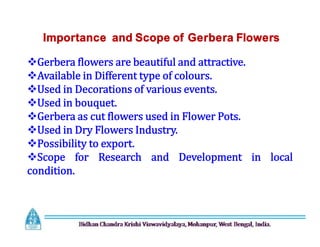
Importance and Scope of Gerbera Flowers
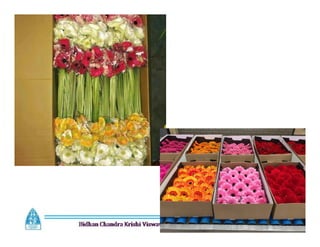
Gerbera flowers are beautiful and attractive.
Available in Different type of colours.
Used in Decorations of various events.
Used in bouquet.
Gerbera as cut flowers used in Flower Pots.
Used in Dry Flowers Industry.
Possibility to export.
Scope for Research and Development in local
condition.
Gerbera flowers are beautiful and attractive.
Available in Different type of colours.
Used in Decorations of various events.
Used in bouquet.
Gerbera as cut flowers used in Flower Pots.
Used in Dry Flowers Industry.
Possibility to export.
Scope for Research and Development in local
condition.
Gerbera is a very attractive, commercial cut flower successfully
grown under different conditions in several areas of the world
as well as in India and meeting the requirements of various
markets. This flower is originated in Asia and South Africa.
Gerbera jamesonii has been developed through cross breeding
program.
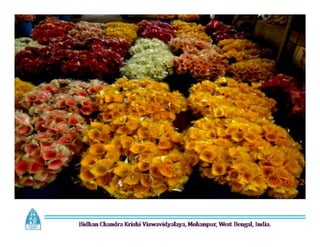
Gerbera flowers have a wide range of colours including yellow,
orange, cream-white, pink, brick red, red, terracotta and
various other intermediate colors. In double varieties, bicolor
flowers are also available. Gerbera flower stalks are long, thin
and leafy and have a long vase life.
The major producing states in India are Karnataka,
Maharashtra, Tamil Nadu, West Bengal, Himachal Pradesh,
Jammu & Kashmir and Gujarat.
Gerbera is a very attractive, commercial cut flower successfully
grown under different conditions in several areas of the world
as well as in India and meeting the requirements of various
markets. This flower is originated in Asia and South Africa.
Gerbera jamesonii has been developed through cross breeding
program.
Gerbera flowers have a wide range of colours including yellow,
orange, cream-white, pink, brick red, red, terracotta and
various other intermediate colors. In double varieties, bicolor
flowers are also available. Gerbera flower stalks are long, thin
and leafy and have a long vase life.
The major producing states in India are Karnataka,
Maharashtra, Tamil Nadu, West Bengal, Himachal Pradesh,
Jammu & Kashmir and Gujarat.
CLIMATE
Bright sunshine accelerates the growth and quality of the
flowers, however, in summer this flower needs diffused
sunlight. Gerbera plants grown in locations with insufficient
light will not bloom well. The optimum day and night
temperature is 270C and 140C respectively. For flower
initiation, the optimum temperature is 230C and for leaf
unfolding it is 25 – 270C.
CLIMATE
Bright sunshine accelerates the growth and quality of the
flowers, however, in summer this flower needs diffused
sunlight. Gerbera plants grown in locations with insufficient
light will not bloom well. The optimum day and night
temperature is 270C and 140C respectively. For flower
initiation, the optimum temperature is 230C and for leaf
unfolding it is 25 – 270C.
SOIL
There are two primary factors to be considered while selecting
soil for Gerbera cultivation.
The soil pH must be between 5.5 to 6.5.
The soil salinity level does not exceed 1 ms/cm; For better
root growth and better penetration of roots, the soil should be
highly porous and well drained.
Red lateritic soils are good for Gerbera cultivation as it is having
all the essential qualities that an ideal soil should have.
After fumigation with formaldehyde, the raised beds are
prepared on which Gerbera plants are planted.
SOIL
There are two primary factors to be considered while selecting
soil for Gerbera cultivation.
The soil pH must be between 5.5 to 6.5.
The soil salinity level does not exceed 1 ms/cm; For better
root growth and better penetration of roots, the soil should be
highly porous and well drained.
Red lateritic soils are good for Gerbera cultivation as it is having
all the essential qualities that an ideal soil should have.
After fumigation with formaldehyde, the raised beds are
prepared on which Gerbera plants are planted.
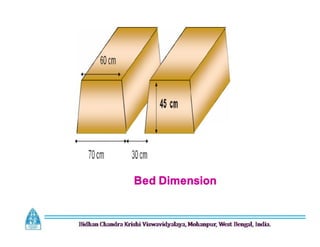
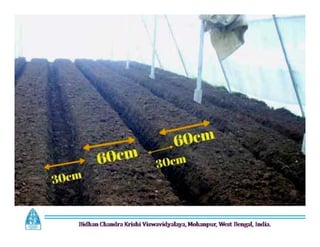
Preparation of planting bed
In general, Gerberas are grown on raised beds to assist in
easier movement and better drainage. The dimensions of the
bed should be as follows:
Bed height: 1.5 feet (45 cm)
Bed width: 2 feet (60 cm)
Between the beds: 1 feet (30 cm)
Preparation of planting bed
In general, Gerberas are grown on raised beds to assist in
easier movement and better drainage. The dimensions of the
bed should be as follows:
Bed height: 1.5 feet (45 cm)
Bed width: 2 feet (60 cm)
Between the beds: 1 feet (30 cm)
Bed Dimension
The beds for planting should be highly porous, well drained
and airy.
Gravel/sand can be added at the bottom for better drainage.
Organic manure is recommended to improve soil texture and to
provide nutrition gradually. Organic manure and soil should be
mixed thoroughly for optimum results.
The soil should be loose all the time.
The soil should not be very compact after watering.
The upper layer of soil and FYM should be properly mixed.
While bed preparation, add Single Super Phosphate (0:16:0) @
2.5 kg per 100 sq.ft. for better root establishment and Magnesium
Sulphate @ 0.5 kg per 100 sq.ft. to take care of deficiency of Mg.
Neem cake (@1kg/m) is also added for prevention of
nematode infestation.
The beds for planting should be highly porous, well drained
and airy.
Gravel/sand can be added at the bottom for better drainage.
Organic manure is recommended to improve soil texture and to
provide nutrition gradually. Organic manure and soil should be
mixed thoroughly for optimum results.
The soil should be loose all the time.
The soil should not be very compact after watering.
The upper layer of soil and FYM should be properly mixed.
While bed preparation, add Single Super Phosphate (0:16:0) @
2.5 kg per 100 sq.ft. for better root establishment and Magnesium
Sulphate @ 0.5 kg per 100 sq.ft. to take care of deficiency of Mg.
Neem cake (@1kg/m) is also added for prevention of
nematode infestation.
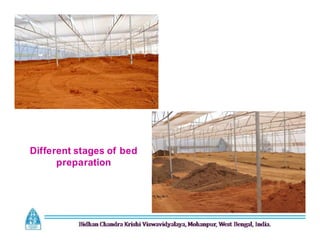
Different stages of bed
preparation
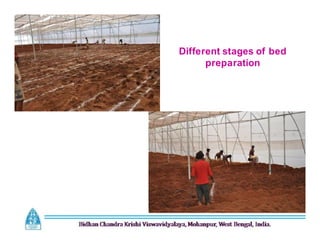
Different stages of bed
preparation
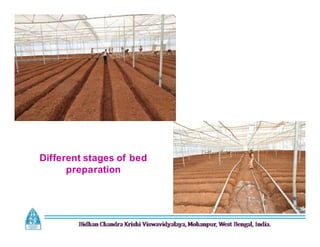
Different stages of bed
preparation
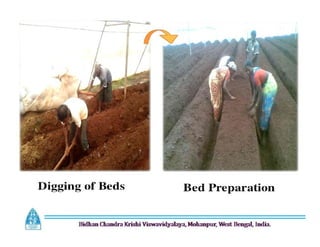
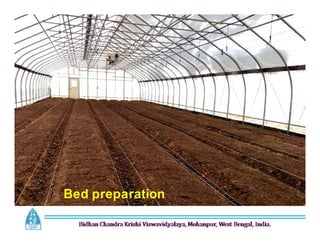
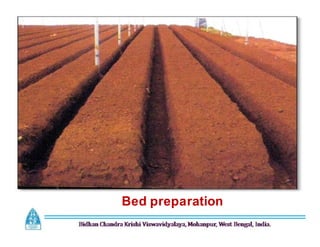
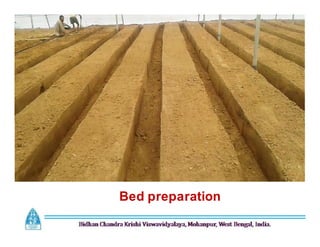
Bed preparation
Bed preparation
Bed preparation
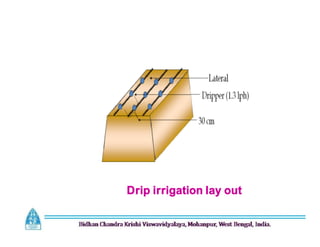
Drip irrigation lay out
Soil sterilization
Soil sterilization is required before gerbera plantation to
manage Phytophthora infestation. There are three main soil
sterilization methods available.
•Steam : Not practical for Indian conditions.
•Solar : in this method plastic sheet is covered on the soil for 6-8
weeks. The sunrise will heat the soil, and this will kill most
fungus.
•Chemical : this is most advanced and useful method. Hydrogen
peroxide (H2O2) with silver is used for sterilization of soil. Use
of formalin @ 7.5 - 10 lit/100sqm can also be done
Soil sterilization
Soil sterilization is required before gerbera plantation to
manage Phytophthora infestation. There are three main soil
sterilization methods available.
•Steam : Not practical for Indian conditions.
•Solar : in this method plastic sheet is covered on the soil for 6-8
weeks. The sunrise will heat the soil, and this will kill most
fungus.
•Chemical : this is most advanced and useful method. Hydrogen
peroxide (H2O2) with silver is used for sterilization of soil. Use
of formalin @ 7.5 - 10 lit/100sqm can also be done
Hydrogen peroxide (H2O2) with silver.
Process:
•Wet the beds with irrigation water.
•Mix water with hydrogen peroxide at a rate of 35 ml per/lite.
Apply this solution evenly on soil beds. Use one liter of
mix solution ( Hydrogen peroxide (H2O2) with silver + water) For
the one-meter area. After that in 4 to 6 hours the crop can be
planted.
Benefits of Hydrogen Peroxide with Silver:
•Economical, reduce input cost
•Very easy and safe this method does not affect any dangerous effect
human health.
•The plantation can be carried out after 4 to 6 hours fumigation.
•Eco-friendly and does not produce any phytotoxic effects on plants.
•Almost any fungi, bacteria and viral presence in the soil destroys the
eggs of larva and insects.
Hydrogen peroxide (H2O2) with silver.
Process:
•Wet the beds with irrigation water.
•Mix water with hydrogen peroxide at a rate of 35 ml per/lite.
Apply this solution evenly on soil beds. Use one liter of
mix solution ( Hydrogen peroxide (H2O2) with silver + water) For
the one-meter area. After that in 4 to 6 hours the crop can be
planted.
Benefits of Hydrogen Peroxide with Silver:
•Economical, reduce input cost
•Very easy and safe this method does not affect any dangerous effect
human health.
•The plantation can be carried out after 4 to 6 hours fumigation.
•Eco-friendly and does not produce any phytotoxic effects on plants.
•Almost any fungi, bacteria and viral presence in the soil destroys the
eggs of larva and insects.
Varieties of Gerbera in India
The numerous cultivars of gerbera, that are known today, have
been developed through hybridization. Based on the rows of ray
floret on flower heads gerbera are grouped as single, semi-double
and double cultivars.
Red coloured : Ruby Red, Dusty, Shania, Salvadore, Tamara, Fredorella,
Vesta & Red Impulse.
Yellow coloured : Supernova, Nadja, Doni, Mammut, Uranus, Fredking,
Fullmoon, Talasa & Panama.
Orange coloured : Kozak, Carrera, Marasol, Orange Classic & Goliath.
Rose Coloured : Rosalin & Salvadore.
Cream Coloured : Farida, Dalma, Snow Flake & Winter Queen.
White coloured : Delphi & White Maria.
Purple coloured : Treasure & BlackJack.
Pink coloured : Terraqueen, Pink Elegance, Esmara, Valentine &
Marmara.
Red coloured : Ruby Red, Dusty, Shania, Salvadore, Tamara, Fredorella,
Vesta & Red Impulse.
Yellow coloured : Supernova, Nadja, Doni, Mammut, Uranus, Fredking,
Fullmoon, Talasa & Panama.
Orange coloured : Kozak, Carrera, Marasol, Orange Classic & Goliath.
Rose Coloured : Rosalin & Salvadore.
Cream Coloured : Farida, Dalma, Snow Flake & Winter Queen.
White coloured : Delphi & White Maria.
Purple coloured : Treasure & BlackJack.
Pink coloured : Terraqueen, Pink Elegance, Esmara, Valentine &
Marmara.
List of Hi-tech Nursery Company
KF Bioplants
Florance Flora
Rise & Shine
Ideal season
Although, Gerbera can be planted any time of the year many
farmers plant it in January to March or June to July period
considering it ideal. A good light amount is required during the
plantation hence is not planted in November and December.
Additionally, there is a risk of frost development, which is
harmful to the plant in initial stages. Farmers also avoid
plantation in August and September as the plants have to
sustain winter during their growing periods.
Ideal season
Although, Gerbera can be planted any time of the year many
farmers plant it in January to March or June to July period
considering it ideal. A good light amount is required during the
plantation hence is not planted in November and December.
Additionally, there is a risk of frost development, which is
harmful to the plant in initial stages. Farmers also avoid
plantation in August and September as the plants have to
sustain winter during their growing periods.
PLANTING DISTANCE
Plant to Plant distance: 30 cm
Row to Row distance : 40 cm
25
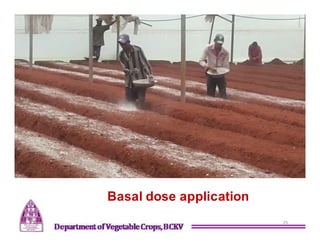
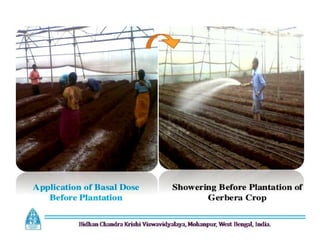
Basal dose application
Planting Season in Gerbera Flower Farming:
Gerbera plantation can be done in spring as well as summer
season.
Gerbera needs good light intensity, planting in spring season
(Jan to March) is best for 1.5 year tissue culture.
Summer (June to July) is Suitable for 1, 1.5 & 2 years tissue
cultures.
Planting in autumn and winter (November and December) is
not recommended due to low light intensity and high heating
cost.
Planting should be avoided in late August or September as it
has to sustain in winter season.
Planting Season in Gerbera Flower Farming:
Gerbera plantation can be done in spring as well as summer
season.
Gerbera needs good light intensity, planting in spring season
(Jan to March) is best for 1.5 year tissue culture.
Summer (June to July) is Suitable for 1, 1.5 & 2 years tissue
cultures.
Planting in autumn and winter (November and December) is
not recommended due to low light intensity and high heating
cost.
Planting should be avoided in late August or September as it
has to sustain in winter season.
Propagation
Gerbera is propagated by seed, by cuttings of side shoots and
suckers.
Seeds: Seed is set if cross-pollinated. Sowing of seed may be
done in almost any season. Seeds germinate in 15 to 200C within
two weeks; otherwise it may take up to 30 days. Plants from
seeds will bloom in the second year and produce good flowers
from the third year onwards.
Vegetative: Side shoots, with some amount of heel, is utilized for.
Divisions/ suckers, cuttings are also used.
Micro propagation: The plant parts used as explants for micro
propagation are Shoot tips, Leaf mid-rib, Capitulum, Flower
heads, Inflorescence and Buds. Murashige and Skoog (MS)
media with modification is successfully used as culture media.
Propagation
Gerbera is propagated by seed, by cuttings of side shoots and
suckers.
Seeds: Seed is set if cross-pollinated. Sowing of seed may be
done in almost any season. Seeds germinate in 15 to 200C within
two weeks; otherwise it may take up to 30 days. Plants from
seeds will bloom in the second year and produce good flowers
from the third year onwards.
Vegetative: Side shoots, with some amount of heel, is utilized for.
Divisions/ suckers, cuttings are also used.
Micro propagation: The plant parts used as explants for micro
propagation are Shoot tips, Leaf mid-rib, Capitulum, Flower
heads, Inflorescence and Buds. Murashige and Skoog (MS)
media with modification is successfully used as culture media.
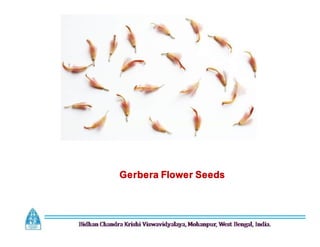
Gerbera Flower Seeds
PLANTING MATERIAL
Plant should not be less than three months old.
At the time of planting the tissue culture, plant should have
at least 4 to 5 leaves.
Gerberas are planted on raised bed in two rows formation.
Zigzag plantation system is mostly preferred.
While planting 65% portion of root ball should be kept
below ground and rest of the portion i.e. 35% should be kept
above the ground for better air circulation in the root zones.
Ideal planting density and spacing: 8-10 plants/sq.m or 30
X 30 cm or 40 x 25 cm.
PLANTING MATERIAL
Plant should not be less than three months old.
At the time of planting the tissue culture, plant should have
at least 4 to 5 leaves.
Gerberas are planted on raised bed in two rows formation.
Zigzag plantation system is mostly preferred.
While planting 65% portion of root ball should be kept
below ground and rest of the portion i.e. 35% should be kept
above the ground for better air circulation in the root zones.
Ideal planting density and spacing: 8-10 plants/sq.m or 30
X 30 cm or 40 x 25 cm.
Gerbera Plantation
Properties
1. Propagation by tissue culture method.
2. Select proper harden plants.
3. Disease and pest free Plants.
4. At planting time 4 to 5 leaves – each plants.
Precautions
1. Crown of Plant 1-2cm above soil.
2. Don’t Disturb root ball.
3. Distance row-row = 35cm.
plant-plant = 30cm.
Precautions
1. Crown of Plant 1-2cm above soil.
2. Don’t Disturb root ball.
3. Distance row-row = 35cm.
plant-plant = 30cm.
Planting beds and initial fertilizer application
Raised beds of 60 cm width are suitable for planting, base
should be70 cm with height 45-60 cm.
Gravels can be put at the bottom of the bed for better
drainage.
Keep 30-45 cm space between beds as working space.
Add and mix 2.5 kg SSP and 0.5kg Magnesium sulphate @
10sq m bed area.
Plant three rows of per bed with 30 cm distance on one bed.
Plant to plant distance should be 30 cm.
Planting is done with root ball and crown is kept above soil
surface (1 cm).
Irrigate lightly after planting.
In 200 sq.m. area, 900 plants can be planted with 3 rows while
in 500 sq.m. area, 2500 plants can be accommodated.
Planting beds and initial fertilizer application
Raised beds of 60 cm width are suitable for planting, base
should be70 cm with height 45-60 cm.
Gravels can be put at the bottom of the bed for better
drainage.
Keep 30-45 cm space between beds as working space.
Add and mix 2.5 kg SSP and 0.5kg Magnesium sulphate @
10sq m bed area.
Plant three rows of per bed with 30 cm distance on one bed.
Plant to plant distance should be 30 cm.
Planting is done with root ball and crown is kept above soil
surface (1 cm).
Irrigate lightly after planting.
In 200 sq.m. area, 900 plants can be planted with 3 rows while
in 500 sq.m. area, 2500 plants can be accommodated.
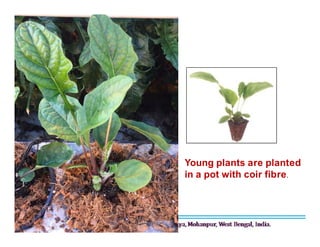
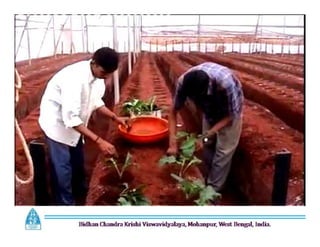
Young plants are planted
in a pot with coir fibre.
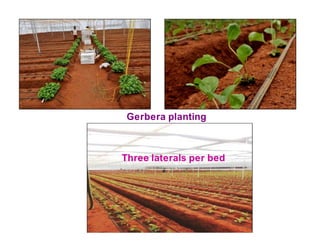
Gerbera planting
Three laterals per bed
Cultural operations after planting
The relative humidity is maintained at 70-80% for first 4 weeks.
Irrigate plants lightly with rose can after planting daily for 4 weeks
(twice in a day).
Drenching of soil with fungicide captan and benlate (1g/lit) after 3
and 6 days, respectively is recommended.
Spray Nuvan (Dichlorvos) (1.5 ml) after 9 days.
Humic acid (1.5 ml/lit) is applied as a drench after 7 days.
Chelated micronutrients are sprayed (0.5g / lit) after 10 days at the
interval of 3-4 days up to one month.
Fertilizers are applied as drench to soil with 14:42:14 (1.5g/ lit) after
13 days. Another drench with 19:19:19 (N:P:K) @ 2 g /lit. can be given
after 17day. Continue this at the interval of 3-4 days up to 4 weeks.
Kelthane and Endosulfan sprays are applied to take care of mites and
other insects as and when required. Remove weeds regularly. Drench
solution should be applied at the rate of 40ml/plant while for spray use
12 lit. of solution /1000plant as the plants are small initially.
Cultural operations after planting
The relative humidity is maintained at 70-80% for first 4 weeks.
Irrigate plants lightly with rose can after planting daily for 4 weeks
(twice in a day).
Drenching of soil with fungicide captan and benlate (1g/lit) after 3
and 6 days, respectively is recommended.
Spray Nuvan (Dichlorvos) (1.5 ml) after 9 days.
Humic acid (1.5 ml/lit) is applied as a drench after 7 days.
Chelated micronutrients are sprayed (0.5g / lit) after 10 days at the
interval of 3-4 days up to one month.
Fertilizers are applied as drench to soil with 14:42:14 (1.5g/ lit) after
13 days. Another drench with 19:19:19 (N:P:K) @ 2 g /lit. can be given
after 17day. Continue this at the interval of 3-4 days up to 4 weeks.
Kelthane and Endosulfan sprays are applied to take care of mites and
other insects as and when required. Remove weeds regularly. Drench
solution should be applied at the rate of 40ml/plant while for spray use
12 lit. of solution /1000plant as the plants are small initially.
Fertilizers and irrigation (Fertigation)
After one month plants get established and liquid fertilizers can be
given through drip.
Apply 20:20:20 N:P:K at alternate day (@ 0.4 g / plant) through drip
during 2nd and 3rd month along with micronutrients and Calcium
chelates. From fourth month onward apply 15:8:35 or 16:8:24 N:P:K +
0:0: 50 at alternate day @ 0.4 g / plant as the flowering picks-up.
Calcium nitrate (250g) and chelated micronutrient mixture at 25 g
(for roughly 1000 plants) should be given once in 8-10 days through
drip. Grown-up plant needs 700 ml water / day hence dripper flow at
each plant has to be checked and adjusted accordingly.
Mix the liquid fertilizer in water in a small tank of fertigation system,
adjust the flow through mixing unit by adjusting the valves. Flow can
be measured at drippers.
Check the flow of drippers over entire area, it should be even to all
plants. For example : 1000 plants require 700 lit water and 400 g
fertilizer quantity. (700 ml water with 0.4g fertilizer to each plant).
Fertilizers and irrigation (Fertigation)
After one month plants get established and liquid fertilizers can be
given through drip.
Apply 20:20:20 N:P:K at alternate day (@ 0.4 g / plant) through drip
during 2nd and 3rd month along with micronutrients and Calcium
chelates. From fourth month onward apply 15:8:35 or 16:8:24 N:P:K +
0:0: 50 at alternate day @ 0.4 g / plant as the flowering picks-up.
Calcium nitrate (250g) and chelated micronutrient mixture at 25 g
(for roughly 1000 plants) should be given once in 8-10 days through
drip. Grown-up plant needs 700 ml water / day hence dripper flow at
each plant has to be checked and adjusted accordingly.
Mix the liquid fertilizer in water in a small tank of fertigation system,
adjust the flow through mixing unit by adjusting the valves. Flow can
be measured at drippers.
Check the flow of drippers over entire area, it should be even to all
plants. For example : 1000 plants require 700 lit water and 400 g
fertilizer quantity. (700 ml water with 0.4g fertilizer to each plant).
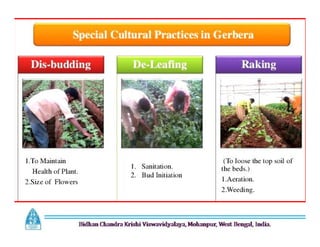
CULTURAL PRACTICES
Weeding & raking of soil:
Weeds take the nutrients of the plants and affect the
production.
Hence, they should be removed from the bed. Due to
daily irrigation, the surface of the gerbera bed becomes
hard hence raking of soil is done with the help of a raker.
It increases soil aeration in the root zone of the plant.
This operation should be done regularly, may be twice in
a month.
CULTURAL PRACTICES
Weeding & raking of soil:
Weeds take the nutrients of the plants and affect the
production.
Hence, they should be removed from the bed. Due to
daily irrigation, the surface of the gerbera bed becomes
hard hence raking of soil is done with the help of a raker.
It increases soil aeration in the root zone of the plant.
This operation should be done regularly, may be twice in
a month.
Disbudding:
Removal of inferior quality flowers at the initial stage
after plantation is called disbudding.
The normal production of gerbera plants starts after 75-90 days
from the date of plantation. Production of flowers starts 45 days
after plantation but initial production is of inferior quality,
hence these flowers should be removed from the base of the
flowers stalk. This helps in making the plant strong and healthy.
Disbudding:
Removal of inferior quality flowers at the initial stage
after plantation is called disbudding.
The normal production of gerbera plants starts after 75-90 days
from the date of plantation. Production of flowers starts 45 days
after plantation but initial production is of inferior quality,
hence these flowers should be removed from the base of the
flowers stalk. This helps in making the plant strong and healthy.
Removal of old leaves:
Sanitation helps in keeping the disease and pest
infestation below the economic threshold level.
The old, dry, infested leaves should be removed from
the plant and burnt outside the green house or
dumped in to a compost pit. This practice allows
producing good, healthy new leaves and better
aeration in the crop.
Removal of old leaves:
Sanitation helps in keeping the disease and pest
infestation below the economic threshold level.
The old, dry, infested leaves should be removed from
the plant and burnt outside the green house or
dumped in to a compost pit. This practice allows
producing good, healthy new leaves and better
aeration in the crop.
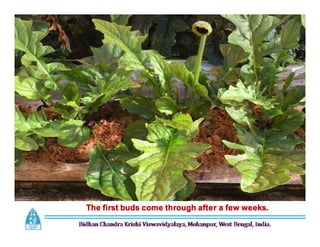
The first buds come through after a few weeks.
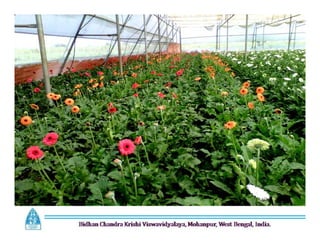
A mature plant with buds
and flowers.
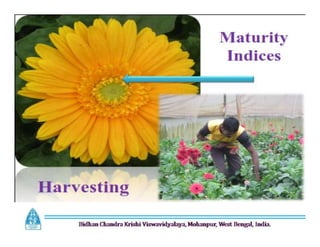
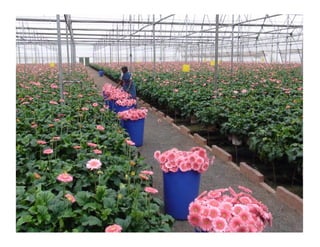
Harvesting
Gerbera plants produce flowers 7-8 weeks after planting. Plants
have productive life up to 24-30 months. One plant yields 30-40
flowers per year and 75 to 100 flowers in 30 months. Flowers are
ready to harvest when 2-3 whorls of stamens are developed.
Pluck the flower at the heel with angular cut. Plucking should be
done in morning or evening.
Harvesting
Gerbera plants produce flowers 7-8 weeks after planting. Plants
have productive life up to 24-30 months. One plant yields 30-40
flowers per year and 75 to 100 flowers in 30 months. Flowers are
ready to harvest when 2-3 whorls of stamens are developed.
Pluck the flower at the heel with angular cut. Plucking should be
done in morning or evening.
60
60
Post-harvest quality and management
Flowers with stalk length 45-55cm and diameter 10- 12
cm fetch very good price as they are ‘A’ grade flowers.
Vase life is 8-10 days. For best vase life put the cut end
of the flower in clean water at 150C for 4 hrs. Add 10 ml
Sodium Hypochlorite in 1 lit water before placing the
flower. For long distance transport corrugated
box/cartons are used. Gerbera does’nt need cooling like
rose or carnation and have reasonably long shelf life.
Post-harvest quality and management
Flowers with stalk length 45-55cm and diameter 10- 12
cm fetch very good price as they are ‘A’ grade flowers.
Vase life is 8-10 days. For best vase life put the cut end
of the flower in clean water at 150C for 4 hrs. Add 10 ml
Sodium Hypochlorite in 1 lit water before placing the
flower. For long distance transport corrugated
box/cartons are used. Gerbera does’nt need cooling like
rose or carnation and have reasonably long shelf life.
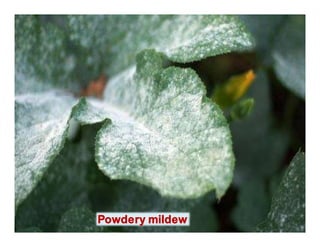
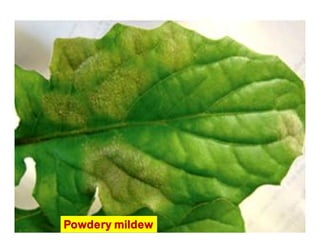
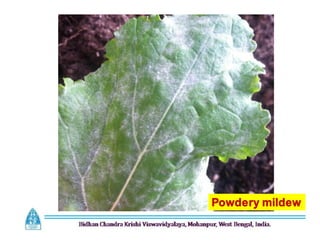
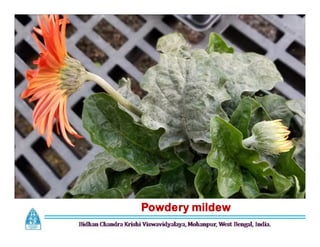
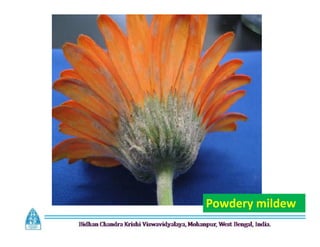
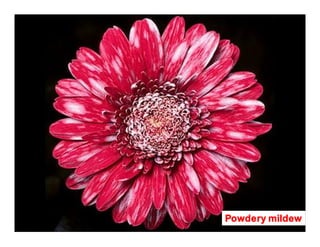
Powdery mildew:
White powdery fungal growth observed on the leaf lamina. In
case of severe attack leaves start curling.
For the control, spraying of Wettable Sulphur (SP) 1.5 gm or
Karathane (Dinocap) (SP) 0.4 ml or Quintol (Iprodion+
Carbendazim) (SP) 0.5 gm or Index (Myclobutanil) (SP) 0.5 gm
or Rubigan (Fenremol) (SP) 1 ml or Hydrogen peroxide (SP) 2
ml per lit of water can be used .
Powdery mildew:
White powdery fungal growth observed on the leaf lamina. In
case of severe attack leaves start curling.
For the control, spraying of Wettable Sulphur (SP) 1.5 gm or
Karathane (Dinocap) (SP) 0.4 ml or Quintol (Iprodion+
Carbendazim) (SP) 0.5 gm or Index (Myclobutanil) (SP) 0.5 gm
or Rubigan (Fenremol) (SP) 1 ml or Hydrogen peroxide (SP) 2
ml per lit of water can be used .
Powdery mildew
Powdery mildew
Powdery mildew
Powdery mildew
Powdery mildew
Powdery mildew
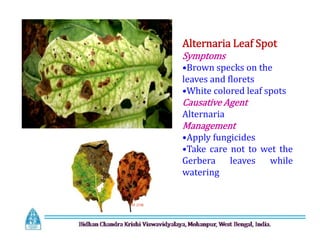
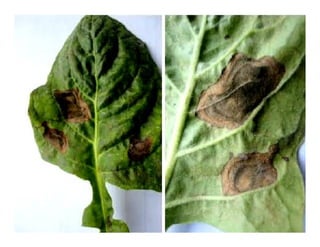
Alternaria Leaf Spot
Symptoms
•Brown specks on the
leaves and florets
•White colored leaf spots
Causative Agent
Alternaria
Management
•Apply fungicides
•Take care not to wet the
Gerbera leaves while
watering
Alternaria Leaf Spot
Symptoms
•Brown specks on the
leaves and florets
•White colored leaf spots
Causative Agent
Alternaria
Management
•Apply fungicides
•Take care not to wet the
Gerbera leaves while
watering
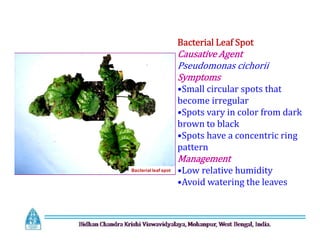
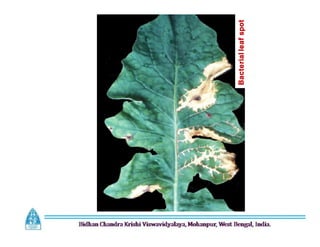
Bacterial Leaf Spot
Causative Agent
Pseudomonas cichorii
Symptoms
•Small circular spots that
become irregular
•Spots vary in color from dark
brown to black
•Spots have a concentric ring
pattern
Management
•Low relative humidity
•Avoid watering the leaves
Bacterial Leaf Spot
Causative Agent
Pseudomonas cichorii
Symptoms
•Small circular spots that
become irregular
•Spots vary in color from dark
brown to black
•Spots have a concentric ring
pattern
Management
•Low relative humidity
•Avoid watering the leaves
Bacterial leaf spot
Bacterial
leaf
spot
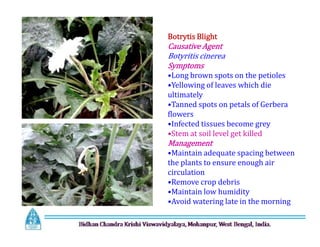
Botrytis Blight
Causative Agent
Botyritis cinerea
Symptoms
•Long brown spots on the petioles
•Yellowing of leaves which die
ultimately
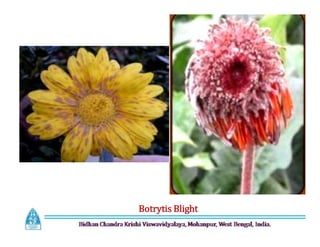
•Tanned spots on petals of Gerbera
flowers
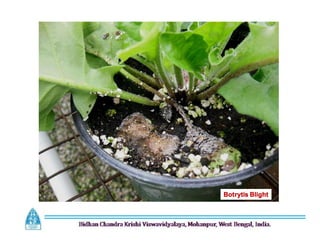
•Infected tissues become grey
•Stem at soil level get killed
Management
•Maintain adequate spacing between
the plants to ensure enough air
circulation
•Remove crop debris
•Maintain low humidity
•Avoid watering late in the morning
Botrytis Blight
Causative Agent
Botyritis cinerea
Symptoms
•Long brown spots on the petioles
•Yellowing of leaves which die
ultimately
•Tanned spots on petals of Gerbera
flowers
•Infected tissues become grey
•Stem at soil level get killed
Management
•Maintain adequate spacing between
the plants to ensure enough air
circulation
•Remove crop debris
•Maintain low humidity
•Avoid watering late in the morning
Botrytis Blight
Botrytis Blight
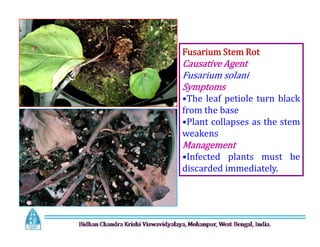
Fusarium Stem Rot
Causative Agent
Fusarium solani
Symptoms
•The leaf petiole turn black
from the base
•Plant collapses as the stem
weakens
Management
•Infected plants must be
discarded immediately.
Fusarium Stem Rot
Causative Agent
Fusarium solani
Symptoms
•The leaf petiole turn black
from the base
•Plant collapses as the stem
weakens
Management
•Infected plants must be
discarded immediately.
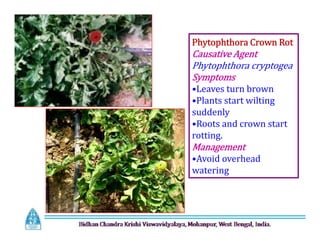
Phytophthora Crown Rot
Causative Agent
Phytophthora cryptogea
Symptoms
•Leaves turn brown
•Plants start wilting
suddenly
•Roots and crown start
rotting.
Management
•Avoid overhead
watering
Phytophthora Crown Rot
Causative Agent
Phytophthora cryptogea
Symptoms
•Leaves turn brown
•Plants start wilting
suddenly
•Roots and crown start
rotting.
Management
•Avoid overhead
watering
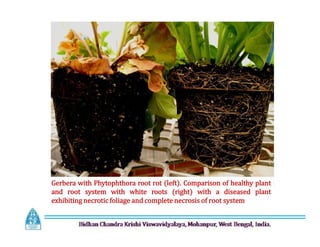
Gerbera with Phytophthora root rot (left). Comparison of healthy plant
and root system with white roots (right) with a diseased plant
exhibiting necrotic foliage and complete necrosis of root system
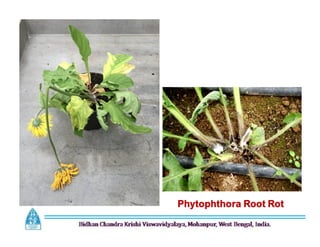
Phytophthora Root Rot
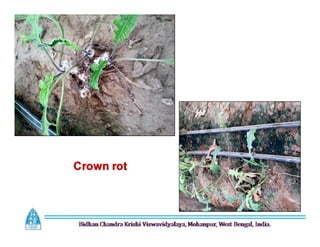
Crown rot
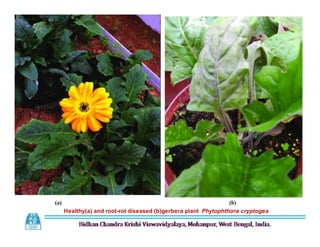
Healthy(a) and root-rot diseased (b)gerbera plant Phytophthora cryptogea
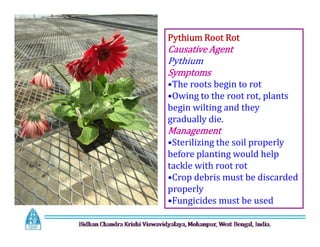
Pythium Root Rot
Causative Agent
Pythium
Symptoms
•The roots begin to rot
•Owing to the root rot, plants
begin wilting and they
gradually die.
Management
•Sterilizing the soil properly
before planting would help
tackle with root rot
•Crop debris must be discarded
properly
•Fungicides must be used
Pythium Root Rot
Causative Agent
Pythium
Symptoms
•The roots begin to rot
•Owing to the root rot, plants
begin wilting and they
gradually die.
Management
•Sterilizing the soil properly
before planting would help
tackle with root rot
•Crop debris must be discarded
properly
•Fungicides must be used
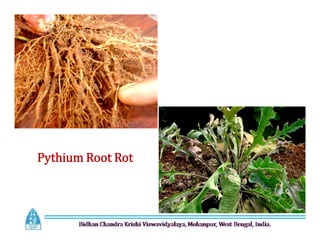
Pythium Root Rot
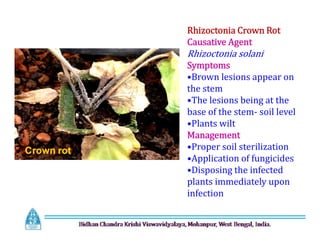
Rhizoctonia Crown Rot
Causative Agent
Rhizoctonia solani
Symptoms
•Brown lesions appear on
the stem
•The lesions being at the
base of the stem- soil level
•Plants wilt
Management
•Proper soil sterilization
•Application of fungicides
•Disposing the infected
plants immediately upon
infection
Rhizoctonia Crown Rot
Causative Agent
Rhizoctonia solani
Symptoms
•Brown lesions appear on
the stem
•The lesions being at the
base of the stem- soil level
•Plants wilt
Management
•Proper soil sterilization
•Application of fungicides
•Disposing the infected
plants immediately upon
infection
Crown rot
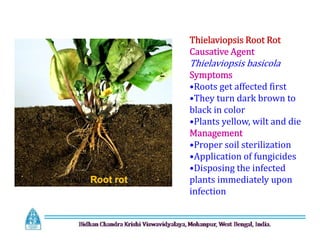
Thielaviopsis Root Rot
Causative Agent
Thielaviopsis basicola
Symptoms
•Roots get affected first
•They turn dark brown to
black in color
•Plants yellow, wilt and die
Management
•Proper soil sterilization
•Application of fungicides
•Disposing the infected
plants immediately upon
infection
Thielaviopsis Root Rot
Causative Agent
Thielaviopsis basicola
Symptoms
•Roots get affected first
•They turn dark brown to
black in color
•Plants yellow, wilt and die
Management
•Proper soil sterilization
•Application of fungicides
•Disposing the infected
plants immediately upon
infection
Root rot
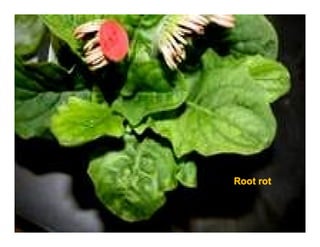
Root rot
Viral Diseases
There are different viral diseases like Gerbera mosaic, tobacco
rattle, cucumber mosaic virus and necrotic spots. In these
cases, the leaves are the first ones to get affected. Yellow
necrotic spots appear on the leaf in various patterns like ring,
line or flecks. The plants become distorted. The color of the
flowers is not uniform. They break at some points. The best
way to manage viral diseases in Gerbera plants is to control
mites and insects. The infected plants must be destroyed.
Viral Diseases
There are different viral diseases like Gerbera mosaic, tobacco
rattle, cucumber mosaic virus and necrotic spots. In these
cases, the leaves are the first ones to get affected. Yellow
necrotic spots appear on the leaf in various patterns like ring,
line or flecks. The plants become distorted. The color of the
flowers is not uniform. They break at some points. The best
way to manage viral diseases in Gerbera plants is to control
mites and insects. The infected plants must be destroyed.
Insect pests
Insect pests
Insect pests
Insect pests
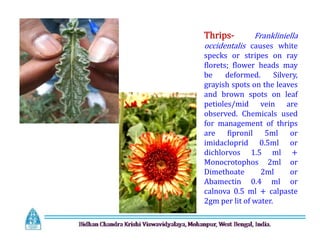
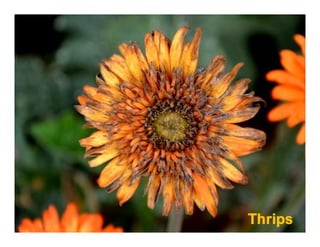
Thrips- Frankliniella
occidentalis causes white
specks or stripes on ray
florets; flower heads may
be deformed. Silvery,
grayish spots on the leaves
and brown spots on leaf
petioles/mid vein are
observed. Chemicals used
for management of thrips
are fipronil 5ml or
imidacloprid 0.5ml or
dichlorvos 1.5 ml +
Monocrotophos 2ml or
Dimethoate 2ml or
Abamectin 0.4 ml or
calnova 0.5 ml + calpaste
2gm per lit of water.
Thrips- Frankliniella
occidentalis causes white
specks or stripes on ray
florets; flower heads may
be deformed. Silvery,
grayish spots on the leaves
and brown spots on leaf
petioles/mid vein are
observed. Chemicals used
for management of thrips
are fipronil 5ml or
imidacloprid 0.5ml or
dichlorvos 1.5 ml +
Monocrotophos 2ml or
Dimethoate 2ml or
Abamectin 0.4 ml or
calnova 0.5 ml + calpaste
2gm per lit of water.
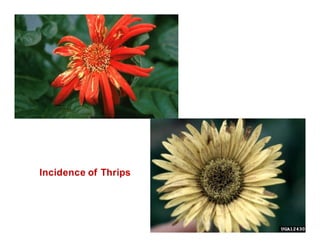
Incidence of Thrips
Incidence of Thrips
Thrips
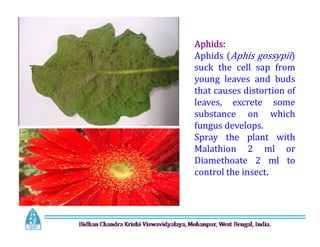
Aphids:
Aphids (Aphis gossypii)
suck the cell sap from
young leaves and buds
that causes distortion of
leaves, excrete some
substance on which
fungus develops.
Spray the plant with
Malathion 2 ml or
Diamethoate 2 ml to
control the insect.
Aphids:
Aphids (Aphis gossypii)
suck the cell sap from
young leaves and buds
that causes distortion of
leaves, excrete some
substance on which
fungus develops.
Spray the plant with
Malathion 2 ml or
Diamethoate 2 ml to
control the insect.
Caterpillar- Heliothis and
Spodoptera both the species feed on
leaves voraciously making holes in
the leaf lamina sometimes leaving
only veins on the leaves. Larvae
attack flower buds as a result
deformed flowers are produced.
The pest can be controlled
biologically by spraying HNPV
(Heliokill) 1 ml or Metarhisium 4
gm per l litre of water in the
evening. The chemicals like
emamectin benzoate 0.2 ml or
methomil 1.5 gm or deltamethrin
0.5 ml or indoxacarb 0.5 ml or
Thiodicarb 0.4 gm per lit of water in
the spray form or soil application of
phorate @ 2 gm per plant are used
to control the pest.
Caterpillar- Heliothis and
Spodoptera both the species feed on
leaves voraciously making holes in
the leaf lamina sometimes leaving
only veins on the leaves. Larvae
attack flower buds as a result
deformed flowers are produced.
The pest can be controlled
biologically by spraying HNPV
(Heliokill) 1 ml or Metarhisium 4
gm per l litre of water in the
evening. The chemicals like
emamectin benzoate 0.2 ml or
methomil 1.5 gm or deltamethrin
0.5 ml or indoxacarb 0.5 ml or
Thiodicarb 0.4 gm per lit of water in
the spray form or soil application of
phorate @ 2 gm per plant are used
to control the pest.
Leaf eating caterpillar
Red Mites- Suck the sap from
lower sides of the leaves causing
development of brown spots on
lower surface of leaves resulting
in marginal drying of leaves.
Webbing on the flower petals can
be seen. The pest can be
controlled with pure water spray
or wetable sulphur 1.5 g or
Dicofol 1.5 ml or abamectin 0.4
ml, fenazaquin 1 ml or propergite
1 ml per litre of water. Some
organic, plant extracts
commercially available also give
good control of the pest.
Red Mites- Suck the sap from
lower sides of the leaves causing
development of brown spots on
lower surface of leaves resulting
in marginal drying of leaves.
Webbing on the flower petals can
be seen. The pest can be
controlled with pure water spray
or wetable sulphur 1.5 g or
Dicofol 1.5 ml or abamectin 0.4
ml, fenazaquin 1 ml or propergite
1 ml per litre of water. Some
organic, plant extracts
commercially available also give
good control of the pest.
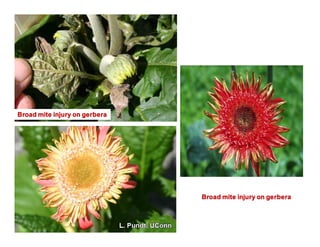
Broad mite
(Polyphagotarsonemus latus)
and cyclamen mite
(Phytonemus pallidus):
Older leaves are curled up.
Younger ones being deformed
and leathery, deformed
flowers or petals are missing,
inward curling and
discolouration of petals.
This pest can be controlled by
spraying wetable sulphur1.5
gm or karathane 0.4 ml or

Abamectin 0.4 ml or Derisom
2ml per litre of water.
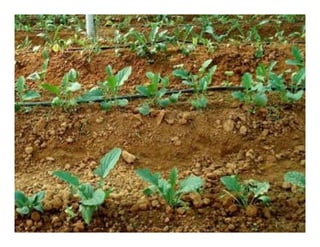
Broad mite
(Polyphagotarsonemus latus)
and cyclamen mite
(Phytonemus pallidus):
Older leaves are curled up.
Younger ones being deformed
and leathery, deformed
flowers or petals are missing,
inward curling and
discolouration of petals.
This pest can be controlled by
spraying wetable sulphur1.5
gm or karathane 0.4 ml or
Abamectin 0.4 ml or Derisom
2ml per litre of water.
Broad mite injury on gerbera
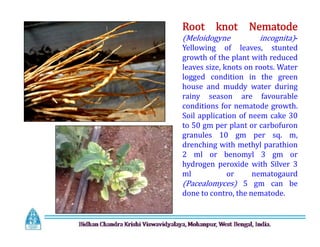
Root knot Nematode
(Meloidogyne incognita)-
Yellowing of leaves, stunted
growth of the plant with reduced
leaves size, knots on roots. Water
logged condition in the green
house and muddy water during
rainy season are favourable
conditions for nematode growth.
Soil application of neem cake 30
to 50 gm per plant or carbofuron
granules 10 gm per sq. m,
drenching with methyl parathion
2 ml or benomyl 3 gm or
hydrogen peroxide with Silver 3
ml or nematogaurd
(Pacealomyces) 5 gm can be
done to contro, the nematode.
Root knot Nematode
(Meloidogyne incognita)-
Yellowing of leaves, stunted
growth of the plant with reduced
leaves size, knots on roots. Water
logged condition in the green
house and muddy water during
rainy season are favourable
conditions for nematode growth.
Soil application of neem cake 30
to 50 gm per plant or carbofuron
granules 10 gm per sq. m,
drenching with methyl parathion
2 ml or benomyl 3 gm or
hydrogen peroxide with Silver 3
ml or nematogaurd
(Pacealomyces) 5 gm can be
done to contro, the nematode.
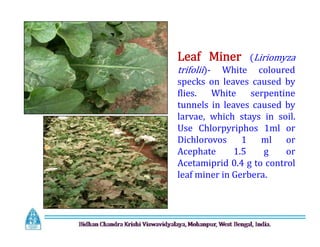
Leaf Miner (Liriomyza
trifolii)- White coloured
specks on leaves caused by
flies. White serpentine
tunnels in leaves caused by
larvae, which stays in soil.
Use Chlorpyriphos 1ml or
Dichlorovos 1 ml or
Acephate 1.5 g or
Acetamiprid 0.4 g to control
leaf miner in Gerbera.
Leaf Miner (Liriomyza
trifolii)- White coloured
specks on leaves caused by
flies. White serpentine
tunnels in leaves caused by
larvae, which stays in soil.
Use Chlorpyriphos 1ml or
Dichlorovos 1 ml or
Acephate 1.5 g or
Acetamiprid 0.4 g to control
leaf miner in Gerbera.
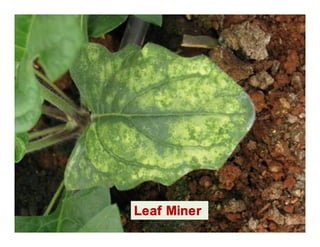
Leaf Miner
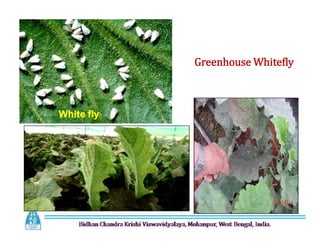
Greenhouse Whitefly
White fly
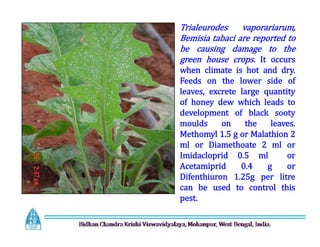
Trialeurodes vaporariarum,
Bemisia tabaci are reported to
be causing damage to the
green house crops. It occurs
when climate is hot and dry.
Feeds on the lower side of
leaves, excrete large quantity
of honey dew which leads to
development of black sooty
moulds on the leaves.
Methomyl 1.5 g or Malathion 2
ml or Diamethoate 2 ml or
Imidacloprid 0.5 ml or
Acetamiprid 0.4 g or
Difenthiuron 1.25g per litre
can be used to control this
pest.
Trialeurodes vaporariarum,
Bemisia tabaci are reported to
be causing damage to the
green house crops. It occurs
when climate is hot and dry.
Feeds on the lower side of
leaves, excrete large quantity
of honey dew which leads to
development of black sooty
moulds on the leaves.
Methomyl 1.5 g or Malathion 2
ml or Diamethoate 2 ml or
Imidacloprid 0.5 ml or
Acetamiprid 0.4 g or
Difenthiuron 1.25g per litre
can be used to control this
pest.
Care to be taken while spraying of pesticides, fungicides and
fertilizers for better results
The pH of the spray solution should be maintained between 6
and 6.5 by acidification 12 hrs before spray. The solution
mixture should be immediately used after preparation before 12
Hrs. A spray adjuvant is added to the spray solution to enhance
the efficacy of the spray. To avoid the plant damage like
scorching, maintenance of suitable conditions inside the green
house is very important.
Pesticides containing Triazophos, Propiconazole, Penconazole,
Hexaconazole, Deltamethrin + Trizophos (Spark), Profenophos,
Metalaxyl + Mancozeb (Rodomil) should not be applied in
Gerbera.
Care to be taken while spraying of pesticides, fungicides and
fertilizers for better results
The pH of the spray solution should be maintained between 6
and 6.5 by acidification 12 hrs before spray. The solution
mixture should be immediately used after preparation before 12
Hrs. A spray adjuvant is added to the spray solution to enhance
the efficacy of the spray. To avoid the plant damage like
scorching, maintenance of suitable conditions inside the green
house is very important.
Pesticides containing Triazophos, Propiconazole, Penconazole,
Hexaconazole, Deltamethrin + Trizophos (Spark), Profenophos,
Metalaxyl + Mancozeb (Rodomil) should not be applied in
Gerbera.
Physiological disorders
Various physiological disorders are observed in gerbera which are resultant
of unfavourable climatic conditions, climatic fluctuations and nutritional
deficiencies and imbalance.
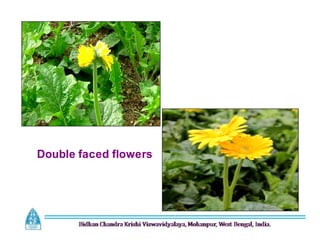
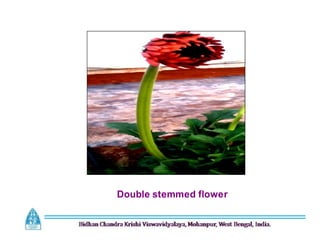
Double stemmed flowers, double faced flowers, flower heads with calyx like
growth at the centre- A physiological disorder caused by imbalance of
nutrients; usually observed when the plant shifts from vegetative to the
generative phase.
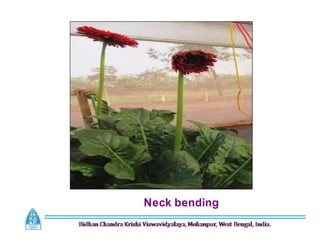
Neck bending- Loss of turgidity and deficiency of calcium are responsible
for the neck bending.
Non-uniform flower blooming- It may occur due to any physical injury to
flower stem or pest attack or due to phyto-toxicity.
Pre-harvest stem break- is a result of high root pressure and high
atmospheric humidity.
Short stem length- High salinity level, moisture stress and low soil
temperature are the causes of short stemmed flowers.
Premature wilting of flowers- is due to cloudy weather followed by bright
sun or carbohydrate depletion.
Physiological disorders
Various physiological disorders are observed in gerbera which are resultant
of unfavourable climatic conditions, climatic fluctuations and nutritional
deficiencies and imbalance.
Double stemmed flowers, double faced flowers, flower heads with calyx like
growth at the centre- A physiological disorder caused by imbalance of
nutrients; usually observed when the plant shifts from vegetative to the
generative phase.
Neck bending- Loss of turgidity and deficiency of calcium are responsible
for the neck bending.
Non-uniform flower blooming- It may occur due to any physical injury to
flower stem or pest attack or due to phyto-toxicity.
Pre-harvest stem break- is a result of high root pressure and high
atmospheric humidity.
Short stem length- High salinity level, moisture stress and low soil
temperature are the causes of short stemmed flowers.
Premature wilting of flowers- is due to cloudy weather followed by bright
sun or carbohydrate depletion.
Double faced flowers
Calyx-like growth and petals at
the centre of the flower head
Double stemmed flower
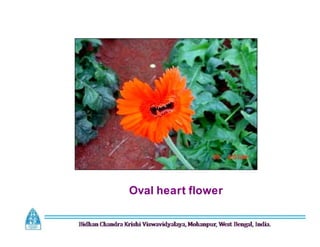
Oval heart flower
Neck bending
Diagnosing Problems
If flower stems are too tall or foliage too large:
 Light intensity too low
If flowers are too short or hidden in foliage:
 Could be the use of excessive fertilizer
 Plants drying out too frequently
 Too much growth regulator
 Growing temperature too low
 Soluble salts too high
If flower stems are too tall or foliage too large:
 Light intensity too low
If flowers are too short or hidden in foliage:
 Could be the use of excessive fertilizer
 Plants drying out too frequently
 Too much growth regulator
 Growing temperature too low
 Soluble salts too high
If flowers are distorted:
 Caused by mites or thrips
If plant is stunted or fails to grow:
 Poor drainage
 Packing soil too tightly
 Low soil temperatures
If plant wilts or dies:
 Planted too deep (crown rot/root rot)
Diagnosing Problems
If flowers are distorted:
 Caused by mites or thrips
If plant is stunted or fails to grow:
 Poor drainage
 Packing soil too tightly
 Low soil temperatures
If plant wilts or dies:
 Planted too deep (crown rot/root rot)
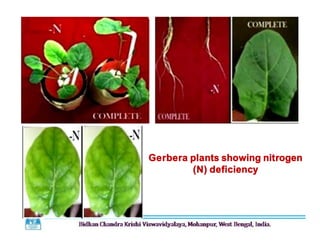
Gerbera plants showing nitrogen
(N) deficiency
The first symptom of N deficiency was reduced plant growth
with stunted appearance.
Leaves were reduced both in number and size, appeared
chlorotic. Symptoms first appeared on older leaves as pale green
discolouration which later changed to uniform yellow. The
pattern of chlorosis extended to younger leaves as the days
progressed. Senescence of leaves in the advanced stages was
visualized.
In the absence of N supply, root development was poor, with
reduced root length compared to plants that received complete
nutrient solution. The roots were thin, filamentous with linear
elongation.
A period of 40 days was taken for the complete manifestation
of visual deficiency symptoms of N. Growth almost ceased and
plants failed to initiate leaves.
The first symptom of N deficiency was reduced plant growth
with stunted appearance.
Leaves were reduced both in number and size, appeared
chlorotic. Symptoms first appeared on older leaves as pale green
discolouration which later changed to uniform yellow. The
pattern of chlorosis extended to younger leaves as the days
progressed. Senescence of leaves in the advanced stages was
visualized.
In the absence of N supply, root development was poor, with
reduced root length compared to plants that received complete
nutrient solution. The roots were thin, filamentous with linear
elongation.
A period of 40 days was taken for the complete manifestation
of visual deficiency symptoms of N. Growth almost ceased and
plants failed to initiate leaves.
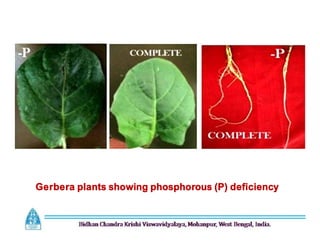
Gerbera plants showing phosphorous (P) deficiency
Plants were reduced in height.
Leaf number was highly reduced. No specific visual
symptoms were occurred on leaves. Older leaves were dark
green when compared to plants grown in complete nutrient
solution.
Roots of P deficient plants were poorly developed with
highly elongated and less branched tap root Laterals were
very few and filamentous.
Plants were reduced in height.
Leaf number was highly reduced. No specific visual
symptoms were occurred on leaves. Older leaves were dark
green when compared to plants grown in complete nutrient
solution.
Roots of P deficient plants were poorly developed with
highly elongated and less branched tap root Laterals were
very few and filamentous.
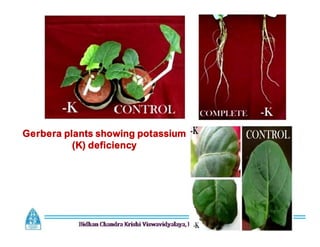
Gerbera plants showing potassium
(K) deficiency
Plants showed reduction in growth.
Potassium deficient plants initially developed symptoms as a
light tannish-brown necrosis along the margin of the older
leaves. The necrosis started from the tip of the leaves, and the
center of leaves remained green. Younger leaves showed
chlorosis.
Root system of K deficient plants, although reduced, was
fairly developed with relatively thicker roots. Laterals had
developed at the basal region and throughout the length of the
tap root.
Plants showed reduction in growth.
Potassium deficient plants initially developed symptoms as a
light tannish-brown necrosis along the margin of the older
leaves. The necrosis started from the tip of the leaves, and the
center of leaves remained green. Younger leaves showed
chlorosis.
Root system of K deficient plants, although reduced, was
fairly developed with relatively thicker roots. Laterals had
developed at the basal region and throughout the length of the
tap root.
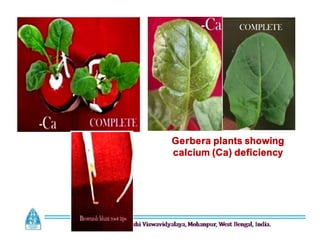
Gerbera plants showing
calcium (Ca) deficiency
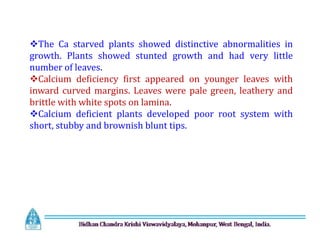
The Ca starved plants showed distinctive abnormalities in
growth. Plants showed stunted growth and had very little
number of leaves.
Calcium deficiency first appeared on younger leaves with
inward curved margins. Leaves were pale green, leathery and
brittle with white spots on lamina.
Calcium deficient plants developed poor root system with
short, stubby and brownish blunt tips.
The Ca starved plants showed distinctive abnormalities in
growth. Plants showed stunted growth and had very little
number of leaves.
Calcium deficiency first appeared on younger leaves with
inward curved margins. Leaves were pale green, leathery and
brittle with white spots on lamina.
Calcium deficient plants developed poor root system with
short, stubby and brownish blunt tips.
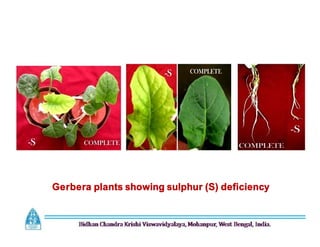
Gerbera plants showing sulphur (S) deficiency
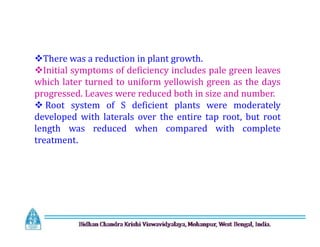
There was a reduction in plant growth.
Initial symptoms of deficiency includes pale green leaves
which later turned to uniform yellowish green as the days
progressed. Leaves were reduced both in size and number.
 Root system of S deficient plants were moderately
developed with laterals over the entire tap root, but root
length was reduced when compared with complete
treatment.
There was a reduction in plant growth.
Initial symptoms of deficiency includes pale green leaves
which later turned to uniform yellowish green as the days
progressed. Leaves were reduced both in size and number.
 Root system of S deficient plants were moderately
developed with laterals over the entire tap root, but root
length was reduced when compared with complete
treatment.
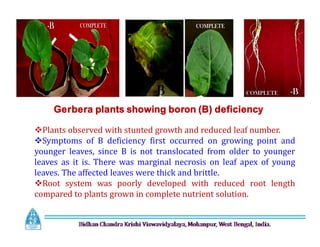
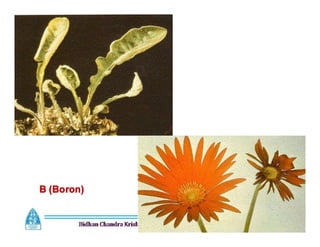
Gerbera plants showing boron (B) deficiency
Plants observed with stunted growth and reduced leaf number.
Symptoms of B deficiency first occurred on growing point and
younger leaves, since B is not translocated from older to younger
leaves as it is. There was marginal necrosis on leaf apex of young
leaves. The affected leaves were thick and brittle.
Root system was poorly developed with reduced root length
compared to plants grown in complete nutrient solution.
Plants observed with stunted growth and reduced leaf number.
Symptoms of B deficiency first occurred on growing point and
younger leaves, since B is not translocated from older to younger
leaves as it is. There was marginal necrosis on leaf apex of young
leaves. The affected leaves were thick and brittle.
Root system was poorly developed with reduced root length
compared to plants grown in complete nutrient solution.
B (Boron)
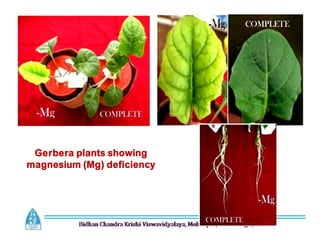
Gerbera plants showing
magnesium (Mg) deficiency
The plants were stunted in growth with few numbers of
leaves.
Leaves of Mg deficient plants showed interveinal
chlorosis on older leaves. Initial symptoms were observed
as pale green leaves, later as the deficiency progressed,
interveinal chlorosis was observed.
Roots of Mg deficient plants were not much affected, but
the root length is reduced when compared to complete
nutrient treatment.
The plants were stunted in growth with few numbers of
leaves.
Leaves of Mg deficient plants showed interveinal
chlorosis on older leaves. Initial symptoms were observed
as pale green leaves, later as the deficiency progressed,
interveinal chlorosis was observed.
Roots of Mg deficient plants were not much affected, but
the root length is reduced when compared to complete
nutrient treatment.
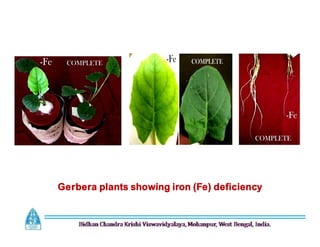
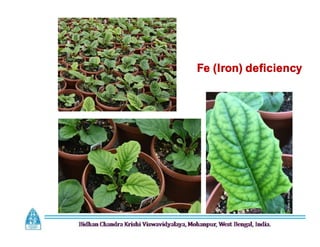
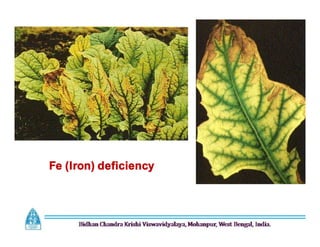
Gerbera plants showing iron (Fe) deficiency
Fe (Iron) deficiency
Plant growth was reduced.
Iron deficiency symptoms first occurred as interveinal
chlorosis on younger leaves. In advanced stage, affected
leaves developed uniform chlorosis.
The root system in Fe deficient plants was highly reduced
with few number of laterals.
Plant growth was reduced.
Iron deficiency symptoms first occurred as interveinal
chlorosis on younger leaves. In advanced stage, affected
leaves developed uniform chlorosis.
The root system in Fe deficient plants was highly reduced
with few number of laterals.
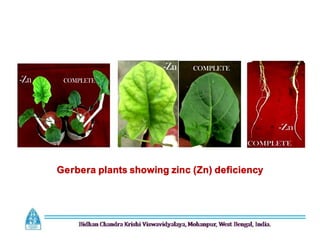
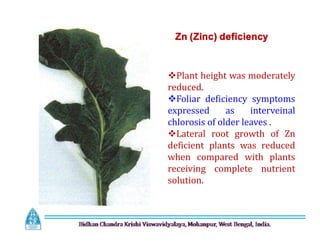
Gerbera plants showing zinc (Zn) deficiency
Zn (Zinc) deficiency
Plant height was moderately
reduced.
Foliar deficiency symptoms
expressed as interveinal
chlorosis of older leaves .
Lateral root growth of Zn
deficient plants was reduced
when compared with plants
receiving complete nutrient
solution.
Plant height was moderately
reduced.
Foliar deficiency symptoms
expressed as interveinal
chlorosis of older leaves .
Lateral root growth of Zn
deficient plants was reduced
when compared with plants
receiving complete nutrient
solution.
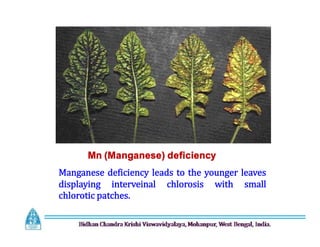
Mn (Manganese) deficiency
Manganese deficiency leads to the younger leaves
displaying interveinal chlorosis with small
chlorotic patches.
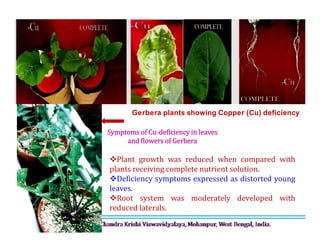
Gerbera plants showing Copper (Cu) deficiency
Symptoms of Cu-deficiency in leaves
and flowers of Gerbera
Plant growth was reduced when compared with
plants receiving complete nutrient solution.
Deficiency symptoms expressed as distorted young
leaves.
Root system was moderately developed with
reduced laterals.
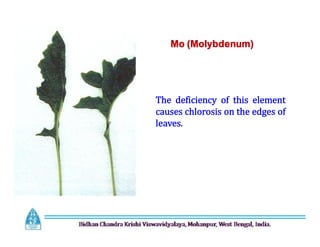
Mo (Molybdenum)
The deficiency of this element
causes chlorosis on the edges of
leaves.
The deficiency of this element
causes chlorosis on the edges of
leaves.
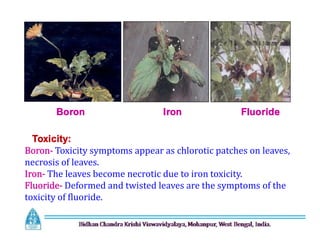
Boron Iron Fluoride
Toxicity:
Boron- Toxicity symptoms appear as chlorotic patches on leaves,
necrosis of leaves.
Iron- The leaves become necrotic due to iron toxicity.
Fluoride- Deformed and twisted leaves are the symptoms of the
toxicity of fluoride.
Gerbera cultivation tk_maity_bckv

Gerbera cultivation tk_maity_bckv

  • 1.
    Prof.(Dr.) Tapan Kr.Maity Prof.(Dr.) Tapan Kr. Maity Bidhan Chandra Krishi Viswavidyalaya Bidhan Chandra Krishi Viswavidyalaya Mohanpur 741252, West Bengal Mohanpur 741252, West Bengal India. India.
  • 2.
    Importance and Scopeof Gerbera Flowers Gerbera flowers are beautiful and attractive. Available in Different type of colours. Used in Decorations of various events. Used in bouquet. Gerbera as cut flowers used in Flower Pots. Used in Dry Flowers Industry. Possibility to export. Scope for Research and Development in local condition. Gerbera flowers are beautiful and attractive. Available in Different type of colours. Used in Decorations of various events. Used in bouquet. Gerbera as cut flowers used in Flower Pots. Used in Dry Flowers Industry. Possibility to export. Scope for Research and Development in local condition.
  • 3.
    Gerbera is avery attractive, commercial cut flower successfully grown under different conditions in several areas of the world as well as in India and meeting the requirements of various markets. This flower is originated in Asia and South Africa. Gerbera jamesonii has been developed through cross breeding program. Gerbera flowers have a wide range of colours including yellow, orange, cream-white, pink, brick red, red, terracotta and various other intermediate colors. In double varieties, bicolor flowers are also available. Gerbera flower stalks are long, thin and leafy and have a long vase life. The major producing states in India are Karnataka, Maharashtra, Tamil Nadu, West Bengal, Himachal Pradesh, Jammu & Kashmir and Gujarat. Gerbera is a very attractive, commercial cut flower successfully grown under different conditions in several areas of the world as well as in India and meeting the requirements of various markets. This flower is originated in Asia and South Africa. Gerbera jamesonii has been developed through cross breeding program. Gerbera flowers have a wide range of colours including yellow, orange, cream-white, pink, brick red, red, terracotta and various other intermediate colors. In double varieties, bicolor flowers are also available. Gerbera flower stalks are long, thin and leafy and have a long vase life. The major producing states in India are Karnataka, Maharashtra, Tamil Nadu, West Bengal, Himachal Pradesh, Jammu & Kashmir and Gujarat.
  • 4.
    CLIMATE Bright sunshine acceleratesthe growth and quality of the flowers, however, in summer this flower needs diffused sunlight. Gerbera plants grown in locations with insufficient light will not bloom well. The optimum day and night temperature is 270C and 140C respectively. For flower initiation, the optimum temperature is 230C and for leaf unfolding it is 25 – 270C. CLIMATE Bright sunshine accelerates the growth and quality of the flowers, however, in summer this flower needs diffused sunlight. Gerbera plants grown in locations with insufficient light will not bloom well. The optimum day and night temperature is 270C and 140C respectively. For flower initiation, the optimum temperature is 230C and for leaf unfolding it is 25 – 270C.
  • 6.
    SOIL There are twoprimary factors to be considered while selecting soil for Gerbera cultivation. The soil pH must be between 5.5 to 6.5. The soil salinity level does not exceed 1 ms/cm; For better root growth and better penetration of roots, the soil should be highly porous and well drained. Red lateritic soils are good for Gerbera cultivation as it is having all the essential qualities that an ideal soil should have. After fumigation with formaldehyde, the raised beds are prepared on which Gerbera plants are planted. SOIL There are two primary factors to be considered while selecting soil for Gerbera cultivation. The soil pH must be between 5.5 to 6.5. The soil salinity level does not exceed 1 ms/cm; For better root growth and better penetration of roots, the soil should be highly porous and well drained. Red lateritic soils are good for Gerbera cultivation as it is having all the essential qualities that an ideal soil should have. After fumigation with formaldehyde, the raised beds are prepared on which Gerbera plants are planted.
  • 7.
    Preparation of plantingbed In general, Gerberas are grown on raised beds to assist in easier movement and better drainage. The dimensions of the bed should be as follows: Bed height: 1.5 feet (45 cm) Bed width: 2 feet (60 cm) Between the beds: 1 feet (30 cm) Preparation of planting bed In general, Gerberas are grown on raised beds to assist in easier movement and better drainage. The dimensions of the bed should be as follows: Bed height: 1.5 feet (45 cm) Bed width: 2 feet (60 cm) Between the beds: 1 feet (30 cm)
  • 8.
  • 9.
    The beds forplanting should be highly porous, well drained and airy. Gravel/sand can be added at the bottom for better drainage. Organic manure is recommended to improve soil texture and to provide nutrition gradually. Organic manure and soil should be mixed thoroughly for optimum results. The soil should be loose all the time. The soil should not be very compact after watering. The upper layer of soil and FYM should be properly mixed. While bed preparation, add Single Super Phosphate (0:16:0) @ 2.5 kg per 100 sq.ft. for better root establishment and Magnesium Sulphate @ 0.5 kg per 100 sq.ft. to take care of deficiency of Mg. Neem cake (@1kg/m) is also added for prevention of nematode infestation. The beds for planting should be highly porous, well drained and airy. Gravel/sand can be added at the bottom for better drainage. Organic manure is recommended to improve soil texture and to provide nutrition gradually. Organic manure and soil should be mixed thoroughly for optimum results. The soil should be loose all the time. The soil should not be very compact after watering. The upper layer of soil and FYM should be properly mixed. While bed preparation, add Single Super Phosphate (0:16:0) @ 2.5 kg per 100 sq.ft. for better root establishment and Magnesium Sulphate @ 0.5 kg per 100 sq.ft. to take care of deficiency of Mg. Neem cake (@1kg/m) is also added for prevention of nematode infestation.
  • 10.
    Different stages ofbed preparation
  • 11.
    Different stages ofbed preparation
  • 12.
    Different stages ofbed preparation
  • 14.
  • 15.
  • 16.
  • 17.
  • 18.
    Soil sterilization Soil sterilizationis required before gerbera plantation to manage Phytophthora infestation. There are three main soil sterilization methods available. •Steam : Not practical for Indian conditions. •Solar : in this method plastic sheet is covered on the soil for 6-8 weeks. The sunrise will heat the soil, and this will kill most fungus. •Chemical : this is most advanced and useful method. Hydrogen peroxide (H2O2) with silver is used for sterilization of soil. Use of formalin @ 7.5 - 10 lit/100sqm can also be done Soil sterilization Soil sterilization is required before gerbera plantation to manage Phytophthora infestation. There are three main soil sterilization methods available. •Steam : Not practical for Indian conditions. •Solar : in this method plastic sheet is covered on the soil for 6-8 weeks. The sunrise will heat the soil, and this will kill most fungus. •Chemical : this is most advanced and useful method. Hydrogen peroxide (H2O2) with silver is used for sterilization of soil. Use of formalin @ 7.5 - 10 lit/100sqm can also be done
  • 19.
    Hydrogen peroxide (H2O2)with silver. Process: •Wet the beds with irrigation water. •Mix water with hydrogen peroxide at a rate of 35 ml per/lite. Apply this solution evenly on soil beds. Use one liter of mix solution ( Hydrogen peroxide (H2O2) with silver + water) For the one-meter area. After that in 4 to 6 hours the crop can be planted. Benefits of Hydrogen Peroxide with Silver: •Economical, reduce input cost •Very easy and safe this method does not affect any dangerous effect human health. •The plantation can be carried out after 4 to 6 hours fumigation. •Eco-friendly and does not produce any phytotoxic effects on plants. •Almost any fungi, bacteria and viral presence in the soil destroys the eggs of larva and insects. Hydrogen peroxide (H2O2) with silver. Process: •Wet the beds with irrigation water. •Mix water with hydrogen peroxide at a rate of 35 ml per/lite. Apply this solution evenly on soil beds. Use one liter of mix solution ( Hydrogen peroxide (H2O2) with silver + water) For the one-meter area. After that in 4 to 6 hours the crop can be planted. Benefits of Hydrogen Peroxide with Silver: •Economical, reduce input cost •Very easy and safe this method does not affect any dangerous effect human health. •The plantation can be carried out after 4 to 6 hours fumigation. •Eco-friendly and does not produce any phytotoxic effects on plants. •Almost any fungi, bacteria and viral presence in the soil destroys the eggs of larva and insects.
  • 20.
    Varieties of Gerberain India The numerous cultivars of gerbera, that are known today, have been developed through hybridization. Based on the rows of ray floret on flower heads gerbera are grouped as single, semi-double and double cultivars. Red coloured : Ruby Red, Dusty, Shania, Salvadore, Tamara, Fredorella, Vesta & Red Impulse. Yellow coloured : Supernova, Nadja, Doni, Mammut, Uranus, Fredking, Fullmoon, Talasa & Panama. Orange coloured : Kozak, Carrera, Marasol, Orange Classic & Goliath. Rose Coloured : Rosalin & Salvadore. Cream Coloured : Farida, Dalma, Snow Flake & Winter Queen. White coloured : Delphi & White Maria. Purple coloured : Treasure & BlackJack. Pink coloured : Terraqueen, Pink Elegance, Esmara, Valentine & Marmara. Red coloured : Ruby Red, Dusty, Shania, Salvadore, Tamara, Fredorella, Vesta & Red Impulse. Yellow coloured : Supernova, Nadja, Doni, Mammut, Uranus, Fredking, Fullmoon, Talasa & Panama. Orange coloured : Kozak, Carrera, Marasol, Orange Classic & Goliath. Rose Coloured : Rosalin & Salvadore. Cream Coloured : Farida, Dalma, Snow Flake & Winter Queen. White coloured : Delphi & White Maria. Purple coloured : Treasure & BlackJack. Pink coloured : Terraqueen, Pink Elegance, Esmara, Valentine & Marmara.
  • 22.
    List of Hi-techNursery Company KF Bioplants Florance Flora Rise & Shine
  • 23.
    Ideal season Although, Gerberacan be planted any time of the year many farmers plant it in January to March or June to July period considering it ideal. A good light amount is required during the plantation hence is not planted in November and December. Additionally, there is a risk of frost development, which is harmful to the plant in initial stages. Farmers also avoid plantation in August and September as the plants have to sustain winter during their growing periods. Ideal season Although, Gerbera can be planted any time of the year many farmers plant it in January to March or June to July period considering it ideal. A good light amount is required during the plantation hence is not planted in November and December. Additionally, there is a risk of frost development, which is harmful to the plant in initial stages. Farmers also avoid plantation in August and September as the plants have to sustain winter during their growing periods.
  • 24.
    PLANTING DISTANCE Plant toPlant distance: 30 cm Row to Row distance : 40 cm
  • 25.
  • 27.
    Planting Season inGerbera Flower Farming: Gerbera plantation can be done in spring as well as summer season. Gerbera needs good light intensity, planting in spring season (Jan to March) is best for 1.5 year tissue culture. Summer (June to July) is Suitable for 1, 1.5 & 2 years tissue cultures. Planting in autumn and winter (November and December) is not recommended due to low light intensity and high heating cost. Planting should be avoided in late August or September as it has to sustain in winter season. Planting Season in Gerbera Flower Farming: Gerbera plantation can be done in spring as well as summer season. Gerbera needs good light intensity, planting in spring season (Jan to March) is best for 1.5 year tissue culture. Summer (June to July) is Suitable for 1, 1.5 & 2 years tissue cultures. Planting in autumn and winter (November and December) is not recommended due to low light intensity and high heating cost. Planting should be avoided in late August or September as it has to sustain in winter season.
  • 30.
    Propagation Gerbera is propagatedby seed, by cuttings of side shoots and suckers. Seeds: Seed is set if cross-pollinated. Sowing of seed may be done in almost any season. Seeds germinate in 15 to 200C within two weeks; otherwise it may take up to 30 days. Plants from seeds will bloom in the second year and produce good flowers from the third year onwards. Vegetative: Side shoots, with some amount of heel, is utilized for. Divisions/ suckers, cuttings are also used. Micro propagation: The plant parts used as explants for micro propagation are Shoot tips, Leaf mid-rib, Capitulum, Flower heads, Inflorescence and Buds. Murashige and Skoog (MS) media with modification is successfully used as culture media. Propagation Gerbera is propagated by seed, by cuttings of side shoots and suckers. Seeds: Seed is set if cross-pollinated. Sowing of seed may be done in almost any season. Seeds germinate in 15 to 200C within two weeks; otherwise it may take up to 30 days. Plants from seeds will bloom in the second year and produce good flowers from the third year onwards. Vegetative: Side shoots, with some amount of heel, is utilized for. Divisions/ suckers, cuttings are also used. Micro propagation: The plant parts used as explants for micro propagation are Shoot tips, Leaf mid-rib, Capitulum, Flower heads, Inflorescence and Buds. Murashige and Skoog (MS) media with modification is successfully used as culture media.
  • 31.
  • 32.
    PLANTING MATERIAL Plant shouldnot be less than three months old. At the time of planting the tissue culture, plant should have at least 4 to 5 leaves. Gerberas are planted on raised bed in two rows formation. Zigzag plantation system is mostly preferred. While planting 65% portion of root ball should be kept below ground and rest of the portion i.e. 35% should be kept above the ground for better air circulation in the root zones. Ideal planting density and spacing: 8-10 plants/sq.m or 30 X 30 cm or 40 x 25 cm. PLANTING MATERIAL Plant should not be less than three months old. At the time of planting the tissue culture, plant should have at least 4 to 5 leaves. Gerberas are planted on raised bed in two rows formation. Zigzag plantation system is mostly preferred. While planting 65% portion of root ball should be kept below ground and rest of the portion i.e. 35% should be kept above the ground for better air circulation in the root zones. Ideal planting density and spacing: 8-10 plants/sq.m or 30 X 30 cm or 40 x 25 cm.
  • 33.
    Gerbera Plantation Properties 1. Propagationby tissue culture method. 2. Select proper harden plants. 3. Disease and pest free Plants. 4. At planting time 4 to 5 leaves – each plants. Precautions 1. Crown of Plant 1-2cm above soil. 2. Don’t Disturb root ball. 3. Distance row-row = 35cm. plant-plant = 30cm. Precautions 1. Crown of Plant 1-2cm above soil. 2. Don’t Disturb root ball. 3. Distance row-row = 35cm. plant-plant = 30cm.
  • 34.
    Planting beds andinitial fertilizer application Raised beds of 60 cm width are suitable for planting, base should be70 cm with height 45-60 cm. Gravels can be put at the bottom of the bed for better drainage. Keep 30-45 cm space between beds as working space. Add and mix 2.5 kg SSP and 0.5kg Magnesium sulphate @ 10sq m bed area. Plant three rows of per bed with 30 cm distance on one bed. Plant to plant distance should be 30 cm. Planting is done with root ball and crown is kept above soil surface (1 cm). Irrigate lightly after planting. In 200 sq.m. area, 900 plants can be planted with 3 rows while in 500 sq.m. area, 2500 plants can be accommodated. Planting beds and initial fertilizer application Raised beds of 60 cm width are suitable for planting, base should be70 cm with height 45-60 cm. Gravels can be put at the bottom of the bed for better drainage. Keep 30-45 cm space between beds as working space. Add and mix 2.5 kg SSP and 0.5kg Magnesium sulphate @ 10sq m bed area. Plant three rows of per bed with 30 cm distance on one bed. Plant to plant distance should be 30 cm. Planting is done with root ball and crown is kept above soil surface (1 cm). Irrigate lightly after planting. In 200 sq.m. area, 900 plants can be planted with 3 rows while in 500 sq.m. area, 2500 plants can be accommodated.
  • 35.
    Young plants areplanted in a pot with coir fibre.
  • 36.
  • 40.
    Cultural operations afterplanting The relative humidity is maintained at 70-80% for first 4 weeks. Irrigate plants lightly with rose can after planting daily for 4 weeks (twice in a day). Drenching of soil with fungicide captan and benlate (1g/lit) after 3 and 6 days, respectively is recommended. Spray Nuvan (Dichlorvos) (1.5 ml) after 9 days. Humic acid (1.5 ml/lit) is applied as a drench after 7 days. Chelated micronutrients are sprayed (0.5g / lit) after 10 days at the interval of 3-4 days up to one month. Fertilizers are applied as drench to soil with 14:42:14 (1.5g/ lit) after 13 days. Another drench with 19:19:19 (N:P:K) @ 2 g /lit. can be given after 17day. Continue this at the interval of 3-4 days up to 4 weeks. Kelthane and Endosulfan sprays are applied to take care of mites and other insects as and when required. Remove weeds regularly. Drench solution should be applied at the rate of 40ml/plant while for spray use 12 lit. of solution /1000plant as the plants are small initially. Cultural operations after planting The relative humidity is maintained at 70-80% for first 4 weeks. Irrigate plants lightly with rose can after planting daily for 4 weeks (twice in a day). Drenching of soil with fungicide captan and benlate (1g/lit) after 3 and 6 days, respectively is recommended. Spray Nuvan (Dichlorvos) (1.5 ml) after 9 days. Humic acid (1.5 ml/lit) is applied as a drench after 7 days. Chelated micronutrients are sprayed (0.5g / lit) after 10 days at the interval of 3-4 days up to one month. Fertilizers are applied as drench to soil with 14:42:14 (1.5g/ lit) after 13 days. Another drench with 19:19:19 (N:P:K) @ 2 g /lit. can be given after 17day. Continue this at the interval of 3-4 days up to 4 weeks. Kelthane and Endosulfan sprays are applied to take care of mites and other insects as and when required. Remove weeds regularly. Drench solution should be applied at the rate of 40ml/plant while for spray use 12 lit. of solution /1000plant as the plants are small initially.
  • 41.
    Fertilizers and irrigation(Fertigation) After one month plants get established and liquid fertilizers can be given through drip. Apply 20:20:20 N:P:K at alternate day (@ 0.4 g / plant) through drip during 2nd and 3rd month along with micronutrients and Calcium chelates. From fourth month onward apply 15:8:35 or 16:8:24 N:P:K + 0:0: 50 at alternate day @ 0.4 g / plant as the flowering picks-up. Calcium nitrate (250g) and chelated micronutrient mixture at 25 g (for roughly 1000 plants) should be given once in 8-10 days through drip. Grown-up plant needs 700 ml water / day hence dripper flow at each plant has to be checked and adjusted accordingly. Mix the liquid fertilizer in water in a small tank of fertigation system, adjust the flow through mixing unit by adjusting the valves. Flow can be measured at drippers. Check the flow of drippers over entire area, it should be even to all plants. For example : 1000 plants require 700 lit water and 400 g fertilizer quantity. (700 ml water with 0.4g fertilizer to each plant). Fertilizers and irrigation (Fertigation) After one month plants get established and liquid fertilizers can be given through drip. Apply 20:20:20 N:P:K at alternate day (@ 0.4 g / plant) through drip during 2nd and 3rd month along with micronutrients and Calcium chelates. From fourth month onward apply 15:8:35 or 16:8:24 N:P:K + 0:0: 50 at alternate day @ 0.4 g / plant as the flowering picks-up. Calcium nitrate (250g) and chelated micronutrient mixture at 25 g (for roughly 1000 plants) should be given once in 8-10 days through drip. Grown-up plant needs 700 ml water / day hence dripper flow at each plant has to be checked and adjusted accordingly. Mix the liquid fertilizer in water in a small tank of fertigation system, adjust the flow through mixing unit by adjusting the valves. Flow can be measured at drippers. Check the flow of drippers over entire area, it should be even to all plants. For example : 1000 plants require 700 lit water and 400 g fertilizer quantity. (700 ml water with 0.4g fertilizer to each plant).
  • 42.
    CULTURAL PRACTICES Weeding &raking of soil: Weeds take the nutrients of the plants and affect the production. Hence, they should be removed from the bed. Due to daily irrigation, the surface of the gerbera bed becomes hard hence raking of soil is done with the help of a raker. It increases soil aeration in the root zone of the plant. This operation should be done regularly, may be twice in a month. CULTURAL PRACTICES Weeding & raking of soil: Weeds take the nutrients of the plants and affect the production. Hence, they should be removed from the bed. Due to daily irrigation, the surface of the gerbera bed becomes hard hence raking of soil is done with the help of a raker. It increases soil aeration in the root zone of the plant. This operation should be done regularly, may be twice in a month.
  • 43.
    Disbudding: Removal of inferiorquality flowers at the initial stage after plantation is called disbudding. The normal production of gerbera plants starts after 75-90 days from the date of plantation. Production of flowers starts 45 days after plantation but initial production is of inferior quality, hence these flowers should be removed from the base of the flowers stalk. This helps in making the plant strong and healthy. Disbudding: Removal of inferior quality flowers at the initial stage after plantation is called disbudding. The normal production of gerbera plants starts after 75-90 days from the date of plantation. Production of flowers starts 45 days after plantation but initial production is of inferior quality, hence these flowers should be removed from the base of the flowers stalk. This helps in making the plant strong and healthy.
  • 44.
    Removal of oldleaves: Sanitation helps in keeping the disease and pest infestation below the economic threshold level. The old, dry, infested leaves should be removed from the plant and burnt outside the green house or dumped in to a compost pit. This practice allows producing good, healthy new leaves and better aeration in the crop. Removal of old leaves: Sanitation helps in keeping the disease and pest infestation below the economic threshold level. The old, dry, infested leaves should be removed from the plant and burnt outside the green house or dumped in to a compost pit. This practice allows producing good, healthy new leaves and better aeration in the crop.
  • 46.
    The first budscome through after a few weeks.
  • 47.
    A mature plantwith buds and flowers.
  • 51.
    Harvesting Gerbera plants produceflowers 7-8 weeks after planting. Plants have productive life up to 24-30 months. One plant yields 30-40 flowers per year and 75 to 100 flowers in 30 months. Flowers are ready to harvest when 2-3 whorls of stamens are developed. Pluck the flower at the heel with angular cut. Plucking should be done in morning or evening. Harvesting Gerbera plants produce flowers 7-8 weeks after planting. Plants have productive life up to 24-30 months. One plant yields 30-40 flowers per year and 75 to 100 flowers in 30 months. Flowers are ready to harvest when 2-3 whorls of stamens are developed. Pluck the flower at the heel with angular cut. Plucking should be done in morning or evening.
  • 52.
  • 53.
    Post-harvest quality andmanagement Flowers with stalk length 45-55cm and diameter 10- 12 cm fetch very good price as they are ‘A’ grade flowers. Vase life is 8-10 days. For best vase life put the cut end of the flower in clean water at 150C for 4 hrs. Add 10 ml Sodium Hypochlorite in 1 lit water before placing the flower. For long distance transport corrugated box/cartons are used. Gerbera does’nt need cooling like rose or carnation and have reasonably long shelf life. Post-harvest quality and management Flowers with stalk length 45-55cm and diameter 10- 12 cm fetch very good price as they are ‘A’ grade flowers. Vase life is 8-10 days. For best vase life put the cut end of the flower in clean water at 150C for 4 hrs. Add 10 ml Sodium Hypochlorite in 1 lit water before placing the flower. For long distance transport corrugated box/cartons are used. Gerbera does’nt need cooling like rose or carnation and have reasonably long shelf life.
  • 63.
    Powdery mildew: White powderyfungal growth observed on the leaf lamina. In case of severe attack leaves start curling. For the control, spraying of Wettable Sulphur (SP) 1.5 gm or Karathane (Dinocap) (SP) 0.4 ml or Quintol (Iprodion+ Carbendazim) (SP) 0.5 gm or Index (Myclobutanil) (SP) 0.5 gm or Rubigan (Fenremol) (SP) 1 ml or Hydrogen peroxide (SP) 2 ml per lit of water can be used . Powdery mildew: White powdery fungal growth observed on the leaf lamina. In case of severe attack leaves start curling. For the control, spraying of Wettable Sulphur (SP) 1.5 gm or Karathane (Dinocap) (SP) 0.4 ml or Quintol (Iprodion+ Carbendazim) (SP) 0.5 gm or Index (Myclobutanil) (SP) 0.5 gm or Rubigan (Fenremol) (SP) 1 ml or Hydrogen peroxide (SP) 2 ml per lit of water can be used .
  • 64.
  • 65.
  • 66.
  • 67.
  • 68.
  • 69.
  • 70.
    Alternaria Leaf Spot Symptoms •Brownspecks on the leaves and florets •White colored leaf spots Causative Agent Alternaria Management •Apply fungicides •Take care not to wet the Gerbera leaves while watering Alternaria Leaf Spot Symptoms •Brown specks on the leaves and florets •White colored leaf spots Causative Agent Alternaria Management •Apply fungicides •Take care not to wet the Gerbera leaves while watering
  • 72.
    Bacterial Leaf Spot CausativeAgent Pseudomonas cichorii Symptoms •Small circular spots that become irregular •Spots vary in color from dark brown to black •Spots have a concentric ring pattern Management •Low relative humidity •Avoid watering the leaves Bacterial Leaf Spot Causative Agent Pseudomonas cichorii Symptoms •Small circular spots that become irregular •Spots vary in color from dark brown to black •Spots have a concentric ring pattern Management •Low relative humidity •Avoid watering the leaves Bacterial leaf spot
  • 73.
  • 74.
    Botrytis Blight Causative Agent Botyritiscinerea Symptoms •Long brown spots on the petioles •Yellowing of leaves which die ultimately •Tanned spots on petals of Gerbera flowers •Infected tissues become grey •Stem at soil level get killed Management •Maintain adequate spacing between the plants to ensure enough air circulation •Remove crop debris •Maintain low humidity •Avoid watering late in the morning Botrytis Blight Causative Agent Botyritis cinerea Symptoms •Long brown spots on the petioles •Yellowing of leaves which die ultimately •Tanned spots on petals of Gerbera flowers •Infected tissues become grey •Stem at soil level get killed Management •Maintain adequate spacing between the plants to ensure enough air circulation •Remove crop debris •Maintain low humidity •Avoid watering late in the morning
  • 75.
  • 76.
  • 77.
    Fusarium Stem Rot CausativeAgent Fusarium solani Symptoms •The leaf petiole turn black from the base •Plant collapses as the stem weakens Management •Infected plants must be discarded immediately. Fusarium Stem Rot Causative Agent Fusarium solani Symptoms •The leaf petiole turn black from the base •Plant collapses as the stem weakens Management •Infected plants must be discarded immediately.
  • 78.
    Phytophthora Crown Rot CausativeAgent Phytophthora cryptogea Symptoms •Leaves turn brown •Plants start wilting suddenly •Roots and crown start rotting. Management •Avoid overhead watering Phytophthora Crown Rot Causative Agent Phytophthora cryptogea Symptoms •Leaves turn brown •Plants start wilting suddenly •Roots and crown start rotting. Management •Avoid overhead watering
  • 79.
    Gerbera with Phytophthoraroot rot (left). Comparison of healthy plant and root system with white roots (right) with a diseased plant exhibiting necrotic foliage and complete necrosis of root system
  • 80.
  • 81.
  • 82.
    Healthy(a) and root-rotdiseased (b)gerbera plant Phytophthora cryptogea
  • 83.
    Pythium Root Rot CausativeAgent Pythium Symptoms •The roots begin to rot •Owing to the root rot, plants begin wilting and they gradually die. Management •Sterilizing the soil properly before planting would help tackle with root rot •Crop debris must be discarded properly •Fungicides must be used Pythium Root Rot Causative Agent Pythium Symptoms •The roots begin to rot •Owing to the root rot, plants begin wilting and they gradually die. Management •Sterilizing the soil properly before planting would help tackle with root rot •Crop debris must be discarded properly •Fungicides must be used
  • 84.
  • 85.
    Rhizoctonia Crown Rot CausativeAgent Rhizoctonia solani Symptoms •Brown lesions appear on the stem •The lesions being at the base of the stem- soil level •Plants wilt Management •Proper soil sterilization •Application of fungicides •Disposing the infected plants immediately upon infection Rhizoctonia Crown Rot Causative Agent Rhizoctonia solani Symptoms •Brown lesions appear on the stem •The lesions being at the base of the stem- soil level •Plants wilt Management •Proper soil sterilization •Application of fungicides •Disposing the infected plants immediately upon infection Crown rot
  • 86.
    Thielaviopsis Root Rot CausativeAgent Thielaviopsis basicola Symptoms •Roots get affected first •They turn dark brown to black in color •Plants yellow, wilt and die Management •Proper soil sterilization •Application of fungicides •Disposing the infected plants immediately upon infection Thielaviopsis Root Rot Causative Agent Thielaviopsis basicola Symptoms •Roots get affected first •They turn dark brown to black in color •Plants yellow, wilt and die Management •Proper soil sterilization •Application of fungicides •Disposing the infected plants immediately upon infection Root rot
  • 87.
  • 88.
    Viral Diseases There aredifferent viral diseases like Gerbera mosaic, tobacco rattle, cucumber mosaic virus and necrotic spots. In these cases, the leaves are the first ones to get affected. Yellow necrotic spots appear on the leaf in various patterns like ring, line or flecks. The plants become distorted. The color of the flowers is not uniform. They break at some points. The best way to manage viral diseases in Gerbera plants is to control mites and insects. The infected plants must be destroyed. Viral Diseases There are different viral diseases like Gerbera mosaic, tobacco rattle, cucumber mosaic virus and necrotic spots. In these cases, the leaves are the first ones to get affected. Yellow necrotic spots appear on the leaf in various patterns like ring, line or flecks. The plants become distorted. The color of the flowers is not uniform. They break at some points. The best way to manage viral diseases in Gerbera plants is to control mites and insects. The infected plants must be destroyed.
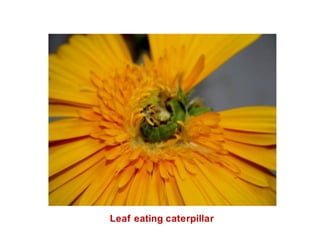
  • 89.
  • 91.
    Thrips- Frankliniella occidentalis causeswhite specks or stripes on ray florets; flower heads may be deformed. Silvery, grayish spots on the leaves and brown spots on leaf petioles/mid vein are observed. Chemicals used for management of thrips are fipronil 5ml or imidacloprid 0.5ml or dichlorvos 1.5 ml + Monocrotophos 2ml or Dimethoate 2ml or Abamectin 0.4 ml or calnova 0.5 ml + calpaste 2gm per lit of water. Thrips- Frankliniella occidentalis causes white specks or stripes on ray florets; flower heads may be deformed. Silvery, grayish spots on the leaves and brown spots on leaf petioles/mid vein are observed. Chemicals used for management of thrips are fipronil 5ml or imidacloprid 0.5ml or dichlorvos 1.5 ml + Monocrotophos 2ml or Dimethoate 2ml or Abamectin 0.4 ml or calnova 0.5 ml + calpaste 2gm per lit of water.
  • 92.
  • 93.
  • 94.
  • 95.
    Aphids: Aphids (Aphis gossypii) suckthe cell sap from young leaves and buds that causes distortion of leaves, excrete some substance on which fungus develops. Spray the plant with Malathion 2 ml or Diamethoate 2 ml to control the insect. Aphids: Aphids (Aphis gossypii) suck the cell sap from young leaves and buds that causes distortion of leaves, excrete some substance on which fungus develops. Spray the plant with Malathion 2 ml or Diamethoate 2 ml to control the insect.
  • 96.
    Caterpillar- Heliothis and Spodopteraboth the species feed on leaves voraciously making holes in the leaf lamina sometimes leaving only veins on the leaves. Larvae attack flower buds as a result deformed flowers are produced. The pest can be controlled biologically by spraying HNPV (Heliokill) 1 ml or Metarhisium 4 gm per l litre of water in the evening. The chemicals like emamectin benzoate 0.2 ml or methomil 1.5 gm or deltamethrin 0.5 ml or indoxacarb 0.5 ml or Thiodicarb 0.4 gm per lit of water in the spray form or soil application of phorate @ 2 gm per plant are used to control the pest. Caterpillar- Heliothis and Spodoptera both the species feed on leaves voraciously making holes in the leaf lamina sometimes leaving only veins on the leaves. Larvae attack flower buds as a result deformed flowers are produced. The pest can be controlled biologically by spraying HNPV (Heliokill) 1 ml or Metarhisium 4 gm per l litre of water in the evening. The chemicals like emamectin benzoate 0.2 ml or methomil 1.5 gm or deltamethrin 0.5 ml or indoxacarb 0.5 ml or Thiodicarb 0.4 gm per lit of water in the spray form or soil application of phorate @ 2 gm per plant are used to control the pest.
  • 97.
  • 98.
    Red Mites- Suckthe sap from lower sides of the leaves causing development of brown spots on lower surface of leaves resulting in marginal drying of leaves. Webbing on the flower petals can be seen. The pest can be controlled with pure water spray or wetable sulphur 1.5 g or Dicofol 1.5 ml or abamectin 0.4 ml, fenazaquin 1 ml or propergite 1 ml per litre of water. Some organic, plant extracts commercially available also give good control of the pest. Red Mites- Suck the sap from lower sides of the leaves causing development of brown spots on lower surface of leaves resulting in marginal drying of leaves. Webbing on the flower petals can be seen. The pest can be controlled with pure water spray or wetable sulphur 1.5 g or Dicofol 1.5 ml or abamectin 0.4 ml, fenazaquin 1 ml or propergite 1 ml per litre of water. Some organic, plant extracts commercially available also give good control of the pest.
  • 99.
    Broad mite (Polyphagotarsonemus latus) andcyclamen mite (Phytonemus pallidus): Older leaves are curled up. Younger ones being deformed and leathery, deformed flowers or petals are missing, inward curling and discolouration of petals. This pest can be controlled by spraying wetable sulphur1.5 gm or karathane 0.4 ml or Abamectin 0.4 ml or Derisom 2ml per litre of water. Broad mite (Polyphagotarsonemus latus) and cyclamen mite (Phytonemus pallidus): Older leaves are curled up. Younger ones being deformed and leathery, deformed flowers or petals are missing, inward curling and discolouration of petals. This pest can be controlled by spraying wetable sulphur1.5 gm or karathane 0.4 ml or Abamectin 0.4 ml or Derisom 2ml per litre of water.
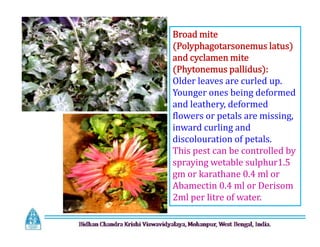
  • 100.
    Broad mite injuryon gerbera Broad mite injury on gerbera
  • 101.
    Root knot Nematode (Meloidogyneincognita)- Yellowing of leaves, stunted growth of the plant with reduced leaves size, knots on roots. Water logged condition in the green house and muddy water during rainy season are favourable conditions for nematode growth. Soil application of neem cake 30 to 50 gm per plant or carbofuron granules 10 gm per sq. m, drenching with methyl parathion 2 ml or benomyl 3 gm or hydrogen peroxide with Silver 3 ml or nematogaurd (Pacealomyces) 5 gm can be done to contro, the nematode. Root knot Nematode (Meloidogyne incognita)- Yellowing of leaves, stunted growth of the plant with reduced leaves size, knots on roots. Water logged condition in the green house and muddy water during rainy season are favourable conditions for nematode growth. Soil application of neem cake 30 to 50 gm per plant or carbofuron granules 10 gm per sq. m, drenching with methyl parathion 2 ml or benomyl 3 gm or hydrogen peroxide with Silver 3 ml or nematogaurd (Pacealomyces) 5 gm can be done to contro, the nematode.
  • 102.
    Leaf Miner (Liriomyza trifolii)-White coloured specks on leaves caused by flies. White serpentine tunnels in leaves caused by larvae, which stays in soil. Use Chlorpyriphos 1ml or Dichlorovos 1 ml or Acephate 1.5 g or Acetamiprid 0.4 g to control leaf miner in Gerbera. Leaf Miner (Liriomyza trifolii)- White coloured specks on leaves caused by flies. White serpentine tunnels in leaves caused by larvae, which stays in soil. Use Chlorpyriphos 1ml or Dichlorovos 1 ml or Acephate 1.5 g or Acetamiprid 0.4 g to control leaf miner in Gerbera.
  • 103.
  • 104.
  • 105.
    Trialeurodes vaporariarum, Bemisia tabaciare reported to be causing damage to the green house crops. It occurs when climate is hot and dry. Feeds on the lower side of leaves, excrete large quantity of honey dew which leads to development of black sooty moulds on the leaves. Methomyl 1.5 g or Malathion 2 ml or Diamethoate 2 ml or Imidacloprid 0.5 ml or Acetamiprid 0.4 g or Difenthiuron 1.25g per litre can be used to control this pest. Trialeurodes vaporariarum, Bemisia tabaci are reported to be causing damage to the green house crops. It occurs when climate is hot and dry. Feeds on the lower side of leaves, excrete large quantity of honey dew which leads to development of black sooty moulds on the leaves. Methomyl 1.5 g or Malathion 2 ml or Diamethoate 2 ml or Imidacloprid 0.5 ml or Acetamiprid 0.4 g or Difenthiuron 1.25g per litre can be used to control this pest.
  • 106.
    Care to betaken while spraying of pesticides, fungicides and fertilizers for better results The pH of the spray solution should be maintained between 6 and 6.5 by acidification 12 hrs before spray. The solution mixture should be immediately used after preparation before 12 Hrs. A spray adjuvant is added to the spray solution to enhance the efficacy of the spray. To avoid the plant damage like scorching, maintenance of suitable conditions inside the green house is very important. Pesticides containing Triazophos, Propiconazole, Penconazole, Hexaconazole, Deltamethrin + Trizophos (Spark), Profenophos, Metalaxyl + Mancozeb (Rodomil) should not be applied in Gerbera. Care to be taken while spraying of pesticides, fungicides and fertilizers for better results The pH of the spray solution should be maintained between 6 and 6.5 by acidification 12 hrs before spray. The solution mixture should be immediately used after preparation before 12 Hrs. A spray adjuvant is added to the spray solution to enhance the efficacy of the spray. To avoid the plant damage like scorching, maintenance of suitable conditions inside the green house is very important. Pesticides containing Triazophos, Propiconazole, Penconazole, Hexaconazole, Deltamethrin + Trizophos (Spark), Profenophos, Metalaxyl + Mancozeb (Rodomil) should not be applied in Gerbera.
  • 108.
    Physiological disorders Various physiologicaldisorders are observed in gerbera which are resultant of unfavourable climatic conditions, climatic fluctuations and nutritional deficiencies and imbalance. Double stemmed flowers, double faced flowers, flower heads with calyx like growth at the centre- A physiological disorder caused by imbalance of nutrients; usually observed when the plant shifts from vegetative to the generative phase. Neck bending- Loss of turgidity and deficiency of calcium are responsible for the neck bending. Non-uniform flower blooming- It may occur due to any physical injury to flower stem or pest attack or due to phyto-toxicity. Pre-harvest stem break- is a result of high root pressure and high atmospheric humidity. Short stem length- High salinity level, moisture stress and low soil temperature are the causes of short stemmed flowers. Premature wilting of flowers- is due to cloudy weather followed by bright sun or carbohydrate depletion. Physiological disorders Various physiological disorders are observed in gerbera which are resultant of unfavourable climatic conditions, climatic fluctuations and nutritional deficiencies and imbalance. Double stemmed flowers, double faced flowers, flower heads with calyx like growth at the centre- A physiological disorder caused by imbalance of nutrients; usually observed when the plant shifts from vegetative to the generative phase. Neck bending- Loss of turgidity and deficiency of calcium are responsible for the neck bending. Non-uniform flower blooming- It may occur due to any physical injury to flower stem or pest attack or due to phyto-toxicity. Pre-harvest stem break- is a result of high root pressure and high atmospheric humidity. Short stem length- High salinity level, moisture stress and low soil temperature are the causes of short stemmed flowers. Premature wilting of flowers- is due to cloudy weather followed by bright sun or carbohydrate depletion.
  • 109.
  • 110.
    Calyx-like growth andpetals at the centre of the flower head
  • 111.
  • 112.
  • 113.
  • 114.
    Diagnosing Problems If flowerstems are too tall or foliage too large:  Light intensity too low If flowers are too short or hidden in foliage:  Could be the use of excessive fertilizer  Plants drying out too frequently  Too much growth regulator  Growing temperature too low  Soluble salts too high If flower stems are too tall or foliage too large:  Light intensity too low If flowers are too short or hidden in foliage:  Could be the use of excessive fertilizer  Plants drying out too frequently  Too much growth regulator  Growing temperature too low  Soluble salts too high
  • 115.
    If flowers aredistorted:  Caused by mites or thrips If plant is stunted or fails to grow:  Poor drainage  Packing soil too tightly  Low soil temperatures If plant wilts or dies:  Planted too deep (crown rot/root rot) Diagnosing Problems If flowers are distorted:  Caused by mites or thrips If plant is stunted or fails to grow:  Poor drainage  Packing soil too tightly  Low soil temperatures If plant wilts or dies:  Planted too deep (crown rot/root rot)
  • 117.
    Gerbera plants showingnitrogen (N) deficiency
  • 118.
    The first symptomof N deficiency was reduced plant growth with stunted appearance. Leaves were reduced both in number and size, appeared chlorotic. Symptoms first appeared on older leaves as pale green discolouration which later changed to uniform yellow. The pattern of chlorosis extended to younger leaves as the days progressed. Senescence of leaves in the advanced stages was visualized. In the absence of N supply, root development was poor, with reduced root length compared to plants that received complete nutrient solution. The roots were thin, filamentous with linear elongation. A period of 40 days was taken for the complete manifestation of visual deficiency symptoms of N. Growth almost ceased and plants failed to initiate leaves. The first symptom of N deficiency was reduced plant growth with stunted appearance. Leaves were reduced both in number and size, appeared chlorotic. Symptoms first appeared on older leaves as pale green discolouration which later changed to uniform yellow. The pattern of chlorosis extended to younger leaves as the days progressed. Senescence of leaves in the advanced stages was visualized. In the absence of N supply, root development was poor, with reduced root length compared to plants that received complete nutrient solution. The roots were thin, filamentous with linear elongation. A period of 40 days was taken for the complete manifestation of visual deficiency symptoms of N. Growth almost ceased and plants failed to initiate leaves.
  • 119.
    Gerbera plants showingphosphorous (P) deficiency
  • 120.
    Plants were reducedin height. Leaf number was highly reduced. No specific visual symptoms were occurred on leaves. Older leaves were dark green when compared to plants grown in complete nutrient solution. Roots of P deficient plants were poorly developed with highly elongated and less branched tap root Laterals were very few and filamentous. Plants were reduced in height. Leaf number was highly reduced. No specific visual symptoms were occurred on leaves. Older leaves were dark green when compared to plants grown in complete nutrient solution. Roots of P deficient plants were poorly developed with highly elongated and less branched tap root Laterals were very few and filamentous.
  • 121.
    Gerbera plants showingpotassium (K) deficiency
  • 122.
    Plants showed reductionin growth. Potassium deficient plants initially developed symptoms as a light tannish-brown necrosis along the margin of the older leaves. The necrosis started from the tip of the leaves, and the center of leaves remained green. Younger leaves showed chlorosis. Root system of K deficient plants, although reduced, was fairly developed with relatively thicker roots. Laterals had developed at the basal region and throughout the length of the tap root. Plants showed reduction in growth. Potassium deficient plants initially developed symptoms as a light tannish-brown necrosis along the margin of the older leaves. The necrosis started from the tip of the leaves, and the center of leaves remained green. Younger leaves showed chlorosis. Root system of K deficient plants, although reduced, was fairly developed with relatively thicker roots. Laterals had developed at the basal region and throughout the length of the tap root.
  • 123.
  • 124.
    The Ca starvedplants showed distinctive abnormalities in growth. Plants showed stunted growth and had very little number of leaves. Calcium deficiency first appeared on younger leaves with inward curved margins. Leaves were pale green, leathery and brittle with white spots on lamina. Calcium deficient plants developed poor root system with short, stubby and brownish blunt tips. The Ca starved plants showed distinctive abnormalities in growth. Plants showed stunted growth and had very little number of leaves. Calcium deficiency first appeared on younger leaves with inward curved margins. Leaves were pale green, leathery and brittle with white spots on lamina. Calcium deficient plants developed poor root system with short, stubby and brownish blunt tips.
  • 125.
    Gerbera plants showingsulphur (S) deficiency
  • 126.
    There was areduction in plant growth. Initial symptoms of deficiency includes pale green leaves which later turned to uniform yellowish green as the days progressed. Leaves were reduced both in size and number.  Root system of S deficient plants were moderately developed with laterals over the entire tap root, but root length was reduced when compared with complete treatment. There was a reduction in plant growth. Initial symptoms of deficiency includes pale green leaves which later turned to uniform yellowish green as the days progressed. Leaves were reduced both in size and number.  Root system of S deficient plants were moderately developed with laterals over the entire tap root, but root length was reduced when compared with complete treatment.
  • 127.
    Gerbera plants showingboron (B) deficiency Plants observed with stunted growth and reduced leaf number. Symptoms of B deficiency first occurred on growing point and younger leaves, since B is not translocated from older to younger leaves as it is. There was marginal necrosis on leaf apex of young leaves. The affected leaves were thick and brittle. Root system was poorly developed with reduced root length compared to plants grown in complete nutrient solution. Plants observed with stunted growth and reduced leaf number. Symptoms of B deficiency first occurred on growing point and younger leaves, since B is not translocated from older to younger leaves as it is. There was marginal necrosis on leaf apex of young leaves. The affected leaves were thick and brittle. Root system was poorly developed with reduced root length compared to plants grown in complete nutrient solution.
  • 128.
  • 129.
  • 130.
    The plants werestunted in growth with few numbers of leaves. Leaves of Mg deficient plants showed interveinal chlorosis on older leaves. Initial symptoms were observed as pale green leaves, later as the deficiency progressed, interveinal chlorosis was observed. Roots of Mg deficient plants were not much affected, but the root length is reduced when compared to complete nutrient treatment. The plants were stunted in growth with few numbers of leaves. Leaves of Mg deficient plants showed interveinal chlorosis on older leaves. Initial symptoms were observed as pale green leaves, later as the deficiency progressed, interveinal chlorosis was observed. Roots of Mg deficient plants were not much affected, but the root length is reduced when compared to complete nutrient treatment.
  • 131.
    Gerbera plants showingiron (Fe) deficiency
  • 132.
  • 133.
  • 134.
    Plant growth wasreduced. Iron deficiency symptoms first occurred as interveinal chlorosis on younger leaves. In advanced stage, affected leaves developed uniform chlorosis. The root system in Fe deficient plants was highly reduced with few number of laterals. Plant growth was reduced. Iron deficiency symptoms first occurred as interveinal chlorosis on younger leaves. In advanced stage, affected leaves developed uniform chlorosis. The root system in Fe deficient plants was highly reduced with few number of laterals.
  • 135.
    Gerbera plants showingzinc (Zn) deficiency
  • 136.
    Zn (Zinc) deficiency Plantheight was moderately reduced. Foliar deficiency symptoms expressed as interveinal chlorosis of older leaves . Lateral root growth of Zn deficient plants was reduced when compared with plants receiving complete nutrient solution. Plant height was moderately reduced. Foliar deficiency symptoms expressed as interveinal chlorosis of older leaves . Lateral root growth of Zn deficient plants was reduced when compared with plants receiving complete nutrient solution.
  • 137.
    Mn (Manganese) deficiency Manganesedeficiency leads to the younger leaves displaying interveinal chlorosis with small chlorotic patches.
  • 138.
    Gerbera plants showingCopper (Cu) deficiency Symptoms of Cu-deficiency in leaves and flowers of Gerbera Plant growth was reduced when compared with plants receiving complete nutrient solution. Deficiency symptoms expressed as distorted young leaves. Root system was moderately developed with reduced laterals.
  • 139.
    Mo (Molybdenum) The deficiencyof this element causes chlorosis on the edges of leaves. The deficiency of this element causes chlorosis on the edges of leaves.
  • 140.
    Boron Iron Fluoride Toxicity: Boron-Toxicity symptoms appear as chlorotic patches on leaves, necrosis of leaves. Iron- The leaves become necrotic due to iron toxicity. Fluoride- Deformed and twisted leaves are the symptoms of the toxicity of fluoride.