Ge r
rbe a
Manual
®
KF Bioplants Pvt. Ltd.
Gerbera (Gerbera jamesonii) is an important commercial flower crop
grown throughout the world in a wide range of climatic conditions.
It is ideal for beds, borders, pots and rock gardens. The flowers come in
a wide range of colors and lend themselves beautifully to different floral
arrangements. The cut blooms when placed in water remain fresh for
a reasonable amount of time.
Gerbera belongs to the family “Compositae”. Plants are stem less and
tender perennial herbs, leave radical, petiole, lanceolate, deeply lobed,
sometimes leathery, narrower at the base and wider at toe and are arranged
in a rosette at the base.
The daisy-like flowers grow in a wide range of colors including yellow,
orange, cream-white, pink, brick red, scarlet, maroon, terracotta and
various other intermediate shades. The double cultivars sometimes have
bicolor flowers, which are very attractive. The flower stalks are long, thin
and leafless.
INTRODUCTION :
To be successful in Gerbera growing, soil selection is very important. The
main factors to consider are as under :
1] Soil pH should be in between 5.5 to 6.5 or it should be maintained at this
level to get maximum efficiency in absorption of nutrients.
2] The salinity level of soil should not be more than 1 mS/cm. Therefore, as
soon as you select the site, get the soil analyzed to decide its further
reclamation.
3] The soil should be highly porous and well drained to have better root
growth and better penetration of roots.
The roots of Gerbera go as deep as 50 - 70 cm.
SOIL STRUCTURE
Before plantation of Gerbera, disinfections of soil are absolutely necessary.
In particular, the fungus Phytophthora is a menace to Gerbera. The various
methods of sterilization are :
1. Steam : Not feasible for Indian conditions.
2. Sun : Cover the soil with plastic for 6 - 8 weeks. Sunrays will heat up the soil,
which will kill most fungi.
GENERAL DISINFECTION OF SOIL
1
2 KF Bioplants Pvt. Ltd.
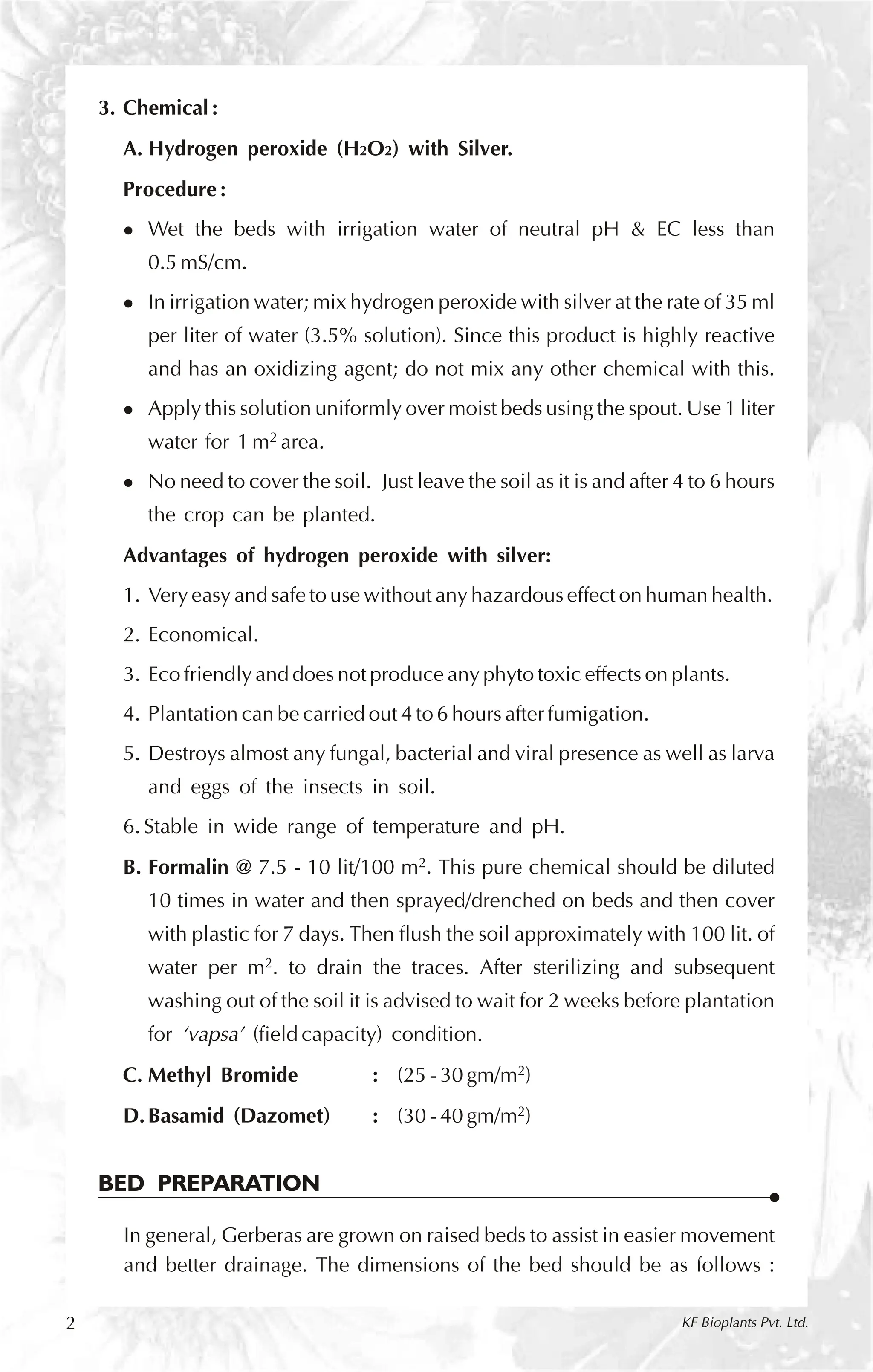
3. Chemical :
A. Hydrogen peroxide (H2O2) with Silver.
Procedure :
l
Wet the beds with irrigation water of neutral pH & EC less than
0.5 mS/cm.
l
In irrigation water; mix hydrogen peroxide with silver at the rate of 35 ml
per liter of water (3.5% solution). Since this product is highly reactive
and has an oxidizing agent; do not mix any other chemical with this.
l
Apply this solution uniformly over moist beds using the spout. Use 1 liter
2
water for 1 m area.
l
No need to cover the soil. Just leave the soil as it is and after 4 to 6 hours
the crop can be planted.
Advantages of hydrogen peroxide with silver:
1. Very easy and safe to use without any hazardous effect on human health.
2. Economical.
3. Eco friendly and does not produce any phyto toxic effects on plants.
4. Plantation can be carried out 4 to 6 hours after fumigation.
5. Destroys almost any fungal, bacterial and viral presence as well as larva
and eggs of the insects in soil.
6. Stable in wide range of temperature and pH.
2
B. Formalin @ 7.5 - 10 lit/100 m . This pure chemical should be diluted
10 times in water and then sprayed/drenched on beds and then cover
with plastic for 7 days. Then flush the soil approximately with 100 lit. of
2
water per m . to drain the traces. After sterilizing and subsequent
washing out of the soil it is advised to wait for 2 weeks before plantation
for ‘vapsa’ (field capacity) condition.
2
C. Methyl Bromide : (25 - 30 gm/m )
2
D.Basamid (Dazomet) : (30 - 40 gm/m )
In general, Gerberas are grown on raised beds to assist in easier movement
and better drainage. The dimensions of the bed should be as follows :
BED PREPARATION
KF Bioplants Pvt. Ltd. 3
Bed height : 1.5 ft. (45 cm)
Bed width : 2 ft. (60 cm)
Pathways between beds : 1 ft. (30 cm)
If soil is black cotton, gravels or murum (6” layer) can be added at the
bottom for better drainage. Recommended quantity of soil and sand is
added along with organic manures. Organic manure is recommended to
improve soil texture and to provide nutrition gradually.
2
At the time of bed preparation (After fumigation) neemcake (@1kg/m ) is
added as prevention against nematode. All material should be mixed
thoroughly for optimum results.
The composition of bed material should be such that it should be highly
porous, well drained and provide proper aeration to the root system.
60 cm 60 cm
45 cm 45 cm
70 cm 70 cm
30 cm
2'
37.5 cm
3
0
c
m
Bed Material Composition:
Material
Red soil
Sand
FYM
Rice husk
Clay soil
55 %
15 %
30 %
2
4kg/m
Silty loam soil
60 %
10 %
30 %
2
2.5 kg/m
KF Bioplants Pvt. Ltd.
4
1. Criteria for site selection :
a. The land should be leveled.
b. No wind breaks or multi storied structures present upto 30 meters.
c. Good connectivity to nearest market
d. Electricity at the site and no high tension electricity wire upto 5 meters.
e. Availability of good quality water
2. Specification :
a. Height : 5 to 6.5 m.
b. Length : North - South.
c. Gutter direction : North - South.
d. Polythene thickness : 200 microns.
e. Vent opening : Along the wind direction.
f. Distance between two adjoining poly houses should be minimum 4 m.
3. Sufficient ventilation space is required on top and sides.
4. To protect the plants from the rains, without affecting the air circulation,
side curtains should be kept open in slanting position.
5. To control light intensity and solar radiation, white shade net (50%) is used.
Approximately 35,000 to 40,000 lux light intensity is required on the
plant level.
6. Greenhouse operation:
a. Open side curtains from 7 am to 6 pm in summer and rainy seasons,
whereas open from 9 am to 5 pm in winter, to facilitate maximum air
circulation.
b. Top shade net opening and closing:
l
During cloudy climate keep open, otherwise close from 10 am
to 4 pm.
l
During cold nights close the shade net.
l
In summer close from 9.30 am to 5 pm.
GREENHOUSE FOR COMMERCIAL CULTIVATION
Area Chemical Quantity
2
10 m Single Super Phosphate 2.50 kg
2
10 m Magnesium Sulphate 0.50 kg
2
10 m Biozyme Granules 200 gm
2
10 m Humiguard Granules 200 gm
Mix it well in upper 6” soil layer, apply water and at Vapsa condition (Field
capacity level) check EC and pH of soil before plantation.
** DO NOT WALK ON THE BEDS AS IT DESTROYS SOIL TEXTURE.
Basal fertilizer dose (After bed preparation) :
5
KF Bioplants Pvt. Ltd.
While planting Gerbera plants, the
crown of plants should be 1 - 2 cm
above soil level. As the root system
establishes; the plants are pulled down.
Therefore, the crown must be above
the ground level at planting and also
throughout the life cycle.
PLANTING
25 per cent
above the soil
75 per cent
below the soil
c. Wash top of plastic with clean water monthly.
d. Always maintain hygiene and sanitation inside as well as outside
polyhouse.
e. Test water and soil sample for EC and pH periodically.
0
7. The ideal temperature for Gerbera flower initiation is 23 C and for leaf
0
unfolding is 25 - 27 C. The flowering of Gerbera is harmed below
0 0
12 C and above 35 C.
8. The optimum humidity inside the greenhouse should be 70 - 80 %, which
will maintain the health of the plants.
9. Apply white wash to east, west and north sides of green house to protect
plants from bright light intensity during summer season.
0
12 C
Bud initiation will stop Frequency of flowers will be very low
& absorption of buds will take place
0
35 C
Plant the seedlings without disturbing the root ball. Generally two rows
should be planted on one bed at 37.5 cm distance and 30 cm distance
between the plants in one row i.e.
Row - Row = 37.5 cm = 1.25'
Plant - Plant = 30.0 cm = 1'
Rake the soil surrounding the plant every fortnight for aeration.
After plantation, maintain the humidity at 80 - 90 % for 4 - 6 weeks to avoid
desiccation of plants.
“AVOID EXCESSIVE WATERING TO GERBERA.”
Thumb rules to curb initial mortality immediately after planting:
1. Fumigation procedure is absolutely necessary to prevent the infestation of
soil borne diseases.
2. After the application of the basal dose, the soil pH and EC should be
tested. Ensure that the soil and water EC and pH are well within the
prescribed limits.
3. The FYM added into the beds should be completely decomposed and
uniformly mixed.
4. At the time of planting, the crown portion should be well above the soil
(25%). This is to prevent soil and water accumulation at the crown portion.
KF Bioplants Pvt. Ltd.
6
1. Water quality should be as follows :
a. pH- 6.5 - 7.0 b. EC- < 0.7 mS/cm.
c. T. D. S. < 450 ppm d. Hardness < 200 ppm
To lower the pH of water, Nitric acid (HNO3) or Phosphoric acid (H2PO4)
can be added to the tank. The tank in which the treatment is being
carried out, should be thoroughly washed. To ensure thorough mixing of
the acid with water, the tank should first be filled with half the required
quantity of the water, after which the acid is added, thereafter, making up
the volume with the remaining quantity of water. This procedure ensures
thorough mixing of acid in water. The contents should be mixed and left
overnight and used in the morning for fertigation or irrigation purpose.
2. Immediately after plantation, irrigate the plant with overhead irrigation for
three weeks to enable uniform root development. Thereafter gradually
change to drip irrigation. Drip irrigation is mainly for correct doses of
fertilizers.
3. Generally one drip per plant is required. The aim is to provide sufficient
nd
irrigation in the 2 year for the extra foliage. The water requirement of
Gerbera plant is approximately 300 to 700 ml per plant per day depending
upon the season. In hot summer, foggers can be used to maintain the
humidity of the air. The foggers should not be operated for more than
30 seconds at any given point in time.
4. Before irrigation observe the soil column and visually check the soil
moisture content. Then decide on the quantity of irrigation required.
5. During summer season, apply water to the edges of the beds frequently by
using shower to minimize the evaporation losses and to maintain micro
climate. For this purpose provision for water outlets (1” diameter pipe)
should be made inside the poly house. Number of outlets depends on size
of the polyhouse.
6. Always water the plants before 12 noon.
7. The relative humidity of air should not exceed 80%, as it will lead
to conditions conducive for the occurrence and survival of fungal
pathogens, especially Botrytis, on the flowers.
8. As a thumb rule, the soil should be moderately moist, however never
having excessive water.
9. Always use fresh water for irrigation i.e. do not store water for more than
4 to 5 days.
IRRIGATION
5. Ensure that the crown is allowed to dry out between each watering.
In other words, the beds should always be in ‘vapsa' condition.
6. Provide adequate ventilation inside the greenhouse to prevent humidity
and temperature buildup.
7. Follow the 21 day schedule which essentially includes preventive
fungicides and insecticides, in addition to the chemicals that enhance
the root development and establishment of the plant.
KF Bioplants Pvt. Ltd. 7
1. After three weeks of plantation apply N:P:K 1:1:1 (e.g. 19:19:19) @ 0.4
gm/plant every alternate day with EC 1.5 mS/cm for first three months
during the vegetative phase to have better foliage.
2. Disbudding operation had to be carred out until 16 -18 fully developed
leaves are present on the plant. Thereafter, the generative stage fertigation
can be commenced. The generative stage fertigation comprises of
N:P:K 2:1:4 (e.g. N:P:K 15:8:35) @ 0.4 gm/plant every alternate day with
EC 1.5 mS/cm to enhance the quantity and quality of flowers.
3. Irrigate and fertilize frequently in small quantities for optimum results.
However, always take care to fulfill the crop requirement.
4. Micronutrients (e.g. Fertilon Combi II, Microsole B, Rexolin, Sequel and
Mahabrexil @ 40 gm per 1000 lit of water) should be given daily or weekly
as per the deficiency symptoms.
5. Add organic manures with EC less than 2 mS/cm at every 3 months interval
to maintain proper C:N Ratio.
6. Always do the detail soil analysis every 2 - 3 months to decide specific
nutrient schedule.
7. As a layman, whenever you enter the greenhouse the plants should look
very healthy and glossy.
“NEVER LEAVE THE PLANTS IN STRESS CONDITION.”
METHOD OF GIVING FERTIGATION:
Fertigation should be given early in the morning at 6 am for better utilization
by the plants. Take recommended quantity of fertilizers and dissolve them
in sufficient quantity of water. If pH of plain water to be used is on higher
side then lower it to 6 to 6.5 by using acid. It should be added to the
water atleast 12 hours before use. It is necessary to give fertilizers with
recommended quantity of water to maintain EC of soil. Hence, operate drip
system for recommended period of time. After every fertigation, open flush
valve to drain off water from laterals and sub mains. Periodically clean
the fertigation system to avoid any type of malfunctioning.
FERTILIZATION
CROPPING PATTERN and HARVESTING OF FLOWERS
Gerbera is a 30 - 36 months crop. The first flowers are produced 7 - 8 weeks
after plantation when plants are with 14 to 16 leaves. The average yield is
2 2
240 flowers per m (6 plants/m ).
1. The flowers are harvested when 2 - 3 whorls of stamens have entirely been
developed; this will decide the vase life of flowers.
a. Pluck the flowers in the morning or late in the evening or during the day
when temperature is low.
b. Pluck the flower from the plant rather than cutting them.
c. After harvesting, cut the heel of the flower stalk by giving an angular cut.
d. Place the flowers immediately in 2-3 cm water for four hours at
0
14 - 15 C.
e. Always add commercial bleach/Sodium Hypochlorite @ 7 - 10 ml or
Citric acid + Ascorbic acid @ 5ml each/lit of water.
8 KF Bioplants Pvt. Ltd.
DISEASES / PESTS
f. Sleeves the individual flower with polythene bag of size 4.5” x 4.5”
g. Make bundle of 10 flowers.
h. Pack the flowers in a box with following dimensions. Generally 250 to
300 flowers are packed per box.
40 cm
98 cm
12 cm
A good flower is :
1. Stalk length = 45 - 55 cm.
2. Diameter of flower = 10 - 12 cm.
A Gerbera cut flower has a minimum vase life of 8 - 10 days.
Aphids : Cause deformed leaves, excrete some substance on which
fungus develops.
Greenhouse Whitefly : It occurs when climate is hot and dry. Feeds on the
lower side of leaves, excrete large quantity of honey dew like substance
which leads to development of black sooty moulds on the leaves.
Leaf Miner : White specks on leaves caused by flies. White serpentine
tunnels in leaves caused by larvae, which stays in soil.
Red Mites : Suck the sap from lower sides of the leaves causing
development of brown spots on lower surface of leaves resulting in
marginal drying of leaves. Webbing on the flower petals.
Cyclamine Mites : Older leaves are curled up. Younger ones being
deformed and leathery, deformed flowers or petals are missing. Inward
curling and discolouration of petals.
Thrips : Causes white specks or stripes on ray florets; flower heads may
be deformed. Silvery, grayish spots on the leaves; Brown spots on leaf
petioles / midvein.
Caterpillar : Eat leaves voraciously making circular holes in the leaf
lamina. It causes white spots on the petals in case of flower attack.
Root knot Nematode : Yellowing of leaves, stunted growth of the plant
with reduced leaves size, knots on roots. Water logged condition in
the greenhouse and muddy water during rainy season are favourable
conditions for nematode growth and spread.
Snails / Slugs : Snails and slugs thrive under plant debris and soil under
cool and moist conditions. They come out to feed during night hours.
The symptoms are characterised by circular feeding holes on the leaves
and flower petals.
Mealy Bugs : Mealy bugs are identifed as white cottony insects, feeding on
leaves and tender growing points. The feeding damage is characterised by
yellowing and distortion of plant parts. During feeding, the insect secretes
honey dew, which serves as a medium for black sooty mold fungi.
9
KF Bioplants Pvt. Ltd.
Diseases :
Crown Rot : Caused by Phytophthora cryptogea results in wilting disease
of Gerbera, Crown of the plant becomes black.
Root Rot : Caused by Pythium. Initially dropping of younger leaves, finally
wilting of the plant. Root skin is easily removed .
Fungal Complex : Plant becomes weak and stunted, with poor quality
stems. This is a combined infection of Cylindrocarpon destructans,
Fusarium solani and Fusarium oxysporum. If leaf stem is cut, you
can see black vessels. Blocking of crown portion with brown
discolouration.
Alternaria Leaf Spot : Develops when moisture persist on leaf surface for
longer duration. Black circular spots appears on leaves.
Powdery Mildew : White powdery growth on the leaf lamina. In case of
severe attack leaves start curling.
Botrytis : Occurs especially when the relative humidity of the air is more
than 92 % for two hours in the morning. Gray spots on the flower petals-rot
in the heart of flower.
Bacterial Blight : Yellowish oily spots on the leaves later turns brown.
Brown discolouration along the mid vein. Wilting of flower bud and brown
spots on the stems.
Phyllody : This is an irreversible phenomenon, which is the abnormal
development of floral parts to leafy structures. It is caused due to combined
effect of unfavourable biotic as well as abiotic factors.
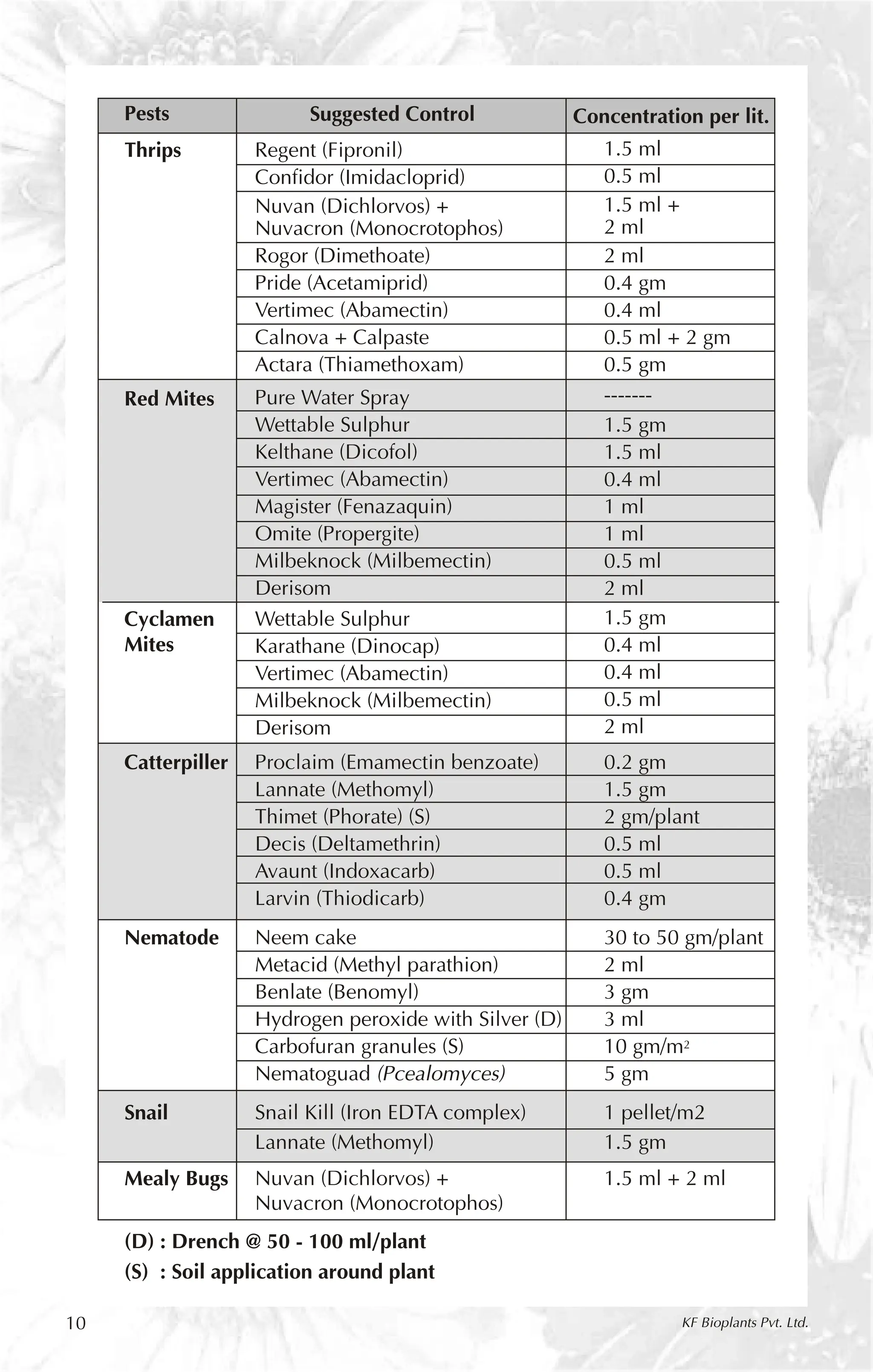
PEST CONTROL IN GERBERA
Pests Suggested Control Concentration per lit.
Astra, Lannate (Methomyl)
Rogor (Dimethoate)
Neemazol
Malathion
Confidor (Imidacloprid)
Pride (Acetamiprid)
Dantop (Clothianidin)
Actara (Thiamethoxam)
Pegasus (Diafenthiuron)
Calnova + Calpaste
Padan (Cartep Hydrochloride)
Whitefly 1.5 gm
2 ml
2 ml
2 ml
0.5 ml
0.4 gm
0.2 gm
0.5 gm
1.25 gm
0.5 ml + 2 gm
1 gm
Leaf Miner Chlorpyriphos
Nuvan (Dichlorovos)
Vertimec (Abamectin)
Acephate (Acephate)
Metacid (Methyl Parathion)
Cal MB
Cypermethrin
Padan (Cartep Hydrochloride)
1 ml
1 ml
0.4 ml
1.5 gm
1 ml
2 ml
0.5 ml
1 gm
10 KF Bioplants Pvt. Ltd.
Pests Suggested Control Concentration per lit.
Regent (Fipronil)
Confidor (Imidacloprid)
Nuvan (Dichlorvos) +
Nuvacron (Monocrotophos)
Rogor (Dimethoate)
Pride (Acetamiprid)
Vertimec (Abamectin)
Calnova + Calpaste
Actara (Thiamethoxam)
Thrips 1.5 ml
0.5 ml
1.5 ml +
2 ml
2 ml
0.4 gm
0.4 ml
0.5 ml + 2 gm
0.5 gm
Pure Water Spray
Wettable Sulphur
Kelthane (Dicofol)
Vertimec (Abamectin)
Magister (Fenazaquin)
Omite (Propergite)
Milbeknock (Milbemectin)
Derisom
Red Mites
1.5 gm
1.5 ml
0.4 ml
1 ml
1 ml
0.5 ml
2 ml
Cyclamen
Mites
Wettable Sulphur
Karathane (Dinocap)
Vertimec (Abamectin)
Milbeknock (Milbemectin)
Derisom
1.5 gm
0.4 ml
0.4 ml
0.5 ml
2 ml
Catterpiller Proclaim (Emamectin benzoate)
Lannate (Methomyl)
Thimet (Phorate) (S)
Decis (Deltamethrin)
Avaunt (Indoxacarb)
Larvin (Thiodicarb)
0.2 gm
1.5 gm
2 gm/plant
0.5 ml
0.5 ml
0.4 gm
Nematode Neem cake
Metacid (Methyl parathion)
Benlate (Benomyl)
Hydrogen peroxide with Silver (D)
Carbofuran granules (S)
Nematoguad (Pcealomyces)
30 to 50 gm/plant
2 ml
3 gm
3 ml
2
10 gm/m
5 gm
(D) : Drench @ 50 - 100 ml/plant
(S) : Soil application around plant
-------
Snail Kill (Iron EDTA complex)
Lannate (Methomyl)
Nuvan (Dichlorvos) +
Nuvacron (Monocrotophos)
Snail 1 pellet/m2
1.5 gm
Mealy Bugs 1.5 ml + 2 ml
KF Bioplants Pvt. Ltd. 11
Note: Yellow sticky traps and blue sticky traps can be placed at crop canopy
level. These sticky cards help in alerting about the presence of the pest as well
as to identify the hot spots in the greenhouse. One to three sticky cards per
2
1000 ft can be placed and will have to be changed regularly.
DISEASE CONTROL IN GERBERA
Disease Suggested Control Concentration per lit.
Root Rot Aliette (Fosetyl Alluminium) (SP)
Topsin-M (Thiophanate- Methyl) (D)
Benlate (Benomyl) (D)
Bavistin (Carbendazim) (D)
Captaf (Captan) (D)
1 gm
2 gm
3 gm
2 gm
2 gm
Crown Rot Aliette (Fosetyl Alluminium) (SP)
Topsin-M (Thiophanate- Methyl) (D)
Blitox (Copper oxychloride) (D)
Kocide (Copper hydroxide) (D)
1 gm
2 gm
1.5 gm
2 gm
Fungal
Complex
Topsin-M (Thiophanate- Methyl) (D)
Bavistin (D)
Hydrogen Peroxide with Silver (D)
Benlate (D)
Streptocyclin + COH (D)
Control Sucking Pests (Vectors)
2 gm
2 gm
3 ml
1.5 gm
0.2 gm + 1.5 g
---
Alternaria
Leaf Spot
Dithane M-45 (Mancozeb) (SP) 1.5 gm
Powdery
Mildew
1.5 gm
0.4 ml
0.5 gm
0.5 gm
1 ml
2 ml
Wettable Sulphur (SP)
Karathane (Dinocap) (SP)
Quintol or Rovral
(Iprodion + Carbendazim) (SP)
Index (Myclobutanil) (SP)
Rubigan (Fenremol) (SP)
Hydrogen Peroxide with Silver (SP)
Botrytis Dithane M-45 (Mancozeb) (SP)
Quintol or Rovral
(Iprodion + Carbendazim) (D)
Index (Myclobutanil) (SP)
1.5 gm
0.5 gm
0.5 gm
Bacterial
Blight
Streptocyclin (SP)
Kasu B (Kasugamycin) (SP)
Emison (Ethoxy methyl
mercury chloride) (SP)
Blitox (Copper oxychloride) (D)
Kocide (Copper hydroxide) (D)
0.2 ml
1.25 ml
0.2 gm
1.5 gm
2 gm
KF Bioplants Pvt. Ltd.
12
Note : In biological fungicides Trichoderma viridae and Trichoderma
herzenium are effective against all fungal diseases. Chemical fungicides
should not be used atleast 21days after or 10 days before its application.
NEVER APPLY FOLLOWING CHEMICALS ON GERBERA
Flower bent : Loss of cell turgidity and under nutrition (lack of Calcium)
l
Pre-harvest stem break : High root pressure and high humidity in the air.
l
Premature wilting of Gerbera flower : Cloudy weather followed by
bright sun or carbohydrate depletion.
Care to be taken while spraying of pesticides, fungicides and fertilizers for
better results.
1) pH of the solution should be between 6 to 6.5. It is maintained by acid
treatment to water 12 hours before spray.
2) Use solution immediately after preparation.
3) Do not store mixture for more than 2 hours after preparation.
4) Smaller droplet size helps to cover maximum leaf surface area.
5) It is recommended to add spray adjuvant like Apsa 80 @ 5 ml/15 lit. of
water to enhance the performance of pesticides & fertilizers and also help
the solution to penetrate deeper.
6) Test water and soil sample for EC & pH periodically.
7) Operation of greenhouse is very important to maintain suitable
conditions inside the polyhouse.
(D) : Drench @ 50 - 100 ml/plant (SP) : Spraying
Streptocyclin + COC (D)
Hydrogen Peroxide with Silver (D)
Kasu B (S)
Validamycin (S)
Perfect
Phyllody
Disease Suggested Control Concentration per lit.
0.2g + 1.5g
3ml
1.25ml
1ml
1ml
Spray schedule to control the sucking pest
TRADE NAME CONSISTENT
Hostathion Triazophos
Tilt Propiconazole
Topaz Penconazole
Contaf Hexconazole
Spark Deltamethrin + Triazophos
Polytrin Profenophos
Ridomil Metalaxyl 8% + Mancozeb 64%
13
KF Bioplants Pvt. Ltd.
KF Bioplants Pvt. Ltd. 13
DEFICIENCY SYMPTOMS
1. Nitrogen : General yellowing starts on older leaves and then moves
gradually upward because nitrogen is translocated out of older leaves to
the new growth under deficiency.
2. Phosphorus : Brownish to purplish discolouration along the veins or the
under side of the older leaves.
3. Potassium : Marginal necrosis of old leaves.
4. Calcium : Extreme yellowing of young leaves.
5. Magnesium : Interveinal chlorosis on older leaves, leaves get thick and
crispy.
6. Iron : Interveinal chlorosis on young leaves. Serious deficiency results in
a yellowish-white coloring.
7. Zinc : Chlorosis, one half of leaf blade ceases to expand and develop
while other half is normal i.e. C shaped leaf structure.
8. Manganese : Leaves turn yellowish, starting with younger ones; veins
remain green, heavy chlorosis.
9. Copper : Chlorosis in younger leaves; flower develops bad.
10. Molybdenum : Chlorosis on the edges of leaves.
11. Boron : Bases of younger leaves are black colored.
Control measure : Chelated sources (like Microsole, Tracel, Micnelf) of these
microelements as a foliar spray.
1. WATER SAMPLE:
l
For tube well or open well, pump out some water and then collect
sample in clean and chemical free plastic or glass bottle.
l
For river of lake, collect sample at a distance from the bed so that the
sediment particles do not enter in the sample.
l
Ensure that the sample should reach the analysis laboratory within
2 days from collection.
WATER AND SOIL SAMPLE COLLECTION
l
Double-faced Gerbera flower : A physiological disorder caused by
imbalance of nutrients. Too much growth too little flower buds.
l
Non-uniform flower blooming : Physical injury to flower stem/pest
damage / phytotoxicity.
l
Short stem length : High salinity level, moisture stress, low soil temp.
l
Hollow stem : Inadequate sunlight during cloudy weather, leading to
lack of carbohydrate accumulation in the flower stalk.
l
Petal drop : High turgor pressure leads to the petals dropping off with
the slightest touch at the time of packing in sleeves.
KF Bioplants Pvt. Ltd.
14
2. SOIL SAMPLE:
l
For existing plot, it is necessary to take samples from 3 to 8 spots
depending on the area.
l
Stop fertigation for 2 days.
l
Remove upper 5 cm layer of soil from these spots.
l
Make a V-shaped hole (as shown in figure) of 6'' depth in between
drippers.
l
Scrap soil from slope of hole and this will be a sample from that spot.
Similarly take samples from all spots and mix together.
l
Then air dry this sample under shade and then take some sample as a
representative sample of the plot. Ensure that the sample should reach
the analysis laboratory within 2 days from collection.
Point of sample
collection
Drippers
6” Depth
Sample
5 cm below soil surface
Soil surface
KF Bioplants Pvt. Ltd. 15
Farm chemicals include Insecticides, Fungicides and various other chemicals,
which are hazardous and can cause grievous injuries, if not taken proper
precautions while handling. The hazards can include burns due to the
corrosive nature of the chemicals, inhalation of the dust or fumes or residual
effect due to improper hygiene after the use of the chemical. Following are
some vital points:
1. The pesticides and other related chemicals should be stored under
lock and key in a separate, dry, well ventilated room.
2. Access to children, unauthorised persons and farm animals should be
strictly denied.
3. A First-Aid Kit should always be available.
4. Use different set of clothing while handling the chemicals.
5. Read the safety instructions mentioned on the container, before opening
the container.
6. Use face mask, eye protecting gears as well as hand gloves while using
the chemicals.
7. In case, any corrosive chemical has come in contact with skin or come in
contact with eyes, immediately wash under running cold water tap,
followed by seeking medical help.
8. Seek immediate medical attention if the chemical has been ingested.
9. The used and empty containers should be safely disposed.
Safety guidelines while handling agricultural chemicals:
This manual is purely for information only. KF Bioplants does not own any liability for any issues caused after following this manual.
An ISO 9001:2008 Company
www.kfbioplants.com
S. No. 178, Kirtane Baug, Mundhwa Road, Magarpatta, Hadapsar, Pune - 411 036. India.
Tel : +91-20-2689 0422 / 2689 0615 Fax : +91-20-2689 0681 E-mail : info@kfbioplants.com
®
www.numerouno-india.com/June'15
CIN : U01122MH1997PTC106620

Gerbera 1.pdf

  • 1.
  • 2.
    KF Bioplants Pvt.Ltd. Gerbera (Gerbera jamesonii) is an important commercial flower crop grown throughout the world in a wide range of climatic conditions. It is ideal for beds, borders, pots and rock gardens. The flowers come in a wide range of colors and lend themselves beautifully to different floral arrangements. The cut blooms when placed in water remain fresh for a reasonable amount of time. Gerbera belongs to the family “Compositae”. Plants are stem less and tender perennial herbs, leave radical, petiole, lanceolate, deeply lobed, sometimes leathery, narrower at the base and wider at toe and are arranged in a rosette at the base. The daisy-like flowers grow in a wide range of colors including yellow, orange, cream-white, pink, brick red, scarlet, maroon, terracotta and various other intermediate shades. The double cultivars sometimes have bicolor flowers, which are very attractive. The flower stalks are long, thin and leafless. INTRODUCTION : To be successful in Gerbera growing, soil selection is very important. The main factors to consider are as under : 1] Soil pH should be in between 5.5 to 6.5 or it should be maintained at this level to get maximum efficiency in absorption of nutrients. 2] The salinity level of soil should not be more than 1 mS/cm. Therefore, as soon as you select the site, get the soil analyzed to decide its further reclamation. 3] The soil should be highly porous and well drained to have better root growth and better penetration of roots. The roots of Gerbera go as deep as 50 - 70 cm. SOIL STRUCTURE Before plantation of Gerbera, disinfections of soil are absolutely necessary. In particular, the fungus Phytophthora is a menace to Gerbera. The various methods of sterilization are : 1. Steam : Not feasible for Indian conditions. 2. Sun : Cover the soil with plastic for 6 - 8 weeks. Sunrays will heat up the soil, which will kill most fungi. GENERAL DISINFECTION OF SOIL 1
  • 3.
    2 KF BioplantsPvt. Ltd. 3. Chemical : A. Hydrogen peroxide (H2O2) with Silver. Procedure : l Wet the beds with irrigation water of neutral pH & EC less than 0.5 mS/cm. l In irrigation water; mix hydrogen peroxide with silver at the rate of 35 ml per liter of water (3.5% solution). Since this product is highly reactive and has an oxidizing agent; do not mix any other chemical with this. l Apply this solution uniformly over moist beds using the spout. Use 1 liter 2 water for 1 m area. l No need to cover the soil. Just leave the soil as it is and after 4 to 6 hours the crop can be planted. Advantages of hydrogen peroxide with silver: 1. Very easy and safe to use without any hazardous effect on human health. 2. Economical. 3. Eco friendly and does not produce any phyto toxic effects on plants. 4. Plantation can be carried out 4 to 6 hours after fumigation. 5. Destroys almost any fungal, bacterial and viral presence as well as larva and eggs of the insects in soil. 6. Stable in wide range of temperature and pH. 2 B. Formalin @ 7.5 - 10 lit/100 m . This pure chemical should be diluted 10 times in water and then sprayed/drenched on beds and then cover with plastic for 7 days. Then flush the soil approximately with 100 lit. of 2 water per m . to drain the traces. After sterilizing and subsequent washing out of the soil it is advised to wait for 2 weeks before plantation for ‘vapsa’ (field capacity) condition. 2 C. Methyl Bromide : (25 - 30 gm/m ) 2 D.Basamid (Dazomet) : (30 - 40 gm/m ) In general, Gerberas are grown on raised beds to assist in easier movement and better drainage. The dimensions of the bed should be as follows : BED PREPARATION
  • 4.
    KF Bioplants Pvt.Ltd. 3 Bed height : 1.5 ft. (45 cm) Bed width : 2 ft. (60 cm) Pathways between beds : 1 ft. (30 cm) If soil is black cotton, gravels or murum (6” layer) can be added at the bottom for better drainage. Recommended quantity of soil and sand is added along with organic manures. Organic manure is recommended to improve soil texture and to provide nutrition gradually. 2 At the time of bed preparation (After fumigation) neemcake (@1kg/m ) is added as prevention against nematode. All material should be mixed thoroughly for optimum results. The composition of bed material should be such that it should be highly porous, well drained and provide proper aeration to the root system. 60 cm 60 cm 45 cm 45 cm 70 cm 70 cm 30 cm 2' 37.5 cm 3 0 c m Bed Material Composition: Material Red soil Sand FYM Rice husk Clay soil 55 % 15 % 30 % 2 4kg/m Silty loam soil 60 % 10 % 30 % 2 2.5 kg/m
  • 5.
    KF Bioplants Pvt.Ltd. 4 1. Criteria for site selection : a. The land should be leveled. b. No wind breaks or multi storied structures present upto 30 meters. c. Good connectivity to nearest market d. Electricity at the site and no high tension electricity wire upto 5 meters. e. Availability of good quality water 2. Specification : a. Height : 5 to 6.5 m. b. Length : North - South. c. Gutter direction : North - South. d. Polythene thickness : 200 microns. e. Vent opening : Along the wind direction. f. Distance between two adjoining poly houses should be minimum 4 m. 3. Sufficient ventilation space is required on top and sides. 4. To protect the plants from the rains, without affecting the air circulation, side curtains should be kept open in slanting position. 5. To control light intensity and solar radiation, white shade net (50%) is used. Approximately 35,000 to 40,000 lux light intensity is required on the plant level. 6. Greenhouse operation: a. Open side curtains from 7 am to 6 pm in summer and rainy seasons, whereas open from 9 am to 5 pm in winter, to facilitate maximum air circulation. b. Top shade net opening and closing: l During cloudy climate keep open, otherwise close from 10 am to 4 pm. l During cold nights close the shade net. l In summer close from 9.30 am to 5 pm. GREENHOUSE FOR COMMERCIAL CULTIVATION Area Chemical Quantity 2 10 m Single Super Phosphate 2.50 kg 2 10 m Magnesium Sulphate 0.50 kg 2 10 m Biozyme Granules 200 gm 2 10 m Humiguard Granules 200 gm Mix it well in upper 6” soil layer, apply water and at Vapsa condition (Field capacity level) check EC and pH of soil before plantation. ** DO NOT WALK ON THE BEDS AS IT DESTROYS SOIL TEXTURE. Basal fertilizer dose (After bed preparation) :
  • 6.
    5 KF Bioplants Pvt.Ltd. While planting Gerbera plants, the crown of plants should be 1 - 2 cm above soil level. As the root system establishes; the plants are pulled down. Therefore, the crown must be above the ground level at planting and also throughout the life cycle. PLANTING 25 per cent above the soil 75 per cent below the soil c. Wash top of plastic with clean water monthly. d. Always maintain hygiene and sanitation inside as well as outside polyhouse. e. Test water and soil sample for EC and pH periodically. 0 7. The ideal temperature for Gerbera flower initiation is 23 C and for leaf 0 unfolding is 25 - 27 C. The flowering of Gerbera is harmed below 0 0 12 C and above 35 C. 8. The optimum humidity inside the greenhouse should be 70 - 80 %, which will maintain the health of the plants. 9. Apply white wash to east, west and north sides of green house to protect plants from bright light intensity during summer season. 0 12 C Bud initiation will stop Frequency of flowers will be very low & absorption of buds will take place 0 35 C Plant the seedlings without disturbing the root ball. Generally two rows should be planted on one bed at 37.5 cm distance and 30 cm distance between the plants in one row i.e. Row - Row = 37.5 cm = 1.25' Plant - Plant = 30.0 cm = 1' Rake the soil surrounding the plant every fortnight for aeration. After plantation, maintain the humidity at 80 - 90 % for 4 - 6 weeks to avoid desiccation of plants. “AVOID EXCESSIVE WATERING TO GERBERA.” Thumb rules to curb initial mortality immediately after planting: 1. Fumigation procedure is absolutely necessary to prevent the infestation of soil borne diseases. 2. After the application of the basal dose, the soil pH and EC should be tested. Ensure that the soil and water EC and pH are well within the prescribed limits. 3. The FYM added into the beds should be completely decomposed and uniformly mixed. 4. At the time of planting, the crown portion should be well above the soil (25%). This is to prevent soil and water accumulation at the crown portion.
  • 7.
    KF Bioplants Pvt.Ltd. 6 1. Water quality should be as follows : a. pH- 6.5 - 7.0 b. EC- < 0.7 mS/cm. c. T. D. S. < 450 ppm d. Hardness < 200 ppm To lower the pH of water, Nitric acid (HNO3) or Phosphoric acid (H2PO4) can be added to the tank. The tank in which the treatment is being carried out, should be thoroughly washed. To ensure thorough mixing of the acid with water, the tank should first be filled with half the required quantity of the water, after which the acid is added, thereafter, making up the volume with the remaining quantity of water. This procedure ensures thorough mixing of acid in water. The contents should be mixed and left overnight and used in the morning for fertigation or irrigation purpose. 2. Immediately after plantation, irrigate the plant with overhead irrigation for three weeks to enable uniform root development. Thereafter gradually change to drip irrigation. Drip irrigation is mainly for correct doses of fertilizers. 3. Generally one drip per plant is required. The aim is to provide sufficient nd irrigation in the 2 year for the extra foliage. The water requirement of Gerbera plant is approximately 300 to 700 ml per plant per day depending upon the season. In hot summer, foggers can be used to maintain the humidity of the air. The foggers should not be operated for more than 30 seconds at any given point in time. 4. Before irrigation observe the soil column and visually check the soil moisture content. Then decide on the quantity of irrigation required. 5. During summer season, apply water to the edges of the beds frequently by using shower to minimize the evaporation losses and to maintain micro climate. For this purpose provision for water outlets (1” diameter pipe) should be made inside the poly house. Number of outlets depends on size of the polyhouse. 6. Always water the plants before 12 noon. 7. The relative humidity of air should not exceed 80%, as it will lead to conditions conducive for the occurrence and survival of fungal pathogens, especially Botrytis, on the flowers. 8. As a thumb rule, the soil should be moderately moist, however never having excessive water. 9. Always use fresh water for irrigation i.e. do not store water for more than 4 to 5 days. IRRIGATION 5. Ensure that the crown is allowed to dry out between each watering. In other words, the beds should always be in ‘vapsa' condition. 6. Provide adequate ventilation inside the greenhouse to prevent humidity and temperature buildup. 7. Follow the 21 day schedule which essentially includes preventive fungicides and insecticides, in addition to the chemicals that enhance the root development and establishment of the plant.
  • 8.
    KF Bioplants Pvt.Ltd. 7 1. After three weeks of plantation apply N:P:K 1:1:1 (e.g. 19:19:19) @ 0.4 gm/plant every alternate day with EC 1.5 mS/cm for first three months during the vegetative phase to have better foliage. 2. Disbudding operation had to be carred out until 16 -18 fully developed leaves are present on the plant. Thereafter, the generative stage fertigation can be commenced. The generative stage fertigation comprises of N:P:K 2:1:4 (e.g. N:P:K 15:8:35) @ 0.4 gm/plant every alternate day with EC 1.5 mS/cm to enhance the quantity and quality of flowers. 3. Irrigate and fertilize frequently in small quantities for optimum results. However, always take care to fulfill the crop requirement. 4. Micronutrients (e.g. Fertilon Combi II, Microsole B, Rexolin, Sequel and Mahabrexil @ 40 gm per 1000 lit of water) should be given daily or weekly as per the deficiency symptoms. 5. Add organic manures with EC less than 2 mS/cm at every 3 months interval to maintain proper C:N Ratio. 6. Always do the detail soil analysis every 2 - 3 months to decide specific nutrient schedule. 7. As a layman, whenever you enter the greenhouse the plants should look very healthy and glossy. “NEVER LEAVE THE PLANTS IN STRESS CONDITION.” METHOD OF GIVING FERTIGATION: Fertigation should be given early in the morning at 6 am for better utilization by the plants. Take recommended quantity of fertilizers and dissolve them in sufficient quantity of water. If pH of plain water to be used is on higher side then lower it to 6 to 6.5 by using acid. It should be added to the water atleast 12 hours before use. It is necessary to give fertilizers with recommended quantity of water to maintain EC of soil. Hence, operate drip system for recommended period of time. After every fertigation, open flush valve to drain off water from laterals and sub mains. Periodically clean the fertigation system to avoid any type of malfunctioning. FERTILIZATION CROPPING PATTERN and HARVESTING OF FLOWERS Gerbera is a 30 - 36 months crop. The first flowers are produced 7 - 8 weeks after plantation when plants are with 14 to 16 leaves. The average yield is 2 2 240 flowers per m (6 plants/m ). 1. The flowers are harvested when 2 - 3 whorls of stamens have entirely been developed; this will decide the vase life of flowers. a. Pluck the flowers in the morning or late in the evening or during the day when temperature is low. b. Pluck the flower from the plant rather than cutting them. c. After harvesting, cut the heel of the flower stalk by giving an angular cut. d. Place the flowers immediately in 2-3 cm water for four hours at 0 14 - 15 C. e. Always add commercial bleach/Sodium Hypochlorite @ 7 - 10 ml or Citric acid + Ascorbic acid @ 5ml each/lit of water.
  • 9.
    8 KF BioplantsPvt. Ltd. DISEASES / PESTS f. Sleeves the individual flower with polythene bag of size 4.5” x 4.5” g. Make bundle of 10 flowers. h. Pack the flowers in a box with following dimensions. Generally 250 to 300 flowers are packed per box. 40 cm 98 cm 12 cm A good flower is : 1. Stalk length = 45 - 55 cm. 2. Diameter of flower = 10 - 12 cm. A Gerbera cut flower has a minimum vase life of 8 - 10 days. Aphids : Cause deformed leaves, excrete some substance on which fungus develops. Greenhouse Whitefly : It occurs when climate is hot and dry. Feeds on the lower side of leaves, excrete large quantity of honey dew like substance which leads to development of black sooty moulds on the leaves. Leaf Miner : White specks on leaves caused by flies. White serpentine tunnels in leaves caused by larvae, which stays in soil. Red Mites : Suck the sap from lower sides of the leaves causing development of brown spots on lower surface of leaves resulting in marginal drying of leaves. Webbing on the flower petals. Cyclamine Mites : Older leaves are curled up. Younger ones being deformed and leathery, deformed flowers or petals are missing. Inward curling and discolouration of petals. Thrips : Causes white specks or stripes on ray florets; flower heads may be deformed. Silvery, grayish spots on the leaves; Brown spots on leaf petioles / midvein. Caterpillar : Eat leaves voraciously making circular holes in the leaf lamina. It causes white spots on the petals in case of flower attack. Root knot Nematode : Yellowing of leaves, stunted growth of the plant with reduced leaves size, knots on roots. Water logged condition in the greenhouse and muddy water during rainy season are favourable conditions for nematode growth and spread. Snails / Slugs : Snails and slugs thrive under plant debris and soil under cool and moist conditions. They come out to feed during night hours. The symptoms are characterised by circular feeding holes on the leaves and flower petals. Mealy Bugs : Mealy bugs are identifed as white cottony insects, feeding on leaves and tender growing points. The feeding damage is characterised by yellowing and distortion of plant parts. During feeding, the insect secretes honey dew, which serves as a medium for black sooty mold fungi.
  • 10.
    9 KF Bioplants Pvt.Ltd. Diseases : Crown Rot : Caused by Phytophthora cryptogea results in wilting disease of Gerbera, Crown of the plant becomes black. Root Rot : Caused by Pythium. Initially dropping of younger leaves, finally wilting of the plant. Root skin is easily removed . Fungal Complex : Plant becomes weak and stunted, with poor quality stems. This is a combined infection of Cylindrocarpon destructans, Fusarium solani and Fusarium oxysporum. If leaf stem is cut, you can see black vessels. Blocking of crown portion with brown discolouration. Alternaria Leaf Spot : Develops when moisture persist on leaf surface for longer duration. Black circular spots appears on leaves. Powdery Mildew : White powdery growth on the leaf lamina. In case of severe attack leaves start curling. Botrytis : Occurs especially when the relative humidity of the air is more than 92 % for two hours in the morning. Gray spots on the flower petals-rot in the heart of flower. Bacterial Blight : Yellowish oily spots on the leaves later turns brown. Brown discolouration along the mid vein. Wilting of flower bud and brown spots on the stems. Phyllody : This is an irreversible phenomenon, which is the abnormal development of floral parts to leafy structures. It is caused due to combined effect of unfavourable biotic as well as abiotic factors. PEST CONTROL IN GERBERA Pests Suggested Control Concentration per lit. Astra, Lannate (Methomyl) Rogor (Dimethoate) Neemazol Malathion Confidor (Imidacloprid) Pride (Acetamiprid) Dantop (Clothianidin) Actara (Thiamethoxam) Pegasus (Diafenthiuron) Calnova + Calpaste Padan (Cartep Hydrochloride) Whitefly 1.5 gm 2 ml 2 ml 2 ml 0.5 ml 0.4 gm 0.2 gm 0.5 gm 1.25 gm 0.5 ml + 2 gm 1 gm Leaf Miner Chlorpyriphos Nuvan (Dichlorovos) Vertimec (Abamectin) Acephate (Acephate) Metacid (Methyl Parathion) Cal MB Cypermethrin Padan (Cartep Hydrochloride) 1 ml 1 ml 0.4 ml 1.5 gm 1 ml 2 ml 0.5 ml 1 gm
  • 11.
    10 KF BioplantsPvt. Ltd. Pests Suggested Control Concentration per lit. Regent (Fipronil) Confidor (Imidacloprid) Nuvan (Dichlorvos) + Nuvacron (Monocrotophos) Rogor (Dimethoate) Pride (Acetamiprid) Vertimec (Abamectin) Calnova + Calpaste Actara (Thiamethoxam) Thrips 1.5 ml 0.5 ml 1.5 ml + 2 ml 2 ml 0.4 gm 0.4 ml 0.5 ml + 2 gm 0.5 gm Pure Water Spray Wettable Sulphur Kelthane (Dicofol) Vertimec (Abamectin) Magister (Fenazaquin) Omite (Propergite) Milbeknock (Milbemectin) Derisom Red Mites 1.5 gm 1.5 ml 0.4 ml 1 ml 1 ml 0.5 ml 2 ml Cyclamen Mites Wettable Sulphur Karathane (Dinocap) Vertimec (Abamectin) Milbeknock (Milbemectin) Derisom 1.5 gm 0.4 ml 0.4 ml 0.5 ml 2 ml Catterpiller Proclaim (Emamectin benzoate) Lannate (Methomyl) Thimet (Phorate) (S) Decis (Deltamethrin) Avaunt (Indoxacarb) Larvin (Thiodicarb) 0.2 gm 1.5 gm 2 gm/plant 0.5 ml 0.5 ml 0.4 gm Nematode Neem cake Metacid (Methyl parathion) Benlate (Benomyl) Hydrogen peroxide with Silver (D) Carbofuran granules (S) Nematoguad (Pcealomyces) 30 to 50 gm/plant 2 ml 3 gm 3 ml 2 10 gm/m 5 gm (D) : Drench @ 50 - 100 ml/plant (S) : Soil application around plant ------- Snail Kill (Iron EDTA complex) Lannate (Methomyl) Nuvan (Dichlorvos) + Nuvacron (Monocrotophos) Snail 1 pellet/m2 1.5 gm Mealy Bugs 1.5 ml + 2 ml
  • 12.
    KF Bioplants Pvt.Ltd. 11 Note: Yellow sticky traps and blue sticky traps can be placed at crop canopy level. These sticky cards help in alerting about the presence of the pest as well as to identify the hot spots in the greenhouse. One to three sticky cards per 2 1000 ft can be placed and will have to be changed regularly. DISEASE CONTROL IN GERBERA Disease Suggested Control Concentration per lit. Root Rot Aliette (Fosetyl Alluminium) (SP) Topsin-M (Thiophanate- Methyl) (D) Benlate (Benomyl) (D) Bavistin (Carbendazim) (D) Captaf (Captan) (D) 1 gm 2 gm 3 gm 2 gm 2 gm Crown Rot Aliette (Fosetyl Alluminium) (SP) Topsin-M (Thiophanate- Methyl) (D) Blitox (Copper oxychloride) (D) Kocide (Copper hydroxide) (D) 1 gm 2 gm 1.5 gm 2 gm Fungal Complex Topsin-M (Thiophanate- Methyl) (D) Bavistin (D) Hydrogen Peroxide with Silver (D) Benlate (D) Streptocyclin + COH (D) Control Sucking Pests (Vectors) 2 gm 2 gm 3 ml 1.5 gm 0.2 gm + 1.5 g --- Alternaria Leaf Spot Dithane M-45 (Mancozeb) (SP) 1.5 gm Powdery Mildew 1.5 gm 0.4 ml 0.5 gm 0.5 gm 1 ml 2 ml Wettable Sulphur (SP) Karathane (Dinocap) (SP) Quintol or Rovral (Iprodion + Carbendazim) (SP) Index (Myclobutanil) (SP) Rubigan (Fenremol) (SP) Hydrogen Peroxide with Silver (SP) Botrytis Dithane M-45 (Mancozeb) (SP) Quintol or Rovral (Iprodion + Carbendazim) (D) Index (Myclobutanil) (SP) 1.5 gm 0.5 gm 0.5 gm Bacterial Blight Streptocyclin (SP) Kasu B (Kasugamycin) (SP) Emison (Ethoxy methyl mercury chloride) (SP) Blitox (Copper oxychloride) (D) Kocide (Copper hydroxide) (D) 0.2 ml 1.25 ml 0.2 gm 1.5 gm 2 gm
  • 13.
    KF Bioplants Pvt.Ltd. 12 Note : In biological fungicides Trichoderma viridae and Trichoderma herzenium are effective against all fungal diseases. Chemical fungicides should not be used atleast 21days after or 10 days before its application. NEVER APPLY FOLLOWING CHEMICALS ON GERBERA Flower bent : Loss of cell turgidity and under nutrition (lack of Calcium) l Pre-harvest stem break : High root pressure and high humidity in the air. l Premature wilting of Gerbera flower : Cloudy weather followed by bright sun or carbohydrate depletion. Care to be taken while spraying of pesticides, fungicides and fertilizers for better results. 1) pH of the solution should be between 6 to 6.5. It is maintained by acid treatment to water 12 hours before spray. 2) Use solution immediately after preparation. 3) Do not store mixture for more than 2 hours after preparation. 4) Smaller droplet size helps to cover maximum leaf surface area. 5) It is recommended to add spray adjuvant like Apsa 80 @ 5 ml/15 lit. of water to enhance the performance of pesticides & fertilizers and also help the solution to penetrate deeper. 6) Test water and soil sample for EC & pH periodically. 7) Operation of greenhouse is very important to maintain suitable conditions inside the polyhouse. (D) : Drench @ 50 - 100 ml/plant (SP) : Spraying Streptocyclin + COC (D) Hydrogen Peroxide with Silver (D) Kasu B (S) Validamycin (S) Perfect Phyllody Disease Suggested Control Concentration per lit. 0.2g + 1.5g 3ml 1.25ml 1ml 1ml Spray schedule to control the sucking pest TRADE NAME CONSISTENT Hostathion Triazophos Tilt Propiconazole Topaz Penconazole Contaf Hexconazole Spark Deltamethrin + Triazophos Polytrin Profenophos Ridomil Metalaxyl 8% + Mancozeb 64%
  • 14.
    13 KF Bioplants Pvt.Ltd. KF Bioplants Pvt. Ltd. 13 DEFICIENCY SYMPTOMS 1. Nitrogen : General yellowing starts on older leaves and then moves gradually upward because nitrogen is translocated out of older leaves to the new growth under deficiency. 2. Phosphorus : Brownish to purplish discolouration along the veins or the under side of the older leaves. 3. Potassium : Marginal necrosis of old leaves. 4. Calcium : Extreme yellowing of young leaves. 5. Magnesium : Interveinal chlorosis on older leaves, leaves get thick and crispy. 6. Iron : Interveinal chlorosis on young leaves. Serious deficiency results in a yellowish-white coloring. 7. Zinc : Chlorosis, one half of leaf blade ceases to expand and develop while other half is normal i.e. C shaped leaf structure. 8. Manganese : Leaves turn yellowish, starting with younger ones; veins remain green, heavy chlorosis. 9. Copper : Chlorosis in younger leaves; flower develops bad. 10. Molybdenum : Chlorosis on the edges of leaves. 11. Boron : Bases of younger leaves are black colored. Control measure : Chelated sources (like Microsole, Tracel, Micnelf) of these microelements as a foliar spray. 1. WATER SAMPLE: l For tube well or open well, pump out some water and then collect sample in clean and chemical free plastic or glass bottle. l For river of lake, collect sample at a distance from the bed so that the sediment particles do not enter in the sample. l Ensure that the sample should reach the analysis laboratory within 2 days from collection. WATER AND SOIL SAMPLE COLLECTION l Double-faced Gerbera flower : A physiological disorder caused by imbalance of nutrients. Too much growth too little flower buds. l Non-uniform flower blooming : Physical injury to flower stem/pest damage / phytotoxicity. l Short stem length : High salinity level, moisture stress, low soil temp. l Hollow stem : Inadequate sunlight during cloudy weather, leading to lack of carbohydrate accumulation in the flower stalk. l Petal drop : High turgor pressure leads to the petals dropping off with the slightest touch at the time of packing in sleeves.
  • 15.
    KF Bioplants Pvt.Ltd. 14 2. SOIL SAMPLE: l For existing plot, it is necessary to take samples from 3 to 8 spots depending on the area. l Stop fertigation for 2 days. l Remove upper 5 cm layer of soil from these spots. l Make a V-shaped hole (as shown in figure) of 6'' depth in between drippers. l Scrap soil from slope of hole and this will be a sample from that spot. Similarly take samples from all spots and mix together. l Then air dry this sample under shade and then take some sample as a representative sample of the plot. Ensure that the sample should reach the analysis laboratory within 2 days from collection. Point of sample collection Drippers 6” Depth Sample 5 cm below soil surface Soil surface
  • 16.
    KF Bioplants Pvt.Ltd. 15 Farm chemicals include Insecticides, Fungicides and various other chemicals, which are hazardous and can cause grievous injuries, if not taken proper precautions while handling. The hazards can include burns due to the corrosive nature of the chemicals, inhalation of the dust or fumes or residual effect due to improper hygiene after the use of the chemical. Following are some vital points: 1. The pesticides and other related chemicals should be stored under lock and key in a separate, dry, well ventilated room. 2. Access to children, unauthorised persons and farm animals should be strictly denied. 3. A First-Aid Kit should always be available. 4. Use different set of clothing while handling the chemicals. 5. Read the safety instructions mentioned on the container, before opening the container. 6. Use face mask, eye protecting gears as well as hand gloves while using the chemicals. 7. In case, any corrosive chemical has come in contact with skin or come in contact with eyes, immediately wash under running cold water tap, followed by seeking medical help. 8. Seek immediate medical attention if the chemical has been ingested. 9. The used and empty containers should be safely disposed. Safety guidelines while handling agricultural chemicals:
  • 17.
    This manual ispurely for information only. KF Bioplants does not own any liability for any issues caused after following this manual. An ISO 9001:2008 Company www.kfbioplants.com S. No. 178, Kirtane Baug, Mundhwa Road, Magarpatta, Hadapsar, Pune - 411 036. India. Tel : +91-20-2689 0422 / 2689 0615 Fax : +91-20-2689 0681 E-mail : info@kfbioplants.com ® www.numerouno-india.com/June'15 CIN : U01122MH1997PTC106620