Introduction
B.N: Gerberajamasonii
Family:Asteraceae
Common name : Africa Daisy , Barberton daisy , Transvaal
daisy
Important flower grown through out world
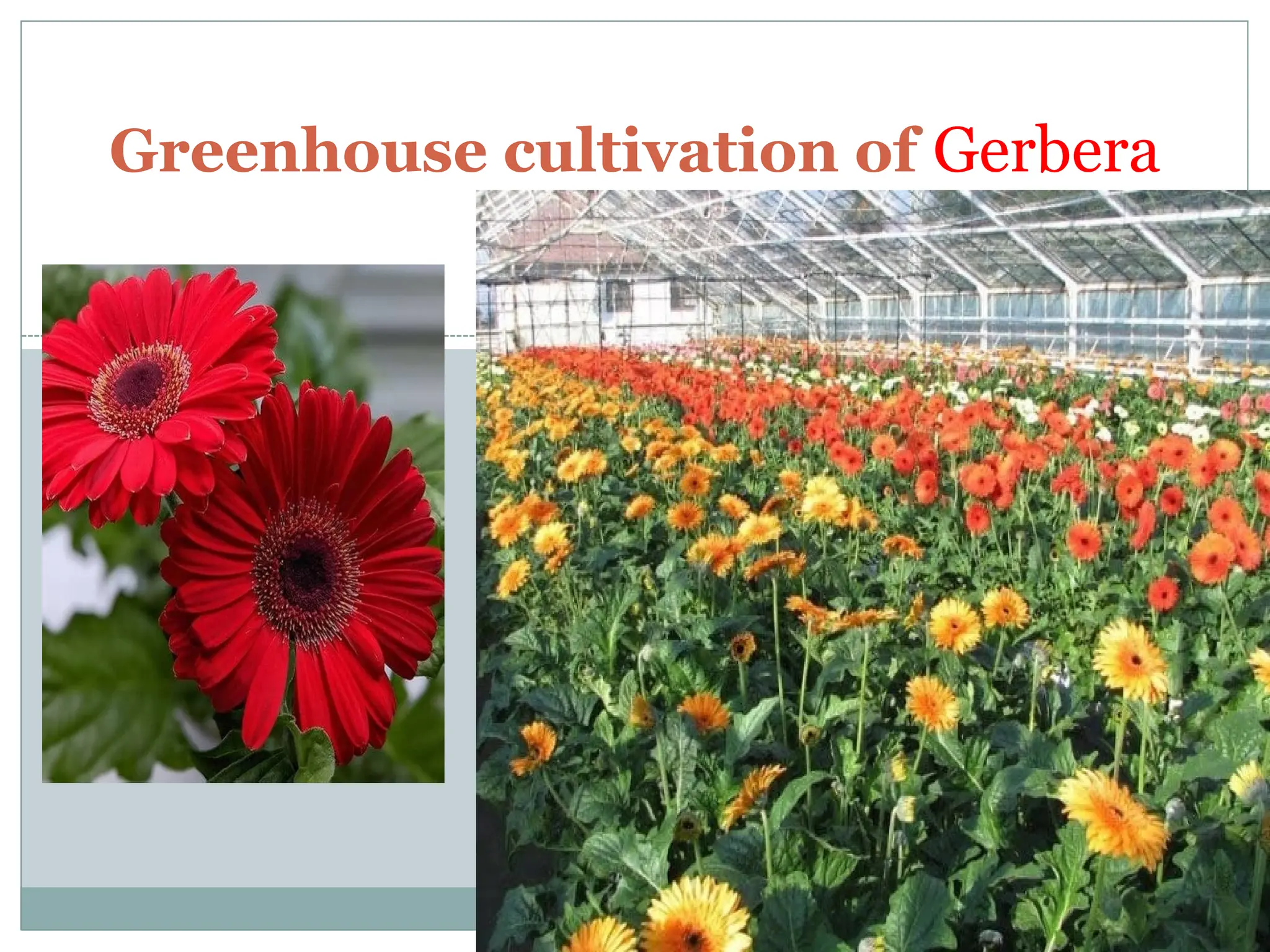
Gerbera is a very attractive, commercial cut flower successfully
grown under different conditions in several areas of the world
as well as in India and meeting the requirements of various
markets.
This flower is originated in Asia and South Africa. Gerbera
jamesonii has been developed through cross breeding program
3.
Varieties
There aremany multi coloured varieties of Gerbera
developed through tissue culture.
Jaffa, Sangria, Rosula, Oprab,
Romona, Salina, Tecora and
Starlight.
4.
Climate
Bright sunshineaccelerates the growth and quality of
the flowers, however, in summer this flower needs
diffused sunlight.
Gerbera plants grown in locations with insufficient
light will not bloom well.
Temperature day- 22-250
c Night -12-150
c, optimum
230
c.Below 120
c above 350
c will affects bud initiation.
Optimum humidity- 75- 80 % and required light
intensity is 450 or 600 FC.
Optimum CO2- 700 ppm
5.
Bed Preparation
Sandand coconut coir pith 2:1:1 used for preparation
of raised beds.
After fumigation with formaldehyde, the raised beds
are prepared on which Gerbera plants are planted.
Top width – 60 cm
Bottom width – 70 cm
Height – 45 cm
Path way - 40 cm
6.
Planting Distance
Plantto Plant distance: 30 cm
Row to Row distance : 30 cm Planting density 8-10
plants/sq.m
9.
Planting material
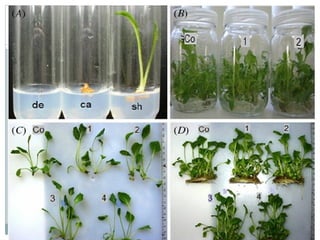
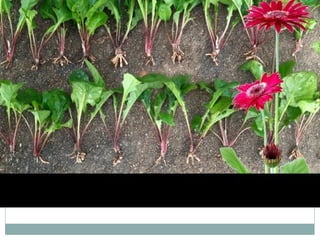
Divisionof clumps and tissue culture plants are used
as propagating material.
Plant should not be less than three months old.
At the time of planting the tissue culture, plant
should have atleast 4 to 5 leaves.
Gerberas are planted on raised bed in two rows
formation.
Zigzag plantation system is mostly preferred.
10.
Manures and Fertilizers
Organic manures are required to be added so that
top 30 cm of the soil has 30% organic matter
content.
Application of nutrients should be based on analysis
of soil and plant. 20:20: 20 NPK @ 1.5 g /L once in
two days for first three months and at flowering- 5:
8:35NPK@ 1.5 g/l on alternate days.
11.
Cultural practices:
Weeding& raking of soil:
Weeds take the nutrients of the plants and affect the
production.
Hence, they should be removed from the bed. Due to
daily irrigation, the surface of the gerbera bed
becomes hard hence raking of soil is done with the
help of a raker.
It increases soil aeration in the root zone of the plant.
this operation should be done regularly, may be
twice in a month.
12.
ii). Disbudding:Removal of inferior quality flowers at the initial
stage after plantation is called disbudding.
The normal production of gerbera plants starts after 75-90 days from
the date of plantation.
Production of flowers starts 45 days after plantation but initial
production is of inferior quality, hence these flowers should be
removed from the base of the flowers stalk. This helps in making the
plant strong and healthy.
iii). Removal of old leaves: Sanitation helps in keeping the disease
and pest infestation below the economic threshold level. The old, dry,
infested leaves should be removed from the plant and burnt outside
the green house or dumped in to a compost pit. This practice allows
producing good, healthy new leaves and better aeration in the crop.
Pest and diseases:
Theprincipal diseases of Gerbera are are
i. Pythium
ii. Sclerotinia
iii. White rust
iv. Rhizoctonia
v. Fusarium
Major insect pests of the rose are
i. Red Spider Mite
ii. Aphids
iii. Thrips
iv. White Fly
Control:
The preventive spray programme with a volume of 1500 litres/spray at an average interval of once in
a week is suggested.
The chemicals could be as under Dithane M-45 0.6 gm/litre Metasystox 1.25 ml/litre Karathane 1.00
ml/litre
15.
Harvesting:
Disbudding doneat 75 days after planting and the first flowers may be
harvested after 75-90 days after planting.
Flowers of most of the varieties (single types) are ready to be picked
when 2-3 whorls of stamens have entirely developed and outer 2-3 discs
perpendicular to stalk.
Some varieties are picked little riper, especially the double types.
Skilled labours are required for harvesting of gerbera cut flowers. After
harvesting the flowers should be kept in bucket containing chlorinated
water.
Flowers are very delicate hence they should be carefully handled
otherwise can be damaged and their quality gets deteriorated. For
harvesting gerbera no secateurs are required and are done by naked
hands.
200 flowers / m2/year (6-7 plants) – 85% first grade