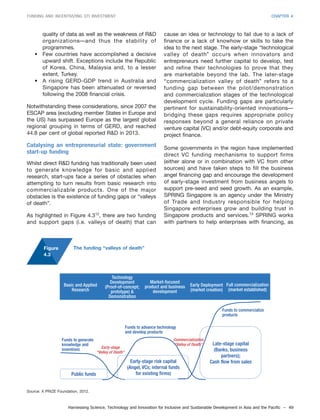
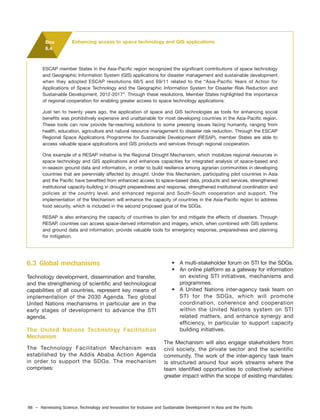
ESCAP is the regional development arm of the United Nations and serves as the main economic and social
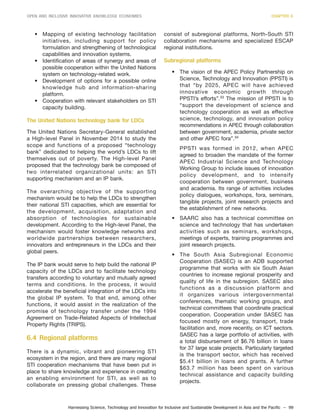
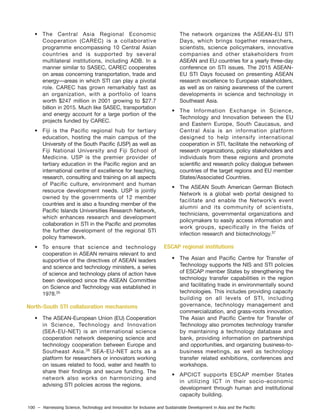
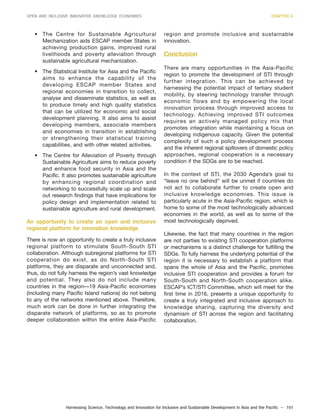
development centre for the United Nations in Asia and the Pacific. Its mandate is to foster cooperation
between its 53 members and 9 associate members. ESCAP provides the strategic link between global and
country-level programmes and issues. It supports Governments of countries in the region in consolidating
regional positions and advocates regional approaches to meeting the region’s unique socio-economic
challenges in a globalizing world. The ESCAP office is located in Bangkok, Thailand. Please visit the ESCAP
website at www.unescap.org for further information.
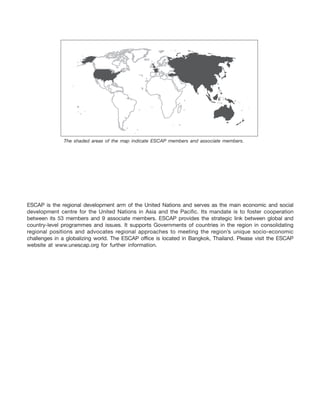
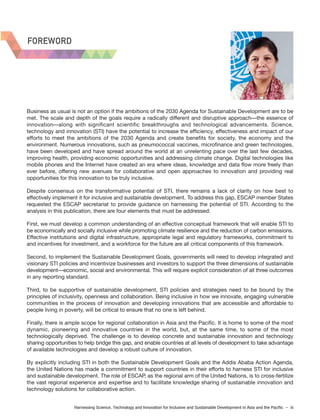
The shaded areas of the map indicate ESCAP members and associate members.
Harnessing Science, Technology and Innovation for Inclusive and Sustainable Development in Asia and the Pacific – i
HARNESSING SCIENCE,
TECHNOLOGY AND INNOVATION
FOR INCLUSIVE AND
SUSTAINABLE DEVELOPMENT
IN ASIA AND THE PACIFIC
ii – Harnessing Science, Technology and Innovation for Inclusive and Sustainable Development in Asia and the Pacific
Shamshad Akhtar
Executive Secretary
Hongjoo Hahm
Deputy Executive Secretary
Susan F. Stone
Director
Trade, Investment and Innovation Division
United Nations publication
Sales No. E.16.II.F.12
Copyright © United Nations 2016
All rights reserved
Printed in Bangkok
ISBN: 978-92-1-120718-7
e-ISBN: 978-92-1-058053-3
ST/ESCAP/2754
HARNESSING SCIENCE, TECHNOLOGY AND INNOVATION
FOR INCLUSIVE AND SUSTAINABLE DEVELOPMENT
IN ASIA AND THE PACIFIC
Cover photo credit: CHOATphotographer
This publication may be reproduced in whole or in part for educational or non-profit purposes without special permission from the copyright holder,
provided that the source is acknowledged. The ESCAP Publications Office would appreciate receiving a copy of any publication that uses this
publication as a source.
No use may be made of this publication for resale or any other commercial purpose whatsoever without prior permission. Applications for such
permission, with a statement of the purpose and extent of reproduction, should be addressed to the Secretary of the Publications Board, United
Nations, New York.
Harnessing Science, Technology and Innovation for Inclusive and Sustainable Development in Asia and the Pacific – iii
FOREWORD
Business as usual is not an option if the ambitions of the 2030 Agenda for Sustainable Development are to be
met. The scale and depth of the goals require a radically different and disruptive approach—the essence of
innovation—along with significant scientific breakthroughs and technological advancements. Science,
technology and innovation (STI) have the potential to increase the efficiency, effectiveness and impact of our
efforts to meet the ambitions of the 2030 Agenda and create benefits for society, the economy and the
environment. Numerous innovations, such as pneumococcal vaccines, microfinance and green technologies,
have been developed and have spread around the world at an unrelenting pace over the last few decades,
improving health, providing economic opportunities and addressing climate change. Digital technologies like
mobile phones and the Internet have created an era where ideas, knowledge and data flow more freely than
ever before, offering new avenues for collaborative and open approaches to innovation and providing real
opportunities for this innovation to be truly inclusive.
Despite consensus on the transformative potential of STI, there remains a lack of clarity on how best to
effectively implement it for inclusive and sustainable development. To address this gap, ESCAP member States
requested the ESCAP secretariat to provide guidance on harnessing the potential of STI. According to the
analysis in this publication, there are four elements that must be addressed:
First, we must develop a common understanding of an effective conceptual framework that will enable STI to
be economically and socially inclusive while promoting climate resilience and the reduction of carbon emissions.
Effective institutions and digital infrastructure, appropriate legal and regulatory frameworks, commitment to
and incentives for investment, and a workforce for the future are all critical components of this framework.
Second, to implement the Sustainable Development Goals, governments will need to develop integrated and
visionary STI policies and incentivize businesses and investors to support the three dimensions of sustainable
development—economic, social and environmental. This will require explicit consideration of all three outcomes
in any reporting standard.
Third, to be supportive of sustainable development, STI policies and strategies need to be bound by the
principles of inclusivity, openness and collaboration. Being inclusive in how we innovate, engaging vulnerable
communities in the process of innovation and developing innovations that are accessible and affordable to
people living in poverty, will be critical to ensure that no one is left behind.
Finally, there is ample scope for regional collaboration in Asia and the Pacific. It is home to some of the most
dynamic, pioneering and innovative countries in the world, but, at the same time, to some of the most
technologically deprived. The challenge is to develop concrete and sustainable innovation and technology
sharing opportunities to help bridge this gap, and enable countries at all levels of development to take advantage
of available technologies and develop a robust culture of innovation.
By explicitly including STI in both the Sustainable Development Goals and the Addis Ababa Action Agenda,
the United Nations has made a commitment to support countries in their efforts to harness STI for inclusive
and sustainable development. The role of ESCAP, as the regional arm of the United Nations, is to cross-fertilize
the vast regional experience and expertise and to facilitate knowledge sharing of sustainable innovation and
technology solutions for collaborative action.
iv – Harnessing Science, Technology and Innovation for Inclusive and Sustainable Development in Asia and the Pacific
This publication is a call to action for regional STI collaboration. It highlights the breadth and dynamism of the
STI agenda in the region and underscores a diverse range of opportunities for private sector innovation, grass-
roots innovation, international technology transfer, frugal innovation, impact investment, enabling research
excellence and supporting mass entrepreneurship, to name but a few.
By highlighting some of the region’s most innovative policies and strategies, it also provides insights into ways
forward for the region and the benefits of collaboration. Many of the policies and strategies discussed in this
publication are themselves innovative experiments. Regional collaboration will be crucial to share knowledge
on what works and to keep pace with the challenges and opportunities that this fast-moving and ever-changing
agenda present.
For STI to be effectively implemented for inclusive and sustainable development, it is critical to first chart the
practical steps needed for balanced and integrated development. This 2016 publication makes an important
contribution to these deliberations.
Shamshad Akhtar
Under-Secretary-General of the United Nations and
Executive Secretary, United Nations Economic and
Social Commission for Asia and the Pacific
Harnessing Science, Technology and Innovation for Inclusive and Sustainable Development in Asia and the Pacific – v
EXECUTIVE SUMMARY
In the closing months of 2015, the United Nations General Assembly adopted its most ambitious,
all-encompassing agenda ever attempted, to guide the advancement of humankind for the next 15 years.
Collectively known as the “2030 Agenda”, the agreements call on all countries to advance the welfare of their
citizens in a sustainable manner to ensure the long-term viability of all development and growth. A key means
of implementation of these Sustainable Development Goals (SDGs) is the effective use of science, technology
and innovation (STI).
This publication highlights the breadth, diversity and dynamism of the STI agenda in the Asia-Pacific region. It
also highlights some of the region’s most innovative policies and strategies, providing examples of best practice,
as well as experimental approaches. The many policies and strategies highlighted are themselves innovative
experiments and illustrate the dynamic mindset of regional governments, and as such, demonstrate the potential
gains from regional collaboration on, and knowledge sharing of, what works.
The publication puts forward a conceptual framework for STI that is bound by the principles of openness,
inclusivity, accountability and collaboration, and moves the focus beyond the economic to fully integrate the
social and environmental dimensions of sustainable development. It also calls on governments to put in place
recommended action-oriented STI plans aligned to development strategies to meet the ambitions of the 2030
Agenda.
The conceptual framework calls for two normative shifts in policy stance. First, innovation policy for inclusive
and sustainable development must move beyond its traditional focus on economic competitiveness to include
social justice and environmental protection. Second, the principles of openness and inclusivity must be
integrated into innovation strategies to complement policies promoting competition as a driver of innovation.
Those countries that attempt to move forward in isolation risk a perpetual state of catch-up and
underperformance.
The conceptual framework also highlights some of the core elements of an effective innovation system for
inclusive and sustainable development:
First, to harness the potential of STI for inclusive and sustainable development, visionary leadership is required.
Leaders will need to create a farsighted action plan informed by foresight activities; put social and
environmental—as well as economic—imperatives at the heart of strategies; and hold the whole of government
to account for its delivery. It will be essential to engage all actors in the innovation system to ensure plans
incorporate the economic, social and environmental dimensions of sustainable development. However, this
will not happen automatically. Harnessing STI for inclusive and sustainable development will require committed
and deliberate action for an integrated governmental approach.
Second, effective institutions are the foundation of effective STI creation, development and implementation.
Institutions define the rules and principles and establish the infrastructure that guide behaviour and structure
patterns of interactions. Physical and virtual infrastructure form the foundation on which a knowledge economy
is built. A strong regulatory environment, including corporate law and intellectual property, will also encourage
the risk-taking required to innovate. In order to ensure that no one is left behind, it will be critical for governments
to support institutional principles of openness and inclusivity and provide the means for their effective
implementation.
Third, committing to and incentivizing investment in STI will be critical. Innovators often lack funding at crucial
stages, preventing basic research or early-stage start-up ventures from being commercialized or achieving
scale. Future public STI investment strategies will need to commit funding, when resources allow, aimed at
vi – Harnessing Science, Technology and Innovation for Inclusive and Sustainable Development in Asia and the Pacific
bridging funding shortfalls in order to accelerate innovation from basic and applied research to
commercialization. It will be critical to incentivize private investors to back STI and ensure that research and
development (R&D) expenditure produces outputs the private sector can commercialize and, conversely, that
important private sector initiatives receive adequate R&D funding. In this respect, the government funder-private
sector investor relationship needs to be strengthened. To effectively and efficiently deploy the various forms
of capital at its disposal (e.g. domestic finance, foreign direct investment and donor capital), alignment of
financial flows to STI strategies for sustainable development will be key. In addition to policies aimed at
increasing the amount of investment in STI, returns will need to incorporate social and environmental, as well
as economic outcomes. Whilst the concept of impact investment makes sense, strong incentives and political
leadership will be required to move it from the margins to the mainstream.
Fourth, to sustain momentum in STI development, governments need to nurture and support their most
important resource—their citizens. While scientists, technologists, innovators and entrepreneurs are considered
the traditional sources of innovative activity, there is potentially an untapped resource of talent residing in what
are often termed “vulnerable” communities or under-recognized community sources. The best government
structures, institutions and funding mechanisms in the world will amount to nothing without talented and
educated people to implement ideas. Governments need to recognize and support under-represented
communities, including women, as significant sources of talent and innovative ideas. Governments also need
to nurture a workforce for the future and enable life-long learning by supporting the development of digital
and innovation skills, and nurturing problem solvers with adaptive, flexible and innovative minds. By supporting
and training the local population, governments can generate and make fit for purpose all available human
capital through the stages of economic and social disruption that often accompany new technologies or
innovative processes. By providing a supportive and transparent regulatory structure, the mass potential of
the entrepreneurial class can be harnessed. Inclusive innovation is not only about making innovations available
to vulnerable populations, but empowering those communities to realize their own innovative potential.
Finally, creating open and inclusive innovative knowledge economies has the potential to increase the
effectiveness and scale of regional STI efforts for sustainable development. In the context of STI, the 2030
Agenda’s goal to “leave no one behind” will be unmet if countries do not act collectively to create open inclusive
and innovative knowledge economies. This issue is particularly acute in the Asia-Pacific region, which is home
to some of the most innovative countries in the world, as well as to some of the most technologically deprived.
The many subregional and North-South STI platforms that exist are disparate and unconnected, and thus are
not fully harnessing the vast knowledge and potential in the region. The ESCAP Information and
Communications Technology/Science, Technology and Innovation Committee (ICT/STI Committee), which will
meet for the first time in 2016, presents a unique opportunity to create a truly integrated and inclusive approach
to knowledge sharing and to capture the diversity and dynamism of STI across the region.
Governments in the region should carefully consider this publication and develop action plans tailored to their
specific objectives, context and level of STI development. This publication makes five broad recommendations,
within which more detailed action items are enumerated. For these action items to have real meaning, they
must be supported by stakeholders across the political spectrum and, importantly, be associated with explicit
time bounds. As member States have committed to a 15-year time horizon (the 2030 Agenda), these
recommendations have been categorized as short-term (1 year), medium-term (3 years) and long-term (5 years).
Provide visionary leadership for STI as an integral component of SDG strategies
• Strengthen governance through the positioning of the mandate for STI in the office of the head of
government to ensure strategic implementation and appropriate political backing. (Short-term)
• Conduct regular foresight exercises to inform STI action plans aligned to the SDGs and integrated across
all line ministries. (Short-term)
• Institutionalize regular reporting on STI indicators and monitoring of STI policy across all line ministries.
(Short-term)
Harnessing Science, Technology and Innovation for Inclusive and Sustainable Development in Asia and the Pacific – vii
Lay the foundations for STI development through high-quality institutions and
infrastructure
• Increase the quality of physical infrastructure (academic and research institutions, innovation and
technology hubs, maker spaces and Internet infrastructure). (Long-term)
• Leverage educational technologies, such as distance learning, to radically widen access to STI education.
(Medium-term)
• Ensure institutional and regulatory compliance, including corporate law and intellectual property. (Medium-
term)
• Adopt open and inclusive principles for innovation with institutions mandated to stimulate open, inclusive,
social and collaborative innovation. (Medium-term)
Commit to funding and incentivizing investment in STI
• Allocate a specified percentage of gross domestic product to R&D and venture funds for start-ups.
(Medium-term)
• Risk-share with the private sector utilizing mechanisms such as public-private partnerships. (Medium-
term)
• Utilize government procurement to catalyse innovation and set specific targets on the awarding of
contracts to organizations such as micro, small and medium enterprises, social enterprises and
non-governmental organizations. (Medium-term)
• Incentivize STI investment through fiscal instruments. (Medium-term)
• Incentivize investment for social and environmental good, as well as economic return. (Medium-term)
Nurture talent for the future
• Increase the quality of education with targeted financial allocation for higher or vocational education.
(Medium-term)
• Create a critical mass of high-quality STI professionals, progressively increasing to 2,500 highly qualified
professionals involved in R&D per million population. (Long-term)
• Increase participation of women in STI. (Long-term)
• Mobilize academic talent for the SDGs through challenge-driven universities. (Short-term)
• Provide support (both financial and non-financial) to aspiring entrepreneurs. (Short-term)
• Incentivize the private sector to reward staff who generate social and environmental, as well as economic
value. (Short-term)
• Create a flexible, adaptable workforce through a focus on reskilling and exposing citizens to
problem-solving skills, critical thinking and innovation, as well as science and technology curricula.
(Medium-term)
• Nurture innovation and digital skills within government. (Short-term)
• Mobilize all members of society, in particular those commonly excluded from the innovation process,
to spur mass innovation. (Short-term)
Enable open and inclusive innovative knowledge economies
• Enable the hiring of highly skilled personnel and encourage the movement of students, scientists,
engineers and other professionals between ESCAP member States. (Medium-term)
• Promote sharing of technical knowledge among countries and provide incentives to promote inter-country
technology collaboration and development alongside technology trade and transfer. (Medium-term)
• Pool funds for R&D and early-stage enterprise investment. (Medium-term)
• Establish a regional platform for government officials, scientists, technologists, innovators and
investors to effectively discuss, collaborate and harness STI for inclusive and sustainable development.
(Short-term)
viii – Harnessing Science, Technology and Innovation for Inclusive and Sustainable Development in Asia and the Pacific
Current intergovernmental STI cooperation in the region is disjointed and ad hoc. ESCAP, as the region’s primary
intergovernmental forum, provides a unique platform to link these disparate efforts, creating a whole that is
greater than the sum of its parts. The most immediate avenue is the inaugural ICT/STI Committee meeting,
which will take place in 2016. This Committee presents a unique opportunity to create a truly regional and
integrated STI platform to share knowledge across the subregions and capture the diversity and dynamism of
STI across Asia and the Pacific.
While the ICT/STI Committee will provide an important venue to ensure the region remains “on track”, the
biannual meeting schedule may hamper countries’ ability to keep pace with the fast-changing landscape of
STI. Thus, an additional avenue of cooperation would be the establishment of an Innovation Forum, which
could be convened more regularly. This Forum would complement the Global Forum on Science and Technology
organized by the United Nations Conference on Trade and Development (UNCTAD) and the various science
fora organized by the United Nations Educational, Scientific and Cultural Organization (UNESCO), and provide
a unique opportunity for Asia-Pacific countries to exchange experiences in identifying opportunities and
challenges. The forum could include baselining activities, developing blueprints for STI implementation for
the SDGs, outcome monitoring, developing regional standards and cooperation agreements, implementing
skills-based exchange programmes and determining the contours of an open innovation framework for the
region. To take advantage of the region’s vibrant STI ecosystem and to support member States in meeting
their ambitions and commitments, ESCAP could support collaboration between member States by:
1. Acting as a bridge between the numerous subregional STI platforms (e.g. the Association of Southeast
Asian Nations [ASEAN], the Asia-Pacific Economic Cooperation [APEC] and the South Asian Association
for Regional Cooperation [SAARC]) to ensure that the region as a whole is fully informed on STI
developments, challenges and opportunities.
2. Coordinating a regional cross-government network on STI in support of knowledge sharing of SDG
achievements.
3. Hosting an online platform as a gateway for information on regional STI needs, solutions, initiatives and
policy developments.
4. Holding an annual multi-stakeholder Innovation Forum for the SDGs.
5. Ensuring regional needs and knowledge are integrated into the global STI agenda (e.g. for the Technology
Facilitation Mechanism and Technology Bank).
The ICT/STI Committee provides a platform that could support more-specific areas of work, such as providing
analysis and best practice assessment of STI policy; advocating for and facilitating commitments to key STI
policy initiatives in the region (e.g. technology transfer, social enterprise and impact investment), with a focus
on least developed countries and countries with special needs; and supporting donors in the region who have
invested in innovation knowledge-sharing platforms (such as the Global Innovation Exchange) to increase
engagement with countries in the region.
Harnessing Science, Technology and Innovation for Inclusive and Sustainable Development in Asia and the Pacific – ix
ACKNOWLEDGEMENTS
This publication was prepared under the overall direction and guidance of Shamshad Akhtar, Under-Secretary-
General of the United Nations and Executive Secretary of the Economic and Social Commission for Asia and
the Pacific (ESCAP). Hongjoo Hahm, Deputy Executive Secretary, provided valuable advice and comments.
The publication was coordinated by a core team under the direction of Susan F. Stone, Director of the Trade,
Investment and Innovation Division. The core team, led by Jonathan Wong, included Teemu Puutio and Luca
Parisotto. Phadnalin Ngernlim, Trade, Investment and Innovation Division, undertook all administrative
processing necessary for the issuance and launch of the publication.
Expert guidance and input was provided by the Executive Secretary’s Science, Technology and Innovation
Advisory Board, comprising Atta-ur-Rahman (co-chair), University of Karachi and UNESCO Science Laureate;
Zakri Abdul Hamid (co-chair), Science Adviser to the Prime Minister of Malaysia and Member of the Scientific
Advisory Board of the United Nations Secretary-General; Durreen Shahnaz, Founder of the Asia Social
Innovation Stock Exchange and Shujog; Lisa Rauter, First Assistant Secretary and Head of the
InnovationXchange, Australian Government Department of Foreign Affairs; Luo Hui, President, National Academy
of Innovation Strategy, China Association for Science and Technology; Mahmoud Molanejad, Acting President,
Iranian Research Organization for Science and Technology; Reiko Kuroda, Professor, Tokyo University of Science
and Member of the Scientific Advisory Board of the United Nations Secretary-General; Sirimali Fernando, Chief
Executive Officer of the Coordinating Secretariat for Science, Technology and Innovation, Sri Lanka; Vineet
Rai, Founder of Aavishkaar and Founding Member of the India Impact Investment Council; and Woosung Lee,
Director of the Global Policy Research Centre, Science and Technology Policy Institute, Republic of Korea.
ESCAP staff who contributed substantively with guidance and input through the Theme Study Taskforce include:
Michael Williamson and Robert Spaull, Office of the Executive Secretary; Shamika Sirimanne (Director), Atsuko
Okuda, Keran Wang, Tae Hyung Kim, Kelly Hayden and Siope Vakataki Ofa, Information and Communications
Technology and Disaster Risk Reduction Division; Laura Lopez (Director), Srinivas Tata, Paul Tacon, Diana
Rodriguez and Maria Shahid, Social Development Division; Aynul Hasan (Director), Steve Gui-Diby, Vatcharin
Sirimaneetham, Heather Taylor, Pannipa Jangvithaya and Krittin Chatteeraphat, Macroeconomic Policy and
Financing for Development Division; Stefanos Fotiou (Director), Katinka Weinberger, Donovan Storey, Nobue
Amanuma, Kareff Limocon Rafisura, Hitomi Rankine, Marco Silvestri and Ram Tiwaree, Environment and
Development Division; Yuwei Li (Director), Edouard Chong and Mathieu Verougstraete, Transport Division;
Margarita Guerrero (Director), Eric Hermouet, Christopher Ryan, Zeynep Orhun, Marko Javorsek, Tanja Sejersen
and Teerapong Praphotjanaporn, Statistics Division; Marc Proksch, Mia Mikic, Joong-Wan Cho, Yann L. Duval,
Eric Roeder and Soo Hyun Kim, Trade, Investment and Innovation Division; Nagesh Kumar (Director), Matthew
Hammill, Wanphen Shresthaputra and Ivana Brnovic, Subregional Office for South and South-West Asia; Kilaparti
Ramakrishna (Director), Sangmin Nam, Gabrielle Chan, Yejin Ha and Nobuko Kajiura, Subregional Office for
East and North-East Asia; Tiziana Bonapace (Director), Hong Pum Chung and Nikolay Pomoshchnikov,
Subregional Office for North and Central Asia; Iosefa Maiava (Director), Timothy Westbury and David Smith,
Subregional Office for the Pacific; Nanjundappa Srinivasan and Satyabrata Sahu, APCTT; Robert de Jesus,
APCICT; Masakazu Ichimura, Anshuman Varma and Takashi Takahatake, CAPSA; Bing Zhao, CSAM.
The following consultants provided inputs: Apiwat Ratanawaraha, Deniz Eröcal, Maria Savona, Sari Laaksonen
and VGR Chandran Govindaraju.
The publication was refereed by Ken Guy.
The manuscript was edited by Naomi Hutchison. Layout and printing were provided by Erawan Printing, Ltd.
Katie Elles, Martin Dessert, Patricia de la Torre Rodriguez and Chavalit Boonthanom of the ESCAP Strategic
Publications, Communications and Advocacy Section coordinated the launch and dissemination of the report.
x – Harnessing Science, Technology and Innovation for Inclusive and Sustainable Development in Asia and the Pacific
Harnessing Science, Technology and Innovation for Inclusive and Sustainable Development in Asia and the Pacific – xi
Foreword .......................................................................................................................................... iii
Executive Summary ........................................................................................................................ v
Acknowledgements ........................................................................................................................ ix
Explanatory notes ........................................................................................................................... xv
Abbreviations................................................................................................................................... xvii
Chapter 1. Setting the Scene ....................................................................................................... 3
1.1 Science, technology and innovation for sustainable development ..................... 3
1.2 Defining science, technology and innovation ...................................................... 4
1.3 A conceptual framework for STI for sustainable development............................ 5
Chapter 2. The Role of Leadership.............................................................................................. 11
2.1 Effective governance ........................................................................................... 12
2.2 Integrated STI policies ......................................................................................... 16
2.3 Planning and foresight ......................................................................................... 17
2.4 Monitoring and measurement .............................................................................. 18
Chapter 3. Building Institutions and Infrastructure for STI Development ............................... 23
3.1 Institutional architecture in Asia and the Pacific .................................................. 24
3.2 Institutions supporting STI creation ..................................................................... 27
3.3 Institutions supporting access and use ............................................................... 32
3.4 Digital Infrastructure............................................................................................. 34
Chapter 4. Funding and Incentivizing STI Investment ............................................................... 45
4.1 Government funding ............................................................................................ 46
4.2 Incentivizing investment in STI ............................................................................ 53
4.3 Donor and philanthropic funding ......................................................................... 56
4.4 Foreign direct investment .................................................................................... 58
4.5 Impact investing................................................................................................... 59
Chapter 5. Nurturing Talent .......................................................................................................... 65
5.1 Nurturing the creation of human capital .............................................................. 66
5.2 Private sector talent ............................................................................................. 75
5.3 Nurturing innovation skills within government ..................................................... 78
5.4 Innovation at the grass-roots level ...................................................................... 81
Chapter 6. Open and Inclusive Innovative Knowledge Economies.......................................... 89
6.1 International mobility ........................................................................................... 91
6.2 International technology transfer, development and collaboration ..................... 94
6.3 Global mechanisms ............................................................................................. 98
6.4 Regional platforms ............................................................................................... 99
Chapter 7. Recommendations and Role of ESCAP ................................................................... 105
7.1 Recommendations............................................................................................... 105
7.2 Role of ESCAP ..................................................................................................... 106
References....................................................................................................................................... 109
CONTENTS
xii – Harnessing Science, Technology and Innovation for Inclusive and Sustainable Development in Asia and the Pacific
Box 2.1. Disruptive innovations: countries driving patenting in 3D printing, nanotechnology
and robotics ................................................................................................................. 18
Box 2.2. Measuring gross national happiness ........................................................................... 19
Box 3.1. Malaysia’s progress in regulatory reform and R&D investment ................................... 27
Box 3.2. Indonesia’s university-industry-government partnership ............................................. 33
Box 3.3. Citizen-centric innovation ............................................................................................ 34
Box 3.4. Massive Open Online Courses (MOOCs) ..................................................................... 35
Box 3.5. Mobile banking initiatives in Asia ................................................................................. 40
Box 4.1. Technology appraisal and private funding ................................................................... 51
Box 4.2. SBRI for sustainable development............................................................................... 53
Box 4.3. Examples of R&D incentives in Asia and the Pacific ................................................... 55
Box 4.4. Open innovation for development challenges ............................................................. 57
Box 4.5. The Asia impact investment exchange ........................................................................ 61
Box 5.1. Viet Nam’s education success ..................................................................................... 68
Box 5.2. Imperial College London: Energy Futures Lab ............................................................. 75
Box 5.3. China and the maker movement .................................................................................. 76
Box 5.4. Worker retraining following trade liberalization: the case of the US Trade Adjustment
Assistance programme ................................................................................................ 79
Box 5.5. Grass-roots innovation in India .................................................................................... 83
Box 6.1. The Global Innovation Exchange ................................................................................. 90
Box 6.2. Policies supporting returning talent ............................................................................. 91
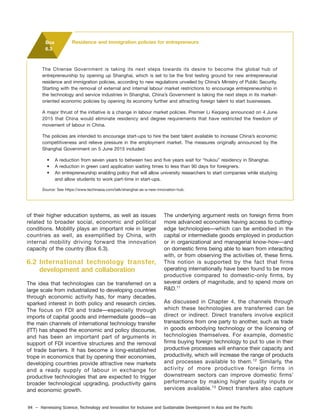
Box 6.3. Residence and immigration policies for entrepreneurs................................................ 94
Box 6.4. Enhancing access to space technology and GIS applications .................................... 98
Figure 1.1. An STI framework for sustainable development .......................................................... 6
Figure 2.1. Japan’s STI governance structure ............................................................................... 15
Figure 2.2. Share of environment-related technologies developed worldwide .............................. 16
Figure 3.1. Good governance and the quality of scientific research organizations ....................... 28
Figure 3.2a. Number of patents in Japan, China, Australia and India ............................................. 29
Figure 3.2b. Number of patents in other selected Asian economies ............................................... 29
Figure 3.3. Patents granted and the Worldwide Governance Indicators ....................................... 30
Figure 3.4. Innovation and the business environment, 2015 ......................................................... 31
Figure 3.5. Global shares of total fixed-broadband subscriptions in 2005 and 2014 .................... 36
Figure 3.6. Total fixed-broadband subscriptions, 2000-2014 ........................................................ 37
Figure 3.7. Share of total fixed-broadband subscriptions in the ESCAP region, 2014 .................. 37
CONTENTS (continued)
LIST OF BOXES, FIGURES AND TABLES
BOXES
FIGURES
Harnessing Science, Technology and Innovation for Inclusive and Sustainable Development in Asia and the Pacific – xiii
Figure 3.8. Fixed-broadband subscriptions per 100 inhabitants, 2014 ......................................... 38
Figure 3.9. Average mobile-broadband subscriptions per 100 inhabitants in ESCAP member
States ........................................................................................................................... 39
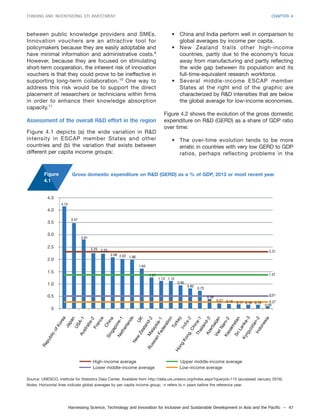
Figure 4.1. Gross domestic expenditure on R&D (GERD) as a % of GDP, 2013 or most
recent year ................................................................................................................... 47
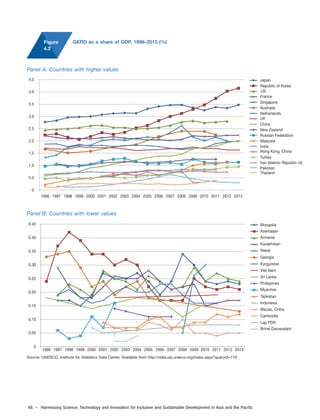
Figure 4.2. GERD as a share of GDP, 1996–2013 .......................................................................... 48
Figure 4.3. The funding “valleys of death” ..................................................................................... 49
Figure 4.4. UK Small Business Research Initiative—how does it work? ....................................... 52
Figure 4.5. Correlation between the Global Innovation Index and FDI inflows per capita, 2014 ... 59
Figure 4.6. Impact investment in selected Asia-Pacific economies............................................... 60
Figure 4.7. Resource flows to developing countries ...................................................................... 60
Figure 5.1. Labour force with tertiary education in ESCAP countries............................................ 69
Figure 5.2. Researchers per million inhabitants, 2009 and 2013 ................................................... 70
Figure 5.3. Share of researchers in the business sector, 1996–2013 ............................................ 71
Figure 5.4. Share of women researchers in ESCAP countries, averages of 2000–2003 and
2010–2013 ................................................................................................................... 74
Figure 5.5. Measure of entrepreneurial culture for selected Asia-Pacific economies, 2014 .......... 76
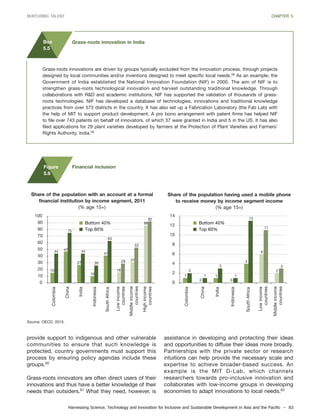
Figure 5.6. Financial inclusion ........................................................................................................ 83
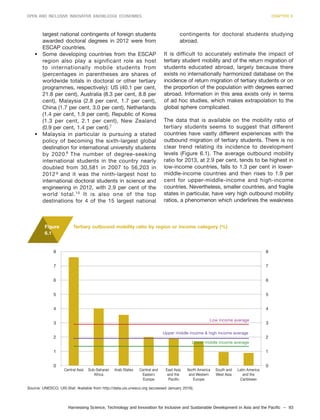
Figure 6.1. Tertiary outbound mobility ratio by region or income category ................................... 93
Table 2.1. Primary owners and drivers of Asia-Pacific STI policies.............................................. 12
Table 3.1. Conditions of rules and regulations related to STI in the Asia-Pacific region .............. 25
Table 3.2. Innovation in quality of institutions............................................................................... 26
Table 3.3. ICT usage by firms in manufacturing sectors .............................................................. 40
Table 5.1. Education and training systems, selected Asia-Pacific economies............................. 67
Table 5.2. Human capital among manufacturing sectors, selected Asia-Pacific economies....... 73
Table 5.3. E-Government Development Index—Top 10 Countries............................................... 79
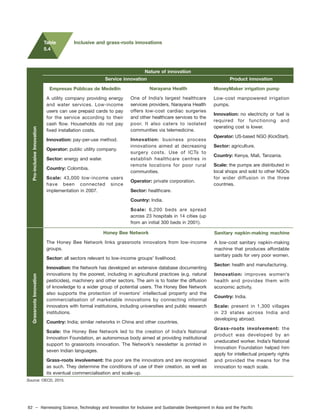
Table 5.4. Inclusive and grass-roots innovations ......................................................................... 82
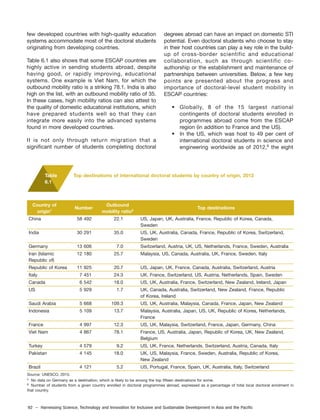
Table 6.1. Top destinations of international doctoral students by country of origin, 2012........... 92
CONTENTS (continued)
TABLES
xiv – Harnessing Science, Technology and Innovation for Inclusive and Sustainable Development in Asia and the Pacific
Harnessing Science, Technology and Innovation for Inclusive and Sustainable Development in Asia and the Pacific – xv
EXPLANATORY NOTES
Analyses presented in the publication Harnessing Science, Technology and Innovation for Inclusive and
Sustainable Development in Asia and the Pacific are based on data and information available up to the end of
March 2016.
Groupings of countries and territories/areas referred to in the publication are defined as follows:
• ESCAP member and Associate member States: Afghanistan; American Samoa; Armenia; Australia;
Azerbaijan; Bangladesh; Bhutan; Brunei Darussalam; Cambodia; China; Cook Islands; Democratic
People’s Republic of Korea; Fiji; French Polynesia; Georgia; Guam; Hong Kong, China; India; Indonesia;
Iran (Islamic Republic of); Japan; Kazakhstan; Kiribati; Kyrgyzstan; Lao People’s Democratic Republic;
Macao, China; Malaysia; Maldives; Marshall Islands; Micronesia (Federated States of); Mongolia;
Myanmar; Nauru; Nepal; New Caledonia; New Zealand; Niue; Northern Marina Islands; Pakistan; Palau;
Papua New Guinea; Philippines; Republic of Korea; Russian Federation; Samoa; Singapore; Solomon
Islands; Sri Lanka; Tajikistan; Thailand; Timor-Leste; Tonga; Turkey; Turkmenistan; Tuvalu; Uzbekistan;
Vanuatu; and Viet Nam
• Developing ESCAP region: ESCAP region excluding Australia; Japan; and New Zealand
• Developed ESCAP region: Australia; Japan; and New Zealand
• Least developed countries (LDC): Afghanistan; Bangladesh; Bhutan; Cambodia; Kiribati; Lao People’s
Democratic Republic; Myanmar; Nepal; Solomon Islands; Timor-Leste; Tuvalu; and Vanuatu
• Landlocked developing countries (LLDC); Afghanistan; Armenia; Azerbaijan; Bhutan; Kazakhstan;
Kyrgyzstan; Lao People’s Democratic Republic; Mongolia; Nepal; Tajikistan; Turkmenistan; and Uzbekistan
• Small island developing States (SIDS): Cook Islands; Fiji; Kiribati; Maldives; Marshall Islands; Micronesia
(Federated States of); Nauru; Niue; Palau; Papua New Guinea; Samoa; Solomon Islands; Timor-Leste;
Tonga; Tuvalu; and Vanuatu
• East-North-East Asia: China; Democratic People’s Republic of Korea; Hong Kong, China; Japan; Macao,
China; Mongolia; and the Republic of Korea
• North and Central Asia: Armenia; Azerbaijan; Georgia; Kazakhstan; Kyrgyzstan; Russian Federation;
Tajikistan; Turkmenistan; and Uzbekistan
• Pacific: American Samoa; Australia; Cook Islands; Fiji; French Polynesia; Guam; Kiribati; Marshall Islands;
Micronesia (Federated States of); Nauru; New Caledonia; New Zealand; Niue; Northern Marina Islands;
Palau; Papua New Guinea; Samoa; Solomon Islands; Tonga; Tuvalu; and Vanuatu
• Pacific island developing economies: All those listed above under “Pacific” except for Australia and New
Zealand
• South and South-West Asia: Afghanistan; Bangladesh; Bhutan; India; Iran (Islamic Republic of); Maldives;
Nepal; Pakistan; Sri Lanka; and Turkey
• South-East Asia: Brunei Darussalam; Cambodia; Indonesia; Lao People’s Democratic Republic; Malaysia;
Myanmar; Philippines; Singapore; Thailand; Timor-Leste; and Viet Nam
Bibliographical and other references have, wherever possible, been verified. The United Nations bears no
responsibility for the availability or functioning of URLs.
Mention of firm names and commercial products does not imply an endorsement of the United Nations.
Reference to dollars ($) are to United States dollars unless otherwise stated.
The publication Harnessing Science, Technology and Innovation for Inclusive and Sustainable Development in
Asia and the Pacific and supporting online documents are the sole responsibility of the ESCAP secretariat.
Any opinions or estimates reflected herein do not necessarily reflect the opinions or views of Members and
Associate Members of the Economic and Social Commission for Asia and the Pacific.
xvi – Harnessing Science, Technology and Innovation for Inclusive and Sustainable Development in Asia and the Pacific
Harnessing Science, Technology and Innovation for Inclusive and Sustainable Development in Asia and the Pacific – xvii
ABBREVIATIONS
2030 Agenda 2030 Agenda for Sustainable Development
ADB Asian Development Bank
APCICT Asian and Pacific Training Centre for Information and Communication Technology for
Development
APCTT Asian and Pacific Centre for Transfer of Technology
APEC Asia-Pacific Economic Cooperation
ASEAN Association of Southeast Asian Nations
BRIICS Brazil, Russian Federation, India, Indonesia, China and South Africa
CAPSA Centre for the Alleviation of Poverty through Sustainable Agriculture
CAREC Central Asia Regional Economic Cooperation
CSAM Centre for Sustainable Agricultural Mechanization
CSR corporate social responsibility
DFID Department for International Development (UK)
ECG electrocardiograph
ESCAP Economic and Social Commission for Asia and the Pacific
EU European Union
FDI foreign direct investment
GERD gross domestic expenditure on research and development
GDP gross domestic product
GIF Global Innovation Fund
GIS Geographic Information System
GPS Global Positioning System
GSMA Groupe Speciale Mobile Association
ICDL International Computer Driving Licence
ICT information and communications technology
IIT Indian Institutes of Technology
IP intellectual property
IPO initial public offering
ITT international technology transfer
KOTEC Korean Technology Finance Corporation
KTRS Kibo Technology Rating System (Republic of Korea)
LDC least-developed country
MIT Massachusetts Institute of Technology
MOOCs Massive Open Online Courses
MSMEs micro, small and medium sized enterprises
NIF National Innovation Foundation (India)
NIS national innovation system
NKRA national key results areas
OECD Organisation for Economic Co-operation and Development
PEMANDU Performance Management and Delivery Unit (Malaysia)
PPP public-private partnership
xviii – Harnessing Science, Technology and Innovation for Inclusive and Sustainable Development in Asia and the Pacific
PPSTI Policy Partnership on Science, Technology and Innovation (APEC)
PS21 Public Service for the 21st
Century Office (Singapore)
R&D research and development
RESAP Regional Space Applications Programme for Sustainable Development
SAARC South Asian Association for Regional Cooperation
SEA-EU-NET ASEAN-EU Cooperation in Science, Technology and Innovation
SASEC South Asia Subregional Economic Cooperation (ADB)
SBRI Small Business Research Initiative (UK)
SDGs Sustainable Development Goals
SIDA Swedish International Development Cooperation Agency
SMEs small and medium-sized enterprises
SSS Staff Suggestion Scheme
STI science, technology and innovation
STEM Science, technology, engineering and mathematics
TAA Trade Adjustment Assistance programme (US)
TACSI The Australian Centre for Social Innovation
UIS UNESCO Institute for Statistics
UK United Kingdom of Great Britain and Northern Ireland
UNCTAD United Nations Conference on Trade and Development
UNESCO United Nations Educational, Scientific and Cultural Organization
UNICEF United Nations Children’s Fund
US United States of America
USAID United States Agency for International Development
USP University of the South Pacific
VC venture capital
WEF World Economic Forum
WHO World Health Organization
WIPO World Intellectual Property Organization
Harnessing Science, Technology and Innovation for Inclusive and Sustainable Development in Asia and the Pacific – 1
SETTING THE SCENE CHAPTER 1
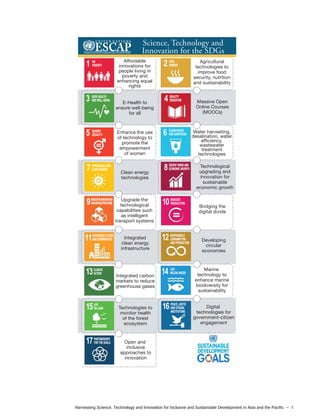
Integrated carbon
markets to reduce
greenhouse gases
Open and
inclusive
approaches to
innovation
Technologies to
monitor health
of the forest
ecosystem
Integrated
clean energy
infrastructure
Upgrade the
technological
capabilities such
as intelligent
transport systems
Clean energy
technologies
Enhance the use
of technology to
promote the
empowerment
of women
E-Health to
ensure well-being
for all
Affordable
innovations for
people living in
poverty and
enhancing equal
rights
Agricultural
technologies to
improve food
security, nutrition
and sustainability
Massive Open
Online Courses
(MOOCs)
Water harvesting,
desalination, water
efficiency,
wastewater
treatment
technologies
Technological
upgrading and
innovation for
sustainable
economic growth
Developing
circular
economies
Marine
technology to
enhance marine
biodiversity for
sustainability
Digital
technologies for
government-citizen
engagement
Bridging the
digital divide
Science, Technology and
Innovation for the SDGs
1
5
9
13
17
14
10
6
2 ZERO
HUNGER
CLEAN WATER
AND SANITATION
REDUCED
INEQUALITIES
LIFE
BELOW WATER
PARTNERSHIPS
FOR THE GOALS
CLIMATE
ACTION
INDUSTRY,INNOVATION
ANDINFRASTRUCTURE
GENDER
EQUALITY
3
7
11
15 16
12
8
4 QUALITY
EDUCATION
DECENTWORKAND
ECONOMICGROWTH
RESPONSIBLE
CONSUMPTION
AND PRODUCTION
PEACE,JUSTIC
AND STRONG
INSTITUTIONS
LIFE
ON LAND
SUSTAINABLECITIES
ANDCOMMUNITIES
AFFORDABLE AND
CLEAN ENERGY
GOOD HEALTH
AND WELL-BEING
NO
POVERTY
2 – Harnessing Science, Technology and Innovation for Inclusive and Sustainable Development in Asia and the Pacific
©SHUTTERSTOCK:VINCENTST.THOMAS
Harnessing Science, Technology and Innovation for Inclusive and Sustainable Development in Asia and the Pacific – 3
SETTING THE SCENE CHAPTER 1
1
CHAPTER
SETTING
THE SCENE
1.1 Science, technology and innovation for sustainable
development
In the closing months of 2015, the United Nations General Assembly
adopted an ambitious, all-encompassing agenda to guide the
advancement of humankind for the next 15 years. Collectively known as
the 2030 Agenda for Sustainable Development (or “2030 Agenda”), the
17 Sustainable Development Goals (SDGs) and the 7 action areas of the
Addis Ababa Action Agenda call on all countries to advance the welfare
of their citizens in a sustainable manner to ensure the long-term viability
of all development and growth. A key means of implementation of the 2030
Agenda is the effective use of science, technology and innovation (STI).
STI is linked directly to productivity, which is the key to job creation and
a rising standard of living. Further, STI can provide the means to help
ensure growth is sustainable and socially inclusive. Through its ability to
catalyse change, STI has the potential to increase the pace and
effectiveness of the world’s efforts to meet the ambitions of the 2030
Agenda. As such, it is seen to be one of the primary engines underpinning
the achievement of the SDGs.
However, STI is not a panacea. Its potential will only be harnessed through
deliberate and committed action. This action should focus on creating an
enabling environment, including innovative, cross-sectoral policy and
funding; nurturing talent for the future; establishing high-quality institutions;
and laying the infrastructure required to create a strong foundation for STI.
4 – Harnessing Science, Technology and Innovation for Inclusive and Sustainable Development in Asia and the Pacific
It will also be important to incentivize the private
sector, research institutions and other actors toward
even greater levels of sustainable innovation. With the
help of digital technology, governments must enable
a networked innovation system to foster collaboration
and collective action to ensure the creation of an
innovative knowledge economy.1
Dynamic STI action plans aligned to the SDGs and
informed by the application of foresight2
across all line
ministries will be critical for dealing with a rapidly
changing and unpredictable world. It is only with a
well-formulated plan that governments will be able to
design policy environments that effectively integrate
the three dimensions of sustainable development
(economic, social and environmental) into STI
strategies.
Why is STI important in integrating the
three dimensions?
The balanced integration of the three dimensions of
sustainable development should and must be the
basis of future STI strategies—strategies to develop
integrated STI government policies that address
potential inequalities and market failures. The policy
environment must incentivize business and investors
(i.e. the private sector), as well as research institutions
and civil society, to maximize synergies and minimize
trade-offs among the objectives of economic growth,
inclusive social progress and environmental protection
for all stakeholders of society—current and future.
Relying on science and technology in the context of
achieving such integration is not widely practiced. The
goals of science and technology have evolved from
discovering the world around us and trying to control
that world, to a new period of transforming the world.
Today we live in a very different era—what the World
Economic Forum has termed the Fourth Industrial
Revolution. This technological revolution will
fundamentally alter the way we live, work and relate
to one another through an increasingly interconnected
world where ideas, knowledge and data flow more
freely than ever before. This flow of information can
be used to fuel collaborative and open approaches to
science and technology. Innovation has emerged as
a key component of science and technology,
broadening their accessibility and itself feeding back
and informing the science and technology process. In
this transformative era, the possibility of more
effectively integrating broader societal goals beyond
economic gain to encompass social and environmental
objectives is, for the first time, within our grasp.
New opportunities for STI to increase inclusiveness
and further economic goals abound. For example,
technological advances have significantly increased
access to international markets for micro, small and
medium sized enterprises (MSMEs). Given that
MSMEs account for over 90 per cent of licensed
companies in the Asia-Pacific region, employing over
half of the region’s workforce, this has immediate and
large implications for poverty reduction.4
Digital and
fabrication technologies have already changed how
technology interacts with the scientific world and have
spurred a movement towards citizen science.5
Renewable energy technologies are fundamentally
changing the way we power our economies.
However, this revolution is not without its challenges.
While science and technology provide opportunities,
governments must ensure these opportunities are
welfare enhancing. To do this, governments must
establish an environment in which the potential of
scientific and technological breakthroughs can be
realized in the form of innovative products and
services. To date, those who have gained the most
from the transformative stage of STI have been people
able to afford and access the digital domain, which
in itself creates problems across the three dimensions.
Asia and the Pacific is the most digitally divided region
in world, with only 6 per cent of the region’s
developing population connected to high-speed
Internet.6
This has obvious implications for income
inequality, for example, in its potential to disrupt labour
markets. The World Economic Forum (WEF) is
predicting a net employment impact of more than
5.1 million jobs lost between 2015 and 2020 due
to robotics and automation alone.7
Moreover, the
potential of Big Data8
is coupled with concerns about
privacy and security, and technology-driven reductions
in transportation costs have led to massive increases
in air travel and its associated emissions.
1.2 Defining science, technology and
innovation
While science, technology and innovation are
inextricably connected, on an individual level they are
profoundly different concepts with sometimes
overlapping but often very different ecosystems and
drivers.
Science can be defined as the systematic study of
the physical or material world (natural science) and of
society (social science) that leads to the generation
or creation of, knowledge from which data and
information are drawn.
3
Harnessing Science, Technology and Innovation for Inclusive and Sustainable Development in Asia and the Pacific – 5
SETTING THE SCENE CHAPTER 1
Technology can be defined as the application of
scientific knowledge for practical ends, such as
developing techniques to produce a product and/or
deliver a service.
Innovation can be defined as the implementation of
a new or significantly improved product (good or
service), or process (such as a new marketing
method), or a new organizational method (such as in
business practices, workplace organization or external
relations). The minimum requirement for an innovation
is that the product, process or organizational method
must be new to the firm (or constitute a significant
improvement).9
Social innovation can similarly be defined, with the
caveat that it simultaneously meets social needs while
creating new social relationships or collaborations. In
other words, social innovations change society and
enhance its capacity to act.10
In this publication, STI is conceptualized as an
integrated life cycle where science leads to new
technologies from which innovations develop.
Innovative ways of doing things can change and
influence the development of science and which
technologies are brought forth, which in turn, can
influence the innovation process. As a holistic process,
it must be supported by a holistic policy environment.
1.3 A conceptual framework for STI for
sustainable development
Asia-Pacific countries are tremendously diverse,
both with respect to their STI capacities and the
evolutionary histories of their STI policies and
frameworks. Visualized as a spectrum, the current STI
capacities within the region range from non-existent
to catch-up to knowledge-driven, and include all of
the stages in between.11
As a consequence, the STI
policies espoused by regional governments differ
greatly in their respective forms and functions.
In the early stages of STI engagement, a country’s
policy focus is generally on technology transfer or
other forms of exogenous delivery. In this context, the
relationship between policy and domestic STI is that
of managing a one-way inflow. As countries move
away from exogenous delivery to endogenous
development, STI policies and strategies have
traditionally become more complex as different
institutional actors arise and the need to coordinate
becomes apparent. Most policy platforms then evolve
using a concept called a national innovation system
(NIS).
An NIS is a multifaceted concept, intended to provide
flexibility for implementation. However, there are
universal aspects. Key among them is recognition of
the fundamental role of institutions and the importance
of linkages among stakeholders.
By design, an NIS reflects a development path for STI
capacities within a country. At earlier phases of STI
development, including catch-up and post-catch up
stages, NISs typically build upon educational and
industrial policies with the aim of establishing and
improving productive capacity. At later stages, NISs
take on increasingly complex challenges, the solutions
to which require intricate linkages to areas such as
commerce, finance, law, education and health. In
general, access to science and technology takes
precedence over improved utilization as a policy
priority. Innovation and the creation of new knowledge
and technologies follow more effortlessly once
progress on these fundamental objectives has reached
sufficient levels.
Accommodating the SDGs requires a rethinking of
how NISs operate and how they are developed.
Traditionally, industrial and economic competitiveness
have been at the core of the NIS concept. In order to
support the attainment of the SDGs, it is necessary
to broaden the concept by placing equal emphasis on
social progress and environmental protection.
The objectives of future NISs for inclusive and
sustainable development must go beyond the
economic imperative, take into account a more diverse
range of actors, place greater emphasis on regional
and global dimensions and be bound by a set of
principles that ensures openness and inclusivity.
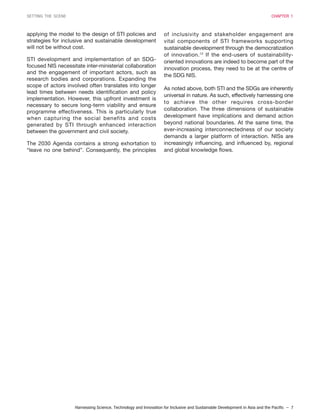
Figure 1.1 outlines a conceptual STI framework
for inclusive and sustainable development. This
framework builds on existing frameworks and
encompasses the inherently complex yet fluid
nature of the STI system life cycle by: (1) integrating
the social and environmental, as well as the
economic dimensions of sustainable development;
(2) adhering to the principles of openness, inclusivity,
accountability and collaboration; (3) incorporating
the roles of a more diverse range of actors and
(4) reflecting the regional and global dimensions of
STI.
6 – Harnessing Science, Technology and Innovation for Inclusive and Sustainable Development in Asia and the Pacific
This publication explores all parts of this conceptual
framework, whilst examining several elements in
greater depth through analysis and case studies. It
also touches on those factors influencing and
informing the framework, namely:
• Governance: the principles, policies, regulations
and informal norms concerning how STI is
governed as a process, and how the inputs and
outputs thereof are administered.
• Trends: the “megatrends” emerging in the
region, focusing on the challenges and
opportunities they present for STI.
• Data: the key role data and indicators will play
in STI implementation, not just to measure
the pulse of STI, but in stimulating new
technologies and innovations.
• Institutions and infrastructure: the importance
of institutions and infrastructure in supporting
STI creation, access and use.
• Finance: how the right financing models and
incentives can stimulate investment in STI, and
how STI itself can support these new financing
models.
• Human capital: how government policy can
nurture talent for the future.
• National, regional and global dimensions: the
national institutions, regional platforms and
global mechanisms that have been developed
to support STI.
• Principles: the importance of applying
the principles of openness, collaboration,
accountability and inclusivity.
• Knowledge: how the creation of open and
inclusive innovative knowledge economies can
ensure that “no one is left behind”.
Conclusion
This framework highlights the importance of a
systemic approach to the development of STI capacity
and its employment for overall welfare enhancement.
It can be a meaningful tool for policymakers for
devising appropriate measures and STI systems that
are appropriate for individual countries. While, overall,
the NIS approach has been very successful in
underscoring the importance of various interlinkages,
Source: ESCAP 2016.
An STI framework for sustainable development
Figure
1.1
ECONOMIC GOALS
SOCIALGOALS
EN
VIR
O
N
M
ENTALGOALS
Principle:
COLLABORATION
Principle:
ACCOUNTABILITY
Principle:
INCLUSIVITY
Principle:
OPENNESS
Knowledge
and
Data
Trends
Citizens
Governance,
Policies
&
Regulation
Institutions
&
Infrastructure
Human
Capital
Finance
National
National
Global
Regional
Global
Regional
Academia
Researchers
Scientists
Technologists
Government
Ministry officials
Public sector workers
Representatives
Civil
Society
NGO workers
Grass-roots innovators
Excluded communities
Private Sector
Investors
Entrepreneurs
Business staff
Harnessing Science, Technology and Innovation for Inclusive and Sustainable Development in Asia and the Pacific – 7
SETTING THE SCENE CHAPTER 1
applying the model to the design of STI policies and
strategies for inclusive and sustainable development
will not be without cost.
STI development and implementation of an SDG-
focused NIS necessitate inter-ministerial collaboration
and the engagement of important actors, such as
research bodies and corporations. Expanding the
scope of actors involved often translates into longer
lead times between needs identification and policy
implementation. However, this upfront investment is
necessary to secure long-term viability and ensure
programme effectiveness. This is particularly true
when capturing the social benefits and costs
generated by STI through enhanced interaction
between the government and civil society.
The 2030 Agenda contains a strong exhortation to
“leave no one behind”. Consequently, the principles
of inclusivity and stakeholder engagement are
vital components of STI frameworks supporting
sustainable development through the democratization
of innovation.12
If the end-users of sustainability-
oriented innovations are indeed to become part of the
innovation process, they need to be at the centre of
the SDG NIS.
As noted above, both STI and the SDGs are inherently
universal in nature. As such, effectively harnessing one
to achieve the other requires cross-border
collaboration. The three dimensions of sustainable
development have implications and demand action
beyond national boundaries. At the same time, the
ever-increasing interconnectedness of our society
demands a larger platform of interaction. NISs are
increasingly influencing, and influenced by, regional
and global knowledge flows.
8 – Harnessing Science, Technology and Innovation for Inclusive and Sustainable Development in Asia and the Pacific
Endnote
1
The term “knowledge economy” was coined in the 1960s to describe a shift from traditional economies to ones where the
production and use of knowledge are paramount. According to the World Bank, knowledge economies are defined by four
pillars: institutional structures that provide incentives for entrepreneurship and the use of knowledge, skilled labour availability
and good education systems, information and communications technology (ICT) infrastructure and access and, finally, a vibrant
innovation landscape that includes academia, the private sector and civil society.
2
Foresight can be defined as the ability to predict what will happen or be needed in the future.
3
Schwab, 2016.
4
Asian Development Bank (ADB), 2013.
5
Oxford Dictionary definition of citizen science is “the collection and analysis of data relating to the natural world by members
of the general public, typically as part of a collaborative project with professional scientists”.
6
Sirimanne, 2015.
7
WEF, 2016.
8
WEF, 2012.
9
Organisation for Economic Co-operation and Development (OECD), 2005.
10
Murray, Caulier-Grice and Mulgan, 2010.
11
One data-driven method for capturing the region’s diversity with regard to STI development is to categorize countries into
four quartiles according to their score in the latest World Intellectual Property Organization (WIPO) Global Innovation Index
(2015). Borrowing WEF terminology, the first quartile represents catch-up economies, the second quartile represents post-
catch-up economies, the third quartile represents emerging economies and the fourth quartile represents knowledge-driven
economies (WEF, 2014). In ascending order of scores, the first quartile comprises Myanmar; Nepal; Pakistan; Bangladesh;
Bhutan; Fiji; Tajikistan; Kyrgyzstan; Iran (Islamic Republic of) and Indonesia. The second quartile comprises Cambodia;
Sri Lanka; Philippines; Kazakhstan; India; Mongolia; Thailand and Viet Nam. The third quartile comprises Malaysia and China.
The fourth quartile comprises Japan; Australia; New Zealand; Republic of Korea; Singapore and Hong Kong, China.
12
Von Hippel, 2005.
Harnessing Science, Technology and Innovation for Inclusive and Sustainable Development in Asia and the Pacific – 9
SETTING THE SCENE CHAPTER 1
10 – Harnessing Science, Technology and Innovation for Inclusive and Sustainable Development in Asia and the Pacific
©SHUTTERSTOCK:BYCHYKHINOLEXANDR
Harnessing Science, Technology and Innovation for Inclusive and Sustainable Development in Asia and the Pacific – 11
THE ROLE OF LEADERSHIP CHAPTER 2
2
CHAPTER
THE ROLE OF
LEADERSHIP
Key messages
• Leadership that enables a “whole-of-government” approach to STI
is essential to creating an innovation nation.
• While science, technology and innovation are inextricably
connected, on an individual level they are profoundly different
concepts with sometimes overlapping but often very different
ecosystems and drivers.
• Integrating the three dimensions of sustainable development into
STI policy will be critical to meeting the ambitions of the SDGs.
However, it will not happen automatically.
• Planning and foresight will be key to enabling proactive, as
opposed to reactive, responses to a rapidly changing world.
• Monitoring and track STI policy implementation will be important
to track progress. However, the traditional STI metrics (e.g. R&D
and patents) fail to capture “hidden innovation” in an economy.
To fully harness the potential of STI for sustainable development,
committed political leadership needs to be supported by a coordinated
vision integrated with an inclusive and sustainable development strategy.
Implementation of the vision also requires synergy between different
ministries. Not only will it be critical to integrate the three SDG
dimensions in STI policy, but alignment of science and technology with
innovation will also be crucial. Coherent government action will need to
ensure that opportunities exist for these critical feedback loops. Planning
1
12 – Harnessing Science, Technology and Innovation for Inclusive and Sustainable Development in Asia and the Pacific
and foresight will be key to deal with a rapidly
changing and unpredictable world. Finally, monitoring
and measurement will be important to track progress
and hold the whole of government to account for the
implementation of STI for sustainable development.
2.1 Effective governance
The institutional frameworks that govern STI result
from complex processes and are shaped by political
objectives and the national stage of STI development.
Some governments have avoided setting up new
specialized agencies, simply expanding the mandates
of existing science and technology agencies to deal
with innovation policies. Given this institutional
alignment, policymakers have tended to equate
innovation with science. Other governments have
aligned innovation policy with ministries of ICT or of
trade and industry, equating it with digital technology
or business development respectively. As an
example, Armenia’s innovation strategy has been
driven by its Ministry of Economy associating
innovation more with entrepreneurship.2
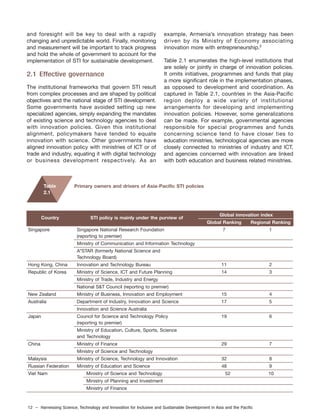
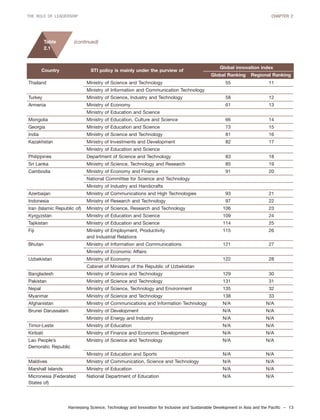
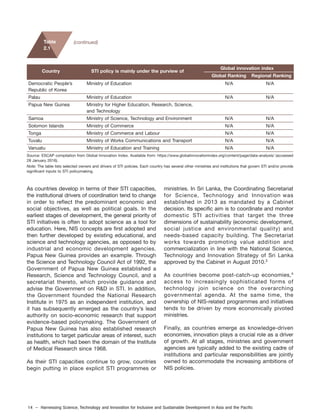
Table 2.1 enumerates the high-level institutions that
are solely or jointly in charge of innovation policies.
It omits initiatives, programmes and funds that play
a more significant role in the implementation phases,
as opposed to development and coordination. As
captured in Table 2.1, countries in the Asia-Pacific
region deploy a wide variety of institutional
arrangements for developing and implementing
innovation policies. However, some generalizations
can be made. For example, governmental agencies
responsible for special programmes and funds
concerning science tend to have closer ties to
education ministries, technological agencies are more
closely connected to ministries of industry and ICT,
and agencies concerned with innovation are linked
with both education and business related ministries.
Country STI policy is mainly under the purview of
Global innovation index
Global Ranking Regional Ranking
Singapore Singapore National Research Foundation 7 1
(reporting to premier)
Ministry of Communication and Information Technology
A*STAR (formerly National Science and
Technology Board)
Hong Kong, China Innovation and Technology Bureau 11 2
Republic of Korea Ministry of Science, ICT and Future Planning 14 3
Ministry of Trade, Industry and Energy
National S&T Council (reporting to premier)
New Zealand Ministry of Business, Innovation and Employment 15 4
Australia Department of Industry, Innovation and Science 17 5
Innovation and Science Australia
Japan Council for Science and Technology Policy 19 6
(reporting to premier)
Ministry of Education, Culture, Sports, Science
and Technology
China Ministry of Finance 29 7
Ministry of Science and Technology
Malaysia Ministry of Science, Technology and Innovation 32 8
Russian Federation Ministry of Education and Science 48 9
Viet Nam Ministry of Science and Technology 52 10
Ministry of Planning and Investment
Ministry of Finance
Primary owners and drivers of Asia-Pacific STI policiesTable
2.1
Harnessing Science, Technology and Innovation for Inclusive and Sustainable Development in Asia and the Pacific – 13
THE ROLE OF LEADERSHIP CHAPTER 2
Thailand Ministry of Science and Technology 55 11
Ministry of Information and Communication Technology
Turkey Ministry of Science, Industry and Technology 58 12
Armenia Ministry of Economy 61 13
Ministry of Education and Science
Mongolia Ministry of Education, Culture and Science 66 14
Georgia Ministry of Education and Science 73 15
India Ministry of Science and Technology 81 16
Kazakhstan Ministry of Investments and Development 82 17
Ministry of Education and Science
Philippines Department of Science and Technology 83 18
Sri Lanka Ministry of Science, Technology and Research 85 19
Cambodia Ministry of Economy and Finance 91 20
National Committee for Science and Technology
Ministry of Industry and Handicrafts
Azerbaijan Ministry of Communications and High Technologies 93 21
Indonesia Ministry of Research and Technology 97 22
Iran (Islamic Republic of) Ministry of Science, Research and Technology 106 23
Kyrgyzstan Ministry of Education and Science 109 24
Tajikistan Ministry of Education and Science 114 25
Fiji Ministry of Employment, Productivity 115 26
and Industrial Relations
Bhutan Ministry of Information and Communications 121 27
Ministry of Economic Affairs
Uzbekistan Ministry of Economy 122 28
Cabinet of Ministers of the Republic of Uzbekistan
Bangladesh Ministry of Science and Technology 129 30
Pakistan Ministry of Science and Technology 131 31
Nepal Ministry of Science, Technology and Environment 135 32
Myanmar Ministry of Science and Technology 138 33
Afghanistan Ministry of Communications and Information Technology N/A N/A
Brunei Darussalam Ministry of Development N/A N/A
Ministry of Energy and Industry N/A N/A
Timor-Leste Ministry of Education N/A N/A
Kiribati Ministry of Finance and Economic Development N/A N/A
Lao People’s Ministry of Science and Technology N/A N/A
Demoratic Republic
Ministry of Education and Sports N/A N/A
Maldives Ministry of Communication, Science and Technology N/A N/A
Marshall Islands Ministry of Education N/A N/A
Micronesia (Federated National Department of Education N/A N/A
States of)
(continued)
Country STI policy is mainly under the purview of
Global innovation index
Global Ranking Regional Ranking
Table
2.1
14 – Harnessing Science, Technology and Innovation for Inclusive and Sustainable Development in Asia and the Pacific
Country STI policy is mainly under the purview of
Global innovation index
Global Ranking Regional Ranking
Democratic People’s Ministry of Education N/A N/A
Republic of Korea
Palau Ministry of Education N/A N/A
Papua New Guinea Ministry for Higher Education, Research, Science,
and Technology
Samoa Ministry of Science, Technology and Environment N/A N/A
Solomon Islands Ministry of Commerce N/A N/A
Tonga Ministry of Commerce and Labour N/A N/A
Tuvalu Ministry of Works Communications and Transport N/A N/A
Vanuatu Ministry of Education and Training N/A N/A
Source: ESCAP compilation from Global Innovation Index. Available from: https://www.globalinnovationindex.org/content/page/data-analysis/ (accessed
28 January 2016).
Note: The table lists selected owners and drivers of STI policies. Each country has several other ministries and institutions that govern STI and/or provide
significant inputs to STI policymaking.
(continued)
As countries develop in terms of their STI capacities,
the institutional drivers of coordination tend to change
in order to reflect the predominant economic and
social objectives, as well as political goals. In the
earliest stages of development, the general priority of
STI initiatives is often to adopt science as a tool for
education. Here, NIS concepts are first adopted and
then further developed by existing educational, and
science and technology agencies, as opposed to by
industrial and economic development agencies.
Papua New Guinea provides an example. Through
the Science and Technology Council Act of 1992, the
Government of Papua New Guinea established a
Research, Science and Technology Council, and a
secretariat thereto, which provide guidance and
advise the Government on R&D in STI. In addition,
the Government founded the National Research
Institute in 1975 as an independent institution, and
it has subsequently emerged as the country’s lead
authority on socio-economic research that support
evidence-based policymaking. The Government of
Papua New Guinea has also established research
institutions to target particular areas of interest, such
as health, which had been the domain of the Institute
of Medical Research since 1968.
As their STI capacities continue to grow, countries
begin putting in place explicit STI programmes or
ministries. In Sri Lanka, the Coordinating Secretariat
for Science, Technology and Innovation was
established in 2013 as mandated by a Cabinet
decision. Its specific aim is to coordinate and monitor
domestic STI activities that target the three
dimensions of sustainability (economic development,
social justice and environmental quality) and
needs-based capacity building. The Secretariat
works towards promoting value addition and
commercialization in line with the National Science,
Technology and Innovation Strategy of Sri Lanka
approved by the Cabinet in August 2010.3
As countries become post-catch-up economies,4
access to increasingly sophisticated forms of
technology join science on the overarching
governmental agenda. At the same time, the
ownership of NIS-related programmes and initiatives
tends to be driven by more economically pivoted
ministries.
Finally, as countries emerge as knowledge-driven
economies, innovation plays a crucial role as a driver
of growth. At all stages, ministries and government
agencies are typically added to the existing cadre of
institutions and particular responsibilities are jointly
owned to accommodate the increasing ambitions of
NIS policies.
Table
2.1
Harnessing Science, Technology and Innovation for Inclusive and Sustainable Development in Asia and the Pacific – 15
THE ROLE OF LEADERSHIP CHAPTER 2
The whole-of-government approach
What many of the leading STI countries in the region
have in common is a “whole-of-government”
approach, with an overarching governance structure
for STI, backed by committed leadership that has
oversight of STI strategy. This governance structure
has allowed these countries to take a much more
holistic and strategic view, and has proven successful
in mainstreaming STI across individual line ministries.
It is worthy of note that countries such as the
Republic of Korea, China, Singapore and Japan,
which belong to the most advanced group of
economies in terms of STI capacities, organize their
cabinets to ensure that NIS policies are coordinated
using a whole-of-government approach and are
under the direct leadership of their respective Prime
Ministers’ offices.
In Japan, for example, the Council for Science and
Technology Policy (Figure 2.1) was set up within the
Cabinet Office as one of four councils on key policy
areas when government ministries and agencies were
reorganized in January 2001. It became the Council
for Science, Technology and Innovation in May 2014
to strengthen its functions to support innovation.
Under the leadership of the Prime Minister and the
Minister of State for Science and Technology Policy,
the Council for Science, Technology and Innovation
serves as headquarters for the promotion of STI
policy, overseeing all of the nation’s science and
technology activities and formulating comprehensive
and basic policies.5
The Council for Science, Technology and Innovation
has four key functions:
1. Basic policies on science and technology: The
Science and Technology Basic Plan (every five
years) and the Comprehensive Strategy on
Science, Technology and Innovation (annually).
2. Allocation of the science and technology
budget and human resources: Policies for the
allocation of resources, including the Science
and Technology Budget (annually) and the
Action Plan for the Implementation of
Important Science and Technology Policy
Measures (annually).
3. Evaluation of nationally important R&D: General
Guidelines for Evaluating Government Funded
R&D and evaluation and follow-up of large-
scale R&D.
4. Other key issues surrounding the promotion of
science and technology.
Japan’s STI governance structure
Source: Government of Japan, Cabinet Office. Available from: http://www8.cao.go.jp/cstp/english/panhu/1_p1-2.pdf.
Figure
2.1
Advice
Council for Science, Technology and innovation
Chairperson: Prime Minister
Cabinet Members: Chief Cabinet Secretary, Minister of State for Science and Technology Policy,
Minister of Internal Affairs and Communications, Minister of Finance,
Minister of Education, Culture, Sports, Science and Technology,
Minister of Economy, Trade and Industry.
Seven Executive Members (full-time, part-time): Those who have excellent knowledge of Science and
Technology are appointed from academia and industry with the approval of the Diet.
Science Council: President of Science Council of Japan
Formulation of comprehensive and basic science and technology policies
and implementation of overall coordination at a level above individual
ministries and agencies
Prime Minister
Relevant Ministries (implementation of concrete measures)
16 – Harnessing Science, Technology and Innovation for Inclusive and Sustainable Development in Asia and the Pacific
2.2 Integrated STI policies
STI policies in the region have traditionally focused
on the economic imperative
Traditionally, STI policy in the region has been
focused on stimulating economic competitiveness
and growth. However, to meet the ambitions of the
2030 Agenda, it will be critical for STI to also focus
on social and environmental concerns. While it is well
acknowledged that to achieve the SDGs, cross-
cutting, multisectoral, multidisciplinary approaches
are essential, to date there have been few of these
types of holistic efforts in policy development. The
approach adopted by the Republic of Korea provides
a good example of STI policies that integrate the
three dimensions while also emphasizing the
integration of science and technology with innovation.
Leveraging science and technology for innovation
for the economy and society
During the past decades, the Republic of Korea has
made significant progress in utilizing the full potential
of STI for the economy and society at large. To a
great extent, the progress is a result of careful
planning, which is exemplified by STI action plans
drafted by the Government for five-year periods at
a time. In its latest iteration, the Science and
Technology Basic Plan emphasizes the role of the
“creative economy” in delivering economic growth
and increasing the well-being of society by
incentivizing innovation at the level of small and
medium-sized enterprises (SMEs) and entrepreneurs.
The ultimate objective of the current plan is to stem
the rise of inequality and unemployment, and to
enable the country to cope with a rapidly aging
population and emerging environmental challenges.6
Reinforcing green and creative growth through
green innovation
In addition to wide-reaching STI plans, the Republic
of Korea has made strategic and policy-level
commitments to fostering green and creative growth.
To promote environmentally sustainable growth, the
Government has placed significant emphasis on
incentivizing and supporting the development of
environment-related technologies (see Figure 2.2). As
a part of its support mechanisms, the Government
developed a Climate Technology R&D Policy for
2014–20207
, which focuses research, development
Share of environment-related technologies developed worldwide (%)
Source: OECD, Green growth indicators database. Available from http://stats.oecd.org/Index.aspx?DataSetCode=GREEN_GROWTH (accessed in January
2016).
Notes: Left axis for bar charts shows cumulative shares; right axis for line charts (OECD-Europe*, Japan, United States of America [US] and BRIICS**
total) shows non-cumulative shares. * Includes Turkey. ** Brazil, Russian Federation, India, Indonesia, China and South Africa.
Figure
2.2
0
5
10
15
20
25
30
35
40
45
50
0
2
4
6
8
10
12
14
16 Indonesia
Turkey
New Zealand
Australia
Russian Federation
India
China
Republic of Korea
OECD-Europe
Japan
US
BRIICS Total
1990 1995 2000 2005 2006 2007 2008 2009 2010 2011 2012
Harnessing Science, Technology and Innovation for Inclusive and Sustainable Development in Asia and the Pacific – 17
THE ROLE OF LEADERSHIP CHAPTER 2
and financing efforts on supporting six core
technologies, including solar cells and bio-fuel, which
will lead to the reduction of greenhouse gasses and
the creation of new industries when employed fully.
To deliver tangible results, the Government has
augmented its policy plans and strategic documents
with practical support mechanisms and instruments.
Notable mechanisms include standards and
certificates for environmentally friendly products,
carbon labelling, and financial measures, tax rebates
and other purchasing and incentive programmes such
as the “Green Card” system. Standards concerning
environmental impacts have also been included in
public procurement processes. As a result, the
overarching objectives of green growth have been
operationalized at all levels of the private sector and
government.8
In addition to the potential economic gains from
green growth, the ambition of these policies is
also to improve quality of life by reversing the
environmental degradation that has accompanied
rapid industrialization. What is notable about the
Republic of Korea’s approach is the fluid and
integrated way in which STI policies for economic
ends (creative economy) also focus on social goals,
and how policies focused on the environment (green
innovation) also aim to integrate benefits for the
economy and society.
STI can act as an engine for integration but
requires committed and deliberate action
Countries like Japan and the Republic of Korea
are examples of how a commitment to STI at the
highest levels of government leads to its effective
development and implementation. Such a
commitment is critical if the three dimensions of
sustainable development are to be balanced and
integrated. In general, STI policy in the region has
the overarching goal of fostering economic
competitiveness and growth. Because current
innovation policies and their implementation
mechanisms generally do not achieve policy
coherence with sustainable and inclusive policy
frameworks and mandates, their impact is
constrained in terms of their overall benefits and
value for inclusive and sustainable development.
The inclusive, resilient and prosperous future we
want, for all the people of Asia and the Pacific,
obliges us to place sustainability at the heart of the
development agenda. This requires an unstinting
regional commitment to balance and integrate the
three dimensions of sustainability—economic, social
and environmental.9
The countries of Asia and the
Pacific need to shift to more future-oriented and
sustainable paths to growth. These paths must be
more resource efficient, able to meet the needs of
both present and future generations, respect
planetary boundaries and put people at the centre of
development.
2.3 Planning and foresight
The global environment, within which national
SDG-supportive innovation systems must be put in
place, is extremely fluid. In addition to the myriad
changes that are taking place at the local level, there
are also broader, universal trends at work. These
“megatrends” can be described as large,
transformative global forces that have a far-reaching
impact on businesses, economies, industries,
societies and individuals.10
There are numerous
megatrends that present both opportunities and
challenges to economies, societies and the
environment.
Economic integration, digital currency, e-commerce,
innovative finance, 3D printing and robotics (see
Box 2.1) will all have an impact on lifestyles,
investment and the types of jobs future economies
will offer. Scientific breakthroughs in genomics, the
shifting demographic and the rapidly growing urban
population will all have a profound impact on the
well-being of society. Climate change is possibly the
biggest challenge humankind has ever faced. In
addition to this, rapidly expanding digital connectivity
and the data revolution, including Big Data, have
created an explosion of information that, for the first
time, could help policymakers understand the
interlinked benefits of and trade-offs between the
economic, societal and environmental impacts of
these trends.
One of the biggest challenges facing society and
governments alike is the pace at which change
is occurring. These trends are moving at an
unprecedented speed and many governments find it
difficult to understand them, let alone develop
appropriate policy to amplify their benefits or mitigate
their risks. In this regard, the application of foresight
will be crucial for policymakers to be proactive in the
face of change.
Foresight can be defined as the ability to predict what
will happen or be needed in the future. Governments
in the region are placing greater emphasis on the
concept of foresight, including through systemic
18 – Harnessing Science, Technology and Innovation for Inclusive and Sustainable Development in Asia and the Pacific
reviews such as the Australia 2020: Foresight for
our Future report, ad hoc measures and long-term
programmes like the APEC initiatives on technology
foresight and institutional arrangements. As an
example of the latter, in the Russian Federation, the
Institute for Statistical Studies and Economics of
Knowledge, the largest research unit at the National
Research University’s Higher School of Economics,
Moscow, produces a high-quality peer reviewed
scientific journal called Foresight and STI Governance
that was established in 2007. The mission of the
journal is to support the creation of a foresight culture
through the dissemination of the best international
and Russian Federation practices in the field of
future-oriented innovation development. It also
provides a framework for discussion of STI trends
and policies, foresight methodologies and best
practices, and advanced practices of foresight
studies.11
The Foresight and STI Governance editorial council
includes prominent scholars and high-level
policymakers from the Russian Federation, United
States of America (US), United Kingdom of Great
Britain and Northern Ireland (UK), Canada, China,
Austria, South Africa and others. The professionalization
of foresight methodologies and best practices will be
critical for the region to deal proactively with the
megatrends that will no doubt emerge.
The overall message is that foresight exercises not
only produce actionable outputs in terms of analyses
and recommendations, but the process itself helps
policymakers come to terms with the concepts
involved and the larger implications of change. This
provides much-needed perspective and reduces the
risk of getting caught up in the details of complex
issues.
Government funding for scientific research and support in moving promising technology from the laboratory
to the production stage have been important factors in creating effective innovation systems. Governments have
played a key role in pushing the boundaries of science and technology, allowing competitive market forces to
encourage firms to innovate and supporting vibrant financial markets through sound regulation and fluid linkages
between public and private innovation actors. This has enabled many countries in the Asia-Pacific region to
be at the cutting edge of frontier science and technology.
China, the Republic of Korea and Japan are part of a small group of nations that are driving innovation in frontier
technologies that hold the potential to boost future economic growth. Eight out of the top ten patent applicants
in the area of robotics are from Japan and one is from the Republic of Korea. Three Japanese companies also
appear in the top ten for filing the most 3D printing patents. Chinese applicants account for more than a quarter
of patents worldwide in the area of 3D printing and robotics—the highest share among all countries.12
Disruptive innovations: countries driving patenting in 3D printing, nanotechnology and
robotics
Box
2.1
2.4 Monitoring and measurement
The Asia-Pacific region is home to some of the most
technologically advanced economies in the world, as
well as to some of the most technologically deprived.
Overall, the region relies on a handful of countries
to push forward the STI agenda. Thus, if the goal of
“leave no one behind” is to be realized, STI activity
must become more widespread. Nevertheless, the
region as a whole has recorded some impressive
gains in STI in recent times. Some noteworthy
indicators include:
• The region’s share of world expenditure on
R&D rose from 36 per cent in 2007 to 44 per
cent in 2013, while the Americas (32 per cent
in 2013) and Europe (23 per cent in 2013) have
seen decreases in their shares and Africa’s
share (1 per cent in 2013) has remained flat. In
total the region spent $643 billion in 2013 on
R&D.
• The region’s share of global researchers rose
from 41 per cent in 2007 to 44 per cent in
2013, while the Americas (22 per cent in 2013)
saw a decrease and Europe and Africa’s shares
Harnessing Science, Technology and Innovation for Inclusive and Sustainable Development in Asia and the Pacific – 19
THE ROLE OF LEADERSHIP CHAPTER 2
(31 per cent and 2 per cent, respectively, in
2013) remained flat.
• The rise in these inputs generated a 69 per
cent increase in scientific publications from the
region between 2008 and 2014.
• The increasing scientific activity has also led to
an upsurge in regional patent applications
submitted to the US Patents and Trademark
Office—to 86,000 in 2013, a 78 per cent
increase over 2008.
• In 2013, the region received 60 per cent of the
world’s granted patents and, importantly, 94.1
per cent of utility patents, which are associated
with more immediate application. Since 2004,
these shares have grown 11 per cent and 18.6
per cent, respectively.13
However, these aggregate figures belie wide gaps in
STI performance that exist in the region. For example,
many countries in the Asia-Pacific region have no
expenditures on R&D at all. This diversity is best
exemplified by the fact that the number of Asia-
Pacific countries ranked in the top quartile of the
Global Innovation Index14
is the same as the number
ranked in the bottom quartile.
Much work is still to be done on understanding the
measures and drivers of innovation
Successful implementation of the SDGs is contingent
on the timeliness and quality of data. In the case of
STI, much work must be done by the global
community to establish and operationalize a set of
indicators that will provide a useful guide for
policymakers over the next decades. Developing a
data series of comparable quality and accessibility
remains a big challenge for developing and
developed economies alike.
Achieving a complete picture of innovation is
challenging, and is further complicated by the fact
that mainstream indicators, such as patenting activity
and R&D expenditure, do not capture all dimensions
of innovation. Data will be critical in identifying and
understanding the drivers of “hidden innovation”.
Hidden innovation refers to innovation activities not
reflected in traditional indicators, such as investment
in R&D or patents awarded,15
that could equally have
the potential for positive impact. There is a risk that
the focus of government policy will be placed on
those areas where measures are readily available
rather than on those areas where it could be most
effective. On a more strategic level, in order to
address the people, planet and prosperity elements
of the SDGs, countries will need to look beyond just
gross domestic product (GDP) as the outcome of
their innovation efforts (see Box 2.2).
Conclusion
Visionary leadership is required to harness the
potential of STI for inclusive and sustainable
development. Leaders will need to create a foreward-
looking action plan informed by foresight activities,
put social and environmental—as well as
economic—imperatives at the heart of strategies and
hold the whole of government to account for its
delivery. It will be essential to engage all actors in the
innovation system to ensure plans incorporate the
economic, social and environmental dimensions of
sustainable development. It will also be essential to
hold all of government to account through monitoring
and measurement. However, this will not happen
automatically. Harnessing STI for inclusive and
sustainable development will require committed and
deliberate action.
Perhaps the most authoritative voice behind the movement to look beyond GDP is that of Bhutan. Building
upon four decades of philosophical and intellectual debate, Bhutan decided to embark on the first nationwide
survey measuring gross national happiness in 2005. The survey examined 33 indicators under 9 distinct
categories of well-being, including health, education, use of time and good governance, and provided, for the
first time, a comprehensive look at the well-being of the populace. The resulting report was embraced by the
global community, and the Bhutanese model has been translated into global action through the OECD’s Better
Life Index, the United Nation’s World Happiness Report and numerous national indicators, such as Thailand’s
Green and Happiness Index. While none of these indicators aim to displace GDP as the modus operandi for
measuring progress, they are extremely valuable complements, and a combination of social and economic
analyses can certainly bring us closer to estimating the true returns of growth.
Measuring gross national happinessBox
2.2
20 – Harnessing Science, Technology and Innovation for Inclusive and Sustainable Development in Asia and the Pacific
Endnote
1
Naim, 2015.
2
See, for example, http://mineconomy.am/eng/38/gortsaruyt.html.
3
See http://www.costi.gov.lk/index.php/en/about-us/what-is-costi.
4
WEF, 2014.
5
See http://www8.cao.go.jp/cstp/english/panhu/1_p1-2.pdf.
6
OECD, 2015.
7
OECD, 2015.
8
OECD, 2015.
9
ESCAP, 2015.
10
See, for example, Ernst & Young, 2015.
11
See http://foresight-journal.hse.ru/en/.
12
WIPO, 2015.
13
UNESCO, 2015.
14
The Global Innovation Index is an attempt to capture the multidimensional facets of innovation. For more information, see
https://www.globalinnovationindex.org/content/page/GII-Home.
15
See www.nesta.org.uk/sites/default/files/hidden_innovation.pdf.
Harnessing Science, Technology and Innovation for Inclusive and Sustainable Development in Asia and the Pacific – 21
THE ROLE OF LEADERSHIP CHAPTER 2
22 – Harnessing Science, Technology and Innovation for Inclusive and Sustainable Development in Asia and the Pacific
©SHUTTERSTOCK:SYAHEIRAZIZAN
Harnessing Science, Technology and Innovation for Inclusive and Sustainable Development in Asia and the Pacific – 23
BUILDING INSTITUTIONS AND INFRASTRUCTURE FOR STI DEVELOPMENT CHAPTER 3
Key messages
• Good governance and effective business regulation have
a significant impact on the creation of science, technology and
innovation.
• Government-established institutions can catalyse open,
collaborative and inclusive innovation.
• Digital technology has the potential to radically widen access to STI
education.
• Establishing and supporting physical and virtual infrastructure
is crucial for enabling STI development and the utilization of its
outputs.
3
CHAPTER
BUILDING
INSTITUTIONS
AND
INFRASTRUCTURE
FOR STI
DEVELOPMENT
24 – Harnessing Science, Technology and Innovation for Inclusive and Sustainable Development in Asia and the Pacific
Success in STI development requires an enabling
environment that supports scientists, technologists,
innovators, entrepreneurs and a variety of other
actors across society.1
Creating an enabling
environment means putting in place a set of
interrelated conditions—legal, organizational, fiscal,
informational, political and cultural—that supports
the capacity of actors to engage in a process or
activity in a sustained and effective manner.2
In turn, enabling environments hinge critically on
quality institutions. Here, the term “institutions” refers
to the organizations, rules and principles, and
infrastructure that guide the behaviour and structure
patterns of interactions. 3
These three dimensions of
institutions—organizations, rules and infrastructure—
govern the collaboration, coordination and linkages
among actors and have a strong influence on STI
activities for sustainable development.4
Strong
institutions generally provide foundations for
beneficial outcomes over time and are key
determinants of STI development.5
The tangible side of institutions encompasses
organizations themselves, and the networks and
linkages between academia, research, industry and
government. The less-tangible aspects of institutions
cover norms, regulations and principles that guide the
behaviour of the constituents of the STI development
process.
As highlighted in Chapter 2, each of the groups
involved in the development and application of STI
needs to be an integral part of the national innovation
systems process. Involvement by all parties
engenders the necessary buy-in and ownership that
leads to a stronger commitment to undertake the
actions needed to meet the SDGs.
This chapter discusses the institutional architecture
required to integrate the three dimensions of
sustainable development and how this institutional
structure can enable and support the creation,
accessibility and utilization of STI.
3.1 Institutional architecture in Asia and
the Pacific
Each country has a distinct institutional architecture,
often as a result of both conscious design and more-
organic evolutionary processes. The ways in which
the hierarchies between ministries, agencies,
programmes, regulations and other institutions that
govern STI can be combined are all but limitless.
However, the combinations that provide optimal
support for a country’s STI framework in any specific
stage of development are much more limited.
Indeed, it is only with a clear understanding of
priorities, and the application of foresight, that
governments can design and influence the types of
institutions that are needed to achieve the common
goal of sustainable development. For countries to
establish or reform institutions in support of the
SDGs, prioritization and sequencing must become
major objectives. From the early stages of basic
research to the adoption and adaptation of innovation
by end users, institutions guide and support the
entire process. Governments can play a role in this
process; in some cases by providing the necessary
institutional structure and in others, by providing
support for that structure.
While national development plans will highlight
priorities, implementation will depend, among other
factors, on the country’s stage of development. For
example, in early stages of development, institutions
that provide stability and leadership should take
precedence over those providing services to
individual groups. Likewise, ministries focusing on
fundamentals, such as education, health, energy,
food, water and transparent government, should be
given priority over those aiming to incentivize high-
technology development or establish world-class
laboratories.
Overall, the quality of institutions varies widely in the
Asia-Pacific region. For example, Table 3.1 provides
an overview of the regulatory conditions of selected
Asia-Pacific economies as outlined in the World
Competitiveness Report.6
Unsurprisingly, rules and
regulations are considered to be of a high quality in
Singapore (which ranks second overall, behind
Finland) and Japan, with Malaysia being a standout
among lower-income economies.
The World Competitiveness Report also provides
estimates of the performance of institutions that
specifically support innovation (Table 3.2). What is of
note here is the fact that high-income and middle-
income economies have similar overall rankings,
which implies that institutional quality is not solely
determined by income levels. Singapore and Malaysia
score well (fifth and twelfth overall, respectively) in
university-business collaboration, but Singapore
scores lower in terms of the availability of scientists
and engineers.
Harnessing Science, Technology and Innovation for Inclusive and Sustainable Development in Asia and the Pacific – 25
BUILDING INSTITUTIONS AND INFRASTRUCTURE FOR STI DEVELOPMENT CHAPTER 3
Intellectual Property
Ethics &
Government Efficiency
Corruption
Efficiency Efficiency
Intellectual Diversion
of legal of legal
Transparency
Country
Property
property of public
Burden of framework framework
of
rights
protection funds
regulation in settling in
policymaking
disputes challenging
regulation
(I) (II) (III) (IV) (V) (VI) (VII)
High Income 5.5 5.4 5.1 3.7 4.9 3.9 4.7
Australia 5.5 5.5 5.3 2.8 4.8 4.1 4.3
Japan 5.9 6.0 5.6 3.5 5.2 4.4 5.3
Singapore 6.2 6.2 6.1 5.2 6.2 4.4 6.1
Republic of 4.2 3.7 3.3 3.2 3.5 2.8 3.1
Korea
Upper Middle 5.5 4.1 3.8 4.1 4.4 3.9 4.5
Income
Malaysia 5.3 5.2 4.8 5.0 5.3 4.8 5.2
China 4.5 4.0 3.9 4.1 4.1 3.6 4.5
Thailand 4.1 3.1 2.6 3.3 3.8 3.3 3.7
Lower Middle 3.8 3.5 3.1 3.4 3.7 3.2 3.6
Income
India 4.1 3.7 3.4 3.6 3.8 3.8 4.0
Indonesia 4.3 4.1 3.4 4.0 4.1 3.8 4.2
Lao PDR 3.8 3.6 3.4 4.0 4.3 2.8 3.5
Myanmar 2.7 2.7 2.4 2.9 2.7 2.4 2.9
Pakistan 3.3 2.9 2.8 3.1 3.3 3.1 3.4
Philippines 4.3 3.7 3.1 3.4 3.7 3.5 3.8
Sri Lanka 4.3 3.9 3.0 3.3 4.6 3.3 3.8
Viet Nam 3.6 3.1 3.2 3.1 3.4 3.2 3.5
Low Income 3.3 2.8 2.6 3.4 3.1 2.7 3.2
Cambodia 3.3 2.8 2.6 3.4 3.1 2.7 3.2
Source: WEF, 2014.
Note: Scale is from 1 to 7; 7 being the best score.
Conditions of rules and regulations related to STI in the Asia-Pacific regionTable
3.1
26 – Harnessing Science, Technology and Innovation for Inclusive and Sustainable Development in Asia and the Pacific
Quality of University- Gov’t Availability
PCT patents,
Capacity for scientific industry procurement of scientists
applications/
Country innovation research collaboration of advanced and
million pop.
institutions in R&D tech products engineers
(I) (II) (III) (IV) (V) (VI)
High Income 4.9 5.5 5.0 4.2 4.8 178.33
Australia 4.6 5.8 4.8 3.4 4.7 78.4
Japan 5.4 5.8 5.0 4.1 5.4 308.2
Singapore 5.0 5.6 5.6 5.1 4.9 125.2
Republic of Korea 4.7 5.0 4.6 4.1 4.4 201.5
Upper Middle Income 4.4 4.5 4.6 4.1 4.6 8.5
Malaysia 5.2 5.2 5.3 5.2 5.2 12.6
China 4.2 4.3 4.4 4.3 4.4 11.7
Thailand 3.7 3.9 4.0 2.9 4.3 1.2
Lower Middle Income 4.0 3.6 3.4 3.6 4.0 0.3
India 4.0 4.0 3.9 3.5 4.4 1.5
Indonesia 4.8 4.3 4.5 4.2 4.6 0.1
Lao PDR 3.7 3.5 3.5 3.7 3.1 0
Myanmar 2.9 2.3 2.2 2.5 3.0 0
Pakistan 4.0 3.4 3.2 3.1 4.3 0
Philippines 4.5 3.6 3.8 3.7 4.0 0.3
Sri Lanka 4.6 4.1 3.1 3.8 4.9 0.6
Viet Nam 3.5 3.3 3.3 3.9 3.8 0.2
Low Income 3.4 2.9 3.0 3.1 3.2 0
Cambodia 3.4 2.9 3.0 3.1 3.2 0
Source: WEF, 2014.
Note: Scale is from 1 to 7; 7 being the best score.
Table
3.2
Innovation and quality of institutions
An area in which government can directly play
a catalysing role is in its procurement policies
(innovative procurement policies are discussed in
Chapter 4). Government procurement represents
large investment flows, which are often more stable
than private investment decisions. In addition, they
can be more easily guided towards socially desired
uses, such as incentivizing STI for sustainable
development. As Table 3.2 shows, there is little
government procurement of advanced technology
products in the region, with only Singapore and
Malaysia as noteworthy exceptions. Government
procurement flows are created and stemmed by the
force of regulation, and even small reforms, such as
enabling bottom-up decision-making, can have
disproportionately positive impacts. Indeed,
Malaysia’s case serves as a learning example, where
government is continually engaged in reforming
its regulatory framework to support a changing
environment (see Box 3.1).
The need to further improve regulatory conditions,
especially in the lower-middle and low-income
economies, is apparent. In particular, there is a need
for a more-efficient legal framework to settle disputes
and to challenge the existing regulations. Intellectual
property (IP) protection, including anti-counterfeiting
measures, is relatively poor in low-income economies.
Among middle-income economies, low ratings for the
least-developed countries (LDCs), such as Myanmar,
illustrate the need for technical assistance to improve
regulatory conditions. Such assistance gives these
economies the advantage of establishing good
procedures at the outset. Streamlining regulatory
processes will help boost STI capabilities that relate
primarily to learning and developing technology
Harnessing Science, Technology and Innovation for Inclusive and Sustainable Development in Asia and the Pacific – 27
BUILDING INSTITUTIONS AND INFRASTRUCTURE FOR STI DEVELOPMENT CHAPTER 3
capabilities. Indeed, more-efficient regulations will
facilitate technology transfer as more strategic
coordination between IP regulations and STI policy
will help ensure that creative work is promoted
effectively.
3.2 Institutions supporting STI creation
The process of creating advances in STI is supported
by many (often overlapping) institutional structures
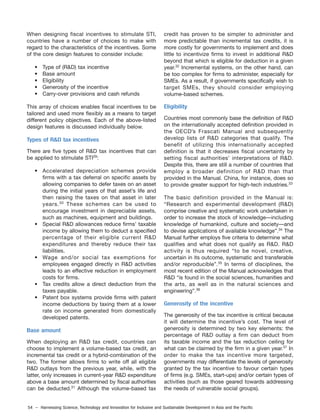
that can be outside of direct governmental control. In
the realm of science, certain fundamental institutional
structures are needed, such as universities and other
research institutions. However, in the broader scope
of creating an enabling environment, government
takes on a more essential role. To enable the efficient
creation of STI, governments must ensure that the
principles of good governance and the rule of law are
followed, and that standards are set that adequately
support quality STI development.
STI and good governance
Good governance is increasingly recognized as a key
ingredient of sustainable development. Available
evidence suggests that strong societal deference to
the rule of law may have tangible effects on STI
outcomes through a variety of mechanisms.7
For
example, the development of an IP protection system
is dependent on the existence of an effective court
system. Conversely, widespread corruption in the
higher education system (e.g. the “buying” of
diplomas) is incompatible with high-quality education.
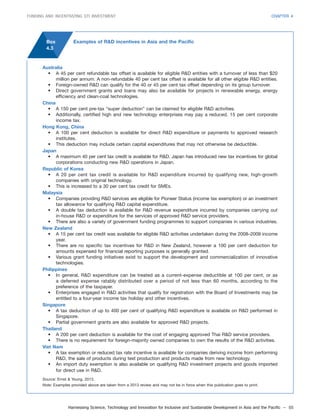
Figure 3.1 suggests that good governance may also
affect STI outcomes through, and in combination
with, the (perceived) quality of scientific research
institutions. In this regard:
• No country with very high-quality scientific
research institutions is found among countries
with low rule of law standards (green ellipse).
• Although it is possible to find jurisdictions with
moderately high-quality scientific research
institutions at any level of rule of law
compliance (purple ellipse), higher scientific
productivity (bubble size) is broadly associated
with better governance of the country as a
whole.
The benefits of deference to the rule of law and good
governance go beyond R&D and the market for STI
products and services. Indeed, their essential function
is to provide legal certainty, facilitate contractual
arrangements between formerly unknown parties
and, as a consequence, enable risk-taking in STI
creation.
As exemplified by Figure 3.1, good governance and
strong regulatory frameworks also improve the quality
of scientific research organizations, affecting
upstream STI development. Indeed, the quintessential
property of the rule of law is that it facilitates all
societally beneficial transactions that are dependent
on legal concepts such as property rights and
enforcement.
The relevance and appropriateness of different legal
and regulatory frameworks depends on both the
stage of development and policy objectives of each
country. For instance, a knowledge-driven economy
will have a pre-existing set of institutions and
regulatory frameworks that can be further improved
with appropriate mechanisms that streamline or
reduce undue regulatory burden. In the case of
catch-up economies, each institution and legal
In the tenth Malaysia Plan, the Malaysian Government introduced the so-called modernization of business
regulations to facilitate a private-sector-led economy, and charged the Malaysia Productivity Corporation with
reviewing the current regulatory framework. The main purpose of the review was to help the Government
develop a regulatory framework that reduces redundancy and red tape. Malaysia has made significant progress
in reforming its regulatory burden with regards to the ease of doing business. It has improved its standing in
the World Bank’s Doing Business Rankings, rising from ninetieth in 2012 to fifteenth in 2014. With regards to
R&D investment, Malaysia has improved its contribution to nearly 1.1 per cent of GDP. This significant increase
in R&D funding has resulted in an increase in scientific outputs, namely publications and patents. Indeed, the
formulation of the Higher Institution Strategic Plan, which was instrumental in the creation of the Research
University Agenda, has significantly increased the production of scientific outputs since 2006.
Box
3.1
Malaysia’s progress in regulatory reform and R&D investment
28 – Harnessing Science, Technology and Innovation for Inclusive and Sustainable Development in Asia and the Pacific
framework element is likely to be new. Consequently,
the sequencing, scope of mandates and first-order
priorities carry much more weight, in particular in
resource-scarce settings. Implementing basic,
transparent regulatory processes that protect
consumers and businesses is therefore a first order
of business for catch-up economies.
STI development can be accommodated by existing
regulatory frameworks in several ways. First, because
applied R&D is an inherently risky endeavour, the
legal setting can be strengthened to enable
contractual arrangements for the sharing of risks and
financial resources. Second, the outputs of STI are
often either non-rivalrous, in the sense of intangible
ideas and knowledge, or easily appropriable products
that are prone to reverse engineering. Thus, the
efforts of entrepreneurs, scientists and other
innovators require some form of protection in order to
both recoup their costs of development and to
provide profit opportunities that will further incentivize
innovative behaviour. IP rights, such as patents and
trade secret protection, can be utilized to fulfil such
aims. It is important to tailor existing IP rights regimes
in light of the current demand for protection and
existing capacities to innovate.
Regulatory protection has been shown to play a key
role in the world’s most technologically advanced
economies. In terms of patenting, Japan tops the list
of countries in the region (Figure 3.2a). China has also
shown remarkable progress over the years, especially
after 2006. Among other Asian economies, Singapore
and Malaysia rank highest (Figure 3.2b). As noted
previously, these countries also had high-ranking
regulatory STI structures.
Good governance and the quality of scientific research organizations
Sources: World Bank, Worldwide governance indicators, Rule of law index. Available from http://data.worldbank.org/data-catalog/worldwide-governance-
indicators; Quality of scientific institutions data from WEF (2012); Publications per million population data computed by Science-Metrix based on Thomson
Reuters, Web of Science. Available from http://ipscience.thomsonreuters.com/product/web-of-science/?utm_source=Adwords&utm_
medium=paid&utm_campaign=WoS&gclid=CM6b_oLrrswCFdKGaAodfGcLxw&gclsrc=aw.ds.
Notes: Presentation inspired by UNESCO (2014); Bubble size is proportionate to scientific productivity (i.e. scientific publications
per million inhabitants, average of 2013–2014); Rule of law index range: -2.5 (weak) to 2.5 (strong); Quality of scientific institutions range: 1 (weak) to 7
(strong).
Figure
3.1
Armenia
Australia
Azerbaijan
Bangladesh
Bhutan
Brunei Darussalam
Cambodia
China
France
Georgia
India
Indonesia
Japan
Kazakhstan
Kyrgyzstan
Lao PDR
Malaysia
Mongolia
Myanmar
Nepal
Netherlands
New Zealand
Pakistan
Philippines
Singapore
Sri Lanka
Thailand
Timor-Leste
Turkey
UK
US
Viet Nam
Rule of law index (average of 2011-2013)
ESCAP members Other countries
Qualityofscientificresearchinstitutionsindex(averageof2012-2013)
-2.0 -1.5 -1.0 -.5 0 0.5 1.0 1.5 2.0 2.5
2.0
2.5
3.0
3.5
4.0
4.5
5.0
5.5
6.0
6.5
7.0
Republic of Korea
Hong Kong, China
Iran (Islamic
Republic of)
Russian Federation
Harnessing Science, Technology and Innovation for Inclusive and Sustainable Development in Asia and the Pacific – 29
BUILDING INSTITUTIONS AND INFRASTRUCTURE FOR STI DEVELOPMENT CHAPTER 3
The intensity of patenting activity depends on
a plethora of parameters, many of which are
determined by the private sector. However, some of
the most significant determinants, such as rule of law
and governance, are driven by governments. Indeed,
as Figure 3.3 shows, good governance is positively
correlated with patenting activity—specifically
successful patents, which require effective
bureaucracy in addition to an empowered private
sector.
Government regulation and the business
environment
Creating an enabling environment for risk-taking
Private sector institutions—including individual
firms—develop directly in response to the regulatory
and legal structures in which they operate. Thus, all
forms of regulation—from labour laws, to professional
standards, to tax structures to IP rights—affect how
dynamic and competitive businesses can be. With
Source: WIPO, IP Statistics Data Center. Available from http://ipstats.wipo.int/ipstatv2/ (accessed 28 January 2016).
Figure
3.2a
Number of patents in Japan, China, Australia and India
Number of patents in other selected Asian economiesFigure
3.2b
50 000
40 000
30 000
20 000
10 000
0
Japan China Australia India
2000
2001
2002
2003
2004
2005
2006
2007
2008
2009
2010
2011
2012
2013
2014
Patent
2000
2001
2002
2003
2004
2005
2006
2007
2008
2009
2010
2011
2012
2013
2014
Singapore Thailand Malaysia Indonesia Viet Nam
1 400
1 200
1 000
800
600
400
200
0
Patent
30 – Harnessing Science, Technology and Innovation for Inclusive and Sustainable Development in Asia and the Pacific
regard to STI in particular, one of the key
characteristics of a successful innovation system is
its ability to provide private sector agents with
sufficient flexibility to pursue uncertain ventures.
Indeed, the ability of a business to reinvent itself—to
start and end a business venture—can be an
important determinant of its willingness to undertake
R&D and to follow through with innovative
transformations. At the same time, the regulatory
environment must protect investors and creditors,
and provide a stable atmosphere where investors’
rights are protected and contracts enforced so that
investors and innovators taking on risks do so in an
informed, transparent way. The efficiency of the
regulatory system depends on whether businesses
can comply without suffering an undue administrative
or financial burden that might act as a barrier to
innovation.
Figure 3.4 highlights the strong correlation that exists
between the ease of doing business in a country and
its innovation outputs, as captured by the World
Bank’s Doing Business Rankings and the Innovation
Output Sub-Index of the Global Innovation Index. The
rankings for “ease of doing business” capture many
of the characteristics that create a business
environment conducive to STI, including: the ease of
starting a business and resolving insolvency, the
strength of protection for minority investors and
contract enforcement, the ease of dealing with
construction permits, paying taxes and accessing
energy.
An interesting aspect of this relationship is its non-
linearity. Countries that rank lower (i.e. less effective)
on the “doing business” scale show no strong
relationship between institutional/regulatory quality
and innovative output. This implies that until countries
have reached a certain level of quality of business
environment there is little correlation with STI
outcomes. Once a critical mass of quality regulation
is in place, innovative output begins to increase
substantially. Hence, an integrated effort from
governments to streamline the regulatory system
across its various components will be one of the key
starting points of establishing a functioning and
efficient innovation system.
Source: WIPO, 2016. World Bank, Worldwide governance indicators, Rule of law index. Available from http://data.worldbank.org/data-catalog/worldwide-
governance-indicators (accessed 2014).
Patents granted and the Worldwide Governance IndicatorsFigure
3.3
0
2
4
6
8
10
12
14
LogTotalPatentsGranted(2014)
-1.5 -1.0 -0.5 0 0.5 1.0 1.5 2.0 2.5
Harnessing Science, Technology and Innovation for Inclusive and Sustainable Development in Asia and the Pacific – 31
BUILDING INSTITUTIONS AND INFRASTRUCTURE FOR STI DEVELOPMENT CHAPTER 3
Creating an environment for a social economy
Beyond the drive for innovation, individual businesses
within many economies are beginning to incorporate
all three dimensions of sustainability in their business
practices. The outcome of this change in institutional
dynamics is often referred to as social enterprise.8
A social enterprise can be defined as an organization
committed to explicitly including social and/or
environmental returns as part of its core business
while seeking profit or return on investment.9
The
concept of social enterprise has been gathering
momentum with the growing recognition that the
three dimensions of sustainable development will
be key in achieving the SDGs. The Republic of Korea
has been at the forefront of formulating innovation
policy on social enterprise. An example of
government policy is the accreditation of social
enterprises by the Korea Social Enterprise Promotion
Agency. The “social economy” is already gaining
momentum in the region. In the Republic of
Korea, the social economy accounts for 3 per cent of
GDP.10
When compared against R&D expenditure of
4.15 per cent of GDP,11
this emerging economy is
significant.
The social enterprise movement is spreading
throughout the region, with several governments
putting in place institutional support and laws to
incentivize the growth of social enterprise. In 2014,
the Government of Viet Nam made revisions to its
Enterprise Law, providing a legal definition of social
enterprise and granting such organizations specific
rights. The amended law stipulates, among other
requirements, that a social enterprise must reinvest
a minimum of 51 per cent of its annual profits
towards social and environmental goals.12
In 2015, the Government of Malaysia launched
the Malaysian Social Enterprise Blueprint 2015-2018,
a three-year roadmap for developing a social
enterprise ecosystem. A key aim of the Blueprint is
to create more impact-driven entrepreneurs, that is,
entrepreneurs who strive to create social and
environmental, as well as economic impact. A key
institutional component of the ecosystem the
Blueprint is aiming to develop is the Malaysian Global
Innovation and Creativity Centre. The Centre’s
mandate is to grow the nation’s social enterprise
sector through a mix of financial and non-financial
support to social entrepreneurs.13
Source: ESCAP based on Global Innovation Index 2015. Available from: https://www.globalinnovationindex.org/content/page/data-analysis/; and World
Bank, Doing Business Rankings 2015. Available from http://www.doingbusiness.org/rankings (accessed 28 January 2016).
Figure
3.4
Innovation and the business environment, 2015
Singapore
New Zealand
Republic of Korea
Hong Kong, China
UK
US
Australia
Malaysia
Switzerland
France
Japan
Kazakhstan
Thailand
Russian Federation
Turkey
Mongolia
Azerbaijan
Kyrgyzstan
Bhutan
China
Uzbekistan
Fiji
Viet Nam
Nepal
Philippines
Sri Lanka
Indonesia Cambodia
India
Tajikistan
Pakistan
Myanmar
Bangladesh
80
70
60
50
40
30
20
10
0
0 20 40 60 80 100 120 140 160
32 – Harnessing Science, Technology and Innovation for Inclusive and Sustainable Development in Asia and the Pacific
Creating an environment for risk-taking whilst
simultaneously putting in place policy and regulations
to incentivize more social forms of enterprise could
catalyse a more integrated approach to innovation
development for the SDGs. It will be interesting to
track the progress of these policies so that other
countries can learn from these early stage
experiments.
3.3 Institutions supporting access and use
An important part of creating an enabling environment
for STI is ensuring access and use. Access to and
use of STI is governed not just by the rules of law
(such as patents and other IP rights), but also by the
opportunities citizens have to obtain information and
use scientific advances, technological breakthroughs
and innovations. As a result, governments need to
evolve institutional structures that facilitate access
and use in a variety of ways. Governments can
facilitate access and use by embedding the
institutional principles of openness, collaboration and
inclusivity into STI policies and strategies.
Government can also radically widen access to STI
education through digital education technologies.
Open innovation
Open innovation describes the process of harnessing
the distributed and collective intelligence of large
groups of people. It is based on a number of
principles, including collaboration, sharing, self-
organization, decentralization, transparency of
process and plurality of participants.14
It has taken on
a wider meaning and application thanks to the
Internet, which has enabled large numbers of people
to interact and contribute at a relatively low cost.15
The concept of open science has emerged from the
open innovation movement. Open science moves
beyond open-access research articles, towards
encompassing all elements underpinning research,
such as data, software codes, protocols and
workflows. The intention is for people to use, reuse
and distribute content without legal, technological or
social restrictions. In some cases, open science also
entails the opening up of the entire research process
from agenda setting to the dissemination of findings.
Open science utilizes the prevalence of the Internet
and associated digital tools to enable greater local
and global research collaboration. However, while
open science is lauded by many as a worthy guiding
principle, in practice it is far from universal among
developed economies and awareness of its benefits
and practices is even less prominent in the
developing world.16
A policy implemented by the Indian Ministry of
Science and Technology provides an example of
open science in practice. Researchers who receive
funding from its biotechnology and science and
technology departments are now required to deposit
copies of their papers in publicly accessible
depositories. The National Data Sharing and
Accessibility Policy also encourages sharing of
government data as well as data from scientific
and R&D institutions. Based on this policy, a
government portal was created to facilitate open-
access data sharing. In Pakistan, the Open Access
Instrumentation scheme allows scientists to have
access to scientific instruments or to send their
samples to any member institution in the country for
free analyses. In the Republic of Korea, Open
Access Korea carries out several initiatives that aim
to support and promote the openness of R&D
information in the country in collaboration with other
STI agencies, such as the National Technical
Information Service and the National Digital Science
Library.19
These examples are policies and initiatives
for open science and open access in general, and are
not specifically targeting SDGs. Open access to
scientific knowledge related to sustainable
development has the potential to leverage
advancements so that more countries stand to meet
the SDGs.
Open innovation, by relying on an array of sources of
information and expertise, generally leads to faster
technological change at less cost and provides
access to notions and procedures outside traditional
frames of reference, which, in turn, can lead to truly
innovative solutions. However, it can also lead to
ambiguity in terms of attribution. The larger the
payoffs associated with these innovative solutions,
the more significant questions of attribution,
ownership and use become.
Collaborative innovation
Another important way society can benefit from STI
is through collaborative efforts, such as technology
clusters. Silicon Valley is often held up as the model
of how innovation and entrepreneurship can be
generated through cross-sector collaboration. A key
ingredient of Silicon Valley’s success has been the
interaction between investors, academia and
business, coupled with access to well-functioning
infrastructure. In the Asian context, the Indian
Government has recently outlined an ambitious
plan—Startup India20
—to build a similarly strong
ecosystem for nurturing innovation and start-ups. As
part of this initiative, the Indian Government has
17
18
Harnessing Science, Technology and Innovation for Inclusive and Sustainable Development in Asia and the Pacific – 33
BUILDING INSTITUTIONS AND INFRASTRUCTURE FOR STI DEVELOPMENT CHAPTER 3
announced plans to support industry-academia
partnerships by establishing seven new research
parks with an initial investment of $18 million each.
These new research parks will be modelled on the
ones at Indian Institutes of Technology (IIT) Madras,
Stanford University, Massachusetts Institute of
Technology (MIT) and the University of Cambridge.
The guiding principles for the research parks include:
• Creating an environment that encourages
collaboration between industry and academia
through joint research projects and consulting
assignments.
• Creating a self-sustaining and technologically
fertile environment.
• Encouraging and enabling R&D activities and
start-ups that are aligned to the potential
needs of industry at large.
• Providing world-class infrastructure for R&D
activities and business incubation.
• Enabling the development of highly qualified
personnel and encouraging the professional
growth of researchers in companies through
part-time master’s and doctoral degree
programmes.
A strategic focus on creating an enabling environment
for these innovators, scientists and technologists and
creating collaborative spaces (both online and offline)
to foster cross-sector collaboration has the potential
to generate and surface compelling innovations
for society’s pressing problems. A meaningful
and constructive university-industry-government
partnership (Box 3.2) could also reap huge dividends
in the search for technological advances and facilitate
the integration of the three dimensions of sustainable
development.
Realizing that Indonesia’s economic development strategy requires strong university-industry-government
collaboration and partnership, the country’s Directorate General of Higher Education has initiated more than
20 different schemes to fund university research and community service activities since the early 1990s. Over
several years of implementation, the development of various types of university-industry-government
partnerships has been observed. These include, among others, service and training contracts amongst
universities, government-supported university patent applications, collaborative R&D efforts between universities
and industry, networking events to forge connections between industrialists and academics, industry
collaboration for education (such as industry staff teaching specific subjects of emerging importance),
incubation/entrepreneurship education for students, SME participation in university activities and the
establishment of science parks close to universities.
Box
3.2
Indonesia’s university-industry-government partnership21
Inclusive innovation
Inclusive innovation is often defined as the inclusion
of groups that are currently marginalized in some
aspects of the innovation process (inclusive
innovation will be discussed further in Chapter 5).22
STI for sustainable development requires that various
actors or stakeholders be involved in STI activities, so
that the outputs and outcomes of the process are
acceptable to them. In a way, this is similar to what
von Hippel (2005) calls the “democratization of
innovation”, in that users are actively involved in the
entire process of innovation. If the end users of
sustainability-oriented innovations are to become part
of the innovation process, then the nature of the
relationships between mainstream actors in sectoral
and technological innovation systems will need to
change. Long-term system transitions, rather than
being driven solely by technocrats and technologists,
will need to involve a large number of stakeholders in
the public, private and civil society sectors (Box 3.3).
When it comes to sustainability, because the issues
are multifaceted, interrelated and complex, overly
prescriptive top-down approaches are inadequate.
More opportunities are needed for active dialogue
and deliberation among scientists, technologists,
policymakers, the private sector and civil society in
order to foster a more comprehensive and inclusive
agenda for STI for sustainable development. Such
opportunities and processes should not be limited to
the national level, but should also take place at local,
regional and global levels.
34 – Harnessing Science, Technology and Innovation for Inclusive and Sustainable Development in Asia and the Pacific
The participation of a variety of stakeholders in
policymaking processes might lead to a more
equitable distribution of the benefits accruing from
STI policies and practices. Inclusive innovation could
be a force for such democratization and ensure that
innovation efforts benefit those most in need.
Digital education and e-learning
The various actors in an innovation system—
government officials, academics, entrepreneurs and
civil society—need to have the necessary skills to
fully avail themselves of the opportunities that STI
presents. In addition to skills (addressed specifically
in Chapter 5), there is also a need for access to
information. One way educational institutions are
providing continual access to learning is by opening
up education opportunities via the Internet. These
digital education resources have turned the web into
a library of lecture materials and coursework that is
available to anyone with Internet access. While the
popularity of online courses has grown rapidly in
recent years (Box 3.4), providing unparalleled access
to informational opportunities, there is a continued
need to effectively support traditional institutions of
learning. Having access to information is not the
same as access to education. Learning technology
and technology-enabled learning are very different
things and, while both are important, one cannot
completely replace the other.
3.4 Digital Infrastructure
Information and Communications Technology (ICT)
fundamentally underpins a vibrant STI sector and
serves as critical infrastructure and a foundation to
support socio-economic growth and well-being. The
Internet, for instance, has transformed the world by
providing instant connectivity to the remotest areas
and transmitting data, information and knowledge in
multiple formats and languages over fiber optics
cables, wireless networks or satellites.
As a versatile technology itself, ICT now permeates
every facet of our lives: enabling trillions of dollars of
financial transactions every day, connecting weather
forecasts to agricultural production and disaster
management, managing intelligent transport,
controlling epidemics, advancing climate change
adaptation and allowing for the creation of new
businesses and even industries. With the advent of
cloud computing, ICT will become ubiquitous, and
the Internet of Things will allow devices to connect to
each other and transmit data, providing unparalleled
opportunities for the collection and analysis of vast
amounts of data.
Progress in the development of critical infrastructure
like ICT is important not only to disseminate
information quickly, but also to conduct research and
connect it to innovation and business sectors at the
national, regional and global levels. Indeed, ICT
enhances efficiency and productivity as a whole,
allowing businesses and society to be more
productive and innovative.
In the Asia-Pacific region, there is room for countries
to improve their ICT infrastructure, especially with
regard to broadband access, affordability, availability
and resilience. Plans to promote competition and
increase investment in ICT have to be accelerated—
not only at the national level, but also at the regional
level, as regional connectivity is key in improving
broadband reach and affordability.
Some countries in the region have implemented strategies to engage citizens in the development of solutions
for societal problems. Seoul City Hall is an example of how government is engaging citizens to identify issues
and solve challenges.
The Seoul Innovation Bureau is a cross-departmental innovation unit with the mandate to engage citizens as
a catalyst for innovation. The Bureau uses digital technologies like social media and mobile phones to actively
engage with citizens in real time. The Bureau also holds policy workshops before decisions are made to
complement online channels for soliciting ideas.
Source: Nesta, 2015.
Box
3.3
Citizen-centric innovation
Harnessing Science, Technology and Innovation for Inclusive and Sustainable Development in Asia and the Pacific – 35
BUILDING INSTITUTIONS AND INFRASTRUCTURE FOR STI DEVELOPMENT CHAPTER 3
Bersin (2016) cites four critical factors in the success of MOOCs:
1. Improved bandwidth and easy access to content from any device. It is now possible to find a course,
register and start it anywhere. The videos play from any device and a course can be started at home,
continued at work and finished over the weekend.
2. Business models that work. Today, companies offer most of their content for free (as a trial or free
offering) and then charge for higher-end content, accreditation or a more-complete, integrated offering.
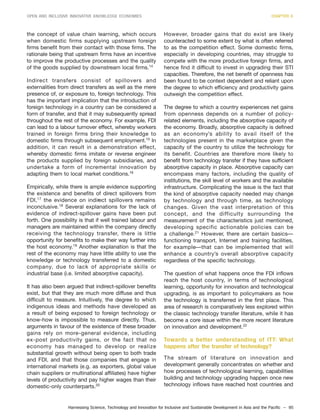
This means users can try a course, learn something and then decide later how much they want to pay.
3. Increased recognition of the value of education and the benefits of the knowledge economy.
4. Vast improvements in course offerings, with world-class universities building high-quality content.
This trend will continue to grow as MOOC services improve and expand, and become a cost-effective way
for employers to engage in continuous learning for staff, staying ahead of the competition by building a skilled
workforce. As the online learning market becomes more validated and mature the value of such platforms will
grow. ESCAP is strongly committed to increasing the availability and accessibility of knowledge through the
Asian and Pacific Training Centre for Information and Communication Technology for Development (APCICT)
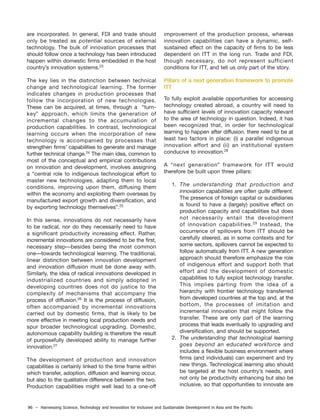
Virtual Academy, for example, which provides essential learning opportunities for government officials.
Box
3.4
Massive Open Online Courses (MOOCs)
Source: Class Central, 2015.
Education & Teaching
9.3%
Health & Medicine
8.2%
Programming
7.4%
Art & Design
6.7%
Engineering
6.1%
Mathematics
4.0%
Business & Management
16.8%
Science
11.3%
Humanities
9.4%
Computer Science
9.7%
Social Sciences
10.8%
Course Distribution by Subjects
While the concept of distance learning has been around for decades, the concept of Massive Open Online
Courses, or MOOCs, is a more recent phenomenon. Traditional online courses charge tuition, carry credit and
limit enrollment to a few dozen to ensure interaction with instructors. MOOCs, on the other hand, are usually
free, uncredited and have no cap on enrollment.
According to Class Central, more than 35 million people have enrolled in online courses in the past four years,
with the number of 2015 enrollments doubling that in 2014 (and equal to one out of five working professionals
in the US). Today there are more than 4,200 MOOCs available covering a variety of topics; most on STI-related
subjects like basic science, computer science and engineering (see figure).
36 – Harnessing Science, Technology and Innovation for Inclusive and Sustainable Development in Asia and the Pacific
The state of connectivity in the region
Fixed broadband
Asia and the Pacific has witnessed a phenomenal
growth in the expansion of fixed-broadband access.
For the first time, over 50 per cent of global fixed-
broadband subscribers are registered in the ESCAP
region, followed by Europe (23 per cent) and the
Americas (23 per cent).23
This is a dramatic change
from 2005, when broadband subscribers from
ESCAP constituted 39 per cent of global total
fixed-broadband subscribers, followed by the
Americas (31 per cent) and Europe (29 per cent) (see
Figure 3.5).
However, performance is unevenly distributed across
ESCAP subregions. ESCAP analysis revealed that
72 per cent of fixed-broadband subscribers reside
in North and North-East Asia, followed by 11 per cent
in South-East Asia and 7 per cent in South and
South-West Asia.
Figure 3.6 shows that ESCAP upper-middle-income
countries have grown much faster than the other
income groups (with a 208 per cent average annual
growth rate between 2001 and 2014).
When further disaggregated by country, it becomes
clear that the region’s expansion in fixed-broadband
access is driven by China, which now accounts
for more than 50 per cent of total ESCAP fixed-
broadband subscriptions (Figure 3.7).
Across the region, the uptake of fixed broadband
differs considerably. China has demonstrated
an exponential increase in the total number of
fixed-broadband subscribers, while slow growth
has occurred amongst countries with low-income
economies, even when the size of the total
population is taken into account, as shown in
Figure 3.8.
Source: ESCAP analysis based on International Telecommunication Union, World Telecommunication/ICT Indicators database 2015. Available from
https://www.itu.int/en/ITU-D/Statistics/Pages/publications/wtid.aspx.
Figure
3.5
Global shares of total fixed-broadband subscriptions in 2005 and 2014
ESCAP
members
50.45%
European
countries
22.92%
Northern
American
countries
14.50%
South American
countries
5.72%
ECA countries
1.28%
West Asia
2.36%
Central American
and Caribbean
countries 2.78%
ESCAP
38.96%
European
countries
29.29%
Northern
American
countries
27.09%
South American
countries
2.80%
ECA countries
0.40%
ESCWA members
0.36%
Central American
and Caribbean
countries 1.11%
2005 2014
Harnessing Science, Technology and Innovation for Inclusive and Sustainable Development in Asia and the Pacific – 37
BUILDING INSTITUTIONS AND INFRASTRUCTURE FOR STI DEVELOPMENT CHAPTER 3
Source: ESCAP analysis based on International Telecommunication Union, World Telecommunication/ICT Indicators database 2015. Available from
https://www.itu.int/en/ITU-D/Statistics/Pages/publications/wtid.aspx.
Figure
3.6
Total fixed-broadband subscriptions, 2000-2014
Source: ESCAP analysis based on International Telecommunication Union, World Telecommunication/ICT Indicators database 2015. Available from
https://www.itu.int/en/ITU-D/Statistics/Pages/publications/wtid.aspx.
Figure
3.7
Share of total fixed-broadband subscriptions in the ESCAP region, 2014
250
200
150
100
50
0
Million
2000 2001 2002 2003 2004 2005 2006 2007 2008 2009 2010 2011 2012 2013 2014
ESCAP low-income economies
ESCAP lower-middle-income economies
ESCAP upper-middle-income economies
ESCAP high-income economies
Australia 1.61%
Iran (Islamic Republic of) 1.97%
Turkey 2.35%
Viet Nam 1.59%
Thailand 1.46%
Malaysia 0.81%
India 4.17%
Indonesia 0.79%
Others 4.27%
Republic of Korea 5.09%
Philippines 6.16%
Russian Federation 6.59%
Japan 9.87%
China 53.20%
38 – Harnessing Science, Technology and Innovation for Inclusive and Sustainable Development in Asia and the Pacific
Source: ESCAP analysis based on International Telecommunication Union, World Telecommunication/ICT Indicators database 2015. Available from
https://www.itu.int/en/ITU-D/Statistics/Pages/publications/wtid.aspx.
Figure
3.8
Fixed-broadband subscriptions per 100 inhabitants, 2014
0.00
0.04
0.07
0.07
0.16
0.18
0.21
0.23
0.27
0.81
1.05
1.08
1.15
1.19
1.19
1.24
1.33
1.40
1.70
1.77
1.79
2.60
2.65
2.98
3.26
4.16
5.64
6.48
6.85
7.15
8.21
9.10
9.13
9.36
9.46
10.14
11.69
12.15
12.93
14.38
17.44
18.52
19.83
22.44
23.22
25.76
28.05
29.31
30.45
31.25
38.78
Afghanistan
Turkmenistan
Timor-Leste
Tajikistan
Lao PDR
Papua New Guinea
Cambodia
Solomon Islands
Myanmar
Nepal
Samoa
Pakistan
Kiribati
Indonesia
Bangladesh
India
Uzbekistan
Fiji
Tonga
Vanuatu
Guam
Marshall Islands
Sri Lanka
Micronesia (Federated States of)
Bhutan
Kyrgyzstan
Maldives
Viet Nam
Mongolia
Brunei Darussalam
Thailand
Tuvalu
Armenia
Palau
Iran (Islamic Republic of)
Malaysia
Turkey
Georgia
Kazakhstan
China
French Polynesia
Russian Federation
Azerbaijan
New Caledonia
Philippines
Australia
Macao, China
Japan
New Zealand
Hong Kong, China
Republic of Korea
0 10 20 30 40
Mobile broadband
The Asia-Pacific region has performed well in terms
of mobile broadband uptake. The increasing
expansion of mobile subscriptions over time indicates
that access has improved (Figure 3.9).
Mobile broadband has many advantages. It enables
Internet access wherever and whenever required, with
the ability to connect to fixed networks like Wi-Fi.
Furthermore, mobile broadband does not require
physical infrastructure to reach each home and can
often be cheaper than fixed-broadband installation.
However, mobile broadband alone is not sufficient to
support and expand the digital economy with its new
services, products and employment opportunities.
This requires reliable, robust, affordable and resilient
fixed-broadband networks. The latter are also needed
Harnessing Science, Technology and Innovation for Inclusive and Sustainable Development in Asia and the Pacific – 39
BUILDING INSTITUTIONS AND INFRASTRUCTURE FOR STI DEVELOPMENT CHAPTER 3
to sustain the expansion of mobile broadband, not
only to densely populated urban areas, but also to
remote and rural areas.
Both fixed and mobile broadband have great
potential to promote economic growth and the
development of society. Furthermore, as cross-cutting
and enabling technologies, ICTs are also widely
acknowledged to play a pivotal role in many aspects
of the 2030 Agenda. For these reasons, the growing
digital divide in the ESCAP region should be
considered a matter of priority.
ICT usage by firms
ICT reduces the cost of communication and well-
developed ICT usage among firms is important as
a channel of exchange for external sources of
information.
ICT usage is lowest among firms in Indonesia
and Sri Lanka. Only 5.7 per cent of Indonesian firms
and 18.6 per cent of Sri Lankan firms have their own
websites (see Table 3.3). Indeed, low e-mail usage is
reported among firms in Indonesia, which is likely
to impact industrial productivity and competitiveness.
ICT-enabled infrastructure can support innovation
In addition to ICT connectivity and access, ICT-
enabled financial, transport and trade facilitation
infrastructure will be essential to enable innovation
and develop inclusive knowledge economies in the
region. These emerging infrastructures are built on
broadband networks and facilitate the movement of
goods, services, people and money across countries
as building blocks of the knowledge economy.
Mobile banking (Box 3.5) has potential as a tool to
facilitate financial transactions by a much wider
segment of the population than can be reached by
traditional banking for a lower cost, not only within
countries but across national boundaries. In addition
to promoting broadband adoption, these services can
also have a significant social and welfare impact.
Financial services delivered through e-banking
represent a powerful tool to dramatically decrease
operational costs, but more importantly, to promote
the financial inclusion of underprivileged segments of
the population.
Source: ESCAP analysis based on International Telecommunication Union, World Telecommunication/ICT Indicators database 2015. Available from
https://www.itu.int/en/ITU-D/Statistics/Pages/publications/wtid.aspx.
Figure
3.9
Average mobile-broadband subscriptions per 100 inhabitants in ESCAP member States
40
30
20
10
0
2007 2008 2009 2010 2011 2012 2000 2000
LDCs LLDCs
SIDS ESCAP average
40 – Harnessing Science, Technology and Innovation for Inclusive and Sustainable Development in Asia and the Pacific
Per cent of firms
Per cent of firms
having their own
using e-mail to
Country
Year website
interact with
clients/suppliers
(I) (II)
High Income n.a 77.4
Republic of Korea 2005 n.a 77.4
Upper Middle Income 46.9 75.3
Malaysia 2007 24.6 66.8
China 2012 66.1 85.0
Thailand 2006 50.0 74.1
Lower Middle Income 30.7 50.4
India 2014 48.9 78.0
Indonesia 2009 5.7 13.2
Lao PDR 2012 20.4 45.9
Myanmar 2014 14.8 30.1
Pakistan 2013 46.9 54.4
Philippines 2009 50.1 67.8
Sri Lanka 2011 18.6 30.5
Viet Nam 2009 40.0 83.2
Low Income 37.1 49.1
Cambodia 2013 37.1 49.1
East Asia and Pacific 30.4 63.1
South Asia 31.3 53.0
Source: World Bank, Enterprise Survey, various years. Available from http://www.enterprisesurveys.org.
Table
3.3
ICT usage by firms in manufacturing sectors
In Afghanistan, the M-Paisa initiative enables national remittances, salary disbursements, airtime purchases, bill
payments and merchant services. The World Bank24
argues that the programme has particular potential to
impact Afghanistan’s economy, as less than 3 per cent of the population is banked and the financial sector is
virtually non-existent, in large part due to the past 20 years of instability. In the Philippines, a flexible approach
by the Bangko Sentral ng Pilipinas has contributed to growing adoption of mobile banking services in the
country and, as of mid-2011, Globe and Smart—the two biggest telecommunication companies—had opened
nearly 10 million e-money wallets. 2011 saw users conduct a total of 158 million e-money transactions with
a total value of 535 billion Philippine pesos (approximately $13 billion). In addition to providing services for
overseas workers, mobile banking has also been used very effectively in the Philippines to transfer funding to
those affected by disasters as well as as a cash transfer tool. One example is Panalo SIKAP, a mobile-based
savings, credit, livelihood and insurance programme launched by Smart e-Money that is closely tied to the
Philippine Government’s conditional cash transfer programme.25
Box
3.5
Mobile banking initiatives in Asia
Harnessing Science, Technology and Innovation for Inclusive and Sustainable Development in Asia and the Pacific – 41
BUILDING INSTITUTIONS AND INFRASTRUCTURE FOR STI DEVELOPMENT CHAPTER 3
In the area of transport facilitation, intelligent transport
systems have been attracting increasing attention and
have been galvanizing the transport sector.26
Using
ICT, such as the Global Positioning System (GPS) and
dedicated short-range communications, intelligent
transport systems enable more-efficient transportation
management, and traffic efficiency and fluidity. The
systems already in use include the electronic toll
collection systems in India, a real-time traffic
information and traffic condition prediction system in
Thailand and the Seoul Bus system in the Republic
of Korea.
The value of ICT for trade facilitation goes beyond
concepts such as “Single Windows”.27
Automated
business processes, digitized procedures, simpler
interaction with and transmission of data, and faster
decision-making abilities deliver advantages in many
trade and transport facilitation areas, according to an
ESCAP study.28
A seamless flow of information is at
the centre of modern supply chain management.
Supply chains that are geographically fragmented and
extended rely upon information processing and
exchange amongst supply chain partners. Information
visibility, timeliness and traceability are the three
information requirements that matter most to efficient
trade facilitation. ICT plays an important role in
making these changes happen. It facilitates new
channels of communication and information
exchange that support Internet publication, paperless
trade and agency cooperation at the process and
information level. It also improves internal processing
at the agency level, statistics and performance
management, and enables faster, integrated and
intelligent risk management.
Digital infrastructure can support a more open,
collaborative and inclusive innovation system. The
examples highlighted also show how digital
technology can be an integrating force for sustainable
development with the potential for positive impact on
the economy, society and environment.
Conclusion
The institutional make-up of an economy—its norms
and practices for inclusion, its laws and regulations
for IP and its digital infrastructure, as examples—
underpins its ability to effectively harness STI for
sustainable development.
In addition to physical institutions, STI development
necessitates a strong regulatory environment that
provides incentives to innovate for economic, social
and environmental outcomes. In order to ensure
that no one is left behind, it will also be critical for
governments to advocate for and implement the
institutional principles of openness and inclusivity in
all of their innovation efforts.
Supportive institutions lay the foundations of
knowledge economies. Digital technology in particular
has the potential to increase the pace and impact of
reaching the targets of many SDGs supporting
access to education, business and more-effective
public services. While the region has made significant
progress in establishing ICT infrastructure,
widespread diversity remains, both within and
between countries.
42 – Harnessing Science, Technology and Innovation for Inclusive and Sustainable Development in Asia and the Pacific
Endnotes
1
Ahlström, 1992, 1993.
2
Thindwa, 2001.
3
Olstrom, 2012.
4
Ratanawaraha, 2015.
5
Rodrik, Subramanian and Trebbi, 2004.
6
See http://reports.weforum.org/global-competitiveness-report-2015-2016/institutions/.
7
UNESCO, 2014; Luc Soete and others, 2015.
8
This change in business attitudes has been supported by the United Nation’s Global Compact, which works as a country-
led initiative to support businesses in effectively integrating the three dimensions. See https://www.unglobalcompact.org/
what-is-gc/our-work/sustainable-development/background.
9
Whitley, Darko and Howells, 2013.
10
Lee and Kim, 2013. Note: The total estimate could vary depending on whether traditional organizations, such as large
cooperatives, are included. If traditional and new types of social economic organizations are considered, the size of the
Korean social economy represented approximately 3.04 per cent of the country’s national GDP in 2011.
11
R&D expenditure as a share of GDP and in purchasing power parity (PPP) dollars, 2013.
12
See http://www.theguardian.com/british-council-partner-zone/2014/dec/16/approved-social-enterprise-receives-legal-status-
in-vietnam.
13
See https://www.digitalnewsasia.com/digital-economy/malaysia-unveils-social-enterprise-blueprint.
14
Chesbrough, 2003; Chesbrough, Vanhaverbeke and West, 2006.
15
See, for example, Tapscott and Williams, 2007; Leadbeater, 2008; Surowiecki, 2004; and Von Hippel, 2005.
16
See http://ocsdnet.org/about-ocsdnet/about-ocs/.
17
See http://ogpl.gov.in/NDSAP/NDSAP-30Jan2012.pdf.
18
Atta-ur-Rahman, 2012.
19
See http://www.unesco.org/new/en/communication-and-information/portals-and-platforms/goap/access-by-region/asia-and-
the-pacific/republic-of-korea/.
20
India, Ministry of Commerce and Industry, 2016.
21
Moeliodihardjo and others, 2012.
22
Foster and Heeks, 2013.
23
International Telecommunication Union, 2014.
24
Kelly and Rossotto, 2012.
25
Groupe Speciale Mobile (GSMA), 2015.
26
See http://www.unescap.org/resources/intelligent-transportation-systems-sustainable-development-asia-and-pacific.
27
“Single Windows” refers to electronic means of verification, processing and distribution of trade related data, permits and
other pertinent documentation.
28
See http://www.unescap.org/resources/information-and-communication-technologies-ict-trade-and-transport-facilitation.
Harnessing Science, Technology and Innovation for Inclusive and Sustainable Development in Asia and the Pacific – 43
BUILDING INSTITUTIONS AND INFRASTRUCTURE FOR STI DEVELOPMENT CHAPTER 3
44 – Harnessing Science, Technology and Innovation for Inclusive and Sustainable Development in Asia and the Pacific
©SHUTTERSTOCK:WK1003MIKE
Harnessing Science, Technology and Innovation for Inclusive and Sustainable Development in Asia and the Pacific – 45
FUNDING AND INCENTIVIZING STI INVESTMENT CHAPTER 4
4
CHAPTER
FUNDING AND
INCENTIVIZING
STI INVESTMENT
Key messages
• Lack of funding in “valleys of death” prevents basic research from
being commercialized.
• It will be critical to collaborate with and support private sector
STI through mechanisms such as public-private partnerships and
innovative government procurement.
• Governments in the region have experimented with a range of
policies to incentivize investment in R&D and high technology.
• A country may have at its disposal multiple sources of finance for
innovation (e.g. domestic finance, foreign direct investment (FDI),
donor capital). To effectively and efficiently deploy this capital,
alignment of financial flows to STI strategies for sustainable
development will be key.
• The potential of impact investment, to date, has yet to be fully
realized.
46 – Harnessing Science, Technology and Innovation for Inclusive and Sustainable Development in Asia and the Pacific
Introduction
Most R&D takes place in the private sector and is
funded from internal sources.1
Although some of this
activity does have a positive impact on the SDGs, the
main objective is profit. Conversely, overall the
majority of organizations seeking funding for STI
projects (whether private or public) have to look to
external sources, such as governments, donors,
philanthropists and venture capitalists. These funders
have a critical role to play in advancing STI: in dealing
with market failures and acting as market makers, but
also in ensuring an integrated approach to STI
investment for sustainable development by setting
the criteria and incentives for investment to create
economic, environmental and social value.
4.1 Government funding
Governments themselves undertake R&D and
innovation activity, but they also fund such activity
through direct mechanisms (e.g. research grants,
government procurement) and indirect mechanisms
(e.g. tax incentives).
Direct government funding mechanisms
Government R&D expenditure
Direct government R&D funding can be targeted or
non-targeted. Non-targeted funding mechanisms
allow researchers to bid for funding in research areas
of their choosing. Here, the main criterion is
excellence. Targeted funding, on the other hand, can
be focused on specific areas, sectors, industries or
firm types with both excellence and relevance as key
selection criteria. Direct funding instruments include
competitive grants and contract awards, subsidized
loans and innovation vouchers. A central aim of direct
funding is to increase the additionality effect of public
support for R&D. This additionality arises when public
money leverages further investment from firms, and
is an important way public money can be used to
stimulate further funding.2
Targeting specific firms,
such as start-ups, MSMEs or those that have hitherto
not been involved in R&D collaborations with
universities or research institutes, could also
contribute to producing behavioural additionality
effects.3
The inherent risk of direct R&D funding is that its
targeted focus on specific areas could potentially
result in governments attempting to ‘picking winners’,
which can be perceived as both unfair and, if the
funding recipients fail, a suboptimal use of public
funding. It is therefore critically important that
governments carefully design and implement direct
R&D funding initiatives. Three criteria need to be
considered when designing direct funding
instruments for R&D: the target, the selection
mechanism and the duration and operation of the
programme or project. Target criteria determine which
firms qualify for funding. These might be based, for
instance, on size and/or type of firm. Firms in specific
sectors might also be targeted, reflecting the need to
both address certain societal goals and global
challenges, as well as meet the strategic aims of
a government’s industrial policy.4
Governments have commonly employed two
selection mechanisms: the first mechanism uses
permanent calls for submissions that are evaluated by
an external review board and selected by the
management of the funding programme. The second
mechanism utilizes periodic calls for submissions with
deadlines. The submitted proposals are evaluated
and ranked by an external review board and,
subsequently, the management of the funding
programme or a strategic committee makes the
selection.5
Given the latter mechanism is still prone to
the risk of governments picking winners, there is
value in considering auction procedures.6
Adopting
auction procedures could potentially increase the
efficiency of funding programmes by stimulating more
competition between applicants and allowing more
information to be extracted from the proposals, thus
allowing programmes to avoid futile funding.7
The
final selection criterion critical to the design of direct
R&D funding initiatives is the duration and operation
of the programmes or projects being funded. Most
generic programmes, for instance those that support
a broader set of firms (including SMEs, for example),
are not time bound and are typically managed by a
separate autonomous body responsible for the
programme. Conversely, targeted programmes are
often time bound and are commonly overseen, along
with various other programmes, by government
organizations and administrations.8
In addition to direct R&D funding through grants and
awards, governments can also make use of
innovation vouchers to target SMEs. Innovation
vouchers provide SMEs with small lines of credit to
procure services from public knowledge providers,
such as universities or public research institutes, that
can improve their business operations. The central
aim of innovation vouchers is to support the
expansion of industry-university/research institute
links by facilitating transfers of knowledge and
encouraging the development of lasting relationships
Harnessing Science, Technology and Innovation for Inclusive and Sustainable Development in Asia and the Pacific – 47
FUNDING AND INCENTIVIZING STI INVESTMENT CHAPTER 4
between public knowledge providers and SMEs.
Innovation vouchers are an attractive tool for
policymakers because they are easily adoptable and
have minimal information and administrative costs.9
However, because they are focused on stimulating
short-term cooperation, the inherent risk of innovation
vouchers is that they could prove to be ineffective in
supporting long-term collaboration.10
One way to
address this risk would be to support the direct
placement of researchers or technicians within firms
in order to enhance their knowledge absorption
capacity.11
Assessment of the overall R&D effort in the region
Figure 4.1 depicts (a) the wide variation in R&D
intensity in ESCAP member States and other
countries and (b) the variation that exists between
different per capita income groups:
• China and India perform well in comparison to
global averages by income per capita.
• New Zealand trails other high-income
countries, partly due to the economy’s focus
away from manufacturing and partly reflecting
the wide gap between its population and its
full-time-equivalent research workforce.
• Several middle-income ESCAP member
States at the right end of the graphic are
characterized by R&D intensities that are below
the global average for low-income economies.
Figure 4.2 shows the evolution of the gross domestic
expenditure on R&D (GERD) as a share of GDP ratio
over time:
• The over-time evolution tends to be more
erratic in countries with very low GERD to GDP
ratios, perhaps reflecting problems in the
Source: UNESCO, Institute for Statistics Data Center. Available from http://data.uis.unesco.org/Index.aspx?queryid=115 (accessed January 2016).
Notes: Horizontal lines indicate global averages by per capita income group; -n refers to n years before the reference year.
Figure
4.1
Gross domestic expenditure on R&D (GERD) as a % of GDP, 2013 or most recent year
RepublicofKorea
4.15
3.47
2.81
2.25 2.23
2.08 2.02 1.98
1.63
1.27
1.13 1.12
0.95
0.82
0.73
0.39
0.21 0.19 0.17 0.16 0.16
0.09
2.31
1.37
0.51
0.27
4.5
4.0
3.5
3.0
2.5
2.0
1.5
1.0
0.5
0
High-income average Upper middle-income average
Lower middle-income average Low-income average
Japan
USA-1Australia-2
France
China
Singapore-1Netherlands
UK
New
Zealand-2M
alaysia-1
RussianFederation
Turkey
India-2
HongKong,China-1Thailand-2AzerbaijanVietNam-2KazakhstanSriLanka-3
Kyrgyzstan-2Indonesia
48 – Harnessing Science, Technology and Innovation for Inclusive and Sustainable Development in Asia and the Pacific
Panel B: Countries with lower values
Figure
4.2
GERD as a share of GDP, 1996-2013 (%)
Source: UNESCO, Institute for Statistics Data Center. Available from http://data.uis.unesco.org/Index.aspx?queryid=115.
Panel A: Countries with higher values
4.5
4.0
3.5
3.0
2.5
2.0
1.5
1.0
0.5
0
1996 1997 1998 1999 2000 2001 2002 2003 2004 2005 2006 2007 2008 2009 2010 2011 2012 2013
Japan
Republic of Korea
US
France
Singapore
Australia
Netherlands
UK
China
New Zealand
Russian Federation
Malaysia
India
Hong Kong, China
Turkey
Iran (Islamic Republic of)
Pakistan
Thailand
0.45
0.40
0.35
0.30
0.25
0.20
0.15
0.10
0.05
0
1996 1997 1998 1999 2000 2001 2002 2003 2004 2005 2006 2007 2008 2009 2010 2011 2012 2013
Mongolia
Azerbaijan
Armenia
Kazakhstan
Nepal
Georgia
Kyrgyzstan
Viet Nam
Sri Lanka
Philippines
Myanmar
Tajikistan
Indonesia
Macao, China
Cambodia
Lap PDR
Brinei Darussalam
Harnessing Science, Technology and Innovation for Inclusive and Sustainable Development in Asia and the Pacific – 49
FUNDING AND INCENTIVIZING STI INVESTMENT CHAPTER 4
quality of data as well as the weakness of R&D
organizations—and thus the stability of
programmes.
• Few countries have accomplished a decisive
upward shift. Exceptions include the Republic
of Korea, China, Malaysia and, to a lesser
extent, Turkey.
• A rising GERD-GDP trend in Australia and
Singapore has been attenuated or reversed
following the 2008 financial crisis.
Notwithstanding these considerations, since 2007 the
ESCAP area (excluding member States in Europe and
the US) has surpassed Europe as the largest global
regional grouping in terms of GERD, and reached
44.8 per cent of global reported R&D in 2013.
Catalysing an entrepreneurial state: government
start-up funding
Whilst direct R&D funding has traditionally been used
to generate knowledge for basic and applied
research, start-ups face a series of obstacles when
attempting to turn results from basic research into
commercializable products. One of the major
obstacles is the existence of funding gaps or “valleys
of death”.
As highlighted in Figure 4.312
, there are two funding
and support gaps (i.e. valleys of death) that can
cause an idea or technology to fail due to a lack of
finance or a lack of knowhow or skills to take the
idea to the next stage. The early-stage “technological
valley of death” occurs when innovators and
entrepreneurs need further capital to develop, test
and refine their technologies to prove that they
are marketable beyond the lab. The later-stage
“commercialization valley of death” refers to a
funding gap between the pilot/demonstration
and commercialization stages of the technological
development cycle. Funding gaps are particularly
pertinent for sustainability-oriented innovations—
bridging these gaps requires appropriate policy
responses beyond a general reliance on private
venture capital (VC) and/or debt-equity corporate and
project finance.
Some governments in the region have implemented
direct VC funding mechanisms to support firms
(either alone or in combination with VC from other
sources) and have taken steps to fill the business
angel financing gap and encourage the development
of early-stage investment from business angels to
support pre-seed and seed growth. As an example,
SPRING Singapore is an agency under the Ministry
of Trade and Industry responsible for helping
Singapore enterprises grow and building trust in
Singapore products and services.13
SPRING works
with partners to help enterprises with financing, as
The funding “valleys of death”
Source: X PRIZE Foundation, 2012.
Figure
4.3
Public funds
Early-stage risk capital
(Angel, VCs; internal funds
for existing firms)
Late-stage capital
(Banks, business
partners);
Cash flow from sales
Funds to generate
knowledge and
inventions
Funds to advance technology
and develop products
Funds to commercialize
products
Commercialization
“Valley of Death”
Early-stage
“Valley of Death”
Basic and Applied
Research
Technology
Development
(Proof-of-concept;
prototype) &
Demonstration
Market-focused
product and business
development
Early Deployment
(market creation)
Full commercialization
(market established)
50 – Harnessing Science, Technology and Innovation for Inclusive and Sustainable Development in Asia and the Pacific
well as with management development, technology
and innovation, and access to markets. An important
aspect of SPRING’s mandate is its role in upholding
quality assurance standards.
The Government of China provides another example
of public financial support for entrepreneurship. In an
ambitious policy statement aimed at spurring mass
innovation and entrepreneurship, the Government
recently announced plans to set up a VC fund worth
$6.5 billion to support start-ups in emerging
industries. This statement signals a policy imperative
for government to act as a market maker and also to
aid in dealing with market failures. “The establishment
of the state venture capital investment guidance fund,
with the focus to support fledging start-ups in
emerging industries, is a significant step for the
combination of technology and the market,
innovations and manufacturing”14
, China’s State
Council, the Cabinet, said in a statement. The
statement also articulated the ambition to “help breed
and foster sunrise industries for the future and
promote (China’s) economy to evolve towards the
medium and high ends”, referring to sectors the
Government is promoting, such as technology and
green energy.
The fund will be underwritten by the Government’s
existing capital resources designated for the
expansion of emerging industries and by state
corporations, while also inviting private partners to
participate. The fund will give priority to private
investors and will operate through publicly available
competitive tenders.15
Governments can also respond to an insufficient
supply of risk capital to support start-ups and SMEs
by providing strategic funds and programmes
designed to spread out the risk to VC firms,
incentivize investment and encourage investment in
innovations with the potential to generate social and
environmental, as well as economic value. There are
three broad programmes that governments can
implement to encourage the development of VC for
these objectives: 1) direct provision of capital to VC
firms, 2) deployment of financial and fiscal incentives
to encourage investment in VC firms and
3) enactment of regulations to control the types of VC
investors that develop. The first of these programmes
is the most high-risk and has been the least widely
pursued, as it entails governments supplying VC firms
with equity investments or low-interest loans. Some
of the incentives that are commonly pursued in the
second programme are credit guarantees on loans
secured by VC firms and tax credits or deductions.
The final programme entails regulating the types of
institutions that are allowed to supply VC funds and
the quantitative restrictions on those investors.16
Access to and availability of bank credit is also
limited in the region. Banks are reluctant to lend to
risky start-ups and often set high interest rates on
loans.17
For this reason, business support and more-
risk-tolerant capital from “impact investors”18
and
philanthropic source are urgently needed. Similarly,
government-backed initiatives are critical to
supplementing this financing gap. Debt and risk-
sharing schemes allow governments to help facilitate
access to finance for firms in the region. In particular,
by deploying credit guarantee schemes (see Box 4.1),
governments can incentivize banks to lend to riskier
start-ups and SMEs by partially insuring bank losses
on loans that are covered by the guarantee. It is
critical, however, that such debt and risk-sharing
schemes be designed carefully in order to ensure that
banks remain prudent in their selection of companies
to fund.
Public-private partnerships
Partnering with the private sector is another
mechanism by which governments can leverage
private sector finance and spur innovation in public
service delivery. Through a public-private partnership
(PPP) contract, a private consortium typically finances
a public infrastructure project and provides public
services over an extended period of time—typically
20 years. In exchange, the private partners can be
granted rights to collect fees from users, such as
collecting tolls on highways for road projects. They
can also be remunerated directly by the public
authorities provided that the performance criteria
defined in the PPP contract are met.
Over the last 15 years, private companies have
invested around $600 billion in Asian developing
countries towards energy (55 per cent), transport
(30 per cent), telecommunication (12 per cent) and
water (3 per cent) infrastructure.19
With PPP projects,
public contracting agencies define projects in terms
of outputs (“what we want to achieve”) rather than
inputs (“how to achieve what we want”), which is a
key distinction from traditional public procurement. In
so doing, public authorities allow private companies
to devise innovative solutions for delivering public
services. Likewise, by encouraging a consortium of
international and local companies, governments can
facilitate transfers of knowledge and technologies.
Harnessing Science, Technology and Innovation for Inclusive and Sustainable Development in Asia and the Pacific – 51
FUNDING AND INCENTIVIZING STI INVESTMENT CHAPTER 4
Private operators can also introduce new
technologies for realizing the commercial potential of
infrastructure. For example, a PPP was used to
develop an automated fare-collection system for the
three rail transit lines in Manila based on contactless
smartcard technology. The system was developed at
no extra cost to passengers or to the government
because the private consortium expects to make
profits in areas other than transport (for example, the
smartcard technology will be used for payments in
shopping malls and customer loyalty schemes). By
involving the private sector in public service delivery,
governments can capitalize on the private sector’s
capacity to capture additional sources of revenue
from infrastructure assets. PPPs can be an excellent
way to inspire innovation, especially in more mature
areas of the economy, and inject new ideas,
generating new revenue streams in public
infrastructure services.
Innovative public pre-commercial procurement
Public sector contracting authorities can act as
catalysts for innovation and create demand long
before a commercial market is established. This has
several advantages:
• By acting as the first buyer or lead customer,
a contracting authority can boost a specific
new market.
• The public benefits directly by being offered
new and innovative public services that are
provided in a more cost-efficient and effective
manner.
• Pre-commercial procurement can lead to
scientific and technological breakthroughs in
areas such as health and well-being, food
security, sustainable agriculture or clean and
efficient energy.23
The UK Government has experimented with
pre-commercial procurement methodology (see
Figure 4.4) to catalyse innovation from industry
through its Small Business Research Initiative (SBRI).
SBRI uses a process to connect public sector
challenges with innovative ideas from industry,
supporting companies to generate economic growth
and enabling improved responses to societal and
environmental challenges. The intent of the SBRI
programme is to develop innovative solutions to
social and environmental challenges and better public
services, and to generate new business opportunities
for SMEs.
An important element of technology financing in the Republic of Korea is technology appraisal, in which an
institution determines the feasibility of a project or firm before a loan or investment decision is made.20
As an
example, the Korean Technology Finance Corporation (KOTEC) was founded in 1989 as a non-profit credit
guarantee institution under the Financial Assistance to New Technology Businesses Act, which was revised to
become the Korea Technology Finance Corporation Act in 2002. KOTEC is a specialized institution that provides
full-scale support to SMEs and early-stage businesses with competitive technology, innovation and other
knowledge-based business content at all stages of the innovation and business cycle. As part of the Korean
Government’s effort to expand the appraisal-based technology loan guarantee, all KOTEC branches throughout
the country now serve as technology appraisal centres. The centres guarantee loans to SMEs by using the
proprietary Kibo Technology Rating System (KTRS).21
KTRS screens promising SME technologies and minimizes
subjectivity among assessors. According to the KOTEC website, KTRS produces technology rating grades for
a firm or its technology, based on technological ability, marketability, business prospects and other business
factors.
There are several other measures for technology financing in the Republic of Korea, including a convergence
technology appraisal system, which focuses on innovations for technology convergence; a guarantee system
based on expected future cash flows of patented technologies, not just expected first-year sales; and an R&D
project guarantee scheme based on the estimated requirement for funding for a technology’s entire R&D life
cycle. Moreover, local private banks now provide loans that are linked to the results of technology appraisals.
In this regard, KOTEC and the Korea Invention Promotion Association issue technology appraisal certificates
to SMEs that have innovative products. Contracted banks then refer to the certificates before approving loans.22
Box
4.1
Technology appraisal and private funding
52 – Harnessing Science, Technology and Innovation for Inclusive and Sustainable Development in Asia and the Pacific
A key feature of the SBRI programme is its
procurement of outcomes with specific targets as
opposed to predetermined products and services
(see Box 4.2). This approach enables bidders to be
more innovative.
Engaging SMEs in public service delivery
The UK Government has also implemented policies
aimed at increasing competition and market
innovation by setting an ambitious target of spending
one third of the Central Government budget with
SMEs.24
This policy is being supported by efforts to improve
the way the Government buys goods and services to
help more SMEs bid for public sector contracts, by:
• requiring the entire public sector supply chain
to pay suppliers within 30 days
Source: Innovate UK, 2015.
Figure
4.4
UK Small Business Research Initiative—how does it work?
1. The government organisation
identifies a particular challenge
2. The government organisation works
to define the competition scope
and desired outcomes
3. The SBRI competition opens
4. Applicants submit proposals
5. The most promising proposals
are selected
6. Phase 1 – feasibility is demonstrated –
typically, this phase is worth £50,000 to
£100,000 and lasts up to six months
8. Phase 2 – prototypes are developed –
typically, this phase lasts up to two years and
is worth £250,000 to £1 million
9. Applicants prepare their
technologies for market
11. Applicants are free to further develop
and exploit their intellectual property
7. Projects are assessed for phase 2 funding
10. The new technology is ready to be used
Harnessing Science, Technology and Innovation for Inclusive and Sustainable Development in Asia and the Pacific – 53
FUNDING AND INCENTIVIZING STI INVESTMENT CHAPTER 4
• abolishing pre-qualification questionnaires for
low value public sector contracts, making the
process simpler and quicker
• requiring the public sector to publish its
contracts in one place25
Furthermore, each government department is held to
account to ensure that it meets this target by setting
out individual plans and targets for spending with
SMEs over a five-year period.26
Stimulating green and social innovation through
public procurement
Public procurement can also be utilized to incentivize
the private sector to address environmental and
societal issues by setting specific criteria in
procurement frameworks.
As an example, in an effort to address climate
change, the Government of Singapore recently
announced plans to procure only electrical products
that have been certified with high energy efficiency.
The scheme has started with four electrical items in
particular, with plans to gradually extend to other
items. In addition, the Government will only procure
printing paper that carries the Singapore Green
Label, which indicates that the supplier practices
sustainable forestry management.27
The intent is that by having a sustainable, green
procurement policy, private sector suppliers will
consider sustainability in their business models so
that they can retain market share.
Whilst this type of policy may only work for
governments with significant funding available to
incentivize the market, it will be interesting to
track the success of this policy in instilling the
concept of “shared value” in business (discussed in
Chapter 5).
4.2 Incentivizing investment in STI
Fiscal incentives for R&D
Fiscal incentives are a popular policy tool that can be
used to incentivize STI. Experience in OECD
countries has shown they can play a positive and
effective role in stimulating R&D. While direct funding
of STI is typically intended for specific projects, tax
incentives give firms more choice over the projects
and types of R&D on which they work. As such,
tax incentives are considered a neutral and more
market-oriented approach to financing STI than
direct funding.28
R&D targeted tax incentives lower
the cost of research and development for firms by
reducing the tax burden they face on eligible R&D
activities.
In 2015, the UK Department for International Development (DFID) launched a competition to develop an
affordable solar-powered irrigation pump that could be deployed to developing regions around the world, and
particularly sub-Saharan Africa. Instead of issuing a traditional tender to the market for available products, DFID
utilized the SBRI approach (Figure 4.4) with targeting outcomes that challenged the market to higher levels of
innovation.
Target requirements for the device included:
1. Volume production cost of 30 British pounds.
2. Light weight.
3. Lift: seven metres.
4. Volume: six cubic metres per day.
5. Ability to be integrated into existing irrigation systems and cope with dirty water.
6. Easy to deploy and operate safely with no specialist skills.
7. Output proportional to sunlight available with some capability in light cloud.
8. Robust design able to withstand the extremes of climate throughout Africa.
9. Easily maintainable when deployed.
Source: Innovate UK, “Solar powered irrigation pump”. Available from https://sbri.innovateuk.org/competition-display-page/-/
asset_publisher/E809e7RZ5ZTz/content/solar-powered-irrigation-pump/1524978.
Box
4.2
SBRI for sustainable development
54 – Harnessing Science, Technology and Innovation for Inclusive and Sustainable Development in Asia and the Pacific
When designing fiscal incentives to stimulate STI,
countries have a number of choices to make with
regard to the characteristics of the incentives. Some
of the core design features to consider include:
• Type of (R&D) tax incentive
• Base amount
• Eligibility
• Generosity of the incentive
• Carry-over provisions and cash refunds
This array of choices enables fiscal incentives to be
tailored and used more flexibly as a means to target
different policy objectives. Each of the above-listed
design features is discussed individually below.
Types of R&D tax incentives
There are five types of R&D tax incentives that can
be applied to stimulate STI29
:
• Accelerated depreciation schemes provide
firms with a tax deferral on specific assets by
allowing companies to defer taxes on an asset
during the initial years of that asset’s life and
then raising the taxes on that asset in later
years.30
These schemes can be used to
encourage investment in depreciable assets,
such as machines, equipment and buildings.
• Special R&D allowances reduce firms’ taxable
income by allowing them to deduct a specified
percentage of their eligible current R&D
expenditures and thereby reduce their tax
liabilities.
• Wage and/or social tax exemptions for
employees engaged directly in R&D activities
leads to an effective reduction in employment
costs for firms.
• Tax credits allow a direct deduction from the
taxes payable.
• Patent box systems provide firms with patent
income deductions by taxing them at a lower
rate on income generated from domestically
developed patents.
Base amount
When deploying an R&D tax credit, countries can
choose to implement a volume-based tax credit, an
incremental tax credit or a hybrid-combination of the
two. The former allows firms to write off all eligible
R&D outlays from the previous year, while, with the
latter, only increases in current-year R&D expenditure
above a base amount determined by fiscal authorities
can be deducted.31
Although the volume-based tax
credit has proven to be simpler to administer and
more predictable than incremental tax credits, it is
more costly for governments to implement and does
little to incentivize firms to invest in additional R&D
beyond that which is eligible for deduction in a given
year.32
Incremental systems, on the other hand, can
be too complex for firms to administer, especially for
SMEs. As a result, if governments specifically wish to
target SMEs, they should consider employing
volume-based schemes.
Eligibility
Countries most commonly base the definition of R&D
on the internationally accepted definition provided in
the OECD’s Frascati Manual and subsequently
develop lists of R&D categories that qualify. The
benefit of utilizing this internationally accepted
definition is that it decreases fiscal uncertainty by
setting fiscal authorities’ interpretations of R&D.
Despite this, there are still a number of countries that
employ a broader definition of R&D than that
provided in the Manual. China, for instance, does so
to provide greater support for high-tech industries.33
The basic definition provided in the Manual is:
“Research and experimental development (R&D)
comprise creative and systematic work undertaken in
order to increase the stock of knowledge—including
knowledge of humankind, culture and society—and
to devise applications of available knowledge”.34
The
Manual further employs five criteria to determine what
qualifies and what does not qualify as R&D. R&D
activity is thus required “to be novel, creative,
uncertain in its outcome, systematic and transferable
and/or reproducible”.35
In terms of disciplines, the
most recent edition of the Manual acknowledges that
R&D “is found in the social sciences, humanities and
the arts, as well as in the natural sciences and
engineering”.36
Generosity of the incentive
The generosity of the tax incentive is critical because
it will determine the incentive’s cost. The level of
generosity is determined by two key elements: the
percentage of R&D outlay a firm can deduct from
its taxable income and the tax reduction ceiling for
what can be claimed by the firm in a given year.37
In
order to make the tax incentive more targeted,
governments may differentiate the levels of generosity
granted by the tax incentive to favour certain types
of firms (e.g. SMEs, start-ups) and/or certain types of
activities (such as those geared towards addressing
the needs of vulnerable social groups).
Harnessing Science, Technology and Innovation for Inclusive and Sustainable Development in Asia and the Pacific – 55
FUNDING AND INCENTIVIZING STI INVESTMENT CHAPTER 4
Australia
• A 45 per cent refundable tax offset is available for eligible R&D entities with a turnover of less than $20
million per annum. A non-refundable 40 per cent tax offset is available for all other eligible R&D entities.
• Foreign-owned R&D can qualify for the 40 or 45 per cent tax offset depending on its group turnover.
• Direct government grants and loans may also be available for projects in renewable energy, energy
efficiency and clean-coal technologies.
China
• A 150 per cent pre-tax “super deduction” can be claimed for eligible R&D activities.
• Additionally, certified high and new technology enterprises may pay a reduced, 15 per cent corporate
income tax.
Hong Kong, China
• A 100 per cent deduction is available for direct R&D expenditure or payments to approved research
institutes.
• This deduction may include certain capital expenditures that may not otherwise be deductible.
Japan
• A maximum 40 per cent tax credit is available for R&D. Japan has introduced new tax incentives for global
corporations conducting new R&D operations in Japan.
Republic of Korea
• A 20 per cent tax credit is available for R&D expenditure incurred by qualifying new, high-growth
companies with original technology.
• This is increased to a 30 per cent tax credit for SMEs.
Malaysia
• Companies providing R&D services are eligible for Pioneer Status (income tax exemption) or an investment
tax allowance for qualifying R&D capital expenditure.
• A double tax deduction is available for R&D revenue expenditure incurred by companies carrying out
in-house R&D or expenditure for the services of approved R&D service providers.
• There are also a variety of government funding programmes to support companies in various industries.
New Zealand
• A 15 per cent tax credit was available for eligible R&D activities undertaken during the 2008–2009 income
year.
• There are no specific tax incentives for R&D in New Zealand, however a 100 per cent deduction for
amounts expensed for financial reporting purposes is generally granted.
• Various grant funding initiatives exist to support the development and commercialization of innovative
technologies.
Philippines
• In general, R&D expenditure can be treated as a current-expense deductible at 100 per cent, or as
a deferred expense ratably distributed over a period of not less than 60 months, according to the
preference of the taxpayer.
• Enterprises engaged in R&D activities that qualify for registration with the Board of Investments may be
entitled to a four-year income tax holiday and other incentives.
Singapore
• A tax deduction of up to 400 per cent of qualifying R&D expenditure is available on R&D performed in
Singapore.
• Partial government grants are also available for approved R&D projects.
Thailand
• A 200 per cent deduction is available for the cost of engaging approved Thai R&D service providers.
• There is no requirement for foreign-majority owned companies to own the results of the R&D activities.
Viet Nam
• A tax exemption or reduced tax rate incentive is available for companies deriving income from performing
R&D, the sale of products during test production and products made from new technology.
• An import duty exemption is also available on qualifying R&D investment projects and goods imported
for direct use in R&D.
Source: Ernst & Young, 2013.
Note: Examples provided above are taken from a 2013 review and may not be in force when this publication goes to print.
Box
4.3
Examples of R&D incentives in Asia and the Pacific
56 – Harnessing Science, Technology and Innovation for Inclusive and Sustainable Development in Asia and the Pacific
Carry-over provisions and cash refunds
These provisions determine if unused portions of tax
credits can be carried forward, carried backward to
previous years or refunded in cash.
Policy design will depend on national objectives.
Thus, if the goal is to increase riskier research and
development, then a narrower R&D definition with an
expenditure base favouring incremental tax credits
should be applied (Box 4.3). However, if the goal is
to increase the general uptake of new knowledge and
innovation, a broader R&D definition with a broader
expenditure base favouring volume-based tax credits
could be applied.
4.3 Donor and philanthropic funding
Donors
There has been a recent surge in interest in
innovation initiatives within international development
donor agencies. Donors are increasingly seeing
innovation as a tool to increase the pace and impact
of their poverty alleviation efforts and have
experimented with different models to manage the
inherent risk of innovation, scale the very best ideas
and “crowd-in” a diverse range of funders and actors
in order to deliver more cost-effective and high-
impact aid. Whilst early innovation efforts were siloed
experiments, there has been a movement towards
multilateral donor innovation initiatives.
The GAVI Alliance38
has been one of the most
successful multilateral initiatives. The mission of the
GAVI Alliance is to save children’s lives and protect
people’s health by increasing access to immunization
in the world’s poorest countries. By “crowding-in”
the specialist skills of all the main players in
immunization—the World Health Organization (WHO),
the United Nations Children’s Fund (UNICEF), the
World Bank, the Bill & Melinda Gates Foundation,
donor governments, developing country governments,
international development and finance organizations
and the pharmaceutical industry—into one decision-
making body, the GAVI Alliance has brought focus to
the urgent task of closing critical gaps in the
provision of vaccines.
In 2014, the Global Innovation Fund (GIF) was
launched. A partnership between the British,
American, Swedish and Australian governments and
the Omidyar Network, GIF invests in social
innovations that aim to improve the lives of and
opportunities for millions of people living in poverty in
the developing world. Borrowing from the experience
of VC, GIF offers three stages of financing using
a range of financial instruments, including grants,
equity and debt, to pilot, test and scale innovations.
GIF supports innovators who are committed to using
and generating rigorous evidence for what works, and
invests the largest funding amounts in innovations
that can demonstrate evidence of success and that
have potential to spread across multiple developing
countries. GIF seeks innovative solutions that can
scale up commercially, through the public or
philanthropic sectors, or through a combination of
both in order to achieve widespread adoption. In
order to unlock social and commercial investment
and facilitate commercial scaling up, GIF will also
support innovations through the funding valley of
death. It will do this by providing funding to get
innovations “market ready” and to an investable
state, and by brokering more systematic links with
social impact and commercial investors. GIF has
global reach, ambition and scope. Grounded in the
belief that good ideas can come from anywhere and
anyone, GIF is open to innovations in almost any
developing country, across any sector, from any
organization and from the early-seed-testing stage
through to later-stage scale.
What can be drawn from this multilateral collaboration
trend is the intent to scale innovation beyond the
initial concept phase, spread risk and create
mechanisms for collaboration by pooling resources
and expertise. These innovative models are also
aiming to catalyse a more integrated approach to
innovation development by incentivizing the private
sector to address social and environmental
challenges and providing early stage risk capital to
“market-ready” innovations. While these efforts have
predominantly focused on addressing stubborn
development challenges in Africa, there is huge
potential for multilateral innovation mechanisms to
address some of the critical development challenges
in the Asia-Pacific region. What is also notable from
these efforts is the role that philanthropic capital
plays in developing STI for sustainable development.
Many countries in the Asia-Pacific region do not have
the resources or economies of scale to develop
meaningful R&D and early-stage investment
initiatives. In this regard, subregional collaboration
(see Box 4.4) may be the only way for such countries
to develop meaningful STI funding mechanisms.
Harnessing Science, Technology and Innovation for Inclusive and Sustainable Development in Asia and the Pacific – 57
FUNDING AND INCENTIVIZING STI INVESTMENT CHAPTER 4
Box
4.4
Open innovation for development challenges
350 ideas 84 final ideas 84 final ideas 84 final ideas Announced in 3 days Starts in 3 days
IDEAS
BENEFICIARY
FEEDBACK EXPERT FEEDBACK IMPROVE WINNING IDEAS IMPACT
Open IDEO is an open innovation platform. Join our global community to solve big challenges for social good.
Sign up, Login or Learn more
Working in partnership with the design firm IDEO.org and OpenIDEO, the DFID Amplify programme sets
development challenges for an online community of over 50,000 participants. The participants then work through
a four-stage design process, tackling the challenges in phases—from research, through to an open call for ideas,
to shortlisting and refinement and, finally, to evaluation and funding. The programme also uses radio projects,
workshops and networks of volunteers to draw on the insights and ideas of communities without online access.
Amplify’s current challenge is crowdsourcing ideas on how urban slum communities could become more resilient
to the effects of climate change. Other ideas on how these communities can adapt, transform and thrive as
they meet climate challenges are being explored together with the Global Resilience Partnership (the Rockefeller
Foundation, the US Agency for International Development [USAID] and the Swedish International Development
Cooperation Agency [SIDA]).
Not only is an open challenge model a tool to gain diverse perspectives on stubborn development challenges,
but it is also a mechanism that allows governments, donors, philanthropists and other investors to pool financial
and human resources to collaborate on issues of aligned importance.
Philanthropy
Philanthropy can play a critical role in funding pre-
seed and seed stage R&D with high potential for
economic, environmental, and/or social returns. In
particular, philanthropic foundations have been
playing a critical role in funding initiatives with
important societal and environmental benefits. As
private entities that serve public goals, the financial
support and research activities of foundations are
vital in promoting global, public benefit R&D and
innovation.39
Some of the most notable globally active
philanthropic funding organizations in international
development include the Bill & Melinda Gates
Foundation, the Rockefeller Foundation and the
Omidyar Network. The Grand Challenges initiatives,
58 – Harnessing Science, Technology and Innovation for Inclusive and Sustainable Development in Asia and the Pacific
launched by the Bill & Melinda Gates Foundation, are
examples of some of the most innovative applications
of philanthropic funding for the sourcing of new ideas
to address global challenges. Initially launched in
2003 as the “Grand Challenge in Global Health”, the
initiative brought together multiple funding partners
and aimed to stimulate innovation across a number
of disciplines and fields to contribute to developing
new health solutions in the developing world.
Forty-four grants valuing over $450 million were
subsequently awarded for research projects involving
scientists in 33 countries. The Grand Challenge in
Global Health continues to exist, but has been
incorporated into the Foundation’s broader-scoped
Grand Challenges family of initiatives.40
Following the Grand Challenge in Global Health
initiative, the Bill & Melinda Gates Foundation
launched the Grand Challenges Exploration initiative
in 2007. Based on a competitive sourcing model, the
Grand Challenges Exploration initiative is open to all
disciplines, all levels (from student to tenured
professor41
) and all organizations. Applicants are
required to submit a two-page application, however
no preliminary data is required. Those with the most
promising ideas are initially awarded $100,000 grants
and, if successful, have the potential to receive up to
$1 million in follow-on funding.42
Although the Grand Challenges has become an
innovative model for philanthropic funding, the
initiatives have had limited success in creating lasting
transformation in the key sectors they have targeted.
On the one hand, this is largely due to the long
gestation period between the funding of initial ideas
and the commercialization of applicable technologies.
On the other hand, there remain significant challenges
in implementing new technologies in developing
countries where people lack access to basic
necessities.
Philanthropic activity in the Asia-Pacific region is
increasing. In 2014, Alibaba founder Jack Ma set up
a philanthropic trust. The trust will focus on
healthcare and the environment (particularly on
water), along with education and culture. It will
operate alongside an existing company foundation to
which Alibaba has given 0.3 per cent of its annual
revenue since 2010. The trust will benefit from
Alibaba’s massive user base, something Mr. Ma said
he would seek to leverage to popularize causes.
Indeed, Alibaba has already started a campaign to
sell low-cost water-testing kits to encourage Chinese
citizens to report contamination in their localities and
to raise awareness of water pollution.
In 2015, Alibaba also announced the launch of
a 1 billion Hong Kong dollar (about $128 million)
not-for-profit foundation to support Hong Kong,
China start-ups. The Alibaba Hong Kong Young
Entrepreneurs Foundation will be managed by
professional investment managers. But whereas
traditional VC funds are designed to generate profits
for limited partners, profits from Alibaba’s Hong Kong
Young Entrepreneurs Foundation will be reinvested
into start-ups.44
4.4 Foreign direct investment
FDI is a potential source of financing and a direct
facilitator of the attainment of STI policy objectives,
such as the transfer of technology (Figure 4.5). There
are a number of factors that drive FDI, a key among
them being the expansion of their production chains
and seeking new markets in which to establish
market presence. While the process is driven by the
private sector, government has an essential role in
both incentivizing FDI inflows and sustaining existing
FDI stocks. To begin with, government is responsible
for setting up the enabling environment for
investment that allows FDI to enter the country.
Sustaining FDI stocks—and, more importantly,
reaping the long-term gains of FDI—requires well-
functioning institutions and policies in areas such as
human capital development and enforcement of
property rights.
One of the primary benefits host countries expect
from FDI is the transfer of technology. There are many
mechanisms—direct and indirect—through which FDI
can generate transfers of technology. The most
obvious mechanisms include transfers that are
directly connected to the FDI project itself, through
the establishment of production facilities. Modalities
for such FDI-spurred transfers comprise licensing and
patent transfers, among others. Technology transfers
may also happen as part of a “demonstration effect”,
whereby domestic firms imitate the products or
productive processes of foreign firms. Another way in
which FDI can facilitate technology transfers is
through competition from the presence of foreign
firms, which may also generate a market restructuring
effect. Finally, there may also be limited labour
turnover effects, whereby workers who acquire
new skills in foreign firms leave those firms to create
their own companies or join existing domestic
companies—effectively transferring newly acquired
human capital.
Empirical evidence in favour of indirect spillovers
from FDI in developing countries has, however,
43
Harnessing Science, Technology and Innovation for Inclusive and Sustainable Development in Asia and the Pacific – 59
FUNDING AND INCENTIVIZING STI INVESTMENT CHAPTER 4
proven to be scarce. In contrast, the notion of direct
technology transfer through value-chain learning has
received much attention and its positive effects are
supported by a large body of empirical work. Certain
types of FDI and trade flows provide far more
opportunities for technology transfer than others,
dependent upon the context in which they exist. The
policies that facilitate technology transfer will
therefore require careful deliberation. The absorptive
capacity of the host country is critical and,
consequently, so its institutional and business
environments. This last point is important because
a country’s absorptive capacity and institutional
context will determine the incentives that foreign firms
may have to transfer technology as well as the types
of FDI inflows that a country can attract.
4.5 Impact investing
The goal of impact investing is to generate social
and environmental value, as well as financial return.45
It includes investments that serve or employ people
living in poverty (defined as living on less than
$2 a day).
In tandem with the increased focus of the SDGs on
the three dimensions of sustainable development
(i.e. economic, social and environmental), this form of
investment has been generating momentum in both
the developed and developing world. It has been
estimated that the impact investment market has
the potential to absorb between $400 billion
and $1 trillion by 2021 from analysis covering
just five sectors (housing, rural water delivery,
maternal health, primary education and financial
services).46
India is the largest impact investment market in the
region. Pakistan and Bangladesh are also active in
impact investing, with Sri Lanka and Nepal emerging
(Figure 4.6).
To date, the level of impact investing remains small.
This is due to the fact that the majority of impact
funds come from development finance institutions,
which are predominantly funded by overseas
development assistance contributions, but these
financial flows represent the smallest proportion of
resource flows to developing countries globally
(Figure 4.7).
There are several issues hindering the growth of
impact investing. There is a lack of information about
the availability of impact investment deals in the
region and a high due diligence cost in assessing
deals. The perceived risk is also high, especially in
emerging markets. A lack of standardized impact
measurement and reporting, as well as a mismatch,
in many instances, between investors’ and investees’
expectations for financial returns on impact
Figure
4.5
Source: ESCAP based on Global Innovation Index 2014. Available from: https://www.globalinnovationindex.org/content/page/data-analysis/; and UNCTAD,
Statistics Data Centre. Available from http://unctadstat.unctad.org/EN/ (accessed 2016).
Correlation between the Global Innovation Index and FDI inflows per capita, 2014
LogGlobalInnovationIndex
12
10
8
6
4
2
0
Log FDI Inflows per capita
2.5 2.7 2.9 3.1 3.3 3.5 3.7 3.9 4.1 4.3
60 – Harnessing Science, Technology and Innovation for Inclusive and Sustainable Development in Asia and the Pacific
Figure 4.6a: Known capital deployed by DFIs
Source: Dalberg analysis.
Notes: Figures represent aggregate capital deployed from 2004-2014. The majority of the capital represented here was deployed between 2009 and 2014.
This is due in part to the limited availability of data for 2004-2009.
Figure
4.6
Impact investment in selected Asia-Pacific economies
Figure 4.6b: Known capital deployed by non-DFI
impact investors
Source: World Bank calculations; World Bank, World Databank, World Development Indicators. Available from http://databank.worldbank.org/data/
reports.aspx?source=world-development-indicators.
Note: Private debt includes portfolio investment bonds, commercial banks and other lending.
Figure
4.7
Resource flows to developing countries
800
700
600
500
400
300
200
100
0
BillionofUnitedStatesdollars
FDI
Remittances
ODA
Pvt debt &
port. equity
1990199119921993199419951996199719981999200020012002200320042005200620072008200920102011201220132014e2015f2016f2017f
4,983.4
1,827.2
834.3
386.3
16.1 8.0
0
1 000
2 000
3 000
4 000
5 000
6 000
India
Pakistan
Bangladesh
SriLanka
Nepal
M
yanm
ar
India
Pakistan
Bangladesh
SriLanka
Nepal
M
yanm
ar
437.7
162.0
120.7 101.8
1.2 4.0
0
100
200
300
400
500
MillionofUnitedStatesdollars
Harnessing Science, Technology and Innovation for Inclusive and Sustainable Development in Asia and the Pacific – 61
FUNDING AND INCENTIVIZING STI INVESTMENT CHAPTER 4
investments are also critical issues.47
Thus, the
potential of impact investment has hot been realized.
The untapped potential of impact investing
To truly unlock this potential, its principles need to be
ingrained in mainstream investment. Governments
have an important role to play to ensure that impact
investment thrives through regulatory incentives and
the creation of an enabling environment capable of
increasing the pipeline of social enterprises for impact
investment (Box 4.5). Governments can also catalyse
impact investment approaches by implementing
reporting requirements on the social and
environmental impacts of investments. In short, to
address the people, planet and prosperity elements
of the SDGs, designing and implementing effective
three-dimensional investment policies is a must.
Box
4.5
The ability to go public is likely to be important if the benefit corporation, or other profit-with-purpose legal
structure, is to emerge as a viable alternative to traditional corporate forms. It may be that the ability to list
on a “social stock exchange” would make it easier for such firms to conduct an initial public offering (IPO) and
attract impact investors who are motivated to protect and advance the social missions of the firms in which
they invest.
Social stock exchanges have begun to emerge. The oldest and most established is the Impact Investment
Exchange (IIX) in Asia, which was established in 2005. The IIX was developed to be Asia’s first private and public
platform for social enterprises to raise capital.
Source: G8 Social Investment Taskforce, 2014.
The Asia impact investment exchange
Conclusion
Future STI investment strategies will need to commit
funding to R&D and efforts aimed at bridging the
funding valleys of death in order to accelerate the
transition of innovation from basic and applied
research to commercial output. It will be critical to
incentivize private investors to support STI and
ensure that R&D expenditure produces outputs the
private sector can commercialize. To this end, the
government funder-private sector investor relationship
needs to be strengthened. Equally, government
funding supports R&D that is not primarily intended
to lead to commercial outputs in either the short or
long term (e.g. research that informs and supports
public policy and research that has cultural rather
than economic drivers). In this respect, the whole-of-
government approach will be essential in supporting
early-stage innovations to scale up through the public
sector.
A country may have at its disposal multiple sources
of finance for innovation (e.g. domestic finance, FDI,
donor capital). To effectively and efficiently deploy this
capital, alignment of financial flows to STI strategies
for sustainable development will be key.
In addition to policies aimed at increasing the amount
of investment in STI, the purpose of investment will
need to address social and environmental, as well as
economic imperatives. Whilst the concept of impact
investment makes sense, strong incentives and
political leadership will be required to move it from
the margins to the mainstream.
62 – Harnessing Science, Technology and Innovation for Inclusive and Sustainable Development in Asia and the Pacific
Endnotes
1
Allen and Gale, 2001.
2
OECD, 2011.
3
OECD, 2011.
4
Cunningham, Laredo and Göh, 2013.
5
Cunningham, Laredo and Göh, 2013.
6
OECD, 2011.
7
OECD, 2011.
8
Cunningham, Laredo and Göh, 2013.
9
OECD, 2011.
10
Bravo-Biosca, Cusolito and Hill, 2014.
11
Bravo-Biosca, Cusolito and Hill, 2014.
12
PRIZE Foundation, 2012.
13
See http://www.spring.gov.sg/.
14
See http://www.reuters.com/article/china-venturecapital-idUSL3N0UU04V20150115.
15
ESCAP-APCTT, 2015.
16
OECD, 1997.
17
OECD, 2013.
18
Impact investors seek to generate social and environmental value, as well as financial return (Monitor Institute, 2009). The
concept of impact investing is discussed further later in this chapter.
19
World Bank, Private Participation in Infrastructure Database.
20
Hong, 2014.
21
Hong, 2014.
22
Hong, 2014.
23
See https://ec.europa.eu/digital-single-market/en/public-procurement-innovative-solutions.
24
See https://www.gov.uk/government/news/big-opportunities-for-small-firms-government-set-to-spend-1-in-every-3-with-small-
businesses.
25
See https://www.gov.uk/government/news/big-opportunities-for-small-firms-government-set-to-spend-1-in-every-3-with-small-
businesses.
26
See https://www.gov.uk/government/news/big-opportunities-for-small-firms-government-set-to-spend-1-in-every-3-with-small-
businesses.
27
See http://www.channelnewsasia.com/news/singapore/government-to-lead-fight/2688166.html.
28
OECD, 2011.
29
Köhler, Laredo and Rammer, 2012.
30
Koowattanatianchai and others, 2009.
31
Köhler, Laredo and Rammer, 2012; Bravo-Biosca, Cusolito and Hill, 2014.
32
OECD, 2011.
33
Köhler, Laredo and Rammer, 2012.
34
OECD, 2015.
35
OECD, 2015.
36
OECD, 2015.
37
Köhler, Laredo and Rammer, 2012.
38
Formerly the Global Alliance for Vaccines and Immunisation
39
Kasper and Marcoux, 2014.
40
See gcgh.grandchallenges.org.
41
See gcgh.grandchallenges.org.
42
See gcgh.grandchallenges.org.
43
See http://www.wsj.com/articles/SB10001424052702304788404579521391392085498.
44
See https://www.techinasia.com/alibaba-to-launch-130m-foundation-to-invest-in-hong-kong-entrepreneurs.
45
Monitor Institute, 2009.
46
J.P. Morgan, 2010.
47
ADB, 2011.
Harnessing Science, Technology and Innovation for Inclusive and Sustainable Development in Asia and the Pacific – 63
FUNDING AND INCENTIVIZING STI INVESTMENT CHAPTER 4
64 – Harnessing Science, Technology and Innovation for Inclusive and Sustainable Development in Asia and the Pacific
©SHUTTERSTOCK:DUSANPETKOVIC
Harnessing Science, Technology and Innovation for Inclusive and Sustainable Development in Asia and the Pacific – 65
NURTURING TALENT CHAPTER 5
5
CHAPTER
NURTURING
TALENT
Key messages
• STI-enabled challenge-driven university models targeting the SDGs
could focus a critical mass of the brightest minds on stubborn
development challenges.
• Entrepreneurs are important for economic growth, and social
entrepreneurship could generate innovations for sustainable
development.
• The talent and know-how in the private sector is a key part of the
next wave of sustainable innovations.
• Governments need to nurture a workforce for the future and enable
lifelong learning by supporting the development of digital and
innovation skills.
• Governments need to recognize and support nontraditional
communities as significant sources of talent and innovative ideas.
• Fostering cross-sector collaboration and cross-fertilization of skills
has the potential to disrupt systems and produce radical
innovations.
Introduction
The previous chapters have focused on the basic elements societies need
to have in place to develop sustainable knowledge economies. However,
to sustain momentum in STI development, governments need to nurture
and support their most important resource in this regard—their citizens.
The best government structures, institutions and funding mechanisms in
66 – Harnessing Science, Technology and Innovation for Inclusive and Sustainable Development in Asia and the Pacific
the world will amount to nothing without talented and
educated people to run them. While scientists,
technologists, innovators and entrepreneurs are
considered the traditional sources of innovative
activity, there is potentially an untapped resource of
talent residing in what are often termed “vulnerable”
communities or under-recognized community
sources.1
This chapter focuses on strategies that policymakers
in the region can implement (and in some cases have
already implemented) to nurture and support the
diversity of domestic talent. In an innovation system
for sustainable development, policymakers need to
stimulate collaboration and strengthen synergies to
encourage a sustainable ecosystem. Navigating this
policy space can be difficult. One reason for the
difficulty is that the sources of STI-related advances
are as varied as they are unpredictable. These
sources include research and academic institutions,
start-ups, civil society, government institutions,
citizens and corporations, both inside and outside the
domestic policy space.
The importance of recognizing the need to view talent
in its broadest sense cannot be understated. This
chapter discusses the four broad areas from which
innovation can arise in a society and how each can
be nurtured by government policy. The first is the
general population, which can be provided with STI
education to contribute crucial inputs to innovative
societies. The second is the private sector,
specifically dealt with here through a discussion of
entrepreneurial activity. The third is people working in
government. Finally, the chapter discusses the need
to recognize innovation at the grass-roots level—
through indigenous efforts to improve everyday life by
developing real solutions to practical problems.
5.1 Nurturing the creation of human capital
Education and training systems
The innovative capacity of any country depends on
human capital, which, in turn, relies heavily on
education and training systems.2
In the Asia-Pacific
region, the accessibility and quality of education
varies widely. Table 5.1 presents several statistics that
paint a picture of the state of education systems in
Asia and the Pacific, as well as their potential to
nurture a wide range of STI-related activities.
The first step, in terms of building a strong stock of
human capital, is to ensure there is access to
education and training. One indicator of accessibility
is the average number of years of schooling in a
country. The ease of accessing education, proxied by
years in school, varies across Asia-Pacific economies
(Table 5.1-I), with some economies—including
Malaysia, the Philippines and Sri Lanka—scoring
much higher than expected given their income levels.
In terms of enrolment in secondary education
(Table 5.1-III), Asia-Pacific economies perform
relatively well and many middle-income countries
reach levels of enrolment that approach those of
high-income countries.3
Examples include China
(89 per cent), Thailand (87 per cent), the Philippines
(84 per cent) and Indonesia (82.5 per cent). Sri Lanka
performs extremely well, with a reported enrolment
rate of 99.3 per cent. However, many of the lower-
middle and low-income economies have low tertiary
education enrolment (Table 5.1-IV). Pakistan (9.5 per
cent), Myanmar (14 per cent), Cambodia (16 per
cent), Sri Lanka (17 per cent) and Lao People’s
Democratic Republic (17 per cent) have the lowest
levels of tertiary education enrolment. Thus,
increasing tertiary enrolment in these societies has
to be a government priority if effective workforces
capable of participating in innovative activities are to
be developed.
The quality of education systems is, overall, stronger
in high-income economies, although there are notable
exceptions.4
One of these exceptions is Viet Nam,
where education has been supported by strong
investment of 6.3 per cent of its GDP, more than any
other economy listed (see Table 5.1-II). However,
other performance indicators show that the results of
this investment are still not manifesting themselves
across the board. While Viet Nam has made progress
in terms of workforce literacy and numeracy, more is
needed to expand access and enhance workforce
skills (see Box 5.1).
Harnessing Science, Technology and Innovation for Inclusive and Sustainable Development in Asia and the Pacific – 67
NURTURING TALENT CHAPTER 5
Country
(I) (II) (III) (IV) (V) (VI) (VII) (VIII) (IX)
High Income 11.6 4.2 114.8 76.3 5.0 5.3 5.0 5.0 5.4
Australia 12.8 4.9 135.5 86.3 4.8 4.6 5.1 4.5 5.2
Japan 11.5 3.8 101.8 61.5 4.4 5.1 4.2 5.4 5.6
Singapore 10.2 2.9 107.1 81.3 5.8 6.3 5.8 5.3 5.5
Republic of Korea 11.8 4.6 97.2 98.4 3.6 4.7 4.2 4.2 4.7
Upper Middle 8.1 5.4 81.1 38.0 4.2 4.5 4.4 4.7 4.7
Income
Malaysia 9.5 5.9 67.2 36.0 5.3 5.2 5.1 5.3 5.4
China 7.5 N/A 89.0 26.7 4.0 4.3 3.9 4.3 4.4
Thailand 7.3 4.9 87.0 51.2 3.4 3.9 4.1 4.4 4.2
Lower Middle 6.3 3.2 67.9 20.7 3.9 3.9 4.1 4.0 3.9
Income
India 4.4 3.8 68.5 24.8 4.2 4.2 4.4 3.9 4.2
Indonesia 7.5 3.5 82.5 31.5 4.5 4.6 4.6 4.7 4.4
Lao PDR 4.6 2.7 46.5 16.7 3.8 3.9 4.1 4.3 3.9
Myanmar 4.0 N/A 50.2 13.8 2.7 2.7 2.6 2.9 2.9
Pakistan 4.7 2.5 36.6 9.5 3.4 3.4 4.3 3.4 3.6
Philippines 8.9 2.6 84.6 28.2 4.5 4.1 4.7 4.6 4.4
Sri Lanka 10.8 1.7 99.3 17.0 4.6 4.8 4.8 4.1 4.4
Viet Nam 5.5 6.3 75.2 24.6 3.3 3.9 3.4 3.9 3.3
Low Income 5.8 2.9 45.0 15.8 3.2 3.2 3.3 3.9 3.6
Cambodia 5.8 2.9 45.0 15.8 3.2 3.2 3.3 3.9 3.6
Source: WEF, 2014; UNESCO, UIS.Stat, various years. Available from http://data.uis.unesco.org; mean years of schooling estimated by United Nations
Development Programme, see http://hdr.undp.org/en/content/mean-years-schooling-adults-years.
Notes: Gross enrolment ratios for the population of official age by level of education can be higher than 100 per cent because of the inclusion of over-
or under-aged students. * Scale is from 1 to 7; 7 being the best score.
Education and training systems, selected Asia-Pacific economiesTable
5.1
MeanYearsof
Schooling(pop.aged
25andabove)
EducationExpenditure
asGDP%
Secondaryeducation
enrolment,gross%
Tertiaryeducation
enrolment,gross%
Qualityofthe
educationsystem*
Qualityofmathand
scienceeducation*
Qualityof
Managementschools*
Extentofstafftraining*
Availabilityofresearch
andtrainingservices*
68 – Harnessing Science, Technology and Innovation for Inclusive and Sustainable Development in Asia and the Pacific
Tertiary attainment within the labour force
Data on the educational attainment of a country’s
workforce is notoriously difficult to collect and
interpret. However, there are a few institutions
(UNESCO, World Bank, OECD) that attempt to
track these measures. The World Bank’s World
Development Indicators provides statistics on the
tertiary attainment of the labour force in selected
economies, with patchy coverage of the period
between 1991 and 2014. This database notes breaks
in the series but does not harmonize the categories
of tertiary education that are covered under each
country. It is assumed that, in most cases, the data
refers to any tertiary education attainment (including
short-cycle), but the sharp swings in certain cases
(Armenia, Kazakhstan, Russian Federation, Singapore)
suggest that definitions shift over time. Despite these
challenges, there are still salient points that can be
gathered from this data (Figure 5.1):
• Among countries with low starting points, a
strong and steady rise in tertiary qualifications
can be seen in Mongolia; Macao, China; and
Singapore and, to a lesser extent, in India,
Indonesia and Turkey.
• Pakistan occupies an interesting position, with
a relatively high level of reported tertiary
attainment that is well ahead of comparable
economies.
• Malaysia depicts a relatively subdued
expansion in tertiary attainment relative to its
high level of public expenditure on higher
education.
• More generally, low growth or recent declines
can be observed in the Philippines and
Thailand.
Some countries, such as Bangladesh, China and
Viet Nam, do not make available internationally
comparable data on labour force by tertiary
attainment.
Human resources in the service of science and
technology
Data on human resources employed in science and
technology provides the next stage of granularity in
assessing a country’s overall level of investment in
science, technology and innovation. The OECD’s
Canberra Manual on the measurement of human
resources devoted to science and technology
constitutes the world standard in this area.8
The
UNESCO Institute for Statistics (UIS) compiles and
publishes internationally comparable statistics that, in
principle, conform with the Canberra Manual. The
World Bank’s World Development Indicators also
includes data on the number of researchers in R&D
per million people, based on UIS data. In general, the
UIS data is assumed to be the most complete,
detailed and up-to-date.
For the past few decades, the Government of Viet Nam has been devising strategies to improve its schooling
system. In 2010 alone, Viet Nam allocated 21 per cent of its expenditures to education. The recent Programme
for International Student Assessment scores ranked Viet Nam in twelfth place based on science and
mathematics achievements among 15 year olds (well ahead of some more advanced nations).5
The Government
is planning to capitalize on this achievement by reforming its curriculum, teaching practices and student
assessment practices. The country is also exploring and studying the reforms made in the Republic of Korea
and elsewhere. The success of Viet Nam is mainly attributed to its investment in education and a high degree
of professionalism (e.g. low teacher absenteeism and high levels of student attendance). However, while Viet
Nam has made significant progress in terms of strengthening its educational system, more needs to be done
to enrol the 31 per cent of its 15 year olds who are not in school.6
In addition, as the Vietnamese economy
continues to undergo structural change, its workforce will need better access to retraining to meet the
associated new skill demands.7
Box
5.1
Viet Nam’s education success
Harnessing Science, Technology and Innovation for Inclusive and Sustainable Development in Asia and the Pacific – 69
NURTURING TALENT CHAPTER 5
Figure
5.1
Labour force with tertiary education in ESCAP countries (% of total)
Panel A: Countries with relatively higher starting points
Source: World Bank, World Databank, World Development Indicators. Available from http://databank.worldbank.org/data/reports.aspx?source=world-
development-indicators (accessed January 2016). Large swings in reported statics have been removed from figures.
Panel B: Countries with relatively lower starting points
60
55
50
45
40
35
30
25
20
15
10
Russian Federation
Armenia
New Caledonia
Japan
Kazakhstan
US
New Zealand
Australia
Georgia
UK
Netherlands
Philippines
France
Hong Kong, China
Pakistan
Malaysia
Azerbaijan
1991
1992
1993
1994
1995
1996
1997
1998
1999
2000
2001
2002
2003
2004
2005
2006
2007
2008
2009
2010
2011
2012
2013
2014
40
35
30
25
20
15
10
5
0
Republic of Korea
Singapore
Mongolia
Macao, China
Kyrgyzstan
Thailand
Iran (Islamic Republic of)
Sri Lanka
Turkey
French Polynesia
Tajikistan
Nepal
India
Indonesia
Cambodia
Timor-Leste
1991
1992
1993
1994
1995
1996
1997
1998
1999
2000
2001
2002
2003
2004
2005
2006
2007
2008
2009
2010
2011
2012
2013
2014
70 – Harnessing Science, Technology and Innovation for Inclusive and Sustainable Development in Asia and the Pacific
Data availability and comparability
Researcher density, customarily measured as the
number of researchers per million inhabitants, is the
most frequently used indicator on the availability of
human resources for STI. Further insights could be
gained by contrasting statistics on other types of
human resources in STI (e.g. technicians, support
staff), however data on technicians is lacking
(Bangladesh, China, Indonesia), incomplete (India,
Pakistan, Viet Nam) or out of date (Australia,
Myanmar, Philippines) for many countries in the
ESCAP region.
Indicators of research density per labour force may
provide a more meaningful picture of the share of
activity directed to research (especially R&D).
However, given the large informal sectors prevalent in
many developing countries, the reliability of labour
force statistics is generally lower than that of
population statistics. The tendency is therefore to use
per-population indicators. Efforts to improve the
policy relevance of data could entail a modest activity
to improve the researcher density indicators to
include only adult population, to compensate for the
large share of youth in some countries (especially in
South Asia).
ESCAP in the world
Notwithstanding data limitations, the ESCAP region
as a whole is characterized by a researcher density
associated with upper-middle-income economies.
However, researcher density varies significantly
across the ESCAP area, ranging from typically low-
income economy levels in South Asia, to the Republic
of Korea and Singapore, where the density is above
the average of high-income economies (Figure 5.2).
Further, the share of ESCAP in the worldwide total of
researchers has increased by more than two
percentage points since 2007, to reach nearly 50 per
cent in 2013. Of the total researchers, over 19 per
cent work in China alone.9
Researchers per million inhabitants, 2009 and 2013Figure
5.2
Republic
ofKorea
Singapore-1
Japan
N
etherlands
France
U
K
U
S-1
N
ew
Zealand-2
H
ong
Kong,C
hina-1M
alaysia-1
Turkey
C
hina
M
acao,C
hina
Kazakhstan
Thailand-2India-4,-3
SriLanka-3
7 000
6 000
5 000
4 000
3 000
2 000
1 000
0
2009 2013
High-income average
Source: UNESCO, UIS.Stat. Available from http://data.uis.unesco.org (accessed January 2016).
Note: -n refers to n years before the reference year.
Harnessing Science, Technology and Innovation for Inclusive and Sustainable Development in Asia and the Pacific – 71
NURTURING TALENT CHAPTER 5
A closer look at those ESCAP members that do have
reasonably comparable data suggests that the
middle-income members still have a lot of catching
up to do to reach the researcher density levels found
in high-income economies. Despite strong growth
in recent years in some countries convergence
with advanced economies may, in the best of
circumstances, be a decade or more away, except
perhaps for Malaysia.
Researchers by performing sector
Data on researchers is further broken down by sector
of employment (business enterprise, government,
higher education, private non-profit and not
elsewhere classified). The business enterprise sector,
in this context, includes both public and privately
owned enterprises. Likewise, the higher education
sector includes public (government) as well as private
(or non-profit) institutions.
While science and innovation have risen in the public
policy priority lists in recent years, a growing role for
business enterprises has come to be expected.
Numerous official strategies and white papers hail or
target the growing share of business enterprises in
R&D or STI expenditure.
Figure 5.3 provides a time-series perspective on
the share of researchers employed by business
enterprises. Although there has been a general
tendency to promote research and innovation for
competitiveness purposes, the share of the business
sector in the total number of researchers has
declined in a number of mature economies (e.g.
Singapore, UK). While the share of business sector
researchers rose quickly in China in the decade
leading up to the 2008 global crisis, it has remained
stable since.
Human resources available in the workforce
One of the primary resource constraints to developing
a knowledge economy is the lack of a qualified labour
force. Indeed, employers have agreed there is a need
to increase the number of science, technology,
engineering and mathematics (STEM) graduates as
these skills are increasingly required across a variety
of traditionally “non-technical” work environments.10
Information on firms’ perceptions of the labour force
Panel A: Countries with higher total researcher density
Figure
5.3
Share of researchers in the business sector, 1996-2013
(% of total researchers)
90
80
70
60
50
40
30
20
1996
1997
1998
1999
2000
2001
2002
2003
2004
2005
2006
2007
2008
2009
2010
2011
2012
2013
Republic of Korea
Japan
US
China
France
Netherlands
Singapore
Russian Federation
UK
Hong Kong, China
72 – Harnessing Science, Technology and Innovation for Inclusive and Sustainable Development in Asia and the Pacific
Figure
5.3
(continued)
Source: UNESCO, UIS.Stat. Available from http://data.uis.unesco.org (accessed January 2016) Note: Dotted lines for Sri Lanka and Indonesia represent
linear estimations of projected shares covering missing years between data points.
Panel B: Countries with lower researcher density
50
45
40
35
30
25
20
15
10
5
0
1996
1997
1998
1999
2000
2001
2002
2003
2004
2005
2006
2007
2008
2009
2010
2011
2012
2013
Philippines
India
Lao PDR
New Zealand
Thailand
Australia
Turkey
Malaysia
Brunei Darussalam
Cambodia
Iran (Islamic Republic of)
Sri Lanka
Indonesia
Uzbekistan
Viet Nam
Guam
Macao, China
environments can be found in the World Bank’s
Enterprise Surveys.11
The Surveys report that, within
the manufacturing sectors, Malaysia, Pakistan,
Thailand and Cambodia have the most firms
identifying an inadequately educated workforce
(Table 5.2-VII). However, the structural differences
between these economies lead to differences in the
type of workforce skills demanded.
Being able to attract and retain high-quality staff is
important in developing a highly skilled workforce.
This implies that firms must have flexibility in their
ability to manage their staff without being overly
regulated. Of the firms covered in the survey, those
in Thailand (20.9 per cent), Malaysia (13 per cent),
Pakistan (12.9 per cent) and India (11 per cent) report
having overly restrictive labour market regulations
(Table 5.2-VI). For instance, according to the survey,
regulations related to hiring and firing are considered
to be relatively burdensome in Malaysia. In addition,
Malaysian firms surveyed indicate that immigration
procedures and red tape make it difficult for them to
recruit workers with specialized skills. While it is
important that firms have the ability to attract and
retain skilled workers, an important mix of supporting
policies also needs to be in place.12
One way firms can address this shortfall is to
provide in-house training systems. As indicated in
Table 5.2-II, many Asia-Pacific firms are doing just
that.13
Firms in China (85 per cent), the Philippines
(69 per cent) and Viet Nam (66 per cent) provide the
most training of those examined, while the shares of
firms offering formal training are relatively low in
Indonesia (4.7 per cent), Myanmar (15.1 per cent),
Sri Lanka (18.4 per cent) and Lao People’s
Democratic Republic (28.5 per cent). One way in
which governments could support lifelong learning is
to assist firms in developing training programmes for
their workforces through centralized or coordinated
coaching or training facilities.
Harnessing Science, Technology and Innovation for Inclusive and Sustainable Development in Asia and the Pacific – 73
NURTURING TALENT CHAPTER 5
Country
(I) (II) (III) (IV) (V) (VI) (VII)
High Income 39.5 N/A N/A 12.1 4.1 6.8
Republic of Korea 2005 39.5 N/A N/A 12.1 4.1 6.8
Upper Middle Income 68.2 58.8 9.9 66.1 11.8 20.4
Malaysia 2007 50.1 32.3 10.1 65.0 13.4 20.2
China 2012 79.2 85.2 14.7 49.8 1.2 2.3
Thailand 2006 75.3 N/A 4.9 83.5 20.9 38.8
Lower Middle Income 26.2 52.3 14.1 22.6 6.6 12.5
India 2014 35.9 53.0 11.0 33.4 11.3 9.4
Indonesia 2009 4.7 52.9 13.2 20.2 2.5 4.5
Lao PDR 2012 28.5 33.4 14.1 30.2 1.1 16.4
Myanmar 2014 15.1 48.7 11.6 31.3 6.2 12.4
Pakistan 2013 32.0 37.4 13.2 19.7 12.9 24.2
Philippines 2009 31.1 69.3 16.6 10.5 5.1 7.8
Sri Lanka 2011 18.4 57.7 18.2 14.6 12.7 16.0
Viet Nam 2009 43.5 65.6 15.0 20.8 1.0 8.9
Low Income 67.9 61.4 N/A 48.8 1.6 27.3
Cambodia 2013 67.9 61.4 N/A 48.8 1.6 27.3
East Asia and the Pacific 44.6 60.3 15.2 30.7 5.9 21.0
South Asia 27.9 45.4 15.2 24.9 10.1 19.9
Source: World Bank, Enterprise Surveys, various years. Available from https://www.enterprisesurveys.org/data.
Human capital among manufacturing sectors, selected Asia-Pacific economiesTable
5.2
SurveyYear
Firmsofferingformal
training(%)
Percentageofworkers
offeredformaltraining
(%)
Topmanagers’yearsof
experienceworkingin
thefirm’ssector
Percentageofunskilled
workersamongall
productionworkers(%)
Firmsidentifyinglabour
regulationsasamajor
constraint(%)
Firmsidentifyingan
inadequateeducated
workforceasamajor
constraint(%)
Capturing all available resources
As noted, advances in STI come from all corners of
society. To realize its potential, society must be able
to access these various segments. As such, any
departures from gender parity affect half of the
population and any lack of progress towards parity
can be a significant blockage in the STI system.
Figure 5.4 shows the share of women researchers in
selected ESCAP economies. Several messages are
evident from this graph with respect to the evolution
of gender parity (usually assumed to represent a 45
to 55 per cent share for each gender) in researchers
working in ESCAP countries from the turn of this
century to present:
• Despite significant growth in female
participation in recent years, research remains
an overwhelmingly male activity with only 11
out of the 32 countries reporting showing
gender parity.
• The two most R&D-intensive economies in the
region (Japan and the Republic of Korea)
report the lowest gender parity.
• Sri Lanka; Macao, China; Pakistan and the
Republic of Korea have made the most
significant advancement in the two time
periods shown, however none have reached
what UNESCO considers to be gender equity.
• Of those countries having gender parity in the
2000-2003 period, only Kyrgyzstan did not
74 – Harnessing Science, Technology and Innovation for Inclusive and Sustainable Development in Asia and the Pacific
Source: UNESCO, UIS.Stat. Available from http://data.uis.unesco.org (accessed February 2016).
Figure
5.4
Share of women researchers in ESCAP countries, averages of 2000-2003 and
2010-2013 (%)
maintain it into the 2010-2013 period, while no
country managed to gain gender parity that did
not already have it in the prior period. This
implies a certain entrenchment in gender
opportunities.
While there has been some progress towards gender
parity around the world, globally, women’s
participation in the knowledge economy still leaves
much to be desired, especially within the upper,
decision-making echelons. UNESCO’s most recent
Science Report highlights a “leaky pipeline” in this
respect, where women’s representation at lower
levels of education and research fail to translate to
improved shares at more advanced levels.14
While women now represent a small majority of
university graduates worldwide (53 per cent), their
share drops significantly when it comes to PhDs
earned (43 per cent), and falls even further, to 28 per
cent, when measuring women’s participation in the
world’s research corps. Widespread evidence testifies
to insignificant female presence within the upper
echelons of STI establishments (e.g. as tenured
professors, managers of research organizations,
editors of influential journals etc.).15
More in-depth
study of gender issues needs to be undertaken as an
integral part of future reviews of ESCAP countries to
identify the constraints such issues put on the
advancement of STI systems.
Mobilizing academic talent for development
challenges
Challenge-driven universities
University education has traditionally been centred on
the study of current knowledge delivered through
lectures and tested through examination. However, to
develop problem-solving and innovation skills for real-
world problems, there is potential to generate new
knowledge through “challenge-driven”16
university
models that complement traditional approaches.
These models challenge students by focusing their
minds on problems with tangible economic, social
and environmental applications and, as a result,
greatly deepen the level of intellectual engagement.17
This model has three core components that
differentiate it from traditional models. Firstly, the
work is organized in teams, secondly, the work is
organized through projects and thirdly, the projects
2000-2003 2010-2013 Gender parity floor
55
50
45
40
35
30
25
20
15
10
5
Myanmar
Philippines
Azerbaijan
NewZealand
Thailand
Georgia
Kazakhstan
Mongolia
Malaysia
Armenia
Kyrgyzstan
VietNam
RussianFederation
Uzbekistan
UK
SriLanka
Turkey
Macao,China
Singapore
Pakistan
Tajikistan
BruneiDarussalam
Iran(IslamicRepublicof)
France
LaoPDR
Cambodia
Netherlands
Nauru
Nepal
India(FTE)
RepublicofKorea
Japan
Harnessing Science, Technology and Innovation for Inclusive and Sustainable Development in Asia and the Pacific – 75
NURTURING TALENT CHAPTER 5
are primarily aimed at addressing unsolved problems
through the creation of new knowledge as opposed
to the learning of existing knowledge18
(see Box 5.2).
A regional university network for the SDGs
A regional challenge-driven university model has the
potential to mobilize and focus the minds of students
to meet the ambitious targets of the SDGs. Providing
students with an avenue to work towards the
achievement of these goals, whilst at the same time
earning credits for their studies, could generate new
knowledge to help solve the world’s problems. It
could also produce graduates that are better
prepared for the workplace and to be future citizens
of the world.19
A regional online campus could link up challenge-
driven university programmes and be organized
around each of the 17 SDGs.20
Such an initiative,
combined with other challenge-driven models
targeting the SDGs, could potentially develop
innovative and problem-solving mindsets as well as
focus a critical mass of the brightest minds on
stubborn development challenges.21
5.2 Private sector talent
Entrepreneurship
Economic growth remains highly dependent on
entrepreneurial activity. Entrepreneurs are an
important source of income and employment for
themselves, create employment opportunities for
others, produce new and innovative products or
services and drive greater upstream and downstream
value-chain activities.22
In Asia and the Pacific, women have shown both their
interest and ability to engage in entrepreneurial
activity.23
The rising number of women entrepreneurs
demonstrates this. For example, between 2002 and
2007, Indonesia experienced an 8 per cent increase
in the number of women-owned SMEs. By 2007,
more than 51 per cent of new businesses in the
Philippines were owned by women. However, there
are still many restrictions facing women in this regard
(such as access to credit and basic business skills
training) and government action could alleviate some
of these barriers.
Indeed, there are creative people everywhere who, for
a variety of reasons, are often not able to bring their
ideas to fruition. Governments must ensure that
unnecessary bureaucracy is not one of those
reasons. By nurturing society’s creativity and enabling
its translation from good ideas to workable solutions,
commercially viable products or new practical
approaches, governments can facilitate the expansion
of the innovative ability of entire societies (see
Box 5.3).
To understand how the entrepreneurial process
works, it is important to get a picture of the
entrepreneurial culture of a society. Figure 5.5
provides a snapshot for several Asia-Pacific
economies. What is immediately apparent is the
dynamic culture present in Singapore—a consistently
top-ranked economy across a variety of metrics. The
graphs show the availability of human capital along
with the opportunity for start-ups are strong.
Openness (measured as internationalization) and
innovation also support a strong entrepreneurial
culture as evidenced by both growth and job creation
The Energy Futures Lab was established in recognition that the range of energy research conducted at Imperial
College London was not confined to one discipline or department. Research was being undertaken in many
parts of the College, with collaboration between many faculties. The Energy Futures Lab’s aim is to support
these researchers and facilitate collaboration. The Lab focuses research collaboration efforts on five broad areas
of research, namely clean fossil fuels, energy infrastructure, low carbon transport, policy and innovation, and
sustainable power. This collaboration leads to development of new knowledge and thinking so students go
beyond traditional existing paradigms.
Source: Imperial College London, 2005. See https://www.imperial.ac.uk/college.asp?P=7022.
Box
5.2
Imperial College London: Energy Futures Lab
76 – Harnessing Science, Technology and Innovation for Inclusive and Sustainable Development in Asia and the Pacific
in Singapore. Malaysia also scores well across a
number of these measures. Nevertheless, compared
to Singapore, Malaysia still lags behind in areas such
as risk capital, internationalization and high growth.
In both these economies, the government has
supported—and is continually supporting—
entrepreneurship development. Indeed, numerous
agencies are involved in providing support for
entrepreneurs.
In 2015, the Chinese Government issued its “Guidelines on Accelerating Speed of Building Supporting Platform
of Mass Entrepreneurship and Innovation”, which will guide its efforts to boost the development of “mass
makerspace” and promote new modes of incubation, such as the “Maker Space and Startup Incubator”.
To date, over 2,300 entrepreneurship spaces have been established. In addition, the more than 2,500 scientific
and technological business incubators had spawned over 80,000 enterprises and nearly 60,000 graduated
enterprises throughout the country by 2015.24, 25
Box
5.3
China and the maker movement
Source: Global Entrepreneurship and Development Institute, 2015.
Figure
5.5
Measure of entrepreneurial culture for selected Asia-Pacific economies, 2014
0
0.2
0.4
0.6
0.8
1.0
Singapore Malaysia
0
0.2
0.4
0.6
0.8
1.0
Pakistan Philippines Thailand
0
0.2
0.4
0.6
0.8
1.0
China India Indonesia
0
0.2
0.4
0.6
0.8
1.0
Cambodia Lao PDR Viet Nam
Opportunity
Perception
Start-up Skills
Risk Acceptance
Networking
Cultural Support
Technology Absorption
Startup Opportunity
Human Capital
Competition
Product Innovation
Process Innovation
High Growth
Internationalisation
Risk Capital
Opportunity
Perception
Start-up Skills
Risk Acceptance
Networking
Cultural Support
Technology Absorption
Startup Opportunity
Human Capital
Competition
Product Innovation
Process Innovation
High Growth
Internationalisation
Risk Capital
Opportunity
Perception
Start-up Skills
Risk Acceptance
Networking
Cultural Support
Technology Absorption
Startup Opportunity
Human Capital
Competition
Product Innovation
Process Innovation
High Growth
Internationalisation
Risk Capital
Opportunity
Perception
Start-up Skills
Risk Acceptance
Networking
Cultural Support
Technology Absorption
Startup Opportunity
Human Capital
Competition
Product Innovation
Process Innovation
High Growth
Internationalisation
Risk Capital
Harnessing Science, Technology and Innovation for Inclusive and Sustainable Development in Asia and the Pacific – 77
NURTURING TALENT CHAPTER 5
On the other side, despite having available human
capital, the Lao People’s Democratic Republic, Viet
Nam and Cambodia face major deficiencies in many
of the crucial components of entrepreneurship.
Among the lower-middle-income economies, many of
the crucial components of entrepreneurship are still
missing, namely adequate start-up skills, ability in
identifying new business opportunities, low risk
acceptance, lack of networking and cultural support
and lack of opportunity for start-ups. Interestingly, the
weaknesses of India, China and Indonesia lie in
similar areas to those of the low-income economies.
These economies share common challenges that may
require cooperation to further improve their situations.
In other words, there are no strong differences
between these economies except in a few areas.
That Singapore and Malaysia are in a better position
compared to all the other economies is partly due to
deliberate government policies to promote
entrepreneurship.
Policies to develop an entrepreneurial ecosystem
As highlighted in Chapter 4, access to finance is
critical in supporting entrepreneurial activity. However,
to develop an entrepreneurial ecosystem, access to
expertise, mentorship, infrastructure, business-friendly
regulation and skills are also essential. India’s
entrepreneurship policy framework26
provides an
example of the core elements of this type of
ecosystem and details how the Government of India
is aiming to address these dimensions. The
framework proposes nine areas of focus for an
entrepreneurship strategy:
• Educate and equip potential and early stage
entrepreneurs across India
• Connect entrepreneurs to peers, mentors and
incubators
• Support entrepreneurs through Entrepreneurship
Hubs
• Catalyse a culture shift to encourage
entrepreneurship
• Encourage entrepreneurship among under-
represented groups
• Promote entrepreneurship among women
• Improve the ease of doing business
• Improve access to finance
• Foster social entrepreneurship and grass-roots
innovations
From a skills development perspective, what is
notable about this framework is the intent to develop
entrepreneurial skills as a core part of the national
curriculum with an ambition to mainstream
entrepreneurship education in 3,000 colleges across
India. Universities will be encouraged to award credits
for entrepreneurship courses. The framework also
places emphasis on the role of mentorship, with
plans to develop a national network of high quality,
screened mentors to guide the next generation of
entrepreneurs.
What is innovative about this framework is a focus on
fostering social entrepreneurs, in the model of social
enterprises discussed in chapter 3. The framework
recognizes the emergence of social enterprise as
a model for addressing social and environmental
challenges through economic business models. With
this in mind, the framework encourages universities
and academic institutions to provide courses on
social entrepreneurship.
Nurturing entrepreneurship skills and, in particular,
social entrepreneurship skills, has the potential to
spur the next generation of entrepreneurs to focus
their efforts on social and environmental challenges.
This will be an important part of the innovation
system for sustainable development and could
potentially provide a pipeline of investments for
impact investors and public sector procurers.
Building relationships for development: the
government’s role in stimulating sustainable
development in business
Government can provide incentives for businesses to
reward staff who generate social and environmental
as well as economic value. The talent and know-how
within existing businesses can be a key part of the
next wave of sustainable innovations. By empowering
staff, who are often at the forefront of change, to
apply their commercial skills to development
challenges, businesses could become a powerful
driver in achieving the SDGs.
Corporations are equipped to deliver innovation at
scale. However, in order to create social and
environmental value to complement their economic
imperative, corporations need to move beyond the
concept of corporate social responsibility (CSR) and
its focus on “public relations” or “community service”
to redefine their objective as creating “shared
value”.27
Creating shared value is the practice of
creating economic value whilst explicitly incorporating
social and environmental outcomes in the decision-
making process. Shared value is not CSR, rather it is
defining value across the three dimensions of
sustainable development as part of the core business
strategy.
78 – Harnessing Science, Technology and Innovation for Inclusive and Sustainable Development in Asia and the Pacific
Specific polices aiming to unlock shared value are
rare, however India has experimented with policy
applications on this agenda. In 2011, India released
the National Voluntary Guidelines to encourage the
adoption of responsible business practices and
to mainstream disclosure and reporting on
environmental, social and governance metrics in
India. The National Voluntary Guidelines were
launched by the Ministry of Corporate Affairs and
provide businesses with a framework to enable them
to move towards responsible operational decision
making and adopt a “triple-bottom-line” approach
(economic, social and environmental).
In a move to incentivize shared-value creation, India
is the first country to enshrine corporate giving into
law in 2014. The law mandates companies with a
certain turnover and profitability to spend 2 per cent
of their net profit on activities across several
categories, which include hunger and poverty,
education, health, gender equality and women’s
empowerment, skills training, environment and social
enterprise.29
In addition, companies that have to
comply with this law are required to report on their
activities. While this initiative could be seen as an
extension of CSR, the policy intent is to raise much-
needed finance for social and environmental
challenges and to move conversations about CSR
from the fringes to the boardroom as companies are
made to think seriously about their legal obligation.30
While it is too early to say whether this innovative
policy has been successful, the lessons from this
experiment will be valuable in developing best
practice policies to generate shared value. Shared
value could reshape capitalism by making the
relationship between firms, society and the
environment more explicit,31
and government has a
key role to play in incentivizing this reshaping.
A true understanding of shared value and how best
to incentivize it has still not been achieved.
Governments need to underpin the momentum of this
movement by finding creative, consistent ways to
reward businesses that address the SDGs. This can
be done through a mix of, for example, trade policy,
public procurement, company reporting and the tax
system. These policy mixes can be complex and
politically sensitive and thus difficult to implement.
Serious and substantive multi-stakeholder dialogue to
develop concrete action plans will therefore be
required to unlock the potential of shared value. The
most direct route to innovation, technological
advances and productive capacity is through a
healthy, engaged industrial sector.32
An inclusive
discussion format that involves business in national
and regional development plans will be key. It will
also be critical to build on and strengthen
collaborative efforts between government and
business. However, governments must take the lead
on this engagement and ensure a transparent
process.
Reskilling33
Entrepreneurial STI involves dynamic and disruptive
processes that have the power to bring about
significant shifts in consumption, production and
beyond. We know from the literature on productivity
that competitive economies create jobs and generate
growth by gains in productivity.34
The dynamic
process resulting from STI directly supports this
growth. However, it also creates a necessary “creative
destructive” cycle that translates into job losses as
uncompetitive businesses close and old industries die
out.35
Consequently, while the business sector can be
a source of opportunity and growth, it can also be a
source of volitility.
It is incumbent on governments to provide the
necessary enabling environment that supports
dynamic economies through job information facilities
and retraining opportunities. Adjustment and reskilling
programmes (Box 5.4) that address the disruption
caused by advances in STI are particularly effective
in smoothing out periodic resource adjustments.
5.3 Nurturing innovation skills within
government
It will be critical for government and public sector
workers to develop innovation skills if countries are
to meet the diverse range of goals set out in the
SDGs. Governments will need to support an agile,
forward-thinking and digitally skilled civil service to
respond to a rapidly changing world and the
opportunities STI presents. While caricatures of public
servants that depict them as hostile to innovation are
out of date, public organizations continue to need
skills and better processes if they are to resist the
tendency to inertia.36
Digital skills
Computer skills today have become as important as
reading skills.37
Digital training is an essential part of
any job training, and one internationally recognized
qualification is the International Computer Driving
Licence (ICDL). In 2013, a memorandum of
understanding was signed between the European
Computer Driving Licence Foundation, the Thailand
28
Harnessing Science, Technology and Innovation for Inclusive and Sustainable Development in Asia and the Pacific – 79
NURTURING TALENT CHAPTER 5
Ministry of ICT, the Telephone Organization of
Thailand Academy and Plan-it Consultants (the ICDL
Asia accreditation partner in Thailand). As part of the
“Smart Thailand” initiative, 5,000 civil servants will
undergo ICDL digital literacy certification.38
The Government of Singapore’s Digital Services Team
provides an example of an initiative by a government
that has focused on bringing in nontraditional civil
service skills. The team of software developers, user
experience designers and architects build digital
services using an agile project management method
that emphasizes small changes to services based on
feedback from user testing and research.
Digital literacy is a key skill that will enable
governments to digitalize many of their services,
increasing effectiveness and efficiency. According to
the E-Government Survey 201439
of the United
Nations Department of Economic and Social Affairs,
countries at the forefront of ICT in Asia and the
Pacific top the survey’s list. The E-Government
Development Index (Table 5.3) measures ICT
infrastructure, services and capacity, and is a critical
From its earliest stages, one of the central tenets of international trade theory has been that in order to achieve
the Pareto-optimal gains promised by free trade, a system of redistribution between winners and losers in the
domestic sphere must be established. This argument has gained significant traction in light of the precipitous
pace of globalization, with support coming largely from manufacturing industries in developed countries.
The oldest and largest government programme aiming to facilitate such adjustments is the Trade Adjustment
Assistance (TAA) in the US. The programme is structured into four main pillars: TAA for workers, for firms, for
farmers and for communities. TAA for workers is the largest by a sizeable margin. The programme was
established in 1962 following tariff cuts under the Kennedy round of multilateral negotiations, and has been
repeatedly expanded, often prior to further rounds of trade liberalization.
As it stands, the mandate of TAA for workers is to provide various reemployment assistance services to workers
displaced as a result of international trade. Eligibility for TAA is based on petitions from workers or applications
by firms who are able to show that they have suffered due to import competition stemming from one of the
US trade agreements. This originally included workers being laid off or suffering wage or hour declines, firms
losing significant market share or competitiveness, and farmers losing out from commodity price declines.
In 2002, eligibility was expanded to include workers in upstream or downstream industries, as well as
workers whose plants were relocated overseas. In 2009, TAA eligibility was again extended to cover services
sectors and the country coverage grew to include those not covered by US trade agreements (such as China
and India).
Source: Baicker and Rehavi, 2004; World Bank, 2010; United States Department of Labour, see https://www.doleta.gov/tradeact/.
Box
5.4
Worker retraining following trade liberalization: the case of the US Trade Adjustment
Assistance programme
Country Index
Republic of Korea 0.9462
Australia 0.9103
Singapore 0.9076
France 0.8938
Netherlands 0.8897
Japan 0.8874
US 0.8748
UK 0.8695
New Zealand 0.8644
Finland 0.8449
Source: United Nations Department of Economic and Social Affairs, 2014.
Available from https://publicadministration.un.org/egovkb/en-us/Reports/
UN-E-Government-Survey-2014.
E-Government Development
Index—Top 10 Countries
Table
5.3
indicator of the digital-readiness of governments
across the globe.
80 – Harnessing Science, Technology and Innovation for Inclusive and Sustainable Development in Asia and the Pacific
Innovation skills
Governments are often at the forefront of innovative
and pioneering ideas,40
but they can also struggle to
find the space and time to invest in the future when
they are responsible for delivering the services that
people rely on today. Too often, hard-pressed civil
servants focus on the performance of the current
system, mainstream budgets sustain incumbent
approaches, and bureaucracies reject experimentation
and change. Smart political leadership recognizes this
tendency and creates the structures, capabilities and
space needed to allow innovation to happen. In the
Asia-Pacific region, governments have experimented
with different models to equip public sector workers
with the skills and space to explore innovative ways
to transform governments.
The Performance Management and Delivery Unit
(PEMANDU)
PEMANDU was set up in 2009 to support the
implementation of Malaysia’s National Transformation
Programme. The aim of PEMANDU is to catalyse
innovation within the Malaysian Government. It
supports civil servants with the design and
implementation of innovative solutions.
PEMANDU targeted its efforts by conducting a series
of extensive consultations, including public surveys,
as well as analysing the media to identify the most
pressing needs in the delivery of public services.
This led to the development of seven national key
results areas (NKRA) for Malaysia’s “Government
Transformation Progamme”41
and to defining how
success and impact could be achieved within each
one. Over 250 civil servants from the Malaysian
Government, including police officers, teachers,
transport staff and senior managers, worked across
each target area to develop innovative solutions that
could achieve NKRA results.
One such solution relates to crime reduction in Kuala
Lumpur. The number of crime incidents that occurred
in Kuala Lumpur over a period of two years was
mapped and it was established that most of the
crimes were committed in 11 hot spots. The
proposed solution involved redeploying 2,892 police
officers to focus on those hot spots. This initial pilot
proved a success and resulted, in just 12 months, in
the redeployment of 20,000 police officers to primarily
focus on 55 hot spots—the most significant
redeployment of police officers in Malaysia’s history.
The result was a 35 per cent drop in reported street
crime within one year.42
Public Service for the 21st
Century (PS21) Office,
Singapore
PS21 was created to innovate Singapore’s public
sector. The ambition for PS21 is to improve the
capacity of public officers to develop ideas and
solutions that “future-proof” the Singaporean public
services. One of the primary tasks of the system is
to develop and implement programmes directly
aimed at involving and recognizing public sector
workers, leading to increasing levels of innovation in
public services.43
The PS21 Staff Suggestion Scheme (SSS) provides
an example of how the Government of Singapore
engaged with public sector workers to surface
innovations. In just one year, SSS received
approximately 520,000 suggestions. Other initiatives
from PS21 include working with all ministries to
ensure staff set up mandatory Work Improvement
Team projects—teams of public sector workers who
are working together to collaboratively develop
innovation projects.44
An example of one of the suggestions taken forward
relates to teaching Mandarin. Chinese language
teachers at Guangyang Primary School developed
the Teaching Mandarin Through Kinaesthetic
Intelligence project. The teachers created a new
teaching method using hand and body movements to
represent the different strokes of the Chinese
characters and pupils were taught to “act out” the
strokes and form Chinese words in teams, which
helped students increase their learning. The project
was rolled out in the school through the entire lower
primary level in 2012.45
The Australian Centre for Social Innovation (TACSI)
TACSI focuses on two main areas. The first focus is
on “doing”—working on practical projects that solve
problems for three segments of citizens: families,
older people and indigenous Australians. The second
focus is on learning from practical projects and using
this enhanced understanding to build the capacity of
staff inside and outside of government who are
involved in delivering public services that deal with
social innovation.46
All of the work TACSI does is guided by a belief that
co-production—where citizens and professionals
work together to co-design and co-deliver projects—
holds the key to solving social challenges.47
TACSI
utilizes design methodologies, such as ethnographic
research, user insights and iterative and adaptive
design, to ensure projects meet user needs.
Harnessing Science, Technology and Innovation for Inclusive and Sustainable Development in Asia and the Pacific – 81
NURTURING TALENT CHAPTER 5
An example of one of its successes is the “Family by
Family” network. An innovative model of family
support was designed in collaboration with families to
address the growing demand for crisis services and
the increasing number of people who are unable to
manage chronic stress and isolation. TACSI worked
with more than 100 families to tackle the problem of
stress causing family breakdowns. This enabled
TACSI to identify causes of crisis and isolation and
potential solutions. Its findings led to prototyping and
later scaling the Family by Family network, where
families that have experienced and overcome
hardships and grievances are trained and paired with
other families currently in difficult circumstances and
eager to make improvements.48
Providing public sector workers with the skills, time
and space to innovate has the potential to transform
public service delivery. As the examples above have
shown, the key to harnessing this potential will be
leadership that is open to change and new ideas,
cross-departmental collaboration and active
engagement with end-users throughout the
innovation process—from problem definition to idea
implementation.
5.4 Innovation at the grass-roots level
Inclusive innovation is often defined as the inclusion
in some aspect of the innovation process of groups
that are currently marginalized.49
The term “grass-
roots” innovation tends to focus specifically on low-
income groups, while broader notions refer to
products that have been developed for the poor and
middle class.50
The notion of inclusive innovation as
discussed in this section refers to making both the
process and the outcomes of innovation available to
all parts of society.
Examples of inclusive innovation include technologies
and services that are simplified or modified for low
and middle-income groups, providing access to the
essential services and features of the product. Frugal
innovation is a form of inclusive innovation.
Frugal innovation is innovation that generates
considerably more business and social value while
significantly reducing the consumption of scarce
resources (for examples see Table 5.4). It is about
solving—and even transcending—the paradox of
“doing more with less”.51
Jugaad and jhakaas
innovation are two forms of frugal innovation at
opposite ends of the spectrum. Jugaad is a colloquial
Hindi word that roughly translates as “an innovative
fix; an improvised solution born from ingenuity
and cleverness”. Jhakaas innovation is more
sophisticated but still-frugal thinking that has the
potential to develop innovations that could disrupt
even developed-world markets.53
As an example,
a portable electrocardiograph (ECG) machine
developed for rural India, when redesigned in
India, cost $1,000 instead of $10,000.54
By nurturing
grass-roots frugal innovation skills, governments
could surface a whole range of cost-effective
innovations that solve everyday problems and ensure
that innovation benefits the masses and not just the
wealthy.
Innovation can only be truly inclusive if the necessary
infrastructure is in place to reach those parts of the
population most vulnerable to being “left out” of the
process. This includes providing access to
information and telecommunication, to financing and
to training. A key concept underpinning inclusive
innovation is that it is not necessarily based on
extensive R&D or on radical change, but rather that
it tends to be needs-driven, comes from users and
can happen anywhere. Thus, it is inherently inclusive
and only needs a supportive environment to become
sustainable.
Building STI capacities at the grass-roots level is in
no way an easy task.55
On the contrary, numerous
idiosyncratic issues complicate targeting vulnerable
populations with government policies. Key among
these issues is that these constituents are not
captured fully by national registries, making them
invisible to the policy framework. As a result,
targeting STI capacities and open innovation requires
dedicated and innovative measures be taken up by
the government (see Box 5.5).
Inclusion also has to do with the ability to benefit
from knowledge products developed. High-value
ideas can often capture markets and lead to a
concentration among a few players. Given the large
share of vulnerable populations in informal
employment, it is important that innovations
stemming from these activities are properly supported
and valued. Evidence shows that traditional craft
and other creative sectors can be important parts of
the informal sector—as can artistic and cultural
activities, including those practiced by indigenous
communities.56
Existing sectoral data provided on the
informal economy does not make explicit these types
of activities, which are based on innovative activities
by indigenous peoples and local communities.57
While international organizations, such as WIPO,
52
82 – Harnessing Science, Technology and Innovation for Inclusive and Sustainable Development in Asia and the Pacific
Nature of innovation
Service innovation Product innovation
Empresas Públicas de Medellín
A utility company providing energy
and water services. Low-income
users can use prepaid cards to pay
for the service according to their
cash flow. Households do not pay
fixed installation costs.
Innovation: pay-per-use method.
Operator: public utility company.
Sector: energy and water.
Country: Colombia.
Scale: 43,000 low-income users
have been connected since
implementation in 2007.
Honey Bee Network
The Honey Bee Network links grassroots innovators from low-income
groups.
Sector: all sectors relevant to low-income groups’ livelihood.
Innovation: the Network has developed an extensive database documenting
innovations by the poorest, including in agricultural practices (e.g. natural
pesticides), machinery and other sectors. The aim is to foster the diffusion
of knowledge to a wider group of potential users. The Honey Bee Network
also supports the protection of inventors’ intellectual property and the
commercialisation of marketable innovations by connecting informal
innovators with formal institutions, including universities and public research
institutions.
Country: India; similar networks in China and other countries.
Scale: the Honey Bee Network led to the creation of India’s National
Innovation Foundation, an autonomous body aimed at providing institutional
support to grassroots innovation. The Network’s newsletter is printed in
seven Indian languages.
Grass-roots involvement: the poor are the innovators and are recognised
as such. They determine the conditions of use of their creation, as well as
its eventual commercialisation and scale-up.
Source: OECD, 2015.
Inclusive and grass-roots innovationsTable
5.4
Pro-inclusiveInnovation
Sanitary napkin-making machine
A low-cost sanitary napkin-making
machine that produces affordable
sanitary pads for very poor women.
Sector: health and manufacturing.
Innovation: improves women’s
health and provides them with
economic activity.
Country: India.
Scale: present in 1,300 villages
in 23 states across India and
developing abroad.
Grass-roots involvement: the
product was developed by an
uneducated worker. India’s National
Innovation Foundation helped him
apply for intellectual property rights
and provided the means for the
innovation to reach scale.
Narayana Health
One of India’s largest healthcare
services providers, Narayana Health
offers low-cost cardiac surgeries
and other healthcare services to the
poor. It also caters to isolated
communities via telemedicine.
Innovation: business process
innovations aimed at decreasing
surgery costs. Use of ICTs to
establish healthcare centres in
remote locations for poor rural
communities.
Operator: private corporation.
Sector: healthcare.
Country: India.
Scale: 6,200 beds are spread
across 23 hospitals in 14 cities (up
from an initial 300 beds in 2001).
MoneyMaker irrigation pump
Low-cost manpowered irrigation
pumps.
Innovation: no electricity or fuel is
required for functioning and
operating cost is lower.
Operator: US-based NGO (KickStart).
Sector: agriculture.
Country: Kenya, Mali, Tanzania.
Scale: the pumps are distributed in
local shops and sold to other NGOs
for wider diffusion in the three
countries.
GrassrootsInnovation
Harnessing Science, Technology and Innovation for Inclusive and Sustainable Development in Asia and the Pacific – 83
NURTURING TALENT CHAPTER 5
provide support to indigenous and other vulnerable
communities to ensure that such knowledge is
protected, country governments must support this
process by ensuring policy agendas include these
groups.60
Grass-roots innovators are often direct users of their
innovations and thus have a better knowledge of their
needs than outsiders.61
What they need, however, is
Grass-roots innovations are driven by groups typically excluded from the innovation process, through projects
designed by local communities and/or inventions designed to meet specific local needs.58
As an example, the
Government of India established the National Innovation Foundation (NIF) in 2000. The aim of NIF is to
strengthen grass-roots technological innovation and harvest outstanding traditional knowledge. Through
collaborations with R&D and academic institutions, NIF has supported the validation of thousands of grass-
roots technologies. NIF has developed a database of technologies, innovations and traditional knowledge
practices from over 575 districts in the country. It has also set up a Fabrication Laboratory (the Fab Lab) with
the help of MIT to support product development. A pro bono arrangement with patent firms has helped NIF
to file over 743 patents on behalf of innovators, of which 37 were granted in India and 5 in the US. It has also
filed applications for 29 plant varieties developed by farmers at the Protection of Plant Varieties and Farmers’
Rights Authority, India.59
Box
5.5
Grass-roots innovation in India
assistance in developing and protecting their ideas
and opportunities to diffuse their ideas more broadly.
Partnerships with the private sector or research
intuitions can help provide the necessary scale and
expertise to achieve broader-based success. An
example is the MIT D-Lab, which channels
researchers towards pro-inclusive innovation and
collaborates with low-income groups in developing
economies to adapt innovations to local needs.62
15
47
27
10
41
16
31
86
44
75
44
26
63
29
53
92
0
10
20
30
40
50
60
70
80
90
100
Colombia
China
India
Indonesia
SouthAfrica
1
0
1
0
4
6
22
1
3
1
13
11
3
0
2
4
6
8
10
12
14
Middleincome
countries
Lowincome
countries
Colombia
China
India
Indonesia
SouthAfrica
Middleincome
countries
Lowincome
countries
Highincome
countries
Bottom 40%
Top 60%
Bottom 40%
Top 60%
Share of the population with an account at a formal
financial institution by income segment, 2011
(% age 15+)
Share of the population having used a mobile phone
to receive money by income segment income
(% age 15+)
Source: OECD, 2015.
Figure
5.6
Financial inclusion
84 – Harnessing Science, Technology and Innovation for Inclusive and Sustainable Development in Asia and the Pacific
A growing area of inclusive innovation is in financing.
ICT-enabled business approaches are providing
capital to local communities to operationalize many
innovative activities. For example, Kiva is a non-profit
organization that uses the Internet to provide loans to
entrepreneurs in developing economies. For as little
as $25, individuals can lend money to projects that
have been screened by Kiva’s partners, international
microfinance institutions and social businesses.
To date, Kiva has lent out over $835 million through
more than 2.4 million users with a 98 per cent
repayment rate.63
While access to formal financial institutions for
vulnerable populations remains limited, other novel
sources of banking, such as mobile phones, have yet
to reach their potential (Figure 5.6). Governments can
support increased access to novel financing tools by
improving regulations surrounding such transactions
and allowing innovative providers market access.
Inclusive innovation has great potential to motivate
and involve a portion of the population not often
included in the STI process. In this sense, it has the
greatest potential to realize the sustainable
development goal of truly leaving no one behind. The
private sector’s interest in developing new markets
and future customers provides a ready source of
support, along with non-profit and more traditional
research institutions. Collaboration will be a key part
of successfully realizing this potential and
governments are in an optimal position to enable
such collaboration and ensure it takes place by
supporting private sector outreach efforts,
underwriting non-profit and research institution
programmes and providing information and capacity-
building tools to local communities.
Conclusion
This chapter has provided an overview of four main
sources of talent for realizing the potential of STI in
supporting the 2030 Agenda. By supporting and
training the local population, including women,
government can generate and make fit for purpose its
key natural resource—human capital. By providing a
supportive and transparent regulatory structure, it can
harness the mass potential of its entrepreneurial
class. Government workers, equipped with the time,
space and skills to innovate, can transform the
delivery of public services. Finally, by realizing that
inclusive innovation is not only about making
innovations available to vulnerable populations, but in
empowering these communities to realize their own
innovative potential, government can vitalize all its
citizens to contribute towards achieving a truly
sustainable society.
Harnessing Science, Technology and Innovation for Inclusive and Sustainable Development in Asia and the Pacific – 85
NURTURING TALENT CHAPTER 5
Endnotes
1
A Vulnerable group can be defined as a population that has some characteristic that make it at higher risk of felling into
poverty (See http://web.worldbank.org/website/external/topics/extpoverty/EXTPA Accessed 15 April 2016).
2
Many studies have illustrated the strong relationship between human capital development and growth. Indeed, variations
in educational attainment have been estimated to explain as much as 2 per cent of per-annum GDP growth differentials in
developing economies (e.g. Hanushek and Woessmann, 2011). However, what these studies have also shown is that
improvements in GDP growth rates depend crucially on the quality of schooling and, more generally, on cognitive skill levels
(Hanushek, 2013).
3
As will be discussed further on, enrolment rates can be very different for male and female populations.
4
A “quality” education system can encompass many elements, from the curriculum and performance outcomes, to the health
of students and the safety and security of institutions (UNICEF, 2000). WEF data is based on surveys of in-country executives
(See http://reports.weforum.org/global-competitiveness-report-2014-2015/technical-notes-and-sources/).
5
OECD, 2012.
6
UNESCO, UIS.Stat. See http://data.uis.unesco.org.
7
World Bank, 2013.
8
OECD, 1995. See http://www.oecd-ilibrary.org/science-and-technology/measurement-of-scientific-and-technological-
activities_9789264065581-en.
9
UNESCO, 2015
10
For a recent discussion on STEM needs, see http://sites.nationalacademies.org/PGA/bhew/stemworkforce/index.htm.
11
See www.enterprisesurveys.org.
12
It has been shown that, while there is a strong link between innovative economies and productivity growth with flexible labour
markets, the negative impact of temporary contracts and the value of security also play a significant role. For a recent
discussion see Wachsen and Blind (2016).
13
It should be noted that the survey covers only firms in the formal sector. Those operating in the informal sector may have
significantly different responses.
14
See https://en.unesco.org/sites/default/files/usr15_is_the_gender_gap_narrowing_in_science_and_engineering.pdf.
15
Beede, 2011.
16
Mulgan and Townsley, 2016. See https://www.nesta.org.uk/sites/default/files/the_challenge-driven_university.pdf.
17
Koh, Hegde and Das, 2016.
18
Mulgan and Townsley, 2016.
19
Mulgan and Townsley, 2016.
20
Mulgan and Townsley, 2016.
21
Mulgan and Townsley, 2016.
22
Ernst & Young, 2015.
23
ESCAP, 2013. See http://www.unescap.org/sites/default/files/Enabling%20women’s%20entrepreneurship.pdf.
24
See http://www.cistc.gov.cn/upfile/753.pdf.
25
Government of China, Ministry of Science and Technology, 2015.
26
See http://www.skilldevelopment.gov.in/assets/images/Skill%20India/policy%20booklet-%20Final.pdf.
27
Porter and Kramer, 2011.
28
See http://www.mca.gov.in/Ministry/latestnews/National_Voluntary_Guidelines_2011_12jul2011.pdf.
29
See http://www.eco-business.com/opinion/one-year-into-indias-csr-law-the-jurys-still-deliberating/.
30
See http://www.theguardian.com/sustainable-business/2016/apr/05/india-csr-law-requires-companies-profits-to-charity-is-it-
working.
31
Porter and Kramer, 2011.
32
UNIDO, 2014.
33
The concept of reskilling and labour force adjustment packages encompasses a variety of programmes not directly discussed
in this section. The influence such programmes have on pension and other safety-net provisions is worthy of note.
34
WEF, 2016. See http://www.weforum.org/agenda/2016/01/the-fourth-industrial-revolution-what-it-means-and-how-to-respond.
35
This idea of “creative destruction” was first introduced in the economics profession by Schumpeter (1976).
36
Mulgan, 2014.
37
See http://www.bangkokpost.com/tech/local-news/789137/digitally-savvy.
86 – Harnessing Science, Technology and Innovation for Inclusive and Sustainable Development in Asia and the Pacific
38
See http://www.bangkokpost.com/tech/local-news/789137/digitally-savvy and http://www.ecdl.org/index.jsp?n=2887&p=
932&a=4622.
39
See https://publicadministration.un.org/egovkb/en-us/Reports/UN-E-Government-Survey-2014.
40
Examples abound of innovative products that started life as government projects—microwave ovens, sonar, carbon fibre
and the Internet are a few.
41
Government of Malaysia, 2016. See http://gtp.pemandu.gov.my/gtp/.
42
Nesta, 2014.
43
Puttick, Baeck and Colligan, 2014.
44
Puttick, Baeck and Colligan, 2014.
45
Puttick, Baeck and Colligan, 2014.
46
Puttick, Baeck and Colligan, 2014.
47
Puttick, Baeck and Colligan, 2014.
48
Nesta, 2014.
49
Foster and Heeks, 2013.
50
Heeks and others, 2013.
51
See http://knowledge.insead.edu/innovation/frugal-innovation-a-new-business-paradigm-2375.
52
Radjou, Prabhu and Ahuja, 2012.
53
The Economist Intelligence Unit, 2014.
54
The Economist Intelligence Unit, 2014.
55
Karnani, 2009.
56
http://www.wipo.int/tk/en/resources/faqs.html
57
For a definition of traditional knowledge, see http://www.wipo.int/tk/en/resources/faqs.html and http://www.wipo.int/tk/en/
resources/glossary.html.
58
OECD, 2015.
59
See http://nif.org.in.
60
See http://www.wipo.int/ip-development/en/agenda/.
61
OECD, 2015.
62
OECD, 2015.
63
See https://www.kiva.org/about/stats.
Harnessing Science, Technology and Innovation for Inclusive and Sustainable Development in Asia and the Pacific – 87
NURTURING TALENT CHAPTER 5
88 – Harnessing Science, Technology and Innovation for Inclusive and Sustainable Development in Asia and the Pacific
©SHUTTERSTOCK:ANTONBALAZH
Harnessing Science, Technology and Innovation for Inclusive and Sustainable Development in Asia and the Pacific – 89
OPEN AND INCLUSIVE INNOVATIVE KNOWLEDGE ECONOMIES CHAPTER 6
6
CHAPTER
OPEN AND
INCLUSIVE
INNOVATIVE
KNOWLEDGE
ECONOMIES
Key messages
• Global and regional mobility of people and technology has the
potential to strengthen national innovation capacities and
knowledge economies.
• Governments need to take advantage of the opportunity to build
and strengthen their national innovation systems through
technology transfer.
• Promoting technology collaboration and knowledge sharing
increases prospects for developing advances with large scale social
impacts.
• Regional diversity demands regional innovation and knowledge-
sharing platforms so that no one is left behind.
• The existing patchwork of regional STI efforts does not fully
harness the vast knowledge and potential in Asia and the Pacific,
with many countries not belonging to any existing STI network.
90 – Harnessing Science, Technology and Innovation for Inclusive and Sustainable Development in Asia and the Pacific
Box
6.1
Donors are establishing platforms for global knowledge sharing on innovation for sustainable development.
HIGHLIGHTS View all Innovations
Clean Fuel from
Agricultural Waste and
Energy-Saving
Cookstoves
Foldscope: Microscopy
for everyone
Appropriate Energy Saving
Technologies (AEST) Limited,
a social business enterprise of
Teso…
We are a research team at
PrakashLab at Stanford University,
focused on democratizing science
by…
Brackish Water
Remediation for Mekong
River Delta
Our innovation is focused on
solving two urgent problems
threatening the future of the
Mekong…
Portable Solar Kiosk
Our Company has developed
a mobile solar kiosk in Rwanda
which is a one stop shop
income…
+ ADD INNOVATION
The Global Innovation Exchange
The Global Innovation Exchange is a global online marketplace for innovation, funding, insights, resources and
conversations, allowing the world to better work together to address development challenges. The goals of the
Exchange are to:
• Modernize international development. Knowing that a breakthrough idea can come from anyone,
anywhere, the Exchange aims to democratize development. The Exchange is an open platform that is
available to everyone.
• Connect global resources. We can only benefit from greater sharing, learning and coordination. The
Exchange is not a replacement for other websites and work relating to development, but acts as
a clearinghouse so that information on various efforts can be easier to find. It seeks to highlight excellent
programmes, activities, organizations, innovations and conversations that are already occurring and
engage more people with them.
• Accelerate innovation. By connecting innovators with resources more efficiently, the Exchange can quickly
test and spread solutions to get them into the communities that need them most.
Led by USAID, the Australian Department for Foreign Affairs and Trade is the key regional partner on this
initiative.
Source: See https://www.globalinnovationexchange.org/. Image reprinted by permission.
Harnessing Science, Technology and Innovation for Inclusive and Sustainable Development in Asia and the Pacific – 91
OPEN AND INCLUSIVE INNOVATIVE KNOWLEDGE ECONOMIES CHAPTER 6
The Asia-Pacific region is home to some of the most
technologically advanced economies in the world, as
well as to some of the most technologically deprived.
This diversity is best exemplified by the fact that the
number of countries ranked in the top quartile of the
Global Innovation Index is the same as the number
ranked in the bottom quartile. This concentration of
expertise means that the region relies on a handful of
countries to push forward the STI agenda and, thus,
there is large scope for diffusion of STI activity.
Collaboration at the regional and global levels can be
a critical force for increasing broad innovation
capacity across the continent and strengthening
global knowledge creation. This is crucial in light of
the global challenges that mark the modern
development agenda. This chapter will first focus on
two specific mechanisms that are catalytic for
knowledge spreading across borders: international
mobility, in particular that of tertiary students, and
technology transfer through economic flows. It will
then explore some of the global and regional
platforms that have been set up to support region-
wide collaboration across STI relevant areas (see
Box 6.1).
6.1 International mobility
Migration affects a country’s ability to develop
a knowledge economy in two ways: through the
integration of foreign talent migrating into the country
and through the loss of skilled workers of domestic
origin. This loss of domestic talent, commonly
referred to as “brain drain”, is particularly relevant for
developing countries that may struggle to build up
human capital in the first place. However, recent
research has shown that an outward flow of skilled
workers is not necessarily a loss for developing
economies.1
It is possible for developing countries to benefit from
high-skilled migration if partnerships between sending
and receiving countries encourage a repatriation of
skills and knowledge, i.e. “brain circulation” (see
Box 6.2). Furthermore, the prospect of migration can
actually act as an incentive to acquire skills and build
up human capital, which can mean that brain
drain actually results in a net increase in the domestic
level of human capital, i.e. “brain gain”.2
Diaspora
networks can also play a crucial role in the
development of knowledge economies, as the large
number of start-up companies created by returned
Indian migrants demonstrates.3
In light of the potential of migration to contribute to
the development of knowledge economies, one
particularly relevant aspect is the international
mobility of tertiary students, which can serve as an
important source of high-quality human capital for
poor countries with weak educational systems.
Although “brain drain” is a real issue in many
countries—chiefly those that are smaller and
poorer4
—for others the potential benefits from “brain
gain” and “brain circulation” generated specifically
by the mobility of tertiary students, represents a
significant element of human capital development.
Recent research estimates that in China, more than
1.4 million students returned home after tertiary
studies abroad during the period 1986-2013.5
This
amounts to almost 5 per cent of all people in China
with tertiary degrees (31.2 million in 2010).
Furthermore, considering that those who go abroad
for tertiary education tend to head to countries
reputed to have better educational standards, the
qualitative impact of returnees is likely to be greater
than their sheer numerical import. Table 6.1
shows the most popular destinations for doctoral
students by country of origin. It highlights that a
Through policies supporting the return of overseas talent to China to start businesses, such as the “1,000 Talent
Plan”, an increasing number of skilled workers have returned to China to engage in entrepreneurial activity. The
number of skilled returnees increased at an annual average rate of 29 per cent from 2010 to 2014, reaching
a total of 1,809,600 by 2014. Fifteen per cent of these returnees started new businesses.
Source: Luo Hui, 2016.
Box
6.2
Policies supporting returning talent
92 – Harnessing Science, Technology and Innovation for Inclusive and Sustainable Development in Asia and the Pacific
few developed countries with high-quality education
systems accommodate most of the doctoral students
originating from developing countries.
Table 6.1 also shows that some ESCAP countries are
highly active in sending students abroad, despite
having good, or rapidly improving, educational
systems. One example is Viet Nam, for which the
outbound mobility ratio is a striking 78.1. India is also
high on the list, with an outbound mobility ratio of 35.
In these cases, high mobility ratios can also attest to
the quality of domestic educational institutions, which
have prepared students well so that they can
integrate more easily into the advanced systems
found in more developed countries.
It is not only through return migration that a
significant number of students completing doctoral
degrees abroad can have an impact on domestic STI
potential. Even doctoral students who choose to stay
in their host countries can play a key role in the build-
up of cross-border scientific and educational
collaboration, such as through scientific co-
authorship or the establishment and maintenance of
partnerships between universities. Below, a few key
points are presented about the progress and
importance of doctoral-level student mobility in
ESCAP countries:
• Globally, 8 of the 15 largest national
contingents of doctoral students enrolled in
programmes abroad come from the ESCAP
region (in addition to France and the US).
• In the US, which was host to 49 per cent of
international doctoral students in science and
engineering worldwide as of 2012,6
the eight
Country of
Number
Outbound
Top destinations
origin1
mobility ratio2
China 58 492 22.1 US, Japan, UK, Australia, France, Republic of Korea, Canada,
Sweden
India 30 291 35.0 US, UK, Australia, Canada, France, Republic of Korea, Switzerland,
Sweden
Germany 13 606 7.0 Switzerland, Austria, UK, US, Netherlands, France, Sweden, Australia
Iran (Islamic 12 180 25.7 Malaysia, US, Canada, Australia, UK, France, Sweden, Italy
Republic of)
Republic of Korea 11 925 20.7 US, Japan, UK, France, Canada, Australia, Switzerland, Austria
Italy 7 451 24.3 UK, France, Switzerland, US, Austria, Netherlands, Spain, Sweden
Canada 6 542 18.0 US, UK, Australia, France, Switzerland, New Zealand, Ireland, Japan
US 5 929 1.7 UK, Canada, Australia, Switzerland, New Zealand, France, Republic
of Korea, Ireland
Saudi Arabia 5 668 109.3 US, UK, Australia, Malaysia, Canada, France, Japan, New Zealand
Indonesia 5 109 13.7 Malaysia, Australia, Japan, US, UK, Republic of Korea, Netherlands,
France
France 4 997 12.3 US, UK, Malaysia, Switzerland, France, Japan, Germany, China
Viet Nam 4 867 78.1 France, US, Australia, Japan, Republic of Korea, UK, New Zealand,
Belgium
Turkey 4 579 9.2 US, UK, France, Netherlands, Switzerland, Austria, Canada, Italy
Pakistan 4 145 18.0 UK, US, Malaysia, France, Sweden, Australia, Republic of Korea,
New Zealand
Brazil 4 121 5.2 US, Portugal, France, Spain, UK, Australia, Italy, Switzerland
Source: UNESCO, 2015.
1
No data on Germany as a destination, which is likely to be among the top fifteen destinations for some.
2
Number of students from a given country enrolled in doctoral programmes abroad, expressed as a percentage of total local doctoral enrolment in
that country.
Table
6.1
Top destinations of international doctoral students by country of origin, 2012
Harnessing Science, Technology and Innovation for Inclusive and Sustainable Development in Asia and the Pacific – 93
OPEN AND INCLUSIVE INNOVATIVE KNOWLEDGE ECONOMIES CHAPTER 6
largest national contingents of foreign students
awarded doctoral degrees in 2012 were from
ESCAP countries.
• Some developing countries from the ESCAP
region also play a significant role as host
to internationally mobile students from
(percentages in parentheses are shares of
worldwide totals in doctoral or other tertiary
programmes, respectively): US (40.1 per cent,
21.8 per cent), Australia (8.3 per cent, 8.8 per
cent), Malaysia (2.8 per cent, 1.7 per cent),
China (1.7 per cent, 3.0 per cent), Netherlands
(1.4 per cent, 1.9 per cent), Republic of Korea
(1.3 per cent, 2.1 per cent), New Zealand
(0.9 per cent, 1.4 per cent).7
• Malaysia in particular is pursuing a stated
policy of becoming the sixth-largest global
destination for international university students
by 2020. The number of degree-seeking
international students in the country nearly
doubled from 30,581 in 2007 to 56,203 in
2012 and it was the ninth-largest host to
international doctoral students in science and
engineering in 2012, with 2.9 per cent of the
world total.10
It is also one of the top
destinations for 4 of the 15 largest national
contingents for doctoral students studying
abroad.
It is difficult to accurately estimate the impact of
tertiary student mobility and of the return migration of
students educated abroad, largely because there
exists no internationally harmonized database on the
incidence of return migration of tertiary students or on
the proportion of the population with degrees earned
abroad. Information in this area exists only in terms
of ad hoc studies, which makes extrapolation to the
global sphere complicated.
The data that is available on the mobility ratio of
tertiary students seems to suggest that different
countries have vastly different experiences with the
outbound migration of tertiary students. There is no
clear trend relating its incidence to development
levels (Figure 6.1). The average outbound mobility
ratio for 2013, at 2.9 per cent, tends to be highest in
low-income countries, falls to 1.3 per cent in lower-
middle-income countries and then rises to 1.9 per
cent for upper-middle-income and high-income
countries. Nevertheless, smaller countries, and fragile
states in particular, have very high outbound mobility
ratios, a phenomenon which underlines the weakness
8
9
Source: UNESCO, UIS.Stat. Available from http://data.uis.unesco.org (accessed January 2016).
Figure
6.1
Tertiary outbound mobility ratio by region or income category (%)
8
7
6
5
4
3
2
1
0
8
7
6
5
4
3
2
1
0
Low income average
Upper middle income & high income average
Lower middle income average
Central Asia Sub-Saharan
Africa
Arab States Central and
Eastern
Europe
East Asia
and the
Pacific
North America
and Western
Europe
South and
West Asia
Latin America
and the
Caribbean
94 – Harnessing Science, Technology and Innovation for Inclusive and Sustainable Development in Asia and the Pacific
of their higher education systems, as well as issues
related to broader social, economic and political
conditions. Mobility plays an important role in larger
countries as well, as exemplified by China, with
internal mobility driving forward the innovation
capacity of the country (Box 6.3).
6.2 International technology transfer,
development and collaboration
The idea that technologies can be transferred on a
large scale from industrialized to developing countries
through economic activity has, for many decades,
sparked interest in both policy and research circles.
The focus on FDI and trade—especially through
imports of capital goods and intermediate goods—as
the main channels of international technology transfer
(ITT) has shaped the economic and policy discourse,
and has been an important part of arguments in
support of FDI incentive structures and the removal
of trade barriers. It has become a long-established
trope in economics that by opening their economies,
developing countries provide attractive new markets
and a ready supply of labour in exchange for
productive technologies that are expected to trigger
broader technological upgrading, productivity gains
and economic growth.
The Chiense Government is taking its next steps towards its desire to become the global hub of
entrepreneurship by opening up Shanghai, which is set to be the first testing ground for new entrepreneurial
residence and immigration policies, according to new regulations unveiled by China’s Ministry of Public Security.
Starting with the removal of external and internal labour market restrictions to encourage entrepreneurship in
the technology and service industries in Shanghai, China’s Government is taking the next steps in its market-
oriented economic policies by opening its economy further and attracting foreign talent to start businesses.
A major thrust of the initiative is a change in labour market policies. Premier Li Keqiang announced on 4 June
2015 that China would eliminate residency and degree requirements that have restricted the freedom of
movement of labour in China.
The policies are intended to encourage start-ups to hire the best talent available to increase China’s economic
competitiveness and relieve pressure in the employment market. The measures originally announced by the
Shanghai Government on 5 June 2015 included:
• A reduction from seven years to between two and five years wait for “hukou” residency in Shanghai.
• A reduction in green card application waiting times to less than 90 days for foreigners.
• An entrepreneurship enabling policy that will allow university researchers to start companies while studying
and allow students to work part-time in start-ups.
Source: See https://www.techinasia.com/talk/shanghai-as-a-new-innovation-hub.
Box
6.3
Residence and immigration policies for entrepreneurs
The underlying argument rests on foreign firms from
more advanced economies having access to cutting-
edge technologies—which can be embodied in the
capital or intermediate goods employed in production
or in organizational and managerial know-how—and
on domestic firms being able to learn from interacting
with, or from observing the activities of, these firms.
This notion is supported by the fact that firms
operating internationally have been found to be more
productive compared to domestic-only firms, by
several orders of magnitude, and to spend more on
R&D.11
As discussed in Chapter 4, the channels through
which these technologies are transferred can be
direct or indirect. Direct transfers involve explicit
transactions from one party to another, such as trade
in goods embodying technology or the licensing of
technologies themselves. For example, domestic
firms buying foreign technology to put to use in their
productive processes will enhance their capacity and
productivity, which will increase the range of products
and processes available to them.12
Similarly, the
activity of more productive foreign firms in
downstream sectors can improve domestic firms’
performance by making higher quality inputs or
services available.13
Direct transfers also capture
Harnessing Science, Technology and Innovation for Inclusive and Sustainable Development in Asia and the Pacific – 95
OPEN AND INCLUSIVE INNOVATIVE KNOWLEDGE ECONOMIES CHAPTER 6
the concept of value chain learning, which occurs
when domestic firms supplying upstream foreign
firms benefit from their contact with those firms. The
rationale being that upstream firms have an incentive
to improve the productive processes and the quality
of the goods supplied by downstream local firms.14
Indirect transfers consist of spillovers and
externalities from direct transfers as well as the mere
presence of, or exposure to, foreign technology. This
has the important implication that the introduction of
foreign technology in a country can be considered a
form of transfer, and that it may subsequently spread
throughout the rest of the economy. For example, FDI
can lead to a labour turnover effect, whereby workers
trained in foreign firms bring their knowledge to
domestic firms through subsequent employment.15
In
addition, it can result in a demonstration effect,
whereby domestic firms imitate or reverse engineer
the products supplied by foreign subsidiaries, and
undertake a form of incremental innovation by
adapting them to local market conditions.16
Empirically, while there is ample evidence supporting
the existence and benefits of direct spillovers from
FDI,17
the evidence on indirect spillovers remains
inconclusive.18
Several explanations for the lack of
evidence of indirect-spillover gains have been put
forth. One possibility is that if well trained labour and
managers are maintained within the company directly
receiving the technology transfer, there is little
opportunity for benefits to make their way further into
the host economy.19
Another explanation is that the
rest of the economy may have little ability to use the
knowledge or technology transferred to a domestic
company, due to lack of appropriate skills or
industrial base (i.e. limited absorptive capacity).
It has also been argued that indirect-spillover benefits
exist, but that they are much more diffuse and thus
difficult to measure. Intuitively, the degree to which
indigenous ideas and methods have developed as
a result of being exposed to foreign technology or
know-how is impossible to measure directly. Thus,
arguments in favour of the existence of these broader
gains rely on more-general evidence, including
ex-post productivity gains, or the fact that no
economy has managed to develop or realize
substantial growth without being open to both trade
and FDI, and that those companies that engage in
international markets (e.g. as exporters, global value
chain suppliers or multinational affiliates) have higher
levels of productivity and pay higher wages than their
domestic-only counterparts.20
However, broader gains that do exist are likely
counteracted to some extent by what is often referred
to as the competition effect. Some domestic firms,
especially in developing countries, may struggle to
compete with the more productive foreign firms, and
hence find it difficult to invest in upgrading their STI
capacities. Therefore, the net benefit of openness has
been found to be context dependent and reliant upon
the degree to which efficiency and productivity gains
outweigh the competition effect.
The degree to which a country experiences net gains
from openness depends on a number of policy-
related elements, including the absorptive capacity of
the economy. Broadly, absorptive capacity is defined
as an economy’s ability to avail itself of the
technologies present in the marketplace given the
capacity of the country to utilize the technology for
its benefit. Countries are therefore more likely to
benefit from technology transfer if they have sufficient
absorptive capacity in place. Absorptive capacity can
encompass many factors, including the quality of
institutions, the skill level of workers and the available
infrastructure. Complicating the issue is the fact that
the kind of absorptive capacity needed may change
by technology and through time, as technology
changes. Given the vast interpretation of this
concept, and the difficulty surrounding the
measurement of the characteristics just mentioned,
developing specific actionable policies can be
a challenge.21
However, there are certain basics—
functioning transport, Internet and training facilities,
for example—that can be implemented that will
enhance a country’s overall absorptive capacity
regardless of the specific technology.
The question of what happens once the FDI inflows
reach the host country, in terms of technological
learning, opportunity for innovation and technological
upgrading, is as important to policymakers as how
the technology is transferred in the first place. This
area of research is comparatively less explored within
the classic technology transfer literature, while it has
become a core issue within the more recent literature
on innovation and development.22
Towards a better understanding of ITT: What
happens after the transfer of technology?
The stream of literature on innovation and
development generally concentrates on whether and
how processes of technological learning, capabilities
building and technology upgrading happen once new
technology inflows have reached host countries and
96 – Harnessing Science, Technology and Innovation for Inclusive and Sustainable Development in Asia and the Pacific
are incorporated. In general, FDI and trade should
only be treated as potential sources of external
technology. The bulk of innovation processes that
should follow once a technology has been introduced
happen within domestic firms embedded in the host
country’s innovation systems.23
The key lies in the distinction between technical
change and technological learning. The former
indicates changes in production processes that
follow the incorporation of new technologies.
These can be acquired, at times, through a “turn-
key” approach, which limits the generation of
incremental changes to the accumulation of
production capabilities. In contrast, technological
learning occurs when the incorporation of new
technology is accompanied by processes that
strengthen firms’ capabilities to generate and manage
further technical change.24
The main idea, common to
most of the conceptual and empirical contributions
on innovation and development, involves assigning
a “central role to indigenous technological effort to
master new technologies, adapting them to local
conditions, improving upon them, diffusing them
within the economy and exploiting them overseas by
manufactured export growth and diversification, and
by exporting technology themselves”.25
In this sense, innovations do not necessarily have
to be radical, nor do they necessarily need to have
a significant productivity increasing effect. Rather,
incremental innovations are considered to be the first,
necessary step—besides being the most common
one—towards technological learning. The traditional,
linear distinction between innovation development
and innovation diffusion must be done away with.
Similarly, the idea of radical innovations developed in
industrialized countries and simply adopted in
developing countries does not do justice to the
complexity of mechanisms that accompany the
process of diffusion.26
It is the process of diffusion,
often accompanied by incremental innovations
carried out by domestic firms, that is likely to be
more effective in meeting local production needs and
spur broader technological upgrading. Domestic,
autonomous capability building is therefore the result
of purposefully developed ability to manage further
innovation.27
The development of production and innovation
capabilities is certainly linked to the time frame within
which transfer, adoption, diffusion and learning occur,
but also to the qualitative difference between the two.
Production capabilities might well lead to a one-off
improvement of the production process, whereas
innovation capabilities can have a dynamic, self-
sustained effect on the capacity of firms to be less
dependent on ITT in the long run. Trade and FDI,
though necessary, do not represent sufficient
conditions for ITT, and tell us only part of the story.
Pillars of a next generation framework to promote
ITT
To fully exploit available opportunities for accessing
technology created abroad, a country will need to
have sufficient levels of innovation capacity relevant
to the area of technology in question. Indeed, it has
been recognized that, in order for technological
learning to happen after diffusion, there need to be at
least two factors in place: (i) a parallel indigenous
innovation effort and (ii) an institutional system
conducive to innovation.28
A “next generation” framework for ITT would
therefore be built upon three pillars:
1. The understanding that production and
innovation capabilities are often quite different.
The presence of foreign capital or subsidiaries
is found to have a (largely) positive effect on
production capacity and capabilities but does
not necessarily entail the development
of innovation capabilities.29
Instead, the
occurrence of spillovers from ITT should be
carefully steered, as in some contexts and for
some sectors, spillovers cannot be expected to
follow automatically from ITT. A new generation
approach should therefore emphasize the role
of indigenous effort and support both that
effort and the development of domestic
capabilities to fully exploit technology transfer.
This implies parting from the idea of a
hierarchy with frontier technology transferred
from developed countries at the top and, at the
bottom, the processes of imitation and
incremental innovation that might follow the
transfer. These are only part of the learning
process that leads eventually to upgrading and
diversification, and should be supported.
2. The understanding that technological learning
goes beyond an educated workforce and
includes a flexible business environment where
firms (and individuals) can experiment and try
new things. Technological learning also should
be targeted at the host country’s needs, and
not only be productivity enhancing but also be
inclusive, so that opportunities to innovate are
Harnessing Science, Technology and Innovation for Inclusive and Sustainable Development in Asia and the Pacific – 97
OPEN AND INCLUSIVE INNOVATIVE KNOWLEDGE ECONOMIES CHAPTER 6
not limited to a subset of economic actors. It
must lead to broader indigenous innovation,
which is not necessarily radical, but can also
be incremental. As such, it can be led by local
firms and ensure employment-friendly growth
and developmental outcomes. This is
particularly relevant in countries that have large
productivity gaps across different sectors. In
these contexts, structural change stemming
from liberalization and ITT might well benefit
the relatively more productive sectors, but this
may be at the cost of job-displacing effects in
the short-run.30
Ensuring a flexible business
environment improves the ability of the
economy to reabsorb these displaced workers.
3. The third, most challenging pillar is the need
to design complementary, carefully timed,
policies. These involve traditional trade and FDI
policies, followed and complemented by
domestic industrial and innovation policies. The
construction of a national innovation system
can be the basis of such policy integration and
coherence. A well-functioning NIS strengthens
governance, improves networks among
different sectors and institutions, and
maximizes the synergies between public and
private actors within the system.
Technology collaboration and sharing
To effectively implement the dynamics outlined
above, the “next generation” framework for
technology transfer needs to be based on principles
of openness and opportunity. This is especially true
in light of the large disparities across the Asia-Pacific
region, and the global scale of the challenges facing
the region. Technology transfer must be approached
as a process of collaboration and sharing—not as a
one-way transfer—if it is to catalyse innovation for
sustainable development. It is not simply the access
to new technologies that will be critical in making
progress on the SDGs. Rather, these advancements
need to reach and benefit broader local communities,
be it through improved access to goods and services
(including social and environmental goods and
services) or through more effective forms of
communication. Numerous breakthrough technologies,
from mobile phones and the Internet to the
pneumococcal vaccine, have been developed and
spread around the world at an unrelenting pace over
the last few decades. However, as the millions who
still have no access to basic medicines, clean water
or sufficient food can attest, more needs to be done.
In order to generate and spread the next wave of
breakthrough technologies, the international
innovation system needs to evolve. In many
circumstances this will not necessarily require more
technology transfer, but it will require more
technology collaboration and sharing.
Many countries in the region have neither the
resources nor the economies of scale to develop
meaningful R&D and technology investment
initiatives. Collaboration, therefore, becomes the
most effective way for such countries to develop
functioning technology funding mechanisms, to
ensure broader access to knowledge and to
ultimately benefit from greater learning opportunities.
In addition, some of the key challenges countries are
faced with, such as climate change, are inherently
shared challenges, and their solutions have significant
international spillovers. Hence, there are significant
incentives for technology sharing, since those who
have solutions will also benefit from their widespread
adoption. While there has long been recognition of
the need for coordinated action on many of the
challenges the SDGs seek to address, there has
never been such opportunity to collaborate on and
share the innovative solutions to these challenges.
Indeed, this shift in focus could, by itself, generate
new technologies, build developing country
innovation capability and improve the scope for
scaling technology at pace (for a regional example
see Box 6.4).
Getting the balance between openness and
competiveness right will be critical. Competition
drives innovation and governments need to carefully
assess how a more collaborative approach could
dampen the private sector’s incentives. One way to
increase incentives is through a well-functioning
IP rights regime that protects (without stifling)
innovation. Another is through a flexible technology
“pricing” regime, which would adjust to different
levels according to the market and level of
development. This would allow profit-maximizing
companies with an IP-monopoly to charge lower
prices where consumers are significantly poorer.31
Although this concept is not new, the way it has been
applied to date has left little incentive to develop new
technologies. Rethinking technology transfer as
technology collaboration and sharing could be one
of the most important components of the 2030
Agenda.32
98 – Harnessing Science, Technology and Innovation for Inclusive and Sustainable Development in Asia and the Pacific
6.3 Global mechanisms
Technology development, dissemination and transfer,
and the strengthening of scientific and technological
capabilities of all countries, represent key means of
implementation of the 2030 Agenda. Two global
United Nations mechanisms in particular are in the
early stages of development to advance the STI
agenda.
The United Nations Technology Facilitation
Mechanism
The Technology Facilitation Mechanism was
established by the Addis Ababa Action Agenda
in order to support the SDGs. The mechanism
comprises:
• A multi-stakeholder forum on STI for the SDGs.
• An online platform as a gateway for information
on existing STI initiatives, mechanisms and
programmes.
• A United Nations inter-agency task team on
STI for the SDGs, which will promote
coordination, coherence and cooperation
within the United Nations system on STI
related matters, and enhance synergy and
efficiency, in particular to support capacity
building initiatives.
The Mechanism will also engage stakeholders from
civil society, the private sector and the scientific
community. The work of the inter-agency task team
is structured around four work streams where the
team identified opportunities to collectively achieve
greater impact within the scope of existing mandates:
ESCAP member States in the Asia-Pacific region recognized the significant contributions of space technology
and Geographic Information System (GIS) applications for disaster management and sustainable development
when they adopted ESCAP resolutions 68/5 and 69/11 related to the “Asia-Pacific Years of Action for
Applications of Space Technology and the Geographic Information System for Disaster Risk Reduction and
Sustainable Development, 2012-2017”. Through these resolutions, Member States highlighted the importance
of regional cooperation for enabling greater access to space technology applications.
Just ten to twenty years ago, the application of space and GIS technologies as tools for enhancing social
benefits was prohibitively expensive and unattainable for most developing countries in the Asia-Pacific region.
These tools can now provide far-reaching solutions to some pressing issues facing humanity, ranging from
health, education, agriculture and natural resource management to disaster risk reduction. Through the ESCAP
Regional Space Applications Programme for Sustainable Development (RESAP), member States are able to
access valuable space applications and GIS products and services through regional cooperation.
One example of a RESAP initiative is the Regional Drought Mechanism, which mobilizes regional resources in
space technology and GIS applications and enhances capacities for integrated analysis of space-based and
in-season ground data and information, in order to build resilience among agrarian communities in developing
countries that are perennially affected by drought. Under this Mechanism, participating pilot countries in Asia
and the Pacific have benefited from enhanced access to space-based data, products and services, strengthened
institutional capacity-building in drought preparedness and response, strengthened institutional coordination and
policies at the country level, and enhanced regional and South-South cooperation and support. The
implementation of the Mechanism will enhance the capacity of countries in the Asia-Pacific region to address
food security, which is included in the second proposed goal of the SDGs.
RESAP is also enhancing the capacity of countries to plan for and mitigate the effects of disasters. Through
RESAP, countries can access space-derived information and imagery, which, when combined with GIS systems
and ground data and information, provide valuable tools for emergency response, preparedness and planning
for mitigation.
Box
6.4
Enhancing access to space technology and GIS applications
Harnessing Science, Technology and Innovation for Inclusive and Sustainable Development in Asia and the Pacific – 99
OPEN AND INCLUSIVE INNOVATIVE KNOWLEDGE ECONOMIES CHAPTER 6
• Mapping of existing technology facilitation
initiatives, including support for policy
formulation and strengthening of technological
capabilities and innovation systems.
• Identification of areas of synergy and areas of
possible cooperation within the United Nations
system on technology-related work.
• Development of options for a possible online
knowledge hub and information-sharing
platform.
• Cooperation with relevant stakeholders on STI
capacity building.
The United Nations technology bank for LDCs
The United Nations Secretary-General established
a High-level Panel in November 2014 to study the
scope and functions of a proposed “technology
bank” dedicated to helping the world’s LDCs to lift
themselves out of poverty. The High-level Panel
proposed that the technology bank be composed of
two interrelated organizational units: an STI
supporting mechanism and an IP bank.
The overarching objective of the supporting
mechanism would be to help the LDCs to strengthen
their national STI capacities, which are essential for
the development, acquisition, adaptation and
absorption of technologies for sustainable
development. According to the High-level Panel, the
mechanism would foster knowledge networks and
worldwide partnerships between researchers,
innovators and entrepreneurs in the LDCs and their
global peers.
The IP bank would serve to help build the national IP
capacity of the LDCs and to facilitate technology
transfers according to voluntary and mutually agreed
terms and conditions. In the process, it would
accelerate the beneficial integration of the LDCs into
the global IP system. To that end, among other
functions, it would assist in the realization of the
promise of technology transfer under the 1994
Agreement on Trade-Related Aspects of Intellectual
Property Rights (TRIPS).
6.4 Regional platforms
There is a dynamic, vibrant and pioneering STI
ecosystem in the region, and there are many regional
STI cooperation mechanisms that have been put in
place to share knowledge and experience in creating
an enabling environment for STI, as well as to
collaborate on pressing global challenges. These
consist of subregional platforms, North-South STI
collaboration mechanisms and specialized ESCAP
regional institutions.
Subregional platforms
• The vision of the APEC Policy Partnership on
Science, Technology and Innovation (PPSTI) is
that “by 2025, APEC will have achieved
innovative economic growth through
PPSTI’s efforts”.33
The mission of PPSTI is to
“support the development of science and
technology cooperation as well as effective
science, technology, and innovation policy
recommendations in APEC through collaboration
between government, academia, private sector
and other APEC fora”.34
PPSTI was formed in 2012, when APEC
agreed to broaden the mandate of the former
APEC Industrial Science and Technology
Working Group to include issues of innovation
policy development, and to intensify
cooperation between government, business
and academia. Its range of activities includes
policy dialogues, workshops, fora, seminars,
tangible projects, joint research projects and
the establishment of new networks.
• SAARC also has a technical committee on
science and technology that has undertaken
activities such as seminars, workshops,
meetings of experts, training programmes and
joint research projects.
• The South Asia Subregional Economic
Cooperation (SASEC) is an ADB supported
programme that works with six South Asian
countries to increase regional prosperity and
quality of life in the subregion. SASEC also
functions as a discussion platform and
it organizes various intergovernmental
conferences, thematic working groups, and
technical committees that coordinate practical
cooperation. Cooperation under SASEC has
focused mostly on energy, transport, trade
facilitation and, more recently, on ICT sectors.
SASEC has a large portfolio of activities, with
a total disbursement of $6.76 billion in loans
for 37 large scale projects. Particularly targeted
is the transport sector, which has received
$5.41 billion in loans and grants. A further
$63.7 million has been spent on various
technical assistance and capacity building
projects.
100 – Harnessing Science, Technology and Innovation for Inclusive and Sustainable Development in Asia and the Pacific
• The Central Asia Regional Economic
Cooperation (CAREC) is a collaborative
programme encompassing 10 Central Asian
countries and is supported by several
multilateral institutions, including ADB. In a
manner similar to SASEC, CAREC cooperates
on areas concerning transportation, trade and
energy—areas in which STI can play a pivotal
role. CAREC has grown remarkably fast as
an organization, with a portfolio of loans
worth $247 million in 2001 growing to $27.7
billion in 2015. Much like SASEC, transportation
and energy account for a large portion of the
projects funded by CAREC.
• Fiji is the Pacific regional hub for tertiary
education, hosting the main campus of the
University of the South Pacific (USP) as well as
Fiji National University and Fiji School of
Medicine. USP is the premier provider of
tertiary education in the Pacific region and an
international centre of excellence for teaching,
research, consulting and training on all aspects
of Pacific culture, environment and human
resource development needs. USP is jointly
owned by the governments of 12 member
countries and is also a founding member of the
Pacific Islands Universities Research Network,
which enhances research and development
collaboration in STI in the Pacific and promotes
the further development of the regional STI
policy framework.
• To ensure that science and technology
cooperation in ASEAN remains relevant to and
supportive of the directives of ASEAN leaders
and science and technology ministers, a series
of science and technology plans of action have
been developed since the ASEAN Committee
on Science and Technology was established in
1978.35
North-South STI collaboration mechanisms
• The ASEAN-European Union (EU) Cooperation
in Science, Technology and Innovation
(SEA-EU-NET) is an international science
cooperation network deepening science and
technology cooperation between Europe and
Southeast Asia.36
SEA-EU-NET acts as a
platform for researchers or innovators working
on issues related to food, water and health to
share their findings and secure funding. The
network also works on harmonizing and
advising STI policies across the regions.
The network organizes the ASEAN-EU STI
Days, which brings together researchers,
scientists, science policymakers, innovative
companies and other stakeholders from
ASEAN and EU countries for a yearly three-day
conference on STI issues. The 2015 ASEAN-
EU STI Days focused on presenting ASEAN
research excellence to European stakeholders,
as well as on raising awareness of the current
developments in science and technology in
Southeast Asia.
• The Information Exchange in Science,
Technology and Innovation between the EU
and Eastern Europe, South Caucasus, and
Central Asia is an information platform
designed to help intensify international
cooperation in STI, facilitate the networking of
research organizations, policy stakeholders and
individuals from these regions and promote
scientific and research policy dialogue between
countries of the target regions and EU member
States/Associated Countries.
• The ASEAN South American German Biotech
Network is a global web portal designed to
facilitate and enable the Network’s event
alumni and its community of scientists,
technicians, governmental organizations and
policymakers to easily access information and
work groups, specifically in the fields of
infection research and biotechnology.37
ESCAP regional institutions
• The Asian and Pacific Centre for Transfer of
Technology supports the NIS and STI policies
of ESCAP member States by strengthening the
technology transfer capabilities in the region
and facilitating trade in environmentally sound
technologies. This includes providing capacity
building on all levels of STI, including
governance, technology management and
commercialization, and grass-roots innovation.
The Asian and Pacific Centre for Transfer of
Technology also promotes technology transfer
by maintaining a technology database and
bank, providing information on partnerships
and opportunities, and organizing business-to-
business meetings, as well as technology
transfer related exhibitions, conferences and
workshops.
• APCICT supports ESCAP member States
in utilizing ICT in their socio-economic
development through human and institutional
capacity building.
Harnessing Science, Technology and Innovation for Inclusive and Sustainable Development in Asia and the Pacific – 101
OPEN AND INCLUSIVE INNOVATIVE KNOWLEDGE ECONOMIES CHAPTER 6
• The Centre for Sustainable Agricultural
Mechanization aids ESCAP member States in
achieving production gains, improved rural
livelihoods and poverty alleviation through
sustainable agricultural mechanization.
• The Statistical Institute for Asia and the Pacific
aims to enhance the capability of the
developing ESCAP member States and
regional economies in transition to collect,
analyse and disseminate statistics, as well as
to produce timely and high quality statistics
that can be utilized for economic and social
development planning. It also aims to assist
developing members, associate members
and economies in transition in establishing
or strengthening their statistical training
capabilities, and with other related activities.
• The Centre for Alleviation of Poverty through
Sustainable Agriculture aims to reduce poverty
and enhance food security in Asia and the
Pacific. It also promotes sustainable agriculture
by enhancing regional coordination and
networking to successfully scale up and scale
out research findings that have implications for
policy design and implementation related to
sustainable agriculture and rural development.
An opportunity to create an open and inclusive
regional platform for innovation knowledge
There is now an opportunity to create a truly inclusive
regional platform to stimulate South-South STI
collaboration. Although subregional platforms for STI
cooperation do exist, as do North-South STI
platforms, they are disparate and unconnected and,
thus, do not fully harness the region’s vast knowledge
and potential. They also do not include many
countries in the region—19 Asia-Pacific economies
(including many Pacific Island nations) do not belong
to any of the networks mentioned above. Therefore,
much work can be done in further integrating the
disparate network of platforms, so as to promote
deeper collaboration within the entire Asia-Pacific
region and promote inclusive and sustainable
innovation.
Conclusion
There are many opportunities in the Asia-Pacific
region to promote the development of STI through
further integration. This can be achieved by
harnessing the potential impact of tertiary student
mobility, by steering technology transfer through
economic flows and by empowering the local
innovation process through improved access to
technology. Achieving improved STI outcomes
requires an actively managed policy mix that
promotes integration while maintaining a focus on
developing indigenous capacity. Given the potential
complexity of such a policy development process
and the inherent regional spillovers of domestic policy
approaches, regional cooperation is a necessary
condition if the SDGs are to be reached.
In the context of STI, the 2030 Agenda’s goal to
“leave no one behind” will be unmet if countries do
not act to collaborate further to create open and
inclusive knowledge economies. This issue is
particularly acute in the Asia-Pacific region, which is
home to some of the most technologically advanced
economies in the world, as well as to some of the
most technologically deprived.
Likewise, the fact that many countries in the region
are not parties to existing STI cooperation platforms
or mechanisms is a distinct challenge for fulfilling the
SDGs. To fully harness the underlying potential of the
region it is necessary to establish a platform that
spans the whole of Asia and the Pacific, promotes
inclusive STI cooperation and provides a forum for
South-South and North-South cooperation alike.
ESCAP’s ICT/STI Committee, which will meet for the
first time in 2016, presents a unique opportunity to
create a truly integrated and inclusive approach to
knowledge sharing, capturing the diversity and
dynamism of STI across the region and facilitating
collaboration.
102 – Harnessing Science, Technology and Innovation for Inclusive and Sustainable Development in Asia and the Pacific
Endnotes
1
Hunger, 2002.
2
Beine, Docquier and Rapoport, 2010.
3
Hunger, 2002.
4
Beine, Docquier and Rapoport, 2008.
5
Cao, 2015. See https://en.unesco.org/sites/default/files/usr15_china.pdf.
6
UNESCO, 2015.
7
UNESCO, 2015.
8
See http://monitor.icef.com/2012/05/malaysia-aims-to-be-sixth-largest-education-exporter-by-2020/.
9
UNESCO, 2015.
10
UNESCO, 2015.
11
See, for example, Helpman, Melitz and Yeaple, 2004.
12
Parisotto and Heal, 2016.
13
Amiti and Konings, 2007; Arnold, Javorcik and Mattoo, 2011.
14
Javorcik, 2004; Blalock and Gertler, 2008; Havranek and Irsova, 2011.
15
Gorg and Strobl, 2005.
16
Navaretti and Venables, 2004.
17
Irsova and Havranek, 2011.
18
Irsova and Havranek, 2013.
19
Aitken and Harrison, 1999.
20
See, for example, Hidalgo and Hausmann, 2009; Poncet and Starosta de Waldemar, 2013. Of course the direction of causality
is difficult to definitively substantiate.
21
Frenz and Ietto-Gillies, 2015.
22
See, for example, Bell and Pavitt, 1993; Bell, 2012; Lall, 1992; Lundvall, 1992; Marcotte and Niosi, 2000.
23
Lundvall, 1992.
24
Bell, 2012.
25
Lall, 1992, p. 166.
26
Bell and Pavitt, 1993.
27
Bell, 2012.
28
Fu and others, 2011.
29
Bell, 2012.
30
Mcmillan, Rodrik and Verduzco-Gallo, 2014.
31
Kenny and Barder, 2015.
32
Kenny and Barder, 2015.
33
APEC, 2015.
34
APEC, 2015.
35
See http://www.asean.org/asean-economic-community/asean-ministerial-meeting-on-science-and-technology-ammst/
overview/.
36
See https://sea-eu.net/.
37
See http://www.asag-biotech.net/.
Harnessing Science, Technology and Innovation for Inclusive and Sustainable Development in Asia and the Pacific – 103
OPEN AND INCLUSIVE INNOVATIVE KNOWLEDGE ECONOMIES CHAPTER 6
104 – Harnessing Science, Technology and Innovation for Inclusive and Sustainable Development in Asia and the Pacific
©SHUTTERSTOCK:BALEIN
Harnessing Science, Technology and Innovation for Inclusive and Sustainable Development in Asia and the Pacific – 105
RECOMMENDATIONS AND ROLE OF ESCAP CHAPTER 7
7
CHAPTER
RECOMMENDATIONS
AND ROLE OF
ESCAP
Harnessing Science, Technology and Innovation for Inclusive and Sustainable Development in Asia and the Pacific – 105
7.1 Recommendations
Governments in the region should carefully consider this publication and develop
action plans tailored to their specific objectives, context and level of STI
development. This publication makes five broad recommendations, within which
more detailed action items are enumerated. For these action items to have real
meaning, they must be supported by stakeholders across the political spectrum
and, importantly, be associated with explicit time bounds. As member States have
committed to a 15-year time horizon (the 2030 Agenda), these recommendations
have been categorized as short-term (1 year), medium-term (3 years) and long-
term (5 years).
Provide visionary leadership for STI as an integral component of SDG
strategies
• Strengthen governance through the positioning of the mandate for STI in
the office of the head of government to ensure strategic implementation
and appropriate political backing. (Short-term)
• Conduct regular foresight exercises to inform STI action plans aligned to
the SDGs and integrated across all line ministries. (Short-term)
• Institutionalize regular reporting on STI indicators and monitoring of STI
policy across all line ministries. (Short-term)
106 – Harnessing Science, Technology and Innovation for Inclusive and Sustainable Development in Asia and the Pacific
Lay the foundations for STI development through
high-quality institutions and infrastructure
• Increase the quality of physical infrastructure
(academic and research institutions, innovation
and technology hubs, maker spaces and
Internet infrastructure). (Long-term)
• Leverage educational technologies, such as
distance learning, to radically widen access to
STI education. (Medium-term)
• Ensure institutional and regulatory compliance,
including corporate law and intellectual
property. (Medium-term)
• Adopt open and inclusive principles for
innovation with institutions mandated
to stimulate open, inclusive, social and
collaborative innovation. (Medium-term)
Commit to funding and incentivizing investment in
STI
• Allocate a specified percentage of gross
domestic product to R&D and venture funds for
start-ups. (Medium-term)
• Risk-share with the private sector utilizing
mechanisms such as public-private
partnerships. (Medium-term)
• Utilize government procurement to catalyse
innovation and set specific targets on the
awarding of contracts to organizations such
as micro, small and medium enterprises, social
enterprises and non-governmental organizations.
(Medium-term)
• Incentivize STI investment through fiscal
instruments. (Medium-term)
• Incentivize investment for social and
environmental good, as well as economic
return. (Medium-term)
Nurture talent for the future
• Increase the quality of education with targeted
financial allocation for higher or vocational
education. (Medium-term)
• Create a critical mass of high-quality STI
professionals, progressively increasing to 2,500
highly qualified professionals involved in R&D
per million population. (Long-term)
• Increase participation of women in STI. (Long-
term)
• Mobilize academic talent for the SDGs through
challenge-driven universities. (Short-term)
• Provide support (both financial and non-
financial) to aspiring entrepreneurs. (Short-term)
• Incentivize the private sector to reward staff
who generate social and environmental, as well
as economic value. (Short-term)
• Create a flexible, adaptable workforce through
a focus on reskilling and exposing citizens to
problem-solving skills, critical thinking and
innovation, as well as science and technology
curricula. (Medium-term)
• Nurture innovation and digital skills within
government. (Short-term)
• Mobilize all members of society, in particular
those commonly excluded from the innovation
process, to spur mass innovation. (Short-term)
Enable open and inclusive innovative knowledge
economies
• Enable the hiring of highly skilled personnel and
encourage the movement of students,
scientists, engineers and other professionals
between ESCAP member States. (Medium-
term)
• Promote sharing of technical knowledge among
countries and provide incentives to promote
inter-country technology collaboration and
development alongside technology trade and
transfer. (Medium-term)
• Pool funds for R&D and early-stage enterprise
investment. (Medium-term)
• Establish a regional platform for government
officials, scientists, technologists, innovators
and investors to effectively discuss, collaborate
and harness STI for inclusive and sustainable
development. (Short-term)
7.2 Role of ESCAP
Current intergovernmental STI cooperation in
the region is disjointed and ad hoc. ESCAP, as the
region’s primary intergovernmental forum, provides
a unique platform to link these disparate efforts,
creating a whole that is greater than the sum of its
parts. The most immediate avenue is the inaugural
ICT/STI Committee meeting, which will take place in
2016. This Committee presents a unique opportunity
to create a truly regional and integrated STI platform
to share knowledge across the subregions and
capture the diversity and dynamism of STI across Asia
and the Pacific.
While the ICT/STI Committee will provide an important
venue to ensure the region remains “on track”, the
biannual meeting schedule may hamper countries’
ability to keep pace with the fast-changing landscape
Harnessing Science, Technology and Innovation for Inclusive and Sustainable Development in Asia and the Pacific – 107
RECOMMENDATIONS AND ROLE OF ESCAP CHAPTER 7
of STI. Thus, an additional avenue of cooperation
would be the establishment of an Innovation Forum,
which could be convened more regularly. This Forum
would complement the Global Forum on Science and
Technology organized by the United Nations
Conference on Trade and Development (UNCTAD) and
the various science fora organized by the United
Nations Educational, Scientific and Cultural
Organization (UNESCO), and provide a unique
opportunity for countries to exchange experiences in
identifying opportunities and challenges. The forum
could include baselining activities, developing
blueprints for STI implementation for the SDGs,
outcome monitoring, developing regional standards
and cooperation agreements, implementing skills-
based exchange programmes and determining the
contours of an open innovation framework for the
region. To take advantage of the region’s vibrant STI
ecosystem and to support member States in meeting
their ambitions and commitments, ESCAP could
support collaboration between member States by:
1. Acting as a bridge between the numerous
subregional STI platforms (e.g. the Association
of Southeast Asian Nations (ASEAN), the
Asia-Pacific Economic Cooperation (APEC) and
the South Asian Association for Regional
Cooperation [SAARC]) to ensure that the
region as a whole is fully informed on STI
developments, challenges and opportunities.
2. Coordinating a regional cross-government
network on STI in support of knowledge sharing
of SDG achievements.
3. Hosting an online platform as a gateway for
information on regional STI needs, solutions,
initiatives and policy developments.
4. Holding an annual multi-stakeholder Innovation
Forum for the SDGs.
5. Ensuring regional needs and knowledge are
integrated into the global STI agenda (e.g. for
the Technology Facilitation Mechanism and
Technology Bank).
The ICT/STI Committee provides a platform that could
support more-specific areas of work, such as
providing analysis and best practice assessment of
STI policy; advocating for and facilitating
commitments to key STI policy initiatives in the region
(e.g. technology transfer, social enterprise and impact
investment), with a focus on least developed countries
and countries with special needs; and supporting
donors in the region who have invested in innovation
knowledge-sharing platforms (such as the Global
Innovation Exchange) to increase engagement with
countries in the region.
108 – Harnessing Science, Technology and Innovation for Inclusive and Sustainable Development in Asia and the Pacific
Harnessing Science, Technology and Innovation for Inclusive and Sustainable Development in Asia and the Pacific – 109
REFERENCES
Ahlström, G. (1992). Technical Competence and Industrial Performance: Sweden in the 19th
and Early 20th
Centuries.
Lund Papers in Economic History, No. 14. Lund, Sweden: Lund University.
_____ (1993). Industrial Research and Technical Proficiency: Swedish Industry in the Early 20th
Century. Lund Papers
in Economic History, No. 23. Lund, Sweden: Lund University.
Aitken, Brian J., and Ann E. Harrison (1999). Do Domestic Firms Benefit from Direct Foreign Investment? Evidence
from Venezuela. American Economic Review, Vol. 89, No. 3(June), pp. 605–618.
Allen, Franklin, and Douglas Gale (2001). Comparative Financial Systems: A Survey. Center for Financial Institutions
Working Paper, No. 01-15. Philadelphia, PA: Wharton School. Available from https://core.ac.uk/download/
files/153/6649943.pdf.
Amiti, Mary, and Jozef Konings (2007). Trade Liberalization, Intermediate Inputs, and Productivity: Evidence from
Indonesia. American Economic Review, Vol. 97, No. 5(December) pp. 1611–1638.
Arnold, Jens M., Beata S. Javorcik and Aaditya Mattoo (2011). Does services liberalization benefit manufacturing
firms?: Evidence from the Czech Republic. Journal of International Economics, Vol. 85 No. 1, pp. 136–146.
Asia-Pacific Economic Cooperation (2015). Policy Partnership on Science, Technology and Innovation Strategic
Plan (2016–2025). Presented at the 6th
Policy Partnership on Science, Technology and Innovation Meeting.
Manila, August. Available from http://mddb.apec.org/Documents/2015/PPSTI/PPSTI2/15_ppsti2_004.pdf.
Asian Development Bank (2011). Impact Investors in Asia: Characteristics and Preferences for Investing in Social
Enterprises in Asia and the Pacific. Mandaluyong City, Philippines: ADB. Available from: www.adb.org/sites/
default/files/publication/29306/impact-investors.pdf.
_____ (2014). Asia SME Finance Monitor 2013. Mandaluyong City, Philippines: ADB, 2014. Available from http://
adb.org/sites/default/files/pub/2014/asia-sme-finance-monitor-2013.pdf.
Atta-ur-Rahman (2012). Pakistan’s novel open access instrumentation. SciDevNet, 1 November. Available from
http://www.scidev.net/global/policy/opinion/pakistan-s-novel-open-access-instrumentation.html.
Baicker, Katherine and Marit M. Rehavi. (2004). Policy Watch: Trade Adjustment Assistance. Journal of Economic
Perspectives, Vol. 18, No. 2(Spring), pp. 239–255. Available from http://pubs.aeaweb.org/doi/pdfplus/
10.1257/0895330041371196.
Beede, David, and others (2011). Women in STEM: A Gender Gap to Innovation. ESA Issue Brief 04–11. Washington,
D.C.: US Department of Commerce, Economics and Statistics Administration. Available from
www.esa.doc.gov/sites/default/files/womeninstemagaptoinnovation8311.pdf.
Beine, Michel, Frâdâric Docquier and Hillel Rapoport (2008). Brain Drain and Human Capital Formation in
Developing Countries: Winners and Losers. The Economic Journal, Vol. 118, No. 528(April), pp. 631–652.
_____ 2010). On the robustness of brain gain estimates. Annals of Economics and Statistics, No. 97/98, Migration
and Development (January/June), pp. 143–165.
Bell, M. (2012). International Technology Transfer, Innovation Capabilities and Sustainable Directions of
Development. In Low Carbon Technology Transfer: From Rhetoric to Reality, D. Ockwell and A. Mallett,
eds. Abingdon: Routledge.
Bell, M., and K. Pavitt (1993). Technological Accumulation and Industrial Growth: Contrasts between developed
and developing countries. Industrial and Corporate Change, Vol. 2, No. 2, pp. 157–209.
Bersin, Josh (2016). Use of MOOCs and Online Education is Exploding: Here’s Why. Forbes, 5 January. Available
from www.forbes.com/sites/joshbersin/2016/01/05/use-of-moocs-and-online-education-is-exploding-heres-
why/#1bce86eb7f09.
REFERENCES
110 – Harnessing Science, Technology and Innovation for Inclusive and Sustainable Development in Asia and the Pacific
Blalock, Garrick, and Paul J. Gertler (2008). Welfare Gains from Foreign Direct Investment through Technology
Transfer to Local Suppliers. Journal of International Economics, Vol. 74, No. 2, pp. 402–421.
Bravo-Biosca, A., A.P. Cusolito and J. Hill (2014). Financing Business Innovation. Paper for Innovation
Technology Entrepreneurship unit policy series. Washington, D.C.: World Bank. Available from https://
innovationpolicyplatform.org/sites/default/files/rdf_imported_documents/Financing%20business
%20innovation%20TOT.pdf.
Cao, Cong (2015). China. In UNESCO Science Report: towards 2030. UNESCO Science Report Series. Available
from https://en.unesco.org/sites/default/files/usr15_china.pdf.
Chesbrough, H. (2003). Open Innovation: The New Imperative for Creating and Profiting from Technology.
Cambridge, MA: Harvard Business School Press.
Chesbrough, H., W. Vanhaverbeke and J. West, eds. (2006). Open Innovation: Researching a New Paradigm. Oxford:
Oxford University Press.
Class Central (2015). By The Numbers: MOOCS in 2015. 2015 MOOC Roundup Series. Available from https://
www.class-central.com/report/moocs-2015-stats/.
Cornell University, INSEAD, and World Intellectual Property Organization (2015). The Global Innovation Index 2015:
Effective Innovation Policies for Development. Fontainebleau, Ithaca, and Geneva. Available from https://
www.globalinnovationindex.org/content/page/GII-Home.
Cunningham, P., P. Laredo and A. Gˆk (2013). The Impact of Direct Support to R&D and Innovation in Firms. Nesta
Working Paper, No. 13/03. London: Nesta. Available from https://www.nesta.org.uk/sites/default/files/
the_impact_of_direct_support_to_rd_and_innovation_in_firms.pdf.
Ernst & Young (2013). 2013 Asia-Pacific R&D Incentives. Available from http://www.ey.com/Publication/vwLUAssets/
2013_Asia-Pacific_R_and_D_incentives/$FILE/2013_Asia-Pac_RD_Incentives_Guide.pdf.
_____ (2015). Megatrends 2015: Making Sense of a World in Motion. Available from www.ey.com/Publication/
vwLUAssets/ey-megatrends-report-2015/$FILE/ey-megatrends-report-2015.pdf.
Etzkowitz, Henry, and Loet Leydesdorff (2000). The Dynamics of Innovation: from National Systems and
‘‘Mode 2’’ to a Triple Helix of University–Industry–Government Relations. Research Policy, vol. 29(2000),
pp. 109–123.
Foster, C., and R.B. Heeks (2013). Conceptualising inclusive innovation: modifying systems of innovation
frameworks to understand diffusion of new technology to low-income consumers. European Journal of
Development Research, Vol. 25(3), pp. 333–355.
Frenz, M., and G. Ietto-Gillies (2015). Revisiting the concept and operationalization of absorptive capacity. Macro
analysis and estimates. Paper presented at the XXIV AEDEM International Conference on Business Strategies
and Entrepreneurship in a Global World. London, September.
Fu, X., C. Pietrobelli and L. Soete, 2011. The Role of Foreign Technology and Indigenous Innovation in the Emerging
Economies: Technological Change and Catching-up. World Development, Vol. 39, No. 7, pp. 1204–1212.
Available from www.uwi.edu/ccfc/wp-content/uploads/2013/11/The-Role-of-Foreign-Technology-and-
Indigenous-Innovation-in-the-Emerging-Economies.pdf.
G8 Social Impact Investment Taskforce (2014). Impact Investment: The Invisible Heart of Markets. Available from
www.socialimpactinvestment.org/reports/Impact%20Investment%20Report%20FINAL[3].pdf.
Global Impact Investing Network and Dalberg Global Development Advisors (2015). The Landscape for Impact
Investing in South Asia. Available from http://www.dalberg.com/wp-content/uploads/2015/04/1_Full_GIIN-
South-Asia-Report.pdf.
Global Entrepreneurship and Development Institute (2015). 2015 Global Entrepreneurship Index. Washington, D.C.:
Global Entrepreneurship and Development Institute. Available from https://thegedi.org/product/2015-global-
entrepreneurship-index/.
Gorg, Holder, and Eric Strobl (2005). Spillovers from Foreign Firms through Worker Mobility: An Empirical
Investigation. Scandinavian Journal of Economics, Vol. 107, No. 4, pp. 693–709.
Harnessing Science, Technology and Innovation for Inclusive and Sustainable Development in Asia and the Pacific – 111
REFERENCES
Government of China, Ministry of Science and Technology (2015). China Science And Technology Newsletter,
No. 6, 30 June. Available from www.china-un.org/eng/chinaandun/economicdevelopment/kj/
P020160101211616794397.pdf.
Government of Malaysia (2016). Government Transformation Programme website. Available from http://
gtp.pemandu.gov.my/gtp/.
Groupe Speciale Mobile (GSMA) (2015). The Mobile Economy: Asia Pacific 2015. GSM Association. Available from
https://www.gsmaintelligence.com/research/?file=fba9efc032061d5066b0eda769ad277f&download.
Hanushek, Eric A. (2013). Struggling Schools, Principals, and Teachers. Economics Working Papers, No. 13113.
Stanford, CA: Hoover Institution, Stanford University. Available from www.hoover.org/sites/default/files/
13113_-_hanushek_-_struggling_schools_principals_and_teachers.pdf.
Hanushek, Eric A., and Ludger Woessmann (2011). How much do educational outcomes matter in OECD countries?
Economic Policy, Vol. 26, No. 67(July), pp. 427–491.
Havranek, Tomas, and Zuzana Irsova (2011). Estimating Vertical Spillovers from FDI: Why Results Vary and What
the True Effect Is. Journal of International Economics, Vol. 85, No. 2, pp. 234–244.
Helpman, Elhanan, Marc J. Melitz and Stephen R. Yeaple (2004). Export Versus FDI with Heterogeneous Firms.
American Economic Review, Vol. 94, No. 1, pp. 300–316.
Hong, Jae-Keun (2014). Financing the technology innovation of SMEs in Korea. Korea Small Business Institute.
Hunger, U. (2002). The “Brain Gain” Hypothesis: Third-World Elites in Industrialized Countries and Socioeconomic
Development in their Home Country. Center for Comparative Immigration Studies Working Paper, No. 47.
San Diego, CA: University of California. Available from www.cctr.ust.hk/materials/library/
Brain_Gain_Hypothesis_Third_worlders_in_the_West..pdf.
India, Ministry of Commerce and Industry (2016). Startup India: Action Plan. Available from http://startupindia.gov.in/
actionplan.php.
Innovate UK (2015). Solar powered irrigation pump. Available from https://sbri.innovateuk.org/competition-display-
page/-/asset_publisher/E809e7RZ5ZTz/content/solar-powered-irrigation-pump/1524978.
International Telecommunication Union (2014). World Telecommunication/ICT Indicators database 2015. Available
from http://www.itu.int/en/ITU-D/Statistics/Pages/publications/wtid.aspx.
Irsova, Zuzana, and Tomas Havranek (2013). Determinants of Horizontal Spillovers from FDI: Evidence from a Large
Meta-Analysis. World Development, Vol. 42, No. C, pp. 1–15.
Javorcik, Beata S. (2004). Does Foreign Direct Investment Increase the Productivity of Domestic Firms? In Search
of Spillovers Through Backward Linkages. American Economic Review, Vol. 94, No. 3(June) pp. 605–627.
J.P. Morgan (2010). Impact Investments: An emerging asset class. Research note. J.P. Morgan Global Research.
Available from https://thegiin.org/assets/documents/Impact%20Investments%20an%20Emerging%20
Asset%20Class2.pdf.
Karnani, Aneel. (2009). The Bottom of the Pyramid Strategy for Reducing Poverty: A Failed Promise.
Kasper, G., and J. Marcoux (2014). The Re-Emerging Art of Funding Innovation. Stanford Social Innovation Review,
Spring. Available from http://ssir.org/articles/entry/the_re_emerging_art_of_funding_innovation.
Kelly, T., and C.M. Rossotto, eds. (2012). Broadband Strategies Handbook. Washington, D.C.: infoDev and World
Bank. www.infodev.org/infodev-files/resource/InfodevDocuments_1118.pdf.
Kenny, Charles, and Owen Barder (2015). Technology, Development, and the Post-2015 Settlement. CGD Policy
Paper No. 063 (June). Washington, D.C.: Center for Global Development. Available from www.cgdev.org/
sites/default/files/CGD-Policy-Paper-63-Kenny-Barder-Technology-Development-Addis.pdf.
Koh, Harvey, Nidhi Hegde and Chandrima Das (2016). Hardware Pioneers: Harnessing the Impact Potential of
Technology Entrepreneurs. FSG. Available from www.fsg.org/sites/default/files/publications/
Hardware_Pioneers.pdf.
112 – Harnessing Science, Technology and Innovation for Inclusive and Sustainable Development in Asia and the Pacific
Köhler, C., P. Laredo and C. Rammer (2012). The Impact of Fiscal Incentives for R&D. Nesta Working Paper,
No. 12/01. London, Nesta. Available from https://www.nesta.org.uk/sites/default/files/the_impact_and_
effectiveness_of_fiscal_incentives.pdf.
Koowattanatianchai, N., M.B. Charles and I. Eddie (2009). Accelerated Depreciation: Establishing a Historical and
Contextual Perspective. Paper prepared for the Asia-Pacific Economic and Business History Conference.
Tokyo, February.
Lall, S. (1992). Technological capabilities and industrialization. World Development, Vol. 20, No. 2, pp. 165–186.
Available from http://siteresources.worldbank.org/INTEXPCOMNET/Resources/Technological_Capabilities_
and_Industrialization.pdf.
Leadbeater, C. (2008). We-Think: Mass Innovation, not Mass Production. London: Profile Books.
Lee, Eun Ae, and Young-Sik Kim (2013). Social Economy and Public Policy Development: A South Korean Case.
Montreal: Chantier de l’Economie Sociale.
Lundvall, Bengt-Ake (1992). National Innovation Systems—Analytical Concept and Development Tool. Paper
presented at the DRUID Tenth Anniversary Summer Conference 2005 on Dynamics of Industry and
Innovation: Organizations, Networks and Systems. Copenhagen, June. Available from www.druid.dk/
conferences/Summer2005/Papers/Lundvall.pdf.
Luo, Hui (2016). Paper submitted to ESCAP through the STI Advisory Board.
Marcotte, Claude, and Jorge Niosi (2000). Technology Transfer to China: The Issues of Knowledge and Learning.
Journal of Technology Transfer, Vol. 25, No. 1(March), pp. 43–57.
McMillan, Margaret, Dani Rodrik and Iñigo Verduzco-Gallo (2014). Globalization, Structural Change, and Productivity
Growth, with an Update on Africa. World Development, Vol. 63, No. 1, pp. 11–32.
Moeliodihardjo, Bagyo Y., and others (2012). University, Industry, and Government Partnership: Its Present and
Future Challenges in Indonesia. Procedia: Social and Behavioral Sciences, Vol. 52(2012), pp. 307–316. 10th
Triple Helix Conference 2012.
Monitor Institute (2009). Investing for Social & Environmental Impact. San Francisco, CA: Monitor Institute. Available
from http://monitorinstitute.com/downloads/what-we-think/impact-investing/Impact_Investing.pdf.
Mulgan, Geoff (2014). Design in Public And Social Innovation: What Works and What Could Work Better. London:
Nesta. Available from https://www.nesta.org.uk/sites/default/files/design_in_public_and_social_
innovation.pdf.
Mulgan, Geoff, and Oscar Townsley (2016). The challenge-driven university: how real-life problems can fuel learning.
London: Nesta. Available from www.nesta.org.uk/sites/default/files/the_challenge-driven_university.pdf.
Murray, Robin, Julie Caulier-Grice and Geoff Mulgan (2010). Open Book of Social Innovation. London: Nesta.
Available from www.nesta.org.uk/sites/default/files/the_open_book_of_social_innovation.pdf.
Naim, S.T.K. (2015). Building Innovation Capabilities. Paper submitted to ESCAP through the STI Advisory Board.
Navaretti, Giorgio Barba, and Anthony J. Venables (2004). Multinational Firms in the World Economy. Princeton,
N.J.: Princeton University Press.
Nesta (2015). What can England’s new mayors learn from the transformation of Seoul city government? Nesta
blog, 2 December. Available from www.nesta.org.uk/blog/what-can-englands-new-mayors-learn-
transformation-seoul-city-government#sthash.yCx8oVlG.dpuf.
Organisation for Economic Co-operation and Development (1995). Manual on the Measurement of Human
Resources Devoted to S&T—Canberra Manual. Paris: OECD Publishing. Available from www.oecd-
ilibrary.org/science-and-technology/measurement-of-scientific-and-technological-activities_9789264065581-
en.
_____ 1997). Government Venture Capital for Technology-Based Firms. Paris: OECD Publishing. Available from
www.oecd.org/sti/inno/2093654.pdf.
_____ (2005). Oslo Manual: Guidelines for Collecting and Interpreting Innovation Data, third edition. Paris: OECD
Publishing. Available from www.oecd.org/innovation/inno/oslomanualguidelinesforcollectingandinter
pretinginnovationdata3rdedition.htm.
´
Harnessing Science, Technology and Innovation for Inclusive and Sustainable Development in Asia and the Pacific – 113
REFERENCES
_____ (2011). Business Innovation Policies: Selected Country Comparisons. Paris: OECD Publishing.
_____ (2013). Innovation in Southeast Asia. OECD Reviews of Innovation Policy series. Paris: OECD Publishing.
Available from www.oecd-ilibrary.org/science-and-technology/innovation-in-southeast-asia-
2012_9789264128712-en.
_____ (2014). PISA 2012 Results in Focus. Paris: OECD Publishing. Available from https://www.oecd.org/pisa/
keyfindings/pisa-2012-results-overview.pdf.
_____ (2015). Frascati Manual 2015: Guidelines for Collecting and Reporting Data on Research and Experimental
Development. Paris: OECD Publishing. Available from www.uis.unesco.org/ScienceTechnology/Documents/
oecd-frascati-manual.pdf.
_____ (2015). Innovation Policies for Inclusive Development: Scaling up Inclusive Innovations. Paris: OECD
Publishing. Available from https://www.oecd.org/innovation/inno/scaling-up-inclusive-innovations.pdf.
_____ (2015). Korea—Policy Priorities for a Dynamic, Inclusive and Creative Economy. Better Policies Series. Paris:
OECD Publishing. Available from https://www.oecd.org/korea/korea-policy-priorities-for-a-dynamic-inclusive-
and-creative-economy-EN.pdf.
Ostrom, Elinor (2012). The Future of the Commons: Beyond Market Failure and Government Regulation. London:
The Institute of Economic Affairs. Available from www.iea.org.uk/sites/default/files/publications/files/
IEA%20Future%20of%20the%20Commons%20web%2029-1.10.12.pdf.
Parisotto, Luca, and Adam Heal (2016). Impacts of Imported Technology in Asia-Pacific Developing Countries:
Evidence from Firm-Level Data. UNESCAP Trade Insight Series, No. 16.
Poncet, Sandra, and Felipe Starosta de Waldemar (2013). Complexitâ âconomique et croissance: une application
au cas chinois. Revue Economique, Vol. 64, No. 3, pp. 495–503.
Porter, Michael E., and Mark R. Kramer (2011). Creating Shared Value. Harvard Business Review, January–February
Issue.
Puttick, Ruth, Peter Baeck and Phillip Colligan (2014). i-teams: The teams and funds making innovation happen
in governments around the world. London: Nesta. Available from www.theiteams.org/resources/read-i-teams-
report-0.
Radjou, Navi, Jaideep Prabhu and Simone Ahuja (2012). Jugaad Innovation: Think Frugal, Be Flexible, Generate
Breakthrough Growth. San Francisco, CA: Jossey-Bass.
Ratanawaraha, A. (2015). Science, Technology, and Innovation for Sustainable Development: National Policy
Frameworks in Asia and the Pacific. Background paper for the Second Regional Workshop on Harnessing
Science, Technology and Innovation for Sustainable Development. Bangkok, November. Available from
http://www.unescap.org/sites/default/files/Presentation%20by%20%20Apiwat%20Ratanawaraha.pdf.
Rodrik, Dani, Arvind Subramanian and Francesco Trebbi (2004). Institutions rule: the primacy of institutions
over geography and integration in economic development. Journal of Economic Growth, Vol. 9.2 (June),
pp. 131–165.
Schumpeter (1976). Capitalism, Socialism, and Democracy. London: Allen and Unwin.
Schwab, Klaus (2016). The Fourth Industrial Revolution. Geneva: World Economic Forum. Available from
www.weforum.org/pages/the-fourth-industrial-revolution-by-klaus-schwab.
Sirimanne, Shamika (2015). The Asia-Pacific Information Superhighway and Regional Cooperation for Better ICT
Connectivity. Presentation at the first meeting of the Working Group on the Asia-Pacific Information
Superhighway. Incheon, Republic of Korea, September.
Soete, Luc, and others (2015). A World in Search of an Effective Growth Strategy. In UNESCO Science Report:
towards 2030. UNESCO Science Report Series. Available from https://en.unesco.org/sites/default/files/
usr15_a_world_in_search_of_an_effective_growth_strategy.pdf.
Surowiecki, J. (2004). The Wisdom of Crowds. London: Little, Brown.
Tapscott, D., and A.D. Williams (2007). Wikinomics: How Mass Collaboration Changes Everything. London: Penguin.
114 – Harnessing Science, Technology and Innovation for Inclusive and Sustainable Development in Asia and the Pacific
The Economist Intelligence Unit (2014). Under the radar: Innovation evolves in Asia. The Economist Intelligence
Unit Limited. Available from www.economistinsights.com/sites/default/files/Asia%20Innovation%20report
%20Oct10.pdf.
Thindwa, J. (2001). Enabling Environment for Civil Society in CDD Projects. Washington, D.C.: World Bank, Social
Development Family, CDD Learning Module, 19 April.
United Nations Children’s Fund (2000). Defining Quality in Education. Paper presented at the meeting of the
International Working Group on Education. Florence, Italy, June.
United Nations Department of Economic and Social Affairs (2014). E-Government Survey 2014. Available from
https://publicadministration.un.org/egovkb/en-us/Reports/UN-E-Government-Survey-2014.
United Nations Economic and Social Commission for Asia and the Pacific (2013). Enabling Entrepreneurship for
Women’s Economic Empowerment in Asia and the Pacific. ST/ESCAP/2679. Available from
www.unescap.org/sites/default/files/SDD_PUB-Executive-Summary-Enabling-entrepreneurship-for-women’s-
empowerment.pdf.
_____ (2015). Balancing the Three Dimensions of Sustainable Development: from Integration to Implementation.
E/ESCAP/FSD(2)/1. Available from www.unescap.org/sites/default/files/FSD_1E.pdf.
United Nations Economic and Social Commission for Asia and the Pacific, Asian and Pacific Centre for Transfer
of Technology (ESCAP-APCTT) (2015). Asia-Pacific Tech Monitor.
United Nations Education, Scientific and Cultural Organization (2014). Mapping Research and Innovation in the
Republic of Malawi. Country Profiles in Science, Technology and Innovation (STI) Policy series. Available
from http://unesdoc.unesco.org/images/0022/002288/228807E.pdf.
_____ (2014). Mapping Research and Innovation in the Republic of Zimbabwe. Country Profiles in Science,
Technology and Innovation (STI) Policy series. Available from http://unesdoc.unesco.org/images/0022/
002288/228806e.pdf.
_____ (2015). UNESCO Science Report: towards 2030. UNESCO Science Report Series. Available from
http://unesdoc.unesco.org/images/0023/002354/235406e.pdf.
United Nations Industrial Development Organization (2014). Engaging with the Private Sector in the Post-2015
Agenda. Series of Dialogues on Means of Implementation of the Post-2015 Development Agenda. Available
from https://www.unido.org/fileadmin/user_media_upgrade/Resources/Publications/Final_Consultation_
Report_Engaging_with_the_Private_Sector.pdf.
United States Department of Labour. Trade Adjustment Assistance programme website. Available from
https://www.doleta.gov/tradeact/.
von Hippel, E. (2005). Democratizing Innovation. Cambridge, MA and London: MIT Press. Available from
https://mitpress.mit.edu/sites/default/files/9780262720472_Democratizing_Innovation.pdf.
Wachsen, E., and K. Blind (2016). More labour market flexibility for more innovation? Evidence from employer-
employee linked micro data. Research Policy, Vol. 45, No. 5 (June), pp. 941–950.
Whitley, Shelagh, Emily Darko and Grace Howells (2013). Impact Investing and Beyond: Mapping Support to Social
Enterprises in Emerging Markets. London: Overseas Development Institute.
World Bank. Private Participation in Infrastructure Database. Available from http://ppi.worldbank.org/.
_____ (2010). Trade Adjustment Costs in Developing Countries: Impacts, Determinants and Policy Responses.
Washington, D.C.: World Bank. Available from http://siteresources.worldbank.org/INTRANETTRADE/
Resources/239054-1239120299171/5998577-1244842549684/6205205-1247069686974/Trade_
Adjustment_Costs.pdf.
_____ (2013). Skilling up Vietnam: Preparing the Workforce for a Modern Market Economy. Vietnam Development
Report 2014. Washington, D.C.: World Bank. Available from www-wds.worldbank.org/external/default/
WDSContentServer/WDSP/IB/2013/11/26/000461832_20131126115640/Rendered/PDF/829400AR0P13040
Box0379879B00PUBLIC0.pdf.
_____ Poverty Analysis-measuring Vulnerability Available from http://web.worldbank.org/website/external/topics/
expoverty.
Harnessing Science, Technology and Innovation for Inclusive and Sustainable Development in Asia and the Pacific – 115
REFERENCES
World Economic Forum (2012). Big Data, Big Impact: New Possibilities for International Development. Geneva:
World Economic Forum. Available from www3.weforum.org/docs/WEF_TC_MFS_BigDataBigImpact_
Briefing_2012.pdf.
_____ (2012). The Global Competitiveness Report 2012–2013. Geneva: World Economic Forum. Available from
www3.weforum.org/docs/WEF_GlobalCompetitivenessReport_2012-13.pdf.
_____ (2014). The Global Competitiveness Report 2014–2015. Geneva: World Economic Forum. Available from
www3.weforum.org/docs/WEF_GlobalCompetitivenessReport_2014-15.pdf.
_____ (2016). The Future of Jobs. Geneva: World Economic Forum. Available from www3.weforum.org/docs/
WEF_Future_of_Jobs.pdf.
World Intellectual Property Organization (2015). World Intellectual Property Report 2015: Breakthrough Innovation
and Economic Growth. Economics and Statistics Series. Geneva: WIPO. Available from www.wipo.int/edocs/
pubdocs/en/wipo_pub_944_2015.pdf.
_____ (2016). WIPO IP Statistics Data Center. Available from http://ipstats.wipo.int/ipstatv2/index.htm.
X Prize Foundation (2012), Prize-Driven Innovation for Development. Available from: https://www.gov.uk/
government/uploads/system/uploads/attachment_data/file/67444/Prize-Driven-Innovation-Delhi.pdf.
United Nations publications may be obtained from bookstores and distributors throughout the world.
Please consult your bookstore or write to any of the following:
Customers in: America, Asia and the Pacific
E-mail: order@un.org
Web: un.org/publications
Tel: +1 703 661 1571
Fax: +1 703 996 1010
Mail Orders to:
United Nations Publications
P.O. Box 960
Herndon, Virginia 20172
United States of America
Customers in: Europe, Africa and the Middle East
United Nations Publication
c/o Eurospan Group
E-mail: info@eurospangroup.com
Web: un.org/publications
Tel: +44 (0) 1767 604972
Fax: +44 (0) 1767 601640
Mail Orders to:
United Nations Publications
Pegasus Drive, Stratton Business Park
Bigglewade, Bedfordshire SG18 8TQ
United Kingdom
For further information on this publication, please address your enquiries to:
Chief
Conference and Documentation Services Section
Office of the Executive Secretary
Economic and Social Commission for Asia and the Pacific (ESCAP)
United Nations Building, Rajadamnern Nok Avenue
Bangkok 10200, Thailand
Tel: 66 2 288-1100
Fax: 66 2 288-3018
E-mail: escap-cdss@un.org
STI_Theme_Study

STI_Theme_Study

  • 2.
    ESCAP is theregional development arm of the United Nations and serves as the main economic and social development centre for the United Nations in Asia and the Pacific. Its mandate is to foster cooperation between its 53 members and 9 associate members. ESCAP provides the strategic link between global and country-level programmes and issues. It supports Governments of countries in the region in consolidating regional positions and advocates regional approaches to meeting the region’s unique socio-economic challenges in a globalizing world. The ESCAP office is located in Bangkok, Thailand. Please visit the ESCAP website at www.unescap.org for further information. The shaded areas of the map indicate ESCAP members and associate members.
  • 3.
    Harnessing Science, Technologyand Innovation for Inclusive and Sustainable Development in Asia and the Pacific – i HARNESSING SCIENCE, TECHNOLOGY AND INNOVATION FOR INCLUSIVE AND SUSTAINABLE DEVELOPMENT IN ASIA AND THE PACIFIC
  • 4.
    ii – HarnessingScience, Technology and Innovation for Inclusive and Sustainable Development in Asia and the Pacific Shamshad Akhtar Executive Secretary Hongjoo Hahm Deputy Executive Secretary Susan F. Stone Director Trade, Investment and Innovation Division United Nations publication Sales No. E.16.II.F.12 Copyright © United Nations 2016 All rights reserved Printed in Bangkok ISBN: 978-92-1-120718-7 e-ISBN: 978-92-1-058053-3 ST/ESCAP/2754 HARNESSING SCIENCE, TECHNOLOGY AND INNOVATION FOR INCLUSIVE AND SUSTAINABLE DEVELOPMENT IN ASIA AND THE PACIFIC Cover photo credit: CHOATphotographer This publication may be reproduced in whole or in part for educational or non-profit purposes without special permission from the copyright holder, provided that the source is acknowledged. The ESCAP Publications Office would appreciate receiving a copy of any publication that uses this publication as a source. No use may be made of this publication for resale or any other commercial purpose whatsoever without prior permission. Applications for such permission, with a statement of the purpose and extent of reproduction, should be addressed to the Secretary of the Publications Board, United Nations, New York.
  • 5.
    Harnessing Science, Technologyand Innovation for Inclusive and Sustainable Development in Asia and the Pacific – iii FOREWORD Business as usual is not an option if the ambitions of the 2030 Agenda for Sustainable Development are to be met. The scale and depth of the goals require a radically different and disruptive approach—the essence of innovation—along with significant scientific breakthroughs and technological advancements. Science, technology and innovation (STI) have the potential to increase the efficiency, effectiveness and impact of our efforts to meet the ambitions of the 2030 Agenda and create benefits for society, the economy and the environment. Numerous innovations, such as pneumococcal vaccines, microfinance and green technologies, have been developed and have spread around the world at an unrelenting pace over the last few decades, improving health, providing economic opportunities and addressing climate change. Digital technologies like mobile phones and the Internet have created an era where ideas, knowledge and data flow more freely than ever before, offering new avenues for collaborative and open approaches to innovation and providing real opportunities for this innovation to be truly inclusive. Despite consensus on the transformative potential of STI, there remains a lack of clarity on how best to effectively implement it for inclusive and sustainable development. To address this gap, ESCAP member States requested the ESCAP secretariat to provide guidance on harnessing the potential of STI. According to the analysis in this publication, there are four elements that must be addressed: First, we must develop a common understanding of an effective conceptual framework that will enable STI to be economically and socially inclusive while promoting climate resilience and the reduction of carbon emissions. Effective institutions and digital infrastructure, appropriate legal and regulatory frameworks, commitment to and incentives for investment, and a workforce for the future are all critical components of this framework. Second, to implement the Sustainable Development Goals, governments will need to develop integrated and visionary STI policies and incentivize businesses and investors to support the three dimensions of sustainable development—economic, social and environmental. This will require explicit consideration of all three outcomes in any reporting standard. Third, to be supportive of sustainable development, STI policies and strategies need to be bound by the principles of inclusivity, openness and collaboration. Being inclusive in how we innovate, engaging vulnerable communities in the process of innovation and developing innovations that are accessible and affordable to people living in poverty, will be critical to ensure that no one is left behind. Finally, there is ample scope for regional collaboration in Asia and the Pacific. It is home to some of the most dynamic, pioneering and innovative countries in the world, but, at the same time, to some of the most technologically deprived. The challenge is to develop concrete and sustainable innovation and technology sharing opportunities to help bridge this gap, and enable countries at all levels of development to take advantage of available technologies and develop a robust culture of innovation. By explicitly including STI in both the Sustainable Development Goals and the Addis Ababa Action Agenda, the United Nations has made a commitment to support countries in their efforts to harness STI for inclusive and sustainable development. The role of ESCAP, as the regional arm of the United Nations, is to cross-fertilize the vast regional experience and expertise and to facilitate knowledge sharing of sustainable innovation and technology solutions for collaborative action.
  • 6.
    iv – HarnessingScience, Technology and Innovation for Inclusive and Sustainable Development in Asia and the Pacific This publication is a call to action for regional STI collaboration. It highlights the breadth and dynamism of the STI agenda in the region and underscores a diverse range of opportunities for private sector innovation, grass- roots innovation, international technology transfer, frugal innovation, impact investment, enabling research excellence and supporting mass entrepreneurship, to name but a few. By highlighting some of the region’s most innovative policies and strategies, it also provides insights into ways forward for the region and the benefits of collaboration. Many of the policies and strategies discussed in this publication are themselves innovative experiments. Regional collaboration will be crucial to share knowledge on what works and to keep pace with the challenges and opportunities that this fast-moving and ever-changing agenda present. For STI to be effectively implemented for inclusive and sustainable development, it is critical to first chart the practical steps needed for balanced and integrated development. This 2016 publication makes an important contribution to these deliberations. Shamshad Akhtar Under-Secretary-General of the United Nations and Executive Secretary, United Nations Economic and Social Commission for Asia and the Pacific
  • 7.
    Harnessing Science, Technologyand Innovation for Inclusive and Sustainable Development in Asia and the Pacific – v EXECUTIVE SUMMARY In the closing months of 2015, the United Nations General Assembly adopted its most ambitious, all-encompassing agenda ever attempted, to guide the advancement of humankind for the next 15 years. Collectively known as the “2030 Agenda”, the agreements call on all countries to advance the welfare of their citizens in a sustainable manner to ensure the long-term viability of all development and growth. A key means of implementation of these Sustainable Development Goals (SDGs) is the effective use of science, technology and innovation (STI). This publication highlights the breadth, diversity and dynamism of the STI agenda in the Asia-Pacific region. It also highlights some of the region’s most innovative policies and strategies, providing examples of best practice, as well as experimental approaches. The many policies and strategies highlighted are themselves innovative experiments and illustrate the dynamic mindset of regional governments, and as such, demonstrate the potential gains from regional collaboration on, and knowledge sharing of, what works. The publication puts forward a conceptual framework for STI that is bound by the principles of openness, inclusivity, accountability and collaboration, and moves the focus beyond the economic to fully integrate the social and environmental dimensions of sustainable development. It also calls on governments to put in place recommended action-oriented STI plans aligned to development strategies to meet the ambitions of the 2030 Agenda. The conceptual framework calls for two normative shifts in policy stance. First, innovation policy for inclusive and sustainable development must move beyond its traditional focus on economic competitiveness to include social justice and environmental protection. Second, the principles of openness and inclusivity must be integrated into innovation strategies to complement policies promoting competition as a driver of innovation. Those countries that attempt to move forward in isolation risk a perpetual state of catch-up and underperformance. The conceptual framework also highlights some of the core elements of an effective innovation system for inclusive and sustainable development: First, to harness the potential of STI for inclusive and sustainable development, visionary leadership is required. Leaders will need to create a farsighted action plan informed by foresight activities; put social and environmental—as well as economic—imperatives at the heart of strategies; and hold the whole of government to account for its delivery. It will be essential to engage all actors in the innovation system to ensure plans incorporate the economic, social and environmental dimensions of sustainable development. However, this will not happen automatically. Harnessing STI for inclusive and sustainable development will require committed and deliberate action for an integrated governmental approach. Second, effective institutions are the foundation of effective STI creation, development and implementation. Institutions define the rules and principles and establish the infrastructure that guide behaviour and structure patterns of interactions. Physical and virtual infrastructure form the foundation on which a knowledge economy is built. A strong regulatory environment, including corporate law and intellectual property, will also encourage the risk-taking required to innovate. In order to ensure that no one is left behind, it will be critical for governments to support institutional principles of openness and inclusivity and provide the means for their effective implementation. Third, committing to and incentivizing investment in STI will be critical. Innovators often lack funding at crucial stages, preventing basic research or early-stage start-up ventures from being commercialized or achieving scale. Future public STI investment strategies will need to commit funding, when resources allow, aimed at
  • 8.
    vi – HarnessingScience, Technology and Innovation for Inclusive and Sustainable Development in Asia and the Pacific bridging funding shortfalls in order to accelerate innovation from basic and applied research to commercialization. It will be critical to incentivize private investors to back STI and ensure that research and development (R&D) expenditure produces outputs the private sector can commercialize and, conversely, that important private sector initiatives receive adequate R&D funding. In this respect, the government funder-private sector investor relationship needs to be strengthened. To effectively and efficiently deploy the various forms of capital at its disposal (e.g. domestic finance, foreign direct investment and donor capital), alignment of financial flows to STI strategies for sustainable development will be key. In addition to policies aimed at increasing the amount of investment in STI, returns will need to incorporate social and environmental, as well as economic outcomes. Whilst the concept of impact investment makes sense, strong incentives and political leadership will be required to move it from the margins to the mainstream. Fourth, to sustain momentum in STI development, governments need to nurture and support their most important resource—their citizens. While scientists, technologists, innovators and entrepreneurs are considered the traditional sources of innovative activity, there is potentially an untapped resource of talent residing in what are often termed “vulnerable” communities or under-recognized community sources. The best government structures, institutions and funding mechanisms in the world will amount to nothing without talented and educated people to implement ideas. Governments need to recognize and support under-represented communities, including women, as significant sources of talent and innovative ideas. Governments also need to nurture a workforce for the future and enable life-long learning by supporting the development of digital and innovation skills, and nurturing problem solvers with adaptive, flexible and innovative minds. By supporting and training the local population, governments can generate and make fit for purpose all available human capital through the stages of economic and social disruption that often accompany new technologies or innovative processes. By providing a supportive and transparent regulatory structure, the mass potential of the entrepreneurial class can be harnessed. Inclusive innovation is not only about making innovations available to vulnerable populations, but empowering those communities to realize their own innovative potential. Finally, creating open and inclusive innovative knowledge economies has the potential to increase the effectiveness and scale of regional STI efforts for sustainable development. In the context of STI, the 2030 Agenda’s goal to “leave no one behind” will be unmet if countries do not act collectively to create open inclusive and innovative knowledge economies. This issue is particularly acute in the Asia-Pacific region, which is home to some of the most innovative countries in the world, as well as to some of the most technologically deprived. The many subregional and North-South STI platforms that exist are disparate and unconnected, and thus are not fully harnessing the vast knowledge and potential in the region. The ESCAP Information and Communications Technology/Science, Technology and Innovation Committee (ICT/STI Committee), which will meet for the first time in 2016, presents a unique opportunity to create a truly integrated and inclusive approach to knowledge sharing and to capture the diversity and dynamism of STI across the region. Governments in the region should carefully consider this publication and develop action plans tailored to their specific objectives, context and level of STI development. This publication makes five broad recommendations, within which more detailed action items are enumerated. For these action items to have real meaning, they must be supported by stakeholders across the political spectrum and, importantly, be associated with explicit time bounds. As member States have committed to a 15-year time horizon (the 2030 Agenda), these recommendations have been categorized as short-term (1 year), medium-term (3 years) and long-term (5 years). Provide visionary leadership for STI as an integral component of SDG strategies • Strengthen governance through the positioning of the mandate for STI in the office of the head of government to ensure strategic implementation and appropriate political backing. (Short-term) • Conduct regular foresight exercises to inform STI action plans aligned to the SDGs and integrated across all line ministries. (Short-term) • Institutionalize regular reporting on STI indicators and monitoring of STI policy across all line ministries. (Short-term)
  • 9.
    Harnessing Science, Technologyand Innovation for Inclusive and Sustainable Development in Asia and the Pacific – vii Lay the foundations for STI development through high-quality institutions and infrastructure • Increase the quality of physical infrastructure (academic and research institutions, innovation and technology hubs, maker spaces and Internet infrastructure). (Long-term) • Leverage educational technologies, such as distance learning, to radically widen access to STI education. (Medium-term) • Ensure institutional and regulatory compliance, including corporate law and intellectual property. (Medium- term) • Adopt open and inclusive principles for innovation with institutions mandated to stimulate open, inclusive, social and collaborative innovation. (Medium-term) Commit to funding and incentivizing investment in STI • Allocate a specified percentage of gross domestic product to R&D and venture funds for start-ups. (Medium-term) • Risk-share with the private sector utilizing mechanisms such as public-private partnerships. (Medium- term) • Utilize government procurement to catalyse innovation and set specific targets on the awarding of contracts to organizations such as micro, small and medium enterprises, social enterprises and non-governmental organizations. (Medium-term) • Incentivize STI investment through fiscal instruments. (Medium-term) • Incentivize investment for social and environmental good, as well as economic return. (Medium-term) Nurture talent for the future • Increase the quality of education with targeted financial allocation for higher or vocational education. (Medium-term) • Create a critical mass of high-quality STI professionals, progressively increasing to 2,500 highly qualified professionals involved in R&D per million population. (Long-term) • Increase participation of women in STI. (Long-term) • Mobilize academic talent for the SDGs through challenge-driven universities. (Short-term) • Provide support (both financial and non-financial) to aspiring entrepreneurs. (Short-term) • Incentivize the private sector to reward staff who generate social and environmental, as well as economic value. (Short-term) • Create a flexible, adaptable workforce through a focus on reskilling and exposing citizens to problem-solving skills, critical thinking and innovation, as well as science and technology curricula. (Medium-term) • Nurture innovation and digital skills within government. (Short-term) • Mobilize all members of society, in particular those commonly excluded from the innovation process, to spur mass innovation. (Short-term) Enable open and inclusive innovative knowledge economies • Enable the hiring of highly skilled personnel and encourage the movement of students, scientists, engineers and other professionals between ESCAP member States. (Medium-term) • Promote sharing of technical knowledge among countries and provide incentives to promote inter-country technology collaboration and development alongside technology trade and transfer. (Medium-term) • Pool funds for R&D and early-stage enterprise investment. (Medium-term) • Establish a regional platform for government officials, scientists, technologists, innovators and investors to effectively discuss, collaborate and harness STI for inclusive and sustainable development. (Short-term)
  • 10.
    viii – HarnessingScience, Technology and Innovation for Inclusive and Sustainable Development in Asia and the Pacific Current intergovernmental STI cooperation in the region is disjointed and ad hoc. ESCAP, as the region’s primary intergovernmental forum, provides a unique platform to link these disparate efforts, creating a whole that is greater than the sum of its parts. The most immediate avenue is the inaugural ICT/STI Committee meeting, which will take place in 2016. This Committee presents a unique opportunity to create a truly regional and integrated STI platform to share knowledge across the subregions and capture the diversity and dynamism of STI across Asia and the Pacific. While the ICT/STI Committee will provide an important venue to ensure the region remains “on track”, the biannual meeting schedule may hamper countries’ ability to keep pace with the fast-changing landscape of STI. Thus, an additional avenue of cooperation would be the establishment of an Innovation Forum, which could be convened more regularly. This Forum would complement the Global Forum on Science and Technology organized by the United Nations Conference on Trade and Development (UNCTAD) and the various science fora organized by the United Nations Educational, Scientific and Cultural Organization (UNESCO), and provide a unique opportunity for Asia-Pacific countries to exchange experiences in identifying opportunities and challenges. The forum could include baselining activities, developing blueprints for STI implementation for the SDGs, outcome monitoring, developing regional standards and cooperation agreements, implementing skills-based exchange programmes and determining the contours of an open innovation framework for the region. To take advantage of the region’s vibrant STI ecosystem and to support member States in meeting their ambitions and commitments, ESCAP could support collaboration between member States by: 1. Acting as a bridge between the numerous subregional STI platforms (e.g. the Association of Southeast Asian Nations [ASEAN], the Asia-Pacific Economic Cooperation [APEC] and the South Asian Association for Regional Cooperation [SAARC]) to ensure that the region as a whole is fully informed on STI developments, challenges and opportunities. 2. Coordinating a regional cross-government network on STI in support of knowledge sharing of SDG achievements. 3. Hosting an online platform as a gateway for information on regional STI needs, solutions, initiatives and policy developments. 4. Holding an annual multi-stakeholder Innovation Forum for the SDGs. 5. Ensuring regional needs and knowledge are integrated into the global STI agenda (e.g. for the Technology Facilitation Mechanism and Technology Bank). The ICT/STI Committee provides a platform that could support more-specific areas of work, such as providing analysis and best practice assessment of STI policy; advocating for and facilitating commitments to key STI policy initiatives in the region (e.g. technology transfer, social enterprise and impact investment), with a focus on least developed countries and countries with special needs; and supporting donors in the region who have invested in innovation knowledge-sharing platforms (such as the Global Innovation Exchange) to increase engagement with countries in the region.
  • 11.
    Harnessing Science, Technologyand Innovation for Inclusive and Sustainable Development in Asia and the Pacific – ix ACKNOWLEDGEMENTS This publication was prepared under the overall direction and guidance of Shamshad Akhtar, Under-Secretary- General of the United Nations and Executive Secretary of the Economic and Social Commission for Asia and the Pacific (ESCAP). Hongjoo Hahm, Deputy Executive Secretary, provided valuable advice and comments. The publication was coordinated by a core team under the direction of Susan F. Stone, Director of the Trade, Investment and Innovation Division. The core team, led by Jonathan Wong, included Teemu Puutio and Luca Parisotto. Phadnalin Ngernlim, Trade, Investment and Innovation Division, undertook all administrative processing necessary for the issuance and launch of the publication. Expert guidance and input was provided by the Executive Secretary’s Science, Technology and Innovation Advisory Board, comprising Atta-ur-Rahman (co-chair), University of Karachi and UNESCO Science Laureate; Zakri Abdul Hamid (co-chair), Science Adviser to the Prime Minister of Malaysia and Member of the Scientific Advisory Board of the United Nations Secretary-General; Durreen Shahnaz, Founder of the Asia Social Innovation Stock Exchange and Shujog; Lisa Rauter, First Assistant Secretary and Head of the InnovationXchange, Australian Government Department of Foreign Affairs; Luo Hui, President, National Academy of Innovation Strategy, China Association for Science and Technology; Mahmoud Molanejad, Acting President, Iranian Research Organization for Science and Technology; Reiko Kuroda, Professor, Tokyo University of Science and Member of the Scientific Advisory Board of the United Nations Secretary-General; Sirimali Fernando, Chief Executive Officer of the Coordinating Secretariat for Science, Technology and Innovation, Sri Lanka; Vineet Rai, Founder of Aavishkaar and Founding Member of the India Impact Investment Council; and Woosung Lee, Director of the Global Policy Research Centre, Science and Technology Policy Institute, Republic of Korea. ESCAP staff who contributed substantively with guidance and input through the Theme Study Taskforce include: Michael Williamson and Robert Spaull, Office of the Executive Secretary; Shamika Sirimanne (Director), Atsuko Okuda, Keran Wang, Tae Hyung Kim, Kelly Hayden and Siope Vakataki Ofa, Information and Communications Technology and Disaster Risk Reduction Division; Laura Lopez (Director), Srinivas Tata, Paul Tacon, Diana Rodriguez and Maria Shahid, Social Development Division; Aynul Hasan (Director), Steve Gui-Diby, Vatcharin Sirimaneetham, Heather Taylor, Pannipa Jangvithaya and Krittin Chatteeraphat, Macroeconomic Policy and Financing for Development Division; Stefanos Fotiou (Director), Katinka Weinberger, Donovan Storey, Nobue Amanuma, Kareff Limocon Rafisura, Hitomi Rankine, Marco Silvestri and Ram Tiwaree, Environment and Development Division; Yuwei Li (Director), Edouard Chong and Mathieu Verougstraete, Transport Division; Margarita Guerrero (Director), Eric Hermouet, Christopher Ryan, Zeynep Orhun, Marko Javorsek, Tanja Sejersen and Teerapong Praphotjanaporn, Statistics Division; Marc Proksch, Mia Mikic, Joong-Wan Cho, Yann L. Duval, Eric Roeder and Soo Hyun Kim, Trade, Investment and Innovation Division; Nagesh Kumar (Director), Matthew Hammill, Wanphen Shresthaputra and Ivana Brnovic, Subregional Office for South and South-West Asia; Kilaparti Ramakrishna (Director), Sangmin Nam, Gabrielle Chan, Yejin Ha and Nobuko Kajiura, Subregional Office for East and North-East Asia; Tiziana Bonapace (Director), Hong Pum Chung and Nikolay Pomoshchnikov, Subregional Office for North and Central Asia; Iosefa Maiava (Director), Timothy Westbury and David Smith, Subregional Office for the Pacific; Nanjundappa Srinivasan and Satyabrata Sahu, APCTT; Robert de Jesus, APCICT; Masakazu Ichimura, Anshuman Varma and Takashi Takahatake, CAPSA; Bing Zhao, CSAM. The following consultants provided inputs: Apiwat Ratanawaraha, Deniz Eröcal, Maria Savona, Sari Laaksonen and VGR Chandran Govindaraju. The publication was refereed by Ken Guy. The manuscript was edited by Naomi Hutchison. Layout and printing were provided by Erawan Printing, Ltd. Katie Elles, Martin Dessert, Patricia de la Torre Rodriguez and Chavalit Boonthanom of the ESCAP Strategic Publications, Communications and Advocacy Section coordinated the launch and dissemination of the report.
  • 12.
    x – HarnessingScience, Technology and Innovation for Inclusive and Sustainable Development in Asia and the Pacific
  • 13.
    Harnessing Science, Technologyand Innovation for Inclusive and Sustainable Development in Asia and the Pacific – xi Foreword .......................................................................................................................................... iii Executive Summary ........................................................................................................................ v Acknowledgements ........................................................................................................................ ix Explanatory notes ........................................................................................................................... xv Abbreviations................................................................................................................................... xvii Chapter 1. Setting the Scene ....................................................................................................... 3 1.1 Science, technology and innovation for sustainable development ..................... 3 1.2 Defining science, technology and innovation ...................................................... 4 1.3 A conceptual framework for STI for sustainable development............................ 5 Chapter 2. The Role of Leadership.............................................................................................. 11 2.1 Effective governance ........................................................................................... 12 2.2 Integrated STI policies ......................................................................................... 16 2.3 Planning and foresight ......................................................................................... 17 2.4 Monitoring and measurement .............................................................................. 18 Chapter 3. Building Institutions and Infrastructure for STI Development ............................... 23 3.1 Institutional architecture in Asia and the Pacific .................................................. 24 3.2 Institutions supporting STI creation ..................................................................... 27 3.3 Institutions supporting access and use ............................................................... 32 3.4 Digital Infrastructure............................................................................................. 34 Chapter 4. Funding and Incentivizing STI Investment ............................................................... 45 4.1 Government funding ............................................................................................ 46 4.2 Incentivizing investment in STI ............................................................................ 53 4.3 Donor and philanthropic funding ......................................................................... 56 4.4 Foreign direct investment .................................................................................... 58 4.5 Impact investing................................................................................................... 59 Chapter 5. Nurturing Talent .......................................................................................................... 65 5.1 Nurturing the creation of human capital .............................................................. 66 5.2 Private sector talent ............................................................................................. 75 5.3 Nurturing innovation skills within government ..................................................... 78 5.4 Innovation at the grass-roots level ...................................................................... 81 Chapter 6. Open and Inclusive Innovative Knowledge Economies.......................................... 89 6.1 International mobility ........................................................................................... 91 6.2 International technology transfer, development and collaboration ..................... 94 6.3 Global mechanisms ............................................................................................. 98 6.4 Regional platforms ............................................................................................... 99 Chapter 7. Recommendations and Role of ESCAP ................................................................... 105 7.1 Recommendations............................................................................................... 105 7.2 Role of ESCAP ..................................................................................................... 106 References....................................................................................................................................... 109 CONTENTS
  • 14.
    xii – HarnessingScience, Technology and Innovation for Inclusive and Sustainable Development in Asia and the Pacific Box 2.1. Disruptive innovations: countries driving patenting in 3D printing, nanotechnology and robotics ................................................................................................................. 18 Box 2.2. Measuring gross national happiness ........................................................................... 19 Box 3.1. Malaysia’s progress in regulatory reform and R&D investment ................................... 27 Box 3.2. Indonesia’s university-industry-government partnership ............................................. 33 Box 3.3. Citizen-centric innovation ............................................................................................ 34 Box 3.4. Massive Open Online Courses (MOOCs) ..................................................................... 35 Box 3.5. Mobile banking initiatives in Asia ................................................................................. 40 Box 4.1. Technology appraisal and private funding ................................................................... 51 Box 4.2. SBRI for sustainable development............................................................................... 53 Box 4.3. Examples of R&D incentives in Asia and the Pacific ................................................... 55 Box 4.4. Open innovation for development challenges ............................................................. 57 Box 4.5. The Asia impact investment exchange ........................................................................ 61 Box 5.1. Viet Nam’s education success ..................................................................................... 68 Box 5.2. Imperial College London: Energy Futures Lab ............................................................. 75 Box 5.3. China and the maker movement .................................................................................. 76 Box 5.4. Worker retraining following trade liberalization: the case of the US Trade Adjustment Assistance programme ................................................................................................ 79 Box 5.5. Grass-roots innovation in India .................................................................................... 83 Box 6.1. The Global Innovation Exchange ................................................................................. 90 Box 6.2. Policies supporting returning talent ............................................................................. 91 Box 6.3. Residence and immigration policies for entrepreneurs................................................ 94 Box 6.4. Enhancing access to space technology and GIS applications .................................... 98 Figure 1.1. An STI framework for sustainable development .......................................................... 6 Figure 2.1. Japan’s STI governance structure ............................................................................... 15 Figure 2.2. Share of environment-related technologies developed worldwide .............................. 16 Figure 3.1. Good governance and the quality of scientific research organizations ....................... 28 Figure 3.2a. Number of patents in Japan, China, Australia and India ............................................. 29 Figure 3.2b. Number of patents in other selected Asian economies ............................................... 29 Figure 3.3. Patents granted and the Worldwide Governance Indicators ....................................... 30 Figure 3.4. Innovation and the business environment, 2015 ......................................................... 31 Figure 3.5. Global shares of total fixed-broadband subscriptions in 2005 and 2014 .................... 36 Figure 3.6. Total fixed-broadband subscriptions, 2000-2014 ........................................................ 37 Figure 3.7. Share of total fixed-broadband subscriptions in the ESCAP region, 2014 .................. 37 CONTENTS (continued) LIST OF BOXES, FIGURES AND TABLES BOXES FIGURES
  • 15.
    Harnessing Science, Technologyand Innovation for Inclusive and Sustainable Development in Asia and the Pacific – xiii Figure 3.8. Fixed-broadband subscriptions per 100 inhabitants, 2014 ......................................... 38 Figure 3.9. Average mobile-broadband subscriptions per 100 inhabitants in ESCAP member States ........................................................................................................................... 39 Figure 4.1. Gross domestic expenditure on R&D (GERD) as a % of GDP, 2013 or most recent year ................................................................................................................... 47 Figure 4.2. GERD as a share of GDP, 1996–2013 .......................................................................... 48 Figure 4.3. The funding “valleys of death” ..................................................................................... 49 Figure 4.4. UK Small Business Research Initiative—how does it work? ....................................... 52 Figure 4.5. Correlation between the Global Innovation Index and FDI inflows per capita, 2014 ... 59 Figure 4.6. Impact investment in selected Asia-Pacific economies............................................... 60 Figure 4.7. Resource flows to developing countries ...................................................................... 60 Figure 5.1. Labour force with tertiary education in ESCAP countries............................................ 69 Figure 5.2. Researchers per million inhabitants, 2009 and 2013 ................................................... 70 Figure 5.3. Share of researchers in the business sector, 1996–2013 ............................................ 71 Figure 5.4. Share of women researchers in ESCAP countries, averages of 2000–2003 and 2010–2013 ................................................................................................................... 74 Figure 5.5. Measure of entrepreneurial culture for selected Asia-Pacific economies, 2014 .......... 76 Figure 5.6. Financial inclusion ........................................................................................................ 83 Figure 6.1. Tertiary outbound mobility ratio by region or income category ................................... 93 Table 2.1. Primary owners and drivers of Asia-Pacific STI policies.............................................. 12 Table 3.1. Conditions of rules and regulations related to STI in the Asia-Pacific region .............. 25 Table 3.2. Innovation in quality of institutions............................................................................... 26 Table 3.3. ICT usage by firms in manufacturing sectors .............................................................. 40 Table 5.1. Education and training systems, selected Asia-Pacific economies............................. 67 Table 5.2. Human capital among manufacturing sectors, selected Asia-Pacific economies....... 73 Table 5.3. E-Government Development Index—Top 10 Countries............................................... 79 Table 5.4. Inclusive and grass-roots innovations ......................................................................... 82 Table 6.1. Top destinations of international doctoral students by country of origin, 2012........... 92 CONTENTS (continued) TABLES
  • 16.
    xiv – HarnessingScience, Technology and Innovation for Inclusive and Sustainable Development in Asia and the Pacific
  • 17.
    Harnessing Science, Technologyand Innovation for Inclusive and Sustainable Development in Asia and the Pacific – xv EXPLANATORY NOTES Analyses presented in the publication Harnessing Science, Technology and Innovation for Inclusive and Sustainable Development in Asia and the Pacific are based on data and information available up to the end of March 2016. Groupings of countries and territories/areas referred to in the publication are defined as follows: • ESCAP member and Associate member States: Afghanistan; American Samoa; Armenia; Australia; Azerbaijan; Bangladesh; Bhutan; Brunei Darussalam; Cambodia; China; Cook Islands; Democratic People’s Republic of Korea; Fiji; French Polynesia; Georgia; Guam; Hong Kong, China; India; Indonesia; Iran (Islamic Republic of); Japan; Kazakhstan; Kiribati; Kyrgyzstan; Lao People’s Democratic Republic; Macao, China; Malaysia; Maldives; Marshall Islands; Micronesia (Federated States of); Mongolia; Myanmar; Nauru; Nepal; New Caledonia; New Zealand; Niue; Northern Marina Islands; Pakistan; Palau; Papua New Guinea; Philippines; Republic of Korea; Russian Federation; Samoa; Singapore; Solomon Islands; Sri Lanka; Tajikistan; Thailand; Timor-Leste; Tonga; Turkey; Turkmenistan; Tuvalu; Uzbekistan; Vanuatu; and Viet Nam • Developing ESCAP region: ESCAP region excluding Australia; Japan; and New Zealand • Developed ESCAP region: Australia; Japan; and New Zealand • Least developed countries (LDC): Afghanistan; Bangladesh; Bhutan; Cambodia; Kiribati; Lao People’s Democratic Republic; Myanmar; Nepal; Solomon Islands; Timor-Leste; Tuvalu; and Vanuatu • Landlocked developing countries (LLDC); Afghanistan; Armenia; Azerbaijan; Bhutan; Kazakhstan; Kyrgyzstan; Lao People’s Democratic Republic; Mongolia; Nepal; Tajikistan; Turkmenistan; and Uzbekistan • Small island developing States (SIDS): Cook Islands; Fiji; Kiribati; Maldives; Marshall Islands; Micronesia (Federated States of); Nauru; Niue; Palau; Papua New Guinea; Samoa; Solomon Islands; Timor-Leste; Tonga; Tuvalu; and Vanuatu • East-North-East Asia: China; Democratic People’s Republic of Korea; Hong Kong, China; Japan; Macao, China; Mongolia; and the Republic of Korea • North and Central Asia: Armenia; Azerbaijan; Georgia; Kazakhstan; Kyrgyzstan; Russian Federation; Tajikistan; Turkmenistan; and Uzbekistan • Pacific: American Samoa; Australia; Cook Islands; Fiji; French Polynesia; Guam; Kiribati; Marshall Islands; Micronesia (Federated States of); Nauru; New Caledonia; New Zealand; Niue; Northern Marina Islands; Palau; Papua New Guinea; Samoa; Solomon Islands; Tonga; Tuvalu; and Vanuatu • Pacific island developing economies: All those listed above under “Pacific” except for Australia and New Zealand • South and South-West Asia: Afghanistan; Bangladesh; Bhutan; India; Iran (Islamic Republic of); Maldives; Nepal; Pakistan; Sri Lanka; and Turkey • South-East Asia: Brunei Darussalam; Cambodia; Indonesia; Lao People’s Democratic Republic; Malaysia; Myanmar; Philippines; Singapore; Thailand; Timor-Leste; and Viet Nam Bibliographical and other references have, wherever possible, been verified. The United Nations bears no responsibility for the availability or functioning of URLs. Mention of firm names and commercial products does not imply an endorsement of the United Nations. Reference to dollars ($) are to United States dollars unless otherwise stated. The publication Harnessing Science, Technology and Innovation for Inclusive and Sustainable Development in Asia and the Pacific and supporting online documents are the sole responsibility of the ESCAP secretariat. Any opinions or estimates reflected herein do not necessarily reflect the opinions or views of Members and Associate Members of the Economic and Social Commission for Asia and the Pacific.
  • 18.
    xvi – HarnessingScience, Technology and Innovation for Inclusive and Sustainable Development in Asia and the Pacific
  • 19.
    Harnessing Science, Technologyand Innovation for Inclusive and Sustainable Development in Asia and the Pacific – xvii ABBREVIATIONS 2030 Agenda 2030 Agenda for Sustainable Development ADB Asian Development Bank APCICT Asian and Pacific Training Centre for Information and Communication Technology for Development APCTT Asian and Pacific Centre for Transfer of Technology APEC Asia-Pacific Economic Cooperation ASEAN Association of Southeast Asian Nations BRIICS Brazil, Russian Federation, India, Indonesia, China and South Africa CAPSA Centre for the Alleviation of Poverty through Sustainable Agriculture CAREC Central Asia Regional Economic Cooperation CSAM Centre for Sustainable Agricultural Mechanization CSR corporate social responsibility DFID Department for International Development (UK) ECG electrocardiograph ESCAP Economic and Social Commission for Asia and the Pacific EU European Union FDI foreign direct investment GERD gross domestic expenditure on research and development GDP gross domestic product GIF Global Innovation Fund GIS Geographic Information System GPS Global Positioning System GSMA Groupe Speciale Mobile Association ICDL International Computer Driving Licence ICT information and communications technology IIT Indian Institutes of Technology IP intellectual property IPO initial public offering ITT international technology transfer KOTEC Korean Technology Finance Corporation KTRS Kibo Technology Rating System (Republic of Korea) LDC least-developed country MIT Massachusetts Institute of Technology MOOCs Massive Open Online Courses MSMEs micro, small and medium sized enterprises NIF National Innovation Foundation (India) NIS national innovation system NKRA national key results areas OECD Organisation for Economic Co-operation and Development PEMANDU Performance Management and Delivery Unit (Malaysia) PPP public-private partnership
  • 20.
    xviii – HarnessingScience, Technology and Innovation for Inclusive and Sustainable Development in Asia and the Pacific PPSTI Policy Partnership on Science, Technology and Innovation (APEC) PS21 Public Service for the 21st Century Office (Singapore) R&D research and development RESAP Regional Space Applications Programme for Sustainable Development SAARC South Asian Association for Regional Cooperation SEA-EU-NET ASEAN-EU Cooperation in Science, Technology and Innovation SASEC South Asia Subregional Economic Cooperation (ADB) SBRI Small Business Research Initiative (UK) SDGs Sustainable Development Goals SIDA Swedish International Development Cooperation Agency SMEs small and medium-sized enterprises SSS Staff Suggestion Scheme STI science, technology and innovation STEM Science, technology, engineering and mathematics TAA Trade Adjustment Assistance programme (US) TACSI The Australian Centre for Social Innovation UIS UNESCO Institute for Statistics UK United Kingdom of Great Britain and Northern Ireland UNCTAD United Nations Conference on Trade and Development UNESCO United Nations Educational, Scientific and Cultural Organization UNICEF United Nations Children’s Fund US United States of America USAID United States Agency for International Development USP University of the South Pacific VC venture capital WEF World Economic Forum WHO World Health Organization WIPO World Intellectual Property Organization
  • 21.
    Harnessing Science, Technologyand Innovation for Inclusive and Sustainable Development in Asia and the Pacific – 1 SETTING THE SCENE CHAPTER 1 Integrated carbon markets to reduce greenhouse gases Open and inclusive approaches to innovation Technologies to monitor health of the forest ecosystem Integrated clean energy infrastructure Upgrade the technological capabilities such as intelligent transport systems Clean energy technologies Enhance the use of technology to promote the empowerment of women E-Health to ensure well-being for all Affordable innovations for people living in poverty and enhancing equal rights Agricultural technologies to improve food security, nutrition and sustainability Massive Open Online Courses (MOOCs) Water harvesting, desalination, water efficiency, wastewater treatment technologies Technological upgrading and innovation for sustainable economic growth Developing circular economies Marine technology to enhance marine biodiversity for sustainability Digital technologies for government-citizen engagement Bridging the digital divide Science, Technology and Innovation for the SDGs 1 5 9 13 17 14 10 6 2 ZERO HUNGER CLEAN WATER AND SANITATION REDUCED INEQUALITIES LIFE BELOW WATER PARTNERSHIPS FOR THE GOALS CLIMATE ACTION INDUSTRY,INNOVATION ANDINFRASTRUCTURE GENDER EQUALITY 3 7 11 15 16 12 8 4 QUALITY EDUCATION DECENTWORKAND ECONOMICGROWTH RESPONSIBLE CONSUMPTION AND PRODUCTION PEACE,JUSTIC AND STRONG INSTITUTIONS LIFE ON LAND SUSTAINABLECITIES ANDCOMMUNITIES AFFORDABLE AND CLEAN ENERGY GOOD HEALTH AND WELL-BEING NO POVERTY
  • 22.
    2 – HarnessingScience, Technology and Innovation for Inclusive and Sustainable Development in Asia and the Pacific ©SHUTTERSTOCK:VINCENTST.THOMAS
  • 23.
    Harnessing Science, Technologyand Innovation for Inclusive and Sustainable Development in Asia and the Pacific – 3 SETTING THE SCENE CHAPTER 1 1 CHAPTER SETTING THE SCENE 1.1 Science, technology and innovation for sustainable development In the closing months of 2015, the United Nations General Assembly adopted an ambitious, all-encompassing agenda to guide the advancement of humankind for the next 15 years. Collectively known as the 2030 Agenda for Sustainable Development (or “2030 Agenda”), the 17 Sustainable Development Goals (SDGs) and the 7 action areas of the Addis Ababa Action Agenda call on all countries to advance the welfare of their citizens in a sustainable manner to ensure the long-term viability of all development and growth. A key means of implementation of the 2030 Agenda is the effective use of science, technology and innovation (STI). STI is linked directly to productivity, which is the key to job creation and a rising standard of living. Further, STI can provide the means to help ensure growth is sustainable and socially inclusive. Through its ability to catalyse change, STI has the potential to increase the pace and effectiveness of the world’s efforts to meet the ambitions of the 2030 Agenda. As such, it is seen to be one of the primary engines underpinning the achievement of the SDGs. However, STI is not a panacea. Its potential will only be harnessed through deliberate and committed action. This action should focus on creating an enabling environment, including innovative, cross-sectoral policy and funding; nurturing talent for the future; establishing high-quality institutions; and laying the infrastructure required to create a strong foundation for STI.
  • 24.
    4 – HarnessingScience, Technology and Innovation for Inclusive and Sustainable Development in Asia and the Pacific It will also be important to incentivize the private sector, research institutions and other actors toward even greater levels of sustainable innovation. With the help of digital technology, governments must enable a networked innovation system to foster collaboration and collective action to ensure the creation of an innovative knowledge economy.1 Dynamic STI action plans aligned to the SDGs and informed by the application of foresight2 across all line ministries will be critical for dealing with a rapidly changing and unpredictable world. It is only with a well-formulated plan that governments will be able to design policy environments that effectively integrate the three dimensions of sustainable development (economic, social and environmental) into STI strategies. Why is STI important in integrating the three dimensions? The balanced integration of the three dimensions of sustainable development should and must be the basis of future STI strategies—strategies to develop integrated STI government policies that address potential inequalities and market failures. The policy environment must incentivize business and investors (i.e. the private sector), as well as research institutions and civil society, to maximize synergies and minimize trade-offs among the objectives of economic growth, inclusive social progress and environmental protection for all stakeholders of society—current and future. Relying on science and technology in the context of achieving such integration is not widely practiced. The goals of science and technology have evolved from discovering the world around us and trying to control that world, to a new period of transforming the world. Today we live in a very different era—what the World Economic Forum has termed the Fourth Industrial Revolution. This technological revolution will fundamentally alter the way we live, work and relate to one another through an increasingly interconnected world where ideas, knowledge and data flow more freely than ever before. This flow of information can be used to fuel collaborative and open approaches to science and technology. Innovation has emerged as a key component of science and technology, broadening their accessibility and itself feeding back and informing the science and technology process. In this transformative era, the possibility of more effectively integrating broader societal goals beyond economic gain to encompass social and environmental objectives is, for the first time, within our grasp. New opportunities for STI to increase inclusiveness and further economic goals abound. For example, technological advances have significantly increased access to international markets for micro, small and medium sized enterprises (MSMEs). Given that MSMEs account for over 90 per cent of licensed companies in the Asia-Pacific region, employing over half of the region’s workforce, this has immediate and large implications for poverty reduction.4 Digital and fabrication technologies have already changed how technology interacts with the scientific world and have spurred a movement towards citizen science.5 Renewable energy technologies are fundamentally changing the way we power our economies. However, this revolution is not without its challenges. While science and technology provide opportunities, governments must ensure these opportunities are welfare enhancing. To do this, governments must establish an environment in which the potential of scientific and technological breakthroughs can be realized in the form of innovative products and services. To date, those who have gained the most from the transformative stage of STI have been people able to afford and access the digital domain, which in itself creates problems across the three dimensions. Asia and the Pacific is the most digitally divided region in world, with only 6 per cent of the region’s developing population connected to high-speed Internet.6 This has obvious implications for income inequality, for example, in its potential to disrupt labour markets. The World Economic Forum (WEF) is predicting a net employment impact of more than 5.1 million jobs lost between 2015 and 2020 due to robotics and automation alone.7 Moreover, the potential of Big Data8 is coupled with concerns about privacy and security, and technology-driven reductions in transportation costs have led to massive increases in air travel and its associated emissions. 1.2 Defining science, technology and innovation While science, technology and innovation are inextricably connected, on an individual level they are profoundly different concepts with sometimes overlapping but often very different ecosystems and drivers. Science can be defined as the systematic study of the physical or material world (natural science) and of society (social science) that leads to the generation or creation of, knowledge from which data and information are drawn. 3
  • 25.
    Harnessing Science, Technologyand Innovation for Inclusive and Sustainable Development in Asia and the Pacific – 5 SETTING THE SCENE CHAPTER 1 Technology can be defined as the application of scientific knowledge for practical ends, such as developing techniques to produce a product and/or deliver a service. Innovation can be defined as the implementation of a new or significantly improved product (good or service), or process (such as a new marketing method), or a new organizational method (such as in business practices, workplace organization or external relations). The minimum requirement for an innovation is that the product, process or organizational method must be new to the firm (or constitute a significant improvement).9 Social innovation can similarly be defined, with the caveat that it simultaneously meets social needs while creating new social relationships or collaborations. In other words, social innovations change society and enhance its capacity to act.10 In this publication, STI is conceptualized as an integrated life cycle where science leads to new technologies from which innovations develop. Innovative ways of doing things can change and influence the development of science and which technologies are brought forth, which in turn, can influence the innovation process. As a holistic process, it must be supported by a holistic policy environment. 1.3 A conceptual framework for STI for sustainable development Asia-Pacific countries are tremendously diverse, both with respect to their STI capacities and the evolutionary histories of their STI policies and frameworks. Visualized as a spectrum, the current STI capacities within the region range from non-existent to catch-up to knowledge-driven, and include all of the stages in between.11 As a consequence, the STI policies espoused by regional governments differ greatly in their respective forms and functions. In the early stages of STI engagement, a country’s policy focus is generally on technology transfer or other forms of exogenous delivery. In this context, the relationship between policy and domestic STI is that of managing a one-way inflow. As countries move away from exogenous delivery to endogenous development, STI policies and strategies have traditionally become more complex as different institutional actors arise and the need to coordinate becomes apparent. Most policy platforms then evolve using a concept called a national innovation system (NIS). An NIS is a multifaceted concept, intended to provide flexibility for implementation. However, there are universal aspects. Key among them is recognition of the fundamental role of institutions and the importance of linkages among stakeholders. By design, an NIS reflects a development path for STI capacities within a country. At earlier phases of STI development, including catch-up and post-catch up stages, NISs typically build upon educational and industrial policies with the aim of establishing and improving productive capacity. At later stages, NISs take on increasingly complex challenges, the solutions to which require intricate linkages to areas such as commerce, finance, law, education and health. In general, access to science and technology takes precedence over improved utilization as a policy priority. Innovation and the creation of new knowledge and technologies follow more effortlessly once progress on these fundamental objectives has reached sufficient levels. Accommodating the SDGs requires a rethinking of how NISs operate and how they are developed. Traditionally, industrial and economic competitiveness have been at the core of the NIS concept. In order to support the attainment of the SDGs, it is necessary to broaden the concept by placing equal emphasis on social progress and environmental protection. The objectives of future NISs for inclusive and sustainable development must go beyond the economic imperative, take into account a more diverse range of actors, place greater emphasis on regional and global dimensions and be bound by a set of principles that ensures openness and inclusivity. Figure 1.1 outlines a conceptual STI framework for inclusive and sustainable development. This framework builds on existing frameworks and encompasses the inherently complex yet fluid nature of the STI system life cycle by: (1) integrating the social and environmental, as well as the economic dimensions of sustainable development; (2) adhering to the principles of openness, inclusivity, accountability and collaboration; (3) incorporating the roles of a more diverse range of actors and (4) reflecting the regional and global dimensions of STI.
  • 26.
    6 – HarnessingScience, Technology and Innovation for Inclusive and Sustainable Development in Asia and the Pacific This publication explores all parts of this conceptual framework, whilst examining several elements in greater depth through analysis and case studies. It also touches on those factors influencing and informing the framework, namely: • Governance: the principles, policies, regulations and informal norms concerning how STI is governed as a process, and how the inputs and outputs thereof are administered. • Trends: the “megatrends” emerging in the region, focusing on the challenges and opportunities they present for STI. • Data: the key role data and indicators will play in STI implementation, not just to measure the pulse of STI, but in stimulating new technologies and innovations. • Institutions and infrastructure: the importance of institutions and infrastructure in supporting STI creation, access and use. • Finance: how the right financing models and incentives can stimulate investment in STI, and how STI itself can support these new financing models. • Human capital: how government policy can nurture talent for the future. • National, regional and global dimensions: the national institutions, regional platforms and global mechanisms that have been developed to support STI. • Principles: the importance of applying the principles of openness, collaboration, accountability and inclusivity. • Knowledge: how the creation of open and inclusive innovative knowledge economies can ensure that “no one is left behind”. Conclusion This framework highlights the importance of a systemic approach to the development of STI capacity and its employment for overall welfare enhancement. It can be a meaningful tool for policymakers for devising appropriate measures and STI systems that are appropriate for individual countries. While, overall, the NIS approach has been very successful in underscoring the importance of various interlinkages, Source: ESCAP 2016. An STI framework for sustainable development Figure 1.1 ECONOMIC GOALS SOCIALGOALS EN VIR O N M ENTALGOALS Principle: COLLABORATION Principle: ACCOUNTABILITY Principle: INCLUSIVITY Principle: OPENNESS Knowledge and Data Trends Citizens Governance, Policies & Regulation Institutions & Infrastructure Human Capital Finance National National Global Regional Global Regional Academia Researchers Scientists Technologists Government Ministry officials Public sector workers Representatives Civil Society NGO workers Grass-roots innovators Excluded communities Private Sector Investors Entrepreneurs Business staff
  • 27.
    Harnessing Science, Technologyand Innovation for Inclusive and Sustainable Development in Asia and the Pacific – 7 SETTING THE SCENE CHAPTER 1 applying the model to the design of STI policies and strategies for inclusive and sustainable development will not be without cost. STI development and implementation of an SDG- focused NIS necessitate inter-ministerial collaboration and the engagement of important actors, such as research bodies and corporations. Expanding the scope of actors involved often translates into longer lead times between needs identification and policy implementation. However, this upfront investment is necessary to secure long-term viability and ensure programme effectiveness. This is particularly true when capturing the social benefits and costs generated by STI through enhanced interaction between the government and civil society. The 2030 Agenda contains a strong exhortation to “leave no one behind”. Consequently, the principles of inclusivity and stakeholder engagement are vital components of STI frameworks supporting sustainable development through the democratization of innovation.12 If the end-users of sustainability- oriented innovations are indeed to become part of the innovation process, they need to be at the centre of the SDG NIS. As noted above, both STI and the SDGs are inherently universal in nature. As such, effectively harnessing one to achieve the other requires cross-border collaboration. The three dimensions of sustainable development have implications and demand action beyond national boundaries. At the same time, the ever-increasing interconnectedness of our society demands a larger platform of interaction. NISs are increasingly influencing, and influenced by, regional and global knowledge flows.
  • 28.
    8 – HarnessingScience, Technology and Innovation for Inclusive and Sustainable Development in Asia and the Pacific Endnote 1 The term “knowledge economy” was coined in the 1960s to describe a shift from traditional economies to ones where the production and use of knowledge are paramount. According to the World Bank, knowledge economies are defined by four pillars: institutional structures that provide incentives for entrepreneurship and the use of knowledge, skilled labour availability and good education systems, information and communications technology (ICT) infrastructure and access and, finally, a vibrant innovation landscape that includes academia, the private sector and civil society. 2 Foresight can be defined as the ability to predict what will happen or be needed in the future. 3 Schwab, 2016. 4 Asian Development Bank (ADB), 2013. 5 Oxford Dictionary definition of citizen science is “the collection and analysis of data relating to the natural world by members of the general public, typically as part of a collaborative project with professional scientists”. 6 Sirimanne, 2015. 7 WEF, 2016. 8 WEF, 2012. 9 Organisation for Economic Co-operation and Development (OECD), 2005. 10 Murray, Caulier-Grice and Mulgan, 2010. 11 One data-driven method for capturing the region’s diversity with regard to STI development is to categorize countries into four quartiles according to their score in the latest World Intellectual Property Organization (WIPO) Global Innovation Index (2015). Borrowing WEF terminology, the first quartile represents catch-up economies, the second quartile represents post- catch-up economies, the third quartile represents emerging economies and the fourth quartile represents knowledge-driven economies (WEF, 2014). In ascending order of scores, the first quartile comprises Myanmar; Nepal; Pakistan; Bangladesh; Bhutan; Fiji; Tajikistan; Kyrgyzstan; Iran (Islamic Republic of) and Indonesia. The second quartile comprises Cambodia; Sri Lanka; Philippines; Kazakhstan; India; Mongolia; Thailand and Viet Nam. The third quartile comprises Malaysia and China. The fourth quartile comprises Japan; Australia; New Zealand; Republic of Korea; Singapore and Hong Kong, China. 12 Von Hippel, 2005.
  • 29.
    Harnessing Science, Technologyand Innovation for Inclusive and Sustainable Development in Asia and the Pacific – 9 SETTING THE SCENE CHAPTER 1
  • 30.
    10 – HarnessingScience, Technology and Innovation for Inclusive and Sustainable Development in Asia and the Pacific ©SHUTTERSTOCK:BYCHYKHINOLEXANDR
  • 31.
    Harnessing Science, Technologyand Innovation for Inclusive and Sustainable Development in Asia and the Pacific – 11 THE ROLE OF LEADERSHIP CHAPTER 2 2 CHAPTER THE ROLE OF LEADERSHIP Key messages • Leadership that enables a “whole-of-government” approach to STI is essential to creating an innovation nation. • While science, technology and innovation are inextricably connected, on an individual level they are profoundly different concepts with sometimes overlapping but often very different ecosystems and drivers. • Integrating the three dimensions of sustainable development into STI policy will be critical to meeting the ambitions of the SDGs. However, it will not happen automatically. • Planning and foresight will be key to enabling proactive, as opposed to reactive, responses to a rapidly changing world. • Monitoring and track STI policy implementation will be important to track progress. However, the traditional STI metrics (e.g. R&D and patents) fail to capture “hidden innovation” in an economy. To fully harness the potential of STI for sustainable development, committed political leadership needs to be supported by a coordinated vision integrated with an inclusive and sustainable development strategy. Implementation of the vision also requires synergy between different ministries. Not only will it be critical to integrate the three SDG dimensions in STI policy, but alignment of science and technology with innovation will also be crucial. Coherent government action will need to ensure that opportunities exist for these critical feedback loops. Planning 1
  • 32.
    12 – HarnessingScience, Technology and Innovation for Inclusive and Sustainable Development in Asia and the Pacific and foresight will be key to deal with a rapidly changing and unpredictable world. Finally, monitoring and measurement will be important to track progress and hold the whole of government to account for the implementation of STI for sustainable development. 2.1 Effective governance The institutional frameworks that govern STI result from complex processes and are shaped by political objectives and the national stage of STI development. Some governments have avoided setting up new specialized agencies, simply expanding the mandates of existing science and technology agencies to deal with innovation policies. Given this institutional alignment, policymakers have tended to equate innovation with science. Other governments have aligned innovation policy with ministries of ICT or of trade and industry, equating it with digital technology or business development respectively. As an example, Armenia’s innovation strategy has been driven by its Ministry of Economy associating innovation more with entrepreneurship.2 Table 2.1 enumerates the high-level institutions that are solely or jointly in charge of innovation policies. It omits initiatives, programmes and funds that play a more significant role in the implementation phases, as opposed to development and coordination. As captured in Table 2.1, countries in the Asia-Pacific region deploy a wide variety of institutional arrangements for developing and implementing innovation policies. However, some generalizations can be made. For example, governmental agencies responsible for special programmes and funds concerning science tend to have closer ties to education ministries, technological agencies are more closely connected to ministries of industry and ICT, and agencies concerned with innovation are linked with both education and business related ministries. Country STI policy is mainly under the purview of Global innovation index Global Ranking Regional Ranking Singapore Singapore National Research Foundation 7 1 (reporting to premier) Ministry of Communication and Information Technology A*STAR (formerly National Science and Technology Board) Hong Kong, China Innovation and Technology Bureau 11 2 Republic of Korea Ministry of Science, ICT and Future Planning 14 3 Ministry of Trade, Industry and Energy National S&T Council (reporting to premier) New Zealand Ministry of Business, Innovation and Employment 15 4 Australia Department of Industry, Innovation and Science 17 5 Innovation and Science Australia Japan Council for Science and Technology Policy 19 6 (reporting to premier) Ministry of Education, Culture, Sports, Science and Technology China Ministry of Finance 29 7 Ministry of Science and Technology Malaysia Ministry of Science, Technology and Innovation 32 8 Russian Federation Ministry of Education and Science 48 9 Viet Nam Ministry of Science and Technology 52 10 Ministry of Planning and Investment Ministry of Finance Primary owners and drivers of Asia-Pacific STI policiesTable 2.1
  • 33.
    Harnessing Science, Technologyand Innovation for Inclusive and Sustainable Development in Asia and the Pacific – 13 THE ROLE OF LEADERSHIP CHAPTER 2 Thailand Ministry of Science and Technology 55 11 Ministry of Information and Communication Technology Turkey Ministry of Science, Industry and Technology 58 12 Armenia Ministry of Economy 61 13 Ministry of Education and Science Mongolia Ministry of Education, Culture and Science 66 14 Georgia Ministry of Education and Science 73 15 India Ministry of Science and Technology 81 16 Kazakhstan Ministry of Investments and Development 82 17 Ministry of Education and Science Philippines Department of Science and Technology 83 18 Sri Lanka Ministry of Science, Technology and Research 85 19 Cambodia Ministry of Economy and Finance 91 20 National Committee for Science and Technology Ministry of Industry and Handicrafts Azerbaijan Ministry of Communications and High Technologies 93 21 Indonesia Ministry of Research and Technology 97 22 Iran (Islamic Republic of) Ministry of Science, Research and Technology 106 23 Kyrgyzstan Ministry of Education and Science 109 24 Tajikistan Ministry of Education and Science 114 25 Fiji Ministry of Employment, Productivity 115 26 and Industrial Relations Bhutan Ministry of Information and Communications 121 27 Ministry of Economic Affairs Uzbekistan Ministry of Economy 122 28 Cabinet of Ministers of the Republic of Uzbekistan Bangladesh Ministry of Science and Technology 129 30 Pakistan Ministry of Science and Technology 131 31 Nepal Ministry of Science, Technology and Environment 135 32 Myanmar Ministry of Science and Technology 138 33 Afghanistan Ministry of Communications and Information Technology N/A N/A Brunei Darussalam Ministry of Development N/A N/A Ministry of Energy and Industry N/A N/A Timor-Leste Ministry of Education N/A N/A Kiribati Ministry of Finance and Economic Development N/A N/A Lao People’s Ministry of Science and Technology N/A N/A Demoratic Republic Ministry of Education and Sports N/A N/A Maldives Ministry of Communication, Science and Technology N/A N/A Marshall Islands Ministry of Education N/A N/A Micronesia (Federated National Department of Education N/A N/A States of) (continued) Country STI policy is mainly under the purview of Global innovation index Global Ranking Regional Ranking Table 2.1
  • 34.
    14 – HarnessingScience, Technology and Innovation for Inclusive and Sustainable Development in Asia and the Pacific Country STI policy is mainly under the purview of Global innovation index Global Ranking Regional Ranking Democratic People’s Ministry of Education N/A N/A Republic of Korea Palau Ministry of Education N/A N/A Papua New Guinea Ministry for Higher Education, Research, Science, and Technology Samoa Ministry of Science, Technology and Environment N/A N/A Solomon Islands Ministry of Commerce N/A N/A Tonga Ministry of Commerce and Labour N/A N/A Tuvalu Ministry of Works Communications and Transport N/A N/A Vanuatu Ministry of Education and Training N/A N/A Source: ESCAP compilation from Global Innovation Index. Available from: https://www.globalinnovationindex.org/content/page/data-analysis/ (accessed 28 January 2016). Note: The table lists selected owners and drivers of STI policies. Each country has several other ministries and institutions that govern STI and/or provide significant inputs to STI policymaking. (continued) As countries develop in terms of their STI capacities, the institutional drivers of coordination tend to change in order to reflect the predominant economic and social objectives, as well as political goals. In the earliest stages of development, the general priority of STI initiatives is often to adopt science as a tool for education. Here, NIS concepts are first adopted and then further developed by existing educational, and science and technology agencies, as opposed to by industrial and economic development agencies. Papua New Guinea provides an example. Through the Science and Technology Council Act of 1992, the Government of Papua New Guinea established a Research, Science and Technology Council, and a secretariat thereto, which provide guidance and advise the Government on R&D in STI. In addition, the Government founded the National Research Institute in 1975 as an independent institution, and it has subsequently emerged as the country’s lead authority on socio-economic research that support evidence-based policymaking. The Government of Papua New Guinea has also established research institutions to target particular areas of interest, such as health, which had been the domain of the Institute of Medical Research since 1968. As their STI capacities continue to grow, countries begin putting in place explicit STI programmes or ministries. In Sri Lanka, the Coordinating Secretariat for Science, Technology and Innovation was established in 2013 as mandated by a Cabinet decision. Its specific aim is to coordinate and monitor domestic STI activities that target the three dimensions of sustainability (economic development, social justice and environmental quality) and needs-based capacity building. The Secretariat works towards promoting value addition and commercialization in line with the National Science, Technology and Innovation Strategy of Sri Lanka approved by the Cabinet in August 2010.3 As countries become post-catch-up economies,4 access to increasingly sophisticated forms of technology join science on the overarching governmental agenda. At the same time, the ownership of NIS-related programmes and initiatives tends to be driven by more economically pivoted ministries. Finally, as countries emerge as knowledge-driven economies, innovation plays a crucial role as a driver of growth. At all stages, ministries and government agencies are typically added to the existing cadre of institutions and particular responsibilities are jointly owned to accommodate the increasing ambitions of NIS policies. Table 2.1
  • 35.
    Harnessing Science, Technologyand Innovation for Inclusive and Sustainable Development in Asia and the Pacific – 15 THE ROLE OF LEADERSHIP CHAPTER 2 The whole-of-government approach What many of the leading STI countries in the region have in common is a “whole-of-government” approach, with an overarching governance structure for STI, backed by committed leadership that has oversight of STI strategy. This governance structure has allowed these countries to take a much more holistic and strategic view, and has proven successful in mainstreaming STI across individual line ministries. It is worthy of note that countries such as the Republic of Korea, China, Singapore and Japan, which belong to the most advanced group of economies in terms of STI capacities, organize their cabinets to ensure that NIS policies are coordinated using a whole-of-government approach and are under the direct leadership of their respective Prime Ministers’ offices. In Japan, for example, the Council for Science and Technology Policy (Figure 2.1) was set up within the Cabinet Office as one of four councils on key policy areas when government ministries and agencies were reorganized in January 2001. It became the Council for Science, Technology and Innovation in May 2014 to strengthen its functions to support innovation. Under the leadership of the Prime Minister and the Minister of State for Science and Technology Policy, the Council for Science, Technology and Innovation serves as headquarters for the promotion of STI policy, overseeing all of the nation’s science and technology activities and formulating comprehensive and basic policies.5 The Council for Science, Technology and Innovation has four key functions: 1. Basic policies on science and technology: The Science and Technology Basic Plan (every five years) and the Comprehensive Strategy on Science, Technology and Innovation (annually). 2. Allocation of the science and technology budget and human resources: Policies for the allocation of resources, including the Science and Technology Budget (annually) and the Action Plan for the Implementation of Important Science and Technology Policy Measures (annually). 3. Evaluation of nationally important R&D: General Guidelines for Evaluating Government Funded R&D and evaluation and follow-up of large- scale R&D. 4. Other key issues surrounding the promotion of science and technology. Japan’s STI governance structure Source: Government of Japan, Cabinet Office. Available from: http://www8.cao.go.jp/cstp/english/panhu/1_p1-2.pdf. Figure 2.1 Advice Council for Science, Technology and innovation Chairperson: Prime Minister Cabinet Members: Chief Cabinet Secretary, Minister of State for Science and Technology Policy, Minister of Internal Affairs and Communications, Minister of Finance, Minister of Education, Culture, Sports, Science and Technology, Minister of Economy, Trade and Industry. Seven Executive Members (full-time, part-time): Those who have excellent knowledge of Science and Technology are appointed from academia and industry with the approval of the Diet. Science Council: President of Science Council of Japan Formulation of comprehensive and basic science and technology policies and implementation of overall coordination at a level above individual ministries and agencies Prime Minister Relevant Ministries (implementation of concrete measures)
  • 36.
    16 – HarnessingScience, Technology and Innovation for Inclusive and Sustainable Development in Asia and the Pacific 2.2 Integrated STI policies STI policies in the region have traditionally focused on the economic imperative Traditionally, STI policy in the region has been focused on stimulating economic competitiveness and growth. However, to meet the ambitions of the 2030 Agenda, it will be critical for STI to also focus on social and environmental concerns. While it is well acknowledged that to achieve the SDGs, cross- cutting, multisectoral, multidisciplinary approaches are essential, to date there have been few of these types of holistic efforts in policy development. The approach adopted by the Republic of Korea provides a good example of STI policies that integrate the three dimensions while also emphasizing the integration of science and technology with innovation. Leveraging science and technology for innovation for the economy and society During the past decades, the Republic of Korea has made significant progress in utilizing the full potential of STI for the economy and society at large. To a great extent, the progress is a result of careful planning, which is exemplified by STI action plans drafted by the Government for five-year periods at a time. In its latest iteration, the Science and Technology Basic Plan emphasizes the role of the “creative economy” in delivering economic growth and increasing the well-being of society by incentivizing innovation at the level of small and medium-sized enterprises (SMEs) and entrepreneurs. The ultimate objective of the current plan is to stem the rise of inequality and unemployment, and to enable the country to cope with a rapidly aging population and emerging environmental challenges.6 Reinforcing green and creative growth through green innovation In addition to wide-reaching STI plans, the Republic of Korea has made strategic and policy-level commitments to fostering green and creative growth. To promote environmentally sustainable growth, the Government has placed significant emphasis on incentivizing and supporting the development of environment-related technologies (see Figure 2.2). As a part of its support mechanisms, the Government developed a Climate Technology R&D Policy for 2014–20207 , which focuses research, development Share of environment-related technologies developed worldwide (%) Source: OECD, Green growth indicators database. Available from http://stats.oecd.org/Index.aspx?DataSetCode=GREEN_GROWTH (accessed in January 2016). Notes: Left axis for bar charts shows cumulative shares; right axis for line charts (OECD-Europe*, Japan, United States of America [US] and BRIICS** total) shows non-cumulative shares. * Includes Turkey. ** Brazil, Russian Federation, India, Indonesia, China and South Africa. Figure 2.2 0 5 10 15 20 25 30 35 40 45 50 0 2 4 6 8 10 12 14 16 Indonesia Turkey New Zealand Australia Russian Federation India China Republic of Korea OECD-Europe Japan US BRIICS Total 1990 1995 2000 2005 2006 2007 2008 2009 2010 2011 2012
  • 37.
    Harnessing Science, Technologyand Innovation for Inclusive and Sustainable Development in Asia and the Pacific – 17 THE ROLE OF LEADERSHIP CHAPTER 2 and financing efforts on supporting six core technologies, including solar cells and bio-fuel, which will lead to the reduction of greenhouse gasses and the creation of new industries when employed fully. To deliver tangible results, the Government has augmented its policy plans and strategic documents with practical support mechanisms and instruments. Notable mechanisms include standards and certificates for environmentally friendly products, carbon labelling, and financial measures, tax rebates and other purchasing and incentive programmes such as the “Green Card” system. Standards concerning environmental impacts have also been included in public procurement processes. As a result, the overarching objectives of green growth have been operationalized at all levels of the private sector and government.8 In addition to the potential economic gains from green growth, the ambition of these policies is also to improve quality of life by reversing the environmental degradation that has accompanied rapid industrialization. What is notable about the Republic of Korea’s approach is the fluid and integrated way in which STI policies for economic ends (creative economy) also focus on social goals, and how policies focused on the environment (green innovation) also aim to integrate benefits for the economy and society. STI can act as an engine for integration but requires committed and deliberate action Countries like Japan and the Republic of Korea are examples of how a commitment to STI at the highest levels of government leads to its effective development and implementation. Such a commitment is critical if the three dimensions of sustainable development are to be balanced and integrated. In general, STI policy in the region has the overarching goal of fostering economic competitiveness and growth. Because current innovation policies and their implementation mechanisms generally do not achieve policy coherence with sustainable and inclusive policy frameworks and mandates, their impact is constrained in terms of their overall benefits and value for inclusive and sustainable development. The inclusive, resilient and prosperous future we want, for all the people of Asia and the Pacific, obliges us to place sustainability at the heart of the development agenda. This requires an unstinting regional commitment to balance and integrate the three dimensions of sustainability—economic, social and environmental.9 The countries of Asia and the Pacific need to shift to more future-oriented and sustainable paths to growth. These paths must be more resource efficient, able to meet the needs of both present and future generations, respect planetary boundaries and put people at the centre of development. 2.3 Planning and foresight The global environment, within which national SDG-supportive innovation systems must be put in place, is extremely fluid. In addition to the myriad changes that are taking place at the local level, there are also broader, universal trends at work. These “megatrends” can be described as large, transformative global forces that have a far-reaching impact on businesses, economies, industries, societies and individuals.10 There are numerous megatrends that present both opportunities and challenges to economies, societies and the environment. Economic integration, digital currency, e-commerce, innovative finance, 3D printing and robotics (see Box 2.1) will all have an impact on lifestyles, investment and the types of jobs future economies will offer. Scientific breakthroughs in genomics, the shifting demographic and the rapidly growing urban population will all have a profound impact on the well-being of society. Climate change is possibly the biggest challenge humankind has ever faced. In addition to this, rapidly expanding digital connectivity and the data revolution, including Big Data, have created an explosion of information that, for the first time, could help policymakers understand the interlinked benefits of and trade-offs between the economic, societal and environmental impacts of these trends. One of the biggest challenges facing society and governments alike is the pace at which change is occurring. These trends are moving at an unprecedented speed and many governments find it difficult to understand them, let alone develop appropriate policy to amplify their benefits or mitigate their risks. In this regard, the application of foresight will be crucial for policymakers to be proactive in the face of change. Foresight can be defined as the ability to predict what will happen or be needed in the future. Governments in the region are placing greater emphasis on the concept of foresight, including through systemic
  • 38.
    18 – HarnessingScience, Technology and Innovation for Inclusive and Sustainable Development in Asia and the Pacific reviews such as the Australia 2020: Foresight for our Future report, ad hoc measures and long-term programmes like the APEC initiatives on technology foresight and institutional arrangements. As an example of the latter, in the Russian Federation, the Institute for Statistical Studies and Economics of Knowledge, the largest research unit at the National Research University’s Higher School of Economics, Moscow, produces a high-quality peer reviewed scientific journal called Foresight and STI Governance that was established in 2007. The mission of the journal is to support the creation of a foresight culture through the dissemination of the best international and Russian Federation practices in the field of future-oriented innovation development. It also provides a framework for discussion of STI trends and policies, foresight methodologies and best practices, and advanced practices of foresight studies.11 The Foresight and STI Governance editorial council includes prominent scholars and high-level policymakers from the Russian Federation, United States of America (US), United Kingdom of Great Britain and Northern Ireland (UK), Canada, China, Austria, South Africa and others. The professionalization of foresight methodologies and best practices will be critical for the region to deal proactively with the megatrends that will no doubt emerge. The overall message is that foresight exercises not only produce actionable outputs in terms of analyses and recommendations, but the process itself helps policymakers come to terms with the concepts involved and the larger implications of change. This provides much-needed perspective and reduces the risk of getting caught up in the details of complex issues. Government funding for scientific research and support in moving promising technology from the laboratory to the production stage have been important factors in creating effective innovation systems. Governments have played a key role in pushing the boundaries of science and technology, allowing competitive market forces to encourage firms to innovate and supporting vibrant financial markets through sound regulation and fluid linkages between public and private innovation actors. This has enabled many countries in the Asia-Pacific region to be at the cutting edge of frontier science and technology. China, the Republic of Korea and Japan are part of a small group of nations that are driving innovation in frontier technologies that hold the potential to boost future economic growth. Eight out of the top ten patent applicants in the area of robotics are from Japan and one is from the Republic of Korea. Three Japanese companies also appear in the top ten for filing the most 3D printing patents. Chinese applicants account for more than a quarter of patents worldwide in the area of 3D printing and robotics—the highest share among all countries.12 Disruptive innovations: countries driving patenting in 3D printing, nanotechnology and robotics Box 2.1 2.4 Monitoring and measurement The Asia-Pacific region is home to some of the most technologically advanced economies in the world, as well as to some of the most technologically deprived. Overall, the region relies on a handful of countries to push forward the STI agenda. Thus, if the goal of “leave no one behind” is to be realized, STI activity must become more widespread. Nevertheless, the region as a whole has recorded some impressive gains in STI in recent times. Some noteworthy indicators include: • The region’s share of world expenditure on R&D rose from 36 per cent in 2007 to 44 per cent in 2013, while the Americas (32 per cent in 2013) and Europe (23 per cent in 2013) have seen decreases in their shares and Africa’s share (1 per cent in 2013) has remained flat. In total the region spent $643 billion in 2013 on R&D. • The region’s share of global researchers rose from 41 per cent in 2007 to 44 per cent in 2013, while the Americas (22 per cent in 2013) saw a decrease and Europe and Africa’s shares
  • 39.
    Harnessing Science, Technologyand Innovation for Inclusive and Sustainable Development in Asia and the Pacific – 19 THE ROLE OF LEADERSHIP CHAPTER 2 (31 per cent and 2 per cent, respectively, in 2013) remained flat. • The rise in these inputs generated a 69 per cent increase in scientific publications from the region between 2008 and 2014. • The increasing scientific activity has also led to an upsurge in regional patent applications submitted to the US Patents and Trademark Office—to 86,000 in 2013, a 78 per cent increase over 2008. • In 2013, the region received 60 per cent of the world’s granted patents and, importantly, 94.1 per cent of utility patents, which are associated with more immediate application. Since 2004, these shares have grown 11 per cent and 18.6 per cent, respectively.13 However, these aggregate figures belie wide gaps in STI performance that exist in the region. For example, many countries in the Asia-Pacific region have no expenditures on R&D at all. This diversity is best exemplified by the fact that the number of Asia- Pacific countries ranked in the top quartile of the Global Innovation Index14 is the same as the number ranked in the bottom quartile. Much work is still to be done on understanding the measures and drivers of innovation Successful implementation of the SDGs is contingent on the timeliness and quality of data. In the case of STI, much work must be done by the global community to establish and operationalize a set of indicators that will provide a useful guide for policymakers over the next decades. Developing a data series of comparable quality and accessibility remains a big challenge for developing and developed economies alike. Achieving a complete picture of innovation is challenging, and is further complicated by the fact that mainstream indicators, such as patenting activity and R&D expenditure, do not capture all dimensions of innovation. Data will be critical in identifying and understanding the drivers of “hidden innovation”. Hidden innovation refers to innovation activities not reflected in traditional indicators, such as investment in R&D or patents awarded,15 that could equally have the potential for positive impact. There is a risk that the focus of government policy will be placed on those areas where measures are readily available rather than on those areas where it could be most effective. On a more strategic level, in order to address the people, planet and prosperity elements of the SDGs, countries will need to look beyond just gross domestic product (GDP) as the outcome of their innovation efforts (see Box 2.2). Conclusion Visionary leadership is required to harness the potential of STI for inclusive and sustainable development. Leaders will need to create a foreward- looking action plan informed by foresight activities, put social and environmental—as well as economic—imperatives at the heart of strategies and hold the whole of government to account for its delivery. It will be essential to engage all actors in the innovation system to ensure plans incorporate the economic, social and environmental dimensions of sustainable development. It will also be essential to hold all of government to account through monitoring and measurement. However, this will not happen automatically. Harnessing STI for inclusive and sustainable development will require committed and deliberate action. Perhaps the most authoritative voice behind the movement to look beyond GDP is that of Bhutan. Building upon four decades of philosophical and intellectual debate, Bhutan decided to embark on the first nationwide survey measuring gross national happiness in 2005. The survey examined 33 indicators under 9 distinct categories of well-being, including health, education, use of time and good governance, and provided, for the first time, a comprehensive look at the well-being of the populace. The resulting report was embraced by the global community, and the Bhutanese model has been translated into global action through the OECD’s Better Life Index, the United Nation’s World Happiness Report and numerous national indicators, such as Thailand’s Green and Happiness Index. While none of these indicators aim to displace GDP as the modus operandi for measuring progress, they are extremely valuable complements, and a combination of social and economic analyses can certainly bring us closer to estimating the true returns of growth. Measuring gross national happinessBox 2.2
  • 40.
    20 – HarnessingScience, Technology and Innovation for Inclusive and Sustainable Development in Asia and the Pacific Endnote 1 Naim, 2015. 2 See, for example, http://mineconomy.am/eng/38/gortsaruyt.html. 3 See http://www.costi.gov.lk/index.php/en/about-us/what-is-costi. 4 WEF, 2014. 5 See http://www8.cao.go.jp/cstp/english/panhu/1_p1-2.pdf. 6 OECD, 2015. 7 OECD, 2015. 8 OECD, 2015. 9 ESCAP, 2015. 10 See, for example, Ernst & Young, 2015. 11 See http://foresight-journal.hse.ru/en/. 12 WIPO, 2015. 13 UNESCO, 2015. 14 The Global Innovation Index is an attempt to capture the multidimensional facets of innovation. For more information, see https://www.globalinnovationindex.org/content/page/GII-Home. 15 See www.nesta.org.uk/sites/default/files/hidden_innovation.pdf.
  • 41.
    Harnessing Science, Technologyand Innovation for Inclusive and Sustainable Development in Asia and the Pacific – 21 THE ROLE OF LEADERSHIP CHAPTER 2
  • 42.
    22 – HarnessingScience, Technology and Innovation for Inclusive and Sustainable Development in Asia and the Pacific ©SHUTTERSTOCK:SYAHEIRAZIZAN
  • 43.
    Harnessing Science, Technologyand Innovation for Inclusive and Sustainable Development in Asia and the Pacific – 23 BUILDING INSTITUTIONS AND INFRASTRUCTURE FOR STI DEVELOPMENT CHAPTER 3 Key messages • Good governance and effective business regulation have a significant impact on the creation of science, technology and innovation. • Government-established institutions can catalyse open, collaborative and inclusive innovation. • Digital technology has the potential to radically widen access to STI education. • Establishing and supporting physical and virtual infrastructure is crucial for enabling STI development and the utilization of its outputs. 3 CHAPTER BUILDING INSTITUTIONS AND INFRASTRUCTURE FOR STI DEVELOPMENT
  • 44.
    24 – HarnessingScience, Technology and Innovation for Inclusive and Sustainable Development in Asia and the Pacific Success in STI development requires an enabling environment that supports scientists, technologists, innovators, entrepreneurs and a variety of other actors across society.1 Creating an enabling environment means putting in place a set of interrelated conditions—legal, organizational, fiscal, informational, political and cultural—that supports the capacity of actors to engage in a process or activity in a sustained and effective manner.2 In turn, enabling environments hinge critically on quality institutions. Here, the term “institutions” refers to the organizations, rules and principles, and infrastructure that guide the behaviour and structure patterns of interactions. 3 These three dimensions of institutions—organizations, rules and infrastructure— govern the collaboration, coordination and linkages among actors and have a strong influence on STI activities for sustainable development.4 Strong institutions generally provide foundations for beneficial outcomes over time and are key determinants of STI development.5 The tangible side of institutions encompasses organizations themselves, and the networks and linkages between academia, research, industry and government. The less-tangible aspects of institutions cover norms, regulations and principles that guide the behaviour of the constituents of the STI development process. As highlighted in Chapter 2, each of the groups involved in the development and application of STI needs to be an integral part of the national innovation systems process. Involvement by all parties engenders the necessary buy-in and ownership that leads to a stronger commitment to undertake the actions needed to meet the SDGs. This chapter discusses the institutional architecture required to integrate the three dimensions of sustainable development and how this institutional structure can enable and support the creation, accessibility and utilization of STI. 3.1 Institutional architecture in Asia and the Pacific Each country has a distinct institutional architecture, often as a result of both conscious design and more- organic evolutionary processes. The ways in which the hierarchies between ministries, agencies, programmes, regulations and other institutions that govern STI can be combined are all but limitless. However, the combinations that provide optimal support for a country’s STI framework in any specific stage of development are much more limited. Indeed, it is only with a clear understanding of priorities, and the application of foresight, that governments can design and influence the types of institutions that are needed to achieve the common goal of sustainable development. For countries to establish or reform institutions in support of the SDGs, prioritization and sequencing must become major objectives. From the early stages of basic research to the adoption and adaptation of innovation by end users, institutions guide and support the entire process. Governments can play a role in this process; in some cases by providing the necessary institutional structure and in others, by providing support for that structure. While national development plans will highlight priorities, implementation will depend, among other factors, on the country’s stage of development. For example, in early stages of development, institutions that provide stability and leadership should take precedence over those providing services to individual groups. Likewise, ministries focusing on fundamentals, such as education, health, energy, food, water and transparent government, should be given priority over those aiming to incentivize high- technology development or establish world-class laboratories. Overall, the quality of institutions varies widely in the Asia-Pacific region. For example, Table 3.1 provides an overview of the regulatory conditions of selected Asia-Pacific economies as outlined in the World Competitiveness Report.6 Unsurprisingly, rules and regulations are considered to be of a high quality in Singapore (which ranks second overall, behind Finland) and Japan, with Malaysia being a standout among lower-income economies. The World Competitiveness Report also provides estimates of the performance of institutions that specifically support innovation (Table 3.2). What is of note here is the fact that high-income and middle- income economies have similar overall rankings, which implies that institutional quality is not solely determined by income levels. Singapore and Malaysia score well (fifth and twelfth overall, respectively) in university-business collaboration, but Singapore scores lower in terms of the availability of scientists and engineers.
  • 45.
    Harnessing Science, Technologyand Innovation for Inclusive and Sustainable Development in Asia and the Pacific – 25 BUILDING INSTITUTIONS AND INFRASTRUCTURE FOR STI DEVELOPMENT CHAPTER 3 Intellectual Property Ethics & Government Efficiency Corruption Efficiency Efficiency Intellectual Diversion of legal of legal Transparency Country Property property of public Burden of framework framework of rights protection funds regulation in settling in policymaking disputes challenging regulation (I) (II) (III) (IV) (V) (VI) (VII) High Income 5.5 5.4 5.1 3.7 4.9 3.9 4.7 Australia 5.5 5.5 5.3 2.8 4.8 4.1 4.3 Japan 5.9 6.0 5.6 3.5 5.2 4.4 5.3 Singapore 6.2 6.2 6.1 5.2 6.2 4.4 6.1 Republic of 4.2 3.7 3.3 3.2 3.5 2.8 3.1 Korea Upper Middle 5.5 4.1 3.8 4.1 4.4 3.9 4.5 Income Malaysia 5.3 5.2 4.8 5.0 5.3 4.8 5.2 China 4.5 4.0 3.9 4.1 4.1 3.6 4.5 Thailand 4.1 3.1 2.6 3.3 3.8 3.3 3.7 Lower Middle 3.8 3.5 3.1 3.4 3.7 3.2 3.6 Income India 4.1 3.7 3.4 3.6 3.8 3.8 4.0 Indonesia 4.3 4.1 3.4 4.0 4.1 3.8 4.2 Lao PDR 3.8 3.6 3.4 4.0 4.3 2.8 3.5 Myanmar 2.7 2.7 2.4 2.9 2.7 2.4 2.9 Pakistan 3.3 2.9 2.8 3.1 3.3 3.1 3.4 Philippines 4.3 3.7 3.1 3.4 3.7 3.5 3.8 Sri Lanka 4.3 3.9 3.0 3.3 4.6 3.3 3.8 Viet Nam 3.6 3.1 3.2 3.1 3.4 3.2 3.5 Low Income 3.3 2.8 2.6 3.4 3.1 2.7 3.2 Cambodia 3.3 2.8 2.6 3.4 3.1 2.7 3.2 Source: WEF, 2014. Note: Scale is from 1 to 7; 7 being the best score. Conditions of rules and regulations related to STI in the Asia-Pacific regionTable 3.1
  • 46.
    26 – HarnessingScience, Technology and Innovation for Inclusive and Sustainable Development in Asia and the Pacific Quality of University- Gov’t Availability PCT patents, Capacity for scientific industry procurement of scientists applications/ Country innovation research collaboration of advanced and million pop. institutions in R&D tech products engineers (I) (II) (III) (IV) (V) (VI) High Income 4.9 5.5 5.0 4.2 4.8 178.33 Australia 4.6 5.8 4.8 3.4 4.7 78.4 Japan 5.4 5.8 5.0 4.1 5.4 308.2 Singapore 5.0 5.6 5.6 5.1 4.9 125.2 Republic of Korea 4.7 5.0 4.6 4.1 4.4 201.5 Upper Middle Income 4.4 4.5 4.6 4.1 4.6 8.5 Malaysia 5.2 5.2 5.3 5.2 5.2 12.6 China 4.2 4.3 4.4 4.3 4.4 11.7 Thailand 3.7 3.9 4.0 2.9 4.3 1.2 Lower Middle Income 4.0 3.6 3.4 3.6 4.0 0.3 India 4.0 4.0 3.9 3.5 4.4 1.5 Indonesia 4.8 4.3 4.5 4.2 4.6 0.1 Lao PDR 3.7 3.5 3.5 3.7 3.1 0 Myanmar 2.9 2.3 2.2 2.5 3.0 0 Pakistan 4.0 3.4 3.2 3.1 4.3 0 Philippines 4.5 3.6 3.8 3.7 4.0 0.3 Sri Lanka 4.6 4.1 3.1 3.8 4.9 0.6 Viet Nam 3.5 3.3 3.3 3.9 3.8 0.2 Low Income 3.4 2.9 3.0 3.1 3.2 0 Cambodia 3.4 2.9 3.0 3.1 3.2 0 Source: WEF, 2014. Note: Scale is from 1 to 7; 7 being the best score. Table 3.2 Innovation and quality of institutions An area in which government can directly play a catalysing role is in its procurement policies (innovative procurement policies are discussed in Chapter 4). Government procurement represents large investment flows, which are often more stable than private investment decisions. In addition, they can be more easily guided towards socially desired uses, such as incentivizing STI for sustainable development. As Table 3.2 shows, there is little government procurement of advanced technology products in the region, with only Singapore and Malaysia as noteworthy exceptions. Government procurement flows are created and stemmed by the force of regulation, and even small reforms, such as enabling bottom-up decision-making, can have disproportionately positive impacts. Indeed, Malaysia’s case serves as a learning example, where government is continually engaged in reforming its regulatory framework to support a changing environment (see Box 3.1). The need to further improve regulatory conditions, especially in the lower-middle and low-income economies, is apparent. In particular, there is a need for a more-efficient legal framework to settle disputes and to challenge the existing regulations. Intellectual property (IP) protection, including anti-counterfeiting measures, is relatively poor in low-income economies. Among middle-income economies, low ratings for the least-developed countries (LDCs), such as Myanmar, illustrate the need for technical assistance to improve regulatory conditions. Such assistance gives these economies the advantage of establishing good procedures at the outset. Streamlining regulatory processes will help boost STI capabilities that relate primarily to learning and developing technology
  • 47.
    Harnessing Science, Technologyand Innovation for Inclusive and Sustainable Development in Asia and the Pacific – 27 BUILDING INSTITUTIONS AND INFRASTRUCTURE FOR STI DEVELOPMENT CHAPTER 3 capabilities. Indeed, more-efficient regulations will facilitate technology transfer as more strategic coordination between IP regulations and STI policy will help ensure that creative work is promoted effectively. 3.2 Institutions supporting STI creation The process of creating advances in STI is supported by many (often overlapping) institutional structures that can be outside of direct governmental control. In the realm of science, certain fundamental institutional structures are needed, such as universities and other research institutions. However, in the broader scope of creating an enabling environment, government takes on a more essential role. To enable the efficient creation of STI, governments must ensure that the principles of good governance and the rule of law are followed, and that standards are set that adequately support quality STI development. STI and good governance Good governance is increasingly recognized as a key ingredient of sustainable development. Available evidence suggests that strong societal deference to the rule of law may have tangible effects on STI outcomes through a variety of mechanisms.7 For example, the development of an IP protection system is dependent on the existence of an effective court system. Conversely, widespread corruption in the higher education system (e.g. the “buying” of diplomas) is incompatible with high-quality education. Figure 3.1 suggests that good governance may also affect STI outcomes through, and in combination with, the (perceived) quality of scientific research institutions. In this regard: • No country with very high-quality scientific research institutions is found among countries with low rule of law standards (green ellipse). • Although it is possible to find jurisdictions with moderately high-quality scientific research institutions at any level of rule of law compliance (purple ellipse), higher scientific productivity (bubble size) is broadly associated with better governance of the country as a whole. The benefits of deference to the rule of law and good governance go beyond R&D and the market for STI products and services. Indeed, their essential function is to provide legal certainty, facilitate contractual arrangements between formerly unknown parties and, as a consequence, enable risk-taking in STI creation. As exemplified by Figure 3.1, good governance and strong regulatory frameworks also improve the quality of scientific research organizations, affecting upstream STI development. Indeed, the quintessential property of the rule of law is that it facilitates all societally beneficial transactions that are dependent on legal concepts such as property rights and enforcement. The relevance and appropriateness of different legal and regulatory frameworks depends on both the stage of development and policy objectives of each country. For instance, a knowledge-driven economy will have a pre-existing set of institutions and regulatory frameworks that can be further improved with appropriate mechanisms that streamline or reduce undue regulatory burden. In the case of catch-up economies, each institution and legal In the tenth Malaysia Plan, the Malaysian Government introduced the so-called modernization of business regulations to facilitate a private-sector-led economy, and charged the Malaysia Productivity Corporation with reviewing the current regulatory framework. The main purpose of the review was to help the Government develop a regulatory framework that reduces redundancy and red tape. Malaysia has made significant progress in reforming its regulatory burden with regards to the ease of doing business. It has improved its standing in the World Bank’s Doing Business Rankings, rising from ninetieth in 2012 to fifteenth in 2014. With regards to R&D investment, Malaysia has improved its contribution to nearly 1.1 per cent of GDP. This significant increase in R&D funding has resulted in an increase in scientific outputs, namely publications and patents. Indeed, the formulation of the Higher Institution Strategic Plan, which was instrumental in the creation of the Research University Agenda, has significantly increased the production of scientific outputs since 2006. Box 3.1 Malaysia’s progress in regulatory reform and R&D investment
  • 48.
    28 – HarnessingScience, Technology and Innovation for Inclusive and Sustainable Development in Asia and the Pacific framework element is likely to be new. Consequently, the sequencing, scope of mandates and first-order priorities carry much more weight, in particular in resource-scarce settings. Implementing basic, transparent regulatory processes that protect consumers and businesses is therefore a first order of business for catch-up economies. STI development can be accommodated by existing regulatory frameworks in several ways. First, because applied R&D is an inherently risky endeavour, the legal setting can be strengthened to enable contractual arrangements for the sharing of risks and financial resources. Second, the outputs of STI are often either non-rivalrous, in the sense of intangible ideas and knowledge, or easily appropriable products that are prone to reverse engineering. Thus, the efforts of entrepreneurs, scientists and other innovators require some form of protection in order to both recoup their costs of development and to provide profit opportunities that will further incentivize innovative behaviour. IP rights, such as patents and trade secret protection, can be utilized to fulfil such aims. It is important to tailor existing IP rights regimes in light of the current demand for protection and existing capacities to innovate. Regulatory protection has been shown to play a key role in the world’s most technologically advanced economies. In terms of patenting, Japan tops the list of countries in the region (Figure 3.2a). China has also shown remarkable progress over the years, especially after 2006. Among other Asian economies, Singapore and Malaysia rank highest (Figure 3.2b). As noted previously, these countries also had high-ranking regulatory STI structures. Good governance and the quality of scientific research organizations Sources: World Bank, Worldwide governance indicators, Rule of law index. Available from http://data.worldbank.org/data-catalog/worldwide-governance- indicators; Quality of scientific institutions data from WEF (2012); Publications per million population data computed by Science-Metrix based on Thomson Reuters, Web of Science. Available from http://ipscience.thomsonreuters.com/product/web-of-science/?utm_source=Adwords&utm_ medium=paid&utm_campaign=WoS&gclid=CM6b_oLrrswCFdKGaAodfGcLxw&gclsrc=aw.ds. Notes: Presentation inspired by UNESCO (2014); Bubble size is proportionate to scientific productivity (i.e. scientific publications per million inhabitants, average of 2013–2014); Rule of law index range: -2.5 (weak) to 2.5 (strong); Quality of scientific institutions range: 1 (weak) to 7 (strong). Figure 3.1 Armenia Australia Azerbaijan Bangladesh Bhutan Brunei Darussalam Cambodia China France Georgia India Indonesia Japan Kazakhstan Kyrgyzstan Lao PDR Malaysia Mongolia Myanmar Nepal Netherlands New Zealand Pakistan Philippines Singapore Sri Lanka Thailand Timor-Leste Turkey UK US Viet Nam Rule of law index (average of 2011-2013) ESCAP members Other countries Qualityofscientificresearchinstitutionsindex(averageof2012-2013) -2.0 -1.5 -1.0 -.5 0 0.5 1.0 1.5 2.0 2.5 2.0 2.5 3.0 3.5 4.0 4.5 5.0 5.5 6.0 6.5 7.0 Republic of Korea Hong Kong, China Iran (Islamic Republic of) Russian Federation
  • 49.
    Harnessing Science, Technologyand Innovation for Inclusive and Sustainable Development in Asia and the Pacific – 29 BUILDING INSTITUTIONS AND INFRASTRUCTURE FOR STI DEVELOPMENT CHAPTER 3 The intensity of patenting activity depends on a plethora of parameters, many of which are determined by the private sector. However, some of the most significant determinants, such as rule of law and governance, are driven by governments. Indeed, as Figure 3.3 shows, good governance is positively correlated with patenting activity—specifically successful patents, which require effective bureaucracy in addition to an empowered private sector. Government regulation and the business environment Creating an enabling environment for risk-taking Private sector institutions—including individual firms—develop directly in response to the regulatory and legal structures in which they operate. Thus, all forms of regulation—from labour laws, to professional standards, to tax structures to IP rights—affect how dynamic and competitive businesses can be. With Source: WIPO, IP Statistics Data Center. Available from http://ipstats.wipo.int/ipstatv2/ (accessed 28 January 2016). Figure 3.2a Number of patents in Japan, China, Australia and India Number of patents in other selected Asian economiesFigure 3.2b 50 000 40 000 30 000 20 000 10 000 0 Japan China Australia India 2000 2001 2002 2003 2004 2005 2006 2007 2008 2009 2010 2011 2012 2013 2014 Patent 2000 2001 2002 2003 2004 2005 2006 2007 2008 2009 2010 2011 2012 2013 2014 Singapore Thailand Malaysia Indonesia Viet Nam 1 400 1 200 1 000 800 600 400 200 0 Patent
  • 50.
    30 – HarnessingScience, Technology and Innovation for Inclusive and Sustainable Development in Asia and the Pacific regard to STI in particular, one of the key characteristics of a successful innovation system is its ability to provide private sector agents with sufficient flexibility to pursue uncertain ventures. Indeed, the ability of a business to reinvent itself—to start and end a business venture—can be an important determinant of its willingness to undertake R&D and to follow through with innovative transformations. At the same time, the regulatory environment must protect investors and creditors, and provide a stable atmosphere where investors’ rights are protected and contracts enforced so that investors and innovators taking on risks do so in an informed, transparent way. The efficiency of the regulatory system depends on whether businesses can comply without suffering an undue administrative or financial burden that might act as a barrier to innovation. Figure 3.4 highlights the strong correlation that exists between the ease of doing business in a country and its innovation outputs, as captured by the World Bank’s Doing Business Rankings and the Innovation Output Sub-Index of the Global Innovation Index. The rankings for “ease of doing business” capture many of the characteristics that create a business environment conducive to STI, including: the ease of starting a business and resolving insolvency, the strength of protection for minority investors and contract enforcement, the ease of dealing with construction permits, paying taxes and accessing energy. An interesting aspect of this relationship is its non- linearity. Countries that rank lower (i.e. less effective) on the “doing business” scale show no strong relationship between institutional/regulatory quality and innovative output. This implies that until countries have reached a certain level of quality of business environment there is little correlation with STI outcomes. Once a critical mass of quality regulation is in place, innovative output begins to increase substantially. Hence, an integrated effort from governments to streamline the regulatory system across its various components will be one of the key starting points of establishing a functioning and efficient innovation system. Source: WIPO, 2016. World Bank, Worldwide governance indicators, Rule of law index. Available from http://data.worldbank.org/data-catalog/worldwide- governance-indicators (accessed 2014). Patents granted and the Worldwide Governance IndicatorsFigure 3.3 0 2 4 6 8 10 12 14 LogTotalPatentsGranted(2014) -1.5 -1.0 -0.5 0 0.5 1.0 1.5 2.0 2.5
  • 51.
    Harnessing Science, Technologyand Innovation for Inclusive and Sustainable Development in Asia and the Pacific – 31 BUILDING INSTITUTIONS AND INFRASTRUCTURE FOR STI DEVELOPMENT CHAPTER 3 Creating an environment for a social economy Beyond the drive for innovation, individual businesses within many economies are beginning to incorporate all three dimensions of sustainability in their business practices. The outcome of this change in institutional dynamics is often referred to as social enterprise.8 A social enterprise can be defined as an organization committed to explicitly including social and/or environmental returns as part of its core business while seeking profit or return on investment.9 The concept of social enterprise has been gathering momentum with the growing recognition that the three dimensions of sustainable development will be key in achieving the SDGs. The Republic of Korea has been at the forefront of formulating innovation policy on social enterprise. An example of government policy is the accreditation of social enterprises by the Korea Social Enterprise Promotion Agency. The “social economy” is already gaining momentum in the region. In the Republic of Korea, the social economy accounts for 3 per cent of GDP.10 When compared against R&D expenditure of 4.15 per cent of GDP,11 this emerging economy is significant. The social enterprise movement is spreading throughout the region, with several governments putting in place institutional support and laws to incentivize the growth of social enterprise. In 2014, the Government of Viet Nam made revisions to its Enterprise Law, providing a legal definition of social enterprise and granting such organizations specific rights. The amended law stipulates, among other requirements, that a social enterprise must reinvest a minimum of 51 per cent of its annual profits towards social and environmental goals.12 In 2015, the Government of Malaysia launched the Malaysian Social Enterprise Blueprint 2015-2018, a three-year roadmap for developing a social enterprise ecosystem. A key aim of the Blueprint is to create more impact-driven entrepreneurs, that is, entrepreneurs who strive to create social and environmental, as well as economic impact. A key institutional component of the ecosystem the Blueprint is aiming to develop is the Malaysian Global Innovation and Creativity Centre. The Centre’s mandate is to grow the nation’s social enterprise sector through a mix of financial and non-financial support to social entrepreneurs.13 Source: ESCAP based on Global Innovation Index 2015. Available from: https://www.globalinnovationindex.org/content/page/data-analysis/; and World Bank, Doing Business Rankings 2015. Available from http://www.doingbusiness.org/rankings (accessed 28 January 2016). Figure 3.4 Innovation and the business environment, 2015 Singapore New Zealand Republic of Korea Hong Kong, China UK US Australia Malaysia Switzerland France Japan Kazakhstan Thailand Russian Federation Turkey Mongolia Azerbaijan Kyrgyzstan Bhutan China Uzbekistan Fiji Viet Nam Nepal Philippines Sri Lanka Indonesia Cambodia India Tajikistan Pakistan Myanmar Bangladesh 80 70 60 50 40 30 20 10 0 0 20 40 60 80 100 120 140 160
  • 52.
    32 – HarnessingScience, Technology and Innovation for Inclusive and Sustainable Development in Asia and the Pacific Creating an environment for risk-taking whilst simultaneously putting in place policy and regulations to incentivize more social forms of enterprise could catalyse a more integrated approach to innovation development for the SDGs. It will be interesting to track the progress of these policies so that other countries can learn from these early stage experiments. 3.3 Institutions supporting access and use An important part of creating an enabling environment for STI is ensuring access and use. Access to and use of STI is governed not just by the rules of law (such as patents and other IP rights), but also by the opportunities citizens have to obtain information and use scientific advances, technological breakthroughs and innovations. As a result, governments need to evolve institutional structures that facilitate access and use in a variety of ways. Governments can facilitate access and use by embedding the institutional principles of openness, collaboration and inclusivity into STI policies and strategies. Government can also radically widen access to STI education through digital education technologies. Open innovation Open innovation describes the process of harnessing the distributed and collective intelligence of large groups of people. It is based on a number of principles, including collaboration, sharing, self- organization, decentralization, transparency of process and plurality of participants.14 It has taken on a wider meaning and application thanks to the Internet, which has enabled large numbers of people to interact and contribute at a relatively low cost.15 The concept of open science has emerged from the open innovation movement. Open science moves beyond open-access research articles, towards encompassing all elements underpinning research, such as data, software codes, protocols and workflows. The intention is for people to use, reuse and distribute content without legal, technological or social restrictions. In some cases, open science also entails the opening up of the entire research process from agenda setting to the dissemination of findings. Open science utilizes the prevalence of the Internet and associated digital tools to enable greater local and global research collaboration. However, while open science is lauded by many as a worthy guiding principle, in practice it is far from universal among developed economies and awareness of its benefits and practices is even less prominent in the developing world.16 A policy implemented by the Indian Ministry of Science and Technology provides an example of open science in practice. Researchers who receive funding from its biotechnology and science and technology departments are now required to deposit copies of their papers in publicly accessible depositories. The National Data Sharing and Accessibility Policy also encourages sharing of government data as well as data from scientific and R&D institutions. Based on this policy, a government portal was created to facilitate open- access data sharing. In Pakistan, the Open Access Instrumentation scheme allows scientists to have access to scientific instruments or to send their samples to any member institution in the country for free analyses. In the Republic of Korea, Open Access Korea carries out several initiatives that aim to support and promote the openness of R&D information in the country in collaboration with other STI agencies, such as the National Technical Information Service and the National Digital Science Library.19 These examples are policies and initiatives for open science and open access in general, and are not specifically targeting SDGs. Open access to scientific knowledge related to sustainable development has the potential to leverage advancements so that more countries stand to meet the SDGs. Open innovation, by relying on an array of sources of information and expertise, generally leads to faster technological change at less cost and provides access to notions and procedures outside traditional frames of reference, which, in turn, can lead to truly innovative solutions. However, it can also lead to ambiguity in terms of attribution. The larger the payoffs associated with these innovative solutions, the more significant questions of attribution, ownership and use become. Collaborative innovation Another important way society can benefit from STI is through collaborative efforts, such as technology clusters. Silicon Valley is often held up as the model of how innovation and entrepreneurship can be generated through cross-sector collaboration. A key ingredient of Silicon Valley’s success has been the interaction between investors, academia and business, coupled with access to well-functioning infrastructure. In the Asian context, the Indian Government has recently outlined an ambitious plan—Startup India20 —to build a similarly strong ecosystem for nurturing innovation and start-ups. As part of this initiative, the Indian Government has 17 18
  • 53.
    Harnessing Science, Technologyand Innovation for Inclusive and Sustainable Development in Asia and the Pacific – 33 BUILDING INSTITUTIONS AND INFRASTRUCTURE FOR STI DEVELOPMENT CHAPTER 3 announced plans to support industry-academia partnerships by establishing seven new research parks with an initial investment of $18 million each. These new research parks will be modelled on the ones at Indian Institutes of Technology (IIT) Madras, Stanford University, Massachusetts Institute of Technology (MIT) and the University of Cambridge. The guiding principles for the research parks include: • Creating an environment that encourages collaboration between industry and academia through joint research projects and consulting assignments. • Creating a self-sustaining and technologically fertile environment. • Encouraging and enabling R&D activities and start-ups that are aligned to the potential needs of industry at large. • Providing world-class infrastructure for R&D activities and business incubation. • Enabling the development of highly qualified personnel and encouraging the professional growth of researchers in companies through part-time master’s and doctoral degree programmes. A strategic focus on creating an enabling environment for these innovators, scientists and technologists and creating collaborative spaces (both online and offline) to foster cross-sector collaboration has the potential to generate and surface compelling innovations for society’s pressing problems. A meaningful and constructive university-industry-government partnership (Box 3.2) could also reap huge dividends in the search for technological advances and facilitate the integration of the three dimensions of sustainable development. Realizing that Indonesia’s economic development strategy requires strong university-industry-government collaboration and partnership, the country’s Directorate General of Higher Education has initiated more than 20 different schemes to fund university research and community service activities since the early 1990s. Over several years of implementation, the development of various types of university-industry-government partnerships has been observed. These include, among others, service and training contracts amongst universities, government-supported university patent applications, collaborative R&D efforts between universities and industry, networking events to forge connections between industrialists and academics, industry collaboration for education (such as industry staff teaching specific subjects of emerging importance), incubation/entrepreneurship education for students, SME participation in university activities and the establishment of science parks close to universities. Box 3.2 Indonesia’s university-industry-government partnership21 Inclusive innovation Inclusive innovation is often defined as the inclusion of groups that are currently marginalized in some aspects of the innovation process (inclusive innovation will be discussed further in Chapter 5).22 STI for sustainable development requires that various actors or stakeholders be involved in STI activities, so that the outputs and outcomes of the process are acceptable to them. In a way, this is similar to what von Hippel (2005) calls the “democratization of innovation”, in that users are actively involved in the entire process of innovation. If the end users of sustainability-oriented innovations are to become part of the innovation process, then the nature of the relationships between mainstream actors in sectoral and technological innovation systems will need to change. Long-term system transitions, rather than being driven solely by technocrats and technologists, will need to involve a large number of stakeholders in the public, private and civil society sectors (Box 3.3). When it comes to sustainability, because the issues are multifaceted, interrelated and complex, overly prescriptive top-down approaches are inadequate. More opportunities are needed for active dialogue and deliberation among scientists, technologists, policymakers, the private sector and civil society in order to foster a more comprehensive and inclusive agenda for STI for sustainable development. Such opportunities and processes should not be limited to the national level, but should also take place at local, regional and global levels.
  • 54.
    34 – HarnessingScience, Technology and Innovation for Inclusive and Sustainable Development in Asia and the Pacific The participation of a variety of stakeholders in policymaking processes might lead to a more equitable distribution of the benefits accruing from STI policies and practices. Inclusive innovation could be a force for such democratization and ensure that innovation efforts benefit those most in need. Digital education and e-learning The various actors in an innovation system— government officials, academics, entrepreneurs and civil society—need to have the necessary skills to fully avail themselves of the opportunities that STI presents. In addition to skills (addressed specifically in Chapter 5), there is also a need for access to information. One way educational institutions are providing continual access to learning is by opening up education opportunities via the Internet. These digital education resources have turned the web into a library of lecture materials and coursework that is available to anyone with Internet access. While the popularity of online courses has grown rapidly in recent years (Box 3.4), providing unparalleled access to informational opportunities, there is a continued need to effectively support traditional institutions of learning. Having access to information is not the same as access to education. Learning technology and technology-enabled learning are very different things and, while both are important, one cannot completely replace the other. 3.4 Digital Infrastructure Information and Communications Technology (ICT) fundamentally underpins a vibrant STI sector and serves as critical infrastructure and a foundation to support socio-economic growth and well-being. The Internet, for instance, has transformed the world by providing instant connectivity to the remotest areas and transmitting data, information and knowledge in multiple formats and languages over fiber optics cables, wireless networks or satellites. As a versatile technology itself, ICT now permeates every facet of our lives: enabling trillions of dollars of financial transactions every day, connecting weather forecasts to agricultural production and disaster management, managing intelligent transport, controlling epidemics, advancing climate change adaptation and allowing for the creation of new businesses and even industries. With the advent of cloud computing, ICT will become ubiquitous, and the Internet of Things will allow devices to connect to each other and transmit data, providing unparalleled opportunities for the collection and analysis of vast amounts of data. Progress in the development of critical infrastructure like ICT is important not only to disseminate information quickly, but also to conduct research and connect it to innovation and business sectors at the national, regional and global levels. Indeed, ICT enhances efficiency and productivity as a whole, allowing businesses and society to be more productive and innovative. In the Asia-Pacific region, there is room for countries to improve their ICT infrastructure, especially with regard to broadband access, affordability, availability and resilience. Plans to promote competition and increase investment in ICT have to be accelerated— not only at the national level, but also at the regional level, as regional connectivity is key in improving broadband reach and affordability. Some countries in the region have implemented strategies to engage citizens in the development of solutions for societal problems. Seoul City Hall is an example of how government is engaging citizens to identify issues and solve challenges. The Seoul Innovation Bureau is a cross-departmental innovation unit with the mandate to engage citizens as a catalyst for innovation. The Bureau uses digital technologies like social media and mobile phones to actively engage with citizens in real time. The Bureau also holds policy workshops before decisions are made to complement online channels for soliciting ideas. Source: Nesta, 2015. Box 3.3 Citizen-centric innovation
  • 55.
    Harnessing Science, Technologyand Innovation for Inclusive and Sustainable Development in Asia and the Pacific – 35 BUILDING INSTITUTIONS AND INFRASTRUCTURE FOR STI DEVELOPMENT CHAPTER 3 Bersin (2016) cites four critical factors in the success of MOOCs: 1. Improved bandwidth and easy access to content from any device. It is now possible to find a course, register and start it anywhere. The videos play from any device and a course can be started at home, continued at work and finished over the weekend. 2. Business models that work. Today, companies offer most of their content for free (as a trial or free offering) and then charge for higher-end content, accreditation or a more-complete, integrated offering. This means users can try a course, learn something and then decide later how much they want to pay. 3. Increased recognition of the value of education and the benefits of the knowledge economy. 4. Vast improvements in course offerings, with world-class universities building high-quality content. This trend will continue to grow as MOOC services improve and expand, and become a cost-effective way for employers to engage in continuous learning for staff, staying ahead of the competition by building a skilled workforce. As the online learning market becomes more validated and mature the value of such platforms will grow. ESCAP is strongly committed to increasing the availability and accessibility of knowledge through the Asian and Pacific Training Centre for Information and Communication Technology for Development (APCICT) Virtual Academy, for example, which provides essential learning opportunities for government officials. Box 3.4 Massive Open Online Courses (MOOCs) Source: Class Central, 2015. Education & Teaching 9.3% Health & Medicine 8.2% Programming 7.4% Art & Design 6.7% Engineering 6.1% Mathematics 4.0% Business & Management 16.8% Science 11.3% Humanities 9.4% Computer Science 9.7% Social Sciences 10.8% Course Distribution by Subjects While the concept of distance learning has been around for decades, the concept of Massive Open Online Courses, or MOOCs, is a more recent phenomenon. Traditional online courses charge tuition, carry credit and limit enrollment to a few dozen to ensure interaction with instructors. MOOCs, on the other hand, are usually free, uncredited and have no cap on enrollment. According to Class Central, more than 35 million people have enrolled in online courses in the past four years, with the number of 2015 enrollments doubling that in 2014 (and equal to one out of five working professionals in the US). Today there are more than 4,200 MOOCs available covering a variety of topics; most on STI-related subjects like basic science, computer science and engineering (see figure).
  • 56.
    36 – HarnessingScience, Technology and Innovation for Inclusive and Sustainable Development in Asia and the Pacific The state of connectivity in the region Fixed broadband Asia and the Pacific has witnessed a phenomenal growth in the expansion of fixed-broadband access. For the first time, over 50 per cent of global fixed- broadband subscribers are registered in the ESCAP region, followed by Europe (23 per cent) and the Americas (23 per cent).23 This is a dramatic change from 2005, when broadband subscribers from ESCAP constituted 39 per cent of global total fixed-broadband subscribers, followed by the Americas (31 per cent) and Europe (29 per cent) (see Figure 3.5). However, performance is unevenly distributed across ESCAP subregions. ESCAP analysis revealed that 72 per cent of fixed-broadband subscribers reside in North and North-East Asia, followed by 11 per cent in South-East Asia and 7 per cent in South and South-West Asia. Figure 3.6 shows that ESCAP upper-middle-income countries have grown much faster than the other income groups (with a 208 per cent average annual growth rate between 2001 and 2014). When further disaggregated by country, it becomes clear that the region’s expansion in fixed-broadband access is driven by China, which now accounts for more than 50 per cent of total ESCAP fixed- broadband subscriptions (Figure 3.7). Across the region, the uptake of fixed broadband differs considerably. China has demonstrated an exponential increase in the total number of fixed-broadband subscribers, while slow growth has occurred amongst countries with low-income economies, even when the size of the total population is taken into account, as shown in Figure 3.8. Source: ESCAP analysis based on International Telecommunication Union, World Telecommunication/ICT Indicators database 2015. Available from https://www.itu.int/en/ITU-D/Statistics/Pages/publications/wtid.aspx. Figure 3.5 Global shares of total fixed-broadband subscriptions in 2005 and 2014 ESCAP members 50.45% European countries 22.92% Northern American countries 14.50% South American countries 5.72% ECA countries 1.28% West Asia 2.36% Central American and Caribbean countries 2.78% ESCAP 38.96% European countries 29.29% Northern American countries 27.09% South American countries 2.80% ECA countries 0.40% ESCWA members 0.36% Central American and Caribbean countries 1.11% 2005 2014
  • 57.
    Harnessing Science, Technologyand Innovation for Inclusive and Sustainable Development in Asia and the Pacific – 37 BUILDING INSTITUTIONS AND INFRASTRUCTURE FOR STI DEVELOPMENT CHAPTER 3 Source: ESCAP analysis based on International Telecommunication Union, World Telecommunication/ICT Indicators database 2015. Available from https://www.itu.int/en/ITU-D/Statistics/Pages/publications/wtid.aspx. Figure 3.6 Total fixed-broadband subscriptions, 2000-2014 Source: ESCAP analysis based on International Telecommunication Union, World Telecommunication/ICT Indicators database 2015. Available from https://www.itu.int/en/ITU-D/Statistics/Pages/publications/wtid.aspx. Figure 3.7 Share of total fixed-broadband subscriptions in the ESCAP region, 2014 250 200 150 100 50 0 Million 2000 2001 2002 2003 2004 2005 2006 2007 2008 2009 2010 2011 2012 2013 2014 ESCAP low-income economies ESCAP lower-middle-income economies ESCAP upper-middle-income economies ESCAP high-income economies Australia 1.61% Iran (Islamic Republic of) 1.97% Turkey 2.35% Viet Nam 1.59% Thailand 1.46% Malaysia 0.81% India 4.17% Indonesia 0.79% Others 4.27% Republic of Korea 5.09% Philippines 6.16% Russian Federation 6.59% Japan 9.87% China 53.20%
  • 58.
    38 – HarnessingScience, Technology and Innovation for Inclusive and Sustainable Development in Asia and the Pacific Source: ESCAP analysis based on International Telecommunication Union, World Telecommunication/ICT Indicators database 2015. Available from https://www.itu.int/en/ITU-D/Statistics/Pages/publications/wtid.aspx. Figure 3.8 Fixed-broadband subscriptions per 100 inhabitants, 2014 0.00 0.04 0.07 0.07 0.16 0.18 0.21 0.23 0.27 0.81 1.05 1.08 1.15 1.19 1.19 1.24 1.33 1.40 1.70 1.77 1.79 2.60 2.65 2.98 3.26 4.16 5.64 6.48 6.85 7.15 8.21 9.10 9.13 9.36 9.46 10.14 11.69 12.15 12.93 14.38 17.44 18.52 19.83 22.44 23.22 25.76 28.05 29.31 30.45 31.25 38.78 Afghanistan Turkmenistan Timor-Leste Tajikistan Lao PDR Papua New Guinea Cambodia Solomon Islands Myanmar Nepal Samoa Pakistan Kiribati Indonesia Bangladesh India Uzbekistan Fiji Tonga Vanuatu Guam Marshall Islands Sri Lanka Micronesia (Federated States of) Bhutan Kyrgyzstan Maldives Viet Nam Mongolia Brunei Darussalam Thailand Tuvalu Armenia Palau Iran (Islamic Republic of) Malaysia Turkey Georgia Kazakhstan China French Polynesia Russian Federation Azerbaijan New Caledonia Philippines Australia Macao, China Japan New Zealand Hong Kong, China Republic of Korea 0 10 20 30 40 Mobile broadband The Asia-Pacific region has performed well in terms of mobile broadband uptake. The increasing expansion of mobile subscriptions over time indicates that access has improved (Figure 3.9). Mobile broadband has many advantages. It enables Internet access wherever and whenever required, with the ability to connect to fixed networks like Wi-Fi. Furthermore, mobile broadband does not require physical infrastructure to reach each home and can often be cheaper than fixed-broadband installation. However, mobile broadband alone is not sufficient to support and expand the digital economy with its new services, products and employment opportunities. This requires reliable, robust, affordable and resilient fixed-broadband networks. The latter are also needed
  • 59.
    Harnessing Science, Technologyand Innovation for Inclusive and Sustainable Development in Asia and the Pacific – 39 BUILDING INSTITUTIONS AND INFRASTRUCTURE FOR STI DEVELOPMENT CHAPTER 3 to sustain the expansion of mobile broadband, not only to densely populated urban areas, but also to remote and rural areas. Both fixed and mobile broadband have great potential to promote economic growth and the development of society. Furthermore, as cross-cutting and enabling technologies, ICTs are also widely acknowledged to play a pivotal role in many aspects of the 2030 Agenda. For these reasons, the growing digital divide in the ESCAP region should be considered a matter of priority. ICT usage by firms ICT reduces the cost of communication and well- developed ICT usage among firms is important as a channel of exchange for external sources of information. ICT usage is lowest among firms in Indonesia and Sri Lanka. Only 5.7 per cent of Indonesian firms and 18.6 per cent of Sri Lankan firms have their own websites (see Table 3.3). Indeed, low e-mail usage is reported among firms in Indonesia, which is likely to impact industrial productivity and competitiveness. ICT-enabled infrastructure can support innovation In addition to ICT connectivity and access, ICT- enabled financial, transport and trade facilitation infrastructure will be essential to enable innovation and develop inclusive knowledge economies in the region. These emerging infrastructures are built on broadband networks and facilitate the movement of goods, services, people and money across countries as building blocks of the knowledge economy. Mobile banking (Box 3.5) has potential as a tool to facilitate financial transactions by a much wider segment of the population than can be reached by traditional banking for a lower cost, not only within countries but across national boundaries. In addition to promoting broadband adoption, these services can also have a significant social and welfare impact. Financial services delivered through e-banking represent a powerful tool to dramatically decrease operational costs, but more importantly, to promote the financial inclusion of underprivileged segments of the population. Source: ESCAP analysis based on International Telecommunication Union, World Telecommunication/ICT Indicators database 2015. Available from https://www.itu.int/en/ITU-D/Statistics/Pages/publications/wtid.aspx. Figure 3.9 Average mobile-broadband subscriptions per 100 inhabitants in ESCAP member States 40 30 20 10 0 2007 2008 2009 2010 2011 2012 2000 2000 LDCs LLDCs SIDS ESCAP average
  • 60.
    40 – HarnessingScience, Technology and Innovation for Inclusive and Sustainable Development in Asia and the Pacific Per cent of firms Per cent of firms having their own using e-mail to Country Year website interact with clients/suppliers (I) (II) High Income n.a 77.4 Republic of Korea 2005 n.a 77.4 Upper Middle Income 46.9 75.3 Malaysia 2007 24.6 66.8 China 2012 66.1 85.0 Thailand 2006 50.0 74.1 Lower Middle Income 30.7 50.4 India 2014 48.9 78.0 Indonesia 2009 5.7 13.2 Lao PDR 2012 20.4 45.9 Myanmar 2014 14.8 30.1 Pakistan 2013 46.9 54.4 Philippines 2009 50.1 67.8 Sri Lanka 2011 18.6 30.5 Viet Nam 2009 40.0 83.2 Low Income 37.1 49.1 Cambodia 2013 37.1 49.1 East Asia and Pacific 30.4 63.1 South Asia 31.3 53.0 Source: World Bank, Enterprise Survey, various years. Available from http://www.enterprisesurveys.org. Table 3.3 ICT usage by firms in manufacturing sectors In Afghanistan, the M-Paisa initiative enables national remittances, salary disbursements, airtime purchases, bill payments and merchant services. The World Bank24 argues that the programme has particular potential to impact Afghanistan’s economy, as less than 3 per cent of the population is banked and the financial sector is virtually non-existent, in large part due to the past 20 years of instability. In the Philippines, a flexible approach by the Bangko Sentral ng Pilipinas has contributed to growing adoption of mobile banking services in the country and, as of mid-2011, Globe and Smart—the two biggest telecommunication companies—had opened nearly 10 million e-money wallets. 2011 saw users conduct a total of 158 million e-money transactions with a total value of 535 billion Philippine pesos (approximately $13 billion). In addition to providing services for overseas workers, mobile banking has also been used very effectively in the Philippines to transfer funding to those affected by disasters as well as as a cash transfer tool. One example is Panalo SIKAP, a mobile-based savings, credit, livelihood and insurance programme launched by Smart e-Money that is closely tied to the Philippine Government’s conditional cash transfer programme.25 Box 3.5 Mobile banking initiatives in Asia
  • 61.
    Harnessing Science, Technologyand Innovation for Inclusive and Sustainable Development in Asia and the Pacific – 41 BUILDING INSTITUTIONS AND INFRASTRUCTURE FOR STI DEVELOPMENT CHAPTER 3 In the area of transport facilitation, intelligent transport systems have been attracting increasing attention and have been galvanizing the transport sector.26 Using ICT, such as the Global Positioning System (GPS) and dedicated short-range communications, intelligent transport systems enable more-efficient transportation management, and traffic efficiency and fluidity. The systems already in use include the electronic toll collection systems in India, a real-time traffic information and traffic condition prediction system in Thailand and the Seoul Bus system in the Republic of Korea. The value of ICT for trade facilitation goes beyond concepts such as “Single Windows”.27 Automated business processes, digitized procedures, simpler interaction with and transmission of data, and faster decision-making abilities deliver advantages in many trade and transport facilitation areas, according to an ESCAP study.28 A seamless flow of information is at the centre of modern supply chain management. Supply chains that are geographically fragmented and extended rely upon information processing and exchange amongst supply chain partners. Information visibility, timeliness and traceability are the three information requirements that matter most to efficient trade facilitation. ICT plays an important role in making these changes happen. It facilitates new channels of communication and information exchange that support Internet publication, paperless trade and agency cooperation at the process and information level. It also improves internal processing at the agency level, statistics and performance management, and enables faster, integrated and intelligent risk management. Digital infrastructure can support a more open, collaborative and inclusive innovation system. The examples highlighted also show how digital technology can be an integrating force for sustainable development with the potential for positive impact on the economy, society and environment. Conclusion The institutional make-up of an economy—its norms and practices for inclusion, its laws and regulations for IP and its digital infrastructure, as examples— underpins its ability to effectively harness STI for sustainable development. In addition to physical institutions, STI development necessitates a strong regulatory environment that provides incentives to innovate for economic, social and environmental outcomes. In order to ensure that no one is left behind, it will also be critical for governments to advocate for and implement the institutional principles of openness and inclusivity in all of their innovation efforts. Supportive institutions lay the foundations of knowledge economies. Digital technology in particular has the potential to increase the pace and impact of reaching the targets of many SDGs supporting access to education, business and more-effective public services. While the region has made significant progress in establishing ICT infrastructure, widespread diversity remains, both within and between countries.
  • 62.
    42 – HarnessingScience, Technology and Innovation for Inclusive and Sustainable Development in Asia and the Pacific Endnotes 1 Ahlström, 1992, 1993. 2 Thindwa, 2001. 3 Olstrom, 2012. 4 Ratanawaraha, 2015. 5 Rodrik, Subramanian and Trebbi, 2004. 6 See http://reports.weforum.org/global-competitiveness-report-2015-2016/institutions/. 7 UNESCO, 2014; Luc Soete and others, 2015. 8 This change in business attitudes has been supported by the United Nation’s Global Compact, which works as a country- led initiative to support businesses in effectively integrating the three dimensions. See https://www.unglobalcompact.org/ what-is-gc/our-work/sustainable-development/background. 9 Whitley, Darko and Howells, 2013. 10 Lee and Kim, 2013. Note: The total estimate could vary depending on whether traditional organizations, such as large cooperatives, are included. If traditional and new types of social economic organizations are considered, the size of the Korean social economy represented approximately 3.04 per cent of the country’s national GDP in 2011. 11 R&D expenditure as a share of GDP and in purchasing power parity (PPP) dollars, 2013. 12 See http://www.theguardian.com/british-council-partner-zone/2014/dec/16/approved-social-enterprise-receives-legal-status- in-vietnam. 13 See https://www.digitalnewsasia.com/digital-economy/malaysia-unveils-social-enterprise-blueprint. 14 Chesbrough, 2003; Chesbrough, Vanhaverbeke and West, 2006. 15 See, for example, Tapscott and Williams, 2007; Leadbeater, 2008; Surowiecki, 2004; and Von Hippel, 2005. 16 See http://ocsdnet.org/about-ocsdnet/about-ocs/. 17 See http://ogpl.gov.in/NDSAP/NDSAP-30Jan2012.pdf. 18 Atta-ur-Rahman, 2012. 19 See http://www.unesco.org/new/en/communication-and-information/portals-and-platforms/goap/access-by-region/asia-and- the-pacific/republic-of-korea/. 20 India, Ministry of Commerce and Industry, 2016. 21 Moeliodihardjo and others, 2012. 22 Foster and Heeks, 2013. 23 International Telecommunication Union, 2014. 24 Kelly and Rossotto, 2012. 25 Groupe Speciale Mobile (GSMA), 2015. 26 See http://www.unescap.org/resources/intelligent-transportation-systems-sustainable-development-asia-and-pacific. 27 “Single Windows” refers to electronic means of verification, processing and distribution of trade related data, permits and other pertinent documentation. 28 See http://www.unescap.org/resources/information-and-communication-technologies-ict-trade-and-transport-facilitation.
  • 63.
    Harnessing Science, Technologyand Innovation for Inclusive and Sustainable Development in Asia and the Pacific – 43 BUILDING INSTITUTIONS AND INFRASTRUCTURE FOR STI DEVELOPMENT CHAPTER 3
  • 64.
    44 – HarnessingScience, Technology and Innovation for Inclusive and Sustainable Development in Asia and the Pacific ©SHUTTERSTOCK:WK1003MIKE
  • 65.
    Harnessing Science, Technologyand Innovation for Inclusive and Sustainable Development in Asia and the Pacific – 45 FUNDING AND INCENTIVIZING STI INVESTMENT CHAPTER 4 4 CHAPTER FUNDING AND INCENTIVIZING STI INVESTMENT Key messages • Lack of funding in “valleys of death” prevents basic research from being commercialized. • It will be critical to collaborate with and support private sector STI through mechanisms such as public-private partnerships and innovative government procurement. • Governments in the region have experimented with a range of policies to incentivize investment in R&D and high technology. • A country may have at its disposal multiple sources of finance for innovation (e.g. domestic finance, foreign direct investment (FDI), donor capital). To effectively and efficiently deploy this capital, alignment of financial flows to STI strategies for sustainable development will be key. • The potential of impact investment, to date, has yet to be fully realized.
  • 66.
    46 – HarnessingScience, Technology and Innovation for Inclusive and Sustainable Development in Asia and the Pacific Introduction Most R&D takes place in the private sector and is funded from internal sources.1 Although some of this activity does have a positive impact on the SDGs, the main objective is profit. Conversely, overall the majority of organizations seeking funding for STI projects (whether private or public) have to look to external sources, such as governments, donors, philanthropists and venture capitalists. These funders have a critical role to play in advancing STI: in dealing with market failures and acting as market makers, but also in ensuring an integrated approach to STI investment for sustainable development by setting the criteria and incentives for investment to create economic, environmental and social value. 4.1 Government funding Governments themselves undertake R&D and innovation activity, but they also fund such activity through direct mechanisms (e.g. research grants, government procurement) and indirect mechanisms (e.g. tax incentives). Direct government funding mechanisms Government R&D expenditure Direct government R&D funding can be targeted or non-targeted. Non-targeted funding mechanisms allow researchers to bid for funding in research areas of their choosing. Here, the main criterion is excellence. Targeted funding, on the other hand, can be focused on specific areas, sectors, industries or firm types with both excellence and relevance as key selection criteria. Direct funding instruments include competitive grants and contract awards, subsidized loans and innovation vouchers. A central aim of direct funding is to increase the additionality effect of public support for R&D. This additionality arises when public money leverages further investment from firms, and is an important way public money can be used to stimulate further funding.2 Targeting specific firms, such as start-ups, MSMEs or those that have hitherto not been involved in R&D collaborations with universities or research institutes, could also contribute to producing behavioural additionality effects.3 The inherent risk of direct R&D funding is that its targeted focus on specific areas could potentially result in governments attempting to ‘picking winners’, which can be perceived as both unfair and, if the funding recipients fail, a suboptimal use of public funding. It is therefore critically important that governments carefully design and implement direct R&D funding initiatives. Three criteria need to be considered when designing direct funding instruments for R&D: the target, the selection mechanism and the duration and operation of the programme or project. Target criteria determine which firms qualify for funding. These might be based, for instance, on size and/or type of firm. Firms in specific sectors might also be targeted, reflecting the need to both address certain societal goals and global challenges, as well as meet the strategic aims of a government’s industrial policy.4 Governments have commonly employed two selection mechanisms: the first mechanism uses permanent calls for submissions that are evaluated by an external review board and selected by the management of the funding programme. The second mechanism utilizes periodic calls for submissions with deadlines. The submitted proposals are evaluated and ranked by an external review board and, subsequently, the management of the funding programme or a strategic committee makes the selection.5 Given the latter mechanism is still prone to the risk of governments picking winners, there is value in considering auction procedures.6 Adopting auction procedures could potentially increase the efficiency of funding programmes by stimulating more competition between applicants and allowing more information to be extracted from the proposals, thus allowing programmes to avoid futile funding.7 The final selection criterion critical to the design of direct R&D funding initiatives is the duration and operation of the programmes or projects being funded. Most generic programmes, for instance those that support a broader set of firms (including SMEs, for example), are not time bound and are typically managed by a separate autonomous body responsible for the programme. Conversely, targeted programmes are often time bound and are commonly overseen, along with various other programmes, by government organizations and administrations.8 In addition to direct R&D funding through grants and awards, governments can also make use of innovation vouchers to target SMEs. Innovation vouchers provide SMEs with small lines of credit to procure services from public knowledge providers, such as universities or public research institutes, that can improve their business operations. The central aim of innovation vouchers is to support the expansion of industry-university/research institute links by facilitating transfers of knowledge and encouraging the development of lasting relationships
  • 67.
    Harnessing Science, Technologyand Innovation for Inclusive and Sustainable Development in Asia and the Pacific – 47 FUNDING AND INCENTIVIZING STI INVESTMENT CHAPTER 4 between public knowledge providers and SMEs. Innovation vouchers are an attractive tool for policymakers because they are easily adoptable and have minimal information and administrative costs.9 However, because they are focused on stimulating short-term cooperation, the inherent risk of innovation vouchers is that they could prove to be ineffective in supporting long-term collaboration.10 One way to address this risk would be to support the direct placement of researchers or technicians within firms in order to enhance their knowledge absorption capacity.11 Assessment of the overall R&D effort in the region Figure 4.1 depicts (a) the wide variation in R&D intensity in ESCAP member States and other countries and (b) the variation that exists between different per capita income groups: • China and India perform well in comparison to global averages by income per capita. • New Zealand trails other high-income countries, partly due to the economy’s focus away from manufacturing and partly reflecting the wide gap between its population and its full-time-equivalent research workforce. • Several middle-income ESCAP member States at the right end of the graphic are characterized by R&D intensities that are below the global average for low-income economies. Figure 4.2 shows the evolution of the gross domestic expenditure on R&D (GERD) as a share of GDP ratio over time: • The over-time evolution tends to be more erratic in countries with very low GERD to GDP ratios, perhaps reflecting problems in the Source: UNESCO, Institute for Statistics Data Center. Available from http://data.uis.unesco.org/Index.aspx?queryid=115 (accessed January 2016). Notes: Horizontal lines indicate global averages by per capita income group; -n refers to n years before the reference year. Figure 4.1 Gross domestic expenditure on R&D (GERD) as a % of GDP, 2013 or most recent year RepublicofKorea 4.15 3.47 2.81 2.25 2.23 2.08 2.02 1.98 1.63 1.27 1.13 1.12 0.95 0.82 0.73 0.39 0.21 0.19 0.17 0.16 0.16 0.09 2.31 1.37 0.51 0.27 4.5 4.0 3.5 3.0 2.5 2.0 1.5 1.0 0.5 0 High-income average Upper middle-income average Lower middle-income average Low-income average Japan USA-1Australia-2 France China Singapore-1Netherlands UK New Zealand-2M alaysia-1 RussianFederation Turkey India-2 HongKong,China-1Thailand-2AzerbaijanVietNam-2KazakhstanSriLanka-3 Kyrgyzstan-2Indonesia
  • 68.
    48 – HarnessingScience, Technology and Innovation for Inclusive and Sustainable Development in Asia and the Pacific Panel B: Countries with lower values Figure 4.2 GERD as a share of GDP, 1996-2013 (%) Source: UNESCO, Institute for Statistics Data Center. Available from http://data.uis.unesco.org/Index.aspx?queryid=115. Panel A: Countries with higher values 4.5 4.0 3.5 3.0 2.5 2.0 1.5 1.0 0.5 0 1996 1997 1998 1999 2000 2001 2002 2003 2004 2005 2006 2007 2008 2009 2010 2011 2012 2013 Japan Republic of Korea US France Singapore Australia Netherlands UK China New Zealand Russian Federation Malaysia India Hong Kong, China Turkey Iran (Islamic Republic of) Pakistan Thailand 0.45 0.40 0.35 0.30 0.25 0.20 0.15 0.10 0.05 0 1996 1997 1998 1999 2000 2001 2002 2003 2004 2005 2006 2007 2008 2009 2010 2011 2012 2013 Mongolia Azerbaijan Armenia Kazakhstan Nepal Georgia Kyrgyzstan Viet Nam Sri Lanka Philippines Myanmar Tajikistan Indonesia Macao, China Cambodia Lap PDR Brinei Darussalam
  • 69.
    Harnessing Science, Technologyand Innovation for Inclusive and Sustainable Development in Asia and the Pacific – 49 FUNDING AND INCENTIVIZING STI INVESTMENT CHAPTER 4 quality of data as well as the weakness of R&D organizations—and thus the stability of programmes. • Few countries have accomplished a decisive upward shift. Exceptions include the Republic of Korea, China, Malaysia and, to a lesser extent, Turkey. • A rising GERD-GDP trend in Australia and Singapore has been attenuated or reversed following the 2008 financial crisis. Notwithstanding these considerations, since 2007 the ESCAP area (excluding member States in Europe and the US) has surpassed Europe as the largest global regional grouping in terms of GERD, and reached 44.8 per cent of global reported R&D in 2013. Catalysing an entrepreneurial state: government start-up funding Whilst direct R&D funding has traditionally been used to generate knowledge for basic and applied research, start-ups face a series of obstacles when attempting to turn results from basic research into commercializable products. One of the major obstacles is the existence of funding gaps or “valleys of death”. As highlighted in Figure 4.312 , there are two funding and support gaps (i.e. valleys of death) that can cause an idea or technology to fail due to a lack of finance or a lack of knowhow or skills to take the idea to the next stage. The early-stage “technological valley of death” occurs when innovators and entrepreneurs need further capital to develop, test and refine their technologies to prove that they are marketable beyond the lab. The later-stage “commercialization valley of death” refers to a funding gap between the pilot/demonstration and commercialization stages of the technological development cycle. Funding gaps are particularly pertinent for sustainability-oriented innovations— bridging these gaps requires appropriate policy responses beyond a general reliance on private venture capital (VC) and/or debt-equity corporate and project finance. Some governments in the region have implemented direct VC funding mechanisms to support firms (either alone or in combination with VC from other sources) and have taken steps to fill the business angel financing gap and encourage the development of early-stage investment from business angels to support pre-seed and seed growth. As an example, SPRING Singapore is an agency under the Ministry of Trade and Industry responsible for helping Singapore enterprises grow and building trust in Singapore products and services.13 SPRING works with partners to help enterprises with financing, as The funding “valleys of death” Source: X PRIZE Foundation, 2012. Figure 4.3 Public funds Early-stage risk capital (Angel, VCs; internal funds for existing firms) Late-stage capital (Banks, business partners); Cash flow from sales Funds to generate knowledge and inventions Funds to advance technology and develop products Funds to commercialize products Commercialization “Valley of Death” Early-stage “Valley of Death” Basic and Applied Research Technology Development (Proof-of-concept; prototype) & Demonstration Market-focused product and business development Early Deployment (market creation) Full commercialization (market established)
  • 70.
    50 – HarnessingScience, Technology and Innovation for Inclusive and Sustainable Development in Asia and the Pacific well as with management development, technology and innovation, and access to markets. An important aspect of SPRING’s mandate is its role in upholding quality assurance standards. The Government of China provides another example of public financial support for entrepreneurship. In an ambitious policy statement aimed at spurring mass innovation and entrepreneurship, the Government recently announced plans to set up a VC fund worth $6.5 billion to support start-ups in emerging industries. This statement signals a policy imperative for government to act as a market maker and also to aid in dealing with market failures. “The establishment of the state venture capital investment guidance fund, with the focus to support fledging start-ups in emerging industries, is a significant step for the combination of technology and the market, innovations and manufacturing”14 , China’s State Council, the Cabinet, said in a statement. The statement also articulated the ambition to “help breed and foster sunrise industries for the future and promote (China’s) economy to evolve towards the medium and high ends”, referring to sectors the Government is promoting, such as technology and green energy. The fund will be underwritten by the Government’s existing capital resources designated for the expansion of emerging industries and by state corporations, while also inviting private partners to participate. The fund will give priority to private investors and will operate through publicly available competitive tenders.15 Governments can also respond to an insufficient supply of risk capital to support start-ups and SMEs by providing strategic funds and programmes designed to spread out the risk to VC firms, incentivize investment and encourage investment in innovations with the potential to generate social and environmental, as well as economic value. There are three broad programmes that governments can implement to encourage the development of VC for these objectives: 1) direct provision of capital to VC firms, 2) deployment of financial and fiscal incentives to encourage investment in VC firms and 3) enactment of regulations to control the types of VC investors that develop. The first of these programmes is the most high-risk and has been the least widely pursued, as it entails governments supplying VC firms with equity investments or low-interest loans. Some of the incentives that are commonly pursued in the second programme are credit guarantees on loans secured by VC firms and tax credits or deductions. The final programme entails regulating the types of institutions that are allowed to supply VC funds and the quantitative restrictions on those investors.16 Access to and availability of bank credit is also limited in the region. Banks are reluctant to lend to risky start-ups and often set high interest rates on loans.17 For this reason, business support and more- risk-tolerant capital from “impact investors”18 and philanthropic source are urgently needed. Similarly, government-backed initiatives are critical to supplementing this financing gap. Debt and risk- sharing schemes allow governments to help facilitate access to finance for firms in the region. In particular, by deploying credit guarantee schemes (see Box 4.1), governments can incentivize banks to lend to riskier start-ups and SMEs by partially insuring bank losses on loans that are covered by the guarantee. It is critical, however, that such debt and risk-sharing schemes be designed carefully in order to ensure that banks remain prudent in their selection of companies to fund. Public-private partnerships Partnering with the private sector is another mechanism by which governments can leverage private sector finance and spur innovation in public service delivery. Through a public-private partnership (PPP) contract, a private consortium typically finances a public infrastructure project and provides public services over an extended period of time—typically 20 years. In exchange, the private partners can be granted rights to collect fees from users, such as collecting tolls on highways for road projects. They can also be remunerated directly by the public authorities provided that the performance criteria defined in the PPP contract are met. Over the last 15 years, private companies have invested around $600 billion in Asian developing countries towards energy (55 per cent), transport (30 per cent), telecommunication (12 per cent) and water (3 per cent) infrastructure.19 With PPP projects, public contracting agencies define projects in terms of outputs (“what we want to achieve”) rather than inputs (“how to achieve what we want”), which is a key distinction from traditional public procurement. In so doing, public authorities allow private companies to devise innovative solutions for delivering public services. Likewise, by encouraging a consortium of international and local companies, governments can facilitate transfers of knowledge and technologies.
  • 71.
    Harnessing Science, Technologyand Innovation for Inclusive and Sustainable Development in Asia and the Pacific – 51 FUNDING AND INCENTIVIZING STI INVESTMENT CHAPTER 4 Private operators can also introduce new technologies for realizing the commercial potential of infrastructure. For example, a PPP was used to develop an automated fare-collection system for the three rail transit lines in Manila based on contactless smartcard technology. The system was developed at no extra cost to passengers or to the government because the private consortium expects to make profits in areas other than transport (for example, the smartcard technology will be used for payments in shopping malls and customer loyalty schemes). By involving the private sector in public service delivery, governments can capitalize on the private sector’s capacity to capture additional sources of revenue from infrastructure assets. PPPs can be an excellent way to inspire innovation, especially in more mature areas of the economy, and inject new ideas, generating new revenue streams in public infrastructure services. Innovative public pre-commercial procurement Public sector contracting authorities can act as catalysts for innovation and create demand long before a commercial market is established. This has several advantages: • By acting as the first buyer or lead customer, a contracting authority can boost a specific new market. • The public benefits directly by being offered new and innovative public services that are provided in a more cost-efficient and effective manner. • Pre-commercial procurement can lead to scientific and technological breakthroughs in areas such as health and well-being, food security, sustainable agriculture or clean and efficient energy.23 The UK Government has experimented with pre-commercial procurement methodology (see Figure 4.4) to catalyse innovation from industry through its Small Business Research Initiative (SBRI). SBRI uses a process to connect public sector challenges with innovative ideas from industry, supporting companies to generate economic growth and enabling improved responses to societal and environmental challenges. The intent of the SBRI programme is to develop innovative solutions to social and environmental challenges and better public services, and to generate new business opportunities for SMEs. An important element of technology financing in the Republic of Korea is technology appraisal, in which an institution determines the feasibility of a project or firm before a loan or investment decision is made.20 As an example, the Korean Technology Finance Corporation (KOTEC) was founded in 1989 as a non-profit credit guarantee institution under the Financial Assistance to New Technology Businesses Act, which was revised to become the Korea Technology Finance Corporation Act in 2002. KOTEC is a specialized institution that provides full-scale support to SMEs and early-stage businesses with competitive technology, innovation and other knowledge-based business content at all stages of the innovation and business cycle. As part of the Korean Government’s effort to expand the appraisal-based technology loan guarantee, all KOTEC branches throughout the country now serve as technology appraisal centres. The centres guarantee loans to SMEs by using the proprietary Kibo Technology Rating System (KTRS).21 KTRS screens promising SME technologies and minimizes subjectivity among assessors. According to the KOTEC website, KTRS produces technology rating grades for a firm or its technology, based on technological ability, marketability, business prospects and other business factors. There are several other measures for technology financing in the Republic of Korea, including a convergence technology appraisal system, which focuses on innovations for technology convergence; a guarantee system based on expected future cash flows of patented technologies, not just expected first-year sales; and an R&D project guarantee scheme based on the estimated requirement for funding for a technology’s entire R&D life cycle. Moreover, local private banks now provide loans that are linked to the results of technology appraisals. In this regard, KOTEC and the Korea Invention Promotion Association issue technology appraisal certificates to SMEs that have innovative products. Contracted banks then refer to the certificates before approving loans.22 Box 4.1 Technology appraisal and private funding
  • 72.
    52 – HarnessingScience, Technology and Innovation for Inclusive and Sustainable Development in Asia and the Pacific A key feature of the SBRI programme is its procurement of outcomes with specific targets as opposed to predetermined products and services (see Box 4.2). This approach enables bidders to be more innovative. Engaging SMEs in public service delivery The UK Government has also implemented policies aimed at increasing competition and market innovation by setting an ambitious target of spending one third of the Central Government budget with SMEs.24 This policy is being supported by efforts to improve the way the Government buys goods and services to help more SMEs bid for public sector contracts, by: • requiring the entire public sector supply chain to pay suppliers within 30 days Source: Innovate UK, 2015. Figure 4.4 UK Small Business Research Initiative—how does it work? 1. The government organisation identifies a particular challenge 2. The government organisation works to define the competition scope and desired outcomes 3. The SBRI competition opens 4. Applicants submit proposals 5. The most promising proposals are selected 6. Phase 1 – feasibility is demonstrated – typically, this phase is worth £50,000 to £100,000 and lasts up to six months 8. Phase 2 – prototypes are developed – typically, this phase lasts up to two years and is worth £250,000 to £1 million 9. Applicants prepare their technologies for market 11. Applicants are free to further develop and exploit their intellectual property 7. Projects are assessed for phase 2 funding 10. The new technology is ready to be used
  • 73.
    Harnessing Science, Technologyand Innovation for Inclusive and Sustainable Development in Asia and the Pacific – 53 FUNDING AND INCENTIVIZING STI INVESTMENT CHAPTER 4 • abolishing pre-qualification questionnaires for low value public sector contracts, making the process simpler and quicker • requiring the public sector to publish its contracts in one place25 Furthermore, each government department is held to account to ensure that it meets this target by setting out individual plans and targets for spending with SMEs over a five-year period.26 Stimulating green and social innovation through public procurement Public procurement can also be utilized to incentivize the private sector to address environmental and societal issues by setting specific criteria in procurement frameworks. As an example, in an effort to address climate change, the Government of Singapore recently announced plans to procure only electrical products that have been certified with high energy efficiency. The scheme has started with four electrical items in particular, with plans to gradually extend to other items. In addition, the Government will only procure printing paper that carries the Singapore Green Label, which indicates that the supplier practices sustainable forestry management.27 The intent is that by having a sustainable, green procurement policy, private sector suppliers will consider sustainability in their business models so that they can retain market share. Whilst this type of policy may only work for governments with significant funding available to incentivize the market, it will be interesting to track the success of this policy in instilling the concept of “shared value” in business (discussed in Chapter 5). 4.2 Incentivizing investment in STI Fiscal incentives for R&D Fiscal incentives are a popular policy tool that can be used to incentivize STI. Experience in OECD countries has shown they can play a positive and effective role in stimulating R&D. While direct funding of STI is typically intended for specific projects, tax incentives give firms more choice over the projects and types of R&D on which they work. As such, tax incentives are considered a neutral and more market-oriented approach to financing STI than direct funding.28 R&D targeted tax incentives lower the cost of research and development for firms by reducing the tax burden they face on eligible R&D activities. In 2015, the UK Department for International Development (DFID) launched a competition to develop an affordable solar-powered irrigation pump that could be deployed to developing regions around the world, and particularly sub-Saharan Africa. Instead of issuing a traditional tender to the market for available products, DFID utilized the SBRI approach (Figure 4.4) with targeting outcomes that challenged the market to higher levels of innovation. Target requirements for the device included: 1. Volume production cost of 30 British pounds. 2. Light weight. 3. Lift: seven metres. 4. Volume: six cubic metres per day. 5. Ability to be integrated into existing irrigation systems and cope with dirty water. 6. Easy to deploy and operate safely with no specialist skills. 7. Output proportional to sunlight available with some capability in light cloud. 8. Robust design able to withstand the extremes of climate throughout Africa. 9. Easily maintainable when deployed. Source: Innovate UK, “Solar powered irrigation pump”. Available from https://sbri.innovateuk.org/competition-display-page/-/ asset_publisher/E809e7RZ5ZTz/content/solar-powered-irrigation-pump/1524978. Box 4.2 SBRI for sustainable development
  • 74.
    54 – HarnessingScience, Technology and Innovation for Inclusive and Sustainable Development in Asia and the Pacific When designing fiscal incentives to stimulate STI, countries have a number of choices to make with regard to the characteristics of the incentives. Some of the core design features to consider include: • Type of (R&D) tax incentive • Base amount • Eligibility • Generosity of the incentive • Carry-over provisions and cash refunds This array of choices enables fiscal incentives to be tailored and used more flexibly as a means to target different policy objectives. Each of the above-listed design features is discussed individually below. Types of R&D tax incentives There are five types of R&D tax incentives that can be applied to stimulate STI29 : • Accelerated depreciation schemes provide firms with a tax deferral on specific assets by allowing companies to defer taxes on an asset during the initial years of that asset’s life and then raising the taxes on that asset in later years.30 These schemes can be used to encourage investment in depreciable assets, such as machines, equipment and buildings. • Special R&D allowances reduce firms’ taxable income by allowing them to deduct a specified percentage of their eligible current R&D expenditures and thereby reduce their tax liabilities. • Wage and/or social tax exemptions for employees engaged directly in R&D activities leads to an effective reduction in employment costs for firms. • Tax credits allow a direct deduction from the taxes payable. • Patent box systems provide firms with patent income deductions by taxing them at a lower rate on income generated from domestically developed patents. Base amount When deploying an R&D tax credit, countries can choose to implement a volume-based tax credit, an incremental tax credit or a hybrid-combination of the two. The former allows firms to write off all eligible R&D outlays from the previous year, while, with the latter, only increases in current-year R&D expenditure above a base amount determined by fiscal authorities can be deducted.31 Although the volume-based tax credit has proven to be simpler to administer and more predictable than incremental tax credits, it is more costly for governments to implement and does little to incentivize firms to invest in additional R&D beyond that which is eligible for deduction in a given year.32 Incremental systems, on the other hand, can be too complex for firms to administer, especially for SMEs. As a result, if governments specifically wish to target SMEs, they should consider employing volume-based schemes. Eligibility Countries most commonly base the definition of R&D on the internationally accepted definition provided in the OECD’s Frascati Manual and subsequently develop lists of R&D categories that qualify. The benefit of utilizing this internationally accepted definition is that it decreases fiscal uncertainty by setting fiscal authorities’ interpretations of R&D. Despite this, there are still a number of countries that employ a broader definition of R&D than that provided in the Manual. China, for instance, does so to provide greater support for high-tech industries.33 The basic definition provided in the Manual is: “Research and experimental development (R&D) comprise creative and systematic work undertaken in order to increase the stock of knowledge—including knowledge of humankind, culture and society—and to devise applications of available knowledge”.34 The Manual further employs five criteria to determine what qualifies and what does not qualify as R&D. R&D activity is thus required “to be novel, creative, uncertain in its outcome, systematic and transferable and/or reproducible”.35 In terms of disciplines, the most recent edition of the Manual acknowledges that R&D “is found in the social sciences, humanities and the arts, as well as in the natural sciences and engineering”.36 Generosity of the incentive The generosity of the tax incentive is critical because it will determine the incentive’s cost. The level of generosity is determined by two key elements: the percentage of R&D outlay a firm can deduct from its taxable income and the tax reduction ceiling for what can be claimed by the firm in a given year.37 In order to make the tax incentive more targeted, governments may differentiate the levels of generosity granted by the tax incentive to favour certain types of firms (e.g. SMEs, start-ups) and/or certain types of activities (such as those geared towards addressing the needs of vulnerable social groups).
  • 75.
    Harnessing Science, Technologyand Innovation for Inclusive and Sustainable Development in Asia and the Pacific – 55 FUNDING AND INCENTIVIZING STI INVESTMENT CHAPTER 4 Australia • A 45 per cent refundable tax offset is available for eligible R&D entities with a turnover of less than $20 million per annum. A non-refundable 40 per cent tax offset is available for all other eligible R&D entities. • Foreign-owned R&D can qualify for the 40 or 45 per cent tax offset depending on its group turnover. • Direct government grants and loans may also be available for projects in renewable energy, energy efficiency and clean-coal technologies. China • A 150 per cent pre-tax “super deduction” can be claimed for eligible R&D activities. • Additionally, certified high and new technology enterprises may pay a reduced, 15 per cent corporate income tax. Hong Kong, China • A 100 per cent deduction is available for direct R&D expenditure or payments to approved research institutes. • This deduction may include certain capital expenditures that may not otherwise be deductible. Japan • A maximum 40 per cent tax credit is available for R&D. Japan has introduced new tax incentives for global corporations conducting new R&D operations in Japan. Republic of Korea • A 20 per cent tax credit is available for R&D expenditure incurred by qualifying new, high-growth companies with original technology. • This is increased to a 30 per cent tax credit for SMEs. Malaysia • Companies providing R&D services are eligible for Pioneer Status (income tax exemption) or an investment tax allowance for qualifying R&D capital expenditure. • A double tax deduction is available for R&D revenue expenditure incurred by companies carrying out in-house R&D or expenditure for the services of approved R&D service providers. • There are also a variety of government funding programmes to support companies in various industries. New Zealand • A 15 per cent tax credit was available for eligible R&D activities undertaken during the 2008–2009 income year. • There are no specific tax incentives for R&D in New Zealand, however a 100 per cent deduction for amounts expensed for financial reporting purposes is generally granted. • Various grant funding initiatives exist to support the development and commercialization of innovative technologies. Philippines • In general, R&D expenditure can be treated as a current-expense deductible at 100 per cent, or as a deferred expense ratably distributed over a period of not less than 60 months, according to the preference of the taxpayer. • Enterprises engaged in R&D activities that qualify for registration with the Board of Investments may be entitled to a four-year income tax holiday and other incentives. Singapore • A tax deduction of up to 400 per cent of qualifying R&D expenditure is available on R&D performed in Singapore. • Partial government grants are also available for approved R&D projects. Thailand • A 200 per cent deduction is available for the cost of engaging approved Thai R&D service providers. • There is no requirement for foreign-majority owned companies to own the results of the R&D activities. Viet Nam • A tax exemption or reduced tax rate incentive is available for companies deriving income from performing R&D, the sale of products during test production and products made from new technology. • An import duty exemption is also available on qualifying R&D investment projects and goods imported for direct use in R&D. Source: Ernst & Young, 2013. Note: Examples provided above are taken from a 2013 review and may not be in force when this publication goes to print. Box 4.3 Examples of R&D incentives in Asia and the Pacific
  • 76.
    56 – HarnessingScience, Technology and Innovation for Inclusive and Sustainable Development in Asia and the Pacific Carry-over provisions and cash refunds These provisions determine if unused portions of tax credits can be carried forward, carried backward to previous years or refunded in cash. Policy design will depend on national objectives. Thus, if the goal is to increase riskier research and development, then a narrower R&D definition with an expenditure base favouring incremental tax credits should be applied (Box 4.3). However, if the goal is to increase the general uptake of new knowledge and innovation, a broader R&D definition with a broader expenditure base favouring volume-based tax credits could be applied. 4.3 Donor and philanthropic funding Donors There has been a recent surge in interest in innovation initiatives within international development donor agencies. Donors are increasingly seeing innovation as a tool to increase the pace and impact of their poverty alleviation efforts and have experimented with different models to manage the inherent risk of innovation, scale the very best ideas and “crowd-in” a diverse range of funders and actors in order to deliver more cost-effective and high- impact aid. Whilst early innovation efforts were siloed experiments, there has been a movement towards multilateral donor innovation initiatives. The GAVI Alliance38 has been one of the most successful multilateral initiatives. The mission of the GAVI Alliance is to save children’s lives and protect people’s health by increasing access to immunization in the world’s poorest countries. By “crowding-in” the specialist skills of all the main players in immunization—the World Health Organization (WHO), the United Nations Children’s Fund (UNICEF), the World Bank, the Bill & Melinda Gates Foundation, donor governments, developing country governments, international development and finance organizations and the pharmaceutical industry—into one decision- making body, the GAVI Alliance has brought focus to the urgent task of closing critical gaps in the provision of vaccines. In 2014, the Global Innovation Fund (GIF) was launched. A partnership between the British, American, Swedish and Australian governments and the Omidyar Network, GIF invests in social innovations that aim to improve the lives of and opportunities for millions of people living in poverty in the developing world. Borrowing from the experience of VC, GIF offers three stages of financing using a range of financial instruments, including grants, equity and debt, to pilot, test and scale innovations. GIF supports innovators who are committed to using and generating rigorous evidence for what works, and invests the largest funding amounts in innovations that can demonstrate evidence of success and that have potential to spread across multiple developing countries. GIF seeks innovative solutions that can scale up commercially, through the public or philanthropic sectors, or through a combination of both in order to achieve widespread adoption. In order to unlock social and commercial investment and facilitate commercial scaling up, GIF will also support innovations through the funding valley of death. It will do this by providing funding to get innovations “market ready” and to an investable state, and by brokering more systematic links with social impact and commercial investors. GIF has global reach, ambition and scope. Grounded in the belief that good ideas can come from anywhere and anyone, GIF is open to innovations in almost any developing country, across any sector, from any organization and from the early-seed-testing stage through to later-stage scale. What can be drawn from this multilateral collaboration trend is the intent to scale innovation beyond the initial concept phase, spread risk and create mechanisms for collaboration by pooling resources and expertise. These innovative models are also aiming to catalyse a more integrated approach to innovation development by incentivizing the private sector to address social and environmental challenges and providing early stage risk capital to “market-ready” innovations. While these efforts have predominantly focused on addressing stubborn development challenges in Africa, there is huge potential for multilateral innovation mechanisms to address some of the critical development challenges in the Asia-Pacific region. What is also notable from these efforts is the role that philanthropic capital plays in developing STI for sustainable development. Many countries in the Asia-Pacific region do not have the resources or economies of scale to develop meaningful R&D and early-stage investment initiatives. In this regard, subregional collaboration (see Box 4.4) may be the only way for such countries to develop meaningful STI funding mechanisms.
  • 77.
    Harnessing Science, Technologyand Innovation for Inclusive and Sustainable Development in Asia and the Pacific – 57 FUNDING AND INCENTIVIZING STI INVESTMENT CHAPTER 4 Box 4.4 Open innovation for development challenges 350 ideas 84 final ideas 84 final ideas 84 final ideas Announced in 3 days Starts in 3 days IDEAS BENEFICIARY FEEDBACK EXPERT FEEDBACK IMPROVE WINNING IDEAS IMPACT Open IDEO is an open innovation platform. Join our global community to solve big challenges for social good. Sign up, Login or Learn more Working in partnership with the design firm IDEO.org and OpenIDEO, the DFID Amplify programme sets development challenges for an online community of over 50,000 participants. The participants then work through a four-stage design process, tackling the challenges in phases—from research, through to an open call for ideas, to shortlisting and refinement and, finally, to evaluation and funding. The programme also uses radio projects, workshops and networks of volunteers to draw on the insights and ideas of communities without online access. Amplify’s current challenge is crowdsourcing ideas on how urban slum communities could become more resilient to the effects of climate change. Other ideas on how these communities can adapt, transform and thrive as they meet climate challenges are being explored together with the Global Resilience Partnership (the Rockefeller Foundation, the US Agency for International Development [USAID] and the Swedish International Development Cooperation Agency [SIDA]). Not only is an open challenge model a tool to gain diverse perspectives on stubborn development challenges, but it is also a mechanism that allows governments, donors, philanthropists and other investors to pool financial and human resources to collaborate on issues of aligned importance. Philanthropy Philanthropy can play a critical role in funding pre- seed and seed stage R&D with high potential for economic, environmental, and/or social returns. In particular, philanthropic foundations have been playing a critical role in funding initiatives with important societal and environmental benefits. As private entities that serve public goals, the financial support and research activities of foundations are vital in promoting global, public benefit R&D and innovation.39 Some of the most notable globally active philanthropic funding organizations in international development include the Bill & Melinda Gates Foundation, the Rockefeller Foundation and the Omidyar Network. The Grand Challenges initiatives,
  • 78.
    58 – HarnessingScience, Technology and Innovation for Inclusive and Sustainable Development in Asia and the Pacific launched by the Bill & Melinda Gates Foundation, are examples of some of the most innovative applications of philanthropic funding for the sourcing of new ideas to address global challenges. Initially launched in 2003 as the “Grand Challenge in Global Health”, the initiative brought together multiple funding partners and aimed to stimulate innovation across a number of disciplines and fields to contribute to developing new health solutions in the developing world. Forty-four grants valuing over $450 million were subsequently awarded for research projects involving scientists in 33 countries. The Grand Challenge in Global Health continues to exist, but has been incorporated into the Foundation’s broader-scoped Grand Challenges family of initiatives.40 Following the Grand Challenge in Global Health initiative, the Bill & Melinda Gates Foundation launched the Grand Challenges Exploration initiative in 2007. Based on a competitive sourcing model, the Grand Challenges Exploration initiative is open to all disciplines, all levels (from student to tenured professor41 ) and all organizations. Applicants are required to submit a two-page application, however no preliminary data is required. Those with the most promising ideas are initially awarded $100,000 grants and, if successful, have the potential to receive up to $1 million in follow-on funding.42 Although the Grand Challenges has become an innovative model for philanthropic funding, the initiatives have had limited success in creating lasting transformation in the key sectors they have targeted. On the one hand, this is largely due to the long gestation period between the funding of initial ideas and the commercialization of applicable technologies. On the other hand, there remain significant challenges in implementing new technologies in developing countries where people lack access to basic necessities. Philanthropic activity in the Asia-Pacific region is increasing. In 2014, Alibaba founder Jack Ma set up a philanthropic trust. The trust will focus on healthcare and the environment (particularly on water), along with education and culture. It will operate alongside an existing company foundation to which Alibaba has given 0.3 per cent of its annual revenue since 2010. The trust will benefit from Alibaba’s massive user base, something Mr. Ma said he would seek to leverage to popularize causes. Indeed, Alibaba has already started a campaign to sell low-cost water-testing kits to encourage Chinese citizens to report contamination in their localities and to raise awareness of water pollution. In 2015, Alibaba also announced the launch of a 1 billion Hong Kong dollar (about $128 million) not-for-profit foundation to support Hong Kong, China start-ups. The Alibaba Hong Kong Young Entrepreneurs Foundation will be managed by professional investment managers. But whereas traditional VC funds are designed to generate profits for limited partners, profits from Alibaba’s Hong Kong Young Entrepreneurs Foundation will be reinvested into start-ups.44 4.4 Foreign direct investment FDI is a potential source of financing and a direct facilitator of the attainment of STI policy objectives, such as the transfer of technology (Figure 4.5). There are a number of factors that drive FDI, a key among them being the expansion of their production chains and seeking new markets in which to establish market presence. While the process is driven by the private sector, government has an essential role in both incentivizing FDI inflows and sustaining existing FDI stocks. To begin with, government is responsible for setting up the enabling environment for investment that allows FDI to enter the country. Sustaining FDI stocks—and, more importantly, reaping the long-term gains of FDI—requires well- functioning institutions and policies in areas such as human capital development and enforcement of property rights. One of the primary benefits host countries expect from FDI is the transfer of technology. There are many mechanisms—direct and indirect—through which FDI can generate transfers of technology. The most obvious mechanisms include transfers that are directly connected to the FDI project itself, through the establishment of production facilities. Modalities for such FDI-spurred transfers comprise licensing and patent transfers, among others. Technology transfers may also happen as part of a “demonstration effect”, whereby domestic firms imitate the products or productive processes of foreign firms. Another way in which FDI can facilitate technology transfers is through competition from the presence of foreign firms, which may also generate a market restructuring effect. Finally, there may also be limited labour turnover effects, whereby workers who acquire new skills in foreign firms leave those firms to create their own companies or join existing domestic companies—effectively transferring newly acquired human capital. Empirical evidence in favour of indirect spillovers from FDI in developing countries has, however, 43
  • 79.
    Harnessing Science, Technologyand Innovation for Inclusive and Sustainable Development in Asia and the Pacific – 59 FUNDING AND INCENTIVIZING STI INVESTMENT CHAPTER 4 proven to be scarce. In contrast, the notion of direct technology transfer through value-chain learning has received much attention and its positive effects are supported by a large body of empirical work. Certain types of FDI and trade flows provide far more opportunities for technology transfer than others, dependent upon the context in which they exist. The policies that facilitate technology transfer will therefore require careful deliberation. The absorptive capacity of the host country is critical and, consequently, so its institutional and business environments. This last point is important because a country’s absorptive capacity and institutional context will determine the incentives that foreign firms may have to transfer technology as well as the types of FDI inflows that a country can attract. 4.5 Impact investing The goal of impact investing is to generate social and environmental value, as well as financial return.45 It includes investments that serve or employ people living in poverty (defined as living on less than $2 a day). In tandem with the increased focus of the SDGs on the three dimensions of sustainable development (i.e. economic, social and environmental), this form of investment has been generating momentum in both the developed and developing world. It has been estimated that the impact investment market has the potential to absorb between $400 billion and $1 trillion by 2021 from analysis covering just five sectors (housing, rural water delivery, maternal health, primary education and financial services).46 India is the largest impact investment market in the region. Pakistan and Bangladesh are also active in impact investing, with Sri Lanka and Nepal emerging (Figure 4.6). To date, the level of impact investing remains small. This is due to the fact that the majority of impact funds come from development finance institutions, which are predominantly funded by overseas development assistance contributions, but these financial flows represent the smallest proportion of resource flows to developing countries globally (Figure 4.7). There are several issues hindering the growth of impact investing. There is a lack of information about the availability of impact investment deals in the region and a high due diligence cost in assessing deals. The perceived risk is also high, especially in emerging markets. A lack of standardized impact measurement and reporting, as well as a mismatch, in many instances, between investors’ and investees’ expectations for financial returns on impact Figure 4.5 Source: ESCAP based on Global Innovation Index 2014. Available from: https://www.globalinnovationindex.org/content/page/data-analysis/; and UNCTAD, Statistics Data Centre. Available from http://unctadstat.unctad.org/EN/ (accessed 2016). Correlation between the Global Innovation Index and FDI inflows per capita, 2014 LogGlobalInnovationIndex 12 10 8 6 4 2 0 Log FDI Inflows per capita 2.5 2.7 2.9 3.1 3.3 3.5 3.7 3.9 4.1 4.3
  • 80.
    60 – HarnessingScience, Technology and Innovation for Inclusive and Sustainable Development in Asia and the Pacific Figure 4.6a: Known capital deployed by DFIs Source: Dalberg analysis. Notes: Figures represent aggregate capital deployed from 2004-2014. The majority of the capital represented here was deployed between 2009 and 2014. This is due in part to the limited availability of data for 2004-2009. Figure 4.6 Impact investment in selected Asia-Pacific economies Figure 4.6b: Known capital deployed by non-DFI impact investors Source: World Bank calculations; World Bank, World Databank, World Development Indicators. Available from http://databank.worldbank.org/data/ reports.aspx?source=world-development-indicators. Note: Private debt includes portfolio investment bonds, commercial banks and other lending. Figure 4.7 Resource flows to developing countries 800 700 600 500 400 300 200 100 0 BillionofUnitedStatesdollars FDI Remittances ODA Pvt debt & port. equity 1990199119921993199419951996199719981999200020012002200320042005200620072008200920102011201220132014e2015f2016f2017f 4,983.4 1,827.2 834.3 386.3 16.1 8.0 0 1 000 2 000 3 000 4 000 5 000 6 000 India Pakistan Bangladesh SriLanka Nepal M yanm ar India Pakistan Bangladesh SriLanka Nepal M yanm ar 437.7 162.0 120.7 101.8 1.2 4.0 0 100 200 300 400 500 MillionofUnitedStatesdollars MillionofUnitedStatesdollars
  • 81.
    Harnessing Science, Technologyand Innovation for Inclusive and Sustainable Development in Asia and the Pacific – 61 FUNDING AND INCENTIVIZING STI INVESTMENT CHAPTER 4 investments are also critical issues.47 Thus, the potential of impact investment has hot been realized. The untapped potential of impact investing To truly unlock this potential, its principles need to be ingrained in mainstream investment. Governments have an important role to play to ensure that impact investment thrives through regulatory incentives and the creation of an enabling environment capable of increasing the pipeline of social enterprises for impact investment (Box 4.5). Governments can also catalyse impact investment approaches by implementing reporting requirements on the social and environmental impacts of investments. In short, to address the people, planet and prosperity elements of the SDGs, designing and implementing effective three-dimensional investment policies is a must. Box 4.5 The ability to go public is likely to be important if the benefit corporation, or other profit-with-purpose legal structure, is to emerge as a viable alternative to traditional corporate forms. It may be that the ability to list on a “social stock exchange” would make it easier for such firms to conduct an initial public offering (IPO) and attract impact investors who are motivated to protect and advance the social missions of the firms in which they invest. Social stock exchanges have begun to emerge. The oldest and most established is the Impact Investment Exchange (IIX) in Asia, which was established in 2005. The IIX was developed to be Asia’s first private and public platform for social enterprises to raise capital. Source: G8 Social Investment Taskforce, 2014. The Asia impact investment exchange Conclusion Future STI investment strategies will need to commit funding to R&D and efforts aimed at bridging the funding valleys of death in order to accelerate the transition of innovation from basic and applied research to commercial output. It will be critical to incentivize private investors to support STI and ensure that R&D expenditure produces outputs the private sector can commercialize. To this end, the government funder-private sector investor relationship needs to be strengthened. Equally, government funding supports R&D that is not primarily intended to lead to commercial outputs in either the short or long term (e.g. research that informs and supports public policy and research that has cultural rather than economic drivers). In this respect, the whole-of- government approach will be essential in supporting early-stage innovations to scale up through the public sector. A country may have at its disposal multiple sources of finance for innovation (e.g. domestic finance, FDI, donor capital). To effectively and efficiently deploy this capital, alignment of financial flows to STI strategies for sustainable development will be key. In addition to policies aimed at increasing the amount of investment in STI, the purpose of investment will need to address social and environmental, as well as economic imperatives. Whilst the concept of impact investment makes sense, strong incentives and political leadership will be required to move it from the margins to the mainstream.
  • 82.
    62 – HarnessingScience, Technology and Innovation for Inclusive and Sustainable Development in Asia and the Pacific Endnotes 1 Allen and Gale, 2001. 2 OECD, 2011. 3 OECD, 2011. 4 Cunningham, Laredo and Göh, 2013. 5 Cunningham, Laredo and Göh, 2013. 6 OECD, 2011. 7 OECD, 2011. 8 Cunningham, Laredo and Göh, 2013. 9 OECD, 2011. 10 Bravo-Biosca, Cusolito and Hill, 2014. 11 Bravo-Biosca, Cusolito and Hill, 2014. 12 PRIZE Foundation, 2012. 13 See http://www.spring.gov.sg/. 14 See http://www.reuters.com/article/china-venturecapital-idUSL3N0UU04V20150115. 15 ESCAP-APCTT, 2015. 16 OECD, 1997. 17 OECD, 2013. 18 Impact investors seek to generate social and environmental value, as well as financial return (Monitor Institute, 2009). The concept of impact investing is discussed further later in this chapter. 19 World Bank, Private Participation in Infrastructure Database. 20 Hong, 2014. 21 Hong, 2014. 22 Hong, 2014. 23 See https://ec.europa.eu/digital-single-market/en/public-procurement-innovative-solutions. 24 See https://www.gov.uk/government/news/big-opportunities-for-small-firms-government-set-to-spend-1-in-every-3-with-small- businesses. 25 See https://www.gov.uk/government/news/big-opportunities-for-small-firms-government-set-to-spend-1-in-every-3-with-small- businesses. 26 See https://www.gov.uk/government/news/big-opportunities-for-small-firms-government-set-to-spend-1-in-every-3-with-small- businesses. 27 See http://www.channelnewsasia.com/news/singapore/government-to-lead-fight/2688166.html. 28 OECD, 2011. 29 Köhler, Laredo and Rammer, 2012. 30 Koowattanatianchai and others, 2009. 31 Köhler, Laredo and Rammer, 2012; Bravo-Biosca, Cusolito and Hill, 2014. 32 OECD, 2011. 33 Köhler, Laredo and Rammer, 2012. 34 OECD, 2015. 35 OECD, 2015. 36 OECD, 2015. 37 Köhler, Laredo and Rammer, 2012. 38 Formerly the Global Alliance for Vaccines and Immunisation 39 Kasper and Marcoux, 2014. 40 See gcgh.grandchallenges.org. 41 See gcgh.grandchallenges.org. 42 See gcgh.grandchallenges.org. 43 See http://www.wsj.com/articles/SB10001424052702304788404579521391392085498. 44 See https://www.techinasia.com/alibaba-to-launch-130m-foundation-to-invest-in-hong-kong-entrepreneurs. 45 Monitor Institute, 2009. 46 J.P. Morgan, 2010. 47 ADB, 2011.
  • 83.
    Harnessing Science, Technologyand Innovation for Inclusive and Sustainable Development in Asia and the Pacific – 63 FUNDING AND INCENTIVIZING STI INVESTMENT CHAPTER 4
  • 84.
    64 – HarnessingScience, Technology and Innovation for Inclusive and Sustainable Development in Asia and the Pacific ©SHUTTERSTOCK:DUSANPETKOVIC
  • 85.
    Harnessing Science, Technologyand Innovation for Inclusive and Sustainable Development in Asia and the Pacific – 65 NURTURING TALENT CHAPTER 5 5 CHAPTER NURTURING TALENT Key messages • STI-enabled challenge-driven university models targeting the SDGs could focus a critical mass of the brightest minds on stubborn development challenges. • Entrepreneurs are important for economic growth, and social entrepreneurship could generate innovations for sustainable development. • The talent and know-how in the private sector is a key part of the next wave of sustainable innovations. • Governments need to nurture a workforce for the future and enable lifelong learning by supporting the development of digital and innovation skills. • Governments need to recognize and support nontraditional communities as significant sources of talent and innovative ideas. • Fostering cross-sector collaboration and cross-fertilization of skills has the potential to disrupt systems and produce radical innovations. Introduction The previous chapters have focused on the basic elements societies need to have in place to develop sustainable knowledge economies. However, to sustain momentum in STI development, governments need to nurture and support their most important resource in this regard—their citizens. The best government structures, institutions and funding mechanisms in
  • 86.
    66 – HarnessingScience, Technology and Innovation for Inclusive and Sustainable Development in Asia and the Pacific the world will amount to nothing without talented and educated people to run them. While scientists, technologists, innovators and entrepreneurs are considered the traditional sources of innovative activity, there is potentially an untapped resource of talent residing in what are often termed “vulnerable” communities or under-recognized community sources.1 This chapter focuses on strategies that policymakers in the region can implement (and in some cases have already implemented) to nurture and support the diversity of domestic talent. In an innovation system for sustainable development, policymakers need to stimulate collaboration and strengthen synergies to encourage a sustainable ecosystem. Navigating this policy space can be difficult. One reason for the difficulty is that the sources of STI-related advances are as varied as they are unpredictable. These sources include research and academic institutions, start-ups, civil society, government institutions, citizens and corporations, both inside and outside the domestic policy space. The importance of recognizing the need to view talent in its broadest sense cannot be understated. This chapter discusses the four broad areas from which innovation can arise in a society and how each can be nurtured by government policy. The first is the general population, which can be provided with STI education to contribute crucial inputs to innovative societies. The second is the private sector, specifically dealt with here through a discussion of entrepreneurial activity. The third is people working in government. Finally, the chapter discusses the need to recognize innovation at the grass-roots level— through indigenous efforts to improve everyday life by developing real solutions to practical problems. 5.1 Nurturing the creation of human capital Education and training systems The innovative capacity of any country depends on human capital, which, in turn, relies heavily on education and training systems.2 In the Asia-Pacific region, the accessibility and quality of education varies widely. Table 5.1 presents several statistics that paint a picture of the state of education systems in Asia and the Pacific, as well as their potential to nurture a wide range of STI-related activities. The first step, in terms of building a strong stock of human capital, is to ensure there is access to education and training. One indicator of accessibility is the average number of years of schooling in a country. The ease of accessing education, proxied by years in school, varies across Asia-Pacific economies (Table 5.1-I), with some economies—including Malaysia, the Philippines and Sri Lanka—scoring much higher than expected given their income levels. In terms of enrolment in secondary education (Table 5.1-III), Asia-Pacific economies perform relatively well and many middle-income countries reach levels of enrolment that approach those of high-income countries.3 Examples include China (89 per cent), Thailand (87 per cent), the Philippines (84 per cent) and Indonesia (82.5 per cent). Sri Lanka performs extremely well, with a reported enrolment rate of 99.3 per cent. However, many of the lower- middle and low-income economies have low tertiary education enrolment (Table 5.1-IV). Pakistan (9.5 per cent), Myanmar (14 per cent), Cambodia (16 per cent), Sri Lanka (17 per cent) and Lao People’s Democratic Republic (17 per cent) have the lowest levels of tertiary education enrolment. Thus, increasing tertiary enrolment in these societies has to be a government priority if effective workforces capable of participating in innovative activities are to be developed. The quality of education systems is, overall, stronger in high-income economies, although there are notable exceptions.4 One of these exceptions is Viet Nam, where education has been supported by strong investment of 6.3 per cent of its GDP, more than any other economy listed (see Table 5.1-II). However, other performance indicators show that the results of this investment are still not manifesting themselves across the board. While Viet Nam has made progress in terms of workforce literacy and numeracy, more is needed to expand access and enhance workforce skills (see Box 5.1).
  • 87.
    Harnessing Science, Technologyand Innovation for Inclusive and Sustainable Development in Asia and the Pacific – 67 NURTURING TALENT CHAPTER 5 Country (I) (II) (III) (IV) (V) (VI) (VII) (VIII) (IX) High Income 11.6 4.2 114.8 76.3 5.0 5.3 5.0 5.0 5.4 Australia 12.8 4.9 135.5 86.3 4.8 4.6 5.1 4.5 5.2 Japan 11.5 3.8 101.8 61.5 4.4 5.1 4.2 5.4 5.6 Singapore 10.2 2.9 107.1 81.3 5.8 6.3 5.8 5.3 5.5 Republic of Korea 11.8 4.6 97.2 98.4 3.6 4.7 4.2 4.2 4.7 Upper Middle 8.1 5.4 81.1 38.0 4.2 4.5 4.4 4.7 4.7 Income Malaysia 9.5 5.9 67.2 36.0 5.3 5.2 5.1 5.3 5.4 China 7.5 N/A 89.0 26.7 4.0 4.3 3.9 4.3 4.4 Thailand 7.3 4.9 87.0 51.2 3.4 3.9 4.1 4.4 4.2 Lower Middle 6.3 3.2 67.9 20.7 3.9 3.9 4.1 4.0 3.9 Income India 4.4 3.8 68.5 24.8 4.2 4.2 4.4 3.9 4.2 Indonesia 7.5 3.5 82.5 31.5 4.5 4.6 4.6 4.7 4.4 Lao PDR 4.6 2.7 46.5 16.7 3.8 3.9 4.1 4.3 3.9 Myanmar 4.0 N/A 50.2 13.8 2.7 2.7 2.6 2.9 2.9 Pakistan 4.7 2.5 36.6 9.5 3.4 3.4 4.3 3.4 3.6 Philippines 8.9 2.6 84.6 28.2 4.5 4.1 4.7 4.6 4.4 Sri Lanka 10.8 1.7 99.3 17.0 4.6 4.8 4.8 4.1 4.4 Viet Nam 5.5 6.3 75.2 24.6 3.3 3.9 3.4 3.9 3.3 Low Income 5.8 2.9 45.0 15.8 3.2 3.2 3.3 3.9 3.6 Cambodia 5.8 2.9 45.0 15.8 3.2 3.2 3.3 3.9 3.6 Source: WEF, 2014; UNESCO, UIS.Stat, various years. Available from http://data.uis.unesco.org; mean years of schooling estimated by United Nations Development Programme, see http://hdr.undp.org/en/content/mean-years-schooling-adults-years. Notes: Gross enrolment ratios for the population of official age by level of education can be higher than 100 per cent because of the inclusion of over- or under-aged students. * Scale is from 1 to 7; 7 being the best score. Education and training systems, selected Asia-Pacific economiesTable 5.1 MeanYearsof Schooling(pop.aged 25andabove) EducationExpenditure asGDP% Secondaryeducation enrolment,gross% Tertiaryeducation enrolment,gross% Qualityofthe educationsystem* Qualityofmathand scienceeducation* Qualityof Managementschools* Extentofstafftraining* Availabilityofresearch andtrainingservices*
  • 88.
    68 – HarnessingScience, Technology and Innovation for Inclusive and Sustainable Development in Asia and the Pacific Tertiary attainment within the labour force Data on the educational attainment of a country’s workforce is notoriously difficult to collect and interpret. However, there are a few institutions (UNESCO, World Bank, OECD) that attempt to track these measures. The World Bank’s World Development Indicators provides statistics on the tertiary attainment of the labour force in selected economies, with patchy coverage of the period between 1991 and 2014. This database notes breaks in the series but does not harmonize the categories of tertiary education that are covered under each country. It is assumed that, in most cases, the data refers to any tertiary education attainment (including short-cycle), but the sharp swings in certain cases (Armenia, Kazakhstan, Russian Federation, Singapore) suggest that definitions shift over time. Despite these challenges, there are still salient points that can be gathered from this data (Figure 5.1): • Among countries with low starting points, a strong and steady rise in tertiary qualifications can be seen in Mongolia; Macao, China; and Singapore and, to a lesser extent, in India, Indonesia and Turkey. • Pakistan occupies an interesting position, with a relatively high level of reported tertiary attainment that is well ahead of comparable economies. • Malaysia depicts a relatively subdued expansion in tertiary attainment relative to its high level of public expenditure on higher education. • More generally, low growth or recent declines can be observed in the Philippines and Thailand. Some countries, such as Bangladesh, China and Viet Nam, do not make available internationally comparable data on labour force by tertiary attainment. Human resources in the service of science and technology Data on human resources employed in science and technology provides the next stage of granularity in assessing a country’s overall level of investment in science, technology and innovation. The OECD’s Canberra Manual on the measurement of human resources devoted to science and technology constitutes the world standard in this area.8 The UNESCO Institute for Statistics (UIS) compiles and publishes internationally comparable statistics that, in principle, conform with the Canberra Manual. The World Bank’s World Development Indicators also includes data on the number of researchers in R&D per million people, based on UIS data. In general, the UIS data is assumed to be the most complete, detailed and up-to-date. For the past few decades, the Government of Viet Nam has been devising strategies to improve its schooling system. In 2010 alone, Viet Nam allocated 21 per cent of its expenditures to education. The recent Programme for International Student Assessment scores ranked Viet Nam in twelfth place based on science and mathematics achievements among 15 year olds (well ahead of some more advanced nations).5 The Government is planning to capitalize on this achievement by reforming its curriculum, teaching practices and student assessment practices. The country is also exploring and studying the reforms made in the Republic of Korea and elsewhere. The success of Viet Nam is mainly attributed to its investment in education and a high degree of professionalism (e.g. low teacher absenteeism and high levels of student attendance). However, while Viet Nam has made significant progress in terms of strengthening its educational system, more needs to be done to enrol the 31 per cent of its 15 year olds who are not in school.6 In addition, as the Vietnamese economy continues to undergo structural change, its workforce will need better access to retraining to meet the associated new skill demands.7 Box 5.1 Viet Nam’s education success
  • 89.
    Harnessing Science, Technologyand Innovation for Inclusive and Sustainable Development in Asia and the Pacific – 69 NURTURING TALENT CHAPTER 5 Figure 5.1 Labour force with tertiary education in ESCAP countries (% of total) Panel A: Countries with relatively higher starting points Source: World Bank, World Databank, World Development Indicators. Available from http://databank.worldbank.org/data/reports.aspx?source=world- development-indicators (accessed January 2016). Large swings in reported statics have been removed from figures. Panel B: Countries with relatively lower starting points 60 55 50 45 40 35 30 25 20 15 10 Russian Federation Armenia New Caledonia Japan Kazakhstan US New Zealand Australia Georgia UK Netherlands Philippines France Hong Kong, China Pakistan Malaysia Azerbaijan 1991 1992 1993 1994 1995 1996 1997 1998 1999 2000 2001 2002 2003 2004 2005 2006 2007 2008 2009 2010 2011 2012 2013 2014 40 35 30 25 20 15 10 5 0 Republic of Korea Singapore Mongolia Macao, China Kyrgyzstan Thailand Iran (Islamic Republic of) Sri Lanka Turkey French Polynesia Tajikistan Nepal India Indonesia Cambodia Timor-Leste 1991 1992 1993 1994 1995 1996 1997 1998 1999 2000 2001 2002 2003 2004 2005 2006 2007 2008 2009 2010 2011 2012 2013 2014
  • 90.
    70 – HarnessingScience, Technology and Innovation for Inclusive and Sustainable Development in Asia and the Pacific Data availability and comparability Researcher density, customarily measured as the number of researchers per million inhabitants, is the most frequently used indicator on the availability of human resources for STI. Further insights could be gained by contrasting statistics on other types of human resources in STI (e.g. technicians, support staff), however data on technicians is lacking (Bangladesh, China, Indonesia), incomplete (India, Pakistan, Viet Nam) or out of date (Australia, Myanmar, Philippines) for many countries in the ESCAP region. Indicators of research density per labour force may provide a more meaningful picture of the share of activity directed to research (especially R&D). However, given the large informal sectors prevalent in many developing countries, the reliability of labour force statistics is generally lower than that of population statistics. The tendency is therefore to use per-population indicators. Efforts to improve the policy relevance of data could entail a modest activity to improve the researcher density indicators to include only adult population, to compensate for the large share of youth in some countries (especially in South Asia). ESCAP in the world Notwithstanding data limitations, the ESCAP region as a whole is characterized by a researcher density associated with upper-middle-income economies. However, researcher density varies significantly across the ESCAP area, ranging from typically low- income economy levels in South Asia, to the Republic of Korea and Singapore, where the density is above the average of high-income economies (Figure 5.2). Further, the share of ESCAP in the worldwide total of researchers has increased by more than two percentage points since 2007, to reach nearly 50 per cent in 2013. Of the total researchers, over 19 per cent work in China alone.9 Researchers per million inhabitants, 2009 and 2013Figure 5.2 Republic ofKorea Singapore-1 Japan N etherlands France U K U S-1 N ew Zealand-2 H ong Kong,C hina-1M alaysia-1 Turkey C hina M acao,C hina Kazakhstan Thailand-2India-4,-3 SriLanka-3 7 000 6 000 5 000 4 000 3 000 2 000 1 000 0 2009 2013 High-income average Source: UNESCO, UIS.Stat. Available from http://data.uis.unesco.org (accessed January 2016). Note: -n refers to n years before the reference year.
  • 91.
    Harnessing Science, Technologyand Innovation for Inclusive and Sustainable Development in Asia and the Pacific – 71 NURTURING TALENT CHAPTER 5 A closer look at those ESCAP members that do have reasonably comparable data suggests that the middle-income members still have a lot of catching up to do to reach the researcher density levels found in high-income economies. Despite strong growth in recent years in some countries convergence with advanced economies may, in the best of circumstances, be a decade or more away, except perhaps for Malaysia. Researchers by performing sector Data on researchers is further broken down by sector of employment (business enterprise, government, higher education, private non-profit and not elsewhere classified). The business enterprise sector, in this context, includes both public and privately owned enterprises. Likewise, the higher education sector includes public (government) as well as private (or non-profit) institutions. While science and innovation have risen in the public policy priority lists in recent years, a growing role for business enterprises has come to be expected. Numerous official strategies and white papers hail or target the growing share of business enterprises in R&D or STI expenditure. Figure 5.3 provides a time-series perspective on the share of researchers employed by business enterprises. Although there has been a general tendency to promote research and innovation for competitiveness purposes, the share of the business sector in the total number of researchers has declined in a number of mature economies (e.g. Singapore, UK). While the share of business sector researchers rose quickly in China in the decade leading up to the 2008 global crisis, it has remained stable since. Human resources available in the workforce One of the primary resource constraints to developing a knowledge economy is the lack of a qualified labour force. Indeed, employers have agreed there is a need to increase the number of science, technology, engineering and mathematics (STEM) graduates as these skills are increasingly required across a variety of traditionally “non-technical” work environments.10 Information on firms’ perceptions of the labour force Panel A: Countries with higher total researcher density Figure 5.3 Share of researchers in the business sector, 1996-2013 (% of total researchers) 90 80 70 60 50 40 30 20 1996 1997 1998 1999 2000 2001 2002 2003 2004 2005 2006 2007 2008 2009 2010 2011 2012 2013 Republic of Korea Japan US China France Netherlands Singapore Russian Federation UK Hong Kong, China
  • 92.
    72 – HarnessingScience, Technology and Innovation for Inclusive and Sustainable Development in Asia and the Pacific Figure 5.3 (continued) Source: UNESCO, UIS.Stat. Available from http://data.uis.unesco.org (accessed January 2016) Note: Dotted lines for Sri Lanka and Indonesia represent linear estimations of projected shares covering missing years between data points. Panel B: Countries with lower researcher density 50 45 40 35 30 25 20 15 10 5 0 1996 1997 1998 1999 2000 2001 2002 2003 2004 2005 2006 2007 2008 2009 2010 2011 2012 2013 Philippines India Lao PDR New Zealand Thailand Australia Turkey Malaysia Brunei Darussalam Cambodia Iran (Islamic Republic of) Sri Lanka Indonesia Uzbekistan Viet Nam Guam Macao, China environments can be found in the World Bank’s Enterprise Surveys.11 The Surveys report that, within the manufacturing sectors, Malaysia, Pakistan, Thailand and Cambodia have the most firms identifying an inadequately educated workforce (Table 5.2-VII). However, the structural differences between these economies lead to differences in the type of workforce skills demanded. Being able to attract and retain high-quality staff is important in developing a highly skilled workforce. This implies that firms must have flexibility in their ability to manage their staff without being overly regulated. Of the firms covered in the survey, those in Thailand (20.9 per cent), Malaysia (13 per cent), Pakistan (12.9 per cent) and India (11 per cent) report having overly restrictive labour market regulations (Table 5.2-VI). For instance, according to the survey, regulations related to hiring and firing are considered to be relatively burdensome in Malaysia. In addition, Malaysian firms surveyed indicate that immigration procedures and red tape make it difficult for them to recruit workers with specialized skills. While it is important that firms have the ability to attract and retain skilled workers, an important mix of supporting policies also needs to be in place.12 One way firms can address this shortfall is to provide in-house training systems. As indicated in Table 5.2-II, many Asia-Pacific firms are doing just that.13 Firms in China (85 per cent), the Philippines (69 per cent) and Viet Nam (66 per cent) provide the most training of those examined, while the shares of firms offering formal training are relatively low in Indonesia (4.7 per cent), Myanmar (15.1 per cent), Sri Lanka (18.4 per cent) and Lao People’s Democratic Republic (28.5 per cent). One way in which governments could support lifelong learning is to assist firms in developing training programmes for their workforces through centralized or coordinated coaching or training facilities.
  • 93.
    Harnessing Science, Technologyand Innovation for Inclusive and Sustainable Development in Asia and the Pacific – 73 NURTURING TALENT CHAPTER 5 Country (I) (II) (III) (IV) (V) (VI) (VII) High Income 39.5 N/A N/A 12.1 4.1 6.8 Republic of Korea 2005 39.5 N/A N/A 12.1 4.1 6.8 Upper Middle Income 68.2 58.8 9.9 66.1 11.8 20.4 Malaysia 2007 50.1 32.3 10.1 65.0 13.4 20.2 China 2012 79.2 85.2 14.7 49.8 1.2 2.3 Thailand 2006 75.3 N/A 4.9 83.5 20.9 38.8 Lower Middle Income 26.2 52.3 14.1 22.6 6.6 12.5 India 2014 35.9 53.0 11.0 33.4 11.3 9.4 Indonesia 2009 4.7 52.9 13.2 20.2 2.5 4.5 Lao PDR 2012 28.5 33.4 14.1 30.2 1.1 16.4 Myanmar 2014 15.1 48.7 11.6 31.3 6.2 12.4 Pakistan 2013 32.0 37.4 13.2 19.7 12.9 24.2 Philippines 2009 31.1 69.3 16.6 10.5 5.1 7.8 Sri Lanka 2011 18.4 57.7 18.2 14.6 12.7 16.0 Viet Nam 2009 43.5 65.6 15.0 20.8 1.0 8.9 Low Income 67.9 61.4 N/A 48.8 1.6 27.3 Cambodia 2013 67.9 61.4 N/A 48.8 1.6 27.3 East Asia and the Pacific 44.6 60.3 15.2 30.7 5.9 21.0 South Asia 27.9 45.4 15.2 24.9 10.1 19.9 Source: World Bank, Enterprise Surveys, various years. Available from https://www.enterprisesurveys.org/data. Human capital among manufacturing sectors, selected Asia-Pacific economiesTable 5.2 SurveyYear Firmsofferingformal training(%) Percentageofworkers offeredformaltraining (%) Topmanagers’yearsof experienceworkingin thefirm’ssector Percentageofunskilled workersamongall productionworkers(%) Firmsidentifyinglabour regulationsasamajor constraint(%) Firmsidentifyingan inadequateeducated workforceasamajor constraint(%) Capturing all available resources As noted, advances in STI come from all corners of society. To realize its potential, society must be able to access these various segments. As such, any departures from gender parity affect half of the population and any lack of progress towards parity can be a significant blockage in the STI system. Figure 5.4 shows the share of women researchers in selected ESCAP economies. Several messages are evident from this graph with respect to the evolution of gender parity (usually assumed to represent a 45 to 55 per cent share for each gender) in researchers working in ESCAP countries from the turn of this century to present: • Despite significant growth in female participation in recent years, research remains an overwhelmingly male activity with only 11 out of the 32 countries reporting showing gender parity. • The two most R&D-intensive economies in the region (Japan and the Republic of Korea) report the lowest gender parity. • Sri Lanka; Macao, China; Pakistan and the Republic of Korea have made the most significant advancement in the two time periods shown, however none have reached what UNESCO considers to be gender equity. • Of those countries having gender parity in the 2000-2003 period, only Kyrgyzstan did not
  • 94.
    74 – HarnessingScience, Technology and Innovation for Inclusive and Sustainable Development in Asia and the Pacific Source: UNESCO, UIS.Stat. Available from http://data.uis.unesco.org (accessed February 2016). Figure 5.4 Share of women researchers in ESCAP countries, averages of 2000-2003 and 2010-2013 (%) maintain it into the 2010-2013 period, while no country managed to gain gender parity that did not already have it in the prior period. This implies a certain entrenchment in gender opportunities. While there has been some progress towards gender parity around the world, globally, women’s participation in the knowledge economy still leaves much to be desired, especially within the upper, decision-making echelons. UNESCO’s most recent Science Report highlights a “leaky pipeline” in this respect, where women’s representation at lower levels of education and research fail to translate to improved shares at more advanced levels.14 While women now represent a small majority of university graduates worldwide (53 per cent), their share drops significantly when it comes to PhDs earned (43 per cent), and falls even further, to 28 per cent, when measuring women’s participation in the world’s research corps. Widespread evidence testifies to insignificant female presence within the upper echelons of STI establishments (e.g. as tenured professors, managers of research organizations, editors of influential journals etc.).15 More in-depth study of gender issues needs to be undertaken as an integral part of future reviews of ESCAP countries to identify the constraints such issues put on the advancement of STI systems. Mobilizing academic talent for development challenges Challenge-driven universities University education has traditionally been centred on the study of current knowledge delivered through lectures and tested through examination. However, to develop problem-solving and innovation skills for real- world problems, there is potential to generate new knowledge through “challenge-driven”16 university models that complement traditional approaches. These models challenge students by focusing their minds on problems with tangible economic, social and environmental applications and, as a result, greatly deepen the level of intellectual engagement.17 This model has three core components that differentiate it from traditional models. Firstly, the work is organized in teams, secondly, the work is organized through projects and thirdly, the projects 2000-2003 2010-2013 Gender parity floor 55 50 45 40 35 30 25 20 15 10 5 Myanmar Philippines Azerbaijan NewZealand Thailand Georgia Kazakhstan Mongolia Malaysia Armenia Kyrgyzstan VietNam RussianFederation Uzbekistan UK SriLanka Turkey Macao,China Singapore Pakistan Tajikistan BruneiDarussalam Iran(IslamicRepublicof) France LaoPDR Cambodia Netherlands Nauru Nepal India(FTE) RepublicofKorea Japan
  • 95.
    Harnessing Science, Technologyand Innovation for Inclusive and Sustainable Development in Asia and the Pacific – 75 NURTURING TALENT CHAPTER 5 are primarily aimed at addressing unsolved problems through the creation of new knowledge as opposed to the learning of existing knowledge18 (see Box 5.2). A regional university network for the SDGs A regional challenge-driven university model has the potential to mobilize and focus the minds of students to meet the ambitious targets of the SDGs. Providing students with an avenue to work towards the achievement of these goals, whilst at the same time earning credits for their studies, could generate new knowledge to help solve the world’s problems. It could also produce graduates that are better prepared for the workplace and to be future citizens of the world.19 A regional online campus could link up challenge- driven university programmes and be organized around each of the 17 SDGs.20 Such an initiative, combined with other challenge-driven models targeting the SDGs, could potentially develop innovative and problem-solving mindsets as well as focus a critical mass of the brightest minds on stubborn development challenges.21 5.2 Private sector talent Entrepreneurship Economic growth remains highly dependent on entrepreneurial activity. Entrepreneurs are an important source of income and employment for themselves, create employment opportunities for others, produce new and innovative products or services and drive greater upstream and downstream value-chain activities.22 In Asia and the Pacific, women have shown both their interest and ability to engage in entrepreneurial activity.23 The rising number of women entrepreneurs demonstrates this. For example, between 2002 and 2007, Indonesia experienced an 8 per cent increase in the number of women-owned SMEs. By 2007, more than 51 per cent of new businesses in the Philippines were owned by women. However, there are still many restrictions facing women in this regard (such as access to credit and basic business skills training) and government action could alleviate some of these barriers. Indeed, there are creative people everywhere who, for a variety of reasons, are often not able to bring their ideas to fruition. Governments must ensure that unnecessary bureaucracy is not one of those reasons. By nurturing society’s creativity and enabling its translation from good ideas to workable solutions, commercially viable products or new practical approaches, governments can facilitate the expansion of the innovative ability of entire societies (see Box 5.3). To understand how the entrepreneurial process works, it is important to get a picture of the entrepreneurial culture of a society. Figure 5.5 provides a snapshot for several Asia-Pacific economies. What is immediately apparent is the dynamic culture present in Singapore—a consistently top-ranked economy across a variety of metrics. The graphs show the availability of human capital along with the opportunity for start-ups are strong. Openness (measured as internationalization) and innovation also support a strong entrepreneurial culture as evidenced by both growth and job creation The Energy Futures Lab was established in recognition that the range of energy research conducted at Imperial College London was not confined to one discipline or department. Research was being undertaken in many parts of the College, with collaboration between many faculties. The Energy Futures Lab’s aim is to support these researchers and facilitate collaboration. The Lab focuses research collaboration efforts on five broad areas of research, namely clean fossil fuels, energy infrastructure, low carbon transport, policy and innovation, and sustainable power. This collaboration leads to development of new knowledge and thinking so students go beyond traditional existing paradigms. Source: Imperial College London, 2005. See https://www.imperial.ac.uk/college.asp?P=7022. Box 5.2 Imperial College London: Energy Futures Lab
  • 96.
    76 – HarnessingScience, Technology and Innovation for Inclusive and Sustainable Development in Asia and the Pacific in Singapore. Malaysia also scores well across a number of these measures. Nevertheless, compared to Singapore, Malaysia still lags behind in areas such as risk capital, internationalization and high growth. In both these economies, the government has supported—and is continually supporting— entrepreneurship development. Indeed, numerous agencies are involved in providing support for entrepreneurs. In 2015, the Chinese Government issued its “Guidelines on Accelerating Speed of Building Supporting Platform of Mass Entrepreneurship and Innovation”, which will guide its efforts to boost the development of “mass makerspace” and promote new modes of incubation, such as the “Maker Space and Startup Incubator”. To date, over 2,300 entrepreneurship spaces have been established. In addition, the more than 2,500 scientific and technological business incubators had spawned over 80,000 enterprises and nearly 60,000 graduated enterprises throughout the country by 2015.24, 25 Box 5.3 China and the maker movement Source: Global Entrepreneurship and Development Institute, 2015. Figure 5.5 Measure of entrepreneurial culture for selected Asia-Pacific economies, 2014 0 0.2 0.4 0.6 0.8 1.0 Singapore Malaysia 0 0.2 0.4 0.6 0.8 1.0 Pakistan Philippines Thailand 0 0.2 0.4 0.6 0.8 1.0 China India Indonesia 0 0.2 0.4 0.6 0.8 1.0 Cambodia Lao PDR Viet Nam Opportunity Perception Start-up Skills Risk Acceptance Networking Cultural Support Technology Absorption Startup Opportunity Human Capital Competition Product Innovation Process Innovation High Growth Internationalisation Risk Capital Opportunity Perception Start-up Skills Risk Acceptance Networking Cultural Support Technology Absorption Startup Opportunity Human Capital Competition Product Innovation Process Innovation High Growth Internationalisation Risk Capital Opportunity Perception Start-up Skills Risk Acceptance Networking Cultural Support Technology Absorption Startup Opportunity Human Capital Competition Product Innovation Process Innovation High Growth Internationalisation Risk Capital Opportunity Perception Start-up Skills Risk Acceptance Networking Cultural Support Technology Absorption Startup Opportunity Human Capital Competition Product Innovation Process Innovation High Growth Internationalisation Risk Capital
  • 97.
    Harnessing Science, Technologyand Innovation for Inclusive and Sustainable Development in Asia and the Pacific – 77 NURTURING TALENT CHAPTER 5 On the other side, despite having available human capital, the Lao People’s Democratic Republic, Viet Nam and Cambodia face major deficiencies in many of the crucial components of entrepreneurship. Among the lower-middle-income economies, many of the crucial components of entrepreneurship are still missing, namely adequate start-up skills, ability in identifying new business opportunities, low risk acceptance, lack of networking and cultural support and lack of opportunity for start-ups. Interestingly, the weaknesses of India, China and Indonesia lie in similar areas to those of the low-income economies. These economies share common challenges that may require cooperation to further improve their situations. In other words, there are no strong differences between these economies except in a few areas. That Singapore and Malaysia are in a better position compared to all the other economies is partly due to deliberate government policies to promote entrepreneurship. Policies to develop an entrepreneurial ecosystem As highlighted in Chapter 4, access to finance is critical in supporting entrepreneurial activity. However, to develop an entrepreneurial ecosystem, access to expertise, mentorship, infrastructure, business-friendly regulation and skills are also essential. India’s entrepreneurship policy framework26 provides an example of the core elements of this type of ecosystem and details how the Government of India is aiming to address these dimensions. The framework proposes nine areas of focus for an entrepreneurship strategy: • Educate and equip potential and early stage entrepreneurs across India • Connect entrepreneurs to peers, mentors and incubators • Support entrepreneurs through Entrepreneurship Hubs • Catalyse a culture shift to encourage entrepreneurship • Encourage entrepreneurship among under- represented groups • Promote entrepreneurship among women • Improve the ease of doing business • Improve access to finance • Foster social entrepreneurship and grass-roots innovations From a skills development perspective, what is notable about this framework is the intent to develop entrepreneurial skills as a core part of the national curriculum with an ambition to mainstream entrepreneurship education in 3,000 colleges across India. Universities will be encouraged to award credits for entrepreneurship courses. The framework also places emphasis on the role of mentorship, with plans to develop a national network of high quality, screened mentors to guide the next generation of entrepreneurs. What is innovative about this framework is a focus on fostering social entrepreneurs, in the model of social enterprises discussed in chapter 3. The framework recognizes the emergence of social enterprise as a model for addressing social and environmental challenges through economic business models. With this in mind, the framework encourages universities and academic institutions to provide courses on social entrepreneurship. Nurturing entrepreneurship skills and, in particular, social entrepreneurship skills, has the potential to spur the next generation of entrepreneurs to focus their efforts on social and environmental challenges. This will be an important part of the innovation system for sustainable development and could potentially provide a pipeline of investments for impact investors and public sector procurers. Building relationships for development: the government’s role in stimulating sustainable development in business Government can provide incentives for businesses to reward staff who generate social and environmental as well as economic value. The talent and know-how within existing businesses can be a key part of the next wave of sustainable innovations. By empowering staff, who are often at the forefront of change, to apply their commercial skills to development challenges, businesses could become a powerful driver in achieving the SDGs. Corporations are equipped to deliver innovation at scale. However, in order to create social and environmental value to complement their economic imperative, corporations need to move beyond the concept of corporate social responsibility (CSR) and its focus on “public relations” or “community service” to redefine their objective as creating “shared value”.27 Creating shared value is the practice of creating economic value whilst explicitly incorporating social and environmental outcomes in the decision- making process. Shared value is not CSR, rather it is defining value across the three dimensions of sustainable development as part of the core business strategy.
  • 98.
    78 – HarnessingScience, Technology and Innovation for Inclusive and Sustainable Development in Asia and the Pacific Specific polices aiming to unlock shared value are rare, however India has experimented with policy applications on this agenda. In 2011, India released the National Voluntary Guidelines to encourage the adoption of responsible business practices and to mainstream disclosure and reporting on environmental, social and governance metrics in India. The National Voluntary Guidelines were launched by the Ministry of Corporate Affairs and provide businesses with a framework to enable them to move towards responsible operational decision making and adopt a “triple-bottom-line” approach (economic, social and environmental). In a move to incentivize shared-value creation, India is the first country to enshrine corporate giving into law in 2014. The law mandates companies with a certain turnover and profitability to spend 2 per cent of their net profit on activities across several categories, which include hunger and poverty, education, health, gender equality and women’s empowerment, skills training, environment and social enterprise.29 In addition, companies that have to comply with this law are required to report on their activities. While this initiative could be seen as an extension of CSR, the policy intent is to raise much- needed finance for social and environmental challenges and to move conversations about CSR from the fringes to the boardroom as companies are made to think seriously about their legal obligation.30 While it is too early to say whether this innovative policy has been successful, the lessons from this experiment will be valuable in developing best practice policies to generate shared value. Shared value could reshape capitalism by making the relationship between firms, society and the environment more explicit,31 and government has a key role to play in incentivizing this reshaping. A true understanding of shared value and how best to incentivize it has still not been achieved. Governments need to underpin the momentum of this movement by finding creative, consistent ways to reward businesses that address the SDGs. This can be done through a mix of, for example, trade policy, public procurement, company reporting and the tax system. These policy mixes can be complex and politically sensitive and thus difficult to implement. Serious and substantive multi-stakeholder dialogue to develop concrete action plans will therefore be required to unlock the potential of shared value. The most direct route to innovation, technological advances and productive capacity is through a healthy, engaged industrial sector.32 An inclusive discussion format that involves business in national and regional development plans will be key. It will also be critical to build on and strengthen collaborative efforts between government and business. However, governments must take the lead on this engagement and ensure a transparent process. Reskilling33 Entrepreneurial STI involves dynamic and disruptive processes that have the power to bring about significant shifts in consumption, production and beyond. We know from the literature on productivity that competitive economies create jobs and generate growth by gains in productivity.34 The dynamic process resulting from STI directly supports this growth. However, it also creates a necessary “creative destructive” cycle that translates into job losses as uncompetitive businesses close and old industries die out.35 Consequently, while the business sector can be a source of opportunity and growth, it can also be a source of volitility. It is incumbent on governments to provide the necessary enabling environment that supports dynamic economies through job information facilities and retraining opportunities. Adjustment and reskilling programmes (Box 5.4) that address the disruption caused by advances in STI are particularly effective in smoothing out periodic resource adjustments. 5.3 Nurturing innovation skills within government It will be critical for government and public sector workers to develop innovation skills if countries are to meet the diverse range of goals set out in the SDGs. Governments will need to support an agile, forward-thinking and digitally skilled civil service to respond to a rapidly changing world and the opportunities STI presents. While caricatures of public servants that depict them as hostile to innovation are out of date, public organizations continue to need skills and better processes if they are to resist the tendency to inertia.36 Digital skills Computer skills today have become as important as reading skills.37 Digital training is an essential part of any job training, and one internationally recognized qualification is the International Computer Driving Licence (ICDL). In 2013, a memorandum of understanding was signed between the European Computer Driving Licence Foundation, the Thailand 28
  • 99.
    Harnessing Science, Technologyand Innovation for Inclusive and Sustainable Development in Asia and the Pacific – 79 NURTURING TALENT CHAPTER 5 Ministry of ICT, the Telephone Organization of Thailand Academy and Plan-it Consultants (the ICDL Asia accreditation partner in Thailand). As part of the “Smart Thailand” initiative, 5,000 civil servants will undergo ICDL digital literacy certification.38 The Government of Singapore’s Digital Services Team provides an example of an initiative by a government that has focused on bringing in nontraditional civil service skills. The team of software developers, user experience designers and architects build digital services using an agile project management method that emphasizes small changes to services based on feedback from user testing and research. Digital literacy is a key skill that will enable governments to digitalize many of their services, increasing effectiveness and efficiency. According to the E-Government Survey 201439 of the United Nations Department of Economic and Social Affairs, countries at the forefront of ICT in Asia and the Pacific top the survey’s list. The E-Government Development Index (Table 5.3) measures ICT infrastructure, services and capacity, and is a critical From its earliest stages, one of the central tenets of international trade theory has been that in order to achieve the Pareto-optimal gains promised by free trade, a system of redistribution between winners and losers in the domestic sphere must be established. This argument has gained significant traction in light of the precipitous pace of globalization, with support coming largely from manufacturing industries in developed countries. The oldest and largest government programme aiming to facilitate such adjustments is the Trade Adjustment Assistance (TAA) in the US. The programme is structured into four main pillars: TAA for workers, for firms, for farmers and for communities. TAA for workers is the largest by a sizeable margin. The programme was established in 1962 following tariff cuts under the Kennedy round of multilateral negotiations, and has been repeatedly expanded, often prior to further rounds of trade liberalization. As it stands, the mandate of TAA for workers is to provide various reemployment assistance services to workers displaced as a result of international trade. Eligibility for TAA is based on petitions from workers or applications by firms who are able to show that they have suffered due to import competition stemming from one of the US trade agreements. This originally included workers being laid off or suffering wage or hour declines, firms losing significant market share or competitiveness, and farmers losing out from commodity price declines. In 2002, eligibility was expanded to include workers in upstream or downstream industries, as well as workers whose plants were relocated overseas. In 2009, TAA eligibility was again extended to cover services sectors and the country coverage grew to include those not covered by US trade agreements (such as China and India). Source: Baicker and Rehavi, 2004; World Bank, 2010; United States Department of Labour, see https://www.doleta.gov/tradeact/. Box 5.4 Worker retraining following trade liberalization: the case of the US Trade Adjustment Assistance programme Country Index Republic of Korea 0.9462 Australia 0.9103 Singapore 0.9076 France 0.8938 Netherlands 0.8897 Japan 0.8874 US 0.8748 UK 0.8695 New Zealand 0.8644 Finland 0.8449 Source: United Nations Department of Economic and Social Affairs, 2014. Available from https://publicadministration.un.org/egovkb/en-us/Reports/ UN-E-Government-Survey-2014. E-Government Development Index—Top 10 Countries Table 5.3 indicator of the digital-readiness of governments across the globe.
  • 100.
    80 – HarnessingScience, Technology and Innovation for Inclusive and Sustainable Development in Asia and the Pacific Innovation skills Governments are often at the forefront of innovative and pioneering ideas,40 but they can also struggle to find the space and time to invest in the future when they are responsible for delivering the services that people rely on today. Too often, hard-pressed civil servants focus on the performance of the current system, mainstream budgets sustain incumbent approaches, and bureaucracies reject experimentation and change. Smart political leadership recognizes this tendency and creates the structures, capabilities and space needed to allow innovation to happen. In the Asia-Pacific region, governments have experimented with different models to equip public sector workers with the skills and space to explore innovative ways to transform governments. The Performance Management and Delivery Unit (PEMANDU) PEMANDU was set up in 2009 to support the implementation of Malaysia’s National Transformation Programme. The aim of PEMANDU is to catalyse innovation within the Malaysian Government. It supports civil servants with the design and implementation of innovative solutions. PEMANDU targeted its efforts by conducting a series of extensive consultations, including public surveys, as well as analysing the media to identify the most pressing needs in the delivery of public services. This led to the development of seven national key results areas (NKRA) for Malaysia’s “Government Transformation Progamme”41 and to defining how success and impact could be achieved within each one. Over 250 civil servants from the Malaysian Government, including police officers, teachers, transport staff and senior managers, worked across each target area to develop innovative solutions that could achieve NKRA results. One such solution relates to crime reduction in Kuala Lumpur. The number of crime incidents that occurred in Kuala Lumpur over a period of two years was mapped and it was established that most of the crimes were committed in 11 hot spots. The proposed solution involved redeploying 2,892 police officers to focus on those hot spots. This initial pilot proved a success and resulted, in just 12 months, in the redeployment of 20,000 police officers to primarily focus on 55 hot spots—the most significant redeployment of police officers in Malaysia’s history. The result was a 35 per cent drop in reported street crime within one year.42 Public Service for the 21st Century (PS21) Office, Singapore PS21 was created to innovate Singapore’s public sector. The ambition for PS21 is to improve the capacity of public officers to develop ideas and solutions that “future-proof” the Singaporean public services. One of the primary tasks of the system is to develop and implement programmes directly aimed at involving and recognizing public sector workers, leading to increasing levels of innovation in public services.43 The PS21 Staff Suggestion Scheme (SSS) provides an example of how the Government of Singapore engaged with public sector workers to surface innovations. In just one year, SSS received approximately 520,000 suggestions. Other initiatives from PS21 include working with all ministries to ensure staff set up mandatory Work Improvement Team projects—teams of public sector workers who are working together to collaboratively develop innovation projects.44 An example of one of the suggestions taken forward relates to teaching Mandarin. Chinese language teachers at Guangyang Primary School developed the Teaching Mandarin Through Kinaesthetic Intelligence project. The teachers created a new teaching method using hand and body movements to represent the different strokes of the Chinese characters and pupils were taught to “act out” the strokes and form Chinese words in teams, which helped students increase their learning. The project was rolled out in the school through the entire lower primary level in 2012.45 The Australian Centre for Social Innovation (TACSI) TACSI focuses on two main areas. The first focus is on “doing”—working on practical projects that solve problems for three segments of citizens: families, older people and indigenous Australians. The second focus is on learning from practical projects and using this enhanced understanding to build the capacity of staff inside and outside of government who are involved in delivering public services that deal with social innovation.46 All of the work TACSI does is guided by a belief that co-production—where citizens and professionals work together to co-design and co-deliver projects— holds the key to solving social challenges.47 TACSI utilizes design methodologies, such as ethnographic research, user insights and iterative and adaptive design, to ensure projects meet user needs.
  • 101.
    Harnessing Science, Technologyand Innovation for Inclusive and Sustainable Development in Asia and the Pacific – 81 NURTURING TALENT CHAPTER 5 An example of one of its successes is the “Family by Family” network. An innovative model of family support was designed in collaboration with families to address the growing demand for crisis services and the increasing number of people who are unable to manage chronic stress and isolation. TACSI worked with more than 100 families to tackle the problem of stress causing family breakdowns. This enabled TACSI to identify causes of crisis and isolation and potential solutions. Its findings led to prototyping and later scaling the Family by Family network, where families that have experienced and overcome hardships and grievances are trained and paired with other families currently in difficult circumstances and eager to make improvements.48 Providing public sector workers with the skills, time and space to innovate has the potential to transform public service delivery. As the examples above have shown, the key to harnessing this potential will be leadership that is open to change and new ideas, cross-departmental collaboration and active engagement with end-users throughout the innovation process—from problem definition to idea implementation. 5.4 Innovation at the grass-roots level Inclusive innovation is often defined as the inclusion in some aspect of the innovation process of groups that are currently marginalized.49 The term “grass- roots” innovation tends to focus specifically on low- income groups, while broader notions refer to products that have been developed for the poor and middle class.50 The notion of inclusive innovation as discussed in this section refers to making both the process and the outcomes of innovation available to all parts of society. Examples of inclusive innovation include technologies and services that are simplified or modified for low and middle-income groups, providing access to the essential services and features of the product. Frugal innovation is a form of inclusive innovation. Frugal innovation is innovation that generates considerably more business and social value while significantly reducing the consumption of scarce resources (for examples see Table 5.4). It is about solving—and even transcending—the paradox of “doing more with less”.51 Jugaad and jhakaas innovation are two forms of frugal innovation at opposite ends of the spectrum. Jugaad is a colloquial Hindi word that roughly translates as “an innovative fix; an improvised solution born from ingenuity and cleverness”. Jhakaas innovation is more sophisticated but still-frugal thinking that has the potential to develop innovations that could disrupt even developed-world markets.53 As an example, a portable electrocardiograph (ECG) machine developed for rural India, when redesigned in India, cost $1,000 instead of $10,000.54 By nurturing grass-roots frugal innovation skills, governments could surface a whole range of cost-effective innovations that solve everyday problems and ensure that innovation benefits the masses and not just the wealthy. Innovation can only be truly inclusive if the necessary infrastructure is in place to reach those parts of the population most vulnerable to being “left out” of the process. This includes providing access to information and telecommunication, to financing and to training. A key concept underpinning inclusive innovation is that it is not necessarily based on extensive R&D or on radical change, but rather that it tends to be needs-driven, comes from users and can happen anywhere. Thus, it is inherently inclusive and only needs a supportive environment to become sustainable. Building STI capacities at the grass-roots level is in no way an easy task.55 On the contrary, numerous idiosyncratic issues complicate targeting vulnerable populations with government policies. Key among these issues is that these constituents are not captured fully by national registries, making them invisible to the policy framework. As a result, targeting STI capacities and open innovation requires dedicated and innovative measures be taken up by the government (see Box 5.5). Inclusion also has to do with the ability to benefit from knowledge products developed. High-value ideas can often capture markets and lead to a concentration among a few players. Given the large share of vulnerable populations in informal employment, it is important that innovations stemming from these activities are properly supported and valued. Evidence shows that traditional craft and other creative sectors can be important parts of the informal sector—as can artistic and cultural activities, including those practiced by indigenous communities.56 Existing sectoral data provided on the informal economy does not make explicit these types of activities, which are based on innovative activities by indigenous peoples and local communities.57 While international organizations, such as WIPO, 52
  • 102.
    82 – HarnessingScience, Technology and Innovation for Inclusive and Sustainable Development in Asia and the Pacific Nature of innovation Service innovation Product innovation Empresas Públicas de Medellín A utility company providing energy and water services. Low-income users can use prepaid cards to pay for the service according to their cash flow. Households do not pay fixed installation costs. Innovation: pay-per-use method. Operator: public utility company. Sector: energy and water. Country: Colombia. Scale: 43,000 low-income users have been connected since implementation in 2007. Honey Bee Network The Honey Bee Network links grassroots innovators from low-income groups. Sector: all sectors relevant to low-income groups’ livelihood. Innovation: the Network has developed an extensive database documenting innovations by the poorest, including in agricultural practices (e.g. natural pesticides), machinery and other sectors. The aim is to foster the diffusion of knowledge to a wider group of potential users. The Honey Bee Network also supports the protection of inventors’ intellectual property and the commercialisation of marketable innovations by connecting informal innovators with formal institutions, including universities and public research institutions. Country: India; similar networks in China and other countries. Scale: the Honey Bee Network led to the creation of India’s National Innovation Foundation, an autonomous body aimed at providing institutional support to grassroots innovation. The Network’s newsletter is printed in seven Indian languages. Grass-roots involvement: the poor are the innovators and are recognised as such. They determine the conditions of use of their creation, as well as its eventual commercialisation and scale-up. Source: OECD, 2015. Inclusive and grass-roots innovationsTable 5.4 Pro-inclusiveInnovation Sanitary napkin-making machine A low-cost sanitary napkin-making machine that produces affordable sanitary pads for very poor women. Sector: health and manufacturing. Innovation: improves women’s health and provides them with economic activity. Country: India. Scale: present in 1,300 villages in 23 states across India and developing abroad. Grass-roots involvement: the product was developed by an uneducated worker. India’s National Innovation Foundation helped him apply for intellectual property rights and provided the means for the innovation to reach scale. Narayana Health One of India’s largest healthcare services providers, Narayana Health offers low-cost cardiac surgeries and other healthcare services to the poor. It also caters to isolated communities via telemedicine. Innovation: business process innovations aimed at decreasing surgery costs. Use of ICTs to establish healthcare centres in remote locations for poor rural communities. Operator: private corporation. Sector: healthcare. Country: India. Scale: 6,200 beds are spread across 23 hospitals in 14 cities (up from an initial 300 beds in 2001). MoneyMaker irrigation pump Low-cost manpowered irrigation pumps. Innovation: no electricity or fuel is required for functioning and operating cost is lower. Operator: US-based NGO (KickStart). Sector: agriculture. Country: Kenya, Mali, Tanzania. Scale: the pumps are distributed in local shops and sold to other NGOs for wider diffusion in the three countries. GrassrootsInnovation
  • 103.
    Harnessing Science, Technologyand Innovation for Inclusive and Sustainable Development in Asia and the Pacific – 83 NURTURING TALENT CHAPTER 5 provide support to indigenous and other vulnerable communities to ensure that such knowledge is protected, country governments must support this process by ensuring policy agendas include these groups.60 Grass-roots innovators are often direct users of their innovations and thus have a better knowledge of their needs than outsiders.61 What they need, however, is Grass-roots innovations are driven by groups typically excluded from the innovation process, through projects designed by local communities and/or inventions designed to meet specific local needs.58 As an example, the Government of India established the National Innovation Foundation (NIF) in 2000. The aim of NIF is to strengthen grass-roots technological innovation and harvest outstanding traditional knowledge. Through collaborations with R&D and academic institutions, NIF has supported the validation of thousands of grass- roots technologies. NIF has developed a database of technologies, innovations and traditional knowledge practices from over 575 districts in the country. It has also set up a Fabrication Laboratory (the Fab Lab) with the help of MIT to support product development. A pro bono arrangement with patent firms has helped NIF to file over 743 patents on behalf of innovators, of which 37 were granted in India and 5 in the US. It has also filed applications for 29 plant varieties developed by farmers at the Protection of Plant Varieties and Farmers’ Rights Authority, India.59 Box 5.5 Grass-roots innovation in India assistance in developing and protecting their ideas and opportunities to diffuse their ideas more broadly. Partnerships with the private sector or research intuitions can help provide the necessary scale and expertise to achieve broader-based success. An example is the MIT D-Lab, which channels researchers towards pro-inclusive innovation and collaborates with low-income groups in developing economies to adapt innovations to local needs.62 15 47 27 10 41 16 31 86 44 75 44 26 63 29 53 92 0 10 20 30 40 50 60 70 80 90 100 Colombia China India Indonesia SouthAfrica 1 0 1 0 4 6 22 1 3 1 13 11 3 0 2 4 6 8 10 12 14 Middleincome countries Lowincome countries Colombia China India Indonesia SouthAfrica Middleincome countries Lowincome countries Highincome countries Bottom 40% Top 60% Bottom 40% Top 60% Share of the population with an account at a formal financial institution by income segment, 2011 (% age 15+) Share of the population having used a mobile phone to receive money by income segment income (% age 15+) Source: OECD, 2015. Figure 5.6 Financial inclusion
  • 104.
    84 – HarnessingScience, Technology and Innovation for Inclusive and Sustainable Development in Asia and the Pacific A growing area of inclusive innovation is in financing. ICT-enabled business approaches are providing capital to local communities to operationalize many innovative activities. For example, Kiva is a non-profit organization that uses the Internet to provide loans to entrepreneurs in developing economies. For as little as $25, individuals can lend money to projects that have been screened by Kiva’s partners, international microfinance institutions and social businesses. To date, Kiva has lent out over $835 million through more than 2.4 million users with a 98 per cent repayment rate.63 While access to formal financial institutions for vulnerable populations remains limited, other novel sources of banking, such as mobile phones, have yet to reach their potential (Figure 5.6). Governments can support increased access to novel financing tools by improving regulations surrounding such transactions and allowing innovative providers market access. Inclusive innovation has great potential to motivate and involve a portion of the population not often included in the STI process. In this sense, it has the greatest potential to realize the sustainable development goal of truly leaving no one behind. The private sector’s interest in developing new markets and future customers provides a ready source of support, along with non-profit and more traditional research institutions. Collaboration will be a key part of successfully realizing this potential and governments are in an optimal position to enable such collaboration and ensure it takes place by supporting private sector outreach efforts, underwriting non-profit and research institution programmes and providing information and capacity- building tools to local communities. Conclusion This chapter has provided an overview of four main sources of talent for realizing the potential of STI in supporting the 2030 Agenda. By supporting and training the local population, including women, government can generate and make fit for purpose its key natural resource—human capital. By providing a supportive and transparent regulatory structure, it can harness the mass potential of its entrepreneurial class. Government workers, equipped with the time, space and skills to innovate, can transform the delivery of public services. Finally, by realizing that inclusive innovation is not only about making innovations available to vulnerable populations, but in empowering these communities to realize their own innovative potential, government can vitalize all its citizens to contribute towards achieving a truly sustainable society.
  • 105.
    Harnessing Science, Technologyand Innovation for Inclusive and Sustainable Development in Asia and the Pacific – 85 NURTURING TALENT CHAPTER 5 Endnotes 1 A Vulnerable group can be defined as a population that has some characteristic that make it at higher risk of felling into poverty (See http://web.worldbank.org/website/external/topics/extpoverty/EXTPA Accessed 15 April 2016). 2 Many studies have illustrated the strong relationship between human capital development and growth. Indeed, variations in educational attainment have been estimated to explain as much as 2 per cent of per-annum GDP growth differentials in developing economies (e.g. Hanushek and Woessmann, 2011). However, what these studies have also shown is that improvements in GDP growth rates depend crucially on the quality of schooling and, more generally, on cognitive skill levels (Hanushek, 2013). 3 As will be discussed further on, enrolment rates can be very different for male and female populations. 4 A “quality” education system can encompass many elements, from the curriculum and performance outcomes, to the health of students and the safety and security of institutions (UNICEF, 2000). WEF data is based on surveys of in-country executives (See http://reports.weforum.org/global-competitiveness-report-2014-2015/technical-notes-and-sources/). 5 OECD, 2012. 6 UNESCO, UIS.Stat. See http://data.uis.unesco.org. 7 World Bank, 2013. 8 OECD, 1995. See http://www.oecd-ilibrary.org/science-and-technology/measurement-of-scientific-and-technological- activities_9789264065581-en. 9 UNESCO, 2015 10 For a recent discussion on STEM needs, see http://sites.nationalacademies.org/PGA/bhew/stemworkforce/index.htm. 11 See www.enterprisesurveys.org. 12 It has been shown that, while there is a strong link between innovative economies and productivity growth with flexible labour markets, the negative impact of temporary contracts and the value of security also play a significant role. For a recent discussion see Wachsen and Blind (2016). 13 It should be noted that the survey covers only firms in the formal sector. Those operating in the informal sector may have significantly different responses. 14 See https://en.unesco.org/sites/default/files/usr15_is_the_gender_gap_narrowing_in_science_and_engineering.pdf. 15 Beede, 2011. 16 Mulgan and Townsley, 2016. See https://www.nesta.org.uk/sites/default/files/the_challenge-driven_university.pdf. 17 Koh, Hegde and Das, 2016. 18 Mulgan and Townsley, 2016. 19 Mulgan and Townsley, 2016. 20 Mulgan and Townsley, 2016. 21 Mulgan and Townsley, 2016. 22 Ernst & Young, 2015. 23 ESCAP, 2013. See http://www.unescap.org/sites/default/files/Enabling%20women’s%20entrepreneurship.pdf. 24 See http://www.cistc.gov.cn/upfile/753.pdf. 25 Government of China, Ministry of Science and Technology, 2015. 26 See http://www.skilldevelopment.gov.in/assets/images/Skill%20India/policy%20booklet-%20Final.pdf. 27 Porter and Kramer, 2011. 28 See http://www.mca.gov.in/Ministry/latestnews/National_Voluntary_Guidelines_2011_12jul2011.pdf. 29 See http://www.eco-business.com/opinion/one-year-into-indias-csr-law-the-jurys-still-deliberating/. 30 See http://www.theguardian.com/sustainable-business/2016/apr/05/india-csr-law-requires-companies-profits-to-charity-is-it- working. 31 Porter and Kramer, 2011. 32 UNIDO, 2014. 33 The concept of reskilling and labour force adjustment packages encompasses a variety of programmes not directly discussed in this section. The influence such programmes have on pension and other safety-net provisions is worthy of note. 34 WEF, 2016. See http://www.weforum.org/agenda/2016/01/the-fourth-industrial-revolution-what-it-means-and-how-to-respond. 35 This idea of “creative destruction” was first introduced in the economics profession by Schumpeter (1976). 36 Mulgan, 2014. 37 See http://www.bangkokpost.com/tech/local-news/789137/digitally-savvy.
  • 106.
    86 – HarnessingScience, Technology and Innovation for Inclusive and Sustainable Development in Asia and the Pacific 38 See http://www.bangkokpost.com/tech/local-news/789137/digitally-savvy and http://www.ecdl.org/index.jsp?n=2887&p= 932&a=4622. 39 See https://publicadministration.un.org/egovkb/en-us/Reports/UN-E-Government-Survey-2014. 40 Examples abound of innovative products that started life as government projects—microwave ovens, sonar, carbon fibre and the Internet are a few. 41 Government of Malaysia, 2016. See http://gtp.pemandu.gov.my/gtp/. 42 Nesta, 2014. 43 Puttick, Baeck and Colligan, 2014. 44 Puttick, Baeck and Colligan, 2014. 45 Puttick, Baeck and Colligan, 2014. 46 Puttick, Baeck and Colligan, 2014. 47 Puttick, Baeck and Colligan, 2014. 48 Nesta, 2014. 49 Foster and Heeks, 2013. 50 Heeks and others, 2013. 51 See http://knowledge.insead.edu/innovation/frugal-innovation-a-new-business-paradigm-2375. 52 Radjou, Prabhu and Ahuja, 2012. 53 The Economist Intelligence Unit, 2014. 54 The Economist Intelligence Unit, 2014. 55 Karnani, 2009. 56 http://www.wipo.int/tk/en/resources/faqs.html 57 For a definition of traditional knowledge, see http://www.wipo.int/tk/en/resources/faqs.html and http://www.wipo.int/tk/en/ resources/glossary.html. 58 OECD, 2015. 59 See http://nif.org.in. 60 See http://www.wipo.int/ip-development/en/agenda/. 61 OECD, 2015. 62 OECD, 2015. 63 See https://www.kiva.org/about/stats.
  • 107.
    Harnessing Science, Technologyand Innovation for Inclusive and Sustainable Development in Asia and the Pacific – 87 NURTURING TALENT CHAPTER 5
  • 108.
    88 – HarnessingScience, Technology and Innovation for Inclusive and Sustainable Development in Asia and the Pacific ©SHUTTERSTOCK:ANTONBALAZH
  • 109.
    Harnessing Science, Technologyand Innovation for Inclusive and Sustainable Development in Asia and the Pacific – 89 OPEN AND INCLUSIVE INNOVATIVE KNOWLEDGE ECONOMIES CHAPTER 6 6 CHAPTER OPEN AND INCLUSIVE INNOVATIVE KNOWLEDGE ECONOMIES Key messages • Global and regional mobility of people and technology has the potential to strengthen national innovation capacities and knowledge economies. • Governments need to take advantage of the opportunity to build and strengthen their national innovation systems through technology transfer. • Promoting technology collaboration and knowledge sharing increases prospects for developing advances with large scale social impacts. • Regional diversity demands regional innovation and knowledge- sharing platforms so that no one is left behind. • The existing patchwork of regional STI efforts does not fully harness the vast knowledge and potential in Asia and the Pacific, with many countries not belonging to any existing STI network.
  • 110.
    90 – HarnessingScience, Technology and Innovation for Inclusive and Sustainable Development in Asia and the Pacific Box 6.1 Donors are establishing platforms for global knowledge sharing on innovation for sustainable development. HIGHLIGHTS View all Innovations Clean Fuel from Agricultural Waste and Energy-Saving Cookstoves Foldscope: Microscopy for everyone Appropriate Energy Saving Technologies (AEST) Limited, a social business enterprise of Teso… We are a research team at PrakashLab at Stanford University, focused on democratizing science by… Brackish Water Remediation for Mekong River Delta Our innovation is focused on solving two urgent problems threatening the future of the Mekong… Portable Solar Kiosk Our Company has developed a mobile solar kiosk in Rwanda which is a one stop shop income… + ADD INNOVATION The Global Innovation Exchange The Global Innovation Exchange is a global online marketplace for innovation, funding, insights, resources and conversations, allowing the world to better work together to address development challenges. The goals of the Exchange are to: • Modernize international development. Knowing that a breakthrough idea can come from anyone, anywhere, the Exchange aims to democratize development. The Exchange is an open platform that is available to everyone. • Connect global resources. We can only benefit from greater sharing, learning and coordination. The Exchange is not a replacement for other websites and work relating to development, but acts as a clearinghouse so that information on various efforts can be easier to find. It seeks to highlight excellent programmes, activities, organizations, innovations and conversations that are already occurring and engage more people with them. • Accelerate innovation. By connecting innovators with resources more efficiently, the Exchange can quickly test and spread solutions to get them into the communities that need them most. Led by USAID, the Australian Department for Foreign Affairs and Trade is the key regional partner on this initiative. Source: See https://www.globalinnovationexchange.org/. Image reprinted by permission.
  • 111.
    Harnessing Science, Technologyand Innovation for Inclusive and Sustainable Development in Asia and the Pacific – 91 OPEN AND INCLUSIVE INNOVATIVE KNOWLEDGE ECONOMIES CHAPTER 6 The Asia-Pacific region is home to some of the most technologically advanced economies in the world, as well as to some of the most technologically deprived. This diversity is best exemplified by the fact that the number of countries ranked in the top quartile of the Global Innovation Index is the same as the number ranked in the bottom quartile. This concentration of expertise means that the region relies on a handful of countries to push forward the STI agenda and, thus, there is large scope for diffusion of STI activity. Collaboration at the regional and global levels can be a critical force for increasing broad innovation capacity across the continent and strengthening global knowledge creation. This is crucial in light of the global challenges that mark the modern development agenda. This chapter will first focus on two specific mechanisms that are catalytic for knowledge spreading across borders: international mobility, in particular that of tertiary students, and technology transfer through economic flows. It will then explore some of the global and regional platforms that have been set up to support region- wide collaboration across STI relevant areas (see Box 6.1). 6.1 International mobility Migration affects a country’s ability to develop a knowledge economy in two ways: through the integration of foreign talent migrating into the country and through the loss of skilled workers of domestic origin. This loss of domestic talent, commonly referred to as “brain drain”, is particularly relevant for developing countries that may struggle to build up human capital in the first place. However, recent research has shown that an outward flow of skilled workers is not necessarily a loss for developing economies.1 It is possible for developing countries to benefit from high-skilled migration if partnerships between sending and receiving countries encourage a repatriation of skills and knowledge, i.e. “brain circulation” (see Box 6.2). Furthermore, the prospect of migration can actually act as an incentive to acquire skills and build up human capital, which can mean that brain drain actually results in a net increase in the domestic level of human capital, i.e. “brain gain”.2 Diaspora networks can also play a crucial role in the development of knowledge economies, as the large number of start-up companies created by returned Indian migrants demonstrates.3 In light of the potential of migration to contribute to the development of knowledge economies, one particularly relevant aspect is the international mobility of tertiary students, which can serve as an important source of high-quality human capital for poor countries with weak educational systems. Although “brain drain” is a real issue in many countries—chiefly those that are smaller and poorer4 —for others the potential benefits from “brain gain” and “brain circulation” generated specifically by the mobility of tertiary students, represents a significant element of human capital development. Recent research estimates that in China, more than 1.4 million students returned home after tertiary studies abroad during the period 1986-2013.5 This amounts to almost 5 per cent of all people in China with tertiary degrees (31.2 million in 2010). Furthermore, considering that those who go abroad for tertiary education tend to head to countries reputed to have better educational standards, the qualitative impact of returnees is likely to be greater than their sheer numerical import. Table 6.1 shows the most popular destinations for doctoral students by country of origin. It highlights that a Through policies supporting the return of overseas talent to China to start businesses, such as the “1,000 Talent Plan”, an increasing number of skilled workers have returned to China to engage in entrepreneurial activity. The number of skilled returnees increased at an annual average rate of 29 per cent from 2010 to 2014, reaching a total of 1,809,600 by 2014. Fifteen per cent of these returnees started new businesses. Source: Luo Hui, 2016. Box 6.2 Policies supporting returning talent
  • 112.
    92 – HarnessingScience, Technology and Innovation for Inclusive and Sustainable Development in Asia and the Pacific few developed countries with high-quality education systems accommodate most of the doctoral students originating from developing countries. Table 6.1 also shows that some ESCAP countries are highly active in sending students abroad, despite having good, or rapidly improving, educational systems. One example is Viet Nam, for which the outbound mobility ratio is a striking 78.1. India is also high on the list, with an outbound mobility ratio of 35. In these cases, high mobility ratios can also attest to the quality of domestic educational institutions, which have prepared students well so that they can integrate more easily into the advanced systems found in more developed countries. It is not only through return migration that a significant number of students completing doctoral degrees abroad can have an impact on domestic STI potential. Even doctoral students who choose to stay in their host countries can play a key role in the build- up of cross-border scientific and educational collaboration, such as through scientific co- authorship or the establishment and maintenance of partnerships between universities. Below, a few key points are presented about the progress and importance of doctoral-level student mobility in ESCAP countries: • Globally, 8 of the 15 largest national contingents of doctoral students enrolled in programmes abroad come from the ESCAP region (in addition to France and the US). • In the US, which was host to 49 per cent of international doctoral students in science and engineering worldwide as of 2012,6 the eight Country of Number Outbound Top destinations origin1 mobility ratio2 China 58 492 22.1 US, Japan, UK, Australia, France, Republic of Korea, Canada, Sweden India 30 291 35.0 US, UK, Australia, Canada, France, Republic of Korea, Switzerland, Sweden Germany 13 606 7.0 Switzerland, Austria, UK, US, Netherlands, France, Sweden, Australia Iran (Islamic 12 180 25.7 Malaysia, US, Canada, Australia, UK, France, Sweden, Italy Republic of) Republic of Korea 11 925 20.7 US, Japan, UK, France, Canada, Australia, Switzerland, Austria Italy 7 451 24.3 UK, France, Switzerland, US, Austria, Netherlands, Spain, Sweden Canada 6 542 18.0 US, UK, Australia, France, Switzerland, New Zealand, Ireland, Japan US 5 929 1.7 UK, Canada, Australia, Switzerland, New Zealand, France, Republic of Korea, Ireland Saudi Arabia 5 668 109.3 US, UK, Australia, Malaysia, Canada, France, Japan, New Zealand Indonesia 5 109 13.7 Malaysia, Australia, Japan, US, UK, Republic of Korea, Netherlands, France France 4 997 12.3 US, UK, Malaysia, Switzerland, France, Japan, Germany, China Viet Nam 4 867 78.1 France, US, Australia, Japan, Republic of Korea, UK, New Zealand, Belgium Turkey 4 579 9.2 US, UK, France, Netherlands, Switzerland, Austria, Canada, Italy Pakistan 4 145 18.0 UK, US, Malaysia, France, Sweden, Australia, Republic of Korea, New Zealand Brazil 4 121 5.2 US, Portugal, France, Spain, UK, Australia, Italy, Switzerland Source: UNESCO, 2015. 1 No data on Germany as a destination, which is likely to be among the top fifteen destinations for some. 2 Number of students from a given country enrolled in doctoral programmes abroad, expressed as a percentage of total local doctoral enrolment in that country. Table 6.1 Top destinations of international doctoral students by country of origin, 2012
  • 113.
    Harnessing Science, Technologyand Innovation for Inclusive and Sustainable Development in Asia and the Pacific – 93 OPEN AND INCLUSIVE INNOVATIVE KNOWLEDGE ECONOMIES CHAPTER 6 largest national contingents of foreign students awarded doctoral degrees in 2012 were from ESCAP countries. • Some developing countries from the ESCAP region also play a significant role as host to internationally mobile students from (percentages in parentheses are shares of worldwide totals in doctoral or other tertiary programmes, respectively): US (40.1 per cent, 21.8 per cent), Australia (8.3 per cent, 8.8 per cent), Malaysia (2.8 per cent, 1.7 per cent), China (1.7 per cent, 3.0 per cent), Netherlands (1.4 per cent, 1.9 per cent), Republic of Korea (1.3 per cent, 2.1 per cent), New Zealand (0.9 per cent, 1.4 per cent).7 • Malaysia in particular is pursuing a stated policy of becoming the sixth-largest global destination for international university students by 2020. The number of degree-seeking international students in the country nearly doubled from 30,581 in 2007 to 56,203 in 2012 and it was the ninth-largest host to international doctoral students in science and engineering in 2012, with 2.9 per cent of the world total.10 It is also one of the top destinations for 4 of the 15 largest national contingents for doctoral students studying abroad. It is difficult to accurately estimate the impact of tertiary student mobility and of the return migration of students educated abroad, largely because there exists no internationally harmonized database on the incidence of return migration of tertiary students or on the proportion of the population with degrees earned abroad. Information in this area exists only in terms of ad hoc studies, which makes extrapolation to the global sphere complicated. The data that is available on the mobility ratio of tertiary students seems to suggest that different countries have vastly different experiences with the outbound migration of tertiary students. There is no clear trend relating its incidence to development levels (Figure 6.1). The average outbound mobility ratio for 2013, at 2.9 per cent, tends to be highest in low-income countries, falls to 1.3 per cent in lower- middle-income countries and then rises to 1.9 per cent for upper-middle-income and high-income countries. Nevertheless, smaller countries, and fragile states in particular, have very high outbound mobility ratios, a phenomenon which underlines the weakness 8 9 Source: UNESCO, UIS.Stat. Available from http://data.uis.unesco.org (accessed January 2016). Figure 6.1 Tertiary outbound mobility ratio by region or income category (%) 8 7 6 5 4 3 2 1 0 8 7 6 5 4 3 2 1 0 Low income average Upper middle income & high income average Lower middle income average Central Asia Sub-Saharan Africa Arab States Central and Eastern Europe East Asia and the Pacific North America and Western Europe South and West Asia Latin America and the Caribbean
  • 114.
    94 – HarnessingScience, Technology and Innovation for Inclusive and Sustainable Development in Asia and the Pacific of their higher education systems, as well as issues related to broader social, economic and political conditions. Mobility plays an important role in larger countries as well, as exemplified by China, with internal mobility driving forward the innovation capacity of the country (Box 6.3). 6.2 International technology transfer, development and collaboration The idea that technologies can be transferred on a large scale from industrialized to developing countries through economic activity has, for many decades, sparked interest in both policy and research circles. The focus on FDI and trade—especially through imports of capital goods and intermediate goods—as the main channels of international technology transfer (ITT) has shaped the economic and policy discourse, and has been an important part of arguments in support of FDI incentive structures and the removal of trade barriers. It has become a long-established trope in economics that by opening their economies, developing countries provide attractive new markets and a ready supply of labour in exchange for productive technologies that are expected to trigger broader technological upgrading, productivity gains and economic growth. The Chiense Government is taking its next steps towards its desire to become the global hub of entrepreneurship by opening up Shanghai, which is set to be the first testing ground for new entrepreneurial residence and immigration policies, according to new regulations unveiled by China’s Ministry of Public Security. Starting with the removal of external and internal labour market restrictions to encourage entrepreneurship in the technology and service industries in Shanghai, China’s Government is taking the next steps in its market- oriented economic policies by opening its economy further and attracting foreign talent to start businesses. A major thrust of the initiative is a change in labour market policies. Premier Li Keqiang announced on 4 June 2015 that China would eliminate residency and degree requirements that have restricted the freedom of movement of labour in China. The policies are intended to encourage start-ups to hire the best talent available to increase China’s economic competitiveness and relieve pressure in the employment market. The measures originally announced by the Shanghai Government on 5 June 2015 included: • A reduction from seven years to between two and five years wait for “hukou” residency in Shanghai. • A reduction in green card application waiting times to less than 90 days for foreigners. • An entrepreneurship enabling policy that will allow university researchers to start companies while studying and allow students to work part-time in start-ups. Source: See https://www.techinasia.com/talk/shanghai-as-a-new-innovation-hub. Box 6.3 Residence and immigration policies for entrepreneurs The underlying argument rests on foreign firms from more advanced economies having access to cutting- edge technologies—which can be embodied in the capital or intermediate goods employed in production or in organizational and managerial know-how—and on domestic firms being able to learn from interacting with, or from observing the activities of, these firms. This notion is supported by the fact that firms operating internationally have been found to be more productive compared to domestic-only firms, by several orders of magnitude, and to spend more on R&D.11 As discussed in Chapter 4, the channels through which these technologies are transferred can be direct or indirect. Direct transfers involve explicit transactions from one party to another, such as trade in goods embodying technology or the licensing of technologies themselves. For example, domestic firms buying foreign technology to put to use in their productive processes will enhance their capacity and productivity, which will increase the range of products and processes available to them.12 Similarly, the activity of more productive foreign firms in downstream sectors can improve domestic firms’ performance by making higher quality inputs or services available.13 Direct transfers also capture
  • 115.
    Harnessing Science, Technologyand Innovation for Inclusive and Sustainable Development in Asia and the Pacific – 95 OPEN AND INCLUSIVE INNOVATIVE KNOWLEDGE ECONOMIES CHAPTER 6 the concept of value chain learning, which occurs when domestic firms supplying upstream foreign firms benefit from their contact with those firms. The rationale being that upstream firms have an incentive to improve the productive processes and the quality of the goods supplied by downstream local firms.14 Indirect transfers consist of spillovers and externalities from direct transfers as well as the mere presence of, or exposure to, foreign technology. This has the important implication that the introduction of foreign technology in a country can be considered a form of transfer, and that it may subsequently spread throughout the rest of the economy. For example, FDI can lead to a labour turnover effect, whereby workers trained in foreign firms bring their knowledge to domestic firms through subsequent employment.15 In addition, it can result in a demonstration effect, whereby domestic firms imitate or reverse engineer the products supplied by foreign subsidiaries, and undertake a form of incremental innovation by adapting them to local market conditions.16 Empirically, while there is ample evidence supporting the existence and benefits of direct spillovers from FDI,17 the evidence on indirect spillovers remains inconclusive.18 Several explanations for the lack of evidence of indirect-spillover gains have been put forth. One possibility is that if well trained labour and managers are maintained within the company directly receiving the technology transfer, there is little opportunity for benefits to make their way further into the host economy.19 Another explanation is that the rest of the economy may have little ability to use the knowledge or technology transferred to a domestic company, due to lack of appropriate skills or industrial base (i.e. limited absorptive capacity). It has also been argued that indirect-spillover benefits exist, but that they are much more diffuse and thus difficult to measure. Intuitively, the degree to which indigenous ideas and methods have developed as a result of being exposed to foreign technology or know-how is impossible to measure directly. Thus, arguments in favour of the existence of these broader gains rely on more-general evidence, including ex-post productivity gains, or the fact that no economy has managed to develop or realize substantial growth without being open to both trade and FDI, and that those companies that engage in international markets (e.g. as exporters, global value chain suppliers or multinational affiliates) have higher levels of productivity and pay higher wages than their domestic-only counterparts.20 However, broader gains that do exist are likely counteracted to some extent by what is often referred to as the competition effect. Some domestic firms, especially in developing countries, may struggle to compete with the more productive foreign firms, and hence find it difficult to invest in upgrading their STI capacities. Therefore, the net benefit of openness has been found to be context dependent and reliant upon the degree to which efficiency and productivity gains outweigh the competition effect. The degree to which a country experiences net gains from openness depends on a number of policy- related elements, including the absorptive capacity of the economy. Broadly, absorptive capacity is defined as an economy’s ability to avail itself of the technologies present in the marketplace given the capacity of the country to utilize the technology for its benefit. Countries are therefore more likely to benefit from technology transfer if they have sufficient absorptive capacity in place. Absorptive capacity can encompass many factors, including the quality of institutions, the skill level of workers and the available infrastructure. Complicating the issue is the fact that the kind of absorptive capacity needed may change by technology and through time, as technology changes. Given the vast interpretation of this concept, and the difficulty surrounding the measurement of the characteristics just mentioned, developing specific actionable policies can be a challenge.21 However, there are certain basics— functioning transport, Internet and training facilities, for example—that can be implemented that will enhance a country’s overall absorptive capacity regardless of the specific technology. The question of what happens once the FDI inflows reach the host country, in terms of technological learning, opportunity for innovation and technological upgrading, is as important to policymakers as how the technology is transferred in the first place. This area of research is comparatively less explored within the classic technology transfer literature, while it has become a core issue within the more recent literature on innovation and development.22 Towards a better understanding of ITT: What happens after the transfer of technology? The stream of literature on innovation and development generally concentrates on whether and how processes of technological learning, capabilities building and technology upgrading happen once new technology inflows have reached host countries and
  • 116.
    96 – HarnessingScience, Technology and Innovation for Inclusive and Sustainable Development in Asia and the Pacific are incorporated. In general, FDI and trade should only be treated as potential sources of external technology. The bulk of innovation processes that should follow once a technology has been introduced happen within domestic firms embedded in the host country’s innovation systems.23 The key lies in the distinction between technical change and technological learning. The former indicates changes in production processes that follow the incorporation of new technologies. These can be acquired, at times, through a “turn- key” approach, which limits the generation of incremental changes to the accumulation of production capabilities. In contrast, technological learning occurs when the incorporation of new technology is accompanied by processes that strengthen firms’ capabilities to generate and manage further technical change.24 The main idea, common to most of the conceptual and empirical contributions on innovation and development, involves assigning a “central role to indigenous technological effort to master new technologies, adapting them to local conditions, improving upon them, diffusing them within the economy and exploiting them overseas by manufactured export growth and diversification, and by exporting technology themselves”.25 In this sense, innovations do not necessarily have to be radical, nor do they necessarily need to have a significant productivity increasing effect. Rather, incremental innovations are considered to be the first, necessary step—besides being the most common one—towards technological learning. The traditional, linear distinction between innovation development and innovation diffusion must be done away with. Similarly, the idea of radical innovations developed in industrialized countries and simply adopted in developing countries does not do justice to the complexity of mechanisms that accompany the process of diffusion.26 It is the process of diffusion, often accompanied by incremental innovations carried out by domestic firms, that is likely to be more effective in meeting local production needs and spur broader technological upgrading. Domestic, autonomous capability building is therefore the result of purposefully developed ability to manage further innovation.27 The development of production and innovation capabilities is certainly linked to the time frame within which transfer, adoption, diffusion and learning occur, but also to the qualitative difference between the two. Production capabilities might well lead to a one-off improvement of the production process, whereas innovation capabilities can have a dynamic, self- sustained effect on the capacity of firms to be less dependent on ITT in the long run. Trade and FDI, though necessary, do not represent sufficient conditions for ITT, and tell us only part of the story. Pillars of a next generation framework to promote ITT To fully exploit available opportunities for accessing technology created abroad, a country will need to have sufficient levels of innovation capacity relevant to the area of technology in question. Indeed, it has been recognized that, in order for technological learning to happen after diffusion, there need to be at least two factors in place: (i) a parallel indigenous innovation effort and (ii) an institutional system conducive to innovation.28 A “next generation” framework for ITT would therefore be built upon three pillars: 1. The understanding that production and innovation capabilities are often quite different. The presence of foreign capital or subsidiaries is found to have a (largely) positive effect on production capacity and capabilities but does not necessarily entail the development of innovation capabilities.29 Instead, the occurrence of spillovers from ITT should be carefully steered, as in some contexts and for some sectors, spillovers cannot be expected to follow automatically from ITT. A new generation approach should therefore emphasize the role of indigenous effort and support both that effort and the development of domestic capabilities to fully exploit technology transfer. This implies parting from the idea of a hierarchy with frontier technology transferred from developed countries at the top and, at the bottom, the processes of imitation and incremental innovation that might follow the transfer. These are only part of the learning process that leads eventually to upgrading and diversification, and should be supported. 2. The understanding that technological learning goes beyond an educated workforce and includes a flexible business environment where firms (and individuals) can experiment and try new things. Technological learning also should be targeted at the host country’s needs, and not only be productivity enhancing but also be inclusive, so that opportunities to innovate are
  • 117.
    Harnessing Science, Technologyand Innovation for Inclusive and Sustainable Development in Asia and the Pacific – 97 OPEN AND INCLUSIVE INNOVATIVE KNOWLEDGE ECONOMIES CHAPTER 6 not limited to a subset of economic actors. It must lead to broader indigenous innovation, which is not necessarily radical, but can also be incremental. As such, it can be led by local firms and ensure employment-friendly growth and developmental outcomes. This is particularly relevant in countries that have large productivity gaps across different sectors. In these contexts, structural change stemming from liberalization and ITT might well benefit the relatively more productive sectors, but this may be at the cost of job-displacing effects in the short-run.30 Ensuring a flexible business environment improves the ability of the economy to reabsorb these displaced workers. 3. The third, most challenging pillar is the need to design complementary, carefully timed, policies. These involve traditional trade and FDI policies, followed and complemented by domestic industrial and innovation policies. The construction of a national innovation system can be the basis of such policy integration and coherence. A well-functioning NIS strengthens governance, improves networks among different sectors and institutions, and maximizes the synergies between public and private actors within the system. Technology collaboration and sharing To effectively implement the dynamics outlined above, the “next generation” framework for technology transfer needs to be based on principles of openness and opportunity. This is especially true in light of the large disparities across the Asia-Pacific region, and the global scale of the challenges facing the region. Technology transfer must be approached as a process of collaboration and sharing—not as a one-way transfer—if it is to catalyse innovation for sustainable development. It is not simply the access to new technologies that will be critical in making progress on the SDGs. Rather, these advancements need to reach and benefit broader local communities, be it through improved access to goods and services (including social and environmental goods and services) or through more effective forms of communication. Numerous breakthrough technologies, from mobile phones and the Internet to the pneumococcal vaccine, have been developed and spread around the world at an unrelenting pace over the last few decades. However, as the millions who still have no access to basic medicines, clean water or sufficient food can attest, more needs to be done. In order to generate and spread the next wave of breakthrough technologies, the international innovation system needs to evolve. In many circumstances this will not necessarily require more technology transfer, but it will require more technology collaboration and sharing. Many countries in the region have neither the resources nor the economies of scale to develop meaningful R&D and technology investment initiatives. Collaboration, therefore, becomes the most effective way for such countries to develop functioning technology funding mechanisms, to ensure broader access to knowledge and to ultimately benefit from greater learning opportunities. In addition, some of the key challenges countries are faced with, such as climate change, are inherently shared challenges, and their solutions have significant international spillovers. Hence, there are significant incentives for technology sharing, since those who have solutions will also benefit from their widespread adoption. While there has long been recognition of the need for coordinated action on many of the challenges the SDGs seek to address, there has never been such opportunity to collaborate on and share the innovative solutions to these challenges. Indeed, this shift in focus could, by itself, generate new technologies, build developing country innovation capability and improve the scope for scaling technology at pace (for a regional example see Box 6.4). Getting the balance between openness and competiveness right will be critical. Competition drives innovation and governments need to carefully assess how a more collaborative approach could dampen the private sector’s incentives. One way to increase incentives is through a well-functioning IP rights regime that protects (without stifling) innovation. Another is through a flexible technology “pricing” regime, which would adjust to different levels according to the market and level of development. This would allow profit-maximizing companies with an IP-monopoly to charge lower prices where consumers are significantly poorer.31 Although this concept is not new, the way it has been applied to date has left little incentive to develop new technologies. Rethinking technology transfer as technology collaboration and sharing could be one of the most important components of the 2030 Agenda.32
  • 118.
    98 – HarnessingScience, Technology and Innovation for Inclusive and Sustainable Development in Asia and the Pacific 6.3 Global mechanisms Technology development, dissemination and transfer, and the strengthening of scientific and technological capabilities of all countries, represent key means of implementation of the 2030 Agenda. Two global United Nations mechanisms in particular are in the early stages of development to advance the STI agenda. The United Nations Technology Facilitation Mechanism The Technology Facilitation Mechanism was established by the Addis Ababa Action Agenda in order to support the SDGs. The mechanism comprises: • A multi-stakeholder forum on STI for the SDGs. • An online platform as a gateway for information on existing STI initiatives, mechanisms and programmes. • A United Nations inter-agency task team on STI for the SDGs, which will promote coordination, coherence and cooperation within the United Nations system on STI related matters, and enhance synergy and efficiency, in particular to support capacity building initiatives. The Mechanism will also engage stakeholders from civil society, the private sector and the scientific community. The work of the inter-agency task team is structured around four work streams where the team identified opportunities to collectively achieve greater impact within the scope of existing mandates: ESCAP member States in the Asia-Pacific region recognized the significant contributions of space technology and Geographic Information System (GIS) applications for disaster management and sustainable development when they adopted ESCAP resolutions 68/5 and 69/11 related to the “Asia-Pacific Years of Action for Applications of Space Technology and the Geographic Information System for Disaster Risk Reduction and Sustainable Development, 2012-2017”. Through these resolutions, Member States highlighted the importance of regional cooperation for enabling greater access to space technology applications. Just ten to twenty years ago, the application of space and GIS technologies as tools for enhancing social benefits was prohibitively expensive and unattainable for most developing countries in the Asia-Pacific region. These tools can now provide far-reaching solutions to some pressing issues facing humanity, ranging from health, education, agriculture and natural resource management to disaster risk reduction. Through the ESCAP Regional Space Applications Programme for Sustainable Development (RESAP), member States are able to access valuable space applications and GIS products and services through regional cooperation. One example of a RESAP initiative is the Regional Drought Mechanism, which mobilizes regional resources in space technology and GIS applications and enhances capacities for integrated analysis of space-based and in-season ground data and information, in order to build resilience among agrarian communities in developing countries that are perennially affected by drought. Under this Mechanism, participating pilot countries in Asia and the Pacific have benefited from enhanced access to space-based data, products and services, strengthened institutional capacity-building in drought preparedness and response, strengthened institutional coordination and policies at the country level, and enhanced regional and South-South cooperation and support. The implementation of the Mechanism will enhance the capacity of countries in the Asia-Pacific region to address food security, which is included in the second proposed goal of the SDGs. RESAP is also enhancing the capacity of countries to plan for and mitigate the effects of disasters. Through RESAP, countries can access space-derived information and imagery, which, when combined with GIS systems and ground data and information, provide valuable tools for emergency response, preparedness and planning for mitigation. Box 6.4 Enhancing access to space technology and GIS applications
  • 119.
    Harnessing Science, Technologyand Innovation for Inclusive and Sustainable Development in Asia and the Pacific – 99 OPEN AND INCLUSIVE INNOVATIVE KNOWLEDGE ECONOMIES CHAPTER 6 • Mapping of existing technology facilitation initiatives, including support for policy formulation and strengthening of technological capabilities and innovation systems. • Identification of areas of synergy and areas of possible cooperation within the United Nations system on technology-related work. • Development of options for a possible online knowledge hub and information-sharing platform. • Cooperation with relevant stakeholders on STI capacity building. The United Nations technology bank for LDCs The United Nations Secretary-General established a High-level Panel in November 2014 to study the scope and functions of a proposed “technology bank” dedicated to helping the world’s LDCs to lift themselves out of poverty. The High-level Panel proposed that the technology bank be composed of two interrelated organizational units: an STI supporting mechanism and an IP bank. The overarching objective of the supporting mechanism would be to help the LDCs to strengthen their national STI capacities, which are essential for the development, acquisition, adaptation and absorption of technologies for sustainable development. According to the High-level Panel, the mechanism would foster knowledge networks and worldwide partnerships between researchers, innovators and entrepreneurs in the LDCs and their global peers. The IP bank would serve to help build the national IP capacity of the LDCs and to facilitate technology transfers according to voluntary and mutually agreed terms and conditions. In the process, it would accelerate the beneficial integration of the LDCs into the global IP system. To that end, among other functions, it would assist in the realization of the promise of technology transfer under the 1994 Agreement on Trade-Related Aspects of Intellectual Property Rights (TRIPS). 6.4 Regional platforms There is a dynamic, vibrant and pioneering STI ecosystem in the region, and there are many regional STI cooperation mechanisms that have been put in place to share knowledge and experience in creating an enabling environment for STI, as well as to collaborate on pressing global challenges. These consist of subregional platforms, North-South STI collaboration mechanisms and specialized ESCAP regional institutions. Subregional platforms • The vision of the APEC Policy Partnership on Science, Technology and Innovation (PPSTI) is that “by 2025, APEC will have achieved innovative economic growth through PPSTI’s efforts”.33 The mission of PPSTI is to “support the development of science and technology cooperation as well as effective science, technology, and innovation policy recommendations in APEC through collaboration between government, academia, private sector and other APEC fora”.34 PPSTI was formed in 2012, when APEC agreed to broaden the mandate of the former APEC Industrial Science and Technology Working Group to include issues of innovation policy development, and to intensify cooperation between government, business and academia. Its range of activities includes policy dialogues, workshops, fora, seminars, tangible projects, joint research projects and the establishment of new networks. • SAARC also has a technical committee on science and technology that has undertaken activities such as seminars, workshops, meetings of experts, training programmes and joint research projects. • The South Asia Subregional Economic Cooperation (SASEC) is an ADB supported programme that works with six South Asian countries to increase regional prosperity and quality of life in the subregion. SASEC also functions as a discussion platform and it organizes various intergovernmental conferences, thematic working groups, and technical committees that coordinate practical cooperation. Cooperation under SASEC has focused mostly on energy, transport, trade facilitation and, more recently, on ICT sectors. SASEC has a large portfolio of activities, with a total disbursement of $6.76 billion in loans for 37 large scale projects. Particularly targeted is the transport sector, which has received $5.41 billion in loans and grants. A further $63.7 million has been spent on various technical assistance and capacity building projects.
  • 120.
    100 – HarnessingScience, Technology and Innovation for Inclusive and Sustainable Development in Asia and the Pacific • The Central Asia Regional Economic Cooperation (CAREC) is a collaborative programme encompassing 10 Central Asian countries and is supported by several multilateral institutions, including ADB. In a manner similar to SASEC, CAREC cooperates on areas concerning transportation, trade and energy—areas in which STI can play a pivotal role. CAREC has grown remarkably fast as an organization, with a portfolio of loans worth $247 million in 2001 growing to $27.7 billion in 2015. Much like SASEC, transportation and energy account for a large portion of the projects funded by CAREC. • Fiji is the Pacific regional hub for tertiary education, hosting the main campus of the University of the South Pacific (USP) as well as Fiji National University and Fiji School of Medicine. USP is the premier provider of tertiary education in the Pacific region and an international centre of excellence for teaching, research, consulting and training on all aspects of Pacific culture, environment and human resource development needs. USP is jointly owned by the governments of 12 member countries and is also a founding member of the Pacific Islands Universities Research Network, which enhances research and development collaboration in STI in the Pacific and promotes the further development of the regional STI policy framework. • To ensure that science and technology cooperation in ASEAN remains relevant to and supportive of the directives of ASEAN leaders and science and technology ministers, a series of science and technology plans of action have been developed since the ASEAN Committee on Science and Technology was established in 1978.35 North-South STI collaboration mechanisms • The ASEAN-European Union (EU) Cooperation in Science, Technology and Innovation (SEA-EU-NET) is an international science cooperation network deepening science and technology cooperation between Europe and Southeast Asia.36 SEA-EU-NET acts as a platform for researchers or innovators working on issues related to food, water and health to share their findings and secure funding. The network also works on harmonizing and advising STI policies across the regions. The network organizes the ASEAN-EU STI Days, which brings together researchers, scientists, science policymakers, innovative companies and other stakeholders from ASEAN and EU countries for a yearly three-day conference on STI issues. The 2015 ASEAN- EU STI Days focused on presenting ASEAN research excellence to European stakeholders, as well as on raising awareness of the current developments in science and technology in Southeast Asia. • The Information Exchange in Science, Technology and Innovation between the EU and Eastern Europe, South Caucasus, and Central Asia is an information platform designed to help intensify international cooperation in STI, facilitate the networking of research organizations, policy stakeholders and individuals from these regions and promote scientific and research policy dialogue between countries of the target regions and EU member States/Associated Countries. • The ASEAN South American German Biotech Network is a global web portal designed to facilitate and enable the Network’s event alumni and its community of scientists, technicians, governmental organizations and policymakers to easily access information and work groups, specifically in the fields of infection research and biotechnology.37 ESCAP regional institutions • The Asian and Pacific Centre for Transfer of Technology supports the NIS and STI policies of ESCAP member States by strengthening the technology transfer capabilities in the region and facilitating trade in environmentally sound technologies. This includes providing capacity building on all levels of STI, including governance, technology management and commercialization, and grass-roots innovation. The Asian and Pacific Centre for Transfer of Technology also promotes technology transfer by maintaining a technology database and bank, providing information on partnerships and opportunities, and organizing business-to- business meetings, as well as technology transfer related exhibitions, conferences and workshops. • APCICT supports ESCAP member States in utilizing ICT in their socio-economic development through human and institutional capacity building.
  • 121.
    Harnessing Science, Technologyand Innovation for Inclusive and Sustainable Development in Asia and the Pacific – 101 OPEN AND INCLUSIVE INNOVATIVE KNOWLEDGE ECONOMIES CHAPTER 6 • The Centre for Sustainable Agricultural Mechanization aids ESCAP member States in achieving production gains, improved rural livelihoods and poverty alleviation through sustainable agricultural mechanization. • The Statistical Institute for Asia and the Pacific aims to enhance the capability of the developing ESCAP member States and regional economies in transition to collect, analyse and disseminate statistics, as well as to produce timely and high quality statistics that can be utilized for economic and social development planning. It also aims to assist developing members, associate members and economies in transition in establishing or strengthening their statistical training capabilities, and with other related activities. • The Centre for Alleviation of Poverty through Sustainable Agriculture aims to reduce poverty and enhance food security in Asia and the Pacific. It also promotes sustainable agriculture by enhancing regional coordination and networking to successfully scale up and scale out research findings that have implications for policy design and implementation related to sustainable agriculture and rural development. An opportunity to create an open and inclusive regional platform for innovation knowledge There is now an opportunity to create a truly inclusive regional platform to stimulate South-South STI collaboration. Although subregional platforms for STI cooperation do exist, as do North-South STI platforms, they are disparate and unconnected and, thus, do not fully harness the region’s vast knowledge and potential. They also do not include many countries in the region—19 Asia-Pacific economies (including many Pacific Island nations) do not belong to any of the networks mentioned above. Therefore, much work can be done in further integrating the disparate network of platforms, so as to promote deeper collaboration within the entire Asia-Pacific region and promote inclusive and sustainable innovation. Conclusion There are many opportunities in the Asia-Pacific region to promote the development of STI through further integration. This can be achieved by harnessing the potential impact of tertiary student mobility, by steering technology transfer through economic flows and by empowering the local innovation process through improved access to technology. Achieving improved STI outcomes requires an actively managed policy mix that promotes integration while maintaining a focus on developing indigenous capacity. Given the potential complexity of such a policy development process and the inherent regional spillovers of domestic policy approaches, regional cooperation is a necessary condition if the SDGs are to be reached. In the context of STI, the 2030 Agenda’s goal to “leave no one behind” will be unmet if countries do not act to collaborate further to create open and inclusive knowledge economies. This issue is particularly acute in the Asia-Pacific region, which is home to some of the most technologically advanced economies in the world, as well as to some of the most technologically deprived. Likewise, the fact that many countries in the region are not parties to existing STI cooperation platforms or mechanisms is a distinct challenge for fulfilling the SDGs. To fully harness the underlying potential of the region it is necessary to establish a platform that spans the whole of Asia and the Pacific, promotes inclusive STI cooperation and provides a forum for South-South and North-South cooperation alike. ESCAP’s ICT/STI Committee, which will meet for the first time in 2016, presents a unique opportunity to create a truly integrated and inclusive approach to knowledge sharing, capturing the diversity and dynamism of STI across the region and facilitating collaboration.
  • 122.
    102 – HarnessingScience, Technology and Innovation for Inclusive and Sustainable Development in Asia and the Pacific Endnotes 1 Hunger, 2002. 2 Beine, Docquier and Rapoport, 2010. 3 Hunger, 2002. 4 Beine, Docquier and Rapoport, 2008. 5 Cao, 2015. See https://en.unesco.org/sites/default/files/usr15_china.pdf. 6 UNESCO, 2015. 7 UNESCO, 2015. 8 See http://monitor.icef.com/2012/05/malaysia-aims-to-be-sixth-largest-education-exporter-by-2020/. 9 UNESCO, 2015. 10 UNESCO, 2015. 11 See, for example, Helpman, Melitz and Yeaple, 2004. 12 Parisotto and Heal, 2016. 13 Amiti and Konings, 2007; Arnold, Javorcik and Mattoo, 2011. 14 Javorcik, 2004; Blalock and Gertler, 2008; Havranek and Irsova, 2011. 15 Gorg and Strobl, 2005. 16 Navaretti and Venables, 2004. 17 Irsova and Havranek, 2011. 18 Irsova and Havranek, 2013. 19 Aitken and Harrison, 1999. 20 See, for example, Hidalgo and Hausmann, 2009; Poncet and Starosta de Waldemar, 2013. Of course the direction of causality is difficult to definitively substantiate. 21 Frenz and Ietto-Gillies, 2015. 22 See, for example, Bell and Pavitt, 1993; Bell, 2012; Lall, 1992; Lundvall, 1992; Marcotte and Niosi, 2000. 23 Lundvall, 1992. 24 Bell, 2012. 25 Lall, 1992, p. 166. 26 Bell and Pavitt, 1993. 27 Bell, 2012. 28 Fu and others, 2011. 29 Bell, 2012. 30 Mcmillan, Rodrik and Verduzco-Gallo, 2014. 31 Kenny and Barder, 2015. 32 Kenny and Barder, 2015. 33 APEC, 2015. 34 APEC, 2015. 35 See http://www.asean.org/asean-economic-community/asean-ministerial-meeting-on-science-and-technology-ammst/ overview/. 36 See https://sea-eu.net/. 37 See http://www.asag-biotech.net/.
  • 123.
    Harnessing Science, Technologyand Innovation for Inclusive and Sustainable Development in Asia and the Pacific – 103 OPEN AND INCLUSIVE INNOVATIVE KNOWLEDGE ECONOMIES CHAPTER 6
  • 124.
    104 – HarnessingScience, Technology and Innovation for Inclusive and Sustainable Development in Asia and the Pacific ©SHUTTERSTOCK:BALEIN
  • 125.
    Harnessing Science, Technologyand Innovation for Inclusive and Sustainable Development in Asia and the Pacific – 105 RECOMMENDATIONS AND ROLE OF ESCAP CHAPTER 7 7 CHAPTER RECOMMENDATIONS AND ROLE OF ESCAP Harnessing Science, Technology and Innovation for Inclusive and Sustainable Development in Asia and the Pacific – 105 7.1 Recommendations Governments in the region should carefully consider this publication and develop action plans tailored to their specific objectives, context and level of STI development. This publication makes five broad recommendations, within which more detailed action items are enumerated. For these action items to have real meaning, they must be supported by stakeholders across the political spectrum and, importantly, be associated with explicit time bounds. As member States have committed to a 15-year time horizon (the 2030 Agenda), these recommendations have been categorized as short-term (1 year), medium-term (3 years) and long- term (5 years). Provide visionary leadership for STI as an integral component of SDG strategies • Strengthen governance through the positioning of the mandate for STI in the office of the head of government to ensure strategic implementation and appropriate political backing. (Short-term) • Conduct regular foresight exercises to inform STI action plans aligned to the SDGs and integrated across all line ministries. (Short-term) • Institutionalize regular reporting on STI indicators and monitoring of STI policy across all line ministries. (Short-term)
  • 126.
    106 – HarnessingScience, Technology and Innovation for Inclusive and Sustainable Development in Asia and the Pacific Lay the foundations for STI development through high-quality institutions and infrastructure • Increase the quality of physical infrastructure (academic and research institutions, innovation and technology hubs, maker spaces and Internet infrastructure). (Long-term) • Leverage educational technologies, such as distance learning, to radically widen access to STI education. (Medium-term) • Ensure institutional and regulatory compliance, including corporate law and intellectual property. (Medium-term) • Adopt open and inclusive principles for innovation with institutions mandated to stimulate open, inclusive, social and collaborative innovation. (Medium-term) Commit to funding and incentivizing investment in STI • Allocate a specified percentage of gross domestic product to R&D and venture funds for start-ups. (Medium-term) • Risk-share with the private sector utilizing mechanisms such as public-private partnerships. (Medium-term) • Utilize government procurement to catalyse innovation and set specific targets on the awarding of contracts to organizations such as micro, small and medium enterprises, social enterprises and non-governmental organizations. (Medium-term) • Incentivize STI investment through fiscal instruments. (Medium-term) • Incentivize investment for social and environmental good, as well as economic return. (Medium-term) Nurture talent for the future • Increase the quality of education with targeted financial allocation for higher or vocational education. (Medium-term) • Create a critical mass of high-quality STI professionals, progressively increasing to 2,500 highly qualified professionals involved in R&D per million population. (Long-term) • Increase participation of women in STI. (Long- term) • Mobilize academic talent for the SDGs through challenge-driven universities. (Short-term) • Provide support (both financial and non- financial) to aspiring entrepreneurs. (Short-term) • Incentivize the private sector to reward staff who generate social and environmental, as well as economic value. (Short-term) • Create a flexible, adaptable workforce through a focus on reskilling and exposing citizens to problem-solving skills, critical thinking and innovation, as well as science and technology curricula. (Medium-term) • Nurture innovation and digital skills within government. (Short-term) • Mobilize all members of society, in particular those commonly excluded from the innovation process, to spur mass innovation. (Short-term) Enable open and inclusive innovative knowledge economies • Enable the hiring of highly skilled personnel and encourage the movement of students, scientists, engineers and other professionals between ESCAP member States. (Medium- term) • Promote sharing of technical knowledge among countries and provide incentives to promote inter-country technology collaboration and development alongside technology trade and transfer. (Medium-term) • Pool funds for R&D and early-stage enterprise investment. (Medium-term) • Establish a regional platform for government officials, scientists, technologists, innovators and investors to effectively discuss, collaborate and harness STI for inclusive and sustainable development. (Short-term) 7.2 Role of ESCAP Current intergovernmental STI cooperation in the region is disjointed and ad hoc. ESCAP, as the region’s primary intergovernmental forum, provides a unique platform to link these disparate efforts, creating a whole that is greater than the sum of its parts. The most immediate avenue is the inaugural ICT/STI Committee meeting, which will take place in 2016. This Committee presents a unique opportunity to create a truly regional and integrated STI platform to share knowledge across the subregions and capture the diversity and dynamism of STI across Asia and the Pacific. While the ICT/STI Committee will provide an important venue to ensure the region remains “on track”, the biannual meeting schedule may hamper countries’ ability to keep pace with the fast-changing landscape
  • 127.
    Harnessing Science, Technologyand Innovation for Inclusive and Sustainable Development in Asia and the Pacific – 107 RECOMMENDATIONS AND ROLE OF ESCAP CHAPTER 7 of STI. Thus, an additional avenue of cooperation would be the establishment of an Innovation Forum, which could be convened more regularly. This Forum would complement the Global Forum on Science and Technology organized by the United Nations Conference on Trade and Development (UNCTAD) and the various science fora organized by the United Nations Educational, Scientific and Cultural Organization (UNESCO), and provide a unique opportunity for countries to exchange experiences in identifying opportunities and challenges. The forum could include baselining activities, developing blueprints for STI implementation for the SDGs, outcome monitoring, developing regional standards and cooperation agreements, implementing skills- based exchange programmes and determining the contours of an open innovation framework for the region. To take advantage of the region’s vibrant STI ecosystem and to support member States in meeting their ambitions and commitments, ESCAP could support collaboration between member States by: 1. Acting as a bridge between the numerous subregional STI platforms (e.g. the Association of Southeast Asian Nations (ASEAN), the Asia-Pacific Economic Cooperation (APEC) and the South Asian Association for Regional Cooperation [SAARC]) to ensure that the region as a whole is fully informed on STI developments, challenges and opportunities. 2. Coordinating a regional cross-government network on STI in support of knowledge sharing of SDG achievements. 3. Hosting an online platform as a gateway for information on regional STI needs, solutions, initiatives and policy developments. 4. Holding an annual multi-stakeholder Innovation Forum for the SDGs. 5. Ensuring regional needs and knowledge are integrated into the global STI agenda (e.g. for the Technology Facilitation Mechanism and Technology Bank). The ICT/STI Committee provides a platform that could support more-specific areas of work, such as providing analysis and best practice assessment of STI policy; advocating for and facilitating commitments to key STI policy initiatives in the region (e.g. technology transfer, social enterprise and impact investment), with a focus on least developed countries and countries with special needs; and supporting donors in the region who have invested in innovation knowledge-sharing platforms (such as the Global Innovation Exchange) to increase engagement with countries in the region.
  • 128.
    108 – HarnessingScience, Technology and Innovation for Inclusive and Sustainable Development in Asia and the Pacific
  • 129.
    Harnessing Science, Technologyand Innovation for Inclusive and Sustainable Development in Asia and the Pacific – 109 REFERENCES Ahlström, G. (1992). Technical Competence and Industrial Performance: Sweden in the 19th and Early 20th Centuries. Lund Papers in Economic History, No. 14. Lund, Sweden: Lund University. _____ (1993). Industrial Research and Technical Proficiency: Swedish Industry in the Early 20th Century. Lund Papers in Economic History, No. 23. Lund, Sweden: Lund University. Aitken, Brian J., and Ann E. Harrison (1999). Do Domestic Firms Benefit from Direct Foreign Investment? Evidence from Venezuela. American Economic Review, Vol. 89, No. 3(June), pp. 605–618. Allen, Franklin, and Douglas Gale (2001). Comparative Financial Systems: A Survey. Center for Financial Institutions Working Paper, No. 01-15. Philadelphia, PA: Wharton School. Available from https://core.ac.uk/download/ files/153/6649943.pdf. Amiti, Mary, and Jozef Konings (2007). Trade Liberalization, Intermediate Inputs, and Productivity: Evidence from Indonesia. American Economic Review, Vol. 97, No. 5(December) pp. 1611–1638. Arnold, Jens M., Beata S. Javorcik and Aaditya Mattoo (2011). Does services liberalization benefit manufacturing firms?: Evidence from the Czech Republic. Journal of International Economics, Vol. 85 No. 1, pp. 136–146. Asia-Pacific Economic Cooperation (2015). Policy Partnership on Science, Technology and Innovation Strategic Plan (2016–2025). Presented at the 6th Policy Partnership on Science, Technology and Innovation Meeting. Manila, August. Available from http://mddb.apec.org/Documents/2015/PPSTI/PPSTI2/15_ppsti2_004.pdf. Asian Development Bank (2011). Impact Investors in Asia: Characteristics and Preferences for Investing in Social Enterprises in Asia and the Pacific. Mandaluyong City, Philippines: ADB. Available from: www.adb.org/sites/ default/files/publication/29306/impact-investors.pdf. _____ (2014). Asia SME Finance Monitor 2013. Mandaluyong City, Philippines: ADB, 2014. Available from http:// adb.org/sites/default/files/pub/2014/asia-sme-finance-monitor-2013.pdf. Atta-ur-Rahman (2012). Pakistan’s novel open access instrumentation. SciDevNet, 1 November. Available from http://www.scidev.net/global/policy/opinion/pakistan-s-novel-open-access-instrumentation.html. Baicker, Katherine and Marit M. Rehavi. (2004). Policy Watch: Trade Adjustment Assistance. Journal of Economic Perspectives, Vol. 18, No. 2(Spring), pp. 239–255. Available from http://pubs.aeaweb.org/doi/pdfplus/ 10.1257/0895330041371196. Beede, David, and others (2011). Women in STEM: A Gender Gap to Innovation. ESA Issue Brief 04–11. Washington, D.C.: US Department of Commerce, Economics and Statistics Administration. Available from www.esa.doc.gov/sites/default/files/womeninstemagaptoinnovation8311.pdf. Beine, Michel, Frâdâric Docquier and Hillel Rapoport (2008). Brain Drain and Human Capital Formation in Developing Countries: Winners and Losers. The Economic Journal, Vol. 118, No. 528(April), pp. 631–652. _____ 2010). On the robustness of brain gain estimates. Annals of Economics and Statistics, No. 97/98, Migration and Development (January/June), pp. 143–165. Bell, M. (2012). International Technology Transfer, Innovation Capabilities and Sustainable Directions of Development. In Low Carbon Technology Transfer: From Rhetoric to Reality, D. Ockwell and A. Mallett, eds. Abingdon: Routledge. Bell, M., and K. Pavitt (1993). Technological Accumulation and Industrial Growth: Contrasts between developed and developing countries. Industrial and Corporate Change, Vol. 2, No. 2, pp. 157–209. Bersin, Josh (2016). Use of MOOCs and Online Education is Exploding: Here’s Why. Forbes, 5 January. Available from www.forbes.com/sites/joshbersin/2016/01/05/use-of-moocs-and-online-education-is-exploding-heres- why/#1bce86eb7f09. REFERENCES
  • 130.
    110 – HarnessingScience, Technology and Innovation for Inclusive and Sustainable Development in Asia and the Pacific Blalock, Garrick, and Paul J. Gertler (2008). Welfare Gains from Foreign Direct Investment through Technology Transfer to Local Suppliers. Journal of International Economics, Vol. 74, No. 2, pp. 402–421. Bravo-Biosca, A., A.P. Cusolito and J. Hill (2014). Financing Business Innovation. Paper for Innovation Technology Entrepreneurship unit policy series. Washington, D.C.: World Bank. Available from https:// innovationpolicyplatform.org/sites/default/files/rdf_imported_documents/Financing%20business %20innovation%20TOT.pdf. Cao, Cong (2015). China. In UNESCO Science Report: towards 2030. UNESCO Science Report Series. Available from https://en.unesco.org/sites/default/files/usr15_china.pdf. Chesbrough, H. (2003). Open Innovation: The New Imperative for Creating and Profiting from Technology. Cambridge, MA: Harvard Business School Press. Chesbrough, H., W. Vanhaverbeke and J. West, eds. (2006). Open Innovation: Researching a New Paradigm. Oxford: Oxford University Press. Class Central (2015). By The Numbers: MOOCS in 2015. 2015 MOOC Roundup Series. Available from https:// www.class-central.com/report/moocs-2015-stats/. Cornell University, INSEAD, and World Intellectual Property Organization (2015). The Global Innovation Index 2015: Effective Innovation Policies for Development. Fontainebleau, Ithaca, and Geneva. Available from https:// www.globalinnovationindex.org/content/page/GII-Home. Cunningham, P., P. Laredo and A. Gˆk (2013). The Impact of Direct Support to R&D and Innovation in Firms. Nesta Working Paper, No. 13/03. London: Nesta. Available from https://www.nesta.org.uk/sites/default/files/ the_impact_of_direct_support_to_rd_and_innovation_in_firms.pdf. Ernst & Young (2013). 2013 Asia-Pacific R&D Incentives. Available from http://www.ey.com/Publication/vwLUAssets/ 2013_Asia-Pacific_R_and_D_incentives/$FILE/2013_Asia-Pac_RD_Incentives_Guide.pdf. _____ (2015). Megatrends 2015: Making Sense of a World in Motion. Available from www.ey.com/Publication/ vwLUAssets/ey-megatrends-report-2015/$FILE/ey-megatrends-report-2015.pdf. Etzkowitz, Henry, and Loet Leydesdorff (2000). The Dynamics of Innovation: from National Systems and ‘‘Mode 2’’ to a Triple Helix of University–Industry–Government Relations. Research Policy, vol. 29(2000), pp. 109–123. Foster, C., and R.B. Heeks (2013). Conceptualising inclusive innovation: modifying systems of innovation frameworks to understand diffusion of new technology to low-income consumers. European Journal of Development Research, Vol. 25(3), pp. 333–355. Frenz, M., and G. Ietto-Gillies (2015). Revisiting the concept and operationalization of absorptive capacity. Macro analysis and estimates. Paper presented at the XXIV AEDEM International Conference on Business Strategies and Entrepreneurship in a Global World. London, September. Fu, X., C. Pietrobelli and L. Soete, 2011. The Role of Foreign Technology and Indigenous Innovation in the Emerging Economies: Technological Change and Catching-up. World Development, Vol. 39, No. 7, pp. 1204–1212. Available from www.uwi.edu/ccfc/wp-content/uploads/2013/11/The-Role-of-Foreign-Technology-and- Indigenous-Innovation-in-the-Emerging-Economies.pdf. G8 Social Impact Investment Taskforce (2014). Impact Investment: The Invisible Heart of Markets. Available from www.socialimpactinvestment.org/reports/Impact%20Investment%20Report%20FINAL[3].pdf. Global Impact Investing Network and Dalberg Global Development Advisors (2015). The Landscape for Impact Investing in South Asia. Available from http://www.dalberg.com/wp-content/uploads/2015/04/1_Full_GIIN- South-Asia-Report.pdf. Global Entrepreneurship and Development Institute (2015). 2015 Global Entrepreneurship Index. Washington, D.C.: Global Entrepreneurship and Development Institute. Available from https://thegedi.org/product/2015-global- entrepreneurship-index/. Gorg, Holder, and Eric Strobl (2005). Spillovers from Foreign Firms through Worker Mobility: An Empirical Investigation. Scandinavian Journal of Economics, Vol. 107, No. 4, pp. 693–709.
  • 131.
    Harnessing Science, Technologyand Innovation for Inclusive and Sustainable Development in Asia and the Pacific – 111 REFERENCES Government of China, Ministry of Science and Technology (2015). China Science And Technology Newsletter, No. 6, 30 June. Available from www.china-un.org/eng/chinaandun/economicdevelopment/kj/ P020160101211616794397.pdf. Government of Malaysia (2016). Government Transformation Programme website. Available from http:// gtp.pemandu.gov.my/gtp/. Groupe Speciale Mobile (GSMA) (2015). The Mobile Economy: Asia Pacific 2015. GSM Association. Available from https://www.gsmaintelligence.com/research/?file=fba9efc032061d5066b0eda769ad277f&download. Hanushek, Eric A. (2013). Struggling Schools, Principals, and Teachers. Economics Working Papers, No. 13113. Stanford, CA: Hoover Institution, Stanford University. Available from www.hoover.org/sites/default/files/ 13113_-_hanushek_-_struggling_schools_principals_and_teachers.pdf. Hanushek, Eric A., and Ludger Woessmann (2011). How much do educational outcomes matter in OECD countries? Economic Policy, Vol. 26, No. 67(July), pp. 427–491. Havranek, Tomas, and Zuzana Irsova (2011). Estimating Vertical Spillovers from FDI: Why Results Vary and What the True Effect Is. Journal of International Economics, Vol. 85, No. 2, pp. 234–244. Helpman, Elhanan, Marc J. Melitz and Stephen R. Yeaple (2004). Export Versus FDI with Heterogeneous Firms. American Economic Review, Vol. 94, No. 1, pp. 300–316. Hong, Jae-Keun (2014). Financing the technology innovation of SMEs in Korea. Korea Small Business Institute. Hunger, U. (2002). The “Brain Gain” Hypothesis: Third-World Elites in Industrialized Countries and Socioeconomic Development in their Home Country. Center for Comparative Immigration Studies Working Paper, No. 47. San Diego, CA: University of California. Available from www.cctr.ust.hk/materials/library/ Brain_Gain_Hypothesis_Third_worlders_in_the_West..pdf. India, Ministry of Commerce and Industry (2016). Startup India: Action Plan. Available from http://startupindia.gov.in/ actionplan.php. Innovate UK (2015). Solar powered irrigation pump. Available from https://sbri.innovateuk.org/competition-display- page/-/asset_publisher/E809e7RZ5ZTz/content/solar-powered-irrigation-pump/1524978. International Telecommunication Union (2014). World Telecommunication/ICT Indicators database 2015. Available from http://www.itu.int/en/ITU-D/Statistics/Pages/publications/wtid.aspx. Irsova, Zuzana, and Tomas Havranek (2013). Determinants of Horizontal Spillovers from FDI: Evidence from a Large Meta-Analysis. World Development, Vol. 42, No. C, pp. 1–15. Javorcik, Beata S. (2004). Does Foreign Direct Investment Increase the Productivity of Domestic Firms? In Search of Spillovers Through Backward Linkages. American Economic Review, Vol. 94, No. 3(June) pp. 605–627. J.P. Morgan (2010). Impact Investments: An emerging asset class. Research note. J.P. Morgan Global Research. Available from https://thegiin.org/assets/documents/Impact%20Investments%20an%20Emerging%20 Asset%20Class2.pdf. Karnani, Aneel. (2009). The Bottom of the Pyramid Strategy for Reducing Poverty: A Failed Promise. Kasper, G., and J. Marcoux (2014). The Re-Emerging Art of Funding Innovation. Stanford Social Innovation Review, Spring. Available from http://ssir.org/articles/entry/the_re_emerging_art_of_funding_innovation. Kelly, T., and C.M. Rossotto, eds. (2012). Broadband Strategies Handbook. Washington, D.C.: infoDev and World Bank. www.infodev.org/infodev-files/resource/InfodevDocuments_1118.pdf. Kenny, Charles, and Owen Barder (2015). Technology, Development, and the Post-2015 Settlement. CGD Policy Paper No. 063 (June). Washington, D.C.: Center for Global Development. Available from www.cgdev.org/ sites/default/files/CGD-Policy-Paper-63-Kenny-Barder-Technology-Development-Addis.pdf. Koh, Harvey, Nidhi Hegde and Chandrima Das (2016). Hardware Pioneers: Harnessing the Impact Potential of Technology Entrepreneurs. FSG. Available from www.fsg.org/sites/default/files/publications/ Hardware_Pioneers.pdf.
  • 132.
    112 – HarnessingScience, Technology and Innovation for Inclusive and Sustainable Development in Asia and the Pacific Köhler, C., P. Laredo and C. Rammer (2012). The Impact of Fiscal Incentives for R&D. Nesta Working Paper, No. 12/01. London, Nesta. Available from https://www.nesta.org.uk/sites/default/files/the_impact_and_ effectiveness_of_fiscal_incentives.pdf. Koowattanatianchai, N., M.B. Charles and I. Eddie (2009). Accelerated Depreciation: Establishing a Historical and Contextual Perspective. Paper prepared for the Asia-Pacific Economic and Business History Conference. Tokyo, February. Lall, S. (1992). Technological capabilities and industrialization. World Development, Vol. 20, No. 2, pp. 165–186. Available from http://siteresources.worldbank.org/INTEXPCOMNET/Resources/Technological_Capabilities_ and_Industrialization.pdf. Leadbeater, C. (2008). We-Think: Mass Innovation, not Mass Production. London: Profile Books. Lee, Eun Ae, and Young-Sik Kim (2013). Social Economy and Public Policy Development: A South Korean Case. Montreal: Chantier de l’Economie Sociale. Lundvall, Bengt-Ake (1992). National Innovation Systems—Analytical Concept and Development Tool. Paper presented at the DRUID Tenth Anniversary Summer Conference 2005 on Dynamics of Industry and Innovation: Organizations, Networks and Systems. Copenhagen, June. Available from www.druid.dk/ conferences/Summer2005/Papers/Lundvall.pdf. Luo, Hui (2016). Paper submitted to ESCAP through the STI Advisory Board. Marcotte, Claude, and Jorge Niosi (2000). Technology Transfer to China: The Issues of Knowledge and Learning. Journal of Technology Transfer, Vol. 25, No. 1(March), pp. 43–57. McMillan, Margaret, Dani Rodrik and Iñigo Verduzco-Gallo (2014). Globalization, Structural Change, and Productivity Growth, with an Update on Africa. World Development, Vol. 63, No. 1, pp. 11–32. Moeliodihardjo, Bagyo Y., and others (2012). University, Industry, and Government Partnership: Its Present and Future Challenges in Indonesia. Procedia: Social and Behavioral Sciences, Vol. 52(2012), pp. 307–316. 10th Triple Helix Conference 2012. Monitor Institute (2009). Investing for Social & Environmental Impact. San Francisco, CA: Monitor Institute. Available from http://monitorinstitute.com/downloads/what-we-think/impact-investing/Impact_Investing.pdf. Mulgan, Geoff (2014). Design in Public And Social Innovation: What Works and What Could Work Better. London: Nesta. Available from https://www.nesta.org.uk/sites/default/files/design_in_public_and_social_ innovation.pdf. Mulgan, Geoff, and Oscar Townsley (2016). The challenge-driven university: how real-life problems can fuel learning. London: Nesta. Available from www.nesta.org.uk/sites/default/files/the_challenge-driven_university.pdf. Murray, Robin, Julie Caulier-Grice and Geoff Mulgan (2010). Open Book of Social Innovation. London: Nesta. Available from www.nesta.org.uk/sites/default/files/the_open_book_of_social_innovation.pdf. Naim, S.T.K. (2015). Building Innovation Capabilities. Paper submitted to ESCAP through the STI Advisory Board. Navaretti, Giorgio Barba, and Anthony J. Venables (2004). Multinational Firms in the World Economy. Princeton, N.J.: Princeton University Press. Nesta (2015). What can England’s new mayors learn from the transformation of Seoul city government? Nesta blog, 2 December. Available from www.nesta.org.uk/blog/what-can-englands-new-mayors-learn- transformation-seoul-city-government#sthash.yCx8oVlG.dpuf. Organisation for Economic Co-operation and Development (1995). Manual on the Measurement of Human Resources Devoted to S&T—Canberra Manual. Paris: OECD Publishing. Available from www.oecd- ilibrary.org/science-and-technology/measurement-of-scientific-and-technological-activities_9789264065581- en. _____ 1997). Government Venture Capital for Technology-Based Firms. Paris: OECD Publishing. Available from www.oecd.org/sti/inno/2093654.pdf. _____ (2005). Oslo Manual: Guidelines for Collecting and Interpreting Innovation Data, third edition. Paris: OECD Publishing. Available from www.oecd.org/innovation/inno/oslomanualguidelinesforcollectingandinter pretinginnovationdata3rdedition.htm. ´
  • 133.
    Harnessing Science, Technologyand Innovation for Inclusive and Sustainable Development in Asia and the Pacific – 113 REFERENCES _____ (2011). Business Innovation Policies: Selected Country Comparisons. Paris: OECD Publishing. _____ (2013). Innovation in Southeast Asia. OECD Reviews of Innovation Policy series. Paris: OECD Publishing. Available from www.oecd-ilibrary.org/science-and-technology/innovation-in-southeast-asia- 2012_9789264128712-en. _____ (2014). PISA 2012 Results in Focus. Paris: OECD Publishing. Available from https://www.oecd.org/pisa/ keyfindings/pisa-2012-results-overview.pdf. _____ (2015). Frascati Manual 2015: Guidelines for Collecting and Reporting Data on Research and Experimental Development. Paris: OECD Publishing. Available from www.uis.unesco.org/ScienceTechnology/Documents/ oecd-frascati-manual.pdf. _____ (2015). Innovation Policies for Inclusive Development: Scaling up Inclusive Innovations. Paris: OECD Publishing. Available from https://www.oecd.org/innovation/inno/scaling-up-inclusive-innovations.pdf. _____ (2015). Korea—Policy Priorities for a Dynamic, Inclusive and Creative Economy. Better Policies Series. Paris: OECD Publishing. Available from https://www.oecd.org/korea/korea-policy-priorities-for-a-dynamic-inclusive- and-creative-economy-EN.pdf. Ostrom, Elinor (2012). The Future of the Commons: Beyond Market Failure and Government Regulation. London: The Institute of Economic Affairs. Available from www.iea.org.uk/sites/default/files/publications/files/ IEA%20Future%20of%20the%20Commons%20web%2029-1.10.12.pdf. Parisotto, Luca, and Adam Heal (2016). Impacts of Imported Technology in Asia-Pacific Developing Countries: Evidence from Firm-Level Data. UNESCAP Trade Insight Series, No. 16. Poncet, Sandra, and Felipe Starosta de Waldemar (2013). Complexitâ âconomique et croissance: une application au cas chinois. Revue Economique, Vol. 64, No. 3, pp. 495–503. Porter, Michael E., and Mark R. Kramer (2011). Creating Shared Value. Harvard Business Review, January–February Issue. Puttick, Ruth, Peter Baeck and Phillip Colligan (2014). i-teams: The teams and funds making innovation happen in governments around the world. London: Nesta. Available from www.theiteams.org/resources/read-i-teams- report-0. Radjou, Navi, Jaideep Prabhu and Simone Ahuja (2012). Jugaad Innovation: Think Frugal, Be Flexible, Generate Breakthrough Growth. San Francisco, CA: Jossey-Bass. Ratanawaraha, A. (2015). Science, Technology, and Innovation for Sustainable Development: National Policy Frameworks in Asia and the Pacific. Background paper for the Second Regional Workshop on Harnessing Science, Technology and Innovation for Sustainable Development. Bangkok, November. Available from http://www.unescap.org/sites/default/files/Presentation%20by%20%20Apiwat%20Ratanawaraha.pdf. Rodrik, Dani, Arvind Subramanian and Francesco Trebbi (2004). Institutions rule: the primacy of institutions over geography and integration in economic development. Journal of Economic Growth, Vol. 9.2 (June), pp. 131–165. Schumpeter (1976). Capitalism, Socialism, and Democracy. London: Allen and Unwin. Schwab, Klaus (2016). The Fourth Industrial Revolution. Geneva: World Economic Forum. Available from www.weforum.org/pages/the-fourth-industrial-revolution-by-klaus-schwab. Sirimanne, Shamika (2015). The Asia-Pacific Information Superhighway and Regional Cooperation for Better ICT Connectivity. Presentation at the first meeting of the Working Group on the Asia-Pacific Information Superhighway. Incheon, Republic of Korea, September. Soete, Luc, and others (2015). A World in Search of an Effective Growth Strategy. In UNESCO Science Report: towards 2030. UNESCO Science Report Series. Available from https://en.unesco.org/sites/default/files/ usr15_a_world_in_search_of_an_effective_growth_strategy.pdf. Surowiecki, J. (2004). The Wisdom of Crowds. London: Little, Brown. Tapscott, D., and A.D. Williams (2007). Wikinomics: How Mass Collaboration Changes Everything. London: Penguin.
  • 134.
    114 – HarnessingScience, Technology and Innovation for Inclusive and Sustainable Development in Asia and the Pacific The Economist Intelligence Unit (2014). Under the radar: Innovation evolves in Asia. The Economist Intelligence Unit Limited. Available from www.economistinsights.com/sites/default/files/Asia%20Innovation%20report %20Oct10.pdf. Thindwa, J. (2001). Enabling Environment for Civil Society in CDD Projects. Washington, D.C.: World Bank, Social Development Family, CDD Learning Module, 19 April. United Nations Children’s Fund (2000). Defining Quality in Education. Paper presented at the meeting of the International Working Group on Education. Florence, Italy, June. United Nations Department of Economic and Social Affairs (2014). E-Government Survey 2014. Available from https://publicadministration.un.org/egovkb/en-us/Reports/UN-E-Government-Survey-2014. United Nations Economic and Social Commission for Asia and the Pacific (2013). Enabling Entrepreneurship for Women’s Economic Empowerment in Asia and the Pacific. ST/ESCAP/2679. Available from www.unescap.org/sites/default/files/SDD_PUB-Executive-Summary-Enabling-entrepreneurship-for-women’s- empowerment.pdf. _____ (2015). Balancing the Three Dimensions of Sustainable Development: from Integration to Implementation. E/ESCAP/FSD(2)/1. Available from www.unescap.org/sites/default/files/FSD_1E.pdf. United Nations Economic and Social Commission for Asia and the Pacific, Asian and Pacific Centre for Transfer of Technology (ESCAP-APCTT) (2015). Asia-Pacific Tech Monitor. United Nations Education, Scientific and Cultural Organization (2014). Mapping Research and Innovation in the Republic of Malawi. Country Profiles in Science, Technology and Innovation (STI) Policy series. Available from http://unesdoc.unesco.org/images/0022/002288/228807E.pdf. _____ (2014). Mapping Research and Innovation in the Republic of Zimbabwe. Country Profiles in Science, Technology and Innovation (STI) Policy series. Available from http://unesdoc.unesco.org/images/0022/ 002288/228806e.pdf. _____ (2015). UNESCO Science Report: towards 2030. UNESCO Science Report Series. Available from http://unesdoc.unesco.org/images/0023/002354/235406e.pdf. United Nations Industrial Development Organization (2014). Engaging with the Private Sector in the Post-2015 Agenda. Series of Dialogues on Means of Implementation of the Post-2015 Development Agenda. Available from https://www.unido.org/fileadmin/user_media_upgrade/Resources/Publications/Final_Consultation_ Report_Engaging_with_the_Private_Sector.pdf. United States Department of Labour. Trade Adjustment Assistance programme website. Available from https://www.doleta.gov/tradeact/. von Hippel, E. (2005). Democratizing Innovation. Cambridge, MA and London: MIT Press. Available from https://mitpress.mit.edu/sites/default/files/9780262720472_Democratizing_Innovation.pdf. Wachsen, E., and K. Blind (2016). More labour market flexibility for more innovation? Evidence from employer- employee linked micro data. Research Policy, Vol. 45, No. 5 (June), pp. 941–950. Whitley, Shelagh, Emily Darko and Grace Howells (2013). Impact Investing and Beyond: Mapping Support to Social Enterprises in Emerging Markets. London: Overseas Development Institute. World Bank. Private Participation in Infrastructure Database. Available from http://ppi.worldbank.org/. _____ (2010). Trade Adjustment Costs in Developing Countries: Impacts, Determinants and Policy Responses. Washington, D.C.: World Bank. Available from http://siteresources.worldbank.org/INTRANETTRADE/ Resources/239054-1239120299171/5998577-1244842549684/6205205-1247069686974/Trade_ Adjustment_Costs.pdf. _____ (2013). Skilling up Vietnam: Preparing the Workforce for a Modern Market Economy. Vietnam Development Report 2014. Washington, D.C.: World Bank. Available from www-wds.worldbank.org/external/default/ WDSContentServer/WDSP/IB/2013/11/26/000461832_20131126115640/Rendered/PDF/829400AR0P13040 Box0379879B00PUBLIC0.pdf. _____ Poverty Analysis-measuring Vulnerability Available from http://web.worldbank.org/website/external/topics/ expoverty.
  • 135.
    Harnessing Science, Technologyand Innovation for Inclusive and Sustainable Development in Asia and the Pacific – 115 REFERENCES World Economic Forum (2012). Big Data, Big Impact: New Possibilities for International Development. Geneva: World Economic Forum. Available from www3.weforum.org/docs/WEF_TC_MFS_BigDataBigImpact_ Briefing_2012.pdf. _____ (2012). The Global Competitiveness Report 2012–2013. Geneva: World Economic Forum. Available from www3.weforum.org/docs/WEF_GlobalCompetitivenessReport_2012-13.pdf. _____ (2014). The Global Competitiveness Report 2014–2015. Geneva: World Economic Forum. Available from www3.weforum.org/docs/WEF_GlobalCompetitivenessReport_2014-15.pdf. _____ (2016). The Future of Jobs. Geneva: World Economic Forum. Available from www3.weforum.org/docs/ WEF_Future_of_Jobs.pdf. World Intellectual Property Organization (2015). World Intellectual Property Report 2015: Breakthrough Innovation and Economic Growth. Economics and Statistics Series. Geneva: WIPO. Available from www.wipo.int/edocs/ pubdocs/en/wipo_pub_944_2015.pdf. _____ (2016). WIPO IP Statistics Data Center. Available from http://ipstats.wipo.int/ipstatv2/index.htm. X Prize Foundation (2012), Prize-Driven Innovation for Development. Available from: https://www.gov.uk/ government/uploads/system/uploads/attachment_data/file/67444/Prize-Driven-Innovation-Delhi.pdf.
  • 137.
    United Nations publicationsmay be obtained from bookstores and distributors throughout the world. Please consult your bookstore or write to any of the following: Customers in: America, Asia and the Pacific E-mail: order@un.org Web: un.org/publications Tel: +1 703 661 1571 Fax: +1 703 996 1010 Mail Orders to: United Nations Publications P.O. Box 960 Herndon, Virginia 20172 United States of America Customers in: Europe, Africa and the Middle East United Nations Publication c/o Eurospan Group E-mail: info@eurospangroup.com Web: un.org/publications Tel: +44 (0) 1767 604972 Fax: +44 (0) 1767 601640 Mail Orders to: United Nations Publications Pegasus Drive, Stratton Business Park Bigglewade, Bedfordshire SG18 8TQ United Kingdom For further information on this publication, please address your enquiries to: Chief Conference and Documentation Services Section Office of the Executive Secretary Economic and Social Commission for Asia and the Pacific (ESCAP) United Nations Building, Rajadamnern Nok Avenue Bangkok 10200, Thailand Tel: 66 2 288-1100 Fax: 66 2 288-3018 E-mail: escap-cdss@un.org